Click mouse to continue
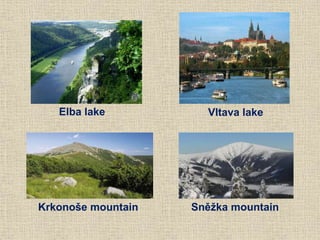
Vltava lakeElba lake
Krkonoše mountain Sněžka mountain
 Czech, formerly known as Bohemian, ia a
West Slavic language spoken by over 10
million people.
 It’s the official language in the Czech
Republic, and has minority language status in
Slovakia.
 Czech’s closest relative is Slovak, with which
it is mutually intelligible.
 It’s closely related to other West Slavic
languages, such as Silesian and Polish, and
more distantly to East Slavic languages such
The Economy
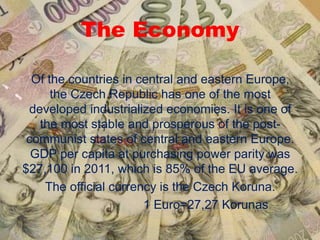
Of the countries in central and eastern Europe,
the Czech Republic has one of the most
developed industrialized economies. It is one of
the most stable and prosperous of the post-
communist states of central and eastern Europe.
GDP per capita at purchasing power parity was
$27,100 in 2011, which is 85% of the EU average.
The official currency is the Czech Koruna.
1 Euro=27,27 Korunas
The Industry
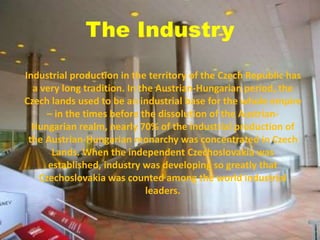
Industrial production in the territory of the Czech Republic has
a very long tradition. In the Austrian-Hungarian period, the
Czech lands used to be an industrial base for the whole empire
– in the times before the dissolution of the Austrian-
Hungarian realm, nearly 70% of the industrial production of
the Austrian-Hungarian monarchy was concentrated in Czech
Lands. When the independent Czechoslovakia was
established, industry was developing so greatly that
Czechoslovakia was counted among the world industrial
leaders.
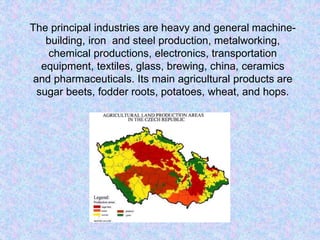
The principal industries are heavy and general machine-
building, iron and steel production, metalworking,
chemical productions, electronics, transportation
equipment, textiles, glass, brewing, china, ceramics
and pharmaceuticals. Its main agricultural products are
sugar beets, fodder roots, potatoes, wheat, and hops.
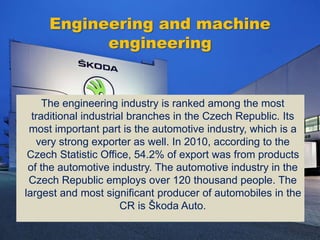
Engineering and machine
engineering
The engineering industry is ranked among the most
traditional industrial branches in the Czech Republic. Its
most important part is the automotive industry, which is a
very strong exporter as well. In 2010, according to the
Czech Statistic Office, 54.2% of export was from products
of the automotive industry. The automotive industry in the
Czech Republic employs over 120 thousand people. The
largest and most significant producer of automobiles in the
CR is Škoda Auto.
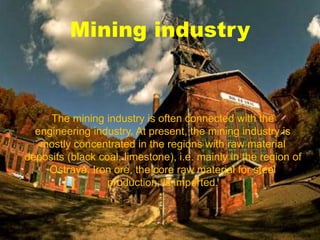
Mining industry
The mining industry is often connected with the
engineering industry. At present, the mining industry is
mostly concentrated in the regions with raw material
deposits (black coal, limestone), i.e. mainly in the region of
Ostrava. Iron ore, the core raw material for steel
production, is imported.
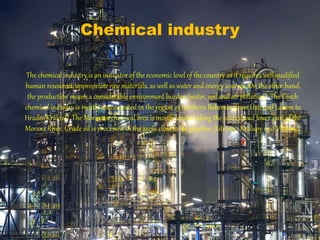
Chemical industry
The chemical industry is an indicator of the economic level of the country as it requires well-qualified
human resources, appropriate raw materials, as well as water and energy sources. On the other hand,
the production means a considerable environment burden (water, soil and air pollution). The Czech
chemical industry is mostly concentrated in the region of northern Bohemia (fromÚstí nad Labem to
Hradec Králové). The Moravian chemical area is mostly located along the central and lower part of the
Morava River. Crude oil is processed in the areas close to the pipeline (Litvínov, Kralupy nad Vltavou).
Foodstuff industry
The food processing industry is spread throughout the
whole territory of the Czech Republic. Basic inputs for
foodstuff production come from agricultural products,
products of forestry and water management, and from
imported products. Among most important segments of
the Czech foodstuff industry, beer production remains in
one of the leading positions. Every year, more than 2
million hl of beer is exported from the Czech Republic.
The largest producers of beer in the Czech Republic are
Prazdroj Plzeň, Staropramen Praha and Budvar České
Budějovice.
Popular Traditions
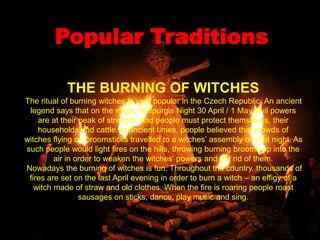
THE BURNING OF WITCHES
The ritual of burning witches is very popular in the Czech Republic. An ancient
legend says that on the magic Walpurgis Night 30 April / 1 May, evil powers
are at their peak of strength, and people must protect themselves, their
households and cattle. In ancient times, people believed that crowds of
witches flying on broomsticks travelled to a witches’ assembly on that night. As
such people would light fires on the hills, throwing burning brooms up into the
air in order to weaken the witches’ powers and get rid of them.
Nowadays the burning of witches is fun. Throughout the country, thousands of
fires are set on the last April evening in order to burn a witch – an effigy of a
witch made of straw and old clothes. When the fire is roaring people roast
sausages on sticks, dance, play music and sing.
King’s Parade
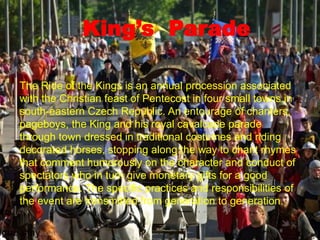
The Ride of the Kings is an annual procession associated
with the Christian feast of Pentecost in four small towns in
south-eastern Czech Republic. An entourage of chanters,
pageboys, the King and his royal cavalcade parade
through town dressed in traditional costumes and riding
decorated horses, stopping along the way to chant rhymes
that comment humorously on the character and conduct of
spectators who in turn give monetary gifts for a good
performance. The specific practices and responsibilities of
the event are transmitted from generation to generation.
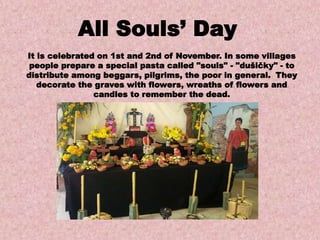
It is celebrated on 1st and 2nd of November. In some villages
people prepare a special pasta called "souls" - "dušičky" - to
distribute among beggars, pilgrims, the poor in general. They
decorate the graves with flowers, wreaths of flowers and
candles to remember the dead.
All Souls’ Day
Barborky
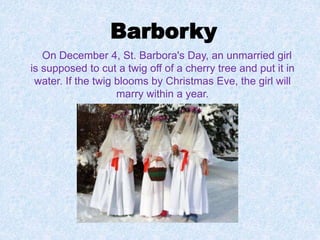
On December 4, St. Barbora's Day, an unmarried girl
is supposed to cut a twig off of a cherry tree and put it in
water. If the twig blooms by Christmas Eve, the girl will
marry within a year.
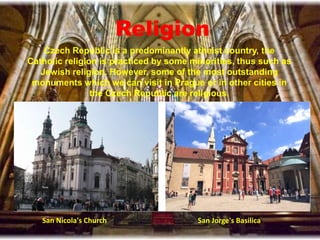
Religion
Czech Republic is a predominantly atheist country, the
Catholic religion is practiced by some minorities, thus such as
Jewish religion. However, some of the most outstanding
monuments which we can visit in Prague or in other cities in
the Czech Republic are religious.
San Nicola's Church San Jorge's Basilica
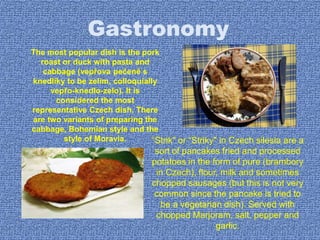
Gastronomy
The most popular dish is the pork
roast or duck with pasta and
cabbage (vepřova pečeně s
knedlíky to be zelim, colloquially
vepřo-knedlo-zelo). It is
considered the most
representative Czech dish. There
are two variants of preparing the
cabbage, Bohemian style and the
style of Moravia. “Strik" or “Striky" in Czech silesia are a
sort of pancakes fried and processed
potatoes in the form of pure (brambory
in Czech), flour, milk and sometimes
chopped sausages (but this is not very
common since the pancake is tried to
be a vegetarian dish). Served with
chopped Marjoram, salt, pepper and
garlic.
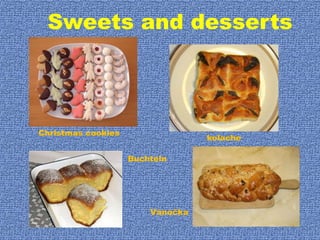
Sweets and desserts
kolache
Christmas cookies
Vánočka
Buchteln
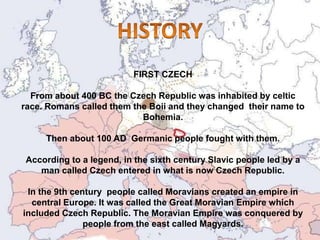
FIRST CZECH
From about 400 BC the Czech Republic was inhabited by celtic
race. Romans called them the Boii and they changed their name to
Bohemia.
Then about 100 AD Germanic people fought with them.
According to a legend, in the sixth century Slavic people led by a
man called Czech entered in what is now Czech Republic.
In the 9th century people called Moravians created an empire in
central Europe. It was called the Great Moravian Empire which
included Czech Republic. The Moravian Empire was conquered by
people from the east called Magyards.
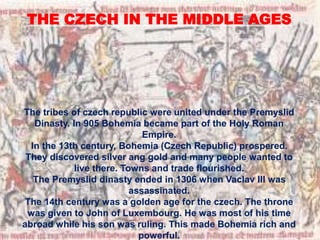
THE CZECH IN THE MIDDLE AGES
The tribes of czech republic were united under the Premyslid
Dinasty. In 905 Bohemia became part of the Holy Roman
Empire.
In the 13th century, Bohemia (Czech Republic) prospered.
They discovered silver ang gold and many people wanted to
live there. Towns and trade flourished.
The Premyslid dinasty ended in 1306 when Vaclav III was
assassinated.
The 14th century was a golden age for the czech. The throne
was given to John of Luxembourg. He was most of his time
abroad while his son was ruling. This made Bohemia rich and
powerful.
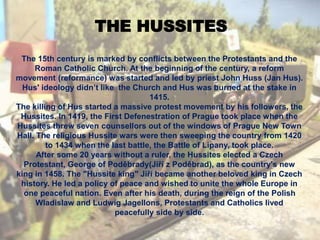
THE HUSSITES
The 15th century is marked by conflicts between the Protestants and the
Roman Catholic Church. At the beginning of the century, a reform
movement (reformance) was started and led by priest John Huss (Jan Hus).
Hus' ideology didn’t like the Church and Hus was burned at the stake in
1415.
The killing of Hus started a massive protest movement by his followers, the
Hussites. In 1419, the First Defenestration of Prague took place when the
Hussites threw seven counsellors out of the windows of Prague New Town
Hall. The religious Hussite wars were then sweeping the country from 1420
to 1434 when the last battle, the Battle of Lipany, took place.
After some 20 years without a ruler, the Hussites elected a Czech
Protestant, George of Poděbrady(Jiří z Poděbrad), as the country's new
king in 1458. The "Hussite king" Jiří became another beloved king in Czech
history. He led a policy of peace and wished to unite the whole Europe in
one peaceful nation. Even after his death, during the reign of the Polish
Wladislaw and Ludwig Jagellons, Protestants and Catholics lived
peacefully side by side.
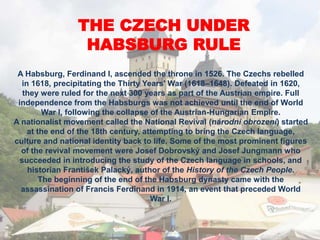
THE CZECH UNDER
HABSBURG RULE
A Habsburg, Ferdinand I, ascended the throne in 1526. The Czechs rebelled
in 1618, precipitating the Thirty Years' War (1618–1648). Defeated in 1620,
they were ruled for the next 300 years as part of the Austrian empire. Full
independence from the Habsburgs was not achieved until the end of World
War I, following the collapse of the Austrian-Hungarian Empire.
A nationalist movement called the National Revival (národní obrození) started
at the end of the 18th century, attempting to bring the Czech language,
culture and national identity back to life. Some of the most prominent figures
of the revival movement were Josef Dobrovský and Josef Jungmann who
succeeded in introducing the study of the Czech language in schools, and
historian František Palacký, author of the History of the Czech People.
The beginning of the end of the Habsburg dynasty came with the
assassination of Francis Ferdinand in 1914, an event that preceded World
War I.
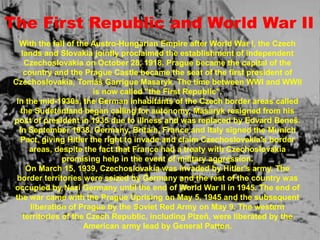
The First Republic and World War II
With the fall of the Austro-Hungarian Empire after World War I, the Czech
lands and Slovakia jointly proclaimed the establishment of independent
Czechoslovakia on October 28, 1918. Prague became the capital of the
country and the Prague Castle became the seat of the first president of
Czechoslovakia, Tomáš Garrigue Masaryk. The time between WWI and WWII
is now called "the First Republic".
In the mid-1930s, the German inhabitants of the Czech border areas called
the Sudetenland began calling for autonomy. Masaryk resigned from his
post of president in 1935 due to illness and was replaced by Edvard Beneš.
In September 1938, Germany, Britain, France and Italy signed the Munich
Pact, giving Hitler the right to invade and claim Czechoslovakia's border
areas, despite the fact that France had a treaty with Czechoslovakia
promising help in the event of military aggression.
On March 15, 1939, Czechoslovakia was invaded by Hitler's army. The
border territories were seized by Germany and the rest of the country was
occupied by Nazi Germany until the end of World War II in 1945. The end of
the war came with the Prague Uprising on May 5, 1945 and the subsequent
liberation of Prague by the Soviet Red Army on May 9. The western
territories of the Czech Republic, including Plzeň, were liberated by the
American army lead by General Patton.
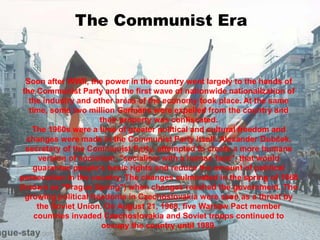
The Communist Era
Soon after WWII, the power in the country went largely to the hands of
the Communist Party and the first wave of nationwide nationalization of
the industry and other areas of the economy took place. At the same
time, some two million Germans were expelled from the country and
their property was confiscated.
The 1960s were a time of greater political and cultural freedom and
changes were made in the Communist Party itself. Alexander Dubček,
secretary of the Communist Party, attempted to create a more humane
version of socialism, "socialism with a human face", that would
guarantee people's basic rights and reduce the amount of political
persecution in the country. The changes culminated in the spring of 1968
(known as "Prague Spring") when changes reached the government. The
growing political freedoms in Czechoslovakia were seen as a threat by
the Soviet Union. On August 21, 1968, five Warsaw Pact member
countries invaded Czechoslovakia and Soviet troops continued to
occupy the country until 1989.
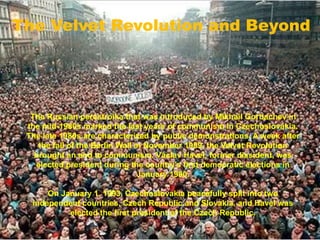
The Velvet Revolution and Beyond
The Russian perestroika that was introduced by Mikhail Gorbachev in
the mid-1980s marked the last years of communism in Czechoslovakia.
The late 1980s are characterized by public demonstrations. A week after
the fall of the Berlin Wall in November 1989, the Velvet Revolution
brought an end to communism. Václav Havel, former dissident, was
elected president during the country's first democratic elections in
January 1990.
On January 1, 1993, Czechoslovakia peacefully split into two
independent countries, Czech Republic and Slovakia, and Havel was
elected the first president of the Czech Republic.
ART AND CULTURE
Music is the first artistic expression in this country, and
especially in its capital Prague, where about ten concerts
a day are usually performed. The most famous composer
of the Czech Republic, is Antonin Dvorak - composer
whose work was carried to the moon by Neil Armstrong in
1969! This is perhaps the most famous - Symphony No. 9
New World -.
Other famous Czech composers are Leos Janacek,
Bohuslav Martinu, and Milan Slavicky.
The performing arts are also a widely practised art form.
It also has an impressive monumental architecture of a
rich artistic quality. Many buildings are of medieval origin.
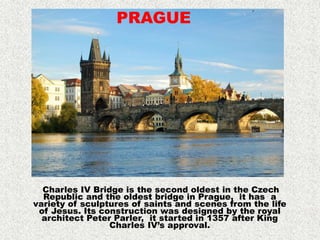
Charles IV Bridge is the second oldest in the Czech
Republic and the oldest bridge in Prague, it has a
variety of sculptures of saints and scenes from the life
of Jesus. Its construction was designed by the royal
architect Peter Parler, it started in 1357 after King
Charles IV’s approval.
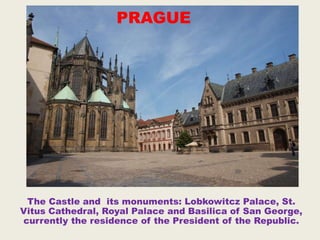
PRAGUE
The Castle and its monuments: Lobkowitcz Palace, St.
Vitus Cathedral, Royal Palace and Basilica of San George,
currently the residence of the President of the Republic.
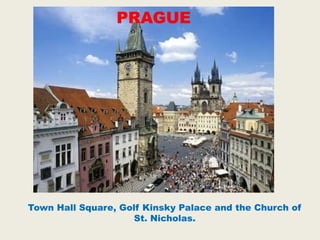
PRAGUE
Town Hall Square, Golf Kinsky Palace and the Church of
St. Nicholas.
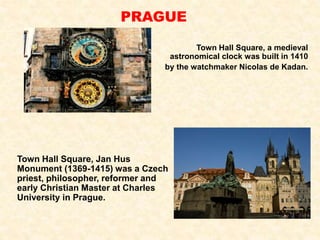
PRAGUE
Town Hall Square, a medieval
astronomical clock was built in 1410
by the watchmaker Nicolas de Kadan.
PRAGUE
Town Hall Square, Jan Hus
Monument (1369-1415) was a Czech
priest, philosopher, reformer and
early Christian Master at Charles
University in Prague.
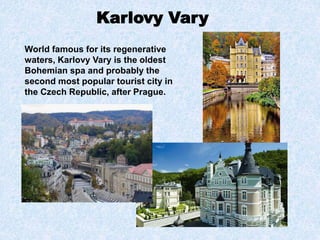
Karlovy Vary
World famous for its regenerative
waters, Karlovy Vary is the oldest
Bohemian spa and probably the
second most popular tourist city in
the Czech Republic, after Prague.
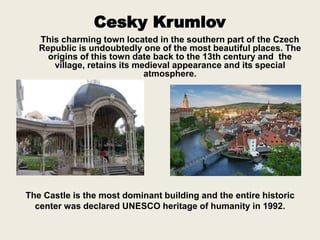
Cesky Krumlov
This charming town located in the southern part of the Czech
Republic is undoubtedly one of the most beautiful places. The
origins of this town date back to the 13th century and the
village, retains its medieval appearance and its special
atmosphere.
The Castle is the most dominant building and the entire historic
center was declared UNESCO heritage of humanity in 1992.
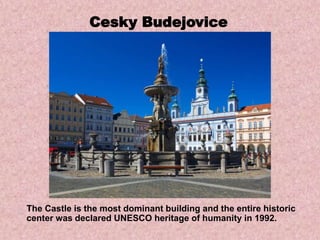
Cesky Budejovice
The Castle is the most dominant building and the entire historic
center was declared UNESCO heritage of humanity in 1992.
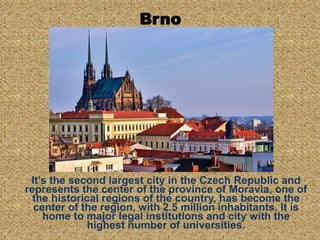
Brno
It’s the second largest city in the Czech Republic and
represents the center of the province of Moravia, one of
the historical regions of the country, has become the
center of the region, with 2.5 million inhabitants. It is
home to major legal institutions and city with the
highest number of universities.
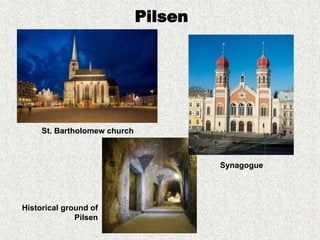
Pilsen
St. Bartholomew church
Historical ground of
Pilsen
Synagogue
Celebrities
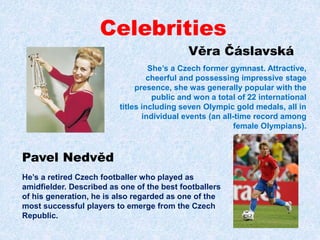
Věra Čáslavská
She’s a Czech former gymnast. Attractive,
cheerful and possessing impressive stage
presence, she was generally popular with the
public and won a total of 22 international
titles including seven Olympic gold medals, all in
individual events (an all-time record among
female Olympians).
He’s a retired Czech footballer who played as
amidfielder. Described as one of the best footballers
of his generation, he is also regarded as one of the
most successful players to emerge from the Czech
Republic.
Pavel Nedvěd
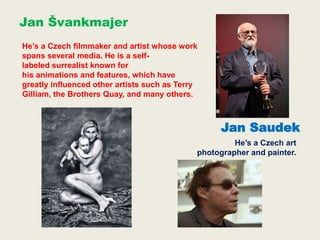
Jan Švankmajer
He’s a Czech filmmaker and artist whose work
spans several media. He is a self-
labeled surrealist known for
his animations and features, which have
greatly influenced other artists such as Terry
Gilliam, the Brothers Quay, and many others.
Jan Saudek
He’s a Czech art
photographer and painter.
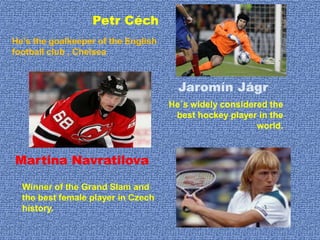
Petr Céch
He’s the goalkeeper of the English
football club , Chelsea
He´s widely considered the
best hockey player in the
world.
Jaromín Jágr
Martina Navratilova
Winner of the Grand Slam and
the best female player in Czech
history.
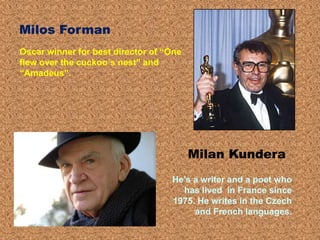
Milos Forman
Oscar winner for best director of “One
flew over the cuckoo´s nest” and
“Amadeus”.
Milan Kundera
He’s a writer and a poet who
has lived in France since
1975. He writes in the Czech
and French languages.
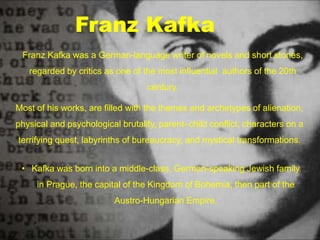
Franz Kafka was a German-language writer of novels and short stories,
regarded by critics as one of the most influential authors of the 20th
century.
Most of his works, are filled with the themes and archetypes of alienation,
physical and psychological brutality, parent–child conflict, characters on a
terrifying quest, labyrinths of bureaucracy, and mystical transformations.
Franz Kafka
• Kafka was born into a middle-class, German-speaking Jewish family
in Prague, the capital of the Kingdom of Bohemia, then part of the
Austro-Hungarian Empire.
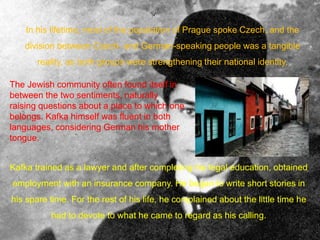
In his lifetime, most of the population of Prague spoke Czech, and the
division between Czech- and German-speaking people was a tangible
reality, as both groups were strengthening their national identity.
The Jewish community often found itself in
between the two sentiments, naturally
raising questions about a place to which one
belongs. Kafka himself was fluent in both
languages, considering German his mother
tongue.
Kafka trained as a lawyer and after completing his legal education, obtained
employment with an insurance company. He began to write short stories in
his spare time. For the rest of his life, he complained about the little time he
had to devote to what he came to regard as his calling.
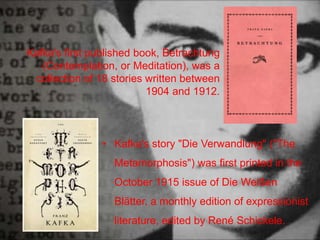
Kafka's first published book, Betrachtung
(Contemplation, or Meditation), was a
collection of 18 stories written between
1904 and 1912.
• Kafka's story "Die Verwandlung" ("The
Metamorphosis") was first printed in the
October 1915 issue of Die Weißen
Blätter, a monthly edition of expressionist
literature, edited by René Schickele.
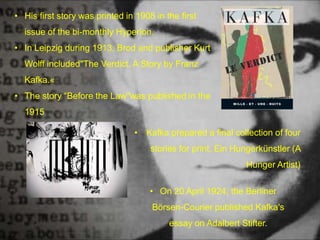
• His first story was printed in 1908 in the first
issue of the bi-monthly Hyperion.
• In Leipzig during 1913, Brod and publisher Kurt
Wolff included"The Verdict. A Story by Franz
Kafka.«
• The story “Before the Law"was published in the
1915
• Kafka prepared a final collection of four
stories for print, Ein Hungerkünstler (A
Hunger Artist)
• On 20 April 1924, the Berliner
Börsen-Courier published Kafka's
essay on Adalbert Stifter.

Czech republic

  • 1.
  • 4.
    Vltava lakeElba lake Krkonošemountain Sněžka mountain
  • 5.
     Czech, formerlyknown as Bohemian, ia a West Slavic language spoken by over 10 million people.  It’s the official language in the Czech Republic, and has minority language status in Slovakia.  Czech’s closest relative is Slovak, with which it is mutually intelligible.  It’s closely related to other West Slavic languages, such as Silesian and Polish, and more distantly to East Slavic languages such
  • 6.
    The Economy Of thecountries in central and eastern Europe, the Czech Republic has one of the most developed industrialized economies. It is one of the most stable and prosperous of the post- communist states of central and eastern Europe. GDP per capita at purchasing power parity was $27,100 in 2011, which is 85% of the EU average. The official currency is the Czech Koruna. 1 Euro=27,27 Korunas
  • 7.
    The Industry Industrial productionin the territory of the Czech Republic has a very long tradition. In the Austrian-Hungarian period, the Czech lands used to be an industrial base for the whole empire – in the times before the dissolution of the Austrian- Hungarian realm, nearly 70% of the industrial production of the Austrian-Hungarian monarchy was concentrated in Czech Lands. When the independent Czechoslovakia was established, industry was developing so greatly that Czechoslovakia was counted among the world industrial leaders.
  • 8.
    The principal industriesare heavy and general machine- building, iron and steel production, metalworking, chemical productions, electronics, transportation equipment, textiles, glass, brewing, china, ceramics and pharmaceuticals. Its main agricultural products are sugar beets, fodder roots, potatoes, wheat, and hops.
  • 9.
    Engineering and machine engineering Theengineering industry is ranked among the most traditional industrial branches in the Czech Republic. Its most important part is the automotive industry, which is a very strong exporter as well. In 2010, according to the Czech Statistic Office, 54.2% of export was from products of the automotive industry. The automotive industry in the Czech Republic employs over 120 thousand people. The largest and most significant producer of automobiles in the CR is Škoda Auto.
  • 10.
    Mining industry The miningindustry is often connected with the engineering industry. At present, the mining industry is mostly concentrated in the regions with raw material deposits (black coal, limestone), i.e. mainly in the region of Ostrava. Iron ore, the core raw material for steel production, is imported.
  • 11.
    Chemical industry The chemicalindustry is an indicator of the economic level of the country as it requires well-qualified human resources, appropriate raw materials, as well as water and energy sources. On the other hand, the production means a considerable environment burden (water, soil and air pollution). The Czech chemical industry is mostly concentrated in the region of northern Bohemia (fromÚstí nad Labem to Hradec Králové). The Moravian chemical area is mostly located along the central and lower part of the Morava River. Crude oil is processed in the areas close to the pipeline (Litvínov, Kralupy nad Vltavou).
  • 12.
    Foodstuff industry The foodprocessing industry is spread throughout the whole territory of the Czech Republic. Basic inputs for foodstuff production come from agricultural products, products of forestry and water management, and from imported products. Among most important segments of the Czech foodstuff industry, beer production remains in one of the leading positions. Every year, more than 2 million hl of beer is exported from the Czech Republic. The largest producers of beer in the Czech Republic are Prazdroj Plzeň, Staropramen Praha and Budvar České Budějovice.
  • 13.
    Popular Traditions THE BURNINGOF WITCHES The ritual of burning witches is very popular in the Czech Republic. An ancient legend says that on the magic Walpurgis Night 30 April / 1 May, evil powers are at their peak of strength, and people must protect themselves, their households and cattle. In ancient times, people believed that crowds of witches flying on broomsticks travelled to a witches’ assembly on that night. As such people would light fires on the hills, throwing burning brooms up into the air in order to weaken the witches’ powers and get rid of them. Nowadays the burning of witches is fun. Throughout the country, thousands of fires are set on the last April evening in order to burn a witch – an effigy of a witch made of straw and old clothes. When the fire is roaring people roast sausages on sticks, dance, play music and sing.
  • 14.
    King’s Parade The Rideof the Kings is an annual procession associated with the Christian feast of Pentecost in four small towns in south-eastern Czech Republic. An entourage of chanters, pageboys, the King and his royal cavalcade parade through town dressed in traditional costumes and riding decorated horses, stopping along the way to chant rhymes that comment humorously on the character and conduct of spectators who in turn give monetary gifts for a good performance. The specific practices and responsibilities of the event are transmitted from generation to generation.
  • 15.
    It is celebratedon 1st and 2nd of November. In some villages people prepare a special pasta called "souls" - "dušičky" - to distribute among beggars, pilgrims, the poor in general. They decorate the graves with flowers, wreaths of flowers and candles to remember the dead. All Souls’ Day
  • 16.
    Barborky On December 4,St. Barbora's Day, an unmarried girl is supposed to cut a twig off of a cherry tree and put it in water. If the twig blooms by Christmas Eve, the girl will marry within a year.
  • 17.
    Religion Czech Republic isa predominantly atheist country, the Catholic religion is practiced by some minorities, thus such as Jewish religion. However, some of the most outstanding monuments which we can visit in Prague or in other cities in the Czech Republic are religious. San Nicola's Church San Jorge's Basilica
  • 18.
    Gastronomy The most populardish is the pork roast or duck with pasta and cabbage (vepřova pečeně s knedlíky to be zelim, colloquially vepřo-knedlo-zelo). It is considered the most representative Czech dish. There are two variants of preparing the cabbage, Bohemian style and the style of Moravia. “Strik" or “Striky" in Czech silesia are a sort of pancakes fried and processed potatoes in the form of pure (brambory in Czech), flour, milk and sometimes chopped sausages (but this is not very common since the pancake is tried to be a vegetarian dish). Served with chopped Marjoram, salt, pepper and garlic.
  • 19.
    Sweets and desserts kolache Christmascookies Vánočka Buchteln
  • 20.
    FIRST CZECH From about400 BC the Czech Republic was inhabited by celtic race. Romans called them the Boii and they changed their name to Bohemia. Then about 100 AD Germanic people fought with them. According to a legend, in the sixth century Slavic people led by a man called Czech entered in what is now Czech Republic. In the 9th century people called Moravians created an empire in central Europe. It was called the Great Moravian Empire which included Czech Republic. The Moravian Empire was conquered by people from the east called Magyards.
  • 21.
    THE CZECH INTHE MIDDLE AGES The tribes of czech republic were united under the Premyslid Dinasty. In 905 Bohemia became part of the Holy Roman Empire. In the 13th century, Bohemia (Czech Republic) prospered. They discovered silver ang gold and many people wanted to live there. Towns and trade flourished. The Premyslid dinasty ended in 1306 when Vaclav III was assassinated. The 14th century was a golden age for the czech. The throne was given to John of Luxembourg. He was most of his time abroad while his son was ruling. This made Bohemia rich and powerful.
  • 22.
    THE HUSSITES The 15thcentury is marked by conflicts between the Protestants and the Roman Catholic Church. At the beginning of the century, a reform movement (reformance) was started and led by priest John Huss (Jan Hus). Hus' ideology didn’t like the Church and Hus was burned at the stake in 1415. The killing of Hus started a massive protest movement by his followers, the Hussites. In 1419, the First Defenestration of Prague took place when the Hussites threw seven counsellors out of the windows of Prague New Town Hall. The religious Hussite wars were then sweeping the country from 1420 to 1434 when the last battle, the Battle of Lipany, took place. After some 20 years without a ruler, the Hussites elected a Czech Protestant, George of Poděbrady(Jiří z Poděbrad), as the country's new king in 1458. The "Hussite king" Jiří became another beloved king in Czech history. He led a policy of peace and wished to unite the whole Europe in one peaceful nation. Even after his death, during the reign of the Polish Wladislaw and Ludwig Jagellons, Protestants and Catholics lived peacefully side by side.
  • 23.
    THE CZECH UNDER HABSBURGRULE A Habsburg, Ferdinand I, ascended the throne in 1526. The Czechs rebelled in 1618, precipitating the Thirty Years' War (1618–1648). Defeated in 1620, they were ruled for the next 300 years as part of the Austrian empire. Full independence from the Habsburgs was not achieved until the end of World War I, following the collapse of the Austrian-Hungarian Empire. A nationalist movement called the National Revival (národní obrození) started at the end of the 18th century, attempting to bring the Czech language, culture and national identity back to life. Some of the most prominent figures of the revival movement were Josef Dobrovský and Josef Jungmann who succeeded in introducing the study of the Czech language in schools, and historian František Palacký, author of the History of the Czech People. The beginning of the end of the Habsburg dynasty came with the assassination of Francis Ferdinand in 1914, an event that preceded World War I.
  • 24.
    The First Republicand World War II With the fall of the Austro-Hungarian Empire after World War I, the Czech lands and Slovakia jointly proclaimed the establishment of independent Czechoslovakia on October 28, 1918. Prague became the capital of the country and the Prague Castle became the seat of the first president of Czechoslovakia, Tomáš Garrigue Masaryk. The time between WWI and WWII is now called "the First Republic". In the mid-1930s, the German inhabitants of the Czech border areas called the Sudetenland began calling for autonomy. Masaryk resigned from his post of president in 1935 due to illness and was replaced by Edvard Beneš. In September 1938, Germany, Britain, France and Italy signed the Munich Pact, giving Hitler the right to invade and claim Czechoslovakia's border areas, despite the fact that France had a treaty with Czechoslovakia promising help in the event of military aggression. On March 15, 1939, Czechoslovakia was invaded by Hitler's army. The border territories were seized by Germany and the rest of the country was occupied by Nazi Germany until the end of World War II in 1945. The end of the war came with the Prague Uprising on May 5, 1945 and the subsequent liberation of Prague by the Soviet Red Army on May 9. The western territories of the Czech Republic, including Plzeň, were liberated by the American army lead by General Patton.
  • 25.
    The Communist Era Soonafter WWII, the power in the country went largely to the hands of the Communist Party and the first wave of nationwide nationalization of the industry and other areas of the economy took place. At the same time, some two million Germans were expelled from the country and their property was confiscated. The 1960s were a time of greater political and cultural freedom and changes were made in the Communist Party itself. Alexander Dubček, secretary of the Communist Party, attempted to create a more humane version of socialism, "socialism with a human face", that would guarantee people's basic rights and reduce the amount of political persecution in the country. The changes culminated in the spring of 1968 (known as "Prague Spring") when changes reached the government. The growing political freedoms in Czechoslovakia were seen as a threat by the Soviet Union. On August 21, 1968, five Warsaw Pact member countries invaded Czechoslovakia and Soviet troops continued to occupy the country until 1989.
  • 26.
    The Velvet Revolutionand Beyond The Russian perestroika that was introduced by Mikhail Gorbachev in the mid-1980s marked the last years of communism in Czechoslovakia. The late 1980s are characterized by public demonstrations. A week after the fall of the Berlin Wall in November 1989, the Velvet Revolution brought an end to communism. Václav Havel, former dissident, was elected president during the country's first democratic elections in January 1990. On January 1, 1993, Czechoslovakia peacefully split into two independent countries, Czech Republic and Slovakia, and Havel was elected the first president of the Czech Republic.
  • 27.
    ART AND CULTURE Musicis the first artistic expression in this country, and especially in its capital Prague, where about ten concerts a day are usually performed. The most famous composer of the Czech Republic, is Antonin Dvorak - composer whose work was carried to the moon by Neil Armstrong in 1969! This is perhaps the most famous - Symphony No. 9 New World -. Other famous Czech composers are Leos Janacek, Bohuslav Martinu, and Milan Slavicky. The performing arts are also a widely practised art form. It also has an impressive monumental architecture of a rich artistic quality. Many buildings are of medieval origin.
  • 28.
    Charles IV Bridgeis the second oldest in the Czech Republic and the oldest bridge in Prague, it has a variety of sculptures of saints and scenes from the life of Jesus. Its construction was designed by the royal architect Peter Parler, it started in 1357 after King Charles IV’s approval. PRAGUE
  • 29.
    The Castle andits monuments: Lobkowitcz Palace, St. Vitus Cathedral, Royal Palace and Basilica of San George, currently the residence of the President of the Republic. PRAGUE
  • 30.
    Town Hall Square,Golf Kinsky Palace and the Church of St. Nicholas. PRAGUE
  • 31.
    Town Hall Square,a medieval astronomical clock was built in 1410 by the watchmaker Nicolas de Kadan. PRAGUE Town Hall Square, Jan Hus Monument (1369-1415) was a Czech priest, philosopher, reformer and early Christian Master at Charles University in Prague.
  • 32.
    Karlovy Vary World famousfor its regenerative waters, Karlovy Vary is the oldest Bohemian spa and probably the second most popular tourist city in the Czech Republic, after Prague.
  • 33.
    Cesky Krumlov This charmingtown located in the southern part of the Czech Republic is undoubtedly one of the most beautiful places. The origins of this town date back to the 13th century and the village, retains its medieval appearance and its special atmosphere. The Castle is the most dominant building and the entire historic center was declared UNESCO heritage of humanity in 1992.
  • 34.
    Cesky Budejovice The Castleis the most dominant building and the entire historic center was declared UNESCO heritage of humanity in 1992.
  • 35.
    Brno It’s the secondlargest city in the Czech Republic and represents the center of the province of Moravia, one of the historical regions of the country, has become the center of the region, with 2.5 million inhabitants. It is home to major legal institutions and city with the highest number of universities.
  • 36.
    Pilsen St. Bartholomew church Historicalground of Pilsen Synagogue
  • 37.
    Celebrities Věra Čáslavská She’s aCzech former gymnast. Attractive, cheerful and possessing impressive stage presence, she was generally popular with the public and won a total of 22 international titles including seven Olympic gold medals, all in individual events (an all-time record among female Olympians). He’s a retired Czech footballer who played as amidfielder. Described as one of the best footballers of his generation, he is also regarded as one of the most successful players to emerge from the Czech Republic. Pavel Nedvěd
  • 38.
    Jan Švankmajer He’s aCzech filmmaker and artist whose work spans several media. He is a self- labeled surrealist known for his animations and features, which have greatly influenced other artists such as Terry Gilliam, the Brothers Quay, and many others. Jan Saudek He’s a Czech art photographer and painter.
  • 39.
    Petr Céch He’s thegoalkeeper of the English football club , Chelsea He´s widely considered the best hockey player in the world. Jaromín Jágr Martina Navratilova Winner of the Grand Slam and the best female player in Czech history.
  • 40.
    Milos Forman Oscar winnerfor best director of “One flew over the cuckoo´s nest” and “Amadeus”. Milan Kundera He’s a writer and a poet who has lived in France since 1975. He writes in the Czech and French languages.
  • 41.
    Franz Kafka wasa German-language writer of novels and short stories, regarded by critics as one of the most influential authors of the 20th century. Most of his works, are filled with the themes and archetypes of alienation, physical and psychological brutality, parent–child conflict, characters on a terrifying quest, labyrinths of bureaucracy, and mystical transformations. Franz Kafka • Kafka was born into a middle-class, German-speaking Jewish family in Prague, the capital of the Kingdom of Bohemia, then part of the Austro-Hungarian Empire.
  • 42.
    In his lifetime,most of the population of Prague spoke Czech, and the division between Czech- and German-speaking people was a tangible reality, as both groups were strengthening their national identity. The Jewish community often found itself in between the two sentiments, naturally raising questions about a place to which one belongs. Kafka himself was fluent in both languages, considering German his mother tongue. Kafka trained as a lawyer and after completing his legal education, obtained employment with an insurance company. He began to write short stories in his spare time. For the rest of his life, he complained about the little time he had to devote to what he came to regard as his calling.
  • 43.
    Kafka's first publishedbook, Betrachtung (Contemplation, or Meditation), was a collection of 18 stories written between 1904 and 1912. • Kafka's story "Die Verwandlung" ("The Metamorphosis") was first printed in the October 1915 issue of Die Weißen Blätter, a monthly edition of expressionist literature, edited by René Schickele.
  • 44.
    • His firststory was printed in 1908 in the first issue of the bi-monthly Hyperion. • In Leipzig during 1913, Brod and publisher Kurt Wolff included"The Verdict. A Story by Franz Kafka.« • The story “Before the Law"was published in the 1915 • Kafka prepared a final collection of four stories for print, Ein Hungerkünstler (A Hunger Artist) • On 20 April 1924, the Berliner Börsen-Courier published Kafka's essay on Adalbert Stifter.