To what extent are GLAMs ready for Open Data and
Crowdsourcing?
Results of a Pilot Survey from Switzerland
Beat Estermann, 12 April 2013


                      This work is licensed under a Creative Commons Attribution-ShareAlike 3.0 Unported License.
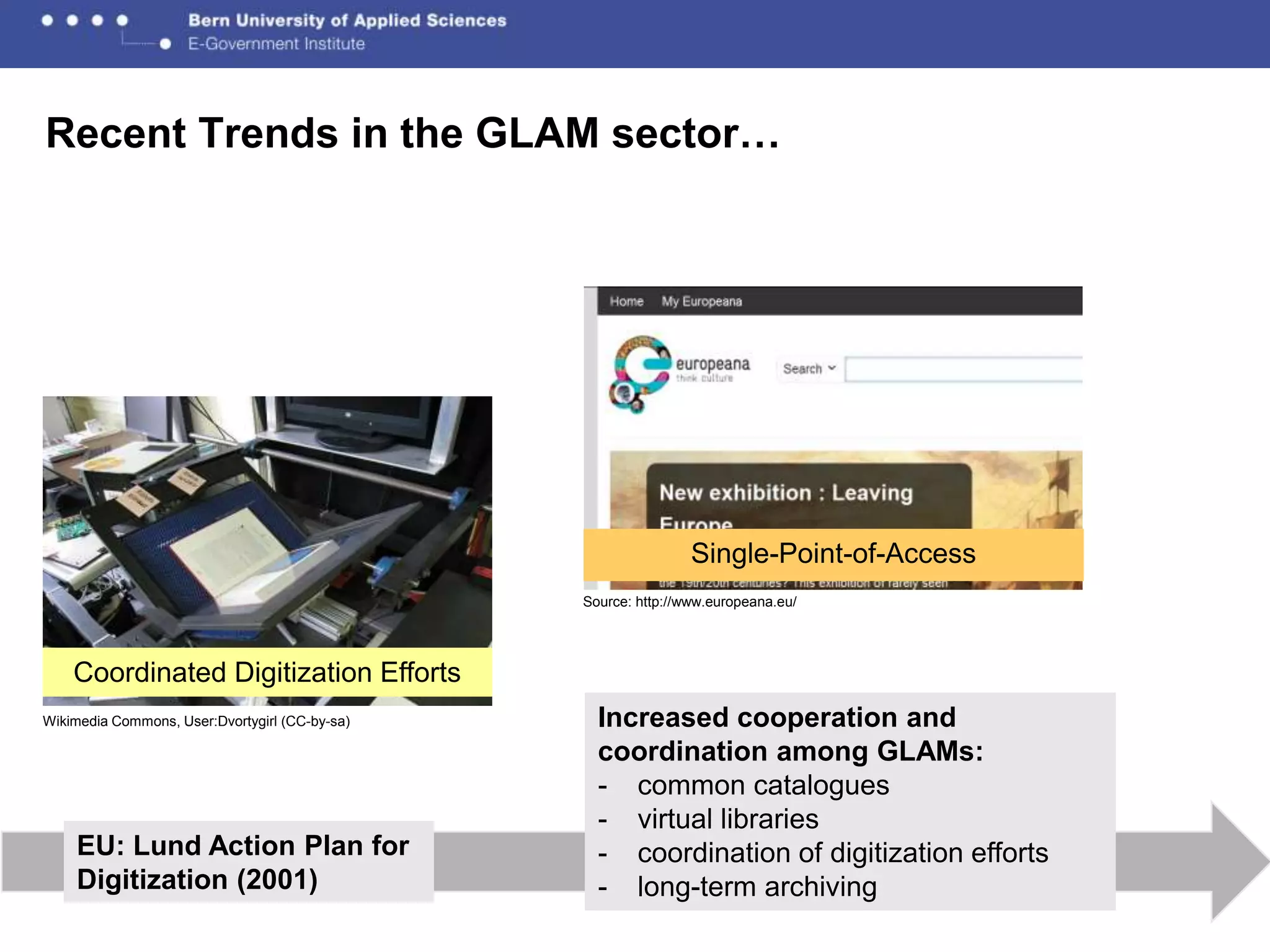
Recent Trends in the GLAM sector…


                                                                Single-Point-of-Access
                                                Source: http://www.europeana.eu/


    Coordinated Digitization Efforts
Wikimedia Commons, User:Dvortygirl (CC-by-sa)     Increased cooperation and
                                                  coordination among GLAMs:
                                                  - common catalogues
                                                  - virtual libraries
    EU: Lund Action Plan for                      - coordination of digitization efforts
    Digitization (2001)                           - long-term archiving                    2
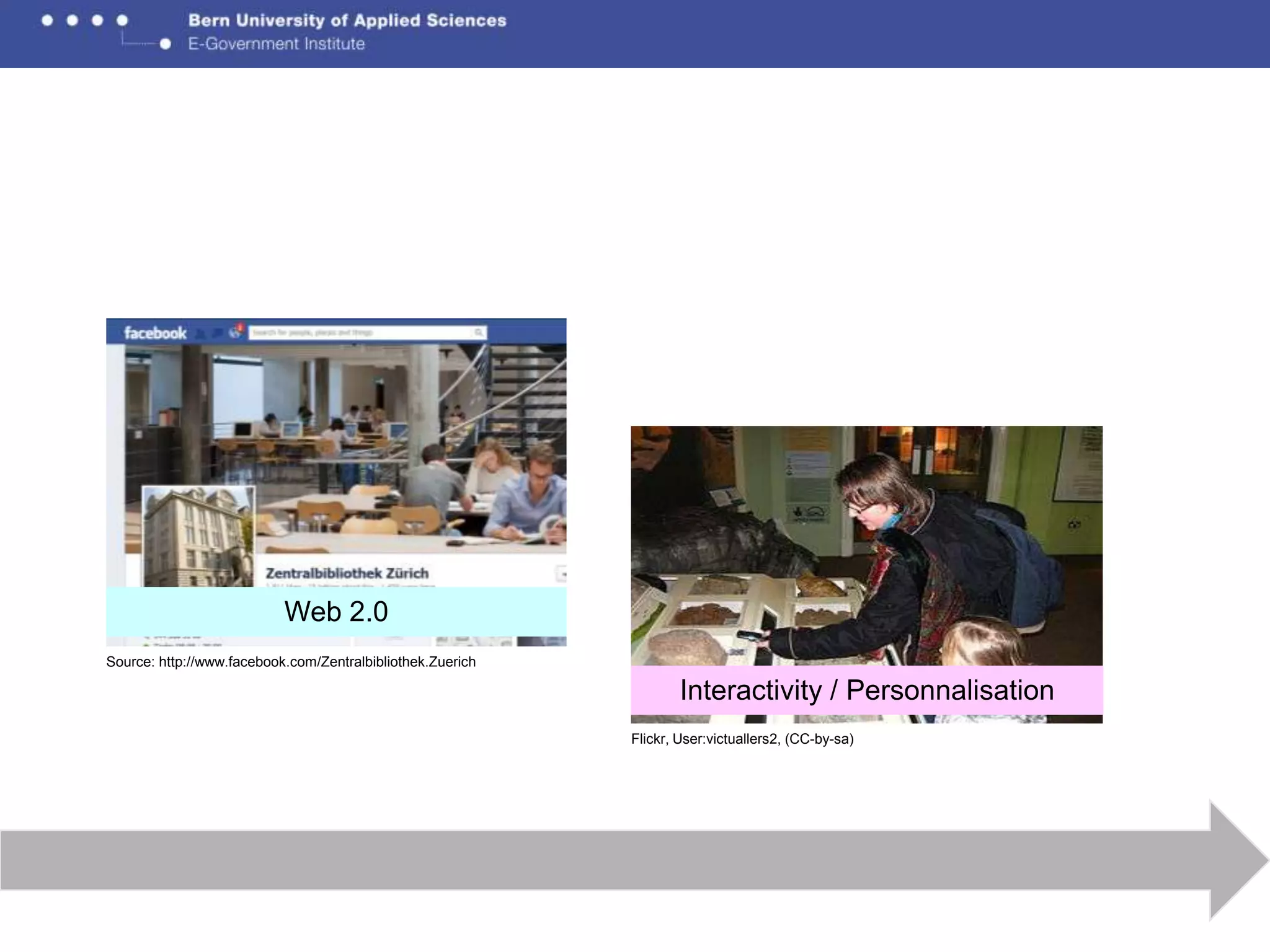
Web 2.0
Source: http://www.facebook.com/Zentralbibliothek.Zuerich

                                                                    Interactivity / Personnalisation
                                                            Flickr, User:victuallers2, (CC-by-sa)


                                                                                                       3
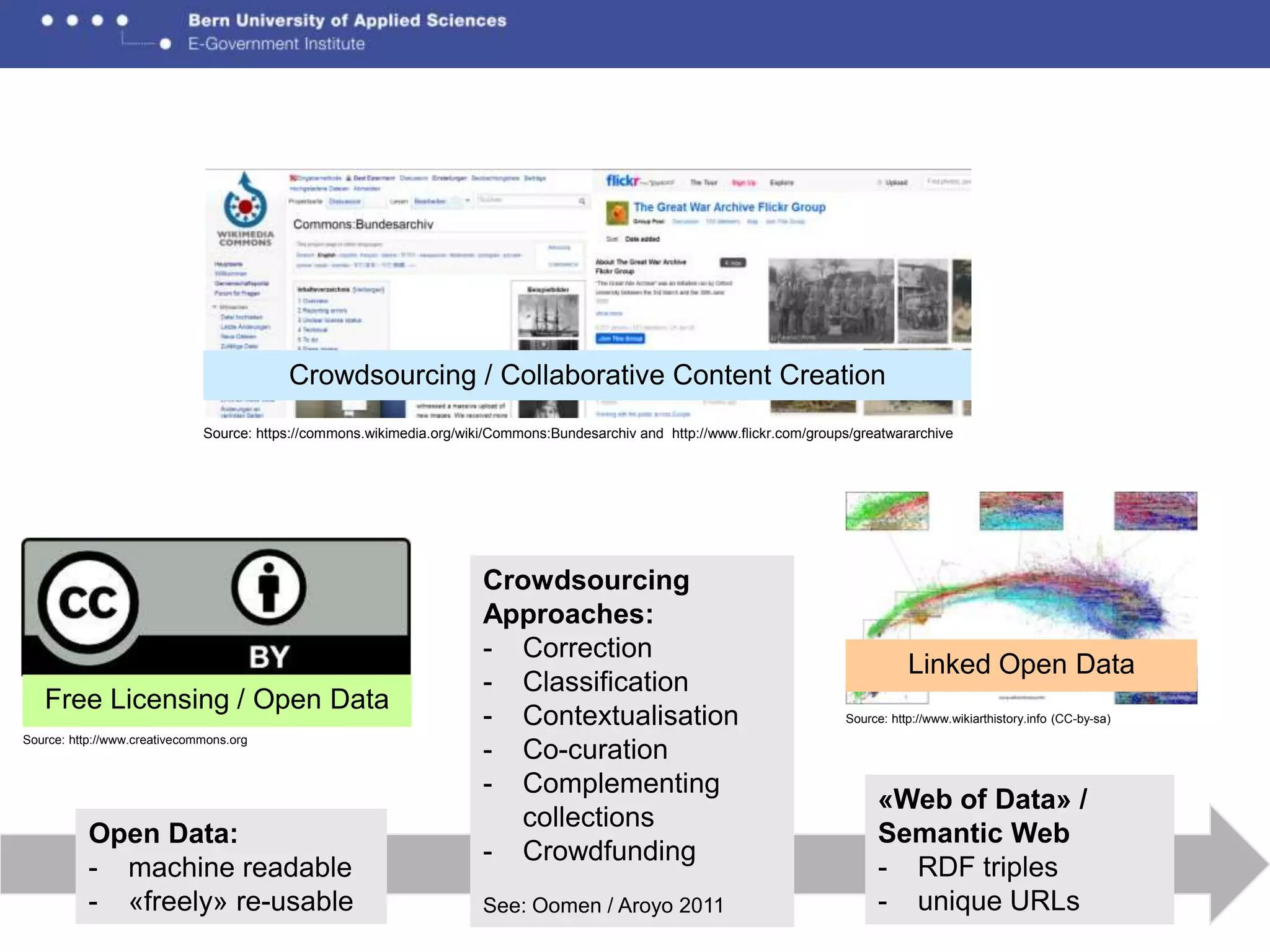
Crowdsourcing / Collaborative Content Creation
                              Source: https://commons.wikimedia.org/wiki/Commons:Bundesarchiv and http://www.flickr.com/groups/greatwararchive


                                                                       Crowdsourcing
                                                                       Approaches:
                                                                       - Correction
                                                                                                                                        Linked Open Data
                                                                       - Classification
   Free Licensing / Open Data
                                                                       - Contextualisation                                   Source: http://www.wikiarthistory.info (CC-by-sa)
Source: http://www.creativecommons.org
                                                                       - Co-curation
                                                                       - Complementing
                                                                                                                                  «Web of Data» /
                                                                         collections
           Open Data:                                                                                                             Semantic Web
                                                                       - Crowdfunding
           - machine readable                                                                                                     - RDF triples
                                                                                                                                                                                 4
           - «freely» re-usable                                        See: Oomen / Aroyo 2011                                    - unique URLs
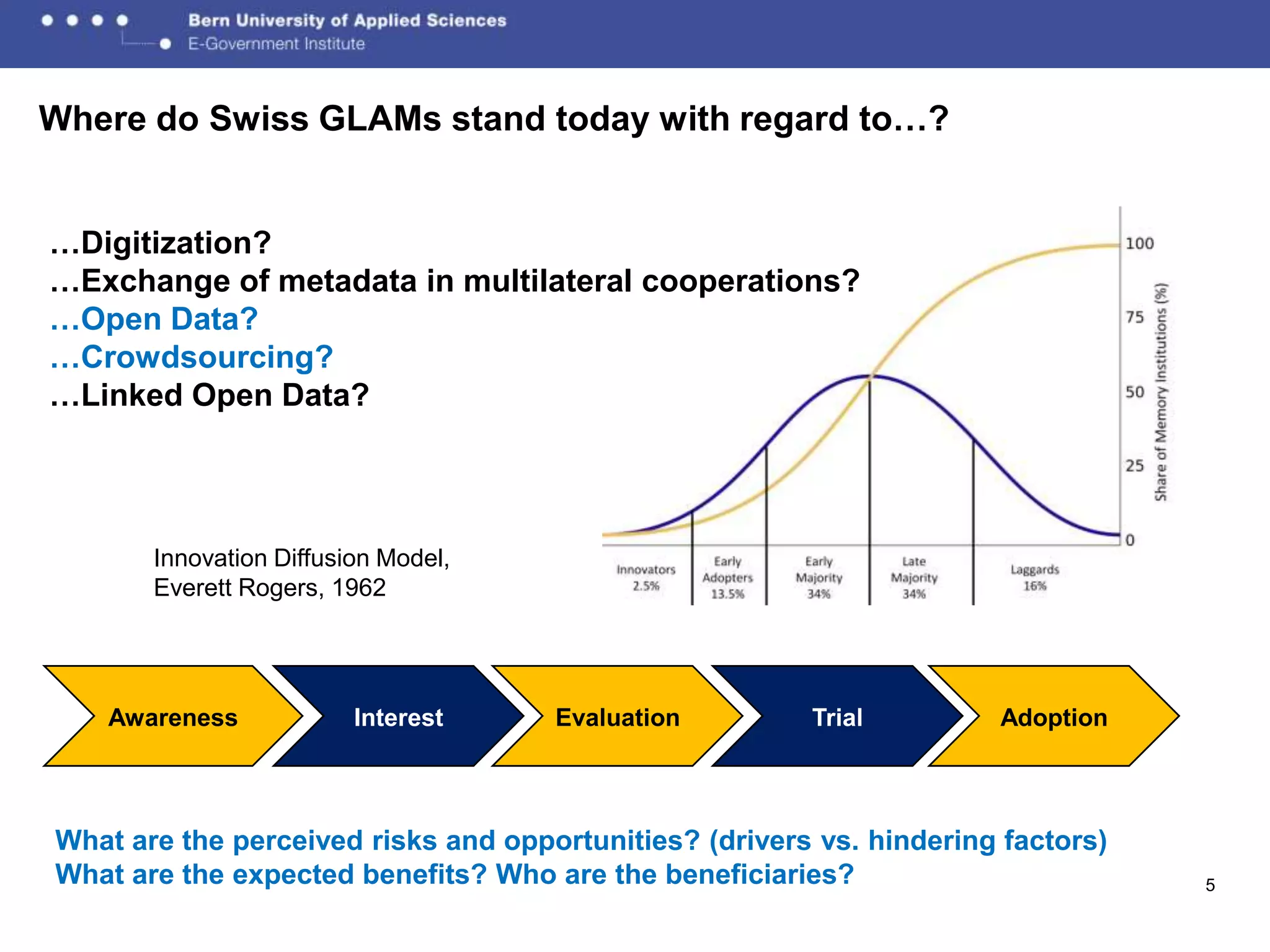
Where do Swiss GLAMs stand today with regard to…?


…Digitization?
…Exchange of metadata in multilateral cooperations?
…Open Data?
…Crowdsourcing?
…Linked Open Data?


       Innovation Diffusion Model,
       Everett Rogers, 1962


   Awareness             Interest    Evaluation         Trial         Adoption


What are the perceived risks and opportunities? (drivers vs. hindering factors)
What are the expected benefits? Who are the beneficiaries?                        5
Pilot Study among Swiss GLAMs

GLAMs in Switzerland:
• ca. 600-700 independent GLAMs of national or regional significance
• ca. 1000 independent GLAMs organized in three umbrella organizations
Our sample: memory institutions of national significance in the German-speaking
part of Switzerland
• 197 organisations contacted (233 e-mail addresses)
• 72 questionnaires completed (34% of the contacted organisations)
Caveats:
• The sample is rather small (results are not very precise with regard to the
  entire Swiss GLAM population, large confidence intervals apply)
• Archives are over-represented in the sample (higher response rate);
  museums and «other institutions» are under-represented; libraries are about
  average.                                                                        6
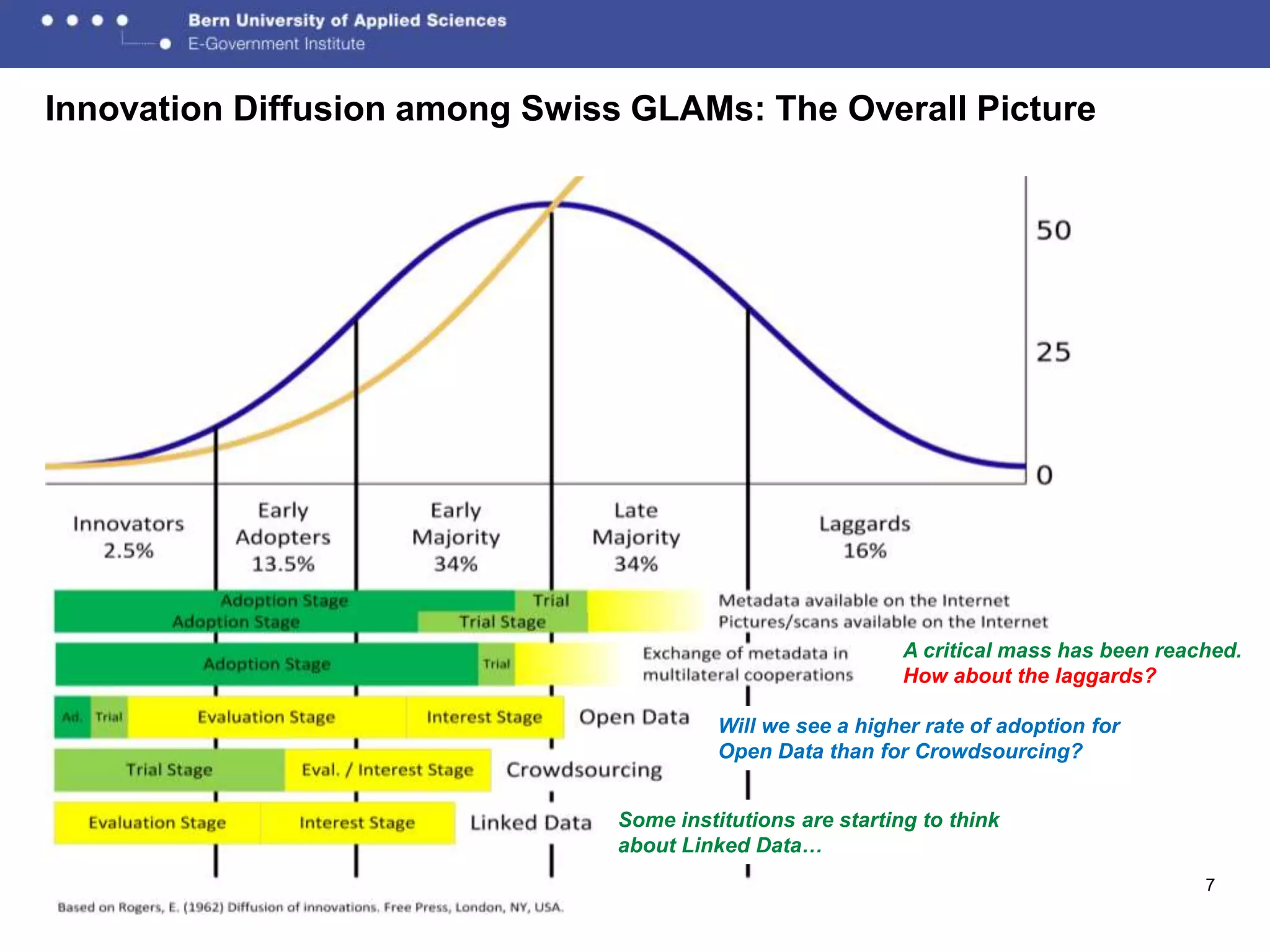
Innovation Diffusion among Swiss GLAMs: The Overall Picture


                                                             A critical mass has been reached.
                                                             How about the laggards?

                                          Will we see a higher rate of adoption for
                                          Open Data than for Crowdsourcing?


                                Some institutions are starting to think
                                about Linked Data…
                                                                                          7
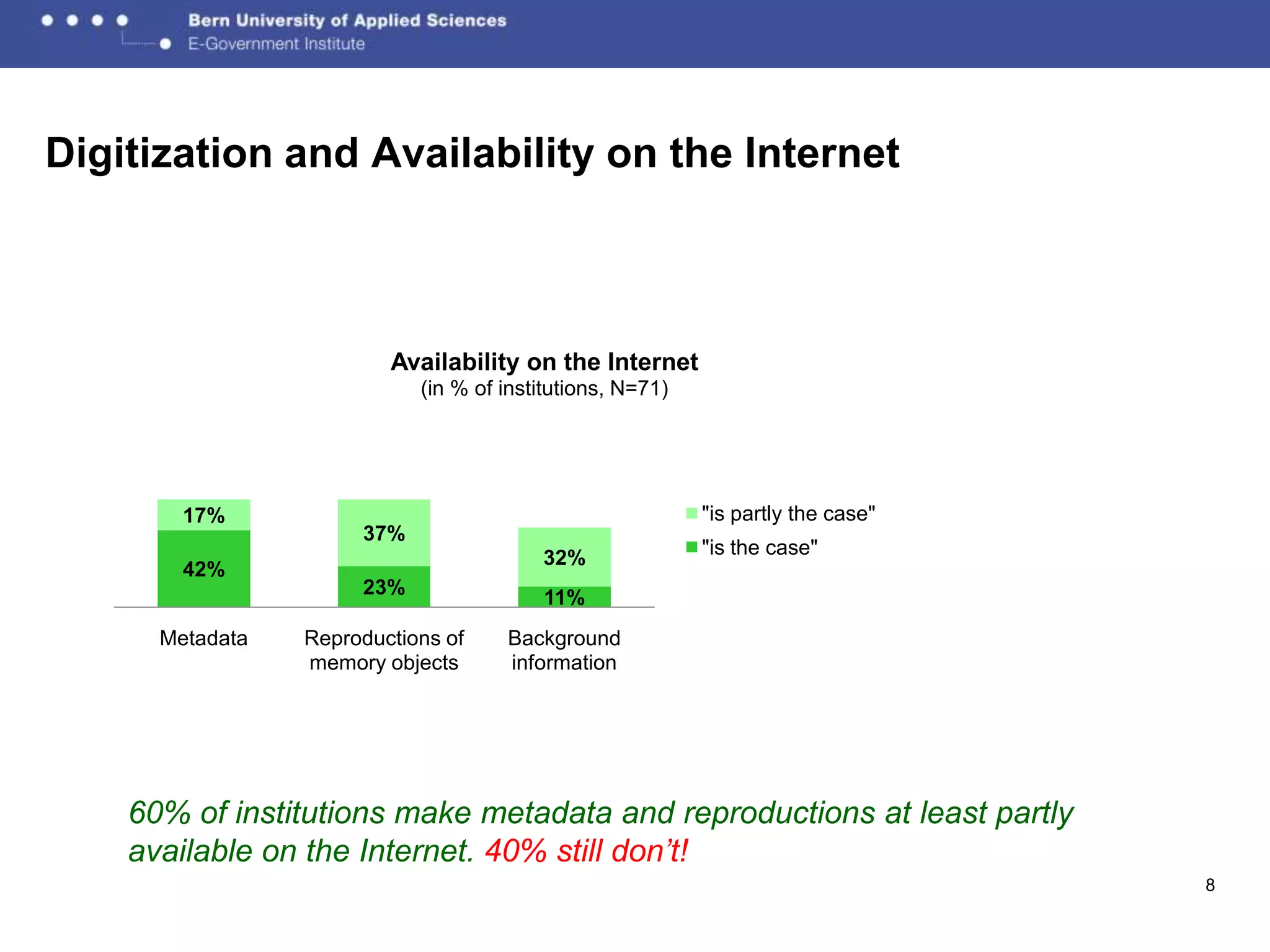
Digitization and Availability on the Internet


                         Availability on the Internet
                            (in % of institutions, N=71)


        17%                                                "is partly the case"
                      37%
                                         32%               "is the case"
        42%
                      23%                11%
      Metadata   Reproductions of    Background
                 memory objects      information


    60% of institutions make metadata and reproductions at least partly
    available on the Internet. 40% still don’t!
                                                                                  8
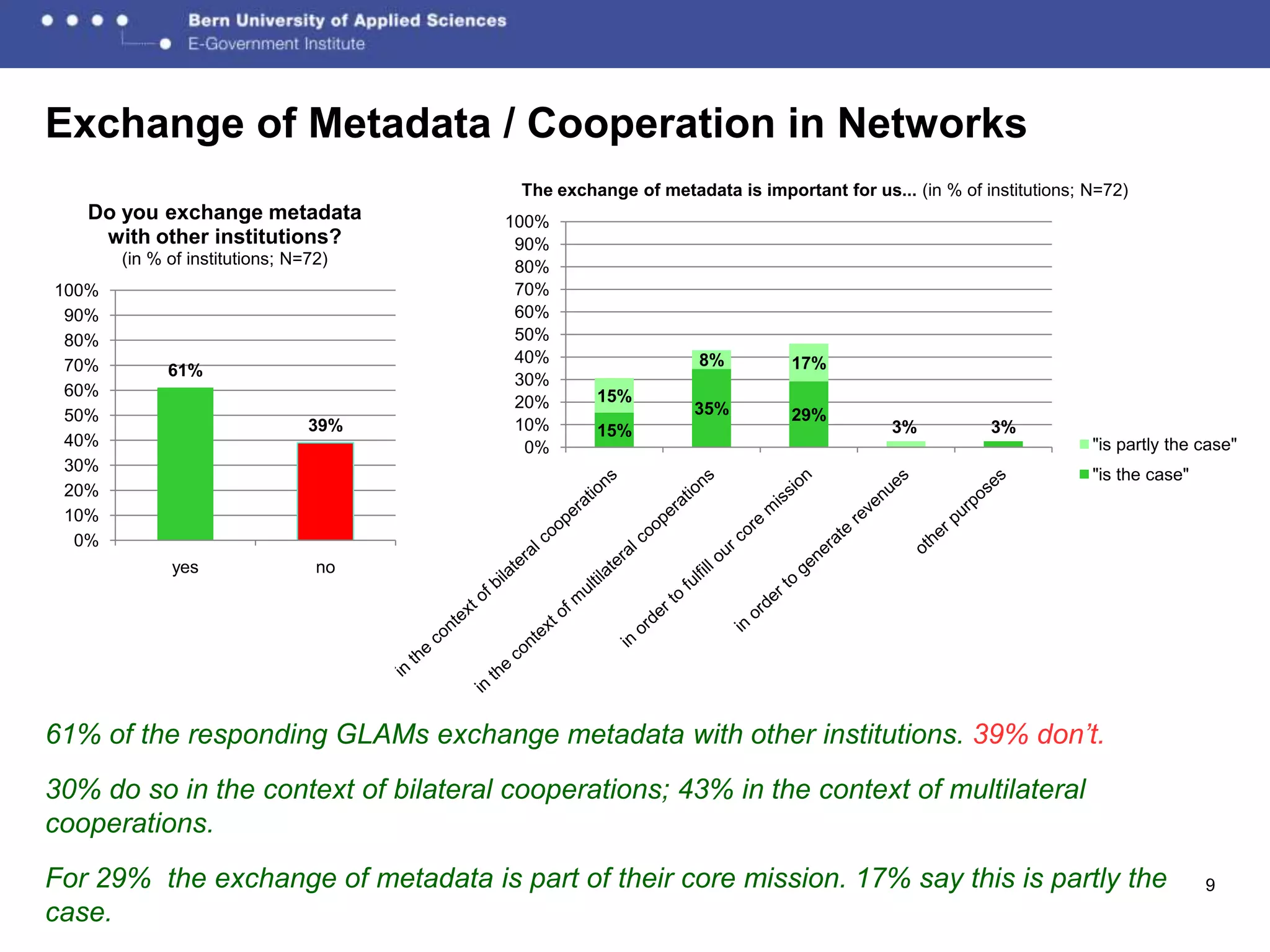
Exchange of Metadata / Cooperation in Networks
                                       The exchange of metadata is important for us... (in % of institutions; N=72)
   Do you exchange metadata           100%
    with other institutions?           90%
       (in % of institutions; N=72)    80%
100%                                   70%
 90%                                   60%
 80%                                   50%
 70%                                   40%                   8%         17%
             61%
                                       30%
 60%                                            15%
                                       20%                  35%
 50%                                                                    29%
                                39%    10%      15%                                  3%          3%
 40%                                    0%                                                                    "is partly the case"
 30%
                                                                                                              "is the case"
 20%
 10%
  0%
             yes                 no


61% of the responding GLAMs exchange metadata with other institutions. 39% don’t.
30% do so in the context of bilateral cooperations; 43% in the context of multilateral
cooperations.
For 29% the exchange of metadata is part of their core mission. 17% say this is partly the                                    9
case.
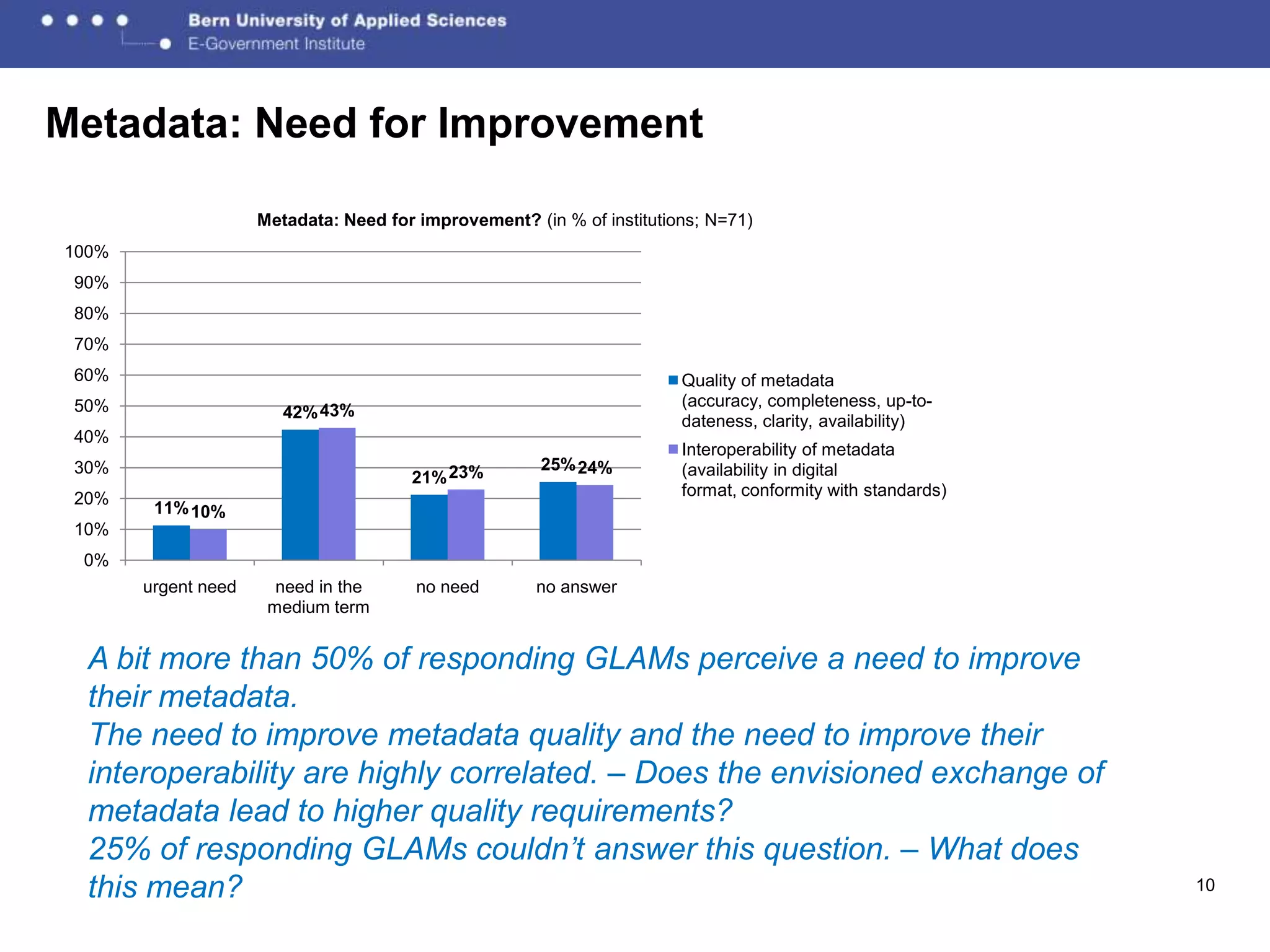
Metadata: Need for Improvement

                     Metadata: Need for improvement? (in % of institutions; N=71)
100%
 90%
 80%
 70%
 60%                                                                    Quality of metadata
 50%                                                                    (accuracy, completeness, up-to-
                        42% 43%                                         dateness, clarity, availability)
 40%
                                                                        Interoperability of metadata
 30%                                                   25% 24%          (availability in digital
                                       21% 23%
 20%                                                                    format, conformity with standards)
        11% 10%
 10%
 0%
       urgent need     need in the      no need       no answer
                      medium term


  A bit more than 50% of responding GLAMs perceive a need to improve
  their metadata.
  The need to improve metadata quality and the need to improve their
  interoperability are highly correlated. – Does the envisioned exchange of
  metadata lead to higher quality requirements?
  25% of responding GLAMs couldn’t answer this question. – What does
  this mean?                                                                                                 10
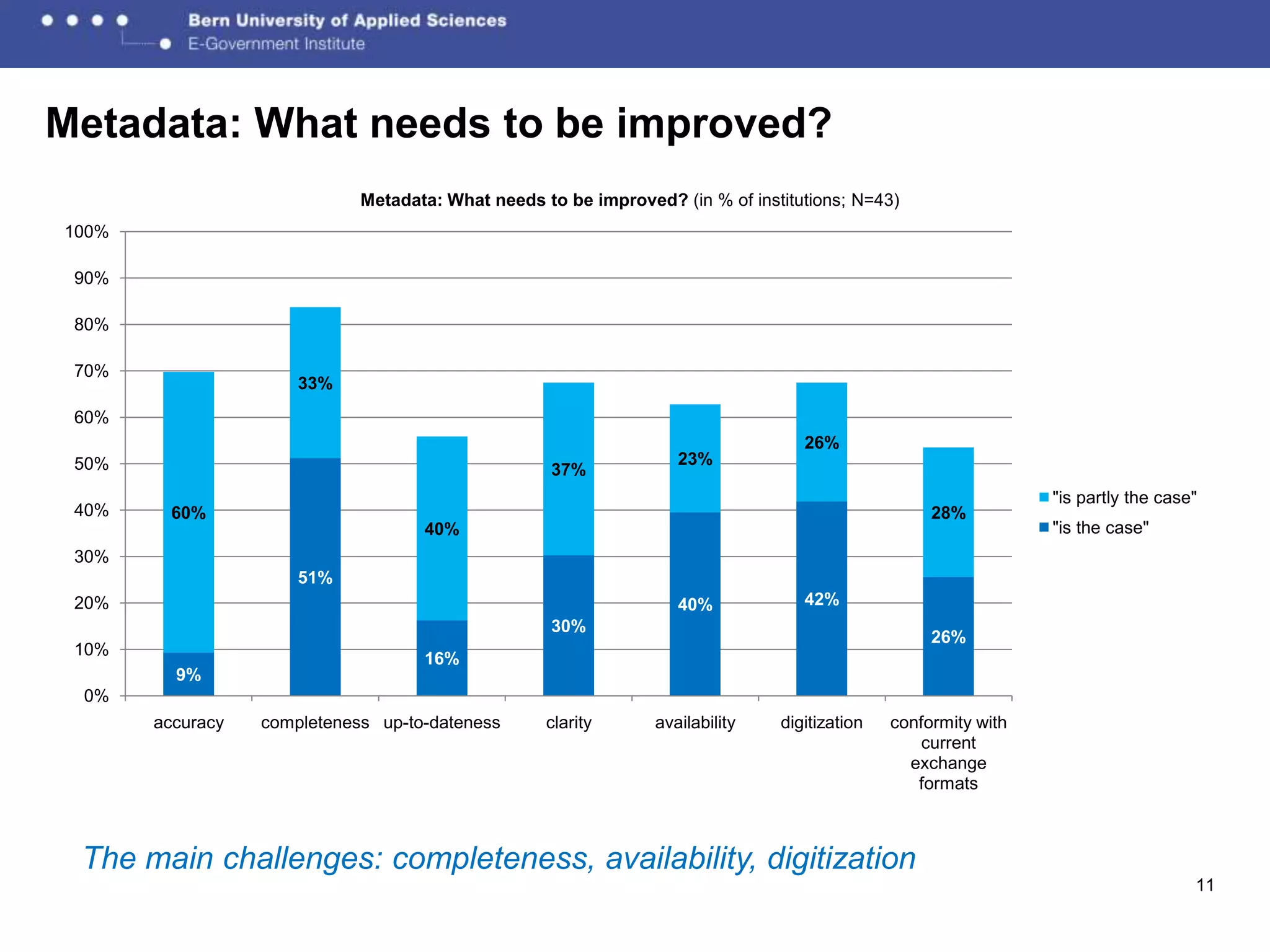
Metadata: What needs to be improved?
                             Metadata: What needs to be improved? (in % of institutions; N=43)
100%

 90%

 80%

 70%
                      33%
 60%
                                                                                  26%
 50%                                                               23%
                                                    37%
                                                                                                                "is partly the case"
 40%    60%                                                                                        28%
                                    40%                                                                         "is the case"
 30%
                      51%
 20%                                                               40%            42%
                                                    30%
                                                                                                   26%
 10%
                                    16%
         9%
 0%
       accuracy   completeness up-to-dateness      clarity      availability   digitization   conformity with
                                                                                                  current
                                                                                                exchange
                                                                                                 formats


 The main challenges: completeness, availability, digitization
                                                                                                                                   11
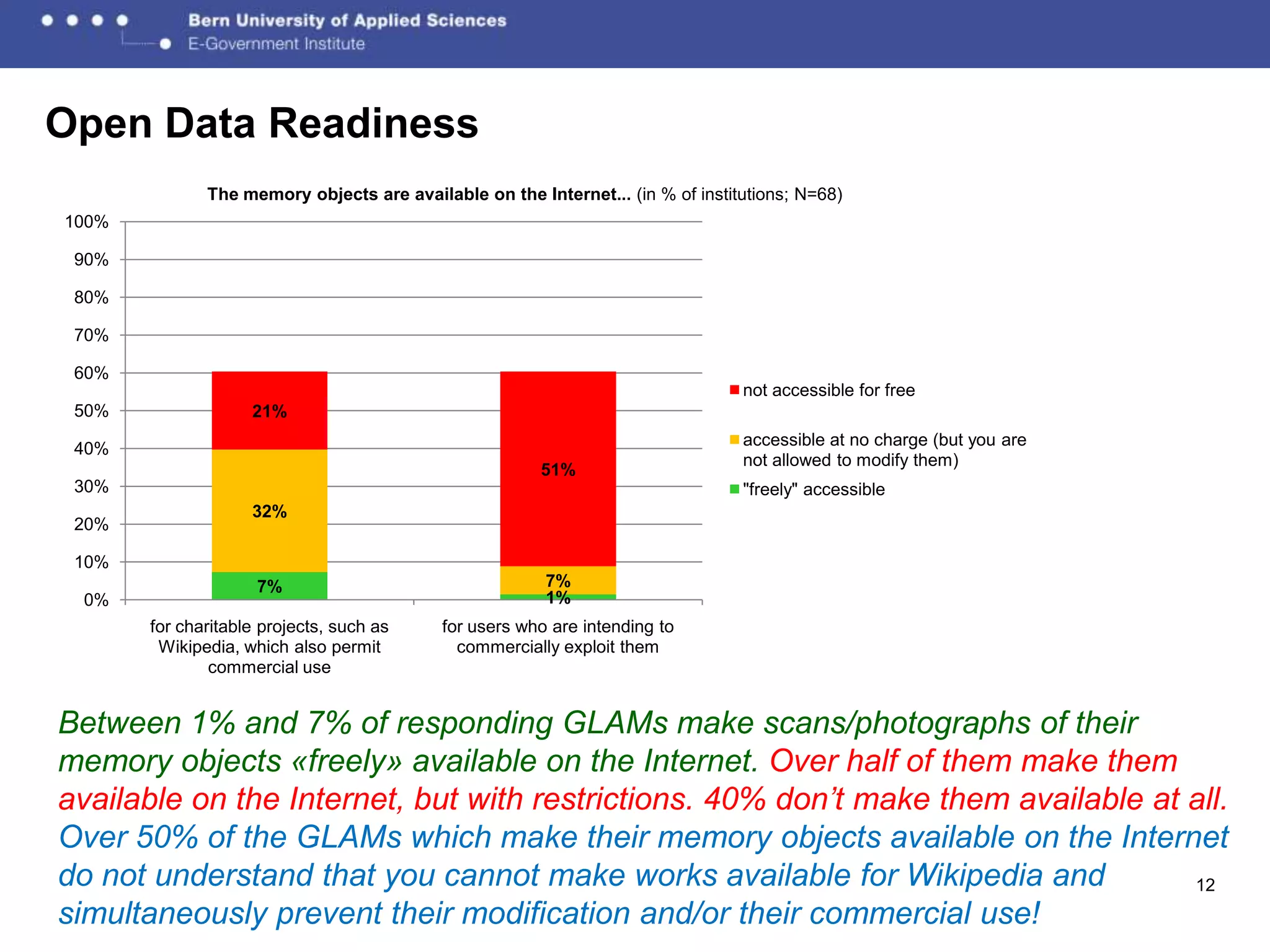
Open Data Readiness
              The memory objects are available on the Internet... (in % of institutions; N=68)
100%

 90%

 80%

 70%

 60%
                                                                                 not accessible for free
 50%                21%
                                                                                 accessible at no charge (but you are
 40%
                                                                                 not allowed to modify them)
                                                        51%
 30%                                                                             "freely" accessible
                    32%
 20%

 10%
                     7%                                 7%
 0%                                                     1%
       for charitable projects, such as    for users who are intending to
        Wikipedia, which also permit         commercially exploit them
               commercial use


Between 1% and 7% of responding GLAMs make scans/photographs of their
memory objects «freely» available on the Internet. Over half of them make them
available on the Internet, but with restrictions. 40% don’t make them available at all.
Over 50% of the GLAMs which make their memory objects available on the Internet
do not understand that you cannot make works available for Wikipedia and           12
simultaneously prevent their modification and/or their commercial use!
Desirability and Importance of Open Data
             Desirability of Open Data (in % of institutions, N=71)
40%
                                                 36%                                                        Importance / Desirability of Open Data
35%                                                                                                               (in % of institutions; N=71)

30%                                                                                                             risks prevail    opportunities prevail
                                                           25%                                35%
25%
                                                                                              30%
20%                                                                                           25%
                                                                                              20%
15%                                                                                           15%                   31%
                                                                    11%                                                            8%            14%
                                                                                                      21%
                                                                                              10%
10%
                                          7%                                                  5%                                                              6%
                        6%       6%                                          6%                                                    8%            7%
5%                                                                                            0%      1%                                                      3%
                                                                                     3%
                1%
       0%                                                                                             very        important     neither, nor unimportant   no answer
0%                                                                                                  important
      -10 to - -8 to -6 -6 to -4 -4 to -2 -2 to 0 0 to 2   2 to 4   4 to 6   6 to 8 8 to 10
         8


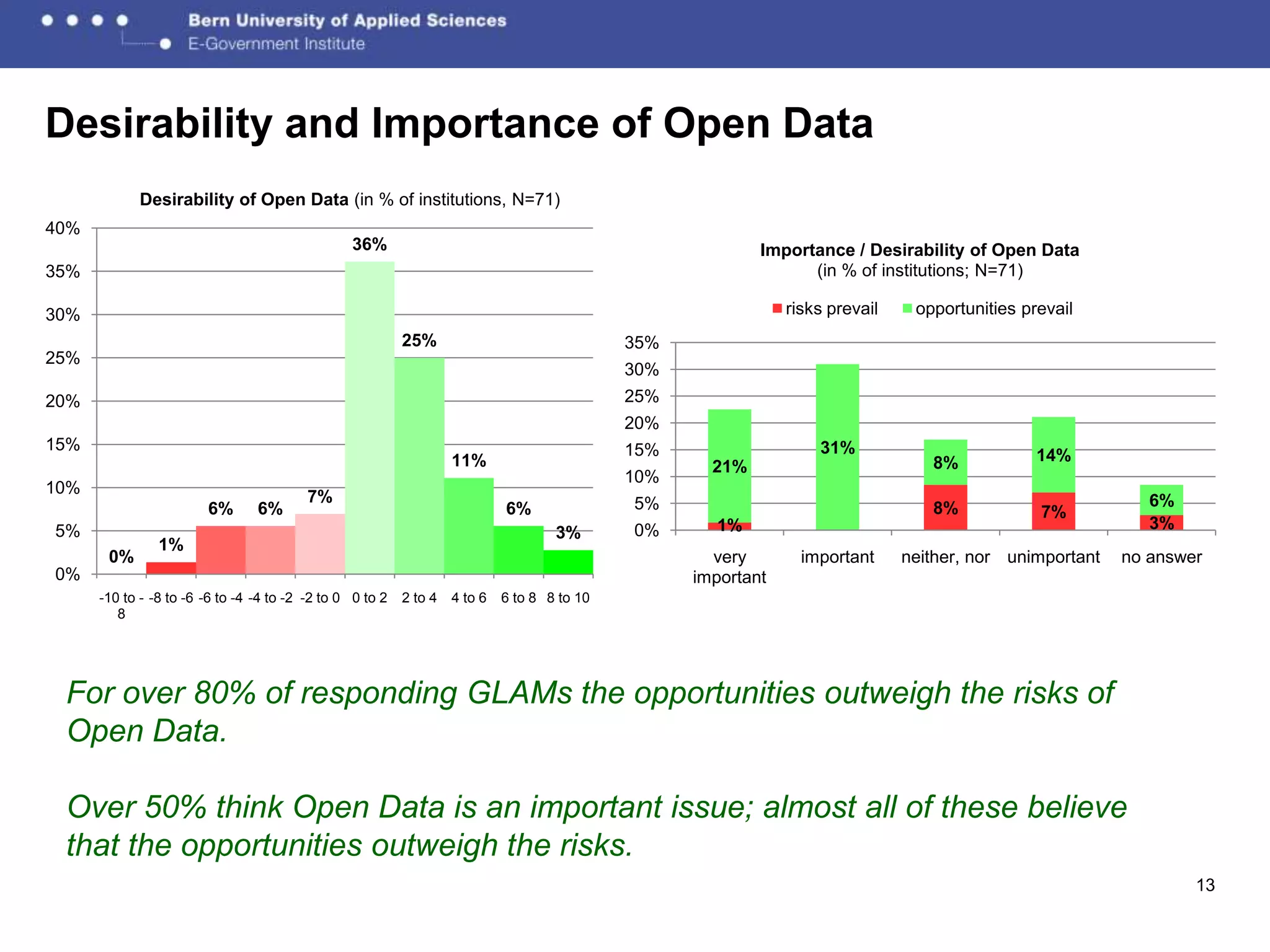
 For over 80% of responding GLAMs the opportunities outweigh the risks of
 Open Data.

 Over 50% think Open Data is an important issue; almost all of these believe
 that the opportunities outweigh the risks.
                                                                                                                                                                   13
Open Data / “Free” Licensing of Content
                        Conditions under which they would make memory objects freely accessible on the Internet
                                                      (in % der Institutionen; N=70)
100%

 90%
                          19%
 80%                                                                                20%

 70%                                     23%
            21%

 60%
                                                                                                   34%
 50%
                                                                                                                                 "is partly the case"
 40%                                                   26%                                                                       "is the case"
                          76%
                                                                                    69%
 30%        59%                          60%

 20%                                                                                               40%
                                                       29%
 10%                                                                  9%

                                                                      7%                                          1%
 0%
       For private use
                For education and research For users who are the name to commercially exploit them
                            For charitable projects, suchOnly if intending of the institution remains attached to the data
                                For charitable projects as Wikipedia, whichOnly if the work will be re-used in unmodified form
                                                                                also permit
                                                   commercial use


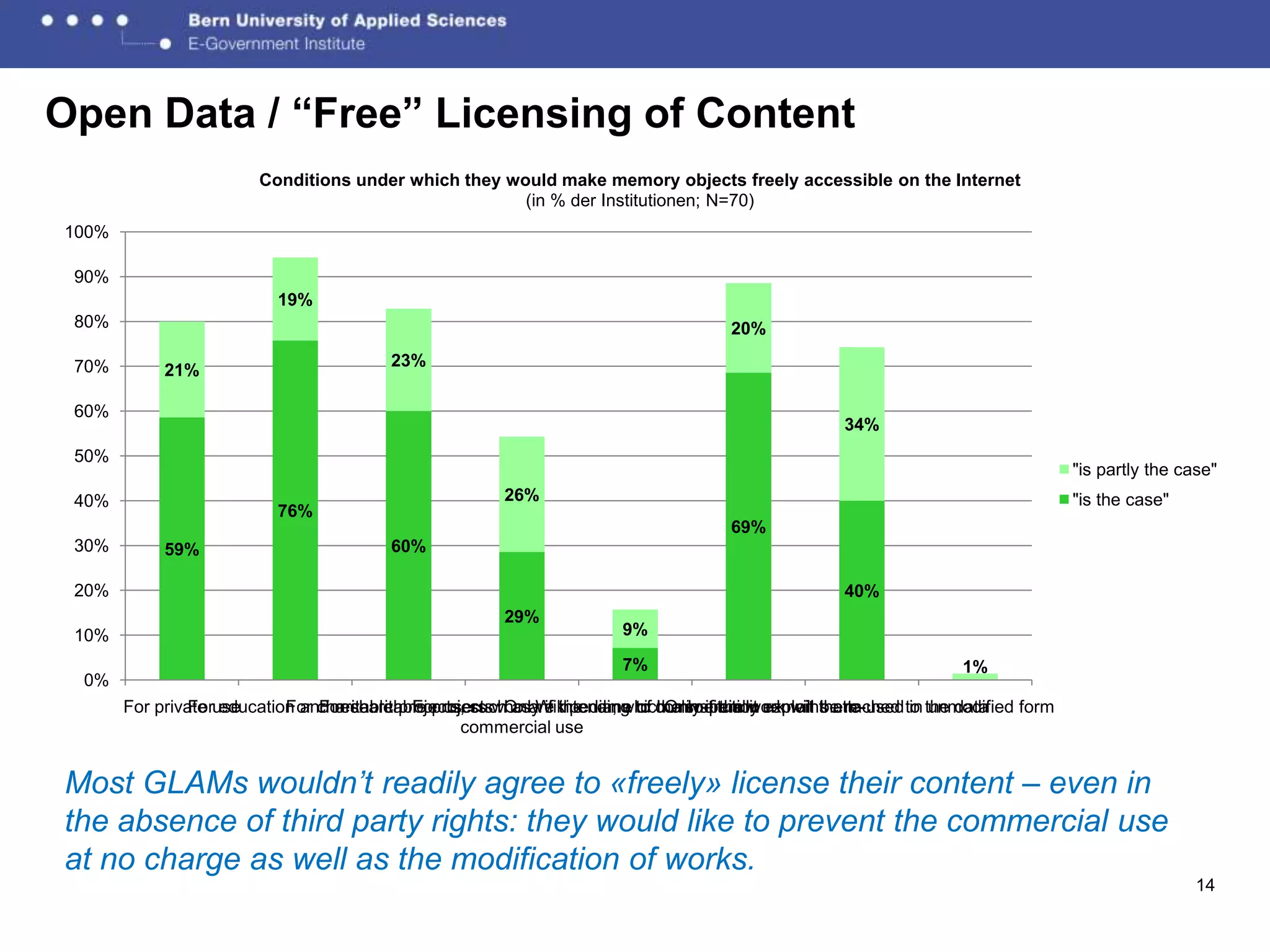
Most GLAMs wouldn’t readily agree to «freely» license their content – even in
the absence of third party rights: they would like to prevent the commercial use
at no charge as well as the modification of works.
                                                                                                                                                  14
Crowdsourcing

       Are any of your staff members engaging in projects which support open
       data or collaborative projects on the Internet? (in % of institutions; N=71)
100%
90%
80%
70%
60%
50%                                                                in their spare time

40%
                                                                   as part of their professional
30%                                                                activity

20%      14%
10%
         11%            3%
                        4%             6%             1%
 0%
       Wikipedia    Wikimedia        Flickr         others
                    Commons        Commons

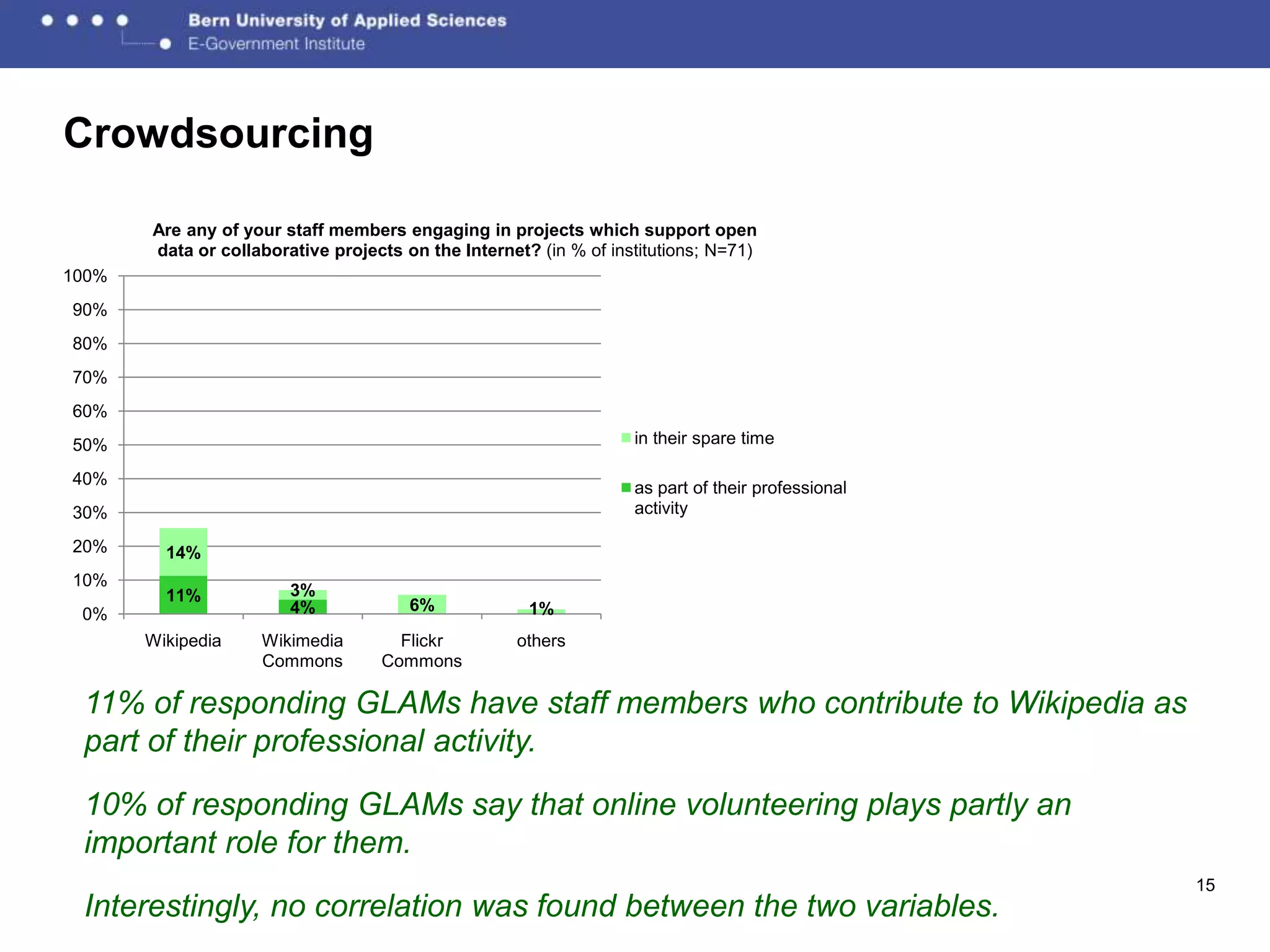
 11% of responding GLAMs have staff members who contribute to Wikipedia as
 part of their professional activity.

 10% of responding GLAMs say that online volunteering plays partly an
 important role for them.
                                                                                                   15
 Interestingly, no correlation was found between the two variables.
Desirability and Importance of Crowdsourcing
      Desirability of Crowdsourcing (in % of institutions; N=69)
                               43%                                                                       Importance / Desirability of Crowdsourcing
45%                                                                                                              (in % of institutions; N=69)
40%
                                                                                                                risks prevail    opportunities prevail
35%
                                                                                              35%
30%
                                                                                              30%
25%                                                                                           25%                    3%
                        19%
20%                                                                                           20%
               15%                                                                                                                                            1%
                                                                                              15%                                   1%           29%
15%                             11%                                                                                 25%
                                                                                              10%
10%                                                                                                                                14%                       16%
                                                                                               5%     10%
       4%
 5%                                               3%        3%                                 0%
                                                                    1%
 0%                                                                                                   very        important     neither, nor unimportant   no answer
      -10 to - -8 to -6 -6 to -4 -4 to -2 -2 to 0 0 to 2   2 to 4   4 to 6   6 to 8 8 to 10         important
         8


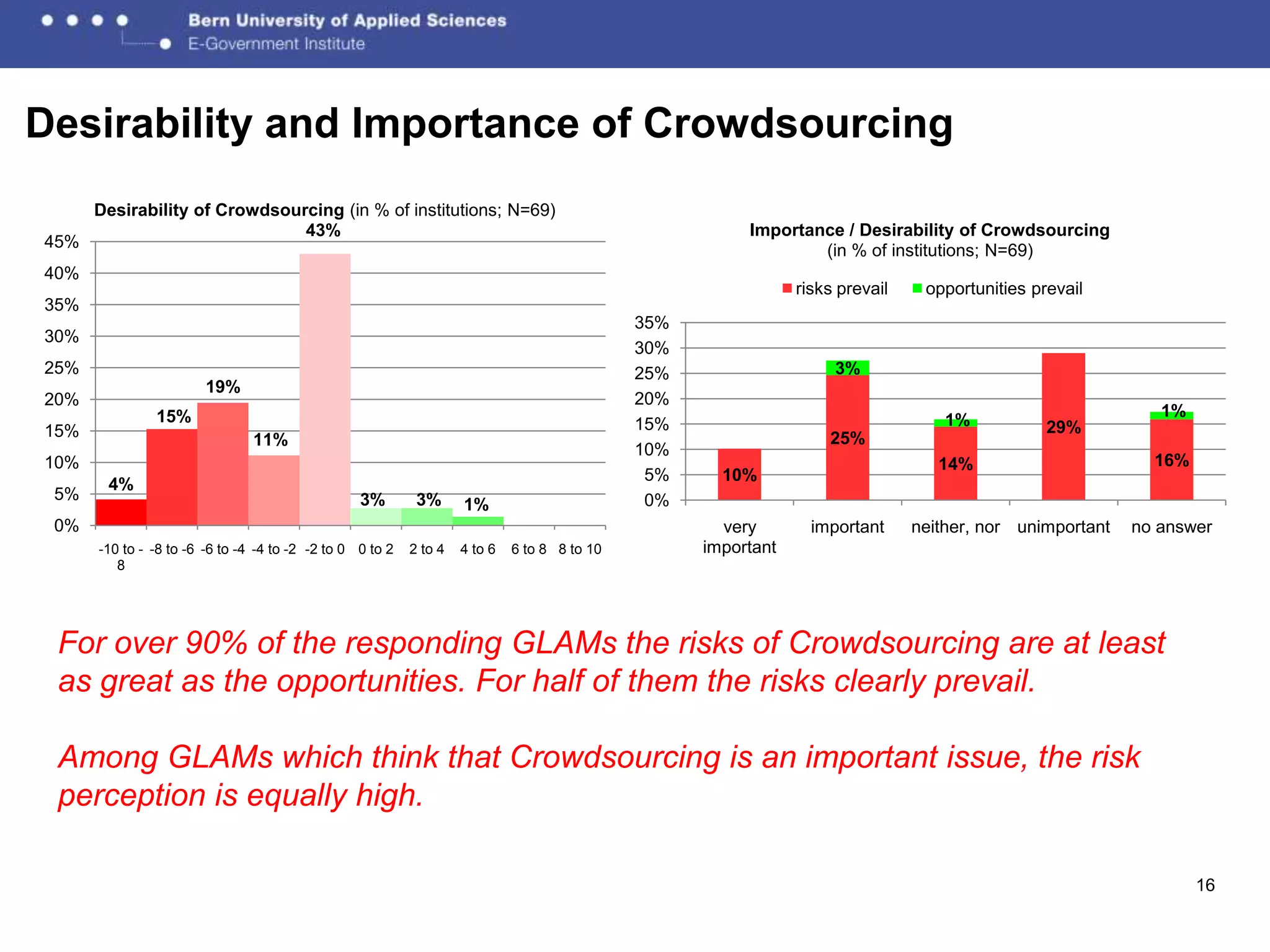
 For over 90% of the responding GLAMs the risks of Crowdsourcing are at least
 as great as the opportunities. For half of them the risks clearly prevail.

 Among GLAMs which think that Crowdsourcing is an important issue, the risk
 perception is equally high.

                                                                                                                                                                   16
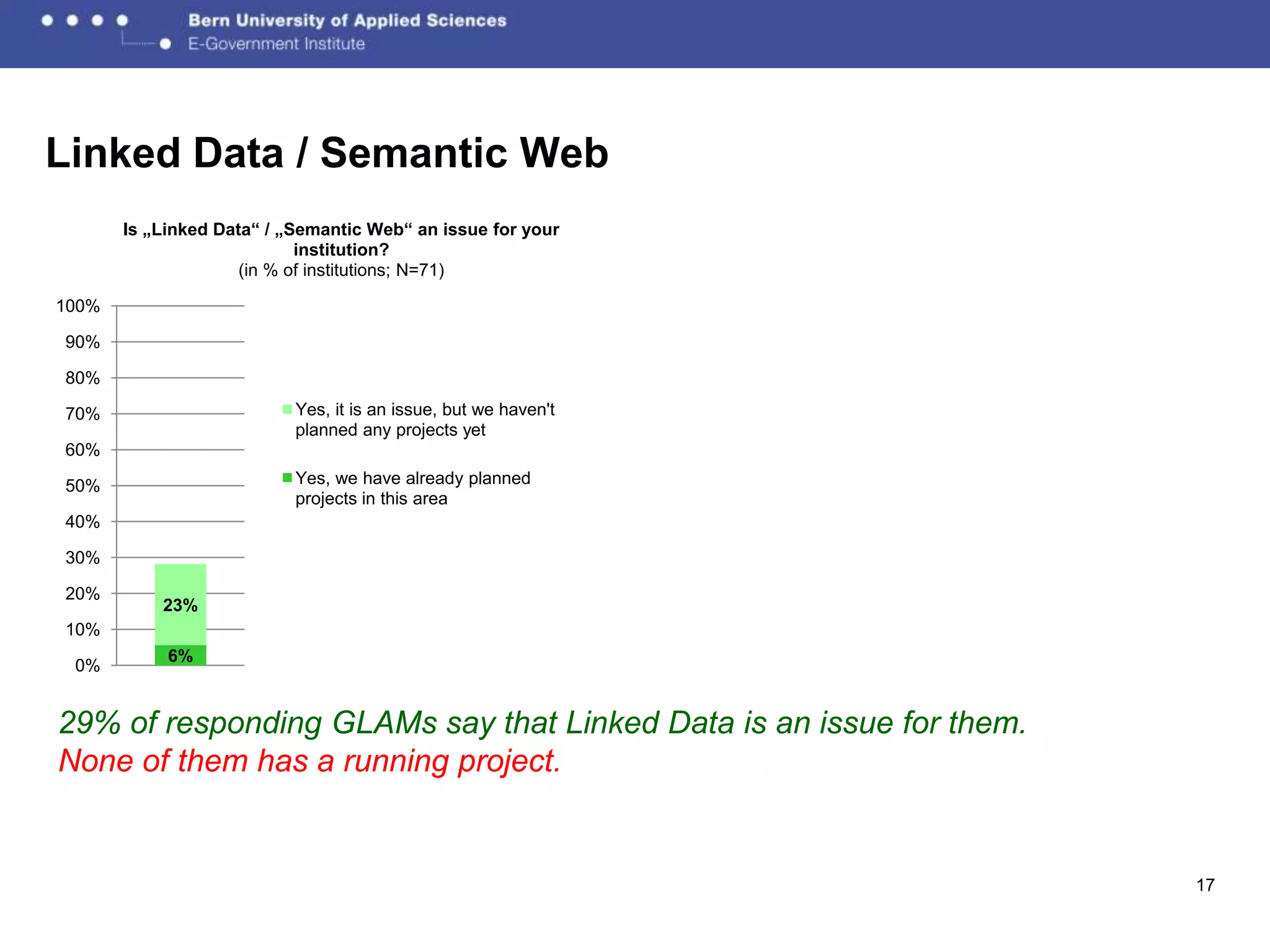
Linked Data / Semantic Web
       Is „Linked Data“ / „Semantic Web“ an issue for your
                            institution?
                     (in % of institutions; N=71)

100%

90%

80%

70%                        Yes, it is an issue, but we haven't
                           planned any projects yet
60%

50%                        Yes, we have already planned
                           projects in this area
40%

30%

20%
           23%
10%
            6%
 0%


29% of responding GLAMs say that Linked Data is an issue for them.
None of them has a running project.


                                                                     17
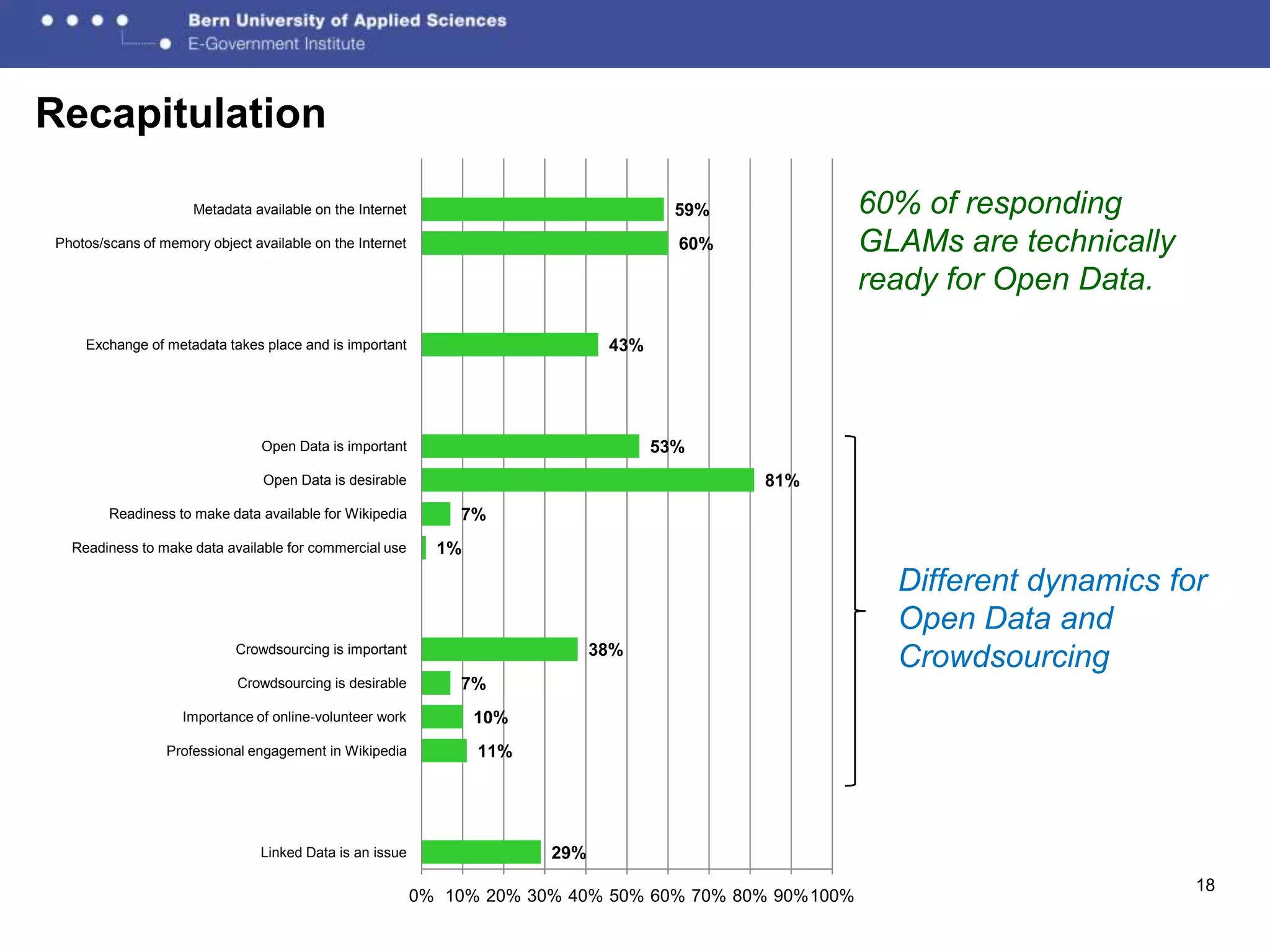
Recapitulation

                     Metadata available on the Internet                               59%              60% of responding
Photos/scans of memory object available on the Internet                               60%              GLAMs are technically
                                                                                                       ready for Open Data.
    Exchange of metadata takes place and is important                         43%


                                Open Data is important                              53%
                                Open Data is desirable                                      81%
        Readiness to make data available for Wikipedia        7%
  Readiness to make data available for commercial use       1%

                                                                                                         Different dynamics for
                                                                                                         Open Data and
                            Crowdsourcing is important                       38%
                                                                                                         Crowdsourcing
                            Crowdsourcing is desirable        7%
                   Importance of online-volunteer work           10%
                 Professional engagement in Wikipedia            11%


                                Linked Data is an issue                29%
                                                                                                                               18
                                                          0% 10% 20% 30% 40% 50% 60% 70% 80% 90%100%
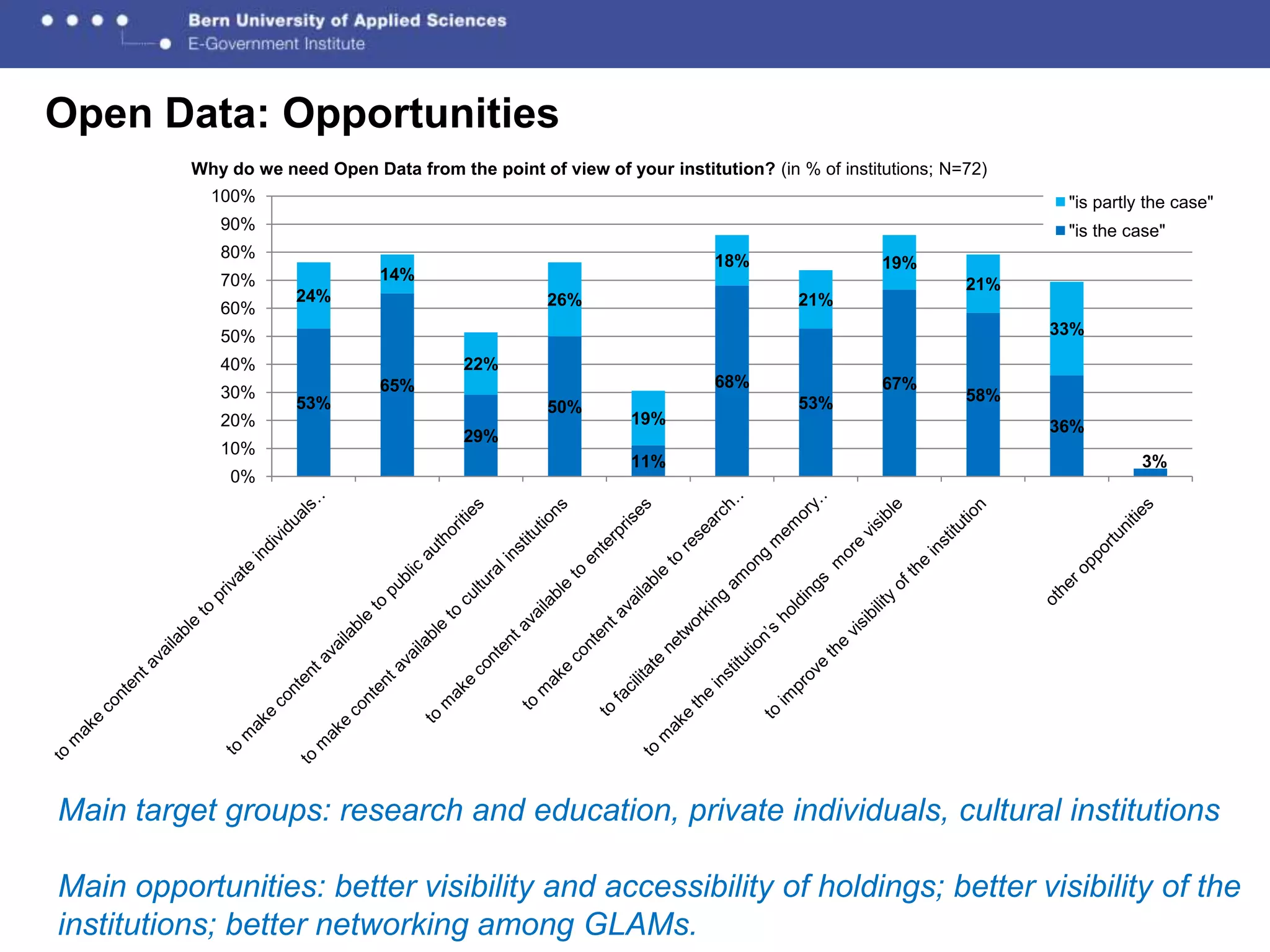
Open Data: Opportunities
          Why do we need Open Data from the point of view of your institution? (in % of institutions; N=72)
            100%                                                                                               "is partly the case"
             90%                                                                                               "is the case"
             80%                                                         18%                  19%
             70%                14%
                                                                                                        21%
                      24%                            26%                           21%
             60%
             50%                                                                                              33%

             40%                           22%
                                65%                                      68%                  67%
             30%                                                                                        58%
                      53%                            50%                           53%
             20%                                               19%                                            36%
                                           29%
             10%
                                                               11%                                                       3%
              0%


Main target groups: research and education, private individuals, cultural institutions

Main opportunities: better visibility and accessibility of holdings; better visibility of 19
                                                                                          the
institutions; better networking among GLAMs.
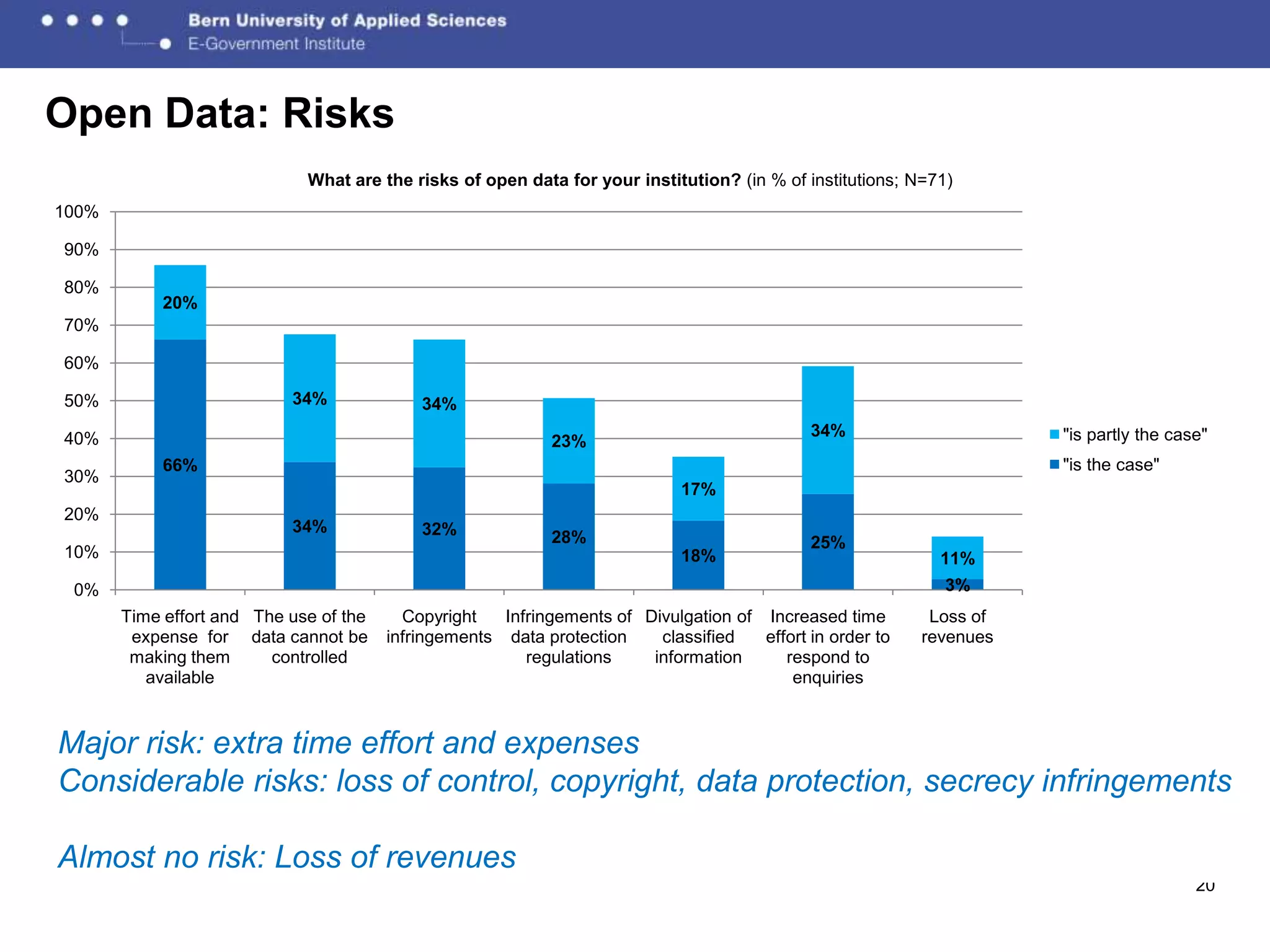
Open Data: Risks
                             What are the risks of open data for your institution? (in % of institutions; N=71)
100%

90%

80%
            20%
70%

60%

50%                        34%              34%
40%                                                                                          34%                      "is partly the case"
                                                            23%
            66%                                                                                                       "is the case"
30%
                                                                             17%
20%
                           34%              32%             28%                              25%
10%                                                                          18%                             11%
 0%                                                                                                           3%
       Time effort and The use of the     Copyright   Infringements of Divulgation of Increased time        Loss of
        expense for data cannot be      infringements data protection    classified   effort in order to   revenues
        making them      controlled                      regulations    information      respond to
          available                                                                       enquiries


Major risk: extra time effort and expenses
Considerable risks: loss of control, copyright, data protection, secrecy infringements

Almost no risk: Loss of revenues
                                                                                                                                        20
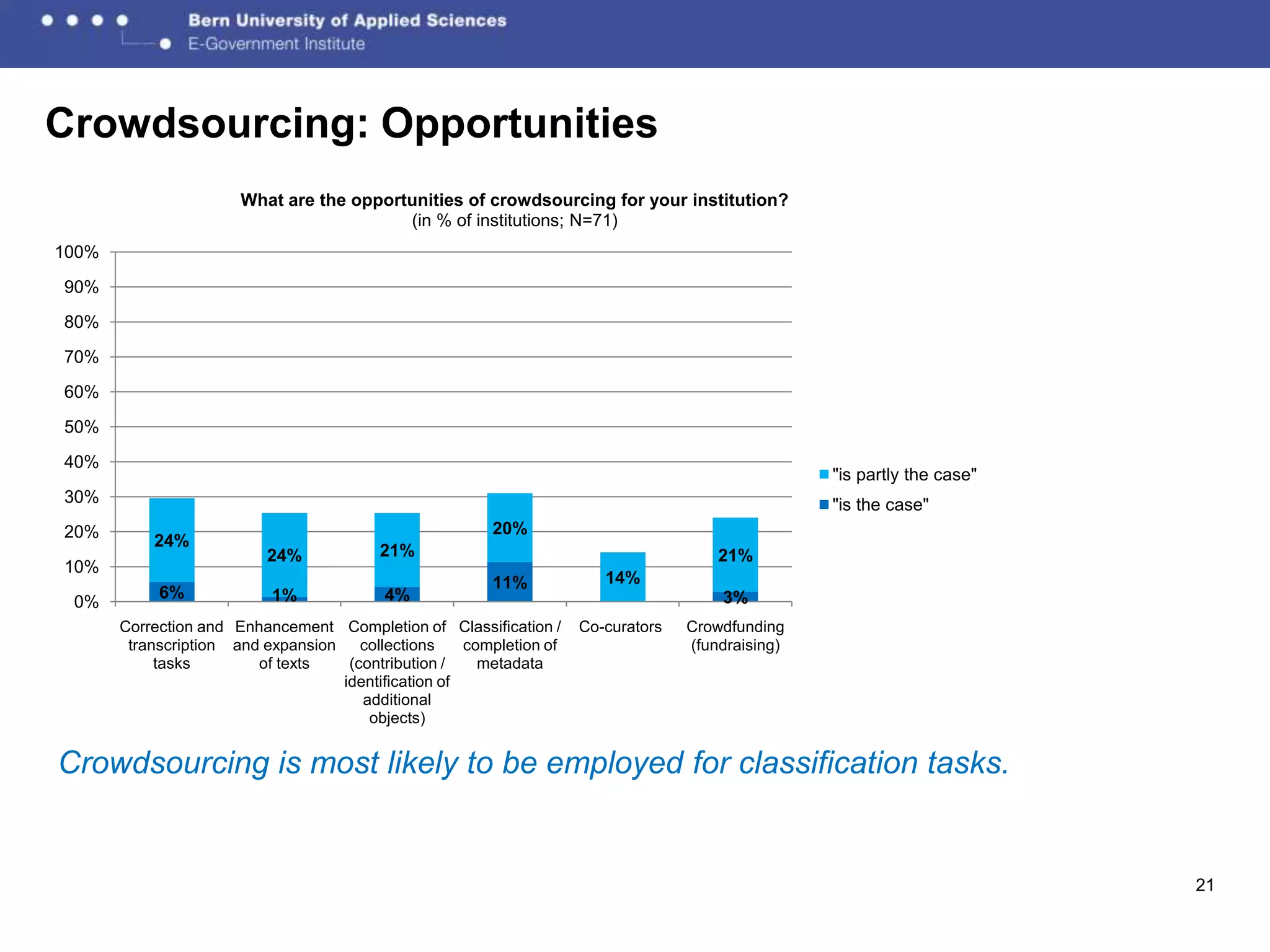
Crowdsourcing: Opportunities
                       What are the opportunities of crowdsourcing for your institution?
                                          (in % of institutions; N=71)
100%
90%
80%
70%
60%
50%
40%
                                                                                                    "is partly the case"
30%                                                                                                 "is the case"
20%                                                      20%
           24%
                           24%            21%                                           21%
10%
                                                         11%             14%
            6%             1%              4%                                           3%
 0%
       Correction and Enhancement Completion of Classification /      Co-curators   Crowdfunding
        transcription and expansion    collections    completion of                 (fundraising)
            tasks        of texts    (contribution /    metadata
                                    identification of
                                       additional
                                        objects)


Crowdsourcing is most likely to be employed for classification tasks.


                                                                                                                           21
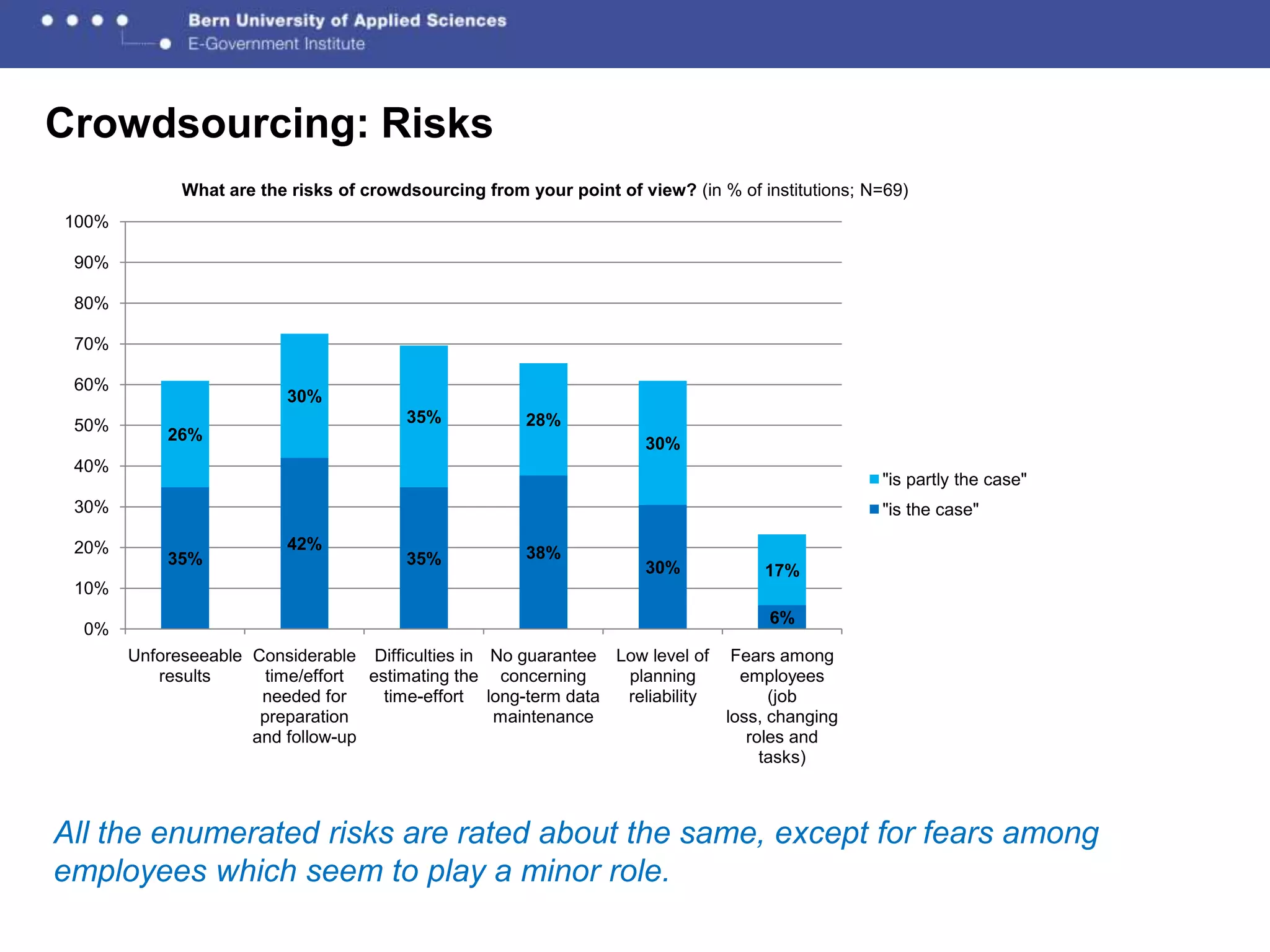
Crowdsourcing: Risks
             What are the risks of crowdsourcing from your point of view? (in % of institutions; N=69)
100%

 90%

 80%

 70%

 60%
                         30%
 50%                                    35%            28%
           26%
                                                                     30%
 40%
                                                                                                  "is partly the case"
 30%                                                                                              "is the case"

 20%                     42%
           35%                          35%            38%
                                                                     30%            17%
 10%
                                                                                     6%
  0%
       Unforeseeable Considerable Difficulties in No guarantee Low level of Fears among
          results      time/effort estimating the concerning    planning      employees
                      needed for     time-effort long-term data reliability       (job
                      preparation                 maintenance               loss, changing
                     and follow-up                                             roles and
                                                                                 tasks)


All the enumerated risks are rated about the same, except for fears among
employees which seem to play a minor role.                                                                               22
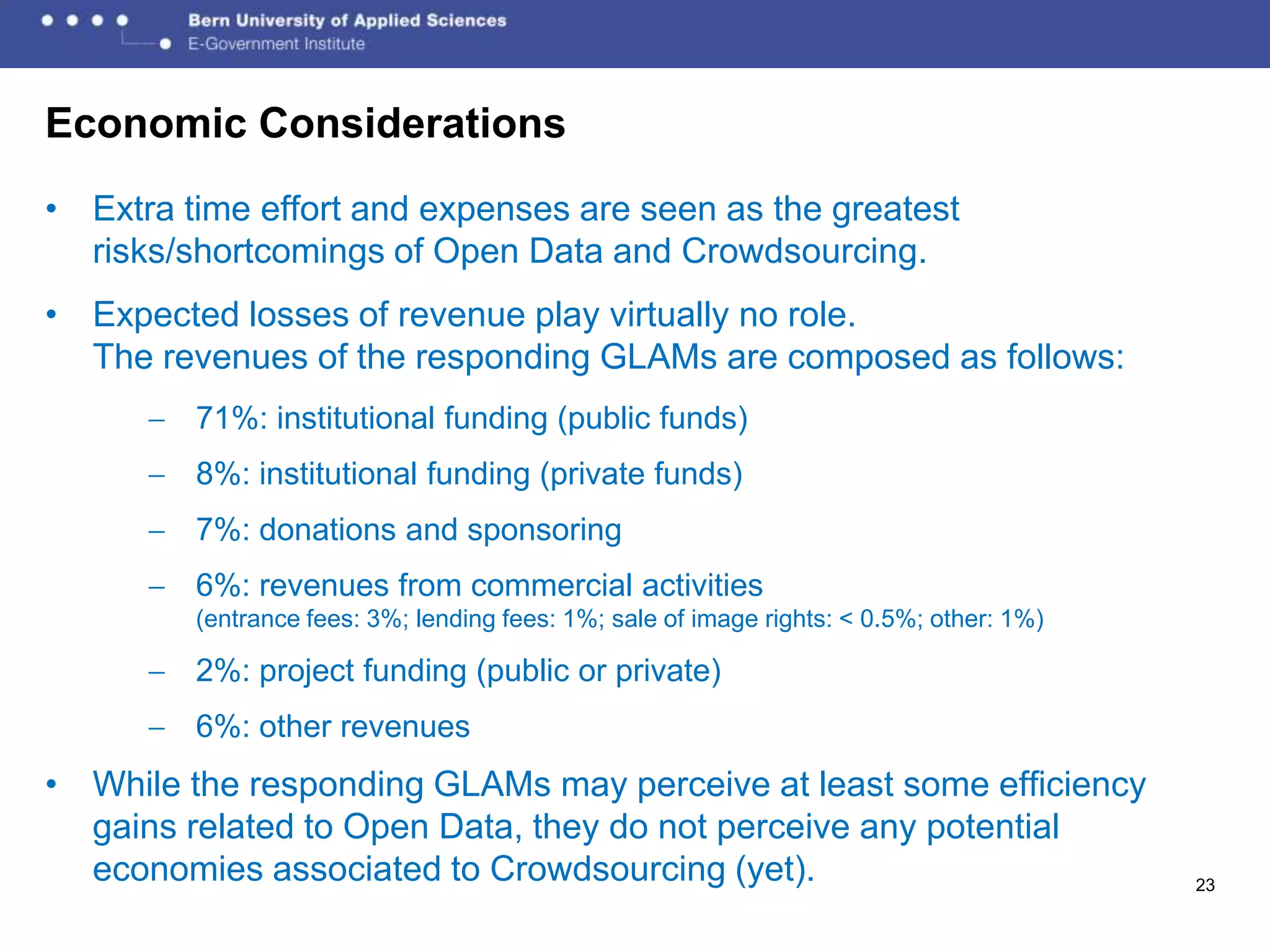
Economic Considerations
• Extra time effort and expenses are seen as the greatest
  risks/shortcomings of Open Data and Crowdsourcing.
• Expected losses of revenue play virtually no role.
  The revenues of the responding GLAMs are composed as follows:
         71%: institutional funding (public funds)
         8%: institutional funding (private funds)
         7%: donations and sponsoring
         6%: revenues from commercial activities
         (entrance fees: 3%; lending fees: 1%; sale of image rights: < 0.5%; other: 1%)

         2%: project funding (public or private)
         6%: other revenues
• While the responding GLAMs may perceive at least some efficiency
  gains related to Open Data, they do not perceive any potential
  economies associated to Crowdsourcing (yet).                                            23
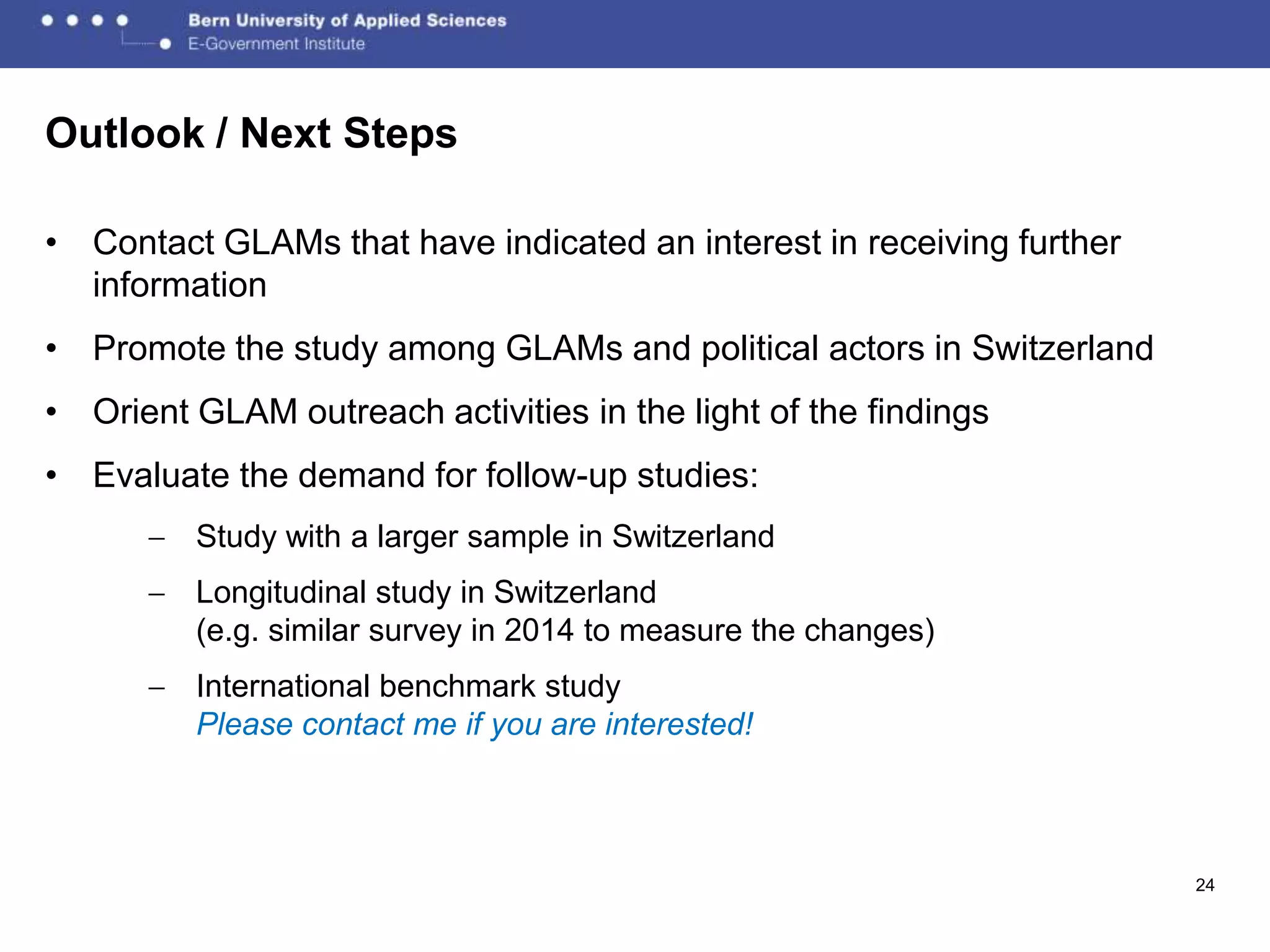
Outlook / Next Steps

• Contact GLAMs that have indicated an interest in receiving further
  information
• Promote the study among GLAMs and political actors in Switzerland
• Orient GLAM outreach activities in the light of the findings
• Evaluate the demand for follow-up studies:
         Study with a larger sample in Switzerland
         Longitudinal study in Switzerland
         (e.g. similar survey in 2014 to measure the changes)
         International benchmark study
         Please contact me if you are interested!


                                                                       24
Contact Information and Affiliations

Beat Estermann
E-mail: beat.estermann@bfh.ch
Phone: +41 31 848 34 38


Affiliations:
Research Associate, Bern University of Applied Sciences
Member of opendata.ch (Swiss Chapter of the Open Knowledge Foundation)
Member of Digitale Allmend (Swiss Chapter of CreativeCommons)
Member of Wikimedia CH’s GLAM working group


This work is licensed under a Creative Commons Attribution-ShareAlike 3.0 Unported License.
                                                                                              25

Swiss_GLAM_Survey_presentation_20130412

  • 1.
    To what extentare GLAMs ready for Open Data and Crowdsourcing? Results of a Pilot Survey from Switzerland Beat Estermann, 12 April 2013 This work is licensed under a Creative Commons Attribution-ShareAlike 3.0 Unported License.
  • 2.
    Recent Trends inthe GLAM sector… Single-Point-of-Access Source: http://www.europeana.eu/ Coordinated Digitization Efforts Wikimedia Commons, User:Dvortygirl (CC-by-sa) Increased cooperation and coordination among GLAMs: - common catalogues - virtual libraries EU: Lund Action Plan for - coordination of digitization efforts Digitization (2001) - long-term archiving 2
  • 3.
    Web 2.0 Source: http://www.facebook.com/Zentralbibliothek.Zuerich Interactivity / Personnalisation Flickr, User:victuallers2, (CC-by-sa) 3
  • 4.
    Crowdsourcing / CollaborativeContent Creation Source: https://commons.wikimedia.org/wiki/Commons:Bundesarchiv and http://www.flickr.com/groups/greatwararchive Crowdsourcing Approaches: - Correction Linked Open Data - Classification Free Licensing / Open Data - Contextualisation Source: http://www.wikiarthistory.info (CC-by-sa) Source: http://www.creativecommons.org - Co-curation - Complementing «Web of Data» / collections Open Data: Semantic Web - Crowdfunding - machine readable - RDF triples 4 - «freely» re-usable See: Oomen / Aroyo 2011 - unique URLs
  • 5.
    Where do SwissGLAMs stand today with regard to…? …Digitization? …Exchange of metadata in multilateral cooperations? …Open Data? …Crowdsourcing? …Linked Open Data? Innovation Diffusion Model, Everett Rogers, 1962 Awareness Interest Evaluation Trial Adoption What are the perceived risks and opportunities? (drivers vs. hindering factors) What are the expected benefits? Who are the beneficiaries? 5
  • 6.
    Pilot Study amongSwiss GLAMs GLAMs in Switzerland: • ca. 600-700 independent GLAMs of national or regional significance • ca. 1000 independent GLAMs organized in three umbrella organizations Our sample: memory institutions of national significance in the German-speaking part of Switzerland • 197 organisations contacted (233 e-mail addresses) • 72 questionnaires completed (34% of the contacted organisations) Caveats: • The sample is rather small (results are not very precise with regard to the entire Swiss GLAM population, large confidence intervals apply) • Archives are over-represented in the sample (higher response rate); museums and «other institutions» are under-represented; libraries are about average. 6
  • 7.
    Innovation Diffusion amongSwiss GLAMs: The Overall Picture A critical mass has been reached. How about the laggards? Will we see a higher rate of adoption for Open Data than for Crowdsourcing? Some institutions are starting to think about Linked Data… 7
  • 8.
    Digitization and Availabilityon the Internet Availability on the Internet (in % of institutions, N=71) 17% "is partly the case" 37% 32% "is the case" 42% 23% 11% Metadata Reproductions of Background memory objects information 60% of institutions make metadata and reproductions at least partly available on the Internet. 40% still don’t! 8
  • 9.
    Exchange of Metadata/ Cooperation in Networks The exchange of metadata is important for us... (in % of institutions; N=72) Do you exchange metadata 100% with other institutions? 90% (in % of institutions; N=72) 80% 100% 70% 90% 60% 80% 50% 70% 40% 8% 17% 61% 30% 60% 15% 20% 35% 50% 29% 39% 10% 15% 3% 3% 40% 0% "is partly the case" 30% "is the case" 20% 10% 0% yes no 61% of the responding GLAMs exchange metadata with other institutions. 39% don’t. 30% do so in the context of bilateral cooperations; 43% in the context of multilateral cooperations. For 29% the exchange of metadata is part of their core mission. 17% say this is partly the 9 case.
  • 10.
    Metadata: Need forImprovement Metadata: Need for improvement? (in % of institutions; N=71) 100% 90% 80% 70% 60% Quality of metadata 50% (accuracy, completeness, up-to- 42% 43% dateness, clarity, availability) 40% Interoperability of metadata 30% 25% 24% (availability in digital 21% 23% 20% format, conformity with standards) 11% 10% 10% 0% urgent need need in the no need no answer medium term A bit more than 50% of responding GLAMs perceive a need to improve their metadata. The need to improve metadata quality and the need to improve their interoperability are highly correlated. – Does the envisioned exchange of metadata lead to higher quality requirements? 25% of responding GLAMs couldn’t answer this question. – What does this mean? 10
  • 11.
    Metadata: What needsto be improved? Metadata: What needs to be improved? (in % of institutions; N=43) 100% 90% 80% 70% 33% 60% 26% 50% 23% 37% "is partly the case" 40% 60% 28% 40% "is the case" 30% 51% 20% 40% 42% 30% 26% 10% 16% 9% 0% accuracy completeness up-to-dateness clarity availability digitization conformity with current exchange formats The main challenges: completeness, availability, digitization 11
  • 12.
    Open Data Readiness The memory objects are available on the Internet... (in % of institutions; N=68) 100% 90% 80% 70% 60% not accessible for free 50% 21% accessible at no charge (but you are 40% not allowed to modify them) 51% 30% "freely" accessible 32% 20% 10% 7% 7% 0% 1% for charitable projects, such as for users who are intending to Wikipedia, which also permit commercially exploit them commercial use Between 1% and 7% of responding GLAMs make scans/photographs of their memory objects «freely» available on the Internet. Over half of them make them available on the Internet, but with restrictions. 40% don’t make them available at all. Over 50% of the GLAMs which make their memory objects available on the Internet do not understand that you cannot make works available for Wikipedia and 12 simultaneously prevent their modification and/or their commercial use!
  • 13.
    Desirability and Importanceof Open Data Desirability of Open Data (in % of institutions, N=71) 40% 36% Importance / Desirability of Open Data 35% (in % of institutions; N=71) 30% risks prevail opportunities prevail 25% 35% 25% 30% 20% 25% 20% 15% 15% 31% 11% 8% 14% 21% 10% 10% 7% 5% 6% 6% 6% 6% 8% 7% 5% 0% 1% 3% 3% 1% 0% very important neither, nor unimportant no answer 0% important -10 to - -8 to -6 -6 to -4 -4 to -2 -2 to 0 0 to 2 2 to 4 4 to 6 6 to 8 8 to 10 8 For over 80% of responding GLAMs the opportunities outweigh the risks of Open Data. Over 50% think Open Data is an important issue; almost all of these believe that the opportunities outweigh the risks. 13
  • 14.
    Open Data /“Free” Licensing of Content Conditions under which they would make memory objects freely accessible on the Internet (in % der Institutionen; N=70) 100% 90% 19% 80% 20% 70% 23% 21% 60% 34% 50% "is partly the case" 40% 26% "is the case" 76% 69% 30% 59% 60% 20% 40% 29% 10% 9% 7% 1% 0% For private use For education and research For users who are the name to commercially exploit them For charitable projects, suchOnly if intending of the institution remains attached to the data For charitable projects as Wikipedia, whichOnly if the work will be re-used in unmodified form also permit commercial use Most GLAMs wouldn’t readily agree to «freely» license their content – even in the absence of third party rights: they would like to prevent the commercial use at no charge as well as the modification of works. 14
  • 15.
    Crowdsourcing Are any of your staff members engaging in projects which support open data or collaborative projects on the Internet? (in % of institutions; N=71) 100% 90% 80% 70% 60% 50% in their spare time 40% as part of their professional 30% activity 20% 14% 10% 11% 3% 4% 6% 1% 0% Wikipedia Wikimedia Flickr others Commons Commons 11% of responding GLAMs have staff members who contribute to Wikipedia as part of their professional activity. 10% of responding GLAMs say that online volunteering plays partly an important role for them. 15 Interestingly, no correlation was found between the two variables.
  • 16.
    Desirability and Importanceof Crowdsourcing Desirability of Crowdsourcing (in % of institutions; N=69) 43% Importance / Desirability of Crowdsourcing 45% (in % of institutions; N=69) 40% risks prevail opportunities prevail 35% 35% 30% 30% 25% 25% 3% 19% 20% 20% 15% 1% 15% 1% 29% 15% 11% 25% 10% 10% 14% 16% 5% 10% 4% 5% 3% 3% 0% 1% 0% very important neither, nor unimportant no answer -10 to - -8 to -6 -6 to -4 -4 to -2 -2 to 0 0 to 2 2 to 4 4 to 6 6 to 8 8 to 10 important 8 For over 90% of the responding GLAMs the risks of Crowdsourcing are at least as great as the opportunities. For half of them the risks clearly prevail. Among GLAMs which think that Crowdsourcing is an important issue, the risk perception is equally high. 16
  • 17.
    Linked Data /Semantic Web Is „Linked Data“ / „Semantic Web“ an issue for your institution? (in % of institutions; N=71) 100% 90% 80% 70% Yes, it is an issue, but we haven't planned any projects yet 60% 50% Yes, we have already planned projects in this area 40% 30% 20% 23% 10% 6% 0% 29% of responding GLAMs say that Linked Data is an issue for them. None of them has a running project. 17
  • 18.
    Recapitulation Metadata available on the Internet 59% 60% of responding Photos/scans of memory object available on the Internet 60% GLAMs are technically ready for Open Data. Exchange of metadata takes place and is important 43% Open Data is important 53% Open Data is desirable 81% Readiness to make data available for Wikipedia 7% Readiness to make data available for commercial use 1% Different dynamics for Open Data and Crowdsourcing is important 38% Crowdsourcing Crowdsourcing is desirable 7% Importance of online-volunteer work 10% Professional engagement in Wikipedia 11% Linked Data is an issue 29% 18 0% 10% 20% 30% 40% 50% 60% 70% 80% 90%100%
  • 19.
    Open Data: Opportunities Why do we need Open Data from the point of view of your institution? (in % of institutions; N=72) 100% "is partly the case" 90% "is the case" 80% 18% 19% 70% 14% 21% 24% 26% 21% 60% 50% 33% 40% 22% 65% 68% 67% 30% 58% 53% 50% 53% 20% 19% 36% 29% 10% 11% 3% 0% Main target groups: research and education, private individuals, cultural institutions Main opportunities: better visibility and accessibility of holdings; better visibility of 19 the institutions; better networking among GLAMs.
  • 20.
    Open Data: Risks What are the risks of open data for your institution? (in % of institutions; N=71) 100% 90% 80% 20% 70% 60% 50% 34% 34% 40% 34% "is partly the case" 23% 66% "is the case" 30% 17% 20% 34% 32% 28% 25% 10% 18% 11% 0% 3% Time effort and The use of the Copyright Infringements of Divulgation of Increased time Loss of expense for data cannot be infringements data protection classified effort in order to revenues making them controlled regulations information respond to available enquiries Major risk: extra time effort and expenses Considerable risks: loss of control, copyright, data protection, secrecy infringements Almost no risk: Loss of revenues 20
  • 21.
    Crowdsourcing: Opportunities What are the opportunities of crowdsourcing for your institution? (in % of institutions; N=71) 100% 90% 80% 70% 60% 50% 40% "is partly the case" 30% "is the case" 20% 20% 24% 24% 21% 21% 10% 11% 14% 6% 1% 4% 3% 0% Correction and Enhancement Completion of Classification / Co-curators Crowdfunding transcription and expansion collections completion of (fundraising) tasks of texts (contribution / metadata identification of additional objects) Crowdsourcing is most likely to be employed for classification tasks. 21
  • 22.
    Crowdsourcing: Risks What are the risks of crowdsourcing from your point of view? (in % of institutions; N=69) 100% 90% 80% 70% 60% 30% 50% 35% 28% 26% 30% 40% "is partly the case" 30% "is the case" 20% 42% 35% 35% 38% 30% 17% 10% 6% 0% Unforeseeable Considerable Difficulties in No guarantee Low level of Fears among results time/effort estimating the concerning planning employees needed for time-effort long-term data reliability (job preparation maintenance loss, changing and follow-up roles and tasks) All the enumerated risks are rated about the same, except for fears among employees which seem to play a minor role. 22
  • 23.
    Economic Considerations • Extratime effort and expenses are seen as the greatest risks/shortcomings of Open Data and Crowdsourcing. • Expected losses of revenue play virtually no role. The revenues of the responding GLAMs are composed as follows: 71%: institutional funding (public funds) 8%: institutional funding (private funds) 7%: donations and sponsoring 6%: revenues from commercial activities (entrance fees: 3%; lending fees: 1%; sale of image rights: < 0.5%; other: 1%) 2%: project funding (public or private) 6%: other revenues • While the responding GLAMs may perceive at least some efficiency gains related to Open Data, they do not perceive any potential economies associated to Crowdsourcing (yet). 23
  • 24.
    Outlook / NextSteps • Contact GLAMs that have indicated an interest in receiving further information • Promote the study among GLAMs and political actors in Switzerland • Orient GLAM outreach activities in the light of the findings • Evaluate the demand for follow-up studies: Study with a larger sample in Switzerland Longitudinal study in Switzerland (e.g. similar survey in 2014 to measure the changes) International benchmark study Please contact me if you are interested! 24
  • 25.
    Contact Information andAffiliations Beat Estermann E-mail: beat.estermann@bfh.ch Phone: +41 31 848 34 38 Affiliations: Research Associate, Bern University of Applied Sciences Member of opendata.ch (Swiss Chapter of the Open Knowledge Foundation) Member of Digitale Allmend (Swiss Chapter of CreativeCommons) Member of Wikimedia CH’s GLAM working group This work is licensed under a Creative Commons Attribution-ShareAlike 3.0 Unported License. 25

Editor's Notes

  • #3 CoordinatedDigitizationEfforts (2000)Single-Point-of-Access Offers (2000..)Web2.0, Personnalization (2005..)Crowdsourcing (2006..)Open Data (2009..)Linked Open Data (2010..)
  • #4 CoordinatedDigitizationEfforts (2000)Single-Point-of-Access Offers (2000..)Web2.0, Personnalization (2005..)Crowdsourcing (2006..)Open Data (2009..)Linked Open Data (2010..)
  • #5 CoordinatedDigitizationEfforts (2000)Single-Point-of-Access Offers (2000..)Web2.0, Personnalization (2005..)Crowdsourcing (2006..)Open Data (2009..)Linked Open Data (2010..)
  • #15 Q: There is a trend among memory institutions to make reproductions / content of their objects freely available on the internet.Under which conditions could you imagine making reproductions / content of your objects available on the internet free of charge, without earning any extra money?(Provided that the contents are already available in digital format and are free from third parties’ copyright claims or confidentiality restrictions.)