• “836 million
people still live in
extreme poverty”
• “About one in five
persons in
developing regions
lives on less than
$1.25 per day”
• “Globally, one in nine
people in the world today
(795
million) are undernourished
”
• “Poor nutrition causes nearly
half (45 per cent) of deaths
in children under five – 3.1
million children each year.”
• “…more than six million
children still die before
their fifth birthday each
year”
• “Only half of women in
developing regions
receive the recommended
amount of health care
they need”
• HIV/AIDS, Malaria, and
other diseases are still an
issue.
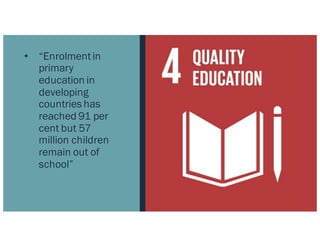
• “Enrolmentin
primary
education in
developing
countries has
reached 91 per
cent but 57
million children
remain out of
school”
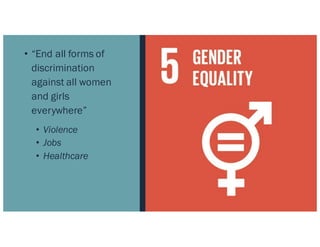
• “End all forms of
discrimination
against all women
and girls
everywhere”
• Violence
• Jobs
• Healthcare
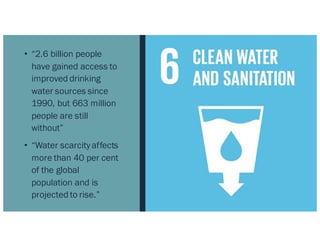
• “2.6 billion people
have gained access to
improved drinking
water sources since
1990, but 663 million
people are still
without”
• “Water scarcity affects
more than 40 per cent
of the global
population and is
projected to rise.”
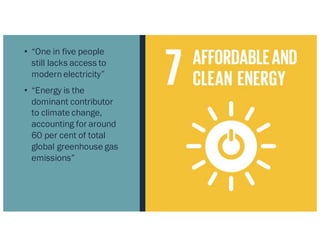
• “One in five people
still lacks access to
modern electricity”
• “Energy is the
dominant contributor
to climate change,
accounting for around
60 per cent of total
global greenhouse gas
emissions”
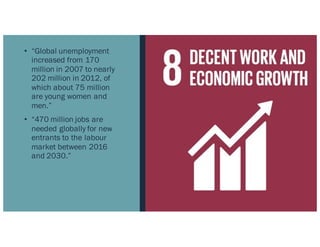
• “Global unemployment
increased from 170
million in 2007 to nearly
202 million in 2012, of
which about 75 million
are young women and
men.”
• “470 million jobs are
needed globally for new
entrants to the labour
market between 2016
and 2030.”
• “Develop quality, reliable,
sustainable and resilient
infrastructure, including
regional and transborder
infrastructure, to support
economic development
and human well-being,
with a focus on affordable
and equitable access for
all”
• “By 2030, empower
and promote the
social, economic and
political inclusion of
all, irrespective of age,
sex, disability, race,
ethnicity, origin,
religion or economic
or other status”
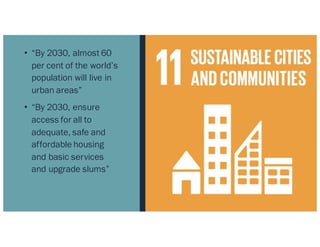
• “By 2030, almost 60
per cent of the world’s
population will live in
urban areas”
• “By 2030, ensure
access for all to
adequate, safe and
affordable housing
and basic services
and upgrade slums”
• “Each year, an estimated one
third of all food produced –
equivalent to 1.3 billion tonnes
worth around $1 trillion – ends
up rotting in the bins of
consumers and retailers, or
spoiling due to poor
transportation and harvesting
practices”
• “Should the global population
reach 9.6 billion by 2050, the
equivalent of almost three
planets could be required to
provide the natural resources
needed to sustain current
lifestyles”
• From 1880 to 2012,
average global
temperature
increased by 0.85°C
• Oceans have warmed,
the amounts of snow
and ice have
diminished and sea
level has risen.
• “Conserve and
sustainably use
the oceans, seas
and marine
resources”
• “Sustainably
manage forests,
combat
desertification,halt
and reverse land
degradation,halt
biodiversity loss”
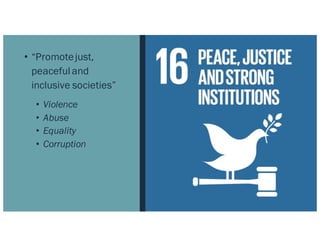
• “Promotejust,
peaceful and
inclusive societies”
• Violence
• Abuse
• Equality
• Corruption
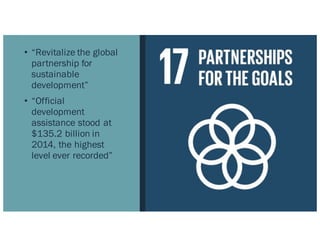
• “Revitalize the global
partnership for
sustainable
development”
• “Official
development
assistance stood at
$135.2 billion in
2014, the highest
level ever recorded”
Discussion Questions
■ Why do you think the UN included this goal?
■ How can this goal be reached?
■ What are the benefits of reaching this
goal/negative outcomes of not reaching this
goal?
■ What countries or types of countries would
benefit most from this goal?

Sustainability goals presentation

  • 2.
    • “836 million peoplestill live in extreme poverty” • “About one in five persons in developing regions lives on less than $1.25 per day”
  • 3.
    • “Globally, onein nine people in the world today (795 million) are undernourished ” • “Poor nutrition causes nearly half (45 per cent) of deaths in children under five – 3.1 million children each year.”
  • 4.
    • “…more thansix million children still die before their fifth birthday each year” • “Only half of women in developing regions receive the recommended amount of health care they need” • HIV/AIDS, Malaria, and other diseases are still an issue.
  • 5.
    • “Enrolmentin primary education in developing countrieshas reached 91 per cent but 57 million children remain out of school”
  • 6.
    • “End allforms of discrimination against all women and girls everywhere” • Violence • Jobs • Healthcare
  • 7.
    • “2.6 billionpeople have gained access to improved drinking water sources since 1990, but 663 million people are still without” • “Water scarcity affects more than 40 per cent of the global population and is projected to rise.”
  • 8.
    • “One infive people still lacks access to modern electricity” • “Energy is the dominant contributor to climate change, accounting for around 60 per cent of total global greenhouse gas emissions”
  • 9.
    • “Global unemployment increasedfrom 170 million in 2007 to nearly 202 million in 2012, of which about 75 million are young women and men.” • “470 million jobs are needed globally for new entrants to the labour market between 2016 and 2030.”
  • 10.
    • “Develop quality,reliable, sustainable and resilient infrastructure, including regional and transborder infrastructure, to support economic development and human well-being, with a focus on affordable and equitable access for all”
  • 11.
    • “By 2030,empower and promote the social, economic and political inclusion of all, irrespective of age, sex, disability, race, ethnicity, origin, religion or economic or other status”
  • 12.
    • “By 2030,almost 60 per cent of the world’s population will live in urban areas” • “By 2030, ensure access for all to adequate, safe and affordable housing and basic services and upgrade slums”
  • 13.
    • “Each year,an estimated one third of all food produced – equivalent to 1.3 billion tonnes worth around $1 trillion – ends up rotting in the bins of consumers and retailers, or spoiling due to poor transportation and harvesting practices” • “Should the global population reach 9.6 billion by 2050, the equivalent of almost three planets could be required to provide the natural resources needed to sustain current lifestyles”
  • 14.
    • From 1880to 2012, average global temperature increased by 0.85°C • Oceans have warmed, the amounts of snow and ice have diminished and sea level has risen.
  • 15.
    • “Conserve and sustainablyuse the oceans, seas and marine resources”
  • 16.
    • “Sustainably manage forests, combat desertification,halt andreverse land degradation,halt biodiversity loss”
  • 17.
    • “Promotejust, peaceful and inclusivesocieties” • Violence • Abuse • Equality • Corruption
  • 18.
    • “Revitalize theglobal partnership for sustainable development” • “Official development assistance stood at $135.2 billion in 2014, the highest level ever recorded”
  • 19.
    Discussion Questions ■ Whydo you think the UN included this goal? ■ How can this goal be reached? ■ What are the benefits of reaching this goal/negative outcomes of not reaching this goal? ■ What countries or types of countries would benefit most from this goal?