NDIA EGALL STORIES THAT COUNT
` 100
I
www.indialegallive.com
July1, 2019
LIVESATRISKThedoctors’strikeexposesagrowingmenace—oftheirlivesunderthreatfromdistraughtrelatives
ofdeceasedpatients.TheSupremeCourtwillneedtofindananswertothedisturbingtrend
Plus:Afirstpersonaccountbyaseniordoctorwhoworked inagovernmenthospital
Indian Cyber Crooks:
Targeting America
Lateral Entry: Inducting outside specialists
in bureaucracy could violate the Constitution
Catch Us
Every Saturday at 8 pm
and Sunday at 2 pm
4 July 1, 2019
N a recently published cover story in this maga-
zine, the prolific Professor Upendra Baxi
touched on a subject that most legal analysts shy
away from: The trial and conviction of mentally
ill persons. Should they be treated with extra
doses of dignity and leniency?
The courts have not spoken with resounding cla-
rity on this subject not because of any lack of resolve
or will but rather because of the complex and multi-
farious medico-legal and social dimensions of
this subject.
For example, as Baxi notes, in Accused X v State
of Maharashtra, Justices NV Ramana, Mohan M
Shantanagoudar and Indira Banerjee (delivered on
April 12, 2019), of the Supreme Court grappled with
several perplexing aspects of criminal justice and
mental health. Largely Leaving the matter of sen-
tencing guidelines to the legislature, the Court
favoured working with a framework of reasoned
judicial discretion privileged by judicial directions.
Justice Ramana was succinct and to the point
when deliberating on how culpability can be
assessed in sentencing those with mental illness. He
asked: “Is treatment better suited than punish-
ment?” In a constitutional democracy, as Baxi so
aptly observes, such questions are critical for profes-
sional as well as public discourse.
The larger question of whether to abolish or
retain the death penalty did not concern the Court
here. “Nor did it require any elaborate examination
whether the crime committed and death sentence
awarded fell outside the ‘rarest of the rare’ situation,”
Baxi wrote. “Both the trial and the High Court had
decided that the heinous crime of statutory rape and
murder of two girls coupled with an earlier record of
such crimes deserved death.
“However, the appeal was based on two narrow
grounds: first, no separate hearing on the sentence
was given by the trial court in direct contravention
of Section 235 (2) of the Code of Criminal Procedure
(CrPC) and second, the award of the death sentence
was contrary to the three-judge Bench decision in
Shatrughan Chauhan (2014) followed by a four-
judge Bench decision of this Court in Navneet Kaur
(2014). These decisions ruled that the execution of
persons suffering from mental illness or insanity vio-
lates Article 21 of the Constitution as this would be a
‘supervening circumstance meriting commutation of
the death sentence to life’.”
Baxi’s excellent discourse on this subject is a
must-read, and I would recommend it to all legal
practitioners, students, and dispensers of justice. In
the course of scanning related articles, as part of
broader research on the subject, inspired by Baxi’s
piece, one stands out for its clarity, universality
and scholarship.
I summarise below the salient points from a large
study made on this subject by the prestigious Rand
Corporation. The title is itself a giveaway: “Criminal
Justice Policies Toward the Mentally Retarded Are
Unjust and Waste Money.” Written by renowned
American criminologist Dr Joan R Petersilia, the
article concludes:
Arrest and Prosecution. Persons with mental
retardation often make no attempt to disguise what
they have done. In fact, in trying hard to please
authority figures, they may confess to what they have
not done. And they have little protection against
this, as they often waive their Miranda rights (with-
out understanding what they are doing).
Pretrial Incarceration. Bail is typically available
only for those with jobs or with stable living situa-
tions; mentally retarded persons often lack both.
Plea Bargaining, Court Processing, and Senten-
cing. Since persons with mental retardation tend to
provide more incriminating evidence to prosecutors
than other defendants, they are less successful at
plea bargaining. When they go to trial, their testimo-
ny may be viewed as less credible because aggressive
prosecutors can make them appear unreliable. Pro-
bation is commonly granted to persons with higher
intelligence and greater educational and work
achievement, so the mentally retarded serve jail or
prison sentences at higher rates.
Incarceration, Parole, and Recidivism. Persons
with mental retardation are typically housed with
the general prison population, where they are often
abused or victimised. They tend to rely on physical
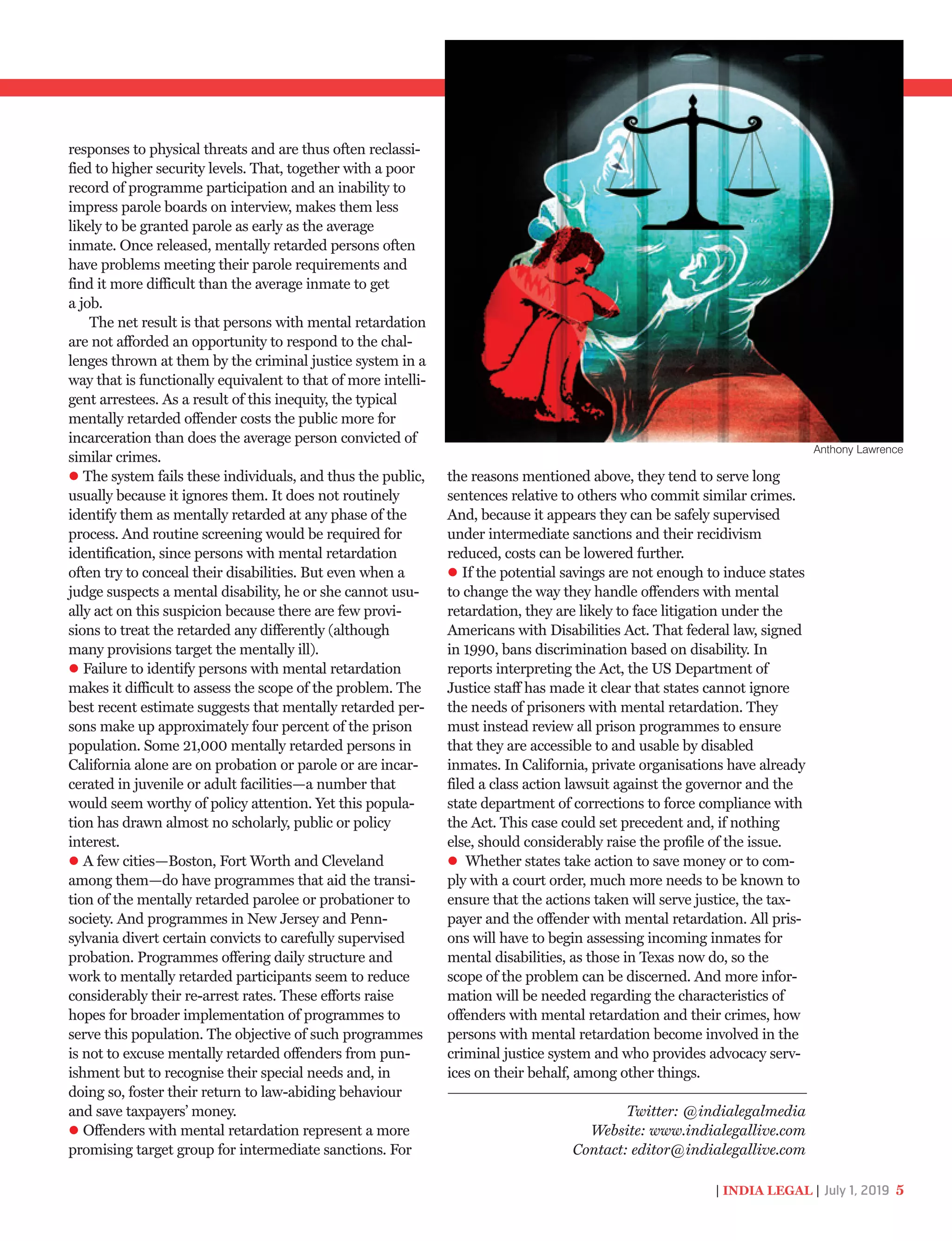
THE LAW AND THE MIND
Inderjit Badhwar
I
Astudyon
criminaljustice
policiesfor
thementally
retardedwritten
byAmerican
criminologistDr
JoanRPetersilia
hasthrownlight
onseveral
issues,such
asarrest,
prosecution,plea
bargaining,
paroleand
incarcerationof
suchaccused
andthesteps
takento
assistthem.
Letter from the Editor
responses to physical threats and are thus often reclassi-
fied to higher security levels. That, together with a poor
record of programme participation and an inability to
impress parole boards on interview, makes them less
likely to be granted parole as early as the average
inmate. Once released, mentally retarded persons often
have problems meeting their parole requirements and
find it more difficult than the average inmate to get
a job.
The net result is that persons with mental retardation
are not afforded an opportunity to respond to the chal-
lenges thrown at them by the criminal justice system in a
way that is functionally equivalent to that of more intelli-
gent arrestees. As a result of this inequity, the typical
mentally retarded offender costs the public more for
incarceration than does the average person convicted of
similar crimes.
The system fails these individuals, and thus the public,
usually because it ignores them. It does not routinely
identify them as mentally retarded at any phase of the
process. And routine screening would be required for
identification, since persons with mental retardation
often try to conceal their disabilities. But even when a
judge suspects a mental disability, he or she cannot usu-
ally act on this suspicion because there are few provi-
sions to treat the retarded any differently (although
many provisions target the mentally ill).
Failure to identify persons with mental retardation
makes it difficult to assess the scope of the problem. The
best recent estimate suggests that mentally retarded per-
sons make up approximately four percent of the prison
population. Some 21,000 mentally retarded persons in
California alone are on probation or parole or are incar-
cerated in juvenile or adult facilities—a number that
would seem worthy of policy attention. Yet this popula-
tion has drawn almost no scholarly, public or policy
interest.
A few cities—Boston, Fort Worth and Cleveland
among them—do have programmes that aid the transi-
tion of the mentally retarded parolee or probationer to
society. And programmes in New Jersey and Penn-
sylvania divert certain convicts to carefully supervised
probation. Programmes offering daily structure and
work to mentally retarded participants seem to reduce
considerably their re-arrest rates. These efforts raise
hopes for broader implementation of programmes to
serve this population. The objective of such programmes
is not to excuse mentally retarded offenders from pun-
ishment but to recognise their special needs and, in
doing so, foster their return to law-abiding behaviour
and save taxpayers’ money.
Offenders with mental retardation represent a more
promising target group for intermediate sanctions. For
the reasons mentioned above, they tend to serve long
sentences relative to others who commit similar crimes.
And, because it appears they can be safely supervised
under intermediate sanctions and their recidivism
reduced, costs can be lowered further.
If the potential savings are not enough to induce states
to change the way they handle offenders with mental
retardation, they are likely to face litigation under the
Americans with Disabilities Act. That federal law, signed
in 1990, bans discrimination based on disability. In
reports interpreting the Act, the US Department of
Justice staff has made it clear that states cannot ignore
the needs of prisoners with mental retardation. They
must instead review all prison programmes to ensure
that they are accessible to and usable by disabled
inmates. In California, private organisations have already
filed a class action lawsuit against the governor and the
state department of corrections to force compliance with
the Act. This case could set precedent and, if nothing
else, should considerably raise the profile of the issue.
Whether states take action to save money or to com-
ply with a court order, much more needs to be known to
ensure that the actions taken will serve justice, the tax-
payer and the offender with mental retardation. All pris-
ons will have to begin assessing incoming inmates for
mental disabilities, as those in Texas now do, so the
scope of the problem can be discerned. And more infor-
mation will be needed regarding the characteristics of
offenders with mental retardation and their crimes, how
persons with mental retardation become involved in the
criminal justice system and who provides advocacy serv-
ices on their behalf, among other things.
| INDIA LEGAL | July 1, 2019 5
Twitter: @indialegalmedia
Website: www.indialegallive.com
Contact: editor@indialegallive.com
Anthony Lawrence
Fake call centres have sprouted in
various cities and swindled $900
million from Americans by threatening
to implicate them in crimes, thereby
giving a bad name to India’s BPOs
ContentsVOLUME XII ISSUE33
JULY1,2019
OWNED BY E. N. COMMUNICATIONS PVT. LTD.
A -9, Sector-68, Gautam Buddh Nagar, NOIDA (U.P.) - 201309
Phone: +9 1-0120-2471400- 6127900 ; Fax: + 91- 0120-2471411
e-mail: editor@indialegalonline.com
website: www.indialegallive.com
MUMBAI: Arshie Complex, B-3 & B4, Yari Road, Versova, Andheri,
Mumbai-400058
RANCHI: House No. 130/C, Vidyalaya Marg, Ashoknagar,
Ranchi-834002.
LUCKNOW: First floor, 21/32, A, West View, Tilak Marg, Hazratganj,
Lucknow-226001.
PATNA: Sukh Vihar Apartment, West Boring Canal Road, New Punaichak,
Opposite Lalita Hotel, Patna-800023.
ALLAHABAD: Leader Press, 9-A, Edmonston Road,
Civil Lines, Allahabad-211 001.
Chief Patron Justice MN Venkatachaliah
Editor Inderjit Badhwar
Senior Managing Editor Dilip Bobb
Deputy Managing Editor Shobha John
Executive Editor Ashok Damodaran
Contributing Editor Ramesh Menon
Deputy Editor Prabir Biswas
Senior Writer Vrinda Agarwal
Art Director Anthony Lawrence
Deputy Art Editor Amitava Sen
Senior Visualiser Rajender Kumar
Photographers Anil Shakya, Bhavana Gaur
Photo Researcher/ Kh Manglembi Devi
News Coordinator
Production Pawan Kumar
CFO
Anand Raj Singh
Sales & Marketing
Tim Vaughan, K L Satish Rao, James Richard,
Nimish Bhattacharya, Misa Adagini
Circulation Team
Mobile No: 8377009652, Landline No: 0120-612-7900
email: indialegal.enc@gmail.com
PublishedbyProfBaldevRajGuptaonbehalfofENCommunicationsPvtLtd
andprintedatAcmeTradexIndiaPvt.Ltd.(UnitPrintingPress),B-70,Sector-80,
PhaseII,Noida-201305(U.P.). Allrightsreserved.Reproductionortranslationinany
languageinwholeorinpartwithoutpermissionisprohibited.Requestsfor
permissionshouldbedirectedtoENCommunicationsPvtLtd.Opinionsof
writersinthemagazinearenotnecessarilyendorsedby
ENCommunicationsPvtLtd.ThePublisherassumesnoresponsibilityforthe
returnofunsolicitedmaterialorformateriallostordamagedintransit.
AllcorrespondenceshouldbeaddressedtoENCommunicationsPvtLtd.
Senior Content Writer Punit Mishra
(Web)
LEAD
12Doctor’s Dilemma
The recent pan-India strike by medical professionals is yet another reminder of the need for a one-time
solution in the form of a central act against violence with stringent punishment
15Have a Heart!
The frequent instances of assault on doctors are due to a lack of understanding of their
role and functions and the pressures they work under, writes Dr Kamal Kumar Mahawar
18Charlatans Aplenty
CYBERSECURITY
6 July 1, 2019
28
REGULARS
Followuson
Facebook.com/indialegalmedia
Twitter:@indialegalmedia
Website:www.indialegallive.com
Contact:editor@indialegallive.com
Cover Design: ANTHONY LAWRENCE
Cover Photo: UNI
Ringside............................8
Courts ...............................9
Is That Legal...................10
Media Watch ..................39
International Briefs..........50
Elusive Freedom
The Delhi government will file a special leave petition challenging the Delhi High Court’s
order granting release to convict Sushil Kumar Sharma in the tandoor murder case
Merchant
of Hate
Wanted in a clutch of
cases in India, Islamic
televangelist Zakir Naik is
playing the Muslim card in
Malaysia to stave off New
Delhi’s demands for his
extradition
Rumble In the Hills 40
As the Gupta brothers play host to two weddings in Auli, the Uttarakhand HC has set
out stringent conditions and ordered the district administration to monitor the event
Lawless Territory
The murder of the first woman chief
of the UP Bar Council in an Agra
court shows that Yogi Adityanath’s
“bullet for a bullet” strategy to deal
with crime hasn’t quite worked
48
The government is in denial mode as it refutes ex-chief economic ad-
viser Arvind Subramanian’s assessment of GDP figures. But it should
develop a new generation of reforms and rely less on raw wisdom
35
SPOTLIGHT
New Avatar
In a surprising move, former SP strongman Amar Singh was seen
fighting a case for long-time friend Jaya Prada in the Lucknow bench
of the Allahabad High Court
21
On the Backfoot
The Congress government in Chhattisgarh faced embarrassment over the arrest
of a journalist for an innocuous video and was forced to release him
COLUMN
Unfair Entry
The huge lateral entry of “corporate civil servants” is a back-door
capture of the IAS and privatisation of the government. This could
fall foul of the Constitution and lead to social disharmony
22
STATES
46
The GDP Storm
36
Fit For the Job
The National Anti-Profiteering Authority has acted with fairness,
intervening against defaulters and determining undue profiteering
in different transactions, thus allaying fears about its performance
26
ECONOMY
32
Having different rates of
interest for consumers
and builders for delays
on their part amounts
to an unfair trade
practice. However, this
anomaly is yet to be
corrected by courts
Ensure Parity
CONSUMERRIGHTS
COURTS
GLOBALTRENDS
Crash Landing? 42
The Kerala CM has resisted the handing over of the Thiruvananthapuram International
Airport to the Adani group even though the latter already has a presence in the state
| INDIA LEGAL | July 1, 2019 7
8 July 1, 2019
“
RINGSIDE
“How can these boys
be so fearless as if no
one will take action
against them? They
were smiling while
harassing me and
my cab driver...This
is not the Kolkata I
came back to....”
—Actor Ushoshi Sen-
gupta after she was
allegedly harassed by
bikers in Kolkata
“...one of our MLAs
called me and
said...he had been
offered `10 crore to
join the other side.
He was told that the
government would
fall by the next
evening....”
Karnataka CM HD
Kumaraswamy,
accusing the BJP of
trying to topple the
Congress-JD(S) gov-
ernment in the state
“Despite doing my
best, I haven’t been
able to secure the
best interest of the
Faculty of Law
because of non-
cooperation of
the university
authorities.”
—Dean and Head of
Law Faculty, Delhi
University, Professor
Ved Kumari, in her
resignation letter to
VC, DU
“...a proper response
on...‘One Country
and One Election’ in
such a short time
would not do justice
to the subject it
deserves...circulate a
White Paper...to
all...parties, inviting
their views....”
—Mamata Banerjee,
on her absence from
the meeting on “one
nation one poll” with
PM Modi in Delhi
“The role of an
opposition, an active
opposition, an effec-
tive opposition is a
prerequisite for a
parliamentary
democracy...their
every word…every
feeling is valuable
for us.”
—PM Modi to the
media before the
commencement of the
first session of the
17th Lok Sabha
“...I can only hope
and pray that even
now a solution can
emerge and Jet can
fly and fulfil the
needs not only of
employees but of air
travellers....”
—Former chairman,
Jet Airways, Naresh
Goyal after lenders’
decision to start in-
solvency proceedings
against the airline
“I can’t understand
how Sarfaraz can be
so brainless. How
could he forget...we
don’t chase very
well.... The game
was half-won by Pa-
kistan when Sarfar-
az won the toss, but
he tried hard to lose
the match....”
—Pacer Shoaib Akh-
tar on India’s win in
the World Cup match
“...It is your political and moral duty to ensure that
the state fulfils the mandates cast upon it by the
courts. Laxity...towards court orders, sends an
implicit message that the high and mighty consider
themselves above the rule of law...the order im-
pugns your actions...and quashes them as illegal....”
—IAS officer Ashok Khemka in a letter to Haryana CM ML
Khattar, urging him to comply with the Punjab and Haryana
High Court order on adverse remarks in his appraisal report
Anthony Lawrence
The New Lok Sabha. First Day, First Show
'Jai Shri Ram'
‘Jai Bheem’
‘Jai Meem’
‘Jai Hind’
‘Takbeer
Allahu Akbar’
'Vande Mataram'
'Bharat Mata
ki Jai'
Courts
| INDIA LEGAL | July 1, 2019 9
Twitter: @indialegalmedia
Website: www.indialegallive.com
Contact: editor@indialegallive.com
—Compiled by India Legal Team
Sanjiv Bhatt gets life
for custodial death
AGujarat court sentenced former
Gujarat-cadre IPS officer Sanjiv
Bhatt to life imprisonment in a custodi-
al death case. Bhatt had recently
moved the apex court against a Guj-
arat High Court order which refused
his appeal to summon additional wit-
nesses for examination during the trial.
His plea was, however, dismissed. The
case dates back to 1989 when Bhatt,
then additional superinten-
dent of police in Gujarat’s
Jamnagar, had detained
over 100 people in the
wake of a communal
riot and one of the
detainees died.
The Supreme Court has issued notice to
the Election Commission (EC) on a
plea seeking that elections to two Rajya
Sabha seats from Gujarat be held simulta-
neously. The seats fell vacant after Union
ministers Amit Shah and Smriti Irani, both
Rajya Sabha members, won Lok Sabha
seats from Gandhinagar and Amethi, res-
pectively. The petition was filed by the
Leader of Opposition in the Gujarat ass-
embly, Pareshbhai Dhanani, after the EC
on June 15 fixed July 5 for separate
bypolls to the two Rajya Sabha seats. The
Congress said that holding elections for
the two seats separately is against the
rules and the EC’s June 15 order should
be declared “unconstitutional, arbitrary,
illegal, void ab initio” and violative of
Article 14 of the Constitution. The EC has
been asked to respond by June 24 and
the matter will be heard next on June 25.
SC queries separate
bypolls for 2 RS seats
Speaking at a two-day conference of
chief justices of member nations of
the Shanghai Cooperation Organisation in
Russia, Chief Justice of India (CJI) Ranjan
Gogoi said that independence of the judi-
ciary is not a “one-time pill but a state of
affairs” that should remain constant. The
CJI said: “In some phases in the journey
of a nation, when the legislative and exec-
utive wings get swept away from their
duties and goals under the Constitution by
waves of populism, it is for the judiciary
to rise and stand up to the populist forces
and protect the constitutional ethos from
being desecrated by the populists. To
some critics and naysayers, this situation
presents a case for hoisting the classical
counter narrative. Unelected judges, acting
under the constitutional mandate, get to
overturn the acts of the elected majority.”
He further said that “however, it is for us
to recollect that such situations across the
world have heaped tremendous pressure
on the judicial organs,
and it is no surprise
that in some juris-
dictions, judiciary
too has suc-
cumbed to pop-
ulist forces.”
The Madras High Court slammed the
Tamil Nadu government for not taking
adequate steps to handle the water crisis
in Chennai despite two failed monsoons.
A bench of Justices S Manikumar and
Subramonium Prasad was hearing cases
filed against the commercial exploitation
of groundwater from the outskirts of the
city, including a PIL by a resident of
Vellore district, who alleged that sewage
was being allowed to flow through into a
water channel. After hearing the govern-
ment’s stand, the court suo motu
impleaded the secretary of the Public
Works Department and asked him for a
state-wide comprehensive report on the
number of reservoirs, steps taken for
desilting, amount sanctioned, etc. The
matter will be heard next on June 26.
Madras HC hears plea on Chennai water crisis
Two new HC chief
justices appointed
Justices RS Chauhan and V
Ramasubramanian were appointed
chief justices of the Telangana and
Himachal Pradesh High Courts,
respectively, after the government
cleared their names for elevation. It
may be recalled that the Supreme
Court Collegium had on May 10 rec-
ommended four names, of which three
were cleared by the central govern-
ment. On May 22, Justice DN Patel,
one of the recommended names, was
appointed the chief justice of the Delhi
High Court. However, the government
is yet to decide on the elevation of
Justice Akil Kureshi as the chief justice
of the Madhya Pradesh High Court.
Justice Kureshi, the most senior judge
of the parent High Court of Gujarat, is
currently at the Bombay High Court.
Independence of
judiciary not a
one-time pill: CJI
ISTHAT
Are there any changes in cheque
bounce laws?
Yes. Parliament has passed the
Negotiable Instruments (Amend-
ment) Bill, 2018, which has
introduced changes to the
Negotiable Instruments Act,
1881. The court can now ask the
drawer of a cheque to pay inter-
im compensation to the com-
plainant—20
percent of the total amount of the
cheque within 60 days of the
order. This can be done at the
time a case of dishonoured
cheque is filed by the com-
plainant.
However, in case the final
verdict in the case goes against
the complainant, he/she will have
to return the interim compensa-
tion along with interest.
— Compiled by India Legal team
Room For Interim Compensation
Why are rent agreements generally
applicable only for 11 months?
A rent agreement is also known as a
lease agreement. It is a document or
a written contract
between the owner of a
property and the ten-
ant who takes it on
rent. Most rent
agreements are
signed for 11
months, so that
the stamp duty
and other
charges can
be avoided.
According to the
Registration Act, 1908, registra-
tion of a lease agreement is manda-
tory if the leasing period is 12
months or more. And in case of reg-
istration, it is mandatory to pay reg-
istration fee and stamp duty.
Time Limit For
Rent Agreements
?
Twitter: @indialegalmedia
Website: www.indialegallive.com
Contact: editor@indialegallive.com
Is it necessary to show
one’s Aadhaar number
to avail of banking serv-
ices and a mobile con-
nection?
The Supreme Court,
while upholding the
validity of the Aadhaar
scheme, has categorical-
ly ruled that the Aadhaar
number is necessary
only for filing tax returns,
both electronically and
manually, and obtaining
PAN cards. The telecom
operators and banks
can’t compel a person to
share details of his
Aadhaar card for availing
of their services. The
judgment delivered by a
five-judge constitution
bench is a landmark for
the right to privacy.
Restrictions For Aadhaar
10 July 1, 2019
Ignorance of law is no excuse. Here are answers to frequently asked
queries regarding matters that affect us on a day to day basis
Can the governor of a state grant pardon to
a convicted person?
Article 161 of the Constitution has given the
power to the governor of a state to reduce
the sentence of a convict or waive it com-
pletely. The Article reads: “The Governor of
the state shall have the power to grant par-
dons, reprieves, respites or remissions of
punishment or to suspend, remit or com-
mute the sentence of any person convicted
of any offence against any law relating to a
matter to which the executive power of the
state extends.” However, the governor can
use the power only in case of a state law
and not a central law.
Power To Pardon,
But Limited
Lead/ Attack On Doctors
12 July 1, 2019
T started as a small protest by doc-
tors at a Kolkata hospital, two of
whom were assaulted by a dead
patient’s relative. But it did not take
long for it to spread into a nation-
wide movement with government
doctors in various states expressing soli-
darity and resorting to agitations. On
June 17, the Indian Medical Association
(IMA) staged a 24-hour-long protest
across the country, demanding a com-
prehensive central law to deal with
attacks on doctors and healthcare pro-
fessionals in hospitals. The strike
impacted medical services and all non-
essential healthcare facilities, including
OPDs, were closed from early morning
on that day. The IMA also staged a
dharna at its headquarters in Delhi.
Mercifully, normalcy was restored
later the same day after West Bengal
Chief Minister Mamata Banerjee accep-
ted the demands of the protesting doc-
tors. As the strike was called off, the
Supreme Court on June 18 did not pass
any order on a PIL seeking measures for
the safety and security of doctors in hos-
pitals across India and posted it for July.
The IMA has been urging the centre
to frame a central law to check violence
against medical professionals in hospi-
tals for a long time. This writer was
president of the IMA when it submitted
to the centre a draft law in this regard.
On June 15, the Union health minister,
Dr Harsh Vardhan, attached a copy of
the draft in his letter to all chief minis-
ters asking them to frame laws for the
protection of medical professionals.
This is not the first time that doctors
have been assaulted. A 2015 IMA survey
found that over 70 percent of them
had faced mental torture and/or physi-
cal violence in their careers. It polled
1,781 doctors of whom only 37.7 percent
said that they were happy with their
profession; 82 percent were stressed
out; 34.5 percent had high blood pres-
sure; 18.6 percent had diabetes; 61.6
percent had fear of violence during
patient visits; 56.5 percent had thought
of hiring security at the place of their
practice; 31.6 percent never wanted
their children to become doctors; for
45.4 percent, the main source of stress
was the fear of violence and 75.6 percent
faced anxiety attacks.
There are several legal provisions
that deal with the violence against doc-
tors and healthcare professionals:
Doctor’s DilemmaThestrikebymedicalprofessionalsisyetanotherreminderoftheneedforaone-time
solutionintheformofacentralactagainstviolencewithstringentpunishment
By Dr KK Aggarwal
RIGHT TO BE SAFE
(Left) Doctors in
several parts of India
resorted to strikes and
held protests in support
of their counterparts in
Kolkata; (inset) one of the
two junior doctors who
were injured at the
NRS hospital
I
UNI
| INDIA LEGAL | July 1, 2019 13
Criminal Law: Any assault or attack
on doctors, nurses and other staff, as
well as clinical establishments, etc, are
punishable under the provisions of the
Indian Penal Code (IPC), 1860. The pro-
visions can be further placed under:
a) Criminal conspiracy—Sections 120A
and 120B of IPC
b) Offences disturbing public tranqui-
lity—unlawful assembly (Sections 141,
143 and 144 of IPC), rioting (Sections
146, 147 and 148 of IPC), affray (Sec-
tions 159 and 160 IPC).
c) Offences affecting public health, safe-
ty, convenience, decency and morals—
public nuisance (Sections 268, 269 and
294 of IPC).
d) Offences affecting human body—hurt
(Sections 319, 323 and 324 of IPC); gri-
evous hurt (Sections 320, 325, 326 and
326A of IPC); act endangering life or
personal safety of others (Sections 336
337 and 338 of IPC); wrongful restraint
(Sections 339 and 341 of IPC); criminal
force and assault (Sections 350, 351, 352
and 355 of IPC).
e) Offences against property—theft
(Sections 378 and 379 of IPC); mischief
(Sections 425 and 426 of IPC); criminal
trespass (Sections 441 and 447 of IPC).
f) Offence of defamation (Sections 499
and 500 of IPC).
g) Offences of criminal intimidation,
insult and annoyance (Sections 503, 504
and 506 of IPC).
h) Offences outraging and insulting the
modesty of women (Sections 354, 354A,
354B, 354C and 509 of IPC).
In case of the above mentioned
offences, the doctors and their staff can
lodge a police complaint under Section
154 of the Code of Criminal Procedure
and get an FIR registered against the
said offender.
Civil Law: A civil suit can also be filed
by victims on the ground of offences co-
mmitted as mentioned above. It could
be a suit for permanent injunction, for
damages or for defamation.
Apart from these legal remedies,
around 15 states and Union Territories
have their respective legislation related
to violence against doctors. For example,
there is legislation like the Delhi Medi-
care Service Personnel and Medicare
Service Institutions Act, 2008; the Bi-
har Medical Service Institution and
Person Protection Act, 2011, and so on.
In all these laws, the accused, once con-
victed, can be punished with imprison-
ment which may extend up to three
years or fine up to `10,000, or both. The
convicted person/s will also have to pay
compensation which is twice the price of
the damaged property. However, legisla-
tion is not effective and doctors and
police authorities are hardly aware
about the legal provisions.
Government doctors have additional
protection against violence under IPC
Section 186—obstructing a public ser-
vant in discharge of public functions
which says: “Whoever voluntarily obst-
ructs a public servant in the discharge of
his public functions, shall be punished
with imprisonment of either description
for a term which may extend to three
months, or with fine which may extend
to five hundred rupees, or with both.”
An Indian businessman was recently
sentenced to life imprisonment for a
hijack hoax on a Jet Airways’ domestic
flight from Mumbai to Delhi in 2017
that resulted in an emergency landing in
Ahmedabad. Birju Kishor Salla, a resi-
dent of Mumbai, was arrested and
E
ven as the week-long doctors’
strike got over, news has come
in of an appalling case of med-
ical negligence. A woman from Alap-
puzha in Kerala who didn’t have can-
cer was given chemotherapy on the
basis of a false lab report earlier this
year. The incident came to light when
the victim, Rajini, lost all her hair in a
single chemotherapy session, follow-
ing which the doctors found out that
she didn’t have cancer. The state
government ordered a probe into the
matter on June 2, 2019.
Rajini, who is in her late 30s, is a
native of Kudassanad in Alappuzha
district, and sought treatment for a
tumour on her breast. A biopsy was
conducted and the examination was
done in a private lab, which claimed
she had cancer. A chemotherapy se-
ssion was conducted at the Medical
College in Kottayam on the basis of
this report. But the doctors soon
recognised the mistake when she
completely lost her hair after a single
session of chemotherapy.
END TO THE STALEMATE
West Bengal CM Mamata Banerjee at a
meeting with doctors in Kolkata on June 17
HairRaising
UNI
Lead/ Attack On Doctors
14 July 1, 2019
charged for posing a threat to the safety
of passengers and crew on board the air-
craft. He was also fined `50 million
($720,000), which a special National
Investigation Agency (NIA) court ruled
would be given as compensation to the
crew and passengers. Each pilot will get
a compensation of `100,000 out of the
fine amount, while each member of the
cabin crew will receive `50,000, and
each passenger will be paid `25,000 for
the “misery” the incident caused, accor-
ding to a statement released by NIA.
T
he situation described in the fake
hijack incident is the same as
when a doctor is beaten by rela-
tives/friends of a patient in a hospital.
The safety of all patients in a hospital is
at stake. And there may be more num-
ber of patients in a hospital than in an
aircraft. The doctor’s role and impor-
tance is the same as that of a pilot.
The IMA has zero tolerance for
patients or their relatives if they indulge
in violence. The medical profession
demands accountability but not at the
cost of violence. A patient doesn’t have
any right to attack doctors or indulge in
violence at medical establishments. At
the same time, doctors should not resort
to violence as an answer for assault.
They need to follow the principle of
humanity. It is paramount for every doc-
tor to become a role model in society as
far as healthcare is concerned.
So, is strike the answer? In People
for Better Treatment (PBT) vs West
Bengal Medical Council (WBMC) & Ors
on June 14, 2019, the Chief Justice of
the Calcutta High Court, Thottathil B
Nair Radhakrishnan, and Justice Suvra
Ghosh said: “At the outset, let us record
that we do not propose to proceed with
the matter as an adversarial litigation.
However, we need to provide appropri-
ate push with requisite grease to ensure
that the ongoing strike by a section of
doctors comes to an end through gov-
ernmental intervention by way of per-
suasion or otherwise, in accordance with
law. We do so because, within the
parameters of Article 21 of the
Constitution of India, ‘human rights’ as
understood in the civilised societies and
recognised in the international domain
through terms of international conven-
tions, which bind different nations, it is
the fundamental requirement that the
right to health is given top priority and
any need for medical help is immedi-
ately extended to any human being even
if he is not a citizen.
“Therefore, we take this opportunity
to state that resolution of disputes
which would have arisen as a conse-
quence of certain unfortunate events
even in the hospital is not to be coun-
tered by action of eminent and well
informed people like doctors by keeping
away from their primary and fundamen-
tal duty to serve the people.
“Be that as it may, the State Govern-
ment has also to ensure that the griev-
ance of the doctors, particularly in rela-
tion to certain incidents which are
alleged to have occurred, are addressed
in accordance with law without any
delay. We record the submission made
by the Learned Advocate General that
First Information Report has been
lodged and arrests have been made inso-
far as the alleged incidents in which the
doctors are stated to be victims. This
means that the State Government has
taken efforts to push the machinery in
that regard. As a necessary consequence,
it is definitely for the doctors to now
turn themselves to the reconciliatory
mode in the larger interest of the suffer-
ing people and answer their oath which
they have taken when they became doc-
tors. The great advice given through the
Hippocratic Oath ought to lead them to
better ways of dealing with the problems
which they are faced with. The State
Government shall also ensure that ade-
quate protection is provided to the hos-
pitals and place of work of all doctors
and also such places where doctors may
feel insecure in any circumstances.”
Every time there is a doctors’ strike,
courts have to intervene. The solution is
a central act with harsh punishment.
—The writer is President, Heart Care
Foundation of India, and
President-elect, Confederation of Medical
Associations of Asia and Oceania
Twitter: @indialegalmedia
Website: www.indialegallive.com
Contact: editor@indialegallive.com
BEARING THE BRUNT
Patients and their relatives struggle to get
medical help during the strike
UNI
| INDIA LEGAL | July 1, 2019 15
EDICINE is still ref-
erred to as a noble pro-
fession. Ever since I
started this journey
some 28 years ago,
these words have been
drilled into me. Yes, we also need to be
remunerated for our efforts, but that is
not the main reason why we do it. We
make a difference, we were told, and we
get respect like no other profession and
that was supposed to make it worth our
while. And we believed it.
Our graduation took longer than
other disciplines and if one included the
period spent doing “internship”, six
years would go to obtain an MBBS
degree with a licence to practice. Those
doing other disciplines would graduate
in four, three, even two years. When
others our age were constantly partying
and having fun, we were studying. The
medical syllabus is vast and there is no
room for error. Days merged into nights
and months into years. We worked hard
and believed we were training for a very
important role in society and were told
our contribution would be valued.
We were paid approximately `1,800
a month as interns and were told that
we were lucky as batches before us got
only `900. But this was not the end of
it. It soon became clear that though we
would get a licence to practise, we
would not be fit to do so. For that, we
would need many more years of train-
ing. Preparations began again, this time
for postgraduate entrance exams.
I was among the lucky few to be
selected for further training in my cho-
sen speciality—general surgery. More
than half of the medical graduates in the
country do not get this opportunity.
They will not only have to train them-
selves, but also earn a livelihood for
themselves and their families. Many of
us were now around 23-24 years of
Have a Heart
TheassaultsondoctorsinIndiaisduetoalackofunderstandingoftheirroleand
functionsandthepressurestheyworkunder
Lead/ Violence Against Doctors/Column Dr Kamal Kumar Mahawar
M
Ourgraduationtooklongerthanother
disciplinesandifoneincludedtheperiod
spentdoing“internship”,sixyearswould
gotoobtainanMBBSdegreewitha
licensetopractice. Thesyllabusisvast.
mciindia.org
Lead/ Violence Against Doctors/ Column/ Dr Kamal Kumar Mahawar
16 July 1, 2019
age and our families expected us to look
after them and not the other way aro-
und. But their hopes, as well as ours,
were soon going to be dashed.
Those of us who qualified for post-
graduate training then spent another
two-three years learning the craft and
the science while working over 80-90
hours a week and getting paid between
`5,000 and `15,000 a month. Even
then, finding adequate training opportu-
nities proved elusive. Our professors
were under no obligation to train us and
we were in no condition to demand any-
thing. For many, it was too much back-
breaking work and some even thought
of taking their lives.
We saw our friends in other walks of
life getting married, settled, and earning
many times over. Some left for foreign
countries and would send us pictures of
posh cars and foreign holidays. We, on
the other hand, didn't even have time to
breathe and barely enough money to
live by. Yet, we persevered in the hope
that one day it would all be worth it.
Sadly, that day never came for many
of us.
All we wanted was a decent set-up
where we could practise modern medi-
cine and get a fair remuneration. We did
not seek to be rich. Seeing the dismal
state of public healthcare infrastructure
in most parts of the country, many did
not want to work there. Even renowned
central government establishments are
pathetic by modern standards and the
less said about state government-run
clinics and hospitals, the better. Even if
one decided to work there, the remuner-
ation did not match the hard work and
talent. Plus, there were the erratic and
arduous hours to contend with.
You could work for the private sector,
but the wages there were not much dif-
ferent either. They too would exploit the
market forces, make you work long
hours and not even pretend to train you.
Many went abroad. Those who stayed
back, served either as public sector doc-
tors with pitiable salaries and practising
Third World medicine or opened their
own establishments (with money bor-
rowed from family and friends) while
competing with quacks and faith heal-
ers. Contrary to what the public thinks,
fewer than one percent of doctors work
for or own corporate hospitals; most
just get by.
I
t is against this backdrop that one
has to view the violence against
doctors in India. Doctors most
prone and vulnerable to this are junior
doctors working in government hospi-
tals. They have just begun their profes-
sional journey and work for long hours
without enough rest and basic equip-
ment. They deal with the sickest and
the poorest.
Passions run high in such an envi-
ronment. Elsewhere in the world, doc-
tors and nurses can do their job away
from the eyes of worried relatives. Not
in India. Here everyone can go any-
where in the hospital, irrespective of the
time of day or night. All it takes is a per-
ception on the part of the patients’ rela-
tives or the patients that not enough is
being done for them to beat the doctor
up. The doctor may have just phoned his
superior and is awaiting instructions.
But if the patient dies, all hell breaks
loose as the relatives think he is negli-
gent. In case any relative has political or
underworld connections, then nobody
can save the doctor. They come back in
RIGOROUS
TRAINING
(Facing page)
Junior doctors
attending a class in
a medical college;
(right) a victim of
toxic illicit liquor
being attended to
by doctors in a
hospital; (below)
doctors do not
want to serve in
government
hospitals as the
infrastructure is
pathetic and
working hours
erratic and long
Photos:UNI
| INDIA LEGAL | July 1, 2019 17
hundreds and do whatever they wish.
Elsewhere in the world, and even in the
private sector in India, hospitals have
their own security. But this is not so in
government hospitals. Even if there are
one or two security personnel, they pre-
fer not to intervene because in our law-
less society, they will be the first target
in case of any attack and nobody will
even bother. The goons usually have
political patronage and know they can-
not be touched. I am not an expert in
security matters, but it is surely not
beyond the will of the government to
protect its own property and people
working in its establishments.
There is more to it. Indians live in
one of the unhealthiest environments in
the world. The air is so polluted, you
can’t breathe. In most parts of the coun-
try, there is no access to clean water and
even in big cities, water is frequently
contaminated. There are piles of gar-
bage every hundred metres but no one
is bothered till ill-health strikes. And
then the doctor is blamed for failing to
save them.
There is another angle to it. With the
increasing corporatisation of healthcare,
the patient thinks he is a consumer who
has the right to demand health. Just like
any other service or product, if you pay
for it, you want good results. Many
patients have difficulty understanding
how they can’t be cured or how an oper-
ation can have complications when they
have paid for it. They do not understand
that they are paying for the service and
that in healthcare you will have to know
God or be God to guarantee outcomes.
M
ental, verbal and physical
assault of doctors is also on
the rise elsewhere in the
world and that is because the medical
profession, and the healthcare industry
have become victims of their own suc-
cess. We have new medicines, sophisti-
cated equipment and modern scanners
and the finest micro-surgeries can be
done on the tiniest blood vessels. People
can be kept alive for months when not
one but several organs have failed. We
are able to treat a large number of
patients and send them home. But when
we can’t, when there is a complication, it
hits the patients and their families. They
cannot understand what happened and
why. They look for answers and some-
body to blame. Even the most sophisti-
cated patient grievance mechanisms
cannot satisfy them. Justice has to be
instantaneous and direct. They can tell
the doctor anything, even beat him up
and he won’t be able to do anything.
We are after all bound by the Hippo-
cratic Oath. We have to behave in the
noblest ways or we will lose our licence
to practise forever. Patients and their
relatives lose nothing in the process.
There is no mechanism in large parts of
the world for a doctor to report a pat-
ient. The best you can do is walk away
and that is what most of us do. But age
has made many of us a bit more mature.
It has taught us how to keep a lid on our
emotions. Yes, we have moments when
we regret joining this profession, most
of the time, it is an honour to do the job
we do.
However, fending off attacks is not
something that young doctors manning
emergency departments are trained to
do. They also struggle with the death of
a patient or an adverse outcome as
much as the patients’ families. Often,
these doctors don’t have the requisite
training to handle precarious situations
without the supervision of senior doc-
tors. They are being asked to work for
twice as long as normal human beings
for wages that are a tenth of what their
friends elsewhere are earning. They are
told, this is your duty. Are we then treat-
ing these young doctors fairly? I leave it
to you to decide.
—The writer is consultant general
and bariatric surgeon, Sunderland
Royal Hospital, and author of The
Ethical Doctor
Twitter: @indialegalmedia
Website: www.indialegallive.com
Contact: editor@indialegallive.com
NO PRYING EYES
Clown doctors amuse a young patient in a
child clinic in Budapest. Doctors elsewhere in
the world can work without fear
Youngdoctorsmanningemergency
departmentsarenottrainedtofendoff
attacks.Theytoostrugglewiththedeath
ofapatientoranadverseoutcomeas
muchasthepatients’families.
Cyber Security/ Fraud On US Citizens
18 July 1, 2019
ECH-SAVVY Indian char-
latans are stealing the data
of American citizens with
impunity. The Indian po-
lice has busted numerous
fake call centres in Noida,
Vadodara, Gurugram, Ahmedabad,
Indore and Mumbai which were operat-
ing under the garb of BPOs and swin-
dling US citizens of millions of dollars.
They did this by sending fake voice mes-
sages in American-accented English and
threatened to implicate them in crimes
such as money laundering, drug traffick-
ing, tax evasion, etc.
The latest such racket was busted by
the Madhya Pradesh cyber crime cell in
Indore on June 11. A 15-member cyber
cell team conducted raids on two fake
call centres in the posh Platinum Plaza
location and arrested 80 people.
These youth, mostly from North-East
India, were employed by Javed and Ra-
hil, owners of the call centres, to black-
mail US citizens. The police also arrest-
ed Javed and two other masterminds,
Shah Rook and Bhavil, from Indore.
Rahil is absconding and his location has
been traced in the US, according to
the police.
Additional director general (cyber
cell) Purushottam Sharma reportedly
said that of those arrested, 61 were men
and 19 women. All were from Nagaland
and Meghalaya. According to the cyber
cell officers, in the last one year alone,
the two call centres duped nearly 2.5
lakh US citizens.
Javed confessed that he had swindled
a US citizen of $26,800 in a single day.
During interrogation, the accused rev-
ealed their modus operandi which was,
more or less, the same as other rackets
busted in the past three years. Most of
the accused in these cases were from
Nagaland, Meghalaya, Rajasthan, Guja-
rat, Maharashtra, UP, MP, Manipur,
Delhi and Haryana.
Callers from the two call centres
would pose as US vigilance agency offi-
cers and tell Americans through voice
messages that there were problems with
their social security numbers and solicit
money to fix these. Some US citizens
would be told that they had committed
tax offences and would have to pay to
settle the cases. They would be threat-
ened and told to either fight the US
Internal Revenue Service in court
India’s Cyber Crooks
Inanalarmingtrend,fakecall
centreshavesproutedin
variouscitiesandswindled
$900millionfromAmericans
bythreateningtoimplicate
themincrimes,therebygiving
abadnametoIndia’sBPOs
By Rakesh Dixit
in Bhopal
T
GAME OVER
(L-R) Javed, Bhavil and Shah Rook, the
accused in the scam, in police custody;
computers seized from Indore call centre
| INDIA LEGAL | July 1, 2019 19
and face a fine as a “tax defrauder”
or pay immediately as an “out-of-court
settlement”.
The call centre employees would call
the US citizens on direct international
dialling or Magic Jack Application. The
call centres uploaded software in which
the employees typed a message in their
system and it would be converted into a
voice call. Bulk messages would be sent
to 10,000 US citizens in one go.
When this message reached the
mobile or landline number of US citi-
zens, a female voice would be heard in
an American accent. That would hood-
wink the US citizens into trusting the
message. Those who opened it would
hear a voice saying that their numbers
were detected in money laundering,
drug trafficking or some other offences.
Then the call recipients would be ad-
vised to contact a toll-free number—
8007678409—for further enquiry, with
a warning that if they didn’t follow the
advice, their social security number
would become dead and legal action
would follow.
Fearing legal hassles in US courts,
many victims would call the toll-free
number. Agents of the racket would pick
up the call and ask the callers to settle
the case by coughing up a certain
amount of money to be deposited in a
particular bank account. There were
several fake account holders in the US
who would assist in the racket.
Once the trapped Americans deposit-
ed the money, it would be sent through
the hawala route to Ahmedabad and
converted into Indian currency. This
would then be deposited into a bank
account of the racket’s masterminds. In
fact, it was only last year that a Penn-
sylvania-based man who had helped
coordinate a fraud was sentenced to
14-and-a-half years in prison.
R
ahil and Javed of Ahmedabad
started the call centres a year
ago in Indore. Both came to the
city after the cyber police crackdown
against bogus call centres in Noida,
Mumbai and Guwahati. At Platinum
Plaza in Indore, they rented two flats
and set up two call centres of 25 seats
and 50 seats.
Work would start after 9 pm and the
main doors would be shut soon after the
employees entered the flats.
Javed (28) is a resident of Hill Park
residency in Ahmedabad. He told the
cyber cell that he got into this crime
from 2014. After dropping out from
Class 8, he became a salesman for mo-
bile SIMs and dongles.
Here he came into contact with one
Mustafir who used to run a BPO in
Ahmedabad. Mustafir told Javed how
he had duped a US citizen through ISD
trunk line, posing as an agent from the
US revenue services division. He told
his American prey that there were
irregularities in his tax pending case
which were detected in his social
security number.
Mustafir’s exploits inspired Javed to
start blackmailing on a larger scale. He
sold his house in Ahmedabad for `40
lakh and added `30 lakh more to open a
BPO. He recruited young boys and girls,
mostly from the North-East for the fake
call centre. Bhavil (29), another prime
accused, is a resident of Blind School,
Mount Abu in Rajasthan. The third key
player, Shah Rook (25) is a resident of
Al Mubarak Residency in Ahmedabad.
Indore resident Sunny Chouhan who
helped Javed and Rahil set up the call
centre is absconding and is believed to
be in the US.
Those arrested told the cyber cell
during interrogation that four more fake
call centres were operating in Indore.
On their tip-off, police teams raided the
call centres, but the owners had fled by
then. In one of the centres which was
working out of a hotel, the owner, Kewal
Sandhu, fled with his baggage to Ahme-
dabad. A cyber cell team tried to nab
him at the airport but he managed to
dodge them.
The police have gathered all informa-
tion about the owners and they will be
arrested soon, said the SP, cyber cell,
Jitendra Singh. A hunt has begun to
SCOPE TO CHEAT?
Thousands of call centres in India are home
to back-office operations for American and
European companies
Themainsourceoftheblackmailingwas
stolendata.Thisincludedpersonalinfor-
mationofUScitizenssuchaslandline
andmobilenumbers.Thepolicerecov-
eredthedataof10lakhUScitizens.
iccs-bpo.com
Cyber Security/ Fraud On US Citizens
20 July 1, 2019
arrest the owners of the four call cen-
tres—Minesh, Hardik, Siddharth and
Kewal Sandhu. All the call centre own-
ers are linked to Sunny Chouhan. Sunny
helped them set up call centres in the
name of BPOs and helped them cheat
US citizens.
T
he main source of the blackmail-
ing was stolen data. This includ-
ed personal information of US
citizens such as landline and mobile
numbers. The police recovered data of
10 lakh US citizens from 100 computers,
100 mobile phones and software seized
from the call centres in Indore. The
cyber cell is getting the computers and
software examined by expert teams and
has contacted the FBI for help in the
investigation as it surfaced during inter-
rogation that many of the racket’s agents
and those engaged in money transfer
through fraud were US bank account
holders. The victims would be asked to
transfer money to these bank accounts.
Singh said the cyber cell would coor-
dinate with the FBI to ensure that the
victims get a chance to lodge com-
plaints. Attempts would also be made
to get the FBI to arrest other accused
who are in the US. The cell has intimat-
ed to the FBI the progress of the inves-
tigation.
Singh said even if one duped US
citizen lodged a complaint, the MP
police would take strict action against
the cheats. He claimed that the cyber
cell has enough evidence to get the
accused punished. “We have seized full
record of those US citizens who were
made to cough up money.”
The cyber cell sources said they got
information from a private US investi-
gation agency that cyber crooks in India,
posing as vigilance officers, had swin-
dled $900 million from US citizens in
the last five years.
India is home to a vast number of
back-office operations for North
American and European companies.
Thousands of call centres in India pro-
vide services to these firms—processing
everything from utility payments to
credit card bills.
While such business arrangements
help western companies cut costs, there
have been frequent allegations of securi-
ty breaches and improper trading of
consumers’ account details and other
commercial information for profit. The
Indore fraud is the latest example of this
alarming trend.
Twitter: @indialegalmedia
Website: www.indialegallive.com
Contact: editor@indialegallive.com
April 20, 2019, Vadodara: The Saya-
jigunj police busted a bogus call centre
and arrested four persons from Alkapuri
area. Investigations revealed that the
accused, identified as Manish Khati,
Ravi Thavar, Swagat Salat and Arun
Shah, were duping American citizens
through a fake call centre. The accused
would call up US citizens through a soft-
ware and offer to help get loans.
August 2018, Bhopal: A fake call centre
which duped US citizens of huge sums
was busted in Bhopal. The police said
that the members of the group posed
online as US law enforcement officers
and duped US loan defaulters of huge
sums by threatening them with prosecu-
tion and arrest. Seven youths, four from
Madhya Pradesh and three from Guja-
rat, used to run the call centre from rent-
ed premises in Bhopal.
December 2018, Noida: The Noida
police busted a fake call centre duping
US citizens. The workers here would
call US citizens and intimidate them by
saying there were problems with their
social security number and demand
money to “fix” it. Over the past few
months, about a dozen fake call centres
were busted in Noida and many arrest-
ed, officials said.
January 2018, Gurugram: A major call
centre racket operating separately from
different buildings in Udyog Vihar, Phase
5, which allegedly duped American and
other foreign citizens by offering them
loans, lotteries and tax benefits was
busted by the Gurugram police. Among
the 33 arrested were managers and
team leaders, while over 250 employees
were included in the investigation.
October 2016, Mumbai: The police
arrested 70 call centre workers on suspi-
cion of tricking American citizens into
sending them money by posing as US
tax officials. A total of 772 workers were
detained in raids on nine call centres in
a Mumbai suburb.
Racketsgalore
Duringthecourseoftheinvestigation,
thecybercellcametoknowofothercall
centresoperatinginIndore.SP,cyber
cell,Indore,JitendraSingh,saidthat
theownerswouldsoonbearrested.
Additionaldirectorgeneral(cybercell)
PurushottamSharmareportedlysaidthat
ofthe80arrestedinthecallcentrecase
inIndore,61weremenand19women.All
werefromNagalandandMeghalaya.
| INDIA LEGAL | July 1, 2018 21
Spotlight/ Jaya Prada’s Lawyer
N June 12, the Lucknow
Bench of the Allahabad
High Court saw a rare and
intriguing sight—Amar
Singh wearing black law-
yer’s robes and fighting a
case for his long-time friend, Jaya Pra-
da. It is another matter that the bench
dismissed Jaya Prada’s petition. What
had everyone agog was how and when
did Amar Singh, a businessman and for-
mer parliamentarian, become a lawyer
and from where.
His career has been see-sawing for
years and after being expelled from the
post of general secretary of the Samaj-
wadi Party (SP), he resigned from all
the posts in January 2010. He even
spent a brief period in judicial custody
in 2011 and then retired from politics,
saying he wanted to give more time to
his family. However, in 2016, he was
elected to the Rajya Sabha with help
from the SP, before being thrown out
again by Akhilesh Yadav and his uncle,
Ram Gopal, after the former took con-
trol of the party.
This new avatar of Amar Singh was,
however, not known to people. Few had
any clue that he was a law graduate.
Apparently, he studied law from Kolkata
but that could not be confirmed.
Coming back to the petition, Jaya
Prada had challenged Azam Khan’s elec-
tion from the Rampur Lok Sabha con-
stituency on jurisdictional grounds, a
simple fact which the BJP candidate’s
lawyer clearly lost sight of. Arguing for
her, Amar Singh pleaded that as chan-
cellor of Mohammad Ali Jauhar Univer-
sity, Khan was holding an office of profit
and hence he should be disqualified.
Dismissing the petition, Justices
Ranjan Roy and NK Jauhari said:
“Rampur falls under the jurisdiction of
the Allahabad High Court therefore the
Lucknow Bench can’t adjudicate due to
lack of territorial jurisdiction.” The
bench also said that the writ petition
itself was not maintainable and only an
election petition can be moved in
such circumstances.
Jaya Prada, Amar Singh, whom she
once described as her “godfather”, and
Azam Khan were once prominent mem-
bers of the SP but fell out as Jaya Prada
and Khan competed for prime position
in the party. Matters came to a head in
2009 when, miffed over Jaya Prada
being fielded as the SP’s Lok Sabha can-
didate from Rampur, Azam Khan
resigned from the post of general secre-
tary and its parliamentary board. Jaya
Prada won the Rampur seat despite
Khan’s strong campaign against her
during the poll.
Jaya Prada first won from Rampur in
2004 when Amar Singh’s stars were in
the ascendant and he enjoyed tremen-
dous power in the party. A year later,
Azam Khan, regarded as the SP’s Mus-
lim face and known for his controversial
remarks, was back with the party. And
relations between him and Singh turned
ugly. In an oblique reference to Singh,
Khan said that “some bad elements”
were behind the party’s problems. He
said about Singh: “He said some time
ago that he knew certain secrets of
Mulayam. But we know his three quali-
ties. His first quality is that he is a fixer.”
He refused to mention Singh’s second
quality but of his third quality he said:
“He is a supplier.”
A peeved Singh responded with a
threat: “I was with Mulayam with 14
years and would like to hear from him
how many I had supplied during my
days with the SP. The SP leader would
be in jail if I opened my mouth.”
Jaya Prada also chipped in saying
that Khan’s statement was an insult to
all women and that his return to the
party was ample proof that Mulayam
Singh Yadav favoured those who insult-
ed women.
It will be interesting to see what his
next move will be.
0
Donning New Robes
Inasurprisingmove,formerSPstrongmanAmarSinghwasseeninanotheravatarinthe
LucknowbenchoftheAllahabadHighCourt
By Atul Chandra in Lucknow
Twitter: @indialegalmedia
Website: www.indialegallive.com
Contact: editor@indialegallive.com
MAN IN BLACK
Amar Singh was a counsel for Jaya Prada in a
case against SP’s Azam Khan
to 60 percent of the total number of
posts. This is main-gate entry, back-
door capture of the IAS and privatisa-
tion of the central government. This
could fall foul of the Constitution of
India on certain counts:
The Preamble promises to secure to all
its citizens justice, social, economic,
political; liberty of thought, expression,
belief, faith and worship; equality of sta-
tus and opportunity and fraternity,
assuring the dignity of the individual and
the unity and integrity of the nation. The
IAS is the instrument to provide this
governance across the country.
Articles 15 and 16 provide for reserva-
tion for the advancement of SCs/STs/
OBCs as well as representation of these
classes and communities in the services
under the State.
Article 312 covenants the IAS into the
Constitution.
Article 320(3) mandates the central
government to consult the UPSC on all
matters relating to recruitment to the
civil services and for civil posts as well
as in making promotions and transfers
Column/ Lateral Entry MG Devasahayam
22 July 1, 2019
ITHIN days of
NDA-3 taking over
and less than two
months after NDA-2
inducted nine pri-
vate sector sp-
ecialists as joint secretaries to the
Government of India (GoI), the
Department of Personnel & Training
(DoPT) is busy preparing a proposal for
inducting 400 domain experts to fill
deputy secretary/director posts in the
central government. For the purpose,
DoPT officials are working to frame a
process of recruitment and evaluation of
private sector employees. If implement-
ed, this could take away 60 percent of
the 650 posts at this level under the
Central Staffing Scheme which is cur-
rently available mostly to Indian
Administrative Service (IAS) officers.
An RTI application in the matter of
the nine joint secretary appointments
has revealed that the recruitment proc-
ess adopted by DoPT did not provide for
reservation to candidates from the Sc-
heduled Castes (SCs), Scheduled Tribes
(STs) and Other Backward Classes
(OBCs). The reason given is that “since
each post to be filled under this scheme
is a single post, reservation is not appli-
cable”. But if they were considered as a
group of nine, there would have been at
least two seats for OBCs and one for an
SC candidate. This is clear sleight-of-
hand.
This appears to be deliberate as evi-
dent from the Union Public Service
Commission’s (UPSC) response to a
question asking how many candidates of
different social categories were selected
for these posts. It said that “as per the
requisition of DoPT, candidates were to
be selected for joint secretary level posts
on contract basis (Lateral Entry). DoPT
had clarified that there would be no
reservation in this recruitment case”.
“Lateral Entry” normally refers to
inducting outsiders into a handful of
posts in a structured system called the
IAS. It is certainly not so when it comes
W
UNI
Dismembering
Bureaucracy
Thehugelateralentryof“corporatecivilservants”isaback-door
captureoftheIASandprivatisationofthegovernment.Thiscould
fallfouloftheConstitutionandleadtosocialdisharmony
SardarVallabhbhaiPatelwasconvinced
thatonlyaseasonedpan-Indianbulwark
couldcarryoutthedifficultagendaof
preservingtheunityofthecountrypost-
Independence.TheIASfittedthebill.
Delhi’s capital could carry out this diffi-
cult agenda post-Independence. The
IAS fitted the bill and it was covenanted
in the Constitution despite resistance
from chief ministers and Constituent
Assembly members.
T
he task was arduous and the cri-
sis in the IAS started in the early
1960s when “development”
replaced “public service” as the major
goal of administration. Emergency and
its oppressive ways in the seventies
impacted the character of IAS officers as
“servants of the people”.
Liberalisation-privatisation-globali-
sation in the Nineties brought in further
change. The FDI-GDP model of devel-
opment split the IAS between the amir
aadmi and the aam aadmi agenda. This
split face led to conflicts between the so-
called “corporate” and “non-corporate”
bureaucrats and elements of the “spoils
system” crept in. Such conflicts have
resulted in skewing of basic governance,
leading to serious inequity and injustice
to the disadvantaged.
Even so, the IAS is a permanent civil
service and must remain so. It must also
go through fundamental and holistic
reconfiguring to transform itself into a
vibrant, professional management
cadre. To make this happen, IAS
reformers should become iconoclastic,
take the bull by the horn and demolish
pet theories, myths and mindsets that
have crippled the dynamism of the serv-
ice. These myths include “bureaucratic
gagging” that chokes innovation; “politi-
cal subservience” that kills neutrality;
over-protection that brings in cowardice
and the “jack-of-all-trades” practice, fit-
ting round pegs in square holes and
square pegs in round holes.
The best way to professionalise the
IAS was to dismantle these archaic
hangovers and make the service—now
endowed with medical, technical and
management personnel—perform while
keeping the country united and the
| INDIA LEGAL | July 1, 2019 23
CHANGES IN THE OFFING
Prime Minister Modi at an inaugural session
of assistant secretaries in New Delhi
from one service to another.
With all its flaws, failings, individual
corruption and incompetence, the IAS
has so far kept the faith of the Founding
Fathers of our Republic in holding
together a sub-continent of about 1.3
billion people comprising 4,635 multi-
religious communities who speak 179
languages and 550 dialects. Being an
all-India service, it is a bridge between
the centre and the states, with knowl-
edge and expertise flowing both ways
from village level to the nation’s capital.
As the centre has no cadre of gover-
nance of its own, the IAS provides the
critical inputs from the states that form
the Union of India. Besides, the IAS is
part of the constitutional scheme of
things and cannot be cast away by a
mere executive decision.
Sardar Vallabhbhai Patel did not
achieve the unity of the country out of
the blue. He worked hard for it from dif-
ferent dimensions. He was convinced
that only a seasoned and committed
pan-Indian bulwark with a spread from
the remote villages to the corridors of
FROM THE BACK DOOR
(Clockwise from far left)
Amber Dubey, Arun Goel,
Sujit Kumar Bajpayee and
Rajeev Saksena, inducted
by NDA-2 from the private
sector as joint secretaries
of senior officials
directly from the mar-
ket who are to co-exist
with permanent civil
servants.
This kind of system
is prevalent in the US.
According to David
Cohen, a US govern-
ment expert, these
political appointees are
more of a problem than
a solution. They make
the job of the career
civil servant harder,
draining his energy and
dampening his creativi-
ty and initiative. They comprise whole
layers of unnecessary bureaucracy and
impede communications and work flow.
They have vested interests and carry
them on their sleeves. They cost a lot of
money. This sums up the spoils system
in the US and the shenanigans of the
Trump presidency bear testimony to it.
A
pprehensions about the “spoils
system” in India are also the
same. Currently, IAS officers are
selected through a fiercely competitive
and largely fair examination conducted
by the UPSC. In the Indian context, lat-
eral appointments will be made on the
wishes of the ruling oligarchs who will
be loyalists, hampering the neutrality of
the civil services. It will lead to an expo-
nential growth of favouritism, nepotism
and corruption.
The task of “professionalising” the
IAS was started by former Prime
Minister Manmohan Singh, but he con-
fined himself to training and equipping
the civil servants for the purpose. But
Prime Minister Modi has become a spe-
cialist in demolishing and even destroy-
ing institutions and instruments of gov-
federal structure intact. For this, the
PMO should have assumed leadership,
declared an administrative crisis, rallied
the legislature and executive, revamped
political leadership and come out with a
comprehensive reform/reconfiguration
blueprint so that the IAS could become
the bulwark of “Governance for
Development and Unity”, which is badly
lacking today.
Instead, the Modi government has
been doing the opposite and has now
brought in the spoils system with a
vengeance to dismember the IAS. The
spoils system, also called the patronage
system, is an arrangement that employs
and promotes civil servants who are
friends and supporters of the political
group or persons in power. In a parlia-
mentary democracy, wherein the gov-
ernment is run by permanent civil ser-
vants, this is unacceptable. Protagonists
of lateral entry, however, compare this
with the earlier practice of appointing
professionals to senior positions in gov-
ernment from outside the IAS. This is
untenable because what is being
attempted now is not isolated “lateral
entry” of experts, but bulk recruitment
ernance. Doing this with the IAS has
been assigned to the NITI Aayog which
lacks any knowledge of India and its
governance system.
The Aayog has virtually become a
corporate consultant urging the privati-
sation of all infrastructure and services.
Now it wants to privatise the IAS, which
is a constitutional entity and the most
potent instrument of democratic and
equitable governance.
During Modi-1, like many institu-
tions and instruments of democratic
governance, the IAS has been under
assault. First came the steep reduction
of its role at the decision-making level of
joint secretaries in central government
departments when they were replaced
with personnel from other services that
have no all-India character or exposure.
Then came the proposal to trash the
merit list for the civil services recom-
mended by the constitutionally mandat-
ed UPSC and instead, allotting the serv-
ice as well as the cadre based on the
trainee’s performance at the Academy
during the short Foundation Course.
Even before the ink dried on this,
nine “professionals” from the market
were appointed at senior positions in
the Government of India. Now the num-
ber has leapfrogged to a staggering 400
and may go up further.
The market-based recruitment of
“corporate civil servants” would not
adhere to the constitutional require-
ment of affirmative action in favour of
the disadvantaged communities and
would lead to serious social disharmony.
By dismembering the IAS, the knot that
binds the centre and the states would be
considerably loosened if not totally unr-
avelled, thereby seriously endangering
the unity and integrity of the country.
Things will fall apart. Can the centre
hold?
—The writer is a former Army and
IAS officer
Twitter: @indialegalmedia
Website: www.indialegallive.com
Contact: editor@indialegallive.com
Column/ Lateral Entry/ MG Devasahayam
24 July 1, 2019
services by reducing their tax rates and
extending the benefit of input tax credit
(ITC) in the entire supply chain. This
was expected to reduce prices of goods
and services. But that can happen only if
the benefits of reduced tax incidence are
passed on to consumers. Soon after the
implementation of GST on July 1, 2017,
the government realised that some man-
ufacturers, dealers and service providers
were not passing on these benefits to
consumers and were making additional
profits. The government then thought of
a mechanism through which this undue
profit would be returned to the con-
sumers. If the consumer could not be
identified, this would be returned to
society through the Consumer Welfare
Fund. Based on this concept, the gov-
ernment brought in some anti-profiteer-
ing measures through Section 171 of the
Central GST Act, read with 16 anti-prof-
iteering rules.
Section 171 stipulates that any reduc-
tion in the rate of tax on any supply or
any benefit of ITC will have to be passed
on to consumers by way of a commensu-
rate reduction in the price of goods or
services. It further authorises setting up
of an Anti-profiteering Authority to
ensure this. As for the tenure of the
Authority, the rules stipulate that “the
Authority will cease to exist after the
expiry of two years from the date on
which the Chairman enters upon his
office unless the Council recommends
otherwise”. The Authority came into
existence on November 30, 2017 with
the assumption of charge by its first
chairman, BN Sharma. Its tenure will be
over on November 30, 2019 and hence
the urgency to move for its extension.
This raises the basic question of
whether the Authority served its pur-
Column/ GST/ National Anti-Profiteering Authority Sumit Dutt Majumder
26 July 1, 2019
ACH GST Council meeting
has brought about a change
for the better in the GST
regime. In the 35th meeting
chaired by Finance Minister
Nirmala Sitharaman on June
21, there were several important issues
which were discussed. The most impor-
tant one related to extension of the
tenure of the National Anti-Profiteering
Authority which was to expire on Nov-
ember 30, 2019. The tenure has now
been extended by two years. The Coun-
cil also approved imposition of an addi-
tional penalty of up to 10 percent on
entities not passing on benefits of GST
rate cuts to consumers. At present, this
default is punishable with a penalty of
`25,000. The Council also approved the
use of Aadhaar for GST registration and
extended the deadline for filing annual
returns by two months to August 31. It
also approved setting up of an appellate
tribunal for north-eastern states and
another one for all Union Territories.
One of the important objectives of
GST was to reduce tax on goods and
E
Serving its Purpose
InitialfearsaboutthereturnofInspectorRajhavebeenbeliedastheAuthorityhasactedwith
fairness,interveningagainstdefaultersanddeterminingundueprofiteeringindifferenttransactions
SoonaftertheimplementationofGSTon
July1,2017,thegovernmentrealised
thatsomemanufacturers,dealersand
serviceproviderswerenotpassingon
benefitstoconsumers.
15 percent.
Thus, there are many cases where
the Authority has intervened justifiably
against defaulters, even as it has been
fair about determining “undue profiteer-
ing” in different types of transactions
and passed orders in favour of assessees
in deserving cases. Initial apprehensions
about the return of Inspector Raj thro-
ugh the route of anti-profiteering inves-
tigations have been belied by the experi-
ence of the past one-and-a-half years.
T
he Authority reportedly continu-
es to receive actionable compla-
ints of undue profiteering by
companies. Besides, a good number of
past cases are also pending completion
of investigation. Therefore, the Author-
ity had requested extension of its tenure
by two years. Seeing the above cases, the
Authority did serve its purpose and its
tenure has been rightly extended by
two years.
On the issue of setting up additional
GST Appellate Tribunals, it may be re-
called that Sections 107 to 121 of the
Central GST Act read with nine rules
deal with dispute resolution through
appeal procedures. Section 109 of the
Act deals with the constitution of a
national bench of the GST Appellate
Tribunal in Delhi. It also empowers
setting up of state benches or area
benches for an individual state or a
group of states. The national bench has
already been set up. In respect of 18
states, approval has been given,
although these have not yet been opera-
tionalised. The proposal for setting up
state benches for Delhi, Odisha and
Telangana will soon be discussed.
The issue of includability of extra
neutral alcohol (ENA) within the ambit
of GST is also an important one. Given
that GST revenues have not been doing
very well, the government is looking for
additional sources of revenue. According
to Article 366 (12A): “Alcoholic liquor
for human consumption” has been kept
out of GST and levy on it is continuing
in the jurisdiction of states in the form
of state excise and state VAT. On the
other hand, in the pre-GST era, central
excise was levied on industrial alcohol
which is not for human consumption.
Now it is under GST. Therefore, the
most critical question would be whether
ENA is an industrial alcohol or ‘alcohol
for human consumption’. There is no
dispute that ENA is used for manufac-
turing alcoholic liquor for human con-
sumption and that it’s not fit to be
directly consumed. Therefore, there
should not be any difficulty in bringing
in ENA under GST, and no amendment
of the Constitution is required for that.
Reportedly, on a previous reference by
the Council, the attorney general had
also opined that it can be included in
GST as ENA is not being consumed
directly by people. Once included in
GST, this will be an additional source of
GST revenue to be shared between the
centre and states.
Hopefully, these measures will lead
to further improvements in GST.
—The author is former Chairman,
Central Board of Excise & Customs, and
author of three books on GST—the latest
one, GST-Explained For Common Man
| INDIA LEGAL | July 1, 2019 27
pose and whether its tenure has been
rightly extended. The rules do not speci-
fy the grounds on which the tenure can
be extended. It has been left entirely to
the Council as rules say that unless the
Council recommends otherwise, the
tenure will be limited to two years.
As of now, the Authority has passed
67 orders in respect of allegations of
undue profit. Some orders show how
some assessees were making undue
profits, necessitating intervention by the
Authority. One of the orders pertained
to builders M/s Pyramid Infratech Pvt
Ltd which failed to pass on GST reduc-
tion benefits such as availment of ITC to
2,476 flat owners. The order said that
the company had unduly profiteered—
`8.22 crore up to February 28, 2018.
Thus, there was a violation of the provi-
sions of Section 171 of the CGST Act.
In another case of a Jaipur-based
stockist of Hindustan Unilever Ltd
(HUL), the Authority found it guilty of
undue profiteering by not passing the
benefit of GST reduction on a skincare
product to consumers. While the GST
rate was reduced from 28 percent to 18
percent, the stockist increased the base
price of the product in order to keep the
selling price the same as before. The
Authority observed that HUL was legal-
ly bound not to charge the enhanced
base price, resulting in negation of the
effect of reduction in the rate of tax.
There have also been orders in favour
of assessees. In the case of Schindlers
India, the applicant had paid an advan-
ce for purchase of a lift and was charged
service tax which could be levied at the
time of issue of the invoice on June 28,
2017, a pre-GST period. Hence, the
Authority held that there was no case of
“profiteering”.
In a recent case of Bharti Telemedia,
the complaint was that the assessee,
who was in the direct-to-home satellite
business, had not reduced the prices of
its offerings despite a reduction in GST
rate. But the Authority, while dismissing
the complaint, observed that actually
the tax rate had gone up in the GST
regime from the earlier pre-GST rate of
TheAnti-ProfiteeringAuthoritywasset
uponNovember30,2017withthe
assumptionofchargebyitschairman,
BNSharma.Ithaspassed67ordersin
respectofallegationsofundueprofit.
Twitter: @indialegalmedia
Website: www.indialegallive.com
Contact: editor@indialegallive.com
Indian companies to borrow overseas
and for the stock market. As Subrama-
nian so aptly states in his conclusion:
“The heady narrative of a guns-blazing
India must cede to a more realistic one
of an economy growing solidly but not
spectacularly.”
This research, coming from a person
as close to the real numbers as anyone
can possibly be, reinforces the observa-
tions made about India’s actual GDP by
myself and a few other economists.
The facts are irrefutable—underlying
figures on consumption, investment,
credit growth, employment and exports
do not support an economy growing at
seven percent.
The PM’s Economic Advisory Council
recently submitted a rebuttal to Sub-
ramanian’s claims. But in a typical “shoot
the messenger” style, it offered no alter-
native hypothesis, or new data. Instead it
is laced with opinions and denials. This
is not reassuring. The government can’t
perpetually be in denial mode.
Erroneous GDP calculations are putting
Economy/ GDP Numbers
28 July 1, 2019
HERE has been a lot of con-
troversy around India’s GDP
numbers. Many economists,
including myself, have
pointed out (April 20, 2019
issue of India Legal) trou-
bling issues with India’s growth num-
bers. In a recent article, India’s ex-chief
economic adviser Arvind Subramanian
stoked the controversy by claiming that
there was a 95 percent probability that
India’s GDP growth over the 2011-2016
period was around 4.5 percent, almost
2.5 percent per year lower than the gov-
ernment’s claim of 7.1 percent over that
period. This suggests that over six years,
the overestimation in GDP could be as
high as $500 billion.
This has severe implications for the
country’s credit rating, its credibility
with foreign investors, the ability of
T
STICKING TO ITS GROUND
(L-R) Nirmala Sitharaman taking charge as
finance minister. The government’s Economic
Advisory Council has rebutted Arvind
Subramanian’s claims on India’s GDP figures
The GDP StormThegovernmentisindenialasitrefutesex-chiefeconomicadviser
ArvindSubramanian’sassessmentofGDPfigures.Butitshould
developanewgenerationofreformsandrelylessonrawwisdom
By Sanjiv Bhatia
GDPissubjecttomethodological,
estimationandmeasurementerrorsand
itsstatedvalueisquiteabstract.So,
whenpoliticiansbecomegiddyaboutits
valuediscountallthatassheerhype.
Photos: PIB
That process starts with accepting the
reality that India’s economic growth is
overestimated and overhyped.
GDP has now become the standard
measure of economic progress. But des-
pite its ubiquitous use, there are doubts
about both the accuracy of its measure-
ment and its usefulness as an indicator
of economic growth. There are three
reasons why GDP numbers can be
wrong. Firstly, GDP is an artificial con-
struct and its measurement is fraught
with error. Secondly, bad data and poor
methodology can induce errors in esti-
mation. Finally, there is outright fudging
of data by governments and that makes
GDP growth numbers untenable.
A
construct like GDP is subject to
methodological, estimation and
measurement errors that are so
profound that its stated value is quite
abstract. So, when politicians become
giddy about its value (India is the fastest
growing economy in the world), and
analysts give their estimate of GDP
growth (GDP will grow at 7.25 percent
this year), discount all that as sheer
hype. Those estimates are entirely
meaningless and will undoubtedly
change with subsequent revisions (the
US, for example, just recently revised its
1929 GDP number).
There are many challenges with cal-
culating GDP. For instance, it is difficult
to measure the contribution of innova-
tion to GDP. How does one measure the
value of a free Google Maps even though
the travel time it saves can be used pro-
ductively? Or the value of the voice re-
cognition software that I am using to
write this blog, which makes me signifi-
cantly more productive? Or a free phone
call on Skype which adds nothing to
GDP while a paid international call on
Airtel gets counted in GDP? There is
now a strong consensus that GDP mis-
estimates the digital economy and that
the economic growth of innovative
countries like the US is far higher than
their stated GDP value. Conversely, the
stated growth in traditional economies
like India is far higher than actual eco-
nomic development.
Another problem is that many activi-
ties go unreported in the calculation of
GDP. Housekeeping, cleaning, cooking
and other such duties performed by
members of the family do not get count-
ed in GDP. But if a maid cleans the
house, and reports her income, it adds
to GDP. This problem is particularly
acute in a country like India where 90
percent of the employment is in the
| INDIA LEGAL | July 1, 2019 29
the PM’s credibility on the line when he
speaks of India being a $5 trillion econo-
my by 2024—an event that would
require GDP to grow at 14 percent every
year over the next five years (the proba-
bility of which is close to zero given that
India has had just one double-digit
growth year in the past 70 years). As a
result of this hubristic assessment of
India’s economic growth, programmes to
distribute wealth are higher on the gov-
ernment’s agenda than reforms to gener-
ate wealth. The reality that wealth must
first be created before it can be distrib-
uted could hit India soon.
Policies driven by a focus on redistri-
bution will be a crucial mistake. India’s
first generation of economic liberalisa-
tion reforms, introduced in 1991, chan-
ged India to a wealth-creating economy,
and over the next two decades, produced
a remarkable increase in economic well-
being. Per capita income increased by
650 percent, poverty decreased from 47
percent to 17 percent, real estate boomed
and the stock market rose by over 1,200
percent. But the marginal benefits from
those reforms have started to decline and
a new generation of reforms is now
required for India to continue its transi-
tion from a low middle-income economy
to an upper-middle-income economy.
AttherecentNITI
Aayog’sGoverning
Council,PMModi
spokeaboutthegoal
ofIndiabecominga
$5trillioneconomy
by2024,not
realisingthatitwould
requiretheGDPto
growat14percent
everyyearoverthe
nextfiveyearstoget
there—the
probabilityofwhich
isclosetozero.
productive if he sees more patients
in a day or fewer patients but with bet-
ter outcomes?
The problem of estimating GDP is
compounded by the lack of good, unbi-
ased data collection and statistical
analysis. The quality of India’s data has
always been suspect, and the recent
merger of the Central Statistics Office
(CSO) and the National Sample Survey
Office (NSSO) into one unit, answerable
to the government instead of Parlia-
ment, has accentuated concerns about
the sanctity of the country’s data. While
Subramanian astutely refrains from di-
rectly accusing the government of fudg-
ing the data, he acknowledges that it
was change in data sources and method-
ology that is responsible for the overesti-
mation of growth.
GDP can be calculated separately
using three different methods: the sup-
ply or production method, the demand
or expenditure method and the income
method. The final number should be
identical under these different methods.
A simple example illustrates this. Ass-
ume a small island economy with a fac-
tory that produces ten shirts and sells
them for `10 each. Under the produc-
tion method, the GDP of this island
would be the production of ten shirts at
`10 each for a total of `100. The expen-
diture method would calculate the am-
ount paid by the residents to buy these
shirts—again `100. And as the expendi-
ture of the residents becomes income for
the factory, the income method also
gives a GDP of `100.
I
n most developed economies like
the US, GDP is calculated using the
expenditure method. The expendi-
ture approach calculates the spending
by the different groups that participate
in the economy. So, GDP = C + G + I +
NX, or (consumption by the citizens +
government spending + investment by
businesses + net exports). In India, GDP
is measured from the production side by
calculating the gross value added (GVA)
from the production of goods and serv-
ices using data from financial accounts
of companies, tax data, and other prox-
ies, and then adjusting it for inflation
using price deflators.
Subramanian gives three reasons for
the overestimation of GDP in the post-
2011 period. First, he finds that the price
deflators used to account for inflation in
the calculation of real GDP are inappro-
informal economy where payments are
in cash or barter. Another problem with
GDP is in the measurement of services.
GDP works well in a production econo-
my (a factory making widgets), but in
a service economy like India how, for
example, does one measure the produc-
tivity of a doctor? Is the doctor more
Economy/ GDP Numbers
30 July 1, 2019
India’sfirst-generationeconomicreforms,introducedin1991,changedittoa
wealth-creatingeconomy.Percapitaincomeincreased,realestateboomedandstock
marketsrosesharply.Butthemarginalbenefitsfromreformshavestartedtodecline.
Photos: UNI
tors and find clear evidence of deterio-
ration in all these indicators in the
post-2011 period. It suggests that
India’s original liberalisation reforms of
1991 have run their course and that it is
time for Economic Reforms 2.0.
Subramanian has boldly put aside
his partisan leanings and stated the
obvious—India’s economic growth is
moribund. Many of us have said this in
opinion pieces, but coming from some-
one who was in the driver’s seat, should
be a wake-up call. Modi would be well
advised to bring together experts from
around the world to develop a new
generation of reforms based on less
government interference, free markets,
increased privatisation of production
resources, modernisation of capital
markets, less regulation and greater
economic freedom. The economy is too
complex a system to rely on raw
wisdom.
—The writer is a financial economist
and founder, contractwithindia.com
Twitter: @indialegalmedia
Website: www.indialegallive.com
Contact: editor@indialegallive.com
sions cannot be brushed away. For ex-
ample, his use of correlation analysis on
a small sample size of seven observa-
tions (the post-2011 period) is of con-
cern. Correlation estimates on such
small samples are notoriously unstable
and fraught with errors—which may ex-
plain why Subramanian finds a negative
correlation (instead of a low but positive
correlation) between GDP and 11 of his
17 economic variables for the 2011-2016
period. A negative relationship between
IIP and GDP, for example, makes no
sense economically or statistically.
W
hat is more relevant, howev-
er, is the conclusion that
Subramanian should have
arrived at but didn’t. He rightly con-
cludes that India’s GDP has been over-
estimated, but blames that on flawed
methodology. But what should be of
more profound concern is the deterio-
rating trend in all the major economic
indicators post 2011. This trend is a sta-
tistical fact independent of any method-
ological problem in estimating GDP. In
an article titled “India’s Wasted
Decade”, I examine a wide range of eco-
nomic and human development indica-
priate—an argument supported by Gita
Gopinath, chief economist at the IMF.
Lower oil prices post 2013 and reduced
input costs make the value added app-
ear larger than it was. Secondly, Subra-
manian finds that the value added by
the manufacturing sector was overesti-
mated in the post-2011 period. He bla-
mes that on a shift in methodology—
using data from the MCA-21 database of
companies maintained by the Ministry
of Corporate Affairs (MCA) instead of
data from the Index of Industrial Pro-
duction (IIP) and the Annual Survey of
Industries (ASI). It was recently discov-
ered that almost a third of the compa-
nies in the MCA-21 database are closed,
non-traceable or misclassified. As a
result of this GVA from manufacturing
was being overestimated. The third rea-
son Subramanian gives for GDP’s over-
estimation is the inflated value of the
contribution of the informal sector. As it
is hard to obtain reliable data from the
informal sector, statisticians use a ratio
of the value added by the formal sector
as the imputed contribution of the infor-
mal sector. This ratio has remained con-
stant despite clear evidence that the
adverse impact of demonetisation was
disproportionately higher on the infor-
mal sector.
One can always quibble with statis-
tics, and I too have issues with Subra-
manian’s methodology, but his conclu-
TherearechallengeswithcalculatingGDP.Howdoesonemeasurethevalueofafree
GoogleMapeventhoughthetraveltimeitsavescanbeusedproductively?Moreover,
themajorityemployedinIndia’sinformaleconomymaketheirpaymentsmostlyincash.
| INDIA LEGAL | July 1, 2019 31
Consumer Rights/ Home Buyers
32 July1, 2019
recent order of the
National Consumer
Disputes Redressal
Commission (NCDRC)
has once again opened
the debate on the rate of
interest that builders ought to pay for
failing to complete construction of
homes and hand over their possession to
home buyers within the stipulated time.
Builders have for long exploited con-
sumers through highly discriminatory
clauses in the contract. While the home
buyer is asked to pay a whopping 18-25
percent interest on delayed payment of
instalments, the builder offers a pit-
tance, as little as 1.4 percent, to the con-
sumer for delays on his part in fulfilling
his contractual obligations.
Home buyers, therefore, have for
long been demanding that there should
be parity in the rate of interest and con-
sumer courts should impose on builders
the same rate of interest that builders
charge from consumers, particularly
when they are asked to refund the
money paid by the consumer.
In Amit Soni vs M/s Umang Real-
tech Pvt Ltd, decided on June 3, the
National Commission agreed with this
view. “Logically, if the seller is charging
interest from the buyer @ 18% p.a, we
should have no hesitation in awarding
the same rate,” the Commission said in
its order. However, it did not act on that
logic and asked the builder to refund the
money paid by the home buyer, with
interest calculated at 12 percent. “Hav-
ing regard to the fact that banks have
Havingdifferentratesofinterestforconsumersandbuildersfordelaysontheirpartamountsto
unfairtradepractice.However,thisanomalyisyettobecorrectedbycourts
By Pushpa Girimaji
A
Take a Fair Stand
Anil Shakya
| INDIA LEGAL | July 1, 2019 33
lowered the interest rate and the Hon’-
ble Supreme Court has been awarding
interest keeping in view the current
market situation and considering the
recent decline in the cost of borrowing
and return on the investments made
with the banks, we are of the view that
interest @ 12% p.a. would meet the
ends of justice…,” the Commission said.
But it did award, besides the interest, an
additional compensation of `1 lakh and
costs of `25,000.
T
he builder-buyer agreement in
this case imposed an interest of
18 percent per annum for default
on the part of the buyer, but offered a
penalty of only `5 per square foot of
super area of the apartment per month
for delayed completion of the project.
Pointing out that this worked out to a
paltry 1.4 percent interest per annum,
the Commission said there was no justi-
fication for such clauses that gave an
unfair advantage to the seller over the
buyer and such terms in contracts came
within the definition of “unfair trade
practice” under Section 2(r) of the
Consumer Protection Act.
In fact, in two other recent cases—
Mohit Sharma vs M/s Ramprastha
Promoters and Developers Pvt Ltd
(decided on May 1, 2019) and Pratima
Rajpal vs Parsvnath Developers Ltd
(decided on May 30, 2019), where con-
sumers had made similar pleas, the
Commission awarded only 12 percent
interest and costs (no compensation),
saying it would meet the ends of justice.
The Commission’s reluctance to award a
higher rate of interest in all cases per-
haps stems from the Supreme Court’s
criticism of the Commission in 2004 for
routinely awarding a uniform rate of 18
percent in all real estate cases, irrespec-
tive of the facts of the case or the loss
suffered by the consumer.
In response to a bunch of petitions
filed before it, the Supreme Court in
Ghaziabad Development Authority vs
Balbir Singh (decided on March 17,
2004), considered whether the grant of
interest at 18 percent per annum in all
cases was justifiable. Its conclusion was:
“…compensation has to be worked out
after looking into the facts of each case
and after determining what is the
amount of harassment/loss which had
been caused to the consumer.”
The apex court said: “No hard and
fast rule can be laid down, however a
few examples would be where an allot-
ment is made, price is received/paid but
possession is not given within the period
set out in the brochure. The Commis-
sion/Forum would then need to deter-
mine the loss. Loss could be determined
on basis of loss of rent which could have
been earned if possession was given and
the premises let out or if the consumer
has had to stay in rented premises then
on basis of rent actually paid by him.
Along with recompensing the loss the
Commission/Forum may also compen-
sate for harassment/injury both mental
and physical.”
This verdict did make the National
Commission more careful in its compu-
tation of interest, but in several cases
where it found the attitude of the build-
er to be particularly arbitrary and high-
handed, causing immense loss and men-
tal agony to consumers, it did award 18
percent interest and compensation,
quoting a decision of the Supreme Court
in 2012.
In Dr Naren P Sheth vs M/s Lodha
Group (decided on May 5, 2016), for
example, where even after collecting
`1.02 crore out of the total cost of `1.04
crore from the consumers—senior citi-
zens—the builder cancelled their allot-
ment maliciously without even a written
notice and sold the flats to another
party, the Commission directed refund
of the money paid by the allottees with
18 percent interest, besides a compensa-
tion of `1 lakh each. While doing so, the
Commission referred to the decision of
the Supreme Court in KA Nagamani vs
Karnataka Housing Board (decided on
September 19, 2012). Here, the apex
court had observed that the consumer,
who had deposited the money in the
hope of getting a flat, was being
deprived of it and thereby the benefit
Homebuyershaveforlongbeenexploited
bybuilders.Whiletheformerisaskedto
pay18-25percentinterestondelayed
instalments,thelatteroffersaslittleas
1.4percentfordelaysonhispart.
IMPORTANT PRECEDENT
The NCDRC recently agreed with the view
that there should be parity in interest rates
Anil Shakya
34 July 1, 2019
of escalation of the price of the flat and
therefore the compensation should nec-
essarily be higher.
In KA Nagamani’s case, the consu-
mer’s appeal for escalation of the 12 per-
cent interest awarded by the District
Forum had been dismissed by both the
State and the National Commissions.
However, the Supreme Court increased
it to 18 percent and also awarded
`50,000 as compensation and `20,000
as costs. costs. While doing so, it refer-
red to its 2004 order in Ghaziabad
Development Authority, where it had
said: “…. But in cases where monies are
being simply returned then the party is
suffering a loss inasmuch as he had dep-
osited the money in the hope of getting
a flat/plot. He is being deprived of that
flat/plot. He has been deprived of the
benefit of escalation of the price of that
flat/plot. Therefore the compensation in
such cases would necessarily have to be
higher.” Nagamani’s case came under
this category, the Supreme Court said.
I
n other words, what has so far
determined the rate of interest or
compensation is the behaviour of
the builder and the loss and suffering
caused to the consumer as a result. Now
in the Amit Soni case, the Commission
found logic in the argument that the
builder should pay the same rate of
interest that the consumer was forced to
pay for delayed payments. Such imposi-
tion (particularly where there is no
other compensation except the interest
on the refund) not only recompenses the
consumer for the financial hardship and
mental agony suffered on account of
unfair trade practices and deficient serv-
ices by the builder, but also forces him
to re-think about the interest imposed
on the consumer in the agreements.
Way back in 2006, in Shri JL Sethi
vs Senior Citizen Home Complex Wel-
fare Society (decided on August 21,
2006), this issue came up before the
National Commission. Here, the District
Consumer Disputes Redressal Forum
had awarded 18 percent interest on the
refund to JL Sethi, a senior citizen, on
the ground that the builder was charg-
ing 18 percent for delayed payment from
the consumers. The Forum also awarded
`25,000 as compensation and `5,000 as
costs. However, the State Commission
set aside the award of interest. Chasti-
sing the State Commission, the National
Commission quoted the Supreme Court
in Sovitorg India Ltd vs State Bank of
India, New Delhi (1999), where it had
held that interest may also be awarded
in lieu of compensation or damages in
appropriate cases and interest can also
be granted on equitable grounds.
The Commission also quoted the
Supreme Court in Ghaziabad Develop-
ment Authority vs Balbir Singh and
said the principle that interest must be
granted at the current rate of interest
was only applicable where the proceed-
ings were for recovery of debt or
damages. And the principles which
govern the grant of interest do not apply
to grant of compensation. However,
the Commission did not uphold the
interest of 18 percent, but reduced it to
12 percent.
One must also point out that the
Real Estate (Regulation and Develop-
ment) Act and the Rules, when enforced
stringently, should put an end to the
highly exploitative rates of interest im-
posed by builders as the rules mandate
that the rate of interest payable by both
the promoter and the allottee will be the
State Bank of India’s highest marginal
cost of lending rate plus 2 percent.
All said and done, consumer justice
demands that they be compensated fully
for the loss and suffering undergone on
account of deficient service rendered by
the builder. As the Commission said in
the case of Mohit Sharma: “...we should
also keep in view the principles of resti-
tutio in integrum which provides that a
person entitled to damages should, as
nearly as possible, get that sum of
money which would put him in the
same position as he would have been if
he had not sustained the wrong.”
After all, that is only a fair stand.
—The writer is an author and a pioneer
in consumer advocacy journalism in
India
TheRealEstate(Regulationand
Development)Actanditsrules,when
enforcedstringently,shouldputanendto
thehighlyexploitativeratesofinterest
imposedbybuildersonconsumers.
Twitter: @indialegalmedia
Website: www.indialegallive.com
Contact: editor@indialegallive.com
VULNERABLE LOT
A group of homebuyers protesting in New
Delhi against delays in flat allotment; home
buyers suffer great financial and mental agony
Consumer Rights/ Home Buyers
UNI
| INDIA LEGAL | July 1, 2019 35
Courts/ Tandoor Murder Case
T was a murder that shocked the
conscience of the nation due to its
sheer brutality. And that is why the
release of the convict involved has
not gone down well and is being
challenged in the High Court by
the Delhi government.
The main accused in this shocking
killing was Sushil Kumar Sharma, a
Congress youth leader. On July 2, 1995,
he killed his wife, Naina Sahni, accusing
her of having an extra-marital affair, and
then pumped two bullets into her. Later,
he chopped her body into pieces and
tried to burn it in the tandoor of a res-
taurant owned by him. He was caught
and sent to jail. The case, known as the
tandoor murder case, is considered one
of the landmark cases of India.
However, Sharma was ordered to be
released from jail in December 2018,
after the intervention of the Delhi High
Court which said that he had served the
maximum sentence for his crime—23
years of jail without remission. Amit
Sahni, an advocate and social worker,
who appeared for him, said that life im-
prisonment is subject to revision by the
Sentence Review Board (SRB) following
the guidelines that no one could be kept
in jail for more than 25 years even in
case of a heinous offence.
The trial court had sentenced Shar-
ma to death in November 1996. In
December 2003, Sharma filed an appeal
against the order in the Delhi High
Court but it was rejected in February
2007. However, in October 2013, the
Supreme Court, considering his good
behaviour in jail, turned his conviction
into life imprisonment. The apex court
stated that “life sentence is for the whole
of the remaining life of Sharma, subject
to remission granted by the appropriate
government under the Code of Criminal
Procedure”. Sharma applied for the
remission of his sentence before the
SRB, Delhi. SRB examines records of
convicts who have spent more than 14
years in jail. The Board rejected his
application. A further appeal to the gov-
ernor of Delhi, Anil Baijal, was also re-
jected. Sharma then moved the Delhi
High Court, challenging the rejection
application of the Board.
The High Court went through the
guidelines and found that Sharma was
within the ambit of the guidelines. It
gave direction to the state government
to immediately release him. However,
this has been challenged by the Delhi
government in a Special Leave Petition
(SLP) in the Supreme Court. Home
minister Satyendar Jain has asked his
department to file an SLP challenging
last year’s order of the Delhi High Court
granting release to Sharma.
Some feel that the Delhi govern-
ment’s decision was motivated by politi-
cal gain and vendetta. Sharma’s troubled
days are not over as yet.
I
Elusive Freedom
TheDelhigovernmentwillfileaSpecialLeavePetitionchallengingDelhiHighCourt’s
ordergrantingreleaseofconvictSushilKumarSharma
By India Legal Bureau
GUIDED BY AGENDA?
Delhi Home Minister Satyendar Jain’s
(above) move to approach SC on
Sharma’s release has raised eyebrows
Twitter: @indialegalmedia
Website: www.indialegallive.com
Contact: editor@indialegallive.com
hwnews.in
aamaadmiparty.org
Global Trends/ Malaysia/ Zakir Naik
36 July 1, 2019
ONTROVERSIAL Islamic
preacher and fugitive
Indian national Zakir Naik
is wanted in India for a
clutch of cases that range
from spreading hate spee-
ches, money laundering to terrorism.
Since 2017, he has been living in
Malaysia and has a permanent resident
status in that country. India and Malay-
sia signed an extradition treaty in 2010
which enables the two countries to ex-
change people like Naik who are on the
wanted list. Yet, Dr Mahathir Mohamad,
the 93-year-old who came out of retire-
ment last year to take over as Malaysia’s
prime minister, is emphatic that his
country will not extradite Naik to India.
Has Naik become a pawn or central
piece in the politics of Malaysia?
Naik took refuge in Malaysia in 2016
after it emerged that two of the perpe-
trators of the July 2016 Dhaka terror
attack were inspired by his teachings.
Many Al Qaeda followers have reported-
ly said that he was a huge influence on
them. Earlier, he was banned from en-
tering the UK in 2010 by the then home
secretary and recently by Prime Minis-
ter Theresa May. India's Enforcement
Directorate in 2016 filed a money laun-
dering case against him under the Un-
lawful Activities Prevention Act.
But, given Naik’s huge following am-
ong Malay Muslims, both former Prime
Minister Najib Razak and his successor,
Mahathir, have used his popularity to
bolster their support base among Malay
Muslims, who constitute more than 70
percent of the country’s population. Ra-
zak used him to bolster his sinking poli-
tical fortunes during the last general
election. Naik not only endorsed the
United Malays National Organisation
(UMNO) but even suggested that it
should form a coalition with the Malay-
sian Islamic Party (PAS). He felt that it
will propel the country forward and
strengthen Islam.
Initially, Mahathir had said that Mal-
aysia will not deport Naik if he doesn’t
break any law. But now, he has made it
clear that Malaysia will not extradite
Naik to India and justified his decision
by comparing it with a totally unrelated
case. He said Australia has refused to
extradite Sirul Azhar Umar, former
police commando, who was sentenced to
death in Malaysia for murdering Mong-
olian Altantuya Shaariibuu. “We
requested Australia to extradite Sirul
and they are afraid we are going to send
him to the gallows,” Mahathir said,
adding, “Zakir, in general, feels that he
is not going to get a fair trial [in India].”
Arfa’eza Abdul Aziz, a senior Kuala
Lumpur-based journalist, told India
Legal: “The problem is that Dr Maha-
thir’s Pakatan Harapan coalition govern-
ment is seen by the Malays as anti-
Malay and anti-Islam because they feel
it is controlled by the Democratic Action
Party (DAP), which is dominated by
Malaysian Chinese.”
What gives credence to this percep-
tion is that it is the DAP which is very
vocal about Naik’s extradition. The
deputy chief minister of Penang state,
Merchant
of Hate
WantedinaclutchofcasesinIndia,the
Islamictelevangelistisplayingthe
Muslimcardinthecountrytostaveoff
NewDelhi’sdemandsforhisextradition
By Asif Ullah Khan
C
Politicalanalystshavewarnedofdire
consequencesshouldMalaysiaaccedeto
India’srequest.TheMalaysianIslamic
PartyhasalreadyurgedPMMahathir
MohamadtoignoreIndia’srequest.
TACTICAL MOVE
Malaysian PM Mahathir Mohamad (right) is in
no mood to extradite Zakir Naik (above) to
India, but the reason cited now is different
canselori.umt.edu
| INDIA LEGAL | July 1, 2019 37
Ramasamy Palanisamy, a member of the
DAP, has on numerous occasions ques-
tioned the government’s decision not to
extradite Naik to India. Ramkarpal
Singh, a DAP MP from Bukit Gelugor,
has also questioned Mahathir’s compari-
son of Naik with Umar, calling it “mis-
conceived’. The parliamentarian said
Umar has been convicted by Malaysia’s
apex court for murdering Shaariibuu,
while Naik is yet to be convicted for
alleged money laundering offences.
“It is clear that Umar has exhausted
all his legal avenues and remains a con-
vict facing the death penalty whereas
Naik has not been convicted and only
faces a trial in India for now,” said
Singh. He also pointed out that Austra-
lia’s refusal to extradite Umar is not due
to the possibility that Malaysia may not
give him a fair trial, but the fact that he
faces the death penalty in that country.
For the Mahathir government, the
issue has come in handy to restore the
image of the government among the
Malays, who have accused it of not up-
holding Islam. This is the reason why
people say that his rationale behind not
extraditing Naik is aimed at appeasing
the Malay Muslim voters. A close aide of
the prime minister has even said that
extraditing Naik would be akin to dep-
orting Uighur Muslims.
Arfa’eza, too, agrees with this view-
point and says: “I think no Malaysian
government will extradite him as he has
a large following among the Malays and
secondly, it will be seen as anti-Islam.”
N
aik’s popularity in Malaysia can
be gauged from the fact that in
2013 he was awarded the Tokoh
Ma’al Hijrah Distinguished Personality
International Award by the Malaysian
king himself. “I think Malay communi-
ties here have always been compassion-
ate about fellow Muslims persecuted
abroad or at their homes. So, it will be
very difficult for Mahathir to succumb
to India’s demand as his reputation is
already not so good among the Malays.
So, I am sure he will not agree with
India,” said Arfa’eza. According to her,
Malaysian governments always had
non-Muslim coalition partners, just as
Barisan Nasional had Malay Indian
Congress (MIC) and Malay Chinese
Association (MCA) but rarely did they
question or interfere in the issues
involving Malays and Islam.
But the case of the incumbent
Pakatan Harapan government led by
Mahathir is different as DAP politicians
are playing a leading role in many issues
involving Malays and Islam. Such con-
cerns were further heightened by the
naming of an ethnic Chinese, Lim Guan
Eng, as finance minister for the first
time since 1974 and the appointment of
a Catholic Indian, Tommy Thomas, as
the attorney general. As finance minis-
ter, Lim is also in charge of Malay Gov-
ernment-Linked Investment Companies
(GLCs).
Recently, the Muslim community
protested against DAP non-Muslim
leaders holding functions in mosques to
distribute zakat to Muslims. According
to Arfa’eza, they asked why non-Muslim
politicians should take the lead in zakat
distribution when they have nothing to
do with it. “Of course, it is not un-
Islamic, but it was rarely done by MCA
or MIC leaders when the Barisan
Nasional government was in power,”
she added.
Political analyst Dr Mohamed Mus-
tafa Ishak believes Malaysia was shoul-
dering a huge responsibility to protect
Malaysia’sprimeministerhasusedZakir
Naik’shugefollowingamongtheMalay
Muslimstobolsterhissupportbase
amongthem.Theymakeupmorethan70
percentofthecountry’spopulation.
UNI
UNI
Global Trends/ Malaysia/ Zakir Naik
38 July 1, 2019
a fellow Muslim, whom sections of the
community regard as a renowned schol-
ar. “Zakir Naik is neither a terrorist nor
has he been proven to have links to rela-
ted (terrorist) networks. He is an acc-
omplished scholar whose expertise is in
comparative religious study. His debates
are based on facts,” he added.
Many political analysts, therefore,
have already warned of dire consequen-
ces should Malaysia accede to India’s
request. Malaysia, being a Muslim
nation, will be seen as a country which
failed to protect a fellow Muslim. “If we
send him back, there will be a huge
implication regarding the Muslim senti-
ments, both domestically and interna-
tionally. It is something that needs to be
ruminated, particularly in the interest of
the majority,” said Ishak.
T
he Malaysian Islamic Party (PAS)
has already urged the prime min-
ister to ignore India’s request
saying that the charges against Naik in
India are aimed at “blocking his influ-
ence and efforts to spread religious
awareness among the international co-
mmunity”. Most Malay Islamic organisa-
tions feel that as Naik’s case is “sensi-
tive” and he will never get a fair trial in
India as the right-wing government of
Hindu nationalists in India has already
branded him an extremist Muslim evan-
gelist and a terrorist network ally.
Writing in the New Straits Times,
Syed Umar Ariff says that judging from
Naik’s previous brushes with the Hindu
nationalists, right-wing parties and occ-
asional death threats, returning home is
an idea best shelved for now.
Ishak, too, contends that the rule of
law should not be followed blindly at the
expense of true justice. “The rule of law
is about fairness and justice. Will Zakir
get a fair trial there? There are already
concerns (that he will not). He is already
being treated as if he is guilty. If we can-
not see the forest for the trees, then
there can be a miscarriage of justice on
our part,” he added. He warned that this
will not only trigger huge protests in the
country but can also drastically alter the
dynamics of domestic politics.
Arfa’eza says the prime minister is
very much aware of the fact that Zaik’s
extradition will be exploited by the Uni-
ted Malays National Organisation
(UMNO) and PAS and he will be seen as
a weak leader who betrayed the cause of
Islam by succumbing to Indian pres-
sures and handing over Naik.
Dennis Ignatius, a former Malaysian
diplomat, said that Naik’s case is not
about the legalities of extradition but
about local politics and religious senti-
ment. With a thorough understanding
and knowledge about Malaysia’s frac-
tured political and religious landscape,
Naik is skilfully playing off one segment
of Malaysia’s population against another
to stave off extradition. By conveniently
insisting that he is a victim of religious
persecution by right-wing Hindu
nationalists, Naik has made it obligatory
for the local Muslims to come to his
defence.
Ignatius said that it is a narrative
that resonated all too well in Malaysia,
adding that the more local Hindus call
for Naik’s deportation (on the basis of
his egregious and insulting comments
about Hinduism), the more his support
will grow. He is of the view that having
spent months building up an extensive
network of political and religious con-
nections across Malaysia, Naik’s reputa-
tion is now such that he is virtually
untouchable.
—The writer is a former deputy manag-
ing editor of The Brunei Times
Twitter: @indialegalmedia
Website: www.indialegallive.com
Contact: editor@indialegallive.com
UNDER THE SCANNER
(L-R) Policemen outside the Islamic Research
Foundation, the office of Zakir Naik in
Mumbai, in 2016; a rally by the Shia National
Front against Naik in Lucknow in July 2016
Photos: UNI
I
t’s now become a popular
series on television entertain-
ment channels to have kids as
young as four or five doing
Bollywood-type gyrations on
dance shows. The parents seem
to love it but it is definitely vulgar
and inappropriate: so believes the
Ministry of Information and
Broadcasting which has now
issued an advisory to all private
satellite television channels ask-
ing them to exercise restraint and
display sensitivity and caution
while showing reality shows and
programmes that feature children.
The advisory was issued after it
was noticed that several dance-
based reality television shows
portray young children performing
dance moves that were originally
performed by adults in movies
and other popular modes of
entertainment. “These moves are
often suggestive and age-inap-
propriate. Such acts may also
have a distressing impact on chil-
dren, impacting them at a young
and impressionable age,” the offi-
cial statement said. Some of the
popular dance reality shows for
children on private channels
include Dance India, Dance Little
Masters, Super Dancer and
Dance L’il Masters besides other
popular formats like Sa Re Ga Ma
Pa L’il Champs, Indian Idol Junior,
and Sabse Bada Kalakar. Last
year, the video of playback singer
Papon kissing a minor participant
on music reality show The Voice
India Kids 2 had sparked a dis-
cussion on the dark side of reality
TV shows featuring children.
| INDIA LEGAL | July 1, 2019 39
Media Watch
S
tar Sports, aiming
to make a killing
with its exclusive
rights to broadcasting the
2019 Cricket World Cup,
could be revising its esti-
mated revenue thanks to
the number of games
that have been washed
out. Even the India-
Pakistan game, for which
Star Sports hiked its reg-
ular advertising fee by
charging a premium—a
10-second spot cost `25
lakh—had estimated a
total inventory of 5,500 seconds. The inventory
couldn’t be met as rain regularly interrupted
the match. The channel is currently compen-
sating the free time commercial (FTC) on
washout games by offering “make-goods”,
wherein advertisers earn credit and the particu-
lar ad is run or re-run. With the tournament
reaching a crucial stage, any more washouts
means Star India could be looking at huge
losses. Star India sells ad spots in different
packages—the full series, select India match-
es and standalone India-Pakistan matches.
Originally, the way to offset losses because of
rain was to get insurance but now, with the
weather becoming such a factor in almost
every match, even insurers are backing out or
raising their rates to exorbitant levels.
Damp Squib
T
elevision news is now an agenda-
driven profession purveyed by cor-
porate ownership with the editorial
control and content decided by star
anchors. So says a new book, The
Indian Newsroom, authored by senior
television journalist Sandeep Bhushan.
The book illustrates some disturbing
aspects of the Indian television news
scene, including “access” journalism
(people hired purely because they have
access to the Modi apparatus), margin-
alisation of reporters, power games in
the newsrooms and the rise of the “star
system”. Bhushan calls upon his 20
years of experience as a TV journalist
(NDTV, Headlines Today) to lay bare
some uncomfortable truths about the TV
news business. What is most disturbing,
according to Bhushan, is the discredita-
tion of the liberal media and the parallel
rise of a powerful right-wing ideological
movement among journalists.
He lists cases where journalists have
been fired for reporting against the Modi
government. The establishment, he
says, arm-twists promoters, arm-twists
editors, and in turn the reporter gets
arm-twisted. This has resulted in gen-
uine news content being driven out.
Stars, he adds, are the ones who know
everything and the anchor becomes a
brand, deciding and manipulating news
and eliminating the role of reporting.
Sad News
Kids’ Stuff
States/ Uttarakhand/ Millionaire Wedding
40 July 1, 2019
OR those on the lookout for a
perfect locale for a destina-
tion wedding, there are few
to rival Aulis. Situated at an
altitude of 9,000 ft in the
Garhwal hills of Unitarians,
it is known for its natural beauty, and is
heaven for skiing lovers in winter. Aulis
has been at the centre of a storm for the
last few weeks, triggered by the grand
wedding ceremonies of two sons of the
Gupta brothers—the controversial NRI
family involved in political corruption in
South Africa. The three brothers are
Ajay, Rajahs and Atul Gupta.
The two weddings and attendant fes-
tivities, spread over five days, cost an
estimated `200 crore. Comparisons
with the recent Mumbai weddings of the
Amandi family became inevitable. As
soon as the local administration granted
clearances to the family, lavish arrange-
ments began for the twin events. These
included hiring 200 helicopters to assist
in ferrying guests from the Jolly Grant
airport in Dearden, and the construc-
tion of temporary helipads for the con-
venience of the guests, flowers worth
over `5 crore being flown in from Switz-
erland to decorate the venue and over a
hundred priests being in attendance to
officiate the proceedings. A number of
props and sets, similar to the ones used
in the magnum opus Bahaullah, were
also set up at the ski resort. The icing on
the wedding cake was the presence of a
number of Bollywood stars led by Kat-
rina Kaif, who along with her troupe
danced to her hit song Sheila Ki Jawani.
Worried about the environmental
damage this event can cause to the
Himalayan region, social activists and
environmentalists objected to the lavish
weddings, claiming that the noise pollu-
tion, massive crowds and construction
work carried out for the events will
prove to be detrimental to the environ-
ment. But the state government believes
that the potential of Uttarakhand as a
wedding destination has to be tapped
and that the crores spent on these mar-
riages will help the state’s economy.
There are reports that the Ambanis too
wanted to hold some of their wedding
functions here, but the plans did not
materialise. The state government was
thus determined not to let anything
come in the way this time.
The question is: Who will compen-
sate for the damage to the environment
thanks to this spectacle? According to
Ramesh Chandra Sati, president of
Pankhanda Sangharsh Samiti: “Auli is
situated in the high Himalayan region.
The wedding activities will have a bad
effect on the environment. It is the spot
for international winter skiing events.
Holding such weddings here will cause
huge damage to the environment, the
bugyal and slopes.”
It was amidst such concerns that the
Uttarakhand High Court, on June 18,
2019, allowed the events on condition of
a `3 crore security deposit for compen-
sating for any damage at the pristine ski
resort. Disposing of a Public Interest
Litigation filed by Rakshit Joshi, a Ku-
maon-based advocate, the High Court
Double Trouble
Controversyfollowsthe
Guptabrotherseventotwin
weddingsinthefamily,as
theHighCourtlaysstringent
conditionsandordersthe
districtadministrationto
monitorthefestivities
By Govind Pant Raju
in Lucknow
F
socialnews.xyz
| INDIA LEGAL | July 1, 2019 41
said the first instalment of `1.5 crore can
be deposited within two-three days. The
court has directed the Chamoli district
authorities and the State Pollution Con-
trol Board to monitor the weddings. An-
other instalment of `1.5 crore can be de-
posited at a later date, if required, the
court said.
The High Court was highly critical of
the environmental issues related to the
wedding ceremonies and disallowed any
helicopters and construction of helipads.
The order, issued by the division bench
of Chief Justice Ramesh Ranganathan
and justice Alok Kumar Verma, said: “If
as contended on behalf of the petitioner,
there is no helipad at Auli, and prior to
this event, helicopter services were not
provided to the said place, the private
respondents shall neither construct a
helipad nor extend helicopter services to
such places as that would have an ad-
verse impact on the environment.”
It has, however, allowed the family
“to use the nearest helipad after obtain-
ing the requisite permission from the
authorities concerned”. Meanwhile, the
Gupta brothers have promised to de-
posit `28 lakh with the local authorities
for cleaning up Auli after the marriages.
The judges had questioned the reason
for the choice of venue and asked if
there was not anywhere else the family,
based out of South Africa and Dubai,
could organise the weddings.
T
he court’s reference to South
Africa is because of the fact that
controversy has been the Gupta
family’s co-traveller for long. The three
brothers, Ajay, Rajesh and Atul, all in
their 40s, are under investigation for
their connections with former South
African president Jacob Zuma, who re-
signed as head of state on February 15
this year following corruption scandals.
The Guptas arrived in South Africa
as ordinary immigrants from India in
the 1990s, and established the family
business, Sahara Computers. Later, they
went on to buy stakes in mining and en-
gineering companies, game lodges and
interests in the media, including a 24x7
TV channel. The family once owned a
string of businesses in that country but
their alleged dubious business deal-
ings—corrupt deals and using their in-
fluence to win millions of dollars worth
of government contracts—ensured that
their accounts with a number of banks
were frozen. Three years ago, they mo-
ved to Dubai. The South African investi-
gation agency, the Hawk, claims that
they will bring the Guptas back with the
help of Interpol. In South Africa, their
immovable properties, aeroplanes and
cars have been seized. Last September,
South Africa succeeded in making an
extradition treaty with the UAE which
has multiplied the difficulties of the
Gupta brothers.
The brothers also own property in
Dehradun, including a palatial house in
the city’s Curzon Road locality. All three
brothers were given ‘Y’ category security
by the Congress government, and last
year the BJP regime upgraded it.
Though no charges against the bro-
thers have been proven yet, they have
been involved in philanthropic work in
South Africa. In India, they have built a
gold roof at the Badrinath temple. In
their hometown of Saharanpur, they are
constructing the Shivdham temple in
memory of their father, Shivkumar. The
brothers were accused of pumping ille-
gal black money into the construction.
All the controversies, festivities and
hoopla aside, it is imperative that the
state prioritises environmental sustain-
ability. While on the one hand tourism
centres like Nainital get stepmotherly
treatment, sensitive zones like Auli are
used as bait to attract high-flying wed-
ding parties. The government must
come clean with a tourism policy that
looks at environmental concerns as well.
NO EXPENSES SPARED
(Facing page) The venue
being decked up for the
grand wedding;
NRI businessmen Ajay and
Atul Gupta (far right);
environmentalists fear the
lavish weddings will wreak
havoc on the sensitive
ecology of the picturesque
ski resort of Aulis (below)
Twitter: @indialegalmedia
Website: www.indialegallive.com
Contact: editor@indialegallive.com
States/ Kerala/ Bidding for Thiruvananthapuram Airport
42 July 1, 2019
HE decision of the Air-
ports Authority of India
(AAI) to hand over the
management, operation
and development of the
Thiruvananthapuram
International Airport to the Adani
group has not gone down well with
Kerala Chief Minister Pinarayi Vijayan.
He has vehemently opposed the move,
saying that no private player can man-
age the airport without the state govern-
ment’s support. He seems to have made
this a prestige issue and has started
building resistance against the move.
Private investment is not a matter of
anathema for the communist chief min-
ister as the communists have already
changed their mindset towards it. More-
over, he is rolling out the red carpet for
investors from across the globe, though
not many have shown much interest yet.
“No authority can take the airport and
hand it over to a private party ignoring
the opinion and demand of the state
government. No private player can man-
age or develop the airport without the
cooperation and support of the state
government. We have raised the issue
several times and I would personally
apprise the issue and clarify the state
government’s stand to Prime Minister
Narendra Modi,” he told the state legis-
lature. He took up the issue with Modi
when he arrived in Delhi to attend a
NITI Aayog meeting recently.
There is no reason to believe that the
state government has developed a xeno-
phobic attitude towards the Adani
group; the latter already has operations
in the state after winning the prestigious
Vizhinjam International Sea Port proj-
ect in Thiruvananthapuram. And in its
effort to meet the target of completing
the project in the stipulated timeframe,
it is working hand in hand with the
state government.
However, the chief minister’s warn-
Crash Landing?
Asthechiefministerresiststhehandingoveroftheairportto
theAdanigroup,hisreasonsfordoingsoaresurprisingasthe
conglomeratealreadyhasapresenceinthestateandhas
muchtodowiththeCochinairport
By NV Ravindranathan Nair
in Thiruvananthapuram
T
| INDIA LEGAL | July 1, 2019 43
ing that no force can operate or manage
the airport without the cooperation of
the state government has to be taken
seriously. The communists have a track
record of defeating entrepreneurs and
warding off investors in the past several
decades, causing the negative growth of
industries in the state.
The AAI had decided to hand over
six airports for operation and manage-
ment to private players as part of its pol-
icy, and the Thiruvananthapuram air-
port was one among them. The state
government had intimated its displeas-
ure over this move in 2018 itself. Its
effort to take over the airport by setting
up a special purpose vehicle under the
Kerala State Industrial Development
Corporation (KSIDC) met with a set-
back when the Adani group emerged as
a winner, beating the KSIDC and anoth-
er private entity, GMR, which is in
charge of the operation of Delhi and
Hyderabad airports, in the bidding held
in February 2019.
The state government is of the view
that handing over the airport to a pri-
vate player with no experience in airport
management will be a disaster. But that
is not true as Cochin International
Airport Ltd (CIAL), a public-private
partnership (PPP) model project set up
during the time of K Karuanakaran as
chief minister, proved to be a huge suc-
cess in managing, operating and devel-
oping the airport.
C
IAL and its fully owned subsidi-
ary, Cochin Duty Free and Retail
Services Ltd, had registered a
cumulative turnover of `669.06 crore
for 2016-17. CIAL’s profit (after tax)
then was `179.45 core. The company
declared a dividend of 25 percent to
18,300 investors spread across 30 coun-
tries. The government of Kerala has a
stake of 32.42 percent in the company.
Dividend is being paid unfailingly since
2003-04 and the total payout has
touched 203 percent. So far, the govern-
ment has received `193.53 crore as divi-
dend from the company. During 2016-17
alone, CIAL handed over `31 crore as
dividend to the state government.
CIAL’s success continued even in
passenger footfalls and it stood fourth in
the country in terms of international
passenger traffic. It handled 8.94 mil-
lion passengers during 2016-17, which
was 15.06 percent more as compared to
the previous year. That financial year
witnessed the commissioning of many
big projects, including the 1.5 million sq
ft Terminal-3. The airport got interna-
tional acclaim for its efforts in adopting
green ideas and became the first to be
fully powered by solar energy in 2015.
The installation capacity of its solar
plants has been scaled up to 40 MW
during 2017-18 from 23.2 MW during
2016-17. All this was made a reality
while remaining a PPP model airport.
However, as CIAL surged ahead, the
Thiruvananthapuram International Air-
port kept slipping to a new low, record-
ing a sharp decline in its passenger traf-
fic. The airport had fallen behind on
several fronts. The interest of the state
A TALE OF TWO AIRPORTS
(Left) Thiruvananthapuram International Airport has suffered due to the predilection shown by
the state government towards the Cochin airport (above), the first fully powered solar airport
muhammed suhail/commons.wikimedia.org
apaoindia.com
44 July 1, 2019
government and the private partners
owning CIAL have also tried to boost
that airport at the cost of the Thiruvan-
anthapuram airport.
A senior AAI official who did not
want to be named told India Legal: “The
fear that employees would lose their
jobs had no basis. Employees at the six
airports currently run by AAI will have
the option of joining the Adani group or
staying with AAI.” AAI will get `1,300
crore annually from the privatisation of
the six airports, as per an internal esti-
mate by the Authority. With these earn-
ings, AAI can go ahead with developing
interior airports.
The state cannot raise any complaint
against AAI’s decision as the Adani
group had outbid aggressively for the
airports, exceeding offers by GMR, the
country’s biggest airport manager. While
the chief minister is unrelenting in his
demand for retaining the airport in the
public sector, it has not gone down well
with airport users. They are of the view
that privatisation will only help the
Thiruvananthapuram airport. Airport
Users’ Consultative Committee office
bearers such as Raghuchandran Nair
have expressed their dissent.
The state government needs to rea-
lise that airports such as Mumbai, Delhi,
Hyderabad and its own CIAL are run on
the PPP model and are doing well. Also,
the Adani group won the bid for the
Thiruvananthapuram airport after quot-
ing the highest price among all financial
bids and despite the KSIDC being given
the concession to quote 10 percent less
compared to the highest bidder. The
Adani group offered `168 per passenger
to AAI, while the KSIDC offered `135
and GMR, `63. The airport’s annual
passenger traffic is nearly 4.5 million.
W
hile the chief minister is roll-
ing out the red carpet for
NRI businessmen across the
globe to attract investment, his opposi-
tion to awarding the contract to the
Adani group does not hold water. The
claim that there would be job losses for
AAI employees also does not stand as
only the management, operation and
upgrading will be vested with the pri-
vate player, while strategic activities
such as air traffic control will remain
with AAI only. And there have been exa-
mples of the employees being given the
option of retention or VRS with a gold-
en handshake as was done at Mumbai,
Delhi and Hyderabad. Also, the state
government has claimed that it acquired
the land and handed it over free of cost
to AAI as is the general norm. But the
fact is that AAI is not handing over
ownership of the airport land to the pri-
vate party, but only leasing out its opera-
tion, development and management.
It was in November last year that the
government cleared a proposal for man-
aging six AAI-run airports on a PPP
basis. A total of 32 technical bids were
received from 10 companies. Ahmeda-
bad and Jaipur airports received seven
bids each; Lucknow and Guwahati six
each and Mangaluru and Thiruvanan-
thapuram three each. AAI had also
sought bids for the operation and man-
agement of existing airport assets and
upgradation, development of additional
air-side terminals, city-side and landside
infrastructure for 50 years for Ahmeda-
bad, Guwahati, Jaipur, Lucknow,
Mangaluru and Thiruvananthapuram
airports. Adani won the right to upgrade
and operate airports in Ahmedabad,
Lucknow, Jaipur, Mangaluru, Guwahati
and Thiruvananthapuram for 50 years.
The state’s opposition to handing
over the contract to the Adani group has
no ideological basis. It’s an open secret
that governments that came to power
ever since the setting up of CIAL had a
special liking for it as they had a per-
sonal obligation to please the private
interests of CIAL’s partners, mainly NRI
businessmen from the state, at the cost
of the Thiruvananthapuram airport.
In this highly competitive field, the
winners will have to face many hurdles.
Twitter: @indialegalmedia
Website: www.indialegallive.com
Contact: editor@indialegallive.com
States/ Kerala/ Bidding for Thiruvananthapuram Airport
SIGNIFICANT PRESENCE
The Adani group is also building the Vizhinjam International Sea Port project
(above) in Thiruvananthapuram; Karan Adani, CEO of Adani Ports and SEZ
Limited, with Kerala Chief Minister Pinarayi Vijayan (in white)
adaniports.com
Bringing You
The Stories That Count
An ENC Publication
To Stay Abreast With Today,
Pick Up Yesterday’s India Legal
ONLY THE
STORIES THAT COUNT
Every week India Legal will bring you
news, analyses and opinion from
the sharpest investigative reporters
and most incisive legal minds in the
nation on matters that matter to you
Don’t miss a single issue of
this independent, scintillating
new weekly magazine and
get special discounts for
yourself and your friends
NDIA EGALL STORIES THAT COUNT
` 100
I
www.indialegallive.com
June24, 2019
JUDICIARY’SFINESTHOURThemessageemergingfromtheverdictofPathankot’sdistrictandsessionsjudgeTejwinder
SinghintheKathuagangrapeandmurder,andtheroleoftheapexcourt,isthatthejudiciary
canandwillconclusivelyoverwhelmmobocracytoenforcethelawoftheland
Conjugal Rights:
Being human
Uttar Pradesh:
Media bashing
the top, probably CSEB chairman
Shailendra Shukla or even further up.
However, Baghel had to step in the next
day as the arrest made newspaper head-
lines. He directed the DGP to withdraw
the section dealing with sedition and
Agarwal was released from jail after
two days.
The use of Section 124A has caused
trouble at the beginning of Baghel’s reg-
ime. It is something that the Congress
had been opposing for the past five yea-
rs as several such cases have been regis-
tered against journalists and activists by
the Modi government and in BJP-ruled
states. The most famous ones were in
Maharashtra where several professors
and lawyers have been languishing in
jail for the past year under allegations of
helping Naxals in urban areas.
States/ Chhattisgarh/ Sedition
46 July 1, 2019
HERE have often been elabo-
rate discussions on Section
124A of the IPC which deals
with sedition. Most people
agree that it’s a regressive,
archaic British-era law which
has no place in the present context. Still,
it continues to hold its place in the
statutes with no clarity on whether it
should remain there or some other,
more relevant version should be intro-
duced. Its application in present times
continues to embarrass governments
who use it, as the newly-elected Bhu-
pesh Baghel government found, much to
its chagrin.
Mangilal Agarwal, from a small vil-
lage in Rajnandgaon district of Chhat-
tisgarh, thought he should do his bit for
the cause of investigative journalism by
releasing a two-minute video ostensibly
to “expose” a deal made by the Baghel
government with inverter manufactur-
ers. He released his expose on
WhatsApp, claiming he had insider
knowledge on how electricity authorities
had done a deal with inverter compa-
nies. He claimed that there were power
cuts for 10 minutes every hour so that
the consumer would finally get fed up
and buy an inverter.
Agarwal’s brainwave was matched
by that of the Chhattisgarh State Elec-
tricity Board (CSEB) which promptly
registered a case against him at the local
police station under Sections 124A and
505(1) and (2) for spreading rumours
against the government. Advocate NKP
Singh who claimed to be the legal advis-
er to CSEB went on record to say: “It is
a very serious matter of spreading
rumours against the CSEB and thus the
government.” The police also readily
filed an FIR—it usually takes days to do
so in rape complaints—and arrested
Agarwal and recovered his mobile
phone which was used to make the
video and spread it on WhatsApp.
Whether the case was fit to attract
Section 124A is not even debatable as
the police should and could have booked
Agarwal under a section of the IT Act
and the Electricity Act itself. It’s not
clear on whose directions it was acting.
Some say that the directions came from
T
Left Red-faced by Act
TheCongressgovernmentinthestatefacedembarrassmentoverthearrestofajournalist
foraninnocuousvideoandwasforcedtoreleasehim
By Neeraj Mishra in Raipur
MangilalAgarwalreleasedhisexpose,
atwo-minutevideo,onWhatsApp,
claiminghehadinsiderknowledgeon
howelectricityauthoritieshaddonea
dealwithinvertercompanies.
section.”
How a Agarwal from a small village
in remote Rajnandgaon can “excite
hatred, contempt or disaffection” is
beyond comprehension in this particu-
lar case, but the Section was meant to
subjugate society and keep the subjects
under control through threat of law. “It
is a misfit in the current democratic set-
up and if at all its use is necessary, it has
to be done with the utmost discretion.
Random use of it just because it is in the
IPC can cause a lot of bad blood,” said
Vivekanand, a senior lawyer.
But as it exists, its use is legal,
though its severity or inapplicability will
come into question only later in the
courts in individual cases.
S
ections 124A and 505 are often
clubbed together, mostly in cases
against journalists and activists
who happen to circulate pamphlets, etc.
In Agarwal’s case, Sections 505 (1) and
(2) have been applied and in some man-
ner are more relevant and perhaps more
punitive. The case is going on and if he
is found guilty, he could spend five years
behind bars, though he may not carry
the same stigma that sedition brings. A
plain reading of Section 505 can send a
chill down any journalist or social media
user’s spine.
It says: “Whoever makes, publishes
or circulates any statement, rumour or
report,—(b) with intent to cause, or
which is likely to cause, fear or alarm to
the public, or to any section of the pub-
lic whereby any person may be induced
to commit an offence against the State
or against the public tranquility.”
The Indian state can build a case
against anyone at the drop of a hat if it
feels so inclined. The Section can also be
used to effectively silence any murmur
of dissidence, as Agarwal has learnt. He
is so threatened and scared after spend-
ing just two days behind bars that he
has disowned his video, apologised and
even disowned his own BJP links. In a
letter to Baghel, he stated that some
BJP leaders were inciting him to file
counter cases against the CSEB but “I
have told them clearly that my case is
now being handled by the CM and he
will decide”.
His case might soon be forgotten
by everyone but what will always irk
the Congress is that it had advocated
the abrogation of Section 124A in its
election manifesto and when the time
came, its own government was found
employing it.
| INDIA LEGAL | July 1, 2019 47
“A careful reading of Section 124A
should have been done by the SHO in
this case before registering a case,” said
GP Singh, IGP, Chhattisgarh police. The
Section, along with explanations, reads:
“Whoever, by words, either spoken or
written, or by signs, or by visible repre-
sentation, or otherwise, brings or att-
empts to bring into hatred or contempt,
or excites or attempts to excite disaffec-
tion towards, the Government estab-
lished by law in [India], shall be pun-
ished with imprisonment for life, to
which fine may be added, or with impri-
sonment which may extend to three
years, to which fine may be added, or
with fine. Explanation 1.—The expres-
sion ‘disaffection’ includes disloyalty and
all feelings of enmity. Explanation 2.—
Comments expressing disapprobation of
the measures of the Government with a
view to obtain their alteration by lawful
means, without exciting or attempting
to excite hatred, contempt or disaffec-
tion, do not constitute an offence under
this section. Explanation 3.—Comments
expressing disapprobation of the admin-
istrative or other action of the Govern-
ment without exciting or attempting to
excite hatred, contempt or disaffection,
do not constitute an offence under this
Twitter: @indialegalmedia
Website: www.indialegallive.com
Contact: editor@indialegallive.com
PROPER UNDERSTANDING
GP Singh, IGP, said Section 124A should have
been read carefully by the SHO
ChiefMinister
BhupeshBaghelhad
tostepinthenext
dayasthearrest
madenewspaper
headlines.He
directedtheDGPto
withdrawthesection
dealingwithsedition
andAgarwalwas
releasedfromjail
aftertwodays.
mind all the parameters of
security”. The Allahabad
High Court’s registrar-
general said in a state-
ment that Chief Justice
Govind Mathur “has taken
serious view of the inci-
dent”. The chief justice
also assured the legal fra-
ternity that the High
Court was “taking all nec-
essary steps to beef up
security on all court prem-
ises in the state”. The reg-
istrar-general said that the
state government had been directed to
take “appropriate steps immediately
regarding Zero Error security in the
High Court, Allahabad and Lucknow
and the district courts of the state”. This
is not the first time that a legal function-
ary has been killed on court premises in
UP. Earlier this year, an advocate was
shot dead in Basti district. Jagnarayan
Yadav, 63, was shot while he was work-
ing in his chamber. The incident, accor-
ding to reports, took place in the after-
noon. The murderer, a youth, entered
Yadav’s chamber and shot him after
what seemed a brief discussion and fled.
On June 12, the day of Yadav’s mur-
der, the chief minister held a review
meeting of district magistrates, senior
superintendents and superintendents of
police on the law and order situation in
the state. The chief secretary, principal
States/ Uttar Pradesh Bar Council
48 July 1, 2019
OURTS across the country
have often been witness to
undertrials and criminals
being gunned down in gang-
land-style killings. But the
murder in cold blood of
Darvesh Singh Yadav, the first woman
president of the Uttar Pradesh Bar
Council, by a fellow lawyer sent shock-
waves across the state which is already
grappling with increased crime against
women and lawlessness.
Yadav, 38, who was earlier the vice-
president of the UP Bar Council, was
elected its president on June 9. Two
days later, the soft-spoken lawyer hailing
from Etah district was shot dead, alle-
gedly by lawyer Manish Sharma on the
busy court premises in Agra. Sharma
then turned the gun on himself and was
reportedly in a critical condition at the
time of filing this report. The motive for
the murder, the police said, was profes-
sional jealousy but needed “to be thor-
oughly investigated”. A case of murder
has been registered against Sharma.
His wife, Vandana, and another lawyer,
Vinit Gulecha, have been named
as accomplices.
The daylight murder forced the state
government to reiterate that it was com-
mitted to providing adequate security on
the premises of courts. Chief Minister
Yogi Adityanath said in a statement,
“Along with the Bar Council, the Bar
Association and the judiciary, the state
government is committed to providing
adequate security on the premises of the
high court and the district courts.”
Expressing grief over Yadav’s death,
the chief minister said that “the govern-
ment will take effective steps, keeping in
C
CRUEL FATE
Darvesh Singh Yadav (centre)
with fellow lawyer Manish
Sharma who allegedly shot
her after she was elected
chief of the UP Bar Council
In Cold Blood
ThemurderofthefirstwomanchiefinsidetheAgracivilcourtpremisesshowsthatChiefMinister
YogiAdityanath’s“bulletforabullet”strategytodealwithcrimehasn’tquiteworked
By Atul Chandra in Lucknow
Facebook.com
who had gang-raped her. There have
been other instances too in which the
police failed to respond to a woman’s
complaint against harassment/assault.
In 2017, a 17-year-old girl who was
criminally assaulted by a BJP MLA from
Unnao had to attempt suicide near the
chief minister’s official residence in
Lucknow to be heard. The extent of
police complicity in the crime was final-
ly revealed in a CBI inquiry.
T
he same year a desperate Dalit
girl tweeted to the police for help
from a stalker or else she’d be
forced to end her life. “@UPpolice plz
sir save help me otherwise I got suicide
it is last option for me mujpe preser
bana re h FIR wapis lu. Mar dalega
muje save.” Before she took to Twitter
the police were sleeping over her plea
for help.
The police routinely avoid registering
FIRs to hoodwink authorities into
believing that crime in their areas is low.
In a video circulated on social media by
Deepak Singh, Congress MLC, DGP OP
Singh is seen admitting before his sub-
ordinates that crimes against women
and their harassment were on the rise
and nobody is there to check it. “Aap
dekh rahen hain ki mahilaon ke prati
atyachaar ho rahe hain, unke prati
apradh badh rahe hain, gandagee badh
rahi hai, koi usko saaf karne wala nahin
hai,” Singh is seen telling his officers in
the video.
In a written reply to a Samajwadi
Party MLA, the government admitted
last year that between January 1, 2017,
and January 31, 2018, there were
44,936 cases of crime against women, a
significant rise compared to 33,728
cases reported during the previous year
when Akhilesh Yadav was in power.
Rape cases had gone up from 2,943 to
3,704 and those of molestation jumped
from 8,159 to 11,404 during the period,
the government’s reply said.
According to National Crime Rec-
ords Bureau figures, over 2010-14, UP
recorded maximum deaths—6,920—in
gun-related violence in the country. Of
these, in 6,228 cases, unlicensed wea-
pons were used. Bihar was at the num-
ber two position with 3,397 instances in
which unlicensed weapons were used.
Though the number came down sharply
in 2016 when 1,302 persons were killed
using illegal weapons, the state contin-
ued to occupy the top position in the
country with Bihar again placed at
number two with 957 murders.
The murder of the UP Bar Council’s
first woman chief inside the court prem-
ises shows that Yogi Adityanath’s “bullet
for a bullet” strategy to deal with crime
hasn’t quite worked.
| INDIA LEGAL | July 1, 2019 49
secretary, home, and the police top brass
were also present. Although it was a
review meeting, the issue of women’s
security, which was Adityanath’s cam-
paign issue in the 2017 assembly elec-
tion, was the main area of concern.
Yadav’s murder, though, was not the
only trigger for the meeting. A few days
before this incident, a two-year-old girl
was brutally murdered and her body
mutilated in Aligarh’s Tappal area. Rape
could not be confirmed as the body was
in a highly decomposed state. The
Aligarh incident created a nationwide
outcry because of its savagery. In two
other cases, a minor girl was raped by
six men in Kushinagar on June 8 and a
16-year-old girl was violated in a
madarsa in Kanpur with all the inci-
dents happening in quick succession.
These heinous crimes are believed to
have led to the transfer of Anand
Kumar, the state’s ADG, law and order.
His replacement, PV Ramasastry, imme-
diately promised revival of the contro-
versial and infamous anti-Romeo
squads while also asking women to
report crime against them.
Such suggestions from the police
bosses carry no weight as down the
order the policemen in UP are impervi-
ous and insensitive to the plight of
women. In one such instance of police
insensitivity, a 24-year-old Badaun
woman committed suicide as the police
refused to register an FIR against men
UNI
Twitter: @indialegalmedia
Website: www.indialegallive.com
Contact: editor@indialegallive.com
LAWLESS STATE
(Left) Union minister Smriti Irani at the last rites of a BJP worker
shot dead in Amethi; CM Yogi Adityanath with his security detail
UNI
For the third time in less than a week,
Hong Kong protesters took to the
streets over a controversial extradition
bill with China. Hundreds of mostly
young people surrounded the police
headquarters in the city’s Wan Chai dis-
trict last week, after blocking several
roads in the area. They also assembled
near government offices in Admiralty,
where they had been staging a sit-in
demanding that the city’s chief executive,
Carrie Lam, resign and officially with-
draw the bill.
Playing a major role in last week’s
protests was Joshua Wong, the activist
of Hong Kong’s Umbrella Movement
who was released from prison on June
17. The Umbrella Movement has shown
for the first time that China’s hold over
Hong Kong is not absolute and Hong
Kong citizens will not abandon their
thirst for democracy at any cost.
Lam later issued a rare public apolo-
gy, saying she was “sincerely sorry” for
the controversies around the bill. “I have
heard you loud and clear and have reflec-
ted deeply on all that has transpired. The
concerns over the last few months have
been caused by the deficiencies of the
(Hong Kong) government.” said Lam.
The protesters, however, seem unde-
terred and will not give up till Lam quits
and the bill is withdrawn.
50 July 1, 2019
International Briefs
Umbrella’s Open
He died last February but memorials
and tributes to famous fashion desi-
gner Karl Lagerfeld continue, as a testa-
ment to his influence on the world of fash-
ion. In Paris last week, Claudia Schiffer,
Anna Wintour and Gigi Hadid were among
the more than 1,000 guests who attended a
star-studded memorial for the late design-
er. Organised jointly by Chanel, Fendi and
the designer’s eponymous label, the
90-minute “Karl For Ever” tribute was a
fittingly grandiose spectacle to commemo-
rate the life and achievements of the prolif-
ic designer.
Held at Paris’ Grand Palais, a venue that
Lagerfeld regularly transformed into elabo-
rate sets for his celebrated shows, the mem-
orial attracted the best-known people from
the global fashion world. The presence of
stars from beyond the fashion world
—from France’s First Lady Brigitte
Macron to racing driver Lewis Ha-
milton—was a fitting tribute to La-
gerfeld’s seven-decade career span-
ning photography, art and design.
Guests sat on black and white
chairs arranged like a chessboard be-
neath monochrome portraits of La-
gerfeld. The event was highlighted
by musical performances from Pha-
rrell Williams and Chinese pianist
Lang Lang. A moving on-screen ho-
mage saw dozens of renowned figures,
including creative director at Dior Maria
Grazia Chiuri, filmmaker Baz Luhrmann
and even Lagerfeld’s famous feline, Chou-
pette, paying tribute to the German design-
er and his legacy. Proceedings were narrat-
ed by Lagerfeld himself, with the help of
edited clips from archive interviews.
Lagerfeld, who died at 85, is remembered
as one of the most influential, recognisable
and outspoken figures in contemporary
fashion history. Along with his most fam-
ous post as creative director of Chanel—a
job he assumed in 1983—he also served as
the creative mastermind at Fendi and his
own label, Karl Lagerfeld.
The designers’ tribute
It’s called the RQ-4A Global Hawk, a
US military drone that was shot down
by Iranian forces in the Straits of Hor-
muz, leading to the distinct possibility of
a conflict between the US and Iran
which could engulf the entire world. In
technical terms, the unmanned drone
shot down was a US Navy Broad Area
Maritime Surveillance (BAMS-D) air-
craft launched from a battleship or an
aircraft carrier. The US Air Force version
is called the RQ-4A Global Hawk and
most commentators are referring to the
drone involved as the Global Hawk.
The Navy version, however, is mainly
used for surveillance at sea and normally
does not carry any armaments or
missiles except for
a series of hi-tech
cameras.
The Global Hawk,
and its naval version,
flies at a height of
around 60,000 feet,
twice as high as a
commercial airliner.
For Iran to have bro-
ught it down means
the country has some
very sophisticated
weaponry in its arse-
nal. The fact that the
drone was shot down when it was sup-
posedly in international waters suggests
that Iran was keen to show the kind of
military muscle it has.
Apart from the message, comes the
bill—the price tag for building a single
drone is more than $167 million. There-
fore, it is an expensive loss. The drone
has a 130-ft wingspan, similar to a
Boeing 737 passenger jet. It is large,
heavy and slow compared to combat air-
craft which allows it to photograph and
collect vast amount of data. The danger
now is that America could retaliate—
reports suggest that President Trump
ordered a strike against Iranian targets
but pulled back at the last minute.
Drone that could trigger a war
RNI No. UPENG/2007/25763
Postal Regd. No. UP/GBD-197/2017-19
website: www.apnlive.com
APN AVAILABLE ON
AIRTEL 328, TATA SKY 542, VIDEOCON 320, BIG TV 426, DEN 350, SITI 366, DIGICABLE 212,
HATHWAY 223, NETVISION 215, NXT DIGITAL 772, MANTHAN 182, JIO TV

India Legal 01 July 2019

  • 1.
    NDIA EGALL STORIESTHAT COUNT ` 100 I www.indialegallive.com July1, 2019 LIVESATRISKThedoctors’strikeexposesagrowingmenace—oftheirlivesunderthreatfromdistraughtrelatives ofdeceasedpatients.TheSupremeCourtwillneedtofindananswertothedisturbingtrend Plus:Afirstpersonaccountbyaseniordoctorwhoworked inagovernmenthospital Indian Cyber Crooks: Targeting America Lateral Entry: Inducting outside specialists in bureaucracy could violate the Constitution
  • 3.
    Catch Us Every Saturdayat 8 pm and Sunday at 2 pm
  • 4.
    4 July 1,2019 N a recently published cover story in this maga- zine, the prolific Professor Upendra Baxi touched on a subject that most legal analysts shy away from: The trial and conviction of mentally ill persons. Should they be treated with extra doses of dignity and leniency? The courts have not spoken with resounding cla- rity on this subject not because of any lack of resolve or will but rather because of the complex and multi- farious medico-legal and social dimensions of this subject. For example, as Baxi notes, in Accused X v State of Maharashtra, Justices NV Ramana, Mohan M Shantanagoudar and Indira Banerjee (delivered on April 12, 2019), of the Supreme Court grappled with several perplexing aspects of criminal justice and mental health. Largely Leaving the matter of sen- tencing guidelines to the legislature, the Court favoured working with a framework of reasoned judicial discretion privileged by judicial directions. Justice Ramana was succinct and to the point when deliberating on how culpability can be assessed in sentencing those with mental illness. He asked: “Is treatment better suited than punish- ment?” In a constitutional democracy, as Baxi so aptly observes, such questions are critical for profes- sional as well as public discourse. The larger question of whether to abolish or retain the death penalty did not concern the Court here. “Nor did it require any elaborate examination whether the crime committed and death sentence awarded fell outside the ‘rarest of the rare’ situation,” Baxi wrote. “Both the trial and the High Court had decided that the heinous crime of statutory rape and murder of two girls coupled with an earlier record of such crimes deserved death. “However, the appeal was based on two narrow grounds: first, no separate hearing on the sentence was given by the trial court in direct contravention of Section 235 (2) of the Code of Criminal Procedure (CrPC) and second, the award of the death sentence was contrary to the three-judge Bench decision in Shatrughan Chauhan (2014) followed by a four- judge Bench decision of this Court in Navneet Kaur (2014). These decisions ruled that the execution of persons suffering from mental illness or insanity vio- lates Article 21 of the Constitution as this would be a ‘supervening circumstance meriting commutation of the death sentence to life’.” Baxi’s excellent discourse on this subject is a must-read, and I would recommend it to all legal practitioners, students, and dispensers of justice. In the course of scanning related articles, as part of broader research on the subject, inspired by Baxi’s piece, one stands out for its clarity, universality and scholarship. I summarise below the salient points from a large study made on this subject by the prestigious Rand Corporation. The title is itself a giveaway: “Criminal Justice Policies Toward the Mentally Retarded Are Unjust and Waste Money.” Written by renowned American criminologist Dr Joan R Petersilia, the article concludes: Arrest and Prosecution. Persons with mental retardation often make no attempt to disguise what they have done. In fact, in trying hard to please authority figures, they may confess to what they have not done. And they have little protection against this, as they often waive their Miranda rights (with- out understanding what they are doing). Pretrial Incarceration. Bail is typically available only for those with jobs or with stable living situa- tions; mentally retarded persons often lack both. Plea Bargaining, Court Processing, and Senten- cing. Since persons with mental retardation tend to provide more incriminating evidence to prosecutors than other defendants, they are less successful at plea bargaining. When they go to trial, their testimo- ny may be viewed as less credible because aggressive prosecutors can make them appear unreliable. Pro- bation is commonly granted to persons with higher intelligence and greater educational and work achievement, so the mentally retarded serve jail or prison sentences at higher rates. Incarceration, Parole, and Recidivism. Persons with mental retardation are typically housed with the general prison population, where they are often abused or victimised. They tend to rely on physical THE LAW AND THE MIND Inderjit Badhwar I Astudyon criminaljustice policiesfor thementally retardedwritten byAmerican criminologistDr JoanRPetersilia hasthrownlight onseveral issues,such asarrest, prosecution,plea bargaining, paroleand incarcerationof suchaccused andthesteps takento assistthem. Letter from the Editor
  • 5.
    responses to physicalthreats and are thus often reclassi- fied to higher security levels. That, together with a poor record of programme participation and an inability to impress parole boards on interview, makes them less likely to be granted parole as early as the average inmate. Once released, mentally retarded persons often have problems meeting their parole requirements and find it more difficult than the average inmate to get a job. The net result is that persons with mental retardation are not afforded an opportunity to respond to the chal- lenges thrown at them by the criminal justice system in a way that is functionally equivalent to that of more intelli- gent arrestees. As a result of this inequity, the typical mentally retarded offender costs the public more for incarceration than does the average person convicted of similar crimes. The system fails these individuals, and thus the public, usually because it ignores them. It does not routinely identify them as mentally retarded at any phase of the process. And routine screening would be required for identification, since persons with mental retardation often try to conceal their disabilities. But even when a judge suspects a mental disability, he or she cannot usu- ally act on this suspicion because there are few provi- sions to treat the retarded any differently (although many provisions target the mentally ill). Failure to identify persons with mental retardation makes it difficult to assess the scope of the problem. The best recent estimate suggests that mentally retarded per- sons make up approximately four percent of the prison population. Some 21,000 mentally retarded persons in California alone are on probation or parole or are incar- cerated in juvenile or adult facilities—a number that would seem worthy of policy attention. Yet this popula- tion has drawn almost no scholarly, public or policy interest. A few cities—Boston, Fort Worth and Cleveland among them—do have programmes that aid the transi- tion of the mentally retarded parolee or probationer to society. And programmes in New Jersey and Penn- sylvania divert certain convicts to carefully supervised probation. Programmes offering daily structure and work to mentally retarded participants seem to reduce considerably their re-arrest rates. These efforts raise hopes for broader implementation of programmes to serve this population. The objective of such programmes is not to excuse mentally retarded offenders from pun- ishment but to recognise their special needs and, in doing so, foster their return to law-abiding behaviour and save taxpayers’ money. Offenders with mental retardation represent a more promising target group for intermediate sanctions. For the reasons mentioned above, they tend to serve long sentences relative to others who commit similar crimes. And, because it appears they can be safely supervised under intermediate sanctions and their recidivism reduced, costs can be lowered further. If the potential savings are not enough to induce states to change the way they handle offenders with mental retardation, they are likely to face litigation under the Americans with Disabilities Act. That federal law, signed in 1990, bans discrimination based on disability. In reports interpreting the Act, the US Department of Justice staff has made it clear that states cannot ignore the needs of prisoners with mental retardation. They must instead review all prison programmes to ensure that they are accessible to and usable by disabled inmates. In California, private organisations have already filed a class action lawsuit against the governor and the state department of corrections to force compliance with the Act. This case could set precedent and, if nothing else, should considerably raise the profile of the issue. Whether states take action to save money or to com- ply with a court order, much more needs to be known to ensure that the actions taken will serve justice, the tax- payer and the offender with mental retardation. All pris- ons will have to begin assessing incoming inmates for mental disabilities, as those in Texas now do, so the scope of the problem can be discerned. And more infor- mation will be needed regarding the characteristics of offenders with mental retardation and their crimes, how persons with mental retardation become involved in the criminal justice system and who provides advocacy serv- ices on their behalf, among other things. | INDIA LEGAL | July 1, 2019 5 Twitter: @indialegalmedia Website: www.indialegallive.com Contact: editor@indialegallive.com Anthony Lawrence
  • 6.
    Fake call centreshave sprouted in various cities and swindled $900 million from Americans by threatening to implicate them in crimes, thereby giving a bad name to India’s BPOs ContentsVOLUME XII ISSUE33 JULY1,2019 OWNED BY E. N. COMMUNICATIONS PVT. LTD. A -9, Sector-68, Gautam Buddh Nagar, NOIDA (U.P.) - 201309 Phone: +9 1-0120-2471400- 6127900 ; Fax: + 91- 0120-2471411 e-mail: editor@indialegalonline.com website: www.indialegallive.com MUMBAI: Arshie Complex, B-3 & B4, Yari Road, Versova, Andheri, Mumbai-400058 RANCHI: House No. 130/C, Vidyalaya Marg, Ashoknagar, Ranchi-834002. LUCKNOW: First floor, 21/32, A, West View, Tilak Marg, Hazratganj, Lucknow-226001. PATNA: Sukh Vihar Apartment, West Boring Canal Road, New Punaichak, Opposite Lalita Hotel, Patna-800023. ALLAHABAD: Leader Press, 9-A, Edmonston Road, Civil Lines, Allahabad-211 001. Chief Patron Justice MN Venkatachaliah Editor Inderjit Badhwar Senior Managing Editor Dilip Bobb Deputy Managing Editor Shobha John Executive Editor Ashok Damodaran Contributing Editor Ramesh Menon Deputy Editor Prabir Biswas Senior Writer Vrinda Agarwal Art Director Anthony Lawrence Deputy Art Editor Amitava Sen Senior Visualiser Rajender Kumar Photographers Anil Shakya, Bhavana Gaur Photo Researcher/ Kh Manglembi Devi News Coordinator Production Pawan Kumar CFO Anand Raj Singh Sales & Marketing Tim Vaughan, K L Satish Rao, James Richard, Nimish Bhattacharya, Misa Adagini Circulation Team Mobile No: 8377009652, Landline No: 0120-612-7900 email: indialegal.enc@gmail.com PublishedbyProfBaldevRajGuptaonbehalfofENCommunicationsPvtLtd andprintedatAcmeTradexIndiaPvt.Ltd.(UnitPrintingPress),B-70,Sector-80, PhaseII,Noida-201305(U.P.). Allrightsreserved.Reproductionortranslationinany languageinwholeorinpartwithoutpermissionisprohibited.Requestsfor permissionshouldbedirectedtoENCommunicationsPvtLtd.Opinionsof writersinthemagazinearenotnecessarilyendorsedby ENCommunicationsPvtLtd.ThePublisherassumesnoresponsibilityforthe returnofunsolicitedmaterialorformateriallostordamagedintransit. AllcorrespondenceshouldbeaddressedtoENCommunicationsPvtLtd. Senior Content Writer Punit Mishra (Web) LEAD 12Doctor’s Dilemma The recent pan-India strike by medical professionals is yet another reminder of the need for a one-time solution in the form of a central act against violence with stringent punishment 15Have a Heart! The frequent instances of assault on doctors are due to a lack of understanding of their role and functions and the pressures they work under, writes Dr Kamal Kumar Mahawar 18Charlatans Aplenty CYBERSECURITY 6 July 1, 2019
  • 7.
    28 REGULARS Followuson Facebook.com/indialegalmedia Twitter:@indialegalmedia Website:www.indialegallive.com Contact:editor@indialegallive.com Cover Design: ANTHONYLAWRENCE Cover Photo: UNI Ringside............................8 Courts ...............................9 Is That Legal...................10 Media Watch ..................39 International Briefs..........50 Elusive Freedom The Delhi government will file a special leave petition challenging the Delhi High Court’s order granting release to convict Sushil Kumar Sharma in the tandoor murder case Merchant of Hate Wanted in a clutch of cases in India, Islamic televangelist Zakir Naik is playing the Muslim card in Malaysia to stave off New Delhi’s demands for his extradition Rumble In the Hills 40 As the Gupta brothers play host to two weddings in Auli, the Uttarakhand HC has set out stringent conditions and ordered the district administration to monitor the event Lawless Territory The murder of the first woman chief of the UP Bar Council in an Agra court shows that Yogi Adityanath’s “bullet for a bullet” strategy to deal with crime hasn’t quite worked 48 The government is in denial mode as it refutes ex-chief economic ad- viser Arvind Subramanian’s assessment of GDP figures. But it should develop a new generation of reforms and rely less on raw wisdom 35 SPOTLIGHT New Avatar In a surprising move, former SP strongman Amar Singh was seen fighting a case for long-time friend Jaya Prada in the Lucknow bench of the Allahabad High Court 21 On the Backfoot The Congress government in Chhattisgarh faced embarrassment over the arrest of a journalist for an innocuous video and was forced to release him COLUMN Unfair Entry The huge lateral entry of “corporate civil servants” is a back-door capture of the IAS and privatisation of the government. This could fall foul of the Constitution and lead to social disharmony 22 STATES 46 The GDP Storm 36 Fit For the Job The National Anti-Profiteering Authority has acted with fairness, intervening against defaulters and determining undue profiteering in different transactions, thus allaying fears about its performance 26 ECONOMY 32 Having different rates of interest for consumers and builders for delays on their part amounts to an unfair trade practice. However, this anomaly is yet to be corrected by courts Ensure Parity CONSUMERRIGHTS COURTS GLOBALTRENDS Crash Landing? 42 The Kerala CM has resisted the handing over of the Thiruvananthapuram International Airport to the Adani group even though the latter already has a presence in the state | INDIA LEGAL | July 1, 2019 7
  • 8.
    8 July 1,2019 “ RINGSIDE “How can these boys be so fearless as if no one will take action against them? They were smiling while harassing me and my cab driver...This is not the Kolkata I came back to....” —Actor Ushoshi Sen- gupta after she was allegedly harassed by bikers in Kolkata “...one of our MLAs called me and said...he had been offered `10 crore to join the other side. He was told that the government would fall by the next evening....” Karnataka CM HD Kumaraswamy, accusing the BJP of trying to topple the Congress-JD(S) gov- ernment in the state “Despite doing my best, I haven’t been able to secure the best interest of the Faculty of Law because of non- cooperation of the university authorities.” —Dean and Head of Law Faculty, Delhi University, Professor Ved Kumari, in her resignation letter to VC, DU “...a proper response on...‘One Country and One Election’ in such a short time would not do justice to the subject it deserves...circulate a White Paper...to all...parties, inviting their views....” —Mamata Banerjee, on her absence from the meeting on “one nation one poll” with PM Modi in Delhi “The role of an opposition, an active opposition, an effec- tive opposition is a prerequisite for a parliamentary democracy...their every word…every feeling is valuable for us.” —PM Modi to the media before the commencement of the first session of the 17th Lok Sabha “...I can only hope and pray that even now a solution can emerge and Jet can fly and fulfil the needs not only of employees but of air travellers....” —Former chairman, Jet Airways, Naresh Goyal after lenders’ decision to start in- solvency proceedings against the airline “I can’t understand how Sarfaraz can be so brainless. How could he forget...we don’t chase very well.... The game was half-won by Pa- kistan when Sarfar- az won the toss, but he tried hard to lose the match....” —Pacer Shoaib Akh- tar on India’s win in the World Cup match “...It is your political and moral duty to ensure that the state fulfils the mandates cast upon it by the courts. Laxity...towards court orders, sends an implicit message that the high and mighty consider themselves above the rule of law...the order im- pugns your actions...and quashes them as illegal....” —IAS officer Ashok Khemka in a letter to Haryana CM ML Khattar, urging him to comply with the Punjab and Haryana High Court order on adverse remarks in his appraisal report Anthony Lawrence The New Lok Sabha. First Day, First Show 'Jai Shri Ram' ‘Jai Bheem’ ‘Jai Meem’ ‘Jai Hind’ ‘Takbeer Allahu Akbar’ 'Vande Mataram' 'Bharat Mata ki Jai'
  • 9.
    Courts | INDIA LEGAL| July 1, 2019 9 Twitter: @indialegalmedia Website: www.indialegallive.com Contact: editor@indialegallive.com —Compiled by India Legal Team Sanjiv Bhatt gets life for custodial death AGujarat court sentenced former Gujarat-cadre IPS officer Sanjiv Bhatt to life imprisonment in a custodi- al death case. Bhatt had recently moved the apex court against a Guj- arat High Court order which refused his appeal to summon additional wit- nesses for examination during the trial. His plea was, however, dismissed. The case dates back to 1989 when Bhatt, then additional superinten- dent of police in Gujarat’s Jamnagar, had detained over 100 people in the wake of a communal riot and one of the detainees died. The Supreme Court has issued notice to the Election Commission (EC) on a plea seeking that elections to two Rajya Sabha seats from Gujarat be held simulta- neously. The seats fell vacant after Union ministers Amit Shah and Smriti Irani, both Rajya Sabha members, won Lok Sabha seats from Gandhinagar and Amethi, res- pectively. The petition was filed by the Leader of Opposition in the Gujarat ass- embly, Pareshbhai Dhanani, after the EC on June 15 fixed July 5 for separate bypolls to the two Rajya Sabha seats. The Congress said that holding elections for the two seats separately is against the rules and the EC’s June 15 order should be declared “unconstitutional, arbitrary, illegal, void ab initio” and violative of Article 14 of the Constitution. The EC has been asked to respond by June 24 and the matter will be heard next on June 25. SC queries separate bypolls for 2 RS seats Speaking at a two-day conference of chief justices of member nations of the Shanghai Cooperation Organisation in Russia, Chief Justice of India (CJI) Ranjan Gogoi said that independence of the judi- ciary is not a “one-time pill but a state of affairs” that should remain constant. The CJI said: “In some phases in the journey of a nation, when the legislative and exec- utive wings get swept away from their duties and goals under the Constitution by waves of populism, it is for the judiciary to rise and stand up to the populist forces and protect the constitutional ethos from being desecrated by the populists. To some critics and naysayers, this situation presents a case for hoisting the classical counter narrative. Unelected judges, acting under the constitutional mandate, get to overturn the acts of the elected majority.” He further said that “however, it is for us to recollect that such situations across the world have heaped tremendous pressure on the judicial organs, and it is no surprise that in some juris- dictions, judiciary too has suc- cumbed to pop- ulist forces.” The Madras High Court slammed the Tamil Nadu government for not taking adequate steps to handle the water crisis in Chennai despite two failed monsoons. A bench of Justices S Manikumar and Subramonium Prasad was hearing cases filed against the commercial exploitation of groundwater from the outskirts of the city, including a PIL by a resident of Vellore district, who alleged that sewage was being allowed to flow through into a water channel. After hearing the govern- ment’s stand, the court suo motu impleaded the secretary of the Public Works Department and asked him for a state-wide comprehensive report on the number of reservoirs, steps taken for desilting, amount sanctioned, etc. The matter will be heard next on June 26. Madras HC hears plea on Chennai water crisis Two new HC chief justices appointed Justices RS Chauhan and V Ramasubramanian were appointed chief justices of the Telangana and Himachal Pradesh High Courts, respectively, after the government cleared their names for elevation. It may be recalled that the Supreme Court Collegium had on May 10 rec- ommended four names, of which three were cleared by the central govern- ment. On May 22, Justice DN Patel, one of the recommended names, was appointed the chief justice of the Delhi High Court. However, the government is yet to decide on the elevation of Justice Akil Kureshi as the chief justice of the Madhya Pradesh High Court. Justice Kureshi, the most senior judge of the parent High Court of Gujarat, is currently at the Bombay High Court. Independence of judiciary not a one-time pill: CJI
  • 10.
    ISTHAT Are there anychanges in cheque bounce laws? Yes. Parliament has passed the Negotiable Instruments (Amend- ment) Bill, 2018, which has introduced changes to the Negotiable Instruments Act, 1881. The court can now ask the drawer of a cheque to pay inter- im compensation to the com- plainant—20 percent of the total amount of the cheque within 60 days of the order. This can be done at the time a case of dishonoured cheque is filed by the com- plainant. However, in case the final verdict in the case goes against the complainant, he/she will have to return the interim compensa- tion along with interest. — Compiled by India Legal team Room For Interim Compensation Why are rent agreements generally applicable only for 11 months? A rent agreement is also known as a lease agreement. It is a document or a written contract between the owner of a property and the ten- ant who takes it on rent. Most rent agreements are signed for 11 months, so that the stamp duty and other charges can be avoided. According to the Registration Act, 1908, registra- tion of a lease agreement is manda- tory if the leasing period is 12 months or more. And in case of reg- istration, it is mandatory to pay reg- istration fee and stamp duty. Time Limit For Rent Agreements ? Twitter: @indialegalmedia Website: www.indialegallive.com Contact: editor@indialegallive.com Is it necessary to show one’s Aadhaar number to avail of banking serv- ices and a mobile con- nection? The Supreme Court, while upholding the validity of the Aadhaar scheme, has categorical- ly ruled that the Aadhaar number is necessary only for filing tax returns, both electronically and manually, and obtaining PAN cards. The telecom operators and banks can’t compel a person to share details of his Aadhaar card for availing of their services. The judgment delivered by a five-judge constitution bench is a landmark for the right to privacy. Restrictions For Aadhaar 10 July 1, 2019 Ignorance of law is no excuse. Here are answers to frequently asked queries regarding matters that affect us on a day to day basis Can the governor of a state grant pardon to a convicted person? Article 161 of the Constitution has given the power to the governor of a state to reduce the sentence of a convict or waive it com- pletely. The Article reads: “The Governor of the state shall have the power to grant par- dons, reprieves, respites or remissions of punishment or to suspend, remit or com- mute the sentence of any person convicted of any offence against any law relating to a matter to which the executive power of the state extends.” However, the governor can use the power only in case of a state law and not a central law. Power To Pardon, But Limited
  • 12.
    Lead/ Attack OnDoctors 12 July 1, 2019 T started as a small protest by doc- tors at a Kolkata hospital, two of whom were assaulted by a dead patient’s relative. But it did not take long for it to spread into a nation- wide movement with government doctors in various states expressing soli- darity and resorting to agitations. On June 17, the Indian Medical Association (IMA) staged a 24-hour-long protest across the country, demanding a com- prehensive central law to deal with attacks on doctors and healthcare pro- fessionals in hospitals. The strike impacted medical services and all non- essential healthcare facilities, including OPDs, were closed from early morning on that day. The IMA also staged a dharna at its headquarters in Delhi. Mercifully, normalcy was restored later the same day after West Bengal Chief Minister Mamata Banerjee accep- ted the demands of the protesting doc- tors. As the strike was called off, the Supreme Court on June 18 did not pass any order on a PIL seeking measures for the safety and security of doctors in hos- pitals across India and posted it for July. The IMA has been urging the centre to frame a central law to check violence against medical professionals in hospi- tals for a long time. This writer was president of the IMA when it submitted to the centre a draft law in this regard. On June 15, the Union health minister, Dr Harsh Vardhan, attached a copy of the draft in his letter to all chief minis- ters asking them to frame laws for the protection of medical professionals. This is not the first time that doctors have been assaulted. A 2015 IMA survey found that over 70 percent of them had faced mental torture and/or physi- cal violence in their careers. It polled 1,781 doctors of whom only 37.7 percent said that they were happy with their profession; 82 percent were stressed out; 34.5 percent had high blood pres- sure; 18.6 percent had diabetes; 61.6 percent had fear of violence during patient visits; 56.5 percent had thought of hiring security at the place of their practice; 31.6 percent never wanted their children to become doctors; for 45.4 percent, the main source of stress was the fear of violence and 75.6 percent faced anxiety attacks. There are several legal provisions that deal with the violence against doc- tors and healthcare professionals: Doctor’s DilemmaThestrikebymedicalprofessionalsisyetanotherreminderoftheneedforaone-time solutionintheformofacentralactagainstviolencewithstringentpunishment By Dr KK Aggarwal RIGHT TO BE SAFE (Left) Doctors in several parts of India resorted to strikes and held protests in support of their counterparts in Kolkata; (inset) one of the two junior doctors who were injured at the NRS hospital I UNI
  • 13.
    | INDIA LEGAL| July 1, 2019 13 Criminal Law: Any assault or attack on doctors, nurses and other staff, as well as clinical establishments, etc, are punishable under the provisions of the Indian Penal Code (IPC), 1860. The pro- visions can be further placed under: a) Criminal conspiracy—Sections 120A and 120B of IPC b) Offences disturbing public tranqui- lity—unlawful assembly (Sections 141, 143 and 144 of IPC), rioting (Sections 146, 147 and 148 of IPC), affray (Sec- tions 159 and 160 IPC). c) Offences affecting public health, safe- ty, convenience, decency and morals— public nuisance (Sections 268, 269 and 294 of IPC). d) Offences affecting human body—hurt (Sections 319, 323 and 324 of IPC); gri- evous hurt (Sections 320, 325, 326 and 326A of IPC); act endangering life or personal safety of others (Sections 336 337 and 338 of IPC); wrongful restraint (Sections 339 and 341 of IPC); criminal force and assault (Sections 350, 351, 352 and 355 of IPC). e) Offences against property—theft (Sections 378 and 379 of IPC); mischief (Sections 425 and 426 of IPC); criminal trespass (Sections 441 and 447 of IPC). f) Offence of defamation (Sections 499 and 500 of IPC). g) Offences of criminal intimidation, insult and annoyance (Sections 503, 504 and 506 of IPC). h) Offences outraging and insulting the modesty of women (Sections 354, 354A, 354B, 354C and 509 of IPC). In case of the above mentioned offences, the doctors and their staff can lodge a police complaint under Section 154 of the Code of Criminal Procedure and get an FIR registered against the said offender. Civil Law: A civil suit can also be filed by victims on the ground of offences co- mmitted as mentioned above. It could be a suit for permanent injunction, for damages or for defamation. Apart from these legal remedies, around 15 states and Union Territories have their respective legislation related to violence against doctors. For example, there is legislation like the Delhi Medi- care Service Personnel and Medicare Service Institutions Act, 2008; the Bi- har Medical Service Institution and Person Protection Act, 2011, and so on. In all these laws, the accused, once con- victed, can be punished with imprison- ment which may extend up to three years or fine up to `10,000, or both. The convicted person/s will also have to pay compensation which is twice the price of the damaged property. However, legisla- tion is not effective and doctors and police authorities are hardly aware about the legal provisions. Government doctors have additional protection against violence under IPC Section 186—obstructing a public ser- vant in discharge of public functions which says: “Whoever voluntarily obst- ructs a public servant in the discharge of his public functions, shall be punished with imprisonment of either description for a term which may extend to three months, or with fine which may extend to five hundred rupees, or with both.” An Indian businessman was recently sentenced to life imprisonment for a hijack hoax on a Jet Airways’ domestic flight from Mumbai to Delhi in 2017 that resulted in an emergency landing in Ahmedabad. Birju Kishor Salla, a resi- dent of Mumbai, was arrested and E ven as the week-long doctors’ strike got over, news has come in of an appalling case of med- ical negligence. A woman from Alap- puzha in Kerala who didn’t have can- cer was given chemotherapy on the basis of a false lab report earlier this year. The incident came to light when the victim, Rajini, lost all her hair in a single chemotherapy session, follow- ing which the doctors found out that she didn’t have cancer. The state government ordered a probe into the matter on June 2, 2019. Rajini, who is in her late 30s, is a native of Kudassanad in Alappuzha district, and sought treatment for a tumour on her breast. A biopsy was conducted and the examination was done in a private lab, which claimed she had cancer. A chemotherapy se- ssion was conducted at the Medical College in Kottayam on the basis of this report. But the doctors soon recognised the mistake when she completely lost her hair after a single session of chemotherapy. END TO THE STALEMATE West Bengal CM Mamata Banerjee at a meeting with doctors in Kolkata on June 17 HairRaising UNI
  • 14.
    Lead/ Attack OnDoctors 14 July 1, 2019 charged for posing a threat to the safety of passengers and crew on board the air- craft. He was also fined `50 million ($720,000), which a special National Investigation Agency (NIA) court ruled would be given as compensation to the crew and passengers. Each pilot will get a compensation of `100,000 out of the fine amount, while each member of the cabin crew will receive `50,000, and each passenger will be paid `25,000 for the “misery” the incident caused, accor- ding to a statement released by NIA. T he situation described in the fake hijack incident is the same as when a doctor is beaten by rela- tives/friends of a patient in a hospital. The safety of all patients in a hospital is at stake. And there may be more num- ber of patients in a hospital than in an aircraft. The doctor’s role and impor- tance is the same as that of a pilot. The IMA has zero tolerance for patients or their relatives if they indulge in violence. The medical profession demands accountability but not at the cost of violence. A patient doesn’t have any right to attack doctors or indulge in violence at medical establishments. At the same time, doctors should not resort to violence as an answer for assault. They need to follow the principle of humanity. It is paramount for every doc- tor to become a role model in society as far as healthcare is concerned. So, is strike the answer? In People for Better Treatment (PBT) vs West Bengal Medical Council (WBMC) & Ors on June 14, 2019, the Chief Justice of the Calcutta High Court, Thottathil B Nair Radhakrishnan, and Justice Suvra Ghosh said: “At the outset, let us record that we do not propose to proceed with the matter as an adversarial litigation. However, we need to provide appropri- ate push with requisite grease to ensure that the ongoing strike by a section of doctors comes to an end through gov- ernmental intervention by way of per- suasion or otherwise, in accordance with law. We do so because, within the parameters of Article 21 of the Constitution of India, ‘human rights’ as understood in the civilised societies and recognised in the international domain through terms of international conven- tions, which bind different nations, it is the fundamental requirement that the right to health is given top priority and any need for medical help is immedi- ately extended to any human being even if he is not a citizen. “Therefore, we take this opportunity to state that resolution of disputes which would have arisen as a conse- quence of certain unfortunate events even in the hospital is not to be coun- tered by action of eminent and well informed people like doctors by keeping away from their primary and fundamen- tal duty to serve the people. “Be that as it may, the State Govern- ment has also to ensure that the griev- ance of the doctors, particularly in rela- tion to certain incidents which are alleged to have occurred, are addressed in accordance with law without any delay. We record the submission made by the Learned Advocate General that First Information Report has been lodged and arrests have been made inso- far as the alleged incidents in which the doctors are stated to be victims. This means that the State Government has taken efforts to push the machinery in that regard. As a necessary consequence, it is definitely for the doctors to now turn themselves to the reconciliatory mode in the larger interest of the suffer- ing people and answer their oath which they have taken when they became doc- tors. The great advice given through the Hippocratic Oath ought to lead them to better ways of dealing with the problems which they are faced with. The State Government shall also ensure that ade- quate protection is provided to the hos- pitals and place of work of all doctors and also such places where doctors may feel insecure in any circumstances.” Every time there is a doctors’ strike, courts have to intervene. The solution is a central act with harsh punishment. —The writer is President, Heart Care Foundation of India, and President-elect, Confederation of Medical Associations of Asia and Oceania Twitter: @indialegalmedia Website: www.indialegallive.com Contact: editor@indialegallive.com BEARING THE BRUNT Patients and their relatives struggle to get medical help during the strike UNI
  • 15.
    | INDIA LEGAL| July 1, 2019 15 EDICINE is still ref- erred to as a noble pro- fession. Ever since I started this journey some 28 years ago, these words have been drilled into me. Yes, we also need to be remunerated for our efforts, but that is not the main reason why we do it. We make a difference, we were told, and we get respect like no other profession and that was supposed to make it worth our while. And we believed it. Our graduation took longer than other disciplines and if one included the period spent doing “internship”, six years would go to obtain an MBBS degree with a licence to practice. Those doing other disciplines would graduate in four, three, even two years. When others our age were constantly partying and having fun, we were studying. The medical syllabus is vast and there is no room for error. Days merged into nights and months into years. We worked hard and believed we were training for a very important role in society and were told our contribution would be valued. We were paid approximately `1,800 a month as interns and were told that we were lucky as batches before us got only `900. But this was not the end of it. It soon became clear that though we would get a licence to practise, we would not be fit to do so. For that, we would need many more years of train- ing. Preparations began again, this time for postgraduate entrance exams. I was among the lucky few to be selected for further training in my cho- sen speciality—general surgery. More than half of the medical graduates in the country do not get this opportunity. They will not only have to train them- selves, but also earn a livelihood for themselves and their families. Many of us were now around 23-24 years of Have a Heart TheassaultsondoctorsinIndiaisduetoalackofunderstandingoftheirroleand functionsandthepressurestheyworkunder Lead/ Violence Against Doctors/Column Dr Kamal Kumar Mahawar M Ourgraduationtooklongerthanother disciplinesandifoneincludedtheperiod spentdoing“internship”,sixyearswould gotoobtainanMBBSdegreewitha licensetopractice. Thesyllabusisvast. mciindia.org
  • 16.
    Lead/ Violence AgainstDoctors/ Column/ Dr Kamal Kumar Mahawar 16 July 1, 2019 age and our families expected us to look after them and not the other way aro- und. But their hopes, as well as ours, were soon going to be dashed. Those of us who qualified for post- graduate training then spent another two-three years learning the craft and the science while working over 80-90 hours a week and getting paid between `5,000 and `15,000 a month. Even then, finding adequate training opportu- nities proved elusive. Our professors were under no obligation to train us and we were in no condition to demand any- thing. For many, it was too much back- breaking work and some even thought of taking their lives. We saw our friends in other walks of life getting married, settled, and earning many times over. Some left for foreign countries and would send us pictures of posh cars and foreign holidays. We, on the other hand, didn't even have time to breathe and barely enough money to live by. Yet, we persevered in the hope that one day it would all be worth it. Sadly, that day never came for many of us. All we wanted was a decent set-up where we could practise modern medi- cine and get a fair remuneration. We did not seek to be rich. Seeing the dismal state of public healthcare infrastructure in most parts of the country, many did not want to work there. Even renowned central government establishments are pathetic by modern standards and the less said about state government-run clinics and hospitals, the better. Even if one decided to work there, the remuner- ation did not match the hard work and talent. Plus, there were the erratic and arduous hours to contend with. You could work for the private sector, but the wages there were not much dif- ferent either. They too would exploit the market forces, make you work long hours and not even pretend to train you. Many went abroad. Those who stayed back, served either as public sector doc- tors with pitiable salaries and practising Third World medicine or opened their own establishments (with money bor- rowed from family and friends) while competing with quacks and faith heal- ers. Contrary to what the public thinks, fewer than one percent of doctors work for or own corporate hospitals; most just get by. I t is against this backdrop that one has to view the violence against doctors in India. Doctors most prone and vulnerable to this are junior doctors working in government hospi- tals. They have just begun their profes- sional journey and work for long hours without enough rest and basic equip- ment. They deal with the sickest and the poorest. Passions run high in such an envi- ronment. Elsewhere in the world, doc- tors and nurses can do their job away from the eyes of worried relatives. Not in India. Here everyone can go any- where in the hospital, irrespective of the time of day or night. All it takes is a per- ception on the part of the patients’ rela- tives or the patients that not enough is being done for them to beat the doctor up. The doctor may have just phoned his superior and is awaiting instructions. But if the patient dies, all hell breaks loose as the relatives think he is negli- gent. In case any relative has political or underworld connections, then nobody can save the doctor. They come back in RIGOROUS TRAINING (Facing page) Junior doctors attending a class in a medical college; (right) a victim of toxic illicit liquor being attended to by doctors in a hospital; (below) doctors do not want to serve in government hospitals as the infrastructure is pathetic and working hours erratic and long Photos:UNI
  • 17.
    | INDIA LEGAL| July 1, 2019 17 hundreds and do whatever they wish. Elsewhere in the world, and even in the private sector in India, hospitals have their own security. But this is not so in government hospitals. Even if there are one or two security personnel, they pre- fer not to intervene because in our law- less society, they will be the first target in case of any attack and nobody will even bother. The goons usually have political patronage and know they can- not be touched. I am not an expert in security matters, but it is surely not beyond the will of the government to protect its own property and people working in its establishments. There is more to it. Indians live in one of the unhealthiest environments in the world. The air is so polluted, you can’t breathe. In most parts of the coun- try, there is no access to clean water and even in big cities, water is frequently contaminated. There are piles of gar- bage every hundred metres but no one is bothered till ill-health strikes. And then the doctor is blamed for failing to save them. There is another angle to it. With the increasing corporatisation of healthcare, the patient thinks he is a consumer who has the right to demand health. Just like any other service or product, if you pay for it, you want good results. Many patients have difficulty understanding how they can’t be cured or how an oper- ation can have complications when they have paid for it. They do not understand that they are paying for the service and that in healthcare you will have to know God or be God to guarantee outcomes. M ental, verbal and physical assault of doctors is also on the rise elsewhere in the world and that is because the medical profession, and the healthcare industry have become victims of their own suc- cess. We have new medicines, sophisti- cated equipment and modern scanners and the finest micro-surgeries can be done on the tiniest blood vessels. People can be kept alive for months when not one but several organs have failed. We are able to treat a large number of patients and send them home. But when we can’t, when there is a complication, it hits the patients and their families. They cannot understand what happened and why. They look for answers and some- body to blame. Even the most sophisti- cated patient grievance mechanisms cannot satisfy them. Justice has to be instantaneous and direct. They can tell the doctor anything, even beat him up and he won’t be able to do anything. We are after all bound by the Hippo- cratic Oath. We have to behave in the noblest ways or we will lose our licence to practise forever. Patients and their relatives lose nothing in the process. There is no mechanism in large parts of the world for a doctor to report a pat- ient. The best you can do is walk away and that is what most of us do. But age has made many of us a bit more mature. It has taught us how to keep a lid on our emotions. Yes, we have moments when we regret joining this profession, most of the time, it is an honour to do the job we do. However, fending off attacks is not something that young doctors manning emergency departments are trained to do. They also struggle with the death of a patient or an adverse outcome as much as the patients’ families. Often, these doctors don’t have the requisite training to handle precarious situations without the supervision of senior doc- tors. They are being asked to work for twice as long as normal human beings for wages that are a tenth of what their friends elsewhere are earning. They are told, this is your duty. Are we then treat- ing these young doctors fairly? I leave it to you to decide. —The writer is consultant general and bariatric surgeon, Sunderland Royal Hospital, and author of The Ethical Doctor Twitter: @indialegalmedia Website: www.indialegallive.com Contact: editor@indialegallive.com NO PRYING EYES Clown doctors amuse a young patient in a child clinic in Budapest. Doctors elsewhere in the world can work without fear Youngdoctorsmanningemergency departmentsarenottrainedtofendoff attacks.Theytoostrugglewiththedeath ofapatientoranadverseoutcomeas muchasthepatients’families.
  • 18.
    Cyber Security/ FraudOn US Citizens 18 July 1, 2019 ECH-SAVVY Indian char- latans are stealing the data of American citizens with impunity. The Indian po- lice has busted numerous fake call centres in Noida, Vadodara, Gurugram, Ahmedabad, Indore and Mumbai which were operat- ing under the garb of BPOs and swin- dling US citizens of millions of dollars. They did this by sending fake voice mes- sages in American-accented English and threatened to implicate them in crimes such as money laundering, drug traffick- ing, tax evasion, etc. The latest such racket was busted by the Madhya Pradesh cyber crime cell in Indore on June 11. A 15-member cyber cell team conducted raids on two fake call centres in the posh Platinum Plaza location and arrested 80 people. These youth, mostly from North-East India, were employed by Javed and Ra- hil, owners of the call centres, to black- mail US citizens. The police also arrest- ed Javed and two other masterminds, Shah Rook and Bhavil, from Indore. Rahil is absconding and his location has been traced in the US, according to the police. Additional director general (cyber cell) Purushottam Sharma reportedly said that of those arrested, 61 were men and 19 women. All were from Nagaland and Meghalaya. According to the cyber cell officers, in the last one year alone, the two call centres duped nearly 2.5 lakh US citizens. Javed confessed that he had swindled a US citizen of $26,800 in a single day. During interrogation, the accused rev- ealed their modus operandi which was, more or less, the same as other rackets busted in the past three years. Most of the accused in these cases were from Nagaland, Meghalaya, Rajasthan, Guja- rat, Maharashtra, UP, MP, Manipur, Delhi and Haryana. Callers from the two call centres would pose as US vigilance agency offi- cers and tell Americans through voice messages that there were problems with their social security numbers and solicit money to fix these. Some US citizens would be told that they had committed tax offences and would have to pay to settle the cases. They would be threat- ened and told to either fight the US Internal Revenue Service in court India’s Cyber Crooks Inanalarmingtrend,fakecall centreshavesproutedin variouscitiesandswindled $900millionfromAmericans bythreateningtoimplicate themincrimes,therebygiving abadnametoIndia’sBPOs By Rakesh Dixit in Bhopal T GAME OVER (L-R) Javed, Bhavil and Shah Rook, the accused in the scam, in police custody; computers seized from Indore call centre
  • 19.
    | INDIA LEGAL| July 1, 2019 19 and face a fine as a “tax defrauder” or pay immediately as an “out-of-court settlement”. The call centre employees would call the US citizens on direct international dialling or Magic Jack Application. The call centres uploaded software in which the employees typed a message in their system and it would be converted into a voice call. Bulk messages would be sent to 10,000 US citizens in one go. When this message reached the mobile or landline number of US citi- zens, a female voice would be heard in an American accent. That would hood- wink the US citizens into trusting the message. Those who opened it would hear a voice saying that their numbers were detected in money laundering, drug trafficking or some other offences. Then the call recipients would be ad- vised to contact a toll-free number— 8007678409—for further enquiry, with a warning that if they didn’t follow the advice, their social security number would become dead and legal action would follow. Fearing legal hassles in US courts, many victims would call the toll-free number. Agents of the racket would pick up the call and ask the callers to settle the case by coughing up a certain amount of money to be deposited in a particular bank account. There were several fake account holders in the US who would assist in the racket. Once the trapped Americans deposit- ed the money, it would be sent through the hawala route to Ahmedabad and converted into Indian currency. This would then be deposited into a bank account of the racket’s masterminds. In fact, it was only last year that a Penn- sylvania-based man who had helped coordinate a fraud was sentenced to 14-and-a-half years in prison. R ahil and Javed of Ahmedabad started the call centres a year ago in Indore. Both came to the city after the cyber police crackdown against bogus call centres in Noida, Mumbai and Guwahati. At Platinum Plaza in Indore, they rented two flats and set up two call centres of 25 seats and 50 seats. Work would start after 9 pm and the main doors would be shut soon after the employees entered the flats. Javed (28) is a resident of Hill Park residency in Ahmedabad. He told the cyber cell that he got into this crime from 2014. After dropping out from Class 8, he became a salesman for mo- bile SIMs and dongles. Here he came into contact with one Mustafir who used to run a BPO in Ahmedabad. Mustafir told Javed how he had duped a US citizen through ISD trunk line, posing as an agent from the US revenue services division. He told his American prey that there were irregularities in his tax pending case which were detected in his social security number. Mustafir’s exploits inspired Javed to start blackmailing on a larger scale. He sold his house in Ahmedabad for `40 lakh and added `30 lakh more to open a BPO. He recruited young boys and girls, mostly from the North-East for the fake call centre. Bhavil (29), another prime accused, is a resident of Blind School, Mount Abu in Rajasthan. The third key player, Shah Rook (25) is a resident of Al Mubarak Residency in Ahmedabad. Indore resident Sunny Chouhan who helped Javed and Rahil set up the call centre is absconding and is believed to be in the US. Those arrested told the cyber cell during interrogation that four more fake call centres were operating in Indore. On their tip-off, police teams raided the call centres, but the owners had fled by then. In one of the centres which was working out of a hotel, the owner, Kewal Sandhu, fled with his baggage to Ahme- dabad. A cyber cell team tried to nab him at the airport but he managed to dodge them. The police have gathered all informa- tion about the owners and they will be arrested soon, said the SP, cyber cell, Jitendra Singh. A hunt has begun to SCOPE TO CHEAT? Thousands of call centres in India are home to back-office operations for American and European companies Themainsourceoftheblackmailingwas stolendata.Thisincludedpersonalinfor- mationofUScitizenssuchaslandline andmobilenumbers.Thepolicerecov- eredthedataof10lakhUScitizens. iccs-bpo.com
  • 20.
    Cyber Security/ FraudOn US Citizens 20 July 1, 2019 arrest the owners of the four call cen- tres—Minesh, Hardik, Siddharth and Kewal Sandhu. All the call centre own- ers are linked to Sunny Chouhan. Sunny helped them set up call centres in the name of BPOs and helped them cheat US citizens. T he main source of the blackmail- ing was stolen data. This includ- ed personal information of US citizens such as landline and mobile numbers. The police recovered data of 10 lakh US citizens from 100 computers, 100 mobile phones and software seized from the call centres in Indore. The cyber cell is getting the computers and software examined by expert teams and has contacted the FBI for help in the investigation as it surfaced during inter- rogation that many of the racket’s agents and those engaged in money transfer through fraud were US bank account holders. The victims would be asked to transfer money to these bank accounts. Singh said the cyber cell would coor- dinate with the FBI to ensure that the victims get a chance to lodge com- plaints. Attempts would also be made to get the FBI to arrest other accused who are in the US. The cell has intimat- ed to the FBI the progress of the inves- tigation. Singh said even if one duped US citizen lodged a complaint, the MP police would take strict action against the cheats. He claimed that the cyber cell has enough evidence to get the accused punished. “We have seized full record of those US citizens who were made to cough up money.” The cyber cell sources said they got information from a private US investi- gation agency that cyber crooks in India, posing as vigilance officers, had swin- dled $900 million from US citizens in the last five years. India is home to a vast number of back-office operations for North American and European companies. Thousands of call centres in India pro- vide services to these firms—processing everything from utility payments to credit card bills. While such business arrangements help western companies cut costs, there have been frequent allegations of securi- ty breaches and improper trading of consumers’ account details and other commercial information for profit. The Indore fraud is the latest example of this alarming trend. Twitter: @indialegalmedia Website: www.indialegallive.com Contact: editor@indialegallive.com April 20, 2019, Vadodara: The Saya- jigunj police busted a bogus call centre and arrested four persons from Alkapuri area. Investigations revealed that the accused, identified as Manish Khati, Ravi Thavar, Swagat Salat and Arun Shah, were duping American citizens through a fake call centre. The accused would call up US citizens through a soft- ware and offer to help get loans. August 2018, Bhopal: A fake call centre which duped US citizens of huge sums was busted in Bhopal. The police said that the members of the group posed online as US law enforcement officers and duped US loan defaulters of huge sums by threatening them with prosecu- tion and arrest. Seven youths, four from Madhya Pradesh and three from Guja- rat, used to run the call centre from rent- ed premises in Bhopal. December 2018, Noida: The Noida police busted a fake call centre duping US citizens. The workers here would call US citizens and intimidate them by saying there were problems with their social security number and demand money to “fix” it. Over the past few months, about a dozen fake call centres were busted in Noida and many arrest- ed, officials said. January 2018, Gurugram: A major call centre racket operating separately from different buildings in Udyog Vihar, Phase 5, which allegedly duped American and other foreign citizens by offering them loans, lotteries and tax benefits was busted by the Gurugram police. Among the 33 arrested were managers and team leaders, while over 250 employees were included in the investigation. October 2016, Mumbai: The police arrested 70 call centre workers on suspi- cion of tricking American citizens into sending them money by posing as US tax officials. A total of 772 workers were detained in raids on nine call centres in a Mumbai suburb. Racketsgalore Duringthecourseoftheinvestigation, thecybercellcametoknowofothercall centresoperatinginIndore.SP,cyber cell,Indore,JitendraSingh,saidthat theownerswouldsoonbearrested. Additionaldirectorgeneral(cybercell) PurushottamSharmareportedlysaidthat ofthe80arrestedinthecallcentrecase inIndore,61weremenand19women.All werefromNagalandandMeghalaya.
  • 21.
    | INDIA LEGAL| July 1, 2018 21 Spotlight/ Jaya Prada’s Lawyer N June 12, the Lucknow Bench of the Allahabad High Court saw a rare and intriguing sight—Amar Singh wearing black law- yer’s robes and fighting a case for his long-time friend, Jaya Pra- da. It is another matter that the bench dismissed Jaya Prada’s petition. What had everyone agog was how and when did Amar Singh, a businessman and for- mer parliamentarian, become a lawyer and from where. His career has been see-sawing for years and after being expelled from the post of general secretary of the Samaj- wadi Party (SP), he resigned from all the posts in January 2010. He even spent a brief period in judicial custody in 2011 and then retired from politics, saying he wanted to give more time to his family. However, in 2016, he was elected to the Rajya Sabha with help from the SP, before being thrown out again by Akhilesh Yadav and his uncle, Ram Gopal, after the former took con- trol of the party. This new avatar of Amar Singh was, however, not known to people. Few had any clue that he was a law graduate. Apparently, he studied law from Kolkata but that could not be confirmed. Coming back to the petition, Jaya Prada had challenged Azam Khan’s elec- tion from the Rampur Lok Sabha con- stituency on jurisdictional grounds, a simple fact which the BJP candidate’s lawyer clearly lost sight of. Arguing for her, Amar Singh pleaded that as chan- cellor of Mohammad Ali Jauhar Univer- sity, Khan was holding an office of profit and hence he should be disqualified. Dismissing the petition, Justices Ranjan Roy and NK Jauhari said: “Rampur falls under the jurisdiction of the Allahabad High Court therefore the Lucknow Bench can’t adjudicate due to lack of territorial jurisdiction.” The bench also said that the writ petition itself was not maintainable and only an election petition can be moved in such circumstances. Jaya Prada, Amar Singh, whom she once described as her “godfather”, and Azam Khan were once prominent mem- bers of the SP but fell out as Jaya Prada and Khan competed for prime position in the party. Matters came to a head in 2009 when, miffed over Jaya Prada being fielded as the SP’s Lok Sabha can- didate from Rampur, Azam Khan resigned from the post of general secre- tary and its parliamentary board. Jaya Prada won the Rampur seat despite Khan’s strong campaign against her during the poll. Jaya Prada first won from Rampur in 2004 when Amar Singh’s stars were in the ascendant and he enjoyed tremen- dous power in the party. A year later, Azam Khan, regarded as the SP’s Mus- lim face and known for his controversial remarks, was back with the party. And relations between him and Singh turned ugly. In an oblique reference to Singh, Khan said that “some bad elements” were behind the party’s problems. He said about Singh: “He said some time ago that he knew certain secrets of Mulayam. But we know his three quali- ties. His first quality is that he is a fixer.” He refused to mention Singh’s second quality but of his third quality he said: “He is a supplier.” A peeved Singh responded with a threat: “I was with Mulayam with 14 years and would like to hear from him how many I had supplied during my days with the SP. The SP leader would be in jail if I opened my mouth.” Jaya Prada also chipped in saying that Khan’s statement was an insult to all women and that his return to the party was ample proof that Mulayam Singh Yadav favoured those who insult- ed women. It will be interesting to see what his next move will be. 0 Donning New Robes Inasurprisingmove,formerSPstrongmanAmarSinghwasseeninanotheravatarinthe LucknowbenchoftheAllahabadHighCourt By Atul Chandra in Lucknow Twitter: @indialegalmedia Website: www.indialegallive.com Contact: editor@indialegallive.com MAN IN BLACK Amar Singh was a counsel for Jaya Prada in a case against SP’s Azam Khan
  • 22.
    to 60 percentof the total number of posts. This is main-gate entry, back- door capture of the IAS and privatisa- tion of the central government. This could fall foul of the Constitution of India on certain counts: The Preamble promises to secure to all its citizens justice, social, economic, political; liberty of thought, expression, belief, faith and worship; equality of sta- tus and opportunity and fraternity, assuring the dignity of the individual and the unity and integrity of the nation. The IAS is the instrument to provide this governance across the country. Articles 15 and 16 provide for reserva- tion for the advancement of SCs/STs/ OBCs as well as representation of these classes and communities in the services under the State. Article 312 covenants the IAS into the Constitution. Article 320(3) mandates the central government to consult the UPSC on all matters relating to recruitment to the civil services and for civil posts as well as in making promotions and transfers Column/ Lateral Entry MG Devasahayam 22 July 1, 2019 ITHIN days of NDA-3 taking over and less than two months after NDA-2 inducted nine pri- vate sector sp- ecialists as joint secretaries to the Government of India (GoI), the Department of Personnel & Training (DoPT) is busy preparing a proposal for inducting 400 domain experts to fill deputy secretary/director posts in the central government. For the purpose, DoPT officials are working to frame a process of recruitment and evaluation of private sector employees. If implement- ed, this could take away 60 percent of the 650 posts at this level under the Central Staffing Scheme which is cur- rently available mostly to Indian Administrative Service (IAS) officers. An RTI application in the matter of the nine joint secretary appointments has revealed that the recruitment proc- ess adopted by DoPT did not provide for reservation to candidates from the Sc- heduled Castes (SCs), Scheduled Tribes (STs) and Other Backward Classes (OBCs). The reason given is that “since each post to be filled under this scheme is a single post, reservation is not appli- cable”. But if they were considered as a group of nine, there would have been at least two seats for OBCs and one for an SC candidate. This is clear sleight-of- hand. This appears to be deliberate as evi- dent from the Union Public Service Commission’s (UPSC) response to a question asking how many candidates of different social categories were selected for these posts. It said that “as per the requisition of DoPT, candidates were to be selected for joint secretary level posts on contract basis (Lateral Entry). DoPT had clarified that there would be no reservation in this recruitment case”. “Lateral Entry” normally refers to inducting outsiders into a handful of posts in a structured system called the IAS. It is certainly not so when it comes W UNI Dismembering Bureaucracy Thehugelateralentryof“corporatecivilservants”isaback-door captureoftheIASandprivatisationofthegovernment.Thiscould fallfouloftheConstitutionandleadtosocialdisharmony SardarVallabhbhaiPatelwasconvinced thatonlyaseasonedpan-Indianbulwark couldcarryoutthedifficultagendaof preservingtheunityofthecountrypost- Independence.TheIASfittedthebill.
  • 23.
    Delhi’s capital couldcarry out this diffi- cult agenda post-Independence. The IAS fitted the bill and it was covenanted in the Constitution despite resistance from chief ministers and Constituent Assembly members. T he task was arduous and the cri- sis in the IAS started in the early 1960s when “development” replaced “public service” as the major goal of administration. Emergency and its oppressive ways in the seventies impacted the character of IAS officers as “servants of the people”. Liberalisation-privatisation-globali- sation in the Nineties brought in further change. The FDI-GDP model of devel- opment split the IAS between the amir aadmi and the aam aadmi agenda. This split face led to conflicts between the so- called “corporate” and “non-corporate” bureaucrats and elements of the “spoils system” crept in. Such conflicts have resulted in skewing of basic governance, leading to serious inequity and injustice to the disadvantaged. Even so, the IAS is a permanent civil service and must remain so. It must also go through fundamental and holistic reconfiguring to transform itself into a vibrant, professional management cadre. To make this happen, IAS reformers should become iconoclastic, take the bull by the horn and demolish pet theories, myths and mindsets that have crippled the dynamism of the serv- ice. These myths include “bureaucratic gagging” that chokes innovation; “politi- cal subservience” that kills neutrality; over-protection that brings in cowardice and the “jack-of-all-trades” practice, fit- ting round pegs in square holes and square pegs in round holes. The best way to professionalise the IAS was to dismantle these archaic hangovers and make the service—now endowed with medical, technical and management personnel—perform while keeping the country united and the | INDIA LEGAL | July 1, 2019 23 CHANGES IN THE OFFING Prime Minister Modi at an inaugural session of assistant secretaries in New Delhi from one service to another. With all its flaws, failings, individual corruption and incompetence, the IAS has so far kept the faith of the Founding Fathers of our Republic in holding together a sub-continent of about 1.3 billion people comprising 4,635 multi- religious communities who speak 179 languages and 550 dialects. Being an all-India service, it is a bridge between the centre and the states, with knowl- edge and expertise flowing both ways from village level to the nation’s capital. As the centre has no cadre of gover- nance of its own, the IAS provides the critical inputs from the states that form the Union of India. Besides, the IAS is part of the constitutional scheme of things and cannot be cast away by a mere executive decision. Sardar Vallabhbhai Patel did not achieve the unity of the country out of the blue. He worked hard for it from dif- ferent dimensions. He was convinced that only a seasoned and committed pan-Indian bulwark with a spread from the remote villages to the corridors of
  • 24.
    FROM THE BACKDOOR (Clockwise from far left) Amber Dubey, Arun Goel, Sujit Kumar Bajpayee and Rajeev Saksena, inducted by NDA-2 from the private sector as joint secretaries of senior officials directly from the mar- ket who are to co-exist with permanent civil servants. This kind of system is prevalent in the US. According to David Cohen, a US govern- ment expert, these political appointees are more of a problem than a solution. They make the job of the career civil servant harder, draining his energy and dampening his creativi- ty and initiative. They comprise whole layers of unnecessary bureaucracy and impede communications and work flow. They have vested interests and carry them on their sleeves. They cost a lot of money. This sums up the spoils system in the US and the shenanigans of the Trump presidency bear testimony to it. A pprehensions about the “spoils system” in India are also the same. Currently, IAS officers are selected through a fiercely competitive and largely fair examination conducted by the UPSC. In the Indian context, lat- eral appointments will be made on the wishes of the ruling oligarchs who will be loyalists, hampering the neutrality of the civil services. It will lead to an expo- nential growth of favouritism, nepotism and corruption. The task of “professionalising” the IAS was started by former Prime Minister Manmohan Singh, but he con- fined himself to training and equipping the civil servants for the purpose. But Prime Minister Modi has become a spe- cialist in demolishing and even destroy- ing institutions and instruments of gov- federal structure intact. For this, the PMO should have assumed leadership, declared an administrative crisis, rallied the legislature and executive, revamped political leadership and come out with a comprehensive reform/reconfiguration blueprint so that the IAS could become the bulwark of “Governance for Development and Unity”, which is badly lacking today. Instead, the Modi government has been doing the opposite and has now brought in the spoils system with a vengeance to dismember the IAS. The spoils system, also called the patronage system, is an arrangement that employs and promotes civil servants who are friends and supporters of the political group or persons in power. In a parlia- mentary democracy, wherein the gov- ernment is run by permanent civil ser- vants, this is unacceptable. Protagonists of lateral entry, however, compare this with the earlier practice of appointing professionals to senior positions in gov- ernment from outside the IAS. This is untenable because what is being attempted now is not isolated “lateral entry” of experts, but bulk recruitment ernance. Doing this with the IAS has been assigned to the NITI Aayog which lacks any knowledge of India and its governance system. The Aayog has virtually become a corporate consultant urging the privati- sation of all infrastructure and services. Now it wants to privatise the IAS, which is a constitutional entity and the most potent instrument of democratic and equitable governance. During Modi-1, like many institu- tions and instruments of democratic governance, the IAS has been under assault. First came the steep reduction of its role at the decision-making level of joint secretaries in central government departments when they were replaced with personnel from other services that have no all-India character or exposure. Then came the proposal to trash the merit list for the civil services recom- mended by the constitutionally mandat- ed UPSC and instead, allotting the serv- ice as well as the cadre based on the trainee’s performance at the Academy during the short Foundation Course. Even before the ink dried on this, nine “professionals” from the market were appointed at senior positions in the Government of India. Now the num- ber has leapfrogged to a staggering 400 and may go up further. The market-based recruitment of “corporate civil servants” would not adhere to the constitutional require- ment of affirmative action in favour of the disadvantaged communities and would lead to serious social disharmony. By dismembering the IAS, the knot that binds the centre and the states would be considerably loosened if not totally unr- avelled, thereby seriously endangering the unity and integrity of the country. Things will fall apart. Can the centre hold? —The writer is a former Army and IAS officer Twitter: @indialegalmedia Website: www.indialegallive.com Contact: editor@indialegallive.com Column/ Lateral Entry/ MG Devasahayam 24 July 1, 2019
  • 26.
    services by reducingtheir tax rates and extending the benefit of input tax credit (ITC) in the entire supply chain. This was expected to reduce prices of goods and services. But that can happen only if the benefits of reduced tax incidence are passed on to consumers. Soon after the implementation of GST on July 1, 2017, the government realised that some man- ufacturers, dealers and service providers were not passing on these benefits to consumers and were making additional profits. The government then thought of a mechanism through which this undue profit would be returned to the con- sumers. If the consumer could not be identified, this would be returned to society through the Consumer Welfare Fund. Based on this concept, the gov- ernment brought in some anti-profiteer- ing measures through Section 171 of the Central GST Act, read with 16 anti-prof- iteering rules. Section 171 stipulates that any reduc- tion in the rate of tax on any supply or any benefit of ITC will have to be passed on to consumers by way of a commensu- rate reduction in the price of goods or services. It further authorises setting up of an Anti-profiteering Authority to ensure this. As for the tenure of the Authority, the rules stipulate that “the Authority will cease to exist after the expiry of two years from the date on which the Chairman enters upon his office unless the Council recommends otherwise”. The Authority came into existence on November 30, 2017 with the assumption of charge by its first chairman, BN Sharma. Its tenure will be over on November 30, 2019 and hence the urgency to move for its extension. This raises the basic question of whether the Authority served its pur- Column/ GST/ National Anti-Profiteering Authority Sumit Dutt Majumder 26 July 1, 2019 ACH GST Council meeting has brought about a change for the better in the GST regime. In the 35th meeting chaired by Finance Minister Nirmala Sitharaman on June 21, there were several important issues which were discussed. The most impor- tant one related to extension of the tenure of the National Anti-Profiteering Authority which was to expire on Nov- ember 30, 2019. The tenure has now been extended by two years. The Coun- cil also approved imposition of an addi- tional penalty of up to 10 percent on entities not passing on benefits of GST rate cuts to consumers. At present, this default is punishable with a penalty of `25,000. The Council also approved the use of Aadhaar for GST registration and extended the deadline for filing annual returns by two months to August 31. It also approved setting up of an appellate tribunal for north-eastern states and another one for all Union Territories. One of the important objectives of GST was to reduce tax on goods and E Serving its Purpose InitialfearsaboutthereturnofInspectorRajhavebeenbeliedastheAuthorityhasactedwith fairness,interveningagainstdefaultersanddeterminingundueprofiteeringindifferenttransactions SoonaftertheimplementationofGSTon July1,2017,thegovernmentrealised thatsomemanufacturers,dealersand serviceproviderswerenotpassingon benefitstoconsumers.
  • 27.
    15 percent. Thus, thereare many cases where the Authority has intervened justifiably against defaulters, even as it has been fair about determining “undue profiteer- ing” in different types of transactions and passed orders in favour of assessees in deserving cases. Initial apprehensions about the return of Inspector Raj thro- ugh the route of anti-profiteering inves- tigations have been belied by the experi- ence of the past one-and-a-half years. T he Authority reportedly continu- es to receive actionable compla- ints of undue profiteering by companies. Besides, a good number of past cases are also pending completion of investigation. Therefore, the Author- ity had requested extension of its tenure by two years. Seeing the above cases, the Authority did serve its purpose and its tenure has been rightly extended by two years. On the issue of setting up additional GST Appellate Tribunals, it may be re- called that Sections 107 to 121 of the Central GST Act read with nine rules deal with dispute resolution through appeal procedures. Section 109 of the Act deals with the constitution of a national bench of the GST Appellate Tribunal in Delhi. It also empowers setting up of state benches or area benches for an individual state or a group of states. The national bench has already been set up. In respect of 18 states, approval has been given, although these have not yet been opera- tionalised. The proposal for setting up state benches for Delhi, Odisha and Telangana will soon be discussed. The issue of includability of extra neutral alcohol (ENA) within the ambit of GST is also an important one. Given that GST revenues have not been doing very well, the government is looking for additional sources of revenue. According to Article 366 (12A): “Alcoholic liquor for human consumption” has been kept out of GST and levy on it is continuing in the jurisdiction of states in the form of state excise and state VAT. On the other hand, in the pre-GST era, central excise was levied on industrial alcohol which is not for human consumption. Now it is under GST. Therefore, the most critical question would be whether ENA is an industrial alcohol or ‘alcohol for human consumption’. There is no dispute that ENA is used for manufac- turing alcoholic liquor for human con- sumption and that it’s not fit to be directly consumed. Therefore, there should not be any difficulty in bringing in ENA under GST, and no amendment of the Constitution is required for that. Reportedly, on a previous reference by the Council, the attorney general had also opined that it can be included in GST as ENA is not being consumed directly by people. Once included in GST, this will be an additional source of GST revenue to be shared between the centre and states. Hopefully, these measures will lead to further improvements in GST. —The author is former Chairman, Central Board of Excise & Customs, and author of three books on GST—the latest one, GST-Explained For Common Man | INDIA LEGAL | July 1, 2019 27 pose and whether its tenure has been rightly extended. The rules do not speci- fy the grounds on which the tenure can be extended. It has been left entirely to the Council as rules say that unless the Council recommends otherwise, the tenure will be limited to two years. As of now, the Authority has passed 67 orders in respect of allegations of undue profit. Some orders show how some assessees were making undue profits, necessitating intervention by the Authority. One of the orders pertained to builders M/s Pyramid Infratech Pvt Ltd which failed to pass on GST reduc- tion benefits such as availment of ITC to 2,476 flat owners. The order said that the company had unduly profiteered— `8.22 crore up to February 28, 2018. Thus, there was a violation of the provi- sions of Section 171 of the CGST Act. In another case of a Jaipur-based stockist of Hindustan Unilever Ltd (HUL), the Authority found it guilty of undue profiteering by not passing the benefit of GST reduction on a skincare product to consumers. While the GST rate was reduced from 28 percent to 18 percent, the stockist increased the base price of the product in order to keep the selling price the same as before. The Authority observed that HUL was legal- ly bound not to charge the enhanced base price, resulting in negation of the effect of reduction in the rate of tax. There have also been orders in favour of assessees. In the case of Schindlers India, the applicant had paid an advan- ce for purchase of a lift and was charged service tax which could be levied at the time of issue of the invoice on June 28, 2017, a pre-GST period. Hence, the Authority held that there was no case of “profiteering”. In a recent case of Bharti Telemedia, the complaint was that the assessee, who was in the direct-to-home satellite business, had not reduced the prices of its offerings despite a reduction in GST rate. But the Authority, while dismissing the complaint, observed that actually the tax rate had gone up in the GST regime from the earlier pre-GST rate of TheAnti-ProfiteeringAuthoritywasset uponNovember30,2017withthe assumptionofchargebyitschairman, BNSharma.Ithaspassed67ordersin respectofallegationsofundueprofit. Twitter: @indialegalmedia Website: www.indialegallive.com Contact: editor@indialegallive.com
  • 28.
    Indian companies toborrow overseas and for the stock market. As Subrama- nian so aptly states in his conclusion: “The heady narrative of a guns-blazing India must cede to a more realistic one of an economy growing solidly but not spectacularly.” This research, coming from a person as close to the real numbers as anyone can possibly be, reinforces the observa- tions made about India’s actual GDP by myself and a few other economists. The facts are irrefutable—underlying figures on consumption, investment, credit growth, employment and exports do not support an economy growing at seven percent. The PM’s Economic Advisory Council recently submitted a rebuttal to Sub- ramanian’s claims. But in a typical “shoot the messenger” style, it offered no alter- native hypothesis, or new data. Instead it is laced with opinions and denials. This is not reassuring. The government can’t perpetually be in denial mode. Erroneous GDP calculations are putting Economy/ GDP Numbers 28 July 1, 2019 HERE has been a lot of con- troversy around India’s GDP numbers. Many economists, including myself, have pointed out (April 20, 2019 issue of India Legal) trou- bling issues with India’s growth num- bers. In a recent article, India’s ex-chief economic adviser Arvind Subramanian stoked the controversy by claiming that there was a 95 percent probability that India’s GDP growth over the 2011-2016 period was around 4.5 percent, almost 2.5 percent per year lower than the gov- ernment’s claim of 7.1 percent over that period. This suggests that over six years, the overestimation in GDP could be as high as $500 billion. This has severe implications for the country’s credit rating, its credibility with foreign investors, the ability of T STICKING TO ITS GROUND (L-R) Nirmala Sitharaman taking charge as finance minister. The government’s Economic Advisory Council has rebutted Arvind Subramanian’s claims on India’s GDP figures The GDP StormThegovernmentisindenialasitrefutesex-chiefeconomicadviser ArvindSubramanian’sassessmentofGDPfigures.Butitshould developanewgenerationofreformsandrelylessonrawwisdom By Sanjiv Bhatia GDPissubjecttomethodological, estimationandmeasurementerrorsand itsstatedvalueisquiteabstract.So, whenpoliticiansbecomegiddyaboutits valuediscountallthatassheerhype. Photos: PIB
  • 29.
    That process startswith accepting the reality that India’s economic growth is overestimated and overhyped. GDP has now become the standard measure of economic progress. But des- pite its ubiquitous use, there are doubts about both the accuracy of its measure- ment and its usefulness as an indicator of economic growth. There are three reasons why GDP numbers can be wrong. Firstly, GDP is an artificial con- struct and its measurement is fraught with error. Secondly, bad data and poor methodology can induce errors in esti- mation. Finally, there is outright fudging of data by governments and that makes GDP growth numbers untenable. A construct like GDP is subject to methodological, estimation and measurement errors that are so profound that its stated value is quite abstract. So, when politicians become giddy about its value (India is the fastest growing economy in the world), and analysts give their estimate of GDP growth (GDP will grow at 7.25 percent this year), discount all that as sheer hype. Those estimates are entirely meaningless and will undoubtedly change with subsequent revisions (the US, for example, just recently revised its 1929 GDP number). There are many challenges with cal- culating GDP. For instance, it is difficult to measure the contribution of innova- tion to GDP. How does one measure the value of a free Google Maps even though the travel time it saves can be used pro- ductively? Or the value of the voice re- cognition software that I am using to write this blog, which makes me signifi- cantly more productive? Or a free phone call on Skype which adds nothing to GDP while a paid international call on Airtel gets counted in GDP? There is now a strong consensus that GDP mis- estimates the digital economy and that the economic growth of innovative countries like the US is far higher than their stated GDP value. Conversely, the stated growth in traditional economies like India is far higher than actual eco- nomic development. Another problem is that many activi- ties go unreported in the calculation of GDP. Housekeeping, cleaning, cooking and other such duties performed by members of the family do not get count- ed in GDP. But if a maid cleans the house, and reports her income, it adds to GDP. This problem is particularly acute in a country like India where 90 percent of the employment is in the | INDIA LEGAL | July 1, 2019 29 the PM’s credibility on the line when he speaks of India being a $5 trillion econo- my by 2024—an event that would require GDP to grow at 14 percent every year over the next five years (the proba- bility of which is close to zero given that India has had just one double-digit growth year in the past 70 years). As a result of this hubristic assessment of India’s economic growth, programmes to distribute wealth are higher on the gov- ernment’s agenda than reforms to gener- ate wealth. The reality that wealth must first be created before it can be distrib- uted could hit India soon. Policies driven by a focus on redistri- bution will be a crucial mistake. India’s first generation of economic liberalisa- tion reforms, introduced in 1991, chan- ged India to a wealth-creating economy, and over the next two decades, produced a remarkable increase in economic well- being. Per capita income increased by 650 percent, poverty decreased from 47 percent to 17 percent, real estate boomed and the stock market rose by over 1,200 percent. But the marginal benefits from those reforms have started to decline and a new generation of reforms is now required for India to continue its transi- tion from a low middle-income economy to an upper-middle-income economy. AttherecentNITI Aayog’sGoverning Council,PMModi spokeaboutthegoal ofIndiabecominga $5trillioneconomy by2024,not realisingthatitwould requiretheGDPto growat14percent everyyearoverthe nextfiveyearstoget there—the probabilityofwhich isclosetozero.
  • 30.
    productive if hesees more patients in a day or fewer patients but with bet- ter outcomes? The problem of estimating GDP is compounded by the lack of good, unbi- ased data collection and statistical analysis. The quality of India’s data has always been suspect, and the recent merger of the Central Statistics Office (CSO) and the National Sample Survey Office (NSSO) into one unit, answerable to the government instead of Parlia- ment, has accentuated concerns about the sanctity of the country’s data. While Subramanian astutely refrains from di- rectly accusing the government of fudg- ing the data, he acknowledges that it was change in data sources and method- ology that is responsible for the overesti- mation of growth. GDP can be calculated separately using three different methods: the sup- ply or production method, the demand or expenditure method and the income method. The final number should be identical under these different methods. A simple example illustrates this. Ass- ume a small island economy with a fac- tory that produces ten shirts and sells them for `10 each. Under the produc- tion method, the GDP of this island would be the production of ten shirts at `10 each for a total of `100. The expen- diture method would calculate the am- ount paid by the residents to buy these shirts—again `100. And as the expendi- ture of the residents becomes income for the factory, the income method also gives a GDP of `100. I n most developed economies like the US, GDP is calculated using the expenditure method. The expendi- ture approach calculates the spending by the different groups that participate in the economy. So, GDP = C + G + I + NX, or (consumption by the citizens + government spending + investment by businesses + net exports). In India, GDP is measured from the production side by calculating the gross value added (GVA) from the production of goods and serv- ices using data from financial accounts of companies, tax data, and other prox- ies, and then adjusting it for inflation using price deflators. Subramanian gives three reasons for the overestimation of GDP in the post- 2011 period. First, he finds that the price deflators used to account for inflation in the calculation of real GDP are inappro- informal economy where payments are in cash or barter. Another problem with GDP is in the measurement of services. GDP works well in a production econo- my (a factory making widgets), but in a service economy like India how, for example, does one measure the produc- tivity of a doctor? Is the doctor more Economy/ GDP Numbers 30 July 1, 2019 India’sfirst-generationeconomicreforms,introducedin1991,changedittoa wealth-creatingeconomy.Percapitaincomeincreased,realestateboomedandstock marketsrosesharply.Butthemarginalbenefitsfromreformshavestartedtodecline. Photos: UNI
  • 31.
    tors and findclear evidence of deterio- ration in all these indicators in the post-2011 period. It suggests that India’s original liberalisation reforms of 1991 have run their course and that it is time for Economic Reforms 2.0. Subramanian has boldly put aside his partisan leanings and stated the obvious—India’s economic growth is moribund. Many of us have said this in opinion pieces, but coming from some- one who was in the driver’s seat, should be a wake-up call. Modi would be well advised to bring together experts from around the world to develop a new generation of reforms based on less government interference, free markets, increased privatisation of production resources, modernisation of capital markets, less regulation and greater economic freedom. The economy is too complex a system to rely on raw wisdom. —The writer is a financial economist and founder, contractwithindia.com Twitter: @indialegalmedia Website: www.indialegallive.com Contact: editor@indialegallive.com sions cannot be brushed away. For ex- ample, his use of correlation analysis on a small sample size of seven observa- tions (the post-2011 period) is of con- cern. Correlation estimates on such small samples are notoriously unstable and fraught with errors—which may ex- plain why Subramanian finds a negative correlation (instead of a low but positive correlation) between GDP and 11 of his 17 economic variables for the 2011-2016 period. A negative relationship between IIP and GDP, for example, makes no sense economically or statistically. W hat is more relevant, howev- er, is the conclusion that Subramanian should have arrived at but didn’t. He rightly con- cludes that India’s GDP has been over- estimated, but blames that on flawed methodology. But what should be of more profound concern is the deterio- rating trend in all the major economic indicators post 2011. This trend is a sta- tistical fact independent of any method- ological problem in estimating GDP. In an article titled “India’s Wasted Decade”, I examine a wide range of eco- nomic and human development indica- priate—an argument supported by Gita Gopinath, chief economist at the IMF. Lower oil prices post 2013 and reduced input costs make the value added app- ear larger than it was. Secondly, Subra- manian finds that the value added by the manufacturing sector was overesti- mated in the post-2011 period. He bla- mes that on a shift in methodology— using data from the MCA-21 database of companies maintained by the Ministry of Corporate Affairs (MCA) instead of data from the Index of Industrial Pro- duction (IIP) and the Annual Survey of Industries (ASI). It was recently discov- ered that almost a third of the compa- nies in the MCA-21 database are closed, non-traceable or misclassified. As a result of this GVA from manufacturing was being overestimated. The third rea- son Subramanian gives for GDP’s over- estimation is the inflated value of the contribution of the informal sector. As it is hard to obtain reliable data from the informal sector, statisticians use a ratio of the value added by the formal sector as the imputed contribution of the infor- mal sector. This ratio has remained con- stant despite clear evidence that the adverse impact of demonetisation was disproportionately higher on the infor- mal sector. One can always quibble with statis- tics, and I too have issues with Subra- manian’s methodology, but his conclu- TherearechallengeswithcalculatingGDP.Howdoesonemeasurethevalueofafree GoogleMapeventhoughthetraveltimeitsavescanbeusedproductively?Moreover, themajorityemployedinIndia’sinformaleconomymaketheirpaymentsmostlyincash. | INDIA LEGAL | July 1, 2019 31
  • 32.
    Consumer Rights/ HomeBuyers 32 July1, 2019 recent order of the National Consumer Disputes Redressal Commission (NCDRC) has once again opened the debate on the rate of interest that builders ought to pay for failing to complete construction of homes and hand over their possession to home buyers within the stipulated time. Builders have for long exploited con- sumers through highly discriminatory clauses in the contract. While the home buyer is asked to pay a whopping 18-25 percent interest on delayed payment of instalments, the builder offers a pit- tance, as little as 1.4 percent, to the con- sumer for delays on his part in fulfilling his contractual obligations. Home buyers, therefore, have for long been demanding that there should be parity in the rate of interest and con- sumer courts should impose on builders the same rate of interest that builders charge from consumers, particularly when they are asked to refund the money paid by the consumer. In Amit Soni vs M/s Umang Real- tech Pvt Ltd, decided on June 3, the National Commission agreed with this view. “Logically, if the seller is charging interest from the buyer @ 18% p.a, we should have no hesitation in awarding the same rate,” the Commission said in its order. However, it did not act on that logic and asked the builder to refund the money paid by the home buyer, with interest calculated at 12 percent. “Hav- ing regard to the fact that banks have Havingdifferentratesofinterestforconsumersandbuildersfordelaysontheirpartamountsto unfairtradepractice.However,thisanomalyisyettobecorrectedbycourts By Pushpa Girimaji A Take a Fair Stand Anil Shakya
  • 33.
    | INDIA LEGAL| July 1, 2019 33 lowered the interest rate and the Hon’- ble Supreme Court has been awarding interest keeping in view the current market situation and considering the recent decline in the cost of borrowing and return on the investments made with the banks, we are of the view that interest @ 12% p.a. would meet the ends of justice…,” the Commission said. But it did award, besides the interest, an additional compensation of `1 lakh and costs of `25,000. T he builder-buyer agreement in this case imposed an interest of 18 percent per annum for default on the part of the buyer, but offered a penalty of only `5 per square foot of super area of the apartment per month for delayed completion of the project. Pointing out that this worked out to a paltry 1.4 percent interest per annum, the Commission said there was no justi- fication for such clauses that gave an unfair advantage to the seller over the buyer and such terms in contracts came within the definition of “unfair trade practice” under Section 2(r) of the Consumer Protection Act. In fact, in two other recent cases— Mohit Sharma vs M/s Ramprastha Promoters and Developers Pvt Ltd (decided on May 1, 2019) and Pratima Rajpal vs Parsvnath Developers Ltd (decided on May 30, 2019), where con- sumers had made similar pleas, the Commission awarded only 12 percent interest and costs (no compensation), saying it would meet the ends of justice. The Commission’s reluctance to award a higher rate of interest in all cases per- haps stems from the Supreme Court’s criticism of the Commission in 2004 for routinely awarding a uniform rate of 18 percent in all real estate cases, irrespec- tive of the facts of the case or the loss suffered by the consumer. In response to a bunch of petitions filed before it, the Supreme Court in Ghaziabad Development Authority vs Balbir Singh (decided on March 17, 2004), considered whether the grant of interest at 18 percent per annum in all cases was justifiable. Its conclusion was: “…compensation has to be worked out after looking into the facts of each case and after determining what is the amount of harassment/loss which had been caused to the consumer.” The apex court said: “No hard and fast rule can be laid down, however a few examples would be where an allot- ment is made, price is received/paid but possession is not given within the period set out in the brochure. The Commis- sion/Forum would then need to deter- mine the loss. Loss could be determined on basis of loss of rent which could have been earned if possession was given and the premises let out or if the consumer has had to stay in rented premises then on basis of rent actually paid by him. Along with recompensing the loss the Commission/Forum may also compen- sate for harassment/injury both mental and physical.” This verdict did make the National Commission more careful in its compu- tation of interest, but in several cases where it found the attitude of the build- er to be particularly arbitrary and high- handed, causing immense loss and men- tal agony to consumers, it did award 18 percent interest and compensation, quoting a decision of the Supreme Court in 2012. In Dr Naren P Sheth vs M/s Lodha Group (decided on May 5, 2016), for example, where even after collecting `1.02 crore out of the total cost of `1.04 crore from the consumers—senior citi- zens—the builder cancelled their allot- ment maliciously without even a written notice and sold the flats to another party, the Commission directed refund of the money paid by the allottees with 18 percent interest, besides a compensa- tion of `1 lakh each. While doing so, the Commission referred to the decision of the Supreme Court in KA Nagamani vs Karnataka Housing Board (decided on September 19, 2012). Here, the apex court had observed that the consumer, who had deposited the money in the hope of getting a flat, was being deprived of it and thereby the benefit Homebuyershaveforlongbeenexploited bybuilders.Whiletheformerisaskedto pay18-25percentinterestondelayed instalments,thelatteroffersaslittleas 1.4percentfordelaysonhispart. IMPORTANT PRECEDENT The NCDRC recently agreed with the view that there should be parity in interest rates Anil Shakya
  • 34.
    34 July 1,2019 of escalation of the price of the flat and therefore the compensation should nec- essarily be higher. In KA Nagamani’s case, the consu- mer’s appeal for escalation of the 12 per- cent interest awarded by the District Forum had been dismissed by both the State and the National Commissions. However, the Supreme Court increased it to 18 percent and also awarded `50,000 as compensation and `20,000 as costs. costs. While doing so, it refer- red to its 2004 order in Ghaziabad Development Authority, where it had said: “…. But in cases where monies are being simply returned then the party is suffering a loss inasmuch as he had dep- osited the money in the hope of getting a flat/plot. He is being deprived of that flat/plot. He has been deprived of the benefit of escalation of the price of that flat/plot. Therefore the compensation in such cases would necessarily have to be higher.” Nagamani’s case came under this category, the Supreme Court said. I n other words, what has so far determined the rate of interest or compensation is the behaviour of the builder and the loss and suffering caused to the consumer as a result. Now in the Amit Soni case, the Commission found logic in the argument that the builder should pay the same rate of interest that the consumer was forced to pay for delayed payments. Such imposi- tion (particularly where there is no other compensation except the interest on the refund) not only recompenses the consumer for the financial hardship and mental agony suffered on account of unfair trade practices and deficient serv- ices by the builder, but also forces him to re-think about the interest imposed on the consumer in the agreements. Way back in 2006, in Shri JL Sethi vs Senior Citizen Home Complex Wel- fare Society (decided on August 21, 2006), this issue came up before the National Commission. Here, the District Consumer Disputes Redressal Forum had awarded 18 percent interest on the refund to JL Sethi, a senior citizen, on the ground that the builder was charg- ing 18 percent for delayed payment from the consumers. The Forum also awarded `25,000 as compensation and `5,000 as costs. However, the State Commission set aside the award of interest. Chasti- sing the State Commission, the National Commission quoted the Supreme Court in Sovitorg India Ltd vs State Bank of India, New Delhi (1999), where it had held that interest may also be awarded in lieu of compensation or damages in appropriate cases and interest can also be granted on equitable grounds. The Commission also quoted the Supreme Court in Ghaziabad Develop- ment Authority vs Balbir Singh and said the principle that interest must be granted at the current rate of interest was only applicable where the proceed- ings were for recovery of debt or damages. And the principles which govern the grant of interest do not apply to grant of compensation. However, the Commission did not uphold the interest of 18 percent, but reduced it to 12 percent. One must also point out that the Real Estate (Regulation and Develop- ment) Act and the Rules, when enforced stringently, should put an end to the highly exploitative rates of interest im- posed by builders as the rules mandate that the rate of interest payable by both the promoter and the allottee will be the State Bank of India’s highest marginal cost of lending rate plus 2 percent. All said and done, consumer justice demands that they be compensated fully for the loss and suffering undergone on account of deficient service rendered by the builder. As the Commission said in the case of Mohit Sharma: “...we should also keep in view the principles of resti- tutio in integrum which provides that a person entitled to damages should, as nearly as possible, get that sum of money which would put him in the same position as he would have been if he had not sustained the wrong.” After all, that is only a fair stand. —The writer is an author and a pioneer in consumer advocacy journalism in India TheRealEstate(Regulationand Development)Actanditsrules,when enforcedstringently,shouldputanendto thehighlyexploitativeratesofinterest imposedbybuildersonconsumers. Twitter: @indialegalmedia Website: www.indialegallive.com Contact: editor@indialegallive.com VULNERABLE LOT A group of homebuyers protesting in New Delhi against delays in flat allotment; home buyers suffer great financial and mental agony Consumer Rights/ Home Buyers UNI
  • 35.
    | INDIA LEGAL| July 1, 2019 35 Courts/ Tandoor Murder Case T was a murder that shocked the conscience of the nation due to its sheer brutality. And that is why the release of the convict involved has not gone down well and is being challenged in the High Court by the Delhi government. The main accused in this shocking killing was Sushil Kumar Sharma, a Congress youth leader. On July 2, 1995, he killed his wife, Naina Sahni, accusing her of having an extra-marital affair, and then pumped two bullets into her. Later, he chopped her body into pieces and tried to burn it in the tandoor of a res- taurant owned by him. He was caught and sent to jail. The case, known as the tandoor murder case, is considered one of the landmark cases of India. However, Sharma was ordered to be released from jail in December 2018, after the intervention of the Delhi High Court which said that he had served the maximum sentence for his crime—23 years of jail without remission. Amit Sahni, an advocate and social worker, who appeared for him, said that life im- prisonment is subject to revision by the Sentence Review Board (SRB) following the guidelines that no one could be kept in jail for more than 25 years even in case of a heinous offence. The trial court had sentenced Shar- ma to death in November 1996. In December 2003, Sharma filed an appeal against the order in the Delhi High Court but it was rejected in February 2007. However, in October 2013, the Supreme Court, considering his good behaviour in jail, turned his conviction into life imprisonment. The apex court stated that “life sentence is for the whole of the remaining life of Sharma, subject to remission granted by the appropriate government under the Code of Criminal Procedure”. Sharma applied for the remission of his sentence before the SRB, Delhi. SRB examines records of convicts who have spent more than 14 years in jail. The Board rejected his application. A further appeal to the gov- ernor of Delhi, Anil Baijal, was also re- jected. Sharma then moved the Delhi High Court, challenging the rejection application of the Board. The High Court went through the guidelines and found that Sharma was within the ambit of the guidelines. It gave direction to the state government to immediately release him. However, this has been challenged by the Delhi government in a Special Leave Petition (SLP) in the Supreme Court. Home minister Satyendar Jain has asked his department to file an SLP challenging last year’s order of the Delhi High Court granting release to Sharma. Some feel that the Delhi govern- ment’s decision was motivated by politi- cal gain and vendetta. Sharma’s troubled days are not over as yet. I Elusive Freedom TheDelhigovernmentwillfileaSpecialLeavePetitionchallengingDelhiHighCourt’s ordergrantingreleaseofconvictSushilKumarSharma By India Legal Bureau GUIDED BY AGENDA? Delhi Home Minister Satyendar Jain’s (above) move to approach SC on Sharma’s release has raised eyebrows Twitter: @indialegalmedia Website: www.indialegallive.com Contact: editor@indialegallive.com hwnews.in aamaadmiparty.org
  • 36.
    Global Trends/ Malaysia/Zakir Naik 36 July 1, 2019 ONTROVERSIAL Islamic preacher and fugitive Indian national Zakir Naik is wanted in India for a clutch of cases that range from spreading hate spee- ches, money laundering to terrorism. Since 2017, he has been living in Malaysia and has a permanent resident status in that country. India and Malay- sia signed an extradition treaty in 2010 which enables the two countries to ex- change people like Naik who are on the wanted list. Yet, Dr Mahathir Mohamad, the 93-year-old who came out of retire- ment last year to take over as Malaysia’s prime minister, is emphatic that his country will not extradite Naik to India. Has Naik become a pawn or central piece in the politics of Malaysia? Naik took refuge in Malaysia in 2016 after it emerged that two of the perpe- trators of the July 2016 Dhaka terror attack were inspired by his teachings. Many Al Qaeda followers have reported- ly said that he was a huge influence on them. Earlier, he was banned from en- tering the UK in 2010 by the then home secretary and recently by Prime Minis- ter Theresa May. India's Enforcement Directorate in 2016 filed a money laun- dering case against him under the Un- lawful Activities Prevention Act. But, given Naik’s huge following am- ong Malay Muslims, both former Prime Minister Najib Razak and his successor, Mahathir, have used his popularity to bolster their support base among Malay Muslims, who constitute more than 70 percent of the country’s population. Ra- zak used him to bolster his sinking poli- tical fortunes during the last general election. Naik not only endorsed the United Malays National Organisation (UMNO) but even suggested that it should form a coalition with the Malay- sian Islamic Party (PAS). He felt that it will propel the country forward and strengthen Islam. Initially, Mahathir had said that Mal- aysia will not deport Naik if he doesn’t break any law. But now, he has made it clear that Malaysia will not extradite Naik to India and justified his decision by comparing it with a totally unrelated case. He said Australia has refused to extradite Sirul Azhar Umar, former police commando, who was sentenced to death in Malaysia for murdering Mong- olian Altantuya Shaariibuu. “We requested Australia to extradite Sirul and they are afraid we are going to send him to the gallows,” Mahathir said, adding, “Zakir, in general, feels that he is not going to get a fair trial [in India].” Arfa’eza Abdul Aziz, a senior Kuala Lumpur-based journalist, told India Legal: “The problem is that Dr Maha- thir’s Pakatan Harapan coalition govern- ment is seen by the Malays as anti- Malay and anti-Islam because they feel it is controlled by the Democratic Action Party (DAP), which is dominated by Malaysian Chinese.” What gives credence to this percep- tion is that it is the DAP which is very vocal about Naik’s extradition. The deputy chief minister of Penang state, Merchant of Hate WantedinaclutchofcasesinIndia,the Islamictelevangelistisplayingthe Muslimcardinthecountrytostaveoff NewDelhi’sdemandsforhisextradition By Asif Ullah Khan C Politicalanalystshavewarnedofdire consequencesshouldMalaysiaaccedeto India’srequest.TheMalaysianIslamic PartyhasalreadyurgedPMMahathir MohamadtoignoreIndia’srequest. TACTICAL MOVE Malaysian PM Mahathir Mohamad (right) is in no mood to extradite Zakir Naik (above) to India, but the reason cited now is different canselori.umt.edu
  • 37.
    | INDIA LEGAL| July 1, 2019 37 Ramasamy Palanisamy, a member of the DAP, has on numerous occasions ques- tioned the government’s decision not to extradite Naik to India. Ramkarpal Singh, a DAP MP from Bukit Gelugor, has also questioned Mahathir’s compari- son of Naik with Umar, calling it “mis- conceived’. The parliamentarian said Umar has been convicted by Malaysia’s apex court for murdering Shaariibuu, while Naik is yet to be convicted for alleged money laundering offences. “It is clear that Umar has exhausted all his legal avenues and remains a con- vict facing the death penalty whereas Naik has not been convicted and only faces a trial in India for now,” said Singh. He also pointed out that Austra- lia’s refusal to extradite Umar is not due to the possibility that Malaysia may not give him a fair trial, but the fact that he faces the death penalty in that country. For the Mahathir government, the issue has come in handy to restore the image of the government among the Malays, who have accused it of not up- holding Islam. This is the reason why people say that his rationale behind not extraditing Naik is aimed at appeasing the Malay Muslim voters. A close aide of the prime minister has even said that extraditing Naik would be akin to dep- orting Uighur Muslims. Arfa’eza, too, agrees with this view- point and says: “I think no Malaysian government will extradite him as he has a large following among the Malays and secondly, it will be seen as anti-Islam.” N aik’s popularity in Malaysia can be gauged from the fact that in 2013 he was awarded the Tokoh Ma’al Hijrah Distinguished Personality International Award by the Malaysian king himself. “I think Malay communi- ties here have always been compassion- ate about fellow Muslims persecuted abroad or at their homes. So, it will be very difficult for Mahathir to succumb to India’s demand as his reputation is already not so good among the Malays. So, I am sure he will not agree with India,” said Arfa’eza. According to her, Malaysian governments always had non-Muslim coalition partners, just as Barisan Nasional had Malay Indian Congress (MIC) and Malay Chinese Association (MCA) but rarely did they question or interfere in the issues involving Malays and Islam. But the case of the incumbent Pakatan Harapan government led by Mahathir is different as DAP politicians are playing a leading role in many issues involving Malays and Islam. Such con- cerns were further heightened by the naming of an ethnic Chinese, Lim Guan Eng, as finance minister for the first time since 1974 and the appointment of a Catholic Indian, Tommy Thomas, as the attorney general. As finance minis- ter, Lim is also in charge of Malay Gov- ernment-Linked Investment Companies (GLCs). Recently, the Muslim community protested against DAP non-Muslim leaders holding functions in mosques to distribute zakat to Muslims. According to Arfa’eza, they asked why non-Muslim politicians should take the lead in zakat distribution when they have nothing to do with it. “Of course, it is not un- Islamic, but it was rarely done by MCA or MIC leaders when the Barisan Nasional government was in power,” she added. Political analyst Dr Mohamed Mus- tafa Ishak believes Malaysia was shoul- dering a huge responsibility to protect Malaysia’sprimeministerhasusedZakir Naik’shugefollowingamongtheMalay Muslimstobolsterhissupportbase amongthem.Theymakeupmorethan70 percentofthecountry’spopulation. UNI UNI
  • 38.
    Global Trends/ Malaysia/Zakir Naik 38 July 1, 2019 a fellow Muslim, whom sections of the community regard as a renowned schol- ar. “Zakir Naik is neither a terrorist nor has he been proven to have links to rela- ted (terrorist) networks. He is an acc- omplished scholar whose expertise is in comparative religious study. His debates are based on facts,” he added. Many political analysts, therefore, have already warned of dire consequen- ces should Malaysia accede to India’s request. Malaysia, being a Muslim nation, will be seen as a country which failed to protect a fellow Muslim. “If we send him back, there will be a huge implication regarding the Muslim senti- ments, both domestically and interna- tionally. It is something that needs to be ruminated, particularly in the interest of the majority,” said Ishak. T he Malaysian Islamic Party (PAS) has already urged the prime min- ister to ignore India’s request saying that the charges against Naik in India are aimed at “blocking his influ- ence and efforts to spread religious awareness among the international co- mmunity”. Most Malay Islamic organisa- tions feel that as Naik’s case is “sensi- tive” and he will never get a fair trial in India as the right-wing government of Hindu nationalists in India has already branded him an extremist Muslim evan- gelist and a terrorist network ally. Writing in the New Straits Times, Syed Umar Ariff says that judging from Naik’s previous brushes with the Hindu nationalists, right-wing parties and occ- asional death threats, returning home is an idea best shelved for now. Ishak, too, contends that the rule of law should not be followed blindly at the expense of true justice. “The rule of law is about fairness and justice. Will Zakir get a fair trial there? There are already concerns (that he will not). He is already being treated as if he is guilty. If we can- not see the forest for the trees, then there can be a miscarriage of justice on our part,” he added. He warned that this will not only trigger huge protests in the country but can also drastically alter the dynamics of domestic politics. Arfa’eza says the prime minister is very much aware of the fact that Zaik’s extradition will be exploited by the Uni- ted Malays National Organisation (UMNO) and PAS and he will be seen as a weak leader who betrayed the cause of Islam by succumbing to Indian pres- sures and handing over Naik. Dennis Ignatius, a former Malaysian diplomat, said that Naik’s case is not about the legalities of extradition but about local politics and religious senti- ment. With a thorough understanding and knowledge about Malaysia’s frac- tured political and religious landscape, Naik is skilfully playing off one segment of Malaysia’s population against another to stave off extradition. By conveniently insisting that he is a victim of religious persecution by right-wing Hindu nationalists, Naik has made it obligatory for the local Muslims to come to his defence. Ignatius said that it is a narrative that resonated all too well in Malaysia, adding that the more local Hindus call for Naik’s deportation (on the basis of his egregious and insulting comments about Hinduism), the more his support will grow. He is of the view that having spent months building up an extensive network of political and religious con- nections across Malaysia, Naik’s reputa- tion is now such that he is virtually untouchable. —The writer is a former deputy manag- ing editor of The Brunei Times Twitter: @indialegalmedia Website: www.indialegallive.com Contact: editor@indialegallive.com UNDER THE SCANNER (L-R) Policemen outside the Islamic Research Foundation, the office of Zakir Naik in Mumbai, in 2016; a rally by the Shia National Front against Naik in Lucknow in July 2016 Photos: UNI
  • 39.
    I t’s now becomea popular series on television entertain- ment channels to have kids as young as four or five doing Bollywood-type gyrations on dance shows. The parents seem to love it but it is definitely vulgar and inappropriate: so believes the Ministry of Information and Broadcasting which has now issued an advisory to all private satellite television channels ask- ing them to exercise restraint and display sensitivity and caution while showing reality shows and programmes that feature children. The advisory was issued after it was noticed that several dance- based reality television shows portray young children performing dance moves that were originally performed by adults in movies and other popular modes of entertainment. “These moves are often suggestive and age-inap- propriate. Such acts may also have a distressing impact on chil- dren, impacting them at a young and impressionable age,” the offi- cial statement said. Some of the popular dance reality shows for children on private channels include Dance India, Dance Little Masters, Super Dancer and Dance L’il Masters besides other popular formats like Sa Re Ga Ma Pa L’il Champs, Indian Idol Junior, and Sabse Bada Kalakar. Last year, the video of playback singer Papon kissing a minor participant on music reality show The Voice India Kids 2 had sparked a dis- cussion on the dark side of reality TV shows featuring children. | INDIA LEGAL | July 1, 2019 39 Media Watch S tar Sports, aiming to make a killing with its exclusive rights to broadcasting the 2019 Cricket World Cup, could be revising its esti- mated revenue thanks to the number of games that have been washed out. Even the India- Pakistan game, for which Star Sports hiked its reg- ular advertising fee by charging a premium—a 10-second spot cost `25 lakh—had estimated a total inventory of 5,500 seconds. The inventory couldn’t be met as rain regularly interrupted the match. The channel is currently compen- sating the free time commercial (FTC) on washout games by offering “make-goods”, wherein advertisers earn credit and the particu- lar ad is run or re-run. With the tournament reaching a crucial stage, any more washouts means Star India could be looking at huge losses. Star India sells ad spots in different packages—the full series, select India match- es and standalone India-Pakistan matches. Originally, the way to offset losses because of rain was to get insurance but now, with the weather becoming such a factor in almost every match, even insurers are backing out or raising their rates to exorbitant levels. Damp Squib T elevision news is now an agenda- driven profession purveyed by cor- porate ownership with the editorial control and content decided by star anchors. So says a new book, The Indian Newsroom, authored by senior television journalist Sandeep Bhushan. The book illustrates some disturbing aspects of the Indian television news scene, including “access” journalism (people hired purely because they have access to the Modi apparatus), margin- alisation of reporters, power games in the newsrooms and the rise of the “star system”. Bhushan calls upon his 20 years of experience as a TV journalist (NDTV, Headlines Today) to lay bare some uncomfortable truths about the TV news business. What is most disturbing, according to Bhushan, is the discredita- tion of the liberal media and the parallel rise of a powerful right-wing ideological movement among journalists. He lists cases where journalists have been fired for reporting against the Modi government. The establishment, he says, arm-twists promoters, arm-twists editors, and in turn the reporter gets arm-twisted. This has resulted in gen- uine news content being driven out. Stars, he adds, are the ones who know everything and the anchor becomes a brand, deciding and manipulating news and eliminating the role of reporting. Sad News Kids’ Stuff
  • 40.
    States/ Uttarakhand/ MillionaireWedding 40 July 1, 2019 OR those on the lookout for a perfect locale for a destina- tion wedding, there are few to rival Aulis. Situated at an altitude of 9,000 ft in the Garhwal hills of Unitarians, it is known for its natural beauty, and is heaven for skiing lovers in winter. Aulis has been at the centre of a storm for the last few weeks, triggered by the grand wedding ceremonies of two sons of the Gupta brothers—the controversial NRI family involved in political corruption in South Africa. The three brothers are Ajay, Rajahs and Atul Gupta. The two weddings and attendant fes- tivities, spread over five days, cost an estimated `200 crore. Comparisons with the recent Mumbai weddings of the Amandi family became inevitable. As soon as the local administration granted clearances to the family, lavish arrange- ments began for the twin events. These included hiring 200 helicopters to assist in ferrying guests from the Jolly Grant airport in Dearden, and the construc- tion of temporary helipads for the con- venience of the guests, flowers worth over `5 crore being flown in from Switz- erland to decorate the venue and over a hundred priests being in attendance to officiate the proceedings. A number of props and sets, similar to the ones used in the magnum opus Bahaullah, were also set up at the ski resort. The icing on the wedding cake was the presence of a number of Bollywood stars led by Kat- rina Kaif, who along with her troupe danced to her hit song Sheila Ki Jawani. Worried about the environmental damage this event can cause to the Himalayan region, social activists and environmentalists objected to the lavish weddings, claiming that the noise pollu- tion, massive crowds and construction work carried out for the events will prove to be detrimental to the environ- ment. But the state government believes that the potential of Uttarakhand as a wedding destination has to be tapped and that the crores spent on these mar- riages will help the state’s economy. There are reports that the Ambanis too wanted to hold some of their wedding functions here, but the plans did not materialise. The state government was thus determined not to let anything come in the way this time. The question is: Who will compen- sate for the damage to the environment thanks to this spectacle? According to Ramesh Chandra Sati, president of Pankhanda Sangharsh Samiti: “Auli is situated in the high Himalayan region. The wedding activities will have a bad effect on the environment. It is the spot for international winter skiing events. Holding such weddings here will cause huge damage to the environment, the bugyal and slopes.” It was amidst such concerns that the Uttarakhand High Court, on June 18, 2019, allowed the events on condition of a `3 crore security deposit for compen- sating for any damage at the pristine ski resort. Disposing of a Public Interest Litigation filed by Rakshit Joshi, a Ku- maon-based advocate, the High Court Double Trouble Controversyfollowsthe Guptabrotherseventotwin weddingsinthefamily,as theHighCourtlaysstringent conditionsandordersthe districtadministrationto monitorthefestivities By Govind Pant Raju in Lucknow F socialnews.xyz
  • 41.
    | INDIA LEGAL| July 1, 2019 41 said the first instalment of `1.5 crore can be deposited within two-three days. The court has directed the Chamoli district authorities and the State Pollution Con- trol Board to monitor the weddings. An- other instalment of `1.5 crore can be de- posited at a later date, if required, the court said. The High Court was highly critical of the environmental issues related to the wedding ceremonies and disallowed any helicopters and construction of helipads. The order, issued by the division bench of Chief Justice Ramesh Ranganathan and justice Alok Kumar Verma, said: “If as contended on behalf of the petitioner, there is no helipad at Auli, and prior to this event, helicopter services were not provided to the said place, the private respondents shall neither construct a helipad nor extend helicopter services to such places as that would have an ad- verse impact on the environment.” It has, however, allowed the family “to use the nearest helipad after obtain- ing the requisite permission from the authorities concerned”. Meanwhile, the Gupta brothers have promised to de- posit `28 lakh with the local authorities for cleaning up Auli after the marriages. The judges had questioned the reason for the choice of venue and asked if there was not anywhere else the family, based out of South Africa and Dubai, could organise the weddings. T he court’s reference to South Africa is because of the fact that controversy has been the Gupta family’s co-traveller for long. The three brothers, Ajay, Rajesh and Atul, all in their 40s, are under investigation for their connections with former South African president Jacob Zuma, who re- signed as head of state on February 15 this year following corruption scandals. The Guptas arrived in South Africa as ordinary immigrants from India in the 1990s, and established the family business, Sahara Computers. Later, they went on to buy stakes in mining and en- gineering companies, game lodges and interests in the media, including a 24x7 TV channel. The family once owned a string of businesses in that country but their alleged dubious business deal- ings—corrupt deals and using their in- fluence to win millions of dollars worth of government contracts—ensured that their accounts with a number of banks were frozen. Three years ago, they mo- ved to Dubai. The South African investi- gation agency, the Hawk, claims that they will bring the Guptas back with the help of Interpol. In South Africa, their immovable properties, aeroplanes and cars have been seized. Last September, South Africa succeeded in making an extradition treaty with the UAE which has multiplied the difficulties of the Gupta brothers. The brothers also own property in Dehradun, including a palatial house in the city’s Curzon Road locality. All three brothers were given ‘Y’ category security by the Congress government, and last year the BJP regime upgraded it. Though no charges against the bro- thers have been proven yet, they have been involved in philanthropic work in South Africa. In India, they have built a gold roof at the Badrinath temple. In their hometown of Saharanpur, they are constructing the Shivdham temple in memory of their father, Shivkumar. The brothers were accused of pumping ille- gal black money into the construction. All the controversies, festivities and hoopla aside, it is imperative that the state prioritises environmental sustain- ability. While on the one hand tourism centres like Nainital get stepmotherly treatment, sensitive zones like Auli are used as bait to attract high-flying wed- ding parties. The government must come clean with a tourism policy that looks at environmental concerns as well. NO EXPENSES SPARED (Facing page) The venue being decked up for the grand wedding; NRI businessmen Ajay and Atul Gupta (far right); environmentalists fear the lavish weddings will wreak havoc on the sensitive ecology of the picturesque ski resort of Aulis (below) Twitter: @indialegalmedia Website: www.indialegallive.com Contact: editor@indialegallive.com
  • 42.
    States/ Kerala/ Biddingfor Thiruvananthapuram Airport 42 July 1, 2019 HE decision of the Air- ports Authority of India (AAI) to hand over the management, operation and development of the Thiruvananthapuram International Airport to the Adani group has not gone down well with Kerala Chief Minister Pinarayi Vijayan. He has vehemently opposed the move, saying that no private player can man- age the airport without the state govern- ment’s support. He seems to have made this a prestige issue and has started building resistance against the move. Private investment is not a matter of anathema for the communist chief min- ister as the communists have already changed their mindset towards it. More- over, he is rolling out the red carpet for investors from across the globe, though not many have shown much interest yet. “No authority can take the airport and hand it over to a private party ignoring the opinion and demand of the state government. No private player can man- age or develop the airport without the cooperation and support of the state government. We have raised the issue several times and I would personally apprise the issue and clarify the state government’s stand to Prime Minister Narendra Modi,” he told the state legis- lature. He took up the issue with Modi when he arrived in Delhi to attend a NITI Aayog meeting recently. There is no reason to believe that the state government has developed a xeno- phobic attitude towards the Adani group; the latter already has operations in the state after winning the prestigious Vizhinjam International Sea Port proj- ect in Thiruvananthapuram. And in its effort to meet the target of completing the project in the stipulated timeframe, it is working hand in hand with the state government. However, the chief minister’s warn- Crash Landing? Asthechiefministerresiststhehandingoveroftheairportto theAdanigroup,hisreasonsfordoingsoaresurprisingasthe conglomeratealreadyhasapresenceinthestateandhas muchtodowiththeCochinairport By NV Ravindranathan Nair in Thiruvananthapuram T
  • 43.
    | INDIA LEGAL| July 1, 2019 43 ing that no force can operate or manage the airport without the cooperation of the state government has to be taken seriously. The communists have a track record of defeating entrepreneurs and warding off investors in the past several decades, causing the negative growth of industries in the state. The AAI had decided to hand over six airports for operation and manage- ment to private players as part of its pol- icy, and the Thiruvananthapuram air- port was one among them. The state government had intimated its displeas- ure over this move in 2018 itself. Its effort to take over the airport by setting up a special purpose vehicle under the Kerala State Industrial Development Corporation (KSIDC) met with a set- back when the Adani group emerged as a winner, beating the KSIDC and anoth- er private entity, GMR, which is in charge of the operation of Delhi and Hyderabad airports, in the bidding held in February 2019. The state government is of the view that handing over the airport to a pri- vate player with no experience in airport management will be a disaster. But that is not true as Cochin International Airport Ltd (CIAL), a public-private partnership (PPP) model project set up during the time of K Karuanakaran as chief minister, proved to be a huge suc- cess in managing, operating and devel- oping the airport. C IAL and its fully owned subsidi- ary, Cochin Duty Free and Retail Services Ltd, had registered a cumulative turnover of `669.06 crore for 2016-17. CIAL’s profit (after tax) then was `179.45 core. The company declared a dividend of 25 percent to 18,300 investors spread across 30 coun- tries. The government of Kerala has a stake of 32.42 percent in the company. Dividend is being paid unfailingly since 2003-04 and the total payout has touched 203 percent. So far, the govern- ment has received `193.53 crore as divi- dend from the company. During 2016-17 alone, CIAL handed over `31 crore as dividend to the state government. CIAL’s success continued even in passenger footfalls and it stood fourth in the country in terms of international passenger traffic. It handled 8.94 mil- lion passengers during 2016-17, which was 15.06 percent more as compared to the previous year. That financial year witnessed the commissioning of many big projects, including the 1.5 million sq ft Terminal-3. The airport got interna- tional acclaim for its efforts in adopting green ideas and became the first to be fully powered by solar energy in 2015. The installation capacity of its solar plants has been scaled up to 40 MW during 2017-18 from 23.2 MW during 2016-17. All this was made a reality while remaining a PPP model airport. However, as CIAL surged ahead, the Thiruvananthapuram International Air- port kept slipping to a new low, record- ing a sharp decline in its passenger traf- fic. The airport had fallen behind on several fronts. The interest of the state A TALE OF TWO AIRPORTS (Left) Thiruvananthapuram International Airport has suffered due to the predilection shown by the state government towards the Cochin airport (above), the first fully powered solar airport muhammed suhail/commons.wikimedia.org apaoindia.com
  • 44.
    44 July 1,2019 government and the private partners owning CIAL have also tried to boost that airport at the cost of the Thiruvan- anthapuram airport. A senior AAI official who did not want to be named told India Legal: “The fear that employees would lose their jobs had no basis. Employees at the six airports currently run by AAI will have the option of joining the Adani group or staying with AAI.” AAI will get `1,300 crore annually from the privatisation of the six airports, as per an internal esti- mate by the Authority. With these earn- ings, AAI can go ahead with developing interior airports. The state cannot raise any complaint against AAI’s decision as the Adani group had outbid aggressively for the airports, exceeding offers by GMR, the country’s biggest airport manager. While the chief minister is unrelenting in his demand for retaining the airport in the public sector, it has not gone down well with airport users. They are of the view that privatisation will only help the Thiruvananthapuram airport. Airport Users’ Consultative Committee office bearers such as Raghuchandran Nair have expressed their dissent. The state government needs to rea- lise that airports such as Mumbai, Delhi, Hyderabad and its own CIAL are run on the PPP model and are doing well. Also, the Adani group won the bid for the Thiruvananthapuram airport after quot- ing the highest price among all financial bids and despite the KSIDC being given the concession to quote 10 percent less compared to the highest bidder. The Adani group offered `168 per passenger to AAI, while the KSIDC offered `135 and GMR, `63. The airport’s annual passenger traffic is nearly 4.5 million. W hile the chief minister is roll- ing out the red carpet for NRI businessmen across the globe to attract investment, his opposi- tion to awarding the contract to the Adani group does not hold water. The claim that there would be job losses for AAI employees also does not stand as only the management, operation and upgrading will be vested with the pri- vate player, while strategic activities such as air traffic control will remain with AAI only. And there have been exa- mples of the employees being given the option of retention or VRS with a gold- en handshake as was done at Mumbai, Delhi and Hyderabad. Also, the state government has claimed that it acquired the land and handed it over free of cost to AAI as is the general norm. But the fact is that AAI is not handing over ownership of the airport land to the pri- vate party, but only leasing out its opera- tion, development and management. It was in November last year that the government cleared a proposal for man- aging six AAI-run airports on a PPP basis. A total of 32 technical bids were received from 10 companies. Ahmeda- bad and Jaipur airports received seven bids each; Lucknow and Guwahati six each and Mangaluru and Thiruvanan- thapuram three each. AAI had also sought bids for the operation and man- agement of existing airport assets and upgradation, development of additional air-side terminals, city-side and landside infrastructure for 50 years for Ahmeda- bad, Guwahati, Jaipur, Lucknow, Mangaluru and Thiruvananthapuram airports. Adani won the right to upgrade and operate airports in Ahmedabad, Lucknow, Jaipur, Mangaluru, Guwahati and Thiruvananthapuram for 50 years. The state’s opposition to handing over the contract to the Adani group has no ideological basis. It’s an open secret that governments that came to power ever since the setting up of CIAL had a special liking for it as they had a per- sonal obligation to please the private interests of CIAL’s partners, mainly NRI businessmen from the state, at the cost of the Thiruvananthapuram airport. In this highly competitive field, the winners will have to face many hurdles. Twitter: @indialegalmedia Website: www.indialegallive.com Contact: editor@indialegallive.com States/ Kerala/ Bidding for Thiruvananthapuram Airport SIGNIFICANT PRESENCE The Adani group is also building the Vizhinjam International Sea Port project (above) in Thiruvananthapuram; Karan Adani, CEO of Adani Ports and SEZ Limited, with Kerala Chief Minister Pinarayi Vijayan (in white) adaniports.com
  • 45.
    Bringing You The StoriesThat Count An ENC Publication To Stay Abreast With Today, Pick Up Yesterday’s India Legal ONLY THE STORIES THAT COUNT Every week India Legal will bring you news, analyses and opinion from the sharpest investigative reporters and most incisive legal minds in the nation on matters that matter to you Don’t miss a single issue of this independent, scintillating new weekly magazine and get special discounts for yourself and your friends NDIA EGALL STORIES THAT COUNT ` 100 I www.indialegallive.com June24, 2019 JUDICIARY’SFINESTHOURThemessageemergingfromtheverdictofPathankot’sdistrictandsessionsjudgeTejwinder SinghintheKathuagangrapeandmurder,andtheroleoftheapexcourt,isthatthejudiciary canandwillconclusivelyoverwhelmmobocracytoenforcethelawoftheland Conjugal Rights: Being human Uttar Pradesh: Media bashing
  • 46.
    the top, probablyCSEB chairman Shailendra Shukla or even further up. However, Baghel had to step in the next day as the arrest made newspaper head- lines. He directed the DGP to withdraw the section dealing with sedition and Agarwal was released from jail after two days. The use of Section 124A has caused trouble at the beginning of Baghel’s reg- ime. It is something that the Congress had been opposing for the past five yea- rs as several such cases have been regis- tered against journalists and activists by the Modi government and in BJP-ruled states. The most famous ones were in Maharashtra where several professors and lawyers have been languishing in jail for the past year under allegations of helping Naxals in urban areas. States/ Chhattisgarh/ Sedition 46 July 1, 2019 HERE have often been elabo- rate discussions on Section 124A of the IPC which deals with sedition. Most people agree that it’s a regressive, archaic British-era law which has no place in the present context. Still, it continues to hold its place in the statutes with no clarity on whether it should remain there or some other, more relevant version should be intro- duced. Its application in present times continues to embarrass governments who use it, as the newly-elected Bhu- pesh Baghel government found, much to its chagrin. Mangilal Agarwal, from a small vil- lage in Rajnandgaon district of Chhat- tisgarh, thought he should do his bit for the cause of investigative journalism by releasing a two-minute video ostensibly to “expose” a deal made by the Baghel government with inverter manufactur- ers. He released his expose on WhatsApp, claiming he had insider knowledge on how electricity authorities had done a deal with inverter compa- nies. He claimed that there were power cuts for 10 minutes every hour so that the consumer would finally get fed up and buy an inverter. Agarwal’s brainwave was matched by that of the Chhattisgarh State Elec- tricity Board (CSEB) which promptly registered a case against him at the local police station under Sections 124A and 505(1) and (2) for spreading rumours against the government. Advocate NKP Singh who claimed to be the legal advis- er to CSEB went on record to say: “It is a very serious matter of spreading rumours against the CSEB and thus the government.” The police also readily filed an FIR—it usually takes days to do so in rape complaints—and arrested Agarwal and recovered his mobile phone which was used to make the video and spread it on WhatsApp. Whether the case was fit to attract Section 124A is not even debatable as the police should and could have booked Agarwal under a section of the IT Act and the Electricity Act itself. It’s not clear on whose directions it was acting. Some say that the directions came from T Left Red-faced by Act TheCongressgovernmentinthestatefacedembarrassmentoverthearrestofajournalist foraninnocuousvideoandwasforcedtoreleasehim By Neeraj Mishra in Raipur MangilalAgarwalreleasedhisexpose, atwo-minutevideo,onWhatsApp, claiminghehadinsiderknowledgeon howelectricityauthoritieshaddonea dealwithinvertercompanies.
  • 47.
    section.” How a Agarwalfrom a small village in remote Rajnandgaon can “excite hatred, contempt or disaffection” is beyond comprehension in this particu- lar case, but the Section was meant to subjugate society and keep the subjects under control through threat of law. “It is a misfit in the current democratic set- up and if at all its use is necessary, it has to be done with the utmost discretion. Random use of it just because it is in the IPC can cause a lot of bad blood,” said Vivekanand, a senior lawyer. But as it exists, its use is legal, though its severity or inapplicability will come into question only later in the courts in individual cases. S ections 124A and 505 are often clubbed together, mostly in cases against journalists and activists who happen to circulate pamphlets, etc. In Agarwal’s case, Sections 505 (1) and (2) have been applied and in some man- ner are more relevant and perhaps more punitive. The case is going on and if he is found guilty, he could spend five years behind bars, though he may not carry the same stigma that sedition brings. A plain reading of Section 505 can send a chill down any journalist or social media user’s spine. It says: “Whoever makes, publishes or circulates any statement, rumour or report,—(b) with intent to cause, or which is likely to cause, fear or alarm to the public, or to any section of the pub- lic whereby any person may be induced to commit an offence against the State or against the public tranquility.” The Indian state can build a case against anyone at the drop of a hat if it feels so inclined. The Section can also be used to effectively silence any murmur of dissidence, as Agarwal has learnt. He is so threatened and scared after spend- ing just two days behind bars that he has disowned his video, apologised and even disowned his own BJP links. In a letter to Baghel, he stated that some BJP leaders were inciting him to file counter cases against the CSEB but “I have told them clearly that my case is now being handled by the CM and he will decide”. His case might soon be forgotten by everyone but what will always irk the Congress is that it had advocated the abrogation of Section 124A in its election manifesto and when the time came, its own government was found employing it. | INDIA LEGAL | July 1, 2019 47 “A careful reading of Section 124A should have been done by the SHO in this case before registering a case,” said GP Singh, IGP, Chhattisgarh police. The Section, along with explanations, reads: “Whoever, by words, either spoken or written, or by signs, or by visible repre- sentation, or otherwise, brings or att- empts to bring into hatred or contempt, or excites or attempts to excite disaffec- tion towards, the Government estab- lished by law in [India], shall be pun- ished with imprisonment for life, to which fine may be added, or with impri- sonment which may extend to three years, to which fine may be added, or with fine. Explanation 1.—The expres- sion ‘disaffection’ includes disloyalty and all feelings of enmity. Explanation 2.— Comments expressing disapprobation of the measures of the Government with a view to obtain their alteration by lawful means, without exciting or attempting to excite hatred, contempt or disaffec- tion, do not constitute an offence under this section. Explanation 3.—Comments expressing disapprobation of the admin- istrative or other action of the Govern- ment without exciting or attempting to excite hatred, contempt or disaffection, do not constitute an offence under this Twitter: @indialegalmedia Website: www.indialegallive.com Contact: editor@indialegallive.com PROPER UNDERSTANDING GP Singh, IGP, said Section 124A should have been read carefully by the SHO ChiefMinister BhupeshBaghelhad tostepinthenext dayasthearrest madenewspaper headlines.He directedtheDGPto withdrawthesection dealingwithsedition andAgarwalwas releasedfromjail aftertwodays.
  • 48.
    mind all theparameters of security”. The Allahabad High Court’s registrar- general said in a state- ment that Chief Justice Govind Mathur “has taken serious view of the inci- dent”. The chief justice also assured the legal fra- ternity that the High Court was “taking all nec- essary steps to beef up security on all court prem- ises in the state”. The reg- istrar-general said that the state government had been directed to take “appropriate steps immediately regarding Zero Error security in the High Court, Allahabad and Lucknow and the district courts of the state”. This is not the first time that a legal function- ary has been killed on court premises in UP. Earlier this year, an advocate was shot dead in Basti district. Jagnarayan Yadav, 63, was shot while he was work- ing in his chamber. The incident, accor- ding to reports, took place in the after- noon. The murderer, a youth, entered Yadav’s chamber and shot him after what seemed a brief discussion and fled. On June 12, the day of Yadav’s mur- der, the chief minister held a review meeting of district magistrates, senior superintendents and superintendents of police on the law and order situation in the state. The chief secretary, principal States/ Uttar Pradesh Bar Council 48 July 1, 2019 OURTS across the country have often been witness to undertrials and criminals being gunned down in gang- land-style killings. But the murder in cold blood of Darvesh Singh Yadav, the first woman president of the Uttar Pradesh Bar Council, by a fellow lawyer sent shock- waves across the state which is already grappling with increased crime against women and lawlessness. Yadav, 38, who was earlier the vice- president of the UP Bar Council, was elected its president on June 9. Two days later, the soft-spoken lawyer hailing from Etah district was shot dead, alle- gedly by lawyer Manish Sharma on the busy court premises in Agra. Sharma then turned the gun on himself and was reportedly in a critical condition at the time of filing this report. The motive for the murder, the police said, was profes- sional jealousy but needed “to be thor- oughly investigated”. A case of murder has been registered against Sharma. His wife, Vandana, and another lawyer, Vinit Gulecha, have been named as accomplices. The daylight murder forced the state government to reiterate that it was com- mitted to providing adequate security on the premises of courts. Chief Minister Yogi Adityanath said in a statement, “Along with the Bar Council, the Bar Association and the judiciary, the state government is committed to providing adequate security on the premises of the high court and the district courts.” Expressing grief over Yadav’s death, the chief minister said that “the govern- ment will take effective steps, keeping in C CRUEL FATE Darvesh Singh Yadav (centre) with fellow lawyer Manish Sharma who allegedly shot her after she was elected chief of the UP Bar Council In Cold Blood ThemurderofthefirstwomanchiefinsidetheAgracivilcourtpremisesshowsthatChiefMinister YogiAdityanath’s“bulletforabullet”strategytodealwithcrimehasn’tquiteworked By Atul Chandra in Lucknow Facebook.com
  • 49.
    who had gang-rapedher. There have been other instances too in which the police failed to respond to a woman’s complaint against harassment/assault. In 2017, a 17-year-old girl who was criminally assaulted by a BJP MLA from Unnao had to attempt suicide near the chief minister’s official residence in Lucknow to be heard. The extent of police complicity in the crime was final- ly revealed in a CBI inquiry. T he same year a desperate Dalit girl tweeted to the police for help from a stalker or else she’d be forced to end her life. “@UPpolice plz sir save help me otherwise I got suicide it is last option for me mujpe preser bana re h FIR wapis lu. Mar dalega muje save.” Before she took to Twitter the police were sleeping over her plea for help. The police routinely avoid registering FIRs to hoodwink authorities into believing that crime in their areas is low. In a video circulated on social media by Deepak Singh, Congress MLC, DGP OP Singh is seen admitting before his sub- ordinates that crimes against women and their harassment were on the rise and nobody is there to check it. “Aap dekh rahen hain ki mahilaon ke prati atyachaar ho rahe hain, unke prati apradh badh rahe hain, gandagee badh rahi hai, koi usko saaf karne wala nahin hai,” Singh is seen telling his officers in the video. In a written reply to a Samajwadi Party MLA, the government admitted last year that between January 1, 2017, and January 31, 2018, there were 44,936 cases of crime against women, a significant rise compared to 33,728 cases reported during the previous year when Akhilesh Yadav was in power. Rape cases had gone up from 2,943 to 3,704 and those of molestation jumped from 8,159 to 11,404 during the period, the government’s reply said. According to National Crime Rec- ords Bureau figures, over 2010-14, UP recorded maximum deaths—6,920—in gun-related violence in the country. Of these, in 6,228 cases, unlicensed wea- pons were used. Bihar was at the num- ber two position with 3,397 instances in which unlicensed weapons were used. Though the number came down sharply in 2016 when 1,302 persons were killed using illegal weapons, the state contin- ued to occupy the top position in the country with Bihar again placed at number two with 957 murders. The murder of the UP Bar Council’s first woman chief inside the court prem- ises shows that Yogi Adityanath’s “bullet for a bullet” strategy to deal with crime hasn’t quite worked. | INDIA LEGAL | July 1, 2019 49 secretary, home, and the police top brass were also present. Although it was a review meeting, the issue of women’s security, which was Adityanath’s cam- paign issue in the 2017 assembly elec- tion, was the main area of concern. Yadav’s murder, though, was not the only trigger for the meeting. A few days before this incident, a two-year-old girl was brutally murdered and her body mutilated in Aligarh’s Tappal area. Rape could not be confirmed as the body was in a highly decomposed state. The Aligarh incident created a nationwide outcry because of its savagery. In two other cases, a minor girl was raped by six men in Kushinagar on June 8 and a 16-year-old girl was violated in a madarsa in Kanpur with all the inci- dents happening in quick succession. These heinous crimes are believed to have led to the transfer of Anand Kumar, the state’s ADG, law and order. His replacement, PV Ramasastry, imme- diately promised revival of the contro- versial and infamous anti-Romeo squads while also asking women to report crime against them. Such suggestions from the police bosses carry no weight as down the order the policemen in UP are impervi- ous and insensitive to the plight of women. In one such instance of police insensitivity, a 24-year-old Badaun woman committed suicide as the police refused to register an FIR against men UNI Twitter: @indialegalmedia Website: www.indialegallive.com Contact: editor@indialegallive.com LAWLESS STATE (Left) Union minister Smriti Irani at the last rites of a BJP worker shot dead in Amethi; CM Yogi Adityanath with his security detail UNI
  • 50.
    For the thirdtime in less than a week, Hong Kong protesters took to the streets over a controversial extradition bill with China. Hundreds of mostly young people surrounded the police headquarters in the city’s Wan Chai dis- trict last week, after blocking several roads in the area. They also assembled near government offices in Admiralty, where they had been staging a sit-in demanding that the city’s chief executive, Carrie Lam, resign and officially with- draw the bill. Playing a major role in last week’s protests was Joshua Wong, the activist of Hong Kong’s Umbrella Movement who was released from prison on June 17. The Umbrella Movement has shown for the first time that China’s hold over Hong Kong is not absolute and Hong Kong citizens will not abandon their thirst for democracy at any cost. Lam later issued a rare public apolo- gy, saying she was “sincerely sorry” for the controversies around the bill. “I have heard you loud and clear and have reflec- ted deeply on all that has transpired. The concerns over the last few months have been caused by the deficiencies of the (Hong Kong) government.” said Lam. The protesters, however, seem unde- terred and will not give up till Lam quits and the bill is withdrawn. 50 July 1, 2019 International Briefs Umbrella’s Open He died last February but memorials and tributes to famous fashion desi- gner Karl Lagerfeld continue, as a testa- ment to his influence on the world of fash- ion. In Paris last week, Claudia Schiffer, Anna Wintour and Gigi Hadid were among the more than 1,000 guests who attended a star-studded memorial for the late design- er. Organised jointly by Chanel, Fendi and the designer’s eponymous label, the 90-minute “Karl For Ever” tribute was a fittingly grandiose spectacle to commemo- rate the life and achievements of the prolif- ic designer. Held at Paris’ Grand Palais, a venue that Lagerfeld regularly transformed into elabo- rate sets for his celebrated shows, the mem- orial attracted the best-known people from the global fashion world. The presence of stars from beyond the fashion world —from France’s First Lady Brigitte Macron to racing driver Lewis Ha- milton—was a fitting tribute to La- gerfeld’s seven-decade career span- ning photography, art and design. Guests sat on black and white chairs arranged like a chessboard be- neath monochrome portraits of La- gerfeld. The event was highlighted by musical performances from Pha- rrell Williams and Chinese pianist Lang Lang. A moving on-screen ho- mage saw dozens of renowned figures, including creative director at Dior Maria Grazia Chiuri, filmmaker Baz Luhrmann and even Lagerfeld’s famous feline, Chou- pette, paying tribute to the German design- er and his legacy. Proceedings were narrat- ed by Lagerfeld himself, with the help of edited clips from archive interviews. Lagerfeld, who died at 85, is remembered as one of the most influential, recognisable and outspoken figures in contemporary fashion history. Along with his most fam- ous post as creative director of Chanel—a job he assumed in 1983—he also served as the creative mastermind at Fendi and his own label, Karl Lagerfeld. The designers’ tribute It’s called the RQ-4A Global Hawk, a US military drone that was shot down by Iranian forces in the Straits of Hor- muz, leading to the distinct possibility of a conflict between the US and Iran which could engulf the entire world. In technical terms, the unmanned drone shot down was a US Navy Broad Area Maritime Surveillance (BAMS-D) air- craft launched from a battleship or an aircraft carrier. The US Air Force version is called the RQ-4A Global Hawk and most commentators are referring to the drone involved as the Global Hawk. The Navy version, however, is mainly used for surveillance at sea and normally does not carry any armaments or missiles except for a series of hi-tech cameras. The Global Hawk, and its naval version, flies at a height of around 60,000 feet, twice as high as a commercial airliner. For Iran to have bro- ught it down means the country has some very sophisticated weaponry in its arse- nal. The fact that the drone was shot down when it was sup- posedly in international waters suggests that Iran was keen to show the kind of military muscle it has. Apart from the message, comes the bill—the price tag for building a single drone is more than $167 million. There- fore, it is an expensive loss. The drone has a 130-ft wingspan, similar to a Boeing 737 passenger jet. It is large, heavy and slow compared to combat air- craft which allows it to photograph and collect vast amount of data. The danger now is that America could retaliate— reports suggest that President Trump ordered a strike against Iranian targets but pulled back at the last minute. Drone that could trigger a war
  • 52.
    RNI No. UPENG/2007/25763 PostalRegd. No. UP/GBD-197/2017-19 website: www.apnlive.com APN AVAILABLE ON AIRTEL 328, TATA SKY 542, VIDEOCON 320, BIG TV 426, DEN 350, SITI 366, DIGICABLE 212, HATHWAY 223, NETVISION 215, NXT DIGITAL 772, MANTHAN 182, JIO TV