ELECTRONIC DATA PROCESSING


Global businesses heavily depend on data processing for maintaining
effectiveness of data. Data processing and information systems are necessary in
an organization of any size. Large number of industries such as retailers,
manufacturers and service providers akin to outsourcing their data processing
services requirements.

Electronic data processing services have the ability to store large amounts of data
in a compact and easily retrievable form. Electronic data processing services are
majorly used in banks, public utilities, transportation and insurance companies,
large manufacturing firms, government and educational establishments.
Electronic data processing services are built to boost productivity and to improve
the quality of work. It is useful in computers in recording, classifying,
manipulating, and summarizing data.


There are many types of data processing services in business industries. Like
Forms Processing, word processing, survey processing, image processing, check
processing, insurance claim processing, data processing web mining services etc…


Electronic Data Processing services are useful in:


    Digital Publication of e-books and Electronic articles
    Development of digital libraries
    Catalogs etc…
ELECTRONIC DATA PROCESSING


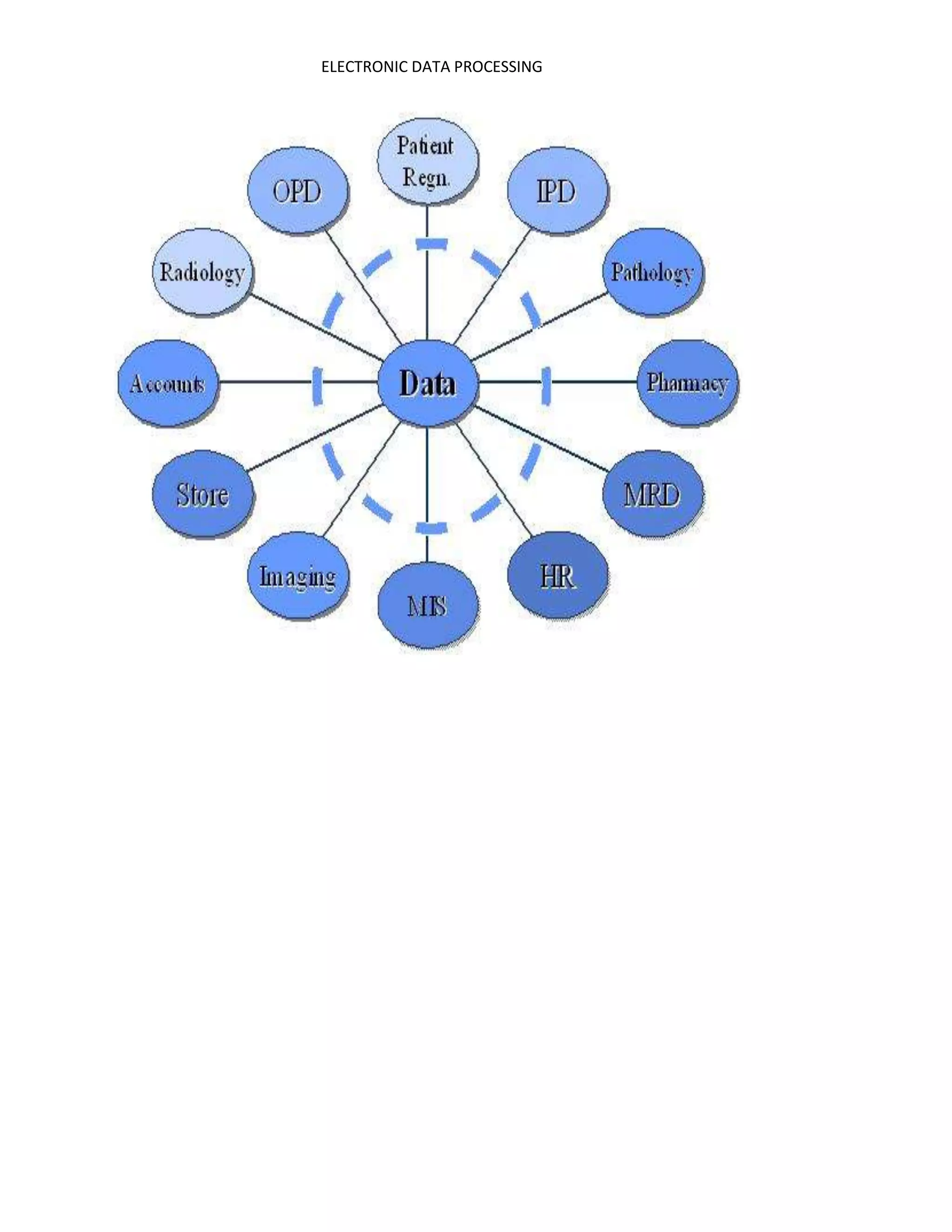
Electronics Data Processing Services is in charge of electronic database
management of an organization. Database management involves planning,
analysis, design, implementation, maintenance & protection of database.
ELECTRONIC DATA PROCESSING


Benefits of Electronics Data Processing:


      Speed
      Accuracy
      Automatic Operation
      Decision making cabalist
      Compact storage
      Discipline it imposes

Electronic Data Processing refers to the use of automated measures using simple,
repetitive actions - and computer technology - to organize and store documents
and sometimes to transfer them from paper to a digital format. Electronic Data
Processing is also responsible for improving database performance (fine
tuning/optimization) & for providing education, trainings, & consulting support to
users.


Electronic data processing services to control the various activities related to the
operation of the firm's mainframe computer or its client-server network, as well
as all of the peripheral equipment.


Electronic data processing and data input services use by distributors, producers,
suppliers of products. Experience & trained teams of Electronic data processing
professionals guarantee quality and conformity to time limit.
ELECTRONIC DATA PROCESSING


EXAMPLES OF EDP
   Payroll system
   Mailing list
   Stock control system
   Ticket buying system
   Point of sale system
   Electronic fund transfer
ELECTRONIC DATA PROCESSING


Article 1 :
Audit procedures in an electronic data processing audit.
 Organizations have the challenge of dealing with employees' honesty and
trustworthiness. Auditing is used to circumvent any question of integrity. An
electronic data processing audit is an evaluation of the accuracy and proper
function of an organization's data processing. Organizations mainly audit the
accounting department. Other areas like project management, quality management
and energy conservation are also audited. Auditing ensures compliance and checks
on fraud of the company's resources.


                               Get Electronic Data

To commence the auditing process, auditors must first retrieve the data stored in
the computer. Documents such as sales receipts and supplies invoices are used to
verify the data entered into the computer. This ensures that correct information was
input into the computer.

                                 Data Conversion

Organizations use different types of software to store their data. This data should
be converted from the stored software to the auditing software. This is done using
special software programs known as package and utility programs. This ensures
that there is no inconsistency when auditing data stored in different software.
ELECTRONIC DATA PROCESSING


                            Compliance Test

Auditors need to verify that procedures followed when entering data into the
data processing system are being applied as prescribed. These procedures act as
the underlying evidence of whether the accounting data is correctly fed into the
processing system. Obtaining this evidence involves reviewing the accounting
journals, ledgers and worksheets. Compliance tests, which are tests used to verify
the correct functioning of internal controls, are then carried out to indicate
whether such internal controls are working properly. This provides the auditor
with the overall picture of the truthfulness of data entered in the processing
system.

                            Substantive Test

Auditors obtain evidence to verify the completeness, validity and accuracy of a
client's records. This evidence is an important factor in determining the auditor's
opinion on the records. Substantive tests in a merchandising firm would include
examining inventory at the end of the period to verify that the levels of such
inventory are as indicated in the records. An auditor can also request that suppliers
confirm in writing the details of the debts owed by a firm at the end of the trading
period.

                           Reporting

The main aim of an audit is to report to the client. A report should be written and
signed after completing the audit examination; it also should include the auditor's
opinion and the basis for it. The date of the report should also be included, along
with recommendations for improvements of the entity's reporting system. Finally,
reports should be objective, clear, concise and timely.
ELECTRONIC DATA PROCESSING


                               ANALYSIS :
In this article , we can say that with the help of EDP correct information is put into
the computer which minimizes the possibility of human error .Different softwares
can be used such as package and utility programs which ensures there is no
inconsistency when auditing data is stored in different softwares.

Compliance test tells us about the truthfulness about the data entered in the
processing system.EDP helps to identify validity and accuracy of client’s record.

Therefore with the help of EDP a clear and concise report is prepared in a timely
manner.
ELECTRONIC DATA PROCESSING


Insuring Electronic Data Processing Equipment


So many businesses are computer-dependent. Only the smallest retailer can operate without a computer
cash register. Embedded chips and computers operate manufacturing equipment, contractors equipment
and are even becoming a critical part in hospital operating rooms. Rather than insuring the computers as
pieces of office or manufacturing equipment, the Electronic Data Processing (EDP) form responds to the
need to protect hardware, software, media and other exposures that are unique to this equipment.
Coverage is available for hacking (unauthorized computer system access) and virus damage, power
shortages, overload and outages.

There isn't a standard form for providing Electronic Data Processing or Computer coverage. Because so
many different forms are offered by many insurers, businesses seeking coverage must take extra care to
understand what is covered.

Any commercial operation that owns and/or uses computers and other data processing equipment is
eligible for EDP coverage. Commonly a policy covers hardware, media, programs/applications, data
records, proprietary programs, loss of income and (on- or off-site) Website servers.

How the EDP's coverage applies depends upon the policy definitions of key terms, including "computer
hacking," "computer virus," "data records," "media," "telecommunications equipment" and others. EDP
policies have many defined terms because technology is dynamic. Liberal use of specific policy language
helps to preserve an EDP policy's intended coverage.

Typically, coverage is provided against a specific list of events that can cause tangible loss to electronic
equipment. Different coverage applies to major areas of EDP, such as hardware, software and Website
servers. Covered businesses usually must comply with certain provisions to qualify for coverage, such as
properly creating and storing back-up programs.

There are certain types of property that, generally, are ineligible for coverage under an EDP policy, such
as:

        Hardcopy accounts, bills, evidences of debt, records, abstracts, deeds, manuscripts, program
        documentation and similar property
        Portable computers that are stolen or that disappear
        Any property used for illegal transportation or that is contraband
        Any property that is leased or rented to others
        Currency, food stamps, lottery tickets, money, notes and securities
        Property held for sale

One area that a business must pay attention to is how losses are settled. Are claims handled according to
the current value of the lost equipment (Actual Cash Value - ACV) or according to what is necessary to
replace the property? Settlement based on ACV can be a problem for companies that don't regularly
upgrade their EDP equipment. Technology changes so fast that payment for equipment purchased years
ago is far less than what is needed to secure new equipment. On the other hand, replacement cost
coverage would not be as critical for a firm that regularly changes equipment as damaged property would
likely be newer.

http://woodlandgeneral.com/files/articles/142f001.htm
ELECTRONIC DATA PROCESSING


SUMMARY
Electronic data processing services have the ability to store large amounts of data in a compact
and easily retrievable form. Rather than insuring the computers as pieces of office or
manufacturing equipment, the Electronic Data Processing (EDP) form responds to the need to
protect hardware, software, media and other exposures that are unique to this equipment.
How the EDP's coverage applies depends upon the policy definitions of key terms, including
"computer hacking," "computer virus," "data records," "media," "telecommunications
equipment" and others. There are list of events which can cause damage to electronic
equipment. Covered businesses usually must comply with certain provisions to qualify for
coverage, such as properly creating and storing back-up programs.

Sushant edp

  • 1.
    ELECTRONIC DATA PROCESSING Globalbusinesses heavily depend on data processing for maintaining effectiveness of data. Data processing and information systems are necessary in an organization of any size. Large number of industries such as retailers, manufacturers and service providers akin to outsourcing their data processing services requirements. Electronic data processing services have the ability to store large amounts of data in a compact and easily retrievable form. Electronic data processing services are majorly used in banks, public utilities, transportation and insurance companies, large manufacturing firms, government and educational establishments. Electronic data processing services are built to boost productivity and to improve the quality of work. It is useful in computers in recording, classifying, manipulating, and summarizing data. There are many types of data processing services in business industries. Like Forms Processing, word processing, survey processing, image processing, check processing, insurance claim processing, data processing web mining services etc… Electronic Data Processing services are useful in:  Digital Publication of e-books and Electronic articles  Development of digital libraries  Catalogs etc…
  • 2.
    ELECTRONIC DATA PROCESSING ElectronicsData Processing Services is in charge of electronic database management of an organization. Database management involves planning, analysis, design, implementation, maintenance & protection of database.
  • 3.
    ELECTRONIC DATA PROCESSING Benefitsof Electronics Data Processing:  Speed  Accuracy  Automatic Operation  Decision making cabalist  Compact storage  Discipline it imposes Electronic Data Processing refers to the use of automated measures using simple, repetitive actions - and computer technology - to organize and store documents and sometimes to transfer them from paper to a digital format. Electronic Data Processing is also responsible for improving database performance (fine tuning/optimization) & for providing education, trainings, & consulting support to users. Electronic data processing services to control the various activities related to the operation of the firm's mainframe computer or its client-server network, as well as all of the peripheral equipment. Electronic data processing and data input services use by distributors, producers, suppliers of products. Experience & trained teams of Electronic data processing professionals guarantee quality and conformity to time limit.
  • 4.
  • 5.
    ELECTRONIC DATA PROCESSING EXAMPLESOF EDP  Payroll system  Mailing list  Stock control system  Ticket buying system  Point of sale system  Electronic fund transfer
  • 6.
    ELECTRONIC DATA PROCESSING Article1 : Audit procedures in an electronic data processing audit. Organizations have the challenge of dealing with employees' honesty and trustworthiness. Auditing is used to circumvent any question of integrity. An electronic data processing audit is an evaluation of the accuracy and proper function of an organization's data processing. Organizations mainly audit the accounting department. Other areas like project management, quality management and energy conservation are also audited. Auditing ensures compliance and checks on fraud of the company's resources. Get Electronic Data To commence the auditing process, auditors must first retrieve the data stored in the computer. Documents such as sales receipts and supplies invoices are used to verify the data entered into the computer. This ensures that correct information was input into the computer. Data Conversion Organizations use different types of software to store their data. This data should be converted from the stored software to the auditing software. This is done using special software programs known as package and utility programs. This ensures that there is no inconsistency when auditing data stored in different software.
  • 7.
    ELECTRONIC DATA PROCESSING Compliance Test Auditors need to verify that procedures followed when entering data into the data processing system are being applied as prescribed. These procedures act as the underlying evidence of whether the accounting data is correctly fed into the processing system. Obtaining this evidence involves reviewing the accounting journals, ledgers and worksheets. Compliance tests, which are tests used to verify the correct functioning of internal controls, are then carried out to indicate whether such internal controls are working properly. This provides the auditor with the overall picture of the truthfulness of data entered in the processing system. Substantive Test Auditors obtain evidence to verify the completeness, validity and accuracy of a client's records. This evidence is an important factor in determining the auditor's opinion on the records. Substantive tests in a merchandising firm would include examining inventory at the end of the period to verify that the levels of such inventory are as indicated in the records. An auditor can also request that suppliers confirm in writing the details of the debts owed by a firm at the end of the trading period. Reporting The main aim of an audit is to report to the client. A report should be written and signed after completing the audit examination; it also should include the auditor's opinion and the basis for it. The date of the report should also be included, along with recommendations for improvements of the entity's reporting system. Finally, reports should be objective, clear, concise and timely.
  • 8.
    ELECTRONIC DATA PROCESSING ANALYSIS : In this article , we can say that with the help of EDP correct information is put into the computer which minimizes the possibility of human error .Different softwares can be used such as package and utility programs which ensures there is no inconsistency when auditing data is stored in different softwares. Compliance test tells us about the truthfulness about the data entered in the processing system.EDP helps to identify validity and accuracy of client’s record. Therefore with the help of EDP a clear and concise report is prepared in a timely manner.
  • 9.
    ELECTRONIC DATA PROCESSING InsuringElectronic Data Processing Equipment So many businesses are computer-dependent. Only the smallest retailer can operate without a computer cash register. Embedded chips and computers operate manufacturing equipment, contractors equipment and are even becoming a critical part in hospital operating rooms. Rather than insuring the computers as pieces of office or manufacturing equipment, the Electronic Data Processing (EDP) form responds to the need to protect hardware, software, media and other exposures that are unique to this equipment. Coverage is available for hacking (unauthorized computer system access) and virus damage, power shortages, overload and outages. There isn't a standard form for providing Electronic Data Processing or Computer coverage. Because so many different forms are offered by many insurers, businesses seeking coverage must take extra care to understand what is covered. Any commercial operation that owns and/or uses computers and other data processing equipment is eligible for EDP coverage. Commonly a policy covers hardware, media, programs/applications, data records, proprietary programs, loss of income and (on- or off-site) Website servers. How the EDP's coverage applies depends upon the policy definitions of key terms, including "computer hacking," "computer virus," "data records," "media," "telecommunications equipment" and others. EDP policies have many defined terms because technology is dynamic. Liberal use of specific policy language helps to preserve an EDP policy's intended coverage. Typically, coverage is provided against a specific list of events that can cause tangible loss to electronic equipment. Different coverage applies to major areas of EDP, such as hardware, software and Website servers. Covered businesses usually must comply with certain provisions to qualify for coverage, such as properly creating and storing back-up programs. There are certain types of property that, generally, are ineligible for coverage under an EDP policy, such as: Hardcopy accounts, bills, evidences of debt, records, abstracts, deeds, manuscripts, program documentation and similar property Portable computers that are stolen or that disappear Any property used for illegal transportation or that is contraband Any property that is leased or rented to others Currency, food stamps, lottery tickets, money, notes and securities Property held for sale One area that a business must pay attention to is how losses are settled. Are claims handled according to the current value of the lost equipment (Actual Cash Value - ACV) or according to what is necessary to replace the property? Settlement based on ACV can be a problem for companies that don't regularly upgrade their EDP equipment. Technology changes so fast that payment for equipment purchased years ago is far less than what is needed to secure new equipment. On the other hand, replacement cost coverage would not be as critical for a firm that regularly changes equipment as damaged property would likely be newer. http://woodlandgeneral.com/files/articles/142f001.htm
  • 10.
    ELECTRONIC DATA PROCESSING SUMMARY Electronicdata processing services have the ability to store large amounts of data in a compact and easily retrievable form. Rather than insuring the computers as pieces of office or manufacturing equipment, the Electronic Data Processing (EDP) form responds to the need to protect hardware, software, media and other exposures that are unique to this equipment. How the EDP's coverage applies depends upon the policy definitions of key terms, including "computer hacking," "computer virus," "data records," "media," "telecommunications equipment" and others. There are list of events which can cause damage to electronic equipment. Covered businesses usually must comply with certain provisions to qualify for coverage, such as properly creating and storing back-up programs.