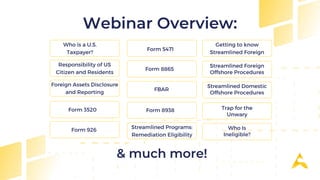
Webinar Overview:
Responsibility of US
Citizen and Residents
Foreign Assets Disclosure
and Reporting
Getting to know
Streamlined Foreign
Streamlined Programs:
Remediation Eligibility
Streamlined Foreign
Offshore Procedures
Form 8938
Streamlined Domestic
Offshore Procedures
Who Is
Ineligible?
Form 8865
FBAR
Form 5471
Trap for the
Unwary
Form 926
Form 3520
Who is a U.S.
Taxpayer?
& much more!
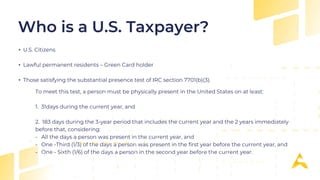
• U.S. Citizens
• Lawful permanent residents – Green Card holder
• Those satisfying the substantial presence test of IRC section 7701(b)(3).
Who is a U.S. Taxpayer?
To meet this test, a person must be physically present in the United States on at least:
1. 31days during the current year, and
2. 183 days during the 3-year period that includes the current year and the 2 years immediately
before that, considering:
- All the days a person was present in the current year, and
- One -Third (1/3) of the days a person was present in the first year before the current year, and
- One - Sixth (1/6) of the days a person in the second year before the current year.
• File income tax returns reporting worldwide income (Form 1040)
• File required US international informational tax returns
• File FBARs on FinCen Form 114
Responsibility of US Citizen
and Residents
• Form 3520 Annual Return to report transactions with foreign trust and receipt of certain foreign gift
• Form 926 Return by a U.S Transferor of property to a foreign corporation
• Form 5471 Information Return of U.S. persons with respect to certain foreign corporations
• Form 8865 Return of U.S. person with respect to certain foreign partnerships
• Form 8621 PFICs
• FBAR
• Form 8938 Foreign Financial Assets
Foreign Assets Disclosure
and Reporting
• Under IRC 6048, taxpayers must report various transactions involving foreign trusts,
including the creation of a foreign trust by a United States person, transfers of property from
a United States person to a foreign trust, and receipt of distributions from foreign trusts.
• This return also reports the receipt of gifts from foreign entities under IRC 6093F.
• The penalty for returns reporting gifts is five percent of the gift per month, up to a maximum
penalty of 25 percent of the gift.
Form 3520
Annual Return to Report Transactions With Foreign
Trusts and Receipt of Certain Foreign Gifts
• Under IRC 6038B, taxpayers must report transfers of property to foreign corporations and other
information.
• The penalty for failing to file each one of these information returns is ten percent of the value of the
property transferred, up to a maximum of $100,000 per return, with no limit if the failure to report the
transfer was intentional.
Form 926
Return by a U.S. Transferor of Property to a Foreign
Corporation
• Under IRC $ 6035, 6038 and 6046, certain United States persons who are officers, directors or
shareholders in certain foreign corporations (including International Business Corporations) must
report information.
• The penalty for failing to file each one of these information returns is $10,000, with an additional
$10,000 added for each month the failure continues beginning 90 days after the taxpayer is notified of
the delinquency, up to a maximum of $50,000 per return.
Form 5471
Information Return of U.S. Persons with Respect to
Certain Foreign Corporations
• Under IRC $ 6038, 6038B, and 6046A, United States persons with certain interests in foreign
partnerships must report interests in and transactions of these foreign partnerships, transfers of
property to these foreign partnerships, and acquisitions, dispositions and changes in foreign
partnership interests.
• Penalties include $10,000 for failure to file each return, with an additional $10,000 added for each
month the failure continues beginning 90 days after the taxpayer is notified of the delinquency.
• The penalty is capped at $50,000 per return, and ten percent of the value of any transferred property
that is not reported, subject to a $100,000 limit.
Form 8865
Return of U.S. Persons with Respect to Certain
Foreign Partnerships
Individuals Must Must File FBARs if they Have:
• Financial Interest in, Signatory Authority or Other Authority Over One or More Accounts
(Bank Accounts, Brokerage Accounts, Mutual Fund Accounts) in a Foreign Country
FBAR
A person who willfully fails to file an FBAR or files an incomplete or incorrect FBAR, may be
subject to a civil monetary penalty of $100,000 or 50% of the balance in the account at the
time of the violation, whichever is greater. Willful violations may also be subject to criminal
penalties.
Who Must Report?
Penalty
Form 8938
A specified foreign financial asset (SFFA) is:
• Any financial account maintained by a foreign financial institution
– Foreign bank accounts
– Foreign mutual funds
– Foreign hedge funds
– Foreign private equity funds
– Certain foreign insurance products
• In general, Form 8938 penalties will be $10,000 per year.
Penalty
• IRS’s latest efforts is to promote tax compliance and to crack down on offshore tax evasion
• These program will ease the financial and legal pain for expatriate Americans who live and
work abroad
• They relax the penalties that a taxpayer with an overseas account might otherwise face for
failing to disclose a foreign account
Efforts by IRS
Never Underestimate What Information The IRS Can Find Out on its Own:
• Tax Return Preparer Must Forewarn Clients About the Increasing Breadth of Information
That Can Be Gathered by IRS, and Department of Justice (DOJ) on Noncompliant Taxpayers
Through Social Media
• Foreign Bankers Are Often meticulous in Keeping Notes of Prior Phone Calls and Meetings
with Clients or Advisors
• No Such Thing as a Secret Account
• Taxpayer Must be prepared to Credibly Explain to IRS Why They Failed to Disclose Foreign
Accounts and Why They Did Not Make a Voluntary Disclosure?
What Does the IRS Know?
Streamlined Programs:
Remediation Eligibility
• Streamlined Programs Initiated in 2012
• Technically Two Programs
1. Streamlined Domestic Offshore Procedures
2. Streamlined Foreign Offshore Procedures
• Common Theme of Both Programs is Requirement That Taxpayer Certify Under Penalty of
Perjury That His Conduct Was Not Willful – Conduct was due to negligence, or mistake or
conduct that is the result of good faith misunderstanding of the requirements of the law,
accidental failure to report
• IRS does not explicitly define “non-willful”. They review each case on an individual basis
• Only available to Individual and Estate (Not entities)
• Always include a certification narrative (reasonable cause statement) and attach Form 14654
or 14653
• Failed to report foreign financial assets and pay taxes
Streamlined Domestic
Offshore Procedures
• IRS extended streamline procedure to American Living in the U.S. with undisclosed foreign
accounts who previously were ineligible from participating in the streamlined procedure
• Such person who come forward now will owe back taxes, interest, and a reduce
“miscellaneous offshore penalty” equal to five percent of their undisclosed foreign financial
assets.
• Taxpayers Residing In US Requires Taxpayer to Have Filed Prior US Tax Returns for Most
Recent 3 Years AND
• Limited to Filing Amended Returns (No Original Returns Permitted if None Originally Filed),
AND
• Carries a Potential 5% Miscellaneous Penalty for Unreported Account/Assets
Getting to Know
Streamlined Domestic
• For each of the most recent three years for which the U.S. tax return due date – or extended
due date - has passed (the "covered tax return period"), file amended tax returns, together
with all required information returns (e.g., Forms 3520, 3520-A, 5471, 5472, 8938, 926, and
8621);
• For each of the most recent six years for which the FBAR due date has passed (the "covered
FBAR period"), file any delinquent FBARS; and
• Pay a miscellaneous offshore penalty. The full amount of the tax, interest, and miscellaneous
offshore penalty should be submitted with the amended tax returns.
What must I submit?
Miscellaneous Offshore Penalty
for Streamlined Domestic
1. How is the miscellaneous offshore penalty calculated?
— It is equal to 5 percent of the highest aggregate balance of the taxpayer’s foreign financial
assets that are subject to the penalty during the years in the covered tax return period and the
covered FBAR period.
2. How is the highest aggregate balance determined?
— By tallying the year-end account balances and year-end asset values of all the foreign financial
assets subject to the penalty for each year in the covered tax return period and the covered FBAR
period and selecting the highest aggregate balance from among those years.
Streamlined Foreign
Offshore Procedures
• U.S. taxpayers must satisfy the following requirements:
• The applicable non-residency requirement (for joint return filers, both spouses must
satisfy the non-residency requirement); and
• Have failed to file an FBAR with respect to a foreign financial account; OR foreign
investment related informational forms, and
• The failure to file an FBAR/Foreign investment related forms must have resulted from
non willful conduct.
• U.S. Taxpayer living abroad who disclose their foreign accounts and settle their tax bills
under Streamlined Foreign Offshore Procedure won’t be charged any penalties.
Instead, they will simply owe back taxes and interest.
• File 3 years of delinquent or amended tax or information return and pay tax and interest
• File 6 years of delinquent FBARs
Getting to know
Streamlined Foreign
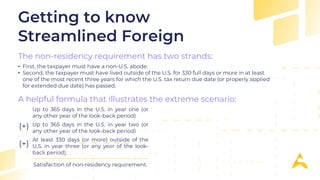
• First, the taxpayer must have a non-U.S. abode.
• Second, the taxpayer must have lived outside of the U.S. for 330 full days or more in at least
one of the most recent three years for which the U.S. tax return due date (or properly applied
for extended due date) has passed.
The non-residency requirement has two strands:
A helpful formula that illustrates the extreme scenario:
Satisfaction of non-residency requirement.
Up to 365 days in the U.S. in year one (or
any other year of the look-back period)
Up to 365 days in the U.S. in year two (or
any other year of the look-back period)
At least 330 days (or more) outside of the
U.S. in year three (or any year of the look-
back period).
(+)
(+)
• A taxpayer who spends 36 days in the U.S. in year one, 36 days in the U.S. in year two, and 36
days in the U.S. in year three fails the nonresidency requirement.
• Why? Because there are 365 days in a year and in no year could he have spent at least 330
days outside of the United States. Instead, the maximum number of days that he spent
outside of the U.S. in each year was 329 days, one day shy of the 330-day threshold.
• As you can see, the rigid requirements of the nonresidency requirement can play the role of
“spoiler” to well intentioned taxpayers wanting to "get right” with the IRS.
Getting to Know
Streamlined Foreign
Example #2:
• Is the taxpayer in example 2 who is deemed ineligible for streamlined foreign, eligible for
streamlined domestic?
• Only if he has filed his U.S. tax returns for each of the most recent three years for which the
U.S. tax return due date - or extended due date - has passed (a key requirement for
streamlined domestic)
• If the taxpayer in example 2 filed U.S. tax returns in two of the most recent three years for
which the U.S. tax return due date has passed, but neglected to do so in just one year, not
only would he be ineligible for streamlined foreign but he would also be ineligible for
streamlined domestic!
Getting to Know
Streamlined Foreign
Interesting question to ponder:
Getting to Know
Streamlined Foreign
• U.S. taxpayer must file delinquent or amended tax returns, together with all required
information returns (e.g, Forms 3520, 5471, and 8938) for each of the most recent three years
for which the U.S. tax return due date – or extended due date – has passed; and
• File any delinquent FBARs for each of the most recent six years for which the FBAR due date
has passed.
Remaining Requirements
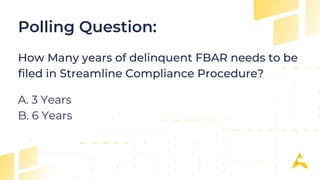
A. 3 Years
B. 6 Years
Polling Question:
How Many years of delinquent FBAR needs to be
filed in Streamline Compliance Procedure?
Streamlined Assets
• Streamlined Assets refers to the assets which are reportable either on FBAR or Form 8938.
• Some assets like personal real estate investment in foreign country are not included
• Other assets such as Canadian RRSP (Registered Retirement Saving Plan) is included on the
FBAR and Form 8938 but NOT computed as part of the penalty. (Elect income deferral on
retirement plans permitted by Treaty)
IRS Audit and Verification
Returns submitted under either the foreign or domestic offshore procedures are not
automatically selected for audit. Instead, they are subject to “verification.”
• Through verification, the examining agent can request account statements and other
relevant documents to verify the information reported.
• However, this does not mean that an examination is impossible. On the contrary, such
returns may be selected for audit under the existing audit selection processes applicable to
any U.S. tax return
Taxpayers who are eligible to use the streamlined procedures and who follow all of the
instructions are not subject to failure-to-file and failure-to-pay penalties, accuracy-related
penalties, information return penalties, or FBAR penalties, even if their returns are
subsequently selected for audit.
• First, any previously assessed penalties relating to the years that are selected for audit will
not be abated.
• Second, to the extent that the IRS determines an additional tax deficiency for a return
submitted under these procedures, it can assert additional tax and penalties relating to that
additional deficiency.
• Finally, the IRS will unleash the full arsenal of penalties if it determines that the original tax
noncompliance was due to fraud and/or that the FBAR violation was willful.
IRS Audit and Verification
• Tax returns will be processed no different than any other returns submitted to the IRS.
Reading between the lines, what the IRS seems to suggest is not to expect confirmation for
receipt of the returns.
• Assuming a taxpayer's streamlined submission is rejected, the only remaining option for
coming into compliance with one's U.S. tax obligations is to file amended 1040s and
delinquent international returns in what is known as a “quiet disclosure.”
• With respect to the Streamlined Domestic Offshore Procedures, the five-percent
miscellaneous penalty is imposed on a broader base of foreign assets - not just those relating
to FBAR reporting.
Who Is Ineligible?
• Those taxpayers who cannot certify that their failure to report all income, pay all tax, and
submit all required information returns was due to nonwillful conduct.
• Those taxpayers who are under criminal investigation by IRS Criminal Investigation.
• Those taxpayers who are undergoing a civil examination, regardless of whether that
examination relates to unreported foreign assets.
A. Yes
B. No
Polling Question:
Is late filing and late payment penalties applicable
for tax returns filed under Streamlined Filing
Procedures?
Do You
Have Any
Questions? An Informative Session On:
“STREAMLINED FILING PROCEDURES”
For those interested in learning
more, asking questions or
signing up for one of our groups
or trainings,
NEXT STEPS:
Stay in the meeting after the end
OR schedule some time to talk:
Email: info@smartaccts.com | Phone: +1 850 788 2090

Streamlined Filing Compliance Procedures

  • 2.
    Webinar Overview: Responsibility ofUS Citizen and Residents Foreign Assets Disclosure and Reporting Getting to know Streamlined Foreign Streamlined Programs: Remediation Eligibility Streamlined Foreign Offshore Procedures Form 8938 Streamlined Domestic Offshore Procedures Who Is Ineligible? Form 8865 FBAR Form 5471 Trap for the Unwary Form 926 Form 3520 Who is a U.S. Taxpayer? & much more!
  • 3.
    • U.S. Citizens •Lawful permanent residents – Green Card holder • Those satisfying the substantial presence test of IRC section 7701(b)(3). Who is a U.S. Taxpayer? To meet this test, a person must be physically present in the United States on at least: 1. 31days during the current year, and 2. 183 days during the 3-year period that includes the current year and the 2 years immediately before that, considering: - All the days a person was present in the current year, and - One -Third (1/3) of the days a person was present in the first year before the current year, and - One - Sixth (1/6) of the days a person in the second year before the current year.
  • 4.
    • File incometax returns reporting worldwide income (Form 1040) • File required US international informational tax returns • File FBARs on FinCen Form 114 Responsibility of US Citizen and Residents
  • 5.
    • Form 3520Annual Return to report transactions with foreign trust and receipt of certain foreign gift • Form 926 Return by a U.S Transferor of property to a foreign corporation • Form 5471 Information Return of U.S. persons with respect to certain foreign corporations • Form 8865 Return of U.S. person with respect to certain foreign partnerships • Form 8621 PFICs • FBAR • Form 8938 Foreign Financial Assets Foreign Assets Disclosure and Reporting
  • 6.
    • Under IRC6048, taxpayers must report various transactions involving foreign trusts, including the creation of a foreign trust by a United States person, transfers of property from a United States person to a foreign trust, and receipt of distributions from foreign trusts. • This return also reports the receipt of gifts from foreign entities under IRC 6093F. • The penalty for returns reporting gifts is five percent of the gift per month, up to a maximum penalty of 25 percent of the gift. Form 3520 Annual Return to Report Transactions With Foreign Trusts and Receipt of Certain Foreign Gifts
  • 7.
    • Under IRC6038B, taxpayers must report transfers of property to foreign corporations and other information. • The penalty for failing to file each one of these information returns is ten percent of the value of the property transferred, up to a maximum of $100,000 per return, with no limit if the failure to report the transfer was intentional. Form 926 Return by a U.S. Transferor of Property to a Foreign Corporation
  • 8.
    • Under IRC$ 6035, 6038 and 6046, certain United States persons who are officers, directors or shareholders in certain foreign corporations (including International Business Corporations) must report information. • The penalty for failing to file each one of these information returns is $10,000, with an additional $10,000 added for each month the failure continues beginning 90 days after the taxpayer is notified of the delinquency, up to a maximum of $50,000 per return. Form 5471 Information Return of U.S. Persons with Respect to Certain Foreign Corporations
  • 9.
    • Under IRC$ 6038, 6038B, and 6046A, United States persons with certain interests in foreign partnerships must report interests in and transactions of these foreign partnerships, transfers of property to these foreign partnerships, and acquisitions, dispositions and changes in foreign partnership interests. • Penalties include $10,000 for failure to file each return, with an additional $10,000 added for each month the failure continues beginning 90 days after the taxpayer is notified of the delinquency. • The penalty is capped at $50,000 per return, and ten percent of the value of any transferred property that is not reported, subject to a $100,000 limit. Form 8865 Return of U.S. Persons with Respect to Certain Foreign Partnerships
  • 10.
    Individuals Must MustFile FBARs if they Have: • Financial Interest in, Signatory Authority or Other Authority Over One or More Accounts (Bank Accounts, Brokerage Accounts, Mutual Fund Accounts) in a Foreign Country FBAR A person who willfully fails to file an FBAR or files an incomplete or incorrect FBAR, may be subject to a civil monetary penalty of $100,000 or 50% of the balance in the account at the time of the violation, whichever is greater. Willful violations may also be subject to criminal penalties. Who Must Report? Penalty
  • 11.
    Form 8938 A specifiedforeign financial asset (SFFA) is: • Any financial account maintained by a foreign financial institution – Foreign bank accounts – Foreign mutual funds – Foreign hedge funds – Foreign private equity funds – Certain foreign insurance products • In general, Form 8938 penalties will be $10,000 per year. Penalty
  • 12.
    • IRS’s latestefforts is to promote tax compliance and to crack down on offshore tax evasion • These program will ease the financial and legal pain for expatriate Americans who live and work abroad • They relax the penalties that a taxpayer with an overseas account might otherwise face for failing to disclose a foreign account Efforts by IRS Never Underestimate What Information The IRS Can Find Out on its Own: • Tax Return Preparer Must Forewarn Clients About the Increasing Breadth of Information That Can Be Gathered by IRS, and Department of Justice (DOJ) on Noncompliant Taxpayers Through Social Media • Foreign Bankers Are Often meticulous in Keeping Notes of Prior Phone Calls and Meetings with Clients or Advisors • No Such Thing as a Secret Account • Taxpayer Must be prepared to Credibly Explain to IRS Why They Failed to Disclose Foreign Accounts and Why They Did Not Make a Voluntary Disclosure? What Does the IRS Know?
  • 13.
    Streamlined Programs: Remediation Eligibility •Streamlined Programs Initiated in 2012 • Technically Two Programs 1. Streamlined Domestic Offshore Procedures 2. Streamlined Foreign Offshore Procedures • Common Theme of Both Programs is Requirement That Taxpayer Certify Under Penalty of Perjury That His Conduct Was Not Willful – Conduct was due to negligence, or mistake or conduct that is the result of good faith misunderstanding of the requirements of the law, accidental failure to report • IRS does not explicitly define “non-willful”. They review each case on an individual basis • Only available to Individual and Estate (Not entities) • Always include a certification narrative (reasonable cause statement) and attach Form 14654 or 14653 • Failed to report foreign financial assets and pay taxes
  • 14.
    Streamlined Domestic Offshore Procedures •IRS extended streamline procedure to American Living in the U.S. with undisclosed foreign accounts who previously were ineligible from participating in the streamlined procedure • Such person who come forward now will owe back taxes, interest, and a reduce “miscellaneous offshore penalty” equal to five percent of their undisclosed foreign financial assets. • Taxpayers Residing In US Requires Taxpayer to Have Filed Prior US Tax Returns for Most Recent 3 Years AND • Limited to Filing Amended Returns (No Original Returns Permitted if None Originally Filed), AND • Carries a Potential 5% Miscellaneous Penalty for Unreported Account/Assets
  • 15.
    Getting to Know StreamlinedDomestic • For each of the most recent three years for which the U.S. tax return due date – or extended due date - has passed (the "covered tax return period"), file amended tax returns, together with all required information returns (e.g., Forms 3520, 3520-A, 5471, 5472, 8938, 926, and 8621); • For each of the most recent six years for which the FBAR due date has passed (the "covered FBAR period"), file any delinquent FBARS; and • Pay a miscellaneous offshore penalty. The full amount of the tax, interest, and miscellaneous offshore penalty should be submitted with the amended tax returns. What must I submit?
  • 16.
    Miscellaneous Offshore Penalty forStreamlined Domestic 1. How is the miscellaneous offshore penalty calculated? — It is equal to 5 percent of the highest aggregate balance of the taxpayer’s foreign financial assets that are subject to the penalty during the years in the covered tax return period and the covered FBAR period. 2. How is the highest aggregate balance determined? — By tallying the year-end account balances and year-end asset values of all the foreign financial assets subject to the penalty for each year in the covered tax return period and the covered FBAR period and selecting the highest aggregate balance from among those years.
  • 17.
    Streamlined Foreign Offshore Procedures •U.S. taxpayers must satisfy the following requirements: • The applicable non-residency requirement (for joint return filers, both spouses must satisfy the non-residency requirement); and • Have failed to file an FBAR with respect to a foreign financial account; OR foreign investment related informational forms, and • The failure to file an FBAR/Foreign investment related forms must have resulted from non willful conduct. • U.S. Taxpayer living abroad who disclose their foreign accounts and settle their tax bills under Streamlined Foreign Offshore Procedure won’t be charged any penalties. Instead, they will simply owe back taxes and interest. • File 3 years of delinquent or amended tax or information return and pay tax and interest • File 6 years of delinquent FBARs
  • 18.
    Getting to know StreamlinedForeign • First, the taxpayer must have a non-U.S. abode. • Second, the taxpayer must have lived outside of the U.S. for 330 full days or more in at least one of the most recent three years for which the U.S. tax return due date (or properly applied for extended due date) has passed. The non-residency requirement has two strands: A helpful formula that illustrates the extreme scenario: Satisfaction of non-residency requirement. Up to 365 days in the U.S. in year one (or any other year of the look-back period) Up to 365 days in the U.S. in year two (or any other year of the look-back period) At least 330 days (or more) outside of the U.S. in year three (or any year of the look- back period). (+) (+)
  • 19.
    • A taxpayerwho spends 36 days in the U.S. in year one, 36 days in the U.S. in year two, and 36 days in the U.S. in year three fails the nonresidency requirement. • Why? Because there are 365 days in a year and in no year could he have spent at least 330 days outside of the United States. Instead, the maximum number of days that he spent outside of the U.S. in each year was 329 days, one day shy of the 330-day threshold. • As you can see, the rigid requirements of the nonresidency requirement can play the role of “spoiler” to well intentioned taxpayers wanting to "get right” with the IRS. Getting to Know Streamlined Foreign Example #2:
  • 20.
    • Is thetaxpayer in example 2 who is deemed ineligible for streamlined foreign, eligible for streamlined domestic? • Only if he has filed his U.S. tax returns for each of the most recent three years for which the U.S. tax return due date - or extended due date - has passed (a key requirement for streamlined domestic) • If the taxpayer in example 2 filed U.S. tax returns in two of the most recent three years for which the U.S. tax return due date has passed, but neglected to do so in just one year, not only would he be ineligible for streamlined foreign but he would also be ineligible for streamlined domestic! Getting to Know Streamlined Foreign Interesting question to ponder:
  • 21.
    Getting to Know StreamlinedForeign • U.S. taxpayer must file delinquent or amended tax returns, together with all required information returns (e.g, Forms 3520, 5471, and 8938) for each of the most recent three years for which the U.S. tax return due date – or extended due date – has passed; and • File any delinquent FBARs for each of the most recent six years for which the FBAR due date has passed. Remaining Requirements
  • 22.
    A. 3 Years B.6 Years Polling Question: How Many years of delinquent FBAR needs to be filed in Streamline Compliance Procedure?
  • 23.
    Streamlined Assets • StreamlinedAssets refers to the assets which are reportable either on FBAR or Form 8938. • Some assets like personal real estate investment in foreign country are not included • Other assets such as Canadian RRSP (Registered Retirement Saving Plan) is included on the FBAR and Form 8938 but NOT computed as part of the penalty. (Elect income deferral on retirement plans permitted by Treaty)
  • 24.
    IRS Audit andVerification Returns submitted under either the foreign or domestic offshore procedures are not automatically selected for audit. Instead, they are subject to “verification.” • Through verification, the examining agent can request account statements and other relevant documents to verify the information reported. • However, this does not mean that an examination is impossible. On the contrary, such returns may be selected for audit under the existing audit selection processes applicable to any U.S. tax return Taxpayers who are eligible to use the streamlined procedures and who follow all of the instructions are not subject to failure-to-file and failure-to-pay penalties, accuracy-related penalties, information return penalties, or FBAR penalties, even if their returns are subsequently selected for audit. • First, any previously assessed penalties relating to the years that are selected for audit will not be abated. • Second, to the extent that the IRS determines an additional tax deficiency for a return submitted under these procedures, it can assert additional tax and penalties relating to that additional deficiency. • Finally, the IRS will unleash the full arsenal of penalties if it determines that the original tax noncompliance was due to fraud and/or that the FBAR violation was willful.
  • 25.
    IRS Audit andVerification • Tax returns will be processed no different than any other returns submitted to the IRS. Reading between the lines, what the IRS seems to suggest is not to expect confirmation for receipt of the returns. • Assuming a taxpayer's streamlined submission is rejected, the only remaining option for coming into compliance with one's U.S. tax obligations is to file amended 1040s and delinquent international returns in what is known as a “quiet disclosure.” • With respect to the Streamlined Domestic Offshore Procedures, the five-percent miscellaneous penalty is imposed on a broader base of foreign assets - not just those relating to FBAR reporting.
  • 26.
    Who Is Ineligible? •Those taxpayers who cannot certify that their failure to report all income, pay all tax, and submit all required information returns was due to nonwillful conduct. • Those taxpayers who are under criminal investigation by IRS Criminal Investigation. • Those taxpayers who are undergoing a civil examination, regardless of whether that examination relates to unreported foreign assets.
  • 27.
    A. Yes B. No PollingQuestion: Is late filing and late payment penalties applicable for tax returns filed under Streamlined Filing Procedures?
  • 28.
    Do You Have Any Questions?An Informative Session On: “STREAMLINED FILING PROCEDURES”
  • 29.
    For those interestedin learning more, asking questions or signing up for one of our groups or trainings, NEXT STEPS: Stay in the meeting after the end OR schedule some time to talk: Email: info@smartaccts.com | Phone: +1 850 788 2090

Editor's Notes

  • #3 More than 1,000 streamlined submission since the program introduced in 2014. On July 1, 2014 the IRS expanded and modified the Streamlined Filing Compliance Procedures first implemented on September 1, 2012 to US individual taxpayers residing outside the United States. Non-willful – personal back ground, financial background, anything else you believe is relevant to your failure to report all required information returns including FBARS how you acquired foreign financial assets, whether purchased, inherited,….
  • #7 Form 3520 is an informational return that U.S. taxpayers report transactions of certain foreign trusts, ownership of foreign trusts, and receipts of large gifts from foreign entities. Typically, there are three reasons you might file Form 3520, you’re a U.S. owner of a foreign trust, you make certain transactions with a foreign trust, and/or you receive a large gift or inheritance from certain overseas persons. 3520-A – Foreign trust annual reporting Form 3520 – Foreign Gifts and Trusts - Required to be filed by any U.S. person who: Received a gift of more than $100,000 from an NRA
  • #8 Most often missed out Many tax software does not include this form Most common instant when required is when US shareholder become shareholder in foreign corporation Reports transfer of cash or property
  • #9  Form 5471 - CFC - Required to be filed by a U.S. person who controls, transacts with or has certain relationships with the CFC Depending upon ownership percentage in foreign corporation various schedules are applicable
  • #10 Ownership in foreign partnership, again depending upon ownership percentage and whether acquired or disposed of interest during the year there are various categories which determines which schedules needs to be reported
  • #11 Reporting requirement Items to include and report Not with tax return
  • #12 Files with tax return Filing requirement is different depending upon filing status and whether you are residing within US OR outside US Much broader definition
  • #13 FATCA signed by various countries – enacted in 2010 – total 113 countries have signed this and can exchange the information
  • #14 A taxpayer who is eligible to use these Streamlined Procedures and who complies with all of the instructions will not be subject to failure-to-file and failure-to-pay penalties, accuracy-related penalties, information return penalties, or FBAR penalties. In order to be eligible for the Streamline Foreign Offshore Procedure, the IRS should not have initiated a civil examination of taxpayer's returns for any taxable year. If the taxpayer is already under audit, the taxpayer is ineligible for the program. ​
  • #22 Include at the top of the first page of each amended tax return and at the top of each information return "Streamlined Domestic Offshore"-14654 OR "Streamlined Foreign Offshore"-14653 written in red to indicate that the returns are being submitted under these procedures.  This is critical to ensure that your returns are processed through these special procedures. Tax return together with the payments if any, must be sent in paper form FBAR must be filed electronically
  • #27 we recommend: Select an experienced expat tax accountant to save time, ensure accuracy, and avoid the risk of an audit Organize your tax documents (for the past three years) Gather statements from your foreign financial accounts (for the past six years) - On the cover page of the electronic form, select "other" as the reason for filing late, and in the explanation box that opens, enter "Streamlined Filing Compliance Procedures."