This paper surveys the challenge of noise reduction in digital images, detailing various types of noise such as impulse, Gaussian, shot, and speckle noise, and their impact on image quality. It discusses different noise filtering techniques that can be applied, including linear and non-linear filters in the spatial domain, as well as methods in the transform domain. The paper emphasizes the importance of selecting appropriate denoising techniques based on the type of noise in the image to improve its quality.
![International Journal of Science and Research (IJSR)
ISSN (Online): 2319-7064
Index Copernicus Value (2015): 78.96 | Impact Factor (2015): 6.391
Volume 5 Issue 11, November 2016
www.ijsr.net
Licensed Under Creative Commons Attribution CC BY
Survey of Noise in Image and Efficient Technique
for Noise Reduction
Arti Singh1
, Madhu2
1, 2
Research Scholar, Computer Science, BBAU University, Lucknow , Uttar Pradesh, India
Abstract: Removing noise from the image is big challenge for researcher because removal of noise in image causes the artifacts and
image blurring. Noise occurred in image during the time of capturing and transmission of the image. There are many methods for noise
removal from the images. Many algorithms and techniques are available for removing noise from image, but each method exist their
own assumptions, merits and demerits. Noise reduction algorithms for remove noise is totally depends on what type of noise occur in the
image. In this paper, focus on some important type of noise and noise removal techniques is done.
Keywords: Impulse noise, Gaussian noise , Speckle noise ,Poisson noise, mean filter, median filter ,etc
1. Introduction
Digital image processing is using of algorithms for
improve quality order of digital image .This error on
image is called noise in image which do not reflect real
intensities of actual scene. There are two problems found
in image processing: Blurring and image noise. Noise
image occurred by many reasons:
When we capture image from camera (scratches are
available in camera).
Image transmission through different media.
Digitization process.
Environmental factor (everywhere faced with pollution
so real scene are not captured).
Noise can introduce by transmission errors and
compression. So noise reduction is most important task for
improve quality of image .Denoising technique is often a
necessary and the take first step, before analysed the
image data. It is important apply denoising technique to
compensate for such data corruption. Denoising
techniques still remains big challenge for researchers
because noise removal introduced artifacts and causes
blurring of an images. Image denoising techniques depend
on what type of noise occurred in image like Gaussian
noise, shot noise, etc.
2. Different Types of Noise
Noise is introduced by imaging system and noise occurred
in image during image acquisition or transmission or
capturing etc .Depending on the type of noise ,noise can
affect image to different extend . Normally, we focus on
to remove different type of noise .So identifies the noise in
image and relatively noise removal algorithm applies.
Image noise can be classified as: Amplifier noise
(Gaussian noise), shot noise (Photon noise), Uniform
noise, On-isotropic noise, Multiplicative noise (speckle
noise), periodic noise, uniform noise, etc.
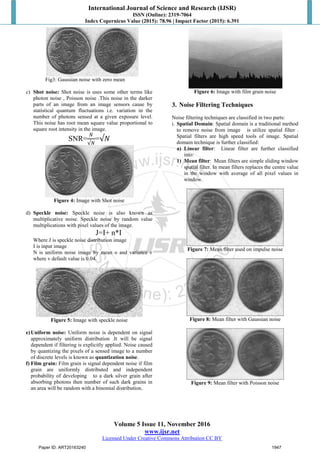
a) Impulse noise (Salt and Pepper noise): In Impulse
noise, dark and bright spot appear in the image as a
result of noise and hence salt and pepper noise. Dust
particles present on the camera during capturing image
or over heated faulty component can cause noise arise
in image because of sharp and sudden changes of
image signal.
𝐼𝑠𝑝 𝑖, 𝑗 =
𝐼 𝑖, 𝑗 𝑥 < 𝑙
𝐼 𝑚𝑖𝑛 + 𝑌 𝐼 𝑚𝑎𝑥 − 𝐼 𝑚𝑖𝑛 𝑥 > 𝑙
x,y∈[0,1] are two uniformly distributed random variables
Figure 1: Original image
Figure 2: Image with 30% noise
b) Gaussian noise (Amplifier noise): Other term used
for Gaussian noise is like white Gaussian noise, zero-
mean stochastic process. Gaussian noise follows
Gaussian distribution. Each pixel is sum of true pixel
value and Gaussian distribution noise value.
White –n(i ,j) independent in both space and time
Zero mean I(i,j)=0
Gaussian –n(i,j) is random variable with distribution
𝑝(𝑥)=
1
𝜎√2𝜋
𝑒
𝑥2
2𝜎2
Paper ID: ART20163240 1946](https://image.slidesharecdn.com/art20163240-170309221837/85/survey-paper-for-image-denoising-1-320.jpg)
![International Journal of Science and Research (IJSR)
ISSN (Online): 2319-7064
Index Copernicus Value (2015): 78.96 | Impact Factor (2015): 6.391
Volume 5 Issue 11, November 2016
www.ijsr.net
Licensed Under Creative Commons Attribution CC BY
Survey of Noise in Image and Efficient Technique
for Noise Reduction
Arti Singh1
, Madhu2
1, 2
Research Scholar, Computer Science, BBAU University, Lucknow , Uttar Pradesh, India
Abstract: Removing noise from the image is big challenge for researcher because removal of noise in image causes the artifacts and
image blurring. Noise occurred in image during the time of capturing and transmission of the image. There are many methods for noise
removal from the images. Many algorithms and techniques are available for removing noise from image, but each method exist their
own assumptions, merits and demerits. Noise reduction algorithms for remove noise is totally depends on what type of noise occur in the
image. In this paper, focus on some important type of noise and noise removal techniques is done.
Keywords: Impulse noise, Gaussian noise , Speckle noise ,Poisson noise, mean filter, median filter ,etc
1. Introduction
Digital image processing is using of algorithms for
improve quality order of digital image .This error on
image is called noise in image which do not reflect real
intensities of actual scene. There are two problems found
in image processing: Blurring and image noise. Noise
image occurred by many reasons:
When we capture image from camera (scratches are
available in camera).
Image transmission through different media.
Digitization process.
Environmental factor (everywhere faced with pollution
so real scene are not captured).
Noise can introduce by transmission errors and
compression. So noise reduction is most important task for
improve quality of image .Denoising technique is often a
necessary and the take first step, before analysed the
image data. It is important apply denoising technique to
compensate for such data corruption. Denoising
techniques still remains big challenge for researchers
because noise removal introduced artifacts and causes
blurring of an images. Image denoising techniques depend
on what type of noise occurred in image like Gaussian
noise, shot noise, etc.
2. Different Types of Noise
Noise is introduced by imaging system and noise occurred
in image during image acquisition or transmission or
capturing etc .Depending on the type of noise ,noise can
affect image to different extend . Normally, we focus on
to remove different type of noise .So identifies the noise in
image and relatively noise removal algorithm applies.
Image noise can be classified as: Amplifier noise
(Gaussian noise), shot noise (Photon noise), Uniform
noise, On-isotropic noise, Multiplicative noise (speckle
noise), periodic noise, uniform noise, etc.
a) Impulse noise (Salt and Pepper noise): In Impulse
noise, dark and bright spot appear in the image as a
result of noise and hence salt and pepper noise. Dust
particles present on the camera during capturing image
or over heated faulty component can cause noise arise
in image because of sharp and sudden changes of
image signal.
𝐼𝑠𝑝 𝑖, 𝑗 =
𝐼 𝑖, 𝑗 𝑥 < 𝑙
𝐼 𝑚𝑖𝑛 + 𝑌 𝐼 𝑚𝑎𝑥 − 𝐼 𝑚𝑖𝑛 𝑥 > 𝑙
x,y∈[0,1] are two uniformly distributed random variables
Figure 1: Original image
Figure 2: Image with 30% noise
b) Gaussian noise (Amplifier noise): Other term used
for Gaussian noise is like white Gaussian noise, zero-
mean stochastic process. Gaussian noise follows
Gaussian distribution. Each pixel is sum of true pixel
value and Gaussian distribution noise value.
White –n(i ,j) independent in both space and time
Zero mean I(i,j)=0
Gaussian –n(i,j) is random variable with distribution
𝑝(𝑥)=
1
𝜎√2𝜋
𝑒
𝑥2
2𝜎2
Paper ID: ART20163240 1946](https://image.slidesharecdn.com/art20163240-170309221837/75/survey-paper-for-image-denoising-1-2048.jpg)
![International Journal of Science and Research (IJSR)
ISSN (Online): 2319-7064
Index Copernicus Value (2015): 78.96 | Impact Factor (2015): 6.391
Volume 5 Issue 11, November 2016
www.ijsr.net
Licensed Under Creative Commons Attribution CC BY
Figure 15: BM3D filter used for impulse noise
Figure 16: BM3D filter used for Gaussian noise
Figure 17: BM3D filter used for Poisson noise
Figure 18: BM3D filter used for Speckle noise
2) Non-adaptive transform: This technique is divided
into two types:
a) Spatial frequency filtering: It refers use of low
pass filtering using fast Fourier transform.In
frequency smoothing technique the removal of
the noise is achieved by designing a frequency
domain filter and adapting a cut-off frequency
when the noise mechanism are decorrelated from
the useful signal in the frequency domain. These
methods are time consuming and depend on the
cut-off frequency and the filter function behavior.
Furthermore, they may generate artificial
frequencies in the processed image.
b) Wavelet Domain: Wavelet domain is classified
as: Linear filtering, non-linear threshold filtering,
wavelet coefficient model, non-orthogonal
wavelet transform .Wiener Filter in the Wavelet
domain performs better than thresholding
methods and Wiener Filter in the Fourier
Domain. Improve denoising along the edges.
4. Conclusion
In this paper we discussed about different types of noises
present in the images along with few noise reduction
techniques. Different types of noise have different effect
on the image. We can identify the type of noise from the
image itself and many filters can be applied on the image
to remove the noise from the image.
References
[1] Mr. Rohit Verma and Dr. Jahid Ali, “A Comparative
Study of Various Types of Image Noise and Efficient
Noise Removal Techniques”, International Journal of
Advanced Research in Computer Science and
Software Engineering. Volume 3, Issue 10, October
2013 ISSN: 2277 128X,2013.
[2] Dr. Aziz Makandar, Daneshwari Mulimani and
Mahantesh Jevoor, “Comparative Study of Different
Noise Models and Effective Filtering Techniques”,
International Journal of Science and Research (IJSR)
ISSN (Online): 2319-7064,2012.
[3] Tariq Ahmad Lone, Showkat Hassan Malik and
S.M.K Quadri, “A Literature Survey of Image
Denoising Techniques in the Spatial Domain”
Volume 5, Issue 2, February 2015 ISSN: 2277
128X,2015
[4] Pooja Kumari, Pulkit Chaurasia, and Prabhat Kumar.
“A Survey on Noise Reduction in
Images”,International Journal of Computer Applications
(0975 – 8887) National Seminar on Future Trends &
Innovations in Computer Engineering
(NSFTICE’2015),2015
Paper ID: ART20163240 1949](https://image.slidesharecdn.com/art20163240-170309221837/85/survey-paper-for-image-denoising-4-320.jpg)


![[IJCT-V3I2P34] Authors: Palwinder Singh](https://cdn.slidesharecdn.com/ss_thumbnails/ijct-v3i2p34-160609072712-thumbnail.jpg?width=640&height=640&fit=bounds)


