P E R I O P E R AT I V E PAT I E N T E D U C AT I O N
Various conditions such as Haglund’s deformity, Achilles
tendonitis, and Achilles tendonosis cause pain and damage to the
Achilles tendon. When non-surgical approaches fail to provide
adequate pain relief, surgery is an appropriate option for many
patients.
A number of different surgical procedures are available to
treat disorders involving the Achilles tendon. In selecting the
procedure, your surgeon has taken into consideration the extent
of your disorder, your age, your activity level, and other factors.
Three types of procedures, which may be modified somewhat by
your surgeon to address your needs, are described below.
Exostectomy
The exostecomy, also called a resection (cutting) of bone, is
commonly performed to remove the bony prominence (“pump
bump”) on the back of the heel. The goal of this procedure is to
reduce the pain associated with this condition.
After making an incision on the back of the heel to gain access to
the bone and tendon, the surgeon:
• 	Inspects the bone and surrounding soft tissue
• Removes the bony prominence
• Removes any bone spurs that may be present
• Cleans out any damaged tissue that may be present around
the Achilles tendon
• Closes the incision with stitches and applies a sterile bandage
• Possible immobilization of the foot and ankle with a cast or
splint
Achilles Tendon Repair
This type of surgery is used to treat such conditions as chronic
Achilles tendonitis or tendinosis, in which inflammation has
caused deterioration of the tendon. The goal of this surgery is to
reduce the pain associated with a damaged Achilles tendon.
After making an incision at the back of the heel to gain access to
the bone and tendon, the surgeon:
• Detaches the Achilles tendon from the bone at the back of
the heel
• 	Removes any bone spurs that may be present
• 	Cleans out the unhealthy, degenerative tissue of the tendon
caused by inflammation
• 	Repairs the remaining, healthy tendon with stitches
• 	Reattaches the tendon to the bone using some type of
fixation hardware
• 	Closes the incision with stitches and applies a sterile bandage
• 	Immobilizes the foot and ankle with a splint, cast or boot
Surgery for Chronic
Achilles Tendon Disorders
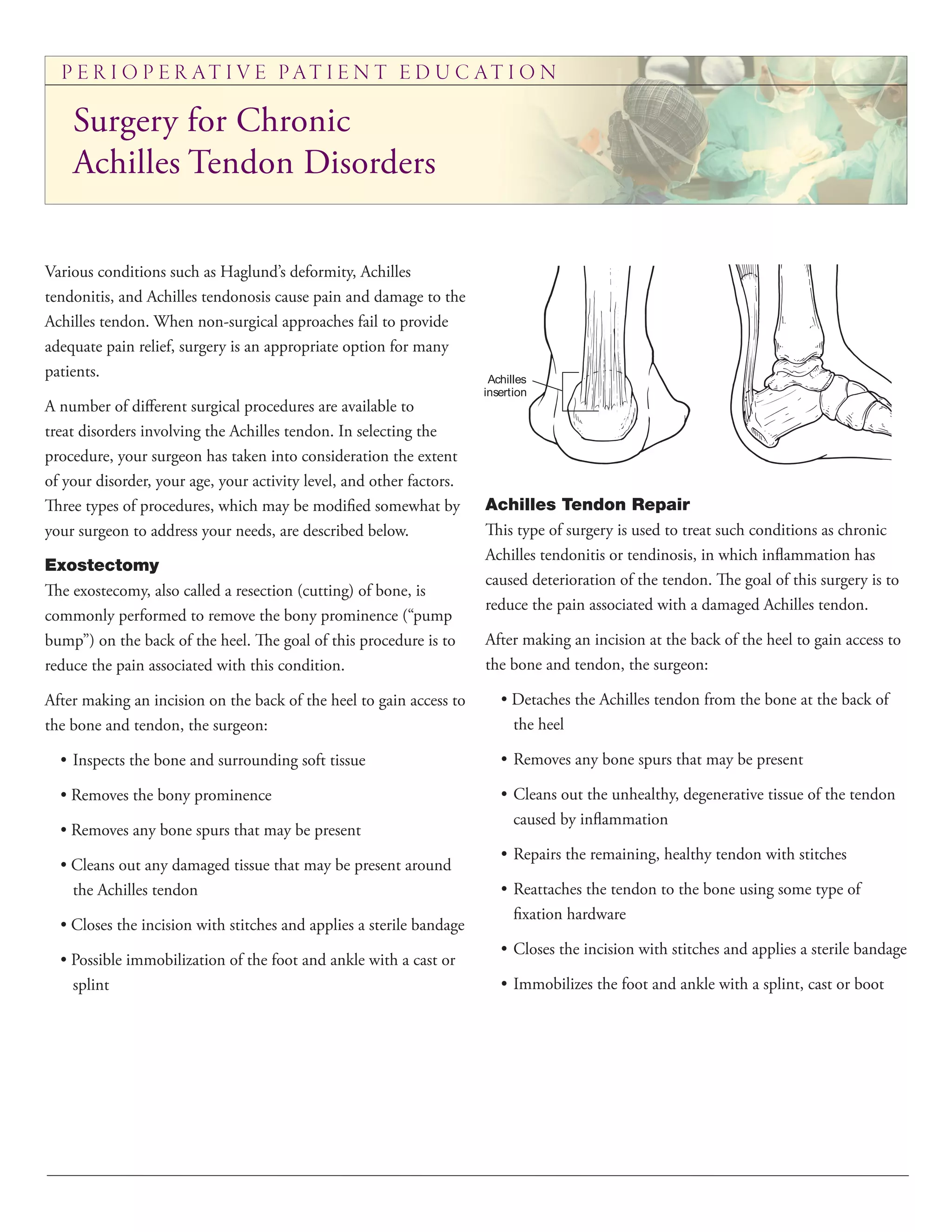
Achilles
insertion
P E R I O P E R AT I V E PAT I E N T E D U C AT I O N
This information has been prepared by the Consumer Education Committee of the American College of Foot and Ankle Surgeons, a
professional society of over 6,500 foot and ankle surgeons.
Members of the College are Doctors of Podiatric Medicine who have received additional training through surgical residency programs.
The mission of the College is to promote superior care of foot and ankle surgical patients through education, research
and the promotion of the highest professional standards.
Copyright © 2012, American College of Foot and Ankle Surgeons • www.FootHealthFacts.org
Tendon Transfer
A tendon transfer is suitable for patients whose Achilles tendon
has been substantially weakened and cannot function properly
on its own. The goals of this procedure are to reduce pain and
improve function.
After making an incision over the Achilles tendon, the surgeon:
• Identifies and cuts out the portion of the Achilles tendon
that is damaged
• Takes a healthy tendon from the area and moves it into a
new position to assist the weakened Achilles tendon
• Reattaches this transferred tendon to the bone using some
type of fixation hardware and repairs the Achilles tendon
and reattaches it to the heel bone (calcaneus)
• Closes the incision with stitches and applies a sterile bandage
• Immobilizes the foot and ankle with a cast, splint, or boot
Recovery
Recovery from Achilles tendon repair surgery generally takes
about 10 to 12 weeks. During a portion of that period, weight
bearing may not be permitted.
Notes:
Surgery for Chronic
Achilles Tendon Disorders continued

Surgery for Chronic Achilles Tendon Disorders

  • 1.
    P E RI O P E R AT I V E PAT I E N T E D U C AT I O N Various conditions such as Haglund’s deformity, Achilles tendonitis, and Achilles tendonosis cause pain and damage to the Achilles tendon. When non-surgical approaches fail to provide adequate pain relief, surgery is an appropriate option for many patients. A number of different surgical procedures are available to treat disorders involving the Achilles tendon. In selecting the procedure, your surgeon has taken into consideration the extent of your disorder, your age, your activity level, and other factors. Three types of procedures, which may be modified somewhat by your surgeon to address your needs, are described below. Exostectomy The exostecomy, also called a resection (cutting) of bone, is commonly performed to remove the bony prominence (“pump bump”) on the back of the heel. The goal of this procedure is to reduce the pain associated with this condition. After making an incision on the back of the heel to gain access to the bone and tendon, the surgeon: • Inspects the bone and surrounding soft tissue • Removes the bony prominence • Removes any bone spurs that may be present • Cleans out any damaged tissue that may be present around the Achilles tendon • Closes the incision with stitches and applies a sterile bandage • Possible immobilization of the foot and ankle with a cast or splint Achilles Tendon Repair This type of surgery is used to treat such conditions as chronic Achilles tendonitis or tendinosis, in which inflammation has caused deterioration of the tendon. The goal of this surgery is to reduce the pain associated with a damaged Achilles tendon. After making an incision at the back of the heel to gain access to the bone and tendon, the surgeon: • Detaches the Achilles tendon from the bone at the back of the heel • Removes any bone spurs that may be present • Cleans out the unhealthy, degenerative tissue of the tendon caused by inflammation • Repairs the remaining, healthy tendon with stitches • Reattaches the tendon to the bone using some type of fixation hardware • Closes the incision with stitches and applies a sterile bandage • Immobilizes the foot and ankle with a splint, cast or boot Surgery for Chronic Achilles Tendon Disorders Achilles insertion
  • 2.
    P E RI O P E R AT I V E PAT I E N T E D U C AT I O N This information has been prepared by the Consumer Education Committee of the American College of Foot and Ankle Surgeons, a professional society of over 6,500 foot and ankle surgeons. Members of the College are Doctors of Podiatric Medicine who have received additional training through surgical residency programs. The mission of the College is to promote superior care of foot and ankle surgical patients through education, research and the promotion of the highest professional standards. Copyright © 2012, American College of Foot and Ankle Surgeons • www.FootHealthFacts.org Tendon Transfer A tendon transfer is suitable for patients whose Achilles tendon has been substantially weakened and cannot function properly on its own. The goals of this procedure are to reduce pain and improve function. After making an incision over the Achilles tendon, the surgeon: • Identifies and cuts out the portion of the Achilles tendon that is damaged • Takes a healthy tendon from the area and moves it into a new position to assist the weakened Achilles tendon • Reattaches this transferred tendon to the bone using some type of fixation hardware and repairs the Achilles tendon and reattaches it to the heel bone (calcaneus) • Closes the incision with stitches and applies a sterile bandage • Immobilizes the foot and ankle with a cast, splint, or boot Recovery Recovery from Achilles tendon repair surgery generally takes about 10 to 12 weeks. During a portion of that period, weight bearing may not be permitted. Notes: Surgery for Chronic Achilles Tendon Disorders continued