John Martinelli, MSIII, SGUSOM
Case 04. Rotation: Surgery/Vascular

DATE: 7/30/13

Identifying Data:
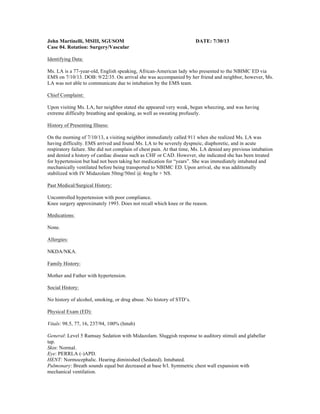
Ms. LA is a 77-year-old, English speaking, African-American lady who presented to the NBIMC ED via
EMS on 7/10/13. DOB: 9/22/35. On arrival she was accompanied by her friend and neighbor, however, Ms.
LA was not able to communicate due to intubation by the EMS team.
Chief Complaint:
Upon visiting Ms. LA, her neighbor stated she appeared very weak, began wheezing, and was having
extreme difficulty breathing and speaking, as well as sweating profusely.
History of Presenting Illness:
On the morning of 7/10/13, a visiting neighbor immediately called 911 when she realized Ms. LA was
having difficulty. EMS arrived and found Ms. LA to be severely dyspneic, diaphoretic, and in acute
respiratory failure. She did not complain of chest pain. At that time, Ms. LA denied any previous intubation
and denied a history of cardiac disease such as CHF or CAD. However, she indicated she has been treated
for hypertension but had not been taking her medication for “years”. She was immediately intubated and
mechanically ventilated before being transported to NBIMC ED. Upon arrival, she was additionally
stabilized with IV Midazolam 50mg/50ml @ 4mg/hr + NS.
Past Medical/Surgical History:
Uncontrolled hypertension with poor compliance.
Knee surgery approximately 1993. Does not recall which knee or the reason.
Medications:
None.
Allergies:
NKDA/NKA.
Family History:
Mother and Father with hypertension.
Social History:
No history of alcohol, smoking, or drug abuse. No history of STD’s.
Physical Exam (ED):
Vitals: 98.5, 77, 16, 237/94, 100% (Intub)
General: Level 5 Ramsay Sedation with Midazolam. Sluggish response to auditory stimuli and glabellar
tap.
Skin: Normal.
Eye: PERRLA (-)APD.
HENT: Normocephalic. Hearing diminished (Sedated). Intubated.
Pulmonary: Breath sounds equal but decreased at base b/l. Symmetric chest wall expansion with
mechanical ventilation.
Gastrointestinal: Soft. Bowel sounds present and normal.
Genitourinary: Foley with good output.
Musculoskeletal: Normal appearance.
Neurologic: Sedation with Midazolam.
Hematologic: Deferred -> Labs
Endocrine: Deferred.
Psychiatric: Sedation with Midazolam.
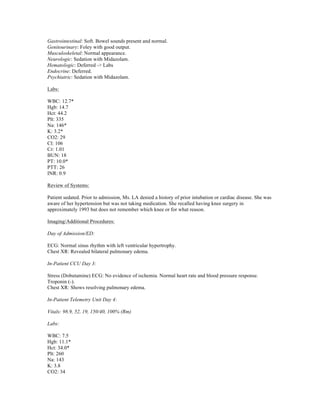
Labs:
WBC: 12.7*
Hgb: 14.7
Hct: 44.2
Plt: 335
Na: 146*
K: 3.2*
CO2: 29
Cl: 106
Cr: 1.01
BUN: 18
PT: 10.0*
PTT: 26
INR: 0.9
Review of Systems:
Patient sedated. Prior to admission, Ms. LA denied a history of prior intubation or cardiac disease. She was
aware of her hypertension but was not taking medication. She recalled having knee surgery in
approximately 1993 but does not remember which knee or for what reason.
Imaging/Additional Procedures:
Day of Admission/ED:
ECG: Normal sinus rhythm with left ventricular hypertrophy.
Chest XR: Revealed bilateral pulmonary edema.
In-Patient CCU Day 3:
Stress (Dobutamine) ECG: No evidence of ischemia. Normal heart rate and blood pressure response.
Troponin (-).
Chest XR: Shows resolving pulmonary edema.
In-Patient Telemetry Unit Day 4:
Vitals: 98.9, 52, 19, 150/40, 100% (Rm)
Labs:
WBC: 7.5
Hgb: 11.1*
Hct: 34.0*
Plt: 260
Na: 143
K: 3.8
CO2: 34
Cl: 101
Cr: 1.36*
BUN: 28*
PT: 11.6
PTT: 28
INR: 1.1
Chest: Improved breath sounds at lung bases and clear to auscultation b/l.
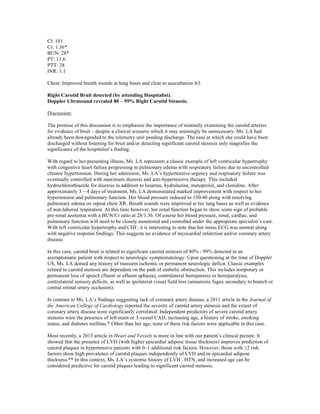
Right Carotid Bruit detected (by attending Hospitalist).
Doppler Ultrasound revealed 80 – 99% Right Carotid Stenosis.
Discussion:
The premise of this discussion is to emphasize the importance of routinely examining the carotid arteries
for evidence of bruit – despite a clinical scenario which it may seemingly be unnecessary. Ms. LA had
already been downgraded to the telemetry unit pending discharge. The ease at which she could have been
discharged without listening for bruit and/or detecting significant carotid stenosis only magnifies the
significance of the hospitalist’s finding.
With regard to her presenting illness, Ms. LA represents a classic example of left ventricular hypertrophy
with congestive heart failure progressing to pulmonary edema with respiratory failure due to uncontrolled
chronic hypertension. During her admission, Ms. LA’s hypertensive urgency and respiratory failure was
eventually controlled with maximum diuresis and anti-hypertensive therapy. This included
hydrochlorothiazide for diuresis in addition to losartan, hydralazine, metoprolol, and clonidine. After
approximately 3 – 4 days of treatment, Ms. LA demonstrated marked improvement with respect to her
hypertension and pulmonary function. Her blood pressure reduced to 150/40 along with resolving
pulmonary edema on repeat chest XR. Breath sounds were improved at her lung bases as well as evidence
of non-labored respiration. At this time however, her renal function began to show some sign of probable
pre-renal azotemia with a BUN/Cr ratio at 28/1.36. Of course her blood pressure, renal, cardiac, and
pulmonary function will need to be closely monitored and controlled under the appropriate specialist’s care.
With left ventricular hypertrophy and CHF, it is interesting to note that her stress ECG was normal along
with negative troponin findings. This suggests no evidence of myocardial infarction and/or coronary artery
disease.
In this case, carotid bruit is related to significant carotid stenosis of 80% - 99% detected in an
asymptomatic patient with respect to neurologic symptomatology. Upon questioning at the time of Doppler
US, Ms. LA denied any history of transient ischemic or permanent neurologic deficit. Classic examples
related to carotid stenosis are dependent on the path of embolic obstruction. This includes temporary or
permanent loss of speech (fluent or afluent aphasia), contralateral hemiparesis or hemiparalysis,
contralateral sensory deficits, as well as ipsilateral visual field loss (amaurosis fugax secondary to branch or
central retinal artery occlusion).
In contrast to Ms. LA’s findings suggesting lack of coronary artery disease, a 2011 article in the Journal of
the American College of Cardiology reported the severity of carotid artery stenosis and the extent of
coronary artery disease were significantly correlated. Independent predictors of severe carotid artery
stenosis were the presence of left-main or 3-vessel CAD, increasing age, a history of stroke, smoking
status, and diabetes mellitus.* Other than her age, none of these risk factors were applicable in this case.
Most recently, a 2013 article in Heart and Vessels is more in line with our patient’s clinical picture. It
showed that the presence of LVH (with higher epicardial adipose tissue thickness) improves prediction of
carotid plaques in hypertensive patients with 0–1 additional risk factors. However, those with ≥2 risk
factors show high prevalence of carotid plaques independently of LVH and/or epicardial adipose
thickness.** In this context, Ms. LA’s systemic history of LVH , HTN, and increased age can be
considered predictive for carotid plaques leading to significant carotid stenosis.
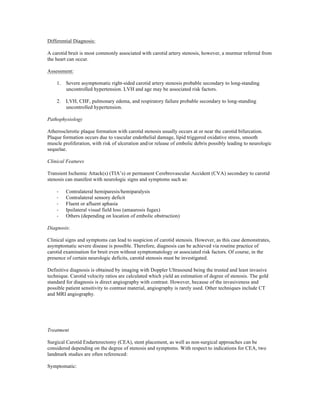
Differential Diagnosis:
A carotid bruit is most commonly associated with carotid artery stenosis, however, a murmur referred from
the heart can occur.
Assessment:
1.

Severe asymptomatic right-sided carotid artery stenosis probable secondary to long-standing
uncontrolled hypertension. LVH and age may be associated risk factors.

2.

LVH, CHF, pulmonary edema, and respiratory failure probable secondary to long-standing
uncontrolled hypertension.

Pathophysiology
Atherosclerotic plaque formation with carotid stenosis usually occurs at or near the carotid bifurcation.
Plaque formation occurs due to vascular endothelial damage, lipid triggered oxidative stress, smooth
muscle proliferation, with risk of ulceration and/or release of embolic debris possibly leading to neurologic
sequelae.
Clinical Features
Transient Ischemic Attack(s) (TIA’s) or permanent Cerebrovascular Accident (CVA) secondary to carotid
stenosis can manifest with neurologic signs and symptoms such as:
-­‐
-­‐
-­‐
-­‐
-­‐

Contralateral hemiparesis/hemiparalysis
Contralateral sensory deficit
Fluent or afluent aphasia
Ipsilateral visual field loss (amaurosis fugax)
Others (depending on location of embolic obstruction)

Diagnosis:
Clinical signs and symptoms can lead to suspicion of carotid stenosis. However, as this case demonstrates,
asymptomatic severe disease is possible. Therefore, diagnosis can be achieved via routine practice of
carotid examination for bruit even without symptomatology or associated risk factors. Of course, in the
presence of certain neurologic deficits, carotid stenosis must be investigated.
Definitive diagnosis is obtained by imaging with Doppler Ultrasound being the trusted and least invasive
technique. Carotid velocity ratios are calculated which yield an estimation of degree of stenosis. The gold
standard for diagnosis is direct angiography with contrast. However, because of the invasiveness and
possible patient sensitivity to contrast material, angiography is rarely used. Other techniques include CT
and MRI angiography.

Treatment
Surgical Carotid Endarterectomy (CEA), stent placement, as well as non-surgical approaches can be
considered depending on the degree of stenosis and symptoms. With respect to indications for CEA, two
landmark studies are often referenced:
Symptomatic:
-­‐
-­‐
-­‐

One or more transient ischemic attacks (TIAs) in the preceding 6 months and carotid artery
stenosis exceeding 50%.
Ipsilateral TIA and carotid artery stenosis exceeding 70%, combined with required coronary artery
bypass grafting (CABG).
Progressive stroke and carotid artery stenosis exceeding 70%
Beneficial effect of carotid endarterectomy in symptomatic patients with high-grade carotid stenosis. North American
Symptomatic Carotid Endarterectomy Trial Collaborators. N Engl J Med. Aug 15 1991;325(7):445-53.

Asymptomatic:
-­‐

“Good Risk” Patients with > 60% Stenosis

Endarterectomy for asymptomatic carotid artery stenosis. Executive Committee for the Asymptomatic Carotid Atherosclerosis Study.
JAMA. May 10 1995;273(18):1421-8.

Regarding stent placement, the risk of embolic events has been found to be greater in comparison to CEA,
therefore CEA remains the first surgical option in most clinical scenarios.
Medical management includes control of underlying risk factors. Recent evidence has shown adding statins
to the treatment plan may have vascular endothelial protective effects in addition to lowering cholesterol.
Risk Factors
Atherosclerotic factors:
-­‐
-­‐
-­‐
-­‐
-­‐
-­‐
-­‐
-­‐

Hypertension
Diabetes
Hyperlipidemia/Hypercholesterolemia
Smoking
EtOH
CAD
LVH (with </= 1 risk factor)
Turbulence at carotid bifurcation

Complications
Complications of carotid stenosis and/or lack of appropriate treatment can be variable including
asymptomatic disease, transient ischemic events, cerebrovascular accidents with permanent neurologic
deficits, and even death. In the presence of patent collateral circulation from the contralateral carotid
arterial supply, the risk of these events is reduced. Likewise, significant stenosis in the contralateral carotid
is associated with increased morbidity and mortality.
With respect to CEA surgery, similar complications can occur during and/or post surgery due to possible
release of embolic debris, ulceration, or surgical failure.
In the case of acute carotid occlusion, emergent CEA is generally not recommended due to possible
reperfusion injury and hemorrhagic CVA.
Plan:
Ms. LA was scheduled for right CEA on 7/22/2013 as an outpatient at NBIMC SDS. She did require a
graft/patch angioplasty and tolerated the procedure well without complication. There was no evidence of
post-operative neurologic deficits.
Regarding her initial presentation, current cardiopulmonary status, as well as renal status, the importance of
follow-up and treatment with her appropriate specialists was stressed.
References:
* J Am Coll Cardiol. 2011;57(7):779-783. doi:10.1016/j.jacc.2010.09.047
** Heart and Vessels. May 2013, Volume 28, Issue 3, pp 277-283

Case Report: Carotid Stenosis

  • 1.
    John Martinelli, MSIII,SGUSOM Case 04. Rotation: Surgery/Vascular DATE: 7/30/13 Identifying Data: Ms. LA is a 77-year-old, English speaking, African-American lady who presented to the NBIMC ED via EMS on 7/10/13. DOB: 9/22/35. On arrival she was accompanied by her friend and neighbor, however, Ms. LA was not able to communicate due to intubation by the EMS team. Chief Complaint: Upon visiting Ms. LA, her neighbor stated she appeared very weak, began wheezing, and was having extreme difficulty breathing and speaking, as well as sweating profusely. History of Presenting Illness: On the morning of 7/10/13, a visiting neighbor immediately called 911 when she realized Ms. LA was having difficulty. EMS arrived and found Ms. LA to be severely dyspneic, diaphoretic, and in acute respiratory failure. She did not complain of chest pain. At that time, Ms. LA denied any previous intubation and denied a history of cardiac disease such as CHF or CAD. However, she indicated she has been treated for hypertension but had not been taking her medication for “years”. She was immediately intubated and mechanically ventilated before being transported to NBIMC ED. Upon arrival, she was additionally stabilized with IV Midazolam 50mg/50ml @ 4mg/hr + NS. Past Medical/Surgical History: Uncontrolled hypertension with poor compliance. Knee surgery approximately 1993. Does not recall which knee or the reason. Medications: None. Allergies: NKDA/NKA. Family History: Mother and Father with hypertension. Social History: No history of alcohol, smoking, or drug abuse. No history of STD’s. Physical Exam (ED): Vitals: 98.5, 77, 16, 237/94, 100% (Intub) General: Level 5 Ramsay Sedation with Midazolam. Sluggish response to auditory stimuli and glabellar tap. Skin: Normal. Eye: PERRLA (-)APD. HENT: Normocephalic. Hearing diminished (Sedated). Intubated. Pulmonary: Breath sounds equal but decreased at base b/l. Symmetric chest wall expansion with mechanical ventilation.
  • 2.
    Gastrointestinal: Soft. Bowelsounds present and normal. Genitourinary: Foley with good output. Musculoskeletal: Normal appearance. Neurologic: Sedation with Midazolam. Hematologic: Deferred -> Labs Endocrine: Deferred. Psychiatric: Sedation with Midazolam. Labs: WBC: 12.7* Hgb: 14.7 Hct: 44.2 Plt: 335 Na: 146* K: 3.2* CO2: 29 Cl: 106 Cr: 1.01 BUN: 18 PT: 10.0* PTT: 26 INR: 0.9 Review of Systems: Patient sedated. Prior to admission, Ms. LA denied a history of prior intubation or cardiac disease. She was aware of her hypertension but was not taking medication. She recalled having knee surgery in approximately 1993 but does not remember which knee or for what reason. Imaging/Additional Procedures: Day of Admission/ED: ECG: Normal sinus rhythm with left ventricular hypertrophy. Chest XR: Revealed bilateral pulmonary edema. In-Patient CCU Day 3: Stress (Dobutamine) ECG: No evidence of ischemia. Normal heart rate and blood pressure response. Troponin (-). Chest XR: Shows resolving pulmonary edema. In-Patient Telemetry Unit Day 4: Vitals: 98.9, 52, 19, 150/40, 100% (Rm) Labs: WBC: 7.5 Hgb: 11.1* Hct: 34.0* Plt: 260 Na: 143 K: 3.8 CO2: 34
  • 3.
    Cl: 101 Cr: 1.36* BUN:28* PT: 11.6 PTT: 28 INR: 1.1 Chest: Improved breath sounds at lung bases and clear to auscultation b/l. Right Carotid Bruit detected (by attending Hospitalist). Doppler Ultrasound revealed 80 – 99% Right Carotid Stenosis. Discussion: The premise of this discussion is to emphasize the importance of routinely examining the carotid arteries for evidence of bruit – despite a clinical scenario which it may seemingly be unnecessary. Ms. LA had already been downgraded to the telemetry unit pending discharge. The ease at which she could have been discharged without listening for bruit and/or detecting significant carotid stenosis only magnifies the significance of the hospitalist’s finding. With regard to her presenting illness, Ms. LA represents a classic example of left ventricular hypertrophy with congestive heart failure progressing to pulmonary edema with respiratory failure due to uncontrolled chronic hypertension. During her admission, Ms. LA’s hypertensive urgency and respiratory failure was eventually controlled with maximum diuresis and anti-hypertensive therapy. This included hydrochlorothiazide for diuresis in addition to losartan, hydralazine, metoprolol, and clonidine. After approximately 3 – 4 days of treatment, Ms. LA demonstrated marked improvement with respect to her hypertension and pulmonary function. Her blood pressure reduced to 150/40 along with resolving pulmonary edema on repeat chest XR. Breath sounds were improved at her lung bases as well as evidence of non-labored respiration. At this time however, her renal function began to show some sign of probable pre-renal azotemia with a BUN/Cr ratio at 28/1.36. Of course her blood pressure, renal, cardiac, and pulmonary function will need to be closely monitored and controlled under the appropriate specialist’s care. With left ventricular hypertrophy and CHF, it is interesting to note that her stress ECG was normal along with negative troponin findings. This suggests no evidence of myocardial infarction and/or coronary artery disease. In this case, carotid bruit is related to significant carotid stenosis of 80% - 99% detected in an asymptomatic patient with respect to neurologic symptomatology. Upon questioning at the time of Doppler US, Ms. LA denied any history of transient ischemic or permanent neurologic deficit. Classic examples related to carotid stenosis are dependent on the path of embolic obstruction. This includes temporary or permanent loss of speech (fluent or afluent aphasia), contralateral hemiparesis or hemiparalysis, contralateral sensory deficits, as well as ipsilateral visual field loss (amaurosis fugax secondary to branch or central retinal artery occlusion). In contrast to Ms. LA’s findings suggesting lack of coronary artery disease, a 2011 article in the Journal of the American College of Cardiology reported the severity of carotid artery stenosis and the extent of coronary artery disease were significantly correlated. Independent predictors of severe carotid artery stenosis were the presence of left-main or 3-vessel CAD, increasing age, a history of stroke, smoking status, and diabetes mellitus.* Other than her age, none of these risk factors were applicable in this case. Most recently, a 2013 article in Heart and Vessels is more in line with our patient’s clinical picture. It showed that the presence of LVH (with higher epicardial adipose tissue thickness) improves prediction of carotid plaques in hypertensive patients with 0–1 additional risk factors. However, those with ≥2 risk factors show high prevalence of carotid plaques independently of LVH and/or epicardial adipose thickness.** In this context, Ms. LA’s systemic history of LVH , HTN, and increased age can be considered predictive for carotid plaques leading to significant carotid stenosis.
  • 4.
    Differential Diagnosis: A carotidbruit is most commonly associated with carotid artery stenosis, however, a murmur referred from the heart can occur. Assessment: 1. Severe asymptomatic right-sided carotid artery stenosis probable secondary to long-standing uncontrolled hypertension. LVH and age may be associated risk factors. 2. LVH, CHF, pulmonary edema, and respiratory failure probable secondary to long-standing uncontrolled hypertension. Pathophysiology Atherosclerotic plaque formation with carotid stenosis usually occurs at or near the carotid bifurcation. Plaque formation occurs due to vascular endothelial damage, lipid triggered oxidative stress, smooth muscle proliferation, with risk of ulceration and/or release of embolic debris possibly leading to neurologic sequelae. Clinical Features Transient Ischemic Attack(s) (TIA’s) or permanent Cerebrovascular Accident (CVA) secondary to carotid stenosis can manifest with neurologic signs and symptoms such as: -­‐ -­‐ -­‐ -­‐ -­‐ Contralateral hemiparesis/hemiparalysis Contralateral sensory deficit Fluent or afluent aphasia Ipsilateral visual field loss (amaurosis fugax) Others (depending on location of embolic obstruction) Diagnosis: Clinical signs and symptoms can lead to suspicion of carotid stenosis. However, as this case demonstrates, asymptomatic severe disease is possible. Therefore, diagnosis can be achieved via routine practice of carotid examination for bruit even without symptomatology or associated risk factors. Of course, in the presence of certain neurologic deficits, carotid stenosis must be investigated. Definitive diagnosis is obtained by imaging with Doppler Ultrasound being the trusted and least invasive technique. Carotid velocity ratios are calculated which yield an estimation of degree of stenosis. The gold standard for diagnosis is direct angiography with contrast. However, because of the invasiveness and possible patient sensitivity to contrast material, angiography is rarely used. Other techniques include CT and MRI angiography. Treatment Surgical Carotid Endarterectomy (CEA), stent placement, as well as non-surgical approaches can be considered depending on the degree of stenosis and symptoms. With respect to indications for CEA, two landmark studies are often referenced: Symptomatic:
  • 5.
    -­‐ -­‐ -­‐ One or moretransient ischemic attacks (TIAs) in the preceding 6 months and carotid artery stenosis exceeding 50%. Ipsilateral TIA and carotid artery stenosis exceeding 70%, combined with required coronary artery bypass grafting (CABG). Progressive stroke and carotid artery stenosis exceeding 70% Beneficial effect of carotid endarterectomy in symptomatic patients with high-grade carotid stenosis. North American Symptomatic Carotid Endarterectomy Trial Collaborators. N Engl J Med. Aug 15 1991;325(7):445-53. Asymptomatic: -­‐ “Good Risk” Patients with > 60% Stenosis Endarterectomy for asymptomatic carotid artery stenosis. Executive Committee for the Asymptomatic Carotid Atherosclerosis Study. JAMA. May 10 1995;273(18):1421-8. Regarding stent placement, the risk of embolic events has been found to be greater in comparison to CEA, therefore CEA remains the first surgical option in most clinical scenarios. Medical management includes control of underlying risk factors. Recent evidence has shown adding statins to the treatment plan may have vascular endothelial protective effects in addition to lowering cholesterol. Risk Factors Atherosclerotic factors: -­‐ -­‐ -­‐ -­‐ -­‐ -­‐ -­‐ -­‐ Hypertension Diabetes Hyperlipidemia/Hypercholesterolemia Smoking EtOH CAD LVH (with </= 1 risk factor) Turbulence at carotid bifurcation Complications Complications of carotid stenosis and/or lack of appropriate treatment can be variable including asymptomatic disease, transient ischemic events, cerebrovascular accidents with permanent neurologic deficits, and even death. In the presence of patent collateral circulation from the contralateral carotid arterial supply, the risk of these events is reduced. Likewise, significant stenosis in the contralateral carotid is associated with increased morbidity and mortality. With respect to CEA surgery, similar complications can occur during and/or post surgery due to possible release of embolic debris, ulceration, or surgical failure. In the case of acute carotid occlusion, emergent CEA is generally not recommended due to possible reperfusion injury and hemorrhagic CVA. Plan: Ms. LA was scheduled for right CEA on 7/22/2013 as an outpatient at NBIMC SDS. She did require a graft/patch angioplasty and tolerated the procedure well without complication. There was no evidence of post-operative neurologic deficits. Regarding her initial presentation, current cardiopulmonary status, as well as renal status, the importance of follow-up and treatment with her appropriate specialists was stressed.
  • 6.
    References: * J AmColl Cardiol. 2011;57(7):779-783. doi:10.1016/j.jacc.2010.09.047 ** Heart and Vessels. May 2013, Volume 28, Issue 3, pp 277-283