SURGE TANK BLADDERS
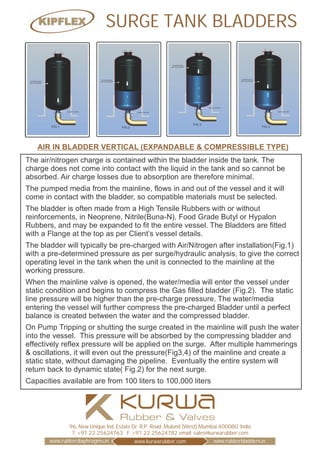
AIR IN BLADDER VERTICAL (EXPANDABLE & COMPRESSIBLE TYPE)
The air/nitrogen charge is contained within the bladder inside the tank. The
charge does not come into contact with the liquid in the tank and so cannot be
absorbed. Air charge losses due to absorption are therefore minimal.
The pumped media from the mainline, flows in and out of the vessel and it will
come in contact with the bladder, so compatible materials must be selected.
The bladder is often made from a High Tensile Rubbers with or without
reinforcements, in Neoprene, Nitrile(Buna-N), Food Grade Butyl or Hypalon
Rubbers, and may be expanded to fit the entire vessel. The Bladders are fitted
with a Flange at the top as per Client’s vessel details.
The bladder will typically be pre-charged with Air/Nitrogen after installation(Fig.1)
with a pre-determined pressure as per surge/hydraulic analysis, to give the correct
operating level in the tank when the unit is connected to the mainline at the
working pressure.
When the mainline valve is opened, the water/media will enter the vessel under
static condition and begins to compress the Gas filled bladder (Fig.2). The static
line pressure will be higher than the pre-charge pressure. The water/media
entering the vessel will further compress the pre-charged Bladder until a perfect
balance is created between the water and the compressed bladder.
On Pump Tripping or shutting the surge created in the mainline will push the water
into the vessel. This pressure will be absorbed by the compressing bladder and
effectively reflex pressure will be applied on the surge. After multiple hammerings
& oscillations, it will even out the pressure( of the mainline and create a
static state, without damaging the pipeline. Eventually the entire system will
return back to dynamic state( Fig.2) for the next surge.
Capacities available are from 100 liters to 100,000 liters
Fig3,4)
FIG.1
T: +91 22 25624763 F: +91 22 25624782 email: sales@kurwarubber.com
www.kurwarubber.com
96, New Unique Ind. Estate Dr. R.P. Road, Mulund (West) Mumbai 400080. India
www.rubberdiaphragms.in www.rubberbladders.in
The air/nitrogen charge is contained within the tank, whilst the liquid from the
mainline flows in and out of the bladder. Like the air in bladder design, the liquid
does not come into contact with the tank nor the air charge, so again, the air charge
cannot be absorbed by the pumped media and so air losses due to absorption are
minimal.
For this design the whole tank is pre-charged at installation with a pre-determined
pressure to give the correct operating level in the tank (FIG.1) when the unit is
connected to the mainline and at the desired operating pressure.
The bladders are made from a High Tensile Rubbers with or without reinforcements,
in Neoprene, Nitrile(Buna-N), Food Grade Butyl or Hypalon Rubbers, and may be
expanded to fit the entire vessel. The Bladders are fitted with a Flange at the Bottom
as per Client’s vessel details.
A grid Plate or
diffuser can be placed at the outlet of the vessel to prevent the bladder from being
sucked into the mainline at low pressures. They are provided with Lugs/Hooks at the
Top for hanging support.
When the mainline valve is opened, the water/media will enter the Bladder under
static condition and begins to compress the Gas filled Tank (Fig.2). The static line
pressure will be higher than the pre-charge pressure of the Tank. The water/media
entering the Bladder will further compress the pre-charged Tank until a perfect
balance is created between the Water in Bladder and the compressed air in Tank.
On Pump Tripping or shutting the surge created in the mainline will push the water
into the Bladder. This pressure will be absorbed by the compressed air in the Tank
and effectively reflex pressure will be applied on the surge. After multiple
hammerings & oscillations, it will even out the pressure(Fig3,4) of the mainline and
create a static state, without damaging the pipeline. Eventually the entire system will
return back to dynamic state( Fig.5) for the next surge.
Capacities available are from 100 liters to 100,000 liters
FIG.1 FIG.2 FIG.3 FIG.4 FIG.5
SURGE TANK BLADDERS
T: +91 22 25624763 F: +91 22 25624782 email: sales@kurwarubber.com
www.kurwarubber.com
96, New Unique Ind. Estate Dr. R.P. Road, Mulund (West) Mumbai 400080. India
www.rubberdiaphragms.in www.rubberbladders.in
WATER IN BLADDER VERTICAL (EXPANDABLE & COMPRESSIBLE TYPE)
The air/nitrogen charge is contained within the bladder inside the tank. The
charge does not come into contact with the liquid in the tank and so cannot be
absorbed. Air charge losses due to absorption are therefore minimal.
The pumped media from the mainline, flows in and out of the vessel and it will
come in contact with the bladder, so compatible materials must be selected.
The bladder is often made from a High Tensile Rubbers with or without
reinforcements, in Neoprene, Nitrile(Buna-N), Food Grade Butyl or Hypalon
Rubbers, and may be expanded to fit the entire vessel. The Bladders are fitted
with a Flange at the top as per Client’s vessel details.
The bladder will typically be pre-charged with Air/Nitrogen after installation(Fig.1)
with a pre-determined pressure as per surge/hydraulic analysis, to give the correct
operating level in the tank when the unit is connected to the mainline at the
working pressure.
When the mainline valve is opened, the water/media will enter the vessel under
static condition and begins to compress the Gas filled bladder (Fig.2). The static
line pressure will be higher than the pre-charge pressure. The water/media
entering the vessel will further compress the pre-charged Bladder until a perfect
balance is created between the water and the compressed bladder.
On Pump Tripping or shutting the surge created in the mainline will push the water
into the vessel. This pressure will be absorbed by the compressing bladder and
effectively reflex pressure will be applied on the surge. After multiple hammerings
& oscillations, it will even out the pressure( of the mainline and create a static
state, without damaging the pipeline. Eventually the entire system will return back
to dynamic state( Fig.2) for the next surge.
Capacities available are from 100 liters to 100,000 liters
Fig3)
FIG.1 FIG.2 FIG.3
SURGE TANK BLADDERS
T: +91 22 25624763 F: +91 22 25624782 email: sales@kurwarubber.com
www.kurwarubber.com
96, New Unique Ind. Estate Dr. R.P. Road, Mulund (West) Mumbai 400080. India
www.rubberdiaphragms.in www.rubberbladders.in
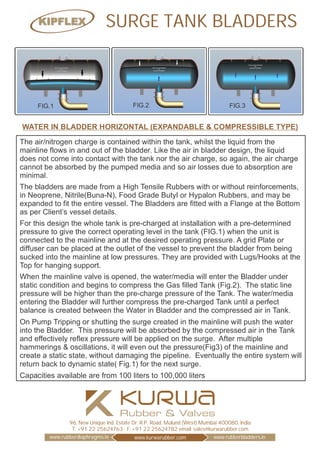
AIR IN BLADDER HORIZONTAL (EXPANDABLE & COMPRESSIBLE TYPE)
The air/nitrogen charge is contained within the tank, whilst the liquid from the
mainline flows in and out of the bladder. Like the air in bladder design, the liquid
does not come into contact with the tank nor the air charge, so again, the air charge
cannot be absorbed by the pumped media and so air losses due to absorption are
minimal.
For this design the whole tank is pre-charged at installation with a pre-determined
pressure to give the correct operating level in the tank (FIG.1) when the unit is
connected to the mainline and at the desired operating pressure.
The bladders are made from a High Tensile Rubbers with or without reinforcements,
in Neoprene, Nitrile(Buna-N), Food Grade Butyl or Hypalon Rubbers, and may be
expanded to fit the entire vessel. The Bladders are fitted with a Flange at the Bottom
as per Client’s vessel details.
A grid Plate or
diffuser can be placed at the outlet of the vessel to prevent the bladder from being
sucked into the mainline at low pressures. They are provided with Lugs/Hooks at the
Top for hanging support.
When the mainline valve is opened, the water/media will enter the Bladder under
static condition and begins to compress the Gas filled Tank (Fig.2). The static line
pressure will be higher than the pre-charge pressure of the Tank. The water/media
entering the Bladder will further compress the pre-charged Tank until a perfect
balance is created between the Water in Bladder and the compressed air in Tank.
On Pump Tripping or shutting the surge created in the mainline will push the water
into the Bladder. This pressure will be absorbed by the compressed air in the Tank
and effectively reflex pressure will be applied on the surge. After multiple
hammerings & oscillations, it will even out the pressure(Fig3) of the mainline and
create a static state, without damaging the pipeline. Eventually the entire system will
return back to dynamic state( Fig.1) for the next surge.
Capacities available are from 100 liters to 100,000 liters
FIG.1 FIG.2 FIG.3
SURGE TANK BLADDERS
T: +91 22 25624763 F: +91 22 25624782 email: sales@kurwarubber.com
www.kurwarubber.com
96, New Unique Ind. Estate Dr. R.P. Road, Mulund (West) Mumbai 400080. India
www.rubberdiaphragms.in www.rubberbladders.in
WATER IN BLADDER HORIZONTAL (EXPANDABLE & COMPRESSIBLE TYPE)

Surge bladder working

  • 1.
    SURGE TANK BLADDERS AIRIN BLADDER VERTICAL (EXPANDABLE & COMPRESSIBLE TYPE) The air/nitrogen charge is contained within the bladder inside the tank. The charge does not come into contact with the liquid in the tank and so cannot be absorbed. Air charge losses due to absorption are therefore minimal. The pumped media from the mainline, flows in and out of the vessel and it will come in contact with the bladder, so compatible materials must be selected. The bladder is often made from a High Tensile Rubbers with or without reinforcements, in Neoprene, Nitrile(Buna-N), Food Grade Butyl or Hypalon Rubbers, and may be expanded to fit the entire vessel. The Bladders are fitted with a Flange at the top as per Client’s vessel details. The bladder will typically be pre-charged with Air/Nitrogen after installation(Fig.1) with a pre-determined pressure as per surge/hydraulic analysis, to give the correct operating level in the tank when the unit is connected to the mainline at the working pressure. When the mainline valve is opened, the water/media will enter the vessel under static condition and begins to compress the Gas filled bladder (Fig.2). The static line pressure will be higher than the pre-charge pressure. The water/media entering the vessel will further compress the pre-charged Bladder until a perfect balance is created between the water and the compressed bladder. On Pump Tripping or shutting the surge created in the mainline will push the water into the vessel. This pressure will be absorbed by the compressing bladder and effectively reflex pressure will be applied on the surge. After multiple hammerings & oscillations, it will even out the pressure( of the mainline and create a static state, without damaging the pipeline. Eventually the entire system will return back to dynamic state( Fig.2) for the next surge. Capacities available are from 100 liters to 100,000 liters Fig3,4) FIG.1 T: +91 22 25624763 F: +91 22 25624782 email: sales@kurwarubber.com www.kurwarubber.com 96, New Unique Ind. Estate Dr. R.P. Road, Mulund (West) Mumbai 400080. India www.rubberdiaphragms.in www.rubberbladders.in
  • 2.
    The air/nitrogen chargeis contained within the tank, whilst the liquid from the mainline flows in and out of the bladder. Like the air in bladder design, the liquid does not come into contact with the tank nor the air charge, so again, the air charge cannot be absorbed by the pumped media and so air losses due to absorption are minimal. For this design the whole tank is pre-charged at installation with a pre-determined pressure to give the correct operating level in the tank (FIG.1) when the unit is connected to the mainline and at the desired operating pressure. The bladders are made from a High Tensile Rubbers with or without reinforcements, in Neoprene, Nitrile(Buna-N), Food Grade Butyl or Hypalon Rubbers, and may be expanded to fit the entire vessel. The Bladders are fitted with a Flange at the Bottom as per Client’s vessel details. A grid Plate or diffuser can be placed at the outlet of the vessel to prevent the bladder from being sucked into the mainline at low pressures. They are provided with Lugs/Hooks at the Top for hanging support. When the mainline valve is opened, the water/media will enter the Bladder under static condition and begins to compress the Gas filled Tank (Fig.2). The static line pressure will be higher than the pre-charge pressure of the Tank. The water/media entering the Bladder will further compress the pre-charged Tank until a perfect balance is created between the Water in Bladder and the compressed air in Tank. On Pump Tripping or shutting the surge created in the mainline will push the water into the Bladder. This pressure will be absorbed by the compressed air in the Tank and effectively reflex pressure will be applied on the surge. After multiple hammerings & oscillations, it will even out the pressure(Fig3,4) of the mainline and create a static state, without damaging the pipeline. Eventually the entire system will return back to dynamic state( Fig.5) for the next surge. Capacities available are from 100 liters to 100,000 liters FIG.1 FIG.2 FIG.3 FIG.4 FIG.5 SURGE TANK BLADDERS T: +91 22 25624763 F: +91 22 25624782 email: sales@kurwarubber.com www.kurwarubber.com 96, New Unique Ind. Estate Dr. R.P. Road, Mulund (West) Mumbai 400080. India www.rubberdiaphragms.in www.rubberbladders.in WATER IN BLADDER VERTICAL (EXPANDABLE & COMPRESSIBLE TYPE)
  • 3.
    The air/nitrogen chargeis contained within the bladder inside the tank. The charge does not come into contact with the liquid in the tank and so cannot be absorbed. Air charge losses due to absorption are therefore minimal. The pumped media from the mainline, flows in and out of the vessel and it will come in contact with the bladder, so compatible materials must be selected. The bladder is often made from a High Tensile Rubbers with or without reinforcements, in Neoprene, Nitrile(Buna-N), Food Grade Butyl or Hypalon Rubbers, and may be expanded to fit the entire vessel. The Bladders are fitted with a Flange at the top as per Client’s vessel details. The bladder will typically be pre-charged with Air/Nitrogen after installation(Fig.1) with a pre-determined pressure as per surge/hydraulic analysis, to give the correct operating level in the tank when the unit is connected to the mainline at the working pressure. When the mainline valve is opened, the water/media will enter the vessel under static condition and begins to compress the Gas filled bladder (Fig.2). The static line pressure will be higher than the pre-charge pressure. The water/media entering the vessel will further compress the pre-charged Bladder until a perfect balance is created between the water and the compressed bladder. On Pump Tripping or shutting the surge created in the mainline will push the water into the vessel. This pressure will be absorbed by the compressing bladder and effectively reflex pressure will be applied on the surge. After multiple hammerings & oscillations, it will even out the pressure( of the mainline and create a static state, without damaging the pipeline. Eventually the entire system will return back to dynamic state( Fig.2) for the next surge. Capacities available are from 100 liters to 100,000 liters Fig3) FIG.1 FIG.2 FIG.3 SURGE TANK BLADDERS T: +91 22 25624763 F: +91 22 25624782 email: sales@kurwarubber.com www.kurwarubber.com 96, New Unique Ind. Estate Dr. R.P. Road, Mulund (West) Mumbai 400080. India www.rubberdiaphragms.in www.rubberbladders.in AIR IN BLADDER HORIZONTAL (EXPANDABLE & COMPRESSIBLE TYPE)
  • 4.
    The air/nitrogen chargeis contained within the tank, whilst the liquid from the mainline flows in and out of the bladder. Like the air in bladder design, the liquid does not come into contact with the tank nor the air charge, so again, the air charge cannot be absorbed by the pumped media and so air losses due to absorption are minimal. For this design the whole tank is pre-charged at installation with a pre-determined pressure to give the correct operating level in the tank (FIG.1) when the unit is connected to the mainline and at the desired operating pressure. The bladders are made from a High Tensile Rubbers with or without reinforcements, in Neoprene, Nitrile(Buna-N), Food Grade Butyl or Hypalon Rubbers, and may be expanded to fit the entire vessel. The Bladders are fitted with a Flange at the Bottom as per Client’s vessel details. A grid Plate or diffuser can be placed at the outlet of the vessel to prevent the bladder from being sucked into the mainline at low pressures. They are provided with Lugs/Hooks at the Top for hanging support. When the mainline valve is opened, the water/media will enter the Bladder under static condition and begins to compress the Gas filled Tank (Fig.2). The static line pressure will be higher than the pre-charge pressure of the Tank. The water/media entering the Bladder will further compress the pre-charged Tank until a perfect balance is created between the Water in Bladder and the compressed air in Tank. On Pump Tripping or shutting the surge created in the mainline will push the water into the Bladder. This pressure will be absorbed by the compressed air in the Tank and effectively reflex pressure will be applied on the surge. After multiple hammerings & oscillations, it will even out the pressure(Fig3) of the mainline and create a static state, without damaging the pipeline. Eventually the entire system will return back to dynamic state( Fig.1) for the next surge. Capacities available are from 100 liters to 100,000 liters FIG.1 FIG.2 FIG.3 SURGE TANK BLADDERS T: +91 22 25624763 F: +91 22 25624782 email: sales@kurwarubber.com www.kurwarubber.com 96, New Unique Ind. Estate Dr. R.P. Road, Mulund (West) Mumbai 400080. India www.rubberdiaphragms.in www.rubberbladders.in WATER IN BLADDER HORIZONTAL (EXPANDABLE & COMPRESSIBLE TYPE)