CONCEPT OF TAWHEED ( montheism )   In Light of Surah Fatiha and Surah Ikhlas By Mrs. Najmunnisa  
Tawheed: Definition The linguistic definition of Tawheed   It means unification and is derived from the Arabic verb ‘Wahhada’ (which means to unite, join, combine or consolidate). The Shari’ah definition of Tawheed "To submit or to confess the Lordship of Allah and to purify Allah’s names, attributes and any deed of creation and not to associate anything with Him." 
as Allaah says [2]: ( and I have not created the Jinn nor Mankind except to worship Me ) And Allaah says [3]: ( and worship Allaah, and do not ascribe a single partner to Him ) Allaah also says [4]: ( So call on Allaah, making the religion entirely for Him, even if the disbelievers detest it )
Types of Tawheed Tawheed  can be viewed from the perspectives of: Tawheed al-Rububiyah   – Unity of Lordship   Tawheed al- Uluhiyah   – Unity of Worship   Tawheed al- Asma wa Sifaat   – Unity of His Names and His Attributes   Tawheed al Itabaa   – Unity in the following the Prophet Muhammad, peace be upon him
Tawheed al-Rububiyah This is the belief that Allah (SWT) is One without partner in His dominion. He is Lord and Sustainer of the universe in all matters of creation, planning and controlling, i.e. the Creator.  Tawheed al-Rububiyah is based on the fundamental concept that Allah (SWT) alone caused all things to exist. Allah (SWT) sustains and maintains the creation and He (SWT) is independent from His creation. Allah (SWT) says; "Allah is the Creator of all things and He is the agent on which all things depend."  [Quran 39:62] "Allah created you and whatever you do."  [Quran 37:96] "And no calamity strikes except by Allah’s permission."  [Quran 64:11]
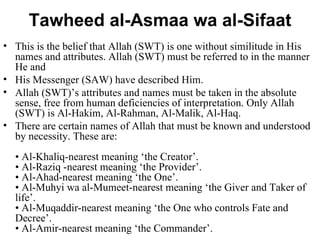
Tawheed al-Asmaa wa al-Sifaat This is the belief that Allah (SWT) is one without similitude in His names and attributes. Allah (SWT) must be referred to in the manner He and  His Messenger (SAW) have described Him.  Allah (SWT)’s attributes and names must be taken in the absolute sense, free from human deficiencies of interpretation. Only Allah (SWT) is Al-Hakim, Al-Rahman, Al-Malik, Al-Haq.  There are certain names of Allah that must be known and understood by necessity. These are: • Al-Khaliq-nearest meaning ‘the Creator’. • Al-Raziq -nearest meaning ‘the Provider’. • Al-Ahad-nearest meaning ‘the One’. • Al-Muhyi wa al-Mumeet-nearest meaning ‘the Giver and Taker of life’. • Al-Muqaddir-nearest meaning ‘the One who controls Fate and Decree’. • Al-Amir-nearest meaning ‘the Commander’.
The above meanings are only indications and are not exact translations of Allah’s attributes. Allah (SWT) says:  "The rule (Command) belongs to none but Allah"  [Quran 12:40] "To Him belongs the Creating and the Commanding."  [Quran 7:54] In reference to the word ‘Ahad’, Allah (SWT) says:  "Say: He is Ahad"  [Quran 112:1] The term ‘Ahad’ is unique since it was never used prior to revelation. In the revelation it was used by Allah (SWT) to describe Himself.
Allah (SWT) states; "There is nothing like Him"  [Quran 42:11] "And never has there been anyone coequal with Him."  [Quran 112:4]
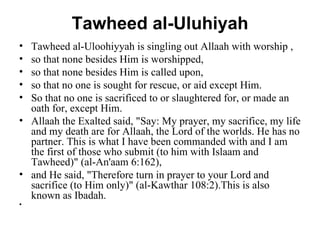
Tawheed al-Uluhiyah Tawheed al-Uloohiyyah is singling out Allaah with worship , so that none besides Him is worshipped,  so that none besides Him is called upon,  so that no one is sought for rescue, or aid except Him.  So that no one is sacrificed to or slaughtered for, or made an oath for, except Him.  Allaah the Exalted said, "Say: My prayer, my sacrifice, my life and my death are for Allaah, the Lord of the worlds. He has no partner. This is what I have been commanded with and I am the first of those who submit (to him with Islaam and Tawheed)" (al-An'aam 6:162),  and He said, "Therefore turn in prayer to your Lord and sacrifice (to Him only)" (al-Kawthar 108:2).This is also known as Ibadah.
Ibn `Abbas [1] says that a bedouin once came to the Messenger of Allah and said, "O Messenger of Allah! Teach me of the most unusual of knowledge!" He asked him, "What have you done with the peak of knowledge so that you now ask about its most unusual things?!" The man asked him, "O Messenger of Allah! What is this peak of knowledge?!" He said, "It is knowing Allah as He deserves to be known." The bedouin then said, "And how can He be known as He ought to be?" The Messenger of Allah answered, "It is that you know Him as having no model, no peer, no antithesis, and that He is One and only: He is the One Who is Apparent yet Hidden, the First and the Last, having no peer nor a similitude; this is the true knowledge about Him." 
Concept of Tawheed in the light of Surah Fatihah & Surah Ikhlas
Surah Faatiha It is named al-Faatihah, the Opening - because it opens the Book and by it the recitation in prayer commences. It is also named Ummul Qur`aan, the Mother of the Qur`aan, and Ummul Kitaab  [Saheeh Bukhaaree [Eng. Trans. 6/1 chpt. 1]] It was also said that it is called Umm Al-Kitab, because it contains the meanings of the entire Qur'an
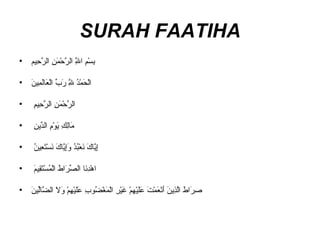
SURAH FAATIHA بِسْمِ اللَّهِ الرَّحْمَنِ الرَّحِيم     الْحَمْدُ لِلَّهِ رَبِّ الْعَالَمِينَ     الرَّحْمَنِ الرَّحِيمِ    مَالِكِ يَوْمِ الدِّينِ    إِيَّاكَ نَعْبُدُ وَإِيَّاكَ نَسْتَعِينُ    اهْدِنَا الصِّرَاطَ الْمُسْتَقِيمَ    صِرَاطَ الَّذِينَ أَنْعَمْتَ عَلَيْهِمْ غَيْرِ الْمَغْضُوبِ عَلَيْهِمْ وَلاَ الضَّالِّينَ  
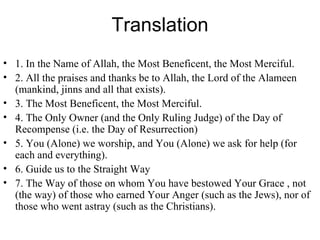
Translation 1. In the Name of Allah, the Most Beneficent, the Most Merciful.  2. All the praises and thanks be to Allah, the Lord of the Alameen (mankind, jinns and all that exists).  3. The Most Beneficent, the Most Merciful.  4. The Only Owner (and the Only Ruling Judge) of the Day of Recompense (i.e. the Day of Resurrection)  5. You (Alone) we worship, and You (Alone) we ask for help (for each and everything).  6. Guide us to the Straight Way  7. The Way of those on whom You have bestowed Your Grace , not (the way) of those who earned Your Anger (such as the Jews), nor of those who went astray (such as the Christians).
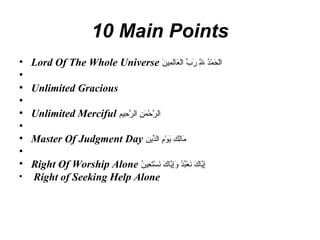
10 Main Points Lord Of The Whole Universe  الْحَمْدُ لِلَّهِ رَبِّ الْعَالَمِينَ     Unlimited Gracious    Unlimited Merciful  الرَّحْمَنِ الرَّحِيمِ    Master Of Judgment Day  مَالِكِ يَوْمِ الدِّينِ    Right Of Worship Alone  إِيَّاكَ نَعْبُدُ وَإِيَّاكَ نَسْتَعِينُ  Right of Seeking Help Alone
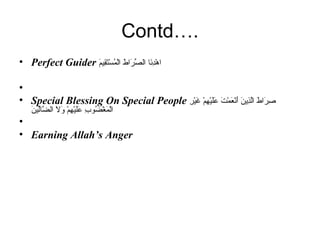
Contd…. Perfect Guider  اهْدِنَا الصِّرَاطَ الْمُسْتَقِيمَ    Special Blessing On Special People  صِرَاطَ الَّذِينَ أَنْعَمْتَ عَلَيْهِمْ غَيْرِ الْمَغْضُوبِ عَلَيْهِمْ وَلاَ الضَّالِّينَ   Earning Allah’s Anger
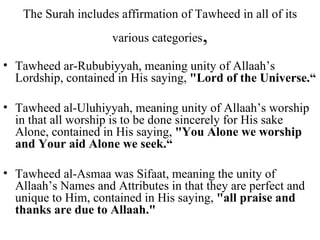
The Surah includes affirmation of Tawheed in all of its various categories , Tawheed ar-Rububiyyah, meaning unity of Allaah’s Lordship, contained in His saying,  "Lord of the Universe.“ Tawheed al-Uluhiyyah, meaning unity of Allaah’s worship in that all worship is to be done sincerely for His sake Alone, contained in His saying,  "You Alone we worship and Your aid Alone we seek.“ Tawheed al-Asmaa was Sifaat, meaning the unity of Allaah’s Names and Attributes in that they are perfect and unique to Him, contained in His saying,  "all praise and thanks are due to Allaah."
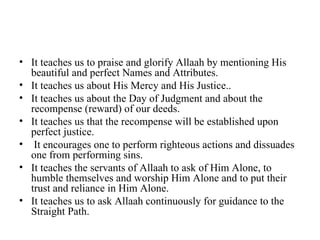
It teaches us to praise and glorify Allaah by mentioning His beautiful and perfect Names and Attributes. It teaches us about His Mercy and His Justice.. It teaches us about the Day of Judgment and about the recompense (reward) of our deeds. It teaches us that the recompense will be established upon perfect justice. It encourages one to perform righteous actions and dissuades one from performing sins. It teaches the servants of Allaah to ask of Him Alone, to humble themselves and worship Him Alone and to put their trust and reliance in Him Alone. It teaches us to ask Allaah continuously for guidance to the Straight Path.
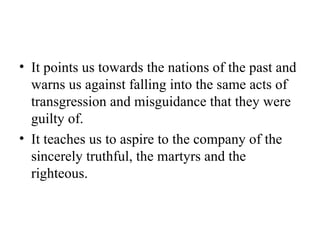
It points us towards the nations of the past and warns us against falling into the same acts of transgression and misguidance that they were guilty of. It teaches us to aspire to the company of the sincerely truthful, the martyrs and the righteous.
Surah Ikhlas
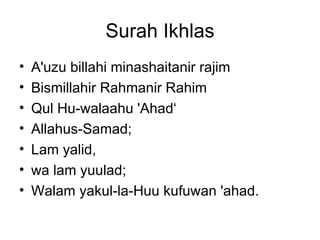
Surah Ikhlas A'uzu billahi minashaitanir rajim Bismillahir Rahmanir Rahim Qul Hu-walaahu 'Ahad‘ Allahus-Samad; Lam yalid,  wa lam yuulad; Walam yakul-la-Huu kufuwan 'ahad.
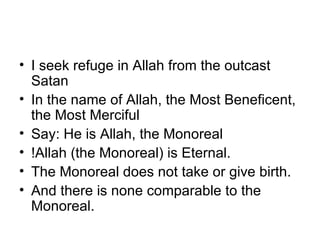
I seek refuge in Allah from the outcast Satan In the name of Allah, the Most Beneficent, the Most Merciful Say: He is Allah, the Monoreal !Allah (the Monoreal) is Eternal. The Monoreal does not take or give birth. And there is none comparable to the Monoreal.
“ Say: He is Allah, The One and Only. “Allah, the Eternal, Absolute. “He begets not, nor is He begotten. And there is none like unto Him.” [Al-Qur’an 112:1-4]
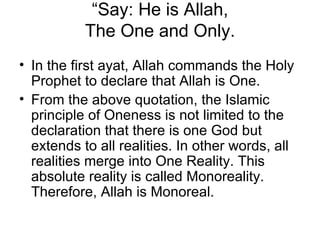
“ Say: He is Allah, The One and Only. In the first ayat, Allah commands the Holy Prophet to declare that Allah is One.  From the above quotation, the Islamic principle of Oneness is not limited to the declaration that there is one God but extends to all realities. In other words, all realities merge into One Reality. This absolute reality is called Monoreality. Therefore, Allah is Monoreal.
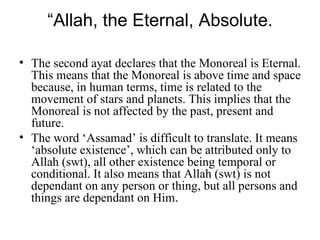
“ Allah, the Eternal, Absolute. The second ayat declares that the Monoreal is Eternal. This means that the Monoreal is above time and space because, in human terms, time is related to the movement of stars and planets. This implies that the Monoreal is not affected by the past, present and future. The word ‘Assamad’ is difficult to translate. It means ‘absolute existence’, which can be attributed only to Allah (swt), all other existence being temporal or conditional. It also means that Allah (swt) is not dependant on any person or thing, but all persons and things are dependant on Him .
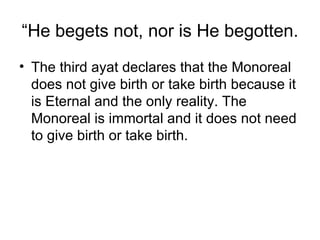
“ He begets not, nor is He begotten. The third ayat declares that the Monoreal does not give birth or take birth because it is Eternal and the only reality. The Monoreal is immortal and it does not need to give birth or take birth.
And there is none like unto Him.” The last ayat declares that there is none equal to the Monoreal because the Monoreal is unique. Human beings live in the world of duality where each object or concept has an opposite. Some examples of duality are good and evil, male and female, small and large, and so on. In contrast to this, the Monoreal is absolutely unique because it consists of all realities and there is nothing left except Itself. Therefore, the Monoreal is beyond comparison.
Summary The message of the  surah  lies in the concept of  Tawhid  it brings out by mention of certain complementary pairs of attributes of God. The essence of which is that God has always existed and shall always exist; He was when there was nothing and shall remain when everything ceases to be; He is complete and entire in His being and is above all needs; everyone needs Him while He needs none; He is a refuge for all and on Him everyone depends; He brings everything into existence, and by His orders everything is destroyed; He is father to none nor has He a father; He is the Creator and the Cherisher of all and fashions and sustains everything; nothing is from His substance and being; He has no peer or equal and indeed all are His servants and slaves.       
The key principle when dealing with Allah’s attributes is given in the Qur’an in Surah Ash-Shura: “ There is nothing Whatever like unto Him, And He is the One That hears and sees (all things).” [Al-Qur’an 42:11] Hearing and seeing are human faculties. However, when attributed to the Divine Being they are without comparison, in their perfection, unlike when associated with humans who require ears, eyes, etc. and who are limited in their sight and hearing in terms of space, time, capacity, etc.

Concept Of Tawheed

  • 1.
    CONCEPT OF TAWHEED( montheism ) In Light of Surah Fatiha and Surah Ikhlas By Mrs. Najmunnisa  
  • 2.
    Tawheed: Definition Thelinguistic definition of Tawheed   It means unification and is derived from the Arabic verb ‘Wahhada’ (which means to unite, join, combine or consolidate). The Shari’ah definition of Tawheed "To submit or to confess the Lordship of Allah and to purify Allah’s names, attributes and any deed of creation and not to associate anything with Him." 
  • 3.
    as Allaah says[2]: ( and I have not created the Jinn nor Mankind except to worship Me ) And Allaah says [3]: ( and worship Allaah, and do not ascribe a single partner to Him ) Allaah also says [4]: ( So call on Allaah, making the religion entirely for Him, even if the disbelievers detest it )
  • 4.
    Types of TawheedTawheed can be viewed from the perspectives of: Tawheed al-Rububiyah – Unity of Lordship Tawheed al- Uluhiyah – Unity of Worship Tawheed al- Asma wa Sifaat – Unity of His Names and His Attributes Tawheed al Itabaa – Unity in the following the Prophet Muhammad, peace be upon him
  • 5.
    Tawheed al-Rububiyah Thisis the belief that Allah (SWT) is One without partner in His dominion. He is Lord and Sustainer of the universe in all matters of creation, planning and controlling, i.e. the Creator. Tawheed al-Rububiyah is based on the fundamental concept that Allah (SWT) alone caused all things to exist. Allah (SWT) sustains and maintains the creation and He (SWT) is independent from His creation. Allah (SWT) says; "Allah is the Creator of all things and He is the agent on which all things depend."  [Quran 39:62] "Allah created you and whatever you do."  [Quran 37:96] "And no calamity strikes except by Allah’s permission."  [Quran 64:11]
  • 6.
    Tawheed al-Asmaa waal-Sifaat This is the belief that Allah (SWT) is one without similitude in His names and attributes. Allah (SWT) must be referred to in the manner He and His Messenger (SAW) have described Him. Allah (SWT)’s attributes and names must be taken in the absolute sense, free from human deficiencies of interpretation. Only Allah (SWT) is Al-Hakim, Al-Rahman, Al-Malik, Al-Haq. There are certain names of Allah that must be known and understood by necessity. These are: • Al-Khaliq-nearest meaning ‘the Creator’. • Al-Raziq -nearest meaning ‘the Provider’. • Al-Ahad-nearest meaning ‘the One’. • Al-Muhyi wa al-Mumeet-nearest meaning ‘the Giver and Taker of life’. • Al-Muqaddir-nearest meaning ‘the One who controls Fate and Decree’. • Al-Amir-nearest meaning ‘the Commander’.
  • 7.
    The above meaningsare only indications and are not exact translations of Allah’s attributes. Allah (SWT) says:  "The rule (Command) belongs to none but Allah"  [Quran 12:40] "To Him belongs the Creating and the Commanding."  [Quran 7:54] In reference to the word ‘Ahad’, Allah (SWT) says:  "Say: He is Ahad"  [Quran 112:1] The term ‘Ahad’ is unique since it was never used prior to revelation. In the revelation it was used by Allah (SWT) to describe Himself.
  • 8.
    Allah (SWT) states;"There is nothing like Him"  [Quran 42:11] "And never has there been anyone coequal with Him."  [Quran 112:4]
  • 9.
    Tawheed al-Uluhiyah Tawheedal-Uloohiyyah is singling out Allaah with worship , so that none besides Him is worshipped, so that none besides Him is called upon, so that no one is sought for rescue, or aid except Him. So that no one is sacrificed to or slaughtered for, or made an oath for, except Him. Allaah the Exalted said, "Say: My prayer, my sacrifice, my life and my death are for Allaah, the Lord of the worlds. He has no partner. This is what I have been commanded with and I am the first of those who submit (to him with Islaam and Tawheed)" (al-An'aam 6:162), and He said, "Therefore turn in prayer to your Lord and sacrifice (to Him only)" (al-Kawthar 108:2).This is also known as Ibadah.
  • 10.
    Ibn `Abbas [1]says that a bedouin once came to the Messenger of Allah and said, "O Messenger of Allah! Teach me of the most unusual of knowledge!" He asked him, "What have you done with the peak of knowledge so that you now ask about its most unusual things?!" The man asked him, "O Messenger of Allah! What is this peak of knowledge?!" He said, "It is knowing Allah as He deserves to be known." The bedouin then said, "And how can He be known as He ought to be?" The Messenger of Allah answered, "It is that you know Him as having no model, no peer, no antithesis, and that He is One and only: He is the One Who is Apparent yet Hidden, the First and the Last, having no peer nor a similitude; this is the true knowledge about Him." 
  • 11.
    Concept of Tawheedin the light of Surah Fatihah & Surah Ikhlas
  • 12.
    Surah Faatiha Itis named al-Faatihah, the Opening - because it opens the Book and by it the recitation in prayer commences. It is also named Ummul Qur`aan, the Mother of the Qur`aan, and Ummul Kitaab [Saheeh Bukhaaree [Eng. Trans. 6/1 chpt. 1]] It was also said that it is called Umm Al-Kitab, because it contains the meanings of the entire Qur'an
  • 13.
    SURAH FAATIHA بِسْمِاللَّهِ الرَّحْمَنِ الرَّحِيم   الْحَمْدُ لِلَّهِ رَبِّ الْعَالَمِينَ   الرَّحْمَنِ الرَّحِيمِ   مَالِكِ يَوْمِ الدِّينِ   إِيَّاكَ نَعْبُدُ وَإِيَّاكَ نَسْتَعِينُ   اهْدِنَا الصِّرَاطَ الْمُسْتَقِيمَ   صِرَاطَ الَّذِينَ أَنْعَمْتَ عَلَيْهِمْ غَيْرِ الْمَغْضُوبِ عَلَيْهِمْ وَلاَ الضَّالِّينَ  
  • 14.
    Translation 1. Inthe Name of Allah, the Most Beneficent, the Most Merciful. 2. All the praises and thanks be to Allah, the Lord of the Alameen (mankind, jinns and all that exists). 3. The Most Beneficent, the Most Merciful. 4. The Only Owner (and the Only Ruling Judge) of the Day of Recompense (i.e. the Day of Resurrection) 5. You (Alone) we worship, and You (Alone) we ask for help (for each and everything). 6. Guide us to the Straight Way 7. The Way of those on whom You have bestowed Your Grace , not (the way) of those who earned Your Anger (such as the Jews), nor of those who went astray (such as the Christians).
  • 15.
    10 Main PointsLord Of The Whole Universe الْحَمْدُ لِلَّهِ رَبِّ الْعَالَمِينَ   Unlimited Gracious   Unlimited Merciful الرَّحْمَنِ الرَّحِيمِ   Master Of Judgment Day مَالِكِ يَوْمِ الدِّينِ   Right Of Worship Alone إِيَّاكَ نَعْبُدُ وَإِيَّاكَ نَسْتَعِينُ Right of Seeking Help Alone
  • 16.
    Contd…. Perfect Guider اهْدِنَا الصِّرَاطَ الْمُسْتَقِيمَ   Special Blessing On Special People صِرَاطَ الَّذِينَ أَنْعَمْتَ عَلَيْهِمْ غَيْرِ الْمَغْضُوبِ عَلَيْهِمْ وَلاَ الضَّالِّينَ   Earning Allah’s Anger
  • 17.
    The Surah includesaffirmation of Tawheed in all of its various categories , Tawheed ar-Rububiyyah, meaning unity of Allaah’s Lordship, contained in His saying, "Lord of the Universe.“ Tawheed al-Uluhiyyah, meaning unity of Allaah’s worship in that all worship is to be done sincerely for His sake Alone, contained in His saying, "You Alone we worship and Your aid Alone we seek.“ Tawheed al-Asmaa was Sifaat, meaning the unity of Allaah’s Names and Attributes in that they are perfect and unique to Him, contained in His saying, "all praise and thanks are due to Allaah."
  • 18.
    It teaches usto praise and glorify Allaah by mentioning His beautiful and perfect Names and Attributes. It teaches us about His Mercy and His Justice.. It teaches us about the Day of Judgment and about the recompense (reward) of our deeds. It teaches us that the recompense will be established upon perfect justice. It encourages one to perform righteous actions and dissuades one from performing sins. It teaches the servants of Allaah to ask of Him Alone, to humble themselves and worship Him Alone and to put their trust and reliance in Him Alone. It teaches us to ask Allaah continuously for guidance to the Straight Path.
  • 19.
    It points ustowards the nations of the past and warns us against falling into the same acts of transgression and misguidance that they were guilty of. It teaches us to aspire to the company of the sincerely truthful, the martyrs and the righteous.
  • 20.
  • 21.
    Surah Ikhlas A'uzubillahi minashaitanir rajim Bismillahir Rahmanir Rahim Qul Hu-walaahu 'Ahad‘ Allahus-Samad; Lam yalid, wa lam yuulad; Walam yakul-la-Huu kufuwan 'ahad.
  • 22.
    I seek refugein Allah from the outcast Satan In the name of Allah, the Most Beneficent, the Most Merciful Say: He is Allah, the Monoreal !Allah (the Monoreal) is Eternal. The Monoreal does not take or give birth. And there is none comparable to the Monoreal.
  • 23.
    “ Say: Heis Allah, The One and Only. “Allah, the Eternal, Absolute. “He begets not, nor is He begotten. And there is none like unto Him.” [Al-Qur’an 112:1-4]
  • 24.
    “ Say: Heis Allah, The One and Only. In the first ayat, Allah commands the Holy Prophet to declare that Allah is One. From the above quotation, the Islamic principle of Oneness is not limited to the declaration that there is one God but extends to all realities. In other words, all realities merge into One Reality. This absolute reality is called Monoreality. Therefore, Allah is Monoreal.
  • 25.
    “ Allah, theEternal, Absolute. The second ayat declares that the Monoreal is Eternal. This means that the Monoreal is above time and space because, in human terms, time is related to the movement of stars and planets. This implies that the Monoreal is not affected by the past, present and future. The word ‘Assamad’ is difficult to translate. It means ‘absolute existence’, which can be attributed only to Allah (swt), all other existence being temporal or conditional. It also means that Allah (swt) is not dependant on any person or thing, but all persons and things are dependant on Him .
  • 26.
    “ He begetsnot, nor is He begotten. The third ayat declares that the Monoreal does not give birth or take birth because it is Eternal and the only reality. The Monoreal is immortal and it does not need to give birth or take birth.
  • 27.
    And there isnone like unto Him.” The last ayat declares that there is none equal to the Monoreal because the Monoreal is unique. Human beings live in the world of duality where each object or concept has an opposite. Some examples of duality are good and evil, male and female, small and large, and so on. In contrast to this, the Monoreal is absolutely unique because it consists of all realities and there is nothing left except Itself. Therefore, the Monoreal is beyond comparison.
  • 28.
    Summary The messageof the surah lies in the concept of Tawhid it brings out by mention of certain complementary pairs of attributes of God. The essence of which is that God has always existed and shall always exist; He was when there was nothing and shall remain when everything ceases to be; He is complete and entire in His being and is above all needs; everyone needs Him while He needs none; He is a refuge for all and on Him everyone depends; He brings everything into existence, and by His orders everything is destroyed; He is father to none nor has He a father; He is the Creator and the Cherisher of all and fashions and sustains everything; nothing is from His substance and being; He has no peer or equal and indeed all are His servants and slaves.      
  • 29.
    The key principlewhen dealing with Allah’s attributes is given in the Qur’an in Surah Ash-Shura: “ There is nothing Whatever like unto Him, And He is the One That hears and sees (all things).” [Al-Qur’an 42:11] Hearing and seeing are human faculties. However, when attributed to the Divine Being they are without comparison, in their perfection, unlike when associated with humans who require ears, eyes, etc. and who are limited in their sight and hearing in terms of space, time, capacity, etc.