IN THE NAME OF ALLAH
THE MOST BENEFICENT
THE MOST MERCIFUL
Thematic Exegesis
on
Monotheism
Chapter: 1
Monotheism
& its Significance (1)
Prepared by
Dr. M. J. Eskandarlou
2
Introduction
What is meant by thematic exegesis (tafsir-i mawdu‘i)?
The meaning of thematic exegesis of the Quran is best explained by giving some
examples. The various verses of the Quran about a particular issue are collected from
all parts of the holy book. These verses, having been revealed on different occasions
and under different circumstances, explain the topic from various angles. They are
then grouped together and analyzed so that the Quranic viewpoint about that particular
issue and all of its various dimensions can be made clear.
As an example the verses of the Quran about the various proofs for the existence of
God can be considered. The verses pertaining to the proof of innate human nature
(burhan al-fitrah), the argument of intelligent design (burhan al-nazm), the proof of
necessity and contingency (burhan al-wujub wa al-imkan) and the rest of the proofs
are placed side by side with one another and analyzed. Since parts of the Quran
elucidate and explain other parts, the various dimensions of this topic are thus made
clear.
The sentence:
“ ‫ا‬‫بعضا‬ ‫ه‬ُ‫بعض‬ ‫ر‬ّ‫يفس‬ ‫ان‬‫ر‬‫لق‬ ”
“(The verses of) the Quran elucidate and explain one another.”
has been narrated from Ibn-i Abbas. Considering the very strong relationship he had
on issues related to the Quran with the Holy Prophet (pbuh) and Imam Ali ibn Abi
Talib (a.s) it is not improbable that this sentence has in fact been narrated from these
two personalities.
A similar statement also appears in Nahj al-Balagha where it is mentioned:
“‫بعضا‬ ‫ه‬ُ‫بعض‬ ‫ق‬ّ‫يصد‬ ‫الكتاب‬ ّ‫ن‬‫ا‬ َ‫ر‬َ‫ك‬َ‫ذ‬‫”و‬
[Allah told His prophet] that the various parts of the Quran confirm and attest to other
parts of it”.1
The Holy Quran deals with various issues and themes repeatedly. Some of the verses
deal with the theme of Afterlife (akhirah) and are related to Heaven and Hell, the path
(sirat) and the book of deeds. There are verses on ethical issues like God-wariness
(taqwa), noble character, patience (sabr) and bravery. Similarly, there are verses on
the practical laws of Islam (ahkam) such as prayers (salat), fasting (sawm), poor-rate
(zakat), one-fifth tax (khums) and the spoils of war (anfal). The Quran also speaks
about social justice, jihad against the enemies of Islam and more importantly jihad
against one’s own soul (jihad al-nafs). All of these verses on a particular theme could
be gathered together, analyzed and expounded upon.
1 Nahj al-Balagha, Sermon 18.
3
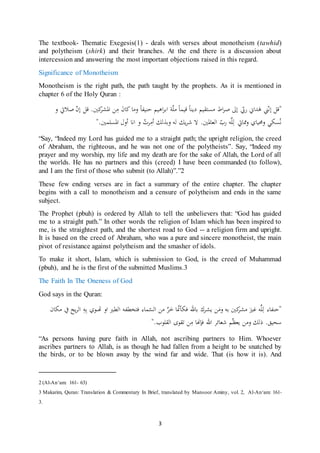
The textbook- Thematic Exegesis(1) - deals with verses about monotheism (tawhid)
and polytheism (shirk) and their branches. At the end there is a discussion about
intercession and answering the most important objections raised in this regard.
Significance of Monotheism
Monotheism is the right path, the path taught by the prophets. As it is mentioned in
chapter 6 of the Holy Quran :
"ّ‫ن‬‫إ‬ ‫قل‬‫ين‬‫كن‬‫اشمرر‬ ‫ن‬‫س‬ َ‫ن‬‫كا‬ ‫وسا‬ ‫نامفا‬ ‫اَم‬‫ر‬‫اب‬ ّّ‫س‬ ‫قماا‬ ‫يياا‬ ‫سستقم‬ ‫ا‬‫ر‬‫ر‬ ‫إ ى‬ ّّ‫ب‬ ‫دا ي‬ََ‫و‬ ‫راليت‬ ّ‫ن‬‫إ‬ ‫قل‬ .
‫و‬ ُ‫رت‬‫ن‬‫أس‬ ‫وبذلك‬ ‫له‬ ‫يك‬‫ر‬‫ش‬ ‫ال‬ .‫العاشمن‬ ّ‫بب‬ ‫ه‬ِّّ‫ن‬‫ل‬ ‫ممايت‬‫و‬ ‫وحمماي‬ ‫سكي‬ُ‫ن‬‫اشمسّان‬ ‫أول‬ ‫انا‬".
“Say, “Indeed my Lord has guided me to a straight path; the upright religion, the creed
of Abraham, the righteous, and he was not one of the polytheists”. Say, “Indeed my
prayer and my worship, my life and my death are for the sake of Allah, the Lord of all
the worlds. He has no partners and this (creed) I have been commanded (to follow),
and I am the first of those who submit (to Allah)”.”2
These few ending verses are in fact a summary of the entire chapter. The chapter
begins with a call to monotheism and a censure of polytheism and ends in the same
subject.
The Prophet (pbuh) is ordered by Allah to tell the unbelievers that: “God has guided
me to a straight path.” In other words the religion of Islam which has been inspired to
me, is the straightest path, and the shortest road to God -- a religion firm and upright.
It is based on the creed of Abraham, who was a pure and sincere monotheist, the main
pivot of resistance against polytheism and the smasher of idols.
To make it short, Islam, which is submission to God, is the creed of Muhammad
(pbuh), and he is the first of the submitted Muslims.3
The Faith In The Oneness of God
God says in the Quran:
‫سكان‬ ‫يف‬ ‫يح‬‫ر‬‫ال‬ ‫ن‬‫ه‬‫ن‬‫ب‬ ‫هتىوي‬ ‫او‬ ‫الطري‬ ‫فتخطفه‬ ‫ااء‬ّ‫الس‬ ‫س‬ َّ‫ر‬َ‫خ‬ ‫ا‬ّ‫ّن‬‫فكأ‬ ‫باهلل‬ ‫يررك‬ َ‫وس‬ ‫به‬ ‫كن‬‫سرر‬ َ‫غري‬ ‫ه‬ِّّ‫ن‬‫ل‬ ‫"نافاء‬
‫القّوب‬ ‫تقوى‬ ‫ن‬‫س‬ ‫فإهنا‬ ‫اهلل‬ ‫شعائر‬ ّ‫ظ‬‫يع‬ ‫وس‬ ‫ذلك‬ .‫سحمق‬."
“As persons having pure faith in Allah, not ascribing partners to Him. Whoever
ascribes partners to Allah, is as though he had fallen from a height to be snatched by
the birds, or to be blown away by the wind far and wide. That (is how it is). And
2 (Al-An‘am: 161- 63)
3 Makarim, Quran: Translation & Commentary In Brief, translated by Mansoor Aminy, vol. 2, Al-An‘am: 161-
3.
4
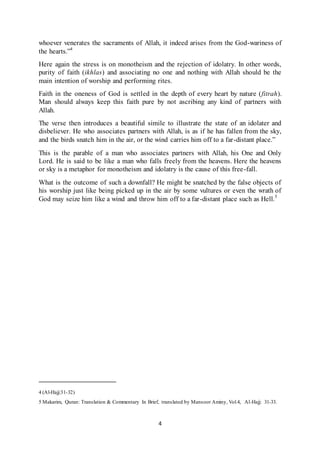
whoever venerates the sacraments of Allah, it indeed arises from the God-wariness of
the hearts.”4
Here again the stress is on monotheism and the rejection of idolatry. In other words,
purity of faith (ikhlas) and associating no one and nothing with Allah should be the
main intention of worship and performing rites.
Faith in the oneness of God is settled in the depth of every heart by nature (fitrah).
Man should always keep this faith pure by not ascribing any kind of partners with
Allah.
The verse then introduces a beautiful simile to illustrate the state of an idolater and
disbeliever. He who associates partners with Allah, is as if he has fallen from the sky,
and the birds snatch him in the air, or the wind carries him off to a far-distant place.”
This is the parable of a man who associates partners with Allah, his One and Only
Lord. He is said to be like a man who falls freely from the heavens. Here the heavens
or sky is a metaphor for monotheism and idolatry is the cause of this free-fall.
What is the outcome of such a downfall? He might be snatched by the false objects of
his worship just like being picked up in the air by some vultures or even the wrath of
God may seize him like a wind and throw him off to a far-distant place such as Hell.5
4 (Al-Hajj:31-32)
5 Makarim, Quran: Translation & Commentary In Brief, translated by Mansoor Aminy, Vol.4, Al-Hajj: 31-33.

Thematic exegesis on monotheism#1

  • 1.
    IN THE NAMEOF ALLAH THE MOST BENEFICENT THE MOST MERCIFUL Thematic Exegesis on Monotheism Chapter: 1 Monotheism & its Significance (1) Prepared by Dr. M. J. Eskandarlou
  • 2.
    2 Introduction What is meantby thematic exegesis (tafsir-i mawdu‘i)? The meaning of thematic exegesis of the Quran is best explained by giving some examples. The various verses of the Quran about a particular issue are collected from all parts of the holy book. These verses, having been revealed on different occasions and under different circumstances, explain the topic from various angles. They are then grouped together and analyzed so that the Quranic viewpoint about that particular issue and all of its various dimensions can be made clear. As an example the verses of the Quran about the various proofs for the existence of God can be considered. The verses pertaining to the proof of innate human nature (burhan al-fitrah), the argument of intelligent design (burhan al-nazm), the proof of necessity and contingency (burhan al-wujub wa al-imkan) and the rest of the proofs are placed side by side with one another and analyzed. Since parts of the Quran elucidate and explain other parts, the various dimensions of this topic are thus made clear. The sentence: “ ‫ا‬‫بعضا‬ ‫ه‬ُ‫بعض‬ ‫ر‬ّ‫يفس‬ ‫ان‬‫ر‬‫لق‬ ” “(The verses of) the Quran elucidate and explain one another.” has been narrated from Ibn-i Abbas. Considering the very strong relationship he had on issues related to the Quran with the Holy Prophet (pbuh) and Imam Ali ibn Abi Talib (a.s) it is not improbable that this sentence has in fact been narrated from these two personalities. A similar statement also appears in Nahj al-Balagha where it is mentioned: “‫بعضا‬ ‫ه‬ُ‫بعض‬ ‫ق‬ّ‫يصد‬ ‫الكتاب‬ ّ‫ن‬‫ا‬ َ‫ر‬َ‫ك‬َ‫ذ‬‫”و‬ [Allah told His prophet] that the various parts of the Quran confirm and attest to other parts of it”.1 The Holy Quran deals with various issues and themes repeatedly. Some of the verses deal with the theme of Afterlife (akhirah) and are related to Heaven and Hell, the path (sirat) and the book of deeds. There are verses on ethical issues like God-wariness (taqwa), noble character, patience (sabr) and bravery. Similarly, there are verses on the practical laws of Islam (ahkam) such as prayers (salat), fasting (sawm), poor-rate (zakat), one-fifth tax (khums) and the spoils of war (anfal). The Quran also speaks about social justice, jihad against the enemies of Islam and more importantly jihad against one’s own soul (jihad al-nafs). All of these verses on a particular theme could be gathered together, analyzed and expounded upon. 1 Nahj al-Balagha, Sermon 18.
  • 3.
    3 The textbook- ThematicExegesis(1) - deals with verses about monotheism (tawhid) and polytheism (shirk) and their branches. At the end there is a discussion about intercession and answering the most important objections raised in this regard. Significance of Monotheism Monotheism is the right path, the path taught by the prophets. As it is mentioned in chapter 6 of the Holy Quran : "ّ‫ن‬‫إ‬ ‫قل‬‫ين‬‫كن‬‫اشمرر‬ ‫ن‬‫س‬ َ‫ن‬‫كا‬ ‫وسا‬ ‫نامفا‬ ‫اَم‬‫ر‬‫اب‬ ّّ‫س‬ ‫قماا‬ ‫يياا‬ ‫سستقم‬ ‫ا‬‫ر‬‫ر‬ ‫إ ى‬ ّّ‫ب‬ ‫دا ي‬ََ‫و‬ ‫راليت‬ ّ‫ن‬‫إ‬ ‫قل‬ . ‫و‬ ُ‫رت‬‫ن‬‫أس‬ ‫وبذلك‬ ‫له‬ ‫يك‬‫ر‬‫ش‬ ‫ال‬ .‫العاشمن‬ ّ‫بب‬ ‫ه‬ِّّ‫ن‬‫ل‬ ‫ممايت‬‫و‬ ‫وحمماي‬ ‫سكي‬ُ‫ن‬‫اشمسّان‬ ‫أول‬ ‫انا‬". “Say, “Indeed my Lord has guided me to a straight path; the upright religion, the creed of Abraham, the righteous, and he was not one of the polytheists”. Say, “Indeed my prayer and my worship, my life and my death are for the sake of Allah, the Lord of all the worlds. He has no partners and this (creed) I have been commanded (to follow), and I am the first of those who submit (to Allah)”.”2 These few ending verses are in fact a summary of the entire chapter. The chapter begins with a call to monotheism and a censure of polytheism and ends in the same subject. The Prophet (pbuh) is ordered by Allah to tell the unbelievers that: “God has guided me to a straight path.” In other words the religion of Islam which has been inspired to me, is the straightest path, and the shortest road to God -- a religion firm and upright. It is based on the creed of Abraham, who was a pure and sincere monotheist, the main pivot of resistance against polytheism and the smasher of idols. To make it short, Islam, which is submission to God, is the creed of Muhammad (pbuh), and he is the first of the submitted Muslims.3 The Faith In The Oneness of God God says in the Quran: ‫سكان‬ ‫يف‬ ‫يح‬‫ر‬‫ال‬ ‫ن‬‫ه‬‫ن‬‫ب‬ ‫هتىوي‬ ‫او‬ ‫الطري‬ ‫فتخطفه‬ ‫ااء‬ّ‫الس‬ ‫س‬ َّ‫ر‬َ‫خ‬ ‫ا‬ّ‫ّن‬‫فكأ‬ ‫باهلل‬ ‫يررك‬ َ‫وس‬ ‫به‬ ‫كن‬‫سرر‬ َ‫غري‬ ‫ه‬ِّّ‫ن‬‫ل‬ ‫"نافاء‬ ‫القّوب‬ ‫تقوى‬ ‫ن‬‫س‬ ‫فإهنا‬ ‫اهلل‬ ‫شعائر‬ ّ‫ظ‬‫يع‬ ‫وس‬ ‫ذلك‬ .‫سحمق‬." “As persons having pure faith in Allah, not ascribing partners to Him. Whoever ascribes partners to Allah, is as though he had fallen from a height to be snatched by the birds, or to be blown away by the wind far and wide. That (is how it is). And 2 (Al-An‘am: 161- 63) 3 Makarim, Quran: Translation & Commentary In Brief, translated by Mansoor Aminy, vol. 2, Al-An‘am: 161- 3.
  • 4.
    4 whoever venerates thesacraments of Allah, it indeed arises from the God-wariness of the hearts.”4 Here again the stress is on monotheism and the rejection of idolatry. In other words, purity of faith (ikhlas) and associating no one and nothing with Allah should be the main intention of worship and performing rites. Faith in the oneness of God is settled in the depth of every heart by nature (fitrah). Man should always keep this faith pure by not ascribing any kind of partners with Allah. The verse then introduces a beautiful simile to illustrate the state of an idolater and disbeliever. He who associates partners with Allah, is as if he has fallen from the sky, and the birds snatch him in the air, or the wind carries him off to a far-distant place.” This is the parable of a man who associates partners with Allah, his One and Only Lord. He is said to be like a man who falls freely from the heavens. Here the heavens or sky is a metaphor for monotheism and idolatry is the cause of this free-fall. What is the outcome of such a downfall? He might be snatched by the false objects of his worship just like being picked up in the air by some vultures or even the wrath of God may seize him like a wind and throw him off to a far-distant place such as Hell.5 4 (Al-Hajj:31-32) 5 Makarim, Quran: Translation & Commentary In Brief, translated by Mansoor Aminy, Vol.4, Al-Hajj: 31-33.