3 ways to support
content and
language learning
through writing
MELANIE GONZALEZ, PH.D.
SALEM STATE UNIVERSITY
FEBRUARY 23, 2016
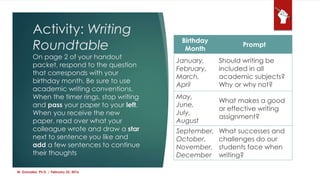
Activity: Writing
Roundtable
On page 2 of your handout
packet, respond to the question
that corresponds with your
birthday month. Be sure to use
academic writing conventions.
When the timer rings, stop writing
and pass your paper to your left.
When you receive the new
paper, read over what your
colleague wrote and draw a star
next to sentence you like and
add a few sentences to continue
their thoughts
M. Gonzalez, Ph.D. | February 23, 2016
Birthday
Month
Prompt
January,
February,
March,
April
Should writing be
included in all
academic subjects?
Why or why not?
May,
June,
July,
August
What makes a good
or effective writing
assignment?
September,
October,
November,
December
What successes and
challenges do our
students face when
writing?
Take the time to
write
• Assign low-stakes
and high-stakes
writing tasks that
require students to
demonstrate
understanding
• Assist students in
understanding that
writing comes in
many shapes and
sizes
• Use teacher-guided
curriculum cycle
1
M. Gonzalez, Ph.D. | February 23, 2016
Take the time to
write
Curriculum cycle to
build academic writing:
1. Build knowledge of
the topic
2. Model the text
3. Joint construction
4. Independent writing
5. Review and revise
1
M. Gonzalez, Ph.D. | February 23, 2016
Take the time to
write
Scaffolding to extend
writing:
1. Sentence/
paragraph/ essay
frames
2. Oral language
support
3. Word banks/
vocabulary sheets
4. Language
Experience
Approach
5. Writing Roundtable
1
M. Gonzalez, Ph.D. | February 23, 2016
Take the time to
write
Activities:
• Freewriting
• Journaling
• 1-minute papers
• Learning logs
• Scenarios
• “Dear reader”
memos
• Curate a portfolio
1
M. Gonzalez, Ph.D. | February 23, 2016
Use mentor texts
to model good
writing
• Backwards plan from
a model to
“deconstruct” the
elements of good
writing
• Have students reflect
on their writing and
connections
between readings
and mentor texts
2
M. Gonzalez, Ph.D. | February 23, 2016
Activity:
Deconstructing
Text
Examine the text on page 3 of
your handout packet. With a
partner, complete the table.
M. Gonzalez, Ph.D. | February 23, 2016
(Gibbons, 2002, p. 58)
Use mentor texts
to model good
writing
Activity: R.A.F.T. writing
Where to find mentor
texts:
• https://k12.Thoughtfull
earning.Com/resource
s/studentmodels
• http://www.Layouth.C
om/archives/
• http://thisibelieve.org/
2
M. Gonzalez, Ph.D. | February 23, 2016
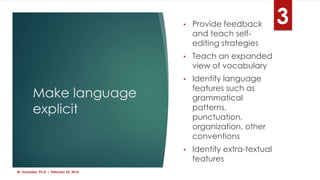
Make language
explicit
• Provide feedback
and teach self-
editing strategies
• Teach an expanded
view of vocabulary
• Identify language
features such as
grammatical
patterns,
punctuation,
organization, other
conventions
• Identify extra-textual
features
3
M. Gonzalez, Ph.D. | February 23, 2016
Make language
explicit
3
M. Gonzalez, Ph.D. | February 23, 2016
Item Example(s)
single
words
Settlement; pioneer
set
phrases
In other words; back and
forth; time and time again
variable
phrases
Subject + poised to
deliver a +adjective +
noun; off and on
phrasal
verbs
Come up with; put away
idioms Case of the Mondays;
Activity:
Language
Awareness
Slip the paper you wrote during
the Writing Roundtable activity
into the plastic sheet protector.
Use the dry erase marker to mark
up the sheet protector.
M. Gonzalez, Ph.D. | February 23, 2016
Birthday
Month
Task
January,
February,
March,
April
Underline each word
and trace each
punctuation mark.
May,
June,
July,
August
Underline tier 1 words;
Circle tier 2 words;
Box tier 3 words
September,
October,
November,
December
Circle connectives,
linking words,
transition words
In sum…
1) Practice writing
frequently and
consistently
2) Teach your students
to be consumers of
writing in order to
produce it
3) Make the writing
process and
language moves
explicit
M. Gonzalez, Ph.D. | February 23, 2016
Gracias!
TIME FOR QUESTIONS?
MGONZALEZ@SALEMSTATE.EDU
M. Gonzalez, Ph.D. | February 23, 2016
References
Gibbons, P. (2002). Scaffolding
language, scaffolding learning:
Teaching second language learners
in the mainstream classroom.
Portsmouth, NH: Heineman.
Herrmann, E. (2014, July). Teaching
writing to ells across the curriculum:
Strategies for success. Multibriefs.
Retrieved from:
http://exclusive.Multibriefs.Com/co
ntent/teaching-writing-to-english-
learners-across-the-curriculum-
strategies-for-s/education
L.A. Youth: The newspaper by teens,
for teens. Retrieved from:
http://www.Layouth.Com/archives/
Student model essays. Retrieved
from:
https://k12.Thoughtfullearning.Com/
resources/studentmodels
M. Gonzalez, Ph.D. | February 23, 2016

Supporting content and language learning through writing

  • 1.
    3 ways tosupport content and language learning through writing MELANIE GONZALEZ, PH.D. SALEM STATE UNIVERSITY FEBRUARY 23, 2016
  • 2.
    Activity: Writing Roundtable On page2 of your handout packet, respond to the question that corresponds with your birthday month. Be sure to use academic writing conventions. When the timer rings, stop writing and pass your paper to your left. When you receive the new paper, read over what your colleague wrote and draw a star next to sentence you like and add a few sentences to continue their thoughts M. Gonzalez, Ph.D. | February 23, 2016 Birthday Month Prompt January, February, March, April Should writing be included in all academic subjects? Why or why not? May, June, July, August What makes a good or effective writing assignment? September, October, November, December What successes and challenges do our students face when writing?
  • 3.
    Take the timeto write • Assign low-stakes and high-stakes writing tasks that require students to demonstrate understanding • Assist students in understanding that writing comes in many shapes and sizes • Use teacher-guided curriculum cycle 1 M. Gonzalez, Ph.D. | February 23, 2016
  • 4.
    Take the timeto write Curriculum cycle to build academic writing: 1. Build knowledge of the topic 2. Model the text 3. Joint construction 4. Independent writing 5. Review and revise 1 M. Gonzalez, Ph.D. | February 23, 2016
  • 5.
    Take the timeto write Scaffolding to extend writing: 1. Sentence/ paragraph/ essay frames 2. Oral language support 3. Word banks/ vocabulary sheets 4. Language Experience Approach 5. Writing Roundtable 1 M. Gonzalez, Ph.D. | February 23, 2016
  • 6.
    Take the timeto write Activities: • Freewriting • Journaling • 1-minute papers • Learning logs • Scenarios • “Dear reader” memos • Curate a portfolio 1 M. Gonzalez, Ph.D. | February 23, 2016
  • 7.
    Use mentor texts tomodel good writing • Backwards plan from a model to “deconstruct” the elements of good writing • Have students reflect on their writing and connections between readings and mentor texts 2 M. Gonzalez, Ph.D. | February 23, 2016
  • 8.
    Activity: Deconstructing Text Examine the texton page 3 of your handout packet. With a partner, complete the table. M. Gonzalez, Ph.D. | February 23, 2016 (Gibbons, 2002, p. 58)
  • 9.
    Use mentor texts tomodel good writing Activity: R.A.F.T. writing Where to find mentor texts: • https://k12.Thoughtfull earning.Com/resource s/studentmodels • http://www.Layouth.C om/archives/ • http://thisibelieve.org/ 2 M. Gonzalez, Ph.D. | February 23, 2016
  • 10.
    Make language explicit • Providefeedback and teach self- editing strategies • Teach an expanded view of vocabulary • Identify language features such as grammatical patterns, punctuation, organization, other conventions • Identify extra-textual features 3 M. Gonzalez, Ph.D. | February 23, 2016
  • 11.
    Make language explicit 3 M. Gonzalez,Ph.D. | February 23, 2016 Item Example(s) single words Settlement; pioneer set phrases In other words; back and forth; time and time again variable phrases Subject + poised to deliver a +adjective + noun; off and on phrasal verbs Come up with; put away idioms Case of the Mondays;
  • 12.
    Activity: Language Awareness Slip the paperyou wrote during the Writing Roundtable activity into the plastic sheet protector. Use the dry erase marker to mark up the sheet protector. M. Gonzalez, Ph.D. | February 23, 2016 Birthday Month Task January, February, March, April Underline each word and trace each punctuation mark. May, June, July, August Underline tier 1 words; Circle tier 2 words; Box tier 3 words September, October, November, December Circle connectives, linking words, transition words
  • 13.
    In sum… 1) Practicewriting frequently and consistently 2) Teach your students to be consumers of writing in order to produce it 3) Make the writing process and language moves explicit M. Gonzalez, Ph.D. | February 23, 2016
  • 14.
  • 15.
    References Gibbons, P. (2002).Scaffolding language, scaffolding learning: Teaching second language learners in the mainstream classroom. Portsmouth, NH: Heineman. Herrmann, E. (2014, July). Teaching writing to ells across the curriculum: Strategies for success. Multibriefs. Retrieved from: http://exclusive.Multibriefs.Com/co ntent/teaching-writing-to-english- learners-across-the-curriculum- strategies-for-s/education L.A. Youth: The newspaper by teens, for teens. Retrieved from: http://www.Layouth.Com/archives/ Student model essays. Retrieved from: https://k12.Thoughtfullearning.Com/ resources/studentmodels M. Gonzalez, Ph.D. | February 23, 2016

Editor's Notes

  • #6 Present directions both orally and visually; allow time to discuss responses
  • #8 Show Not Tell Let's take a moment to think of ourselves when we learn: Do we understand something and apply it better when we are shown a finished product while also being told about it? I'm going to guess that most of us will say yes. Doesn't it help to scrutinize that already-assembled bookshelf display at Ikea before going home to those often confusing instructions? (Clearly, I speak from experience on this one.) So if we want students to write a convincing persuasive essay that includes evidence, let's show them examples. If we want them to craft a descriptive story, filled with dialogue and details, we need to show them what this looks like and talk about. Now, I know what some of you are thinking: when I show them a student model it often gets copied or parroted back! And, yes this is a concern as we want all our students to work hard and create their own original and unique essay, story, or speech. Additionally, and I speak from experience as both a teacher and a writer on this one, nothing causes writer's block more than being handed an amazing model and then told, "Okay, now you write!" So how do we keep students from mimicking or from freezing up? We have to give students time to talk about the mentor text, time to practice, and time to share their own efforts with peers for feedback. Once you have found some good mentor texts -- student written or published pieces -- plan backwards from there. Put your lesson designer cap on and ask yourself, what are all the features that make this a solid piece of writing: the organization? the title? the sentence variety? the use of metaphor and other imagery? the evidence that supports claims? the introduction? After you have listed these features, create mini-lessons for each one you want your students to emulate. The mini-lesson should include time after the teaching for students to practice and share in small, safe groups and when ready, with the whole class. Also, I used to create a handout with several really great introductions (from books, essays, short stories, and speeches). Together, the students I would analyze these opening sentences and discuss what made them so powerful. The importance of what happens next should not be underestimated: Give your students time to practice writing what they just learned. And not just time but make it low-stakes -- no grading, no evaluation, no rubric -- simply time to explode on a page, take chances, be whimisical, be daring: firewrite! Let them then share what they wrote with near neighbors or read it aloud to the whole class. If they don't want to do either, give them the option to not.
  • #10 Show Not Tell Let's take a moment to think of ourselves when we learn: Do we understand something and apply it better when we are shown a finished product while also being told about it? I'm going to guess that most of us will say yes. Doesn't it help to scrutinize that already-assembled bookshelf display at Ikea before going home to those often confusing instructions? (Clearly, I speak from experience on this one.) So if we want students to write a convincing persuasive essay that includes evidence, let's show them examples. If we want them to craft a descriptive story, filled with dialogue and details, we need to show them what this looks like and talk about. Now, I know what some of you are thinking: when I show them a student model it often gets copied or parroted back! And, yes this is a concern as we want all our students to work hard and create their own original and unique essay, story, or speech. Additionally, and I speak from experience as both a teacher and a writer on this one, nothing causes writer's block more than being handed an amazing model and then told, "Okay, now you write!" So how do we keep students from mimicking or from freezing up? We have to give students time to talk about the mentor text, time to practice, and time to share their own efforts with peers for feedback. Once you have found some good mentor texts -- student written or published pieces -- plan backwards from there. Put your lesson designer cap on and ask yourself, what are all the features that make this a solid piece of writing: the organization? the title? the sentence variety? the use of metaphor and other imagery? the evidence that supports claims? the introduction? After you have listed these features, create mini-lessons for each one you want your students to emulate. The mini-lesson should include time after the teaching for students to practice and share in small, safe groups and when ready, with the whole class. Also, I used to create a handout with several really great introductions (from books, essays, short stories, and speeches). Together, the students I would analyze these opening sentences and discuss what made them so powerful. The importance of what happens next should not be underestimated: Give your students time to practice writing what they just learned. And not just time but make it low-stakes -- no grading, no evaluation, no rubric -- simply time to explode on a page, take chances, be whimisical, be daring: firewrite! Let them then share what they wrote with near neighbors or read it aloud to the whole class. If they don't want to do either, give them the option to not.