Robotic Services in the UK
-
The Role of
Superspecialisation
Christian Bach
Consultant Urological Surgeon
Freeman Hospital, Newcastle, UK
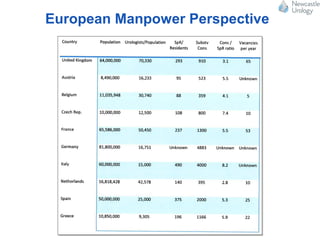
European Manpower Perspective
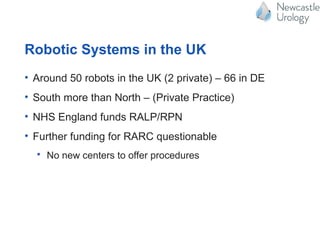
Robotic Systems in the UK
• Around 50 robots in the UK (2 private) – 66 in DE
• South more than North – (Private Practice)
• NHS England funds RALP/RPN
• Further funding for RARC questionable
 No new centers to offer procedures
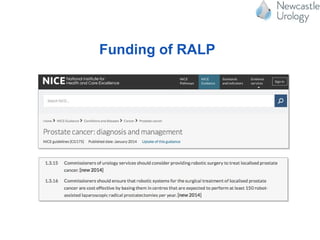
Funding of RALP
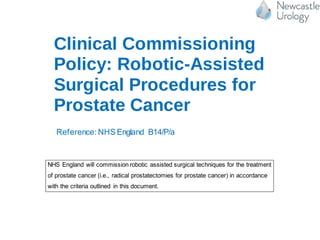
Clinical Commissioning
Policy: Robotic-Assisted
Surgical Procedures for
Prostate Cancer
Reference: NHS England B14/P/a
OFFICIAL
1 Executive summary
Policy Statement
NHS England will commission robotic assisted surgical techniques for the treatment
of prostate cancer (i.e., radical prostatectomies for prostate cancer) in accordance
with the criteria outlined in this document.
In creating this policy NHS England has reviewed this clinical condition and the
options for its treatment. It has considered the place of this treatment in current
clinical practice, whether scientific research has shown the treatment to be of benefit
Multidisciplinary Programme
We use cookies on this website to make your visit an easier and faster experience. If you continue to use our site, we'll assume that you are happy to receive cookies from our site. However,
you can opt out of receiving cookies. Ok, I understand
23.11.2015
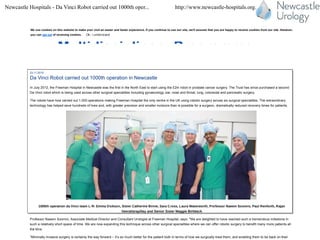
Da Vinci Robot carried out 1000th operation in Newcastle
In July 2012, the Freeman Hospital in Newcastle was the first in the North East to start using the £2m robot in prostate cancer surgery. The Trust has since purchased a second
Da Vinci robot which is being used across other surgical specialities including gynaecology, ear, nose and throat, lung, colorectal and pancreatic surgery.
The robots have how carried out 1,000 operations making Freeman Hospital the only centre in the UK using robotic surgery across six surgical specialities. The extraordinary
technology has helped save hundreds of lives and, with greater precision and smaller incisions than is possible for a surgeon, dramatically reduced recovery times for patients.
1000th operation da Vinci team L-R: Emma Dickson, Sister Catherine Birnie, Sara Cross, Laura Waterworth, Professor Naeem Soomro, Paul Renforth, Rajan
Veeratterapillay and Senior Sister Maggie Birkbeck
Professor Naeem Soomro, Associate Medical Director and Consultant Urologist at Freeman Hospital, says: "We are delighted to have reached such a tremendous milestone in
such a relatively short space of time. We are now expanding this technique across other surgical specialities where we can offer robotic surgery to benefit many more patients all
the time.
“Minimally invasive surgery is certainly the way forward – it’s so much better for the patient both in terms of how we surgically treat them, and enabling them to be back on their
Newcastle Hospitals - Da Vinci Robot carried out 1000th oper... http://www.newcastle-hospitals.org.uk/news/news-item-21472...
We use cookies on this website to make your visit an easier and faster experience. If you continue to use our site, we'll assume that you are happy to receive cookies from our site. However,
you can opt out of receiving cookies. Ok, I understand
23.11.2015
Da Vinci Robot carried out 1000th operation in Newcastle
In July 2012, the Freeman Hospital in Newcastle was the first in the North East to start using the £2m robot in prostate cancer surgery. The Trust has since purchased a second
Da Vinci robot which is being used across other surgical specialities including gynaecology, ear, nose and throat, lung, colorectal and pancreatic surgery.
The robots have how carried out 1,000 operations making Freeman Hospital the only centre in the UK using robotic surgery across six surgical specialities. The extraordinary
technology has helped save hundreds of lives and, with greater precision and smaller incisions than is possible for a surgeon, dramatically reduced recovery times for patients.
1000th operation da Vinci team L-R: Emma Dickson, Sister Catherine Birnie, Sara Cross, Laura Waterworth, Professor Naeem Soomro, Paul Renforth, Rajan
Veeratterapillay and Senior Sister Maggie Birkbeck
Professor Naeem Soomro, Associate Medical Director and Consultant Urologist at Freeman Hospital, says: "We are delighted to have reached such a tremendous milestone in
such a relatively short space of time. We are now expanding this technique across other surgical specialities where we can offer robotic surgery to benefit many more patients all
the time.
“Minimally invasive surgery is certainly the way forward – it’s so much better for the patient both in terms of how we surgically treat them, and enabling them to be back on their
Newcastle Hospitals - Da Vinci Robot carried out 1000th oper... http://www.newcastle-hospitals.org.uk/news/news-item-21472...
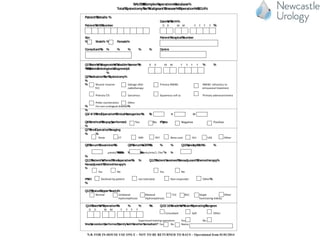
N.B. FOR IN-HOUSE USE ONLY – NOT TO BE RETURNED TO BAUS – Operational from 01/01/2014
BAUS%&%Complex%operations%database%
Total%Cystectomy%for%Malignant%Disease%–%Operation%–%2014%
Patient%Details: %
Date%of%Birth%
Patient%NHS%Number %
Sex Patient%Hospital%Number
% Male% % Female%
Consultant%% % % % % % Centre
Q1%Date%of%diagnosis%of%bladder%cancer%% % %
%%%%%%(date&histological&diagnosis)&
%
Q2%Indication%for%Cystectomy%
%
%
% %
%
Q3/ 4/ 5%Pre&Operative%Clinical%categories:%% %
Q6%Urethral%Biopsy%performed If%yes
%
Q7%Pre&Operative%Imaging
% %
Q8%Serum%Creatinine%%% Q9%Serum%eGFR%%% % % Q10%pre&op%Hb%% %
%%%%%%%%% % %%%%% % % %
%
Q11%Patient%offered%Pre&operative%% % Q12%Patient%received%Neoadjuvant%Chemotherapy%
Neoadjuvant%Chemotherapy%
%
If%NO %
%
Q13%Status%Upper%tracts%
Q14%Date%of%Operation%% % % %% Q15/ 16%Grade%of%Main%Operating%Surgeon
Was%procedure%performed%jointly%with%another%consultant?
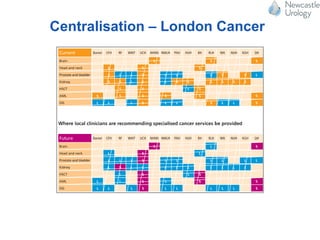
Centralisation – London Cancer
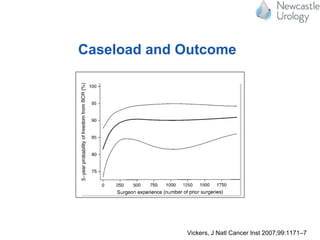
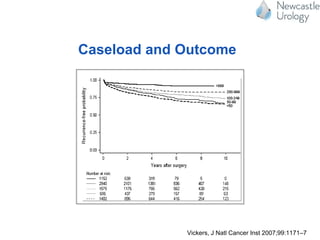
Caseload and Outcome
cancer, Gleason grade ≤6, and
clinically meaningful differen
homogenous group. Because
between surgeon experience
by the ability of individual su
capable surgeon who was u
therefore contribute to the be
ing curve), weperformed add
the sample to patients who
100 total surgeries and to pa
at least 250 total surgeries. C
results were unduly influenc
geons, we restricted the ana
completed the median num
Because there were some di
levels of surgeon experience,
addition, because it is possib
affected by differences in the
hormonal therapy before pat
cal recurrence, we performed
Fig. 2. The surgical learning curve for cancer control after radical pros-
tatectomy. Predicted probability (black curve) and 95% confidence
intervals (gray curves) for freedom from biochemical recurrence (BCR)
at 5 years after radical prostatectomy are plotted against increasing
surgeon experience. Probabilities are for a patient with typical cancer
severity (mean prostate-specifi c antigen level, pathologic stage, and
grade) treated in 1997 (approximately equal numbers of patients were
cancer, Gleason grade ≤6, and
clinically meaningful differen
homogenous group. Because
between surgeon experience
by the ability of individual su
capable surgeon who was un
therefore contribute to the be
ing curve), weperformed addi
the sample to patients whos
100 total surgeries and to pat
at least 250 total surgeries. C
results were unduly influence
geons, we restricted the anal
completed the median numb
Because there were some dif
levels of surgeon experience, w
addition, because it is possibl
affected by differences in the i
hormonal therapy before pati
cal recurrence, we performed
Fig. 2. The surgical learning curve for cancer control after radical pros-
tatectomy. Predicted probability (black curve) and 95% confidence
intervals (gray curves) for freedom from biochemical recurrence (BCR)
at 5 years after radical prostatectomy are plotted against increasing
surgeon experience. Probabilities are for a patient with typical cancer
severity (mean prostate-specifi c antigen level, pathologic stage, and
grade) treated in 1997 (approximately equal numbers of patients were
Vickers, J Natl Cancer Inst 2007;99:1171–7
Effect of Surgeon Experience on Cancer Control
There were1256 biochemical recurrencesamong the 7765 patients
in this study. Median follow-up for patients without recurrence
was 3.9 years. Only a small proportion of patients died without
experiencing abiochemical recurrence, resulting in a5-year overall
survival probability of 95%. This finding suggests that adjustment
for competing risk would have a minimal effect on any of our
analyses.
high (concordance index of
able model provides good c
model, greater surgeon exper
of prostate cancer recurrence
Figure 2 shows the 5-yea
chemical recurrence plotted
providesthe learning curve fo
prostatectomy. T here was a d
trol with increasing surgeon e
but no large change in recurr
rience. T o illustrate the asso
and outcome, wecompared th
wastreated by asurgeon with
tectomy (one with 10 prior o
was treated by a more exper
operations). We chose this d
because this number of prio
(275) for patientsand isalso t
the learning curve started to
of recurrence at 5 years were
for patients treated by surg
10.7% (95% CI = 7.1% to 15
with 250 prior operations, w
difference of 7.2% (95% C
needed to harm of 14; that
a surgeon with 10 as oppose
will experience a recurrence
We conducted a number
robustness of our findings
migration might haveaffected
Fig. 1. Probability of freedom from biochemical recurrence after radical
prostatectomy. The data are stratifi ed by surgeon experience (i.e., the
number of prior surgeries) at the time of the patient’s radical prostatec-
tomy, shown as numbers next to each curve.
Effect of Surgeon Experience on Cancer Control
T here were 1256 biochemical recurrencesamong the7765 patients
in this study. Median follow-up for patients without recurrence
was 3.9 years. Only a small proportion of patients died without
experiencing abiochemical recurrence, resulting in a5-year overall
survival probability of 95%. This finding suggests that adjustment
for competing risk would have a minimal effect on any of our
analyses.
high (concordance index of 0
able model provides good co
model, greater surgeon experi
of prostate cancer recurrence
Figure 2 shows the 5-yea
chemical recurrence plotted
providesthelearning curvefo
prostatectomy. T here wasa d
trol with increasing surgeon e
but no large change in recurre
rience. T o illustrate the asso
and outcome, wecompared th
wastreated by asurgeon with
tectomy (one with 10 prior o
was treated by a more exper
operations). We chose this d
because this number of prio
(275) for patientsand isalso th
the learning curve started to
of recurrence at 5 years were
for patients treated by surg
10.7% (95% CI = 7.1% to 15
with 250 prior operations, w
difference of 7.2% (95% CI
needed to harm of 14; that
a surgeon with 10 as opposed
will experience a recurrence a
We conducted a number o
robustness of our findings (
migration might haveaffected
Fig. 1. Probability of freedom from biochemical recurrence after radical
prostatectomy. The data are stratifi ed by surgeon experience (i.e., the
number of prior surgeries) at the time of the patient’s radical prostatec-
tomy, shown as numbers next to each curve.
Caseload and Outcome
Vickers, J Natl Cancer Inst 2007;99:1171–7
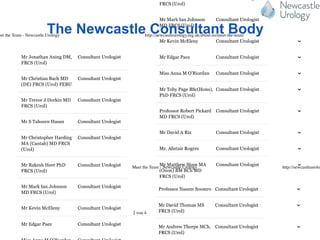
The Newcastle Consultant Body
Problems with Superspecialisation
• Nobody wants to do general urology any more
• Long travelling times for patients
• Needs working Hub and Spoke system (aftercare)
• What happens if somebody gets sick
• Jealousy from the non specialized surgeons
• 150 Cases – influencing patient selection?
• Don’t be a one trick Pony!
Summary
• Existing robotic systems not used efficiently
• Attempt to Increase outcomes/efficiency through
 Centralisation
 Multispecialty programs
 Superspecialisation

Superspecialiation_UK_Upload_Linkedin

  • 1.
    Robotic Services inthe UK - The Role of Superspecialisation Christian Bach Consultant Urological Surgeon Freeman Hospital, Newcastle, UK
  • 2.
  • 3.
    Robotic Systems inthe UK • Around 50 robots in the UK (2 private) – 66 in DE • South more than North – (Private Practice) • NHS England funds RALP/RPN • Further funding for RARC questionable  No new centers to offer procedures
  • 4.
  • 5.
    Clinical Commissioning Policy: Robotic-Assisted SurgicalProcedures for Prostate Cancer Reference: NHS England B14/P/a OFFICIAL 1 Executive summary Policy Statement NHS England will commission robotic assisted surgical techniques for the treatment of prostate cancer (i.e., radical prostatectomies for prostate cancer) in accordance with the criteria outlined in this document. In creating this policy NHS England has reviewed this clinical condition and the options for its treatment. It has considered the place of this treatment in current clinical practice, whether scientific research has shown the treatment to be of benefit
  • 6.
    Multidisciplinary Programme We usecookies on this website to make your visit an easier and faster experience. If you continue to use our site, we'll assume that you are happy to receive cookies from our site. However, you can opt out of receiving cookies. Ok, I understand 23.11.2015 Da Vinci Robot carried out 1000th operation in Newcastle In July 2012, the Freeman Hospital in Newcastle was the first in the North East to start using the £2m robot in prostate cancer surgery. The Trust has since purchased a second Da Vinci robot which is being used across other surgical specialities including gynaecology, ear, nose and throat, lung, colorectal and pancreatic surgery. The robots have how carried out 1,000 operations making Freeman Hospital the only centre in the UK using robotic surgery across six surgical specialities. The extraordinary technology has helped save hundreds of lives and, with greater precision and smaller incisions than is possible for a surgeon, dramatically reduced recovery times for patients. 1000th operation da Vinci team L-R: Emma Dickson, Sister Catherine Birnie, Sara Cross, Laura Waterworth, Professor Naeem Soomro, Paul Renforth, Rajan Veeratterapillay and Senior Sister Maggie Birkbeck Professor Naeem Soomro, Associate Medical Director and Consultant Urologist at Freeman Hospital, says: "We are delighted to have reached such a tremendous milestone in such a relatively short space of time. We are now expanding this technique across other surgical specialities where we can offer robotic surgery to benefit many more patients all the time. “Minimally invasive surgery is certainly the way forward – it’s so much better for the patient both in terms of how we surgically treat them, and enabling them to be back on their Newcastle Hospitals - Da Vinci Robot carried out 1000th oper... http://www.newcastle-hospitals.org.uk/news/news-item-21472... We use cookies on this website to make your visit an easier and faster experience. If you continue to use our site, we'll assume that you are happy to receive cookies from our site. However, you can opt out of receiving cookies. Ok, I understand 23.11.2015 Da Vinci Robot carried out 1000th operation in Newcastle In July 2012, the Freeman Hospital in Newcastle was the first in the North East to start using the £2m robot in prostate cancer surgery. The Trust has since purchased a second Da Vinci robot which is being used across other surgical specialities including gynaecology, ear, nose and throat, lung, colorectal and pancreatic surgery. The robots have how carried out 1,000 operations making Freeman Hospital the only centre in the UK using robotic surgery across six surgical specialities. The extraordinary technology has helped save hundreds of lives and, with greater precision and smaller incisions than is possible for a surgeon, dramatically reduced recovery times for patients. 1000th operation da Vinci team L-R: Emma Dickson, Sister Catherine Birnie, Sara Cross, Laura Waterworth, Professor Naeem Soomro, Paul Renforth, Rajan Veeratterapillay and Senior Sister Maggie Birkbeck Professor Naeem Soomro, Associate Medical Director and Consultant Urologist at Freeman Hospital, says: "We are delighted to have reached such a tremendous milestone in such a relatively short space of time. We are now expanding this technique across other surgical specialities where we can offer robotic surgery to benefit many more patients all the time. “Minimally invasive surgery is certainly the way forward – it’s so much better for the patient both in terms of how we surgically treat them, and enabling them to be back on their Newcastle Hospitals - Da Vinci Robot carried out 1000th oper... http://www.newcastle-hospitals.org.uk/news/news-item-21472...
  • 7.
    N.B. FOR IN-HOUSEUSE ONLY – NOT TO BE RETURNED TO BAUS – Operational from 01/01/2014 BAUS%&%Complex%operations%database% Total%Cystectomy%for%Malignant%Disease%–%Operation%–%2014% Patient%Details: % Date%of%Birth% Patient%NHS%Number % Sex Patient%Hospital%Number % Male% % Female% Consultant%% % % % % % Centre Q1%Date%of%diagnosis%of%bladder%cancer%% % % %%%%%%(date&histological&diagnosis)& % Q2%Indication%for%Cystectomy% % % % % % Q3/ 4/ 5%Pre&Operative%Clinical%categories:%% % Q6%Urethral%Biopsy%performed If%yes % Q7%Pre&Operative%Imaging % % Q8%Serum%Creatinine%%% Q9%Serum%eGFR%%% % % Q10%pre&op%Hb%% % %%%%%%%%% % %%%%% % % % % Q11%Patient%offered%Pre&operative%% % Q12%Patient%received%Neoadjuvant%Chemotherapy% Neoadjuvant%Chemotherapy% % If%NO % % Q13%Status%Upper%tracts% Q14%Date%of%Operation%% % % %% Q15/ 16%Grade%of%Main%Operating%Surgeon Was%procedure%performed%jointly%with%another%consultant?
  • 8.
  • 9.
    Caseload and Outcome cancer,Gleason grade ≤6, and clinically meaningful differen homogenous group. Because between surgeon experience by the ability of individual su capable surgeon who was u therefore contribute to the be ing curve), weperformed add the sample to patients who 100 total surgeries and to pa at least 250 total surgeries. C results were unduly influenc geons, we restricted the ana completed the median num Because there were some di levels of surgeon experience, addition, because it is possib affected by differences in the hormonal therapy before pat cal recurrence, we performed Fig. 2. The surgical learning curve for cancer control after radical pros- tatectomy. Predicted probability (black curve) and 95% confidence intervals (gray curves) for freedom from biochemical recurrence (BCR) at 5 years after radical prostatectomy are plotted against increasing surgeon experience. Probabilities are for a patient with typical cancer severity (mean prostate-specifi c antigen level, pathologic stage, and grade) treated in 1997 (approximately equal numbers of patients were cancer, Gleason grade ≤6, and clinically meaningful differen homogenous group. Because between surgeon experience by the ability of individual su capable surgeon who was un therefore contribute to the be ing curve), weperformed addi the sample to patients whos 100 total surgeries and to pat at least 250 total surgeries. C results were unduly influence geons, we restricted the anal completed the median numb Because there were some dif levels of surgeon experience, w addition, because it is possibl affected by differences in the i hormonal therapy before pati cal recurrence, we performed Fig. 2. The surgical learning curve for cancer control after radical pros- tatectomy. Predicted probability (black curve) and 95% confidence intervals (gray curves) for freedom from biochemical recurrence (BCR) at 5 years after radical prostatectomy are plotted against increasing surgeon experience. Probabilities are for a patient with typical cancer severity (mean prostate-specifi c antigen level, pathologic stage, and grade) treated in 1997 (approximately equal numbers of patients were Vickers, J Natl Cancer Inst 2007;99:1171–7
  • 10.
    Effect of SurgeonExperience on Cancer Control There were1256 biochemical recurrencesamong the 7765 patients in this study. Median follow-up for patients without recurrence was 3.9 years. Only a small proportion of patients died without experiencing abiochemical recurrence, resulting in a5-year overall survival probability of 95%. This finding suggests that adjustment for competing risk would have a minimal effect on any of our analyses. high (concordance index of able model provides good c model, greater surgeon exper of prostate cancer recurrence Figure 2 shows the 5-yea chemical recurrence plotted providesthe learning curve fo prostatectomy. T here was a d trol with increasing surgeon e but no large change in recurr rience. T o illustrate the asso and outcome, wecompared th wastreated by asurgeon with tectomy (one with 10 prior o was treated by a more exper operations). We chose this d because this number of prio (275) for patientsand isalso t the learning curve started to of recurrence at 5 years were for patients treated by surg 10.7% (95% CI = 7.1% to 15 with 250 prior operations, w difference of 7.2% (95% C needed to harm of 14; that a surgeon with 10 as oppose will experience a recurrence We conducted a number robustness of our findings migration might haveaffected Fig. 1. Probability of freedom from biochemical recurrence after radical prostatectomy. The data are stratifi ed by surgeon experience (i.e., the number of prior surgeries) at the time of the patient’s radical prostatec- tomy, shown as numbers next to each curve. Effect of Surgeon Experience on Cancer Control T here were 1256 biochemical recurrencesamong the7765 patients in this study. Median follow-up for patients without recurrence was 3.9 years. Only a small proportion of patients died without experiencing abiochemical recurrence, resulting in a5-year overall survival probability of 95%. This finding suggests that adjustment for competing risk would have a minimal effect on any of our analyses. high (concordance index of 0 able model provides good co model, greater surgeon experi of prostate cancer recurrence Figure 2 shows the 5-yea chemical recurrence plotted providesthelearning curvefo prostatectomy. T here wasa d trol with increasing surgeon e but no large change in recurre rience. T o illustrate the asso and outcome, wecompared th wastreated by asurgeon with tectomy (one with 10 prior o was treated by a more exper operations). We chose this d because this number of prio (275) for patientsand isalso th the learning curve started to of recurrence at 5 years were for patients treated by surg 10.7% (95% CI = 7.1% to 15 with 250 prior operations, w difference of 7.2% (95% CI needed to harm of 14; that a surgeon with 10 as opposed will experience a recurrence a We conducted a number o robustness of our findings ( migration might haveaffected Fig. 1. Probability of freedom from biochemical recurrence after radical prostatectomy. The data are stratifi ed by surgeon experience (i.e., the number of prior surgeries) at the time of the patient’s radical prostatec- tomy, shown as numbers next to each curve. Caseload and Outcome Vickers, J Natl Cancer Inst 2007;99:1171–7
  • 11.
  • 12.
    Problems with Superspecialisation •Nobody wants to do general urology any more • Long travelling times for patients • Needs working Hub and Spoke system (aftercare) • What happens if somebody gets sick • Jealousy from the non specialized surgeons • 150 Cases – influencing patient selection? • Don’t be a one trick Pony!
  • 13.
    Summary • Existing roboticsystems not used efficiently • Attempt to Increase outcomes/efficiency through  Centralisation  Multispecialty programs  Superspecialisation