Role of Radiation Therapy in  Multidisciplinary Management of Hepatocellullar Carcinoma Darlene Gabeau, M.D., Ph.D. Assistant Professor Department of Radiation Oncology Department of Radiation Oncology
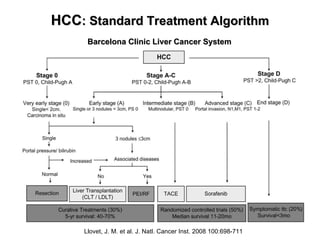
HCC : Standard Treatment Algorithm Barcelona Clinic Liver Cancer System Llovet, J. M. et al. J. Natl. Cancer Inst. 2008 100:698-711
HCC:  Limitations of Standard Modalities Survival  50 - 70% Local Control <25%
HCC:  Limitations of Standard Modalities Survival  50 - 70% Local Control <25% Survival  50 - 80%
HCC:  Limitations of Standard Modalities Survival  50 - 70% Local Control <25% Survival  50 - 80% Ablation Survival  10 - 50%
HCC:  Limitations of Standard Modalities Survival  50 - 70% Local Control <25% Survival  50 - 80% Ablation Survival  10 - 50% TACE Survival  30 - 60%
Eligibility criteria: 1 lesion    5 cm or    3 lesions/< 3 cm Long wait list    interim tumor progression    >20% dropout HCC:  Limitations of Standard Modalities Survival  50 - 70% Local Control <25% Survival  50 - 80% Ablation Survival  10 - 50% TACE Survival  30 - 60%
Eligibility criteria: 1 lesion    5 cm or    3 lesions/< 3cm Long wait list    interim tumor progression    >20% dropout HCC:  Limitations of Standard Modalities Survival  50 - 70% Local Control <25% Survival  50 - 80% Ablation Survival  10 - 50% TACE Survival  30 - 60% Might radiation therapy have a role: Tumor downsizing?  Bridge to transplant?
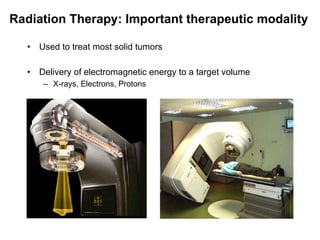
Radiation Therapy: Important therapeutic modality Used to treat most solid tumors Delivery of electromagnetic energy to a target volume X-rays, Electrons, Protons
Radiation Therapy: Important therapeutic modality Cellular basis  DNA repair Cell cycle regulation Apoptosis
Radiation Therapy: Important therapeutic modality Tumor Cell Kill Must also consider normal tissues
Radiation Therapy: Important therapeutic modality Therapeutic Ratio: TCP/ NTCP Tumor control probability/normal tissue complication probability
Radiation Therapy: Important therapeutic modality Improving the Therapeutic Ratio Fractionation : aliquoting radiation dose The “4 R’s” of radiation therapy Repair Normal Tissue > tumor Repopulation Normal Tissue, Some tumors Redistribution Not significant Reoxygenation Tumors
Improving the Therapeutic Ratio Fractionation : aliquoting radiation dose Standard: 1.8 - 2 Gy per fraction over 5 -7 weeks Hyperfractionate: 1.5 Gy per fraction twice per day over shorter span Normal tissues repair sublethal damage between doses Minimizes repopulation of tumor Hypofractionate : >3 Gy per fraction over shorter span More lethal damage, less repopulation Limited by ability to spare normal tissues Radiation Therapy: Important therapeutic modality
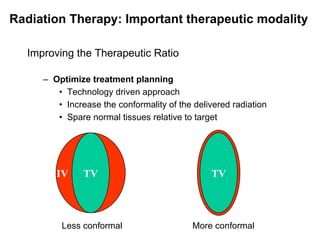
Radiation Therapy: Important therapeutic modality Improving the Therapeutic Ratio Optimize treatment planning Technology driven approach Increase the conformality of the delivered radiation Spare normal tissues relative to target TV IV Less conformal More conformal TV
Emerging Role for Radiation Therapy in HCC: Why not in intra-hepatic malignancies? Historical Data: low therapeutic ratio, hepatotoxicity, unable to deliver curative doses Radiation induced liver disease (RILD) Triad of anicteric ascites, elevated alkaline phosphatase, hepatomegaly Within 3 months of liver irradiation Modern Clinical Data:  NTCP depends on volume of liver irradiated small liver volumes can tolerate high radiation doses
Emerging Role for Radiation Therapy in HCC   Small liver volumes can tolerate high radiation doses
Emerging Role for Radiation Therapy in HCC: C hallenges  to  safe radiation delivery: Low whole liver tolerance to radiation Other radiosensitive tissues in upper abdomen Tumor and organ motion Baseline compromised hepatic function Advanced disease at presentation
Emerging Role for Radiation Therapy in HCC: C hallenges  to  safe radiation delivery: Low whole liver tolerance to radiation    conformality Other radiosensitive tissues in upper abdomen    conformality Tumor and organ motion Baseline compromised hepatic function Advanced disease at presentation
Emerging Role for Radiation Therapy in HCC: C hallenges  to  safe radiation delivery: Low whole liver tolerance to radiation    conformality Other radiosensitive tissues in upper abdomen    conformality Tumor and organ motion    motion management, image guidance Baseline compromised hepatic function Advanced disease at presentation
Emerging Role for Radiation Therapy in HCC: C hallenges  to  safe radiation delivery: Low whole liver tolerance to radiation    conformality Other radiosensitive tissues in upper abdomen    conformality Tumor and organ motion    motion management, image guidance Baseline compromised hepatic function    patient selection Advanced disease at presentation    patient selection
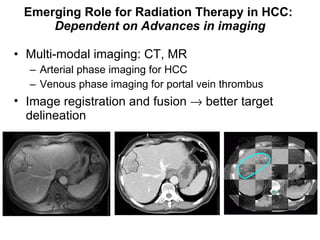
Emerging Role for Radiation Therapy in HCC:  Dependent on Advances in imaging Multi-modal imaging: CT, MR Arterial phase imaging for HCC Venous phase imaging for portal vein thrombus Image registration and fusion    better target delineation
Emerging Role for Radiation Therapy in HCC: Stereotactic Body Radiotherapy (SBRT) Superior tumor imaging Reliable patient immobilization Respiratory motion management techniques Real-time image guidance for conformal delivery (IGRT)  Minimize dose to uninvolved liver  Improve conformality Safer radiation dose escalation     hypofractionate
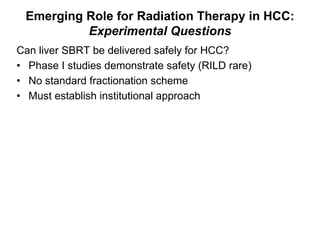
Can liver SBRT be delivered safely for HCC?  Phase I studies demonstrate safety (RILD rare) No standard fractionation scheme Must establish institutional approach Emerging Role for Radiation Therapy in HCC: Experimental Questions
Can liver SBRT be delivered safely for HCC?  Phase I studies demonstrate safety (RILD rare) No standard fractionation scheme Must establish institutional approach Can liver SBRT effectively bridge HCC patients awaiting transplant? Emerging Role for Radiation Therapy in HCC: Experimental Questions
Can liver SBRT be delivered safely for HCC?  Phase I studies demonstrate safety (RILD rare) No standard fractionation scheme Must establish institutional approach Can liver SBRT effectively bridge HCC patients awaiting transplant? Can liver SBRT downsize HCC lesions for patients outside of criteria? Emerging Role for Radiation Therapy in HCC: Experimental Questions
Can liver SBRT be delivered safely for HCC?  Phase I studies demonstrate safety (RILD rare) No standard fractionation scheme Must establish institutional approach Can liver SBRT effectively bridge HCC patients awaiting transplant? Can liver SBRT downsize HCC lesions for patients outside of criteria? Are there serologic and tissue biomarkers of hepatic radiation response? Emerging Role for Radiation Therapy in HCC: Experimental Questions
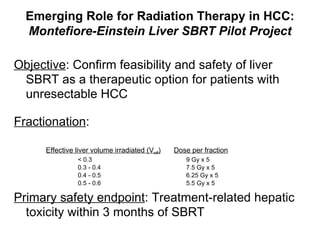
Objective : Confirm feasibility and safety of liver SBRT as a therapeutic option for patients with unresectable HCC Fractionation : Effective liver volume irradiated (V eff )   Dose per fraction < 0.3     9 Gy x 5  0.3 - 0.4     7.5 Gy x 5  0.4 - 0.5     6.25 Gy x 5 0.5 - 0.6   5.5 Gy x 5  Primary safety endpoint : Treatment-related hepatic toxicity within 3 months of SBRT Emerging Role for Radiation Therapy in HCC: Montefiore-Einstein Liver SBRT Pilot Project
Secondary efficacy endpoints : radiographic response, time to progression, survival Correlative endpoints : Serologic and explant biomarkers for radiation response  Acrrual : 20 patients over ≤20 months Emerging Role for Radiation Therapy in HCC: Montefiore-Einstein Liver SBRT Pilot Project
Investigate combined modality therapy: -Liver SBRT + targeted agents? -Liver SBRT + other locoregional therapies? Profiling of human serologic and explant tissue for radiation response biomarkers? Genomic, proteomic, metabolomic Partner with cooperative clinical research groups for large prospective comparative effectiveness studies of liver SBRT? Emerging Role for Radiation Therapy in HCC: Potential Future Directions
Multidisciplinary Team Radiation Oncology Niloy Deb Chandan Guha Linda Hong Shalom Kalnicki Nitika Thawani Medical Oncology Andreas Kaubisch Epidemiology Mimi Kim Hepatology Paul Gaglio John Reinus Pathology Quiang Lu Kathryn Tanaka Surgery Milan Kinkhabwala Funding:  Paul Calabresi Award in Clinical Oncology (K12)   Prinicipal Investigator: Roman Perez-Soler

Session 2.3 Gabeau

  • 1.
    Role of RadiationTherapy in Multidisciplinary Management of Hepatocellullar Carcinoma Darlene Gabeau, M.D., Ph.D. Assistant Professor Department of Radiation Oncology Department of Radiation Oncology
  • 2.
    HCC : StandardTreatment Algorithm Barcelona Clinic Liver Cancer System Llovet, J. M. et al. J. Natl. Cancer Inst. 2008 100:698-711
  • 3.
    HCC : StandardTreatment Algorithm Barcelona Clinic Liver Cancer System Llovet, J. M. et al. J. Natl. Cancer Inst. 2008 100:698-711
  • 4.
    HCC: Limitationsof Standard Modalities Survival 50 - 70% Local Control <25%
  • 5.
    HCC: Limitationsof Standard Modalities Survival 50 - 70% Local Control <25% Survival 50 - 80%
  • 6.
    HCC: Limitationsof Standard Modalities Survival 50 - 70% Local Control <25% Survival 50 - 80% Ablation Survival 10 - 50%
  • 7.
    HCC: Limitationsof Standard Modalities Survival 50 - 70% Local Control <25% Survival 50 - 80% Ablation Survival 10 - 50% TACE Survival 30 - 60%
  • 8.
    Eligibility criteria: 1lesion  5 cm or  3 lesions/< 3 cm Long wait list  interim tumor progression  >20% dropout HCC: Limitations of Standard Modalities Survival 50 - 70% Local Control <25% Survival 50 - 80% Ablation Survival 10 - 50% TACE Survival 30 - 60%
  • 9.
    Eligibility criteria: 1lesion  5 cm or  3 lesions/< 3cm Long wait list  interim tumor progression  >20% dropout HCC: Limitations of Standard Modalities Survival 50 - 70% Local Control <25% Survival 50 - 80% Ablation Survival 10 - 50% TACE Survival 30 - 60% Might radiation therapy have a role: Tumor downsizing? Bridge to transplant?
  • 10.
    Radiation Therapy: Importanttherapeutic modality Used to treat most solid tumors Delivery of electromagnetic energy to a target volume X-rays, Electrons, Protons
  • 11.
    Radiation Therapy: Importanttherapeutic modality Cellular basis DNA repair Cell cycle regulation Apoptosis
  • 12.
    Radiation Therapy: Importanttherapeutic modality Tumor Cell Kill Must also consider normal tissues
  • 13.
    Radiation Therapy: Importanttherapeutic modality Therapeutic Ratio: TCP/ NTCP Tumor control probability/normal tissue complication probability
  • 14.
    Radiation Therapy: Importanttherapeutic modality Improving the Therapeutic Ratio Fractionation : aliquoting radiation dose The “4 R’s” of radiation therapy Repair Normal Tissue > tumor Repopulation Normal Tissue, Some tumors Redistribution Not significant Reoxygenation Tumors
  • 15.
    Improving the TherapeuticRatio Fractionation : aliquoting radiation dose Standard: 1.8 - 2 Gy per fraction over 5 -7 weeks Hyperfractionate: 1.5 Gy per fraction twice per day over shorter span Normal tissues repair sublethal damage between doses Minimizes repopulation of tumor Hypofractionate : >3 Gy per fraction over shorter span More lethal damage, less repopulation Limited by ability to spare normal tissues Radiation Therapy: Important therapeutic modality
  • 16.
    Radiation Therapy: Importanttherapeutic modality Improving the Therapeutic Ratio Optimize treatment planning Technology driven approach Increase the conformality of the delivered radiation Spare normal tissues relative to target TV IV Less conformal More conformal TV
  • 17.
    Emerging Role forRadiation Therapy in HCC: Why not in intra-hepatic malignancies? Historical Data: low therapeutic ratio, hepatotoxicity, unable to deliver curative doses Radiation induced liver disease (RILD) Triad of anicteric ascites, elevated alkaline phosphatase, hepatomegaly Within 3 months of liver irradiation Modern Clinical Data: NTCP depends on volume of liver irradiated small liver volumes can tolerate high radiation doses
  • 18.
    Emerging Role forRadiation Therapy in HCC Small liver volumes can tolerate high radiation doses
  • 19.
    Emerging Role forRadiation Therapy in HCC Small liver volumes can tolerate high radiation doses
  • 20.
    Emerging Role forRadiation Therapy in HCC: C hallenges to safe radiation delivery: Low whole liver tolerance to radiation Other radiosensitive tissues in upper abdomen Tumor and organ motion Baseline compromised hepatic function Advanced disease at presentation
  • 21.
    Emerging Role forRadiation Therapy in HCC: C hallenges to safe radiation delivery: Low whole liver tolerance to radiation  conformality Other radiosensitive tissues in upper abdomen  conformality Tumor and organ motion Baseline compromised hepatic function Advanced disease at presentation
  • 22.
    Emerging Role forRadiation Therapy in HCC: C hallenges to safe radiation delivery: Low whole liver tolerance to radiation  conformality Other radiosensitive tissues in upper abdomen  conformality Tumor and organ motion  motion management, image guidance Baseline compromised hepatic function Advanced disease at presentation
  • 23.
    Emerging Role forRadiation Therapy in HCC: C hallenges to safe radiation delivery: Low whole liver tolerance to radiation  conformality Other radiosensitive tissues in upper abdomen  conformality Tumor and organ motion  motion management, image guidance Baseline compromised hepatic function  patient selection Advanced disease at presentation  patient selection
  • 24.
    Emerging Role forRadiation Therapy in HCC: Dependent on Advances in imaging Multi-modal imaging: CT, MR Arterial phase imaging for HCC Venous phase imaging for portal vein thrombus Image registration and fusion  better target delineation
  • 25.
    Emerging Role forRadiation Therapy in HCC: Stereotactic Body Radiotherapy (SBRT) Superior tumor imaging Reliable patient immobilization Respiratory motion management techniques Real-time image guidance for conformal delivery (IGRT)  Minimize dose to uninvolved liver Improve conformality Safer radiation dose escalation  hypofractionate
  • 26.
    Can liver SBRTbe delivered safely for HCC? Phase I studies demonstrate safety (RILD rare) No standard fractionation scheme Must establish institutional approach Emerging Role for Radiation Therapy in HCC: Experimental Questions
  • 27.
    Can liver SBRTbe delivered safely for HCC? Phase I studies demonstrate safety (RILD rare) No standard fractionation scheme Must establish institutional approach Can liver SBRT effectively bridge HCC patients awaiting transplant? Emerging Role for Radiation Therapy in HCC: Experimental Questions
  • 28.
    Can liver SBRTbe delivered safely for HCC? Phase I studies demonstrate safety (RILD rare) No standard fractionation scheme Must establish institutional approach Can liver SBRT effectively bridge HCC patients awaiting transplant? Can liver SBRT downsize HCC lesions for patients outside of criteria? Emerging Role for Radiation Therapy in HCC: Experimental Questions
  • 29.
    Can liver SBRTbe delivered safely for HCC? Phase I studies demonstrate safety (RILD rare) No standard fractionation scheme Must establish institutional approach Can liver SBRT effectively bridge HCC patients awaiting transplant? Can liver SBRT downsize HCC lesions for patients outside of criteria? Are there serologic and tissue biomarkers of hepatic radiation response? Emerging Role for Radiation Therapy in HCC: Experimental Questions
  • 30.
    Objective : Confirmfeasibility and safety of liver SBRT as a therapeutic option for patients with unresectable HCC Fractionation : Effective liver volume irradiated (V eff ) Dose per fraction < 0.3 9 Gy x 5 0.3 - 0.4 7.5 Gy x 5 0.4 - 0.5 6.25 Gy x 5 0.5 - 0.6 5.5 Gy x 5 Primary safety endpoint : Treatment-related hepatic toxicity within 3 months of SBRT Emerging Role for Radiation Therapy in HCC: Montefiore-Einstein Liver SBRT Pilot Project
  • 31.
    Secondary efficacy endpoints: radiographic response, time to progression, survival Correlative endpoints : Serologic and explant biomarkers for radiation response Acrrual : 20 patients over ≤20 months Emerging Role for Radiation Therapy in HCC: Montefiore-Einstein Liver SBRT Pilot Project
  • 32.
    Investigate combined modalitytherapy: -Liver SBRT + targeted agents? -Liver SBRT + other locoregional therapies? Profiling of human serologic and explant tissue for radiation response biomarkers? Genomic, proteomic, metabolomic Partner with cooperative clinical research groups for large prospective comparative effectiveness studies of liver SBRT? Emerging Role for Radiation Therapy in HCC: Potential Future Directions
  • 33.
    Multidisciplinary Team RadiationOncology Niloy Deb Chandan Guha Linda Hong Shalom Kalnicki Nitika Thawani Medical Oncology Andreas Kaubisch Epidemiology Mimi Kim Hepatology Paul Gaglio John Reinus Pathology Quiang Lu Kathryn Tanaka Surgery Milan Kinkhabwala Funding: Paul Calabresi Award in Clinical Oncology (K12) Prinicipal Investigator: Roman Perez-Soler

Editor's Notes

  • #3 2 2 Click and type your text here
  • #4 2 2 Click and type your text here
  • #5 2 2 Click and type your text here
  • #6 2 2 Click and type your text here
  • #7 2 2 Click and type your text here
  • #8 2 2 Click and type your text here
  • #9 2 2 Click and type your text here
  • #10 2 2 Click and type your text here
  • #11 2 2
  • #12 2 2
  • #13 2 2
  • #14 2 2
  • #15 2 2
  • #16 2 2
  • #17 2 2
  • #18 2 2
  • #19 2 2 Click and type your text here
  • #20 2 2 Click and type your text here
  • #21 2 2
  • #22 2 2
  • #23 2 2
  • #24 2 2
  • #25 2 2
  • #26 2 2 Click and type your text here
  • #33 2 2 Click and type your text here
  • #34 2 2 Click and type your text here