superfood
FOR BABIES
How overcoming
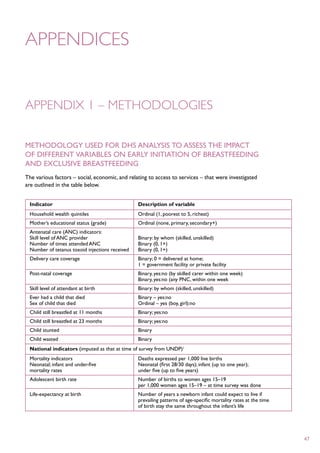
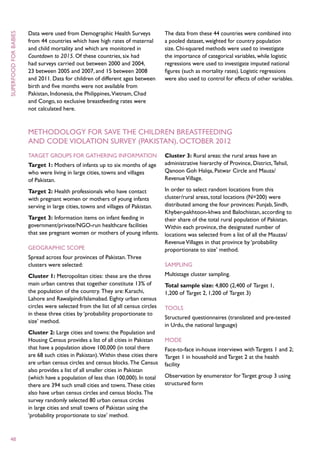
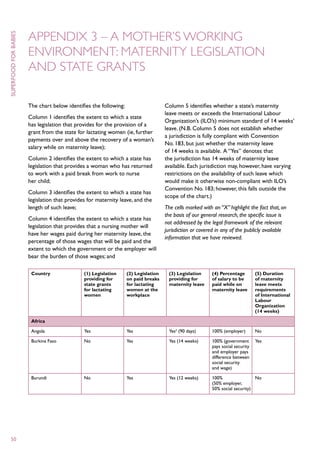
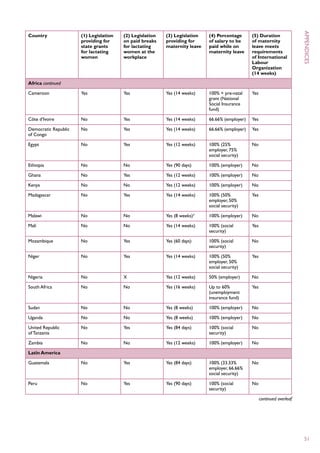
barriers to
breastfeeding will
save children’s lives
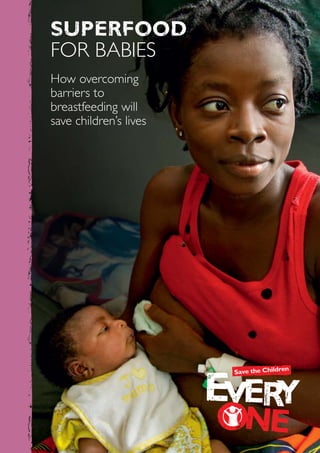
Front cover: Princess Dean is learning
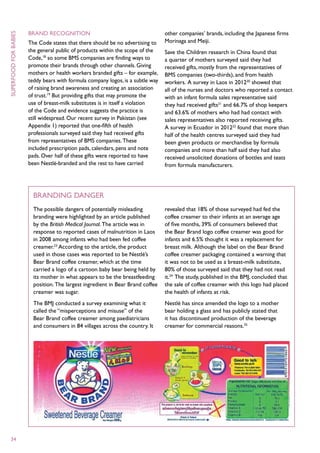
how to breastfeed her newborn baby,
Jallah, at a hospital run by Save the
Children in Liberia. (Photo: Raj Yagnik/
Save the Children)


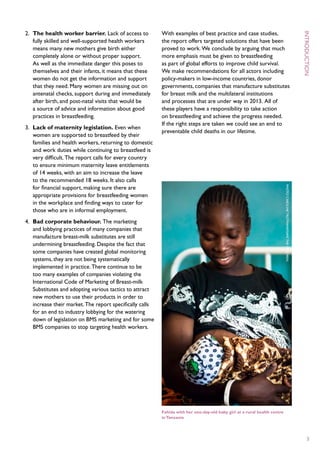
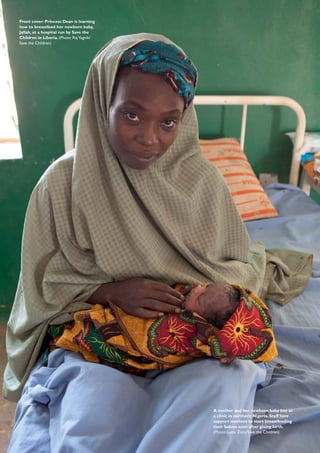
                                           A mother and her newborn baby boy at
                                           a clinic in northern Nigeria. Staff here
                                           support mothers to start breastfeeding
                                           their babies soon after giving birth.
                                           (Photo: Lucia Zoro/Save the Children)
superfood
FOR BABIES
How overcoming barriers
to breastfeeding will
save children’s lives
Save the Children works in more than 120 countries.
We save children’s lives. We fight for their rights.
We help them fulfil their potential.


Authors and acknowledgements
This report was written by Frances Mason, Kathryn Rawe and Simon Wright,
with contributions from Liam Crosby, David McNair, Andrew Hall, Victoria Sibson,
Ali Maclaine, Alex Rees, all from Save the Children.  
Other colleagues at Save the Children greatly supported the research: Michel Anglade,
Pia MacRae, Patricia Norimarna, Yang Ruikan, Louise Sampson, Carmina Sarmiento,
Alison Donnelly, Karin Lapping, Ashley Jones, Arshad Mahmood and the Save the Children
Pakistan team.
We are also very grateful for the substantial insights and support of experts who
contributed to this report: Annelies Allain, Dr Dai, Velvet Escario-Roxas, Ines Fernandez,
Arun Gupta, Francesco Branca, Bridget Fenn, Alyssa Klein, Lida Lhotska, Pamela Mbele,
Jessica Meeker, James Njiru, Rebecca Norton, Dr Perera, Anna Taylor and Terri Wafwafwa.
Particular thanks go to Patti Rundall and Mike Brady of Baby Milk Action, the
UK branch of IBFAN.


Published by
Save the Children
1 St John’s Lane
London EC1M 4AR
UK
+44 (0)20 7012 6400
savethechildren.org.uk

First published 2013

© The Save the Children Fund 2013

The Save the Children Fund is a charity registered in England and Wales (213890)
and Scotland (SC039570). Registered Company No. 178159

This publication is copyright, but may be reproduced by any method without fee or
prior permission for teaching purposes, but not for resale. For copying in any other
circumstances, prior written permission must be obtained from the publisher, and a
fee may be payable.

Typeset by Grasshopper Design Company
Printed by Page Bros Ltd.
contents


Breastfeeding saves lives: the story in numbers	iv
Abbreviations and acronyms	vi
Executive summary	vii
Introduction	1
1 	 How breastfeeding saves children’s lives	4
	   The power of the first hour	                                                           4
	   Six months’ protection	                                                                5
	   Universal benefits	                                                                    6

2 	 The global breastfeeding picture	8
	   Global trends: regional variation	                                                     8
	   Global trends: income, education and breastfeeding rates	                              9

3 	 Empowering mothers to breastfeed their babies	13
	   Common inappropriate feeding practices	                                               13
	   Women’s empowerment and breastfeeding	                                                14
	   Overcoming the barriers	                                                              16

4 	 The health worker crisis and its impact on breastfeeding	19
	   The global shortage of health workers	                                                19
	   Ensuring health workers can support breastfeeding	                                    21
	   No child out of reach	                                                                24

5 	 Maternity protection: lack of legislation to enable mothers
	 to breastfeed	25
	   A mother’s working environment: maternity legislation and state grants	               25

6 	 Breast-milk substitute companies facing conflict of interest	31
	   Thirty years of regulation, but violations continue	                                  31
	   The problem with breast-milk substitute promotion	                                    33
	   Emerging markets: the new frontline for sales of breast-milk substitutes	             37
	   The way forward	                                                                      41

Conclusion and recommendations	43
Appendices 	47
	   Appendix 1: Methodologies	                                                            47
	   Appendix 2: Promoting successful breastfeeding	                                       49
	   Appendix 3: A mother’s working environment: maternity legislation and state grants	   50
	   Appendix 4: The Code and a review of WHO resolutions supporting the Code	             53
	   Appendix 5: Provisions of the Code in national law	                                   56
Endnotes		                                                                                57
breastfeeding saves lives
     the story in numbers

     The big picture: how many children are dying?


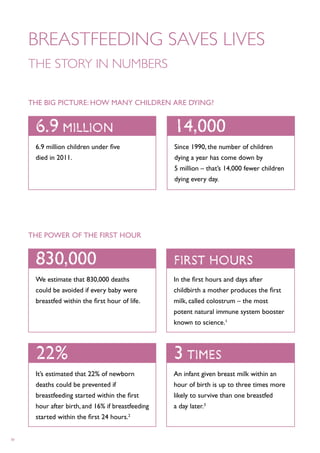
      6.9 million                                  14,000
      6.9 million children under five              Since 1990, the number of children
      died in 2011.                                dying a year has come down by
                                                   5 million – that’s 14,000 fewer children
                                                   dying every day.


     The power of the first hour


      830,000                                      first hours
      We estimate that 830,000 deaths              In the first hours and days after
      could be avoided if every baby were          childbirth a mother produces the first
      breastfed within the first hour of life.     milk, called colostrum – the most
                                                   potent natural immune system booster
                                                   known to science.1


      22%                                          3 times
      It’s estimated that 22% of newborn           An infant given breast milk within an
      deaths could be prevented if                 hour of birth is up to three times more
      breastfeeding started within the first       likely to survive than one breastfed
      hour after birth, and 16% if breastfeeding   a day later.3
      started within the first 24 hours.2


iv
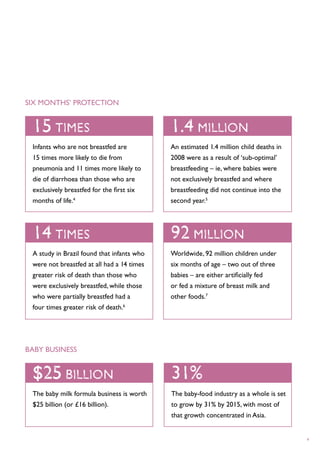
Six months’ protection


 15 times                                   1.4 million
 Infants who are not breastfed are          An estimated 1.4 million child deaths in
 15 times more likely to die from           2008 were as a result of ‘sub-optimal’
 pneumonia and 11 times more likely to      breastfeeding – ie, where babies were
 die of diarrhoea than those who are        not exclusively breastfed and where
 exclusively breastfed for the first six    breastfeeding did not continue into the
 months of life.4                           second year.5


 14 times                                   92 million
 A study in Brazil found that infants who   Worldwide, 92 million children under
 were not breastfed at all had a 14 times   six months of age – two out of three
 greater risk of death than those who       babies – are either artificially fed
 were exclusively breastfed, while those    or fed a mixture of breast milk and
 who were partially breastfed had a         other foods.7
 four times greater risk of death.6


Baby business


 $25 billion                                31%
 The baby milk formula business is worth    The baby-food industry as a whole is set
 $25 billion (or £16 billion).              to grow by 31% by 2015, with most of
                                            that growth concentrated in Asia.


                                                                                       v
Abbreviations
     and acronyms

     ANC	          antenatal care		
     BFHI	         Baby-Friendly Hospital Initiative
     BINGO	 business interest non-governmental organisation
     BMS	          breast-milk substitute
     EBF	          exclusive breastfeeding
     EU      	 European Union
     IBFAN 	 International Baby Food Action Network
     IFE     	     infant feeding in emergencies
     ILO         	 International Labour Organization
     IYCF	         infant and young child feeding
     NCT         	 National Childbirth Trust
     NGO          	 non-governmental organisation
     PINGO 	public interest non-governmental organisation
     RUTF        	 ready-to-use therapeutic foods
     SUN         	 Scaling Up Nutrition
     WHA         	 World Health Assembly
     WHO          	 World Health Organization


vi
Executive summary


In the last two decades there has been huge                  who is not breastfed is 15 times more likely to die
global progress in reducing child mortality.                 from pneumonia and 11 times more likely to die from
Five million fewer children died in 2011 than in             diarrhoea.2 Around one in eight of the young lives lost
1990. The world is nearing a tipping point, the              each year could be prevented through breastfeeding,3
                                                             making it the most effective of all ways to prevent the
time at which the eradication of preventable
                                                             diseases and malnutrition that can cause child deaths.4
child deaths becomes a real possibility.
                                                             But breastfeeding is undervalued. This report finds
There is still a long way to go to achieve that goal.
                                                             that progress made in increasing breastfeeding rates
One-third of child deaths are still attributable to
                                                             in the 1980s (as a result of initiatives such as Baby-
malnutrition; the reduction in malnutrition rates has
                                                             Friendly Hospitals and agreement on the International
been proceeding at a stubbornly slow pace. Unless
                                                             Code of Marketing of Breast-milk Substitutes) has
malnutrition is tackled it threatens to become the
                                                             stalled. Global rates of breastfeeding have remained
‘Achilles’ heel’ of development, holding back progress
                                                             below 40% for the past 20 years as breastfeeding has
in other areas. We must also tackle the unacceptably
                                                             slipped down the list of political priorities. In some
high number of newborn deaths: while overall child
                                                             countries, particularly in east Asia and the Pacific, the
mortality rates are falling, a larger proportion of
                                                             number of breastfed children is starting to fall.
deaths now occur within the first month of life.
                                                             After years of neglect, malnutrition is starting to get
Breastfeeding saves lives. It’s the closest thing there is
                                                             the attention it deserves, with initiatives including
to a ‘silver bullet’ in the fight against malnutrition and
                                                             the Scaling Up Nutrition (SUN) movement, the
newborn deaths.
                                                             1,000 Days Partnership and the G8’s New Alliance for
                                                             Food Security and Nutrition. The year 2013 will be
                                                             crucial, with the UK hosting a ‘hunger summit’ as part
The power of the first hour
                                                             of its G8 presidency. This gives a unique opportunity
Breast milk is a superfood. In the first hours and days      to address the question of child malnutrition,
of her baby’s life the mother produces milk called           including promoting the vital role of breastfeeding. In
colostrum, the most potent natural immune system             addition, Ireland is holding the European Union (EU)
booster known to science.1 Research for this report          presidency, which will focus on nutrition, and SUN
estimates that 830,000 newborn deaths could be               is gathering momentum in 33 countries across the
prevented every year if all infants were given breast        world. It is vital that plans in each of these countries
milk in the first hour of life.                              include protection, support and promotion of
                                                             breastfeeding. We must seize these opportunities to
It is not only through the ‘power of the first hour’         make a difference and accelerate progress towards
that breastfeeding is beneficial. If an infant is fed        the goal of ending preventable child deaths in
only breast milk for the first six months they are           our generation.
protected against major childhood diseases. A child


                                                                                                                         vii
the four barriers                                                             Countries that support infant feeding practices have
superfood for babies


                       to breastfeeding                                                              shown that it is possible to rapidly increase the rates of
                                                                                                     early initiation and exclusive practice of breastfeeding.
                       This report examines the reasons behind the lack                              The Baby-Friendly Hospital and Community Initiative,
                       of progress in improving breastfeeding rates and                              launched in 1991 by WHO and UNICEF, is among the
                       especially the four major barriers that prevent                               most successful of these programmes.
                       mothers from breastfeeding their babies.
                                                                                                     3. Lack of maternity legislation
                       1. community and cultural pressures                                           Returning to work after the birth of a child is difficult
                       Despite clear evidence that early and exclusive                               for any mother and may mean that continuing
                       breastfeeding is the best way to care for newborns,                           to breastfeed is very challenging. Three areas of
                       many mothers in poor countries are given bad                                  national policy play a key role in a woman’s ability to
                       advice or are pressurised into harmful alternatives.                          breastfeed: maternity leave, financial protection to
                       Common practices include denying the newborn                                  help maintain the family’s income while the mother
                       colostrum and giving other foods or liquids before                            is not working, and workplace provisions to allow
                       starting breastfeeding.                                                       breastfeeding to continue once a mother returns to
                                                                                                     work. To promote exclusive breastfeeding, women
                       Many women are not free to make their own                                     must be provided with sufficient paid maternity leave
                       decisions about whether they will breastfeed, or for                          – in line with the international minimum of 14 weeks
                       how long. In Pakistan, a Save the Children survey                             and working towards 18 weeks’ leave with at least
                       revealed that only 44% of mothers considered                                  two-thirds pay – but the majority of poor countries
                       themselves the prime decision-maker over how                                  do not meet this standard. Once a mother returns
                       their children were fed. Instead it is often husbands                         to work, there must be policies in place that require
                       or mothers-in-law who decide.5                                                employers to provide paid breaks and private places
                       It is important to recognise the contribution a                               where women can breastfeed or express milk so that
                       woman is making to the future of her child, her                               they are able to continue breastfeeding.
                       family, her village and her country’s economy                                 Women in informal employment also face problems in
                       by breastfeeding. Projects that seek to address                               continuing to breastfeed when they return to work, as
                       community power dynamics while promoting more                                 they are often unable to take their children with them
                       helpful behaviours, through a variety of efforts,                             to the fields to farm or to do household chores such
                       including mass media campaigns, support groups                                as collecting firewood and water. For these women,
                       and interpersonal communication, can be useful –                              state grants and social protection (in the form of
                       especially if they empower young women by                                     social security payments or cash benefits) that are not
                       changing communities’ views of breastfeeding                                  dependent on formal maternity leave arrangements
                       and also target fathers and grandmothers and                                  are even more important.
                       other influential community members.
                                                                                                     4. The Big Business barrier
                       2. The health worker shortage
                                                                                                     While there is a recognised need for certain infants
                       Owing to a chronic shortage of health workers,                                to be formula-fed, there has long been concern
                       one-third of infants are born without a skilled birth                         that the marketing activities of some manufacturers
                       attendant present.6 As a result, the opportunity for                          has led to infant formula being used unnecessarily
                       new mothers to be supported to breastfeed in the                              and improperly, ultimately putting children at risk.
                       first few hours is lost. Our analysis of data from                            In 1981, the World Health Assembly adopted a set
                       44 countries7 found that women who had a skilled                              of standards known as The International Code of
                       attendant present at birth were twice as likely to                            Marketing of Breast-milk Substitutes, and has since
                       initiate breastfeeding within the first hour.                                 adopted a number of subsequent resolutions that
                       Human and financial resources are needed to scale                             have developed and updated the original provisions.*
                       up the support mothers get from health workers.8                              ‘The Code’ regulates marketing tactics that can


                       *
                        For the purposes of this report, any reference to ‘the Code’ should be taken to refer to The International Code of
                       Marketing of Breast-milk Substitutes and its subsequent resolutions, which have the same status.


   viii
undermine breastfeeding, including advertising, free       governments must fund projects that focus on changing


                                                                                                                       ex
samples, targeting mothers and health claims on            the power and gender dynamics in the community
packaging. While some companies have created global        to empower young women to make their own
monitoring and reporting systems, in many cases            decisions. They need to include fathers and husbands,


                                                                                                                       ecutive
they are not being implemented in practice and there       grandmothers and local leaders in their work.
continue to be too many examples of violations of          Governments should invest in programmes to address
the Code by some breast-milk substitute companies.         breastfeeding that include high-quality, professional
Among the most worrying violations is the alleged          national communications and media campaigns to


                                                                                                                       summary
targeting of health workers with encouragement to          spread messages about the benefits of breastfeeding,
promote the companies’ products to mothers of              well-targeted support for communities, and measures
young infants.                                             for tackling the obstacles to good practice.
Growth in the baby food market is increasingly             To achieve the goal of every birth being attended
dependent on emerging economies. The shift in the          by a skilled health worker, governments must
economic centre of gravity has created new lucrative       work to make the health system stronger to
markets in countries with a growing middle class.          protect, promote and support breastfeeding.
Meanwhile, sales are stagnating in Europe and North        This should include allocating adequate resources
America, as a result of declining birth rates and          to long-term health worker training, recruitment,
increased interest in breastfeeding.                       support and retention and ensuring that all healthcare
                                                           providers have strong policies in place that protect
Strong legislation can restrict the marketing activities
                                                           breastfeeding. International donors should support
of breast-milk substitute (BMS) companies. During
                                                           these efforts by increasing funding for projects that
research for this report we found evidence of
                                                           support breastfeeding. The UK prime minister’s
lobbying by the industry that we believe could serve
                                                           ‘hunger summit’ ahead of the G8 leaders meeting in
to weaken legislation on the Code in a number of
                                                           the UK provides the ideal opportunity for leaders to
countries. It is our understanding that BMS companies
                                                           put nutrition, including breastfeeding, at the top of the
have put corporate competition aside to form groups
                                                           agenda and to fill the funding gap.
to influence national governments. We question the
true intention of these groups, some of which have         All governments should introduce nationwide
pseudo-scientific titles that could be misleading and      breastfeeding-friendly policies and legislation.
are presented as nutrition associations.                   They should provide maternity leave in line with the
                                                           International Labour Organization (ILO) minimum
                                                           recommendation of 14 weeks of paid leave but
Recommendations                                            working towards best practice of 18 weeks.9
                                                           Governments should also provide financial protection
This report is a call to action for the world to           for six months in the form of cash transfers, state
rediscover the importance of breastfeeding and for         grants or maternity benefits to all breastfeeding
a commitment to support mothers to breastfeed              women in both the formal and informal sectors,
their babies, especially in the poorest communities        and require that employers make provisions for
in the poorest countries. It calls for world leaders,      breastfeeding women in the workplace.
international institutions and multinational companies
to take action to ensure that every infant is given the    In order to improve breast-milk substitute
life-saving protection that breastfeeding can offer.       industry practices we need a two-pronged
                                                           approach that requires change from within industry
All countries should put breastfeeding at the centre       while also seeking to tighten national regulation in
of efforts to improve infant and child nutrition, and      the countries where they operate. BMS companies
should develop specific breastfeeding strategies as        and those working on their behalf should adopt a
well as including breastfeeding in their nutrition         code of conduct regarding their engagement with
strategies. Countries that are developing plans as         governments and open up their lobbying activity for
part of the SUN movement should ensure that they           public scrutiny through a public register of meetings
address all of the obstacles identified in this report     regarding the International Code.
that deter optimal breastfeeding practices.
                                                           Whistleblowing procedures must be strengthened,
To overcome harmful practices and tackle                   and to ensure that the Code is understood
breastfeeding taboos, developing country                   and enforced at every level, responsibility for

                                                                                                                        ix
preventing Code violations should be built into                  enforced and complemented by additional measures.
superfood for babies


                       the job description of the company’s most senior                 For example, while the International Code states
                       representative in every country. The job description             that companies must include health warnings and
                       of the company’s most senior representative in                   details of the benefits of breastfeeding, in practice
                       every country, whether that is a company office or               these warnings are usually small and unobtrusive.
                       distributor, should include ensuring that no Code                To strengthen the power of these warnings, national
                       violations occur in the area they are responsible for.           laws should specify that health warnings should
                       That person should be held accountable under the                 cover one-third of any BMS packaging. In order to
                       terms of their employment and be held personally                 hold companies accountable at a global level the UN
                       responsible in law for any violations of the Code. A             should create an effective body to monitor reports
                       member of the board should be made accountable for               of, and rule on, Code violations, and should publicly
                       ensuring that the company does not violate the Code              disclose, in detail, all Code violations. The operating
                       and for managing a robust auditing system.                       costs of this body, which should work with national
                                                                                        regulatory bodies to penalise companies, could be
                       At the same time, all governments must enshrine the
                                                                                        covered by a combination of donor funding and fines
                       International Code and subsequent resolutions into
                                                                                        issued to BMS companies for Code violations.
                       law and ensure that it is independently monitored and


                                                                                                                                             P
                                                                                                                                             hoto : C
                                                                                                                                             aroline T
                                                                                                                                             rutmann /S
                                                                                                                                             ave
                                                                                                                                             the C
                                                                                                                                             hildren


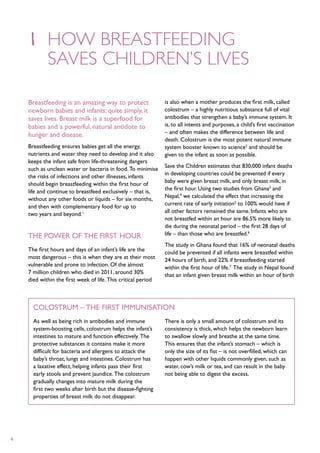
                       Nurse Koletha teaches Mwajuma how to breastfeed her one-day-old baby boy at the Lindi Regional Hospital, Tanzania


   x
Introduction


In the last two decades there has been great                                     It has become the Achilles’ heel of child survival
progress at the global level in reducing child                                   as, while rapid progress has been made on other
mortality. Five million fewer children died in                                   fronts such as immunisation, progress in reducing
2011 than in 1990 and we are now reaching a                                      malnutrition has remained stubbornly slow. At the
                                                                                 same time, as the child death toll falls, a greater
tipping point where preventable child deaths
                                                                                 proportion of deaths are among newborn babies
could be eradicated in our lifetime. Between
                                                                                 – currently, two in five children under five who die
2010 and 2011 we saw the biggest annual                                          are under one month old. Breastfeeding has a strong
reduction in child deaths ever recorded,                                         impact on both reducing malnutrition and protecting
showing that global efforts are paying off.                                      children in their first 28 days and beyond – it is
Ours could be the generation to eradicate                                        the closest thing there is to a ‘silver bullet’ to save
preventable child death.                                                         these children’s lives. To achieve our goal that within
But there is still a lot to do to reach that point and                           our lifetime no child will be born to die from a
breastfeeding is key to unlocking further progress.                              preventable cause, we must put breastfeeding at the
Malnutrition was the underlying cause of around                                  centre of our efforts.
one-third of the almost 7 million child deaths in 2010.


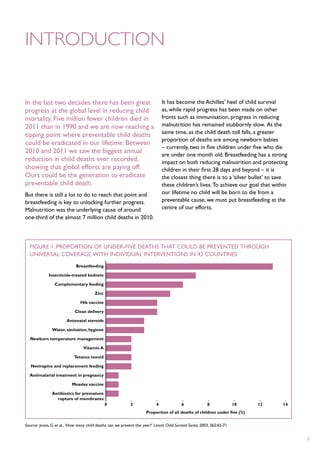
  Figure 1. proportion of under-five deaths that could be prevented through
  universal coverage with individual interventions in 42 countries
                              Breastfeeding

              Insecticide-treated bednets

                 Complementary feeding

                                         Zinc

                                Hib vaccine

                             Clean delivery

                        Antenatal steroids

               Water, sanitation, hygiene

  Newborn temperature management

                                  Vitamin A

                             Tetanus toxoid

   Nevirapine and replacement feeding

  Antimalarial treatment in pregnancy

                           Measles vaccine

               Antibiotics for premature
                 rupture of membranes
                                      	  0	2	4	6	8	10	12	14
                                                                       Proportion of all deaths of children under five (%)


Source: Jones, G et al., ‘How many child deaths can we prevent this year?’ Lancet Child Survival Series, 2003, 362:65-71


                                                                                                                                           1
It is common knowledge that breastfeeding a baby is        US and Irish governments launched the 1,000 Days
superfood for babies


                       good for his or her health. Breast milk is a superfood.    Partnership, highlighting the need to focus on the
                       In the first hours and days of her baby’s life the         critical first 1,000 days of a child’s life from conception
                       mother produces milk called colostrum, the most            through pregnancy to the age of two. In 2012, world
                       potent natural immune system booster known to              leaders attending the G8 summit held in the USA
                       science.1 Research for this report estimates that          recommitted themselves to SUN and launched the
                       830,000 newborn deaths could be prevented if every         New Alliance for Food Security and Nutrition. And
                       infant were given breast milk in the first hour of life.   2013 is set to be a crucial year, with the UK hosting
                       Breastfeeding gives an infant significant protection       a hunger summit as part of its G8 presidency. In
                       against pneumonia and diarrhoea, which are two             addition, Ireland is holding the EU presidency, which
                       major causes of deaths of children in poor countries.      will focus on nutrition and the SUN movement. We
                       If we can ensure that every infant is given breast milk    must seize these opportunities to make a difference
                       immediately after birth and is fed only breast milk        and accelerate progress towards the goal of ending
                       for the first six months, we can greatly increase the      preventable child deaths in our generation’s lifetime.
                       chance that they will survive and go on to fulfil their
                                                                                  This report is a call to action for the world to
                       potential. Around one in eight of the young lives lost
                                                                                  rediscover the importance of breastfeeding and
                       each year could be prevented through breastfeeding,2
                                                                                  to demonstrate a commitment to supporting
                       making it the most effective of all ways to prevent the
                                                                                  mothers to breastfeed their babies, especially in the
                       diseases and malnutrition that can cause child deaths.3
                                                                                  poorest communities in the poorest countries. It
                       But breastfeeding is undervalued. The world is in          calls on world leaders to take action to ensure that
                       danger of forgetting just how important this universal,    every infant is given the life-saving protection that
                       free and wholly beneficial practice is. Previous           breastfeeding can offer.
                       progress in increasing the rates of breastfeeding has
                                                                                  In the next chapter, we set out the evidence for
                       slowed down. The global proportion of children
                                                                                  how breastfeeding saves children’s lives, showing just
                       exclusively breastfed for six months increased from
                                                                                  how vital early initiation and six months’ exclusive
                       32% in 1995 to 39% in 20104 – an improvement of
                                                                                  breastfeeding is to an infant. Chapter 2 then tracks the
                       just over 1.5% a year.
                                                                                  current global trends and the rates of breastfeeding
                       In the 1980s and early 1990s there was significant         in different parts of the world, and provides examples
                       progress in improving the number of infants who            of countries that have made significant improvements
                       were breastfed. Global initiatives such as the UNICEF      and those that are lagging behind.
                       and World Health Organization Baby-friendly Hospital
                                                                                  The four subsequent chapters then focus on the
                       Initiative and the International Code of Marketing
                                                                                  barriers to further global progress and the major
                       of Breast-milk Substitutes showed that, with political
                                                                                  social, cultural and political obstacles that are
                       will and dedicated resources, it was possible to
                                                                                  preventing mothers from breastfeeding their infants.
                       achieve dramatic improvement. However, since
                                                                                  Reasons vary from country to country – and indeed
                       then, attention has slipped. In the last two decades,
                                                                                  from woman to woman – but the report identifies
                       breastfeeding has dropped down the global agenda
                                                                                  four main barriers:
                       and fallen lower in the priorities of national
                       governments. At the same time, according to                1.	 Community and cultural pressures. Many
                       industry analysts Euromonitor, “The [baby food]                women face extreme pressures from their family
                       industry is fighting a rearguard action against                or their community to feed their infants in ways
                       regulation [on advertising and promotion of breast-            that are traditional in their society, but which can
                       milk substitutes] on a country-by-country basis.” 5            be harmful. Husbands, other family members, and
                                                                                      community leaders may have such a significant
                       However, other, more recent developments are also
                                                                                      influence over young mothers that it prevents
                       significant. After years of neglect, malnutrition is
                                                                                      them from making their own informed decisions
                       starting to get the attention it deserves. The Scaling
                                                                                      about how to feed their infants. The chapter
                       Up Nutrition movement is gathering momentum
                                                                                      calls for empowerment of young women and
                       in 33 countries across the world. It is vital that
                                                                                      widespread knowledge-sharing on the benefits
                       plans in each of these countries include protection,
                                                                                      of breastfeeding, as crucial to transforming
                       support and promotion of breastfeeding. In 2010, the
                                                                                      breastfeeding practices.


  2
2.	 The health worker barrier. Lack of access to           With examples of best practice and case studies,


                                                                                                                                         I
    fully skilled and well-supported health workers        the report offers targeted solutions that have been
    means many new mothers give birth either               proved to work. We conclude by arguing that much
    completely alone or without proper support.            more emphasis must be given to breastfeeding
    As well as the immediate danger this poses to          as part of global efforts to improve child survival.
    themselves and their infants, it means that these      We make recommendations for all actors including


                                                                                                                                         ntroduction
    women do not get the information and support           policy-makers in low-income countries, donor
    that they need. Many women are missing out on          governments, companies that manufacture substitutes
    antenatal checks, support during and immediately       for breast milk and the multilateral institutions
    after birth, and post-natal visits that would be       and processes that are under way in 2013. All of
    a source of advice and information about good          these players have a responsibility to take action
    practices in breastfeeding.                            on breastfeeding and achieve the progress needed.
                                                           If the right steps are taken we could see an end to
3.	 Lack of maternity legislation. Even when
                                                           preventable child deaths in our lifetime.
    women are supported to breastfeed by their
    families and health workers, returning to domestic
    and work duties while continuing to breastfeed is
    very difficult. The report calls for every country
    to ensure minimum maternity leave entitlements
    of 14 weeks, with an aim to increase the leave
    to the recommended 18 weeks. It also calls
    for financial support, making sure there are


                                                                                                                            P
    appropriate provisions for breastfeeding women


                                                                                                                            hoto : C
    in the workplace and finding ways to cater for
    those who are in informal employment.


                                                                                                                            aroline T
4.	 Bad corporate behaviour. The marketing
    and lobbying practices of many companies that


                                                                                                                            rutmann /S
    manufacture breast-milk substitutes are still


                                                                                                                            ave
    undermining breastfeeding. Despite the fact that


                                                                                                                            the C
    some companies have created global monitoring
    systems, they are not being systematically


                                                                                                                            hildren
    implemented in practice. There continue to be
    too many examples of companies violating the
    International Code of Marketing of Breast-milk
    Substitutes and adopting various tactics to attract
    new mothers to use their products in order to
    increase their market. The report specifically calls
    for an end to industry lobbying for the watering
    down of legislation on BMS marketing and for some
    BMS companies to stop targeting health workers.


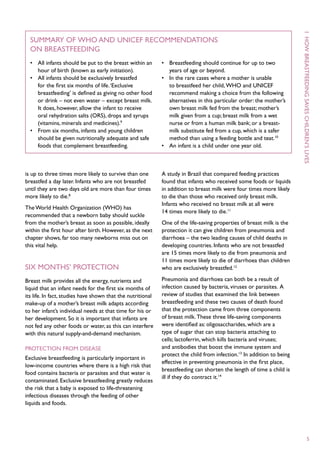
                                                           Fahida with her one-day-old baby girl at a rural health centre
                                                           in Tanzania


                                                                                                                                              3
1	 How breastfeeding
    	saves children’s lives

    Breastfeeding is an amazing way to protect                 is also when a mother produces the first milk, called
    newborn babies and infants; quite simply, it               colostrum – a highly nutritious substance full of vital
    saves lives. Breast milk is a superfood for                antibodies that strengthen a baby’s immune system. It
    babies and a powerful, natural antidote to                 is, to all intents and purposes, a child’s first vaccination
                                                               – and often makes the difference between life and
    hunger and disease.
                                                               death. Colostrum is the most potent natural immune
    Breastfeeding ensures babies get all the energy,           system booster known to science2 and should be
    nutrients and water they need to develop and it also       given to the infant as soon as possible.
    keeps the infant safe from life-threatening dangers
                                                               Save the Children estimates that 830,000 infant deaths
    such as unclean water or bacteria in food. To minimise
                                                               in developing countries could be prevented if every
    the risks of infections and other illnesses, infants
                                                               baby were given breast milk, and only breast milk, in
    should begin breastfeeding within the first hour of
                                                               the first hour. Using two studies from Ghana3 and
    life and continue to breastfeed exclusively – that is,
                                                               Nepal,4 we calculated the effect that increasing the
    without any other foods or liquids – for six months,
                                                               current rate of early initiation5 to 100% would have if
    and then with complementary food for up to
                                                               all other factors remained the same. Infants who are
    two years and beyond.1
                                                               not breastfed within an hour are 86.5% more likely to
                                                               die during the neonatal period – the first 28 days of
    The power of the first hour                                life – than those who are breastfed.6
                                                               The study in Ghana found that 16% of neonatal deaths
    The first hours and days of an infant’s life are the       could be prevented if all infants were breastfed within
    most dangerous – this is when they are at their most       24 hours of birth, and 22% if breastfeeding started
    vulnerable and prone to infection. Of the almost           within the first hour of life.7 The study in Nepal found
    7 million children who died in 2011, around 30%            that an infant given breast milk within an hour of birth
    died within the first week of life. This critical period


      Colostrum – the first immunisation
      As well as being rich in antibodies and immune           There is only a small amount of colostrum and its
      system-boosting cells, colostrum helps the infant’s      consistency is thick, which helps the newborn learn
      intestines to mature and function effectively. The       to swallow slowly and breathe at the same time.
      protective substances it contains make it more           This ensures that the infant’s stomach – which is
      difficult for bacteria and allergens to attack the       only the size of its fist – is not overfilled, which can
      baby’s throat, lungs and intestines. Colostrum has       happen with other liquids commonly given, such as
      a laxative effect, helping infants pass their first      water, cow’s milk or tea, and can result in the baby
      early stools and prevent jaundice. The colostrum         not being able to digest the excess.
      gradually changes into mature milk during the
      first two weeks after birth but the disease-fighting
      properties of breast milk do not disappear.


4
1  H ow
  Summary of WHO and UNICEF recommendations
  on breastfeeding
  •	 All infants should be put to the breast within an       •	 Breastfeeding should continue for up to two
     hour of birth (known as early initiation).                 years of age or beyond.
  •	 All infants should be exclusively breastfed             •	 In the rare cases where a mother is unable
     for the first six months of life. ‘Exclusive               to breastfeed her child, WHO and UNICEF
     breastfeeding’ is defined as giving no other food          recommend making a choice from the following


                                                                                                                        breastfeeding
     or drink – not even water – except breast milk.            alternatives in this particular order: the mother’s
     It does, however, allow the infant to receive              own breast milk fed from the breast; mother’s


                                                                                                                        saves
     oral rehydration salts (ORS), drops and syrups             milk given from a cup; breast milk from a wet
     (vitamins, minerals and medicines).9                       nurse or from a human milk bank; or a breast-
  •	 From six months, infants and young children                milk substitute fed from a cup, which is a safer
     should be given nutritionally adequate and safe            method than using a feeding bottle and teat.10


                                                                                                                        children ’s
     foods that complement breastfeeding.                    •	 An infant is a child under one year old.


                                                                                                                        lives
is up to three times more likely to survive than one         A study in Brazil that compared feeding practices
breastfed a day later. Infants who are not breastfed         found that infants who received some foods or liquids
until they are two days old are more than four times         in addition to breast milk were four times more likely
more likely to die.8                                         to die than those who received only breast milk.
                                                             Infants who received no breast milk at all were
The World Health Organization (WHO) has
                                                             14 times more likely to die.11
recommended that a newborn baby should suckle
from the mother’s breast as soon as possible, ideally        One of the life-saving properties of breast milk is the
within the first hour after birth. However, as the next      protection it can give children from pneumonia and
chapter shows, far too many newborns miss out on             diarrhoea – the two leading causes of child deaths in
this vital help.                                             developing countries. Infants who are not breastfed
                                                             are 15 times more likely to die from pneumonia and
                                                             11 times more likely to die of diarrhoea than children
Six months’ protection                                       who are exclusively breastfed.12

Breast milk provides all the energy, nutrients and           Pneumonia and diarrhoea can both be a result of
liquid that an infant needs for the first six months of      infection caused by bacteria, viruses or parasites. A
its life. In fact, studies have shown that the nutritional   review of studies that examined the link between
make-up of a mother’s breast milk adapts according           breastfeeding and these two causes of death found
to her infant’s individual needs at that time for his or     that the protection came from three components
her development. So it is important that infants are         of breast milk. These three life-saving components
not fed any other foods or water, as this can interfere      were identified as: oligosaccharides, which are a
with this natural supply-and-demand mechanism.               type of sugar that can stop bacteria attaching to
                                                             cells; lactoferrin, which kills bacteria and viruses;
Protection from disease                                      and antibodies that boost the immune system and
                                                             protect the child from infection.13 In addition to being
Exclusive breastfeeding is particularly important in
                                                             effective in preventing pneumonia in the first place,
low-income countries where there is a high risk that
                                                             breastfeeding can shorten the length of time a child is
food contains bacteria or parasites and that water is
                                                             ill if they do contract it.14
contaminated. Exclusive breastfeeding greatly reduces
the risk that a baby is exposed to life-threatening
infectious diseases through the feeding of other
liquids and foods.


                                                                                                                              5
superfood for babies


                            Figure 2. Relative risk of incidence and mortality from diarrhoea and pneumonia
                            for predominant, partial and non-breastfed infants aged 0–5 months compared
                            with breastfed infants
                                                  16.0


                                                  14.0


                                                  12.0
                         Level of relative risk


                                                  10.0


                                                   8.0


                                                   6.0


                                                   4.0


                                                   2.0

                                                                                                                                              Predominant breastfeeding
                                                    0                                                                                         Partial breastfeeding
                                                         	 Diarrhoea 	 Diarrhoea	 Pneumonia	 Pneumonia
                                                         	 incidence	mortality	incidence	mortality	                                           No breastfeeding


                       Note: Relative risk of incidence of and mortality from diarrhoea and pneumonia for partial breastfeeding and not breastfeeding;
                       compared with that for exclusive breastfeeding among infants aged 0–5 months. A relative risk of 1.0 indicates the same risk
                       incurred as for exclusively breastfed children. Relative risks above 1.0 indicate increased risk.
                       Source: UNICEF (2012) Pneumonia and Diarrhoea: Tackling the deadliest diseases for the world’s poorest children


                       Preventing malnutrition                                                          Universal benefits
                       Malnutrition is an underlying cause of one-third of
                       child deaths, and our analysis15 has demonstrated that                           It is clear that the protection provided by
                       breastfeeding has a significant impact on childhood                              breastfeeding applies whether a child has been born
                       nutrition status. Failure to ensure early initiation was                         to a wealthy family in a rich country or born to an
                       linked to an increase – by up to one-fifth – of the                              impoverished family in a poor country. In Spain, risk of
                       likelihood of a child being wasted.16 And failure to                             admission into hospital for infection in the first year
                       achieve exclusive breastfeeding was associated with                              of life was five times higher among infants (born into
                       a 10% increase in the risk of a child being wasted.17                            upper-middle-class, educated, urban families) who were
                       Malnutrition and diseases such as pneumonia and                                  never breastfed, compared with infants breastfed for
                       diarrhoea work in a deadly cycle. A malnourished                                 four months or more.18 In the USA, a study estimated
                       child is more likely to suffer from disease, and the                             that children who were never breastfed were 24%
                       more they suffer from disease the more likely they                               more likely to die of infection, injury and other causes
                       are to be malnourished. Inadequate food intake                                   in the post-neonatal period (defined as from 28 days
                       leads to weight loss and a weakened immune system,                               to one year) than those who were breastfed.19
                       which means that childhood diseases will be more                                 Research compiled by WHO suggests that children
                       severe and will last longer. This in turn leads to a                             who are not optimally breastfed have a higher risk of
                       loss of appetite.                                                                asthma, diabetes, coeliac disease, ulcerative colitis and
                                                                                                        Crohn’s disease and potentially a higher chance of
                                                                                                        becoming obese in childhood and adolescence.20 There
                                                                                                        is also a growing body of evidence that links feeding an
                                                                                                        infant with liquids other than breast milk with risks of

  6
cardiovascular disease.21 Breastfeeding has also been                 The process of producing milk can use up to


                                                                                                                                          1  H ow
linked to cognitive development. A meta-analysis of                   500 calories per day and help women lose weight
20 studies showed that breastfed children scored on                   after pregnancy.24 And in the longer term, there is
average 3.2 points higher in cognitive function tests                 evidence that the risk of breast and ovarian cancer is
than those who were formula-fed.22                                    smaller among women who have breastfed.It is now
                                                                      estimated that breastfeeding for six to 24 months
As well as helping a mother bond with her baby,
                                                                      throughout a mother’s reproductive lifetime may
breastfeeding has short- and long-term benefits
                                                                      reduce the risk of breast cancer by up to 25%.25, 26
for the mother’s health. Immediately after birth,


                                                                                                                                          breastfeeding
the suckling action of the baby releases a hormone                    In the poorest countries, where child mortality rates
called oxytocin. This hormone not only releases milk                  are driven by lack of access to sufficient nutritious
to the baby, it produces contractions in the uterus                   food, high rates of poverty, prevalence of diseases and


                                                                                                                                          saves
that prevent postpartum haemorrhage. Exclusive                        lack of access to healthcare, breastfeeding is a vital
breastfeeding can often mean a woman’s periods                        way to help children survive and develop. Increasing
do not return for several months, which conserves                     optimal breastfeeding will help to drive down the
iron stores in her body and can act as a natural                      rates of children dying before their fifth birthday. It is


                                                                                                                                          children ’s
contraceptive, thus helping to space pregnancies.                     therefore a top priority. However, as the next chapter
Healthier birth spacing, where mothers delay                          shows, breastfeeding is not being prioritised in the


                                                                                                                                          lives
conceiving until 36 months after giving birth, could                  poorest countries of the world.
prevent 1.8 million deaths of children under five a
year – around a quarter of annual child deaths.23


                                                                                                                              P
                                                                                                                              hoto : L
                                                                                                                              ouise D
                                                                                                                              yring N
                                                                                                                              ielson /S
                                                                                                                              ave
                                                                                                                              the C
                                                                                                                              hildren D
                                                                                                                              enmark


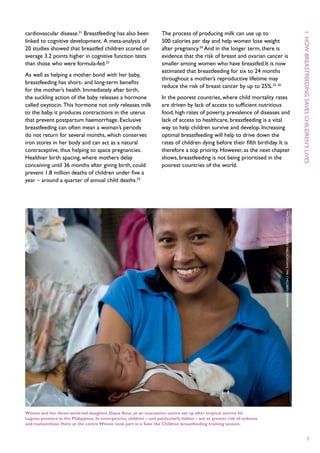
Winnie and her three-week-old daughter, Diana Rose, at an evacuation centre set up after tropical storms hit
Laguna province in the Philippines. In emergencies, children – and particularly babies – are at greater risk of sickness
and malnutrition. Here at the centre Winnie took part in a Save the Children breastfeeding training session.


                                                                                                                                                7
2	 The global
    	breastfeeding picture

    Despite universal consensus that breastfeeding                                        Global trends:
    is the best way to give a child a healthy start in                                    regional variation
    life, and a wealth of solid evidence of the critical
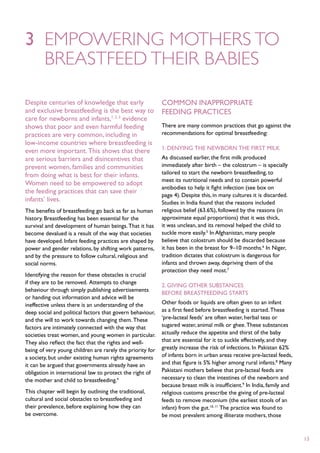
    role it plays in reducing child mortality, only 37%                                   This global stagnation conceals varied trends within
    of children globally are exclusively breastfed                                        countries and regions. History has shown that much
    for the first six months of life and only 43% are                                     rapid progress on improving breastfeeding rates
                                                                                          is possible. Sri Lanka, for example, saw a dramatic
    breastfed within the first hour of life.1 What
                                                                                          increase in its exclusive breastfeeding rate from
    is shocking is that despite significant efforts in
                                                                                          17% in 1993 to 76% in 2007; Cambodia’s exclusive
    global policy and initiatives for over 20 years 2 to                                  breastfeeding rate was just 12% in 2000 but it had
    improve breastfeeding rates, the global rate of                                       increased to 74% by 2010; Ghana’s rose from a
    exclusive breastfeeding has stayed below 40%.                                         low level of 7% in 1993 to 63% in 2008. 5 A total
    Member states meeting at the World Health Assembly                                    of 27 countries6 have seen exclusive breastfeeding
    in 2012 adopted a global target for at least 50% of                                   rates increase by more than 20 percentage points
    infants under six months of age to be exclusively                                     in ten years.7
    breastfed by 2025, requiring an increase of at least                                  The fact that rates in some of the countries with the
    2.5% a year. This can be done – rapid and substantial                                 largest populations have stalled or even declined has
    increases in exclusive breastfeeding rates, often                                     contributed to the global stagnation and has masked
    exceeding the proposed global target, have been                                       progress by smaller countries. According to the
    achieved in individual countries in all regions,3 yet                                 most recent available national data, two-thirds of the
    this progress needs to be made across all countries.                                  92 million children who are not exclusively breastfed


          Figure 3. Global trends in rate of exclusive breastfeeding
                                            100
                                                  Innocenti Declaration                   UN Millennium Development Goals
                                             90                                           ILO Maternity Protection Convention
                                                      Baby-Friendly Hospital Initiative
                                                                                                    Global Strategy for Infant & Young Child Feeding
      Rate of exclusive breastfeeding (%)


                                             80            World Breastfeeding Week
                                                           first celebrated                                        Expanded Innocenti Declaration
                                             70
                                                                                                                                  Lancet
                                             60                                                                                   Undernutrition
                                                                                                                                  Series
                                             50

                                             40

                                             30

                                             20                                             World Health Assembly resolution
                                                                                            Launch of SUN and 1,000 Days Initiative
                                             10                                             G8 commitment to reduce undernutrition
                                             0
                                             	 1990	1992	1994	1996	1998	 2000	2002	2004	2006	 2008	2010	2012

    Note: Comparable global trend data is not available for each of the above points during the period 1990–2012;
    however, in that period, global rates only increased from 32% to 39%.4


8
2 T he
      Figure 4. Rates of exclusive breastfeeding according to national surveys
                                        100

                                         90
  Rate of exclusive breastfeeding (%)


                                         80


                                                                                                                                                                            global
                                         70
                                                                                                                                                             64
                                         60                                                                      54
                                                                                                                      52
                                         50     46   46                                                                                                 45
                                                                                       42
                                         40                                                      37                                                37                  37
                                                                                            32        34
                                         30                    28


                                                                                                                                                                            breastfeeding
                                                                                                                                                                  24
                                         20                               17                                                     17   17      16
                                                                               13
                                         10

                                          0


                                                                                                                                                                            picture
                                                06 a


                                                            00 a


                                                                            08 a


                                                                                             07 a


                                                                                             08 s


                                                                                                                   10 a


                                                                                                                                 20 am


                                                                                                                                                           07 n


                                                                                                                                                           11 h


                                                                                                                                                    5, on tic
                                                                                           20 ne
                                              20 ndi


                                                          (2 hin


                                                                          20 ri


                                                                                           20 si


                                                                                                                 20 pi


                                                                                                                                                         20 ta


                                                                                                                                                         20 es


                                                                                                                                                99 f C ra
                                                                                         7, ne
                                                   )


                                                              8)


                                                                        9, ige

                                                                              )


                                                                                               )


                                                                                               )


                                                                                                                     )


                                                                                                                                     )


                                                                                                                                                             )


                                                                                                                                                             )


                                                                                                                                                         10 o
                                                                                                               0, io


                                                                                                                               7, tn


                                                                                                                                                       5, is
                                                                                         7, pi


                                                                                                                                                       7, ad
                                                                                                                                   06


                                                                                                                                                      20 g
                                                 I


                                                             C


                                                                                                                                              (1 c o oc
                                                                                                                                                    99 ak
                                                                                                             00 th
                                                                                       99 do


                                                                                      99 ilip


                                                                                                                             99 ie


                                                                                                                                                           )
                                                                      99 N


                                                                                                                                                    99 gl
                                                                                                           (2 E


                                                                                                                                                bl em
                                                                                                                                                 (1 P
                                                                                                                           (1 V


                                                                                                                                                 (1 n
                                                                                    (1 In


                                                                                         Ph
                                             8,


                                                                                                                                                      Ba


                                                                                                                                             pu D
                                           99
                                         (1


                                                                    (1


                                                                                    (1


                                                                                                                                                  i
                                                                                                                                           Re
                                                              The ten countries where two-thirds of children who are not exclusively breastfed live


Source: UNICEF, World Breastfeeding Conference, 20128


live in just ten countries. Seven of these countries                                                       divided into five groups in terms of income (wealth
(India, China, Nigeria, Indonesia, Philippines, Ethiopia                                                   quintiles). National average breastfeeding rates are
and Vietnam) have made no progress on improving                                                            able to conceal inequity in rates according to the
exclusive breastfeeding, despite having some of the                                                        mother’s or family’s income.
highest burdens of child mortality (see page 4).
                                                                                                           Poorer households were less likely to initiate
The region that is the biggest cause for concern is east                                                   breastfeeding early than those in higher income
Asia and the Pacific. UNICEF recently reviewed the                                                         groups. Those in the wealthiest fifth of the population
declining rate of exclusive breastfeeding in the region                                                    were 25% more likely to follow the short-term
and found that the overall rate, which in 2006 was 45%                                                     good practice of early initiation. The second-richest
including China9 or 32% excluding China, had fallen                                                        group were 16% more likely to do so. This trend was
to 29% for the whole region in 2012.10 This region is                                                      revealed after analysis controlling for other factors
the area where the baby food industry is targeting the                                                     such as the skill level of their birth attendant, and
greatest proportion of its resources (see Chapter 6).11                                                    which household member has control over spending
                                                                                                           decisions, factors that also differ significantly between
                                                                                                           income groups.
income, education and
                                                                                                           Conversely, the poorest are more likely to exclusively
breastfeeding rates                                                                                        breastfeed than the richest. The richest population
                                                                                                           group is 24% less likely than the poorest group to
Breastfeeding rates by income level
                                                                                                           exclusively breastfeed for the first six months.14 A study
New analysis commissioned by Save the Children has                                                         of infant feeding in Bangladesh backed these findings,
reviewed global infant feeding practices and found                                                         showing that while richer households were more
a number of interesting trends within the global                                                           likely to initiate breastfeeding within the first hour of
statistics. We analysed data from 44 countries with                                                        birth, higher socio-economic status meant it was more
among the highest global rates of maternal and child                                                       likely an infant would not continue to be exclusively
mortality (monitored in Countdown to 201512).13 The                                                        breastfed.15 These findings suggest that the lifestyle of
research found that there were significant disparities                                                     wealthier women can increase the use of infant formula,
in rates of breastfeeding depending on the wealth                                                          but they also show that women of all wealth groups
of the household, when looking at the population                                                           can face distinct difficulties in breastfeeding.

                                                                                                                                                                                 9
superfood for babies


                                Figure 5. wealth and breastfeeding
                                                                                40
                         Breastfeeding practice relative to poorest group (%)


                                                                                30


                                                                                20


                                                                                10


                                                                                 0


                                                                                –10


                                                                                –20
                                                                                                                                                        Early initiation

                                                                                –30                                                                     Exclusive breastfeeding
                                                                                      	Poorest	   Poorer	   Middle	    Richer	        Richest           for first six months

                       Note; The figure shows odds ratios of breastfeeding practices, by wealth quintile. Results are gained through logistic regression, controlling
                       for parents’ education; ANC, delivery, and PNC skill level; age at marriage; ownership of TV and radio; country-level IMR and birth rate.


                       Breastfeeding rates by                                                                         Variations in breastfeeding rates
                       level of education                                                                             between countries
                       The disparity in breastfeeding is particularly                                                 Lack of international and national attention to
                       pronounced among uneducated mothers, who are                                                   breastfeeding is a key underlying reason for the
                       19% less likely to initiate breastfeeding early and 13%                                        stagnation of breastfeeding rates. There has been little
                       less likely to exclusively breastfeed than mothers who                                         effective action on the world stage since the 1980s
                       had completed primary education.16 These findings                                              and early 1990s. The introduction of the International
                       are supported by wider evidence. Studies conducted                                             Code of Marketing of Breast-milk Substitutes in
                       in Uganda17 and Nigeria18 found that a mother’s                                                1981 (see Chapter 6) and the Baby-Friendly Hospital
                       education was an important factor associated with                                              Initiative in 1991 (see Chapter 4) brought about an
                       exclusive breastfeeding. Women who have had no                                                 increase from levels of around 14% in 1985 21 to their
                       education may be more likely to follow traditional                                             current levels, but since these global initiatives were
                       social practices in which giving an infant colostrum is                                        first introduced, progress has almost stalled.
                       often considered taboo (see Chapter 3).
                                                                                                                      The global average, moreover, can give a misleading
                       However, our study also found that having had a                                                picture: there are substantial differences in rates of
                       higher level of education (above primary) can actually                                         both early initiation and of exclusive breastfeeding
                       negatively affect breastfeeding practices: women                                               between countries. In several of the countries
                       with higher levels of education were less likely to                                            analysed by Save the Children, rates of early initiation
                       exclusively breastfeed than those who only attended                                            and exclusive breastfeeding are very much lower than
                       primary school. Similarly, studies in Ghana19 and                                              the average. As can be seen in Table 1, four countries
                       Ethiopia20 found that mothers who reported having                                              have exclusive breastfeeding rates lower than 5%.
                       primary schooling were more likely to breastfeed
                       exclusively than those with higher schooling levels.                                           Sri Lanka sets the global standard for having the right
                       As the study from Ethiopia suggested, this could be                                            policies in place to protect and promote breastfeeding
                       due to a correlation between higher education levels                                           and is near the top of the list for both early initiation
                       and employment, as well as greater exposure or                                                 and exclusive breastfeeding. The country has a strong
                       susceptibility to advertising of breast-milk substitutes.                                      health infrastructure and a breastfeeding training
                                                                                                                      programme for health workers. Almost every birth

 10
2 T he
    Figure 6. education and breastfeeding
                                                  30


                                                  20
  Breastfeeding practice relative to women with


                                                                                                                                                            global
                                                  10


                                                   0
                no education (%)


                                                  –10


                                                                                                                                                            breastfeeding
                                                  –20


                                                  –30


                                                                                                                                                            picture
                                                  –40
                                                                                                                              Early initiation

                                                  –50                                                                         Exclusive breastfeeding
                                                     	None	        Primary	         Secondary	         Higher                 for first six months

Note: Odds ratios of breastfeeding practices, by maternal education level. Results for early initiation only are gained through logistic regression,
controlling for wealth category; ANC, delivery, and PNC skill level; age at marriage; ownership of TV and radio; country-level IMR and birth rate.
Results for exclusive breastfeeding are not controlled for these factors due to colinearity.


Table 1: Rates of exclusive breastfeeding and early initiation

    Exclusive breastfeeding (%)22                                                       Early initiation (%)
    Top ten		                                                 Bottom ten	               Top ten		                       Bottom ten

    Rwanda	                                             85	Djibouti	                1   Samoa	                  88	Mexico	                             18

                                                                                                  	                     Democratic People’s
    Sri Lanka	                                          76	   Suriname	             2   Tunisia	87                                                     18
                                                                                        		                              Republic of Korea	

    Solomon Islands	                                    74	   Chad	                 3   Timor-Leste	            82	     Burkina Faso	                  20


    Cambodia	                                           74	   Côte d’Ivoire	        4   Mauritania	             81	Cameroon	                           20


    Malawi	                                             72	Tunisia	                 6   Mongolia	               81	Botswana	                           20


    Burundi	                                            69	Algeria	                 7   Sri Lanka	              80	     Belarus	                       21


    Peru	                                               68	   South Africa	         8   Honduras	               79	Senegal	                            23


    Nauru	                                              67	Belarus	                 9   Eritrea	                78	     Côte d’Ivoire	                 25

    Democratic People’s 		
                         65                                   Somalia	9                 Nauru	                  76	Somalia	                            26
    Republic of Korea	      	

    Bangladesh23	                                       64	   Dominican Republic	   9   Myanmar	                76	Pakistan	                           29

Note: The rates are given for the top ten and bottom ten countries for which data were available for analysis.
Source: UNICEF, State of the World’s Children 2012


                                                                                                                                                             11
takes place in a hospital or health centre, and 90% of      hour, Burkina Faso is still near the bottom of both
superfood for babies


                       births take place in the 71 hospitals in the country        tables. Bottle-feeding rates are low, but the country
                       that offer specialist care for newborns and have            faces huge challenges in overcoming traditional
                       been designated Baby-Friendly Hospitals. In addition,       feeding practices, and many infants are given water
                       the Sri Lankan Ministry of Health demonstrates its          and other foods alongside breast milk. Support for the
                       commitment by hosting a monthly meeting of the              Baby-Friendly Hospital Initiative has also waned, from
                       Committee on Promotion, Protection and Support              19 certified hospitals in the early 1990s to the current
                       of Breastfeeding and the Marketing of Designated            situation where not one remains.
                       Products, where government, academics and
                                                                                   Mexico is also falling behind. While the country has
                       representatives of the relevant UN agencies review
                                                                                   officially adopted a national breastfeeding policy it has
                       violations of the International Code.24
                                                                                   no plan of action to implement it, and the training that
                       Malawi is one of only three African countries in the        health workers receive on the best way to feed infants
                       top ten for exclusive breastfeeding. Its early initiation   is inadequate. The national strategy for communicating
                       rate is 56%. Despite poor legislation on maternity          the benefits of breastfeeding is weak; messages have
                       leave for women in formal employment, Malawi has            been found to contain inaccurate information and
                       achieved great progress in all other areas of support       the campaign has not been active in the past year. In
                       to breastfeeding mothers. It has done this through          addition, women have shorter maternity leave than
                       strong policies and full adoption of the International      is internationally recommended and are not entitled
                       Code of the Marketing of Breast-milk Substitutes into       to take paid breaks to breastfeed when they return
                       its legislation, with monitoring and enforcement of the     to work.26
                       Code. In addition, the country’s health professionals
                                                                                   Much of the data on breastfeeding trends is out
                       receive guidelines and training on appropriate maternity
                                                                                   of date and some countries have not measured
                       care, and there is nationwide coverage of infant and
                                                                                   their rates of breastfeeding for over a decade. This
                       young child feeding support services, together with
                                                                                   is illustrative of the problem that breastfeeding is
                       community-based support and a national campaign on
                                                                                   not given the political time, energy or resources it
                       the importance of breastfeeding.25
                                                                                   needs. As the management adage states, “what gets
                       Despite significant improvements, from a low point          measured, gets done”, and this lack of monitoring and
                       where only 3% of babies were breastfed exclusively          accountability could certainly be a contributing factor
                       in 1994 to now, when around 25% are exclusively             to the persistent low rates of breastfeeding.
                       breastfeeding and 20% are breastfed within the first


                         Breastfeeding rates in developed countries
                         In the UK, 81% of mothers initiate breastfeeding          to the situation in the UK, this had declined to
                         early 27 (defined in this context as within the first     10% exclusive breastfeeding at six months.31 This
                         24 hours).28 This highlights a steady increase            is despite an extensive and positive breastfeeding
                         from 62% in 1990 and 76% in 2005.29 However,              tradition in Norway and a maternal leave system
                         according to the 2010 survey, only 5% of babies           that supports the possibility to breastfeed.
                         were still breastfed at five months (up from 3%
                                                                                   In the USA, there has been a steady increase in
                         in 2005).30
                                                                                   the rate of exclusive breastfeeding at six months
                         In Norway, in 2010, 92% of infants were exclusively       of age, from 10.3% in 2003 to 16.3% in 2009. Early
                         breastfed at one week of age. However, similar            initiation rates in 2009 reached 77%.32


 12
3	 Empowering mothers to
	breastfeed their babies

Despite centuries of knowledge that early                  Common inappropriate
and exclusive breastfeeding is the best way to             feeding practices
care for newborns and infants,1, 2, 3 evidence
shows that poor and even harmful feeding                   There are many common practices that go against the
practices are very common, including in                    recommendations for optimal breastfeeding:
low-income countries where breastfeeding is
                                                           1. Denying the newborn the first milk
even more important. This shows that there
are serious barriers and disincentives that                As discussed earlier, the first milk produced
prevent women, families and communities                    immediately after birth – the colostrum – is specially
from doing what is best for their infants.                 tailored to start the newborn breastfeeding, to
                                                           meet its nutritional needs and to contain powerful
Women need to be empowered to adopt
                                                           antibodies to help it fight infection (see box on
the feeding practices that can save their
                                                           page 4). Despite this, in many cultures it is discarded.
infants’ lives.                                            Studies in India found that the reasons included
The benefits of breastfeeding go back as far as human      religious belief (63.6%), followed by the reasons (in
history. Breastfeeding has been essential for the          approximate equal proportions) that it was thick,
survival and development of human beings. That it has      it was unclean, and its removal helped the child to
become devalued is a result of the way that societies      suckle more easily.5 In Afghanistan, many people
have developed. Infant feeding practices are shaped by     believe that colostrum should be discarded because
power and gender relations, by shifting work patterns,     it has been in the breast for 9–10 months.6 In Niger,
and by the pressure to follow cultural, religious and      tradition dictates that colostrum is dangerous for
social norms.                                              infants and thrown away, depriving them of the
                                                           protection they need most.7
Identifying the reason for these obstacles is crucial
if they are to be removed. Attempts to change
                                                           2. Giving other substances
behaviour through simply publishing advertisements
                                                           before breastfeeding starts
or handing out information and advice will be
ineffective unless there is an understanding of the        Other foods or liquids are often given to an infant
deep social and political factors that govern behaviour,   as a first feed before breastfeeding is started. These
and the will to work towards changing them. These          ‘pre-lacteal feeds’ are often water, herbal teas or
factors are intimately connected with the way that         sugared water, animal milk or ghee. These substances
societies treat women, and young women in particular.      actually reduce the appetite and thirst of the baby
They also reflect the fact that the rights and well-       that are essential for it to suckle effectively, and they
being of very young children are rarely the priority for   greatly increase the risk of infections. In Pakistan 62%
a society, but under existing human rights agreements      of infants born in urban areas receive pre-lacteal feeds,
it can be argued that governments already have an          and that figure is 5% higher among rural infants.8 Many
obligation in international law to protect the right of    Pakistani mothers believe that pre-lacteal feeds are
the mother and child to breastfeeding.4                    necessary to clean the intestines of the newborn and
                                                           because breast milk is insufficient.9 In India, family and
This chapter will begin by outlining the traditional,      religious customs prescribe the giving of pre-lacteal
cultural and social obstacles to breastfeeding and         feeds to remove meconium (the earliest stools of an
their prevalence, before explaining how they can           infant) from the gut.10, 11 The practice was found to
be overcome.                                               be most prevalent among illiterate mothers, those


                                                                                                                        13
within lower social classes and those who gave birth          Women’s empowerment
superfood for babies


                       at home.12 In Burkina Faso, infants are often fed a           and breastfeeding
                       concoction of roots, leaves and bark, cooked with tea,
                       which is given to them as early as the first day of life.13   It is important to ensure that the whole community
                                                                                     is fully aware of best practices and of how these can
                       3. Assuming that breastfeeding                                be supported, in order to succeed in increasing rates
                       cannot be re-established                                      of immediate and exclusive breastfeeding. For this
                       After the 2005 Pakistan earthquake, rapid assessments         reason, education and information-giving, coupled with
                       found several barriers were preventing women from             counselling and support mechanisms, are all important
                       breastfeeding. One of these was the belief that once          activities. However, the underlying reason why women
                       stopped, breastfeeding cannot be re-established               and communities do not follow ideal practices is much
                       and that tired and malnourished mothers cannot                more than lack of information or support. At root, it
                       breastfeed.14 The same phenomenon is seen in                  is often the low status of young women in their homes
                       maternity care in hospitals. In some cases it may be          and communities and their lack of power to choose
                       necessary to temporarily supplement the baby’s intake         alternatives that are driving poor practices and the
                       with formula milk, but often mothers are not given            persistence of incorrect traditional beliefs. This includes
                       enough advice, support and encouragement to continue          women’s lack of access to education and information.
                       to express milk so that they can resume breastfeeding.        Many women are not free to make their own
                                                                                     decisions about whether they will breastfeed or for
                       4. Fear of breastfeeding in public                            how long. In Pakistan, a survey of mothers of infants
                       Many women in industrialised countries will be                under six months old undertaken by Save the Children
                       familiar with the challenge of breastfeeding in public,       in 2012 revealed that only 44% of mothers considered
                       but in countries where a woman’s ability to breastfeed        themselves the prime decision-maker regarding the
                       is controlled by religious, traditional and social            way that their children were fed. When asked to
                       practices, that challenge can be significantly greater.       specify the main decision-maker on issues related
                       Many women in Afghanistan are unable to breastfeed            to the infant’s feeding practices (up to six months
                       if they do not have a private space in which to do so.15      of age), 22% of mothers said it was other relatives
                       In parts of Ethiopia there is a belief that some people       (primarily the mother-in-law) and the rest cited health
                       possess the ‘evil eye’, meaning they are able to lay          professionals or traditional birth attendants.20
                       curses on others. One study found that most women
                       believed that exposure to an ‘evil eye’ could harm            A woman’s decision will be heavily influenced by her
                       their baby and would not breastfeed in places where           husband and his family. A husband may need a young
                       they could not properly shield and protect their              mother to return to work as soon as possible, whether
                       infant.16 Women and their infants are watched over by         in formal employment or informal work that generates
                       family members for the first 40 days of the infant’s life     income for the family, such as farming or selling, often
                       in order to protect them.17                                   alongside household work and responsibilities. It is
                                                                                     often the father who determines whether the infant is
                       5. Belief that breast milk is insufficient                    breastfed and, if so, for how long. Fathers interviewed
                                                                                     in Kenya said that they did not believe that exclusive
                       An assessment in Kenya found that grandmothers                breastfeeding for six months was feasible, owing to
                       recommended giving cow’s milk to the baby when it is          women having multiple responsibilities that require
                       two weeks old and water by the time it is one month           separation from their infants and because the mother’s
                       old, in order to make the baby healthier or help it           diet is insufficient for them to produce enough milk.21
                       pass a stool. By 2–3 months, they encourage the giving
                       of a thin porridge of maize and fruit juices.18 A study       In Sierra Leone, nearly half (47%) of women reported
                       of breastfeeding mothers in Nigeria found that the            that their husband made the decisions about their
                       main reason that women felt unable to breastfeed              own healthcare, mainly by himself.22 In some societies
                       exclusively included (in approximate equal measure):          there is a post-partum taboo whereby sexual relations
                       the perception that their infants continued to be             are forbidden between a husband and a wife while the
                       hungry after breastfeeding, maternal health problems,         wife is breastfeeding. This may result in the husband
                       fear of infants becoming addicted to breast milk,             taking on another wife or mistress which in turn puts
                       pressure from the mother-in-law, pains in the breast,         pressure on the mother to preserve her marriage by
                       and the need to return to work.19                             giving up breastfeeding.23

 14
P
                                                      hoto : A
                                                      yesha V
missing out


                                                      ellani/S
Karam and her husband, from Punjab in Pakistan,


                                                      ave
have six children. The family struggles to survive.


                                                      the C
“Poverty is the only life we know,” she says.
“I don’t know of a life where your needs


                                                      hildren
are met.” Karam’s youngest child, Raeesa,
who is three months old, is showing signs
of malnutrition.
Karam says that babies in her
neighbourhood are not generally
breastfed for their first three
days, and so they miss out on
the mother’s colostrum.
Instead, newborn babies
are fed cow’s milk and
ghutti – a paste of seeds,
herbs and petals that
have been cooked
together – which
is believed to
“cleanse their
stomachs”.
Overcoming the barriers                                     community. For example, in the Philippines, Save
superfood for babies


                                                                                   the Children infant and young child feeding (IYCF)
                       Frequent and regular breastfeeding is essential to          programmes in Muslim communities use verses from
                       keep milk flowing, and it is a significant demand on        the Qur’an and quote Muslim leaders who assert
                       a mother’s time. Women are often under extreme              that the last Prophet was wet-nursed.
                       pressure to return to domestic duties or employment
                       as quickly as possible after birth, which may curtail the   Campaigns
                       period of exclusive breastfeeding. One solution to this,    Many countries have launched national campaigns to
                       discussed in Chapter 4, is to ensure legal protection       inform and educate women and the wider community
                       and financial support for new mothers. Another              about the importance of breastfeeding and improving
                       is to provide skilled supportive health workers to          IYCF practices. These may include the use of media
                       promote breastfeeding, as discussed in Chapter 3.24         channels – TV, radio, video, magazines, newspapers,
                       But underlying that is a need for husbands, families,       advertisements, billboards or posters. Such campaigns
                       communities, employers, local authorities and               have far greater impact when combined with direct
                       governments to properly recognise the significance          work with communities, including counselling, group
                       of the contribution that a woman is making to the           education or support groups and community activities.
                       future of her child, her family, her village and her        It is important that information and motivational
                       country’s economy by breastfeeding her child.               material reaches families and the community, as well
                                                                                   as mothers.26
                       Projects to address cultural barriers
                                                                                   Countries’ campaigns and communication strategies
                       Improving feeding practices in the community requires
                                                                                   will be most effective if they are implemented
                       social and behaviour change communication strategies
                                                                                   nationally and with consistent and up-to-date
                       that lead to changes in norms and values. These can
                                                                                   messages that are tailored for different groups
                       come in a number of forms, as outlined below. For
                                                                                   within the population. The World Breastfeeding
                       these strategies to be successful they must address
                                                                                   Trends Initiative found that while all but two of the
                       not only the individual behaviours of the mother, but
                                                                                   51 countries they assessed engaged in some form of
                       the beliefs of those who influence her: health workers,
                                                                                   programme or campaign activity about how to feed
                       family members, elders and community members.
                                                                                   infants and young children, only 15 had comprehensive
                       Many programmes fail because they were targeted
                                                                                   national strategies.28 The lack of a national strategy
                       only at mothers, on the mistaken assumption that
                                                                                   often leads to confusion, as the public hear different
                       it is they who are responsible for the nutrition of
                                                                                   messages and many women live in remote areas that
                       the family, when often other members of the family
                                                                                   are not reached by any kind of messaging at all.
                       have equal or even greater decision-making powers,
                       particularly when it comes to infants.25                    World Breastfeeding Week is seen in Ethiopia, Kenya
                                                                                   and elsewhere as an opportunity for appropriate
                       It is critical that programmes working to address
                                                                                   feeding messages to be widely publicised. However, it
                       inappropriate feeding practices are based on a clear
                                                                                   is important that this week-long focus does not leave
                       understanding of the factors that influence the


                         Successful media campaign in Bangladesh
                         The Bangladesh Infant and Young Children Feeding          community health workers who are carrying out
                         (IYCF) programme is using a national media                IYCF activities, including counselling and support.
                         education and awareness campaign with TV and              The programme is ongoing, but it is expected to lead
                         radio spots to generate demand for IYCF services          to an additional 800,000 infants under six months
                         and to create a supportive environment. Six TV            old being exclusively breastfed, with reported rates
                         commercials were aired, each representing a               increasing from 43% to 65% in programme areas. It
                         different stage of childhood. They covered early          will also lead to nearly 300,000 fewer children under
                         initiation, the misguided perception of insufficient      five being stunted and a 10% reduction in anaemia
                         milk and the involvement of fathers. This media           among children 6–23 months old.27
                         campaign is also being supported by 15,000 frontline


 16
3  E
  Innovative approaches in Brazil
  Brazil is one of the most impressive success stories    A network of 270 human milk banks has been
  in infant feeding in recent decades, thanks to          set up where specially trained firefighters or milk
  innovative programmes and a dedicated effort by         bank employees go to the expressing mother’s


                                                                                                                    mpowering
  the government, non-governmental organisations          home to collect donated milk to be given to
  (NGOs) and the private sector. Breastfeeding            infants who were not able to be breastfed.34 The
  duration increased from an average of 5.5 months        National Network of Human Milk Banks in Brazil
  in 198929 to 14 months in 2006.30 The 1986 DHS          is considered the largest in the world, with national


                                                                                                                    mothers to
  survey measured the rate of exclusive breastfeeding     and international recognition. In Brasilia, one local
  (EBF) up to four months as 3.6%. In 2006, the rate      hospital reported that infant deaths had decreased
  of EBF up to six months had risen to 40%.31             by 50% after just one year of the programme.35
  In 1980 a mass media campaign was launched with         The Breastfeeding-friendly Postman Programme
  national and state-level coordination. A message        trained nearly 40,000 postmen to provide


                                                                                                                    breastfeed
  encouraging mothers to breastfeed for at least          information on breastfeeding to pregnant women
  six months was spread through 100 television            and mothers with babies as they went door-to-door
  channels, 600 radio stations, sports lottery tickets,   delivering mail.36


                                                                                                                    their
  water, telephone and energy bills, bank statements
                                                          Finally, in Ceara state, a radio show called ‘Family
  and newspaper articles, and through the more
                                                          Talks’ was set up as an experiment to spread


                                                                                                                    babies
  traditional scientific meetings. The campaign
                                                          community health messages. It features discussions
  reached millions of households.32 It led into a
                                                          with families on a wide range of topics that include
  second campaign with the key messages including:
                                                          childcare, nutrition and breastfeeding. By 2008
  “Continue breastfeeding, every woman can”, “You
                                                          Family Talks had been picked up by 62 radio stations
  can produce enough milk”, “Your breasts will not
                                                          throughout Ceara state.37
  drop if you breastfeed”, “You can breastfeed and
  work”, and “Make up your own mind”.33


gaps in information, education and communication for      were familiar with – for example, feeding the
the remaining 51 weeks of the year. An understanding      colostrum, which is usually done in the case of calves.
of breastfeeding needs to be incorporated into school     One husband remarked during the research for the
curricula, medical training and paramedical courses       project: “What I can do for my crops and cattle, I can
consistently throughout the year.                         do for my children.”
                                                          In Kenya, researchers found that men listen to
Talking to fathers
                                                          men, and it was suggested that using trained male
In Ethiopia, Alive & Thrive38 has been working with       facilitators, such as other fathers, could be important
fathers on issues around infant feeding practices.        for spreading sources of information.40
Its research found that fathers make most of the
household-level decisions and are viewed as the           In Ghana, a programme that used existing community
‘owners’ of family resources. Alive & Thrive worked       networks and a wide range of partners found that
with a marketing firm to develop and test a campaign      breastfeeding practices could be improved on a
to target them. Materials include counselling             large scale in a relatively short space of time. The
handbooks to be used by health extension workers,39       project focused on training and behaviour change
a child nutrition card for families to track their        communication using radio programmes, print media,
child’s feeding against recommended guidance, TV          counselling, community events and mother-to-mother
and radio adverts, a radio drama serial, a 50-minute      support groups. Over four years approximately
entertainment video and a music video. All materials      500 radio broadcasts were made. Fathers were seen as
are culture-specific and produced in local languages.     a priority audience and were given the message that a
The TV adverts used farming analogies to link good        wise father encourages exclusive breastfeeding so their
feeding practices to farming practices that fathers       babies grow up to be healthy, strong and intelligent.41

                                                                                                                    17
In Nicaragua, a new drive to improve rates of exclusive    This is done through activities such as support
superfood for babies


                       breastfeeding includes promoting ‘Breastfeeding-           groups, individual or group counselling, home visits,
                       friendly homes’ that aim to change gender roles. The       and ensuring that women have access to necessary
                       project will develop a counselling programme for           information and assistance. Mother support is especially
                       couples and families on how to support breastfeeding       important in areas where home delivery is common.
                       mothers, by ensuring that they are the first to eat, and
                       by sharing childcare and household chores.42               Community groups
                                                                                  Large-scale community programmes aiming to improve
                       Influential grandmothers                                   breastfeeding practices were implemented in Bolivia,
                       Grandmothers were also found to be open to                 Ghana and Madagascar.44 In each country hundreds of
                       combining new practices with old ones, even if             community members were trained, alongside health
                       this meant abandoning certain traditions.43 The            workers, in order to saturate the community with clear
                       Grandmother Project has been set up in several             messages. The chief goal was to equip service providers
                       countries including Djibouti, Mali, Mauritania and         and community volunteers with the right skills needed
                       Senegal. Programmes have dealt with various                to persuade mothers to change their infant-feeding
                       aspects of women’s and children’s health by forming        behaviour. Mass media was also employed, including a
                       multigenerational groups to analyse community              nationwide radio campaign in Bolivia. Over three to
                       problems and identify collective actions that can lead     four years, early initiation increased by 18% in Ghana
                       to positive and sustainable changes within their own       and Bolivia and from 35% to 78% in Madagascar.
                       cultural systems, including infant feeding practices.      Exclusive breastfeeding increased in all three countries,
                                                                                  with the greatest increase again shown in Madagascar
                       Supporting a mother includes helping a woman               (from 46% to 68%).
                       build confidence before, during and after childbirth.
                        Photo: Sebastian Rich/Save the Children


                                                                                  Bishnu, a
                                                                                  subsistence farmer
                                                                                  from Nepal, with
                                                                                  her five-month-old
                                                                                  son Abhijit.


 18
4	 The health worker
	 crisis and its impact
	on breastfeeding

Health workers are vital in supporting a                    and support to the mother at such times are critical
mother to breastfeed – before the birth                     so that she can continue breastfeeding.
and especially in the first hours and days of               This is as much the case for women in developing
an infant’s life. Save the Children’s analysis              countries as it is for women in richer countries such
of data from 44 countries1 found that the                   as the UK or the USA. The difference for women
presence of a skilled birth attendant increases             in poorer countries is that they are much less likely
the likelihood that an infant will be breastfed             to have attended prenatal sessions or to have a
immediately and exclusively for six months.                 midwife, nurse or doctor present when they give birth
Women who had a skilled attendant present                   to provide support, and hence the importance of
at birth were twice as likely to initiate                   breastfeeding is even greater.
breastfeeding within the first hour.                        Whether the infant is born at home or in a health
The analysis showed that the presence of unskilled          centre also has a strong influence on breastfeeding
people, such as traditional birth attendants, was           practices. In India infants born in health facilities were
correlated with much smaller increases in the               twice as likely to be breastfed in the first hour as
likelihood of early initiation of breastfeeding. This       those born at home and in Tanzania, early initiation
suggests that these attendants, often older women in        rates were 57% for those born in health facilities
the community who traditionally help mothers to give        compared with 38% for those born at home.3
birth but are not formally trained or certified, are less   Save the Children’s research in Pakistan found that
likely to give correct advice. In India in 2009, a survey   84% of mothers were advised about breastfeeding
reported that only 48% of women had received any            by health professionals, but 84% of mothers also
information on breastfeeding during pregnancy and           reported that they had been advised to use formula
only 17% had received support from a health worker.2        milk or other milk or drinks or food for infants under
It is not just the support needed at birth that is          six months of age. Over half of this advice came from
critical to the mother and infant. The Save the             doctors or nurses, a problem discussed further in
Children analysis found that mothers who attended           Chapter 6.4 It is therefore critical that these health
antenatal care sessions run by a skilled practitioner       professionals are trained in optimal feeding practices
were 18% more likely to initiate breastfeeding early        for infants.
and to exclusively breastfeed for six months than
mothers who did not.
                                                            The global shortage
As many mothers all over the world will know from           of health workers
experience, breastfeeding does not necessarily come
naturally. Fear and stress can temporarily inhibit          There is a global shortage of about 350,000 midwives,
production of the hormone oxytocin, which is                which is part of a wider global shortage of around
responsible for the ‘let-down reflex’, meaning              3.5 million health workers (see box on page 21). As
that milk is not released. This reaction may be             a result, more than four in ten infants are delivered
evolutionary, from times when a rapid flight from           without any skilled assistance.5 This poses an
danger required lactation to cease and only to              immediate risk to the life of the mother and her baby
re-start when safety had been found. Reassurance            because of the dangers of childbirth, but it also means


                                                                                                                         19
P
                                                                                              hoto : C
                                                                                              aroline T
                                                                                              rutmann /S
                                                                                              ave
                                                                                              the C
                                                                                              hildren
     mother nature’s recipe
     Basilija (pictured, right) has been a midwife at a rural health centre in Tanzania for
     five years. She has seen how babies who aren’t exclusively breastfeed for six months
     are at greater risk of life-threatening illnesses like pneumonia and diarrhoea.
     “When a baby isn’t exclusively breastfed for the first six months, many problems
     can occur. They can get diarrhoea or they might suffer from indigestion,” she says.
     “Mothers who don’t exclusively breastfeed expose their newborn babies to the risk
     of infection, because of where food is prepared. On the other hand, breast milk is
     safe and provides newborn babies with enough vitamins and minerals to help build
     up their immune system.
     “Here at the health centre we start educating women when they’re pregnant about
     the importance of exclusive breastfeeding,” Basilija continues. “After they give birth
     we keep teaching them about its importance and how to take care of their babies.
     One of the challenges we face is that some mothers start giving their babies water
     or other foods instead of breast milk – they think that breastfeeding isn’t enough
     for their children. But we’re doing our best to raise awareness of the importance of
     exclusive breastfeeding.”

20
the mother is less likely to receive the help she needs   than women who had no post-natal care at all. This


                                                                                                                       4 T he
to breastfeed immediately, and the important advice       suggests that those unskilled practitioners, such as
required on exclusive breastfeeding until the child       traditional birth attendants, were giving poor advice
is six months old. In many countries, the majority        and potentially reinforcing harmful local attitudes
of infants are born at home, rather than in a health      and taboos.


                                                                                                                       health
centre. In 2008 in sub-Saharan Africa, south Asia and
                                                          While most Nigerian women breastfeed, fewer than
south-east Asia, more than 70% of all births of the
                                                          2% do so exclusively for even four months, and early
poorest 40% of the population took place at home.6
                                                          initiation is often low.12 An intervention to train health


                                                                                                                       worker
                                                          extension workers to give breastfeeding support led
                                                          to 47% of infants being breastfed within 30 minutes of
Ensuring health workers
                                                          delivery, compared with only 4% in the control area.


                                                                                                                       crisis
can support breastfeeding                                 Following the intervention, many more health workers
                                                          recommended exclusive breastfeeding and avoidance


                                                                                                                       and
Many countries have shown that it is possible to
                                                          of pre-lacteal feeds, compared with the control area.13
increase the rates of breastfeeding and support


                                                                                                                       its
appropriate infant feeding practices. A number
                                                          Baby-Friendly Hospital Initiative
of these activities, run by health workers and
                                                          The Baby-Friendly Hospital Initiative (BFHI) was


                                                                                                                       impact
overseen by ministries of health in developing
countries, are described below and offer lessons          launched in 1991 by WHO and UNICEF in an effort


                                                                                                                       on
for successful practice.                                  to implement practices that protect, promote and
                                                          support breastfeeding. To be designated ‘baby-friendly’
Health workers’ direct support to mothers                 a maternity centre must implement the Ten Steps
                                                          to Successful Breastfeeding (see Appendix 2). More
The Lancet Series on Maternal and Child
                                                          than 20,000 hospitals in 156 countries have achieved
Undernutrition emphasised the importance of
                                                          BFHI status and proved to be effective in increasing


                                                                                                                       breastfeeding
breastfeeding counselling, as one of the top three
                                                          exclusive breastfeeding rates. In China, breastfeeding
interventions that will improve infant and young child
                                                          rates doubled in rural areas and increased from
nutrition.8 Indian mothers who had received antenatal
                                                          10% to 47% in urban areas after two years of BFHI
counselling had greater awareness of breastfeeding
                                                          implementation.14 In Cuba, exclusive breastfeeding
than those who had not and were more likely to
                                                          rose from 25% to 72% in the six years after the
practise exclusive breastfeeding.9 These findings are
                                                          introduction of the BFHI.15, 16
substantiated by similar studies in Nigeria.10, 11
                                                          Nicaragua was the first country to successfully certify
Women who were given post-natal care by someone
                                                          the Baby-Friendly Hospital Initiative at the national
who was unskilled and had not had sufficient training
                                                          level. By 2005, 77% of all hospitals were certified,
were 25% less likely to be exclusively breastfeeding


  The global health worker crisis
  The World Health Organization (WHO) has                 overworked, while a lack of money for the health
  said that the minimum recommended number of             service means they are underpaid. This chronic
  health workers – doctors, nurses and midwives –         underinvestment in health also means health
  is 23 per 10,000 population or one for every            facilities lack the basic equipment and medicines
  435 people. There are more than 60 countries with       workers need to do their jobs and there are few
  a critical shortage of health workers; two-thirds       opportunities for training, education and career
  of these countries are in Africa. Sierra Leone,         development. Countries do not have the facilities to
  for example, has two health workers for every           educate sufficient numbers of health workers and
  10,000 people.                                          many of those they do train will go abroad to seek
                                                          a better standard of living. Remote rural areas and
  There are many reasons for this health workforce
                                                          neglected urban areas face particular challenges as
  crisis. Health workers have tough working
                                                          few health workers are willing to work there.7
  conditions; staff shortages mean they are


                                                                                                                        21
superfood for babies


                         The world’s first baby-friendly state
                         In 2002, Kerala, India, was declared the world’s          cases the infants had remained with their mother
                         first ‘baby-friendly state’ after 80% of its maternity    since delivery – as recommended, to ensure early
                         hospitals were given BFHI status. Rates of initiating     initiation and optimal breastfeeding. Furthermore,
                         breastfeeding within the first day of an infant’s life    none of the hospitals was found to be displaying
                         were 92% compared with the national average               or distributing any advertisement, promotional or
                         of 37.1%.17 Random reviews of BFHI hospitals in           educational materials carrying the name of any
                         Kerala found that breastfeeding practices were            infant formula or its manufacturers.18
                         being followed systematically and that in 85.7% of


                       and exclusive breastfeeding rates had increased             Special circumstances
                       from 6% in 1998 to 31% in 2001. The Ministry of             There is a need for two further types of programmes
                       Health achieved this by enforcing a legal framework         that give special consideration to breastfeeding as part
                       concerning exclusive breastfeeding and by ensuring          of a wider response to specific circumstances: those
                       that every single person working in health institutions     around mothers living with HIV; and situations in the
                       – including drivers, clerks and janitors – was trained.     wake of humanitarian crises. Both are discussed below.
                       Despite this, five years after the certification, lack of
                       continued investment meant that only one hospital           HIV and infant feeding
                       was still certified as baby-friendly under the BFHI.19
                                                                                   Infant feeding in the context of HIV is complex, as the
                       In 2012, however, there was renewed political will
                                                                                   risk of passing the virus from mother to child must be
                       to revitalise hospitals and communities that were
                                                                                   balanced against the increased risk of the infant dying
                       previously certified.20
                                                                                   from a disease (eg, pneumonia or diarrhoea) if he or
                       Global momentum for the BFHI project now                    she is not breastfed. Recommended feeding practices
                       appears to be stalling: many hospitals were never           should support the greatest likelihood of HIV-free
                       fully drawn into the project because of a lack of           survival of children, while not harming the health
                       available funding, and many of those that were have         of mothers. Many studies in countries that include
                       not been monitored or reassessed since their initial        Botswana, India, Malawi, South Africa and Uganda have
                       designation.21 In Pakistan, the BFHI was launched           found that even in the absence of antiretroviral (ARV)
                       with the support of development partners, but               interventions, there is still higher mortality among
                       weak commitment from the government meant                   non-breastfed children than among children whose
                       that the initiative reached only a few hospitals.22 A       HIV-positive mothers breastfed properly.24 When ARV
                       similar situation exists in Nigeria, where only 4.8% of     drugs are available, the risk of transmitting the virus
                       hospitals have been designated baby-friendly.23             through breast milk is even lower.
                       UNICEF is promoting the BFHI beyond hospitals               In 2010, new guidelines on HIV and Infant Feeding
                       to health workers in other settings such as health          recommended that governments decide on a single
                       centres and clinics, and is pushing for the Ten Steps to    national public health recommendation depending
                       Successful Breastfeeding to be used in all maternity        on the epidemiological, child survival and HIV
                       units. To be accredited, a healthcare centre has to         situation in their respective countries. Accordingly,
                       ensure all staff are aware of a written breastfeeding       national guidelines may recommend either exclusive
                       policy and that they have received appropriate training     breastfeeding while the mother receives ARV treatment
                       so that it will be properly implemented. Pregnant           or that she avoids breastfeeding.25 The former option
                       women and mothers should in turn be taught about            is the one favoured by most developing countries.
                       the benefits of breastfeeding and supported to initiate
                                                                                   Eight out of ten health professionals in Ethiopia
                       and maintain breastfeeding. Cooperation between
                                                                                   would strongly defend both their promotion of
                       healthcare staff, breastfeeding support groups and
                                                                                   replacement feeding and their silence regarding
                       the local community is also an essential element of
                                                                                   exclusive breastfeeding as an infant feeding option
                       the initiative.
                                                                                   for HIV-positive mothers.26 In Kenya, to help eliminate
                                                                                   mother-to-child transmission (MTCT) of the virus,

  22
P
                                                                                          hoto : G
                                                                                          enna N
                                                                                          accache/S
                                                                                          ave
                                                                                          the C
                                                                                          hildren
simply the best
Joice is from Bahia state in eastern Brazil. Her daughter, Laura, was born
premature and she was kept in a neonatal unit for 45 days. During this time Joice
was unable to breastfeed. Instead, she had to express milk and feed it to Laura
from a bottle, supplemented as necessary with milk from the ‘milk bank’ (see
page 17). Joice found it hard not to be able to breastfeed – she knew about the
benefits of breastfeeding for children’s health and development.
However, in spite of this difficult start, Joice did go on to breastfeed successfully.
When Laura came out of the incubator she was transferred to a centre
that practises ‘kangaroo care’. This technique of caring for premature babies
emphasises the importance of skin-to-skin contact with the parents. Thanks to
the support of health workers, Laura started to breastfeed within days.
“Mothers often worry that their breast milk won’t be enough to sustain their
babies,” says Joice. “That’s why many of them end up feeding them with formula
milk. The health team here has taught me that the more milk I give, the more I’ll
have, and this helps your child to grow up healthy.”

                                                                                         23
UNICEF launched a ‘Mother–Baby Pack’ initiative              than one-quarter of mothers received infant formula
superfood for babies


                       in 2010 as part of the Maisha MTCT-free Zone                 during or immediately after the conflict, including
                       Initiative.27 As less than half of all pregnant women in     mothers who were breastfeeding. Nearly half the
                       Kenya complete four antenatal visits and more than           mothers received other breast-milk substitutes and
                       half of women do not give birth in health facilities, this   some received baby bottles. Roughly 50% of mothers
                       initiative aims to reach women who would otherwise           reported that they reduced their frequency of
                       fall through the cracks.                                     breastfeeding during this time.30

                       Infant Feeding in Emergencies (IFE)
                       In emergencies there is often a breakdown in                 No Child Out Of Reach
                       national or agency policies related to infant feeding,
                                                                                    Save the Children is campaigning for every child to
                       as companies and donors rush to provide goods and
                                                                                    be in reach of a health worker. A key part of this is
                       services and send countries products that are not
                                                                                    the role that health workers must play in supporting
                       needed and that may actually harm breastfeeding
                                                                                    women to breastfeed. This requires global and
                       and other infant feeding practices. Any donations of
                                                                                    political action at the highest level to recruit more
                       breast-milk substitutes and related products such
                                                                                    health workers with appropriate skills, make better
                       as bottles and teats should be collected and stored
                                                                                    use of existing health workers to reach the most
                       until UNICEF or the designated coordinating agency,
                                                                                    vulnerable families, ensure that all health workers
                       together with the government – if functional –
                                                                                    are paid a fair wage, and deliver more funding for
                       develops a plan for their safe use or destruction.28
                                                                                    healthcare – and in a more effective way.
                       Should there be a need for breast-milk substitutes it is
                       usually far better to source them within the region to       A 2010 report reviewing ten areas31 of infant feeding
                       ensure labels are in the correct language. Distribution      policies and programmes in 33 countries found that
                       of breast-milk substitutes must be done in a carefully       achieving optimal breastfeeding practices was not a
                       targeted way.                                                priority for any of these countries. In addition, in many
                                                                                    of them, information was either lacking or out of date,
                       Key information on how infants and young children
                                                                                    making it difficult to assess the situation.32 This report
                       are being fed should be collected during routine
                                                                                    found that infant and young child nutrition had not
                       rapid assessment procedures. Health, nutrition and
                                                                                    been successfully integrated into health and nutrition
                       community workers should be trained according to
                                                                                    systems in the countries surveyed. Enthusiasm for
                       national or agency guidelines, to promote, protect and
                                                                                    successful schemes like the Baby-Friendly Hospital
                       support optimal feeding practices as soon as possible
                                                                                    Initiative had not been maintained.
                       after the onset of an emergency. Child feeding/caring
                       areas should be set up where necessary to provide            As well as taking action to ensure that health workers
                       individual support to mothers and infants who                are in place to support breastfeeding and that they
                       require it.29                                                are properly trained and equipped, governments need
                                                                                    to give attention to how the state can do more to
                       In the 2008 conflict in Gaza there was an untargeted
                                                                                    remove the barriers and enable women to breastfeed.
                       distribution of breast-milk substitutes and more


  24
5	 Maternity protection:
	 lack of legislation
	 to enable mothers
	 to breastfeed

Political will and social support for                       maternity legislation
breastfeeding have a strong influence over                  and state grants
whether and how long women are able
to breastfeed.                                              In order to reduce the barriers to breastfeeding
                                                            that women can face as a result of work pressures,
Returning to work after the birth of a child is difficult   the state can provide various forms of support and
for any mother, regardless of her circumstances,            protection, including:
and it can often mean that continuing to breastfeed         •	 maternity leave and employment rights
exclusively for the recommended six months                  •	 financial protection in the form of state grants,
becomes very challenging. Therefore, national policies         social protection, or benefits
related to employment and maternity, the financial          •	 policies and provisions to support breastfeeding
support on offer from the government and the                   in the workplace.
attitude of those in power all play a key role in a
woman’s decision to breastfeed.                             The new Save the Children research commissioned
                                                            for this report examined maternity protection in
This chapter outlines the type of support available         the 36 low-income countries with the highest
for breastfeeding mothers, drawing on new                   number of malnourished children. It looked at
comparative research into national legislation that         whether maternity leave in these countries met the
affects breastfeeding, carried out for Save the Children    International Labour Organization’s (ILO’s) minimum
by international law firm Freshfields Bruckhaus             standards, the extent to which the state provided
Deringer LLP.                                               financial protection and whether its policies made
Women who are not employed in the formal sector             provision for breastfeeding women at the workplace.
– for example, those working on family farms or small       Highlights of the research are outlined below and
traders – often do not benefit from the protection          a full overview is in Appendix 3.
provided by employment and maternity policies.
In developing countries where the burden of child           Maternity leave
mortality is highest, these women make up a larger          The importance of appropriate length of maternity
share of the workforce; thus, protecting their ability      leave is critical not just for the infant and for the
to breastfeed must also be a priority. The latter           continuation of breastfeeding, but for the mother’s
section of this chapter will consider the particular        health.1 In 2000, the ILO recommended that countries
vulnerabilities of women in this situation, and what        endeavour to provide women with 18 weeks’
can be done to support them.                                maternity leave, but no less than 14 weeks.2 Many
                                                            countries are still falling well short of the minimum
                                                            standard and most are failing to meet best practice.


                                                                                                                    25
superfood for babies


                         THE ILO Convention
                         Global standards on maternity protection are                  through compulsory social insurance or public
                         overseen by the International Labour Organization             funds and not by an employer)
                         (ILO), a United Nations agency that brings together      •	   the right to one or more daily breaks, or a
                         governments, employers and workers. In 2000 it                daily reduction in hours of work, to allow for
                         adopted the Maternity Protection Convention                   breastfeeding
                         183 and Recommendation 191, to ensure that               •	   medical and maternity care provided by qualified
                         women’s work does not threaten the health of the              healthcare providers
                         woman or her children and that having a baby does        •	   protection of pregnant and breastfeeding women
                         not compromise her economic and employment                    and their children from any workplace risks to
                         security. The Convention and subsequent                       their health
                         Recommendation provide for:                              •	   protection from dismissal and discrimination
                         •	 a minimum of 14 weeks’ maternity leave, with               and entitlement to return to a former position
                            a recommendation for states to endeavour to                with breastfeeding support on return to
                            provide 18 weeks                                           work (eg, private spaces for breastfeeding
                         •	 cash benefits amounting to not less than two-              or expressing milk, flexible scheduling for
                            thirds of their previous salary (to be provided            breastfeeding mothers, childcare, etc).


                       The length of time provided for maternity leave varies     for government sector workers, though this has yet
                       widely from country to country. Even 18 weeks is           to filter down to private sector employees. In India,
                       not long enough to allow a woman to breastfeed             employees of central government receive six months
                       exclusively for six months (or 26 weeks) at home,          but state government employees still receive only
                       and many rich countries therefore have considerably        90 days’ maternity leave, while maternity leave for
                       more generous maternity leave policies. At the top         private sector employees is left to the discretion of
                       end of the scale is Sweden, which provides 480 days        the employer.8
                       of parental leave that can be taken by either parent at
                                                                                  A comparison of 38 industrialised countries revealed
                       any point until the child is eight years old.3 The UK
                                                                                  that all but one met the minimum standard of
                       provides for up to 52 weeks of maternity leave with
                                                                                  14 weeks’ leave (the exception being the USA
                       maternity pay contributions coming from employers
                                                                                  with 12 weeks) and that 18 met or exceeded the
                       and the state budget.4 In Norway there is provision
                                                                                  recommended duration of 18 weeks.
                       for 47 weeks’ parental leave on full pay, or 57 weeks
                       on 80% pay. In both cases the father has to take           In June 2012 Vietnam’s National Assembly made a
                       12 of the total number of weeks allowed. There is a        landmark decision to extend paid maternity leave
                       cash-for-care system for children aged 13–23 months        from four to six months – a bold departure from
                       who are not in day care, with subsidies provided by        other maternity leave policies in south-east Asia.9
                       the government.5                                           Women working in the public sector are entitled to
                                                                                  100% of their salary for the time that they are on
                       Save the Children’s latest analysis in 36 low-income
                                                                                  leave.10 It is notable that it is compulsory for women
                       countries found that all countries’ legislation provided
                                                                                  to have at least two months’ rest after the birth, and
                       some form of maternity leave. However, only Vietnam,
                                                                                  longer if they are not certified as fit to return to
                       which provides six months’ maternity leave, exceeded
                                                                                  work at that time.11 It must be pointed out, however,
                       the recommended allowance of 18 weeks. Only ten
                                                                                  that while this legislation is a positive step by the
                       countries met the minimum standard of 14 weeks.6 At
                                                                                  Vietnamese government, the exclusive breastfeeding
                       the bottom end of the table were Malawi and Sudan,
                                                                                  rates remain very low, at 17%.12 Hence, other aspects
                       which provided only eight weeks’ leave; Mozambique,
                                                                                  of support to mothers of newborns are essential, as
                       Iraq, the Philippines and Yemen all allowed less than
                                                                                  described in this report.
                       nine weeks. In addition to this analysis, we have
                       learned that in October 2011 Chile increased its           The map opposite demonstrates the differentiation of
                       maternity leave from three to six months7 and in 2011      maternity protection in the world.
                       Bangladesh increased maternity leave to six months

  26
maternity leave around the world


                                                                                                                           Iceland
                                                                                                                                                      Norway
                                                                                                                                                                              Finland
                                                                                                                                                                  Sweden                                                               Russian Federation
                                  Canada                                                                                                                                Estonia
                                                                                                                            United Kingdom                           Latvia
                                                                                                                                                     Denmark
                                                                                                                                                                Lithuania
                                                                                                                                                                            Belarus
                                                                                                                              Ireland                   Germany
                                                                                                                                                                Poland
                                                                                                                                                                           Ukraine
                                                                                                                                                France      Austria                                                    Kazakhstan
                                                                                                                                                                              Romania                                                                             Mongolia

                                                                                                                                                               Italy           Bulgaria                             Uzbekistan
                                                                                                                                             Spain                                                                                     Kyrgyzstan
                                                                                                                              Portugal                                                   Turkey            Turkmenistan          Tajikistan
                                United States of America
                                                                                                                                                                        Greece                                                                                                          Republic        Japan
                                                                                                                                                                                                        Iran (Islamic                                              China
                                                                                                                                                            Tunisia               Cyprus                                                                                                of Korea
                                                                                                                                                                                                   Iraq Republic of) Afghanistan
                                                                                Bermuda                                         Morocco
                                                                                                                                                                                                                                                Nepal
                                                                                                                                               Algeria         Libyan Arab
                                                                   Bahamas                                                                                                                                                Pakistan
                                                                                                                                                               Jamahiriya         Egypt
                                       Mexico                          Dominican                                                                                                                                                                         Bangladesh
                                                            Cuba       Republic                                                                                                                   Saudi Arabia                          India
                                                                                                                                Mauritania                                                                                                              Myanmar       Lao PDR
                                                                                Antigua and                                                   Mali
                                                             Jamaica Haiti      Barbuda                                                                  Niger         Chad       Sudan Eritrea                                                              Thailand
                                                                                                              Cape Verde    Senegal                                                                     Yemen
                                        Guatemala                                                                                                                                                                                                                            Vietnam      Philippines
                                                          Nicaragua                                                    Gambia                                                                                                                                Cambodia
                                          El Salvador                                   Trinidad and Tobago        Guinea-Bissau Guinea                          Central
                                                                                                                                                        Nigeria                                           Somalia
                                               Costa Rica                Venezuela        Guyana                                                                 African                     Ethiopia
                                                                                                                      Burkina Faso                               Republic
Kiribati                                            Panama                                                                                                  Cameroon                                                                                                    Malaysia
                                                                Colombia                                                Côte d’Ivoire                                                                                                   Sri Lanka
                                                                                                                                                                            Uganda
                                                                                                                                         Ghana


                                                                                                                                                                  ngo
                                                           Ecuador                                                                                                Democratic         Kenya
                                                                                                                                         Togo                                                   Seychelles


                                                                                                                                                                  Co
                                                                                                                                                                  Republic                                                                                                                                                   Solomon
                                                                                                                                         Benin                    of Congo     United Republic                                                                                                                               Islands
                                                                                                                                                                                                                                                                                       Indonesia                Papua
                                                                                                                                                                               of Tanzania
                                                                                                                                         Sao Tome                                        Comoros                                                                                                                New Guinea
                                                                                             Brazil                                      and Principé          Angola
                                                                     Peru                                                                                                           Mozambique
                                                                                                                                         Equatorial                    Zambia                                                                                                                                                              Fiji
                                                                                                                                                                                  Malawi
                                                                             Bolivia                                                     Guinea
                                                                                                                                                                            Zimbabwe       Madagascar                                                                                                                        Vanuatu
                                                                                                                                         Gabon              Namibia
                                                                                       Paraguay                                                                                                       Mauritius
                                                                                                                                                                      Botswana
                                                                                                                                                                                                                                                                                               Australia
                                                                                                                                                                                          Swaziland
                                                                 Chile                                                                                                   South          Lesotho
                                                                                          Uruguay                                                                        Africa

                                                                            Argentina


                                                                                                                                                                                                                                                                                                                             New Zealand
           18 weeks or above
           (or 126 days or 5 months)
           14 weeks up to 18 weeks
           (or 98–125 days or 4 months)
                                                                                                                                                                                                                                   Note: In India, maternity leave for central government employees
           Under 14 weeks                                                                                                                                                                                                          is six months, for state government employees 90 days, and in the
           (or under 98 days or 3 months)                                                                                                                                                                                          private sector is at the employer’s discretion.
Financial protection                                       Workplace policies
superfood for babies


                       Financial support from the state that helps a mother       Once a mother returns to work, policies are needed
                       to maintain the family’s income level during the           that require employers to provide paid breaks and
                       early months of her child’s life can alleviate some of     private places where women can breastfeed or
                       the pressure to return to work immediately. This           express milk. In countries where maternity policies
                       support normally comes in the form of maternity            do not provide for the full six months recommended
                       pay or benefits but can also take the form of state        for exclusive breastfeeding, these provisions are even
                       grants to enable breastfeeding. Again, despite the ILO     more important. If a woman works close to home it
                       recommendation that governments provide women              may be possible for the infant to be brought to her
                       with at least two-thirds of their salary, countries were   place of work to be fed, or alternatively childcare
                       found to provide very different levels of financial        facilities should be considered.
                       support. The balance between how much of the costs
                                                                                  This is part of a wider change that is needed within
                       were covered by the state budget and how much by
                                                                                  many societies to ensure that women are valued
                       employers also varied from country to country.
                                                                                  within the workplace and that employers are not able
                       Save the Children’s analysis looked at the percentage      to discriminate against women because of pregnancy.
                       of a woman’s salary that would be paid while she was       Governments must ensure that employers are
                       on maternity leave. The analysis found that 28 of the      supported to make these provisions in order that
                       36 low-income countries paid 100% of the woman’s           they do not act as a disincentive to employ women.
                       salary for the duration of the maternity leave – either
                                                                                  Save the Children’s research shows that more than
                       shared by the government and employer or paid
                                                                                  20 of the 36 low-income countries legislated for paid
                       fully by either one. Of the remaining countries,
                                                                                  breaks for lactating mothers at the workplace. In
                       only Nigeria and Cambodia paid less than half the
                                                                                  19 of the 36 countries there is a law in place allowing
                       woman’s salary.
                                                                                  for paid breaks at work. In Vietnam, in addition to
                       In the industrialised group only five of the               60 minutes’ paid rest in order to breastfeed at their
                       38 countries failed to meet the two-thirds standard        workplace each day, enterprises that employ a high
                       (Canada 55%, Czech Republic 60%, Greece 50%,               number of female employees should provide childcare
                       Japan 30% and Slovakia 55%). In two countries              centres and kindergartens or assist with part of the
                       (Australia and Denmark) maternity pay was funded           costs of child care.16 Nigeria allows women to take up
                       by employers, and the USA did not provide data.13          to one hour a day off work in order to breastfeed, but
                                                                                  fails to state whether this is to be paid.17
                       In rare instances, countries have provided financial
                       support that specifically rewards or incentivises
                                                                                  Supportive policies and laws
                       women who breastfeed. Angola has national
                       legislation that provides state grants for lactating       A government’s responsibility to protect breastfeeding
                       women in addition to the normal maternity benefits         does not end there. Other laws can be implemented
                       that are available to all women.14 To qualify for these    relating to the healthcare industry, education, taxation
                       breastfeeding cash payments, women must have               and financial incentives to support breastfeeding and
                       contributed social security payments for at least          in employment law. For example, the Philippines’ Act
                       three of the last 12 months; have the birth certificate    100028 requires the Department of Education to
                       of the newborn; and have met the vaccination               integrate breastfeeding education into the curriculum
                       schedule established by the Ministry of Health. India      at all educational levels, including elementary, high
                       is considering similar grants for lactating women as       school and college levels. The same Act, passed in
                       part of the Food Security Bill proposals currently         July 2009, requires certain health and non-health
                       going through parliament.15                                facilities to create lactation stations which provide
                                                                                  breastfeeding mothers with a place to breastfeed.
                                                                                  The Act provides tax incentives to establishments
                                                                                  providing such accommodation. Violators, by contrast,
                                                                                  are required to pay fines for failing to provide the
                                                                                  minimum standard for lactation stations. Mongolia
                                                                                  and Estonia prohibit dismissal from the time of
                                                                                  pregnancy until the child is three years old.18 In 2004,


  28
the Scottish Parliament passed the Breastfeeding Act.     leave) or national labour legislation, including


                                                                                                                      5  M
Under the Act, a person who interferes with a mother      maternity policies. The most recent World
in the act of breastfeeding her child in a place that     Breastfeeding Trends report showed that of the
she is otherwise lawfully allowed to be may be fined      51 countries reviewed24 only 17 had any provisions
up to £2,500.19 Similar laws exist in British Columbia    for mothers working in the informal and agricultural


                                                                                                                      aternity
(Canada), Taiwan and Australia.                           sectors. In Angola, women who work outside the
                                                          regulated sector and are not paying social security
Alongside all this is the importance of integrating
                                                          are not eligible for state grants. Thus, breastfeeding
the International Code of Marketing of Breast-milk
                                                          women who are in informal employment are not
Substitutes and other subsequent relevant resolutions
                                                          sufficiently protected by the state but are still subject


                                                                                                                      protection :
into national law.
                                                          to pressure to return to work.
Brazil is an example to other countries in many
                                                          Women in informal employment also face problems


                                                                                                                      lack
aspects of its law, and the Ministry of Health has been
                                                          in continuing to breastfeed when they return to work,
referred to as a pioneer in developing breastfeeding


                                                                                                                      of
                                                          as they are unable to take their children with them to
policy.20 One example comes from the industrial city
                                                          the fields to farm or to do household work such as
of São José dos Campos in São Paulo state, a city with
                                                          collecting firewood and water.
more than 400 factories, where the health secretariat
introduced counselling for mothers to teach them          For these women, state grants and social protection


                                                                                                                      legislation
how to express and store breast milk before they          that are not linked to formal maternity leave are even
return to work. It also includes training for childcare   more important. These forms of financial support


                                                                                                                      to
providers – such as childminders or grandparents          allow women to maintain their household income
– on how to cup-feed expressed breast milk in the         while they are breastfeeding and relieve some of the
mother’s absence. The city council also provides          pressure to return to work immediately. This sort of


                                                                                                                      enable
crèche facilities for female employees with children      financial support for breastfeeding is a clear indication
up to five years of age.21                                of a government’s commitment to improving nutrition
                                                          and the extent to which it values the role being
Women working in the informal sector                      performed by mothers.


                                                                                                                      mothers to
The ‘informal sector’ includes jobs like street
vending, domestic work, casual labour or agricultural     Protection for women in
work and is a major source of employment and              informal employment
income for women. The ILO has said that more              In India, the government has started providing
women are in informal employment than formal              conditional cash transfers to women working in


                                                                                                                      breastfeed
employment and that more women than men are in            the informal sector who have infants up to the
informal employment.22 These women may be from            age of six months. The scheme, currently in 52 of
households living in poverty, as earnings from informal   the 393 districts, is conditional upon a number of
employment are likely to be low and unreliable. The       requirements including women attending antenatal
ILO Maternity Protection Convention ostensibly            care clinics, receiving breastfeeding counselling and
applies to “all employed women, including those in        exclusively breastfeeding. It has now been extended
atypical forms of dependent work”, but according          so it reaches every woman in the two states of
to UNICEF the compensation frameworks in many             Assam and Orissa. The amount of cash given has been
jurisdictions do not apply to women working “in the       increased from 4,000 Indian rupees to 6,000 rupees
informal economy and in rural farming who often           ($110), paid in three instalments, and in Assam
lead the most economically fragile lives”.23              women with infants up to the age of nine months
                                                          are now covered.25 Another example in India is the
Strong policies and practices in the formal sector of
                                                          Self-Employed Women’s Association, an insurance
employment help to set standards and norms which
                                                          scheme for casual labourers that includes maternity
can help to advocate for similar policies to apply
                                                          benefits and reimburses mothers for a proportion
to those in other modes of employment. However,
                                                          of their loss of income and medical expenses.26 In
for many women, their informal employment is
                                                          Bangladesh social security provides maternity benefits
not covered by formal arrangements including
                                                          for self-employed women and casual labourers,
employment benefits (such as sick pay or annual
                                                          though in practice coverage is very limited.27


                                                                                                                      29
In some countries, poverty alleviation programmes        and greater support for pregnant and breastfeeding
superfood for babies


                       that are not traditionally associated with or            women, in terms of attitudes and an increased
                       specifically designed to improve breastfeeding have      entitlement to health services.28
                       seen positive results on infant nutrition.
                                                                                The Red de Protección Social cash transfer
                       In Mexico, the Progresa-Oportunidades cash transfers     programme in Nicaragua, launched in 2000, provided
                       were targeted at poor families and used for increasing   all households that met certain conditions with a cash
                       access to education and to health facilities. The cash   payment designed to increase their access to food.
                       transfers were given to mothers to empower women         One of these conditions was that family members
                       at the household and community level. The result         had to attend health and nutrition workshops that
                       was a positive change in behaviour towards girls         included education on childcare and breastfeeding.29


                         Promoting breastfeeding in Myanmar
                         In Myanmar, Save the Children has been protecting      other mothers facing difficulties. This programme
                         breastfeeding mothers in rural and urban settings      also included a project to support women to
                         and in the formal and informal sectors. We provided    establish gardens at home, and a fresh food voucher
                         mothers with cash grants so they could stay            scheme for pregnant and breastfeeding women.
                         at home and breastfeed during the crucial first        The result was an increase in early initiation rates
                         months. All the recipients were active members of      from 50% to 90% and an increase in exclusive
                         mothers’ support groups where they were able to        breastfeeding rates from 9% to 45%.
                         get information and advice about nutrition. We also
                                                                                In the peri-urban area around the capital Yangon
                         involved the wider community in some sessions to
                                                                                we are working with employers to strengthen the
                         ensure that messages about breastfeeding reached
                                                                                maternity provisions for working mothers and to
                         influential people, such as local leaders, who could
                                                                                provide breastfeeding spaces in the workplace.
                         help to achieve changes within families. The project
                                                                                We are encouraging employers and mothers to
                         resulted in over 90% of the targeted mothers
                                                                                participate in the government’s social protection
                         reporting that they had breastfed exclusively.30
                                                                                schemes and are helping to shape government
                         In rural areas we trained a group of experienced       policies on maternity.
                         mothers to act as breastfeeding counsellors to


  30
6	 breast-milk substitute
	 companies facing
	 conflict of interest

The global baby food industry is estimated                   Thirty years of regulation,
to be worth more than $36 billion and that                   but violations continue
figure is predicted to rise by 31% by 2015.
The lion’s share of this is the sale of milk                 In 1981, the World Health Assembly (WHA)
formula, which accounts for $25 billion.1                    responded to a long-running international campaign
                                                             by civil society and health advocates by adopting
While there is a recognised need for some infants to         a set of minimum standards to promote and protect
be formula-fed in certain cases, there has long been         breastfeeding and ensure breast-milk substitutes are
concern that the marketing and promotion activities          used safely if needed. The standards, adopted by the
of some manufacturers has led to breast-milk                 WHA – the world’s highest-level body that sets global
substitutes being used unnecessarily and improperly,         health policies – are known as The International Code
ultimately putting children at risk. The risk is amplified   of Marketing of Breast-milk Substitutes or, more
in lower-income countries where women have less              simply, ‘the Code’. Since then the WHA has adopted a
access to clean water to prepare formula and are             number of additional subsequent resolutions that
often unable to afford sufficient amounts of the             update and develop the provisions of the Code (See
product to keep their baby well fed. Regulation of           Box below and Appendix 4).
these marketing practices is often weaker in these
countries, where governments generally do not have           The Code is designed to regulate “inappropriate sales
the power to hold large companies to account.                promotion” of breast-milk substitutes, and instructs
                                                             signatory governments to ensure the implementation
Save the Children believes that breast-milk substitute       of its aims through legislation.3 The Code is not legally
companies face an inherent conflict of interest              binding unless it has been enshrined into a country’s
because their rival product, breast milk, is both            national law but, independent of this, the Code states
superior and free. Putting all other corporate or            that relevant companies should abide by it and regard
social aims of these companies aside, it is in the           themselves responsible for monitoring their marketing
commercial interests of breast-milk substitute               practices according to the principles and aim of the
manufacturers to undermine breastfeeding and thus            Code, and take steps to ensure that their conduct at
limit the use of the rival product.2                         every level conforms.4 This means that where national
                                                             law is not as strong as the Code, BMS companies
                                                             should still adhere to the Code. In addition, the UN
                                                             Convention on the Rights of the Child 1989 speaks
                                                             of the need to “ensure that all segments of society,
                                                             in particular parents and children, are informed, have
                                                             access to education and are supported in the use of
                                                             basic knowledge of child health and nutrition [and],
                                                             the advantages of breast-feeding”.5


                                                                                                                         31
There is evidence that since the introduction of the      to strengthen it in the face of new marketing tactics
superfood for babies


                       Code, in those countries that have adopted it, some       and to close the loopholes that have been utilised by
                       BMS manufacturers have improved their approach. In        some manufacturers.7
                       those countries, some of the more blatant violations
                                                                                 Thirty years after the launch of the Code, the
                       (such as free samples of breast-milk substitutes to new
                                                                                 global situation for breast-milk substitute sales and
                       mothers) have reduced significantly. However, in those
                                                                                 marketing has changed, but is no less concerning.
                       countries where regulation is weak, evidence suggests
                                                                                 There is fresh evidence that, in practice, despite
                       that violations continue. Even where the Code has
                                                                                 the introduction of high-level company policies and
                       been adopted, it appears that many BMS companies
                                                                                 guidelines, violations of the Code and resolutions
                       are finding new ways around it, and are utilising
                                                                                 are still widespread. Save the Children researched
                       loopholes such as marketing ‘follow-on formula’.6
                                                                                 practices in more than a dozen countries in order
                       Some BMS companies have taken steps in the right          to prepare this report and found recent evidence
                       direction by creating their own internal management       to suggest multiple violations by many breast-milk
                       procedures for monitoring and reporting Code              substitute companies, their subsidiaries and
                       violations, including whistleblowing policies and         distributors. Some of the most concerning examples
                       online reporting forms. Furthermore, the corporate        of violations include the apparent targeting of
                       social responsibility activities of some of the parent    health workers.
                       companies of BMS manufacturers are highly developed
                                                                                 At the same time, the most obvious global trend is
                       and play a valuable role.
                                                                                 that BMS companies are increasingly focusing their
                       However, it is clear that the industry is not doing       efforts on emerging markets, such as China, India and
                       enough to ensure compliance with the Code and             south-east Asia. Evidence suggests that this new focus
                       has yet to go through a change in mindset. The            is often accompanied by BMS companies seeking to
                       WHA response to these challenges has been to              influence governments in these countries to weaken
                       adopt additional resolutions to the Code in order         national policies and legislation.


                         Summary: International Code of Marketing
                         of Breast-milk Substitutes8
                         Since the Code was introduced in 1981 a number          Main points
                         of subsequent WHA resolutions have been adopted         •	 No advertising of breast-milk substitutes and
                         – including as recently as 2012 – which have aimed         no other promotion of products, ie, no product
                         to keep pace with development in marketing and             displays, posters or promotional materials.
                         science. These are listed in Appendix 4, alongside      •	 No free samples to mothers, their families or
                         a fuller explanation of the Code.9 The subsequent          health workers. No free or low-cost supplies to
                         resolutions have the same status as the 1981 Code.         any part of the healthcare system.
                         A breast-milk substitute is any product that            •	 Marketing personnel should not seek direct
                         represents a partial or total replacement for breast       or indirect contact with pregnant women or
                         milk. This can include food and beverages such as:         mothers of infants and young children (children
                         infant formula, other milk products, cereals for           up to three years of age).
                         infants, vegetable mixes, baby teas and juices, and     •	 No gifts to health workers.
                         follow-up milks. The Code also applies to feeding       •	 Product information must be factual and
                         bottles and teats.                                         scientific.
                                                                                 •	 Labels must state the superiority of
                                                                                    breastfeeding and [give] a warning about
                                                                                    health hazards.
                                                                                 •	 Labels must be written in the local language.
                                                                                 •	 No pictures of infants, or other pictures or text
                                                                                    idealising the use of infant formula.


  32
The problem with breast-milk                               Save the Children research in six cities in China12


                                                                                                                    6
substitute promotion                                       found that 16 of the 35 food stores surveyed
                                                           promoted breast-milk substitutes, for example,
                                                           through salespeople, posters and gifts, and hence in


                                                                                                                     breast -
Breast-milk substitute companies are normally
multi-million-dollar operations with huge marketing        our view violated the Code. In Pakistan13 we found


                                                                                                                    milk
budgets. Nestlé SA is the global leader in baby food       that 11% of mothers interviewed reported seeing
with a 23% share of the market, followed by Danone         or reading about a promotional campaign by BMS
which, since acquiring Royal Numico, has 14%. Mead         companies, mainly at a clinic or hospital.14
Johnson is third with 11% of the global market.10          Some of the more misleading marketing campaigns
                                                           over the years have included health claims for which


                                                                                                                    substitute
The Code includes provisions on a number of
marketing tactics that when used to promote breast-        there is little scientific evidence. The UK Scientific
milk substitutes can directly or indirectly undermine      Advisory Committee on Nutrition (SACN) in 2007
breastfeeding. This includes direct advertising, giving    explained why such claims are inappropriate, saying:
free samples, targeting mothers and printing spurious      “We find the case for labelling infant formula


                                                                                                                    companies
health claims on packaging. Breast-milk substitute         or follow-on formula with health or nutrition
companies that use these tactics are violating the         claims entirely unsupportable. If an ingredient
Code. Naren Kaimal, an advertising executive who           is unequivocally beneficial as demonstrated by


                                                                                                                    facing
has been working for the Breastfeeding Promotion           independent review of scientific data it would be
Network of India, said: “Promotion of breast-milk          unethical to withhold it for commercial reasons.
substitutes is very clever. It portrays the product as     Rather it should be made a required ingredient
something aspirational, turning it into a status symbol    of infant formula in order to reduce existing risks


                                                                                                                    conflict
and attempting to convince women that they could           associated with artificial feeding.”15 In 2010, the


                                                                                                                    of
not have made a better choice for their baby. It also      European Food Standards Agency ruled that Danone
plays with perceptions around nuclear families – that      did not have sufficient evidence to justify a claim
it is a convenient product for working women who           that the ‘Immunofortis’ ingredient in its baby formula
have little time off work.” 11                             products strengthened an infant’s immune system;16


                                                                                                                    interest
                                                           subsequently, Danone said that the Immunofortis
Advertising                                                shield logo trademark would no longer be
BMS companies use a variety of advertising messages        used on products manufactured after the end
to market their products, often appearing to make the      of 2012.17
use of breast-milk substitutes seem aspirational.


 Figure 7. Global baby food competitive landscape 2009

                                                                        Nestlé 23%


                        Others 44%


                                                                               Danone 14%


                                                                    Mead Johnson 11%
                                               Abbott 8%


                                                                                                                    33
Brand recognition                                         other companies’ brands, including the Japanese firms
superfood for babies


                       The Code states that there should be no advertising to    Morinaga and Meiji.
                       the general public of products within the scope of the    Save the Children research in China found that
                       Code,18 so some BMS companies are finding ways to         a quarter of mothers surveyed said they had
                       promote their brands through other channels. Giving       received gifts, mostly from the representatives of
                       mothers or health workers branded gifts – for example,    BMS companies (two-thirds), and from health
                       teddy bears with formula company logos, is a subtle way   workers. A survey in Laos in 201220 showed that
                       of raising brand awareness and creating an association    all of the nurses and doctors who reported a contact
                       of trust.19 But providing gifts that may promote the      with an infant formula sales representative said
                       use of breast-milk substitutes is in itself a violation   they had received gifts21 and 66.7% of shop keepers
                       of the Code and evidence suggests the practice is         and 63.6% of mothers who had had contact with
                       still widespread. Our recent survey in Pakistan (see      sales representatives also reported receiving gifts.
                       Appendix 1) reported that one-fifth of health             A survey in Ecuador in 201222 found that more than
                       professionals surveyed said they had received gifts       half of the health centres surveyed said they had
                       from representatives of BMS companies. These              been given products or merchandise by formula
                       included prescription pads, calendars, pens and note      companies and more than half said they had also
                       pads. Over half of these gifts were reported to have      received unsolicited donations of bottles and teats
                       been Nestlé-branded and the rest to have carried          from formula manufacturers.


                         Branding danger
                         The possible dangers of potentially misleading          revealed that 18% of those surveyed had fed the
                         branding were highlighted by an article published       coffee creamer to their infants at an average age
                         by the British Medical Journal. The article was in      of five months, 39% of consumers believed that
                         response to reported cases of malnutrition in Laos      the Bear Brand logo coffee creamer was good for
                         in 2008 among infants who had been fed coffee           infants and 6.5% thought it was a replacement for
                         creamer.23 According to the article, the product        breast milk. Although the label on the Bear Brand
                         used in those cases was reported to be Nestlé’s         coffee creamer packaging contained a warning that
                         Bear Brand coffee creamer, which at the time            it was not to be used as a breast-milk substitute,
                         carried a logo of a cartoon baby bear being held by     80% of those surveyed said that they had not read
                         its mother in what appears to be the breastfeeding      it.24 The study, published in the BMJ, concluded that
                         position. The largest ingredient in Bear Brand coffee   the sale of coffee creamer with this logo had placed
                         creamer was sugar.                                      the health of infants at risk.
                         The BMJ conducted a survey examining what it            Nestlé has since amended the logo to a mother
                         called the “misperceptions and misuse” of the           bear holding a glass and has publicly stated that
                         Bear Brand coffee creamer among paediatricians          it has discontinued production of the beverage
                         and consumers in 84 villages across the country. It     creamer for commercial reasons.25


  34
6
  The follow-on formula controversy
  It has been claimed that follow-on formula            Network (IBFAN), Baby Milk Action (the UK


                                                                                                                  breast -
  was invented in an attempt to circumvent the          member of IBFAN) and Save the Children agree
  requirements of the Code.27 When the WHA              that follow-on formula should be regulated by


                                                                                                                 milk
  became aware of this claim it issued a resolution     the Code since the milk part of the infant’s diet is
  stating that “providing infants with specially        meant to be made up of breast milk up to the age
  formulated milks (so-called ‘follow-up milks’) is     of two years or beyond, and the Code classes a
  not necessary”.28 Although ostensibly for infants     breast-milk substitute as “any food being marketed


                                                                                                                 substitute
  over six months old, marketing and branding for       or otherwise presented as a partial or total
  follow-on formula can be almost indistinguishable     replacement for breast milk”.
  from those for infant formula. This can lead to
                                                        An additional new report published in November
  it being used for younger infants for whom it
                                                        2012 states that there is scientific evidence that
  is unsuitable owing to its high mineral content.


                                                                                                                 companies
                                                        follow-on milks are “dispensable” and “serve as
  Although WHO is yet to confirm its position,
                                                        breast-milk substitutes, hence their marketing
  UNICEF, the [UK’s] National Childbirth Trust
                                                        should respect appropriate standards”.29
  (NCT), the International Baby Food Action


                                                                                                                 facing
Targeting mothers                                       Free samples


                                                                                                                 conflict
Breast-milk substitute companies use numerous           If new mothers are given free samples to feed to their


                                                                                                                 of
techniques to introduce their products and build        babies it can start a vicious circle that undermines
loyalty among parents, and in many cases they cast      their own ability to breastfeed. An infant satiated
themselves in the role of trusted advisers. In the UK   with formula may demand less breast milk, so the


                                                                                                                 interest
and other rich countries, many formula companies        mother produces less, and that can result in her
have online baby clubs to develop relationships with    losing confidence in her ability to breastfeed. Save
mothers and build loyalty to a brand. In developing     the Children’s research in China found that 40%
countries, where internet use is lower, the approach    of the mothers interviewed said they had received
to mothers is more often made in person, but the        formula samples. Of these samples 60% were said to
objective is arguably the same. To protect mothers      be provided by baby food company representatives,
from being provided with information that comes         and over one-third were said to be given by health
from a source with an inherent conflict of interest,    workers.30 The mothers interviewed for the survey
the Code forbids BMS companies from having              reported that samples were provided by (in order
direct contact with pregnant women or mothers.26        of frequency): Dumex (Danone), Enfamil (Mead
However, our research in China found that 40%           Johnson), Wyeth, Abbott, Nestlé, Friso, Ausnutria
of mothers interviewed said that they had been          and Bei-yin-mei.31
contacted directly by baby food companies’              A nationally representative survey commissioned by
representatives; half of them had been contacted in     Save the Children in Pakistan in 201232 shows that
hospitals and over one-third by phone. Seventy-nine     one in ten health professionals surveyed said that
per cent of these mothers said the representatives      their health facility had received free samples of
had recommended their companies’ products or            breast-milk substitutes, teats or bottles in the
given them free samples. In this survey in China, the   previous six months; half of the free samples were
brands mentioned by mothers who said they had           said to be of infant formula. Among all those
been contacted directly by baby food companies’         respondents who said they had received a sample,
representatives were Dumex (Danone), Abbott,            68% said that the sample had been manufactured
Enfamil (Mead Johnson), Wyeth, Nestlé, Friso,           by Nestlé.33
Ausnutria and Yi-li (listed in order of the frequency
which they were mentioned by those surveyed).


                                                                                                                 35
Economic costs of infant formula                         as hospitals and surgeries, which are very important
superfood for babies


                       The cost of regularly buying formula can put a           to baby food sales in developing countries”.36
                       great strain on a family’s budget, even in developed     Save the Children’s research in Pakistan37 found that
                       countries. In lower-income countries, it is only the     almost one-third of health professionals interviewed
                       richer families who can afford formula and who           said they had been visited by a representative of
                       have access to the clean water and facilities needed     BMS companies. Among these health professionals,
                       to prepare the formula safely. In Nicaragua, low-        74% said they had been visited by Nestlé and 30%
                       income families who feed their children breast-milk      by the Japanese company Morinaga. The health
                       substitutes spend 27% of their household budget          professionals surveyed said that the purpose of
                       every month on breast-milk substitutes, compared         more than one-third of these visits was to provide
                       with 4.5% spent by high-income families.34               information to pregnant women.38 Only 7% of the
                       If women who cannot afford it are encouraged to          visits were said to be at the request of the health
                       formula-feed – for example, through free samples –       professionals or authorities.39
                       they may be too poor to continue buying sufficient     As outlined in Chapter 3, health workers are often
                       quantities of formula and may not get the support      underpaid and poorly trained and are working in
                       needed to re-start breastfeeding. In this situation    very difficult conditions with little or poor-quality
                       women have reported feeding their infants with         equipment. Continuing education for midwives is
                       over-diluted formula, which is likely to lead to the   limited and incomes are low. These conditions leave
                       infant falling prey to infections.                     midwives and other health workers vulnerable to
                       A study from the Philippines showed that after         influence from those who might seek to use their
                       adjusting for income and non-milk family expenditures, proximity to mothers of infants and young children,
                       the average formula-purchasing Philippine family       including in relation to the promotion of infant
                       spent an additional $0.30 on medical expenditure for   formula to mothers.
                       every $1 spent on formula. This was two-and-a-half     In August 2012, Wyeth LLC, a subsidiary of Pfizer,
                       times as much as that spent by families who did not    agreed to a settlement in which it paid a sum of
                       buy formula.35                                         more than $18.9 million to the US Securities and
                                                                                Exchange Commission (SEC) in respect of various
                       Targeting health workers                                 alleged violations of the US Foreign and Corrupt
                       One of the most concerning dimensions in the             Practices Act by its subsidiaries. Wyeth, a subsidiary
                       continued violations of the Code is the reported         of Pfizer since October 2009, was charged by the
                       targeting of health workers – doctors, nurses            SEC with – among other things – providing cash
                       and midwives – by some breast-milk substitute            payments, travel incentives and gifts (eg, smartphones)
                       companies. Unlike advertising or free gifts, these       to state-employed doctors, midwives and other
                       violations can be committed without leaving any          healthcare providers through its subsidiaries in several
                       evidence. Our research suggests that many BMS            countries over the period 2005 to 2010. The SEC
                       companies view health workers as a direct link to        alleged that payments and incentives were offered by
                       new mothers and infants who can recommend their          Wyeth subsidiaries in order to influence healthcare
                       products – the presumed rationale being that once        professionals to recommend Wyeth’s nutritional
                       a mother begins using a product recommended by           products, to ensure that Wyeth products were made
                       their health worker, they are more likely to continue    available to new mothers at hospitals, and to obtain
                       using the same brand.                                    information about new births that could be used
                                                                                for marketing purposes. Wyeth subsidiaries were
                       The market research body, Euromonitor, recommends
                                                                                also accused of concealing the true nature of those
                       that infant formula companies highlight the protective
                                                                                transactions. The settlement was reached without any
                       qualities of breast milk in order that local health
                                                                                admission or denial of the allegations by Wyeth and
                       authorities come to regard them as valid partners
                                                                                was approved by federal court.40, 41
                       in promoting infant nutrition and health. The
                       Euromonitor report states that this relationship could   Nestlé completed the acquisition of Pfizer Nutrition
                       be used “to gain access to public health channels such   on 30 November 2012. Pfizer had been seeking to sell


  36
the nutrition/baby formula business that it acquired        Emerging markets: the new


                                                                                                                       6
in a takeover of Wyeth, in October 2009. Save the           frontline for sales of
Children recognises and welcomes Pfizer’s decision
to divest itself of this section of its business, and its
                                                            breast-milk substitutes


                                                                                                                        breast -
decision to voluntarily disclose the above matters to       The above examples from Indonesia, China and


                                                                                                                       milk
the SEC.                                                    elsewhere suggest a shift in strategy for breast-milk
                                                            substitute companies. The substantial growth in
Reward schemes for midwives                                 the baby food market is increasingly dependent on
Sari Husada,44 a BMS company acquired by Danone in          emerging economies. Retail trend analysts predict
2007, has been cultivating relationships with midwives      that the future success of global baby food companies


                                                                                                                       substitute
in Indonesia for several years through its various          “will hinge on their performance in the increasingly
‘Srikandi’ programmes.45 These programmes aim to            lucrative Asia Pacific market” and that is played out by
build brand loyalty and trust among health workers,         the company’s own reports.51 Danone Baby Nutrition
including midwives. Evidence published by IBFAN             sales52 grew 10.7% in 2011, thanks in large part to


                                                                                                                       companies
in 2010 and seen by Save the Children suggests              markets in Asia, which account for 40% of its business.
that the Srikandi scheme provided midwives with             Mead Johnson reported sales growth for Asia/Latin
incentives of money and foreign travel in return for        America of 26% that year while its North America/


                                                                                                                       facing
selling formula.46 The evidence suggests that Srikandi      Europe sales increased by just 3%.53
midwives were given monthly criteria including
                                                            The explanation for this change is twofold. The shift
providing details of babies born and buying a certain
                                                            in the economic centre of gravity has created a
amount of formula and that midwives could get
                                                            proliferation of new lucrative markets with a growing


                                                                                                                       conflict
financial rewards, invitations to scientific seminars and
                                                            middle class. This means many more women are


                                                                                                                       of
tourism trips, depending on how long they remained
                                                            entering the workplace who may find it difficult
in the scheme. Some of the free trips on offer were
                                                            to continue breastfeeding because of restrictive
said to be a pilgrimage to Mecca.47 Danone has said
                                                            maternity provisions (see Chapter 4). Meanwhile,
that this Srikandi programme has been terminated.48


                                                                                                                       interest
                                                            sales are stagnating in Europe and North America
However, Danone has since launched a new Srikandi           because of declining birth rates and increased interest
Academy, in 2011. The stated aim of the project is          in breastfeeding. Heinz, for example, announced plans
to “help junior midwives establish practices in rural       to close its Nurture Baby Milk UK operations (where
areas”.49 But a business case for the project presented     it had 2% market share) in 201054 and to launch
in January 2012 suggests that this may not be the           its formula business in China, where it will spend
only aim. It states that “Health Care Professionals         $30 million to develop its infant formula business in
(midwives especially) are of course key endorsers /         450 cities.55
brand ambassadors for our products!” 50
                                                            Weak national legislation: impunity
                                                            for breast-milk substitute companies?
                                                            Part of the attraction of emerging markets may
  Low breastfeeding rates                                   lie in the fact that many countries currently have
  in Indonesia                                              only weak regulations and enforcement regarding
                                                            the marketing of breast-milk substitutes. Only
  Indonesian law states that all infants should be          37 countries have adopted the entirety or most of
  exclusively breastfed for the first six months of         the Code’s provisions. A total of 103 member states
  life42 and that anyone who stands in the way of           have implemented at least part of the Code in their
  this will be fined up to 100m rupiah ($11,000)            national law, and it has been drafted in a further 14
  and sentenced to up to a year in prison. However,         (see Appendix 5).56
  only 32% of infants are exclusively breastfed up
  to six months and 44% are breastfed in the first          National regulation can make a significant difference
  hour of life.43                                           in formula sales. The case of India and China, the two
                                                            largest emerging economies, is a case in point. There


                                                                                                                       37
is a huge disparity in the retail value of formula sales               In another case, Nestlé India was charged by a court
superfood for babies


                       between China, which has weak enforcement, and                         in Delhi in March 2012 for allegedly violating the
                       India, which has implemented the Code and where                        country’s infant formula labelling laws. The charge,
                       enforcement is relatively strong.57 China issued a                     which relates to a complaint filed by the Association
                       national regulation in 1995 forbidding advertising and                 for Consumers Action on Safety and Health in 1994,
                       promotion of ‘stage one’ formula but reports suggest                   was denied by Nestlé.61 The case is ongoing.
                       that it was widely ignored and punishments were
                       limited to warnings and fines.                                         Industry lobbies to weaken legislation
                       India has been stricter in enforcing its laws. On                      Strong country legislation can put a brake on the
                       1 August 2012, the Food and Drug Administration                        worst examples of code violations and seriously
                       (FDA) in Haryana state, near Delhi, raided a Nestlé                    restrict the marketing activities of BMS companies,
                       factory in Samalkha for allegedly using inappropriate                  and thus their ability to make profits. An increasing
                       graphics on milk substitutes meant for infants. The                    number of countries are passing strong laws to
                       FDA seized consignments of infant milk substitutes,                    regulate companies and enshrine the Code into
                       which the FDA Commissioner Rakesh Gupta said                           national law. Vietnam passed new legislation in June
                       had graphics depicting a feeding bottle along with                     2012, Kenya in September 2012 and South Africa in
                       advertisements for other products, which are                           December 2012.
                       prohibited for infants below two years under the drugs                 Companies may feel that with marketing regulations
                       law. The raids, he said, came after the FDA (within                    coming into force in some developing countries,
                       whose power it is to determine that labels are non-                    “short-term maximisation of market share is a crucial
                       compliant and confiscate products58) had sent a notice                 goal”, as once laws are in place it becomes more
                       to Nestlé in this regard,59 although Nestlé claims not                 difficult for new entrants to take sales away from
                       to have received any written communication of the                      established brands.62 Therefore, it is no surprise that
                       FDA’s concerns. A Nestlé spokesperson denied any                       in several countries where regulation concerning
                       violations,60 and Nestlé India has said it is now revising             the Code is being considered or has recently been
                       BMS labels.                                                            passed, some BMS companies have been lobbying


                              Figure 8. The impact regulation can have on milk formula sales
                                                                        4,000


                                                                        3,500
                        Milk formula retail value sales (US$ million)


                                                                        3,000


                                                                        2,500


                                                                        2,000


                                                                        1,500


                                                                        1,000


                                                                         500

                                                                                                                                               China
                                                                          0
                                                                          	 2002	2003	2004	2005	2006	2007	2008                                 India


  38
to weaken it. They appear to be putting corporate          strongly stated their opposition. Ines Fernandez,


                                                                                                                     6
competition aside to form groups to influence national     lead convener of the Philippines Save the Babies
governments. Furthermore, as will be examined              Coalition, said the bill undermines breastfeeding and
in more detail below, the real intentions of these         indulges milk manufacturers. “The true intention


                                                                                                                      breast -
groups are unclear. While we acknowledge that the          of the Breastfeeding Promotion and Infant Formula


                                                                                                                     milk
industry has a valuable role to play in policy-making,     Regulation Bill is to water down the Milk Code,”
it should be as transparent as possible to ensure          she added.
there is no undue influence on governments and
                                                           The bill is backed by the Infant and Paediatric
legislative processes. We believe the use of pseudo-
                                                           Nutrition Association of the Philippines (IPNAP),
scientific titles and the way these groups are presented
                                                           a lobby body consisting of Nestlé, Mead Johnson,


                                                                                                                     substitute
as nutrition associations or neutral non-industry
                                                           Abbott, Fonterra, and Wyeth, who issued a position
organisations could be misleading. There is evidence
                                                           paper that said it was “a progressive piece of
to suggest that breast-milk substitute companies are
                                                           legislation”.69 The Filipino Department of Trade
coming together as non-governmental organisations,
                                                           and Industry has echoed the BMS companies in


                                                                                                                     companies
or NGOs, a term normally reserved for not-for-profit
                                                           a statement saying that the Philippines could lose
bodies. The term can also apply to business groups but
                                                           $400 million in investment projects from BMS
these companies may be using that ambiguity to their
                                                           companies if the law is not passed.70


                                                                                                                     facing
advantage. For this reason, health advocates such as
IBFAN encourage the use of the terms that distinguish      The bill was heard by the House Committees on
between business interest NGOs (BINGOs) and                Trade and Industry, and the legislative process
public interest NGOs (PINGOs).                             has involved consultation with a wide range of


                                                                                                                     conflict
                                                           stakeholders, including the government, industry
In the Philippines, a dispute over proposed legislation
                                                           and civil society.


                                                                                                                     of
controlling BMS marketing has divided parliament.
The Filipino ‘Milk Code’ was originally created in         In June 2012, the Government of Vietnam voted
198663 and is seen as a gold standard legislation, as      to extend the ban on advertising of breast-milk
it incorporated the Code and all the provisions of         substitutes for infants from up to six months to up


                                                                                                                     interest
its subsequent WHA resolutions at the time of their        to 24 months, including feeding bottles and teats,
adoption, and has influenced other Asian countries         as well as other food for infants of less than six
to improve their own laws. After the introduction of       months. This new law was passed with more than
this gold standard bill, sales of infant formula in the    90% of the vote. However, the decision was taken
Philippines dropped.64                                     despite apparent substantial lobbying for an opposite
                                                           outcome. In June 2012 the US Embassy in Hanoi
However, a new bill proposed by congress, which
                                                           urged the Chairman of Vietnam’s National Assembly
includes amendments to the Milk Code, is perceived
                                                           not to extend a ban on advertising formula milk
as an attempt to weaken the current regulations.65
                                                           products to children up to two years old. In a letter
Although the new bill would strengthen the penalties
                                                           copied to three ministers in Vietnam’s government,
issued to companies for violations, it would reduce
                                                           the US Chargé d’Affaires said: “Several US companies
the scope of the national regulations from the current
                                                           have contacted the US Embassy regarding their
0–36 months to just 0–6 months. It would allow
                                                           serious concerns over the proposed ban, as it ‘could
donations of breast-milk substitutes in emergencies
                                                           have a significant negative impact on their business in
and samples of breast-milk substitutes to be
                                                           Vietnam’. We share their concerns.” 71 However, the
distributed in healthcare facilities, and give sales
                                                           law was extended despite the pressure, thus reducing
and marketing staff of BMS companies access to
                                                           risks for Vietnamese children.
health workers.66
                                                           Kenya successfully resisted the pressure of industry
There has been strong opposition to this bill, known
                                                           lobbying as the Breast-milk Substitutes (Regulation
as the ‘Monster Bill’ to its opponents, with UNICEF,
                                                           and Control) Act that was passed in September
WHO and the Philippines’ Department of Health
                                                           2012 rejected nine proposed amendments that
condemning it in a statement in September 2012.67
                                                           ministers said would “negate the spirit of the bill
Breastfeeding advocates in the Philippines, including
                                                           which is to encourage breastfeeding”.72 One of the
Save the Children’s Philippines office,68 have also
                                                           rejected amendments would have allowed health


                                                                                                                     39
workers to receive gifts, scholarships and samples of      nutrition rather than representing industry interests.
superfood for babies


                       complementary food product from a manufacturer or          For example, the Asia Pacific Infant and Young Child
                       a distributor.73 The Kenyan government has adopted         Nutrition Association is an organisation whose
                       the Code’s provisions in spite of industry pressure.       membership is made up entirely of breast-milk
                                                                                  substitute companies. Save the Children believes that
                       South Africa’s national legislation to implement the
                                                                                  companies should be fully transparent about their
                       Code was passed in December 2012 to replace its
                                                                                  activities and publicly accountable to their customers,
                       previous code that was voluntary and unenforceable.
                                                                                  shareholders and the governments of the countries
                       Securing the law was a nine-year process, which
                                                                                  in which they work. The table below lists a number
                       suffered many setbacks including lobbying from
                                                                                  of such bodies that Save the Children encountered
                       BMS companies. The baby food industry raised
                                                                                  during its research.
                       many concerns over the draft regulations, which
                       they claimed went beyond the scope of the Code,
                                                                                  business interests and who
                       were unconstitutional, placed restrictions on access
                       to information and went beyond the Minister’s              We are also concerned over the potential influence
                       authority. They formed a new business interest             of interest groups that are in official relations with
                       organisation, which lobbied for amendments to the          WHO.82 Such bodies include The International
                       South African regulations.74                               Special Dietary Foods Industries Federation, an
                                                                                  umbrella group of national and international food
                       The industry in disguise?                                  industry associations,83 and the International Life
                       There is a concerning trend for these industry groups      Sciences Institute (ILSI), a multi-stakeholder, nonprofit
                       to be formed in a way that lacks transparency. Their       organisation whose stated mission is to “provide
                       names can make the intention and membership of             science that improves public health”. While ILSI’s
                       these groups unclear and at first glance they may          Board is comprised of at least 50% public sector
                       appear to be acting solely in the interests of child       representatives, 70% of its funding comes from support


                       Table 2: examples of Industry associations and their activities

                        Organisation	          Membership	                                    Examples of activities
                        Asia Pacific 	         Set up in 2010 by Abbott Nutrition, 	          Has previously hired MCI Singapore – a
                        Infant and Young 	     Danone Asia Pacific, Fonterra Co-operative	    global association, communications and
                        Child Nutrition 	      Group Limited, Friesland Campina, Nestlé	      event management company – to set up the
                        Association 	          Nutrition, Mead Johnson Nutrition and	         association, prepare for its WHO meeting
                        (APIYCNA) 	            Wyeth Pharmaceuticals (Pfizer). 	              and lobbying with local associations with
                        	                      Headquartered in Singapore.75	                 the industry.76
                        Hong Kong              Set up in May 2011 after Hong Kong             Has issued position statement and
                        Infant and Young       announced plans to review its regulations on   submissions to legislative council that are
                        Child Nutrition        BMS marketing.                                 unsupportive of the proposed new Hong
                        Association                                                           Kong Code. Commissioned a survey that
                        (HKIYCNA)              Abbott Laboratories Limited, Danone Baby       showed 80% of mothers said the prohibition
                                               Nutrition (HK) Limited, FrieslandCampina       of marketing of infant formula over six
                                               (Hong Kong) Limited, Mead Johnson              months was unnecessary.78 Placed ads in
                                               Nutrition (Hong Kong) Limited, Nestlé          Hong Kong daily newspapers saying: “Help
                                               Hong Kong Limited and Wyeth (Hong Kong)        Mothers Make the Right Choice: Many
                                               Holding Company Limited77                      mothers cannot breastfeed for various
                                                                                              reasons. Moms can only make an informed
                                                                                              choice and choose the best for their babies
                                                                                              if a wide range of information is available
                                                                                              to them.” 79
                        Infant and 	           Member companies are: Abbott	                  Has been supporting revisions to the
                        Paediatric Nutrition 	 Laboratories, Fonterra brands, Mead Johnson	   Milk Code that are perceived as an attempt
                        Association of the 	   Nutrition, Nestlé and Wyeth.80	                to weaken the current regulations.81
                        Philippines (IPNAP)	 


 40
from its members who include Abbott Nutrition,              on the Code and its application, enforcement


                                                                                                                        6
Fonterra, Mead Johnson, Nestlé, and Danone,84 among         and monitoring, and that gaps in health worker
many other food, pharmaceutical and biotechnology           training and public knowledge of the Code must be
companies. The status of official relations means           filled.89 Currently, responsibility for the monitoring


                                                                                                                         breast -
that these bodies have the ability to attend certain        and enforcement of the Code is divided among


                                                                                                                        milk
meetings, access documents and influence certain            governments, manufacturers and distributors, and
processes. In 2002, the WHO’s Civil Society Initiative      NGOs.90 Member States must report to WHO on
report said that there were “insufficient safeguards”       their implementation of the Code, but WHO plays no
on conflict of interest and “a lack of systematically       direct role in monitoring and enforcing the Code.
accumulated knowledge about the sponsors and the
                                                            For the Code to be effective there need to be firm


                                                                                                                        substitute
interest groups behind individual NGOs”.85 Member
                                                            regulations in place within each country. There is
States have recently called on WHO to protect the
                                                            evidence of good legislative practice by countries.
integrity of its public policy decision-making and ensure
                                                            In Botswana the government trains staff to monitor
that this is transparent. A draft policy paper regarding
                                                            Code compliance and national regulations include
WHO’s official relations with NGOs was discussed at


                                                                                                                        companies
                                                            imprisonment for violations. In India violators are
the 2013 Executive Board meeting. IBFAN, the Conflict
                                                            subject to a prison term of up to three years and/or
of Interest Coalition and other NGOs are calling for
                                                            a fine, and commentators suggest that companies are


                                                                                                                        facing
clear distinctions to be made between BINGOs and
                                                            conforming.91 The responsibility for Code monitoring
PINGOs, and for a clear differentiation to be made
                                                            in India is shared with four NGOS, who have brought
between their policies, norms and standards.
                                                            complaints that led to actions in Indian courts against
                                                            BMS companies.92, 93


                                                                                                                        conflict
The way forward                                             Fiji is one of only four countries in the world 94


                                                                                                                        of
                                                            to regulate on the advertising of food products,
Putting a stop to all Code violations will need serious     including infant formula and other complementary
reform within breast-milk substitute companies and          foods, for children up to the age of five years. These
significant changes to the way their activities are


                                                                                                                        interest
                                                            regulations were introduced in 2010 after rising rates
regulated. We believe that BMS companies have an            of malnutrition and micronutrient deficiencies were
inherent conflict of interest and must change their         recorded in the country. The challenge the country
promotion and activities accordingly. In many cases we      now faces is in monitoring any violations.
consider this means no less than a complete overhaul
of their approach to the way they do business.              Some countries have gone even further to regulate
                                                            the practices of BMS companies. In Iran, formula is
At present there is no regulatory system operating          available only by prescription and the tins must carry
at the international level for when national measures       a generic label with no pictures or promotional
are lacking or ineffective. The fact that there are still   messages. In India tins of infant formula must carry
examples of Code violations suggests that some              a conspicuous warning about the potential harm
BMS companies are failing to effectively monitor            caused by artificial feeding, placed on the central panel
themselves86 and even where national legislation            of the label. In Papua New Guinea, the sale of feeding
does exist, in many cases it has failed to designate a      bottles, cups, teats and dummies is strictly controlled,
responsible or effective monitoring authority87 that        and there is a ban on advertising these products in
is transparent and truly independent.88 WHO has             the Philippines.95
said that there are shortfalls in operational guidance


                                                                                                                         41
superfood for babies


                       The Role of FTSE4Good
                       FTSE4Good is an ethical investment index in the         In 2010 FTSE4Good produced another set of
                       UK that seeks to encourage companies to improve         BMS marketing criteria,97 which focus on BMS
                       their policies, practices and accountability. For the   firms operating in 149 ‘higher-risk’ countries
                       last ten years it has been trying to find a practical   (thus designated for their higher rates of child
                       way forward to unlock the current stalemate on          malnutrition and mortality). The approach has been
                       the issue of BMS marketing and to incentivise firms     criticised, as companies that systematically violate
                       to make progress on their application of the Code,      the Code and resolutions can now be admitted
                       but has attracted criticism for the way it has gone     on the basis of their own presentation of their
                       about that process.                                     marketing policies and management systems.98
                       FTSE4Good works by requiring firms listed on            The revised FTSE4Good criteria suggest that some
                       the index to improve their ratings over time on         parts of the Code are not so vital to children’s
                       a range of social and environmental issues, from        health and so are allowable in ‘low-risk’ countries.
                       bribery and corruption to climate change. In this       This approach has attracted widespread criticism.99
                       way, it differs from other indices in that it does      Critics argue that the new standard is weaker
                       not exclude firms that fail to comply with all the      than the Code, which is designed to be applied
                       elements of the Code; instead, it includes firms,       internationally and be a minimum standard.
                       but uses the threat of exclusion from the index
                                                                               The assessment criteria have also been criticised.
                       as a way of driving change.
                                                                               Nestlé was admitted to the FTSE4Good Index in
                       Until 2003, baby food manufacturers were                March 2011. A later review in September 2011
                       automatically excluded from the index because of        maintained Nestlé’s position in the index on the
                       evidence of Code violations. However, to include        basis of assessments in India and Zambia. This move
                       BMS firms in its approach to changing corporate         has met with criticism in the light of reports of
                       behaviour, FTSE4Good brought in a new policy            Code violations in both countries.
                       in 2003. In order to qualify for inclusion on the
                                                                               Although the FTSE4Good standard is not
                       FTSE4Good index, a firm must demonstrate that
                                                                               as powerful as the legislative application of
                       it has put in place management systems that will
                                                                               the International Code, if BMS companies
                       eventually lead to Code compliance, rather than
                                                                               were assessed against more robust criteria
                       having to demonstrate actual compliance.96
                                                                               according to the Code, the process that
                       In 2006 Novartis, the parent company of Gerber,         FTSE4Good has established has the potential
                       the market leader in complementary foods in             to become a useful element in a global action
                       the USA, became the first company to meet the           plan to put an end to examples of Code
                       FTSE4Good BMS marketing criteria and entered the        violations by BMS manufacturers.
                       index. The following year Gerber was taken over
                       by Nestlé. For three years no BMS manufacturer
                       featured on the index, with some commentators
                       claiming that this was because Nestlé did not
                       comply with FTSE4Good standards.
                       Despite considerable effort by FTSE4Good
                       staff to work with companies to get them
                       to the point where they could comply, no
                       companies were successful in meeting the
                       criteria. This led FTSE4Good to conclude
                       that the criteria were too stringent to serve
                       as an incentive for companies to improve
                       their practices.


 42
Conclusions and
recommendations

Action is needed now to unlock the                         Recommendations
life-saving potential of breastfeeding. Save
the Children estimates that if every child                 Countries should put breastfeeding at the centre
                                                           of efforts to improve infant and child nutrition and
started breastfeeding within the first hour it
                                                           should develop specific breastfeeding strategies as
could save 830,000 young lives, thus reducing
                                                           well as including breastfeeding in nutrition strategies.
the global burden of child mortality by 12%.               Countries that are developing plans as part of the
Exclusive breastfeeding of all children up                 Scaling Up Nutrition (SUN) movement should ensure
to the age of six months would protect                     that they address all of the obstacles identified in this
them from diseases such as pneumonia and                   report, which deter optimal breastfeeding practices.
diarrhoea and save even more children.
While breastfeeding is preventing millions of deaths       Overcome harmful cultural
and helping to reduce health inequalities, there is        and community practices and
great unlocked potential to be gained by enabling          tackle breastfeeding taboos
more mothers to breastfeed their babies. It is of huge     Many women are prevented from making their
concern that breastfeeding rates have remained so          own decisions about whether and how long to
low, particularly in low-income countries where the        breastfeed and are heavily influenced by traditional
practice can make such a huge difference to child          feeding practices that can be harmful to infants (see
survival. In the last 15 years, progress on improving      Chapter 3). In Pakistan, for example, fewer than half
breastfeeding rates has been extremely slow. The           of the mothers we surveyed said they were able to
barriers to breastfeeding are many, they are complex       make decisions about the way their children were fed.
and they can be difficult to overcome. But, as this
                                                           The first step in overcoming these traditions is to
report has shown, they are not insurmountable.
                                                           address the power dynamics in a community that
Women face four main barriers to breastfeeding their       explain why women are often unable, rather than
infants: the influence of cultural and religious feeding   unwilling, to follow the best advice. Fundamental
practices; limited access to good-quality healthcare;      changes are required in many societies to bring
insufficient support from the state; and inappropriate     gender equality for women. Changing these dynamics
marketing practices by BMS companies. As the               is not just about providing the right information
recommendations below will demonstrate, there are          at the right time in the right way. It requires social
effective actions that could be taken by governments,      and behaviour change that can empower women to
multilateral institutions, breast-milk substitute          challenge traditional practices.
manufacturers and others to overcome these barriers.
                                                           •	 Projects to improve breastfeed rates should include
For many women a combination of some or all of                the entire community, especially fathers, who
these above factors will influence their ability to           traditionally have not been targeted. Developing
breastfeed their children. The impact of these four           country governments must recognise this in order
hurdles varies dramatically between countries and             to achieve impact on the ground. Local leaders,
within countries and among different wealth groups.           grandmothers and wider communities must all be
Hence countries need to review the following                  involved. Successful projects are those that use
recommendations within their own contexts and                 multiple strategies to address key decision-makers.
prioritise accordingly.                                       These strategies must address the power dynamics
                                                              that govern breastfeeding practices and the most
                                                              effective projects are those implemented by the
                                                              community itself.

                                                                                                                       43
•	 Governments should increase investment in                •	 All healthcare providers, whether private or state,
superfood for babies


                          sustained national communications campaigns                 must have strong policies in place that protect
                          and programmes to spread messages about the                 breastfeeding. These should include policies that
                          benefits of breastfeeding. The example of Brazil            ensure mother and baby are kept together after
                          shows the scale of impact these can have. These             delivery as much as possible, that employees are
                          media should include high-quality, professional             well trained in breastfeeding promotion, protection
                          TV, radio, social media, newspaper, magazine and            and support including during emergencies, and that
                          billboard advertising, as well as community-level           skills are kept up to date with refresher training.
                          work such as counselling and peer support groups.           These policies must be supported and enforced
                          Such comprehensive programmes should be                     at the most senior level and must be regularly
                          included in SUN country-costed plans currently              monitored with frequent spot checks to maintain
                          being drafted, and should be supported by funding           high standards.
                          from developing country governments and donors.
                                                                                   •	 International donors should increase funding for
                       •	 Governments should put women’s empowerment                  projects that support breastfeeding as part of
                          at the heart of their work around breastfeeding             broader country plans to reduce malnutrition
                          promotion, protection and support. They must                under the Scaling-Up Nutrition movement. Those
                          recognise that unless they ensure that women                plans will require funding from developing countries
                          are free and able to make their own choices,                and from donors. The UK prime minister’s Hunger
                          breastfeeding rates will not improve.1                      Summit ahead of the G8 leaders’ meeting in the
                                                                                      UK provides the ideal opportunity for leaders to
                       Make the health system stronger to                             put nutrition, including breastfeeding, at the top of
                       protect and promote breastfeeding                              the agenda and fill the estimated $10bn funding gap.
                       Because of the chronic shortage of health workers,
                       many women in developing countries give birth at            Introduce and enforce consistent
                       home without skilled help, or in a health facility where    nation-wide breastfeeding-friendly
                       the health workers are over-stretched and under-            policies and legislation
                       trained. One-third of babies are born without a skilled     Working women may struggle to continue
                       birth attendant present. As a result the opportunity        breastfeeding when they return to work if the
                       for new mothers to be supported to breastfeed in the        environment and working conditions are not
                       first few hours is lost. Human and financial resources      supportive. Policies that protect both their
                       need to be substantially increased to allow a scale-up      employment and their ability to give their infants
                       of the tools that are already available to enable strong,   the best start in life must be put in place and
                       effective programming.2                                     backed up by national legislation where appropriate.
                                                                                   Governments need to review their own policies and
                       •	 Governments must address the global health
                                                                                   legislation and ensure that mothers have the right
                          worker crisis in order to achieve improved
                                                                                   protection through maternity leave and benefits.
                          breastfeeding rates. They must allocate adequate
                          resources to long-term health worker training            •	 Every country should immediately bring their
                          (including training on the benefits of breastfeeding        maternity leave policies into line with the
                          and how to support mothers to breastfeed),                  International Labour Organization (ILO) minimum
                          recruitment, support and retention, and remove              recommendation of 14 weeks and work towards
                          financial barriers that prevent women from                  the recommendation of 18 weeks. Maternity leave
                          accessing healthcare.                                       provided must be paid at a minimum of two-thirds
                                                                                      of the woman’s salary, but preferably at 100%.3
                       •	 In order that progress can be monitored and
                          evaluated and so that decisions can be based on
                          strong evidence, infant and young child feeding
                          indicators should be recorded and reported in
                          government health information systems.


 44
•	 For new mothers who are not employed within               •	 Breast-milk substitute companies should adopt and


                                                                                                                       C
   the formal sector, states should provide social              implement a business code of conduct regarding
   protection in the form of cash transfers, state grants       their engagement with governments in relation
   or benefits in order to maintain the household               to breast-milk substitutes legislation. Companies
   income while they are breastfeeding. These should            should include a public register on their website
   be available to all women who are breastfeeding              that outlines their membership of national or


                                                                                                                       onclusions
   who do not otherwise benefit from paid maternity             regional industry bodies or associations, any


                                                                                                                       and
   leave, for the first six months of their infant’s life.      meetings where the WHO Code or breastfeeding
                                                                is discussed, and details of any public affairs
Improve BMS industry practices                                  or public relations companies they have hired,
There continue to be too many examples of some                  alongside the nature of this work. Any associations
BMS companies violating both the spirit and the letter          (such as nutrition associations or working
of the International Code of Marketing of Breast-milk           mothers’ associations) that receive funding from
Substitutes and subsequent resolutions. The Code                infant formula companies should be required to
was designed to prevent baby food manufacturers                 declare it publicly. In addition to this information


                                                                                                                       recommendations
from inappropriately marketing and distributing their           being made publicly available on the websites of
products and has been in place for 30 years.Yet, as             individual companies, the International Association
evidence regularly collected by an active civil society         of Infant Food Manufacturers should publish a
suggests, Code violations continue, with many infant            consolidated record of this information, updated
formula companies conducting marketing and lobbying             on a quarterly basis.
practices that, we believe, put children at risk.            •	 To improve accountability, the employees of BMS
To achieve change we need a two-pronged approach                companies must be held personally responsible
that directly targets the breast-milk substitute                for adherence to the Code. The job description
industry while seeking to tighten the regulative                of the company’s most senior representative in
and legislative frameworks in which it operates.                every country, whether in a company office or that
Significant improvements are needed across a number             of a distributor, should include responsibility for
of dimensions: transparency, accountability, internal           ensuring that no Code violations occur in the area
practices and external regulation.                              for which they are responsible. That person should
                                                                be held accountable under the terms of their
•	 Governments can make a significant impact on the             employment and be held personally responsible in
   number of Code violations by strengthening their             law for violations of the Code. A member of the
   national laws and prosecuting any violations. Many           board should manage a robust auditing system and
   countries – including India, Fiji, Vietnam, Botswana         should be made accountable for ensuring that the
   and South Africa – have successfully enshrined               company does not violate the Code.
   strong laws on BMS marketing that make Code
   violations either a criminal or a civil offence and       •	 The fact that some violations of the Code are
   are using these laws to hold companies to account            being brought to the attention of infant formula
   and penalise them where necessary.                           companies through outlets such as IBFAN’s
                                                                Breaking the Rules, Stretching the Rules report
•	 While the International Code states that                     rather than through internal mechanisms suggests
   companies must include health warnings and                   that their whistleblowing policies are not fit for
   details of the benefits of breastfeeding, in practice        purpose.4 Whistleblowing procedures must be
   these warnings cover a small proportion of                   strengthened to provide all staff in all countries
   packaging, are written in small type and are                 with access to easy-to-use confidential advice
   designed to be unobtrusive. To strengthen the                from an independent body to which they can
   power of these warnings, national laws should                report violations.
   specify that health warnings should cover one-
   third of any breast-milk substitute packaging.


                                                                                                                        45
•	 In order to hold companies accountable at a            •	 To encourage companies to improve their policies,
superfood for babies


                          global level, the UN should mandate WHO                   practices and accountability, FTSE4Good should, by
                          to create a body to monitor reports of Code               2015, extend its criteria for the inclusion of a BMS
                          violations or strengthen existing bodies such             company on its index to include the company’s
                          as IBFAN. That body should have the power to              activities in all countries, rather than just those
                          rule on Code violations and work with national            countries listed as higher risk, and should bring
                          regulatory bodies to issue penalties including fines      its criteria into line with the International Code
                          based on the size of the violation and the size of        and resolutions. It should assess company
                          the company’s turnover. The operating costs of            practices in selected countries against the
                          this body could be covered by a combination               Code and resolutions, as well as the company’s
                          of donor funding and the fines issued.                    own policies.


 46
Appendices


Appendix 1 – Methodologies

Methodology used for DHS analysis to assess the impact
of different variables on early initiation of breastfeeding
and exclusive breastfeeding
The various factors – social, economic, and relating to access to services – that were investigated
are outlined in the table below.


 Indicator	                                      Description of variable
 Household wealth quintiles 	                    Ordinal (1, poorest to 5, richest)
 Mother’s educational status (grade)	            Ordinal (none, primary, secondary+)
 Antenatal care (ANC) indicators:
 Skill level of ANC provider	                    Binary: by whom (skilled, unskilled)
 Number of times attended ANC	                   Binary (0, 1+)
 Number of tetanus toxoid injections received	   Binary (0, 1+)
 Delivery care coverage 	                        Binary; 0 = delivered at home;
 	                                               1 = government facility or private facility
 Post-natal coverage	                            Binary, yes:no (by skilled carer within one week)
 	                                               Binary, yes:no (any PNC, within one week
 Skill level of attendant at birth 	             Binary: by whom (skilled, unskilled)
 Ever had a child that died	                     Binary – yes:no
 Sex of child that died	                         Ordinal – yes (boy, girl):no
 Child still breastfed at 11 months 	            Binary; yes:no
 Child still breastfed at 23 months 	            Binary; yes:no
 Child stunted	                                  Binary
 Child wasted	                                   Binary
 National indicators (imputed as that at time of survey from UNDP)1
 Mortality indicators 	                          Deaths expressed per 1,000 live births
 Neonatal; infant and under-five	                Neonatal (first 28/30 days); infant (up to one year);
 mortality rates	                                under five (up to five years)
 Adolescent birth rate 	                         Number of births to women ages 15–19
 	                                               per 1,000 women ages 15–19 – at time survey was done
 Life-expectancy at birth 	                      Number of years a newborn infant could expect to live if
 	                                               prevailing patterns of age-specific mortality rates at the time
 	                                               of birth stay the same throughout the infant’s life


                                                                                                                   47
Data were used from Demographic Health Surveys               The data from these 44 countries were combined into
superfood for babies


                       from 44 countries which have high rates of maternal          a pooled dataset, weighted for country population
                       and child mortality and which are monitored in               size. Chi-squared methods were used to investigate
                       Countdown to 2015. Of these countries, six had               the importance of categorical variables, while logistic
                       had surveys carried out between 2000 and 2004,               regressions were used to investigate imputed national
                       23 between 2005 and 2007, and 15 between 2008                figures (such as mortality rates). Logistic regressions
                       and 2011. Data for children of different ages between        were also used to control for effects of other variables.
                       birth and five months were not available from
                       Pakistan, Indonesia, the Philippines, Vietnam, Chad
                       and Congo, so exclusive breastfeeding rates were
                       not calculated here.


                       Methodology for Save the Children Breastfeeding
                       and Code Violation Survey (Pakistan), October 2012
                       Target groups for gathering information                      Cluster 3: Rural areas: the rural areas have an
                       Target 1: Mothers of infants up to six months of age         administrative hierarchy of Province, District, Tehsil,
                       who were living in large cities, towns and villages          Qanoon Goh Halqa, Patwar Circle and Mauza/
                       of Pakistan.                                                 Revenue Village.

                       Target 2: Health professionals who have contact      In order to select random locations from this
                       with pregnant women or mothers of young infants      cluster/rural areas, total locations (N=200) were
                                                                            distributed among the four provinces: Punjab, Sindh,
                       serving in large cities, towns and villages of Pakistan.
                                                                            Khyber-pakhtoon-khwa and Balochistan, according to
                       Target 3: Information items on infant feeding in     their share of the total rural population of Pakistan.
                       government/private/NGO-run healthcare facilities     Within each province, the designated number of
                       that see pregnant women or mothers of young infants. locations was selected from a list of all the Mauzas/
                                                                            Revenue Villages in that province by ‘probability
                       Geographic scope                                     proportionate to size’ method.
                       Spread across four provinces of Pakistan. Three
                       clusters were selected:                              Sampling
                       Cluster 1: Metropolitan cities: these are the three          Multistage cluster sampling.
                       main urban centres that together constitute 13% of           Total sample size: 4,800 (2,400 of Target 1,
                       the population of the country. They are: Karachi,            1,200 of Target 2, 1,200 of Target 3)
                       Lahore and Rawalpindi/Islamabad. Eighty urban census
                       circles were selected from the list of all census circles    Tools
                       in these three cities by ‘probability proportionate to
                                                                                    Structured questionnaires (translated and pre-tested
                       size’ method.
                                                                                    in Urdu, the national language)
                       Cluster 2: Large cities and towns: the Population and
                       Housing Census provides a list of all cities in Pakistan     Mode
                       that have a population above 100,000 (in total there         Face-to-face in-house interviews with Targets 1 and 2;
                       are 68 such cities in Pakistan). Within these cities there   Target 1 in household and Target 2 at the health
                       are urban census circles and census blocks. The Census       facility
                       also provides a list of all smaller cities in Pakistan
                       (which have a population of less than 100,000). In total     Observation by enumerator for Target group 3 using
                       there are 394 such small cities and towns. These cities      structured form
                       also have urban census circles and census blocks. The
                       survey randomly selected 80 urban census circles
                       in large cities and small towns of Pakistan using the
                       ‘probability proportionate to size’ method.


 48
Appendix 2 – Promoting
successful breastfeeding2


                                                                                                          appendices
The ten steps to successful breastfeeding
	 1. 	Have a written breastfeeding policy that is routinely communicated to all healthcare staff.
	 2. 	Train all healthcare staff in skills necessary to implement this policy.
	 3. 	Inform all pregnant women about the benefits and management of breastfeeding.
	 4. 	Help mothers initiate breastfeeding within one half hour of birth.
	 5. 	Show mothers how to breastfeed and how to maintain lactation even if they should be
      separated from their infants.
	 6. 	Give newborn infants no food or drink other than breast milk, unless medically indicated.
	 7. 	Practise rooming-in – allow mothers and infants to remain together – 24 hours a day.
	 8. 	Encourage breastfeeding on demand.
	 9. 	Give no artificial teats or pacifiers (also called dummies or soothers) to breastfeeding infants.
	 0. 	Foster the establishment of breastfeeding support groups and refer mothers to them on
1
      discharge from the hospital or clinic.


                                                                                                          49
Appendix 3 – A mother’s working
superfood for babies


                       environment: maternity legislation
                       and state grants

                       The chart below identifies the following:                Column 5 identifies whether a state’s maternity
                                                                                leave meets or exceeds the International Labour
                       Column 1 identifies the extent to which a state
                                                                                Organization’s (ILO’s) minimum standard of 14 weeks’
                       has legislation that provides for the provision of a
                                                                                leave. (N.B. Column 5 does not establish whether
                       grant from the state for lactating women (ie, further
                                                                                a jurisdiction is fully compliant with Convention
                       payments over and above the recovery of a woman’s
                                                                                No. 183, but just whether the maternity leave
                       salary while on maternity leave);
                                                                                of 14 weeks is available. A “Yes” denotes that
                       Column 2 identifies the extent to which a state has      the jurisdiction has 14 weeks of maternity leave
                       legislation that provides a woman who has returned       available. Each jurisdiction may, however, have varying
                       to work with a paid break from work to nurse             restrictions on the availability of such leave which
                       her child;                                               would make it otherwise non-compliant with ILO’s
                                                                                Convention No. 183; however, this falls outside the
                       Column 3 identifies the extent to which a state has
                                                                                scope of the chart.)
                       legislation that provides for maternity leave, and the
                       length of such leave;                                    The cells marked with an “X” highlight the fact that, on
                                                                                the basis of our general research, the specific issue is
                       Column 4 identifies the extent to which a state has
                                                                                not addressed by the legal framework of the relevant
                       legislation that provides that a nursing mother will
                                                                                jurisdiction or covered in any of the publicly available
                       have her wages paid during her maternity leave, the
                                                                                information that we have reviewed.
                       percentage of those wages that will be paid and the
                       extent to which the government or the employer will
                       bear the burden of those wages; and

                        Country	 (1) Legislation 	 (2) Legislation	 (3) Legislation	 (4) Percentage	  (5) Duration
                        	        providing for 	   on paid breaks	  providing for	   of salary to be	 of maternity
                        	        state grants 	    for lactating	   maternity leave	 paid while on	   leave meets
                        	        for lactating 	   women at the		                    maternity leave	 requirements
                        	        women	            workplace			of International
                        					 Labour
                        					 Organization
                        					 (14 weeks)

                        Africa

                        Angola	 Yes	Yes	Yes2 (90 days)	                                              100% (employer)	    No

                        Burkina Faso	 No	 Yes	 Yes (14 weeks)	 100% (government 	 Yes
                        				                                   pays social security
                        				                                   and employer pays
                        				 difference between
                        				 social security
                        				 and wage)

                        Burundi	 No	 Yes	 Yes (12 weeks)	 100% 	               No
                        				 (50% employer,
                        				                              50% social security)


  50
Country	 (1) Legislation 	 (2) Legislation	 (3) Legislation	 (4) Percentage	  (5) Duration
	        providing for 	   on paid breaks	  providing for	   of salary to be	 of maternity
	        state grants 	    for lactating	   maternity leave	 paid while on	   leave meets
	        for lactating 	   women at the		                    maternity leave	 requirements
	        women	            workplace			of International
					 Labour


                                                                                                               appendices
					 Organization
					 (14 weeks)

Africa continued

Cameroon	 Yes	 Yes	 Yes (14 weeks)	 100% + pre-natal 	                              Yes
				 grant (National
				 Social Insurance
				 fund)

Côte d’Ivoire	          No	      Yes	          Yes (14 weeks)	   66.66% (employer)	 Yes

Democratic Republic 	   No	      Yes	          Yes (14 weeks)	   66.66% (employer)	 Yes
of Congo

Egypt	 No	 Yes	 Yes (12 weeks)	 100% (25% 	                                         No
				 employer, 75%
				 social security)

Ethiopia	               No	      No	           Yes (90 days)	    100% (employer)	   No

Ghana	                  No	      Yes	          Yes (12 weeks)	   100% (employer)	   No

Kenya	                  No	      No	           Yes (12 weeks)	   100% (employer)	   No

Madagascar	 No	 Yes	 Yes (14 weeks)	 100% (50% 	                                    Yes
				 employer, 50%
				 social security)

Malawi	                 No	      No	           Yes (8 weeks)3	   100% (employer)	   No

Mali	 No	 No	 Yes (14 weeks)	 100% (social	                                         Yes
				 security)

Mozambique	 No	 Yes	 Yes (60 days)	 100% (social	                                   No
				 security)

Niger	 No	 Yes	 Yes (14 weeks)	 100% (50% 	                                         Yes
				 employer, 50%
				 social security)

Nigeria	                No	X	                  Yes (12 weeks)	   50% (employer)	    No

South Africa	 No	 No	 Yes (16 weeks)	 Up to 60% 	                                   Yes
				 (unemployment
				 insurance fund)

Sudan	                  No	      No	           Yes (8 weeks)	    100% (employer)	   No

Uganda	                 No	      No	           Yes (8 weeks)	    100% (employer)	   No

United Republic 	 No	 Yes	 Yes (84 days)	 100% (social	                             No
of Tanzania				 security)

Zambia	                 No	      No	           Yes (12 weeks)	   100% (employer)	   No

Latin America

Guatemala	 No	 Yes	 Yes (84 days)	 100% (33.33% 	                                   No
				 employer, 66.66%
				 social security)

Peru	 No	 Yes	 Yes (90 days)	 100% (social 	                                        No
				 security)

                                                                                          continued overleaf


                                                                                                                51
superfood for babies


                       Country	 (1) Legislation 	 (2) Legislation	 (3) Legislation	 (4) Percentage	  (5) Duration
                       	        providing for 	   on paid breaks	  providing for	   of salary to be	 of maternity
                       	        state grants 	    for lactating	   maternity leave	 paid while on	   leave meets
                       	        for lactating 	   women at the		                    maternity leave	 requirements
                       	        women	            workplace			of International
                       					 Labour
                       					 Organization
                       					 (14 weeks)

                       Asia

                       Afghanistan	      No	            No	           Yes (90 days)	    100% (employer)	   No

                       Bangladesh	       No	            No	           Yes (12 weeks)	   100% (employer)	   No

                       Cambodia	         No	            Yes	          Yes (90 days)	    50% (employer)	    No

                       India	            Yes	           Yes	          Yes (12 weeks)	   100% (employer)	   No

                       Indonesia	        No	            Yes	          Yes (3 months)	   100% (employer)	   No

                       Iraq	             No	            Yes	          Yes (62 days)	    100% (employer)	   No

                       Myanmar	 No	 No	 Yes (12 weeks)	 66.66% (social	                                    No
                       				 security)

                       Nepal	            No	            Yes	          Yes (52 days)	    100% (employer)	   No

                       Pakistan	         No	            No	           Yes (12 weeks)	   100% (employer)	   No

                       Philippines	 No	 No	 Yes (60 days)	 100% (social	                                   No
                       				 security)

                       Turkey	 No	 No	 Yes (16 weeks)	 66.66% (social	                                     Yes
                       				 security)

                       Vietnam	 No	 Yes	 Yes (18 weeks) 	 100% (social	                                    Yes
                       				 security)

                       Yemen	            No	            No	           Yes (60 days)	    100% (employer)	   No


  52
Appendix 4 – The Code and a review of
WHO resolutions supporting the Code


                                                                                                                     appendices
Summary: International Code of Marketing of
Breast-milk Substitutes
Aim: To protect and promote breastfeeding by           on any type of educational role unless granted
ensuring appropriate marketing and distribution of     government permission.
breast-milk substitutes.
                                                       Supplies: No free or low-cost supplies of
Scope: Breast-milk substitutes, when marketed          breast-milk substitutes to any part of the
or otherwise represented as a partial or total         healthcare system.
replacement for breast milk. These can include
                                                       Information: Information and educational
food and beverages such as: infant formula, other
                                                       materials must explain the benefits of breastfeeding,
milk products, cereals for infants, vegetable mixes,
                                                       health hazards associated with bottle-feeding, the
baby teas and juices, and follow-up milks. The Code
                                                       difficulty of reverting back to breastfeeding, the
also applies to feeding bottles and teats. It also
                                                       costs of using infant formula and, where applicable,
protects and supports those who are not breastfed
                                                       the proper use of infant formula.
by ensuring that their caregivers are provided
with correct information, eg, through labelling        Labels: Product labels must clearly state the
specifications.                                        superiority of breastfeeding, the need for the
                                                       advice of a health worker and a warning about
Advertising: No advertising of above products
                                                       health hazards, and be written in the local language.
to the public.
                                                       No pictures of infants, or other pictures or text
Samples: No free samples to mothers, their             idealising the use of infant formula.
families or health workers.
                                                       Products: Unsuitable products, such as sweetened
Healthcare facilities: No promotion of products,       condensed milk, should not be promoted for infants.
ie, no product displays, posters or distribution of    All products should be of a high quality,4 have
promotional materials. No use of company-paid          expiration dates, and take account of the climatic
personnel. Health authorities are encouraged to        and storage conditions for the country where they
promote breastfeeding, discourage use of infant        are used.
formula and ensure that only authorised personnel
                                                       A number of subsequent WHA resolutions adopted
demonstrate to pregnant mothers the correct use
                                                       in the intervening years addressed and continue to
of formula and the potential hazards of its use.
                                                       address the marketing of breast-milk substitutes as
Health workers: No gifts or samples to health          described below.
workers. Product information must be factual and
scientific. Distributors and manufacturers should
disclose to the employers of healthcare workers        Adapted from: International Code Documentation Centre/IBFAN
any contributions made in-kind, and must not take      Penang, PO Box 19, 10700, Penang, Malaysia


                                                                                                                     53
Additional resolutions                                          ‘baby-friendly’ hospital initiative, whose focus
superfood for babies


                       supplementing the Code                                          is the positive role that health services play
                                                                                       in the protection, promotion and support of
                       As previously noted, a number of World Health                   breastfeeding.
                       Assembly resolutions have been adopted in the              (m)	 1994: Resolution 47.5 reiterates previous calls
                       intervening years to supplement the Code and provide            to end “free or low cost supplies”, and extends
                       greater guidance and clarity as to its interpretation:          the scope of this provision to the entirety of
                       (f)	 1981: Resolution 34.22 emphasises adherence                the healthcare system. This call has the practical
                            to the Code as a minimum standard to which                 effect of superseding Article 6.6 of the Code.
                            states should adhere, and urges signatories to             The Resolution also provides practical guidelines
                            implement the Code in their territories via                on the provision of breast-milk substitutes in
                            legislation, regulation or other measures.                 emergency situations.

                       (g)	 1982: Resolution 35.26 recognises that                (n)	 1996: Resolution 49.15 calls on governments
                            commercial advocacy of breast-milk substitutes             to ensure that: complementary foods are not
                            can contribute to increased artificial feeding. The        marketed so as to undermine the exclusive use
                            Resolution reinforces previous calls to signatory          of breastfeeding; healthcare professionals are
                            states to implement and monitor the Code.                  not put in situations of conflict of interest and,
                                                                                       crucially, that the monitoring of the Code and
                       (h)	 1984: Resolution 37.30 requests that the                   subsequent WHA Resolutions is conducted in an
                            Director-General of WHO work with Member                   independent and transparent manner free from
                            States to implement and monitor the Code. The              commercial influence.
                            Director-General was also asked to examine
                            further the promotion and use of unsuitable           (o)	 2001: Resolution 54.2 establishes an international
                            foods for children.                                        recommendation time frame of six months for
                                                                                       exclusive breastfeeding, at which stage it calls for
                       (i)	 1986: Resolution 39.28 urges Code signatories              the introduction of safe or appropriate foods
                            to ensure that in those cases where breast-                until a child reaches two years of age.
                            milk substitutes are required, they are provided
                            through normal channels and not freely or at a        (p)	 2002: Resolution 55.25 endorses the Global
                            reduced price. Further, the Resolution calls on            Strategy on Infant and Young Child Feeding. This
                            Member States to refrain from promoting any                strategy advocates national policies that aim
                            food or drink before breastfeeding (potentially            to create environments that protect, promote
                            interfering with breastfeeding), and deems                 and support beneficial child feeding methods.
                            follow-up milks “not necessary”.                           It mandates that baby food producers comply
                                                                                       with the Code and appropriate national
                       (j)	 1988: Resolution 41.11 requests the WHO                    provisions and ensure a uniform quality of their
                            Director-General to provide legal and                      products. Further, the Resolution recognises the
                            technical assistance to Member States in their             role of correct infant feeding in reducing the
                            transposition of the Code into appropriate                 risk of obesity.
                            national norms.
                                                                                  (q)	 2005: Resolution 58.32 requests that signatories
                       (k)	 1990: Resolution 43.3 highlights the WHO/                  ensure that health claims for breast-milk
                            UNICEF statement on “protecting, promoting                 substitutes are not permitted unless specifically
                            and supporting breastfeeding: the special role of          allowed by law, and that states should be
                            maternity services”. The Resolution further urges          aware of the potential risks of contamination
                            signatories to ensure that all national legislation        of formulas (and that this risk is correctly
                            and health policy fully expresses the stated aims          labelled) and ensure that this information is
                            and principles of the Code.                                conveyed accordingly through label warnings. The
                       (l)	 1992: Resolution 45.34 reaffirms the Code’s                Resolution further reiterates the need to ensure
                            role as a minimum standard and, building on the            that child healthcare professionals’ financial
                            aforementioned statement of Resolution 43.3,               support or backing does not create conflicts
                            welcomes the adoption of the WHO/UNICEF                    of interest.


  54
(r)	 2006: Resolution 59.11 requests that Member          (x)	 2012: Resolution 65.6 requests WHO to provide
     States take measures to ensure that any response          clarification and guidance on the inappropriate
     to the HIV pandemic (at the time) does not                promotion of foods for infants and young
     compromise compliance with the Code.                      children cited in Resolution 63.23, taking into
                                                               consideration the ongoing work of the Codex


                                                                                                                     appendices
(s)	 Resolution 59.21 in the same year reiterates a
                                                               Alimentarius Commission and to “develop risk
     request for ongoing WHO technical assistance to
                                                               assessment, disclosure and management tools
     states to better enable them to implement and
                                                               to safeguard against possible conflicts of interest
     monitor the provisions of the Code.
                                                               in policy development and implementation of
(t)	 2008: Resolution 61.14 endorses the action                nutrition programmes consistent with WHO’s
     plan for the Global Strategy for the Prevention           overall policy and practice”.
     and Control of Non-communicable Diseases.
                                                          (y)	 The Special Rapporteur on the Right to Food
     The Resolution includes the promotion of
                                                               calls on countries committed to ‘scaling up
     breastfeeding and complementary feeding as
                                                               nutrition’ to “begin by regulating the marketing of
     examples of key interventions to reduce risk
                                                               commercial infant formula and other breast-milk
     factors for non-communicable diseases.
                                                               substitutes, in accordance with WHA resolution
(u)	 Resolution 61.20 in the same year again urges             63.23, and by implementing the full set of WHO
     signatories to improve efforts to monitor                 recommendations on the marketing of breast-
     and enforce those national measures taken to              milk substitutes and of foods and non-alcoholic
     implement the Code, and to avoid conflicts of             beverages to children, in accordance with WHA
     interest in so doing. Importantly, the Resolution         resolution 63.14”. He also called for “a clear
     calls for an investigation of the safe use of             exit strategy to empower communities to feed
     donor milk through human milk banks for those             themselves”. In such circumstances, “when
     children in need and for whom milk sources are            ecosystems are able to support sustainable diets,
     otherwise unavailable.                                    nutrition programmes, policies and interventions
                                                               supporting the use of supplements, ready-to-
(v)	 2010: Resolution 63.14 calls on Member States
                                                               use therapeutic foods (RUTF), fortificants and
     to implement recommendations aimed at
                                                               infant formulas are inappropriate and can lead
     reducing the impact of marketing of ‘junk’ foods
                                                               to malnutrition, and the marketing of these food
     to children, and to follow guidelines to restrict
                                                               substitutes and related products can contribute
     such marketing where appropriate (for example,
                                                               to major public health problems”.
     schools).
(w)	 Resolution 63.23 in the same year compels states
     to strengthen their degree of implementation
     into national legislation of the following
     documents: the Code, the relevant WHA
     Resolutions, the Global Strategy on Infant
     and Young Child Feeding, the Baby-Friendly
     Hospital Initiative and the Operational Guidance
     for Emergency Relief Staff and Programme
     Managers on Infant and Young Child Feeding in
     Emergencies. It also specifies that health and
     nutrition claims shall not be permitted, except
     where specifically provided for, in relevant Codex
     Alimentarius standards or national legislation.


                                                                                                                     55
Appendix 5 – Provisions of the Code
superfood for babies


                       in national law

                       Thirty-seven countries have adopted the entirety          Eight countries have adopted some of the Code’s
                       or substantial entirety of the Code’s provisions:         provisions through provisions through voluntary,
                       Afghanistan, Albania, Bahrain, Benin, Botswana, Brazil,   non-binding measures: Bhutan, Guyana, Hong Kong,
                       Burkina Faso, Cameroon, Cape Verde, Costa Rica,           Jamaica, South Korea, Liberia, Singapore, Switzerland.
                       Dominican Republic, Fiji, Gabon, Gambia, Georgia,
                                                                                 Fourteen have a draft law in place: Bosnia/
                       Ghana, Guatemala, India, Iran, Lebanon, Madagascar,
                                                                                 Herzegovina, Burundi, Congo, Côte d’Ivoire,
                       Maldives, Mozambique, Nepal, Pakistan, Palau, Panama,
                                                                                 El Salvador, Haiti, Iraq, Malta, Moldova, Morocco,
                       Peru, Philippines, Saudi Arabia, Sri Lanka, Tanzania,
                                                                                 Namibia, Rwanda, Sierra Leone, Togo.
                       Uganda, Uruguay, Venezuela, Yemen, Zimbabwe.
                                                                                 Fourteen are studying how best to implement the
                       Forty-seven countries have adopted laws that
                                                                                 Code: Angola, Belarus, Croatia, Eritrea, Lesotho,
                       encompass many of the Code’s provisions: Argentina,
                                                                                 Lithuania, Mauritania, Mauritius, Myanmar, Romania,
                       Austria, Azerbaijan, Bangladesh, Belgium, Bolivia,
                                                                                 Russia, Slovakia, Syria, Uzbekistan.
                       Cambodia, Czech Republic, China, Colombia,
                       Denmark, Egypt, Djibouti, Finland, France, Germany,       Two have taken some steps to eliminate the supply
                       Greece, Hungary, Indonesia, Ireland, Italy, Jordan,       of free or reduced-price breast-milk substitutes:
                       Kyrgyzstan, Lao PDR, Latvia, Luxembourg, Malawi,          Libya, Sudan.
                       Mali, Mexico, Netherlands, Nicaragua, Niger, Nigeria,
                                                                                 Six countries have taken no action to implement the
                       Norway, Oman, Poland, Portugal, Papua New Guinea,
                                                                                 Code: Central African Republic, Chad, Somalia, USA,
                       Senegal, Slovenia, Sweden, Spain, Tajikistan, Tunisia,
                                                                                 Iceland, Kazakhstan.
                       United Kingdom, Vietnam, Zambia.
                                                                                 No information exists on the remaining countries:
                       Nineteen countries have laws that include few
                                                                                 Bulgaria, Equatorial Guinea, North Korea, Netherlands
                       provisions of the Code: Algeria, Armenia, Canada,
                                                                                 Antilles, Niue, São Tomé & Principe, Ukraine.
                       Chile, Democratic Republic of Congo, Cuba,
                       Estonia, Ethiopia, Guinea, Guinea-Bissau, Israel,
                       Japan, Macedonia, Mongolia, Paraguay, Qatar, Turkey,
                       Turkmenistan, United Arab Emirates.
                       Eleven have adopted all or a substantial proportion
                       of the Code’s provisions through voluntary,
                       non-binding measures: Australia, Ecuador, Honduras,
                       Kenya, Kuwait, Malaysia, New Zealand, South Africa,
                       Swaziland, Thailand, Trinidad & Tobago.


  56
endnotes


How breastfeeding saves lives:                                                       1  How breastfeeding saves
the story in numbers                                                                 children’s lives
1
 Uruakpa, F, ‘Colostrum and its benefits: a review’, Nutrition Research, 2002,       1
                                                                                      No foods or water should be given to an infant under six months except if
22, 755–767, Department of Food Science, University of Manitoba, Winnipeg,           the infant needs to receive oral rehydration salts, drops and syrups (vitamins,
Manitoba, R3T 2N2, Canada.                                                           minerals and medicines).
2
 Edmond, K M, Zandoh, C, Quigley, M A, Amenga-Etego, S, Owusu-Agyei, S               2
                                                                                      Uruakpa, F, ‘Colostrum and its benefits: a review’, Nutrition Research, 2002,
and Kirkwood, B R, ‘Delayed breastfeeding initiation increases risk of neonatal      22, 755–767, Department of Food Science, University of Manitoba, Winnipeg,
mortality’, Pediatrics, March 2006, 117(3):e380-6                                    Manitoba, R3T 2N2, Canada
3
 Mullany, L, Katz, J, Yue M Li, Subarna, K, Khatry, S, LeClerq, C, Darmstadt, G L,   3
                                                                                      Edmond, K M, Zandoh, C, Quigley, M A, Amenga-Etego, S, Owusu-Agyei, S
and Tielsch, J M, ‘Breast-feeding patterns, time to initiation, and mortality risk   and Kirkwood, B R, ‘Delayed breastfeeding initiation increases risk of neonatal
among newborns in southern Nepal’, Journal of Nutrition, March 2008, 138(3):         mortality’, Pediatrics, March 2006, 117(3):e380-6
599–603                                                                              4
                                                                                      Mullany, L, Katz, J, Yue M Li, Subarna, K, Khatry, S, LeClerq, C, Darmstadt, G L,
4
 UNICEF, Pneumonia and Diarrhoea: Tackling the deadliest diseases for the world’s    and Tielsch, J M, ‘Breast-feeding patterns, time to initiation, and mortality risk
poorest children, 2012                                                               among newborns in southern Nepal’, Journal of Nutrition, March 2008, 138(3):
5
 Suboptimal breastfeeding means not exclusively breastfeeding and not                599–603
continuing to breastfeed through the second year.                                    5
                                                                                      These data were taken from UNICEF, State of the World’s Children 2012. Where
6
 Victora, C G, Smith, P G, Patrick, J, et al., ‘Infant feeding and deaths due        prevalences were missing, the UN regional average was imputed.
to diarrhea: a case-control study’, American Journal of Epidemiology, 1989,          6
                                                                                         Population attributable fractions range from 9.7% to 41.7%.
129:1032–41                                                                          7
                                                                                      Edmond, K M, Zandoh, C, Quigley, M A, Amenga-Etego, S, Owusu-Agyei, S
7
    World Breastfeeding Conference Declaration 2012                                  and Kirkwood, B R, ‘Delayed breastfeeding initiation increases risk of neonatal
                                                                                     mortality’, Pediatrics, March 2006, 117(3):e380-6
                                                                                     8
                                                                                      Mullany, L, Katz, J, Yue M Li, Subarna, K, Khatry, S, LeClerq, C, Darmstadt, G L,
Executive summary                                                                    and Tielsch, J M, ‘Breast-feeding patterns, time to initiation, and mortality risk
1
 Uruakpa, F, ‘Colostrum and its benefits: a review’, Nutrition Research, 2002,       among newborns in southern Nepal’, Journal of Nutrition, March 2008, 138(3):
22, 755–767, Department of Food Science, University of Manitoba, Winnipeg,           599–603
Manitoba, R3T 2N2, Canada                                                            9
                                                                                      WHO, Up to what age can a baby stay well nourished by just being breastfed?,
2
 UNICEF, Pneumonia and Diarrhoea: Tackling the deadliest diseases for the world’s    web page, http://www.who.int/features/qa/21/en/index.html
poorest children, 2012                                                               10
                                                                                       WHO, Infant and Young Child Nutrition: Global strategy on infant and young child
3
 Defined as exclusive breastfeeding in the first six months of life and continued    feeding, 2002
breastfeeding from 6–11 months                                                       11
                                                                                       Victora, C G, Smith, P G, Patrick, J, et al., ‘Infant feeding and deaths due
4
 Jones, G et al., ‘How many child deaths can we prevent this year?’, Lancet Child    to diarrhea: a case-control study’, American Journal of Epidemiology, 1989,
Survival Series, 2003, 362:65-71                                                     129:1032–41
5
 Save the Children, Breastfeeding and code violation survey (Pakistan), October      12
                                                                                       UNICEF, Pneumonia and Diarrhoea: Tackling the deadliest diseases for the world’s
2012, (unpublished?)                                                                 poorest children, 2012
6
    UNICEF, The State of the World’s Children 2012                                   13
                                                                                       Story, L and Parish, T, ‘Breastfeeding helps prevent two major infant illnesses’,
7
 44 countries monitored by Countdown with high rates of maternal, newborn            The Internet Journal of Allied Health Sciences and Practice, July 2008,Volume 6,
and child mortality and which had the relevant DHS variables available for           Number 3
analysis.                                                                            14
                                                                                       WHO, Pneumonia, web page, http://www.who.int/mediacentre/factsheets/
8
    UNICEF, Programming Guide: Infant and young child feeding, 2011                  fs331/en/index.html
9
  Maternity Protection Convention, 2000, (no. 183), ILO, provides for 14
                                                                                     15
                                                                                        Data from Demographic Health Surveys from 44 countries were combined
weeks of maternity benefit to women for whom the instrument applies; and             into a pooled dataset, which constitutes a very rich source of data on
a subsequent recommendation, Maternity Protection Recommendation, 2000,              breastfeeding practices and their determinants. Data were weighted according
(No. 191), ILO, says “Members should endeavour to extend the period of               to country population size, and as such large countries, eg, India and Nigeria,
maternity leave referred to in Article 4 of the Convention to at least 18 weeks.”    have a larger influence on the results of the pooled analysis than smaller
                                                                                     countries (as discussed in the text on page 8). This weighting was not applied to
                                                                                     the individual country analyses, and so has no impact on the rankings presented
Introduction                                                                         in Table 1. See Appendix 1 for a full methodology.
1
 Uruakpa, F, ‘Colostrum and its benefits: a review’, Nutrition Research, 2002,        Wasting reflects a recent and severe process that has led to substantial
                                                                                     16


22, 755–767, Department of Food Science, University of Manitoba, Winnipeg,           weight loss, measured as a child weighing significantly too little for their height.
Manitoba, R3T 2N2, Canada                                                             Save the Children, Analysis of factors affecting breastfeeding in 44
                                                                                     17

2
 Defined as exclusive breastfeeding in the first six months of life and continued    Countdown countries, 2012
breastfeeding from 6–11 months                                                       18
                                                                                       Paricio Talayero, J M, Lizan-Garcia, M, et al., ‘Full breastfeeding and
3
 Jones, G et al., ‘How many child deaths can we prevent this year?’ Lancet Child     hospitalisation as a result of infections in the first year of life’, Pediatrics, 2006,
Survival Series, 2003, 362:65-71                                                     118(1):e92–99
4
 Childinfo, Breastfeeding: progress, web page, http://www.childinfo.org/
                                                                                     19
                                                                                        Chen, A and Rogan, W J, ‘Breastfeeding and the risk of postneonatal death
breastfeeding_progress.html                                                          in the United States’, Pediatrics, 2004, 113:435–439. This study recognises that
                                                                                     the effects of breast milk and breastfeeding cannot be separated from other
5
 Euromonitor International, 2008, Global Packaged Food: Market opportunities for     characteristics and assumes causality.
baby food to 2013


                                                                                                                                                                               57
20
                          WHO, Infant and Young Child Feeding: Model chapter for textbooks for medical         18
                                                                                                                 Emodi, I, Uchendu, U and Ikefuna, A, ‘Factors associated with exclusive
superfood for babies


                       students and allied health professionals, 2009, WHO Press                               breastfeeding among mothers seen at the University of Nigeria Teaching
                       21
                          Martin, R M, Gunnell, D, Davey Smith, G, ‘Breastfeeding in infancy and blood         Hospital’, South African Journal of Child Health, 2009, Vol 3, No 1
                       pressure in later life: systemic review and meta-analysis’, American Journal of         19
                                                                                                                 Sika-Bright, S, ‘Socio-cultural factors influencing infant feeding practices of
                       Epidemiology, 2005, 161:15-26                                                           mothers attending welfare clinic in Cape Coast’, IFRA – Accra Series 2009,
                       22
                          Anderson, J W, Johnstone, B M, Remley, D T, ‘Breastfeeding and cognitive             Proceedings of the conference of the 2009 IFRA & French Embassy in Ghana
                       development: a meta-analysis’, American Journal of Clinical Nutrition, 1999,            Grant Programme, 2010
                       70:525-535                                                                              20
                                                                                                                 Alemayehu, T, Haidar, J and Habte, D ‘Determinants of exclusive breastfeeding
                       23
                         Rutstein, S O, Further Evidence of the Effects of Preceding Birth Intervals on        practices in Ethiopia’ Ethiopian Journal of Health, 2009, 23(1)
                       Neonatal, Infant, and Under-Five-Years Mortality and Nutritional Status in Developing   21
                                                                                                                 WHO, Maternal, infant and young child nutrition: draft implementation plan,
                       Countries: Evidence from the Demographic and Health Surveys, DHS Working                2012
                       Papers, 2008, USAID. These figures exclude China, where the one child policy            22
                                                                                                                 UNICEF, The State of the World’s Children 2012 (Data for 2006–10) Please
                       means that birth spacing would have little impact.                                      note, some data refer to years or periods other than those specified. Estimates
                       24
                          Prentice, A M, ‘Variation in maternal dietary intake, birthweight and breast         from data years prior to 2001 are not displayed. For full details see The State of
                       milk output in Gambia’, in Abei, H and Whitehead, R G, Maternal Nutrition during        the World’s Children 2012: Nutrition statistics
                       Pregnancy and Lactation, Verlag Hans Huber/Harper and Row                               23
                                                                                                                    Bangladesh Demographic and Health Survey 2011, Preliminary report
                       25
                          Layde, P, et al, ‘The independent associations parity, age at first full term        24
                                                                                                                 World Breastfeeding Trends Initiative, Are our Babies Falling through the Gaps?:The
                       pregnancy, and duration of breastfeeding with the risk of breast cancer’, Journal       state of policies and programme implementation of the Global Strategy for IYCF in 51
                       of Clinical Epidemiology, 1989, 42:963                                                  countries, 2012 and personal communication with the Director of Maternal and
                       26
                          Newcomb, P et al, ‘Lactation and a reduced risk of postmenopausal breast             Child Health in Sri Lanka, Minnistry of Health
                       cancer’, The New England Journal of Medicine, 1994, 330:81                              25
                                                                                                                 World Breastfeeding Trends Initiative, Are our Babies Falling through the Gaps?:The
                                                                                                               state of policies and programme implementation of the Global Strategy for IYCF in 51
                                                                                                               countries, 2012
                       2 The global breastfeeding picture                                                      26
                                                                                                                 World Breastfeeding Trends Initiative, Are our Babies Falling through the Gaps?:The
                       1
                           UNICEF, The State of the World’s Children 2012                                      state of policies and programme implementation of the Global Strategy for IYCF in 51
                       2
                         These global initiatives date back to 1990, when the first Innocenti                  countries, 2012
                       Declaration on the Protection, Promotion and Support of breastfeeding was               27
                                                                                                                    In the UK, the definition of early initiation is within the first 48 hours of life.
                       signed. They include World Breastfeeding Week, the WHO/UNICEF Global                    28
                                                                                                                 The Office for National Statistics, Infant feeding survey, 2010 (as yet
                       Strategy for Infant and Young Child Feeding, and the landmark Lancet Child
                                                                                                               unpublished)
                       Survival Series, followed by the 2008 Nutrition Series. More recently, 2010 saw
                       the launch of the SUN movement which features breastfeeding prominently                  Renfrew, M and IFF Research, Infant Feeding Survey 2010: Early results, 2011,
                                                                                                               29

                       within the ‘1000 days’ window of opportunity.                                           NHS Information Centre for Health and Social Care
                       3
                         WHO, Proposed Global Targets for Maternal, Infant and Young Child Nutrition,          30
                                                                                                                 The Office for National Statistics, Infant Feeding Survey 2005, published in
                       WHO discussion paper, February 2012                                                     2008
                       4
                           Source: UNICEF, World Breastfeeding Conference, December 2012                       31
                                                                                                                 Kristiansen, A L et al., ‘Factors associated with exclusive breast-feeding and
                                                                                                               breastfeeding in Norway’, Public Health Nutrition, 2010, 13(12), 2087–96
                       5
                        Child Info, Breastfeeding: progress, web page, http://www.childinfo.org/
                       breastfeeding_progress.html                                                             32
                                                                                                                 Center for Disease Control, Breastfeeding among US children born
                                                                                                               2000–2009, CDC National Immunization Survey, web page, http://www.cdc.gov/
                       6
                        Sri Lanka, Cambodia, Malawi, Ghana, Togo, Zambia, Bolivia, Georgia, Lesotho,
                                                                                                               breastfeeding/data/nis_data/
                       Tanzania, Guinea, Maldives, Mauritania, Swaziland, Colombia, Benin, Turkey,
                       Albania, Senegal, Pakistan, Central African Republic, Guyana, Kenya, Sierra Leone,
                       Niger, Uzbekistan, Burkina Faso
                                                                                                               3  Empowering mothers to breastfeed
                       7
                           UNICEF, World Breastfeeding Conference, December 2012
                       8
                        The Indonesia Demographic and Health Survey 2012 was anticipated as this
                                                                                                               their babies
                       report went to press.
                                                                                                               1
                                                                                                                Jones, G et al., ‘How many child deaths can we prevent this year?’, Lancet Child
                                                                                                               Survival Series, 2003, 362:65-71
                       9
                         This data is not comparable with current exclusive breastfeeding rates as in
                       2006 China measured exclusive breastfeeding up to four months and allowed
                                                                                                               2
                                                                                                                Black, R et al., ‘Maternal and child undernutrition: global and regional
                       for an infant’s additional intake of water.                                             exposures and health consequences’, Lancet Maternal and Child Undernutrition
                                                                                                               Series 1, 2008
                       10
                            UNICEF, The State of the World’s Children 2012
                                                                                                               3
                                                                                                                   Lancet Newborn Survival Series, 2005
                       11
                         Euromonitor, Safety First: Global baby food opportunities and challenges to 2015,
                       February 2011
                                                                                                               4
                                                                                                                   The United Nations Convention on the Rights of the Child, Article 24
                       12
                            See Countdown to 2015 website, http://www.countdown2015mnch.org/
                                                                                                               5
                                                                                                                Laroia, N and Sharma, D, ‘The religious and cultural bases for breastfeeding
                                                                                                               practices among the Hindus’, Breastfeeding Medicine, 2006
                       13
                         Data from Demographic Health Surveys in 44 countries were combined into
                       a pooled dataset, weighted for country population size, which constitutes a
                                                                                                               6
                                                                                                                Ministry of Public Health, Afghanistan, The National Infant and Young Child
                       very rich source of data on breastfeeding practices and their determinants. Of          Feeding Policy and Strategy, 2009–2013
                       these countries, six had surveys that were done between 2000 and 2004, 23               7
                                                                                                                Daulaire, N, ‘Niger: not just another famine’, The Lancet, 10 December 2005,
                       between 2005 and 2007, and 15 between 2008 and 2011. Ages for children 0–5              Vol. 366, Issue 9502
                       months were not available from Pakistan, Indonesia, Philippines, Vietnam, Chad          8
                                                                                                                   Demographic and Health Survey: Pakistan, 2006–2007
                       and Republic of Congo, so exclusive breastfeeding rates were not calculated
                       here. See Appendix 1 for a full methodology.
                                                                                                               9
                                                                                                                 Morisky, D, Kar, S B, Chaudhry, A S, Chen, K R, Shaheen, M and Chickering, K,
                                                                                                               ‘Breastfeeding practices in Pakistan’, Pakistan Journal of Nutrition, 2002, 137-42
                       14
                         Save the Children research and Kabir, M et al, ‘Determinants of infant
                       and young child feeding practices in Bangladesh: secondary data analysis of
                                                                                                               10
                                                                                                                 Laroia, N and Sharma, D, ‘The religious and cultural bases for breastfeeding
                       Demographic and Health Survey 2004’, Food Nutrition Bulletin, 2010,Vol. 31(2)           practices among the Hindus’, Breastfeeding Medicine, 2006
                       15
                            Kabir, M et al, 2010 – see previous note.
                                                                                                               11
                                                                                                                 Raval, D, Jankar, D V and Singh, M P, ‘A study of breast feeding practices
                                                                                                               among infants living in slums of Bhavnagar city, Gujarat, India’, Healthline, 2011
                       16
                         Adjusted odds ratios (controlling for wealth quintile; skill level of ANC,
                       delivery and PNC practitioner; age at marriage; maternal/paternal/joint control
                                                                                                               12
                                                                                                                 Raval, D, Jankar, D V and Singh, M P, ‘A study of breast feeding practices
                       of financial decisions; radio usage; TV usage) show that primary education is           among infants living in slums of Bhavnagar city, Gujarat, India’, Healthline, 2011
                       associated with a 19% increase in early initiation rates compared to mothers            13
                                                                                                                    Personal communication with IBFAN West Africa
                       with no education. Unadjusted odds ratios (due to colinearity) suggest that             14
                                                                                                                 Arts, M, Infant feeding in the South Asia earthquake aftermath, web article,
                       primary education is associated with a 13% increase in exclusive breastfeeding          2005, Emergency Nutrition Network website, http://fex.ennonline.net/27/asia.
                       rates compared to mothers with no education.                                            aspx (accessed April 2011)
                       17
                          Engebretsen, I et al., ‘Low adherence to exclusive breastfeeding in eastern          15
                                                                                                                    Friere, O, Cultural Challenges to Breastfeeding, ACF, 2003
                       Uganda: a community-based cross-sectional study comparing dietary recall
                       since birth with 24-hour recall’, BMC Pediatrics, 2007, Vol. 7
                                                                                                               16
                                                                                                                    IYCN/USAID, Literature Review, 2011


  58
17
   Finnerman, N, ‘Ethiopian evil eye belief and the magical symbolism of iron             3
                                                                                              Save the Children analysis from country DHS surveys
working’, Folklore, 2003, 114:427–33                                                      4
                                                                                           Save the Children, Breastfeeding and Code Violation Survey (Pakistan),
18
  Thuita, F M, Engaging Grandmothers and Men in Infant and Young Child Feeding            October 2012 (unpublished report)
and Maternal Nutrition, 2011, USAID                                                       5
                                                                                            International donors can support this work with increased funding at the G8
19
  Ogunleye, O, Agunbiade, M and Opeyemi V, ‘Constraints to exclusive                      for projects that support breastfeeding, as part of the wider $5bn investment
breastfeeding practice among breastfeeding mothers in southwest Nigeria:                  called for to scale up direct nutrition interventions in the 36 countries with the


                                                                                                                                                                                    endnotes
implications for scaling up’, International Breastfeeding Journal, 2012                   highest rates of stunting.
20
   Save the Children, Breastfeeding and Code Violation Survey (Pakistan),                 6
                                                                                           Montagu, D, Yamey, G, Visconti, A, Harding, A and Yoong, J, ‘Where do
October 2012 (unpublished report)                                                         poor women in developing countries give birth? a multi-country analysis
21
   Thuita, F M, Engaging Grandmothers and Men in Infant and Young Child Feeding           of Demographic and Health Survey data’, 2011, PLoS ONE 6(2): e17155,
and Maternal Nutrition, 2011, USAID                                                       doi:10.1371/journal.pone.0017155
22
     Sierra Leone, 2008 Demographic and Health Survey
                                                                                          7
                                                                                           Action for Global Health, Health Workers Urgently Needed to Reach the Health
                                                                                          MDGs, briefing paper, 2010
23
     Maher, V (ed.) The Anthropology of Breastfeeding, 1992, Berg Publishers Ltd
                                                                                          8
                                                                                            Butta, Z, Ahmed, T, Black, R E, Cousens, S, Dewey, K, Giugliani, E, Haider, B A,
24
     Save the Children, Breastfeeding, policy brief, 2009                                 Kirkwood, B, Morris, S S, Sachdev, H P S and Shekar, M, ‘What works?
25
   Maclaine, A, Creating a baby friendly community in Zimbabwe, briefing                  Interventions for maternal and child undernutrition and survival’, Maternal and
document, February 2009, UNICEF, Zimbabwe                                                 Child Undernutrition 3, The Lancet, January 2008
26
   WHO, Infant and Young Child Feeding. A tool for assessing national practices,          9
                                                                                            International donors can support this work with increased funding at the G8
policies and programmes, 2003                                                             for projects that support breastfeeding, as part of the wider $5bn investment
27
   Alive & Thrive, Bangladesh country profile, web page, http://aliveandthrive.org/       called for to scale up direct nutrition interventions in the 36 countries with the
category/country/bangladesh                                                               highest rates of stunting.
28
   World Breastfeeding Trends Initiative, Are our Babies Falling through the Gaps?:
                                                                                          10
                                                                                            Agho, K et al., ‘Determinants of exclusive breastfeeding in Nigeria’, BMC
The state of policies and programme implementation of the Global Strategy for IYCF        Pregnancy and Childbirth, 2011, Vol. 11(2)
in 51 countries, 2012                                                                     11
                                                                                            See, for example, Isah, H, Association between ante-natal care and exclusive
29
  Ministry of Health, Brazil, ‘Children health programs and projects: shared              breastfeeding in Nigeria, 2011.
responsibilities to benefit Brazilian children’, Rev. bras. saúde matern. infant, 2002,   12
                                                                                            Davies-Adetugbo, A and Adebawa, H, ‘The Ife South Breastfeeding Project:
197–200                                                                                   training community health extension workers to promote and manage
30
  Venancio, S I, Escuder, M M L, Saldiva, S R D M, and Giugliani, E R J,                  breastfeeding in rural communities’, Bulletin of the World Health Organization,
‘Breastfeeding practice in the Brazilian capital cities and the federal district:         1997, 75:323–32
current status and advances’, Jornal de Pediatria, 2010                                   13
                                                                                               See previous note.
31
     Ministry of Health, PNDS 2006, Brazil                                                14
                                                                                            Duursma, L and Hogan, M, BFHI Australia. Protecting, Promoting and Supporting
 IOM, The Brazilian National Breastfeeding Promotion Program: social
32                                                                                        Breastfeeding: The Baby Friendly Health Initiative, July 2009
marketing lessons learned’, IOM Workshop, Washington, DC, 2011                            15
                                                                                            Philipp, B L, Malone, K L, Cimo, S and Merewoo, A, ‘Sustained breastfeeding
33
     See previous note.                                                                   rates at a US baby-friendly hospital’, Pediatrics, 2003, 233–36
34
  INFACT Canada, ‘Brazil wins prestigious WHO Sasakawa prize: Human milk
                                                                                          16
                                                                                            DiGirolamo et al., ‘Intention or experience? Predictors of continued
banks and breastfeeding support, a global model’, INFACT Canada/IBFAN                     breastfeeding’, Health Education and Behaviour, April 2005, 32: 208–26
North America newsletter, Summer/Fall 2001, http://www.infactcanada.ca/                   17
                                                                                               The Times of India, ‘Kerala is world’s first ‘baby friendly’ state’, 1 August 2002
brazil_wins_prestigious.htm                                                               18
                                                                                               See previous note.
35
  Baby Milk Action, ‘Postmen deliver the message in Brazil’, Update, October,             19
                                                                                               Ministry of Health, Nicaragua, National evaluation, 2010
1997, Issue no. 21, http://www.babymilkaction.org/update/update21.html#14
                                                                                          20
                                                                                            Rodezno, R A, UNICEF, presentation at World Breastfeeding Conference,
36
  de Araújo, M de F M, Del Fiaco, A, Werner, E H and Schmitz, B, ‘Incentive               2012
to breast-feeding in Brazil: progress of the Friendly Postman Breast-feeding
Program from 1996 to 2002’, Revista Brasileira de Saúde Materno Infantil, 2003,
                                                                                          21
                                                                                            UNICEF and WHO, Baby-Friendly Hospital Initiative: Revised, updated and
195–204                                                                                   expanded for integrated care, Section 4, Hospital self-appraisal and monitoring,
                                                                                          BFHI Course, Geneva, 2009, revised from 1991, WHO Press
37
  UNICEF, ‘Family Talks’ broadcasts the message good health to Brazil, web
page, 25 January 2008, http://www.unicef.org/sowc/brazil_42670.html; UNICEF,
                                                                                          22
                                                                                            World Breastfeeding Trends Initiative, The State of Breastfeeding in 33 Countries:
Brazil: statistics, web page, http://www.unicef.org/infobycountry/brazil_statistics.      Tracking infant and young child feeding policies and programmes worldwide, 2010
html (accessed July 2012).                                                                23
                                                                                            Infant and young child feeding: assessment of national practices, policies and
38
  Alive & Thrive, Dads can do that!, web page, http://www.aliveandthrive.org/             programmes in Nigeria, draft report, December 2008
fathers?utm_source=Fathers+involvement+case+study&utm_campaign=Researc                    24
                                                                                            WHO, UNAIDS, UNFPA and UNICEF, Guidelines on HIV and Infant Feeding,
h+to+Action+case+study&utm_medium=email                                                   2010, Geneva: WHO Press
39
  Alive & Thrive, Counseling tool on 7 excellent feeding actions, web page,               25
                                                                                            WHO, UNAIDS, UNFPA and UNICEF, Guidelines on HIV and Infant Feeding,
http://www.aliveandthrive.org/resource/counseling-tool-7-excellent-feeding-               2010, Geneva: WHO Press
actions                                                                                   26
                                                                                            Koricho, A T, Moland, K M and Blystad, A, ‘Poisonous milk and sinful mothers:
40
  Thuita, F M, Engaging Grandmothers and Men in Infant and Young Child Feeding            the changing meaning of breastfeeding in the wake of the HIV epidemic in Addis
and Maternal Nutrition, 2011, USAID                                                       Ababa, Ethiopia’, International Breastfeeding Journal, 2010
41
  Schubert, J W and Martin, L H, ‘Seeing is believing: mobilizing community               27
                                                                                            Lina, Y, ‘UNICEF rolls out innovative way to prevent mother-to-child HIV
support for breastfeeding in Ghana, Nutrition magazine, Issue 2, May 2006,                transmission in Kenya’, web page, Xinhua news website, 30 Oct 2010, http://
42
  Rodezno, R A, UNICEF, presentation at World Breastfeeding Conference,                   news.xinhuanet.com/english2010/health/2010-10/30/c_13582713.htm
2012                                                                                      28
                                                                                            Emergency Nutrition Network, Operational Guidance on Infant and Young Child
43
     See previous note.                                                                   Feeding in Emergencies, V2.1, 2007
                                                                                           IFE Core Working Group, Infant and Young Child Feeding in Emergencies:
                                                                                          29

                                                                                          Operational guidance for emergency relief staff and programme managers, 2007
4 The health worker crisis                                                                 Thurstans, S and Sibson, V, ‘Assessing the intervention of infant feeding in
                                                                                          30


and its impact on breastfeeding                                                           Gaza’, Field Exchange, April 2010, issue 38
1
 44 countries monitored by Countdown with high rates of maternal, newborn
                                                                                          31
                                                                                            The ten areas reviewed were: monitoring and evaluation; infant feeding during
and child mortality and which had the relevant DHS variables available for                emergencies; infant feeding and HIV; information support; mother support and
analysis.                                                                                 community outreach; health and nutrition care systems; maternity protection;
                                                                                          implementation of the International Code; Baby Friendly Hospital Initiative;
2
 Ekambaram, M, Bhat, B V and Ahamed, M A P, ‘Knowledge, attitiude and
                                                                                          national policy, programme and coordination.
practice of breastfeeding among postnatal mothers’, Current Pediatric Research,
2010, 119–124
                                                                                          32
                                                                                            World Breastfeeding Trends Initiative, The State of Breastfeeding in 33 Countries:
                                                                                          Tracking infant and young child feeding policies and programmes worldwide, 2010


                                                                                                                                                                                    59
5  Maternity protection: lack of                                                        26
                                                                                                                 Vyas, J, Effective micro-insurance and micro-health insurance programs to
superfood for babies


                                                                                                               reduce vulnerability: self employed women’s association, prepared for the
                       legislation to enable mothers                                                           Global Micro Credit Summit, 2006, http://www.microcreditsummit.org/papers/
                       to breastfeed                                                                           Workshops/11_Vyas.pdf
                       1
                           UNICEF, Handbook on Legislative Reform: Realising Children’s Rights, 2008, p260
                                                                                                               27
                                                                                                                 UNICEF, Handbook on Legislative Reform: Realising Children’s Rights, 2008, p261;
                                                                                                               ILO, Social Protection Sector Implementation Report 2000-2001
                       2
                         International Labour Organization, 87th Session 1999, Report V(1), Maternity
                       Protection at Work, Revision of the Maternity Protection Convention (Revised),
                                                                                                               28
                                                                                                                 Holmes, R and Slater, R, Conditional Cash Transfers: What implications for equality
                       1952 (No. 103), and Recommendation, 1952 (No. 95). Thereafter, the ILO                  and social cohesion? The experience of Oportunidades in Mexico, A case study in
                       passed convention C183, Maternity Protection Convention, 2000 (No. 183),                the EUROsociAL case studies publication series, 2007, ODI
                       setting out the updates to the 1952 Convention. While Convention 183, Art.              29
                                                                                                                 Maluccio, J A, and Flores, R, Impact Evaluation of a Conditional Cash Transfer
                       4(1) establishes an ILO standard norm for maternity leave of 14 weeks, a                Program: The Nicaraguan Red de Protección Social, Research reports 141, 2005,
                       subsequent Recommendation 191, Para. 1(1) calls on states to endeavour to               International Food Policy Research Institute
                       extend this period to 18 weeks. See ILO, Maternity at Work: Review of national          30
                                                                                                                 Sibson, V, Review of the impact of cash transfers on child nutrition in the
                       legislation, p5                                                                         delta of Myanmar, April 2011 (unpublished report)
                       3
                        Killian, E, ‘Parental leave: the Swedes are the most generous’, 8 August 2011,
                       NPR, www.npr.org/blogs/babyproject/2011/08/09/139121410/parental-leave-
                       the-swedes-are-the-most-generous                                                        6 breast-milk substitute companies
                       4
                        Consisting of 26 weeks of ordinary maternity leave and 26 weeks of additional          facing conflict of interest
                       maternity leave. For details, see ‘Statutory maternity pay’, web page, gov.UK,          1
                                                                                                                Euromonitor, Safety First: Global baby food opportunities and challenges to 2015,
                       www.gov.uk/statutory-maternity-pay
                                                                                                               February 2011
                       5
                        For the 13–18 month age group the amount is 5,000 NOK per month and for                2
                                                                                                                Palmer, G, The Politics of Breastfeeding: When breasts are bad for business, Pinter
                       parents of children aged 18–23 months the amount is 3,303 NOK per month.
                                                                                                               & Martin
                       6
                        Burkina Faso, Cameroon, Côte d’Ivoire, Democratic Republic of Congo,                   3
                                                                                                                WHO, The International Code on Marketing Breast-milk Substitutes 1981,
                       Madagascar, Mali, Niger, South Africa, Turkey and Vietnam
                                                                                                               http://apps.who.int/iris/bitstream/10665/40382/1/9241541601.pdf
                       7
                        Government of Chile, ‘President Piñera celebrates as 6-month postnatal                 4
                                                                                                                   Article 11.3 of the Code
                       maternity leave comes into effect: “This is a historic day”’, web page, http://
                       www.gob.cl/english/featured/2011/10/18/president-pinera-celebrates-as-6-
                                                                                                               5
                                                                                                                   UN Convention on the Rights of the Child 1989
                       month-postnatal-maternity-leave-comes-into-effect-this-is-a-histori.htm                 6
                                                                                                                Faircloth, C, A Weak Formula for Legislation: How loopholes in the law are putting
                       8
                        Deccan Herald, Now, 6-month maternity leave for govt employees, web page,              babies at risk, 2007, UNICEF, National Childbirth Trust and Save the Children
                       6 July 2012, http://www.deccanherald.com/content/262476/now-6-month-                    7
                                                                                                                   See previous note.
                       maternity-leave.html                                                                    8
                                                                                                                Adapted from: International Code Documentation Centre/IBFAN Penang PO
                       9
                         UNICEF and Alive & Thrive, ‘Advocating for stronger infant and young child            Box 19, 10700, Penang, Malaysia
                       feeding policies in the Asia-Pacific region: lessons learned from Viet Nam’, 2012       9
                                                                                                                   WHO, The International Code of Marketing Breast-milk Substitutes, 1981, 4–5
                       10
                         Vietnam Law on Social Insurance 2006, section 2,27; Vietnam Labour Code               10
                                                                                                                 Euromonitor, Safety First: Global baby food opportunities and challenges to 2015,
                       1994, section 141.
                                                                                                               February 2011
                       11
                          Vietnam Labour Code 1994, section 114(2) and Law on Social Insurance                 11
                                                                                                                 Interview with Naren Kaimal carried out by Kathryn Rawe, 19 December
                       2006, section 36
                                                                                                               2012
                       12
                            UNICEF, State of the World’s Children 2012                                         12
                                                                                                                  Hohhot from Inner Mongolia Autonomous Region, Beijing, Jinan from
                       13
                          International Labour Office, Maternity protection database available from the        Shandong Province, Shanghai, Nanjing from Jiangsu Province, and Shenzhen
                       ILO Conditions of Work and Employment Programme’s website, http://www.                  from Guangdong Province. 291 mothers of infants under six months were
                       ilo.org/dyn/travail/travmain.sectionChoice?p_structure=, supplemented by                interviewed and 35 stores visited, 17 hospitals, and 26 companies in the six
                       data compiled by the United States Social Security Administration (SSA) and             cities were surveyed.
                       published in: Social Security Programs throughout the World: The Americas, 2009;
                                                                                                                Save the Children, Breastfeeding and Code Violation Survey (Pakistan),
                                                                                                               13
                       Social Security Programs throughout the World: Africa, 2009; Social Security Programs
                                                                                                               October 2012 (unpublished report)
                       throughout the World: Asia and the Pacific, 2010; and Social Security Programs
                       throughout the World: Europe, 2010, available from the SSA website, http://www.
                                                                                                               14
                                                                                                                 A number of BMS companies have requested copies of the China and
                       ssa.gov/policy/docs/progdesc/index.html                                                 Pakistan country surveys in order to investigate further. Save the Children will
                                                                                                               be providing a summary of the relevant research.
                       14
                          ILO, Angola – maternity protection 2011, web page, http://www.ilo.org/dyn/
                       travail/travmain.sectionReport1?p_lang=en&p_structure=3&p_sc_id=2000&p_
                                                                                                               15
                                                                                                                 Scientific Advisory Committee on Nutrition, letter, http://www.sacn.gov.uk/
                       countries=AO&p_countries=FR&p_countries=GB                                              pdfs/position_statement_2007_09_24.pdf
                       15
                          ‘India food security Bill could be stalled’, web page, The Wall Street Journal,
                                                                                                               16
                                                                                                                 EFSA, 4 February 2010, ‘Scientific opinion on the substantiation of a health
                       http://online.wsj.com/article/SB10001424052970203922804578080082774594                  claim related Immunofortis® and strengthening of the baby’s immune system
                       820.html                                                                                pursuant to article 14 of regulation (ec) no 1924/2006’. “The panel concludes
                                                                                                               that the evidence provided is insufficient to establish a cause and effect
                       16
                          Vietnam Labour Code 1994, section 115(3), 116,. Decree No. 23/1996 –
                                                                                                               relationship between the consumption of Immunofortis® and the initiation
                       Details and guidance on Women Labourers, section 5
                                                                                                               of appropriate immune responses including the defence against pathogens”.
                       17
                            Nigerian Labour Act, section 54(1)(c)                                              Reuters, Dominic Vidalon, ‘Danone faces key EU decision on health claims’,
                       18
                            ILO, Maternity at Work: A review of national legislation, 2010                     http://uk.reuters.com/article/2010/03/26/danone-iduklne62p04i20100326, 26
                                                                                                               March 2010
                       19
                            Breastfeeding etc. (Scotland) Act 2005, 2005 asp 1
                                                                                                               17
                                                                                                                 Danone, Sustainability Report: Strategy and performance, 2011, page 227, http://
                       20
                         INFACT Canada, ‘Brazil wins prestigious WHO Sasakawa prize: Human milk
                                                                                                               media.corporate-ir.net/media_files/IROL/95/95168/Danone_Sustainability_
                       banks and breastfeeding support, a global model’, INFACT Canada/IBFAN
                                                                                                               Report_2011.pdf (accessed 25 January 2013)
                       North America newsletter, Summer/Fall 2001, http://www.infactcanada.ca/
                       brazil_wins_prestigious.htm
                                                                                                               18
                                                                                                                    Article 5.1
                        Brady, O, ‘Protecting breastfeeding: Brazil’s story’, The Practicing Midwife,
                       21                                                                                       Article 5.4: Manufacturers and distributors should not distribute to pregnant
                                                                                                               19


                       November 2003, vol. 6, no: 10                                                           women or mothers or infants and young children any gifts of articles or utensils
                                                                                                               which may promote the use of breast-milk substitutes or bottle-feeding.
                       22
                            ILO, Women and Men in the Informal Economy: A statistical picture, 2002
                                                                                                               20
                                                                                                                 Barennes, H et al., Investigation of Violations of the Code of Marketing of
                       23
                            UNICEF, Handbook on Legislative Reform: Realising Children’s Rights, 2008, p261
                                                                                                               Breastmilk Substitutes in Lao PDR, 2012, sample of 77 people who had contact
                       24
                          World Breastfeeding Trends Initiative, Are our Babies Falling through the Gaps?:     with BMS representative (not yet published)
                       The state of policies and programme implementation of the Global Strategy for IYCF      21
                                                                                                                    Violations of Article 7.3 of the Code
                       in 51 countries, 2012
                                                                                                               22
                                                                                                                 Vigilancia del cumplimiento del codigo internacional de comercializacion de
                       25
                          Singh, G et al., UNICEF, Breastfeeding in India: From vertical to central,
                                                                                                               sucedeaneos de la leche materna en Ecuador, Ministerio de Salud Publica, www.
                       presentation at the World Breastfeeding Conference, December 2012
                                                                                                               ibfan-alc.org/.../Monitoreo-Ecuador-2011


  60
23
   Barennes et al, ‘Misperceptions and misuse of Bear Brand coffee creamer as          44
                                                                                         Sari Husada website: http://www.sarihusada.co.id/ina/news (accessed
infant food: national cross sectional survey of consumers and paediatricians in        25 January 2013)
Laos’, BMJ, 2008, 337:a1379                                                            45
                                                                                         Danone Ecosystem Fund newsletter, issue 8, June 2012, page 6,
24
     See previous note.                                                                http://ecosysteme.danone.com/nl/2012-06/en/index.html#/6 (accessed
25
   In addition to changing the logo, Nestle commissioned its own consumer              25 January 2013)
research in rural areas of Laos and Thailand to test the new logo against              46
                                                                                          IBFAN, Breaking the Rules, Stretching the Rules 2010: Evidence of violations of the


                                                                                                                                                                                endnotes
other sweetened condensed milk logos. This is available at: www.nestle.com/            International Code of Marketing of Breastmilk Substitutes and subsequent resolutions,
asset-library/Documents/Library/Documents/Corporate_Social_Responsibility/             2010, International Baby International Baby Food Action Network, International
Nestl%c3%a9-Bear-Brand-sweetened-beverage-creamer.pdf                                  Code Documentation Centre
26
   Violation of Article 5.5, which states that marketing personnel, in their           47
                                                                                         A violation of Article 7.3 of the Code. See IBFAN, Breaking the Rules,
business capacity, should not seek direct or indirect contact of any kind with         Stretching the Rules 2010, which measures companies’ marketing behaviour
pregnant women or with mothers of infants and young children                           against International Code of Marketing of Breast-milk Substitutes and WHA
27
   UNICEF, A Weak Formula for Legislation: How loopholes in the law are putting        resolutions.
babies at risk, 2006; NCT, The UK Infant Formula Regulations, briefing, June 2010;     48
                                                                                            Danone communication with Save the Children, January 2013
IBFAN, Legal Update, November 2009, http://www.ibfan.org/art/LU%20Nov%20               49
                                                                                         Danone Ecosystem Fund newsletter, issue 8, June 2012, page 6,
09.pdf                                                                                 http://ecosysteme.danone.com/nl/2012-06/en/index.html#/6 (accessed
28
     Document WHA39/1986/REC/1                                                         25 January 2013)
29
  Koletzko, B, Bhutta, Z A et al., ‘Compositional Requirements of Follow-Up            50
                                                                                         Srikandi Academy project case, http://ecosysteme.danone.com/wp-content/
Formula for Use in Infancy: Recommendations of an International Expert                 uploads/2012/01/Business-Case-Srikandi-academy-v211111-Jan-9.pdf (accessed
Group Coordinated by the Early Nutrition Academy’, Annals of Nutrition and             3 December 2012)
Metabolism, November 2012                                                              51
                                                                                         Euromonitor, Safety First: Global baby food opportunities and challenges to 2015,
30
  Violation of Article 5.2, which states that manufacturers and distributors           February 2011
should not provide, directly or indirectly, to pregnant women, mothers or              52
                                                                                          Danone (2012) Danone 11, annual review, http://danone11.danone.com/
members of their families, samples of products within the scope of the Code            static/2012/06/06/Danone_AR2011_RESULTS&ACTIVITIES.pdf?o-1y1GCm-
31
   Save the Children survey, China, October, 2012. The survey was undertaken           ftuMl85nO7_gA:hR99JS2-c_4MwQRfdLoZnQ:7ccRBQJ3wBlT65daxRiCmA
in six cities: Hohhot, Beijing, Jinan, Shanghai, Nanjing, and Shenzhen. Within         (accessed 25 January 2013)
each city, 60 mothers of infants aged 0–6 months were interviewed (through             53
                                                                                          Mead Johnson Nutrition, ‘Mead Johnson reports 17 percent sales growth
randomised selection within the waiting areas) in one MCH Hospital, one                in 2011 and delivers non-GAAP EPS growth of 15 percent; provides initial
level-3 comprehensive (the highest level in China) hospital MCH Division, one          2012 guidance’, press release, http://www.meadjohnson.com/News/Pages/
level-2 comprehensive hospital MCH Division – ie, 20 mothers with babies 0–6           Release-1653008.aspx (accessed 25 January 2013)
months old from each facility were interviewed. Additional to this, in each city,
shops in each of the above health facilities, one local shopping mall, one local
                                                                                       54
                                                                                         Heinz Baby, ‘Heinz to discontinue Nurture range of infant milks in the UK’,
supermarket, and one shop specialising in baby-related products were assessed          web page, http://www.heinzbaby.co.uk/nurture-discontinuation-message-page.
for Code violations as well as one local (provincial or prefectural) TV channel        aspx (accessed 25 January 2013)
and 3–5 newspapers and magazines specialising in mothers and babies. In the            55
                                                                                         Bloomberg, ‘Heinz Will Almost Triple Investment in China to Expand Into
shops, the investigators acted as potential customers.                                 Baby Formula’, 27 May 2010, http://www.bloomberg.com/news/2010-05-27/
32
   Save the Children, Breastfeeding and Code Violation Survey (Pakistan),              heinz-will-almost-triple-investment-in-china-to-expand-into-baby-formula.html
October 2012 (unpublished report)                                                      56
                                                                                         UNICEF website: http://www.unicef.org/nutrition/files/State_of_the_Code_
33
  Violation of Article 7.3, which states that no samples of infant formula or          by_Country_April2011.pdf
other products listed in the Code should be provided to healthworkers except           57
                                                                                         Euromonitor International, Global Packaged Food: Market opportunities for baby
for professional evaluation or research.                                               food to 2013, September 2008
34
   Argüello, SoyNica workshop on breastfeeding promotion, oral presentation,           58
                                                                                         India Infant Milk Substitutes Act (http://www.bpni.org/documents/IMS-act.
Managua, Nicaragua, 2006                                                               pdf). This states that “if a food inspector or authorised officer has a reason to
35
   Sobel, H L et al., ‘The economic burden of infant formula on families with          believe that in respect of any infant milk substitute or feeding bottle or infant
young children in the Philippines’, Journal of Lactation, May 2012, vol. 28, no. 2,    food or container thereof, the provisions of this Act have been or are being
174–180                                                                                contravened, he may seize such substitute or bottle or food or container.”
                                                                                       However, this cannot be retained for “a period exceeding ninety days from the
36
   Euromonitor, Safety First: Global baby food opportunities and challenges to 2015,   date of its seizure unless the approval of the District Judge… has been obtained
February 2011                                                                          for such retention.”
 Save the Children, Breastfeeding and Code Violation Survey (Pakistan),
37
                                                                                       59
                                                                                         Indian Express, ‘Haryana goes after Nestlé baby food’, http://www.
October 2012 (unpublished report)                                                      indianexpress.com/news/haryana-goes-after-nestle-baby-food/983986
38
  Violation of Article 5.5, which states that marketing personnel, in their            60
                                                                                            See previous note.
business capacity, should not seek direct or indirect contact of any kind with
pregnant women or with mothers of infants and young children. The Code
                                                                                       61
                                                                                          Food Navigator Asia, ‘Nestlé in the dock for 17-year-old complaint on
aims to ensure the proper use of breast milk substitutes based on adequate             flouting infant formula labelling laws’, 19 March 2012 http://www.foodnavigator-
information and as such, the dissemination of scientific and factual information       asia.com/Policy/Nestle-in-the-dock-for-17-year-old-complaint-on-flouting-infant-
to healthcare professionals is specifically allowed (art. 6.2).                        formula-labelling-laws; Communication with Ajay Kumar, Advocate, Supreme
                                                                                       Court of India.
 Save the Children, Breastfeeding and Code Violation Survey (Pakistan),
39

October 2012 (unpublished report)                                                      Nestlé claims that this legal complaint refers to a brief period when two
                                                                                       different laws governed the labelling of baby foods. The company claims that a
40
  The US Securities and Exchange Commission charged Wyeth (owned by                    statement on the label of their baby foods at that time conformed to one of
Nestlé since 30 November 2012) with violating the Foreign Corrupt Practices            those laws but not the other and that when the government issued clarification
Act, ‘relating to improper payments made to foreign officials in order to assist       they complied with it.
Wyeth in obtaining or retaining business’, see US Securities and Exchange
Commission, ‘SEC charges Pfizer with FCPA violations’, press release, 7 August
                                                                                       62
                                                                                         Euromonitor International 2011, Safety First: Global baby food opportunities and
2012, http://www.sec.gov/news/press/2012/2012-152.htm                                  challenges to 2015
41
  Complaint Summary from the United States District Court for the District              Baby Milk Action, The Implementing Rules and Regulations for the Philippines
                                                                                       63


of Columbia, US Securities and Exchange Commission vs Wyeth LLC. 2012                  Milk Code: Chronology, www.babymilkaction.org/pdfs/philippineschrono06.rtf
42
  Government Regulation (PP) No 33/2012 – officially approved on 1 March                Personal communication with Velvet Escario-Roxas, IBFAN, Presentation at
                                                                                       64


2012. This stipulates that unless there is a medical indication, every child           World Breastfeeding Conference, December 2012
has the right to exclusive breastfeeding for the first six months of life to           65
                                                                                         WHO, ‘WHO expresses alarm over bill on breastfeeding in the Philippines’,
achieve optimal growth. Article 200 of the 2009 law stipulates that anyone             web page, 1 September 2012, http://www.wpro.who.int/mediacentre/
who commits a violation in preventing mother and child from exclusive                  releases/2012/20120912/en/index.html
breastfeeding can face one year in jail.                                               66
                                                                                            See previous note.
43
     UNICEF, State of the World’s Children 2012


                                                                                                                                                                                61
67
                          Romero, P, Lawmaker warns of rise in child mortality, web page, The               organisations, “should” collaborate with governments in this regard. Article
superfood for babies


                       Philippine Star, updated 13 October 2012, http://www.philstar.com/                   11.3 instructs manufacturers and distributors of breast-milk substitutes to
                       headlines/2012/10/13/859073/lawmaker-warns-rise-child-mortality                      self-monitor their marketing practices and ensure that they are consistent
                       68
                          Save the Children Philippines Office, Statement of Save the Children on the       with the principles of the Code. Article 11.4 of the Code instructs non-
                       proposed House Bill amending the Milk Code, June 2012                                governmental organisations, professional groups, and concerned individuals to inform
                                                                                                            manufacturers and distributors of non-conforming practice, and to equally
                       69
                          IPNAP, Position paper on the Milk Code Revisions, published 9 March 2012,         inform the relevant government authorities.
                       http://www.ipnap.org.ph/?q=node/26 (accessed 25 January 2013)
                                                                                                            91
                                                                                                              Bar, R H, Gupta, A and Anand, R J, Protecting, Promoting and Supporting
                       70
                         Malaya Business Insight, Proposed ban on milk products puts in peril $400M         breastfeeding:The Indian Experience, Breastfeeding Promotion Network of India,
                       investment, web page, 29 October 2012, www.malaya.com.ph/index.php/                  New Delhi, 2003, cited in IBFAN’s Submission to the General Comment on
                       business/business-news/16336-proposed-ban-on-milk-products-puts-in-peril-            Child Rights and the Business Sector
                       400m-investment (accessed 25 January 2013)
                                                                                                            92
                                                                                                              Government of India, The Infant Milk Substitutes, Feeding Bottles and Infant
                       71
                          Letter from US Chargé d’Affaires in Hanoi, Claire Pierangelo, to the              Foods (Regulation of Production, Supply and Distribution) Act, (41 of 1992),
                       Chairman of the National Assembly, dated 13 June 2012, http://www.                   Article 20
                       infactcanada.ca/pdf/vietnam-us-embassy-letter.pdf
                                                                                                            93
                                                                                                              See Bouckley, B, ‘Nestle India faces charge for alleged infant formula labeling
                       72
                         Standard Digital, Breastfeeding Bill passed as industry amendments rejected,       law violations’, 19 March 2012, Dairy Reporter
                       21 September 2012, http://www.standardmedia.co.ke/?articleID=2000066622&
                       story_title=Lifestyle:%20Breastfeeding%20Bill%20passed%20as%20industry%20
                                                                                                            94
                                                                                                              The other countries are Niger, Tanzania and Zimbabwe (personal
                       amendments%20rejected                                                                communication with David Clark, Nutrition Specialist (Legal), UNICEF).
                       73
                            See previous note.
                                                                                                            95
                                                                                                              UNICEF, The International Code, web page, http://www.unicef.org/
                                                                                                            programme/breastfeeding/code.htm
                       74
                         Presentation by Lynn Moeng, Director at the National Department of Health,
                       South Africa at the World Breastfeeding Conference, 2012.
                                                                                                            96
                                                                                                              Save the Children (2006) A Generation On: Baby milk marketing still putting
                                                                                                            children’s lives at risk.
                       75
                            APIYCNA website: http://www.apiycna.org/
                                                                                                            97
                                                                                                              FTSE4Good, A note on the new FTSE4Good breastmilk substitutes
                        MCI, Focus newsletter, Issue 9, July 2010 http://content.yudu.com/Library/
                       76
                                                                                                            marketing criteria and its impact on the FTSE4Good March 2011 review,
                       A1oj7e/MCIFocusIssue9/resources/2.htm                                                2011, http://www.ftse.com/Indices/FTSE4Good_Index_Series/Downloads/
                       77
                          Hong Kong Infant and Young Child Nutrition Association website, http://           FTSE4Good_Web_Update_March_2011.pdf
                       hkiycna.hk/en/                                                                       98
                                                                                                               Letter from Mark Makepeace, Chief Executive, FTSE Group, http://www.
                       78
                          HKIYCNA, press release, Mothers ask for breastfeeding facilities and feeding      ftse.com/Indices/FTSE4Good_Index_Series/Downloads/Letter_to_IBFAN.pdf
                       information, 16 February 2012 http://hkiycna.hk/downloads/English%20Press%20         (accessed 25 January 2013)
                       Release%2016%20Feb%202012.pdf                                                        99
                                                                                                              Baby Milk Action, web page, FTSE4Good rules change to accept code
                       79
                         Yeong Joo Kean, ICDC – presentation at World Breastfeeding Conference.             breakers, http://info.babymilkaction.org/update/update44page6
                       Base: 507; Source: Survey on Infant and Young Child Feeding Public Opinion
                       Programme, HKUPOP, jointly with Hong Kong Infant and Young Child Nutrition
                       Association. Advertisements were published in Mingpao, 21 Nov 2012, and              Conclusions and recommendations
                       South China Post, 23 Nov 2012                                                        1
                                                                                                             Quinn et al., Improving breastfeeding practices on a broad scale at the
                       80
                            IPNAP, ‘What is IPNAP?’, web page, http://ipnap.org.ph/?q=node/2                community level: success stories from Africa and Latin America, Journal of
                       81
                          IPNAP, position paper, 9 March 2012, www.ipnap.org.ph/?q=node/26                  Human Lactation, 2005, 21(3)
                       (accessed 25 January 2013)                                                           2
                                                                                                                UNICEF, Programming Guide: Infant and young child feeding, 2011
                       82
                         World Health Organization, List of 183 nongovernmental organizations in            3
                                                                                                              Convention C183 – Maternity Protection Convention, 2000 (No. 183) says
                       official relations with WHO, http://www.who.int/civilsociety/relations/NGOs-in-      14 weeks and a subsequent recommendation, R191 – Maternity Protection
                       Official-Relations-with-WHO.pdf; World Health Organization, WHO’s relations          Recommendation, 2000 (No. 191), said “Members should endeavour to extend
                       with nongovernmental and civil society organizations, http://www.who.int/            the period of maternity leave referred to in Article 4 of the Convention to at
                       civilsociety/relations/official_relations/en/                                        least 18 weeks”. ILO, R191 – Maternity Protection Recommendation, 2000 (No.
                       83
                         WHO (2002) WHO’s Interactions with Civil Society and Nongovernmental               191), available at www.ilo.org/dyn/normlex/en/f?p=1000:12100:0::NO:12100
                       Organizations, http://www.who.int/civilsociety/relations/csi_review/en/index.html    :P12100_INSTRUMENT_ID:312529
                       84
                          ILSI website, http://www.ilsi.org/SEA_REGION/Pages/Membership.aspx ; ILSI,
                                                                                                            4
                                                                                                              Public Concern at Work, Whistleblowing Best Practice, http://www.pcaw.org.uk/
                       2011 Annual Report http://www.ilsi.org/Documents/ILSI_AR2011_rFinal.pdf              files/best_practice_guide-2006.pdf
                       85
                         WHO (2002) WHO’s Interactions with Civil Society and Nongovernmental
                       Organizations, http://www.who.int/civilsociety/relations/csi_review/en/index.html
                                                                                                            Appendices
                       86
                          Shubber, S, The International Code of Marketing of Breast-Milk Substitutes: An    1
                                                                                                              UNDP, Life expectancy at birth, web page, http://hdrstats.undp.org/en/
                       international measure to protect and promote breast-feeding, Kluwer International,
                                                                                                            indicators/69206.html
                       1998, p220–21
                                                                                                            2
                                                                                                              WHO/UNICEF, Protecting, Promoting and Supporting Breastfeeding: The special
                       87
                          Shubber, S, The International Code of Marketing of Breast-Milk Substitutes: An
                                                                                                            role of maternity services, 1989
                       international measure to protect and promote breast-feeding, Kluwer International,
                       1998, p220–21
                                                                                                            3
                                                                                                                See previous note.
                       88
                            WHA Resolution 49.15
                                                                                                            4
                                                                                                             Employment Act, Malawi, 2000, http://www.ilo.org/dyn/travail/docs/2216/
                                                                                                            Employment%20act.pdf
                       89
                         WHO (2010) Review of nutrition policies, draft report, http://www.who.int/
                       nutrition/EB128_18_Backgroundpaper1_A_review_of_nutritionpolicies.pdf
                                                                                                            5
                                                                                                                Codex Alimentarius Standards
                        Article 11.2 instructs governments to monitor the application of the Code.
                       90

                       Other stakeholders, such as manufacturers, distributors and non-governmental


  62
superfood


                                                                 COVER Photo: Raj Yagnik/Sa ve the Child ren
FOR BABIES
How overcoming barriers
to breastfeeding will
save children’s lives


Breastfeeding is an amazing way to protect babies.
Quite simply, it saves lives. It’s the most effective approach
to preventing the diseases and malnutrition that cause
child deaths.
But breastfeeding is undervalued. Progress made in
the 1980s in increasing breastfeeding rates has almost
stalled. And in some countries, it’s in reverse.
Superfood for Babies is a global call to action to
rediscover the importance of breastfeeding and to
support mothers to breastfeed their babies – especially
in the poorest communities in the poorest countries.
The four major barriers that prevent mothers from
breastfeeding are examined: community and cultural
pressures; the shortage of health workers; lack of
maternity legislation; and inappropriate promotion of
breast-milk substitutes.
This report then puts forward a series of
recommendations to governments, international
institutions and multinational companies to act to
ensure that every infant is given the life-saving
protection that breastfeeding can offer.
                                                                                           cover photo: hildren


everyone.org

Superfood for Babies

  • 1.
    superfood FOR BABIES How overcoming barriersto breastfeeding will save children’s lives
  • 2.
    Front cover: PrincessDean is learning how to breastfeed her newborn baby, Jallah, at a hospital run by Save the Children in Liberia. (Photo: Raj Yagnik/ Save the Children) A mother and her newborn baby boy at a clinic in northern Nigeria. Staff here support mothers to start breastfeeding their babies soon after giving birth. (Photo: Lucia Zoro/Save the Children)
  • 3.
    superfood FOR BABIES How overcomingbarriers to breastfeeding will save children’s lives
  • 4.
    Save the Childrenworks in more than 120 countries. We save children’s lives. We fight for their rights. We help them fulfil their potential. Authors and acknowledgements This report was written by Frances Mason, Kathryn Rawe and Simon Wright, with contributions from Liam Crosby, David McNair, Andrew Hall, Victoria Sibson, Ali Maclaine, Alex Rees, all from Save the Children.   Other colleagues at Save the Children greatly supported the research: Michel Anglade, Pia MacRae, Patricia Norimarna, Yang Ruikan, Louise Sampson, Carmina Sarmiento, Alison Donnelly, Karin Lapping, Ashley Jones, Arshad Mahmood and the Save the Children Pakistan team. We are also very grateful for the substantial insights and support of experts who contributed to this report: Annelies Allain, Dr Dai, Velvet Escario-Roxas, Ines Fernandez, Arun Gupta, Francesco Branca, Bridget Fenn, Alyssa Klein, Lida Lhotska, Pamela Mbele, Jessica Meeker, James Njiru, Rebecca Norton, Dr Perera, Anna Taylor and Terri Wafwafwa. Particular thanks go to Patti Rundall and Mike Brady of Baby Milk Action, the UK branch of IBFAN. Published by Save the Children 1 St John’s Lane London EC1M 4AR UK +44 (0)20 7012 6400 savethechildren.org.uk First published 2013 © The Save the Children Fund 2013 The Save the Children Fund is a charity registered in England and Wales (213890) and Scotland (SC039570). Registered Company No. 178159 This publication is copyright, but may be reproduced by any method without fee or prior permission for teaching purposes, but not for resale. For copying in any other circumstances, prior written permission must be obtained from the publisher, and a fee may be payable. Typeset by Grasshopper Design Company Printed by Page Bros Ltd.
  • 5.
    contents Breastfeeding saves lives:the story in numbers iv Abbreviations and acronyms vi Executive summary vii Introduction 1 1 How breastfeeding saves children’s lives 4 The power of the first hour 4 Six months’ protection 5 Universal benefits 6 2 The global breastfeeding picture 8 Global trends: regional variation 8 Global trends: income, education and breastfeeding rates 9 3 Empowering mothers to breastfeed their babies 13 Common inappropriate feeding practices 13 Women’s empowerment and breastfeeding 14 Overcoming the barriers 16 4 The health worker crisis and its impact on breastfeeding 19 The global shortage of health workers 19 Ensuring health workers can support breastfeeding 21 No child out of reach 24 5 Maternity protection: lack of legislation to enable mothers to breastfeed 25 A mother’s working environment: maternity legislation and state grants 25 6 Breast-milk substitute companies facing conflict of interest 31 Thirty years of regulation, but violations continue 31 The problem with breast-milk substitute promotion 33 Emerging markets: the new frontline for sales of breast-milk substitutes 37 The way forward 41 Conclusion and recommendations 43 Appendices 47 Appendix 1: Methodologies 47 Appendix 2: Promoting successful breastfeeding 49 Appendix 3: A mother’s working environment: maternity legislation and state grants 50 Appendix 4: The Code and a review of WHO resolutions supporting the Code 53 Appendix 5: Provisions of the Code in national law 56 Endnotes 57
  • 6.
    breastfeeding saves lives the story in numbers The big picture: how many children are dying? 6.9 million 14,000 6.9 million children under five Since 1990, the number of children died in 2011. dying a year has come down by 5 million – that’s 14,000 fewer children dying every day. The power of the first hour 830,000 first hours We estimate that 830,000 deaths In the first hours and days after could be avoided if every baby were childbirth a mother produces the first breastfed within the first hour of life. milk, called colostrum – the most potent natural immune system booster known to science.1 22% 3 times It’s estimated that 22% of newborn An infant given breast milk within an deaths could be prevented if hour of birth is up to three times more breastfeeding started within the first likely to survive than one breastfed hour after birth, and 16% if breastfeeding a day later.3 started within the first 24 hours.2 iv
  • 7.
    Six months’ protection 15 times 1.4 million Infants who are not breastfed are An estimated 1.4 million child deaths in 15 times more likely to die from 2008 were as a result of ‘sub-optimal’ pneumonia and 11 times more likely to breastfeeding – ie, where babies were die of diarrhoea than those who are not exclusively breastfed and where exclusively breastfed for the first six breastfeeding did not continue into the months of life.4 second year.5 14 times 92 million A study in Brazil found that infants who Worldwide, 92 million children under were not breastfed at all had a 14 times six months of age – two out of three greater risk of death than those who babies – are either artificially fed were exclusively breastfed, while those or fed a mixture of breast milk and who were partially breastfed had a other foods.7 four times greater risk of death.6 Baby business $25 billion 31% The baby milk formula business is worth The baby-food industry as a whole is set $25 billion (or £16 billion). to grow by 31% by 2015, with most of that growth concentrated in Asia. v
  • 8.
    Abbreviations and acronyms ANC antenatal care BFHI Baby-Friendly Hospital Initiative BINGO business interest non-governmental organisation BMS breast-milk substitute EBF exclusive breastfeeding EU European Union IBFAN International Baby Food Action Network IFE infant feeding in emergencies ILO International Labour Organization IYCF infant and young child feeding NCT National Childbirth Trust NGO non-governmental organisation PINGO public interest non-governmental organisation RUTF ready-to-use therapeutic foods SUN Scaling Up Nutrition WHA World Health Assembly WHO World Health Organization vi
  • 9.
    Executive summary In thelast two decades there has been huge who is not breastfed is 15 times more likely to die global progress in reducing child mortality. from pneumonia and 11 times more likely to die from Five million fewer children died in 2011 than in diarrhoea.2 Around one in eight of the young lives lost 1990. The world is nearing a tipping point, the each year could be prevented through breastfeeding,3 making it the most effective of all ways to prevent the time at which the eradication of preventable diseases and malnutrition that can cause child deaths.4 child deaths becomes a real possibility. But breastfeeding is undervalued. This report finds There is still a long way to go to achieve that goal. that progress made in increasing breastfeeding rates One-third of child deaths are still attributable to in the 1980s (as a result of initiatives such as Baby- malnutrition; the reduction in malnutrition rates has Friendly Hospitals and agreement on the International been proceeding at a stubbornly slow pace. Unless Code of Marketing of Breast-milk Substitutes) has malnutrition is tackled it threatens to become the stalled. Global rates of breastfeeding have remained ‘Achilles’ heel’ of development, holding back progress below 40% for the past 20 years as breastfeeding has in other areas. We must also tackle the unacceptably slipped down the list of political priorities. In some high number of newborn deaths: while overall child countries, particularly in east Asia and the Pacific, the mortality rates are falling, a larger proportion of number of breastfed children is starting to fall. deaths now occur within the first month of life. After years of neglect, malnutrition is starting to get Breastfeeding saves lives. It’s the closest thing there is the attention it deserves, with initiatives including to a ‘silver bullet’ in the fight against malnutrition and the Scaling Up Nutrition (SUN) movement, the newborn deaths. 1,000 Days Partnership and the G8’s New Alliance for Food Security and Nutrition. The year 2013 will be crucial, with the UK hosting a ‘hunger summit’ as part The power of the first hour of its G8 presidency. This gives a unique opportunity Breast milk is a superfood. In the first hours and days to address the question of child malnutrition, of her baby’s life the mother produces milk called including promoting the vital role of breastfeeding. In colostrum, the most potent natural immune system addition, Ireland is holding the European Union (EU) booster known to science.1 Research for this report presidency, which will focus on nutrition, and SUN estimates that 830,000 newborn deaths could be is gathering momentum in 33 countries across the prevented every year if all infants were given breast world. It is vital that plans in each of these countries milk in the first hour of life. include protection, support and promotion of breastfeeding. We must seize these opportunities to It is not only through the ‘power of the first hour’ make a difference and accelerate progress towards that breastfeeding is beneficial. If an infant is fed the goal of ending preventable child deaths in only breast milk for the first six months they are our generation. protected against major childhood diseases. A child vii
  • 10.
    the four barriers Countries that support infant feeding practices have superfood for babies to breastfeeding shown that it is possible to rapidly increase the rates of early initiation and exclusive practice of breastfeeding. This report examines the reasons behind the lack The Baby-Friendly Hospital and Community Initiative, of progress in improving breastfeeding rates and launched in 1991 by WHO and UNICEF, is among the especially the four major barriers that prevent most successful of these programmes. mothers from breastfeeding their babies. 3. Lack of maternity legislation 1. community and cultural pressures Returning to work after the birth of a child is difficult Despite clear evidence that early and exclusive for any mother and may mean that continuing breastfeeding is the best way to care for newborns, to breastfeed is very challenging. Three areas of many mothers in poor countries are given bad national policy play a key role in a woman’s ability to advice or are pressurised into harmful alternatives. breastfeed: maternity leave, financial protection to Common practices include denying the newborn help maintain the family’s income while the mother colostrum and giving other foods or liquids before is not working, and workplace provisions to allow starting breastfeeding. breastfeeding to continue once a mother returns to work. To promote exclusive breastfeeding, women Many women are not free to make their own must be provided with sufficient paid maternity leave decisions about whether they will breastfeed, or for – in line with the international minimum of 14 weeks how long. In Pakistan, a Save the Children survey and working towards 18 weeks’ leave with at least revealed that only 44% of mothers considered two-thirds pay – but the majority of poor countries themselves the prime decision-maker over how do not meet this standard. Once a mother returns their children were fed. Instead it is often husbands to work, there must be policies in place that require or mothers-in-law who decide.5 employers to provide paid breaks and private places It is important to recognise the contribution a where women can breastfeed or express milk so that woman is making to the future of her child, her they are able to continue breastfeeding. family, her village and her country’s economy Women in informal employment also face problems in by breastfeeding. Projects that seek to address continuing to breastfeed when they return to work, as community power dynamics while promoting more they are often unable to take their children with them helpful behaviours, through a variety of efforts, to the fields to farm or to do household chores such including mass media campaigns, support groups as collecting firewood and water. For these women, and interpersonal communication, can be useful – state grants and social protection (in the form of especially if they empower young women by social security payments or cash benefits) that are not changing communities’ views of breastfeeding dependent on formal maternity leave arrangements and also target fathers and grandmothers and are even more important. other influential community members. 4. The Big Business barrier 2. The health worker shortage While there is a recognised need for certain infants Owing to a chronic shortage of health workers, to be formula-fed, there has long been concern one-third of infants are born without a skilled birth that the marketing activities of some manufacturers attendant present.6 As a result, the opportunity for has led to infant formula being used unnecessarily new mothers to be supported to breastfeed in the and improperly, ultimately putting children at risk. first few hours is lost. Our analysis of data from In 1981, the World Health Assembly adopted a set 44 countries7 found that women who had a skilled of standards known as The International Code of attendant present at birth were twice as likely to Marketing of Breast-milk Substitutes, and has since initiate breastfeeding within the first hour. adopted a number of subsequent resolutions that Human and financial resources are needed to scale have developed and updated the original provisions.* up the support mothers get from health workers.8 ‘The Code’ regulates marketing tactics that can * For the purposes of this report, any reference to ‘the Code’ should be taken to refer to The International Code of Marketing of Breast-milk Substitutes and its subsequent resolutions, which have the same status. viii
  • 11.
    undermine breastfeeding, includingadvertising, free governments must fund projects that focus on changing ex samples, targeting mothers and health claims on the power and gender dynamics in the community packaging. While some companies have created global to empower young women to make their own monitoring and reporting systems, in many cases decisions. They need to include fathers and husbands, ecutive they are not being implemented in practice and there grandmothers and local leaders in their work. continue to be too many examples of violations of Governments should invest in programmes to address the Code by some breast-milk substitute companies. breastfeeding that include high-quality, professional Among the most worrying violations is the alleged national communications and media campaigns to summary targeting of health workers with encouragement to spread messages about the benefits of breastfeeding, promote the companies’ products to mothers of well-targeted support for communities, and measures young infants. for tackling the obstacles to good practice. Growth in the baby food market is increasingly To achieve the goal of every birth being attended dependent on emerging economies. The shift in the by a skilled health worker, governments must economic centre of gravity has created new lucrative work to make the health system stronger to markets in countries with a growing middle class. protect, promote and support breastfeeding. Meanwhile, sales are stagnating in Europe and North This should include allocating adequate resources America, as a result of declining birth rates and to long-term health worker training, recruitment, increased interest in breastfeeding. support and retention and ensuring that all healthcare providers have strong policies in place that protect Strong legislation can restrict the marketing activities breastfeeding. International donors should support of breast-milk substitute (BMS) companies. During these efforts by increasing funding for projects that research for this report we found evidence of support breastfeeding. The UK prime minister’s lobbying by the industry that we believe could serve ‘hunger summit’ ahead of the G8 leaders meeting in to weaken legislation on the Code in a number of the UK provides the ideal opportunity for leaders to countries. It is our understanding that BMS companies put nutrition, including breastfeeding, at the top of the have put corporate competition aside to form groups agenda and to fill the funding gap. to influence national governments. We question the true intention of these groups, some of which have All governments should introduce nationwide pseudo-scientific titles that could be misleading and breastfeeding-friendly policies and legislation. are presented as nutrition associations. They should provide maternity leave in line with the International Labour Organization (ILO) minimum recommendation of 14 weeks of paid leave but Recommendations working towards best practice of 18 weeks.9 Governments should also provide financial protection This report is a call to action for the world to for six months in the form of cash transfers, state rediscover the importance of breastfeeding and for grants or maternity benefits to all breastfeeding a commitment to support mothers to breastfeed women in both the formal and informal sectors, their babies, especially in the poorest communities and require that employers make provisions for in the poorest countries. It calls for world leaders, breastfeeding women in the workplace. international institutions and multinational companies to take action to ensure that every infant is given the In order to improve breast-milk substitute life-saving protection that breastfeeding can offer. industry practices we need a two-pronged approach that requires change from within industry All countries should put breastfeeding at the centre while also seeking to tighten national regulation in of efforts to improve infant and child nutrition, and the countries where they operate. BMS companies should develop specific breastfeeding strategies as and those working on their behalf should adopt a well as including breastfeeding in their nutrition code of conduct regarding their engagement with strategies. Countries that are developing plans as governments and open up their lobbying activity for part of the SUN movement should ensure that they public scrutiny through a public register of meetings address all of the obstacles identified in this report regarding the International Code. that deter optimal breastfeeding practices. Whistleblowing procedures must be strengthened, To overcome harmful practices and tackle and to ensure that the Code is understood breastfeeding taboos, developing country and enforced at every level, responsibility for ix
  • 12.
    preventing Code violationsshould be built into enforced and complemented by additional measures. superfood for babies the job description of the company’s most senior For example, while the International Code states representative in every country. The job description that companies must include health warnings and of the company’s most senior representative in details of the benefits of breastfeeding, in practice every country, whether that is a company office or these warnings are usually small and unobtrusive. distributor, should include ensuring that no Code To strengthen the power of these warnings, national violations occur in the area they are responsible for. laws should specify that health warnings should That person should be held accountable under the cover one-third of any BMS packaging. In order to terms of their employment and be held personally hold companies accountable at a global level the UN responsible in law for any violations of the Code. A should create an effective body to monitor reports member of the board should be made accountable for of, and rule on, Code violations, and should publicly ensuring that the company does not violate the Code disclose, in detail, all Code violations. The operating and for managing a robust auditing system. costs of this body, which should work with national regulatory bodies to penalise companies, could be At the same time, all governments must enshrine the covered by a combination of donor funding and fines International Code and subsequent resolutions into issued to BMS companies for Code violations. law and ensure that it is independently monitored and P hoto : C aroline T rutmann /S ave the C hildren Nurse Koletha teaches Mwajuma how to breastfeed her one-day-old baby boy at the Lindi Regional Hospital, Tanzania x
  • 13.
    Introduction In the lasttwo decades there has been great It has become the Achilles’ heel of child survival progress at the global level in reducing child as, while rapid progress has been made on other mortality. Five million fewer children died in fronts such as immunisation, progress in reducing 2011 than in 1990 and we are now reaching a malnutrition has remained stubbornly slow. At the same time, as the child death toll falls, a greater tipping point where preventable child deaths proportion of deaths are among newborn babies could be eradicated in our lifetime. Between – currently, two in five children under five who die 2010 and 2011 we saw the biggest annual are under one month old. Breastfeeding has a strong reduction in child deaths ever recorded, impact on both reducing malnutrition and protecting showing that global efforts are paying off. children in their first 28 days and beyond – it is Ours could be the generation to eradicate the closest thing there is to a ‘silver bullet’ to save preventable child death. these children’s lives. To achieve our goal that within But there is still a lot to do to reach that point and our lifetime no child will be born to die from a breastfeeding is key to unlocking further progress. preventable cause, we must put breastfeeding at the Malnutrition was the underlying cause of around centre of our efforts. one-third of the almost 7 million child deaths in 2010. Figure 1. proportion of under-five deaths that could be prevented through universal coverage with individual interventions in 42 countries Breastfeeding Insecticide-treated bednets Complementary feeding Zinc Hib vaccine Clean delivery Antenatal steroids Water, sanitation, hygiene Newborn temperature management Vitamin A Tetanus toxoid Nevirapine and replacement feeding Antimalarial treatment in pregnancy Measles vaccine Antibiotics for premature rupture of membranes 0 2 4 6 8 10 12 14 Proportion of all deaths of children under five (%) Source: Jones, G et al., ‘How many child deaths can we prevent this year?’ Lancet Child Survival Series, 2003, 362:65-71 1
  • 14.
    It is commonknowledge that breastfeeding a baby is US and Irish governments launched the 1,000 Days superfood for babies good for his or her health. Breast milk is a superfood. Partnership, highlighting the need to focus on the In the first hours and days of her baby’s life the critical first 1,000 days of a child’s life from conception mother produces milk called colostrum, the most through pregnancy to the age of two. In 2012, world potent natural immune system booster known to leaders attending the G8 summit held in the USA science.1 Research for this report estimates that recommitted themselves to SUN and launched the 830,000 newborn deaths could be prevented if every New Alliance for Food Security and Nutrition. And infant were given breast milk in the first hour of life. 2013 is set to be a crucial year, with the UK hosting Breastfeeding gives an infant significant protection a hunger summit as part of its G8 presidency. In against pneumonia and diarrhoea, which are two addition, Ireland is holding the EU presidency, which major causes of deaths of children in poor countries. will focus on nutrition and the SUN movement. We If we can ensure that every infant is given breast milk must seize these opportunities to make a difference immediately after birth and is fed only breast milk and accelerate progress towards the goal of ending for the first six months, we can greatly increase the preventable child deaths in our generation’s lifetime. chance that they will survive and go on to fulfil their This report is a call to action for the world to potential. Around one in eight of the young lives lost rediscover the importance of breastfeeding and each year could be prevented through breastfeeding,2 to demonstrate a commitment to supporting making it the most effective of all ways to prevent the mothers to breastfeed their babies, especially in the diseases and malnutrition that can cause child deaths.3 poorest communities in the poorest countries. It But breastfeeding is undervalued. The world is in calls on world leaders to take action to ensure that danger of forgetting just how important this universal, every infant is given the life-saving protection that free and wholly beneficial practice is. Previous breastfeeding can offer. progress in increasing the rates of breastfeeding has In the next chapter, we set out the evidence for slowed down. The global proportion of children how breastfeeding saves children’s lives, showing just exclusively breastfed for six months increased from how vital early initiation and six months’ exclusive 32% in 1995 to 39% in 20104 – an improvement of breastfeeding is to an infant. Chapter 2 then tracks the just over 1.5% a year. current global trends and the rates of breastfeeding In the 1980s and early 1990s there was significant in different parts of the world, and provides examples progress in improving the number of infants who of countries that have made significant improvements were breastfed. Global initiatives such as the UNICEF and those that are lagging behind. and World Health Organization Baby-friendly Hospital The four subsequent chapters then focus on the Initiative and the International Code of Marketing barriers to further global progress and the major of Breast-milk Substitutes showed that, with political social, cultural and political obstacles that are will and dedicated resources, it was possible to preventing mothers from breastfeeding their infants. achieve dramatic improvement. However, since Reasons vary from country to country – and indeed then, attention has slipped. In the last two decades, from woman to woman – but the report identifies breastfeeding has dropped down the global agenda four main barriers: and fallen lower in the priorities of national governments. At the same time, according to 1. Community and cultural pressures. Many industry analysts Euromonitor, “The [baby food] women face extreme pressures from their family industry is fighting a rearguard action against or their community to feed their infants in ways regulation [on advertising and promotion of breast- that are traditional in their society, but which can milk substitutes] on a country-by-country basis.” 5 be harmful. Husbands, other family members, and community leaders may have such a significant However, other, more recent developments are also influence over young mothers that it prevents significant. After years of neglect, malnutrition is them from making their own informed decisions starting to get the attention it deserves. The Scaling about how to feed their infants. The chapter Up Nutrition movement is gathering momentum calls for empowerment of young women and in 33 countries across the world. It is vital that widespread knowledge-sharing on the benefits plans in each of these countries include protection, of breastfeeding, as crucial to transforming support and promotion of breastfeeding. In 2010, the breastfeeding practices. 2
  • 15.
    2. The healthworker barrier. Lack of access to With examples of best practice and case studies, I fully skilled and well-supported health workers the report offers targeted solutions that have been means many new mothers give birth either proved to work. We conclude by arguing that much completely alone or without proper support. more emphasis must be given to breastfeeding As well as the immediate danger this poses to as part of global efforts to improve child survival. themselves and their infants, it means that these We make recommendations for all actors including ntroduction women do not get the information and support policy-makers in low-income countries, donor that they need. Many women are missing out on governments, companies that manufacture substitutes antenatal checks, support during and immediately for breast milk and the multilateral institutions after birth, and post-natal visits that would be and processes that are under way in 2013. All of a source of advice and information about good these players have a responsibility to take action practices in breastfeeding. on breastfeeding and achieve the progress needed. If the right steps are taken we could see an end to 3. Lack of maternity legislation. Even when preventable child deaths in our lifetime. women are supported to breastfeed by their families and health workers, returning to domestic and work duties while continuing to breastfeed is very difficult. The report calls for every country to ensure minimum maternity leave entitlements of 14 weeks, with an aim to increase the leave to the recommended 18 weeks. It also calls for financial support, making sure there are P appropriate provisions for breastfeeding women hoto : C in the workplace and finding ways to cater for those who are in informal employment. aroline T 4. Bad corporate behaviour. The marketing and lobbying practices of many companies that rutmann /S manufacture breast-milk substitutes are still ave undermining breastfeeding. Despite the fact that the C some companies have created global monitoring systems, they are not being systematically hildren implemented in practice. There continue to be too many examples of companies violating the International Code of Marketing of Breast-milk Substitutes and adopting various tactics to attract new mothers to use their products in order to increase their market. The report specifically calls for an end to industry lobbying for the watering down of legislation on BMS marketing and for some BMS companies to stop targeting health workers. Fahida with her one-day-old baby girl at a rural health centre in Tanzania 3
  • 16.
    1 How breastfeeding saves children’s lives Breastfeeding is an amazing way to protect is also when a mother produces the first milk, called newborn babies and infants; quite simply, it colostrum – a highly nutritious substance full of vital saves lives. Breast milk is a superfood for antibodies that strengthen a baby’s immune system. It babies and a powerful, natural antidote to is, to all intents and purposes, a child’s first vaccination – and often makes the difference between life and hunger and disease. death. Colostrum is the most potent natural immune Breastfeeding ensures babies get all the energy, system booster known to science2 and should be nutrients and water they need to develop and it also given to the infant as soon as possible. keeps the infant safe from life-threatening dangers Save the Children estimates that 830,000 infant deaths such as unclean water or bacteria in food. To minimise in developing countries could be prevented if every the risks of infections and other illnesses, infants baby were given breast milk, and only breast milk, in should begin breastfeeding within the first hour of the first hour. Using two studies from Ghana3 and life and continue to breastfeed exclusively – that is, Nepal,4 we calculated the effect that increasing the without any other foods or liquids – for six months, current rate of early initiation5 to 100% would have if and then with complementary food for up to all other factors remained the same. Infants who are two years and beyond.1 not breastfed within an hour are 86.5% more likely to die during the neonatal period – the first 28 days of The power of the first hour life – than those who are breastfed.6 The study in Ghana found that 16% of neonatal deaths The first hours and days of an infant’s life are the could be prevented if all infants were breastfed within most dangerous – this is when they are at their most 24 hours of birth, and 22% if breastfeeding started vulnerable and prone to infection. Of the almost within the first hour of life.7 The study in Nepal found 7 million children who died in 2011, around 30% that an infant given breast milk within an hour of birth died within the first week of life. This critical period Colostrum – the first immunisation As well as being rich in antibodies and immune There is only a small amount of colostrum and its system-boosting cells, colostrum helps the infant’s consistency is thick, which helps the newborn learn intestines to mature and function effectively. The to swallow slowly and breathe at the same time. protective substances it contains make it more This ensures that the infant’s stomach – which is difficult for bacteria and allergens to attack the only the size of its fist – is not overfilled, which can baby’s throat, lungs and intestines. Colostrum has happen with other liquids commonly given, such as a laxative effect, helping infants pass their first water, cow’s milk or tea, and can result in the baby early stools and prevent jaundice. The colostrum not being able to digest the excess. gradually changes into mature milk during the first two weeks after birth but the disease-fighting properties of breast milk do not disappear. 4
  • 17.
    1  H ow Summary of WHO and UNICEF recommendations on breastfeeding • All infants should be put to the breast within an • Breastfeeding should continue for up to two hour of birth (known as early initiation). years of age or beyond. • All infants should be exclusively breastfed • In the rare cases where a mother is unable for the first six months of life. ‘Exclusive to breastfeed her child, WHO and UNICEF breastfeeding’ is defined as giving no other food recommend making a choice from the following breastfeeding or drink – not even water – except breast milk. alternatives in this particular order: the mother’s It does, however, allow the infant to receive own breast milk fed from the breast; mother’s saves oral rehydration salts (ORS), drops and syrups milk given from a cup; breast milk from a wet (vitamins, minerals and medicines).9 nurse or from a human milk bank; or a breast- • From six months, infants and young children milk substitute fed from a cup, which is a safer should be given nutritionally adequate and safe method than using a feeding bottle and teat.10 children ’s foods that complement breastfeeding. • An infant is a child under one year old. lives is up to three times more likely to survive than one A study in Brazil that compared feeding practices breastfed a day later. Infants who are not breastfed found that infants who received some foods or liquids until they are two days old are more than four times in addition to breast milk were four times more likely more likely to die.8 to die than those who received only breast milk. Infants who received no breast milk at all were The World Health Organization (WHO) has 14 times more likely to die.11 recommended that a newborn baby should suckle from the mother’s breast as soon as possible, ideally One of the life-saving properties of breast milk is the within the first hour after birth. However, as the next protection it can give children from pneumonia and chapter shows, far too many newborns miss out on diarrhoea – the two leading causes of child deaths in this vital help. developing countries. Infants who are not breastfed are 15 times more likely to die from pneumonia and 11 times more likely to die of diarrhoea than children Six months’ protection who are exclusively breastfed.12 Breast milk provides all the energy, nutrients and Pneumonia and diarrhoea can both be a result of liquid that an infant needs for the first six months of infection caused by bacteria, viruses or parasites. A its life. In fact, studies have shown that the nutritional review of studies that examined the link between make-up of a mother’s breast milk adapts according breastfeeding and these two causes of death found to her infant’s individual needs at that time for his or that the protection came from three components her development. So it is important that infants are of breast milk. These three life-saving components not fed any other foods or water, as this can interfere were identified as: oligosaccharides, which are a with this natural supply-and-demand mechanism. type of sugar that can stop bacteria attaching to cells; lactoferrin, which kills bacteria and viruses; Protection from disease and antibodies that boost the immune system and protect the child from infection.13 In addition to being Exclusive breastfeeding is particularly important in effective in preventing pneumonia in the first place, low-income countries where there is a high risk that breastfeeding can shorten the length of time a child is food contains bacteria or parasites and that water is ill if they do contract it.14 contaminated. Exclusive breastfeeding greatly reduces the risk that a baby is exposed to life-threatening infectious diseases through the feeding of other liquids and foods. 5
  • 18.
    superfood for babies Figure 2. Relative risk of incidence and mortality from diarrhoea and pneumonia for predominant, partial and non-breastfed infants aged 0–5 months compared with breastfed infants 16.0 14.0 12.0 Level of relative risk 10.0 8.0 6.0 4.0 2.0 Predominant breastfeeding 0 Partial breastfeeding Diarrhoea Diarrhoea Pneumonia Pneumonia incidence mortality incidence mortality No breastfeeding Note: Relative risk of incidence of and mortality from diarrhoea and pneumonia for partial breastfeeding and not breastfeeding; compared with that for exclusive breastfeeding among infants aged 0–5 months. A relative risk of 1.0 indicates the same risk incurred as for exclusively breastfed children. Relative risks above 1.0 indicate increased risk. Source: UNICEF (2012) Pneumonia and Diarrhoea: Tackling the deadliest diseases for the world’s poorest children Preventing malnutrition Universal benefits Malnutrition is an underlying cause of one-third of child deaths, and our analysis15 has demonstrated that It is clear that the protection provided by breastfeeding has a significant impact on childhood breastfeeding applies whether a child has been born nutrition status. Failure to ensure early initiation was to a wealthy family in a rich country or born to an linked to an increase – by up to one-fifth – of the impoverished family in a poor country. In Spain, risk of likelihood of a child being wasted.16 And failure to admission into hospital for infection in the first year achieve exclusive breastfeeding was associated with of life was five times higher among infants (born into a 10% increase in the risk of a child being wasted.17 upper-middle-class, educated, urban families) who were Malnutrition and diseases such as pneumonia and never breastfed, compared with infants breastfed for diarrhoea work in a deadly cycle. A malnourished four months or more.18 In the USA, a study estimated child is more likely to suffer from disease, and the that children who were never breastfed were 24% more they suffer from disease the more likely they more likely to die of infection, injury and other causes are to be malnourished. Inadequate food intake in the post-neonatal period (defined as from 28 days leads to weight loss and a weakened immune system, to one year) than those who were breastfed.19 which means that childhood diseases will be more Research compiled by WHO suggests that children severe and will last longer. This in turn leads to a who are not optimally breastfed have a higher risk of loss of appetite. asthma, diabetes, coeliac disease, ulcerative colitis and Crohn’s disease and potentially a higher chance of becoming obese in childhood and adolescence.20 There is also a growing body of evidence that links feeding an infant with liquids other than breast milk with risks of 6
  • 19.
    cardiovascular disease.21 Breastfeedinghas also been The process of producing milk can use up to 1  H ow linked to cognitive development. A meta-analysis of 500 calories per day and help women lose weight 20 studies showed that breastfed children scored on after pregnancy.24 And in the longer term, there is average 3.2 points higher in cognitive function tests evidence that the risk of breast and ovarian cancer is than those who were formula-fed.22 smaller among women who have breastfed.It is now estimated that breastfeeding for six to 24 months As well as helping a mother bond with her baby, throughout a mother’s reproductive lifetime may breastfeeding has short- and long-term benefits reduce the risk of breast cancer by up to 25%.25, 26 for the mother’s health. Immediately after birth, breastfeeding the suckling action of the baby releases a hormone In the poorest countries, where child mortality rates called oxytocin. This hormone not only releases milk are driven by lack of access to sufficient nutritious to the baby, it produces contractions in the uterus food, high rates of poverty, prevalence of diseases and saves that prevent postpartum haemorrhage. Exclusive lack of access to healthcare, breastfeeding is a vital breastfeeding can often mean a woman’s periods way to help children survive and develop. Increasing do not return for several months, which conserves optimal breastfeeding will help to drive down the iron stores in her body and can act as a natural rates of children dying before their fifth birthday. It is children ’s contraceptive, thus helping to space pregnancies. therefore a top priority. However, as the next chapter Healthier birth spacing, where mothers delay shows, breastfeeding is not being prioritised in the lives conceiving until 36 months after giving birth, could poorest countries of the world. prevent 1.8 million deaths of children under five a year – around a quarter of annual child deaths.23 P hoto : L ouise D yring N ielson /S ave the C hildren D enmark Winnie and her three-week-old daughter, Diana Rose, at an evacuation centre set up after tropical storms hit Laguna province in the Philippines. In emergencies, children – and particularly babies – are at greater risk of sickness and malnutrition. Here at the centre Winnie took part in a Save the Children breastfeeding training session. 7
  • 20.
    2 The global breastfeeding picture Despite universal consensus that breastfeeding Global trends: is the best way to give a child a healthy start in regional variation life, and a wealth of solid evidence of the critical role it plays in reducing child mortality, only 37% This global stagnation conceals varied trends within of children globally are exclusively breastfed countries and regions. History has shown that much for the first six months of life and only 43% are rapid progress on improving breastfeeding rates is possible. Sri Lanka, for example, saw a dramatic breastfed within the first hour of life.1 What increase in its exclusive breastfeeding rate from is shocking is that despite significant efforts in 17% in 1993 to 76% in 2007; Cambodia’s exclusive global policy and initiatives for over 20 years 2 to breastfeeding rate was just 12% in 2000 but it had improve breastfeeding rates, the global rate of increased to 74% by 2010; Ghana’s rose from a exclusive breastfeeding has stayed below 40%. low level of 7% in 1993 to 63% in 2008. 5 A total Member states meeting at the World Health Assembly of 27 countries6 have seen exclusive breastfeeding in 2012 adopted a global target for at least 50% of rates increase by more than 20 percentage points infants under six months of age to be exclusively in ten years.7 breastfed by 2025, requiring an increase of at least The fact that rates in some of the countries with the 2.5% a year. This can be done – rapid and substantial largest populations have stalled or even declined has increases in exclusive breastfeeding rates, often contributed to the global stagnation and has masked exceeding the proposed global target, have been progress by smaller countries. According to the achieved in individual countries in all regions,3 yet most recent available national data, two-thirds of the this progress needs to be made across all countries. 92 million children who are not exclusively breastfed Figure 3. Global trends in rate of exclusive breastfeeding 100 Innocenti Declaration UN Millennium Development Goals 90 ILO Maternity Protection Convention Baby-Friendly Hospital Initiative Global Strategy for Infant & Young Child Feeding Rate of exclusive breastfeeding (%) 80 World Breastfeeding Week first celebrated Expanded Innocenti Declaration 70 Lancet 60 Undernutrition Series 50 40 30 20 World Health Assembly resolution Launch of SUN and 1,000 Days Initiative 10 G8 commitment to reduce undernutrition 0 1990 1992 1994 1996 1998 2000 2002 2004 2006 2008 2010 2012 Note: Comparable global trend data is not available for each of the above points during the period 1990–2012; however, in that period, global rates only increased from 32% to 39%.4 8
  • 21.
    2 T he Figure 4. Rates of exclusive breastfeeding according to national surveys 100 90 Rate of exclusive breastfeeding (%) 80 global 70 64 60 54 52 50 46 46 45 42 40 37 37 37 32 34 30 28 breastfeeding 24 20 17 17 17 16 13 10 0 picture 06 a 00 a 08 a 07 a 08 s 10 a 20 am 07 n 11 h 5, on tic 20 ne 20 ndi (2 hin 20 ri 20 si 20 pi 20 ta 20 es 99 f C ra 7, ne ) 8) 9, ige ) ) ) ) ) ) ) 10 o 0, io 7, tn 5, is 7, pi 7, ad 06 20 g I C (1 c o oc 99 ak 00 th 99 do 99 ilip 99 ie ) 99 N 99 gl (2 E bl em (1 P (1 V (1 n (1 In Ph 8, Ba pu D 99 (1 (1 (1 i Re The ten countries where two-thirds of children who are not exclusively breastfed live Source: UNICEF, World Breastfeeding Conference, 20128 live in just ten countries. Seven of these countries divided into five groups in terms of income (wealth (India, China, Nigeria, Indonesia, Philippines, Ethiopia quintiles). National average breastfeeding rates are and Vietnam) have made no progress on improving able to conceal inequity in rates according to the exclusive breastfeeding, despite having some of the mother’s or family’s income. highest burdens of child mortality (see page 4). Poorer households were less likely to initiate The region that is the biggest cause for concern is east breastfeeding early than those in higher income Asia and the Pacific. UNICEF recently reviewed the groups. Those in the wealthiest fifth of the population declining rate of exclusive breastfeeding in the region were 25% more likely to follow the short-term and found that the overall rate, which in 2006 was 45% good practice of early initiation. The second-richest including China9 or 32% excluding China, had fallen group were 16% more likely to do so. This trend was to 29% for the whole region in 2012.10 This region is revealed after analysis controlling for other factors the area where the baby food industry is targeting the such as the skill level of their birth attendant, and greatest proportion of its resources (see Chapter 6).11 which household member has control over spending decisions, factors that also differ significantly between income groups. income, education and Conversely, the poorest are more likely to exclusively breastfeeding rates breastfeed than the richest. The richest population group is 24% less likely than the poorest group to Breastfeeding rates by income level exclusively breastfeed for the first six months.14 A study New analysis commissioned by Save the Children has of infant feeding in Bangladesh backed these findings, reviewed global infant feeding practices and found showing that while richer households were more a number of interesting trends within the global likely to initiate breastfeeding within the first hour of statistics. We analysed data from 44 countries with birth, higher socio-economic status meant it was more among the highest global rates of maternal and child likely an infant would not continue to be exclusively mortality (monitored in Countdown to 201512).13 The breastfed.15 These findings suggest that the lifestyle of research found that there were significant disparities wealthier women can increase the use of infant formula, in rates of breastfeeding depending on the wealth but they also show that women of all wealth groups of the household, when looking at the population can face distinct difficulties in breastfeeding. 9
  • 22.
    superfood for babies Figure 5. wealth and breastfeeding 40 Breastfeeding practice relative to poorest group (%) 30 20 10 0 –10 –20 Early initiation –30 Exclusive breastfeeding Poorest Poorer Middle Richer Richest for first six months Note; The figure shows odds ratios of breastfeeding practices, by wealth quintile. Results are gained through logistic regression, controlling for parents’ education; ANC, delivery, and PNC skill level; age at marriage; ownership of TV and radio; country-level IMR and birth rate. Breastfeeding rates by Variations in breastfeeding rates level of education between countries The disparity in breastfeeding is particularly Lack of international and national attention to pronounced among uneducated mothers, who are breastfeeding is a key underlying reason for the 19% less likely to initiate breastfeeding early and 13% stagnation of breastfeeding rates. There has been little less likely to exclusively breastfeed than mothers who effective action on the world stage since the 1980s had completed primary education.16 These findings and early 1990s. The introduction of the International are supported by wider evidence. Studies conducted Code of Marketing of Breast-milk Substitutes in in Uganda17 and Nigeria18 found that a mother’s 1981 (see Chapter 6) and the Baby-Friendly Hospital education was an important factor associated with Initiative in 1991 (see Chapter 4) brought about an exclusive breastfeeding. Women who have had no increase from levels of around 14% in 1985 21 to their education may be more likely to follow traditional current levels, but since these global initiatives were social practices in which giving an infant colostrum is first introduced, progress has almost stalled. often considered taboo (see Chapter 3). The global average, moreover, can give a misleading However, our study also found that having had a picture: there are substantial differences in rates of higher level of education (above primary) can actually both early initiation and of exclusive breastfeeding negatively affect breastfeeding practices: women between countries. In several of the countries with higher levels of education were less likely to analysed by Save the Children, rates of early initiation exclusively breastfeed than those who only attended and exclusive breastfeeding are very much lower than primary school. Similarly, studies in Ghana19 and the average. As can be seen in Table 1, four countries Ethiopia20 found that mothers who reported having have exclusive breastfeeding rates lower than 5%. primary schooling were more likely to breastfeed exclusively than those with higher schooling levels. Sri Lanka sets the global standard for having the right As the study from Ethiopia suggested, this could be policies in place to protect and promote breastfeeding due to a correlation between higher education levels and is near the top of the list for both early initiation and employment, as well as greater exposure or and exclusive breastfeeding. The country has a strong susceptibility to advertising of breast-milk substitutes. health infrastructure and a breastfeeding training programme for health workers. Almost every birth 10
  • 23.
    2 T he Figure 6. education and breastfeeding 30 20 Breastfeeding practice relative to women with global 10 0 no education (%) –10 breastfeeding –20 –30 picture –40 Early initiation –50 Exclusive breastfeeding None Primary Secondary Higher for first six months Note: Odds ratios of breastfeeding practices, by maternal education level. Results for early initiation only are gained through logistic regression, controlling for wealth category; ANC, delivery, and PNC skill level; age at marriage; ownership of TV and radio; country-level IMR and birth rate. Results for exclusive breastfeeding are not controlled for these factors due to colinearity. Table 1: Rates of exclusive breastfeeding and early initiation Exclusive breastfeeding (%)22 Early initiation (%) Top ten Bottom ten Top ten Bottom ten Rwanda 85 Djibouti 1 Samoa 88 Mexico 18 Democratic People’s Sri Lanka 76 Suriname 2 Tunisia 87 18 Republic of Korea Solomon Islands 74 Chad 3 Timor-Leste 82 Burkina Faso 20 Cambodia 74 Côte d’Ivoire 4 Mauritania 81 Cameroon 20 Malawi 72 Tunisia 6 Mongolia 81 Botswana 20 Burundi 69 Algeria 7 Sri Lanka 80 Belarus 21 Peru 68 South Africa 8 Honduras 79 Senegal 23 Nauru 67 Belarus 9 Eritrea 78 Côte d’Ivoire 25 Democratic People’s 65 Somalia 9 Nauru 76 Somalia 26 Republic of Korea Bangladesh23 64 Dominican Republic 9 Myanmar 76 Pakistan 29 Note: The rates are given for the top ten and bottom ten countries for which data were available for analysis. Source: UNICEF, State of the World’s Children 2012 11
  • 24.
    takes place ina hospital or health centre, and 90% of hour, Burkina Faso is still near the bottom of both superfood for babies births take place in the 71 hospitals in the country tables. Bottle-feeding rates are low, but the country that offer specialist care for newborns and have faces huge challenges in overcoming traditional been designated Baby-Friendly Hospitals. In addition, feeding practices, and many infants are given water the Sri Lankan Ministry of Health demonstrates its and other foods alongside breast milk. Support for the commitment by hosting a monthly meeting of the Baby-Friendly Hospital Initiative has also waned, from Committee on Promotion, Protection and Support 19 certified hospitals in the early 1990s to the current of Breastfeeding and the Marketing of Designated situation where not one remains. Products, where government, academics and Mexico is also falling behind. While the country has representatives of the relevant UN agencies review officially adopted a national breastfeeding policy it has violations of the International Code.24 no plan of action to implement it, and the training that Malawi is one of only three African countries in the health workers receive on the best way to feed infants top ten for exclusive breastfeeding. Its early initiation is inadequate. The national strategy for communicating rate is 56%. Despite poor legislation on maternity the benefits of breastfeeding is weak; messages have leave for women in formal employment, Malawi has been found to contain inaccurate information and achieved great progress in all other areas of support the campaign has not been active in the past year. In to breastfeeding mothers. It has done this through addition, women have shorter maternity leave than strong policies and full adoption of the International is internationally recommended and are not entitled Code of the Marketing of Breast-milk Substitutes into to take paid breaks to breastfeed when they return its legislation, with monitoring and enforcement of the to work.26 Code. In addition, the country’s health professionals Much of the data on breastfeeding trends is out receive guidelines and training on appropriate maternity of date and some countries have not measured care, and there is nationwide coverage of infant and their rates of breastfeeding for over a decade. This young child feeding support services, together with is illustrative of the problem that breastfeeding is community-based support and a national campaign on not given the political time, energy or resources it the importance of breastfeeding.25 needs. As the management adage states, “what gets Despite significant improvements, from a low point measured, gets done”, and this lack of monitoring and where only 3% of babies were breastfed exclusively accountability could certainly be a contributing factor in 1994 to now, when around 25% are exclusively to the persistent low rates of breastfeeding. breastfeeding and 20% are breastfed within the first Breastfeeding rates in developed countries In the UK, 81% of mothers initiate breastfeeding to the situation in the UK, this had declined to early 27 (defined in this context as within the first 10% exclusive breastfeeding at six months.31 This 24 hours).28 This highlights a steady increase is despite an extensive and positive breastfeeding from 62% in 1990 and 76% in 2005.29 However, tradition in Norway and a maternal leave system according to the 2010 survey, only 5% of babies that supports the possibility to breastfeed. were still breastfed at five months (up from 3% In the USA, there has been a steady increase in in 2005).30 the rate of exclusive breastfeeding at six months In Norway, in 2010, 92% of infants were exclusively of age, from 10.3% in 2003 to 16.3% in 2009. Early breastfed at one week of age. However, similar initiation rates in 2009 reached 77%.32 12
  • 25.
    3 Empowering mothersto breastfeed their babies Despite centuries of knowledge that early Common inappropriate and exclusive breastfeeding is the best way to feeding practices care for newborns and infants,1, 2, 3 evidence shows that poor and even harmful feeding There are many common practices that go against the practices are very common, including in recommendations for optimal breastfeeding: low-income countries where breastfeeding is 1. Denying the newborn the first milk even more important. This shows that there are serious barriers and disincentives that As discussed earlier, the first milk produced prevent women, families and communities immediately after birth – the colostrum – is specially from doing what is best for their infants. tailored to start the newborn breastfeeding, to meet its nutritional needs and to contain powerful Women need to be empowered to adopt antibodies to help it fight infection (see box on the feeding practices that can save their page 4). Despite this, in many cultures it is discarded. infants’ lives. Studies in India found that the reasons included The benefits of breastfeeding go back as far as human religious belief (63.6%), followed by the reasons (in history. Breastfeeding has been essential for the approximate equal proportions) that it was thick, survival and development of human beings. That it has it was unclean, and its removal helped the child to become devalued is a result of the way that societies suckle more easily.5 In Afghanistan, many people have developed. Infant feeding practices are shaped by believe that colostrum should be discarded because power and gender relations, by shifting work patterns, it has been in the breast for 9–10 months.6 In Niger, and by the pressure to follow cultural, religious and tradition dictates that colostrum is dangerous for social norms. infants and thrown away, depriving them of the protection they need most.7 Identifying the reason for these obstacles is crucial if they are to be removed. Attempts to change 2. Giving other substances behaviour through simply publishing advertisements before breastfeeding starts or handing out information and advice will be ineffective unless there is an understanding of the Other foods or liquids are often given to an infant deep social and political factors that govern behaviour, as a first feed before breastfeeding is started. These and the will to work towards changing them. These ‘pre-lacteal feeds’ are often water, herbal teas or factors are intimately connected with the way that sugared water, animal milk or ghee. These substances societies treat women, and young women in particular. actually reduce the appetite and thirst of the baby They also reflect the fact that the rights and well- that are essential for it to suckle effectively, and they being of very young children are rarely the priority for greatly increase the risk of infections. In Pakistan 62% a society, but under existing human rights agreements of infants born in urban areas receive pre-lacteal feeds, it can be argued that governments already have an and that figure is 5% higher among rural infants.8 Many obligation in international law to protect the right of Pakistani mothers believe that pre-lacteal feeds are the mother and child to breastfeeding.4 necessary to clean the intestines of the newborn and because breast milk is insufficient.9 In India, family and This chapter will begin by outlining the traditional, religious customs prescribe the giving of pre-lacteal cultural and social obstacles to breastfeeding and feeds to remove meconium (the earliest stools of an their prevalence, before explaining how they can infant) from the gut.10, 11 The practice was found to be overcome. be most prevalent among illiterate mothers, those 13
  • 26.
    within lower socialclasses and those who gave birth Women’s empowerment superfood for babies at home.12 In Burkina Faso, infants are often fed a and breastfeeding concoction of roots, leaves and bark, cooked with tea, which is given to them as early as the first day of life.13 It is important to ensure that the whole community is fully aware of best practices and of how these can 3. Assuming that breastfeeding be supported, in order to succeed in increasing rates cannot be re-established of immediate and exclusive breastfeeding. For this After the 2005 Pakistan earthquake, rapid assessments reason, education and information-giving, coupled with found several barriers were preventing women from counselling and support mechanisms, are all important breastfeeding. One of these was the belief that once activities. However, the underlying reason why women stopped, breastfeeding cannot be re-established and communities do not follow ideal practices is much and that tired and malnourished mothers cannot more than lack of information or support. At root, it breastfeed.14 The same phenomenon is seen in is often the low status of young women in their homes maternity care in hospitals. In some cases it may be and communities and their lack of power to choose necessary to temporarily supplement the baby’s intake alternatives that are driving poor practices and the with formula milk, but often mothers are not given persistence of incorrect traditional beliefs. This includes enough advice, support and encouragement to continue women’s lack of access to education and information. to express milk so that they can resume breastfeeding. Many women are not free to make their own decisions about whether they will breastfeed or for 4. Fear of breastfeeding in public how long. In Pakistan, a survey of mothers of infants Many women in industrialised countries will be under six months old undertaken by Save the Children familiar with the challenge of breastfeeding in public, in 2012 revealed that only 44% of mothers considered but in countries where a woman’s ability to breastfeed themselves the prime decision-maker regarding the is controlled by religious, traditional and social way that their children were fed. When asked to practices, that challenge can be significantly greater. specify the main decision-maker on issues related Many women in Afghanistan are unable to breastfeed to the infant’s feeding practices (up to six months if they do not have a private space in which to do so.15 of age), 22% of mothers said it was other relatives In parts of Ethiopia there is a belief that some people (primarily the mother-in-law) and the rest cited health possess the ‘evil eye’, meaning they are able to lay professionals or traditional birth attendants.20 curses on others. One study found that most women believed that exposure to an ‘evil eye’ could harm A woman’s decision will be heavily influenced by her their baby and would not breastfeed in places where husband and his family. A husband may need a young they could not properly shield and protect their mother to return to work as soon as possible, whether infant.16 Women and their infants are watched over by in formal employment or informal work that generates family members for the first 40 days of the infant’s life income for the family, such as farming or selling, often in order to protect them.17 alongside household work and responsibilities. It is often the father who determines whether the infant is 5. Belief that breast milk is insufficient breastfed and, if so, for how long. Fathers interviewed in Kenya said that they did not believe that exclusive An assessment in Kenya found that grandmothers breastfeeding for six months was feasible, owing to recommended giving cow’s milk to the baby when it is women having multiple responsibilities that require two weeks old and water by the time it is one month separation from their infants and because the mother’s old, in order to make the baby healthier or help it diet is insufficient for them to produce enough milk.21 pass a stool. By 2–3 months, they encourage the giving of a thin porridge of maize and fruit juices.18 A study In Sierra Leone, nearly half (47%) of women reported of breastfeeding mothers in Nigeria found that the that their husband made the decisions about their main reason that women felt unable to breastfeed own healthcare, mainly by himself.22 In some societies exclusively included (in approximate equal measure): there is a post-partum taboo whereby sexual relations the perception that their infants continued to be are forbidden between a husband and a wife while the hungry after breastfeeding, maternal health problems, wife is breastfeeding. This may result in the husband fear of infants becoming addicted to breast milk, taking on another wife or mistress which in turn puts pressure from the mother-in-law, pains in the breast, pressure on the mother to preserve her marriage by and the need to return to work.19 giving up breastfeeding.23 14
  • 27.
    P hoto : A yesha V missing out ellani/S Karam and her husband, from Punjab in Pakistan, ave have six children. The family struggles to survive. the C “Poverty is the only life we know,” she says. “I don’t know of a life where your needs hildren are met.” Karam’s youngest child, Raeesa, who is three months old, is showing signs of malnutrition. Karam says that babies in her neighbourhood are not generally breastfed for their first three days, and so they miss out on the mother’s colostrum. Instead, newborn babies are fed cow’s milk and ghutti – a paste of seeds, herbs and petals that have been cooked together – which is believed to “cleanse their stomachs”.
  • 28.
    Overcoming the barriers community. For example, in the Philippines, Save superfood for babies the Children infant and young child feeding (IYCF) Frequent and regular breastfeeding is essential to programmes in Muslim communities use verses from keep milk flowing, and it is a significant demand on the Qur’an and quote Muslim leaders who assert a mother’s time. Women are often under extreme that the last Prophet was wet-nursed. pressure to return to domestic duties or employment as quickly as possible after birth, which may curtail the Campaigns period of exclusive breastfeeding. One solution to this, Many countries have launched national campaigns to discussed in Chapter 4, is to ensure legal protection inform and educate women and the wider community and financial support for new mothers. Another about the importance of breastfeeding and improving is to provide skilled supportive health workers to IYCF practices. These may include the use of media promote breastfeeding, as discussed in Chapter 3.24 channels – TV, radio, video, magazines, newspapers, But underlying that is a need for husbands, families, advertisements, billboards or posters. Such campaigns communities, employers, local authorities and have far greater impact when combined with direct governments to properly recognise the significance work with communities, including counselling, group of the contribution that a woman is making to the education or support groups and community activities. future of her child, her family, her village and her It is important that information and motivational country’s economy by breastfeeding her child. material reaches families and the community, as well as mothers.26 Projects to address cultural barriers Countries’ campaigns and communication strategies Improving feeding practices in the community requires will be most effective if they are implemented social and behaviour change communication strategies nationally and with consistent and up-to-date that lead to changes in norms and values. These can messages that are tailored for different groups come in a number of forms, as outlined below. For within the population. The World Breastfeeding these strategies to be successful they must address Trends Initiative found that while all but two of the not only the individual behaviours of the mother, but 51 countries they assessed engaged in some form of the beliefs of those who influence her: health workers, programme or campaign activity about how to feed family members, elders and community members. infants and young children, only 15 had comprehensive Many programmes fail because they were targeted national strategies.28 The lack of a national strategy only at mothers, on the mistaken assumption that often leads to confusion, as the public hear different it is they who are responsible for the nutrition of messages and many women live in remote areas that the family, when often other members of the family are not reached by any kind of messaging at all. have equal or even greater decision-making powers, particularly when it comes to infants.25 World Breastfeeding Week is seen in Ethiopia, Kenya and elsewhere as an opportunity for appropriate It is critical that programmes working to address feeding messages to be widely publicised. However, it inappropriate feeding practices are based on a clear is important that this week-long focus does not leave understanding of the factors that influence the Successful media campaign in Bangladesh The Bangladesh Infant and Young Children Feeding community health workers who are carrying out (IYCF) programme is using a national media IYCF activities, including counselling and support. education and awareness campaign with TV and The programme is ongoing, but it is expected to lead radio spots to generate demand for IYCF services to an additional 800,000 infants under six months and to create a supportive environment. Six TV old being exclusively breastfed, with reported rates commercials were aired, each representing a increasing from 43% to 65% in programme areas. It different stage of childhood. They covered early will also lead to nearly 300,000 fewer children under initiation, the misguided perception of insufficient five being stunted and a 10% reduction in anaemia milk and the involvement of fathers. This media among children 6–23 months old.27 campaign is also being supported by 15,000 frontline 16
  • 29.
    3  E Innovative approaches in Brazil Brazil is one of the most impressive success stories A network of 270 human milk banks has been in infant feeding in recent decades, thanks to set up where specially trained firefighters or milk innovative programmes and a dedicated effort by bank employees go to the expressing mother’s mpowering the government, non-governmental organisations home to collect donated milk to be given to (NGOs) and the private sector. Breastfeeding infants who were not able to be breastfed.34 The duration increased from an average of 5.5 months National Network of Human Milk Banks in Brazil in 198929 to 14 months in 2006.30 The 1986 DHS is considered the largest in the world, with national mothers to survey measured the rate of exclusive breastfeeding and international recognition. In Brasilia, one local (EBF) up to four months as 3.6%. In 2006, the rate hospital reported that infant deaths had decreased of EBF up to six months had risen to 40%.31 by 50% after just one year of the programme.35 In 1980 a mass media campaign was launched with The Breastfeeding-friendly Postman Programme national and state-level coordination. A message trained nearly 40,000 postmen to provide breastfeed encouraging mothers to breastfeed for at least information on breastfeeding to pregnant women six months was spread through 100 television and mothers with babies as they went door-to-door channels, 600 radio stations, sports lottery tickets, delivering mail.36 their water, telephone and energy bills, bank statements Finally, in Ceara state, a radio show called ‘Family and newspaper articles, and through the more Talks’ was set up as an experiment to spread babies traditional scientific meetings. The campaign community health messages. It features discussions reached millions of households.32 It led into a with families on a wide range of topics that include second campaign with the key messages including: childcare, nutrition and breastfeeding. By 2008 “Continue breastfeeding, every woman can”, “You Family Talks had been picked up by 62 radio stations can produce enough milk”, “Your breasts will not throughout Ceara state.37 drop if you breastfeed”, “You can breastfeed and work”, and “Make up your own mind”.33 gaps in information, education and communication for were familiar with – for example, feeding the the remaining 51 weeks of the year. An understanding colostrum, which is usually done in the case of calves. of breastfeeding needs to be incorporated into school One husband remarked during the research for the curricula, medical training and paramedical courses project: “What I can do for my crops and cattle, I can consistently throughout the year. do for my children.” In Kenya, researchers found that men listen to Talking to fathers men, and it was suggested that using trained male In Ethiopia, Alive & Thrive38 has been working with facilitators, such as other fathers, could be important fathers on issues around infant feeding practices. for spreading sources of information.40 Its research found that fathers make most of the household-level decisions and are viewed as the In Ghana, a programme that used existing community ‘owners’ of family resources. Alive & Thrive worked networks and a wide range of partners found that with a marketing firm to develop and test a campaign breastfeeding practices could be improved on a to target them. Materials include counselling large scale in a relatively short space of time. The handbooks to be used by health extension workers,39 project focused on training and behaviour change a child nutrition card for families to track their communication using radio programmes, print media, child’s feeding against recommended guidance, TV counselling, community events and mother-to-mother and radio adverts, a radio drama serial, a 50-minute support groups. Over four years approximately entertainment video and a music video. All materials 500 radio broadcasts were made. Fathers were seen as are culture-specific and produced in local languages. a priority audience and were given the message that a The TV adverts used farming analogies to link good wise father encourages exclusive breastfeeding so their feeding practices to farming practices that fathers babies grow up to be healthy, strong and intelligent.41 17
  • 30.
    In Nicaragua, anew drive to improve rates of exclusive This is done through activities such as support superfood for babies breastfeeding includes promoting ‘Breastfeeding- groups, individual or group counselling, home visits, friendly homes’ that aim to change gender roles. The and ensuring that women have access to necessary project will develop a counselling programme for information and assistance. Mother support is especially couples and families on how to support breastfeeding important in areas where home delivery is common. mothers, by ensuring that they are the first to eat, and by sharing childcare and household chores.42 Community groups Large-scale community programmes aiming to improve Influential grandmothers breastfeeding practices were implemented in Bolivia, Grandmothers were also found to be open to Ghana and Madagascar.44 In each country hundreds of combining new practices with old ones, even if community members were trained, alongside health this meant abandoning certain traditions.43 The workers, in order to saturate the community with clear Grandmother Project has been set up in several messages. The chief goal was to equip service providers countries including Djibouti, Mali, Mauritania and and community volunteers with the right skills needed Senegal. Programmes have dealt with various to persuade mothers to change their infant-feeding aspects of women’s and children’s health by forming behaviour. Mass media was also employed, including a multigenerational groups to analyse community nationwide radio campaign in Bolivia. Over three to problems and identify collective actions that can lead four years, early initiation increased by 18% in Ghana to positive and sustainable changes within their own and Bolivia and from 35% to 78% in Madagascar. cultural systems, including infant feeding practices. Exclusive breastfeeding increased in all three countries, with the greatest increase again shown in Madagascar Supporting a mother includes helping a woman (from 46% to 68%). build confidence before, during and after childbirth. Photo: Sebastian Rich/Save the Children Bishnu, a subsistence farmer from Nepal, with her five-month-old son Abhijit. 18
  • 31.
    4 The healthworker crisis and its impact on breastfeeding Health workers are vital in supporting a and support to the mother at such times are critical mother to breastfeed – before the birth so that she can continue breastfeeding. and especially in the first hours and days of This is as much the case for women in developing an infant’s life. Save the Children’s analysis countries as it is for women in richer countries such of data from 44 countries1 found that the as the UK or the USA. The difference for women presence of a skilled birth attendant increases in poorer countries is that they are much less likely the likelihood that an infant will be breastfed to have attended prenatal sessions or to have a immediately and exclusively for six months. midwife, nurse or doctor present when they give birth Women who had a skilled attendant present to provide support, and hence the importance of at birth were twice as likely to initiate breastfeeding is even greater. breastfeeding within the first hour. Whether the infant is born at home or in a health The analysis showed that the presence of unskilled centre also has a strong influence on breastfeeding people, such as traditional birth attendants, was practices. In India infants born in health facilities were correlated with much smaller increases in the twice as likely to be breastfed in the first hour as likelihood of early initiation of breastfeeding. This those born at home and in Tanzania, early initiation suggests that these attendants, often older women in rates were 57% for those born in health facilities the community who traditionally help mothers to give compared with 38% for those born at home.3 birth but are not formally trained or certified, are less Save the Children’s research in Pakistan found that likely to give correct advice. In India in 2009, a survey 84% of mothers were advised about breastfeeding reported that only 48% of women had received any by health professionals, but 84% of mothers also information on breastfeeding during pregnancy and reported that they had been advised to use formula only 17% had received support from a health worker.2 milk or other milk or drinks or food for infants under It is not just the support needed at birth that is six months of age. Over half of this advice came from critical to the mother and infant. The Save the doctors or nurses, a problem discussed further in Children analysis found that mothers who attended Chapter 6.4 It is therefore critical that these health antenatal care sessions run by a skilled practitioner professionals are trained in optimal feeding practices were 18% more likely to initiate breastfeeding early for infants. and to exclusively breastfeed for six months than mothers who did not. The global shortage As many mothers all over the world will know from of health workers experience, breastfeeding does not necessarily come naturally. Fear and stress can temporarily inhibit There is a global shortage of about 350,000 midwives, production of the hormone oxytocin, which is which is part of a wider global shortage of around responsible for the ‘let-down reflex’, meaning 3.5 million health workers (see box on page 21). As that milk is not released. This reaction may be a result, more than four in ten infants are delivered evolutionary, from times when a rapid flight from without any skilled assistance.5 This poses an danger required lactation to cease and only to immediate risk to the life of the mother and her baby re-start when safety had been found. Reassurance because of the dangers of childbirth, but it also means 19
  • 32.
    P hoto : C aroline T rutmann /S ave the C hildren mother nature’s recipe Basilija (pictured, right) has been a midwife at a rural health centre in Tanzania for five years. She has seen how babies who aren’t exclusively breastfeed for six months are at greater risk of life-threatening illnesses like pneumonia and diarrhoea. “When a baby isn’t exclusively breastfed for the first six months, many problems can occur. They can get diarrhoea or they might suffer from indigestion,” she says. “Mothers who don’t exclusively breastfeed expose their newborn babies to the risk of infection, because of where food is prepared. On the other hand, breast milk is safe and provides newborn babies with enough vitamins and minerals to help build up their immune system. “Here at the health centre we start educating women when they’re pregnant about the importance of exclusive breastfeeding,” Basilija continues. “After they give birth we keep teaching them about its importance and how to take care of their babies. One of the challenges we face is that some mothers start giving their babies water or other foods instead of breast milk – they think that breastfeeding isn’t enough for their children. But we’re doing our best to raise awareness of the importance of exclusive breastfeeding.” 20
  • 33.
    the mother isless likely to receive the help she needs than women who had no post-natal care at all. This 4 T he to breastfeed immediately, and the important advice suggests that those unskilled practitioners, such as required on exclusive breastfeeding until the child traditional birth attendants, were giving poor advice is six months old. In many countries, the majority and potentially reinforcing harmful local attitudes of infants are born at home, rather than in a health and taboos. health centre. In 2008 in sub-Saharan Africa, south Asia and While most Nigerian women breastfeed, fewer than south-east Asia, more than 70% of all births of the 2% do so exclusively for even four months, and early poorest 40% of the population took place at home.6 initiation is often low.12 An intervention to train health worker extension workers to give breastfeeding support led to 47% of infants being breastfed within 30 minutes of Ensuring health workers delivery, compared with only 4% in the control area. crisis can support breastfeeding Following the intervention, many more health workers recommended exclusive breastfeeding and avoidance and Many countries have shown that it is possible to of pre-lacteal feeds, compared with the control area.13 increase the rates of breastfeeding and support its appropriate infant feeding practices. A number Baby-Friendly Hospital Initiative of these activities, run by health workers and The Baby-Friendly Hospital Initiative (BFHI) was impact overseen by ministries of health in developing countries, are described below and offer lessons launched in 1991 by WHO and UNICEF in an effort on for successful practice. to implement practices that protect, promote and support breastfeeding. To be designated ‘baby-friendly’ Health workers’ direct support to mothers a maternity centre must implement the Ten Steps to Successful Breastfeeding (see Appendix 2). More The Lancet Series on Maternal and Child than 20,000 hospitals in 156 countries have achieved Undernutrition emphasised the importance of BFHI status and proved to be effective in increasing breastfeeding breastfeeding counselling, as one of the top three exclusive breastfeeding rates. In China, breastfeeding interventions that will improve infant and young child rates doubled in rural areas and increased from nutrition.8 Indian mothers who had received antenatal 10% to 47% in urban areas after two years of BFHI counselling had greater awareness of breastfeeding implementation.14 In Cuba, exclusive breastfeeding than those who had not and were more likely to rose from 25% to 72% in the six years after the practise exclusive breastfeeding.9 These findings are introduction of the BFHI.15, 16 substantiated by similar studies in Nigeria.10, 11 Nicaragua was the first country to successfully certify Women who were given post-natal care by someone the Baby-Friendly Hospital Initiative at the national who was unskilled and had not had sufficient training level. By 2005, 77% of all hospitals were certified, were 25% less likely to be exclusively breastfeeding The global health worker crisis The World Health Organization (WHO) has overworked, while a lack of money for the health said that the minimum recommended number of service means they are underpaid. This chronic health workers – doctors, nurses and midwives – underinvestment in health also means health is 23 per 10,000 population or one for every facilities lack the basic equipment and medicines 435 people. There are more than 60 countries with workers need to do their jobs and there are few a critical shortage of health workers; two-thirds opportunities for training, education and career of these countries are in Africa. Sierra Leone, development. Countries do not have the facilities to for example, has two health workers for every educate sufficient numbers of health workers and 10,000 people. many of those they do train will go abroad to seek a better standard of living. Remote rural areas and There are many reasons for this health workforce neglected urban areas face particular challenges as crisis. Health workers have tough working few health workers are willing to work there.7 conditions; staff shortages mean they are 21
  • 34.
    superfood for babies The world’s first baby-friendly state In 2002, Kerala, India, was declared the world’s cases the infants had remained with their mother first ‘baby-friendly state’ after 80% of its maternity since delivery – as recommended, to ensure early hospitals were given BFHI status. Rates of initiating initiation and optimal breastfeeding. Furthermore, breastfeeding within the first day of an infant’s life none of the hospitals was found to be displaying were 92% compared with the national average or distributing any advertisement, promotional or of 37.1%.17 Random reviews of BFHI hospitals in educational materials carrying the name of any Kerala found that breastfeeding practices were infant formula or its manufacturers.18 being followed systematically and that in 85.7% of and exclusive breastfeeding rates had increased Special circumstances from 6% in 1998 to 31% in 2001. The Ministry of There is a need for two further types of programmes Health achieved this by enforcing a legal framework that give special consideration to breastfeeding as part concerning exclusive breastfeeding and by ensuring of a wider response to specific circumstances: those that every single person working in health institutions around mothers living with HIV; and situations in the – including drivers, clerks and janitors – was trained. wake of humanitarian crises. Both are discussed below. Despite this, five years after the certification, lack of continued investment meant that only one hospital HIV and infant feeding was still certified as baby-friendly under the BFHI.19 Infant feeding in the context of HIV is complex, as the In 2012, however, there was renewed political will risk of passing the virus from mother to child must be to revitalise hospitals and communities that were balanced against the increased risk of the infant dying previously certified.20 from a disease (eg, pneumonia or diarrhoea) if he or Global momentum for the BFHI project now she is not breastfed. Recommended feeding practices appears to be stalling: many hospitals were never should support the greatest likelihood of HIV-free fully drawn into the project because of a lack of survival of children, while not harming the health available funding, and many of those that were have of mothers. Many studies in countries that include not been monitored or reassessed since their initial Botswana, India, Malawi, South Africa and Uganda have designation.21 In Pakistan, the BFHI was launched found that even in the absence of antiretroviral (ARV) with the support of development partners, but interventions, there is still higher mortality among weak commitment from the government meant non-breastfed children than among children whose that the initiative reached only a few hospitals.22 A HIV-positive mothers breastfed properly.24 When ARV similar situation exists in Nigeria, where only 4.8% of drugs are available, the risk of transmitting the virus hospitals have been designated baby-friendly.23 through breast milk is even lower. UNICEF is promoting the BFHI beyond hospitals In 2010, new guidelines on HIV and Infant Feeding to health workers in other settings such as health recommended that governments decide on a single centres and clinics, and is pushing for the Ten Steps to national public health recommendation depending Successful Breastfeeding to be used in all maternity on the epidemiological, child survival and HIV units. To be accredited, a healthcare centre has to situation in their respective countries. Accordingly, ensure all staff are aware of a written breastfeeding national guidelines may recommend either exclusive policy and that they have received appropriate training breastfeeding while the mother receives ARV treatment so that it will be properly implemented. Pregnant or that she avoids breastfeeding.25 The former option women and mothers should in turn be taught about is the one favoured by most developing countries. the benefits of breastfeeding and supported to initiate Eight out of ten health professionals in Ethiopia and maintain breastfeeding. Cooperation between would strongly defend both their promotion of healthcare staff, breastfeeding support groups and replacement feeding and their silence regarding the local community is also an essential element of exclusive breastfeeding as an infant feeding option the initiative. for HIV-positive mothers.26 In Kenya, to help eliminate mother-to-child transmission (MTCT) of the virus, 22
  • 35.
    P hoto : G enna N accache/S ave the C hildren simply the best Joice is from Bahia state in eastern Brazil. Her daughter, Laura, was born premature and she was kept in a neonatal unit for 45 days. During this time Joice was unable to breastfeed. Instead, she had to express milk and feed it to Laura from a bottle, supplemented as necessary with milk from the ‘milk bank’ (see page 17). Joice found it hard not to be able to breastfeed – she knew about the benefits of breastfeeding for children’s health and development. However, in spite of this difficult start, Joice did go on to breastfeed successfully. When Laura came out of the incubator she was transferred to a centre that practises ‘kangaroo care’. This technique of caring for premature babies emphasises the importance of skin-to-skin contact with the parents. Thanks to the support of health workers, Laura started to breastfeed within days. “Mothers often worry that their breast milk won’t be enough to sustain their babies,” says Joice. “That’s why many of them end up feeding them with formula milk. The health team here has taught me that the more milk I give, the more I’ll have, and this helps your child to grow up healthy.” 23
  • 36.
    UNICEF launched a‘Mother–Baby Pack’ initiative than one-quarter of mothers received infant formula superfood for babies in 2010 as part of the Maisha MTCT-free Zone during or immediately after the conflict, including Initiative.27 As less than half of all pregnant women in mothers who were breastfeeding. Nearly half the Kenya complete four antenatal visits and more than mothers received other breast-milk substitutes and half of women do not give birth in health facilities, this some received baby bottles. Roughly 50% of mothers initiative aims to reach women who would otherwise reported that they reduced their frequency of fall through the cracks. breastfeeding during this time.30 Infant Feeding in Emergencies (IFE) In emergencies there is often a breakdown in No Child Out Of Reach national or agency policies related to infant feeding, Save the Children is campaigning for every child to as companies and donors rush to provide goods and be in reach of a health worker. A key part of this is services and send countries products that are not the role that health workers must play in supporting needed and that may actually harm breastfeeding women to breastfeed. This requires global and and other infant feeding practices. Any donations of political action at the highest level to recruit more breast-milk substitutes and related products such health workers with appropriate skills, make better as bottles and teats should be collected and stored use of existing health workers to reach the most until UNICEF or the designated coordinating agency, vulnerable families, ensure that all health workers together with the government – if functional – are paid a fair wage, and deliver more funding for develops a plan for their safe use or destruction.28 healthcare – and in a more effective way. Should there be a need for breast-milk substitutes it is usually far better to source them within the region to A 2010 report reviewing ten areas31 of infant feeding ensure labels are in the correct language. Distribution policies and programmes in 33 countries found that of breast-milk substitutes must be done in a carefully achieving optimal breastfeeding practices was not a targeted way. priority for any of these countries. In addition, in many of them, information was either lacking or out of date, Key information on how infants and young children making it difficult to assess the situation.32 This report are being fed should be collected during routine found that infant and young child nutrition had not rapid assessment procedures. Health, nutrition and been successfully integrated into health and nutrition community workers should be trained according to systems in the countries surveyed. Enthusiasm for national or agency guidelines, to promote, protect and successful schemes like the Baby-Friendly Hospital support optimal feeding practices as soon as possible Initiative had not been maintained. after the onset of an emergency. Child feeding/caring areas should be set up where necessary to provide As well as taking action to ensure that health workers individual support to mothers and infants who are in place to support breastfeeding and that they require it.29 are properly trained and equipped, governments need to give attention to how the state can do more to In the 2008 conflict in Gaza there was an untargeted remove the barriers and enable women to breastfeed. distribution of breast-milk substitutes and more 24
  • 37.
    5 Maternity protection: lack of legislation to enable mothers to breastfeed Political will and social support for maternity legislation breastfeeding have a strong influence over and state grants whether and how long women are able to breastfeed. In order to reduce the barriers to breastfeeding that women can face as a result of work pressures, Returning to work after the birth of a child is difficult the state can provide various forms of support and for any mother, regardless of her circumstances, protection, including: and it can often mean that continuing to breastfeed • maternity leave and employment rights exclusively for the recommended six months • financial protection in the form of state grants, becomes very challenging. Therefore, national policies social protection, or benefits related to employment and maternity, the financial • policies and provisions to support breastfeeding support on offer from the government and the in the workplace. attitude of those in power all play a key role in a woman’s decision to breastfeed. The new Save the Children research commissioned for this report examined maternity protection in This chapter outlines the type of support available the 36 low-income countries with the highest for breastfeeding mothers, drawing on new number of malnourished children. It looked at comparative research into national legislation that whether maternity leave in these countries met the affects breastfeeding, carried out for Save the Children International Labour Organization’s (ILO’s) minimum by international law firm Freshfields Bruckhaus standards, the extent to which the state provided Deringer LLP. financial protection and whether its policies made Women who are not employed in the formal sector provision for breastfeeding women at the workplace. – for example, those working on family farms or small Highlights of the research are outlined below and traders – often do not benefit from the protection a full overview is in Appendix 3. provided by employment and maternity policies. In developing countries where the burden of child Maternity leave mortality is highest, these women make up a larger The importance of appropriate length of maternity share of the workforce; thus, protecting their ability leave is critical not just for the infant and for the to breastfeed must also be a priority. The latter continuation of breastfeeding, but for the mother’s section of this chapter will consider the particular health.1 In 2000, the ILO recommended that countries vulnerabilities of women in this situation, and what endeavour to provide women with 18 weeks’ can be done to support them. maternity leave, but no less than 14 weeks.2 Many countries are still falling well short of the minimum standard and most are failing to meet best practice. 25
  • 38.
    superfood for babies THE ILO Convention Global standards on maternity protection are through compulsory social insurance or public overseen by the International Labour Organization funds and not by an employer) (ILO), a United Nations agency that brings together • the right to one or more daily breaks, or a governments, employers and workers. In 2000 it daily reduction in hours of work, to allow for adopted the Maternity Protection Convention breastfeeding 183 and Recommendation 191, to ensure that • medical and maternity care provided by qualified women’s work does not threaten the health of the healthcare providers woman or her children and that having a baby does • protection of pregnant and breastfeeding women not compromise her economic and employment and their children from any workplace risks to security. The Convention and subsequent their health Recommendation provide for: • protection from dismissal and discrimination • a minimum of 14 weeks’ maternity leave, with and entitlement to return to a former position a recommendation for states to endeavour to with breastfeeding support on return to provide 18 weeks work (eg, private spaces for breastfeeding • cash benefits amounting to not less than two- or expressing milk, flexible scheduling for thirds of their previous salary (to be provided breastfeeding mothers, childcare, etc). The length of time provided for maternity leave varies for government sector workers, though this has yet widely from country to country. Even 18 weeks is to filter down to private sector employees. In India, not long enough to allow a woman to breastfeed employees of central government receive six months exclusively for six months (or 26 weeks) at home, but state government employees still receive only and many rich countries therefore have considerably 90 days’ maternity leave, while maternity leave for more generous maternity leave policies. At the top private sector employees is left to the discretion of end of the scale is Sweden, which provides 480 days the employer.8 of parental leave that can be taken by either parent at A comparison of 38 industrialised countries revealed any point until the child is eight years old.3 The UK that all but one met the minimum standard of provides for up to 52 weeks of maternity leave with 14 weeks’ leave (the exception being the USA maternity pay contributions coming from employers with 12 weeks) and that 18 met or exceeded the and the state budget.4 In Norway there is provision recommended duration of 18 weeks. for 47 weeks’ parental leave on full pay, or 57 weeks on 80% pay. In both cases the father has to take In June 2012 Vietnam’s National Assembly made a 12 of the total number of weeks allowed. There is a landmark decision to extend paid maternity leave cash-for-care system for children aged 13–23 months from four to six months – a bold departure from who are not in day care, with subsidies provided by other maternity leave policies in south-east Asia.9 the government.5 Women working in the public sector are entitled to 100% of their salary for the time that they are on Save the Children’s latest analysis in 36 low-income leave.10 It is notable that it is compulsory for women countries found that all countries’ legislation provided to have at least two months’ rest after the birth, and some form of maternity leave. However, only Vietnam, longer if they are not certified as fit to return to which provides six months’ maternity leave, exceeded work at that time.11 It must be pointed out, however, the recommended allowance of 18 weeks. Only ten that while this legislation is a positive step by the countries met the minimum standard of 14 weeks.6 At Vietnamese government, the exclusive breastfeeding the bottom end of the table were Malawi and Sudan, rates remain very low, at 17%.12 Hence, other aspects which provided only eight weeks’ leave; Mozambique, of support to mothers of newborns are essential, as Iraq, the Philippines and Yemen all allowed less than described in this report. nine weeks. In addition to this analysis, we have learned that in October 2011 Chile increased its The map opposite demonstrates the differentiation of maternity leave from three to six months7 and in 2011 maternity protection in the world. Bangladesh increased maternity leave to six months 26
  • 39.
    maternity leave aroundthe world Iceland Norway Finland Sweden Russian Federation Canada Estonia United Kingdom Latvia Denmark Lithuania Belarus Ireland Germany Poland Ukraine France Austria Kazakhstan Romania Mongolia Italy Bulgaria Uzbekistan Spain Kyrgyzstan Portugal Turkey Turkmenistan Tajikistan United States of America Greece Republic Japan Iran (Islamic China Tunisia Cyprus of Korea Iraq Republic of) Afghanistan Bermuda Morocco Nepal Algeria Libyan Arab Bahamas Pakistan Jamahiriya Egypt Mexico Dominican Bangladesh Cuba Republic Saudi Arabia India Mauritania Myanmar Lao PDR Antigua and Mali Jamaica Haiti Barbuda Niger Chad Sudan Eritrea Thailand Cape Verde Senegal Yemen Guatemala Vietnam Philippines Nicaragua Gambia Cambodia El Salvador Trinidad and Tobago Guinea-Bissau Guinea Central Nigeria Somalia Costa Rica Venezuela Guyana African Ethiopia Burkina Faso Republic Kiribati Panama Cameroon Malaysia Colombia Côte d’Ivoire Sri Lanka Uganda Ghana ngo Ecuador Democratic Kenya Togo Seychelles Co Republic Solomon Benin of Congo United Republic Islands Indonesia Papua of Tanzania Sao Tome Comoros New Guinea Brazil and Principé Angola Peru Mozambique Equatorial Zambia Fiji Malawi Bolivia Guinea Zimbabwe Madagascar Vanuatu Gabon Namibia Paraguay Mauritius Botswana Australia Swaziland Chile South Lesotho Uruguay Africa Argentina New Zealand 18 weeks or above (or 126 days or 5 months) 14 weeks up to 18 weeks (or 98–125 days or 4 months) Note: In India, maternity leave for central government employees Under 14 weeks is six months, for state government employees 90 days, and in the (or under 98 days or 3 months) private sector is at the employer’s discretion.
  • 40.
    Financial protection Workplace policies superfood for babies Financial support from the state that helps a mother Once a mother returns to work, policies are needed to maintain the family’s income level during the that require employers to provide paid breaks and early months of her child’s life can alleviate some of private places where women can breastfeed or the pressure to return to work immediately. This express milk. In countries where maternity policies support normally comes in the form of maternity do not provide for the full six months recommended pay or benefits but can also take the form of state for exclusive breastfeeding, these provisions are even grants to enable breastfeeding. Again, despite the ILO more important. If a woman works close to home it recommendation that governments provide women may be possible for the infant to be brought to her with at least two-thirds of their salary, countries were place of work to be fed, or alternatively childcare found to provide very different levels of financial facilities should be considered. support. The balance between how much of the costs This is part of a wider change that is needed within were covered by the state budget and how much by many societies to ensure that women are valued employers also varied from country to country. within the workplace and that employers are not able Save the Children’s analysis looked at the percentage to discriminate against women because of pregnancy. of a woman’s salary that would be paid while she was Governments must ensure that employers are on maternity leave. The analysis found that 28 of the supported to make these provisions in order that 36 low-income countries paid 100% of the woman’s they do not act as a disincentive to employ women. salary for the duration of the maternity leave – either Save the Children’s research shows that more than shared by the government and employer or paid 20 of the 36 low-income countries legislated for paid fully by either one. Of the remaining countries, breaks for lactating mothers at the workplace. In only Nigeria and Cambodia paid less than half the 19 of the 36 countries there is a law in place allowing woman’s salary. for paid breaks at work. In Vietnam, in addition to In the industrialised group only five of the 60 minutes’ paid rest in order to breastfeed at their 38 countries failed to meet the two-thirds standard workplace each day, enterprises that employ a high (Canada 55%, Czech Republic 60%, Greece 50%, number of female employees should provide childcare Japan 30% and Slovakia 55%). In two countries centres and kindergartens or assist with part of the (Australia and Denmark) maternity pay was funded costs of child care.16 Nigeria allows women to take up by employers, and the USA did not provide data.13 to one hour a day off work in order to breastfeed, but fails to state whether this is to be paid.17 In rare instances, countries have provided financial support that specifically rewards or incentivises Supportive policies and laws women who breastfeed. Angola has national legislation that provides state grants for lactating A government’s responsibility to protect breastfeeding women in addition to the normal maternity benefits does not end there. Other laws can be implemented that are available to all women.14 To qualify for these relating to the healthcare industry, education, taxation breastfeeding cash payments, women must have and financial incentives to support breastfeeding and contributed social security payments for at least in employment law. For example, the Philippines’ Act three of the last 12 months; have the birth certificate 100028 requires the Department of Education to of the newborn; and have met the vaccination integrate breastfeeding education into the curriculum schedule established by the Ministry of Health. India at all educational levels, including elementary, high is considering similar grants for lactating women as school and college levels. The same Act, passed in part of the Food Security Bill proposals currently July 2009, requires certain health and non-health going through parliament.15 facilities to create lactation stations which provide breastfeeding mothers with a place to breastfeed. The Act provides tax incentives to establishments providing such accommodation. Violators, by contrast, are required to pay fines for failing to provide the minimum standard for lactation stations. Mongolia and Estonia prohibit dismissal from the time of pregnancy until the child is three years old.18 In 2004, 28
  • 41.
    the Scottish Parliamentpassed the Breastfeeding Act. leave) or national labour legislation, including 5  M Under the Act, a person who interferes with a mother maternity policies. The most recent World in the act of breastfeeding her child in a place that Breastfeeding Trends report showed that of the she is otherwise lawfully allowed to be may be fined 51 countries reviewed24 only 17 had any provisions up to £2,500.19 Similar laws exist in British Columbia for mothers working in the informal and agricultural aternity (Canada), Taiwan and Australia. sectors. In Angola, women who work outside the regulated sector and are not paying social security Alongside all this is the importance of integrating are not eligible for state grants. Thus, breastfeeding the International Code of Marketing of Breast-milk women who are in informal employment are not Substitutes and other subsequent relevant resolutions sufficiently protected by the state but are still subject protection : into national law. to pressure to return to work. Brazil is an example to other countries in many Women in informal employment also face problems lack aspects of its law, and the Ministry of Health has been in continuing to breastfeed when they return to work, referred to as a pioneer in developing breastfeeding of as they are unable to take their children with them to policy.20 One example comes from the industrial city the fields to farm or to do household work such as of São José dos Campos in São Paulo state, a city with collecting firewood and water. more than 400 factories, where the health secretariat introduced counselling for mothers to teach them For these women, state grants and social protection legislation how to express and store breast milk before they that are not linked to formal maternity leave are even return to work. It also includes training for childcare more important. These forms of financial support to providers – such as childminders or grandparents allow women to maintain their household income – on how to cup-feed expressed breast milk in the while they are breastfeeding and relieve some of the mother’s absence. The city council also provides pressure to return to work immediately. This sort of enable crèche facilities for female employees with children financial support for breastfeeding is a clear indication up to five years of age.21 of a government’s commitment to improving nutrition and the extent to which it values the role being Women working in the informal sector performed by mothers. mothers to The ‘informal sector’ includes jobs like street vending, domestic work, casual labour or agricultural Protection for women in work and is a major source of employment and informal employment income for women. The ILO has said that more In India, the government has started providing women are in informal employment than formal conditional cash transfers to women working in breastfeed employment and that more women than men are in the informal sector who have infants up to the informal employment.22 These women may be from age of six months. The scheme, currently in 52 of households living in poverty, as earnings from informal the 393 districts, is conditional upon a number of employment are likely to be low and unreliable. The requirements including women attending antenatal ILO Maternity Protection Convention ostensibly care clinics, receiving breastfeeding counselling and applies to “all employed women, including those in exclusively breastfeeding. It has now been extended atypical forms of dependent work”, but according so it reaches every woman in the two states of to UNICEF the compensation frameworks in many Assam and Orissa. The amount of cash given has been jurisdictions do not apply to women working “in the increased from 4,000 Indian rupees to 6,000 rupees informal economy and in rural farming who often ($110), paid in three instalments, and in Assam lead the most economically fragile lives”.23 women with infants up to the age of nine months are now covered.25 Another example in India is the Strong policies and practices in the formal sector of Self-Employed Women’s Association, an insurance employment help to set standards and norms which scheme for casual labourers that includes maternity can help to advocate for similar policies to apply benefits and reimburses mothers for a proportion to those in other modes of employment. However, of their loss of income and medical expenses.26 In for many women, their informal employment is Bangladesh social security provides maternity benefits not covered by formal arrangements including for self-employed women and casual labourers, employment benefits (such as sick pay or annual though in practice coverage is very limited.27 29
  • 42.
    In some countries,poverty alleviation programmes and greater support for pregnant and breastfeeding superfood for babies that are not traditionally associated with or women, in terms of attitudes and an increased specifically designed to improve breastfeeding have entitlement to health services.28 seen positive results on infant nutrition. The Red de Protección Social cash transfer In Mexico, the Progresa-Oportunidades cash transfers programme in Nicaragua, launched in 2000, provided were targeted at poor families and used for increasing all households that met certain conditions with a cash access to education and to health facilities. The cash payment designed to increase their access to food. transfers were given to mothers to empower women One of these conditions was that family members at the household and community level. The result had to attend health and nutrition workshops that was a positive change in behaviour towards girls included education on childcare and breastfeeding.29 Promoting breastfeeding in Myanmar In Myanmar, Save the Children has been protecting other mothers facing difficulties. This programme breastfeeding mothers in rural and urban settings also included a project to support women to and in the formal and informal sectors. We provided establish gardens at home, and a fresh food voucher mothers with cash grants so they could stay scheme for pregnant and breastfeeding women. at home and breastfeed during the crucial first The result was an increase in early initiation rates months. All the recipients were active members of from 50% to 90% and an increase in exclusive mothers’ support groups where they were able to breastfeeding rates from 9% to 45%. get information and advice about nutrition. We also In the peri-urban area around the capital Yangon involved the wider community in some sessions to we are working with employers to strengthen the ensure that messages about breastfeeding reached maternity provisions for working mothers and to influential people, such as local leaders, who could provide breastfeeding spaces in the workplace. help to achieve changes within families. The project We are encouraging employers and mothers to resulted in over 90% of the targeted mothers participate in the government’s social protection reporting that they had breastfed exclusively.30 schemes and are helping to shape government In rural areas we trained a group of experienced policies on maternity. mothers to act as breastfeeding counsellors to 30
  • 43.
    6 breast-milk substitute companies facing conflict of interest The global baby food industry is estimated Thirty years of regulation, to be worth more than $36 billion and that but violations continue figure is predicted to rise by 31% by 2015. The lion’s share of this is the sale of milk In 1981, the World Health Assembly (WHA) formula, which accounts for $25 billion.1 responded to a long-running international campaign by civil society and health advocates by adopting While there is a recognised need for some infants to a set of minimum standards to promote and protect be formula-fed in certain cases, there has long been breastfeeding and ensure breast-milk substitutes are concern that the marketing and promotion activities used safely if needed. The standards, adopted by the of some manufacturers has led to breast-milk WHA – the world’s highest-level body that sets global substitutes being used unnecessarily and improperly, health policies – are known as The International Code ultimately putting children at risk. The risk is amplified of Marketing of Breast-milk Substitutes or, more in lower-income countries where women have less simply, ‘the Code’. Since then the WHA has adopted a access to clean water to prepare formula and are number of additional subsequent resolutions that often unable to afford sufficient amounts of the update and develop the provisions of the Code (See product to keep their baby well fed. Regulation of Box below and Appendix 4). these marketing practices is often weaker in these countries, where governments generally do not have The Code is designed to regulate “inappropriate sales the power to hold large companies to account. promotion” of breast-milk substitutes, and instructs signatory governments to ensure the implementation Save the Children believes that breast-milk substitute of its aims through legislation.3 The Code is not legally companies face an inherent conflict of interest binding unless it has been enshrined into a country’s because their rival product, breast milk, is both national law but, independent of this, the Code states superior and free. Putting all other corporate or that relevant companies should abide by it and regard social aims of these companies aside, it is in the themselves responsible for monitoring their marketing commercial interests of breast-milk substitute practices according to the principles and aim of the manufacturers to undermine breastfeeding and thus Code, and take steps to ensure that their conduct at limit the use of the rival product.2 every level conforms.4 This means that where national law is not as strong as the Code, BMS companies should still adhere to the Code. In addition, the UN Convention on the Rights of the Child 1989 speaks of the need to “ensure that all segments of society, in particular parents and children, are informed, have access to education and are supported in the use of basic knowledge of child health and nutrition [and], the advantages of breast-feeding”.5 31
  • 44.
    There is evidencethat since the introduction of the to strengthen it in the face of new marketing tactics superfood for babies Code, in those countries that have adopted it, some and to close the loopholes that have been utilised by BMS manufacturers have improved their approach. In some manufacturers.7 those countries, some of the more blatant violations Thirty years after the launch of the Code, the (such as free samples of breast-milk substitutes to new global situation for breast-milk substitute sales and mothers) have reduced significantly. However, in those marketing has changed, but is no less concerning. countries where regulation is weak, evidence suggests There is fresh evidence that, in practice, despite that violations continue. Even where the Code has the introduction of high-level company policies and been adopted, it appears that many BMS companies guidelines, violations of the Code and resolutions are finding new ways around it, and are utilising are still widespread. Save the Children researched loopholes such as marketing ‘follow-on formula’.6 practices in more than a dozen countries in order Some BMS companies have taken steps in the right to prepare this report and found recent evidence direction by creating their own internal management to suggest multiple violations by many breast-milk procedures for monitoring and reporting Code substitute companies, their subsidiaries and violations, including whistleblowing policies and distributors. Some of the most concerning examples online reporting forms. Furthermore, the corporate of violations include the apparent targeting of social responsibility activities of some of the parent health workers. companies of BMS manufacturers are highly developed At the same time, the most obvious global trend is and play a valuable role. that BMS companies are increasingly focusing their However, it is clear that the industry is not doing efforts on emerging markets, such as China, India and enough to ensure compliance with the Code and south-east Asia. Evidence suggests that this new focus has yet to go through a change in mindset. The is often accompanied by BMS companies seeking to WHA response to these challenges has been to influence governments in these countries to weaken adopt additional resolutions to the Code in order national policies and legislation. Summary: International Code of Marketing of Breast-milk Substitutes8 Since the Code was introduced in 1981 a number Main points of subsequent WHA resolutions have been adopted • No advertising of breast-milk substitutes and – including as recently as 2012 – which have aimed no other promotion of products, ie, no product to keep pace with development in marketing and displays, posters or promotional materials. science. These are listed in Appendix 4, alongside • No free samples to mothers, their families or a fuller explanation of the Code.9 The subsequent health workers. No free or low-cost supplies to resolutions have the same status as the 1981 Code. any part of the healthcare system. A breast-milk substitute is any product that • Marketing personnel should not seek direct represents a partial or total replacement for breast or indirect contact with pregnant women or milk. This can include food and beverages such as: mothers of infants and young children (children infant formula, other milk products, cereals for up to three years of age). infants, vegetable mixes, baby teas and juices, and • No gifts to health workers. follow-up milks. The Code also applies to feeding • Product information must be factual and bottles and teats. scientific. • Labels must state the superiority of breastfeeding and [give] a warning about health hazards. • Labels must be written in the local language. • No pictures of infants, or other pictures or text idealising the use of infant formula. 32
  • 45.
    The problem withbreast-milk Save the Children research in six cities in China12 6 substitute promotion found that 16 of the 35 food stores surveyed promoted breast-milk substitutes, for example, through salespeople, posters and gifts, and hence in  breast - Breast-milk substitute companies are normally multi-million-dollar operations with huge marketing our view violated the Code. In Pakistan13 we found milk budgets. Nestlé SA is the global leader in baby food that 11% of mothers interviewed reported seeing with a 23% share of the market, followed by Danone or reading about a promotional campaign by BMS which, since acquiring Royal Numico, has 14%. Mead companies, mainly at a clinic or hospital.14 Johnson is third with 11% of the global market.10 Some of the more misleading marketing campaigns over the years have included health claims for which substitute The Code includes provisions on a number of marketing tactics that when used to promote breast- there is little scientific evidence. The UK Scientific milk substitutes can directly or indirectly undermine Advisory Committee on Nutrition (SACN) in 2007 breastfeeding. This includes direct advertising, giving explained why such claims are inappropriate, saying: free samples, targeting mothers and printing spurious “We find the case for labelling infant formula companies health claims on packaging. Breast-milk substitute or follow-on formula with health or nutrition companies that use these tactics are violating the claims entirely unsupportable. If an ingredient Code. Naren Kaimal, an advertising executive who is unequivocally beneficial as demonstrated by facing has been working for the Breastfeeding Promotion independent review of scientific data it would be Network of India, said: “Promotion of breast-milk unethical to withhold it for commercial reasons. substitutes is very clever. It portrays the product as Rather it should be made a required ingredient something aspirational, turning it into a status symbol of infant formula in order to reduce existing risks conflict and attempting to convince women that they could associated with artificial feeding.”15 In 2010, the of not have made a better choice for their baby. It also European Food Standards Agency ruled that Danone plays with perceptions around nuclear families – that did not have sufficient evidence to justify a claim it is a convenient product for working women who that the ‘Immunofortis’ ingredient in its baby formula have little time off work.” 11 products strengthened an infant’s immune system;16 interest subsequently, Danone said that the Immunofortis Advertising shield logo trademark would no longer be BMS companies use a variety of advertising messages used on products manufactured after the end to market their products, often appearing to make the of 2012.17 use of breast-milk substitutes seem aspirational. Figure 7. Global baby food competitive landscape 2009 Nestlé 23% Others 44% Danone 14% Mead Johnson 11% Abbott 8% 33
  • 46.
    Brand recognition other companies’ brands, including the Japanese firms superfood for babies The Code states that there should be no advertising to Morinaga and Meiji. the general public of products within the scope of the Save the Children research in China found that Code,18 so some BMS companies are finding ways to a quarter of mothers surveyed said they had promote their brands through other channels. Giving received gifts, mostly from the representatives of mothers or health workers branded gifts – for example, BMS companies (two-thirds), and from health teddy bears with formula company logos, is a subtle way workers. A survey in Laos in 201220 showed that of raising brand awareness and creating an association all of the nurses and doctors who reported a contact of trust.19 But providing gifts that may promote the with an infant formula sales representative said use of breast-milk substitutes is in itself a violation they had received gifts21 and 66.7% of shop keepers of the Code and evidence suggests the practice is and 63.6% of mothers who had had contact with still widespread. Our recent survey in Pakistan (see sales representatives also reported receiving gifts. Appendix 1) reported that one-fifth of health A survey in Ecuador in 201222 found that more than professionals surveyed said they had received gifts half of the health centres surveyed said they had from representatives of BMS companies. These been given products or merchandise by formula included prescription pads, calendars, pens and note companies and more than half said they had also pads. Over half of these gifts were reported to have received unsolicited donations of bottles and teats been Nestlé-branded and the rest to have carried from formula manufacturers. Branding danger The possible dangers of potentially misleading revealed that 18% of those surveyed had fed the branding were highlighted by an article published coffee creamer to their infants at an average age by the British Medical Journal. The article was in of five months, 39% of consumers believed that response to reported cases of malnutrition in Laos the Bear Brand logo coffee creamer was good for in 2008 among infants who had been fed coffee infants and 6.5% thought it was a replacement for creamer.23 According to the article, the product breast milk. Although the label on the Bear Brand used in those cases was reported to be Nestlé’s coffee creamer packaging contained a warning that Bear Brand coffee creamer, which at the time it was not to be used as a breast-milk substitute, carried a logo of a cartoon baby bear being held by 80% of those surveyed said that they had not read its mother in what appears to be the breastfeeding it.24 The study, published in the BMJ, concluded that position. The largest ingredient in Bear Brand coffee the sale of coffee creamer with this logo had placed creamer was sugar. the health of infants at risk. The BMJ conducted a survey examining what it Nestlé has since amended the logo to a mother called the “misperceptions and misuse” of the bear holding a glass and has publicly stated that Bear Brand coffee creamer among paediatricians it has discontinued production of the beverage and consumers in 84 villages across the country. It creamer for commercial reasons.25 34
  • 47.
    6 Thefollow-on formula controversy It has been claimed that follow-on formula Network (IBFAN), Baby Milk Action (the UK  breast - was invented in an attempt to circumvent the member of IBFAN) and Save the Children agree requirements of the Code.27 When the WHA that follow-on formula should be regulated by milk became aware of this claim it issued a resolution the Code since the milk part of the infant’s diet is stating that “providing infants with specially meant to be made up of breast milk up to the age formulated milks (so-called ‘follow-up milks’) is of two years or beyond, and the Code classes a not necessary”.28 Although ostensibly for infants breast-milk substitute as “any food being marketed substitute over six months old, marketing and branding for or otherwise presented as a partial or total follow-on formula can be almost indistinguishable replacement for breast milk”. from those for infant formula. This can lead to An additional new report published in November it being used for younger infants for whom it 2012 states that there is scientific evidence that is unsuitable owing to its high mineral content. companies follow-on milks are “dispensable” and “serve as Although WHO is yet to confirm its position, breast-milk substitutes, hence their marketing UNICEF, the [UK’s] National Childbirth Trust should respect appropriate standards”.29 (NCT), the International Baby Food Action facing Targeting mothers Free samples conflict Breast-milk substitute companies use numerous If new mothers are given free samples to feed to their of techniques to introduce their products and build babies it can start a vicious circle that undermines loyalty among parents, and in many cases they cast their own ability to breastfeed. An infant satiated themselves in the role of trusted advisers. In the UK with formula may demand less breast milk, so the interest and other rich countries, many formula companies mother produces less, and that can result in her have online baby clubs to develop relationships with losing confidence in her ability to breastfeed. Save mothers and build loyalty to a brand. In developing the Children’s research in China found that 40% countries, where internet use is lower, the approach of the mothers interviewed said they had received to mothers is more often made in person, but the formula samples. Of these samples 60% were said to objective is arguably the same. To protect mothers be provided by baby food company representatives, from being provided with information that comes and over one-third were said to be given by health from a source with an inherent conflict of interest, workers.30 The mothers interviewed for the survey the Code forbids BMS companies from having reported that samples were provided by (in order direct contact with pregnant women or mothers.26 of frequency): Dumex (Danone), Enfamil (Mead However, our research in China found that 40% Johnson), Wyeth, Abbott, Nestlé, Friso, Ausnutria of mothers interviewed said that they had been and Bei-yin-mei.31 contacted directly by baby food companies’ A nationally representative survey commissioned by representatives; half of them had been contacted in Save the Children in Pakistan in 201232 shows that hospitals and over one-third by phone. Seventy-nine one in ten health professionals surveyed said that per cent of these mothers said the representatives their health facility had received free samples of had recommended their companies’ products or breast-milk substitutes, teats or bottles in the given them free samples. In this survey in China, the previous six months; half of the free samples were brands mentioned by mothers who said they had said to be of infant formula. Among all those been contacted directly by baby food companies’ respondents who said they had received a sample, representatives were Dumex (Danone), Abbott, 68% said that the sample had been manufactured Enfamil (Mead Johnson), Wyeth, Nestlé, Friso, by Nestlé.33 Ausnutria and Yi-li (listed in order of the frequency which they were mentioned by those surveyed). 35
  • 48.
    Economic costs ofinfant formula as hospitals and surgeries, which are very important superfood for babies The cost of regularly buying formula can put a to baby food sales in developing countries”.36 great strain on a family’s budget, even in developed Save the Children’s research in Pakistan37 found that countries. In lower-income countries, it is only the almost one-third of health professionals interviewed richer families who can afford formula and who said they had been visited by a representative of have access to the clean water and facilities needed BMS companies. Among these health professionals, to prepare the formula safely. In Nicaragua, low- 74% said they had been visited by Nestlé and 30% income families who feed their children breast-milk by the Japanese company Morinaga. The health substitutes spend 27% of their household budget professionals surveyed said that the purpose of every month on breast-milk substitutes, compared more than one-third of these visits was to provide with 4.5% spent by high-income families.34 information to pregnant women.38 Only 7% of the If women who cannot afford it are encouraged to visits were said to be at the request of the health formula-feed – for example, through free samples – professionals or authorities.39 they may be too poor to continue buying sufficient As outlined in Chapter 3, health workers are often quantities of formula and may not get the support underpaid and poorly trained and are working in needed to re-start breastfeeding. In this situation very difficult conditions with little or poor-quality women have reported feeding their infants with equipment. Continuing education for midwives is over-diluted formula, which is likely to lead to the limited and incomes are low. These conditions leave infant falling prey to infections. midwives and other health workers vulnerable to A study from the Philippines showed that after influence from those who might seek to use their adjusting for income and non-milk family expenditures, proximity to mothers of infants and young children, the average formula-purchasing Philippine family including in relation to the promotion of infant spent an additional $0.30 on medical expenditure for formula to mothers. every $1 spent on formula. This was two-and-a-half In August 2012, Wyeth LLC, a subsidiary of Pfizer, times as much as that spent by families who did not agreed to a settlement in which it paid a sum of buy formula.35 more than $18.9 million to the US Securities and Exchange Commission (SEC) in respect of various Targeting health workers alleged violations of the US Foreign and Corrupt One of the most concerning dimensions in the Practices Act by its subsidiaries. Wyeth, a subsidiary continued violations of the Code is the reported of Pfizer since October 2009, was charged by the targeting of health workers – doctors, nurses SEC with – among other things – providing cash and midwives – by some breast-milk substitute payments, travel incentives and gifts (eg, smartphones) companies. Unlike advertising or free gifts, these to state-employed doctors, midwives and other violations can be committed without leaving any healthcare providers through its subsidiaries in several evidence. Our research suggests that many BMS countries over the period 2005 to 2010. The SEC companies view health workers as a direct link to alleged that payments and incentives were offered by new mothers and infants who can recommend their Wyeth subsidiaries in order to influence healthcare products – the presumed rationale being that once professionals to recommend Wyeth’s nutritional a mother begins using a product recommended by products, to ensure that Wyeth products were made their health worker, they are more likely to continue available to new mothers at hospitals, and to obtain using the same brand. information about new births that could be used for marketing purposes. Wyeth subsidiaries were The market research body, Euromonitor, recommends also accused of concealing the true nature of those that infant formula companies highlight the protective transactions. The settlement was reached without any qualities of breast milk in order that local health admission or denial of the allegations by Wyeth and authorities come to regard them as valid partners was approved by federal court.40, 41 in promoting infant nutrition and health. The Euromonitor report states that this relationship could Nestlé completed the acquisition of Pfizer Nutrition be used “to gain access to public health channels such on 30 November 2012. Pfizer had been seeking to sell 36
  • 49.
    the nutrition/baby formulabusiness that it acquired Emerging markets: the new 6 in a takeover of Wyeth, in October 2009. Save the frontline for sales of Children recognises and welcomes Pfizer’s decision to divest itself of this section of its business, and its breast-milk substitutes  breast - decision to voluntarily disclose the above matters to The above examples from Indonesia, China and milk the SEC. elsewhere suggest a shift in strategy for breast-milk substitute companies. The substantial growth in Reward schemes for midwives the baby food market is increasingly dependent on Sari Husada,44 a BMS company acquired by Danone in emerging economies. Retail trend analysts predict 2007, has been cultivating relationships with midwives that the future success of global baby food companies substitute in Indonesia for several years through its various “will hinge on their performance in the increasingly ‘Srikandi’ programmes.45 These programmes aim to lucrative Asia Pacific market” and that is played out by build brand loyalty and trust among health workers, the company’s own reports.51 Danone Baby Nutrition including midwives. Evidence published by IBFAN sales52 grew 10.7% in 2011, thanks in large part to companies in 2010 and seen by Save the Children suggests markets in Asia, which account for 40% of its business. that the Srikandi scheme provided midwives with Mead Johnson reported sales growth for Asia/Latin incentives of money and foreign travel in return for America of 26% that year while its North America/ facing selling formula.46 The evidence suggests that Srikandi Europe sales increased by just 3%.53 midwives were given monthly criteria including The explanation for this change is twofold. The shift providing details of babies born and buying a certain in the economic centre of gravity has created a amount of formula and that midwives could get proliferation of new lucrative markets with a growing conflict financial rewards, invitations to scientific seminars and middle class. This means many more women are of tourism trips, depending on how long they remained entering the workplace who may find it difficult in the scheme. Some of the free trips on offer were to continue breastfeeding because of restrictive said to be a pilgrimage to Mecca.47 Danone has said maternity provisions (see Chapter 4). Meanwhile, that this Srikandi programme has been terminated.48 interest sales are stagnating in Europe and North America However, Danone has since launched a new Srikandi because of declining birth rates and increased interest Academy, in 2011. The stated aim of the project is in breastfeeding. Heinz, for example, announced plans to “help junior midwives establish practices in rural to close its Nurture Baby Milk UK operations (where areas”.49 But a business case for the project presented it had 2% market share) in 201054 and to launch in January 2012 suggests that this may not be the its formula business in China, where it will spend only aim. It states that “Health Care Professionals $30 million to develop its infant formula business in (midwives especially) are of course key endorsers / 450 cities.55 brand ambassadors for our products!” 50 Weak national legislation: impunity for breast-milk substitute companies? Part of the attraction of emerging markets may Low breastfeeding rates lie in the fact that many countries currently have in Indonesia only weak regulations and enforcement regarding the marketing of breast-milk substitutes. Only Indonesian law states that all infants should be 37 countries have adopted the entirety or most of exclusively breastfed for the first six months of the Code’s provisions. A total of 103 member states life42 and that anyone who stands in the way of have implemented at least part of the Code in their this will be fined up to 100m rupiah ($11,000) national law, and it has been drafted in a further 14 and sentenced to up to a year in prison. However, (see Appendix 5).56 only 32% of infants are exclusively breastfed up to six months and 44% are breastfed in the first National regulation can make a significant difference hour of life.43 in formula sales. The case of India and China, the two largest emerging economies, is a case in point. There 37
  • 50.
    is a hugedisparity in the retail value of formula sales In another case, Nestlé India was charged by a court superfood for babies between China, which has weak enforcement, and in Delhi in March 2012 for allegedly violating the India, which has implemented the Code and where country’s infant formula labelling laws. The charge, enforcement is relatively strong.57 China issued a which relates to a complaint filed by the Association national regulation in 1995 forbidding advertising and for Consumers Action on Safety and Health in 1994, promotion of ‘stage one’ formula but reports suggest was denied by Nestlé.61 The case is ongoing. that it was widely ignored and punishments were limited to warnings and fines. Industry lobbies to weaken legislation India has been stricter in enforcing its laws. On Strong country legislation can put a brake on the 1 August 2012, the Food and Drug Administration worst examples of code violations and seriously (FDA) in Haryana state, near Delhi, raided a Nestlé restrict the marketing activities of BMS companies, factory in Samalkha for allegedly using inappropriate and thus their ability to make profits. An increasing graphics on milk substitutes meant for infants. The number of countries are passing strong laws to FDA seized consignments of infant milk substitutes, regulate companies and enshrine the Code into which the FDA Commissioner Rakesh Gupta said national law. Vietnam passed new legislation in June had graphics depicting a feeding bottle along with 2012, Kenya in September 2012 and South Africa in advertisements for other products, which are December 2012. prohibited for infants below two years under the drugs Companies may feel that with marketing regulations law. The raids, he said, came after the FDA (within coming into force in some developing countries, whose power it is to determine that labels are non- “short-term maximisation of market share is a crucial compliant and confiscate products58) had sent a notice goal”, as once laws are in place it becomes more to Nestlé in this regard,59 although Nestlé claims not difficult for new entrants to take sales away from to have received any written communication of the established brands.62 Therefore, it is no surprise that FDA’s concerns. A Nestlé spokesperson denied any in several countries where regulation concerning violations,60 and Nestlé India has said it is now revising the Code is being considered or has recently been BMS labels. passed, some BMS companies have been lobbying Figure 8. The impact regulation can have on milk formula sales 4,000 3,500 Milk formula retail value sales (US$ million) 3,000 2,500 2,000 1,500 1,000 500 China 0 2002 2003 2004 2005 2006 2007 2008 India 38
  • 51.
    to weaken it.They appear to be putting corporate strongly stated their opposition. Ines Fernandez, 6 competition aside to form groups to influence national lead convener of the Philippines Save the Babies governments. Furthermore, as will be examined Coalition, said the bill undermines breastfeeding and in more detail below, the real intentions of these indulges milk manufacturers. “The true intention  breast - groups are unclear. While we acknowledge that the of the Breastfeeding Promotion and Infant Formula milk industry has a valuable role to play in policy-making, Regulation Bill is to water down the Milk Code,” it should be as transparent as possible to ensure she added. there is no undue influence on governments and The bill is backed by the Infant and Paediatric legislative processes. We believe the use of pseudo- Nutrition Association of the Philippines (IPNAP), scientific titles and the way these groups are presented a lobby body consisting of Nestlé, Mead Johnson, substitute as nutrition associations or neutral non-industry Abbott, Fonterra, and Wyeth, who issued a position organisations could be misleading. There is evidence paper that said it was “a progressive piece of to suggest that breast-milk substitute companies are legislation”.69 The Filipino Department of Trade coming together as non-governmental organisations, and Industry has echoed the BMS companies in companies or NGOs, a term normally reserved for not-for-profit a statement saying that the Philippines could lose bodies. The term can also apply to business groups but $400 million in investment projects from BMS these companies may be using that ambiguity to their companies if the law is not passed.70 facing advantage. For this reason, health advocates such as IBFAN encourage the use of the terms that distinguish The bill was heard by the House Committees on between business interest NGOs (BINGOs) and Trade and Industry, and the legislative process public interest NGOs (PINGOs). has involved consultation with a wide range of conflict stakeholders, including the government, industry In the Philippines, a dispute over proposed legislation and civil society. of controlling BMS marketing has divided parliament. The Filipino ‘Milk Code’ was originally created in In June 2012, the Government of Vietnam voted 198663 and is seen as a gold standard legislation, as to extend the ban on advertising of breast-milk it incorporated the Code and all the provisions of substitutes for infants from up to six months to up interest its subsequent WHA resolutions at the time of their to 24 months, including feeding bottles and teats, adoption, and has influenced other Asian countries as well as other food for infants of less than six to improve their own laws. After the introduction of months. This new law was passed with more than this gold standard bill, sales of infant formula in the 90% of the vote. However, the decision was taken Philippines dropped.64 despite apparent substantial lobbying for an opposite outcome. In June 2012 the US Embassy in Hanoi However, a new bill proposed by congress, which urged the Chairman of Vietnam’s National Assembly includes amendments to the Milk Code, is perceived not to extend a ban on advertising formula milk as an attempt to weaken the current regulations.65 products to children up to two years old. In a letter Although the new bill would strengthen the penalties copied to three ministers in Vietnam’s government, issued to companies for violations, it would reduce the US Chargé d’Affaires said: “Several US companies the scope of the national regulations from the current have contacted the US Embassy regarding their 0–36 months to just 0–6 months. It would allow serious concerns over the proposed ban, as it ‘could donations of breast-milk substitutes in emergencies have a significant negative impact on their business in and samples of breast-milk substitutes to be Vietnam’. We share their concerns.” 71 However, the distributed in healthcare facilities, and give sales law was extended despite the pressure, thus reducing and marketing staff of BMS companies access to risks for Vietnamese children. health workers.66 Kenya successfully resisted the pressure of industry There has been strong opposition to this bill, known lobbying as the Breast-milk Substitutes (Regulation as the ‘Monster Bill’ to its opponents, with UNICEF, and Control) Act that was passed in September WHO and the Philippines’ Department of Health 2012 rejected nine proposed amendments that condemning it in a statement in September 2012.67 ministers said would “negate the spirit of the bill Breastfeeding advocates in the Philippines, including which is to encourage breastfeeding”.72 One of the Save the Children’s Philippines office,68 have also rejected amendments would have allowed health 39
  • 52.
    workers to receivegifts, scholarships and samples of nutrition rather than representing industry interests. superfood for babies complementary food product from a manufacturer or For example, the Asia Pacific Infant and Young Child a distributor.73 The Kenyan government has adopted Nutrition Association is an organisation whose the Code’s provisions in spite of industry pressure. membership is made up entirely of breast-milk substitute companies. Save the Children believes that South Africa’s national legislation to implement the companies should be fully transparent about their Code was passed in December 2012 to replace its activities and publicly accountable to their customers, previous code that was voluntary and unenforceable. shareholders and the governments of the countries Securing the law was a nine-year process, which in which they work. The table below lists a number suffered many setbacks including lobbying from of such bodies that Save the Children encountered BMS companies. The baby food industry raised during its research. many concerns over the draft regulations, which they claimed went beyond the scope of the Code, business interests and who were unconstitutional, placed restrictions on access to information and went beyond the Minister’s We are also concerned over the potential influence authority. They formed a new business interest of interest groups that are in official relations with organisation, which lobbied for amendments to the WHO.82 Such bodies include The International South African regulations.74 Special Dietary Foods Industries Federation, an umbrella group of national and international food The industry in disguise? industry associations,83 and the International Life There is a concerning trend for these industry groups Sciences Institute (ILSI), a multi-stakeholder, nonprofit to be formed in a way that lacks transparency. Their organisation whose stated mission is to “provide names can make the intention and membership of science that improves public health”. While ILSI’s these groups unclear and at first glance they may Board is comprised of at least 50% public sector appear to be acting solely in the interests of child representatives, 70% of its funding comes from support Table 2: examples of Industry associations and their activities Organisation Membership Examples of activities Asia Pacific Set up in 2010 by Abbott Nutrition, Has previously hired MCI Singapore – a Infant and Young Danone Asia Pacific, Fonterra Co-operative global association, communications and Child Nutrition Group Limited, Friesland Campina, Nestlé event management company – to set up the Association Nutrition, Mead Johnson Nutrition and association, prepare for its WHO meeting (APIYCNA) Wyeth Pharmaceuticals (Pfizer). and lobbying with local associations with Headquartered in Singapore.75 the industry.76 Hong Kong Set up in May 2011 after Hong Kong Has issued position statement and Infant and Young announced plans to review its regulations on submissions to legislative council that are Child Nutrition BMS marketing. unsupportive of the proposed new Hong Association Kong Code. Commissioned a survey that (HKIYCNA) Abbott Laboratories Limited, Danone Baby showed 80% of mothers said the prohibition Nutrition (HK) Limited, FrieslandCampina of marketing of infant formula over six (Hong Kong) Limited, Mead Johnson months was unnecessary.78 Placed ads in Nutrition (Hong Kong) Limited, Nestlé Hong Kong daily newspapers saying: “Help Hong Kong Limited and Wyeth (Hong Kong) Mothers Make the Right Choice: Many Holding Company Limited77 mothers cannot breastfeed for various reasons. Moms can only make an informed choice and choose the best for their babies if a wide range of information is available to them.” 79 Infant and Member companies are: Abbott Has been supporting revisions to the Paediatric Nutrition Laboratories, Fonterra brands, Mead Johnson Milk Code that are perceived as an attempt Association of the Nutrition, Nestlé and Wyeth.80 to weaken the current regulations.81 Philippines (IPNAP)   40
  • 53.
    from its memberswho include Abbott Nutrition, on the Code and its application, enforcement 6 Fonterra, Mead Johnson, Nestlé, and Danone,84 among and monitoring, and that gaps in health worker many other food, pharmaceutical and biotechnology training and public knowledge of the Code must be companies. The status of official relations means filled.89 Currently, responsibility for the monitoring  breast - that these bodies have the ability to attend certain and enforcement of the Code is divided among milk meetings, access documents and influence certain governments, manufacturers and distributors, and processes. In 2002, the WHO’s Civil Society Initiative NGOs.90 Member States must report to WHO on report said that there were “insufficient safeguards” their implementation of the Code, but WHO plays no on conflict of interest and “a lack of systematically direct role in monitoring and enforcing the Code. accumulated knowledge about the sponsors and the For the Code to be effective there need to be firm substitute interest groups behind individual NGOs”.85 Member regulations in place within each country. There is States have recently called on WHO to protect the evidence of good legislative practice by countries. integrity of its public policy decision-making and ensure In Botswana the government trains staff to monitor that this is transparent. A draft policy paper regarding Code compliance and national regulations include WHO’s official relations with NGOs was discussed at companies imprisonment for violations. In India violators are the 2013 Executive Board meeting. IBFAN, the Conflict subject to a prison term of up to three years and/or of Interest Coalition and other NGOs are calling for a fine, and commentators suggest that companies are facing clear distinctions to be made between BINGOs and conforming.91 The responsibility for Code monitoring PINGOs, and for a clear differentiation to be made in India is shared with four NGOS, who have brought between their policies, norms and standards. complaints that led to actions in Indian courts against BMS companies.92, 93 conflict The way forward Fiji is one of only four countries in the world 94 of to regulate on the advertising of food products, Putting a stop to all Code violations will need serious including infant formula and other complementary reform within breast-milk substitute companies and foods, for children up to the age of five years. These significant changes to the way their activities are interest regulations were introduced in 2010 after rising rates regulated. We believe that BMS companies have an of malnutrition and micronutrient deficiencies were inherent conflict of interest and must change their recorded in the country. The challenge the country promotion and activities accordingly. In many cases we now faces is in monitoring any violations. consider this means no less than a complete overhaul of their approach to the way they do business. Some countries have gone even further to regulate the practices of BMS companies. In Iran, formula is At present there is no regulatory system operating available only by prescription and the tins must carry at the international level for when national measures a generic label with no pictures or promotional are lacking or ineffective. The fact that there are still messages. In India tins of infant formula must carry examples of Code violations suggests that some a conspicuous warning about the potential harm BMS companies are failing to effectively monitor caused by artificial feeding, placed on the central panel themselves86 and even where national legislation of the label. In Papua New Guinea, the sale of feeding does exist, in many cases it has failed to designate a bottles, cups, teats and dummies is strictly controlled, responsible or effective monitoring authority87 that and there is a ban on advertising these products in is transparent and truly independent.88 WHO has the Philippines.95 said that there are shortfalls in operational guidance 41
  • 54.
    superfood for babies The Role of FTSE4Good FTSE4Good is an ethical investment index in the In 2010 FTSE4Good produced another set of UK that seeks to encourage companies to improve BMS marketing criteria,97 which focus on BMS their policies, practices and accountability. For the firms operating in 149 ‘higher-risk’ countries last ten years it has been trying to find a practical (thus designated for their higher rates of child way forward to unlock the current stalemate on malnutrition and mortality). The approach has been the issue of BMS marketing and to incentivise firms criticised, as companies that systematically violate to make progress on their application of the Code, the Code and resolutions can now be admitted but has attracted criticism for the way it has gone on the basis of their own presentation of their about that process. marketing policies and management systems.98 FTSE4Good works by requiring firms listed on The revised FTSE4Good criteria suggest that some the index to improve their ratings over time on parts of the Code are not so vital to children’s a range of social and environmental issues, from health and so are allowable in ‘low-risk’ countries. bribery and corruption to climate change. In this This approach has attracted widespread criticism.99 way, it differs from other indices in that it does Critics argue that the new standard is weaker not exclude firms that fail to comply with all the than the Code, which is designed to be applied elements of the Code; instead, it includes firms, internationally and be a minimum standard. but uses the threat of exclusion from the index The assessment criteria have also been criticised. as a way of driving change. Nestlé was admitted to the FTSE4Good Index in Until 2003, baby food manufacturers were March 2011. A later review in September 2011 automatically excluded from the index because of maintained Nestlé’s position in the index on the evidence of Code violations. However, to include basis of assessments in India and Zambia. This move BMS firms in its approach to changing corporate has met with criticism in the light of reports of behaviour, FTSE4Good brought in a new policy Code violations in both countries. in 2003. In order to qualify for inclusion on the Although the FTSE4Good standard is not FTSE4Good index, a firm must demonstrate that as powerful as the legislative application of it has put in place management systems that will the International Code, if BMS companies eventually lead to Code compliance, rather than were assessed against more robust criteria having to demonstrate actual compliance.96 according to the Code, the process that In 2006 Novartis, the parent company of Gerber, FTSE4Good has established has the potential the market leader in complementary foods in to become a useful element in a global action the USA, became the first company to meet the plan to put an end to examples of Code FTSE4Good BMS marketing criteria and entered the violations by BMS manufacturers. index. The following year Gerber was taken over by Nestlé. For three years no BMS manufacturer featured on the index, with some commentators claiming that this was because Nestlé did not comply with FTSE4Good standards. Despite considerable effort by FTSE4Good staff to work with companies to get them to the point where they could comply, no companies were successful in meeting the criteria. This led FTSE4Good to conclude that the criteria were too stringent to serve as an incentive for companies to improve their practices. 42
  • 55.
    Conclusions and recommendations Action isneeded now to unlock the Recommendations life-saving potential of breastfeeding. Save the Children estimates that if every child Countries should put breastfeeding at the centre of efforts to improve infant and child nutrition and started breastfeeding within the first hour it should develop specific breastfeeding strategies as could save 830,000 young lives, thus reducing well as including breastfeeding in nutrition strategies. the global burden of child mortality by 12%. Countries that are developing plans as part of the Exclusive breastfeeding of all children up Scaling Up Nutrition (SUN) movement should ensure to the age of six months would protect that they address all of the obstacles identified in this them from diseases such as pneumonia and report, which deter optimal breastfeeding practices. diarrhoea and save even more children. While breastfeeding is preventing millions of deaths Overcome harmful cultural and helping to reduce health inequalities, there is and community practices and great unlocked potential to be gained by enabling tackle breastfeeding taboos more mothers to breastfeed their babies. It is of huge Many women are prevented from making their concern that breastfeeding rates have remained so own decisions about whether and how long to low, particularly in low-income countries where the breastfeed and are heavily influenced by traditional practice can make such a huge difference to child feeding practices that can be harmful to infants (see survival. In the last 15 years, progress on improving Chapter 3). In Pakistan, for example, fewer than half breastfeeding rates has been extremely slow. The of the mothers we surveyed said they were able to barriers to breastfeeding are many, they are complex make decisions about the way their children were fed. and they can be difficult to overcome. But, as this The first step in overcoming these traditions is to report has shown, they are not insurmountable. address the power dynamics in a community that Women face four main barriers to breastfeeding their explain why women are often unable, rather than infants: the influence of cultural and religious feeding unwilling, to follow the best advice. Fundamental practices; limited access to good-quality healthcare; changes are required in many societies to bring insufficient support from the state; and inappropriate gender equality for women. Changing these dynamics marketing practices by BMS companies. As the is not just about providing the right information recommendations below will demonstrate, there are at the right time in the right way. It requires social effective actions that could be taken by governments, and behaviour change that can empower women to multilateral institutions, breast-milk substitute challenge traditional practices. manufacturers and others to overcome these barriers. • Projects to improve breastfeed rates should include For many women a combination of some or all of the entire community, especially fathers, who these above factors will influence their ability to traditionally have not been targeted. Developing breastfeed their children. The impact of these four country governments must recognise this in order hurdles varies dramatically between countries and to achieve impact on the ground. Local leaders, within countries and among different wealth groups. grandmothers and wider communities must all be Hence countries need to review the following involved. Successful projects are those that use recommendations within their own contexts and multiple strategies to address key decision-makers. prioritise accordingly. These strategies must address the power dynamics that govern breastfeeding practices and the most effective projects are those implemented by the community itself. 43
  • 56.
    • Governments shouldincrease investment in • All healthcare providers, whether private or state, superfood for babies sustained national communications campaigns must have strong policies in place that protect and programmes to spread messages about the breastfeeding. These should include policies that benefits of breastfeeding. The example of Brazil ensure mother and baby are kept together after shows the scale of impact these can have. These delivery as much as possible, that employees are media should include high-quality, professional well trained in breastfeeding promotion, protection TV, radio, social media, newspaper, magazine and and support including during emergencies, and that billboard advertising, as well as community-level skills are kept up to date with refresher training. work such as counselling and peer support groups. These policies must be supported and enforced Such comprehensive programmes should be at the most senior level and must be regularly included in SUN country-costed plans currently monitored with frequent spot checks to maintain being drafted, and should be supported by funding high standards. from developing country governments and donors. • International donors should increase funding for • Governments should put women’s empowerment projects that support breastfeeding as part of at the heart of their work around breastfeeding broader country plans to reduce malnutrition promotion, protection and support. They must under the Scaling-Up Nutrition movement. Those recognise that unless they ensure that women plans will require funding from developing countries are free and able to make their own choices, and from donors. The UK prime minister’s Hunger breastfeeding rates will not improve.1 Summit ahead of the G8 leaders’ meeting in the UK provides the ideal opportunity for leaders to Make the health system stronger to put nutrition, including breastfeeding, at the top of protect and promote breastfeeding the agenda and fill the estimated $10bn funding gap. Because of the chronic shortage of health workers, many women in developing countries give birth at Introduce and enforce consistent home without skilled help, or in a health facility where nation-wide breastfeeding-friendly the health workers are over-stretched and under- policies and legislation trained. One-third of babies are born without a skilled Working women may struggle to continue birth attendant present. As a result the opportunity breastfeeding when they return to work if the for new mothers to be supported to breastfeed in the environment and working conditions are not first few hours is lost. Human and financial resources supportive. Policies that protect both their need to be substantially increased to allow a scale-up employment and their ability to give their infants of the tools that are already available to enable strong, the best start in life must be put in place and effective programming.2 backed up by national legislation where appropriate. Governments need to review their own policies and • Governments must address the global health legislation and ensure that mothers have the right worker crisis in order to achieve improved protection through maternity leave and benefits. breastfeeding rates. They must allocate adequate resources to long-term health worker training • Every country should immediately bring their (including training on the benefits of breastfeeding maternity leave policies into line with the and how to support mothers to breastfeed), International Labour Organization (ILO) minimum recruitment, support and retention, and remove recommendation of 14 weeks and work towards financial barriers that prevent women from the recommendation of 18 weeks. Maternity leave accessing healthcare. provided must be paid at a minimum of two-thirds of the woman’s salary, but preferably at 100%.3 • In order that progress can be monitored and evaluated and so that decisions can be based on strong evidence, infant and young child feeding indicators should be recorded and reported in government health information systems. 44
  • 57.
    • For newmothers who are not employed within • Breast-milk substitute companies should adopt and C the formal sector, states should provide social implement a business code of conduct regarding protection in the form of cash transfers, state grants their engagement with governments in relation or benefits in order to maintain the household to breast-milk substitutes legislation. Companies income while they are breastfeeding. These should should include a public register on their website be available to all women who are breastfeeding that outlines their membership of national or onclusions who do not otherwise benefit from paid maternity regional industry bodies or associations, any and leave, for the first six months of their infant’s life. meetings where the WHO Code or breastfeeding is discussed, and details of any public affairs Improve BMS industry practices or public relations companies they have hired, There continue to be too many examples of some alongside the nature of this work. Any associations BMS companies violating both the spirit and the letter (such as nutrition associations or working of the International Code of Marketing of Breast-milk mothers’ associations) that receive funding from Substitutes and subsequent resolutions. The Code infant formula companies should be required to was designed to prevent baby food manufacturers declare it publicly. In addition to this information recommendations from inappropriately marketing and distributing their being made publicly available on the websites of products and has been in place for 30 years.Yet, as individual companies, the International Association evidence regularly collected by an active civil society of Infant Food Manufacturers should publish a suggests, Code violations continue, with many infant consolidated record of this information, updated formula companies conducting marketing and lobbying on a quarterly basis. practices that, we believe, put children at risk. • To improve accountability, the employees of BMS To achieve change we need a two-pronged approach companies must be held personally responsible that directly targets the breast-milk substitute for adherence to the Code. The job description industry while seeking to tighten the regulative of the company’s most senior representative in and legislative frameworks in which it operates. every country, whether in a company office or that Significant improvements are needed across a number of a distributor, should include responsibility for of dimensions: transparency, accountability, internal ensuring that no Code violations occur in the area practices and external regulation. for which they are responsible. That person should be held accountable under the terms of their • Governments can make a significant impact on the employment and be held personally responsible in number of Code violations by strengthening their law for violations of the Code. A member of the national laws and prosecuting any violations. Many board should manage a robust auditing system and countries – including India, Fiji, Vietnam, Botswana should be made accountable for ensuring that the and South Africa – have successfully enshrined company does not violate the Code. strong laws on BMS marketing that make Code violations either a criminal or a civil offence and • The fact that some violations of the Code are are using these laws to hold companies to account being brought to the attention of infant formula and penalise them where necessary. companies through outlets such as IBFAN’s Breaking the Rules, Stretching the Rules report • While the International Code states that rather than through internal mechanisms suggests companies must include health warnings and that their whistleblowing policies are not fit for details of the benefits of breastfeeding, in practice purpose.4 Whistleblowing procedures must be these warnings cover a small proportion of strengthened to provide all staff in all countries packaging, are written in small type and are with access to easy-to-use confidential advice designed to be unobtrusive. To strengthen the from an independent body to which they can power of these warnings, national laws should report violations. specify that health warnings should cover one- third of any breast-milk substitute packaging. 45
  • 58.
    • In orderto hold companies accountable at a • To encourage companies to improve their policies, superfood for babies global level, the UN should mandate WHO practices and accountability, FTSE4Good should, by to create a body to monitor reports of Code 2015, extend its criteria for the inclusion of a BMS violations or strengthen existing bodies such company on its index to include the company’s as IBFAN. That body should have the power to activities in all countries, rather than just those rule on Code violations and work with national countries listed as higher risk, and should bring regulatory bodies to issue penalties including fines its criteria into line with the International Code based on the size of the violation and the size of and resolutions. It should assess company the company’s turnover. The operating costs of practices in selected countries against the this body could be covered by a combination Code and resolutions, as well as the company’s of donor funding and the fines issued. own policies. 46
  • 59.
    Appendices Appendix 1 –Methodologies Methodology used for DHS analysis to assess the impact of different variables on early initiation of breastfeeding and exclusive breastfeeding The various factors – social, economic, and relating to access to services – that were investigated are outlined in the table below. Indicator Description of variable Household wealth quintiles Ordinal (1, poorest to 5, richest) Mother’s educational status (grade) Ordinal (none, primary, secondary+) Antenatal care (ANC) indicators: Skill level of ANC provider Binary: by whom (skilled, unskilled) Number of times attended ANC Binary (0, 1+) Number of tetanus toxoid injections received Binary (0, 1+) Delivery care coverage Binary; 0 = delivered at home; 1 = government facility or private facility Post-natal coverage Binary, yes:no (by skilled carer within one week) Binary, yes:no (any PNC, within one week Skill level of attendant at birth Binary: by whom (skilled, unskilled) Ever had a child that died Binary – yes:no Sex of child that died Ordinal – yes (boy, girl):no Child still breastfed at 11 months Binary; yes:no Child still breastfed at 23 months Binary; yes:no Child stunted Binary Child wasted Binary National indicators (imputed as that at time of survey from UNDP)1 Mortality indicators Deaths expressed per 1,000 live births Neonatal; infant and under-five Neonatal (first 28/30 days); infant (up to one year); mortality rates under five (up to five years) Adolescent birth rate Number of births to women ages 15–19 per 1,000 women ages 15–19 – at time survey was done Life-expectancy at birth Number of years a newborn infant could expect to live if prevailing patterns of age-specific mortality rates at the time of birth stay the same throughout the infant’s life 47
  • 60.
    Data were usedfrom Demographic Health Surveys The data from these 44 countries were combined into superfood for babies from 44 countries which have high rates of maternal a pooled dataset, weighted for country population and child mortality and which are monitored in size. Chi-squared methods were used to investigate Countdown to 2015. Of these countries, six had the importance of categorical variables, while logistic had surveys carried out between 2000 and 2004, regressions were used to investigate imputed national 23 between 2005 and 2007, and 15 between 2008 figures (such as mortality rates). Logistic regressions and 2011. Data for children of different ages between were also used to control for effects of other variables. birth and five months were not available from Pakistan, Indonesia, the Philippines, Vietnam, Chad and Congo, so exclusive breastfeeding rates were not calculated here. Methodology for Save the Children Breastfeeding and Code Violation Survey (Pakistan), October 2012 Target groups for gathering information Cluster 3: Rural areas: the rural areas have an Target 1: Mothers of infants up to six months of age administrative hierarchy of Province, District, Tehsil, who were living in large cities, towns and villages Qanoon Goh Halqa, Patwar Circle and Mauza/ of Pakistan. Revenue Village. Target 2: Health professionals who have contact In order to select random locations from this with pregnant women or mothers of young infants cluster/rural areas, total locations (N=200) were distributed among the four provinces: Punjab, Sindh, serving in large cities, towns and villages of Pakistan. Khyber-pakhtoon-khwa and Balochistan, according to Target 3: Information items on infant feeding in their share of the total rural population of Pakistan. government/private/NGO-run healthcare facilities Within each province, the designated number of that see pregnant women or mothers of young infants. locations was selected from a list of all the Mauzas/ Revenue Villages in that province by ‘probability Geographic scope proportionate to size’ method. Spread across four provinces of Pakistan. Three clusters were selected: Sampling Cluster 1: Metropolitan cities: these are the three Multistage cluster sampling. main urban centres that together constitute 13% of Total sample size: 4,800 (2,400 of Target 1, the population of the country. They are: Karachi, 1,200 of Target 2, 1,200 of Target 3) Lahore and Rawalpindi/Islamabad. Eighty urban census circles were selected from the list of all census circles Tools in these three cities by ‘probability proportionate to Structured questionnaires (translated and pre-tested size’ method. in Urdu, the national language) Cluster 2: Large cities and towns: the Population and Housing Census provides a list of all cities in Pakistan Mode that have a population above 100,000 (in total there Face-to-face in-house interviews with Targets 1 and 2; are 68 such cities in Pakistan). Within these cities there Target 1 in household and Target 2 at the health are urban census circles and census blocks. The Census facility also provides a list of all smaller cities in Pakistan (which have a population of less than 100,000). In total Observation by enumerator for Target group 3 using there are 394 such small cities and towns. These cities structured form also have urban census circles and census blocks. The survey randomly selected 80 urban census circles in large cities and small towns of Pakistan using the ‘probability proportionate to size’ method. 48
  • 61.
    Appendix 2 –Promoting successful breastfeeding2 appendices The ten steps to successful breastfeeding 1. Have a written breastfeeding policy that is routinely communicated to all healthcare staff. 2. Train all healthcare staff in skills necessary to implement this policy. 3. Inform all pregnant women about the benefits and management of breastfeeding. 4. Help mothers initiate breastfeeding within one half hour of birth. 5. Show mothers how to breastfeed and how to maintain lactation even if they should be separated from their infants. 6. Give newborn infants no food or drink other than breast milk, unless medically indicated. 7. Practise rooming-in – allow mothers and infants to remain together – 24 hours a day. 8. Encourage breastfeeding on demand. 9. Give no artificial teats or pacifiers (also called dummies or soothers) to breastfeeding infants. 0. Foster the establishment of breastfeeding support groups and refer mothers to them on 1 discharge from the hospital or clinic. 49
  • 62.
    Appendix 3 –A mother’s working superfood for babies environment: maternity legislation and state grants The chart below identifies the following: Column 5 identifies whether a state’s maternity leave meets or exceeds the International Labour Column 1 identifies the extent to which a state Organization’s (ILO’s) minimum standard of 14 weeks’ has legislation that provides for the provision of a leave. (N.B. Column 5 does not establish whether grant from the state for lactating women (ie, further a jurisdiction is fully compliant with Convention payments over and above the recovery of a woman’s No. 183, but just whether the maternity leave salary while on maternity leave); of 14 weeks is available. A “Yes” denotes that Column 2 identifies the extent to which a state has the jurisdiction has 14 weeks of maternity leave legislation that provides a woman who has returned available. Each jurisdiction may, however, have varying to work with a paid break from work to nurse restrictions on the availability of such leave which her child; would make it otherwise non-compliant with ILO’s Convention No. 183; however, this falls outside the Column 3 identifies the extent to which a state has scope of the chart.) legislation that provides for maternity leave, and the length of such leave; The cells marked with an “X” highlight the fact that, on the basis of our general research, the specific issue is Column 4 identifies the extent to which a state has not addressed by the legal framework of the relevant legislation that provides that a nursing mother will jurisdiction or covered in any of the publicly available have her wages paid during her maternity leave, the information that we have reviewed. percentage of those wages that will be paid and the extent to which the government or the employer will bear the burden of those wages; and Country (1) Legislation (2) Legislation (3) Legislation (4) Percentage (5) Duration providing for on paid breaks providing for of salary to be of maternity state grants for lactating maternity leave paid while on leave meets for lactating women at the maternity leave requirements women workplace of International Labour Organization (14 weeks) Africa Angola Yes Yes Yes2 (90 days) 100% (employer) No Burkina Faso No Yes Yes (14 weeks) 100% (government Yes pays social security and employer pays difference between social security and wage) Burundi No Yes Yes (12 weeks) 100% No (50% employer, 50% social security) 50
  • 63.
    Country (1) Legislation (2) Legislation (3) Legislation (4) Percentage (5) Duration providing for on paid breaks providing for of salary to be of maternity state grants for lactating maternity leave paid while on leave meets for lactating women at the maternity leave requirements women workplace of International Labour appendices Organization (14 weeks) Africa continued Cameroon Yes Yes Yes (14 weeks) 100% + pre-natal Yes grant (National Social Insurance fund) Côte d’Ivoire No Yes Yes (14 weeks) 66.66% (employer) Yes Democratic Republic No Yes Yes (14 weeks) 66.66% (employer) Yes of Congo Egypt No Yes Yes (12 weeks) 100% (25% No employer, 75% social security) Ethiopia No No Yes (90 days) 100% (employer) No Ghana No Yes Yes (12 weeks) 100% (employer) No Kenya No No Yes (12 weeks) 100% (employer) No Madagascar No Yes Yes (14 weeks) 100% (50% Yes employer, 50% social security) Malawi No No Yes (8 weeks)3 100% (employer) No Mali No No Yes (14 weeks) 100% (social Yes security) Mozambique No Yes Yes (60 days) 100% (social No security) Niger No Yes Yes (14 weeks) 100% (50% Yes employer, 50% social security) Nigeria No X Yes (12 weeks) 50% (employer) No South Africa No No Yes (16 weeks) Up to 60% Yes (unemployment insurance fund) Sudan No No Yes (8 weeks) 100% (employer) No Uganda No No Yes (8 weeks) 100% (employer) No United Republic No Yes Yes (84 days) 100% (social No of Tanzania security) Zambia No No Yes (12 weeks) 100% (employer) No Latin America Guatemala No Yes Yes (84 days) 100% (33.33% No employer, 66.66% social security) Peru No Yes Yes (90 days) 100% (social No security) continued overleaf 51
  • 64.
    superfood for babies Country (1) Legislation (2) Legislation (3) Legislation (4) Percentage (5) Duration providing for on paid breaks providing for of salary to be of maternity state grants for lactating maternity leave paid while on leave meets for lactating women at the maternity leave requirements women workplace of International Labour Organization (14 weeks) Asia Afghanistan No No Yes (90 days) 100% (employer) No Bangladesh No No Yes (12 weeks) 100% (employer) No Cambodia No Yes Yes (90 days) 50% (employer) No India Yes Yes Yes (12 weeks) 100% (employer) No Indonesia No Yes Yes (3 months) 100% (employer) No Iraq No Yes Yes (62 days) 100% (employer) No Myanmar No No Yes (12 weeks) 66.66% (social No security) Nepal No Yes Yes (52 days) 100% (employer) No Pakistan No No Yes (12 weeks) 100% (employer) No Philippines No No Yes (60 days) 100% (social No security) Turkey No No Yes (16 weeks) 66.66% (social Yes security) Vietnam No Yes Yes (18 weeks) 100% (social Yes security) Yemen No No Yes (60 days) 100% (employer) No 52
  • 65.
    Appendix 4 –The Code and a review of WHO resolutions supporting the Code appendices Summary: International Code of Marketing of Breast-milk Substitutes Aim: To protect and promote breastfeeding by on any type of educational role unless granted ensuring appropriate marketing and distribution of government permission. breast-milk substitutes. Supplies: No free or low-cost supplies of Scope: Breast-milk substitutes, when marketed breast-milk substitutes to any part of the or otherwise represented as a partial or total healthcare system. replacement for breast milk. These can include Information: Information and educational food and beverages such as: infant formula, other materials must explain the benefits of breastfeeding, milk products, cereals for infants, vegetable mixes, health hazards associated with bottle-feeding, the baby teas and juices, and follow-up milks. The Code difficulty of reverting back to breastfeeding, the also applies to feeding bottles and teats. It also costs of using infant formula and, where applicable, protects and supports those who are not breastfed the proper use of infant formula. by ensuring that their caregivers are provided with correct information, eg, through labelling Labels: Product labels must clearly state the specifications. superiority of breastfeeding, the need for the advice of a health worker and a warning about Advertising: No advertising of above products health hazards, and be written in the local language. to the public. No pictures of infants, or other pictures or text Samples: No free samples to mothers, their idealising the use of infant formula. families or health workers. Products: Unsuitable products, such as sweetened Healthcare facilities: No promotion of products, condensed milk, should not be promoted for infants. ie, no product displays, posters or distribution of All products should be of a high quality,4 have promotional materials. No use of company-paid expiration dates, and take account of the climatic personnel. Health authorities are encouraged to and storage conditions for the country where they promote breastfeeding, discourage use of infant are used. formula and ensure that only authorised personnel A number of subsequent WHA resolutions adopted demonstrate to pregnant mothers the correct use in the intervening years addressed and continue to of formula and the potential hazards of its use. address the marketing of breast-milk substitutes as Health workers: No gifts or samples to health described below. workers. Product information must be factual and scientific. Distributors and manufacturers should disclose to the employers of healthcare workers Adapted from: International Code Documentation Centre/IBFAN any contributions made in-kind, and must not take Penang, PO Box 19, 10700, Penang, Malaysia 53
  • 66.
    Additional resolutions ‘baby-friendly’ hospital initiative, whose focus superfood for babies supplementing the Code is the positive role that health services play in the protection, promotion and support of As previously noted, a number of World Health breastfeeding. Assembly resolutions have been adopted in the (m) 1994: Resolution 47.5 reiterates previous calls intervening years to supplement the Code and provide to end “free or low cost supplies”, and extends greater guidance and clarity as to its interpretation: the scope of this provision to the entirety of (f) 1981: Resolution 34.22 emphasises adherence the healthcare system. This call has the practical to the Code as a minimum standard to which effect of superseding Article 6.6 of the Code. states should adhere, and urges signatories to The Resolution also provides practical guidelines implement the Code in their territories via on the provision of breast-milk substitutes in legislation, regulation or other measures. emergency situations. (g) 1982: Resolution 35.26 recognises that (n) 1996: Resolution 49.15 calls on governments commercial advocacy of breast-milk substitutes to ensure that: complementary foods are not can contribute to increased artificial feeding. The marketed so as to undermine the exclusive use Resolution reinforces previous calls to signatory of breastfeeding; healthcare professionals are states to implement and monitor the Code. not put in situations of conflict of interest and, crucially, that the monitoring of the Code and (h) 1984: Resolution 37.30 requests that the subsequent WHA Resolutions is conducted in an Director-General of WHO work with Member independent and transparent manner free from States to implement and monitor the Code. The commercial influence. Director-General was also asked to examine further the promotion and use of unsuitable (o) 2001: Resolution 54.2 establishes an international foods for children. recommendation time frame of six months for exclusive breastfeeding, at which stage it calls for (i) 1986: Resolution 39.28 urges Code signatories the introduction of safe or appropriate foods to ensure that in those cases where breast- until a child reaches two years of age. milk substitutes are required, they are provided through normal channels and not freely or at a (p) 2002: Resolution 55.25 endorses the Global reduced price. Further, the Resolution calls on Strategy on Infant and Young Child Feeding. This Member States to refrain from promoting any strategy advocates national policies that aim food or drink before breastfeeding (potentially to create environments that protect, promote interfering with breastfeeding), and deems and support beneficial child feeding methods. follow-up milks “not necessary”. It mandates that baby food producers comply with the Code and appropriate national (j) 1988: Resolution 41.11 requests the WHO provisions and ensure a uniform quality of their Director-General to provide legal and products. Further, the Resolution recognises the technical assistance to Member States in their role of correct infant feeding in reducing the transposition of the Code into appropriate risk of obesity. national norms. (q) 2005: Resolution 58.32 requests that signatories (k) 1990: Resolution 43.3 highlights the WHO/ ensure that health claims for breast-milk UNICEF statement on “protecting, promoting substitutes are not permitted unless specifically and supporting breastfeeding: the special role of allowed by law, and that states should be maternity services”. The Resolution further urges aware of the potential risks of contamination signatories to ensure that all national legislation of formulas (and that this risk is correctly and health policy fully expresses the stated aims labelled) and ensure that this information is and principles of the Code. conveyed accordingly through label warnings. The (l) 1992: Resolution 45.34 reaffirms the Code’s Resolution further reiterates the need to ensure role as a minimum standard and, building on the that child healthcare professionals’ financial aforementioned statement of Resolution 43.3, support or backing does not create conflicts welcomes the adoption of the WHO/UNICEF of interest. 54
  • 67.
    (r) 2006: Resolution59.11 requests that Member (x) 2012: Resolution 65.6 requests WHO to provide States take measures to ensure that any response clarification and guidance on the inappropriate to the HIV pandemic (at the time) does not promotion of foods for infants and young compromise compliance with the Code. children cited in Resolution 63.23, taking into consideration the ongoing work of the Codex appendices (s) Resolution 59.21 in the same year reiterates a Alimentarius Commission and to “develop risk request for ongoing WHO technical assistance to assessment, disclosure and management tools states to better enable them to implement and to safeguard against possible conflicts of interest monitor the provisions of the Code. in policy development and implementation of (t) 2008: Resolution 61.14 endorses the action nutrition programmes consistent with WHO’s plan for the Global Strategy for the Prevention overall policy and practice”. and Control of Non-communicable Diseases. (y) The Special Rapporteur on the Right to Food The Resolution includes the promotion of calls on countries committed to ‘scaling up breastfeeding and complementary feeding as nutrition’ to “begin by regulating the marketing of examples of key interventions to reduce risk commercial infant formula and other breast-milk factors for non-communicable diseases. substitutes, in accordance with WHA resolution (u) Resolution 61.20 in the same year again urges 63.23, and by implementing the full set of WHO signatories to improve efforts to monitor recommendations on the marketing of breast- and enforce those national measures taken to milk substitutes and of foods and non-alcoholic implement the Code, and to avoid conflicts of beverages to children, in accordance with WHA interest in so doing. Importantly, the Resolution resolution 63.14”. He also called for “a clear calls for an investigation of the safe use of exit strategy to empower communities to feed donor milk through human milk banks for those themselves”. In such circumstances, “when children in need and for whom milk sources are ecosystems are able to support sustainable diets, otherwise unavailable. nutrition programmes, policies and interventions supporting the use of supplements, ready-to- (v) 2010: Resolution 63.14 calls on Member States use therapeutic foods (RUTF), fortificants and to implement recommendations aimed at infant formulas are inappropriate and can lead reducing the impact of marketing of ‘junk’ foods to malnutrition, and the marketing of these food to children, and to follow guidelines to restrict substitutes and related products can contribute such marketing where appropriate (for example, to major public health problems”. schools). (w) Resolution 63.23 in the same year compels states to strengthen their degree of implementation into national legislation of the following documents: the Code, the relevant WHA Resolutions, the Global Strategy on Infant and Young Child Feeding, the Baby-Friendly Hospital Initiative and the Operational Guidance for Emergency Relief Staff and Programme Managers on Infant and Young Child Feeding in Emergencies. It also specifies that health and nutrition claims shall not be permitted, except where specifically provided for, in relevant Codex Alimentarius standards or national legislation. 55
  • 68.
    Appendix 5 –Provisions of the Code superfood for babies in national law Thirty-seven countries have adopted the entirety Eight countries have adopted some of the Code’s or substantial entirety of the Code’s provisions: provisions through provisions through voluntary, Afghanistan, Albania, Bahrain, Benin, Botswana, Brazil, non-binding measures: Bhutan, Guyana, Hong Kong, Burkina Faso, Cameroon, Cape Verde, Costa Rica, Jamaica, South Korea, Liberia, Singapore, Switzerland. Dominican Republic, Fiji, Gabon, Gambia, Georgia, Fourteen have a draft law in place: Bosnia/ Ghana, Guatemala, India, Iran, Lebanon, Madagascar, Herzegovina, Burundi, Congo, Côte d’Ivoire, Maldives, Mozambique, Nepal, Pakistan, Palau, Panama, El Salvador, Haiti, Iraq, Malta, Moldova, Morocco, Peru, Philippines, Saudi Arabia, Sri Lanka, Tanzania, Namibia, Rwanda, Sierra Leone, Togo. Uganda, Uruguay, Venezuela, Yemen, Zimbabwe. Fourteen are studying how best to implement the Forty-seven countries have adopted laws that Code: Angola, Belarus, Croatia, Eritrea, Lesotho, encompass many of the Code’s provisions: Argentina, Lithuania, Mauritania, Mauritius, Myanmar, Romania, Austria, Azerbaijan, Bangladesh, Belgium, Bolivia, Russia, Slovakia, Syria, Uzbekistan. Cambodia, Czech Republic, China, Colombia, Denmark, Egypt, Djibouti, Finland, France, Germany, Two have taken some steps to eliminate the supply Greece, Hungary, Indonesia, Ireland, Italy, Jordan, of free or reduced-price breast-milk substitutes: Kyrgyzstan, Lao PDR, Latvia, Luxembourg, Malawi, Libya, Sudan. Mali, Mexico, Netherlands, Nicaragua, Niger, Nigeria, Six countries have taken no action to implement the Norway, Oman, Poland, Portugal, Papua New Guinea, Code: Central African Republic, Chad, Somalia, USA, Senegal, Slovenia, Sweden, Spain, Tajikistan, Tunisia, Iceland, Kazakhstan. United Kingdom, Vietnam, Zambia. No information exists on the remaining countries: Nineteen countries have laws that include few Bulgaria, Equatorial Guinea, North Korea, Netherlands provisions of the Code: Algeria, Armenia, Canada, Antilles, Niue, São Tomé & Principe, Ukraine. Chile, Democratic Republic of Congo, Cuba, Estonia, Ethiopia, Guinea, Guinea-Bissau, Israel, Japan, Macedonia, Mongolia, Paraguay, Qatar, Turkey, Turkmenistan, United Arab Emirates. Eleven have adopted all or a substantial proportion of the Code’s provisions through voluntary, non-binding measures: Australia, Ecuador, Honduras, Kenya, Kuwait, Malaysia, New Zealand, South Africa, Swaziland, Thailand, Trinidad & Tobago. 56
  • 69.
    endnotes How breastfeeding saveslives: 1  How breastfeeding saves the story in numbers children’s lives 1 Uruakpa, F, ‘Colostrum and its benefits: a review’, Nutrition Research, 2002, 1 No foods or water should be given to an infant under six months except if 22, 755–767, Department of Food Science, University of Manitoba, Winnipeg, the infant needs to receive oral rehydration salts, drops and syrups (vitamins, Manitoba, R3T 2N2, Canada. minerals and medicines). 2 Edmond, K M, Zandoh, C, Quigley, M A, Amenga-Etego, S, Owusu-Agyei, S 2 Uruakpa, F, ‘Colostrum and its benefits: a review’, Nutrition Research, 2002, and Kirkwood, B R, ‘Delayed breastfeeding initiation increases risk of neonatal 22, 755–767, Department of Food Science, University of Manitoba, Winnipeg, mortality’, Pediatrics, March 2006, 117(3):e380-6 Manitoba, R3T 2N2, Canada 3 Mullany, L, Katz, J, Yue M Li, Subarna, K, Khatry, S, LeClerq, C, Darmstadt, G L, 3 Edmond, K M, Zandoh, C, Quigley, M A, Amenga-Etego, S, Owusu-Agyei, S and Tielsch, J M, ‘Breast-feeding patterns, time to initiation, and mortality risk and Kirkwood, B R, ‘Delayed breastfeeding initiation increases risk of neonatal among newborns in southern Nepal’, Journal of Nutrition, March 2008, 138(3): mortality’, Pediatrics, March 2006, 117(3):e380-6 599–603 4 Mullany, L, Katz, J, Yue M Li, Subarna, K, Khatry, S, LeClerq, C, Darmstadt, G L, 4 UNICEF, Pneumonia and Diarrhoea: Tackling the deadliest diseases for the world’s and Tielsch, J M, ‘Breast-feeding patterns, time to initiation, and mortality risk poorest children, 2012 among newborns in southern Nepal’, Journal of Nutrition, March 2008, 138(3): 5 Suboptimal breastfeeding means not exclusively breastfeeding and not 599–603 continuing to breastfeed through the second year. 5 These data were taken from UNICEF, State of the World’s Children 2012. Where 6 Victora, C G, Smith, P G, Patrick, J, et al., ‘Infant feeding and deaths due prevalences were missing, the UN regional average was imputed. to diarrhea: a case-control study’, American Journal of Epidemiology, 1989, 6 Population attributable fractions range from 9.7% to 41.7%. 129:1032–41 7 Edmond, K M, Zandoh, C, Quigley, M A, Amenga-Etego, S, Owusu-Agyei, S 7 World Breastfeeding Conference Declaration 2012 and Kirkwood, B R, ‘Delayed breastfeeding initiation increases risk of neonatal mortality’, Pediatrics, March 2006, 117(3):e380-6 8 Mullany, L, Katz, J, Yue M Li, Subarna, K, Khatry, S, LeClerq, C, Darmstadt, G L, Executive summary and Tielsch, J M, ‘Breast-feeding patterns, time to initiation, and mortality risk 1 Uruakpa, F, ‘Colostrum and its benefits: a review’, Nutrition Research, 2002, among newborns in southern Nepal’, Journal of Nutrition, March 2008, 138(3): 22, 755–767, Department of Food Science, University of Manitoba, Winnipeg, 599–603 Manitoba, R3T 2N2, Canada 9 WHO, Up to what age can a baby stay well nourished by just being breastfed?, 2 UNICEF, Pneumonia and Diarrhoea: Tackling the deadliest diseases for the world’s web page, http://www.who.int/features/qa/21/en/index.html poorest children, 2012 10 WHO, Infant and Young Child Nutrition: Global strategy on infant and young child 3 Defined as exclusive breastfeeding in the first six months of life and continued feeding, 2002 breastfeeding from 6–11 months 11 Victora, C G, Smith, P G, Patrick, J, et al., ‘Infant feeding and deaths due 4 Jones, G et al., ‘How many child deaths can we prevent this year?’, Lancet Child to diarrhea: a case-control study’, American Journal of Epidemiology, 1989, Survival Series, 2003, 362:65-71 129:1032–41 5 Save the Children, Breastfeeding and code violation survey (Pakistan), October 12 UNICEF, Pneumonia and Diarrhoea: Tackling the deadliest diseases for the world’s 2012, (unpublished?) poorest children, 2012 6 UNICEF, The State of the World’s Children 2012 13 Story, L and Parish, T, ‘Breastfeeding helps prevent two major infant illnesses’, 7 44 countries monitored by Countdown with high rates of maternal, newborn The Internet Journal of Allied Health Sciences and Practice, July 2008,Volume 6, and child mortality and which had the relevant DHS variables available for Number 3 analysis. 14 WHO, Pneumonia, web page, http://www.who.int/mediacentre/factsheets/ 8 UNICEF, Programming Guide: Infant and young child feeding, 2011 fs331/en/index.html 9 Maternity Protection Convention, 2000, (no. 183), ILO, provides for 14 15 Data from Demographic Health Surveys from 44 countries were combined weeks of maternity benefit to women for whom the instrument applies; and into a pooled dataset, which constitutes a very rich source of data on a subsequent recommendation, Maternity Protection Recommendation, 2000, breastfeeding practices and their determinants. Data were weighted according (No. 191), ILO, says “Members should endeavour to extend the period of to country population size, and as such large countries, eg, India and Nigeria, maternity leave referred to in Article 4 of the Convention to at least 18 weeks.” have a larger influence on the results of the pooled analysis than smaller countries (as discussed in the text on page 8). This weighting was not applied to the individual country analyses, and so has no impact on the rankings presented Introduction in Table 1. See Appendix 1 for a full methodology. 1 Uruakpa, F, ‘Colostrum and its benefits: a review’, Nutrition Research, 2002, Wasting reflects a recent and severe process that has led to substantial 16 22, 755–767, Department of Food Science, University of Manitoba, Winnipeg, weight loss, measured as a child weighing significantly too little for their height. Manitoba, R3T 2N2, Canada Save the Children, Analysis of factors affecting breastfeeding in 44 17 2 Defined as exclusive breastfeeding in the first six months of life and continued Countdown countries, 2012 breastfeeding from 6–11 months 18 Paricio Talayero, J M, Lizan-Garcia, M, et al., ‘Full breastfeeding and 3 Jones, G et al., ‘How many child deaths can we prevent this year?’ Lancet Child hospitalisation as a result of infections in the first year of life’, Pediatrics, 2006, Survival Series, 2003, 362:65-71 118(1):e92–99 4 Childinfo, Breastfeeding: progress, web page, http://www.childinfo.org/ 19 Chen, A and Rogan, W J, ‘Breastfeeding and the risk of postneonatal death breastfeeding_progress.html in the United States’, Pediatrics, 2004, 113:435–439. This study recognises that the effects of breast milk and breastfeeding cannot be separated from other 5 Euromonitor International, 2008, Global Packaged Food: Market opportunities for characteristics and assumes causality. baby food to 2013 57
  • 70.
    20 WHO, Infant and Young Child Feeding: Model chapter for textbooks for medical 18 Emodi, I, Uchendu, U and Ikefuna, A, ‘Factors associated with exclusive superfood for babies students and allied health professionals, 2009, WHO Press breastfeeding among mothers seen at the University of Nigeria Teaching 21 Martin, R M, Gunnell, D, Davey Smith, G, ‘Breastfeeding in infancy and blood Hospital’, South African Journal of Child Health, 2009, Vol 3, No 1 pressure in later life: systemic review and meta-analysis’, American Journal of 19 Sika-Bright, S, ‘Socio-cultural factors influencing infant feeding practices of Epidemiology, 2005, 161:15-26 mothers attending welfare clinic in Cape Coast’, IFRA – Accra Series 2009, 22 Anderson, J W, Johnstone, B M, Remley, D T, ‘Breastfeeding and cognitive Proceedings of the conference of the 2009 IFRA & French Embassy in Ghana development: a meta-analysis’, American Journal of Clinical Nutrition, 1999, Grant Programme, 2010 70:525-535 20 Alemayehu, T, Haidar, J and Habte, D ‘Determinants of exclusive breastfeeding 23 Rutstein, S O, Further Evidence of the Effects of Preceding Birth Intervals on practices in Ethiopia’ Ethiopian Journal of Health, 2009, 23(1) Neonatal, Infant, and Under-Five-Years Mortality and Nutritional Status in Developing 21 WHO, Maternal, infant and young child nutrition: draft implementation plan, Countries: Evidence from the Demographic and Health Surveys, DHS Working 2012 Papers, 2008, USAID. These figures exclude China, where the one child policy 22 UNICEF, The State of the World’s Children 2012 (Data for 2006–10) Please means that birth spacing would have little impact. note, some data refer to years or periods other than those specified. Estimates 24 Prentice, A M, ‘Variation in maternal dietary intake, birthweight and breast from data years prior to 2001 are not displayed. For full details see The State of milk output in Gambia’, in Abei, H and Whitehead, R G, Maternal Nutrition during the World’s Children 2012: Nutrition statistics Pregnancy and Lactation, Verlag Hans Huber/Harper and Row 23 Bangladesh Demographic and Health Survey 2011, Preliminary report 25 Layde, P, et al, ‘The independent associations parity, age at first full term 24 World Breastfeeding Trends Initiative, Are our Babies Falling through the Gaps?:The pregnancy, and duration of breastfeeding with the risk of breast cancer’, Journal state of policies and programme implementation of the Global Strategy for IYCF in 51 of Clinical Epidemiology, 1989, 42:963 countries, 2012 and personal communication with the Director of Maternal and 26 Newcomb, P et al, ‘Lactation and a reduced risk of postmenopausal breast Child Health in Sri Lanka, Minnistry of Health cancer’, The New England Journal of Medicine, 1994, 330:81 25 World Breastfeeding Trends Initiative, Are our Babies Falling through the Gaps?:The state of policies and programme implementation of the Global Strategy for IYCF in 51 countries, 2012 2 The global breastfeeding picture 26 World Breastfeeding Trends Initiative, Are our Babies Falling through the Gaps?:The 1 UNICEF, The State of the World’s Children 2012 state of policies and programme implementation of the Global Strategy for IYCF in 51 2 These global initiatives date back to 1990, when the first Innocenti countries, 2012 Declaration on the Protection, Promotion and Support of breastfeeding was 27 In the UK, the definition of early initiation is within the first 48 hours of life. signed. They include World Breastfeeding Week, the WHO/UNICEF Global 28 The Office for National Statistics, Infant feeding survey, 2010 (as yet Strategy for Infant and Young Child Feeding, and the landmark Lancet Child unpublished) Survival Series, followed by the 2008 Nutrition Series. More recently, 2010 saw the launch of the SUN movement which features breastfeeding prominently Renfrew, M and IFF Research, Infant Feeding Survey 2010: Early results, 2011, 29 within the ‘1000 days’ window of opportunity. NHS Information Centre for Health and Social Care 3 WHO, Proposed Global Targets for Maternal, Infant and Young Child Nutrition, 30 The Office for National Statistics, Infant Feeding Survey 2005, published in WHO discussion paper, February 2012 2008 4 Source: UNICEF, World Breastfeeding Conference, December 2012 31 Kristiansen, A L et al., ‘Factors associated with exclusive breast-feeding and breastfeeding in Norway’, Public Health Nutrition, 2010, 13(12), 2087–96 5 Child Info, Breastfeeding: progress, web page, http://www.childinfo.org/ breastfeeding_progress.html 32 Center for Disease Control, Breastfeeding among US children born 2000–2009, CDC National Immunization Survey, web page, http://www.cdc.gov/ 6 Sri Lanka, Cambodia, Malawi, Ghana, Togo, Zambia, Bolivia, Georgia, Lesotho, breastfeeding/data/nis_data/ Tanzania, Guinea, Maldives, Mauritania, Swaziland, Colombia, Benin, Turkey, Albania, Senegal, Pakistan, Central African Republic, Guyana, Kenya, Sierra Leone, Niger, Uzbekistan, Burkina Faso 3  Empowering mothers to breastfeed 7 UNICEF, World Breastfeeding Conference, December 2012 8 The Indonesia Demographic and Health Survey 2012 was anticipated as this their babies report went to press. 1 Jones, G et al., ‘How many child deaths can we prevent this year?’, Lancet Child Survival Series, 2003, 362:65-71 9 This data is not comparable with current exclusive breastfeeding rates as in 2006 China measured exclusive breastfeeding up to four months and allowed 2 Black, R et al., ‘Maternal and child undernutrition: global and regional for an infant’s additional intake of water. exposures and health consequences’, Lancet Maternal and Child Undernutrition Series 1, 2008 10 UNICEF, The State of the World’s Children 2012 3 Lancet Newborn Survival Series, 2005 11 Euromonitor, Safety First: Global baby food opportunities and challenges to 2015, February 2011 4 The United Nations Convention on the Rights of the Child, Article 24 12 See Countdown to 2015 website, http://www.countdown2015mnch.org/ 5 Laroia, N and Sharma, D, ‘The religious and cultural bases for breastfeeding practices among the Hindus’, Breastfeeding Medicine, 2006 13 Data from Demographic Health Surveys in 44 countries were combined into a pooled dataset, weighted for country population size, which constitutes a 6 Ministry of Public Health, Afghanistan, The National Infant and Young Child very rich source of data on breastfeeding practices and their determinants. Of Feeding Policy and Strategy, 2009–2013 these countries, six had surveys that were done between 2000 and 2004, 23 7 Daulaire, N, ‘Niger: not just another famine’, The Lancet, 10 December 2005, between 2005 and 2007, and 15 between 2008 and 2011. Ages for children 0–5 Vol. 366, Issue 9502 months were not available from Pakistan, Indonesia, Philippines, Vietnam, Chad 8 Demographic and Health Survey: Pakistan, 2006–2007 and Republic of Congo, so exclusive breastfeeding rates were not calculated here. See Appendix 1 for a full methodology. 9 Morisky, D, Kar, S B, Chaudhry, A S, Chen, K R, Shaheen, M and Chickering, K, ‘Breastfeeding practices in Pakistan’, Pakistan Journal of Nutrition, 2002, 137-42 14 Save the Children research and Kabir, M et al, ‘Determinants of infant and young child feeding practices in Bangladesh: secondary data analysis of 10 Laroia, N and Sharma, D, ‘The religious and cultural bases for breastfeeding Demographic and Health Survey 2004’, Food Nutrition Bulletin, 2010,Vol. 31(2) practices among the Hindus’, Breastfeeding Medicine, 2006 15 Kabir, M et al, 2010 – see previous note. 11 Raval, D, Jankar, D V and Singh, M P, ‘A study of breast feeding practices among infants living in slums of Bhavnagar city, Gujarat, India’, Healthline, 2011 16 Adjusted odds ratios (controlling for wealth quintile; skill level of ANC, delivery and PNC practitioner; age at marriage; maternal/paternal/joint control 12 Raval, D, Jankar, D V and Singh, M P, ‘A study of breast feeding practices of financial decisions; radio usage; TV usage) show that primary education is among infants living in slums of Bhavnagar city, Gujarat, India’, Healthline, 2011 associated with a 19% increase in early initiation rates compared to mothers 13 Personal communication with IBFAN West Africa with no education. Unadjusted odds ratios (due to colinearity) suggest that 14 Arts, M, Infant feeding in the South Asia earthquake aftermath, web article, primary education is associated with a 13% increase in exclusive breastfeeding 2005, Emergency Nutrition Network website, http://fex.ennonline.net/27/asia. rates compared to mothers with no education. aspx (accessed April 2011) 17 Engebretsen, I et al., ‘Low adherence to exclusive breastfeeding in eastern 15 Friere, O, Cultural Challenges to Breastfeeding, ACF, 2003 Uganda: a community-based cross-sectional study comparing dietary recall since birth with 24-hour recall’, BMC Pediatrics, 2007, Vol. 7 16 IYCN/USAID, Literature Review, 2011 58
  • 71.
    17 Finnerman, N, ‘Ethiopian evil eye belief and the magical symbolism of iron 3 Save the Children analysis from country DHS surveys working’, Folklore, 2003, 114:427–33 4 Save the Children, Breastfeeding and Code Violation Survey (Pakistan), 18 Thuita, F M, Engaging Grandmothers and Men in Infant and Young Child Feeding October 2012 (unpublished report) and Maternal Nutrition, 2011, USAID 5 International donors can support this work with increased funding at the G8 19 Ogunleye, O, Agunbiade, M and Opeyemi V, ‘Constraints to exclusive for projects that support breastfeeding, as part of the wider $5bn investment breastfeeding practice among breastfeeding mothers in southwest Nigeria: called for to scale up direct nutrition interventions in the 36 countries with the endnotes implications for scaling up’, International Breastfeeding Journal, 2012 highest rates of stunting. 20 Save the Children, Breastfeeding and Code Violation Survey (Pakistan), 6 Montagu, D, Yamey, G, Visconti, A, Harding, A and Yoong, J, ‘Where do October 2012 (unpublished report) poor women in developing countries give birth? a multi-country analysis 21 Thuita, F M, Engaging Grandmothers and Men in Infant and Young Child Feeding of Demographic and Health Survey data’, 2011, PLoS ONE 6(2): e17155, and Maternal Nutrition, 2011, USAID doi:10.1371/journal.pone.0017155 22 Sierra Leone, 2008 Demographic and Health Survey 7 Action for Global Health, Health Workers Urgently Needed to Reach the Health MDGs, briefing paper, 2010 23 Maher, V (ed.) The Anthropology of Breastfeeding, 1992, Berg Publishers Ltd 8 Butta, Z, Ahmed, T, Black, R E, Cousens, S, Dewey, K, Giugliani, E, Haider, B A, 24 Save the Children, Breastfeeding, policy brief, 2009 Kirkwood, B, Morris, S S, Sachdev, H P S and Shekar, M, ‘What works? 25 Maclaine, A, Creating a baby friendly community in Zimbabwe, briefing Interventions for maternal and child undernutrition and survival’, Maternal and document, February 2009, UNICEF, Zimbabwe Child Undernutrition 3, The Lancet, January 2008 26 WHO, Infant and Young Child Feeding. A tool for assessing national practices, 9 International donors can support this work with increased funding at the G8 policies and programmes, 2003 for projects that support breastfeeding, as part of the wider $5bn investment 27 Alive & Thrive, Bangladesh country profile, web page, http://aliveandthrive.org/ called for to scale up direct nutrition interventions in the 36 countries with the category/country/bangladesh highest rates of stunting. 28 World Breastfeeding Trends Initiative, Are our Babies Falling through the Gaps?: 10 Agho, K et al., ‘Determinants of exclusive breastfeeding in Nigeria’, BMC The state of policies and programme implementation of the Global Strategy for IYCF Pregnancy and Childbirth, 2011, Vol. 11(2) in 51 countries, 2012 11 See, for example, Isah, H, Association between ante-natal care and exclusive 29 Ministry of Health, Brazil, ‘Children health programs and projects: shared breastfeeding in Nigeria, 2011. responsibilities to benefit Brazilian children’, Rev. bras. saúde matern. infant, 2002, 12 Davies-Adetugbo, A and Adebawa, H, ‘The Ife South Breastfeeding Project: 197–200 training community health extension workers to promote and manage 30 Venancio, S I, Escuder, M M L, Saldiva, S R D M, and Giugliani, E R J, breastfeeding in rural communities’, Bulletin of the World Health Organization, ‘Breastfeeding practice in the Brazilian capital cities and the federal district: 1997, 75:323–32 current status and advances’, Jornal de Pediatria, 2010 13 See previous note. 31 Ministry of Health, PNDS 2006, Brazil 14 Duursma, L and Hogan, M, BFHI Australia. Protecting, Promoting and Supporting IOM, The Brazilian National Breastfeeding Promotion Program: social 32 Breastfeeding: The Baby Friendly Health Initiative, July 2009 marketing lessons learned’, IOM Workshop, Washington, DC, 2011 15 Philipp, B L, Malone, K L, Cimo, S and Merewoo, A, ‘Sustained breastfeeding 33 See previous note. rates at a US baby-friendly hospital’, Pediatrics, 2003, 233–36 34 INFACT Canada, ‘Brazil wins prestigious WHO Sasakawa prize: Human milk 16 DiGirolamo et al., ‘Intention or experience? Predictors of continued banks and breastfeeding support, a global model’, INFACT Canada/IBFAN breastfeeding’, Health Education and Behaviour, April 2005, 32: 208–26 North America newsletter, Summer/Fall 2001, http://www.infactcanada.ca/ 17 The Times of India, ‘Kerala is world’s first ‘baby friendly’ state’, 1 August 2002 brazil_wins_prestigious.htm 18 See previous note. 35 Baby Milk Action, ‘Postmen deliver the message in Brazil’, Update, October, 19 Ministry of Health, Nicaragua, National evaluation, 2010 1997, Issue no. 21, http://www.babymilkaction.org/update/update21.html#14 20 Rodezno, R A, UNICEF, presentation at World Breastfeeding Conference, 36 de Araújo, M de F M, Del Fiaco, A, Werner, E H and Schmitz, B, ‘Incentive 2012 to breast-feeding in Brazil: progress of the Friendly Postman Breast-feeding Program from 1996 to 2002’, Revista Brasileira de Saúde Materno Infantil, 2003, 21 UNICEF and WHO, Baby-Friendly Hospital Initiative: Revised, updated and 195–204 expanded for integrated care, Section 4, Hospital self-appraisal and monitoring, BFHI Course, Geneva, 2009, revised from 1991, WHO Press 37 UNICEF, ‘Family Talks’ broadcasts the message good health to Brazil, web page, 25 January 2008, http://www.unicef.org/sowc/brazil_42670.html; UNICEF, 22 World Breastfeeding Trends Initiative, The State of Breastfeeding in 33 Countries: Brazil: statistics, web page, http://www.unicef.org/infobycountry/brazil_statistics. Tracking infant and young child feeding policies and programmes worldwide, 2010 html (accessed July 2012). 23 Infant and young child feeding: assessment of national practices, policies and 38 Alive & Thrive, Dads can do that!, web page, http://www.aliveandthrive.org/ programmes in Nigeria, draft report, December 2008 fathers?utm_source=Fathers+involvement+case+study&utm_campaign=Researc 24 WHO, UNAIDS, UNFPA and UNICEF, Guidelines on HIV and Infant Feeding, h+to+Action+case+study&utm_medium=email 2010, Geneva: WHO Press 39 Alive & Thrive, Counseling tool on 7 excellent feeding actions, web page, 25 WHO, UNAIDS, UNFPA and UNICEF, Guidelines on HIV and Infant Feeding, http://www.aliveandthrive.org/resource/counseling-tool-7-excellent-feeding- 2010, Geneva: WHO Press actions 26 Koricho, A T, Moland, K M and Blystad, A, ‘Poisonous milk and sinful mothers: 40 Thuita, F M, Engaging Grandmothers and Men in Infant and Young Child Feeding the changing meaning of breastfeeding in the wake of the HIV epidemic in Addis and Maternal Nutrition, 2011, USAID Ababa, Ethiopia’, International Breastfeeding Journal, 2010 41 Schubert, J W and Martin, L H, ‘Seeing is believing: mobilizing community 27 Lina, Y, ‘UNICEF rolls out innovative way to prevent mother-to-child HIV support for breastfeeding in Ghana, Nutrition magazine, Issue 2, May 2006, transmission in Kenya’, web page, Xinhua news website, 30 Oct 2010, http:// 42 Rodezno, R A, UNICEF, presentation at World Breastfeeding Conference, news.xinhuanet.com/english2010/health/2010-10/30/c_13582713.htm 2012 28 Emergency Nutrition Network, Operational Guidance on Infant and Young Child 43 See previous note. Feeding in Emergencies, V2.1, 2007 IFE Core Working Group, Infant and Young Child Feeding in Emergencies: 29 Operational guidance for emergency relief staff and programme managers, 2007 4 The health worker crisis Thurstans, S and Sibson, V, ‘Assessing the intervention of infant feeding in 30 and its impact on breastfeeding Gaza’, Field Exchange, April 2010, issue 38 1 44 countries monitored by Countdown with high rates of maternal, newborn 31 The ten areas reviewed were: monitoring and evaluation; infant feeding during and child mortality and which had the relevant DHS variables available for emergencies; infant feeding and HIV; information support; mother support and analysis. community outreach; health and nutrition care systems; maternity protection; implementation of the International Code; Baby Friendly Hospital Initiative; 2 Ekambaram, M, Bhat, B V and Ahamed, M A P, ‘Knowledge, attitiude and national policy, programme and coordination. practice of breastfeeding among postnatal mothers’, Current Pediatric Research, 2010, 119–124 32 World Breastfeeding Trends Initiative, The State of Breastfeeding in 33 Countries: Tracking infant and young child feeding policies and programmes worldwide, 2010 59
  • 72.
    5  Maternity protection:lack of 26 Vyas, J, Effective micro-insurance and micro-health insurance programs to superfood for babies reduce vulnerability: self employed women’s association, prepared for the legislation to enable mothers Global Micro Credit Summit, 2006, http://www.microcreditsummit.org/papers/ to breastfeed Workshops/11_Vyas.pdf 1 UNICEF, Handbook on Legislative Reform: Realising Children’s Rights, 2008, p260 27 UNICEF, Handbook on Legislative Reform: Realising Children’s Rights, 2008, p261; ILO, Social Protection Sector Implementation Report 2000-2001 2 International Labour Organization, 87th Session 1999, Report V(1), Maternity Protection at Work, Revision of the Maternity Protection Convention (Revised), 28 Holmes, R and Slater, R, Conditional Cash Transfers: What implications for equality 1952 (No. 103), and Recommendation, 1952 (No. 95). Thereafter, the ILO and social cohesion? The experience of Oportunidades in Mexico, A case study in passed convention C183, Maternity Protection Convention, 2000 (No. 183), the EUROsociAL case studies publication series, 2007, ODI setting out the updates to the 1952 Convention. While Convention 183, Art. 29 Maluccio, J A, and Flores, R, Impact Evaluation of a Conditional Cash Transfer 4(1) establishes an ILO standard norm for maternity leave of 14 weeks, a Program: The Nicaraguan Red de Protección Social, Research reports 141, 2005, subsequent Recommendation 191, Para. 1(1) calls on states to endeavour to International Food Policy Research Institute extend this period to 18 weeks. See ILO, Maternity at Work: Review of national 30 Sibson, V, Review of the impact of cash transfers on child nutrition in the legislation, p5 delta of Myanmar, April 2011 (unpublished report) 3 Killian, E, ‘Parental leave: the Swedes are the most generous’, 8 August 2011, NPR, www.npr.org/blogs/babyproject/2011/08/09/139121410/parental-leave- the-swedes-are-the-most-generous 6 breast-milk substitute companies 4 Consisting of 26 weeks of ordinary maternity leave and 26 weeks of additional facing conflict of interest maternity leave. For details, see ‘Statutory maternity pay’, web page, gov.UK, 1 Euromonitor, Safety First: Global baby food opportunities and challenges to 2015, www.gov.uk/statutory-maternity-pay February 2011 5 For the 13–18 month age group the amount is 5,000 NOK per month and for 2 Palmer, G, The Politics of Breastfeeding: When breasts are bad for business, Pinter parents of children aged 18–23 months the amount is 3,303 NOK per month. & Martin 6 Burkina Faso, Cameroon, Côte d’Ivoire, Democratic Republic of Congo, 3 WHO, The International Code on Marketing Breast-milk Substitutes 1981, Madagascar, Mali, Niger, South Africa, Turkey and Vietnam http://apps.who.int/iris/bitstream/10665/40382/1/9241541601.pdf 7 Government of Chile, ‘President Piñera celebrates as 6-month postnatal 4 Article 11.3 of the Code maternity leave comes into effect: “This is a historic day”’, web page, http:// www.gob.cl/english/featured/2011/10/18/president-pinera-celebrates-as-6- 5 UN Convention on the Rights of the Child 1989 month-postnatal-maternity-leave-comes-into-effect-this-is-a-histori.htm 6 Faircloth, C, A Weak Formula for Legislation: How loopholes in the law are putting 8 Deccan Herald, Now, 6-month maternity leave for govt employees, web page, babies at risk, 2007, UNICEF, National Childbirth Trust and Save the Children 6 July 2012, http://www.deccanherald.com/content/262476/now-6-month- 7 See previous note. maternity-leave.html 8 Adapted from: International Code Documentation Centre/IBFAN Penang PO 9 UNICEF and Alive & Thrive, ‘Advocating for stronger infant and young child Box 19, 10700, Penang, Malaysia feeding policies in the Asia-Pacific region: lessons learned from Viet Nam’, 2012 9 WHO, The International Code of Marketing Breast-milk Substitutes, 1981, 4–5 10 Vietnam Law on Social Insurance 2006, section 2,27; Vietnam Labour Code 10 Euromonitor, Safety First: Global baby food opportunities and challenges to 2015, 1994, section 141. February 2011 11 Vietnam Labour Code 1994, section 114(2) and Law on Social Insurance 11 Interview with Naren Kaimal carried out by Kathryn Rawe, 19 December 2006, section 36 2012 12 UNICEF, State of the World’s Children 2012 12 Hohhot from Inner Mongolia Autonomous Region, Beijing, Jinan from 13 International Labour Office, Maternity protection database available from the Shandong Province, Shanghai, Nanjing from Jiangsu Province, and Shenzhen ILO Conditions of Work and Employment Programme’s website, http://www. from Guangdong Province. 291 mothers of infants under six months were ilo.org/dyn/travail/travmain.sectionChoice?p_structure=, supplemented by interviewed and 35 stores visited, 17 hospitals, and 26 companies in the six data compiled by the United States Social Security Administration (SSA) and cities were surveyed. published in: Social Security Programs throughout the World: The Americas, 2009; Save the Children, Breastfeeding and Code Violation Survey (Pakistan), 13 Social Security Programs throughout the World: Africa, 2009; Social Security Programs October 2012 (unpublished report) throughout the World: Asia and the Pacific, 2010; and Social Security Programs throughout the World: Europe, 2010, available from the SSA website, http://www. 14 A number of BMS companies have requested copies of the China and ssa.gov/policy/docs/progdesc/index.html Pakistan country surveys in order to investigate further. Save the Children will be providing a summary of the relevant research. 14 ILO, Angola – maternity protection 2011, web page, http://www.ilo.org/dyn/ travail/travmain.sectionReport1?p_lang=en&p_structure=3&p_sc_id=2000&p_ 15 Scientific Advisory Committee on Nutrition, letter, http://www.sacn.gov.uk/ countries=AO&p_countries=FR&p_countries=GB pdfs/position_statement_2007_09_24.pdf 15 ‘India food security Bill could be stalled’, web page, The Wall Street Journal, 16 EFSA, 4 February 2010, ‘Scientific opinion on the substantiation of a health http://online.wsj.com/article/SB10001424052970203922804578080082774594 claim related Immunofortis® and strengthening of the baby’s immune system 820.html pursuant to article 14 of regulation (ec) no 1924/2006’. “The panel concludes that the evidence provided is insufficient to establish a cause and effect 16 Vietnam Labour Code 1994, section 115(3), 116,. Decree No. 23/1996 – relationship between the consumption of Immunofortis® and the initiation Details and guidance on Women Labourers, section 5 of appropriate immune responses including the defence against pathogens”. 17 Nigerian Labour Act, section 54(1)(c) Reuters, Dominic Vidalon, ‘Danone faces key EU decision on health claims’, 18 ILO, Maternity at Work: A review of national legislation, 2010 http://uk.reuters.com/article/2010/03/26/danone-iduklne62p04i20100326, 26 March 2010 19 Breastfeeding etc. (Scotland) Act 2005, 2005 asp 1 17 Danone, Sustainability Report: Strategy and performance, 2011, page 227, http:// 20 INFACT Canada, ‘Brazil wins prestigious WHO Sasakawa prize: Human milk media.corporate-ir.net/media_files/IROL/95/95168/Danone_Sustainability_ banks and breastfeeding support, a global model’, INFACT Canada/IBFAN Report_2011.pdf (accessed 25 January 2013) North America newsletter, Summer/Fall 2001, http://www.infactcanada.ca/ brazil_wins_prestigious.htm 18 Article 5.1 Brady, O, ‘Protecting breastfeeding: Brazil’s story’, The Practicing Midwife, 21 Article 5.4: Manufacturers and distributors should not distribute to pregnant 19 November 2003, vol. 6, no: 10 women or mothers or infants and young children any gifts of articles or utensils which may promote the use of breast-milk substitutes or bottle-feeding. 22 ILO, Women and Men in the Informal Economy: A statistical picture, 2002 20 Barennes, H et al., Investigation of Violations of the Code of Marketing of 23 UNICEF, Handbook on Legislative Reform: Realising Children’s Rights, 2008, p261 Breastmilk Substitutes in Lao PDR, 2012, sample of 77 people who had contact 24 World Breastfeeding Trends Initiative, Are our Babies Falling through the Gaps?: with BMS representative (not yet published) The state of policies and programme implementation of the Global Strategy for IYCF 21 Violations of Article 7.3 of the Code in 51 countries, 2012 22 Vigilancia del cumplimiento del codigo internacional de comercializacion de 25 Singh, G et al., UNICEF, Breastfeeding in India: From vertical to central, sucedeaneos de la leche materna en Ecuador, Ministerio de Salud Publica, www. presentation at the World Breastfeeding Conference, December 2012 ibfan-alc.org/.../Monitoreo-Ecuador-2011 60
  • 73.
    23 Barennes et al, ‘Misperceptions and misuse of Bear Brand coffee creamer as 44 Sari Husada website: http://www.sarihusada.co.id/ina/news (accessed infant food: national cross sectional survey of consumers and paediatricians in 25 January 2013) Laos’, BMJ, 2008, 337:a1379 45 Danone Ecosystem Fund newsletter, issue 8, June 2012, page 6, 24 See previous note. http://ecosysteme.danone.com/nl/2012-06/en/index.html#/6 (accessed 25 In addition to changing the logo, Nestle commissioned its own consumer 25 January 2013) research in rural areas of Laos and Thailand to test the new logo against 46 IBFAN, Breaking the Rules, Stretching the Rules 2010: Evidence of violations of the endnotes other sweetened condensed milk logos. This is available at: www.nestle.com/ International Code of Marketing of Breastmilk Substitutes and subsequent resolutions, asset-library/Documents/Library/Documents/Corporate_Social_Responsibility/ 2010, International Baby International Baby Food Action Network, International Nestl%c3%a9-Bear-Brand-sweetened-beverage-creamer.pdf Code Documentation Centre 26 Violation of Article 5.5, which states that marketing personnel, in their 47 A violation of Article 7.3 of the Code. See IBFAN, Breaking the Rules, business capacity, should not seek direct or indirect contact of any kind with Stretching the Rules 2010, which measures companies’ marketing behaviour pregnant women or with mothers of infants and young children against International Code of Marketing of Breast-milk Substitutes and WHA 27 UNICEF, A Weak Formula for Legislation: How loopholes in the law are putting resolutions. babies at risk, 2006; NCT, The UK Infant Formula Regulations, briefing, June 2010; 48 Danone communication with Save the Children, January 2013 IBFAN, Legal Update, November 2009, http://www.ibfan.org/art/LU%20Nov%20 49 Danone Ecosystem Fund newsletter, issue 8, June 2012, page 6, 09.pdf http://ecosysteme.danone.com/nl/2012-06/en/index.html#/6 (accessed 28 Document WHA39/1986/REC/1 25 January 2013) 29 Koletzko, B, Bhutta, Z A et al., ‘Compositional Requirements of Follow-Up 50 Srikandi Academy project case, http://ecosysteme.danone.com/wp-content/ Formula for Use in Infancy: Recommendations of an International Expert uploads/2012/01/Business-Case-Srikandi-academy-v211111-Jan-9.pdf (accessed Group Coordinated by the Early Nutrition Academy’, Annals of Nutrition and 3 December 2012) Metabolism, November 2012 51 Euromonitor, Safety First: Global baby food opportunities and challenges to 2015, 30 Violation of Article 5.2, which states that manufacturers and distributors February 2011 should not provide, directly or indirectly, to pregnant women, mothers or 52 Danone (2012) Danone 11, annual review, http://danone11.danone.com/ members of their families, samples of products within the scope of the Code static/2012/06/06/Danone_AR2011_RESULTS&ACTIVITIES.pdf?o-1y1GCm- 31 Save the Children survey, China, October, 2012. The survey was undertaken ftuMl85nO7_gA:hR99JS2-c_4MwQRfdLoZnQ:7ccRBQJ3wBlT65daxRiCmA in six cities: Hohhot, Beijing, Jinan, Shanghai, Nanjing, and Shenzhen. Within (accessed 25 January 2013) each city, 60 mothers of infants aged 0–6 months were interviewed (through 53 Mead Johnson Nutrition, ‘Mead Johnson reports 17 percent sales growth randomised selection within the waiting areas) in one MCH Hospital, one in 2011 and delivers non-GAAP EPS growth of 15 percent; provides initial level-3 comprehensive (the highest level in China) hospital MCH Division, one 2012 guidance’, press release, http://www.meadjohnson.com/News/Pages/ level-2 comprehensive hospital MCH Division – ie, 20 mothers with babies 0–6 Release-1653008.aspx (accessed 25 January 2013) months old from each facility were interviewed. Additional to this, in each city, shops in each of the above health facilities, one local shopping mall, one local 54 Heinz Baby, ‘Heinz to discontinue Nurture range of infant milks in the UK’, supermarket, and one shop specialising in baby-related products were assessed web page, http://www.heinzbaby.co.uk/nurture-discontinuation-message-page. for Code violations as well as one local (provincial or prefectural) TV channel aspx (accessed 25 January 2013) and 3–5 newspapers and magazines specialising in mothers and babies. In the 55 Bloomberg, ‘Heinz Will Almost Triple Investment in China to Expand Into shops, the investigators acted as potential customers. Baby Formula’, 27 May 2010, http://www.bloomberg.com/news/2010-05-27/ 32 Save the Children, Breastfeeding and Code Violation Survey (Pakistan), heinz-will-almost-triple-investment-in-china-to-expand-into-baby-formula.html October 2012 (unpublished report) 56 UNICEF website: http://www.unicef.org/nutrition/files/State_of_the_Code_ 33 Violation of Article 7.3, which states that no samples of infant formula or by_Country_April2011.pdf other products listed in the Code should be provided to healthworkers except 57 Euromonitor International, Global Packaged Food: Market opportunities for baby for professional evaluation or research. food to 2013, September 2008 34 Argüello, SoyNica workshop on breastfeeding promotion, oral presentation, 58 India Infant Milk Substitutes Act (http://www.bpni.org/documents/IMS-act. Managua, Nicaragua, 2006 pdf). This states that “if a food inspector or authorised officer has a reason to 35 Sobel, H L et al., ‘The economic burden of infant formula on families with believe that in respect of any infant milk substitute or feeding bottle or infant young children in the Philippines’, Journal of Lactation, May 2012, vol. 28, no. 2, food or container thereof, the provisions of this Act have been or are being 174–180 contravened, he may seize such substitute or bottle or food or container.” However, this cannot be retained for “a period exceeding ninety days from the 36 Euromonitor, Safety First: Global baby food opportunities and challenges to 2015, date of its seizure unless the approval of the District Judge… has been obtained February 2011 for such retention.” Save the Children, Breastfeeding and Code Violation Survey (Pakistan), 37 59 Indian Express, ‘Haryana goes after Nestlé baby food’, http://www. October 2012 (unpublished report) indianexpress.com/news/haryana-goes-after-nestle-baby-food/983986 38 Violation of Article 5.5, which states that marketing personnel, in their 60 See previous note. business capacity, should not seek direct or indirect contact of any kind with pregnant women or with mothers of infants and young children. The Code 61 Food Navigator Asia, ‘Nestlé in the dock for 17-year-old complaint on aims to ensure the proper use of breast milk substitutes based on adequate flouting infant formula labelling laws’, 19 March 2012 http://www.foodnavigator- information and as such, the dissemination of scientific and factual information asia.com/Policy/Nestle-in-the-dock-for-17-year-old-complaint-on-flouting-infant- to healthcare professionals is specifically allowed (art. 6.2). formula-labelling-laws; Communication with Ajay Kumar, Advocate, Supreme Court of India. Save the Children, Breastfeeding and Code Violation Survey (Pakistan), 39 October 2012 (unpublished report) Nestlé claims that this legal complaint refers to a brief period when two different laws governed the labelling of baby foods. The company claims that a 40 The US Securities and Exchange Commission charged Wyeth (owned by statement on the label of their baby foods at that time conformed to one of Nestlé since 30 November 2012) with violating the Foreign Corrupt Practices those laws but not the other and that when the government issued clarification Act, ‘relating to improper payments made to foreign officials in order to assist they complied with it. Wyeth in obtaining or retaining business’, see US Securities and Exchange Commission, ‘SEC charges Pfizer with FCPA violations’, press release, 7 August 62 Euromonitor International 2011, Safety First: Global baby food opportunities and 2012, http://www.sec.gov/news/press/2012/2012-152.htm challenges to 2015 41 Complaint Summary from the United States District Court for the District Baby Milk Action, The Implementing Rules and Regulations for the Philippines 63 of Columbia, US Securities and Exchange Commission vs Wyeth LLC. 2012 Milk Code: Chronology, www.babymilkaction.org/pdfs/philippineschrono06.rtf 42 Government Regulation (PP) No 33/2012 – officially approved on 1 March Personal communication with Velvet Escario-Roxas, IBFAN, Presentation at 64 2012. This stipulates that unless there is a medical indication, every child World Breastfeeding Conference, December 2012 has the right to exclusive breastfeeding for the first six months of life to 65 WHO, ‘WHO expresses alarm over bill on breastfeeding in the Philippines’, achieve optimal growth. Article 200 of the 2009 law stipulates that anyone web page, 1 September 2012, http://www.wpro.who.int/mediacentre/ who commits a violation in preventing mother and child from exclusive releases/2012/20120912/en/index.html breastfeeding can face one year in jail. 66 See previous note. 43 UNICEF, State of the World’s Children 2012 61
  • 74.
    67 Romero, P, Lawmaker warns of rise in child mortality, web page, The organisations, “should” collaborate with governments in this regard. Article superfood for babies Philippine Star, updated 13 October 2012, http://www.philstar.com/ 11.3 instructs manufacturers and distributors of breast-milk substitutes to headlines/2012/10/13/859073/lawmaker-warns-rise-child-mortality self-monitor their marketing practices and ensure that they are consistent 68 Save the Children Philippines Office, Statement of Save the Children on the with the principles of the Code. Article 11.4 of the Code instructs non- proposed House Bill amending the Milk Code, June 2012 governmental organisations, professional groups, and concerned individuals to inform manufacturers and distributors of non-conforming practice, and to equally 69 IPNAP, Position paper on the Milk Code Revisions, published 9 March 2012, inform the relevant government authorities. http://www.ipnap.org.ph/?q=node/26 (accessed 25 January 2013) 91 Bar, R H, Gupta, A and Anand, R J, Protecting, Promoting and Supporting 70 Malaya Business Insight, Proposed ban on milk products puts in peril $400M breastfeeding:The Indian Experience, Breastfeeding Promotion Network of India, investment, web page, 29 October 2012, www.malaya.com.ph/index.php/ New Delhi, 2003, cited in IBFAN’s Submission to the General Comment on business/business-news/16336-proposed-ban-on-milk-products-puts-in-peril- Child Rights and the Business Sector 400m-investment (accessed 25 January 2013) 92 Government of India, The Infant Milk Substitutes, Feeding Bottles and Infant 71 Letter from US Chargé d’Affaires in Hanoi, Claire Pierangelo, to the Foods (Regulation of Production, Supply and Distribution) Act, (41 of 1992), Chairman of the National Assembly, dated 13 June 2012, http://www. Article 20 infactcanada.ca/pdf/vietnam-us-embassy-letter.pdf 93 See Bouckley, B, ‘Nestle India faces charge for alleged infant formula labeling 72 Standard Digital, Breastfeeding Bill passed as industry amendments rejected, law violations’, 19 March 2012, Dairy Reporter 21 September 2012, http://www.standardmedia.co.ke/?articleID=2000066622& story_title=Lifestyle:%20Breastfeeding%20Bill%20passed%20as%20industry%20 94 The other countries are Niger, Tanzania and Zimbabwe (personal amendments%20rejected communication with David Clark, Nutrition Specialist (Legal), UNICEF). 73 See previous note. 95 UNICEF, The International Code, web page, http://www.unicef.org/ programme/breastfeeding/code.htm 74 Presentation by Lynn Moeng, Director at the National Department of Health, South Africa at the World Breastfeeding Conference, 2012. 96 Save the Children (2006) A Generation On: Baby milk marketing still putting children’s lives at risk. 75 APIYCNA website: http://www.apiycna.org/ 97 FTSE4Good, A note on the new FTSE4Good breastmilk substitutes MCI, Focus newsletter, Issue 9, July 2010 http://content.yudu.com/Library/ 76 marketing criteria and its impact on the FTSE4Good March 2011 review, A1oj7e/MCIFocusIssue9/resources/2.htm 2011, http://www.ftse.com/Indices/FTSE4Good_Index_Series/Downloads/ 77 Hong Kong Infant and Young Child Nutrition Association website, http:// FTSE4Good_Web_Update_March_2011.pdf hkiycna.hk/en/ 98 Letter from Mark Makepeace, Chief Executive, FTSE Group, http://www. 78 HKIYCNA, press release, Mothers ask for breastfeeding facilities and feeding ftse.com/Indices/FTSE4Good_Index_Series/Downloads/Letter_to_IBFAN.pdf information, 16 February 2012 http://hkiycna.hk/downloads/English%20Press%20 (accessed 25 January 2013) Release%2016%20Feb%202012.pdf 99 Baby Milk Action, web page, FTSE4Good rules change to accept code 79 Yeong Joo Kean, ICDC – presentation at World Breastfeeding Conference. breakers, http://info.babymilkaction.org/update/update44page6 Base: 507; Source: Survey on Infant and Young Child Feeding Public Opinion Programme, HKUPOP, jointly with Hong Kong Infant and Young Child Nutrition Association. Advertisements were published in Mingpao, 21 Nov 2012, and Conclusions and recommendations South China Post, 23 Nov 2012 1 Quinn et al., Improving breastfeeding practices on a broad scale at the 80 IPNAP, ‘What is IPNAP?’, web page, http://ipnap.org.ph/?q=node/2 community level: success stories from Africa and Latin America, Journal of 81 IPNAP, position paper, 9 March 2012, www.ipnap.org.ph/?q=node/26 Human Lactation, 2005, 21(3) (accessed 25 January 2013) 2 UNICEF, Programming Guide: Infant and young child feeding, 2011 82 World Health Organization, List of 183 nongovernmental organizations in 3 Convention C183 – Maternity Protection Convention, 2000 (No. 183) says official relations with WHO, http://www.who.int/civilsociety/relations/NGOs-in- 14 weeks and a subsequent recommendation, R191 – Maternity Protection Official-Relations-with-WHO.pdf; World Health Organization, WHO’s relations Recommendation, 2000 (No. 191), said “Members should endeavour to extend with nongovernmental and civil society organizations, http://www.who.int/ the period of maternity leave referred to in Article 4 of the Convention to at civilsociety/relations/official_relations/en/ least 18 weeks”. ILO, R191 – Maternity Protection Recommendation, 2000 (No. 83 WHO (2002) WHO’s Interactions with Civil Society and Nongovernmental 191), available at www.ilo.org/dyn/normlex/en/f?p=1000:12100:0::NO:12100 Organizations, http://www.who.int/civilsociety/relations/csi_review/en/index.html :P12100_INSTRUMENT_ID:312529 84 ILSI website, http://www.ilsi.org/SEA_REGION/Pages/Membership.aspx ; ILSI, 4 Public Concern at Work, Whistleblowing Best Practice, http://www.pcaw.org.uk/ 2011 Annual Report http://www.ilsi.org/Documents/ILSI_AR2011_rFinal.pdf files/best_practice_guide-2006.pdf 85 WHO (2002) WHO’s Interactions with Civil Society and Nongovernmental Organizations, http://www.who.int/civilsociety/relations/csi_review/en/index.html Appendices 86 Shubber, S, The International Code of Marketing of Breast-Milk Substitutes: An 1 UNDP, Life expectancy at birth, web page, http://hdrstats.undp.org/en/ international measure to protect and promote breast-feeding, Kluwer International, indicators/69206.html 1998, p220–21 2 WHO/UNICEF, Protecting, Promoting and Supporting Breastfeeding: The special 87 Shubber, S, The International Code of Marketing of Breast-Milk Substitutes: An role of maternity services, 1989 international measure to protect and promote breast-feeding, Kluwer International, 1998, p220–21 3 See previous note. 88 WHA Resolution 49.15 4 Employment Act, Malawi, 2000, http://www.ilo.org/dyn/travail/docs/2216/ Employment%20act.pdf 89 WHO (2010) Review of nutrition policies, draft report, http://www.who.int/ nutrition/EB128_18_Backgroundpaper1_A_review_of_nutritionpolicies.pdf 5 Codex Alimentarius Standards Article 11.2 instructs governments to monitor the application of the Code. 90 Other stakeholders, such as manufacturers, distributors and non-governmental 62
  • 75.
    superfood COVER Photo: Raj Yagnik/Sa ve the Child ren FOR BABIES How overcoming barriers to breastfeeding will save children’s lives Breastfeeding is an amazing way to protect babies. Quite simply, it saves lives. It’s the most effective approach to preventing the diseases and malnutrition that cause child deaths. But breastfeeding is undervalued. Progress made in the 1980s in increasing breastfeeding rates has almost stalled. And in some countries, it’s in reverse. Superfood for Babies is a global call to action to rediscover the importance of breastfeeding and to support mothers to breastfeed their babies – especially in the poorest communities in the poorest countries. The four major barriers that prevent mothers from breastfeeding are examined: community and cultural pressures; the shortage of health workers; lack of maternity legislation; and inappropriate promotion of breast-milk substitutes. This report then puts forward a series of recommendations to governments, international institutions and multinational companies to act to ensure that every infant is given the life-saving protection that breastfeeding can offer. cover photo: hildren everyone.org