SUPER IMIDA
IMIDACLOPRID
• Imidacloprid based insecticide formulations
are available as
dustable powder, granular, suspension
concentrate, wettable powder.
seed dressing (flowable slurry concentrate),
soluble concentrate,
IMIDACLOPRID
• is a systemic
• with translaminar activity
• with contact and stomach action
• Readily taken up by the plant and further
distributed acropetally, with good root-
systemic action
• chloro-nicotinyl insecticide with soil, seed and
foliar uses
Pests and crops
• for the control of sucking insects
including rice hoppers, aphids, thrips,
whiteflies, termites, turf insects, soil
insects and some beetles
• It is most commonly used on paddy,
cotton, wheat, maize, potatoes, sugarcane,
vegetables, fruits
• It is especially systemic when used as a
seed or soil treatment
• The application rates are considerably lower
than older, traditionally used insecticides
• It can be phytotoxic if it is not used according
to manufacturer's specifications
• It has been shown to be compatible with
fungicides when used as a seed treatment to
control insect pests
Mode of Action
• The chemical works by interfering with the
transmission of stimuli in the insect nervous system
• It causes a blockage in a type of neuronal pathway
(nicotinergic) that is more abundant in insects than in
warm-blooded animals (making the chemical
selectively more toxic to insects than warm-blooded
animals).
• This blockage leads to the accumulation of
acetylcholine, an important neurotransmitter, resulting
in the insect's paralysis, and eventually death.
• It is effective on contact and via stomach action.
Toxicity
• Imidacloprid is moderately toxic.
• It is considered non-irritating to eyes and
skin, and non-sensitizing to skin
• Some granular formulations may contain clays
as inert ingredients that may act as eye irritants
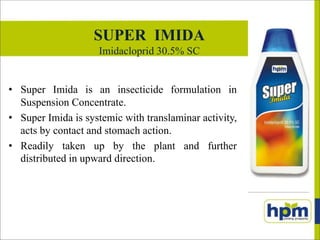
SUPER IMIDA
Imidacloprid 30.5% SC
• Super Imida is an insecticide formulation in
Suspension Concentrate.
• Super Imida is systemic with translaminar activity,
acts by contact and stomach action.
• Readily taken up by the plant and further
distributed in upward direction.
• Has instant dispersion when it added to water and does not
allow the spray solution to settle down for a longer period,
thereby no frequent agitation required during the spray.
• It reduces surface runoff and provides uniform coverage over
the foliages with enhanced penetration & stability.
• Super Imida found to be very effective up to 10 - 14 days after
application.
• The MRL of SUPER IMIDA in Rice & Cotton seed oil has
already been fixed by Central Committee for Food Standards
[CCFS] as 0.05 ppm.
• SUPER IMIDA does not have any adverse effect on the
population of common natural enemies like Coccinella,
Chrysoperla, etc.
Method of Use
• Shake the SUPER IMIDA bottle vigorously for 2 - 5 minutes
to form a homogeneous mixture before dilution.
• Mix the homogeneous mixture formed in water as per
recommendations.
• The prepared mixture should be sprayed within 30-40 minutes
after preparing the mixture.
RECOMMENDATIONS
Crop Name of the Pest Dosage / acre
[ml]
Dilution
in water
[Litres]
Cotton /
Bt-Cotton
Aphids, Jassids & Thrips
30-50
150-200
Rice
Brown Plant Hopper [BPH]
&
White backed Plant Hopper
[WBPH]
150-200
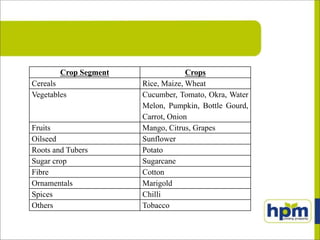
Crop Segment Crops
Cereals Rice, Maize, Wheat
Vegetables Cucumber, Tomato, Okra, Water
Melon, Pumpkin, Bottle Gourd,
Carrot, Onion
Fruits Mango, Citrus, Grapes
Oilseed Sunflower
Roots and Tubers Potato
Sugar crop Sugarcane
Fibre Cotton
Ornamentals Marigold
Spices Chilli
Others Tobacco
Major Pests
Aphids
• It is active in May to November.
• Life cycle - 8 - 10 days
Damage:
• Both young and adult suck plant sap
• The plant becomes weak
• Tender shoots and leaves become yellowish
and then dries up.
Insecticide Dosage/ acre
Super Imida 30-50 ml
Aphids
Jassids
• Attacks through out crop life
• Eggs hatch in about 4-11 days
• Young nymphs feed on leaf sap for 7-12 days
• The winged adults live for 35-50 days feeding
constantly on plant sap
• It completes 7 generations in a year
Damage:
• The adults and nymphs suck sap from leaves
which turn yellow or reddish brown
• The leaf curls downwards, dries up and falls
Insecticide Dosage/ acre
Super Imida 30-50 ml
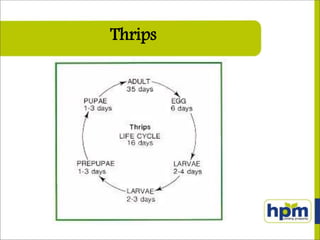
Thrips
• It is found through out the year.
• It breeds on cotton from May to September.
Damage:
• The thrips and its nymphs lacerate the surface
tissues of the foliage and suck the exuding sap
• In severe infestation, the plant appears
blighted and occasionally dries up
Insecticide Dosage/ acre
Super Imida 30-50 ml
Thrips
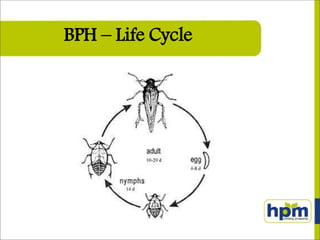
Brown Plant Hopper
• Nymphs and adults congregate
at the base of the plant above
the water level.
• The insect sucks the sap and
the leaves turn brown.
• Affected plant dries up and
gives a scorched appearance
called “hopper burn”.
• Circular patches of drying and
lodging of matured plant
• It is vector of grassy stunt,
ragged stunt and wilted stunt
diseases
Major characteristics of BPH populations
 Discrete period of seasonal appearance
 Low initial density
 Steep and steady population growth
 Clumped spatial distribution
 Violent density fluctuations from year to year
BPH – Life Cycle
White backed Plant Hopper
• Nymph - White in colour and
pronotum is pale yellow.
• Adult - Possess a diamond
like marking on the thorax
and ovipositional site is black
streaks.
• Suck the sap and cause
stunted growth.
• “Hopper burn” is caused in
irregular patches.
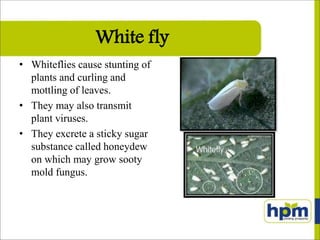
White fly
• Whiteflies cause stunting of
plants and curling and
mottling of leaves.
• They may also transmit
plant viruses.
• They excrete a sticky sugar
substance called honeydew
on which may grow sooty
mold fungus.
Termites
• Sugarcane
 Poor germination of setts
(After Planting).
 Characteristic semi-
circular feeding marks on the leaves
in the standing crop.
 Entire shoot dries up and can be pulled
out easily.
 Setts hollow inside and may be filled
with soil.
 Cane collapses if disturbed
 Rind filled with mud.
www.agritech.tnau.ac.in
Effect of Pests on different crops
Aphid attack on COTTON
Jassid attack on COTTON
Thrips attack on COTTON
Brown Plant Hopper attack in
PADDY
Aphids in CHILLI
Damage in CHILLI by
Thrips
Aphids in OKRA Jassids in OKRA
Hoppers in MANGO
Aphids in TOMATO
Thrips in TOMATO
Leaf hopper in POTATO
Thrips in ONION Leaf miner in ONION
Jassid in SUNFLOWER White fly in SUNFLOWER
Aphid in PUMPKIN
Thank You

Super imida large

  • 1.
  • 2.
    IMIDACLOPRID • Imidacloprid basedinsecticide formulations are available as dustable powder, granular, suspension concentrate, wettable powder. seed dressing (flowable slurry concentrate), soluble concentrate,
  • 3.
    IMIDACLOPRID • is asystemic • with translaminar activity • with contact and stomach action • Readily taken up by the plant and further distributed acropetally, with good root- systemic action • chloro-nicotinyl insecticide with soil, seed and foliar uses
  • 4.
    Pests and crops •for the control of sucking insects including rice hoppers, aphids, thrips, whiteflies, termites, turf insects, soil insects and some beetles • It is most commonly used on paddy, cotton, wheat, maize, potatoes, sugarcane, vegetables, fruits • It is especially systemic when used as a seed or soil treatment
  • 5.
    • The applicationrates are considerably lower than older, traditionally used insecticides • It can be phytotoxic if it is not used according to manufacturer's specifications • It has been shown to be compatible with fungicides when used as a seed treatment to control insect pests
  • 6.
    Mode of Action •The chemical works by interfering with the transmission of stimuli in the insect nervous system • It causes a blockage in a type of neuronal pathway (nicotinergic) that is more abundant in insects than in warm-blooded animals (making the chemical selectively more toxic to insects than warm-blooded animals). • This blockage leads to the accumulation of acetylcholine, an important neurotransmitter, resulting in the insect's paralysis, and eventually death. • It is effective on contact and via stomach action.
  • 7.
    Toxicity • Imidacloprid ismoderately toxic. • It is considered non-irritating to eyes and skin, and non-sensitizing to skin • Some granular formulations may contain clays as inert ingredients that may act as eye irritants
  • 8.
    SUPER IMIDA Imidacloprid 30.5%SC • Super Imida is an insecticide formulation in Suspension Concentrate. • Super Imida is systemic with translaminar activity, acts by contact and stomach action. • Readily taken up by the plant and further distributed in upward direction.
  • 9.
    • Has instantdispersion when it added to water and does not allow the spray solution to settle down for a longer period, thereby no frequent agitation required during the spray. • It reduces surface runoff and provides uniform coverage over the foliages with enhanced penetration & stability. • Super Imida found to be very effective up to 10 - 14 days after application.
  • 10.
    • The MRLof SUPER IMIDA in Rice & Cotton seed oil has already been fixed by Central Committee for Food Standards [CCFS] as 0.05 ppm. • SUPER IMIDA does not have any adverse effect on the population of common natural enemies like Coccinella, Chrysoperla, etc.
  • 11.
    Method of Use •Shake the SUPER IMIDA bottle vigorously for 2 - 5 minutes to form a homogeneous mixture before dilution. • Mix the homogeneous mixture formed in water as per recommendations. • The prepared mixture should be sprayed within 30-40 minutes after preparing the mixture.
  • 12.
    RECOMMENDATIONS Crop Name ofthe Pest Dosage / acre [ml] Dilution in water [Litres] Cotton / Bt-Cotton Aphids, Jassids & Thrips 30-50 150-200 Rice Brown Plant Hopper [BPH] & White backed Plant Hopper [WBPH] 150-200
  • 13.
    Crop Segment Crops CerealsRice, Maize, Wheat Vegetables Cucumber, Tomato, Okra, Water Melon, Pumpkin, Bottle Gourd, Carrot, Onion Fruits Mango, Citrus, Grapes Oilseed Sunflower Roots and Tubers Potato Sugar crop Sugarcane Fibre Cotton Ornamentals Marigold Spices Chilli Others Tobacco
  • 14.
  • 15.
    Aphids • It isactive in May to November. • Life cycle - 8 - 10 days Damage: • Both young and adult suck plant sap • The plant becomes weak • Tender shoots and leaves become yellowish and then dries up. Insecticide Dosage/ acre Super Imida 30-50 ml
  • 16.
  • 17.
    Jassids • Attacks throughout crop life • Eggs hatch in about 4-11 days • Young nymphs feed on leaf sap for 7-12 days • The winged adults live for 35-50 days feeding constantly on plant sap • It completes 7 generations in a year Damage: • The adults and nymphs suck sap from leaves which turn yellow or reddish brown • The leaf curls downwards, dries up and falls Insecticide Dosage/ acre Super Imida 30-50 ml
  • 18.
    Thrips • It isfound through out the year. • It breeds on cotton from May to September. Damage: • The thrips and its nymphs lacerate the surface tissues of the foliage and suck the exuding sap • In severe infestation, the plant appears blighted and occasionally dries up Insecticide Dosage/ acre Super Imida 30-50 ml
  • 19.
  • 20.
    Brown Plant Hopper •Nymphs and adults congregate at the base of the plant above the water level. • The insect sucks the sap and the leaves turn brown. • Affected plant dries up and gives a scorched appearance called “hopper burn”. • Circular patches of drying and lodging of matured plant • It is vector of grassy stunt, ragged stunt and wilted stunt diseases
  • 21.
    Major characteristics ofBPH populations  Discrete period of seasonal appearance  Low initial density  Steep and steady population growth  Clumped spatial distribution  Violent density fluctuations from year to year
  • 22.
  • 23.
    White backed PlantHopper • Nymph - White in colour and pronotum is pale yellow. • Adult - Possess a diamond like marking on the thorax and ovipositional site is black streaks. • Suck the sap and cause stunted growth. • “Hopper burn” is caused in irregular patches.
  • 24.
    White fly • Whitefliescause stunting of plants and curling and mottling of leaves. • They may also transmit plant viruses. • They excrete a sticky sugar substance called honeydew on which may grow sooty mold fungus.
  • 25.
    Termites • Sugarcane  Poorgermination of setts (After Planting).  Characteristic semi- circular feeding marks on the leaves in the standing crop.  Entire shoot dries up and can be pulled out easily.  Setts hollow inside and may be filled with soil.  Cane collapses if disturbed  Rind filled with mud. www.agritech.tnau.ac.in
  • 26.
    Effect of Pestson different crops
  • 27.
  • 28.
  • 29.
  • 30.
    Brown Plant Hopperattack in PADDY
  • 31.
    Aphids in CHILLI Damagein CHILLI by Thrips
  • 32.
    Aphids in OKRAJassids in OKRA
  • 33.
  • 34.
  • 35.
  • 36.
  • 37.
    Thrips in ONIONLeaf miner in ONION
  • 38.
    Jassid in SUNFLOWERWhite fly in SUNFLOWER
  • 39.
  • 40.