Xiaobin Zhang, zhangxbk@cnsuning.com
Long Jin, jinlongb@cnsuning.com
Qiming Teng, tengqim@cn.ibm.com
• Suning Overview
• Suning OpenStack Journey
• Suning Cloud Workload
• Lessons Learnt
• Wishlists
2
• Basic Information
• Established in 1990
• The largest commercial enterprise in China
• Top 3 Chinese private enterprises
• The 50th among the Top 500 enterprises in China
• Business Lines
• retail, logistics, supply chain, real estates, investments, ...
• By the end of 2012
• Suning has stores in 700+ cities in China and other countries.
• The total number of staff is 180,000
• 4 R&D centers: Beijing, Shanghai, Nanjing, Silicon Valley
• Brand value of $ 13 B, annual revenue $ 37 B
3
$ 175 Billion
43.9% YTY Growth
1H 2014, China
• Opportunities
• Improve Efficiency, Collaboration Paradigms and Business Models
• Traditional e-Commerce  O2O (Online-to-Offline)  Cloudified Whole Value Chain
4
PERSONALIZED
SHOPPING
EXPERIENCES
EFFICIENT
MERCHANDISING AND
SUPPLY NETWORK
TRANSFORM AND
OPTIMIZE OPERATIONS
OPERATING
EFFICIENCY
REVENUE
GROWTH
ECOSYSTEM
DOMINATION
Suning Private Cloud
• Multiple Data Centers
• 1000s of Hosts
• 10x1000s of Virtual Machines
• Rich & Customized Middleware
• Automated Deployment / Operation
• Workflow Consolidation
5
Suning Public Cloud
• Cloud Server
• VPC
• Shared, Object Storage
• Cloud Database
• Fast Deployment
• Monitoring and Billing
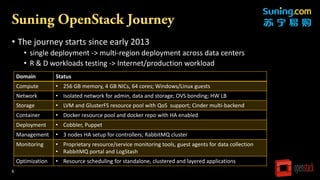
• The journey starts since early 2013
• single deployment -> multi-region deployment across data centers
• R & D workloads testing -> Internet/production workload
6
Domain Status
Compute • 256 GB memory, 4 GB NICs, 64 cores; Windows/Linux guests
Network • Isolated network for admin, data and storage; OVS bonding; HW LB
Storage • LVM and GlusterFS resource pool with QoS support; Cinder multi-backend
Container • Docker resource pool and docker repo with HA enabled
Deployment • Cobbler, Puppet
Management • 3 nodes HA setup for controllers; RabbitMQ cluster
Monitoring • Proprietary resource/service monitoring tools, guest agents for data collection
• RabbitMQ portal and LogStash
Optimization • Resource scheduling for standalone, clustered and layered applications
• 100+ applications of diverse characteristics
• Mixed CPU-intensive and I/O Intensive workload:
• CPU-intensive, long-hour duration mobile application compilation and building
• huge storage and volume (800G ~ 1T)
• search engine compilation
• big data analytics, e.g. sentiment analysis
• thumbnail generation
• Different software stacks for Internet applications
• Apache + JBoss + MySQL
• IHS + WAS + DB2
• Others
7
8
Web /
Frond-End
AppServer /
Middle-Tier
Database /
Back-End
• Optionally Clustering
• Optionally Auto-Scaling
• Dispatch to different hosts,
regions, networks, ...
• Optionally Clustering
• Optionally Auto-Scaling
• Schedule to different hosts,
regions, networks, ...
• Short upgrade cycle: 1-4
weeks (not whole system)
• Optionally Active/Passive
• Dispatch to different hosts,
networks, regions, ...
Dynamic Discovery
Live Registration
Request Granularity
Dynamic Discovery
Live Registration
Transaction Dispatching
• A component/service may play different roles
• Apache: web-server and/or reverse-proxy and/or load-balancer
• JBoss: front-end, back-end or both
• Master agent, Host agent, JBoss instances
• Service discovery and registration is complex
• IT requirements like SSH key, service user, password, directory, package repository…
• Legacy script and automation tools (taking in or discard)
• Workload distribution has to be planned ahead
• traditional process forking is not acceptable on a virtualized platform
• VMs become the management unit on cloud
• tuning specs: quota, profile, application characteristics
• scaling VMs instead of forking new processes
9
• An orchestrator sitting above compute, storage and network
• Template based VM provisioning, aka. stack creation
• Heat’s auto-scaling solution is valuable for Suning's Internet applications
• A standardized approach of cloud application deployment
• and orchestration?
10
milk powder: 5 million cans milk: 100 containers promotion season: 3 days
• Standard images and software packages
• Post-launch configuration
• creation of user accounts
• key distribution and revocation
• VM roles assignment
• package update or upgrade
• middleware install and configuration
• application install and configuration
• monitoring tools install and configuration
• service discover and registration ???
• .......
11
• Deployment and Orchestration
• Heat based deployment only covers part of the story
• Cloud-init only concerns with the initial deployment
• What we need is an integrated end-to-end tool chain
that covers runtime/maintenance orchestration as well
12
• Orchestration is not thoroughly tested in community (e.g. Auto-scaling)
• involves Heat, Ceilometer, Nova, Keystone...
• rolling-update may not work as expected
• scaling out may jump from one to many directly
• ceilometer alarm evaluator may not work
• ...
• fixing these is not an easy job
• Triggers for scaling
• network metrics (packets processed, bytes transferred) sounds interesting, but
• CPU and memory are still the primary bottlenecks
• Scaling may be triggered with combination factors of CPU, memory, disk I/O and/or
network I/O with customized algorithm
• Rolling update is of critical importance
• ensure a given number of instances are always online when performing updates
• Deletion policy from resource groups
• sometimes the newest members are preferred to oldest members, considering that
• old members may have state cached, may have proved to be stable, ...
• Fast detection and fast scaling (seconds level)
13
• Availability
• Storage Reliability/Availability
• Hard disk errors are common
• VM High-Availability (aka. the "Pets" story)
• it doesn't seem like a single project mission
• host failure, network failure, storage failure, guest failure, application failure ...
• may need to get Nova, Ceilometer (Zaqar?), Heat, Keystone to work together
• AutoScaling
• Semi-AutoScaling (Scale at a given point in time)
• Smarter VM placement, aka. Global Scheduling
• e.g. 3 Apache server per host is okay, but 9 Apache per host is risky
• VM placement is mainly concerned with service availability
• Scaling across availability zones, across regions
14
• Application Profile and Management
• Each application has a unique architecture where some components are reusable
• Most components are capable of playing different roles (e.g. front-end vs back-end)
• domain role, slave role, host role, etc.
• Combinations are difficult to predict and manage
• Solum? Murano?
• Provider Templates?
+ promote template reusability
+ facilitate fine granularity version control
- difficult to reference resources (attributes) from outer/inner templates
- difficult to get dependencies done right
- Tools to standardize Heat template collections
15
• Configurable frequency for Heat engine calls
• mostly from os-xxx-config
• may need a short interval during bootup, then switch to a longer interval
• Tools and guidance for the establishment of standard workflows
• need to abstract away common features and parameters
• need to simplify the deployment, management process
• need to adapt to new technologies
• e.g. transition from using shared disk volumes to use storage cloud
16
Thank You!
17

Suning OpenStack Cloud and Heat

  • 1.
    Xiaobin Zhang, zhangxbk@cnsuning.com LongJin, jinlongb@cnsuning.com Qiming Teng, tengqim@cn.ibm.com
  • 2.
    • Suning Overview •Suning OpenStack Journey • Suning Cloud Workload • Lessons Learnt • Wishlists 2
  • 3.
    • Basic Information •Established in 1990 • The largest commercial enterprise in China • Top 3 Chinese private enterprises • The 50th among the Top 500 enterprises in China • Business Lines • retail, logistics, supply chain, real estates, investments, ... • By the end of 2012 • Suning has stores in 700+ cities in China and other countries. • The total number of staff is 180,000 • 4 R&D centers: Beijing, Shanghai, Nanjing, Silicon Valley • Brand value of $ 13 B, annual revenue $ 37 B 3 $ 175 Billion 43.9% YTY Growth 1H 2014, China
  • 4.
    • Opportunities • ImproveEfficiency, Collaboration Paradigms and Business Models • Traditional e-Commerce  O2O (Online-to-Offline)  Cloudified Whole Value Chain 4 PERSONALIZED SHOPPING EXPERIENCES EFFICIENT MERCHANDISING AND SUPPLY NETWORK TRANSFORM AND OPTIMIZE OPERATIONS OPERATING EFFICIENCY REVENUE GROWTH ECOSYSTEM DOMINATION
  • 5.
    Suning Private Cloud •Multiple Data Centers • 1000s of Hosts • 10x1000s of Virtual Machines • Rich & Customized Middleware • Automated Deployment / Operation • Workflow Consolidation 5 Suning Public Cloud • Cloud Server • VPC • Shared, Object Storage • Cloud Database • Fast Deployment • Monitoring and Billing
  • 6.
    • The journeystarts since early 2013 • single deployment -> multi-region deployment across data centers • R & D workloads testing -> Internet/production workload 6 Domain Status Compute • 256 GB memory, 4 GB NICs, 64 cores; Windows/Linux guests Network • Isolated network for admin, data and storage; OVS bonding; HW LB Storage • LVM and GlusterFS resource pool with QoS support; Cinder multi-backend Container • Docker resource pool and docker repo with HA enabled Deployment • Cobbler, Puppet Management • 3 nodes HA setup for controllers; RabbitMQ cluster Monitoring • Proprietary resource/service monitoring tools, guest agents for data collection • RabbitMQ portal and LogStash Optimization • Resource scheduling for standalone, clustered and layered applications
  • 7.
    • 100+ applicationsof diverse characteristics • Mixed CPU-intensive and I/O Intensive workload: • CPU-intensive, long-hour duration mobile application compilation and building • huge storage and volume (800G ~ 1T) • search engine compilation • big data analytics, e.g. sentiment analysis • thumbnail generation • Different software stacks for Internet applications • Apache + JBoss + MySQL • IHS + WAS + DB2 • Others 7
  • 8.
    8 Web / Frond-End AppServer / Middle-Tier Database/ Back-End • Optionally Clustering • Optionally Auto-Scaling • Dispatch to different hosts, regions, networks, ... • Optionally Clustering • Optionally Auto-Scaling • Schedule to different hosts, regions, networks, ... • Short upgrade cycle: 1-4 weeks (not whole system) • Optionally Active/Passive • Dispatch to different hosts, networks, regions, ... Dynamic Discovery Live Registration Request Granularity Dynamic Discovery Live Registration Transaction Dispatching
  • 9.
    • A component/servicemay play different roles • Apache: web-server and/or reverse-proxy and/or load-balancer • JBoss: front-end, back-end or both • Master agent, Host agent, JBoss instances • Service discovery and registration is complex • IT requirements like SSH key, service user, password, directory, package repository… • Legacy script and automation tools (taking in or discard) • Workload distribution has to be planned ahead • traditional process forking is not acceptable on a virtualized platform • VMs become the management unit on cloud • tuning specs: quota, profile, application characteristics • scaling VMs instead of forking new processes 9
  • 10.
    • An orchestratorsitting above compute, storage and network • Template based VM provisioning, aka. stack creation • Heat’s auto-scaling solution is valuable for Suning's Internet applications • A standardized approach of cloud application deployment • and orchestration? 10 milk powder: 5 million cans milk: 100 containers promotion season: 3 days
  • 11.
    • Standard imagesand software packages • Post-launch configuration • creation of user accounts • key distribution and revocation • VM roles assignment • package update or upgrade • middleware install and configuration • application install and configuration • monitoring tools install and configuration • service discover and registration ??? • ....... 11
  • 12.
    • Deployment andOrchestration • Heat based deployment only covers part of the story • Cloud-init only concerns with the initial deployment • What we need is an integrated end-to-end tool chain that covers runtime/maintenance orchestration as well 12 • Orchestration is not thoroughly tested in community (e.g. Auto-scaling) • involves Heat, Ceilometer, Nova, Keystone... • rolling-update may not work as expected • scaling out may jump from one to many directly • ceilometer alarm evaluator may not work • ... • fixing these is not an easy job
  • 13.
    • Triggers forscaling • network metrics (packets processed, bytes transferred) sounds interesting, but • CPU and memory are still the primary bottlenecks • Scaling may be triggered with combination factors of CPU, memory, disk I/O and/or network I/O with customized algorithm • Rolling update is of critical importance • ensure a given number of instances are always online when performing updates • Deletion policy from resource groups • sometimes the newest members are preferred to oldest members, considering that • old members may have state cached, may have proved to be stable, ... • Fast detection and fast scaling (seconds level) 13
  • 14.
    • Availability • StorageReliability/Availability • Hard disk errors are common • VM High-Availability (aka. the "Pets" story) • it doesn't seem like a single project mission • host failure, network failure, storage failure, guest failure, application failure ... • may need to get Nova, Ceilometer (Zaqar?), Heat, Keystone to work together • AutoScaling • Semi-AutoScaling (Scale at a given point in time) • Smarter VM placement, aka. Global Scheduling • e.g. 3 Apache server per host is okay, but 9 Apache per host is risky • VM placement is mainly concerned with service availability • Scaling across availability zones, across regions 14
  • 15.
    • Application Profileand Management • Each application has a unique architecture where some components are reusable • Most components are capable of playing different roles (e.g. front-end vs back-end) • domain role, slave role, host role, etc. • Combinations are difficult to predict and manage • Solum? Murano? • Provider Templates? + promote template reusability + facilitate fine granularity version control - difficult to reference resources (attributes) from outer/inner templates - difficult to get dependencies done right - Tools to standardize Heat template collections 15
  • 16.
    • Configurable frequencyfor Heat engine calls • mostly from os-xxx-config • may need a short interval during bootup, then switch to a longer interval • Tools and guidance for the establishment of standard workflows • need to abstract away common features and parameters • need to simplify the deployment, management process • need to adapt to new technologies • e.g. transition from using shared disk volumes to use storage cloud 16
  • 17.