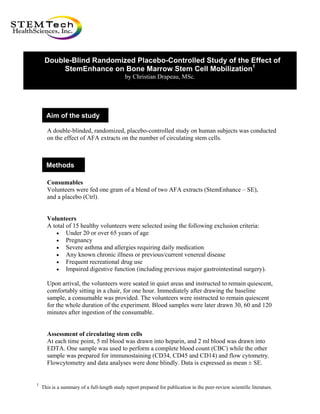
Double-Blind Randomized Placebo-Controlled Study of the Effect of
          StemEnhance on Bone Marrow Stem Cell Mobilization1
                                             by Christian Drapeau, MSc.


      Aim of the study

      A double-blinded, randomized, placebo-controlled study on human subjects was conducted
      on the effect of AFA extracts on the number of circulating stem cells.


      Methods

      Consumables
      Volunteers were fed one gram of a blend of two AFA extracts (StemEnhance – SE),
      and a placebo (Ctrl).


      Volunteers
      A total of 15 healthy volunteers were selected using the following exclusion criteria:
         • Under 20 or over 65 years of age
          • Pregnancy
          • Severe asthma and allergies requiring daily medication
          • Any known chronic illness or previous/current venereal disease
          • Frequent recreational drug use
          • Impaired digestive function (including previous major gastrointestinal surgery).

      Upon arrival, the volunteers were seated in quiet areas and instructed to remain quiescent,
      comfortably sitting in a chair, for one hour. Immediately after drawing the baseline
      sample, a consumable was provided. The volunteers were instructed to remain quiescent
      for the whole duration of the experiment. Blood samples were later drawn 30, 60 and 120
      minutes after ingestion of the consumable.


      Assessment of circulating stem cells
      At each time point, 5 ml blood was drawn into heparin, and 2 ml blood was drawn into
      EDTA. One sample was used to perform a complete blood count (CBC) while the other
      sample was prepared for immunostaining (CD34, CD45 and CD14) and flow cytometry.
      Flowcytometry and data analyses were done blindly. Data is expressed as mean ± SE.


1
    This is a summary of a full-length study report prepared for publication in the peer-review scientific literature.
Results

Consumption of SE led to an increase in                      130%                                        SE
the number of circulating CD34+ cells,
                                                                                 p<0.003                 Ctrl
while consumption of the placebo did not                                         121%
lead to any statistically significant effect.                120%

Since the overall time for the absorption


                                                % of Start
of bioactive compounds, delivery to                          110%
target organs, and the generation a
quantifiable physiological response may
be different depending on each                               100%
volunteer’s overall physiology, we
calculated the maximum response of SE
at any one point in time, within 60                          90%
minutes of consumption. We found a 24                               0       30         60       90       120
± 5 % increase (median = 27%) in the
                                                                                   Time (min)
number of circulating stem cells with SE.
If we include data obtained during a dose                    Figure 1. Time course of the number of CD34+ cells in
study performed in May 2005, the average                     peripheral blood after consumption (arrow) of SE and
maximum response raises to 30 ± 6%.                          placebo (Crtl). Data are expressed as % of starting value.
                                                             Bars express standard error.


Discussion

This study confirmed that SE is effective at supporting the release of stem cells from the
bone marrow, increasing the number of circulating stem cells (CD34+ cells). The data
collected show that SE increases the number of circulating stem cells by up to 30%.

Physiological relevance of the observed stem cell mobilization
In this study the average number of lymphocytes was 1,978 per µL and the average
proportion of CD34+ cells at time 0 was 0.12%, for an average number of circulating
CD34+ cells of 2.4 per µL. An increase of 25% to 30%, as seen in this study, translates
to an average increase of 0.7 stem cells per µL, i.e. from 2.4 to 3.1 stem cells per µL.
Assuming 5.0 liters of blood, this corresponds to approximately 3.5 million new
circulating stem cells. The novelty of the concept of using endogenous release of bone
marrow stem cells to support optimal health is paralleled by a scarcity of data linking the
magnitude of mobilization with physiological relevance. Nevertheless, data exist to
estimate the physiological relevance of putting into circulation 3.5 million new stem
cells. Based on various studies (Orlic et al. 2001; Bodine et al., 1994; Bodine et al. 1993;
Vandelverde et al., 2005; Valgimigli et al., 2005) one can estimate that one gram of
StemEnhance can lead to potentially of up to a few billion somatic cells in target tissues.
Therefore the average increase of 25% to 30% obtained with SE in this study is likely to
have physiological relevance.


                                                2
References


Bodine DM, Seidel NE, Gale MS, Nienhuis AW, and. (1994) Efficient Retrovirus Transduction of Mouse
      Pluripotent Hematopoietic Stem Cells Mobilized Into the Peripheral Blood by Treatment With
      Granulocyte Colony-Stimulating Factor and Stem Cell Factor. Blood, 84(5): 1482-1491.

Bodine DM, Seidel NE, Zsebo KM, and Orlic D. (1993) In Vivo Administration of Stem Cell Factor to
      Mice Increases the Absolute Number of Pluripotent Hematopoietic Stem Cells. Blood, 82(2): 445-
      455.

Orlic D, Kajstura J, Chimenti S, Bodine DM, Leri A. & Anversa P. (2003) Bone marrow stem cells
       regenerate infarcted myocardium. Pediatr Transplantation 7 (Suppl. 3): 86–88.

Orlic D, Kajstura J, Chimenti S, Limana F, Jakoniuk I, Quaini F, Nadal-Ginard B, Bodine DM, Leri A. &
       Anversa P. (2001) Mobilized bone marrow cells repair the infracted heart, improving function and
       survival. PNAS 98(18):10344–10349.

Valgimigli M, Rigolin GM, Cittanti C, Malagutti P, Curello S, Percoco G, Bugli AM, Porta MD, Bragotti
      LZ, Ansani L, Mauro E, Lanfranchi A, Giganti M, Feggi L, Castoldi G, Ferrari R. (2005) Use of
      granulocyte-colony stimulating factor during acute myocardial infarction to enhance bone marrow
      stem cell mobilization in humans: clinical and angiographic safety profile. Eur Heart J. Apr 28.
      Epub.

Vandervelde S, van Luyn MJ, Tio RA, Harmsen MC. (2005) Signaling factors in stem cell-mediated repair
     of infarcted myocardium. J Mol Cell Cardiol. Jun 28. Epub.


                                                   3

Summaryofdoubleblindstudyv2

  • 1.
    Double-Blind Randomized Placebo-ControlledStudy of the Effect of StemEnhance on Bone Marrow Stem Cell Mobilization1 by Christian Drapeau, MSc. Aim of the study A double-blinded, randomized, placebo-controlled study on human subjects was conducted on the effect of AFA extracts on the number of circulating stem cells. Methods Consumables Volunteers were fed one gram of a blend of two AFA extracts (StemEnhance – SE), and a placebo (Ctrl). Volunteers A total of 15 healthy volunteers were selected using the following exclusion criteria: • Under 20 or over 65 years of age • Pregnancy • Severe asthma and allergies requiring daily medication • Any known chronic illness or previous/current venereal disease • Frequent recreational drug use • Impaired digestive function (including previous major gastrointestinal surgery). Upon arrival, the volunteers were seated in quiet areas and instructed to remain quiescent, comfortably sitting in a chair, for one hour. Immediately after drawing the baseline sample, a consumable was provided. The volunteers were instructed to remain quiescent for the whole duration of the experiment. Blood samples were later drawn 30, 60 and 120 minutes after ingestion of the consumable. Assessment of circulating stem cells At each time point, 5 ml blood was drawn into heparin, and 2 ml blood was drawn into EDTA. One sample was used to perform a complete blood count (CBC) while the other sample was prepared for immunostaining (CD34, CD45 and CD14) and flow cytometry. Flowcytometry and data analyses were done blindly. Data is expressed as mean ± SE. 1 This is a summary of a full-length study report prepared for publication in the peer-review scientific literature.
  • 2.
    Results Consumption of SEled to an increase in 130% SE the number of circulating CD34+ cells, p<0.003 Ctrl while consumption of the placebo did not 121% lead to any statistically significant effect. 120% Since the overall time for the absorption % of Start of bioactive compounds, delivery to 110% target organs, and the generation a quantifiable physiological response may be different depending on each 100% volunteer’s overall physiology, we calculated the maximum response of SE at any one point in time, within 60 90% minutes of consumption. We found a 24 0 30 60 90 120 ± 5 % increase (median = 27%) in the Time (min) number of circulating stem cells with SE. If we include data obtained during a dose Figure 1. Time course of the number of CD34+ cells in study performed in May 2005, the average peripheral blood after consumption (arrow) of SE and maximum response raises to 30 ± 6%. placebo (Crtl). Data are expressed as % of starting value. Bars express standard error. Discussion This study confirmed that SE is effective at supporting the release of stem cells from the bone marrow, increasing the number of circulating stem cells (CD34+ cells). The data collected show that SE increases the number of circulating stem cells by up to 30%. Physiological relevance of the observed stem cell mobilization In this study the average number of lymphocytes was 1,978 per µL and the average proportion of CD34+ cells at time 0 was 0.12%, for an average number of circulating CD34+ cells of 2.4 per µL. An increase of 25% to 30%, as seen in this study, translates to an average increase of 0.7 stem cells per µL, i.e. from 2.4 to 3.1 stem cells per µL. Assuming 5.0 liters of blood, this corresponds to approximately 3.5 million new circulating stem cells. The novelty of the concept of using endogenous release of bone marrow stem cells to support optimal health is paralleled by a scarcity of data linking the magnitude of mobilization with physiological relevance. Nevertheless, data exist to estimate the physiological relevance of putting into circulation 3.5 million new stem cells. Based on various studies (Orlic et al. 2001; Bodine et al., 1994; Bodine et al. 1993; Vandelverde et al., 2005; Valgimigli et al., 2005) one can estimate that one gram of StemEnhance can lead to potentially of up to a few billion somatic cells in target tissues. Therefore the average increase of 25% to 30% obtained with SE in this study is likely to have physiological relevance. 2
  • 3.
    References Bodine DM, SeidelNE, Gale MS, Nienhuis AW, and. (1994) Efficient Retrovirus Transduction of Mouse Pluripotent Hematopoietic Stem Cells Mobilized Into the Peripheral Blood by Treatment With Granulocyte Colony-Stimulating Factor and Stem Cell Factor. Blood, 84(5): 1482-1491. Bodine DM, Seidel NE, Zsebo KM, and Orlic D. (1993) In Vivo Administration of Stem Cell Factor to Mice Increases the Absolute Number of Pluripotent Hematopoietic Stem Cells. Blood, 82(2): 445- 455. Orlic D, Kajstura J, Chimenti S, Bodine DM, Leri A. & Anversa P. (2003) Bone marrow stem cells regenerate infarcted myocardium. Pediatr Transplantation 7 (Suppl. 3): 86–88. Orlic D, Kajstura J, Chimenti S, Limana F, Jakoniuk I, Quaini F, Nadal-Ginard B, Bodine DM, Leri A. & Anversa P. (2001) Mobilized bone marrow cells repair the infracted heart, improving function and survival. PNAS 98(18):10344–10349. Valgimigli M, Rigolin GM, Cittanti C, Malagutti P, Curello S, Percoco G, Bugli AM, Porta MD, Bragotti LZ, Ansani L, Mauro E, Lanfranchi A, Giganti M, Feggi L, Castoldi G, Ferrari R. (2005) Use of granulocyte-colony stimulating factor during acute myocardial infarction to enhance bone marrow stem cell mobilization in humans: clinical and angiographic safety profile. Eur Heart J. Apr 28. Epub. Vandervelde S, van Luyn MJ, Tio RA, Harmsen MC. (2005) Signaling factors in stem cell-mediated repair of infarcted myocardium. J Mol Cell Cardiol. Jun 28. Epub. 3