Colleen McGonigle, Barrie Rogers, Megan Summers
Bucknell University, Lewisburg PA 17837
Background Discussion
Methods
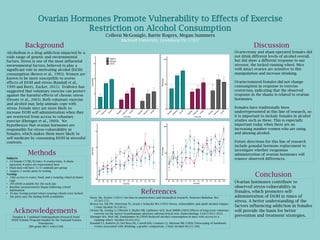
Ovariectomy and sham-operated females did
not drink different levels of alcohol overall,
but did show a different response to our
stressor, the locked running wheel. Mice
with intact ovaries are sensitive to this
manipulation and increase drinking.
Ovariectomized females did not change
consumption in response to exercise
restriction, indicating that the observed
response in the shams is related to ovarian
hormones.
Females have traditionally been
underrepresented in this line of research, so
it is important to include females in alcohol
studies such as these. This is especially
important today when there are an
increasing number women who are using
and abusing alcohol.
Future directions for this line of research
include gonadal hormone replacement to
investigate whether exogenous
administration of ovarian hormones will
remove observed differences.Subjects
•  24 female C57BL/6J mice: 8 ovariectomy, 8 sham-
operated, 8 naïve are represented here
•  Final data will have 11-13 animals per group
•  Surgery 2 weeks prior to testing
Testing
•  24hr access to water, food, and a running wheel in home
cage
•  20% EtOH available for 2hr each day
•  Baseline measurements began following a brief
habituation
•  10-day testing period where running wheels were locked
1hr prior and 2hr during EtOH availability
Alcoholism is a drug addiction impacted by a
wide range of genetic and environmental
factors. Stress is one of the most influential
environmental factors, believed to play a
significant role in motivating alcohol (EtOH)
consumption (Brown et al., 1995). Women are
known to be more susceptible to averse
effects of EtOH and stress (Randall et al.,
1999 and Beery, Zucker, 2011). Evidence has
suggested that voluntary exercise can protect
against the harmful effects of chronic stress
(Droste et al., 2003). Both voluntary exercise
and alcohol may help animals cope with
stress. Female mice are more likely to
increase EtOH self-administration when they
are restricted from access to voluntary
exercise (Ehringer et al., 2009). We
hypothesize that ovarian hormones are
responsible for stress-vulnerability in
females, which makes them more likely to
self-medicate by consuming EtOH in stressful
contexts.
References
Beery AK, Zucker I (2011) Sex bias in neuroscience and biomedical research. Neurosci Biobehav Rev
35:565-572.
Brown SA, Vik PW, Patterson TL, Grant I, Schuckit MA (1995) Stress, vulnerability and adult alcohol relapse.
J Stud Alcohol 56:538-45.
Droste SK, Gesing A, Ulbricht S, Muller MB, Linthorst ACE, Reul JMHM (2003) Effects of long-term voluntary
exercise on the mouse hypothalamic-pituitary-adrenocortical axis. Endocrinology 144(7):3012-3023.
Ehringer MA, Hoft NR, Zunhammer M (2009) Reduced alcohol consumption in mice with access to a
running wheel. Alcohol 43:443-452.
Randall CL, Roberts JS, Del Boca FK, Carroll KM, Connors CJ, Mattson ME (1999) Telescoping of landmark
events associated with drinking: a gender comparison. J Stud Alcohol 60:252-260.
Acknowledgements
Douglas K. Candland Undergraduate Research Fund
STEM Scholar Program funded by the National Science
Foundation.
NIH grant #R15 AA022506
Conclusion
Ovarian hormones contribute to
observed stress-vulnerability in
females, which promotes self-
administration of EtOH in times of
stress. A better understanding of the
factors influencing addiction in females
will provide the basis for better
prevention and treatment strategies.
Baseline
U
nlocked
Locked
Baseline
U
nlocked
Locked
Baseline
U
nlocked
Locked
0
2
4
6
Test Day
g/kgEtOH
OVX
Sham
Naive
Baseline
U
nlocked
Locked
Baseline
U
nlocked
Locked
Baseline
U
nlocked
Locked
0
50
100
Test Day
Percentage
B1 B2 B3 B4 U1 L2 U3 L4 U5 L6 U7 L8 U9 L10
0
2
4
6
Test Day
g/kgEtOH
B1 B2 B3 B4 U1 L2 U3 L4 U5 L6 U7 L8 U9 L10
0
50
100
Test Day
Percentage

OVX

  • 1.
    Colleen McGonigle, BarrieRogers, Megan Summers Bucknell University, Lewisburg PA 17837 Background Discussion Methods Ovariectomy and sham-operated females did not drink different levels of alcohol overall, but did show a different response to our stressor, the locked running wheel. Mice with intact ovaries are sensitive to this manipulation and increase drinking. Ovariectomized females did not change consumption in response to exercise restriction, indicating that the observed response in the shams is related to ovarian hormones. Females have traditionally been underrepresented in this line of research, so it is important to include females in alcohol studies such as these. This is especially important today when there are an increasing number women who are using and abusing alcohol. Future directions for this line of research include gonadal hormone replacement to investigate whether exogenous administration of ovarian hormones will remove observed differences.Subjects •  24 female C57BL/6J mice: 8 ovariectomy, 8 sham- operated, 8 naïve are represented here •  Final data will have 11-13 animals per group •  Surgery 2 weeks prior to testing Testing •  24hr access to water, food, and a running wheel in home cage •  20% EtOH available for 2hr each day •  Baseline measurements began following a brief habituation •  10-day testing period where running wheels were locked 1hr prior and 2hr during EtOH availability Alcoholism is a drug addiction impacted by a wide range of genetic and environmental factors. Stress is one of the most influential environmental factors, believed to play a significant role in motivating alcohol (EtOH) consumption (Brown et al., 1995). Women are known to be more susceptible to averse effects of EtOH and stress (Randall et al., 1999 and Beery, Zucker, 2011). Evidence has suggested that voluntary exercise can protect against the harmful effects of chronic stress (Droste et al., 2003). Both voluntary exercise and alcohol may help animals cope with stress. Female mice are more likely to increase EtOH self-administration when they are restricted from access to voluntary exercise (Ehringer et al., 2009). We hypothesize that ovarian hormones are responsible for stress-vulnerability in females, which makes them more likely to self-medicate by consuming EtOH in stressful contexts. References Beery AK, Zucker I (2011) Sex bias in neuroscience and biomedical research. Neurosci Biobehav Rev 35:565-572. Brown SA, Vik PW, Patterson TL, Grant I, Schuckit MA (1995) Stress, vulnerability and adult alcohol relapse. J Stud Alcohol 56:538-45. Droste SK, Gesing A, Ulbricht S, Muller MB, Linthorst ACE, Reul JMHM (2003) Effects of long-term voluntary exercise on the mouse hypothalamic-pituitary-adrenocortical axis. Endocrinology 144(7):3012-3023. Ehringer MA, Hoft NR, Zunhammer M (2009) Reduced alcohol consumption in mice with access to a running wheel. Alcohol 43:443-452. Randall CL, Roberts JS, Del Boca FK, Carroll KM, Connors CJ, Mattson ME (1999) Telescoping of landmark events associated with drinking: a gender comparison. J Stud Alcohol 60:252-260. Acknowledgements Douglas K. Candland Undergraduate Research Fund STEM Scholar Program funded by the National Science Foundation. NIH grant #R15 AA022506 Conclusion Ovarian hormones contribute to observed stress-vulnerability in females, which promotes self- administration of EtOH in times of stress. A better understanding of the factors influencing addiction in females will provide the basis for better prevention and treatment strategies. Baseline U nlocked Locked Baseline U nlocked Locked Baseline U nlocked Locked 0 2 4 6 Test Day g/kgEtOH OVX Sham Naive Baseline U nlocked Locked Baseline U nlocked Locked Baseline U nlocked Locked 0 50 100 Test Day Percentage B1 B2 B3 B4 U1 L2 U3 L4 U5 L6 U7 L8 U9 L10 0 2 4 6 Test Day g/kgEtOH B1 B2 B3 B4 U1 L2 U3 L4 U5 L6 U7 L8 U9 L10 0 50 100 Test Day Percentage