Summarize Analyze
Evaluate Synthesize
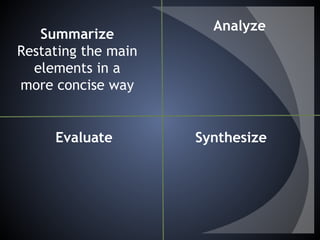
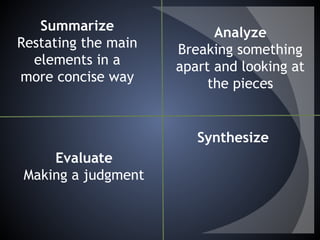
Summarize
Restating the main
elements in a
more concise way
Analyze
Evaluate Synthesize
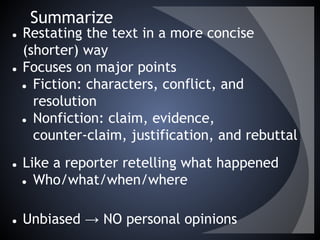
Summarize
● Restating the text in a more concise
(shorter) way
● Focuses on major points
● Fiction: characters, conflict, and
resolution
● Nonfiction: claim, evidence,
counter-claim, justification, and rebuttal
● Like a reporter retelling what happened
● Who/what/when/where
● Unbiased → NO personal opinions
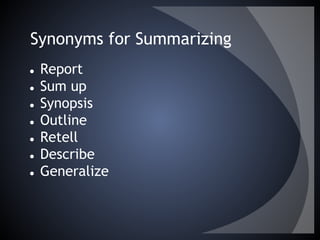
Synonyms for Summarizing
● Report
● Sum up
● Synopsis
● Outline
● Retell
● Describe
● Generalize
How do I know if I’m summarizing?
● Am I stating something that would be
obvious to a reader or viewer?
● Does my essay move in chronological
order, or in the exact same order the
author used?
● Am I simply describing what happens?
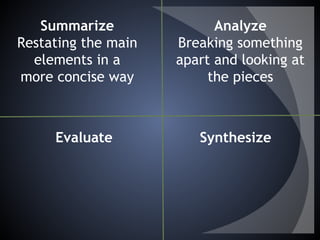
Summarize
Restating the main
elements in a
more concise way
Analyze
Breaking something
apart and looking at
the pieces
Evaluate Synthesize
Analyze
● Examine purposefully and in detail the
structure of something for purposes of
explanation and interpretation
● Explaining – to clearly share a reason
● Interpreting – creating your own
understanding of what the author is doing
and why
● Looks at all aspects but does NOT make a
judgment about it
Analyze
● Focuses on why and how the writing is done
● Relationships, trends, patterns
● Roles of people, places, objects, situations
● Gains and losses
● Consequences or results of events, decisions and
processes
Synonyms for Analyzing
● Dissect
● Consider
● Investigate
● Interpret
● Break down
● Categorize
● Compare/Contrast
● Distinguish
● Examine
● Separate
● Select
● Explain
How do I know if I’m analyzing?
● Am I making an original argument
about the text?
● Have I arranged my evidence around
my own points, rather than just
following the plot's order?
● Am I explaining why or how an aspect
of the text is significant?
Try It Out!
Analyze the following poem:
Hickory dickory dock,
The mouse ran up the clock.
The clock struck one,
The mouse ran down,
Hickory dickory dock.
Try It Out!
Analyze the following poem:
Hickory dickory dock,
The mouse ran up the clock.
The clock struck one,
The mouse ran down,
Hickory dickory dock.
The rhyme scheme in the poem “Hickory Dickory
Dock” causes it to be memorable. The rhyme scheme
is A,A,B, C, A. Using rhyming words to end lines 1, 2,
& 3 makes these lines stick in the reader’s mind.
Summarize
Restating the main
elements in a
more concise way
Analyze
Breaking something
apart and looking at
the pieces
Evaluate
Making a judgment
Synthesize
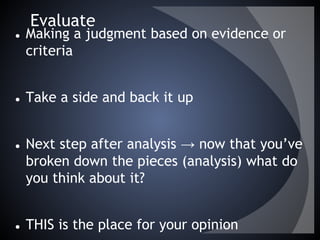
Evaluate
● Making a judgment based on evidence or
criteria
● Take a side and back it up
● Next step after analysis → now that you’ve
broken down the pieces (analysis) what do
you think about it?
● THIS is the place for your opinion
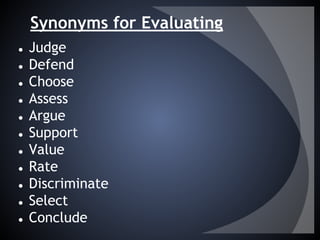
Synonyms for Evaluating
● Judge
● Defend
● Choose
● Assess
● Argue
● Support
● Value
● Rate
● Discriminate
● Select
● Conclude
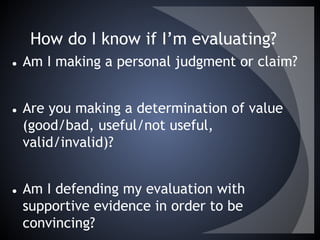
How do I know if I’m evaluating?
● Am I making a personal judgment or claim?
● Are you making a determination of value
(good/bad, useful/not useful,
valid/invalid)?
● Am I defending my evaluation with
supportive evidence in order to be
convincing?
Try It Out!
Evaluate the following poem:
Hickory dickory dock,
The mouse ran up the clock.
The clock struck one,
The mouse ran down,
Hickory dickory dock.
Try It Out!
Evaluate the following poem:
Hickory dickory dock,
The mouse ran up the clock.
The clock struck one,
The mouse ran down,
Hickory dickory dock.
The rhyme scheme in the poem “Hickory Dickory
Dock” causes it to be a quality poem. The rhyme
scheme is A,A,B, C, A. Using rhyming words to end
lines 1, 2, & 3 makes these lines stick in the reader’s
mind. Because these lines stay in the reader’s mind,
the poem is good poem.
Summarize
Restating the main
elements in a
more concise way
Analyze
Breaking something
apart and looking at
the pieces
Evaluate
Making a judgment
Synthesize
Take separate ideas
and put them
together to make
something new
Synthesize
● Take separate ideas and put them
together to make something new
● Explaining a concept or event with
information from multiple sources
● Finding common threads
● Blending different ideas together into one
new idea of your own
Synonyms for Synthesizing
● Assemble
● Compose
● Create
● Design
● Develop
● Generate
● Prepare
● Reorganize
● Rewrite
● Revise
● Construct
● Combine
How do I know if I’m synthesizing?
Am I looking at information or ideas
from more than one place?
● Am I putting different ideas together
(integrating) into something new?
● Am I finding common threads and
making generalizations?
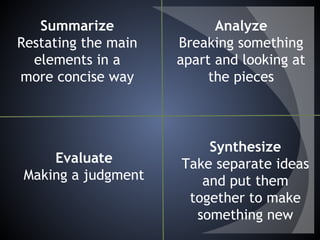
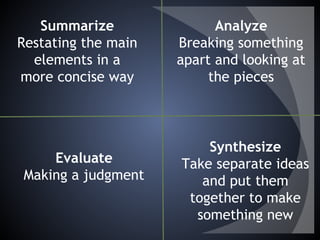
Summarize
Restating the main
elements in a
more concise way
Analyze
Breaking something
apart and looking at
the pieces
Evaluate
Making a judgment
Synthesize
Take separate ideas
and put them
together to make
something new
Which is it?
● #1 Miles, a teenage boy around the age of
15, leaves his mother and his new
step-family in Chicago, to live with a
father he barely knows in New Orleans.
Miles, who loves his mother, cannot stand
the cramped conditions of his new home,
and although he knows it will not be easy
to live with his father, he decides that
being ignored for jazz is better than
being ignored in a crowd of new siblings.
Which is it?
#2 Matilda’s character is withdrawn and
uncommunicative, apparently unwilling or unable
to form an intimate relationship. For example, she
and her husband do not talk to each other much,
except about external things such as his taste for
boiled beef and her lack of a party dress and
jewelry. With such an uncommunicative marriage,
one might suppose that she would be more open
with her close friend, Jeanne Forrestier, but
Mathilde does not say much even to her.
● --E.V. Roberts and H. E. Jacobs (1998)
Which is it?
● #3 Brick: It starts off quite refreshing, but
becomes borderline tedious and annoying by the
end – it’s also the film’s biggest downfall.. The
dialogue also flips and flops between cool and
stupid, as some parts become hard to follow,
given the speed of delivery and unfamiliar
phrasings As a crime story Brick pretty good, but
it’s a film that is 100% defined  as a modern take
on 60-year-old conventions: sure it’s unique,
stylish, funny and entertaining, but it’s also
predictable. The positives do outweigh the
trappings, making Brick worth a watch.
Which is it?
● #4 Bees and the practice of beekeeping have been
important for society throughout history due to the
positive impact they have the production of foods
and goods. Even as long ago as the Stone Ages
“peopleate honey they stole from the hives of wild
bees,” (Heinrich) and today beekeeping is still the
source in which honey is made to sell at
supermarkets (“A Sweet Find”). In addition to
honey, bees are important because they cause
other crops to grow by pollination: “Bees, via
pollination, are responsible for 15 to 30 percent of
the food U.S. consumers eat” (Roach).
Which is it?
#5 Harry Potter and the Sorcerer’s
Stone is about a young boy who finds
out he is a wizard. He then goes to a
special school, Hogwarts School of
Witchcraft and Wizardry, to learn
magic.
Which is it?
● #6 While blogger Jenna Marbles disagrees with the
adage that “nice guys finish last” and blogger TPindell
agrees that nice guys indeed do finish last, both
bloggers seem to imply that men and women can only
forge successful relationship if they identify compatible
romantic partners. (TPindell). Although Marbles’ and
TPindell’s approaches differ, each advocates that both
men and women develop the agency to identify and
then choose the best partners for themselves, and that
they don’t play into any part of the “nice guys finish
last” stereotype by either equating being nice with
being perfect, or by assuming that women are only
attracted to “bad boys” when in fact women may only
be inexperienced in identifying compatible partners.
Which is it?
#7 To Greg Heffley, middle school is the
dumbest idea ever invented. It's a place
with hundreds of social problems, not
the least of which are morons, wedgies,
swirlies, bullies, and lunchtime
troubles. To survive the never-ending
days and become popular like he feels
he deserves, Greg comes up with an
endless series of can't-miss schemes, all
of which, of course, go wrong.
Which is it?
● #8 The fourth book of the Twilight
series is completely inappropriate for
students in middle school. It discusses
topics for which students of that age
are not developmentally prepared. It
is wrong for a teacher or school to
offer this book as a choice for their
students.
Which is it?
● #9 The essay is structured
chronologically. It begins with the
origins of rap music and progresses to
explain how rap music became what it
is today. The author focuses heavily
on cultural influences to the music
genre. This is perhaps because of his
personal perspective of growing up in
an area where rap was the most
popular genre of music.
Which is it?
●  #10 Sam Roberts begins the New York Times
article “Celebrating the Semicolon in a Most
Unlikely Location” with the sighting of a
semicolon used on a city transit placard. He then
explains that the semicolon is a rarely employed,
and when it is, it is often used incorrectly. He
supports his claim with quotes from author Lynn
Truss, linguist Geoffrey Nunberg, and
even intellectual Noam Chomsky. Roberts
also provides evidence of how semicolon misuse
has resulted in loss of money and stature. Finally,
Roberts notes how the semicolon might just live
on through the use of emoticons. ;-)   
Which was it?
Summarize, Analyze, Evaluate, Synthesize?
1. Timeline graphic organizer
2. Venn diagram graphic organizer
3. Research paper
4. Taste test
5. Book review
6. Debate prep
Creation Lab
Step 1: Give a cup to everyone at your pod.
Step 2: Using the materials given, make sure everyone
(that wants it!) has some iced tea & lemonade.
Step 3: Summarize what you see.
Step 4: Analyze each of your drinks.
Step 5: Evaluate each of your drinks.
Step 6: Synthesize your drinks.
Step 7: Analyze your synthesis.
Step 8: Evaluate your synthesis.
Summarizing What You Read
● With your table partners, read the article given. You
may write right on your article.
● After you read a section (text between the bold
headings), stop and summarize what you just read.
● When finished with the article, write a summary of
the article as a whole.
● When finished summarizing, analyze the article by
identifying 3 things you noticed in the article and why
you think they were there.

Summarize analyze-evaluate-synthesize-notes

  • 1.
  • 2.
    Summarize Restating the main elementsin a more concise way Analyze Evaluate Synthesize
  • 3.
    Summarize ● Restating thetext in a more concise (shorter) way ● Focuses on major points ● Fiction: characters, conflict, and resolution ● Nonfiction: claim, evidence, counter-claim, justification, and rebuttal ● Like a reporter retelling what happened ● Who/what/when/where ● Unbiased → NO personal opinions
  • 4.
    Synonyms for Summarizing ●Report ● Sum up ● Synopsis ● Outline ● Retell ● Describe ● Generalize
  • 5.
    How do Iknow if I’m summarizing? ● Am I stating something that would be obvious to a reader or viewer? ● Does my essay move in chronological order, or in the exact same order the author used? ● Am I simply describing what happens?
  • 6.
    Summarize Restating the main elementsin a more concise way Analyze Breaking something apart and looking at the pieces Evaluate Synthesize
  • 7.
    Analyze ● Examine purposefullyand in detail the structure of something for purposes of explanation and interpretation ● Explaining – to clearly share a reason ● Interpreting – creating your own understanding of what the author is doing and why ● Looks at all aspects but does NOT make a judgment about it
  • 8.
    Analyze ● Focuses onwhy and how the writing is done ● Relationships, trends, patterns ● Roles of people, places, objects, situations ● Gains and losses ● Consequences or results of events, decisions and processes
  • 9.
    Synonyms for Analyzing ●Dissect ● Consider ● Investigate ● Interpret ● Break down ● Categorize ● Compare/Contrast ● Distinguish ● Examine ● Separate ● Select ● Explain
  • 10.
    How do Iknow if I’m analyzing? ● Am I making an original argument about the text? ● Have I arranged my evidence around my own points, rather than just following the plot's order? ● Am I explaining why or how an aspect of the text is significant?
  • 11.
    Try It Out! Analyzethe following poem: Hickory dickory dock, The mouse ran up the clock. The clock struck one, The mouse ran down, Hickory dickory dock.
  • 12.
    Try It Out! Analyzethe following poem: Hickory dickory dock, The mouse ran up the clock. The clock struck one, The mouse ran down, Hickory dickory dock. The rhyme scheme in the poem “Hickory Dickory Dock” causes it to be memorable. The rhyme scheme is A,A,B, C, A. Using rhyming words to end lines 1, 2, & 3 makes these lines stick in the reader’s mind.
  • 13.
    Summarize Restating the main elementsin a more concise way Analyze Breaking something apart and looking at the pieces Evaluate Making a judgment Synthesize
  • 14.
    Evaluate ● Making ajudgment based on evidence or criteria ● Take a side and back it up ● Next step after analysis → now that you’ve broken down the pieces (analysis) what do you think about it? ● THIS is the place for your opinion
  • 15.
    Synonyms for Evaluating ●Judge ● Defend ● Choose ● Assess ● Argue ● Support ● Value ● Rate ● Discriminate ● Select ● Conclude
  • 16.
    How do Iknow if I’m evaluating? ● Am I making a personal judgment or claim? ● Are you making a determination of value (good/bad, useful/not useful, valid/invalid)? ● Am I defending my evaluation with supportive evidence in order to be convincing?
  • 17.
    Try It Out! Evaluatethe following poem: Hickory dickory dock, The mouse ran up the clock. The clock struck one, The mouse ran down, Hickory dickory dock.
  • 18.
    Try It Out! Evaluatethe following poem: Hickory dickory dock, The mouse ran up the clock. The clock struck one, The mouse ran down, Hickory dickory dock. The rhyme scheme in the poem “Hickory Dickory Dock” causes it to be a quality poem. The rhyme scheme is A,A,B, C, A. Using rhyming words to end lines 1, 2, & 3 makes these lines stick in the reader’s mind. Because these lines stay in the reader’s mind, the poem is good poem.
  • 20.
    Summarize Restating the main elementsin a more concise way Analyze Breaking something apart and looking at the pieces Evaluate Making a judgment Synthesize Take separate ideas and put them together to make something new
  • 21.
    Synthesize ● Take separateideas and put them together to make something new ● Explaining a concept or event with information from multiple sources ● Finding common threads ● Blending different ideas together into one new idea of your own
  • 22.
    Synonyms for Synthesizing ●Assemble ● Compose ● Create ● Design ● Develop ● Generate ● Prepare ● Reorganize ● Rewrite ● Revise ● Construct ● Combine
  • 23.
    How do Iknow if I’m synthesizing? Am I looking at information or ideas from more than one place? ● Am I putting different ideas together (integrating) into something new? ● Am I finding common threads and making generalizations?
  • 24.
    Summarize Restating the main elementsin a more concise way Analyze Breaking something apart and looking at the pieces Evaluate Making a judgment Synthesize Take separate ideas and put them together to make something new
  • 25.
    Which is it? ●#1 Miles, a teenage boy around the age of 15, leaves his mother and his new step-family in Chicago, to live with a father he barely knows in New Orleans. Miles, who loves his mother, cannot stand the cramped conditions of his new home, and although he knows it will not be easy to live with his father, he decides that being ignored for jazz is better than being ignored in a crowd of new siblings.
  • 26.
    Which is it? #2Matilda’s character is withdrawn and uncommunicative, apparently unwilling or unable to form an intimate relationship. For example, she and her husband do not talk to each other much, except about external things such as his taste for boiled beef and her lack of a party dress and jewelry. With such an uncommunicative marriage, one might suppose that she would be more open with her close friend, Jeanne Forrestier, but Mathilde does not say much even to her. ● --E.V. Roberts and H. E. Jacobs (1998)
  • 27.
    Which is it? ●#3 Brick: It starts off quite refreshing, but becomes borderline tedious and annoying by the end – it’s also the film’s biggest downfall.. The dialogue also flips and flops between cool and stupid, as some parts become hard to follow, given the speed of delivery and unfamiliar phrasings As a crime story Brick pretty good, but it’s a film that is 100% defined  as a modern take on 60-year-old conventions: sure it’s unique, stylish, funny and entertaining, but it’s also predictable. The positives do outweigh the trappings, making Brick worth a watch.
  • 28.
    Which is it? ●#4 Bees and the practice of beekeeping have been important for society throughout history due to the positive impact they have the production of foods and goods. Even as long ago as the Stone Ages “peopleate honey they stole from the hives of wild bees,” (Heinrich) and today beekeeping is still the source in which honey is made to sell at supermarkets (“A Sweet Find”). In addition to honey, bees are important because they cause other crops to grow by pollination: “Bees, via pollination, are responsible for 15 to 30 percent of the food U.S. consumers eat” (Roach).
  • 29.
    Which is it? #5Harry Potter and the Sorcerer’s Stone is about a young boy who finds out he is a wizard. He then goes to a special school, Hogwarts School of Witchcraft and Wizardry, to learn magic.
  • 30.
    Which is it? ●#6 While blogger Jenna Marbles disagrees with the adage that “nice guys finish last” and blogger TPindell agrees that nice guys indeed do finish last, both bloggers seem to imply that men and women can only forge successful relationship if they identify compatible romantic partners. (TPindell). Although Marbles’ and TPindell’s approaches differ, each advocates that both men and women develop the agency to identify and then choose the best partners for themselves, and that they don’t play into any part of the “nice guys finish last” stereotype by either equating being nice with being perfect, or by assuming that women are only attracted to “bad boys” when in fact women may only be inexperienced in identifying compatible partners.
  • 31.
    Which is it? #7To Greg Heffley, middle school is the dumbest idea ever invented. It's a place with hundreds of social problems, not the least of which are morons, wedgies, swirlies, bullies, and lunchtime troubles. To survive the never-ending days and become popular like he feels he deserves, Greg comes up with an endless series of can't-miss schemes, all of which, of course, go wrong.
  • 32.
    Which is it? ●#8 The fourth book of the Twilight series is completely inappropriate for students in middle school. It discusses topics for which students of that age are not developmentally prepared. It is wrong for a teacher or school to offer this book as a choice for their students.
  • 33.
    Which is it? ●#9 The essay is structured chronologically. It begins with the origins of rap music and progresses to explain how rap music became what it is today. The author focuses heavily on cultural influences to the music genre. This is perhaps because of his personal perspective of growing up in an area where rap was the most popular genre of music.
  • 34.
    Which is it? ● #10 Sam Roberts begins the New York Times article “Celebrating the Semicolon in a Most Unlikely Location” with the sighting of a semicolon used on a city transit placard. He then explains that the semicolon is a rarely employed, and when it is, it is often used incorrectly. He supports his claim with quotes from author Lynn Truss, linguist Geoffrey Nunberg, and even intellectual Noam Chomsky. Roberts also provides evidence of how semicolon misuse has resulted in loss of money and stature. Finally, Roberts notes how the semicolon might just live on through the use of emoticons. ;-)   
  • 35.
    Which was it? Summarize,Analyze, Evaluate, Synthesize? 1. Timeline graphic organizer 2. Venn diagram graphic organizer 3. Research paper 4. Taste test 5. Book review 6. Debate prep
  • 36.
    Creation Lab Step 1:Give a cup to everyone at your pod. Step 2: Using the materials given, make sure everyone (that wants it!) has some iced tea & lemonade. Step 3: Summarize what you see. Step 4: Analyze each of your drinks. Step 5: Evaluate each of your drinks. Step 6: Synthesize your drinks. Step 7: Analyze your synthesis. Step 8: Evaluate your synthesis.
  • 37.
    Summarizing What YouRead ● With your table partners, read the article given. You may write right on your article. ● After you read a section (text between the bold headings), stop and summarize what you just read. ● When finished with the article, write a summary of the article as a whole. ● When finished summarizing, analyze the article by identifying 3 things you noticed in the article and why you think they were there.