SUCCESSION PLANNING
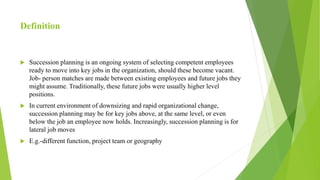
Definition
 Succession planning is an ongoing system of selecting competent employees
ready to move into key jobs in the organization, should these become vacant.
Job- person matches are made between existing employees and future jobs they
might assume. Traditionally, these future jobs were usually higher level
positions.
 In current environment of downsizing and rapid organizational change,
succession planning may be for key jobs above, at the same level, or even
below the job an employee now holds. Increasingly, succession planning is for
lateral job moves
 E.g.-different function, project team or geography
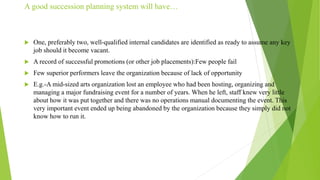
A good succession planning system will have…
 One, preferably two, well-qualified internal candidates are identified as ready to assume any key
job should it become vacant.
 A record of successful promotions (or other job placements):Few people fail
 Few superior performers leave the organization because of lack of opportunity
 E.g.-A mid-sized arts organization lost an employee who had been hosting, organizing and
managing a major fundraising event for a number of years. When he left, staff knew very little
about how it was put together and there was no operations manual documenting the event. This
very important event ended up being abandoned by the organization because they simply did not
know how to run it.
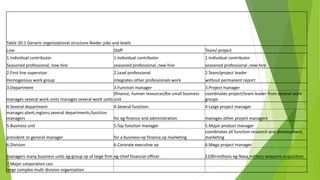
Table 20-1 Generic organizational structure-feeder jobs and levels
Line Staff Team/ project
1.Individual contributor 1.Individual contributor 1.Individual contributor
Seasoned professional, new hire seasoned professional ,new hire seasoned professional ,new hire
2.First line supervisor 2.Lead professional 2.Team/project leader
Homogenous work group integrates other professionals work without permanent report
3.Department 3.Function manager 3.Project manager
manages several work units manages several work units
(finance, human resources)for small business
unit
coordinates project/team leader from several work
groups
4.Several department 4.Several function: 4 Large project manager
manages plant,regions,several departments,function
managers for eg-finance and administration manages other project managers
5.Business unit 5.Top function manager 5.Major product manager
president or general manager for a business-vp finance,vp marketing
coordinates all function-research and development,
marketing
6.Division 6.Cororate executive vp 6.Mega project manager
managers many business units eg-group vp of large firm eg-chief financial officer $100+millions eg-Nasa,military weapons acquisition
7.Major corporation ceo
large complex multi division organization
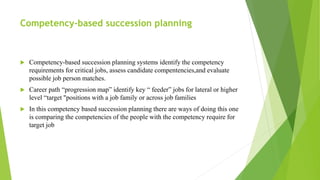
Competency-based succession planning
 Competency-based succession planning systems identify the competency
requirements for critical jobs, assess candidate compentencies,and evaluate
possible job person matches.
 Career path “progression map” identify key “ feeder” jobs for lateral or higher
level “target "positions with a job family or across job families
 In this competency based succession planning there are ways of doing this one
is comparing the competencies of the people with the competency require for
target job
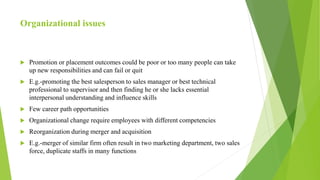
Organizational issues
 Promotion or placement outcomes could be poor or too many people can take
up new responsibilities and can fail or quit
 E.g.-promoting the best salesperson to sales manager or best technical
professional to supervisor and then finding he or she lacks essential
interpersonal understanding and influence skills
 Few career path opportunities
 Organizational change require employees with different competencies
 Reorganization during merger and acquisition
 E.g.-merger of similar firm often result in two marketing department, two sales
force, duplicate staffs in many functions
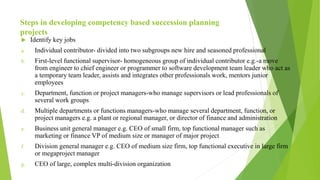
Steps in developing competency based succession planning
projects
 Identify key jobs
a. Individual contributor- divided into two subgroups new hire and seasoned professional
b. First-level functional supervisor- homogeneous group of individual contributor e.g.-a move
from engineer to chief engineer or programmer to software development team leader who act as
a temporary team leader, assists and integrates other professionals work, mentors junior
employees
c. Department, function or project managers-who manage supervisors or lead professionals of
several work groups
d. Multiple departments or functions managers-who manage several department, function, or
project managers e.g. a plant or regional manager, or director of finance and administration
e. Business unit general manager e.g. CEO of small firm, top functional manager such as
marketing or finance VP of medium size or manager of major project
f. Division general manager e.g. CEO of medium size firm, top functional executive in large firm
or megaproject manager
g. CEO of large, complex multi-division organization
continues
 Develop competency models for critical target and feeder jobs
- Frequently involves development of competency models each of several steps
- BEI conducted with four superiors and two average at each level
- Analysed to identify competencies required for superior performance at the level
 Assess candidates (and current job holders) against competencies for target jobs
-competency based selection programs
sub -steps
-identify cost effective assessment methods
-train assessors to evaluate candidates for target jobs
-Down an organization goes assessing people in feeder jobs increases the population to be assessed
continue
 Make decisions about job incumbents and candidates-evaluates on their competence to do their
jobs and potential to go higher in future
a.Promotable, either:
-ready now or
-developable
b. Not promotable
-competent in their current job, and/ or
-have potential to transfer laterally to some other jobs
c. Not competent in their job and not fit with other jobs of the organization
 Develop a human resource management information system
-computerized human resource information system to keep track of the competency requirement for
all jobs
 Develop a development/career pathing system
Succession planning

Succession planning

  • 1.
  • 2.
    Definition  Succession planningis an ongoing system of selecting competent employees ready to move into key jobs in the organization, should these become vacant. Job- person matches are made between existing employees and future jobs they might assume. Traditionally, these future jobs were usually higher level positions.  In current environment of downsizing and rapid organizational change, succession planning may be for key jobs above, at the same level, or even below the job an employee now holds. Increasingly, succession planning is for lateral job moves  E.g.-different function, project team or geography
  • 3.
    A good successionplanning system will have…  One, preferably two, well-qualified internal candidates are identified as ready to assume any key job should it become vacant.  A record of successful promotions (or other job placements):Few people fail  Few superior performers leave the organization because of lack of opportunity  E.g.-A mid-sized arts organization lost an employee who had been hosting, organizing and managing a major fundraising event for a number of years. When he left, staff knew very little about how it was put together and there was no operations manual documenting the event. This very important event ended up being abandoned by the organization because they simply did not know how to run it.
  • 4.
    Table 20-1 Genericorganizational structure-feeder jobs and levels Line Staff Team/ project 1.Individual contributor 1.Individual contributor 1.Individual contributor Seasoned professional, new hire seasoned professional ,new hire seasoned professional ,new hire 2.First line supervisor 2.Lead professional 2.Team/project leader Homogenous work group integrates other professionals work without permanent report 3.Department 3.Function manager 3.Project manager manages several work units manages several work units (finance, human resources)for small business unit coordinates project/team leader from several work groups 4.Several department 4.Several function: 4 Large project manager manages plant,regions,several departments,function managers for eg-finance and administration manages other project managers 5.Business unit 5.Top function manager 5.Major product manager president or general manager for a business-vp finance,vp marketing coordinates all function-research and development, marketing 6.Division 6.Cororate executive vp 6.Mega project manager managers many business units eg-group vp of large firm eg-chief financial officer $100+millions eg-Nasa,military weapons acquisition 7.Major corporation ceo large complex multi division organization
  • 5.
    Competency-based succession planning Competency-based succession planning systems identify the competency requirements for critical jobs, assess candidate compentencies,and evaluate possible job person matches.  Career path “progression map” identify key “ feeder” jobs for lateral or higher level “target "positions with a job family or across job families  In this competency based succession planning there are ways of doing this one is comparing the competencies of the people with the competency require for target job
  • 6.
    Organizational issues  Promotionor placement outcomes could be poor or too many people can take up new responsibilities and can fail or quit  E.g.-promoting the best salesperson to sales manager or best technical professional to supervisor and then finding he or she lacks essential interpersonal understanding and influence skills  Few career path opportunities  Organizational change require employees with different competencies  Reorganization during merger and acquisition  E.g.-merger of similar firm often result in two marketing department, two sales force, duplicate staffs in many functions
  • 7.
    Steps in developingcompetency based succession planning projects  Identify key jobs a. Individual contributor- divided into two subgroups new hire and seasoned professional b. First-level functional supervisor- homogeneous group of individual contributor e.g.-a move from engineer to chief engineer or programmer to software development team leader who act as a temporary team leader, assists and integrates other professionals work, mentors junior employees c. Department, function or project managers-who manage supervisors or lead professionals of several work groups d. Multiple departments or functions managers-who manage several department, function, or project managers e.g. a plant or regional manager, or director of finance and administration e. Business unit general manager e.g. CEO of small firm, top functional manager such as marketing or finance VP of medium size or manager of major project f. Division general manager e.g. CEO of medium size firm, top functional executive in large firm or megaproject manager g. CEO of large, complex multi-division organization
  • 8.
    continues  Develop competencymodels for critical target and feeder jobs - Frequently involves development of competency models each of several steps - BEI conducted with four superiors and two average at each level - Analysed to identify competencies required for superior performance at the level  Assess candidates (and current job holders) against competencies for target jobs -competency based selection programs sub -steps -identify cost effective assessment methods -train assessors to evaluate candidates for target jobs -Down an organization goes assessing people in feeder jobs increases the population to be assessed
  • 9.
    continue  Make decisionsabout job incumbents and candidates-evaluates on their competence to do their jobs and potential to go higher in future a.Promotable, either: -ready now or -developable b. Not promotable -competent in their current job, and/ or -have potential to transfer laterally to some other jobs c. Not competent in their job and not fit with other jobs of the organization  Develop a human resource management information system -computerized human resource information system to keep track of the competency requirement for all jobs  Develop a development/career pathing system

Editor's Notes

  • #5 Line staff is connected to costumers and staff is to functions of line staff
  • #10 Incumbent –single person-ceo cco