Subsidiary
Books and it’s
types
Presented by :
Dibyaranjan, Pragyan & Swagatika
Innovation-The Business School
Date: 10th
-11th
October 2025
INTRODUCTION
• Businesses record many transactions daily.
• Writing everything in one book is
confusing.
• To make it simple → we use Subsidiary
Books.
• Definition: These are books used to record
similar types of transactions.
• In simple words:
• Instead of writing all transactions in one
book, we keep different books for different
purposes.
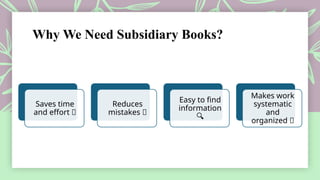
Why We Need Subsidiary Books?
Saves time
and effort ā°
Reduces
mistakes āŒ
Easy to find
information
šŸ”
Makes work
systematic
and
organized 🧾
EXAMPLE
• Imagine you run a small shop. Every day, you sell
goods, buy materials, pay bills, and receive money.If
you record everything in one big book, it’ll soon
become messy and confusing .
• To stay organized, you keep separate notebooks:
• One for purchases
• One for sales
• One for cash
• That’s how Subsidiary Books work
• That’s why accountants divide the work into different
small books — each book for a particular type of
transaction.These are called Subsidiary Books.
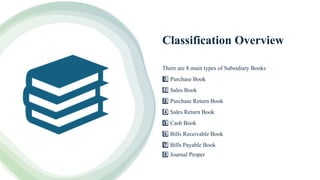
Classification Overview
There are 8 main types of Subsidiary Books
Purchase Book
1 ļø
1ļøāƒ£
Sales Book
2ļøāƒ£
Purchase Return Book
3 ļø
3ļøāƒ£
Sales Return Book
4ļøāƒ£
Cash Book
5 ļø
5ļøāƒ£
Bills Receivable Book
6ļøāƒ£
Bills Payable Book
7 ļø
7ļøāƒ£
Journal Proper
8ļøāƒ£
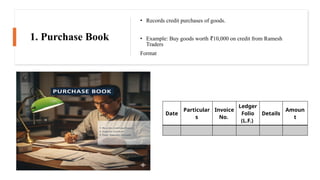
1. Purchase Book
• Records credit purchases of goods.
• Example: Buy goods worth 10,000 on credit from Ramesh
₹
Traders
Format
Date
Particular
s
Invoice
No.
Ledger
Folio
(L.F.)
Details
Amoun
t
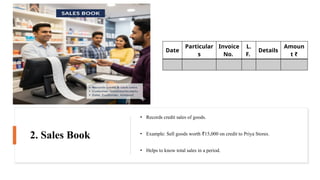
2. Sales Book
• Records credit sales of goods.
• Example: Sell goods worth 15,000 on credit to Priya Stores.
₹
• Helps to know total sales in a period.
Date
Particular
s
Invoice
No.
L.
F.
Details
Amoun
t ₹
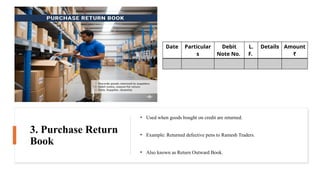
3. Purchase Return
Book
• Used when goods bought on credit are returned.
• Example: Returned defective pens to Ramesh Traders.
• Also known as Return Outward Book.
Date Particular
s
Debit
Note No.
L.
F.
Details Amount
₹
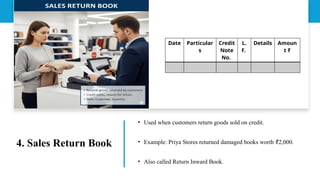
4. Sales Return Book
• Used when customers return goods sold on credit.
• Example: Priya Stores returned damaged books worth 2,000.
₹
• Also called Return Inward Book.
Date Particular
s
Credit
Note
No.
L.
F.
Details Amoun
t ₹
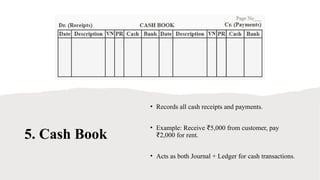
5. Cash Book
• Records all cash receipts and payments.
• Example: Receive 5,000 from customer, pay
₹
2,000 for rent.
₹
• Acts as both Journal + Ledger for cash transactions.
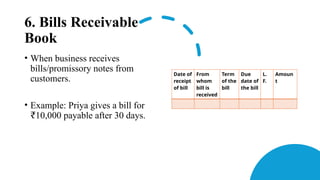
6. Bills Receivable
Book
• When business receives
bills/promissory notes from
customers.
• Example: Priya gives a bill for
10,000 payable after 30 days.
₹
Date of
receipt
of bill
From
whom
bill is
received
Term
of the
bill
Due
date of
the bill
L.
F.
Amoun
t
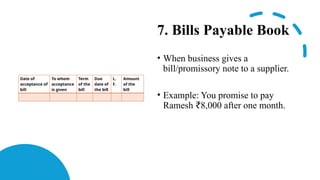
7. Bills Payable Book
• When business gives a
bill/promissory note to a supplier.
• Example: You promise to pay
Ramesh 8,000 after one month.
₹
Date of
acceptance of
bill
To whom
acceptance
is given
Term
of the
bill
Due
date of
the bill
L.
F.
Amount
of the
bill
8. Journal
Proper
• Records rare or special transactions:
• Goods lost by fire šŸ”„
• Depreciation šŸ’ø
• Owner takes goods for personal use šŸ‘¤
CONCLUSION
• Subsidiary Books = Smart
recordkeeping
• Saves time, reduces errors, keeps
accounts neat.
• Simple, Systematic, and
Reliable šŸ“˜
• > ā€œAccounting becomes easy
when work is divided wisely.ā€
Subsidiary   Book   and   it's   types.pptx

Subsidiary Book and it's types.pptx

  • 1.
    Subsidiary Books and it’s types Presentedby : Dibyaranjan, Pragyan & Swagatika Innovation-The Business School Date: 10th -11th October 2025
  • 2.
    INTRODUCTION • Businesses recordmany transactions daily. • Writing everything in one book is confusing. • To make it simple → we use Subsidiary Books. • Definition: These are books used to record similar types of transactions. • In simple words: • Instead of writing all transactions in one book, we keep different books for different purposes.
  • 3.
    Why We NeedSubsidiary Books? Saves time and effort ā° Reduces mistakes āŒ Easy to find information šŸ” Makes work systematic and organized 🧾
  • 4.
    EXAMPLE • Imagine yourun a small shop. Every day, you sell goods, buy materials, pay bills, and receive money.If you record everything in one big book, it’ll soon become messy and confusing . • To stay organized, you keep separate notebooks: • One for purchases • One for sales • One for cash • That’s how Subsidiary Books work • That’s why accountants divide the work into different small books — each book for a particular type of transaction.These are called Subsidiary Books.
  • 5.
    Classification Overview There are8 main types of Subsidiary Books Purchase Book 1 ļø 1ļøāƒ£ Sales Book 2ļøāƒ£ Purchase Return Book 3 ļø 3ļøāƒ£ Sales Return Book 4ļøāƒ£ Cash Book 5 ļø 5ļøāƒ£ Bills Receivable Book 6ļøāƒ£ Bills Payable Book 7 ļø 7ļøāƒ£ Journal Proper 8ļøāƒ£
  • 6.
    1. Purchase Book •Records credit purchases of goods. • Example: Buy goods worth 10,000 on credit from Ramesh ₹ Traders Format Date Particular s Invoice No. Ledger Folio (L.F.) Details Amoun t
  • 7.
    2. Sales Book •Records credit sales of goods. • Example: Sell goods worth 15,000 on credit to Priya Stores. ₹ • Helps to know total sales in a period. Date Particular s Invoice No. L. F. Details Amoun t ₹
  • 8.
    3. Purchase Return Book •Used when goods bought on credit are returned. • Example: Returned defective pens to Ramesh Traders. • Also known as Return Outward Book. Date Particular s Debit Note No. L. F. Details Amount ₹
  • 9.
    4. Sales ReturnBook • Used when customers return goods sold on credit. • Example: Priya Stores returned damaged books worth 2,000. ₹ • Also called Return Inward Book. Date Particular s Credit Note No. L. F. Details Amoun t ₹
  • 10.
    5. Cash Book •Records all cash receipts and payments. • Example: Receive 5,000 from customer, pay ₹ 2,000 for rent. ₹ • Acts as both Journal + Ledger for cash transactions.
  • 11.
    6. Bills Receivable Book •When business receives bills/promissory notes from customers. • Example: Priya gives a bill for 10,000 payable after 30 days. ₹ Date of receipt of bill From whom bill is received Term of the bill Due date of the bill L. F. Amoun t
  • 12.
    7. Bills PayableBook • When business gives a bill/promissory note to a supplier. • Example: You promise to pay Ramesh 8,000 after one month. ₹ Date of acceptance of bill To whom acceptance is given Term of the bill Due date of the bill L. F. Amount of the bill
  • 13.
    8. Journal Proper • Recordsrare or special transactions: • Goods lost by fire šŸ”„ • Depreciation šŸ’ø • Owner takes goods for personal use šŸ‘¤
  • 14.
    CONCLUSION • Subsidiary Books= Smart recordkeeping • Saves time, reduces errors, keeps accounts neat. • Simple, Systematic, and Reliable šŸ“˜ • > ā€œAccounting becomes easy when work is divided wisely.ā€