SUBJECT-VERB
AGREEMENT
Subject- Verb Agreement or Concord
• The subject and verb must work together.
• Both the subject and verb must agree in number.
SINGULAR SUBJECT SINGULAR VERB
PLURAL SUBJECT PLURAL VERB
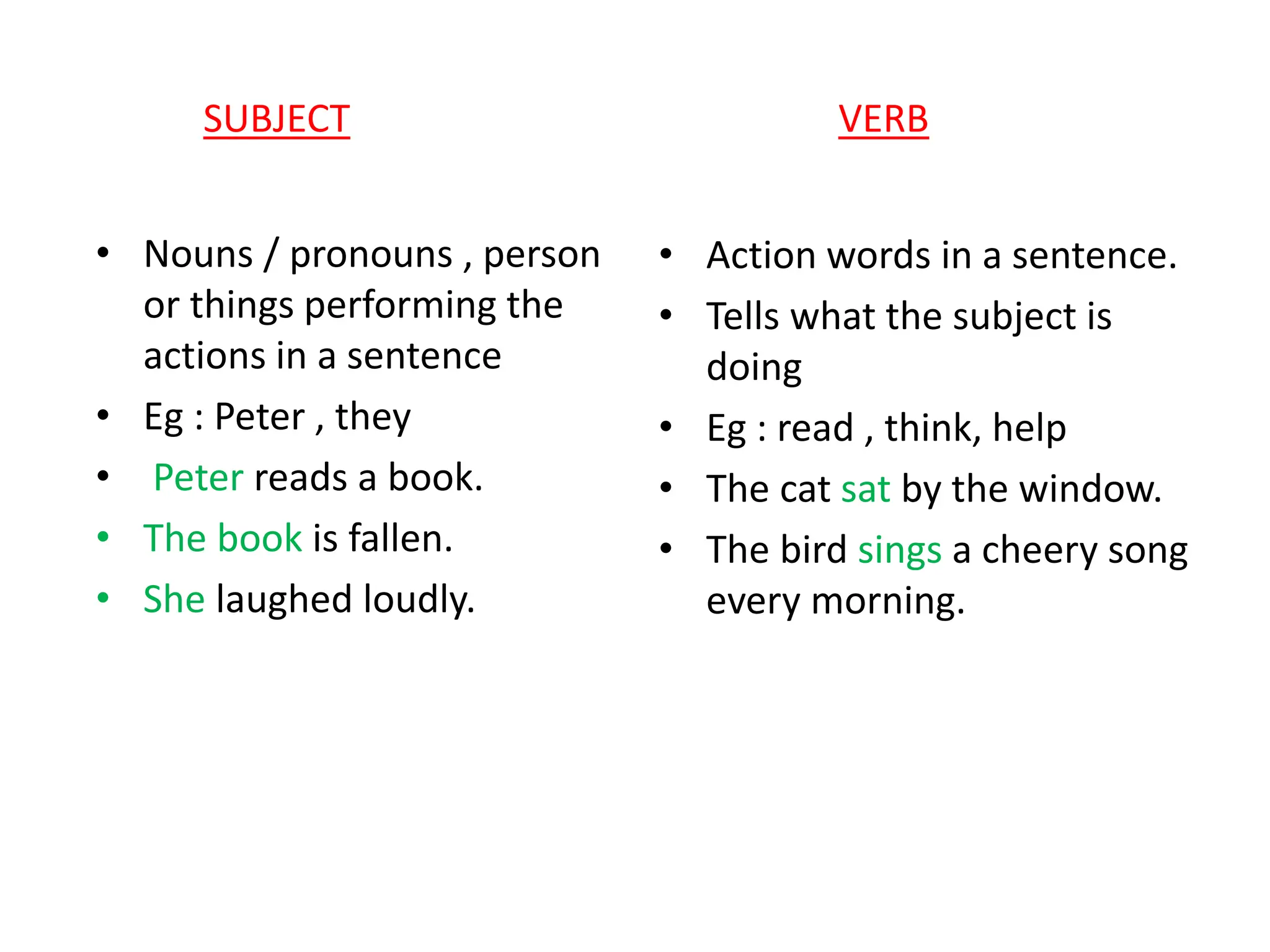
SUBJECT VERB
• Nouns / pronouns , person
or things performing the
actions in a sentence
• Eg : Peter , they
• Peter reads a book.
• The book is fallen.
• She laughed loudly.
• Action words in a sentence.
• Tells what the subject is
doing
• Eg : read , think, help
• The cat sat by the window.
• The bird sings a cheery song
every morning.
TENSES
1.Present Tense
2.Past Tense
3.Future Tense
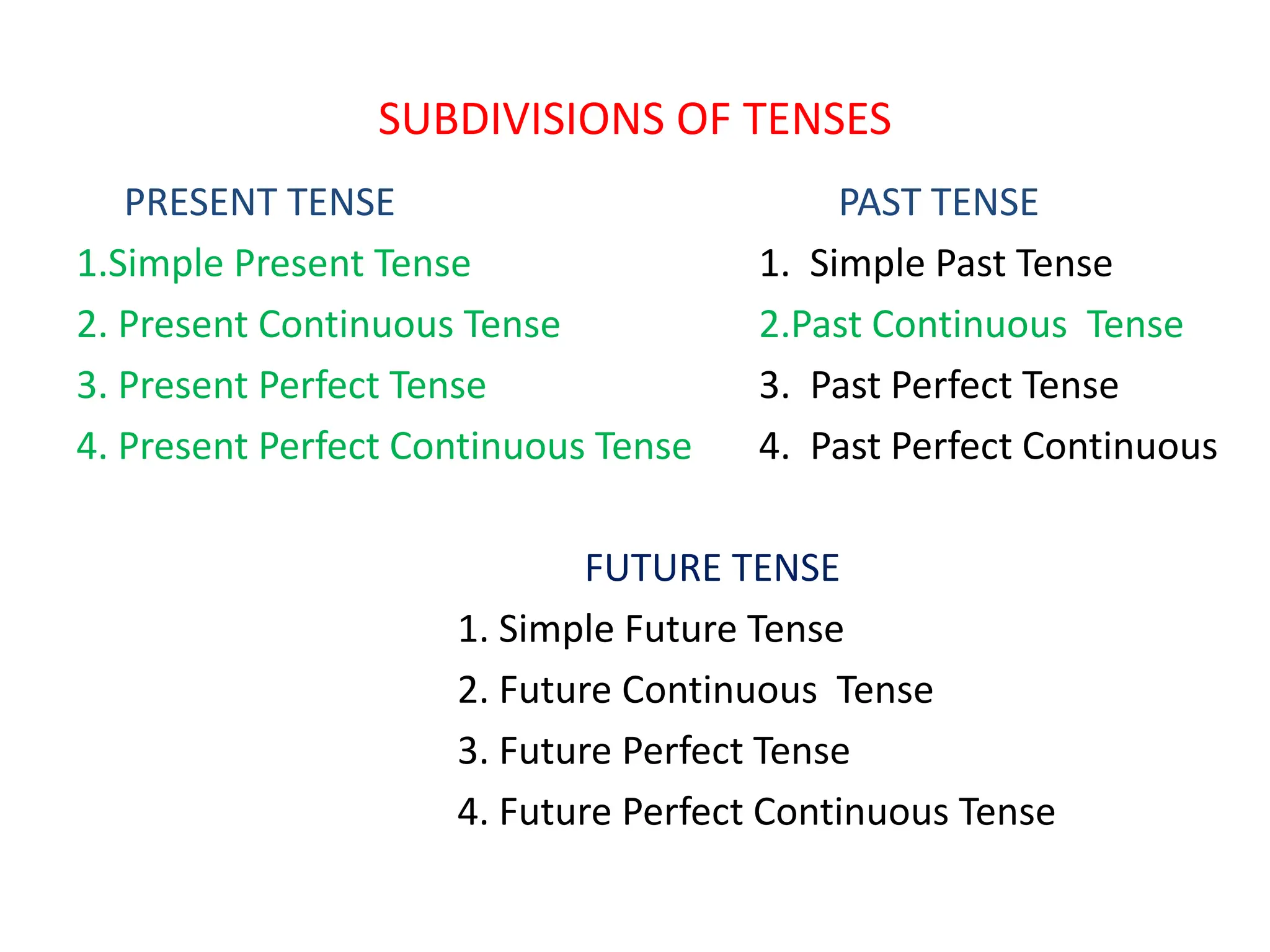
SUBDIVISIONS OF TENSES
PRESENT TENSE PAST TENSE
1.Simple Present Tense 1. Simple Past Tense
2. Present Continuous Tense 2.Past Continuous Tense
3. Present Perfect Tense 3. Past Perfect Tense
4. Present Perfect Continuous Tense 4. Past Perfect Continuous
FUTURE TENSE
1. Simple Future Tense
2. Future Continuous Tense
3. Future Perfect Tense
4. Future Perfect Continuous Tense
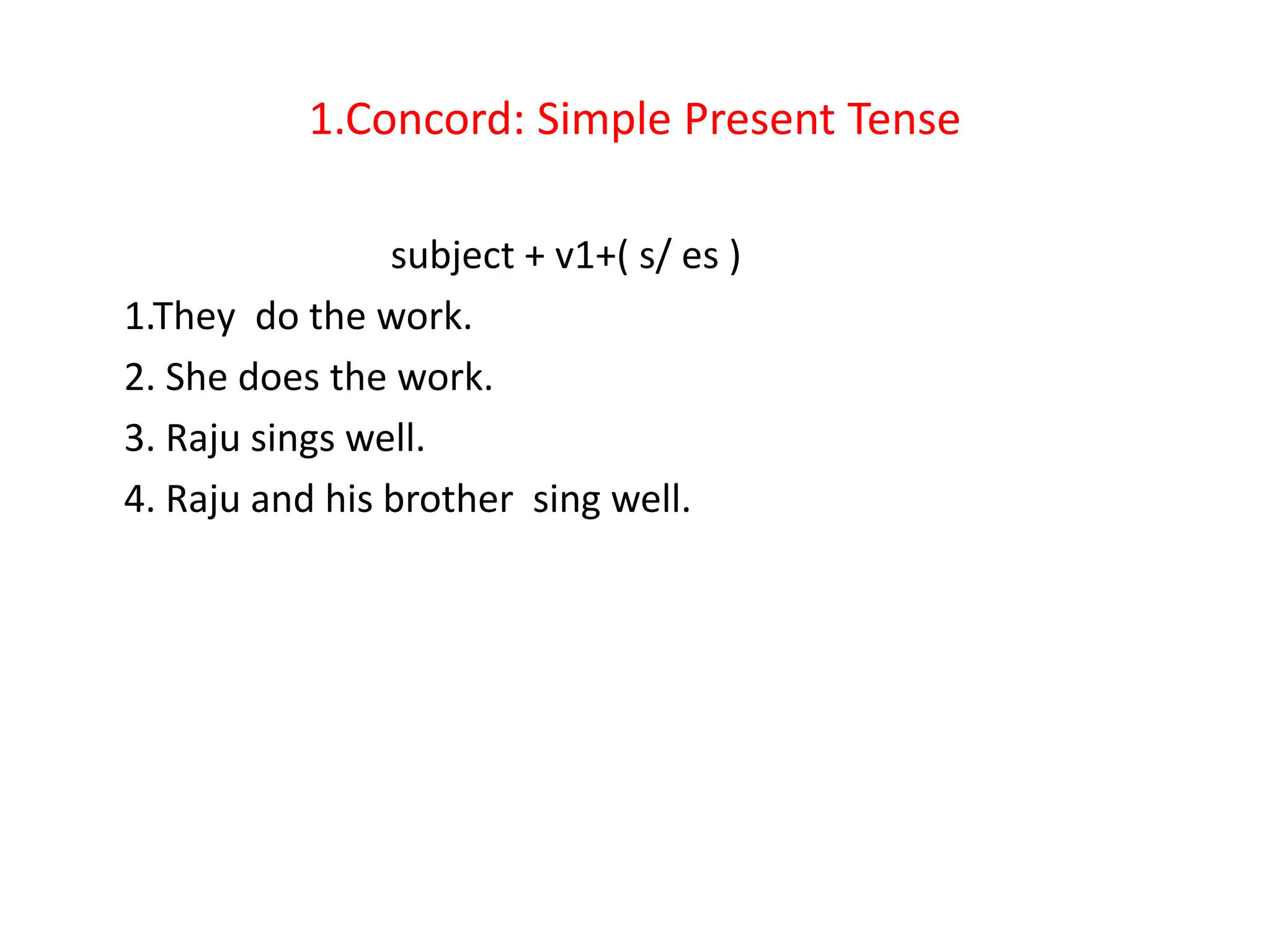
1.Concord: Simple Present Tense
subject + v1+( s/ es )
1.They do the work.
2. She does the work.
3. Raju sings well.
4. Raju and his brother sing well.
2.Concord: Present Continuous Tense
Subject + am/is/are +v + ing
1. Rana is drawing.
2. The boys are playing after school.
3.Concord: Present Perfect Tense
Subject + has/have+ v3
1. She has lived here all her life.
2. We have seen this movie already.
4.Present Perfect Continuous Tense
Subject+ has/have+been+v4
1. Gita has been studying in the library for three
hours.
2. Kate and her friends have been shopping in the fair
since morning.
5.Past Continuous Tense
Subject +was /were +v4
1. Alan was cutting the grass the other day when the
snake appeared.
2. It started to rain while we were playing.
VERBS
SINGULAR
is
has
was
does
draws
goes
PLURAL
are
have
were
do
draw
go
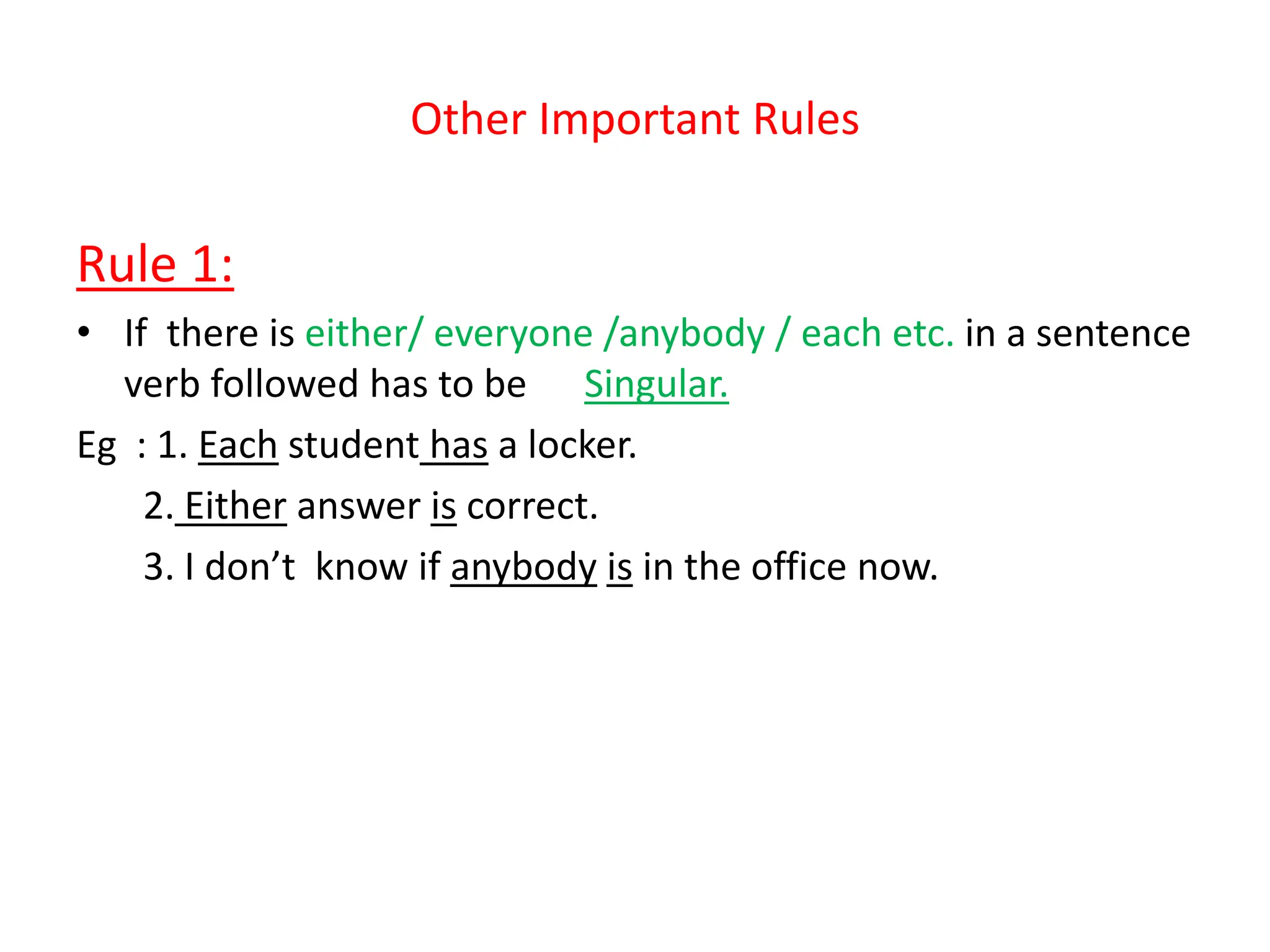
Other Important Rules
Rule 1:
• If there is either/ everyone /anybody / each etc. in a sentence
verb followed has to be Singular.
Eg : 1. Each student has a locker.
2. Either answer is correct.
3. I don’t know if anybody is in the office now.
Rule 2
• Two subjects combined by and takes plural verb.
Eg : 1. Rahim and Ram are working in a bank.
Exceptions
• Two subjects combined by and but used as a single unit has to
be placed with a singular verb.
Eg : Bread and butter is her favourite meal.
• Two subjects joined by and but articles are placed before both
the subjects – represents two different entities- plural verb.
Eg : The founder and the Principal have arrived.
• If only the first subject is preceded by an article -singular verb
Eg : The founder and Principal has arrived
Rule 3
• A lot of + uncountable noun takes singular verb.
Eg : A lot of water has been supplied.
• A lot of+ countable noun takes plural verb.
Eg : A lot of people have gathered in my house.
Rule 4
• If two subjects are combined with as well as/ along with verb
will be placed according to the first subject.
Eg : 1.The brothers as well as their sister are good at studies.
2. The brother as well as his sisters is good at studies.
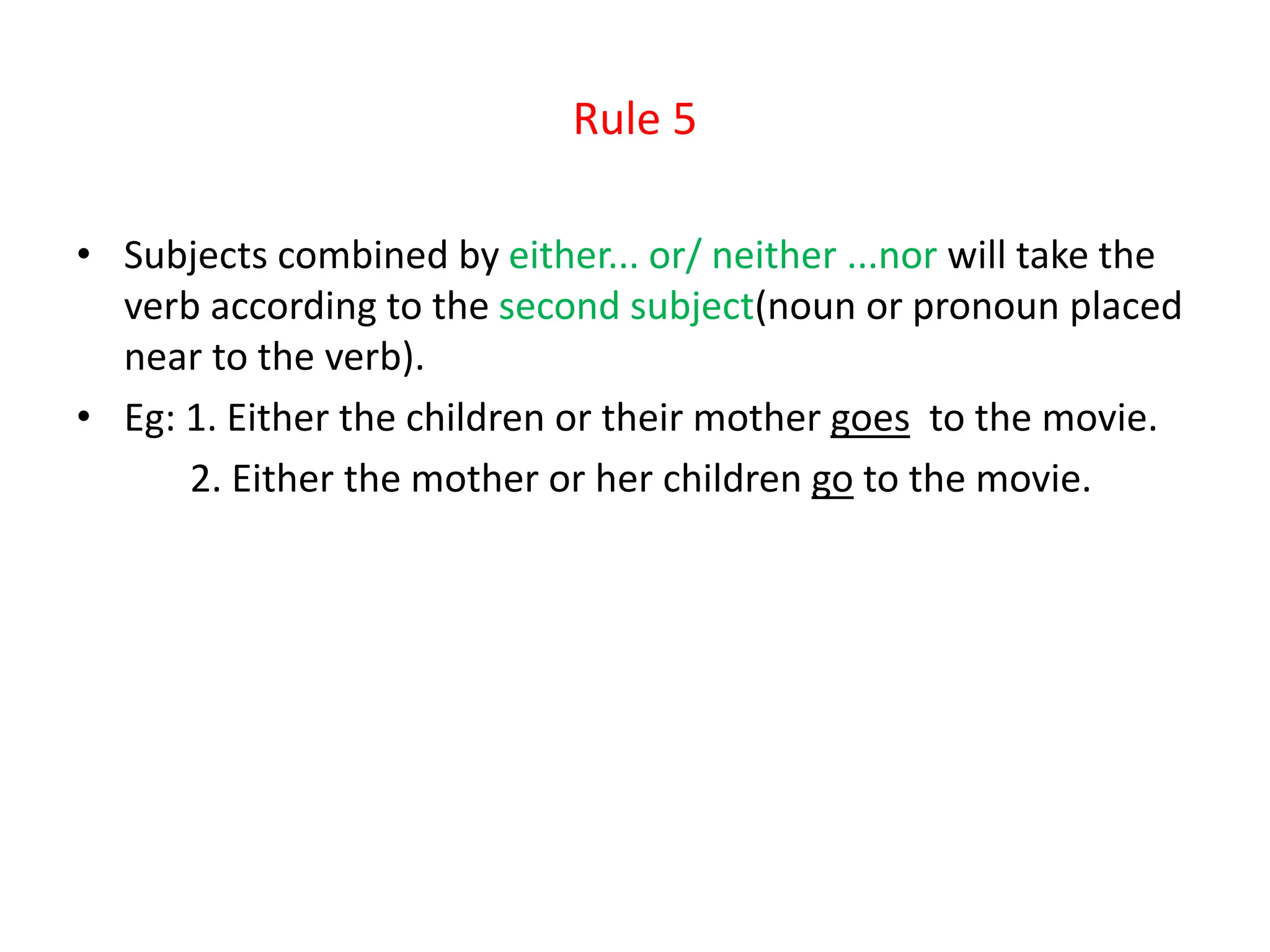
Rule 5
• Subjects combined by either... or/ neither ...nor will take the
verb according to the second subject(noun or pronoun placed
near to the verb).
• Eg: 1. Either the children or their mother goes to the movie.
2. Either the mother or her children go to the movie.
Rule 6
• Nouns which are plural in form but singular in meaning takes
singular verb
Eg:1. Mathematics is an interesting subject.
2. Five kilometres is such a short distance.
Rule 7
• Each of/ one of always takes singular verb
Eg: Each of the candidates gets a good chance to win the
scholarship.
Rule 8
• Many a will be followed by singular verb.
Eg: Many a tale was told.
Many a man has tried.
Exercise
1. Jane and her sisters ______ dancers. (is/are)
2. The actor and director _____reached. (has/have)
3. Either Ravi or his brothers _____to the party, (go/goes)
4. One of my sisters ______attending today’s exam. (is/are)
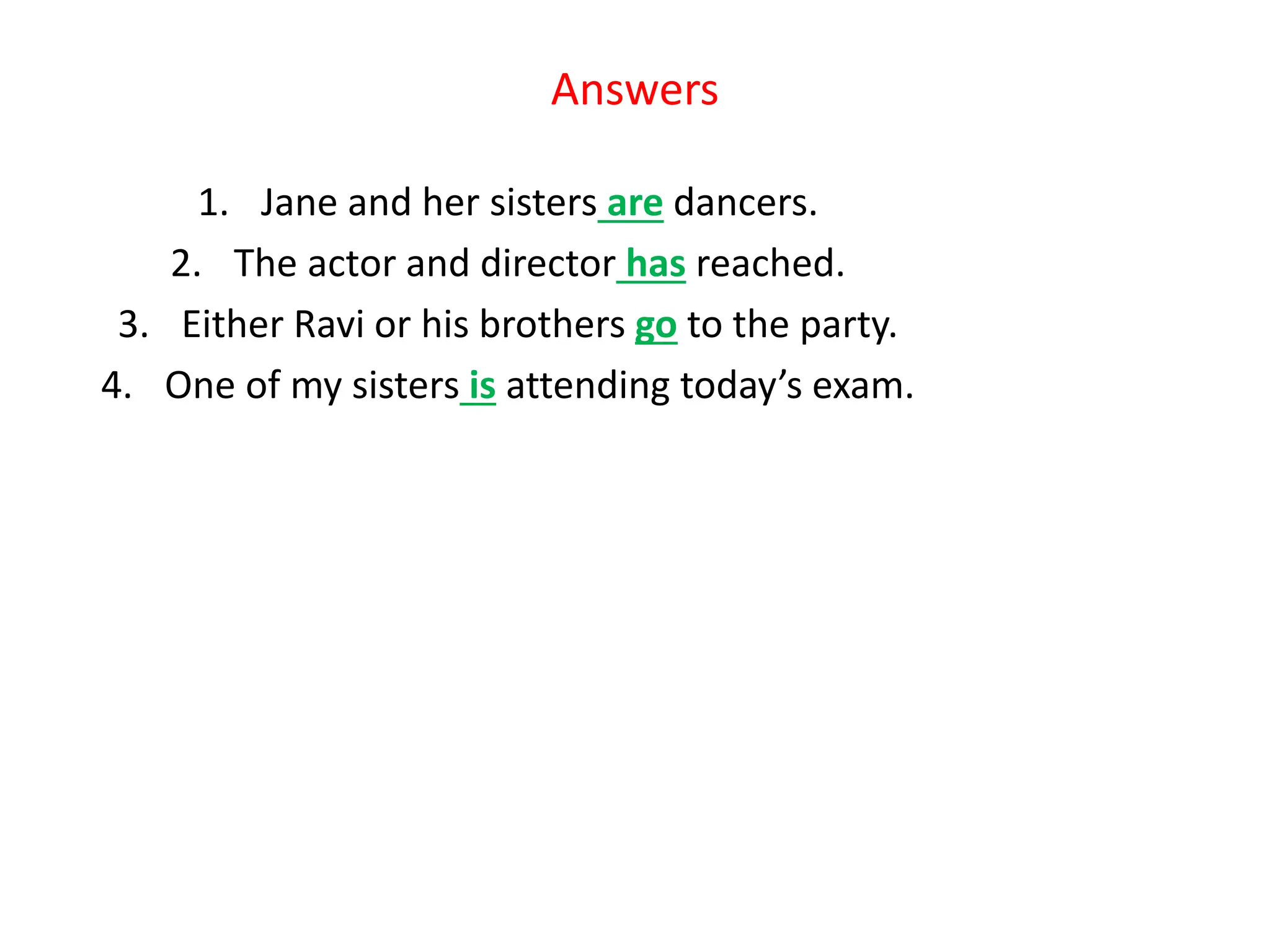
Answers
1. Jane and her sisters are dancers.
2. The actor and director has reached.
3. Either Ravi or his brothers go to the party.
4. One of my sisters is attending today’s exam.
THANK YOU

Subject Verb Agreement.pptx for class 6,7,8,9

  • 1.
  • 2.
    Subject- Verb Agreementor Concord • The subject and verb must work together. • Both the subject and verb must agree in number. SINGULAR SUBJECT SINGULAR VERB PLURAL SUBJECT PLURAL VERB
  • 3.
    SUBJECT VERB • Nouns/ pronouns , person or things performing the actions in a sentence • Eg : Peter , they • Peter reads a book. • The book is fallen. • She laughed loudly. • Action words in a sentence. • Tells what the subject is doing • Eg : read , think, help • The cat sat by the window. • The bird sings a cheery song every morning.
  • 4.
  • 5.
    SUBDIVISIONS OF TENSES PRESENTTENSE PAST TENSE 1.Simple Present Tense 1. Simple Past Tense 2. Present Continuous Tense 2.Past Continuous Tense 3. Present Perfect Tense 3. Past Perfect Tense 4. Present Perfect Continuous Tense 4. Past Perfect Continuous FUTURE TENSE 1. Simple Future Tense 2. Future Continuous Tense 3. Future Perfect Tense 4. Future Perfect Continuous Tense
  • 6.
    1.Concord: Simple PresentTense subject + v1+( s/ es ) 1.They do the work. 2. She does the work. 3. Raju sings well. 4. Raju and his brother sing well.
  • 7.
    2.Concord: Present ContinuousTense Subject + am/is/are +v + ing 1. Rana is drawing. 2. The boys are playing after school. 3.Concord: Present Perfect Tense Subject + has/have+ v3 1. She has lived here all her life. 2. We have seen this movie already.
  • 8.
    4.Present Perfect ContinuousTense Subject+ has/have+been+v4 1. Gita has been studying in the library for three hours. 2. Kate and her friends have been shopping in the fair since morning. 5.Past Continuous Tense Subject +was /were +v4 1. Alan was cutting the grass the other day when the snake appeared. 2. It started to rain while we were playing.
  • 9.
  • 10.
    Other Important Rules Rule1: • If there is either/ everyone /anybody / each etc. in a sentence verb followed has to be Singular. Eg : 1. Each student has a locker. 2. Either answer is correct. 3. I don’t know if anybody is in the office now.
  • 11.
    Rule 2 • Twosubjects combined by and takes plural verb. Eg : 1. Rahim and Ram are working in a bank. Exceptions • Two subjects combined by and but used as a single unit has to be placed with a singular verb. Eg : Bread and butter is her favourite meal. • Two subjects joined by and but articles are placed before both the subjects – represents two different entities- plural verb. Eg : The founder and the Principal have arrived. • If only the first subject is preceded by an article -singular verb Eg : The founder and Principal has arrived
  • 12.
    Rule 3 • Alot of + uncountable noun takes singular verb. Eg : A lot of water has been supplied. • A lot of+ countable noun takes plural verb. Eg : A lot of people have gathered in my house.
  • 13.
    Rule 4 • Iftwo subjects are combined with as well as/ along with verb will be placed according to the first subject. Eg : 1.The brothers as well as their sister are good at studies. 2. The brother as well as his sisters is good at studies.
  • 14.
    Rule 5 • Subjectscombined by either... or/ neither ...nor will take the verb according to the second subject(noun or pronoun placed near to the verb). • Eg: 1. Either the children or their mother goes to the movie. 2. Either the mother or her children go to the movie.
  • 15.
    Rule 6 • Nounswhich are plural in form but singular in meaning takes singular verb Eg:1. Mathematics is an interesting subject. 2. Five kilometres is such a short distance.
  • 16.
    Rule 7 • Eachof/ one of always takes singular verb Eg: Each of the candidates gets a good chance to win the scholarship. Rule 8 • Many a will be followed by singular verb. Eg: Many a tale was told. Many a man has tried.
  • 17.
    Exercise 1. Jane andher sisters ______ dancers. (is/are) 2. The actor and director _____reached. (has/have) 3. Either Ravi or his brothers _____to the party, (go/goes) 4. One of my sisters ______attending today’s exam. (is/are)
  • 18.
    Answers 1. Jane andher sisters are dancers. 2. The actor and director has reached. 3. Either Ravi or his brothers go to the party. 4. One of my sisters is attending today’s exam.
  • 19.