Subject-Verb Agreement
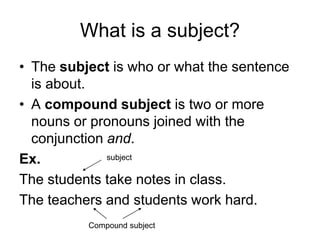
What is a subject?
• The subject is who or what the sentence
is about.
• A compound subject is two or more
nouns or pronouns joined with the
conjunction and.
Ex.
The students take notes in class.
The teachers and students work hard.
subject
Compound subject
Subject-Verb Agreement Rules
1. When the subject is singular, use a
singular verb. Most singular verbs end in
–s.
Ex. Julie dances at the party.
2. When the subject is plural, use a plural
verb. Plural verbs are NOT formed by
adding –s or –es like plural nouns.
Ex. Julie and Jan dance at the party.
The students study hard for the test.
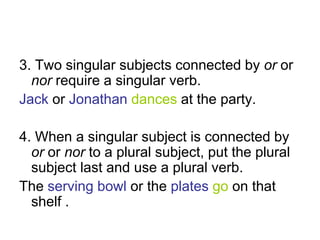
3. Two singular subjects connected by or or
nor require a singular verb.
Jack or Jonathan dances at the party.
4. When a singular subject is connected by
or or nor to a plural subject, put the plural
subject last and use a plural verb.
The serving bowl or the plates go on that
shelf .
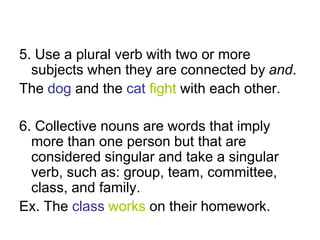
5. Use a plural verb with two or more
subjects when they are connected by and.
The dog and the cat fight with each other.
6. Collective nouns are words that imply
more than one person but that are
considered singular and take a singular
verb, such as: group, team, committee,
class, and family.
Ex. The class works on their homework.
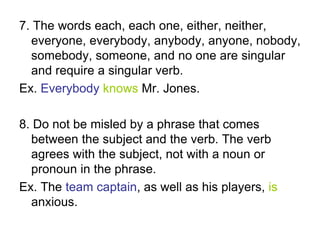
7. The words each, each one, either, neither,
everyone, everybody, anybody, anyone, nobody,
somebody, someone, and no one are singular
and require a singular verb.
Ex. Everybody knows Mr. Jones.
8. Do not be misled by a phrase that comes
between the subject and the verb. The verb
agrees with the subject, not with a noun or
pronoun in the phrase.
Ex. The team captain, as well as his players, is
anxious.
9. Doesn't is a contraction of does not and
should be used only with a singular subject.
Don't is a contraction of do not and should be
used only with a plural subject. The exception
to this rule appears in the case of the first
person and second person pronouns I and
you. With these pronouns, the contraction
don't should be used.
Ex. He doesn’t want to study.
They don’t eat pizza.
I don’t talk on the phone.

subject verb agreement.ppt

  • 1.
  • 2.
    What is asubject? • The subject is who or what the sentence is about. • A compound subject is two or more nouns or pronouns joined with the conjunction and. Ex. The students take notes in class. The teachers and students work hard. subject Compound subject
  • 3.
    Subject-Verb Agreement Rules 1.When the subject is singular, use a singular verb. Most singular verbs end in –s. Ex. Julie dances at the party. 2. When the subject is plural, use a plural verb. Plural verbs are NOT formed by adding –s or –es like plural nouns. Ex. Julie and Jan dance at the party. The students study hard for the test.
  • 4.
    3. Two singularsubjects connected by or or nor require a singular verb. Jack or Jonathan dances at the party. 4. When a singular subject is connected by or or nor to a plural subject, put the plural subject last and use a plural verb. The serving bowl or the plates go on that shelf .
  • 5.
    5. Use aplural verb with two or more subjects when they are connected by and. The dog and the cat fight with each other. 6. Collective nouns are words that imply more than one person but that are considered singular and take a singular verb, such as: group, team, committee, class, and family. Ex. The class works on their homework.
  • 6.
    7. The wordseach, each one, either, neither, everyone, everybody, anybody, anyone, nobody, somebody, someone, and no one are singular and require a singular verb. Ex. Everybody knows Mr. Jones. 8. Do not be misled by a phrase that comes between the subject and the verb. The verb agrees with the subject, not with a noun or pronoun in the phrase. Ex. The team captain, as well as his players, is anxious.
  • 7.
    9. Doesn't isa contraction of does not and should be used only with a singular subject. Don't is a contraction of do not and should be used only with a plural subject. The exception to this rule appears in the case of the first person and second person pronouns I and you. With these pronouns, the contraction don't should be used. Ex. He doesn’t want to study. They don’t eat pizza. I don’t talk on the phone.