Subject
&
Content
Art Appreciation
Pages 37-51
Looking at art is much like any instance of
taking in information or stimulus that originates
from the world around us.
2
Topics
• Types of subject:
 Representational art
 Non-Representational art
 Ways of Representing Subject
 Abstract art
• Sources and Kinds of Subject
• Content of art
3
The subject of art refers to any
person, object, scene or event
described or represented in a work
of art.
4
What is a Subject?
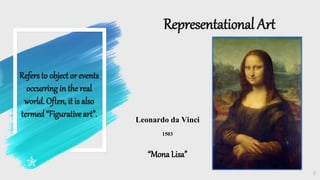
Refers to object or events
occurring in the real
world. Often, it is also
termed “Figurativeart”.
Representational Art
5
Leonardo da Vinci
1503
“MonaLisa”
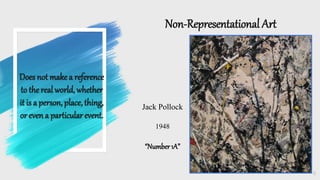
Does not make a reference
to the real world, whether
it is a person, place,thing,
or evena particular event.
Non-Representational Art
6
Jack Pollock
1948
“Number1A”
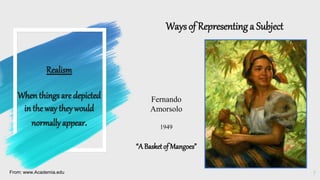
Realism
When things are depicted
in the way theywould
normallyappear.
Waysof Representing a Subject
7
From: www.Academia.edu
Fernando
Amorsolo
1949
“A Basketof Mangoes”
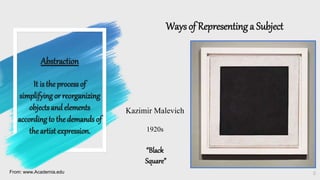
Abstraction
It is the processof
simplifyingor reorganizing
objectsand elements
accordingto the demands of
theartist expression.
Waysof Representing a Subject
8
From: www.Academia.edu
Kazimir Malevich
1920s
“Black
Square”
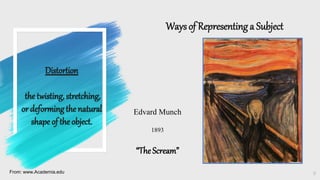
Distortion
the twisting, stretching,
or deformingthe natural
shape of the object.
Waysof Representing a Subject
9
From: www.Academia.edu
Edvard Munch
1893
“TheScream”
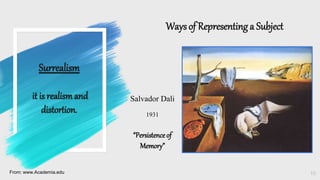
Surrealism
it is realismand
distortion.
Waysof Representing a Subject
10
From: www.Academia.edu
Salvador Dali
1931
“Persistenceof
Memory”
Non-Representational Art
and Abstract Art
11
• Painting, sculpture and other art forms can be divided
into the categories of Representational, Non-
representational and Abstract art.
• Non-representational- one source of confusion is the
notion that non-representational art is the same as
abstract art.
12
Abstract Art
13
is in itself a departure from reality, but the extent
of that departure determines whether it has reached the
end of the spectrum which is non-representationality, a
complete severance from the world.
Sources
and
Kinds of Subject
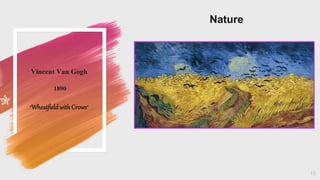
Vincent Van Gogh
1890
“WheatfieldwithCrows”
Nature
15
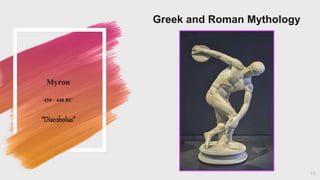
Myron
450 - 440 BC
“Discobolus”
Greek and Roman Mythology
16
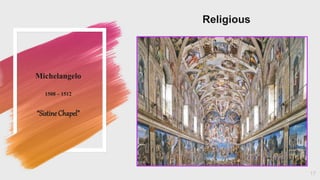
Michelangelo
1508 – 1512
“SistineChapel”
Religious
17
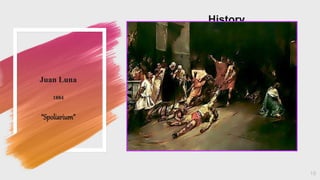
Juan Luna
1884
“Spoliarium”
History
18
Forms in Art
19
What is Forms?
Refers to the work’s composition, techniques, and
media used, and how the elements of design are implemented
Content in Art
20
What is Content?
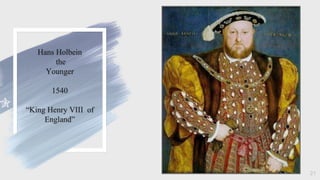
• Is the message or meaning of what is depicted and how it is depicted.
• It can be positive, negative, neutral or promote value and ideas related
to the subject matter
• It’s expressed through the visual, but isn’t visual itself.
Hans Holbein
the
Younger
1540
“King Henry VIII of
England”
21
22
THANKS!
Any questions?

subject and content

Editor's Notes

  • #2 Greetings, Name the members one by one Overall view of the topic Interact (paintings, artist, etc.)
  • #3 Primary stage of looking at art is PERCEPTION. The main reason why art is there Think OUT SIDE THE BOX
  • #4 Tackle the diff. topics with member name.
  • #5 Interact. If none call someone. Physical of an art. What you can see from the art.
  • #6 Objective art Easy to make out. Facts: Mona lisa Mysteries
  • #7 Non- Objective Does not have any subject.
  • #8 More realistic More like photographic Mostly we saw this kinds of art in our environment.
  • #9 More on shapes, lines, colors, etc. It is on the viewers to interpret the meaning.
  • #10 Dramatize the art to cream a emotion. Facts: Refer to “Soul Painting” Inner self of the painter (Troubles, Anxiety, etc.)
  • #11 Dreamlike art, Like nature or environment but Combined with unnatural and fantastic. Facts: “Persistent” – “Continuing”, Ant eating the red clock – Decaying