GRIP
- The manner in which competitive
players grip their bats/rackets can be
classified into
two major family of styles
> Penhold
> Shakehand
But, numerous variations on gripping
styles exist.
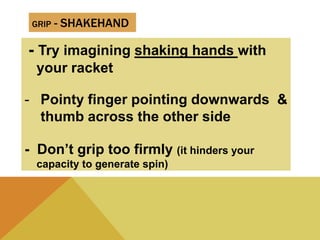
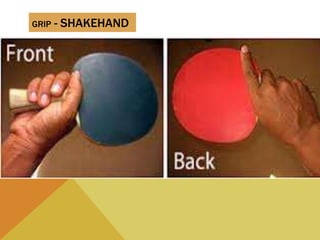
GRIP - SHAKEHAND
- Try imagining shaking hands with
your racket
- Pointy finger pointing downwards &
thumb across the other side
- Don’t grip too firmly (it hinders your
capacity to generate spin)
GRIP - SHAKEHAND
COMMON QUESTION?
Why not use the forehand grip from holding a
lawn tennis racket?
>>It’s a little unstable
>>Having the pointy finger pointing downwards
gives you more control over the racket and
helps you determine which angle is your racket
at
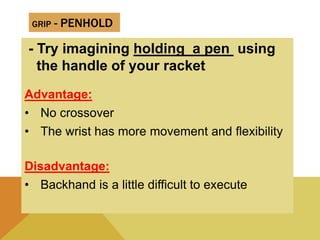
GRIP - PENHOLD
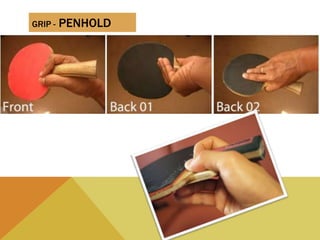
- Try imagining holding a pen using
the handle of your racket
Advantage:
• No crossover
• The wrist has more movement and flexibility
Disadvantage:
• Backhand is a little difficult to execute
GRIP - PENHOLD
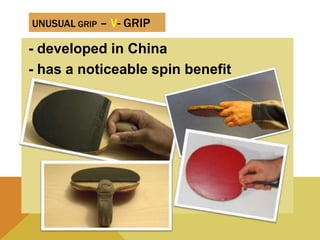
UNUSUAL GRIP – V- GRIP
- developed in China
- has a noticeable spin benefit
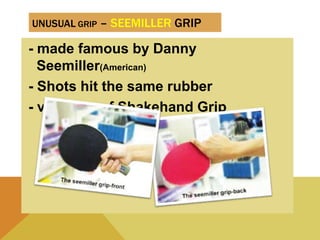
UNUSUAL GRIP – SEEMILLER GRIP
- made famous by Danny
Seemiller(American)
- Shots hit the same rubber
- variation of Shakehand Grip
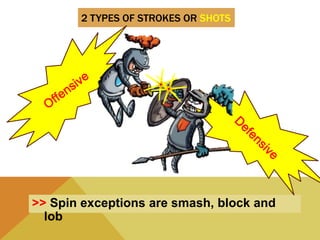
2 TYPES OF STROKES OR SHOTS
>> Spin exceptions are smash, block and
lob
5 OFFENSIVE STROKES
1. Speed Drive
2. Loop Drive
3. Counter Drive
4. Flip (Flick in Europe)
5. Smash
1 / 5 OFFENSIVE STROKES
- the racket is perpendicular to the direction
of the stroke when executed
- focused on speed than spin
- used mostly to keep the ball in
play, applying pressure on the opponent
to return their shots as fast as they can
SPEED DRIVE
2 / 5 OFFENSIVE STROKES
- reverse of speed drive
- racket is parallel to the direction of the
stroke
- it will arc quite a bit
- not as difficult to return as speed drive but
will likely to rebound off the opponents
racket at a high angle, easy for a smash
LOOP DRIVE
2 / 5 OFFENSIVE STROKES
>> Categorized in 3 variations by the
Chinese players:
1. The “Loop” – slower; ultra-topspin; has a
higher trajectory; more loopy arc
2. The “Rush” – combination of loop &
speed drive; as fast as a speed drive &
has a flatter trajectory as a loop if it
bounces; it spins
3. The “Hook” – top-side spin; bounces
sideways/downwards upon hitting the
table
LOOP DRIVE – 3 CATEGORIES
3 / 5 OFFENSIVE STROKES
- it’s usually a counter attack against drives
- racket is near the ball, hit with a short
movement “off the bounce” (before reaching
the highest point) , hence the ball travels
faster to the other side
- with timing & accuracy, it can be effective
as a smash
COUNTER DRIVE
4 / 5 OFFENSIVE STROKES
- a short topspin stroke played from over
the table, using mainly the wrist and
forearm, typically against a
short serve or push
- it can also be a backswing that is
compressed to a quick wrist action
FLIP (OR FLICK IN EUROPE)
5 / 5 OFFENSIVE STROKES
- A forceful shot with an emphasis
on speed.
- It is a power stroke that will
have the intention of winning
the point. Also known as a flat
hit or kill.
- Usually executed when the
opponent has returned a ball
that bounces too high and/or
close to the net
SMASH
7 DEFENSIVE STROKES
1. Slice
2. Chop
3. Block
4. Push Block
5. Side Drive
6. Lob
7. Stop
1 / 7 DEFENSIVE STROKES
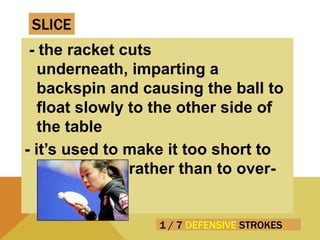
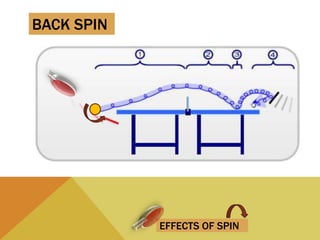
- the racket cuts
underneath, imparting a
backspin and causing the ball to
float slowly to the other side of
the table
- it’s used to make it too short to
be attacked rather than to over-
spin
SLICE
2 / 7 DEFENSIVE STROKES
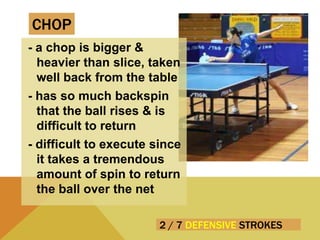
- a chop is bigger &
heavier than slice, taken
well back from the table
- has so much backspin
that the ball rises & is
difficult to return
- difficult to execute since
it takes a tremendous
amount of spin to return
the ball over the net
CHOP
3 / 7 DEFENSIVE STROKES
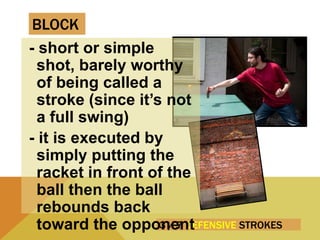
- short or simple
shot, barely worthy
of being called a
stroke (since it’s not
a full swing)
- it is executed by
simply putting the
racket in front of the
ball then the ball
rebounds back
toward the opponent
BLOCK
4 / 7 DEFENSIVE STROKES
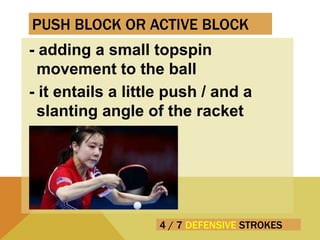
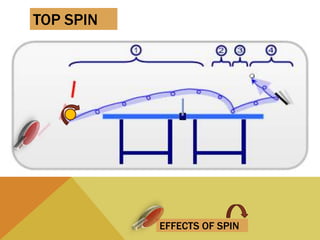
- adding a small topspin
movement to the ball
- it entails a little push / and a
slanting angle of the racket
PUSH BLOCK OR ACTIVE BLOCK
5 / 7 DEFENSIVE STROKES
- this is alternately used as
defensive / offensive maneuver
- it puts a spin on the ball either to
the right or left
- its execution is similar to slice
but the rackets angle is sideward
not downward
SIDE DRIVE
6 / 7 DEFENSIVE STROKES
- it’s deceptive & the most
visually-impressive shot
- it is done by lifting the ball to
enormous height before it falls
back to the opponents side
- it’s unpredictable because of its
heavy amounts of spin
LOB
7 / 7 DEFENSIVE STROKES
- it’s a high level stroke, used as
another variation for close-to-
table strokes (like slice)
- it’s done by positioning your
body close to the ball and just let
the ball touch the racket without
any hand movement
STOP OR DROP SHOT
OTHERS MAY SIMPLY SAY
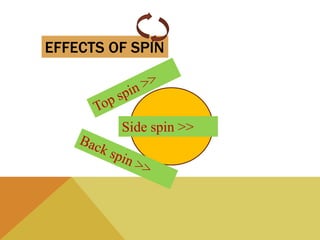
EFFECTS OF SPIN
Side spin >>
EFFECTS OF SPIN
BACK SPIN
EFFECTS OF SPIN
TOP SPIN
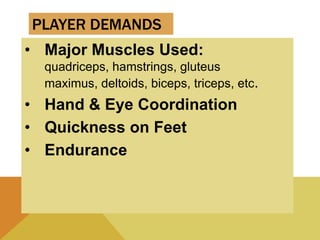
• Major Muscles Used:
quadriceps, hamstrings, gluteus
maximus, deltoids, biceps, triceps, etc.
• Hand & Eye Coordination
• Quickness on Feet
• Endurance
PLAYER DEMANDS
SOURCES:
• http://tabletennis.about.com/od/glossary/Glossary_of_Table_Tennis_Ter
ms.htm . Accessed on 06/19/2013
• Tulio, Doris T. (2008) . Physical Education 3 for College. First Year
Publication, 2010 Reprint.
• http://www.youtube.com . Accessed on 06/19/2013
• http://en.wikipedia.org/wiki/Table_tennis . Accessed on 06/19/2013
END OF REPORT

Styles of play

  • 2.
    GRIP - The mannerin which competitive players grip their bats/rackets can be classified into two major family of styles > Penhold > Shakehand But, numerous variations on gripping styles exist.
  • 3.
    GRIP - SHAKEHAND -Try imagining shaking hands with your racket - Pointy finger pointing downwards & thumb across the other side - Don’t grip too firmly (it hinders your capacity to generate spin)
  • 4.
  • 5.
    COMMON QUESTION? Why notuse the forehand grip from holding a lawn tennis racket? >>It’s a little unstable >>Having the pointy finger pointing downwards gives you more control over the racket and helps you determine which angle is your racket at
  • 6.
    GRIP - PENHOLD -Try imagining holding a pen using the handle of your racket Advantage: • No crossover • The wrist has more movement and flexibility Disadvantage: • Backhand is a little difficult to execute
  • 7.
  • 8.
    UNUSUAL GRIP –V- GRIP - developed in China - has a noticeable spin benefit
  • 9.
    UNUSUAL GRIP –SEEMILLER GRIP - made famous by Danny Seemiller(American) - Shots hit the same rubber - variation of Shakehand Grip
  • 10.
    2 TYPES OFSTROKES OR SHOTS >> Spin exceptions are smash, block and lob
  • 11.
    5 OFFENSIVE STROKES 1.Speed Drive 2. Loop Drive 3. Counter Drive 4. Flip (Flick in Europe) 5. Smash
  • 12.
    1 / 5OFFENSIVE STROKES - the racket is perpendicular to the direction of the stroke when executed - focused on speed than spin - used mostly to keep the ball in play, applying pressure on the opponent to return their shots as fast as they can SPEED DRIVE
  • 13.
    2 / 5OFFENSIVE STROKES - reverse of speed drive - racket is parallel to the direction of the stroke - it will arc quite a bit - not as difficult to return as speed drive but will likely to rebound off the opponents racket at a high angle, easy for a smash LOOP DRIVE
  • 14.
    2 / 5OFFENSIVE STROKES >> Categorized in 3 variations by the Chinese players: 1. The “Loop” – slower; ultra-topspin; has a higher trajectory; more loopy arc 2. The “Rush” – combination of loop & speed drive; as fast as a speed drive & has a flatter trajectory as a loop if it bounces; it spins 3. The “Hook” – top-side spin; bounces sideways/downwards upon hitting the table LOOP DRIVE – 3 CATEGORIES
  • 15.
    3 / 5OFFENSIVE STROKES - it’s usually a counter attack against drives - racket is near the ball, hit with a short movement “off the bounce” (before reaching the highest point) , hence the ball travels faster to the other side - with timing & accuracy, it can be effective as a smash COUNTER DRIVE
  • 16.
    4 / 5OFFENSIVE STROKES - a short topspin stroke played from over the table, using mainly the wrist and forearm, typically against a short serve or push - it can also be a backswing that is compressed to a quick wrist action FLIP (OR FLICK IN EUROPE)
  • 17.
    5 / 5OFFENSIVE STROKES - A forceful shot with an emphasis on speed. - It is a power stroke that will have the intention of winning the point. Also known as a flat hit or kill. - Usually executed when the opponent has returned a ball that bounces too high and/or close to the net SMASH
  • 18.
    7 DEFENSIVE STROKES 1.Slice 2. Chop 3. Block 4. Push Block 5. Side Drive 6. Lob 7. Stop
  • 19.
    1 / 7DEFENSIVE STROKES - the racket cuts underneath, imparting a backspin and causing the ball to float slowly to the other side of the table - it’s used to make it too short to be attacked rather than to over- spin SLICE
  • 20.
    2 / 7DEFENSIVE STROKES - a chop is bigger & heavier than slice, taken well back from the table - has so much backspin that the ball rises & is difficult to return - difficult to execute since it takes a tremendous amount of spin to return the ball over the net CHOP
  • 21.
    3 / 7DEFENSIVE STROKES - short or simple shot, barely worthy of being called a stroke (since it’s not a full swing) - it is executed by simply putting the racket in front of the ball then the ball rebounds back toward the opponent BLOCK
  • 22.
    4 / 7DEFENSIVE STROKES - adding a small topspin movement to the ball - it entails a little push / and a slanting angle of the racket PUSH BLOCK OR ACTIVE BLOCK
  • 23.
    5 / 7DEFENSIVE STROKES - this is alternately used as defensive / offensive maneuver - it puts a spin on the ball either to the right or left - its execution is similar to slice but the rackets angle is sideward not downward SIDE DRIVE
  • 24.
    6 / 7DEFENSIVE STROKES - it’s deceptive & the most visually-impressive shot - it is done by lifting the ball to enormous height before it falls back to the opponents side - it’s unpredictable because of its heavy amounts of spin LOB
  • 25.
    7 / 7DEFENSIVE STROKES - it’s a high level stroke, used as another variation for close-to- table strokes (like slice) - it’s done by positioning your body close to the ball and just let the ball touch the racket without any hand movement STOP OR DROP SHOT
  • 26.
  • 27.
  • 28.
  • 29.
  • 30.
    • Major MusclesUsed: quadriceps, hamstrings, gluteus maximus, deltoids, biceps, triceps, etc. • Hand & Eye Coordination • Quickness on Feet • Endurance PLAYER DEMANDS
  • 31.
    SOURCES: • http://tabletennis.about.com/od/glossary/Glossary_of_Table_Tennis_Ter ms.htm .Accessed on 06/19/2013 • Tulio, Doris T. (2008) . Physical Education 3 for College. First Year Publication, 2010 Reprint. • http://www.youtube.com . Accessed on 06/19/2013 • http://en.wikipedia.org/wiki/Table_tennis . Accessed on 06/19/2013 END OF REPORT