is, and can be, played in a
wide variety of environments which is an
advantage because it is easily set up but also a
disadvantage as it is easily packed away
therefore becoming invisible.

   Often the sport is made to put up with sub-
standard facilities such as poor lighting,
unsuitable floor covering or inappropriate wall
colouring.
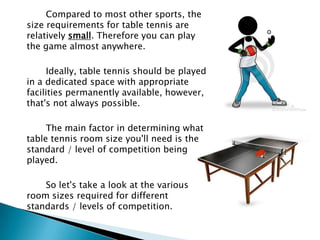
Compared to most other sports, the
size requirements for table tennis are
relatively small. Therefore you can play
the game almost anywhere.

      Ideally, table tennis should be played
in a dedicated space with appropriate
facilities permanently available, however,
that's not always possible.

     The main factor in determining what
table tennis room size you'll need is the
standard / level of competition being
played.

    So let's take a look at the various
room sizes required for different
standards / levels of competition.
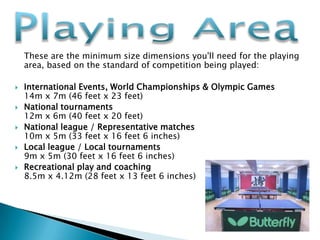
These are the minimum size dimensions you'll need for the playing
    area, based on the standard of competition being played:

   International Events, World Championships & Olympic Games
    14m x 7m (46 feet x 23 feet)
   National tournaments
    12m x 6m (40 feet x 20 feet)
   National league / Representative matches
    10m x 5m (33 feet x 16 feet 6 inches)
   Local league / Local tournaments
    9m x 5m (30 feet x 16 feet 6 inches)
   Recreational play and coaching
    8.5m x 4.12m (28 feet x 13 feet 6 inches)
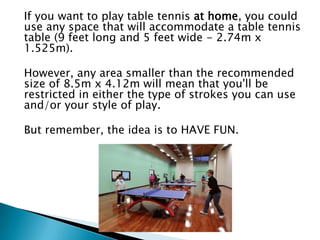
If you want to play table tennis at home, you could
use any space that will accommodate a table tennis
table (9 feet long and 5 feet wide - 2.74m x
1.525m).

However, any area smaller than the recommended
size of 8.5m x 4.12m will mean that you'll be
restricted in either the type of strokes you can use
and/or your style of play.

But remember, the idea is to HAVE FUN.
Uniform lighting over the whole of the playing area is essential.
    The minimum light intensity over the whole of the playing surface (measured at
    the table surface height) and the clear height from the floor to the light should
    be as follows:

   World Championships & Olympic Games
    1,000 lux
    5m (16 feet 6 inches) above the floor
   Other International and National tournaments
    750 - 1,000 lux
    4m (13 feet) above the floor
   National league / Representative matches
    500 lux
    3m (10 feet) above the floor
   Local league / Local tournaments
    500 lux
    3m (10 feet) above the floor
   Recreational play and coaching
    300 lux
    3m (10 feet) above the floor
   paramount importance
   #1 priority
   non-slip
   smooth and level
   able to support the weight of the table tennis table and the players
   good contrast between the table top surface and the surrounding
    areas, both for the benefit of the players and the spectators; non-
    reflective

    Wooden semi-sprung floors provide the best surface while solid
    concrete and carpeted floors are totally unsuitable.

    All the top international table tennis tournaments now use specialist
    sports flooring such as Taraflex® made by French company Gerflor.
    The reddish color of this flooring, together with blue tables,
    provides a fantastic setting for table tennis.
   The ideal room temperature is 15-20°C with a
    relative humidity of 40-50%.
   adequate ventilation; any condensation will make
    the floor slippery and will cause the ball to slide
    off the racket if you're using reverse rubber.
   If there are any air conditioning units, you'll also
    need to ensure that they don't cause any air
    currents which will deflect the flight of the ball.
   Spectators' comfort
   playing conditions take priority
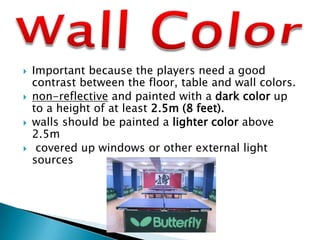
   Important because the players need a good
    contrast between the floor, table and wall colors.
   non-reflective and painted with a dark color up
    to a height of at least 2.5m (8 feet).
   walls should be painted a lighter color above
    2.5m
    covered up windows or other external light
    sources
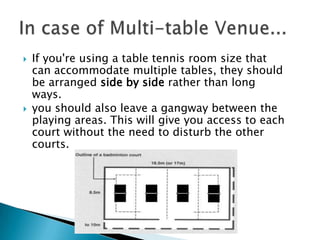
   If you're using a table tennis room size that
    can accommodate multiple tables, they should
    be arranged side by side rather than long
    ways.
   you should also leave a gangway between the
    playing areas. This will give you access to each
    court without the need to disturb the other
    courts.
   Barriers
    ◦ useful to stop the ball from straying too far
      and minimize interruptions from other tables.
    ◦ must be collapsible rather than solid, so that
      they won't harm any player who runs into
      them
    ◦ 1.5m (5 feet) long and 75cm (2 feet 6 inches)
      high and should completely enclose the
      playing area

Reference: http://www.allabouttabletennis.com/table-tennis-room-
  size.html

Table tennis Facilities

  • 2.
    is, and canbe, played in a wide variety of environments which is an advantage because it is easily set up but also a disadvantage as it is easily packed away therefore becoming invisible. Often the sport is made to put up with sub- standard facilities such as poor lighting, unsuitable floor covering or inappropriate wall colouring.
  • 3.
    Compared to mostother sports, the size requirements for table tennis are relatively small. Therefore you can play the game almost anywhere. Ideally, table tennis should be played in a dedicated space with appropriate facilities permanently available, however, that's not always possible. The main factor in determining what table tennis room size you'll need is the standard / level of competition being played. So let's take a look at the various room sizes required for different standards / levels of competition.
  • 4.
    These are theminimum size dimensions you'll need for the playing area, based on the standard of competition being played:  International Events, World Championships & Olympic Games 14m x 7m (46 feet x 23 feet)  National tournaments 12m x 6m (40 feet x 20 feet)  National league / Representative matches 10m x 5m (33 feet x 16 feet 6 inches)  Local league / Local tournaments 9m x 5m (30 feet x 16 feet 6 inches)  Recreational play and coaching 8.5m x 4.12m (28 feet x 13 feet 6 inches)
  • 5.
    If you wantto play table tennis at home, you could use any space that will accommodate a table tennis table (9 feet long and 5 feet wide - 2.74m x 1.525m). However, any area smaller than the recommended size of 8.5m x 4.12m will mean that you'll be restricted in either the type of strokes you can use and/or your style of play. But remember, the idea is to HAVE FUN.
  • 6.
    Uniform lighting overthe whole of the playing area is essential. The minimum light intensity over the whole of the playing surface (measured at the table surface height) and the clear height from the floor to the light should be as follows:  World Championships & Olympic Games 1,000 lux 5m (16 feet 6 inches) above the floor  Other International and National tournaments 750 - 1,000 lux 4m (13 feet) above the floor  National league / Representative matches 500 lux 3m (10 feet) above the floor  Local league / Local tournaments 500 lux 3m (10 feet) above the floor  Recreational play and coaching 300 lux 3m (10 feet) above the floor
  • 7.
    paramount importance  #1 priority  non-slip  smooth and level  able to support the weight of the table tennis table and the players  good contrast between the table top surface and the surrounding areas, both for the benefit of the players and the spectators; non- reflective Wooden semi-sprung floors provide the best surface while solid concrete and carpeted floors are totally unsuitable. All the top international table tennis tournaments now use specialist sports flooring such as Taraflex® made by French company Gerflor. The reddish color of this flooring, together with blue tables, provides a fantastic setting for table tennis.
  • 8.
    The ideal room temperature is 15-20°C with a relative humidity of 40-50%.  adequate ventilation; any condensation will make the floor slippery and will cause the ball to slide off the racket if you're using reverse rubber.  If there are any air conditioning units, you'll also need to ensure that they don't cause any air currents which will deflect the flight of the ball.  Spectators' comfort  playing conditions take priority
  • 9.
    Important because the players need a good contrast between the floor, table and wall colors.  non-reflective and painted with a dark color up to a height of at least 2.5m (8 feet).  walls should be painted a lighter color above 2.5m  covered up windows or other external light sources
  • 10.
    If you're using a table tennis room size that can accommodate multiple tables, they should be arranged side by side rather than long ways.  you should also leave a gangway between the playing areas. This will give you access to each court without the need to disturb the other courts.
  • 11.
    Barriers ◦ useful to stop the ball from straying too far and minimize interruptions from other tables. ◦ must be collapsible rather than solid, so that they won't harm any player who runs into them ◦ 1.5m (5 feet) long and 75cm (2 feet 6 inches) high and should completely enclose the playing area Reference: http://www.allabouttabletennis.com/table-tennis-room- size.html