Study of One-way Hash function and Signature Generation & Implementation
1.
A
Presentation
On
Study of One-wayHash function and Signature
Generation & Implementation
Department of Cyber Forensics & Information Security
Behala Government Polytechnic
Presented by :
Sumangal Kayal
Supriyo Dana
Swarnali Adhikary
Trisha Giri
2.
Contents
INTRODUCTION
DIGITALSIGNATURE
MOTIVATION
BASIC REQUIREMENTS
HASH FUNCTION
PRIVATE & PUBLIC KEY
HOW IT WORKS
DIGITAL SIGNATURE CREATION
STEPS
VERIFICATION PROCESS
FLOWCHART
3.
Introduction
In today'sdigital age it is essential
to verify the authenticity and
integrity of digital documents to
ensure that they have not been
tampered with or altered, which
is essential for e-government
services, and electronic medical
records and other valuable
documents.
4.
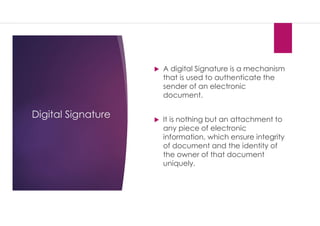
Digital Signature
Adigital Signature is a mechanism
that is used to authenticate the
sender of an electronic
document.
It is nothing but an attachment to
any piece of electronic
information, which ensure integrity
of document and the identity of
the owner of that document
uniquely.
5.
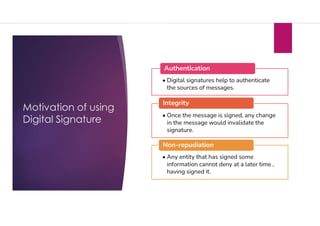
Motivation of using
DigitalSignature
• Digital signatures help to authenticate
the sources of messages.
Authentication
• Once the message is signed, any change
in the message would invalidate the
signature.
Integrity
• Any entity that has signed some
information cannot deny at a later time ,
having signed it.
Non-repudiation
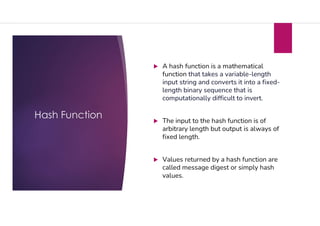
Hash Function
Ahash function is a mathematical
function that takes a variable-length
input string and converts it into a fixed-
length binary sequence that is
computationally difficult to invert.
The input to the hash function is of
arbitrary length but output is always of
fixed length.
Values returned by a hash function are
called message digest or simply hash
values.
8.
Benefits of
one-way
Hash Function
One-way hash functions have several
benefits, including: data integrity, data
authenticity, data tamper detection,
digital signatures, and password storage.
They are also fast and efficient, making
them ideal for use in large-scale systems.
9.
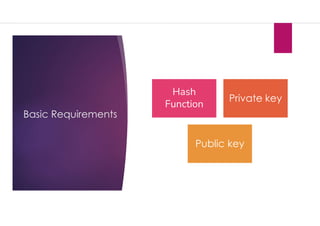
Private Key &
PublicKey
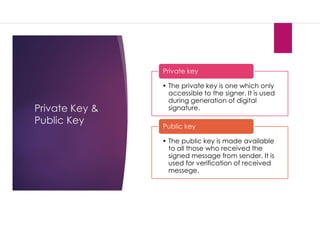
• The private key is one which only
accessible to the signer. It is used
during generation of digital
signature.
Private key
• The public key is made available
to all those who received the
signed message from sender. It is
used for verification of received
messege.
Public key
10.
How it works
Hash value of a message when
encrypted with the private key of a
person, is his digital signature on that
document .
Digital signature of a person therefore
varies from document to document thus
ensuring authenticity of each word of
that document.
As the public key of the owner is known,
anybody can verify the message and
digital signature.
11.
Digital Signature
Creation steps
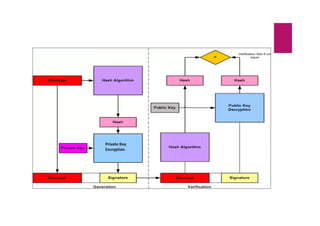
First we need to generate a hash
value of the document.
Next, generate a key pair. i.e private
key and public key.
After successfully generating keys, the
hash value encrypted using private
key.
12.
Verification
process
Compute thehash of the document.
Decrypt the signature using available
public key.
If the decrypted hash matches with
computed hash, then the verification
is successful.
14.
Conclusion
One-way hashfunction-based digital
signature generation is a powerful tool for
securing digital documents. It provides a
way to ensure the authenticity, integrity,
and non-repudiation of digital
documents.
By understanding the basics of digital
signatures and one-way hash functions,
you can take steps to protect your digital
documents.