ISSN 2393-8471
International Journal of Recent Research in Civil and Mechanical Engineering (IJRRCME)
Vol. 3, Issue 1, pp: (1-9), Month: April 2016 – September 2016, Available at: www.paperpublications.org
Page | 1
Paper Publications
Design of Machining Fixture for Support
Bracket
Josco Jose1
, Kiran Prakash2
, Harikrishnan K M3
, Sarath chandran M4
,
Midhun K M 5
, Job Jose P 6
Abstract: This Project presents the Design of Machining Fixture for Support Bracket for Machining on VTC
(Vertical Turning Centre). Fixture Design consists of High product rate, low manufacturing operation cost. The
fixture should be designed in such-a-way that part/product change overtime is very less. The report consists of
study of input data from customers like Part drawing and Assembly drawing. The fixture design begins with part
modeling, Machining and Analysis of various parts in the fixture assembly using AutoCAD and Solid works, for a
analysis ANSYS Software package is used. The actual design begins with study details of project proposal
summary from customer. After that machining fixture concept is done. Locating and clamping points are decided.
This also includes accessibility, loading and unloading sequence of parts, required material for this fixture is
selected, and Fixture is designed at HMT MACHINE TOOL, KALAMASSERY using Industrial application
standards. Locating accuracy and machined part quality tested and found that the fixture is as good as any
dedicated fixture in production.
Keywords: Fixture design, vertical turning centre, solidwork, ansys. Accuracy and production.
1. INTRODUCTION
This project is intended to design and develop a machining fixture for the support bracket. Machining fixture requires
systematic design to clamp, hold the work-piece during machining process. Using the design data and geometry of the
component fixture is designed to hold the part with less time for loading and unloading the part
In HMT plant manufacturing of the support bracket is done on four machines like Centre lathe, Radial drilling machine,
Horizontal milling machine and Slotting machine. In this project we replace the four machines into one VTC machine.
Thus it will increase production rate about 50% and reduce the labour cost and power consumption rate. By this method
we maximize profit of company.
1.1 Elements of Fixtures:
Five considerations are important, of which the first two are common to both jigs and fixtures, the third applies to jigs
only, and the last two only to fixtures.
a) Location b) Clamping c) Guidance d) Setting of cutters e) Securing to the machine table
1.2 Advantages of jigs and fixtures:
a) Productivity: Jigs & Fixtures eliminate individual marking, positioning and frequent checking. This reduces operation
time and increase productivity.
b) Interchangeability: Jigs & Fixtures facilitate uniform quality in manufacture. There is no need for selective assembly.
Any part of the machine would fit properly in assembly and all similar components are interchangeable.
c) Skill Reduction: Jigs & Fixtures simplify locating and clamping of the work pieces. Tool guiding elements ensure
correct positioning of the tools with respect to the work pieces. There is no need of skillful setting of the work piece or
ISSN 2393-8471
International Journal of Recent Research in Civil and Mechanical Engineering (IJRRCME)
Vol. 3, Issue 1, pp: (1-9), Month: April 2016 – September 2016, Available at: www.paperpublications.org
Page | 2
Paper Publications
tool. Any average person can be trained to use Jigs & Fixtures. The replacement of a skilled workman with unskilled labor
can effect substantial saving in labor cost.
d) Cost Reduction: Higher production, reduction in scrap, easy assembly and savings in labor costs results in substantial
reduction in the cost of work pieces produced with Jigs & Fixtures.
1.3 Material used:
Jigs and fixtures are made from a variety of materials some of them can be hardened to resist wear. It is sometimes
necessary to use non-ferrous metals like Phosphor Bronze or Brass to reduce wear of mating parts or Nylons or Fiber to
prevent damage to the work piece.
Mild steel: It is the cheapest and most widely used material in Jigs & Fixtures. It contains less than 0.3%C. Steel En 2
falls in this category. This steel can be case hardened to 56 HRC. It is used to make parts which are not subjected to wear
and not highly stressed. .
High Tensile Steels: These can be classified into medium carbon steels with 0.45-0.65%C (En 8, En 9) and alloy steels
like En 24 (40Ni2Cr1Mo28).The tensile strength can be increased up to 125 kg/mm2 by tempering.
Case Hardening Steels: These can be carburized and case hardened to provide 0.6-1.5 mm thick, hard exterior (58-62
HRC). 17Mn1Cr95 steels with 1%Mn and 0.95%Cr is widely used for locating pins, Rest pads etc. These steels are
suitable for parts which require only local hardness on small wearing surfaces.(Ex: En 353, En 36).
Cast Iron: It contains 2-2.5%C. As it can withstand vibrations well, it is used widely in milling fixtures. The ingenious
shaping of a casting and the pattern can save a lot of machining time. Nodular CI is as strong as MS while Meehanite
castings have heat resistance, wear resistance and corrosion resistance grades.
Nylon and Fiber: These are usually used as soft lining of clamps to prevent denting or damage to work piece under high
clamping pressure. Nylon or Fiber pads are screwed or stuck to mild steel clamps.
2. LITERATURE REVIEW
A literature search is performed to understand the fixture-workpiece systems. Much research has been done regarding
fixture-workpiece systems. These studies give a great insight into various fixturing schemes. However, these studies lack
the focus on theturning process. N.P.Maniar and D.P.Vakhariya[1]
have introduced the proposes direction for future
research of fixture. In his paper Basic requirements of fixture, phases of fixture design, Dedicated and modular fixtures,
Flexible mechanical fixtures, locating and clamping consideration, Fixture design process and computer aided fixture
design have explained very well for the Design and Development of Fixture.R.D.Makwana and N.D.Gosvami[2]
have
study is about the 3-2-1 principle of fixture design and the different approaches which are used in the related fixture
design are explained. ShaileshS.Pachbhai and LaukikP.Raut[3]
details to minimizing workpiece deformation due to
clamping and cutting forces is essential to maintain the machining accuracy, different Steps of fixture design, study of
Elements of Fixtures and different types of locator and clamping Tom Zacharia and M.S. Steve [4]
The design
requirements of the fixture were studied and cutting forces were calculated. Strap clamp which is convenient to use the
fixture at different machine beds is designed and modeled. Fixture models were developed in 3D modeling softwares.
3. FIXTURE DESIGN FOR SUPPORT BRACKET
For making the machining fixture design it is required to study in detail about the component for which fixture is
designed and customer requirements.
3.1 customer requirement:
a. The requirement is a machining Fixture.
b. Five components loading at a time.
c. Loading and unloading of part using hand and it shouldn’t foul with either machine elements or fixture elements.
d. Fool proofing while loading component. Write-up of Interchangeable elements. Machining Accuracy should be within
50 microns.
ISSN 2393-8471
International Journal of Recent Research in Civil and Mechanical Engineering (IJRRCME)
Vol. 3, Issue 1, pp: (1-9), Month: April 2016 – September 2016, Available at: www.paperpublications.org
Page | 3
Paper Publications
3.2 component description:
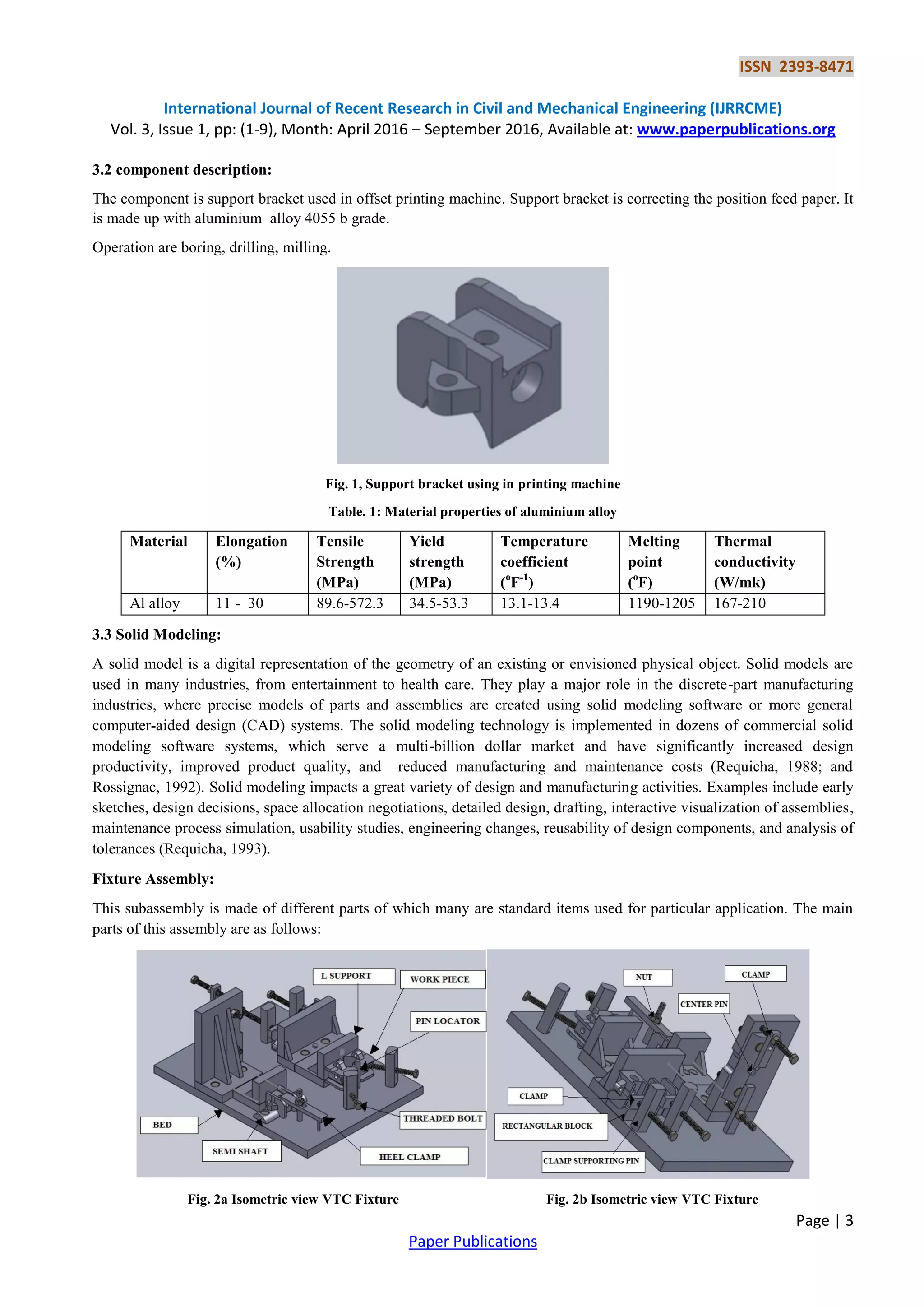
The component is support bracket used in offset printing machine. Support bracket is correcting the position feed paper. It
is made up with aluminium alloy 4055 b grade.
Operation are boring, drilling, milling.
Fig. 1, Support bracket using in printing machine
Table. 1: Material properties of aluminium alloy
Material Elongation
(%)
Tensile
Strength
(MPa)
Yield
strength
(MPa)
Temperature
coefficient
(o
F-1
)
Melting
point
(o
F)
Thermal
conductivity
(W/mk)
Al alloy 11 - 30 89.6-572.3 34.5-53.3 13.1-13.4 1190-1205 167-210
3.3 Solid Modeling:
A solid model is a digital representation of the geometry of an existing or envisioned physical object. Solid models are
used in many industries, from entertainment to health care. They play a major role in the discrete-part manufacturing
industries, where precise models of parts and assemblies are created using solid modeling software or more general
computer-aided design (CAD) systems. The solid modeling technology is implemented in dozens of commercial solid
modeling software systems, which serve a multi-billion dollar market and have significantly increased design
productivity, improved product quality, and reduced manufacturing and maintenance costs (Requicha, 1988; and
Rossignac, 1992). Solid modeling impacts a great variety of design and manufacturing activities. Examples include early
sketches, design decisions, space allocation negotiations, detailed design, drafting, interactive visualization of assemblies,
maintenance process simulation, usability studies, engineering changes, reusability of design components, and analysis of
tolerances (Requicha, 1993).
Fixture Assembly:
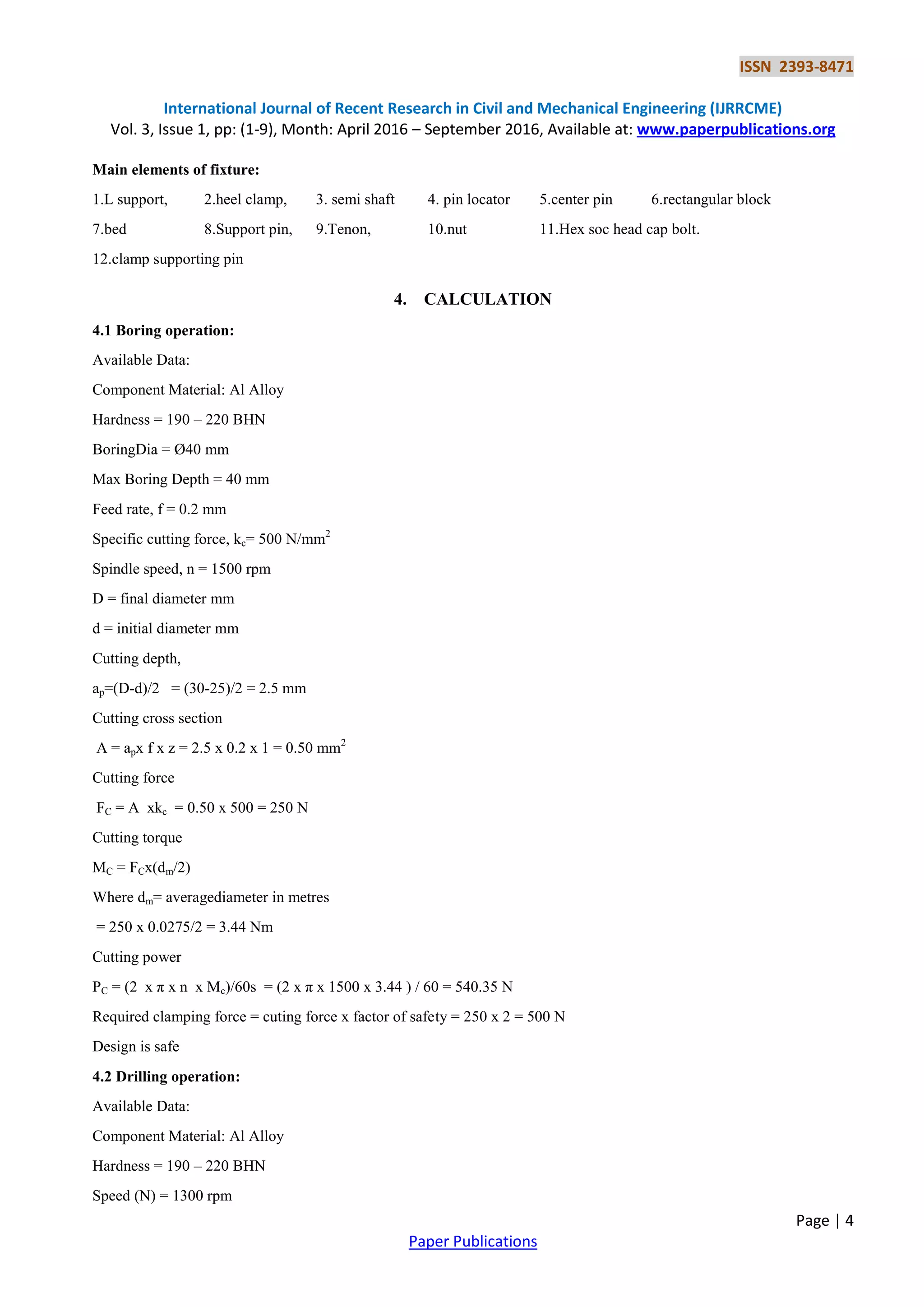
This subassembly is made of different parts of which many are standard items used for particular application. The main
parts of this assembly are as follows:
Fig. 2a Isometric view VTC Fixture Fig. 2b Isometric view VTC Fixture
ISSN 2393-8471
International Journal of Recent Research in Civil and Mechanical Engineering (IJRRCME)
Vol. 3, Issue 1, pp: (1-9), Month: April 2016 – September 2016, Available at: www.paperpublications.org
Page | 4
Paper Publications
Main elements of fixture:
1.L support, 2.heel clamp, 3. semi shaft 4. pin locator 5.center pin 6.rectangular block
7.bed 8.Support pin, 9.Tenon, 10.nut 11.Hex soc head cap bolt.
12.clamp supporting pin
4. CALCULATION
4.1 Boring operation:
Available Data:
Component Material: Al Alloy
Hardness = 190 – 220 BHN
BoringDia = Ø40 mm
Max Boring Depth = 40 mm
Feed rate, f = 0.2 mm
Specific cutting force, kc= 500 N/mm2
Spindle speed, n = 1500 rpm
D = final diameter mm
d = initial diameter mm
Cutting depth,
ap=(D-d)/2 = (30-25)/2 = 2.5 mm
Cutting cross section
A = apx f x z = 2.5 x 0.2 x 1 = 0.50 mm2
Cutting force
FC = A xkc = 0.50 x 500 = 250 N
Cutting torque
MC = FCx(dm/2)
Where dm= averagediameter in metres
= 250 x 0.0275/2 = 3.44 Nm
Cutting power
PC = (2 x π x n x Mc)/60s = (2 x π x 1500 x 3.44 ) / 60 = 540.35 N
Required clamping force = cuting force x factor of safety = 250 x 2 = 500 N
Design is safe
4.2 Drilling operation:
Available Data:
Component Material: Al Alloy
Hardness = 190 – 220 BHN
Speed (N) = 1300 rpm
ISSN 2393-8471
International Journal of Recent Research in Civil and Mechanical Engineering (IJRRCME)
Vol. 3, Issue 1, pp: (1-9), Month: April 2016 – September 2016, Available at: www.paperpublications.org
Page | 5
Paper Publications
Drill Dia = Ø10 mm
Max Drill Depth = 7 mm
Feed per Revolution = 0.04 -0.06 mm/rev
Notations Used
kWs – Spindle Power, kW
TF – Thrust Force, N or kgf
Cutting Speed Calculations(V):
V = π x D x n / 1000
= π x 2.5 x 1300 /1000 = 10.21 m/min
Material factor, k = 0.55
Spindle Power:
N = 1.25 x D2
x k x n (0.056 + 1.5 x s) / 105 = 1.25 x (10)2
x 0.55 x 1300 x (0.056 + 1.5 x 0.04) /105 = 0.1036 kW
Torque:
T = 975 x N/ n = 975 x 0.1036/1300 = 0.0777 kgf = 0.762 N
Thrust Force:
TF = 1.16 K D (100 x s)0.85
= 1.16 x 0.55 x 10 x (100 x 0.04)0.85
= 20.73kgf = 203.35 N
Required clamping force = cuting force x factor of safety
= 203.5 x 2 = 207 N
4.3 Milling operation:
Available Data:
Component Material: Al Alloy
Cutting Tool: Side and face tool
Cutting Speed, (n) = 3000 rpm
Cutter Dia, (D) = Ø100 mm
Width of Cut, (b)= 10 mm
No of Teeth, (Z) = 2
Feed(S) = 1000 mm/min
Speed Calculations (v):
V = πDn/1000 m/min = πx100x3000/1000 = 942.48 m/min
Feed/Tooth (Sz)
Sz= S/(Zx Speed ) = 1000/( 2x3000 ) = 0.17mm/tooth
Feed per minute (Sm)
Sm = Sz x Z x n = 0.17 x 2 x 3000 = 1020mm/min
Material removal rate (Q)
ISSN 2393-8471
International Journal of Recent Research in Civil and Mechanical Engineering (IJRRCME)
Vol. 3, Issue 1, pp: (1-9), Month: April 2016 – September 2016, Available at: www.paperpublications.org
Page | 6
Paper Publications
Q = b x d x Sm / 1000 = 10x 1 x 1020/1000 = 10.2 cm3
/min
Where b = width of cut
d = depth of cut
Sm= Feed /min.
Unit power: U = 2.4 kW / cm3
/ min
Correction factor for flank wear (Kh): = (1.10-1.25)
Correction factor for radial rake angle (Kr): = 0.87
Radial rake angle: = 20 degrees
Power at the spindle (N)
N = U x Kh x Kr x Q KW = 2.4 x 1.15 x 0.87 x 10.2= 24.5 kw
Power at the motor (Nel)
Nel = N /E = 24.5/0.8 = 30.6 kw
Tangential cutting force (Pz)
Pz = 6120 x N / V kgf = 6120 x 24.5 / 942.48 = 159.7 kgf= 1567 N
Required clamping force = cuting force x factor of safety
= 1567 x 2 = 3134 N
4.4 Drilling operation:
Available Data:
Component Material: Al Alloy
Hardness = 190 – 220 BHN
Speed (n) = 1500 rpm
Drill Dia = Ø18 mm
Max Drill Depth = 9 mm
Feed per Revolution = 0.04 mm/rev
Cutting Speed Calculations (V)
V = π x D x n/ 1000 m/min = π x 18 x 1500 /1000 = 84.82 m/min
Material factor: k = 0.55
Spindle Power
N = 1.25 x D2
x k x n (0.056 + 1.5 x s) / 105
= 1.25 x (2.5) 2 x 0.55 x 1500 x (0.056 + 1.5 x 0.04) /105
= 0.38 kW
Torque
T = 975 x N/ n = 975 x 0.38 /1500 = 0.247 kgf = 2.42 N
Thrust Force
Tf = 1.16 K D (100 x s)0.85
kgf = 1.16 x 0.55 x 18 x (100 x 0.04)0.85
= 37.31 kgf = 366 N
Required clamping force = cuting force x factor of safety
= 366 x 2 = 732 N
ISSN 2393-8471
International Journal of Recent Research in Civil and Mechanical Engineering (IJRRCME)
Vol. 3, Issue 1, pp: (1-9), Month: April 2016 – September 2016, Available at: www.paperpublications.org
Page | 7
Paper Publications
5. SIMULATION RESULTS AND DISCUSSION
Table.2, Material properties
5.1 analysis of boring part of fixture:
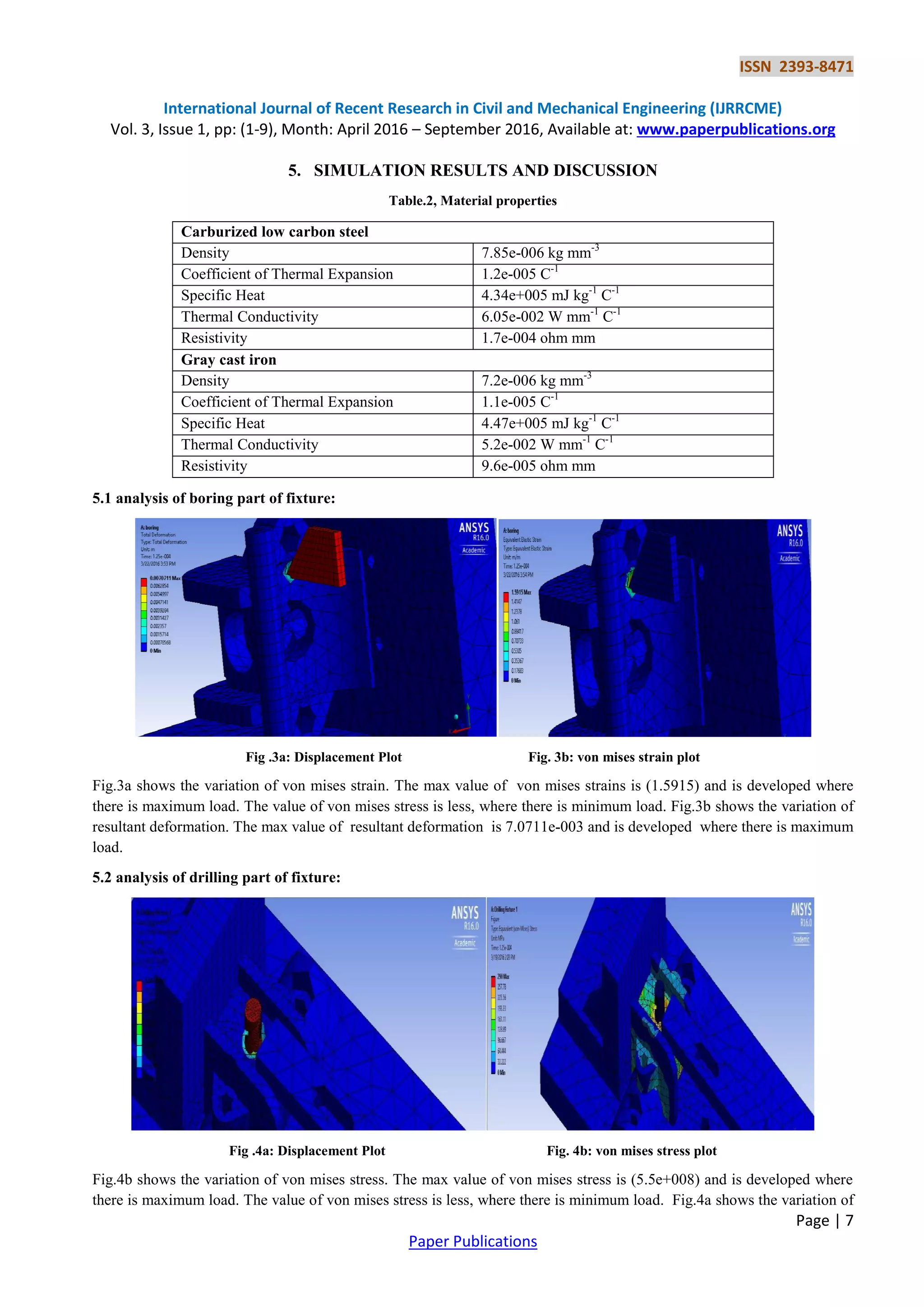
Fig .3a: Displacement Plot Fig. 3b: von mises strain plot
Fig.3a shows the variation of von mises strain. The max value of von mises strains is (1.5915) and is developed where
there is maximum load. The value of von mises stress is less, where there is minimum load. Fig.3b shows the variation of
resultant deformation. The max value of resultant deformation is 7.0711e-003 and is developed where there is maximum
load.
5.2 analysis of drilling part of fixture:
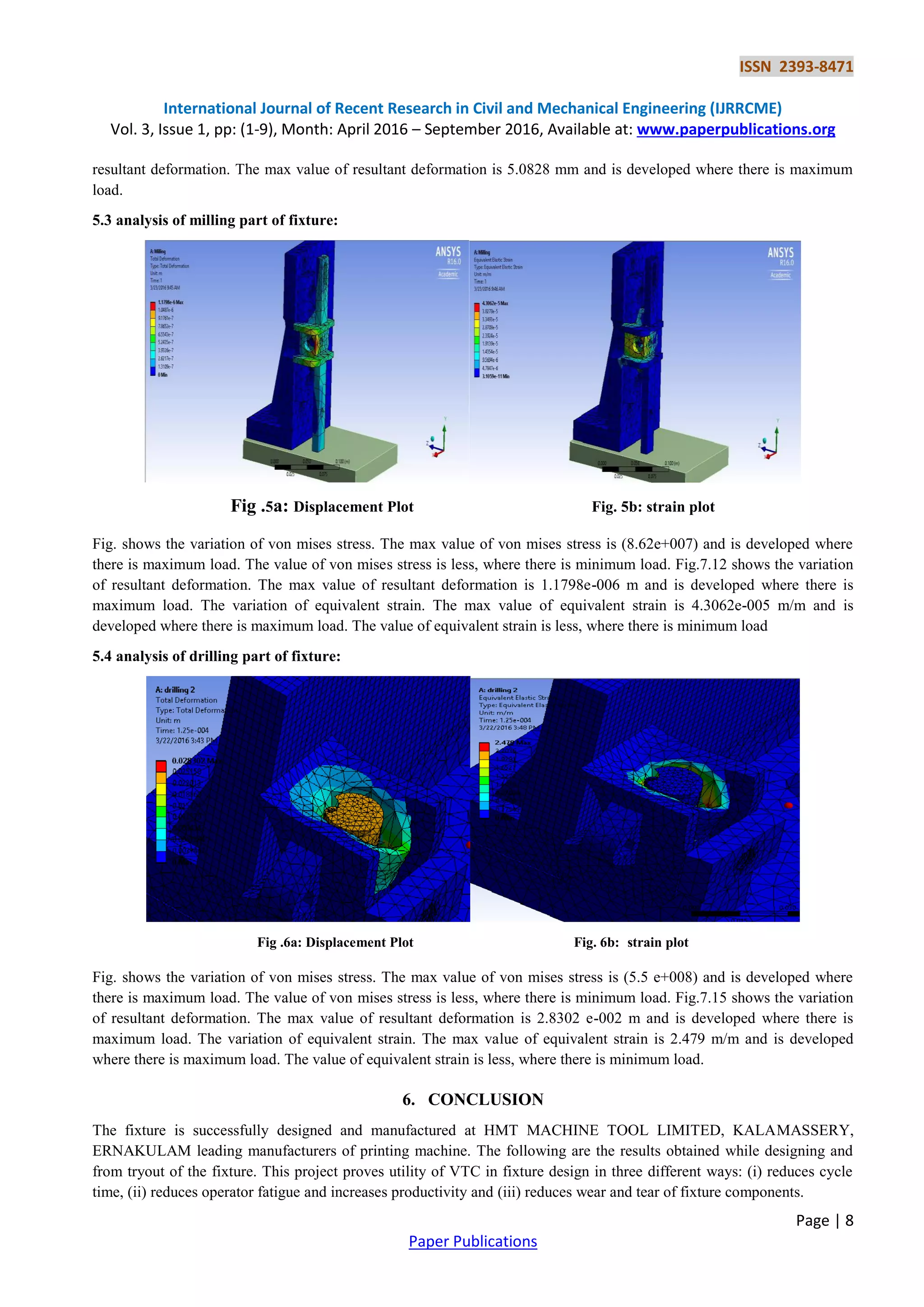
Fig .4a: Displacement Plot Fig. 4b: von mises stress plot
Fig.4b shows the variation of von mises stress. The max value of von mises stress is (5.5e+008) and is developed where
there is maximum load. The value of von mises stress is less, where there is minimum load. Fig.4a shows the variation of
Carburized low carbon steel
Density 7.85e-006 kg mm-3
Coefficient of Thermal Expansion 1.2e-005 C-1
Specific Heat 4.34e+005 mJ kg-1
C-1
Thermal Conductivity 6.05e-002 W mm-1
C-1
Resistivity 1.7e-004 ohm mm
Gray cast iron
Density 7.2e-006 kg mm-3
Coefficient of Thermal Expansion 1.1e-005 C-1
Specific Heat 4.47e+005 mJ kg-1
C-1
Thermal Conductivity 5.2e-002 W mm-1
C-1
Resistivity 9.6e-005 ohm mm
ISSN 2393-8471
International Journal of Recent Research in Civil and Mechanical Engineering (IJRRCME)
Vol. 3, Issue 1, pp: (1-9), Month: April 2016 – September 2016, Available at: www.paperpublications.org
Page | 8
Paper Publications
resultant deformation. The max value of resultant deformation is 5.0828 mm and is developed where there is maximum
load.
5.3 analysis of milling part of fixture:
Fig .5a: Displacement Plot Fig. 5b: strain plot
Fig. shows the variation of von mises stress. The max value of von mises stress is (8.62e+007) and is developed where
there is maximum load. The value of von mises stress is less, where there is minimum load. Fig.7.12 shows the variation
of resultant deformation. The max value of resultant deformation is 1.1798e-006 m and is developed where there is
maximum load. The variation of equivalent strain. The max value of equivalent strain is 4.3062e-005 m/m and is
developed where there is maximum load. The value of equivalent strain is less, where there is minimum load
5.4 analysis of drilling part of fixture:
Fig .6a: Displacement Plot Fig. 6b: strain plot
Fig. shows the variation of von mises stress. The max value of von mises stress is (5.5 e+008) and is developed where
there is maximum load. The value of von mises stress is less, where there is minimum load. Fig.7.15 shows the variation
of resultant deformation. The max value of resultant deformation is 2.8302 e-002 m and is developed where there is
maximum load. The variation of equivalent strain. The max value of equivalent strain is 2.479 m/m and is developed
where there is maximum load. The value of equivalent strain is less, where there is minimum load.
6. CONCLUSION
The fixture is successfully designed and manufactured at HMT MACHINE TOOL LIMITED, KALAMASSERY,
ERNAKULAM leading manufacturers of printing machine. The following are the results obtained while designing and
from tryout of the fixture. This project proves utility of VTC in fixture design in three different ways: (i) reduces cycle
time, (ii) reduces operator fatigue and increases productivity and (iii) reduces wear and tear of fixture components.
ISSN 2393-8471
International Journal of Recent Research in Civil and Mechanical Engineering (IJRRCME)
Vol. 3, Issue 1, pp: (1-9), Month: April 2016 – September 2016, Available at: www.paperpublications.org
Page | 9
Paper Publications
REFERENCES
[1] N. P. Maniar, D.P. Vakharia, “Design & Development of Fixture for CNC-Reviews, Practices & Future Directions”,
International Journal of Scientific & Engineering Research Volume 4, Issue 2, February-2013.
[2] R.D.Makwana and N.D.Gosvami, “A Study on Fixture Design for Complex Part” International Journal of Futuristic
Trends in Engineering and Technology Vol. 1 (01), 2014.
[3] Necmettin Kaya, “Machining fixture locating and clamping position optimization using genetic algorithms” science
driect 2005
[4] P. FallboÈhmer, C.A. RodrõÂguez, T. OÈ zel, T. Altan, “High-speed machining of cast iron and alloy steels for die
and mold manufacturing” Journal of Materials Processing Technology 98 (2014)
[5] Tom Zacharia and M.S. Steve, “Design Optimization of Machining Fixture for the Slant Bed CNC Lathe
(SBCNC80/2000)”. International Journal of Mechanical Engineering and Research. ISSN No. 2249-0019, Volume 3,
Number 4 (2013)
[6] S. Selvakumar, K.P. Arulshri, K.P. Padmanaban and K.S.K. Sasikumar,“ Clamping Force Optimization for
Minimum Deformation of Workpiece” World Applied Sciences Journal 11 (7): 840-846, 2010 ISSN 1818-4952

Design of Machining Fixture for Support Bracket

  • 1.
    ISSN 2393-8471 International Journalof Recent Research in Civil and Mechanical Engineering (IJRRCME) Vol. 3, Issue 1, pp: (1-9), Month: April 2016 – September 2016, Available at: www.paperpublications.org Page | 1 Paper Publications Design of Machining Fixture for Support Bracket Josco Jose1 , Kiran Prakash2 , Harikrishnan K M3 , Sarath chandran M4 , Midhun K M 5 , Job Jose P 6 Abstract: This Project presents the Design of Machining Fixture for Support Bracket for Machining on VTC (Vertical Turning Centre). Fixture Design consists of High product rate, low manufacturing operation cost. The fixture should be designed in such-a-way that part/product change overtime is very less. The report consists of study of input data from customers like Part drawing and Assembly drawing. The fixture design begins with part modeling, Machining and Analysis of various parts in the fixture assembly using AutoCAD and Solid works, for a analysis ANSYS Software package is used. The actual design begins with study details of project proposal summary from customer. After that machining fixture concept is done. Locating and clamping points are decided. This also includes accessibility, loading and unloading sequence of parts, required material for this fixture is selected, and Fixture is designed at HMT MACHINE TOOL, KALAMASSERY using Industrial application standards. Locating accuracy and machined part quality tested and found that the fixture is as good as any dedicated fixture in production. Keywords: Fixture design, vertical turning centre, solidwork, ansys. Accuracy and production. 1. INTRODUCTION This project is intended to design and develop a machining fixture for the support bracket. Machining fixture requires systematic design to clamp, hold the work-piece during machining process. Using the design data and geometry of the component fixture is designed to hold the part with less time for loading and unloading the part In HMT plant manufacturing of the support bracket is done on four machines like Centre lathe, Radial drilling machine, Horizontal milling machine and Slotting machine. In this project we replace the four machines into one VTC machine. Thus it will increase production rate about 50% and reduce the labour cost and power consumption rate. By this method we maximize profit of company. 1.1 Elements of Fixtures: Five considerations are important, of which the first two are common to both jigs and fixtures, the third applies to jigs only, and the last two only to fixtures. a) Location b) Clamping c) Guidance d) Setting of cutters e) Securing to the machine table 1.2 Advantages of jigs and fixtures: a) Productivity: Jigs & Fixtures eliminate individual marking, positioning and frequent checking. This reduces operation time and increase productivity. b) Interchangeability: Jigs & Fixtures facilitate uniform quality in manufacture. There is no need for selective assembly. Any part of the machine would fit properly in assembly and all similar components are interchangeable. c) Skill Reduction: Jigs & Fixtures simplify locating and clamping of the work pieces. Tool guiding elements ensure correct positioning of the tools with respect to the work pieces. There is no need of skillful setting of the work piece or
  • 2.
    ISSN 2393-8471 International Journalof Recent Research in Civil and Mechanical Engineering (IJRRCME) Vol. 3, Issue 1, pp: (1-9), Month: April 2016 – September 2016, Available at: www.paperpublications.org Page | 2 Paper Publications tool. Any average person can be trained to use Jigs & Fixtures. The replacement of a skilled workman with unskilled labor can effect substantial saving in labor cost. d) Cost Reduction: Higher production, reduction in scrap, easy assembly and savings in labor costs results in substantial reduction in the cost of work pieces produced with Jigs & Fixtures. 1.3 Material used: Jigs and fixtures are made from a variety of materials some of them can be hardened to resist wear. It is sometimes necessary to use non-ferrous metals like Phosphor Bronze or Brass to reduce wear of mating parts or Nylons or Fiber to prevent damage to the work piece. Mild steel: It is the cheapest and most widely used material in Jigs & Fixtures. It contains less than 0.3%C. Steel En 2 falls in this category. This steel can be case hardened to 56 HRC. It is used to make parts which are not subjected to wear and not highly stressed. . High Tensile Steels: These can be classified into medium carbon steels with 0.45-0.65%C (En 8, En 9) and alloy steels like En 24 (40Ni2Cr1Mo28).The tensile strength can be increased up to 125 kg/mm2 by tempering. Case Hardening Steels: These can be carburized and case hardened to provide 0.6-1.5 mm thick, hard exterior (58-62 HRC). 17Mn1Cr95 steels with 1%Mn and 0.95%Cr is widely used for locating pins, Rest pads etc. These steels are suitable for parts which require only local hardness on small wearing surfaces.(Ex: En 353, En 36). Cast Iron: It contains 2-2.5%C. As it can withstand vibrations well, it is used widely in milling fixtures. The ingenious shaping of a casting and the pattern can save a lot of machining time. Nodular CI is as strong as MS while Meehanite castings have heat resistance, wear resistance and corrosion resistance grades. Nylon and Fiber: These are usually used as soft lining of clamps to prevent denting or damage to work piece under high clamping pressure. Nylon or Fiber pads are screwed or stuck to mild steel clamps. 2. LITERATURE REVIEW A literature search is performed to understand the fixture-workpiece systems. Much research has been done regarding fixture-workpiece systems. These studies give a great insight into various fixturing schemes. However, these studies lack the focus on theturning process. N.P.Maniar and D.P.Vakhariya[1] have introduced the proposes direction for future research of fixture. In his paper Basic requirements of fixture, phases of fixture design, Dedicated and modular fixtures, Flexible mechanical fixtures, locating and clamping consideration, Fixture design process and computer aided fixture design have explained very well for the Design and Development of Fixture.R.D.Makwana and N.D.Gosvami[2] have study is about the 3-2-1 principle of fixture design and the different approaches which are used in the related fixture design are explained. ShaileshS.Pachbhai and LaukikP.Raut[3] details to minimizing workpiece deformation due to clamping and cutting forces is essential to maintain the machining accuracy, different Steps of fixture design, study of Elements of Fixtures and different types of locator and clamping Tom Zacharia and M.S. Steve [4] The design requirements of the fixture were studied and cutting forces were calculated. Strap clamp which is convenient to use the fixture at different machine beds is designed and modeled. Fixture models were developed in 3D modeling softwares. 3. FIXTURE DESIGN FOR SUPPORT BRACKET For making the machining fixture design it is required to study in detail about the component for which fixture is designed and customer requirements. 3.1 customer requirement: a. The requirement is a machining Fixture. b. Five components loading at a time. c. Loading and unloading of part using hand and it shouldn’t foul with either machine elements or fixture elements. d. Fool proofing while loading component. Write-up of Interchangeable elements. Machining Accuracy should be within 50 microns.
  • 3.
    ISSN 2393-8471 International Journalof Recent Research in Civil and Mechanical Engineering (IJRRCME) Vol. 3, Issue 1, pp: (1-9), Month: April 2016 – September 2016, Available at: www.paperpublications.org Page | 3 Paper Publications 3.2 component description: The component is support bracket used in offset printing machine. Support bracket is correcting the position feed paper. It is made up with aluminium alloy 4055 b grade. Operation are boring, drilling, milling. Fig. 1, Support bracket using in printing machine Table. 1: Material properties of aluminium alloy Material Elongation (%) Tensile Strength (MPa) Yield strength (MPa) Temperature coefficient (o F-1 ) Melting point (o F) Thermal conductivity (W/mk) Al alloy 11 - 30 89.6-572.3 34.5-53.3 13.1-13.4 1190-1205 167-210 3.3 Solid Modeling: A solid model is a digital representation of the geometry of an existing or envisioned physical object. Solid models are used in many industries, from entertainment to health care. They play a major role in the discrete-part manufacturing industries, where precise models of parts and assemblies are created using solid modeling software or more general computer-aided design (CAD) systems. The solid modeling technology is implemented in dozens of commercial solid modeling software systems, which serve a multi-billion dollar market and have significantly increased design productivity, improved product quality, and reduced manufacturing and maintenance costs (Requicha, 1988; and Rossignac, 1992). Solid modeling impacts a great variety of design and manufacturing activities. Examples include early sketches, design decisions, space allocation negotiations, detailed design, drafting, interactive visualization of assemblies, maintenance process simulation, usability studies, engineering changes, reusability of design components, and analysis of tolerances (Requicha, 1993). Fixture Assembly: This subassembly is made of different parts of which many are standard items used for particular application. The main parts of this assembly are as follows: Fig. 2a Isometric view VTC Fixture Fig. 2b Isometric view VTC Fixture
  • 4.
    ISSN 2393-8471 International Journalof Recent Research in Civil and Mechanical Engineering (IJRRCME) Vol. 3, Issue 1, pp: (1-9), Month: April 2016 – September 2016, Available at: www.paperpublications.org Page | 4 Paper Publications Main elements of fixture: 1.L support, 2.heel clamp, 3. semi shaft 4. pin locator 5.center pin 6.rectangular block 7.bed 8.Support pin, 9.Tenon, 10.nut 11.Hex soc head cap bolt. 12.clamp supporting pin 4. CALCULATION 4.1 Boring operation: Available Data: Component Material: Al Alloy Hardness = 190 – 220 BHN BoringDia = Ø40 mm Max Boring Depth = 40 mm Feed rate, f = 0.2 mm Specific cutting force, kc= 500 N/mm2 Spindle speed, n = 1500 rpm D = final diameter mm d = initial diameter mm Cutting depth, ap=(D-d)/2 = (30-25)/2 = 2.5 mm Cutting cross section A = apx f x z = 2.5 x 0.2 x 1 = 0.50 mm2 Cutting force FC = A xkc = 0.50 x 500 = 250 N Cutting torque MC = FCx(dm/2) Where dm= averagediameter in metres = 250 x 0.0275/2 = 3.44 Nm Cutting power PC = (2 x π x n x Mc)/60s = (2 x π x 1500 x 3.44 ) / 60 = 540.35 N Required clamping force = cuting force x factor of safety = 250 x 2 = 500 N Design is safe 4.2 Drilling operation: Available Data: Component Material: Al Alloy Hardness = 190 – 220 BHN Speed (N) = 1300 rpm
  • 5.
    ISSN 2393-8471 International Journalof Recent Research in Civil and Mechanical Engineering (IJRRCME) Vol. 3, Issue 1, pp: (1-9), Month: April 2016 – September 2016, Available at: www.paperpublications.org Page | 5 Paper Publications Drill Dia = Ø10 mm Max Drill Depth = 7 mm Feed per Revolution = 0.04 -0.06 mm/rev Notations Used kWs – Spindle Power, kW TF – Thrust Force, N or kgf Cutting Speed Calculations(V): V = π x D x n / 1000 = π x 2.5 x 1300 /1000 = 10.21 m/min Material factor, k = 0.55 Spindle Power: N = 1.25 x D2 x k x n (0.056 + 1.5 x s) / 105 = 1.25 x (10)2 x 0.55 x 1300 x (0.056 + 1.5 x 0.04) /105 = 0.1036 kW Torque: T = 975 x N/ n = 975 x 0.1036/1300 = 0.0777 kgf = 0.762 N Thrust Force: TF = 1.16 K D (100 x s)0.85 = 1.16 x 0.55 x 10 x (100 x 0.04)0.85 = 20.73kgf = 203.35 N Required clamping force = cuting force x factor of safety = 203.5 x 2 = 207 N 4.3 Milling operation: Available Data: Component Material: Al Alloy Cutting Tool: Side and face tool Cutting Speed, (n) = 3000 rpm Cutter Dia, (D) = Ø100 mm Width of Cut, (b)= 10 mm No of Teeth, (Z) = 2 Feed(S) = 1000 mm/min Speed Calculations (v): V = πDn/1000 m/min = πx100x3000/1000 = 942.48 m/min Feed/Tooth (Sz) Sz= S/(Zx Speed ) = 1000/( 2x3000 ) = 0.17mm/tooth Feed per minute (Sm) Sm = Sz x Z x n = 0.17 x 2 x 3000 = 1020mm/min Material removal rate (Q)
  • 6.
    ISSN 2393-8471 International Journalof Recent Research in Civil and Mechanical Engineering (IJRRCME) Vol. 3, Issue 1, pp: (1-9), Month: April 2016 – September 2016, Available at: www.paperpublications.org Page | 6 Paper Publications Q = b x d x Sm / 1000 = 10x 1 x 1020/1000 = 10.2 cm3 /min Where b = width of cut d = depth of cut Sm= Feed /min. Unit power: U = 2.4 kW / cm3 / min Correction factor for flank wear (Kh): = (1.10-1.25) Correction factor for radial rake angle (Kr): = 0.87 Radial rake angle: = 20 degrees Power at the spindle (N) N = U x Kh x Kr x Q KW = 2.4 x 1.15 x 0.87 x 10.2= 24.5 kw Power at the motor (Nel) Nel = N /E = 24.5/0.8 = 30.6 kw Tangential cutting force (Pz) Pz = 6120 x N / V kgf = 6120 x 24.5 / 942.48 = 159.7 kgf= 1567 N Required clamping force = cuting force x factor of safety = 1567 x 2 = 3134 N 4.4 Drilling operation: Available Data: Component Material: Al Alloy Hardness = 190 – 220 BHN Speed (n) = 1500 rpm Drill Dia = Ø18 mm Max Drill Depth = 9 mm Feed per Revolution = 0.04 mm/rev Cutting Speed Calculations (V) V = π x D x n/ 1000 m/min = π x 18 x 1500 /1000 = 84.82 m/min Material factor: k = 0.55 Spindle Power N = 1.25 x D2 x k x n (0.056 + 1.5 x s) / 105 = 1.25 x (2.5) 2 x 0.55 x 1500 x (0.056 + 1.5 x 0.04) /105 = 0.38 kW Torque T = 975 x N/ n = 975 x 0.38 /1500 = 0.247 kgf = 2.42 N Thrust Force Tf = 1.16 K D (100 x s)0.85 kgf = 1.16 x 0.55 x 18 x (100 x 0.04)0.85 = 37.31 kgf = 366 N Required clamping force = cuting force x factor of safety = 366 x 2 = 732 N
  • 7.
    ISSN 2393-8471 International Journalof Recent Research in Civil and Mechanical Engineering (IJRRCME) Vol. 3, Issue 1, pp: (1-9), Month: April 2016 – September 2016, Available at: www.paperpublications.org Page | 7 Paper Publications 5. SIMULATION RESULTS AND DISCUSSION Table.2, Material properties 5.1 analysis of boring part of fixture: Fig .3a: Displacement Plot Fig. 3b: von mises strain plot Fig.3a shows the variation of von mises strain. The max value of von mises strains is (1.5915) and is developed where there is maximum load. The value of von mises stress is less, where there is minimum load. Fig.3b shows the variation of resultant deformation. The max value of resultant deformation is 7.0711e-003 and is developed where there is maximum load. 5.2 analysis of drilling part of fixture: Fig .4a: Displacement Plot Fig. 4b: von mises stress plot Fig.4b shows the variation of von mises stress. The max value of von mises stress is (5.5e+008) and is developed where there is maximum load. The value of von mises stress is less, where there is minimum load. Fig.4a shows the variation of Carburized low carbon steel Density 7.85e-006 kg mm-3 Coefficient of Thermal Expansion 1.2e-005 C-1 Specific Heat 4.34e+005 mJ kg-1 C-1 Thermal Conductivity 6.05e-002 W mm-1 C-1 Resistivity 1.7e-004 ohm mm Gray cast iron Density 7.2e-006 kg mm-3 Coefficient of Thermal Expansion 1.1e-005 C-1 Specific Heat 4.47e+005 mJ kg-1 C-1 Thermal Conductivity 5.2e-002 W mm-1 C-1 Resistivity 9.6e-005 ohm mm
  • 8.
    ISSN 2393-8471 International Journalof Recent Research in Civil and Mechanical Engineering (IJRRCME) Vol. 3, Issue 1, pp: (1-9), Month: April 2016 – September 2016, Available at: www.paperpublications.org Page | 8 Paper Publications resultant deformation. The max value of resultant deformation is 5.0828 mm and is developed where there is maximum load. 5.3 analysis of milling part of fixture: Fig .5a: Displacement Plot Fig. 5b: strain plot Fig. shows the variation of von mises stress. The max value of von mises stress is (8.62e+007) and is developed where there is maximum load. The value of von mises stress is less, where there is minimum load. Fig.7.12 shows the variation of resultant deformation. The max value of resultant deformation is 1.1798e-006 m and is developed where there is maximum load. The variation of equivalent strain. The max value of equivalent strain is 4.3062e-005 m/m and is developed where there is maximum load. The value of equivalent strain is less, where there is minimum load 5.4 analysis of drilling part of fixture: Fig .6a: Displacement Plot Fig. 6b: strain plot Fig. shows the variation of von mises stress. The max value of von mises stress is (5.5 e+008) and is developed where there is maximum load. The value of von mises stress is less, where there is minimum load. Fig.7.15 shows the variation of resultant deformation. The max value of resultant deformation is 2.8302 e-002 m and is developed where there is maximum load. The variation of equivalent strain. The max value of equivalent strain is 2.479 m/m and is developed where there is maximum load. The value of equivalent strain is less, where there is minimum load. 6. CONCLUSION The fixture is successfully designed and manufactured at HMT MACHINE TOOL LIMITED, KALAMASSERY, ERNAKULAM leading manufacturers of printing machine. The following are the results obtained while designing and from tryout of the fixture. This project proves utility of VTC in fixture design in three different ways: (i) reduces cycle time, (ii) reduces operator fatigue and increases productivity and (iii) reduces wear and tear of fixture components.
  • 9.
    ISSN 2393-8471 International Journalof Recent Research in Civil and Mechanical Engineering (IJRRCME) Vol. 3, Issue 1, pp: (1-9), Month: April 2016 – September 2016, Available at: www.paperpublications.org Page | 9 Paper Publications REFERENCES [1] N. P. Maniar, D.P. Vakharia, “Design & Development of Fixture for CNC-Reviews, Practices & Future Directions”, International Journal of Scientific & Engineering Research Volume 4, Issue 2, February-2013. [2] R.D.Makwana and N.D.Gosvami, “A Study on Fixture Design for Complex Part” International Journal of Futuristic Trends in Engineering and Technology Vol. 1 (01), 2014. [3] Necmettin Kaya, “Machining fixture locating and clamping position optimization using genetic algorithms” science driect 2005 [4] P. FallboÈhmer, C.A. RodrõÂguez, T. OÈ zel, T. Altan, “High-speed machining of cast iron and alloy steels for die and mold manufacturing” Journal of Materials Processing Technology 98 (2014) [5] Tom Zacharia and M.S. Steve, “Design Optimization of Machining Fixture for the Slant Bed CNC Lathe (SBCNC80/2000)”. International Journal of Mechanical Engineering and Research. ISSN No. 2249-0019, Volume 3, Number 4 (2013) [6] S. Selvakumar, K.P. Arulshri, K.P. Padmanaban and K.S.K. Sasikumar,“ Clamping Force Optimization for Minimum Deformation of Workpiece” World Applied Sciences Journal 11 (7): 840-846, 2010 ISSN 1818-4952