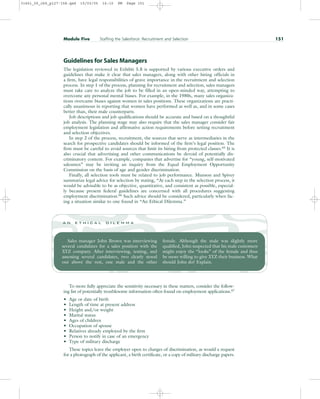
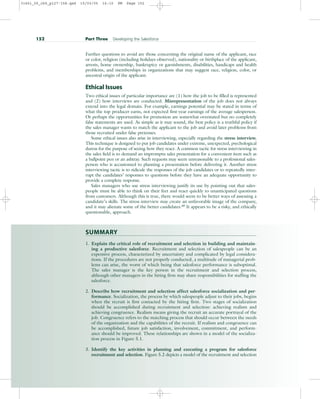
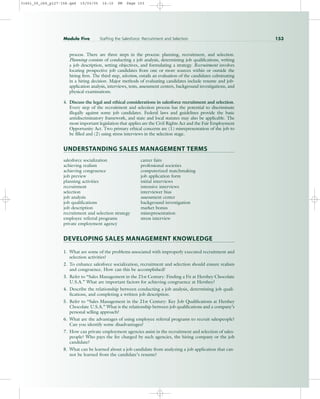
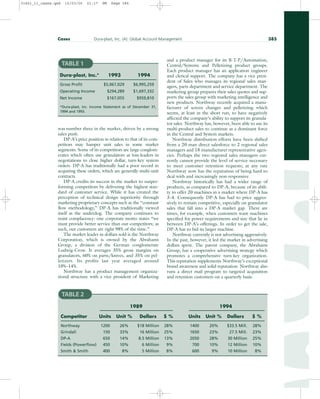
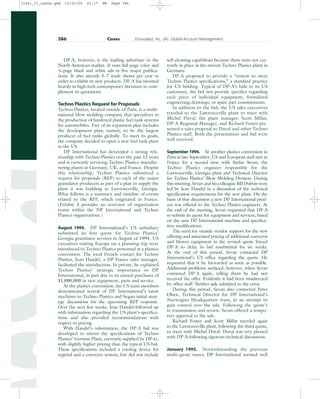
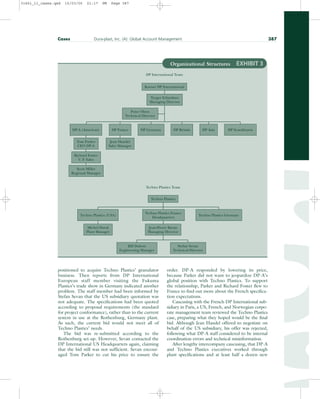
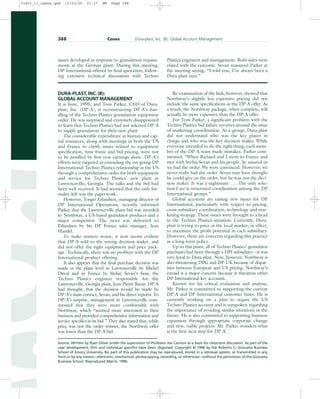
Sales Management
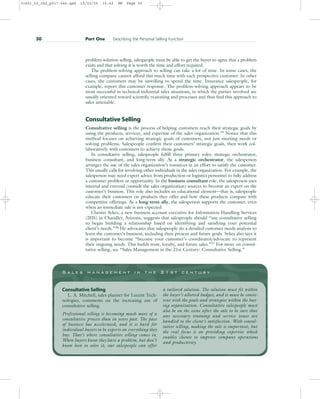
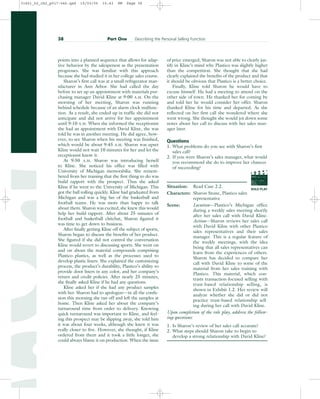
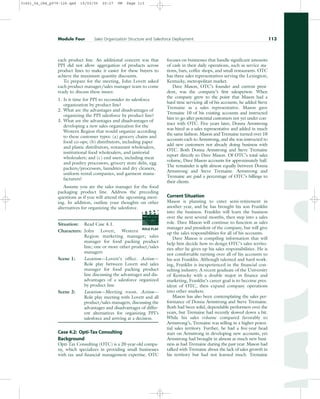
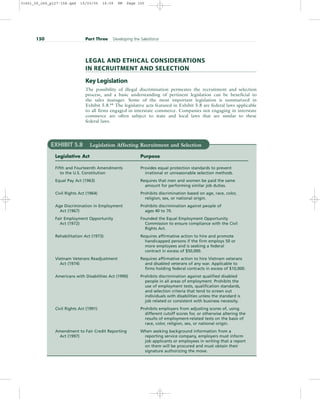
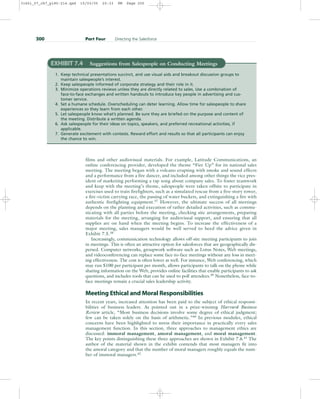
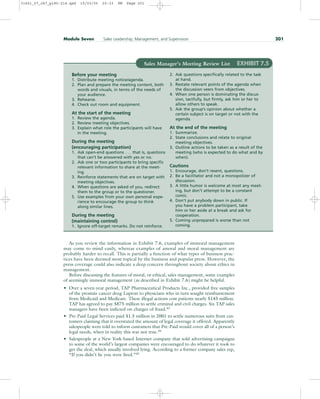
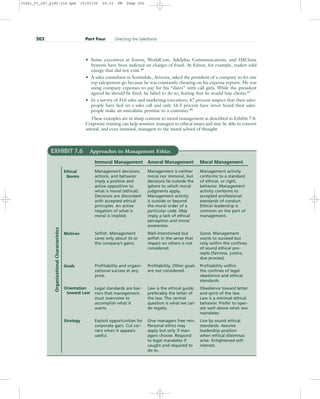
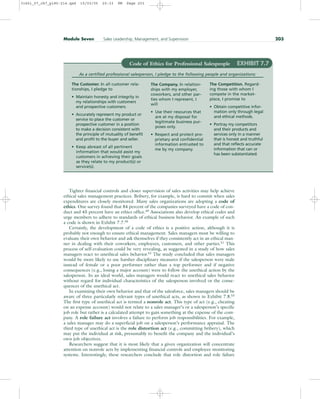
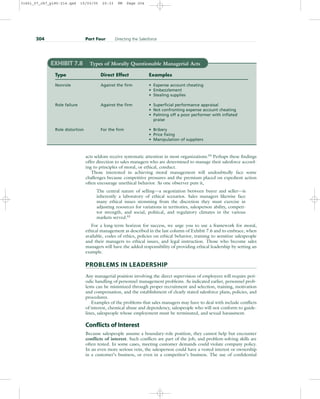
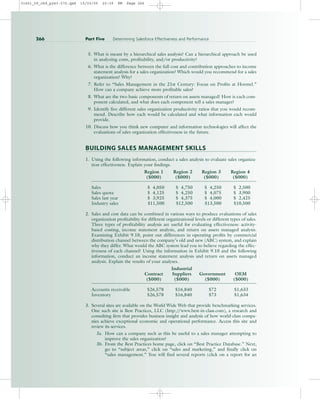
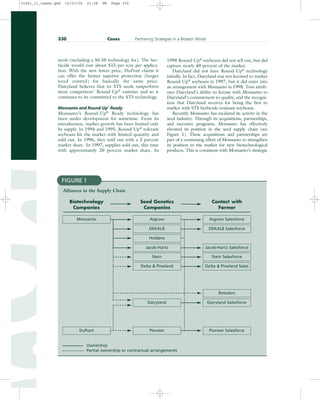
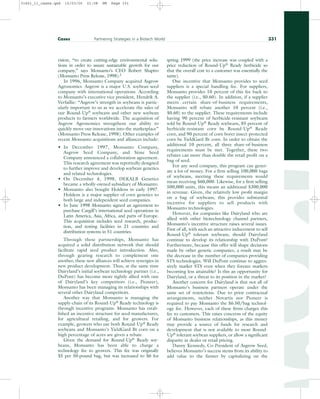
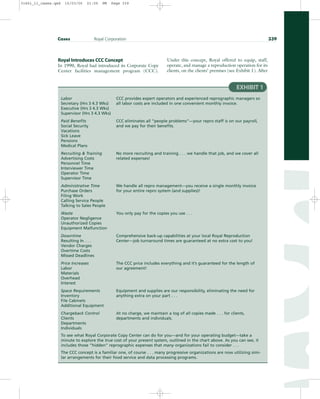
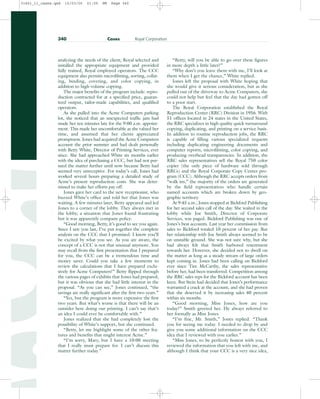
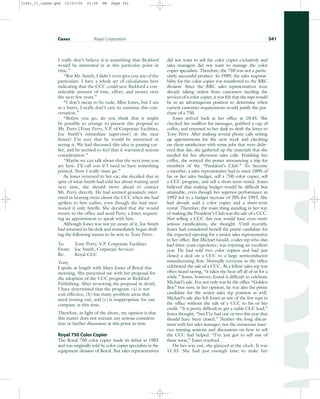
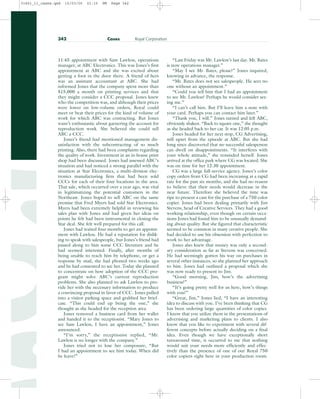
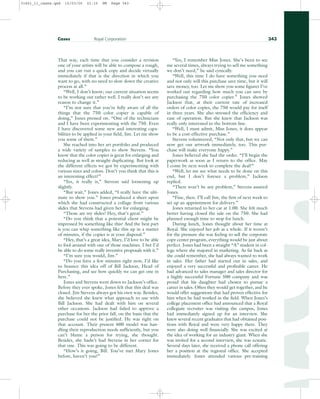
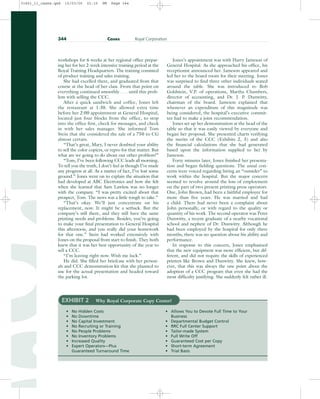
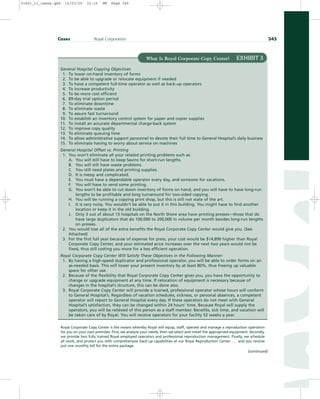
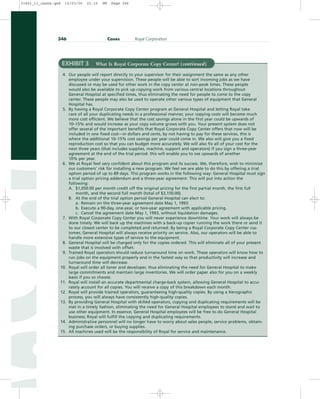
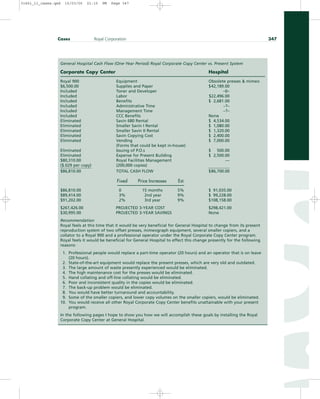
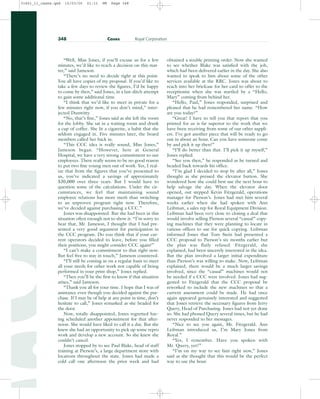
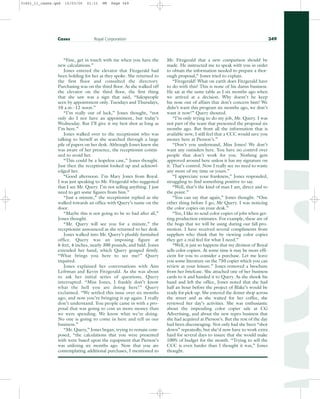
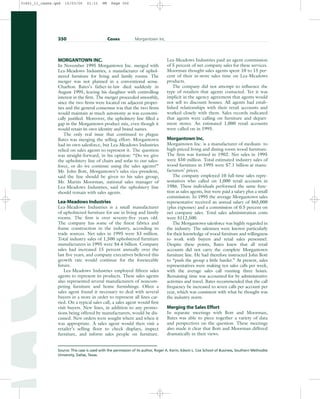
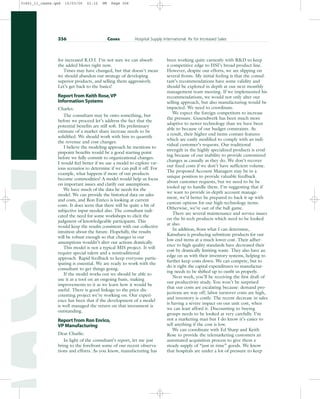
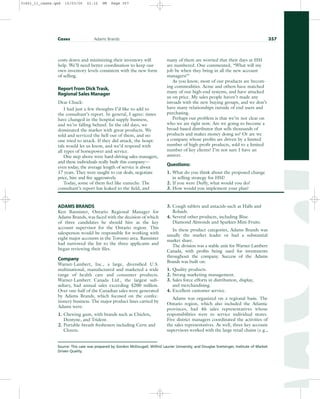
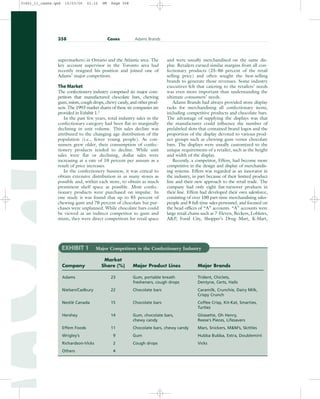
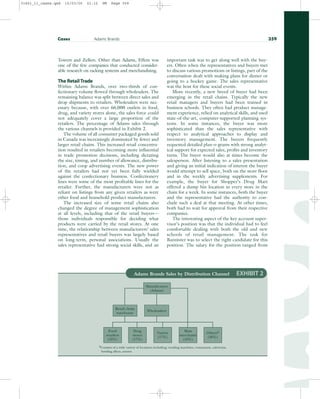
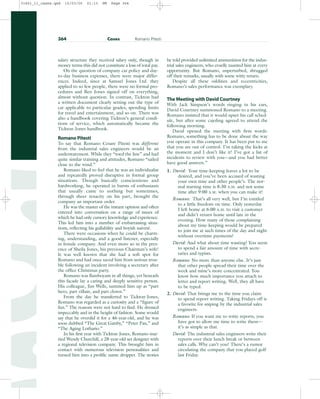
Analysis and Decision Making
Sales Management
Analysis and Decision Making
Sales
Management
Analysis
and
Decision
Making
Ingram • LaForge • Avila
Schwepker Jr. • Williams
Ingram
•
LaForge
•
Avila
Schwepker
Jr.
•
Williams
Sixth Edition
Sixth
Edition
Sixth
Edition
The top
portion will
have a
spot varnish.
Please talk to
Thomson to
find out
details of
how this is
to print.
9 780324 321050
90000
ISBN 0-324-32105-8
Join us on the Internet
South-Western – http://www.swlearning.com
Marketing – http://marketing.swlearning.com
VIDEOS ON DVD:
Created specifically for the sixth edition, this video
package focuses on accurately and effectively
portraying sales management by beginning with
personal selling and moving to the relationship
of the sales consultant to the sales manager.
All stages of sales are portrayed.
EXPERIENTIAL EXERCISES:
Expanded experiential activities have been
developed and included in each module. These
expanded active learning-based activities are
included as (a) Activities for Developing Sales
Management Knowledge, (b) Activities for Building
Sales Management Skills, and (c) Short and
experiential Cases to build students’mastery in
making sales management decisions. Many of the
experiential exercises appearing at the end of each
module require usage of the World Wide Web.
CUSTOMER RELATIONSHIP MANAGEMENT (CRM):
This edition of Sales Management continues the
discussion of CRM as a new emerging business
strategy, integrating the use of technology to
execute a successful CRM strategy.
ROLE PLAYS:
In this edition, the authors have increased the
role-plays at the end of each module for readers to
act out various sales management roles. A role-play
icon in the text margin allows for easy identification
of these exercises.
CASES:
The text contains a mix of cases.The shorter
cases are found in theā€œMaking Sales Management
Decisionsā€at the end of each chapter, and are
great for written assignments, as well as excellent
opportunities to stimulate classroom discussions
and role-plays.The longer cases are found at the
end-of-book and are best for a more comprehensive
analysis or team presentation.
SALES MANAGEMENT: ANALYSIS AND DECISION MAKING, 6E blends the most recent sales management
research with real-lifeā€œbest practicesā€of leading sales organizations.This text continues to focus
on the importance of employing different sales strategies for different consumer groups, as well
as integrating corporate, business, marketing, and sales strategies.Topics are covered from the
perspective of a sales management decision maker
K E Y F E A T U R E S :
http://ingram-sales.swlearning.com
h t t p : / / i n g r a m - s a l e s . s w l e a r n i n g . c o m
Ingram • LaForge • Avila • Schwepker Jr. • Williams
Sales Management:
Analysis and Decision Making
6th Edition
Thomas N.Ingram
Colorado State University
Raymond W.LaForge
University of Louisville
Ramon A.Avila
Ball State University
Charles H.Schwepker Jr.
Central Missouri State University
Michael R.Williams
Illinois State University
31451_00_Prelims.qxd 15/03/05 15:22 PM Page i
Sales Management: Analysis and Decision Making, Sixth Edition
Thomas N. Ingram, Raymond W. LaForge, Ramon A. Avila, Charles H. Schwepker, Jr., Michael R. Williams
VP/Editorial Director:
Jack W. Calhoun
VP/Editor-in-Chief:
Dave Shaut
Acquisitions Editor:
Neil Marquardt
Developmental Editor:
Rebecca von Gillern
Marketing Manager:
Nicole Moore
Production Editor:
Stephanie Schempp
Manager of Technology, Editorial:
Vicky True
Technology Project Editor:
Pam Wallace
Web Coordinator:
Karen Schaffer
Manufacturing Coordinator:
Diane Lohman
Production House:
Stratford Publishing Services, Inc.
Printer:
Edwards Brothers
Ann Arbor, MI
Art Director:
Stacy Jenkins Shirley
Internal Designer:
Bethany Casey and Lou Ann Thesing
Cover Designer:
Bethany Casey and Lou Ann Thesing
Cover Illustration:
Ted Knapke
COPYRIGHT Ā© 2006
Thomson South-Western, a part of The
Thomson Corporation. Thomson, the Star
logo, and South-Western are trademarks
used herein under license.
Printed in the United States of America
1 2 3 4 5 08 07 06 05
Student Edition: ISBN 0-324-32105-8
ALL RIGHTS RESERVED.
No part of this work covered by the
copyright hereon may be reproduced
or used in any form or by any means—
graphic, electronic, or mechanical,
including photocopying, recording, taping,
Web distribution or information storage
and retrieval systems, or in any other
manner—without the written permission
of the publisher.
For permission to use material from this
text or product, submit a request online at
http:/
/www.thomsonrights.com.
Library of Congress Control Number:
2005920275
For more information about our
products, contact us at:
Thomson Learning Academic Resource
Center
1-800-423-0563
Asia (including India)
Thomson Learning
5 Shenton Way
#01-01 UIC Building
Singapore 068808
Canada
Thomson Nelson
1120 Birchmount Road
Toronto, Ontario
M1K 5G4
Canada
UK/Europe/Middle East/Africa
Thomson Learning
High Holborn House
50/51 Bedford Row
London WC1R 4LR
United Kingdom
Thomson Higher Education
5191 Natorp Boulevard
Mason, OH 45040
USA
Australia/New Zealand
Thomson Learning Australia
102 Dodds Street
Southbank, Victoria 3006
Australia
Latin America
Thomson Learning
Seneca, 53
Colonia Polanco
11560 Mexico
D.F.Mexico
Spain (including Portugal)
Thomson Paraninfo
Calle Magallanes, 25
28015 Madrid, Spain
31451_00_Prelims.qxd 15/03/05 15:22 PM Page ii
To Jacque
—Thomas N. Ingram
To Susan, Alexandra, Kelly, and
in memory of my Mom and Dad
—Raymond W. LaForge
To Terry, Sarah, Anne, Ryan,
Laura, Kate, and my parents
—Ramon A. Avila
To Laura, Charlie III, Anthony, Lauren, my Mom,
and in memory of my Dad, ā€œBig Cā€
—Charles H. Schwepker Jr.
To Marilyn, Aimee and Rodney, Kerri and Bart,
my Mom, and in memory of my Dad
—Michael R. Williams
31451_00_Prelims.qxd 15/03/05 15:22 PM Page iii
31451_00_Prelims.qxd 15/03/05 15:22 PM Page iv
v
Our objective in writing the sixth edition of Sales Management: Analysis and Decision
Making was to continue to present comprehensive and rigorous coverage of contem-
porary sales management in a readable, interesting, and challenging manner. Findings
from recent sales management research are blended with examples of current sales
management practice into an effective pedagogical format. Topics are covered from the
perspective of a sales management decision maker. This decision-making perspective is
accomplished through a modular format that typically consists of discussing basic
concepts, identifying critical decision areas, and presenting analytical approaches for
improved sales management decision making. Company examples from the contempo-
rary business world are used throughout the text to supplement module discussion.
STRENGTHS OF THIS EDITION
The sixth edition of Sales Management: Analysis and Decision Making has several
important strengths. The authors teach sales management courses and interact with
sales managers and sales management professors on a regular basis. These interactions
with practicing professionals and students ensure that the text covers the appropriate
sales management topics and employs effective pedagogy. This new edition continues
what has been effective in previous editions, but contains changes that improve content
and pedagogy. The key strengths of the sixth edition include:
• The 10 modules and paperback format from the previous edition are maintained.
This makes it easy for professors to cover the text in a semester or quarter, and still
have sufficient time to use active learning exercises throughout the course. All of the
important sales management topics are addressed and students can purchase the text
for much less than a typical hardcover sales management book.
• All new Opening Vignettes are used to introduce each module. These vignettes gen-
erate student interest by presenting examples of current sales management practice in
leading firms.
• Revised ā€œSales Management in the 21st Centuryā€ boxes and new sales executives
have been added in our Sales Executive Panel.
• The introduction of an important trend—the move from an administrative to an
entrepreneurial perspective—has been introduced in Module 1. The turbulent envi-
ronment facing most sales organizations requires that sales managers act more as
entrepreneurs and less as administrators to be successful.
• New or expanded coverage of important topics such as customer relationship man-
agement (CRM); outsourcing the salesforce; and key differences among sales leader-
ship, management, and supervisory activities can be found throughout the text.
• Role-play exercises for Ethical Dilemmas and the short cases are included at the end
of each module. These role plays give professors the opportunity to involve students
actively in exploring complex ethical and sales management situations.
• New or updated exercises in the Building Sales Management Skills section can now
be found at the end of each module. Many of these exercises require the use of the
Internet, but all involve students actively in the learning process.
P r e f a c e
31451_00_Prelims.qxd 15/03/05 15:22 PM Page v
LEVEL AND ORGANIZATION
This text was written for the undergraduate student enrolled in a one-semester or one-
quarter sales management class. However, it is sufficiently rigorous to be used at the
MBA level.
A sales management model is used to present coverage in a logical sequence. The text
is organized into five parts to correspond with the five stages in the sales management
model.
Part One, ā€œDescribing the Personal Selling Function,ā€ is designed to provide stu-
dents with an understanding of personal selling prior to addressing specific sales man-
agement areas. We devote one module at the beginning of the text to this topic.
Part Two, ā€œDefining the Strategic Role of the Sales Function,ā€ consists of two mod-
ules; one discusses important relationships between personal selling and organizational
strategies at the corporate, business, marketing, and sales levels. This module focuses on
how strategic decisions at different organizational levels affect sales management deci-
sions and personal selling practices.
The second module in this part investigates alternative sales organization structures
and examines analytical methods for determining salesforce size, territory design, and
the allocation of selling effort.
Part Three, ā€œDeveloping the Salesforce,ā€ changes the focus from organizational top-
ics to people topics. The two modules in this part cover the critical decision areas in the
recruitment and selection of salespeople and in training salespeople once they have been
hired.
Part Four, ā€œDirecting the Salesforceā€ continues the people orientation by discussing
the leadership, management, and supervisory activities necessary for successful sales
management and examining important areas of salesforce motivation and reward
systems.
Part Five, ā€œDetermining Salesforce Effectiveness and Performance,ā€ concludes the
sales management process by addressing evaluation and control procedures. Differences
in evaluating the effectiveness of the sales organization and the performance of sales-
people are highlighted and covered in separate modules.
PEDAGOGY
The following pedagogical format is used for each module to facilitate the learning
process.
Learning Objectives. Specific learning objectives for the module are stated in behav-
ioral terms so that students will know what they should be able to do after the module
has been covered.
Opening Vignettes. All modules are introduced by an opening vignette that typi-
cally consists of a recent, real-world company example addressing many of the key
points to be discussed in the module. These opening vignettes are intended to gener-
ate student interest in the topics to be covered and to illustrate the practicality of the
module coverage.
Key Words. Key words are highlighted in bold type throughout each module
and summarized in list form at the end of the module to alert students to their
importance.
Boxed Inserts. Each module contains two boxed inserts titled ā€œSales Management in
the 21st Century.ā€ The comments in these boxes are provided by members of our Sales
Executive Panel and were made specifically for our text.
Figure Captions. Most figures in the text include a summarizing caption designed to
make the figure understandable without reference to the module discussion.
vi Preface
31451_00_Prelims.qxd 15/03/05 15:22 PM Page vi
Module Summaries. A module summary recaps the key points covered in the module
by restating and answering questions presented in the learning objectives at the begin-
ning of the module.
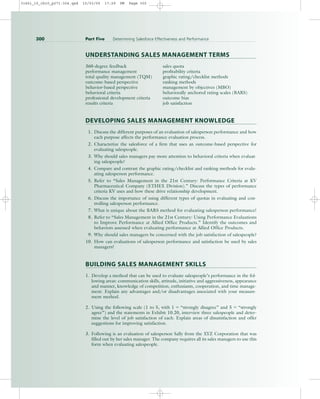
Developing Sales Management Knowledge. Ten discussion questions are presented
at the end of each module to review key concepts covered in the module. Some of the
questions require students to summarize what has been covered, while others are
designed to be more thought-provoking and extend beyond module coverage.
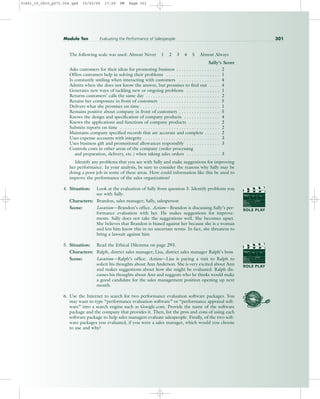
Building Sales Management Skills. Application exercises are supplied for each mod-
ule, requiring students to apply what has been learned in the module to a specific sales
management situation. Many of the application exercises require data analysis. Many
modules also have an Internet exercise to get students involved with the latest technol-
ogy. Role plays are also included in most modules.
Making Sales Management Decisions. Each module concludes with two short
cases. Most of these cases represent realistic and interesting sales management situa-
tions. Several require data analysis. Most are designed so that students can role play
their solutions.
CASES
The book contains a mixture of short, medium, and long cases. The 18 short cases at
the end of modules can be used as a basis for class discussion, short written assignments,
or role plays. The longer cases are more appropriate for detailed analysis and class dis-
cussions or presentations by individuals or student groups. The longer cases are located
at the end of the book.
SUPPLEMENTS
Instructor’s Resource CD (IRCD)
The Instructor’s Resource CD delivers all the traditional instructor support materials in
one handy place: a CD. Electronic files are included on the CD for the complete
Instructor’s Manual, Test Bank, computerized Test Bank and computerized Test Bank
software (ExamView), and chapter-by-chapter PowerPoint presentation files that can be
used to enhance in-class lectures.
• Instructor’s Manual
The Instructor’s Manual for the sixth edition of Sales Management: Analysis and
Decision Making contains many helpful teaching suggestions and solutions to text
exercises to help instructors successfully integrate all the materials offered with
this text into their class. Each module includes the following materials designed
to meet the instructor’s needs.
• Learning objectives
• Module outline and summary
• Ideas for student involvement
• Possible answers to review sections in the text, Developing Sales Management
Knowledge and Building Sales Management Skills
• Ideas for how to incorporate the role play exercises found in the text into the
classroom setting, as well as suggestions for conducting the Role Plays
The Instructor’s Manual files are located on the IRCD in Microsoft Word 2000
format.
• Test Bank
The revised and updated Test Bank includes a variety of multiple choice and
true/false questions, which emphasize the important concepts presented in each
Preface vii
31451_00_Prelims.qxd 15/03/05 15:22 PM Page vii
chapter. The Test Bank questions vary in levels of difficulty so that each instructor
can tailor his/her testing to meet his/her specific needs. The Test Bank files are
located on the IRCD in Microsoft Word 2000 format.
• ExamView (Computerized) Test Bank
The Test Bank is also available on the IRCD in computerized format (ExamView),
allowing instructors to select problems at random by level of difficulty or type, cus-
tomize or add test questions, and scramble questions to create up to 99 versions of
the same test. This software is available in DOS, Mac, or Windows formats.
• PowerPoint Presentation Slides
Created by an expert in the field of sales, Scott Inks of Ball State University, this
package brings classroom lectures and discussions to life with the Microsoft
PowerPoint 2000 presentation tool. Extremely professor-friendly and organized by
chapter, these chapter-by-chapter presentations outline chapter content. The eye-
appealing and easy-to-read slides are, in this new edition, tailored specifically to the
Sales Management text from the Ingram author team. The PowerPoint presentation
slides are available on the IRCD in Microsoft 2000 format and as downloadable
files on the text support site (http:/
/ingram-sales.swlearning.com).
Web site
Visit the text web site at http:/
/ingram-sales.swlearning.com to find instructor’s support
materials as well as study resources that will help students practice and apply the con-
cepts they have learned in class.
• Student Resources
• Online quizzes for each chapter are available on the web site for those students
who would like additional study materials. After each quiz is submitted, auto-
matic feedback tells the students how they scored and what the correct answers
are to the questions they missed. Students are then able to email their results
directly to the their instructor if desired.
• Crossword quizzing of glossary terms and definitions arranged by chapter is also
available for extra review of key terms found in the text.
• Students can download the PowerPoint presentation slides from the web site.
• Instructor Resources
• Downloadable Instructor’s Manual files are available in Microsoft Word 2000
format and Adobe Acrobat format.
• Downloadable PowerPoint presentation files are available in Microsoft
PowerPoint 2000 format.
Brand-New Videos!
A brand-new video package has been professionally filmed and produced specifically for
this text. The authors and a team of experienced selling educators have developed a series
of videos illustrating the concepts and skills of professional selling and management
aspects of professional selling including coaching, sales training, motivation, and evaluat-
ing performance. Each video has been carefully developed to accurately and effectively
demonstrate and teach specific concepts. Experienced actors provide clear examples and
an off-camera spokesperson provides narrative explanation and reinforcement and asks
a variety of teaching-related questions for students to consider and answer.
ACKNOWLEDGMENTS
The writing of a book is a long and arduous task that requires the dedicated efforts of
many individuals. The contributions of these individuals are greatly appreciated and
deserve specific recognition. We are especially grateful to those who provided valuable
viii Preface
31451_00_Prelims.qxd 15/03/05 15:22 PM Page viii
insight and to the following reviewers who provided useful suggestions for revising the
fifth edition of this text.
Anne L. Balazs, Ph.D., Mississippi University for Women
Duane Davis, University of Central Florida
Mark Johlke, University of North Carolina—Wilmington
Michael J. Swenson, Brigham Young University
Scott A. Inks, Ball State University
We sincerely appreciate the willingness of many individuals to allow us to include
their cases in the book. These cases have substantially enhanced the effectiveness and
interest of the text.
A great deal of credit for this book should go to all of the wonderful people at South-
Western. Their expertise, support, and constant encouragement turned an extremely
difficult task into a very enjoyable one. We would like to recognize specifically the
tremendous efforts of the following professionals and friends: Neil Marquardt, Nicole
Moore, Rebecca von Gillern, and Stephanie Schempp. Without their efforts this edition
would not have seen the light of day. However, we also want to thank the many indi-
viduals with whom we did not have direct contact but who assisted in the development
and production of this book.
We are also very appreciative of the support provided by our colleagues at Colorado
State University, the University of Louisville, Central Missouri State University, Ball State
University, and Illinois State University.
Thomas A. Ingram
Raymond W. LaForge
Ramon A. Avila
Charles H. Schwepker Jr.
Michael R. Williams
March 2005
Preface ix
31451_00_Prelims.qxd 15/03/05 15:22 PM Page ix
31451_00_Prelims.qxd 15/03/05 15:22 PM Page x
A b o u t t h e A u t h o r s
Thomas N. Ingram (Ph.D., Georgia State University) is professor of marketing at
Colorado State University. Before commencing his academic career, he worked in
sales, product management, and sales management with Exxon and Mobil. Tom is a
recipient of the Marketing Educator of the Year award given by Sales and Marketing
Executives International (SMEI). He was honored as the first recipient of the
Mu Kappa Tau National Marketing Honor Society recognition award for Outstanding
Scholarly Contributions to the Sales Discipline. On several occasions, he has been
recognized at the university and college level for outstanding teaching. Tom has
served as the editor of Journal of Personal Selling & Sales Management, chair of the
SMEI Accreditation Institute, and as a member of the Board of Directors of SMEI.
He is the former editor of Journal of Marketing Theory & Practice. Tom’s primary
research is in personal selling and sales management. His work has appeared in the
Journal of Marketing, Journal of Marketing Research, Journal of Personal Selling &
Sales Management, and Journal of the Academy of Marketing Science, among others.
He is the co-author of one of the ā€œTen Most Influential Articles of the 20th Centuryā€
as designated by the Sales and Sales Management Special Interest Group of the
American Marketing Association.
Raymond W. (Buddy) LaForge is the Brown-Forman Professor of Marketing at the
University of Louisville. He is the founding executive editor of the Marketing
Education Review, founding executive editor of the Sales Educator Network, has served
as associate editor, Sales Education and Training section of the Journal of Personal
Selling & Sales Management, has co-authored Marketing: Principles & Perspectives,
Sales Management: Analysis and Decision Making, Professional Selling: A Trust-Based
Approach, The Professional Selling Skills Workbook, and co-edited Emerging Trends in
Sales Thought and Practice. His research is published in many journals including the
Journal of Marketing, Journal of Marketing Research, Decision Sciences, Journal of the
Academy of Marketing Science, and Journal of Personal Selling & Sales Management.
Buddy has served as vice president/marketing for the Academy of Business Education,
vice president of marketing, teaching, and conferences for the American Marketing
Association Academic Council, chair of the American Marketing Association Sales
Interest Group, and on the Direct Selling Education Foundation Board of Directors
and Academic Program Committee, DuPont Corporate Marketing Faculty Advisory
Team for the Sales Enhancement Process, Family Business Center Advisory board, and
Strategic Planning Committee for the National Conference on Sales Management. He
currently serves as vice chair for awards and recognition for the AMA Sales SIG and
administers the AMA Sales SIG/DSEF Sales Dissertation Grants.
Charles H. Schwepker Jr. (Ph.D., University of Memphis) is professor of marketing
at Central Missouri State University. He has experience in wholesale and retail sales.
His primary research interests are in sales management, personal selling, and market-
ing ethics. His articles have appeared in the Journal of the Academy of Marketing
Science, Journal of Business Research, Journal of Public Policy and Marketing, Journal
of Personal Selling & Sales Management, and Journal of Business Ethics, among other
journals, various national and regional proceedings, and books including Marketing
Communications Classics and Environmental Marketing. He has received both
xi
31451_00_Prelims.qxd 15/03/05 15:22 PM Page xi
xii About the Authors
teaching and research awards. He is on the editorial review boards of the Journal of
Personal Selling & Sales Management, Journal of Marketing Theory & Practice, Journal
of Business & Industrial Marketing, Journal of Relationship Marketing, and Southern
Business Review, and has won awards for outstanding reviewer. He is a co-author of
Professional Selling: A Trust-Based Approach.
Ramon A. Avila (Ph.D., Virginia Tech University) is the George and Frances Ball
Distinguished Professor of Marketing at Ball State University. Before coming to Ball
State, he worked in sales with the Burroughs Corporation. He has held two visiting
professorships at the University of Hawaii and another at the Kelley School of
Business at Indiana University. In April 2002, Ramon received a Leavey Award. This
award was given for innovation in the classroom with his advanced selling class.
Ramon was presented the 1999 Mu Kappa Tau’s Outstanding Contributor to the
Sales Profession. He is only the third recipient of this award. Ramon has also received
the University’s Outstanding Service award, the University’s Outstanding Junior
Faculty award, the College of Business Professor of the Year, and the Dean’s Teaching
award every year since its inception in 1987. Ramon also sits on four editorial review
boards. Ramon’s primary research is in personal selling and sales management. His
work has appeared in the Journal of Marketing Research, Journal of Personal Selling &
Sales Management, The Journal of Management, Industrial Marketing Management,
The Marketing Management Journal, and the Journal of Marketing Theory & Practice,
among others. He is the co-author of The Professional Selling Skills Workbook.
Michael R. Williams (Ph.D., Oklahoma State University) is professor of marketing and
director of the Professional Sales Institute at Illinois State University. Prior to his academic
career, Mike established a successful 30-plus year career in industrial sales, market research,
and sales management and continues to consult and work with a wide range of business
organizations. He has co-authored The Professional Selling Skills Workbook, Professional
Selling: A Trust-Based Approach, and a variety of executive monographs and white-paper on
sales performance topics. Mike’s research has been published in many different national
and international journals including Journal of Personal Selling & Sales Management,
International Journal of Purchasing and Materials Management, Journal of Business and
Industrial Marketing, Quality Management Journal, and Journal of Industrial Technology.
His work has also received numerous honors, including Outstanding Article for the Year in
Journal of Business and Industrial Marketing, the AACSB’s Leadership in Innovative
Business Education Award, and the Marketing Science Institute’s Alden G. Clayton
Competition. Mike has also been honored with numerous university, college, and corporate
teaching and research awards including Old Republic Research Scholar, the presentation of
a seminar at Oxford’s Braesnose College, Who’s Who in American Education, and Who’s
Who in America. Mike has and continues to serve in leadership roles as an advisor and board
member for sales and sales management associations and organizations including the
University Sales Center Alliance, National Conference in Sales and Sales Management, and
Vector Marketing.
31451_00_Prelims.qxd 15/03/05 15:22 PM Page xii
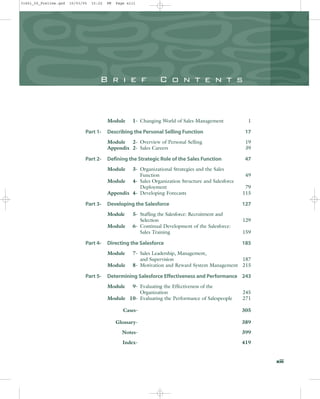
B r i e f C o n t e n t s
Module 1- Changing World of Sales Management 1
Part 1- Describing the Personal Selling Function 17
Module 2- Overview of Personal Selling 19
Appendix 2- Sales Careers 39
Part 2- Defining the Strategic Role of the Sales Function 47
Module 3- Organizational Strategies and the Sales
Function 49
Module 4- Sales Organization Structure and Salesforce
Deployment 79
Appendix 4- Developing Forecasts 115
Part 3- Developing the Salesforce 127
Module 5- Staffing the Salesforce: Recruitment and
Selection 129
Module 6- Continual Development of the Salesforce:
Sales Training 159
Part 4- Directing the Salesforce 185
Module 7- Sales Leadership, Management,
and Supervision 187
Module 8- Motivation and Reward System Management 215
Part 5- Determining Salesforce Effectiveness and Performance 243
Module 9- Evaluating the Effectiveness of the
Organization 245
Module 10- Evaluating the Performance of Salespeople 271
Cases- 305
Glossary- 389
Notes- 399
Index- 419
xiii
31451_00_Prelims.qxd 15/03/05 15:22 PM Page xiii
31451_00_Prelims.qxd 15/03/05 15:22 PM Page xiv
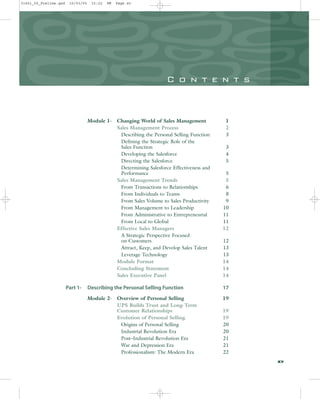
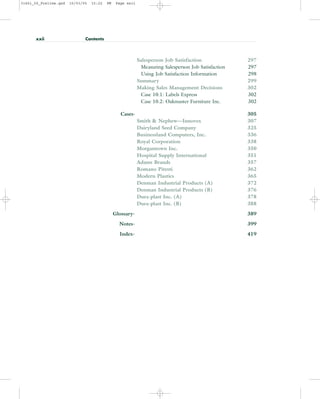
C o n t e n t s
Module 1- Changing World of Sales Management 1
Sales Management Process 2
Describing the Personal Selling Function 3
Defining the Strategic Role of the
Sales Function 3
Developing the Salesforce 4
Directing the Salesforce 5
Determining Salesforce Effectiveness and
Performance 5
Sales Management Trends 5
From Transactions to Relationships 6
From Individuals to Teams 8
From Sales Volume to Sales Productivity 9
From Management to Leadership 10
From Administrative to Entrepreneurial 11
From Local to Global 11
Effective Sales Managers 12
A Strategic Perspective Focused
on Customers 12
Attract, Keep, and Develop Sales Talent 13
Leverage Technology 13
Module Format 14
Concluding Statement 14
Sales Executive Panel 14
Part 1- Describing the Personal Selling Function 17
Module 2- Overview of Personal Selling 19
UPS Builds Trust and Long-Term
Customer Relationships 19
Evolution of Personal Selling 19
Origins of Personal Selling 20
Industrial Revolution Era 20
Post–Industrial Revolution Era 21
War and Depression Era 21
Professionalism: The Modern Era 22
xv
31451_00_Prelims.qxd 15/03/05 15:22 PM Page xv
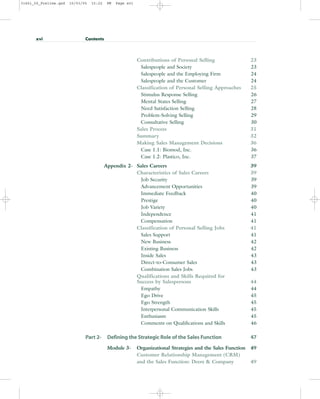
Contributions of Personal Selling 23
Salespeople and Society 23
Salespeople and the Employing Firm 24
Salespeople and the Customer 24
Classification of Personal Selling Approaches 25
Stimulus Response Selling 26
Mental States Selling 27
Need Satisfaction Selling 28
Problem-Solving Selling 29
Consultative Selling 30
Sales Process 31
Summary 32
Making Sales Management Decisions 36
Case 1.1: Biomod, Inc. 36
Case 1.2: Plastico, Inc. 37
Appendix 2- Sales Careers 39
Characteristics of Sales Careers 39
Job Security 39
Advancement Opportunities 39
Immediate Feedback 40
Prestige 40
Job Variety 40
Independence 41
Compensation 41
Classification of Personal Selling Jobs 41
Sales Support 41
New Business 42
Existing Business 42
Inside Sales 43
Direct-to-Consumer Sales 43
Combination Sales Jobs 43
Qualifications and Skills Required for
Success by Salespersons 44
Empathy 44
Ego Drive 45
Ego Strength 45
Interpersonal Communication Skills 45
Enthusiasm 45
Comments on Qualifications and Skills 46
Part 2- Defining the Strategic Role of the Sales Function 47
Module 3- Organizational Strategies and the Sales Function 49
Customer Relationship Management (CRM)
and the Sales Function: Deere & Company 49
xvi Contents
31451_00_Prelims.qxd 15/03/05 15:22 PM Page xvi
Organizational Strategy Levels 50
Corporate Strategy and the Sales Function 50
Corporate Mission 51
Definition of Strategic Business Units 51
Objectives for Strategic Business Units 52
Corporate Strategy Summary 53
Business Strategy and the Sales Function 53
Business Strategy Types 53
Business Strategy Summary 54
Marketing Strategy and the Sales Function 54
Advantages and Disadvantages of
Personal Selling 56
Target Market Situations and Personal Selling 57
Marketing Mix Elements and Personal Selling 57
Integrated Marketing Communication 58
Marketing Strategy Summary 59
Sales Strategy Framework 59
Organizational Buyer Behavior 61
Buying Situation 61
Buying Center 62
Buying Process 62
Buying Needs 62
Sales Strategy 63
Account Targeting Strategy 63
Relationship Strategy 64
Selling Strategy 65
Sales Channel Strategy 66
The Internet 66
Industrial Distributors 67
Independent Representatives 67
Team Selling 69
Telemarketing 69
Trade Shows 70
Summary 72
Making Sales Management Decisions 75
Case 3.1: Pronto Retail Centers 75
Case 3.2: National Communications 76
Manufacturing
Module 4- Sales Organization Structure and
Salesforce Deployment 79
Strategy and Sales Organization
Structure: IBM 79
Sales Organization Concepts 80
Specialization 80
Centralization 81
Contents xvii
31451_00_Prelims.qxd 15/03/05 15:22 PM Page xvii
Span of Control versus Management Levels 82
Line versus Staff Positions 83
Selling Situation Contingencies 84
Sales Organization Structures 85
Geographic Sales Organization 85
Product Sales Organization 86
Market Sales Organization 87
Functional Sales Organization 87
Major Account Organization 88
Identifying Major Accounts 90
Organizing for Major Account Coverage 90
Comparing Sales Organization Structures 91
Salesforce Deployment 93
Allocation of Selling Effort 94
Salesforce Size 97
Designing Territories 102
Procedure for Designing Territories 103
Using Technology 107
ā€œPeopleā€ Considerations 107
Summary 109
Making Sales Management Decisions 112
Case 4.1: Protek Packaging, Inc. 112
Case 4.2: Opti-Tax Consulting 113
Appendix 4- Developing Forecasts 115
Forecasting by Sales Managers 115
Types of Forecasts 115
Uses of Forecasts 117
Top-Down and Bottom-Up Forecasts 117
Using Different Forecasting Approaches
and Methods 123
Part 3- Developing the Salesforce 127
Module 5- Staffing the Salesforce: Recruitment
and Selection 129
New Hiring Strategy at Information
Graphics Group Allows Them to Bring
Aboard the Best 129
Importance of Recruitment and Selection 130
Introduction to Salesforce Socialization 130
Recruitment and Selection Process 132
Planning for Recruitment and Selection 132
Recruitment: Locating Prospective Candidates 137
Selection: Evaluation and Hiring 140
Legal and Ethical Considerations in
Recruitment and Selection 150
xviii Contents
31451_00_Prelims.qxd 15/03/05 15:22 PM Page xviii
Key Legislation 150
Guidelines for Sales Managers 151
Ethical Issues 152
Summary 152
Making Sales Management Decisions 156
Case 5.1: Sweet-Treats, Inc. 156
Case 5.2: Titan Industries 157
Module 6- Continual Development of the Salesforce:
Sales Training 159
Sales Training at UPS: From Selling Rates
to Selling Solutions 159
Role of Sales Training in Salesforce
Socialization 160
Sales Training as a Crucial Investment 161
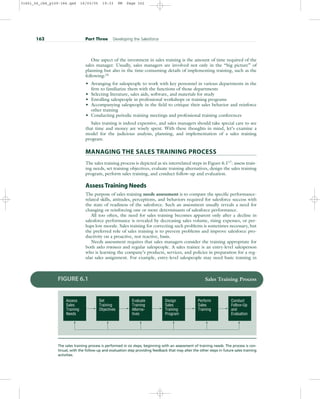
Managing the Sales Training Process 162
Assess Training Needs 162
Set Training Objectives 170
Evaluate Training Alternatives 170
Design the Sales Training Program 175
Perform Sales Training 176
Conduct Follow-Up and Evaluation 176
Ethical and Legal Issues 178
Summary 180
Making Sales Management Decisions 183
Case 6.1: Solutions Software, Inc. 183
Case 6.2: Compusystems, Inc. 183
Part 4- Directing the Salesforce 185
Module 7- Sales Leadership, Management,
and Supervision 187
Sales Leadership: SAP America 187
Contemporary Views of Sales Leadership 189
Leadership Style 189
Leader-Member Exchange Model 189
A Leadership Model for Sales Management 190
Power and Leadership 191
Situational Factors 192
Needs and Wants of Salespeople 193
Goals and Objectives 193
Leadership Skills 193
Communication Mechanisms 197
Selected Leadership Functions 197
Coaching 197
Contents xix
31451_00_Prelims.qxd 15/03/05 15:22 PM Page xix
Planning and Conducting Integrative
Sales Meetings 199
Meeting Ethical and Moral Responsibilities 200
Problems in Leadership 204
Conflicts of Interest 204
Chemical Abuse and Dependency 205
Problem Salespeople:
A Disruptive Influence 205
Termination of Employment 206
Sexual Harassment 207
Summary 208
Making Sales Management Decisions 212
Case 7.1: Tasti-Fresh Bakery Products 212
Case 7.2: Global Enterprise 212
Module 8- Motivation and Reward System
Management 215
Motivating and Rewarding: Driving Product
Mix Sales at FedEx 215
Motivation and Reward Systems 216
Optimal Salesforce Reward System 217
Types of Saleforce Rewards 218
Financial Compensation 218
Straight Salary 219
Straight Commission 220
Performance Bonuses 222
Combination Plans (Salary plus Incentive) 222
Nonfinancial Compensation 224
Opportunity for Promotion 224
Sense of Accomplishment 224
Opportunity for Personal Growth 224
Recognition 225
Job Security 225
Sales Expenses 226
Additional Issues in Managing Salesforce
Reward Systems 228
Sales Contests 228
Equal Pay 229
Team Compensation 230
Global Considerations 231
Changing the Reward System 232
Guidelines for Motivating and
Rewarding Salespeople 233
Recruitment and Selection 233
Incorporation of Individual Needs 234
xx Contents
31451_00_Prelims.qxd 15/03/05 15:22 PM Page xx
Information and Skills 234
Job Design 234
Building Self-Esteem 234
Proactive Approach 234
Summary 235
Making Sales Management Decisions 239
Case 8.1: Stalwart Industrial Products 239
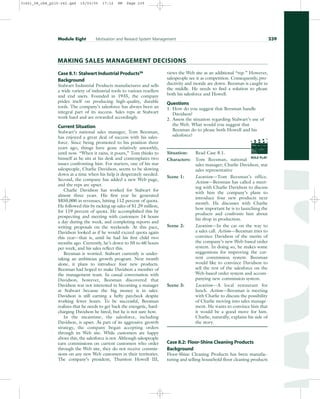
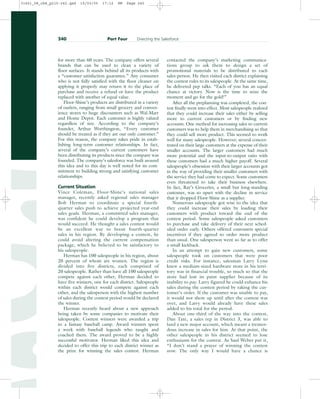
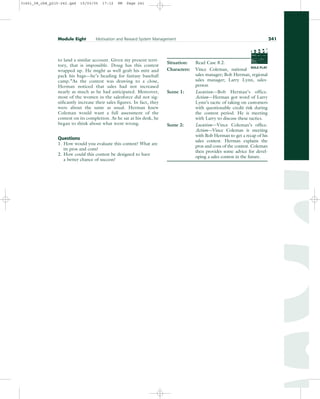
Case 8.2: Floor-Shine Cleaning Products 239
Part 5- Determining Salesforce Effectiveness and Performance 243
Module 9- Evaluating the Effectiveness of
the Organization 245
Increasing Productivity and Evaluating
Effectiveness at Solcorp 245
Sales Organization Audit 247
Benchmarking 249
Sales Organization Effectiveness Evaluations 251
Sales Analysis 251
Cost Analysis 256
Profitability Analysis 258
Activity-Based Costing 260
Return on Assets Managed Analysis 260
Productivity Analysis 262
Ethical Issues 263
Concluding Comments 264
Summary 264
Making Sales Management Decisions 268
Case 9.1: Beauty Glow Cosmetics Company 268
Case 9.2: Induplicate Copiers, Inc. 269
Module 10- Evaluating the Performance of Salespeople 271
Evaluating Salesperson Performance
at City Wholesale 271
Purposes of Salesperson Performance
Evaluations 272
Salesperson Performance Evaluation
Approaches 272
Key Issues in Evaluating and Controlling
Salesperson Performance 275
Criteria for Performance Evaluation 277
Performance Evaluation Methods 286
Performance Evaluation Bias 291
Evaluating Team Performance 293
Using Performance Information 295
Contents xxi
31451_00_Prelims.qxd 15/03/05 15:22 PM Page xxi
Salesperson Job Satisfaction 297
Measuring Salesperson Job Satisfaction 297
Using Job Satisfaction Information 298
Summary 299
Making Sales Management Decisions 302
Case 10.1: Labels Express 302
Case 10.2: Oakmaster Furniture Inc. 302
Cases- 305
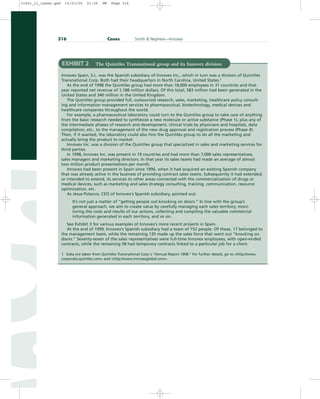
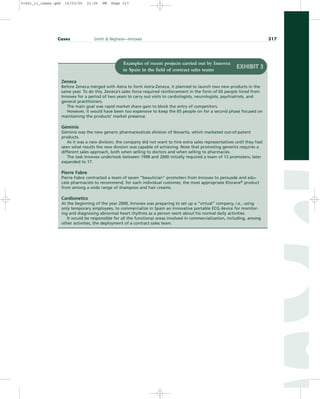
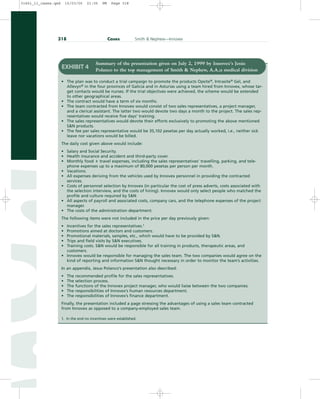
Smith & Nephew—Innovex 307
Dairyland Seed Company 325
Businessland Computers, Inc. 336
Royal Corporation 338
Morgantown Inc. 350
Hospital Supply International 351
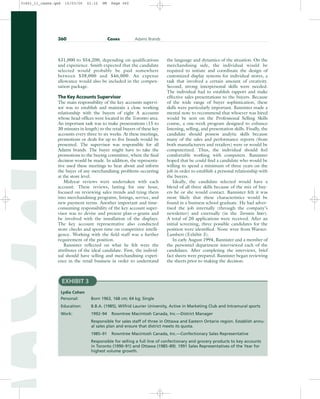
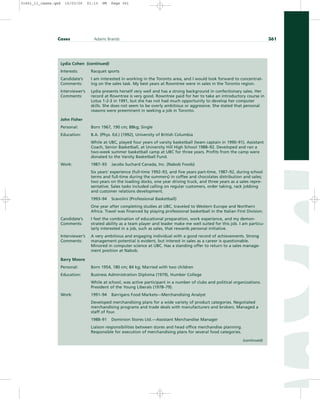
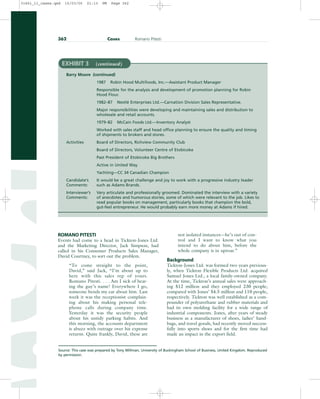
Adams Brands 357
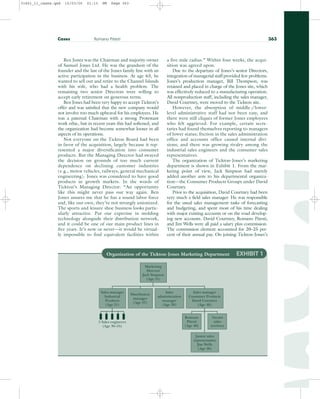
Romano Pitesti 362
Modern Plastics 365
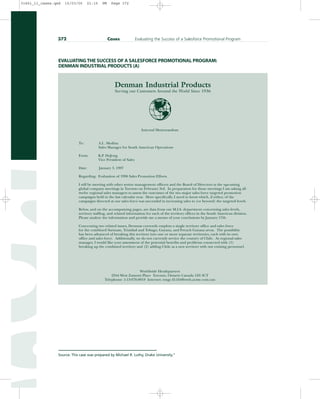
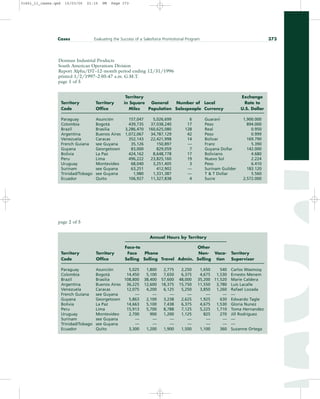
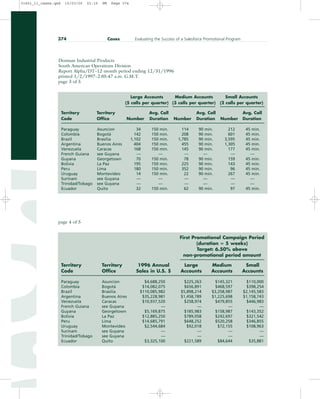
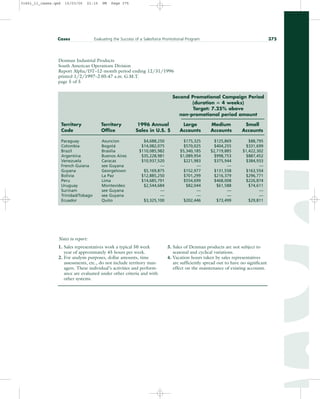
Denman Industrial Products (A) 372
Denman Industrial Products (B) 376
Dura-plast Inc. (A) 378
Dura-plast Inc. (B) 388
Glossary- 389
Notes- 399
Index- 419
xxii Contents
31451_00_Prelims.qxd 15/03/05 15:22 PM Page xxii
Jason Karem is sales manager for Automatic Data Processing (ADP) Emerging
Business Services Division. He manages nine sales associates who sell payroll,
tax filing, time-and-attendance, and human resource–related services to business
customers. Although each day is different and challenging, Jason describes a
ā€œtypical dayā€ for him.
A majority of my time is spent out in the field with the sales associates,
helping them master all of the business calls they make in a given day.
7:45 A.M.—Arrive at the office to revisit training topic for the morning,
review sales calls for the afternoon, and handle administrative tasks
such as e-mail and voice-mail. This is when I touch base with my boss to
brainstorm any focus items for the week.
8:30 A.M.—Group training with the sales associates. This is a 45-minute
training topic focused around either improving selling skills or building
relationships with key business partners. We review the material for
15 minutes and break into groups for 30 minutes of role playing. The
role playing is the most important part of any training, because it really
helps the associates feel comfortable with what they will say when they get
out in the field. It is the practice before game time.
9:30 A.M.–12:00 noon—Planning sessions with various salespeople on the
team. The purpose of these sessions is to go over certain accounts or
specific sales presentation items and to develop each person while assist-
ing him or her close any outstanding quotes.
During this time I typically make thank-you calls to partners that
referred business to us in the past week and make executive thank-you
calls to prospects that sales associates met with during the past week. The
goal is to build that partner relationship even more and let the prospects
know that we appreciate the opportunity to earn their business.
12–4 P.M.—Sales calls. During a field ride with my sales associates
I have one goal: Help them improve. The way I do this is with a sales call
feedback form, which outlines the whole sales call, from building rapport
to closing the sale. We review the calls together and develop action items
to talk about at our planning session at 4 P.M.
4–5 P.M.—Planning session with the sales associate. This is when we really
focus on the items the associate wants to improve. Using a coaching and
counseling model, I assist the salesperson in creating a game plan to take
what he or she learned today and incorporate into tomorrow’s calls. This
is primarily done through doing a mock sales call. First, I model the call
to the associate and then the associate role plays the call back to me. If my
associates can each get better at one item and closer to their goals, whether
that item is a certain selling skill or strategizing on closing a deal, I feel
I have done my job. That feeling is what energizes me into getting up the
next morning and doing it all over again.
1
1
M o d u l e
C H A N G I N G W O R L D O F S A L E S
M A N A G E M E N T
31451_01_ch1_p001-016.qxd 15/03/05 15:29 PM Page 1
What an interesting day! Jason is a field sales manager. He works directly with the sales
associates assigned to him. He conducts some of this work in the office, but much of his
time is spent in the field making calls with sales associates, then coaching them to help
them improve.
Most of our focus is on field sales managers such as Jason. However, some of our
discussion is more relevant to sales managers at various levels within a sales organization.
These sales managers have different titles and may not have direct responsibility for
specific salespeople, but they all perform sales management activities that affect all or
most of the salespeople in a sales organization. Consider the following examples:
• Clint Geffert is national account division manager for Respironics. His division sells
respiratory equipment to home-care providers. There are 110 salespeople in this division.
He travels about 95 percent of the time and has many sales management responsibilities.1
• Tony Bridge is regional sales manager with World Savings. He manages the mortgage
origination department, which has three sales managers and 15 sales reps. Most of his
time is spent on personnel issues, daily activity reports, and handling fires through-
out the department.2
• Paul Gerrard is vice president of the central region for Hewlett-Packard’s enterprise and
commercial sales division. He spends a large portion of his time communicating with the
340 sales managers and salespeople in his region. Much of this communication is
through conference calls and e-mail. However, he is often in a different city each day and
always starts the day with an informal coffee talk with sales managers and salespeople.3
• Brad Graver is western regional sales manager for Professional Office Services.
He works directly with 30 sales reps to provide marketing services for healthcare
firms. His reps are organized into protected geographical territories to serve mid-
sized doctor’s offices.4
• Mary Kay Nedrich is director of sales training and development for Convergys. The
training programs she develops for the company’s 100 salespeople include online ses-
sions that salespeople can access as their schedule allows, as well as traditional seminars.5
• Randy Lofland is sales manager for Lanx Fabric. He is the one-person sales and market-
ing department for the company. Instead of having salespeople, he works with six
to eight distributors to reach customers. Sometimes he goes on sales calls with these
distributors and sometimes he calls on customers by himself.6
These examples illustrate some of sales managers’ possible titles and activities.
Depending on the company and position, sales managers may perform some or all of the
sales management functions.
Our objective in this module is to introduce the exciting world of sales management.
We begin by presenting a general sales management model and discussing each stage in
the sales management process. Then we examine some of the emerging trends in sales
management, discuss the key characteristics of effective sales managers, and describe the
basic format of each module. The goal is to ā€œset the stageā€ for your journey into the
dynamic and challenging world of sales management.
SALES MANAGEMENT PROCESS
The marketing communications tools available to any firm are typically classified as per-
sonal selling, advertising, sales promotion, and publicity. Personal selling is defined as
personal communication with an audience through paid personnel of an organization or
its agents in such a way that the audience perceives the communicator’s organization as
being the source of the message. This definition differentiates personal selling as per-
sonal communication, whereas advertising and sales promotion are nonpersonal.
Second, in personal selling the audience perceives the message as being delivered by the
organization, whereas in publicity, even when it is in the form of personal communica-
tion, the audience typically perceives the medium, not the organization, as being the
source of the message.
2 Module One Changing World of Sales Management
31451_01_ch1_p001-016.qxd 15/03/05 15:29 PM Page 2
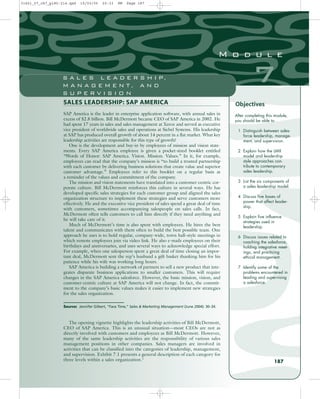
Sales management is simply management of an organization’s personal selling func-
tion. Sales managers are involved in both the strategy (planning) and people (imple-
mentation) aspects of personal selling, as well as in evaluating and controlling personal
selling activities. They must be able to deal effectively with people in the personal selling
function, with people in other functional areas in the organization, and with people
outside the organization, especially customers. The sales management model presented
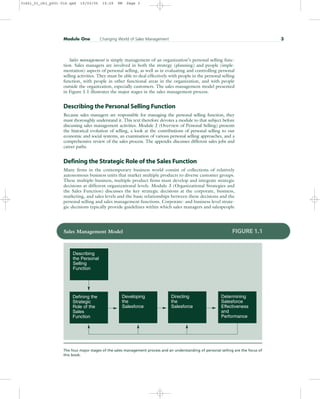
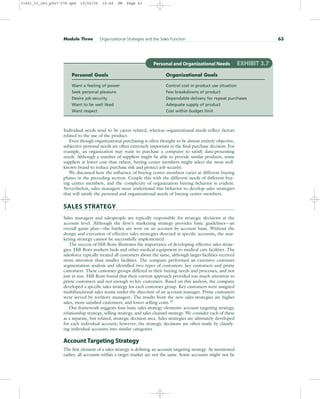
in Figure 1.1 illustrates the major stages in the sales management process.
Describing the Personal Selling Function
Because sales managers are responsible for managing the personal selling function, they
must thoroughly understand it. This text therefore devotes a module to that subject before
discussing sales management activities. Module 2 (Overview of Personal Selling) presents
the historical evolution of selling, a look at the contributions of personal selling to our
economic and social systems, an examination of various personal selling approaches, and a
comprehensive review of the sales process. The appendix discusses different sales jobs and
career paths.
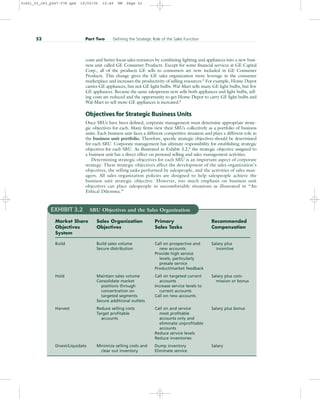
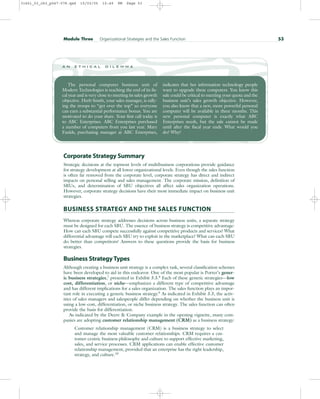
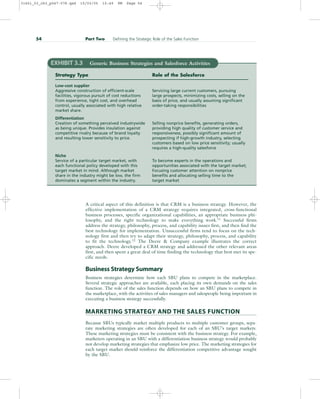
Defining the Strategic Role of the Sales Function
Many firms in the contemporary business world consist of collections of relatively
autonomous business units that market multiple products to diverse customer groups.
These multiple-business, multiple-product firms must develop and integrate strategic
decisions at different organizational levels. Module 3 (Organizational Strategies and
the Sales Function) discusses the key strategic decisions at the corporate, business,
marketing, and sales levels and the basic relationships between these decisions and the
personal selling and sales management functions. Corporate- and business-level strate-
gic decisions typically provide guidelines within which sales managers and salespeople
Module One Changing World of Sales Management 3
Describing
the Personal
Selling
Function
Defining the
Strategic
Role of the
Sales
Function
Determining
Salesforce
Effectiveness
and
Performance
Developing
the
Salesforce
Directing
the
Salesforce
Sales Management Model FIGURE 1.1
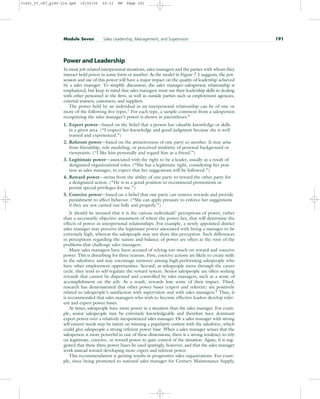
The four major stages of the sales management process and an understanding of personal selling are the focus of
this book.
31451_01_ch1_p001-016.qxd 15/03/05 15:29 PM Page 3
must operate. This is especially true for firms focusing on a customer relationship
management (CRM) strategy. By contrast, personal selling is an important component
of marketing strategies in specific product market situations. The role of personal
selling in a given marketing strategy has direct and important implications for sales
managers.
Strategic decisions at the corporate, business, and marketing levels must be trans-
lated into strategies for individual accounts. We discuss the major elements of a sales
strategy: account targeting strategy, relationship strategy, selling strategy, and sales
channel strategy. Because personal selling is typically important in organizational
marketing situations, we provide an explanation of organizational buyer behavior as
a foundation for the development of sales strategies.
Sales strategies are designed for individual accounts or groups of similar accounts.
Therefore, an account targeting strategy is needed to identify and classify accounts into
useful categories. Then, the type of relationship, the desired selling approach, and the
most productive mix of sales channels are determined for each account category. These
decisions result in an integrated sales strategy for each targeted account and account
group.
The development and integration of corporate, business, marketing, and sales strate-
gies establishes the basic strategic direction for personal selling and sales management
activities. However, an effective sales organization is necessary to implement these strate-
gies successfully. Module 4 (Sales Organization Structure and Salesforce Deployment)
presents the basic concepts in designing an effective sales organization structure: special-
ization, centralization, span of control versus management levels, and line versus staff
positions. Different decisions in any of these areas produce different sales organization
structures. The appropriate structure for a firm depends on the specific characteristics of
a given selling situation. If major account selling programs are used, specific attention
must be directed toward determining the best organizational structure for serving these
major accounts.
Closely related to sales organization decisions are decisions on the amount and
allocation of selling effort. We present specific methods for making salesforce deploy-
ment decisions. Because the decisions on selling effort allocation, salesforce size, and
territory design are interrelated, they should be addressed in an integrative manner.
A number of different analytical approaches can assist in this endeavor, but ā€œpeopleā€
issues must also be considered.
Developing the Salesforce
The sales strategy, sales organization, and salesforce deployment decisions produce the
basic structure for personal selling efforts and can be considered similar to the ā€œmachineā€
decisions in a production operation. Sales managers must also make a number of ā€œpeopleā€
decisions to ensure that the right types of salespeople are available and have the skills to
operate the ā€œmachineā€ structure effectively and efficiently.
Module 5 (Staffing the Salesforce: Recruitment and Selection) discusses the key activ-
ities involved in planning and carrying out salesforce recruitment and selection pro-
grams. These activities include determining the type of salespeople desired, identifying
prospective salesperson candidates, and evaluating candidates to ensure that the best are
hired. Legal and ethical issues are important considerations in the recruitment and selec-
tion process. The ramifications of this process for salespeople’s subsequent adjustment
to a new job (socialization) are also examined.
Module 6 (Continual Development of the Salesforce: Sales Training) emphasizes the
need for continuous training of salespeople and the important role that sales managers
play in this activity. The sales training process consists of assessing training needs, devel-
oping objectives, evaluating alternatives, designing the training program, carrying it out,
and evaluating it. Sales managers face difficult decisions at each stage of the sales train-
ing process, because it is not only extremely important but also expensive, and there are
many sales training alternatives available.
4 Module One Changing World of Sales Management
31451_01_ch1_p001-016.qxd 15/03/05 15:29 PM Page 4
Directing the Salesforce
Hiring the best salespeople and providing them with the skills required for success is one
thing; directing their efforts to meet sales organization goals and objectives is another.
Sales managers spend a great deal of their time in motivating, supervising, and leading
members of the salesforce.
Module 7 (Sales Leadership, Management, and Supervision) distinguishes between
the leadership, management, and supervisory activities of a sales manager. Leadership
activities focus on influencing salespeople through communication processes to attain
specific goals and objectives. Management activities include all aspects of the sales man-
agement process, such as recruiting, selecting, and training salespeople. Supervisory
activities are concerned with day-to-day control of the salesforce under routine operat-
ing conditions. Key issues and problems in sales leadership, management, and supervi-
sion are discussed.
Module 8 (Motivation and Reward System Management) presents several content
and process theories of motivation that attempt to explain how individuals decide to
spend effort on specific activities over extended periods of time. Sales managers can use
these theories as a foundation for determining the best ways to get salespeople to spend
the appropriate amount of time on the right activities over a period of time. These the-
ories provide the basis for specific salesforce reward systems. Both compensation and
noncompensation rewards are examined. The advantages and disadvantages of different
compensation programs are investigated, as well as methods for sales expense reim-
bursement. Specific guidelines for developing and managing a salesforce reward system
are suggested.
Determining Salesforce Effectiveness and Performance
Sales managers must continually monitor the progress of the salesforce to determine
current effectiveness and performance. This is a difficult task, because these evaluations
should address both the effectiveness of units within the sales organization and the
performance of individual salespeople.
Module 9 (Evaluating the Effectiveness of the Organization) focuses on evaluating
the effectiveness of sales organization units, such as territories, districts, regions, and
zones. The sales organization audit is the most comprehensive approach for evaluating
the effectiveness of the sales organization as a whole. Specific methods are presented for
assessing the effectiveness of different sales organization units with regard to sales, costs,
profitability, and productivity. Skill in using these analyses helps a sales manager to diag-
nose specific problems and develop solutions to them.
Module 10 (Evaluating the Performance of Salespeople) changes the focus to eval-
uating the performance of people, both as individuals and in groups. These perform-
ance evaluations are used for a variety of purposes by sales managers. Specific criteria
to be evaluated and methods for providing the evaluative information are examined,
and the use of this information in a diagnostic and problem-solving manner is
described. A method for measuring salesperson job satisfaction, which is closely
related to salesperson performance, is presented as well.
SALES MANAGEMENT TRENDS
The turbulent business environment presents a variety of challenges. Many sales organiza-
tions face fierce global competition in both home and international markets. The purchas-
ing function is increasingly viewed as an important way for organizations to lower costs and
increase profits. Therefore, buyers are more demanding, better prepared, and highly skilled.
The costs of maintaining salespeople in the field are escalating at the same time that sales
organizations are being pressured to increase sales but decrease the costs of doing business.
Thus, sales organizations are being challenged by competitors, customers, and even their
own firms.
Module One Changing World of Sales Management 5
31451_01_ch1_p001-016.qxd 15/03/05 15:29 PM Page 5
Many sales organizations are responding to these challenges by making dramatic
changes in sales operations. Consider what some companies are doing.
• The Bose Corporation’s sales organization is involved in hundreds of activities ranging
from direct-to-consumer promotions to nationwide reseller programs. Since the sales
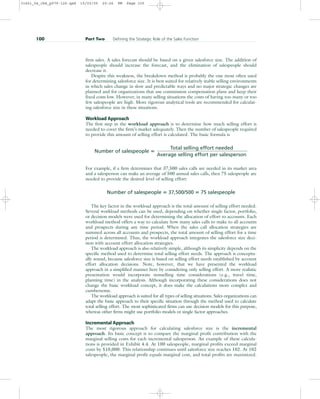
organization is organized into regional groups, it is difficult to ensure that selling efforts
are coordinated effectively. The company implemented a customized customer rela-
tionship management (CRM) program to address this problem. The CRM program
standardized the process for planning and managing sales activities, tracking leads, and
monitoring reseller programs. The system also automates tracking inventory records
and submitting expense reports.7
• Marriott salespeople represent hotel brands such as Ritz-Carlton, Courtyard, and
Fairfield Inns. Because customers differ in purchasing preferences, Marriott employs
several sales channels. Customers who already know what they want can make book-
ings directly through the Internet or by calling one of Marriott’s event-booking
centers staffed by inside salespeople. Customers who need help in making an appro-
priate choice are serviced by the field salesforce. These salespeople try to identify the
specific Marriott brand that will best meet a customer’s needs.8
• Salespeople at Johnson Control’s Automotive Systems Group (ASG) try to create
long-term relationships with customers. To this end cross-functional sales teams work
closely together, even going on joint sales calls. The marketing department does
extensive consumer research on automobile buyers. Salespeople give this research to
automobile manufacturers to add value to their relationship. Sometimes, salespeople
set up offices at customer sites to service these customers more quickly.9
These situations illustrate some of the ways sales organizations are responding to the
challenges facing them. Some of the changes are relatively minor, whereas others repre-
sent radical departures from past operating methods. Even though many firms are
making significant changes in sales management, the framework presented in Figure 1.1
is still relevant. All sales organizations must somehow address each stage of the sales
management process. What is changing, however, are the types of decisions made at
each stage and how these decisions affect other stages in the sales management process.
We think that the challenges facing sales organizations will continue to increase.
Therefore, successful sales organizations will be those that are willing to change and
meet these challenges. Several of the most important sales management trends are pre-
sented in Figure 1.2.
Many of these trends are the result of a more strategic perspective toward sales organ-
izations. As companies adopt a market orientation, the role of sales managers and sales-
people becomes strategically more important. Market-oriented firms typically develop
customer-centric cultures and establish organizational structures around customers
rather than products. Market segmentation and prioritizing customers within target
markets becomes increasingly important. Selling is viewed more as a core business
process rather than a tactical activity. This strategic perspective considers the sales organ-
ization as critical in delivering value to customers and generating profits for the firm.
Sales managers and salespeople need to change many of their activities to be successful
in a more strategic role.10
From Transactions to Relationships
The traditional transaction selling model is increasingly being replaced by more
relationship-oriented selling approaches. Instead of an emphasis on selling products in
the short run, salespeople are being required to develop long-term relationships by
solving customer problems, providing opportunities, and adding value to customer
businesses over an extended period of time. Sometimes, the shift to a relationship
approach is demanded by specific customers. For example, companies such as Ford,
Xerox, and General Electric have drastically reduced the number of their suppliers.
Instead of working with many suppliers for a particular product or service, these firms
want to deal with only one supplier or a few suppliers. Because these buyers desire
6 Module One Changing World of Sales Management
31451_01_ch1_p001-016.qxd 15/03/05 15:29 PM Page 6
long-term relationships with fewer suppliers, suppliers have no choice but to adopt
a relationship approach if they want to sell to them.
In other cases, sales organizations have been more proactive in establishing a rela-
tionship strategy. These sellers realize that their long-term success depends on having
long-term customers. Helping customers improve their business operations is the best
way to develop the long-term customer relationships that will lead to long-term success.
The key sales management task is determining the appropriate type of relationship to
pursue with specific customers. Some customers want and can best be served with
a transaction approach. Others require some type of relationship strategy. There are,
however, different types of relationships that might be established between buyers and
sellers. These are difficult but critical decisions for sales organizations, because the type
of relationship affects all other aspects of sales management.
The relationship selling trend is exhibited in the following examples:
• Texas Nameplate Company (TNC), with $4 million in annual sales, is the smallest
company to win the Malcolm Baldridge National Quality Award. TNC focuses on
retaining customers by being viewed as a trusted and valuable supplier. The company
uses customer visits and response cards to generate feedback from customers and to
take corrective action when problems are identified. Twice a year salespeople get
a printout of customers who have not made a purchase during the past 12 months.
The salespeople visit these customers, and one year they recovered 78 inactive
accounts. This relationship orientation is working, as more than 62 percent of
customers have been doing business with TNC for more than 10 years.11
• DXI sells software and services to companies that use ocean transportation. The com-
pany’s online database with ocean transportation rates can help customers solve
a variety of problems, but many customers viewed the company as just another
vendor. Ed Ryan, vice president of sales and marketing, decided to change this.
Module One Changing World of Sales Management 7
Sales Management Trends FIGURE 1.2
Transactions Relationships
Individuals Teams
Sales Volume Sales Productivity
Management Leadership
Administrative Entrepreneurial
Global
From To
Local
Many sales organizations are responding to the challenges facing them by making changes in their sales operations.
31451_01_ch1_p001-016.qxd 15/03/05 15:29 PM Page 7
He initiated a sales training program to help salespeople develop different types of
relationships with different customers. Strategic resource relationships were estab-
lished with the best customers. In these relationships, DXI is regarded as a consult-
ant helping the customer improve its business by reducing transportation and other
costs. DXI benefits from these relationships by generating higher margins and having
more control over the sales process.12
• Salespeople from General Motors Service Parts Operation (GMSPO) used to focus
entirely on selling car parts to dealers. Now, the emphasis is on helping the dealers
improve business operations. The salespeople present detailed, easy-to-read reports on
a dealer’s business in the form of a Dealer Business Profile and Dealer Dashboard. The
salesperson and dealer discuss this information to identify problem areas and to devise
solutions to these problems. This consultative service is valued by the dealer and helps
to strengthen the relationship with GMSPO.13
We examine the move from transactions to relationships throughout the remainder
of the text. However, particular attention to relationship selling approaches is provided
in the personal selling module (Module 2). In addition, an important element of a sales
strategy is determining the type of relationship desired with each account. This strategic
decision is examined in detail in Module 3.
From Individuals to Teams
The importance of the ā€œlone-wolf, superstarā€ salesperson is diminishing in many sales
organizations, especially when the focus changes from just selling products to solving
customer problems. In many situations, no one person possesses the knowledge and
skills needed to identify and solve customer problems. Typically, some type of teamwork
is required. This teamwork may be among individuals in the sales organization, between
the sales and marketing departments, or among the functions within the business.
Although there are many possible teamwork approaches, the trend from individuals to
teams is becoming increasingly prevalent.
One way to view teamwork approaches is presented in Exhibit 1.1.14
At one extreme
is a core selling team—a formal sales team assigned to a specific customer. Team mem-
bers can come from all business functional areas. Normally, a core selling team is headed
by a sales manager. An example is the national account program employed by Nalco.
When Nalco wins a national account, employees from Nalco and its customer form an
8 Module One Changing World of Sales Management
EXHIBIT 1.1 Sales Teamwork Approaches
Core Selling Team Selling Team
Relatively permanent, customer- Relatively temporary, transaction-
focused group focused group
Membership determined by job Membership determined by
assignment to a specific buying involvement in sales transaction for a
organization particular good or service
One team per buying unit One selling center per sales
opportunity
Membership relatively stable Membership very fluid
Characteristics of team depend on Characteristics of team depend on
characteristics of buying organization characteristics of sales opportunity
Mission is strategic with respect to the Mission is tactical with respect to the
buying organization sales opportunity
Different teamwork approaches that sales organizations can use are represented by this continuum.
31451_01_ch1_p001-016.qxd 15/03/05 15:29 PM Page 8
account team. The team includes a Nalco senior executive who is paired with a senior
executive from the customer company. The remainder of the team consists of people
from sales and other functions at Nalco matched by the customer’s counterparts.
As expressed by Jim Scott, Nalco’s vice president of corporate sales: ā€œTo be successful,
you have to have people matched up from both the customer and supplier sides, from the
executive level on down.ā€15
In the middle of this continuum is a formal sales team designed to close a transaction
with a specific customer. For example, Lockheed Martin Information Technology put
together a team of sales, management, technical, pricing, contracts, and executive lead-
ership to try to win a contract with the Centers for Medicare and Medicaid Services. The
team set up a command center near the customer, followed the Win Plan sales process,
and created the slogan ā€œOne Company, One Team.ā€ All members of the team worked
together to devise responses to the customer’s negotiating points. This team process was
expensive and took one and a half years to complete, but the result was a $401 million
contract.16
At the other extreme is a selling center where individuals are involved in a particular
sales transaction in an informal teamwork approach. Individuals can come from any
business function and can participate at any stage of the sales process. Often, it is the
responsibility of the salesperson to orchestrate the resources of the selling organization
to meet the needs of the buying organization. The Holophane Corporation imple-
mented a sales automation system to facilitate teamwork among the business functions.
All orders are entered directly into a database that is accessible to all departments
involved in manufacturing and executing the order. As engineering and manufacturing
work on the order, its status is continuously updated. Customer service personnel can
easily respond to customer inquiries about the order or make changes in the order
requested by customers. The sales automation system provides the information the busi-
ness functions need to work as a team to meet customer needs.17
Between these two extremes is a variety of approaches that differ in degree of
formality, composition of team members, number of teams, and other characteristics.
The important point is that the need for teamwork and the development of various
types of selling teams is likely to increase in the future. And, as sales organiza-
tions move from a focus on individuals to an emphasis on teamwork, many aspects
of sales management must change. Therefore, we examine the teamwork trend
throughout the text.
From Sales Volume to Sales Productivity
The basic role of a sales organization has been to sell. Salespeople and sales managers
are normally evaluated and rewarded according to total sales volume generated over
some time period. Although sales volume is important, many companies are finding that
all sales are not equal. Some sales are more profitable than others. Therefore, more sales
organizations are focusing not just on ā€œsales for the sake of sales,ā€ but on the prof-
itability of sales. This changes the focus from sales volume only to sales productivity.
Sales productivity includes the costs associated with generating sales and serving cus-
tomers. A sales productivity orientation emphasizes producing more sales for a given
level of costs by doing things more effectively or more efficiently.
Increasing sales productivity usually requires a sales organization to do some things
differently. Consider the following examples:
• Many companies use travel incentives to motivate salespeople. Because of tight
budgets and tough economic times, companies are keenly interested in making sure
the benefits from these incentive programs exceed program costs. TRAVEL’ round
designs, administers, and fulfills the awards for sales organization travel incentive pro-
grams. The company spent $1.5 million on Web technology to put these programs
online. The cost savings from going online are tremendous. According to Bob Ryan,
president of TRAVEL’round: ā€œWe can administer an incentive program online for
5,000 people for the same cost as for 50 people.ā€18
Module One Changing World of Sales Management 9
31451_01_ch1_p001-016.qxd 15/03/05 15:29 PM Page 9
• Intel’s Business Conferencing Group uses what it makes to increase sales productivity.
The company used a multipoint videoconference to communicate the launch of its
new Team-Station 4.0 videoconferencing system to about 40 sales reps in North
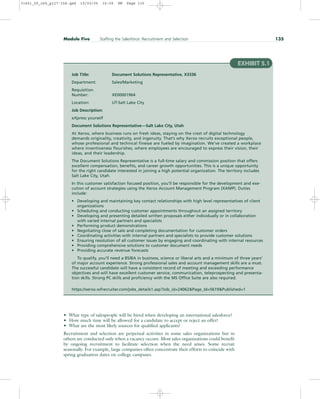
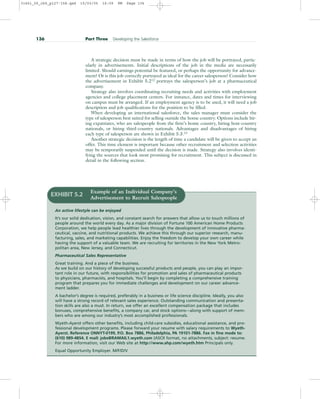
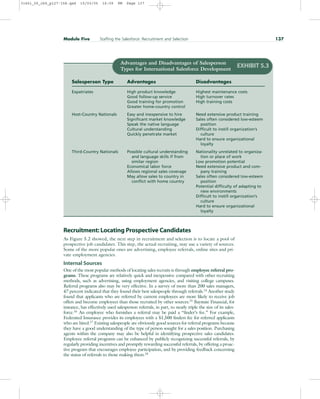
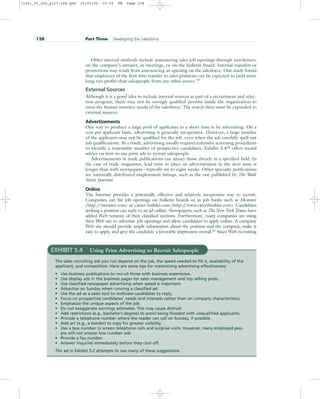
America and Europe. The full-day program linked 20 sales offices and some reps in
their homes. The videoconference was interactive as all participants could ask ques-
tions at any time. The participants rated the program as very effective, and the cost
savings in relation to bringing everyone to the same location were substantial.19
• Fisher Scientific International’s salespeople often show up for training programs in
their pajamas. That is because the training programs are on the Web. The salespeo-
ple can receive training programs in their homes, cars, hotel rooms, or wherever they
bring their laptop computers. Using a Web-based product called Performance
Learning System, salespeople receive product training, take an exam, or post mes-
sages to product experts wherever and whenever they want. The company saves
money on travel costs and the salespeople save valuable selling time.20
The common element in all these situations is that some changes were made to
increase sales productivity. Some things were done differently to get ā€œmore bang for the
sales buck.ā€ This pressure to increase sales productivity is likely to intensify in the future
for most sales organizations.
In one sense, all sales management decisions can be viewed from a sales productivity
perspective. Sales managers should continuously be trying to ā€œdo more with less.ā€
Therefore, we address sales productivity throughout the sales management process.
However, sales productivity is especially relevant when developing sales strategies
(Module 3), organizing selling activities and deploying selling effort (Module 4), and
evaluating sales organization effectiveness (Module 9).
From Management to Leadership
Many sales organizations use a hierarchical, bureaucratic structure. Sales managers operate at
different levels with direct supervisory responsibility for the level below and direct account-
ability to the management level above. Thus, field sales managers operate as the ā€œbossā€ for
the salespeople who report to them. They are responsible for the performance of these sales-
people and exercise various types of control to get salespeople to produce desired results.
Although this approach might work well in very stable environments, many sales
organizations realize that this approach makes it difficult for them to be responsive in
a rapidly changing environment. These sales organizations are ā€œflatteningā€ the hierarchy
and empowering salespeople to make more decisions in the field. This changes the role
of sales managers and their relationship with salespeople. The basic trend is for a sales
manager to lead more and manage less. One study found that sales managers are playing
more of a leadership role by emphasizing:
• collaboration rather than control
• coaching instead of criticism
• salesperson empowerment rather than domination
• sharing information rather than withholding it
• adapting to individual salespeople rather than treating everyone the same.21
This emphasis on leadership means that a sales manager’s job is more to help salespeo-
ple perform better and less to control and evaluate salespeople. This change in orienta-
tion is illustrated in Exhibit 1.2.22
Several studies reinforce the importance of leadership skills for sales managers. One
study of 900 salespeople found that the skills salespeople most desired from their sales
managers were good communication skills, the ability to motivate, and training and
coaching.23 Another study indicated that the major reason salespeople leave their firms
is because of dissatisfaction with their sales manager.24 Similar results were found in
another study in which salespeople suggested less loyalty to their firm because of con-
cerns about their sales manager’s ability to lead them.25 Finally, a study of 130 global
firms reported that leadership was the most important quality of sales executives.26
10 Module One Changing World of Sales Management
31451_01_ch1_p001-016.qxd 15/03/05 15:29 PM Page 10
Debbie Smith, North American sales manager for Extended Systems, agrees with the
results of these studies:
Salespeople want to know that you’re there for them. Managers need to show
their reps that they’re prepared to listen and work with them. Managers who
just hand out leads, sit in their office doing budgets, and talk to salespeople
only when necessary are going to be hated by their people.27
The trend toward a leadership orientation by sales managers is examined throughout
the text. However, Module 7 (Sales Leadership, Management, and Supervision) is
devoted entirely to discussing the important leadership versus management and
supervision issues.
From Administrative to Entrepreneurial
Consistent with the move from less management to more leadership, there is a trend from
less emphasis on administrative activities to more of an entrepreneurial orientation through-
out a sales organization. One study found that sales managers wanted to spend less of their
time on administrative tasks and internal, nonsales functions and much more time with
customers in selling and market development activities.28
This shift requires sales managers
to be more entrepreneurial in their sales management and marketplace activities.
An entrepreneurial orientation consists of three basic dimensions: proactiveness, risk-
taking, and innovation. Sales managers exhibiting an entrepreneurial orientation do not
just respond to whatever happens, they make things happen. These sales managers are
willing to take calculated risks and to perform activities in new ways. They look for and
pursue opportunities and leverage resources in unique ways. An entrepreneurial orien-
tation is much different from the administrative orientation of the past.29
W. L. Gore & Associates provides an interesting example of an entrepreneurial orien-
tation as well as several other sales management trends. No one in the company holds a title
other than associate and technically no one is anyone else’s boss. All work gets done by small
teams. Sales leaders emerge by earning followers. These sales leaders function more like
coaches than bosses, and spend most of their time guiding, directing, and encouraging
salespeople through face-to-face communication. Sales associates develop their own territo-
ries and sales forecasts, and then discuss them with their sales leaders. The teams within each
division are encouraged to generate their own ideas and strategies with a focus on customer
retention and long-term success. This unusual but very entrepreneurial orientation has
helped Gore grow to over $1 billion in annual sales.30
From Local to Global
The marketplace is now global. Products and services are produced and marketed
throughout the world. Most companies are involved in the international marketplace in
some way now and are likely to become more involved internationally in the future. This
trend toward a global orientation includes operating in international markets but goes
Module One Changing World of Sales Management 11
Yesterday Today
Natural resources defined power. Knowledge is power.
Leaders commanded and controlled. Leaders empower and coach.
Leaders were warriors. Leaders are facilitators.
Managers directed. Managers delegate.
Several important changes in effective leadership have occurred over the years.
Leadership Trends EXHIBIT 1.2
31451_01_ch1_p001-016.qxd 15/03/05 15:29 PM Page 11
well beyond just this geographic dimension. Even companies that do business only in
the domestic market, such as the United States or a region of the United States, might
compete against firms from other countries, use international suppliers, work with inter-
national partners, be affected by international events, serve customers from other coun-
tries regardless of where the customers are currently located, and/or have employees
from other countries and cultures. Any of these situations requires a sales organization
to expand from a local to a more global focus.
The most obvious need for a global orientation occurs when a company moves into
unfamiliar international markets. More and more companies are having to do this to
achieve growth objectives, because many local markets are not growing. Operating in
international markets presents difficult challenges for sales managers. United Parcel Service
(UPS) is a good example of a company facing these challenges. UPS delivers more than
1 million packages each day to over 200 countries. The company has invested $11 billion
in technology to connect buyers and sellers around the world through e-commerce.
Ted Gandolf, vice president of worldwide sales, thinks the technology infrastructure ā€œhelps
us build credibilityā€ to sell UPS services internationally.31
Less obvious, but of increasing importance, are the many situations in which a global
orientation is needed to be effective in a sales organization’s domestic market. Competing
against international competitors, serving customers from other countries and cultures, and
managing a diverse salesforce are of particular relevance to sales managers. Few markets or
sales organizations are homogeneous. Most are becoming more and more heterogeneous
and diverse.
Take the situation in the United States. One study projected that 75 percent of the pop-
ulation growth in the United States will come from Asian, Hispanic, and African-American
groups.32
Thus, in the years to come, an increasing proportion of the labor pool for sales
organizations and customers for consumer marketers in the United States will come from
these cultural groups. Jerry DiMonti, Century 21 People Services Realty, has taken advan-
tage of this situation. His company operates in an area outside New York City with
89 nationalities. To sell effectively in this marketplace, his 33 sales agents include individu-
als with Italian, French, African-American, Guatemalan, Puerto Rican, Jamaican, Nigerian,
Jewish, Indian, and South African backgrounds. This diverse sales organization selling to
diverse customers has increased company sales dramatically in the past two years.33
The pharmaceutical industry provides another example of the importance of cultural
issues in sales situations. Cultural issues are often relevant in the relationship between
a pharmaceutical sales rep and physicians, and between physicians and patients from
different cultures. CPRi Communications has developed online training that allows
pharmaceutical sales reps to role play interactions in cultural situations and to receive
feedback from trainers.34
EFFECTIVE SALES MANAGERS
Sales managers face many challenges in today’s business environment. They must be able
to implement all stages of the sales management model (see Figure 1.1) and implement
the sales management trends throughout this process. So, what does it take to be an
effective sales manager? Several studies and evaluations of leading sales organizations
suggest that effective sales managers employ a strategic perspective that focuses on
customers; are able to attract, keep, and develop sales talent; and leverage technology
throughout the sales organization.35
A Strategic Perspective Focused on Customers
As emphasized earlier in this chapter, effective sales managers need to be more strategically
oriented. This requires bringing a customer focus to the development of organiza-
tional strategies and creating sales strategies to meet the needs of different customers in a
profitable manner.
12 Module One Changing World of Sales Management
31451_01_ch1_p001-016.qxd 15/03/05 15:29 PM Page 12
PeopleSoft represents a good example of a customer-focused strategic perspective.
All of the company’s organizational strategies are built around customer satisfaction.
Sales organization compensation is not only tied to sales quotas, but also to measures
of customer satisfaction and the service customers receive from the PeopleSoft sales
organization. Sales strategies emphasize a dedicated account executive for each major
client. These clients have one point of contact with PeopleSoft. So, each customer can
contact their account executive, and the account executive’s job is to do whatever is
necessary to meet the customer’s needs.36
Attract,Keep,and Develop Sales Talent
A critical part of sales management is related to people issues. Hiring the best salespeo-
ple, making sure they stay with the sales organization, and helping them perform at their
highest levels are some of the most important accomplishments of effective sales man-
agers. One study found that ā€œsales is essentially a talent-driven occupation.ā€ World-class
sales organizations hire the best people and engage them.37
General Electric does an especially good job with sales talent. It spends a great
deal of time trying to hire the best salespeople; then its sales managers focus their
attention on supporting and developing these salespeople. Sales managers help each
salesperson develop a performance management plan and then meet with them three
to four times a year to assess progress. Extensive product and selling skills training
is also provided. These efforts have helped General Electric to attract and retain
a talented salesforce.38
Leverage Technology
The proper use of information and communication technologies can help salespeople
and sales managers perform their jobs more effectively and efficiently. The key task is to
select the right technology and ensure that it is used in the appropriate manner. Effective
sales managers leverage technology to increase productivity throughout their sales
organization.
Charles Schwab integrates technology into its sales strategy so that customers can
choose any sales channel they want to use for any interaction. A customer could use
the Internet one day, visit a salesperson the next day, and use the phone on another
day. Oracle has taken a different approach by shifting to an online sales model.
Routine activities are performed electronically so that salespeople can spend more
time building relationships with customers and less time with mundane paperwork.39
The most effective sales managers are those who find the proper blend of people and
technology to meet the needs of customers and salespeople.
In addition to these general perspectives, the best sales managers focus on a number
of specific activities in their interactions with salespeople:40
• Prepare their sales team for constant change by being a role model and mentoring
salespeople.
• Earn the trust of salespeople by being dependable and competent, and exhibiting
integrity.
• Give salespeople continuous feedback in a positive manner.
• Build enthusiasm throughout the sales team.
• Get involved by being accessible to salespeople and visible to customers.
• Grow and develop salespeople by emphasizing continuous job improvement and
career development.
As you can see, sales management is a complex, constantly evolving field. Each module
in the text is designed to address key sales management issues and to illustrate the impor-
tant changes being implemented by leading sales organizations.
Module One Changing World of Sales Management 13
31451_01_ch1_p001-016.qxd 15/03/05 15:29 PM Page 13
MODULE FORMAT
Sales Management: Analysis and Decision Making was written for students. Therefore,
its aim is to provide comprehensive coverage of sales management in a manner that
students will find interesting and readable. Each module blends recent research results
with current sales management practice in a format designed to facilitate learning.
At the beginning of each module, ā€œObjectivesā€ highlight the basic material that the
student should expect to learn. These learning objectives are helpful in reviewing
modules for future study. An opening vignette then illustrates many of the important
ideas to be covered in the module, using examples of companies in various industries
to illustrate the diversity and complexity of sales management. Most of the companies
described in the vignettes are well known, and most of the situations represent real
actions by these firms.
Key words in the body of each module are printed in bold letters, and figures
and exhibits are used liberally to illustrate and amplify the discussion in the text.
Every figure contains an explanation so that it can be understood without reference
to the text.
Each module contains two boxed inserts entitled Sales Management in the 21st
Century. The examples in both boxes have been provided specifically for this textbook
by sales executives from various companies whom we recruited to serve as a Sales
Executive Panel. To ensure that the textbook includes the latest practices from leading
sales organizations, each executive was asked to provide specific examples of ā€œbest prac-
ticesā€ in their company. Backgrounds of each executive are provided at the end of this
module.
Sales managers are confronted with various ethical issues when performing their job
activities. Many of these ethical issues are addressed in the Ethical Dilemma boxes that
appear in the remaining modules. You will be presented with realistic ethical situations
faced by sales managers and asked to recommend appropriate courses of action.
A module summary is geared to the learning objectives presented at the beginning of
the module. Understanding Sales Management Terms lists the key words that appear
in bold throughout the module. Developing Sales Management Knowledge presents
10 questions to help you develop an understanding of important sales management
issues and relationships. Building Sales Management Skills consists of exercises in
which you can apply the sales management knowledge learned in the module. Making
Sales Management Decisions includes two interesting case situations that allow you to
make important sales management decisions. If you understand sales management
terms, develop sales management knowledge, and build sales management skills, you
will be prepared to make successful sales management decisions.
CONCLUDING STATEMENT
This brief overview of contemporary sales management and summary of the contents and
format of Sales Management: Analysis and Decision Making set the stage for your jour-
ney into the dynamic and exciting world of sales management. This should be a valuable
learning experience as well as an interesting journey. All the information contained in this
textbook should prove very relevant to those of you who begin your career in personal
selling and progress through the ranks of sales management.
SALES EXECUTIVE PANEL
Jane Hrehocik Clampitt is marketing process manager for DuPont Consulting Solutions.
Jane has spent most of her time at DuPont in sales and marketing roles with her current
position aimed at raising the competency of sales and marketing professionals at DuPont.
She has a B.S. in chemical engineering from Pennsylvania State University.
14 Module One Changing World of Sales Management
31451_01_ch1_p001-016.qxd 15/03/05 15:29 PM Page 14
Doug Clopton is director of retail operations for Catholic Charities of Kansas, where he
oversees the retail sales of stores generating revenue, which is returned to help those in
need. Prior to this, Doug spent 22 years with Hershey Chocolate, in a variety of sales posi-
tions in the Kansas City, Chicago, Dallas, and Seattle markets, responsible for directing his
team’s selling efforts. Doug has a B.S.B.A. in marketing and an M.B.A. from Central
Missouri State University.
Jerry Heffel started with The Southwestern Company as a college student salesperson
in 1965, and has been president of the company since 1980. He is responsible for
current profitability and setting the future direction for the company. Jerry has a B.A. in
history from Oklahoma State University, and an M.B.A. from the University of
Oklahoma.
Jason Karem is sales manager for Automatic Data Processing (ADP) Emerging Business
Services Division. He manages nine associates who sell payroll, tax filing, time-and-
attendance, and human resource–related services to business customers. Jason has a B.A.
in marketing from Murray State University.
Bob LaMontagne is director of sales excellence for the Brown-Forman Corporation. He
works with all operating groups to ensure the effectiveness of their sales professionals.
This includes position descriptions, competency development, and training. Bob has
a B.S. in business administration from Western New England College.
L. A. Mitchell is sales planner, business management, for Lucent Technologies. She
works with the sales team as a strategic financial partner with the sales directors, which
involves financial analysis, forecasting, and the identification of sales opportunities.
She has a B.S.B.A. in marketing and an M.S. in marketing from Colorado State
University.
Steve Randazzo is vice president of sales for KV Pharmaceutical, Inc. (ETHEX
Division). He is responsible for all accounts in the United States. His primary customer
base includes drug wholesalers, retail chains, managed care facilities, and hospitals. Steve
has a B.S. in advertising from Southeast Missouri State University.
Sabrina Rogers is a district marketing manager for Federated Mutual Insurance. She
manages eight sales representatives who sell property and causality, group health, and
life and disability insurance to small and medium-sized businesses. Sabrina has a
B.S.B.A. with a major in marketing from Central Missouri State University.
AndrƩ R. Wickham is corporate regional sales manager southeast region and corpo-
rate national accounts sales manager for Hormel Foods’ Foodservice Group. He is
responsible for providing leadership of all sales activities in the southeast region of the
United States. As national account manager, AndrĆ© directly manages the company’s
sales activities with many national foodservice chains throughout the United States.
He has a B.S. degree in business administration from Morgan State University in
Baltimore.
Marty Zucker is vice president/general manager for Allied Office Products. Allied
Office Products is the largest independent office supply company in the United States.
He is responsible for increasing revenues and margins at their Long Island, New York,
Division. Marty has been in the office products industry for 32 years. He has held
such positions as regional vice president National Accounts, Midwest Region; Vice
president/general manager Chicago as well as director of operations for the Long
Island, NY Division in the 1970s and 1980s. Marty studied marketing and business
administration at the State University New York, Delhi.
Module One Changing World of Sales Management 15
31451_01_ch1_p001-016.qxd 15/03/05 15:29 PM Page 15
31451_01_ch1_p001-016.qxd 15/03/05 15:29 PM Page 16
P a r t
1
Describing the Personal
Selling Function
17
The module and appendix in Part One describe the personal selling function.
A clear understanding of personal selling is essential to gain a proper perspective
on the issues facing sales managers. Module 2 presents the historical evolution
of selling, along with a contemporary look at the contributions of personal
selling to our economic and social systems. In addition, classifications of the
various approaches to personal selling and the sales process are discussed.
Appendix 2 covers the characteristics of sales careers, classification of sales
jobs, and the qualifications and skills required for salesperson success.
31451_02_ch2_p017-046.qxd 15/03/05 15:41 PM Page 17
31451_02_ch2_p017-046.qxd 15/03/05 15:41 PM Page 18
UPS BUILDS TRUST AND LONG-TERM CUSTOMER
RELATIONSHIPS
When most people think of United Parcel Service (UPS), they probably think of the
distinct brown-and-gold trucks that deliver small packages to homes and businesses.
But UPS does a lot more than deliver packages. Using a highly customer-oriented
approach, approximately 4,000 UPS salespeople in the United States function as
value-building consultants to their business clients. Using this approach has paid off
in sales growth, with UPS now in the top 50 of the Fortune 500.
Carl Strenger, a UPS vice president, describes the sales approach as a ā€œconsulta-
tive discussion across the supply chain. . . . We go in and we learn about the busi-
ness. We talk to the functional people—information technology, finance, and so
on. Once we decide what’s important to this customer, we come up with a bundle
of solutions to grow their top-line or reduce their bottom-line costs.ā€ To make its
sales presentations effective, UPS conducts extensive training to focus on solutions
for specific customers.
UPS salespeople from the package delivery side also frequently team up with
UPS Capital sales personnel to offer customers integrated delivery and cash-flow
management systems, and business process improvement programs. The overall
sales strategy focuses on building long-term, trust-based relationships with cus-
tomers. After almost a hundred years in business, UPS clearly is demonstrating
that it understands how to implement a customer-focused strategy.
After completing this module,
you should be able to
1 Describe the evolution of
personal selling from
ancient times to the
modern era.
2 Explain the contributions
of personal selling to soci-
ety, business firms, and
customers.
3 Distinguish between
transaction-focused tradi-
tional selling and trust-
based relationship selling.
4 Discuss five alternative
approaches to personal
selling.
5 Describe the three primary
roles fulfilled by consulta-
tive salespeople.
6 Understand the sales
process as a series of
interrelated steps.
Objectives
Source: From ā€œUPS Builds Billions in Sales,ā€ by Robert McGarvey in Selling Power (June 2004):
56–62.
19
2
M o d u l e
O V E R V I E W O F P E R S O N A L
S E L L I N G
EVOLUTION OF PERSONAL SELLING
The successful professional salesperson of today and the future is likely a better lis-
tener than a talker, is more oriented toward developing long-term relationships with
customers than placing an emphasis on high-pressure, short-term sales techniques,
and has the skills and patience to endure lengthy, complex sales processes. Like the
UPS salespeople in the opening vignette, they strive to deliver relevant presentations
based on unique customer needs. Teamwork between salespeople and others in the
organization, also illustrated in the UPS example, is increasingly important for sales
success. For more on teamwork, see ā€œSales Management in the 21st Century: The
Importance of Teamwork in Sales.ā€
Personal selling is defined as personal communication with an audience through
paid personnel of an organization or its agents in such a way that the audience per-
ceives the communicator’s organization as being the source of the message. The
audience may be an individual or a group representing another organization or
a household. An audience may also be an individual acting solely on his or her
behalf. In this book, we typically describe personal selling in a business-to-business
context, in which a salesperson or sales team interacts with one or more individuals
from another organization.
Personal selling has evolved into a different activity than it was just a decade
ago. Throughout this course, you learn about new technologies and techniques
that have contributed to this evolution. This module provides an overview of
31451_02_ch2_p017-046.qxd 15/03/05 15:41 PM Page 19
personal selling, affording insight into the operating rationale of today’s salespeople and
sales managers. It also describes approaches to personal selling and presents the sales
process as a series of interrelated steps. The appendix at the end of the module discusses
several important aspects of sales careers, including types of selling jobs and characteris-
tics and skills needed for sales success. In the highly competitive, complex environment
of the world business community, personal selling and sales management have never
played more critical roles.
Origins of Personal Selling
Ancient Greek history documents selling as an exchange activity, and the term salesman
appears in the writings of Plato.1
However, true salespeople, those who earned a living
only by selling, did not exist in any sizable number until the Industrial Revolution in
England, from the mid-eighteenth century to the mid-nineteenth century. Prior to this
time, traders, merchants, and artisans filled the selling function. These predecessors of
contemporary marketers were generally viewed with contempt because deception was
often used in the sale of goods.2
In the latter phase of the Middle Ages, the first door-to-door salesperson appeared
in the form of the peddler. Peddlers collected produce from local farmers, sold it to
townspeople, and, in turn, bought manufactured goods in town for subsequent sale
in rural areas.3 Like many other early salespeople, they performed other important
marketing functions—in this case, purchasing, assembling, sorting, and redistributing
of goods.
Industrial Revolution Era
As the Industrial Revolution began to blossom in the middle of the eighteenth century,
the economic justification for salespeople gained momentum. Local economies were
no longer self-sufficient, and as intercity and international trade began to flourish,
economies of scale in production spurred the growth of mass markets in geographically
dispersed areas. The continual need to reach new customers in these dispersed markets
called for an increasing number of salespeople.
It is interesting to note the job activities of the first wave of salespeople in the era of
the Industrial Revolution. The following quotation describes a salesperson who served
the customer in conjunction with a producer:
Thus, a salesman representing the producing firm, armed with samples of
the firm’s products, could bring the latter to the attention of a large num-
ber of potential customers—whether buying for sale to others or for their
20 Part One Describing the Personal Selling Function
S a l e s m a n a g e m e n t i n t h e 2 1 s t c e n t u r y
The Importance of Teamwork in Sales
Jerry Heffel, president of the Southwestern
Company, offers his perspective on teamwork:
Sometimes the salesperson is referred to as the
lead car in the business train. But just having
a lead car doesn’t make a train. For this reason,
a salesperson who is effective long term is also an
effective team player—he or she realizes they need
coordinated involvement from many different
parts of the organization in order to serve the
customer. At the same time, whenever they see
themselves as part of the customer’s team, and that
they are both striving for the same outcome, they
become an indispensable part of the value chain
for that customer. Southwestern’s sales training
philosophy stresses this team aspect: we tell our
salespeople that they are the gas and oil of the free
enterprise system, but they also need the tires, the
car body, the drive train, and what’s in the trunk
to get anywhere significant.
31451_02_ch2_p017-046.qxd 15/03/05 15:41 PM Page 20
own production requirements—who might not, without the salesman’s
visit, have learnt of the product’s existence, and give them the opportu-
nity of examining and discussing it without having to go out of their way
to do so. . . . Even if the salesman did not succeed in obtaining an order,
he frequently picked up valuable information on the state of the market,
sometimes the very reasons for refusal. . . . This information could be very
useful to the producer.4
Post–Industrial Revolution Era
By the early 1800s, personal selling was well established in England but just beginning to
develop in the United States.5
This situation changed noticeably after 1850, and by the
latter part of the century, salespeople were a well-established part of business practice in
the United States. For example, one wholesaler in the Detroit area reported sending out
400 traveling salespeople in the 1880s.6
At the dawning of the twentieth century, an exciting time in the economic history of
the United States, it became apparent that marketing, especially advertising and personal
selling, would play a crucial role in the rapid transition of the economy from an agrarian
base to one of mass production and efficient transportation.
Glimpses of the lives of salespeople in the early 1900s, gained from literature of that
period, reveal an adventuresome, aggressive, and valuable group of employees often
working on the frontier of new markets. Already, however, the independent maverick
salespeople who had blazed the early trails to new markets were beginning to disappear.
One clear indication that selling was becoming a more structured activity was the devel-
opment of a canned sales presentation by John H. Patterson of the National Cash
Register Company (NCR). This presentation, a virtual script to guide NCR salespeople
on how to sell cash registers, was based on the premise that salespeople are not ā€œborn,
but rather they are made.ā€7
Sales historians noted the changes occurring in personal selling in the early twentieth
century. Charles W. Hoyt, author of one of the first textbooks on sales management,
chronicled this transition in 1912, noting two types of salespeople:
The old kind of salesman is the ā€œbig meā€ species. . . . He works for himself
and, so far as possible, according to his own ideas. . . . There is another type
of salesman. He is the new kind. At present he is in the minority, but he works
for the fastest growing and most successful houses of the day. He works for
the house, and the house works for him. He welcomes and uses every bit of
help the house sends to him.8
Hoyt’s observations about the ā€œoldā€ and the ā€œnewā€ salesperson summed up the
changing role of personal selling. The managements of firms in the United States were
beginning to understand the tremendous potential of personal selling and, simultane-
ously, the need to shape the growth of the sales function. In particular, a widespread
interest arose in how to reduce the cost of sales. According to Hoyt, this did not mean
hiring lower-cost salespeople, but instead called for ā€œdistributing much larger quantities
of goods with less motion.ā€9
War and Depression Era
The 30-year span from 1915 to 1945 was marked by three overwhelming events—two
world wars and the Great Depression in the United States. Because economic activity
concentrated on the war efforts, new sales methods did not develop quickly during those
periods. During the Great Depression, however, business firms, starved for sales volume,
often employed aggressive salespeople to produce badly needed revenue. Then, with
renewed prosperity in the post–World War II era, salespeople emerged as important
Module Two Overview of Personal Selling 21
31451_02_ch2_p017-046.qxd 15/03/05 15:41 PM Page 21
employees for an increasing number of firms that were beginning to realize the benefits
of research-based integrated marketing programs.
Professionalism:The Modern Era
In the middle 1940s personal selling became more professional. Not only did buyers begin
to demand more from salespeople, but they also grew intolerant of high-pressure, fast-
talking salespeople, preferring instead a well-informed, customer-oriented salesperson.
In 1947, the Harvard Business Review published ā€œLow-Pressure Selling,ā€10
a classic article
followed by many others that called for salespeople to increase the effectiveness of their
sales efforts by improving their professional demeanor.
An emphasis on sales professionalism is the keynote of the current era. The term
has varied meanings, but in this context we use it to mean a customer-oriented
approach that uses truthful, nonmanipulative tactics to satisfy the long-term needs of
both the customer and the selling firm. The effective salesperson of today is no longer
a mere presenter of information but now must stand equipped to respond to a variety
of customer needs before, during, and after the sale. In addition, salespeople must be
able to work effectively with others in their organizations to meet or exceed customer
expectations.
In examining the status of sales as a true profession, one study found that sales meets
four of the six criteria that define professions, and that progress is still needed on the
other two dimensions.11
This study concluded that sales meets the criterion of operat-
ing from a substantial knowledge base that has been developed by academics, corporate
trainers and executives, and professional organizations. Sales also meets the criterion of
making a significant contribution to society, which is discussed in the next section of this
module. Third, through professional organizations such as the Strategic Account
Management Association (SAMA) and through a common sales vocabulary such as that
found in textbooks and training materials, sales meets the professional criterion of hav-
ing a defined culture and organization of colleagues. Fourth, sales does have a unique
set of professional skills, though these skills vary depending on the specific nature of
a given sales position.
Two areas in the study indicated that sales needs additional progress to be viewed
as a profession on a par with law, medicine, and other long-recognized professions.
The first area has to do with how much autonomy salespeople have to make
decisions and the amount of public trust granted to salespeople. While many
business-to-business salespeople have considerable decision-making autonomy, oth-
ers have very little. Public trust could be improved by a widely accepted certification
program such as the CPA designation for accountants. At present, however, very
few salespeople have professional certification credentials. While many salespeople
do have considerable autonomy, public trust in certification programs is modest;
thus the results are mixed as to whether the sales profession meets this professional
criterion.
The final area where sales needs to improve is to adhere to a uniform ethical code. While
many companies have ethical codes and some professional organizations have ethical codes
for salespeople, there is no universal code of ethics with a mechanism for dealing with
violators. Until such a code is developed and widely accepted in business, some members
of society will not view sales as a true profession.
Whether or not sales is viewed as a true profession, comparable to law and medicine,
salespeople can benefit tremendously by embracing high ethical standards, participating
in professional organizations, and working from a continually evolving knowledge base.
In so doing, they will not only be more effective, they will also help advance sales as
a true profession.
Future evolution is inevitable as tomorrow’s professional salesperson responds to
a more complex, dynamic environment. Also, increased sophistication of buyers and
of new technologies will demand more from the next generation of salespeople.
Exhibit 2.1 summarizes some of the likely events of the future.12
22 Part One Describing the Personal Selling Function
31451_02_ch2_p017-046.qxd 15/03/05 15:41 PM Page 22
CONTRIBUTIONS OF PERSONAL SELLING
Although advertising has traditionally captured most of the attention of students and
researchers, personal selling is actually the most important part of marketing communica-
tions for most business firms. This is particularly true in firms that engage in business-to-
business marketing. More money is spent on personal selling than on any other form of
marketing communications, whether it be advertising, sales promotion, publicity, or public
relations. We now take a look at how this investment is justified by reviewing the contribu-
tions of personal selling to society in general, to the employing firm, and to customers.
Salespeople and Society
Salespeople contribute to their nations’ economic growth in two basic ways. They act as
stimuli for economic transactions, and they further the diffusion of innovation.
Salespeople as Economic Stimuli
Salespeople are expected to stimulate action in the business world—hence the term
economic stimuli. In a fluctuating economy, salespeople make invaluable contributions by
assisting in recovery cycles and by helping to sustain periods of relative prosperity. As the
world economic system deals with issues such as increased globalization of business, more
emphasis on customer satisfaction, and building competitiveness through quality improve-
ment programs, it is expected that salespeople will be recognized as a key force in execut-
ing the appropriate strategies and tactics necessary for survival and growth.
Salespeople and Diffusion of Innovation
Salespeople play a critical role in the diffusion of innovation, the process whereby new
products, services, and ideas are distributed to the members of society. Consumers who
are likely to be early adopters of an innovation often rely on salespeople as a primary
source of information. Frequently, well-informed, specialized salespeople provide useful
information to potential consumers who then purchase from a lower-cost outlet.
Module Two Overview of Personal Selling 23
Continued Evolution of Personal Selling EXHIBIT 2.1
Change Salesforce Response
Intensified competition More emphasis on developing and maintaining trust-based,
long-term customer relationships
More emphasis on improving Increased use of technology (e.g., laptop computers,
sales productivity electronic mail, databases, customer relationship
management software)
Increased use of lower-cost-per-contact methods
(e.g., telemarketing for some customers)
More emphasis on profitability (e.g., gross margin) objectives
Fragmentation of traditional Sales specialists for specific customer types
customer bases Multiple sales channels (e.g., major accounts programs,
telemarketing, electronic networks)
Globalization of sales efforts
Customers dictating quality Team selling
standards and inventory/ Salesforce compensation sometimes based on customer
shipping procedures to satisfaction and team performance
be met by vendors
Demand for in-depth, Team selling
specialized knowledge as More emphasis on customer-oriented sales training
an input to purchase decisions
31451_02_ch2_p017-046.qxd 15/03/05 15:41 PM Page 23
The role of salespeople in the diffusion of industrial products and services is particularly
crucial. Imagine trying to purchase a companywide computer system without the assis-
tance of a competent salesperson or sales team!
While acting as an agent of innovation, the salesperson invariably encounters a strong
resistance to change in the latter stages of the diffusion process. The status quo seems to be
extremely satisfactory to many parties, even though, in the long run, change is necessary for
continued progress or survival. By encouraging the adoption of innovative products and
services, salespeople may indeed be making a positive contribution to society.
Salespeople and the Employing Firm
Because salespeople are in direct contact with the all-important customer, they can make
valuable contributions to their employers. Salespeople contribute to their firms as
revenue producers, as sources of market research and feedback, and as candidates for
management positions.
Salespeople as Revenue Producers
Salespeople occupy the somewhat unique role of revenue producers in their firms.
Consequently, they usually feel the brunt of that pressure along with the management of the
firm. Although accountants and financial staff are concerned with profitability in bottom-
line terms, salespeople are constantly reminded of their responsibility to achieve a healthy
ā€œtop lineā€ on the profit and loss statement. This should not suggest that salespeople are
concerned only with sales revenue and not with overall profitability. Indeed, salespeople
are increasingly responsible for improving profitability, not only by producing sales rev-
enues, but also by improving the productivity of their actions.
Market Research and Feedback
Because salespeople spend so much time in direct contact with their customers, it is only
logical that they would play an important role in market research and in providing feedback
to their firms. For example, entertainment and home products retailer Best Buy relies heavily
on feedback from its sales associates in what it calls a customer-centricity initiative, which
places the customer at the center of its marketing strategy. Feedback from sales associates
helps Best Buy offer tailored products to specific customer segments, design appealing
in-store merchandising formats, increase sales volume for in-home services, and improve the
effectiveness of customer-support call centers. Results of the customer-centricity program
have been so positive that Best Buy is rapidly increasing the number of participating stores as
it tries to fend off Wal-Mart and other major competitors.13
Some would argue that salespeople are not trained as market researchers, or that sales-
people’s time could be better used than in research and feedback activities. Many firms,
however, refute this argument by finding numerous ways to capitalize on the salesforce as
a reservoir of ideas. It is not an exaggeration to say that many firms have concluded that
they cannot afford to operate in the absence of salesforce feedback and research.
Salespeople as Future Managers
In recent years, marketing and sales personnel have been in strong demand for upper
management positions. Recognizing the need for a top management trained in sales,
many firms use the sales job as an entry-level position that provides a foundation for
future assignments. As progressive firms continue to emphasize customer orientation as
a basic operating concept, it is only natural that salespeople who have learned how to
meet customer needs will be good candidates for management jobs.
Salespeople and the Customer
Given the increasing importance of building trust with customers and an emphasis on estab-
lishing and maintaining long-term relationships, it is imperative that salespeople be honest
and candid with customers. Salespeople must also be able to demonstrate knowledge of
their products and services, especially as they compare competitive offerings. Customers
24 Part One Describing the Personal Selling Function
31451_02_ch2_p017-046.qxd 15/03/05 15:41 PM Page 24
also expect salespeople to be knowledgeable about market opportunities and relevant busi-
ness trends that may affect a customer’s business. There has been a long-standing expecta-
tion that salespeople need to be the key contact for the buyer, who expects that they will
coordinate activities within the selling firm to deliver maximum value to the customer.
The overall conclusion is that buyers expect salespeople to contribute to the success
of the buyer’s firm. Buyers value the information furnished by salespeople, and more
than ever before, they value the problem-solving skills of salespeople.14
See ā€œAn Ethical
Dilemmaā€ for a scenario in which the salesperson must think about where to draw the
line in sharing information with customers.
As salespeople serve their customers, they simultaneously serve their employers and
society. When the interests of these parties conflict, the salesperson can be caught in the
middle. By learning to resolve these conflicts as a routine part of their jobs, salespeople fur-
ther contribute to developing a business system based on progress through problem solving.
Module Two Overview of Personal Selling 25
Terry Kelly, sales representative for EFAX, a
computer software company, has just concluded
a sales call with Landnet, one of his distributors.
During the call, purchasing agent Linda Meyer
mentioned that Ron Hawkins, Landnet’s top
salesperson, had suddenly resigned and moved
out of the state. Ms. Meyer said that this unex-
pected resignation could not have come at a worse
time, as several key customer contracts were
pending renewal, and Landnet had no candidates
to replace Hawkins. On his way to his next sales
call with Netserve, his largest distributor, Terry
debated whether or not he should share the news
of Hawkins’ resignation. After all, the buyer at
Netserve viewed Terry as a great source of market
information, and Terry figured that the Netserve
buyer would hear the news anyway before the day
was over. What should Terry do?
a n e t h i c a l d i l e m m a
CLASSIFICATION OF PERSONAL SELLING APPROACHES
In this section, we take a closer look at alternative approaches to personal selling that
professionals may choose from to best interact with their customers. Some of these
approaches are simple. Other approaches are more sophisticated and require that the
salesperson play a strategic role to use them successfully. More than three decades ago,
four basic approaches to personal selling were identified: stimulus response, mental
states, need satisfaction, and problem solving.15 Since that time, another approach to
personal selling, termed consultative selling, has gained popularity. All five approaches to
selling are practiced today. Furthermore, many salespeople use elements of more than
one approach in their own hybrids of personal selling.
As a prelude to our discussion of approaches to personal selling, an expansion of two
key points is in order. Recall that personal selling differs from other forms of marketing
communications because it is a personal communication delivered by employees or
agents of the sales organization. Because the personal element is present, salespeople
have the opportunity to alter their sales messages and behaviors during a sales presenta-
tion or as they encounter unique sales situations and customers. This is referred to as
adaptive selling. Because salespeople often encounter buyers with different personali-
ties, communications styles, needs and goals, adaptive selling is an important concept.
A second point is that personal selling is moving from transaction-based methods to
relationship-based methods. Rather than trying to maximize sales in the short run,
relationship-based selling approaches focus on solving customer problems, providing
opportunities, and adding value to the customer’s business over an extended period.
Exhibit 2.216 illustrates how transaction-based selling differs from relationship-based selling.
We now explore one element of Exhibit 2.2 in detail—personal selling approaches.
31451_02_ch2_p017-046.qxd 15/03/05 15:41 PM Page 25
Stimulus Response Selling
Of the five views of personal selling, stimulus response selling is the simplest. The theo-
retical background for this approach originated in early experiments with animal behavior.
The key idea is that various stimuli can elicit predictable responses. Salespeople furnish the
stimuli from a repertoire of words and actions designed to produce the desired response.
This approach to selling is illustrated in Figure 2.1.
26 Part One Describing the Personal Selling Function
EXHIBIT 2.2
Comparison of Transaction-Focused Traditional
Selling with Trust-Based Relationship Selling
Transaction-Focused
Traditional Selling Trust-Based Relationship Selling
Primary perspective The salesperson and the The customer and the customer’s
selling firm customers
Personal selling Stimulus response, mental Need satisfaction, problem solving,
approaches states consultative
Desired outcome Closed sales, order volume Trust, joint planning, mutual bene-
fits, enhance profits
Role of salesperson Make calls and close sales Business consultant and long-term ally
Key player in the customer’s business
Nature of communication One-way, from salesperson Two-way and collaborative
to customer
Degree of salesperson’s Isolated from customer’s Actively involved in customer’s
involvement in cus- decision-making process decision-making process
tomer’s decision-making
process
Knowledge required Own company’s products Own company’s products and
Competition resources
Applications Competition
Account strategies Applications
Costs Account strategies
Opportunities Costs
Opportunities
General business and industry knowl-
edge and insight
Customer’s products, competition,
and customers
Typical skills required Selling skills Selling skills
Information gathering
Listening and questioning
Strategic problem solving
Creating and demonstrating unique,
value-added solutions
Teambuilding and teamwork
Post-sale follow-up Little or none; move on Continued follow-through to:
to conquer next customer • Ensure customer satisfaction
• Keep customer informed
• Add customer value
• Manage opportunities
31451_02_ch2_p017-046.qxd 15/03/05 15:41 PM Page 26
An example of the stimulus response view of selling would be continued affirma-
tion, a method in which a series of questions or statements furnished by the salesperson
is designed to condition the prospective buyer to answering ā€œyesā€ time after time, until,
it is hoped, he or she will be inclined to say ā€œyesā€ to the entire sales proposition. This
method is often used by telemarketing personnel, who rely on comprehensive sales
scripts read or delivered from memory.
Stimulus response sales strategies, particularly when implemented with a canned sales
presentation, have some advantages for the seller. The sales message can be structured in
a logical order. Questions and objections from the buyer can usually be anticipated and
addressed before they are magnified during buyer–seller interaction. Inexperienced sales-
people can rely on stimulus response sales methods in some settings, and this may even-
tually contribute to sales expertise.
The limitations of stimulus response methods, however, can be severe, especially if
the salesperson is dealing with a professional buyer. Most buyers like to take an active
role in sales dialogue, and the stimulus response approach calls for the salesperson to
dominate the flow of conversation. The lack of flexibility in this approach is also a dis-
advantage, as buyer responses and unforeseen interruptions may neutralize or damage
the effectiveness of the stimuli.
Considering the net effects of this method’s advantages and disadvantages, it appears
most suitable for relatively unimportant purchase decisions, when time is severely con-
strained and when professional buyers are not the prospects. As consumers in general
become more sophisticated, this approach will become more problematic.
Mental States Selling
Mental states selling, or the formula approach to personal selling, assumes that the
buying process for most buyers is essentially identical and that buyers can be led through
certain mental states, or steps, in the buying process. These mental states are typically
referred to as AIDA (attention, interest, desire, and action). Appropriate sales messages
provide a transition from one mental state to the next.
Like stimulus response selling, the mental states approach relies on a highly struc-
tured sales presentation. The salesperson does most of the talking, as feedback from the
prospect could be disruptive to the flow of the presentation.
A positive feature of this method is that it forces the salesperson to plan the sales
presentation prior to calling on the customer. It also helps the salesperson recognize
that timing is an important element in the purchase decision process and that careful
listening is necessary to determine which stage the buyer is in at any given point.
Module Two Overview of Personal Selling 27
Salesperson
Provides Stimuli:
Statements
Questions
Actions
Audio/Visual Aids
Demonstrations
Continue
Process Until
Purchase
Decision
Buyer
Responses
Sought:
Favorable
Reactions and
Eventual
Purchase
Stimulus Response Approach to Selling FIGURE 2.1
The salesperson attempts to gain favorable responses from the customer by providing stimuli, or cues, to influence the
buyer. After the customer has been properly conditioned, the salesperson tries to secure a positive purchase decision.
31451_02_ch2_p017-046.qxd 15/03/05 15:41 PM Page 27
A problem with the mental states method is that it is difficult to determine which
state a prospect is in. Sometimes a prospect is spanning two mental states or moving
back and forth between two states during the sales presentation. Consequently, the
heavy guidance structure the salesperson implements may be inappropriate, confusing,
and even counterproductive to sales effectiveness. We should also note that this method
is not customer oriented. Although the salesperson tailors the presentation to each cus-
tomer somewhat, this is done by noting customer mental states rather than needs. See
ā€œAn Ethical Dilemmaā€ for a situation in which the salesperson is contemplating the
movement of the prospect into the ā€œactionā€ stage.
28 Part One Describing the Personal Selling Function
Rachel Duke sells advertising for her college
newspaper. One of her potential clients is con-
templating buying an ad for an upcoming special
issue featuring bars and restaurants. Over the past
two weeks, Rachel has tried unsuccessfully to get
a commitment from the restaurant owner to
place an ad. Her sales manager has suggested that
Rachel call the prospect and tell him that there is
only one remaining ad space in the special issue,
and that she must have an immediate answer to
ensure that the prospect’s ad will appear in the
special issue. The sales manager said, ā€œRachel,
this guy is stalling. You’ve got to move him to
action, and this technique will do the trick.ā€
Rachel was troubled by her manager’s advice,
since the special issue had plenty of ad space
remaining. If you were Rachel, would you follow
her sales manager’s advice? Why or why not?
a n e t h i c a l d i l e m m a
The mental states method is illustrated in Exhibit 2.3.17
Note that this version
includes ā€œconvictionā€ as an intermediate stage between interest and desire. Such minor
variations are commonplace in different renditions of this approach to selling.
Need Satisfaction Selling
Need satisfaction selling is based on the notion that the customer is buying to satisfy
a particular need or set of needs. This approach is shown in Figure 2.2. It is the sales-
person’s task to identify the need to be met, then to help the buyer meet the need.
Unlike the mental states and stimulus response methods, this method focuses on the
EXHIBIT 2.3 Mental States View of Selling
Mental State Sales Step Critical Sales Task
Curiosity Attention Get prospects excited, then you get them to like you.
Interest Interest Interview: needs and wants
Conviction Conviction ā€œWhat’s in it for me?ā€
Productā€”ā€Will it do what I want it to do?ā€
Priceā€”ā€Is it worth it?ā€ ā€œThe hassle of changeā€ ā€œCheaper
elsewhereā€
Peersā€”ā€What will others think of it?ā€
Priorityā€”ā€Do I need it now?ā€ (sense of urgency)
Desire Desire Overcome their stall.
Action Close Alternate choice close: which, not if!
31451_02_ch2_p017-046.qxd 15/03/05 15:42 PM Page 28
customer rather than on the salesperson. The salesperson uses a questioning, probing
tactic to uncover important buyer needs. Customer responses dominate the early por-
tion of the sales interaction, and only after relevant needs have been established does the
salesperson begin to relate how his or her offering can satisfy these needs.
Customers seem to appreciate this selling method and are often willing to spend
considerable time in preliminary meetings to define needs prior to a sales presentation
or written sales proposal. Also, this method avoids the defensiveness that arises in some
prospects when a salesperson rushes to the persuasive part of the sales message without
adequate attention to the buyer’s needs.
Problem-Solving Selling
Problem-solving selling is an extension of need satisfaction selling. It goes beyond
identifying needs to developing alternative solutions for satisfying these needs. The
problem-solving approach to selling is depicted in Figure 2.3. Sometimes even com-
petitors’ offerings are included as alternatives in the purchase decision.
The problem-solving approach typically requires educating the customer about the full
impact of the existing problem and clearly communicating how the solution delivers
significant customer value. This is true even in cases where the solution seems to be an obvi-
ously beneficial course of action for the buyer. For example, SoftSwitching Technologies’
Dynamic Sag Corrector (DySC) practically eliminates expensive power-related downtime in
manufacturing processes. Competitive products are expensive and hard to maintain. Yet the
company found that DySC did not sell itself because buyers were used to having downtime
in manufacturing and were not sure DySC would be a solution.18 To be successful in
Module Two Overview of Personal Selling 29
Uncover and
Confirm Buyer
Needs
Continue Selling
Until Purchase
Decision
Present Offering
to Satisfy Buyer
Needs
Need Satisfaction Approach to Selling FIGURE 2.2
The salesperson attempts to uncover customer needs that are related to the product or service offering. This may require
extensive questioning in the early stages of the sales process. After confirming the buyer’s needs, the salesperson
proceeds with a presentation based on how the offering can meet those needs.
Define
Problem
Continue
Selling
Until
Purchase
Decision
Generate
Alternative
Solutions
Evaluate
Alternative
Solutions
Problem-Solving Approach to Selling FIGURE 2.3
The salesperson defines a customer problem that may be solved by various alternatives. Then an offering is made that
represents at least one of these alternatives. All alternatives are carefully evaluated before a purchase decision is made.
31451_02_ch2_p017-046.qxd 15/03/05 15:42 PM Page 29
problem-solution selling, salespeople must be able to get the buyer to agree that a problem
exists and that solving it is worth the time and effort required.
The problem-solving approach to selling can take a lot of time. In some cases, the
selling company cannot afford this much time with each prospective customer. In other
cases, the customers may be unwilling to spend the time. Insurance salespeople, for
example, report this customer response. The problem-solving approach appears to be
most successful in technical industrial sales situations, in which the parties involved are
usually oriented toward scientific reasoning and processes and thus find this approach to
sales amenable.
Consultative Selling
Consultative selling is the process of helping customers reach their strategic goals by
using the products, services, and expertise of the sales organization.19
Notice that this
method focuses on achieving strategic goals of customers, not just meeting needs or
solving problems. Salespeople confirm their customers’ strategic goals, then work col-
laboratively with customers to achieve those goals.
In consultative selling, salespeople fulfill three primary roles: strategic orchestrator,
business consultant, and long-term ally. As a strategic orchestrator, the salesperson
arranges the use of the sales organization’s resources in an effort to satisfy the customer.
This usually calls for involving other individuals in the sales organization. For example, the
salesperson may need expert advice from production or logistics personnel to fully address
a customer problem or opportunity. In the business consultant role, the salesperson uses
internal and external (outside the sales organization) sources to become an expert on the
customer’s business. This role also includes an educational element—that is, salespeople
educate their customers on products they offer and how these products compare with
competitive offerings. As a long-term ally, the salesperson supports the customer, even
when an immediate sale is not expected.
Chester Sykes, a new business account executive for Information Handling Services
(IHS) in Chandler, Arizona, suggests that salespeople should ā€œuse consultative selling
to begin building a relationship based on identifying and satisfying your potential
client’s needs.ā€20
He advocates that salespeople do a detailed customer needs analysis to
learn the customer’s business, including their present and future goals. Sykes also says it
is important to become ā€œbecome your customer’s coordinator/advocate to represent
their ongoing needs. This builds trust, loyalty, and future sales.ā€21 For more on consul-
tative selling, see ā€œSales Management in the 21st Century: Consultative Selling.ā€
30 Part One Describing the Personal Selling Function
S a l e s m a n a g e m e n t i n t h e 2 1 s t c e n t u r y
Consultative Selling
L. A. Mitchell, sales planner for Lucent Tech-
nologies, comments on the increasing use of
consultative selling.
Professional selling is becoming much more of a
consultative process than in years past. The pace
of business has accelerated, and it is hard for
individual buyers to be experts on everything they
buy. That’s where consultative selling comes in.
When buyers know they have a problem, but don’t
know how to solve it, our salespeople can offer
a tailored solution. The solution must fit within
the buyer’s allotted budget, and it must be consis-
tent with the goals and strategies within the buy-
ing organization. Consultative salespeople must
also be on the scene after the sale to be sure that
any necessary training and service issues are
handled to the client’s satisfaction. With consul-
tative selling, making the sale is important, but
the real focus is on providing expertise which
enables clients to improve company operations
and productivity.
31451_02_ch2_p017-046.qxd 15/03/05 15:42 PM Page 30
SALES PROCESS
The nonselling activities on which most salespeople spend a majority of their time are
essential for the successful execution of the most important part of the salesperson’s job,
the sales process. The sales process has traditionally been described as a series of inter-
related steps beginning with locating qualified prospective customers. From there, the
salesperson plans the sales presentation, makes an appointment to see the customer,
completes the sale, and performs post-sale activities.
As you should recall from the earlier discussion of the continued evolution of per-
sonal selling (refer to Exhibit 2.1), the sales process is increasingly being viewed as a rela-
tionship management process, as depicted in Figure 2.4. In this conceptualization of the
sales process, salespeople strive to attain lasting relationships with their customers. The
basis for such relationships may vary, but the element of trust between the customer and
the salesperson is an essential part of enduring relationships. To earn the trust of
customers, salespeople should be customer oriented, honest, dependable, competent,
and likable.22 These attributes are reflected by Blake Conrad, who sells medical supplies
for Centurion Specialty Care. Conrad, based in Denver, says:
You simply cannot have productive relationships with your customers unless
they trust you. I work really hard to show customers that I care about their
bottom line, and I would never sell them something they don’t really need.
If I don’t have an answer for them on the spot, I make every effort to get
the answer and get back to them the same day. Customers appreciate the fact
that I do what I say and follow up on all the details. To me, being customer
oriented and dependable is just part of my job. It makes selling a lot more
fun when your customers trust you, and—guess what—I sell more to cus-
tomers who trust me.23
Another important element of achieving sound relationships with customers is to
recognize that individual customers and their particular needs must be addressed with appro-
priate selling strategies and tactics. In selling, we discuss strategy at four levels: corporate,
Module Two Overview of Personal Selling 31
Enhancing
Customer
Relationships
Adding Value:
• Follow-up
• Self-leadership
and Teamwork
Developing
Customer
Relationships
• Sales
Presentation
Delivery
• Earning
Customer
Commitment
Initiating Customer
Relationships
• Prospecting
• Preapproach
• Presentation
Planning
• Approaching the
Customer
Selling Foundations
• Trust and Ethics
• Understanding
Buyers
• Communications
Skills
Selling Strategy
• Sales Territory
• Each Customer
• Each Sales Call
Sales Process FIGURE 2.4
Salespeople must possess certain attributes to inspire trust in their customers and to be able to adapt their selling strategy to differ-
ent situations. One or more selling approaches are used in the sales process. The three major phases of the sales process are initiating,
developing, and enhancing customer relationships.
31451_02_ch2_p017-046.qxd 15/03/05 15:42 PM Page 31
business unit, marketing department, and the overall sales function. An individual salesperson
is strongly guided by strategy at these higher levels in the organization but must also develop
selling strategies and tactics to fit the sales territory, each customer, and ultimately, each
sales call.
When studying the sales process, we should note that there are countless versions of the
process in terms of number of steps and the names of the steps. If, however, you were to
examine popular trade books on selling and training manuals used by corporations, you
would find that the various depictions of the sales process are actually more alike than truly
unique. The sales process shown in Figure 2.4 is comparable to most versions of the sales
process, with the exception of those versions that advocate high-pressure methods centering
on how to get the customer to ā€œsay yesā€ rather than focusing on meeting the customer’s true
needs. This version of the sales process suggests that salespeople must have certain attributes
to inspire trust in their customers and that salespeople should adapt their selling strategy to
fit the situation. The three phases of the sales process are initiating, developing, and enhanc-
ing customer relationships. For discussion purposes, the first two phases have been
subdivided into a total of five steps. The sixth and final step in the sales process is that of
enhancing customer relationships, which, in many cases, extends over a prolonged period.
Another point that should be stressed is that the sales process is broken into steps to
facilitate discussion and sales training, not to suggest discrete lines between the steps.
The steps are actually highly interrelated and, in some instances, may overlap. Further,
the stepwise flow of Figure 2.4 does not imply a strict sequence of events. Salespeople
may move back and forth in the process with a given customer, sometimes shifting from
step to step several times in the same sales encounter. Finally, completion of the sales
process typically will require multiple sales calls.
SUMMARY
1. Describe the evolution of personal selling from ancient times to the modern era.
The history of personal selling can be traced as far back as ancient Greece. The
Industrial Revolution enhanced the importance of salespeople, and personal selling
as we know it today had its roots in the early twentieth century. The current era of
sales professionalism represents a further evolution.
2. Explain the contributions of personal selling to society, business firms, and
customers. Salespeople contribute to society by acting as stimuli in the economic
process and by assisting in the diffusion of innovation. They contribute to their
employers by producing revenue, performing research and feedback activities, and
comprising a pool of future managers. They contribute to customers by providing
timely knowledge to assist in solving problems.
3. Distinguish between transaction-focused traditional selling and trust-based rela-
tionship selling. As summarized in Exhibit 2.2, trust-based selling focuses more on the
customer than does transaction-focused selling. The salesperson will act as a consultant
to the customer in trust-based selling, whereas transaction-based selling concentrates
more on making sales calls and on closing sales. There is far more emphasis on post-
sales follow-up with relationship selling than with transaction selling, and salespeople
must have a broader range of skills to practice relationship selling.
4. Discuss five alternative approaches to personal selling. Alternative approaches
to personal selling include stimulus response, mental states, need satisfaction,
problem solving, and the consultative approach. Stimulus response selling often
uses the same sales presentation for all customers. The mental states approach pre-
scribes that the salesperson lead the buyer through stages in the buying process.
Need satisfaction selling focuses on relating benefits of the seller’s products or
services to the buyer’s particular situation. Problem-solving selling extends need
32 Part One Describing the Personal Selling Function
31451_02_ch2_p017-046.qxd 15/03/05 15:42 PM Page 32
satisfaction by concentrating on various alternatives available to the buyer.
Consultative selling focuses on helping customers achieve strategic goals, not just
meeting needs or solving problems. In consultative selling, salespersons fulfill
three primary roles: strategic orchestrator, business consultant, and long-term ally
to the customer.
5. Describe the three primary roles fulfilled by consultative salespeople. The
three roles are strategic orchestrator, business consultant, and long-term ally. As a
strategic orchestrator, salespeople coordinate the use of the sales organization’s
resources to satisfy the customer. As a business consultant, the salesperson becomes
an expert on the customer’s business and educates the customer on how his or her
products can benefit the customer. The consultative salesperson acts as a long-term
ally to the customer, acting in the customer’s best interest even when an immedi-
ate sale is not expected.
6. Discuss the sales process as a series of interrelated steps. As presented in
Figure 2.4, the sales process involves initiating, developing, and enhancing cus-
tomer relationships. Salespeople initiate customer relationships through prospect-
ing and preapproach activities, presentation planning, and approaching the
customer. Customer relationships are developed when salespeople make sales
presentations and earn a commitment from their customers. Salespeople enhance
customer relationships by following up after the sale, taking a leadership role, and
sometimes working as part of a team to constantly increase the value received by
the customer.
UNDERSTANDING SALES MANAGEMENT TERMS
personal selling mental states selling
canned sales presentation AIDA
sales professionalism need satisfaction selling
economic stimuli problem-solving selling
diffusion of innovation consultative selling
revenue producers strategic orchestrator
adaptive selling business consultant
stimulus response selling long-term ally
continued affirmation sales process
DEVELOPING SALES MANAGEMENT KNOWLEDGE
1. What factors will influence the continued evolution of personal selling?
2. How do salespeople contribute to our society? Are there negative aspects of personal
selling from a societal perspective?
3. What are the primary contributions made by salespeople to their employers?
4. Most businesses would have a difficult time surviving without the benefits of the
salespeople who call on them. Do you agree?
5. How are need satisfaction and problem-solving selling related? How do they differ?
6. How does the consultative selling approach differ from problem-solving and need
satisfaction selling? Explain the three key roles of consultative salespersons.
7. When do you think stimulus response selling would be most effective?
8. How important is teamwork between the customer and the sales organization in prac-
ticing consultative selling? How does teamwork within the sales organization factor
into consultative selling?
Module Two Overview of Personal Selling 33
31451_02_ch2_p017-046.qxd 15/03/05 15:42 PM Page 33
9. Is adaptive selling as important in domestic markets as it is in international markets?
10. Discuss the final step of the sales process (enhancing customer relationships) as
related to the continuing evolution of personal selling.
BUILDING SALES MANAGEMENT SKILLS
1. Situation: Assume you are a salesperson for a packaging manufacturing company
that supplies retail stores with custom-imprinted shopping bags. The company has
manufacturing facilities in Texas, Georgia, New York, and California. There are
five functional areas in the company: marketing (includes sales), production,
finance and accounting, customer service and shipping, and human resources. You
work out of the California plant, which serves the United States west of the Rocky
Mountains. Within the marketing department, your key contact is the product
manager who routinely interacts with individuals from production, customer serv-
ice, and shipping to coordinate production runs with promised delivery dates.
The product manager has no direct authority over any of the personnel in pro-
duction or customer service and shipping. For the following situations, explain
how you would try to gain the cooperation of the right people to meet customer
needs. It is important that you achieve customer satisfaction but not at the
expense of profitability.
Scenario A: A large customer unexpectedly runs out of shopping bags and is
requesting a shipment within 72 hours. Normal lead time for existing
customers is 10 working days. Production is fully booked, that is,
there is no idle capacity in the California plant.
Scenario B: A long-time customer buys three sizes of shopping bags, all shipped
in identical corrugated boxes. The smallest bags are packed 500 to
a box, the medium-sized bags 250 to a box, and the largest 100 to
a box. Black-and-white labels on one end of the corrugated boxes
denote bag sizes. The customer wants labels in three different colors
to denote bag size. According to the customer, store employees
could then tell at a glance if stock for a particular size was running
low and thus place prompt requests for reorders. Currently, the
black-and-white labels are applied by a machine as part of the
manufacturing process. The color labels would have to be custom
produced and hand-fed into the labeling machine, whereas existing
labels are printed inexpensively in large quantities and fed automat-
ically into the labeling machine.
2. Your knowledge of selling can help you get started in a sales career. Landing a job
is like making a major sale in that your knowledge, skills, and attitudes must meet
the needs of the employer. One way to match up with employer needs is to use the
feature-advantage-benefit (FAB) approach to assess yourself relative to employer
needs. In selling, a feature is a factual statement about the product or service, for
example, ā€œat 10 pounds, it is the lightest electrical motor in its performance cate-
gory.ā€ An advantage describes how the product can be used or help the customer,
for example, ā€œit is light enough to be used in portable applications.ā€ The benefit is
the favorable outcome the customer will experience from the advantage, for exam-
ple, ā€œyour customers no longer will have to come to the repair center for assistance,
as service reps will be able to use portable repair kits in the field.ā€ To translate this
method to the job search, think of yourself as the ā€œproduct.ā€ Select an appropriate
company and discover what they are looking for in sales job applicants. You can use
classified ads, the college placement center, personal contacts, or other sources
to find a sales position that you are interested in. Using the following example as
a starting point, complete a FAB worksheet that shows how you are qualified for the
job. In a real job search, this information could be translated to your rƩsumƩ or
cover letter requesting an interview.
34 Part One Describing the Personal Selling Function
PROD. NO
SCENE TAKE ROLL
SOUND
DATE
PROD CO.
DIRECTOR
CAMERAMAN
ROLE PLAY
31451_02_ch2_p017-046.qxd 15/03/05 15:42 PM Page 34
Module Two Overview of Personal Selling 35
The FAB Job-Search Matrix (Example)
A B C D
Need Feature Advantage Benefit
Employer or Problem Student Employer
ā€œThis job requires . . .ā€ ā€œI have . . .ā€ ā€œThis means . . .ā€ ā€œYou will . . .ā€
frequent sales taken 10 classes I require limited or save on the cost of
presentations to that required no training in training; you have
individuals and groups presentations making presentations ability and confidence
to be productive early
(List additional needs, features, advantages, and benefits.)
3. Many industry observers believe that entrepreneurs must have strong selling skills to
succeed. At a minimum, entrepreneurs should understand the sales process well enough
to direct the sales efforts of others. To better understand the linkages between entre-
preneurship and selling, visit the Inc magazine Web site at http:/
/www.inc.com. From
the home page, click on the ā€œSalesā€ link under the ā€œHow Toā€ menu. What suggestions
can you find that relate to material in this module?
31451_02_ch2_p017-046.qxd 15/03/05 15:42 PM Page 35
Case 2.1: Biomod,Inc.
Background
Biomod, Inc., a California-based manufacturer of
educational models of the human body, has been in
business since the mid-1960s. The company’s prod-
ucts, sold primarily to middle schools in the United
States, are available in plastic or as computer images.
Accompanying products include lesson plans for
teachers, and workbooks and computer programs for
students. Biomod has enjoyed healthy sales increases
in recent years, as schools increasingly integrated
computer-assisted instruction into their curricula.
Five years ago, Biomod began selling consumer
versions of its models through selected specialty edu-
cational toy stores and recently began selling on its
own Web site. In addition, Biomod is also selling on
the Web through Hypermart.com and Ed-Toys.
Further, Biomod has had discussions with Toys ā€œ ā€
Us, and the giant retailer seems eager to stock
Biomod products.
Current Situation
Biomod has employed Zack Wilson, a recent grad-
uate of San Diego State University, for the past six
months. He has become familiar with all aspects of
marketing the Biomod product line and is now the
sales representative for electronic retailing accounts.
Zack is truly excited about his job, as he sees the
explosive growth potential for selling Biomod prod-
ucts on the Internet. His first big success came
when he convinced Hypermart.com to sell Biomod
products. After all, Hypermart has the reputation in
most circles as the premier electronic retailer. Thirty
days after his initial sales to Hypermart, Zack was
thrilled to land Ed-Toys as his second electronic
retailer.
No doubt about it, Zack Wilson was on a roll.
Securing commitments from Hypermart and Ed-Toys
within a month was almost too good to be true. In
fact, there was only one problem facing Zack Wilson.
Hypermart had begun discounting the Biomod prod-
uct line as much as 20 percent off suggested retail,
and Ed-Toys was unhappy with the intense price com-
petition. The following conversation had just taken
place between Zack and Ed-Toys buyer Andrea
Haughton:
Andrea: Zack, your line looked really promising to
us at suggested retail prices, but meeting
Hypermart’s pricing sucks the profit right out
of the equation. Are you selling Hypermart at
a lower price than us?
Zack: Absolutely not! Hypermart just decided to
promote our line with the discounts.
Andrea: So the discounts are just a temporary
promotion? When will Hypermart stop
discounting?
Zack: Well, I don’t really know. What I mean by
that is that Hypermart often discounts, but in
the case of the Biomod line, I’ve got to believe
it’s just a temporary thing.
Andrea: Why do you think so?
Zack: Because they haven’t asked me for a lower
price. Like you, they can’t be making much of
a profit after the discounts.
Andrea: Well, Zack, we need to stop the bleeding!
I can’t go on meeting their prices. If they’re
not making money either, maybe it’s time you
get them to stop the discounting. Can you talk
with them about getting up to suggested retail?
Zack: Andrea, you know I can’t dictate retail selling
prices to them any more than I could to you.
Andrea: Nor am I suggesting you try to dictate
prices. I am simply suggesting that you let them
know that if they choose to go back to suggested
retail, we will surely follow. If we can’t sell at
suggested retail, we will have little choice but to
stop selling the Biomod line. I’m sure you can
appreciate the fact that we have profit expecta-
tions for every line we sell. At 20 percent off,
Zack, the Biomod line just doesn’t cut it for us.
Zack: O.K., I will see what I can do.
Later in the day, Zack checked his e-mail and
found a disturbing message from Barbara Moore,
a Biomod sales representative for the retail store
division. Barbara’s message informed Zack that one
of her key retailers had visited the Hypermart Web
site and was extremely upset to see the heavy dis-
counting on the Biomod line. Barbara claimed that
she was in danger of losing her account and that she
feared a widespread outcry from other specialty
stores as word of the Hypermart discounting would
quickly spread. Barbara strongly urged Zack to do
what he could to get Hypermart back to suggested
retail. Zack noted that Barbara had copied both her
sales manager and Rebecca Stanley, Zack’s sales
manager, with her e-mail message.
The following day, Zack called on Warren
Bryant, Hypermart’s buyer for the Biomod line. He
conveyed to Warren that Ed-Toys and some of the
store retailers were upset with the discounting.
Warren shrugged off the news, commenting only
that ā€œit’s a dog-eat-dogā€ world and that price com-
petition was part of the game. Zack asked Warren if
he was happy with the profit margins on the
Biomod line, and Warren responded that he was
more concerned with growing Hypermart’s market
R
36 Part One Describing the Personal Selling Function
MAKING SALES MANAGEMENT DECISIONS
31451_02_ch2_p017-046.qxd 15/03/05 15:42 PM Page 36
share than with profit margins. He told Zack, ā€œOur
game plan is grab a dominant share, then worry
about margins.ā€ At this point, Warren gave Zack
something else to think about:
Warren: Hey, Zack, I noticed you guys are selling
the same products on your own Web site as the
ones we’re selling on ours.
Zack: True, what’s the problem?
Warren: Well, I just read in the trade press where
Home Depot told their vendors that they don’t
buy from their (Home Depot’s) competitors
and that they view vendor Web sites as competi-
tors to their retail business. Maybe we feel the
same way. We sell on the Web, and if you do
too, then you’re really a competitor for us.
Zack: Warren, you know that we only do a little
volume on the Web. Our site is really more of
an information site.
Warren: But you do offer an alternative to other
electronic retailers and us by selling on your
own site. And by the way, don’t your store
retailers oppose your selling on the Web?
Zack: At this point, most of them are small retail-
ers, and frankly speaking, they view you as more
of a threat than us selling on our own site.
Besides, our store division salesforce is working
on a software package that will enable our store
retailers to easily set up their own Web sites
over the next six months or so.
Warren: Unbelievable! What you’re saying is that
another division in your company is creating
even more Web-based competition for me!
I thought we had a real future together, but
I’ve got to do some heavy-duty thinking on
that. Thanks, Zack, but I’m really busy and
need to move on to some other priorities this
afternoon. Call me if you have any new
thoughts on where we go from here.
Zack left Hypermart and began the hour-long
drive back to the office. ā€œGood thing I’ve a little time
to think about this situation,ā€ he thought as he drove
along. ā€œI need to talk with Rebecca Stanley just as
soon as I get to the office.ā€
Questions
1. How do you think Zack got into this dilemma?
2. If you were Rebecca Stanley, Zack’s sales man-
ager, what would you advise Zack to do?
Situation: Read Case 2.1.
Characters: Zack Wilson, Biomod sales
representative; Rebecca Stanley,
Biomod sales manager.
Scene 1: Location—Rebecca’s office. Action—
Zack explains to Rebecca what has
occurred with the Ed-Toys and
Hypermart accounts. Rather than
telling Zack how to deal with
Hypermart and Ed-Toys from this
point forward, Rebecca directs Zack
to devise his own strategy. Rebecca
then tells Zack that she would like to
visit both accounts with him within a
week, and that she should like to
review his strategy for Hypermart and
Ed-Toys within 48 hours.
Upon completion of the role play, address the follow-
ing questions:
1. Is Rebecca justified in telling Zack to devise his
own strategy rather than giving him specific
direction at this time? What are the advantages
and disadvantages of her approach?
2. How could this situation have been prevented?
Scene 2: Location—Rebecca’s office. Action—
Zack presents his strategy to Rebecca.
Upon completion of the role play, address the follow-
ing questions:
1. What are the strengths and weaknesses of
Zack’s interaction with Ed-Toys and
Hypermart?
2. What further suggestions can you make for
dealing with Hypermart and Ed-Toys?
Case 2.2: Plastico,Inc.
Background
Plastico, Inc., located in New York, is a manufacturer
of plastic components. The company is noted for
producing high-quality products. Its sales-force calls
on large accounts, such as refrigerator manufacturers
who might need large quantities of custom-made
products, such as door liners. Recent increases in
new-home sales over the past several years have
fueled refrigerator sales and, subsequently, sales at
Plastico. Moreover, federal regulations requiring that
dishwasher liners be made of plastic, rather than
porcelain, have enhanced Plastico’s sales.
Current Situation
Sharon Stone had recently been assigned to the cen-
tral Michigan territory. Although this was her first
sales job, she felt confident and was eager to begin.
She had taken a sales course in college and had just
completed the company’s training program. The
company stressed the use of an organized sales pres-
entation in which the salesperson organizes the key
Module Two Overview of Personal Selling 37
ROLE PLAY
PROD. NO
SCENE TAKE ROLL
SOUND
DATE
PROD CO.
DIRECTOR
CAMERAMAN
31451_02_ch2_p017-046.qxd 15/03/05 15:43 PM Page 37
points into a planned sequence that allows for adap-
tive behavior by the salesperson as the presentation
progresses. She was familiar with this approach
because she had studied it in her college sales course.
Sharon’s first call was at a small refrigerator man-
ufacturer in Ann Arbor. She had called the day
before to set up an appointment with materials pur-
chasing manager David Kline at 9:00 A.M. On the
morning of her meeting, Sharon was running
behind schedule because of an alarm clock malfunc-
tion. As a result, she ended up in traffic she did not
anticipate and did not arrive for her appointment
until 9:10 A.M. When she informed the receptionist
she had an appointment with David Kline, she was
told he was in another meeting. He did agree, how-
ever, to see Sharon when his meeting was finished,
which would be about 9:45 A.M. Sharon was upset
Kline would not wait 10 minutes for her and let the
receptionist know it.
At 9:50 A.M. Sharon was introducing herself
to Kline. She noticed his office was filled with
University of Michigan memorabilia. She remem-
bered from her training that the first thing to do was
build rapport with the prospect. Thus she asked
Kline if he went to the University of Michigan. This
got the ball rolling quickly. Kline had graduated from
Michigan and was a big fan of the basketball and
football teams. He was more than happy to talk
about them. Sharon was excited; she knew this would
help her build rapport. After about 25 minutes of
football and basketball chitchat, Sharon figured it
was time to get down to business.
After finally getting Kline off the subject of sports,
Sharon began to discuss the benefits of her product.
She figured if she did not control the conversation
Kline would revert to discussing sports. She went on
and on about the material compounds comprising
Plastico plastics, as well as the processes used to
develop plastic liners. She explained the customizing
process, the product’s durability, Plastico’s ability to
provide door liners in any color, and her company’s
return and credit policies. After nearly 25 minutes,
she finally asked Kline if he had any questions.
Kline asked her if she had any product samples
with her. Sharon had to apologize—in all the confu-
sion this morning she ran off and left the samples at
home. Then Kline asked her about the company’s
turnaround time from order to delivery. Knowing
quick turnaround was important to Kline, and feel-
ing this prospect may be slipping away, she told him
it was about four weeks, although she knew it was
really closer to five. However, she thought, if Kline
ordered from them and it took a little longer, she
could always blame it on production. When the issue
of price emerged, Sharon was not able to clearly jus-
tify in Kline’s mind why Plastico was slightly higher
than the competition. She thought that she had
clearly explained the benefits of the product and that
it should be obvious that Plastico is a better choice.
Finally, Kline told Sharon he would have to
excuse himself. He had a meeting to attend on the
other side of town. He thanked her for coming by
and told her he would consider her offer. Sharon
thanked Kline for his time and departed. As she
reflected on her first call she wondered where she
went wrong. She thought she would jot down some
notes about her call to discuss with her sales man-
ager later.
Questions
1. What problems do you see with Sharon’s first
sales call?
2. If you were Sharon’s sales manager, what would
you recommend she do to improve her chances
of succeeding?
Situation: Read Case 2.2.
Characters: Sharon Stone, Plastico sales
representative
Scene: Location—Plastico’s Michigan office
during a weekly sales meeting shortly
after her sales call with David Kline.
Action—Sharon reviews her sales call
with David Kilne with other Plastico
sales representatives and their sales
manager. This is a regular feature of
the weekly meetings, with the idea
being that all sales representatives can
learn from the experiences of others.
Sharon has decided to compare her
call with David Kline to some of the
material from her sales training with
Plastico. This material, which con-
trasts transaction-focused selling with
trust-based relationship selling, is
shown in Exhibit 1.2. Her review will
analyze whether she did or did not
practice trust-based relationship sell-
ing during her call with David Kline.
Upon completion of the role play, address the follow-
ing questions:
1. Is Sharon’s review of her sales call accurate?
2. What steps should Sharon take to begin to
develop a strong relationship with David Kline?
38 Part One Describing the Personal Selling Function
ROLE PLAY
PROD. NO
SCENE TAKE ROLL
SOUND
DATE
PROD CO.
DIRECTOR
CAMERAMAN
31451_02_ch2_p017-046.qxd 15/03/05 15:43 PM Page 38
This appendix is designed to give an in-depth look at sales careers. We first discuss
characteristics of sales careers, then describe several different types of personal sell-
ing jobs. The appendix concludes with a discussion of the skills and qualifications
necessary for success in sales careers.
CHARACTERISTICS OF SALES CAREERS
Although individual opinions will vary, the ideal career for most individuals
offers a bright future, including good opportunities for financial rewards and
job advancement. As you read the following sections on the characteristics of
sales careers, you might think about what you expect from a career and
whether your expectations could be met in a sales career. The characteristics to
be discussed are:
• job security
• advancement opportunities
• immediate feedback
• prestige
• job variety
• independence
• compensation.
Job Security
Salespeople are revenue producers and thus enjoy relatively good job security
compared with other occupational groups. Certainly, individual job security
depends on individual performance, but in general, salespeople are usually the
last group to be negatively affected by personnel cutbacks.
Competent salespeople also have some degree of job security based on the
universality of their basic sales skills. In many cases, salespeople are able to suc-
cessfully move to another employer, maybe even change industries, because sales
skills are largely transferable. For salespeople working in declining or stagnant
industries, this is heartening news.
Furthermore, projections by the U.S. Department of Labor indicate enduring
demand for salespeople in all categories in the future (see Exhibit 2A.1.)1 And
growth in the number of salespeople should bring a corresponding growth in the
number of sales management positions. According to Exhibit 2A.1, there are
particularly good opportunities in manufacturing and wholesaling companies.
Advancement Opportunities
As the business world continues to become more competitive, the advancement
opportunities for salespeople will continue to be an attractive dimension of sales
careers. In highly competitive markets, individuals and companies that are success-
ful in determining and meeting customer needs will be rewarded. A case in point
is Carly Fiorina, CEO of Hewlett-Packard, who began her career as a sales repre-
sentative for AT&T. She later led the spinoff of Lucent Technologies from AT&T
and used her sales skills to raise $3 billion on Wall Street to fund the largest public
offering in U.S. history. According to Jo Weiss of Catalyst, Inc., a company that 39
2
A p p e n d i x
S A L E S C A R E E R S
31451_02_ch2_p017-046.qxd 15/03/05 15:43 PM Page 39
tracks women in business, a sales background was key to Fiorina’s ascent to the top at
Hewlett-Packard. Joel Ronning, CEO of Digital River, an e-commerce company in
Minneapolis, adds, ā€œAny good CEO has to understand sales. You’re constantly selling in
all aspects of your life. In my early sales experience, I learned persistence and not to take
rejection personally, which made all the difference in the world.ā€2
Immediate Feedback
Salespeople receive constant, immediate feedback on their job performance. Usually, the
results of their efforts can be plainly observed by both salespeople and their sales man-
agers—a source of motivation and job satisfaction. On a daily basis, salespeople receive
direct feedback from their customers, and this can be stimulating, challenging, and
productive. The opportunity to react immediately to customer feedback during sales pre-
sentations is a strong benefit of adaptive selling, and distinguishes selling from other forms
of marketing communications such as advertising and public relations. The spontaneity
and creativity involved in reacting to immediate feedback is one dimension of selling that
makes it such an interesting job.
Prestige
Traditionally, sales has not been a prestigious occupation in the eyes of the general pub-
lic. There is some evidence that as the general public learns more about the activities and
qualifications of professional salespeople, the image of salespeople, and thus the prestige
of selling, is improving. An analysis of the popular press (excluding business publications)
reveals that there are more positive than negative mentions of news-making salespeople.
In a positive light, salespeople are frequently seen as knowledgeable, well trained, edu-
cated, and capable of solving customer problems. The negative aspects of salespeople’s
image often center on deception and high-pressure techniques.3
The struggling, down-and-out huckster as depicted by Willy Loman in Arthur Miller’s
1949 classic Death of a Salesman is hardly typical of the professional salesperson of today
and the future. Professional salespeople destroy such unfavorable stereotypes, and they
would not jeopardize customer relationships by using high-pressure sales techniques to
force a premature sale.4
These perceptions are especially true in the business world, where
encounters with professional salespeople are commonplace.
Job Variety
Salespeople rarely vegetate due to boredom. Their jobs are multifaceted and dynamic. For
a person seeking the comfort of a well-established routine, sales might not be a good career
choice. In sales, day-to-day variation on the job is the norm. Customers change, new prod-
ucts and services are developed, and competition introduces new elements at a rapid pace.
40 Part One Describing the Personal Selling Function
EXHIBIT 2A.1 Occupational Outlook for Salespeople
Projected Growth
Job Type 2002 Employment 2002–2012 Percentage
Manufacturers and Wholesale 1,857,000 19.2
Advertising Sales Representative 157,000 13.4
Real Estate 407,000 4.9
Securities/Financial Services 300,000 13.0
Insurance Agents 381,000 8.4
Retail 4,706,000 14.6
31451_02_ch2_p017-046.qxd 15/03/05 15:43 PM Page 40
The opportunity to become immersed in the job and bring creativity to bear is
demonstrated by General Mills, whose salesforce has been named one of the best in
America. According to John Maschuzik, vice president of sales in the western United
States, salespeople’s customization of promotional efforts for their customers is
crucial to the company’s success. Maschuzik says that General Mills gives their sales-
people a lot of latitude and the opportunity to be creative in spending retail promo-
tion money.5
Independence
Sales jobs often allow independence of action. This independence is frequently a by-
product of decentralized sales operations in which salespeople live and work away from
headquarters, therefore working from their homes and making their own plans for
extensive travel.
Independence of action and freedom to make decisions are usually presented as
advantages that sales positions have over tightly supervised jobs. College students who
prefer sales careers rate freedom to make decisions second only to salary as an important
job consideration.6
Despite its appeal, however, independence does present some prob-
lems. New recruits working from their homes may find the lack of a company office
somewhat disorienting. They may need an office environment to relate to, especially if
their past work experience provided regular contact in an office environment.
The independence of action traditionally enjoyed by salespeople is being scrutinized
by sales managers more heavily now than in the past. The emphasis on sales productiv-
ity, accomplished in part through cost containment, is encouraging sales managers to
take a more active role in dictating travel plans and sales call schedules.
Compensation
Compensation is generally thought to be a strong advantage of sales careers. Pay is
closely tied to performance, especially if commissions and bonuses are part of the pay
package.
Starting salaries for inexperienced salespersons with a college degree typically average
$40,000. Between the extremes of the highly experienced salesperson and the inexperi-
enced recruit, an average salesperson earns approximately $50,000–$70,000 per year.
More experienced salespersons, including those who deal with large customers, often
earn in the $85,000–$135,000 range. Top salespeople can earn hundreds of thousands
of dollars annually, with some exceeding a million dollars in annual earnings.
CLASSIFICATION OF PERSONAL SELLING JOBS
Because there are so many unique sales jobs, the term salesperson is not by itself very
descriptive. A salesperson could be a flower vendor at a busy downtown intersection or the
sales executive negotiating the sale of Boeing aircraft to the People’s Republic of China.
We briefly discuss six types of personal selling jobs:
• sales support
• new business
• existing business
• inside sales (nonretail)
• direct-to-consumer sales
• combination sales jobs
Sales Support
Sales support personnel are not usually involved in the direct solicitation of pur-
chase orders. Rather, their primary responsibility is dissemination of information and
performance of other activities designed to stimulate sales. They might concentrate
Module Two Overview of Personal Selling 41
31451_02_ch2_p017-046.qxd 15/03/05 15:43 PM Page 41
at the end-user level or another level in the channel of distribution to support the
overall sales effort. They may report to another salesperson, who is responsible for
direct handling of purchase orders, or to the sales manager. There are two well-
known categories of support salespeople: missionary or detail salespeople and tech-
nical support salespeople.
Missionary salespeople usually work for a manufacturer but may also be found
working for brokers and manufacturing representatives, especially in the grocery indus-
try. There are strong similarities between sales missionaries and religious missionaries.
Like their counterparts, sales missionaries are expected to ā€œspread the wordā€ with the
purpose of conversion—to customer status. Once converted, the customer receives rein-
forcing messages, new information, and the benefit of the missionary’s activities to
strengthen the relationship between buyer and seller.
In the pharmaceutical industry, the detailer is a fixture. Detailers working at the
physician level furnish valuable information regarding the capabilities and limitations of
medications in an attempt to get the physician to prescribe their product. Another sales
representative from the same pharmaceutical company will sell the medication to the
wholesaler or pharmacist, but it is the detailer’s job to support the direct sales effort by
calling on physicians.
Technical specialists are sometimes considered to be sales support personnel. These
technical support salespeople may assist in design and specification processes, installa-
tion of equipment, training of the customer’s employees, and follow-up service of
a technical nature. They are sometimes part of a sales team that includes another sales-
person who specializes in identifying and satisfying customer needs by recommending
the appropriate product or service.
New Business
New business is generated for the selling firm by adding new customers or introducing
new products to the marketplace. Two types of new-business salespeople are pioneers
and order-getters.
Pioneers, as the term suggests, are constantly involved with either new products, new
customers, or both. Their task requires creative selling and the ability to counter the
resistance to change that will likely be present in prospective customers. Pioneers are well
represented in the sale of business franchises, in which the sales representatives travel from
city to city seeking new franchisees.
Order-getters are salespeople who actively seek orders, usually in a highly com-
petitive environment. Although all pioneers are also order-getters, the reverse is not
true. An order-getter may serve existing customers on an ongoing basis, whereas the
pioneer moves on to new customers as soon as possible. Order-getters may seek new
business by selling an existing customer additional items from the product line.
A well-known tactic is to establish a relationship with a customer by selling a single
product from the line, then to follow up with subsequent sales calls for other items
from the product line.
Most corporations emphasize sales growth, and salespeople operating as pioneers and
order-getters are at the heart of sales growth objectives. The pressure to perform in these
roles is fairly intense; the results are highly visible. For these reasons, the new-business
salesperson is often among the elite in any company’s salesforce.
Existing Business
In direct contrast to new-business salespeople, other salespeople’s primary responsibility
is to maintain relationships with existing customers. Salespeople who specialize in main-
taining existing business include order-takers. These salespeople frequently work for
wholesalers and, as the term order-taker implies, they are not too involved in creative sell-
ing. Route salespeople who work an established customer base, taking routine reorders
42 Part One Describing the Personal Selling Function
31451_02_ch2_p017-046.qxd 15/03/05 15:43 PM Page 42
of stock items, are order-takers. They sometimes follow a pioneer salesperson and take
over the account after the pioneer has made the initial sale.
These salespeople are no less valuable to their firms than the new-business salespeo-
ple, but creative selling skills are less important to this category of sales personnel. Their
strengths tend to be reliability and competence in assuring customer convenience.
Customers grow to depend on the services provided by this type of salesperson. As most
markets are becoming more competitive, the role of existing-business salespeople is
sometimes critical to prevent erosion of the customer base.
Many firms, believing that it is easier to protect and maintain profitable customers
than it is to find replacement customers, are reinforcing sales efforts to existing cus-
tomers. For example, Frito-Lay uses 18,000 route service salespeople to call on retail
customers at least three times weekly. Larger customers see their Frito-Lay representa-
tive on a daily basis. These salespeople spend a lot of their time educating customers
about the profitability of Frito-Lay’s snack foods, which leads to increased sales for both
the retailer and for Frito-Lay.
Inside Sales
In this text, inside sales refers to nonretail salespeople who remain in their employer’s
place of business while dealing with customers. The inside-sales operation has received
considerable attention in recent years, not only as a supplementary sales tactic, but also
as an alternative to field selling.
Inside sales can be conducted on an active or passive sales basis. Active inside sales
include the solicitation of entire orders, either as part of a telemarketing operation or
when customers walk into the seller’s facilities. Passive inside sales imply the accept-
ance, rather than solicitation, of customer orders, although it is common practice for
these transactions to include add-on sales attempts. We should note that customer
service personnel sometimes function as inside-sales personnel as an ongoing part of
their jobs.
Direct-to-Consumer Sales
Direct-to-consumer salespeople are the most numerous type. There are more than
4.5 million retail salespeople in this country and perhaps another million selling real
estate, insurance, and securities. Add to this figure another several million selling direct
to the consumer for such companies as Tupperware, Mary Kay, and Avon.
This diverse category of salespeople ranges from the part-time, often temporary sales-
person in a retail store to the highly educated, professionally trained stockbroker on Wall
Street. As a general statement, the more challenging direct-to-consumer sales positions
are those involving the sale of intangible services such as insurance and financial services.
Combination Sales Jobs
Now that we have reviewed some of the basic types of sales jobs, let us consider the sales-
person who performs multiple types of sales jobs within the framework of a single posi-
tion. We use the case of the territory manager’s position with GlaxoSmithKline
Consumer Healthcare (GSK) to illustrate the combination sales job concept. GSK,
whose products include Aqua-Fresh toothpaste, markets a wide range of consumer
healthcare goods to food, drug, variety, and mass merchandisers. The territory manager’s
job blends responsibilities for developing new business, maintaining and stimulating
existing business, and performing sales support activities.
During a typical day in the field, the GSK territory manager is involved in sales support
activities such as merchandising and in-store promotion at the individual retail store level.
Maintaining contact and goodwill with store personnel is another routine sales support
activity. The territory manager also makes sales calls on chain headquarters personnel to
handle existing business and to seek new business. And it is the territory manager who
introduces new GSK products in the marketplace.
Module Two Overview of Personal Selling 43
31451_02_ch2_p017-046.qxd 15/03/05 15:43 PM Page 43
QUALIFICATIONS AND SKILLS REQUIRED
FOR SUCCESS BY SALESPERSONS
Because there are so many different types of jobs in sales, it is rather difficult to gener-
alize about the qualifications and skills needed for success. This list would have to vary
according to the details of a given job. Even then, it is reasonable to believe that for any
given job, different persons with different skills could be successful. These conclusions
have been reached after decades of research that has tried to correlate sales performance
with physical traits, mental abilities, personality characteristics, and the experience and
background of the salesperson.
Many of the skills and characteristics leading to success in sales would do the same in
practically any professional business occupation. For example, the Occupational Outlook
Handbook published by the U.S. Department of Labor points out the importance of var-
ious personal attributes for success in sales, including the following: communications
and problem-solving skills, the ability to work independently and as part of a team,
being goal-driven, having a pleasant personality and appearance, and perseverance.7
Who could dispute the value of such traits for any occupation?
Success in sales is increasingly being thought of in terms of a strategic team effort,
rather than the characteristics of individual salespersons. For example, three studies of
more than 200 companies that employ 25,000 salespersons in the United States and
Australia found that being customer-oriented and cooperating as a team player were crit-
ical to salespersons’ success.8
Being careful not to suggest that sales success is solely a function of individual traits,
let us consider some of the skills and qualifications that are thought to be especially crit-
ical for success in most sales jobs. Five factors that seem to be particularly important for
success in sales are empathy, ego drive, ego strength, verbal communication skills, and
enthusiasm. These factors have been selected after reviewing three primary sources of
information:
• a study of more than 750,000 salespeople in 15,000 companies (Greenberg and
Greenberg)9
• two reviews of four decades of research on factors related to sales success (Comer and
Dubinsky; and Brown, Leigh, and Haygood)10
• surveys of sales executives11
Empathy
In a sales context, empathy (the ability to see things as others would see them)
includes being able to read cues furnished by the customer to better determine the
customer’s viewpoint. According to Spiro and Weitz, empathy is crucial for successful
interaction between a buyer and a seller.12
An empathetic salesperson is presumably in
a better position to tailor the sales presentation to the customer during the planning
stages. More important, empathetic salespeople can adjust to feedback during the
presentation.
The research of Greenberg and Greenberg found empathy to be a significant predic-
tor of sales success. This finding was partially supported in the review by Comer and
Dubinsky, who found empathy to be an important factor in consumer and insurance
sales but not in retail or industrial sales. Supporting the importance of empathy in sales
success is a multi-industry study of 215 sales managers by Marshall, Goebel, and
Moncrief.13
These researchers found empathy to be among the top 25 percent of skills
and personal attributes thought to be important determinants of sales success. Even
though some studies do not find direct links between salesperson empathy and success,
empathy is generally accepted as an important trait for successful salespeople. As rela-
tionship selling grows in importance, empathy logically will become even more impor-
tant for sales success.
44 Part One Describing the Personal Selling Function
31451_02_ch2_p017-046.qxd 15/03/05 15:43 PM Page 44
Ego Drive
In a sales context, ego drive (an indication of the degree of determination a person has
to achieve goals and overcome obstacles in striving for success) is manifested as an inner
need to persuade others in order to achieve personal gratification. Greenberg and
Greenberg point out the complementary relationship between empathy and ego drive
that is necessary for sales success. The salesperson who is extremely empathetic but lacks
ego drive may have problems in taking active steps to confirm a sale. However, a sales-
person with more ego drive than empathy may ignore the customer’s viewpoint in an
ill-advised, overly anxious attempt to gain commitment from the customer.
Ego Strength
The degree to which a person is able to achieve an approximation of inner drives is ego
strength. Salespeople with high levels of ego strength are likely to be self-assured and self-
accepting. Salespeople with healthy egos are better equipped to deal with the possibility of
rejection throughout the sales process. They are probably less likely to experience sales call
reluctance and are resilient enough to overcome the disappointment of inevitable lost sales.
Salespeople with strong ego drives who are well equipped to do their job will likely be
high in self-efficacy; that is, they will strongly believe that they can be successful on the job.
In situations in which their initial efforts meet resistance, rejection, or failure, salespeople
high in self-efficacy are likely to persist in pursuing their goals. In complex sales involving
large dollar amounts and a long sales cycle (the time from first customer contact to eventu-
al sale), it is crucial to continue working toward a distant goal despite the very real possibil-
ity of setbacks along the way. For example, airplane manufacturers hoping to land contracts
with the airlines typically pursue such contracts for several years before a buying decision is
made. For those who persevere, however, the payoff can be well worth the extended effort.
Interpersonal Communication Skills
Interpersonal communication skills, including listening and questioning, are essential
for sales success. An in-depth study of 300 sales executives, salespeople, and customers
of 24 major sales companies in North America, Europe, and Japan found that effective
salespeople are constantly seeking ways to improve communication skills that enable
them to develop, explain, and implement customer solutions. The companies in the
study are some of the best in the world at professional selling: Sony, Xerox, American
Airlines, Fuji, and Scott paper.14
Another major study across several industries found that three communications skills
in particular were among the top 10 percent of success factors for professional sales-
people.15
The highest-rated success factor in this study was listening skills, with ability
to adapt presentations according to the situation and verbal communications skills fol-
lowing close behind.
To meet customer needs, salespeople must be able to solicit opinions, listen effectively,
and confirm customer needs and concerns. They must be capable of probing customer
expectations with open- and closed-end questions and responding in a flexible manner to
individual personalities and different business cultures in ways that demonstrate respect for
differences.16 This requires adaptable, socially intelligent salespeople, especially when deal-
ing with multicultural customers.17
The importance of communication skills has been recognized by sales managers,
recruiters, and sales researchers. These skills can be continually refined throughout a sales
career, a positive factor from both a personal and a career development perspective.
Enthusiasm
When sales executives and recruiters discuss qualifications for sales positions, they invariably
include enthusiasm. They are usually referring to dual dimensions of enthusiasm—an
enthusiastic attitude in a general sense and a special enthusiasm for selling. On-campus
Module Two Overview of Personal Selling 45
31451_02_ch2_p017-046.qxd 15/03/05 15:43 PM Page 45
recruiters have mentioned that they seek students who are well beyond ā€œinterested in salesā€
to the point of truly being enthusiastic about career opportunities in sales. Recruiters are
somewhat weary of ā€œselling salesā€ as a viable career, and they welcome the job applicant
who displays genuine enthusiasm for the field.
Comments on Qualifications and Skills
The qualifications and skills needed for sales success are different today from those
required for success two decades ago. As the popularity of relationship selling grows, the
skills necessary for sales success will evolve to meet the needs of the marketplace. For
example, Greenberg and Greenberg’s research has identified what they call an ā€œemerg-
ing factorā€ for sales success, a strong motivation to provide service to the customer.
They contrast this service motivation with ego drive by noting that, although ego drive
relates to persuading others, service motivation comes from desiring the approval of
others. For example, a salesperson may be extremely gratified to please a customer
through superior postsale service. Greenberg and Greenberg conclude that most sales-
people will need both service motivation and ego drive to succeed, although they note
that extremely high levels of both attributes are not likely to exist in the same individ-
ual. A survey of 28,000 people in 59 major companies by the Forum Corporation
reports that a service motivation, along with understanding and respect for customers,
is far more effective than aggressive selling tactics in terms of generating sales.18
Our discussion of factors related to sales success is necessarily brief, as a fully descrip-
tive treatment of the topic must be tied to a given sales position. Veteran sales managers
and recruiters can often specify with amazing precision what qualifications and skills are
needed to succeed in a given sales job. These assessments are usually based on a mixture
of objective and subjective judgments.
Professional selling offers virtually unlimited career opportunities for the right person.
Many of the skills and qualifications necessary for success in selling are also important for
success as an entrepreneur or as a leader in a corporate setting. For those interested in
learning more about sales careers, consult these sources: Sales & Marketing Management
magazine at http:/
/salesandmarketing.com; Selling Power magazine at http:/
/selling-
power.com; and Sales & Marketing Executives-International, a professional organization,
at http:/
/www.smei.org.
UNDERSTANDING SALES MANAGEMENT TERMS
sales support personnel combination sales job
missionary salespeople empathy
detailer ego drive
technical support salespeople ego strength
pioneers self-efficacy
order-getters interpersonal communication skills
order-takers enthusiasm
inside sales service motivation
46 Part One Describing the Personal Selling Function
31451_02_ch2_p017-046.qxd 15/03/05 15:43 PM Page 46
P a r t
2
Defining the Strategic
Role of the Sales Function
The two modules in Part Two discuss the sales function from a strategic per-
spective. Module 3 investigates strategic decisions at different levels in multi-
business multiproduct firms. The key elements of corporate strategy, business
strategy, marketing strategy, and sales strategy are described, and important
relationships between each strategy level and the sales function are identified.
Special attention is directed toward the role of personal selling in a marketing
strategy and sales strategy development. Account targeting strategy, relation-
ship strategy, selling strategy, and sales channel strategy are the key elements of
a sales strategy.
Module 4 emphasizes the importance of sales organization design and
salesforce deployment in successfully executing organizational strategies. The
concepts of specialization, centralization, span of control, management levels, and
line/staff positions are critical considerations in sales organization design. Special
attention is directed toward the use of different sales organization structures in
different selling environments. Salesforce deployment decisions include allocating
selling effort to accounts, determining the appropriate salesforce size, and design-
ing sales territories. The key considerations and analytical approaches for each of
these decisions are discussed.
47
31451_03_ch3_p047-078.qxd 15/03/05 15:48 PM Page 47
31451_03_ch3_p047-078.qxd 15/03/05 15:48 PM Page 48
CUSTOMER RELATIONSHIP MANAGEMENT (CRM)
AND THE SALES FUNCTION: DEERE & COMPANY
Deere & Company was started as a one-person operation in 1868 by John Deere.
Today, the heavy-equipment company has over 43,000 employees operating
in about 160 countries. The company consists of three divisions: Agriculture,
Commercial and Consumer Equipment, and Construction and Forestry. Deere
equipment is sold through a 1,000-plus dealer/owner network. Most of these
dealers started as mom-and-pop operations, but many have grown to be mid-
sized businesses with 10 to 65 dealer locations.
The Agriculture Division has faced a tough business climate in recent years.
Farmers have experienced rising operating costs but low prices for their products.
This has led to consolidation within the agriculture industry. Although Deere
dealers still serve many types and sizes of farms, there is a clear trend toward
fewer, but larger accounts.
Deere is responding to the changes in its customer base by implementing a
customer relationship management (CRM) strategy. Its dealers are developing
stronger relationships with the largest accounts using a consultative selling
process. They are using different types of relationships and selling processes to
serve the smaller accounts. Many dealers are using the latest technology to imple-
ment their CRM strategy effectively.
For example, one dealer with 10 locations has created a database to keep track
of its 90,000 customers. This database includes everything from basic contact
information to complete purchase and service histories and is available to anyone
in the dealership who might have contact with a customer. It is also integrated
with the Deere quoting system. The data are used by management as a basis for
developing sales strategies and deploying the selling effort to different accounts,
and for tracking deals in process. Several interactive reporting capabilities provide
valuable information to management as needed.
Salespeople also find the technology useful. All of the information a salesper-
son needs to plan sales calls, create quotes, and schedule customer follow-up
contact is readily available. As one agricultural salesperson said, ā€œIt’s improved
my selling process.ā€ The dealers benefit from the increased productivity of their
salespeople. For example, one dealer grew annual sales by 20 percent in a flat
industry after implementing the CRM strategy and technology.
After completing this module,
you should be able to
1 Define the strategy levels
for multibusiness, multi-
product firms.
2 Discuss how corporate
and business strategy
decisions affect the sales
function.
3 List the advantages and
disadvantages of personal
selling as a marketing
communications tool.
4 Specify the situations in
which personal selling is
typically emphasized in
a marketing strategy.
5 Describe ways that per-
sonal selling, advertising,
and other tools can be
blended into effective inte-
grated marketing commu-
nications programs.
6 Discuss the important
concepts behind organi-
zational buyer behavior.
7 Define an account target-
ing strategy.
8 Explain the different types
of relationship strategies.
9 Discuss the importance of
different selling strategies.
10 Describe the sales chan-
nel strategies.
Objectives
Sources: Julia Chang, ā€œCRM at Any Size,ā€ Sales & Marketing Mananagement (August 2004):
33–34; ā€œJohn Deere Would Have Been Proud,ā€ Sales & Marketing Strategies and News (May
2004): 22–23.
49
3
M o d u l e
O r g a n i z a t i o n a l S t r a t e g i e s
a n d t h e S a l e s F u n c t i o n
The Deere & Company example illustrates the close relationship between
changes in organizational strategies at different levels and buyer behavior. Of par-
ticular importance in this example is the development of a customer relationship
management (CRM) business strategy that is translated into specific sales strate-
gies implemented effectively by salespeople. It is also critical to note that the
process at Deere was driven by strategy with the latest technology used to imple-
ment the CRM and sales strategies effectively.
Many firms consist of multiple business units that market multiple products to dif-
ferent customer groups. Strategy development in these multibusiness, multiproduct
31451_03_ch3_p047-078.qxd 15/03/05 15:49 PM Page 49
firms is extremely complex. Strategy decisions must be made at many levels of the organiza-
tion. However, the strategies must be consistent with each other and integrated for the firm
to perform successfully. We now examine the key strategic decisions at each organizational
level and highlight the impact of these strategic decisions on the sales organization.
ORGANIZATIONAL STRATEGY LEVELS
The key strategy levels for multibusiness, multiproduct firms are presented in Exhibit 3.1.
Corporate strategy consists of decisions that determine the mission, business portfolio,
and future growth directions for the entire corporate entity. A separate business strategy
must be developed for each strategic business unit (SBU) (discussed later in this
module) in the corporate family, defining how that SBU plans to compete effectively with-
in its industry. Because an SBU typically consists of multiple products serving different
markets, each product/market combination requires a specific marketing strategy. Each
marketing strategy includes the selection of target market segments and the development
of a marketing mix to serve each target market. A key consideration is the role that per-
sonal selling will play in the marketing communications mix for a particular marketing
strategy.
The corporate, business, and marketing strategies represent strategy development from
the perspective of different levels within an organization. Although sales management may
have some influence on the decisions made at each level, the key decision makers are typ-
ically from higher management levels outside the sales function. Sales management does,
however, play the key role in sales strategy development. An example of one approach for
strategy development at different organizational levels is presented in ā€œSales Management
in the 21st Century: Integrating Organizational Strategies.ā€
CORPORATE STRATEGY AND THE SALES FUNCTION
Strategic decisions at the topmost level of multibusiness multiproduct firms determine
the corporate strategy for a given firm, which is what provides direction and guidance
for activities at all organizational levels. Developing a corporate strategy requires the fol-
lowing steps:1
1. Analyzing corporate performance and identifying future opportunities and threats
2. Determining corporate mission and objectives
3. Defining business units
4. Setting objectives for each business unit
50 Part Two Defining the Strategic Role of the Sales Function
EXHIBIT 3.1 Organizational Strategy Levels
Strategy Level Key Decision Areas Key Decision Makers
Corporate strategy Corporate mission Corporate management
Strategic business unit definition
Strategic business unit objectives
Business strategy Strategy types Business unit management
Strategy execution
Marketing strategy Target market selection Marketing management
Marketing mix development
Integrated marketing communications
Sales strategy Account targeting strategy Sales management
Relationship strategy
Selling strategy
Sales channel strategy
31451_03_ch3_p047-078.qxd 15/03/05 15:49 PM Page 50
Once the corporate strategy has been developed, management is concerned with
implementation, evaluation, and control of the corporate strategic plan. Although the
corporate strategy has the most direct impact on business-level operations, each element
does affect the sales function.
Corporate Mission
The development of a corporate mission statement is an important first step in the
strategy formulation process. This mission statement provides direction for strategy
development and execution throughout the organization. Sales managers and salespeo-
ple must operate within the guidelines presented in the corporate mission statement.
Furthermore, they can use these corporate guidelines as a basis for establishing specific
policies for the entire sales organization. Thus, in this way, the corporate mission state-
ment has a direct effect on sales management activities.
Despite its importance, it has been estimated that only about 20 percent of companies
have a clear mission statement that is articulated to salespeople by sales managers. The
most successful corporate mission statements are simple, complete, and communicated
directly to salespeople. Siebel Systems used this approach. It changed its mission state-
ment to ā€œMake one hundred percent customer satisfaction Siebel’s overriding priority.ā€
This simplified version expressed the company’s values succinctly and was easy for the
salespeople to understand and adopt.2
Definition of Strategic Business Units
Defining business units, often called SBUs, is an important and difficult aspect of cor-
porate strategy development. The basic purpose is to divide the corporation into parts
to facilitate strategic analysis and planning. Cravens defines an SBU as ā€œa single product
or brand, a line of products, or a mix of related products that meets a common market
need or a group of related needs, and the unit’s management is responsible for all
(or most) of the basic business functions.ā€3
The definition of SBUs is an important element of corporate strategy. Changes in SBU
definition may increase or decrease the number of SBUs, and these changes typically
affect the sales function in many ways. Salesforces may have to be merged, new salesforces
may have to be established, or existing salesforces may have to be reorganized to perform
different activities. These changes may affect all sales management activities from the type
of salespeople to be hired to how they should be trained, motivated, compensated, and
supervised.
Restructuring at General Electric (GE) provides a typical example. GE had considered
lighting and appliances to be separate SBUs. The company, however, decided it could cut
Module Three Organizational Strategies and the Sales Function 51
S a l e s m a n a g e m e n t i n t h e 2 1 s t c e n t u r y
Integrating Organizational Strategies
Jane Hrehocik Clampitt, marketing process
manager at DuPont, discusses the importance
of integrating strategies at different levels in a
company:
It is extremely important for large companies to
develop effective strategies at different organiza-
tional levels. We focus a lot of attention on this process
at DuPont. The corporate strategy defines business
units and determines strategic objectives and basic
resource allocations for each business unit. Then,
each business unit follows a detailed process to create
a business strategy that will achieve its objectives.
Next, another rigorous process is used to develop
specific marketing strategies for the business unit’s
product/markets. Finally, strategies for selling to spe-
cific customer groups within each product/market
are determined. This type of sequential process is
intended to develop effective and consistent strategies
at each organizational level.
31451_03_ch3_p047-078.qxd 15/03/05 15:49 PM Page 51
costs and better focus sales resources by combining lighting and appliances into a new busi-
ness unit called GE Consumer Products. Except for some financial services at GE Capital
Corp., all of the products GE sells to consumers are now included in GE Consumer
Products. This change gives the GE sales organization more leverage in the consumer
marketplace and increases the productivity of selling resources.4
For example, Home Depot
carries GE appliances, but not GE light bulbs. Wal-Mart sells many GE light bulbs, but few
GE appliances. Because the same salesperson now sells both appliances and light bulbs, sell-
ing costs are reduced and the opportunity to get Home Depot to carry GE light bulbs and
Wal-Mart to sell more GE appliances is increased.5
Objectives for Strategic Business Units
Once SBUs have been defined, corporate management must determine appropriate strate-
gic objectives for each. Many firms view their SBUs collectively as a portfolio of business
units. Each business unit faces a different competitive situation and plays a different role in
the business unit portfolio. Therefore, specific strategic objectives should be determined
for each SBU. Corporate management has ultimate responsibility for establishing strategic
objectives for each SBU. As illustrated in Exhibit 3.2,6
the strategic objective assigned to
a business unit has a direct effect on personal selling and sales management activities.
Determining strategic objectives for each SBU is an important aspect of corporate
strategy. These strategic objectives affect the development of the sales organization’s
objectives, the selling tasks performed by salespeople, and the activities of sales man-
agers. All sales organization policies are designed to help salespeople achieve the
business unit strategic objective. However, too much emphasis on business unit
objectives can place salespeople in uncomfortable situations as illustrated in ā€œAn
Ethical Dilemma.ā€
52 Part Two Defining the Strategic Role of the Sales Function
EXHIBIT 3.2 SBU Objectives and the Sales Organization
Market Share Sales Organization Primary Recommended
Objectives Objectives Sales Tasks Compensation
System
Build Build sales volume Call on prospective and Salary plus
Secure distribution new accounts incentive
Provide high service
levels, particularly
presale service
Product/market feedback
Hold Maintain sales volume Call on targeted current Salary plus com-
Consolidate market accounts mission or bonus
positions through Increase service levels to
concentration on current accounts
targeted segments Call on new accounts
Secure additional outlets
Harvest Reduce selling costs Call on and service Salary plus bonus
Target profitable most profitable
accounts accounts only and
eliminate unprofitable
accounts
Reduce service levels
Reduce inventories
Divest/Liquidate Minimize selling costs and Dump inventory Salary
clear out inventory Eliminate service
31451_03_ch3_p047-078.qxd 15/03/05 15:49 PM Page 52
Corporate Strategy Summary
Strategic decisions at the topmost levels of multibusiness corporations provide guidance
for strategy development at all lower organizational levels. Even though the sales function
is often far removed from the corporate level, corporate strategy has direct and indirect
impacts on personal selling and sales management. The corporate mission, definition of
SBUs, and determination of SBU objectives all affect sales organization operations.
However, corporate strategy decisions have their most immediate impact on business unit
strategies.
BUSINESS STRATEGY AND THE SALES FUNCTION
Whereas corporate strategy addresses decisions across business units, a separate strategy
must be designed for each SBU. The essence of business strategy is competitive advantage:
How can each SBU compete successfully against competitive products and services? What
differential advantage will each SBU try to exploit in the marketplace? What can each SBU
do better than competitors? Answers to these questions provide the basis for business
strategies.
Business Strategy Types
Although creating a business unit strategy is a complex task, several classification schemes
have been developed to aid in this endeavor. One of the most popular is Porter’s gener-
ic business strategies,7 presented in Exhibit 3.3.8 Each of these generic strategies—low
cost, differentiation, or niche—emphasizes a different type of competitive advantage
and has different implications for a sales organization. The sales function plays an impor-
tant role in executing a generic business strategy.9 As indicated in Exhibit 3.3, the activ-
ities of sales managers and salespeople differ depending on whether the business unit is
using a low-cost, differentiation, or niche business strategy. The sales function can often
provide the basis for differentiation.
As indicated by the Deere & Company example in the opening vignette, many com-
panies are adopting customer relationship management (CRM) as a business strategy:
Customer relationship management (CRM) is a business strategy to select
and manage the most valuable customer relationships. CRM requires a cus-
tomer-centric business philosophy and culture to support effective marketing,
sales, and service processes. CRM applications can enable effective customer
relationship management, provided that an enterprise has the right leadership,
strategy, and culture.10
Module Three Organizational Strategies and the Sales Function 53
The personal computer business unit of
Modern Technologies is reaching the end of its fis-
cal year and is very close to meeting its sales growth
objective. Herb Smith, your sales manager, is rally-
ing the troops to ā€œget over the topā€ so everyone
can earn a substantial performance bonus. You are
motivated to do your share. Your first call today is
to ABC Enterprises. ABC Enterprises purchased
a number of computers from you last year. Mary
Faulds, purchasing manager at ABC Enterprises,
indicates that her information technology people
want to upgrade these computers. You know this
sale could be critical to meeting your quota and the
business unit’s sales growth objective. However,
you also know that a new, more powerful personal
computer will be available in three months. This
new personal computer is exactly what ABC
Enterprises needs, but the sale cannot be made
until after the fiscal year ends. What would you
do? Why?
a n e t h i c a l d i l e m m a
31451_03_ch3_p047-078.qxd 15/03/05 15:49 PM Page 53
A critical aspect of this definition is that CRM is a business strategy. However, the
effective implementation of a CRM strategy requires integrated, cross-functional
business processes, specific organizational capabilities, an appropriate business phi-
losophy, and the right technology to make everything work.11
Successful firms
address the strategy, philosophy, process, and capability issues first, and then find the
best technology for implementation. Unsuccessful firms tend to focus on the tech-
nology first and then try to adapt their strategy, philosophy, process, and capability
to fit the technology.12
The Deere & Company example illustrates the correct
approach. Deere developed a CRM strategy and addressed the other relevant areas
first, and then spent a great deal of time finding the technology that best met its spe-
cific needs.
Business Strategy Summary
Business strategies determine how each SBU plans to compete in the marketplace.
Several strategic approaches are available, each placing its own demands on the sales
function. The role of the sales function depends on how an SBU plans to compete in
the marketplace, with the activities of sales managers and salespeople being important in
executing a business strategy successfully.
MARKETING STRATEGY AND THE SALES FUNCTION
Because SBUs typically market multiple products to multiple customer groups, sepa-
rate marketing strategies are often developed for each of an SBU’s target markets.
These marketing strategies must be consistent with the business strategy. For example,
marketers operating in an SBU with a differentiation business strategy would probably
not develop marketing strategies that emphasize low price. The marketing strategies for
each target market should reinforce the differentiation competitive advantage sought
by the SBU.
54 Part Two Defining the Strategic Role of the Sales Function
EXHIBIT 3.3 Generic Business Strategies and Salesforce Activities
Strategy Type Role of the Salesforce
Low-cost supplier
Aggressive construction of efficient-scale Servicing large current customers, pursuing
facilities, vigorous pursuit of cost reductions large prospects, minimizing costs, selling on the
from experience, tight cost, and overhead basis of price, and usually assuming significant
control, usually associated with high relative order-taking responsibilities
market share.
Differentiation
Creation of something perceived industrywide Selling nonprice benefits, generating orders,
as being unique. Provides insulation against providing high quality of customer service and
competitive rivalry because of brand loyalty responsiveness, possibly significant amount of
and resulting lower sensitivity to price. prospecting if high-growth industry, selecting
customers based on low price sensitivity; usually
requires a high-quality salesforce
Niche
Service of a particular target market, with To become experts in the operations and
each functional policy developed with this opportunities associated with the target market;
target market in mind. Although market Focusing customer attention on nonprice
share in the industry might be low, the firm benefits and allocating selling time to the
dominates a segment within the industry. target market
31451_03_ch3_p047-078.qxd 15/03/05 15:49 PM Page 54
Figure 3.1 illustrates the major components of a marketing strategy and highlights the
position of personal selling within the marketing communications portion of a marketing
strategy. The key components of any marketing strategy are the selection of a target market
and the development of a marketing mix. Target market selection requires a definition of
the specific market segment to be served. The marketing mix then consists of a marketing
offer designed to appeal to the defined target market. This marketing offer contains a mix-
ture of product, price, distribution, and marketing communications strategies. The critical
task for the marketing strategist is to develop a marketing mix that satisfies the needs of the
target market better than competitive offerings.
Personal selling may be an important element in the marketing communications por-
tion of the marketing mix. The marketing communications strategy consists of a mixture
Module Three Organizational Strategies and the Sales Function 55
Marketing Strategy and Personal Selling FIGURE 3.1
Personal selling is an important element of a marketing communications strategy. The marketing communications
strategy is one element of a marketing mix designed to appeal to a defined target market. A marketing strategy can be
defined in terms of target market and marketing mix components.
Marketing Strategy
Target Market Selection
Marketing Mix Development
Product Strategy
Price Strategy Distribution Strategy
Marketing Communications
Strategy
Advertising Strategy
Publicity Strategy Sales Promotion Strategy
Personal Selling Strategy
Sales Strategy
31451_03_ch3_p047-078.qxd 15/03/05 15:49 PM Page 55
of personal selling, advertising, sales promotion, and publicity, with most strategies
emphasizing either personal selling or advertising as the main tool. Sales promotion and
publicity are typically viewed as supplemental tools. Thus, a key strategic decision is to
determine when marketing communications strategies should be driven by personal sell-
ing or advertising. This decision should capitalize on the relative advantages of personal
selling and advertising for different target markets and different marketing mixes.
Advantages and Disadvantages of Personal Selling
Personal selling is the only promotional tool that consists of personal communication
between seller and buyer, and the advantages and disadvantages of personal selling thus
accrue from this personal communication. The personal communication between buyer
and seller is typically viewed as more credible and has more of an impact (or impression)
than messages delivered through advertising media. Personal selling also allows for bet-
ter timing of message delivery, and it affords the flexibility of communicating different
messages to different customers or changing a message during a sales call based on cus-
tomer feedback. Finally, personal selling has the advantage of allowing a sale to be
closed. These characteristics make personal selling a powerful tool in situations in which
the benefits of personal communication are important (see Figure 3.2).
56 Part Two Defining the Strategic Role of the Sales Function
Personal Selling–Driven versus Advertising–Driven
Marketing Communications Strategies
FIGURE 3.2
Personal selling–driven marketing communications strategies are most appropriate in situations in which the benefits of
personal communication are important.
When Message Flexibility Is Important
When Message Timing Is Important
When Reaction Speed Is Important
When Message Credibility Is Important
When Trying to Close the Sale
When Low Cost per Contact Is Important
When Repetitive Contact Is Important
When Control of Message Is Important
When Audience Is Large
Personal
Selling–Driven
Marketing Communication
Strategies
Advertising–Driven
Marketing Communication
Strategies
31451_03_ch3_p047-078.qxd 15/03/05 15:49 PM Page 56
The major disadvantage of personal selling is the high cost to reach each member of
the audience. Contrast this with the pennies that it costs to reach an audience member
through mass advertising. The benefits of personal selling do not come cheap. They
may, however, outweigh its costs for certain types of target market situations and for spe-
cific marketing mixes.
Target Market Situations and Personal Selling
The characteristics of personal selling are most advantageous in specific target market
situations. Personal selling–driven strategies are appropriate when (1) the market con-
sists of only a few buyers that tend to be concentrated in location, (2) the buyer needs
a great deal of information, (3) the purchase is important, (4) the product is complex,
and (5) service after the sale is important. The target market characteristics that favor
personal selling are similar to those found in most business purchasing situations. Thus,
personal selling is typically the preferred tool in business marketing, whereas advertis-
ing is normally emphasized in consumer marketing situations (see Figure 3.3).
An effective marketing communications mix capitalizes on the advantages of each
promotional tool. Moreover, characteristics of the target market must be considered,
and the promotional mix must also be consistent with the other elements of the
marketing mix to ensure a coordinated marketing offer.
Marketing Mix Elements and Personal Selling
One of the most difficult challenges facing the marketing strategist is making sure that
decisions concerning the product, distribution, price, and marketing communications
areas result in an effective marketing mix. There are any number of ways that these ele-
ments can be combined to form a marketing mix. However, some combinations tend to
represent logical fits. Exhibit 3.413
shows when a personal selling emphasis might fit well
with the other marketing elements. Again, these suggestions should be considered only
as guidelines, because the development of unique marketing mixes may produce com-
petitive advantages in the marketplace.
An interesting example is Best Buy. Best Buy is the largest consumer electronics
retailer in the nation with annual sales in excess of $24 billion. It is, however, begin-
ning to face increased competition from new sources. Wal-Mart, the world’s largest
Module Three Organizational Strategies and the Sales Function 57
Targeting Market Characteristics and Marketing
Communications Strategy
Personal selling–driven marketing communications strategies are most appropriate for target markets that have charac-
teristics typical of business markets.
FIGURE 3.3
Business
Target
Markets
Personal Selling–Driven
Marketing Communications
Strategies
Characteristics
•
•
•
•
•
•
•
Few Buyers
Buyers Concentrated Geographically
Purchase Information Needs High
Purchases Made in Large Amounts
High-Importance Purchases
Complex Products Purchased
Postpurchase Service Important
Consumer
Target
Markets
Advertising–Driven
Marketing Communications
Strategies
Characteristics
•
•
•
•
•
•
•
Many Buyers
Buyers Dispersed Geographically
Purchase Information Needs Low
Purchases Made in Small Amounts
Low-Importance Purchases
Low-Complexity Products Purchased
Postpurchase Service Not Important
31451_03_ch3_p047-078.qxd 15/03/05 15:49 PM Page 57
retailer with over $250 billion in annual sales, is moving aggressively into high-end
consumer electronics. In addition, Dell is also expanding its product mix to include
MP3 players and flat-panel TVs. Best Buy’s marketing strategy to compete with these
giants is to focus more on the personal selling component of its marketing mix. Its
salespeople, called ā€œblueshirts,ā€ are implementing a CARE Plus sales process to
increase sales by connecting more deeply with customers and providing attention,
know-how, service, and complete solutions to meet customer needs. This personal sell-
ing–driven strategy is intended to differentiate Best Buy’s from Wal-Mart, with its low
price strategy, and Dell, which has a direct selling Internet model.14
Integrated Marketing Communication
Although marketing communication strategies are typically driven by advertising or per-
sonal selling, most firms use a variety of tools in their marketing communication mix.
The relative importance of various marketing communication tools in consumer and
business markets is shown in the rankings presented in Exhibit 3.5.15
The key task facing both business and consumer marketers is deciding how and when
to use these tools. Integrated marketing communication (IMC) is the increasingly pop-
ular term used by many firms to describe their approach. IMC is the strategic integration
of multiple marketing communication tools in the most effective and efficient manner. The
objective is to use the most cost-effective tool to achieve a desired communication objec-
tive and to ensure a consistent message is being communicated to the market.
58 Part Two Defining the Strategic Role of the Sales Function
EXHIBIT 3.4 Marketing Mix Elements and Personal Selling
Marketing Marketing
Mix Area Characteristics Mix Area Characteristics
Product or Complex products requiring Channels Channel system relatively short
service customer application and direct to end users
assistance (computers, Product and service train-
pollution control systems, ing and assistance needed
stream turbines) by channel in inter-
Major purchase decisions, mediaries
such as food items Personal selling needed in
purchased by supermarket ā€œpushingā€ product through
chains channel
Features and performance of Channel intermediaries
the product requiring available to perform personal
personal demonstration selling function for supplier
and trial by the customer with limited resources and
(private aircraft) experience (brokers or
manufacturers’ agents)
Price Final price negotiated
between buyer and seller
(appliances, automobiles,
real estate)
Selling price or quantity
purchased enable an
adequate margin to
support selling expenses
(traditional department
store compared with
discount house)
31451_03_ch3_p047-078.qxd 15/03/05 15:49 PM Page 58
A typical approach is to use some form of advertising to generate company and prod-
uct awareness and to identify potential customers. These sales leads might then be con-
tacted and qualified by telemarketers. The best prospects are then turned over to the
salesforce to receive personal selling attention. This approach uses relatively inexpensive
tools (advertising and telemarketing) to communicate with potential customers early in
the buying process and saves the more expensive tools (personal selling) for the best
prospects later in the buying process.
Marketing Strategy Summary
Selecting target markets and designing marketing mixes are the key components in
marketing strategy development. Marketing strategies must be developed for the target
markets served by an SBU and must be consistent with the business unit strategy. One
important element of the marketing mix is marketing communications. The critical task
is designing a mix that capitalizes on the advantages of each tool. Personal selling has
the basic advantage of personal communication and is emphasized in target market sit-
uations and marketing mixes in which personal communication is important.
SALES STRATEGY FRAMEWORK
Corporate, business, and marketing strategies view customers as aggregate markets or
market segments. These organizational strategies provide direction and guidance for the
sales function, but then sales managers and salespeople must translate these general
organizational strategies into specific strategies for individual customers.
A sales strategy is designed to execute an organization’s marketing strategy for indi-
vidual accounts. For example, a marketing strategy consists of selecting a target market
and developing a marketing mix. Target markets are typically defined in broad terms,
such as the small business market or the university market. Marketing mixes are also
described broadly in terms of general product, distribution, price, and marketing com-
munications approaches. All accounts within a target market (e.g., all small businesses
or all universities), however, are not the same in terms of size, purchasing procedures,
needs, problems, and other factors. The major purpose of a sales strategy is to develop
a specific approach for selling to individual accounts within a target market. A sales strat-
egy capitalizes on the important differences among individual accounts or groups of
similar accounts.
A firm’s sales strategy is important for two basic reasons. First, it has a major impact on
a firm’s sales and profit performance. Second, it influences many other sales management
decisions. Salesforce recruiting, selecting, training, compensation, and performance evalu-
ation are affected by the sales strategies used by a firm as discussed in ā€œSales Management
in the 21st Century: The Importance of Sales Strategy.ā€
Module Three Organizational Strategies and the Sales Function 59
Ranking of Marketing Communications Tools EXHIBIT 3.5
Consumer Markets Business Markets
Television ads Personal selling
Literature, coupons, and point-of-purchase Print ads
displays Direct mail
Print ads Trade shows and exhibits catalogs/directories
Direct mail Literature, coupons, and point-of-purchase
Radio ads displays
Catalogs/directories Public relations
Public relations Dealer and distributor materials
Trade shows and exhibits
31451_03_ch3_p047-078.qxd 15/03/05 15:49 PM Page 59
60 Part Two Defining the Strategic Role of the Sales Function
S a l e s m a n a g e m e n t i n t h e 2 1 s t c e n t u r y
The Importance of Sales Strategy
Jane Hrehocik Clampitt, marketing process
manager at DuPont, emphasizes the importance
of having a specific sales strategy for different
account groups:
Having an effective sales strategy is so impor-
tant for a sales organization to be aligned with its
business and marketing strategies. The sales strat-
egy provides direction for executing the business
and marketing strategies. At DuPont we identify
a specific customer interface strategy for each
account segment. The customer interface strategy
defines how we plan to interact with each customer
group. Different customer interface strategies
require different selling skills and affect all aspects
of sales management. The customer interface
strategies determine the types of salespeople to hire,
how to develop these individuals and the support
systems needed, and how to measure success. Our
aim is to maximize the effectiveness, efficiency,
and productivity of everyone involved at the cus-
tomer interface.
Because personal selling–driven promotion strategies are typical in business marketing,
our discussion of sales strategy focuses on organizational (also called industrial or business)
customers. Specific customers are referred to as accounts. Thus, a sales strategy must be
based on the important and unique aspects of organizational buyer behavior. A framework
that integrates organizational buyer behavior and sales strategy is presented in Figure 3.4.
Sales Strategy Framework FIGURE 3.4
Salesperson interaction with accounts is directed by a sales strategy. The sales strategy, which defines how specific
accounts are to be managed and covered, must be based on an understanding of the buying situation, buying center,
buying process, and buying needs of the account.
Account Salesperson Sales
Strategy
Organizational
Buyer Behavior
Buying
Situation
Buying Center
Buying Process
Buying Needs
Account Targeting
Strategy
Selling
Strategy
Relationship
Strategy
Sales Channel
Strategy
31451_03_ch3_p047-078.qxd 15/03/05 15:49 PM Page 60
Module Three Organizational Strategies and the Sales Function 61
Types of Organizations EXHIBIT 3.6
Major Category Types Example
Business or industrial Users—purchase products and IBM purchasing facsimile
organizations services to produce other machines from Sharp for their
products and services corporate offices
Original equipment manufacturers IBM purchasing microcomputer
(OEM)—purchase products to chips from Intel to incorporate
incorporate into products into their personal computers
Resellers—purchase products Businessland purchasing IBM
to sell personal computers to sell to
organizations
Government Federal, state, and local Virginia State Lottery purchasing
organizations government agencies IBM personal computers for
managers
Institutions Public and private institutions United Way purchasing IBM
personal computers for their
offices
ORGANIZATIONAL BUYER BEHAVIOR
Organizational buyer behavior refers to the purchasing behavior of organizations.
Although there are unique aspects in the buying behavior of any organization,
specific types of organizations tend to share similarities in their purchasing proce-
dures (see Exhibit 3.6).16
Most of our attention is focused on business organizations
classified as users or original equipment manufacturers (OEM). However, we
provide examples of resellers, government organizations, and institutions
throughout the book.
As indicated in Figure 3.4, the development of sales strategy requires an understand-
ing of organizational buyer behavior. The unique aspects of organizational buyer behav-
ior revolve around the buying situation, buying center, buying process, and buying
needs.
Buying Situation
One key determinant of organizational buyer behavior is the buying situation faced by
an account. Three major types are possible, each representing its own problems for the
buying firm and each having different strategic implications for the selling firm.
A new task buying situation, in which the organization is purchasing a product
for the first time, poses the most problems for the buyer. Because the account has
little knowledge or experience as a basis for making the purchase decision, it will
typically use a lengthy process to collect and evaluate purchase information. The
decision-making process in this type of situation is often called extensive problem
solving.
A modified rebuy buying situation exists when the account has previously pur-
chased and used the product. Although the account has information and experience
with the product, it will usually want to collect additional information and may make a
change when purchasing a replacement product. The decision-making process in this
type of situation is often referred to as limited problem solving.
31451_03_ch3_p047-078.qxd 15/03/05 15:49 PM Page 61
The least complex buying situation is the straight rebuy buying situation, wherein
the account has considerable experience in using the product and is satisfied with the
current purchase arrangements. In this case, the buyer is merely reordering from the
current supplier and engaging in routinized response behavior.
Buying Center
One of the most important characteristics of organizational buyer behavior is the
involvement of the many individuals from the firm that participate in the purchasing
process. The term buying center has been used to designate these individuals. The buy-
ing center is not a formal designation on the organization chart but rather an informal
network of purchasing participants. (However, members of the purchasing department
are typically included in most buying centers and are normally represented in the formal
organizational structure.) The difficult task facing the selling firm is to identify all the
buying center members and to determine the specific role of each.
The possible roles that buying center members might play in a particular purchasing
decision are
• initiators, who start the organizational purchasing process
• users, who use the product to be purchased
• gatekeepers, who control the flow of information between buying center members
• influencers, who provide input for the purchasing decision
• deciders, who make the final purchase decision
• purchasers, who implement the purchasing decision
Each buying center role may be performed by more than one individual, and each indi-
vidual may perform more than one buying center role.
Buying Process
Organizational buyer behavior can be viewed as a buying process consisting of several
phases. Although this process has been presented in different ways, the following phases
represent a consensus.17
Phase 1. Recognition of problem or need
Phase 2. Determination of the characteristics of the item and the quantity needed
Phase 3. Description of the characteristics of the item and quantity needed
Phase 4. Search for and qualification of potential sources
Phase 5. Acquisition and analysis of proposals
Phase 6. Evaluation of proposals and selection of suppliers
Phase 7. Selection of an order routine
Phase 8. Performance feedback and evaluation
These buying phases may be formalized for some organizations and/or for certain pur-
chases. In other situations, this process may only be a rough approximation of what
actually occurs. For example, government organizations and institutions tend to have
more formal purchasing processes than most business or industrial organizations.
Viewing organizational buying as a multiple-phase process is helpful in developing sales
strategy. A major objective of any sales strategy is to facilitate an account’s movement
through this process in a manner that will lead to a purchase of the seller’s product.
Buying Needs
Organizational buying is typically viewed as goal-directed behavior intended to satisfy
specific buying needs. Although the organizational purchasing process is made to satisfy
organizational needs, the buying center consists of individuals who are also trying to sat-
isfy individual needs throughout the decision process. Exhibit 3.718 presents examples of
individual and organizational needs that might be important in a purchase situation.
62 Part Two Defining the Strategic Role of the Sales Function
31451_03_ch3_p047-078.qxd 15/03/05 15:49 PM Page 62
Individual needs tend to be career related, whereas organizational needs reflect factors
related to the use of the product.
Even though organizational purchasing is often thought to be almost entirely objective,
subjective personal needs are often extremely important in the final purchase decision. For
example, an organization may want to purchase a computer to satisfy data-processing
needs. Although a number of suppliers might be able to provide similar products, some
suppliers at lower cost than others, buying center members might select the most well-
known brand to reduce purchase risk and protect job security.
We discussed how the influence of buying center members varies at different buying
phases in the preceding section. Couple this with the different needs of different buy-
ing center members, and the complexity of organization buying behavior is evident.
Nevertheless, sales managers must understand this behavior to develop sales strategies
that will satisfy the personal and organizational needs of buying center members.
SALES STRATEGY
Sales managers and salespeople are typically responsible for strategic decisions at the
account level. Although the firm’s marketing strategy provides basic guidelines—an
overall game plan—the battles are won on an account-by-account basis. Without the
design and execution of effective sales strategies directed at specific accounts, the mar-
keting strategy cannot be successfully implemented.
The success of Hill-Rom illustrates the importance of developing effective sales strate-
gies. Hill-Rom markets beds and other medical equipment to medical care facilities. The
salesforce typically treated all customers about the same, although larger facilities received
more attention than smaller facilities. The company performed an extensive customer
segmentation analysis and identified two types of customers: key customers and prime
customers. These customer groups differed in their buying needs and processes, and not
just in size. Hill-Rom found that their current approach provided too much attention to
prime customers and not enough to key customers. Based on this analysis, the company
developed a specific sales strategy for each customer group. Key customers were assigned
multifunctional sales teams under the direction of an account manager. Prime customers
were served by territory managers. The results from the new sales strategies are higher
sales, more satisfied customers, and lower selling costs.19
Our framework suggests four basic sales strategy elements: account targeting strategy,
relationship strategy, selling strategy, and sales channel strategy. We consider each of these
as a separate, but related, strategic decision area. Sales strategies are ultimately developed
for each individual account; however, the strategic decisions are often made by classify-
ing individual accounts into similar categories.
Account Targeting Strategy
The first element of a sales strategy is defining an account targeting strategy. As mentioned
earlier, all accounts within a target market are not the same. Some accounts might not be
Module Three Organizational Strategies and the Sales Function 63
Personal and Organizational Needs EXHIBIT 3.7
Personal Goals Organizational Goals
Want a feeling of power Control cost in product use situation
Seek personal pleasure Few breakdowns of product
Desire job security Dependable delivery for repeat purchases
Want to be well liked Adequate supply of product
Want respect Cost within budget limit
31451_03_ch3_p047-078.qxd 15/03/05 15:49 PM Page 63
good prospects because of existing relationships with competitors. Even those that are good
prospects or even current customers differ in terms of how much they buy now or might
buy in the future, how they want to do business with sales organizations, and other factors.
This means that all accounts cannot be effectively or efficiently served in the same way.
An account targeting strategy is the classification of accounts within a target market
into categories for the purpose of developing strategic approaches for selling to each
account or account group. The account targeting strategy provides the foundation for all
other elements of a sales strategy. Just as different marketing mixes are developed to serve
different target markets, sales organizations need to use different relationship, selling, and
sales channel strategies for different account groups.
The account targeting strategy used by IBM for small and medium-sized businesses is
illustrative. IBM targets four different types of small and medium-sized business accounts:
1. the largest customers whose business problems need a complex solution
2. the smaller customers that do not need as much attention
3. prospective customers
4. the very smallest customers
Each of these account segments has different needs, and IBM satisfies these needs in
different ways.20
Relationship Strategy
As discussed in previous modules, there is a clear trend toward a relationship orientation
between buyers and sellers, especially in business markets. However, some accounts want to
continue in a transaction mode whereas others want various types of relationships between
buyer and seller. A relationship strategy is a determination of the type of relationship to
be developed with different account groups. A specific relationship strategy is developed for
each account group identified by a sales organization’s account targeting strategy.
Any number of relationship strategies might be developed, but typically an account
targeting strategy defines three to five target groups, each requiring a specific relationship
strategy. We illustrate with the general approach established by a large industrial manu-
facturer. The firm’s account targeting strategy identified four different account groups
and determined a specific relationship strategy for each group. Exhibit 3.8 presents the
characteristics of each relationship strategy.
The relationship strategies range from a transaction relationship based on selling stan-
dardized products to a collaborative relationship in which the buyers and sellers work
closely together for the benefit of both businesses. In between these extremes are inter-
mediate types of relationships. A solutions relationship emphasizes solving customer
problems, and a partnership relationship represents a preferred supplier position over
the long term. As a sales organization moves from transaction to collaborative relation-
ships, the time frame becomes longer, the focus changes from buying/selling to creat-
ing value, and the products and services offered move from simple and standardized to
more complex and customized.
64 Part Two Defining the Strategic Role of the Sales Function
EXHIBIT 3.8 Characteristics of Relationship Strategies
Transaction Solutions Partnership Collaborative
Relationsip Relationship Relationship Relationsip
Goal Sell Products Add value
Time frame Short Long
Offering Standardized Customized
Number of
customers Many Few
31451_03_ch3_p047-078.qxd 15/03/05 15:49 PM Page 64
The different characteristics of the different relationship strategies are further illus-
trated in Figure 3.5. The move from transaction to collaborative relationships requires
a greater commitment between buyer and seller, because they will be working together
much more closely. Some buyers and sellers are not willing to make the required com-
mitments. In addition, the selling costs are increased to serve accounts with higher-level
relationships. Therefore, sales organizations must consider the sales and costs associated
with using different relationship strategies for different account groups. The critical task
is balancing the customer’s needs with the cost to serve the account.
Selling Strategy
Successfully executing a specific relationship strategy requires a different selling approach.
A selling strategy is the planned selling approach for each relationship strategy. Module 2
presented five basic selling approaches: stimulus response, mental states, need satisfaction,
problem solving, and consultative. These selling approaches represent different selling
strategies that might be used to execute a specific relationship strategy. We illustrate this
by continuing the example of the large industrial manufacturer and the relationship strate-
gies presented in Exhibit 3.8 and Figure 3.5.
Module Three Organizational Strategies and the Sales Function 65
High
Low
High
Low
Cost
to
Serve
Commitment
Transaction
Relationship
Solutions
Relationship
Partnership
Relationship
Collaborative
Relationship
Relationship Strategy Selling Costs FIGURE 3.5
Each relationship strategy represents an increasing commitment between the buyer and seller and a higher cost to
serve the customer.
31451_03_ch3_p047-078.qxd 15/03/05 15:49 PM Page 65
Exhibit 3.9 matches the appropriate selling strategy with the appropriate relationship
strategy. As indicated, the stimulus response and mental states approaches typically fit with
a transaction relationship strategy. The need satisfaction and problem-solving selling strate-
gies are normally used with a solutions relationship strategy. The consultative approach is
most effective with the partnership and collaborative relationship strategies. Sometimes,
a collaborative relationship strategy requires a selling strategy that is completely customized
to the specific buyer-seller situation. The important point is that achieving the desired type
of relationship in a productive manner requires using different selling strategies. Matching
selling strategies and relationship strategies is an important sales management task.
Sales Channel Strategy
Sales channel strategy—ensuring that accounts receive selling effort coverage in an effective
and efficient manner—is a necessary component of sales strategy. Various methods are avail-
able to provide selling coverage to accounts, including a company salesforce, the Internet,
industrial distributors, independent representatives, team selling, telemarketing, and trade
shows. Many firms use multiple distribution channels and multiple sales channels for their
products. One study found that about 40 percent of sales by U.S. companies come from
indirect sales channels, and this is expected to increase to over 60 percent by 2010.21
However, another study found that salespeople are still the most important means of inter-
acting with customers, followed by the Internet, telephone, e-mail, and fax.22
Because most
of this book is concerned with management of a company field salesforce, our discussion of
sales channel strategy focuses on alternatives to the typical company field salesforce.
The Internet
The Internet is rapidly becoming an important sales channel in selling to organizations.
Most companies are not replacing field salesforces but integrating the Internet into
a multiple-sales-channel strategy. The focus is using this electronic channel in a way that
meets customer needs and reduces selling costs. Consider two examples:
• Cisco Systems has Internet revenues in excess of $9.5 billion annually. But new cus-
tomers cannot buy directly from Cisco’s Internet site. New customers must first work
with a dealer to negotiate purchases. Once this initial relationship is established,
a customer can go to the Web to research products, place orders, or check the status
of orders. This networked business model uses the Internet to handle routine selling
and service activities and frees salespeople to focus on more value-adding activities.
Cisco estimates that this approach saves $800 million a year and increases salesperson
productivity by 15 percent.23
• National Semiconductor uses a company salesforce for its largest accounts and a distrib-
utor network for the remaining smaller accounts. The company is, however, integrating
the Internet as another sales channel for each segment. The objective is to streamline the
sales and service process. For the largest accounts, National Semiconductor sets up
66 Part Two Defining the Strategic Role of the Sales Function
EXHIBIT 3.9 Matching Selling and Relationship Strategies
Relationship Strategy
Transaction Solutions Partnership Collaborative
Stimulus Response
Mental States
Need Satisfaction
Problem Solving
Consultative Consultative
Customized
31451_03_ch3_p047-078.qxd 15/03/05 15:49 PM Page 66
private extranets for each customer so the customer can access relevant purchasing infor-
mation. The smaller accounts have access to an open Web site and can use it to deter-
mine which distributors to buy from and to coordinate these purchases. The Internet
sales channel has allowed National Semiconductor to develop closer relationships with
customers and distributors and to reduce selling costs.24
These examples illustrate how the Internet is being used as an electronic sales channel by
two different companies. These and most other companies are focusing on ways to inte-
grate the Internet into a multiple sales channel strategy that provides value to customers
in a cost-effective manner. Thus, the Internet is being blended with field selling effort but
also with other sales channels such as industrial distributors, independent representatives,
and telemarketing.
Industrial Distributors
One alternative sales channel is industrial distributors—channel middlemen that take title
to the goods that they market to end users. These distributors typically employ their own
field salesforce and may carry (1) the products of only one manufacturer, (2) related but
noncompeting products from different manufacturers, or (3) competing products from
different manufacturers. Firms that use industrial distributors normally have a relatively
small company salesforce to serve and support the efforts of the distributor.
The use of industrial distributors adds another member to the distribution channel.
Although these distributors should not be considered as final customers, they should be
treated like customers. Developing positive long-term relationships with distributors is
necessary for success. Indeed, the development of a partnership with distributors can be
the key to success.
Herman Miller, the furniture manufacturer, has 300 direct salespeople and 240
distributors. Herman Miller salespeople call on customers directly but also work with
distributors to make sure customers are satisfied. In large markets, the salespeople are
usually the lead on accounts, with the distributors responsible for smaller accounts.
Herman Miller also provides the distributors with market information to help them
succeed, and the salespeople maintain continuous contact to motivate the distribu-
tors to emphasize Herman Miller products.25
Independent Representatives
Firms using personal selling can choose to cover accounts with independent representa-
tives (also called manufacturers’ representatives or just reps). Reps are independent sales
organizations that sell complementary, but noncompeting, products from different
manufacturers. In contrast to industrial distributors, independent representatives do not
normally carry inventory or take title to the products they sell. Manufacturers typically
develop contractual agreements with several rep organizations. Each rep organization
consists of one or more salespeople and is assigned a geographic territory. It is typically
compensated on a commission basis for products sold.
Most independent rep agencies are small with an average of six employees, although
a few have up to a hundred salespeople and support staff. Independent reps are typically
compensated on a commission basis for products sold. There is, however, a trend toward
paying larger commissions and even stipends for opening new territories and shifting
some compensation toward paying for rep activities rather than just for sales results.
Some rep agencies are performing direct mail, telemarketing, newsletter publishing, and
Web site design services for clients.26
Why would so many manufacturers use reps instead of company salesforces? As indi-
cated in Exhibit 3.10,27 reps have certain advantages over company salesforces, especially
for small firms or for smaller markets served by larger firms. Because reps are paid on
a commission basis, selling costs are almost totally variable, whereas a large percentage of
the selling costs of a company salesforce are fixed. Thus, at lower sales levels a rep organ-
ization is more cost-efficient to use than a company salesforce. However, at some level of
Module Three Organizational Strategies and the Sales Function 67
31451_03_ch3_p047-078.qxd 15/03/05 15:49 PM Page 67
sales the company salesforce will become more cost-efficient, because reps typically
receive higher commission rates than company salespeople (see Figure 3.6).
Marley Cooling Tower capitalizes on the different cost structure between company
salesforces and independent reps. Tim Wigger, vice president of sales, manages a com-
pany salesforce of 40, plus 70 manufacturers’ reps. The company started with only
a field salesforce but began adding reps to capitalize on growth outside the original
salesperson territories. This approach has been a cost-effective way for Marley to grow
in new geographic areas.28
Although reps may cost less in many situations, management also has less control over
their activities. The basic trade-off is cost versus control. There are two aspects to con-
trol. First, because reps are paid a commission on sales, it is difficult to get them to
engage in activities not directly related to sales generation. Thus, if servicing of accounts
68 Part Two Defining the Strategic Role of the Sales Function
EXHIBIT 3.10 Advantages of Independent Representatives
Independent sales representatives offer several advantages over company salesforces:
• Reps provide a professional selling capability that is difficult to match with company salespeople.
• Reps offer in-depth knowledge of general markets and individual customers.
• Reps offer established relationships with individual customers.
• The use of reps provides improved cash flow because payments to reps are typically not made
until customers have paid for their purchases.
• The use of reps provides predictable sales expenses because most of the selling costs are vari-
able and directly related to sales volume.
• The use of reps can provide greater territory coverage because companies can employ more
reps than company salespeople for the same cost.
• Companies can usually penetrate new markets faster by using reps because of the reps’ estab-
lished customer relationships.
Independent
Representatives
More Cost-Efficient
Selling Costs ($)
Company
Salesforce More
Cost-Efficient Company
Salesforce
A Sales Volume ($)
Independent
Representatives
FIGURE 3.6 Independent Representatives versus Company Salesforce Costs
Independent representatives are typically more cost-efficient at lower sales levels, because most of the costs
associated with reps are variable. However, at higher sales levels (beyond point A) a company salesforce becomes
more cost-efficient.
31451_03_ch3_p047-078.qxd 15/03/05 15:49 PM Page 68
is important, reps may not perform these activities as well as a company salesforce.
Second, the typical rep represents an average of 10 manufacturers or principals. Each
manufacturer’s products will therefore receive 10 percent of the rep’s time if it is divided
equally. Usually, however, some products receive more attention than others. The biggest
complaints that manufacturers seem to have with reps is that they do not spend enough
time with their products and thus do not generate sufficient sales. The use of reps limits
the amount of control that management has over the time spent selling their products.
The relationship with manufacturer’s representative organizations can also produce some
complex situations as indicated in ā€œAn Ethical Dilemma.ā€
Module Three Organizational Strategies and the Sales Function 69
You are national sales manager for Specialty
Chemicals. The company serves manufacturers
of specialty chemicals. Most of your customers
are in Michigan, Illinois, and Indiana. These cus-
tomers are served by a company salesforce.
Other customers in adjoining states are the
responsibility of Thompson & Associates, a man-
ufacturer’s representative agency. Thompson has
done a good job in building your business in this
area. You think it might be time to hire compa-
ny salespeople for these areas. When you indicate
to Mr. Thompson that you do not think you will
renew the contract with his agency, he gets very
mad. He talks about all of the hard work his
salespeople did to sell your products and now
that business is good you are taking it away from
him. What would you do? Why?
a n e t h i c a l d i l e m m a
Team Selling
Our earlier discussion of organizational buyer behavior presented the concepts of buy-
ing centers and buying situations. If we move to the selling side of the exchange rela-
tionship, we find analogous concepts. As discussed in Module 1, firms often employ
multiple-person sales teams to deal with the multiple-person buying centers of their
accounts. Figure 3.729
illustrates the basic relationships between sales teams and buy-
ing centers. A company salesperson typically coordinates the activities of the sales team,
whereas the purchasing agent typically coordinates the activities of the buying center.
Both the sales team and buying center can consist of multiple individuals from differ-
ent functional areas. Each of these individuals can play one or more roles in the
exchange process.
The use of team selling is increasing in many firms. Developing successful relation-
ships with accounts often requires the participation of many individuals from the selling
firm. One study found that team selling was important at 42 percent of the responding
companies. The importance varied by industry, however. Team selling was most impor-
tant to firms in the petroleum, chemical, industrial machinery, and electronics industries
and less important to those in the food and beverage, retail, and wholesale industries.30
Another study of global sales leaders indicated that such companies as Sony, Xerox,
Hewlett-Packard, Siemens, 3M, and NEC were involved extensively in team selling.
Customers like team selling, because they think their needs are better met.31
Telemarketing
An increasingly important sales channel is telemarketing (also called telesales), which
consists of using the telephone as a means for customer contact, to perform some of or
all the activities required to develop and maintain account relationships. This includes
both outbound telemarketing (the seller calls the account) and inbound telemarketing
(the account calls the seller).
31451_03_ch3_p047-078.qxd 15/03/05 15:49 PM Page 69
Firms typically use telemarketing to replace field selling for specific accounts or integrate
telemarketing with field selling to the same accounts (see Figure 3.8). The major reason for
replacing field selling with telemarketing at specific accounts is the low cost of telemarketing
selling. Telemarketing salespeople are able to serve a large number of smaller accounts. This
lowers the selling costs to the smaller accounts and frees the field salesforce to concentrate
on the larger accounts. Sometimes telemarketing can be used effectively to serve all accounts.
For example, SecureWorks once used a field salesforce to bring its Internet security services
to distributors and resellers. The company changed to salespeople selling directly to end
users over the phone. Results of the change have been spectacular, with the number of
clients going from 50 to 850 and annual sales from $700,00 to over $8.5 million.32
Telemarketing is also being integrated with other sales channels. For example, Shachihata
Inc., sells pre-inked rubber stamps through independent reps. The company created a cus-
tomer development department consisting of 10 telemarketers. The telemarketers take leads
and generate appointments for the independent reps. Once an appointment is made, the
telemarketer faxes a profile sheet of the customer to the appropriate rep. The rep later
returns it with information on the results of the sales call. The integration of independent
reps and telemarketers has increased appointments by more than 400 percent and reduced
selling costs by about 60 percent.33
The development of telemarketing salesforces to serve some accounts or to support
field selling operations can be difficult. One of the keys to success appears to be consis-
tent communication with the field salesforce throughout all stages of telemarketing
development. Field salespeople must be assured that the telemarketing operations will
help them improve their performance. Specific attention must also be directed toward
developing appropriate compensation programs for both salesforces and devising train-
ing programs that provide the necessary knowledge and skills for the telemarketing and
field salesforces to be able to work effectively together.
Trade Shows
The final sales channel to be discussed here, trade shows, is typically an industry-sponsored
event in which companies use a booth to display products and services to potential and
70 Part Two Defining the Strategic Role of the Sales Function
Information
Problem Solving
Negotiation
Friendship, Trust
Product/Services
Payment
Reciprocity
Selling Firm Buying Firm
Purchasing
Manufacturing
Engineering
Marketing
Purchasing
Agent
Exchange
Processes
Salesperson Organizational
Buying Center
Sales
Manufacturing
Engineering
Physical
Distribution
R and D
Marketing
Sales Team
R and D
FIGURE 3.7 Team Selling and Buying Centers
The salesperson coordinates the activities of a sales team to interact with the members of an account’s buying center.
The size, composition, and activities of the sales team depend on the buying situation faced by the seller.
31451_03_ch3_p047-078.qxd 15/03/05 15:49 PM Page 70
existing customers. Because a particular trade show is held only once a year and lasts only
a few days, trade shows should be viewed as supplemental methods for account coverage,
not to be used by themselves but integrated with other sales channels.
Statistics show that trade shows are popular. Company budgets for trade shows have
nearly doubled in recent years. About 1.5 million companies exhibited at 4,500 U.S.
trade shows attended by 102 million people in 1999. This is expected to increase to
nearly 6,000 trade shows and 125 million attendees in 2008.34
Trade shows are used to achieve both selling and nonselling objectives. Relevant selling
objectives are to test new products, to close sales, and to introduce new products.
Nonselling objectives include servicing current customers, gathering competitive informa-
tion, identifying new prospects, and enhancing corporate image. Successful trade shows
tend to be those where firms exhibit a large number of products to a large number of
attendees, where specific written objectives for the trade show are established, and where
attendees match the firm’s target market.
The potential value of trade shows can be illustrated through several examples.
Express Personnel Services spent $50,000 to exhibit at the Society of Human Resource
Managers Conference and generated about 400 sales leads and an increase in sales of
$1.2 million. Azanda Network Devices garnered three new customers and $3 million to
$5 million in extra sales from a $70,000 investment at the NetWorld-Interprop
Conference. Orion International gained 125 new clients and $245,000 in new sales
from its exhibit at the National Manufacturers Association Conference.35
Developing an effective sales channel strategy is a challenging task. Sales managers must
determine the right mix of sales channel alternatives to meet the needs of all their cus-
tomers in a cost-effective manner. Once a sales channel strategy is created, sales managers
are faced with managing multiple channels and the channel conflict that emerges. Channel
conflict occurs when the interests of different channels are not consistent. Typical exam-
ples of channel conflict include the introduction of an Internet sales channel that takes sales
away from distributors or independent reps, determining which accounts are served by the
Module Three Organizational Strategies and the Sales Function 71
Integrate with
Field Selling to
Same Accounts
Activities
Prospecting
Qualifying Leads
Conducting Surveys
Taking Orders
Checking on
Order Status
Handling Order
Problems
Following Up for
Repeat Business
Replace Field
Salesforce for
Certain Accounts
Or
All Accounts
Telemarketing
•
•
•
•
•
•
•
Uses of Telemarketing FIGURE 3.8
Telemarketing is typically used either to replace field selling or be integrated with field selling by performing specific
activities.
31451_03_ch3_p047-078.qxd 15/03/05 15:49 PM Page 71
field salesforce and which accounts are served by a distributor, or taking accounts from
field salespeople and turning them over to telemarketers. There are often no easy answers
to channel conflict, but sales managers must balance the needs of each channel with the
needs of the sales organization and its customers.
SUMMARY
1. Define the strategy levels for multibusiness, multiproduct firms. Multibusiness,
multiproduct firms must make strategic decisions at the corporate, business, marketing,
and sales levels. Corporate strategy decisions determine the basic scope and direction for
the corporate entity through formulating the corporate mission statement, defining
strategic business units, setting strategic business unit objectives, and determining cor-
porate growth orientation. Business strategy decisions determine how each business unit
plans to compete effectively within its industry. Marketing strategies consist of the selec-
tion of target markets and the development of marketing mixes for each product mar-
ket. Personal selling is an important component of the marketing communications mix
portion and business of marketing strategies and a key element in sales strategies.
2. Discuss how corporate and business strategy decisions affect the sales function.
Corporate strategy decisions provide direction for strategy development at all organi-
zational levels. The corporate mission statement, definition of strategic business units,
determination of strategic business unit objectives, and establishment of the corporate
growth orientation provide guidelines within which sales managers and salespeople
must operate. Changes in corporate strategy typically lead to changes in sales man-
agement and personal selling activities. Business strategy decisions determine how
each strategic business unit intends to compete. Different business strategies place
different demands on the sales organization.
3. List the advantages and disadvantages of personal selling as a marketing com-
munications tool. Personal selling is the only tool that involves personal commu-
nication between buyer and seller. As such, personal selling has the advantage of
being able to tailor the message to the specific needs of each customer and to deliver
complicated messages. The major disadvantage of personal selling is the high cost
to reach individual buyers.
4. Specify the situations in which personal selling is typically emphasized in a mar-
keting strategy. Marketing strategies tend to be either personal selling driven or
advertising driven. Personal selling is normally emphasized in business markets where
there are relatively few buyers, usually in concentrated locations, who make impor-
tant purchases of complex products and require a great deal of information and
service. Personal selling is also typically emphasized in marketing mixes for complex
expensive products that are distributed through direct channels or through indirect
channels by using a ā€œpushā€ strategy and when the price affords sufficient margin to
support the high costs associated with personal selling.
5. Describe ways that personal selling, advertising, and other tools can be blended
into effective integrated marketing communications strategies. Effective strategies
typically consist of a mixture of personal selling, advertising, and other tools. Firms
often use advertising to generate company and brand awareness and to identify poten-
tial customers. Personal selling is then used to turn these prospects into customers of
the firm’s products or services. Other tools are normally used to supplement the
advertising and personal selling efforts.
6. Discuss the important concepts behind organizational buyer behavior. The key con-
cepts behind organizational buyer behavior are buying situation, buying center, buying
72 Part Two Defining the Strategic Role of the Sales Function
31451_03_ch3_p047-078.qxd 15/03/05 15:49 PM Page 72
process, and buying needs. Buying situations can be characterized as new task, modified
rebuy, or straight rebuy. The type of buying situation affects all other aspects of organi-
zational buyer behavior. The buying center consists of all the individuals from a firm
involved in a particular buying decision. These individuals may come from different
functional areas and may play the role of initiators, users, gatekeepers, influencers,
deciders, and/or buyers. Organizational purchasing should be viewed as a buying
process with multiple phases. Members of the buying center may be involved at differ-
ent phases of the buying process. Organizational purchases are made to satisfy specific
buying needs, which may be both organizational and personal. These concepts are highly
interrelated and interact to produce complex organizational purchasing phenomena.
7. Define an account targeting strategy. An account targeting strategy is the clas-
sification of accounts within a target market into categories for the purpose of
developing strategic approaches for selling to each account or account group.
8. Explain the different types of relationship strategies. A sales organization might
use any number of different relationship strategies to serve targeted accounts.
Transaction, solutions, partnership, and collaborative relationship strategies are
examples used by some sales organizations.
9. Discuss the importance of different selling strategies. A selling strategy is the
planned selling approach for each relationship strategy. Selling strategies might
include stimulus response, mental states, need satisfaction, problem-solving,
consultative, or a completely customized strategy. Different selling strategies are
needed to successfully execute different relationship strategies.
10. Describe sales channel strategies. A sales channel strategy consists of decisions as to
how to provide selling effort coverage to accounts. The sales channel strategy depends
on the firm’s marketing strategy. If indirect distribution is used, then industrial distrib-
utors become the main focus of selling effort coverage. Firms might decide to employ
independent representatives instead of having a company salesforce. The concept of
team selling is analogous to the buying center concept. Depending on whether the
seller faces a new task selling situation, a modified resell situation, or a routine resell sit-
uation, different individuals will be included in the sales team. Multilevel selling and
major account selling are types of team selling strategies. Telemarketing is a sales chan-
nel that can be used to replace or support field selling operations. Finally, trade shows
can be used to achieve specific objectives and supplement the other sales channels.
UNDERSTANDING SALES MANAGEMENT TERMS
corporate strategy user
business strategy original equipment manufacturer
strategic business unit (SBU) (OEM)
marketing strategy reseller
corporate mission statement government organization
business unit portfolio institution
generic business strategies new task buying situation
low-cost strategy extensive problem solving
differentiation strategy modified rebuy buying situation
niche strategy limited problem solving
customer relationship management straight rebuy buying situation
(CRM) routinized response behavior
target market buying center
marketing mix buying process
business marketing buying needs
integrated marketing communication account targeting strategy
(IMC) relationship strategy
Module Three Organizational Strategies and the Sales Function 73
31451_03_ch3_p047-078.qxd 15/03/05 15:49 PM Page 73
selling strategy team selling
sales channel strategy telemarketing
industrial distributors trade shows
independent representatives channel conflict
DEVELOPING SALES MANAGEMENT KNOWLEDGE
1. How does the corporate mission statement affect personal selling and sales manage-
ment activities?
2. How can sales promotion and publicity be used to supplement a personal selling–
driven strategy?
3. Why is personal selling typically emphasized in business markets and advertising
emphasized in consumer markets?
4. Why do most firms use both personal selling and advertising in their strategies?
5. How would sales management activities differ for an SBU following a differentiation
strategy versus an SBU using a low-cost strategy?
6. Discuss how the buying situation affects the buying center, the buying process, and
buying needs.
7. How is the management of relationships with industrial distributors different from
the management of relationships with end-user customers?
8. How can trade shows be used to supplement other sales channels?
9. How might telemarketing be used when accounts are covered by distributors?
10. What are the most important organizational buyer behavior trends, and how might
these trends affect sales strategies in the future?
BUILDING SALES MANAGEMENT SKILLS
1. Visit the library or use the Internet to find the annual report or similar information
about a company of your choice. Try to choose a firm with whom you might like to
work after graduation. Use the information in the annual report to describe the
firm’s corporate strategy, marketing strategy, and sales function.
2. You are the sales manager for WorldPub, a textbook publishing company. You believe
it would be a good idea to get involved in the Internet to help move your company’s
line of college business textbooks. Discuss your strategy for using the Internet and
other sales channels to sell textbooks.
3. Protech Athletics Manufacturing currently markets a line of sporting goods equip-
ment through independent sales representatives. The company has grown consider-
ably since its inception seven years ago. Recently, Protech has become frustrated with
its independent reps. It believes its products are not getting the attention they
deserve. Protech is wondering if there is something it can do to help motivate the
reps. However, given its recent disappointment with the reps, Protech is entertaining
the idea of developing its own salesforce. What do you suggest Protech do and why?
What are the advantages and disadvantages associated with your solution?
4. Situation: Read the Ethical Dilemma on page 69.
Characters: National sales manager for Specialty Chemicals; Mr. Thompson,
President of Thompson & Associates
Scene: Location—National sales manager’s office at Specialty Chemicals.
Action—Role play meeting between the national sales manager for
Specialty Chemicals and Mr. Thompson concerning the future rela-
tionship between the two companies to arrive at a decision.
74 Part Two Defining the Strategic Role of the Sales Function
PROD. NO
SCENE TAKE ROLL
SOUND
DATE
PROD CO.
DIRECTOR
CAMERAMAN
ROLE PLAY
31451_03_ch3_p047-078.qxd 15/03/05 15:49 PM Page 74
Case 3.1: Pronto Retail Centers
Background
Pronto Retail Centers is a well-established company
with 125 outlets in the northeastern United States.
Each outlet is a combination convenience store,
car wash, and Pronto-Lube oil change center. Of the
125 stores, 31 are company-owned with the remain-
ing stores leased to independent dealers in a quasi-
franchising arrangement. The independent dealers
agree to buy gasoline and motor oil from Pronto’s
designated distributors. They also agree to uphold
uniformity and facilities appearance standards as set
by Pronto. The independent dealers are encouraged
to buy their convenience store merchandise from
Pronto’s designated distributors, but they are not
required to do so. Lease payments are collected
from independent dealers when gasoline deliveries
are made.
Current Situation
In the past 12 months, Pronto’s growth rate has
slowed considerably. This has been a major concern
to Pronto’s upper management, including John
Rickles, vice president for sales. Rickles has analyzed
the declining growth rate and found that sales
volume at company-owned stores is growing at a
very acceptable 12 percent on an annualized basis.
In contrast, stores run by independent dealers are
lagging behind with an annual growth rate of only
2 percent. Rickles believes the independent catego-
ry is under-performing for three basic reasons. First,
the independent stores are generally not kept as
clean and professional looking as the company-
owned stores. Second, many of the larger inde-
pendent operators have begun buying a larger share
of their convenience store merchandise from low-
cost distributors other than Pronto’s designated
distributors. This hurts sales volume results since
Pronto’s retail operation gets rebates from their
designated distributors, which counts as sales vol-
ume in the Pronto financial system. Third, Pronto
has suffered volume losses from closed outlets.
Competition had intensified, and turnover among
dealers was becoming more commonplace. It was
taking Pronto an average of 60 days to find new
dealers when existing dealers decided to leave the
business. When a dealer operation closed, Pronto
rarely converted it to a company-owned store, as
their aggressive growth strategy at the corporate
level left precious little capital for acquisition of
existing outlets.
John Rickles had called his five regional
managers into his New York headquarters office to
discuss the problem with declining sales volume and
possible remedies to the problem. Given that the
corporate strategy would continue to be to build
market share and sales volume, Rickles outlined the
following five-point plan:
1. Each salesperson would continue to supervise
company-owned stores and independent
dealers.
2. Salespeople would be given specific objectives
for facilities appearance and percentage of sales
of convenience store merchandise purchases
from Pronto’s designated distributors.
3. Salespeople would be given mandates that no
retail outlet would remain closed for more than
30 days.
4. Sales volume objectives for salespeople would
remain in place. Current year volume objectives
would not change.
5. Regional sales managers’ annual objectives would
be revised to be consistent with salespeople’s new
objectives.
The regional managers saw the need for the
revised strategy, but raised several concerns. They
felt that the corporate strategy focused on
building market share, but that the sales organi-
zation was expected to both build and hold mar-
ket share. They complained that the new-dealer
team, a corporate group, should be adding new
dealers at a faster rate, and that part of the volume
short-fall was due to poor performance of the new
dealer team, not the salesforce. They also pointed
out that Pronto salespeople were paid on a
straight salary basis, primarily because they had
previously functioned more as managers of multi-
ple retail outlets than as pure salespeople. The dis-
cussion became heated, and finally Mary
McCarthy spoke for the regional managers:
ā€œLook, John, we know that corporate strategy can
shift, and we know we have to adapt when that
happens. But this drop in sales volume is partly
the fault of the corporate new-dealer team. We
don’t see them having to change their ways. And
we are really concerned that without some
incentive pay, it will be hard to redirect our sales-
people.ā€ Rickles, having heard enough at this
point, replied, ā€œTell your salespeople that their
incentive is that if they succeed, they get to keep
their jobs!ā€ With that, the meeting quickly came
to a conclusion.
Questions
1. Is it reasonable to charge Pronto’s salesforce
with simultaneously building and holding mar-
ket share?
2. What are the pros and cons of John Rickles’
five-point plan?
Module Three Organizational Strategies and the Sales Function 75
MAKING SALES MANAGEMENT DECISIONS
31451_03_ch3_p047-078.qxd 15/03/05 15:50 PM Page 75
3. Since the meeting with the regional managers
ended on a sour note, what should Rickles do
now? What should the regional managers do?
Situation: Read Case 3.1.
Characters: John Rickles, Vice Presi-
dent of Sales; five regional managers
Scene: Location—Conference room at
Pronto Headquarters. Action—Role
play meeting among John Rickles
and the five regional managers to
discuss the five-point plan and to
decide on a strategy to increase sales
at independent stores.
Case 3.2: National Communications
Manufacturing
Background
National Communications Manufacturing (NCM)
is a Minneapolis-based manufacturer of consumer
communications devices, most notably portable
two-way radios commonly called walkie-talkies. In
recent years, these devices have exploded in popu-
larity as prices dropped to affordable levels. This is
due to advancing technology and low-cost produc-
tion outside the United States. Although NCM
continues to manufacture a few of its own products,
most production is outsourced to manufacturers in
Taiwan.
A key element in the NCM success story is the
growth of dominant retail chains such as Wal-Mart,
Target, and Best Buy. NCM uses major account
teams to serve these and other large discounters,
which accounts for 70 percent of NCM’s annual
sales. The remaining 30 percent of NCM’s sales
come from smaller retail accounts that buy either
from NCM’s manufacturers’ reps or directly from
NCM’s Web site.
Current Situation
Ann Culligan, NCM’s national sales manager, is
working on two major isuses. First, she is fighting
a losing battle to keep NCM’s direct cost of sales
at 5 percent of total sales. The 5 percent target
has been part of NCM’s sales culture for more
than 20 years, reflecting a belief that a low-cost
operation translates into a more competitive posi-
tion in the marketplace. Over the past few years,
Ann’s sales organization had reduced costs in
various ways.
E-mail, instead of long-distance phone calls,
staying in budget motels, cutting overnight travel
to a minimum, and Saturday night stay-overs were
just a few of the measures taken to stay within the
5 percent guideline. In spite of diligent efforts,
cost of sales was running at 7 percent for the major
account sales teams. Commissions paid to the
independent reps had remained fixed for several
years at 41⁄2 percent.
The second issue currently demanding Ann’s
attention ironically stemmed from an NCM cost-
cutting measure that was implemented 12 months
ago. In an attempt to reduce manufacturers’
representative costs, NCM had established a Web
site as an alternative channel for smaller retail
customers. The reps had protested vigorously, but
NCM insisted that selling on the Internet was an
essential part of a contemporary sales strategy.
Not all NCM products were available on the Web,
a fact that did little to appease the disgruntled
reps. Cost of sales on the Web site was a modest
2 percent of sales. Sales volume on the Web
amounted to 3 percent of NCM’s total sales dur-
ing the past year, but current projections were for
volume to increase to 5 percent of the total this
year, and perhaps as much as 10 percent the fol-
lowing year. Some of the stronger reps were
threatening to leave NCM in favor of a major
competitor, which offered its reps a partial com-
mission on all Web sales.
As Ann pondered the situation, she began to
wonder if she could hit the 5 percent cost-of-sales
target this year. Ninety percent of the cost of her
major account teams was compensation-related—
salaries and incentive pay. Good people were hard
to find, and Ann had found that NCM had to pay
the going rate or else NCM’s top performers
would look for new opportunities. Ann still
regretted the recent loss of Byron Schuster, a
major account manager, to a competitor who
offered a better pay package. Sales volume at
Byron’s former account had dropped 10 percent
since his departure.
Ann didn’t like to think about changing her
major account team strategy, but she wondered if
she could move some of her large retail chain
accounts to the manufacturers’ rep organization.
After all, rep commissions ran only 41⁄2 percent,
and essentially there were no other direct sales
costs associated with the reps. As she headed
home after a long day at the office, Ann thought
that the next morning she would try to build
a case with the CEO of NCM to revise the 5 per-
cent cost-of-sales target to reflect reality. If the
answer is no, Ann thought she just might explore
the idea of consolidating her major account teams
76 Part Two Describing the Personal Selling Function
PROD. NO
SCENE TAKE ROLL
SOUND
DATE
PROD CO.
DIRECTOR
CAMERAMAN
ROLE PLAY
31451_03_ch3_p047-078.qxd 15/03/05 15:50 PM Page 76
and handing over selected large retail accounts to
some of the more capable rep firms. She hated the
idea of laying people off, but, she told herself, it
may be necessary in this case.
Questions
1. Should Ann request a revision of the 5 percent
cost-of-sales target? If so, what sort of informa-
tion would she need to convince her CEO?
2. What factors should Ann consider as she con-
templates a change in major account sales
strategy, especially a change that assigns inde-
pendent reps to some major accounts?
3. How would you assess NCM’s alternative sales
channel on the Web? Can you recommend any
changes to minimize conflict with the inde-
pendent reps?
Situation: Read Case 3.2.
Characters: Ann Culligan, NCM
national sales manager; CEO of
NCM; President of Manufacturers’
rep agency
Scene 1: Location—Office of NCM CEO.
Action—Role play meeting between
Ann Culligan and NCM CEO to dis-
cuss 5 percent cost-of-sales target
and to arrive at a decision.
Scene 2: Location—Ann Culligan’s office
Action—Role play meeting between
Ann Culligan and president of manu-
facturers’ rep agency concerning the
practice of selling over the Internet
by NCM to arrive at a decision.
Module Three Organizational Strategies and the Sales Function 77
PROD. NO
SCENE TAKE ROLL
SOUND
DATE
PROD CO.
DIRECTOR
CAMERAMAN
ROLE PLAY
31451_03_ch3_p047-078.qxd 15/03/05 15:50 PM Page 77
31451_03_ch3_p047-078.qxd 15/03/05 15:50 PM Page 78
STRATEGY AND SALES ORGANIZATION
STRUCTURE: IBM
IBM has been in business for over 90 years, operates around the world, and
has about 325,000 employees. The company expanded from computer hardware
into the financing, software, and consulting businesses. It competes with the likes of
Hewlett-Packard in hardware, Accenture in consulting services, and Microsoft in
software. Sam Palmisano rose through the sales ranks to take over as CEO. His goal
is to generate double-digit earnings growth at IBM by creating ā€œa new era at IBM.ā€
The cornerstone of this growth plan is a new strategy called business-on-
demand. Customers can purchase technology solutions to their IT problems on
a pay-as-you-go basis. Similar to utilities, companies pay only for what they use.
This allows them the flexibility to adjust their computing power up or down,
based on marketplace conditions. Several large companies, such as J.P. Morgan
Chase and American Express, have responded favorably to this new strategy by
signing multiyear, multibillon-dollar deals.
Implementing the new strategy successfully requires several major changes in the
IBM sales organization of about 35,000. One of the key changes is in the structure
of the IBM sales organization. IBM salespeople typically focused on selling specific
products to assigned customers. The salespeople now work in teams to sell complete
solutions consisting of both products and services. The teams are organized accord-
ing to customer size, industry, and location. Salespeople are part of a salesforce that
serves three main customer groups: large, integrated accounts; clusters of aligned
accounts; or small and medium-sized accounts. This type of structure requires sales-
people to be industry experts with product and technical support provided by other
members of the team.
IBM is also trying to get more from its sales organization by having salespeople
spend more time in front of customers in an effective way. Meetings between sales-
people and sales managers are limited to one 30-minute meeting each Monday. No
other meetings are required. The meetings focus on coaching and solving customer
problems. This frees up more time for IBM salespeople to sell.
The increased selling time is more effective, because a seven-step sales process was
been designed based on best practices throughout the company. All salespeople fol-
low this process, and progress is reported and tracked on one common information
system. This allows sales management to track sales progress with customers around
the world and more easily make comparisons over time and across areas.
These are big changes for IBM. The company had become very bureaucratic
and hierarchical, and was slow to respond to customer needs and marketplace
changes. The new sales organization structure promotes teamwork and focuses
on solving customer problems with complete solutions. Because everyone fol-
lows the same basic sales process, it is easier for IBM to monitor how well the
new strategy is being implemented.
After completing this module,
you should be able to
1 Define the concepts of spe-
cialization, centralization,
span of control versus
management levels, and
line versus staff positions.
2 Describe the ways
salesforces might be
specialized.
3 Evaluate the advantages
and disadvantages of
sales organization
structures.
4 Name the important con-
siderations in organizing
major account manage-
ment programs.
5 Explain how to determine
the appropriate sales
organization structure for
a given selling situation.
6 Discuss salesforce
deployment.
7 Explain three analytical
approaches for determin-
ing allocation of selling
effort.
8 Describe three methods for
calculating salesforce size.
9 Explain the importance of
sales territories and list
the steps in the territory
design process.
10 Discuss the important
ā€œpeopleā€ considerations
in salesforce deployment.
Objectives
Sources: Erin Strout, ā€œBlue Skies Ahead?ā€ Sales & Marketing Management (March 2003): 25–29;
Spencer E. Ante, ā€œThe New Blue,ā€ Business Week (March 17, 2003): 80–88; Daniel Eisenberg,
ā€œThere’s a New Way to Think @ Big Blue,ā€ Time (January 20, 2003): 49–52.
79
4
M o d u l e
S A L E S O R G A N I Z A T I O N
S T R U C T U R E A N D S A L E S F O R C E
D E P L O Y M E N T
Module 3 discussed the close relationships among corporate, business, mar-
keting, and sales strategies. The strategic levels must be consistent and integrated
31451_04_ch4_p079-126.qxd 15/03/05 20:26 PM Page 79
to be effective. Strategic changes at one organizational level typically require strategic
changes at other organizational levels.
The development of effective strategies is one thing, successfully implementing them
another. In one sense, the remainder of this book is concerned with the development and
management of a sales organization to implement organizational strategies successfully.
This module begins the journey into successful implementation by investigating the key
decisions required in sales organization structure and salesforce deployment.
The IBM example in the opening vignette illustrates the close link between organiza-
tional strategy and sales organization structure and salesforce deployment. The business-on-
demand strategy requires that salespeople understand customer needs and can sell all of
IBM’s products and services to meet these needs. Putting salespeople in teams and organ-
izing them according to industry, customer size, and location provides the needed customer
focus along with product and technical capabilities. IBM is also getting more effective
selling time from its existing salespeople by limiting meetings and implementing a common
sales process. These sales organization changes are necessary to implement IBM’s new
organizational strategy.
SALES ORGANIZATION CONCEPTS
The basic problem in sales organization structure can be presented in simple terms. The
corporate, business, marketing, and sales strategies developed by a firm prescribe specific
activities that must be performed by salespeople for these strategies to be successful. Sales
managers are also needed to recruit, select, train, motivate, supervise, evaluate, and
control salespeople. In essence, the firm has salespeople and sales managers who must
engage in a variety of activities for the firm to perform successfully. A sales organization
structure must be developed to help salespeople and sales managers perform the required
activities effectively and efficiently. This structure provides a framework for sales organi-
zation operations by indicating what specific activities are performed by whom in the sales
organization. The sales organization structure is the vehicle through which strategic plans
are translated into selling operations in the marketplace.
The important role of a sales organization structure for a firm has been described as
follows:
The role of organization in sales has been compared to that of the skeleton in
the human body; it provides a framework within which normal functions must
take place. There is, however, a degree of uniformity in the human skeleton that
does not characterize the sales organization. Each firm has its own objectives
and problems, and the structure of the sales organization reflects this diversity.1
Developing a sales organization structure is difficult. Many different types of struc-
tures might be used, and many variations are possible within each basic type. Often the
resultant structure is complex, with many boxes and arrows. The basic concepts involved
are specialization, centralization, span of control versus management levels, and line ver-
sus staff positions.2
Specialization
Our earlier discussion suggested that a sales organization structure must ensure that all
required selling and management activities are performed. In the simplest case, each sales-
person could perform all selling tasks, and each sales manager could perform all man-
agement activities. Most sales organizations, however, are too complex for this structure
and require instead some degree of specialization, in which certain individuals concen-
trate on performing some of the required activities to the exclusion of other tasks. Thus,
certain salespeople might sell only certain products or call on certain customers. Some
sales managers might concentrate on training, others on planning. The basic idea behind
specialization is that, by concentrating on a limited number of activities, individuals can
become experts on those tasks, leading to better performance for the entire organization.
80 Part Two Defining the Strategic Role of the Sales Function
31451_04_ch4_p079-126.qxd 15/03/05 20:26 PM Page 80
A useful way to view salesforce specialization is from the perspective of the continuum
presented in Figure 4.1. At one extreme, salespeople act as generalists, performing all sell-
ing activities for all the company’s products to all types of customers. Moving toward the
right of the continuum, salespeople begin to specialize by performing only certain selling
tasks, selling only certain types of products, or calling on only specific types of accounts.
Centralization
An important characteristic of the management structure within a sales organization is its
degree of centralization—that is, the degree to which important decisions and tasks are
performed at higher levels in the management hierarchy. A centralized structure is one in
which authority and responsibility are placed at higher management levels. An organization
becomes more decentralized as tasks become the responsibility of lower-level managers.
Centralization is a relative concept in that no organization is totally centralized or totally
decentralized. Organizations typically centralize some activities and decentralize others.
However, most organizations tend to have a centralized or decentralized orientation.
The trends from transactions to relationships, from individuals to teams, and from
management to leadership are producing a more decentralized orientation in many sales
organizations. Salespeople and other sales team members who have contact with
customers must be able to respond to customer needs in a timely manner. They must be
empowered to make decisions quickly. A decentralized structure facilitates decision
making in the field and encourages the development of relationships with customers.
This approach can produce difficult situations as indicated in ā€œAn Ethical Dilemma.ā€
Module Four Sales Organization Structure and Salesforce Deployment 81
Universal Internet Services recently redesigned
its sales organization. One objective was to decen-
tralization. This was accomplished by eliminating
two layers of sales management and increasing the
span of control for field sales managers.
Salespeople were also given more authority in
making decisions needed to serve assigned
accounts and were given an overall budget that
could be spent as deemed appropriate by the sales-
person. District manager Mary Swenson noticed
that soon after these changes were made, one of
her poorest performers had suddenly increased
sales dramatically. The salesperson, Fred Williams,
had apparently landed three new, large accounts.
Mary was delighted about this development, until
she began to hear rumors that Fred had bought
these accounts by giving lavish gifts to key deci-
sion makers at each account. Universal had strict
guidelines about giving gifts. Mary did not want
to violate the recent empowerment of salespeople,
but she was concerned about Fred’s situation.
What should Mary do? Why?
a n e t h i c a l d i l e m m a
Generalists
All selling activities
and all products to
all customers
Some specialization
of selling activities,
products, and/or
customers
Specialists
Certain selling
activities for certain
products to certain
customers
Salesforce Specialization Continuum FIGURE 4.1
A broad range of alternatives exists for specializing salesforce activities.
31451_04_ch4_p079-126.qxd 15/03/05 20:26 PM Page 81
Span of Control versus Management Levels
Span of control refers to the number of individuals who report to each sales manager. The
larger the span of control, the more subordinates a sales manager must supervise.
Management levels define the number of different hierarchical levels of sales management
within the organization. Typically, span of control is inversely related to the number of
sales management levels. This relationship is illustrated in Figure 4.2.
82 Part Two Defining the Strategic Role of the Sales Function
District Sales
Manager
District Sales
Manager
District Sales
Manager
District Sales
Manager
District Sales
Manager
National Sales
Manager
Management
Levels
Management
Levels
Flat Sales Organization
Tall Sales Organization
Span of Control
Span of Control
District Sales
Manager
District Sales
Manager
District Sales
Manager
District Sales
Manager
District Sales
Manager
District Sales
Manager
Regional Sales
Manager
Regional Sales
Manager
National Sales
Manager
FIGURE 4.2 Span of Control versus Management Levels
The flat sales organization has only two sales management levels, giving the national sales manager a span of control
of 5. The tall sales organization has three sales management levels, giving the national sales manager a span of control
of only 2.
31451_04_ch4_p079-126.qxd 15/03/05 20:26 PM Page 82
In the flat sales organization structure, there are relatively few sales management lev-
els, with each sales manager having a relatively large span of control. Conversely, in the
tall structure, there are more sales management levels and smaller spans of control.
Flat organization structures tend to be used to achieve decentralization, whereas tall
structures are more appropriate for centralized organizations. The span of control also
tends to increase at lower sales management levels. Thus, as one moves down the organ-
ization chart from national sales manager to regional sales manager to district sales man-
ager, the number of individuals to be supervised directly increases.
Line versus Staff Positions
Sales management positions can be differentiated as to line or staff positions. Line sales
management positions are part of the direct management hierarchy within the sales
organization. Line sales managers have direct responsibility for a certain number of sub-
ordinates and report directly to management at the next highest level in the sales organ-
ization. These managers are directly involved in the sales-generating activities of the firm
and may perform any number of sales management activities. Staff sales management
positions, however, are not in the direct chain of command in the sales organization
structure. Instead, those in staff positions do not directly manage people, but they are
responsible for certain functions (e.g., recruiting and selecting, training) and are not
directly involved in sales-generating activities. Staff sales management positions are more
specialized than line sales management positions.
A comparison of line and staff sales management positions is presented in
Figure 4.3. The regional and district sales managers all operate in line positions.
The district sales managers directly manage the field salesforce and report to a
specific regional sales manager. The regional sales managers manage the district sales
managers and report to the national sales manager. Two staff positions are
represented in the figure. These training managers are located at both the national
and regional levels and are responsible for sales training programs at each level.
Module Four Sales Organization Structure and Salesforce Deployment 83
National Sales Manager
Sales Training Manager
Regional Sales Managers
District Sales Managers
Salespeople
Sales Training Manager
Line versus Staff Positions FIGURE 4.3
The national, regional, and district sales managers occupy line positions, whereas the sales training managers represent
staff positions.
31451_04_ch4_p079-126.qxd 15/03/05 20:26 PM Page 83
The use of staff positions results in more specialization of sales management activi-
ties. Staff managers specialize in certain sales management activities.
In sum, designing the sales organization is an extremely important and complex task.
Decisions concerning the appropriate specialization, centralization, span of control versus
management levels, and line versus staff positions are difficult. Although these decisions
should be based on the specifics of each selling situation, several trends appear to be
emerging. Many sales organizations are moving to some type of specialization, usually
a structure that allows salespeople to concentrate on specific types of customers. The
downsizing and restructuring of entire companies have affected the sales function. Sales
management levels have been eliminated and replaced by sales organization structures that
are flatter and that increase the span of control exercised by the remaining sales managers.
This restructuring has influenced the trend toward more decentralized orientations and
has resulted in the elimination of some staff positions. For example, some sales organiza-
tions have outsourced the sales training function to sales training firms, thereby either
eliminating or greatly reducing the number of sales training staff positions.
SELLING SITUATION CONTINGENCIES
Determining the appropriate type of sales organization structure is as difficult as it is
important. There is no one best way to organize a salesforce. The appropriate organiza-
tion structure depends or is contingent on the characteristics of the selling situation. As
a selling situation changes, the type of sales organization structure may also need to
change. The IBM reorganization provides a good illustration of the way one firm altered
its sales organization in response to changes in organizational strategies.
One key decision in sales organization design relates to specialization. Two basic
questions must be addressed:
1. Should the salesforce be specialized?
2. If the salesforce should be specialized, what type of specialization is most appropriate?
The decision on specialization hinges on the relative importance to the firm of selling
skill versus selling effort. Thus, if sales management wants to emphasize the amount of
selling contact, a generalized salesforce should be used. If sales management wants to
focus on specific skills within each selling contact, then a specialized salesforce should be
used. Obviously, there must be some balance between selling effort and selling skill in
all situations. But sales management can skew this balance toward selling effort or sell-
ing skill by employing a generalized or specialized salesforce.
Some guidelines for sales organization structure and selling situation factors are pre-
sented in Exhibit 4.1.3 This exhibit suggests that a specialized structure is best when
there is a high level of environmental uncertainty, when salespeople and sales managers
must perform creative and nonroutine activities, and when adaptability is critical to
achieving performance objectives. Centralization is most appropriate when environ-
mental uncertainty is low, sales organization activities are routine and repetitive, and the
performance emphasis is on effectiveness.
Two of the most important factors in determining the appropriate type of specializa-
tion are the similarity of customer needs and the complexity of products offered by the
firm. Figure 4.44 illustrates how these factors can be used to suggest the appropriate
84 Part Two Defining the Strategic Role of the Sales Function
EXHIBIT 4.1 Selling Situation Factors and Organizational Structure
Organization Environmental Task Performance
Structure Characteristics Performance Objective
Specialization High environmental uncertainty Nonroutine Adaptiveness
Centralization Low environmental uncertainty Repetitive Effectiveness
31451_04_ch4_p079-126.qxd 15/03/05 20:26 PM Page 84
type of specialization. For example, when the firm has a simple product offering but
customers have different needs, a market-specialized salesforce is recommended. If,
however, customers have similar needs and the firm sells a complex range of products,
then a product-specialized salesforce is more appropriate.
Decisions concerning centralization, span of control versus management levels, and
line versus staff positions require analysis of similar selling situation factors. Decisions in
these areas must be consistent with the specialization decision. For example, decentral-
ized organization structures with few management levels, large spans of control, and the
use of staff positions may be consistent with a specialized salesforce in some selling sit-
uations but not in others. The appropriate sales organization structure depends on the
specific characteristics of a firm’s selling situation.
SALES ORGANIZATION STRUCTURES
Designing the sales organization structure requires integration of the desired degree of
specialization, centralization, span of control, management levels, line positions, and
staff positions. Obviously, there are a tremendous number of ways a sales organization
might be structured. Our objective is to review several of the basic and most often used
ways and to illustrate some variations in these basic structures.
To provide continuity to this discussion, each type of sales organization is discussed
from the perspective of the ABC Company. The ABC Company markets office equipment
(e.g., printers, furniture) and office supplies (e.g., paper, pencils) to commercial and gov-
ernment accounts. The firm employs 200 salespeople who operate throughout the United
States. The salespeople perform various activities that can be characterized as being relat-
ed either to sales generation or account servicing. Examples of sales organization structures
that the ABC Company might use are presented and discussed.
Geographic Sales Organization
Many salesforces emphasize geographic specialization. This is the least specialized
and most generalized type of salesforce. Salespeople are typically assigned a geographic
area and are responsible for all selling activities to all accounts within the assigned area.
There is no attempt to specialize by product, market, or function. An example of a geo-
graphic sales organization for the ABC Company is presented in Figure 4.5. Again, note
that this type of organization provides no salesforce specialization except by geographic
Module Four Sales Organization Structure and Salesforce Deployment 85
Customer Needs Different
Customer Needs Similar
Simple
Product
Offering
Complex
Range of
Products
Market-
Driven
Specialization
Geography-
Driven
Specialization
Product/Market-
Driven
Specialization
Product-
Driven
Specialization
Customer and Product Determinants of Salesforce Specialization FIGURE 4.4
Analysis of the similarity of customer needs and the complexity of a firm’s product offering can provide general guide-
lines for determining the appropriate type of salesforce specialization.
31451_04_ch4_p079-126.qxd 15/03/05 20:26 PM Page 85
area. Because of the lack of specialization, there is no duplication of effort. All geographic
areas and accounts are served by only one salesperson.
The structure in this example is a rather tall one and thus somewhat centralized. There
are four levels of line sales management with relatively small spans of control, indicated in
parentheses: national sales manager (2), regional sales managers (4), zone sales managers
(5), and district sales managers (5). Note the sales management specialization in the sales
training staff position. Because this staff position is located at the national sales manager
level, training activities tend to be centralized.
Product Sales Organization
Product specialization has been popular in recent years, but it seems to be declining in
importance, at least in certain industries. Salesforces specializing by product assign sales-
people selling responsibility for specific products or product lines. The objective is for
salespeople to become experts in the assigned product categories.
An example of a product sales organization for the ABC Company is presented in
Figure 4.6. This organization structure indicates two levels of product specialization.
There are two separate salesforces: One salesforce specializes in selling office equipment,
and the other specializes in selling office supplies. Each of the specialized salesforces per-
forms all selling activities for all types of accounts. The separate salesforces are each
organized geographically. Thus, there will be duplication in the coverage of geographic
areas, with both office equipment and office supplies salespeople operating in the same
areas. In some cases, the salespeople may call on the same accounts.
The example structure in Figure 4.6 is flat and decentralized, especially when com-
pared with the example presented in Figure 4.5. There are only three line management
86 Part Two Defining the Strategic Role of the Sales Function
National Sales Manager
Sales Training Manager
Salespeople (100)
District Sales Managers (20)
Zone Sales Managers (4)
Eastern Regional Sales Manager
Salespeople (100)
District Sales Managers (20)
Zone Sales Managers (4)
Western Regional Sales Manager
FIGURE 4.5 Geographic Sales Organization
This geographic sales organization structure has four sales management levels, small spans of control, and a staff posi-
tion at the national level.
31451_04_ch4_p079-126.qxd 15/03/05 20:26 PM Page 86
levels with wide spans of control: national sales manager (2), product sales managers
(10), and district sales managers (10). This structure has no staff positions and thus no
management specialization beyond product specialization. The office equipment and
office supplies salesforces are organized in exactly the same manner.
Market Sales Organization
An increasingly important type of specialization is market specialization. Salespeople
are assigned specific types of customers and are required to satisfy all needs of these cus-
tomers. The new sales organization structure for IBM is an example of market special-
ization, because salespeople specialize in serving one specific industry and customer
type. The basic objective of market specialization is to ensure that salespeople under-
stand how customers use and purchase their products. Salespeople should then be able
to direct their efforts to satisfy customer needs better. There is a clear trend toward mar-
ket specializations by many sales organizations.5
The market sales organization shown for the ABC Company in Figure 4.7 focuses
on account types. Separate salesforces have been organized for commercial and
government accounts. Salespeople perform all selling activities for all products
but only for certain accounts. This arrangement avoids duplication of sales effort,
because only one salesperson will ever call on a given account. Several salespeople may,
however, operate in the same geographic area.
The example in Figure 4.7 presents some interesting variations in sales management
organization. The commercial accounts salesforce is much more centralized than the
government accounts salesforce. This centralization is due to more line management
levels, shorter spans of control, and a specialized sales training staff position. This exam-
ple structure illustrates the important point that the specialized salesforces within a sales
organization do not have to be structured in the same manner.
Functional Sales Organization
The final type of specialization is functional specialization. Most selling situations
require a number of selling activities, so there may be efficiencies in having salespeople
specialize in performing certain of these required activities. As already discussed in
Module Four Sales Organization Structure and Salesforce Deployment 87
National Sales Manager
Office Equipment Sales Manager Office Supplies Sales Manager
District Sales Managers (10)
Salespeople (100)
District Sales Managers (10)
Salespeople (100)
Product Sales Organization FIGURE 4.6
This product sales organization structure has three sales management levels, large spans of control, and no staff positions.
31451_04_ch4_p079-126.qxd 15/03/05 20:26 PM Page 87
Module 3, many firms are using a telemarketing salesforce to generate leads, qualify
prospects, monitor shipments, and so forth, while the outside salesforce concentrates on
sales-generating activities. These firms are specializing by function.
An example of a functional sales organization for ABC Company is presented in
Figure 4.8. In this structure, a field salesforce performs sales-generating activities and a
telemarketing salesforce performs account-servicing activities. Although the salesforces
will cover the same geographic areas and the same accounts, the use of telemarketing
helps to reduce the cost of this duplication of effort. The more routine and repetitive
activities will be performed by the inside telemarketing salesforce. The more creative and
nonroutine sales-generating activities will be performed by the outside field salesforce.
The field salesforce is more centralized than the telemarketing salesforce, but both sales-
forces tend to be decentralized. The cost-effectiveness of telemarketing is illustrated by the
need for only two management levels and three managers to supervise 40 salespeople. This
example does not include any staff positions for sales management specialization.
Major Account Organization
Many firms receive a large percentage of their total sales from relatively few accounts. These
large-volume accounts are obviously extremely important and must be considered when
designing a sales organization. The term major account is used to refer to large, important
accounts that should receive special attention from the sales organization. Some firms use
the terms key account or strategic account instead. We use the term major account to refer
to all large, important accounts in this text. One approach for serving major accounts is pre-
sented in ā€œSales Management in the 21st Century: Organizing Major Accounts.ā€
88 Part Two Defining the Strategic Role of the Sales Function
National Sales Manager
Commercial Accounts Sales Manager Government Accounts Sales Manager
Sales Training Manager
Zone Sales Managers (4)
District Sales Managers (25)
Salespeople (150)
District Sales Managers (5)
Salespeople (50)
FIGURE 4.7 Market Sales Organization
This market sales organization structure organizes its commercial accounts salesforce differently from its government
accounts salesforce. The commercial accounts salesforce has three sales management levels, small spans of control, and
a staff position. The government accounts salesforce has two sales management levels, large spans of control, and no
staff positions.
31451_04_ch4_p079-126.qxd 15/03/05 20:26 PM Page 88
A major account organization represents a type of market specialization based on
account size and complexity. Two types of major account organizations are of particular
importance. National account management (NAM) focuses on meeting the needs of
specific accounts with multiple locations throughout a large region or entire country. For
example, the distribution company Unisource has a formal national account management
program for major accounts that have many locations nationwide. Major accounts from
the printing, publishing, retail grocery, manufacturing, and food processing industries are
provided special services, pricing, and delivery schedules. These major accounts have a
single contact point within Unisource and the same contract for all their locations.6
Module Four Sales Organization Structure and Salesforce Deployment 89
National Sales Manager
Field Sales Manager
Regional Sales Managers (4) District Sales Managers (2)
Salespeople (40)
District Sales Managers (16)
Salespeople (160)
Telemarketing Sales Manager
Functional Sales Organization FIGURE 4.8
This functional sales organization structure organizes its field salesforce differently from its telemarketing salesforce. The
field salesforce has three sales management levels with small spans of control, and the telemarketing salesforce has two
sales management levels with large spans of control. Neither salesforce uses staff positions.
S a l e s m a n a g e m e n t i n t h e 2 1 s t c e n t u r y
Organizing Major Accounts
Bob LaMontagne, director of sales excellence
for Brown-Forman Corporation, discusses his
company’s perspective for serving major accounts:
Brown-Forman is a package consumer goods
company in the beverage business. Large retail
chains are considered major accounts, because they
require special attention and have high potential
for product exposure and sales. A major account
sales manager is assigned to each retail chain
major account to provide a single point of contact
for the customer. This manager is responsible for
working with a team of Brown-Forman colleagues
to meet the high standards that major accounts
expect and demand. Major account sales man-
agers must be savvy front-line sales managers, but
also able to interface effectively with senior buyers,
category management specialists, advertising and
promotion agencies, and individuals in market-
ing, packaging, and manufacturing.
31451_04_ch4_p079-126.qxd 15/03/05 20:26 PM Page 89
Global account management (GAM), by contrast, serves the needs of major cus-
tomers with locations around the world. Typically, a global account manager will be
located at the customer’s headquarters. This manager directs the activities of account
representatives in that customer’s other locations worldwide. Often, a global account
management team is assigned to each customer. This team might consist of product spe-
cialists, applications specialists, sales support specialists, and others.7
Major account organization has become increasingly important in both domestic and
international markets. Although major account programs differ considerably across
firms, all firms must determine how to identify their own major accounts and how to
organize for effective coverage of them.
Identifying Major Accounts
All large accounts do not qualify as major accounts. As illustrated in Figure 4.9,8
a
major account should be of sufficient size and complexity to warrant special attention
from the sales organization. An account can be considered complex under the follow-
ing circumstances:9
• Its purchasing function is centralized.
• Top management heavily influences its purchasing decisions.
• It has multisite purchasing influences.
• Its purchasing process is complex and diffuse.
• It requires special price concessions.
• It requires special services.
• It purchases customized products.
Organizing for Major Account Coverage
Accounts that are not both large and complex are typically served adequately through the
basic sales organization structure, but those identified as major accounts pose problems
for organization design that might be handled in a variety of ways. The basic options are
shown in Figure 4.10.10
In one option, major accounts, although identified, are assigned
to salespeople, as are other accounts. This approach may provide some special attention
to these accounts but is not a formal major account management program.
90 Part Two Defining the Strategic Role of the Sales Function
Large
Size
of
Account
Small
Simple Complex
Complexity of Account
Large
Account
Regular
Account
Major
Account
Complex
Account
FIGURE 4.9 Identifying Major Accounts
Major accounts are both large and complex. They are extremely important to the firm and require specialized attention.
31451_04_ch4_p079-126.qxd 15/03/05 20:26 PM Page 90
Many firms have found that formal major account management programs can
strengthen account relationships and improve communications between buyers and sell-
ers. These formal programs are designed in several ways. One approach is to assign
major accounts to sales executives, who are responsible for coordinating all activities
with each assigned account. This major account responsibility is typically in addition to
the executives’ normal management activities.
An increasingly popular approach is to establish a separate major account salesforce.
This approach is a type of market specialization in which salespeople specialize by type
of account based on size and complexity. Each salesperson is typically assigned one or
more major accounts and is responsible for coordinating all seller activities to serve the
assigned accounts. In other cases, formal sales teams are created to serve specific major
accounts. Research indicates that the effectiveness of the major account salesforce
depends on the esprit de corps of those serving the major account, access to sales and
marketing resources, the number of activities performed with the major account, and
top management involvement. Interestingly, the formalization of the major account
salesforce approach was not related to effectiveness.11
COMPARING SALES ORGANIZATION STRUCTURES
The sales organization structures described in the preceding section represent the basic
types of salesforce specialization and some examples of the variations possible. A prem-
ise of this module is that no one best way exists to structure a sales organization. The
appropriate structure for a given sales organization depends on the characteristics of the
selling situation. Some structures are better in some selling situations than in others.
Exhibit 4.2 summarizes much of what has been discussed previously by directly com-
paring the advantages and disadvantages of each basic sales organization structure.
As is evident from this exhibit, the strengths of one structure are weaknesses in other
structures. For example, the lack of geographic and customer duplication is an advan-
tage of a geographic structure but a disadvantage of the product and market structures.
Because of this situation, many firms use hybrid sales organization structures that
incorporate several of the basic structural types. The objective of these hybrid structures
is to capitalize on the advantages of each type while minimizing the disadvantages.
An example of a hybrid sales organizational structure is presented in Figure 4.11.
This structure is extremely complex in that it includes elements of geographic,
Module Four Sales Organization Structure and Salesforce Deployment 91
Assign Major Accounts to Salespeople
Along with Other Accounts
Assign Major Accounts to Sales
Managers
Develop Major Account Salesforce
Major Account Options FIGURE 4.10
Once identified, major accounts can be served in three basic ways. The development of a major account salesforce is the
most comprehensive approach and is being used increasingly often for customers in domestic and international markets.
31451_04_ch4_p079-126.qxd 15/03/05 20:26 PM Page 91
92 Part Two Defining the Strategic Role of the Sales Function
EXHIBIT 4.2 Comparison of Sales Organization Structures
Organization
Structure Advantages Disadvantages
Geographic • Low cost • Limited specialization
• No geographic duplication • Lack of management control over
• No customer duplication product or customer emphasis
• Fewer management levels
Product • Salespeople become experts in • High cost
product attributes and applications • Geographic duplication
• Management control over selling • Customer duplication
effort allocated to products
Market • Salespeople develop better • High cost
understanding of unique customer • Geographic duplication
needs
• Management control over selling
effort allocated to different markets
Functional • Efficiency in performing selling • Geographic duplication
activities • Customer duplication
• Need for coordination
Telemarketing Sales
Manager
Field Sales Manager
Office Supplies Sales
Manager
Office Equipment
Sales Manager
Regular Accounts
Sales Manager
Major Accounts Sales
Manager
Government Accounts
Sales Manager
Commercial Accounts
Sales Manager
National Sales
Manager
Eastern Sales
Manager
Western Sales
Manager
FIGURE 4.11 Hybrid Sales Organization Structure
This complex sales organization structure incorporates market, product, functional, and geographic specialization.
31451_04_ch4_p079-126.qxd 15/03/05 20:26 PM Page 92
product, market, function, and major account organizations. Although Figure 4.11
represents only one possible hybrid structure, it does illustrate how the different
structure types might be combined into one overall sales organization structure. The
example also illustrates the complex nature of the task of determining sales organi-
zation structure. As noted before, the task is an extremely important one; sales man-
agement must develop the appropriate sales organization structure for its particular
selling situation to ensure the successful implementation of organizational and
account strategies. This task becomes increasingly more difficult as firms operate
globally.
SALESFORCE DEPLOYMENT
The important sales management decisions involved in allocating selling effort, deter-
mining salesforce size, and designing territories are often referred to as salesforce
deployment. These decisions are closely related to the sales organization structure deci-
sions. Changes in structure often require adjustments in all three areas of salesforce
deployment—selling effort allocation, salesforce size determination, and territory
design.
Salesforce deployment decisions can be viewed as providing answers to three interre-
lated questions.
1. How much selling effort is needed to cover accounts and prospects adequately so
that sales and profit objectives will be achieved?
2. How many salespeople are required to provide the desired amount of selling effort?
3. How should territories be designed to ensure proper coverage of accounts and to
provide each salesperson with a reasonable opportunity for success?
The interrelatedness of these decisions is illustrated in Figure 4.12. Decisions in one
salesforce deployment area affect decisions in other areas. For example, the decision on
allocation of selling effort provides input for determining salesforce size, which provides
input for territory design.
Despite the importance of salesforce deployment and the need to address the deploy-
ment decisions in an interrelated manner, many sales organizations use simplified analytical
methods and consider each deployment decision in isolation—an approach not likely to
result in the best deployment decisions. Even such simplified approaches, however, can
Module Four Sales Organization Structure and Salesforce Deployment 93
2,000 accounts  25 sales calls/account =
50,000 sales calls required to cover accounts
50,000 sales calls required Ć·
1,250 sales calls/salesperson = 40 salespeople needed
40 territories needed to provide each salesperson
with opportunity for success and to ensure proper
coverage of accounts
Territory Design
Salesforce Size
Allocation of Selling Effort
Interrelatedness of Salesforce Deployment Decisions FIGURE 4.12
Determining how much selling effort should be allocated to various accounts provides a basis for calculating the number
of salespeople required to produce the desired amount of selling effort. The salesforce size decision then determines
the number of territories that must be designed. Thus, decisions in one deployment area affect decisions in other deploy-
ment areas.
31451_04_ch4_p079-126.qxd 15/03/05 20:26 PM Page 93
typically identify deployment changes that will increase sales and profits. The basic
objectives of and approaches for determining selling effort allocation, salesforce size, and
territory design are discussed separately in the remainder of this module.
Allocation of Selling Effort
The allocation of selling effort is one of the most important deployment decisions, because
the salesforce size and territory decisions are based on this allocation decision. Regardless
of the method of account coverage, determining how much selling effort to allocate to
individual accounts is an important decision strategically speaking, because selling effort is
a major determinant of account sales and a major element of account selling costs.
Although decisions on the allocation of selling effort are difficult, several analytical
tools are available to help. The three basic analytical approaches are single factor mod-
els, portfolio models, and decision models. These three are compared in Figure 4.1312
and discussed in detail throughout the remainder of this section.
Single Factor Models
Easy to develop and use, single factor models do not, however, provide a very compre-
hensive analysis of accounts. The typical procedure is to classify all accounts on one factor,
such as market potential, and then to assign all accounts in the same category the same
number of sales calls. An example of using a single factor model for sales call allocation is
presented in Exhibit 4.3.
Although single factor models have limitations, they do provide sales managers with a
systematic approach for determining selling effort allocation. Sales managers are likely to
make better allocation decisions by using single factor models than when relying totally
94 Part Two Defining the Strategic Role of the Sales Function
Easy to Develop and Use
Low
Analytical
Rigor
High
Analytical
Rigor
Difficult to Develop and Use
Decision
Models
Single Factor
Models
Portfolio
Models
FIGURE 4.13 Analytical Approaches to Allocation of Selling Effort
The single factor, portfolio, and decision model approaches for performing a deployment analysis differ in terms of ana-
lytical rigor and in ease of development and use. Typically, the more rigorous the approach, the more difficult it is to
develop and use.
31451_04_ch4_p079-126.qxd 15/03/05 20:26 PM Page 94
on judgment and intuition. Because of their ease of development and usage, single fac-
tor models are probably the most widely used analytical approach for making these allo-
cation decisions.
Portfolio Models
A more comprehensive analysis of accounts is provided by portfolio models, but they
are somewhat more difficult to develop and use than single factor models. In a portfo-
lio model, each account served by a firm is considered as part of an overall portfolio of
accounts. Thus, accounts within the portfolio represent different situations and receive
different levels of selling effort attention. The typical approach is to classify all accounts
in the portfolio into categories of similar attractiveness for receiving sales call invest-
ment. Then, selling effort is allocated so that the more attractive accounts receive more
selling effort. The typical attractiveness segments and basic effort allocation strategies
are presented in Figure 4.14.13
Account attractiveness is a function of account opportunity and competitive position
for each account. Account opportunity is defined as an account’s need for and ability to
purchase the firm’s products (e.g., grocery products, computer products, financial serv-
ices). Competitive position is defined as the strength of the relationship between the firm
and an account. As indicated in Figure 4.14, accounts are more attractive the higher the
account opportunity and the stronger the competitive positions.
Using portfolio models to develop an account effort allocation strategy requires that
account opportunity and competitive position be measured for each account. Based on
these measurements, accounts can be classified into the attractiveness segments. The
portfolio model differs from the single factor model in that many factors are normally
measured to assess account opportunity and competitive position. The exact number
and types of factors depend on a firm’s specific selling situation. Thus, the portfolio
approach provides a comprehensive account analysis that can be adapted to the specific
selling situation faced by any firm.
Portfolio models can be valuable tools for helping sales managers improve their
account effort allocation strategy. They are relatively easy to develop and use (although
more difficult than single factor models) and provide a more comprehensive analysis
than single factor models.
Decision Models
The most rigorous and comprehensive method for determining an account effort allo-
cation strategy is by means of a decision model. Because of their complexity, decision
models are somewhat difficult to develop and use. However, today’s computer hardware
and software make decision models much easier to use than before. Research results
have consistently supported the value of decision models in improving effort allocation
and salesforce productivity.14
Module Four Sales Organization Structure and Salesforce Deployment 95
Examples of Single Factor Model EXHIBIT 4.3
The single factor model was applied to evaluate the market potential of each account and then
classify all accounts into A, B, C, and D market potential categories. The average number of sales
calls to an account in each market potential category was calculated and evaluated. Based on this
analysis, changes in the account effort allocation strategy were made. A summary of the results
follows:
Market Potential Average Sales Calls to Average Sales Calls to
Categories an Account Last Year an Account Next Year
A 25 32
B 23 24
C 20 16
D 16 8
31451_04_ch4_p079-126.qxd 15/03/05 20:26 PM Page 95
Although the mathematical formulations of decision models can be complex, the
basic concept is simple—to allocate sales calls to accounts that promise the highest sales
return from the sales calls. The objective is to achieve the highest level of sales for any
given number of sales calls and to continue increasing sales calls until their marginal
costs equal their marginal returns. Thus, decision models calculate the optimal alloca-
tion of sales calls in terms of sales or profit maximization.
96 Part Two Defining the Strategic Role of the Sales Function
Account
Opportunity Competitive Position
Low
High Strong Weak
SEGMENT 1
Attractiveness:
Accounts are very attractive because
they offer high opportunity, and
sales organization has strong
competitive position.
Selling Effort Strategy:
Accounts should receive a heavy
investment of selling effort to take
advantage of opportunity and
maintain/improve competitive
position.
SEGMENT 3
Attractiveness:
Accounts are moderately attractive
due to sales organization’s strong
competitive position. However,
future opportunity is limited.
Selling Effort Strategy:
Accounts should receive a selling
effort investment sufficient to
maintain current competitive
position.
SEGMENT 2
Attractiveness:
Accounts are potentially attractive
due to high opportunity, but sales
organization currently has weak
competitive position.
Selling Effort Strategy:
Additional analysis should be
performed to identify accounts
where sales organization’s
competitive position can be
strengthened. These accounts
should receive heavy investment of
selling effort, while other accounts
receive minimal investment.
SEGMENT 4
Attractiveness:
Accounts are very unattractive; they
offer low opportunity, and sales
organization has weak competitive
position.
Selling Effort Strategy:
Accounts should receive minimal
investment of selling effort. Less
costly forms of marketing (for
example, telephone sales calls,
direct mail) should replace personal
selling efforts on a selective basis,
or the account coverage should be
eliminated entirely.
FIGURE 4.14 Portfolio Model Segments and Strategies
Accounts are classified into attractiveness categories based on evaluations of account opportunity and competitive posi-
tion. The selling effort strategies are based on the concept that the more attractive an account, the more selling effort
it should receive.
31451_04_ch4_p079-126.qxd 15/03/05 20:26 PM Page 96
Salesforce Size
Research results have consistently shown that many firms could improve their perform-
ance by changing the size of their salesforce. In some situations, the salesforce should
be increased. In other situations, firms are employing too many salespeople and could
improve performance by reducing the size of their salesforce. Determining the appro-
priate salesforce size requires an understanding of several key considerations as well as a
familiarity with the analytical approaches that might be used.
Key Considerations
The size of a firm’s salesforce determines the total amount of selling effort that is avail-
able to call on accounts and prospects. The decision on salesforce size is analogous to
the decision on advertising budget. Whereas the advertising budget establishes the total
amount that the firm has to spend on advertising communications, the salesforce size
determines the total amount of personal selling effort that is available. Because each
salesperson can make only a certain number of sales calls during any period, the num-
ber of salespeople times the number of sales calls per salesperson defines the total avail-
able selling effort. For example, a firm with 100 salespeople who each make 500 sales
calls per year has a total selling effort of 50,000 sales calls. If the salesforce is increased
to 110 salespeople, then total selling effort is increased to 55,000 sales calls. Key con-
siderations in determining salesforce size are productivity, turnover, and organizational
strategy.
Productivity
In general terms, productivity is defined as a ratio between outputs and inputs. One
way the sales productivity of a salesforce is calculated is the ratio of sales gene-
rated to selling effort used. Thus, productivity is an important consideration for all
deployment decisions. However, selling effort is often expressed in terms of number
of salespeople. This suggests that the critical consideration is the relationship
between selling effort and sales, not just the total amount of selling effort or the total
level of sales. For example, sales per salesperson is an important sales productivity
measure.
Sales will generally increase with the addition of salespeople, but not in a linear
manner. With some exceptions, costs tend to increase directly with salesforce size. This
produces the basic relationship presented in Figure 4.15. In early stages, the addition of
salespeople increases sales considerably more than the selling costs. However, as sales-
people continue to be added, sales increases tend to decline until a point is reached when
the costs to add a salesperson are more than the revenues that salesperson can generate.
In fact, the profit maximization point is when the marginal costs of adding a salesper-
son are equal to the marginal profits generated by that salesperson. It typically becomes
more difficult to maintain high sales productivity levels at larger salesforce sizes. This
makes it imperative that management consider the relationship between sales and costs
when making decisions on salesforce size.
Turnover
Salesforce turnover is extremely costly. Because some turnover is going to occur for
all firms, it should always be considered when determining salesforce size. Once the
appropriate salesforce size is determined—that is, one sufficient for salespeople to
call on all the firm’s accounts and prospects in a productive manner—this figure
should be adjusted to reflect expected turnover. If an increase or maintenance of
current salesforce size is desired, excess salespeople should be in the recruiting-
selecting-training pipeline. If a decrease is desired, turnover might be all that is nec-
essary to accomplish it. For example, a grocery products marketer that found that its
salesforce should be reduced from 34 to 32 salespeople achieved the two-salesperson
reduction through scheduled retirements in the near future instead of firing two
salespeople.
Module Four Sales Organization Structure and Salesforce Deployment 97
31451_04_ch4_p079-126.qxd 15/03/05 20:26 PM Page 97
Organizational Strategy
Salesforce size decisions must also be consistent with the firm’s organizational strategy.
Companies that focus on serving current customers and achieving limited growth during
slow economic times might reduce salesforce size as a way to lower costs. In contrast,
companies trying to gain market share, capture new customers, and take advantage of
market opportunities are likely to increase salesforce size. In fact, increasing salesforce size
at the right time can provide a firm with a competitive advantage. For example, when
Rilston Electrical Components sensed that economic conditions were improving, it
added three salespeople to its salesforce of eight. Because it responded to opportunities
before its competitors did, the company was able to increase market share and grow sales
by 25 percent.15
The pharmaceutical industry provides an interesting example. Most pharmaceutical
companies find sales calls to doctors a more effective way to increase prescriptions than
consumer advertising. Thus, the number of pharmaceutical salespeople has tripled to over
90,000 in the past decade. Typical is Merck. It has added 1,500 salespeople, bringing
its salesforce to about 7,000. The increased number of salespeople has increased drug
sales, but there are problems. Sales organization costs are up significantly. Many doctors
feel bombarded by pharmaceutical salespeople and have refused to see them or have
severely limited their access. This has lowered sales productivity as the number of meet-
ings with a doctor for an average pharmaceutical salesperson has dropped from 808 per
year to around 529 per year. Although the drug companies are aware of these problems,
individual companies are reluctant to reduce their salesforce size, because this would give
their competitors an advantage.16
Analytical Tools
The need to consider sales, costs, productivity, and turnover makes salesforce size a dif-
ficult decision. Fortunately, some analytical tools are available to help management
process relevant information and evaluate salesforce size alternatives more fully. Before
describing these analytical tools, we want to make it clear that there are several types of
salesforce size decisions (see Figure 4.16). The most straightforward situation is when
98 Part Two Defining the Strategic Role of the Sales Function
Sales and Costs ($)
Sales
Costs
A
Number of Salespeople
FIGURE 4.15 Sales and Cost Relationships
Although costs tend to increase in a linear manner with the addition of salespeople, the associated sales increases are
typically nonlinear. In general, the increases in sales tend to decrease as more salespeople are added. A point (A) is
reached when the sales from adding a salesperson are not sufficient to cover the additional costs.
31451_04_ch4_p079-126.qxd 15/03/05 20:26 PM Page 98
a firm has one generalized salesforce. However, as discussed earlier, many firms employ
multiple specialized salesforces, in which case both the total number of salespeople
employed by the firm and the size of each individual salesforce are important. Both gen-
eralized and specialized salesforces are normally organized into geographic districts,
zones, regions, and so on. The number of salespeople to assign to each district, zone,
region, and so on is a type of salesforce size decision.
These decisions are similar conceptually and can be addressed by the same analytical
tools, provided that the type of salesforce size decision being addressed is specified.
Unless stated otherwise, you can assume the situation of one generalized salesforce in
the following discussion.
Breakdown Approach
A relatively simple approach for calculating salesforce size, the breakdown approach
assumes that an accurate sales forecast is available. This forecast is then ā€œbroken downā€
to determine the number of salespeople needed to generate the forecasted level of sales.
The basic formula is
Salesforce size  Forecasted sales/Average sales per salesperson
Assume that a firm forecasts sales of $50 million for next year. If salespeople gener-
ate an average of $2 million in annual sales, then the firm needs 25 salespeople to
achieve the $50 million sales forecast:
Salesforce size  $50,000,000/$2,000,000  25 salespeople
The basic advantage of the breakdown method is its ease of development. The
approach is straightforward, and the mathematical calculations are simple. However, the
approach is conceptually weak. The concept underlying the calculations is that sales
determine the number of salespeople needed. This puts the cart before the horse,
because the number of salespeople employed by a firm is an important determinant of
Module Four Sales Organization Structure and Salesforce Deployment 99
Number of Salespeople Assigned to
Districts, Zones, or Regions
Size of Each Specialized Salesforce
Total Size of All Specialized
Salesforces
Size of Total Generalized Salesforce
Salesforce Size Decisions FIGURE 4.16
Depending on the sales organization structure of a firm, sales managers may be faced with several different types of
salesforce size decisions. Each requires the same basic concepts and analytical methods.
31451_04_ch4_p079-126.qxd 15/03/05 20:26 PM Page 99
firm sales. A sales forecast should be based on a given salesforce size. The addition of
salespeople should increase the forecast, and the elimination of salespeople should
decrease it.
Despite this weakness, the breakdown method is probably the one most often used
for determining salesforce size. It is best suited for relatively stable selling environments
in which sales change in slow and predictable ways and no major strategic changes are
planned and for organizations that use commission compensation plans and keep their
fixed costs low. However, in many selling situations the costs of having too many or too
few salespeople are high. More rigorous analytical tools are recommended for calculat-
ing salesforce size in these situations.
Workload Approach
The first step in the workload approach is to determine how much selling effort is
needed to cover the firm’s market adequately. Then the number of salespeople required
to provide this amount of selling effort is calculated. The basic formula is
Number of salespeople 
Total selling effort needed
Average selling effort per salesperson
For example, if a firm determines that 37,500 sales calls are needed in its market area
and a salesperson can make an average of 500 annual sales calls, then 75 salespeople are
needed to provide the desired level of selling effort:
Number of salespeople  37,500/500  75 salespeople
The key factor in the workload approach is the total amount of selling effort needed.
Several workload methods can be used, depending on whether single factor, portfolio,
or decision models were used for determining the allocation of effort to accounts. Each
workload method offers a way to calculate how many sales calls to make to all accounts
and prospects during any time period. When the sales call allocation strategies are
summed across all accounts and prospects, the total amount of selling effort for a time
period is determined. Thus, the workload approach integrates the salesforce size deci-
sion with account effort allocation strategies.
The workload approach is also relatively simple, although its simplicity depends on the
specific method used to determine total selling effort needs. The approach is conceptu-
ally sound, because salesforce size is based on selling effort needs established by account
effort allocation decisions. Note, however, that we have presented the workload
approach in a simplified manner here by considering only selling effort. A more realistic
presentation would incorporate nonselling time considerations (e.g., travel time,
planning time) in the analysis. Although incorporating these considerations does not
change the basic workload concept, it does make the calculations more complex and
cumbersome.
The workload approach is suited for all types of selling situations. Sales organizations can
adapt the basic approach to their specific situation through the method used to calculate
total selling effort. The most sophisticated firms can use decision models for this purpose,
whereas other firms might use portfolio models or single factor approaches.
Incremental Approach
The most rigorous approach for calculating salesforce size is the incremental
approach. Its basic concept is to compare the marginal profit contribution with the
marginal selling costs for each incremental salesperson. An example of these calcula-
tions is provided in Exhibit 4.4. At 100 salespeople, marginal profits exceed marginal
costs by $10,000. This relationship continues until salesforce size reaches 102. At 102
salespeople, the marginal profit equals marginal cost, and total profits are maximized.
100 Part Two Defining the Strategic Role of the Sales Function
31451_04_ch4_p079-126.qxd 15/03/05 20:26 PM Page 100
If the firm added one more salesperson, total profits would be reduced, because
marginal costs would exceed marginal profits by $5,000. Thus, the optimal salesforce
size for this example is 102.
The major advantage of the incremental approach is that it quantifies the important
relationships between salesforce size, sales, and costs, making it possible to assess the
potential sales and profit impacts of different salesforce sizes. It forces management to
view the salesforce size decision as one that affects both the level of sales that can be gen-
erated and the costs associated with producing each sales level.
The incremental method is, however, somewhat difficult to develop. Relatively com-
plex response functions must be formulated to predict sales at different salesforce sizes
(sales  f [salesforce size]). Developing these response functions requires either histor-
ical data or management judgment. Thus, the incremental approach cannot be used for
new salesforces where historical data and accurate judgments are not possible.
Turnover
All the analytical tools incorporate various elements of sales and costs in their calcula-
tions. Therefore, they directly address productivity issues but do not directly consider
turnover in the salesforce size calculations. When turnover considerations are important,
management should adjust the recommended salesforce size produced by any of the
analytical methods to reflect expected turnover rates. For example, if an analytical tool
recommended a salesforce size of 100 for a firm that experiences 20 percent annual
turnover, the effective salesforce size should be adjusted to 120. Recruiting, selecting,
and training plans should be based on the 120 salesforce size.
Failure to incorporate anticipated salesforce turnover into salesforce size calculations
can be costly. Evidence suggests that many firms may lose as much as 10 percent in sales
productivity due to the loss in sales from vacant territories or low initial sales when a new
salesperson is assigned to a territory. Thus, the sooner that sales managers can replace
salespeople and get them productive in their territories, the less loss in sales within the
territory.
Outsourcing the Salesforce
The salesforce size decisions we have been discussing apply directly to an ongoing com-
pany salesforce. However, there may be situations where a company needs salespeople
quickly, for short periods of time, for smaller customers, or for other reasons, but does
not want to hire additional salespeople. An attractive option is to outsource the salesforce.
A growing number of companies can provide salespeople to a firm on a contract basis.
These salespeople only represent the firm and customers are typically not aware that these
are contracted salespeople. Contracts can vary as to length, customer assignment, and
other relevant factors. This gives the client firm a great deal of flexibility.
The situation at GE Medical Systems is illustrative. Salespeople at GE Medical
Systems called on hospitals with 100 or more beds in major metropolitan areas. This left
the market for smaller hospitals in rural areas to competitors. GE decided it needed pur-
sue these smaller markets, but did not want to hire additional salespeople or to have
existing salespeople take time away from their large customers. So, GE contracted with
a firm to provide seven salespeople experienced in capital equipment sales to serve the
Module Four Sales Organization Structure and Salesforce Deployment 101
Incremental Approach EXHIBIT 4.4
Number of Marginal Salesperson Marginal
Salespeople Profit Contribution Salesperson Cost
100 $85,000 $75,000
101 $80,000 $75,000
102 $75,000 $75,000
103 $70,000 $75,000
31451_04_ch4_p079-126.qxd 15/03/05 20:26 PM Page 101
smaller markets. The salespeople were hired, trained on GE products, and in the field
within three months. These contracted reps grew annual GE sales in the smaller markets
to $260 million within five years. The results were so spectacular that GE has renewed
the outsourcing contract and continues to use the contracted salespeople.17
Designing Territories
As discussed earlier, the size of a salesforce determines the total amount of selling effort
that a firm has available to generate sales from accounts and prospects. The effective use
of this selling effort often requires that sales territories be developed and each sales-
person be assigned to a specific territory. A territory consists of whatever specific
accounts are assigned to a specific salesperson. The overall objective is to ensure that
all accounts are assigned salesperson responsibility and that each salesperson can
adequately cover the assigned accounts. Although territories are often defined by
geographic area (e.g., the Oklahoma territory, the Tennessee territory), the key compo-
nents of a territory are the accounts within the specified geographic area.
The territory can be viewed as the work unit for a salesperson. The salesperson is
largely responsible for the selling activities performed and the performance achieved in
a territory. Salesperson compensation and success are normally a direct function of
territory performance; thus, the design of territories is extremely important to the indi-
vidual salespeople of a firm as well as to management. An example of trying to balance
company and salesperson needs is presented in ā€œSales Management in the 21st Century:
Designing Sales Territories.ā€
Territory Considerations
The critical territory considerations are illustrated in Exhibit 4.5.18
In this example, Andy
and Sally are salespeople for a consumer durable goods manufacturer. They have each
been assigned a geographic territory consisting of several trading areas. The exhibit
compares the percentage of their time currently spent in each trading area with the
percentages recommended from a decision model analysis. A review of the information
provided in the exhibit highlights territory design problems from the perspective of the
firm and of each salesperson.
The current territory design does not provide proper selling coverage of the trading
areas. The decision model analysis suggests that the trading areas in Andy’s territory
should require only 36 percent of his time, yet he is spending all his time there. Clearly,
the firm is wasting expensive selling effort in Andy’s territory. The situation in Sally’s
territory is just the opposite. Proper coverage of Sally’s trading areas should require
more than two salespeople, yet Sally has sole responsibility for these trading areas. In this
situation the firm is losing sales opportunities because of a lack of selling attention.
102 Part Two Defining the Strategic Role of the Sales Function
S a l e s m a n a g e m e n t i n t h e 2 1 s t c e n t u r y
Designing Sales Territories
Bob LaMontagne, director of sales excellence
for Brown-Forman Corporation, discusses the
important factors in designing effective sales
territories:
Each of our salespeople is responsible for a territory
defined by geographic area and assigned accounts.
By law, we sell to distributors (wholesalers) who in
turn sell to retail stores. Therefore, the critical driver
for our territory design is the number of distributors
included in a geographic area. We always start with
a state. Since each state has specific laws that govern
it, it is a big decision to give more than one state to a
sales representative. Large states such as New York,
California, and Texas are subdivided into smaller
trading areas and assigned to salespeople.
31451_04_ch4_p079-126.qxd 15/03/05 20:27 PM Page 102
From the firm’s perspective, the design of Andy’s and Sally’s territories limits sales
and profit performance. Sales performance in Sally’s territory is much lower than it
might be if more selling attention were given to her trading areas. Profit performance is
low in Andy’s territory because too much selling effort is being expended in his trading
areas. The firm is not achieving the level of sales and profits that might be achieved if
the territories were designed to provide more productive market coverage. Thus, one
key consideration in territory design is the productive deployment of selling effort with-
in each territory.
From the perspective of Andy and Sally, the poor territory design affects their level of
motivation. Andy is frustrated. He spends much of his time making sales calls in trading
areas where little potential exists for generating additional sales. Andy’s motivational level
is low, and he may consider resigning from the company. By contrast, Sally’s territory has
so much sales potential that she can limit her sales calls to the largest accounts or the eas-
iest sales. She is not motivated to develop the potential of her territory but can merely
ā€œskim the creamā€ from the best accounts. The situations facing Andy and Sally illustrate
how territory design might affect salesperson motivation, morale, and even turnover.
These potential effects are important considerations when designing territories.
Recent research results support the example. Studies of sales managers in several
countries found positive relationships between satisfaction with territory design and
salesperson performance. These results are confirmed in a study of salespeople. The
study concluded that salespeople who are satisfied with the design of their sales terri-
tory worked harder, performed better, and were more satisfied with their job. This
research provides strong evidence for the impact of sales territory design on the atti-
tudes, behavior, and performance of salespeople.19
Procedure for Designing Territories
A general procedure for designing territories is presented in Figure 4.17. Each step in the
procedure can be performed manually or by using computer models. The procedure is illus-
trated manually by using Andy’s and Sally’s territories as an example application. The basic
problem is to organize the 11 trading areas into three territories that provide proper mar-
ket coverage of accounts in each territory and equal performance opportunities for each
Module Four Sales Organization Structure and Salesforce Deployment 103
Territory Design Example EXHIBIT 4.5
Trading Areaa
Present Effort (%)b
Recommended Effort (%)b
Andy 1 10 4
2 60 20
3 15 7
4 5 2
5 10 3
Total 100 36
Sally 6 18 81
7 7 21
8 5 11
9 35 35
10 5 11
11 30 77
Total 100 236
aEach territory is made of up several trading areas.
bThe percentage of salesperson time spent in the trading area (100%  1 salesperson). Thus, the deployment analysis suggests
that Andy’s territory requires only 0.36 salespeople, whereas Sally’s territory needs 2.36 salespeople for proper coverage.
31451_04_ch4_p079-126.qxd 15/03/05 20:27 PM Page 103
salesperson. Three territories are developed because the decision model results presented in
Exhibit 4.5 indicate that two salespeople cannot adequately cover these trading areas. The
data needed to design the sales territories are presented in Exhibit 4.6.
Select Planning and Control Unit
The first step in territory design is to select the planning and control unit that will be
used in the analysis—that is, some entity that is smaller than a territory. The total mar-
ket area served by a firm is divided into these planning and control units, then they are
analyzed and grouped together to form territories.
Examples of potential planning and control units are illustrated in Figure 4.18. In
general, management should use the smallest unit feasible. However, data are often not
available for small planning and control units, and the computational task becomes more
complex as more units are included in the analysis. The selection of the appropriate
planning and control unit therefore represents a trade-off between what is desired and
what is possible under the given data or computational conditions. In our example, trad-
ing areas have been selected as the planning and control unit.
Analyze Opportunity of Planning and Control Unit
First, determine the amount of opportunity available from each planning and control
unit. Specific methods for performing these calculations will be covered in the appen-
dix to Module 4. However, the most often used measure of opportunity is market
potential. The market potentials for the 11 trading areas in our example are provided
in Exhibit 4.6. Everything else being equal, the higher the market potential, the more
opportunity is available.
104 Part Two Defining the Strategic Role of the Sales Function
Finalize
Territory
Design
Assess
Territory
Workload
Form Initial
Territories
Analyze
Planning and
Control Unit
Opportunity
Select
Planning and
Control Unit
FIGURE 4.17 Territory Design Procedure
Designing territories requires a multiple-stage approach. Although most territory design approaches follow the stages
presented in this figure, the methods used at each stage differ considerably, depending on the analytical tools used.
EXHIBIT 4.6 Territory Design Data
Trading Area Market Potential Number of Sales Calls
1 $250,000 25
2 $700,000 100
3 $350,000 35
4 $150,000 15
5 $200,000 20
6 $2,000,000 175
7 $750,000 65
8 $500,000 50
9 $1,000,000 100
10 $500,000 50
11 $1,750,000 175
31451_04_ch4_p079-126.qxd 15/03/05 20:27 PM Page 104
Form Initial Territories
Once planning and control units have been selected and opportunity evaluated, initial
territories can be designed. The objective is to group the planning and control units into
territories that are as equal as possible in opportunity. This step may take several itera-
tions, as there are probably a number of feasible territory designs. It is also unlikely that
any design will achieve complete equality of opportunity. The best approach is to design
several territory arrangements and evaluate each alternative. Each alternative must be
feasible in that planning and control units grouped together are contiguous. This can be
a cumbersome task when done manually but is much more efficient when computer
modeling approaches are used.
Two alternative territory designs for our example are presented and evaluated in
Exhibit 4.7. Although the first design is feasible, the territories are markedly unequal in
opportunity. However, a few adjustments produce reasonably equal territories.
Module Four Sales Organization Structure and Salesforce Deployment 105
Accounts
ZIP
Codes
Cities
Metro-
politan
Areas
Trading
Areas
Counties
States
Potential Planning and Control Units FIGURE 4.18
Planning and control units represent the unit of analysis for territory design. Accounts are the preferred planning and
control unit. However, often it is not possible to use them as such, in which case a more aggregate type of planning and
control unit is used.
Initial Territory Design EXHIBIT 4.7
Alternative 1 Alternative 2
Trading Area Market Potential Trading Area Market Potential
Territory 1 1 $ 250,000 1 $ 250,000
2 700,000 2 700,000
3 350,000 5 200,000
4 150,000 8 500,000
5 200,000 9 1,000,000
$1,650,000 $2,650,000
Territory 2 6 $2,000,000 6 $2,000,000
7 750,000 7 750,000
8 500,000 $2,750,000
$3,250,000
Territory 3 9 $1,000,000 3 $ 350,000
10 500,000 4 150,000
11 1,750,000 10 500,000
$3,250,000 11 1,750,000
$2,750,000
31451_04_ch4_p079-126.qxd 15/03/05 20:27 PM Page 105
Assess Territory Workloads
The preceding step produces territories of nearly equal opportunity. It may, however, take
more work to realize this opportunity in some territories than in others. Therefore, the
workload of each territory should be evaluated by (1) the number of sales calls required
to cover the accounts in the territory, (2) the amount of travel time in the territory,
(3) the total number of accounts, and (4) any other factors that measure the amount of
work required by a salesperson assigned to the territory. In our example, workload for
each trading area and territory is evaluated by the number of sales calls required. This
information is presented in Exhibit 4.8.
Finalize Territory Design
The final step is to adjust the initial territories to achieve equal workloads for each sales-
person. The objective is to achieve the best possible balance between equal opportunity
and equal workload for each territory. Typically, both of these objectives cannot be
completely achieved, so management must decide on the best trade-offs for its situation.
Any inequalities in the final territories can be addressed when quotas are established as
discussed in Module 10.
Achieving workload and opportunity balance for our example is illustrated in
Exhibit 4.9. The equal opportunity territories resulted in somewhat unequal workloads
(see Exhibit 4.8). The final territory design moved trading area 7 to territory 1 and
trading area 2 to territory 2. This produces territories that are reasonably equal in both
opportunity and workload.
Performing territory design analyses manually is difficult and time consuming.
Fortunately, advances in computer hardware and software make it possible to consider
multiple factors and rapidly evaluate many alternatives when designing territories.
Assigning Salespeople to Territories
Once territories have been designed, salespeople must be assigned to them. Salespeople
are not equal in abilities and will perform differently with different types of accounts or
prospects. Some sales managers consider their salespeople to be either farmers or hunters.
Farmers are effective with existing accounts but do not perform well in establishing busi-
ness with new accounts. Hunters excel in establishing new accounts but do not fully
106 Part Two Defining the Strategic Role of the Sales Function
EXHIBIT 4.8 Workload Evaluations
Trading Area Sales Calls
Territory 1 1 25
2 100
5 20
8 50
9 100
295
Territory 2 6 175
7 65
240
Territory 3 3 35
4 15
10 50
11 175
275
31451_04_ch4_p079-126.qxd 15/03/05 20:27 PM Page 106
develop existing accounts. Based on these categories, farmers should be assigned to
territories that contain many ongoing account relationships, and hunters should be
assigned to territories in new or less-developed market areas.
Using Technology
We have taken you through the territory design process manually so that you under-
stand what is involved in each step. Many sales organizations still perform this process
manually using maps, grease pencils, and calculators. There are, however, several soft-
ware programs that automate the process. Most of these programs make it easy to
design potential territories, print maps, and compare opportunity and workload. Then,
changes can be made easily and new maps and comparisons produced quickly. This
allows sales managers to evaluate many possible territory designs and to assess the
impact of territory design changes easily. Examples of available software include Sales
Territory Configurator (www.rochestergroup.com), TacticianĀ®
(www.tactician.com),
and TerrAlign (www.terralign.com).
ā€œPEOPLEā€ CONSIDERATIONS
Our discussion of salesforce deployment decisions has, to this point, focused entirely on
analytical approaches. This analytical orientation emphasizes objective sales and cost con-
siderations in evaluating different allocations of sales calls to accounts, different salesforce
sizes, different territory designs, and different assignments of salespeople to territories.
Although such analytical approaches are valuable and should be used by sales managers,
final deployment decisions should also be based on ā€œpeopleā€ considerations. These ā€œpeo-
pleā€ considerations can produce some problems as presented in ā€œAn Ethical Dilemma.ā€
Statistics are numbers, whereas sales managers, salespeople, and customers are people.
Analysis of statistical data provides useful but incomplete information for deployment
decisions. Models are only representations of reality, and no matter how complex, no
model can incorporate all the people factors that are important in any salesforce deploy-
ment decision. Accordingly, while using the appropriate analytical approaches, sales man-
agers should temper the analytical results with people considerations before making final
deployment decisions.
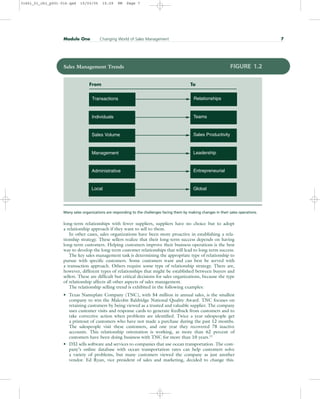
Module Four Sales Organization Structure and Salesforce Deployment 107
Final Territory Design EXHIBIT 4.9
Trading Area Market Potential Sales Calls
Territory 1 1 $250,000 25
5 200,000 20
7 750,000 65
8 500,000 50
9 1,000,000 100
$2,700,000 260
Territory 2 2 $700,000 100
6 2,000,000 175
$2,700,000 275
Territory 3 3 $350,000 35
4 150,000 15
10 500,000 50
11 1,750,000 175
$2,750,000 275
31451_04_ch4_p079-126.qxd 15/03/05 20:27 PM Page 107
What are the important people considerations in salesforce deployment? The most
important ones concern personal relationships between salespeople and customers and
between salespeople and the sales organization. Consider the allocation of selling effort
to accounts. The analytical approaches for making this decision produce a recommended
number of sales calls to each account based on some assessment of expected sales and
costs for different sales call levels. Although these approaches may incorporate a number
of factors in developing the recommended sales call levels, there is no way that any ana-
lytical approach can use the detailed knowledge that a salesperson has about the unique
needs of individual accounts. Therefore, an analytical approach may suggest that sales
calls should be increased or decreased to a specific account, whereas the salesperson serv-
ing this account may know that the account will react adversely to any changes in sales
call coverage. In this situation, a sales manager would be wise to ignore the analytical rec-
ommendation and not change sales call coverage to the account, because of the existing
relationship between the salesperson and customer.
Salesforce size decisions also require consideration of people issues. A decision to
reduce the size of a salesforce means that some salespeople will have to be removed
from the salesforce. How this reduction is accomplished can affect the relationship
between salespeople and the sales organization. Achieving this reduction through attri-
tion or offering salespeople other positions is typically a better approach than merely
firing salespeople.
Increasing salesforce size means that the new salespeople must be assigned to territories.
Consequently, some accounts will find themselves being served by new salespeople. These
changes in assignment can have a devastating effect on the existing customer-salesperson
relationship. Not only should that relationship be considered but also the issue of fairness
in taking accounts from one salesperson and assigning them to another. The situation can
be a delicate one, requiring careful judgment as to how these people considerations should
be balanced against analytical results.
In sum, sales managers should integrate the results from salesforce deployment analysis
with people considerations before implementing changes in sales call allocation, salesforce
size, or territory design. A good rule of thumb is to make salesforce deployment changes
that are likely to have the least disruptive effect on existing personal relationships.
108 Part Two Defining the Strategic Role of the Sales Function
Business is booming at Lunsford Electronics.
The economy is growing and new electronic prod-
ucts are being introduced on a regular basis. The
company has decided to add one salesperson to
each district. The southeastern district manager,
Terry Bearden, will now have 10 salespeople to
cover all accounts and prospects in the district. He
has spent days examining alternative sales territory
designs and thinks one option is best for the com-
pany and fair to all salespeople. However, he is
considering another option that would give Cathy
Swift a better territory and Fred Mangold a poor-
er one. Terry has always liked Cathy and thinks the
better territory will help improve her sales. Fred
has been a star performer for years and doesn’t
mind telling everyone how much money he makes.
Terry thinks Fred will still perform well in the new
territory and maybe this will eliminate some of his
ā€œbragging.ā€ Which territory design should Terry
decide to use? Why?
a n e t h i c a l d i l e m m a
31451_04_ch4_p079-126.qxd 15/03/05 20:27 PM Page 108
SUMMARY
1. Define the concepts of specialization, centralization, span of control versus man-
agement levels, and line versus staff positions. Specialization refers to the division
of labor such that salespeople or sales managers concentrate on performing certain
activities to the exclusion of others. Centralization refers to where in the organization
decision-making responsibility exists. Centralized organizations locate decision-
making responsibility at higher organizational levels than decentralized organizations.
Any sales organization structure can be evaluated in terms of the types and degrees of
specialization and centralization afforded by the structure. Sales management organi-
zation design also requires decisions concerning the number of management levels,
spans of control, and line versus staff positions. In general, more management levels
result in smaller spans of control and more staff positions result in more sales manage-
ment specialization.
2. Describe the ways salesforces might be specialized. A critical decision in
designing the sales organization is determining whether the salesforce should be
specialized and, if so, the appropriate type of specialization. The basic types of
salesforce specialization are geographic, product, market (including major
account organization), and functional. The appropriate type of specialization
depends on the characteristics of the selling situation. Important selling situation
characteristics include the similarity of customer needs, the complexity of the
firm’s product offering, the market environment, and the professionalism of the
salesforce. Specific criteria of importance are affordability and payout, credibility
and coverage, and flexibility. The use of different types and levels of specialization
typically requires the establishment of separate salesforces.
3. Evaluate the advantages and disadvantages of sales organization structures.
Because each type of sales organization structure has certain advantages and
disadvantages, many firms use hybrid structures that combine the features of
several types. Usually, the strengths of one structure are weaknesses in other
structures.
4. Name the important considerations in organizing major account management
programs. Identifying major accounts (which should be both large and complex)
and organizing for coverage of them are the important considerations in major
account management.
5. Explain how to determine the appropriate sales organization structure for
a given selling situation. There is no one best way to structure a sales organization.
The appropriate way to organize a salesforce and sales management depends on
certain characteristics of a particular selling situation. Also, because the sales organi-
zation structure decision is dynamic, it must be adapted to changes in a firm’s selling
situation that occur over time.
6. Discuss salesforce deployment. Salesforce deployment decisions entail allocating
selling effort, determining salesforce size, and designing territories. These decisions
are highly interrelated and should be addressed in an integrated, sequential manner.
Improvements in salesforce deployment can produce substantial increases in sales and
profits.
7. Explain three analytical approaches for determining allocation of selling effort.
Single factor, portfolio, and decision models can be used as analytical tools to determine
appropriate selling effort allocations. The approaches differ in terms of analytical rigor
and ease of development and use. Sales organizations should use the approach that best
fits their particular selling situation.
Module Four Sales Organization Structure and Salesforce Deployment 109
31451_04_ch4_p079-126.qxd 15/03/05 20:27 PM Page 109
8. Describe three methods for calculating salesforce size. The breakdown method
for calculating salesforce size is the easiest to use but the weakest conceptually. It
uses the expected level of sales to determine the number of salespeople. The work-
load approach is sounder conceptually, because it bases the salesforce size decision
on the amount of selling effort needed to cover the market appropriately. The
incremental method is the best approach, although it is often difficult to develop.
It examines the marginal sales and costs associated with different salesforce sizes.
9. Explain the importance of sales territories from the perspective of the sales
organization and from the perspective of the salespeople, and list the steps in
the territory design process. Territories are assignments of accounts to salespeo-
ple. Each becomes the work unit for a salesperson, who is largely responsible for the
performance of the assigned territory. Poorly designed territories can have adverse
effects on the motivation of salespeople. From the perspective of the firm, territory
design decisions should ensure that the firm’s market area is adequately covered in
a productive manner. The first step in the territory design process is to identify plan-
ning and control units. Next, the opportunity available from each planning and
control unit is determined, initial territories are formed, and the workloads of each
potential territory are assessed. The final territory design represents management’s
judgment concerning the best balance between opportunity and workload.
10. Discuss the important ā€œpeopleā€ considerations in salesforce deployment.
Although analytical approaches provide useful input for salesforce deployment deci-
sions, they do not address people considerations adequately. Sales managers should
always consider existing relationships between salespeople and customers and
between salespeople and the sales organization before making salesforce deploy-
ment changes. Many of these people considerations have ethical consequences.
UNDERSTANDING SALES MANAGEMENT TERMS
specialization
centralization
span of control
management levels
line sales management
staff sales management
geographic specialization
product specialization
market specialization
functional specialization
major account organization
national account management (NAM)
DEVELOPING SALES MANAGEMENT KNOWLEDGE
1. Discuss the situational factors that suggest the need for specialization and centraliza-
tion. Provide a specific example of each factor discussed.
2. Why do you think there is a trend toward more salesforce specialization?
3. What are the advantages and disadvantages of structuring a sales organization for
major account management?
4. What are some problems that a firm might face when undertaking a major restruc-
turing of its sales organization?
5. What are the important relationships between span of control, management levels,
line positions, staff positions, specialization, and centralization?
110 Part Two Defining the Strategic Role of the Sales Function
global account management (GAM)
hybrid sales organization
salesforce deployment
single factor models
portfolio models
decision models
sales productivity
breakdown approach
workload approach
incremental approach
territory
planning and control unit
31451_04_ch4_p079-126.qxd 15/03/05 20:27 PM Page 110
6. How are salesforce deployment decisions related to decisions on sales organization
structure?
7. How can the incremental method be used to determine the number of salespeople
to assign to a sales district?
8. How are salesforce size decisions different for firms with one generalized salesforce
versus firms with several specialized salesforces?
9. How can computer modeling assist sales managers in designing territories?
10. Should firms always try to design equal territories? Why or why not?
BUILDING SALES MANAGEMENT SKILLS
1. Assume that you are the national sales manager for Replica Inc., a manufacturer and
marketer of photocopy equipment and supplies. The firm’s products are sold both
nationally and internationally by a salesforce of 5,000. Replica sells to accounts of
various sizes across several industries. Prepare a proposal that illustrates your recom-
mended sales organization structure. Be sure to justify your recommended structure.
2. As an organization, your university has a specified structure. Identify this structure
(draw it or obtain a copy of it). How specialized is this structure? What is its degree
of centralization? What does the span of control look like and how appropriate is it?
How many levels of management exist? Is this enough or too much? What are the
relationships between line and staff positions? Are they appropriate? Assuming you
would like the university to run as efficiently and effectively as possible, what changes
would you recommend making to this structure and why? If no changes are recom-
mended, why not?
3. Using the following information, calculate the total salesforce size necessary by using
each of the following approaches: breakdown, workload, and incremental. (Your
answers may vary because each piece of information does not apply to the same com-
pany.) Be sure to show your work. Also, explain the advantages and disadvantages of
each approach. Which approach would you recommend using to determine sales-
force size? Why?
• Sales of $80 million are forecast for next year.
• Fifteen thousand calls are needed in the market area to be covered.
• Salespeople generate an average of $2 million in annual sales.
• A salesperson can make an average of 500 annual sales calls.
• Marginal salesperson cost is $65,000. With 88 salespeople, the marginal salesper-
son profit contribution is $75,000. This profit contribution decreases by $5,000
with each additional salesperson added to the base of 88 salespeople. Marginal
salesperson cost remains constant.
• Turnover is 10 percent annually.
4. Situation: Read the Ethical Dilemma on page 81.
Characters: Mary Swenson, district manager; Fred Williams, salesperson
Scene: Location—Mary Swenson’s office. Action—Role play a meeting
between Mary Swenson and Fred Williams concerning possible exces-
sive gift-giving by Fred Williams to get new accounts.
Module Four Sales Organization Structure and Salesforce Deployment 111
PROD. NO
SCENE TAKE ROLL
SOUND
DATE
PROD CO.
DIRECTOR
CAMERAMAN
ROLE PLAY
31451_04_ch4_p079-126.qxd 15/03/05 20:27 PM Page 111
Case 4.1: Protek Packaging,Inc.
Background
Protek Packaging, Inc. (PPI) is a national manufac-
turer of a wide variety of polyethylene and poly-
styrene packaging products, including food and ice
bags; styrofoam egg cartons, meat trays, and food
service products; laundry and dry cleaning packag-
ing; trash bags; construction film and plastic ship-
ping pallets. PPI is a strong competitor in all of its
product lines. Not an innovative company, PPI
leverages its large manufacturing capacity to drive
its costs down, which allows the company to sell its
products at highly attractive price levels.
PPI operates five regional offices: Atlanta, New
York, Chicago, Dallas, and Los Angeles. These
offices are located at manufacturing plants that
serve each region. PPI is organized by product
line, with each product line run by a regional prod-
uct manager and a regional sales manager. Eight to
10 sales representatives report to each of the five
regional sales managers. The product managers
and sales managers in each region report to a
regional marketing manager. The key products and
customers for each product line are shown in
Exhibit 4.10.
Current Situation
John Lovett, Western Region marketing manager,
has called his four sales managers and four product
managers to Los Angeles to discuss alternative
approaches to organizing the PPI salesforce. Thirty
days earlier, Lovett and his managers had hosted a
key customer roundtable at the annual meeting of
the Plastics Packaging Manufacturers’ Association.
Lovett was troubled by several themes that emerged
from the roundtable. Some of the most influential
paper and plastic distributors are disturbed by the
fact that PPI sells to grocery chains, garment man-
ufacturers, egg packers/processors, and uniform
rental companies on a direct basis. This is puzzling
to Lovett, since PPI has always sold through dis-
tributors when feasible. Further, distributors are
informed before stocking PPI products that if end-
users meet certain sales volume requirements and
request that they be sold on a direct basis, PPI will
sell direct rather than risk losing the business.
Lovett is also concerned that many of the grocery
chain buyers and paper and plastic distributors com-
plained about the amount of time it takes for them to
see several PPI salespeople. These customers wanted
to deal with a single PPI representative, not one from
112 Part Two Defining the Strategic Role of the Sales Function
MAKING SALES MANAGEMENT DECISIONS
EXHIBIT 4.10 PPI Product Lines and Key Customer Types
Product Line Key Products Key Customer Types
Food Packaging Produce bags Grocery chains
Food co-ops
Paper and plastic distributors
Foam meat trays Grocery chains
Meat and poultry processors
Food co-ops
Paper and plastic distributors
Institutional Trash bags Paper and plastic distributors
Restaurant wholesalers
Janitorial wholesalers
Food service Restaurant wholesalers
(plastic plates, bowls) Grocery store delis
Institutional food wholesalers
Paper and plastic distributors
Agricultural Egg cartons Grocery chains
Egg packers/processors
Garment Poly bags Laundries and dry cleaners
Uniform rental companies
Garment manufacturers
Paper and plastic distributors
31451_04_ch4_p079-126.qxd 15/03/05 20:27 PM Page 112
each product line. An additional concern was that
PPI did not allow aggregation of products across
product lines to make it easier for these buyers to
achieve the maximum quantity discounts.
To prepare for the meeting, John Lovett asked
each product manager/sales manager team to come
ready to discuss these issues:
1. Is it time for PPI to reconsider its salesforce
organization by product line?
2. What are the advantages and disadvantages of
organizing the PPI salesforce by product line?
3. What are the advantages and disadvantages of
developing a new sales organization for the
Western Region that would organize according
to these customer types: (a) grocery chains and
food co-ops; (b) distributors, including paper
and plastic distributors, restaurant wholesalers,
institutional food wholesalers, and janitorial
wholesalers; and (c) end users, including meat
and poultry processors, grocery store delis, egg
packers/processors, laundries and dry cleaners,
uniform rental companies, and garment manu-
facturers?
Assume you are the sales manager for the food
packaging product line. Address the preceding
questions as if you will attend the upcoming meet-
ing. In addition, outline your thoughts on other
alternatives for organizing the salesforce.
Situation: Read Case 4.1.
Characters: John Lovett, Western
Region marketing manager; sales
manager for food packing product
line; one or more other product/sales
managers
Scene 1: Location—Lovett’s office. Action—
Role play between Lovett and sales
manager for food packing product
line discussing the advantages and dis-
advantages of a salesforce organized
by product line.
Scene 2: Location—Meeting room. Action—
Role play meeting with Lovett and all
product/sales managers, discussing the
advantages and disadvantages of differ-
ent alternatives for organizing PPI’s
salesforce and arriving at a decision.
Case 4.2: Opti-Tax Consulting
Background
Opti-Tax Consulting (OTC) is a 20-year-old compa-
ny, which specializes in providing small businesses
with tax and financial management expertise. OTC
focuses on businesses that handle significant amounts
of cash in their daily operations, such as service sta-
tions, bars, coffee shops, and small restaurants. OTC
has three sales representatives serving the Lexington,
Kentucky, metropolitan market.
Dave Mason, OTC’s founder and current presi-
dent, was the company’s first salesperson. When
the company grew to the point that Mason had a
hard time servicing all of his accounts, he added Steve
Tremaine as a sales representative. Mason gave
Tremaine 10 of his existing accounts and instructed
him to go after potential customers not yet under con-
tract with OTC. Five years later, Donna Armstrong
was hired as a sales representative and added in much
the same fashion. Mason and Tremaine turned over 10
accounts each to Armstrong, and she was instructed to
add new customers not already doing business with
OTC. Both Donna Armstrong and Steve Tremaine
report directly to Dave Mason. Of OTC’s total sales
volume, Dave Mason accounts for approximately half.
The remainder is split almost equally between Donna
Armstrong and Steve Tremaine. Armstrong and
Tremaine are paid a percentage of OTC’s billings to
their clients.
Current Situation
Mason is planning to enter semi-retirement in
another year, and he has brought his son Franklin
into the business. Franklin will learn the business
over the next several months, then step into a sales
role. Dave Mason will continue to function as sales
manager and president of the company, but will give
up the sales responsibilities for all of his accounts.
Dave Mason is compiling information that will
help him decide how to design OTC’s sales territo-
ries after he gives up his sales responsibilities. He is
not comfortable turning over all of his accounts to
his son Franklin. Although talented and hard work-
ing, Franklin is inexperienced in the financial con-
sulting industry. A recent graduate of the University
of Kentucky with a double major in finance and
marketing, Franklin’s career goal is to become pres-
ident of OTC, then expand company operations
into other markets.
Mason has also been contemplating the sales per-
formance of Donna Armstrong and Steve Tremaine.
Both had been solid, dependable performers over the
years, but Tremaine had recently slowed down a bit.
While his sales volume compared favorably to
Armstrong’s, Tremaine was selling in a higher poten-
tial sales territory. Further, he had a five-year head
start on Armstrong in developing new accounts, yet
Armstrong had brought in almost as much new busi-
ness as had Tremaine during the past year. Mason had
talked with Tremaine about the lack of sales growth in
his territory but had not learned much. Tremaine
Module Four Sales Organization Structure and Salesforce Deployment 113
ROLE PLAY
PROD. NO
SCENE TAKE ROLL
SOUND
DATE
PROD CO.
DIRECTOR
CAMERAMAN
31451_04_ch4_p079-126.qxd 15/03/05 20:27 PM Page 113
made no excuses and acknowledged that his sales
levels had been relatively stable in recent years. He
promised to try harder to bring in new business.
Mason suspected that Tremaine was comfortable with
his earnings and simply did not want to work a lot
harder, even if he could make more money.
After several weeks of analysis, Dave Mason finally
had a rough draft of a new territory design policy that
would go into effect in 90 days. The key points of the
new policy are:
1. Half of Dave Mason’s accounts will be split
between Steve Tremaine and Donna
Armstrong. Dave Mason’s remaining accounts
will be assigned to Franklin Mason.
2. After one year, sales territories will be redesigned
so that the three territories will be comparable
in terms of workload and sales potential.
3. For the current year, OTC salespeople will con-
tinue to earn a commission based on OTC
billings to their clients.
4. After the sales territories are redesigned in a
year, the commission rate for existing clients will
be reduced, and a higher commission rate
will be implemented for new accounts added
within the past year.
Dave Mason distributed the draft plan to Donna,
Steve, and Franklin. Both Donna and Steve ques-
tioned the idea of assigning half of Dave’s accounts to
Franklin. Steve came right to the point, saying, ā€œLook,
Dave, he’s your son and he will do just fine with some
seasoning. But I think he ought to start with a smaller
group of accounts. He’ll learn the business a lot faster
if he has to build it by adding his own accounts.ā€
Donna and Steve were also concerned that they
would have some of Dave’s former accounts for
a year, and then lose them to Franklin. Franklin
remained neutral on these issues, and voiced neither
support nor opposition to the draft plan.
Questions
1. What are the implications for Donna
Armstrong and Steve Tremaine if the draft
plan is implemented?
2. What are the implications for OTC’s customers
if the draft plan is implemented?
3. What are the pros and cons of Mason’s draft
plan?
4. What changes and additions would you make to
the draft plan?
Situation: Read Case 4.2.
Characters: Dave Mason, president;
Franklin Mason, son and salesperson;
Steve Tremaine, company’s first sales-
person; Donna Armstrong, company’s
second salesperson
Scene 1: Location—Meeting room. Action—
Role play discussion among Dave
Mason, Franklin Mason, Steve
Tremaine, and Donna Armstrong
about the draft territory design plan.
Scene 2: Location—Meeting room. Action—
Role play discussion among Dave
Mason, Franklin Mason, Steve
Tremaine, and Donna Armstrong
about alternatives to the draft territory
design plan and a final territory design
decision.
114 Part Two Defining the Strategic Role of the Sales Function
ROLE PLAY
PROD. NO
SCENE TAKE ROLL
SOUND
DATE
PROD CO.
DIRECTOR
CAMERAMAN
31451_04_ch4_p079-126.qxd 15/03/05 20:27 PM Page 114
A meteorologist used all the latest technology to predict a bright and sunny day
in the mid-80s. It rained most of the day and never got warmer than 70 degrees.
The weather forecast missed the mark on this particular occasion, but the mete-
orologist will continue to make weather forecasts and to work on improving
weather forecasting procedures.
Sales managers face a situation similar to that of the meteorologist. The
business environment is complex and dynamic, there are a number of forecast-
ing methods available, and often forecasts are incorrect. Nevertheless, sales
managers must continue to forecast and to work on improving their forecasting
procedures.
Why is forecasting so important to sales managers? In one sense, all sales
management decisions are based on some type of forecast. The sales manager
decides on a certain action because he or she thinks that it will produce a certain
result. This expected result is a forecast, even though the sales manager may not
have quantified it or may not have used a mathematical forecasting procedure.
More specifically, forecasts provide the basis for the following sales management
decisions:
1. Determining salesforce size
2. Designing territories
3. Establishing sales quotas and selling budgets
4. Determining sales compensation levels
5. Evaluating salesperson performance
6. Evaluating prospective accounts
FORECASTING BY SALES MANAGERS
Although top management levels are most concerned with total firm forecasts,
sales managers are typically interested in developing and using forecasts for spe-
cific areas, such as accounts, territories, districts, regions, and/or zones. For exam-
ple, a district sales manager would be concerned with the district forecast as well
as forecasts for individual territories and accounts within the district. There are,
however, different types of forecasts that sales managers might use in different
ways, and different approaches and methods might be used to develop these
forecasts.
Types of Forecasts
The term forecast is ordinarily used to refer to a prediction for a future period.
Although this usage is technically correct, it is too general for managerial value.
As illustrated in Figure 4A.1, at least three factors must be defined when referring
to a forecast: the product level, the geographic area, and the time period. The
figure presents 90 different forecasts that might be made, depending on these
factors. Thus, when using the term forecast, sales managers should be specific in
defining exactly what is being forecast, what geographic area is being targeted,
and what period is being forecast.
A useful way for viewing what is being forecast is presented in Exhibit 4A.1.
This exhibit suggests that it is important to differentiate between industry
and firm levels and to determine whether the prediction is for the best possible 115
4
a p p e n d i x
D E V E L O P I N G F O R E C A S T S
31451_04_ch4_p079-126.qxd 15/03/05 20:27 PM Page 115
results or for the expected results given a specific strategy. Four different types of fore-
casts emerge from this classification scheme:
1. Market potential—the best possible level of industry sales in a given geographic area
for a specific period
2. Market forecast—the expected level of industry sales given a specific industry strategy
in a given geographic area for a specific period
3. Sales potential—the best possible level of firm sales in a given geographic area for a
specific period
4. Sales forecast—the expected level of firm sales given a specific strategy in a given
geographic area for a specific period
116 Part Two Defining the Strategic Role of the Sales Function
Geographic
Area
Product
Level
Time
Period
Product Item Sales
Product Form Sales
Product Line Sales
Company Sales
Industry Sales
World
U.S.A.
Region
Territory
Customer
Long Range
Medium
Range
Short Range
FIGURE 4A.1 Defining the Forecast
Many different types of forecasts are possible. Every forecast should be defined in terms of geographic area, product
level, and time period.
EXHIBIT 4A.1 Types of Forecasts
Four different types of forecasts are typically important to sales managers, depending on whether a forecast is needed for the
industry or the firm and whether the best possible or expected results are to be forecast.
Best Possible Results
Market Potential
Sales Potential
Industry
Level
Firm
Level
Expected Results for
Given Strategy
Market Potential
Sales Potential
31451_04_ch4_p079-126.qxd 15/03/05 20:27 PM Page 116
Notice that the geographic area and period are defined for each of these terms and that
a true sales forecast must include the consideration of a specific strategy. If a firm changes
this strategy, the sales forecast should change also.
As an example, assume that you are the district sales manager for a firm that markets
microcomputers to organizational buyers. Your district includes Missouri, Kansas, Iowa,
and Nebraska. You are preparing forecasts for 2006. You might first try to assess market
potential. This market potential forecast would be an estimate of the highest level of
microcomputer sales by all brands in your district for 2006. Then, you might try to
develop a market forecast, which would be the expected level of industry microcom-
puter sales in your district for 2006. This forecast would be based on an assumption of
the strategies that would be used by all microcomputer firms operating in your district.
If you think that new firms are going to enter the industry or that existing firms are
going to leave it or change their strategies, your industry forecast will change. Another
type of forecast might be a determination of the best possible level of 2006 sales for your
firm’s microcomputers in the district. This would be a sales potential forecast. Finally,
you would probably want to predict a specific level of district sales of your firm’s micro-
computers given your firm’s expected strategy. This would result in a sales forecast that
would have to be revised whenever strategic changes were made.
Uses of Forecasts
Because different types of forecasts convey different information, sales managers use
specific types for specific sales management decisions. Forecasts of market potential and
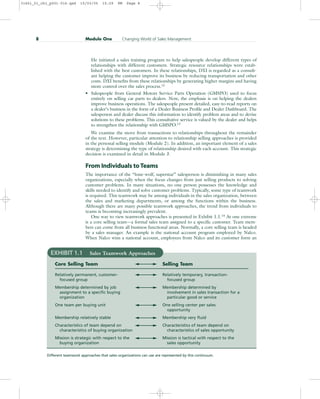
sales potential are most often used to identify opportunities and to guide the allocation
of selling efforts. Market potential provides an assessment of overall demand opportu-
nity available to all firms in an industry. Sales potential adjusts market potential to
reflect industry competition and thus represents a better assessment of demand oppor-
tunity for an individual firm. Both of these forecasts of potential can be used by sales
managers to determine where selling effort is needed and how selling effort should
be distributed. For example, as discussed earlier, designing territories requires an assess-
ment of market potential for all planning and control units. Specific territories are then
designed by grouping planning and control units together and evaluating the equality
of market potential across the territories.
Market forecasts and sales forecasts are used to predict the expected results from
various sales management decisions. For example, once territories are designed, sales
managers typically want to forecast expected industry and company sales for each spe-
cific sales territory. These forecasts are then used to set sales quotas and selling budgets
for specific planning periods.
Top-Down and Bottom-Up Forecasting Approaches
Forecasting methods can be classified in a variety of ways.1
Specific examples of two basic
approaches are presented in Figure 4A.2. Top-down approaches typically consist of
different methods for developing company forecasts at the business unit level. Sales
managers then break down these company forecasts into zone, region, district, territory,
and account forecasts. Bottom-up approaches, by contrast, consist of different methods
for developing sales forecasts for individual accounts. Sales managers then combine the
account forecasts into territory, district, region, zone, and company forecasts. The top-
down and bottom-up approaches represent entirely different perspectives for developing
forecasts, although some forecasting methods can be used in either approach. However,
the focus is on the most popular forecasting methods for each approach.
Top-Down Approach
Implementing the top-down approach requires the development of company fore-
casts and their breakdown into zone, region, district, territory, and account levels.
Different methods are used to develop company forecasts and break them down to the
desired levels.
Module Four Sales Organization Structure and Salesforce Deployment 117
31451_04_ch4_p079-126.qxd 15/03/05 20:27 PM Page 117
Company Forecasting Methods
Although a variety of methods is available for developing company forecasts, this dis-
cussion is limited to three popular time series methods: moving averages, exponential
smoothing, and decomposition methods.
Moving averages is a relatively simple method that develops a company forecast by
calculating the average company sales for previous years. Thus, the company sales fore-
cast for next year is the average of actual company sales for the past three years, past
118 Part Two Defining the Strategic Role of the Sales Function
Combined into Territory
Forecasts
Combined into District,
Region, and Zone Forecasts
Company Sales Forecast
Salespersons’ Forecasts of
Accounts
Forecast of General Economic
and Business Conditions for
the Country as a Whole
Market Potential for Relevant
Industry
Sales Potential for Company as
a Percentage of Industry Sales
Company Sales Forecast
Sales’ Managers’ Forecasts for
Zones, Regions, Districts,
Territories, and Accounts
Factors Affecting Company’s
Share of Total Industry Sales
Top-Down Approach Bottom-Up Approach
FIGURE 4A.2 Forecasting Approaches
In top-down approaches, company personnel provide aggregate company forecasts that sales managers must break
down into zone, region, district, territory, and account forecasts. In bottom-up approaches, account forecasts are com-
bined into territory, district, region, zone, and company forecasts.
31451_04_ch4_p079-126.qxd 15/03/05 20:27 PM Page 118
six years, or some other number of years. An example of calculating a moving averages
company sales forecast for two- and four-year time frames is presented in Exhibit 4A.2.
As illustrated in this example, the moving averages method is straightforward and
requires simple calculations. Management must, however, determine the appropriate
number of years to include in the calculations. In addition, this method weights actual
company sales for previous years equally in generating the forecast for the next year. This
equal weighting may not be appropriate if company sales vary substantially from year to
year or if there are major differences in the business environment between the most
recent and past years. Nevertheless, one survey of managers found this to be the most
popular technique for short-range and medium-range forecasts in U.S. corporations.2
Exponential smoothing is a type of moving averages method, except that company
sales in the most recent year are weighted differently from company sales in past years.3
An example of the exponential smoothing method is provided in Exhibit 4A.3. A criti-
cal aspect of this method involves determining the appropriate weight () for this year’s
company sales. This is typically accomplished by examining different weights for histor-
ical sales data to determine which weight would have generated the most accurate
sales forecasts in the past. Based on the analysis in Exhibit 4A.3, management should
probably use a weight of 0.8 for this year’s company sales.
Module Four Sales Organization Structure and Salesforce Deployment 119
Moving Averages Example EXHIBIT 4A.2
Moving Averages Forecast
Year Actual Sales Two-Year Four-Year
1998 $ 8,400,000
1999 8,820,000
2000 8,644,000 $8,610,000
2001 8,212,000 8,732,000
2002 8,622,000 8,428,000 $8,520,000
2003 9,484,000 8,418,000 8,574,000
2004 9,674,000 9,054,000 8,740,000
2005 10,060,000 9,579,000 8,998,000
2006 9,868,000 9,460,000
where
Sales forecast for next year =
Actual sales for past two or four years
Number of years (two or four years)
Exponential Smoothing Example EXHIBIT 4A.3
Sales Forecast for Next Year
Year Actual Sales  = 0.2  = 0.5  = 0.8
1998 $ 8,400,000
1999 8,820,000 $8,400,000 $8,400,000 $8,400,000
2000 8,644,000 8,484,000 8,610,000 8,736,000
2001 8,212,000 8,516,000 8,626,000 8,664,000
2002 8,622,000 8,456,000 8,420,000 8,302,000
2003 9,484,000 8,488,000 8,520,000 8,558,000
2004 9,674,000 8,686,000 9,002,000 9,298,000
2005 10,060,000 8,882,000 9,338,000 9,600,000
2006 9,118,000 9,698,000 9,968,000
where
Sales forecast for next year = () (actual sales this year) + (1 – ) (this year’s sales forecast)
31451_04_ch4_p079-126.qxd 15/03/05 20:27 PM Page 119
Decomposition methods involve different procedures that break down previous
company sales data into four major components: trend, cycle, seasonal, and erratic
events. These components are then reincorporated to produce the sales forecast. An
example of a decomposition method is presented in Exhibit 4A.4. Notice that the
trend, cycle, and erratic events components are incorporated into the annual forecast
but that the seasonal component is used only when forecasting sales for periods of less
than a year, such as months or quarters. Decomposition methods are sound conceptu-
ally but often require complex statistical approaches for breaking down the company
sales data into the trend components. Once this decomposition has been completed, it
is relatively easy to reincorporate the components into the development of a company
forecast.
Breakdown Methods
Once sales managers receive a company forecast, they can use different market factor
methods to break it down to the desired levels. Market factor methods typically involve
identifying one or more factors that are related to sales at the zone, region, district,
territory, or account levels and using these factors to break down the overall company
forecast into forecasts at these levels.
A typical approach is to use the Buying Power Index (BPI) supplied by Sales 
Marketing Management.4
The BPI is a market factor calculated for different areas in the
following manner:
BPI  (5I  2P  3R)  10
where
I  Percentage of U.S. disposable personal income in the area
P  Percentage of U.S. population in the area
R  Percentage of U.S. retail sales in the area
120 Part Two Defining the Strategic Role of the Sales Function
EXHIBIT 4A.4 Decomposition Method Example
Assume that various analyses have decomposed previous sales data into the following
components:
A 5% growth in sales is predicted due to basic developments in population, capital formation,
and technology (trend component). A 10% decrease in sales is expected due to a business reces-
sion (cycle component). Increased tensions in the Middle East are expected to reduce sales by an
additional 5% (erratic events component). Sales results are reasonably consistent throughout the
year except for the fourth quarter, where sales are expected to be 25% higher than the other
quarters (seasonal component).
A marketer of consumer products might recombine the different components in the following
manner to forecast sales for 2006:
Sales in 2005 were $10,060,000. The trend component suggests that 2006 sales will be $10,563,000
($10,060,000  1.05). However, incorporating the expected business recession represented in the
cycle component changes the sales forecast to $9,506,700 ($10,563,000  0.90). The annual sales
forecast is reduced to $9,031,365 when the erratic events component is introduced ($9,056,700 
0.95). Quarterly sales forecasts would initially be calculated as $2,257,841 ($9,031,365  4). However,
incorporating the seasonal component suggests fourth-quarter sales of $2,822,302 ($2,257,841 
1.25) and sales for the other three quarters of $2,069,688 ($9,031,365 – $2,822,302  3).
31451_04_ch4_p079-126.qxd 15/03/05 20:27 PM Page 120
Performing these calculations for any area produces a BPI for the area. This BPI can
be translated as the percentage of U.S. buying power residing in the area: The
higher the index, the more buying power in the area. Fortunately, Sales  Marketing
Management provides these calculations for areas in the United States on an annual
basis.
An example of the BPI data provided by Sales  Marketing Management is presented
in Exhibit 4A.5. BPIs and other data are available for all counties in a state and for the
major cities and metropolitan areas. The information in the exhibit suggests that the BPI
for the Kansas City metropolitan area is 0.6914; for Jackson County, 0.2557; and for
Kansas City, Missouri, 0.1764. This means that 0.6914 percent, 0.2557 percent, and
0.1764 percent of total U.S. buying power resides in the Kansas City metro area,
Jackson County, and Kansas City, Missouri, respectively.
Sales managers can use the BPI data to divide the overall company forecast
into more disaggregate forecasts. For example, assume that you are the Missouri
district sales manager for a marketer of cosmetics. Management has used various
methods to forecast total company sales in the United States of $500 million for
2006. The calculations necessary to break down this company forecast into sales
forecasts for areas within your district are illustrated in Exhibit 4A.6. Using the appro-
priate BPIs, you are able to forecast 2006 sales of $3,457,000, $1,278,500, and
$882,000 for the Kansas City metro area, Jackson County, and Kansas City, Missouri,
respectively.
The BPI is an extremely useful tool for forecasting, because it is readily available and
updated on an annual basis. It is most appropriate for often-purchased consumer goods
because of the factors used in calculating the index for each area. Marketers of durable
consumer goods or industrial products may not find the BPI sufficiently accurate
for their needs. In these situations, other market factors must be identified and used.
For example, Sherwood Medical uses total available hospitals requiring a specific
product (based on medical procedures performed at the hospital) as a market factor for
forecasting purposes.5
Another approach is for a firm to develop a buying power index for its specific situa-
tion. For example, a general aviation aircraft marketer developed a buying power index
for its products in each county in the United States. The basic formula was
Index  (5I  3AR  2P)  10
where
I  Percentage of U.S. disposable income in county
AR  Percentage of U.S. aircraft registrations in county
P  Percentage of U.S. registered pilots in county
These calculations produced an index for each county that could be translated and used
like the BPI. The firm could take U.S. forecasts provided by the industry trade associa-
tion and convert them to market and sales forecasts for each county by using their cal-
culated indices and market shares.
The use of market factor methods is widespread in the sales management area.
Indices such as the BPI or those developed by specific firms and other market factor
methods can be extremely valuable forecasting tools for sales managers. These indices
and market factors should be continually evaluated and improved. They can be assessed
by comparing actual sales in an area to the market factor value for the area. For exam-
ple, the general aviation aircraft marketer found high correlations between actual aircraft
sales in a county and the county indices. This finding provided support for the use of
the calculated index as an indirect forecasting tool.
Module Four Sales Organization Structure and Salesforce Deployment 121
31451_04_ch4_p079-126.qxd 15/03/05 20:27 PM Page 121
EXHIBIT 4A.5 Buying Power Index (BPI) Data
Effective Buying Income (EBI)
Percentage of Households
by EBI Group:
(A) $10,000  $19,999
(B) $20,000  $34,999
(C) $35,000  $49,999
(D) $50,000 and more
METRO AREA
County/City
COLUMBIA . . . . . . . . . . . . . . .
Boone . . . . . . . . . . . . . . . . .
Columbia. . . . . . . . . . . . .
Suburban Total . . . . . . . . . .
JOPLIN . . . . . . . . . . . . . . . . . . .
Jasper . . . . . . . . . . . . . . . . .
Joplin. . . . . . . . . . . . . . . .
Newton . . . . . . . . . . . . . . . .
Suburban Total . . . . . . . . . .
KANSAS CITY . . . . . . . . . . . . .
Cass . . . . . . . . . . . . . . . . . . .
Clay . . . . . . . . . . . . . . . . . . .
Clinton . . . . . . . . . . . . . . . .
Jackson . . . . . . . . . . . . . . . .
Blue Springs . . . . . . . . . .
Independence. . . . . . . . .
Kansas City . . . . . . . . . . .
Lee’s Summit. . . . . . . . . .
Lafayette. . . . . . . . . . . . . . .
Platte. . . . . . . . . . . . . . . . . .
Ray. . . . . . . . . . . . . . . . . . . .
Johnson, Kansas . . . . . . . . .
Olathe . . . . . . . . . . . . . . .
Overland Park. . . . . . . . .
Leavenworth, Kansas . . . . .
Leavenworth. . . . . . . . . .
Miami, Kansas. . . . . . . . . . .
Wyandotte, Kansas . . . . . .
Kansas City . . . . . . . . . . .
Suburban Total . . . . . . . . . .
ST. JOSEPH. . . . . . . . . . . . . . . .
Andrew . . . . . . . . . . . . . . . .
Buchanan . . . . . . . . . . . . . .
St. Joseph . . . . . . . . . . . .
Suburban Total . . . . . . . . . .
Total EBI
($000)
1,992,259
1,992,259
1,241,418
750,841
1,928,856
1,270,128
601,136
658,728
1,327,720
30,987,132
1,163,582
2,978,457
260,091
11,052,639
860,954
1,919,067
7,482,105
1,190,035
474,375
1,265,415
305,948
9,979,906
1,333,636
3,314,864
1,162,130
726,671
392,606
1,951,983
1,791,288
19,653,432
1,397,897
209,843
1,188,054
1,014,905
382,992
Median
Household
EBI
33,873
33,873
29,645
39,208
27,823
27,079
25,413
29,348
28,931
40,963
39,979
41,735
33,954
36,936
51,044
37,782
35,483
49,815
32,757
45,520
34,906
54,758
50,929
56,241
43,140
39,967
37,473
29,202
28,711
44,951
30,847
32,952
30,476
29,567
34,530
A
16.1
16.1
18.7
11.7
20.2
20.9
22.5
18.7
19.1
12.4
13.2
11.8
18.0
14.4
7.4
15.3
14.8
9.1
17.1
9.9
15.7
6.8
7.3
6.8
10.9
12.1
15.1
18.3
18.7
10.8
18.2
16.9
18.4
19.0
15.9
B
22.4
22.4
21.0
25.0
27.1
26.9
26.6
27.6
27.4
20.7
22.2
22.1
23.2
21.6
14.4
22.3
21.7
16.3
26.2
19.8
23.5
15.7
16.9
15.5
19.7
21.5
22.3
25.9
25.5
19.6
23.7
22.7
23.8
23.4
24.3
C
18.1
18.1
15.2
23.2
18.7
18.5
16.7
18.8
19.5
19.8
22.1
22.4
19.2
19.6
21.9
21.2
19.1
18.9
20.3
21.4
22.4
18.3
20.4
17.3
21.7
21.6
20.9
19.8
19.7
20.1
19.4
21.6
19,0
18.7
21.3
D
30.4
30.4
28.3
33.9
19.2
18.2
17.5
21.4
20.1
38.4
35.3
37.9
29.3
33.1
51.6
32.9
31.6
49.8
25.9
43.9
27.5
55.5
51.3
57.2
40.2
35.4
32.7
20.6
19.9
43.6
24.2
25.3
24.1
23.0
27.9
Buying
Power
Index
.0516
.0516
.0378
.0138
.0520
.0373
.0225
.0147
.0295
.6914
.0243
.0748
.0055
.2557
.0206
.0462
.1764
.0237
.0103
.0256
.0061
.2118
.0321
.0765
.0235
.0154
.0081
.0457
.0419
.4256
.0349
.0045
.0304
.0274
.0075
Bottom-Up Approach
Implementing the bottom-up approach requires various methods to forecast sales to
individual accounts and the combination of these account forecasts into territory, dis-
trict, region, zone, and company forecasts. This section focuses on the survey of buyer
122 Part Two Defining the Strategic Role of the Sales Function
31451_04_ch4_p079-126.qxd 15/03/05 20:27 PM Page 122
intentions, jury of executive opinion, Delphi, and salesforce composite methods as used
in a bottom-up approach.
The survey of buyer intentions method is any procedure that asks individual
accounts about their purchasing plans for a future period and translates these responses
into account forecasts. The intended purchases by accounts might be obtained through
mail surveys, telephone surveys, personal interviews, or other approaches. For example,
at Dow Chemical’s Basic Chemical Division, salespeople provide forecast data based on
customers’ business plans.6
Similarly, Hewlett-Packard Company’s major customers sup-
ply its marketing centers with input concerning future needs.7
At times, forecasts based
on customer intentions may be distorted due to buyers’ unwillingness to put much
effort into predicting future needs. Moreover, buyers are often unwilling to reveal plans
for selling a vendor’s product out of fear competitors may retaliate if they find out.8
The jury of executive opinion method involves any approach in which executives
of the firm use their expert knowledge to forecast sales to individual accounts. Separate
forecasts might be obtained from managers in different functional areas. These forecasts
are then averaged or discussed by the managers until a consensus forecast for each
account is reached. Team-based approaches such as this are believed to result in more
accurate long-range industry-level forecasts than individually based approaches.9
The Delphi method is a structured type of jury of executive opinion method. The
basic procedure involves selection of a panel of managers from within the firm. Each
member of the panel submits anonymous forecasts for each account. These forecasts are
summarized into a report that is sent to each panel member. The report presents
descriptive statistics concerning the submitted forecasts with reasons for the lowest and
highest forecasts. Panel members review this information and then again submit anony-
mous individual forecasts. The same procedure is repeated until the forecasts for indi-
vidual accounts converge into a consensus. Because this procedure involves written
rather than verbal communication, such negatives as domination, undue conservatism,
and argument are eliminated, while team members benefit from one another’s input.10
The salesforce composite method involves various procedures by which salespeople
provide forecasts for their assigned accounts, typically on specially designed forms (see
Figure 4A.3) or electronically via computer. At Ricoh Corporation, an office products
manufacturer, salespeople are asked to provide a three-month rolling forecast for each
product and model.11 Similarly, salespeople at Pfizer Animal Health Care are asked to
forecast account sales based on their familiarity with each account’s business.12 Research
results suggest that salesperson forecasts can be improved by developing detailed instruc-
tions about the forecasting procedures and providing salespeople with detailed informa-
tion about their accounts and feedback concerning the accuracy of previous forecasts.13
USING DIFFERENT FORECASTING
APPROACHES AND METHODS
This discussion of top-down and bottom-up approaches and several forecasting meth-
ods is illustrative of the forecasting procedures used by many sales organizations.
However, all available forecasting methods have not been introduced, and some sales
Module Four Sales Organization Structure and Salesforce Deployment 123
Market Factor Calculations EXHIBIT 4A.6
Kansas City Kansas City,
Metro Area Jackson County Missouri
2006 company sales forecast $500,000,000 $500,000,000 $500,000,000
BPI 0.6914% 0.2557% 0.1764%
2006 area sales forecast $ 3,457,000 $ 1,278,500 $ 882,000
31451_04_ch4_p079-126.qxd 15/03/05 20:27 PM Page 123
organizations may use the approaches and methods in different ways than discussed here.
For example, some sales organizations use statistical methods, such as regression analysis,
to develop sales forecasts for accounts, territories, districts, regions, zones, and/or the
company. In the next section, the use of regression procedures for developing sales fore-
casts as a means for establishing sales quotas is examined.
The actual usage of specific forecasting methods is presented in Exhibit 4A.7.
Although this study did not ask respondents their degree of usage of either the survey of
buyer intentions approach or the Delphi method, previous research indicates these two
approaches are fairly popular.14 Study results indicate that the bottom-up approaches
are more popular than the top-down approaches. Notice the differences that exist in the
frequency of usage depending on the forecast period.
Because forecasting is such a difficult task and each approach and method has certain
advantages and disadvantages, most firms use multiple forecasting approaches and methods.
124 Part Two Defining the Strategic Role of the Sales Function
460
2,100
470
960
3,530
Account
Projected Sales by Product Group for Quarter Beginning 7/5/2006
Totals
Ace
Sentry
Cutter
Grossman
Paycass
American
Pro
364-60
1,250
950
400
2,600
364-80
960
1,250
2,110
1,800
6,820
28B
1,400
1,930
3,330
28
160
968
1,750
364
720
1,230
5,192
Totals
5,870
5,568
4,820
364
2,920
1,230
700
21,472
–
–
–
–
–
–
–
–
–
–
–
–
–
–
–
–
–
FIGURE 4A.3 Quarterly Forecasting Form for Salespeople
This is an example of a form used by a firm to get salespeople to forecast sales for each account and product group.
EXHIBIT 4A.7 Usage of Forecasting Methods
Percentage of Firms Using Method by Forecast Period
Immediate Medium Long
(less than Short (6 months– (more than
Forecasting Method 1 month) (1–6 months) 1 year) 1 year)
Top-Down
Moving average 17.7 33.5 28.3 8.7
Exponential smoothing 12.9 19.6 16.8 4.2
Decomposition 0.0 6.8 11.9 9.3
Regression 13.4 25.1 25.4 16.5
Bottom-Up
Jury of executive opinion 17.5 28.9 40.1 26.2
Salesforce composite 28.6 17.5 33.1 8.7
31451_04_ch4_p079-126.qxd 15/03/05 20:27 PM Page 124
Then, various approaches are used to combine the results from each method into a final
forecast.15
If different approaches and methods produce similar sales forecasts, sales man-
agers can be more confident in the validity of the forecast. If extremely divergent forecasts
are generated from the different approaches and methods, additional analysis is required to
determine the reasons for the large differences and to make the adjustments necessary to
produce an accurate sales forecast.
Even though firms use multiple forecasting methods, research evidence indicates that sev-
eral criteria are used to select specific forecasting methods.16
The most important criterion
identified in this study was the accuracy of the forecasting method. Other criteria that were
considered in decreasing importance were ease of use, data requirements, cost, and famil-
iarity with methods. These results suggest that the selection of forecasting methods often
represents a trade-off between the accuracy of the method and the ease with which it can be
implemented. Some of the more accurate forecasting methods are difficult to use and have
substantial data requirements. Thus, firms may have to sacrifice some accuracy by selecting
methods that they are able to readily implement. This situation is illustrated in Exhibit 4A.7,
where some of the more accurate methods (e.g., decomposition) are not used by many
firms. Strengths and weaknesses of each forecasting method are found in Exhibit 4A.8.
Module Four Sales Organization Structure and Salesforce Deployment 125
Strengths and Weaknesses of Forecasting Methods EXHIBIT 4A.8
Technique Strengths Weaknesses
Moving averages Well suited to situations in which
sales forecasts are needed for a
large number of products
Good for products with fairly
stable sales
Smoothes out small random fluc-
tuations
Can compensate to some degree
for trend if double moving aver-
age model is used
Fairly simple to understand and
use
Provides more weight to recent
data points
Requires little data storage
Generally accessible software
packages are available
Fairly good accuracy for short-term
forecasts
Simple to understand
Included in most computer packages
Acknowledges three key factors
affecting sales—trend, seasonal,
cycles
Breaks past sales into component
parts making it easier to under-
stand the sales pattern
Requires a large amount of
historical data
Adjusts slowly to changes in sales
Assigns equal weight to each
period, ignoring the fact that
more recent periods usually
have more impact on future sales
Results cannot be tested
statistically
Much searching may be needed to
find appropriate weight
Poor for medium- and long-term
forecasts
Erroneous forecasts can result due
to large random fluctuations in
recent data
Requires a large amount of past
data
Does not lend itself to longer-
range forecasts
Does not lend itself to statistical
analysis of forecast values (no
confidence limits or tests of
significance)
Exponential smoothing
Decomposition
method
(continued)
31451_04_ch4_p079-126.qxd 15/03/05 20:27 PM Page 125
126 Part Two Defining the Strategic Role of the Sales Function
EXHIBIT 4A.8 Strengths and Weaknesses of Forecasting Methods—continued
Technique Strengths Weaknesses
Forecasts are based on customers’
buying plans
Contacts with customers can also
provide feedback about possible
problems with the firm’s products
Relatively inexpensive if only a
few key customers need to be
contacted
Provides input from the firm’s key
functional areas
Executives usually have a solid
understanding of broad-based fac-
tors and how they affect sales
Can provide fairly quick forecasts
Eliminates the need for committee
or group meetings
Eliminates group decision-making
pitfalls, such as specious persua-
sion or a bandwagon effect
Participants receive input from
other ā€œexpertsā€ in an isolated
environment
Allows for voicing of unusual
opinions and anonymous mind
changing
Proper facilities (e-mail) enable
rapid exchange of ideas
Uses input from persons closest to
actual markets
Provides reasonably detailed fore-
casts (by product, customer, or
territory)
May enhance salesforce morale by
letting their input guide decisions
Intentions frequently do not
culminate in actual purchases
Some firms may not be willing
to disclose buying intentions,
especially if they are not regular
customers
May require excessive amounts of
executives’ time
Executives removed from the mar-
ketplace may not understand the
firm’s sales situation
Not well suited to firms with a
large number of products
One or two influential people may
dominate the process
Participants are often selected
more on their willingness to partic-
ipate and their accessibility than
on their real knowledge or repre-
sentativeness
Can take a great deal of time to
arrive at a consensus. Process may
suffer because of high dropout
rate of participants
Salespeople may underestimate
sales when their forecasts are
being used to set sales quotas
Can take excessive amounts of
salespeople’s time if done too
often
Salespeople often lack the knowl-
edge to evaluate the economic
situation and how it might affect
future sales
Salesforce composite
Delphi method
Jury of executive
opinion
Survey of buyer
intentions
31451_04_ch4_p079-126.qxd 15/03/05 20:27 PM Page 126
P a r t
3
Developing the
Salesforce
The two modules in Part Three concentrate on the development of a produc-
tive salesforce. In Module 5, we review the process of staffing the salesforce
through recruitment and selection. Standard recruitment and selection tools
such as advertising, job interviews, and tests are discussed. Legal and ethical
issues are also raised, and the topic of salesforce socialization is introduced.
Module 6 focuses on the continual development of salespeople through sales
training. A model of the sales training process provides a framework for
discussing needs assessment; training objectives; alternatives for training; and
the design, performance, and evaluation of sales training.
127
31451_05_ch5_p127-158.qxd 15/03/05 16:09 PM Page 127
31451_05_ch5_p127-158.qxd 15/03/05 16:09 PM Page 128
NEW HIRING STRATEGY AT INFORMATION
GRAPHICS GROUP ALLOWS THEM TO BRING
ABOARD THE BEST
A change in business strategy may impact the approach taken in the recruitment
and selection process. Consequently, companies such as Information Graphics
have responded by implementing a new hiring strategy that allows them to best
meet their needs.
Information Graphics Group, located in Scottsdale, Arizona, had typically
performed well when hiring. However, growth opportunities in new markets
prompted a change in hiring strategy to add a few rising stars to its salesforce.
Sales applicants at Information Graphics Group were put through a comprehen-
sive selection process. To better understand how sales applicants think, Ron Loback,
vice president of sales, decided to change his interviewing format. Rather than the
standard interview questions, he asked more ā€œWhat would you do?ā€ type questions
and scenarios. Those who made it through the interview process then spent a full
day with two of the company’s top salespeople, where they were required to
sell them on themselves. Candidates also had to complete presentations and partic-
ipate in role plays. In addition, candidates were taken to lunch, sometimes with
customers, to see how they responded in social situations. Finally, Ron and his top
salespeople reviewed the candidates’ performance and decided on the ā€œwinners.ā€
The approach has paid dividends. According to Loback, ā€œThanks to our new
additions, we’re now making big strides in those growing markets—and looking
at a huge year ahead.ā€
After completing this module,
you should be able to
1 Explain the critical role of
recruitment and selection
in building and maintain-
ing a productive
salesforce.
2 Describe how recruitment
and selection affect sales-
force socialization and
performance.
3 Identify the key activities
in planning and executing
a program for salesforce
recruitment and selection.
4 Discuss the legal and
ethical considerations in
salesforce recruitment and
selection.
Source: Ron Loback, ā€œOur Revamped Hiring Strategy Brought the Best Salespeople
Aboard,ā€ What’s Working in Sales Management 11 (March 29, 2004): 5.
129
5
M o d u l e
S T A F F I N G T H E S A L E S F O R C E :
R E C R U I T M E N T A N D S E L E C T I O N
Objectives
As illustrated in the opening vignette of Information Graphics Group, the
recruitment and selection process can be a comprehensive and time-consuming
endeavor. However, investing the necessary resources to hire the right people is
essential. Recruiting and selecting those best qualified for a position can make
the difference between a firm’s long-run ultimate success and failure.
Although many factors influence sales performance, sales managers cannot
survive without doing a competent job in recruiting and selecting salespeople.
The vital and complex nature of the job is summarized by Munson and Spivey:
The process is complicated by various conflicting factors—the need to
select applicants with characteristics related to job success, the diffi-
culty of determining these characteristics, inadequacies inherent in the
various selection techniques themselves, and the need to simultane-
ously insure that the selection process satisfies existing governmental
regulations pertaining to discrimination in hiring practices.1
Today, the recruitment and selection process must be adjusted to the demo-
graphics of an older salesforce with a higher proportion of women and minori-
ties than in the past. The number of Asians, Hispanics, and African-Americans in
the United States is projected to continue to grow.2
Sales managers also face
challenges associated with staffing an international salesforce, as well as with
31451_05_ch5_p127-158.qxd 15/03/05 16:09 PM Page 129
recruiting and selecting for team selling. Proper staffing of the salesforce is critical given
the strong impact of the recruiting process on a firm’s performance and profits.3
Today’s sales manager’s role in recruitment and selection is explored in this module.
Before examining a basic model of the process, let’s discuss further the importance of
recruitment and selection.
IMPORTANCE OF RECRUITMENT AND SELECTION
In most sales organizations, sales managers with direct supervisory responsibilities for
salespeople have the primary responsibility for recruitment and selection. They may
have the support of top management or coordinate their efforts with human resource
personnel or other managers within the firm, but it is the sales manager who generally
retains primary recruitment and selection responsibilities. To emphasize the importance
of recruitment and selection, consider a few of the problems associated with inadequate
implementation:
1. Inadequate sales coverage and lack of customer follow-up
2. Increased training costs to overcome deficiencies
3. More supervisory problems
4. Higher turnover rates
5. Difficulty in establishing enduring relationships with customers
6. Suboptimal total salesforce performance
Clearly, salesforce performance will suffer if recruitment and selection are poorly
executed. Other sales management functions become more burdensome when the sales
manager is handicapped by a multitude of ā€œbad hires.ā€ The full costs of unsuccessful
recruitment and selection are probably impossible to estimate. In addition to sales trainee
salaries; advertising fees; screening, interviewing, and assessment costs; and employment
agency fees, among others, there are hidden costs associated with salesforce turnover, such
as the loss of the relationships that salespeople build with their customers over time and
increased managerial problems that defy calculation. It is estimated that it costs anywhere
from 50 to 150 percent of an employee’s salary to replace that person.4
Federated Insurance
estimates that it invests $150,000 in each new recruit before the rep is placed in his or her
own territory.5
For a bad hire, such an investment represents sunk costs that may be
nonrecoverable. And in view of studies that tell us that a significant number of salespeople
should not be in sales for one reason or another,6 it is apparent that recruitment and selec-
tion are among the most challenging and important responsibilities of sales management.
INTRODUCTION TO SALESFORCE SOCIALIZATION
Salesforce socialization refers to the process by which salespeople acquire the knowledge,
skills, and values essential to perform their jobs. The process begins when the sales recruit
is first exposed to the organization and may extend for several years. A model of salesforce
socialization is shown in Figure 5.1. This model suggests that important job outcomes
such as job satisfaction, job involvement and commitment, and performance are directly
and indirectly affected by recruitment and selection procedures.
The socialization process is discussed again in subsequent modules. For now, accept
the idea that socialization affects salesforce performance and that recruitment and selec-
tion procedures play a major role in the socialization process. The two stages of social-
ization relevant to recruitment and selection are (1) achieving realism, which is giving
the recruit an accurate portrayal of the job and (2) achieving congruence, which is
matching the capabilities of the recruit with the needs of the organization. Realism can
be achieved by providing accurate job descriptions and perhaps offering a job preview
through a field visit with a salesperson. Congruence can be achieved through proper
screening and selection of candidates who fit the job and the organization. From the
candidates’ perspective, they are more likely to choose an organization if they perceive
130 Part Three Developing the Salesforce
31451_05_ch5_p127-158.qxd 15/03/05 16:09 PM Page 130
its goals and values to be congruent with theirs.7
For a closer look at the importance of
obtaining congruence at Hershey Chocolate U.S.A., see ā€œSales Management in the
21st Century: Finding a Fit at Hershey Chocolate U.S.A.ā€
Companies take several approaches to achieve realism and congruence in the recruiting
process. For instance, Dictaphone, Inc. gives students an opportunity to view what a career
in sales at the company entails by providing a video to college placement centers.
Module Five Staffing the Salesforce: Recruitment and Selection 131
Realism Initiation to Task Task Specific
Self-Esteem
Job Satisfaction
Performance
Job Involvement/
Commitment
Congruence Role Definition Resolution of
Conflicting
Demands at Work
Recruiting/Selection
Objectives
Training
Objectives
Person
Outcomes
Job
Outcomes
Proposed Model of Salesforce Socialization FIGURE 5.1
S a l e s m a n a g e m e n t i n t h e 2 1 s t c e n t u r y
Finding a Fit at Hershey Chocolate U.S.A.
Douglas Clopton, former district and region
manager for Hershey Chocolate, comments on
the importance of congruence.
Hershey identified 15 traits or dimensions that
the company feels individuals should possess in
order to be successful sales representatives with
Hershey Chocolate U.S.A. A few of these are plan-
ning and organizing skills, personal leadership,
persuasiveness, initiative, and communication
skills. Hershey determines if sales candidates possess
these dimensions through extensive questioning
and testing of each during the interview process.
Having most of these, however, is no guarantee of
success. A candidate also must possess what Hershey
refers to as motivational fit. This fit occurs when
the individual is one who enjoys the selling process.
Thus, it is critical for candidates to not only possess
certain characteristics, but to enjoy the selling
process to be successful at Hershey.
Sales organizations must present accurate portrayals of the sales job (achieving realism) to sales recruits, who must
possess skills and needs compatible with the needs and offerings of the organization (achieving congruence). If these
objectives of recruiting and selection are met, salesforce socialization is enhanced, and ultimately, salesforce perform-
ance, job satisfaction, and job involvement and commitment are improved.
31451_05_ch5_p127-158.qxd 15/03/05 16:09 PM Page 131
Companies such as Hershey Chocolate U.S.A., Federated Insurance, and Motorola, Inc.,
provide candidates with a comprehensive brochure describing the company, its philosophy,
and its products.
RECRUITMENT AND SELECTION PROCESS
Figure 5.2 illustrates the steps in the recruitment and selection process. The first step
involves planning activities: conducting a job analysis, establishing job qualifications,
completing a written job description, setting recruitment and selection objectives, and
developing a recruitment and selection strategy. These planning activities are conducted
within the overall planning framework of the organization to ensure consistency with the
objectives, strategies, resources, and constraints of the organization.
The second step is recruitment, which, simply put, is the procedure of locating a suffi-
cient number of prospective job applicants. A number of internal (within the company) and
external (outside the company) sources may be used to develop this pool of candidates.
The next step in the model is selection, the process of choosing which candidates will
be offered the job. Many screening and evaluation methods, including evaluation of
resumes and job application forms, interviews, tests, assessment centers, background
investigations, and physical exams, are used in this step. A more detailed discussion of
each step in the recruitment and selection process follows.
Planning for Recruitment and Selection
Given the critical nature of recruitment and selection, it would be difficult to overstate
the case for careful planning as part of the process. Sales managers are concerned with
the current staffing needs of their organizations; but perhaps more important, they are
also concerned with future staffing needs, which is what makes planning so essential.
Proper planning provides more time for locating the best recruits. Upper management
can be alerted in advance to probable future needs, rather than having to be convinced
quickly when the need becomes imminent. Also, training can be planned more effectively
when the flow of new trainees into the organization is known. Overall, the main benefit
of adequate planning for the recruitment and selection process is that it helps prevent the
kind of poor decisions that often prove so expensive both emotionally and financially. The
key tasks in planning for recruitment and selection are the following.
132 Part Three Developing the Salesforce
Selection:
Evaluation and Hiring
Screening Resumes and
Applications
Initial Interview
Intensive Interview
Testing
Assessment Centers
Background Investigation
Physical Examination
Selection Decision/Job Offer
Recruitment:
Locating Prospective Candidates
Internal Sources
External Sources
Planning for Recruitment
and Selection
Job Analysis
Job Qualifications
Job Description
Recruitment and Selection
Objectives
Recruitment and Selection
Strategy
Step 1 Step 2 Step 3
FIGURE 5.2 Recruiting and Selecting Salespeople
Three main steps are involved in recruiting and selecting salespeople: planning, recruiting, and selection.
31451_05_ch5_p127-158.qxd 15/03/05 16:09 PM Page 132
Job Analysis
To effectively recruit and select salespeople, sales managers must have a complete under-
standing of the job for which candidates are sought. Because most sales managers have
served as salespeople in their companies before entering management, it is reasonable to
think that they would have a good understanding of the sales jobs for which they recruit.
However, some have lost touch with changing conditions in the field and thus have an
obsolete view of the current sales task to be accomplished.
To ensure an understanding of the sales job, the sales manager may need to conduct,
confirm, or update a job analysis, which entails an investigation of the tasks, duties, and
responsibilities of the job. For example, will the selling tasks include responsibilities for
opening new accounts as well as maintaining existing accounts? Will the salesperson be
responsible for collecting accounts receivable or completing administrative reports? The
job analysis defines the expected behavior of salespeople, indicating which areas of per-
formance will be crucial for success. In most larger companies, the job analysis is
completed by human resource managers or other corporate managers, but even then,
the sales manager may have input into the job analysis.
Job Qualifications
The job analysis indicates what the salespeople are supposed to do on the job, whereas
job qualifications refer to the aptitude, skills, knowledge, personal traits, and willing-
ness to accept occupational conditions necessary to perform the job. For example, when
hiring document solutions representatives, Xerox looks for candidates who are college
educated; have three years of major account experience; have strong selling and account
management skills; have the ability to meet and exceed performance objectives; have
excellent communication, teleprospecting, customer service, and presentation skills; and
are personal-computer literate with proficiency in MS Office Suite.8
Common sales job qualifications address sales experience, educational level, willingness
to travel, willingness to relocate, interpersonal skills, communication skills, problem-solving
skills, relationship management skills, self-motivation, and ability to work independently.
Consistent with our earlier discussion of the diversity of personal selling jobs, there is a
corresponding variance in job qualifications for different sales jobs. Therefore, each sales
manager should record the pertinent job qualifications for each job in the salesforce.
A generic list of job qualifications for all the salespeople in the organization may not be
Module Five Staffing the Salesforce: Recruitment and Selection 133
S a l e s m a n a g e m e n t i n t h e 2 1 s t c e n t u r y
Key Job Qualifications at Hershey
Chocolate USA
Douglas Clopton, former region sales manager
for Hershey Chocolate U.S.A., comments on key
sales job qualifications:
Selling has evolved from a feature- and benefit-
based selling process to a consultative selling process.
In the past, sales organizations would attempt to
address the customer’s needs by providing an arse-
nal of features in their sales presentation. Today,
however, a consumer/customer-focused organiza-
tion must first uncover their customer’s wants,
needs, or problems, and then tailor their promo-
tional solutions to best satisfy them. For example,
most people don’t want to deal with a doctor who
ā€œhas all the answersā€ even before they discuss their
health concerns with him or her. They would rather
have the physician thoroughly question and seek out
all the symptoms and problems and then write
a prescription. The 21st-century sales organization
sales reps’ first step is to conduct a want/need
analysis with the customer, extensively utilizing
their questioning skills; then writing a prescription
(marketing program) that will serve as the solution
to the patient’s (customer’s) needs. In light of this
change, recruiting efforts must be revised to place
much greater emphasis on listening skills as well as
problem-solving skills. Recruiting efforts no
longer can focus on candidates who can sell, but on
individuals who can help their customers buy.
31451_05_ch5_p127-158.qxd 15/03/05 16:09 PM Page 133
feasible. Doug Clopton explains key job qualifications necessary for a position in sales
at Hershey Chocolate U.S.A. in ā€œSales Management in the 21st Century: Key Job
Qualifications at Hershey Chocolate U.S.A.ā€
For a given sales job within the same company, the qualifications may vary in differ-
ent selling situations. For example, a multinational company whose salespeople sell the
same products to the same types of customers may require different qualifications in
different countries. Qualifications considered unimportant, and even discriminatory, in
hiring salespeople in the United States, such as social class and religious and ethnic
background, are important in hiring overseas.9
In general, when sending salespeople on
international assignments, it is helpful if they are patient, flexible, confident, persistent,
motivated, and tolerant of new ways of doing things; have a desire to work abroad; and
have a sense of humor.10
Job Description
Based on the job analysis and job qualifications, a written summary of the job, the job
description, is completed by the sales manager or, in many cases, the human resource
manager. Job descriptions for salespeople could contain any or all of the following
elements:
1. Job title (e.g., sales trainee, senior sales representative)
2. Duties, tasks, and responsibilities of the salesperson
3. Administrative relationships indicating to whom the salesperson reports
4. Types of products to be sold
5. Customer types
6. Significant job-related demands, such as mental stress, physical strength or stamina
requirements, or environmental pressures to be encountered
Job descriptions are an essential document in sales management. Their use in
recruitment and selection is only one of their multiple functions. They are used to
clarify duties and thereby reduce role ambiguity in the salesforce, to familiarize poten-
tial employees with the sales job, to set objectives for salespeople, and eventually, to
aid in evaluating performance. A typical job description for a sales representative is
shown in Exhibit 5.1.11
Recruitment and Selection Objectives
To be fully operational, recruitment and selection objectives should be specifically stated
for a given period. The following general objectives of recruitment and selection could
be converted to specific operational objectives in a given firm:
• Determine present and future needs in terms of numbers and types of salespeople (as
discussed in Module 4).
• Meet the company’s legal and social responsibilities regarding composition of the
salesforce.
• Reduce the number of underqualified or overqualified applicants.
• Increase the number of qualified applicants at a specified cost.
• Evaluate the effectiveness of recruiting sources and evaluation techniques.
By setting specific objectives for recruitment and selection, sales managers can chan-
nel resources into priority areas and improve organizational and salesforce effectiveness.
Recruitment and Selection Strategy
After objectives have been set, a recruitment and selection strategy can be developed.
Formulating this strategy requires the sales manager to consider the scope and timing of
recruitment and selection activities as follows:
• When will the recruitment and selection be done?
• How will the job be portrayed?
• How will efforts with intermediaries, such as employment agencies and college place-
ment centers, be optimized?
134 Part Three Developing the Salesforce
31451_05_ch5_p127-158.qxd 15/03/05 16:09 PM Page 134
• What type of salespeople will be hired when developing an international salesforce?
• How much time will be allowed for a candidate to accept or reject an offer?
• What are the most likely sources for qualified applicants?
Recruitment and selection are perpetual activities in some sales organizations but in
others are conducted only when a vacancy occurs. Most sales organizations could benefit
by ongoing recruitment to facilitate selection when the need arises. Some recruit
seasonally. For example, large companies often concentrate their efforts to coincide with
spring graduation dates on college campuses.
Module Five Staffing the Salesforce: Recruitment and Selection 135
EXHIBIT 5.1
Job Title: Document Solutions Representative, X3336
Department: Sales/Marketing
Requisition
Number: XE00001964
Location: UT-Salt Lake City
Job Description:
eXpress yourself
Document Solutions Representative—Salt Lake City, Utah
At Xerox, where business runs on fresh ideas, staying on the crest of digital technology
demands originality, creativity, and ingenuity. That’s why Xerox recruits exceptional people,
whose professional and technical finesse are fueled by imagination. We’ve created a workplace
where inventiveness flourishes, where employees are encouraged to express their vision, their
ideas, and their leadership.
The Document Solutions Representative is a full-time salary and commission position that offers
excellent compensation, benefits, and career growth opportunities. This is a unique opportunity
for the right candidate interested in joining a high potential organization. The territory includes
Salt Lake City, Utah.
In this customer satisfaction focused position, you’ll be responsible for the development and exe-
cution of account strategies using the Xerox Account Management Program (XAMP). Duties
include:
• Developing and maintaining key contact relationships with high level representatives of client
organizations
• Scheduling and conducting customer appointments throughout an assigned territory
• Developing and presenting detailed written proposals either individually or in collaboration
with varied internal partners and specialists
• Performing product demonstrations
• Negotiating close of sale and completing documentation for customer orders
• Coordinating activities with internal partners and specialists to provide customer solutions
• Ensuring resolution of all customer issues by engaging and coordinating with internal resources
• Providing comprehensive solutions to customer document needs
• Providing accurate revenue forecasts
To qualify, you’ll need a BS/BA in business, science or liberal arts and a minimum of three years’
of major account experience. Strong professional sales and account management skills are a must.
The successful candidate will have a consistent record of meeting and exceeding performance
objectives and will have excellent customer service, communication, teleprospecting and presenta-
tion skills. Strong PC skills and proficiency with the MS Office Suite are also required.
https://xerox.wfrecruiter.com/jobs_details1.asp?Job_id=24062Page_Id=5619Published=1
31451_05_ch5_p127-158.qxd 15/03/05 16:09 PM Page 135
A strategic decision must be made in terms of how the job will be portrayed, partic-
ularly in advertisements. Initial descriptions of the job in the media are necessarily
limited. Should earnings potential be featured, or perhaps the opportunity for advance-
ment? Or is this job correctly portrayed as ideal for the career salesperson? Consider how
the advertisement in Exhibit 5.212
portrays the salesperson’s job at a pharmaceutical
company.
Strategy also involves coordinating recruiting needs and activities with employment
agencies and college placement centers. For instance, dates and times for interviewing
on campus must be arranged. If an employment agency is to be used, it will need a job
description and job qualifications for the position to be filled.
When developing an international salesforce, the sales manager must consider the
type of salesperson best suited for selling outside the home country. Options include hir-
ing expatriates, who are salespeople from the firm’s home country, hiring host-country
nationals, or hiring third-country nationals. Advantages and disadvantages of hiring
each type of salesperson are shown in Exhibit 5.3.13
Another strategic decision is the length of time a candidate will be given to accept an
offer. This time element is important because other recruitment and selection activities
may be temporarily suspended until the decision is made. Strategy also involves identi-
fying the sources that look most promising for recruitment. This subject is discussed in
detail in the following section.
136 Part Three Developing the Salesforce
Example of an Individual Company’s
Advertisement to Recruit Salespeople
An active lifestyle can be enjoyed
It’s our solid dedication, vision, and constant search for answers that allow us to touch millions of
people around the world every day. As a major division of Fortune 100 American Home Products
Corporation, we help people lead healthier lives through the development of innovative pharma-
ceutical, vaccine, and nutritional products. We achieve this through our superior research, manu-
facturing, sales, and marketing capabilities. Enjoy the freedom to develop your own career while
having the support of a valuable team. We are recruiting for territories in the New York Metro-
politan area, New Jersey, and Connecticut.
Pharmaceutical Sales Representative
Great training. And a piece of the business.
As we build on our history of developing successful products and people, you can play an impor-
tant role in our future, with responsibilities for promotion and sales of pharmaceutical products
to physicians, pharmacists, and hospitals. You’ll begin by completing a comprehensive training
program that prepares you for immediate challenges and development on our career advance-
ment ladder.
A bachelor’s degree is required, preferably in a business or life science discipline. Ideally, you also
will have a strong record of relevant sales experience. Outstanding communication and presenta-
tion skills are also a must. In return, we offer an excellent compensation package that includes
bonuses, comprehensive benefits, a company car, and stock options—along with support of mem-
bers who are among our industry’s most accomplished professionals.
Wyeth-Ayerst offers other benefits, including child-care subsidies, educational assistance, and pro-
fessional development programs. Please forward your resume with salary requirements to Wyeth-
Ayerst. Reference ONNYT-0199, P.O. Box 7886, Philadelphia, PA 19101-7886. Fax in fine mode to:
(610) 989-4854. E mail: jobs@RAMAIL1.wyeth.com (ASCII format, no attachments, subject: resume.
For more information, visit our Web site at http://www.ahp.com/wyeth.htm Principals only.
Equal Opportunity Employer. M/F/D/V
EXHIBIT 5.2
31451_05_ch5_p127-158.qxd 15/03/05 16:09 PM Page 136
Recruitment: Locating Prospective Candidates
As Figure 5.2 showed, the next step in recruitment and selection is to locate a pool of
prospective job candidates. This step, the actual recruiting, may use a variety of sources.
Some of the more popular ones are advertising, employee referrals, online sites and pri-
vate employment agencies.
Internal Sources
One of the most popular methods of locating sales recruits is through employee referral pro-
grams. These programs are relatively quick and inexpensive compared with other recruiting
methods, such as advertising, using employment agencies, and visiting college campuses.
Referral programs also may be very effective. In a survey of more than 200 sales managers,
47 percent indicated that they found their best salespeople through referrals.14
Another study
found that applicants who are referred by current employees are more likely to receive job
offers and become employees than those recruited by other sources.15 Baystate Financial, for
instance, has effectively used salesperson referrals, in part, to nearly triple the size of its sales-
force.16
An employee who furnishes a referral may be paid a ā€œfinder’s fee.ā€ For example,
Federated Insurance provides its employees with a $1,500 finders fee for referred applicants
who are hired.17
Existing salespeople are obviously good sources for referral programs because
they have a good understanding of the type of person sought for a sales position. Purchasing
agents within the company may also be helpful in identifying prospective sales candidates.
Employee referral programs can be enhanced by publicly recognizing successful referrals, by
regularly providing incentives and promptly rewarding successful referrals, by offering a proac-
tive program that encourages employee participation, and by providing feedback concerning
the status of referrals to those making them.18
Module Five Staffing the Salesforce: Recruitment and Selection 137
Advantages and Disadvantages of Salesperson
Types for International Salesforce Development
Salesperson Type Advantages Disadvantages
Expatriates High product knowledge Highest maintenance costs
Good follow-up service High turnover rates
Good training for promotion High training costs
Greater home-country control
Host-Country Nationals Easy and inexpensive to hire Need extensive product training
Significant market knowledge Sales often considered low-esteem
Speak the native language position
Cultural understanding Difficult to instill organization’s
Quickly penetrate market culture
Hard to ensure organizational
loyalty
Third-Country Nationals Possible cultural understanding Nationality unrelated to organiza-
and language skills if from tion or place of work
similar region Low promotion potential
Economical labor force Need extensive product and com-
Allows regional sales coverage pany training
May allow sales to country in Sales often considered low-esteem
conflict with home country position
Potential difficulty of adapting to
new environments
Difficult to instill organization’s
culture
Hard to ensure organizational
loyalty
EXHIBIT 5.3
31451_05_ch5_p127-158.qxd 15/03/05 16:09 PM Page 137
Other internal methods include announcing sales job openings through newsletters,
on the company’s intranet, in meetings, or on the bulletin board. Internal transfers or
promotions may result from announcing an opening on the salesforce. One study found
that employees of the firm who transfer to sales positions can be expected to yield more
long-run profits than salespeople from any other source.19
External Sources
Although it is a good idea to include internal sources as part of a recruitment and selec-
tion program, there may not be enough qualified persons inside the organization to
meet the human resource needs of the salesforce. The search then must be expanded to
external sources.
Advertisements
One way to produce a large pool of applicants in a short time is by advertising. On a
cost-per-applicant basis, advertising is generally inexpensive. However, a large number
of the applicants may not be qualified for the job, even when the ads carefully spell out
job qualifications. As a result, advertising usually requires extensive screening procedures
to identify a reasonable number of prospective candidates. Exhibit 5.420
offers sound
advice on how to use print ads to recruit salespeople.
Advertisements in trade publications can attract those already in a specified field. In
the case of trade magazines, lead time to place an advertisement in the next issue is
longer than with newspapers—typically six to eight weeks. Other specialty publications
are nationally distributed employment listings, such as the one published by The Wall
Street Journal.
Online
The Internet provides a potentially effective and relatively inexpensive way to recruit.
Companies can list job openings on bulletin boards or in job banks such as Monster
(http:/
/monster.com) or career builder.com (http:/
/www.careerbuilder.com). Candidates
seeking a position can reply to an ad online. Newspapers, such as The New York Times, have
added Web versions of their classified sections. Furthermore, many companies are using
their Web site to advertise job openings and allow candidates to apply online. A company
Web site should provide ample information about the position and the company, make it
easy to apply, and give the candidate a favorable impression overall.21
Since Web recruiting
138 Part Three Developing the Salesforce
EXHIBIT 5.4 Using Print Advertising to Recruit Salespeople
The sales recruiting ads you run depend on the job, the speed needed to fill it, availability of the
applicant, and competition. Here are some tips for maximizing advertising effectiveness:
• Use business publications to recruit those with business experience.
• Use display ads in the business pages for sales management and top selling posts.
• Use classified newspaper advertising when speed is important.
• Advertise on Sunday when running a classified ad.
• Use the ad as a sales tool to motivate candidates to reply.
• Focus on prospective candidates’ needs and interests rather than on company characteristics.
• Emphasize the unique aspects of the job.
• Do not exaggerate earnings estimates. This may cause distrust.
• Add restrictions (e.g., bachelor’s degree) to avoid being flooded with unqualified applicants.
• Provide a telephone number where the reader can call on Sunday, if possible.
• Add art (e.g., a border) to copy for greater visibility.
• Use a box number to screen telephone calls and surprise visits. However, many employed peo-
ple will not answer box number ads.
• Provide a fax number.
• Answer inquiries immediately before they cool off.
The ad in Exhibit 5.2 attempts to use many of these suggestions.
31451_05_ch5_p127-158.qxd 15/03/05 16:09 PM Page 138
can produce a tremendous number of resumes, it may be helpful to use an automated
tracking system, such as PeopleClick (www.peopleclick.com), to identify the applicants who
are most appropriate for the position.22
Recruiting online offers several benefits. For one, it has the potential for fast turn-
around. While a week may pass by the time an ad appears in the Sunday paper and the
first applications are received, an opening can be posted online and applications
received as early as the same day. There is also a cost savings. Posting a position on a
national job Web site costs from $100 to $300 for 30 days, whereas a single local
Sunday newspaper ad may run $1,000 or more.23
Finally, given a poll showing that
96 percent of all job seekers use the Internet, having a presence there appears critical.
Nevertheless, this method should not be used exclusively since portions of the pop-
ulation may be excluded. Not all demographics use the Internet on an equally propor-
tional basis.24
As such, strictly relying on online sources to recruit may result in
violating antidiscrimination laws.25
Private Employment Agencies
A commonly used source is the private employment agency. The fee charged by the
agency may be paid by the employer or the job seeker, as established by contract before
the agency begins work for either party. Fees vary but typically amount to 15 to 20 percent
of the first-year earnings of the person hired through the agency. The higher the caliber of
salesperson being sought, the greater the probability the employer will pay the fee.
Many agencies, such as Relocate.com (http:/
/www.relocate.com), findasalesagent.com
(http:/
/findasalesagent.com), and IndustrySalesPros (http:/
/www.industrysalespros.com),
specialize in the placement of salespeople. Such agencies can be extremely useful in national
searches, particularly if the sales manager is seeking high-quality, experienced salespeople.
This is true because high-performing salespeople are usually employed but may contact an
agency just to see if a better opportunity has arisen.
Employment agencies usually work from a job description furnished by the sales man-
ager and can be instructed to screen candidates based on specific job qualifications. The
professionalism of private employment agencies varies widely, but there are enough
good agencies that a sales manager should not tolerate an agency that cannot refer qual-
ified candidates.
Employment agencies that specialize in part-timers are sometimes used when a need
arises to hire part-time salespeople to support or supplant the full-time salesforce. In
most cases, part-time salespeople are not eligible for fringe benefits, so the cost of sales
coverage can be reduced by using them. However, when considering using temporaries
internationally, keep in mind that many western European countries restrict or even ban
their use.26
Colleges and Universities
A popular source for sales recruits, especially for large companies with extensive training
programs, are colleges and universities. College students usually can be hired at lower
salaries than experienced salespeople, yet they have already demonstrated their learning
abilities. Companies seeking future managers often look here for sales recruits.
Campus placement centers can be helpful in providing resumes of applicants, arrang-
ing interviews, and providing facilities for screening interviews. Some campus placement
centers now offer videoconferencing systems that allow corporate recruiters to interview
students from the home office.27 College campuses are also common sites for career
conferences in which multiple companies participate in trade show fashion to familiarize
students with sales job opportunities. Most placement centers also provide access to
alumni in addition to the current student body. In some instances, contacts with faculty
members may provide sales recruits.
Another campus recruiting method is to offer sales internships, which allow both the
company and the student an opportunity to see whether a match exists. The internship
as a recruiting vehicle is gaining popularity. Northwestern Mutual Financial Network’s
internship program is designed to develop college students personally and professionally.
Approximately 72 percent of the student interns participating each year eventually
Module Five Staffing the Salesforce: Recruitment and Selection 139
31451_05_ch5_p127-158.qxd 15/03/05 16:09 PM Page 139
become full-time agents.28 Likewise, Vector Marketing, Xerox, and Hershey Chocolate
U.S.A. all offer sales internships in hopes of developing future reps for the company.
Mutual of Omaha has even gone as far as sponsoring a university’s selling program to
enable closer contact with students in hopes of recruiting them.29
On the international scene, college campuses are gaining in popularity as a source of
sales recruits. College students in foreign countries are beginning to see United
States–based firms as viable alternatives to home-country firms.
Career Fairs
Several employers are brought together in one location for recruiting purposes by career
fairs. Candidates visit the booths of employers they are interested in, or companies
request a meeting with a candidate based on a favorable reaction to the candidate’s
resume. Career fairs are best conducted in the evening hours so that currently employed
salespeople can attend. However, virtual career fairs on the Internet circumvent this
problem. Companies can participate in online career fairs hosted by companies such as
jobweb (http:/
/www.jobweb.com). Employers’ banner ads are grouped in common
areas. When candidates click on a banner, they are treated to company information,
position descriptions, and links to the companies’ Web sites.
Professional Societies
Another worthwhile source of sales recruits is professional societies. A primary reason
sales executives join professional organizations is to establish a network of colleagues
who have common interests. Organizations such as Sales and Marketing Executives
International meet regularly and provide the opportunity to establish contacts with pro-
fessional sales executives, who may provide the names of prospective salespeople. Some
professional organizations publish newsletters or operate a placement service, which
could also be used in recruiting.
Computer Rosters
Locating prospective salespeople through computerized matchmaking services is
becoming a more important recruiting method each day. Computer technology is being
used by an increasing number of college placement centers and employment agencies.
For instance, at Central Missouri State University, employers can post job vacancies
directly to the career services Web site, which is accessible by all students. Independent
computer recruiting services are also widely available. For example, Wonderlic Inc.
(http:/
/www.wonderlic.com), offers sales managers an automated application service
that allows them to screen applicants before taking a phone call or handling a resume or
application. Applicants call a special toll-free phone number included in the firm’s
recruiting ad, or are sent to a designated Web site and respond to questions related to
the job. Wonderlic forwards the completed applications to the client company the next
day for their review.
Resume-search services such as CIRS (http:/
/www.cirssearch.com) are also useful for
finding qualified candidates. These services sort through thousands of resumes they have
on file looking for candidates who match the specific qualifications a firm desires. They
generally guarantee qualified candidates and charge only when a match is made.
Recruiting software, such as iResumix, is available to help manage the recruitment
process. This application allows for automating much of the recruiting process from
posting the position online, to screening and contacting candidates, to scheduling inter-
views and assigning in-house interviewing responsibilities such as prescreening.30
Selection: Evaluation and Hiring
The third step in the recruitment and selection model shown in Figure 5.2 is selection.
As part of the selection process, various tools are used to evaluate the job candidate in
terms of job qualifications and to provide a relative ranking compared with other can-
didates. In this section, commonly used evaluation tools are presented and some of the
key issues in salesforce selection are discussed.
140 Part Three Developing the Salesforce
31451_05_ch5_p127-158.qxd 15/03/05 16:09 PM Page 140
Screening Resumes and Applications
The pool of prospective salespeople generated in the recruiting phase often must be
drastically reduced before engaging in time-consuming expensive evaluation procedures
such as personal interviews. Initially, sales recruits may be screened based on a review of
a resume or an application form.
In analyzing resumes, sales managers check job qualifications (e.g., education or sales
experience requirements), the degree of career progress by the applicant, and the fre-
quency of job change. Depending on the format and extensiveness of the resume, it may
be possible to examine salary history and requirements, travel or relocation restrictions,
and reasons for past job changes. Also, valuable clues about the recruit may be gathered
from the appearance and completeness of the resume.
New technology makes it possible to screen resumes electronically. Screening software
helps select the best applicants by screening for certain words or phrases, thus eliminat-
ing the need to examine every single resume received.31 Using companies such as Taleo
(http:/
/www.recruitsoft.com) and Hire.com (http:/
/www.hire.com), businesses also can
define e-mail questionnaires that are mailed out to determine candidates’ experience and
skills. Returned responses are automatically tracked and profiled prior to being entered
into the firm’s HR database. This process is considered by some to offer improved identi-
fication matching over many keyword search screening alternatives.32 Caution, however,
should be exercised when using screening software. If the screening criteria are not care-
fully chosen, groups of people from various protected categories may be eliminated.33
A job application form can be designed to gather all pertinent information and exclude
unnecessary information. There are three additional advantages of application forms as a
selection tool. First, the application form can be designed to meet antidiscriminatory legal
requirements, whereas resumes often contain such information. For example, if some appli-
cants note age, sex, race, color, religion, or national origin on their resumes and others do
not, a legal question as to whether this information was used in the selection process might
arise. A second advantage of application forms is that the comparison of multiple candidates
is facilitated because the information on each candidate is presented in the same sequence.
This is not the case with personalized resumes. Finally, job applications are usually filled out
in handwriting, so the sales manager can observe the attention to detail and neatness of the
candidate. In some sales jobs, these factors may be important for success.
Interviews
Interviews of assorted types are an integral part of the selection process. Because inter-
personal communications and relationships are a fundamental part of sales jobs, it is only
natural for sales managers to weigh interview results heavily in the selection process.
Although sales managers agree that interviews are important in selecting salespeople,
there is less agreement on how structured the interviews should be and how they should be
conducted. For example, some sales managers favor unstructured interviews, which encour-
age the candidates to talk freely about themselves. Others favor a more structured approach
in which particular answers are sought, in a particular sequence, from each candidate.
Initial Interviews
Interviews are usually designed to get an in-depth look at the candidate. In some cases,
however, they merely serve as a screening mechanism to support or replace a review of
resumes or application forms. These initial interviews are typified by the on-campus inter-
views conducted by most sales recruiters. They are brief, lasting less than an hour. The
recruiter clarifies questions about job qualifications and makes a preliminary judgment
about whether a match exists between the applicant and the company. Such interviews may
also be conducted one-on-one over the telephone or through teleconferencing or video-
conferencing if there is a need to involve multiple parties.34
A promising time-saving technique for initially interviewing candidates involves them
responding to a series of questions on the Internet or over the telephone. Gallup, Inc., helps
firms identify recurring patterns of thoughts, feelings, and behaviors exhibited by top per-
formers. Gallup’s Selection Research Instrument System then helps to identify new employees
Module Five Staffing the Salesforce: Recruitment and Selection 141
31451_05_ch5_p127-158.qxd 15/03/05 16:09 PM Page 141
who exhibit success factors similar to the organization’s top performers. Assessment results are
then delivered online to managers responsible for making hiring decisions.35
These interviews
alleviate some of the costs involved in conducting a personal interview.
Computer-assisted interviewing is an emerging device that also can be used for
screening candidates. For example, Nike used it to hire 250 retail salespeople for its
Niketown outlet in Las Vegas. After seeing an ad in the newspaper and responding to
eight questions over the phone, applicants who were not screened out were invited to
the store for a computer-assisted interview, followed by a personal interview. As part of
the computer interview, applicants viewed a video showing three scenarios for helping
a customer and were asked to pick the best one. The computer flagged applicants’
strengths, weaknesses, and areas that needed further probing. Although Nike used on-
site computer-assisted interviewing, the Internet now provides another venue for this
option, allowing greater flexibility for both employers and prospective employees.36
During this phase of selection, sales managers should be careful to give the candidate
an accurate picture of the job and not oversell it. Candidates who are totally ā€œsoldā€ on
the job during the first interview only to be rejected later suffer unnecessary trauma.
Intensive Interviews
One or more intensive interviews may be conducted to get an in-depth look at the
candidate. Often, this involves multiple sequential interviews by several executives or
several managers at the company’s facilities. The interview process at Federated Insurance,
for example, involves eight interviews.37
Another variation on the theme, used less often,
is to interview several job candidates simultaneously in a group setting.
When a candidate is to be interviewed in succession by several managers, planning
and coordination are required to achieve more depth and to avoid redundancy.
Otherwise, each interviewer might concentrate on the more interesting dimensions of
a candidate and some important areas may be neglected. An interviewing guide such as
the one in Exhibit 5.538
could be used with multiple interviewers, each of whom would
delve into one or more of the seven categories of information about the candidate. Some
evidence suggests that structured interviews are more accurate at predicting a candi-
date’s success than unstructured interviews.39
Given the emphasis placed today on developing enduring customer relationships, it is
important to hire salespeople who value honesty and integrity, characteristics necessary for
developing such relationships. Exhibit 5.6 outlines some sample questions (along with
potential responses) geared toward gathering information on past behaviors that illustrate
whether a candidate’s own ethical values are compatible with those of the organization.
Most interview situations would require using only two or three such questions.
The ā€œrightnessā€ or ā€œwrongnessā€ of the answers is up to the interviewer’s judgment. As
such it’s important to train interviewers to follow up with more questions to pin down behav-
ior and the thinking behind the behavior as well as to ask for additional examples. Interviewers
then meet so that multiple interpretations of the answers can be obtained and discussed. The
interviewers would then agree on a rating for the candidate’s level of integrity.40
Interviews, like any other single selection tool, may fail to predict adequately applicants’
future success on the job.41 Interviewer bias, or allowing personal opinions, attitudes, and
beliefs to influence judgments about a candidate, can be a particularly acute problem with
some interviewers. Sales managers, like other human beings, tend to have preferences in
candidates’ appearances and personalities—and any number of other subjective feelings
that may be irrelevant for a given interview situation.
Research confirms the subjective nature of interviewing, concluding that different
interviewers will rate the same applicant differently unless there is a commonly accepted
stereotype of the ideal applicant.42 For instance, research suggests that race bias is
a potential concern.43 Sales managers must not let bias interfere with the hiring decision.
Testing
To overcome the pitfalls of subjectivity and a potential lack of critical analysis of job can-
didates, many firms use tests as part of the selection process. Selection tests may be
designed to measure intelligence, aptitudes, personality, and other interpersonal factors.
142 Part Three Developing the Salesforce
31451_05_ch5_p127-158.qxd 15/03/05 16:09 PM Page 142
Module Five Staffing the Salesforce: Recruitment and Selection 143
Interview Guide EXHIBIT 5.5
Meeting the Candidate
At the outset, act friendly but avoid prolonged small talk—interviewing time costs money.
• Introduce yourself by using your name and title.
• Mention casually that you will make notes. (You don’t mind if I make notes, do you?)
• Assure the candidate that all information will be treated in confidence.
Questions:
• Ask questions in a conversational tone. Make them both concise and clear.
• Avoid loaded and negative questions. Ask open-ended questions that will force complete
answers: ā€œWhy do you say that?ā€ (Who, what, where, when, how?)
• Don’t ask direct questions that can be answered ā€œyesā€ or ā€œno.ā€
Analyzing:
• Attempt to determine the candidate’s goals. Try to draw the candidate out, but let him or her
do most of the talking. Don’t sell—interview.
• Try to avoid snap judgments.
Interviewer Instructions
You will find two columns of questions on the following pages. The left-hand column contains
questions to ask yourself about the candidate. The right-hand column suggests questions to ask
the candidate. During the interview it is suggested that you continually ask yourself, What is this
person telling me about himself or herself? What kind of person is he or she?ā€ In other parts of
the interview, you can cover education, previous experience, and other matters relating to spe-
cific qualifications.
Ask Yourself
I. Attitude
• Can compete without irritation?
• Can bounce back easily?
• Can balance interest of both company and
self?
• What is important to him or her?
• Is he or she loyal?
• Takes pride in doing a good job?
• Is he or she a cooperative team player?
II. Motivation
• Is settled in choice of work?
• Works from necessity, or choice?
• Makes day-to-day and long-range plans?
• Uses some leisure for self-improvement?
• Is willing to work for what he or she wants
in face of opposition?
III. Initiative
• Is he or she a self-starter?
• Completes own tasks?
• Follows through on assigned tasks?
• Works in assigned manner without leaving
own trademark?
• Can work independently?
Ask the Candidate
1. Ever lose in competition? Feelings?
2. Ever uncertain about providing for your
family?
3. How can the American way of business be
improved?
4. Do you think that you’ve made a success of
life to date?
5. Who was your best boss? Describe the person.
6. How do you handle customer complaints?
1. How does your spouse (or other) feel about a
selling career?
2. When and how did you first develop an inter-
est in selling?
3. What mortgages, debts, etc., press you now?
4. How will this job help you get what you want?
5. What obstacles are most likely to trip you up?
1. How (or why) did you get (or want) into sales?
2. Do you prefer to work alone or with others?
3. What do you like most and, like least about
selling?
4. Which supervisors let you work alone? How
did you feel about this?
5. When have you felt like giving up on a task?
Tell me about it.
(continued)
31451_05_ch5_p127-158.qxd 15/03/05 16:09 PM Page 143
144 Part Three Developing the Salesforce
EXHIBIT 5.5 Interview Guide (continued)
Ask Yourself
IV. Stability
• Is he or she excitable or even-tempered?
• Impatient or understanding?
• Uses words that show strong feelings?
• Is candidate poised or impulsive; controlled
or erratic?
• Will he or she broaden or flatten under
pressure?
• Is candidate enthusiastic about job?
V. Planning
• Ability to plan and follow through? Or will
depend on supervisor for planning?
• Ability to coordinate work of others?
• Ability to think of ways of improving
methods?
• Ability to fit into company methods?
• Will he or she see the whole job or get
caught up in details?
VI. Insight
• Realistic in appraising self?
• Desire for self-improvement?
• Interested in problems of others?
• Interested in reaction of others to self?
• Will he or she take constructive action on
weaknesses?
• How does he or she take criticism?
VII. Social Skills
• Is he or she a leader or follower?
• Interested in new ways of dealing with
people?
• Can get along best with what types of
people?
• Will wear well over the long term?
• Can make friends easily?
Ask the Candidate
1. What things disturb you most?
2. How do you get along with customers (peo-
ple) you dislike?
3. What buyers’ actions irritate you?
4. What were your most unpleasant sales (work)
experiences?
5. Most pleasant sales (work) experiences?
6. What do you most admire about your friends?
7. What things do some customers do that are
irritating to other people?
1. What part of your work (selling) do you like
best? like least?
2. What part is the most difficult for you?
3. Give me an idea of how you spend a typical
day.
4. Where do you want to be five years from
today?
5. If you were manager, how would you run your
present job?
6. What are the differences between planned
and unplanned work?
1. Tell me about your strengths and weaknesses.
2. Are your weaknesses important enough to do
something about them? Why or why not?
3. How do you feel about those weaknesses?
4. How would you size up your last employer?
5. Most useful criticism received? From whom?
Tell me about it. Most useless?
6. How do you handle fault finders?
1. What do you like to do in your spare time?
2. Have you ever organized a group? Tell me
about it.
3. What methods are effective in dealing with
people? What methods are ineffective?
4. What kind of customers (people) do you get
along with best?
5. Do you prefer making new friends or keeping
old ones? Why?
6. How would you go about making a friend?
Developing a customer?
7. What must a person do to be liked by others?
Historically, the use of such tests has been controversial. In the late 1960s, it appeared that
testing would slowly disappear from the employment scene under legal and social pressure
related to the lack of validity and possible discriminatory nature of some testing procedures.
Instead, selection tests have changed, and perhaps managers have learned more about how
to use them as a legitimate part of the selection process. Therefore, they are still used today.
Those who have had success with tests suggest they are useful for identifying
candidates’ strengths and weaknesses, as well as for revealing candidates who possess key
personality traits associated with successful salespeople.44
For example, the trait
31451_05_ch5_p127-158.qxd 15/03/05 16:09 PM Page 144
Module Five Staffing the Salesforce: Recruitment and Selection 145
Interviewing for Integrity EXHIBIT 5.6
1. ā€œWe are often confronted with the dilemma of having to choose between what is right and
what is best for the company. Give at least two examples of situations in which you faced this
dilemma and how you handled them.ā€
Good answer: Once, we discovered a technical defect in a product after it had been shipped and
used by a client. The client did not notice the defect. We debated whether to tell the client and
admit we had made a stupid error, or just let things go because the client seemed to be using the
product with no problem. We decided to tell the client and replace the product at no cost.
Questionable answer: We discovered that our sales clerks were making errors in charging for cer-
tain combinations of products and that the errors were almost always in favor of the company. In
no way were the clerks encouraged or trained to make these errors. We also learned that, with
training, the errors could be eliminated, but the training would be fairly expensive. I decided not
to institute the training.
2. ā€œHave you ever observed someone stretching the rules at work? What did you do about it?ā€
Good answer: One of my fellow executives took a company car to use for a weekend vacation.
I spoke to him, and he agreed that it was not right and that he would not do it again.
Questionable answer: Everybody stretches the rules sometimes.
3. ā€œHave you ever had to bend the rules or exaggerate a little bit when trying to make a sale?ā€
Good answer: My experience is that when salespeople misrepresent products and services, cus-
tomers buy less from them. Having credibility with customers brings in better long-term sales. For
example, when I was selling servers, we had a proprietary server and operating system. The client
asked me why my machine was really worth the higher cost. I listed the advantages and disadvan-
tages, which indicated for him that the cheaper solution would work. I lost that sale but came
back to win a much larger sale six months later.
Questionable answer: Sometimes when selling to a doctor, the doctor will state that he’s heard
that one of my products is effective against a certain disease. I listen and nod my head and say,
ā€œInteresting.ā€ I don’t correct him even though I know that the drug is not recommended for that
purpose. I’m not saying that it does work the way he thinks it does; I’m just not disagreeing with
the doctor. You can’t give advice to physicians.
4. ā€œWe’ve all done things that we regretted. Can you give me an example that falls into this cate-
gory for you? How would you handle it differently today?ā€
Good answer: When I first took over my job, I let seven people go without a whole lot of know-
ledge about their skills and contributions. Later I found that three of them were actually outstand-
ing employees who should not have been let go. My jumping to conclusions hurt them and the
company’s operations. It took us several years to replace their knowledge of our equipment.
Questionable answer: I’ve never regretted anything about business. It’s a game. I play the
game to win.
5. ā€œThere are two philosophies about regulations and policies. One is that they are to be followed
to the letter; the other is that they are just guidelines. What is your opinion?ā€
Good answer: Regulations and policies are made for important reasons. A regulation seems to me
to be stronger, and I feel that I follow all regulations, such as getting reports in at a certain time
and accounting for expenses in a certain way. Policies are a little bit more indefinite. They express
more of a guideline and a philosophy. There are circumstances when you fall into the ā€œgray areaā€
when applying a policy. When I have had questions, I’ve checked with my boss.
Questionable answer: In order to get things done, you can’t be held back by old-fashioned poli-
cies of your organization. You have to know what’s right and do the right thing. You have to have
good ethics and make decisions based on those ethics. You may have to bend the rules sometimes.
Source: William C. Byham, ā€œCan You Interview for Integrity?ā€ Across the Board (March/April 2004): 1–5.
31451_05_ch5_p127-158.qxd 15/03/05 16:09 PM Page 145
ā€œconscientiousnessā€ appears to be a valid predictor of sales performance.45 Sales Success
Profile (http:/
/www.doubleeaglecomm.com/salesprofile.htm), a 50-question, multiple-
choice test, measures salespeople’s strengths and weaknesses in 13 critical areas, includ-
ing the ability to approach, involve, and build rapport; the ability to identify a buyer’s
needs and motivations; skill at overcoming objections; and time management.46 The
StrengthsFinder test developed by Gallup International Research  Education Center
can be used to identify ā€œcompetitionā€ and ā€œachieverā€ strengths, both found to contribute
to salesperson drive and performance.47 Valid tests measuring certain personality traits,
sales skills, or strengths may be used to supplement other salesforce selection tools.
Those who remain reluctant to use tests ask three questions: (1) Can selection tests
really predict future job performance? (2) Can tests give an accurate, job-related profile
of the candidate? (3) What are the legal liabilities arising from testing? In addressing the
first question, one must admit it is sometimes difficult to correlate performance on a test
at a given point in time with job performance at a later date. For example, how can sales
managers account for performance variations caused primarily by changes in the uncon-
trollable environment, as might be the case in an unpredictable economic setting?
Question 2 really is concerned with whether the tests measure the appropriate factors
in an accurate fashion. The precise measurement of complex behavioral variables such as
motivation is difficult at best, so it is likely that some tests do not really measure what
they purport to measure.
Answers to question 3 depend largely on the complete answers to questions 1 and 2.
The capsule response to the third question is that unless test results can be validated as
a meaningful indicator of performance, there is a strong possibility that the sales man-
ager is in a legally precarious position.
Suggestions to improve the usefulness to sales managers of tests as selection tools
follow.48
1. Do not attempt to construct tests for the purpose of selecting salespeople. Leave
this job to the testing experts and human resource specialists.
2. If psychological tests are used, be sure the standards of the American Psychological
Association have been met.
3. Use tests that have been based on a job analysis for the particular job in question.
4. Select a test that minimizes the applicant’s ability to anticipate desired responses.
5. Use tests as part of the selection process, but do not base the hiring decision solely
on test results.
Tests can be useful selection tools if these suggestions are followed. In particular, tests
can identify areas worthy of further scrutiny if they are administered and interpreted before
a final round of intensive interviewing. For example, prospective candidates who enter the
career section of Northwestern Mutual Financial Network’s Web site to apply online com-
plete a self-employment screening test that examines their characteristics and style as they
relate to specific entrepreneurial opportunities. That information is forwarded to an office
selected by the candidate prior to further interviewing.49 Likewise, Federated Insurance
requires applicants to take a written personality test as part of the application process.50
Sales managers may use commercial testing services in selecting salespeople. For
example, Wonderlic Inc., (http:/
/www.wonderlic.com) offers a computer-scored test
called the Comprehensive Personality Profile that assesses personality from a job com-
patibility perspective.51
This extensively validated test can be used to analyze candidates’
strengths and weaknesses related to a position in sales, and may be administered by
paper, personal computer, telephone, or online. Companies such as GM Parts, for
instance, test job candidates’ sales skills utilizing online assessment and testing services
provided by the HR Chally Group (http:/
/www.chally.com).52
Tests may also be used to assess a candidate’s honesty and integrity. Standardized tests
designed for this purpose include the Reid Report (www.pearsonreidlondonhours.com/
index.html) and the CareerEthic Inventory (www.careerethic.com).53
Tests may prove useful for selecting among local candidates when operating in a foreign
country. For example, when United States–based Caliper wanted to hire salespeople for its
146 Part Three Developing the Salesforce
31451_05_ch5_p127-158.qxd 15/03/05 16:09 PM Page 146
operations in the Czech Republic, it successfully translated and administered to Czech
candidates the same examination it gives to American candidates to assess such qualities as
ego drive, empathy, and leadership.54
Assessment Centers
An assessment center offers a set of well-defined procedures for using techniques
such as group discussion, business game simulations, presentations, and role-playing
exercises for the purpose of employee selection or development. The participant’s per-
formance is evaluated by a group of assessors, usually members of management with-
in the firm. Although somewhat expensive because of the high cost of managerial time
to conduct the assessments, such centers are being used more often in the selection
of salespeople.
An interesting report on the use of an assessment center to select salespeople comes
from the life insurance industry, well known for its continual need for new salespeople.
Traditional selection methods used in this industry apparently leave something to be
desired because turnover rates are among the highest for salespeople. An assessment-
center approach was used by one life insurance firm to select salespeople based on exer-
cises simulating various sales skills, such as prospecting, time management, and sales
presentation skills. Results of the study indicated that this program was superior to tra-
ditional methods of selecting salespeople in the insurance industry in terms of predict-
ing which salespeople would survive and which would drop out within six months of
being hired.55
Background Investigation
Job candidates who have favorably emerged from resume and application screening,
interviewing, testing, and perhaps an assessment center may next become the subject of
a background investigation. This may be as perfunctory as a reference check or com-
prehensive if the situation warrants it. For instance, Federated Insurance checks each
sales applicant’s driver’s record and credit history, and conducts 10 reference checks.56
In conducting background investigations, it is advisable to request job-related informa-
tion only and to obtain a written release from the candidate before proceeding with the
investigation.
If a reference check is conducted, two points should be kept in mind. First, persons
listed as references are biased in favor of the job applicant. As one sales manager puts it,
ā€œEven the losers have three good references—so I don’t bother checking them.ā€
Second, persons serving as references may not be candid or may not provide the desired
information. This reluctance may stem from a personal concern (i.e., Will I lose a friend
or be sued if I tell the truth?) or from a company policy limiting the discussion of past
employees.
Despite these and other limitations, a reference check can help verify the true identity
of a person and possibly confirm his or her employment history. Learning that an appli-
cant or employee lied on the application form can also be used as a defense in a hiring or
firing discrimination suit.57
With personal misrepresentation and resume fraud being very
real possibilities, a reference check is recommended.58
Exhibit 5.759
provides techniques
for getting valid information in a background check.
Physical Examination
Requiring the job candidate to pass a physical examination is often a formal condition
of employment. In many instances, the insurance carrier of the employing firm requires
a physical examination of all incoming employees. The objective is to discover any phys-
ical problem that may inhibit job performance.
In recent years, drug and communicable disease testing has made this phase of selec-
tion controversial. Although the courts will undoubtedly have a major role in determin-
ing the legality of testing in these areas in the future, the current rules, at least in the case
of drug testing of potential employees, are fairly simple. A company can test for drug use
if the applicant is informed of the test before taking it, if the results are kept confidential,
Module Five Staffing the Salesforce: Recruitment and Selection 147
31451_05_ch5_p127-158.qxd 15/03/05 16:09 PM Page 147
148 Part Three Developing the Salesforce
EXHIBIT 5.7 How to Get Valid Information in a Background Check
The HR Chally Group’s experience shows that many employers never really check references, or
else they do it hastily and it becomes little more than a rubber stamp. Here are 10 techniques to
make the background check a useful and productive tool in aiding the selection process.
While it is often difficult to get references to cooperate because of cautious internal policies or
other legal concerns, many will comment orally or off the record, but not in writing.
1. Be wary of first-party references.
Good sales candidates are not going to name references who will describe them negatively.
Such first-party references are not as valuable as the candidate’s past customers, who will
probably be more candid. These references can indicate how loyal and satisfied the customers
were with the candidate, which is a good indication of a prospective employee’s past per-
formance.
2. Radial search referrals might be used.
The radial search for referrals is a method of reference checking that requires getting addi-
tional references from the first-party references. Such ā€œsecond generationā€ references will
not be carefully selected to present only a positive impression.
Remember: Ask references to help you out; don’t ask them just to criticize. Ask them to high-
light strengths and let them build up the salesperson, and see how high they are willing to
go.
3. Use an interview background check.
This will show whether or not the salesperson is likely to change in terms of work perform-
ance. In other words, what degree of reliability do the references suggest? What ā€œoddsā€ do
they give for the person’s future success?
4. Use the critical incident technique.
Determine the one trait or incident for which the candidate is best remembered. Could this
be described as primarily good, bad, or neutral? Does it indicate an individual who is results
oriented or service oriented?
5. Pick out problem areas.
Determine the candidate’s customers who were the most difficult to handle, and those prob-
lems that were the toughest to solve. Even first-party references may reveal difficulties that
can be indicative of future sales performance. Find out if the candidate eventually overcame
the difficulties.
6. Obtain a numerical scale reference rating.
Keep in mind that 70 points on a 100 point scale is ā€œpassingā€ to most people; 50 points
would be ā€œfailing.ā€ Reference rating scales are often easier for people to deal with. For exam-
ple, references generally do not like to say negative things, but they may be willing to call
a person an ā€œ85ā€ instead of flatly saying ā€œaverage.ā€
7. Identify an individual’s best job.
Notice whether or not the reference needs to think excessively about identifying an
Individual’s best job. This may suggest that the individual’s behavior was consistent, but not
necessarily exceptional.
8. Check for idiosyncrasies.
Did the candidate have any outstanding idiosyncrasies? If so, did they help or hinder job per-
formance?
9. Check financial and personal habits.
Credit difficulties and any indication of alcoholism or gambling are clearly negative indicators
for future success. A strong interest in betting, even associated with a measure of success, is
frequently associated with long-term problems in sales.
10. Get customer opinion.
Has the candidate kept regular customers? How loyal are customers to the candidate person-
ally as opposed to the product or the company? Why? Was the candidate seen as efficient,
dependable, and genuinely interested in the customers?
31451_05_ch5_p127-158.qxd 15/03/05 16:09 PM Page 148
and if the need for drug testing is reasonably related to potential job functions.60
If a drug
testing program is in place, all applicants should be required to be tested.61
Selection Decision and Job Offer
When making the selection decision, the sales manager must evaluate candidates’ qual-
ifications relative to characteristics considered most important for the job. A decision
must be made about whether a candidate’s strength in one characteristic can compen-
sate for a weakness in another characteristic, whether a characteristic is so important
a weakness in it cannot be tolerated, or whether the candidate must meet certain mini-
mum levels to be successful.62
At times, the sales manager may face a dilemma, similar
to that found in ā€œAn Ethical Dilemma.ā€
Module Five Staffing the Salesforce: Recruitment and Selection 149
You are the district sales manager for an elec-
tronics manufacturing company and are responsi-
ble for all the recruitment and selection decisions
in your district. The company’s national sales
manager has asked you to interview his son for a
sales position that has just opened up in your dis-
trict. Coincidentally, he mentions that a regional
sales manager position (which you desire very
much) is about to open up. On interviewing the
national sales manager’s son, along with several
other candidates, you find that he is not the best
qualified for the position. What do you do?
Explain.
a n e t h i c a l D i l e m m a
After evaluating the available candidates, the sales manager may be ready to offer
a job to one or more candidates. Some candidates may be ā€œput on holdā€ until the top
candidates have made their decisions. Another possibility is that the sales manager
may decide to extend the search and begin the recruitment and selection process all
over again.
In communicating with those offered jobs, it is now appropriate for the sales man-
ager to ā€œsellā€ the prospective salesperson on joining the firm. In reality, top salespeople
are hard to find, and the competition for them is intense. Therefore, a sales manager
should enthusiastically pursue the candidate once the offer is extended. As always, an
accurate portrayal of the job is a must.
In addition to standard enticements, such as salary, performance bonuses, company
car, and fringe benefits, certain extra incentives are sometimes offered to prospec-
tive salespeople. Bonuses for relocation are one type of incentive, especially with
today’s sentiment for less mobile lifestyles. Another is the market bonus paid on hir-
ing to salespeople having highly sought-after skills and qualifications. This one-time
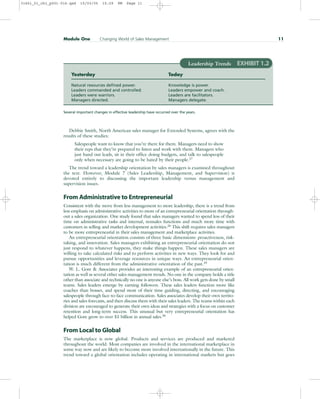
payment recognizes an existing imbalance in supply and demand in a given labor
market. Using a market bonus could be a reasonable alternative if the supply-demand
imbalance is thought to be temporary because the bonus is a one-time payment and
not a permanent addition to base compensation. For instance, IBM once offered
some high-tech sales reps who were in high demand as much as $50,000 to join its
organization.63
The offer of employment should be written but can be initially extended in verbal
form. Any final contingencies, such as passing a physical examination, should be detailed
in the offer letter. Candidates not receiving a job offer should be notified in a prompt,
courteous manner. A specific reason for not hiring a candidate need not be given. A sim-
ple statement that an individual who better suits the needs of the company has been hired
is sufficient.
31451_05_ch5_p127-158.qxd 15/03/05 16:09 PM Page 149
LEGAL AND ETHICAL CONSIDERATIONS
IN RECRUITMENT AND SELECTION
Key Legislation
The possibility of illegal discrimination permeates the recruitment and selection
process, and a basic understanding of pertinent legislation can be beneficial to
the sales manager. Some of the most important legislation is summarized in
Exhibit 5.8.64
The legislative acts featured in Exhibit 5.8 are federal laws applicable
to all firms engaged in interstate commerce. Companies not engaging in interstate
commerce are often subject to state and local laws that are similar to these
federal laws.
150 Part Three Developing the Salesforce
EXHIBIT 5.8 Legislation Affecting Recruitment and Selection
Legislative Act Purpose
Fifth and Fourteenth Amendments Provides equal protection standards to prevent
to the U.S. Constitution irrational or unreasonable selection methods.
Equal Pay Act (1963) Requires that men and women be paid the same
amount for performing similar job duties.
Civil Rights Act (1964) Prohibits discrimination based on age, race, color,
religion, sex, or national origin.
Age Discrimination in Employment Prohibits discrimination against people of
Act (1967) ages 40 to 70.
Fair Employment Opportunity Founded the Equal Employment Opportunity
Act (1972) Commission to ensure compliance with the Civil
Rights Act.
Rehabilitation Act (1973) Requires affirmative action to hire and promote
handicapped persons if the firm employs 50 or
more employees and is seeking a federal
contract in excess of $50,000.
Vietnam Veterans Readjustment Requires affirmative action to hire Vietnam veterans
Act (1974) and disabled veterans of any war. Applicable to
firms holding federal contracts in excess of $10,000.
Americans with Disabilities Act (1990) Prohibits discrimination against qualified disabled
people in all areas of employment. Prohibits the
use of employment tests, qualification standards,
and selection criteria that tend to screen out
individuals with disabilities unless the standard is
job related or consistent with business necessity.
Civil Rights Act (1991) Prohibits employers from adjusting scores of, using
different cutoff scores for, or otherwise altering the
results of employment-related tests on the basis of
race, color, religion, sex, or national origin.
Amendment to Fair Credit Reporting When seeking background information from a
Act (1997) reporting service company, employers must inform
job applicants or employees in writing that a report
on them will be procured and must obtain their
signature authorizing the move.
31451_05_ch5_p127-158.qxd 15/03/05 16:09 PM Page 150
Guidelines for Sales Managers
The legislation reviewed in Exhibit 5.8 is supported by various executive orders and
guidelines that make it clear that sales managers, along with other hiring officials in
a firm, have legal responsibilities of grave importance in the recruitment and selection
process. In step 1 of the process, planning for recruitment and selection, sales managers
must take care to analyze the job to be filled in an open-minded way, attempting to
overcome any personal mental biases. For example, in the 1980s, many sales organiza-
tions overcame biases against women in sales positions. These organizations are practi-
cally unanimous in reporting that women have performed as well as, and in some cases
better than, their male counterparts.
Job descriptions and job qualifications should be accurate and based on a thoughtful
job analysis. The planning stage may also require that the sales manager consider fair
employment legislation and affirmative action requirements before setting recruitment
and selection objectives.
In step 2 of the process, recruitment, the sources that serve as intermediaries in the
search for prospective candidates should be informed of the firm’s legal position. The
firm must be careful to avoid sources that limit its hiring from protected classes.65 It is
also crucial that advertising and other communications be devoid of potentially dis-
criminatory content. For example, companies that advertise for ā€œyoung, self-motivated
salesmenā€ may be inviting an inquiry from the Equal Employment Opportunity
Commission on the basis of age and gender discrimination.
Finally, all selection tools must be related to job performance. Munson and Spivey
summarize legal advice for selection by stating, ā€œAt each step in the selection process, it
would be advisable to be as objective, quantitative, and consistent as possible, especial-
ly because present federal guidelines are concerned with all procedures suggesting
employment discrimination.66
Such advice should be considered, particularly when fac-
ing a situation similar to one found in ā€œAn Ethical Dilemma.ā€
Module Five Staffing the Salesforce: Recruitment and Selection 151
Sales manager John Brown was interviewing
several candidates for a sales position with the
XYZ company. After interviewing, testing, and
assessing several candidates, two clearly stood
out above the rest, one male and the other
female. Although the male was slightly more
qualified, John suspected that his male customers
might enjoy the ā€œlooksā€ of the female and thus
be more willing to give XYZ their business. What
should John do? Explain.
a n e t h i c a l d i l e m m a
To more fully appreciate the sensitivity necessary in these matters, consider the follow-
ing list of potentially troublesome information often found on employment applications.67
• Age or date of birth
• Length of time at present address
• Height and/or weight
• Marital status
• Ages of children
• Occupation of spouse
• Relatives already employed by the firm
• Person to notify in case of an emergency
• Type of military discharge
These topics leave the employer open to charges of discrimination, as would a request
for a photograph of the applicant, a birth certificate, or a copy of military discharge papers.
31451_05_ch5_p127-158.qxd 15/03/05 16:10 PM Page 151
Further questions to avoid are those concerning the original name of the applicant, race
or color, religion (including holidays observed), nationality or birthplace of the applicant,
arrests, home ownership, bankruptcy or garnishments, disabilities, handicaps and health
problems, and memberships in organizations that may suggest race, religion, color, or
ancestral origin of the applicant.
Ethical Issues
Two ethical issues of particular importance are (1) how the job to be filled is represented
and (2) how interviews are conducted. Misrepresentation of the job does not always
extend into the legal domain. For example, earnings potential may be stated in terms of
what the top producer earns, not expected first-year earnings of the average salesperson.
Or perhaps the opportunities for promotion are somewhat overstated but no completely
false statements are used. As simple as it may sound, the best policy is a truthful policy if
the sales manager wants to match the applicant to the job and avoid later problems from
those recruited under false pretenses.
Some ethical issues also arise in interviewing, especially regarding the stress interview.
This technique is designed to put job candidates under extreme, unexpected, psychological
duress for the purpose of seeing how they react. A common tactic for stress interviewing in
the sales field is to demand an impromptu sales presentation for a convenient item such as
a ballpoint pen or an ashtray. Such requests may seem unreasonable to a professional sales-
person who is accustomed to planning a presentation before delivering it. Another stress
interviewing tactic is to ridicule the responses of the job candidates or to repeatedly inter-
rupt the candidates’ responses to questions before they have an adequate opportunity to
provide a complete response.
Sales managers who use stress interviewing justify its use by pointing out that sales-
people must be able to think on their feet and react quickly to unanticipated questions
from customers. Although this is true, there would seem to be better ways of assessing a
candidate’s skills. The stress interview may create an unfavorable image of the company,
and it may alienate some of the better candidates.68
It appears to be a risky, and ethically
questionable, approach.
SUMMARY
1. Explain the critical role of recruitment and selection in building and maintain-
ing a productive salesforce. Recruitment and selection of salespeople can be an
expensive process, characterized by uncertainty and complicated by legal considera-
tions. If the procedures are not properly conducted, a multitude of managerial prob-
lems can arise, the worst of which being that salesforce performance is suboptimal.
The sales manager is the key person in the recruitment and selection process,
although other managers in the hiring firm may share responsibilities for staffing the
salesforce.
2. Describe how recruitment and selection affect salesforce socialization and per-
formance. Socialization, the process by which salespeople adjust to their jobs, begins
when the recruit is first contacted by the hiring firm. Two stages of socialization
should be accomplished during recruitment and selection: achieving realism and
achieving congruence. Realism means giving the recruit an accurate portrayal of the
job. Congruence refers to the matching process that should occur between the needs
of the organization and the capabilities of the recruit. If realism and congruence can
be accomplished, future job satisfaction, involvement, commitment, and perform-
ance should be improved. These relationships are shown in a model of the socializa-
tion process in Figure 5.1.
3. Identify the key activities in planning and executing a program for salesforce
recruitment and selection. Figure 5.2 depicts a model of the recruitment and selection
152 Part Three Developing the Salesforce
31451_05_ch5_p127-158.qxd 15/03/05 16:10 PM Page 152
process. There are three steps in the process: planning, recruitment, and selection.
Planning consists of conducting a job analysis, determining job qualifications, writing
a job description, setting objectives, and formulating a strategy. Recruitment involves
locating prospective job candidates from one or more sources within or outside the
hiring firm. The third step, selection, entails an evaluation of the candidates culminating
in a hiring decision. Major methods of evaluating candidates include resume and job-
application analysis, interviews, tests, assessment centers, background investigations, and
physical examinations.
4. Discuss the legal and ethical considerations in salesforce recruitment and selection.
Every step of the recruitment and selection process has the potential to discriminate
illegally against some job candidates. Federal laws and guidelines provide the basic
antidiscriminatory framework, and state and local statutes may also be applicable. The
most important legislation that applies are the Civil Rights Act and the Fair Employment
Opportunity Act. Two primary ethical concerns are (1) misrepresentation of the job to
be filled and (2) using stress interviews in the selection stage.
UNDERSTANDING SALES MANAGEMENT TERMS
salesforce socialization career fairs
achieving realism professional societies
achieving congruence computerized matchmaking
job preview job application form
planning activities initial interviews
recruitment intensive interviews
selection interviewer bias
job analysis assessment center
job qualifications background investigation
job description market bonus
recruitment and selection strategy misrepresentation
employee referral programs stress interview
private employment agency
DEVELOPING SALES MANAGEMENT KNOWLEDGE
1. What are some of the problems associated with improperly executed recruitment and
selection activities?
2. To enhance salesforce socialization, recruitment and selection should ensure realism
and congruence. How can this be accomplished?
3. Refer to ā€œSales Management in the 21st Century: Finding a Fit at Hershey Chocolate
U.S.A.ā€ What are important factors for achieving congruence at Hershey?
4. Describe the relationship between conducting a job analysis, determining job quali-
fications, and completing a written job description.
5. Refer to ā€œSales Management in the 21st Century: Key Job Qualifications at Hershey
Chocolate U.S.A.ā€ What is the relationship between job qualifications and a company’s
personal selling approach?
6. What are the advantages of using employee referral programs to recruit salespeople?
Can you identify some disadvantages?
7. How can private employment agencies assist in the recruitment and selection of sales-
people? Who pays the fee charged by such agencies, the hiring company or the job
candidate?
8. What can be learned about a job candidate from analyzing a job application that can-
not be learned from the candidate’s resume?
Module Five Staffing the Salesforce: Recruitment and Selection 153
31451_05_ch5_p127-158.qxd 15/03/05 16:10 PM Page 153
9. Summarize the primary legislation designed to prohibit illegal discrimination in the
recruitment and selection process.
10. What is stress interviewing? How do some sales managers justify using stress
interviews?
BUILDING SALES MANAGEMENT SKILLS
1. Find three advertisements for sales positions (one from a newspaper, one from a trade
magazine, and one from the Internet). After examining each ad, list the job qualifi-
cations for the position being advertised. Then, develop a job description based on
the ad’s contents. Finally, using Exhibit 5.4 as a guide, provide your suggestions for
improving each ad.
2. Find job qualifications and a position description for a sales position at a company of
your choice. Design a series of questions that you could use as a guide to interview
a candidate for this position. Now, find a classmate who also has found job qualifica-
tions and a position description for a sales position, and swap information. Using
your interview guide, take turns interviewing each other. (The information you
swapped with your classmate serves as a guide for the interviewee.) Record your
interview on audiotape or videotape. Finally, listen to or view your tape and write a
critique of your interview, explaining what went well and what did not.
3. The Web is filled with many sites that could be beneficial in the recruitment and
selection process. One site that has been designed to make getting around in
cyberspace easier for human resource development professionals is WorkIndex
(http:/
/www.workindex.com). Access this site, then go to the ā€œkeyword searchā€
line and type in ā€œrecruitment.ā€ This will provide you with several sites that could
be useful in the recruitment and selection process. Explore some of these sites,
and then choose three that you believe would be helpful to a sales manager
involved in recruitment and selection. First, provide each site address. Second,
provide a description of each site. Finally, explain how each site or the informa-
tion it contains could be useful in the recruitment and selection process.
4. Due to the high costs associated with turnover, it is critical that companies do a good
job in the recruitment and selection process. The HR Chally Group has devised
a method to help estimate the costs of turnover. Access the Chally Group’s turnover
cost calculator at http:/
/www.chally.com/turnover_cost_calculator.htm. Given
the following information, calculate the annual turnover cost for the salesforce:
• The company employs 100 salespeople.
• Annual turnover is 10 percent.
• Average annual compensation is $50,000.
• Average tax and benefit cost as a percent of salary is $12,500.
• Average number of candidates interviewed per opening is 10.
• Average number of candidates assessed per opening is three.
5. The Claron Corporation’s main competitor, Brighton Company, just filed for bank-
ruptcy, presenting a potential opportunity for an increase in customers and revenue
at Claron. As a result, several of Brighton’s salespeople have contacted George Wills,
Claron’s vice president of sales, inquiring about employment with Claron. Currently
Wills has no openings on his 10-person salesforce. However, he does not want to
dismiss the Brighton reps, some of whom are top performers that might be able to
enhance Brighton’s revenue stream that has been falling for the past year.
After speaking to his CEO about adding a position to his salesforce, Wills was given
permission to do so as long as the new salesperson made more of his salary in
commissions than base salary. Wills, however, would like to add three of Brighton’s
salespeople. Currently there are four salespeople on Wills’ staff that outperform the
154 Part Three Developing the Salesforce
31451_05_ch5_p127-158.qxd 15/03/05 16:10 PM Page 154
other six, who are approximately equal in talent. Yet, Wills is hard pressed to identify
a clear laggard whom he would dismiss in favor of the competition’s salespeople.
Wills is also concerned that he could disrupt the team chemistry he has worked hard
to build the past two years by firing some of his current salespeople and hiring those
from Brighton. However, he does not know if he can pass up this opportunity to
upgrade his salesforce.
How should Wills approach this dilemma? Should he hire the new reps and deal
with the ramifications of letting two of his people go, or can he afford to pass on the
new reps altogether?69
6. This exercise consists of a series of different role plays involving two characters, a sales
manager and a candidate seeking a sales position. Find another classmate to assume
one of the roles. Role play the following situations:
1. The sales manager misrepresents the job in an interview.
2. The sales manager employs a stress interview.
3. The sales manager opens him/herself up to charges of discrimination during an
Interview.
On completion of the role play, address the following questions:
1. What are the dangers of misrepresenting the position during an interview?
2. What are the pros and cons of using a stress interview?
3. How can you avoid possible discrimination charges as a result of interviewing?
7. Situation: Read the Ethical Dilemma on page 149.
Characters: District sales manager; National sales manager
Scene: Location—National sales manager’s office. Action—Having completed
the interview process, the district sales manager explains to the nation-
al sales manager who will be hired and why.
Module Five Staffing the Salesforce: Recruitment and Selection 155
PROD. NO
SCENE TAKE ROLL
SOUND
DATE
PROD CO.
DIRECTOR
CAMERAMAN
ROLE PLAY
PROD. NO
SCENE TAKE ROLL
SOUND
DATE
PROD CO.
DIRECTOR
CAMERAMAN
ROLE PLAY
31451_05_ch5_p127-158.qxd 15/03/05 16:10 PM Page 155
Case 5.1: Sweet-Treats,Inc.
Background
Sweet-Treats, Inc., one of the leading manufactur-
ers and marketers of chocolate and cocoa prod-
ucts, has several plants in the United States. Its
products can be divided into two major categories:
confectionery products, which include several
brands of candy bars and assorted candy treats,
and grocery products, such as cocoa, syrup, and
baking chips. In the United States, Sweet-Treats’
products are distributed by a network of strategi-
cally located warehouses, with volume customers
receiving direct shipment from the manufacturing
plants. The method of shipment and warehousing
is determined by customer location and quantity
ordered.
Sweet-Treats uses a field sales organization to sell
products to retailers and wholesalers nationwide. Its
overriding goals are to distribute a high-quality
product and to provide optimum consumer value.
To ensure that these goals are met, the company
hires salespeople who possess outstanding planning
and organizing skills, have the ability to lead, are
persuasive, show initiative, and possess strong com-
munication skills, including the ability to write,
speak, and listen.
At Sweet-Treats, salespeople represent the com-
pany and carry its image. A crucial responsibility,
this calls for salespeople to be consummate profes-
sionals. Major responsibilities of the salesperson
include selling and maintaining distribution of all
products, ensuring the salability of all Sweet-Treat
items in an assigned territory, implementing pro-
motional programs, introducing new items, and
presenting proper merchandising techniques to
both headquarter and retail accounts. In addition,
salespeople must act as ā€œsales consultantsā€ to cus-
tomers. This involves maintaining good customer
rapport while developing accounts in an assigned
territory. Salespeople work with their sales man-
agers and team members to achieve specific sales
and merchandising objectives.
Current Situation
Sweet-Treats’ Kansas City district sales manager,
Rob Gum, recently lost one of his top-performing
salespeople, Arlene Oellermann, who left for a sud-
den career change. Although other salespeople in
his district are covering Arlene’s accounts, Rob fears
that leaving Arlene’s position unfilled for long will
create stress for these salespeople and may affect the
quality of service they provide to their accounts as
well as to Arlene’s.
Rob is presently undergoing an intensive search to
locate Arlene’s replacement. He placed a classified ad
in the local newspaper, the Kansas City Star. In addi-
tion, he contacted the career placement offices of local
colleges and universities to see whether they had any
leads on potential candidates. Through these efforts,
Rob received several resumes. After examining the
resumes, Rob decided to interview two candidates.
What follows are excerpts from those interviews:
Excerpts from an interview with Christine Pirrone
who is currently a sales rep with an industrial prod-
ucts company in the Kansas City area and who has
three years of sales experience.
Rob: Why did you get into sales?
Christine: I chose sales as a career for several rea-
sons. First, I like dealing with other people and
helping them to solve their problems. I view
sales as a way to accomplish this. Second, sales
provides me with a certain level of independ-
ence. I am self-motivated so I like being able
to get things accomplished without being
closely supervised. Third, there is decent money
to be made in sales. I might as well get my
share of the pie.
Rob: In general, how do you get things accom-
plished?
Christine: Simple, planning. I set certain goals for
each day. Then I plan how I will achieve them.
Planning helps me to stay organized, and I feel
that by being organized I am able to accom-
plish many things.
Rob: This position requires some degree of travel.
How do you feel about that?
Christine: Currently I travel quite extensively.
I enjoy the travel, so it would not bother me.
Rob: Have you ever organized a group?
Christine: Yes. When I was a junior in college
I started a new organization on campus, the
Entrepreneurship Club. I was the organiza-
tion’s president for two years. When I graduat-
ed we had more than 40 members. I was very
proud! I am currently a member of several
civic groups, although I did not organize any
of these.
Excerpts from an interview with Joe Stein who is
from Minnesota, but just received his B.S.B.A. from
a local university with a 3.8 (4.0 scale) G.P.A. His
major was marketing.
Rob: Why do you want a career in sales?
Joe: I think sales is a very flexible job. You basically
manage your own time, and I like the idea of
this. Also, it is more exciting than sitting
156 Part Three Developing the Salesforce
MAKING SALES MANAGEMENT DECISIONS
31451_05_ch5_p127-158.qxd 15/03/05 16:10 PM Page 156
behind a desk. You get to meet and interact
with people. Also, I understand that there is
a fair amount of money to be made in sales.
Rob: In general, how do you get things accom-
plished?
Joe: I’ve found that the best way to get things
done is to jump right in and tackle them. Take
the bull by the horns, so to speak.
Procrastinating only makes things worse.
Rob: This position requires some degree of travel.
How do you feel about that?
Joe: I traveled a lot with the track team in college.
I also travel back to Minnesota quite frequently
to visit family and friends. I don’t think the
travel will bother me.
Rob: Have you ever organized a group?
Joe: In college, we worked in several groups.
Sometimes I was the group leader, but I always
tried to carry my load. I was also a member of
the American Marketing Association.
Rob decided that additional searching at this
point might not prove worthwhile. With his sales-
people getting restless, he decided he would make
a decision between Christine and Joe and make one
an offer.
Questions
1. Based on the information you have about
Christine and Joe, how do they rate relative to
Sweet-Treats’ job qualifications?
2. Who should Rob hire and why? Explain.
3. How could Rob improve his recruiting and
selecting process? Explain.
4. What key concepts of salesforce socialization are
related to this situation? Explain.
Situation: Read Case 5.1.
Characters: Rob Gum, sales manager;
Christine Pirrone, sales candidate;
Joe Stein, sales candidate; Candice
Cane, regional sales manager
Scene 1: Location—Rob’s office. Action—Rob
interviews Christine.
Scene 2: Location—Rob’s office. Action—Rob
interviews Joe.
Scene 3: Location—Local restaurant over
lunch. Action—Rob discusses the
merits and potential fit of each can-
didate with Candice.
Scene 4: Location—Rob’s office. Action—
Rob makes a job offer via a phone
call to either Christine or Joe.
Case 5.2: Titan Industries
Background
Titan Industries manufactures and markets industrial
equipment throughout the United States. In 2004,
Titan did more than $2 billion in sales and appeared
to be in an upward growth trend. The company has
grown considerably since its inception in 1964.
Founder and CEO Carman Pulte is proud of the
progress the company has achieved over the years,
despite considerable aggressive competition. He
attributes much of Titan’s success to his management
team, most of whom have been with him since the
company’s founding.
David Winston had been vice president of sales
and marketing at Titan since 1968. Two months
ago, he retired and was replaced by Duane
Blankenship. Blankenship had been in product
design and engineering at Titan since 1979. Well-
educated, articulate, and likable, Blankenship was
believed to be the best candidate for the position.
Blankenship, a very methodical individual, set as
his first task an assessment of the marketing pro-
gram. One of the main things concerning him was
the composition of the salesforce. In particular, he
was concerned about two items. First, the salesforce
was aging, with the average age being 51. Several
salespeople were nearing retirement. Only a small
percentage were in their twenties or thirties.
Second, he noticed that the salesforce did not
include any minorities or women. Blankenship
scheduled a meeting to discuss these issues with
Titan’s national sales manager, Tommy Angotti.
Angotti loves his job. He has been with Titan for
nearly 25 years. He began as a salesperson and
worked his way up to national sales manager.
Surprisingly, many of his salespeople have been with
the company for 20 years or more. Angotti takes
pride in the accomplishments of his salesforce. He
believes they have been instrumental in Titan’s
growth over the years.
Current Situation
At their scheduled meeting, Blankenship explained
to Angotti his ideas concerning the composition of
the salesforce. The following are excerpts from their
meeting:
Angotti: I realize we will have several salespeople
soon retiring, but could you explain why it is
necessary to hire women and minorities to
replace these individuals?
Blankenship: Many of the companies we sell equip-
ment to are now being closely monitored and
regulated by federal and state governments.
Several companies in our industry have recently
come under attack from the Equal Employment
Opportunity Commission. The commission is
Module Five Staffing the Salesforce Recruitment and Selection 157
PROD. NO
SCENE TAKE ROLL
SOUND
DATE
PROD CO.
DIRECTOR
CAMERAMAN
ROLE PLAY
31451_05_ch5_p127-158.qxd 15/03/05 16:10 PM Page 157
putting pressure on these companies to hire
women and minorities. It is only a matter of
time before they take aim at us. We need to get
women and minorities into the salesforce so
that they can eventually work their way up into
management positions.
Angotti: I can’t imagine a woman going into the
field trying to sell a large piece of industrial
equipment. How seriously do you think a
woman will be taken in this business? Not very,
I can assure you. Our customers want to speak
to someone who really understands how this
equipment operates.
Blankenship: Women can learn to sell our equip-
ment. Just because they may not operate it
doesn’t mean they can’t understand how it
works. As a matter of fact, a few months ago a
woman was involved in selling us a piece of
manufacturing equipment for our operations.
She did an outstanding job.
Angotti: Maybe so. However, when we hire a
replacement, we try to find the best person for
the job. As a result, I believe we currently have
some of the best salespeople in the business.
Blankenship: Unfortunately, that person always
seems to be a white male. There are plenty of
intelligent and motivated women and minorities
graduating from business schools today who are
capable of performing the job. Regardless of
governmental threats, it is still the right thing
to do, and the profitable one. I would like to
see us take a leadership role in this area in our
industry and begin to make an effort to hire
women and minorities.
Angotti was not convinced. He was very con-
cerned that minorities, and women in particular,
would not be positively accepted by buyers. The
industrial equipment business is largely male domi-
nated. This, in turn, could have a negative impact
on sales. Moreover, given that much of his sales-
force was composed of ā€œold-timers,ā€ he was con-
cerned about how hiring these groups might affect
salesforce morale.
Turnover in the salesforce was relatively low.
Thus, specific hiring procedures were not well
developed. Angotti decided he would recruit
women and minorities to appease Blankenship but
would develop an entrance test that would be diffi-
cult for women and minorities to pass. This way he
could actively recruit women and minorities but tell
Blankenship they did not qualify because they did
not pass the entrance test. Angotti was only a few
years from retirement and was unwilling to change
his current practices at this juncture, particularly in
light of the success his salesforce had experienced
over the years.
Questions
1. Should Blankenship be concerned about the
present composition of the salesforce? Explain.
2. How do you evaluate Angotti’s method for
dealing with the salesforce composition issue?
3. What steps could be taken to effectively bring
about a salesforce comprised of more women
and minorities?
Situation: Read Case 5.2.
Characters: Duane Blankenship, vice
president of sales and marketing;
Tommy Angotti, national sales man-
ager
Scene 1: Location—Blankenship’s office.
Action—Role play the interview
between Angotti and Blankenship.
Scene 2: Location—Angotti’s office. Action—
Blankenship gets a copy of the selec-
tion test, figures out what Angotti is
up to, and decides to confront him.
158 Part Three Developing the Salesforce
PROD. NO
SCENE TAKE ROLL
SOUND
DATE
PROD CO.
DIRECTOR
CAMERAMAN
ROLE PLAY
31451_05_ch5_p127-158.qxd 15/03/05 16:10 PM Page 158
SALES TRAINING AT UPS: FROM SELLING
RATES TO SELLING SOLUTIONS
As UPS shifted its business model, the need arose to alter its sales strategy as well,
from a transaction-based to a solutions-based approach. No longer would sales-
people simply be taking orders in the shipping department. The new focus
required them to call on corporate-level executives. In part, this entailed calling
on customer service managers to learn how they interact with their customers
and how they answer customer queries. It also called for salespeople to discuss
the financial impact of transportation decisions with financial executives. This
strategic change required new skills, a new vocabulary, and a new mind-set.
To meet these needs, UPS created a special salesforce. This salesforce worked in
teams alongside the traditional salesforce to offer solutions to high-opportunity
accounts. Having found success with the solutions-based sales approach, UPS
decided to train the entire salesforce in this new approach. In doing so, they creat-
ed a sales training program called e-Commerce University.
The training program is designed to accomplish three objectives: 1) provide
salespeople with the competencies necessary to have a conversational comfort level
with varied technology offerings; 2) provide an understanding of what the tech-
nology can do for customers; and 3) integrate the technological understanding into
UPS’ sales methodology and strategy.
Every week UPS sends 40 to 50 people to its corporate office in Atlanta
to attend e-Commerce University. This costs more than bringing the program to
its salespeople, but UPS believes it provides salespeople with a sense that the
company values them and engenders their loyalty to the company, as well as
creates a sense of camaraderie. Divided into two groups, students listen to
lectures and presentations, participate in discussions and roundtables, work in
teams, and role play for nine to ten hours each day. For instance, during the online
tools course students learn XML and HTML. Students participate in role plays
to exercise their knowledge and vocabulary in the new technology employed by
UPS, such as their flat-file billing system (storing bills on a hard drive). Students
also outline how they will apply what they learn to one of their accounts and then
hold a discussion about this with classmates at the end of the week.
On completing the training, students fill out surveys assessing the training’s
relevance and effectiveness. Six weeks later, students are asked to complete a
Web-based survey asking qualitative and quantitative questions about the useful-
ness of the training with regard to customer acquisition and retention. Responses
to surveys thus far indicate that the training does have an impact on students’
sales process. According to Laura Bostic, an e-Commerce University graduate,
ā€œI just feel more empowered. When you can start talking the language with
customers and talk about process improvement, it puts UPS in a different light.
We’re not just salespeople—we’ve become consultants, supply-chain solution
consultants.ā€ The training program has been a success and is credited for increas-
ing sales performance by up to 7 percent.
After completing this module,
you should be able to
1 Understand the role of
sales training in sales-
force socialization.
2 Explain the importance of
sales training and the
sales manager’s role in
sales training.
3 Describe the sales train-
ing process as a series of
six interrelated steps.
4 Discuss six methods for
assessing sales training
needs and identify typical
sales training needs.
5 Name some typical
objectives of sales train-
ing programs, and
explain how setting objec-
tives for sales training is
beneficial to sales man-
agers.
6 Identify the key issues in
evaluating sales training
alternatives.
7 Identify key ethical
and legal issues in sales
training.
159
6
M o d u l e
C O N T I N U A L D E V E L O P M E N T O F
T H E S A L E S F O R C E : S A L E S
T R A I N I N G
Objectives
Source: Heather Johnson, ā€œPostmarked for Growth,ā€ Training 40 (September 2003): 20–22;
John Beystehner, ā€œPlaying a Brand New Game,ā€ Sales  Marketing Management 155 (November
2003): 72. All rights in the article are owned by United Parcel Service of America, Inc. Ā© 2003.
All rights reserved.
31451_06_ch6_p159-184.qxd 16/03/05 19:33 PM Page 159
As the opening vignette illustrates, companies often believe that sales training is neces-
sary to successfully implement their strategy. UPS realizes the important role its sales-
people play in the success of the company and is willing to invest considerable time and
money in developing them. Training can be used to achieve a number of objectives and
fulfill various needs. As at e-Commerce University, various methods may be used to
accomplish sales training. Another important point illustrated in the vignette is that
training must be evaluated to ensure its effectiveness.
Today’s salespeople must be prepared to meet the demands of value-conscious cus-
tomers. Salespeople must do their part by providing solutions to problems and meeting
service requirements expected to satisfy customer needs. Proper training can prepare
salespeople to meet these challenges.
In this module several training issues and methods are discussed. First, the role of
sales training in salesforce socialization is examined. Then the importance of sales train-
ing is considered and management of the sales training process is discussed.
ROLE OF SALES TRAINING IN SALESFORCE
SOCIALIZATION
Recall from Module 5 that salesforce socialization refers to the process by which sales-
people acquire the knowledge, skills, and values essential to perform their jobs. Training
plays a key role in this process. Newly hired salespeople usually receive a company
orientation designed to familiarize them with company history, policies, facilities, pro-
cedures, and key people with whom salespeople interact. Some firms go well beyond a
perfunctory company orientation in an effort to enhance salesforce socialization. By
referring to Figure 5.1 in Module 5, you can see how sales training can affect salesforce
socialization. During initial sales training, it is hoped that each salesforce member will
experience a positive initiation to task—the degree to which a sales trainee feels com-
petent and accepted as a working partner—and satisfactory role definition—an under-
standing of what tasks are to be performed, what the priorities of the tasks are, and how
time should be allocated among the tasks.1
The need for socialization as part of the training process is supported by expected
indirect linkages between socialization and beneficial job outcomes. As suggested in
Figure 5.1, trainees who have been properly recruited and trained tend to be more con-
fident on the job and have fewer problems with job conflicts, leading to higher job
satisfaction, involvement, commitment, and performance.
The positive relationships between salespeople’s job-related attitudes and perceptions
and their commitment to their companies have been supported in empirical studies. For
example, a study of 102 salespeople in the food industry found that ā€œamong approaches
within a company’s control, programs aimed at minimizing new salespeople’s role ambi-
guity and improving their satisfaction are most likely to be most effective in building
commitment to the company.ā€2 Another study of 120 manufacturers’ salespeople found
a positive relationship between job satisfaction and salespeople’s commitment to the
organization.3
In addition, a study of 301 industrial salespeople found that when sales-
people believe the company is taking certain actions to support the salesforce and reduce
the difficulties associated with a sales position, they are more committed to and satisfied
with the job.4
These studies reinforce the importance of sales managers taking an active
role in socializing their salespeople to maximize overall salesforce productivity.
Newly hired salespeople should be extremely interested in learning about their jobs,
peers, and supervisors. A basic orientation may be insufficient to provide all the information
they desire, so more extensive socialization may be indicated. At Federated Insurance,
trainees participate in a two-week seminar that introduces them to the company’s products,
the corporate mission, the Federated business plan, functions and departments within the
company, and many of the support people with whom they will work.5
The need for salesforce socialization is especially likely to extend past the initial training
period. This is particularly true if salesforce members have limited personal contact with
peers, managers, and other company personnel.
160 Part Three Developing the Salesforce
31451_06_ch6_p159-184.qxd 16/03/05 19:33 PM Page 160
SALES TRAINING AS A CRUCIAL INVESTMENT
A comprehensive review of sales management research concludes that whom one
recruits is important but it is probably not as important in determining salesforce per-
formance as what sales managers do with the recruits—and to the recruits—after they
have been hired.6
The importance of sales training in achieving the highest levels of sales performance
is shown in Sales  Marketing Management’s annual survey of the best salesforces in
the United States. The accounts of sales successes for the top salesforces often reveal that
the winning salesforces had to adapt to changes in marketing and sales strategies. This
obviously requires some degree of salesforce training or retraining. A survey of sales
executives finds that 80 percent of respondents claim that training is a key aspect of their
business.7 Some research, in fact, indicates a positive relationship between training
expenditures and a firm’s share price.8 One toothbrush manufacturer, for example, cred-
its sales training conducted by Ansir International for a $30-million increase in sales in
the first two years after implementing the training.9 Deluxe Corporation, a financial and
check printing company, credits its sales training with improving its client retention rate
from 85 percent to 95 percent in less than two years.10
Most organizations need sales training of some type, perhaps because of inadequacies
of current training programs and/or because new salespeople have joined the organiza-
tion. Thus, an ongoing need exists to conduct sales training to improve salesforce per-
formance. It should be stressed that the need for sales training is continual, if for no
other reason than that the sales environment is constantly changing.
Companies view training as an important means for protecting their investments in
their salesforces.11
U.S. companies spend approximately $7.8 billion annually to provide
salespeople with training and devote several hours per year to the average salesperson.12
Average training costs per salesperson per year can run from over $3,400 to more than
$9,000 depending on the industry, company size, and experience of the salesperson.13
As research shows, this training generally pays off in terms of improvement in salesforce
productivity.14
Exhibit 6.115
shows the time invested in sales training as related to its
value to the organization.
Module Six Continual Development of the Salesforce: Sales Training 161
Investment in Sales Training EXHIBIT 6.1
Sales training received each year:
Less than 8 hours 18.3%*
1–5 days a year 46.8%
6–10 days a year 19.5%
11–15 days a year 7.9%
More than 15 days a year 7.5%
Sales training received by new employees:
Less than 8 hours 5.9%
1–5 days a year 31.0%
6–10 days a year 18.5%
11–15 days a year 14.3%
More than 15 days a year 30.3%
Value of training to the organization:
Extremely valuable 29.5%
Very valuable 47.0%
Somewhat valuable 18.3%
Not very valuable 4.8%
Not valuable at all 0.4%
* Percent of respondents indicating each choice.
31451_06_ch6_p159-184.qxd 16/03/05 19:33 PM Page 161
One aspect of the investment in sales training is the amount of time required of the
sales manager. Usually, sales managers are involved not only in the ā€œbig pictureā€ of
planning but also in the time-consuming details of implementing training, such as the
following:16
• Arranging for salespeople to work with key personnel in various departments in the
firm to familiarize them with the functions of those departments
• Selecting literature, sales aids, software, and materials for study
• Enrolling salespeople in professional workshops or training programs
• Accompanying salespeople in the field to critique their sales behavior and reinforce
other training
• Conducting periodic training meetings and professional training conferences
Sales training is indeed expensive, and sales managers should take special care to see
that time and money are wisely spent. With these thoughts in mind, let’s examine a
model for the judicious analysis, planning, and implementation of a sales training
program.
MANAGING THE SALES TRAINING PROCESS
The sales training process is depicted as six interrelated steps in Figure 6.117
: assess train-
ing needs, set training objectives, evaluate training alternatives, design the sales training
program, perform sales training, and conduct follow-up and evaluation.
Assess Training Needs
The purpose of sales training needs assessment is to compare the specific performance-
related skills, attitudes, perceptions, and behaviors required for salesforce success with
the state of readiness of the salesforce. Such an assessment usually reveals a need for
changing or reinforcing one or more determinants of salesforce performance.
All too often, the need for sales training becomes apparent only after a decline in
salesforce performance is revealed by decreasing sales volume, rising expenses, or per-
haps low morale. Sales training for correcting such problems is sometimes necessary, but
the preferred role of sales training is to prevent problems and improve salesforce pro-
ductivity on a proactive, not reactive, basis.
Needs assessment requires that sales managers consider the training appropriate for
both sales trainees and regular salespeople. A sales trainee is an entry-level salesperson
who is learning the company’s products, services, and policies in preparation for a reg-
ular sales assignment. For example, entry-level salespeople may need basic training in
162 Part Three Developing the Salesforce
Perform
Sales
Training
Design
Sales
Training
Program
Evaluate
Training
Alterna-
tives
Set
Training
Objectives
Assess
Sales
Training
Needs
Conduct
Follow-Up
and
Evaluation
FIGURE 6.1 Sales Training Process
The sales training process is performed in six steps, beginning with an assessment of training needs. The process is con-
tinual, with the follow-up and evaluation step providing feedback that may alter the other steps in future sales training
activities.
31451_06_ch6_p159-184.qxd 16/03/05 19:33 PM Page 162
sales techniques, whereas experienced salespeople could benefit from training in
advanced sales techniques. In addition, the training needs of selling teams must be
considered.
Methods of Needs Assessment
Proactive approaches to determining sales training needs include a salesforce audit, per-
formance testing, observation, a salesforce survey, a customer survey, and a job analysis.
Needs assessment can be conducted in-house or by companies such as Wilson Learning
Corporation (http:/
/www.wilsonlearning.com).
Salesforce Audit
A salesforce audit is ā€œa systematic, diagnostic, prescriptive tool which can be
employed on a periodic basis to identify and address sales department problems and
to prevent or reduce the impact of future problems.ā€18
The salesforce audit (discussed
fully in Module 9) includes an appraisal of all salesforce activities and the environment
in which the salesforce operates. In the sales training area, the audit examines such
questions as these:
• Is the training program adequate in light of objectives and resources?
• Does the training program need revision?
• Is an ongoing training program available for senior salespeople?
• Does the training program positively contribute to the socialization of sales trainees?
To be effective, a salesforce audit should be conducted annually. More frequent
audits may be warranted in some situations, but the comprehensive nature of an audit
requires a considerable time and money investment. As a result, other periodic assess-
ments of sales training are suggested.
Performance Testing
Some firms use performance testing to help determine training needs. This method
specifies the evaluation of particular tasks or skills of the salesforce. For example, sales-
people may be given periodic examinations on product knowledge to check retention
rates and uncover areas for retraining. Salespeople may be asked to exhibit particular
sales techniques, such as demonstrating the product or using the telephone to set up
sales appointments while the sales trainer evaluates their performance. Sales managers
may even want to administer a recently developed measure of selling skills; this new
measure assesses salespeople’s interpersonal, salesmanship, and technical skills.19
Observation
First-level sales managers spend a considerable amount of time in the field working
with salespeople. They also may have direct responsibility for some accounts, acting as
a salesperson or as a member of a sales team. Through these field selling activities,
sales managers often observe the need for particular sales training. In some instances,
the training need is addressed instantaneously by critiquing the salesperson’s
performance after the sales call has been completed. In other situations, frequent
observation of particularly deficient or outstanding sales behavior may suggest future
training topics.
Salesforce Survey
The salesforce may be surveyed in an attempt to isolate sales training needs. The salesforce
survey may be completed as an independent activity or combined with other sales man-
agement activities such as field visits or even included as part of the routine salesforce
reporting procedures. The weekly reports submitted by many salespeople to their sales
managers often have sections dealing with problems to be solved and areas in which
managerial assistance is requested. For example, a faltering, new product introduction may
signal the need for more product training, additional sales technique sharpening, or per-
haps training needs specific to an individual salesperson. Canon USA, for example, identi-
fies the best practices of its salespeople to determine necessary proficiencies around which
training can be designed.20
Module Six Continual Development of the Salesforce: Sales Training 163
31451_06_ch6_p159-184.qxd 16/03/05 19:33 PM Page 163
By surveying the salesforce, the task of assessing training needs may become more
complex than if sales management alone determines training needs. To ignore the
salesforce in this step of the training process, however, could be a serious sin of omis-
sion. For example, when implementing a CRM strategy, Storage Tek, a network
computing storage company, found resistance from its salesforce. It used phone
interviews to survey the salesforce to determine everyone’s computer capability and
efficiency to assess where deficiencies existed. Storage Tek then enlisted the help of
a training company to design and deliver a program to fit its salespeople’s needs.21
If
sales managers and their salespeople should disagree on training needs, it is far better
to discover this disagreement and resolve it before designing and delivering specific
sales training programs.
Customer Survey
Intended to define customer expectations, a customer survey helps determine how com-
petitive the salesforce is compared with other salesforces in the industry. If personal
selling is prominent in the firm’s marketing strategy, some sort of customer survey to
help determine sales training needs is highly recommended. For example, upon survey-
ing its customers, Paxar, a supplier of labels to retailers and apparel manufacturers,
learned that its salespeople were miscommunicating with customers and were failing to
understand their market needs.22
Online services such as QuestionPro.com (http:/
/ques-
tionpro.com) make it easy to design, deliver, and analyze Web-based customer surveys.23
Sometimes information gathered from a customer survey may have ethical implications
as seen in ā€œAn Ethical Dilemma.ā€
164 Part Three Developing the Salesforce
Your salespeople have been reaching or
exceeding their sales goals for the year, and your
region is on pace to set a new company sales
record, putting you in line for a big bonus.
When conducting a recent customer survey to
use as input for developing a training program,
you discover that some customers are upset
about promises salespeople are making but not
fulfilling. Is this cause for alarm? What should
you do and when?
a n e t h i c a l d i l e m m a
Job Analysis
The job analysis, defined in Module 5, is an investigation of the task, duties, and
responsibilities of the sales job. In a well-run sales organization, a job analysis will be
part of the recruitment and selection process and then will continue to be used in sales
training and other managerial functions. For instance, NBC bases its hiring and training
goals for sales teams on a competency model it developed that describes characteristics
of its ideal salespeople in 12 areas, including team orientation and communication
skills.24
Because the job analysis defines expected behavior for salespeople, it is a logical
tool to be used in assessing training needs. Because sales jobs may vary within the same
salesforce, job analyses may also help in determining individualized sales training needs
or the needs of different groups of salespeople.
Typical Sales Training Needs
As the preceding discussion implies, the need for sales training varies over time and
across organizations. However, the need for salesforce training on certain topics is wide-
spread. A discussion of some of the more popular sales training topics follows.
Sales Techniques
There is a universal, ongoing need for training on ā€œhow to sell.ā€ Research has indicated
that salespeople sometimes sell despite themselves; that is, many salespeople do not
31451_06_ch6_p159-184.qxd 16/03/05 19:33 PM Page 164
competently execute fundamental sales techniques.25
Common mistakes identified in
this research include the following:
• Ineffective listening and questioning
• Failure to build rapport and trust
• Poor job of prospecting for new accounts
• Lack of preplanning of sales calls
• Reluctance to make cold calls (without an appointment)
• Lack of sales strategies for different accounts
• Failure to match call frequency with account potential
• Spending too much time with old customers
• Overcontrolling the sales call
• Failure to respond to customers’ needs with related benefits
• Giving benefits before clarifying customers’ needs
• Ineffective handling of negative attitudes
• Failure to effectively confirm the sale
This rather lengthy list of common shortcomings is remarkable in that proper train-
ing could erase these problems entirely. In fact, most formal sales training programs
spend considerable time on sales techniques. One study of sales executives found that
nearly 79 percent indicate that employees receive training in sales skills.26
As mentioned previously, the basic nature of sales techniques training is changing, and
more emphasis is being placed on developing trusting, enduring relationships with cus-
tomers. Salespeople are receiving more training on listening and questioning skills so that
they may be more effective in learning the customer’s needs. Limited research supports the
idea that effective listening skills are positively associated with sales performance and work
satisfaction.27
Furthermore, high-pressure sales techniques are declining in popularity and
are being replaced with sales techniques based on need satisfaction, problem solving, and
partnership forming with the customer’s best interests as the focus.28
Companies such as
Motorola and Owens Corning teach their salespeople how to provide solutions to customer
problems to facilitate the development of lasting relationships with customers.29
A study of
more than 1,000 salespeople, customers, support staff, and sales managers found that
today’s salesperson must learn to perform like a ā€œmini-CEO,ā€ focusing on issues such as the
customer’s strategic objectives.30
Exhibit 6.231
points out seven competencies that this
research suggests today’s successful salesperson must master along with a method for assess-
ing these competencies. To learn how ADP trains its salespeople to build relationships, see
ā€œSales Management in the 21st Century: Training for Relationship Building at ADP.ā€
Module Six Continual Development of the Salesforce: Sales Training 165
Competencies of Successful Salespeople EXHIBIT 6.2
Below each competency are questions that can be used to assess it. Ask salespeople to respond to
each question using the following scale to indicate how often they use each behavior: 1—never,
or not at all; 2—seldom or to a small extent; 3—sometimes or to a moderate extent; 4—usually or
to a great extent; 5—almost always. When finished, calculate the total score for each competency
by adding the responses to each question for a particular competency and then adding each com-
petency score together to get a total score. The average score is 63. A score above average
indicates the salesperson is using the competencies better than the typical business-to-business
salesperson, whereas a score below average may signal a need for improvement.
Competency 1
Aligning customer/supplier strategic objectives by identifying new opportunities and applications
that add value to the customer organization and enhance the value of the relationship with my
organization.
1. I gather information to understand customers’ business strategies and view of market oppor-
tunities.
2. I stay up-to-date with new developments and innovations in customers’ markets.
3. I keep current with emerging trends and initiatives of customers’ competitors.
(continued)
31451_06_ch6_p159-184.qxd 16/03/05 19:33 PM Page 165
166 Part Three Developing the Salesforce
EXHIBIT 6.2 Competencies of Successful Salespeople (Continued)
Competency 2
Listening beyond product needs by identifying business process improvement potential and
opportunities to add value to my organization and our customers.
4. I keep the customer regularly updated with information and changes that might be important.
5. I suggest ways I can bring added value to our customers.
6. I help customers think differently about their future needs.
Competency 3
Understanding the financial impact of decisions on the customer’s organization and on my organ-
ization by quantifying and communicating the value of the relationship.
7. I look actively for ways to contribute to the customer’s profitability.
8. I search actively for more cost-effective ways to serve customers.
9. I focus on the financial consequences of approaches to meeting customer needs.
Competency 4
Orchestrating organizational resources by identifying key contributors; communicating relevant
information; and building collaborative, customer-focused relationships.
10. I communicate customer needs, suggestions, and concerns to appropriate resources in my
organization.
11. I work cooperatively with people in other parts of the customer organization who can be
useful sources of ongoing information, resources, and support.
12. I ensure that my product, sales, and service units work together to deliver value.
Competency 5
Consultative problem solving to create new solutions, customized products and services, and
paradigm changes while being willing and able to work outside the norm when necessary.
13. I anticipate possible problems and invite discussion about how they can be overcome.
14. I determine the cause of a problem and identify constraints before recommending a solution.
15. I propose innovative solutions that go beyond the immediate application of the product or
service.
Competency 6
Establishing a vision of a committed customer/supplier relationship by identifying value-adding
products, processes, and services.
16. I create a relationship that supports the goals and values of both organizations.
17. I develop relationships that recognize the needs of all contributing functions in both
organizations.
18. I communicate objectives for the relationship that are achievable and challenge the creativity
of both organizations.
Competency 7
Engaging in self-appraisal and continuous learning by securing feedback from customers, col-
leagues, and managers.
19. I demonstrate an understanding of what is working, what is not working, and how I can do
things differently.
20. I stay up-to-date in my field of expertise.
21. I ask for and welcome feedback to assess my performance and the degree to which I am meet-
ing expectations.
Product Knowledge
Salespeople must have thorough product knowledge, including its benefits, applica-
tions, competitive strengths, and limitations. Product knowledge may need updating in
the event of new product development, product modification, product deletions, or the
development of new applications for the product.
Source: Dr. Bernard L. Rosenbaum, ā€œDo You Have the Skills for 21st Century Selling? Rate Yourself With This Exerciseā€American
Salesman 45 (July 2000): 24–30. Reprinted by kind permission of the author.
31451_06_ch6_p159-184.qxd 16/03/05 19:33 PM Page 166
Generally speaking, product knowledge is one of the most commonly covered topics
in sales training programs. As expected, the more complex the product or service, the
higher the likelihood that detailed knowledge about the offering will be stressed in the
training program.
Although it is an essential requirement, adequate product knowledge will not
necessarily lead to sales success. Studies have shown that product knowledge levels of
high-performing salespeople are not significantly different from those of moderate
performers.32
Having product knowledge is not enough—the salesperson must know
the customer and have the necessary sales skills to apply the knowledge of the product
to the customer’s situation.
Customer Knowledge
Sales training may include information relating to customers’ needs, buying motives,
buying procedures, and personalities (i.e., customer knowledge). As explained in the
opening vignette, salespeople at UPS had to learn how to communicate with executives
and better understand their needs. Faced with situational and individual differences
among customers, some firms use classification methods to categorize buyers according
to personality and the buying situation. An example of different types of buyers and sug-
gested sales training topics is presented in Exhibit 6.3.33
As minority populations increase and companies expand their global selling efforts,
training programs must address multicultural differences and business protocol in
subcultures and foreign countries. For instance, female Hispanic business owners gen-
erally take longer to make decisions.34 Such information can be useful in determining
the selling cycle. Gift-giving, for example, is a sensitive area internationally because well-
intentioned expressions of goodwill can backfire and instead become personal insults to
a prospective customer. It is important that salespeople are trained in intercultural com-
munication to improve their chances of developing international buyer–seller relation-
ships.35 Insights for understanding foreign customers are provided in Exhibit 6.4.36
Competitive Knowledge
Salespeople must know competitive offerings in terms of strengths and weaknesses to plan
sales strategy and sales presentations effectively and to be able to respond effectively to
customer questions and objections. This area is extremely important for salespeople who
Module Six Continual Development of the Salesforce: Sales Training 167
S a l e s m a n a g e m e n t i n t h e 2 1 s t c e n t u r y
Training for Relationship Building at ADP
Jason Karem, sales manager at ADP, com-
ments on training for relationship building:
To be successful in any sales job you have to work
hard, be able to build rapport with everyone you
talk to, and follow through on every expectation
you set. But there is one key ingredient that sepa-
rates the great salespeople from the good ones: The
ability to build relationships. Building relation-
ships allows you to work smarter by allowing your
territory to work for you all the time—even while
you are on vacation. Therefore, training on how to
build business partnerships with individuals and
influence centers in one’s territory is key with every
salesperson at ADP. Some of the specifics we focus
on are how to truly understand the business of the
person with whom we are trying to build a rela-
tionship. For instance, for salespeople to be success-
ful at ADP, they must understand the business of
some of our critical customers, CPAs, and bankers.
Therefore, we constantly train associates about
CPA’s and banker’s needs, what they actually do
on a daily basis, and how we can help them fulfill
their business goals. This not only builds trust with
our partners, but also builds credibility with them
for future sales opportunities. Periodically we will
bring CPAs or bankers into one of our meetings to
determine first hand their expectations. We ask
them how we can better serve them and their firm.
If an ADP sales associate can build solid, credible
relationships with key business partners, their sales
only will go one way—up.
31451_06_ch6_p159-184.qxd 16/03/05 19:33 PM Page 167
168 Part Three Developing the Salesforce
EXHIBIT 6.3 Sales Training for Different Types of Buyers
Kind of Buyer Sales Training Topic
1. Hard Bargainer (a difficult 1. Teach psychologically oriented sales strategies (e.g., transac-
person to deal with) tional analysis).
2. Teach sales negotiation strategies (e.g., the use of different
bases of power).
3. Teach listening skills and the benefits of listening to the
prospect.
4. Emphasize how to handle objections.
5. Emphasize competitive product knowledge.
2. Sales Job Facilitator 1. Teach importance of a quid pro quo.
(attempts to make the 2. Communicate advantages of having a satisfied customer base.
sales transaction go 3. Show how customers can assist salespeople (e.g., by pooling
smoothly) orders, providing leads).
3. Straight Shooter (behaves 1. Teach importance of selling the ā€œsubstanceā€ of the product
with integrity and offering and not just the ā€œsizzle.ā€
propriety) 2. Teach straightforward techniques for handling objections (e.g.,
a direct denial approach).
4. Socializer (enjoys 1. Communicate company policy information about giving gifts
personal interaction and entertaining and socializing with customers.
with salespeople) 2. Discuss ethical and legal implications of transacting business.
3. Emphasize importance of salespeople maintaining an appro-
priate balance between socializing with customers and per-
forming job responsibilities.
5. Persuader (attempts to 1. Communicate importance of qualifying prospects.
ā€œmarketā€ his or her 2. Teach techniques for qualifying customers.
company)
6. Considerate (shows 1. Communicate importance of obtaining market information
compassion for salesperson) from customers.
2. Teach importance of a quid pro quo.
are new to the industry because the competitor’s salespeople may have years of experience
and be quite knowledgeable. Furthermore, customers may exploit a salesperson’s lack of
competitive knowledge to negotiate terms of sale that may be costly to the selling firm.
For example, salespeople who are not familiar with a competitor’s price structure may
unnecessarily reduce their own price to make a sale, thereby sacrificing more revenue and
profits than they should have.
EXHIBIT 6.4 Understanding Foreign Customers
Many selling skills that are successful in the United States will also work in other countries.
However, one must be aware of cultural variations that can make the difference between closing
a deal and losing a customer. Here is some advice for conducting business in certain countries
around the world.
Arab Countries:
• Don’t use your left hand to hold, offer, or receive materials because Arabs use their left hands to
touch toilet paper. If you must use your left hand to write, apologize for doing so.
• When first meeting someone, avoid giving a gift as it might be interpreted as a bribe.
31451_06_ch6_p159-184.qxd 16/03/05 19:33 PM Page 168
Module Six Continual Development of the Salesforce: Sales Training 169
China:
• Don’t refuse tea during a business discussion. Always drink it, even if you’re offered a dozen
cups a day.
• Printed materials presented to Chinese business leaders should be in black and white because
colors have great significance for the Chinese.
• Never begin to eat or drink before your host does in China.
• Deliver presentations in a visually neutral way.
• Present gifts privately and do not make a big issue of it.
France:
• Don’t schedule a breakfast meeting—the French tend not to meet until after 10 A.M.
Germany:
• Don’t address a business associate by his or her first name, even if you have known each other
for years. Always wait for an invitation to do so.
• Breakfast meetings are unheard of here also.
• Provide detail and lots of supporting documentation during presentations.
Latin America:
• People here don’t take the clock too seriously—scheduling more than two appointments in the
same day can prove disastrous.
• People like to stand close to one another and touch during conversation.
• Give gifts after establishing a relationship and during social encounters, rather than in the
course of business.
Japan:
• Don’t bring up business on the golf course—always wait for your host to take the initiative.
• Don’t cross your legs in Japan—showing the bottom of the foot is insulting.
• Deliver presentations in a visually neutral way.
• Avoid giving gifts wrapped with bows (considered unattractive) and ribbons (colors have differ-
ent meanings). Do not open a gift in front of a Japanese counterpart or expect them to do so.
Mexico:
• Don’t send a bouquet of red or yellow flowers as a gift—Mexicans associate those colors with
evil spirits and death. Instead, send a box of premium chocolates.
Miscellaneous:
• The thumbs-up gesture is considered offensive in the Middle East, rude in Australia, and a sign
of ā€œOKā€ in France.
• It is rude to cross your arms while facing someone in Turkey.
• In the Middle East don’t ask, ā€œHow’s the family?ā€ā€”it is considered too personal. Also, don’t
show the bottom of your foot.
Time and Territory Management
The quest for an optimal balance between salesforce output and salesforce expenditures
is a perennial objective for most sales managers. Therefore, training in time and terri-
tory management (TTM), is often included in formal sales training programs.
Essentially, the purpose of TTM training is to teach salespeople how to use time and
efforts for maximum work efficiency.
TTM training is important for all sales organizations but especially for those in
declining, stagnant, or highly competitive industries. In such situations, salespeople are
often overworked, and there comes a point when working harder to improve results is
not realistic. Such circumstances call for ā€œworking smarter, not harder,ā€ an idea that is
receiving considerable discussion in sales management circles.37
Efforts to make more efficient use of time and increase salesperson productivity have
been bolstered by salesforce automation. Salesforce automation (e.g., cellular phones,
faxes, portable computers, databases, the Internet, personal digital assistants, and elec-
tronic data interchange) can boost productivity by as much as 20 to 40 percent.38
To do
so, salespeople often need training in computer and software applications. Furthermore,
as electronic data interchange (a method for transferring information electronically
31451_06_ch6_p159-184.qxd 16/03/05 19:33 PM Page 169
between selling firms and buying firms) and CRM technology become more prominent,
the need for computer literacy in the salesforce will increase.39
Studies indicate that
proper training in salesforce automation is necessary for it to be effective.40
Perhaps time and territory management could be improved by training salespeople in
self-management. Self-management refers to an individual’s effort to control certain
aspects of his or her decision making and behavior, and as such employs strategies that
assist individuals in structuring the environment and facilitating behaviors necessary to
achieve performance standards. Recent research suggests that salespeople trained in self-
management increase both short- and long-term performance.41
Set Training Objectives
Having assessed the needs for sales training, the sales manager moves to the next step in
the sales training process shown in Figure 6.1: setting specific sales training objectives.
Because training needs vary from one sales organization to the next, so do the objec-
tives. In general, however, one or more of the following are included.
1. Increase sales or profits.
2. Create positive attitudes and improve salesforce morale.
3. Assist in salesforce socialization.
4. Reduce role conflict and ambiguity.
5. Introduce new products, markets, and promotional programs.
6. Develop salespeople for future management positions.
7. Ensure awareness of ethical and legal responsibilities.
8. Teach administrative procedures (e.g., expense accounts, call reports).
9. Ensure competence in the use of sales and sales support tools, such as CRM
technology.
10. Minimize salesforce turnover rate.
11. Prepare new salespeople for assignment to a sales territory.
12. Improve teamwork and cooperative efforts.
These objectives are interrelated. For example, if salespeople gain competence in the
use of a new sales tool, sales and profit may improve, salesforce morale may be posi-
tively affected, and other beneficial outcomes may occur. By setting objectives for sales
training, the manager avoids the wasteful practice of training simply for training’s sake.
Furthermore, objectives force the sales manager to define the reasonable expectations
of sales training rather than to view training as a quick-fix panacea for all the problems
faced by the salesforce. Additional benefits of setting objectives for sales training are as
follows:42
• Written objectives become a good communications vehicle to inform the salesforce
and other interested parties about upcoming training.
• Top management is responsive to well-written, specific objectives and may be more
willing to provide budget support for the training.
• Specific training objectives provide a standard for measuring the effectiveness of training.
• By setting objectives, the sales manager finds it easier to prioritize various training
needs, and the proper sequence of training becomes more apparent.
Evaluate Training Alternatives
In the third step of the sales training process, the sales manager considers various
approaches for accomplishing the objectives of training. Certainly, many more alterna-
tives exist today than in the past, thanks to such technologies as computer-assisted
instruction, video conferencing, and the Internet. The number of sales training profes-
sionals for hire also seems to be increasing, or perhaps such trainers are just doing a
better job of promoting their services. Even a casual examination of a typical shopping
mall bookstore will reveal a number of titles related to building sales skills, along with
audio- and videotapes/disks on the subject. Some associations are even offering training
170 Part Three Developing the Salesforce
31451_06_ch6_p159-184.qxd 16/03/05 19:33 PM Page 170
courses to help improve the skills of salespeople in their industry. For example, a course
cosponsored by the Safety Equipment Manufacturers Agents Association allows distrib-
utor reps, manufacturer reps, and independent manufacturer reps to attend a weeklong
course on the topic of safety.43
Critiquing all these alternatives is a monumental job, so it is recommended that fairly
stringent criteria, including cost, location of the training, flexibility of prepackaged
materials, opportunity for reinforcement training, and time required to implement an
alternative, be established for preliminary screening.
The evaluation of alternatives for training inevitably leads to three key questions. First,
who will conduct the training? An answer to this question will require the consideration
of internal (within the company) and external (outside the company) trainers. The sec-
ond question deals with location for the training. Sales training may be conducted in the
field, in the office, at a central training location, at hotels and conference centers, or at
other locations. The third question is which method (or methods) and media are best
suited for conducting the training?
Selecting Sales Trainers
In general, companies rely most heavily on their own personnel to conduct sales train-
ing. In this endeavor, the sales manager is the most important sales trainer. Senior
salespeople are also often involved as trainers. For example, beer brewing company
Molson Canada uses both managers and experienced salespeople to conduct formal
training sessions three or four days a year.44 In larger companies, a full-time sales train-
er is often available.
Why are internal sources used so often in sales training? First, and perhaps most
important, sales managers and senior salespeople are intimately aware of job require-
ments and can communicate in very specific terms to the sales trainee. However, outside
consultants may be only superficially informed about a specific sales job and often offer
generic sales training packages. Second, sales managers are the logical source for train-
ing to be conducted in the field, where valuable learning can occur with each sales call.
It is extremely difficult to turn field training over to external trainers. Finally, using inter-
nal trainers simplifies control and coordination tasks. It is easier to control the content
of the program, coordinate training for maximum impact, and provide continuity for the
program when it is the sales manager who does the training or who designates other
company personnel to do the training.
At some point, a sales manager’s effectiveness may be improved by using external train-
ers. Internal resources, including time, expertise, facilities, and personnel, may be insuffi-
cient to accomplish the objectives of the sales training program. Also, outside trainers might
be looked to for new ideas and methods. Large training firms such as Forum
(http:/
/www.forum.com), Sales Performance International (www.SPISales.com), and U.S.
Learning Inc. (http:/
/www. uslearning.com) often customize their generic programs for use
within specific companies. Others, such as Wilson Learning Corporation, deliver training
programs via the Web that include interactive stories, tutorials, interactive questions, online
exercises, role plays, games, summaries, and post-tests.45
Exhibit 6.546
outlines attributes to
consider when shopping for an outside training program.
Selecting Sales Training Locations
Most sales training is conducted in home, regional, or field offices of the sales organi-
zation. Manufacturing plants are also popular training sites, and some firms use non-
company sites such as hotels or conference centers to conduct training.
Central training facilities are another possibility, used extensively by Noxell Corporation,
Xerox, IBM, General Electric, Armstrong World Industries, and scores of other large firms.
One of the largest training facilities in the country is Xerox Document University, located
on the banks of the Potomac River in Leesburg, Virginia. At this facility, trainees stay in
dormlike confines while being indoctrinated into the company.
As video broadcasting and teleconferencing become more prevalent, many firms are
enjoying some of the benefits of a centralized training facility without incurring the
Module Six Continual Development of the Salesforce: Sales Training 171
31451_06_ch6_p159-184.qxd 16/03/05 19:33 PM Page 171
172 Part Three Developing the Salesforce
EXHIBIT 6.5 Choosing an Outside Training Program
Several training organizations, such as the Covey Leadership Center, the Center for Creative Lead-
ership, Decker Communications, and the American Society of Training and Development, provide
their input on what makes a useful training program.
1. The program should make it easy to master content by lessening the participant’s struggle to
learn new skills and knowledge and change old work habits. Content and delivery must con-
sider the skill level, education level, and learning style of participants.
2. The program should anticipate and deal with obstacles to long-term behavior modification. It
should motivate participants to drop old habits, adopt new skills, and desire continued training.
3. The program’s content should be limited to what has been shown to help participants most on
the job.
4. The program’s development and delivery should stay within the constraints of time, money,
logistics, and repeatability. Only technology that enhances training should be used.
5. Participants should be actively involved in the program to preserve the excitement that comes
from self-development.
6. The trainer must clearly understand the program’s objectives, as well as the concepts, behaviors,
and attitudes to be acquired by participants.
7. When appropriate, the program should accommodate group dynamics and promote a sense of
group membership and shared purpose.
travel costs and lost time to transport the salesforce to and from training. Field offices
arrange for video hook-up, either in-house or at video-equipped conference hotels, and
trainees across the country share simultaneously in training emanating from a central
location.
Selecting Sales Training Methods
A variety of methods can be selected to fit the training situation. Indeed, the use of mul-
tiple methods is encouraged over the course of a training program to help maintain
trainee attention and enhance learning. There are four categories of training methods:
classroom/conference, on-the-job, behavioral simulations, and absorption.
Classroom/Conference Training
The classroom or conference setting features lectures, demonstrations, and group dis-
cussion with expert trainers serving as instructors. This method is often used for train-
ing on basic product knowledge, new product introductions, administrative procedures,
and legal and ethical issues in personal selling. At Cullinet Software, for instance,
trainees spend six to seven months in the classroom learning product knowledge and
sales methodologies.47 The format often resembles a college classroom, with regularly
scheduled examinations and overnight homework assignments. In addition to using
internal facilities and personnel, some companies send their salespeople to seminars
sponsored by the American Management Association, American Marketing Association,
Sales and Marketing Executives International, and local colleges and universities. These
organizations offer training on practically any phase of selling and sales management.
On-the-Job Training
In the final analysis, salespeople can be taught only so much about selling without
actually experiencing it. Consequently, on-the-job training (OJT) is extremely
important and is the most prevalent method of training salespeople.48 OJT puts the
trainee into actual work circumstances under the observant (it is hoped) eye of a sup-
portive mentor or sales manager. Other OJT methods approximate a ā€œsink or swimā€
philosophy and often produce disastrous results when the trainee is overwhelmed with
unfamiliar job requirements.
Mentors have different objectives from company to company, but they usually strive
to make the new hires feel at home in their jobs, relay information about the corporate
31451_06_ch6_p159-184.qxd 16/03/05 19:33 PM Page 172
culture, and be available for discussion and advice on topics of concern to the trainee.
Coworker mentoring is popular among salesforces, and in some companies, the sales
manager serves as the mentor. For instance, at Ecolab, a provider of commercial clean-
ing products, sales managers accompany reps on sales calls to coach them and to help
them develop monthly improvement plans.49
The mentoring concept is yet another way
that companies are striving to improve salesforce socialization, especially the role defini-
tion and initiation-to-task steps explained earlier in this module.
Other than working with a senior salesperson or a mentor, common OJT assignments
include the trainee’s filling in for a vacationing salesperson, working with a sales man-
ager who acts as a ā€œcoach,ā€ and job rotation. When senior salespeople act as mentors,
they too are undergoing continual training as their ideas and methods are reassessed,
and sometimes refined, with each trainee. The sales manager’s role as coach is discussed
in Module 7 on supervision and leadership of the salesforce. Job rotation, the exposure
of the sales trainee to different jobs, may involve stints as a customer service representa-
tive, a distribution clerk, or perhaps in other sales positions. Job rotation is often used
to groom salespeople for management positions.
Behavioral Simulations
Methods that focus on behavioral learning by means of business games and simula-
tions, case studies, and role playing—where trainees portray a specified role in a staged
situation—are called behavioral simulations. They focus on defining desirable
behavior or in correcting behavioral mistakes, in part by allowing salespeople to expe-
rience the consequences of their actions.
Games may come in a variety of forms. For instance, Bax Global, a California-based
transportation and logistics company, uses a board game called Apples and Oranges to
help its sales reps better understand how executive-level decision makers think by hav-
ing them run a mock manufacturing company over a simulated three-year period.
During six-hour training sessions, reps are divided into teams of four or five. As players
progress along the board, they must make decisions regarding productivity changes,
resource allocation, and cash flow management. The game helps reps better understand
where Bax Global’s services can add value for a customer.50
At International Paper, col-
lege sales recruits play Zodiak, a board game that teaches them how their actions impact
a company’s finances.51
An example of a computer-based simulation is one offered by the Brooks Group called
the Impact Selling Simulator. This is an off-the-shelf CD-ROM simulation that uses real-
world scenarios to help salespeople learn to understand customer problems, develop their
questioning skills, and improve customer relationships, among other things.52 Such sim-
ulations provide the advantage of reaching large populations at once via the Internet,
company intranet, or CD-ROM.
Along with OJT, role playing is extremely popular for teaching sales techniques.
Typically, one trainee plays the role of the salesperson and another trainee acts as the
buyer. The role playing is videotaped or performed live for a group of observers who
then critique the performance. This can be an extremely effective means of teaching
personal selling, without the risk of a poor performance in the presence of a real
customer. It is most effective when promptly critiqued with emphasis on the positive
points of the performance as well as suggestions for improvement. A good way to
maximize the benefits of the critique is to have the person who has played the role of
the salesperson offer opinions first and then solicit opinions from observers. After role
playing, the ā€œsalespersonā€ is usually modest about his or her performance, and the
comments from observers may bolster this individual’s self-confidence. In turn, future
performance may be improved.53 An alternative format involves using role play soft-
ware, such as Dialog Coach, that uses artificial intelligence, voice recognition, and
video to provide virtual, customized client interaction. Ecolab, a provider of com-
mercial cleaning products, has used the software to help improve its salespeople’s
close ratio by approximately 13 percent.54 While role playing offers the opportunity
for a positive learning experience, this may not always be the case as seen in ā€œAn
Ethical Dilemma.ā€
Module Six Continual Development of the Salesforce: Sales Training 173
31451_06_ch6_p159-184.qxd 16/03/05 19:33 PM Page 173
Absorption Training
As the name implies, absorption training involves furnishing trainees or salespeople
with materials that they peruse (or ā€œabsorbā€) without opportunity for immediate feed-
back and questioning. Product manuals, direction-laden memoranda, and sales bulletins
are used in absorption training. Federated Insurance, for example, maintains a substan-
tial library of audio- and videotapes, books, workbooks, and self-study material for
employees to use.55
This method is most useful as a supplement to update salesforce
knowledge, reinforce previous training, or introduce basic materials to be covered in
more detail at a later date.
One time-effective method of absorption training involves furnishing the salesforce
with CDs or audiocassettes so that driving time can be used as training time. At Omni
Oral Pharmaceuticals, in addition to instructor-led training, salespeople are given a CD
filled with audio tips to listen to while driving between sales calls.56
Selecting Sales Training Media
Communications and computer technology have expanded the range of sales training
media dramatically in the past decade. Sales trainers warn against the tendency to be
overly impressed with the glamorous aspects of such training media, but they agree that
it is advisable to evaluate new media continually to see whether they should be incor-
porated into the sales training program. Among other things, electronic media typically
allow trainees to learn at their own pace in a risk-free environment. The most promis-
ing new media are found at the communications/computer technology interface and are
often referred to as e-learning media.
The Internet offers opportunities to cost-effectively train the salesforce across dif-
ferent times and locations without taking salespeople out of the field. One study found
that 48 percent of the companies surveyed go online to train salespeople.57 Companies
such as WebEx (http:/
/www.webex.com) and Raindance (http:/
/www.raindance.com)
provide Web and telephone conferencing services. Using the Web trainers can display
slides, whiteboard visual concepts, introduce real-time interaction, share desktop appli-
cations, and lead a Web tour.58 Cisco used the Web to deliver a tutorial to 2,000 of its
salespeople in conference rooms located in Asia, Europe, and the United States, saving
the company over $530,000 in training expenditures.59 It also offered training on the
Web via video-on-demand. Trainees could use the Web to access 10 half-day training
course videos. Personal digital assistants are likewise being used to deliver sales train-
ing. At Monsanto, trainers push e-mail reminders to the field salesforce, which is
equipped with Palm handhelds.60
Another emerging technology, desktop personal computer videoconferencing, allows
sales managers and salespeople to see each other and trade information via their personal
computers. Similarly, audiographics connects the instructor simultaneously with several
sites via computer displays and audio link.61 Or sales managers may want to set up an
online chat room to train salespeople interactively at remote locations.62
These tech-
nologies can be used to simultaneously train salespeople dispersed in several remote
locations.
174 Part Three Developing the Salesforce
During a recent training session, national sales
manager Joe Smith was not happy with trainee
Jill Horner’s performance in a role playing exer-
cise. Upon conclusion of the exercise, Joe began
to mock Jill’s role playing behavior in front of
the other trainees to illustrate how inadequate
her performance was. He informed Jill and
the others that if they performed like that on a
sales call, they would be looking for a new
job very soon. What do you think about
Joe’s actions? How would you have handled this
situation?
a n e t h i c a l d i l e m m a
31451_06_ch6_p159-184.qxd 16/03/05 19:33 PM Page 174
Satellite television offers another viable training alternative. For instance, RE/MAX
uses its satellite network to conduct sales training in more than 1,400 commercial offices
throughout the United States.63
An example of how video technology can improve sales training comes from Frito-
Lay. Frito-Lay’s Priority One video series involves its CEO and senior vice president of
field operations role playing a Frito-Lay salesperson and a store owner, respectively, in a
variety of situations. Each month, the 15-minute videos are distributed to reps who get
together with their district managers to view them. The videos suggest one new tactic
that reps should try that month.64
Sales training software is increasingly available for a few hundred dollars per program
or less. Programs cover time and territory management, sales analysis, and the entire sales
process. For example, the Brooks Group offers CD-ROM titles such as ā€œHow to Build
Instant Trust and Rapportā€ and ā€œThe Magic of Asking Questions.ā€65 An alternative is to
custom-build a training module using a program such as RoboDemo eLearning Edition.
This program helps managers without technical assistance to develop interactive train-
ing sessions that can be posted on the Internet, an intranet, or burned onto a CD.66
Figure 6.267 summarizes results from a study indicating usage of various methods and
media used to train salespeople.
Design the Sales Training Program
The fourth step in the sales training process is a culmination of, and condensation of,
the first three steps shown in Figure 6.1. Working toward selected objectives based on
needs assessment and having evaluated training alternatives, the sales manager now com-
mits resources to the training to be accomplished. At this point in the process, sales
managers may have to seek budget approval from upper management.
In this step of designing the training program, the necessary responses to what, when,
where, and how questions are finalized. Training is scheduled, travel arrangements
made, media selected, speakers hired, and countless other details arranged. Certainly
this can be the most tedious part of the sales training process, but attention to detail is
necessary to ensure successful implementation of the process.
Module Six Continual Development of the Salesforce: Sales Training 175
Methods and Media Used to Train Salespeople FIGURE 6.2
C
l
a
s
s
r
o
o
m
w
i
t
h
i
n
s
t
r
u
c
t
o
r
W
o
r
k
b
o
o
k
s
/
M
a
n
u
a
l
s
P
u
b
l
i
c
s
e
m
i
n
a
r
s
R
o
l
e
p
l
a
y
C
D
-
R
O
M
A
u
d
i
o
c
a
s
s
e
t
t
e
s
I
n
t
e
r
n
e
t
I
n
t
r
a
n
e
t
T
e
l
e
c
o
n
f
e
r
e
n
c
i
n
g
V
i
d
e
o
c
o
n
f
e
r
e
n
c
i
n
g
i
n
g
r
o
u
p
s
77.4%*
53.6%
46.0% 43.5%
38.7% 34.3% 31.9%
25.0% 22.2%
12.5%
*Percent of respondents indicating use.
31451_06_ch6_p159-184.qxd 16/03/05 19:33 PM Page 175
Perform Sales Training
The fifth step in the process, actually performing the training, may take only a fraction
of the time required by the previous steps. This is particularly true in better sales train-
ing programs. As the training is being conducted, the sales manager’s primary responsi-
bility is to monitor the progress of the trainees and to ensure adequate presentation of
the training topics. In particular, sales managers should assess the clarity of training
materials. It is also recommended that some assessment of the trainees’ continuing moti-
vation to learn be made. Feedback from the trainees might be solicited on everything
from the effectiveness of external trainers to the adequacy of the physical training site.
For an analysis of the performance of sales training at ADP, see ā€œSales Management in
the 21st Century: Performing Sales Training at ADP.ā€
Conduct Follow-Up and Evaluation
It is always difficult to measure the effectiveness of sales training. This is a long-stand-
ing problem, due in some cases to a lack of clearly stated sales training objectives. Even
with clearly stated objectives, however, it is hard to determine which future performance
variations are a result of sales training. Other factors, such as motivation, role percep-
tions, and environmental factors, may affect performance more or less than training in
different situations.
Although scientific precision cannot be hoped for, a reasonable attempt must never-
theless be made to assess whether current training expenditures are worthwhile and
whether future modification is warranted. Evaluations can be made before, during, and
after the training occurs.68
For example, the pretraining evaluation might include an
examination for sales trainees to assess their level of knowledge, corroborate or deny the
need for training, and further define the objectives of the training. As suggested earlier,
training can be evaluated while it is being conducted, and adjustments may be made at
176 Part Three Developing the Salesforce
S a l e s m a n a g e m e n t i n t h e 2 1 s t c e n t u r y
Performing Sales Training at ADP
Jason Karem, sales manager at ADP, com-
ments on the performance of sales training:
From the time one is hired for a sales position
at Automatic Data Processing (ADP), he or she
is constantly trained not only on individual sell-
ing skills, buy also on ADP’s product set. In fact,
ADP places so much energy and resources on new
sales associates that it takes two years before that
individual associate is profitable for ADP.
A majority of ADP’s training prior to attending
our corporate office for two weeks is made up of
computer-based training (CBT), webinars, and
role plays with sales managers. One of the most
important training tools offered by ADP ini-
tially, which becomes even more valuable through
a sales associate’s career, is a Web site totally ded-
icated to any topic an associate might uncover in
the field. From specific ideas for how to get in the
door with a prospect to going through a quick
training module on a specific product or solu-
tion, the information is right at one’s fingertips.
After the initial training takes place, associates
are trained two to three times each month on spe-
cific product and selling skills. In most of these
sessions, sales representatives actually facilitate
the training themselves. This accomplishes a cou-
ple things. First, the associate giving the training
becomes very knowledgeable on the topic and
becomes a ā€œchampionā€ for the product or selling
skill. Secondly, it really helps each associate with
preparation and presentation skills, both of
which will help him or her in the field. Even more
important to a salesperson’s success in any com-
pany, however, is the desire to continuously learn
and improve. Most of this comes from self-study
and is done outside of the normal 8 A.M. to 5 P.M.
selling time. Quite honestly, what makes a sales-
person successful is not what they do between 8–5,
it is what they do before 8 and after 5.
31451_06_ch6_p159-184.qxd 16/03/05 19:34 PM Page 176
any point in the delivery of training. Post-training evaluations might include reactions
or critiques of the trainees, ā€œfinal examinations,ā€ retention examinations at later dates,
observations by sales managers as they work in the field with salespeople, customer
feedback, new business growth, and an examination of actual performance indicators
such as sales volume. At Motorola, Inc., the effectiveness of sales training is determined
by measuring customer satisfaction, along with salespeople’s ability to affect customer
values.69
Dell measures the strength of its customer relationships as a means of assessing
its sales training, as does Dr Pepper/Seven Up, which also gauges volume, distribution,
and display.70
Trainee reactions, however, can serve as an important measure of training
effectiveness given research indicating that trainees who are satisfied with their training
are more likely to retain and use what they learned, resulting in greater selling
effectiveness, improved customer relations, and a stronger commitment to the
organization.71
Exhibit 6.672
summarizes the sales training evaluation practices of 129
companies.
Despite the inherent difficulty in relating subsequent sales performance to previously
conducted sales training, the effectiveness of sales training is increasingly being measured
in dollars and cents. This return-on-investment approach seeks to define training effec-
tiveness in terms of incremental sales volume from existing accounts or volume generated
by new accounts. As mentioned, at Dr Pepper/Seven Up training, in part, is evaluated
based on its impact on increasing sales growth.
It is also important to reinforce the training in subsequent weeks. According to a study
of over 6,000 sales professionals, participants in sales training remember only half of what
they learn within five weeks of the training. Post-training implementation and reinforce-
ment are critical to enhanced behavior change. Reinforcement should be integrated with
the sales organization’s daily work.72
Molson Canada, for instance, reinforces its training
Module Six Continual Development of the Salesforce: Sales Training 177
Sales Training Evaluation Practices Ranked by Importance and Frequency EXHIBIT 6.6
Frequency of
Mean Importance* Use Percentage
All Service Manufacturing
Source Companies Companies Companies Often Sometimes Never
Reaction Measures
Trainee feedback 3.42 3.39 3.39 86 14 0
Supervisor’s feedback 3.15 3.14 3.12 68 24 8
Training staff
comments 2.95 2.92 2.85 93 7 0
Learning Measures
Performance tests 3.10 3.31 2.85 63 29 8
Pretraining versus
post-training
measurements 2.72 2.71 2.56 31 51 18
Behavior Measures
Supervisory appraisal 3.38 3.50 3.29 64 26 10
Self-appraisal 3.25 3.37 3.10 61 30 9
Customer appraisal 3.17 3.42 2.78 41 35 23
Subordinate appraisal 2.73 2.93 2.37 32 45 23
Coworker appraisal 2.52 2.63 2.33 33 45 22
Result Measures
Bottom line
measurement 3.20 3.34 2.94 40 46 14
*Mean importance is based on a 1 to 5 scale, with 5 indicating the most importance.
31451_06_ch6_p159-184.qxd 16/03/05 19:34 PM Page 177
through frequent informal coaching sessions with its salespeople.73 Exhibit 6.774 shows
results of a study identifying the most effective methods to reinforce new sales skills.
A reasonable approach to sales training is to ensure that it is not prohibitively expensive
by carefully assessing training needs, setting objectives, and evaluating training alternatives
before designing the training program and performing the training. Furthermore, the sales
training process is incomplete without evaluation and follow-up.
ETHICAL AND LEGAL ISSUES
Ethical and legal issues are being included in sales training programs more often than in the
past. One catalyst for this change has been product liability litigation that has awarded mul-
timillion-dollar judgments to plaintiffs who have suffered as a result of unsafe products.
Research has found that salespeople face a number of ethical and legal dilemmas on the job
and that salespeople want more direction from their managers on how to handle such
dilemmas.75
Exhibit 6.876
lists situations or practices that some salespeople find to be ethi-
cally troubling and would like to see addressed by a company policy.
Training in the legal area is extremely difficult because laws are sometimes confusing
and subject to multiple interpretations. Training salespeople in ethics is even more dif-
ficult because ethical issues are often gray, not black or white. Companies that address
ethics and legal issues in their sales training programs usually rely on straightforward
guidelines that avoid complexity. Salespeople should be provided with the company’s
code of ethics and informed of the organization’s policies concerning ethical behavior.
Furthermore, by providing salespeople with potentially troubling ethical scenarios, hav-
ing them respond, and then explaining how a similar situation could be handled, it may
be possible to lessen salespeople’s concerns about such situations. Salespeople are given
basic training on applicable legal dimensions and advised simply to tell the truth and
seek management assistance should problems arise. For instance, at Owens Corning,
a lawyer speaks to salespeople about legal and ethical issues.77
Another possibility
includes role playing, in which trainees learn to develop consistently legal interactive
scripts.78
These guidelines may sound simplistic, but such training can greatly reduce
salesperson conflict on the job, help develop profitable long-term relationships with cus-
tomers, and reduce the liability of the salesperson and the organization.
The legal framework for personal selling is extensive. Some of the key components of
this framework are antitrust legislation, contract law, local ordinances governing sales
practices, and guidelines issued by the Federal Trade Commission dealing with unfair
trade practices. A partial listing of important legal reminders that should be included in
a sales training program is shown in Exhibit 6.9. Salespeople must be made aware of
changes in the legal environment as soon as they occur.
178 Part Three Developing the Salesforce
EXHIBIT 6.7 Methods for Reinforcing New Sales Skills Ranked by Importance
Percent Indicating
Method as Effective
Sharing sales methods and language with the sales team 49
Coaching by the sales manager 46
Follow-up training classes 43
Clear statement of management expectations 39
Incentive compensation for new sales behaviors 36
Technology reinforcement and support 33
Coaching by outside specialists 30
Participation in a community Web site based on the training 11
Source: Gail Johnson, ā€œForget Me Not,ā€ Training 41 (March 2004): 12.
31451_06_ch6_p159-184.qxd 16/03/05 19:34 PM Page 178
Module Six Continual Development of the Salesforce: Sales Training 179
EXHIBIT 6.8
1. Making statements to an existing purchaser that exaggerate the seriousness of his or her
problem to obtain a bigger order or other concessions.
2. Soliciting low-priority or low-volume business that the salesperson’s firm will not deliver or
service in an economic slowdown or periods of resource shortages.
3. Allowing personalities—liking one purchaser and disliking another—to affect price, delivery,
and other decisions regarding the terms of sale.
4. Seeking information from purchasers on competitors’ quotations for the purpose of submit-
ting another quotation.
5. Having less competitive prices or other terms for buyers who use your firm as the sole source
of supply than for firms for which you are one of two or more suppliers.
6. Giving physical gifts such as free sales promotion prizes or ā€œpurchase-volume incentive bonusesā€
to a purchaser.
7. Providing free trips, free luncheons or dinners, or other free entertainment to a purchaser.
8. Using the firm’s economic power to obtain premium prices or other concessions from
buyers.
9. Gaining information about competitors by asking purchasers.
10. Giving preferential treatment to purchasers whom higher levels of the firm’s own manage-
ment prefer or recommend.
11. Giving preferential treatment to customers who are also good suppliers.
12. Attempting to reach and influence other departments (e.g., engineering) directly rather than
going through the purchasing department when such avoidance of the purchasing depart-
ment increases the likelihood of a sale.
Ethically Troubling Situations and Practices Salespeople
Would Like Addressed by Company Policy*
*Ranked from most to least troubling in a survey of industrial salespeople.
Legal Reminders for Salespeople EXHIBIT 6.9
1. Use factual data rather than general statements of praise during the sales presentation. Avoid
misrepresentation.
2. Thoroughly educate customers before the sale on the product’s specifications, capabilities,
and limitations. Remind customers to read all warnings.
3. Do not overstep authority because the salesperson’s actions can be binding to the selling firm.
4. Avoid discussing these topics with competitors: prices, profit margins, discounts, terms of sale,
bids or intent to bid, sales territories or markets to be served, and rejection or termination of
customers.
5. Do not use one product as bait for selling another product.
6. Do not try to force the customer to buy only from your organization.
7. Offer the same price and support to all buyers who purchase under the same set
of circumstances.
8. Do not tamper with a competitor’s product.
9. Do not disparage a competitor’s product, business conduct, or financial condition without
specific evidence of your contentions.
10. Avoid promises that will be difficult or impossible to honor.
31451_06_ch6_p159-184.qxd 16/03/05 19:34 PM Page 179
SUMMARY
1. Understand the role of sales training in salesforce socialization. Newly hired
salespeople usually receive a company orientation designed to familiarize them
with company history, policies, facilities, procedures, and key individuals with
whom they will interact. During initial sales training, it is hoped that each
salesforce member will experience a positive initiation to task and satisfactory role
definition.
2. Explain the importance of sales training and the sales manager’s role in sales
training. Most organizations have a continual need for sales training as a result of
changing business conditions, the influx of new salespeople into the organization,
and the need to reinforce previous training. Sizable investments in training are likely
in larger companies. The sales manager has the overall responsibility for training the
salesforce, although other people may also conduct sales training.
3. Describe the sales training process as a series of six interrelated steps. Figure 6.1
presents the sales training process in six steps: assess sales training needs, set training
objectives, evaluate training alternatives, design the sales training program, perform
sales training, and conduct follow-up and evaluation. The time spent to perform sales
training may be only a fraction of the time spent to complete the other steps in the
process, especially in well-run sales organizations.
4. Discuss six methods for assessing sales training needs and identify typical
sales training needs. Sales managers may assess needs through a salesforce audit,
performance testing, observation, a salesforce survey, a customer survey, or a job
analysis. It is recommended that salesforce training needs be assessed in a proac-
tive fashion; that is, needs should be assessed before performance problems occur
rather than after problems occur. Typical sales training needs include product,
customer, and competitive knowledge; sales techniques; and time and territory
management.
5. Name some typical objectives of sales training programs, and explain how set-
ting objectives for sales training is beneficial to sales managers. The objectives
of sales training vary over time and across organizations, but they often include
preparing sales trainees for assignment to a sales territory, improving a particular
dimension of performance, aiding in the socialization process, or improving sales-
force morale and motivation. By setting objectives, the sales manager can prioritize
training, allocate resources consistent with priorities, communicate the purpose of
the training to interested parties, and perhaps gain top management support for
sales training.
6. Identify the key issues in evaluating sales training alternatives. Evaluation of alter-
natives is a search for an optimal balance between cost and effectiveness. One key issue
is the selection of trainers, whether from outside the company (external) or inside the
company (internal). Another is the potential location or locations for training. Still
another important factor is the method or methods to use for various topics. Sales train-
ing methods include classroom/conference training, on-the-job training, behavioral
simulations, and absorption training. The sales manager must also consider whether to
use various sales training media, such as printed material, audio- and videotape and
CDs, and computer-assisted instruction.
7. Identify key ethical and legal issues in sales training. Because of increasing
product liability litigation, legal and ethical issues are being incorporated into
salesforce training. Exhibits 6.8 and 6.9 point out several issues that should be
covered in sales training. Lectures and role playing provide useful means for train-
ing in this area.
180 Part Three Developing the Salesforce
31451_06_ch6_p159-184.qxd 16/03/05 19:34 PM Page 180
UNDERSTANDING SALES MANAGEMENT TERMS
initiation to task time and territory management (TTM)
role definition self-management
needs assessment sales training objectives
salesforce audit sales trainer
performance testing classroom/conference training
observation on-the-job training (OJT)
salesforce survey mentor
customer survey job rotation
job analysis behavioral simulations
sales techniques role playing
product knowledge absorption training
customer knowledge sales training media
competitive knowledge
DEVELOPING SALES MANAGEMENT KNOWLEDGE
1. How is sales training related to recruiting and selecting salespeople? How can sales
training contribute to salesforce socialization?
2. Why is it important to invest in sales training?
3. What are six methods of assessing sales training needs? Can each of these methods
be used in either a proactive or reactive approach to determining training needs?
4. Refer to ā€œSales Management in the 21st Century: Training for Relationship Building
at ADP.ā€ How can training salespeople in relationship building help a company?
5. How is the process of setting objectives for sales training beneficial to sales managers?
6. When the sales manager is evaluating sales training alternatives, what four areas
should he or she consider?
7. Discuss four methods for delivering sales training.
8. Refer to ā€œSales Management in the 21st Century: Performing Sales Training at
ADP.ā€ What are the benefits of using sales reps to facilitate sales training?
9. What is the purpose of the follow-up and evaluation step in the sales training
process? When should evaluation take place?
10. What are some of the important ethical and legal considerations that might be
included in a sales training program?
BUILDING SALES MANAGEMENT SKILLS
1. There is a universal ongoing need for training on ā€œhow to sell.ā€ For instance, know-
ing how to listen effectively is an extremely important skill that contributes to the
success of salespeople. Find several articles on listening. Use this information to
design a training program to improve salespeople’s listening skills. Assume that you
will conduct the training session. Determine what you will teach, along with the
methods and media you will use. Also, decide how you will assess whether the train-
ing was successful. If possible, conduct your training program on a small group such
as your fraternity, sorority, student American Marketing Association chapter, or any
other student group.
2. As the sales manager for ABC company, you have decided that as part of your training
program you would like to use role playing to achieve three objectives: (1) teach sales-
people how to set appointments with prospects properly via the phone, (2) teach sales-
people how to approach prospects and build rapport, and (3) teach salespeople how to
question prospects effectively. Design three role plays (one of each objective) to achieve
Module Six Continual Development of the Salesforce: Sales Training 181
PROD. NO
SCENE TAKE ROLL
SOUND
DATE
PROD CO.
DIRECTOR
CAMERAMAN
ROLE PLAY
31451_06_ch6_p159-184.qxd 16/03/05 19:34 PM Page 181
these goals. Then, have a classmate play the salesperson and you play the buyer and act
out each role play. On completing each role play, critique the salesperson’s performance,
being sure to emphasize the positive points and to make suggestions for improvements.
Consider soliciting self-assessment feedback from the salesperson before making your
own critique.
3. Access SalesPro Online Training at http:/
/4moresales.com. Address the following
questions:
3a. What types of sales training needs does this company address with its online
training?
3b. What are some potentially important training needs that are not addressed?
3c. Examine the example of a SalesPro Seminar: ā€œEffective Selling to Different
Personality Types.ā€ What are the advantages and disadvantages of using this
type of online training?
3d. What does it cost to use this training?
4. The Web contains various sales training Web sites. For instance, by accessing
http:/
/dir.yahoo.com/business_and_economy/business_to_business/training_and_
development/sales one can find a number of such sites. Search the Web to find a
company that offers sales training. Briefly explain the types of training the company
offers, the methods and media they use to deliver the training, and the pros and cons
of using the company to train the salesforce.
5. As a sales manager, you would like to teach your salespeople how to handle different
buyer types. Using Exhibit 6.3 as a guide, for each buyer type explain the methods
and media you would use to prepare your salespeople to deal with that buyer type.
6. Situation: Read the Ethical Dilemma on page 174.
Characters: Joe Smith, national sales manager; Jill Horner, sales trainee
Scene: Location—Company training room. Action—Joe acts out an alternative
method for handling Jill’s poor role play performance.
7. As a sales manager, you would like to survey your salesforce to determine their sales
techniques training needs. Develop a series of questions for a short salesforce survey
to determine their training needs with regard to sales techniques.
182 Part Three Developing the Salesforce
PROD. NO
SCENE TAKE ROLL
SOUND
DATE
PROD CO.
DIRECTOR
CAMERAMAN
ROLE PLAY
31451_06_ch6_p159-184.qxd 16/03/05 19:34 PM Page 182
Case 6.1: Solutions Software,Inc.
Background
Solutions Software, Inc., develops and markets soft-
ware through office and computer software retailers
throughout the United States. Established in 1982,
the company has been successful competing against
larger companies because it offers a quality product
at an affordable price. Moreover, it has a reputation
of providing a high level of service through a
knowledgeable and efficient salesforce.
On entering the salesforce, reps are given formal
training at the company’s headquarters in St. Louis,
Missouri. There they are taught various sales tech-
niques, product knowledge, and competitive knowl-
edge. In addition, they learn about company policies
and the company’s code of ethics. Each of the
company’s four regional sales managers is responsible
for any additional training, to occur as each deems
necessary. Regional sales managers typically have
attempted, at a minimum, to keep their salespeople
up to speed on product knowledge.
Current Situation
More than one-third of the way into the fiscal year,
sales in the Midwest region at Solutions Software
are running about 10 percent behind last year.
Regional sales manager Clara Halter is concerned.
National sales manager Ken Raft has been pushing
Clara hard since last year when her region’s sales
came in just under the yearly sales target. This year,
Clara is determined to exceed her goal. If she does
not, she fears she might not be around to make an
attempt again next year.
Clara has been the Midwest regional sales man-
ager for four years, having formerly been a salesper-
son with Solutions for six years. During her tenure
as sales manager, she has yet to conduct any formal
training beyond keeping her salespeople abreast of
new products. Now, she thinks, might be the time
for some additional training. Perhaps this would
provide her salespeople with the tools they need to
increase their sales.
First, Clara thinks, she must decide what the train-
ing should include. She recalls that salespeople’s initial
training did not address time and territory manage-
ment or customer knowledge. Perhaps her salespeople
are not using their time as efficiently and effectively as
they should be. She figures that salespeople could
always use some additional training in this area.
Furthermore, she surmises that her salespeople might
benefit from understanding different buyer types
along with techniques for handling each. Finally, Clara
believes that her salespeople might gain from brushing
up on some sales techniques. Clara believes that
because building relationships is such an important
part of the business, salespeople could use some addi-
tional training on how to build rapport and trust, as
well as effectively listen and question.
Having determined what she wants her sales-
people to learn, Clara sets out to decide on the
methods that will be most suitable for teaching her
salespeople. She decides that she will develop a
two-page handout on time and territory manage-
ment to deliver to salespeople during their training
session. They can review these materials at their
leisure and use the information to make them more
efficient. With regard to customer knowledge,
Clara thinks she will design a series of role playing
exercises involving different customer types.
Salespeople will form teams of two. One salesper-
son will play the role of a specific type of buyer and
the other salesperson will attempt to identify and
appropriately sell to this buyer type. Salespeople
will then critique the performance. Finally, Clara
believes that the best way for salespeople to
improve their selling skills is for her to lecture on
the topics of rapport and trust building, and listen-
ing and questioning.
Next, Clara has to decide when and where to
hold the training. As far as she is concerned, it can-
not be soon enough. She decides to hold a two-day
training seminar in sunny Orlando, Florida, at the
beginning of next month. She thinks this change in
scenery might be conducive to learning. She sends
a company memo via e-mail to all her salespeople
explaining the program and the date.
On completion of the sales training, Clara feels
more upbeat. Surely, she thinks this will help her
salespeople pick up the pace. Only time will tell.
Questions
1. Assess the sales training processes used by Clara
Halter. What would you do differently if you
were she? (That is, how could the process be
improved?)
2. Do you think this program will improve sales?
Explain.
3. Do you think that salespeople will find this
program useful? Explain.
Case 6.2: Compusystems,Inc.
Background
Beth Barnes joined Compusystems, Inc., 18 months
ago. She was interested in working for a progressive
company with growth potential. Compusystems, Inc.,
appeared to be such a company. The company sold
a variety of business computing systems. Beth was
assigned to sell computerized cash register systems.
Module Six Continual Development of the Salesforce: Sales Training 183
MAKING SALES MANAGEMENT DECISIONS
31451_06_ch6_p159-184.qxd 16/03/05 19:34 PM Page 183
The salesforce was taught to practice adaptive sell-
ing in which salespeople learned how to probe for
customer needs and respond to customer wants. This
method of selling has proven to be very successful for
the company. In fact, the company credits its move in
market position from number five to number three in
the last three years to its implementation of adaptive
selling and its salesforce’s ability to build strong cus-
tomer relationships.
Current Situation
Beth was running behind as usual. She had a major
presentation scheduled with a well-qualified prospect
that could bring a substantial payoff to both her and
her company. As a result, she had to cancel her first
scheduled appointment of the day so that she could
finish preparing her presentation for this prospect.
This was not the first time she had to cancel an
appointment. Just last week she canceled an appoint-
ment because she realized she would be unable to
make it to the client’s firm before it closed. She had
failed to budget enough time into her schedule to
allow her to travel from one appointment to the next.
Beth arrived at Handyman Hardware five minutes
late. Luckily for Beth the owner of Handyman, Joshua
Jones, had been on an important conference call that
ran a little longer than anticipated. Jones was hoping
to purchase a new cash register system that could track
his inventory. He was concerned about inventory loss,
particularly in terms of pilferage and the possibility of
employees inaccurately (both on purpose and other-
wise) ringing up sales. Moreover, he hoped to imple-
ment a system that would allow him to track sales bet-
ter, while at the same time expedite the check-out
process. Currently, he is using fairly antiquated equip-
ment that does not provide him with the ability to
scan merchandise or systematically track inventory and
sales.
After introducing herself and her company,
Beth got right down to business. She went into
a 30-minute presentation explaining the CR2000,
a cash register system she believed would be
appropriate for Jones’ store. What follows are
excerpts from her meeting with Jones:
Beth: Although we sell several systems, Mr. Jones,
I believe the CR2000 cash registers would be
good for you. They are relatively inexpensive,
provide a more rapid system for checking out cus-
tomers, and are superior to what you now have.
Jones: As I mentioned earlier, I want a system that
provides me with the ability to track inventory
and total sales. Does this system do that?
Beth: No, it doesn’t. We sell systems that can mon-
itor inventory, but they are more expensive.
You presently have some type of system for
tracking inventory, don’t you?
Jones: Yes, but it is time-consuming and I have
always been concerned about its accuracy.
Beth: We could provide you with an inventory
tracking system. But, in your case, it may not
be worth the extra cost.
Jones: I’d really be interested in a system that is
quicker than my present system and can track
sales and inventory. I would also like to begin
using bar codes, rather than individually pricing
each item.
Beth: We carry the CR2500. This system would
provide you with the ability to do these things.
However, this system runs quite a bit more.
Jones: Will this system allow me to monitor sales
hourly?
Beth: I believe it will. This is a fairly new system.
It’s an update of an earlier model. Some
changes were made, and I’m not sure exactly
what has been changed.
Jones: Can the system break out sales by depart-
ment?
Beth: The older version of this system could. I am
sure the new version can also. If you would like,
Mr. Jones, I can write you a proposal for
installing the CR2500. When I finish the pro-
posal we can meet again to further discuss the
CR2500.
Questions
1. With regard to Beth, what sales training needs
can you identify?
2. If you were Beth’s sales manager and you dis-
covered that several of your salespeople had
training needs similar to those of Beth, what
methods would you suggest for training the
salesforce to improve in deficient areas?
3. What are the effects of sales training on sales-
force motivation and morale?
Situation: Read Case 6.2.
Characters: Beth Barnes, sales rep;
Joshua Jones, store owner; Donna
Karin, Beth’s sales manager
Scene 1: (optional) Location—Handyman
Hardware. Action—Beth is making
her presentation to Joshua Jones as
her sales manager Donna Karin
observes.
Scene2: Location—Outside Handyman
Hardware following Beth’s meeting
with Jones. Action—Donna coaches
Beth regarding her sales presentation
(for more detail on coaching see
Module 7).
184 Part Three Developing the Salesforce
ROLE PLAY
PROD. NO
SCENE TAKE ROLL
SOUND
DATE
PROD CO.
DIRECTOR
CAMERAMAN
31451_06_ch6_p159-184.qxd 16/03/05 19:34 PM Page 184
P a r t
4
Directing the Salesforce
This part contains two modules dealing with the direction of the activities of
the salesforce. Module 7 presents a model of sales management leadership.
Contemporary views of sales leadership are discussed, along with important
leadership functions such as coaching. The critical role of ethics in leadership is
investigated, and coverage is provided on dealing with problems such as sexual
harassment, conflicts of interest, and disruptive salespeople.
Module 8 deals with motivating the salesforce to work hard on the right
activities over a sustained period of time. Reward systems, with an emphasis
on financial and nonfinancial compensation are discussed. Special issues related
to team compensation and compensating a global salesforce are presented.
Guidelines for motivating and rewarding salespeople are offered.
185
31451_07_ch7_p185-214.qxd 15/03/05 20:33 PM Page 185
31451_07_ch7_p185-214.qxd 15/03/05 20:33 PM Page 186
SALES LEADERSHIP: SAP AMERICA
SAP America is the leader in enterprise application software, with annual sales in
excess of $2.8 billion. Bill McDermott became CEO of SAP America in 2002. He
had spent 17 years in sales and sales management at Xerox and served as executive
vice president of worldwide sales and operations at Siebel Systems. His leadership
at SAP has produced overall growth of about 14 percent in a flat market. What key
leadership activities are responsible for this type of growth?
One is the development and buy-in by employees of mission and vision state-
ments. Every SAP America employee is given a pocket-sized booklet entitled
ā€œWords of Honor: SAP America. Vision. Mission. Values.ā€ In it, for example,
employees can read that the company’s mission is ā€œto build a trusted partnership
with each customer by delivering business solutions that create value and superior
customer advantage.ā€ Employees refer to this booklet on a regular basis as
a reminder of the values and commitment of the company.
The mission and vision statements have translated into a customer-centric cor-
porate culture. Bill McDermott reinforces this culture in several ways. He has
developed specific sales strategies for each customer group and aligned the sales
organization structure to implement these strategies and serve customers more
effectively. He and the executive vice president of sales spend a great deal of time
with customers, sometimes accompanying salespeople on sales calls. In fact,
McDermott often tells customers to call him directly if they need anything and
he will take care of it.
Much of McDermott’s time is also spent with employees. He hires the best
talent and communicates with them often to build the best possible team. One
approach he uses is to hold regular, company-wide, town hall–style meetings in
which remote employees join via video link. He also e-mails employees on their
birthdays and anniversaries, and uses several ways to acknowledge special effort.
For example, when one salesperson spent a great deal of time closing an impor-
tant deal, McDermott sent the rep’s husband a gift basket thanking him for his
patience while his wife was working long hours.
SAP America is building a network of partners to sell a new product that inte-
grates disparate business applications to smaller customers. This will require
changes in the SAP America salesforce. However, the basic mission, vision, and
customer-centric culture at SAP America will not change. In fact, the commit-
ment to the company’s basic values makes it easier to implement new strategies
for the sales organization.
Source: Jennifer Gilbert, ā€œFace Time,ā€ Sales  Marketing Management (June 2004): 30–34.
The opening vignette highlights the leadership activities of Bill McDermott,
CEO of SAP America. This is an unusual situation—most CEOs are not as
directly involved with customers and employees as Bill McDermott. However,
many of the same leadership activities are the responsibility of various sales
management positions in other companies. Sales managers are involved in
activities that can be classified into the categories of leadership, management,
and supervision. Exhibit 7.1 presents a general description of each category for
three levels within a sales organization.1
After completing this module,
you should be able to
1 Distinguish between sales-
force leadership, manage-
ment, and supervision.
2 Explain how the LMX
model and leadership
style approaches con-
tribute to contemporary
sales leadership.
3 List the six components of
a sales leadership model.
4 Discuss five bases of
power that affect leader-
ship.
5 Explain five influence
strategies used in
leadership.
6 Discuss issues related to
coaching the salesforce,
holding integrative meet-
ings, and practicing
ethical management.
7 Identify some of the
problems encountered in
leading and supervising
a salesforce.
187
7
M o d u l e
S A L E S L E A D E R S H I P,
M A N A G E M E N T , A N D
S U P E R V I S I O N
Objectives
31451_07_ch7_p185-214.qxd 15/03/05 20:33 PM Page 187
Senior sales leadership includes all positions within a sales organization that have
direct responsibility for other sales executives or field sales managers. Typical senior
sales leadership titles are chief sales executive, national sales manager, or regional sales
manager. Field sales managers have direct responsibility for an assigned group of sales-
people and normally include titles like district sales manager or sales manager. The
major distinguishing characteristic between senior sales leadership and field sales man-
agers is that salespeople report directly to field sales managers but not to senior sales
leaders. Notice that Exhibit 7.1 also includes salespeople. Salespeople are often
involved in leadership, management, and sometimes supervision activities.
Although the terms leadership, management, and supervision are often used inter-
changeably, we think it is important to differentiate among them. Sales leadership
includes activities that influence others to achieve common goals for the collective good of
the sales organization and the company. The leadership activities of senior sales leaders are
directed at the entire sales organization or large subunits, and focus on creating the appro-
priate direction, environment, and alignment within the sales organization. Field sales
manager leadership activities emphasize creating the right climate to inspire their assigned
salespeople to achieve high levels of performance. Salespeople, in contrast, are engaged in
self-leadership and sometimes play a leadership role with customers, others in the sales
organization and company, and with channel partners.
Sales management activities are those related to the planning, implementation, and
control of the sales management process, as presented in Figure 1.1. Senior sales leaders
address the broader aspects of the sales management process, while field sales managers are
more involved in implementing the process with their assigned salespeople. For example,
senior sales leaders typically establish the recruiting and selection process for the sales
organization, while field sales managers implement the process by actually recruiting,
interviewing, evaluating, and often hiring salespeople. The management activities of sales-
people are more focused on the planning, implementation, and control of sales activities
within their assigned territory.
Sales supervision refers to working with subordinates on a day-to-day basis. Senior
sales leadership and salespeople are normally not as involved with supervision as field
188 Part Four Directing the Salesforce
EXHIBIT 7.1 Sales Organization Positions and Activities
Leadership Management Supervision
Senior Sales Influencing the Planning, Working with sales
Leadership entire sales implementation, and administrative
organization or a control of sales personnel on
large subunit by management process day-to-day basis
creating a vision, for entire sales
values, culture, organization or large
direction, alignment, subunit
and change, and by
energizing action
Field Sales Managers Influencing assigned Planning, Working with
salespeople by implementation, and salespeople on
creating a climate control of sales day-to-day basis
that inspires management process
salespeople within assigned
sales unit
Salespeople Influencing Planning, Working with sales
customers, sales team implementation, and assistants on
members, others in control of sales day-to-day basis
the company, and activities within
channel partners assigned territory
31451_07_ch7_p185-214.qxd 15/03/05 20:33 PM Page 188
sales managers. Sales supervision is an extremely important component of the field sales
manager position, because field sales managers spend a great deal of time working with
assigned salespeople on a day-to-day basis.
This module focuses primarily on sales leadership and secondarily on sales super-
vision. Because sales leadership activities are becoming increasingly important for all
positions within a sales organization, an emphasis on leadership is warranted. Sales
supervision is also critical for field sales managers, so it is addressed as well. Sales
management activities are the major focus of this book and are covered in detail in
the other modules in the text.
CONTEMPORARY VIEWS OF SALES LEADERSHIP
Sales researchers have advanced two general views of sales leadership: leadership style and
the Leader-Member Exchange (LMX) model. Each of these views provides a general
perspective on sales leadership.
Leadership Style
A leadership style is the general orientation toward leadership activities. Two basic lead-
ership styles have been examined by sales researchers: transactional and transformational.
A transactional leadership style is characterized as a contingent reward or contingent
punishment orientation.2
Sales leaders exhibiting a transactional leadership style focus on
getting subordinates to perform desired behaviors and achieve high performance levels by
providing rewards and punishments. A transformational leadership style, in contrast, is
represented by an orientation toward inspiring subordinates to engage in desired behav-
iors and perform at high levels. Specific aspects of a transformational leadership style
include articulating a vision, providing an appropriate model, fostering the acceptance of
group goals, having high performance expectations, giving individual support, and pro-
viding intellectual stimulation.3
Although transactional and transformational are the two basic leadership styles, there
are individual styles within each category. For example, one categorization suggests
visionary, coaching, affiliative, and democratic as transformational styles, and pace setting
and commanding as transaction approaches. This research indicates that effective leaders
employ multiple leadership styles, depending on the situation. Thus, sales managers
might have a general transactional or transformational leadership style, but adapt to each
situation by using an appropriate leadership style.4
Leader-Member Exchange Model
Instead of emphasizing general leadership styles, the Leader-Member Exchange
(LMX) model focuses on the relationships in each salesperson–sales manager dyad.
LMX proposes that sales managers interact uniquely with individual salespeople rather
than employing a specific leadership style for each situation. Studies have shown that
reciprocal trust between sales managers and salespeople has a positive effect on the
salesperson–sales manager relationship. This research indicates a positive relationship
between trust and job satisfaction, satisfaction with the manager, a positive psycholog-
ical climate, a willingness to change, goal commitment, performance, and a negative
relationship with role conflict.5
One appealing aspect of the LMX model is that many sales organizations are reorienting
their sales processes toward more long-term, trust-based relationships with customers.
Salespeople and sales managers in these companies are learning the benefits of building trust
in customer relationships and are likely to be motivated to engage in trust-building in the
salesperson–sales manager dyad. By developing quality working relationships with sales-
people, sales managers may be able to foster more adaptive selling behaviors by salespeople
as a way to develop customer relationships.6
Module Seven Sales Leadership, Management, and Supervision 189
31451_07_ch7_p185-214.qxd 15/03/05 20:33 PM Page 189
A LEADERSHIP MODEL FOR SALES MANAGEMENT
The LMX model and leadership styles approaches capture some of the key thoughts in
contemporary sales leadership: Build a strong, trust-based relationship with individual
salespeople. Be an active stimulus for change, and work with salespeople and others to
accomplish the mission. Expect salespeople to take an active role in managing them-
selves. To pull these and other leadership approaches together, we now offer a leader-
ship model for sales management.
Figure 7.1 shows the model with six components:
1. Power—of the salesperson, salespeople, or other party with whom the sales manager
is interacting
2. Power—of the sales manager
3. Situation—including time constraints, nature of the task, organizational history,
and group norms
4. Needs—of the salesperson, salespeople, or other people with whom the sales manager
is interacting
5. Goals and objectives—of the individuals and the organization
6. Leadership skills—anticipation, diagnostic, selection and matching, and communications
190 Part Four Directing the Salesforce
Goals and Objectives
Individual
Organizational
Situation
Time Constraints
Nature of Task
History and Norms
Needs
Salespeople
Other People
Leadership
Skills
Anticipation
Diagnostic
Selection
Communications
• Influence Strategy
• Communication
Mechanisms
Power
Sales Manager
Sales
Manager’s
Leadership
Effectiveness
Goals and Objectives
Individual
Organizational
Situation
Time Constraints
Nature of Task
History and Norms
Needs
Salespeople
Other People
Leadership
Skills
Anticipation
Diagnostic
Selection
Communications
• Influence Strategy
• Communication
Mechanisms
Power
Salespeople
Other People
Power
Sales Manager
FIGURE 7.1 A Leadership Model for Sales Management
A sales manager’s leadership effectiveness is a function of six factors: the power of the salesperson and other people,
the power of the sales manager, the situation, human needs, individual and organizational goals and objectives, and the
leadership skills of the sales manager.
31451_07_ch7_p185-214.qxd 15/03/05 20:33 PM Page 190
Power and Leadership
In most job-related interpersonal situations, sales managers and the parties with whom they
interact hold power in some form or another. As the model in Figure 7.1 suggests, the pos-
session and use of this power will have a major impact on the quality of leadership achieved
by a sales manager. To simplify discussion, the sales manager–salesperson relationship is
emphasized, but keep in mind that sales managers must use their leadership skills in dealing
with other personnel in the firm, as well as outside parties such as employment agencies,
external trainers, customers, and suppliers.
The power held by an individual in an interpersonal relationship can be of one or
more of the following five types.7 For each type, a sample comment from a salesperson
recognizing the sales manager’s power is shown in parentheses.8
1. Expert power—based on the belief that a person has valuable knowledge or skills
in a given area. (ā€œI respect her knowledge and good judgment because she is well
trained and experienced.ā€)
2. Referent power—based on the attractiveness of one party to another. It may arise
from friendship, role modeling, or perceived similarity of personal background or
viewpoints. (ā€œI like him personally and regard him as a friend.ā€)
3. Legitimate power—associated with the right to be a leader, usually as a result of
designated organizational roles. (ā€œShe has a legitimate right, considering her posi-
tion as sales manager, to expect that her suggestions will be followed.ā€)
4. Reward power—stems from the ability of one party to reward the other party for
a designated action. (ā€œHe is in a good position to recommend promotions or
permit special privileges for me.ā€)
5. Coercive power—based on a belief that one party can remove rewards and provide
punishment to affect behavior. (ā€œShe can apply pressure to enforce her suggestions
if they are not carried out fully and properly.ā€)
It should be stressed that it is the various individuals’ perceptions of power, rather
than a necessarily objective assessment of where the power lies, that will determine the
effects of power in interpersonal relationships. For example, a newly appointed district
sales manager may perceive the legitimate power associated with being a manager to be
extremely high, whereas the salespeople may not share this perception. Such differences
in perceptions regarding the nature and balance of power are often at the root of the
problems that challenge sales managers.
Many sales managers have been accused of relying too much on reward and coercive
power. This is disturbing for three reasons. First, coercive actions are likely to create strife
in the salesforce and may encourage turnover among high-performing salespeople who
have other employment opportunities. Second, as salespeople move through the career
cycle, they tend to self-regulate the reward system. Senior salespeople are often seeking
rewards that cannot be dispensed and controlled by sales managers, such as a sense of
accomplishment on the job. As a result, rewards lose some of their impact. Third,
research has demonstrated that other power bases (expert and referent) are positively
related to salespeople’s satisfaction with supervision and with sales managers.9
Thus, it
is recommended that sales managers who wish to become effective leaders develop refer-
ent and expert power bases.
At times, salespeople have more power in a situation than the sales manager. For exam-
ple, senior salespeople may be extremely knowledgeable and therefore have dominant
expert power over a relatively inexperienced sales manager. Or a sales manager with strong
self-esteem needs may be intent on winning a popularity contest with the salesforce, which
could give salespeople a strong referent power base. When a sales manager senses that the
salesperson is more powerful in one of these dimensions, there is a strong tendency to rely
on legitimate, coercive, or reward power to gain control of the situation. Again, it is sug-
gested that these three power bases be used sparingly, however, and that the sales manager
work instead toward developing more expert and referent power.
This recommendation is getting results in progressive sales organizations. For exam-
ple, since being promoted to national sales manager for Century Maintenance Supply,
Module Seven Sales Leadership, Management, and Supervision 191
31451_07_ch7_p185-214.qxd 15/03/05 20:33 PM Page 191
Theresa Cullens has used a personal approach to leadership to bring about double-digit
sales increases. One of her coworkers at Century explains, ā€œShe doesn’t direct her team
from a throne, she gets down in the trenches with you.ā€10
The concepts of teamwork and employee participation in management decision mak-
ing are often used and are largely incompatible with the heavy-handed use of coercive and
legitimate power. Sales managers interested in developing an effective power base might
consider the advice given in Exhibit 7.2 by Robert Dilenschneider, former president and
CEO of Hill and Knowlton, a global public relations firm.11
One additional point on sales managers’ use of power is that a combination of power
bases may be used in a given situation. For example, it might be a sales manager’s referent
and expert power that allow him or her to conduct a highly effective leadership function,
such as an annual sales meeting. Previous research that focused on food brokers suggests
that the use of combinations of power bases more accurately reflects reality than does the
exclusive use of one power base in a given situation.12
Situational Factors
Scores of studies have tried to uncover what makes an effective leader. One popular cat-
egory of this research is called the trait approach, which attempts to determine the
personality traits of an effective leader. To date, trait research, however, has not been
enlightening. The behavior approach, which seeks to catalog behaviors associated
with effective leadership, has likewise failed to identify what makes an effective leader.
As the behavior and trait studies continue to be inconclusive, it has become increas-
ingly apparent that the situation could have a strong impact on leadership. The model
in Figure 7.1 of a contingency approach to leadership recognizes the importance of
the interaction between situational factors and other factors. Situational contingency
factors include the firm’s market orientation; sales organization culture; company poli-
cies and procedures; the importance of the issue requiring attention; the time available
to react; and the power, resources, and interdependencies of the parties involved.13
When time is at a premium, crisis management is called for, which requires totally dif-
ferent leadership behaviors than usual. For example, a sales manager might rely on
legitimate power, or even coercive power, to get immediate, undisputed support of the
salesforce if time is constrained.
Certainly the nature of the task is an important part of the situation. Many sales organ-
izations have had a tough time during the recent economic slump. However, there are signs
of a recovery and sales managers need to make some changes. Take Mohawk Ltd as an
example. The company had sales decrease from $14 million to $13 million in 2003, but
expected sales to increase to $16.5 million in 2004 as the economy improved. Suzanne
Bakiewicz, vice president of sales and marketing, is continuing a focus on productivity and
profitability. However, she has redesigned sales territories and is having more sales meetings
to keep her sales teamed geared up for a large increase in sales growth next year.14
192 Part Four Directing the Salesforce
EXHIBIT 7.2 How Sales Managers Can Develop Power
The former president of Hill and Knowlton, a global public relations firm, offers sales managers
several suggestions for developing their power bases:
• Decide on overall objectives.
• Listen to your sales team’s wants, needs, and dreams.
• Align the sales team with the firm’s corporate culture.
• Meet key customers and industry leaders.
• Make appearances at image-enhancing events.
• Secure support of upper management for sales management programs and activities.
• Use one-on-one meetings to motivate salespeople.
• Develop an information management system to minimize the flow of irrelevant information.
31451_07_ch7_p185-214.qxd 15/03/05 20:33 PM Page 192
Needs and Wants of Salespeople
Continuing the discussion of the model shown in Figure 7.1, it should be stressed that
leadership is an interactive process requiring one or more individuals to assume the role
of followers or constituents. If coercive power-based behavior is cast aside, the needs and
wants of salespeople must be given due consideration to ensure a supporting con-
stituency for effective sales management leadership. Obviously the needs and wants of
salespeople cannot be met on a carte blanche basis. Furthermore, a sales manager can-
not become overly sensitive to the point of paranoia or managerial paralysis brought on
by the fear that necessary actions will alienate the salesforce. But on balance, the needs
and wants of salespeople must be constantly weighed as an important determinant of
leadership behavior.
In assessing the needs and wants of salespeople, it is important to consider each
salesperson as a unique individual. Although it is true that individual salespeople are
typically part of a work group (i.e., the salesforce), sales managers should attempt to
tailor their actions to individual salespeople when feasible. A study of retail and insur-
ance salespeople provides support for these ideas, concluding that sales managers’
supervisory behaviors are related to sales performance and that sales managers should
manage salespeople individually in terms of supervisory behaviors.15
Goals and Objectives
If salespeople’s needs and wants are consistent with the organization’s goals and objec-
tives, leadership is an easier task for sales managers. To this end, some companies hold
extensive training and development sessions on ā€œlife planningā€ for their salespeople. In
these sessions, salespeople define their short- and long-term personal goals. In subse-
quent sessions, company management attempts to show how the salespeople’s personal
goal achievement can also assist in organizational goal achievement.
One firm that uses life planning is Combustion Engineering, a large industrial com-
pany. Combustion Engineering conducts these sessions on college campuses such as MIT
with the assistance of industrial psychologists. The sessions are taken seriously. Company
management believes that such goal clarification is beneficial not only to the personal
development of their employees, but also because it helps produce a supportive
constituency for the leaders of the firm.
Leadership Skills
As previously suggested, no one has been able to identify the exact personality traits or
leadership behaviors that make an effective sales management leader. Likewise, there is
no magic combination of skills that ensures effective leadership. Next, several skill areas
that may be related to effective leadership are reviewed; keep in mind, however, that
possession of a particular skill is no more important than knowing when to use it. The
skill areas covered include anticipation and seeking feedback, diagnostic skills, selection
and matching, and communication skills. See how sales manager Sabrina Rogers uses
various skills to lead her salesforce in ā€œSales Management in the 21st Century: Leading
the Salesforce at Federated Mutual Insurance.ā€
Anticipation and Seeking Feedback
The business press is full of examples of leadership crises that could have been avoided
by anticipation of a potential problem. Consider the case of Frontier Corporation, a
telecommunications company based in Rochester, New York, whose goal is to be as
familiar to businesses and consumers as ATT, MCI, and Sprint. With revenues sliding,
the fifth largest telecommunications company in the United States decided to revamp
its misguided sales compensation plan that paid salespeople against the total revenue
they generated in a new account over a three-month period. With proper anticipation,
management at Frontier might have foreseen that this system provided reps with little
Module Seven Sales Leadership, Management, and Supervision 193
31451_07_ch7_p185-214.qxd 15/03/05 20:33 PM Page 193
reason to further customer relationships beyond the third month. The new plan rewards
reps for increasing business in a one-year period and provides them roughly 3 percent
of the total revenue in the account each month after that period. Salespeople have
embraced the new system because they find that it is easier to sell additional products to
a current customer than it is to open a new account.16
The Frontier case illustrates how even the best-run companies can benefit from
better anticipation of problems to avert leadership crises. It is unfair to expect unerr-
ing clairvoyance of sales managers, but it is reasonable to expect that responsible
leaders will try to extend their vision into the future. One way they can do this is to
seek feedback from customers, salespeople, and other important sources regularly.
Feedback can be gathered regularly through field visits, salesforce audits, and con-
scientious reviews of routine call reports submitted by salespeople. The idea of sales
managers spending more time in the field, whether or not they are accompanied by
salespeople, is increasingly being advocated.
One option is for the sales manager to actually spend time in the field in the role of
the salesperson. Some sales managers have actual sales responsibilities; others visit the
field as temporary salespeople. While in the sales role, the manager can assess sales sup-
port, customer service, availability of required information, job stress, workload factors,
and other variables of interest. For example, at Cort Furniture Rental in Capital
Heights, Maryland, sales managers may spend two or more days a month accompany-
ing each salesperson on calls.17
Diagnostic Skills
Effective leaders must be able to determine the specific nature of the problem or oppor-
tunity to be addressed. Although this sounds simple, it is often difficult to distinguish
between the real problem and the more visible symptoms of the problem. Earlier it was
noted that sales managers have relied too heavily on reward and coercive power to direct
their salesforces. A primary reason for this is a recurring tendency to attack easily iden-
tified symptoms of problems, not the core problems that need resolution. Reward and
coercive power are also expedient ways to exercise control, and they suit the manager
who likes to react without deliberation when faced with a problem.
For example, a sales manager may react to sluggish sales volume results by automati-
cally assuming the problem is motivation. What follows from this hasty conclusion is
a heavy dose of newly structured rewards, or just the opposite: a strong shot of coercion.
Perhaps motivation is not the underlying problem; perhaps other determinants of per-
formance are actually the source of the problem. But a lack of diagnostic skills (discussed
194 Part Four Directing the Salesforce
S a l e s m a n a g e m e n t i n t h e 2 1 s t c e n t u r y
Leading the Salesforce at Federated
Mutual Insurance
Sabrina Rogers, district marketing manager for
Federated Mutual Insurance, discusses her leader-
ship approach.
Leadership in today’s salesforce requires a definite
and positive approach to each team member. My
approach remains consistent. First, Federated has
established a business plan that clearly defines the
[company’s] expectations of each sales representative.
The business plan helps guide each individual to take
responsibility for their own results and, therefore,
contributes to the company’s success. It is my respon-
sibility to ensure that my reps understand the business
plan. Secondly, I strive to provide timely and accu-
rate feedback to each individual regarding the sales
approach and sales techniques. I reinforce positive
behaviors while providing and monitoring alterna-
tives to poor habits. Finally, as a leader, I provide an
example of how to attain goals and overall success
while promoting core values and a good work ethic.
It is imperative that sales representatives understand
that I will work for them and with them.
31451_07_ch7_p185-214.qxd 15/03/05 20:33 PM Page 194
further in Module 10) has led the sales manager to attack the easiest target, the symptom
of the problem, rather than fully examine the root cause of the problem. As we all know
from our experiences with the common cold, treating the symptoms will not solve the
problem permanently.
Bob Murphy, vice president of sales for Optimus Solutions, knows that diagnosing
and fixing the right problem can be very effective. The company had a sales rep who was
not performing well and the company considered letting her go. Murphy decided to
identify the cause of her poor performance. He determined that she lacked the confi-
dence to sell without lowering the product price. He worked with her to increase her
confidence, improve her selling approach, and eliminate her price-lowering tendencies.
This work paid off: The salesperson increased sales by 50 percent and is now a high per-
former.18
Selection and Matching
As already mentioned, no specific inventory of skills exists for effective leadership. Rather,
there is a range of behaviors that should be matched to a particular situation. For exam-
ple, aspersions have been cast on the use of coercive power in sales management, but its
use may be entirely appropriate in some situations. In the case of a problem employee
whose insubordination is creating morale problems for the remainder of the salesforce, for
example, a ā€œshape up or ship outā€ ultimatum may be the best response.
The importance of selecting appropriate leadership responses to match the situation is
highlighted in the research dealing with salespeople’s concerns as they move through career
stages. A study of one company’s salespeople found entry-level salespeople to be unhappy
with their sales managers and the aspects of the sales jobs over which the manager had con-
siderable control.19
For example, they did not perceive their sales managers to be open and
supportive, and they believed they had little opportunity to make important decisions.
More experienced salespeople in this company held positive perceptions toward their sales
managers and toward aspects of their jobs heavily influenced by management. Obviously,
either a change in managerial behavior toward the discontented entry-level salespeople was
called for in this case, or the company’s recruitment and selection methods should have
been changed. Either way, being able to match managerial actions to the situation, rather
than responding within a narrowly defined range of behaviors, would be a big advantage to
effective leadership.
Communication
Recall the definition of leadership from the beginning of this module. At the heart of
the definition is the phrase ā€œthe use of influence through communication processes.ā€ In
this section, various influence strategies and communications mechanisms involved in
leadership and supervision are discussed. Effective leaders deliver clear, timely informa-
tion through appropriate media or interpersonal communications. By contrast, the best
plans and intentions can be destroyed by faulty communication. All too often, sales
operations are damaged by premature leakage of information, inconsistent and conflict-
ing communication, tardy messages, or poorly conceived strategies for influencing the
salesforce.
Influence Strategies
Because sales managers have power from different sources to use in dealing with sales-
people, peers, and superiors, they have the opportunity to devise different influence
strategies according to situational demands. Influence strategies can be based on
threats, promises, persuasion, relationships, and manipulation.20 All are appropriate at
some time with some salespeople but not necessarily with superiors or peers.
Threats
In a strategy based on threats, a manager might specify a desired behavior and the punish-
ment that will follow if the behavior is not achieved. ā€œIf you do not call on your accounts
at least once a week, you will lose your job,ā€ is an example. Because threats are used only
in cases of noncompliance to operational guidelines, their use requires a monitoring system
Module Seven Sales Leadership, Management, and Supervision 195
31451_07_ch7_p185-214.qxd 15/03/05 20:33 PM Page 195
to see whether the threatened person is engaging in the desired behavior. This can be time-
consuming and annoying for the manager. Threats should be viewed as a last resort, but
they should not be eliminated as a viable influence strategy. Research has indicated that
salespeople, contrary to common wisdom, do not appear to react unfavorably to appropri-
ate punishment and that managers ā€œneed to overcome their own reluctance in meting out
punishment.ā€21
Promises
Sales managers can use reward power as a basis for developing influence strategies based
on promises. Research has indicated that promises produce better compliance than
threats.22 This would seem to be especially true for well-educated mobile employees,
which many professional salespeople are. Furthermore, influence strategies based on
promises as opposed to threats help foster positive feelings among salespeople and boost
salesforce morale.
Persuasion
An influence strategy based on persuasion can work without the use of reward or coer-
cive power. Because persuasive messages must be rational and reasonable, however,
expert and referent power bases are necessary to make them effective. Persuasion implies
that the target of influence must first change his or her attitudes and intentions to pro-
duce a subsequent change in behavior. For example, a sales manager might persuade the
salesforce to submit weekly activity reports by first convincing them of the importance
of the reports in the company’s marketing information system.
Sales managers are almost always former salespeople and therefore are comfortable
with influence through persuasion. Generally speaking, persuasion is preferred to threats
and promises, but it does require more time and skill.
Relationships
Two types of relationships can affect influence processes. The first type is based on ref-
erent power. It builds on personal friendships, or feelings of trust, admiration, or
respect. In short, one party is willing to do what the other party desires, simply because
the former likes the latter. In a salesforce setting, these kinds of relationships are consis-
tent with the notion of the salesforce as a cooperative team.
To develop relationships based on referent power, sales managers can take several
actions. First, they should recognize that, generally speaking, they will be better liked
by others if they can cope effectively with their own job pressures. Being calm and
pleasant under pressure will bring a sales manager more power than caving in to the
pressure, which might result in temper tantrums and impulsive reactions. Second,
sales managers can take a genuine interest in the people with whom they interact and
can learn to show that interest through conversation and other means of communi-
cation. Another suggestion is to initiate reciprocation with other parties by being the
first to offer information or to provide a service.23 For example, a sales manager
might provide a production manager with a timely sales forecast on a voluntary basis
to help schedule future manufacturing processes. In turn, this may lead the produc-
tion manager to reciprocate with valuable information for the sales manager at some
future date.
In the second type of relationship, one party has legitimate power over the other party
by virtue of position in the organizational hierarchy. Sales managers have legitimate power
in dealing with salespeople. As a result, they can influence salespeople in many situations
without the use of threats, promises, or persuasion.
Manipulation
Unlike the other influence strategies, manipulation does not involve direct commu-
nications with the target of influence. Rather, circumstances are controlled to influ-
ence behavior. For example, a salesperson lacking self-confidence might be assigned
to work on a temporary assignment with a confident senior salesperson. In team sell-
ing, the sales manager might control the group dynamics within teams by carefully
196 Part Four Directing the Salesforce
31451_07_ch7_p185-214.qxd 15/03/05 20:33 PM Page 196
selecting compatible personality types to compose the teams. Manipulation might also
involve ā€œoffice politicsā€ and the use of third parties to influence others. For example,
a sales manager might use the backing of his or her superior in dealing with peers on
the job.
Communication Mechanisms
A critical part of using communication in leadership processes is knowing how to use
appropriate communication mechanisms effectively. In today’s productivity-driven
environment, sales managers are using every conceivable device to improve the efficiency
of their communication with the salesforce. Cell phones, pagers, fax machines, voice mail,
e-mail, Internet, company intranet, satellite, and companywide video networks are some
of the more popular tools being used to speed communication to salesforces in far-flung
locations. The key is to use the communication mechanisms most appropriate to the sales
organization. For example, Carole Levin, sales manager for Taconic, has found that
a monthly conference call is an effective way for her and her 11 salespeople, scattered
throughout the United States, to communicate on a regular basis. She solicits ideas from
reps and publishes an agenda to keep the calls on track. The first 30 minutes of the call
focus on the agenda and the remaining 30 minutes are used for discussion and feedback.
Levin e-mails a call summary to everyone.24
All communication with the salesforce must be carefully planned to ensure accuracy
and clarity. And remember, although the latest developments offer exciting features, the
simple spoken word between a sales manager and a salesperson is still of prime impor-
tance in effective leadership. In fact, research suggests that more frequent and informal
communication between a sales manager and salespeople is likely to result in better job
performance and greater job satisfaction.25
SELECTED LEADERSHIP FUNCTIONS
In this section, three particularly important leadership functions of sales management
are discussed: coaching the salesforce, planning and conducting integrative sales meet-
ings, and striving for ethical (or moral) leadership behavior.
Coaching
In the coaching role, a sales manager concentrates on continuous development of sales-
people through supervisory feedback and role modeling.26 The importance of coaching
is illustrated in this passage:
To many a sales manager, a seller either has or hasn’t got what it takes to sell.
This attitude reduces sales management to a problem of finding the right seller.
The difficulty with that approach is that seller turnover rates are often horren-
dous, leaving many territories poorly covered or not covered at all. . . . Sales
managers should be in the field with their low producers, and their new sellers,
as much as possible. Like good athletic coaches, they should constantly remind
the sellers of the fundamentals, constantly encourage, and constantly praise
good performance.27
Although coaching may entail the sales manager’s interactions with a group of sales-
people, its most crucial activities are those conducted with individual salespeople.
Coaching sessions may take place in the office or during the sales manager’s field visits with
salespeople. In the field, such sessions often take the form of ā€œcurbstone conferencesā€
immediately before or after each sales call.
Because salespeople often have considerable latitude to plan and execute work activities,
coaching is extremely important for most sales managers. Furthermore, the boundary-role
demands of sales jobs and the frequent geographic isolation of salespeople from other
company personnel add to the significance of coaching activities.
Module Seven Sales Leadership, Management, and Supervision 197
31451_07_ch7_p185-214.qxd 15/03/05 20:33 PM Page 197
The essence of coaching is providing guidance and feedback as close as possible to the
occurrence of an appropriate event related to developing salespeople’s skills, attitudes, or
behaviors. For example, at Pfizer Inc., sales managers accompany salespeople in the field
once a month. After every field ride, sales managers provide salespeople with a coaching
guide that analyzes their performance in categories such as work ethic, technical knowl-
edge, and sales skills. Managers provide suggestions for improvement along with positive
feedback.28
By ensuring a close link between the coaching session and the appropriate
event (e.g., a sales call), the sales manager is using the principle of recency to assist the
developmental, or learning, process. Essentially this principle holds that learning is facil-
itated when it is immediately applied. By making a practice of holding coaching sessions
before and after each sales call, sales managers are also using repetition, another powerful
learning tool.
In addition to using repetition and recency to facilitate learning, sales managers should
consider the type of feedback they offer to salespeople during coaching sessions. Feedback
can be described as either outcome feedback or as cognitive feedback.29
Outcome feed-
back is information about whether a desired outcome is achieved. By contrast, cognitive
feedback is information about how and why the desired outcome is achieved. Post-sales
call coaching focusing on outcome feedback might feature such comments as, ā€œYour
response to the question on pricing was totally inadequate,ā€ whereas cognitive feedback
might focus on why the pricing question was poorly handled, how a better response could
have been made, and how the proper handling of the question could have facilitated the
desired outcome for the sales call.
Researchers have suggested that cognitive feedback can be helpful to salespeople and
that positive outcome feedback serves an informational and motivational function and
can enhance salespeople’s job performance and job satisfaction.30
The importance of
cognitive feedback is reaffirmed in several of the points in Exhibit 7.3.31
Successful coaching occurs in an environment of trust and respect between the sales
manager and salesperson. By demonstrating honesty, reliability, and competency and by
198 Part Four Directing the Salesforce
EXHIBIT 7.3 Coaching Suggestions
1. Take a ā€œweā€ approach instead of a ā€œyouā€ approach. Instead of telling the salesperson, ā€œYou
should do it this way next time,ā€ say, ā€œOn the next call, we can do it this way.ā€
2. Address only one or two problems at a time. Prioritize problems to be attacked, and deal with
the most important ones first.
3. Instead of criticizing salespeople during coaching, help them improve by giving how-to advice.
Repeatedly tell them what you like about their performance.
4. Ask questions to maximize the salesperson’s active involvement in the coaching process.
5. Recognize differences in salespeople and coach accordingly. Although salespeople should work
together as a team, direct some efforts toward meeting individual needs.
6. Coordinate coaching with more formal sales training. Coaching is valuable, but it cannot
replace formal sales training. Train regularly to enhance skills, then reinforce with coaching.
7. Encourage continual growth and improvement of salespeople. Use team or one-on-one
sessions to evaluate progress and celebrate accomplishments.
8. Insist that salespeople evaluate themselves. Self-evaluation helps develop salespeople into crit-
ical thinkers regarding their work habits and performance.
9. Reach concrete agreements about what corrective action is to be taken after each coaching
session. Failure to agree on corrective action may lead to the salesperson’s withdrawal from
the developmental aspects of coaching.
10. Keep records of coaching sessions specifying corrective action to be taken, objectives of the
coaching session, and a timetable for accomplishing the objective. Follow up to ensure objec-
tives are accomplished.
31451_07_ch7_p185-214.qxd 15/03/05 20:33 PM Page 198
listening to salespeople’s needs, sales managers can earn the trust and respect of sales-
people and enhance their own chances of being a successful coach.32
One study sug-
gested that sales managers also can enhance salespeople’s trust in them by being good
role models.33
As coaches, sales managers must be role models that set positive exam-
ples through their behavior. This is crucial because salespeople will emulate the work
habits, positive attitudes, and goals of their managers.34
See how Steve Randazzo at KV
Pharmaceutical Company (ETHEX Division), uses collaboration and coaching to help
his salespeople achieve their goals in ā€œSales Management in the 21st Century:
Collaboration and Coaching at KV Pharmaceutical Company (ETHEX Division).ā€
Module Seven Sales Leadership, Management, and Supervision 199
S a l e s m a n a g e m e n t i n t h e 2 1 s t c e n t u r y
Collaboration and Coaching at KV
Pharmaceutical Company (ETHEX Division)
Steve Randazzo, vice president of sales for KV
Pharmaceutical Company, shares his strategy for
using collaboration and coaching to help his
salespeople achieve their goals:
We believe that our salespeople are also our cus-
tomers. Therefore, we listen closely to their needs and
then work with them to develop strategies to best
serve their accounts. I sit down with salespeople, and
together we analyze their current product mix and
relationship development strategy for each account.
We then determine a strategy for developing a
product mix and cultivating relationships that will
grow each account to achieve desired sales goals.
Besides helping salespeople with strategy, we use
coaching to help salespeople improve their sales pre-
sentations. After a sales call, I will conduct a post-
call analysis. First, salespeople provide a self-critique
of the call. Then I give my analysis, letting the sales-
people know what they did well or not so well and
offering suggestions for improving future calls.
Although salespeople are still held fully accountable
for reaching their goals, we believe that they will be
in a better position to achieve them if we can provide
them with direction for doing so.
Planning and Conducting Integrative Sales Meetings
One of the best opportunities for sales managers to demonstrate leadership ability comes
when they plan and execute an integrative meeting, one in which several sales and sales
management functions are achieved. Although multiple objectives are accomplished at
such meetings, their overall purpose is to unite the salesforce in the quest for common
objectives, a key part of the leadership model discussed earlier in this module. Such
meetings may combine training, strategic planning, motivational programs, recognition
of outstanding sales performance, and recreation and entertainment for the attendees.
In large sales organizations, the entire salesforce may attend a major integrative sales
meeting each year to review the past year’s performance and unite for the upcoming
year. According to John Mackenzie, a meeting consultant for Coca-Cola, DuPont, and
General Foods, such events allow ā€œpsychic bondingā€ among salespeople; that is, sales-
people can share common experiences and feel more like team members than isolated
employees.35 Sales managers can use integrative meetings to ensure that salespeople gain
a better understanding of their important revenue production role. Mackenzie also
stresses that such meetings provide an excellent means for sales managers to reinforce
their own visibility, reputation, and image with top management and the salesforce.
As is true with all leadership functions, the needs and wants of the salesforce should
be given some consideration in the planning and execution of integrative meetings.
Some suggestions from salespeople are given in Exhibit 7.4.36
Planning and conducting an integrative sales meeting involves creative, sometimes
glamorous, activities, such as selecting a theme for the meeting, arranging for the
appearance of professional entertainers, or even assisting in the production of special
31451_07_ch7_p185-214.qxd 15/03/05 20:33 PM Page 199
films and other audiovisual materials. For example, Latitude Communications, an
online conferencing provider, developed the theme ā€œFire Upā€ for its national sales
meeting. The meeting began with a volcano erupting with smoke and sound effects
and a performance from a fire dancer, and included among other things the vice pres-
ident of marketing performing a rap song about company sales. To foster teamwork
and keep with the meeting’s theme, salespeople were taken offsite to participate in
exercises used to train firefighters, such as a simulated rescue from a five-story tower,
a fire-victim carrying race, the passing of water buckets, and extinguishing a fire with
authentic firefighting equipment.37
However, the ultimate success of all meetings
depends on the planning and execution of rather detailed activities, such as commu-
nicating with all parties before the meeting, checking site arrangements, preparing
materials for the meeting, arranging for audiovisual support, and ensuring that all
supplies are on hand when the meeting begins. To increase the effectiveness of a
major meeting, sales managers would be well served to heed the advice given in
Exhibit 7.5.38
Increasingly, communication technology allows off-site meeting participants to join
in meetings. This is often an attractive option for salesforces that are geographically dis-
persed. Computer networks, groupwork software such as Lotus Notes, Web meetings,
and videoconferencing can replace some face-to-face meetings without any loss in meet-
ing effectiveness. The cost is often lower as well. For instance, Web conferencing, which
may run $100 per participant per month, allows participants to talk on the phone while
sharing information on the Web, provides online facilities that enable participants to ask
questions, and includes tools that can be used to poll attendees.39
Nonetheless, face-to-
face meetings remain a crucial sales leadership activity.
Meeting Ethical and Moral Responsibilities
In recent years, increased attention has been paid to the subject of ethical responsi-
bilities of business leaders. As pointed out in a prize-winning Harvard Business
Review article, ā€œMost business decisions involve some degree of ethical judgment;
few can be taken solely on the basis of arithmetic.ā€40 In previous modules, ethical
concerns have been highlighted to stress their importance in practically every sales
management function. In this section, three approaches to management ethics are
discussed: immoral management, amoral management, and moral management.
The key points distinguishing these three approaches are shown in Exhibit 7.6.41 The
author of the material shown in the exhibit contends that most managers fit into
the amoral category and that the number of moral managers roughly equals the num-
ber of immoral managers.42
200 Part Four Directing the Salesforce
EXHIBIT 7.4 Suggestions from Salespeople on Conducting Meetings
1. Keep technical presentations succinct, and use visual aids and breakout discussion groups to
maintain salespeople’s interest.
2. Keep salespeople informed of corporate strategy and their role in it.
3. Minimize operations reviews unless they are directly related to sales. Use a combination of
face-to-face exchanges and written handouts to introduce key people in advertising and cus-
tomer service.
4. Set a humane schedule. Overscheduling can deter learning. Allow time for salespeople to share
experiences so they learn from each other.
5. Let salespeople know what’s planned. Be sure they are briefed on the purpose and content of
the meeting. Distribute a written agenda.
6. Ask salespeople for their ideas on topics, speakers, and preferred recreational activities, if
applicable.
7. Generate excitement with contests. Reward effort and results so that all participants can enjoy
the chance to win.
31451_07_ch7_p185-214.qxd 15/03/05 20:33 PM Page 200
As you review the information in Exhibit 7.6, examples of immoral management
may come to mind easily, whereas examples of amoral and moral management are
probably harder to recall. This is partially a function of what types of business prac-
tices have been deemed most topical by the business and popular press. However, the
press coverage could also indicate a deep concern throughout society about ethics in
management.
Before discussing the features of moral, or ethical, sales management, some examples
of seemingly immoral management (as described in Exhibit 7.6) might be helpful.
• Over a seven-year period, TAP Pharmaceutical Products Inc., provided free samples
of the prostate cancer drug Lupron to physicians who in turn sought reimbursement
from Medicaid and Medicare. These illegal actions cost patients nearly $145 million.
TAP has agreed to pay $875 million to settle criminal and civil charges. Six TAP sales
managers have been indicted on charges of fraud.43
• Pre-Paid Legal Services paid $1.5 million in 2001 to settle numerous suits from cus-
tomers claiming that it overstated the amount of legal coverage it offered. Apparently
salespeople were told to inform customers that Pre-Paid would cover all of a person’s
legal needs, when in reality this was not true.44
• Salespeople at a New York-based Internet company that sold advertising campaigns
to some of the world’s largest companies were encouraged to do whatever it took to
get the deal, which usually involved lying. According to a former company sales rep,
ā€œIf you didn’t lie you were fired.ā€45
Module Seven Sales Leadership, Management, and Supervision 201
Sales Manager’s Meeting Review List EXHIBIT 7.5
Before your meeting
1. Distribute meeting notice/agenda.
2. Plan and prepare the meeting content, both
words and visuals, in terms of the needs of
your audience.
3. Rehearse.
4. Check out room and equipment.
At the start of the meeting
1. Review the agenda.
2. Review meeting objectives.
3. Explain what role the participants will have
in the meeting.
During the meeting
(encouraging participation)
1. Ask open-end questions . . . that is, questions
that can’t be answered with yes or no.
2. Ask one or two participants to bring specific
relevant information to share at the meet-
ing.
3. Reinforce statements that are on target with
meeting objectives.
4. When questions are asked of you, redirect
them to the group or to the questioner.
5. Use examples from your own personal expe-
rience to encourage the group to think
along similar lines.
During the meeting
(maintaining control)
1. Ignore off-target remarks. Do not reinforce.
2. Ask questions specifically related to the task
at hand.
3. Restate relevant points of the agenda when
the discussion veers from objectives.
4. When one person is dominating the discus-
sion, tactfully, but firmly, ask him or her to
allow others to speak.
5. Ask the group’s opinion about whether a
certain subject is on target or not with the
agenda.
At the end of the meeting
1. Summarize.
2. State conclusions and relate to original
meeting objectives.
3. Outline actions to be taken as a result of the
meeting (who is expected to do what and by
when).
Cautions
1. Encourage, don’t resent, questions.
2. Be a facilitator and not a monopolizer of
discussion.
3. A little humor is welcome at most any meet-
ing, but don’t attempt to be a constant
comic.
4. Don’t put anybody down in public. If
you have a problem participant, take
him or her aside at a break and ask for
cooperation.
5. Coming unprepared is worse than not
coming.
31451_07_ch7_p185-214.qxd 15/03/05 20:33 PM Page 201
• Some executives at Enron, WorldCom, Adelphia Communications, and IMClone
Systems have been indicted on charges of fraud. At Enron, for example, traders sold
energy that did not exist.46
• A sales consultant in Scottsdale, Arizona, asked the president of a company to let one
top salesperson go because he was constantly cheating on his expense reports. He was
using company expenses to pay for his ā€œdatesā€ with call girls. While the president
agreed he should be fired, he failed to do so, fearing that he would lose clients.47
• In a survey of 316 sales and marketing executives, 47 percent suspect that their sales-
people have lied on a sales call and only 16.5 percent have never heard their sales-
people make an unrealistic promise to a customer.48
These examples are in sharp contrast to moral management as described in Exhibit 7.6.
Corporate training can help sensitize managers to ethical issues and may be able to convert
amoral, and even immoral, managers to the moral school of thought.
202 Part Four Directing the Salesforce
EXHIBIT 7.6 Approaches to Management Ethics
Ethical
Norms
Motives
Goals
Orientation
toward Law
Strategy
Immoral Management
Management decisions,
actions, and behavior
imply a positive and
active opposition to
what is moral (ethical).
Decisions are discordant
with accepted ethical
principles. An active
negation of what is
moral is implied.
Selfish. Management
cares only about its or
the company’s gains.
Profitability and organi-
zational success at any
price.
Legal standards are bar-
riers that management
must overcome to
accomplish what it
wants.
Exploit opportunities for
corporate gain. Cut cor-
ners when it appears
useful.
Amoral Management
Management is neither
moral nor immoral, but
decisions lie outside the
sphere to which moral
judgments apply.
Management activity
is outside or beyond
the moral order of a
particular code. May
imply a lack of ethical
perception and moral
awareness.
Well-intentioned but
selfish in the sense that
impact on others is not
considered.
Profitability. Other goals
are not considered.
Law is the ethical guide,
preferably the letter of
the law. The central
question is what we can
do legally.
Give managers free rein.
Personal ethics may
apply but only if man-
agers choose. Respond
to legal mandates if
caught and required to
do so.
Moral Management
Management activity
conforms to a standard
of ethical, or right,
behavior. Management
activity conforms to
accepted professional
standards of conduct.
Ethical leadership is
common on the part of
management.
Good. Management
wants to succeed but
only within the confines
of sound ethical pre-
cepts (fairness, justice,
due process).
Profitability within
the confines of legal
obedience and ethical
standards.
Obedience toward letter
and spirit of the law.
Law is a minimal ethical
behavior. Prefer to oper-
ate well above what law
mandates.
Live by sound ethical
standards. Assume
leadership position
when ethical dilemmas
arise. Enlightened self-
interest.
Organizational
Characteristics
31451_07_ch7_p185-214.qxd 15/03/05 20:33 PM Page 202
Tighter financial controls and closer supervision of sales activities may help achieve
ethical sales management practices. Bribery, for example, is hard to commit when sales
expenditures are closely monitored. Many sales organizations are adopting a code of
ethics. One survey found that 84 percent of the companies surveyed have a code of con-
duct and 45 percent have an ethics office.49
Associations also develop ethical codes and
urge members to adhere to standards of ethical business behavior. An example of such
a code is shown in Exhibit 7.7.50
Certainly, the development of a code of ethics is a positive action, although it is
probably not enough to ensure ethical management. Sales managers must be willing to
evaluate their own behavior and ask themselves if they consistently act in an ethical man-
ner in dealing with their coworkers, employees, customers, and other parties.51 This
process of self-evaluation could be very revealing, as suggested in a study of how sales
managers react to unethical sales behavior.52 The study concluded that sales managers
would be more likely to use harsher disciplinary measures if the salesperson were male
instead of female or a poor performer rather than a top performer and if negative
consequences (e.g., losing a major account) were to follow the unethical action by the
salesperson. In an ideal world, sales managers would react to unethical sales behavior
without regard for individual characteristics of the salesperson involved or the conse-
quences of the unethical act.
In examining their own behavior and that of the salesforce, sales managers should be
aware of three particularly relevant types of unethical acts, as shown in Exhibit 7.8.53
The first type of unethical act is termed a nonrole act. This type of act (e.g., cheating
on an expense account) would not relate to a sales manager’s or a salesperson’s specific
job role but rather is a calculated attempt to gain something at the expense of the com-
pany. A role failure act involves a failure to perform job responsibilities. For example,
a sales manager may do a superficial job on a salesperson’s performance appraisal. The
third type of unethical act is the role distortion act (e.g., committing bribery), which
may put the individual at risk, presumably to benefit the company and the individual’s
own job objectives.
Researchers suggest that it is most likely that a given organization will concentrate
attention on nonrole acts by implementing financial controls and employee monitoring
systems. Interestingly, these researchers conclude that role distortion and role failure
Module Seven Sales Leadership, Management, and Supervision 203
Code of Ethics for Professional Salespeople EXHIBIT 7.7
As a certified professional salesperson, I pledge to the following people and organizations:
The Customer. In all customer rela-
tionships, I pledge to
• Maintain honesty and integrity in
my relationships with customers
and prospective customers.
• Accurately represent my product or
service to place the customer or
prospective customer in a position
to make a decision consistent with
the principle of mutuality of benefit
and profit to the buyer and seller.
• Keep abreast of all pertinent
information that would assist my
customers in achieving their goals
as they relate to my product(s) or
service(s).
The Company. In relation-
ships with my employer,
coworkers, and other par-
ties whom I represent, I
will
• Use their resources that
are at my disposal for
legitimate business pur-
poses only.
• Respect and protect pro-
prietary and confidential
information entrusted to
me by my company.
The Competition. Regard-
ing those with whom I
compete in the market-
place, I promise to
• Obtain competitive infor-
mation only through legal
and ethical methods.
• Portray my competitors
and their products and
services only in a manner
that is honest and truthful
and that reflects accurate
information that can or
has been substantiated.
31451_07_ch7_p185-214.qxd 15/03/05 20:33 PM Page 203
acts seldom receive systematic attention in most organizations.54
Perhaps these findings
offer direction to sales managers who are determined to manage their salesforce accord-
ing to principles of moral, or ethical, conduct.
Those interested in achieving moral management will undoubtedly face some
challenges because competitive pressures and the premium placed on expedient action
often encourage unethical behavior. As one observer puts it,
The central nature of selling—a negotiation between buyer and seller—is
inherently a laboratory of ethical scenarios. Sales managers likewise face
many ethical issues stemming from the discretion they must exercise in
adjusting resources for variations in territories, salesperson ability, competi-
tor strength, and social, political, and regulatory climates in the various
markets served.55
For a long-term horizon for success, we urge you to use a framework for moral,
ethical management as described in the last column of Exhibit 7.6 and to embrace, when
available, codes of ethics, policies on ethical behavior, training to sensitize salespeople
and their managers to ethical issues, and legal instruction. Those who become sales
managers will have the added responsibility of providing ethical leadership by setting an
example.
PROBLEMS IN LEADERSHIP
Any managerial position involving the direct supervision of employees will require peri-
odic handling of personnel management problems. As indicated earlier, personnel prob-
lems can be minimized through proper recruitment and selection, training, motivation
and compensation, and the establishment of clearly stated salesforce plans, policies, and
procedures.
Examples of the problems that sales managers may have to deal with include conflicts
of interest, chemical abuse and dependency, salespeople who will not conform to guide-
lines, salespeople whose employment must be terminated, and sexual harassment.
Conflicts of Interest
Because salespeople assume a boundary-role position, they cannot help but encounter
conflicts of interest. Such conflicts are part of the job, and problem-solving skills are
often tested. In some cases, meeting customer demands could violate company policy.
In an even more serious vein, the salesperson could have a vested interest or ownership
in a customer’s business, or even in a competitor’s business. The use of confidential
204 Part Four Directing the Salesforce
EXHIBIT 7.8 Types of Morally Questionable Managerial Acts
Type Direct Effect Examples
Nonrole Against the firm • Expense account cheating
• Embezzlement
• Stealing supplies
Role failure Against the firm • Superficial performance appraisal
• Not confronting expense account cheating
• Palming off a poor performer with inflated
praise
Role distortion For the firm • Bribery
• Price fixing
• Manipulation of suppliers
31451_07_ch7_p185-214.qxd 15/03/05 20:33 PM Page 204
information for individual profit, as in the case of Wall Street insider trading, is also an
example of serious—in fact, criminal—conflict of interest. At times, sales managers may
be asked to put the company’s interest ahead of customers’ interests, as seen in ā€œAn
Ethical Dilemma.ā€ Many companies require that employees periodically sign an agree-
ment not to engage in specified situations that may represent conflicting interests.
Module Seven Sales Leadership, Management, and Supervision 205
You recently received a promotion to district
sales manager. You are eager to show your lead-
ership ability and ready to implement a strategy
to make your company successful. Your boss has
come to you to explain a new selling strategy
that he would like to see you implement. It
involves having your salespeople be a little more
aggressive with their customers. Essentially, he
would like them to oversell their customers. For
instance, a salesperson should attempt to
convince a customer that he needs an $8,000
copier, even if a $4,000 copier would satisfy his
needs. Your boss explains that customers will still
be receiving what they need, albeit perhaps a
little more, and the company will reap greater
profits, resulting in larger bonuses for you. What
would you do and why?
a n e t h i c a l d i l e m m a
Chemical Abuse and Dependency
Salespeople may be no more susceptible to chemical dependency than any other occupa-
tional group, nor is there any hard evidence that chemical abuse and dependency are worse
among their ranks now than in the past. However, these problems do exist. Chemically
dependent employees comprise approximately 10 percent of the workforce. Compared to
their peers, these employees are more likely to be late to work, absent, have on-the-job acci-
dents, and file workers’ compensation claims. Moreover, they function at only two-thirds of
their potential. Estimates indicate that drug abuse in the workplace costs employees more
than $100 billion annually.56
Awareness of this problem is increasing, and sales managers
are taking a more active role in identifying individuals with problems and in assisting reha-
bilitative efforts. This is particularly important given workers’ compensation suits and the
potential liability for the company and/or individual in the case of employees’ misuse of
alcohol.57
Sales managers have historically played a key role as counselors to salespeople with
chemical dependency problems. In today’s environment, sales managers might be well
advised to leave the counseling to professionals. Many companies have assistance pro-
grams to help employees deal with emotional distress, alcoholism, and drug dependency.
Such programs take sales managers out of the role of counselor, allowing them to focus
on other aspects of their job for which they are better equipped.58
Problem Salespeople: A Disruptive Influence
Sales managers must be able to deal effectively with problem salespeople. In most cases,
problems can be remedied by identifying the behavior or attitude to be corrected, then
encouraging a change through motivation, supervision, and further training and devel-
opment. Several caricatures of problem salespeople and the recommended sales man-
agement actions are shown in Exhibit 7.9.59
Perhaps the most infamous of the ā€œproblem salespeopleā€ is the nonconforming
ā€œmaverickā€ who breaks all the rules in the quest for sales results. Although mavericks
often are high achievers, their flouting of the rules can be disruptive to sales managers
and can adversely affect the remainder of the salesforce. A maverick who fails to produce
will not survive in most sales organizations, but a rule-breaker who can produce often
thrives as the center of attention.
31451_07_ch7_p185-214.qxd 15/03/05 20:33 PM Page 205
In terms of organizational commitment and job involvement, mavericks are often
very enthusiastic about their selling jobs (high involvement) but are not bound to their
organizations (low commitment). This high–low combination in terms of involvement
and commitment produces a salesperson type sometimes called a lone wolf.60
In some
sales environments, for example, if the company sold through independent sales
contractors, so-called lone wolves would not present substantial problems. In others,
especially when team efforts are required, they would represent a sales management
challenge.
Salespeople who are highly committed to the organization but who do not strongly
identify with their selling roles might be called corporate citizens. They, too, may rep-
resent supervisory problems for sales managers, particularly if aggressive sales growth
objectives are in place.
Most sales managers would prefer to have a high proportion of salespeople who are
both highly committed to the organization and highly involved in their selling jobs.
Such salespeople have been called institutional stars, and they are the primary targets
of retention and reward programs.
Continuing the involvement/commitment typology, salespeople who are low on
both dimensions would represent another problem category for sales managers. These
salespeople have been referred to as apathetics and may be candidates for termination
of employment if they cannot be resurrected.
Termination of Employment
In some cases, problems cannot be overcome, and it is necessary to terminate the
employment of a salesperson. When performance consistently fails to meet standards
and coaching, training, and retraining are unsuccessful, termination or reassignment
206 Part Four Directing the Salesforce
EXHIBIT 7.9 Examples of Problem Salespeople and Remedies
Nonverbal How to Growth
Behavior Signals Motivated by Strengths Problems Manage Programs
Aggressive Exuberant Big awards Great closer Overpowering Clip his wings Team-building
at times program
Low enthusiasm Scared Support Honesty Low sales Set/support Dale Carnegie
volume activity goals course
Burned out Depressed Coaching Past success Pessimistic Focus on Positive
experience attitide future goals attitude
programs
High enthusiasm Wired Exotic Opening Poor follow-up Supply new Relaxation
incentives new territories challenges; training
monitor carefully
Inconsistent Frustrated Meaning Good team Unfinished Prioritize; assign Time/territory
player business specific tasks, management
deadlines
Overcontrolled Rigid Control Detail oriented Lack of Relax pressure; Stress
flexibility reward growth management
Low enthusiasm Hesitant Stability Amiable, Tendency to Build self- Self-esteem
understanding start rumors confidence program
31451_07_ch7_p185-214.qxd 15/03/05 20:33 PM Page 206
may be the only remaining alternatives. Also, a salesperson’s insubordination or lack of
effort may damage the overall effectiveness or morale of the salesforce, in which case ter-
mination could be justified.
The current environment dictates that sales managers pay close attention to the legal
ramifications of terminating a salesperson’s employment. A permanent record of perform-
ance appraisals, conditions of employment, and any deviations from expected performance
or behavior should be carefully maintained throughout the salesperson’s term of employ-
ment. Attempts to correct performance deficiencies should be noted and filed when they
occur.
Before firing the salesperson, the sales manager should carefully review all relevant
company policies to ensure his or her own adherence to appropriate guidelines. Finally,
the actual communication of termination should be written, and any verbal communi-
cation of the termination should be witnessed by a third party. At all times, sales man-
agers should respect the dignity of the person whose employment is being terminated
while firmly communicating the termination notice.
Sexual Harassment
In 1980, the Equal Employment Opportunity Commission (EEOC) formally
addressed a long-standing workplace problem by issuing guidelines for minimizing
sexual harassment.61
Defining this term is not an easy matter, but EEOC guidelines
indicate that sexual harassment could include lewd remarks, physical and visual
actions, and sexual innuendos. Companies are expected to have guidelines for deal-
ing with this offense, including a written policy prohibiting all forms of sexual harass-
ment, training on this policy, and a method for responding to sexual harassment
complaints.62
Since the establishment of EEOC guidelines, there have been numerous instances
of reported sexual harassment, most often with a woman being the target of the
harassment. A survey of 200 sales professionals revealed that 63 percent of the female
respondents had been sexually harassed, compared with 9 percent of the men
surveyed. Almost three-fourths (74 percent) of the women said that sexual harass-
ment was most likely to occur during job-related travel.63
Charges filed with the
EEOC have increased by nearly 5,000 from 1992 to 2001 going from 10,532 to
15,475. Benefits resulting from these charges have increased from $12.7 million to
$53.0 million.64
Policies and procedures for dealing with sexual harassment should be developed for
the entire company, and sales managers must strive to implement them in a conscien-
tious manner. Furthermore, sales managers must become familiar with EEOC guidelines
so that they can serve as role models and communicate clearly to their salespeople the
important issues involved in sexual harassment. The job of protecting salespeople from
sexual harassment is complicated by the fact that salespeople work with customers away
from the office and in social situations.
It is important to take action immediately if a sexual harassment problem comes to
light. Employers may be legally accountable, for example, if they ignore sexual harass-
ment of their salespeople by customers or others in the workplace. In a landmark case
by the Supreme Court, Burlington Industries was held liable for sexual harassment in a
suit filed by a former employee who claimed that her sales manager constantly harassed
her. The sales manager reportedly advised her to ā€œloosen upā€ in the office and told her
that he could make her life very hard or very easy at Burlington.65
As illustrated in ā€œAn
Ethical Dilemma,ā€ similar situations may occur among salespeople.
The examples of conflicts of interest, chemical dependency, rule-breaking sales-
people, the need to terminate employment of unsatisfactory salespeople, and sexual
harassment are offered here to remind you of the complex human issues of manag-
ing a salesforce. Realities dictate that sales managers be able to confront and handle
personnel problems as adeptly as strategic sales management issues to be effective
leaders of their salesforces.
Module Seven Sales Leadership, Management, and Supervision 207
31451_07_ch7_p185-214.qxd 15/03/05 20:33 PM Page 207
SUMMARY
1. Distinguish between salesforce leadership, management, and supervision. As
noted in Exhibit 7.1, senior sales leaders, field sales managers, and salespeople can all
be involved in leadership, management, and supervision activities. Sales leadership
includes all activities performed by those in a sales organization to influence others
to achieve common goals for the collective good of the sales organization and com-
pany. The leadership activities of senior sales leaders are directed at the entire sales
organization or large subunits, while field sales manager leadership activities empha-
size creating the right climate to inspire their assigned salespeople. Salespeople, in
contrast, are engaged in self-leadership and sometimes play a leadership role with cus-
tomers, others in the sales organization and company, and with channel partners.
Sales management activities are those related to the planning, implementation, and
control of the sales management process. Senior sales leaders address the broader
aspects of the sales management process, while field sales managers are more involved
in implementing the process with their assigned salespeople. The management activ-
ities of salespeople are more focused on the planning, implementation, and control
of sales activities within their assigned territory. Sales supervision refers to working
with subordinates on a day-to-day basis. Senior sales leadership and salespeople are
normally not as involved with supervision activities as are field sales managers.
2. Explain how the LMX model and leadership style approaches contribute to
contemporary sales leadership. These views of sales leadership offer several impor-
tant thoughts for today’s sales managers. The Leader–Member Exchange (LMX)
model encourages sales managers and salespeople to build a relationship on mutual
trust. Transformational leadership recognizes the necessity and importance of change
in most sales organizations.
3. List the six components of a sales leadership model. A model for sales leadership,
shown in Figure 7.1, identifies six components: power of the sales manager, power
of salespeople, situational factors, needs of salespeople and other parties, goals and
objectives, and leadership skills.
4. Discuss five bases of power that affect leadership. Five power bases are coercive,
reward, legitimate, referent, and expert. Coercive power is associated with punish-
ment and is the opposite of reward power. Legitimate power stems from the individ-
ual’s position in the organizational hierarchy. Referent power is held by one person
when another person wants to maintain a relationship with that person. Expert power
is attributed to the possession of information. A sales manager and those with whom
he or she interacts may use one or more power bases in a given situation.
208 Part Four Directing the Salesforce
It has recently come to your attention that
your star salesperson, Bob Smith, has been mak-
ing sexual innuendos to some of the female
salespeople on your salesforce. You have known
Bob and his family for more than five years, and
during this period, he never struck you as the
type of guy who would do this. He has been an
outstanding performer for you, being your top
salesperson each year. You are afraid that if you
falsely accuse Bob of these actions, you might
damage your relationship with him, hurt his fam-
ily, and possibly drive him off. You would hate to
lose Bob. Perhaps these women are just overly
sensitive. What should you do and why?
a n e t h i c a l d i l e m m a
31451_07_ch7_p185-214.qxd 15/03/05 20:34 PM Page 208
5. Explain five influence strategies used in leadership. Influence strategies used by sales
managers could be based on threats, promises, persuasion, relationships, or manipula-
tion. Unlike the other four strategies, manipulation does not involve face-to-face inter-
actions with the target of influence. Threats use coercive power, whereas promises stem
from the reward power base. Persuasion uses expert and referent power. Legitimate and
referent power are used when influence strategy is based on interpersonal relationships.
6. Discuss issues related to coaching the salesforce, holding integrative meetings,
and practicing ethical management. Coaching involves the continual development
of the salesforce. A most critical part of coaching is one-on-one sessions with a sales-
person. Coaching relies on the learning principles of recency and repetition and is
often conducted in the field before and after sales calls. Integrative meetings accom-
plish multiple sales management functions. Sales managers are involved in creative
aspects of planning integrative meetings, but paying attention to detail is the key to
successful meetings. Meeting ethical responsibilities is not necessarily easy but is
essential to long-term success in a sales career.
7. Identify some of the problems encountered in leading and supervising a sales-
force. Some of the problems encountered in salesforce management are conflicts of
interest; chemical abuse and dependency; disruptive, rule-breaking salespeople; sales-
people whose employment must be terminated; and sexual harassment.
UNDERSTANDING SALES MANAGEMENT TERMS
sales leadership persuasion
sales management relationships
sales supervision manipulation
leadership style communication mechanisms
transactional leadership style coaching
transformational leadership outcome feedback
Leader–Member Exchange (LMX) cognitive feedback
model integrative meeting
expert power immoral management
referent power amoral management
legitimate power moral management
reward power code of ethics
coercive power nonrole act
trait approach role failure act
behavior approach role distortion act
contingency approach conflicts of interest
anticipation lone wolf
seek feedback corporate citizens
diagnostic skills institutional stars
influence strategies apathetics
threats sexual harassment
promises
DEVELOPING SALES MANAGEMENT KNOWLEDGE
1. Explain why the following views of leadership are relevant for sales organizations:
Leader–Member Exchange (LMX) model and transformational leadership.
2. Briefly describe the six components of the sales leadership model shown in Figure 7.1.
3. Describe five types of power that affect leadership. What are the problems associ-
ated with overreliance on reward and coercive power?
Module Seven Sales Leadership, Management, and Supervision 209
31451_07_ch7_p185-214.qxd 15/03/05 20:34 PM Page 209
4. How does the contingency approach to leadership differ from the trait approach
and the behavior approach?
5. What are four categories of skills that could be useful in leadership?
6. Describe five influence strategies, including the power bases related to each strategy.
7. What is the difference between outcome feedback and cognitive feedback? Which is
most important in coaching?
8. Sales managers may learn a lot about their organizations and salespeople simply by
spending time observing activities in the office or in the field and talking with the
people involved. To maximize their own learning while simultaneously providing
leadership, which power bases would be especially important?
9. Refer to ā€œSales Management in the 21st Century: Leading the Salesforce at
Federated Mutual Insurance.ā€ Explain Sabrina Rogers’ approach to leadership in
your own words.
10. Refer to ā€œSales Management in the 21st Century: Collaboration and Coaching at
KV Pharmaceutical Company.ā€ How does Steve Randazzo use collaboration and
coaching to help its salespeople succeed?
BUILDING SALES MANAGEMENT SKILLS
1. Sid Cox has been a steady contributor as an automotive parts representative with
Premier Auto Parts for the past five years. Conscientious and hardworking, he has
always been willing to pull his weight and then some. Customers and coworkers find
that his cheerful and pleasant demeanor make him a joy to be around. Over the past
month, his sales manager, Randy Ross, has noticed a significant change in Sid’s
behavior. Sid appears to be worn down, less than enthusiastic, and reluctant to make
as many sales calls as he has in the past. His positive, upbeat demeanor seems to have
been replaced with a more pessimistic attitude about things. His generally steady sales
results have been on the decline. If you were Randy Ross, what would you do?
Explain.
2. Choose an individual who is considered to be (or to have been) a great leader (e.g.,
Lee Iacocca, J.F.K.). Use library resources, the Internet, and so on, to examine this
individual to determine what makes (or made) this person such a good leader. In
your analysis, explain this leader’s traits or characteristics and the leadership skills that
contributed to his or her success. Also, attempt to identify and explain the sources of
power generally used by this leader. Finally, explain what you learned about this
leader that you could use to help you become a more successful leader.
3. Each month Sales  Marketing Management describes a real-life, sales-related prob-
lem and asks, ā€œWhat Should You Do?ā€ Readers are asked to submit their responses
and the most noteworthy appear in the following month’s issue. This feature can be
accessed online at: http:/
/www.salesandmarketing.com. Access this address. Go to
the section titled ā€œcurrent issueā€ and click on ā€œWhat Should You Do?ā€. Study the
situation described and the answers given by two real-life working professionals.
Write a short paper that answers the following: (1) Describe in your own words the
situation that has transpired. (2) What would you do and why?
4. Situation: Sales manager Lisa Lefton is accompanying sales rep Sherry Shorten
on a sales call to a local grocery store, Price Chopper. Sherry is
attempting to gain shelf space for a new flavor of Lipton bottled tea.
Characters: Lisa Lefton, sales manager; Sherry Shorten, sales representative; Jim
Hopson, store manager
Scene 1: Location—Price Chopper grocery store. Action—Sherry attempts to
convince Jim Hopson to give her shelf space for a new flavor of Lipton
bottled tea. She is very unenthusiastic. Furthermore, she is having
PROD. NO
SCENE TAKE ROLL
SOUND
DATE
PROD CO.
DIRECTOR
CAMERAMAN
210 Part Four Directing the Salesforce
31451_07_ch7_p185-214.qxd 15/03/05 20:34 PM Page 210
trouble overcoming objections, particularly Jim’s concern about the
need for a new flavor and the space desired. Lisa observes the sales call.
Scene 2: Location—in Sherry’s car on the way to their next sales call. Action—
Lisa coaches Sherry regarding her visit with Jim Hopson.
5. Situation: Read the Ethical Dilemma on page 205.
Characters: District sales manager; district sales manager’s boss
Scene: Location—District sales manager’s office. Action—Having heard the
boss’s new strategy for selling copiers, the district sales manager pro-
vides his/her response by providing pros and cons of the proposed
strategy. The boss, in turn, reacts.
6. Situation: Read the Ethical Dilemma on page 208.
Characters: Bob Smith, salesperson; Bob Smith’s sales manager
Scene: Location—Sales manager’s office. Action—Bob Smith’s sales manager
confronts Bob Smith concerning his alleged sexual innuendos. Bob
Smith reacts to his sales manager’s comments (however he desires,
depending upon his guilt or innocence and the approach taken by Bob
Smith).
7. Access the center for creative leadership at http:/
/www.ccl.org. Examine the con-
tents of the Web site. What types of resources are available to sales managers to help
them become better leaders (explain at least two of these). Be sure to explain how
the resources could be utilized by sales managers.
PROD. NO
SCENE TAKE ROLL
SOUND
DATE
PROD CO.
DIRECTOR
CAMERAMAN
PROD. NO
SCENE TAKE ROLL
SOUND
DATE
PROD CO.
DIRECTOR
CAMERAMAN
Module Seven Sales Leadership, Management, and Supervision 211
31451_07_ch7_p185-214.qxd 15/03/05 20:34 PM Page 211
Case 7.1: Tasti-Fresh Bakery Products
Background
Tasti-Fresh Bakery Products has been very successful
at selling breads, rolls, and other bakery products to
small- and medium-sized retailers throughout the
Midwest. It has built its reputation on quality prod-
ucts, strong service, honesty, and integrity. The com-
pany credits much of its success to its salespeople, who
provide the main link between it and its customers.
The ability of Tasti-Fresh’s salespeople to build strong
customer relationships has helped keep the company
profitable despite increasing competition.
Current Situation
Tasti-Fresh district sales manager Laurel Brown
recently received the following letter from one of
the company’s biggest customers.
February 22, 2005
3242 Grand Avenue
St. Louis, MO 63441
Ms. Laurel Brown
District Sales Manager
Tasti-Fresh Bakery Products
1675 Main
St. Charles, MO 63301
Dear Laurel:
We have always been pleased with your company’s
products and service. The sales rep who calls on us,
Curt Stanford, has gone out of his way to ensure
our satisfaction. Lately, however, I have noticed
some changes in Curt’s behavior. Normally I would
not complain, but the treatment we have been
getting recently is dramatically different from that
to which we are accustomed, and I am concerned
about Curt.
Over the past couple of months, I have noticed a
dramatic shift in Curt’s behavior. Usually steady
and dependable, his behavior has become erratic.
He has been late, or not shown up at all, for some
of his scheduled appointments. Curt also has failed
to follow through on several occasions. Sometimes
he visits us and he is so enthusiastic it is almost
unbearable, whereas on other visits he appears very
tired and worn down. I suspect and fear that he may
be on drugs.
As I said earlier, over the years we have been happy
with your products and service. However, if this
type of behavior persists, we will be forced to look
for another supplier. We simply cannot afford to
jeopardize our business.
Sincerely,
Janice Miller
Janice Miller
Purchasing Agent, Flanders Groceries, Inc.
Laurel was perplexed. Curt is one of her top
performers. He has worked for the company for four
years and has been salesperson of the year the past two
years. She had not noticed a change in Curt. Then
again, she has not had much direct contact with Curt
lately because she has been concentrating her efforts
on three newly hired sales reps. She wonders if she
should confront Curt or simply ignore it. He is mak-
ing the company a lot of money, and she has not
heard any other complaints. If she confronts him, he
might quit. Perhaps Janice is simply exaggerating and
is really upset about something else. Maybe Janice
needs to be confronted. Ignoring her may result in
the loss of a big customer.
Questions
1. Should Laurel confront Curt? If not, why? If
so, how should she handle the situation?
2. Should Laurel speak to Janice? Why or why
not? If so, what should she say to her?
3. If Curt is taking drugs, what do you recom-
mend that Laurel do? How can she prevent
problems like this in the future?
Situation: Read Case 7.1.
Characters: Laurel Brown, district
sales manager; Janice Miller, pur-
chasing agent; Curt Stanford, sales
representative
Scene 1: Location—Laurel’s office. Action—
Laurel has called a meeting with
Curt Stanford to confront him
regarding the issue brought to her
attention by Laurel Brown.
Scene 2: Location—Tasti-Fresh Bakery Pro-
ducts. Action—After speaking to
Curt, Laurel decides to visit Janice
Miller at Tasti-Fresh to discuss the
situation with her.
Case 7.2: Global Enterprise
Background
Rock Madd was a drill sergeant in the U.S. Marine
Corps for five years before joining Global Enterprise
212 Part Four Directing the Salesforce
MAKING SALES MANAGEMENT DECISIONS
PROD. NO
SCENE TAKE ROLL
SOUND
DATE
PROD CO.
DIRECTOR
CAMERAMAN
ROLE PLAY
31451_07_ch7_p185-214.qxd 15/03/05 20:34 PM Page 212
seven years ago as a sales representative. In the
Corps, he had been through some tough times and
was always willing to face a challenge. A disciplined
man, he rapidly became one of the company’s best
salespeople. However, his goal was to move into
sales management. Because of his strong determina-
tion and hard work, he was eventually promoted to
district sales manager where he replaced Lucille
Fagan, who recently retired.
Lucille had done an outstanding job with the
district. Her district’s sales figures were consistently
among the top in the company. She was well liked
and respected by her salespeople. Lucille practiced
good management skills and was adept at planning,
organizing, controlling, and leading. Although she
always took the ultimate responsibility for planning,
she often consulted salespeople when she thought
their ideas might be helpful. When it came to
organizing, her goal was to motivate her salespeople
to work as a team. As a result, she was able to get
salespeople to help each other when the needs
arose. She had control over her salespeople, but it
was primarily through self-control. By setting real-
istic and individual-specific goals, she was able to
motivate her salespeople not only to commit to
those goals but also to supervise their own efforts
effectively. Finally, Lucille had a real knack for
leadership. She had the ability to get salespeople to
realize their true potential and then help them
achieve it. It was her contention that a leader should
develop people, and she did. In fact, over the years,
her salespeople were consistently promoted into
management positions.
Rock took a different approach to managing, pri-
marily as a result of his military background. He was
a hard-working individual who demanded respect
from those around him. He wanted to make sure
those he supervised knew he was the boss. His atti-
tude toward planning was that he made the plans and
others carried them out. He did not need or seek
input from others. He ran a tight organization, call-
ing all the shots. When it came to control, he liked to
scrutinize his salespeople closely, making sure they
were doing what they were supposed to do.
Current Situation
On Monday afternoon, Rock completed a sales call
with Electra Aveshon, a three-year veteran at Global
Enterprise. Although not the most outstanding
salesperson in the district, Electra was a good per-
former. She credited much of her success to Lucille
who had helped bring her along. It was Electra’s
opinion that Lucille could have easily let her go
after her rocky start but instead invested the time in
coaching her to become a better salesperson. After
the call, Rock indicated that he would like to meet
with Electra on Friday to discuss the sales call. He
had some other business he had to attend to right
away, so they could not meet that afternoon. She
agreed and an appointment was scheduled for
Friday afternoon.
After finishing her appointments Friday morn-
ing, Electra met with Rock as scheduled. Following
are excerpts from their meeting:
Rock: I was disappointed with your sales call on
Monday. It surprised me to see a veteran such
as yourself perform so sloppily. You should be
ashamed.
Electra: I realize I didn’t make the sale. But for
the first visit, I felt I made progress in begin-
ning to establish trust and build a relationship.
Rock: You spent too much time attempting to
build rapport. You wasted valuable time that
could be spent calling on other prospects or
servicing current customers.
Electra: I always spend a little more time building
rapport. I think it pays off in the long run.
Rock: Your handling of objections was poor. Your
response to the question on pricing was totally
inadequate. Your response to the question on
delivery time was likewise inept. You need to
work on handling objections.
Electra: My responses may not have been perfect,
but I did not sense the prospect was unsure
about what I was saying or had a problem with
my responses.
Rock: And where did you learn to close? You need
to drive the sale home. You played it a little too
soft. I expect to see some real improvement on
our next outing. If you can’t do any better than
this, maybe I’ll have to find someone who can.
That evening after work Electra met with a few of
her colleagues for some drinks and dinner. The fol-
lowing conversation ensued:
Electra: I’m sick of Madd bossing us around like
we are a bunch of his soldiers. This isn’t the
army. We deserve to be treated with a little
more respect.
Andrew: I hear you. The other day Madd went
with me on a sales call. All I heard was what
a horrible job I was doing. It was as if nothing
I did on my call was right.
Colette: Madd always has something to say, and it’s
usually negative. He doesn’t have any problem
telling me what’s wrong, but he never offers
any advice on how to improve.
Matt: Come on, you guys. Give the guy a break.
He’s just doing what he thinks is right. He’s
trying to impress upper management by show-
ing them he has everything under control down
here. Once he sees this hard-guy stuff doesn’t
work, he’ll loosen up.
Module Seven Sales Leadership, Management, and Supervision 213
31451_07_ch7_p185-214.qxd 15/03/05 20:34 PM Page 213
Andrew: Yeah, if half the salesforce doesn’t quit
first. I don’t like working for a guy like him.
Why should I bust my tail to make him look
good? I won’t put up with it for long. I’ve
heard some of the others (salespeople) talking
and they aren’t happy either. Morale really
seems to be down.
Colette: Maybe Matt’s right. Perhaps soon, Madd
will loosen up a bit.
Electra: I don’t know, Colette. It’s been eight
months now. Once a sergeant, always a sergeant.
Questions
1. How would you characterize Rock’s manage-
ment style? How would you assess his sales
management performance thus far?
2. What suggestions can you provide to Rock
regarding coaching?
3. What would you recommend Rock do
differently?
Situation: Read Case 7.2.
Characters: Rock Madd, district sales
manager; Electra Aveshon, sales rep;
Andrew, sales rep; Colette, sales rep;
Matt, sales rep
Scene 1: Location—Madd’s office. Action—
Role play the meeting between Rock
and Electra.
Scene 2: Location—A local bar and grill.
Action—Role play the conversation
between Electra, Andrew, Colette,
and Matt.
Scene 3: Location—Madd’s office on Monday
morning. Action—Electra, Andrew,
Collette, and Matt decide to con-
front Rock about his management
style, letting him know their con-
cerns about how he manages.
214 Part Four Directing the Salesforce
PROD. NO
SCENE TAKE ROLL
SOUND
DATE
PROD CO.
DIRECTOR
CAMERAMAN
ROLE PLAY
31451_07_ch7_p185-214.qxd 15/03/05 20:34 PM Page 214
MOTIVATING AND REWARDING: DRIVING
PRODUCT MIX SALES AT FEDEX
Faced with two important problems, shipping and logistics giant FedEx determined
that it needed a new compensation plan for its sales organization. First, field sales-
people and sales managers were complaining about how confusing and unpredictable
the pay program was. According to Mark Jennings, director of sales planning and
sales variable compensation programs for FedEx, ā€œWe had tweaked our plan so many
times that it became almost impossible for the salespeople to understand. We were
constantly hearing complaints that the plan wasn’t paying out in a timely manner,
and the unpredictability on commissions and bonuses was frustrating for the sales-
force.ā€ Second, due to mergers and new product rollouts, FedEx’s 5,000-member
salesforce needed a new pay plan that would motivate them to grow the overall busi-
ness, as well as grow a diverse product line (three products as opposed to one).
To solve the second problem, the company developed and implemented
a linked compensation design. Under this system, salespeople have to reach spe-
cific targets on each of the three product lines to achieve the highest bonuses and
commissions. Previously, a salesperson’s commission and bonuses would be
determined by an average of sales across three lines. This resulted in the highest
bonuses and commissions being paid without target sales levels being reached
within each product line.
In turn, the new compensation plan and communication about it helped solve
the first problem. To clear up confusion regarding the compensation system,
Jennings conducted a survey of the salesforce to determine how salespeople
would like to receive information about compensation plan changes. Having
determined they wanted to learn about changes from their managers, Jennings
trained managers on the new program and provided them with PowerPoint pre-
sentations to explain the plan to their salespeople. According to Jennings, ā€œThe
adoption and comprehension of the new program was dramatically improved
because of the delivery method.ā€ Salespeople are now clear what targets need to
be reached for each product in order to get the largest payout.
The new compensation system appears to be a huge success. Jennings claims that
he rarely hears any questions or complaints about the system anymore. ā€œThe pay
plan is now almost self-explanatory and the predictability of the program has
become a motivator for our salesforce. We now have a better focus on selling prod-
uct mix, and people are actually motivated by the plan, rather than frustrated by it.ā€
Source: Andy Cohen, ā€œExtreme Makeovers,ā€ Sales  Marketing Management 156 (May 2004):
36–43.
The opening vignette introduces several important points regarding salesforce
motivation and reward system management. First, it illustrates the importance of
implementing an appropriate compensation system to properly motivate salespeople
to achieve desired company goals. Second, it suggests that the compensation system
should be devoid of confusion. Finally, the vignette demonstrates that companies
may need to change compensation systems as circumstances dictate.
A salesforce reward system, because of its impact on motivation and job satis-
faction, is one of the most important determinants of short- and long-term sales
After completing this module,
you should be able to
1 Explain the key compo-
nents of motivation: inten-
sity, persistence, and
direction.
2 Explain the difference
between compensation
rewards and noncompen-
sation rewards.
3 Describe the primary
financial and nonfinancial
compensation rewards
available to salespeople.
4 Describe salary, commis-
sion, and combination
pay plans in terms of their
advantages and disad-
vantages.
5 Explain the fundamental
concepts in sales-expense
reimbursement.
6 Discuss issues associated
with sales contests, equal
pay for equal work, team
compensation, global
compensation, and chang-
ing a reward system.
7 List the guidelines for
motivating and rewarding
salespeople.
215
8
M o d u l e
M O T I V A T I O N A N D R E W A R D
S Y S T E M M A N A G E M E N T
Objectives
31451_08_ch8_p215-242.qxd 15/03/05 17:11 PM Page 215
performance. This module examines the sales manager’s role in motivating the salesforce
through the use of reward systems. We first define motivation and explain some key con-
cepts in reward system management. In the next section of this module, the character-
istics of an effective reward system along with the reward preferences of salespeople in
general are discussed. The following section concentrates on financial rewards, such as
salaries, commissions, and bonuses. As seen in Exhibit 8.1, expenditures for financial
rewards are quite substantial, often being the largest component of the sales organiza-
tion’s budget.1
Expense reimbursement is also covered.
Nonfinancial rewards, such as opportunities for growth, recognition, and promotion, are
reviewed. Current issues in reward system management, such as the use of sales contests,
equal pay for equal work, team compensation, global compensation, and changing reward
systems, are presented. This module concludes with summary guidelines for managing
salesforce reward systems.
MOTIVATION AND REWARD SYSTEMS
Defining motivation has been a tedious job for psychologists, sales management
researchers, and sales managers. After decades of study, the most commonly used definitions
of motivation include three dimensions—intensity, persistence, and direction.2
Intensity
refers to the amount of mental and physical effort put forth by the salesperson. Persistence
describes the salesperson’s choice to expend effort over time, especially when faced with
adverse conditions. Direction implies that salespeople choose where their efforts will be
spent among various job activities.3
Because salespeople are often faced with a diverse set of selling and nonselling job
responsibilities, their choice of which activities warrant action is just as important as how
hard they work or how well they persist in their efforts. The motivation task is incom-
plete unless salespeople’s efforts are channeled in directions consistent with the overall
strategic role of the salesforce within the firm. These ideas are supported in two studies
of salespeople: one in the direct selling industry and the other of a national manufac-
turer’s salesforce.4 Both studies indicate that higher levels of effort, or intensity, are not
necessarily associated with higher levels of performance.
Motivation is an unobservable phenomenon, and the terms intensity, persistence, and
direction are concepts that help managers explain what they expect from their sales-
people. It is important to note that although sales managers can observe salespeople’s
behavior, they can only infer their motivation. Indeed, it is the personal, unobservable
nature of motivation that makes it such a difficult area to study.
Motivation can also be viewed as intrinsic or extrinsic. If salespeople find their job to
be inherently rewarding, they are intrinsically motivated. If they are motivated by the
rewards provided by others, such as pay and formal recognition, they are extrinsically
motivated. Although a salesperson’s overall motivation could be a function of both
intrinsic and extrinsic motivation, some will have strong preferences for extrinsic
rewards, such as pay and formal recognition awards, whereas others will seek intrinsic
rewards, such as interesting, challenging work.5
216 Part Four Directing the Salesforce
EXHIBIT 8.1 Average Costs of Financial Compensation for Salespeople in 2003
Bonus Plus
Base Salary Commissions Total Compensation
Executive $95,170 $49,483 $144,653
Top performer $87,342 $66,075 $153,417
Mid-level performer $58,546 $33,791 $92,337
Low-level performer $44,289 $19,486 $63,775
Average of all reps $70,588 $40,547 $111,135
31451_08_ch8_p215-242.qxd 15/03/05 17:11 PM Page 216
Reward system management involves the selection and use of organizational rewards
to direct salespeople’s behavior toward the attainment of organizational objectives. An
organizational reward could be anything from a $5,000 pay raise to a compliment for
a job well done.
Organizational rewards can be classified as compensation and noncompensation
rewards. Compensation rewards are those that are given in return for acceptable per-
formance or effort. Compensation rewards can include nonfinancial compensation, such
as recognition and opportunities for growth and promotion.
Noncompensation rewards include factors related to the work situation and well- being
of each salesperson. Sales jobs that are interesting and challenging can increase salespeople’s
motivation, as can allowing salespeople some control over their own activities. Sales man-
agers can also improve salesforce motivation by providing performance-enhancing feedback
to salespeople. Other examples of noncompensation rewards are (1) providing adequate
resources so that salespeople can accomplish their jobs and (2) practicing a supportive sales
management leadership style. In this module, the focus is on compensation rewards, includ-
ing financial and nonfinancial compensation.
OPTIMAL SALESFORCE REWARD SYSTEM
The optimal reward system balances the needs of the organization, its salespeople, and its
customers against one another. From the organization’s perspective, the reward system
should help accomplish the following results:
1. Provide an acceptable ratio of costs and salesforce output in volume, profit, or
other objectives.
2. Encourage specific activities consistent with the firm’s overall, marketing, and sales-
force objectives and strategies. For example, the firm may use the reward system to
encourage the selling of particular products or to promote teamwork in the salesforce.
3. Attract and retain competent salespeople, thereby enhancing long-term customer
relationships.
4. Allow the kind of adjustments that facilitate administration of the reward system.
A clearly stated, reasonably flexible plan assists in the administration of the plan.
From the perspective of the salesperson, reward systems are expected to meet a some-
what different set of criteria than from the sales manager’s perspective. As indicated in the
previous module, salespeople expect to be treated equitably, with rewards comparable to
those of others in the organization doing a similar job—and to the rewards of competitors’
salespeople. Most salespeople prefer some stability in the reward system, but they simulta-
neously want incentive rewards for superior performance. Because the most productive
salespeople have the best opportunities to leave the firm for more attractive work situations,
the preferences of the salesforce regarding compensation must be given due consideration.
Exhibit 8.26 shows the most popular incentives based on a survey of sales executives.
In recent years, the needs of the customer have become more important than the needs
of the salesforce in determining the structure of reward systems in sales organizations.
Module Eight Motivation and Reward System Management 217
Most Popular Incentives EXHIBIT 8.2
Incentive Executives Indicating as Most Popular
Cash 58%
Plaques/rewards 30%
Recognition dinners 26%
Leisure trips/travel 26%
Merchandise/gifts 24%
31451_08_ch8_p215-242.qxd 15/03/05 17:11 PM Page 217
Companies such as IBM, Eastman Kodak, and Xerox tie compensation to customer
satisfaction. In fact, research shows that 93 percent of technology companies tie compen-
sation to customer satisfaction and loyalty.7
Some automobile dealers have tried to reduce
customer dissatisfaction stemming from high-pressure sales techniques by paying their
salespeople a salary instead of a commission based on sales volume. Others adjust the sales-
person’s commission based on customer satisfaction with the salesperson’s handling of the
sale. Research indicates that salespeople are more customer oriented when customer
satisfaction incentives are used.8
Meeting the needs of customers, salespeople, and the sales organization simultane-
ously is indeed a challenging task. As you might suspect, compromise between sometimes
divergent interests becomes essential for managing most salesforce reward systems. As
noted by Greenberg and Greenberg, ā€œA salesforce is comprised of individual human
beings with broadly varying needs, points of view, and psychological characteristics who
cannot be infallibly categorized, measured, and punched out to formula.ā€9
TYPES OF SALESFORCE REWARDS
For discussion purposes, the countless number of specific rewards available to sales-
people are classified into six categories, as shown in Exhibit 8.3: pay, promotion, sense
of accomplishment, personal growth opportunities, recognition, and job security.10
Each of these reward categories is discussed in the next two sections of this module.
The financial compensation section focuses on pay, and the nonfinancial compensa-
tion section on the other rewards shown in Exhibit 8.3. Keep in mind that reward
preferences may differ internationally. For example, one study found that Japanese
salespeople prefer being a member of a successful team with shared goals and values
over receiving financial rewards.11
FINANCIAL COMPENSATION
In many sales organizations, financial compensation is composed of current spendable
income, deferred income or retirement pay, and various insurance plans that may pro-
vide income when needed. The discussion here is limited to the current spendable
income because it is the most controllable, and arguably most important, dimension of
a salesforce reward system. The other components of financial compensation tend to be
dictated more by overall company policy rather than by sales managers.
Current spendable income includes money provided in the short term (weekly,
monthly, and annually) that allows salespeople to pay for desired goods and services. It
includes salaries, commissions, and bonuses. Bonus compensation may include noncash
income equivalents, such as merchandise and free-travel awards. A comprehensive study
of salesforce financial compensation practices found salaries, commissions, and bonuses
to be used widely to pay salespeople. The study concluded that financial compensation
plans including a salary and one or more incentives (commission and/or bonus) are the
most popular.12 However, the chosen compensation system often depends on the orga-
nization’s strategy, competitive offerings, and products or services sold.13
218 Part Four Directing the Salesforce
EXHIBIT 8.3 Salesforce Rewards
Pay
Promotion
Sense of Accomplishment
Personal Growth Opportunities
Recognition
Job Security
31451_08_ch8_p215-242.qxd 15/03/05 17:11 PM Page 218
The three basic types of salesforce financial compensation plans are straight salary,
straight commission, and a salary plus incentive, with the incentive being a commission
and/or a bonus. A discussion of each type follows (summarized in Exhibit 8.4).
Straight Salary
Paying salespeople a straight salary (exclusively by a salary) is uncommon. Such plans
are well suited for paying sales support personnel and sales trainees.
Sales support personnel, including missionaries and detailers, are involved in situations
in which it is difficult to determine who really makes the sale. Because missionaries and
detailers are concerned primarily with dissemination of information rather than direct
solicitation of orders, a salary can equitably compensate for effort. Compensation based
on sales results might not be fair.
Salaries are also appropriate for sales trainees, who are involved in learning about the job
rather than producing on the job. In most cases, a firm cannot recruit sales trainees on a
college campus without the lure of a salary to be paid at least until training is completed.
Advantages of Salary Plans
One advantage of using salary plans is that they are the simplest ones to administer, with
adjustments usually occurring only once a year. Because salaries are fixed costs, planned
earnings for the salesforce are easy to project, which facilitates the salesforce budgeting
process. The fixed nature of planned earnings with salary plans may also facilitate
recruitment and selection. For example, some recruits may be more likely to join the
sales organization when their first-year earnings can be articulated clearly in salary terms
rather than less certain commission terms.
Salaries can provide control over salespeople’s activities, and reassigning salespeople
and changing sales territories is less a problem with salary plans than with other finan-
cial compensation plans. There is general agreement that salesforce loyalty to the com-
pany may be greater with salary plans and that there is less chance that high-pressure,
non-customer-oriented sales techniques will be used. Salary plans also make it easier to
encourage teamwork and customer service.
Module Eight Motivation and Reward System Management 219
Summary of Financial Compensation Plans EXHIBIT 8.4
Type of Plan Advantages Disadvantages Common Uses
Salary Simple to administer; No financial incentive to Sales trainees; sales
planned earnings facili- improve performance; support
tates budgeting and pay often based on sen-
recruiting; customer loyalty iority, not merit; salaries
enhanced; more control may be a burden to new
of nonselling activities firms or to those in
declining industries
Commission Income linked to results; Difficult to build loyalty Real estate; insurance;
strong financial incentive of salesforce to company; wholesaling; securities;
to improve results; costs less control of nonselling automobiles
reduced during slow sales activities
periods; less operating
capital required
Combination Flexibility allows fre- Complex to administer; Widely used—most
quent reward of desired may encourage crisis- popular type of finan-
behavior; may attract oriented objectives cial pay plan
high-potential but
unproven recruits
31451_08_ch8_p215-242.qxd 15/03/05 17:11 PM Page 219
Salaries are also used when substantial developmental work is required to open a new
sales territory or introduce new products to the marketplace. Presumably, the income
stability guaranteed by a salary allows the salesperson to concentrate on job activities
rather than worry about how much the next paycheck will be. In general, salary plans
allow more control over salesforce activities, especially nonselling activities.
Disadvantages of Salary Plans
The most serious shortcoming of straight-salary plans is that they offer little financial
incentive to perform past a merely acceptable level. As a result, the least productive
members of the salesforce are, in effect, the most rewarded salespeople. Conversely, the
most productive salespeople are likely to think salary plans are inequitable. As such, it
may be difficult to attract high-performing salespeople.
Differences in salary levels among salespeople are often a function of seniority on the
job instead of true merit. Even so, the constraints under which many salary plans oper-
ate may cause salary compression, or a narrow range of salaries in the salesforce. Thus
sales trainees may be earning close to what experienced salespeople earn, which could
cause perceptions of inequity among experienced salespeople, leading to diminished
motivation.
Salaries represent fixed overhead in a sales operation. If the market is declining or
stagnating, the financial burden of the firm is greater with salary plans than with a vari-
able expense such as commissions based on sales.
Straight Commission
Unlike straight-salary plans, commission-only plans (or straight commission) offer
strong financial incentives to maximize performance. However, they also limit control
of the salesforce. Some industries—real estate, insurance, automobiles, and securities—
traditionally have paid salespeople by straight commission. In these industries, the pri-
mary responsibility of salespeople is simply to close sales; nonselling activities are less
important to the employer than in some other industries.
Manufacturers’ representatives, who represent multiple manufacturers, are also paid
by commission. Wholesalers, many of whom founded their businesses with limited
working capital, also traditionally pay their salesforce by commission.
The huge direct-sales industry, including such companies as Mary Kay Cosmetics,
Tupperware, and Avon, also pays by straight commission. The large number of sales-
people working for these organizations makes salary payments impractical from an over-
head and administrative standpoint.
Commission Plan Variations
There are several factors to be considered in developing a commission-only plan:
1. Commission base—volume or profitability
2. Commission rate—constant, progressive, regressive, or a combination
3. Commission splits—between two or more salespeople or between salespeople
and the employer
4. Commission payout event—when the order is confirmed, shipped, billed, paid
for, or some combination of these events
Commissions may be paid according to sales volume or some measure of profitability,
such as gross margin, contribution margin, or in rare cases, net income. Recently, there has
been more experimentation with profitability-oriented commission plans in an effort to
improve salesforce productivity. For instance, at technology services provider Technical
Concepts Inc., the sales compensation plan was revised to heavily reward for profitable busi-
ness in order to increase the overall profitability of the salesforce.14 Despite the gradual
adoption of profitability-based commission plans by various companies, the most popular
commission base appears to be sales volume.
Commission rates vary widely, and determining the appropriate rate is a weighty mana-
gerial task. The commission rate, or percentage paid to the salesperson, may be a constant
220 Part Four Directing the Salesforce
31451_08_ch8_p215-242.qxd 15/03/05 17:11 PM Page 220
rate over the pay period, which is an easy plan for the salespeople to understand and pro-
vides incentive for them to produce more sales or profits (because pay is linked directly to
performance). A progressive rate increases as salespeople reach prespecified targets. This
provides an even stronger incentive to the salesperson, but it may result in overselling and
higher selling costs. A regressive rate declines at some predetermined point. Regressive
rates might be appropriate when the first order is hard to secure but reorders are virtually
automatic. Such is the case for many manufacturer salespeople who sell to distributors
and retailers.
Some circumstances might warrant a combination of a constant rate with either a
progressive or regressive rate. For example, assume that a manufacturer has limited pro-
duction capacity. The manufacturer wants to use capacity fully (i.e., sell out) but not
oversell, because service problems would hamper future marketing plans. In such a case,
the commission rate might be fixed, or perhaps progressive up to the point at which
capacity is almost fully used, then regressive to the point of full use.
When salespeople are paid on straight commission, the question of splitting commissions
is of primary concern. To illustrate this point, consider a company with centralized pur-
chasing, such as Delta Airlines. Delta may buy from a sales representative in Atlanta, where
its headquarters are located, and have the product shipped to various hubs across the coun-
try. The salespeople in the hub cities are expected to provide local follow-up and be sure the
product is performing satisfactorily. Which salespeople will receive how much commission?
Procedures for splitting commissions are best established before such a question is asked.
No general rules exist for splitting commissions; rather, company-specific rules must
be spelled out to avoid serious disputes. A company selling to Delta Airlines in the
situation just described might decide to pay the salesperson who calls on the Atlanta
headquarters 50 percent of the total commission and split the remaining 50 percent
among the salespeople who serve the hub cities. The details of how commissions are
split depend entirely on each company’s situation.
Another issue in structuring straight-commission plans is when to pay the commission.
The actual payment may be at any time interval, although monthly and quarterly payments
are most common. The question of when the commission is earned is probably just
as important as when it is paid. The largest proportion of companies operating on the basis
of sales-volume commissions declare the commission earned at the time the customer
is billed for the order, rather than when the order is confirmed, shipped, or paid for.
Salesforce automation has made it easier to keep track of complicated commission
systems. For instance, AccountPro offers a software application called Sales Commission
that enables companies to rapidly design, process, and communicate sophisticated
commission programs. By communicating sales credit, performance, and earnings
information, the software allows sales managers and salespeople to keep abreast of their
compensation status.15
Advantages of Commission Plans
One advantage of straight-commission plans is that salespeople’s income is linked directly
to desired results and therefore may be perceived as more equitable than salary plans.
In the right circumstances, a strong financial incentive can provide superior results, and
commission plans provide such an incentive. Thus, such plans are likely to attract com-
petent results-oriented salespeople and eliminate incompetent reps.
From a cost-control perspective, commissions offer further advantages. Because com-
missions are a variable cost, operating costs are minimized during slack selling periods.
Also, working capital requirements are lessened with commission-only pay plans. Before
choosing a straight-commission plan, however, the disadvantages of such plans should
be considered.
Disadvantages of Commission Plans
Perhaps the most serious shortcoming of straight-commission plans is that they con-
tribute little to company loyalty, which may mean other problems in controlling the
activities of the salesforce, particularly nonselling and administrative activities. A lack of
Module Eight Motivation and Reward System Management 221
31451_08_ch8_p215-242.qxd 15/03/05 17:11 PM Page 221
commitment may lead commission salespeople to leave the company if business condi-
tions worsen or sales drop. Or, salespeople may neglect cultivating potentially profitable
long-run customers in favor of easy sales. Another potential problem can arise if com-
missions are not limited by an earnings cap, in that salespeople may earn more than their
managers. Not only do managers resent this outcome, but the salespeople may not
respond to direction from those they exceed in earnings.
Performance Bonuses
The third dimension of current spendable income is the performance bonus, either
group or individual. Both types are prevalent, and some bonus plans combine them.
Bonuses are typically used to direct effort toward relatively short-term objectives, such
as introducing new products, adding new accounts, or reducing accounts receivable.
They may be offered in the form of cash or income equivalents, such as merchandise
or free travel. At Northcoast Duplicating, a dealer of duplicating equipment, top-
performing salespeople’s bonuses come in the way of ā€œbid bucksā€ for meeting and
exceeding quotas. Once a quarter, the company holds an auction in which salespeople
can bid on anything from flashlights to golf bags with their bid bucks. They have even
included a ā€œLet’s Make a Dealā€ component to the auction to allow salespeople to trade
their items for mystery gifts.16
Although commissions or salary may be the financial-
compensation base, bonuses are used strictly in a supplementary fashion.
Advantages of Performance Bonuses
One advantage of the performance bonus is that the organization can direct emphasis
to what it considers important in the sales area. In addition, sales emphasis can be
changed from period to period. Bonuses are particularly useful for tying rewards to
accomplishment of objectives.17
Disadvantages of Performance Bonuses
One problem with the performance bonus is that it may be difficult to determine a for-
mula for calculating bonus achievement if the objective is expressed in subjective terms
(e.g., account servicing). Further, if salespeople do not fully support the established
objective, they may not exert additional effort to accomplish the goal.18
Combination Plans (Salary plus Incentive)
The limitations of straight-salary and straight-commission plans have led to increasing
use of plans that feature some combination of salary, commission, and bonus—in other
words, salary plus incentive. Combination pay plans usually feature salary as the major
source of salesperson income. Salary-plus-bonus and salary-plus-commission-plus-bonus
plans are popular.
When properly conceived, combination plans offer a balance of incentive, control,
and enough flexibility to reward important salesforce activities. The most difficult part
of structuring combination plans is determining the financial compensation mix, or
the relative amounts to be paid in salary, commission, and bonus. Exhibit 8.5 enumer-
ates a number of factors related to determining the appropriate ratio of salary to total
financial compensation.19
As indicated in Exhibit 8.5, the compensation mix should be tilted more heavily toward
the salary component when individual salespeople have limited control over their own
performance. When well-established companies rely heavily on advertising to sell their
products in highly competitive markets, the salesforce has less direct control over job out-
comes. Then a salary emphasis is logical. Furthermore, if the provision of customer serv-
ice is crucial as contrasted with maximizing short-term sales volume or if team selling is
used, a compensation mix favoring the salary dimension is appropriate. As suggested in
Exhibit 8.5, conditions contrary to those favorable to a high salary-to-total-compensation
ratio would dictate an emphasis on commissions in the compensation mix.
222 Part Four Directing the Salesforce
31451_08_ch8_p215-242.qxd 15/03/05 17:11 PM Page 222
Advantages of Combination Plans
The primary advantage of combination pay plans is their flexibility. Sales behavior can
be rewarded frequently, and specific behaviors can be reinforced or stimulated quickly.
For example, bonuses or additional commissions could be easily added to a salary base
to encourage such activities as selling excess inventory, maximizing the sales of highly
seasonal products, introducing new products, or obtaining new customers. For exam-
ple, when Management Recruiters International wanted to boost its business one
December after having a record-breaking November, it offered the office’s nine sales-
people a $5,000 bonus to split among themselves if they did two-thirds of the business
that they had done in November. Each salesperson’s share of the bonus, however, was
based on their contribution to sales.20
Combination plans can also be used to advantage when the skill levels of the sales-
force vary, assuming that the sales manager can accurately place salespeople into various
skill-level categories and then formulate the proper combination for each category.21 In
effect, this is done with sales trainees, regular salespeople, and senior salespeople in some
companies, with each category of salespeople having a different combination of salary
and incentive compensation.
Combination pay plans are attractive to high-potential but unproven candidates for
sales jobs. College students nearing graduation, for example, might be attracted by
the security of a salary and the opportunity for additional earnings from incentive-pay
components.
Disadvantages of Combination Plans
As compared with straight-salary and straight-commission plans, combination plans
are more complex and difficult to administer. Their flexibility sometimes leads to fre-
quent changes in compensation practices to achieve short-term objectives. Although
flexibility is desirable, each change requires careful communication with the salesforce
and precise coordination with long-term sales, marketing, and corporate objectives.
A common criticism of combination plans is that they tend to produce too many sales-
force objectives, many of which are of the crisis resolution ā€œfire-fightingā€ variety.
Should this occur, more important long-term progress can be impeded. Furthermore,
mediocre salespeople are eliminated less rapidly than they would be under a straight
commission plan.
Module Eight Motivation and Reward System Management 223
Conditions That Influence the Proportion
of Salary to Total Pay for Salespeople
Proportion of Salary to
Total Pay Should Be
Condition Lower Higher
1. Importance of salesperson’s personal skills in making sales Considerable Slight
2. Reputation of salesperson’s company Little known Well known
3. Company’s reliance on advertising and other sales promotion
activities Little Much
4. Competitive advantage of product in terms of price,
quality, and so forth Little Much
5. Importance of providing customer service Slight Considerable
6. Significance of total sales volume as a primary selling objective Greater Lesser
7. Incidence of technical or team selling Little Much
8. Importance of factors beyond the control of salesperson that
influence sales Slight Considerable
EXHIBIT 8.5
31451_08_ch8_p215-242.qxd 15/03/05 17:11 PM Page 223
NONFINANCIAL COMPENSATION
As indicated early in this module, compensation for effort and performance may include
nonfinancial rewards. Examples of nonfinancial compensation include career advancement
through promotion, a sense of accomplishment on the job, opportunities for personal
growth, recognition of achievement, and job security. Sometimes, nonfinancial rewards are
coupled with financial rewards—for example, a promotion into sales management usually
results in a pay increase—so one salesperson might view these rewards as primarily financial,
whereas another might view them from a nonfinancial perspective. The value of nonfinan-
cial compensation is illustrated by the considerable number of salespeople who knowingly
take cuts in financial compensation to become sales managers. The prevalence of other non-
financial rewards in salesforce reward systems also attests to their important role.
Opportunity for Promotion
Opportunity for promotion is a highly valued reward among salespeople. Among
younger salespeople, it often eclipses pay as the most valued reward.22
Given the increasing
number of young to middle-aged people in the workforce, the opportunities for promo-
tion may be limited severely in nongrowth industries. (Growth industries, such as financial
services and direct sales, offer reasonably good opportunities for advancement through
promotion.) Because opportunities for promotion are not easily varied in the short run, the
importance of matching recruits to the job and its rewards is again emphasized.
It should be noted that a promotion need not involve a move from sales into man-
agement. Some career paths may extend from sales into management, whereas others
progress along a career salesperson path.
Sense of Accomplishment
Unlike some rewards, a sense of accomplishment cannot be delivered to the salesper-
son from the organization. Because a sense of accomplishment emanates from the
salesperson’s psyche, all the organization can do is facilitate the process by which it
develops. Although organizations cannot administer sense-of-accomplishment rewards
as they would pay increases, promotions, or formal recognition rewards, the converse
is not true—they do have the ability to withhold this reward, to deprive individuals of
feeling a sense of accomplishment. Of course, no organization chooses this result; it
stems from poor management practice.
Several steps can be taken to facilitate a sense of accomplishment in the salesforce.
First, ensure that the salesforce members understand the critical role they fulfill in
revenue production and other key activities within the company. Second, personalize the
causes and effects of salesperson performance. This means that each salesperson should
understand the link between effort and performance and between performance and
rewards. Third, strongly consider the practice of management by objectives or goal
setting as a standard management practice. Finally, reinforce feelings of worthwhile
accomplishment in communication with the salesforce.
Opportunity for Personal Growth
Opportunities for personal growth are routinely offered to salespeople. For example,
college tuition reimbursement programs are common, as are seminars and workshops on
such topics as physical fitness, stress reduction, and personal financial planning.
Interestingly, many sales job candidates think the major reward available from well-
known companies is the opportunity for personal growth. This is particularly true of
entrepreneurially oriented college students who hope to ā€œlearn then earnā€ in their own
business. In a parallel development, many companies showcase their training program
during recruitment and selection as an opportunity for personal growth through the
acquisition of universally valuable selling skills.
224 Part Four Directing the Salesforce
31451_08_ch8_p215-242.qxd 15/03/05 17:11 PM Page 224
Recognition
Recognition, both informal and formal, is an integral part of most salesforce reward sys-
tems. Informal recognition refers to ā€œnice jobā€ accolades and similar kudos usually
delivered in private conversation or correspondence between a sales manager and a sales-
person. Informal recognition is easy to administer, costs nothing or practically nothing,
and can reinforce desirable behavior immediately after it occurs.
Formal recognition programs have long been popular in sales organizations. The
insurance industry has the Million Dollar Roundtable, and ā€œ100%ā€ clubs for those who
exceed 100 percent of their sales quota are common. The ultimate recognition for
Xerox’s sales elite is to be named a member of the President’s Club.
Formal recognition programs are typically based on group competition or individual
accomplishments representing improved performance. Formal recognition may also be
associated with monetary, merchandise, or travel awards but is distinguished from other
rewards by two characteristics. First, formal recognition implies public recognition for
accomplishment in the presence of peers and superiors in the organization. Second, it
includes a symbolic award of lasting psychological value, such as jewelry or a plaque.
Sound advice for conducting formal recognition programs is offered in Exhibit 8.6. For
example, at Talx Corporation, a provider of outsourced human resources, salespeople
with the highest sales, the most quarterly revenue, and the highest percentage of quota
receive plaques, in addition to money to put toward a trip of their choosing.23
As formal recognition, programs often feature lavish awards banquets and ceremonies
to culminate the program and set the stage for future recognition programs. Because
lavish expenditures for any salesforce activity ultimately must be well justified in this era
of emphasis on productivity improvement, it is evident that many companies believe that
money spent on recognition is a good investment. For more on recognition programs,
see ā€œSales Management in the 21st Century: Recognition and Incentive Programs at
Federated Mutual Insurance.ā€
Job Security
Job security, although valued highly by salespeople nearing retirement age, is the least-
valued reward among those shown in Exhibit 8.3. High-performing salespeople may
sense they have job security, if not with their present employer then with the industry in
general.
With the current wave of mergers, acquisitions, and general downsizing of corpora-
tions, it is becoming more difficult to offer job security as a reward. In the past, job secu-
rity was easier to assure, at least as long as performance contingencies were met. Another
factor that will make it difficult to offer job security with a given company is the lack of
unionization of salespeople in most fields.
Module Eight Motivation and Reward System Management 225
Guidelines for Formal Programs EXHIBIT 8.6
Formal recognition programs have a better chance of success if sales managers
1. Remember that recognition programs should produce results well beyond the expected and
that the program should make sense from a return-on-investment perspective.
2. Publicize the program before it is implemented. Build momentum for the program while it is
under way with additional communiquƩs, and reinforce the accomplishments of the winners
with postprogram communications both inside and outside the company.
3. Ensure that the celebration for winners is well conceived and executed. Consider the possibility
of having customers and teammates join in with brief congratulatory testimonials or thanks.
4. Arrange for individual salespeople or sales teams to acknowledge the support of others who
helped them win the award—as is the case with the Grammy Awards, for example. This builds
the teamwork orientation.
5. Strive for fairness in structuring recognition programs so that winners are clearly superior per-
formers, not those with less difficult performance goals.
31451_08_ch8_p215-242.qxd 15/03/05 17:11 PM Page 225
SALES EXPENSES
Most sales organizations provide full reimbursement to their salespeople for legitimate
sales expenses incurred while on the job. As shown in Exhibit 8.7, typical reimbursable
expenses include travel, lodging, meals, entertainment of customers, telephone, and per-
sonal entertainment.24 Selling expenses are a substantial amount in most companies, and
may average more than $1,000 a month for an experienced salesperson.25 Given the
magnitude of sales expenses, it is easy to understand why most companies impose tight
controls to ensure judicious spending by the salesforce.
Controls used in the sales expense reimbursement process include (1) a definition of
which expenses are reimbursable, (2) the establishment of expense budgets, (3) the use of
allowances for certain expenditures, and (4) documentation of expenses to be reimbursed.
Covered expenses vary from company to company, so it is important for each com-
pany to designate which expenses are reimbursable and which are not. For example,
some firms reimburse their salespeople for personal entertainment, such as the cost of
movies and reading material while traveling, and others do not.
226 Part Four Directing the Salesforce
S a l e s m a n a g e m e n t i n t h e 2 1 s t c e n t u r y
Recognition and Incentive Programs
at Federated Mutual Insurance
Sabrina Rogers, district marketing manager
for Federated Mutual Insurance, discusses how
the company uses recognition and incentive
programs.
Federated Mutual Insurance has multiple
incentive programs designed to drive and ensure
activity, results, and success for individuals who
follow our business plan. The incentive plans are
designed to provide consistent recognition for the
top performing salespeople. At the beginning of the
year, standards are set for these awards, including
Federated’s most sought-after award—President’s
Council. Salespeople receiving this coveted award
are praised for outstanding performance, which
can lead to district recognition and national
accomplishment. Federated’s sales reps have long
used the combination of knowledge, energy, and
passion to achieve astonishing results, as well as
receive one of the industry’s best incentive packages.
Future success is dependant on monitoring each
sales representative to ensure outstanding results
through adherence to our business plan, motivation,
and a good work ethic. Our celebration of this
success keeps our reps focused, resulting in a win-
ning combination for our clients, reps, and the
company.
EXHIBIT 8.7 Typical Reimbursable Expense Items
Automobile (company-leased)
Automobile (company-owned)
Mileage allowance
Other travel reimbursement
Lodging
Telephone
Entertainment
Product samples
Local promotions
Office and/or clerical
Car phone
Home photocopier
Home fax machine
Laptop PC
31451_08_ch8_p215-242.qxd 15/03/05 17:11 PM Page 226
Expense budgets may be used to maintain expenses as a specified percentage of over-
all sales volume or profit. Expenditures are compared regularly to the budgeted amount,
and expenditure patterns may change in response to budgetary pressures.
Allowances for automobile expenses, lodging, and meal costs are sometimes used to
control expenditures. For example, one common practice is to reimburse personal auto-
mobile use on the job at a cents-per-mile allowance. Many firms use a per-diem
allowance for meals and lodging.
Because of more stringent tax laws, extensive documentation in the form of receipts
and other information concerning the what, when, who, and why of the expenditure has
become standard procedure. Salespeople whose companies do not reimburse expenses
must also provide such documentation to deduct sales expenses in calculating their
income taxes. A typical form for documenting sales expenses is shown in Exhibit 8.8.26
The job of reporting and tracking sales expenses has become less burdensome and
more cost efficient for companies that use expense-report software and Web-based
programs. For example, Concur Technologies’ Concur Expense Service makes it easier
for salespeople to file expense reports and for sales managers to process the reports and
analyze expenditures. This Web-based application allows salespeople to generate and
submit reports anytime from anywhere. The system, which integrates with a company’s
back office systems, allows data to be automatically imported from a company’s corpo-
rate card, increasing accuracy and productivity, and decreasing exposure to mistakes or
fraud.27
With this program, sales managers can easily audit salespeople’s expenditures,
Module Eight Motivation and Reward System Management 227
Sales Expense Report Form EXHIBIT 8.8
31451_08_ch8_p215-242.qxd 15/03/05 17:11 PM Page 227
focus on expenses in a particular area, and compare selling costs with selling budgets. It
is also possible to track expenditures with particular hotels or rental car companies,
which may enable the sales organization to negotiate more favorable rates.
The area of expense reimbursement is the cause of some ethical and legal concern in
sales organizations. Certainly expense account padding, in which a salesperson seeks
reimbursement for ineligible or fictional expenses, is not unknown. There are countless
ways for an unscrupulous salesperson to misappropriate company funds. Tactics include
overstating expenses, seeking reimbursement for personal expenses, inventing purchases,
and filing the same expenses on separate expense reports.28
A common ploy of expense
account ā€œpaddersā€ is to entertain friends rather than customers, then seek reimbursement
for customer entertainment. Another tactic is to eat a $5 meal and report that it
costs $20, since most companies do not require receipts for expenses less than $25.
Others simply add a certain percentage to every expense report they file. One survey
shows that 49 percent of sales executives believe expense reports are padded by at least
$50 per month by one or more of their reps.29
ā€œAn Ethical Dilemmaā€ illustrates such a
situation.
228 Part Four Directing the Salesforce
You have been Sherry Smith’s sales manager
for more than six years. Her dedication to the
company, her sales team, and her customers is
beyond reproach. For the past two years, she has
been named salesperson of the year at your com-
pany. Besides being an outstanding performer,
she is a genuinely nice person with a great per-
sonality. Looking over Sherry’s latest expense
report, you noticed that she had meal expenses
for her and a customer last Thursday. However,
you recall making a call to this customer on that
very day to follow up with some information he
had requested and being informed that he was
out of town. Your company has very strict poli-
cies regarding business expenses. What should
you do? Explain.
a n e t h i c a l d i l e m m a
Tight financial controls, requirements for documentation of expenditures, an anony-
mous tip program, and periodic visits by highly trained financial auditors help deter
expense account abuse. Although it may sound extreme, many companies have a simple
policy regarding misappropriation of company funds—the minimum sanction is termi-
nation of employment, and criminal charges are a distinct possibility.
ADDITIONAL ISSUES IN MANAGING SALESFORCE
REWARD SYSTEMS
In addition to the managerial issues raised thus far, five other areas of salesforce reward
systems have received considerable attention: sales contests, equal pay for equal work,
team compensation, global considerations, and changing an existing reward system.
Sales Contests
Sales contests are temporary programs that offer financial and/or nonfinancial rewards for
accomplishing specified, usually short-term, objectives. Popular incentives, as indicated by
the extent to which they are awarded to salespeople, include merchandise, gift certificates,
cash, electronics, and travel.30
Contests may involve group competition among salespeople,
individual competition whereby each salesperson competes against past performance stan-
dards or new goals, or a combination of group and individual competition. Sales contests
can be instituted without altering the basic financial compensation plan.
31451_08_ch8_p215-242.qxd 15/03/05 17:12 PM Page 228
Despite the widespread use of sales contests and the sizable expenditures for them,
very little is known about their true effects. In fact, many contests are held to correct
bad planning and poor sales performance, and others are held with the belief that
contests must have positive effects, despite the difficulty in pinpointing these effects.
There is always a concern about whether sales contests have any lasting value or simply
boost short-term sales. If contests merely pull sales from a future period into the con-
test period, little is gained—and the expenses of running contests can be substantial.
To optimize the use of sales contests, the following guidelines are recommended.31
1. Minimize potential motivation and morale problems by allowing multiple winners.
Salespeople should compete against individual goals and be declared winners if
those goals are met. To increase motivation, base the amount of reward on relative
rank achieved so that those ranking higher receive larger amounts.
2. Recognize that contests will concentrate efforts in specific areas, often at the tem-
porary neglect of other areas. Plan accordingly.
3. Consider the positive effects of including nonselling personnel in sales contests.
4. Use variety as a basic element of sales contests. Vary timing, duration, themes, and
rewards.
5. Ensure that sales contest objectives are clear, realistically attainable, and quantifiable
to allow performance assessment.
Contests can be implemented to achieve a variety of objectives. For instance, when
NBC wanted to stimulate local ad sales for its coverage of the Olympics in Athens it
sponsored a three-week sales contest at Mediacom Communications Corp entitled ā€œGo
For the Gold.ā€ Salespeople earned points by signing deals with new clients or expand-
ing agreements with existing advertisers that bought ads for NBC Cable’s coverage of
the Olympics. Trips to New York or Los Angeles were awarded to three gold prize win-
ners, while 10 silver prize winners each won a trip to the Cable Television Advertising
Bureau conference in Chicago. Bronze prize winners received NBC premiums.32
Companies such as Sales Driver (http:/
/www.salesdriver.com) have made it easier to
implement sales contests. This company provides a Web-based application that allows
managers to develop a contest tailored to their needs in as little as 20 to 30 minutes.
Salespeople view contest details and receive contest updates via the Web. Sales managers
can monitor individual and group sales results and make updates to the contest at any
time. Salespeople are awarded DriverDollars based on their performance during the
contest period. This currency can be used to redeem rewards from the Sales Driver cat-
alog that contains 1,200 different rewards. Salespeople can choose from top brand-
name housewares, electronics, luxury goods, sports, travel, and more.33
It is hard to design a sales contest that will maximally motivate every member of the sales-
force. One study found that salesperson contest design preferences for goal type, number
of winners, contest duration, and award value may vary by individual, supervisory, and sales
setting characteristics.34 It is even more difficult to measure precisely the effectiveness of
most sales contests. One survey found that the most difficult challenge involved in running
a contest was measuring results, followed by administering the program.35
Even so, sales
contests will doubtlessly continue to be a commonly used tool. By following the five
guidelines previously mentioned, sales managers can improve the odds of making justifi-
able investments in sales contests. For more on sales contests, see ā€œSales Management in the
21st Century: Use of Sales Contests at Allied Office Products.ā€
Equal Pay
In addition to the motivational aspects of equity in financial compensation systems,
there is a legal responsibility to ensure that salespeople are paid on an equitable basis.
The Equal Pay Act, mentioned in Module 5, requires that equal pay be given for jobs
requiring the same skills, efforts, responsibilities, and working conditions. Furthermore,
research shows that rewarding salespeople fairly leads to increased motivation and
improved job performance.36
Module Eight Motivation and Reward System Management 229
31451_08_ch8_p215-242.qxd 15/03/05 17:12 PM Page 229
Sad to say, some sales managers attempt to pay female salespeople less than males
because they think women’s family responsibilities will cause them to leave the salesforce,
or they think women will be less willing to travel or relocate than male salespeople.
Studies show gaps still exist between men and women’s pay, 10 percent of which is
accounted for by outright discrimination against women.37
The dangers of such thinking
are not limited to legal ramifications, but the Equal Pay Act of 1963 does provide a
strong reminder for those who consider paying one group of people less than another.
Team Compensation
Most salespeople are still paid based on their individual performance. As mentioned
throughout this textbook, however, teamwork in selling and team selling are growing in
importance. As a result, many sales organizations are adjusting their compensation plans
to recognize team performance. This represents a real challenge to sales managers for
several reasons. Existing reward systems for individual salespeople typically are not easy
to adapt to team selling situations.38 Salespeople who are accustomed to earning com-
missions based on their individual efforts may not respond enthusiastically to team-
based compensation. They may be concerned that rewards for high performers might
be diminished by lower-performing team members. Furthermore, it is difficult to deter-
mine an individual salesperson’s contribution to overall team performance.
Given these challenges, it is easy to see that experimentation is often required to find
the right compensation plan for sales teams. At HomeBanc, a mortgage lender, sales-
people with different levels of experience often work as a team. In this case, commissions
are split based on experience. For instance, the experienced salesperson might receive 57
percent of the commission, versus 43 percent for the less-experienced salesperson. Plans
are reviewed every six months and revised based on an individual’s performance on the
team.39 In many cases, discussion among team members determines how incentive pay
is distributed.40
230 Part Four Directing the Salesforce
S a l e s m a n a g e m e n t i n t h e 2 1 s t c e n t u r y
Use of Sales Contests at Allied Office
Products
Marty Zucker, division vice president/general
manager at Allied Office Products, Long Island,
New York, discusses how the company uses sales
contests to increase revenues and margins while
motivating their salesforce.
Allied Office Products promotes five main
product lines: office supplies, furniture, coffee
and other refreshments, printing, and promo-
tional products. Sales contests are run at both
the national and divisional levels to promote dif-
ferent product groups within our ā€œonesolutionā€
selling strategy. Each contest is unique. Take for
instance our coffee contest. This is a contest that
is run on a national level from October through
September each year. The rules are simple: The
salesperson who sells the most Keurig Coffee
systems, as well as the most individual ā€œK Cups,ā€
wins a new BMW. The car is presented at the
Allied national sales meeting each October.
Another contest that we run is known as the
President’s Council, in which sales representa-
tives compete against quotas. Each year all sales
representatives who exceed both their sales and
gross margin budgets by 10 percent and attain a
specific gross profit dollar threshold are treated
(along with their significant others) to a first-
class trip to Rose Hall in Jamaica. We also
conduct divisional-level sales contests. We recent-
ly held a contest in which teams competed for
prizes and recognition for most new accounts
opened and most new accounts that were
regenerated from our ā€œlost accountā€ list. Our
most recent new account contest generated a
significant amount of new accounts and gave
our sales team a huge morale boost. We believe
that sales contests are an important tool in sales
management in the 21st century.
31451_08_ch8_p215-242.qxd 15/03/05 17:12 PM Page 230
There are no easy answers for structuring team pay. In general, it is a good idea to
reward both individual and team performance. As one expert says, ā€œTeam pay does not
mean that all team members must be measured and paid alike!ā€41
Some research shows
that compensation packages that reward individual and team performance are more
effective than pay equality (each team member receives the same pay) and pay equity
(each member is compensated according to individual performance) approaches to team
compensation. Compensation packages in which team members’ pay rates rise relative
to their individual performance after the team as a whole reaches a certain target, or
where pay rates for each rise according to their individual performance only after every
member of the team hits an established target, are more effective at keeping high per-
formers motivated and encouraging them to teach and share information with less-
talented performers.42
One sales manager, for example, encouraged team collaboration
by mandating that none of his reps could place in the top three of company sales con-
tests unless he or she also placed in the top six of their sales collaboration schemes.
Salespeople who placed in the top three in both categories received a weekend at a West
Coast Ritz-Carlton. As a result, both gross sales and individual performance improved.43
In most cases, the majority of compensation will be in salary form, but bonuses and
commissions also play an important role in team compensation.
Team recognition rewards are also important because they can build excitement and
motivation and lead to higher performance levels. At Ultimus, a business management
software firm, support technicians and salespeople work in teams to serve clients. When
a customer problem arises, both are notified. If they solve the problem by a deadline,
the team is recognized in the form of a memo to the entire company that details how
the problem was fixed and congratulates them on a job well done.44
Global Considerations
Global compensation issues are receiving more attention. In many cases, sales represen-
tation in other countries is secured through a distributor or sales agent. These situations
are not so complex from a compensation management point of view because commis-
sions or discounts from list price provide the income basis for the sellers. The compen-
sation of native salespeople is more difficult. In many countries, political or cultural
factors may have a strong influence on salesforce pay practices. For example, salespeople
in the United States are less often paid by straight salary than their counterparts in any
other part of the world.45 It has been suggested that this practice is linked to cultural
norms; for example, in the United States, we prize individualism, whereas in many other
cultures, collectivism is valued. Furthermore, what motivates salespeople can vary from
country to country. A survey of nearly 41,000 salespeople in nine countries found that
only salespeople in the United States, United Kingdom, and Singapore choose money
as their number-one motivator. Salespeople in Australia, Canada, Chile, New Zealand,
Norway, and Sweden are more motivated by the opportunity to use their talent.46
Additionally, in many countries fringe benefits play a significant role. Liberal expense
accounts and nontaxable fringe benefits are preferred to income subject to high taxes in
some countries.47 Also, in some countries statutory increases are required for compen-
sation decisions.48
The compensation of expatriate salespeople presents a different set of problems.49
Often, the company is in the position of offering additional incentives to encourage
salespeople to take assignments abroad. This pattern is changing somewhat as awareness
increases that overseas assignments can enhance career opportunities. Furthermore, as
companies cultivate ā€œglobalā€ employees who welcome the opportunity to experience
new cultures and take advantage of learning opportunities, companies are scaling back
the once-lucrative incentives for foreign-based employment.50 Nonetheless, arriving at
equitable pay for salespeople deployed around the world requires knowledge of living
costs, taxes, and other factors that are not typically dealt with by sales managers. In fact,
sales managers often rely on human resource professionals to assist in global compensa-
tion planning. These professionals point out that expatriates should not lose or gain in
Module Eight Motivation and Reward System Management 231
31451_08_ch8_p215-242.qxd 15/03/05 17:12 PM Page 231
spending power as a result of an international assignment. They also point out the
importance of tying a deployment plan to the sales growth strategy and specifying the
particulars of the job before addressing compensation issues.51
Exhibit 8.952
provides a
list of ā€œdos and don’tsā€ for developing global compensation that comes from experience
gained by IBM when it revamped its global compensation scheme.
Changing the Reward System
The need to change the salesforce reward system for a given company may arise period-
ically as companies strive for improved performance and productivity. Changes in sales
compensation are often made to bring the salesforce more in line with a shift in strategy
or to maximize corporate resources. If the current plan is confusing, offers little choice,
fails to drive organizational cultural initiatives, or results in unhappy salespeople, it
likewise may be time for a change. When Dive Rite, a seller of diving equipment to
independent retailers, found that it was not getting the incremental gains that it desired,
it decided to change its salesforce compensation system. Thus, it rearranged its bonus
structure to improve motivation. It switched from rewarding the one rep who shipped
the most goods, to paying out extra cash on sales orders. No longer did reps have to
worry that their bonus was in jeopardy if, for example, the manufacturer did not ship on
time. The change has created a happier salesforce, one that is now meeting its weekly and
monthly goals.53
Reward systems should be closely monitored and should be changed
when conditions warrant. A situation similar to the one in ā€œAn Ethical Dilemmaā€ may
warrant consideration.
Minor adjustments in reward systems can be made relatively painlessly, and some-
times even pleasurably, for all concerned parties. For example, the sales manager might
plan three sales contests this year instead of the customary two, or could announce a
cash bonus instead of a trip to Acapulco for those who make quota.
232 Part Four Directing the Salesforce
EXHIBIT 8.9 DOs AND DON’Ts of Global Compensation
• Do involve reps from key countries
• Do allow local managers to decide the mix between base and incentive pay
• Do use consistent performance measures (results paid for) and emphasis on each measure
• Do allow local countries flexibility in implementation
• Do use consistent communication and training themes worldwide
• Don’t design the plan centrally and dictate to local countries
• Don’t create a similar framework for jobs with different responsibilities
• Don’t require consistency on every performance measure within the incentive plan
• Don’t assume cultural differences can be managed through the incentive plan
• Don’t proceed without the support of senior sales executives worldwide
You have been hired by a copier supply com-
pany to replace their sales manager. Although it
is a small company, its salesforce has always
performed well, allowing it to hold its own
against much larger competitors. The former
sales manager had a unique way of motivating his
salesforce. Each year all salespeople were rank
ordered, and the bottom three performers were
fired, despite having performed very profitably
for the company. Will you change this system?
Why or why not?
a n e t h i c a l d i l e m m a
31451_08_ch8_p215-242.qxd 15/03/05 17:12 PM Page 232
However, making major changes in reward systems can be traumatic for salespeople
and management alike if not properly handled. Any major change in financial compen-
sation practices is likely to produce a widespread fear among the salesforce that their
earnings will decline. Because many changes are precipitated by poor financial perform-
ance by the company or inequitable earnings among salesforce members, this fear is
often justified for at least part of the salesforce.
To implement a new or modified reward system, sales managers must, in effect,
sell the plan to the salesforce. To do this, the details of the plan must be clearly com-
municated well in advance of its implementation. Feedback from the sales-
force should be encouraged and questions promptly addressed. Reasons for the
change should be discussed openly, and any expected changes in job activities should
be detailed.
It is recommended that, if possible, major changes be implemented to coincide
with the beginning of a new fiscal year or planning period. It is also preferable to
institute changes during favorable business conditions, rather than during recession-
ary periods.
The dynamic nature of marketing and sales environments dictates that sales managers
constantly monitor their reward systems. It is not unreasonable to think that major
changes could occur every few years or even more frequently.
GUIDELINES FOR MOTIVATING
AND REWARDING SALESPEOPLE
Sales managers should realize that practically everything they do will influence sales-
force motivation one way or another. The people they recruit, the plans and policies
they institute, the training they provide, and the way they communicate with and
supervise salespeople are among the more important factors. In addition, sales man-
agers should realize that environmental factors beyond their control may also influence
salesforce motivation. Like other managerial functions, motivating salespeople requires
a prioritized, calculated approach rather than a futile attempt to address all motiva-
tional needs simultaneously. If for no other reason, the complexity of human nature
and changing needs of salesforce members will prohibit the construction of motiva-
tional programs that run smoothly without periodic adjustment. Guidelines for
motivating salespeople are as follows:
1. Recruit and select salespeople whose personal motives match the requirements and
rewards of the job.
2. Attempt to incorporate the individual needs of salespeople into motivational
programs.
3. Provide adequate job information and ensure proper skill development for the
salesforce.
4. Use job design and redesign as motivational tools.
5. Concentrate on building the self-esteem of salespeople.
6. Take a proactive approach to seeking out motivational problems and sources of
frustration in the salesforce.
Recruitment and Selection
The importance of matching the abilities and needs of sales recruits to the requirements
and rewards of the job cannot be overstated. This is especially critical for sales managers
who have little opportunity to alter job dimensions and reward structures. Investing
more time in recruitment and selection to ensure a good match is likely to pay off later
in terms of fewer motivational and other managerial problems.
Module Eight Motivation and Reward System Management 233
31451_08_ch8_p215-242.qxd 15/03/05 17:12 PM Page 233
Incorporation of Individual Needs
At the outset of this module, motivation was described as a complex personal
process. At the heart of the complexity of motivation is the concept of individual
needs. Although there is considerable pressure and, in many cases, sound economic
rationale for supporting mass approaches to salesforce motivation, there may also be
opportunities to incorporate individual needs into motivational programs. When
possible, individual consideration should be taken into account when motivating and
rewarding salespeople. For instance, some companies, such as broadband equipment
manufacturer Netopia, have turned to online incentive programs, such as InnergE
(http:/
/www.hinda.com/technology/InnergE.html), to meet the diverse needs of
its resellers when attempting to motivate them. Resellers participating in the pro-
gram log on to InnergE, where they can redeem points earned by selling Netopia
products for rewards from a catalog of more than 2,000 items ranging from digital
cameras and DVD players to travel certificates.54
Information and Skills
Salespeople must have high skill levels and be well equipped with the right information
to do their jobs well. If sales managers train their people properly and give them the
right information, salespeople can see how their efforts lead to the desired results. If
salespeople’s understanding of how their efforts produce results is consistent with that
of the sales manager, reasonable goals can be set that allow performance worthy of
rewards. Providing adequate information to the salesforce also enhances salesforce
socialization (discussed in earlier modules), thereby reducing role conflict and role
ambiguity.
Job Design
Given the nature of sales jobs, one would expect good opportunities to stimulate intrin-
sic motivation without major changes in the job. Sales jobs allow the use of a wide range
of skills and abilities; boredom is thus not a typical problem. And given the unique con-
tributions of personal selling to the organization, as discussed in Module 2, salespeople
can readily see that their jobs are critical to the organization’s success. Most salespeople
have considerable latitude in determining work priorities and thus experience more free-
dom on the job than do many other employees. Finally, feedback from sales managers
or through self-monitoring is readily available. In many ways, the motivational task is
easier for sales managers than for other managers. The sales job itself can be a powerful
motivator.
Building Self-Esteem
Sales managers increase salesforce motivation by building salespeople’s self-esteem.
Positive reinforcement for good performance should be standard procedure. This may
be done with formal or informal communications or recognition programs designed to
spotlight good performance. When performance is less than satisfactory, it should not
be overlooked but addressed in a constructive manner.
Proactive Approach
Sales managers should be committed to uncovering potential problems in motivation
and eliminating them before they develop. For example, if some members of the
salesforce perceive a lack of opportunity for promotion into management and are demo-
tivated as a result, the sales manager might take additional steps to clearly define the
guidelines for promotion into management and review the performance of management
hopefuls in light of these guidelines. If promotion opportunities are indeed limited, the
matching function of recruitment and selection again shows its importance.
234 Part Four Directing the Salesforce
31451_08_ch8_p215-242.qxd 15/03/05 17:12 PM Page 234
SUMMARY
1. Explain the key components of motivation: intensity, persistence, and direction.
A variety of ways exist to define motivation. Our definition includes the qualities of
intensity, persistence, and direction. Intensity is the amount of mental and physical
effort the salesperson is willing to expend on a specific activity. Persistence is a choice
to expend effort over time, especially in the face of adversity. Direction implies that,
to some extent, salespeople choose the activities on which effort is expended.
2. Explain the difference between compensation rewards and noncompensation
rewards. Compensation rewards are those given by the organization in return for
the salesperson’s efforts and performance. They may include both financial and
nonfinancial rewards. Noncompensation rewards are related to job design and work
environment. The opportunity to be involved in meaningful interesting work is an
example of a noncompensation reward. The provision of adequate resources to do
the job and a supportive management system are other examples. The focus in this
module has been on the management of compensation rewards.
3. Describe the primary financial and nonfinancial compensation rewards available
to salespeople. As shown in Exhibit 8.3, six major rewards are available to salespeople:
pay (or financial compensation), opportunity for promotion, a sense of accomplish-
ment, personal growth opportunities, recognition, and job security (the last five being
nonfinancial). Pay is usually current spendable income generated by salary, commis-
sions, and bonuses.
4. Describe salary, commission, and combination pay plans in terms of their
advantages and disadvantages. Straight-salary plans and straight-commission plans
represent the two extremes in financial compensation for salespeople. Straight salary
offers maximum control over salesforce activities but does not provide added incen-
tive for exceptional performance. The opposite is true for straight-commission plans.
The limitations of both plans have made combination plans the most popular with
sales organizations. Although such plans can become too complex for easy adminis-
tration, when properly conceived, they offer a balance of control and incentive.
5. Explain the fundamental concepts in sales-expense reimbursement. Job-related
expenses incurred by salespeople are reimbursed by a large majority of sales organi-
zations. Sales expenses are usually substantial, averaging 20 to 30 percent of total
financial compensation paid to salespeople. Companies use budgets, allowances, and
documentation requirements to control sales expenses.
6. Discuss issues associated with sales contests, equal pay for equal work, team
compensation, global compensation, and changing a reward system. Sales
contests are used widely to achieve short-term results, but little is known about
their true effects. The Equal Pay Act of 1963 reinforces an ethically desirable
behavior—paying those who do equal work an equal amount of money.
Companies that are new to team selling may find it difficult to move from indi-
vidual-based compensation to team-based compensation. It is a challenge to
determine how much of each team member’s pay should be based on individual
performance and how much on team performance. In most team selling situa-
tions, salary is the major compensation component, although bonuses, commis-
sions, and other team rewards can have a positive influence on motivation. Global
compensation may be dependent on different cultures and other business envi-
ronment factors in varying locations around the world. Sales managers often rely
heavily on human resource professionals to structure global compensation plans.
Changing a reward system is a delicate procedure, requiring careful communica-
tion to the salesforce, who must ā€œbuyā€ the new system much like a customer
would buy a product.
Module Eight Motivation and Reward System Management 235
31451_08_ch8_p215-242.qxd 15/03/05 17:12 PM Page 235
7. List the guidelines for motivating and rewarding salespeople. Six managerial
guidelines for motivating salespeople are as follows: First, match the recruit to the
requirements and rewards of the job. Second, incorporate individual needs into
motivational programs when feasible. Third, provide salespeople with adequate
information and ensure proper skill development to facilitate job performance.
Fourth, cultivate salespeople’s self-esteem. Fifth, take a proactive approach to
uncovering motivational problems. Sixth, try to eliminate problems before they
become serious.
UNDERSTANDING SALES MANAGEMENT TERMS
motivation commission payout event
intensity constant rate
persistence progressive rate
direction regressive rate
intrinsic motivation performance bonus
extrinsic motivation salary plus incentive
reward system management financial compensation mix
compensation rewards nonfinancial compensation
noncompensation rewards opportunity for promotion
current spendable income sense of accomplishment
straight salary opportunities for personal growth
planned earnings recognition
salary compression job security
straight commission sales expenses
commission base expense account padding
commission rate sales contests
commission splits
DEVELOPING SALES MANAGEMENT KNOWLEDGE
1. Identify and explain the three key dimensions of motivation.
2. Distinguish between compensation rewards and noncompensation rewards.
3. Describe an optimal salesforce reward system.
4. What are the nonfinancial compensation rewards discussed in this module? What
suggestions can you make for administering recognition rewards?
5. Evaluate straight-salary, straight-commission, and combination pay plans in terms
of their advantages and disadvantages. When should each be used?
6. Refer to ā€œSales Management in the 21st Century: Recognition and Incentive
Programs at Federated Mutual Insurance.ā€ How does Federated Mutual
Insurance Company use recognition and incentive programs to motivate its
salespeople?
7. What concerns should a sales manager have regarding the use of sales contests?
8. Refer to ā€œSales Management in the 21st Century: Use of Sales Contests at Allied
Office Productsā€. At what levels in the organization does Allied hold sales contests?
What are some of the goals that Allied is trying to achieve with their contests? What
types of incentives do they offer?
9. What challenges do sales managers face when using team-based compensation?
What guidelines can sales managers follow when using team-based compensation?
10. Discuss several guidelines to improve the effectiveness of salesforce motivation and
reward system management.
236 Part Four Directing the Salesforce
31451_08_ch8_p215-242.qxd 15/03/05 17:12 PM Page 236
BUILDING SALES MANAGEMENT SKILLS
1. Assume you have been hired as the national sales manager for a newly formed
electronics distributor. Your salesforce will sell directly to electronics retailers.
Although the company is not widely known, it will use little other than the salesforce
to promote its products in a highly competitive market. Thus, salespeople’s skills are
very important. Salespeople will be responsible for providing complete customer
service, including handling damage claims, helping with merchandising, providing
advice, and following up after the sale to ensure the customer is completely satisfied.
Devise a reward system for your salesforce, being sure to address the type of financial
compensation plan you will use and why, as well as the types of nonfinancial com-
pensation you will provide. What role will recruitment and selection play in this
process? Explain.
2. Most student organizations are looking for ways to raise funds. Choose a student (or
any other) organization and determine a fundraising activity that involves some form
of personal selling (e.g., a raffle). Then, devise a sales contest that would be appro-
priate for achieving predetermined fundraising objectives. Explain your fundraiser, its
objectives, the contest, and the rationale behind the contest’s incentives.
3. This exercise is designed to expose you to differences in compensation and
motivation across salespeople and companies. Interview three salespeople (in per-
son or via telephone or the Internet) from three companies. Provide a brief report
for each salesperson indicating gender, age, experience, company, industry,
compensation method, financial and nonfinancial compensation rewards, and
what each believes motivates him or her to perform. Then write a summary para-
graph that points to similarities and differences among the three and why these
might exist. Finally, of the three, whose compensation plan would interest you the
most and why?
4. It is important to consider cost of living differences if a company has salespeople who
will be located in several different places. Assume that you will pay salespeople a base
salary of $35,000 based on the cost of living in St. Louis, Missouri. Access the Career
Journal by The Wall Street Journal at http:/
/www.careerjournal.com/salaryhiring/
index.html. Now click on the ā€œSalary Calculatorā€ located in the ā€œSalary and hiring infoā€
section and use the calculator to determine what an equivalent base salary of $35,000
would be in the following places (You will need to access the international Salary
Calculator in the pull down window at the bottom of the page to calculate the interna-
tional locations):
Washington, DC Jacksonville, FL
San Diego, CA Seattle, WA
Houston, TX Syracuse, NY
Chicago, IL Paris, France
London, England Athens, Greece
5. Nick Pirrone, VP of sales and marketing for Steeltime, Inc., recently invested over
$250,000 in a customer relationship management (CRM) system. He has a problem,
however. His 10 salespeople either do not know how to use the system or simply do
not want to use it. The CRM system was to be used to move prospects through
Steeltime’s sales cycle more efficiently and improve the level of customer satisfaction.
When the system was introduced seven months ago, the sales and marketing staff
embarked on extensive training to learn the system. Given this, Pirrone feels that his
Module Eight Motivation and Reward System Management 237
31451_08_ch8_p215-242.qxd 15/03/05 17:12 PM Page 237
salespeople have the knowledge to use the system, but that they are simply ignoring
his wishes and choosing not to do so. How can Pirrone convince his salespeople that
the CRM system can actually benefit them? How can he motivate them to start using
the system?55
6. Situation: Read the Ethical Dilemma on page 228.
Characters: Sherry Smith, salesperson; Sherry’s sales manager
Scene: Location—Sales manager’s office. Action—Sherry’s sales manager con-
fronts her regarding meal expenses that he believes Sherry falsified on
her expense report.
238 Part Four Directing the Salesforce
PROD. NO
SCENE TAKE ROLL
SOUND
DATE
PROD CO.
DIRECTOR
CAMERAMAN
ROLE PLAY
31451_08_ch8_p215-242.qxd 15/03/05 17:12 PM Page 238
Case 8.1: Stalwart Industrial Products56
Background
Stalwart Industrial Products manufactures and sells
a wide variety of industrial tools to various resellers
and end users. Founded in 1935, the company
prides itself on producing high-quality, durable
tools. The company’s salesforce has always been an
integral part of its success. Sales reps at Stalwart
work hard and are rewarded accordingly.
Current Situation
Stalwart’s national sales manager, Tom Beesman,
has enjoyed a great deal of success with his sales-
force. Since being promoted to his position three
years ago, things have gone relatively smoothly,
until now. ā€œWhen it rains, it pours,ā€ Tom thinks to
himself as he sits at his desk and contemplates two
issues confronting him. For starters, one of his star
salespeople, Charlie Davidson, seems to be slowing
down at a time when his help is desperately needed.
Second, the company has added a new Web page,
and the reps are upset.
Charlie Davidson has worked for Stalwart for
almost three years. His first year he generated
$850,000 in revenues, hitting 112 percent of quota.
He followed this by racking up sales of $1.29 million,
for 119 percent of quota. He accomplished this by
prospecting and meeting with customers 14 hours
a day during the week, and completing reports and
writing proposals on the weekends. At this pace,
Davidson looked as if he would exceed quota again
this year—that is, until he had his first child two
months ago. Currently, he’s down to 50 to 60 hours
per week, and his sales reflect this.
Beesman is worried. Stalwart currently is under-
taking an ambitious growth program. Next month
alone, it plans to introduce four new products.
Beesman had hoped to make Davidson a member of
the management team. In casual conversation with
Davidson, however, Beesman discovered that
Davidson was not interested in becoming a manager
at Stalwart because the big money is in sales.
Davidson is still earning a hefty paycheck despite
working fewer hours. To be successful, Beesman
realizes that he needs to get back the energetic, hard-
charging Davidson he hired, but he is not sure how.
In the meantime, the salesforce, including
Davidson, is upset. As part of its aggressive growth
strategy, the company began accepting orders
through its Web site. While customers are happy
about this, the salesforce is not. Although salespeople
earn commissions on current customers who order
through the Web site, they do not receive commis-
sions on any new Web customers in their territories.
The company’s president, Thurston Howell III,
views the Web site as an additional ā€œrep.ā€ However,
salespeople see it as competition. Consequently, pro-
ductivity and morale are down. Beesman is caught in
the middle. He needs to find a solution to please
both his salesforce and Howell.
Questions
1. How do you suggest that Beesman handle
Davidson?
2. Assess the situation regarding Stalwart’s use of
the Web. What would you suggest that
Beesman do to please both Howell and his
salesforce?
Situation: Read Case 8.1.
Characters: Tom Beesman, national
sales manager; Charlie Davidson, star
sales representative
Scene 1: Location—Tom Beesman’s office.
Action—Beesman has called a meet-
ing with Charlie Davidson to discuss
with him the company’s plans to
introduce four new products next
month. He discusses with Charlie
how important he is to launching the
products and confronts him about
his drop in production.
Scene 2: Location—In the car on the way to
a sales call. Action—Beesman tries to
convince Davidson of the merits of
the company’s new Web-based order
system. In doing so, he makes some
suggestions for improving the cur-
rent commission system. Beesman
would like to convince Davidson to
sell the rest of the salesforce on the
Web-based order system and accom-
panying new commission system.
Scene 3: Location—A local restaurant for
lunch. Action—Beesman is meeting
with Charlie to discuss the possibility
of Charlie moving into sales manage-
ment. He wants to convince him that
it would be a good move for him.
Charlie, naturally, explains his side of
the story.
Case 8.2: Floor-Shine Cleaning Products
Background
Floor-Shine Cleaning Products has been manufac-
turing and selling household floor cleaning products
Module Eight Motivation and Reward System Management 239
PROD. NO
SCENE TAKE ROLL
SOUND
DATE
PROD CO.
DIRECTOR
CAMERAMAN
ROLE PLAY
MAKING SALES MANAGEMENT DECISIONS
31451_08_ch8_p215-242.qxd 15/03/05 17:12 PM Page 239
for more than 60 years. The company offers several
brands that can be used to clean a variety of
floor surfaces. It stands behind all its products with
a ā€œcustomer satisfaction guarantee.ā€ Any consumer
who is not fully satisfied with the floor cleaner on
applying it properly may return it to the place of
purchase and receive a refund or have the product
replaced with another of equal value.
Floor-Shine’s products are distributed in a variety
of outlets, ranging from small grocery and conven-
ience stores to huge discounters such as Wal-Mart
and Home Depot. Each customer is highly valued
regardless of size. According to the company’s
founder, Arthur Worthington, ā€œEvery customer
should be treated as if they are our only customer.ā€
For this reason, the company takes pride in estab-
lishing long-term customer relationships. In fact,
several of the company’s current customers have
been distributing its products since the company was
founded. The company’s salesforce was built around
this idea and to this day is well noted for its com-
mitment to building strong and satisfying customer
relationships.
Current Situation
Vince Coleman, Floor-Shine’s national sales
manager, recently asked regional sales manager
Bob Herman to coordinate a special fourth-
quarter sales push to achieve projected year-end
sales goals. Herman, a committed sales manager,
was confident he could develop a program that
would succeed. He thought a sales contest would
be an excellent way to boost fourth-quarter
sales in his region. By developing a contest, he
could avoid altering the current compensation
package, which he believed to be satisfactory to
his salespeople.
Herman has 100 salespeople in his region, about
20 percent of whom are women. The region is
divided into five districts, each comprised of
20 salespeople. Rather than have all 100 salespeople
compete against each other, Herman decided to
have five winners, one for each district. Salespeople
within each district would compete against each
other, and the salesperson with the highest number
of sales during the contest period would be declared
the winner.
Herman recently heard about a new approach
being taken by some companies to motivate their
salespeople. Contest winners were awarded a trip
to a fantasy baseball camp. Award winners spent
a week with baseball legends who taught and
coached them. The award proved to be a highly
successful motivator. Herman liked this idea and
decided to offer this trip to each district winner as
the prize for winning the sales contest. Herman
contacted the company’s marketing communica-
tions group to ask them to design a set of
promotional materials to be distributed to each
sales-person. He then visited each district explaining
the contest rules to its salespeople. At the same time,
he delivered pep talks. ā€œEach of you has an equal
chance at victory. Now is the time to seize the
moment and go for the gold!ā€
After all the preplanning was completed, the con-
test finally went into effect. Most salespeople realized
that they could increase their sales either by selling
more to current customers or by finding new
accounts. One method for increasing sales to current
customers was to help them in merchandising so that
they could sell more product. This seemed to work
well for many salespeople. However, several concen-
trated on their large customers at the expense of their
smaller accounts. The larger customers had much
more potential and the input-to-output ratio with
these customers had a much higher payoff. Several
salespeople’s obsession with their larger accounts got
in the way of providing their smaller customers with
the service they had come to expect. Some customers
even threatened to take their business elsewhere.
In fact, Ray’s Groceries, a small but long-standing
customer, was so upset with the decline in service
that it dropped Floor-Shine as a supplier.
Numerous salespeople got wise to the idea that
they could increase their sales by loading their
customers with product toward the end of the
contest period. Some salespeople asked customers
to purchase and take delivery of their next sched-
uled order early. Others offered customers special
incentives if they agreed to order more product
than usual. One salesperson went so far as to offer
a small kickback.
In an attempt to gain new customers, some
salespeople took on customers that were poor
credit risks. For instance, salesman Larry Lynn
knew a medium-sized hardware store in his terri-
tory was in financial trouble, so much so that the
store had lost its paint supplier because of its
inability to pay. Larry figured he could enhance his
sales during the contest period by taking the cus-
tomer’s order. If the customer was unable to pay,
it would not show up until after the contest was
over, and Larry would already have these sales
added to his total for the period.
About one-third of the way into the contest,
Dan Tate, a sales rep in District 3, was able to
land a new major account, which meant a tremen-
dous increase in sales for him. At that point, the
other salespeople in his district seemed to lose
enthusiasm for the contest. As Saul Weber put it,
ā€œI don’t stand a prayer of winning the contest
now. The only way I would have a chance is
240 Part Four Directing the Salesforce
31451_08_ch8_p215-242.qxd 15/03/05 17:12 PM Page 240
to land a similar account. Given my present terri-
tory, that is impossible. Doug has this contest
wrapped up. He might as well grab his mitt and
pack his bags—he’s heading for fantasy baseball
camp.ā€As the contest was drawing to a close,
Herman noticed that sales had not increased
nearly as much as he had anticipated. Moreover,
most of the women in the salesforce did not sig-
nificantly increase their sales figures. In fact, they
were about the same as usual. Herman knew
Coleman would want a full assessment of the
contest on its completion. As he sat at his desk, he
began to think about what went wrong.
Questions
1. How would you evaluate this contest? What are
its pros and cons?
2. How could this contest be designed to have
a better chance of success?
Situation: Read Case 8.2.
Characters: Vince Coleman, national
sales manager; Bob Herman, regional
sales manager; Larry Lynn, sales-
person
Scene 1: Location—Bob Herman’s office.
Action—Herman got word of Larry
Lynn’s tactic of taking on customers
with questionable credit risk during
the contest period. He is meeting
with Larry to discuss these tactics.
Scene 2: Location—Vince Coleman’s office.
Action—Vince Coleman is meeting
with Bob Herman to get a recap of his
sales contest. Herman explains the
pros and cons of the contest. Coleman
then provides some advice for devel-
oping a sales contest in the future.
Module Eight Motivation and Reward System Management 241
PROD. NO
SCENE TAKE ROLL
SOUND
DATE
PROD CO.
DIRECTOR
CAMERAMAN
ROLE PLAY
31451_08_ch8_p215-242.qxd 15/03/05 17:12 PM Page 241
31451_08_ch8_p215-242.qxd 15/03/05 17:12 PM Page 242
P a r t
5
Determining Salesforce
Effectiveness and Performance
The two modules in Part Five focus on determining salesforce effectiveness
and performance. Module 9 addresses the evaluation of sales organization effec-
tiveness. Methods for analyzing sales, costs, profitability, and productivity at dif-
ferent sales organization levels are reviewed. Module 10 addresses the evaluation
of salespeople’s individual performance and job satisfaction. Ways of determining
the appropriate performance criteria and methods of evaluation, and of using the
evaluations to improve salesperson performance and job satisfaction, are discussed.
243
31451_09_ch9_p243-270.qxd 15/03/05 20:38 PM Page 243
31451_09_ch9_p243-270.qxd 15/03/05 20:38 PM Page 244
INCREASING PRODUCTIVITY AND EVALUATING
EFFECTIVENESS AT SOLCORP
Solcorp, a subsidiary of EDS, provides software solutions and services for the life
insurance and wealth management industries. Solcorp found itself in need of
a more fluid and centralized system that would enable its salesforce to deliver
enterprise software to top-tier global financial services. Most of the tasks associ-
ated with forecasting and reporting were done manually, while Microsoft Excel
spreadsheets were being used to track account activities, manage territories, and
generally guide performance. Furthermore, since sales data was dispersed over
several databases, it was difficult to gather real-time reports showing accurate
current performance and historical trends.
In an attempt to improve the company’s salesforce productivity, as well as
enhance its ability to evaluate salesforce effectiveness, Blair Goulet, senior vice
president of global sales and marketing at Solcorp, turned to Salesnet, a salesforce
automation provider. Salesnet was able to provide a CRM solution that offered
real-time access to critical sales data. The solution also supported the proven best
practices that Goulet and his team have defined in selling to enterprise-class
accounts like Great-West Life Assurance Company and Citigroup.
Salesnet worked collaboratively with Goulet to initiate training of sales, sales
support, and executive management. Solcorp’s Excel spreadsheets were imported
into the Salesnet application, and its proprietary sales processes were incorporated
into the system. Solcorp’s global sales organization was trained and fully using
Salesnet within 60 days of start-up.
There have been several positive results. Solcorp now has real-time access to glob-
al sales information and is able to predict business with a higher degree of accuracy.
Workflow and process management capabilities allow Solcorp consistency of opera-
tions. Salesnet also allows Solcorp a centralized location for reporting, forecasting,
and managing global sales activities. Finally, Salesnet makes it easier to track and
manage territories, accounts, and opportunities. As such, this system not only helps
track salesforce effectiveness, but also helps improve it.
Source: Salesnet, http://w
eb.salesnet.com/main.asp?urhus_custpage_solcorp. Accessed
7/16/04.
Assessing the success of a sales organization is difficult because so many factors
must be considered. For example, the success of the sales organization must be dif-
ferentiated from the success of individual salespeople1 (see Figure 9.1).2 Whereas
sales organization effectiveness is a function of how well the sales organization
achieved its goals and objectives overall, salesperson performance is a function of
how well each salesperson performed in his or her particular situation. Thus, sales-
person performance contributes to, but does not completely determine, sales
organization effectiveness.
As indicated by the Solcorp example in the opening vignette, sales organization
effectiveness must be evaluated to determine means for improving performance
and productivity. The focus is on the overall sales organization as well as the levels
within the sales organization (territories, districts, regions, and zones). The results
of such evaluations are normally general strategic or policy changes. However,
After completing this module,
you should be able to
1 Differentiate between
sales organization effec-
tiveness and salesperson
performance.
2 Define a sales organiza-
tion audit and discuss how
it should be conducted.
3 Define benchmarking and
discuss how it should be
conducted.
4 Describe how to perform
different types of sales
analysis for different
organizational levels and
types of sales.
5 Describe how to perform
a cost analysis for a sales
organization.
6 Describe how to perform
an income statement
analysis, activity-based
costing, and return on
assets managed to
assess sales organization
profitability.
7 Describe how to perform
a productivity analysis for
a sales organization.
245
9
M o d u l e
E V A L U A T I N G T H E E F F E C T I V E N E S S
O F T H E O R G A N I Z A T I O N
Objectives
31451_09_ch9_p243-270.qxd 15/03/05 20:38 PM Page 245
analyzing and improving salesperson performance is typically paramount to improving
sales organization effectiveness.
Evaluations of salesperson performance are confined to the individuals, not the sales
organization or sales organization levels. The results of these evaluations are typically
tactical. In other words, they lead a sales manager to take specific actions to improve
the performance of an individual salesperson. Generally, different actions are warrant-
ed for different salespeople, depending on the areas that need improvement.
Evidence for the difference between sales organization effectiveness and salesperson
performance is provided in a study of 144 sales organizations in the United States.
A comparison of the more-effective and less-effective sales organizations indicated that
those that were more effective had achieved much better results in many areas, com-
pared with their less-effective counterparts. For example, the more-effective sales organ-
izations generated much higher sales per salesperson ($3,988,000 versus $1,755,000)
and much lower selling expenses as a percentage of sales (13 percent versus 18 percent)
than the less-effective sales organizations. The salespeople in the more-effective organi-
zations also outperformed salespeople in the less-effective ones in several areas.
However, the differences in salesperson performance were not sufficient to completely
explain the differences in sales organization effectiveness. Thus, sales organization effec-
tiveness is the result of salesperson performance as well as many other factors (e.g., sales
organization structure and deployment and sales management performance).3
This module addresses the evaluation of sales organization effectiveness, and Module 10
addresses the evaluation of salesperson performance. This module begins with a discussion
of a sales organization audit, examines benchmarking, then describes more specific analyses
of sales, costs, profits, and productivity to determine sales organization effectiveness.
246 Part Five Determining Salesforce Effectiveness and Performance
Sales
Organization
Effectiveness
Salesforce
Outcome
Performance
Salesforce
Selling
Behavioral
Performance
Salesforce
Characteristics
Organizational
Factors
Salesforce
Nonselling
Behavioral
Performance
Environmental
Factors
Salesforce
Control
System
FIGURE 9.1 Sales Organization Effectiveness
31451_09_ch9_p243-270.qxd 15/03/05 20:38 PM Page 246
SALES ORGANIZATION AUDIT
Although the term audit is most often used in reference to financial audits performed
by accounting firms, the audit concept has been extended to business functions in recent
years. In Module 6, a sales organization audit was described as a comprehensive, sys-
tematic, diagnostic, and prescriptive tool.4 The purpose of a sales organization audit is
to assess the adequacy of a firm’s sales management process and to provide direc-
tion for improved performance and prescription for needed changes. It is a tool
that should be used by all firms whether or not they are achieving their goals.
This type of audit is the most comprehensive approach for evaluating sales organiza-
tion effectiveness.
A framework for performing a sales organization audit is presented in Figure 9.2.5
As indicated in the figure, the audit addresses four major areas: sales organization
Module Nine Evaluating the Effectiveness of the Organization 247
SALES ORGANIZATION ENVIRONMENT
Extraorganizational Factors
•
•
•
•
•
•
Economic-Demographic
Political-Legal
Technological
Competitive
Market
Customer
Intraorganizational Factors
•
•
•
•
Company Organization
Sales–Marketing Department Linkages
Sales–Other Department Linkages
Marketing Mix
SALES ORGANIZATION
PLANNING SYSTEM
Objectives
Sales Management Program
Implementation of the Program
SALES MANAGEMENT EVALUATION
Adequacy of Sales Managers
Adequacy of Management Practices
SALES MANAGEMENT FUNCTIONS
Salesforce Organization
Recruitment and Selection
Sales Training
Compensation and Expenses
Supervision, Morale, and Motivation
Sales Forecasting
Budgeting
Quotas
Territories and Routing
Sales Analysis
Cost/Profitability Analysis
Salesforce Evaluation
Salesforce Management
Auditor
Sales Organization Audit Framework FIGURE 9.2
The sales organization audit is the most comprehensive evaluation of sales organization effectiveness. The audit typically
provides assessments of the sales organization environment, sales management evaluation, sales organization planning
system, and sales management functions.
Source: Alan J. Dubinsky and Richard W. Hansen, ā€œThe Sales Force Management Audit.ā€ Copyright Ā© 1981, by The
Regents of the University of California. Reprinted from the California Management Review, Vol. 24, No. 2. By permission
of The Regents.
31451_09_ch9_p243-270.qxd 15/03/05 20:38 PM Page 247
environment, sales management evaluation, sales organization planning system, and
sales management functions. The purpose of the audit is to investigate, systematically
and comprehensively, each of these areas to identify existing or potential problems,
determine their causes, and take the necessary corrective action. For example, after
having an agency conduct an audit, Guinness was able to redesign its salesforce to
improve its structure and clarity. This resulted in a more motivated, focused, efficient,
and subsequently higher-performing sales organization.6
The sales organization audit should be performed regularly, not just when problems
are evident. One of the major values of an audit is its generation of diagnostic informa-
tion that can help management correct problems in early stages or eliminate potential
problems before they become serious. Because auditing should be objective, it should
be conducted by someone from outside the sales organization. This could be someone
from another functional area within the firm or an outside consulting firm.
Although outsiders should conduct the audit, members of the sales organization
should be active participants in it. Sales managers and salespeople provide much of the
information collected. Exhibit 9.1 presents sample questions that should be addressed
in a sales organization audit.7
Answers typically come from members of the sales organ-
ization and from company records.
Although obviously an expensive and time-consuming process, the sales organization
audit usually generates benefits that outweigh the monetary and time costs. This is espe-
cially true when audits are conducted regularly because the chances of identifying and
correcting potential problems before they become troublesome increase with the regu-
larity of the auditing process.
248 Part Five Determining Salesforce Effectiveness and Performance
EXHIBIT 9.1 Sample Questions from a Sales Organization Audit
IV. Sales Management Functions
A. Salesforce Organization
1. How is our salesforce organized (by product, by customer, by territory)?
2. Is this type of organization appropriate, given the current intraorganizational and extra-
organizational conditions?
3. Does this type of organization adequately service the needs of our customers?
B. Recruitment and Selection
1. How many salespeople do we have?
2. Is this number adequate in light of our objectives and resources?
3. Are we serving our customers adequately with this number of salespeople?
4. How is our salesforce size determined?
5. What is our turnover rate? What have we done to try to change it?
6. Do we have adequate sources from which to obtain recruits? Have we overlooked some
possible sources?
7. Do we have a job description for each of our sales jobs? Is each job description current?
8. Have we enumerated the necessary sales job qualifications? Have they been recently
updated? Are they predictive of sales success?
9. Are our selection screening procedures financially feasible and appropriate?
10. Do we use a battery of psychological tests in our selection process? Are the tests valid
and reliable?
11. Do our recruitment and selection procedures satisfy employment opportunity guidelines?
C. Sales Training
1. How is our sales training program developed? Does it meet the needs of management
and sales personnel?
2. Do we establish training objectives before developing and implementing the training
program?
3. Is the training program adequate in light of our objectives and resources?
4. What kinds of training do we currently provide our salespeople?
31451_09_ch9_p243-270.qxd 15/03/05 20:38 PM Page 248
BENCHMARKING
Although the sales audit can help identify areas in the sales organization that need
improvement, an increasingly popular technique for improving sales organization effec-
tiveness is benchmarking. Benchmarking is an ongoing measurement and analysis
process that compares an organization’s current operating practices with the ā€œbest
practicesā€ used by world-class organizations. It is a tool for evaluating current business
practices and finding a way to do them better, more quickly, and less expensively to
better meet customer needs.8 Using benchmarking, Norwest, the nation’s largest mort-
gage company, was able to consolidate its sales brochures and direct mail campaigns
resulting in savings of more than $1.4 million. It also increased sales by 102 percent
using sales road maps. Rank Xerox, the British unit of Xerox, used benchmarking to
increase country unit sales from 152 percent to 328 percent and improve new revenue
by $200 million.9 A research study of more than 1,600 U.S. and Canadian organizations
found that those companies willing to learn from the best practices of others are more
successful at improving customer satisfaction than those that are more reluctant. Perhaps
this explains why such firms as IBM, ATT, DuPont, GM, Intel, Sprint, Motorola, and
Xerox use benchmarking.10
Figure 9.3 outlines steps in the benchmarking process.11 A pivotal part of this process
is identifying the company or salesforce to benchmark. A literature search and personal
contacts are means for identifying companies that perform the process in an exception-
al manner. Winning an industry award, being recognized for functional excellence, and
receiving a national quality award are three indicators of excellence.12 Eastman Chemical
Company and IBM have used the Malcolm Baldrige National Quality Award criteria
as bases on which to evaluate their salesforce, map processes leading to desired results,
and focus efforts on continuously improving these processes.13 Those processes that
have the greatest impact on salesforce productivity should be benchmarked. Companies
such as Best Practices, LLC (http:/
/www.best-in-class.com), the Benchmarking
Network (http:/
/www.benchmarkingnetwork.com), and American Productivity and
Quality Center (http:/
/www.apqc.org) provide useful Web sites for initiating a bench-
marking program.14
Module Nine Evaluating the Effectiveness of the Organization 249
Source: Alan J. Dubinsky and Richard W. Hansen, ā€œThe Sales Force Management Audit.ā€ Copyright Ā© 1981, by The Regents of
the University of California. Reprinted from the California Management Review, Vol. 24, No. 2. By permission of The Regents.
5. Does the training program need revising? What areas of the training program should be
improved or deemphasized?
6. What methods do we use to evaluate the effectiveness of our training program?
7. Can we afford to train internally or should we use external sources for training?
8. Do we have an ongoing training program for senior salespeople? Is it adequate?
D. Compensation and Expenses
1. Does our sales compensation plan meet our objectives in light of our financial resources?
2. Is the compensation plan fair, flexible, economical, and easy to understand and adminis-
ter?
3. What is the level of compensation, the type of plan, and the frequency of payment?
4. Are the salespeople and management satisfied with the compensation plan?
5. Does the compensation plan ensure that the salespeople perform the necessary sales job
activities?
6. Does the compensation plan attract and retain enough quality sales performers?
7. Does the sales expense plan meet our objectives in light of our financial resources?
8. Is the expense plan fair, flexible, and easy to administer? Does it allow for geographical,
customer, and/or product differences?
9. Does the expense plan ensure that the necessary sales job activities are performed?
10. Can we easily audit the expenses incurred by our sales personnel?
31451_09_ch9_p243-270.qxd 15/03/05 20:38 PM Page 249
A benchmarking study should provide several outputs. First, it should provide a meas-
ure that compares performance for the benchmarked process relative to the organization
studied. Second, it should identify the organization’s performance gap relative to bench-
marked performance levels. Third, it should identify best practices and facilitators that
produced the results observed during the study. Finally, the study should determine
performance goals for the process studied and identify areas in which action can be taken
to improve performance.15
Exhibit 9.2 provides some keys to successful benchmarking.16
To see how benchmarking can be used to improve sales organization performance, see
ā€œSales Management in the 21st Century: Using Benchmarking to Succeed.ā€
250 Part Five Determining Salesforce Effectiveness and Performance
EXHIBIT 9.2 Keys to Successful Benchmarking
• Clearly identify critical activities that will improve quality or service or reduce cost.
• Properly prepare and benchmark only one activity at a time.
• Make sure that you thoroughly understand your own process first.
• Create a ā€œseek, desire, and listenā€ environment by choosing curious and knowledgeable people
for your benchmark team.
• Verify that your benchmark partner company is the best in its class, and clearly understand your
partner’s process.
• Provide adequate resources, not only financial, but also knowledgeable personnel.
• Be diligent in selecting the correct partner—do not use a company that may not provide
advantages to you.
• Implement the benchmarking action plan.
S a l e s m a n a g e m e n t i n t h e 2 1 s t c e n t u r y
Using Benchmarking to Succeed
Andre Wickham, corporate regional sales
manager, Southeastern United States for
Hormel Foods Corporation, comments on his
company’s use of benchmarking:
The marketplace today is fast-paced and con-
stantly changing. As a result, sales organizations are
continuously challenged to develop a structure that
will allow them to effectively meet customer needs
and fully penetrate all competitive market segments.
At Hormel, we use benchmarking to help us achieve
this goal. With benchmarking, we gauge our prac-
tices against the ā€œbest practicesā€ of others in the
marketplace. In recent years, this activity has become
an important part of the strategic planning process.
This evaluation helps us to assess our current and
future course, which may range anywhere from no
change to a major overhaul. Importantly, however,
this practice allows us to clearly understand our
strengths, weaknesses, opportunities, and threats.
PLAN
* Identify what to benchmark.
* Identify comparative
companies or salesforces.
GATHER DATA
* Determine data
collection method
and collect data.
ANALYZE AND COMMUNICATE
* Determine current
performance gap.
* Project future performance
levels.
* Communicate benchmark
findings and gain acceptance.
IMPLEMENT AND CONTROL
TO IMPROVE PERFORMANCE
* Establish functional goals.
* Develop action plans.
* Implement specific action
plans and monitor progress.
* Recalibrate benchmark.
FIGURE 9.3 Benchmarking Process
31451_09_ch9_p243-270.qxd 15/03/05 20:38 PM Page 250
SALES ORGANIZATION EFFECTIVENESS EVALUATIONS
There is no one summary measure of sales organization effectiveness. Sales organiza-
tions have multiple goals and objectives, and thus, multiple factors must be assessed.
As illustrated in Figure 9.4, four types of analyses are typically necessary to develop
a comprehensive evaluation of any sales organization. Conducting analyses in each of
these areas is a complex task for two reasons. First, many types of analyses can be
performed to evaluate sales, cost, profitability, and productivity results. For example,
a sales analysis might focus on total sales, sales of specific products, sales to specific cus-
tomers, or other types of sales and might include sales comparisons to sales quotas, to
previous periods, to sales of competitors, or other types of analyses. Second, separate
sales analyses need to be performed for the different levels in the sales organization.
Thus, a typical evaluation would include separate sales analyses for sales zones, regions,
districts, and territories.
Many sales organizations focus on sales analysis.17 The results from one study on meth-
ods used to measure salesforce effectiveness are presented in Exhibit 9.3.18 Customer
satisfaction is also heavily relied upon to determine sales organization effectiveness. This
involves surveying customers to determine their level of satisfaction with the company’s
products, service, and salespeople, among other things. Determining the level of customer
satisfaction has become easier due to the Internet. Companies such as Apogee Analytics,
LLC (http:/
/www.apogeeanalytics.com) and NetReflector (http:/
/www.netreflector.com)
will create and administer Web-based customer satisfaction surveys for firms.19
Now we
discuss how sales, cost, profitability, and productivity analyses can be conducted to evalu-
ate sales organization effectiveness.
Sales Analysis
Because the basic purpose of a sales organization is to generate sales, sales analysis
is an obvious and important element of evaluating sales organization effectiveness.
The difficulty, however, is in determining exactly what should be analyzed. One key
consideration is in defining what is meant by a sale. Definitions include a placed
order, a shipped order, and a paid order. Defining a sale by when an order is shipped
is probably most common. Regardless of the definition used, the sales organization
must be consistent and develop an information system to track sales based on what-
ever sales definition is used.
Module Nine Evaluating the Effectiveness of the Organization 251
Sales Analysis
Sales Organization
Effectiveness
Cost Analysis Productivity Analysis
Profitability Analysis
Sales Organization Effectiveness Framework FIGURE 9.4
Evaluating sales organization effectiveness requires analyses of sales, cost, profitability, and productivity. Each type of
analysis can be performed in several ways, should be performed at different sales organization levels, and will produce
unique evaluative and diagnostic information for sales managers.
31451_09_ch9_p243-270.qxd 15/03/05 20:38 PM Page 251
Another consideration is whether to focus on sales dollars or sales units. This can
be extremely important during times when prices increase or when salespeople have
substantial latitude in negotiating selling prices. The sales information in Exhibit 9.4
illustrates how different conclusions may result from analyses of sales dollars or sales
units. If just sales dollars are analyzed, all regions in the exhibit would appear to
be generating substantial sales growth. However, when sales units are introduced,
the dollar sales growth for all regions in 2003 can be attributed almost entirely to
price increases, because units sold increased only minimally during this period. The
situation is somewhat different in 2004, because all regions increased the number of
units sold. However, sales volume for region 2 is relatively flat, even though units
sold increased. This could be caused either by selling more lower-priced products or
by using larger price concessions than the other regions. In either case, analysis of
sales dollars or sales units provides different evaluative information, so it is often
useful to include both dollars and units in a sales analysis.
Given a definition of sales and a decision concerning sales dollars versus units, many
types of sales evaluations can be performed. Several alternative evaluations are presented
in Figure 9.5. The critical decision areas are the organizational level of analysis, the type
of sales, and the type of analysis.
Organizational Level of Analysis
Sales analyses should be performed for all levels in the sales organization for two basic
reasons. First, sales managers at each level need sales analyses at their level and the next
level below for evaluation and control purposes. For example, a regional sales manager
should have sales analyses for all regions as well as for all districts within his or her
region. This makes it possible to assess the sales effectiveness of the region and to deter-
mine the sales contribution of each district.
252 Part Five Determining Salesforce Effectiveness and Performance
EXHIBIT 9.3 Methods Used to Measure Salesforce Effectiveness
Percent Using
Sales results versus goal 79
Customer satisfaction 59
Profit versus goal 49
Sales manager feedback 45
Market share 39
Cost of sales 37
Sales employee feedback 28
Return on investment of sales resources 21
Other 9
EXHIBIT 9.4 Sales Dollars versus Sales Units
2002 2003 2004
Sales Sales Sales Sales Sales Sales
Dollars Units Dollars Units Dollars Units
Region 1 $50,000,000 500,000 $55,000,000 510,000 $62,000,000 575,000
Region 2 $55,000,000 550,000 $60,000,000 560,000 $62,000,000 600,000
Region 3 $45,000,000 450,000 $50,000,000 460,000 $56,000,000 520,000
Region 4 $60,000,000 600,000 $65,000,000 610,000 $73,000,000 720,000
31451_09_ch9_p243-270.qxd 15/03/05 20:38 PM Page 252
Second, a useful way to identify problem areas in achieving sales effectiveness is to
perform a hierarchical sales analysis, which consists of evaluating sales results
throughout the sales organization from a top-down perspective. Essentially, the
analysis begins with total sales for the sales organization and proceeds through each
successively lower level in the sales organization. The emphasis is on identifying
potential problem areas at each level and then using analyses at lower levels to pin-
point the specific problems. An example of a hierarchical sales analysis is presented in
Figure 9.6.
In this example, sales for region 3 appear to be much lower than those for the other
regions, so the analysis proceeds to investigate the sales for all the districts in region 3.
Low sales are identified for district 4; then district 4 sales are analyzed by territory. The
results of this analysis suggest potential sales problems within territory 5. Additional
analyses would be performed to determine why sales are so low for territory 5 and to
take corrective action to increase sales from this territory. The hierarchical approach to
sales analysis provides an efficient way to conduct a sales analysis and to identify major
areas of sales problems.
Type of Sales
The analysis in Figure 9.6 addresses only total firm sales at each organizational level. It
is usually desirable to evaluate several types of sales, such as by the following categories:
• product type or specific products
• account type or specific accounts
• type of distribution method
• order size
The hierarchical analysis in Figure 9.6 could have included sales by product type,
account type, or other type of sales at each level. Or once the potential sales prob-
lem in territory 5 has been isolated, analysis of different types of sales could be
performed to define the sales problem more fully. An example analysis is presented
Module Nine Evaluating the Effectiveness of the Organization 253
Organizational Level
of Analysis
Type of Sales Type of Analysis
Sales Organization
Zones
Regions
Districts
Territories
Accounts
Total Sales
Type of Product Sales
Type of Account Sales
Type of Distribution Sales
Order Size Sales
Comparisons within
Sales Organization
Comparisons with
Forecasts
Comparisons with
Sales Quotas
Comparisons with
Previous Period
Comparisons with
Industry/Competitors
Sales Analysis
Sales Analysis Framework FIGURE 9.5
A sales analysis can be performed at a number of organization levels and for many types of sales and can use several types
of analysis.
31451_09_ch9_p243-270.qxd 15/03/05 20:38 PM Page 253
in Figure 9.7. This example suggests especially low sales volume for product type
A and account type B. Additional analyses within these product and account types
would be needed to determine why sales are low in these areas and what needs to be
done to improve sales effectiveness.
The analysis of different types of sales at different organizational levels increases man-
agement’s ability to detect and define problem areas in sales performance. However,
incorporating different sales types into the analysis complicates the evaluation process
and requires an information system capable of providing sales data concerning the
desired breakdowns.
Type of Analysis
The discussion to this point has focused on the actual sales results for different organiza-
tional levels and types of sales. However, the use of actual sales results limits the analysis
to comparisons across organizational levels or sales types. These within-organization
comparisons provide some useful information but are insufficient for a comprehensive
evaluation of sales effectiveness. Several additional types of analysis are recommended and
presented in Exhibit 9.5.
Comparing actual sales results with sales forecasts and quotas is extremely revealing.
A sales forecast represents an expected level of firm sales for defined products, markets, and
254 Part Five Determining Salesforce Effectiveness and Performance
Territory 1 Territory 2 Territory 3 Territory 4 Territory 5 Territory 6
Sales $1,300,000 $1,250,000 $1,400,000 $750,000 $1,200,000
Additional
Analysis
District 1 District 2 District 3 District 4 District 5
Sales $12,000,000 $13,500,000 $7,000,000 $12,500,000
Region 1 Region 2 Region 3 Region 4
Sales $62,000,000 $62,000,000 $56,000,000 $73,000,000
Sales
Organization
$1,100,000
$11,000,000
FIGURE 9.6 Example of Hierarchical Sales Analysis
This multistage analysis proceeds from one sales organization level to the next by identifying the major deviations and investigating
them in more detail at the next lower level. In the present example, region 3 has the lowest sales, so all districts in region 3 are exam-
ined. District 4 has poor sales results, so all the territories in district 4 are examined. Additional analysis is indicated for territory 5.
31451_09_ch9_p243-270.qxd 15/03/05 20:38 PM Page 254
time periods and for a specified strategy. Based on this definition, a sales forecast provides
a basis for establishing specific sales quotas and reasonable sales objectives for a territory,
district, region, or zone (methods for establishing sales quotas are discussed in Module 10).
An effectiveness index can be computed by dividing actual sales results by the sales quota
and multiplying by 100. As illustrated in Exhibit 9.5, sales results in excess of quota will have
index values greater than 100, and results lower than quota will have index values less than
100. The sales effectiveness index makes it easy to compare directly the sales effectiveness
of different organizational levels and different types of sales.
Another type of useful analysis is the comparison of actual results to previous periods.
As illustrated in Exhibit 9.5, this type of analysis can be used to determine sales growth
rates for different organizational levels and for different sales types. Incorporating sales
data for many periods makes it possible to assess long-term sales trends.
A final type of analysis to be considered is a comparison of actual sales results to
those achieved by competitors. This type of analysis can again be performed at different
organizational levels and for different types of sales. If the comparison is extended to
Module Nine Evaluating the Effectiveness of the Organization 255
Product
Type B
Product
Type A
Product
Type C
Account
Type A
Account
Type B
Account
Type C
$175,000 $275,000 $300,000 $290,000 $175,000 $285,000
Additional
Analysis
Product
Type Sales
Account
Type Sales
Additional
Analysis
Territory 5
Sales
Example of Type-of-Sales Analysis FIGURE 9.7
This is a continuation of the hierarchical sales analysis presented in Figure 9.6. Sales in territory 5 are analyzed by prod-
uct type and account type. The analysis suggests poor sales results for product type A and account type B.
Types of Analysis Examples EXHIBIT 9.5
District 1 District 2 District 3 District 4 District 5
Sales $11,000,000 $12,000,000 $13,000,000 $7,000,000 $12,000,000
Sales quota $11,250,000 $11,500,000 $12,750,000 $10,000,000 $11,000,000
Effectiveness index 98 104 102 70 109
Sales last year $10,700,000 $11,000,000 $12,250,000 $6,800,000 $10,350,000
Sales growth 3% 9% 6% 3% 16%
Industry sales $42,000,000 $42,000,000 $45,000,000 $40,000,000 $45,000,000
Market share 26% 29% 29% 18% 27%
31451_09_ch9_p243-270.qxd 15/03/05 20:38 PM Page 255
overall industry sales, various types of market share can be calculated. Examples of these
comparisons are presented in Exhibit 9.5.
Sales analysis is the approach used most often for evaluating sales organization effective-
ness. Sales data are typically more readily available than other data types, and sales results
are extremely important to sales organizations. However, developing a sales analysis
approach that will produce the desired evaluative information is a complex undertaking.
Sales data must be available for different organizational levels and for different types of sales.
Valid sales forecasts are needed to establish sales quotas for evaluating sales effectiveness in
achieving sales objectives. In addition, industry and competitor sales information is also use-
ful. Regardless of the comprehensiveness of the sales analysis, sales organizations need to
perform additional analyses to evaluate sales organization effectiveness adequately.
Cost Analysis
A second major element in the evaluation of sales organization effectiveness is cost
analysis. The emphasis here is on assessing the costs incurred by the sales organization
to generate the achieved levels of sales. The general approach is to compare the costs
incurred with planned costs as defined by selling budgets.
Corporate resources earmarked for personal selling expenses for a designated period
represent the total selling budget. The key sales management budgeting task is to
determine the best way to allocate these sales resources throughout the sales organiza-
tion and across the different selling activities. The budgeting process is intended to
instill cost consciousness and profit awareness throughout the organization, and it is
necessary for establishing benchmarks for evaluating selling costs.
Selling budgets are developed at all levels of the sales organization and for all key
expenditure categories. Our discussion focuses on the major selling expense categories
and methods for establishing specific expenditure levels within the budget.
Firms differ considerably in how they define their selling expense categories.
Nevertheless, all sales organizations should plan expenditures carefully for the major sell-
ing and sales management activities and for the different levels in the sales organization
structure. The selling budget addresses controllable expenses, not uncontrollable ones.
Typical selling budget expense categories are presented in Exhibit 9.6.
256 Part Five Determining Salesforce Effectiveness and Performance
EXHIBIT 9.6 Selling Expense Categories in Budget
Actual Original April July October
Classification 2004 2005 Budget Revision Revision Revision
Compensation expenses
Salaries
Commissions
Bonuses
Total
Travel expenses
Lodging
Food
Transportation
Miscellaneous
Total
Administrative expenses
Recruiting
Training
Meetings
Sales offices
Total
31451_09_ch9_p243-270.qxd 15/03/05 20:38 PM Page 256
Both the total expenditures for each of these categories and sales management budget
responsibility must be determined. Sales management budget responsibility depends
on the degree of centralization or decentralization in the sales organization. In general,
more centralized sales organizations will place budget responsibility at higher sales man-
agement levels. For example, if salesforce recruitment and selection take place at the
regional level, then the regional sales managers will have responsibility for this budget
category. Typically, the sales management activity occurs at all management levels. For
example, training activities might be performed at national, zone, regional, and district
levels. In this case, the budgeting process must address how much to spend on overall
training and how to allocate training expenditures to the organizational levels.
The basic objective in budgeting for each category is to determine the lowest expen-
diture level necessary to achieve the sales quotas. Notice that we did not say the lowest
possible expenditure level. Sales managers might cut costs and improve profitability in
the short run, but if expenditures for training, travel, and so forth are too low, long-run
sales and profits will be sacrificed. However, if expenses can be reduced by more effec-
tive or more efficient spending, these productivity improvements can produce increased
profitability in the long run. Achieving productivity improvements has been one of the
most demanding tasks facing sales managers in recent years because increases in field
selling costs and extremely competitive markets have put tremendous pressure on firm
profitability.
Determining expenditure levels for each selling expense category is extremely diffi-
cult. Although there is no perfect way to arrive at these expenditure levels, two
approaches warrant attention: the percentage of sales method and the objective and task
method.20
Probably the most often used, the percentage of sales method calculates an expen-
diture level for each category by multiplying an expenditure percentage times forecasted
sales. The effectiveness of the percentage of sales method depends on the accuracy of sales
forecasts and the appropriateness of the expenditure percentages. If the sales forecasts are
not accurate, the selling budgets will be incorrect, regardless of the expenditure per-
centages used. If sales forecasts are accurate, the key is determining the expenditure
percentages. This percentage may be derived from historical spending patterns or indus-
try averages. Sales management should adjust the percentage up or down to reflect the
unique aspects of their sales organization.
The objective and task method takes an entirely different approach. In its most basic
form, it is a type of zero-based budgeting. In essence, each sales manager prepares a sepa-
rate budget request that stipulates the objectives to be achieved, the tasks required to
achieve these objectives, and the costs associated with performing the necessary tasks. These
requests are reviewed, and through an iterative process, selling budgets are approved. Many
variations of the objective and task method are used by different sales organizations.
In reality, the process of establishing a selling budget is an involved one that typically
incorporates various types of analysis, many meetings, and much political maneuvering.
However, the process has been streamlined in many firms through the use of computer
modeling to rapidly evaluate alternative selling budgets.
After a budget has been determined, cost analysis can be performed. Examples of two
types of cost analysis are presented in Exhibit 9.7. The first analysis calculates the variance
between actual costs and budgeted costs for the regions in a sales organization. Regions
with the largest variation, especially when actual costs far exceed budgeted costs, should be
highlighted for further analysis. Large variations are not necessarily bad, but the reasons for
the variations should be determined. For example, the ultimate purpose of selling costs is
to generate sales. Therefore, the objective is not necessarily to minimize selling costs but to
ensure that a specified relationship between sales and selling costs is maintained. Evaluate
one sales manager’s method for determining budgeted costs in ā€œAn Ethical Dilemma.ā€
One way to evaluate this relationship is to calculate the selling costs as a percentage of
sales achieved. Translating actual selling costs into percentages of sales achieved provides
a means for assessing whether the cost–sales relationship has been maintained, even though
the actual costs may exceed the absolute level in the selling budget. This situation is illus-
trated by region 4 in Exhibit 9.7.
Module Nine Evaluating the Effectiveness of the Organization 257
31451_09_ch9_p243-270.qxd 15/03/05 20:38 PM Page 257
Sales and cost analyses are the two most direct approaches for evaluating sales organ-
ization effectiveness. Profitability and productivity analyses extend the evaluation by
assessing relationships between sales and costs. These analyses can be quite complex but
may provide very useful information.
Profitability Analysis
Sales and cost data can be combined in various ways to produce evaluations of sales
organization profitability for different organizational levels of different types of sales.
This section covers three types of profitability analysis: income statement analysis,
activity-based costing, and return on assets managed analysis.
Income Statement Analysis
The different levels in a sales organization and different types of sales can be considered
as separate businesses.21
Consequently, income statements can be developed for prof-
itability analysis. One of the major difficulties in income statement analysis is that some
costs are shared between organizational levels or sales types.
Two approaches for dealing with the shared costs are illustrated in Exhibit 9.8. The
full cost approach attempts to allocate the shared costs to individual units based on
258 Part Five Determining Salesforce Effectiveness and Performance
EXHIBIT 9.7 Cost Analysis Examples
Compensation Costs Training Costs
Actual Budgeted Actual Budgeted
Cost Cost Variance Cost Cost Variance
Region 1 $3,660,000 $3,600,000 +$ 60,000 $ 985,000 $1,030,000 –$ 45,000
Region 2 $3,500,000 $3,700,000 –$200,000 $2,110,000 $2,040,000 +$ 70,000
Region 3 $3,150,000 $3,400,000 –$250,000 $ 830,000 $1,060,000 –$230,000
Region 4 $4,200,000 $3,900,000 +$300,000 $2,340,000 $2,160,000 +$180,000
Compensation Costs Training Costs
Actual Budgeted Actual Budgeted
% Sales % Sales % Sales % Sales
Region 1 6.1 6 2.9 3
Region 2 5.8 6 3.1 3
Region 3 5.4 6 2.6 3
Region 4 6.0 6 3.1 3
At the Alpha company, a contest is held each
year among sales regions. Salespeople in the
region deemed to be the most effective, based in
large part on a cost analysis, receive a weekend
trip to an exotic island. As manager of the south-
eastern region, Kathy has finished as runner-up
in the contest the past three years. She thinks her
salespeople are long overdue. This year Kathy is
considering setting budgeted costs higher than
she actually anticipates so that her year-end costs
will look significantly lower than budgeted.
What do you think Kathy should do? Why?
a n e t h i c a l d i l e m m a
31451_09_ch9_p243-270.qxd 15/03/05 20:39 PM Page 258
some type of cost allocation procedure. This results in a net profit figure for each unit.
The contribution approach is different in that only direct costs are included in the
profitability analysis; the indirect or shared costs are not included. The net contribution
calculated from this approach represents the profit contribution of the unit being ana-
lyzed. This profit contribution must be sufficient to cover indirect costs and other over-
head and to provide the net profit for the firm.
An example that incorporates both approaches is presented in Exhibit 9.9. This
example uses the direct approach for assessing sales region profitability and the contri-
bution approach for evaluating the districts within this region. Notice that the prof-
itability calculations for each district include only district sales, cost of goods sold, and
district direct selling expenses. A profit contribution is generated for each district. The
profitability calculations for the region include district selling expenses, region direct
selling expenses that have not been allocated to the districts, and an allocated portion
of shared zone costs. This produces a net profit figure for a profitability evaluation of
the region.
Although either approach might be used, there seems to be a trend toward the con-
tribution approach, probably because of the difficulty in arriving at a satisfactory proce-
dure for allocating the shared costs. Different cost allocation methods produce different
results. Thus, many firms feel more comfortable with the contribution approach because
it eliminates the need for cost allocation judgments and is viewed as more objective. For
a look at how Hormel Foods focuses on selling costs to achieve profitable sales, see
ā€œSales Management in the 21st Century: Focus on Profits at Hormel.ā€
Module Nine Evaluating the Effectiveness of the Organization 259
Full Cost versus Contribution Approaches EXHIBIT 9.8
Full Cost Approach Contribution Approach
Sales Sales
Minus: Cost of goods sold Minus: Cost of goods sold
Gross margin Gross margin
Minus: Direct selling expenses Minus: Direct selling expenses
Minus: Allocated portion of shared expenses Profit contribution
Net profit
Profitability Analysis Example EXHIBIT 9.9
Full Cost
Approach Contribution Approach
Region District 1 District 2 District 3
Sales $300,000,000 $180,000,000 $70,000,000 $50,000,000
Cost of goods sold 255,000,000 168,500,000 58,500,000 28,000,000
Gross margin 45,000,000 11,500,000 11,500,000 22,000,000
District selling expenses 11,000,000 5,000,000 3,500,000 2,500,000
Region direct selling expenses 10,000,000 — — —
Profit contribution 24,000,000 6,500,000 8,000,000 19,500,000
Allocated portion of shared zone costs 16,000,000
Net profit 8,000,000
31451_09_ch9_p243-270.qxd 15/03/05 20:39 PM Page 259
Activity-Based Costing
Perhaps a more accountable method for allocating costs is activity-based costing
(ABC). ABC allocates costs to individual units on the basis of how the units actually
expend or cause these costs. Costs are accumulated and then allocated to the units by
the appropriate drivers, factors that drive costs up or down.22
Exhibit 9.10 illustrates how the profitability picture changed for a building supplies
company that switched to ABC to assess distribution channel profitability.23
Notice that
with ABC, selling expenses are no longer allocated to each channel based on a percent-
age of that channel’s sales revenues. Instead, costs associated with each activity used to
generate sales for a specific channel are allocated to that channel. With ABC, a clearer
picture of operating profits per channel emerges. In particular, the original equipment
manufacturer channel appears to be much more profitable than the firm’s prior account-
ing system indicates.
ABC places greater emphasis on more accurately defining unit profitability by tracing
activities and their associated costs directly to a specific unit. For example, using ABC
analysis, the Doig Corporation was able to lower costs by identifying which tasks added
value and which ones did not. For instance, it identified which customers could be
served just as well by phone, saving both reps and the company time and money.24
As
such, ABC helps foster an understanding of resource expenditures, how customer value
is created, and where money is being made or lost.25
Return on Assets Managed Analysis
The income statement approach to profitability assessment produces net profit or prof-
it contribution in dollars or expressed as a percentage of sales. Although necessary and
valuable, the income statement approach is incomplete because it does not incorporate
any evaluation of the investment in assets required to generate the net profit or profit
contribution.
The calculation of return on assets managed (ROAM) can extend the income statement
analysis to include asset investment considerations. The formula for calculating ROAM is
ROAM  Profit contribution as percentage
of sales  Asset turnover rate
 (Profit contribution/Sales)  (Sales/Assets managed)
260 Part Five Determining Salesforce Effectiveness and Performance
S a l e s m a n a g e m e n t i n t h e 2 1 s t c e n t u r y
Focus on Profits at Hormel
Andre Wickham, corporate regional sales man-
ager, Southeastern United States for Hormel
Foods Corporation, comments on his company’s
focus on profitable selling:
In today’s sales environment, simply making the
sale is not enough. We are fully invested in making
profitable sales that mutually benefit our company
and our customers. Our sales organization’s ability
to achieve desired profit targets is often manifested
in two ways: by controlling our selling costs and
by improving our product mix. Our sales organiza-
tion is accountable for managing controllable
expenses such as travel, entertainment, and product
samples. This may appear to be a small matter, but
we find that our people make better sales (business)
decisions when this type of accountability is placed at
their level. Further, we believe that by selling our
customers a balanced mix of products, our sales
organization will benefit with stronger sales volume
sold as well as higher profit contributions. When
these tasks are effectively accomplished the objectives
of the customer and our company are met in a very
efficient manner.
31451_09_ch9_p243-270.qxd 15/03/05 20:39 PM Page 260
Profit contribution can be either a net profit figure from a direct approach or profit
contribution from a contribution approach. Assets managed typically include inventory,
accounts receivable, or other assets at each sales organizational level.
An example of ROAM calculations is presented in Exhibit 9.11. The example
illustrates ROAM calculations for sales districts within a region. Notice that district
1 and district 2 produce the same ROAM but achieve their results in different ways.
District 1 generates a relatively high profit contribution percentage, whereas district
2 operates with a relatively high asset turnover. Both district 3 and district 4 are
Module Nine Evaluating the Effectiveness of the Organization 261
Activity-Based Costing Example EXHIBIT 9.10
Profits by Commercial Distribution Channel (Old System)
Industrial Total
Contract Suppliers Government OEM Commercial
Annual sales (in thousands
of dollars) $79,434 $25,110 $422 $9,200 $114,166
Gross margin 34% 41% 23% 27% 35%
Gross profit $27,375 $10,284 $136 $2,461 $ 40,256
SGA allowancea
(in thousands
of dollars) $19,746 $ 6,242 $105 $2,287 $ 31,814
Operating profit (in thousands
of dollars) $ 7,629 $ 4,042 $ 31 $ 174 $ 11,876
Operating margin 10% 16% 7% 2% 10%
Invested capital allowanceb
(in thousands of dollars) $33,609 $10,624 $179 $3,893 $ 48,305
Return on investment 23% 38% 17% 4% 25%
a
SGA allowance for each channel is 25 percent of that channel’s revenues.
b
Invested capital allowance for each channel is 42 percent of that channel’s revenues.
Profits by Commercial Distribution Channel (New System: ABC)
Industrial Total
Contract Suppliers Government OEM Commercial
Gross profit (from previous table) $27,375 $10,284 $136 $2,461 $ 40,256
Selling expensesc (all in thousands
of dollars)
Commission $ 4,682 $ 1,344 $ 12 $ 372 $ 6,410
Advertising 132 38 0 2 172
Catalog 504 160 0 0 664
Co-op advertising 416 120 0 0 536
Sales promotion 394 114 0 2 510
Warranty 64 22 0 4 90
Sales administration 5,696 1,714 20 351 7,781
Cash discount 892 252 12 114 1,270
Total $12,780 $ 3,764 $ 44 $ 845 $ 17,433
GA (in thousands of dollars) $ 6,740 $ 2,131 $ 36 $ 781 $ 9,688
Operating profit (in thousands
of dollars) $ 7,855 $ 4,389 $ 56 $ 835 $ 13,135
Operating margin 10% 17% 13% 9% 12%
Invested capitalc
$33,154 $10,974 $184 $2,748 $ 47,060
Return on investment 24% 40% 30% 30% 28%
cSelling expenses and invested capital estimated under an activity-based system.
31451_09_ch9_p243-270.qxd 15/03/05 20:39 PM Page 261
achieving poor levels of ROAM but for different reasons. District 3 has an acceptable
profit contribution percentage but very low asset turnover ratio. This low asset
turnover ratio is the result of both inventory accumulations or problems in payments
from accounts. District 4, however, has an acceptable asset turnover ratio but low
profit contribution percentage. This low profit contribution percentage may be the
result of selling low margin products, negotiating low selling prices, or accruing
excessive selling expenses.
As illustrated in the preceding example, ROAM calculations provide an assessment of
profitability and useful diagnostic information. ROAM is determined by both profit
contribution percentage and asset turnover. If ROAM is low in any area, the profit
contribution percentage and asset turnover ratio can be examined to determine the
reason. Corrective action (e.g., reduced selling expenses, stricter credit guidelines, lower
inventory levels) can then be taken to improve future ROAM performance.
Productivity Analysis
Although ROAM incorporates elements of productivity by comparing profits and asset
investments, additional productivity analysis is desirable for thorough evaluation of
sales organization effectiveness. Productivity is typically measured in terms of ratios
between outputs and inputs. For example, as discussed in Module 4, one often-used
measure of salesforce productivity is sales per salesperson. A major advantage of pro-
ductivity ratios is that they can be compared directly across the entire sales organization
and with other sales organizations. This direct comparison is possible because all the
ratios are expressed in terms of the same units.
Because the basic job of sales managers is to manage salespeople, the most useful
input unit for productivity analysis is the salesperson. Therefore, various types of pro-
ductivity ratios are calculated on a per-salesperson basis. The specific ratios depend on
the characteristics of a particular selling situation but often include important outputs
such as sales, expenses, calls, demonstrations, and proposals. An example of a produc-
tivity analysis is presented in Exhibit 9.12.
Exhibit 9.12 illustrates how productivity analysis provides a different and useful per-
spective for evaluating sales organization effectiveness. As the exhibit reveals, absolute
values can be misleading. For example, the highest sales districts are not necessarily the
most effective. Although profitability analyses would likely detect this also, productiv-
ity analysis presents a vivid and precise evaluation by highlighting specific areas of both
high and low productivity. Take the information concerning district 2. Although sales
per salesperson is reasonable and expenses per salesperson is relatively low, both calls
262 Part Five Determining Salesforce Effectiveness and Performance
EXHIBIT 9.11 Return on Assets Managed (ROAM) Example
District 1 District 2 District 3 District 4
Sales $24,000,000 $24,000,000 $24,000,000 $24,000,000
Cost of goods sold 12,000,000 12,000,000 14,000,000 14,000,000
Gross margin 12,000,000 12,000,000 10,000,000 10,000,000
Direct selling expenses 7,200,000 9,600,000 5,200,000 8,800,000
Profit contribution 4,800,000 2,400,000 4,800,000 1,200,000
Accounts receivable 8,000,000 4,000,000 16,000,000 4,000,000
Inventory 8,000,000 4,000,000 16,000,000 4,000,000
Total assets managed 16,000,000 8,000,000 32,000,000 8,000,000
Profit contribution percentage 20% 10% 20% 5%
Asset turnover 1.5 3.0 .75 3.0
ROAM 30% 30% 15% 15%
31451_09_ch9_p243-270.qxd 15/03/05 20:39 PM Page 262
per salesperson and proposals per salesperson are much lower than those for the other
districts. This may explain why selling expenses are low, but it also suggests that the
salespeople in this district may not be covering the district adequately. The high sales
may be due to a few large sales to large customers.
In any case, the productivity analysis provides useful evaluative and diagnostic infor-
mation that is not directly available from the other types of analyses discussed in this
module. Sales productivity and profitability are highly interrelated. However, profitabil-
ity analysis has a financial perspective, whereas productivity analysis is more manageri-
ally oriented. Improvements in sales productivity should translate into increases in
profitability.
Productivity improvements are obtained in one of two basic ways:
1. increasing output with the same level of input
2. maintaining the same level of output but using less input
Productivity analysis can help determine which of these basic approaches should be
pursued.
ETHICAL ISSUES
The value of comparing actual expenses with budgeted expenses depends on the
accuracy of the expense information provided by salespeople. Although most sales
organizations have prepared forms with the expense categories and instructions for
salespeople, salespeople often face ethical problems in reporting their expenses.
Consider the following situations:
• A salesperson has been on the road for a week and incurs laundry expenses. He knows
that if he places the laundry expenses under the miscellaneous expense category in his
expense report, he will have to provide receipts. He decides that he can include them
under the meals category because receipts are not required for this category as long
as he stays under his per-diem allowance.
• A salesperson is trying to get a customer to purchase a new product. He decides to
take three individuals from the customer’s firm to dinner and a basketball game, even
though he knows that he has exceeded his entertainment budget for the month. He
thinks about hiding these entertainment expenses in different categories in his
expense report.
The decisions that salespeople make in these and similar situations affect the ability
of sales managers to evaluate actual and budgeted expenses in an accurate manner. Sales
managers themselves, however, may have opportunities to act unethically when evaluat-
ing salesforce effectiveness as illustrated in ā€œAn Ethical Dilemma.ā€
Module Nine Evaluating the Effectiveness of the Organization 263
Productivity Analysis Example EXHIBIT 9.12
District 1 District 2 District 3 District 4
Sales $20,000,000 $24,000,000 $20,000,000 $24,000,000
Selling expenses $ 2,000,000 $ 2,400,000 $ 3,000,000 $ 3,000,000
Sales calls 9,000 7,500 8,500 10,000
Proposals 220 180 260 270
Number of salespeople 20 30 20 30
Sales/salesperson $ 1,000,000 $ 800,000 $ 1,000,000 $ 800,000
Expenses/salesperson $ 100,000 $ 80,000 $ 150,000 $ 100,000
Calls/salesperson 450 250 425 333
Proposals/salesperson 11 6 13 9
31451_09_ch9_p243-270.qxd 15/03/05 20:39 PM Page 263
SUMMARY
1. Differentiate between sales organization effectiveness and salesperson perform-
ance. Sales organization effectiveness is a summary evaluation of the overall success
of a sales organization in meeting its goals and objectives in total and at different
organizational levels. By contrast, salesperson performance is a function of individual
salesperson performance in individual situations.
2. Define a sales organization audit and discuss how it should be conducted. The
most comprehensive type of evaluation is a sales organization audit, which is
a systematic assessment of all aspects of a sales organization. The major areas
included in the audit are sales organization environment, sales management evalua-
tion, sales organization planning system, and sales management functions. The audit
should be conducted regularly by individuals outside the sales organization. It is
intended to identify existing or potential problems early so that corrective action can
be taken before the problems become serious.
3. Define benchmarking and discuss how it should be conducted. Benchmarking
is an ongoing measurement and analysis process that compares an organization’s
current operating practices with the ā€œbest practicesā€ used by world-class organi-
zations. It involves identifying the sales organization processes to be benchmarked
and whom to benchmark, collecting data on the benchmarked firm, analyzing
performance gaps and communicating them to the salesforce, and establishing
goals and implementing plans. Its purpose is to improve processes to improve
performance.
264 Part Five Determining Salesforce Effectiveness and Performance
CONCLUDING COMMENTS
As is obvious from the discussion in this module, there is no easy way to evaluate the
effectiveness of a sales organization. Our recommendation is to perform separate analy-
ses of sales, costs, profitability, and productivity to assess different aspects of sales organ-
ization effectiveness. In addition, salesperson performance, which is discussed in the next
module, must also be evaluated and considered. Each type of analysis offers a piece of the
puzzle. Sales managers must put these pieces together for comprehensive evaluations.
The objective underlying each of the analyses is to be able to evaluate effectiveness,
identify problem areas, and use this information to improve future sales organization
effectiveness.
As regional sales manager for International
Enterprises, Janice has been passed over several
times for a promotion. Although her region per-
forms as well as others within the company, she
believes she may be getting overlooked because
she is female. She has been told that if her region
ranks above the other regions in the company in
terms of effectiveness (based on sales, costs, prof-
itability, productivity) this year that she will finally
get her promotion. To ensure that her salesforce
fares well, Janice is considering doing a little ā€œcre-
ative bookkeeping.ā€ She reasons that her salesforce
might look a little more effective than it actually is,
but no harm will be done, and she will finally get
the promotion the company owes her. If you were
Janice, what would you do and why?
a n e t h i c a l d i l e m m a
31451_09_ch9_p243-270.qxd 15/03/05 20:39 PM Page 264
4. Describe how to perform different types of sales analysis for different organi-
zational levels and types of sales. Sales analysis is the most common evaluation
approach, but it can be extremely complex. Specific definitions of a sale are required,
and both sales dollars and units typically should be considered. A hierarchical
approach is suggested as a top-down procedure to address sales results at each level
of the sales organization with an emphasis on identifying problem areas. Sales analy-
sis is more useful when sales results are compared with forecasts, quotas, previous
time periods, and competitor results.
5. Describe how to perform a cost analysis for a sales organization. Cost analysis
focuses on the costs incurred to generate sales results. Specific costs can be compared
with the planned levels in the selling budget. Areas with large variances require
specific attention. Costs can also be evaluated as percentages of sales and compared
to comparable industry figures.
6. Describe how to perform an income statement analysis, activity-based costing,
and return on assets managed to assess sales organization profitability.
Profitability analysis combines sales and cost data in various ways. The income state-
ment approach focuses on net profit or profit contributions from the different sales
organization levels. Activity-based costing allocates costs to individual units on the
basis of how the units actually expend or cause these costs. The return on assets man-
aged approach assesses relationships between profit contributions and the assets used
to generate these profit contributions. Residual income analysis combines the return
on assets managed concept with sales growth objectives to produce a very useful
evaluative tool. The different profitability analyses address different aspects of prof-
itability that are of interest to sales managers.
7. Describe how to perform a productivity analysis for a sales organization.
Productivity analysis focuses on relationships between outputs and inputs. The most
useful input is the number of salespeople, whereas relevant outputs might be sales,
expenses, proposals, and so on. The productivity ratios calculated in this manner are
versatile because they can be used for comparisons within the sales organization and
across other sales organizations. Productivity analysis not only provides useful evalu-
ative information but also provides managerially useful diagnostic information that
can suggest ways to improve productivity and increase profitability.
UNDERSTANDING SALES MANAGEMENT TERMS
sales organization audit objective and task method
benchmarking profitability analysis
sales analysis income statement analysis
hierarchical sales analysis full cost approach
effectiveness index contribution approach
cost analysis activity-based costing (ABC)
selling budget return on assets managed (ROAM)
percentage of sales method productivity analysis
DEVELOPING SALES MANAGEMENT KNOWLEDGE
1. Discuss why it is important to differentiate between sales organization effectiveness
and salesperson performance.
2. Discuss what is involved in conducting a sales management audit.
3. What is the purpose of benchmarking? Discuss what is involved in benchmarking.
4. Refer to ā€œSales Management in the 21st Century: Using Benchmarking to Succeed.ā€
How can benchmarking be used to improve performance?
Module Nine Evaluating the Effectiveness of the Organization 265
31451_09_ch9_p243-270.qxd 15/03/05 20:39 PM Page 265
5. What is meant by a hierarchical sales analysis? Can a hierarchical approach be used
in analyzing costs, profitability, and/or productivity?
6. What is the difference between the full cost and contribution approaches to income
statement analysis for a sales organization? Which would you recommend for a sales
organization? Why?
7. Refer to ā€œSales Management in the 21st Century: Focus on Profits at Hormel.ā€
How can a company achieve more profitable sales?
8. What are the two basic components of return on assets managed? How is each com-
ponent calculated, and what does each component tell a sales manager?
9. Identify five different sales organization productivity ratios that you would recom-
mend. Describe how each would be calculated and what information each would
provide.
10. Discuss how you think new computer and information technologies will affect the
evaluations of sales organization effectiveness in the future.
BUILDING SALES MANAGEMENT SKILLS
1. Using the following information, conduct a sales analysis to evaluate sales organiza-
tion effectiveness. Explain your findings.
Region 1 Region 2 Region 3 Region 4
($000) ($000) ($000) ($000)
Sales $ 4,050 $ 4,750 $ 4,250 $ 2,500
Sales quota $ 4,125 $ 4,250 $ 4,075 $ 3,900
Sales last year $ 3,925 $ 4,375 $ 4,000 $ 2,425
Industry sales $11,500 $12,500 $13,500 $10,500
2. Sales and cost data can be combined in various ways to produce evaluations of sales
organization profitability for different organizational levels or different types of sales.
Three types of profitability analysis are useful for evaluating effectiveness: activity-
based costing, income statement analysis, and return on assets managed analysis.
Examining Exhibit 9.10, point out differences in operating profits by commercial
distribution channel between the company’s old and new (ABC) system, and explain
why they differ. What would the ABC system lead you to believe regarding the effec-
tiveness of each channel? Using the information in Exhibit 9.10 and the following
information, conduct an income statement analysis and return on assets managed
analysis. Explain the results of your analyses.
Industrial
Contract Suppliers Government OEM
($000) ($000) ($000) ($000)
Accounts receivable $26,578 $16,840 $72 $1,633
Inventory $26,578 $16,840 $73 $1,634
3. Several sites are available on the World Wide Web that provide benchmarking services.
One such site is Best Practices, LLC (http:/
/www.best-in-class.com), a research and
consulting firm that provides business insight and analysis of how world-class compa-
nies achieve exceptional economic and operational performance. Access this site and
review its services.
3a. How can a company such as this be useful to a sales manager attempting to
improve the sales organization?
3b. From the Best Practices home page, click on ā€œBest Practice Database.ā€ Next,
go to ā€œsubject areas,ā€ click on ā€œsales and marketing,ā€ and finally click on
ā€œsales management.ā€ You will find several reports (click on a report for an
266 Part Five Determining Salesforce Effectiveness and Performance
31451_09_ch9_p243-270.qxd 15/03/05 20:39 PM Page 266
Module Nine Evaluating the Effectiveness of the Organization 267
overview). Identify two reports that might be helpful for improving a sales
organization’s effectiveness and briefly explain how each report’s information
might be used.
3c. Locate another benchmarking service on the World Wide Web. Identify its
address and briefly describe its services. Compare and contrast its services to
those of Best Practices, LLC.
4. Situation: Read the Ethical Dilemma on page 258.
Characters: Kathy, southeastern region manager; Brenda, one of Kathy’s top sales-
people
Scene: Location—local restaurant for lunch. Action—Kathy tells Brenda
abouther plan to set higher than usual budgeted selling costs. Brenda
is skeptical. The two discuss the pros and cons of doing so and con-
sider other alternatives Kathy might take.
5. Using the following information, conduct a productivity analysis.
District 1 District 2 District 3 District 4
Sales $30,000,000 $36,000,000 $30,000,000 $36,000,000
Selling expenses $ 3,000,000 $ 3,600,000 $ 4,500,000 $ 4,500,000
Sales calls 13,500 11,250 12,750 15,000
Proposals 330 270 390 405
Number of salespeople 30 45 30 45
PROD. NO
SCENE TAKE ROLL
SOUND
DATE
PROD CO.
DIRECTOR
CAMERAMAN
ROLE PLAY
31451_09_ch9_p243-270.qxd 15/03/05 20:39 PM Page 267
Case 9.1: Beauty Glow Cosmetics Company
Background
Beauty Glow Cosmetics Company manufactures
and markets a line of cosmetics products to retail-
ers throughout the United States. The salesforce is
organized into five regions, each comprised of
five districts. A national sales manager oversees the
five regional sales managers. Each regional manager
is responsible for the effectiveness of his or her region
and is compensated accordingly.
Current Situation
Kate Flower is the regional sales manager for the
northern region. The fiscal year just ended, and
Kate has compiled data to help her analyze her
regions’s effectiveness. Although her region has had
what she believes to be a very successful year, she
wants to analyze each district closely. She hopes to
use her analysis to identify and correct problems.
Moreover, she needs to complete her analysis for
her upcoming meeting with her national sales man-
ager, Calvin Cline.
Market shares for each district were fairly sizable
(30 percent, 32 percent, 34 percent, 31 percent, and
28 percent for districts 1 through 5, respectively)
at the beginning of the fiscal year. Kate had expected
these to remain relatively stable over the past year.
The company had anticipated a sales growth of
2 percent. In addition, selling costs were budgeted
at 10 percent of sales. If Kate’s region did not
increase sales by 2 percent and stay within the sales
budget, her performance appraisal, and subse-
quently her compensation, would suffer.
Kate knew her boss would carefully scrutinize
her analysis. She hoped to be able to identify any
problem areas so that she could develop solutions
and implement them in the upcoming year. She was
scheduled to meet with Cline in 3 days.
Kate compiled the following information.
(Shown at the bottom of the page.)
Questions
1. What analyses should Kate perform with this
data? Perform these analyses.
2. What problems can you identify from your
analyses?
3. What solutions do you recommend to solve
these problems and improve results in the future?
Situation: Read Case 9.1.
Characters: Calvin Cline, national
sales manager; Kate Flower, regional
sales manager
Scene: Location—meeting room at Beauty
Glow Cosmetics headquarters.
Action—Kate presents her findings
from analyzing the effectiveness of
her salesforce. She makes suggestions
for solving the problems she has
identified. Calvin responds to her
analysis. He then asks Kate about the
performance of her salespeople and
who, if anyone, she thinks the com-
pany should let go.
268 Part Five Determining Salesforce Effectiveness and Performance
MAKING SALES MANAGEMENT DECISIONS
PROD. NO
SCENE TAKE ROLL
SOUND
DATE
PROD CO.
DIRECTOR
CAMERAMAN
ROLE PLAY
District District District District District
1 2 3 4 5
($000) ($000) ($000) ($000) ($000)
Sales $8,200 $9,500 $10,450 $13,750 $8,400
Cost of goods sold 4,920 5,510 6,479 8,250 4,620
Compensation 615 810 735 1,140 630
Transportation 41 67 42 70 50
Lodging and meals 17 30 16 41 21
Telephone 8 10 12 14 9
Entertainment 10 8 15 12 12
Training 80 95 105 125 110
District accounts receivable 1,170 1,400 1,450 2,420 1,150
District inventory 2,000 3,500 3,200 5,250 2,500
Number of salespeople 8 9 11 12 10
Sales quota 8,100 9,750 10,250 14,125 3,300
Sales last year 7,500 9,250 10,250 13,925 8,200
Industry sales 26,452 29,689 30,736 45,834 30,000
31451_09_ch9_p243-270.qxd 15/03/05 20:39 PM Page 268
Case 9.2: Induplicate Copiers,Inc.
Background
Induplicate Copiers, Inc., manufactures and mar-
kets photocopiers. The company operates through-
out the United States and is divided into four
regions, each consisting of four districts with a dis-
trict sales manager in charge of each. A regional
sales manager is assigned ultimate responsibility for
each region. The company manufactures its copiers
in San Diego, California, and ships them directly to
regional warehouses.
For the most part, salespeople at Induplicate are
well qualified and experienced. All its salespeople
have a college degree, and several have prior sales
experience. The average salesperson tenure at
Induplicate is seven years.
Current Situation
Despite competing with major copier manufactur-
ers such as Xerox and Minolta, Induplicate has done
well. It continues to produce some of the most
innovative and advanced machines on the market.
However, Induplicate’s president, Alicia Doubleit,
believes that the company can do much better. The
following is a conversation she recently had with her
national sales manager, Rich Getmore:
Alicia: I believe that the key to our growth lies in
having a successful salesforce.
Rich: Absolutely. We have made great strides over
the past three years, consistently increasing our
sales volume.
Alicia: Sales growth is a must. However, we need
to measure up to the performance of our com-
petition in other ways.
Rich: What do you mean?
Alicia: If we want to reach the top, we have to
have a salesforce that performs like those at the
top. How convenient and quick is our service?
How long does it take from order to delivery
and setup?
Rich: I suppose we could always improve our serv-
ice. However, our salespeople are well qualified
and do a competent job.
Alicia: What about our user training program?
Can it be made more convenient for customers?
Is it possible to accomplish it more quickly and
less expensively without sacrificing the quality
of the training?
Rich: We seem to be doing okay in this area.
There haven’t been a lot of complaints that I
am aware of, so I assume everything is going
well.
Alicia: If we are going to be the best, we have to
have the best salesforce. Rich, I’m counting on
you to lead our salesforce to the top. I can’t
stress how important it is for us to have a high
performing salesforce. I’d like to meet with you
in two weeks to discuss your plan for addressing
these issues.
Rich: Perhaps it’s time to take a closer look at our
sales organization. I’ll do my best.
Questions
1. How could Rich use benchmarking to address
Alicia’s concerns?
2. Outline a benchmarking study that could be
used to help make Induplicate’s salesforce more
effective.
3. What else can be done to ensure that
Induplicate’s salesforce is performing effectively?
Situation: Read Case 9.2.
Characters: Alicia Doubleit, president;
Rich Getmore, national sales manager
Scene 1: Location—Getmore’s office. Action—
Role play the conversation between
Alicia and Rich as outlined in the
case.
Scene 2: Location—Alicia’s office, two weeks
later. Action—Rich is meeting with
Alicia to discuss his plan for improv-
ing the sales organization. He out-
lines his plan and Alicia provides her
thoughts regarding it.
Module Nine Evaluating the Effectiveness of the Organization 269
PROD. NO
SCENE TAKE ROLL
SOUND
DATE
PROD CO.
DIRECTOR
CAMERAMAN
ROLE PLAY
31451_09_ch9_p243-270.qxd 15/03/05 20:39 PM Page 269
31451_09_ch9_p243-270.qxd 15/03/05 20:39 PM Page 270
EVALUATING SALESPERSON PERFORMANCE
AT CITY WHOLESALE
Chip Prince, director of sales and marketing at City Wholesale, a provider of food
service products based in Birmingham, Alabama, holds his salespeople accountable
for their performance. He will not tolerate excuses for poor performance such as
ā€œnot enough timeā€ or ā€œtough economy right now.ā€ However, he wants to help
improve his salespeople’s performance. To do so, Prince conducts frequent per-
formance evaluations.
When Prince took over in 2000, sales reps were evaluated annually, and the
company’s turnover was at 50 percent. ā€œWe spent five or six months figuring
out what was important to our employees,ā€ Prince says. ā€œAlmost everyone said
they wanted to get quicker feedback.ā€ As a result, Prince now evaluates his reps
quarterly. In doing so, he focuses on determining what needs to be done to help
improve each rep’s performance. A key question he asks his reps is ā€œWhat do
you think we’re not doing?ā€ He then tries to determine what can be done to
improve performance and stipulates what he expects from his reps.
The more frequent evaluations at City Wholesale have improved communica-
tions and provided better direction. ā€œPeople are telling us they now know
where they’re supposed to go and are more in tune with what they’re supposed to
be doing,ā€ says Prince. Consequently, his reps are performing better. Take for
instance Catherine, one of Prince’s most improved performers. When Catherine
began, she was an average performer who was falling well short of her potential.
Her problem stemmed from her inability to focus her sales efforts. During one of
their quarterly reviews, Prince asked her, ā€œWhat do you think we could do better?ā€
Catherine told Prince that she was uncertain about what he expected from her and
that it would be helpful if he more clearly defined her objectives. Subsequently,
Prince clearly outlined her goals and provided her with a specific quota. Catherine
increased her sales by 30 to 40 percent after three quarters. According to Prince,
ā€œPerformance is not going to just happen. Our job is to give guidance.ā€
The improved performance evaluation system at City Wholesale has reaped
huge benefits. Turnover has dropped to less than 10 percent and profit margins
are up by an average of 15 percent per quarter.
Source: Jordana Mishory, ā€œFrequency Matters,ā€ Sales  Marketing Management 156 (July
2004): 36–38.
Whereas Module 9 focused on evaluating sales organization effectiveness, this
module examines the task of evaluating salesperson performance and job satisfaction.
Evaluations of sales organization effectiveness concentrate on the overall results
achieved by the different units within the sales organization, with special attention
given to determining the effectiveness of territories, districts, regions, and zones and
identifying strategic changes to improve future effectiveness. These effectiveness
assessments examine sales organization units and do not directly evaluate individuals;
however, sales managers are responsible for the effectiveness of their assigned units.
The City Wholesale example in the opening vignette illustrates how one firm
conducts performance evaluations and how such evaluations might be used. City
Wholesale evaluates its salespeople’s performance quarterly in an effort to determine
After completing this module,
you should be able to
1 Discuss the different
purposes of salesperson
performance evaluations.
2 Differentiate between an
outcome-based and a
behavior-based perspec-
tive for evaluating and
controlling salesperson
performance.
3 Describe the different
types of criteria necessary
for comprehensive evalua-
tions of salesperson
performance.
4 Compare the advantages
and disadvantages of
different methods of
salesperson performance
evaluation.
5 Explain how salesperson
performance information
can be used to identify
problems, determine their
causes, and suggest sales
management actions to
solve them.
6 Discuss the measurement
and importance of sales-
person job satisfaction.
Objectives
271
10
M o d u l e
E V A L U A T I N G T H E
P E R F O R M A N C E O F
S A L E S P E O P L E
31451_10_ch10_p271-304.qxd 15/03/05 17:28 PM Page 271
salespeople’s problems, improve communication, and provide direction. To evaluate sales-
person performance, sales managers must understand why and how performance evalua-
tions are conducted, as well as how to use information gained from these evaluations.
The purpose of this module is to investigate the key issues involved in evaluating and
controlling the performance and job satisfaction of salespeople. The purposes of sales-
person performance evaluations are discussed initially. Then, the performance evaluation
procedures currently used by sales organizations are examined. This is followed by a com-
prehensive assessment of salesperson performance evaluation. The assessment addresses
the criteria to be used in evaluating salespeople, the methods for evaluating salespeople
against these criteria, and the outcomes of salesperson performance evaluations. The
module concludes by discussing the importance and measurement of salesperson job
satisfaction and relationships between salesperson performance and job satisfaction.
PURPOSES OF SALESPERSON PERFORMANCE
EVALUATIONS
As the name suggests, the basic objective of salesperson performance evaluations is to
determine how well individual salespeople have performed. However, the results of
salesperson performance evaluations can be used for many sales management purposes:1
1. To ensure that compensation and other reward disbursements are consistent with
actual salesperson performance.
2. To identify salespeople who might be promoted.
3. To identify salespeople whose employment should be terminated and to supply
evidence to support the need for termination.
4. To determine the specific training and counseling needs of individual salespeople
and the overall salesforce.
5. To provide information for effective human resource planning.
6. To identify criteria that can be used to recruit and select salespeople in the future.
7. To advise salespeople of work expectations.
8. To motivate salespeople.
9. To help salespeople set career goals.
10. To relate salesperson performance to sales organization goals.
11. To enhance communications between salesperson and sales manager.
12. To improve salesperson performance.
These diverse purposes affect all aspects of the performance evaluation process. For
example, performance evaluations for determining compensation and special rewards
should emphasize activities and results related to the salesperson’s current job and situation.
Performance evaluations for the purpose of identifying salespeople for promotion into sales
management positions should focus on criteria related to potential effectiveness as a sales
manager and not just current performance as a salesperson. The best salespeople do not
always make the best sales managers. Thus, salesperson performance appraisals must be
carefully developed and implemented to provide the types of information necessary to
accomplish all the desired purposes. For an example of how Allied Office Products uses
performance evaluations to determine how to improve salespeople’s performance see ā€œSales
Management in the 21st Century: Using Performance Evaluations to Improve
Performance at Allied Office Products.ā€
SALESPERSON PERFORMANCE EVALUATION
APPROACHES
Although it is impossible to determine with precision all the performance evaluation
approaches used by sales organizations, several studies have produced sufficiently con-
sistent information to warrant some general conclusions.2
272 Part Five Determining Salesforce Effectiveness and Performance
31451_10_ch10_p271-304.qxd 15/03/05 17:28 PM Page 272
1. Most sales organizations evaluate salesperson performance annually, although many
firms conduct evaluations semiannually or quarterly. Relatively few firms evaluate
salesperson performance more often than quarterly.
2. Most sales organizations use combinations of input and output criteria that are
evaluated by quantitative and qualitative measures. However, emphasis seems to be
placed on outputs, with evaluations of sales volume results the most popular.
3. Sales organizations that set performance standards or quotas tend to enlist the aid
of salespeople in establishing these objectives. The degree of salesperson input and
involvement does, however, appear to vary across firms.
4. Many sales organizations assign weights to different performance objectives and
incorporate territory data when establishing these objectives.
5. Most firms use more than one source of information in evaluating salesperson perform-
ance. and client and peer feedback are some of the common sources of information.
6. Most salesperson performance evaluations are conducted by the field sales manager
who supervises the salesperson. However, some firms involve the manager above
the field sales manager in the salesperson performance appraisal.
7. Most sales organizations provide salespeople with a written copy of their perform-
ance review and have sales managers discuss the performance evaluation with each
salesperson. These discussions typically take place in an office, although sometimes
they are conducted in the field.
These results offer a glimpse of current practices in evaluating salesperson performance.
Although performance appraisal continues to be primarily a top-down process, changes are
taking place in some companies leading to the implementation of a broader-based
assessment process. An increasingly popular assessment technique, dubbed 360-degree
feedback, involves performance assessment from multiple raters, including sales managers,
Module Ten Evaluating the Performance of Salespeople 273
S a l e s m a n a g e m e n t i n t h e 2 1 s t c e n t u r y
Using Performance Evaluations to Improve
Performance at Allied Office Products
Marty Zucker, vice president and general
manager of the Long Island Division at Allied
Office Products, discusses how the company
evaluates its salesforce in order to improve rev-
enues and margin performance:
Allied Office Products is the largest independ-
ent office products company in the United States,
selling office supplies, furniture, promotion mar-
keting, printing, and beverage services. At Allied
Office Products, it is extremely important that we
have a well-educated, highly talented, and moti-
vated salesforce.
My division, Allied Long Island, is in a very
competitive market place. Thus, to compete we
must be at the top of our game every day. To do
so, we conduct performance evaluations monthly
and annually to ensure that valuable assets are
being used correctly. Each month, we hold one-
on-one meetings with each sales representative to
discuss their current clients, new prospects, future
projects, and strategies for developing and
closing accounts. We also discuss our ā€œjackpotā€
report, which lets us know how much money a
client should be spending in each of our offerings.
The evaluation takes approximately one hour
and lets our management team determine if the
sales representative is knowledgeable of our
offerings, as well as his or her level of motivation.
As for our annual review, we check to determine
if the sales rep achieved both sales and margin
plans. We examine what accounts were opened,
what accounts were lost, and what accounts are
good prospects. Furthermore, we scrutinize the
outlook for the following year, as well as develop
a new budget. By analyzing these reviews, we are
able to coach our sales representatives to success-
ful careers. Undoubtedly, conducting perform-
ance evaluations will improve your company’s
health in the 21st century.
31451_10_ch10_p271-304.qxd 15/03/05 17:28 PM Page 273
internal and external customers, team members, and even salespeople themselves. As part
of its 360-degree review, sales managers at Knowledgepoint, a human resources software
provider, solicit feedback from coworkers in areas such as rapport with clients, time
management, and presentation skills when evaluating salespeople.3
Among its many benefits, 360-degree feedback helps managers better understand cus-
tomer needs, detect barriers to success, assess developmental needs, create job involve-
ment, reduce assessment bias, and improve performance.4
Because this evaluation
method tends to make employees feel valued, they stay with the organization longer.5
However, when using the process, keep in mind that bias may still exist. Individuals may
be less forthright in giving feedback and less accepting of feedback from others if they
believe it will have damaging consequences.6
Furthermore, top salespeople tend to
underestimate their performance, while bottom performers overestimate.7
Also, other
ratings and self-ratings tend to differ significantly most of the time.8
Thus, it may be best
to use feedback in conjunction with other appraisal techniques. Exhibit 10.1 provides
274 Part Five Determining Salesforce Effectiveness and Performance
Salesperson
E
x
t
e
r
n
a
l
Customers Internal
C
u
s
t
o
m
e
r
s
O
n
e
s
e
l
f
Sales Manager
T
e
a
m
M
e
m
b
e
r
s
Evaluation
Evaluation
Evaluation
E
v
a
l
u
a
t
i
o
n
Evaluation
EXHIBIT 10.1 Keys to an Effective 360-Degree Feedback System
1. Ensure that participants willingly provide honest feedback by distributing the feedback instru-
ment confidentially, aggregating responses by rating source, having rating forms sent directly
to the person or group organizing the data, and including feedback from at least three respon-
dents in each rater group (e.g., customers, coworkers, team members). Allow participants some
input in selecting raters.
2. Explain to all participants how the data will be used.
3. Ensure that the data sources remain confidential so those being rated do not know specifically
who did the rating.
4. Verify that the data are accurate. The assessment tools used to gather the data should be reli-
able and valid.
5. Ensure that subjects can use the data to improve their performance. Present the feedback from
the different groups (perspectives). It should be in a format that is easy to use and interpret.
Compare feedback from others with one’s own perceptions. Feedback should be linked to
development tools and processes.
6. Determine how the system will affect the organization overall and systematically evaluate its
effectiveness.
7. Do not rely exclusively on 360-degree feedback. Timely feedback concerning day-to-day per-
formance is important.
31451_10_ch10_p271-304.qxd 15/03/05 17:28 PM Page 274
keys to implementing an effective 360-degree feedback system.9
To facilitate this process,
some companies use Web sites to distribute and collect multiple evaluations.10
Companies
such as Training Technologies, Inc. (http:/
/www.surveytracker.com) and Cognology
(http:/
/www.cognology.biz) use the Internet to conduct 360-degree feedback surveys
for companies.11
Another evaluation approach that moves away from the traditional top-down appraisal is
referred to as performance management. This approach involves sales managers and
salespeople working together on setting goals, giving feedback, reviewing, and rewarding.12
With this system, salespeople create their own development plans and assume responsibility
for their careers. The sales manager acts as a partner in the process, providing feedback that
is timely, specific, regular, solicited, and focused on what is within the salesperson’s control
to change. Salespeople are compensated on the value of their contributions to the organi-
zation’s success. To facilitate the review process, sales managers may want to use software
applications, such as Performance Now Enterprise Edition, which provide a framework for
implementing a comprehensive performance management system.
Performance management ultimately focuses on improving organizational performance
by finding new and better ways to satisfy customers.13
A study of 437 U.S. companies in
58 industries reported that companies following a performance management approach
had greater financial and productivity performance relative to other companies in their
industry.14
A performance management approach is consistent with the principles of total qual-
ity management (TQM). TQM incorporates a strong customer orientation, a team-
oriented corporate culture, and the use of statistical methods to analyze and improve all
business processes including sales management.15
TQM programs focus on efforts to
continuously monitor and improve performance rather than merely evaluating perform-
ance over extended periods. This can be accomplished by mapping the processes that
lead to desired results and then concentrating effort on improving these processes. As
a result, reengineering may occur, resulting in a simpler process with corresponding
savings in time and cost and improvements in quality.16
One approach for incorporating TQM into the performance evaluation process consists
of four stages. In stage one, the sales manager and salesperson discuss the salesperson’s
evaluation, which is based on feedback from several sources, such as the manager,
customers, team members, and oneself. During stage two, the sales manager rates the
salesperson relative to predetermined criteria to determine whether he or she is above or
below expectations. In stage three, the salesperson’s performance is reviewed relative to his
or her previous performance evaluation to ascertain accomplishments in performance
and areas that need improvement. The final stage focuses on improving the system. During
this stage, the sales manager specifies training and resources needed for improvement.
The sales manager and salesperson also mutually agree on targets, degree, and type of
improvement.17
Despite the approach taken, several key decisions concerning the appraisal process
must be made. The remainder of this module addresses the key decision areas and alter-
native methods for developing comprehensive evaluation and control procedures.
KEY ISSUES IN EVALUATING AND CONTROLLING
SALESPERSON PERFORMANCE
A useful way to view different perspectives for evaluating and controlling salesperson
performance is presented in Exhibit 10.2.18
An outcome-based perspective focuses on
objective measures of results with little monitoring or directing of salesperson behavior
by sales managers. By contrast, a behavior-based perspective incorporates complex and
often subjective assessments of salesperson characteristics and behaviors with consider-
able monitoring and directing of salesperson behavior by sales managers.19
The outcome-based and behavior-based perspectives illustrated in Exhibit 10.2 rep-
resent the extreme positions that a sales organization might take concerning salesper-
son performance evaluation. Although our earlier review of current practice indicates
a tendency toward an outcome-based perspective, most sales organizations operate
Module Ten Evaluating the Performance of Salespeople 275
31451_10_ch10_p271-304.qxd 15/03/05 17:28 PM Page 275
somewhere between the two extreme positions. However, emphasis on either perspec-
tive can have far-reaching impacts on the salesforce and important implications for sales
managers. Several of these key implications are presented in Exhibit 10.3.20
See how
placing too much focus on outcomes may lead to undesirable behavior as illustrated in
ā€œAn Ethical Dilemma.ā€
On balance, these implications provide strong support for at least some behavior-based
evaluations in most selling situations, including internationally. Some research finds a pos-
itive relationship between behavior-based control and salesperson outcome performance,
and sales organization effectiveness in Australia and Austria.21
In the absence of any
behavior-based measures and limited monitoring and direction from sales management,
salespeople are likely to focus on the short-term outcomes that are being evaluated. The
process of obtaining the desired outcomes may be neglected, causing some activities that
produce short-term results (e.g., selling pressure, unethical activities) to be emphasized
and activities related to long-term customer relationships (e.g., customer orientation,
post-sale service) to be minimized.
A reasonable conclusion from this discussion is that sales organizations should use both
outcome-based and behavior-based measures when evaluating salesperson performance.
Research indicates that some firms use a hybrid approach to controlling the salesforce. The
hybrid form was found to place considerable emphasis on the following: supervision;
276 Part Five Determining Salesforce Effectiveness and Performance
EXHIBIT 10.2 Perspectives on Salesperson Performance Evaluation
Outcome-Based Perspective Behavior-Based Perspective
• Little monitoring of salespeople • Considerable monitoring of salespeople
• Little managerial direction of salespeople • High levels of managerial direction of
• Straightforward, objective measures of salespeople
results • Subjective measures of salesperson
characteristics, activities, and strategies
The perspectives that a sales organization might take toward salesperson performance evaluation
and control lie on a continuum. The two extremes are the outcome-based and behavior-based
perspectives.
EXHIBIT 10.3 Outcome-Based versus Behavior-Based Implications
The more behavior-based (versus outcome-based) a salesperson performance evaluation is,
• The more professionally competent, team-oriented, risk averse, planning-oriented, sales
support-oriented, and customer-oriented salespeople will be.
• The more intrinsically and recognition-motivated salespeople will be.
• The more committed to the sales organization salespeople will be.
• The more likely salespeople will be to accept authority, participate in decision making, and
welcome management performance reviews.
• The less the need for using pay as a control mechanism.
• The more innovative and supportive the culture is likely to be.
• The more inclined salespeople are to sell smarter rather than harder.
• The better salespeople will perform on both selling (e.g., using technical knowledge, making
sales presentations) and nonselling (e.g., providing information, controlling expenses ethically)
behavioral performance dimensions.
• The better salespeople will perform on outcome (e.g., achieving sales objectives) performance
dimensions.
• The better the sales organization will perform on sales organization effectiveness dimensions
(e.g., sales volume and growth, profitability, and customer satisfaction).
• The greater salespeople’s job satisfaction will be.
31451_10_ch10_p271-304.qxd 15/03/05 17:28 PM Page 276
evaluation of attitude, effort, and quantitative results; and complete, accurate paperwork.22
However, the relative emphasis on outcome-based and behavior-based measures depends
on environmental, firm, and salesperson considerations. Limited research finds that behav-
ior-based control is used when the selling environment is uncertain, the salesforce is small,
outputs and the cost of measuring them are inadequate, means for measuring behaviors are
available, products are less complex, the percentage of routine activities is high, and sales-
people are more educated.23
In addition, when formalization is high, outcome-based con-
trol can reduce its negative impact on role ambiguity and organizational commitment.24
Establishing the desired emphasis should be the initial decision in developing a salesperson
performance evaluation and control system. Once this emphasis has been established, the
sales organization can then address the specific criteria to be evaluated, the methods of eval-
uation, and how the performance information will be used. Regardless of the relative
emphasis, however, some research suggests that greater control leads to higher levels of
salesperson job satisfaction, organizational commitment and job performance, and lower
levels of role stress.25
Criteria for Performance Evaluation
The typical salesperson job is multidimensional. Salespeople normally sell multiple products
to diverse customers and perform a variety of selling and nonselling activities. Therefore,
any comprehensive assessment of salesperson performance must include multiple criteria.
Although the specific criteria depend on the characteristics of a given selling situation
and the performance evaluation perspective, the four performance dimensions illustrated
in Figure 10.1 should be considered: behavioral and professional development (behavior-
based perspective) and results and profitability (outcome-based perspective). Regardless
of the specific evaluative criteria chosen, it is important that salespeople know and under-
stand the criteria to achieve desired performance. Moreover, sales managers should
explain the rationale underlying the use of specific criteria. They may even want to let
salespeople help in determining the evaluation criteria. When salespeople believe that the
criteria upon which they are being evaluated is appropriate, they are likely to be more
satisfied with their job.26
Behavior
The behavioral dimension consists of criteria related to activities performed by individ-
ual salespeople. The emphasis is on evaluating exactly what each salesperson does. These
behavioral criteria should not only address activities related to short-term sales gener-
ation but should also include nonselling activities needed to ensure long-term customer
satisfaction and to provide necessary information to the sales organization. Examples of
typical behavioral criteria are presented in Exhibit 10.4.27
As might be expected, most sales organizations focus on the number of sales calls made
as the key behavioral criterion. However, other activities are also important to at least
some sales organizations. At Motorola, for instance, customer satisfaction is measured to
determine goal achievement.28
Part of salespeople’s compensation at IBM is based on
Module Ten Evaluating the Performance of Salespeople 277
It is performance appraisal time again. Dollar
sales volume is an important criterion on which
salespeople’s performance is evaluated. You just
found out that your star sales performer is mak-
ing statements to customers that exaggerate the
seriousness of their problem to obtain a bigger
order or other concessions. Your yearly bonus is
based on how well your salesforce performs.
What do you do? Why?
a n e t h i c a l d i l e m m a
31451_10_ch10_p271-304.qxd 15/03/05 17:28 PM Page 277
278 Part Five Determining Salesforce Effectiveness and Performance
Behavioral
Professional
Development
Profitability
Results
Salesperson
Performance
Behavior-Based Perspective Outcome-Based Perspective
FIGURE 10.1 Dimensions of Salesperson Performance Evaluation
A comprehensive evaluation of salesperson performance should incorporate criteria from these dimensions. Sales organ-
izations using a behavior-based perspective would focus on behavioral and professional development criteria, whereas
those using an outcome-based perspective would emphasize results and profitability criteria.
EXHIBIT 10.4 Behavioral Criteria
Base Percentage Reporting Using
Calls
Number of customer calls 48
Number of calls per day (or period) 42
Number of planned calls 24
Number of calls per account 23
Number of calls per number of customers—
by product class (call frequency ratio) 18
Average time spent per call 8
Number of unplanned calls 7
Planned to unplanned call ratio 3
Ancillary Activities
Number of required reports turned in 38
Number of days worked (per period) 33
Selling time versus nonselling time 27
Training meetings conducted 26
Number of customer complaints 25
Number of formal presentations 22
Number of quotes 21
Percentage of goods returned 17
Number of dealer meetings held 17
Number of service calls made 15
Number of formal proposals developed 15
Advertising displays set up 13
Number of demonstrations conducted 12
Dollar amount of overdue accounts collected 10
Number of letters/phone calls to prospects 9
31451_10_ch10_p271-304.qxd 15/03/05 17:28 PM Page 278
customer satisfaction. When salespeople’s rewards are based on a customer satisfaction rat-
ing, salespeople are likely to demonstrate a higher level of customer service activity.29
This
helps to explain research that finds that when buyers rate salespeople highly, they tend to
give the salesperson’s organization higher performance ratings.30
Salespeople have the most control over what they do, so evaluations of their perform-
ance should include some assessment of their behaviors. Interestingly, foreign subsidiaries
of U.S.–based multinationals appear to rely more heavily than U.S. firms on behavioral
criteria for evaluating salesperson performance.31
This may be because behavior-based
systems have been found to be better than compensation at promoting selling techniques
among salespeople in other cultures, particularly Europe.32
As discussed in Exhibit 10.3,
the use of behavior-based criteria will also facilitate the development of a professional,
customer-oriented, committed, and motivated salesforce.
Professional Development
Another dimension of considerable importance in evaluating the performance of individ-
ual salespeople relates to professional development. Professional development criteria
assess improvements in certain characteristics of salespeople that are related to successful
performance in the sales job. For example, if product knowledge is critical in a particular
selling situation, then evaluations of the product knowledge of individual salespeople over
various periods should be conducted. Examples of professional development criteria are
presented in Exhibit 10.5.33
Module Ten Evaluating the Performance of Salespeople 279
Professional Development Criteria EXHIBIT 10.5
Base Percentage Reporting Using
Communication skills 88
Product knowledge 85
Attitude 82
Selling skills 79
Initiative and aggressiveness 76
Appearance and manner 75
Knowledge of competition 71
Team player 67
Enthusiasm 66
Time management 63
Judgment 62
Cooperation 62
Motivation 61
Ethical/moral behavior 59
Planning ability 58
Pricing knowledge 55
Report preparation and submission 54
Creativity 54
Punctuality 49
Resourcefulness 49
Knowledge of company policies 48
Customer goodwill generation 41
Self-improvement efforts 40
Care of company property 39
Degree of respect from trade and competition 38
Use of promotional materials 37
New product ideas 35
Use of marketing/technical backup teams 33
Good citizenship 22
31451_10_ch10_p271-304.qxd 15/03/05 17:28 PM Page 279
Many sales organizations incorporate multiple professional development criteria into
their salesperson performance evaluations. This is appropriate, because salespeople have
control over the development of personal characteristics related to success in their sell-
ing situation. The professional development criteria introduce a long-term perspective
into the process of salesperson performance evaluation. Salespeople who are developing
professionally are increasing their chances of successful performance over the long run.
Although the professional development and behavioral criteria might be combined into
one category, we prefer to keep them separate to reflect their different perspectives.
Results
The results achieved by salespeople are extremely important and should be evaluated.
Examples of results criteria used in salesperson performance evaluations are listed in
Exhibit 10.6.34
A potential problem with the use of results criteria in Exhibit 10.6 is that the overall
results measures do not reflect the territory situations faced by individual salespeople. The
salesperson with the highest level of sales may have the best territory and may not neces-
sarily be the best performer in generating sales. In fact, some research shows that rewards
for achieving results have a negative effect on performance and satisfaction because sales-
people may view the rewards as arbitrary if the goals are beyond their control.35
Aside from
the impossible task of developing territories that are exactly equal, the only way to address
this potential problem is to compare actual results with standards that reflect the unique ter-
ritory situation faced by each salesperson. These standards are generally called sales quotas.
A sales quota represents a reasonable sales objective for a territory, district, region,
or zone. Because a sales forecast represents an expected level of firm sales for a defined
280 Part Five Determining Salesforce Effectiveness and Performance
EXHIBIT 10.6 Results Criteria
Base Percentage Reporting Using
Sales
Sales volume in dollars 79
Sales volume to previous year’s sales 76
Sales volume by (versus) dollar quota 65
Percentage of increase in sales volume 55
Sales volume by product or product line 48
Sales volume by customer 44
Amount of new account sales 42
Sales volume in units 35
Sales volume to (versus) market potential 27
Sales volume by customer type 22
Sales volume to physical unit quota 9
Sales volume per order 7
Sales volume per call 6
Sales volume by outlet type 4
Percentage of sales made by telephone or mail 1
Market Share
Market share achieved 59
Market share per quota 18
Accounts
Number of new accounts 69
Number of accounts lost 33
Number of accounts buying the full line 22
Dollar amount of accounts receivable 17
Number of accounts (payment is) overdue 15
Lost account ratio 6
31451_10_ch10_p271-304.qxd 15/03/05 17:28 PM Page 280
geographic area, time period, and strategy, there should be a close relationship between
the sales forecast and the sales quota. Bottom-up and/or top-down approaches might
be used to develop sales forecasts that are translated into sales quotas.
One recommended approach for developing a sales forecast is to use statistical
methods such as regression.36
A market response framework to guide this type of
approach is presented in Figure 10.2.37
Depending on the planning and control unit
of interest (territory, district, region, or zone), different determinants of market
response (e.g., sales, market share) might be important. However, these determinants
can be classified as either environmental, organizational, or salesperson factors. Once
the determinant and market response factors are identified, their values for each plan-
ning and control unit in the previous period must be measured.
Statistical packages can then be used to estimate the parameters of the regression
equation. For example, if you are a district sales manager interested in forecasting terri-
tory sales, you would identify and measure specific environmental, organizational, and
salesperson factors as well as sales for each territory in the previous year. You could then
develop a regression model of the following form:
Territory sales  a  (b1)(environmental factor)
 (b2)(organizational factor)
 (b3)(salesperson factor)
Module Ten Evaluating the Performance of Salespeople 281
Salesperson
Factors
Planning and
Control Unit
Market
Response
• Role
Perceptions
• Aptitude
• Skill Level
• Motivation
Organizational
Factors
• Effort
• Quality
• Control Unit
Attractiveness
• Business
Position
Characteristics
Environmental
Factors
• Marketing
Effort
• Sales
Management
Effort
Behavior
Market Response Framework FIGURE 10.2
These are the types of factors that affect market response for any planning and control unit, whether it be accounts, ter-
ritories, districts, regions, or zones. Market response might be profits, market share, or some other response, but sales is
usually the market response variable of interest to sales managers.
31451_10_ch10_p271-304.qxd 15/03/05 17:28 PM Page 281
The a, b1, b2, and b3 values are the model parameters supplied by the regression pro-
cedure to define the relationship between the determinant factors and territory sales.
Although this type of model might be useful, it suffers from two basic weaknesses.
First, it incorporates only the independent effects of the determinant variables, yet these
variables are highly interrelated. Second, this type of equation is linear, yet the determi-
nant variable relationships are probably nonlinear. These weaknesses can be addressed
by performing the linear regression on the logarithms of the actual data, producing
a multiplicative power function of the following form:
Territory sales  (a) (environmental factorb1
)
(organizational factorb2)
(salesperson factorb3)
This function is nonlinear and incorporates interactions through the multiplication of
determinant variables.
A specific example illustrating this type of function is presented in Exhibit 10.7.38
The
environmental factors are potential and concentration, the salesperson factor is experience,
and the organizational factor is span of control. The data are for three territories and are
used in the model to generate sales forecasts for each territory individually. This regres-
sion model indicates that the higher the territory potential, account concentration, and
level of salesperson experience are, the higher the territory sales will be. The larger the
span of control is, the lower the territory sales. The exponents in the model suggest that
territory sales are most affected by territory potential and span of control. Thus, the
regression model generates a specific sales forecast for each territory, and it also provides
information concerning relationships between determinant factors and sales.
The regression forecasting approach develops sales forecasts that explicitly consider the
characteristics of a territory or other planning and control unit. Thus, these regression
forecasts can be translated directly into sales quotas. For example, the sales forecasts for the
three territories in Exhibit 10.7 ($586,000, $238,400, and $173,200) represent expected
sales levels given the potential, concentration experience, and span of control evaluations
for each territory. Sales management might use these regression sales forecasts as sales quo-
tas for each territory. Alternatively, sales management might adjust the forecasts up or
down based on information about the territories not incorporated in the regression model.
282 Part Five Determining Salesforce Effectiveness and Performance
EXHIBIT 10.7 Regression Model Example
Territory sales = (800.82) (potential.53
) (concentration.03
) (experience.08
) (span of control–.55
)
Territory 1 Territory 2 Territory 3
Potential 114,000 125,000 87,000
(number of persons employed by firms in
customer industry located in territory)
Concentration 94,000 52,000 12,000
(number of persons employed by the large
plants in customer industry located in territory)
Experience 30 10 20
(months salesperson has been with company)
Span of control 5 8 10
(number of salespeople supervised by
sales manager)
Territory sales forecast $586,000 $238,400 $173,200
31451_10_ch10_p271-304.qxd 15/03/05 17:28 PM Page 282
Exhibit 10.8 shows results of a survey indicating the relative importance placed on various
factors by sales managers when assigning sales quotas.39
In any case, the territory sales fore-
casts provide the basis for establishing the territory sales quotas.
The regression approach can be used to develop sales forecasts and establish sales
quotas at all sales organization levels.40
The determinant variables and measures are
typically different depending on whether the control unit is a territory, district,
region, or zone. Nevertheless, accurate sales forecasts are critical for establishing valid
sales quotas at all sales organization levels. To increase the accuracy of sales forecasts
and subsequently quotas, they should be developed quarterly, particularly in highly
dynamic environments.41
Although forecasts provide the basis for developing quotas, they must be adjusted to
determine each individual’s quota. Research suggests that salesperson performance can
be enhanced by assigning more challenging quotas to experienced salespeople who have
demonstrated exceptional competence or to novices who quickly exhibit high poten-
tial.42
Likewise, performance may be enhanced by setting fair, consistent, and realistic
quotas and by explaining to salespeople the rationale behind the quota assignment.43
Web-based applications such as Synygy Quotas, by Synygy, Inc. (http:/
/www.
synygy.com), facilitate the quota-setting process. This application provides companies
a means for setting corporate sales goals, allocating quotas, communicating them, mak-
ing field adjustments, tracking changes, and tying quotas to incentive compensation pro-
grams. Quota allocation methods are derived from over eight years of industry-leading
best practices. Sales managers can use market potential, historical data, revenue, gross
margin, profit, or any other measure or combination of measures to set quota.44
Module Ten Evaluating the Performance of Salespeople 283
Elements Important in Assigning Sales Quotas EXHIBIT 10.8
Statement Mean1,2
Rank
Concentration of businesses within the sales representative’s territory
is important in determining the amount of quota. 1.82 1
The geographical size of territory is important in determining the
amount of quota. 1.95 2
Growth of businesses within the sales representative’s territory is
important in determining the amount of quota. 2.11 3
Commitment by the sales manager to assisting the sales representative
is important in determining the amount of quota. 2.23 4
Complexity of products sold is important in determining the amount
of quota. 2.50 5
The sales representative’s past sales performance is important in
determining the amount of quota. 2.54 6
Extent of product line is important in determining the amount
of quota. 2.59 7
The financial support (e.g., compensation) a firm provides sales
representatives is important in assigning quota. 2.76 8
The relationship of your product line is important in determining
the amount of quota. 2.82 9
The amount of clerical support given to a sales representative is
important in determining the amount of quota. 3.13 10
1The rating scale and weights used to rate the importance of each statement were as follows: 1  strongly agree; 2  agree;
3  neutral; 4  disagree; and 5  strongly disagree.
2
The responses numbered 186.
31451_10_ch10_p271-304.qxd 15/03/05 17:28 PM Page 283
Although it varies from company to company, some research indicates that a majority
of companies require salespeople to achieve 100 percent or more of quota to be consid-
ered a strong performer. Over 26 percent of the respondents in this research claimed that
achieving 111 percent or more of quota is necessary to be considered a strong performer.
However, most companies (72 percent) consider salespeople who make 90 percent or less
of quota to be average performers.45
As seen in Exhibit 10.9, this research also found that
sales managers often work closely with salespeople to improve their performance when
they fail to achieve quota.46
Profitability
A potential problem with focusing on sales results is that the profitability of sales is not
assessed. Salespeople can affect profitability in two basic ways. First, salespeople have an
impact on gross profits through the specific products they sell and/or through the prices
they negotiate for final sale. Thus, two salespeople could generate the same level of sales
dollars and achieve the same sales/sales quota evaluation, but one salesperson could pro-
duce more gross profits by selling higher margin products and/or maintaining higher
prices in sales negotiations.
Second, salespeople affect net profits by the expenses they incur in generating sales.
The selling expenses most under the control of salespeople are travel and entertainment
expenses. Therefore, two salespeople could generate the same levels of total sales, the
same sales/sales quota performance, and even the same levels of gross profits, but one
salesperson could contribute more to net profits through lower travel and entertainment
costs. Examples of profitability criteria are listed in Exhibit 10.10.47
Sales organizations are increasingly incorporating profitability criteria into their salesper-
son performance evaluations. The most frequently used profitability criterion is net profit
dollars. Selling expenditures relative to budget is also heavily emphasized. The need to
address profitability criteria is especially important during a slow-growth, competitive envi-
ronment in which sales growth is so difficult and productivity and profitability so important.
Comment on Criteria
Conducting a comprehensive evaluation of salesperson performance typically requires
consideration of behavioral professional development, results, and profitability criteria.
Each set of criteria tells a different story as to how well salespeople have performed and
provides different diagnostic information for control purposes. Steve Randazzo of KV
Pharmaceutical (ETHEX Division) explains how KV uses various performance criteria to
drive relationship development in ā€œSales Management in the 21st Century: Performance
Criteria at KV Pharmaceutical Inc. (ETHEX Division).ā€ Other methods for evaluating
salespeople against these criteria are discussed in the following sections.
284 Part Five Determining Salesforce Effectiveness and Performance
EXHIBIT 10.9
Examples of Managerial Actions Resulting
from Failure to Achieve Assigned Quota
Percentage Agreement
Strongly Strongly
Action to Salesperson Disagree Disagree Neutral Agree Agree
Nothing 12.7 38.2 18.5 25.4 5.2
Informal reprimand to do better 9.2 16.1 19.0 47.1 8.6
A stern verbal warning 10.7 30.5 23.4 29.7 5.7
Sales manager works closely
with salesperson to improve 7.6 7.0 17.4 48.8 19.2
Formal probation 12.2 34.9 24.4 22.1 6.4
31451_10_ch10_p271-304.qxd 15/03/05 17:28 PM Page 284
Module Ten Evaluating the Performance of Salespeople 285
Profitability Criteria EXHIBIT 10.10
Base Percentage Reporting Using
Sales
Net profit dollars 69
Gross margin per sales (a percentage of sales) 34
Return on investment 33
Net profit as a percent(age) of sales 32
Margin by product category 28
Gross margin (in dollars) 25
Margin by customer type 18
Net profit per sale 14
Return on sales cost 14
Net profit contribution —
Order(s)
Number of orders secured 47
Average size of order secured 22
Order per call ratio (aka batting average) 14
Number of orders canceled 11
Net orders per repeat order 10
Number of canceled orders per orders booked 4
Selling Expense
Selling expense versus budget 55
Total expenses 53
Selling expense to sales 49
Average cost per call 12
Selling expense to quota 12
Expenses by product category 7
Expenses by customer type 3
S a l e s m a n a g e m e n t i n t h e 2 1 s t c e n t u r y
Performance Criteria at KV Pharmaceutical,
Inc.(ETHEX Division)
Steve Randazzo, vice president of sales for KV
Pharmaceutical, Inc. (ETHEX Division), dis-
cusses how he uses performance criteria to drive
relationship development:
Our salespeople are evaluated on several crite-
ria: industry/product knowledge; promotion of
specified and new products; relationship develop-
ment skills; territory management/work habits;
and sales and profitability. While achieving
sales and profitability goals are important, it is
equally important for our salespeople to be able to
develop customer relationships, be creative, and
think ā€œoutside the box.ā€ Good sales numbers might
be achieved because we launched a new product,
or offered a very competitive price. However, we
want to establish relationships with customers that
will enable us to withstand turbulent times in the
market. For instance, salespeople are evaluated on
their ability to get customers to implement promo-
tional programs developed by our marketing
department that are designed to help customers
move our products. Customers who use these pro-
grams are more likely to see us as a partner.
Therefore, we evaluate salespeople’s ability to
build relationships just as seriously as we do their
ability to achieve sales and profits. Territory man-
agement and work habits are also extremely
important to being a successful salesperson. My top
producers are always the ones who understand how
to work with the corporate office to meet customer
needs and work equally hard for the customer plus
close for the business.
31451_10_ch10_p271-304.qxd 15/03/05 17:28 PM Page 285
Performance Evaluation Methods
Sales managers can use a number of different methods for measuring the behaviors, pro-
fessional development, results, and profitability of salespeople. Ideally, the method used
should have the following characteristics.48
• Job relatedness: The performance evaluation method should be designed to meet the
needs of each specific sales organization.
• Reliability: The measures should be stable over time and exhibit internal consistency.
• Validity: The measures should provide accurate assessments of the criteria they are
intended to measure.
• Standardization: The measurement instruments and evaluation process should be
similar throughout the sales organization.
• Practicality: Sales managers and salespeople should understand the entire performance
appraisal process and should be able to implement it in a reasonable amount of time.
• Comparability: The results of the performance evaluation process should make it pos-
sible to compare the performance of individual salespeople directly.
• Discriminability: The evaluative methods must be capable of detecting differences in
the performance of individual salespeople.
• Usefulness: The information provided by the performance evaluation must be valuable
to sales managers in making various decisions.
Designing methods of salesperson performance evaluation that possess all these char-
acteristics is a difficult task. As indicated in Exhibit 10.11 each evaluative method has
certain strengths and weaknesses.49
No one method provides a perfect evaluation.
Therefore, it is important to understand the strengths and weaknesses of each method
so that several can be combined to produce the best evaluative procedure for a given
sales organization.
Graphic Rating/Checklist Methods
Graphic rating/checklist methods consist of approaches in which salespeople are eval-
uated by using some type of performance evaluation form. The performance evaluation
form contains the criteria to be used in the evaluation as well as some means to provide
an assessment of how well each salesperson performed on each criterion. An example of
part of such a form is presented in Exhibit 10.12.
286 Part Five Determining Salesforce Effectiveness and Performance
EXHIBIT 10.11 Comparison of Performance Evaluation Methods
Evaluation Criteria
Performance
Evaluation Method
Graphic rating/checklist Very good Good Good Very good Very good Very good Poor Good
Ranking Poor Poor Poor Very good Poor Good Excellent Poor
Objective-setting/MBO Very Good Good Good Poor Good Poor Good Poor
Behaviorally Anchored
Rating Scale (BARS) Very Good Good Good Poor Good Poor Poor Good
J
o
b
R
e
l
a
t
e
d
n
e
s
s
R
e
l
i
a
b
i
l
i
t
y
V
a
l
i
d
i
t
y
S
t
a
n
d
a
r
d
i
z
a
t
i
o
n
P
r
a
c
t
i
c
a
l
i
t
y
C
o
m
p
a
r
a
b
i
l
i
t
y
D
i
s
c
r
i
m
i
n
a
b
i
l
i
t
y
U
s
e
f
u
l
n
e
s
s
31451_10_ch10_p271-304.qxd 15/03/05 17:28 PM Page 286
This method is popular in many sales organizations. It is especially useful in evaluating
salesperson behavioral and professional development criteria. As part of its assessment
process, Eastman Chemical Company asks its customers to evaluate their satisfaction with
the company by using a rating scale. As evident from Exhibit 10.13, Eastman’s salespeo-
ple are responsible for several behavior-based performance factors.50 Rating methods have
Module Ten Evaluating the Performance of Salespeople 287
Graphic Rating/Checklist Example EXHIBIT 10.12
1. Asks customers for their ideas for promoting business
Almost Never 1 2 3 4 5 Almost Always NA
2. Offers customers help in solving their problems
Almost Never 1 2 3 4 5 Almost Always NA
3. Is constantly smiling when interacting with customers
Almost Never 1 2 3 4 5 Almost Always NA
4. Admits when he/she doesn’t know the answer, but promises to find out
Almost Never 1 2 3 4 5 Almost Always NA
5. Generates new ways of tackling new or ongoing problems
Almost Never 1 2 3 4 5 Almost Always NA
6. Returns customers’ calls the same day
Almost Never 1 2 3 4 5 Almost Always NA
7. Retains his or her composure in front of customers
Almost Never 1 2 3 4 5 Almost Always NA
8. Delivers what he or she promises on time
Almost Never 1 2 3 4 5 Almost Always NA
Eastman Chemical Company Customer Satisfaction Survey EXHIBIT 10.13
Importance: Rate the importance of each state-
ment (your buying criteria) by asking,
ā€œWould I place additional business
with a supplier who improved per-
formance in this category from ā€˜aver-
age’ to ā€˜outstanding’?ā€
Performance: Rate Eastman performance and your
best ā€œother supplierā€ on each criteria.
Product
1. Product Performance: Supplier provides a product
that consistently meets your requirements and
performance expectations.
2. Product Mix: Supplier offers a range of products
that meets your needs.
3. Packaging: Supplier has the package type, size,
and label to meet your needs.
4. New Products: Supplier meets your needs
through timely introduction of new products.
5. Product Availability: Supplier meets volume com-
mitments and is also fair and consistent during
times of restricted supply.
6. Product Stewardship: Supplier provides informa-
tion about the transportation, storage, handling,
use, recycling, disposal, and regulation of prod-
ucts and product packaging.
Importance Performance
5—Definitely Would 5—Outstanding 2—Fair
4—Probably Would 4—Good 1—Poor
3—Uncertain 3—Average
2—Probably Would Not NA—Not Applicable
1—Definitely Would Not
NA—Not Applicable
Eastman
Best Other
Supplier
(continued)
31451_10_ch10_p271-304.qxd 15/03/05 17:28 PM Page 287
288 Part Five Determining Salesforce Effectiveness and Performance
EXHIBIT 10.13 Eastman Chemical Company Customer Satisfaction Survey (Continued)
Service
7. Order Entry: Supplier has a user-friendly system to
place orders that is flexible and responsive to rou-
tine order changes as well as urgent or special
requests.
8. Delivery: Supplier consistently delivers the right
product on time and in satisfactory condition.
9. Technical Service: Supplier provides timely techni-
cal support through training, information, prob-
lem solving, and assistance in current and new
end-use applications.
10. Sharing Information: Supplier is a resource for
product, market, industry, and company informa-
tion that helps you better understand business
issues.
11. New Ideas: Supplier offers new ideas that add
value to your business.
Pricing/Business Practices
12. Pricing Practices: Supplier is consistent with the
marketplace in establishing pricing practices.
13. Paperwork: Supplier provides clear and accurate
paperwork and business documents that meet
your needs.
14. Commitment to total quality management:
Supplier exhibits strong commitment to total quality
management in all aspects of their business.
15. Responsiveness: Supplier listens and responds to
your business needs in a timely manner.
Relationship
16. Integrity: Supplier is credible, honest, and trust-
worthy.
17. Dependability: Supplier follows through on agree-
ments.
18. Supplier Contact: Supplier is easy to contact and
provides the right amount of interface with the
appropriate personnel.
19. Problem Solving: Supplier provides empowered
employees to solve your problems.
Supplier Commitment
20. Industry Commitment: Supplier exhibits a strong
commitment to your industry.
21. Regional Commitment: Supplier has the appropri-
ate resources in place in your region to provide
products and services needed.
22. Customer Commitment: Supplier is strongly com-
mitted to helping your business be successful.
Importance Performance
Eastman
Best Other
Supplier
31451_10_ch10_p271-304.qxd 15/03/05 17:28 PM Page 288
been developed to evaluate all the important salesperson performance dimensions.51
There are even employee-appraisal software programs, such as Performance Now!, avail-
able to assist in the review process. The program asks users to rate employees by goals,
development plans, and competencies.52
As evident from Exhibit 10.11, graphic rating/checklist methods possess many
desirable characteristics, especially in terms of job relatedness, standardization, practi-
cality, and comparability. The reliability and validity of these methods, however, must be
continually assessed and the specific rating scales improved over time.
The major disadvantage of graphic rating/checklist methods is in providing evalua-
tions that discriminate sufficiently among the performances of individual salespeople or
among the performances on different criteria for the same salesperson. For example,
some sales managers may be very lenient in their evaluations; they may try to play it safe
and give all salespeople ratings around the average. In addition, when evaluating an indi-
vidual salesperson, some sales managers are subject to a halo effect, meaning that their
evaluations on one criterion affect their ratings on other criteria.
The advantages of graphic rating/checklist methods clearly outweigh the disadvan-
tages. However, care must be taken to minimize potential sales management biases
when the evaluation forms are completed, and continuous attention to reliability and
validity issues is necessary.
Ranking Methods
Otherwise similar to graphic rating/checklist methods, ranking methods rank all
salespeople according to relative performance on each performance criterion rather
than evaluating them against a set of performance criteria. Companies such as Ford,
General Electric, and Microsoft use ranking methods.53
Many approaches might be
used to obtain the rankings. An example of a ranking approach in which salespeople
are compared in pairs concerning relative communication skills is presented in
Exhibit 10.14.54
Ranking methods provide a standardized approach to evaluation and thus force dis-
crimination as to the performance of individual salespeople on each criterion. The
process of ranking forces this discrimination in performance. Despite these advantages,
ranking methods have many shortcomings, as indicated in Exhibit 10.11. Of major con-
cern are the constraints on their practicality and usefulness. Ranking all salespeople
against each performance criterion can be a complex and cognitively difficult task. The
ranking task can be simplified by using paired-comparison approaches like the one pre-
sented in Exhibit 10.14. However, the computations required to translate the paired
comparisons into overall rankings can be extremely cumbersome.
Even if the evaluative and computative procedures can be simplified, the rankings are
of limited usefulness. Rank data reveal only relative ordering and omit any assessment of
the differences between ranks. For example, the actual differences in the communication
skills of salespeople ranked first, second, and third may be small or large, but there is no
Module Ten Evaluating the Performance of Salespeople 289
Ranking Method Example EXHIBIT 10.14
Performance Criterion: Communication Skills
Much Slightly Slightly Much
Better Better Equal Better Better
Jane Haynes X John Evans
Ron Castaneda X Jane Haynes
Bill Haroldson X Jane Haynes
31451_10_ch10_p271-304.qxd 15/03/05 17:28 PM Page 289
way to tell the degree of these differences from the ranked data. In addition, informa-
tion obtained from graphic rating/checklist methods can always be transformed into
rankings, but rankings cannot be translated into graphic rating/checklist form. Despite
their limitations, one study of several large companies found forced rankings to be an
effective way to identify and reward core competencies.55
However, given their limita-
tions, it is suggested that ranking methods for salesperson performance evaluations be
used as a supplement to other methods.
Objective-Setting Methods
The most common and comprehensive goal-setting method is management by objec-
tives (MBO). Applied to a salesforce, the typical MBO approach is as follows:56
1. mutual setting of well-defined and measurable goals within a specified time period
2. managing activities within the specified time period toward the accomplishment of
the stated objectives
3. appraisal of performance against objectives
As with all the performance evaluation methods, MBO and other goal-setting meth-
ods have certain strengths and weaknesses (see Exhibit 10.11). Although complete
reliance on this or any other goal-setting method is inadvisable, the incorporation of
some goal-setting procedures is normally desirable. This is especially true for performance
criteria related to quantitative behavioral, professional development, results, and prof-
itability criteria. Absolute measures of these dimensions are often not very meaningful
because of extreme differences in the territory situations of individual salespeople. The
setting of objectives or quotas provides a means for controlling for territory differences
through the establishment of performance benchmarks that incorporate these territory
differences.
Quotas can be established for other important results criteria and for specific behav-
ioral, professional development, and profitability criteria. Each type of quota represents
a specific objective for a salesperson to achieve during a given period. Actual perform-
ance can be compared with the quota objective and a performance index calculated for
each criterion being evaluated. The individual performance indices can then be weight-
ed to reflect their relative importance and combined to produce an overall performance
index. An example of this procedure is shown in Exhibit 10.15.57
290 Part Five Determining Salesforce Effectiveness and Performance
EXHIBIT 10.15 Quota Evaluation Example
Actual Weighted
Salesperson Quota Weight Performance Index Performance
Laura
Sales 600,000 3 552,000 92 276
Gross profits 150,000 6 180,000 120 720
Demonstrations 200 4 250 125 500
Overall performance 115
David
Sales 700,000 3 710,000 101 303
Gross profits 170,000 6 174,000 102 612
Demonstrations 200 4 200 100 400
Overall performance 101
Kendra
Sales 550,000 3 650,000 118 354
Gross profits 140,000 6 100,000 71 426
Demonstrations 180 4 150 82 332
Overall performance 86
31451_10_ch10_p271-304.qxd 15/03/05 17:28 PM Page 290
This example illustrates an evaluation of Kendra, David, and Laura on sales, gross
profit, and demonstration quotas. The unequal weights reflect that the firm is placing
the most importance on gross profits, followed by demonstrations and then sales. Laura
has performed the best overall, but she did not reach her sales quota for this period.
David has performed reasonably well on all criteria. Kendra’s situation is interesting in
that she performed the best on the sales quota but poorly overall due to low perform-
ance indices for gross profits and demonstrations. Perhaps she is concentrating too
much on short-term sales generation and not concerning herself with the profitability of
sales or the number of product demonstrations. In any case, the use of quotas provides
an extremely useful method for evaluating salesperson performance and highlighting
specific areas in which performance is especially good or especially poor.
Behaviorally Anchored Rating Scales
The uniqueness of behaviorally anchored rating scales (BARS) is due to its focus on
trying to link salesperson behaviors with specific results. These behavior–results linkages
become the basis for salesperson performance evaluation in this method.
The development of a BARS approach is an iterative process that actively incorporates
members of the salesforce.58
Salespeople are used to identify important performance
results and the critical behaviors necessary to achieve those results. The critical behav-
iors are assigned numbers on a rating scale for each performance result. An example of
one such BARS rating scale is presented in Figure 10.3.59
The performance result in this example is achieving cooperative relations with sales
team members. Seven behaviors have been assigned numbers on a 10-point rating scale
to reflect the linkages between engaging in the behavior and achieving the result. This
scale can then be used to evaluate individual salespeople. For instance, the example rat-
ing of 5 in the figure suggests that the salesperson occasionally supports the sales team
on problems encountered in the field and thus achieves only a moderate amount of
cooperation with sales team members.
As indicated in Exhibit 10.11, the BARS approach rates high on job relatedness. This
is because of the rigorous process used to determine important performance results and
critical salesperson behaviors. The results and behaviors identified in this manner are
specific to a given selling situation and directly related to the job of the salespeople being
evaluated. Research indicates that positive feedback about sales behaviors has a greater
impact on salesperson behavior than positive output feedback, perhaps because it gives
salespeople direction for improving selling. However, although both have a positive
effect on performance, the effect is greater for positive output feedback.60 The really
unique aspect of BARS is the focus on linkages between behaviors and results. No other
approach incorporates this perspective.
In sum, the basic methods for evaluating salesperson performance include graphic
rating/checklist methods, ranking methods, objective-setting methods, and BARS
methods. Each approach has specific strengths and weaknesses that should be consid-
ered. Combining different methods into the salesperson performance evaluation pro-
cess is one way to capitalize on the strengths and minimize the weaknesses inherent in
each approach.
Performance Evaluation Bias
Sales managers must be careful to avoid bias when assessing salespeople. For instance,
sales managers tend to give more favorable performance ratings to those with whom
they have closer personal relationships and less favorable performance ratings to those
with whom they maintain formal role-defined relationships.61 Similarly, sales managers
are more likely to discount internal responsibility while bolstering external explanations
when appraising salespeople with whom they work well and are socially compatible. In
addition, these salespeople are less likely to receive coercive feedback.62 Sales managers
also tend to rate individuals in more difficult territories higher in ability and perform-
ance than those in less difficult territories.63
Furthermore, supervisors are more likely to
Module Ten Evaluating the Performance of Salespeople 291
31451_10_ch10_p271-304.qxd 15/03/05 17:28 PM Page 291
292 Part Five Determining Salesforce Effectiveness and Performance
Cooperative Relations with Other Sales Team Members
Seven
Behavioral
Anchor Statements
Could be expected to cooperate when help or
aid is requested by other team members.
Could be expected to go out of his or her way
to help the team achieve its goals.
Is usually willing to lend a helping hand and
can be expected to try hard to help the team.
Could be expected to occasionally support the
team on problems encountered in the field.
Could be expected to contribute halfheartedly
to the team effort to accomplish goals.
Could be expected not to care much about the
team and its members.
Could be expected to antagonize members of
the team and pull against the team goals.
Performance Categories
and Definitions of the
Dimension
Very High
This indicates a
willingness to work
as a member of the sales
team.
Moderate
This indicates an average
amount of cooperation
and willingness to be
part of the sales team.
Very Low
This indicates an
antagonistic and non-
team-oriented effort,
which is not conducive
to good performance.
0.0
10.0
9.0
8.0
7.0
6.0
5.0
4.0
3.0
2.0
1.0
Example of Rating
FIGURE 10.3 BARS Scale
This scale evaluates a salesperson’s cooperation with other sales team members. The example rating of 5 suggests a mod-
erate level of cooperation in which the salesperson gives only occasional support to the sales team.
rate those who are better at impression management (the ability to shape and manage a
self-image that positively influences others), which tend to be males, more favorably
when using subjective evaluations.64
Sales managers must likewise be careful to avoid outcome bias. Outcome bias occurs
when the outcome of a decision rather than the appropriateness of the decision influences
an evaluator’s ratings. When sales managers rate the quality of a salesperson’s decision,
outcome information (e.g., salesperson did or did not make the sale) often influences
their ratings across all criteria when the decision is perceived to have been inappropriate.
Using the BARS scale to assess behavioral and professional development criteria helps
reduce outcome bias.65
Performance evaluation bias not only is harmful to the individual being rated but
could result in legal action. Personnel actions that discriminate unfairly are unlawful.66
A performance appraisal system is more likely to withstand a legal challenge if the guide-
lines in Exhibit 10.16 are adhered to in developing and implementing the system. ā€œAn
Ethical Dilemmaā€ illustrates potential difficulties a sales manager may face when evalu-
ating salesperson performance.
31451_10_ch10_p271-304.qxd 15/03/05 17:28 PM Page 292
Evaluating Team Performance
Sales organizations employing sales teams must also consider how to evaluate them.
When designing the appraisal process for teams, sales managers must still consider the
criteria on which members will be evaluated and the methods used to evaluate per-
formance. In addition, it is important that sales managers establish a link between team
performance and positive outcomes to promote individual and team effort. The process
is fostered by allowing team members to participate in developing team goals and objec-
tives.67 Furthermore, members are more willing to participate when individual goals are
linked to team goals.68 Individual and group assignments necessary for reaching goals
should be prioritized to help the team better manage its time.69
Generally, the team as a whole should be evaluated, in addition to assessing individual
member performance. Team performance can be measured by team members as well as
by the sales manager.70 Exhibit 10.1771 provides an example of a multidimensional
Module Ten Evaluating the Performance of Salespeople 293
Guidelines for Withstanding Discriminatory Appraisal Lawsuits EXHIBIT 10.16
• Conduct reviews at least once a year, preferably more often.
• Base the appraisal system on a thorough job analysis that identifies the important duties or ele-
ments of job performance.
• Base the appraisal system on behaviors or results, not vague or ambiguous salesperson traits or
characteristics.
• Observe salespeople performing their work.
• Train performance raters how to use the system, including proper use of the rating forms.
• Use the same rating form, that measures specific criteria, for all salespeople.
• Fill out the rating form honestly. Sales managers are asking for trouble if they allow salespeo-
ple to think their performances are satisfactory if they are not.
• Address both the salesperson’s strengths and weaknesses.
• Carefully document appraisals and their rationale. Both the sales manager and salesperson
should sign and date the evaluation after the meeting.
• Develop with the salesperson a plan of action and specific goals for the coming months.
• Bring in a third party for sensitive evaluation meetings.
• Never make reference to a legally protected class of which the salesperson is a member (e.g.,
racial or religious origin, gender, age).
• Have higher-level managers or human resource managers review appraisals.
• Develop a formal appeal mechanism or system that provides an avenue of appeal to salespeo-
ple who are dissatisfied with their evaluations.
• Provide performance counseling, guidance, and/or training to help poor performers improve
their performance.
As district manager for the ABC company,
you are responsible for evaluating the perform-
ance of all eight of your salespeople. Your per-
formance appraisals play a large role in your
salespeoples’ bonus and promotion opportuni-
ties. Your boss has come to you and ā€œsuggestedā€
that you look favorably on one of your salespeo-
ple, Ann Anderson, during her upcoming
performance appraisal. You understand that a
sales management position is opening up in
another division next month and suspect that
Ann may be next in line, particularly if her latest
appraisal looks good. Although Ann is a solid
performer, she has not exactly been outstanding.
Your star sales performer would actually be
a good candidate for the position. However, you
would hate to lose him. What would you do?
Explain.
a n e t h i c a l d i l e m m a
31451_10_ch10_p271-304.qxd 15/03/05 17:29 PM Page 293
294 Part Five Determining Salesforce Effectiveness and Performance
EXHIBIT 10.17 Teamwork Effectiveness/Attitude Measurement (TEAM)
MAJOR LEADERSHIP STRENGTH:
POSITIVE SUGGESTION FOR IMPROVING LEADERSHIP ROLE:
TEAM Productivity
1. Uses time effectively.
2. Produces quality work.
3. Provides creative ideas and proposals.
4. Is industrious, works at good pace.
5. Meets targets and deadlines.
6. Focuses on high-priority projects.
7. Has discipline and perserverance.
8. Plans and organizes effectively.
9. Produces accurate work.
10. Stays within budget (resources and/or parameters).
Totals
A
L
W
A
Y
S
U
S
U
A
L
L
Y
O
F
T
E
N
R
A
R
E
L
Y
N
E
V
E
R
MAJOR PRODUCTIVITY STRENGTH:
POSITIVE SUGGESTION FOR IMPROVING PRODUCTIVITY:
TEAM Leadership
1. Is assertive, persuasive.
2. Has trust and respect of team members.
3. Sets good example, role model.
4. Is consistent in attitude, actions, behavior.
5. Provides recognition/encouragement to others.
6. Volunteers, takes initiative on assignments.
7. Is willing to assume extra responsibility.
8. Makes effective decisions/uses good judgment.
9. Has high, positive expectations of self and team members.
10. Is firm but fair.
Totals
A
L
W
A
Y
S
U
S
U
A
L
L
Y
O
F
T
E
N
R
A
R
E
L
Y
N
E
V
E
R
TEAM Communication
1. Communicates clearly and specifically.
2. Allows sufficient time for communication.
3. Listens effectively.
4. Keeps others informed, provides feedback.
5. Is concise, to the point.
6. Organizes written and verbal communication.
7. Initiates discussion on important matters.
8. Is open-minded, receptive to others’ ideas.
9. Generates or confirms important communication in writing.
10. Responds promptly to requests for information.
Totals
MAJOR COMMUNICATION STRENGTH:
POSITIVE SUGGESTION FOR IMPROVING COMMUNICATION SKILLS:
A
L
W
A
Y
S
S
O
M
E
T
I
M
E
S
U
S
U
A
L
L
Y
O
F
T
E
N
R
A
R
E
L
Y
N
E
V
E
R
TEAM Relations
1. Is sensitive to needs of others.
2. Is supportive, concerned.
3. Keeps commitments.
4. Has positive attitude.
5. Is pleasant, courteous, tactful.
6. Maintains control, has high threshold of frustration.
7. Levels with others.
8. Cooperates with team members.
9. Is flexible in approach and relationships.
10. Has patience, accepts team members’ shortcomings.
Totals
MAJOR RELATIONS STRENGTH:
POSITIVE SUGGESTION FOR IMPROVING RELATIONS WITH TEAM:
A
L
W
A
Y
S
U
S
U
A
L
L
Y
O
F
T
E
N
R
A
R
E
L
Y
N
E
V
E
R
TEAMwork
1. Is competitive/wants team to ā€œwin.ā€
2. Takes reasonable risks.
3. Has confidence in team members’ abilities.
4. Places team success before individual recognition.
5. Contributes ā€œextra effortā€ to team success/efforts.
6. Implements or supports all team decisions.
7. Shares ā€œcreditā€ with team members.
8. Works well with team.
9. Has personal ā€œchemistryā€ with other team members.
10. Is resilient; bounces back and regains momentum after setback.
Totals
MAJOR TEAMWORK STRENGTH:
POSITIVE SUGGESTION FOR IMPROVING TEAMWORK:
A
L
W
A
Y
S
U
S
U
A
L
L
Y
O
F
T
E
N
R
A
R
E
L
Y
N
E
V
E
R
S
O
M
E
T
I
M
E
S
S
O
M
E
T
I
M
E
S
S
O
M
E
T
I
M
E
S
S
O
M
E
T
I
M
E
S
approach team members can use to evaluate teammates’ critical skills and behaviors. The
measurement allows sales managers to develop a composite performance appraisal, merg-
ing each team member’s viewpoint. The process helps strengthen teams, enhance morale,
and contribute to a healthy working climate.72 In addition, the team and its members
must be evaluated against predetermined performance criteria. Exhibit 10.18 outlines
a process for measuring team performance.73
Poor team performance is often not the fault of individual team members but of
management. A study of 179 companies found top management commitment and support,
appropriate use of teams, provision of training, start-up support, cross-team communica-
tion, and accountability for team performance to most influence a team’s success.74
31451_10_ch10_p271-304.qxd 15/03/05 17:29 PM Page 294
Using Performance Information
Using different methods to evaluate the behavior, professional development, results, and
profitability of salespeople provides extremely important performance information. The
critical sales management task is to use this information to improve the performance of
individual salespeople, sales teams, and the overall operations of the sales organization.
Initially, it should be used to determine the absolute and relative performance of each
salesperson. These determinations then provide the basis for reward disbursements, spe-
cial recognition, promotions, and so forth.
The second major use of this performance information is to identify potential problems
or areas in which salespeople need to improve for better performance in the future. If sales-
people are evaluated against multiple criteria, as suggested in this module, useful diagnostic
information will be available. The difficulty exists in isolating the specific causes of low per-
formance areas. A framework for performing this analysis is given in Figure 10.4.
The first step in this analysis is to review the performance of each salesperson against each
relevant criterion and summarize the results across all salespeople being supervised. The
purpose of this step is to determine whether there are common areas of low performance.
For example, the situation is different when most salespeople are not meeting their sales
quotas than when only one or two salespeople are not meeting their sales quotas.
Once the poor performance areas have been identified, the sales manager must work
backward to try to identify the cause of the poor performance. Merely determining that
most salespeople did not meet their sales quotas is not sufficient to improve future per-
formance; the sales manager must try to uncover the reason for this poor performance. The
basic approach is to try to answer the question, ā€œWhat factors affect the achievement of this
performance dimension?ā€ For instance, in regard to achieving sales quotas, the key question
is, ā€œWhat factors determine whether salespeople achieve their sales quotas?ā€ All the factors
identified should be reviewed to isolate the cause of any poor performance. Several factors
that might cause poor performance in different areas are presented in Exhibit 10.19.75
After identifying the potential causes of poor performance, the sales manager must
determine the appropriate action to reduce or eliminate the cause of the problem so that
performance will be improved in the future. Examples of potential management actions
for specific problems are also presented in Exhibit 10.19.
Consider again poor performance on sales quota achievement. Assume that intense
review of this problem reveals that salespeople not meeting sales quotas also do not
make many product demonstrations to prospects. This analysis suggests that if salespeo-
ple were to make more product demonstrations, they would be able to generate more
sales and thus achieve their sales quotas. The sales management task is to determine
what management actions will lead to more product demonstrations by salespeople.
Module Ten Evaluating the Performance of Salespeople 295
Steps for Measuring Team Performance EXHIBIT 10.18
1. Review the existing organizational measures. Make sure that the measures above and around
the team are known to the team and linked to the team’s measures.
2. Define team measurement points. Select the best alternatives for identifying starting points for
team measurement. Selecting the best alternatives and using them to identify the team’s
accomplishments provides the basis for all further measurement.
3. Identify individual team member accomplishments that support the team. Identify the results
each team member must produce to support the team’s results or work process.
4. Weight the accomplishments. The team should discuss and agree upon the relative importance
of each accomplishment.
5. Develop team and individual performance measures. Identify the numeric and descriptive yard-
sticks that will be used to gauge how well results have been achieved.
6. Develop team and individual performance standards. Define how well the team and individuals
have to perform to meet expectations.
7. Decide how to track performance. Identify how the team will collect the data for each per-
formance standard and feed this data back to the team.
31451_10_ch10_p271-304.qxd 15/03/05 17:29 PM Page 295
296 Part Five Determining Salesforce Effectiveness and Performance
Evaluate Salespeople against Relevant
Performance Criteria
Compare Salesperson Evaluations to
Identify Problem Areas
Investigate Problem Areas to Identify
Causes of Performance Problems
Determine Sales Management Actions to
Eliminate Causes of Future Problems and to
Solve Existing Problems
FIGURE 10.4 Framework for Using Performance Information
Sales managers need to be able to use the information provided by salesperson performance evaluations in a diagnos-
tic manner. The basic diagnostic approach is to determine problem areas, identify the causes of these problems, and take
appropriate action to eliminate the causes and to solve problems that are already present, thus improving future sales-
person performance.
EXHIBIT 10.19 Sample Problems, Causes, and Management Actions
Not meeting sales or
other results quotas
Not meeting behavioral
quotas
Not meeting profitability
quotas
Not meeting professional
development quotas
Sales or other results quotas
incorrect; poor account cov-
erage; too few sales calls
Behavioral quotas incorrect;
too little effort; poor quality
of effort
Profitability quotas incorrect;
low gross margins; high sell-
ing expenses
Professional development
quotas incorrect; inadequate
training
Revise sales or other results quotas;
revise effort allocation; redesign terri-
tories; develop motivational programs;
provide closer supervision; increase
salesforce size
Revise behavioral quotas; develop
motivational programs; increase sales-
force size; conduct training programs;
provide closer supervision
Revise profitability quotas; change
compensation; devise incentive
programs; provide closer supervision;
conduct training programs
Revise professional development
quotas; conduct training programs;
provide closer supervision; develop
motivational programs; change hiring
practices
Performance Problems Potential Causes Sales Management Actions
31451_10_ch10_p271-304.qxd 15/03/05 17:29 PM Page 296
Possible actions include more training on product demonstrations, direct communica-
tion with individual salespeople about the need for more product demonstrations, or
some combination of these or other management actions.
This discussion highlights the thought processes that sales managers need to use to
identify performance problems, isolate the causes of these problems, and determine the
appropriate management actions necessary to solve the problems and improve future
salesperson performance. Using this approach successfully requires that sales managers
have a detailed understanding of the personal selling and sales management processes
and relationships. Such an understanding is essential for them to be able to determine
the causes of performance problems and identify the appropriate management actions
to solve these problems.
Our discussion and examples have emphasized problems affecting many salespeople.
The same basic approach can be used for performance problems that are unique to one
individual salesperson. In fact, many sales organizations use performance reviews as a
means for a sales manager to meet with each salesperson, analyze the salesperson’s per-
formance on each criterion, and suggest ways to improve future performance. These
performance reviews provide one means for communicating the performance feedback
that is so important to salespeople. Performance feedback is also an important determi-
nant of salesperson job satisfaction, which is discussed next.
SALESPERSON JOB SATISFACTION
In addition to evaluating salesperson performance, sales managers should be concerned
with the job satisfaction of salespeople. Research results have consistently found rela-
tionships between salesperson job satisfaction and turnover, absenteeism, motivation,
and organizational commitment.76
Salespeople who are satisfied with their job tend to
stay with the firm and work harder than those who are not satisfied.
Other research has investigated relationships between salesperson performance and
salesperson satisfaction. This research has produced conflicting findings concerning the
direction of the relationship between performance and satisfaction.77
In other words, it
has not been established whether achieving high performance causes salesperson satis-
faction or whether salesperson satisfaction determines salesperson performance.
However, there is some evidence that salespeople’s job satisfaction has a positive effect
on customer satisfaction.78
Thus it is clear, however, that sales managers should be con-
cerned with both the performance and satisfaction of their salespeople. Of importance
to sales managers is how salesperson satisfaction might be measured and then how this
satisfaction information might be used.
Measuring Salesperson Job Satisfaction
Because job satisfaction is based on individual perceptions, measures of salesperson sat-
isfaction must be based on data provided by individual salespeople. In addition, there
are many different aspects of a salesperson’s job, and these different areas should be
incorporated into the satisfaction evaluation. Fortunately, a scale for evaluating the job
satisfaction of salespeople, termed INDSALES, has been developed, validated, and
revised. Portions of the revised scale are presented in Exhibit 10.20.79,80
On this scale, salespeople indicate their level of agreement with statements concerning
their particular sales job. These statements are designed to measure their satisfaction
in seven general areas: satisfaction with the job, fellow workers, supervision, company
policy and support, pay, promotion and advancement, and customers. Answers to
the specific questions for each area are summed to produce a separate satisfaction
score for each job dimension. These individual job dimension scores can then be
summed to form an overall salesperson satisfaction score. Sales managers can then view
the dimensional or overall satisfaction scores for each salesperson or for specified groups
of salespeople.
Module Ten Evaluating the Performance of Salespeople 297
31451_10_ch10_p271-304.qxd 15/03/05 17:29 PM Page 297
Using Job Satisfaction Information
INDSALES provides extremely useful evaluative and diagnostic information. Because
sales managers can evaluate the degree of salesperson satisfaction with specific aspects of
the sales job, areas in which satisfaction is low can be investigated further by looking at
the individual questions for that dimension. For example, if salespeople tended to
express dissatisfaction with the supervision they were receiving, management could
investigate the answers to the specific questions designed to evaluate the supervision
dimension (see Exhibit 10.20). The sales manager in this example might find that most
salespeople responded negatively to the statement, ā€œMy sales manager really tries to get
our ideas about things.ā€ The sales manager could then try to increase salesperson satis-
faction by using a more participative management style and trying to incorporate sales-
person input into the decision-making process.
One useful approach is to perform separate analyses of salesperson satisfaction for
high-performing and low-performing salespeople. Research results suggest that there
may be important differences in job satisfaction between high performers and low per-
formers. Not incorporating these differences could lead sales managers to make changes
that would tend to reduce the turnover of low performers but not of high performers.81
Research has also found an important relationship between salesperson satisfaction and
performance feedback. Interestingly, negative output feedback does not lower satisfaction
with supervisors, whereas negative behavioral feedback appears to improve satisfaction mar-
ginally.82
This suggests salespeople are open to feedback that helps improve their sales per-
formance. Further support for this finding comes from studies showing that sales managers’
leadership and role modeling behaviors positively affect salespeople’s job satisfaction.83
One
of the studies, involving 25,000 employees (2,000 of whom were sales professionals), found
that 69 percent of employee job satisfaction stems from the leadership skills of managers.
The study suggests a sales manager can become a great leader by doing many of the activ-
ities involved in performance appraisal: providing feedback on what salespeople need to
improve; offering recognition and rewards in a manner that acknowledges individuals and
teams; and helping and supporting salespeople in developing their talents and careers.84
Carefully evaluating salesperson performance and satisfaction, identifying problem areas,
and solving these problems is really what sales management is all about.
298 Part Five Determining Salesforce Effectiveness and Performance
EXHIBIT 10.20 Sample Questions from Revised INDSALES Scale
Total Number
Component of Items Sample Items
The job 4 My work gives me a sense of accomplishment.
My job is exciting.
Fellow workers 4 My fellow workers are selfish.
My fellow workers are pleasant.
Supervision 4 My sales manager really tries to get our ideas about things.
My sales manager keeps his or her promises.
Company policy 4 Top management really knows its job.
and support Management is progressive.
Pay 4 My pay is low in comparison with what others get for similar
work in other companies.
I’m paid fairly compared with other employees in this
company.
Promotion and 4 My opportunities for advancement are limited.
advancement I have a good chance for promotion.
Customers 4 My customers are loyal.
My customers are trustworthy.
31451_10_ch10_p271-304.qxd 15/03/05 17:29 PM Page 298
SUMMARY
1. Discuss the different purposes of salesperson performance evaluations.
Performance evaluations can serve many different purposes and should be designed
with specific purposes in mind. They may serve to determine appropriate compen-
sation and other reward disbursements, to identify salespeople who should be
promoted or fired, to determine training and counseling needs, to provide infor-
mation for human resource planning to identify criteria for future recruitment and
selection of salespeople, to advise salespeople of work expectations, to motivate
salespeople, to help salespeople set career goals, to tie indivdual performance to sales
organization goals, to enhance communications, and to ultimately improve sales-
person performance.
2. Differentiate between an outcome-based and a behavior-based perspective for
evaluating and controlling salesperson performance. An outcome-based
perspective focuses on objective measures of results, with little monitoring or direc-
tion of salesperson efforts by sales managers. By contrast, a behavior-based per-
spective focuses on close supervision of salesperson efforts and subjective measures
of salesperson characteristics, activities, and strategies. The perspective taken by
a sales organization will affect salespeople and has important implications for sales
management.
3. Describe the different types of criteria necessary for comprehensive evalua-
tions of salesperson performance. The multifaceted nature of sales jobs requires
that performance evaluations incorporate multiple criteria. Although the specific
criteria depend on the characteristics of a particular selling situation, compre-
hensive evaluations of salesperson performance require that four dimensions be
addressed: behavioral, professional development, results, and profitability criteria.
Addressing each of these areas is necessary to get a complete picture of salesper-
son performance and to produce the diagnostic information needed to improve
future performance.
4. Compare the advantages and disadvantages of different methods of salesperson
performance evaluation. Sales managers can use four basic methods to evaluate
salesperson behaviors, professional development, results, and profitability: graphic
rating/checklist methods, ranking methods, objective-setting methods, and behav-
iorally anchored rating scales (BARS). Each method has certain strengths and
weaknesses that must be understood and can be compensated for by using other
methods in combination. Special attention should be directed toward developing
performance benchmarks or quotas that reflect the unique characteristics of each
territory.
5. Explain how salesperson performance information can be used to identify
problems, determine their causes, and suggest sales management actions to
solve them. The suggested approach is to first identify areas of poor performance,
then work backward to try to identify the cause by asking, ā€œWhat factors affect
the achievement of this performance dimension?ā€ Finally, the most effective sales
management action to remove the cause of the problem and improve future
performance must be determined. Examples of possible actions are given in
Exhibit 10.19.
6. Discuss the measurement and importance of salesperson job satisfaction.
Dissatisfied salespeople tend to be absent more, leave the firm more, and work less
hard than satisfied salespeople. The INDSALES scale can be used to measure sales-
person satisfaction in total and for specific job dimensions. Analysis of the satisfaction
with individual job dimensions can be used to determine appropriate action to
increase salesperson job satisfaction.
Module Ten Evaluating the Performance of Salespeople 299
31451_10_ch10_p271-304.qxd 15/03/05 17:29 PM Page 299
UNDERSTANDING SALES MANAGEMENT TERMS
360-degree feedback sales quota
performance management profitability criteria
total quality management (TQM) graphic rating/checklist methods
outcome-based perspective ranking methods
behavior-based perspective management by objectives (MBO)
behavioral criteria behaviorally anchored rating scales (BARS)
professional development criteria outcome bias
results criteria job satisfaction
DEVELOPING SALES MANAGEMENT KNOWLEDGE
1. Discuss the different purposes of an evaluation of salesperson performance and how
each purpose affects the performance evaluation process.
2. Characterize the salesforce of a firm that uses an outcome-based perspective for
evaluating salespeople.
3. Why should sales managers pay more attention to behavioral criteria when evaluat-
ing salespeople?
4. Compare and contrast the graphic rating/checklist and ranking methods for evalu-
ating salesperson performance.
5. Refer to ā€œSales Management in the 21st Century: Performance Criteria at KV
Pharmaceutical Company (ETHEX Division).ā€ Discuss the types of performance
criteria KV uses and how these drive relationship development.
6. Discuss the importance of using different types of quotas in evaluating and con-
trolling salesperson performance.
7. What is unique about the BARS method for evaluating salesperson performance?
8. Refer to ā€œSales Management in the 21st Century: Using Performance Evaluations
to Improve Performance at Allied Office Products.ā€ Identify the outcomes and
behaviors assessed when evaluating performance at Allied Office Products.
9. Why should sales managers be concerned with the job satisfaction of salespeople?
10. How can evaluations of salesperson performance and satisfaction be used by sales
managers?
BUILDING SALES MANAGEMENT SKILLS
1. Develop a method that can be used to evaluate salespeople’s performance in the fol-
lowing areas: communication skills, attitude, initiative and aggressiveness, appearance
and manner, knowledge of competition, enthusiasm, cooperation, and time manage-
ment. Explain any advantages and/or disadvantages associated with your measure-
ment method.
2. Using the following scale (1 to 5, with 1  ā€œstrongly disagreeā€ and 5  ā€œstrongly
agreeā€) and the statements in Exhibit 10.20, interview three salespeople and deter-
mine the level of job satisfaction of each. Explain areas of dissatisfaction and offer
suggestions for improving satisfaction.
3. Following is an evaluation of salesperson Sally from the XYZ Corporation that was
filled out by her sales manager. The company requires all its sales managers to use this
form when evaluating salespeople.
300 Part Five Determining Salesforce Effectiveness and Performance
31451_10_ch10_p271-304.qxd 15/03/05 17:29 PM Page 300
The following scale was used: Almost Never 1 2 3 4 5 Almost Always
Sally’s Score
Asks customers for their ideas for promoting business . . . . . . . . . . . . . . . . . 2
Offers customers help in solving their problems . . . . . . . . . . . . . . . . . . . . . 1
Is constantly smiling when interacting with customers . . . . . . . . . . . . . . . . 4
Admits when she does not know the answer, but promises to find out . . . . 4
Generates new ways of tackling new or ongoing problems . . . . . . . . . . . . . 1
Returns customers’ calls the same day . . . . . . . . . . . . . . . . . . . . . . . . . . . . . 2
Retains her composure in front of customers . . . . . . . . . . . . . . . . . . . . . . . 5
Delivers what she promises on time . . . . . . . . . . . . . . . . . . . . . . . . . . . . . . . 1
Remains positive about company in front of customers . . . . . . . . . . . . . . . . 5
Knows the design and specification of company products . . . . . . . . . . . . . . 4
Knows the applications and functions of company products . . . . . . . . . . . . 2
Submits reports on time . . . . . . . . . . . . . . . . . . . . . . . . . . . . . . . . . . . . . . . 2
Maintains company specified records that are accurate and complete . . . . . . 2
Uses expense accounts with integrity . . . . . . . . . . . . . . . . . . . . . . . . . . . . . . 3
Uses business gift and promotional allowances responsibly . . . . . . . . . . . . . 3
Controls costs in other areas of the company (order processing
and preparation, delivery, etc.) when taking sales orders . . . . . . . . . . . . . 3
Identify any problems that you see with Sally and make suggestions for improving
her performance. In your analysis, be sure to consider the reasons why Sally may be
doing a poor job in some of these areas. How could information like this be used to
improve the performance of the sales organization?
4. Situation: Look at the evaluation of Sally from question 3. Identify problems you
see with Sally.
Characters: Brandon, sales manager; Sally, salesperson
Scene: Location—Brandon’s office. Action—Brandon is discussing Sally’s per-
formance evaluation with her. He makes suggestions for improve-
ments. Sally does not take the suggestions well. She becomes upset.
She believes that Brandon is biased against her because she is a woman
and lets him know this in no uncertain terms. In fact, she threatens to
bring a lawsuit against him.
5. Situation: Read the Ethical Dilemma on page 293.
Characters: Ralph, district sales manager; Lisa, district sales manager Ralph’s boss
Scene: Location—Ralph’s office. Action—Lisa is paying a visit to Ralph to
solicit his thoughts about Ann Anderson. She is very excited about Ann
and makes suggestions about how she might be evaluated. Ralph dis-
cusses his thoughts about Ann and suggests who he thinks would make
a good candidate for the sales management position opening up next
month.
6. Use the Internet to search for two performance evaluation software packages. You
may want to type ā€œperformance evaluation softwareā€ or ā€œperformance appraisal soft-
wareā€ into a search engine such as Google.com. Provide the name of the software
package and the company that provides it. Then, list the pros and cons of using each
software package to help sales managers evaluate salespeople. Finally, of the two soft-
ware packages you evaluated, if you were a sales manager, which would you choose
to use and why?
Module Ten Evaluating the Performance of Salespeople 301
PROD. NO
SCENE TAKE ROLL
SOUND
DATE
PROD CO.
DIRECTOR
CAMERAMAN
ROLE PLAY
PROD. NO
SCENE TAKE ROLL
SOUND
DATE
PROD CO.
DIRECTOR
CAMERAMAN
ROLE PLAY
31451_10_ch10_p271-304.qxd 15/03/05 17:29 PM Page 301
Case 10.1: Labels Express
Background
Sally Stickum has just completed her first year as a
district sales manager for Labels Express, a manufac-
turer and marketer of a wide variety of labels. Before
joining Labels Express, Sally was a salesperson for
one of Labels’ competitors. She was hired partly
because of her philosophy on personal selling.
Sally’s philosophy on personal selling is simple
and consists of three premises. First, to succeed in
sales requires the proper attitude. A salesperson
should have a positive, forward-looking, nonde-
featist, cooperative attitude. Second, a salesper-
son should be aggressive and show initiative.
According to Sally, ā€œThings don’t happen until you
make them happen.ā€ Third, although salespeople
should be aggressive, at no time should their behav-
ior be unethical. It is Sally’s opinion that honest and
ethical behavior leads to long-term, trusting
relationships.
Current Situation
Sally is now in the process of a year-end review.
When the year began, she met with each salesperson
to explain the criteria on which their performance
would be judged. Several quotas were determined
for each salesperson, including a sales dollar quota,
new account quota, and sales call quota. The
relative importance of each was determined by the
following weight system: 4 for new accounts, 3 for
sales, and 2 for sales calls, with 4 being weighted the
highest. Salespeople were also told that their
performance would be judged by the number of
customer complaints received and by the extent to
which they submitted required reports. Finally,
salespeople would be judged on their ability to meet
customer needs. This includes salespeople’s ability
to suggest ideas for promoting business, helping
customers solve problems, finding answers to
customer questions not readily known, returning
customers’ calls, and delivering what is promised.
Sally had heard about a performance appraisal
process dubbed 360-degree feedback that involved
getting feedback from multiple sources. She
thought that this would be a great way to evaluate
her salespeople and decided to implement her plan
for using it. She decided that she would have each
salesperson give a questionnaire to a customer, a
team member, and a member of customer service
(with whom salespeople worked very closely) to
have them evaluate that salesperson’s performance.
Each questionnaire contained the following ques-
tions: (1) How often did you have contact with this
salesperson over the course of the year? (2) Were
you able to work closely with this salesperson to
satisfy your needs? (3) Overall, how would you
evaluate this salesperson’s performance? (4) How
satisfied are you with this salesperson? The ques-
tionnaire was to be signed by the respondent and
returned to the salesperson who would submit it to
Sally for review. Sally decided that if she saw some-
thing that she did not like in the feedback, she
would discuss it with the salesperson. Sally thought
that evaluating quota achievement would be a fairly
straightforward process and that she could easily
determine discrepancies and make salespeople
aware of their shortcomings.
Questions
1. Assess Sally’s use of 360-degree feedback for
performance appraisal. Can you make any sug-
gestions for improving this process?
2. What do you think about the type of feedback
Sally is willing to provide her salespeople? How
do you suggest performance feedback be
handled?
3. What can Sally do to ensure that her salespeople
make efforts to improve their performance in
the areas she deems important?
Situation: Read Case 10.1.
Characters: Sally Stickum, district sales
manager; Nick Pallardy, regional sales
manager
Scene: Location—Nick Pallardy’s office.
Action—Nick is meeting with Sally
to review how things have been
going for her during her first year.
Sally explains her performance
review process to Nick. Nick makes
some suggestions for improving her
appraisal methods and performance
feedback.
Case 10.2: Oakmaster Furniture Inc.
Background
Oakmaster Furniture Inc. produces several lines of
oak furniture, ranging from traditional to contem-
porary. The firm has been in business for more than
20 years, serving primarily the western half of the
United States. Headquartered in Portland, Oregon,
the company employs 360 salespeople. Its salesforce
consists of three regions, with four districts in each
region. There are three regional sales managers and
12 district sales managers.
302 Part Five Determining Salesforce Effectiveness and Performance
MAKING SALES MANAGEMENT DECISIONS
PROD. NO
SCENE TAKE ROLL
SOUND
DATE
PROD CO.
DIRECTOR
CAMERAMAN
ROLE PLAY
31451_10_ch10_p271-304.qxd 15/03/05 17:29 PM Page 302
About one year ago, Roger Acorn was promoted
to district sales manager at Oakmaster. He had been
a salesperson with a competing firm for five years
before joining the company two years ago. Roger
was dissatisfied with the work environment at his
previous employer, so when he arrived at Oakmaster,
he was eager to take on new challenges with a com-
pany he viewed as progressive.
Current Situation
As Roger reflected on his first year as district sales
manager, he was concerned. His district had experi-
enced higher-than-expected turnover among his
salesforce during the year, and he was puzzled. In his
opinion, Oakmaster offered excellent pay and bene-
fits, a cooperative work environment, a challenging
and rewarding job, strong company support, and
opportunity for promotion.
Although Roger was very satisfied at Oakmaster,
he began to believe that his salespeople might not be
as happy. As a salesperson, he had noticed that
dissatisfied colleagues’ job performance often suf-
fered. However, his salespeople’s performance on
the whole was not significantly down. Like many
salesforces, his salespeople’s performances ranged
from less than average to outstanding. Nevertheless,
he knew the importance of being satisfied. It was job
dissatisfaction that led to his departure from his pre-
vious job.
In an attempt to measure the level of job satisfac-
tion among his salespeople, Roger administered
INDSALES to his salesforce. When the results were
tabulated, he was surprised to find several areas in
which salespeople expressed dissatisfaction.
Salespeople seemed to be dissatisfied with their pay,
thinking that it was low in comparison with what
others were getting for similar work in other compa-
nies. Much to his dismay, Roger’s salespeople seemed
to be dissatisfied with him. They thought that he did
not attempt to solicit their ideas about things and did
not live up to his promises. Salespeople also
expressed their dissatisfaction with the promotion
policy, believing that it was unfair. They did not think
that promotion was based on ability.
Although Roger was satisfied with the company’s
training program, his salespeople were not. Finally,
salespeople did not believe they were receiving ade-
quate support from the home office. Although Roger
was surprised and disappointed at the level of dissatis-
faction among his salespeople, he was glad he took
steps to analyze their job satisfaction. He was eager to
take steps to bring about greater satisfaction. Roger
decided to draw up plans for improving satisfaction
and present them to his boss at their meeting sched-
uled for next week.
Questions
1. What steps can Roger take to increase the level
of satisfaction among his salespeople?
2. Rather than examining overall salesforce job sat-
isfaction, what might be a more useful approach
to examining salesforce job satisfaction with
INDSALES?
3. What do you perceive the relationship to be
between job satisfaction and turnover at
Oakmaster?
Situation: Read Case 10.2.
Characters: Roger Acorn, district sales
manager; Ben Bark, Roger’s boss;
Glenda Leaf, member of Roger’s
salesforce
Scene 1: Location—Ben’s office. Action—
Roger explains to Ben his plans for
improving satisfaction amongst his
salespeople. Ben provides his reac-
tion, including his assessment of
Roger’s method for determining
salesforce job satisfaction.
Scene 2: Location—in the car in route to a sales
call. Action—Roger is accompanying
one of his salespeople, Glenda Leaf,
on a sales call. He asks Glenda why his
salespeople think he does a poor job
soliciting their ideas and following
through on promises and how she
thinks he could improve in these
areas. Glenda provides her thoughts
and ideas.
Module Ten Evaluating the Performance of Salespeople 303
PROD. NO
SCENE TAKE ROLL
SOUND
DATE
PROD CO.
DIRECTOR
CAMERAMAN
ROLE PLAY
31451_10_ch10_p271-304.qxd 15/03/05 17:29 PM Page 303
31451_10_ch10_p271-304.qxd 15/03/05 17:29 PM Page 304
c a s e s
Smith  Nephew—Innovex
Dairyland Seed Company
Businessland Computers, Inc.
Royal Corporation
Morgantown Inc.
Hospital Supply International
Adams Brands
Romano Pitesti
Modern Plastics
Denman Industrial Products (A)
Denman Industrial Products (B)
Dura-plast Inc. (A)
Dura-plast Inc. (B)
305
31451_11_cases.qxd 15/03/05 21:03 PM Page 305
31451_11_cases.qxd 15/03/05 21:03 PM Page 306
SMITH  NEPHEW—INNOVEX
At the beginning of March 2000, James Brown,
CEO of Smith  Nephew, S.A. (SN), was in a
meeting with Josep Serra, Director of the Medical
Division.
Almost six months earlier, on September 29,
1999, they had signed an agency contract with
Innovex whereby Innovex employees would pro-
mote SN’s moist wound healing (MWH) products
AllevynĀ®
, IntrasiteĀ®
Gel, and Opsite®1
to primary
care centres2
in Galicia and Asturias (see map in
Exhibit 8). It was the first time SN had used
the services of a contract or outsourced sales force
in Spain.
Among other things, the contract specified that
the agreement would expire on March 29, 2000.
Brown and Serra had to assess the results of their
collaboration with Innovex and decide not only
what to do in Galicia and Asturias but also, more
generally, what their policy should be with respect
to the sales personnel who promoted the company’s
MWH products in the rest of Spain.
Smith  Nephew,S.A.(SN)
Smith  Nephew, S.A. (SN) was the Spanish sub-
sidiary of the Smith  Nephew group (for informa-
tion on the group, see Exhibit 1).
Founded in Spain in 1963, SN sold in Spain the
healthcare products manufactured by the Smith 
Nephew group in various countries, mainly the
United Kingdom and the United States, though it
also imported products from France, Germany and
South Africa, among others.
With annual sales of more than 4,000 million
pesetas, the Spanish subsidiary had two commercial
divisions: a medical division, and a surgical division.
Between them these two sold all of the group’s
product ranges and families except consumer
healthcare products, which were sold almost exclu-
sively in the United Kingdom and some former
Commonwealth countries. The company also had
an administrative and finance division.
At the beginning of the year 2000, James Brown
had been with the Smith  Nephew group for
18 years. He had been appointed CEO of the Spanish
subsidiary in 1993. He reported to the Managing
Director for Continental Europe, who was responsible
for various countries in the north and south of
continental Europe. The Managing Director for
Continental Europe, in turn, reported to the Group
Commercial Director, who was a member of the
Group Executive Committee, along with the chief
executive, the three presidents of the group’s Global
Business Units, and other senior executives.
The Spanish subsidiary had been the official
supplier of certain healthcare products during the
1992 Barcelona Olympics. It had had ISO 9002
certification for several years and had almost fin-
ished computerising its entire sales network.
Since November 1998 SN had been using the
services of a specialized shipping and logistics compa-
ny, which, under contract, took care of the reception
of imported goods, storage, stock control, order
preparation, and transport and delivery to the cus-
tomer’s address. Given its small workforce of fewer
than 100 people, SN also outsourced certain other
services, such as payroll administration and Social
Security paperwork, legal and tax advice, design and
execution of advertising materials, organization of
sales conventions, etc.
And yet the company had an uneven profit record,
and its management faced certain challenges. For
example, throughout 1998 and 1999 the pound ster-
ling had steadily appreciated against the peseta, giving
rise to a steady increase in the peseta cost of the prod-
ucts sold in Spain, most of which were imported from
the United States and the United Kingdom.
Selling prices in the Spanish market for healthcare
products were significantly lower than in other
European countries. Also, in Spain it was more diffi-
cult to raise prices because the Social Security
Administration often did its purchasing by a system
of open bidding, and because other competitors were
less affected by the strength of the dollar and sterling.
Commercialization of healthcare
products in Spain
According to EC directives, before a healthcare
product could be commercialized, it first had to
obtain the ā€œCE markingā€ from an authorized
body in any EU member country. In addition to
this, in Spain the company commercializing the
product had to submit, generally to the Ministry
of Health or the regional government, a ā€œmarket
Cases Smith  Nephew—Innovex 307
Case of the Research Department at IESE.
Prepared by Professor Lluis G. Renart. May 2000.
It is intended to be used as a basis for class discussion rather than to illustrate either effective or ineffective handling of an
administrative situation.
Copyright Ā© 2000, IESE.
No part of this publication may be reproduced without the written permission of IESE.
Last edited: 1/16/01
31451_11_cases.qxd 15/03/05 21:04 PM Page 307
introduction report.ā€ Once these requirements
had been met, the product could be marketed
and sold.
However, given the way Social Security operated in
Spain, the second key requirement for a product to
achieve widespread use was for the product to gain
approval from the Social Security Administration as
a reimbursable product. Reimbursable products were
identified by what was known as the cupón precinto or
ā€œSocial Security coupon.ā€3 As is explained in greater
detail later on, obtaining reimbursable status as certi-
fied by the Social Security coupon was critical for sales
of a particular product through pharmacies, though
not strictly necessary for its use in hospitals.
The Social Security coupon was a rectangle
printed on the packaging of each unit of product,
with perforated edges to allow it to be detached.
On it were printed the initials A.S.S.S. (ā€œSocial
Security healthcareā€), the commercial name of the
product, certain data about the product and manu-
facturer, and the price.
Healthcare products sold in pharmacies
In the case of drugs and healthcare products sold in
pharmacies, patients covered by Social Security had
to obtain a prescription from their Social Security
physician, who would usually have her office in a
primary care centre. They could then take the pre-
scription to any pharmacy to obtain the medicine.
At the time of purchase, the patient would have
to pay 40 percent of the retail price (except for
pensioners and the chronically ill, for whom pre-
scriptions were completely free). Before handing
over the product, the pharmacist would cut out the
Social Security coupon and staple it to the prescrip-
tion, so as later to be able to obtain reimbursement
of the remaining 60 percent (or 100 percent if sold
to a pensioner or chronic patient) from the Social
Security Administration.
If a drug or healthcare product was authorized
for sale but did not have the Social Security coupon,
a patient could still apply to the Social Security
Administration’s own medical inspection service for
reimbursement as an exceptional case, but this was
a very laborious procedure with no guarantee of
success. The alternative was to pay the full 100 per-
cent of the retail price. In either case use of the
product was seriously inhibited, above all if there
were alternative healthcare products on the market
that had similar therapeutic qualities and were
reimbursable.
Given the pressure to contain health spending in
the Spanish state budget, it was quite possible for
a more modern and more efficient yet more expen-
sive drug or healthcare product not to obtain Social
Security approval because an alternative product
was available which, while not so advanced from a
therapeutic point of view and possibly less efficient,
could cover the same need.
Healthcare products used in hospitals
and primary care centres
In hospitals, whether a healthcare product was reim-
bursable or not had no direct impact on sales (though
it did affect them indirectly, as we shall see later).
Private hospitals and clinics purchased healthcare
products in the normal way, paying the price freely
agreed with the manufacturer or distributor.
Hospitals and primary care centres belonging to
the Social Security Administration, in contrast, used
a system of procurement by public bidding. Usually,
an individual hospital or primary care centre, or all of
the hospitals and primary care centres in a particular
geographical area, would issue an invitation to tender
once a year, specifying the quantity and characteris-
tics of the products they wanted to purchase. All of
this would be set out in a bidding document, which
would also specify the information and other things
required of prospective bidders, the bid closing date,
the selection criteria, etc.
Healthcare products for ulcer and wound care
Traditionally, the main wound care products were
elastic adhesive bandages, gauzes, and the classic
dressings. These constituted what was known as the
wet-to-dry method. In the year 2000, wet-to-dry
dressings were still commonly used in the manage-
ment of acute wounds, where it was possible to
predict the duration of the healing process. They
were products with a low unit value, and so whether
they were reimbursable or not was practically irrele-
vant, as hardly anybody went to the doctor to get
a prescription for a roll of plaster.
From the early 80s onward, however, a new
method, known as moist wound healing, began to
be adopted in the treatment of chronic ulcers.4
It was found that wounds healed more quickly if
they were kept moist and protected from infection,
allowing the passage of moisture vapour and main-
taining the physiological temperature.
Over the years a variety of products for moist
wound healing (MWH) came onto the market, such
as polyurethane dressings, hydrocolloids, alginates,
hydrocellular dressings, and carbon moist wound
dressings.
In Spain, in 1999, the total market for MWH
products was worth around 3,200 million pesetas
at manufacturer’s prices. Of this total, around
1,870 million was sold through pharmacies and
around 1,300 to hospitals and clinics. A large pro-
portion of the total MWH market consisted of
hydrocolloids.
The main competitors in the MWH product
category were C.S. (with a market share of around
308 Cases Smith  Nephew—Innovex
31451_11_cases.qxd 15/03/05 21:04 PM Page 308
35 percent), Danplast (22 percent), and Smith 
Nephew (9 percent).5
The medical division of
Smith  Nephew,S.A.(SN)
Under the overall management of Josep Serra, the
medical division’s sales and marketing activities were
carried out by a sales team and a marketing team.
In 1999 the division had total sales in the region of
3,000 million pesetas, shared between three product
families: wound care (1,000 million); casting and
bandaging; and orthosis, rehabilitation and aids for
everyday living (2,000 million between these last
two families).
Of the 1,000 million pesetas in wound care,
around 600 million were wet-to-dry and around
400 million, moist wound healing (MWH) products.
At the beginning of the year 2000, SN com-
peted in only three categories of MWH products (in
various sizes and varieties):
• IntrasiteĀ®
Gel, a cleansing hydrogel that regenerat-
ed the ulcer, debriding and absorptive, sold in
packs of five 15g units (see Exhibit 5). It had the
Social Security coupon. In 1999, SN had sold
130 million pesetas of the product and had a mar-
ket share in this subcategory in the order of 40 per-
cent of sales through pharmacies.
• The AllevynĀ®
range, a controlled absorption hydro-
cellular dressing (see Exhibit 6). Three sizes of the
range had the Social Security coupon. In 1999,
SN had sold 170 million pesetas of the product
and had a market share in this subcategory in the
order of 50 percent of sales through pharmacies.
• The OpsiteĀ® range, a transparent polyurethane
dressing (see Exhibit 7). Six sizes of the range had
the Social Security coupon. In 1999, SN had
sold 100 million pesetas of the product and had a
market share in this subcategory in the order of
90 percent of sales through pharmacies.
These products had various technical advantages
that made the healing of an ulcer or wound faster,
safer, and less painful.
However, the correct prescription, use and appli-
cation of MWH products required certain knowledge
that only doctors and nurses were likely to have. This
meant that patients and their relatives very rarely
influenced the type of product used.
Nevertheless, a significant volume of MWH
products was sold through pharmacies. It was true
that it was always a doctor who prescribed the use
of a particular product. But, often, a relative of a
housebound chronically ill patient would go to the
pharmacy, obtain the product free of charge, and
then give it to the nurse who, in the course of a
home visit, would apply the dressing.
The management of SN’s medical division esti-
mated that slightly over 50 percent of their MWH
products were sold through pharmacies.
Almost all the remainder, just under 50 percent,
was used in hospitals and primary care centres
belonging to the Social Security Administration.
SN medical division’s sales
and promotional activities
The division’s sales efforts, strictly speaking (i.e., activ-
ities undertaken to generate orders and invoices),
were conducted in three channels:
1. Sales to Social Security hospitals and primary
care centres were made by bidding in yearly auc-
tions.6 Products that won a contract would be
supplied and billed over the course of the year,
and were used either in the hospital or primary
care centre itself, or during home visits.
2. Sales to pharmacies were accomplished through
pharmaceutical wholesalers or cooperatives,
which replenished their stocks at regular inter-
vals without SN having to make hardly any
effort to sell to them.
3. Lastly, the medical division’s own sales repre-
sentatives sold directly to private hospitals and
large private clinics, or indirectly, through
healthcare product wholesalers/distributors,
to other private hospitals and clinics, geriatric
homes, and the private practices of doctors
and vets.
The division’s promotional efforts were targeted
at doctors and, above all, nurses. The aim was to
bring the products to their attention, explain their
advantages and how to use them, give the doctors
and nurses an opportunity to try them out, and
explain to them the differential therapeutic advan-
tages of the company’s products compared with
older or competing alternatives.
When dealing with healthcare professionals work-
ing in the public health system, the sales representa-
tives’ mission was also to persuade doctors and nurses
to issue favourable reports on SN’s products.
Lastly, an important goal of the promotional
effort was to ensure, once a contract had been won
and the SN product was in use in a given health-
care facility, that the product was always at hand for
any doctor or nurse who needed it.
As Josep Serra remarked:
It’s a major training and ā€œmerchandis-
ingā€ challenge seeing to it that the
products we sell are available on every
floor, in every consulting room, on
every trolley, and that they are used
correctly.
Cases Smith  Nephew—Innovex 309
31451_11_cases.qxd 15/03/05 21:04 PM Page 309
Promotional tasks carried out in the field by the
medical division’s own sales representatives
The national sales manager supervised two regional
sales managers. Between them the two regional sales
managers had 18 sales representatives and three com-
mission agents, who did all the sales and promotional
work for all the division’s products.
This sales team’s coverage of the Spanish market
as a whole was considered poor, particularly com-
pared with the division’s main competitors. It was
estimated that it covered almost 100 percent of the
hospitals but only 20 percent of the primary care
centres. In contrast, Danplast, S.A. was thought to
have around 50 sales representatives, and another
major competitor, C.S., S.A., more than 40.
SN’s marketing manager estimated that to be
able to provide a satisfactory level of promotional
and sales service for the medical division’s products
throughout Spain, they would need about 40 sales
representatives. Without that number it would be
impossible to visit all the primary care centres.
One of the division’s sales representatives nomi-
nally covered the area of Galicia. But given the size
of the region,7
in practice he only ever had time to
visit hospitals and clinics and healthcare product
wholesalers.
In 1999 the medical division’s full-time sales rep-
resentatives had sold an average of 150 million
pesetas each, at an average cost per representative of
8.5 million pesetas, including salary, incentives,
Social Security, vacations, travelling expenses, etc.
The division’s three remaining commission
agents (previously it had had five or six of them) had
between them sold 150 million pesetas. The agent
for the region of Extremadura was a company that
had been working with SN for about eight years.
The other two agents were individuals. One covered
the islands of Majorca and Ibiza, selling only SN
products. The other covered t
students Sales Management Analysis and Decision Making.pdf

students Sales Management Analysis and Decision Making.pdf

  • 1.
    Sales Management Analysis andDecision Making Sales Management Analysis and Decision Making Sales Management Analysis and Decision Making Ingram • LaForge • Avila Schwepker Jr. • Williams Ingram • LaForge • Avila Schwepker Jr. • Williams Sixth Edition Sixth Edition Sixth Edition The top portion will have a spot varnish. Please talk to Thomson to find out details of how this is to print. 9 780324 321050 90000 ISBN 0-324-32105-8 Join us on the Internet South-Western – http://www.swlearning.com Marketing – http://marketing.swlearning.com VIDEOS ON DVD: Created specifically for the sixth edition, this video package focuses on accurately and effectively portraying sales management by beginning with personal selling and moving to the relationship of the sales consultant to the sales manager. All stages of sales are portrayed. EXPERIENTIAL EXERCISES: Expanded experiential activities have been developed and included in each module. These expanded active learning-based activities are included as (a) Activities for Developing Sales Management Knowledge, (b) Activities for Building Sales Management Skills, and (c) Short and experiential Cases to build students’mastery in making sales management decisions. Many of the experiential exercises appearing at the end of each module require usage of the World Wide Web. CUSTOMER RELATIONSHIP MANAGEMENT (CRM): This edition of Sales Management continues the discussion of CRM as a new emerging business strategy, integrating the use of technology to execute a successful CRM strategy. ROLE PLAYS: In this edition, the authors have increased the role-plays at the end of each module for readers to act out various sales management roles. A role-play icon in the text margin allows for easy identification of these exercises. CASES: The text contains a mix of cases.The shorter cases are found in theā€œMaking Sales Management Decisionsā€at the end of each chapter, and are great for written assignments, as well as excellent opportunities to stimulate classroom discussions and role-plays.The longer cases are found at the end-of-book and are best for a more comprehensive analysis or team presentation. SALES MANAGEMENT: ANALYSIS AND DECISION MAKING, 6E blends the most recent sales management research with real-lifeā€œbest practicesā€of leading sales organizations.This text continues to focus on the importance of employing different sales strategies for different consumer groups, as well as integrating corporate, business, marketing, and sales strategies.Topics are covered from the perspective of a sales management decision maker K E Y F E A T U R E S : http://ingram-sales.swlearning.com h t t p : / / i n g r a m - s a l e s . s w l e a r n i n g . c o m Ingram • LaForge • Avila • Schwepker Jr. • Williams
  • 2.
    Sales Management: Analysis andDecision Making 6th Edition Thomas N.Ingram Colorado State University Raymond W.LaForge University of Louisville Ramon A.Avila Ball State University Charles H.Schwepker Jr. Central Missouri State University Michael R.Williams Illinois State University 31451_00_Prelims.qxd 15/03/05 15:22 PM Page i
  • 3.
    Sales Management: Analysisand Decision Making, Sixth Edition Thomas N. Ingram, Raymond W. LaForge, Ramon A. Avila, Charles H. Schwepker, Jr., Michael R. Williams VP/Editorial Director: Jack W. Calhoun VP/Editor-in-Chief: Dave Shaut Acquisitions Editor: Neil Marquardt Developmental Editor: Rebecca von Gillern Marketing Manager: Nicole Moore Production Editor: Stephanie Schempp Manager of Technology, Editorial: Vicky True Technology Project Editor: Pam Wallace Web Coordinator: Karen Schaffer Manufacturing Coordinator: Diane Lohman Production House: Stratford Publishing Services, Inc. Printer: Edwards Brothers Ann Arbor, MI Art Director: Stacy Jenkins Shirley Internal Designer: Bethany Casey and Lou Ann Thesing Cover Designer: Bethany Casey and Lou Ann Thesing Cover Illustration: Ted Knapke COPYRIGHT Ā© 2006 Thomson South-Western, a part of The Thomson Corporation. Thomson, the Star logo, and South-Western are trademarks used herein under license. Printed in the United States of America 1 2 3 4 5 08 07 06 05 Student Edition: ISBN 0-324-32105-8 ALL RIGHTS RESERVED. No part of this work covered by the copyright hereon may be reproduced or used in any form or by any means— graphic, electronic, or mechanical, including photocopying, recording, taping, Web distribution or information storage and retrieval systems, or in any other manner—without the written permission of the publisher. For permission to use material from this text or product, submit a request online at http:/ /www.thomsonrights.com. Library of Congress Control Number: 2005920275 For more information about our products, contact us at: Thomson Learning Academic Resource Center 1-800-423-0563 Asia (including India) Thomson Learning 5 Shenton Way #01-01 UIC Building Singapore 068808 Canada Thomson Nelson 1120 Birchmount Road Toronto, Ontario M1K 5G4 Canada UK/Europe/Middle East/Africa Thomson Learning High Holborn House 50/51 Bedford Row London WC1R 4LR United Kingdom Thomson Higher Education 5191 Natorp Boulevard Mason, OH 45040 USA Australia/New Zealand Thomson Learning Australia 102 Dodds Street Southbank, Victoria 3006 Australia Latin America Thomson Learning Seneca, 53 Colonia Polanco 11560 Mexico D.F.Mexico Spain (including Portugal) Thomson Paraninfo Calle Magallanes, 25 28015 Madrid, Spain 31451_00_Prelims.qxd 15/03/05 15:22 PM Page ii
  • 4.
    To Jacque —Thomas N.Ingram To Susan, Alexandra, Kelly, and in memory of my Mom and Dad —Raymond W. LaForge To Terry, Sarah, Anne, Ryan, Laura, Kate, and my parents —Ramon A. Avila To Laura, Charlie III, Anthony, Lauren, my Mom, and in memory of my Dad, ā€œBig Cā€ —Charles H. Schwepker Jr. To Marilyn, Aimee and Rodney, Kerri and Bart, my Mom, and in memory of my Dad —Michael R. Williams 31451_00_Prelims.qxd 15/03/05 15:22 PM Page iii
  • 5.
  • 6.
    v Our objective inwriting the sixth edition of Sales Management: Analysis and Decision Making was to continue to present comprehensive and rigorous coverage of contem- porary sales management in a readable, interesting, and challenging manner. Findings from recent sales management research are blended with examples of current sales management practice into an effective pedagogical format. Topics are covered from the perspective of a sales management decision maker. This decision-making perspective is accomplished through a modular format that typically consists of discussing basic concepts, identifying critical decision areas, and presenting analytical approaches for improved sales management decision making. Company examples from the contempo- rary business world are used throughout the text to supplement module discussion. STRENGTHS OF THIS EDITION The sixth edition of Sales Management: Analysis and Decision Making has several important strengths. The authors teach sales management courses and interact with sales managers and sales management professors on a regular basis. These interactions with practicing professionals and students ensure that the text covers the appropriate sales management topics and employs effective pedagogy. This new edition continues what has been effective in previous editions, but contains changes that improve content and pedagogy. The key strengths of the sixth edition include: • The 10 modules and paperback format from the previous edition are maintained. This makes it easy for professors to cover the text in a semester or quarter, and still have sufficient time to use active learning exercises throughout the course. All of the important sales management topics are addressed and students can purchase the text for much less than a typical hardcover sales management book. • All new Opening Vignettes are used to introduce each module. These vignettes gen- erate student interest by presenting examples of current sales management practice in leading firms. • Revised ā€œSales Management in the 21st Centuryā€ boxes and new sales executives have been added in our Sales Executive Panel. • The introduction of an important trend—the move from an administrative to an entrepreneurial perspective—has been introduced in Module 1. The turbulent envi- ronment facing most sales organizations requires that sales managers act more as entrepreneurs and less as administrators to be successful. • New or expanded coverage of important topics such as customer relationship man- agement (CRM); outsourcing the salesforce; and key differences among sales leader- ship, management, and supervisory activities can be found throughout the text. • Role-play exercises for Ethical Dilemmas and the short cases are included at the end of each module. These role plays give professors the opportunity to involve students actively in exploring complex ethical and sales management situations. • New or updated exercises in the Building Sales Management Skills section can now be found at the end of each module. Many of these exercises require the use of the Internet, but all involve students actively in the learning process. P r e f a c e 31451_00_Prelims.qxd 15/03/05 15:22 PM Page v
  • 7.
    LEVEL AND ORGANIZATION Thistext was written for the undergraduate student enrolled in a one-semester or one- quarter sales management class. However, it is sufficiently rigorous to be used at the MBA level. A sales management model is used to present coverage in a logical sequence. The text is organized into five parts to correspond with the five stages in the sales management model. Part One, ā€œDescribing the Personal Selling Function,ā€ is designed to provide stu- dents with an understanding of personal selling prior to addressing specific sales man- agement areas. We devote one module at the beginning of the text to this topic. Part Two, ā€œDefining the Strategic Role of the Sales Function,ā€ consists of two mod- ules; one discusses important relationships between personal selling and organizational strategies at the corporate, business, marketing, and sales levels. This module focuses on how strategic decisions at different organizational levels affect sales management deci- sions and personal selling practices. The second module in this part investigates alternative sales organization structures and examines analytical methods for determining salesforce size, territory design, and the allocation of selling effort. Part Three, ā€œDeveloping the Salesforce,ā€ changes the focus from organizational top- ics to people topics. The two modules in this part cover the critical decision areas in the recruitment and selection of salespeople and in training salespeople once they have been hired. Part Four, ā€œDirecting the Salesforceā€ continues the people orientation by discussing the leadership, management, and supervisory activities necessary for successful sales management and examining important areas of salesforce motivation and reward systems. Part Five, ā€œDetermining Salesforce Effectiveness and Performance,ā€ concludes the sales management process by addressing evaluation and control procedures. Differences in evaluating the effectiveness of the sales organization and the performance of sales- people are highlighted and covered in separate modules. PEDAGOGY The following pedagogical format is used for each module to facilitate the learning process. Learning Objectives. Specific learning objectives for the module are stated in behav- ioral terms so that students will know what they should be able to do after the module has been covered. Opening Vignettes. All modules are introduced by an opening vignette that typi- cally consists of a recent, real-world company example addressing many of the key points to be discussed in the module. These opening vignettes are intended to gener- ate student interest in the topics to be covered and to illustrate the practicality of the module coverage. Key Words. Key words are highlighted in bold type throughout each module and summarized in list form at the end of the module to alert students to their importance. Boxed Inserts. Each module contains two boxed inserts titled ā€œSales Management in the 21st Century.ā€ The comments in these boxes are provided by members of our Sales Executive Panel and were made specifically for our text. Figure Captions. Most figures in the text include a summarizing caption designed to make the figure understandable without reference to the module discussion. vi Preface 31451_00_Prelims.qxd 15/03/05 15:22 PM Page vi
  • 8.
    Module Summaries. Amodule summary recaps the key points covered in the module by restating and answering questions presented in the learning objectives at the begin- ning of the module. Developing Sales Management Knowledge. Ten discussion questions are presented at the end of each module to review key concepts covered in the module. Some of the questions require students to summarize what has been covered, while others are designed to be more thought-provoking and extend beyond module coverage. Building Sales Management Skills. Application exercises are supplied for each mod- ule, requiring students to apply what has been learned in the module to a specific sales management situation. Many of the application exercises require data analysis. Many modules also have an Internet exercise to get students involved with the latest technol- ogy. Role plays are also included in most modules. Making Sales Management Decisions. Each module concludes with two short cases. Most of these cases represent realistic and interesting sales management situa- tions. Several require data analysis. Most are designed so that students can role play their solutions. CASES The book contains a mixture of short, medium, and long cases. The 18 short cases at the end of modules can be used as a basis for class discussion, short written assignments, or role plays. The longer cases are more appropriate for detailed analysis and class dis- cussions or presentations by individuals or student groups. The longer cases are located at the end of the book. SUPPLEMENTS Instructor’s Resource CD (IRCD) The Instructor’s Resource CD delivers all the traditional instructor support materials in one handy place: a CD. Electronic files are included on the CD for the complete Instructor’s Manual, Test Bank, computerized Test Bank and computerized Test Bank software (ExamView), and chapter-by-chapter PowerPoint presentation files that can be used to enhance in-class lectures. • Instructor’s Manual The Instructor’s Manual for the sixth edition of Sales Management: Analysis and Decision Making contains many helpful teaching suggestions and solutions to text exercises to help instructors successfully integrate all the materials offered with this text into their class. Each module includes the following materials designed to meet the instructor’s needs. • Learning objectives • Module outline and summary • Ideas for student involvement • Possible answers to review sections in the text, Developing Sales Management Knowledge and Building Sales Management Skills • Ideas for how to incorporate the role play exercises found in the text into the classroom setting, as well as suggestions for conducting the Role Plays The Instructor’s Manual files are located on the IRCD in Microsoft Word 2000 format. • Test Bank The revised and updated Test Bank includes a variety of multiple choice and true/false questions, which emphasize the important concepts presented in each Preface vii 31451_00_Prelims.qxd 15/03/05 15:22 PM Page vii
  • 9.
    chapter. The TestBank questions vary in levels of difficulty so that each instructor can tailor his/her testing to meet his/her specific needs. The Test Bank files are located on the IRCD in Microsoft Word 2000 format. • ExamView (Computerized) Test Bank The Test Bank is also available on the IRCD in computerized format (ExamView), allowing instructors to select problems at random by level of difficulty or type, cus- tomize or add test questions, and scramble questions to create up to 99 versions of the same test. This software is available in DOS, Mac, or Windows formats. • PowerPoint Presentation Slides Created by an expert in the field of sales, Scott Inks of Ball State University, this package brings classroom lectures and discussions to life with the Microsoft PowerPoint 2000 presentation tool. Extremely professor-friendly and organized by chapter, these chapter-by-chapter presentations outline chapter content. The eye- appealing and easy-to-read slides are, in this new edition, tailored specifically to the Sales Management text from the Ingram author team. The PowerPoint presentation slides are available on the IRCD in Microsoft 2000 format and as downloadable files on the text support site (http:/ /ingram-sales.swlearning.com). Web site Visit the text web site at http:/ /ingram-sales.swlearning.com to find instructor’s support materials as well as study resources that will help students practice and apply the con- cepts they have learned in class. • Student Resources • Online quizzes for each chapter are available on the web site for those students who would like additional study materials. After each quiz is submitted, auto- matic feedback tells the students how they scored and what the correct answers are to the questions they missed. Students are then able to email their results directly to the their instructor if desired. • Crossword quizzing of glossary terms and definitions arranged by chapter is also available for extra review of key terms found in the text. • Students can download the PowerPoint presentation slides from the web site. • Instructor Resources • Downloadable Instructor’s Manual files are available in Microsoft Word 2000 format and Adobe Acrobat format. • Downloadable PowerPoint presentation files are available in Microsoft PowerPoint 2000 format. Brand-New Videos! A brand-new video package has been professionally filmed and produced specifically for this text. The authors and a team of experienced selling educators have developed a series of videos illustrating the concepts and skills of professional selling and management aspects of professional selling including coaching, sales training, motivation, and evaluat- ing performance. Each video has been carefully developed to accurately and effectively demonstrate and teach specific concepts. Experienced actors provide clear examples and an off-camera spokesperson provides narrative explanation and reinforcement and asks a variety of teaching-related questions for students to consider and answer. ACKNOWLEDGMENTS The writing of a book is a long and arduous task that requires the dedicated efforts of many individuals. The contributions of these individuals are greatly appreciated and deserve specific recognition. We are especially grateful to those who provided valuable viii Preface 31451_00_Prelims.qxd 15/03/05 15:22 PM Page viii
  • 10.
    insight and tothe following reviewers who provided useful suggestions for revising the fifth edition of this text. Anne L. Balazs, Ph.D., Mississippi University for Women Duane Davis, University of Central Florida Mark Johlke, University of North Carolina—Wilmington Michael J. Swenson, Brigham Young University Scott A. Inks, Ball State University We sincerely appreciate the willingness of many individuals to allow us to include their cases in the book. These cases have substantially enhanced the effectiveness and interest of the text. A great deal of credit for this book should go to all of the wonderful people at South- Western. Their expertise, support, and constant encouragement turned an extremely difficult task into a very enjoyable one. We would like to recognize specifically the tremendous efforts of the following professionals and friends: Neil Marquardt, Nicole Moore, Rebecca von Gillern, and Stephanie Schempp. Without their efforts this edition would not have seen the light of day. However, we also want to thank the many indi- viduals with whom we did not have direct contact but who assisted in the development and production of this book. We are also very appreciative of the support provided by our colleagues at Colorado State University, the University of Louisville, Central Missouri State University, Ball State University, and Illinois State University. Thomas A. Ingram Raymond W. LaForge Ramon A. Avila Charles H. Schwepker Jr. Michael R. Williams March 2005 Preface ix 31451_00_Prelims.qxd 15/03/05 15:22 PM Page ix
  • 11.
  • 12.
    A b ou t t h e A u t h o r s Thomas N. Ingram (Ph.D., Georgia State University) is professor of marketing at Colorado State University. Before commencing his academic career, he worked in sales, product management, and sales management with Exxon and Mobil. Tom is a recipient of the Marketing Educator of the Year award given by Sales and Marketing Executives International (SMEI). He was honored as the first recipient of the Mu Kappa Tau National Marketing Honor Society recognition award for Outstanding Scholarly Contributions to the Sales Discipline. On several occasions, he has been recognized at the university and college level for outstanding teaching. Tom has served as the editor of Journal of Personal Selling & Sales Management, chair of the SMEI Accreditation Institute, and as a member of the Board of Directors of SMEI. He is the former editor of Journal of Marketing Theory & Practice. Tom’s primary research is in personal selling and sales management. His work has appeared in the Journal of Marketing, Journal of Marketing Research, Journal of Personal Selling & Sales Management, and Journal of the Academy of Marketing Science, among others. He is the co-author of one of the ā€œTen Most Influential Articles of the 20th Centuryā€ as designated by the Sales and Sales Management Special Interest Group of the American Marketing Association. Raymond W. (Buddy) LaForge is the Brown-Forman Professor of Marketing at the University of Louisville. He is the founding executive editor of the Marketing Education Review, founding executive editor of the Sales Educator Network, has served as associate editor, Sales Education and Training section of the Journal of Personal Selling & Sales Management, has co-authored Marketing: Principles & Perspectives, Sales Management: Analysis and Decision Making, Professional Selling: A Trust-Based Approach, The Professional Selling Skills Workbook, and co-edited Emerging Trends in Sales Thought and Practice. His research is published in many journals including the Journal of Marketing, Journal of Marketing Research, Decision Sciences, Journal of the Academy of Marketing Science, and Journal of Personal Selling & Sales Management. Buddy has served as vice president/marketing for the Academy of Business Education, vice president of marketing, teaching, and conferences for the American Marketing Association Academic Council, chair of the American Marketing Association Sales Interest Group, and on the Direct Selling Education Foundation Board of Directors and Academic Program Committee, DuPont Corporate Marketing Faculty Advisory Team for the Sales Enhancement Process, Family Business Center Advisory board, and Strategic Planning Committee for the National Conference on Sales Management. He currently serves as vice chair for awards and recognition for the AMA Sales SIG and administers the AMA Sales SIG/DSEF Sales Dissertation Grants. Charles H. Schwepker Jr. (Ph.D., University of Memphis) is professor of marketing at Central Missouri State University. He has experience in wholesale and retail sales. His primary research interests are in sales management, personal selling, and market- ing ethics. His articles have appeared in the Journal of the Academy of Marketing Science, Journal of Business Research, Journal of Public Policy and Marketing, Journal of Personal Selling & Sales Management, and Journal of Business Ethics, among other journals, various national and regional proceedings, and books including Marketing Communications Classics and Environmental Marketing. He has received both xi 31451_00_Prelims.qxd 15/03/05 15:22 PM Page xi
  • 13.
    xii About theAuthors teaching and research awards. He is on the editorial review boards of the Journal of Personal Selling & Sales Management, Journal of Marketing Theory & Practice, Journal of Business & Industrial Marketing, Journal of Relationship Marketing, and Southern Business Review, and has won awards for outstanding reviewer. He is a co-author of Professional Selling: A Trust-Based Approach. Ramon A. Avila (Ph.D., Virginia Tech University) is the George and Frances Ball Distinguished Professor of Marketing at Ball State University. Before coming to Ball State, he worked in sales with the Burroughs Corporation. He has held two visiting professorships at the University of Hawaii and another at the Kelley School of Business at Indiana University. In April 2002, Ramon received a Leavey Award. This award was given for innovation in the classroom with his advanced selling class. Ramon was presented the 1999 Mu Kappa Tau’s Outstanding Contributor to the Sales Profession. He is only the third recipient of this award. Ramon has also received the University’s Outstanding Service award, the University’s Outstanding Junior Faculty award, the College of Business Professor of the Year, and the Dean’s Teaching award every year since its inception in 1987. Ramon also sits on four editorial review boards. Ramon’s primary research is in personal selling and sales management. His work has appeared in the Journal of Marketing Research, Journal of Personal Selling & Sales Management, The Journal of Management, Industrial Marketing Management, The Marketing Management Journal, and the Journal of Marketing Theory & Practice, among others. He is the co-author of The Professional Selling Skills Workbook. Michael R. Williams (Ph.D., Oklahoma State University) is professor of marketing and director of the Professional Sales Institute at Illinois State University. Prior to his academic career, Mike established a successful 30-plus year career in industrial sales, market research, and sales management and continues to consult and work with a wide range of business organizations. He has co-authored The Professional Selling Skills Workbook, Professional Selling: A Trust-Based Approach, and a variety of executive monographs and white-paper on sales performance topics. Mike’s research has been published in many different national and international journals including Journal of Personal Selling & Sales Management, International Journal of Purchasing and Materials Management, Journal of Business and Industrial Marketing, Quality Management Journal, and Journal of Industrial Technology. His work has also received numerous honors, including Outstanding Article for the Year in Journal of Business and Industrial Marketing, the AACSB’s Leadership in Innovative Business Education Award, and the Marketing Science Institute’s Alden G. Clayton Competition. Mike has also been honored with numerous university, college, and corporate teaching and research awards including Old Republic Research Scholar, the presentation of a seminar at Oxford’s Braesnose College, Who’s Who in American Education, and Who’s Who in America. Mike has and continues to serve in leadership roles as an advisor and board member for sales and sales management associations and organizations including the University Sales Center Alliance, National Conference in Sales and Sales Management, and Vector Marketing. 31451_00_Prelims.qxd 15/03/05 15:22 PM Page xii
  • 14.
    B r ie f C o n t e n t s Module 1- Changing World of Sales Management 1 Part 1- Describing the Personal Selling Function 17 Module 2- Overview of Personal Selling 19 Appendix 2- Sales Careers 39 Part 2- Defining the Strategic Role of the Sales Function 47 Module 3- Organizational Strategies and the Sales Function 49 Module 4- Sales Organization Structure and Salesforce Deployment 79 Appendix 4- Developing Forecasts 115 Part 3- Developing the Salesforce 127 Module 5- Staffing the Salesforce: Recruitment and Selection 129 Module 6- Continual Development of the Salesforce: Sales Training 159 Part 4- Directing the Salesforce 185 Module 7- Sales Leadership, Management, and Supervision 187 Module 8- Motivation and Reward System Management 215 Part 5- Determining Salesforce Effectiveness and Performance 243 Module 9- Evaluating the Effectiveness of the Organization 245 Module 10- Evaluating the Performance of Salespeople 271 Cases- 305 Glossary- 389 Notes- 399 Index- 419 xiii 31451_00_Prelims.qxd 15/03/05 15:22 PM Page xiii
  • 15.
  • 16.
    C o nt e n t s Module 1- Changing World of Sales Management 1 Sales Management Process 2 Describing the Personal Selling Function 3 Defining the Strategic Role of the Sales Function 3 Developing the Salesforce 4 Directing the Salesforce 5 Determining Salesforce Effectiveness and Performance 5 Sales Management Trends 5 From Transactions to Relationships 6 From Individuals to Teams 8 From Sales Volume to Sales Productivity 9 From Management to Leadership 10 From Administrative to Entrepreneurial 11 From Local to Global 11 Effective Sales Managers 12 A Strategic Perspective Focused on Customers 12 Attract, Keep, and Develop Sales Talent 13 Leverage Technology 13 Module Format 14 Concluding Statement 14 Sales Executive Panel 14 Part 1- Describing the Personal Selling Function 17 Module 2- Overview of Personal Selling 19 UPS Builds Trust and Long-Term Customer Relationships 19 Evolution of Personal Selling 19 Origins of Personal Selling 20 Industrial Revolution Era 20 Post–Industrial Revolution Era 21 War and Depression Era 21 Professionalism: The Modern Era 22 xv 31451_00_Prelims.qxd 15/03/05 15:22 PM Page xv
  • 17.
    Contributions of PersonalSelling 23 Salespeople and Society 23 Salespeople and the Employing Firm 24 Salespeople and the Customer 24 Classification of Personal Selling Approaches 25 Stimulus Response Selling 26 Mental States Selling 27 Need Satisfaction Selling 28 Problem-Solving Selling 29 Consultative Selling 30 Sales Process 31 Summary 32 Making Sales Management Decisions 36 Case 1.1: Biomod, Inc. 36 Case 1.2: Plastico, Inc. 37 Appendix 2- Sales Careers 39 Characteristics of Sales Careers 39 Job Security 39 Advancement Opportunities 39 Immediate Feedback 40 Prestige 40 Job Variety 40 Independence 41 Compensation 41 Classification of Personal Selling Jobs 41 Sales Support 41 New Business 42 Existing Business 42 Inside Sales 43 Direct-to-Consumer Sales 43 Combination Sales Jobs 43 Qualifications and Skills Required for Success by Salespersons 44 Empathy 44 Ego Drive 45 Ego Strength 45 Interpersonal Communication Skills 45 Enthusiasm 45 Comments on Qualifications and Skills 46 Part 2- Defining the Strategic Role of the Sales Function 47 Module 3- Organizational Strategies and the Sales Function 49 Customer Relationship Management (CRM) and the Sales Function: Deere & Company 49 xvi Contents 31451_00_Prelims.qxd 15/03/05 15:22 PM Page xvi
  • 18.
    Organizational Strategy Levels50 Corporate Strategy and the Sales Function 50 Corporate Mission 51 Definition of Strategic Business Units 51 Objectives for Strategic Business Units 52 Corporate Strategy Summary 53 Business Strategy and the Sales Function 53 Business Strategy Types 53 Business Strategy Summary 54 Marketing Strategy and the Sales Function 54 Advantages and Disadvantages of Personal Selling 56 Target Market Situations and Personal Selling 57 Marketing Mix Elements and Personal Selling 57 Integrated Marketing Communication 58 Marketing Strategy Summary 59 Sales Strategy Framework 59 Organizational Buyer Behavior 61 Buying Situation 61 Buying Center 62 Buying Process 62 Buying Needs 62 Sales Strategy 63 Account Targeting Strategy 63 Relationship Strategy 64 Selling Strategy 65 Sales Channel Strategy 66 The Internet 66 Industrial Distributors 67 Independent Representatives 67 Team Selling 69 Telemarketing 69 Trade Shows 70 Summary 72 Making Sales Management Decisions 75 Case 3.1: Pronto Retail Centers 75 Case 3.2: National Communications 76 Manufacturing Module 4- Sales Organization Structure and Salesforce Deployment 79 Strategy and Sales Organization Structure: IBM 79 Sales Organization Concepts 80 Specialization 80 Centralization 81 Contents xvii 31451_00_Prelims.qxd 15/03/05 15:22 PM Page xvii
  • 19.
    Span of Controlversus Management Levels 82 Line versus Staff Positions 83 Selling Situation Contingencies 84 Sales Organization Structures 85 Geographic Sales Organization 85 Product Sales Organization 86 Market Sales Organization 87 Functional Sales Organization 87 Major Account Organization 88 Identifying Major Accounts 90 Organizing for Major Account Coverage 90 Comparing Sales Organization Structures 91 Salesforce Deployment 93 Allocation of Selling Effort 94 Salesforce Size 97 Designing Territories 102 Procedure for Designing Territories 103 Using Technology 107 ā€œPeopleā€ Considerations 107 Summary 109 Making Sales Management Decisions 112 Case 4.1: Protek Packaging, Inc. 112 Case 4.2: Opti-Tax Consulting 113 Appendix 4- Developing Forecasts 115 Forecasting by Sales Managers 115 Types of Forecasts 115 Uses of Forecasts 117 Top-Down and Bottom-Up Forecasts 117 Using Different Forecasting Approaches and Methods 123 Part 3- Developing the Salesforce 127 Module 5- Staffing the Salesforce: Recruitment and Selection 129 New Hiring Strategy at Information Graphics Group Allows Them to Bring Aboard the Best 129 Importance of Recruitment and Selection 130 Introduction to Salesforce Socialization 130 Recruitment and Selection Process 132 Planning for Recruitment and Selection 132 Recruitment: Locating Prospective Candidates 137 Selection: Evaluation and Hiring 140 Legal and Ethical Considerations in Recruitment and Selection 150 xviii Contents 31451_00_Prelims.qxd 15/03/05 15:22 PM Page xviii
  • 20.
    Key Legislation 150 Guidelinesfor Sales Managers 151 Ethical Issues 152 Summary 152 Making Sales Management Decisions 156 Case 5.1: Sweet-Treats, Inc. 156 Case 5.2: Titan Industries 157 Module 6- Continual Development of the Salesforce: Sales Training 159 Sales Training at UPS: From Selling Rates to Selling Solutions 159 Role of Sales Training in Salesforce Socialization 160 Sales Training as a Crucial Investment 161 Managing the Sales Training Process 162 Assess Training Needs 162 Set Training Objectives 170 Evaluate Training Alternatives 170 Design the Sales Training Program 175 Perform Sales Training 176 Conduct Follow-Up and Evaluation 176 Ethical and Legal Issues 178 Summary 180 Making Sales Management Decisions 183 Case 6.1: Solutions Software, Inc. 183 Case 6.2: Compusystems, Inc. 183 Part 4- Directing the Salesforce 185 Module 7- Sales Leadership, Management, and Supervision 187 Sales Leadership: SAP America 187 Contemporary Views of Sales Leadership 189 Leadership Style 189 Leader-Member Exchange Model 189 A Leadership Model for Sales Management 190 Power and Leadership 191 Situational Factors 192 Needs and Wants of Salespeople 193 Goals and Objectives 193 Leadership Skills 193 Communication Mechanisms 197 Selected Leadership Functions 197 Coaching 197 Contents xix 31451_00_Prelims.qxd 15/03/05 15:22 PM Page xix
  • 21.
    Planning and ConductingIntegrative Sales Meetings 199 Meeting Ethical and Moral Responsibilities 200 Problems in Leadership 204 Conflicts of Interest 204 Chemical Abuse and Dependency 205 Problem Salespeople: A Disruptive Influence 205 Termination of Employment 206 Sexual Harassment 207 Summary 208 Making Sales Management Decisions 212 Case 7.1: Tasti-Fresh Bakery Products 212 Case 7.2: Global Enterprise 212 Module 8- Motivation and Reward System Management 215 Motivating and Rewarding: Driving Product Mix Sales at FedEx 215 Motivation and Reward Systems 216 Optimal Salesforce Reward System 217 Types of Saleforce Rewards 218 Financial Compensation 218 Straight Salary 219 Straight Commission 220 Performance Bonuses 222 Combination Plans (Salary plus Incentive) 222 Nonfinancial Compensation 224 Opportunity for Promotion 224 Sense of Accomplishment 224 Opportunity for Personal Growth 224 Recognition 225 Job Security 225 Sales Expenses 226 Additional Issues in Managing Salesforce Reward Systems 228 Sales Contests 228 Equal Pay 229 Team Compensation 230 Global Considerations 231 Changing the Reward System 232 Guidelines for Motivating and Rewarding Salespeople 233 Recruitment and Selection 233 Incorporation of Individual Needs 234 xx Contents 31451_00_Prelims.qxd 15/03/05 15:22 PM Page xx
  • 22.
    Information and Skills234 Job Design 234 Building Self-Esteem 234 Proactive Approach 234 Summary 235 Making Sales Management Decisions 239 Case 8.1: Stalwart Industrial Products 239 Case 8.2: Floor-Shine Cleaning Products 239 Part 5- Determining Salesforce Effectiveness and Performance 243 Module 9- Evaluating the Effectiveness of the Organization 245 Increasing Productivity and Evaluating Effectiveness at Solcorp 245 Sales Organization Audit 247 Benchmarking 249 Sales Organization Effectiveness Evaluations 251 Sales Analysis 251 Cost Analysis 256 Profitability Analysis 258 Activity-Based Costing 260 Return on Assets Managed Analysis 260 Productivity Analysis 262 Ethical Issues 263 Concluding Comments 264 Summary 264 Making Sales Management Decisions 268 Case 9.1: Beauty Glow Cosmetics Company 268 Case 9.2: Induplicate Copiers, Inc. 269 Module 10- Evaluating the Performance of Salespeople 271 Evaluating Salesperson Performance at City Wholesale 271 Purposes of Salesperson Performance Evaluations 272 Salesperson Performance Evaluation Approaches 272 Key Issues in Evaluating and Controlling Salesperson Performance 275 Criteria for Performance Evaluation 277 Performance Evaluation Methods 286 Performance Evaluation Bias 291 Evaluating Team Performance 293 Using Performance Information 295 Contents xxi 31451_00_Prelims.qxd 15/03/05 15:22 PM Page xxi
  • 23.
    Salesperson Job Satisfaction297 Measuring Salesperson Job Satisfaction 297 Using Job Satisfaction Information 298 Summary 299 Making Sales Management Decisions 302 Case 10.1: Labels Express 302 Case 10.2: Oakmaster Furniture Inc. 302 Cases- 305 Smith & Nephew—Innovex 307 Dairyland Seed Company 325 Businessland Computers, Inc. 336 Royal Corporation 338 Morgantown Inc. 350 Hospital Supply International 351 Adams Brands 357 Romano Pitesti 362 Modern Plastics 365 Denman Industrial Products (A) 372 Denman Industrial Products (B) 376 Dura-plast Inc. (A) 378 Dura-plast Inc. (B) 388 Glossary- 389 Notes- 399 Index- 419 xxii Contents 31451_00_Prelims.qxd 15/03/05 15:22 PM Page xxii
  • 24.
    Jason Karem issales manager for Automatic Data Processing (ADP) Emerging Business Services Division. He manages nine sales associates who sell payroll, tax filing, time-and-attendance, and human resource–related services to business customers. Although each day is different and challenging, Jason describes a ā€œtypical dayā€ for him. A majority of my time is spent out in the field with the sales associates, helping them master all of the business calls they make in a given day. 7:45 A.M.—Arrive at the office to revisit training topic for the morning, review sales calls for the afternoon, and handle administrative tasks such as e-mail and voice-mail. This is when I touch base with my boss to brainstorm any focus items for the week. 8:30 A.M.—Group training with the sales associates. This is a 45-minute training topic focused around either improving selling skills or building relationships with key business partners. We review the material for 15 minutes and break into groups for 30 minutes of role playing. The role playing is the most important part of any training, because it really helps the associates feel comfortable with what they will say when they get out in the field. It is the practice before game time. 9:30 A.M.–12:00 noon—Planning sessions with various salespeople on the team. The purpose of these sessions is to go over certain accounts or specific sales presentation items and to develop each person while assist- ing him or her close any outstanding quotes. During this time I typically make thank-you calls to partners that referred business to us in the past week and make executive thank-you calls to prospects that sales associates met with during the past week. The goal is to build that partner relationship even more and let the prospects know that we appreciate the opportunity to earn their business. 12–4 P.M.—Sales calls. During a field ride with my sales associates I have one goal: Help them improve. The way I do this is with a sales call feedback form, which outlines the whole sales call, from building rapport to closing the sale. We review the calls together and develop action items to talk about at our planning session at 4 P.M. 4–5 P.M.—Planning session with the sales associate. This is when we really focus on the items the associate wants to improve. Using a coaching and counseling model, I assist the salesperson in creating a game plan to take what he or she learned today and incorporate into tomorrow’s calls. This is primarily done through doing a mock sales call. First, I model the call to the associate and then the associate role plays the call back to me. If my associates can each get better at one item and closer to their goals, whether that item is a certain selling skill or strategizing on closing a deal, I feel I have done my job. That feeling is what energizes me into getting up the next morning and doing it all over again. 1 1 M o d u l e C H A N G I N G W O R L D O F S A L E S M A N A G E M E N T 31451_01_ch1_p001-016.qxd 15/03/05 15:29 PM Page 1
  • 25.
    What an interestingday! Jason is a field sales manager. He works directly with the sales associates assigned to him. He conducts some of this work in the office, but much of his time is spent in the field making calls with sales associates, then coaching them to help them improve. Most of our focus is on field sales managers such as Jason. However, some of our discussion is more relevant to sales managers at various levels within a sales organization. These sales managers have different titles and may not have direct responsibility for specific salespeople, but they all perform sales management activities that affect all or most of the salespeople in a sales organization. Consider the following examples: • Clint Geffert is national account division manager for Respironics. His division sells respiratory equipment to home-care providers. There are 110 salespeople in this division. He travels about 95 percent of the time and has many sales management responsibilities.1 • Tony Bridge is regional sales manager with World Savings. He manages the mortgage origination department, which has three sales managers and 15 sales reps. Most of his time is spent on personnel issues, daily activity reports, and handling fires through- out the department.2 • Paul Gerrard is vice president of the central region for Hewlett-Packard’s enterprise and commercial sales division. He spends a large portion of his time communicating with the 340 sales managers and salespeople in his region. Much of this communication is through conference calls and e-mail. However, he is often in a different city each day and always starts the day with an informal coffee talk with sales managers and salespeople.3 • Brad Graver is western regional sales manager for Professional Office Services. He works directly with 30 sales reps to provide marketing services for healthcare firms. His reps are organized into protected geographical territories to serve mid- sized doctor’s offices.4 • Mary Kay Nedrich is director of sales training and development for Convergys. The training programs she develops for the company’s 100 salespeople include online ses- sions that salespeople can access as their schedule allows, as well as traditional seminars.5 • Randy Lofland is sales manager for Lanx Fabric. He is the one-person sales and market- ing department for the company. Instead of having salespeople, he works with six to eight distributors to reach customers. Sometimes he goes on sales calls with these distributors and sometimes he calls on customers by himself.6 These examples illustrate some of sales managers’ possible titles and activities. Depending on the company and position, sales managers may perform some or all of the sales management functions. Our objective in this module is to introduce the exciting world of sales management. We begin by presenting a general sales management model and discussing each stage in the sales management process. Then we examine some of the emerging trends in sales management, discuss the key characteristics of effective sales managers, and describe the basic format of each module. The goal is to ā€œset the stageā€ for your journey into the dynamic and challenging world of sales management. SALES MANAGEMENT PROCESS The marketing communications tools available to any firm are typically classified as per- sonal selling, advertising, sales promotion, and publicity. Personal selling is defined as personal communication with an audience through paid personnel of an organization or its agents in such a way that the audience perceives the communicator’s organization as being the source of the message. This definition differentiates personal selling as per- sonal communication, whereas advertising and sales promotion are nonpersonal. Second, in personal selling the audience perceives the message as being delivered by the organization, whereas in publicity, even when it is in the form of personal communica- tion, the audience typically perceives the medium, not the organization, as being the source of the message. 2 Module One Changing World of Sales Management 31451_01_ch1_p001-016.qxd 15/03/05 15:29 PM Page 2
  • 26.
    Sales management issimply management of an organization’s personal selling func- tion. Sales managers are involved in both the strategy (planning) and people (imple- mentation) aspects of personal selling, as well as in evaluating and controlling personal selling activities. They must be able to deal effectively with people in the personal selling function, with people in other functional areas in the organization, and with people outside the organization, especially customers. The sales management model presented in Figure 1.1 illustrates the major stages in the sales management process. Describing the Personal Selling Function Because sales managers are responsible for managing the personal selling function, they must thoroughly understand it. This text therefore devotes a module to that subject before discussing sales management activities. Module 2 (Overview of Personal Selling) presents the historical evolution of selling, a look at the contributions of personal selling to our economic and social systems, an examination of various personal selling approaches, and a comprehensive review of the sales process. The appendix discusses different sales jobs and career paths. Defining the Strategic Role of the Sales Function Many firms in the contemporary business world consist of collections of relatively autonomous business units that market multiple products to diverse customer groups. These multiple-business, multiple-product firms must develop and integrate strategic decisions at different organizational levels. Module 3 (Organizational Strategies and the Sales Function) discusses the key strategic decisions at the corporate, business, marketing, and sales levels and the basic relationships between these decisions and the personal selling and sales management functions. Corporate- and business-level strate- gic decisions typically provide guidelines within which sales managers and salespeople Module One Changing World of Sales Management 3 Describing the Personal Selling Function Defining the Strategic Role of the Sales Function Determining Salesforce Effectiveness and Performance Developing the Salesforce Directing the Salesforce Sales Management Model FIGURE 1.1 The four major stages of the sales management process and an understanding of personal selling are the focus of this book. 31451_01_ch1_p001-016.qxd 15/03/05 15:29 PM Page 3
  • 27.
    must operate. Thisis especially true for firms focusing on a customer relationship management (CRM) strategy. By contrast, personal selling is an important component of marketing strategies in specific product market situations. The role of personal selling in a given marketing strategy has direct and important implications for sales managers. Strategic decisions at the corporate, business, and marketing levels must be trans- lated into strategies for individual accounts. We discuss the major elements of a sales strategy: account targeting strategy, relationship strategy, selling strategy, and sales channel strategy. Because personal selling is typically important in organizational marketing situations, we provide an explanation of organizational buyer behavior as a foundation for the development of sales strategies. Sales strategies are designed for individual accounts or groups of similar accounts. Therefore, an account targeting strategy is needed to identify and classify accounts into useful categories. Then, the type of relationship, the desired selling approach, and the most productive mix of sales channels are determined for each account category. These decisions result in an integrated sales strategy for each targeted account and account group. The development and integration of corporate, business, marketing, and sales strate- gies establishes the basic strategic direction for personal selling and sales management activities. However, an effective sales organization is necessary to implement these strate- gies successfully. Module 4 (Sales Organization Structure and Salesforce Deployment) presents the basic concepts in designing an effective sales organization structure: special- ization, centralization, span of control versus management levels, and line versus staff positions. Different decisions in any of these areas produce different sales organization structures. The appropriate structure for a firm depends on the specific characteristics of a given selling situation. If major account selling programs are used, specific attention must be directed toward determining the best organizational structure for serving these major accounts. Closely related to sales organization decisions are decisions on the amount and allocation of selling effort. We present specific methods for making salesforce deploy- ment decisions. Because the decisions on selling effort allocation, salesforce size, and territory design are interrelated, they should be addressed in an integrative manner. A number of different analytical approaches can assist in this endeavor, but ā€œpeopleā€ issues must also be considered. Developing the Salesforce The sales strategy, sales organization, and salesforce deployment decisions produce the basic structure for personal selling efforts and can be considered similar to the ā€œmachineā€ decisions in a production operation. Sales managers must also make a number of ā€œpeopleā€ decisions to ensure that the right types of salespeople are available and have the skills to operate the ā€œmachineā€ structure effectively and efficiently. Module 5 (Staffing the Salesforce: Recruitment and Selection) discusses the key activ- ities involved in planning and carrying out salesforce recruitment and selection pro- grams. These activities include determining the type of salespeople desired, identifying prospective salesperson candidates, and evaluating candidates to ensure that the best are hired. Legal and ethical issues are important considerations in the recruitment and selec- tion process. The ramifications of this process for salespeople’s subsequent adjustment to a new job (socialization) are also examined. Module 6 (Continual Development of the Salesforce: Sales Training) emphasizes the need for continuous training of salespeople and the important role that sales managers play in this activity. The sales training process consists of assessing training needs, devel- oping objectives, evaluating alternatives, designing the training program, carrying it out, and evaluating it. Sales managers face difficult decisions at each stage of the sales train- ing process, because it is not only extremely important but also expensive, and there are many sales training alternatives available. 4 Module One Changing World of Sales Management 31451_01_ch1_p001-016.qxd 15/03/05 15:29 PM Page 4
  • 28.
    Directing the Salesforce Hiringthe best salespeople and providing them with the skills required for success is one thing; directing their efforts to meet sales organization goals and objectives is another. Sales managers spend a great deal of their time in motivating, supervising, and leading members of the salesforce. Module 7 (Sales Leadership, Management, and Supervision) distinguishes between the leadership, management, and supervisory activities of a sales manager. Leadership activities focus on influencing salespeople through communication processes to attain specific goals and objectives. Management activities include all aspects of the sales man- agement process, such as recruiting, selecting, and training salespeople. Supervisory activities are concerned with day-to-day control of the salesforce under routine operat- ing conditions. Key issues and problems in sales leadership, management, and supervi- sion are discussed. Module 8 (Motivation and Reward System Management) presents several content and process theories of motivation that attempt to explain how individuals decide to spend effort on specific activities over extended periods of time. Sales managers can use these theories as a foundation for determining the best ways to get salespeople to spend the appropriate amount of time on the right activities over a period of time. These the- ories provide the basis for specific salesforce reward systems. Both compensation and noncompensation rewards are examined. The advantages and disadvantages of different compensation programs are investigated, as well as methods for sales expense reim- bursement. Specific guidelines for developing and managing a salesforce reward system are suggested. Determining Salesforce Effectiveness and Performance Sales managers must continually monitor the progress of the salesforce to determine current effectiveness and performance. This is a difficult task, because these evaluations should address both the effectiveness of units within the sales organization and the performance of individual salespeople. Module 9 (Evaluating the Effectiveness of the Organization) focuses on evaluating the effectiveness of sales organization units, such as territories, districts, regions, and zones. The sales organization audit is the most comprehensive approach for evaluating the effectiveness of the sales organization as a whole. Specific methods are presented for assessing the effectiveness of different sales organization units with regard to sales, costs, profitability, and productivity. Skill in using these analyses helps a sales manager to diag- nose specific problems and develop solutions to them. Module 10 (Evaluating the Performance of Salespeople) changes the focus to eval- uating the performance of people, both as individuals and in groups. These perform- ance evaluations are used for a variety of purposes by sales managers. Specific criteria to be evaluated and methods for providing the evaluative information are examined, and the use of this information in a diagnostic and problem-solving manner is described. A method for measuring salesperson job satisfaction, which is closely related to salesperson performance, is presented as well. SALES MANAGEMENT TRENDS The turbulent business environment presents a variety of challenges. Many sales organiza- tions face fierce global competition in both home and international markets. The purchas- ing function is increasingly viewed as an important way for organizations to lower costs and increase profits. Therefore, buyers are more demanding, better prepared, and highly skilled. The costs of maintaining salespeople in the field are escalating at the same time that sales organizations are being pressured to increase sales but decrease the costs of doing business. Thus, sales organizations are being challenged by competitors, customers, and even their own firms. Module One Changing World of Sales Management 5 31451_01_ch1_p001-016.qxd 15/03/05 15:29 PM Page 5
  • 29.
    Many sales organizationsare responding to these challenges by making dramatic changes in sales operations. Consider what some companies are doing. • The Bose Corporation’s sales organization is involved in hundreds of activities ranging from direct-to-consumer promotions to nationwide reseller programs. Since the sales organization is organized into regional groups, it is difficult to ensure that selling efforts are coordinated effectively. The company implemented a customized customer rela- tionship management (CRM) program to address this problem. The CRM program standardized the process for planning and managing sales activities, tracking leads, and monitoring reseller programs. The system also automates tracking inventory records and submitting expense reports.7 • Marriott salespeople represent hotel brands such as Ritz-Carlton, Courtyard, and Fairfield Inns. Because customers differ in purchasing preferences, Marriott employs several sales channels. Customers who already know what they want can make book- ings directly through the Internet or by calling one of Marriott’s event-booking centers staffed by inside salespeople. Customers who need help in making an appro- priate choice are serviced by the field salesforce. These salespeople try to identify the specific Marriott brand that will best meet a customer’s needs.8 • Salespeople at Johnson Control’s Automotive Systems Group (ASG) try to create long-term relationships with customers. To this end cross-functional sales teams work closely together, even going on joint sales calls. The marketing department does extensive consumer research on automobile buyers. Salespeople give this research to automobile manufacturers to add value to their relationship. Sometimes, salespeople set up offices at customer sites to service these customers more quickly.9 These situations illustrate some of the ways sales organizations are responding to the challenges facing them. Some of the changes are relatively minor, whereas others repre- sent radical departures from past operating methods. Even though many firms are making significant changes in sales management, the framework presented in Figure 1.1 is still relevant. All sales organizations must somehow address each stage of the sales management process. What is changing, however, are the types of decisions made at each stage and how these decisions affect other stages in the sales management process. We think that the challenges facing sales organizations will continue to increase. Therefore, successful sales organizations will be those that are willing to change and meet these challenges. Several of the most important sales management trends are pre- sented in Figure 1.2. Many of these trends are the result of a more strategic perspective toward sales organ- izations. As companies adopt a market orientation, the role of sales managers and sales- people becomes strategically more important. Market-oriented firms typically develop customer-centric cultures and establish organizational structures around customers rather than products. Market segmentation and prioritizing customers within target markets becomes increasingly important. Selling is viewed more as a core business process rather than a tactical activity. This strategic perspective considers the sales organ- ization as critical in delivering value to customers and generating profits for the firm. Sales managers and salespeople need to change many of their activities to be successful in a more strategic role.10 From Transactions to Relationships The traditional transaction selling model is increasingly being replaced by more relationship-oriented selling approaches. Instead of an emphasis on selling products in the short run, salespeople are being required to develop long-term relationships by solving customer problems, providing opportunities, and adding value to customer businesses over an extended period of time. Sometimes, the shift to a relationship approach is demanded by specific customers. For example, companies such as Ford, Xerox, and General Electric have drastically reduced the number of their suppliers. Instead of working with many suppliers for a particular product or service, these firms want to deal with only one supplier or a few suppliers. Because these buyers desire 6 Module One Changing World of Sales Management 31451_01_ch1_p001-016.qxd 15/03/05 15:29 PM Page 6
  • 30.
    long-term relationships withfewer suppliers, suppliers have no choice but to adopt a relationship approach if they want to sell to them. In other cases, sales organizations have been more proactive in establishing a rela- tionship strategy. These sellers realize that their long-term success depends on having long-term customers. Helping customers improve their business operations is the best way to develop the long-term customer relationships that will lead to long-term success. The key sales management task is determining the appropriate type of relationship to pursue with specific customers. Some customers want and can best be served with a transaction approach. Others require some type of relationship strategy. There are, however, different types of relationships that might be established between buyers and sellers. These are difficult but critical decisions for sales organizations, because the type of relationship affects all other aspects of sales management. The relationship selling trend is exhibited in the following examples: • Texas Nameplate Company (TNC), with $4 million in annual sales, is the smallest company to win the Malcolm Baldridge National Quality Award. TNC focuses on retaining customers by being viewed as a trusted and valuable supplier. The company uses customer visits and response cards to generate feedback from customers and to take corrective action when problems are identified. Twice a year salespeople get a printout of customers who have not made a purchase during the past 12 months. The salespeople visit these customers, and one year they recovered 78 inactive accounts. This relationship orientation is working, as more than 62 percent of customers have been doing business with TNC for more than 10 years.11 • DXI sells software and services to companies that use ocean transportation. The com- pany’s online database with ocean transportation rates can help customers solve a variety of problems, but many customers viewed the company as just another vendor. Ed Ryan, vice president of sales and marketing, decided to change this. Module One Changing World of Sales Management 7 Sales Management Trends FIGURE 1.2 Transactions Relationships Individuals Teams Sales Volume Sales Productivity Management Leadership Administrative Entrepreneurial Global From To Local Many sales organizations are responding to the challenges facing them by making changes in their sales operations. 31451_01_ch1_p001-016.qxd 15/03/05 15:29 PM Page 7
  • 31.
    He initiated asales training program to help salespeople develop different types of relationships with different customers. Strategic resource relationships were estab- lished with the best customers. In these relationships, DXI is regarded as a consult- ant helping the customer improve its business by reducing transportation and other costs. DXI benefits from these relationships by generating higher margins and having more control over the sales process.12 • Salespeople from General Motors Service Parts Operation (GMSPO) used to focus entirely on selling car parts to dealers. Now, the emphasis is on helping the dealers improve business operations. The salespeople present detailed, easy-to-read reports on a dealer’s business in the form of a Dealer Business Profile and Dealer Dashboard. The salesperson and dealer discuss this information to identify problem areas and to devise solutions to these problems. This consultative service is valued by the dealer and helps to strengthen the relationship with GMSPO.13 We examine the move from transactions to relationships throughout the remainder of the text. However, particular attention to relationship selling approaches is provided in the personal selling module (Module 2). In addition, an important element of a sales strategy is determining the type of relationship desired with each account. This strategic decision is examined in detail in Module 3. From Individuals to Teams The importance of the ā€œlone-wolf, superstarā€ salesperson is diminishing in many sales organizations, especially when the focus changes from just selling products to solving customer problems. In many situations, no one person possesses the knowledge and skills needed to identify and solve customer problems. Typically, some type of teamwork is required. This teamwork may be among individuals in the sales organization, between the sales and marketing departments, or among the functions within the business. Although there are many possible teamwork approaches, the trend from individuals to teams is becoming increasingly prevalent. One way to view teamwork approaches is presented in Exhibit 1.1.14 At one extreme is a core selling team—a formal sales team assigned to a specific customer. Team mem- bers can come from all business functional areas. Normally, a core selling team is headed by a sales manager. An example is the national account program employed by Nalco. When Nalco wins a national account, employees from Nalco and its customer form an 8 Module One Changing World of Sales Management EXHIBIT 1.1 Sales Teamwork Approaches Core Selling Team Selling Team Relatively permanent, customer- Relatively temporary, transaction- focused group focused group Membership determined by job Membership determined by assignment to a specific buying involvement in sales transaction for a organization particular good or service One team per buying unit One selling center per sales opportunity Membership relatively stable Membership very fluid Characteristics of team depend on Characteristics of team depend on characteristics of buying organization characteristics of sales opportunity Mission is strategic with respect to the Mission is tactical with respect to the buying organization sales opportunity Different teamwork approaches that sales organizations can use are represented by this continuum. 31451_01_ch1_p001-016.qxd 15/03/05 15:29 PM Page 8
  • 32.
    account team. Theteam includes a Nalco senior executive who is paired with a senior executive from the customer company. The remainder of the team consists of people from sales and other functions at Nalco matched by the customer’s counterparts. As expressed by Jim Scott, Nalco’s vice president of corporate sales: ā€œTo be successful, you have to have people matched up from both the customer and supplier sides, from the executive level on down.ā€15 In the middle of this continuum is a formal sales team designed to close a transaction with a specific customer. For example, Lockheed Martin Information Technology put together a team of sales, management, technical, pricing, contracts, and executive lead- ership to try to win a contract with the Centers for Medicare and Medicaid Services. The team set up a command center near the customer, followed the Win Plan sales process, and created the slogan ā€œOne Company, One Team.ā€ All members of the team worked together to devise responses to the customer’s negotiating points. This team process was expensive and took one and a half years to complete, but the result was a $401 million contract.16 At the other extreme is a selling center where individuals are involved in a particular sales transaction in an informal teamwork approach. Individuals can come from any business function and can participate at any stage of the sales process. Often, it is the responsibility of the salesperson to orchestrate the resources of the selling organization to meet the needs of the buying organization. The Holophane Corporation imple- mented a sales automation system to facilitate teamwork among the business functions. All orders are entered directly into a database that is accessible to all departments involved in manufacturing and executing the order. As engineering and manufacturing work on the order, its status is continuously updated. Customer service personnel can easily respond to customer inquiries about the order or make changes in the order requested by customers. The sales automation system provides the information the busi- ness functions need to work as a team to meet customer needs.17 Between these two extremes is a variety of approaches that differ in degree of formality, composition of team members, number of teams, and other characteristics. The important point is that the need for teamwork and the development of various types of selling teams is likely to increase in the future. And, as sales organiza- tions move from a focus on individuals to an emphasis on teamwork, many aspects of sales management must change. Therefore, we examine the teamwork trend throughout the text. From Sales Volume to Sales Productivity The basic role of a sales organization has been to sell. Salespeople and sales managers are normally evaluated and rewarded according to total sales volume generated over some time period. Although sales volume is important, many companies are finding that all sales are not equal. Some sales are more profitable than others. Therefore, more sales organizations are focusing not just on ā€œsales for the sake of sales,ā€ but on the prof- itability of sales. This changes the focus from sales volume only to sales productivity. Sales productivity includes the costs associated with generating sales and serving cus- tomers. A sales productivity orientation emphasizes producing more sales for a given level of costs by doing things more effectively or more efficiently. Increasing sales productivity usually requires a sales organization to do some things differently. Consider the following examples: • Many companies use travel incentives to motivate salespeople. Because of tight budgets and tough economic times, companies are keenly interested in making sure the benefits from these incentive programs exceed program costs. TRAVEL’ round designs, administers, and fulfills the awards for sales organization travel incentive pro- grams. The company spent $1.5 million on Web technology to put these programs online. The cost savings from going online are tremendous. According to Bob Ryan, president of TRAVEL’round: ā€œWe can administer an incentive program online for 5,000 people for the same cost as for 50 people.ā€18 Module One Changing World of Sales Management 9 31451_01_ch1_p001-016.qxd 15/03/05 15:29 PM Page 9
  • 33.
    • Intel’s BusinessConferencing Group uses what it makes to increase sales productivity. The company used a multipoint videoconference to communicate the launch of its new Team-Station 4.0 videoconferencing system to about 40 sales reps in North America and Europe. The full-day program linked 20 sales offices and some reps in their homes. The videoconference was interactive as all participants could ask ques- tions at any time. The participants rated the program as very effective, and the cost savings in relation to bringing everyone to the same location were substantial.19 • Fisher Scientific International’s salespeople often show up for training programs in their pajamas. That is because the training programs are on the Web. The salespeo- ple can receive training programs in their homes, cars, hotel rooms, or wherever they bring their laptop computers. Using a Web-based product called Performance Learning System, salespeople receive product training, take an exam, or post mes- sages to product experts wherever and whenever they want. The company saves money on travel costs and the salespeople save valuable selling time.20 The common element in all these situations is that some changes were made to increase sales productivity. Some things were done differently to get ā€œmore bang for the sales buck.ā€ This pressure to increase sales productivity is likely to intensify in the future for most sales organizations. In one sense, all sales management decisions can be viewed from a sales productivity perspective. Sales managers should continuously be trying to ā€œdo more with less.ā€ Therefore, we address sales productivity throughout the sales management process. However, sales productivity is especially relevant when developing sales strategies (Module 3), organizing selling activities and deploying selling effort (Module 4), and evaluating sales organization effectiveness (Module 9). From Management to Leadership Many sales organizations use a hierarchical, bureaucratic structure. Sales managers operate at different levels with direct supervisory responsibility for the level below and direct account- ability to the management level above. Thus, field sales managers operate as the ā€œbossā€ for the salespeople who report to them. They are responsible for the performance of these sales- people and exercise various types of control to get salespeople to produce desired results. Although this approach might work well in very stable environments, many sales organizations realize that this approach makes it difficult for them to be responsive in a rapidly changing environment. These sales organizations are ā€œflatteningā€ the hierarchy and empowering salespeople to make more decisions in the field. This changes the role of sales managers and their relationship with salespeople. The basic trend is for a sales manager to lead more and manage less. One study found that sales managers are playing more of a leadership role by emphasizing: • collaboration rather than control • coaching instead of criticism • salesperson empowerment rather than domination • sharing information rather than withholding it • adapting to individual salespeople rather than treating everyone the same.21 This emphasis on leadership means that a sales manager’s job is more to help salespeo- ple perform better and less to control and evaluate salespeople. This change in orienta- tion is illustrated in Exhibit 1.2.22 Several studies reinforce the importance of leadership skills for sales managers. One study of 900 salespeople found that the skills salespeople most desired from their sales managers were good communication skills, the ability to motivate, and training and coaching.23 Another study indicated that the major reason salespeople leave their firms is because of dissatisfaction with their sales manager.24 Similar results were found in another study in which salespeople suggested less loyalty to their firm because of con- cerns about their sales manager’s ability to lead them.25 Finally, a study of 130 global firms reported that leadership was the most important quality of sales executives.26 10 Module One Changing World of Sales Management 31451_01_ch1_p001-016.qxd 15/03/05 15:29 PM Page 10
  • 34.
    Debbie Smith, NorthAmerican sales manager for Extended Systems, agrees with the results of these studies: Salespeople want to know that you’re there for them. Managers need to show their reps that they’re prepared to listen and work with them. Managers who just hand out leads, sit in their office doing budgets, and talk to salespeople only when necessary are going to be hated by their people.27 The trend toward a leadership orientation by sales managers is examined throughout the text. However, Module 7 (Sales Leadership, Management, and Supervision) is devoted entirely to discussing the important leadership versus management and supervision issues. From Administrative to Entrepreneurial Consistent with the move from less management to more leadership, there is a trend from less emphasis on administrative activities to more of an entrepreneurial orientation through- out a sales organization. One study found that sales managers wanted to spend less of their time on administrative tasks and internal, nonsales functions and much more time with customers in selling and market development activities.28 This shift requires sales managers to be more entrepreneurial in their sales management and marketplace activities. An entrepreneurial orientation consists of three basic dimensions: proactiveness, risk- taking, and innovation. Sales managers exhibiting an entrepreneurial orientation do not just respond to whatever happens, they make things happen. These sales managers are willing to take calculated risks and to perform activities in new ways. They look for and pursue opportunities and leverage resources in unique ways. An entrepreneurial orien- tation is much different from the administrative orientation of the past.29 W. L. Gore & Associates provides an interesting example of an entrepreneurial orien- tation as well as several other sales management trends. No one in the company holds a title other than associate and technically no one is anyone else’s boss. All work gets done by small teams. Sales leaders emerge by earning followers. These sales leaders function more like coaches than bosses, and spend most of their time guiding, directing, and encouraging salespeople through face-to-face communication. Sales associates develop their own territo- ries and sales forecasts, and then discuss them with their sales leaders. The teams within each division are encouraged to generate their own ideas and strategies with a focus on customer retention and long-term success. This unusual but very entrepreneurial orientation has helped Gore grow to over $1 billion in annual sales.30 From Local to Global The marketplace is now global. Products and services are produced and marketed throughout the world. Most companies are involved in the international marketplace in some way now and are likely to become more involved internationally in the future. This trend toward a global orientation includes operating in international markets but goes Module One Changing World of Sales Management 11 Yesterday Today Natural resources defined power. Knowledge is power. Leaders commanded and controlled. Leaders empower and coach. Leaders were warriors. Leaders are facilitators. Managers directed. Managers delegate. Several important changes in effective leadership have occurred over the years. Leadership Trends EXHIBIT 1.2 31451_01_ch1_p001-016.qxd 15/03/05 15:29 PM Page 11
  • 35.
    well beyond justthis geographic dimension. Even companies that do business only in the domestic market, such as the United States or a region of the United States, might compete against firms from other countries, use international suppliers, work with inter- national partners, be affected by international events, serve customers from other coun- tries regardless of where the customers are currently located, and/or have employees from other countries and cultures. Any of these situations requires a sales organization to expand from a local to a more global focus. The most obvious need for a global orientation occurs when a company moves into unfamiliar international markets. More and more companies are having to do this to achieve growth objectives, because many local markets are not growing. Operating in international markets presents difficult challenges for sales managers. United Parcel Service (UPS) is a good example of a company facing these challenges. UPS delivers more than 1 million packages each day to over 200 countries. The company has invested $11 billion in technology to connect buyers and sellers around the world through e-commerce. Ted Gandolf, vice president of worldwide sales, thinks the technology infrastructure ā€œhelps us build credibilityā€ to sell UPS services internationally.31 Less obvious, but of increasing importance, are the many situations in which a global orientation is needed to be effective in a sales organization’s domestic market. Competing against international competitors, serving customers from other countries and cultures, and managing a diverse salesforce are of particular relevance to sales managers. Few markets or sales organizations are homogeneous. Most are becoming more and more heterogeneous and diverse. Take the situation in the United States. One study projected that 75 percent of the pop- ulation growth in the United States will come from Asian, Hispanic, and African-American groups.32 Thus, in the years to come, an increasing proportion of the labor pool for sales organizations and customers for consumer marketers in the United States will come from these cultural groups. Jerry DiMonti, Century 21 People Services Realty, has taken advan- tage of this situation. His company operates in an area outside New York City with 89 nationalities. To sell effectively in this marketplace, his 33 sales agents include individu- als with Italian, French, African-American, Guatemalan, Puerto Rican, Jamaican, Nigerian, Jewish, Indian, and South African backgrounds. This diverse sales organization selling to diverse customers has increased company sales dramatically in the past two years.33 The pharmaceutical industry provides another example of the importance of cultural issues in sales situations. Cultural issues are often relevant in the relationship between a pharmaceutical sales rep and physicians, and between physicians and patients from different cultures. CPRi Communications has developed online training that allows pharmaceutical sales reps to role play interactions in cultural situations and to receive feedback from trainers.34 EFFECTIVE SALES MANAGERS Sales managers face many challenges in today’s business environment. They must be able to implement all stages of the sales management model (see Figure 1.1) and implement the sales management trends throughout this process. So, what does it take to be an effective sales manager? Several studies and evaluations of leading sales organizations suggest that effective sales managers employ a strategic perspective that focuses on customers; are able to attract, keep, and develop sales talent; and leverage technology throughout the sales organization.35 A Strategic Perspective Focused on Customers As emphasized earlier in this chapter, effective sales managers need to be more strategically oriented. This requires bringing a customer focus to the development of organiza- tional strategies and creating sales strategies to meet the needs of different customers in a profitable manner. 12 Module One Changing World of Sales Management 31451_01_ch1_p001-016.qxd 15/03/05 15:29 PM Page 12
  • 36.
    PeopleSoft represents agood example of a customer-focused strategic perspective. All of the company’s organizational strategies are built around customer satisfaction. Sales organization compensation is not only tied to sales quotas, but also to measures of customer satisfaction and the service customers receive from the PeopleSoft sales organization. Sales strategies emphasize a dedicated account executive for each major client. These clients have one point of contact with PeopleSoft. So, each customer can contact their account executive, and the account executive’s job is to do whatever is necessary to meet the customer’s needs.36 Attract,Keep,and Develop Sales Talent A critical part of sales management is related to people issues. Hiring the best salespeo- ple, making sure they stay with the sales organization, and helping them perform at their highest levels are some of the most important accomplishments of effective sales man- agers. One study found that ā€œsales is essentially a talent-driven occupation.ā€ World-class sales organizations hire the best people and engage them.37 General Electric does an especially good job with sales talent. It spends a great deal of time trying to hire the best salespeople; then its sales managers focus their attention on supporting and developing these salespeople. Sales managers help each salesperson develop a performance management plan and then meet with them three to four times a year to assess progress. Extensive product and selling skills training is also provided. These efforts have helped General Electric to attract and retain a talented salesforce.38 Leverage Technology The proper use of information and communication technologies can help salespeople and sales managers perform their jobs more effectively and efficiently. The key task is to select the right technology and ensure that it is used in the appropriate manner. Effective sales managers leverage technology to increase productivity throughout their sales organization. Charles Schwab integrates technology into its sales strategy so that customers can choose any sales channel they want to use for any interaction. A customer could use the Internet one day, visit a salesperson the next day, and use the phone on another day. Oracle has taken a different approach by shifting to an online sales model. Routine activities are performed electronically so that salespeople can spend more time building relationships with customers and less time with mundane paperwork.39 The most effective sales managers are those who find the proper blend of people and technology to meet the needs of customers and salespeople. In addition to these general perspectives, the best sales managers focus on a number of specific activities in their interactions with salespeople:40 • Prepare their sales team for constant change by being a role model and mentoring salespeople. • Earn the trust of salespeople by being dependable and competent, and exhibiting integrity. • Give salespeople continuous feedback in a positive manner. • Build enthusiasm throughout the sales team. • Get involved by being accessible to salespeople and visible to customers. • Grow and develop salespeople by emphasizing continuous job improvement and career development. As you can see, sales management is a complex, constantly evolving field. Each module in the text is designed to address key sales management issues and to illustrate the impor- tant changes being implemented by leading sales organizations. Module One Changing World of Sales Management 13 31451_01_ch1_p001-016.qxd 15/03/05 15:29 PM Page 13
  • 37.
    MODULE FORMAT Sales Management:Analysis and Decision Making was written for students. Therefore, its aim is to provide comprehensive coverage of sales management in a manner that students will find interesting and readable. Each module blends recent research results with current sales management practice in a format designed to facilitate learning. At the beginning of each module, ā€œObjectivesā€ highlight the basic material that the student should expect to learn. These learning objectives are helpful in reviewing modules for future study. An opening vignette then illustrates many of the important ideas to be covered in the module, using examples of companies in various industries to illustrate the diversity and complexity of sales management. Most of the companies described in the vignettes are well known, and most of the situations represent real actions by these firms. Key words in the body of each module are printed in bold letters, and figures and exhibits are used liberally to illustrate and amplify the discussion in the text. Every figure contains an explanation so that it can be understood without reference to the text. Each module contains two boxed inserts entitled Sales Management in the 21st Century. The examples in both boxes have been provided specifically for this textbook by sales executives from various companies whom we recruited to serve as a Sales Executive Panel. To ensure that the textbook includes the latest practices from leading sales organizations, each executive was asked to provide specific examples of ā€œbest prac- ticesā€ in their company. Backgrounds of each executive are provided at the end of this module. Sales managers are confronted with various ethical issues when performing their job activities. Many of these ethical issues are addressed in the Ethical Dilemma boxes that appear in the remaining modules. You will be presented with realistic ethical situations faced by sales managers and asked to recommend appropriate courses of action. A module summary is geared to the learning objectives presented at the beginning of the module. Understanding Sales Management Terms lists the key words that appear in bold throughout the module. Developing Sales Management Knowledge presents 10 questions to help you develop an understanding of important sales management issues and relationships. Building Sales Management Skills consists of exercises in which you can apply the sales management knowledge learned in the module. Making Sales Management Decisions includes two interesting case situations that allow you to make important sales management decisions. If you understand sales management terms, develop sales management knowledge, and build sales management skills, you will be prepared to make successful sales management decisions. CONCLUDING STATEMENT This brief overview of contemporary sales management and summary of the contents and format of Sales Management: Analysis and Decision Making set the stage for your jour- ney into the dynamic and exciting world of sales management. This should be a valuable learning experience as well as an interesting journey. All the information contained in this textbook should prove very relevant to those of you who begin your career in personal selling and progress through the ranks of sales management. SALES EXECUTIVE PANEL Jane Hrehocik Clampitt is marketing process manager for DuPont Consulting Solutions. Jane has spent most of her time at DuPont in sales and marketing roles with her current position aimed at raising the competency of sales and marketing professionals at DuPont. She has a B.S. in chemical engineering from Pennsylvania State University. 14 Module One Changing World of Sales Management 31451_01_ch1_p001-016.qxd 15/03/05 15:29 PM Page 14
  • 38.
    Doug Clopton isdirector of retail operations for Catholic Charities of Kansas, where he oversees the retail sales of stores generating revenue, which is returned to help those in need. Prior to this, Doug spent 22 years with Hershey Chocolate, in a variety of sales posi- tions in the Kansas City, Chicago, Dallas, and Seattle markets, responsible for directing his team’s selling efforts. Doug has a B.S.B.A. in marketing and an M.B.A. from Central Missouri State University. Jerry Heffel started with The Southwestern Company as a college student salesperson in 1965, and has been president of the company since 1980. He is responsible for current profitability and setting the future direction for the company. Jerry has a B.A. in history from Oklahoma State University, and an M.B.A. from the University of Oklahoma. Jason Karem is sales manager for Automatic Data Processing (ADP) Emerging Business Services Division. He manages nine associates who sell payroll, tax filing, time-and- attendance, and human resource–related services to business customers. Jason has a B.A. in marketing from Murray State University. Bob LaMontagne is director of sales excellence for the Brown-Forman Corporation. He works with all operating groups to ensure the effectiveness of their sales professionals. This includes position descriptions, competency development, and training. Bob has a B.S. in business administration from Western New England College. L. A. Mitchell is sales planner, business management, for Lucent Technologies. She works with the sales team as a strategic financial partner with the sales directors, which involves financial analysis, forecasting, and the identification of sales opportunities. She has a B.S.B.A. in marketing and an M.S. in marketing from Colorado State University. Steve Randazzo is vice president of sales for KV Pharmaceutical, Inc. (ETHEX Division). He is responsible for all accounts in the United States. His primary customer base includes drug wholesalers, retail chains, managed care facilities, and hospitals. Steve has a B.S. in advertising from Southeast Missouri State University. Sabrina Rogers is a district marketing manager for Federated Mutual Insurance. She manages eight sales representatives who sell property and causality, group health, and life and disability insurance to small and medium-sized businesses. Sabrina has a B.S.B.A. with a major in marketing from Central Missouri State University. AndrĆ© R. Wickham is corporate regional sales manager southeast region and corpo- rate national accounts sales manager for Hormel Foods’ Foodservice Group. He is responsible for providing leadership of all sales activities in the southeast region of the United States. As national account manager, AndrĆ© directly manages the company’s sales activities with many national foodservice chains throughout the United States. He has a B.S. degree in business administration from Morgan State University in Baltimore. Marty Zucker is vice president/general manager for Allied Office Products. Allied Office Products is the largest independent office supply company in the United States. He is responsible for increasing revenues and margins at their Long Island, New York, Division. Marty has been in the office products industry for 32 years. He has held such positions as regional vice president National Accounts, Midwest Region; Vice president/general manager Chicago as well as director of operations for the Long Island, NY Division in the 1970s and 1980s. Marty studied marketing and business administration at the State University New York, Delhi. Module One Changing World of Sales Management 15 31451_01_ch1_p001-016.qxd 15/03/05 15:29 PM Page 15
  • 39.
  • 40.
    P a rt 1 Describing the Personal Selling Function 17 The module and appendix in Part One describe the personal selling function. A clear understanding of personal selling is essential to gain a proper perspective on the issues facing sales managers. Module 2 presents the historical evolution of selling, along with a contemporary look at the contributions of personal selling to our economic and social systems. In addition, classifications of the various approaches to personal selling and the sales process are discussed. Appendix 2 covers the characteristics of sales careers, classification of sales jobs, and the qualifications and skills required for salesperson success. 31451_02_ch2_p017-046.qxd 15/03/05 15:41 PM Page 17
  • 41.
  • 42.
    UPS BUILDS TRUSTAND LONG-TERM CUSTOMER RELATIONSHIPS When most people think of United Parcel Service (UPS), they probably think of the distinct brown-and-gold trucks that deliver small packages to homes and businesses. But UPS does a lot more than deliver packages. Using a highly customer-oriented approach, approximately 4,000 UPS salespeople in the United States function as value-building consultants to their business clients. Using this approach has paid off in sales growth, with UPS now in the top 50 of the Fortune 500. Carl Strenger, a UPS vice president, describes the sales approach as a ā€œconsulta- tive discussion across the supply chain. . . . We go in and we learn about the busi- ness. We talk to the functional people—information technology, finance, and so on. Once we decide what’s important to this customer, we come up with a bundle of solutions to grow their top-line or reduce their bottom-line costs.ā€ To make its sales presentations effective, UPS conducts extensive training to focus on solutions for specific customers. UPS salespeople from the package delivery side also frequently team up with UPS Capital sales personnel to offer customers integrated delivery and cash-flow management systems, and business process improvement programs. The overall sales strategy focuses on building long-term, trust-based relationships with cus- tomers. After almost a hundred years in business, UPS clearly is demonstrating that it understands how to implement a customer-focused strategy. After completing this module, you should be able to 1 Describe the evolution of personal selling from ancient times to the modern era. 2 Explain the contributions of personal selling to soci- ety, business firms, and customers. 3 Distinguish between transaction-focused tradi- tional selling and trust- based relationship selling. 4 Discuss five alternative approaches to personal selling. 5 Describe the three primary roles fulfilled by consulta- tive salespeople. 6 Understand the sales process as a series of interrelated steps. Objectives Source: From ā€œUPS Builds Billions in Sales,ā€ by Robert McGarvey in Selling Power (June 2004): 56–62. 19 2 M o d u l e O V E R V I E W O F P E R S O N A L S E L L I N G EVOLUTION OF PERSONAL SELLING The successful professional salesperson of today and the future is likely a better lis- tener than a talker, is more oriented toward developing long-term relationships with customers than placing an emphasis on high-pressure, short-term sales techniques, and has the skills and patience to endure lengthy, complex sales processes. Like the UPS salespeople in the opening vignette, they strive to deliver relevant presentations based on unique customer needs. Teamwork between salespeople and others in the organization, also illustrated in the UPS example, is increasingly important for sales success. For more on teamwork, see ā€œSales Management in the 21st Century: The Importance of Teamwork in Sales.ā€ Personal selling is defined as personal communication with an audience through paid personnel of an organization or its agents in such a way that the audience per- ceives the communicator’s organization as being the source of the message. The audience may be an individual or a group representing another organization or a household. An audience may also be an individual acting solely on his or her behalf. In this book, we typically describe personal selling in a business-to-business context, in which a salesperson or sales team interacts with one or more individuals from another organization. Personal selling has evolved into a different activity than it was just a decade ago. Throughout this course, you learn about new technologies and techniques that have contributed to this evolution. This module provides an overview of 31451_02_ch2_p017-046.qxd 15/03/05 15:41 PM Page 19
  • 43.
    personal selling, affordinginsight into the operating rationale of today’s salespeople and sales managers. It also describes approaches to personal selling and presents the sales process as a series of interrelated steps. The appendix at the end of the module discusses several important aspects of sales careers, including types of selling jobs and characteris- tics and skills needed for sales success. In the highly competitive, complex environment of the world business community, personal selling and sales management have never played more critical roles. Origins of Personal Selling Ancient Greek history documents selling as an exchange activity, and the term salesman appears in the writings of Plato.1 However, true salespeople, those who earned a living only by selling, did not exist in any sizable number until the Industrial Revolution in England, from the mid-eighteenth century to the mid-nineteenth century. Prior to this time, traders, merchants, and artisans filled the selling function. These predecessors of contemporary marketers were generally viewed with contempt because deception was often used in the sale of goods.2 In the latter phase of the Middle Ages, the first door-to-door salesperson appeared in the form of the peddler. Peddlers collected produce from local farmers, sold it to townspeople, and, in turn, bought manufactured goods in town for subsequent sale in rural areas.3 Like many other early salespeople, they performed other important marketing functions—in this case, purchasing, assembling, sorting, and redistributing of goods. Industrial Revolution Era As the Industrial Revolution began to blossom in the middle of the eighteenth century, the economic justification for salespeople gained momentum. Local economies were no longer self-sufficient, and as intercity and international trade began to flourish, economies of scale in production spurred the growth of mass markets in geographically dispersed areas. The continual need to reach new customers in these dispersed markets called for an increasing number of salespeople. It is interesting to note the job activities of the first wave of salespeople in the era of the Industrial Revolution. The following quotation describes a salesperson who served the customer in conjunction with a producer: Thus, a salesman representing the producing firm, armed with samples of the firm’s products, could bring the latter to the attention of a large num- ber of potential customers—whether buying for sale to others or for their 20 Part One Describing the Personal Selling Function S a l e s m a n a g e m e n t i n t h e 2 1 s t c e n t u r y The Importance of Teamwork in Sales Jerry Heffel, president of the Southwestern Company, offers his perspective on teamwork: Sometimes the salesperson is referred to as the lead car in the business train. But just having a lead car doesn’t make a train. For this reason, a salesperson who is effective long term is also an effective team player—he or she realizes they need coordinated involvement from many different parts of the organization in order to serve the customer. At the same time, whenever they see themselves as part of the customer’s team, and that they are both striving for the same outcome, they become an indispensable part of the value chain for that customer. Southwestern’s sales training philosophy stresses this team aspect: we tell our salespeople that they are the gas and oil of the free enterprise system, but they also need the tires, the car body, the drive train, and what’s in the trunk to get anywhere significant. 31451_02_ch2_p017-046.qxd 15/03/05 15:41 PM Page 20
  • 44.
    own production requirements—whomight not, without the salesman’s visit, have learnt of the product’s existence, and give them the opportu- nity of examining and discussing it without having to go out of their way to do so. . . . Even if the salesman did not succeed in obtaining an order, he frequently picked up valuable information on the state of the market, sometimes the very reasons for refusal. . . . This information could be very useful to the producer.4 Post–Industrial Revolution Era By the early 1800s, personal selling was well established in England but just beginning to develop in the United States.5 This situation changed noticeably after 1850, and by the latter part of the century, salespeople were a well-established part of business practice in the United States. For example, one wholesaler in the Detroit area reported sending out 400 traveling salespeople in the 1880s.6 At the dawning of the twentieth century, an exciting time in the economic history of the United States, it became apparent that marketing, especially advertising and personal selling, would play a crucial role in the rapid transition of the economy from an agrarian base to one of mass production and efficient transportation. Glimpses of the lives of salespeople in the early 1900s, gained from literature of that period, reveal an adventuresome, aggressive, and valuable group of employees often working on the frontier of new markets. Already, however, the independent maverick salespeople who had blazed the early trails to new markets were beginning to disappear. One clear indication that selling was becoming a more structured activity was the devel- opment of a canned sales presentation by John H. Patterson of the National Cash Register Company (NCR). This presentation, a virtual script to guide NCR salespeople on how to sell cash registers, was based on the premise that salespeople are not ā€œborn, but rather they are made.ā€7 Sales historians noted the changes occurring in personal selling in the early twentieth century. Charles W. Hoyt, author of one of the first textbooks on sales management, chronicled this transition in 1912, noting two types of salespeople: The old kind of salesman is the ā€œbig meā€ species. . . . He works for himself and, so far as possible, according to his own ideas. . . . There is another type of salesman. He is the new kind. At present he is in the minority, but he works for the fastest growing and most successful houses of the day. He works for the house, and the house works for him. He welcomes and uses every bit of help the house sends to him.8 Hoyt’s observations about the ā€œoldā€ and the ā€œnewā€ salesperson summed up the changing role of personal selling. The managements of firms in the United States were beginning to understand the tremendous potential of personal selling and, simultane- ously, the need to shape the growth of the sales function. In particular, a widespread interest arose in how to reduce the cost of sales. According to Hoyt, this did not mean hiring lower-cost salespeople, but instead called for ā€œdistributing much larger quantities of goods with less motion.ā€9 War and Depression Era The 30-year span from 1915 to 1945 was marked by three overwhelming events—two world wars and the Great Depression in the United States. Because economic activity concentrated on the war efforts, new sales methods did not develop quickly during those periods. During the Great Depression, however, business firms, starved for sales volume, often employed aggressive salespeople to produce badly needed revenue. Then, with renewed prosperity in the post–World War II era, salespeople emerged as important Module Two Overview of Personal Selling 21 31451_02_ch2_p017-046.qxd 15/03/05 15:41 PM Page 21
  • 45.
    employees for anincreasing number of firms that were beginning to realize the benefits of research-based integrated marketing programs. Professionalism:The Modern Era In the middle 1940s personal selling became more professional. Not only did buyers begin to demand more from salespeople, but they also grew intolerant of high-pressure, fast- talking salespeople, preferring instead a well-informed, customer-oriented salesperson. In 1947, the Harvard Business Review published ā€œLow-Pressure Selling,ā€10 a classic article followed by many others that called for salespeople to increase the effectiveness of their sales efforts by improving their professional demeanor. An emphasis on sales professionalism is the keynote of the current era. The term has varied meanings, but in this context we use it to mean a customer-oriented approach that uses truthful, nonmanipulative tactics to satisfy the long-term needs of both the customer and the selling firm. The effective salesperson of today is no longer a mere presenter of information but now must stand equipped to respond to a variety of customer needs before, during, and after the sale. In addition, salespeople must be able to work effectively with others in their organizations to meet or exceed customer expectations. In examining the status of sales as a true profession, one study found that sales meets four of the six criteria that define professions, and that progress is still needed on the other two dimensions.11 This study concluded that sales meets the criterion of operat- ing from a substantial knowledge base that has been developed by academics, corporate trainers and executives, and professional organizations. Sales also meets the criterion of making a significant contribution to society, which is discussed in the next section of this module. Third, through professional organizations such as the Strategic Account Management Association (SAMA) and through a common sales vocabulary such as that found in textbooks and training materials, sales meets the professional criterion of hav- ing a defined culture and organization of colleagues. Fourth, sales does have a unique set of professional skills, though these skills vary depending on the specific nature of a given sales position. Two areas in the study indicated that sales needs additional progress to be viewed as a profession on a par with law, medicine, and other long-recognized professions. The first area has to do with how much autonomy salespeople have to make decisions and the amount of public trust granted to salespeople. While many business-to-business salespeople have considerable decision-making autonomy, oth- ers have very little. Public trust could be improved by a widely accepted certification program such as the CPA designation for accountants. At present, however, very few salespeople have professional certification credentials. While many salespeople do have considerable autonomy, public trust in certification programs is modest; thus the results are mixed as to whether the sales profession meets this professional criterion. The final area where sales needs to improve is to adhere to a uniform ethical code. While many companies have ethical codes and some professional organizations have ethical codes for salespeople, there is no universal code of ethics with a mechanism for dealing with violators. Until such a code is developed and widely accepted in business, some members of society will not view sales as a true profession. Whether or not sales is viewed as a true profession, comparable to law and medicine, salespeople can benefit tremendously by embracing high ethical standards, participating in professional organizations, and working from a continually evolving knowledge base. In so doing, they will not only be more effective, they will also help advance sales as a true profession. Future evolution is inevitable as tomorrow’s professional salesperson responds to a more complex, dynamic environment. Also, increased sophistication of buyers and of new technologies will demand more from the next generation of salespeople. Exhibit 2.1 summarizes some of the likely events of the future.12 22 Part One Describing the Personal Selling Function 31451_02_ch2_p017-046.qxd 15/03/05 15:41 PM Page 22
  • 46.
    CONTRIBUTIONS OF PERSONALSELLING Although advertising has traditionally captured most of the attention of students and researchers, personal selling is actually the most important part of marketing communica- tions for most business firms. This is particularly true in firms that engage in business-to- business marketing. More money is spent on personal selling than on any other form of marketing communications, whether it be advertising, sales promotion, publicity, or public relations. We now take a look at how this investment is justified by reviewing the contribu- tions of personal selling to society in general, to the employing firm, and to customers. Salespeople and Society Salespeople contribute to their nations’ economic growth in two basic ways. They act as stimuli for economic transactions, and they further the diffusion of innovation. Salespeople as Economic Stimuli Salespeople are expected to stimulate action in the business world—hence the term economic stimuli. In a fluctuating economy, salespeople make invaluable contributions by assisting in recovery cycles and by helping to sustain periods of relative prosperity. As the world economic system deals with issues such as increased globalization of business, more emphasis on customer satisfaction, and building competitiveness through quality improve- ment programs, it is expected that salespeople will be recognized as a key force in execut- ing the appropriate strategies and tactics necessary for survival and growth. Salespeople and Diffusion of Innovation Salespeople play a critical role in the diffusion of innovation, the process whereby new products, services, and ideas are distributed to the members of society. Consumers who are likely to be early adopters of an innovation often rely on salespeople as a primary source of information. Frequently, well-informed, specialized salespeople provide useful information to potential consumers who then purchase from a lower-cost outlet. Module Two Overview of Personal Selling 23 Continued Evolution of Personal Selling EXHIBIT 2.1 Change Salesforce Response Intensified competition More emphasis on developing and maintaining trust-based, long-term customer relationships More emphasis on improving Increased use of technology (e.g., laptop computers, sales productivity electronic mail, databases, customer relationship management software) Increased use of lower-cost-per-contact methods (e.g., telemarketing for some customers) More emphasis on profitability (e.g., gross margin) objectives Fragmentation of traditional Sales specialists for specific customer types customer bases Multiple sales channels (e.g., major accounts programs, telemarketing, electronic networks) Globalization of sales efforts Customers dictating quality Team selling standards and inventory/ Salesforce compensation sometimes based on customer shipping procedures to satisfaction and team performance be met by vendors Demand for in-depth, Team selling specialized knowledge as More emphasis on customer-oriented sales training an input to purchase decisions 31451_02_ch2_p017-046.qxd 15/03/05 15:41 PM Page 23
  • 47.
    The role ofsalespeople in the diffusion of industrial products and services is particularly crucial. Imagine trying to purchase a companywide computer system without the assis- tance of a competent salesperson or sales team! While acting as an agent of innovation, the salesperson invariably encounters a strong resistance to change in the latter stages of the diffusion process. The status quo seems to be extremely satisfactory to many parties, even though, in the long run, change is necessary for continued progress or survival. By encouraging the adoption of innovative products and services, salespeople may indeed be making a positive contribution to society. Salespeople and the Employing Firm Because salespeople are in direct contact with the all-important customer, they can make valuable contributions to their employers. Salespeople contribute to their firms as revenue producers, as sources of market research and feedback, and as candidates for management positions. Salespeople as Revenue Producers Salespeople occupy the somewhat unique role of revenue producers in their firms. Consequently, they usually feel the brunt of that pressure along with the management of the firm. Although accountants and financial staff are concerned with profitability in bottom- line terms, salespeople are constantly reminded of their responsibility to achieve a healthy ā€œtop lineā€ on the profit and loss statement. This should not suggest that salespeople are concerned only with sales revenue and not with overall profitability. Indeed, salespeople are increasingly responsible for improving profitability, not only by producing sales rev- enues, but also by improving the productivity of their actions. Market Research and Feedback Because salespeople spend so much time in direct contact with their customers, it is only logical that they would play an important role in market research and in providing feedback to their firms. For example, entertainment and home products retailer Best Buy relies heavily on feedback from its sales associates in what it calls a customer-centricity initiative, which places the customer at the center of its marketing strategy. Feedback from sales associates helps Best Buy offer tailored products to specific customer segments, design appealing in-store merchandising formats, increase sales volume for in-home services, and improve the effectiveness of customer-support call centers. Results of the customer-centricity program have been so positive that Best Buy is rapidly increasing the number of participating stores as it tries to fend off Wal-Mart and other major competitors.13 Some would argue that salespeople are not trained as market researchers, or that sales- people’s time could be better used than in research and feedback activities. Many firms, however, refute this argument by finding numerous ways to capitalize on the salesforce as a reservoir of ideas. It is not an exaggeration to say that many firms have concluded that they cannot afford to operate in the absence of salesforce feedback and research. Salespeople as Future Managers In recent years, marketing and sales personnel have been in strong demand for upper management positions. Recognizing the need for a top management trained in sales, many firms use the sales job as an entry-level position that provides a foundation for future assignments. As progressive firms continue to emphasize customer orientation as a basic operating concept, it is only natural that salespeople who have learned how to meet customer needs will be good candidates for management jobs. Salespeople and the Customer Given the increasing importance of building trust with customers and an emphasis on estab- lishing and maintaining long-term relationships, it is imperative that salespeople be honest and candid with customers. Salespeople must also be able to demonstrate knowledge of their products and services, especially as they compare competitive offerings. Customers 24 Part One Describing the Personal Selling Function 31451_02_ch2_p017-046.qxd 15/03/05 15:41 PM Page 24
  • 48.
    also expect salespeopleto be knowledgeable about market opportunities and relevant busi- ness trends that may affect a customer’s business. There has been a long-standing expecta- tion that salespeople need to be the key contact for the buyer, who expects that they will coordinate activities within the selling firm to deliver maximum value to the customer. The overall conclusion is that buyers expect salespeople to contribute to the success of the buyer’s firm. Buyers value the information furnished by salespeople, and more than ever before, they value the problem-solving skills of salespeople.14 See ā€œAn Ethical Dilemmaā€ for a scenario in which the salesperson must think about where to draw the line in sharing information with customers. As salespeople serve their customers, they simultaneously serve their employers and society. When the interests of these parties conflict, the salesperson can be caught in the middle. By learning to resolve these conflicts as a routine part of their jobs, salespeople fur- ther contribute to developing a business system based on progress through problem solving. Module Two Overview of Personal Selling 25 Terry Kelly, sales representative for EFAX, a computer software company, has just concluded a sales call with Landnet, one of his distributors. During the call, purchasing agent Linda Meyer mentioned that Ron Hawkins, Landnet’s top salesperson, had suddenly resigned and moved out of the state. Ms. Meyer said that this unex- pected resignation could not have come at a worse time, as several key customer contracts were pending renewal, and Landnet had no candidates to replace Hawkins. On his way to his next sales call with Netserve, his largest distributor, Terry debated whether or not he should share the news of Hawkins’ resignation. After all, the buyer at Netserve viewed Terry as a great source of market information, and Terry figured that the Netserve buyer would hear the news anyway before the day was over. What should Terry do? a n e t h i c a l d i l e m m a CLASSIFICATION OF PERSONAL SELLING APPROACHES In this section, we take a closer look at alternative approaches to personal selling that professionals may choose from to best interact with their customers. Some of these approaches are simple. Other approaches are more sophisticated and require that the salesperson play a strategic role to use them successfully. More than three decades ago, four basic approaches to personal selling were identified: stimulus response, mental states, need satisfaction, and problem solving.15 Since that time, another approach to personal selling, termed consultative selling, has gained popularity. All five approaches to selling are practiced today. Furthermore, many salespeople use elements of more than one approach in their own hybrids of personal selling. As a prelude to our discussion of approaches to personal selling, an expansion of two key points is in order. Recall that personal selling differs from other forms of marketing communications because it is a personal communication delivered by employees or agents of the sales organization. Because the personal element is present, salespeople have the opportunity to alter their sales messages and behaviors during a sales presenta- tion or as they encounter unique sales situations and customers. This is referred to as adaptive selling. Because salespeople often encounter buyers with different personali- ties, communications styles, needs and goals, adaptive selling is an important concept. A second point is that personal selling is moving from transaction-based methods to relationship-based methods. Rather than trying to maximize sales in the short run, relationship-based selling approaches focus on solving customer problems, providing opportunities, and adding value to the customer’s business over an extended period. Exhibit 2.216 illustrates how transaction-based selling differs from relationship-based selling. We now explore one element of Exhibit 2.2 in detail—personal selling approaches. 31451_02_ch2_p017-046.qxd 15/03/05 15:41 PM Page 25
  • 49.
    Stimulus Response Selling Ofthe five views of personal selling, stimulus response selling is the simplest. The theo- retical background for this approach originated in early experiments with animal behavior. The key idea is that various stimuli can elicit predictable responses. Salespeople furnish the stimuli from a repertoire of words and actions designed to produce the desired response. This approach to selling is illustrated in Figure 2.1. 26 Part One Describing the Personal Selling Function EXHIBIT 2.2 Comparison of Transaction-Focused Traditional Selling with Trust-Based Relationship Selling Transaction-Focused Traditional Selling Trust-Based Relationship Selling Primary perspective The salesperson and the The customer and the customer’s selling firm customers Personal selling Stimulus response, mental Need satisfaction, problem solving, approaches states consultative Desired outcome Closed sales, order volume Trust, joint planning, mutual bene- fits, enhance profits Role of salesperson Make calls and close sales Business consultant and long-term ally Key player in the customer’s business Nature of communication One-way, from salesperson Two-way and collaborative to customer Degree of salesperson’s Isolated from customer’s Actively involved in customer’s involvement in cus- decision-making process decision-making process tomer’s decision-making process Knowledge required Own company’s products Own company’s products and Competition resources Applications Competition Account strategies Applications Costs Account strategies Opportunities Costs Opportunities General business and industry knowl- edge and insight Customer’s products, competition, and customers Typical skills required Selling skills Selling skills Information gathering Listening and questioning Strategic problem solving Creating and demonstrating unique, value-added solutions Teambuilding and teamwork Post-sale follow-up Little or none; move on Continued follow-through to: to conquer next customer • Ensure customer satisfaction • Keep customer informed • Add customer value • Manage opportunities 31451_02_ch2_p017-046.qxd 15/03/05 15:41 PM Page 26
  • 50.
    An example ofthe stimulus response view of selling would be continued affirma- tion, a method in which a series of questions or statements furnished by the salesperson is designed to condition the prospective buyer to answering ā€œyesā€ time after time, until, it is hoped, he or she will be inclined to say ā€œyesā€ to the entire sales proposition. This method is often used by telemarketing personnel, who rely on comprehensive sales scripts read or delivered from memory. Stimulus response sales strategies, particularly when implemented with a canned sales presentation, have some advantages for the seller. The sales message can be structured in a logical order. Questions and objections from the buyer can usually be anticipated and addressed before they are magnified during buyer–seller interaction. Inexperienced sales- people can rely on stimulus response sales methods in some settings, and this may even- tually contribute to sales expertise. The limitations of stimulus response methods, however, can be severe, especially if the salesperson is dealing with a professional buyer. Most buyers like to take an active role in sales dialogue, and the stimulus response approach calls for the salesperson to dominate the flow of conversation. The lack of flexibility in this approach is also a dis- advantage, as buyer responses and unforeseen interruptions may neutralize or damage the effectiveness of the stimuli. Considering the net effects of this method’s advantages and disadvantages, it appears most suitable for relatively unimportant purchase decisions, when time is severely con- strained and when professional buyers are not the prospects. As consumers in general become more sophisticated, this approach will become more problematic. Mental States Selling Mental states selling, or the formula approach to personal selling, assumes that the buying process for most buyers is essentially identical and that buyers can be led through certain mental states, or steps, in the buying process. These mental states are typically referred to as AIDA (attention, interest, desire, and action). Appropriate sales messages provide a transition from one mental state to the next. Like stimulus response selling, the mental states approach relies on a highly struc- tured sales presentation. The salesperson does most of the talking, as feedback from the prospect could be disruptive to the flow of the presentation. A positive feature of this method is that it forces the salesperson to plan the sales presentation prior to calling on the customer. It also helps the salesperson recognize that timing is an important element in the purchase decision process and that careful listening is necessary to determine which stage the buyer is in at any given point. Module Two Overview of Personal Selling 27 Salesperson Provides Stimuli: Statements Questions Actions Audio/Visual Aids Demonstrations Continue Process Until Purchase Decision Buyer Responses Sought: Favorable Reactions and Eventual Purchase Stimulus Response Approach to Selling FIGURE 2.1 The salesperson attempts to gain favorable responses from the customer by providing stimuli, or cues, to influence the buyer. After the customer has been properly conditioned, the salesperson tries to secure a positive purchase decision. 31451_02_ch2_p017-046.qxd 15/03/05 15:41 PM Page 27
  • 51.
    A problem withthe mental states method is that it is difficult to determine which state a prospect is in. Sometimes a prospect is spanning two mental states or moving back and forth between two states during the sales presentation. Consequently, the heavy guidance structure the salesperson implements may be inappropriate, confusing, and even counterproductive to sales effectiveness. We should also note that this method is not customer oriented. Although the salesperson tailors the presentation to each cus- tomer somewhat, this is done by noting customer mental states rather than needs. See ā€œAn Ethical Dilemmaā€ for a situation in which the salesperson is contemplating the movement of the prospect into the ā€œactionā€ stage. 28 Part One Describing the Personal Selling Function Rachel Duke sells advertising for her college newspaper. One of her potential clients is con- templating buying an ad for an upcoming special issue featuring bars and restaurants. Over the past two weeks, Rachel has tried unsuccessfully to get a commitment from the restaurant owner to place an ad. Her sales manager has suggested that Rachel call the prospect and tell him that there is only one remaining ad space in the special issue, and that she must have an immediate answer to ensure that the prospect’s ad will appear in the special issue. The sales manager said, ā€œRachel, this guy is stalling. You’ve got to move him to action, and this technique will do the trick.ā€ Rachel was troubled by her manager’s advice, since the special issue had plenty of ad space remaining. If you were Rachel, would you follow her sales manager’s advice? Why or why not? a n e t h i c a l d i l e m m a The mental states method is illustrated in Exhibit 2.3.17 Note that this version includes ā€œconvictionā€ as an intermediate stage between interest and desire. Such minor variations are commonplace in different renditions of this approach to selling. Need Satisfaction Selling Need satisfaction selling is based on the notion that the customer is buying to satisfy a particular need or set of needs. This approach is shown in Figure 2.2. It is the sales- person’s task to identify the need to be met, then to help the buyer meet the need. Unlike the mental states and stimulus response methods, this method focuses on the EXHIBIT 2.3 Mental States View of Selling Mental State Sales Step Critical Sales Task Curiosity Attention Get prospects excited, then you get them to like you. Interest Interest Interview: needs and wants Conviction Conviction ā€œWhat’s in it for me?ā€ Productā€”ā€Will it do what I want it to do?ā€ Priceā€”ā€Is it worth it?ā€ ā€œThe hassle of changeā€ ā€œCheaper elsewhereā€ Peersā€”ā€What will others think of it?ā€ Priorityā€”ā€Do I need it now?ā€ (sense of urgency) Desire Desire Overcome their stall. Action Close Alternate choice close: which, not if! 31451_02_ch2_p017-046.qxd 15/03/05 15:42 PM Page 28
  • 52.
    customer rather thanon the salesperson. The salesperson uses a questioning, probing tactic to uncover important buyer needs. Customer responses dominate the early por- tion of the sales interaction, and only after relevant needs have been established does the salesperson begin to relate how his or her offering can satisfy these needs. Customers seem to appreciate this selling method and are often willing to spend considerable time in preliminary meetings to define needs prior to a sales presentation or written sales proposal. Also, this method avoids the defensiveness that arises in some prospects when a salesperson rushes to the persuasive part of the sales message without adequate attention to the buyer’s needs. Problem-Solving Selling Problem-solving selling is an extension of need satisfaction selling. It goes beyond identifying needs to developing alternative solutions for satisfying these needs. The problem-solving approach to selling is depicted in Figure 2.3. Sometimes even com- petitors’ offerings are included as alternatives in the purchase decision. The problem-solving approach typically requires educating the customer about the full impact of the existing problem and clearly communicating how the solution delivers significant customer value. This is true even in cases where the solution seems to be an obvi- ously beneficial course of action for the buyer. For example, SoftSwitching Technologies’ Dynamic Sag Corrector (DySC) practically eliminates expensive power-related downtime in manufacturing processes. Competitive products are expensive and hard to maintain. Yet the company found that DySC did not sell itself because buyers were used to having downtime in manufacturing and were not sure DySC would be a solution.18 To be successful in Module Two Overview of Personal Selling 29 Uncover and Confirm Buyer Needs Continue Selling Until Purchase Decision Present Offering to Satisfy Buyer Needs Need Satisfaction Approach to Selling FIGURE 2.2 The salesperson attempts to uncover customer needs that are related to the product or service offering. This may require extensive questioning in the early stages of the sales process. After confirming the buyer’s needs, the salesperson proceeds with a presentation based on how the offering can meet those needs. Define Problem Continue Selling Until Purchase Decision Generate Alternative Solutions Evaluate Alternative Solutions Problem-Solving Approach to Selling FIGURE 2.3 The salesperson defines a customer problem that may be solved by various alternatives. Then an offering is made that represents at least one of these alternatives. All alternatives are carefully evaluated before a purchase decision is made. 31451_02_ch2_p017-046.qxd 15/03/05 15:42 PM Page 29
  • 53.
    problem-solution selling, salespeoplemust be able to get the buyer to agree that a problem exists and that solving it is worth the time and effort required. The problem-solving approach to selling can take a lot of time. In some cases, the selling company cannot afford this much time with each prospective customer. In other cases, the customers may be unwilling to spend the time. Insurance salespeople, for example, report this customer response. The problem-solving approach appears to be most successful in technical industrial sales situations, in which the parties involved are usually oriented toward scientific reasoning and processes and thus find this approach to sales amenable. Consultative Selling Consultative selling is the process of helping customers reach their strategic goals by using the products, services, and expertise of the sales organization.19 Notice that this method focuses on achieving strategic goals of customers, not just meeting needs or solving problems. Salespeople confirm their customers’ strategic goals, then work col- laboratively with customers to achieve those goals. In consultative selling, salespeople fulfill three primary roles: strategic orchestrator, business consultant, and long-term ally. As a strategic orchestrator, the salesperson arranges the use of the sales organization’s resources in an effort to satisfy the customer. This usually calls for involving other individuals in the sales organization. For example, the salesperson may need expert advice from production or logistics personnel to fully address a customer problem or opportunity. In the business consultant role, the salesperson uses internal and external (outside the sales organization) sources to become an expert on the customer’s business. This role also includes an educational element—that is, salespeople educate their customers on products they offer and how these products compare with competitive offerings. As a long-term ally, the salesperson supports the customer, even when an immediate sale is not expected. Chester Sykes, a new business account executive for Information Handling Services (IHS) in Chandler, Arizona, suggests that salespeople should ā€œuse consultative selling to begin building a relationship based on identifying and satisfying your potential client’s needs.ā€20 He advocates that salespeople do a detailed customer needs analysis to learn the customer’s business, including their present and future goals. Sykes also says it is important to become ā€œbecome your customer’s coordinator/advocate to represent their ongoing needs. This builds trust, loyalty, and future sales.ā€21 For more on consul- tative selling, see ā€œSales Management in the 21st Century: Consultative Selling.ā€ 30 Part One Describing the Personal Selling Function S a l e s m a n a g e m e n t i n t h e 2 1 s t c e n t u r y Consultative Selling L. A. Mitchell, sales planner for Lucent Tech- nologies, comments on the increasing use of consultative selling. Professional selling is becoming much more of a consultative process than in years past. The pace of business has accelerated, and it is hard for individual buyers to be experts on everything they buy. That’s where consultative selling comes in. When buyers know they have a problem, but don’t know how to solve it, our salespeople can offer a tailored solution. The solution must fit within the buyer’s allotted budget, and it must be consis- tent with the goals and strategies within the buy- ing organization. Consultative salespeople must also be on the scene after the sale to be sure that any necessary training and service issues are handled to the client’s satisfaction. With consul- tative selling, making the sale is important, but the real focus is on providing expertise which enables clients to improve company operations and productivity. 31451_02_ch2_p017-046.qxd 15/03/05 15:42 PM Page 30
  • 54.
    SALES PROCESS The nonsellingactivities on which most salespeople spend a majority of their time are essential for the successful execution of the most important part of the salesperson’s job, the sales process. The sales process has traditionally been described as a series of inter- related steps beginning with locating qualified prospective customers. From there, the salesperson plans the sales presentation, makes an appointment to see the customer, completes the sale, and performs post-sale activities. As you should recall from the earlier discussion of the continued evolution of per- sonal selling (refer to Exhibit 2.1), the sales process is increasingly being viewed as a rela- tionship management process, as depicted in Figure 2.4. In this conceptualization of the sales process, salespeople strive to attain lasting relationships with their customers. The basis for such relationships may vary, but the element of trust between the customer and the salesperson is an essential part of enduring relationships. To earn the trust of customers, salespeople should be customer oriented, honest, dependable, competent, and likable.22 These attributes are reflected by Blake Conrad, who sells medical supplies for Centurion Specialty Care. Conrad, based in Denver, says: You simply cannot have productive relationships with your customers unless they trust you. I work really hard to show customers that I care about their bottom line, and I would never sell them something they don’t really need. If I don’t have an answer for them on the spot, I make every effort to get the answer and get back to them the same day. Customers appreciate the fact that I do what I say and follow up on all the details. To me, being customer oriented and dependable is just part of my job. It makes selling a lot more fun when your customers trust you, and—guess what—I sell more to cus- tomers who trust me.23 Another important element of achieving sound relationships with customers is to recognize that individual customers and their particular needs must be addressed with appro- priate selling strategies and tactics. In selling, we discuss strategy at four levels: corporate, Module Two Overview of Personal Selling 31 Enhancing Customer Relationships Adding Value: • Follow-up • Self-leadership and Teamwork Developing Customer Relationships • Sales Presentation Delivery • Earning Customer Commitment Initiating Customer Relationships • Prospecting • Preapproach • Presentation Planning • Approaching the Customer Selling Foundations • Trust and Ethics • Understanding Buyers • Communications Skills Selling Strategy • Sales Territory • Each Customer • Each Sales Call Sales Process FIGURE 2.4 Salespeople must possess certain attributes to inspire trust in their customers and to be able to adapt their selling strategy to differ- ent situations. One or more selling approaches are used in the sales process. The three major phases of the sales process are initiating, developing, and enhancing customer relationships. 31451_02_ch2_p017-046.qxd 15/03/05 15:42 PM Page 31
  • 55.
    business unit, marketingdepartment, and the overall sales function. An individual salesperson is strongly guided by strategy at these higher levels in the organization but must also develop selling strategies and tactics to fit the sales territory, each customer, and ultimately, each sales call. When studying the sales process, we should note that there are countless versions of the process in terms of number of steps and the names of the steps. If, however, you were to examine popular trade books on selling and training manuals used by corporations, you would find that the various depictions of the sales process are actually more alike than truly unique. The sales process shown in Figure 2.4 is comparable to most versions of the sales process, with the exception of those versions that advocate high-pressure methods centering on how to get the customer to ā€œsay yesā€ rather than focusing on meeting the customer’s true needs. This version of the sales process suggests that salespeople must have certain attributes to inspire trust in their customers and that salespeople should adapt their selling strategy to fit the situation. The three phases of the sales process are initiating, developing, and enhanc- ing customer relationships. For discussion purposes, the first two phases have been subdivided into a total of five steps. The sixth and final step in the sales process is that of enhancing customer relationships, which, in many cases, extends over a prolonged period. Another point that should be stressed is that the sales process is broken into steps to facilitate discussion and sales training, not to suggest discrete lines between the steps. The steps are actually highly interrelated and, in some instances, may overlap. Further, the stepwise flow of Figure 2.4 does not imply a strict sequence of events. Salespeople may move back and forth in the process with a given customer, sometimes shifting from step to step several times in the same sales encounter. Finally, completion of the sales process typically will require multiple sales calls. SUMMARY 1. Describe the evolution of personal selling from ancient times to the modern era. The history of personal selling can be traced as far back as ancient Greece. The Industrial Revolution enhanced the importance of salespeople, and personal selling as we know it today had its roots in the early twentieth century. The current era of sales professionalism represents a further evolution. 2. Explain the contributions of personal selling to society, business firms, and customers. Salespeople contribute to society by acting as stimuli in the economic process and by assisting in the diffusion of innovation. They contribute to their employers by producing revenue, performing research and feedback activities, and comprising a pool of future managers. They contribute to customers by providing timely knowledge to assist in solving problems. 3. Distinguish between transaction-focused traditional selling and trust-based rela- tionship selling. As summarized in Exhibit 2.2, trust-based selling focuses more on the customer than does transaction-focused selling. The salesperson will act as a consultant to the customer in trust-based selling, whereas transaction-based selling concentrates more on making sales calls and on closing sales. There is far more emphasis on post- sales follow-up with relationship selling than with transaction selling, and salespeople must have a broader range of skills to practice relationship selling. 4. Discuss five alternative approaches to personal selling. Alternative approaches to personal selling include stimulus response, mental states, need satisfaction, problem solving, and the consultative approach. Stimulus response selling often uses the same sales presentation for all customers. The mental states approach pre- scribes that the salesperson lead the buyer through stages in the buying process. Need satisfaction selling focuses on relating benefits of the seller’s products or services to the buyer’s particular situation. Problem-solving selling extends need 32 Part One Describing the Personal Selling Function 31451_02_ch2_p017-046.qxd 15/03/05 15:42 PM Page 32
  • 56.
    satisfaction by concentratingon various alternatives available to the buyer. Consultative selling focuses on helping customers achieve strategic goals, not just meeting needs or solving problems. In consultative selling, salespersons fulfill three primary roles: strategic orchestrator, business consultant, and long-term ally to the customer. 5. Describe the three primary roles fulfilled by consultative salespeople. The three roles are strategic orchestrator, business consultant, and long-term ally. As a strategic orchestrator, salespeople coordinate the use of the sales organization’s resources to satisfy the customer. As a business consultant, the salesperson becomes an expert on the customer’s business and educates the customer on how his or her products can benefit the customer. The consultative salesperson acts as a long-term ally to the customer, acting in the customer’s best interest even when an immedi- ate sale is not expected. 6. Discuss the sales process as a series of interrelated steps. As presented in Figure 2.4, the sales process involves initiating, developing, and enhancing cus- tomer relationships. Salespeople initiate customer relationships through prospect- ing and preapproach activities, presentation planning, and approaching the customer. Customer relationships are developed when salespeople make sales presentations and earn a commitment from their customers. Salespeople enhance customer relationships by following up after the sale, taking a leadership role, and sometimes working as part of a team to constantly increase the value received by the customer. UNDERSTANDING SALES MANAGEMENT TERMS personal selling mental states selling canned sales presentation AIDA sales professionalism need satisfaction selling economic stimuli problem-solving selling diffusion of innovation consultative selling revenue producers strategic orchestrator adaptive selling business consultant stimulus response selling long-term ally continued affirmation sales process DEVELOPING SALES MANAGEMENT KNOWLEDGE 1. What factors will influence the continued evolution of personal selling? 2. How do salespeople contribute to our society? Are there negative aspects of personal selling from a societal perspective? 3. What are the primary contributions made by salespeople to their employers? 4. Most businesses would have a difficult time surviving without the benefits of the salespeople who call on them. Do you agree? 5. How are need satisfaction and problem-solving selling related? How do they differ? 6. How does the consultative selling approach differ from problem-solving and need satisfaction selling? Explain the three key roles of consultative salespersons. 7. When do you think stimulus response selling would be most effective? 8. How important is teamwork between the customer and the sales organization in prac- ticing consultative selling? How does teamwork within the sales organization factor into consultative selling? Module Two Overview of Personal Selling 33 31451_02_ch2_p017-046.qxd 15/03/05 15:42 PM Page 33
  • 57.
    9. Is adaptiveselling as important in domestic markets as it is in international markets? 10. Discuss the final step of the sales process (enhancing customer relationships) as related to the continuing evolution of personal selling. BUILDING SALES MANAGEMENT SKILLS 1. Situation: Assume you are a salesperson for a packaging manufacturing company that supplies retail stores with custom-imprinted shopping bags. The company has manufacturing facilities in Texas, Georgia, New York, and California. There are five functional areas in the company: marketing (includes sales), production, finance and accounting, customer service and shipping, and human resources. You work out of the California plant, which serves the United States west of the Rocky Mountains. Within the marketing department, your key contact is the product manager who routinely interacts with individuals from production, customer serv- ice, and shipping to coordinate production runs with promised delivery dates. The product manager has no direct authority over any of the personnel in pro- duction or customer service and shipping. For the following situations, explain how you would try to gain the cooperation of the right people to meet customer needs. It is important that you achieve customer satisfaction but not at the expense of profitability. Scenario A: A large customer unexpectedly runs out of shopping bags and is requesting a shipment within 72 hours. Normal lead time for existing customers is 10 working days. Production is fully booked, that is, there is no idle capacity in the California plant. Scenario B: A long-time customer buys three sizes of shopping bags, all shipped in identical corrugated boxes. The smallest bags are packed 500 to a box, the medium-sized bags 250 to a box, and the largest 100 to a box. Black-and-white labels on one end of the corrugated boxes denote bag sizes. The customer wants labels in three different colors to denote bag size. According to the customer, store employees could then tell at a glance if stock for a particular size was running low and thus place prompt requests for reorders. Currently, the black-and-white labels are applied by a machine as part of the manufacturing process. The color labels would have to be custom produced and hand-fed into the labeling machine, whereas existing labels are printed inexpensively in large quantities and fed automat- ically into the labeling machine. 2. Your knowledge of selling can help you get started in a sales career. Landing a job is like making a major sale in that your knowledge, skills, and attitudes must meet the needs of the employer. One way to match up with employer needs is to use the feature-advantage-benefit (FAB) approach to assess yourself relative to employer needs. In selling, a feature is a factual statement about the product or service, for example, ā€œat 10 pounds, it is the lightest electrical motor in its performance cate- gory.ā€ An advantage describes how the product can be used or help the customer, for example, ā€œit is light enough to be used in portable applications.ā€ The benefit is the favorable outcome the customer will experience from the advantage, for exam- ple, ā€œyour customers no longer will have to come to the repair center for assistance, as service reps will be able to use portable repair kits in the field.ā€ To translate this method to the job search, think of yourself as the ā€œproduct.ā€ Select an appropriate company and discover what they are looking for in sales job applicants. You can use classified ads, the college placement center, personal contacts, or other sources to find a sales position that you are interested in. Using the following example as a starting point, complete a FAB worksheet that shows how you are qualified for the job. In a real job search, this information could be translated to your rĆ©sumĆ© or cover letter requesting an interview. 34 Part One Describing the Personal Selling Function PROD. NO SCENE TAKE ROLL SOUND DATE PROD CO. DIRECTOR CAMERAMAN ROLE PLAY 31451_02_ch2_p017-046.qxd 15/03/05 15:42 PM Page 34
  • 58.
    Module Two Overviewof Personal Selling 35 The FAB Job-Search Matrix (Example) A B C D Need Feature Advantage Benefit Employer or Problem Student Employer ā€œThis job requires . . .ā€ ā€œI have . . .ā€ ā€œThis means . . .ā€ ā€œYou will . . .ā€ frequent sales taken 10 classes I require limited or save on the cost of presentations to that required no training in training; you have individuals and groups presentations making presentations ability and confidence to be productive early (List additional needs, features, advantages, and benefits.) 3. Many industry observers believe that entrepreneurs must have strong selling skills to succeed. At a minimum, entrepreneurs should understand the sales process well enough to direct the sales efforts of others. To better understand the linkages between entre- preneurship and selling, visit the Inc magazine Web site at http:/ /www.inc.com. From the home page, click on the ā€œSalesā€ link under the ā€œHow Toā€ menu. What suggestions can you find that relate to material in this module? 31451_02_ch2_p017-046.qxd 15/03/05 15:42 PM Page 35
  • 59.
    Case 2.1: Biomod,Inc. Background Biomod,Inc., a California-based manufacturer of educational models of the human body, has been in business since the mid-1960s. The company’s prod- ucts, sold primarily to middle schools in the United States, are available in plastic or as computer images. Accompanying products include lesson plans for teachers, and workbooks and computer programs for students. Biomod has enjoyed healthy sales increases in recent years, as schools increasingly integrated computer-assisted instruction into their curricula. Five years ago, Biomod began selling consumer versions of its models through selected specialty edu- cational toy stores and recently began selling on its own Web site. In addition, Biomod is also selling on the Web through Hypermart.com and Ed-Toys. Further, Biomod has had discussions with Toys ā€œ ā€ Us, and the giant retailer seems eager to stock Biomod products. Current Situation Biomod has employed Zack Wilson, a recent grad- uate of San Diego State University, for the past six months. He has become familiar with all aspects of marketing the Biomod product line and is now the sales representative for electronic retailing accounts. Zack is truly excited about his job, as he sees the explosive growth potential for selling Biomod prod- ucts on the Internet. His first big success came when he convinced Hypermart.com to sell Biomod products. After all, Hypermart has the reputation in most circles as the premier electronic retailer. Thirty days after his initial sales to Hypermart, Zack was thrilled to land Ed-Toys as his second electronic retailer. No doubt about it, Zack Wilson was on a roll. Securing commitments from Hypermart and Ed-Toys within a month was almost too good to be true. In fact, there was only one problem facing Zack Wilson. Hypermart had begun discounting the Biomod prod- uct line as much as 20 percent off suggested retail, and Ed-Toys was unhappy with the intense price com- petition. The following conversation had just taken place between Zack and Ed-Toys buyer Andrea Haughton: Andrea: Zack, your line looked really promising to us at suggested retail prices, but meeting Hypermart’s pricing sucks the profit right out of the equation. Are you selling Hypermart at a lower price than us? Zack: Absolutely not! Hypermart just decided to promote our line with the discounts. Andrea: So the discounts are just a temporary promotion? When will Hypermart stop discounting? Zack: Well, I don’t really know. What I mean by that is that Hypermart often discounts, but in the case of the Biomod line, I’ve got to believe it’s just a temporary thing. Andrea: Why do you think so? Zack: Because they haven’t asked me for a lower price. Like you, they can’t be making much of a profit after the discounts. Andrea: Well, Zack, we need to stop the bleeding! I can’t go on meeting their prices. If they’re not making money either, maybe it’s time you get them to stop the discounting. Can you talk with them about getting up to suggested retail? Zack: Andrea, you know I can’t dictate retail selling prices to them any more than I could to you. Andrea: Nor am I suggesting you try to dictate prices. I am simply suggesting that you let them know that if they choose to go back to suggested retail, we will surely follow. If we can’t sell at suggested retail, we will have little choice but to stop selling the Biomod line. I’m sure you can appreciate the fact that we have profit expecta- tions for every line we sell. At 20 percent off, Zack, the Biomod line just doesn’t cut it for us. Zack: O.K., I will see what I can do. Later in the day, Zack checked his e-mail and found a disturbing message from Barbara Moore, a Biomod sales representative for the retail store division. Barbara’s message informed Zack that one of her key retailers had visited the Hypermart Web site and was extremely upset to see the heavy dis- counting on the Biomod line. Barbara claimed that she was in danger of losing her account and that she feared a widespread outcry from other specialty stores as word of the Hypermart discounting would quickly spread. Barbara strongly urged Zack to do what he could to get Hypermart back to suggested retail. Zack noted that Barbara had copied both her sales manager and Rebecca Stanley, Zack’s sales manager, with her e-mail message. The following day, Zack called on Warren Bryant, Hypermart’s buyer for the Biomod line. He conveyed to Warren that Ed-Toys and some of the store retailers were upset with the discounting. Warren shrugged off the news, commenting only that ā€œit’s a dog-eat-dogā€ world and that price com- petition was part of the game. Zack asked Warren if he was happy with the profit margins on the Biomod line, and Warren responded that he was more concerned with growing Hypermart’s market R 36 Part One Describing the Personal Selling Function MAKING SALES MANAGEMENT DECISIONS 31451_02_ch2_p017-046.qxd 15/03/05 15:42 PM Page 36
  • 60.
    share than withprofit margins. He told Zack, ā€œOur game plan is grab a dominant share, then worry about margins.ā€ At this point, Warren gave Zack something else to think about: Warren: Hey, Zack, I noticed you guys are selling the same products on your own Web site as the ones we’re selling on ours. Zack: True, what’s the problem? Warren: Well, I just read in the trade press where Home Depot told their vendors that they don’t buy from their (Home Depot’s) competitors and that they view vendor Web sites as competi- tors to their retail business. Maybe we feel the same way. We sell on the Web, and if you do too, then you’re really a competitor for us. Zack: Warren, you know that we only do a little volume on the Web. Our site is really more of an information site. Warren: But you do offer an alternative to other electronic retailers and us by selling on your own site. And by the way, don’t your store retailers oppose your selling on the Web? Zack: At this point, most of them are small retail- ers, and frankly speaking, they view you as more of a threat than us selling on our own site. Besides, our store division salesforce is working on a software package that will enable our store retailers to easily set up their own Web sites over the next six months or so. Warren: Unbelievable! What you’re saying is that another division in your company is creating even more Web-based competition for me! I thought we had a real future together, but I’ve got to do some heavy-duty thinking on that. Thanks, Zack, but I’m really busy and need to move on to some other priorities this afternoon. Call me if you have any new thoughts on where we go from here. Zack left Hypermart and began the hour-long drive back to the office. ā€œGood thing I’ve a little time to think about this situation,ā€ he thought as he drove along. ā€œI need to talk with Rebecca Stanley just as soon as I get to the office.ā€ Questions 1. How do you think Zack got into this dilemma? 2. If you were Rebecca Stanley, Zack’s sales man- ager, what would you advise Zack to do? Situation: Read Case 2.1. Characters: Zack Wilson, Biomod sales representative; Rebecca Stanley, Biomod sales manager. Scene 1: Location—Rebecca’s office. Action— Zack explains to Rebecca what has occurred with the Ed-Toys and Hypermart accounts. Rather than telling Zack how to deal with Hypermart and Ed-Toys from this point forward, Rebecca directs Zack to devise his own strategy. Rebecca then tells Zack that she would like to visit both accounts with him within a week, and that she should like to review his strategy for Hypermart and Ed-Toys within 48 hours. Upon completion of the role play, address the follow- ing questions: 1. Is Rebecca justified in telling Zack to devise his own strategy rather than giving him specific direction at this time? What are the advantages and disadvantages of her approach? 2. How could this situation have been prevented? Scene 2: Location—Rebecca’s office. Action— Zack presents his strategy to Rebecca. Upon completion of the role play, address the follow- ing questions: 1. What are the strengths and weaknesses of Zack’s interaction with Ed-Toys and Hypermart? 2. What further suggestions can you make for dealing with Hypermart and Ed-Toys? Case 2.2: Plastico,Inc. Background Plastico, Inc., located in New York, is a manufacturer of plastic components. The company is noted for producing high-quality products. Its sales-force calls on large accounts, such as refrigerator manufacturers who might need large quantities of custom-made products, such as door liners. Recent increases in new-home sales over the past several years have fueled refrigerator sales and, subsequently, sales at Plastico. Moreover, federal regulations requiring that dishwasher liners be made of plastic, rather than porcelain, have enhanced Plastico’s sales. Current Situation Sharon Stone had recently been assigned to the cen- tral Michigan territory. Although this was her first sales job, she felt confident and was eager to begin. She had taken a sales course in college and had just completed the company’s training program. The company stressed the use of an organized sales pres- entation in which the salesperson organizes the key Module Two Overview of Personal Selling 37 ROLE PLAY PROD. NO SCENE TAKE ROLL SOUND DATE PROD CO. DIRECTOR CAMERAMAN 31451_02_ch2_p017-046.qxd 15/03/05 15:43 PM Page 37
  • 61.
    points into aplanned sequence that allows for adap- tive behavior by the salesperson as the presentation progresses. She was familiar with this approach because she had studied it in her college sales course. Sharon’s first call was at a small refrigerator man- ufacturer in Ann Arbor. She had called the day before to set up an appointment with materials pur- chasing manager David Kline at 9:00 A.M. On the morning of her meeting, Sharon was running behind schedule because of an alarm clock malfunc- tion. As a result, she ended up in traffic she did not anticipate and did not arrive for her appointment until 9:10 A.M. When she informed the receptionist she had an appointment with David Kline, she was told he was in another meeting. He did agree, how- ever, to see Sharon when his meeting was finished, which would be about 9:45 A.M. Sharon was upset Kline would not wait 10 minutes for her and let the receptionist know it. At 9:50 A.M. Sharon was introducing herself to Kline. She noticed his office was filled with University of Michigan memorabilia. She remem- bered from her training that the first thing to do was build rapport with the prospect. Thus she asked Kline if he went to the University of Michigan. This got the ball rolling quickly. Kline had graduated from Michigan and was a big fan of the basketball and football teams. He was more than happy to talk about them. Sharon was excited; she knew this would help her build rapport. After about 25 minutes of football and basketball chitchat, Sharon figured it was time to get down to business. After finally getting Kline off the subject of sports, Sharon began to discuss the benefits of her product. She figured if she did not control the conversation Kline would revert to discussing sports. She went on and on about the material compounds comprising Plastico plastics, as well as the processes used to develop plastic liners. She explained the customizing process, the product’s durability, Plastico’s ability to provide door liners in any color, and her company’s return and credit policies. After nearly 25 minutes, she finally asked Kline if he had any questions. Kline asked her if she had any product samples with her. Sharon had to apologize—in all the confu- sion this morning she ran off and left the samples at home. Then Kline asked her about the company’s turnaround time from order to delivery. Knowing quick turnaround was important to Kline, and feel- ing this prospect may be slipping away, she told him it was about four weeks, although she knew it was really closer to five. However, she thought, if Kline ordered from them and it took a little longer, she could always blame it on production. When the issue of price emerged, Sharon was not able to clearly jus- tify in Kline’s mind why Plastico was slightly higher than the competition. She thought that she had clearly explained the benefits of the product and that it should be obvious that Plastico is a better choice. Finally, Kline told Sharon he would have to excuse himself. He had a meeting to attend on the other side of town. He thanked her for coming by and told her he would consider her offer. Sharon thanked Kline for his time and departed. As she reflected on her first call she wondered where she went wrong. She thought she would jot down some notes about her call to discuss with her sales man- ager later. Questions 1. What problems do you see with Sharon’s first sales call? 2. If you were Sharon’s sales manager, what would you recommend she do to improve her chances of succeeding? Situation: Read Case 2.2. Characters: Sharon Stone, Plastico sales representative Scene: Location—Plastico’s Michigan office during a weekly sales meeting shortly after her sales call with David Kline. Action—Sharon reviews her sales call with David Kilne with other Plastico sales representatives and their sales manager. This is a regular feature of the weekly meetings, with the idea being that all sales representatives can learn from the experiences of others. Sharon has decided to compare her call with David Kline to some of the material from her sales training with Plastico. This material, which con- trasts transaction-focused selling with trust-based relationship selling, is shown in Exhibit 1.2. Her review will analyze whether she did or did not practice trust-based relationship sell- ing during her call with David Kline. Upon completion of the role play, address the follow- ing questions: 1. Is Sharon’s review of her sales call accurate? 2. What steps should Sharon take to begin to develop a strong relationship with David Kline? 38 Part One Describing the Personal Selling Function ROLE PLAY PROD. NO SCENE TAKE ROLL SOUND DATE PROD CO. DIRECTOR CAMERAMAN 31451_02_ch2_p017-046.qxd 15/03/05 15:43 PM Page 38
  • 62.
    This appendix isdesigned to give an in-depth look at sales careers. We first discuss characteristics of sales careers, then describe several different types of personal sell- ing jobs. The appendix concludes with a discussion of the skills and qualifications necessary for success in sales careers. CHARACTERISTICS OF SALES CAREERS Although individual opinions will vary, the ideal career for most individuals offers a bright future, including good opportunities for financial rewards and job advancement. As you read the following sections on the characteristics of sales careers, you might think about what you expect from a career and whether your expectations could be met in a sales career. The characteristics to be discussed are: • job security • advancement opportunities • immediate feedback • prestige • job variety • independence • compensation. Job Security Salespeople are revenue producers and thus enjoy relatively good job security compared with other occupational groups. Certainly, individual job security depends on individual performance, but in general, salespeople are usually the last group to be negatively affected by personnel cutbacks. Competent salespeople also have some degree of job security based on the universality of their basic sales skills. In many cases, salespeople are able to suc- cessfully move to another employer, maybe even change industries, because sales skills are largely transferable. For salespeople working in declining or stagnant industries, this is heartening news. Furthermore, projections by the U.S. Department of Labor indicate enduring demand for salespeople in all categories in the future (see Exhibit 2A.1.)1 And growth in the number of salespeople should bring a corresponding growth in the number of sales management positions. According to Exhibit 2A.1, there are particularly good opportunities in manufacturing and wholesaling companies. Advancement Opportunities As the business world continues to become more competitive, the advancement opportunities for salespeople will continue to be an attractive dimension of sales careers. In highly competitive markets, individuals and companies that are success- ful in determining and meeting customer needs will be rewarded. A case in point is Carly Fiorina, CEO of Hewlett-Packard, who began her career as a sales repre- sentative for AT&T. She later led the spinoff of Lucent Technologies from AT&T and used her sales skills to raise $3 billion on Wall Street to fund the largest public offering in U.S. history. According to Jo Weiss of Catalyst, Inc., a company that 39 2 A p p e n d i x S A L E S C A R E E R S 31451_02_ch2_p017-046.qxd 15/03/05 15:43 PM Page 39
  • 63.
    tracks women inbusiness, a sales background was key to Fiorina’s ascent to the top at Hewlett-Packard. Joel Ronning, CEO of Digital River, an e-commerce company in Minneapolis, adds, ā€œAny good CEO has to understand sales. You’re constantly selling in all aspects of your life. In my early sales experience, I learned persistence and not to take rejection personally, which made all the difference in the world.ā€2 Immediate Feedback Salespeople receive constant, immediate feedback on their job performance. Usually, the results of their efforts can be plainly observed by both salespeople and their sales man- agers—a source of motivation and job satisfaction. On a daily basis, salespeople receive direct feedback from their customers, and this can be stimulating, challenging, and productive. The opportunity to react immediately to customer feedback during sales pre- sentations is a strong benefit of adaptive selling, and distinguishes selling from other forms of marketing communications such as advertising and public relations. The spontaneity and creativity involved in reacting to immediate feedback is one dimension of selling that makes it such an interesting job. Prestige Traditionally, sales has not been a prestigious occupation in the eyes of the general pub- lic. There is some evidence that as the general public learns more about the activities and qualifications of professional salespeople, the image of salespeople, and thus the prestige of selling, is improving. An analysis of the popular press (excluding business publications) reveals that there are more positive than negative mentions of news-making salespeople. In a positive light, salespeople are frequently seen as knowledgeable, well trained, edu- cated, and capable of solving customer problems. The negative aspects of salespeople’s image often center on deception and high-pressure techniques.3 The struggling, down-and-out huckster as depicted by Willy Loman in Arthur Miller’s 1949 classic Death of a Salesman is hardly typical of the professional salesperson of today and the future. Professional salespeople destroy such unfavorable stereotypes, and they would not jeopardize customer relationships by using high-pressure sales techniques to force a premature sale.4 These perceptions are especially true in the business world, where encounters with professional salespeople are commonplace. Job Variety Salespeople rarely vegetate due to boredom. Their jobs are multifaceted and dynamic. For a person seeking the comfort of a well-established routine, sales might not be a good career choice. In sales, day-to-day variation on the job is the norm. Customers change, new prod- ucts and services are developed, and competition introduces new elements at a rapid pace. 40 Part One Describing the Personal Selling Function EXHIBIT 2A.1 Occupational Outlook for Salespeople Projected Growth Job Type 2002 Employment 2002–2012 Percentage Manufacturers and Wholesale 1,857,000 19.2 Advertising Sales Representative 157,000 13.4 Real Estate 407,000 4.9 Securities/Financial Services 300,000 13.0 Insurance Agents 381,000 8.4 Retail 4,706,000 14.6 31451_02_ch2_p017-046.qxd 15/03/05 15:43 PM Page 40
  • 64.
    The opportunity tobecome immersed in the job and bring creativity to bear is demonstrated by General Mills, whose salesforce has been named one of the best in America. According to John Maschuzik, vice president of sales in the western United States, salespeople’s customization of promotional efforts for their customers is crucial to the company’s success. Maschuzik says that General Mills gives their sales- people a lot of latitude and the opportunity to be creative in spending retail promo- tion money.5 Independence Sales jobs often allow independence of action. This independence is frequently a by- product of decentralized sales operations in which salespeople live and work away from headquarters, therefore working from their homes and making their own plans for extensive travel. Independence of action and freedom to make decisions are usually presented as advantages that sales positions have over tightly supervised jobs. College students who prefer sales careers rate freedom to make decisions second only to salary as an important job consideration.6 Despite its appeal, however, independence does present some prob- lems. New recruits working from their homes may find the lack of a company office somewhat disorienting. They may need an office environment to relate to, especially if their past work experience provided regular contact in an office environment. The independence of action traditionally enjoyed by salespeople is being scrutinized by sales managers more heavily now than in the past. The emphasis on sales productiv- ity, accomplished in part through cost containment, is encouraging sales managers to take a more active role in dictating travel plans and sales call schedules. Compensation Compensation is generally thought to be a strong advantage of sales careers. Pay is closely tied to performance, especially if commissions and bonuses are part of the pay package. Starting salaries for inexperienced salespersons with a college degree typically average $40,000. Between the extremes of the highly experienced salesperson and the inexperi- enced recruit, an average salesperson earns approximately $50,000–$70,000 per year. More experienced salespersons, including those who deal with large customers, often earn in the $85,000–$135,000 range. Top salespeople can earn hundreds of thousands of dollars annually, with some exceeding a million dollars in annual earnings. CLASSIFICATION OF PERSONAL SELLING JOBS Because there are so many unique sales jobs, the term salesperson is not by itself very descriptive. A salesperson could be a flower vendor at a busy downtown intersection or the sales executive negotiating the sale of Boeing aircraft to the People’s Republic of China. We briefly discuss six types of personal selling jobs: • sales support • new business • existing business • inside sales (nonretail) • direct-to-consumer sales • combination sales jobs Sales Support Sales support personnel are not usually involved in the direct solicitation of pur- chase orders. Rather, their primary responsibility is dissemination of information and performance of other activities designed to stimulate sales. They might concentrate Module Two Overview of Personal Selling 41 31451_02_ch2_p017-046.qxd 15/03/05 15:43 PM Page 41
  • 65.
    at the end-userlevel or another level in the channel of distribution to support the overall sales effort. They may report to another salesperson, who is responsible for direct handling of purchase orders, or to the sales manager. There are two well- known categories of support salespeople: missionary or detail salespeople and tech- nical support salespeople. Missionary salespeople usually work for a manufacturer but may also be found working for brokers and manufacturing representatives, especially in the grocery indus- try. There are strong similarities between sales missionaries and religious missionaries. Like their counterparts, sales missionaries are expected to ā€œspread the wordā€ with the purpose of conversion—to customer status. Once converted, the customer receives rein- forcing messages, new information, and the benefit of the missionary’s activities to strengthen the relationship between buyer and seller. In the pharmaceutical industry, the detailer is a fixture. Detailers working at the physician level furnish valuable information regarding the capabilities and limitations of medications in an attempt to get the physician to prescribe their product. Another sales representative from the same pharmaceutical company will sell the medication to the wholesaler or pharmacist, but it is the detailer’s job to support the direct sales effort by calling on physicians. Technical specialists are sometimes considered to be sales support personnel. These technical support salespeople may assist in design and specification processes, installa- tion of equipment, training of the customer’s employees, and follow-up service of a technical nature. They are sometimes part of a sales team that includes another sales- person who specializes in identifying and satisfying customer needs by recommending the appropriate product or service. New Business New business is generated for the selling firm by adding new customers or introducing new products to the marketplace. Two types of new-business salespeople are pioneers and order-getters. Pioneers, as the term suggests, are constantly involved with either new products, new customers, or both. Their task requires creative selling and the ability to counter the resistance to change that will likely be present in prospective customers. Pioneers are well represented in the sale of business franchises, in which the sales representatives travel from city to city seeking new franchisees. Order-getters are salespeople who actively seek orders, usually in a highly com- petitive environment. Although all pioneers are also order-getters, the reverse is not true. An order-getter may serve existing customers on an ongoing basis, whereas the pioneer moves on to new customers as soon as possible. Order-getters may seek new business by selling an existing customer additional items from the product line. A well-known tactic is to establish a relationship with a customer by selling a single product from the line, then to follow up with subsequent sales calls for other items from the product line. Most corporations emphasize sales growth, and salespeople operating as pioneers and order-getters are at the heart of sales growth objectives. The pressure to perform in these roles is fairly intense; the results are highly visible. For these reasons, the new-business salesperson is often among the elite in any company’s salesforce. Existing Business In direct contrast to new-business salespeople, other salespeople’s primary responsibility is to maintain relationships with existing customers. Salespeople who specialize in main- taining existing business include order-takers. These salespeople frequently work for wholesalers and, as the term order-taker implies, they are not too involved in creative sell- ing. Route salespeople who work an established customer base, taking routine reorders 42 Part One Describing the Personal Selling Function 31451_02_ch2_p017-046.qxd 15/03/05 15:43 PM Page 42
  • 66.
    of stock items,are order-takers. They sometimes follow a pioneer salesperson and take over the account after the pioneer has made the initial sale. These salespeople are no less valuable to their firms than the new-business salespeo- ple, but creative selling skills are less important to this category of sales personnel. Their strengths tend to be reliability and competence in assuring customer convenience. Customers grow to depend on the services provided by this type of salesperson. As most markets are becoming more competitive, the role of existing-business salespeople is sometimes critical to prevent erosion of the customer base. Many firms, believing that it is easier to protect and maintain profitable customers than it is to find replacement customers, are reinforcing sales efforts to existing cus- tomers. For example, Frito-Lay uses 18,000 route service salespeople to call on retail customers at least three times weekly. Larger customers see their Frito-Lay representa- tive on a daily basis. These salespeople spend a lot of their time educating customers about the profitability of Frito-Lay’s snack foods, which leads to increased sales for both the retailer and for Frito-Lay. Inside Sales In this text, inside sales refers to nonretail salespeople who remain in their employer’s place of business while dealing with customers. The inside-sales operation has received considerable attention in recent years, not only as a supplementary sales tactic, but also as an alternative to field selling. Inside sales can be conducted on an active or passive sales basis. Active inside sales include the solicitation of entire orders, either as part of a telemarketing operation or when customers walk into the seller’s facilities. Passive inside sales imply the accept- ance, rather than solicitation, of customer orders, although it is common practice for these transactions to include add-on sales attempts. We should note that customer service personnel sometimes function as inside-sales personnel as an ongoing part of their jobs. Direct-to-Consumer Sales Direct-to-consumer salespeople are the most numerous type. There are more than 4.5 million retail salespeople in this country and perhaps another million selling real estate, insurance, and securities. Add to this figure another several million selling direct to the consumer for such companies as Tupperware, Mary Kay, and Avon. This diverse category of salespeople ranges from the part-time, often temporary sales- person in a retail store to the highly educated, professionally trained stockbroker on Wall Street. As a general statement, the more challenging direct-to-consumer sales positions are those involving the sale of intangible services such as insurance and financial services. Combination Sales Jobs Now that we have reviewed some of the basic types of sales jobs, let us consider the sales- person who performs multiple types of sales jobs within the framework of a single posi- tion. We use the case of the territory manager’s position with GlaxoSmithKline Consumer Healthcare (GSK) to illustrate the combination sales job concept. GSK, whose products include Aqua-Fresh toothpaste, markets a wide range of consumer healthcare goods to food, drug, variety, and mass merchandisers. The territory manager’s job blends responsibilities for developing new business, maintaining and stimulating existing business, and performing sales support activities. During a typical day in the field, the GSK territory manager is involved in sales support activities such as merchandising and in-store promotion at the individual retail store level. Maintaining contact and goodwill with store personnel is another routine sales support activity. The territory manager also makes sales calls on chain headquarters personnel to handle existing business and to seek new business. And it is the territory manager who introduces new GSK products in the marketplace. Module Two Overview of Personal Selling 43 31451_02_ch2_p017-046.qxd 15/03/05 15:43 PM Page 43
  • 67.
    QUALIFICATIONS AND SKILLSREQUIRED FOR SUCCESS BY SALESPERSONS Because there are so many different types of jobs in sales, it is rather difficult to gener- alize about the qualifications and skills needed for success. This list would have to vary according to the details of a given job. Even then, it is reasonable to believe that for any given job, different persons with different skills could be successful. These conclusions have been reached after decades of research that has tried to correlate sales performance with physical traits, mental abilities, personality characteristics, and the experience and background of the salesperson. Many of the skills and characteristics leading to success in sales would do the same in practically any professional business occupation. For example, the Occupational Outlook Handbook published by the U.S. Department of Labor points out the importance of var- ious personal attributes for success in sales, including the following: communications and problem-solving skills, the ability to work independently and as part of a team, being goal-driven, having a pleasant personality and appearance, and perseverance.7 Who could dispute the value of such traits for any occupation? Success in sales is increasingly being thought of in terms of a strategic team effort, rather than the characteristics of individual salespersons. For example, three studies of more than 200 companies that employ 25,000 salespersons in the United States and Australia found that being customer-oriented and cooperating as a team player were crit- ical to salespersons’ success.8 Being careful not to suggest that sales success is solely a function of individual traits, let us consider some of the skills and qualifications that are thought to be especially crit- ical for success in most sales jobs. Five factors that seem to be particularly important for success in sales are empathy, ego drive, ego strength, verbal communication skills, and enthusiasm. These factors have been selected after reviewing three primary sources of information: • a study of more than 750,000 salespeople in 15,000 companies (Greenberg and Greenberg)9 • two reviews of four decades of research on factors related to sales success (Comer and Dubinsky; and Brown, Leigh, and Haygood)10 • surveys of sales executives11 Empathy In a sales context, empathy (the ability to see things as others would see them) includes being able to read cues furnished by the customer to better determine the customer’s viewpoint. According to Spiro and Weitz, empathy is crucial for successful interaction between a buyer and a seller.12 An empathetic salesperson is presumably in a better position to tailor the sales presentation to the customer during the planning stages. More important, empathetic salespeople can adjust to feedback during the presentation. The research of Greenberg and Greenberg found empathy to be a significant predic- tor of sales success. This finding was partially supported in the review by Comer and Dubinsky, who found empathy to be an important factor in consumer and insurance sales but not in retail or industrial sales. Supporting the importance of empathy in sales success is a multi-industry study of 215 sales managers by Marshall, Goebel, and Moncrief.13 These researchers found empathy to be among the top 25 percent of skills and personal attributes thought to be important determinants of sales success. Even though some studies do not find direct links between salesperson empathy and success, empathy is generally accepted as an important trait for successful salespeople. As rela- tionship selling grows in importance, empathy logically will become even more impor- tant for sales success. 44 Part One Describing the Personal Selling Function 31451_02_ch2_p017-046.qxd 15/03/05 15:43 PM Page 44
  • 68.
    Ego Drive In asales context, ego drive (an indication of the degree of determination a person has to achieve goals and overcome obstacles in striving for success) is manifested as an inner need to persuade others in order to achieve personal gratification. Greenberg and Greenberg point out the complementary relationship between empathy and ego drive that is necessary for sales success. The salesperson who is extremely empathetic but lacks ego drive may have problems in taking active steps to confirm a sale. However, a sales- person with more ego drive than empathy may ignore the customer’s viewpoint in an ill-advised, overly anxious attempt to gain commitment from the customer. Ego Strength The degree to which a person is able to achieve an approximation of inner drives is ego strength. Salespeople with high levels of ego strength are likely to be self-assured and self- accepting. Salespeople with healthy egos are better equipped to deal with the possibility of rejection throughout the sales process. They are probably less likely to experience sales call reluctance and are resilient enough to overcome the disappointment of inevitable lost sales. Salespeople with strong ego drives who are well equipped to do their job will likely be high in self-efficacy; that is, they will strongly believe that they can be successful on the job. In situations in which their initial efforts meet resistance, rejection, or failure, salespeople high in self-efficacy are likely to persist in pursuing their goals. In complex sales involving large dollar amounts and a long sales cycle (the time from first customer contact to eventu- al sale), it is crucial to continue working toward a distant goal despite the very real possibil- ity of setbacks along the way. For example, airplane manufacturers hoping to land contracts with the airlines typically pursue such contracts for several years before a buying decision is made. For those who persevere, however, the payoff can be well worth the extended effort. Interpersonal Communication Skills Interpersonal communication skills, including listening and questioning, are essential for sales success. An in-depth study of 300 sales executives, salespeople, and customers of 24 major sales companies in North America, Europe, and Japan found that effective salespeople are constantly seeking ways to improve communication skills that enable them to develop, explain, and implement customer solutions. The companies in the study are some of the best in the world at professional selling: Sony, Xerox, American Airlines, Fuji, and Scott paper.14 Another major study across several industries found that three communications skills in particular were among the top 10 percent of success factors for professional sales- people.15 The highest-rated success factor in this study was listening skills, with ability to adapt presentations according to the situation and verbal communications skills fol- lowing close behind. To meet customer needs, salespeople must be able to solicit opinions, listen effectively, and confirm customer needs and concerns. They must be capable of probing customer expectations with open- and closed-end questions and responding in a flexible manner to individual personalities and different business cultures in ways that demonstrate respect for differences.16 This requires adaptable, socially intelligent salespeople, especially when deal- ing with multicultural customers.17 The importance of communication skills has been recognized by sales managers, recruiters, and sales researchers. These skills can be continually refined throughout a sales career, a positive factor from both a personal and a career development perspective. Enthusiasm When sales executives and recruiters discuss qualifications for sales positions, they invariably include enthusiasm. They are usually referring to dual dimensions of enthusiasm—an enthusiastic attitude in a general sense and a special enthusiasm for selling. On-campus Module Two Overview of Personal Selling 45 31451_02_ch2_p017-046.qxd 15/03/05 15:43 PM Page 45
  • 69.
    recruiters have mentionedthat they seek students who are well beyond ā€œinterested in salesā€ to the point of truly being enthusiastic about career opportunities in sales. Recruiters are somewhat weary of ā€œselling salesā€ as a viable career, and they welcome the job applicant who displays genuine enthusiasm for the field. Comments on Qualifications and Skills The qualifications and skills needed for sales success are different today from those required for success two decades ago. As the popularity of relationship selling grows, the skills necessary for sales success will evolve to meet the needs of the marketplace. For example, Greenberg and Greenberg’s research has identified what they call an ā€œemerg- ing factorā€ for sales success, a strong motivation to provide service to the customer. They contrast this service motivation with ego drive by noting that, although ego drive relates to persuading others, service motivation comes from desiring the approval of others. For example, a salesperson may be extremely gratified to please a customer through superior postsale service. Greenberg and Greenberg conclude that most sales- people will need both service motivation and ego drive to succeed, although they note that extremely high levels of both attributes are not likely to exist in the same individ- ual. A survey of 28,000 people in 59 major companies by the Forum Corporation reports that a service motivation, along with understanding and respect for customers, is far more effective than aggressive selling tactics in terms of generating sales.18 Our discussion of factors related to sales success is necessarily brief, as a fully descrip- tive treatment of the topic must be tied to a given sales position. Veteran sales managers and recruiters can often specify with amazing precision what qualifications and skills are needed to succeed in a given sales job. These assessments are usually based on a mixture of objective and subjective judgments. Professional selling offers virtually unlimited career opportunities for the right person. Many of the skills and qualifications necessary for success in selling are also important for success as an entrepreneur or as a leader in a corporate setting. For those interested in learning more about sales careers, consult these sources: Sales & Marketing Management magazine at http:/ /salesandmarketing.com; Selling Power magazine at http:/ /selling- power.com; and Sales & Marketing Executives-International, a professional organization, at http:/ /www.smei.org. UNDERSTANDING SALES MANAGEMENT TERMS sales support personnel combination sales job missionary salespeople empathy detailer ego drive technical support salespeople ego strength pioneers self-efficacy order-getters interpersonal communication skills order-takers enthusiasm inside sales service motivation 46 Part One Describing the Personal Selling Function 31451_02_ch2_p017-046.qxd 15/03/05 15:43 PM Page 46
  • 70.
    P a rt 2 Defining the Strategic Role of the Sales Function The two modules in Part Two discuss the sales function from a strategic per- spective. Module 3 investigates strategic decisions at different levels in multi- business multiproduct firms. The key elements of corporate strategy, business strategy, marketing strategy, and sales strategy are described, and important relationships between each strategy level and the sales function are identified. Special attention is directed toward the role of personal selling in a marketing strategy and sales strategy development. Account targeting strategy, relation- ship strategy, selling strategy, and sales channel strategy are the key elements of a sales strategy. Module 4 emphasizes the importance of sales organization design and salesforce deployment in successfully executing organizational strategies. The concepts of specialization, centralization, span of control, management levels, and line/staff positions are critical considerations in sales organization design. Special attention is directed toward the use of different sales organization structures in different selling environments. Salesforce deployment decisions include allocating selling effort to accounts, determining the appropriate salesforce size, and design- ing sales territories. The key considerations and analytical approaches for each of these decisions are discussed. 47 31451_03_ch3_p047-078.qxd 15/03/05 15:48 PM Page 47
  • 71.
  • 72.
    CUSTOMER RELATIONSHIP MANAGEMENT(CRM) AND THE SALES FUNCTION: DEERE & COMPANY Deere & Company was started as a one-person operation in 1868 by John Deere. Today, the heavy-equipment company has over 43,000 employees operating in about 160 countries. The company consists of three divisions: Agriculture, Commercial and Consumer Equipment, and Construction and Forestry. Deere equipment is sold through a 1,000-plus dealer/owner network. Most of these dealers started as mom-and-pop operations, but many have grown to be mid- sized businesses with 10 to 65 dealer locations. The Agriculture Division has faced a tough business climate in recent years. Farmers have experienced rising operating costs but low prices for their products. This has led to consolidation within the agriculture industry. Although Deere dealers still serve many types and sizes of farms, there is a clear trend toward fewer, but larger accounts. Deere is responding to the changes in its customer base by implementing a customer relationship management (CRM) strategy. Its dealers are developing stronger relationships with the largest accounts using a consultative selling process. They are using different types of relationships and selling processes to serve the smaller accounts. Many dealers are using the latest technology to imple- ment their CRM strategy effectively. For example, one dealer with 10 locations has created a database to keep track of its 90,000 customers. This database includes everything from basic contact information to complete purchase and service histories and is available to anyone in the dealership who might have contact with a customer. It is also integrated with the Deere quoting system. The data are used by management as a basis for developing sales strategies and deploying the selling effort to different accounts, and for tracking deals in process. Several interactive reporting capabilities provide valuable information to management as needed. Salespeople also find the technology useful. All of the information a salesper- son needs to plan sales calls, create quotes, and schedule customer follow-up contact is readily available. As one agricultural salesperson said, ā€œIt’s improved my selling process.ā€ The dealers benefit from the increased productivity of their salespeople. For example, one dealer grew annual sales by 20 percent in a flat industry after implementing the CRM strategy and technology. After completing this module, you should be able to 1 Define the strategy levels for multibusiness, multi- product firms. 2 Discuss how corporate and business strategy decisions affect the sales function. 3 List the advantages and disadvantages of personal selling as a marketing communications tool. 4 Specify the situations in which personal selling is typically emphasized in a marketing strategy. 5 Describe ways that per- sonal selling, advertising, and other tools can be blended into effective inte- grated marketing commu- nications programs. 6 Discuss the important concepts behind organi- zational buyer behavior. 7 Define an account target- ing strategy. 8 Explain the different types of relationship strategies. 9 Discuss the importance of different selling strategies. 10 Describe the sales chan- nel strategies. Objectives Sources: Julia Chang, ā€œCRM at Any Size,ā€ Sales & Marketing Mananagement (August 2004): 33–34; ā€œJohn Deere Would Have Been Proud,ā€ Sales & Marketing Strategies and News (May 2004): 22–23. 49 3 M o d u l e O r g a n i z a t i o n a l S t r a t e g i e s a n d t h e S a l e s F u n c t i o n The Deere & Company example illustrates the close relationship between changes in organizational strategies at different levels and buyer behavior. Of par- ticular importance in this example is the development of a customer relationship management (CRM) business strategy that is translated into specific sales strate- gies implemented effectively by salespeople. It is also critical to note that the process at Deere was driven by strategy with the latest technology used to imple- ment the CRM and sales strategies effectively. Many firms consist of multiple business units that market multiple products to dif- ferent customer groups. Strategy development in these multibusiness, multiproduct 31451_03_ch3_p047-078.qxd 15/03/05 15:49 PM Page 49
  • 73.
    firms is extremelycomplex. Strategy decisions must be made at many levels of the organiza- tion. However, the strategies must be consistent with each other and integrated for the firm to perform successfully. We now examine the key strategic decisions at each organizational level and highlight the impact of these strategic decisions on the sales organization. ORGANIZATIONAL STRATEGY LEVELS The key strategy levels for multibusiness, multiproduct firms are presented in Exhibit 3.1. Corporate strategy consists of decisions that determine the mission, business portfolio, and future growth directions for the entire corporate entity. A separate business strategy must be developed for each strategic business unit (SBU) (discussed later in this module) in the corporate family, defining how that SBU plans to compete effectively with- in its industry. Because an SBU typically consists of multiple products serving different markets, each product/market combination requires a specific marketing strategy. Each marketing strategy includes the selection of target market segments and the development of a marketing mix to serve each target market. A key consideration is the role that per- sonal selling will play in the marketing communications mix for a particular marketing strategy. The corporate, business, and marketing strategies represent strategy development from the perspective of different levels within an organization. Although sales management may have some influence on the decisions made at each level, the key decision makers are typ- ically from higher management levels outside the sales function. Sales management does, however, play the key role in sales strategy development. An example of one approach for strategy development at different organizational levels is presented in ā€œSales Management in the 21st Century: Integrating Organizational Strategies.ā€ CORPORATE STRATEGY AND THE SALES FUNCTION Strategic decisions at the topmost level of multibusiness multiproduct firms determine the corporate strategy for a given firm, which is what provides direction and guidance for activities at all organizational levels. Developing a corporate strategy requires the fol- lowing steps:1 1. Analyzing corporate performance and identifying future opportunities and threats 2. Determining corporate mission and objectives 3. Defining business units 4. Setting objectives for each business unit 50 Part Two Defining the Strategic Role of the Sales Function EXHIBIT 3.1 Organizational Strategy Levels Strategy Level Key Decision Areas Key Decision Makers Corporate strategy Corporate mission Corporate management Strategic business unit definition Strategic business unit objectives Business strategy Strategy types Business unit management Strategy execution Marketing strategy Target market selection Marketing management Marketing mix development Integrated marketing communications Sales strategy Account targeting strategy Sales management Relationship strategy Selling strategy Sales channel strategy 31451_03_ch3_p047-078.qxd 15/03/05 15:49 PM Page 50
  • 74.
    Once the corporatestrategy has been developed, management is concerned with implementation, evaluation, and control of the corporate strategic plan. Although the corporate strategy has the most direct impact on business-level operations, each element does affect the sales function. Corporate Mission The development of a corporate mission statement is an important first step in the strategy formulation process. This mission statement provides direction for strategy development and execution throughout the organization. Sales managers and salespeo- ple must operate within the guidelines presented in the corporate mission statement. Furthermore, they can use these corporate guidelines as a basis for establishing specific policies for the entire sales organization. Thus, in this way, the corporate mission state- ment has a direct effect on sales management activities. Despite its importance, it has been estimated that only about 20 percent of companies have a clear mission statement that is articulated to salespeople by sales managers. The most successful corporate mission statements are simple, complete, and communicated directly to salespeople. Siebel Systems used this approach. It changed its mission state- ment to ā€œMake one hundred percent customer satisfaction Siebel’s overriding priority.ā€ This simplified version expressed the company’s values succinctly and was easy for the salespeople to understand and adopt.2 Definition of Strategic Business Units Defining business units, often called SBUs, is an important and difficult aspect of cor- porate strategy development. The basic purpose is to divide the corporation into parts to facilitate strategic analysis and planning. Cravens defines an SBU as ā€œa single product or brand, a line of products, or a mix of related products that meets a common market need or a group of related needs, and the unit’s management is responsible for all (or most) of the basic business functions.ā€3 The definition of SBUs is an important element of corporate strategy. Changes in SBU definition may increase or decrease the number of SBUs, and these changes typically affect the sales function in many ways. Salesforces may have to be merged, new salesforces may have to be established, or existing salesforces may have to be reorganized to perform different activities. These changes may affect all sales management activities from the type of salespeople to be hired to how they should be trained, motivated, compensated, and supervised. Restructuring at General Electric (GE) provides a typical example. GE had considered lighting and appliances to be separate SBUs. The company, however, decided it could cut Module Three Organizational Strategies and the Sales Function 51 S a l e s m a n a g e m e n t i n t h e 2 1 s t c e n t u r y Integrating Organizational Strategies Jane Hrehocik Clampitt, marketing process manager at DuPont, discusses the importance of integrating strategies at different levels in a company: It is extremely important for large companies to develop effective strategies at different organiza- tional levels. We focus a lot of attention on this process at DuPont. The corporate strategy defines business units and determines strategic objectives and basic resource allocations for each business unit. Then, each business unit follows a detailed process to create a business strategy that will achieve its objectives. Next, another rigorous process is used to develop specific marketing strategies for the business unit’s product/markets. Finally, strategies for selling to spe- cific customer groups within each product/market are determined. This type of sequential process is intended to develop effective and consistent strategies at each organizational level. 31451_03_ch3_p047-078.qxd 15/03/05 15:49 PM Page 51
  • 75.
    costs and betterfocus sales resources by combining lighting and appliances into a new busi- ness unit called GE Consumer Products. Except for some financial services at GE Capital Corp., all of the products GE sells to consumers are now included in GE Consumer Products. This change gives the GE sales organization more leverage in the consumer marketplace and increases the productivity of selling resources.4 For example, Home Depot carries GE appliances, but not GE light bulbs. Wal-Mart sells many GE light bulbs, but few GE appliances. Because the same salesperson now sells both appliances and light bulbs, sell- ing costs are reduced and the opportunity to get Home Depot to carry GE light bulbs and Wal-Mart to sell more GE appliances is increased.5 Objectives for Strategic Business Units Once SBUs have been defined, corporate management must determine appropriate strate- gic objectives for each. Many firms view their SBUs collectively as a portfolio of business units. Each business unit faces a different competitive situation and plays a different role in the business unit portfolio. Therefore, specific strategic objectives should be determined for each SBU. Corporate management has ultimate responsibility for establishing strategic objectives for each SBU. As illustrated in Exhibit 3.2,6 the strategic objective assigned to a business unit has a direct effect on personal selling and sales management activities. Determining strategic objectives for each SBU is an important aspect of corporate strategy. These strategic objectives affect the development of the sales organization’s objectives, the selling tasks performed by salespeople, and the activities of sales man- agers. All sales organization policies are designed to help salespeople achieve the business unit strategic objective. However, too much emphasis on business unit objectives can place salespeople in uncomfortable situations as illustrated in ā€œAn Ethical Dilemma.ā€ 52 Part Two Defining the Strategic Role of the Sales Function EXHIBIT 3.2 SBU Objectives and the Sales Organization Market Share Sales Organization Primary Recommended Objectives Objectives Sales Tasks Compensation System Build Build sales volume Call on prospective and Salary plus Secure distribution new accounts incentive Provide high service levels, particularly presale service Product/market feedback Hold Maintain sales volume Call on targeted current Salary plus com- Consolidate market accounts mission or bonus positions through Increase service levels to concentration on current accounts targeted segments Call on new accounts Secure additional outlets Harvest Reduce selling costs Call on and service Salary plus bonus Target profitable most profitable accounts accounts only and eliminate unprofitable accounts Reduce service levels Reduce inventories Divest/Liquidate Minimize selling costs and Dump inventory Salary clear out inventory Eliminate service 31451_03_ch3_p047-078.qxd 15/03/05 15:49 PM Page 52
  • 76.
    Corporate Strategy Summary Strategicdecisions at the topmost levels of multibusiness corporations provide guidance for strategy development at all lower organizational levels. Even though the sales function is often far removed from the corporate level, corporate strategy has direct and indirect impacts on personal selling and sales management. The corporate mission, definition of SBUs, and determination of SBU objectives all affect sales organization operations. However, corporate strategy decisions have their most immediate impact on business unit strategies. BUSINESS STRATEGY AND THE SALES FUNCTION Whereas corporate strategy addresses decisions across business units, a separate strategy must be designed for each SBU. The essence of business strategy is competitive advantage: How can each SBU compete successfully against competitive products and services? What differential advantage will each SBU try to exploit in the marketplace? What can each SBU do better than competitors? Answers to these questions provide the basis for business strategies. Business Strategy Types Although creating a business unit strategy is a complex task, several classification schemes have been developed to aid in this endeavor. One of the most popular is Porter’s gener- ic business strategies,7 presented in Exhibit 3.3.8 Each of these generic strategies—low cost, differentiation, or niche—emphasizes a different type of competitive advantage and has different implications for a sales organization. The sales function plays an impor- tant role in executing a generic business strategy.9 As indicated in Exhibit 3.3, the activ- ities of sales managers and salespeople differ depending on whether the business unit is using a low-cost, differentiation, or niche business strategy. The sales function can often provide the basis for differentiation. As indicated by the Deere & Company example in the opening vignette, many com- panies are adopting customer relationship management (CRM) as a business strategy: Customer relationship management (CRM) is a business strategy to select and manage the most valuable customer relationships. CRM requires a cus- tomer-centric business philosophy and culture to support effective marketing, sales, and service processes. CRM applications can enable effective customer relationship management, provided that an enterprise has the right leadership, strategy, and culture.10 Module Three Organizational Strategies and the Sales Function 53 The personal computer business unit of Modern Technologies is reaching the end of its fis- cal year and is very close to meeting its sales growth objective. Herb Smith, your sales manager, is rally- ing the troops to ā€œget over the topā€ so everyone can earn a substantial performance bonus. You are motivated to do your share. Your first call today is to ABC Enterprises. ABC Enterprises purchased a number of computers from you last year. Mary Faulds, purchasing manager at ABC Enterprises, indicates that her information technology people want to upgrade these computers. You know this sale could be critical to meeting your quota and the business unit’s sales growth objective. However, you also know that a new, more powerful personal computer will be available in three months. This new personal computer is exactly what ABC Enterprises needs, but the sale cannot be made until after the fiscal year ends. What would you do? Why? a n e t h i c a l d i l e m m a 31451_03_ch3_p047-078.qxd 15/03/05 15:49 PM Page 53
  • 77.
    A critical aspectof this definition is that CRM is a business strategy. However, the effective implementation of a CRM strategy requires integrated, cross-functional business processes, specific organizational capabilities, an appropriate business phi- losophy, and the right technology to make everything work.11 Successful firms address the strategy, philosophy, process, and capability issues first, and then find the best technology for implementation. Unsuccessful firms tend to focus on the tech- nology first and then try to adapt their strategy, philosophy, process, and capability to fit the technology.12 The Deere & Company example illustrates the correct approach. Deere developed a CRM strategy and addressed the other relevant areas first, and then spent a great deal of time finding the technology that best met its spe- cific needs. Business Strategy Summary Business strategies determine how each SBU plans to compete in the marketplace. Several strategic approaches are available, each placing its own demands on the sales function. The role of the sales function depends on how an SBU plans to compete in the marketplace, with the activities of sales managers and salespeople being important in executing a business strategy successfully. MARKETING STRATEGY AND THE SALES FUNCTION Because SBUs typically market multiple products to multiple customer groups, sepa- rate marketing strategies are often developed for each of an SBU’s target markets. These marketing strategies must be consistent with the business strategy. For example, marketers operating in an SBU with a differentiation business strategy would probably not develop marketing strategies that emphasize low price. The marketing strategies for each target market should reinforce the differentiation competitive advantage sought by the SBU. 54 Part Two Defining the Strategic Role of the Sales Function EXHIBIT 3.3 Generic Business Strategies and Salesforce Activities Strategy Type Role of the Salesforce Low-cost supplier Aggressive construction of efficient-scale Servicing large current customers, pursuing facilities, vigorous pursuit of cost reductions large prospects, minimizing costs, selling on the from experience, tight cost, and overhead basis of price, and usually assuming significant control, usually associated with high relative order-taking responsibilities market share. Differentiation Creation of something perceived industrywide Selling nonprice benefits, generating orders, as being unique. Provides insulation against providing high quality of customer service and competitive rivalry because of brand loyalty responsiveness, possibly significant amount of and resulting lower sensitivity to price. prospecting if high-growth industry, selecting customers based on low price sensitivity; usually requires a high-quality salesforce Niche Service of a particular target market, with To become experts in the operations and each functional policy developed with this opportunities associated with the target market; target market in mind. Although market Focusing customer attention on nonprice share in the industry might be low, the firm benefits and allocating selling time to the dominates a segment within the industry. target market 31451_03_ch3_p047-078.qxd 15/03/05 15:49 PM Page 54
  • 78.
    Figure 3.1 illustratesthe major components of a marketing strategy and highlights the position of personal selling within the marketing communications portion of a marketing strategy. The key components of any marketing strategy are the selection of a target market and the development of a marketing mix. Target market selection requires a definition of the specific market segment to be served. The marketing mix then consists of a marketing offer designed to appeal to the defined target market. This marketing offer contains a mix- ture of product, price, distribution, and marketing communications strategies. The critical task for the marketing strategist is to develop a marketing mix that satisfies the needs of the target market better than competitive offerings. Personal selling may be an important element in the marketing communications por- tion of the marketing mix. The marketing communications strategy consists of a mixture Module Three Organizational Strategies and the Sales Function 55 Marketing Strategy and Personal Selling FIGURE 3.1 Personal selling is an important element of a marketing communications strategy. The marketing communications strategy is one element of a marketing mix designed to appeal to a defined target market. A marketing strategy can be defined in terms of target market and marketing mix components. Marketing Strategy Target Market Selection Marketing Mix Development Product Strategy Price Strategy Distribution Strategy Marketing Communications Strategy Advertising Strategy Publicity Strategy Sales Promotion Strategy Personal Selling Strategy Sales Strategy 31451_03_ch3_p047-078.qxd 15/03/05 15:49 PM Page 55
  • 79.
    of personal selling,advertising, sales promotion, and publicity, with most strategies emphasizing either personal selling or advertising as the main tool. Sales promotion and publicity are typically viewed as supplemental tools. Thus, a key strategic decision is to determine when marketing communications strategies should be driven by personal sell- ing or advertising. This decision should capitalize on the relative advantages of personal selling and advertising for different target markets and different marketing mixes. Advantages and Disadvantages of Personal Selling Personal selling is the only promotional tool that consists of personal communication between seller and buyer, and the advantages and disadvantages of personal selling thus accrue from this personal communication. The personal communication between buyer and seller is typically viewed as more credible and has more of an impact (or impression) than messages delivered through advertising media. Personal selling also allows for bet- ter timing of message delivery, and it affords the flexibility of communicating different messages to different customers or changing a message during a sales call based on cus- tomer feedback. Finally, personal selling has the advantage of allowing a sale to be closed. These characteristics make personal selling a powerful tool in situations in which the benefits of personal communication are important (see Figure 3.2). 56 Part Two Defining the Strategic Role of the Sales Function Personal Selling–Driven versus Advertising–Driven Marketing Communications Strategies FIGURE 3.2 Personal selling–driven marketing communications strategies are most appropriate in situations in which the benefits of personal communication are important. When Message Flexibility Is Important When Message Timing Is Important When Reaction Speed Is Important When Message Credibility Is Important When Trying to Close the Sale When Low Cost per Contact Is Important When Repetitive Contact Is Important When Control of Message Is Important When Audience Is Large Personal Selling–Driven Marketing Communication Strategies Advertising–Driven Marketing Communication Strategies 31451_03_ch3_p047-078.qxd 15/03/05 15:49 PM Page 56
  • 80.
    The major disadvantageof personal selling is the high cost to reach each member of the audience. Contrast this with the pennies that it costs to reach an audience member through mass advertising. The benefits of personal selling do not come cheap. They may, however, outweigh its costs for certain types of target market situations and for spe- cific marketing mixes. Target Market Situations and Personal Selling The characteristics of personal selling are most advantageous in specific target market situations. Personal selling–driven strategies are appropriate when (1) the market con- sists of only a few buyers that tend to be concentrated in location, (2) the buyer needs a great deal of information, (3) the purchase is important, (4) the product is complex, and (5) service after the sale is important. The target market characteristics that favor personal selling are similar to those found in most business purchasing situations. Thus, personal selling is typically the preferred tool in business marketing, whereas advertis- ing is normally emphasized in consumer marketing situations (see Figure 3.3). An effective marketing communications mix capitalizes on the advantages of each promotional tool. Moreover, characteristics of the target market must be considered, and the promotional mix must also be consistent with the other elements of the marketing mix to ensure a coordinated marketing offer. Marketing Mix Elements and Personal Selling One of the most difficult challenges facing the marketing strategist is making sure that decisions concerning the product, distribution, price, and marketing communications areas result in an effective marketing mix. There are any number of ways that these ele- ments can be combined to form a marketing mix. However, some combinations tend to represent logical fits. Exhibit 3.413 shows when a personal selling emphasis might fit well with the other marketing elements. Again, these suggestions should be considered only as guidelines, because the development of unique marketing mixes may produce com- petitive advantages in the marketplace. An interesting example is Best Buy. Best Buy is the largest consumer electronics retailer in the nation with annual sales in excess of $24 billion. It is, however, begin- ning to face increased competition from new sources. Wal-Mart, the world’s largest Module Three Organizational Strategies and the Sales Function 57 Targeting Market Characteristics and Marketing Communications Strategy Personal selling–driven marketing communications strategies are most appropriate for target markets that have charac- teristics typical of business markets. FIGURE 3.3 Business Target Markets Personal Selling–Driven Marketing Communications Strategies Characteristics • • • • • • • Few Buyers Buyers Concentrated Geographically Purchase Information Needs High Purchases Made in Large Amounts High-Importance Purchases Complex Products Purchased Postpurchase Service Important Consumer Target Markets Advertising–Driven Marketing Communications Strategies Characteristics • • • • • • • Many Buyers Buyers Dispersed Geographically Purchase Information Needs Low Purchases Made in Small Amounts Low-Importance Purchases Low-Complexity Products Purchased Postpurchase Service Not Important 31451_03_ch3_p047-078.qxd 15/03/05 15:49 PM Page 57
  • 81.
    retailer with over$250 billion in annual sales, is moving aggressively into high-end consumer electronics. In addition, Dell is also expanding its product mix to include MP3 players and flat-panel TVs. Best Buy’s marketing strategy to compete with these giants is to focus more on the personal selling component of its marketing mix. Its salespeople, called ā€œblueshirts,ā€ are implementing a CARE Plus sales process to increase sales by connecting more deeply with customers and providing attention, know-how, service, and complete solutions to meet customer needs. This personal sell- ing–driven strategy is intended to differentiate Best Buy’s from Wal-Mart, with its low price strategy, and Dell, which has a direct selling Internet model.14 Integrated Marketing Communication Although marketing communication strategies are typically driven by advertising or per- sonal selling, most firms use a variety of tools in their marketing communication mix. The relative importance of various marketing communication tools in consumer and business markets is shown in the rankings presented in Exhibit 3.5.15 The key task facing both business and consumer marketers is deciding how and when to use these tools. Integrated marketing communication (IMC) is the increasingly pop- ular term used by many firms to describe their approach. IMC is the strategic integration of multiple marketing communication tools in the most effective and efficient manner. The objective is to use the most cost-effective tool to achieve a desired communication objec- tive and to ensure a consistent message is being communicated to the market. 58 Part Two Defining the Strategic Role of the Sales Function EXHIBIT 3.4 Marketing Mix Elements and Personal Selling Marketing Marketing Mix Area Characteristics Mix Area Characteristics Product or Complex products requiring Channels Channel system relatively short service customer application and direct to end users assistance (computers, Product and service train- pollution control systems, ing and assistance needed stream turbines) by channel in inter- Major purchase decisions, mediaries such as food items Personal selling needed in purchased by supermarket ā€œpushingā€ product through chains channel Features and performance of Channel intermediaries the product requiring available to perform personal personal demonstration selling function for supplier and trial by the customer with limited resources and (private aircraft) experience (brokers or manufacturers’ agents) Price Final price negotiated between buyer and seller (appliances, automobiles, real estate) Selling price or quantity purchased enable an adequate margin to support selling expenses (traditional department store compared with discount house) 31451_03_ch3_p047-078.qxd 15/03/05 15:49 PM Page 58
  • 82.
    A typical approachis to use some form of advertising to generate company and prod- uct awareness and to identify potential customers. These sales leads might then be con- tacted and qualified by telemarketers. The best prospects are then turned over to the salesforce to receive personal selling attention. This approach uses relatively inexpensive tools (advertising and telemarketing) to communicate with potential customers early in the buying process and saves the more expensive tools (personal selling) for the best prospects later in the buying process. Marketing Strategy Summary Selecting target markets and designing marketing mixes are the key components in marketing strategy development. Marketing strategies must be developed for the target markets served by an SBU and must be consistent with the business unit strategy. One important element of the marketing mix is marketing communications. The critical task is designing a mix that capitalizes on the advantages of each tool. Personal selling has the basic advantage of personal communication and is emphasized in target market sit- uations and marketing mixes in which personal communication is important. SALES STRATEGY FRAMEWORK Corporate, business, and marketing strategies view customers as aggregate markets or market segments. These organizational strategies provide direction and guidance for the sales function, but then sales managers and salespeople must translate these general organizational strategies into specific strategies for individual customers. A sales strategy is designed to execute an organization’s marketing strategy for indi- vidual accounts. For example, a marketing strategy consists of selecting a target market and developing a marketing mix. Target markets are typically defined in broad terms, such as the small business market or the university market. Marketing mixes are also described broadly in terms of general product, distribution, price, and marketing com- munications approaches. All accounts within a target market (e.g., all small businesses or all universities), however, are not the same in terms of size, purchasing procedures, needs, problems, and other factors. The major purpose of a sales strategy is to develop a specific approach for selling to individual accounts within a target market. A sales strat- egy capitalizes on the important differences among individual accounts or groups of similar accounts. A firm’s sales strategy is important for two basic reasons. First, it has a major impact on a firm’s sales and profit performance. Second, it influences many other sales management decisions. Salesforce recruiting, selecting, training, compensation, and performance evalu- ation are affected by the sales strategies used by a firm as discussed in ā€œSales Management in the 21st Century: The Importance of Sales Strategy.ā€ Module Three Organizational Strategies and the Sales Function 59 Ranking of Marketing Communications Tools EXHIBIT 3.5 Consumer Markets Business Markets Television ads Personal selling Literature, coupons, and point-of-purchase Print ads displays Direct mail Print ads Trade shows and exhibits catalogs/directories Direct mail Literature, coupons, and point-of-purchase Radio ads displays Catalogs/directories Public relations Public relations Dealer and distributor materials Trade shows and exhibits 31451_03_ch3_p047-078.qxd 15/03/05 15:49 PM Page 59
  • 83.
    60 Part TwoDefining the Strategic Role of the Sales Function S a l e s m a n a g e m e n t i n t h e 2 1 s t c e n t u r y The Importance of Sales Strategy Jane Hrehocik Clampitt, marketing process manager at DuPont, emphasizes the importance of having a specific sales strategy for different account groups: Having an effective sales strategy is so impor- tant for a sales organization to be aligned with its business and marketing strategies. The sales strat- egy provides direction for executing the business and marketing strategies. At DuPont we identify a specific customer interface strategy for each account segment. The customer interface strategy defines how we plan to interact with each customer group. Different customer interface strategies require different selling skills and affect all aspects of sales management. The customer interface strategies determine the types of salespeople to hire, how to develop these individuals and the support systems needed, and how to measure success. Our aim is to maximize the effectiveness, efficiency, and productivity of everyone involved at the cus- tomer interface. Because personal selling–driven promotion strategies are typical in business marketing, our discussion of sales strategy focuses on organizational (also called industrial or business) customers. Specific customers are referred to as accounts. Thus, a sales strategy must be based on the important and unique aspects of organizational buyer behavior. A framework that integrates organizational buyer behavior and sales strategy is presented in Figure 3.4. Sales Strategy Framework FIGURE 3.4 Salesperson interaction with accounts is directed by a sales strategy. The sales strategy, which defines how specific accounts are to be managed and covered, must be based on an understanding of the buying situation, buying center, buying process, and buying needs of the account. Account Salesperson Sales Strategy Organizational Buyer Behavior Buying Situation Buying Center Buying Process Buying Needs Account Targeting Strategy Selling Strategy Relationship Strategy Sales Channel Strategy 31451_03_ch3_p047-078.qxd 15/03/05 15:49 PM Page 60
  • 84.
    Module Three OrganizationalStrategies and the Sales Function 61 Types of Organizations EXHIBIT 3.6 Major Category Types Example Business or industrial Users—purchase products and IBM purchasing facsimile organizations services to produce other machines from Sharp for their products and services corporate offices Original equipment manufacturers IBM purchasing microcomputer (OEM)—purchase products to chips from Intel to incorporate incorporate into products into their personal computers Resellers—purchase products Businessland purchasing IBM to sell personal computers to sell to organizations Government Federal, state, and local Virginia State Lottery purchasing organizations government agencies IBM personal computers for managers Institutions Public and private institutions United Way purchasing IBM personal computers for their offices ORGANIZATIONAL BUYER BEHAVIOR Organizational buyer behavior refers to the purchasing behavior of organizations. Although there are unique aspects in the buying behavior of any organization, specific types of organizations tend to share similarities in their purchasing proce- dures (see Exhibit 3.6).16 Most of our attention is focused on business organizations classified as users or original equipment manufacturers (OEM). However, we provide examples of resellers, government organizations, and institutions throughout the book. As indicated in Figure 3.4, the development of sales strategy requires an understand- ing of organizational buyer behavior. The unique aspects of organizational buyer behav- ior revolve around the buying situation, buying center, buying process, and buying needs. Buying Situation One key determinant of organizational buyer behavior is the buying situation faced by an account. Three major types are possible, each representing its own problems for the buying firm and each having different strategic implications for the selling firm. A new task buying situation, in which the organization is purchasing a product for the first time, poses the most problems for the buyer. Because the account has little knowledge or experience as a basis for making the purchase decision, it will typically use a lengthy process to collect and evaluate purchase information. The decision-making process in this type of situation is often called extensive problem solving. A modified rebuy buying situation exists when the account has previously pur- chased and used the product. Although the account has information and experience with the product, it will usually want to collect additional information and may make a change when purchasing a replacement product. The decision-making process in this type of situation is often referred to as limited problem solving. 31451_03_ch3_p047-078.qxd 15/03/05 15:49 PM Page 61
  • 85.
    The least complexbuying situation is the straight rebuy buying situation, wherein the account has considerable experience in using the product and is satisfied with the current purchase arrangements. In this case, the buyer is merely reordering from the current supplier and engaging in routinized response behavior. Buying Center One of the most important characteristics of organizational buyer behavior is the involvement of the many individuals from the firm that participate in the purchasing process. The term buying center has been used to designate these individuals. The buy- ing center is not a formal designation on the organization chart but rather an informal network of purchasing participants. (However, members of the purchasing department are typically included in most buying centers and are normally represented in the formal organizational structure.) The difficult task facing the selling firm is to identify all the buying center members and to determine the specific role of each. The possible roles that buying center members might play in a particular purchasing decision are • initiators, who start the organizational purchasing process • users, who use the product to be purchased • gatekeepers, who control the flow of information between buying center members • influencers, who provide input for the purchasing decision • deciders, who make the final purchase decision • purchasers, who implement the purchasing decision Each buying center role may be performed by more than one individual, and each indi- vidual may perform more than one buying center role. Buying Process Organizational buyer behavior can be viewed as a buying process consisting of several phases. Although this process has been presented in different ways, the following phases represent a consensus.17 Phase 1. Recognition of problem or need Phase 2. Determination of the characteristics of the item and the quantity needed Phase 3. Description of the characteristics of the item and quantity needed Phase 4. Search for and qualification of potential sources Phase 5. Acquisition and analysis of proposals Phase 6. Evaluation of proposals and selection of suppliers Phase 7. Selection of an order routine Phase 8. Performance feedback and evaluation These buying phases may be formalized for some organizations and/or for certain pur- chases. In other situations, this process may only be a rough approximation of what actually occurs. For example, government organizations and institutions tend to have more formal purchasing processes than most business or industrial organizations. Viewing organizational buying as a multiple-phase process is helpful in developing sales strategy. A major objective of any sales strategy is to facilitate an account’s movement through this process in a manner that will lead to a purchase of the seller’s product. Buying Needs Organizational buying is typically viewed as goal-directed behavior intended to satisfy specific buying needs. Although the organizational purchasing process is made to satisfy organizational needs, the buying center consists of individuals who are also trying to sat- isfy individual needs throughout the decision process. Exhibit 3.718 presents examples of individual and organizational needs that might be important in a purchase situation. 62 Part Two Defining the Strategic Role of the Sales Function 31451_03_ch3_p047-078.qxd 15/03/05 15:49 PM Page 62
  • 86.
    Individual needs tendto be career related, whereas organizational needs reflect factors related to the use of the product. Even though organizational purchasing is often thought to be almost entirely objective, subjective personal needs are often extremely important in the final purchase decision. For example, an organization may want to purchase a computer to satisfy data-processing needs. Although a number of suppliers might be able to provide similar products, some suppliers at lower cost than others, buying center members might select the most well- known brand to reduce purchase risk and protect job security. We discussed how the influence of buying center members varies at different buying phases in the preceding section. Couple this with the different needs of different buy- ing center members, and the complexity of organization buying behavior is evident. Nevertheless, sales managers must understand this behavior to develop sales strategies that will satisfy the personal and organizational needs of buying center members. SALES STRATEGY Sales managers and salespeople are typically responsible for strategic decisions at the account level. Although the firm’s marketing strategy provides basic guidelines—an overall game plan—the battles are won on an account-by-account basis. Without the design and execution of effective sales strategies directed at specific accounts, the mar- keting strategy cannot be successfully implemented. The success of Hill-Rom illustrates the importance of developing effective sales strate- gies. Hill-Rom markets beds and other medical equipment to medical care facilities. The salesforce typically treated all customers about the same, although larger facilities received more attention than smaller facilities. The company performed an extensive customer segmentation analysis and identified two types of customers: key customers and prime customers. These customer groups differed in their buying needs and processes, and not just in size. Hill-Rom found that their current approach provided too much attention to prime customers and not enough to key customers. Based on this analysis, the company developed a specific sales strategy for each customer group. Key customers were assigned multifunctional sales teams under the direction of an account manager. Prime customers were served by territory managers. The results from the new sales strategies are higher sales, more satisfied customers, and lower selling costs.19 Our framework suggests four basic sales strategy elements: account targeting strategy, relationship strategy, selling strategy, and sales channel strategy. We consider each of these as a separate, but related, strategic decision area. Sales strategies are ultimately developed for each individual account; however, the strategic decisions are often made by classify- ing individual accounts into similar categories. Account Targeting Strategy The first element of a sales strategy is defining an account targeting strategy. As mentioned earlier, all accounts within a target market are not the same. Some accounts might not be Module Three Organizational Strategies and the Sales Function 63 Personal and Organizational Needs EXHIBIT 3.7 Personal Goals Organizational Goals Want a feeling of power Control cost in product use situation Seek personal pleasure Few breakdowns of product Desire job security Dependable delivery for repeat purchases Want to be well liked Adequate supply of product Want respect Cost within budget limit 31451_03_ch3_p047-078.qxd 15/03/05 15:49 PM Page 63
  • 87.
    good prospects becauseof existing relationships with competitors. Even those that are good prospects or even current customers differ in terms of how much they buy now or might buy in the future, how they want to do business with sales organizations, and other factors. This means that all accounts cannot be effectively or efficiently served in the same way. An account targeting strategy is the classification of accounts within a target market into categories for the purpose of developing strategic approaches for selling to each account or account group. The account targeting strategy provides the foundation for all other elements of a sales strategy. Just as different marketing mixes are developed to serve different target markets, sales organizations need to use different relationship, selling, and sales channel strategies for different account groups. The account targeting strategy used by IBM for small and medium-sized businesses is illustrative. IBM targets four different types of small and medium-sized business accounts: 1. the largest customers whose business problems need a complex solution 2. the smaller customers that do not need as much attention 3. prospective customers 4. the very smallest customers Each of these account segments has different needs, and IBM satisfies these needs in different ways.20 Relationship Strategy As discussed in previous modules, there is a clear trend toward a relationship orientation between buyers and sellers, especially in business markets. However, some accounts want to continue in a transaction mode whereas others want various types of relationships between buyer and seller. A relationship strategy is a determination of the type of relationship to be developed with different account groups. A specific relationship strategy is developed for each account group identified by a sales organization’s account targeting strategy. Any number of relationship strategies might be developed, but typically an account targeting strategy defines three to five target groups, each requiring a specific relationship strategy. We illustrate with the general approach established by a large industrial manu- facturer. The firm’s account targeting strategy identified four different account groups and determined a specific relationship strategy for each group. Exhibit 3.8 presents the characteristics of each relationship strategy. The relationship strategies range from a transaction relationship based on selling stan- dardized products to a collaborative relationship in which the buyers and sellers work closely together for the benefit of both businesses. In between these extremes are inter- mediate types of relationships. A solutions relationship emphasizes solving customer problems, and a partnership relationship represents a preferred supplier position over the long term. As a sales organization moves from transaction to collaborative relation- ships, the time frame becomes longer, the focus changes from buying/selling to creat- ing value, and the products and services offered move from simple and standardized to more complex and customized. 64 Part Two Defining the Strategic Role of the Sales Function EXHIBIT 3.8 Characteristics of Relationship Strategies Transaction Solutions Partnership Collaborative Relationsip Relationship Relationship Relationsip Goal Sell Products Add value Time frame Short Long Offering Standardized Customized Number of customers Many Few 31451_03_ch3_p047-078.qxd 15/03/05 15:49 PM Page 64
  • 88.
    The different characteristicsof the different relationship strategies are further illus- trated in Figure 3.5. The move from transaction to collaborative relationships requires a greater commitment between buyer and seller, because they will be working together much more closely. Some buyers and sellers are not willing to make the required com- mitments. In addition, the selling costs are increased to serve accounts with higher-level relationships. Therefore, sales organizations must consider the sales and costs associated with using different relationship strategies for different account groups. The critical task is balancing the customer’s needs with the cost to serve the account. Selling Strategy Successfully executing a specific relationship strategy requires a different selling approach. A selling strategy is the planned selling approach for each relationship strategy. Module 2 presented five basic selling approaches: stimulus response, mental states, need satisfaction, problem solving, and consultative. These selling approaches represent different selling strategies that might be used to execute a specific relationship strategy. We illustrate this by continuing the example of the large industrial manufacturer and the relationship strate- gies presented in Exhibit 3.8 and Figure 3.5. Module Three Organizational Strategies and the Sales Function 65 High Low High Low Cost to Serve Commitment Transaction Relationship Solutions Relationship Partnership Relationship Collaborative Relationship Relationship Strategy Selling Costs FIGURE 3.5 Each relationship strategy represents an increasing commitment between the buyer and seller and a higher cost to serve the customer. 31451_03_ch3_p047-078.qxd 15/03/05 15:49 PM Page 65
  • 89.
    Exhibit 3.9 matchesthe appropriate selling strategy with the appropriate relationship strategy. As indicated, the stimulus response and mental states approaches typically fit with a transaction relationship strategy. The need satisfaction and problem-solving selling strate- gies are normally used with a solutions relationship strategy. The consultative approach is most effective with the partnership and collaborative relationship strategies. Sometimes, a collaborative relationship strategy requires a selling strategy that is completely customized to the specific buyer-seller situation. The important point is that achieving the desired type of relationship in a productive manner requires using different selling strategies. Matching selling strategies and relationship strategies is an important sales management task. Sales Channel Strategy Sales channel strategy—ensuring that accounts receive selling effort coverage in an effective and efficient manner—is a necessary component of sales strategy. Various methods are avail- able to provide selling coverage to accounts, including a company salesforce, the Internet, industrial distributors, independent representatives, team selling, telemarketing, and trade shows. Many firms use multiple distribution channels and multiple sales channels for their products. One study found that about 40 percent of sales by U.S. companies come from indirect sales channels, and this is expected to increase to over 60 percent by 2010.21 However, another study found that salespeople are still the most important means of inter- acting with customers, followed by the Internet, telephone, e-mail, and fax.22 Because most of this book is concerned with management of a company field salesforce, our discussion of sales channel strategy focuses on alternatives to the typical company field salesforce. The Internet The Internet is rapidly becoming an important sales channel in selling to organizations. Most companies are not replacing field salesforces but integrating the Internet into a multiple-sales-channel strategy. The focus is using this electronic channel in a way that meets customer needs and reduces selling costs. Consider two examples: • Cisco Systems has Internet revenues in excess of $9.5 billion annually. But new cus- tomers cannot buy directly from Cisco’s Internet site. New customers must first work with a dealer to negotiate purchases. Once this initial relationship is established, a customer can go to the Web to research products, place orders, or check the status of orders. This networked business model uses the Internet to handle routine selling and service activities and frees salespeople to focus on more value-adding activities. Cisco estimates that this approach saves $800 million a year and increases salesperson productivity by 15 percent.23 • National Semiconductor uses a company salesforce for its largest accounts and a distrib- utor network for the remaining smaller accounts. The company is, however, integrating the Internet as another sales channel for each segment. The objective is to streamline the sales and service process. For the largest accounts, National Semiconductor sets up 66 Part Two Defining the Strategic Role of the Sales Function EXHIBIT 3.9 Matching Selling and Relationship Strategies Relationship Strategy Transaction Solutions Partnership Collaborative Stimulus Response Mental States Need Satisfaction Problem Solving Consultative Consultative Customized 31451_03_ch3_p047-078.qxd 15/03/05 15:49 PM Page 66
  • 90.
    private extranets foreach customer so the customer can access relevant purchasing infor- mation. The smaller accounts have access to an open Web site and can use it to deter- mine which distributors to buy from and to coordinate these purchases. The Internet sales channel has allowed National Semiconductor to develop closer relationships with customers and distributors and to reduce selling costs.24 These examples illustrate how the Internet is being used as an electronic sales channel by two different companies. These and most other companies are focusing on ways to inte- grate the Internet into a multiple sales channel strategy that provides value to customers in a cost-effective manner. Thus, the Internet is being blended with field selling effort but also with other sales channels such as industrial distributors, independent representatives, and telemarketing. Industrial Distributors One alternative sales channel is industrial distributors—channel middlemen that take title to the goods that they market to end users. These distributors typically employ their own field salesforce and may carry (1) the products of only one manufacturer, (2) related but noncompeting products from different manufacturers, or (3) competing products from different manufacturers. Firms that use industrial distributors normally have a relatively small company salesforce to serve and support the efforts of the distributor. The use of industrial distributors adds another member to the distribution channel. Although these distributors should not be considered as final customers, they should be treated like customers. Developing positive long-term relationships with distributors is necessary for success. Indeed, the development of a partnership with distributors can be the key to success. Herman Miller, the furniture manufacturer, has 300 direct salespeople and 240 distributors. Herman Miller salespeople call on customers directly but also work with distributors to make sure customers are satisfied. In large markets, the salespeople are usually the lead on accounts, with the distributors responsible for smaller accounts. Herman Miller also provides the distributors with market information to help them succeed, and the salespeople maintain continuous contact to motivate the distribu- tors to emphasize Herman Miller products.25 Independent Representatives Firms using personal selling can choose to cover accounts with independent representa- tives (also called manufacturers’ representatives or just reps). Reps are independent sales organizations that sell complementary, but noncompeting, products from different manufacturers. In contrast to industrial distributors, independent representatives do not normally carry inventory or take title to the products they sell. Manufacturers typically develop contractual agreements with several rep organizations. Each rep organization consists of one or more salespeople and is assigned a geographic territory. It is typically compensated on a commission basis for products sold. Most independent rep agencies are small with an average of six employees, although a few have up to a hundred salespeople and support staff. Independent reps are typically compensated on a commission basis for products sold. There is, however, a trend toward paying larger commissions and even stipends for opening new territories and shifting some compensation toward paying for rep activities rather than just for sales results. Some rep agencies are performing direct mail, telemarketing, newsletter publishing, and Web site design services for clients.26 Why would so many manufacturers use reps instead of company salesforces? As indi- cated in Exhibit 3.10,27 reps have certain advantages over company salesforces, especially for small firms or for smaller markets served by larger firms. Because reps are paid on a commission basis, selling costs are almost totally variable, whereas a large percentage of the selling costs of a company salesforce are fixed. Thus, at lower sales levels a rep organ- ization is more cost-efficient to use than a company salesforce. However, at some level of Module Three Organizational Strategies and the Sales Function 67 31451_03_ch3_p047-078.qxd 15/03/05 15:49 PM Page 67
  • 91.
    sales the companysalesforce will become more cost-efficient, because reps typically receive higher commission rates than company salespeople (see Figure 3.6). Marley Cooling Tower capitalizes on the different cost structure between company salesforces and independent reps. Tim Wigger, vice president of sales, manages a com- pany salesforce of 40, plus 70 manufacturers’ reps. The company started with only a field salesforce but began adding reps to capitalize on growth outside the original salesperson territories. This approach has been a cost-effective way for Marley to grow in new geographic areas.28 Although reps may cost less in many situations, management also has less control over their activities. The basic trade-off is cost versus control. There are two aspects to con- trol. First, because reps are paid a commission on sales, it is difficult to get them to engage in activities not directly related to sales generation. Thus, if servicing of accounts 68 Part Two Defining the Strategic Role of the Sales Function EXHIBIT 3.10 Advantages of Independent Representatives Independent sales representatives offer several advantages over company salesforces: • Reps provide a professional selling capability that is difficult to match with company salespeople. • Reps offer in-depth knowledge of general markets and individual customers. • Reps offer established relationships with individual customers. • The use of reps provides improved cash flow because payments to reps are typically not made until customers have paid for their purchases. • The use of reps provides predictable sales expenses because most of the selling costs are vari- able and directly related to sales volume. • The use of reps can provide greater territory coverage because companies can employ more reps than company salespeople for the same cost. • Companies can usually penetrate new markets faster by using reps because of the reps’ estab- lished customer relationships. Independent Representatives More Cost-Efficient Selling Costs ($) Company Salesforce More Cost-Efficient Company Salesforce A Sales Volume ($) Independent Representatives FIGURE 3.6 Independent Representatives versus Company Salesforce Costs Independent representatives are typically more cost-efficient at lower sales levels, because most of the costs associated with reps are variable. However, at higher sales levels (beyond point A) a company salesforce becomes more cost-efficient. 31451_03_ch3_p047-078.qxd 15/03/05 15:49 PM Page 68
  • 92.
    is important, repsmay not perform these activities as well as a company salesforce. Second, the typical rep represents an average of 10 manufacturers or principals. Each manufacturer’s products will therefore receive 10 percent of the rep’s time if it is divided equally. Usually, however, some products receive more attention than others. The biggest complaints that manufacturers seem to have with reps is that they do not spend enough time with their products and thus do not generate sufficient sales. The use of reps limits the amount of control that management has over the time spent selling their products. The relationship with manufacturer’s representative organizations can also produce some complex situations as indicated in ā€œAn Ethical Dilemma.ā€ Module Three Organizational Strategies and the Sales Function 69 You are national sales manager for Specialty Chemicals. The company serves manufacturers of specialty chemicals. Most of your customers are in Michigan, Illinois, and Indiana. These cus- tomers are served by a company salesforce. Other customers in adjoining states are the responsibility of Thompson & Associates, a man- ufacturer’s representative agency. Thompson has done a good job in building your business in this area. You think it might be time to hire compa- ny salespeople for these areas. When you indicate to Mr. Thompson that you do not think you will renew the contract with his agency, he gets very mad. He talks about all of the hard work his salespeople did to sell your products and now that business is good you are taking it away from him. What would you do? Why? a n e t h i c a l d i l e m m a Team Selling Our earlier discussion of organizational buyer behavior presented the concepts of buy- ing centers and buying situations. If we move to the selling side of the exchange rela- tionship, we find analogous concepts. As discussed in Module 1, firms often employ multiple-person sales teams to deal with the multiple-person buying centers of their accounts. Figure 3.729 illustrates the basic relationships between sales teams and buy- ing centers. A company salesperson typically coordinates the activities of the sales team, whereas the purchasing agent typically coordinates the activities of the buying center. Both the sales team and buying center can consist of multiple individuals from differ- ent functional areas. Each of these individuals can play one or more roles in the exchange process. The use of team selling is increasing in many firms. Developing successful relation- ships with accounts often requires the participation of many individuals from the selling firm. One study found that team selling was important at 42 percent of the responding companies. The importance varied by industry, however. Team selling was most impor- tant to firms in the petroleum, chemical, industrial machinery, and electronics industries and less important to those in the food and beverage, retail, and wholesale industries.30 Another study of global sales leaders indicated that such companies as Sony, Xerox, Hewlett-Packard, Siemens, 3M, and NEC were involved extensively in team selling. Customers like team selling, because they think their needs are better met.31 Telemarketing An increasingly important sales channel is telemarketing (also called telesales), which consists of using the telephone as a means for customer contact, to perform some of or all the activities required to develop and maintain account relationships. This includes both outbound telemarketing (the seller calls the account) and inbound telemarketing (the account calls the seller). 31451_03_ch3_p047-078.qxd 15/03/05 15:49 PM Page 69
  • 93.
    Firms typically usetelemarketing to replace field selling for specific accounts or integrate telemarketing with field selling to the same accounts (see Figure 3.8). The major reason for replacing field selling with telemarketing at specific accounts is the low cost of telemarketing selling. Telemarketing salespeople are able to serve a large number of smaller accounts. This lowers the selling costs to the smaller accounts and frees the field salesforce to concentrate on the larger accounts. Sometimes telemarketing can be used effectively to serve all accounts. For example, SecureWorks once used a field salesforce to bring its Internet security services to distributors and resellers. The company changed to salespeople selling directly to end users over the phone. Results of the change have been spectacular, with the number of clients going from 50 to 850 and annual sales from $700,00 to over $8.5 million.32 Telemarketing is also being integrated with other sales channels. For example, Shachihata Inc., sells pre-inked rubber stamps through independent reps. The company created a cus- tomer development department consisting of 10 telemarketers. The telemarketers take leads and generate appointments for the independent reps. Once an appointment is made, the telemarketer faxes a profile sheet of the customer to the appropriate rep. The rep later returns it with information on the results of the sales call. The integration of independent reps and telemarketers has increased appointments by more than 400 percent and reduced selling costs by about 60 percent.33 The development of telemarketing salesforces to serve some accounts or to support field selling operations can be difficult. One of the keys to success appears to be consis- tent communication with the field salesforce throughout all stages of telemarketing development. Field salespeople must be assured that the telemarketing operations will help them improve their performance. Specific attention must also be directed toward developing appropriate compensation programs for both salesforces and devising train- ing programs that provide the necessary knowledge and skills for the telemarketing and field salesforces to be able to work effectively together. Trade Shows The final sales channel to be discussed here, trade shows, is typically an industry-sponsored event in which companies use a booth to display products and services to potential and 70 Part Two Defining the Strategic Role of the Sales Function Information Problem Solving Negotiation Friendship, Trust Product/Services Payment Reciprocity Selling Firm Buying Firm Purchasing Manufacturing Engineering Marketing Purchasing Agent Exchange Processes Salesperson Organizational Buying Center Sales Manufacturing Engineering Physical Distribution R and D Marketing Sales Team R and D FIGURE 3.7 Team Selling and Buying Centers The salesperson coordinates the activities of a sales team to interact with the members of an account’s buying center. The size, composition, and activities of the sales team depend on the buying situation faced by the seller. 31451_03_ch3_p047-078.qxd 15/03/05 15:49 PM Page 70
  • 94.
    existing customers. Becausea particular trade show is held only once a year and lasts only a few days, trade shows should be viewed as supplemental methods for account coverage, not to be used by themselves but integrated with other sales channels. Statistics show that trade shows are popular. Company budgets for trade shows have nearly doubled in recent years. About 1.5 million companies exhibited at 4,500 U.S. trade shows attended by 102 million people in 1999. This is expected to increase to nearly 6,000 trade shows and 125 million attendees in 2008.34 Trade shows are used to achieve both selling and nonselling objectives. Relevant selling objectives are to test new products, to close sales, and to introduce new products. Nonselling objectives include servicing current customers, gathering competitive informa- tion, identifying new prospects, and enhancing corporate image. Successful trade shows tend to be those where firms exhibit a large number of products to a large number of attendees, where specific written objectives for the trade show are established, and where attendees match the firm’s target market. The potential value of trade shows can be illustrated through several examples. Express Personnel Services spent $50,000 to exhibit at the Society of Human Resource Managers Conference and generated about 400 sales leads and an increase in sales of $1.2 million. Azanda Network Devices garnered three new customers and $3 million to $5 million in extra sales from a $70,000 investment at the NetWorld-Interprop Conference. Orion International gained 125 new clients and $245,000 in new sales from its exhibit at the National Manufacturers Association Conference.35 Developing an effective sales channel strategy is a challenging task. Sales managers must determine the right mix of sales channel alternatives to meet the needs of all their cus- tomers in a cost-effective manner. Once a sales channel strategy is created, sales managers are faced with managing multiple channels and the channel conflict that emerges. Channel conflict occurs when the interests of different channels are not consistent. Typical exam- ples of channel conflict include the introduction of an Internet sales channel that takes sales away from distributors or independent reps, determining which accounts are served by the Module Three Organizational Strategies and the Sales Function 71 Integrate with Field Selling to Same Accounts Activities Prospecting Qualifying Leads Conducting Surveys Taking Orders Checking on Order Status Handling Order Problems Following Up for Repeat Business Replace Field Salesforce for Certain Accounts Or All Accounts Telemarketing • • • • • • • Uses of Telemarketing FIGURE 3.8 Telemarketing is typically used either to replace field selling or be integrated with field selling by performing specific activities. 31451_03_ch3_p047-078.qxd 15/03/05 15:49 PM Page 71
  • 95.
    field salesforce andwhich accounts are served by a distributor, or taking accounts from field salespeople and turning them over to telemarketers. There are often no easy answers to channel conflict, but sales managers must balance the needs of each channel with the needs of the sales organization and its customers. SUMMARY 1. Define the strategy levels for multibusiness, multiproduct firms. Multibusiness, multiproduct firms must make strategic decisions at the corporate, business, marketing, and sales levels. Corporate strategy decisions determine the basic scope and direction for the corporate entity through formulating the corporate mission statement, defining strategic business units, setting strategic business unit objectives, and determining cor- porate growth orientation. Business strategy decisions determine how each business unit plans to compete effectively within its industry. Marketing strategies consist of the selec- tion of target markets and the development of marketing mixes for each product mar- ket. Personal selling is an important component of the marketing communications mix portion and business of marketing strategies and a key element in sales strategies. 2. Discuss how corporate and business strategy decisions affect the sales function. Corporate strategy decisions provide direction for strategy development at all organi- zational levels. The corporate mission statement, definition of strategic business units, determination of strategic business unit objectives, and establishment of the corporate growth orientation provide guidelines within which sales managers and salespeople must operate. Changes in corporate strategy typically lead to changes in sales man- agement and personal selling activities. Business strategy decisions determine how each strategic business unit intends to compete. Different business strategies place different demands on the sales organization. 3. List the advantages and disadvantages of personal selling as a marketing com- munications tool. Personal selling is the only tool that involves personal commu- nication between buyer and seller. As such, personal selling has the advantage of being able to tailor the message to the specific needs of each customer and to deliver complicated messages. The major disadvantage of personal selling is the high cost to reach individual buyers. 4. Specify the situations in which personal selling is typically emphasized in a mar- keting strategy. Marketing strategies tend to be either personal selling driven or advertising driven. Personal selling is normally emphasized in business markets where there are relatively few buyers, usually in concentrated locations, who make impor- tant purchases of complex products and require a great deal of information and service. Personal selling is also typically emphasized in marketing mixes for complex expensive products that are distributed through direct channels or through indirect channels by using a ā€œpushā€ strategy and when the price affords sufficient margin to support the high costs associated with personal selling. 5. Describe ways that personal selling, advertising, and other tools can be blended into effective integrated marketing communications strategies. Effective strategies typically consist of a mixture of personal selling, advertising, and other tools. Firms often use advertising to generate company and brand awareness and to identify poten- tial customers. Personal selling is then used to turn these prospects into customers of the firm’s products or services. Other tools are normally used to supplement the advertising and personal selling efforts. 6. Discuss the important concepts behind organizational buyer behavior. The key con- cepts behind organizational buyer behavior are buying situation, buying center, buying 72 Part Two Defining the Strategic Role of the Sales Function 31451_03_ch3_p047-078.qxd 15/03/05 15:49 PM Page 72
  • 96.
    process, and buyingneeds. Buying situations can be characterized as new task, modified rebuy, or straight rebuy. The type of buying situation affects all other aspects of organi- zational buyer behavior. The buying center consists of all the individuals from a firm involved in a particular buying decision. These individuals may come from different functional areas and may play the role of initiators, users, gatekeepers, influencers, deciders, and/or buyers. Organizational purchasing should be viewed as a buying process with multiple phases. Members of the buying center may be involved at differ- ent phases of the buying process. Organizational purchases are made to satisfy specific buying needs, which may be both organizational and personal. These concepts are highly interrelated and interact to produce complex organizational purchasing phenomena. 7. Define an account targeting strategy. An account targeting strategy is the clas- sification of accounts within a target market into categories for the purpose of developing strategic approaches for selling to each account or account group. 8. Explain the different types of relationship strategies. A sales organization might use any number of different relationship strategies to serve targeted accounts. Transaction, solutions, partnership, and collaborative relationship strategies are examples used by some sales organizations. 9. Discuss the importance of different selling strategies. A selling strategy is the planned selling approach for each relationship strategy. Selling strategies might include stimulus response, mental states, need satisfaction, problem-solving, consultative, or a completely customized strategy. Different selling strategies are needed to successfully execute different relationship strategies. 10. Describe sales channel strategies. A sales channel strategy consists of decisions as to how to provide selling effort coverage to accounts. The sales channel strategy depends on the firm’s marketing strategy. If indirect distribution is used, then industrial distrib- utors become the main focus of selling effort coverage. Firms might decide to employ independent representatives instead of having a company salesforce. The concept of team selling is analogous to the buying center concept. Depending on whether the seller faces a new task selling situation, a modified resell situation, or a routine resell sit- uation, different individuals will be included in the sales team. Multilevel selling and major account selling are types of team selling strategies. Telemarketing is a sales chan- nel that can be used to replace or support field selling operations. Finally, trade shows can be used to achieve specific objectives and supplement the other sales channels. UNDERSTANDING SALES MANAGEMENT TERMS corporate strategy user business strategy original equipment manufacturer strategic business unit (SBU) (OEM) marketing strategy reseller corporate mission statement government organization business unit portfolio institution generic business strategies new task buying situation low-cost strategy extensive problem solving differentiation strategy modified rebuy buying situation niche strategy limited problem solving customer relationship management straight rebuy buying situation (CRM) routinized response behavior target market buying center marketing mix buying process business marketing buying needs integrated marketing communication account targeting strategy (IMC) relationship strategy Module Three Organizational Strategies and the Sales Function 73 31451_03_ch3_p047-078.qxd 15/03/05 15:49 PM Page 73
  • 97.
    selling strategy teamselling sales channel strategy telemarketing industrial distributors trade shows independent representatives channel conflict DEVELOPING SALES MANAGEMENT KNOWLEDGE 1. How does the corporate mission statement affect personal selling and sales manage- ment activities? 2. How can sales promotion and publicity be used to supplement a personal selling– driven strategy? 3. Why is personal selling typically emphasized in business markets and advertising emphasized in consumer markets? 4. Why do most firms use both personal selling and advertising in their strategies? 5. How would sales management activities differ for an SBU following a differentiation strategy versus an SBU using a low-cost strategy? 6. Discuss how the buying situation affects the buying center, the buying process, and buying needs. 7. How is the management of relationships with industrial distributors different from the management of relationships with end-user customers? 8. How can trade shows be used to supplement other sales channels? 9. How might telemarketing be used when accounts are covered by distributors? 10. What are the most important organizational buyer behavior trends, and how might these trends affect sales strategies in the future? BUILDING SALES MANAGEMENT SKILLS 1. Visit the library or use the Internet to find the annual report or similar information about a company of your choice. Try to choose a firm with whom you might like to work after graduation. Use the information in the annual report to describe the firm’s corporate strategy, marketing strategy, and sales function. 2. You are the sales manager for WorldPub, a textbook publishing company. You believe it would be a good idea to get involved in the Internet to help move your company’s line of college business textbooks. Discuss your strategy for using the Internet and other sales channels to sell textbooks. 3. Protech Athletics Manufacturing currently markets a line of sporting goods equip- ment through independent sales representatives. The company has grown consider- ably since its inception seven years ago. Recently, Protech has become frustrated with its independent reps. It believes its products are not getting the attention they deserve. Protech is wondering if there is something it can do to help motivate the reps. However, given its recent disappointment with the reps, Protech is entertaining the idea of developing its own salesforce. What do you suggest Protech do and why? What are the advantages and disadvantages associated with your solution? 4. Situation: Read the Ethical Dilemma on page 69. Characters: National sales manager for Specialty Chemicals; Mr. Thompson, President of Thompson & Associates Scene: Location—National sales manager’s office at Specialty Chemicals. Action—Role play meeting between the national sales manager for Specialty Chemicals and Mr. Thompson concerning the future rela- tionship between the two companies to arrive at a decision. 74 Part Two Defining the Strategic Role of the Sales Function PROD. NO SCENE TAKE ROLL SOUND DATE PROD CO. DIRECTOR CAMERAMAN ROLE PLAY 31451_03_ch3_p047-078.qxd 15/03/05 15:49 PM Page 74
  • 98.
    Case 3.1: ProntoRetail Centers Background Pronto Retail Centers is a well-established company with 125 outlets in the northeastern United States. Each outlet is a combination convenience store, car wash, and Pronto-Lube oil change center. Of the 125 stores, 31 are company-owned with the remain- ing stores leased to independent dealers in a quasi- franchising arrangement. The independent dealers agree to buy gasoline and motor oil from Pronto’s designated distributors. They also agree to uphold uniformity and facilities appearance standards as set by Pronto. The independent dealers are encouraged to buy their convenience store merchandise from Pronto’s designated distributors, but they are not required to do so. Lease payments are collected from independent dealers when gasoline deliveries are made. Current Situation In the past 12 months, Pronto’s growth rate has slowed considerably. This has been a major concern to Pronto’s upper management, including John Rickles, vice president for sales. Rickles has analyzed the declining growth rate and found that sales volume at company-owned stores is growing at a very acceptable 12 percent on an annualized basis. In contrast, stores run by independent dealers are lagging behind with an annual growth rate of only 2 percent. Rickles believes the independent catego- ry is under-performing for three basic reasons. First, the independent stores are generally not kept as clean and professional looking as the company- owned stores. Second, many of the larger inde- pendent operators have begun buying a larger share of their convenience store merchandise from low- cost distributors other than Pronto’s designated distributors. This hurts sales volume results since Pronto’s retail operation gets rebates from their designated distributors, which counts as sales vol- ume in the Pronto financial system. Third, Pronto has suffered volume losses from closed outlets. Competition had intensified, and turnover among dealers was becoming more commonplace. It was taking Pronto an average of 60 days to find new dealers when existing dealers decided to leave the business. When a dealer operation closed, Pronto rarely converted it to a company-owned store, as their aggressive growth strategy at the corporate level left precious little capital for acquisition of existing outlets. John Rickles had called his five regional managers into his New York headquarters office to discuss the problem with declining sales volume and possible remedies to the problem. Given that the corporate strategy would continue to be to build market share and sales volume, Rickles outlined the following five-point plan: 1. Each salesperson would continue to supervise company-owned stores and independent dealers. 2. Salespeople would be given specific objectives for facilities appearance and percentage of sales of convenience store merchandise purchases from Pronto’s designated distributors. 3. Salespeople would be given mandates that no retail outlet would remain closed for more than 30 days. 4. Sales volume objectives for salespeople would remain in place. Current year volume objectives would not change. 5. Regional sales managers’ annual objectives would be revised to be consistent with salespeople’s new objectives. The regional managers saw the need for the revised strategy, but raised several concerns. They felt that the corporate strategy focused on building market share, but that the sales organi- zation was expected to both build and hold mar- ket share. They complained that the new-dealer team, a corporate group, should be adding new dealers at a faster rate, and that part of the volume short-fall was due to poor performance of the new dealer team, not the salesforce. They also pointed out that Pronto salespeople were paid on a straight salary basis, primarily because they had previously functioned more as managers of multi- ple retail outlets than as pure salespeople. The dis- cussion became heated, and finally Mary McCarthy spoke for the regional managers: ā€œLook, John, we know that corporate strategy can shift, and we know we have to adapt when that happens. But this drop in sales volume is partly the fault of the corporate new-dealer team. We don’t see them having to change their ways. And we are really concerned that without some incentive pay, it will be hard to redirect our sales- people.ā€ Rickles, having heard enough at this point, replied, ā€œTell your salespeople that their incentive is that if they succeed, they get to keep their jobs!ā€ With that, the meeting quickly came to a conclusion. Questions 1. Is it reasonable to charge Pronto’s salesforce with simultaneously building and holding mar- ket share? 2. What are the pros and cons of John Rickles’ five-point plan? Module Three Organizational Strategies and the Sales Function 75 MAKING SALES MANAGEMENT DECISIONS 31451_03_ch3_p047-078.qxd 15/03/05 15:50 PM Page 75
  • 99.
    3. Since themeeting with the regional managers ended on a sour note, what should Rickles do now? What should the regional managers do? Situation: Read Case 3.1. Characters: John Rickles, Vice Presi- dent of Sales; five regional managers Scene: Location—Conference room at Pronto Headquarters. Action—Role play meeting among John Rickles and the five regional managers to discuss the five-point plan and to decide on a strategy to increase sales at independent stores. Case 3.2: National Communications Manufacturing Background National Communications Manufacturing (NCM) is a Minneapolis-based manufacturer of consumer communications devices, most notably portable two-way radios commonly called walkie-talkies. In recent years, these devices have exploded in popu- larity as prices dropped to affordable levels. This is due to advancing technology and low-cost produc- tion outside the United States. Although NCM continues to manufacture a few of its own products, most production is outsourced to manufacturers in Taiwan. A key element in the NCM success story is the growth of dominant retail chains such as Wal-Mart, Target, and Best Buy. NCM uses major account teams to serve these and other large discounters, which accounts for 70 percent of NCM’s annual sales. The remaining 30 percent of NCM’s sales come from smaller retail accounts that buy either from NCM’s manufacturers’ reps or directly from NCM’s Web site. Current Situation Ann Culligan, NCM’s national sales manager, is working on two major isuses. First, she is fighting a losing battle to keep NCM’s direct cost of sales at 5 percent of total sales. The 5 percent target has been part of NCM’s sales culture for more than 20 years, reflecting a belief that a low-cost operation translates into a more competitive posi- tion in the marketplace. Over the past few years, Ann’s sales organization had reduced costs in various ways. E-mail, instead of long-distance phone calls, staying in budget motels, cutting overnight travel to a minimum, and Saturday night stay-overs were just a few of the measures taken to stay within the 5 percent guideline. In spite of diligent efforts, cost of sales was running at 7 percent for the major account sales teams. Commissions paid to the independent reps had remained fixed for several years at 41⁄2 percent. The second issue currently demanding Ann’s attention ironically stemmed from an NCM cost- cutting measure that was implemented 12 months ago. In an attempt to reduce manufacturers’ representative costs, NCM had established a Web site as an alternative channel for smaller retail customers. The reps had protested vigorously, but NCM insisted that selling on the Internet was an essential part of a contemporary sales strategy. Not all NCM products were available on the Web, a fact that did little to appease the disgruntled reps. Cost of sales on the Web site was a modest 2 percent of sales. Sales volume on the Web amounted to 3 percent of NCM’s total sales dur- ing the past year, but current projections were for volume to increase to 5 percent of the total this year, and perhaps as much as 10 percent the fol- lowing year. Some of the stronger reps were threatening to leave NCM in favor of a major competitor, which offered its reps a partial com- mission on all Web sales. As Ann pondered the situation, she began to wonder if she could hit the 5 percent cost-of-sales target this year. Ninety percent of the cost of her major account teams was compensation-related— salaries and incentive pay. Good people were hard to find, and Ann had found that NCM had to pay the going rate or else NCM’s top performers would look for new opportunities. Ann still regretted the recent loss of Byron Schuster, a major account manager, to a competitor who offered a better pay package. Sales volume at Byron’s former account had dropped 10 percent since his departure. Ann didn’t like to think about changing her major account team strategy, but she wondered if she could move some of her large retail chain accounts to the manufacturers’ rep organization. After all, rep commissions ran only 41⁄2 percent, and essentially there were no other direct sales costs associated with the reps. As she headed home after a long day at the office, Ann thought that the next morning she would try to build a case with the CEO of NCM to revise the 5 per- cent cost-of-sales target to reflect reality. If the answer is no, Ann thought she just might explore the idea of consolidating her major account teams 76 Part Two Describing the Personal Selling Function PROD. NO SCENE TAKE ROLL SOUND DATE PROD CO. DIRECTOR CAMERAMAN ROLE PLAY 31451_03_ch3_p047-078.qxd 15/03/05 15:50 PM Page 76
  • 100.
    and handing overselected large retail accounts to some of the more capable rep firms. She hated the idea of laying people off, but, she told herself, it may be necessary in this case. Questions 1. Should Ann request a revision of the 5 percent cost-of-sales target? If so, what sort of informa- tion would she need to convince her CEO? 2. What factors should Ann consider as she con- templates a change in major account sales strategy, especially a change that assigns inde- pendent reps to some major accounts? 3. How would you assess NCM’s alternative sales channel on the Web? Can you recommend any changes to minimize conflict with the inde- pendent reps? Situation: Read Case 3.2. Characters: Ann Culligan, NCM national sales manager; CEO of NCM; President of Manufacturers’ rep agency Scene 1: Location—Office of NCM CEO. Action—Role play meeting between Ann Culligan and NCM CEO to dis- cuss 5 percent cost-of-sales target and to arrive at a decision. Scene 2: Location—Ann Culligan’s office Action—Role play meeting between Ann Culligan and president of manu- facturers’ rep agency concerning the practice of selling over the Internet by NCM to arrive at a decision. Module Three Organizational Strategies and the Sales Function 77 PROD. NO SCENE TAKE ROLL SOUND DATE PROD CO. DIRECTOR CAMERAMAN ROLE PLAY 31451_03_ch3_p047-078.qxd 15/03/05 15:50 PM Page 77
  • 101.
  • 102.
    STRATEGY AND SALESORGANIZATION STRUCTURE: IBM IBM has been in business for over 90 years, operates around the world, and has about 325,000 employees. The company expanded from computer hardware into the financing, software, and consulting businesses. It competes with the likes of Hewlett-Packard in hardware, Accenture in consulting services, and Microsoft in software. Sam Palmisano rose through the sales ranks to take over as CEO. His goal is to generate double-digit earnings growth at IBM by creating ā€œa new era at IBM.ā€ The cornerstone of this growth plan is a new strategy called business-on- demand. Customers can purchase technology solutions to their IT problems on a pay-as-you-go basis. Similar to utilities, companies pay only for what they use. This allows them the flexibility to adjust their computing power up or down, based on marketplace conditions. Several large companies, such as J.P. Morgan Chase and American Express, have responded favorably to this new strategy by signing multiyear, multibillon-dollar deals. Implementing the new strategy successfully requires several major changes in the IBM sales organization of about 35,000. One of the key changes is in the structure of the IBM sales organization. IBM salespeople typically focused on selling specific products to assigned customers. The salespeople now work in teams to sell complete solutions consisting of both products and services. The teams are organized accord- ing to customer size, industry, and location. Salespeople are part of a salesforce that serves three main customer groups: large, integrated accounts; clusters of aligned accounts; or small and medium-sized accounts. This type of structure requires sales- people to be industry experts with product and technical support provided by other members of the team. IBM is also trying to get more from its sales organization by having salespeople spend more time in front of customers in an effective way. Meetings between sales- people and sales managers are limited to one 30-minute meeting each Monday. No other meetings are required. The meetings focus on coaching and solving customer problems. This frees up more time for IBM salespeople to sell. The increased selling time is more effective, because a seven-step sales process was been designed based on best practices throughout the company. All salespeople fol- low this process, and progress is reported and tracked on one common information system. This allows sales management to track sales progress with customers around the world and more easily make comparisons over time and across areas. These are big changes for IBM. The company had become very bureaucratic and hierarchical, and was slow to respond to customer needs and marketplace changes. The new sales organization structure promotes teamwork and focuses on solving customer problems with complete solutions. Because everyone fol- lows the same basic sales process, it is easier for IBM to monitor how well the new strategy is being implemented. After completing this module, you should be able to 1 Define the concepts of spe- cialization, centralization, span of control versus management levels, and line versus staff positions. 2 Describe the ways salesforces might be specialized. 3 Evaluate the advantages and disadvantages of sales organization structures. 4 Name the important con- siderations in organizing major account manage- ment programs. 5 Explain how to determine the appropriate sales organization structure for a given selling situation. 6 Discuss salesforce deployment. 7 Explain three analytical approaches for determin- ing allocation of selling effort. 8 Describe three methods for calculating salesforce size. 9 Explain the importance of sales territories and list the steps in the territory design process. 10 Discuss the important ā€œpeopleā€ considerations in salesforce deployment. Objectives Sources: Erin Strout, ā€œBlue Skies Ahead?ā€ Sales & Marketing Management (March 2003): 25–29; Spencer E. Ante, ā€œThe New Blue,ā€ Business Week (March 17, 2003): 80–88; Daniel Eisenberg, ā€œThere’s a New Way to Think @ Big Blue,ā€ Time (January 20, 2003): 49–52. 79 4 M o d u l e S A L E S O R G A N I Z A T I O N S T R U C T U R E A N D S A L E S F O R C E D E P L O Y M E N T Module 3 discussed the close relationships among corporate, business, mar- keting, and sales strategies. The strategic levels must be consistent and integrated 31451_04_ch4_p079-126.qxd 15/03/05 20:26 PM Page 79
  • 103.
    to be effective.Strategic changes at one organizational level typically require strategic changes at other organizational levels. The development of effective strategies is one thing, successfully implementing them another. In one sense, the remainder of this book is concerned with the development and management of a sales organization to implement organizational strategies successfully. This module begins the journey into successful implementation by investigating the key decisions required in sales organization structure and salesforce deployment. The IBM example in the opening vignette illustrates the close link between organiza- tional strategy and sales organization structure and salesforce deployment. The business-on- demand strategy requires that salespeople understand customer needs and can sell all of IBM’s products and services to meet these needs. Putting salespeople in teams and organ- izing them according to industry, customer size, and location provides the needed customer focus along with product and technical capabilities. IBM is also getting more effective selling time from its existing salespeople by limiting meetings and implementing a common sales process. These sales organization changes are necessary to implement IBM’s new organizational strategy. SALES ORGANIZATION CONCEPTS The basic problem in sales organization structure can be presented in simple terms. The corporate, business, marketing, and sales strategies developed by a firm prescribe specific activities that must be performed by salespeople for these strategies to be successful. Sales managers are also needed to recruit, select, train, motivate, supervise, evaluate, and control salespeople. In essence, the firm has salespeople and sales managers who must engage in a variety of activities for the firm to perform successfully. A sales organization structure must be developed to help salespeople and sales managers perform the required activities effectively and efficiently. This structure provides a framework for sales organi- zation operations by indicating what specific activities are performed by whom in the sales organization. The sales organization structure is the vehicle through which strategic plans are translated into selling operations in the marketplace. The important role of a sales organization structure for a firm has been described as follows: The role of organization in sales has been compared to that of the skeleton in the human body; it provides a framework within which normal functions must take place. There is, however, a degree of uniformity in the human skeleton that does not characterize the sales organization. Each firm has its own objectives and problems, and the structure of the sales organization reflects this diversity.1 Developing a sales organization structure is difficult. Many different types of struc- tures might be used, and many variations are possible within each basic type. Often the resultant structure is complex, with many boxes and arrows. The basic concepts involved are specialization, centralization, span of control versus management levels, and line ver- sus staff positions.2 Specialization Our earlier discussion suggested that a sales organization structure must ensure that all required selling and management activities are performed. In the simplest case, each sales- person could perform all selling tasks, and each sales manager could perform all man- agement activities. Most sales organizations, however, are too complex for this structure and require instead some degree of specialization, in which certain individuals concen- trate on performing some of the required activities to the exclusion of other tasks. Thus, certain salespeople might sell only certain products or call on certain customers. Some sales managers might concentrate on training, others on planning. The basic idea behind specialization is that, by concentrating on a limited number of activities, individuals can become experts on those tasks, leading to better performance for the entire organization. 80 Part Two Defining the Strategic Role of the Sales Function 31451_04_ch4_p079-126.qxd 15/03/05 20:26 PM Page 80
  • 104.
    A useful wayto view salesforce specialization is from the perspective of the continuum presented in Figure 4.1. At one extreme, salespeople act as generalists, performing all sell- ing activities for all the company’s products to all types of customers. Moving toward the right of the continuum, salespeople begin to specialize by performing only certain selling tasks, selling only certain types of products, or calling on only specific types of accounts. Centralization An important characteristic of the management structure within a sales organization is its degree of centralization—that is, the degree to which important decisions and tasks are performed at higher levels in the management hierarchy. A centralized structure is one in which authority and responsibility are placed at higher management levels. An organization becomes more decentralized as tasks become the responsibility of lower-level managers. Centralization is a relative concept in that no organization is totally centralized or totally decentralized. Organizations typically centralize some activities and decentralize others. However, most organizations tend to have a centralized or decentralized orientation. The trends from transactions to relationships, from individuals to teams, and from management to leadership are producing a more decentralized orientation in many sales organizations. Salespeople and other sales team members who have contact with customers must be able to respond to customer needs in a timely manner. They must be empowered to make decisions quickly. A decentralized structure facilitates decision making in the field and encourages the development of relationships with customers. This approach can produce difficult situations as indicated in ā€œAn Ethical Dilemma.ā€ Module Four Sales Organization Structure and Salesforce Deployment 81 Universal Internet Services recently redesigned its sales organization. One objective was to decen- tralization. This was accomplished by eliminating two layers of sales management and increasing the span of control for field sales managers. Salespeople were also given more authority in making decisions needed to serve assigned accounts and were given an overall budget that could be spent as deemed appropriate by the sales- person. District manager Mary Swenson noticed that soon after these changes were made, one of her poorest performers had suddenly increased sales dramatically. The salesperson, Fred Williams, had apparently landed three new, large accounts. Mary was delighted about this development, until she began to hear rumors that Fred had bought these accounts by giving lavish gifts to key deci- sion makers at each account. Universal had strict guidelines about giving gifts. Mary did not want to violate the recent empowerment of salespeople, but she was concerned about Fred’s situation. What should Mary do? Why? a n e t h i c a l d i l e m m a Generalists All selling activities and all products to all customers Some specialization of selling activities, products, and/or customers Specialists Certain selling activities for certain products to certain customers Salesforce Specialization Continuum FIGURE 4.1 A broad range of alternatives exists for specializing salesforce activities. 31451_04_ch4_p079-126.qxd 15/03/05 20:26 PM Page 81
  • 105.
    Span of Controlversus Management Levels Span of control refers to the number of individuals who report to each sales manager. The larger the span of control, the more subordinates a sales manager must supervise. Management levels define the number of different hierarchical levels of sales management within the organization. Typically, span of control is inversely related to the number of sales management levels. This relationship is illustrated in Figure 4.2. 82 Part Two Defining the Strategic Role of the Sales Function District Sales Manager District Sales Manager District Sales Manager District Sales Manager District Sales Manager National Sales Manager Management Levels Management Levels Flat Sales Organization Tall Sales Organization Span of Control Span of Control District Sales Manager District Sales Manager District Sales Manager District Sales Manager District Sales Manager District Sales Manager Regional Sales Manager Regional Sales Manager National Sales Manager FIGURE 4.2 Span of Control versus Management Levels The flat sales organization has only two sales management levels, giving the national sales manager a span of control of 5. The tall sales organization has three sales management levels, giving the national sales manager a span of control of only 2. 31451_04_ch4_p079-126.qxd 15/03/05 20:26 PM Page 82
  • 106.
    In the flatsales organization structure, there are relatively few sales management lev- els, with each sales manager having a relatively large span of control. Conversely, in the tall structure, there are more sales management levels and smaller spans of control. Flat organization structures tend to be used to achieve decentralization, whereas tall structures are more appropriate for centralized organizations. The span of control also tends to increase at lower sales management levels. Thus, as one moves down the organ- ization chart from national sales manager to regional sales manager to district sales man- ager, the number of individuals to be supervised directly increases. Line versus Staff Positions Sales management positions can be differentiated as to line or staff positions. Line sales management positions are part of the direct management hierarchy within the sales organization. Line sales managers have direct responsibility for a certain number of sub- ordinates and report directly to management at the next highest level in the sales organ- ization. These managers are directly involved in the sales-generating activities of the firm and may perform any number of sales management activities. Staff sales management positions, however, are not in the direct chain of command in the sales organization structure. Instead, those in staff positions do not directly manage people, but they are responsible for certain functions (e.g., recruiting and selecting, training) and are not directly involved in sales-generating activities. Staff sales management positions are more specialized than line sales management positions. A comparison of line and staff sales management positions is presented in Figure 4.3. The regional and district sales managers all operate in line positions. The district sales managers directly manage the field salesforce and report to a specific regional sales manager. The regional sales managers manage the district sales managers and report to the national sales manager. Two staff positions are represented in the figure. These training managers are located at both the national and regional levels and are responsible for sales training programs at each level. Module Four Sales Organization Structure and Salesforce Deployment 83 National Sales Manager Sales Training Manager Regional Sales Managers District Sales Managers Salespeople Sales Training Manager Line versus Staff Positions FIGURE 4.3 The national, regional, and district sales managers occupy line positions, whereas the sales training managers represent staff positions. 31451_04_ch4_p079-126.qxd 15/03/05 20:26 PM Page 83
  • 107.
    The use ofstaff positions results in more specialization of sales management activi- ties. Staff managers specialize in certain sales management activities. In sum, designing the sales organization is an extremely important and complex task. Decisions concerning the appropriate specialization, centralization, span of control versus management levels, and line versus staff positions are difficult. Although these decisions should be based on the specifics of each selling situation, several trends appear to be emerging. Many sales organizations are moving to some type of specialization, usually a structure that allows salespeople to concentrate on specific types of customers. The downsizing and restructuring of entire companies have affected the sales function. Sales management levels have been eliminated and replaced by sales organization structures that are flatter and that increase the span of control exercised by the remaining sales managers. This restructuring has influenced the trend toward more decentralized orientations and has resulted in the elimination of some staff positions. For example, some sales organiza- tions have outsourced the sales training function to sales training firms, thereby either eliminating or greatly reducing the number of sales training staff positions. SELLING SITUATION CONTINGENCIES Determining the appropriate type of sales organization structure is as difficult as it is important. There is no one best way to organize a salesforce. The appropriate organiza- tion structure depends or is contingent on the characteristics of the selling situation. As a selling situation changes, the type of sales organization structure may also need to change. The IBM reorganization provides a good illustration of the way one firm altered its sales organization in response to changes in organizational strategies. One key decision in sales organization design relates to specialization. Two basic questions must be addressed: 1. Should the salesforce be specialized? 2. If the salesforce should be specialized, what type of specialization is most appropriate? The decision on specialization hinges on the relative importance to the firm of selling skill versus selling effort. Thus, if sales management wants to emphasize the amount of selling contact, a generalized salesforce should be used. If sales management wants to focus on specific skills within each selling contact, then a specialized salesforce should be used. Obviously, there must be some balance between selling effort and selling skill in all situations. But sales management can skew this balance toward selling effort or sell- ing skill by employing a generalized or specialized salesforce. Some guidelines for sales organization structure and selling situation factors are pre- sented in Exhibit 4.1.3 This exhibit suggests that a specialized structure is best when there is a high level of environmental uncertainty, when salespeople and sales managers must perform creative and nonroutine activities, and when adaptability is critical to achieving performance objectives. Centralization is most appropriate when environ- mental uncertainty is low, sales organization activities are routine and repetitive, and the performance emphasis is on effectiveness. Two of the most important factors in determining the appropriate type of specializa- tion are the similarity of customer needs and the complexity of products offered by the firm. Figure 4.44 illustrates how these factors can be used to suggest the appropriate 84 Part Two Defining the Strategic Role of the Sales Function EXHIBIT 4.1 Selling Situation Factors and Organizational Structure Organization Environmental Task Performance Structure Characteristics Performance Objective Specialization High environmental uncertainty Nonroutine Adaptiveness Centralization Low environmental uncertainty Repetitive Effectiveness 31451_04_ch4_p079-126.qxd 15/03/05 20:26 PM Page 84
  • 108.
    type of specialization.For example, when the firm has a simple product offering but customers have different needs, a market-specialized salesforce is recommended. If, however, customers have similar needs and the firm sells a complex range of products, then a product-specialized salesforce is more appropriate. Decisions concerning centralization, span of control versus management levels, and line versus staff positions require analysis of similar selling situation factors. Decisions in these areas must be consistent with the specialization decision. For example, decentral- ized organization structures with few management levels, large spans of control, and the use of staff positions may be consistent with a specialized salesforce in some selling sit- uations but not in others. The appropriate sales organization structure depends on the specific characteristics of a firm’s selling situation. SALES ORGANIZATION STRUCTURES Designing the sales organization structure requires integration of the desired degree of specialization, centralization, span of control, management levels, line positions, and staff positions. Obviously, there are a tremendous number of ways a sales organization might be structured. Our objective is to review several of the basic and most often used ways and to illustrate some variations in these basic structures. To provide continuity to this discussion, each type of sales organization is discussed from the perspective of the ABC Company. The ABC Company markets office equipment (e.g., printers, furniture) and office supplies (e.g., paper, pencils) to commercial and gov- ernment accounts. The firm employs 200 salespeople who operate throughout the United States. The salespeople perform various activities that can be characterized as being relat- ed either to sales generation or account servicing. Examples of sales organization structures that the ABC Company might use are presented and discussed. Geographic Sales Organization Many salesforces emphasize geographic specialization. This is the least specialized and most generalized type of salesforce. Salespeople are typically assigned a geographic area and are responsible for all selling activities to all accounts within the assigned area. There is no attempt to specialize by product, market, or function. An example of a geo- graphic sales organization for the ABC Company is presented in Figure 4.5. Again, note that this type of organization provides no salesforce specialization except by geographic Module Four Sales Organization Structure and Salesforce Deployment 85 Customer Needs Different Customer Needs Similar Simple Product Offering Complex Range of Products Market- Driven Specialization Geography- Driven Specialization Product/Market- Driven Specialization Product- Driven Specialization Customer and Product Determinants of Salesforce Specialization FIGURE 4.4 Analysis of the similarity of customer needs and the complexity of a firm’s product offering can provide general guide- lines for determining the appropriate type of salesforce specialization. 31451_04_ch4_p079-126.qxd 15/03/05 20:26 PM Page 85
  • 109.
    area. Because ofthe lack of specialization, there is no duplication of effort. All geographic areas and accounts are served by only one salesperson. The structure in this example is a rather tall one and thus somewhat centralized. There are four levels of line sales management with relatively small spans of control, indicated in parentheses: national sales manager (2), regional sales managers (4), zone sales managers (5), and district sales managers (5). Note the sales management specialization in the sales training staff position. Because this staff position is located at the national sales manager level, training activities tend to be centralized. Product Sales Organization Product specialization has been popular in recent years, but it seems to be declining in importance, at least in certain industries. Salesforces specializing by product assign sales- people selling responsibility for specific products or product lines. The objective is for salespeople to become experts in the assigned product categories. An example of a product sales organization for the ABC Company is presented in Figure 4.6. This organization structure indicates two levels of product specialization. There are two separate salesforces: One salesforce specializes in selling office equipment, and the other specializes in selling office supplies. Each of the specialized salesforces per- forms all selling activities for all types of accounts. The separate salesforces are each organized geographically. Thus, there will be duplication in the coverage of geographic areas, with both office equipment and office supplies salespeople operating in the same areas. In some cases, the salespeople may call on the same accounts. The example structure in Figure 4.6 is flat and decentralized, especially when com- pared with the example presented in Figure 4.5. There are only three line management 86 Part Two Defining the Strategic Role of the Sales Function National Sales Manager Sales Training Manager Salespeople (100) District Sales Managers (20) Zone Sales Managers (4) Eastern Regional Sales Manager Salespeople (100) District Sales Managers (20) Zone Sales Managers (4) Western Regional Sales Manager FIGURE 4.5 Geographic Sales Organization This geographic sales organization structure has four sales management levels, small spans of control, and a staff posi- tion at the national level. 31451_04_ch4_p079-126.qxd 15/03/05 20:26 PM Page 86
  • 110.
    levels with widespans of control: national sales manager (2), product sales managers (10), and district sales managers (10). This structure has no staff positions and thus no management specialization beyond product specialization. The office equipment and office supplies salesforces are organized in exactly the same manner. Market Sales Organization An increasingly important type of specialization is market specialization. Salespeople are assigned specific types of customers and are required to satisfy all needs of these cus- tomers. The new sales organization structure for IBM is an example of market special- ization, because salespeople specialize in serving one specific industry and customer type. The basic objective of market specialization is to ensure that salespeople under- stand how customers use and purchase their products. Salespeople should then be able to direct their efforts to satisfy customer needs better. There is a clear trend toward mar- ket specializations by many sales organizations.5 The market sales organization shown for the ABC Company in Figure 4.7 focuses on account types. Separate salesforces have been organized for commercial and government accounts. Salespeople perform all selling activities for all products but only for certain accounts. This arrangement avoids duplication of sales effort, because only one salesperson will ever call on a given account. Several salespeople may, however, operate in the same geographic area. The example in Figure 4.7 presents some interesting variations in sales management organization. The commercial accounts salesforce is much more centralized than the government accounts salesforce. This centralization is due to more line management levels, shorter spans of control, and a specialized sales training staff position. This exam- ple structure illustrates the important point that the specialized salesforces within a sales organization do not have to be structured in the same manner. Functional Sales Organization The final type of specialization is functional specialization. Most selling situations require a number of selling activities, so there may be efficiencies in having salespeople specialize in performing certain of these required activities. As already discussed in Module Four Sales Organization Structure and Salesforce Deployment 87 National Sales Manager Office Equipment Sales Manager Office Supplies Sales Manager District Sales Managers (10) Salespeople (100) District Sales Managers (10) Salespeople (100) Product Sales Organization FIGURE 4.6 This product sales organization structure has three sales management levels, large spans of control, and no staff positions. 31451_04_ch4_p079-126.qxd 15/03/05 20:26 PM Page 87
  • 111.
    Module 3, manyfirms are using a telemarketing salesforce to generate leads, qualify prospects, monitor shipments, and so forth, while the outside salesforce concentrates on sales-generating activities. These firms are specializing by function. An example of a functional sales organization for ABC Company is presented in Figure 4.8. In this structure, a field salesforce performs sales-generating activities and a telemarketing salesforce performs account-servicing activities. Although the salesforces will cover the same geographic areas and the same accounts, the use of telemarketing helps to reduce the cost of this duplication of effort. The more routine and repetitive activities will be performed by the inside telemarketing salesforce. The more creative and nonroutine sales-generating activities will be performed by the outside field salesforce. The field salesforce is more centralized than the telemarketing salesforce, but both sales- forces tend to be decentralized. The cost-effectiveness of telemarketing is illustrated by the need for only two management levels and three managers to supervise 40 salespeople. This example does not include any staff positions for sales management specialization. Major Account Organization Many firms receive a large percentage of their total sales from relatively few accounts. These large-volume accounts are obviously extremely important and must be considered when designing a sales organization. The term major account is used to refer to large, important accounts that should receive special attention from the sales organization. Some firms use the terms key account or strategic account instead. We use the term major account to refer to all large, important accounts in this text. One approach for serving major accounts is pre- sented in ā€œSales Management in the 21st Century: Organizing Major Accounts.ā€ 88 Part Two Defining the Strategic Role of the Sales Function National Sales Manager Commercial Accounts Sales Manager Government Accounts Sales Manager Sales Training Manager Zone Sales Managers (4) District Sales Managers (25) Salespeople (150) District Sales Managers (5) Salespeople (50) FIGURE 4.7 Market Sales Organization This market sales organization structure organizes its commercial accounts salesforce differently from its government accounts salesforce. The commercial accounts salesforce has three sales management levels, small spans of control, and a staff position. The government accounts salesforce has two sales management levels, large spans of control, and no staff positions. 31451_04_ch4_p079-126.qxd 15/03/05 20:26 PM Page 88
  • 112.
    A major accountorganization represents a type of market specialization based on account size and complexity. Two types of major account organizations are of particular importance. National account management (NAM) focuses on meeting the needs of specific accounts with multiple locations throughout a large region or entire country. For example, the distribution company Unisource has a formal national account management program for major accounts that have many locations nationwide. Major accounts from the printing, publishing, retail grocery, manufacturing, and food processing industries are provided special services, pricing, and delivery schedules. These major accounts have a single contact point within Unisource and the same contract for all their locations.6 Module Four Sales Organization Structure and Salesforce Deployment 89 National Sales Manager Field Sales Manager Regional Sales Managers (4) District Sales Managers (2) Salespeople (40) District Sales Managers (16) Salespeople (160) Telemarketing Sales Manager Functional Sales Organization FIGURE 4.8 This functional sales organization structure organizes its field salesforce differently from its telemarketing salesforce. The field salesforce has three sales management levels with small spans of control, and the telemarketing salesforce has two sales management levels with large spans of control. Neither salesforce uses staff positions. S a l e s m a n a g e m e n t i n t h e 2 1 s t c e n t u r y Organizing Major Accounts Bob LaMontagne, director of sales excellence for Brown-Forman Corporation, discusses his company’s perspective for serving major accounts: Brown-Forman is a package consumer goods company in the beverage business. Large retail chains are considered major accounts, because they require special attention and have high potential for product exposure and sales. A major account sales manager is assigned to each retail chain major account to provide a single point of contact for the customer. This manager is responsible for working with a team of Brown-Forman colleagues to meet the high standards that major accounts expect and demand. Major account sales man- agers must be savvy front-line sales managers, but also able to interface effectively with senior buyers, category management specialists, advertising and promotion agencies, and individuals in market- ing, packaging, and manufacturing. 31451_04_ch4_p079-126.qxd 15/03/05 20:26 PM Page 89
  • 113.
    Global account management(GAM), by contrast, serves the needs of major cus- tomers with locations around the world. Typically, a global account manager will be located at the customer’s headquarters. This manager directs the activities of account representatives in that customer’s other locations worldwide. Often, a global account management team is assigned to each customer. This team might consist of product spe- cialists, applications specialists, sales support specialists, and others.7 Major account organization has become increasingly important in both domestic and international markets. Although major account programs differ considerably across firms, all firms must determine how to identify their own major accounts and how to organize for effective coverage of them. Identifying Major Accounts All large accounts do not qualify as major accounts. As illustrated in Figure 4.9,8 a major account should be of sufficient size and complexity to warrant special attention from the sales organization. An account can be considered complex under the follow- ing circumstances:9 • Its purchasing function is centralized. • Top management heavily influences its purchasing decisions. • It has multisite purchasing influences. • Its purchasing process is complex and diffuse. • It requires special price concessions. • It requires special services. • It purchases customized products. Organizing for Major Account Coverage Accounts that are not both large and complex are typically served adequately through the basic sales organization structure, but those identified as major accounts pose problems for organization design that might be handled in a variety of ways. The basic options are shown in Figure 4.10.10 In one option, major accounts, although identified, are assigned to salespeople, as are other accounts. This approach may provide some special attention to these accounts but is not a formal major account management program. 90 Part Two Defining the Strategic Role of the Sales Function Large Size of Account Small Simple Complex Complexity of Account Large Account Regular Account Major Account Complex Account FIGURE 4.9 Identifying Major Accounts Major accounts are both large and complex. They are extremely important to the firm and require specialized attention. 31451_04_ch4_p079-126.qxd 15/03/05 20:26 PM Page 90
  • 114.
    Many firms havefound that formal major account management programs can strengthen account relationships and improve communications between buyers and sell- ers. These formal programs are designed in several ways. One approach is to assign major accounts to sales executives, who are responsible for coordinating all activities with each assigned account. This major account responsibility is typically in addition to the executives’ normal management activities. An increasingly popular approach is to establish a separate major account salesforce. This approach is a type of market specialization in which salespeople specialize by type of account based on size and complexity. Each salesperson is typically assigned one or more major accounts and is responsible for coordinating all seller activities to serve the assigned accounts. In other cases, formal sales teams are created to serve specific major accounts. Research indicates that the effectiveness of the major account salesforce depends on the esprit de corps of those serving the major account, access to sales and marketing resources, the number of activities performed with the major account, and top management involvement. Interestingly, the formalization of the major account salesforce approach was not related to effectiveness.11 COMPARING SALES ORGANIZATION STRUCTURES The sales organization structures described in the preceding section represent the basic types of salesforce specialization and some examples of the variations possible. A prem- ise of this module is that no one best way exists to structure a sales organization. The appropriate structure for a given sales organization depends on the characteristics of the selling situation. Some structures are better in some selling situations than in others. Exhibit 4.2 summarizes much of what has been discussed previously by directly com- paring the advantages and disadvantages of each basic sales organization structure. As is evident from this exhibit, the strengths of one structure are weaknesses in other structures. For example, the lack of geographic and customer duplication is an advan- tage of a geographic structure but a disadvantage of the product and market structures. Because of this situation, many firms use hybrid sales organization structures that incorporate several of the basic structural types. The objective of these hybrid structures is to capitalize on the advantages of each type while minimizing the disadvantages. An example of a hybrid sales organizational structure is presented in Figure 4.11. This structure is extremely complex in that it includes elements of geographic, Module Four Sales Organization Structure and Salesforce Deployment 91 Assign Major Accounts to Salespeople Along with Other Accounts Assign Major Accounts to Sales Managers Develop Major Account Salesforce Major Account Options FIGURE 4.10 Once identified, major accounts can be served in three basic ways. The development of a major account salesforce is the most comprehensive approach and is being used increasingly often for customers in domestic and international markets. 31451_04_ch4_p079-126.qxd 15/03/05 20:26 PM Page 91
  • 115.
    92 Part TwoDefining the Strategic Role of the Sales Function EXHIBIT 4.2 Comparison of Sales Organization Structures Organization Structure Advantages Disadvantages Geographic • Low cost • Limited specialization • No geographic duplication • Lack of management control over • No customer duplication product or customer emphasis • Fewer management levels Product • Salespeople become experts in • High cost product attributes and applications • Geographic duplication • Management control over selling • Customer duplication effort allocated to products Market • Salespeople develop better • High cost understanding of unique customer • Geographic duplication needs • Management control over selling effort allocated to different markets Functional • Efficiency in performing selling • Geographic duplication activities • Customer duplication • Need for coordination Telemarketing Sales Manager Field Sales Manager Office Supplies Sales Manager Office Equipment Sales Manager Regular Accounts Sales Manager Major Accounts Sales Manager Government Accounts Sales Manager Commercial Accounts Sales Manager National Sales Manager Eastern Sales Manager Western Sales Manager FIGURE 4.11 Hybrid Sales Organization Structure This complex sales organization structure incorporates market, product, functional, and geographic specialization. 31451_04_ch4_p079-126.qxd 15/03/05 20:26 PM Page 92
  • 116.
    product, market, function,and major account organizations. Although Figure 4.11 represents only one possible hybrid structure, it does illustrate how the different structure types might be combined into one overall sales organization structure. The example also illustrates the complex nature of the task of determining sales organi- zation structure. As noted before, the task is an extremely important one; sales man- agement must develop the appropriate sales organization structure for its particular selling situation to ensure the successful implementation of organizational and account strategies. This task becomes increasingly more difficult as firms operate globally. SALESFORCE DEPLOYMENT The important sales management decisions involved in allocating selling effort, deter- mining salesforce size, and designing territories are often referred to as salesforce deployment. These decisions are closely related to the sales organization structure deci- sions. Changes in structure often require adjustments in all three areas of salesforce deployment—selling effort allocation, salesforce size determination, and territory design. Salesforce deployment decisions can be viewed as providing answers to three interre- lated questions. 1. How much selling effort is needed to cover accounts and prospects adequately so that sales and profit objectives will be achieved? 2. How many salespeople are required to provide the desired amount of selling effort? 3. How should territories be designed to ensure proper coverage of accounts and to provide each salesperson with a reasonable opportunity for success? The interrelatedness of these decisions is illustrated in Figure 4.12. Decisions in one salesforce deployment area affect decisions in other areas. For example, the decision on allocation of selling effort provides input for determining salesforce size, which provides input for territory design. Despite the importance of salesforce deployment and the need to address the deploy- ment decisions in an interrelated manner, many sales organizations use simplified analytical methods and consider each deployment decision in isolation—an approach not likely to result in the best deployment decisions. Even such simplified approaches, however, can Module Four Sales Organization Structure and Salesforce Deployment 93 2,000 accounts 25 sales calls/account = 50,000 sales calls required to cover accounts 50,000 sales calls required Ć· 1,250 sales calls/salesperson = 40 salespeople needed 40 territories needed to provide each salesperson with opportunity for success and to ensure proper coverage of accounts Territory Design Salesforce Size Allocation of Selling Effort Interrelatedness of Salesforce Deployment Decisions FIGURE 4.12 Determining how much selling effort should be allocated to various accounts provides a basis for calculating the number of salespeople required to produce the desired amount of selling effort. The salesforce size decision then determines the number of territories that must be designed. Thus, decisions in one deployment area affect decisions in other deploy- ment areas. 31451_04_ch4_p079-126.qxd 15/03/05 20:26 PM Page 93
  • 117.
    typically identify deploymentchanges that will increase sales and profits. The basic objectives of and approaches for determining selling effort allocation, salesforce size, and territory design are discussed separately in the remainder of this module. Allocation of Selling Effort The allocation of selling effort is one of the most important deployment decisions, because the salesforce size and territory decisions are based on this allocation decision. Regardless of the method of account coverage, determining how much selling effort to allocate to individual accounts is an important decision strategically speaking, because selling effort is a major determinant of account sales and a major element of account selling costs. Although decisions on the allocation of selling effort are difficult, several analytical tools are available to help. The three basic analytical approaches are single factor mod- els, portfolio models, and decision models. These three are compared in Figure 4.1312 and discussed in detail throughout the remainder of this section. Single Factor Models Easy to develop and use, single factor models do not, however, provide a very compre- hensive analysis of accounts. The typical procedure is to classify all accounts on one factor, such as market potential, and then to assign all accounts in the same category the same number of sales calls. An example of using a single factor model for sales call allocation is presented in Exhibit 4.3. Although single factor models have limitations, they do provide sales managers with a systematic approach for determining selling effort allocation. Sales managers are likely to make better allocation decisions by using single factor models than when relying totally 94 Part Two Defining the Strategic Role of the Sales Function Easy to Develop and Use Low Analytical Rigor High Analytical Rigor Difficult to Develop and Use Decision Models Single Factor Models Portfolio Models FIGURE 4.13 Analytical Approaches to Allocation of Selling Effort The single factor, portfolio, and decision model approaches for performing a deployment analysis differ in terms of ana- lytical rigor and in ease of development and use. Typically, the more rigorous the approach, the more difficult it is to develop and use. 31451_04_ch4_p079-126.qxd 15/03/05 20:26 PM Page 94
  • 118.
    on judgment andintuition. Because of their ease of development and usage, single fac- tor models are probably the most widely used analytical approach for making these allo- cation decisions. Portfolio Models A more comprehensive analysis of accounts is provided by portfolio models, but they are somewhat more difficult to develop and use than single factor models. In a portfo- lio model, each account served by a firm is considered as part of an overall portfolio of accounts. Thus, accounts within the portfolio represent different situations and receive different levels of selling effort attention. The typical approach is to classify all accounts in the portfolio into categories of similar attractiveness for receiving sales call invest- ment. Then, selling effort is allocated so that the more attractive accounts receive more selling effort. The typical attractiveness segments and basic effort allocation strategies are presented in Figure 4.14.13 Account attractiveness is a function of account opportunity and competitive position for each account. Account opportunity is defined as an account’s need for and ability to purchase the firm’s products (e.g., grocery products, computer products, financial serv- ices). Competitive position is defined as the strength of the relationship between the firm and an account. As indicated in Figure 4.14, accounts are more attractive the higher the account opportunity and the stronger the competitive positions. Using portfolio models to develop an account effort allocation strategy requires that account opportunity and competitive position be measured for each account. Based on these measurements, accounts can be classified into the attractiveness segments. The portfolio model differs from the single factor model in that many factors are normally measured to assess account opportunity and competitive position. The exact number and types of factors depend on a firm’s specific selling situation. Thus, the portfolio approach provides a comprehensive account analysis that can be adapted to the specific selling situation faced by any firm. Portfolio models can be valuable tools for helping sales managers improve their account effort allocation strategy. They are relatively easy to develop and use (although more difficult than single factor models) and provide a more comprehensive analysis than single factor models. Decision Models The most rigorous and comprehensive method for determining an account effort allo- cation strategy is by means of a decision model. Because of their complexity, decision models are somewhat difficult to develop and use. However, today’s computer hardware and software make decision models much easier to use than before. Research results have consistently supported the value of decision models in improving effort allocation and salesforce productivity.14 Module Four Sales Organization Structure and Salesforce Deployment 95 Examples of Single Factor Model EXHIBIT 4.3 The single factor model was applied to evaluate the market potential of each account and then classify all accounts into A, B, C, and D market potential categories. The average number of sales calls to an account in each market potential category was calculated and evaluated. Based on this analysis, changes in the account effort allocation strategy were made. A summary of the results follows: Market Potential Average Sales Calls to Average Sales Calls to Categories an Account Last Year an Account Next Year A 25 32 B 23 24 C 20 16 D 16 8 31451_04_ch4_p079-126.qxd 15/03/05 20:26 PM Page 95
  • 119.
    Although the mathematicalformulations of decision models can be complex, the basic concept is simple—to allocate sales calls to accounts that promise the highest sales return from the sales calls. The objective is to achieve the highest level of sales for any given number of sales calls and to continue increasing sales calls until their marginal costs equal their marginal returns. Thus, decision models calculate the optimal alloca- tion of sales calls in terms of sales or profit maximization. 96 Part Two Defining the Strategic Role of the Sales Function Account Opportunity Competitive Position Low High Strong Weak SEGMENT 1 Attractiveness: Accounts are very attractive because they offer high opportunity, and sales organization has strong competitive position. Selling Effort Strategy: Accounts should receive a heavy investment of selling effort to take advantage of opportunity and maintain/improve competitive position. SEGMENT 3 Attractiveness: Accounts are moderately attractive due to sales organization’s strong competitive position. However, future opportunity is limited. Selling Effort Strategy: Accounts should receive a selling effort investment sufficient to maintain current competitive position. SEGMENT 2 Attractiveness: Accounts are potentially attractive due to high opportunity, but sales organization currently has weak competitive position. Selling Effort Strategy: Additional analysis should be performed to identify accounts where sales organization’s competitive position can be strengthened. These accounts should receive heavy investment of selling effort, while other accounts receive minimal investment. SEGMENT 4 Attractiveness: Accounts are very unattractive; they offer low opportunity, and sales organization has weak competitive position. Selling Effort Strategy: Accounts should receive minimal investment of selling effort. Less costly forms of marketing (for example, telephone sales calls, direct mail) should replace personal selling efforts on a selective basis, or the account coverage should be eliminated entirely. FIGURE 4.14 Portfolio Model Segments and Strategies Accounts are classified into attractiveness categories based on evaluations of account opportunity and competitive posi- tion. The selling effort strategies are based on the concept that the more attractive an account, the more selling effort it should receive. 31451_04_ch4_p079-126.qxd 15/03/05 20:26 PM Page 96
  • 120.
    Salesforce Size Research resultshave consistently shown that many firms could improve their perform- ance by changing the size of their salesforce. In some situations, the salesforce should be increased. In other situations, firms are employing too many salespeople and could improve performance by reducing the size of their salesforce. Determining the appro- priate salesforce size requires an understanding of several key considerations as well as a familiarity with the analytical approaches that might be used. Key Considerations The size of a firm’s salesforce determines the total amount of selling effort that is avail- able to call on accounts and prospects. The decision on salesforce size is analogous to the decision on advertising budget. Whereas the advertising budget establishes the total amount that the firm has to spend on advertising communications, the salesforce size determines the total amount of personal selling effort that is available. Because each salesperson can make only a certain number of sales calls during any period, the num- ber of salespeople times the number of sales calls per salesperson defines the total avail- able selling effort. For example, a firm with 100 salespeople who each make 500 sales calls per year has a total selling effort of 50,000 sales calls. If the salesforce is increased to 110 salespeople, then total selling effort is increased to 55,000 sales calls. Key con- siderations in determining salesforce size are productivity, turnover, and organizational strategy. Productivity In general terms, productivity is defined as a ratio between outputs and inputs. One way the sales productivity of a salesforce is calculated is the ratio of sales gene- rated to selling effort used. Thus, productivity is an important consideration for all deployment decisions. However, selling effort is often expressed in terms of number of salespeople. This suggests that the critical consideration is the relationship between selling effort and sales, not just the total amount of selling effort or the total level of sales. For example, sales per salesperson is an important sales productivity measure. Sales will generally increase with the addition of salespeople, but not in a linear manner. With some exceptions, costs tend to increase directly with salesforce size. This produces the basic relationship presented in Figure 4.15. In early stages, the addition of salespeople increases sales considerably more than the selling costs. However, as sales- people continue to be added, sales increases tend to decline until a point is reached when the costs to add a salesperson are more than the revenues that salesperson can generate. In fact, the profit maximization point is when the marginal costs of adding a salesper- son are equal to the marginal profits generated by that salesperson. It typically becomes more difficult to maintain high sales productivity levels at larger salesforce sizes. This makes it imperative that management consider the relationship between sales and costs when making decisions on salesforce size. Turnover Salesforce turnover is extremely costly. Because some turnover is going to occur for all firms, it should always be considered when determining salesforce size. Once the appropriate salesforce size is determined—that is, one sufficient for salespeople to call on all the firm’s accounts and prospects in a productive manner—this figure should be adjusted to reflect expected turnover. If an increase or maintenance of current salesforce size is desired, excess salespeople should be in the recruiting- selecting-training pipeline. If a decrease is desired, turnover might be all that is nec- essary to accomplish it. For example, a grocery products marketer that found that its salesforce should be reduced from 34 to 32 salespeople achieved the two-salesperson reduction through scheduled retirements in the near future instead of firing two salespeople. Module Four Sales Organization Structure and Salesforce Deployment 97 31451_04_ch4_p079-126.qxd 15/03/05 20:26 PM Page 97
  • 121.
    Organizational Strategy Salesforce sizedecisions must also be consistent with the firm’s organizational strategy. Companies that focus on serving current customers and achieving limited growth during slow economic times might reduce salesforce size as a way to lower costs. In contrast, companies trying to gain market share, capture new customers, and take advantage of market opportunities are likely to increase salesforce size. In fact, increasing salesforce size at the right time can provide a firm with a competitive advantage. For example, when Rilston Electrical Components sensed that economic conditions were improving, it added three salespeople to its salesforce of eight. Because it responded to opportunities before its competitors did, the company was able to increase market share and grow sales by 25 percent.15 The pharmaceutical industry provides an interesting example. Most pharmaceutical companies find sales calls to doctors a more effective way to increase prescriptions than consumer advertising. Thus, the number of pharmaceutical salespeople has tripled to over 90,000 in the past decade. Typical is Merck. It has added 1,500 salespeople, bringing its salesforce to about 7,000. The increased number of salespeople has increased drug sales, but there are problems. Sales organization costs are up significantly. Many doctors feel bombarded by pharmaceutical salespeople and have refused to see them or have severely limited their access. This has lowered sales productivity as the number of meet- ings with a doctor for an average pharmaceutical salesperson has dropped from 808 per year to around 529 per year. Although the drug companies are aware of these problems, individual companies are reluctant to reduce their salesforce size, because this would give their competitors an advantage.16 Analytical Tools The need to consider sales, costs, productivity, and turnover makes salesforce size a dif- ficult decision. Fortunately, some analytical tools are available to help management process relevant information and evaluate salesforce size alternatives more fully. Before describing these analytical tools, we want to make it clear that there are several types of salesforce size decisions (see Figure 4.16). The most straightforward situation is when 98 Part Two Defining the Strategic Role of the Sales Function Sales and Costs ($) Sales Costs A Number of Salespeople FIGURE 4.15 Sales and Cost Relationships Although costs tend to increase in a linear manner with the addition of salespeople, the associated sales increases are typically nonlinear. In general, the increases in sales tend to decrease as more salespeople are added. A point (A) is reached when the sales from adding a salesperson are not sufficient to cover the additional costs. 31451_04_ch4_p079-126.qxd 15/03/05 20:26 PM Page 98
  • 122.
    a firm hasone generalized salesforce. However, as discussed earlier, many firms employ multiple specialized salesforces, in which case both the total number of salespeople employed by the firm and the size of each individual salesforce are important. Both gen- eralized and specialized salesforces are normally organized into geographic districts, zones, regions, and so on. The number of salespeople to assign to each district, zone, region, and so on is a type of salesforce size decision. These decisions are similar conceptually and can be addressed by the same analytical tools, provided that the type of salesforce size decision being addressed is specified. Unless stated otherwise, you can assume the situation of one generalized salesforce in the following discussion. Breakdown Approach A relatively simple approach for calculating salesforce size, the breakdown approach assumes that an accurate sales forecast is available. This forecast is then ā€œbroken downā€ to determine the number of salespeople needed to generate the forecasted level of sales. The basic formula is Salesforce size Forecasted sales/Average sales per salesperson Assume that a firm forecasts sales of $50 million for next year. If salespeople gener- ate an average of $2 million in annual sales, then the firm needs 25 salespeople to achieve the $50 million sales forecast: Salesforce size $50,000,000/$2,000,000 25 salespeople The basic advantage of the breakdown method is its ease of development. The approach is straightforward, and the mathematical calculations are simple. However, the approach is conceptually weak. The concept underlying the calculations is that sales determine the number of salespeople needed. This puts the cart before the horse, because the number of salespeople employed by a firm is an important determinant of Module Four Sales Organization Structure and Salesforce Deployment 99 Number of Salespeople Assigned to Districts, Zones, or Regions Size of Each Specialized Salesforce Total Size of All Specialized Salesforces Size of Total Generalized Salesforce Salesforce Size Decisions FIGURE 4.16 Depending on the sales organization structure of a firm, sales managers may be faced with several different types of salesforce size decisions. Each requires the same basic concepts and analytical methods. 31451_04_ch4_p079-126.qxd 15/03/05 20:26 PM Page 99
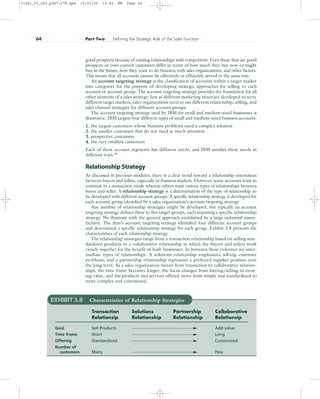
  • 123.
    firm sales. Asales forecast should be based on a given salesforce size. The addition of salespeople should increase the forecast, and the elimination of salespeople should decrease it. Despite this weakness, the breakdown method is probably the one most often used for determining salesforce size. It is best suited for relatively stable selling environments in which sales change in slow and predictable ways and no major strategic changes are planned and for organizations that use commission compensation plans and keep their fixed costs low. However, in many selling situations the costs of having too many or too few salespeople are high. More rigorous analytical tools are recommended for calculat- ing salesforce size in these situations. Workload Approach The first step in the workload approach is to determine how much selling effort is needed to cover the firm’s market adequately. Then the number of salespeople required to provide this amount of selling effort is calculated. The basic formula is Number of salespeople Total selling effort needed Average selling effort per salesperson For example, if a firm determines that 37,500 sales calls are needed in its market area and a salesperson can make an average of 500 annual sales calls, then 75 salespeople are needed to provide the desired level of selling effort: Number of salespeople 37,500/500 75 salespeople The key factor in the workload approach is the total amount of selling effort needed. Several workload methods can be used, depending on whether single factor, portfolio, or decision models were used for determining the allocation of effort to accounts. Each workload method offers a way to calculate how many sales calls to make to all accounts and prospects during any time period. When the sales call allocation strategies are summed across all accounts and prospects, the total amount of selling effort for a time period is determined. Thus, the workload approach integrates the salesforce size deci- sion with account effort allocation strategies. The workload approach is also relatively simple, although its simplicity depends on the specific method used to determine total selling effort needs. The approach is conceptu- ally sound, because salesforce size is based on selling effort needs established by account effort allocation decisions. Note, however, that we have presented the workload approach in a simplified manner here by considering only selling effort. A more realistic presentation would incorporate nonselling time considerations (e.g., travel time, planning time) in the analysis. Although incorporating these considerations does not change the basic workload concept, it does make the calculations more complex and cumbersome. The workload approach is suited for all types of selling situations. Sales organizations can adapt the basic approach to their specific situation through the method used to calculate total selling effort. The most sophisticated firms can use decision models for this purpose, whereas other firms might use portfolio models or single factor approaches. Incremental Approach The most rigorous approach for calculating salesforce size is the incremental approach. Its basic concept is to compare the marginal profit contribution with the marginal selling costs for each incremental salesperson. An example of these calcula- tions is provided in Exhibit 4.4. At 100 salespeople, marginal profits exceed marginal costs by $10,000. This relationship continues until salesforce size reaches 102. At 102 salespeople, the marginal profit equals marginal cost, and total profits are maximized. 100 Part Two Defining the Strategic Role of the Sales Function 31451_04_ch4_p079-126.qxd 15/03/05 20:26 PM Page 100
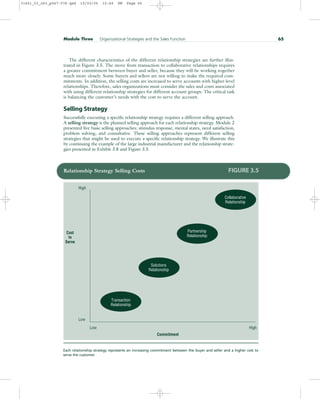
  • 124.
    If the firmadded one more salesperson, total profits would be reduced, because marginal costs would exceed marginal profits by $5,000. Thus, the optimal salesforce size for this example is 102. The major advantage of the incremental approach is that it quantifies the important relationships between salesforce size, sales, and costs, making it possible to assess the potential sales and profit impacts of different salesforce sizes. It forces management to view the salesforce size decision as one that affects both the level of sales that can be gen- erated and the costs associated with producing each sales level. The incremental method is, however, somewhat difficult to develop. Relatively com- plex response functions must be formulated to predict sales at different salesforce sizes (sales f [salesforce size]). Developing these response functions requires either histor- ical data or management judgment. Thus, the incremental approach cannot be used for new salesforces where historical data and accurate judgments are not possible. Turnover All the analytical tools incorporate various elements of sales and costs in their calcula- tions. Therefore, they directly address productivity issues but do not directly consider turnover in the salesforce size calculations. When turnover considerations are important, management should adjust the recommended salesforce size produced by any of the analytical methods to reflect expected turnover rates. For example, if an analytical tool recommended a salesforce size of 100 for a firm that experiences 20 percent annual turnover, the effective salesforce size should be adjusted to 120. Recruiting, selecting, and training plans should be based on the 120 salesforce size. Failure to incorporate anticipated salesforce turnover into salesforce size calculations can be costly. Evidence suggests that many firms may lose as much as 10 percent in sales productivity due to the loss in sales from vacant territories or low initial sales when a new salesperson is assigned to a territory. Thus, the sooner that sales managers can replace salespeople and get them productive in their territories, the less loss in sales within the territory. Outsourcing the Salesforce The salesforce size decisions we have been discussing apply directly to an ongoing com- pany salesforce. However, there may be situations where a company needs salespeople quickly, for short periods of time, for smaller customers, or for other reasons, but does not want to hire additional salespeople. An attractive option is to outsource the salesforce. A growing number of companies can provide salespeople to a firm on a contract basis. These salespeople only represent the firm and customers are typically not aware that these are contracted salespeople. Contracts can vary as to length, customer assignment, and other relevant factors. This gives the client firm a great deal of flexibility. The situation at GE Medical Systems is illustrative. Salespeople at GE Medical Systems called on hospitals with 100 or more beds in major metropolitan areas. This left the market for smaller hospitals in rural areas to competitors. GE decided it needed pur- sue these smaller markets, but did not want to hire additional salespeople or to have existing salespeople take time away from their large customers. So, GE contracted with a firm to provide seven salespeople experienced in capital equipment sales to serve the Module Four Sales Organization Structure and Salesforce Deployment 101 Incremental Approach EXHIBIT 4.4 Number of Marginal Salesperson Marginal Salespeople Profit Contribution Salesperson Cost 100 $85,000 $75,000 101 $80,000 $75,000 102 $75,000 $75,000 103 $70,000 $75,000 31451_04_ch4_p079-126.qxd 15/03/05 20:26 PM Page 101
  • 125.
    smaller markets. Thesalespeople were hired, trained on GE products, and in the field within three months. These contracted reps grew annual GE sales in the smaller markets to $260 million within five years. The results were so spectacular that GE has renewed the outsourcing contract and continues to use the contracted salespeople.17 Designing Territories As discussed earlier, the size of a salesforce determines the total amount of selling effort that a firm has available to generate sales from accounts and prospects. The effective use of this selling effort often requires that sales territories be developed and each sales- person be assigned to a specific territory. A territory consists of whatever specific accounts are assigned to a specific salesperson. The overall objective is to ensure that all accounts are assigned salesperson responsibility and that each salesperson can adequately cover the assigned accounts. Although territories are often defined by geographic area (e.g., the Oklahoma territory, the Tennessee territory), the key compo- nents of a territory are the accounts within the specified geographic area. The territory can be viewed as the work unit for a salesperson. The salesperson is largely responsible for the selling activities performed and the performance achieved in a territory. Salesperson compensation and success are normally a direct function of territory performance; thus, the design of territories is extremely important to the indi- vidual salespeople of a firm as well as to management. An example of trying to balance company and salesperson needs is presented in ā€œSales Management in the 21st Century: Designing Sales Territories.ā€ Territory Considerations The critical territory considerations are illustrated in Exhibit 4.5.18 In this example, Andy and Sally are salespeople for a consumer durable goods manufacturer. They have each been assigned a geographic territory consisting of several trading areas. The exhibit compares the percentage of their time currently spent in each trading area with the percentages recommended from a decision model analysis. A review of the information provided in the exhibit highlights territory design problems from the perspective of the firm and of each salesperson. The current territory design does not provide proper selling coverage of the trading areas. The decision model analysis suggests that the trading areas in Andy’s territory should require only 36 percent of his time, yet he is spending all his time there. Clearly, the firm is wasting expensive selling effort in Andy’s territory. The situation in Sally’s territory is just the opposite. Proper coverage of Sally’s trading areas should require more than two salespeople, yet Sally has sole responsibility for these trading areas. In this situation the firm is losing sales opportunities because of a lack of selling attention. 102 Part Two Defining the Strategic Role of the Sales Function S a l e s m a n a g e m e n t i n t h e 2 1 s t c e n t u r y Designing Sales Territories Bob LaMontagne, director of sales excellence for Brown-Forman Corporation, discusses the important factors in designing effective sales territories: Each of our salespeople is responsible for a territory defined by geographic area and assigned accounts. By law, we sell to distributors (wholesalers) who in turn sell to retail stores. Therefore, the critical driver for our territory design is the number of distributors included in a geographic area. We always start with a state. Since each state has specific laws that govern it, it is a big decision to give more than one state to a sales representative. Large states such as New York, California, and Texas are subdivided into smaller trading areas and assigned to salespeople. 31451_04_ch4_p079-126.qxd 15/03/05 20:27 PM Page 102
  • 126.
    From the firm’sperspective, the design of Andy’s and Sally’s territories limits sales and profit performance. Sales performance in Sally’s territory is much lower than it might be if more selling attention were given to her trading areas. Profit performance is low in Andy’s territory because too much selling effort is being expended in his trading areas. The firm is not achieving the level of sales and profits that might be achieved if the territories were designed to provide more productive market coverage. Thus, one key consideration in territory design is the productive deployment of selling effort with- in each territory. From the perspective of Andy and Sally, the poor territory design affects their level of motivation. Andy is frustrated. He spends much of his time making sales calls in trading areas where little potential exists for generating additional sales. Andy’s motivational level is low, and he may consider resigning from the company. By contrast, Sally’s territory has so much sales potential that she can limit her sales calls to the largest accounts or the eas- iest sales. She is not motivated to develop the potential of her territory but can merely ā€œskim the creamā€ from the best accounts. The situations facing Andy and Sally illustrate how territory design might affect salesperson motivation, morale, and even turnover. These potential effects are important considerations when designing territories. Recent research results support the example. Studies of sales managers in several countries found positive relationships between satisfaction with territory design and salesperson performance. These results are confirmed in a study of salespeople. The study concluded that salespeople who are satisfied with the design of their sales terri- tory worked harder, performed better, and were more satisfied with their job. This research provides strong evidence for the impact of sales territory design on the atti- tudes, behavior, and performance of salespeople.19 Procedure for Designing Territories A general procedure for designing territories is presented in Figure 4.17. Each step in the procedure can be performed manually or by using computer models. The procedure is illus- trated manually by using Andy’s and Sally’s territories as an example application. The basic problem is to organize the 11 trading areas into three territories that provide proper mar- ket coverage of accounts in each territory and equal performance opportunities for each Module Four Sales Organization Structure and Salesforce Deployment 103 Territory Design Example EXHIBIT 4.5 Trading Areaa Present Effort (%)b Recommended Effort (%)b Andy 1 10 4 2 60 20 3 15 7 4 5 2 5 10 3 Total 100 36 Sally 6 18 81 7 7 21 8 5 11 9 35 35 10 5 11 11 30 77 Total 100 236 aEach territory is made of up several trading areas. bThe percentage of salesperson time spent in the trading area (100% 1 salesperson). Thus, the deployment analysis suggests that Andy’s territory requires only 0.36 salespeople, whereas Sally’s territory needs 2.36 salespeople for proper coverage. 31451_04_ch4_p079-126.qxd 15/03/05 20:27 PM Page 103
  • 127.
    salesperson. Three territoriesare developed because the decision model results presented in Exhibit 4.5 indicate that two salespeople cannot adequately cover these trading areas. The data needed to design the sales territories are presented in Exhibit 4.6. Select Planning and Control Unit The first step in territory design is to select the planning and control unit that will be used in the analysis—that is, some entity that is smaller than a territory. The total mar- ket area served by a firm is divided into these planning and control units, then they are analyzed and grouped together to form territories. Examples of potential planning and control units are illustrated in Figure 4.18. In general, management should use the smallest unit feasible. However, data are often not available for small planning and control units, and the computational task becomes more complex as more units are included in the analysis. The selection of the appropriate planning and control unit therefore represents a trade-off between what is desired and what is possible under the given data or computational conditions. In our example, trad- ing areas have been selected as the planning and control unit. Analyze Opportunity of Planning and Control Unit First, determine the amount of opportunity available from each planning and control unit. Specific methods for performing these calculations will be covered in the appen- dix to Module 4. However, the most often used measure of opportunity is market potential. The market potentials for the 11 trading areas in our example are provided in Exhibit 4.6. Everything else being equal, the higher the market potential, the more opportunity is available. 104 Part Two Defining the Strategic Role of the Sales Function Finalize Territory Design Assess Territory Workload Form Initial Territories Analyze Planning and Control Unit Opportunity Select Planning and Control Unit FIGURE 4.17 Territory Design Procedure Designing territories requires a multiple-stage approach. Although most territory design approaches follow the stages presented in this figure, the methods used at each stage differ considerably, depending on the analytical tools used. EXHIBIT 4.6 Territory Design Data Trading Area Market Potential Number of Sales Calls 1 $250,000 25 2 $700,000 100 3 $350,000 35 4 $150,000 15 5 $200,000 20 6 $2,000,000 175 7 $750,000 65 8 $500,000 50 9 $1,000,000 100 10 $500,000 50 11 $1,750,000 175 31451_04_ch4_p079-126.qxd 15/03/05 20:27 PM Page 104
  • 128.
    Form Initial Territories Onceplanning and control units have been selected and opportunity evaluated, initial territories can be designed. The objective is to group the planning and control units into territories that are as equal as possible in opportunity. This step may take several itera- tions, as there are probably a number of feasible territory designs. It is also unlikely that any design will achieve complete equality of opportunity. The best approach is to design several territory arrangements and evaluate each alternative. Each alternative must be feasible in that planning and control units grouped together are contiguous. This can be a cumbersome task when done manually but is much more efficient when computer modeling approaches are used. Two alternative territory designs for our example are presented and evaluated in Exhibit 4.7. Although the first design is feasible, the territories are markedly unequal in opportunity. However, a few adjustments produce reasonably equal territories. Module Four Sales Organization Structure and Salesforce Deployment 105 Accounts ZIP Codes Cities Metro- politan Areas Trading Areas Counties States Potential Planning and Control Units FIGURE 4.18 Planning and control units represent the unit of analysis for territory design. Accounts are the preferred planning and control unit. However, often it is not possible to use them as such, in which case a more aggregate type of planning and control unit is used. Initial Territory Design EXHIBIT 4.7 Alternative 1 Alternative 2 Trading Area Market Potential Trading Area Market Potential Territory 1 1 $ 250,000 1 $ 250,000 2 700,000 2 700,000 3 350,000 5 200,000 4 150,000 8 500,000 5 200,000 9 1,000,000 $1,650,000 $2,650,000 Territory 2 6 $2,000,000 6 $2,000,000 7 750,000 7 750,000 8 500,000 $2,750,000 $3,250,000 Territory 3 9 $1,000,000 3 $ 350,000 10 500,000 4 150,000 11 1,750,000 10 500,000 $3,250,000 11 1,750,000 $2,750,000 31451_04_ch4_p079-126.qxd 15/03/05 20:27 PM Page 105
  • 129.
    Assess Territory Workloads Thepreceding step produces territories of nearly equal opportunity. It may, however, take more work to realize this opportunity in some territories than in others. Therefore, the workload of each territory should be evaluated by (1) the number of sales calls required to cover the accounts in the territory, (2) the amount of travel time in the territory, (3) the total number of accounts, and (4) any other factors that measure the amount of work required by a salesperson assigned to the territory. In our example, workload for each trading area and territory is evaluated by the number of sales calls required. This information is presented in Exhibit 4.8. Finalize Territory Design The final step is to adjust the initial territories to achieve equal workloads for each sales- person. The objective is to achieve the best possible balance between equal opportunity and equal workload for each territory. Typically, both of these objectives cannot be completely achieved, so management must decide on the best trade-offs for its situation. Any inequalities in the final territories can be addressed when quotas are established as discussed in Module 10. Achieving workload and opportunity balance for our example is illustrated in Exhibit 4.9. The equal opportunity territories resulted in somewhat unequal workloads (see Exhibit 4.8). The final territory design moved trading area 7 to territory 1 and trading area 2 to territory 2. This produces territories that are reasonably equal in both opportunity and workload. Performing territory design analyses manually is difficult and time consuming. Fortunately, advances in computer hardware and software make it possible to consider multiple factors and rapidly evaluate many alternatives when designing territories. Assigning Salespeople to Territories Once territories have been designed, salespeople must be assigned to them. Salespeople are not equal in abilities and will perform differently with different types of accounts or prospects. Some sales managers consider their salespeople to be either farmers or hunters. Farmers are effective with existing accounts but do not perform well in establishing busi- ness with new accounts. Hunters excel in establishing new accounts but do not fully 106 Part Two Defining the Strategic Role of the Sales Function EXHIBIT 4.8 Workload Evaluations Trading Area Sales Calls Territory 1 1 25 2 100 5 20 8 50 9 100 295 Territory 2 6 175 7 65 240 Territory 3 3 35 4 15 10 50 11 175 275 31451_04_ch4_p079-126.qxd 15/03/05 20:27 PM Page 106
  • 130.
    develop existing accounts.Based on these categories, farmers should be assigned to territories that contain many ongoing account relationships, and hunters should be assigned to territories in new or less-developed market areas. Using Technology We have taken you through the territory design process manually so that you under- stand what is involved in each step. Many sales organizations still perform this process manually using maps, grease pencils, and calculators. There are, however, several soft- ware programs that automate the process. Most of these programs make it easy to design potential territories, print maps, and compare opportunity and workload. Then, changes can be made easily and new maps and comparisons produced quickly. This allows sales managers to evaluate many possible territory designs and to assess the impact of territory design changes easily. Examples of available software include Sales Territory Configurator (www.rochestergroup.com), TacticianĀ® (www.tactician.com), and TerrAlign (www.terralign.com). ā€œPEOPLEā€ CONSIDERATIONS Our discussion of salesforce deployment decisions has, to this point, focused entirely on analytical approaches. This analytical orientation emphasizes objective sales and cost con- siderations in evaluating different allocations of sales calls to accounts, different salesforce sizes, different territory designs, and different assignments of salespeople to territories. Although such analytical approaches are valuable and should be used by sales managers, final deployment decisions should also be based on ā€œpeopleā€ considerations. These ā€œpeo- pleā€ considerations can produce some problems as presented in ā€œAn Ethical Dilemma.ā€ Statistics are numbers, whereas sales managers, salespeople, and customers are people. Analysis of statistical data provides useful but incomplete information for deployment decisions. Models are only representations of reality, and no matter how complex, no model can incorporate all the people factors that are important in any salesforce deploy- ment decision. Accordingly, while using the appropriate analytical approaches, sales man- agers should temper the analytical results with people considerations before making final deployment decisions. Module Four Sales Organization Structure and Salesforce Deployment 107 Final Territory Design EXHIBIT 4.9 Trading Area Market Potential Sales Calls Territory 1 1 $250,000 25 5 200,000 20 7 750,000 65 8 500,000 50 9 1,000,000 100 $2,700,000 260 Territory 2 2 $700,000 100 6 2,000,000 175 $2,700,000 275 Territory 3 3 $350,000 35 4 150,000 15 10 500,000 50 11 1,750,000 175 $2,750,000 275 31451_04_ch4_p079-126.qxd 15/03/05 20:27 PM Page 107
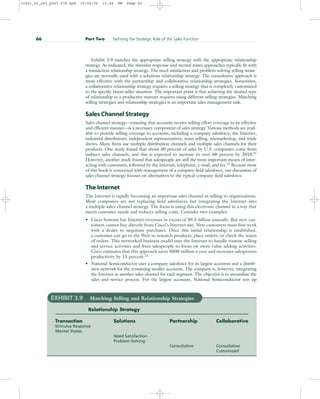
  • 131.
    What are theimportant people considerations in salesforce deployment? The most important ones concern personal relationships between salespeople and customers and between salespeople and the sales organization. Consider the allocation of selling effort to accounts. The analytical approaches for making this decision produce a recommended number of sales calls to each account based on some assessment of expected sales and costs for different sales call levels. Although these approaches may incorporate a number of factors in developing the recommended sales call levels, there is no way that any ana- lytical approach can use the detailed knowledge that a salesperson has about the unique needs of individual accounts. Therefore, an analytical approach may suggest that sales calls should be increased or decreased to a specific account, whereas the salesperson serv- ing this account may know that the account will react adversely to any changes in sales call coverage. In this situation, a sales manager would be wise to ignore the analytical rec- ommendation and not change sales call coverage to the account, because of the existing relationship between the salesperson and customer. Salesforce size decisions also require consideration of people issues. A decision to reduce the size of a salesforce means that some salespeople will have to be removed from the salesforce. How this reduction is accomplished can affect the relationship between salespeople and the sales organization. Achieving this reduction through attri- tion or offering salespeople other positions is typically a better approach than merely firing salespeople. Increasing salesforce size means that the new salespeople must be assigned to territories. Consequently, some accounts will find themselves being served by new salespeople. These changes in assignment can have a devastating effect on the existing customer-salesperson relationship. Not only should that relationship be considered but also the issue of fairness in taking accounts from one salesperson and assigning them to another. The situation can be a delicate one, requiring careful judgment as to how these people considerations should be balanced against analytical results. In sum, sales managers should integrate the results from salesforce deployment analysis with people considerations before implementing changes in sales call allocation, salesforce size, or territory design. A good rule of thumb is to make salesforce deployment changes that are likely to have the least disruptive effect on existing personal relationships. 108 Part Two Defining the Strategic Role of the Sales Function Business is booming at Lunsford Electronics. The economy is growing and new electronic prod- ucts are being introduced on a regular basis. The company has decided to add one salesperson to each district. The southeastern district manager, Terry Bearden, will now have 10 salespeople to cover all accounts and prospects in the district. He has spent days examining alternative sales territory designs and thinks one option is best for the com- pany and fair to all salespeople. However, he is considering another option that would give Cathy Swift a better territory and Fred Mangold a poor- er one. Terry has always liked Cathy and thinks the better territory will help improve her sales. Fred has been a star performer for years and doesn’t mind telling everyone how much money he makes. Terry thinks Fred will still perform well in the new territory and maybe this will eliminate some of his ā€œbragging.ā€ Which territory design should Terry decide to use? Why? a n e t h i c a l d i l e m m a 31451_04_ch4_p079-126.qxd 15/03/05 20:27 PM Page 108
  • 132.
    SUMMARY 1. Define theconcepts of specialization, centralization, span of control versus man- agement levels, and line versus staff positions. Specialization refers to the division of labor such that salespeople or sales managers concentrate on performing certain activities to the exclusion of others. Centralization refers to where in the organization decision-making responsibility exists. Centralized organizations locate decision- making responsibility at higher organizational levels than decentralized organizations. Any sales organization structure can be evaluated in terms of the types and degrees of specialization and centralization afforded by the structure. Sales management organi- zation design also requires decisions concerning the number of management levels, spans of control, and line versus staff positions. In general, more management levels result in smaller spans of control and more staff positions result in more sales manage- ment specialization. 2. Describe the ways salesforces might be specialized. A critical decision in designing the sales organization is determining whether the salesforce should be specialized and, if so, the appropriate type of specialization. The basic types of salesforce specialization are geographic, product, market (including major account organization), and functional. The appropriate type of specialization depends on the characteristics of the selling situation. Important selling situation characteristics include the similarity of customer needs, the complexity of the firm’s product offering, the market environment, and the professionalism of the salesforce. Specific criteria of importance are affordability and payout, credibility and coverage, and flexibility. The use of different types and levels of specialization typically requires the establishment of separate salesforces. 3. Evaluate the advantages and disadvantages of sales organization structures. Because each type of sales organization structure has certain advantages and disadvantages, many firms use hybrid structures that combine the features of several types. Usually, the strengths of one structure are weaknesses in other structures. 4. Name the important considerations in organizing major account management programs. Identifying major accounts (which should be both large and complex) and organizing for coverage of them are the important considerations in major account management. 5. Explain how to determine the appropriate sales organization structure for a given selling situation. There is no one best way to structure a sales organization. The appropriate way to organize a salesforce and sales management depends on certain characteristics of a particular selling situation. Also, because the sales organi- zation structure decision is dynamic, it must be adapted to changes in a firm’s selling situation that occur over time. 6. Discuss salesforce deployment. Salesforce deployment decisions entail allocating selling effort, determining salesforce size, and designing territories. These decisions are highly interrelated and should be addressed in an integrated, sequential manner. Improvements in salesforce deployment can produce substantial increases in sales and profits. 7. Explain three analytical approaches for determining allocation of selling effort. Single factor, portfolio, and decision models can be used as analytical tools to determine appropriate selling effort allocations. The approaches differ in terms of analytical rigor and ease of development and use. Sales organizations should use the approach that best fits their particular selling situation. Module Four Sales Organization Structure and Salesforce Deployment 109 31451_04_ch4_p079-126.qxd 15/03/05 20:27 PM Page 109
  • 133.
    8. Describe threemethods for calculating salesforce size. The breakdown method for calculating salesforce size is the easiest to use but the weakest conceptually. It uses the expected level of sales to determine the number of salespeople. The work- load approach is sounder conceptually, because it bases the salesforce size decision on the amount of selling effort needed to cover the market appropriately. The incremental method is the best approach, although it is often difficult to develop. It examines the marginal sales and costs associated with different salesforce sizes. 9. Explain the importance of sales territories from the perspective of the sales organization and from the perspective of the salespeople, and list the steps in the territory design process. Territories are assignments of accounts to salespeo- ple. Each becomes the work unit for a salesperson, who is largely responsible for the performance of the assigned territory. Poorly designed territories can have adverse effects on the motivation of salespeople. From the perspective of the firm, territory design decisions should ensure that the firm’s market area is adequately covered in a productive manner. The first step in the territory design process is to identify plan- ning and control units. Next, the opportunity available from each planning and control unit is determined, initial territories are formed, and the workloads of each potential territory are assessed. The final territory design represents management’s judgment concerning the best balance between opportunity and workload. 10. Discuss the important ā€œpeopleā€ considerations in salesforce deployment. Although analytical approaches provide useful input for salesforce deployment deci- sions, they do not address people considerations adequately. Sales managers should always consider existing relationships between salespeople and customers and between salespeople and the sales organization before making salesforce deploy- ment changes. Many of these people considerations have ethical consequences. UNDERSTANDING SALES MANAGEMENT TERMS specialization centralization span of control management levels line sales management staff sales management geographic specialization product specialization market specialization functional specialization major account organization national account management (NAM) DEVELOPING SALES MANAGEMENT KNOWLEDGE 1. Discuss the situational factors that suggest the need for specialization and centraliza- tion. Provide a specific example of each factor discussed. 2. Why do you think there is a trend toward more salesforce specialization? 3. What are the advantages and disadvantages of structuring a sales organization for major account management? 4. What are some problems that a firm might face when undertaking a major restruc- turing of its sales organization? 5. What are the important relationships between span of control, management levels, line positions, staff positions, specialization, and centralization? 110 Part Two Defining the Strategic Role of the Sales Function global account management (GAM) hybrid sales organization salesforce deployment single factor models portfolio models decision models sales productivity breakdown approach workload approach incremental approach territory planning and control unit 31451_04_ch4_p079-126.qxd 15/03/05 20:27 PM Page 110
  • 134.
    6. How aresalesforce deployment decisions related to decisions on sales organization structure? 7. How can the incremental method be used to determine the number of salespeople to assign to a sales district? 8. How are salesforce size decisions different for firms with one generalized salesforce versus firms with several specialized salesforces? 9. How can computer modeling assist sales managers in designing territories? 10. Should firms always try to design equal territories? Why or why not? BUILDING SALES MANAGEMENT SKILLS 1. Assume that you are the national sales manager for Replica Inc., a manufacturer and marketer of photocopy equipment and supplies. The firm’s products are sold both nationally and internationally by a salesforce of 5,000. Replica sells to accounts of various sizes across several industries. Prepare a proposal that illustrates your recom- mended sales organization structure. Be sure to justify your recommended structure. 2. As an organization, your university has a specified structure. Identify this structure (draw it or obtain a copy of it). How specialized is this structure? What is its degree of centralization? What does the span of control look like and how appropriate is it? How many levels of management exist? Is this enough or too much? What are the relationships between line and staff positions? Are they appropriate? Assuming you would like the university to run as efficiently and effectively as possible, what changes would you recommend making to this structure and why? If no changes are recom- mended, why not? 3. Using the following information, calculate the total salesforce size necessary by using each of the following approaches: breakdown, workload, and incremental. (Your answers may vary because each piece of information does not apply to the same com- pany.) Be sure to show your work. Also, explain the advantages and disadvantages of each approach. Which approach would you recommend using to determine sales- force size? Why? • Sales of $80 million are forecast for next year. • Fifteen thousand calls are needed in the market area to be covered. • Salespeople generate an average of $2 million in annual sales. • A salesperson can make an average of 500 annual sales calls. • Marginal salesperson cost is $65,000. With 88 salespeople, the marginal salesper- son profit contribution is $75,000. This profit contribution decreases by $5,000 with each additional salesperson added to the base of 88 salespeople. Marginal salesperson cost remains constant. • Turnover is 10 percent annually. 4. Situation: Read the Ethical Dilemma on page 81. Characters: Mary Swenson, district manager; Fred Williams, salesperson Scene: Location—Mary Swenson’s office. Action—Role play a meeting between Mary Swenson and Fred Williams concerning possible exces- sive gift-giving by Fred Williams to get new accounts. Module Four Sales Organization Structure and Salesforce Deployment 111 PROD. NO SCENE TAKE ROLL SOUND DATE PROD CO. DIRECTOR CAMERAMAN ROLE PLAY 31451_04_ch4_p079-126.qxd 15/03/05 20:27 PM Page 111
  • 135.
    Case 4.1: ProtekPackaging,Inc. Background Protek Packaging, Inc. (PPI) is a national manufac- turer of a wide variety of polyethylene and poly- styrene packaging products, including food and ice bags; styrofoam egg cartons, meat trays, and food service products; laundry and dry cleaning packag- ing; trash bags; construction film and plastic ship- ping pallets. PPI is a strong competitor in all of its product lines. Not an innovative company, PPI leverages its large manufacturing capacity to drive its costs down, which allows the company to sell its products at highly attractive price levels. PPI operates five regional offices: Atlanta, New York, Chicago, Dallas, and Los Angeles. These offices are located at manufacturing plants that serve each region. PPI is organized by product line, with each product line run by a regional prod- uct manager and a regional sales manager. Eight to 10 sales representatives report to each of the five regional sales managers. The product managers and sales managers in each region report to a regional marketing manager. The key products and customers for each product line are shown in Exhibit 4.10. Current Situation John Lovett, Western Region marketing manager, has called his four sales managers and four product managers to Los Angeles to discuss alternative approaches to organizing the PPI salesforce. Thirty days earlier, Lovett and his managers had hosted a key customer roundtable at the annual meeting of the Plastics Packaging Manufacturers’ Association. Lovett was troubled by several themes that emerged from the roundtable. Some of the most influential paper and plastic distributors are disturbed by the fact that PPI sells to grocery chains, garment man- ufacturers, egg packers/processors, and uniform rental companies on a direct basis. This is puzzling to Lovett, since PPI has always sold through dis- tributors when feasible. Further, distributors are informed before stocking PPI products that if end- users meet certain sales volume requirements and request that they be sold on a direct basis, PPI will sell direct rather than risk losing the business. Lovett is also concerned that many of the grocery chain buyers and paper and plastic distributors com- plained about the amount of time it takes for them to see several PPI salespeople. These customers wanted to deal with a single PPI representative, not one from 112 Part Two Defining the Strategic Role of the Sales Function MAKING SALES MANAGEMENT DECISIONS EXHIBIT 4.10 PPI Product Lines and Key Customer Types Product Line Key Products Key Customer Types Food Packaging Produce bags Grocery chains Food co-ops Paper and plastic distributors Foam meat trays Grocery chains Meat and poultry processors Food co-ops Paper and plastic distributors Institutional Trash bags Paper and plastic distributors Restaurant wholesalers Janitorial wholesalers Food service Restaurant wholesalers (plastic plates, bowls) Grocery store delis Institutional food wholesalers Paper and plastic distributors Agricultural Egg cartons Grocery chains Egg packers/processors Garment Poly bags Laundries and dry cleaners Uniform rental companies Garment manufacturers Paper and plastic distributors 31451_04_ch4_p079-126.qxd 15/03/05 20:27 PM Page 112
  • 136.
    each product line.An additional concern was that PPI did not allow aggregation of products across product lines to make it easier for these buyers to achieve the maximum quantity discounts. To prepare for the meeting, John Lovett asked each product manager/sales manager team to come ready to discuss these issues: 1. Is it time for PPI to reconsider its salesforce organization by product line? 2. What are the advantages and disadvantages of organizing the PPI salesforce by product line? 3. What are the advantages and disadvantages of developing a new sales organization for the Western Region that would organize according to these customer types: (a) grocery chains and food co-ops; (b) distributors, including paper and plastic distributors, restaurant wholesalers, institutional food wholesalers, and janitorial wholesalers; and (c) end users, including meat and poultry processors, grocery store delis, egg packers/processors, laundries and dry cleaners, uniform rental companies, and garment manu- facturers? Assume you are the sales manager for the food packaging product line. Address the preceding questions as if you will attend the upcoming meet- ing. In addition, outline your thoughts on other alternatives for organizing the salesforce. Situation: Read Case 4.1. Characters: John Lovett, Western Region marketing manager; sales manager for food packing product line; one or more other product/sales managers Scene 1: Location—Lovett’s office. Action— Role play between Lovett and sales manager for food packing product line discussing the advantages and dis- advantages of a salesforce organized by product line. Scene 2: Location—Meeting room. Action— Role play meeting with Lovett and all product/sales managers, discussing the advantages and disadvantages of differ- ent alternatives for organizing PPI’s salesforce and arriving at a decision. Case 4.2: Opti-Tax Consulting Background Opti-Tax Consulting (OTC) is a 20-year-old compa- ny, which specializes in providing small businesses with tax and financial management expertise. OTC focuses on businesses that handle significant amounts of cash in their daily operations, such as service sta- tions, bars, coffee shops, and small restaurants. OTC has three sales representatives serving the Lexington, Kentucky, metropolitan market. Dave Mason, OTC’s founder and current presi- dent, was the company’s first salesperson. When the company grew to the point that Mason had a hard time servicing all of his accounts, he added Steve Tremaine as a sales representative. Mason gave Tremaine 10 of his existing accounts and instructed him to go after potential customers not yet under con- tract with OTC. Five years later, Donna Armstrong was hired as a sales representative and added in much the same fashion. Mason and Tremaine turned over 10 accounts each to Armstrong, and she was instructed to add new customers not already doing business with OTC. Both Donna Armstrong and Steve Tremaine report directly to Dave Mason. Of OTC’s total sales volume, Dave Mason accounts for approximately half. The remainder is split almost equally between Donna Armstrong and Steve Tremaine. Armstrong and Tremaine are paid a percentage of OTC’s billings to their clients. Current Situation Mason is planning to enter semi-retirement in another year, and he has brought his son Franklin into the business. Franklin will learn the business over the next several months, then step into a sales role. Dave Mason will continue to function as sales manager and president of the company, but will give up the sales responsibilities for all of his accounts. Dave Mason is compiling information that will help him decide how to design OTC’s sales territo- ries after he gives up his sales responsibilities. He is not comfortable turning over all of his accounts to his son Franklin. Although talented and hard work- ing, Franklin is inexperienced in the financial con- sulting industry. A recent graduate of the University of Kentucky with a double major in finance and marketing, Franklin’s career goal is to become pres- ident of OTC, then expand company operations into other markets. Mason has also been contemplating the sales per- formance of Donna Armstrong and Steve Tremaine. Both had been solid, dependable performers over the years, but Tremaine had recently slowed down a bit. While his sales volume compared favorably to Armstrong’s, Tremaine was selling in a higher poten- tial sales territory. Further, he had a five-year head start on Armstrong in developing new accounts, yet Armstrong had brought in almost as much new busi- ness as had Tremaine during the past year. Mason had talked with Tremaine about the lack of sales growth in his territory but had not learned much. Tremaine Module Four Sales Organization Structure and Salesforce Deployment 113 ROLE PLAY PROD. NO SCENE TAKE ROLL SOUND DATE PROD CO. DIRECTOR CAMERAMAN 31451_04_ch4_p079-126.qxd 15/03/05 20:27 PM Page 113
  • 137.
    made no excusesand acknowledged that his sales levels had been relatively stable in recent years. He promised to try harder to bring in new business. Mason suspected that Tremaine was comfortable with his earnings and simply did not want to work a lot harder, even if he could make more money. After several weeks of analysis, Dave Mason finally had a rough draft of a new territory design policy that would go into effect in 90 days. The key points of the new policy are: 1. Half of Dave Mason’s accounts will be split between Steve Tremaine and Donna Armstrong. Dave Mason’s remaining accounts will be assigned to Franklin Mason. 2. After one year, sales territories will be redesigned so that the three territories will be comparable in terms of workload and sales potential. 3. For the current year, OTC salespeople will con- tinue to earn a commission based on OTC billings to their clients. 4. After the sales territories are redesigned in a year, the commission rate for existing clients will be reduced, and a higher commission rate will be implemented for new accounts added within the past year. Dave Mason distributed the draft plan to Donna, Steve, and Franklin. Both Donna and Steve ques- tioned the idea of assigning half of Dave’s accounts to Franklin. Steve came right to the point, saying, ā€œLook, Dave, he’s your son and he will do just fine with some seasoning. But I think he ought to start with a smaller group of accounts. He’ll learn the business a lot faster if he has to build it by adding his own accounts.ā€ Donna and Steve were also concerned that they would have some of Dave’s former accounts for a year, and then lose them to Franklin. Franklin remained neutral on these issues, and voiced neither support nor opposition to the draft plan. Questions 1. What are the implications for Donna Armstrong and Steve Tremaine if the draft plan is implemented? 2. What are the implications for OTC’s customers if the draft plan is implemented? 3. What are the pros and cons of Mason’s draft plan? 4. What changes and additions would you make to the draft plan? Situation: Read Case 4.2. Characters: Dave Mason, president; Franklin Mason, son and salesperson; Steve Tremaine, company’s first sales- person; Donna Armstrong, company’s second salesperson Scene 1: Location—Meeting room. Action— Role play discussion among Dave Mason, Franklin Mason, Steve Tremaine, and Donna Armstrong about the draft territory design plan. Scene 2: Location—Meeting room. Action— Role play discussion among Dave Mason, Franklin Mason, Steve Tremaine, and Donna Armstrong about alternatives to the draft territory design plan and a final territory design decision. 114 Part Two Defining the Strategic Role of the Sales Function ROLE PLAY PROD. NO SCENE TAKE ROLL SOUND DATE PROD CO. DIRECTOR CAMERAMAN 31451_04_ch4_p079-126.qxd 15/03/05 20:27 PM Page 114
  • 138.
    A meteorologist usedall the latest technology to predict a bright and sunny day in the mid-80s. It rained most of the day and never got warmer than 70 degrees. The weather forecast missed the mark on this particular occasion, but the mete- orologist will continue to make weather forecasts and to work on improving weather forecasting procedures. Sales managers face a situation similar to that of the meteorologist. The business environment is complex and dynamic, there are a number of forecast- ing methods available, and often forecasts are incorrect. Nevertheless, sales managers must continue to forecast and to work on improving their forecasting procedures. Why is forecasting so important to sales managers? In one sense, all sales management decisions are based on some type of forecast. The sales manager decides on a certain action because he or she thinks that it will produce a certain result. This expected result is a forecast, even though the sales manager may not have quantified it or may not have used a mathematical forecasting procedure. More specifically, forecasts provide the basis for the following sales management decisions: 1. Determining salesforce size 2. Designing territories 3. Establishing sales quotas and selling budgets 4. Determining sales compensation levels 5. Evaluating salesperson performance 6. Evaluating prospective accounts FORECASTING BY SALES MANAGERS Although top management levels are most concerned with total firm forecasts, sales managers are typically interested in developing and using forecasts for spe- cific areas, such as accounts, territories, districts, regions, and/or zones. For exam- ple, a district sales manager would be concerned with the district forecast as well as forecasts for individual territories and accounts within the district. There are, however, different types of forecasts that sales managers might use in different ways, and different approaches and methods might be used to develop these forecasts. Types of Forecasts The term forecast is ordinarily used to refer to a prediction for a future period. Although this usage is technically correct, it is too general for managerial value. As illustrated in Figure 4A.1, at least three factors must be defined when referring to a forecast: the product level, the geographic area, and the time period. The figure presents 90 different forecasts that might be made, depending on these factors. Thus, when using the term forecast, sales managers should be specific in defining exactly what is being forecast, what geographic area is being targeted, and what period is being forecast. A useful way for viewing what is being forecast is presented in Exhibit 4A.1. This exhibit suggests that it is important to differentiate between industry and firm levels and to determine whether the prediction is for the best possible 115 4 a p p e n d i x D E V E L O P I N G F O R E C A S T S 31451_04_ch4_p079-126.qxd 15/03/05 20:27 PM Page 115
  • 139.
    results or forthe expected results given a specific strategy. Four different types of fore- casts emerge from this classification scheme: 1. Market potential—the best possible level of industry sales in a given geographic area for a specific period 2. Market forecast—the expected level of industry sales given a specific industry strategy in a given geographic area for a specific period 3. Sales potential—the best possible level of firm sales in a given geographic area for a specific period 4. Sales forecast—the expected level of firm sales given a specific strategy in a given geographic area for a specific period 116 Part Two Defining the Strategic Role of the Sales Function Geographic Area Product Level Time Period Product Item Sales Product Form Sales Product Line Sales Company Sales Industry Sales World U.S.A. Region Territory Customer Long Range Medium Range Short Range FIGURE 4A.1 Defining the Forecast Many different types of forecasts are possible. Every forecast should be defined in terms of geographic area, product level, and time period. EXHIBIT 4A.1 Types of Forecasts Four different types of forecasts are typically important to sales managers, depending on whether a forecast is needed for the industry or the firm and whether the best possible or expected results are to be forecast. Best Possible Results Market Potential Sales Potential Industry Level Firm Level Expected Results for Given Strategy Market Potential Sales Potential 31451_04_ch4_p079-126.qxd 15/03/05 20:27 PM Page 116
  • 140.
    Notice that thegeographic area and period are defined for each of these terms and that a true sales forecast must include the consideration of a specific strategy. If a firm changes this strategy, the sales forecast should change also. As an example, assume that you are the district sales manager for a firm that markets microcomputers to organizational buyers. Your district includes Missouri, Kansas, Iowa, and Nebraska. You are preparing forecasts for 2006. You might first try to assess market potential. This market potential forecast would be an estimate of the highest level of microcomputer sales by all brands in your district for 2006. Then, you might try to develop a market forecast, which would be the expected level of industry microcom- puter sales in your district for 2006. This forecast would be based on an assumption of the strategies that would be used by all microcomputer firms operating in your district. If you think that new firms are going to enter the industry or that existing firms are going to leave it or change their strategies, your industry forecast will change. Another type of forecast might be a determination of the best possible level of 2006 sales for your firm’s microcomputers in the district. This would be a sales potential forecast. Finally, you would probably want to predict a specific level of district sales of your firm’s micro- computers given your firm’s expected strategy. This would result in a sales forecast that would have to be revised whenever strategic changes were made. Uses of Forecasts Because different types of forecasts convey different information, sales managers use specific types for specific sales management decisions. Forecasts of market potential and sales potential are most often used to identify opportunities and to guide the allocation of selling efforts. Market potential provides an assessment of overall demand opportu- nity available to all firms in an industry. Sales potential adjusts market potential to reflect industry competition and thus represents a better assessment of demand oppor- tunity for an individual firm. Both of these forecasts of potential can be used by sales managers to determine where selling effort is needed and how selling effort should be distributed. For example, as discussed earlier, designing territories requires an assess- ment of market potential for all planning and control units. Specific territories are then designed by grouping planning and control units together and evaluating the equality of market potential across the territories. Market forecasts and sales forecasts are used to predict the expected results from various sales management decisions. For example, once territories are designed, sales managers typically want to forecast expected industry and company sales for each spe- cific sales territory. These forecasts are then used to set sales quotas and selling budgets for specific planning periods. Top-Down and Bottom-Up Forecasting Approaches Forecasting methods can be classified in a variety of ways.1 Specific examples of two basic approaches are presented in Figure 4A.2. Top-down approaches typically consist of different methods for developing company forecasts at the business unit level. Sales managers then break down these company forecasts into zone, region, district, territory, and account forecasts. Bottom-up approaches, by contrast, consist of different methods for developing sales forecasts for individual accounts. Sales managers then combine the account forecasts into territory, district, region, zone, and company forecasts. The top- down and bottom-up approaches represent entirely different perspectives for developing forecasts, although some forecasting methods can be used in either approach. However, the focus is on the most popular forecasting methods for each approach. Top-Down Approach Implementing the top-down approach requires the development of company fore- casts and their breakdown into zone, region, district, territory, and account levels. Different methods are used to develop company forecasts and break them down to the desired levels. Module Four Sales Organization Structure and Salesforce Deployment 117 31451_04_ch4_p079-126.qxd 15/03/05 20:27 PM Page 117
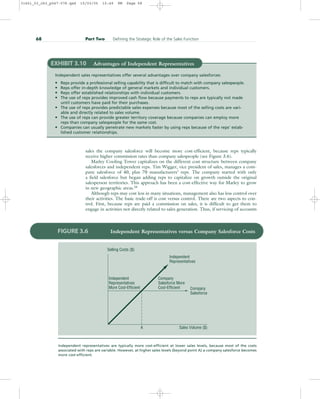
  • 141.
    Company Forecasting Methods Althougha variety of methods is available for developing company forecasts, this dis- cussion is limited to three popular time series methods: moving averages, exponential smoothing, and decomposition methods. Moving averages is a relatively simple method that develops a company forecast by calculating the average company sales for previous years. Thus, the company sales fore- cast for next year is the average of actual company sales for the past three years, past 118 Part Two Defining the Strategic Role of the Sales Function Combined into Territory Forecasts Combined into District, Region, and Zone Forecasts Company Sales Forecast Salespersons’ Forecasts of Accounts Forecast of General Economic and Business Conditions for the Country as a Whole Market Potential for Relevant Industry Sales Potential for Company as a Percentage of Industry Sales Company Sales Forecast Sales’ Managers’ Forecasts for Zones, Regions, Districts, Territories, and Accounts Factors Affecting Company’s Share of Total Industry Sales Top-Down Approach Bottom-Up Approach FIGURE 4A.2 Forecasting Approaches In top-down approaches, company personnel provide aggregate company forecasts that sales managers must break down into zone, region, district, territory, and account forecasts. In bottom-up approaches, account forecasts are com- bined into territory, district, region, zone, and company forecasts. 31451_04_ch4_p079-126.qxd 15/03/05 20:27 PM Page 118
  • 142.
    six years, orsome other number of years. An example of calculating a moving averages company sales forecast for two- and four-year time frames is presented in Exhibit 4A.2. As illustrated in this example, the moving averages method is straightforward and requires simple calculations. Management must, however, determine the appropriate number of years to include in the calculations. In addition, this method weights actual company sales for previous years equally in generating the forecast for the next year. This equal weighting may not be appropriate if company sales vary substantially from year to year or if there are major differences in the business environment between the most recent and past years. Nevertheless, one survey of managers found this to be the most popular technique for short-range and medium-range forecasts in U.S. corporations.2 Exponential smoothing is a type of moving averages method, except that company sales in the most recent year are weighted differently from company sales in past years.3 An example of the exponential smoothing method is provided in Exhibit 4A.3. A criti- cal aspect of this method involves determining the appropriate weight () for this year’s company sales. This is typically accomplished by examining different weights for histor- ical sales data to determine which weight would have generated the most accurate sales forecasts in the past. Based on the analysis in Exhibit 4A.3, management should probably use a weight of 0.8 for this year’s company sales. Module Four Sales Organization Structure and Salesforce Deployment 119 Moving Averages Example EXHIBIT 4A.2 Moving Averages Forecast Year Actual Sales Two-Year Four-Year 1998 $ 8,400,000 1999 8,820,000 2000 8,644,000 $8,610,000 2001 8,212,000 8,732,000 2002 8,622,000 8,428,000 $8,520,000 2003 9,484,000 8,418,000 8,574,000 2004 9,674,000 9,054,000 8,740,000 2005 10,060,000 9,579,000 8,998,000 2006 9,868,000 9,460,000 where Sales forecast for next year = Actual sales for past two or four years Number of years (two or four years) Exponential Smoothing Example EXHIBIT 4A.3 Sales Forecast for Next Year Year Actual Sales = 0.2 = 0.5 = 0.8 1998 $ 8,400,000 1999 8,820,000 $8,400,000 $8,400,000 $8,400,000 2000 8,644,000 8,484,000 8,610,000 8,736,000 2001 8,212,000 8,516,000 8,626,000 8,664,000 2002 8,622,000 8,456,000 8,420,000 8,302,000 2003 9,484,000 8,488,000 8,520,000 8,558,000 2004 9,674,000 8,686,000 9,002,000 9,298,000 2005 10,060,000 8,882,000 9,338,000 9,600,000 2006 9,118,000 9,698,000 9,968,000 where Sales forecast for next year = () (actual sales this year) + (1 – ) (this year’s sales forecast) 31451_04_ch4_p079-126.qxd 15/03/05 20:27 PM Page 119
  • 143.
    Decomposition methods involvedifferent procedures that break down previous company sales data into four major components: trend, cycle, seasonal, and erratic events. These components are then reincorporated to produce the sales forecast. An example of a decomposition method is presented in Exhibit 4A.4. Notice that the trend, cycle, and erratic events components are incorporated into the annual forecast but that the seasonal component is used only when forecasting sales for periods of less than a year, such as months or quarters. Decomposition methods are sound conceptu- ally but often require complex statistical approaches for breaking down the company sales data into the trend components. Once this decomposition has been completed, it is relatively easy to reincorporate the components into the development of a company forecast. Breakdown Methods Once sales managers receive a company forecast, they can use different market factor methods to break it down to the desired levels. Market factor methods typically involve identifying one or more factors that are related to sales at the zone, region, district, territory, or account levels and using these factors to break down the overall company forecast into forecasts at these levels. A typical approach is to use the Buying Power Index (BPI) supplied by Sales Marketing Management.4 The BPI is a market factor calculated for different areas in the following manner: BPI (5I 2P 3R) 10 where I Percentage of U.S. disposable personal income in the area P Percentage of U.S. population in the area R Percentage of U.S. retail sales in the area 120 Part Two Defining the Strategic Role of the Sales Function EXHIBIT 4A.4 Decomposition Method Example Assume that various analyses have decomposed previous sales data into the following components: A 5% growth in sales is predicted due to basic developments in population, capital formation, and technology (trend component). A 10% decrease in sales is expected due to a business reces- sion (cycle component). Increased tensions in the Middle East are expected to reduce sales by an additional 5% (erratic events component). Sales results are reasonably consistent throughout the year except for the fourth quarter, where sales are expected to be 25% higher than the other quarters (seasonal component). A marketer of consumer products might recombine the different components in the following manner to forecast sales for 2006: Sales in 2005 were $10,060,000. The trend component suggests that 2006 sales will be $10,563,000 ($10,060,000 1.05). However, incorporating the expected business recession represented in the cycle component changes the sales forecast to $9,506,700 ($10,563,000 0.90). The annual sales forecast is reduced to $9,031,365 when the erratic events component is introduced ($9,056,700 0.95). Quarterly sales forecasts would initially be calculated as $2,257,841 ($9,031,365 4). However, incorporating the seasonal component suggests fourth-quarter sales of $2,822,302 ($2,257,841 1.25) and sales for the other three quarters of $2,069,688 ($9,031,365 – $2,822,302 3). 31451_04_ch4_p079-126.qxd 15/03/05 20:27 PM Page 120
  • 144.
    Performing these calculationsfor any area produces a BPI for the area. This BPI can be translated as the percentage of U.S. buying power residing in the area: The higher the index, the more buying power in the area. Fortunately, Sales Marketing Management provides these calculations for areas in the United States on an annual basis. An example of the BPI data provided by Sales Marketing Management is presented in Exhibit 4A.5. BPIs and other data are available for all counties in a state and for the major cities and metropolitan areas. The information in the exhibit suggests that the BPI for the Kansas City metropolitan area is 0.6914; for Jackson County, 0.2557; and for Kansas City, Missouri, 0.1764. This means that 0.6914 percent, 0.2557 percent, and 0.1764 percent of total U.S. buying power resides in the Kansas City metro area, Jackson County, and Kansas City, Missouri, respectively. Sales managers can use the BPI data to divide the overall company forecast into more disaggregate forecasts. For example, assume that you are the Missouri district sales manager for a marketer of cosmetics. Management has used various methods to forecast total company sales in the United States of $500 million for 2006. The calculations necessary to break down this company forecast into sales forecasts for areas within your district are illustrated in Exhibit 4A.6. Using the appro- priate BPIs, you are able to forecast 2006 sales of $3,457,000, $1,278,500, and $882,000 for the Kansas City metro area, Jackson County, and Kansas City, Missouri, respectively. The BPI is an extremely useful tool for forecasting, because it is readily available and updated on an annual basis. It is most appropriate for often-purchased consumer goods because of the factors used in calculating the index for each area. Marketers of durable consumer goods or industrial products may not find the BPI sufficiently accurate for their needs. In these situations, other market factors must be identified and used. For example, Sherwood Medical uses total available hospitals requiring a specific product (based on medical procedures performed at the hospital) as a market factor for forecasting purposes.5 Another approach is for a firm to develop a buying power index for its specific situa- tion. For example, a general aviation aircraft marketer developed a buying power index for its products in each county in the United States. The basic formula was Index (5I 3AR 2P) 10 where I Percentage of U.S. disposable income in county AR Percentage of U.S. aircraft registrations in county P Percentage of U.S. registered pilots in county These calculations produced an index for each county that could be translated and used like the BPI. The firm could take U.S. forecasts provided by the industry trade associa- tion and convert them to market and sales forecasts for each county by using their cal- culated indices and market shares. The use of market factor methods is widespread in the sales management area. Indices such as the BPI or those developed by specific firms and other market factor methods can be extremely valuable forecasting tools for sales managers. These indices and market factors should be continually evaluated and improved. They can be assessed by comparing actual sales in an area to the market factor value for the area. For exam- ple, the general aviation aircraft marketer found high correlations between actual aircraft sales in a county and the county indices. This finding provided support for the use of the calculated index as an indirect forecasting tool. Module Four Sales Organization Structure and Salesforce Deployment 121 31451_04_ch4_p079-126.qxd 15/03/05 20:27 PM Page 121
  • 145.
    EXHIBIT 4A.5 BuyingPower Index (BPI) Data Effective Buying Income (EBI) Percentage of Households by EBI Group: (A) $10,000 $19,999 (B) $20,000 $34,999 (C) $35,000 $49,999 (D) $50,000 and more METRO AREA County/City COLUMBIA . . . . . . . . . . . . . . . Boone . . . . . . . . . . . . . . . . . Columbia. . . . . . . . . . . . . Suburban Total . . . . . . . . . . JOPLIN . . . . . . . . . . . . . . . . . . . Jasper . . . . . . . . . . . . . . . . . Joplin. . . . . . . . . . . . . . . . Newton . . . . . . . . . . . . . . . . Suburban Total . . . . . . . . . . KANSAS CITY . . . . . . . . . . . . . Cass . . . . . . . . . . . . . . . . . . . Clay . . . . . . . . . . . . . . . . . . . Clinton . . . . . . . . . . . . . . . . Jackson . . . . . . . . . . . . . . . . Blue Springs . . . . . . . . . . Independence. . . . . . . . . Kansas City . . . . . . . . . . . Lee’s Summit. . . . . . . . . . Lafayette. . . . . . . . . . . . . . . Platte. . . . . . . . . . . . . . . . . . Ray. . . . . . . . . . . . . . . . . . . . Johnson, Kansas . . . . . . . . . Olathe . . . . . . . . . . . . . . . Overland Park. . . . . . . . . Leavenworth, Kansas . . . . . Leavenworth. . . . . . . . . . Miami, Kansas. . . . . . . . . . . Wyandotte, Kansas . . . . . . Kansas City . . . . . . . . . . . Suburban Total . . . . . . . . . . ST. JOSEPH. . . . . . . . . . . . . . . . Andrew . . . . . . . . . . . . . . . . Buchanan . . . . . . . . . . . . . . St. Joseph . . . . . . . . . . . . Suburban Total . . . . . . . . . . Total EBI ($000) 1,992,259 1,992,259 1,241,418 750,841 1,928,856 1,270,128 601,136 658,728 1,327,720 30,987,132 1,163,582 2,978,457 260,091 11,052,639 860,954 1,919,067 7,482,105 1,190,035 474,375 1,265,415 305,948 9,979,906 1,333,636 3,314,864 1,162,130 726,671 392,606 1,951,983 1,791,288 19,653,432 1,397,897 209,843 1,188,054 1,014,905 382,992 Median Household EBI 33,873 33,873 29,645 39,208 27,823 27,079 25,413 29,348 28,931 40,963 39,979 41,735 33,954 36,936 51,044 37,782 35,483 49,815 32,757 45,520 34,906 54,758 50,929 56,241 43,140 39,967 37,473 29,202 28,711 44,951 30,847 32,952 30,476 29,567 34,530 A 16.1 16.1 18.7 11.7 20.2 20.9 22.5 18.7 19.1 12.4 13.2 11.8 18.0 14.4 7.4 15.3 14.8 9.1 17.1 9.9 15.7 6.8 7.3 6.8 10.9 12.1 15.1 18.3 18.7 10.8 18.2 16.9 18.4 19.0 15.9 B 22.4 22.4 21.0 25.0 27.1 26.9 26.6 27.6 27.4 20.7 22.2 22.1 23.2 21.6 14.4 22.3 21.7 16.3 26.2 19.8 23.5 15.7 16.9 15.5 19.7 21.5 22.3 25.9 25.5 19.6 23.7 22.7 23.8 23.4 24.3 C 18.1 18.1 15.2 23.2 18.7 18.5 16.7 18.8 19.5 19.8 22.1 22.4 19.2 19.6 21.9 21.2 19.1 18.9 20.3 21.4 22.4 18.3 20.4 17.3 21.7 21.6 20.9 19.8 19.7 20.1 19.4 21.6 19,0 18.7 21.3 D 30.4 30.4 28.3 33.9 19.2 18.2 17.5 21.4 20.1 38.4 35.3 37.9 29.3 33.1 51.6 32.9 31.6 49.8 25.9 43.9 27.5 55.5 51.3 57.2 40.2 35.4 32.7 20.6 19.9 43.6 24.2 25.3 24.1 23.0 27.9 Buying Power Index .0516 .0516 .0378 .0138 .0520 .0373 .0225 .0147 .0295 .6914 .0243 .0748 .0055 .2557 .0206 .0462 .1764 .0237 .0103 .0256 .0061 .2118 .0321 .0765 .0235 .0154 .0081 .0457 .0419 .4256 .0349 .0045 .0304 .0274 .0075 Bottom-Up Approach Implementing the bottom-up approach requires various methods to forecast sales to individual accounts and the combination of these account forecasts into territory, dis- trict, region, zone, and company forecasts. This section focuses on the survey of buyer 122 Part Two Defining the Strategic Role of the Sales Function 31451_04_ch4_p079-126.qxd 15/03/05 20:27 PM Page 122
  • 146.
    intentions, jury ofexecutive opinion, Delphi, and salesforce composite methods as used in a bottom-up approach. The survey of buyer intentions method is any procedure that asks individual accounts about their purchasing plans for a future period and translates these responses into account forecasts. The intended purchases by accounts might be obtained through mail surveys, telephone surveys, personal interviews, or other approaches. For example, at Dow Chemical’s Basic Chemical Division, salespeople provide forecast data based on customers’ business plans.6 Similarly, Hewlett-Packard Company’s major customers sup- ply its marketing centers with input concerning future needs.7 At times, forecasts based on customer intentions may be distorted due to buyers’ unwillingness to put much effort into predicting future needs. Moreover, buyers are often unwilling to reveal plans for selling a vendor’s product out of fear competitors may retaliate if they find out.8 The jury of executive opinion method involves any approach in which executives of the firm use their expert knowledge to forecast sales to individual accounts. Separate forecasts might be obtained from managers in different functional areas. These forecasts are then averaged or discussed by the managers until a consensus forecast for each account is reached. Team-based approaches such as this are believed to result in more accurate long-range industry-level forecasts than individually based approaches.9 The Delphi method is a structured type of jury of executive opinion method. The basic procedure involves selection of a panel of managers from within the firm. Each member of the panel submits anonymous forecasts for each account. These forecasts are summarized into a report that is sent to each panel member. The report presents descriptive statistics concerning the submitted forecasts with reasons for the lowest and highest forecasts. Panel members review this information and then again submit anony- mous individual forecasts. The same procedure is repeated until the forecasts for indi- vidual accounts converge into a consensus. Because this procedure involves written rather than verbal communication, such negatives as domination, undue conservatism, and argument are eliminated, while team members benefit from one another’s input.10 The salesforce composite method involves various procedures by which salespeople provide forecasts for their assigned accounts, typically on specially designed forms (see Figure 4A.3) or electronically via computer. At Ricoh Corporation, an office products manufacturer, salespeople are asked to provide a three-month rolling forecast for each product and model.11 Similarly, salespeople at Pfizer Animal Health Care are asked to forecast account sales based on their familiarity with each account’s business.12 Research results suggest that salesperson forecasts can be improved by developing detailed instruc- tions about the forecasting procedures and providing salespeople with detailed informa- tion about their accounts and feedback concerning the accuracy of previous forecasts.13 USING DIFFERENT FORECASTING APPROACHES AND METHODS This discussion of top-down and bottom-up approaches and several forecasting meth- ods is illustrative of the forecasting procedures used by many sales organizations. However, all available forecasting methods have not been introduced, and some sales Module Four Sales Organization Structure and Salesforce Deployment 123 Market Factor Calculations EXHIBIT 4A.6 Kansas City Kansas City, Metro Area Jackson County Missouri 2006 company sales forecast $500,000,000 $500,000,000 $500,000,000 BPI 0.6914% 0.2557% 0.1764% 2006 area sales forecast $ 3,457,000 $ 1,278,500 $ 882,000 31451_04_ch4_p079-126.qxd 15/03/05 20:27 PM Page 123
  • 147.
    organizations may usethe approaches and methods in different ways than discussed here. For example, some sales organizations use statistical methods, such as regression analysis, to develop sales forecasts for accounts, territories, districts, regions, zones, and/or the company. In the next section, the use of regression procedures for developing sales fore- casts as a means for establishing sales quotas is examined. The actual usage of specific forecasting methods is presented in Exhibit 4A.7. Although this study did not ask respondents their degree of usage of either the survey of buyer intentions approach or the Delphi method, previous research indicates these two approaches are fairly popular.14 Study results indicate that the bottom-up approaches are more popular than the top-down approaches. Notice the differences that exist in the frequency of usage depending on the forecast period. Because forecasting is such a difficult task and each approach and method has certain advantages and disadvantages, most firms use multiple forecasting approaches and methods. 124 Part Two Defining the Strategic Role of the Sales Function 460 2,100 470 960 3,530 Account Projected Sales by Product Group for Quarter Beginning 7/5/2006 Totals Ace Sentry Cutter Grossman Paycass American Pro 364-60 1,250 950 400 2,600 364-80 960 1,250 2,110 1,800 6,820 28B 1,400 1,930 3,330 28 160 968 1,750 364 720 1,230 5,192 Totals 5,870 5,568 4,820 364 2,920 1,230 700 21,472 – – – – – – – – – – – – – – – – – FIGURE 4A.3 Quarterly Forecasting Form for Salespeople This is an example of a form used by a firm to get salespeople to forecast sales for each account and product group. EXHIBIT 4A.7 Usage of Forecasting Methods Percentage of Firms Using Method by Forecast Period Immediate Medium Long (less than Short (6 months– (more than Forecasting Method 1 month) (1–6 months) 1 year) 1 year) Top-Down Moving average 17.7 33.5 28.3 8.7 Exponential smoothing 12.9 19.6 16.8 4.2 Decomposition 0.0 6.8 11.9 9.3 Regression 13.4 25.1 25.4 16.5 Bottom-Up Jury of executive opinion 17.5 28.9 40.1 26.2 Salesforce composite 28.6 17.5 33.1 8.7 31451_04_ch4_p079-126.qxd 15/03/05 20:27 PM Page 124
  • 148.
    Then, various approachesare used to combine the results from each method into a final forecast.15 If different approaches and methods produce similar sales forecasts, sales man- agers can be more confident in the validity of the forecast. If extremely divergent forecasts are generated from the different approaches and methods, additional analysis is required to determine the reasons for the large differences and to make the adjustments necessary to produce an accurate sales forecast. Even though firms use multiple forecasting methods, research evidence indicates that sev- eral criteria are used to select specific forecasting methods.16 The most important criterion identified in this study was the accuracy of the forecasting method. Other criteria that were considered in decreasing importance were ease of use, data requirements, cost, and famil- iarity with methods. These results suggest that the selection of forecasting methods often represents a trade-off between the accuracy of the method and the ease with which it can be implemented. Some of the more accurate forecasting methods are difficult to use and have substantial data requirements. Thus, firms may have to sacrifice some accuracy by selecting methods that they are able to readily implement. This situation is illustrated in Exhibit 4A.7, where some of the more accurate methods (e.g., decomposition) are not used by many firms. Strengths and weaknesses of each forecasting method are found in Exhibit 4A.8. Module Four Sales Organization Structure and Salesforce Deployment 125 Strengths and Weaknesses of Forecasting Methods EXHIBIT 4A.8 Technique Strengths Weaknesses Moving averages Well suited to situations in which sales forecasts are needed for a large number of products Good for products with fairly stable sales Smoothes out small random fluc- tuations Can compensate to some degree for trend if double moving aver- age model is used Fairly simple to understand and use Provides more weight to recent data points Requires little data storage Generally accessible software packages are available Fairly good accuracy for short-term forecasts Simple to understand Included in most computer packages Acknowledges three key factors affecting sales—trend, seasonal, cycles Breaks past sales into component parts making it easier to under- stand the sales pattern Requires a large amount of historical data Adjusts slowly to changes in sales Assigns equal weight to each period, ignoring the fact that more recent periods usually have more impact on future sales Results cannot be tested statistically Much searching may be needed to find appropriate weight Poor for medium- and long-term forecasts Erroneous forecasts can result due to large random fluctuations in recent data Requires a large amount of past data Does not lend itself to longer- range forecasts Does not lend itself to statistical analysis of forecast values (no confidence limits or tests of significance) Exponential smoothing Decomposition method (continued) 31451_04_ch4_p079-126.qxd 15/03/05 20:27 PM Page 125
  • 149.
    126 Part TwoDefining the Strategic Role of the Sales Function EXHIBIT 4A.8 Strengths and Weaknesses of Forecasting Methods—continued Technique Strengths Weaknesses Forecasts are based on customers’ buying plans Contacts with customers can also provide feedback about possible problems with the firm’s products Relatively inexpensive if only a few key customers need to be contacted Provides input from the firm’s key functional areas Executives usually have a solid understanding of broad-based fac- tors and how they affect sales Can provide fairly quick forecasts Eliminates the need for committee or group meetings Eliminates group decision-making pitfalls, such as specious persua- sion or a bandwagon effect Participants receive input from other ā€œexpertsā€ in an isolated environment Allows for voicing of unusual opinions and anonymous mind changing Proper facilities (e-mail) enable rapid exchange of ideas Uses input from persons closest to actual markets Provides reasonably detailed fore- casts (by product, customer, or territory) May enhance salesforce morale by letting their input guide decisions Intentions frequently do not culminate in actual purchases Some firms may not be willing to disclose buying intentions, especially if they are not regular customers May require excessive amounts of executives’ time Executives removed from the mar- ketplace may not understand the firm’s sales situation Not well suited to firms with a large number of products One or two influential people may dominate the process Participants are often selected more on their willingness to partic- ipate and their accessibility than on their real knowledge or repre- sentativeness Can take a great deal of time to arrive at a consensus. Process may suffer because of high dropout rate of participants Salespeople may underestimate sales when their forecasts are being used to set sales quotas Can take excessive amounts of salespeople’s time if done too often Salespeople often lack the knowl- edge to evaluate the economic situation and how it might affect future sales Salesforce composite Delphi method Jury of executive opinion Survey of buyer intentions 31451_04_ch4_p079-126.qxd 15/03/05 20:27 PM Page 126
  • 150.
    P a rt 3 Developing the Salesforce The two modules in Part Three concentrate on the development of a produc- tive salesforce. In Module 5, we review the process of staffing the salesforce through recruitment and selection. Standard recruitment and selection tools such as advertising, job interviews, and tests are discussed. Legal and ethical issues are also raised, and the topic of salesforce socialization is introduced. Module 6 focuses on the continual development of salespeople through sales training. A model of the sales training process provides a framework for discussing needs assessment; training objectives; alternatives for training; and the design, performance, and evaluation of sales training. 127 31451_05_ch5_p127-158.qxd 15/03/05 16:09 PM Page 127
  • 151.
  • 152.
    NEW HIRING STRATEGYAT INFORMATION GRAPHICS GROUP ALLOWS THEM TO BRING ABOARD THE BEST A change in business strategy may impact the approach taken in the recruitment and selection process. Consequently, companies such as Information Graphics have responded by implementing a new hiring strategy that allows them to best meet their needs. Information Graphics Group, located in Scottsdale, Arizona, had typically performed well when hiring. However, growth opportunities in new markets prompted a change in hiring strategy to add a few rising stars to its salesforce. Sales applicants at Information Graphics Group were put through a comprehen- sive selection process. To better understand how sales applicants think, Ron Loback, vice president of sales, decided to change his interviewing format. Rather than the standard interview questions, he asked more ā€œWhat would you do?ā€ type questions and scenarios. Those who made it through the interview process then spent a full day with two of the company’s top salespeople, where they were required to sell them on themselves. Candidates also had to complete presentations and partic- ipate in role plays. In addition, candidates were taken to lunch, sometimes with customers, to see how they responded in social situations. Finally, Ron and his top salespeople reviewed the candidates’ performance and decided on the ā€œwinners.ā€ The approach has paid dividends. According to Loback, ā€œThanks to our new additions, we’re now making big strides in those growing markets—and looking at a huge year ahead.ā€ After completing this module, you should be able to 1 Explain the critical role of recruitment and selection in building and maintain- ing a productive salesforce. 2 Describe how recruitment and selection affect sales- force socialization and performance. 3 Identify the key activities in planning and executing a program for salesforce recruitment and selection. 4 Discuss the legal and ethical considerations in salesforce recruitment and selection. Source: Ron Loback, ā€œOur Revamped Hiring Strategy Brought the Best Salespeople Aboard,ā€ What’s Working in Sales Management 11 (March 29, 2004): 5. 129 5 M o d u l e S T A F F I N G T H E S A L E S F O R C E : R E C R U I T M E N T A N D S E L E C T I O N Objectives As illustrated in the opening vignette of Information Graphics Group, the recruitment and selection process can be a comprehensive and time-consuming endeavor. However, investing the necessary resources to hire the right people is essential. Recruiting and selecting those best qualified for a position can make the difference between a firm’s long-run ultimate success and failure. Although many factors influence sales performance, sales managers cannot survive without doing a competent job in recruiting and selecting salespeople. The vital and complex nature of the job is summarized by Munson and Spivey: The process is complicated by various conflicting factors—the need to select applicants with characteristics related to job success, the diffi- culty of determining these characteristics, inadequacies inherent in the various selection techniques themselves, and the need to simultane- ously insure that the selection process satisfies existing governmental regulations pertaining to discrimination in hiring practices.1 Today, the recruitment and selection process must be adjusted to the demo- graphics of an older salesforce with a higher proportion of women and minori- ties than in the past. The number of Asians, Hispanics, and African-Americans in the United States is projected to continue to grow.2 Sales managers also face challenges associated with staffing an international salesforce, as well as with 31451_05_ch5_p127-158.qxd 15/03/05 16:09 PM Page 129
  • 153.
    recruiting and selectingfor team selling. Proper staffing of the salesforce is critical given the strong impact of the recruiting process on a firm’s performance and profits.3 Today’s sales manager’s role in recruitment and selection is explored in this module. Before examining a basic model of the process, let’s discuss further the importance of recruitment and selection. IMPORTANCE OF RECRUITMENT AND SELECTION In most sales organizations, sales managers with direct supervisory responsibilities for salespeople have the primary responsibility for recruitment and selection. They may have the support of top management or coordinate their efforts with human resource personnel or other managers within the firm, but it is the sales manager who generally retains primary recruitment and selection responsibilities. To emphasize the importance of recruitment and selection, consider a few of the problems associated with inadequate implementation: 1. Inadequate sales coverage and lack of customer follow-up 2. Increased training costs to overcome deficiencies 3. More supervisory problems 4. Higher turnover rates 5. Difficulty in establishing enduring relationships with customers 6. Suboptimal total salesforce performance Clearly, salesforce performance will suffer if recruitment and selection are poorly executed. Other sales management functions become more burdensome when the sales manager is handicapped by a multitude of ā€œbad hires.ā€ The full costs of unsuccessful recruitment and selection are probably impossible to estimate. In addition to sales trainee salaries; advertising fees; screening, interviewing, and assessment costs; and employment agency fees, among others, there are hidden costs associated with salesforce turnover, such as the loss of the relationships that salespeople build with their customers over time and increased managerial problems that defy calculation. It is estimated that it costs anywhere from 50 to 150 percent of an employee’s salary to replace that person.4 Federated Insurance estimates that it invests $150,000 in each new recruit before the rep is placed in his or her own territory.5 For a bad hire, such an investment represents sunk costs that may be nonrecoverable. And in view of studies that tell us that a significant number of salespeople should not be in sales for one reason or another,6 it is apparent that recruitment and selec- tion are among the most challenging and important responsibilities of sales management. INTRODUCTION TO SALESFORCE SOCIALIZATION Salesforce socialization refers to the process by which salespeople acquire the knowledge, skills, and values essential to perform their jobs. The process begins when the sales recruit is first exposed to the organization and may extend for several years. A model of salesforce socialization is shown in Figure 5.1. This model suggests that important job outcomes such as job satisfaction, job involvement and commitment, and performance are directly and indirectly affected by recruitment and selection procedures. The socialization process is discussed again in subsequent modules. For now, accept the idea that socialization affects salesforce performance and that recruitment and selec- tion procedures play a major role in the socialization process. The two stages of social- ization relevant to recruitment and selection are (1) achieving realism, which is giving the recruit an accurate portrayal of the job and (2) achieving congruence, which is matching the capabilities of the recruit with the needs of the organization. Realism can be achieved by providing accurate job descriptions and perhaps offering a job preview through a field visit with a salesperson. Congruence can be achieved through proper screening and selection of candidates who fit the job and the organization. From the candidates’ perspective, they are more likely to choose an organization if they perceive 130 Part Three Developing the Salesforce 31451_05_ch5_p127-158.qxd 15/03/05 16:09 PM Page 130
  • 154.
    its goals andvalues to be congruent with theirs.7 For a closer look at the importance of obtaining congruence at Hershey Chocolate U.S.A., see ā€œSales Management in the 21st Century: Finding a Fit at Hershey Chocolate U.S.A.ā€ Companies take several approaches to achieve realism and congruence in the recruiting process. For instance, Dictaphone, Inc. gives students an opportunity to view what a career in sales at the company entails by providing a video to college placement centers. Module Five Staffing the Salesforce: Recruitment and Selection 131 Realism Initiation to Task Task Specific Self-Esteem Job Satisfaction Performance Job Involvement/ Commitment Congruence Role Definition Resolution of Conflicting Demands at Work Recruiting/Selection Objectives Training Objectives Person Outcomes Job Outcomes Proposed Model of Salesforce Socialization FIGURE 5.1 S a l e s m a n a g e m e n t i n t h e 2 1 s t c e n t u r y Finding a Fit at Hershey Chocolate U.S.A. Douglas Clopton, former district and region manager for Hershey Chocolate, comments on the importance of congruence. Hershey identified 15 traits or dimensions that the company feels individuals should possess in order to be successful sales representatives with Hershey Chocolate U.S.A. A few of these are plan- ning and organizing skills, personal leadership, persuasiveness, initiative, and communication skills. Hershey determines if sales candidates possess these dimensions through extensive questioning and testing of each during the interview process. Having most of these, however, is no guarantee of success. A candidate also must possess what Hershey refers to as motivational fit. This fit occurs when the individual is one who enjoys the selling process. Thus, it is critical for candidates to not only possess certain characteristics, but to enjoy the selling process to be successful at Hershey. Sales organizations must present accurate portrayals of the sales job (achieving realism) to sales recruits, who must possess skills and needs compatible with the needs and offerings of the organization (achieving congruence). If these objectives of recruiting and selection are met, salesforce socialization is enhanced, and ultimately, salesforce perform- ance, job satisfaction, and job involvement and commitment are improved. 31451_05_ch5_p127-158.qxd 15/03/05 16:09 PM Page 131
  • 155.
    Companies such asHershey Chocolate U.S.A., Federated Insurance, and Motorola, Inc., provide candidates with a comprehensive brochure describing the company, its philosophy, and its products. RECRUITMENT AND SELECTION PROCESS Figure 5.2 illustrates the steps in the recruitment and selection process. The first step involves planning activities: conducting a job analysis, establishing job qualifications, completing a written job description, setting recruitment and selection objectives, and developing a recruitment and selection strategy. These planning activities are conducted within the overall planning framework of the organization to ensure consistency with the objectives, strategies, resources, and constraints of the organization. The second step is recruitment, which, simply put, is the procedure of locating a suffi- cient number of prospective job applicants. A number of internal (within the company) and external (outside the company) sources may be used to develop this pool of candidates. The next step in the model is selection, the process of choosing which candidates will be offered the job. Many screening and evaluation methods, including evaluation of resumes and job application forms, interviews, tests, assessment centers, background investigations, and physical exams, are used in this step. A more detailed discussion of each step in the recruitment and selection process follows. Planning for Recruitment and Selection Given the critical nature of recruitment and selection, it would be difficult to overstate the case for careful planning as part of the process. Sales managers are concerned with the current staffing needs of their organizations; but perhaps more important, they are also concerned with future staffing needs, which is what makes planning so essential. Proper planning provides more time for locating the best recruits. Upper management can be alerted in advance to probable future needs, rather than having to be convinced quickly when the need becomes imminent. Also, training can be planned more effectively when the flow of new trainees into the organization is known. Overall, the main benefit of adequate planning for the recruitment and selection process is that it helps prevent the kind of poor decisions that often prove so expensive both emotionally and financially. The key tasks in planning for recruitment and selection are the following. 132 Part Three Developing the Salesforce Selection: Evaluation and Hiring Screening Resumes and Applications Initial Interview Intensive Interview Testing Assessment Centers Background Investigation Physical Examination Selection Decision/Job Offer Recruitment: Locating Prospective Candidates Internal Sources External Sources Planning for Recruitment and Selection Job Analysis Job Qualifications Job Description Recruitment and Selection Objectives Recruitment and Selection Strategy Step 1 Step 2 Step 3 FIGURE 5.2 Recruiting and Selecting Salespeople Three main steps are involved in recruiting and selecting salespeople: planning, recruiting, and selection. 31451_05_ch5_p127-158.qxd 15/03/05 16:09 PM Page 132
  • 156.
    Job Analysis To effectivelyrecruit and select salespeople, sales managers must have a complete under- standing of the job for which candidates are sought. Because most sales managers have served as salespeople in their companies before entering management, it is reasonable to think that they would have a good understanding of the sales jobs for which they recruit. However, some have lost touch with changing conditions in the field and thus have an obsolete view of the current sales task to be accomplished. To ensure an understanding of the sales job, the sales manager may need to conduct, confirm, or update a job analysis, which entails an investigation of the tasks, duties, and responsibilities of the job. For example, will the selling tasks include responsibilities for opening new accounts as well as maintaining existing accounts? Will the salesperson be responsible for collecting accounts receivable or completing administrative reports? The job analysis defines the expected behavior of salespeople, indicating which areas of per- formance will be crucial for success. In most larger companies, the job analysis is completed by human resource managers or other corporate managers, but even then, the sales manager may have input into the job analysis. Job Qualifications The job analysis indicates what the salespeople are supposed to do on the job, whereas job qualifications refer to the aptitude, skills, knowledge, personal traits, and willing- ness to accept occupational conditions necessary to perform the job. For example, when hiring document solutions representatives, Xerox looks for candidates who are college educated; have three years of major account experience; have strong selling and account management skills; have the ability to meet and exceed performance objectives; have excellent communication, teleprospecting, customer service, and presentation skills; and are personal-computer literate with proficiency in MS Office Suite.8 Common sales job qualifications address sales experience, educational level, willingness to travel, willingness to relocate, interpersonal skills, communication skills, problem-solving skills, relationship management skills, self-motivation, and ability to work independently. Consistent with our earlier discussion of the diversity of personal selling jobs, there is a corresponding variance in job qualifications for different sales jobs. Therefore, each sales manager should record the pertinent job qualifications for each job in the salesforce. A generic list of job qualifications for all the salespeople in the organization may not be Module Five Staffing the Salesforce: Recruitment and Selection 133 S a l e s m a n a g e m e n t i n t h e 2 1 s t c e n t u r y Key Job Qualifications at Hershey Chocolate USA Douglas Clopton, former region sales manager for Hershey Chocolate U.S.A., comments on key sales job qualifications: Selling has evolved from a feature- and benefit- based selling process to a consultative selling process. In the past, sales organizations would attempt to address the customer’s needs by providing an arse- nal of features in their sales presentation. Today, however, a consumer/customer-focused organiza- tion must first uncover their customer’s wants, needs, or problems, and then tailor their promo- tional solutions to best satisfy them. For example, most people don’t want to deal with a doctor who ā€œhas all the answersā€ even before they discuss their health concerns with him or her. They would rather have the physician thoroughly question and seek out all the symptoms and problems and then write a prescription. The 21st-century sales organization sales reps’ first step is to conduct a want/need analysis with the customer, extensively utilizing their questioning skills; then writing a prescription (marketing program) that will serve as the solution to the patient’s (customer’s) needs. In light of this change, recruiting efforts must be revised to place much greater emphasis on listening skills as well as problem-solving skills. Recruiting efforts no longer can focus on candidates who can sell, but on individuals who can help their customers buy. 31451_05_ch5_p127-158.qxd 15/03/05 16:09 PM Page 133
  • 157.
    feasible. Doug Cloptonexplains key job qualifications necessary for a position in sales at Hershey Chocolate U.S.A. in ā€œSales Management in the 21st Century: Key Job Qualifications at Hershey Chocolate U.S.A.ā€ For a given sales job within the same company, the qualifications may vary in differ- ent selling situations. For example, a multinational company whose salespeople sell the same products to the same types of customers may require different qualifications in different countries. Qualifications considered unimportant, and even discriminatory, in hiring salespeople in the United States, such as social class and religious and ethnic background, are important in hiring overseas.9 In general, when sending salespeople on international assignments, it is helpful if they are patient, flexible, confident, persistent, motivated, and tolerant of new ways of doing things; have a desire to work abroad; and have a sense of humor.10 Job Description Based on the job analysis and job qualifications, a written summary of the job, the job description, is completed by the sales manager or, in many cases, the human resource manager. Job descriptions for salespeople could contain any or all of the following elements: 1. Job title (e.g., sales trainee, senior sales representative) 2. Duties, tasks, and responsibilities of the salesperson 3. Administrative relationships indicating to whom the salesperson reports 4. Types of products to be sold 5. Customer types 6. Significant job-related demands, such as mental stress, physical strength or stamina requirements, or environmental pressures to be encountered Job descriptions are an essential document in sales management. Their use in recruitment and selection is only one of their multiple functions. They are used to clarify duties and thereby reduce role ambiguity in the salesforce, to familiarize poten- tial employees with the sales job, to set objectives for salespeople, and eventually, to aid in evaluating performance. A typical job description for a sales representative is shown in Exhibit 5.1.11 Recruitment and Selection Objectives To be fully operational, recruitment and selection objectives should be specifically stated for a given period. The following general objectives of recruitment and selection could be converted to specific operational objectives in a given firm: • Determine present and future needs in terms of numbers and types of salespeople (as discussed in Module 4). • Meet the company’s legal and social responsibilities regarding composition of the salesforce. • Reduce the number of underqualified or overqualified applicants. • Increase the number of qualified applicants at a specified cost. • Evaluate the effectiveness of recruiting sources and evaluation techniques. By setting specific objectives for recruitment and selection, sales managers can chan- nel resources into priority areas and improve organizational and salesforce effectiveness. Recruitment and Selection Strategy After objectives have been set, a recruitment and selection strategy can be developed. Formulating this strategy requires the sales manager to consider the scope and timing of recruitment and selection activities as follows: • When will the recruitment and selection be done? • How will the job be portrayed? • How will efforts with intermediaries, such as employment agencies and college place- ment centers, be optimized? 134 Part Three Developing the Salesforce 31451_05_ch5_p127-158.qxd 15/03/05 16:09 PM Page 134
  • 158.
    • What typeof salespeople will be hired when developing an international salesforce? • How much time will be allowed for a candidate to accept or reject an offer? • What are the most likely sources for qualified applicants? Recruitment and selection are perpetual activities in some sales organizations but in others are conducted only when a vacancy occurs. Most sales organizations could benefit by ongoing recruitment to facilitate selection when the need arises. Some recruit seasonally. For example, large companies often concentrate their efforts to coincide with spring graduation dates on college campuses. Module Five Staffing the Salesforce: Recruitment and Selection 135 EXHIBIT 5.1 Job Title: Document Solutions Representative, X3336 Department: Sales/Marketing Requisition Number: XE00001964 Location: UT-Salt Lake City Job Description: eXpress yourself Document Solutions Representative—Salt Lake City, Utah At Xerox, where business runs on fresh ideas, staying on the crest of digital technology demands originality, creativity, and ingenuity. That’s why Xerox recruits exceptional people, whose professional and technical finesse are fueled by imagination. We’ve created a workplace where inventiveness flourishes, where employees are encouraged to express their vision, their ideas, and their leadership. The Document Solutions Representative is a full-time salary and commission position that offers excellent compensation, benefits, and career growth opportunities. This is a unique opportunity for the right candidate interested in joining a high potential organization. The territory includes Salt Lake City, Utah. In this customer satisfaction focused position, you’ll be responsible for the development and exe- cution of account strategies using the Xerox Account Management Program (XAMP). Duties include: • Developing and maintaining key contact relationships with high level representatives of client organizations • Scheduling and conducting customer appointments throughout an assigned territory • Developing and presenting detailed written proposals either individually or in collaboration with varied internal partners and specialists • Performing product demonstrations • Negotiating close of sale and completing documentation for customer orders • Coordinating activities with internal partners and specialists to provide customer solutions • Ensuring resolution of all customer issues by engaging and coordinating with internal resources • Providing comprehensive solutions to customer document needs • Providing accurate revenue forecasts To qualify, you’ll need a BS/BA in business, science or liberal arts and a minimum of three years’ of major account experience. Strong professional sales and account management skills are a must. The successful candidate will have a consistent record of meeting and exceeding performance objectives and will have excellent customer service, communication, teleprospecting and presenta- tion skills. Strong PC skills and proficiency with the MS Office Suite are also required. https://xerox.wfrecruiter.com/jobs_details1.asp?Job_id=24062Page_Id=5619Published=1 31451_05_ch5_p127-158.qxd 15/03/05 16:09 PM Page 135
  • 159.
    A strategic decisionmust be made in terms of how the job will be portrayed, partic- ularly in advertisements. Initial descriptions of the job in the media are necessarily limited. Should earnings potential be featured, or perhaps the opportunity for advance- ment? Or is this job correctly portrayed as ideal for the career salesperson? Consider how the advertisement in Exhibit 5.212 portrays the salesperson’s job at a pharmaceutical company. Strategy also involves coordinating recruiting needs and activities with employment agencies and college placement centers. For instance, dates and times for interviewing on campus must be arranged. If an employment agency is to be used, it will need a job description and job qualifications for the position to be filled. When developing an international salesforce, the sales manager must consider the type of salesperson best suited for selling outside the home country. Options include hir- ing expatriates, who are salespeople from the firm’s home country, hiring host-country nationals, or hiring third-country nationals. Advantages and disadvantages of hiring each type of salesperson are shown in Exhibit 5.3.13 Another strategic decision is the length of time a candidate will be given to accept an offer. This time element is important because other recruitment and selection activities may be temporarily suspended until the decision is made. Strategy also involves identi- fying the sources that look most promising for recruitment. This subject is discussed in detail in the following section. 136 Part Three Developing the Salesforce Example of an Individual Company’s Advertisement to Recruit Salespeople An active lifestyle can be enjoyed It’s our solid dedication, vision, and constant search for answers that allow us to touch millions of people around the world every day. As a major division of Fortune 100 American Home Products Corporation, we help people lead healthier lives through the development of innovative pharma- ceutical, vaccine, and nutritional products. We achieve this through our superior research, manu- facturing, sales, and marketing capabilities. Enjoy the freedom to develop your own career while having the support of a valuable team. We are recruiting for territories in the New York Metro- politan area, New Jersey, and Connecticut. Pharmaceutical Sales Representative Great training. And a piece of the business. As we build on our history of developing successful products and people, you can play an impor- tant role in our future, with responsibilities for promotion and sales of pharmaceutical products to physicians, pharmacists, and hospitals. You’ll begin by completing a comprehensive training program that prepares you for immediate challenges and development on our career advance- ment ladder. A bachelor’s degree is required, preferably in a business or life science discipline. Ideally, you also will have a strong record of relevant sales experience. Outstanding communication and presenta- tion skills are also a must. In return, we offer an excellent compensation package that includes bonuses, comprehensive benefits, a company car, and stock options—along with support of mem- bers who are among our industry’s most accomplished professionals. Wyeth-Ayerst offers other benefits, including child-care subsidies, educational assistance, and pro- fessional development programs. Please forward your resume with salary requirements to Wyeth- Ayerst. Reference ONNYT-0199, P.O. Box 7886, Philadelphia, PA 19101-7886. Fax in fine mode to: (610) 989-4854. E mail: jobs@RAMAIL1.wyeth.com (ASCII format, no attachments, subject: resume. For more information, visit our Web site at http://www.ahp.com/wyeth.htm Principals only. Equal Opportunity Employer. M/F/D/V EXHIBIT 5.2 31451_05_ch5_p127-158.qxd 15/03/05 16:09 PM Page 136
  • 160.
    Recruitment: Locating ProspectiveCandidates As Figure 5.2 showed, the next step in recruitment and selection is to locate a pool of prospective job candidates. This step, the actual recruiting, may use a variety of sources. Some of the more popular ones are advertising, employee referrals, online sites and pri- vate employment agencies. Internal Sources One of the most popular methods of locating sales recruits is through employee referral pro- grams. These programs are relatively quick and inexpensive compared with other recruiting methods, such as advertising, using employment agencies, and visiting college campuses. Referral programs also may be very effective. In a survey of more than 200 sales managers, 47 percent indicated that they found their best salespeople through referrals.14 Another study found that applicants who are referred by current employees are more likely to receive job offers and become employees than those recruited by other sources.15 Baystate Financial, for instance, has effectively used salesperson referrals, in part, to nearly triple the size of its sales- force.16 An employee who furnishes a referral may be paid a ā€œfinder’s fee.ā€ For example, Federated Insurance provides its employees with a $1,500 finders fee for referred applicants who are hired.17 Existing salespeople are obviously good sources for referral programs because they have a good understanding of the type of person sought for a sales position. Purchasing agents within the company may also be helpful in identifying prospective sales candidates. Employee referral programs can be enhanced by publicly recognizing successful referrals, by regularly providing incentives and promptly rewarding successful referrals, by offering a proac- tive program that encourages employee participation, and by providing feedback concerning the status of referrals to those making them.18 Module Five Staffing the Salesforce: Recruitment and Selection 137 Advantages and Disadvantages of Salesperson Types for International Salesforce Development Salesperson Type Advantages Disadvantages Expatriates High product knowledge Highest maintenance costs Good follow-up service High turnover rates Good training for promotion High training costs Greater home-country control Host-Country Nationals Easy and inexpensive to hire Need extensive product training Significant market knowledge Sales often considered low-esteem Speak the native language position Cultural understanding Difficult to instill organization’s Quickly penetrate market culture Hard to ensure organizational loyalty Third-Country Nationals Possible cultural understanding Nationality unrelated to organiza- and language skills if from tion or place of work similar region Low promotion potential Economical labor force Need extensive product and com- Allows regional sales coverage pany training May allow sales to country in Sales often considered low-esteem conflict with home country position Potential difficulty of adapting to new environments Difficult to instill organization’s culture Hard to ensure organizational loyalty EXHIBIT 5.3 31451_05_ch5_p127-158.qxd 15/03/05 16:09 PM Page 137
  • 161.
    Other internal methodsinclude announcing sales job openings through newsletters, on the company’s intranet, in meetings, or on the bulletin board. Internal transfers or promotions may result from announcing an opening on the salesforce. One study found that employees of the firm who transfer to sales positions can be expected to yield more long-run profits than salespeople from any other source.19 External Sources Although it is a good idea to include internal sources as part of a recruitment and selec- tion program, there may not be enough qualified persons inside the organization to meet the human resource needs of the salesforce. The search then must be expanded to external sources. Advertisements One way to produce a large pool of applicants in a short time is by advertising. On a cost-per-applicant basis, advertising is generally inexpensive. However, a large number of the applicants may not be qualified for the job, even when the ads carefully spell out job qualifications. As a result, advertising usually requires extensive screening procedures to identify a reasonable number of prospective candidates. Exhibit 5.420 offers sound advice on how to use print ads to recruit salespeople. Advertisements in trade publications can attract those already in a specified field. In the case of trade magazines, lead time to place an advertisement in the next issue is longer than with newspapers—typically six to eight weeks. Other specialty publications are nationally distributed employment listings, such as the one published by The Wall Street Journal. Online The Internet provides a potentially effective and relatively inexpensive way to recruit. Companies can list job openings on bulletin boards or in job banks such as Monster (http:/ /monster.com) or career builder.com (http:/ /www.careerbuilder.com). Candidates seeking a position can reply to an ad online. Newspapers, such as The New York Times, have added Web versions of their classified sections. Furthermore, many companies are using their Web site to advertise job openings and allow candidates to apply online. A company Web site should provide ample information about the position and the company, make it easy to apply, and give the candidate a favorable impression overall.21 Since Web recruiting 138 Part Three Developing the Salesforce EXHIBIT 5.4 Using Print Advertising to Recruit Salespeople The sales recruiting ads you run depend on the job, the speed needed to fill it, availability of the applicant, and competition. Here are some tips for maximizing advertising effectiveness: • Use business publications to recruit those with business experience. • Use display ads in the business pages for sales management and top selling posts. • Use classified newspaper advertising when speed is important. • Advertise on Sunday when running a classified ad. • Use the ad as a sales tool to motivate candidates to reply. • Focus on prospective candidates’ needs and interests rather than on company characteristics. • Emphasize the unique aspects of the job. • Do not exaggerate earnings estimates. This may cause distrust. • Add restrictions (e.g., bachelor’s degree) to avoid being flooded with unqualified applicants. • Provide a telephone number where the reader can call on Sunday, if possible. • Add art (e.g., a border) to copy for greater visibility. • Use a box number to screen telephone calls and surprise visits. However, many employed peo- ple will not answer box number ads. • Provide a fax number. • Answer inquiries immediately before they cool off. The ad in Exhibit 5.2 attempts to use many of these suggestions. 31451_05_ch5_p127-158.qxd 15/03/05 16:09 PM Page 138
  • 162.
    can produce atremendous number of resumes, it may be helpful to use an automated tracking system, such as PeopleClick (www.peopleclick.com), to identify the applicants who are most appropriate for the position.22 Recruiting online offers several benefits. For one, it has the potential for fast turn- around. While a week may pass by the time an ad appears in the Sunday paper and the first applications are received, an opening can be posted online and applications received as early as the same day. There is also a cost savings. Posting a position on a national job Web site costs from $100 to $300 for 30 days, whereas a single local Sunday newspaper ad may run $1,000 or more.23 Finally, given a poll showing that 96 percent of all job seekers use the Internet, having a presence there appears critical. Nevertheless, this method should not be used exclusively since portions of the pop- ulation may be excluded. Not all demographics use the Internet on an equally propor- tional basis.24 As such, strictly relying on online sources to recruit may result in violating antidiscrimination laws.25 Private Employment Agencies A commonly used source is the private employment agency. The fee charged by the agency may be paid by the employer or the job seeker, as established by contract before the agency begins work for either party. Fees vary but typically amount to 15 to 20 percent of the first-year earnings of the person hired through the agency. The higher the caliber of salesperson being sought, the greater the probability the employer will pay the fee. Many agencies, such as Relocate.com (http:/ /www.relocate.com), findasalesagent.com (http:/ /findasalesagent.com), and IndustrySalesPros (http:/ /www.industrysalespros.com), specialize in the placement of salespeople. Such agencies can be extremely useful in national searches, particularly if the sales manager is seeking high-quality, experienced salespeople. This is true because high-performing salespeople are usually employed but may contact an agency just to see if a better opportunity has arisen. Employment agencies usually work from a job description furnished by the sales man- ager and can be instructed to screen candidates based on specific job qualifications. The professionalism of private employment agencies varies widely, but there are enough good agencies that a sales manager should not tolerate an agency that cannot refer qual- ified candidates. Employment agencies that specialize in part-timers are sometimes used when a need arises to hire part-time salespeople to support or supplant the full-time salesforce. In most cases, part-time salespeople are not eligible for fringe benefits, so the cost of sales coverage can be reduced by using them. However, when considering using temporaries internationally, keep in mind that many western European countries restrict or even ban their use.26 Colleges and Universities A popular source for sales recruits, especially for large companies with extensive training programs, are colleges and universities. College students usually can be hired at lower salaries than experienced salespeople, yet they have already demonstrated their learning abilities. Companies seeking future managers often look here for sales recruits. Campus placement centers can be helpful in providing resumes of applicants, arrang- ing interviews, and providing facilities for screening interviews. Some campus placement centers now offer videoconferencing systems that allow corporate recruiters to interview students from the home office.27 College campuses are also common sites for career conferences in which multiple companies participate in trade show fashion to familiarize students with sales job opportunities. Most placement centers also provide access to alumni in addition to the current student body. In some instances, contacts with faculty members may provide sales recruits. Another campus recruiting method is to offer sales internships, which allow both the company and the student an opportunity to see whether a match exists. The internship as a recruiting vehicle is gaining popularity. Northwestern Mutual Financial Network’s internship program is designed to develop college students personally and professionally. Approximately 72 percent of the student interns participating each year eventually Module Five Staffing the Salesforce: Recruitment and Selection 139 31451_05_ch5_p127-158.qxd 15/03/05 16:09 PM Page 139
  • 163.
    become full-time agents.28Likewise, Vector Marketing, Xerox, and Hershey Chocolate U.S.A. all offer sales internships in hopes of developing future reps for the company. Mutual of Omaha has even gone as far as sponsoring a university’s selling program to enable closer contact with students in hopes of recruiting them.29 On the international scene, college campuses are gaining in popularity as a source of sales recruits. College students in foreign countries are beginning to see United States–based firms as viable alternatives to home-country firms. Career Fairs Several employers are brought together in one location for recruiting purposes by career fairs. Candidates visit the booths of employers they are interested in, or companies request a meeting with a candidate based on a favorable reaction to the candidate’s resume. Career fairs are best conducted in the evening hours so that currently employed salespeople can attend. However, virtual career fairs on the Internet circumvent this problem. Companies can participate in online career fairs hosted by companies such as jobweb (http:/ /www.jobweb.com). Employers’ banner ads are grouped in common areas. When candidates click on a banner, they are treated to company information, position descriptions, and links to the companies’ Web sites. Professional Societies Another worthwhile source of sales recruits is professional societies. A primary reason sales executives join professional organizations is to establish a network of colleagues who have common interests. Organizations such as Sales and Marketing Executives International meet regularly and provide the opportunity to establish contacts with pro- fessional sales executives, who may provide the names of prospective salespeople. Some professional organizations publish newsletters or operate a placement service, which could also be used in recruiting. Computer Rosters Locating prospective salespeople through computerized matchmaking services is becoming a more important recruiting method each day. Computer technology is being used by an increasing number of college placement centers and employment agencies. For instance, at Central Missouri State University, employers can post job vacancies directly to the career services Web site, which is accessible by all students. Independent computer recruiting services are also widely available. For example, Wonderlic Inc. (http:/ /www.wonderlic.com), offers sales managers an automated application service that allows them to screen applicants before taking a phone call or handling a resume or application. Applicants call a special toll-free phone number included in the firm’s recruiting ad, or are sent to a designated Web site and respond to questions related to the job. Wonderlic forwards the completed applications to the client company the next day for their review. Resume-search services such as CIRS (http:/ /www.cirssearch.com) are also useful for finding qualified candidates. These services sort through thousands of resumes they have on file looking for candidates who match the specific qualifications a firm desires. They generally guarantee qualified candidates and charge only when a match is made. Recruiting software, such as iResumix, is available to help manage the recruitment process. This application allows for automating much of the recruiting process from posting the position online, to screening and contacting candidates, to scheduling inter- views and assigning in-house interviewing responsibilities such as prescreening.30 Selection: Evaluation and Hiring The third step in the recruitment and selection model shown in Figure 5.2 is selection. As part of the selection process, various tools are used to evaluate the job candidate in terms of job qualifications and to provide a relative ranking compared with other can- didates. In this section, commonly used evaluation tools are presented and some of the key issues in salesforce selection are discussed. 140 Part Three Developing the Salesforce 31451_05_ch5_p127-158.qxd 15/03/05 16:09 PM Page 140
  • 164.
    Screening Resumes andApplications The pool of prospective salespeople generated in the recruiting phase often must be drastically reduced before engaging in time-consuming expensive evaluation procedures such as personal interviews. Initially, sales recruits may be screened based on a review of a resume or an application form. In analyzing resumes, sales managers check job qualifications (e.g., education or sales experience requirements), the degree of career progress by the applicant, and the fre- quency of job change. Depending on the format and extensiveness of the resume, it may be possible to examine salary history and requirements, travel or relocation restrictions, and reasons for past job changes. Also, valuable clues about the recruit may be gathered from the appearance and completeness of the resume. New technology makes it possible to screen resumes electronically. Screening software helps select the best applicants by screening for certain words or phrases, thus eliminat- ing the need to examine every single resume received.31 Using companies such as Taleo (http:/ /www.recruitsoft.com) and Hire.com (http:/ /www.hire.com), businesses also can define e-mail questionnaires that are mailed out to determine candidates’ experience and skills. Returned responses are automatically tracked and profiled prior to being entered into the firm’s HR database. This process is considered by some to offer improved identi- fication matching over many keyword search screening alternatives.32 Caution, however, should be exercised when using screening software. If the screening criteria are not care- fully chosen, groups of people from various protected categories may be eliminated.33 A job application form can be designed to gather all pertinent information and exclude unnecessary information. There are three additional advantages of application forms as a selection tool. First, the application form can be designed to meet antidiscriminatory legal requirements, whereas resumes often contain such information. For example, if some appli- cants note age, sex, race, color, religion, or national origin on their resumes and others do not, a legal question as to whether this information was used in the selection process might arise. A second advantage of application forms is that the comparison of multiple candidates is facilitated because the information on each candidate is presented in the same sequence. This is not the case with personalized resumes. Finally, job applications are usually filled out in handwriting, so the sales manager can observe the attention to detail and neatness of the candidate. In some sales jobs, these factors may be important for success. Interviews Interviews of assorted types are an integral part of the selection process. Because inter- personal communications and relationships are a fundamental part of sales jobs, it is only natural for sales managers to weigh interview results heavily in the selection process. Although sales managers agree that interviews are important in selecting salespeople, there is less agreement on how structured the interviews should be and how they should be conducted. For example, some sales managers favor unstructured interviews, which encour- age the candidates to talk freely about themselves. Others favor a more structured approach in which particular answers are sought, in a particular sequence, from each candidate. Initial Interviews Interviews are usually designed to get an in-depth look at the candidate. In some cases, however, they merely serve as a screening mechanism to support or replace a review of resumes or application forms. These initial interviews are typified by the on-campus inter- views conducted by most sales recruiters. They are brief, lasting less than an hour. The recruiter clarifies questions about job qualifications and makes a preliminary judgment about whether a match exists between the applicant and the company. Such interviews may also be conducted one-on-one over the telephone or through teleconferencing or video- conferencing if there is a need to involve multiple parties.34 A promising time-saving technique for initially interviewing candidates involves them responding to a series of questions on the Internet or over the telephone. Gallup, Inc., helps firms identify recurring patterns of thoughts, feelings, and behaviors exhibited by top per- formers. Gallup’s Selection Research Instrument System then helps to identify new employees Module Five Staffing the Salesforce: Recruitment and Selection 141 31451_05_ch5_p127-158.qxd 15/03/05 16:09 PM Page 141
  • 165.
    who exhibit successfactors similar to the organization’s top performers. Assessment results are then delivered online to managers responsible for making hiring decisions.35 These interviews alleviate some of the costs involved in conducting a personal interview. Computer-assisted interviewing is an emerging device that also can be used for screening candidates. For example, Nike used it to hire 250 retail salespeople for its Niketown outlet in Las Vegas. After seeing an ad in the newspaper and responding to eight questions over the phone, applicants who were not screened out were invited to the store for a computer-assisted interview, followed by a personal interview. As part of the computer interview, applicants viewed a video showing three scenarios for helping a customer and were asked to pick the best one. The computer flagged applicants’ strengths, weaknesses, and areas that needed further probing. Although Nike used on- site computer-assisted interviewing, the Internet now provides another venue for this option, allowing greater flexibility for both employers and prospective employees.36 During this phase of selection, sales managers should be careful to give the candidate an accurate picture of the job and not oversell it. Candidates who are totally ā€œsoldā€ on the job during the first interview only to be rejected later suffer unnecessary trauma. Intensive Interviews One or more intensive interviews may be conducted to get an in-depth look at the candidate. Often, this involves multiple sequential interviews by several executives or several managers at the company’s facilities. The interview process at Federated Insurance, for example, involves eight interviews.37 Another variation on the theme, used less often, is to interview several job candidates simultaneously in a group setting. When a candidate is to be interviewed in succession by several managers, planning and coordination are required to achieve more depth and to avoid redundancy. Otherwise, each interviewer might concentrate on the more interesting dimensions of a candidate and some important areas may be neglected. An interviewing guide such as the one in Exhibit 5.538 could be used with multiple interviewers, each of whom would delve into one or more of the seven categories of information about the candidate. Some evidence suggests that structured interviews are more accurate at predicting a candi- date’s success than unstructured interviews.39 Given the emphasis placed today on developing enduring customer relationships, it is important to hire salespeople who value honesty and integrity, characteristics necessary for developing such relationships. Exhibit 5.6 outlines some sample questions (along with potential responses) geared toward gathering information on past behaviors that illustrate whether a candidate’s own ethical values are compatible with those of the organization. Most interview situations would require using only two or three such questions. The ā€œrightnessā€ or ā€œwrongnessā€ of the answers is up to the interviewer’s judgment. As such it’s important to train interviewers to follow up with more questions to pin down behav- ior and the thinking behind the behavior as well as to ask for additional examples. Interviewers then meet so that multiple interpretations of the answers can be obtained and discussed. The interviewers would then agree on a rating for the candidate’s level of integrity.40 Interviews, like any other single selection tool, may fail to predict adequately applicants’ future success on the job.41 Interviewer bias, or allowing personal opinions, attitudes, and beliefs to influence judgments about a candidate, can be a particularly acute problem with some interviewers. Sales managers, like other human beings, tend to have preferences in candidates’ appearances and personalities—and any number of other subjective feelings that may be irrelevant for a given interview situation. Research confirms the subjective nature of interviewing, concluding that different interviewers will rate the same applicant differently unless there is a commonly accepted stereotype of the ideal applicant.42 For instance, research suggests that race bias is a potential concern.43 Sales managers must not let bias interfere with the hiring decision. Testing To overcome the pitfalls of subjectivity and a potential lack of critical analysis of job can- didates, many firms use tests as part of the selection process. Selection tests may be designed to measure intelligence, aptitudes, personality, and other interpersonal factors. 142 Part Three Developing the Salesforce 31451_05_ch5_p127-158.qxd 15/03/05 16:09 PM Page 142
  • 166.
    Module Five Staffingthe Salesforce: Recruitment and Selection 143 Interview Guide EXHIBIT 5.5 Meeting the Candidate At the outset, act friendly but avoid prolonged small talk—interviewing time costs money. • Introduce yourself by using your name and title. • Mention casually that you will make notes. (You don’t mind if I make notes, do you?) • Assure the candidate that all information will be treated in confidence. Questions: • Ask questions in a conversational tone. Make them both concise and clear. • Avoid loaded and negative questions. Ask open-ended questions that will force complete answers: ā€œWhy do you say that?ā€ (Who, what, where, when, how?) • Don’t ask direct questions that can be answered ā€œyesā€ or ā€œno.ā€ Analyzing: • Attempt to determine the candidate’s goals. Try to draw the candidate out, but let him or her do most of the talking. Don’t sell—interview. • Try to avoid snap judgments. Interviewer Instructions You will find two columns of questions on the following pages. The left-hand column contains questions to ask yourself about the candidate. The right-hand column suggests questions to ask the candidate. During the interview it is suggested that you continually ask yourself, What is this person telling me about himself or herself? What kind of person is he or she?ā€ In other parts of the interview, you can cover education, previous experience, and other matters relating to spe- cific qualifications. Ask Yourself I. Attitude • Can compete without irritation? • Can bounce back easily? • Can balance interest of both company and self? • What is important to him or her? • Is he or she loyal? • Takes pride in doing a good job? • Is he or she a cooperative team player? II. Motivation • Is settled in choice of work? • Works from necessity, or choice? • Makes day-to-day and long-range plans? • Uses some leisure for self-improvement? • Is willing to work for what he or she wants in face of opposition? III. Initiative • Is he or she a self-starter? • Completes own tasks? • Follows through on assigned tasks? • Works in assigned manner without leaving own trademark? • Can work independently? Ask the Candidate 1. Ever lose in competition? Feelings? 2. Ever uncertain about providing for your family? 3. How can the American way of business be improved? 4. Do you think that you’ve made a success of life to date? 5. Who was your best boss? Describe the person. 6. How do you handle customer complaints? 1. How does your spouse (or other) feel about a selling career? 2. When and how did you first develop an inter- est in selling? 3. What mortgages, debts, etc., press you now? 4. How will this job help you get what you want? 5. What obstacles are most likely to trip you up? 1. How (or why) did you get (or want) into sales? 2. Do you prefer to work alone or with others? 3. What do you like most and, like least about selling? 4. Which supervisors let you work alone? How did you feel about this? 5. When have you felt like giving up on a task? Tell me about it. (continued) 31451_05_ch5_p127-158.qxd 15/03/05 16:09 PM Page 143
  • 167.
    144 Part ThreeDeveloping the Salesforce EXHIBIT 5.5 Interview Guide (continued) Ask Yourself IV. Stability • Is he or she excitable or even-tempered? • Impatient or understanding? • Uses words that show strong feelings? • Is candidate poised or impulsive; controlled or erratic? • Will he or she broaden or flatten under pressure? • Is candidate enthusiastic about job? V. Planning • Ability to plan and follow through? Or will depend on supervisor for planning? • Ability to coordinate work of others? • Ability to think of ways of improving methods? • Ability to fit into company methods? • Will he or she see the whole job or get caught up in details? VI. Insight • Realistic in appraising self? • Desire for self-improvement? • Interested in problems of others? • Interested in reaction of others to self? • Will he or she take constructive action on weaknesses? • How does he or she take criticism? VII. Social Skills • Is he or she a leader or follower? • Interested in new ways of dealing with people? • Can get along best with what types of people? • Will wear well over the long term? • Can make friends easily? Ask the Candidate 1. What things disturb you most? 2. How do you get along with customers (peo- ple) you dislike? 3. What buyers’ actions irritate you? 4. What were your most unpleasant sales (work) experiences? 5. Most pleasant sales (work) experiences? 6. What do you most admire about your friends? 7. What things do some customers do that are irritating to other people? 1. What part of your work (selling) do you like best? like least? 2. What part is the most difficult for you? 3. Give me an idea of how you spend a typical day. 4. Where do you want to be five years from today? 5. If you were manager, how would you run your present job? 6. What are the differences between planned and unplanned work? 1. Tell me about your strengths and weaknesses. 2. Are your weaknesses important enough to do something about them? Why or why not? 3. How do you feel about those weaknesses? 4. How would you size up your last employer? 5. Most useful criticism received? From whom? Tell me about it. Most useless? 6. How do you handle fault finders? 1. What do you like to do in your spare time? 2. Have you ever organized a group? Tell me about it. 3. What methods are effective in dealing with people? What methods are ineffective? 4. What kind of customers (people) do you get along with best? 5. Do you prefer making new friends or keeping old ones? Why? 6. How would you go about making a friend? Developing a customer? 7. What must a person do to be liked by others? Historically, the use of such tests has been controversial. In the late 1960s, it appeared that testing would slowly disappear from the employment scene under legal and social pressure related to the lack of validity and possible discriminatory nature of some testing procedures. Instead, selection tests have changed, and perhaps managers have learned more about how to use them as a legitimate part of the selection process. Therefore, they are still used today. Those who have had success with tests suggest they are useful for identifying candidates’ strengths and weaknesses, as well as for revealing candidates who possess key personality traits associated with successful salespeople.44 For example, the trait 31451_05_ch5_p127-158.qxd 15/03/05 16:09 PM Page 144
  • 168.
    Module Five Staffingthe Salesforce: Recruitment and Selection 145 Interviewing for Integrity EXHIBIT 5.6 1. ā€œWe are often confronted with the dilemma of having to choose between what is right and what is best for the company. Give at least two examples of situations in which you faced this dilemma and how you handled them.ā€ Good answer: Once, we discovered a technical defect in a product after it had been shipped and used by a client. The client did not notice the defect. We debated whether to tell the client and admit we had made a stupid error, or just let things go because the client seemed to be using the product with no problem. We decided to tell the client and replace the product at no cost. Questionable answer: We discovered that our sales clerks were making errors in charging for cer- tain combinations of products and that the errors were almost always in favor of the company. In no way were the clerks encouraged or trained to make these errors. We also learned that, with training, the errors could be eliminated, but the training would be fairly expensive. I decided not to institute the training. 2. ā€œHave you ever observed someone stretching the rules at work? What did you do about it?ā€ Good answer: One of my fellow executives took a company car to use for a weekend vacation. I spoke to him, and he agreed that it was not right and that he would not do it again. Questionable answer: Everybody stretches the rules sometimes. 3. ā€œHave you ever had to bend the rules or exaggerate a little bit when trying to make a sale?ā€ Good answer: My experience is that when salespeople misrepresent products and services, cus- tomers buy less from them. Having credibility with customers brings in better long-term sales. For example, when I was selling servers, we had a proprietary server and operating system. The client asked me why my machine was really worth the higher cost. I listed the advantages and disadvan- tages, which indicated for him that the cheaper solution would work. I lost that sale but came back to win a much larger sale six months later. Questionable answer: Sometimes when selling to a doctor, the doctor will state that he’s heard that one of my products is effective against a certain disease. I listen and nod my head and say, ā€œInteresting.ā€ I don’t correct him even though I know that the drug is not recommended for that purpose. I’m not saying that it does work the way he thinks it does; I’m just not disagreeing with the doctor. You can’t give advice to physicians. 4. ā€œWe’ve all done things that we regretted. Can you give me an example that falls into this cate- gory for you? How would you handle it differently today?ā€ Good answer: When I first took over my job, I let seven people go without a whole lot of know- ledge about their skills and contributions. Later I found that three of them were actually outstand- ing employees who should not have been let go. My jumping to conclusions hurt them and the company’s operations. It took us several years to replace their knowledge of our equipment. Questionable answer: I’ve never regretted anything about business. It’s a game. I play the game to win. 5. ā€œThere are two philosophies about regulations and policies. One is that they are to be followed to the letter; the other is that they are just guidelines. What is your opinion?ā€ Good answer: Regulations and policies are made for important reasons. A regulation seems to me to be stronger, and I feel that I follow all regulations, such as getting reports in at a certain time and accounting for expenses in a certain way. Policies are a little bit more indefinite. They express more of a guideline and a philosophy. There are circumstances when you fall into the ā€œgray areaā€ when applying a policy. When I have had questions, I’ve checked with my boss. Questionable answer: In order to get things done, you can’t be held back by old-fashioned poli- cies of your organization. You have to know what’s right and do the right thing. You have to have good ethics and make decisions based on those ethics. You may have to bend the rules sometimes. Source: William C. Byham, ā€œCan You Interview for Integrity?ā€ Across the Board (March/April 2004): 1–5. 31451_05_ch5_p127-158.qxd 15/03/05 16:09 PM Page 145
  • 169.
    ā€œconscientiousnessā€ appears tobe a valid predictor of sales performance.45 Sales Success Profile (http:/ /www.doubleeaglecomm.com/salesprofile.htm), a 50-question, multiple- choice test, measures salespeople’s strengths and weaknesses in 13 critical areas, includ- ing the ability to approach, involve, and build rapport; the ability to identify a buyer’s needs and motivations; skill at overcoming objections; and time management.46 The StrengthsFinder test developed by Gallup International Research Education Center can be used to identify ā€œcompetitionā€ and ā€œachieverā€ strengths, both found to contribute to salesperson drive and performance.47 Valid tests measuring certain personality traits, sales skills, or strengths may be used to supplement other salesforce selection tools. Those who remain reluctant to use tests ask three questions: (1) Can selection tests really predict future job performance? (2) Can tests give an accurate, job-related profile of the candidate? (3) What are the legal liabilities arising from testing? In addressing the first question, one must admit it is sometimes difficult to correlate performance on a test at a given point in time with job performance at a later date. For example, how can sales managers account for performance variations caused primarily by changes in the uncon- trollable environment, as might be the case in an unpredictable economic setting? Question 2 really is concerned with whether the tests measure the appropriate factors in an accurate fashion. The precise measurement of complex behavioral variables such as motivation is difficult at best, so it is likely that some tests do not really measure what they purport to measure. Answers to question 3 depend largely on the complete answers to questions 1 and 2. The capsule response to the third question is that unless test results can be validated as a meaningful indicator of performance, there is a strong possibility that the sales man- ager is in a legally precarious position. Suggestions to improve the usefulness to sales managers of tests as selection tools follow.48 1. Do not attempt to construct tests for the purpose of selecting salespeople. Leave this job to the testing experts and human resource specialists. 2. If psychological tests are used, be sure the standards of the American Psychological Association have been met. 3. Use tests that have been based on a job analysis for the particular job in question. 4. Select a test that minimizes the applicant’s ability to anticipate desired responses. 5. Use tests as part of the selection process, but do not base the hiring decision solely on test results. Tests can be useful selection tools if these suggestions are followed. In particular, tests can identify areas worthy of further scrutiny if they are administered and interpreted before a final round of intensive interviewing. For example, prospective candidates who enter the career section of Northwestern Mutual Financial Network’s Web site to apply online com- plete a self-employment screening test that examines their characteristics and style as they relate to specific entrepreneurial opportunities. That information is forwarded to an office selected by the candidate prior to further interviewing.49 Likewise, Federated Insurance requires applicants to take a written personality test as part of the application process.50 Sales managers may use commercial testing services in selecting salespeople. For example, Wonderlic Inc., (http:/ /www.wonderlic.com) offers a computer-scored test called the Comprehensive Personality Profile that assesses personality from a job com- patibility perspective.51 This extensively validated test can be used to analyze candidates’ strengths and weaknesses related to a position in sales, and may be administered by paper, personal computer, telephone, or online. Companies such as GM Parts, for instance, test job candidates’ sales skills utilizing online assessment and testing services provided by the HR Chally Group (http:/ /www.chally.com).52 Tests may also be used to assess a candidate’s honesty and integrity. Standardized tests designed for this purpose include the Reid Report (www.pearsonreidlondonhours.com/ index.html) and the CareerEthic Inventory (www.careerethic.com).53 Tests may prove useful for selecting among local candidates when operating in a foreign country. For example, when United States–based Caliper wanted to hire salespeople for its 146 Part Three Developing the Salesforce 31451_05_ch5_p127-158.qxd 15/03/05 16:09 PM Page 146
  • 170.
    operations in theCzech Republic, it successfully translated and administered to Czech candidates the same examination it gives to American candidates to assess such qualities as ego drive, empathy, and leadership.54 Assessment Centers An assessment center offers a set of well-defined procedures for using techniques such as group discussion, business game simulations, presentations, and role-playing exercises for the purpose of employee selection or development. The participant’s per- formance is evaluated by a group of assessors, usually members of management with- in the firm. Although somewhat expensive because of the high cost of managerial time to conduct the assessments, such centers are being used more often in the selection of salespeople. An interesting report on the use of an assessment center to select salespeople comes from the life insurance industry, well known for its continual need for new salespeople. Traditional selection methods used in this industry apparently leave something to be desired because turnover rates are among the highest for salespeople. An assessment- center approach was used by one life insurance firm to select salespeople based on exer- cises simulating various sales skills, such as prospecting, time management, and sales presentation skills. Results of the study indicated that this program was superior to tra- ditional methods of selecting salespeople in the insurance industry in terms of predict- ing which salespeople would survive and which would drop out within six months of being hired.55 Background Investigation Job candidates who have favorably emerged from resume and application screening, interviewing, testing, and perhaps an assessment center may next become the subject of a background investigation. This may be as perfunctory as a reference check or com- prehensive if the situation warrants it. For instance, Federated Insurance checks each sales applicant’s driver’s record and credit history, and conducts 10 reference checks.56 In conducting background investigations, it is advisable to request job-related informa- tion only and to obtain a written release from the candidate before proceeding with the investigation. If a reference check is conducted, two points should be kept in mind. First, persons listed as references are biased in favor of the job applicant. As one sales manager puts it, ā€œEven the losers have three good references—so I don’t bother checking them.ā€ Second, persons serving as references may not be candid or may not provide the desired information. This reluctance may stem from a personal concern (i.e., Will I lose a friend or be sued if I tell the truth?) or from a company policy limiting the discussion of past employees. Despite these and other limitations, a reference check can help verify the true identity of a person and possibly confirm his or her employment history. Learning that an appli- cant or employee lied on the application form can also be used as a defense in a hiring or firing discrimination suit.57 With personal misrepresentation and resume fraud being very real possibilities, a reference check is recommended.58 Exhibit 5.759 provides techniques for getting valid information in a background check. Physical Examination Requiring the job candidate to pass a physical examination is often a formal condition of employment. In many instances, the insurance carrier of the employing firm requires a physical examination of all incoming employees. The objective is to discover any phys- ical problem that may inhibit job performance. In recent years, drug and communicable disease testing has made this phase of selec- tion controversial. Although the courts will undoubtedly have a major role in determin- ing the legality of testing in these areas in the future, the current rules, at least in the case of drug testing of potential employees, are fairly simple. A company can test for drug use if the applicant is informed of the test before taking it, if the results are kept confidential, Module Five Staffing the Salesforce: Recruitment and Selection 147 31451_05_ch5_p127-158.qxd 15/03/05 16:09 PM Page 147
  • 171.
    148 Part ThreeDeveloping the Salesforce EXHIBIT 5.7 How to Get Valid Information in a Background Check The HR Chally Group’s experience shows that many employers never really check references, or else they do it hastily and it becomes little more than a rubber stamp. Here are 10 techniques to make the background check a useful and productive tool in aiding the selection process. While it is often difficult to get references to cooperate because of cautious internal policies or other legal concerns, many will comment orally or off the record, but not in writing. 1. Be wary of first-party references. Good sales candidates are not going to name references who will describe them negatively. Such first-party references are not as valuable as the candidate’s past customers, who will probably be more candid. These references can indicate how loyal and satisfied the customers were with the candidate, which is a good indication of a prospective employee’s past per- formance. 2. Radial search referrals might be used. The radial search for referrals is a method of reference checking that requires getting addi- tional references from the first-party references. Such ā€œsecond generationā€ references will not be carefully selected to present only a positive impression. Remember: Ask references to help you out; don’t ask them just to criticize. Ask them to high- light strengths and let them build up the salesperson, and see how high they are willing to go. 3. Use an interview background check. This will show whether or not the salesperson is likely to change in terms of work perform- ance. In other words, what degree of reliability do the references suggest? What ā€œoddsā€ do they give for the person’s future success? 4. Use the critical incident technique. Determine the one trait or incident for which the candidate is best remembered. Could this be described as primarily good, bad, or neutral? Does it indicate an individual who is results oriented or service oriented? 5. Pick out problem areas. Determine the candidate’s customers who were the most difficult to handle, and those prob- lems that were the toughest to solve. Even first-party references may reveal difficulties that can be indicative of future sales performance. Find out if the candidate eventually overcame the difficulties. 6. Obtain a numerical scale reference rating. Keep in mind that 70 points on a 100 point scale is ā€œpassingā€ to most people; 50 points would be ā€œfailing.ā€ Reference rating scales are often easier for people to deal with. For exam- ple, references generally do not like to say negative things, but they may be willing to call a person an ā€œ85ā€ instead of flatly saying ā€œaverage.ā€ 7. Identify an individual’s best job. Notice whether or not the reference needs to think excessively about identifying an Individual’s best job. This may suggest that the individual’s behavior was consistent, but not necessarily exceptional. 8. Check for idiosyncrasies. Did the candidate have any outstanding idiosyncrasies? If so, did they help or hinder job per- formance? 9. Check financial and personal habits. Credit difficulties and any indication of alcoholism or gambling are clearly negative indicators for future success. A strong interest in betting, even associated with a measure of success, is frequently associated with long-term problems in sales. 10. Get customer opinion. Has the candidate kept regular customers? How loyal are customers to the candidate person- ally as opposed to the product or the company? Why? Was the candidate seen as efficient, dependable, and genuinely interested in the customers? 31451_05_ch5_p127-158.qxd 15/03/05 16:09 PM Page 148
  • 172.
    and if theneed for drug testing is reasonably related to potential job functions.60 If a drug testing program is in place, all applicants should be required to be tested.61 Selection Decision and Job Offer When making the selection decision, the sales manager must evaluate candidates’ qual- ifications relative to characteristics considered most important for the job. A decision must be made about whether a candidate’s strength in one characteristic can compen- sate for a weakness in another characteristic, whether a characteristic is so important a weakness in it cannot be tolerated, or whether the candidate must meet certain mini- mum levels to be successful.62 At times, the sales manager may face a dilemma, similar to that found in ā€œAn Ethical Dilemma.ā€ Module Five Staffing the Salesforce: Recruitment and Selection 149 You are the district sales manager for an elec- tronics manufacturing company and are responsi- ble for all the recruitment and selection decisions in your district. The company’s national sales manager has asked you to interview his son for a sales position that has just opened up in your dis- trict. Coincidentally, he mentions that a regional sales manager position (which you desire very much) is about to open up. On interviewing the national sales manager’s son, along with several other candidates, you find that he is not the best qualified for the position. What do you do? Explain. a n e t h i c a l D i l e m m a After evaluating the available candidates, the sales manager may be ready to offer a job to one or more candidates. Some candidates may be ā€œput on holdā€ until the top candidates have made their decisions. Another possibility is that the sales manager may decide to extend the search and begin the recruitment and selection process all over again. In communicating with those offered jobs, it is now appropriate for the sales man- ager to ā€œsellā€ the prospective salesperson on joining the firm. In reality, top salespeople are hard to find, and the competition for them is intense. Therefore, a sales manager should enthusiastically pursue the candidate once the offer is extended. As always, an accurate portrayal of the job is a must. In addition to standard enticements, such as salary, performance bonuses, company car, and fringe benefits, certain extra incentives are sometimes offered to prospec- tive salespeople. Bonuses for relocation are one type of incentive, especially with today’s sentiment for less mobile lifestyles. Another is the market bonus paid on hir- ing to salespeople having highly sought-after skills and qualifications. This one-time payment recognizes an existing imbalance in supply and demand in a given labor market. Using a market bonus could be a reasonable alternative if the supply-demand imbalance is thought to be temporary because the bonus is a one-time payment and not a permanent addition to base compensation. For instance, IBM once offered some high-tech sales reps who were in high demand as much as $50,000 to join its organization.63 The offer of employment should be written but can be initially extended in verbal form. Any final contingencies, such as passing a physical examination, should be detailed in the offer letter. Candidates not receiving a job offer should be notified in a prompt, courteous manner. A specific reason for not hiring a candidate need not be given. A sim- ple statement that an individual who better suits the needs of the company has been hired is sufficient. 31451_05_ch5_p127-158.qxd 15/03/05 16:09 PM Page 149
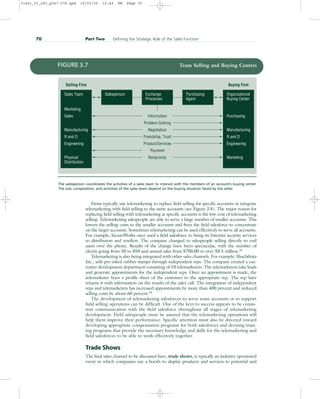
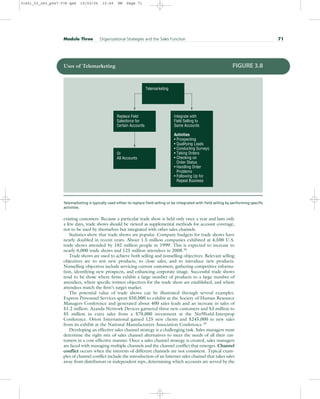
  • 173.
    LEGAL AND ETHICALCONSIDERATIONS IN RECRUITMENT AND SELECTION Key Legislation The possibility of illegal discrimination permeates the recruitment and selection process, and a basic understanding of pertinent legislation can be beneficial to the sales manager. Some of the most important legislation is summarized in Exhibit 5.8.64 The legislative acts featured in Exhibit 5.8 are federal laws applicable to all firms engaged in interstate commerce. Companies not engaging in interstate commerce are often subject to state and local laws that are similar to these federal laws. 150 Part Three Developing the Salesforce EXHIBIT 5.8 Legislation Affecting Recruitment and Selection Legislative Act Purpose Fifth and Fourteenth Amendments Provides equal protection standards to prevent to the U.S. Constitution irrational or unreasonable selection methods. Equal Pay Act (1963) Requires that men and women be paid the same amount for performing similar job duties. Civil Rights Act (1964) Prohibits discrimination based on age, race, color, religion, sex, or national origin. Age Discrimination in Employment Prohibits discrimination against people of Act (1967) ages 40 to 70. Fair Employment Opportunity Founded the Equal Employment Opportunity Act (1972) Commission to ensure compliance with the Civil Rights Act. Rehabilitation Act (1973) Requires affirmative action to hire and promote handicapped persons if the firm employs 50 or more employees and is seeking a federal contract in excess of $50,000. Vietnam Veterans Readjustment Requires affirmative action to hire Vietnam veterans Act (1974) and disabled veterans of any war. Applicable to firms holding federal contracts in excess of $10,000. Americans with Disabilities Act (1990) Prohibits discrimination against qualified disabled people in all areas of employment. Prohibits the use of employment tests, qualification standards, and selection criteria that tend to screen out individuals with disabilities unless the standard is job related or consistent with business necessity. Civil Rights Act (1991) Prohibits employers from adjusting scores of, using different cutoff scores for, or otherwise altering the results of employment-related tests on the basis of race, color, religion, sex, or national origin. Amendment to Fair Credit Reporting When seeking background information from a Act (1997) reporting service company, employers must inform job applicants or employees in writing that a report on them will be procured and must obtain their signature authorizing the move. 31451_05_ch5_p127-158.qxd 15/03/05 16:09 PM Page 150
  • 174.
    Guidelines for SalesManagers The legislation reviewed in Exhibit 5.8 is supported by various executive orders and guidelines that make it clear that sales managers, along with other hiring officials in a firm, have legal responsibilities of grave importance in the recruitment and selection process. In step 1 of the process, planning for recruitment and selection, sales managers must take care to analyze the job to be filled in an open-minded way, attempting to overcome any personal mental biases. For example, in the 1980s, many sales organiza- tions overcame biases against women in sales positions. These organizations are practi- cally unanimous in reporting that women have performed as well as, and in some cases better than, their male counterparts. Job descriptions and job qualifications should be accurate and based on a thoughtful job analysis. The planning stage may also require that the sales manager consider fair employment legislation and affirmative action requirements before setting recruitment and selection objectives. In step 2 of the process, recruitment, the sources that serve as intermediaries in the search for prospective candidates should be informed of the firm’s legal position. The firm must be careful to avoid sources that limit its hiring from protected classes.65 It is also crucial that advertising and other communications be devoid of potentially dis- criminatory content. For example, companies that advertise for ā€œyoung, self-motivated salesmenā€ may be inviting an inquiry from the Equal Employment Opportunity Commission on the basis of age and gender discrimination. Finally, all selection tools must be related to job performance. Munson and Spivey summarize legal advice for selection by stating, ā€œAt each step in the selection process, it would be advisable to be as objective, quantitative, and consistent as possible, especial- ly because present federal guidelines are concerned with all procedures suggesting employment discrimination.66 Such advice should be considered, particularly when fac- ing a situation similar to one found in ā€œAn Ethical Dilemma.ā€ Module Five Staffing the Salesforce: Recruitment and Selection 151 Sales manager John Brown was interviewing several candidates for a sales position with the XYZ company. After interviewing, testing, and assessing several candidates, two clearly stood out above the rest, one male and the other female. Although the male was slightly more qualified, John suspected that his male customers might enjoy the ā€œlooksā€ of the female and thus be more willing to give XYZ their business. What should John do? Explain. a n e t h i c a l d i l e m m a To more fully appreciate the sensitivity necessary in these matters, consider the follow- ing list of potentially troublesome information often found on employment applications.67 • Age or date of birth • Length of time at present address • Height and/or weight • Marital status • Ages of children • Occupation of spouse • Relatives already employed by the firm • Person to notify in case of an emergency • Type of military discharge These topics leave the employer open to charges of discrimination, as would a request for a photograph of the applicant, a birth certificate, or a copy of military discharge papers. 31451_05_ch5_p127-158.qxd 15/03/05 16:10 PM Page 151
  • 175.
    Further questions toavoid are those concerning the original name of the applicant, race or color, religion (including holidays observed), nationality or birthplace of the applicant, arrests, home ownership, bankruptcy or garnishments, disabilities, handicaps and health problems, and memberships in organizations that may suggest race, religion, color, or ancestral origin of the applicant. Ethical Issues Two ethical issues of particular importance are (1) how the job to be filled is represented and (2) how interviews are conducted. Misrepresentation of the job does not always extend into the legal domain. For example, earnings potential may be stated in terms of what the top producer earns, not expected first-year earnings of the average salesperson. Or perhaps the opportunities for promotion are somewhat overstated but no completely false statements are used. As simple as it may sound, the best policy is a truthful policy if the sales manager wants to match the applicant to the job and avoid later problems from those recruited under false pretenses. Some ethical issues also arise in interviewing, especially regarding the stress interview. This technique is designed to put job candidates under extreme, unexpected, psychological duress for the purpose of seeing how they react. A common tactic for stress interviewing in the sales field is to demand an impromptu sales presentation for a convenient item such as a ballpoint pen or an ashtray. Such requests may seem unreasonable to a professional sales- person who is accustomed to planning a presentation before delivering it. Another stress interviewing tactic is to ridicule the responses of the job candidates or to repeatedly inter- rupt the candidates’ responses to questions before they have an adequate opportunity to provide a complete response. Sales managers who use stress interviewing justify its use by pointing out that sales- people must be able to think on their feet and react quickly to unanticipated questions from customers. Although this is true, there would seem to be better ways of assessing a candidate’s skills. The stress interview may create an unfavorable image of the company, and it may alienate some of the better candidates.68 It appears to be a risky, and ethically questionable, approach. SUMMARY 1. Explain the critical role of recruitment and selection in building and maintain- ing a productive salesforce. Recruitment and selection of salespeople can be an expensive process, characterized by uncertainty and complicated by legal considera- tions. If the procedures are not properly conducted, a multitude of managerial prob- lems can arise, the worst of which being that salesforce performance is suboptimal. The sales manager is the key person in the recruitment and selection process, although other managers in the hiring firm may share responsibilities for staffing the salesforce. 2. Describe how recruitment and selection affect salesforce socialization and per- formance. Socialization, the process by which salespeople adjust to their jobs, begins when the recruit is first contacted by the hiring firm. Two stages of socialization should be accomplished during recruitment and selection: achieving realism and achieving congruence. Realism means giving the recruit an accurate portrayal of the job. Congruence refers to the matching process that should occur between the needs of the organization and the capabilities of the recruit. If realism and congruence can be accomplished, future job satisfaction, involvement, commitment, and perform- ance should be improved. These relationships are shown in a model of the socializa- tion process in Figure 5.1. 3. Identify the key activities in planning and executing a program for salesforce recruitment and selection. Figure 5.2 depicts a model of the recruitment and selection 152 Part Three Developing the Salesforce 31451_05_ch5_p127-158.qxd 15/03/05 16:10 PM Page 152
  • 176.
    process. There arethree steps in the process: planning, recruitment, and selection. Planning consists of conducting a job analysis, determining job qualifications, writing a job description, setting objectives, and formulating a strategy. Recruitment involves locating prospective job candidates from one or more sources within or outside the hiring firm. The third step, selection, entails an evaluation of the candidates culminating in a hiring decision. Major methods of evaluating candidates include resume and job- application analysis, interviews, tests, assessment centers, background investigations, and physical examinations. 4. Discuss the legal and ethical considerations in salesforce recruitment and selection. Every step of the recruitment and selection process has the potential to discriminate illegally against some job candidates. Federal laws and guidelines provide the basic antidiscriminatory framework, and state and local statutes may also be applicable. The most important legislation that applies are the Civil Rights Act and the Fair Employment Opportunity Act. Two primary ethical concerns are (1) misrepresentation of the job to be filled and (2) using stress interviews in the selection stage. UNDERSTANDING SALES MANAGEMENT TERMS salesforce socialization career fairs achieving realism professional societies achieving congruence computerized matchmaking job preview job application form planning activities initial interviews recruitment intensive interviews selection interviewer bias job analysis assessment center job qualifications background investigation job description market bonus recruitment and selection strategy misrepresentation employee referral programs stress interview private employment agency DEVELOPING SALES MANAGEMENT KNOWLEDGE 1. What are some of the problems associated with improperly executed recruitment and selection activities? 2. To enhance salesforce socialization, recruitment and selection should ensure realism and congruence. How can this be accomplished? 3. Refer to ā€œSales Management in the 21st Century: Finding a Fit at Hershey Chocolate U.S.A.ā€ What are important factors for achieving congruence at Hershey? 4. Describe the relationship between conducting a job analysis, determining job quali- fications, and completing a written job description. 5. Refer to ā€œSales Management in the 21st Century: Key Job Qualifications at Hershey Chocolate U.S.A.ā€ What is the relationship between job qualifications and a company’s personal selling approach? 6. What are the advantages of using employee referral programs to recruit salespeople? Can you identify some disadvantages? 7. How can private employment agencies assist in the recruitment and selection of sales- people? Who pays the fee charged by such agencies, the hiring company or the job candidate? 8. What can be learned about a job candidate from analyzing a job application that can- not be learned from the candidate’s resume? Module Five Staffing the Salesforce: Recruitment and Selection 153 31451_05_ch5_p127-158.qxd 15/03/05 16:10 PM Page 153
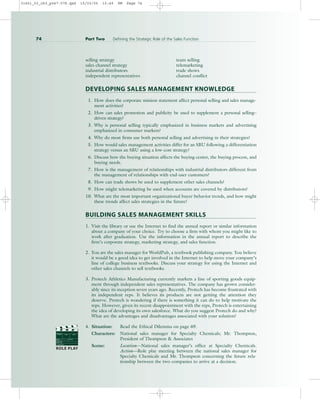
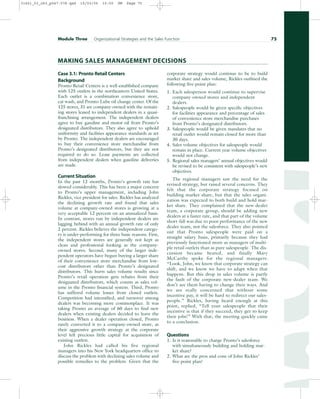
  • 177.
    9. Summarize theprimary legislation designed to prohibit illegal discrimination in the recruitment and selection process. 10. What is stress interviewing? How do some sales managers justify using stress interviews? BUILDING SALES MANAGEMENT SKILLS 1. Find three advertisements for sales positions (one from a newspaper, one from a trade magazine, and one from the Internet). After examining each ad, list the job qualifi- cations for the position being advertised. Then, develop a job description based on the ad’s contents. Finally, using Exhibit 5.4 as a guide, provide your suggestions for improving each ad. 2. Find job qualifications and a position description for a sales position at a company of your choice. Design a series of questions that you could use as a guide to interview a candidate for this position. Now, find a classmate who also has found job qualifica- tions and a position description for a sales position, and swap information. Using your interview guide, take turns interviewing each other. (The information you swapped with your classmate serves as a guide for the interviewee.) Record your interview on audiotape or videotape. Finally, listen to or view your tape and write a critique of your interview, explaining what went well and what did not. 3. The Web is filled with many sites that could be beneficial in the recruitment and selection process. One site that has been designed to make getting around in cyberspace easier for human resource development professionals is WorkIndex (http:/ /www.workindex.com). Access this site, then go to the ā€œkeyword searchā€ line and type in ā€œrecruitment.ā€ This will provide you with several sites that could be useful in the recruitment and selection process. Explore some of these sites, and then choose three that you believe would be helpful to a sales manager involved in recruitment and selection. First, provide each site address. Second, provide a description of each site. Finally, explain how each site or the informa- tion it contains could be useful in the recruitment and selection process. 4. Due to the high costs associated with turnover, it is critical that companies do a good job in the recruitment and selection process. The HR Chally Group has devised a method to help estimate the costs of turnover. Access the Chally Group’s turnover cost calculator at http:/ /www.chally.com/turnover_cost_calculator.htm. Given the following information, calculate the annual turnover cost for the salesforce: • The company employs 100 salespeople. • Annual turnover is 10 percent. • Average annual compensation is $50,000. • Average tax and benefit cost as a percent of salary is $12,500. • Average number of candidates interviewed per opening is 10. • Average number of candidates assessed per opening is three. 5. The Claron Corporation’s main competitor, Brighton Company, just filed for bank- ruptcy, presenting a potential opportunity for an increase in customers and revenue at Claron. As a result, several of Brighton’s salespeople have contacted George Wills, Claron’s vice president of sales, inquiring about employment with Claron. Currently Wills has no openings on his 10-person salesforce. However, he does not want to dismiss the Brighton reps, some of whom are top performers that might be able to enhance Brighton’s revenue stream that has been falling for the past year. After speaking to his CEO about adding a position to his salesforce, Wills was given permission to do so as long as the new salesperson made more of his salary in commissions than base salary. Wills, however, would like to add three of Brighton’s salespeople. Currently there are four salespeople on Wills’ staff that outperform the 154 Part Three Developing the Salesforce 31451_05_ch5_p127-158.qxd 15/03/05 16:10 PM Page 154
  • 178.
    other six, whoare approximately equal in talent. Yet, Wills is hard pressed to identify a clear laggard whom he would dismiss in favor of the competition’s salespeople. Wills is also concerned that he could disrupt the team chemistry he has worked hard to build the past two years by firing some of his current salespeople and hiring those from Brighton. However, he does not know if he can pass up this opportunity to upgrade his salesforce. How should Wills approach this dilemma? Should he hire the new reps and deal with the ramifications of letting two of his people go, or can he afford to pass on the new reps altogether?69 6. This exercise consists of a series of different role plays involving two characters, a sales manager and a candidate seeking a sales position. Find another classmate to assume one of the roles. Role play the following situations: 1. The sales manager misrepresents the job in an interview. 2. The sales manager employs a stress interview. 3. The sales manager opens him/herself up to charges of discrimination during an Interview. On completion of the role play, address the following questions: 1. What are the dangers of misrepresenting the position during an interview? 2. What are the pros and cons of using a stress interview? 3. How can you avoid possible discrimination charges as a result of interviewing? 7. Situation: Read the Ethical Dilemma on page 149. Characters: District sales manager; National sales manager Scene: Location—National sales manager’s office. Action—Having completed the interview process, the district sales manager explains to the nation- al sales manager who will be hired and why. Module Five Staffing the Salesforce: Recruitment and Selection 155 PROD. NO SCENE TAKE ROLL SOUND DATE PROD CO. DIRECTOR CAMERAMAN ROLE PLAY PROD. NO SCENE TAKE ROLL SOUND DATE PROD CO. DIRECTOR CAMERAMAN ROLE PLAY 31451_05_ch5_p127-158.qxd 15/03/05 16:10 PM Page 155
  • 179.
    Case 5.1: Sweet-Treats,Inc. Background Sweet-Treats,Inc., one of the leading manufactur- ers and marketers of chocolate and cocoa prod- ucts, has several plants in the United States. Its products can be divided into two major categories: confectionery products, which include several brands of candy bars and assorted candy treats, and grocery products, such as cocoa, syrup, and baking chips. In the United States, Sweet-Treats’ products are distributed by a network of strategi- cally located warehouses, with volume customers receiving direct shipment from the manufacturing plants. The method of shipment and warehousing is determined by customer location and quantity ordered. Sweet-Treats uses a field sales organization to sell products to retailers and wholesalers nationwide. Its overriding goals are to distribute a high-quality product and to provide optimum consumer value. To ensure that these goals are met, the company hires salespeople who possess outstanding planning and organizing skills, have the ability to lead, are persuasive, show initiative, and possess strong com- munication skills, including the ability to write, speak, and listen. At Sweet-Treats, salespeople represent the com- pany and carry its image. A crucial responsibility, this calls for salespeople to be consummate profes- sionals. Major responsibilities of the salesperson include selling and maintaining distribution of all products, ensuring the salability of all Sweet-Treat items in an assigned territory, implementing pro- motional programs, introducing new items, and presenting proper merchandising techniques to both headquarter and retail accounts. In addition, salespeople must act as ā€œsales consultantsā€ to cus- tomers. This involves maintaining good customer rapport while developing accounts in an assigned territory. Salespeople work with their sales man- agers and team members to achieve specific sales and merchandising objectives. Current Situation Sweet-Treats’ Kansas City district sales manager, Rob Gum, recently lost one of his top-performing salespeople, Arlene Oellermann, who left for a sud- den career change. Although other salespeople in his district are covering Arlene’s accounts, Rob fears that leaving Arlene’s position unfilled for long will create stress for these salespeople and may affect the quality of service they provide to their accounts as well as to Arlene’s. Rob is presently undergoing an intensive search to locate Arlene’s replacement. He placed a classified ad in the local newspaper, the Kansas City Star. In addi- tion, he contacted the career placement offices of local colleges and universities to see whether they had any leads on potential candidates. Through these efforts, Rob received several resumes. After examining the resumes, Rob decided to interview two candidates. What follows are excerpts from those interviews: Excerpts from an interview with Christine Pirrone who is currently a sales rep with an industrial prod- ucts company in the Kansas City area and who has three years of sales experience. Rob: Why did you get into sales? Christine: I chose sales as a career for several rea- sons. First, I like dealing with other people and helping them to solve their problems. I view sales as a way to accomplish this. Second, sales provides me with a certain level of independ- ence. I am self-motivated so I like being able to get things accomplished without being closely supervised. Third, there is decent money to be made in sales. I might as well get my share of the pie. Rob: In general, how do you get things accom- plished? Christine: Simple, planning. I set certain goals for each day. Then I plan how I will achieve them. Planning helps me to stay organized, and I feel that by being organized I am able to accom- plish many things. Rob: This position requires some degree of travel. How do you feel about that? Christine: Currently I travel quite extensively. I enjoy the travel, so it would not bother me. Rob: Have you ever organized a group? Christine: Yes. When I was a junior in college I started a new organization on campus, the Entrepreneurship Club. I was the organiza- tion’s president for two years. When I graduat- ed we had more than 40 members. I was very proud! I am currently a member of several civic groups, although I did not organize any of these. Excerpts from an interview with Joe Stein who is from Minnesota, but just received his B.S.B.A. from a local university with a 3.8 (4.0 scale) G.P.A. His major was marketing. Rob: Why do you want a career in sales? Joe: I think sales is a very flexible job. You basically manage your own time, and I like the idea of this. Also, it is more exciting than sitting 156 Part Three Developing the Salesforce MAKING SALES MANAGEMENT DECISIONS 31451_05_ch5_p127-158.qxd 15/03/05 16:10 PM Page 156
  • 180.
    behind a desk.You get to meet and interact with people. Also, I understand that there is a fair amount of money to be made in sales. Rob: In general, how do you get things accom- plished? Joe: I’ve found that the best way to get things done is to jump right in and tackle them. Take the bull by the horns, so to speak. Procrastinating only makes things worse. Rob: This position requires some degree of travel. How do you feel about that? Joe: I traveled a lot with the track team in college. I also travel back to Minnesota quite frequently to visit family and friends. I don’t think the travel will bother me. Rob: Have you ever organized a group? Joe: In college, we worked in several groups. Sometimes I was the group leader, but I always tried to carry my load. I was also a member of the American Marketing Association. Rob decided that additional searching at this point might not prove worthwhile. With his sales- people getting restless, he decided he would make a decision between Christine and Joe and make one an offer. Questions 1. Based on the information you have about Christine and Joe, how do they rate relative to Sweet-Treats’ job qualifications? 2. Who should Rob hire and why? Explain. 3. How could Rob improve his recruiting and selecting process? Explain. 4. What key concepts of salesforce socialization are related to this situation? Explain. Situation: Read Case 5.1. Characters: Rob Gum, sales manager; Christine Pirrone, sales candidate; Joe Stein, sales candidate; Candice Cane, regional sales manager Scene 1: Location—Rob’s office. Action—Rob interviews Christine. Scene 2: Location—Rob’s office. Action—Rob interviews Joe. Scene 3: Location—Local restaurant over lunch. Action—Rob discusses the merits and potential fit of each can- didate with Candice. Scene 4: Location—Rob’s office. Action— Rob makes a job offer via a phone call to either Christine or Joe. Case 5.2: Titan Industries Background Titan Industries manufactures and markets industrial equipment throughout the United States. In 2004, Titan did more than $2 billion in sales and appeared to be in an upward growth trend. The company has grown considerably since its inception in 1964. Founder and CEO Carman Pulte is proud of the progress the company has achieved over the years, despite considerable aggressive competition. He attributes much of Titan’s success to his management team, most of whom have been with him since the company’s founding. David Winston had been vice president of sales and marketing at Titan since 1968. Two months ago, he retired and was replaced by Duane Blankenship. Blankenship had been in product design and engineering at Titan since 1979. Well- educated, articulate, and likable, Blankenship was believed to be the best candidate for the position. Blankenship, a very methodical individual, set as his first task an assessment of the marketing pro- gram. One of the main things concerning him was the composition of the salesforce. In particular, he was concerned about two items. First, the salesforce was aging, with the average age being 51. Several salespeople were nearing retirement. Only a small percentage were in their twenties or thirties. Second, he noticed that the salesforce did not include any minorities or women. Blankenship scheduled a meeting to discuss these issues with Titan’s national sales manager, Tommy Angotti. Angotti loves his job. He has been with Titan for nearly 25 years. He began as a salesperson and worked his way up to national sales manager. Surprisingly, many of his salespeople have been with the company for 20 years or more. Angotti takes pride in the accomplishments of his salesforce. He believes they have been instrumental in Titan’s growth over the years. Current Situation At their scheduled meeting, Blankenship explained to Angotti his ideas concerning the composition of the salesforce. The following are excerpts from their meeting: Angotti: I realize we will have several salespeople soon retiring, but could you explain why it is necessary to hire women and minorities to replace these individuals? Blankenship: Many of the companies we sell equip- ment to are now being closely monitored and regulated by federal and state governments. Several companies in our industry have recently come under attack from the Equal Employment Opportunity Commission. The commission is Module Five Staffing the Salesforce Recruitment and Selection 157 PROD. NO SCENE TAKE ROLL SOUND DATE PROD CO. DIRECTOR CAMERAMAN ROLE PLAY 31451_05_ch5_p127-158.qxd 15/03/05 16:10 PM Page 157
  • 181.
    putting pressure onthese companies to hire women and minorities. It is only a matter of time before they take aim at us. We need to get women and minorities into the salesforce so that they can eventually work their way up into management positions. Angotti: I can’t imagine a woman going into the field trying to sell a large piece of industrial equipment. How seriously do you think a woman will be taken in this business? Not very, I can assure you. Our customers want to speak to someone who really understands how this equipment operates. Blankenship: Women can learn to sell our equip- ment. Just because they may not operate it doesn’t mean they can’t understand how it works. As a matter of fact, a few months ago a woman was involved in selling us a piece of manufacturing equipment for our operations. She did an outstanding job. Angotti: Maybe so. However, when we hire a replacement, we try to find the best person for the job. As a result, I believe we currently have some of the best salespeople in the business. Blankenship: Unfortunately, that person always seems to be a white male. There are plenty of intelligent and motivated women and minorities graduating from business schools today who are capable of performing the job. Regardless of governmental threats, it is still the right thing to do, and the profitable one. I would like to see us take a leadership role in this area in our industry and begin to make an effort to hire women and minorities. Angotti was not convinced. He was very con- cerned that minorities, and women in particular, would not be positively accepted by buyers. The industrial equipment business is largely male domi- nated. This, in turn, could have a negative impact on sales. Moreover, given that much of his sales- force was composed of ā€œold-timers,ā€ he was con- cerned about how hiring these groups might affect salesforce morale. Turnover in the salesforce was relatively low. Thus, specific hiring procedures were not well developed. Angotti decided he would recruit women and minorities to appease Blankenship but would develop an entrance test that would be diffi- cult for women and minorities to pass. This way he could actively recruit women and minorities but tell Blankenship they did not qualify because they did not pass the entrance test. Angotti was only a few years from retirement and was unwilling to change his current practices at this juncture, particularly in light of the success his salesforce had experienced over the years. Questions 1. Should Blankenship be concerned about the present composition of the salesforce? Explain. 2. How do you evaluate Angotti’s method for dealing with the salesforce composition issue? 3. What steps could be taken to effectively bring about a salesforce comprised of more women and minorities? Situation: Read Case 5.2. Characters: Duane Blankenship, vice president of sales and marketing; Tommy Angotti, national sales man- ager Scene 1: Location—Blankenship’s office. Action—Role play the interview between Angotti and Blankenship. Scene 2: Location—Angotti’s office. Action— Blankenship gets a copy of the selec- tion test, figures out what Angotti is up to, and decides to confront him. 158 Part Three Developing the Salesforce PROD. NO SCENE TAKE ROLL SOUND DATE PROD CO. DIRECTOR CAMERAMAN ROLE PLAY 31451_05_ch5_p127-158.qxd 15/03/05 16:10 PM Page 158
  • 182.
    SALES TRAINING ATUPS: FROM SELLING RATES TO SELLING SOLUTIONS As UPS shifted its business model, the need arose to alter its sales strategy as well, from a transaction-based to a solutions-based approach. No longer would sales- people simply be taking orders in the shipping department. The new focus required them to call on corporate-level executives. In part, this entailed calling on customer service managers to learn how they interact with their customers and how they answer customer queries. It also called for salespeople to discuss the financial impact of transportation decisions with financial executives. This strategic change required new skills, a new vocabulary, and a new mind-set. To meet these needs, UPS created a special salesforce. This salesforce worked in teams alongside the traditional salesforce to offer solutions to high-opportunity accounts. Having found success with the solutions-based sales approach, UPS decided to train the entire salesforce in this new approach. In doing so, they creat- ed a sales training program called e-Commerce University. The training program is designed to accomplish three objectives: 1) provide salespeople with the competencies necessary to have a conversational comfort level with varied technology offerings; 2) provide an understanding of what the tech- nology can do for customers; and 3) integrate the technological understanding into UPS’ sales methodology and strategy. Every week UPS sends 40 to 50 people to its corporate office in Atlanta to attend e-Commerce University. This costs more than bringing the program to its salespeople, but UPS believes it provides salespeople with a sense that the company values them and engenders their loyalty to the company, as well as creates a sense of camaraderie. Divided into two groups, students listen to lectures and presentations, participate in discussions and roundtables, work in teams, and role play for nine to ten hours each day. For instance, during the online tools course students learn XML and HTML. Students participate in role plays to exercise their knowledge and vocabulary in the new technology employed by UPS, such as their flat-file billing system (storing bills on a hard drive). Students also outline how they will apply what they learn to one of their accounts and then hold a discussion about this with classmates at the end of the week. On completing the training, students fill out surveys assessing the training’s relevance and effectiveness. Six weeks later, students are asked to complete a Web-based survey asking qualitative and quantitative questions about the useful- ness of the training with regard to customer acquisition and retention. Responses to surveys thus far indicate that the training does have an impact on students’ sales process. According to Laura Bostic, an e-Commerce University graduate, ā€œI just feel more empowered. When you can start talking the language with customers and talk about process improvement, it puts UPS in a different light. We’re not just salespeople—we’ve become consultants, supply-chain solution consultants.ā€ The training program has been a success and is credited for increas- ing sales performance by up to 7 percent. After completing this module, you should be able to 1 Understand the role of sales training in sales- force socialization. 2 Explain the importance of sales training and the sales manager’s role in sales training. 3 Describe the sales train- ing process as a series of six interrelated steps. 4 Discuss six methods for assessing sales training needs and identify typical sales training needs. 5 Name some typical objectives of sales train- ing programs, and explain how setting objec- tives for sales training is beneficial to sales man- agers. 6 Identify the key issues in evaluating sales training alternatives. 7 Identify key ethical and legal issues in sales training. 159 6 M o d u l e C O N T I N U A L D E V E L O P M E N T O F T H E S A L E S F O R C E : S A L E S T R A I N I N G Objectives Source: Heather Johnson, ā€œPostmarked for Growth,ā€ Training 40 (September 2003): 20–22; John Beystehner, ā€œPlaying a Brand New Game,ā€ Sales Marketing Management 155 (November 2003): 72. All rights in the article are owned by United Parcel Service of America, Inc. Ā© 2003. All rights reserved. 31451_06_ch6_p159-184.qxd 16/03/05 19:33 PM Page 159
  • 183.
    As the openingvignette illustrates, companies often believe that sales training is neces- sary to successfully implement their strategy. UPS realizes the important role its sales- people play in the success of the company and is willing to invest considerable time and money in developing them. Training can be used to achieve a number of objectives and fulfill various needs. As at e-Commerce University, various methods may be used to accomplish sales training. Another important point illustrated in the vignette is that training must be evaluated to ensure its effectiveness. Today’s salespeople must be prepared to meet the demands of value-conscious cus- tomers. Salespeople must do their part by providing solutions to problems and meeting service requirements expected to satisfy customer needs. Proper training can prepare salespeople to meet these challenges. In this module several training issues and methods are discussed. First, the role of sales training in salesforce socialization is examined. Then the importance of sales train- ing is considered and management of the sales training process is discussed. ROLE OF SALES TRAINING IN SALESFORCE SOCIALIZATION Recall from Module 5 that salesforce socialization refers to the process by which sales- people acquire the knowledge, skills, and values essential to perform their jobs. Training plays a key role in this process. Newly hired salespeople usually receive a company orientation designed to familiarize them with company history, policies, facilities, pro- cedures, and key people with whom salespeople interact. Some firms go well beyond a perfunctory company orientation in an effort to enhance salesforce socialization. By referring to Figure 5.1 in Module 5, you can see how sales training can affect salesforce socialization. During initial sales training, it is hoped that each salesforce member will experience a positive initiation to task—the degree to which a sales trainee feels com- petent and accepted as a working partner—and satisfactory role definition—an under- standing of what tasks are to be performed, what the priorities of the tasks are, and how time should be allocated among the tasks.1 The need for socialization as part of the training process is supported by expected indirect linkages between socialization and beneficial job outcomes. As suggested in Figure 5.1, trainees who have been properly recruited and trained tend to be more con- fident on the job and have fewer problems with job conflicts, leading to higher job satisfaction, involvement, commitment, and performance. The positive relationships between salespeople’s job-related attitudes and perceptions and their commitment to their companies have been supported in empirical studies. For example, a study of 102 salespeople in the food industry found that ā€œamong approaches within a company’s control, programs aimed at minimizing new salespeople’s role ambi- guity and improving their satisfaction are most likely to be most effective in building commitment to the company.ā€2 Another study of 120 manufacturers’ salespeople found a positive relationship between job satisfaction and salespeople’s commitment to the organization.3 In addition, a study of 301 industrial salespeople found that when sales- people believe the company is taking certain actions to support the salesforce and reduce the difficulties associated with a sales position, they are more committed to and satisfied with the job.4 These studies reinforce the importance of sales managers taking an active role in socializing their salespeople to maximize overall salesforce productivity. Newly hired salespeople should be extremely interested in learning about their jobs, peers, and supervisors. A basic orientation may be insufficient to provide all the information they desire, so more extensive socialization may be indicated. At Federated Insurance, trainees participate in a two-week seminar that introduces them to the company’s products, the corporate mission, the Federated business plan, functions and departments within the company, and many of the support people with whom they will work.5 The need for salesforce socialization is especially likely to extend past the initial training period. This is particularly true if salesforce members have limited personal contact with peers, managers, and other company personnel. 160 Part Three Developing the Salesforce 31451_06_ch6_p159-184.qxd 16/03/05 19:33 PM Page 160
  • 184.
    SALES TRAINING ASA CRUCIAL INVESTMENT A comprehensive review of sales management research concludes that whom one recruits is important but it is probably not as important in determining salesforce per- formance as what sales managers do with the recruits—and to the recruits—after they have been hired.6 The importance of sales training in achieving the highest levels of sales performance is shown in Sales Marketing Management’s annual survey of the best salesforces in the United States. The accounts of sales successes for the top salesforces often reveal that the winning salesforces had to adapt to changes in marketing and sales strategies. This obviously requires some degree of salesforce training or retraining. A survey of sales executives finds that 80 percent of respondents claim that training is a key aspect of their business.7 Some research, in fact, indicates a positive relationship between training expenditures and a firm’s share price.8 One toothbrush manufacturer, for example, cred- its sales training conducted by Ansir International for a $30-million increase in sales in the first two years after implementing the training.9 Deluxe Corporation, a financial and check printing company, credits its sales training with improving its client retention rate from 85 percent to 95 percent in less than two years.10 Most organizations need sales training of some type, perhaps because of inadequacies of current training programs and/or because new salespeople have joined the organiza- tion. Thus, an ongoing need exists to conduct sales training to improve salesforce per- formance. It should be stressed that the need for sales training is continual, if for no other reason than that the sales environment is constantly changing. Companies view training as an important means for protecting their investments in their salesforces.11 U.S. companies spend approximately $7.8 billion annually to provide salespeople with training and devote several hours per year to the average salesperson.12 Average training costs per salesperson per year can run from over $3,400 to more than $9,000 depending on the industry, company size, and experience of the salesperson.13 As research shows, this training generally pays off in terms of improvement in salesforce productivity.14 Exhibit 6.115 shows the time invested in sales training as related to its value to the organization. Module Six Continual Development of the Salesforce: Sales Training 161 Investment in Sales Training EXHIBIT 6.1 Sales training received each year: Less than 8 hours 18.3%* 1–5 days a year 46.8% 6–10 days a year 19.5% 11–15 days a year 7.9% More than 15 days a year 7.5% Sales training received by new employees: Less than 8 hours 5.9% 1–5 days a year 31.0% 6–10 days a year 18.5% 11–15 days a year 14.3% More than 15 days a year 30.3% Value of training to the organization: Extremely valuable 29.5% Very valuable 47.0% Somewhat valuable 18.3% Not very valuable 4.8% Not valuable at all 0.4% * Percent of respondents indicating each choice. 31451_06_ch6_p159-184.qxd 16/03/05 19:33 PM Page 161
  • 185.
    One aspect ofthe investment in sales training is the amount of time required of the sales manager. Usually, sales managers are involved not only in the ā€œbig pictureā€ of planning but also in the time-consuming details of implementing training, such as the following:16 • Arranging for salespeople to work with key personnel in various departments in the firm to familiarize them with the functions of those departments • Selecting literature, sales aids, software, and materials for study • Enrolling salespeople in professional workshops or training programs • Accompanying salespeople in the field to critique their sales behavior and reinforce other training • Conducting periodic training meetings and professional training conferences Sales training is indeed expensive, and sales managers should take special care to see that time and money are wisely spent. With these thoughts in mind, let’s examine a model for the judicious analysis, planning, and implementation of a sales training program. MANAGING THE SALES TRAINING PROCESS The sales training process is depicted as six interrelated steps in Figure 6.117 : assess train- ing needs, set training objectives, evaluate training alternatives, design the sales training program, perform sales training, and conduct follow-up and evaluation. Assess Training Needs The purpose of sales training needs assessment is to compare the specific performance- related skills, attitudes, perceptions, and behaviors required for salesforce success with the state of readiness of the salesforce. Such an assessment usually reveals a need for changing or reinforcing one or more determinants of salesforce performance. All too often, the need for sales training becomes apparent only after a decline in salesforce performance is revealed by decreasing sales volume, rising expenses, or per- haps low morale. Sales training for correcting such problems is sometimes necessary, but the preferred role of sales training is to prevent problems and improve salesforce pro- ductivity on a proactive, not reactive, basis. Needs assessment requires that sales managers consider the training appropriate for both sales trainees and regular salespeople. A sales trainee is an entry-level salesperson who is learning the company’s products, services, and policies in preparation for a reg- ular sales assignment. For example, entry-level salespeople may need basic training in 162 Part Three Developing the Salesforce Perform Sales Training Design Sales Training Program Evaluate Training Alterna- tives Set Training Objectives Assess Sales Training Needs Conduct Follow-Up and Evaluation FIGURE 6.1 Sales Training Process The sales training process is performed in six steps, beginning with an assessment of training needs. The process is con- tinual, with the follow-up and evaluation step providing feedback that may alter the other steps in future sales training activities. 31451_06_ch6_p159-184.qxd 16/03/05 19:33 PM Page 162
  • 186.
    sales techniques, whereasexperienced salespeople could benefit from training in advanced sales techniques. In addition, the training needs of selling teams must be considered. Methods of Needs Assessment Proactive approaches to determining sales training needs include a salesforce audit, per- formance testing, observation, a salesforce survey, a customer survey, and a job analysis. Needs assessment can be conducted in-house or by companies such as Wilson Learning Corporation (http:/ /www.wilsonlearning.com). Salesforce Audit A salesforce audit is ā€œa systematic, diagnostic, prescriptive tool which can be employed on a periodic basis to identify and address sales department problems and to prevent or reduce the impact of future problems.ā€18 The salesforce audit (discussed fully in Module 9) includes an appraisal of all salesforce activities and the environment in which the salesforce operates. In the sales training area, the audit examines such questions as these: • Is the training program adequate in light of objectives and resources? • Does the training program need revision? • Is an ongoing training program available for senior salespeople? • Does the training program positively contribute to the socialization of sales trainees? To be effective, a salesforce audit should be conducted annually. More frequent audits may be warranted in some situations, but the comprehensive nature of an audit requires a considerable time and money investment. As a result, other periodic assess- ments of sales training are suggested. Performance Testing Some firms use performance testing to help determine training needs. This method specifies the evaluation of particular tasks or skills of the salesforce. For example, sales- people may be given periodic examinations on product knowledge to check retention rates and uncover areas for retraining. Salespeople may be asked to exhibit particular sales techniques, such as demonstrating the product or using the telephone to set up sales appointments while the sales trainer evaluates their performance. Sales managers may even want to administer a recently developed measure of selling skills; this new measure assesses salespeople’s interpersonal, salesmanship, and technical skills.19 Observation First-level sales managers spend a considerable amount of time in the field working with salespeople. They also may have direct responsibility for some accounts, acting as a salesperson or as a member of a sales team. Through these field selling activities, sales managers often observe the need for particular sales training. In some instances, the training need is addressed instantaneously by critiquing the salesperson’s performance after the sales call has been completed. In other situations, frequent observation of particularly deficient or outstanding sales behavior may suggest future training topics. Salesforce Survey The salesforce may be surveyed in an attempt to isolate sales training needs. The salesforce survey may be completed as an independent activity or combined with other sales man- agement activities such as field visits or even included as part of the routine salesforce reporting procedures. The weekly reports submitted by many salespeople to their sales managers often have sections dealing with problems to be solved and areas in which managerial assistance is requested. For example, a faltering, new product introduction may signal the need for more product training, additional sales technique sharpening, or per- haps training needs specific to an individual salesperson. Canon USA, for example, identi- fies the best practices of its salespeople to determine necessary proficiencies around which training can be designed.20 Module Six Continual Development of the Salesforce: Sales Training 163 31451_06_ch6_p159-184.qxd 16/03/05 19:33 PM Page 163
  • 187.
    By surveying thesalesforce, the task of assessing training needs may become more complex than if sales management alone determines training needs. To ignore the salesforce in this step of the training process, however, could be a serious sin of omis- sion. For example, when implementing a CRM strategy, Storage Tek, a network computing storage company, found resistance from its salesforce. It used phone interviews to survey the salesforce to determine everyone’s computer capability and efficiency to assess where deficiencies existed. Storage Tek then enlisted the help of a training company to design and deliver a program to fit its salespeople’s needs.21 If sales managers and their salespeople should disagree on training needs, it is far better to discover this disagreement and resolve it before designing and delivering specific sales training programs. Customer Survey Intended to define customer expectations, a customer survey helps determine how com- petitive the salesforce is compared with other salesforces in the industry. If personal selling is prominent in the firm’s marketing strategy, some sort of customer survey to help determine sales training needs is highly recommended. For example, upon survey- ing its customers, Paxar, a supplier of labels to retailers and apparel manufacturers, learned that its salespeople were miscommunicating with customers and were failing to understand their market needs.22 Online services such as QuestionPro.com (http:/ /ques- tionpro.com) make it easy to design, deliver, and analyze Web-based customer surveys.23 Sometimes information gathered from a customer survey may have ethical implications as seen in ā€œAn Ethical Dilemma.ā€ 164 Part Three Developing the Salesforce Your salespeople have been reaching or exceeding their sales goals for the year, and your region is on pace to set a new company sales record, putting you in line for a big bonus. When conducting a recent customer survey to use as input for developing a training program, you discover that some customers are upset about promises salespeople are making but not fulfilling. Is this cause for alarm? What should you do and when? a n e t h i c a l d i l e m m a Job Analysis The job analysis, defined in Module 5, is an investigation of the task, duties, and responsibilities of the sales job. In a well-run sales organization, a job analysis will be part of the recruitment and selection process and then will continue to be used in sales training and other managerial functions. For instance, NBC bases its hiring and training goals for sales teams on a competency model it developed that describes characteristics of its ideal salespeople in 12 areas, including team orientation and communication skills.24 Because the job analysis defines expected behavior for salespeople, it is a logical tool to be used in assessing training needs. Because sales jobs may vary within the same salesforce, job analyses may also help in determining individualized sales training needs or the needs of different groups of salespeople. Typical Sales Training Needs As the preceding discussion implies, the need for sales training varies over time and across organizations. However, the need for salesforce training on certain topics is wide- spread. A discussion of some of the more popular sales training topics follows. Sales Techniques There is a universal, ongoing need for training on ā€œhow to sell.ā€ Research has indicated that salespeople sometimes sell despite themselves; that is, many salespeople do not 31451_06_ch6_p159-184.qxd 16/03/05 19:33 PM Page 164
  • 188.
    competently execute fundamentalsales techniques.25 Common mistakes identified in this research include the following: • Ineffective listening and questioning • Failure to build rapport and trust • Poor job of prospecting for new accounts • Lack of preplanning of sales calls • Reluctance to make cold calls (without an appointment) • Lack of sales strategies for different accounts • Failure to match call frequency with account potential • Spending too much time with old customers • Overcontrolling the sales call • Failure to respond to customers’ needs with related benefits • Giving benefits before clarifying customers’ needs • Ineffective handling of negative attitudes • Failure to effectively confirm the sale This rather lengthy list of common shortcomings is remarkable in that proper train- ing could erase these problems entirely. In fact, most formal sales training programs spend considerable time on sales techniques. One study of sales executives found that nearly 79 percent indicate that employees receive training in sales skills.26 As mentioned previously, the basic nature of sales techniques training is changing, and more emphasis is being placed on developing trusting, enduring relationships with cus- tomers. Salespeople are receiving more training on listening and questioning skills so that they may be more effective in learning the customer’s needs. Limited research supports the idea that effective listening skills are positively associated with sales performance and work satisfaction.27 Furthermore, high-pressure sales techniques are declining in popularity and are being replaced with sales techniques based on need satisfaction, problem solving, and partnership forming with the customer’s best interests as the focus.28 Companies such as Motorola and Owens Corning teach their salespeople how to provide solutions to customer problems to facilitate the development of lasting relationships with customers.29 A study of more than 1,000 salespeople, customers, support staff, and sales managers found that today’s salesperson must learn to perform like a ā€œmini-CEO,ā€ focusing on issues such as the customer’s strategic objectives.30 Exhibit 6.231 points out seven competencies that this research suggests today’s successful salesperson must master along with a method for assess- ing these competencies. To learn how ADP trains its salespeople to build relationships, see ā€œSales Management in the 21st Century: Training for Relationship Building at ADP.ā€ Module Six Continual Development of the Salesforce: Sales Training 165 Competencies of Successful Salespeople EXHIBIT 6.2 Below each competency are questions that can be used to assess it. Ask salespeople to respond to each question using the following scale to indicate how often they use each behavior: 1—never, or not at all; 2—seldom or to a small extent; 3—sometimes or to a moderate extent; 4—usually or to a great extent; 5—almost always. When finished, calculate the total score for each competency by adding the responses to each question for a particular competency and then adding each com- petency score together to get a total score. The average score is 63. A score above average indicates the salesperson is using the competencies better than the typical business-to-business salesperson, whereas a score below average may signal a need for improvement. Competency 1 Aligning customer/supplier strategic objectives by identifying new opportunities and applications that add value to the customer organization and enhance the value of the relationship with my organization. 1. I gather information to understand customers’ business strategies and view of market oppor- tunities. 2. I stay up-to-date with new developments and innovations in customers’ markets. 3. I keep current with emerging trends and initiatives of customers’ competitors. (continued) 31451_06_ch6_p159-184.qxd 16/03/05 19:33 PM Page 165
  • 189.
    166 Part ThreeDeveloping the Salesforce EXHIBIT 6.2 Competencies of Successful Salespeople (Continued) Competency 2 Listening beyond product needs by identifying business process improvement potential and opportunities to add value to my organization and our customers. 4. I keep the customer regularly updated with information and changes that might be important. 5. I suggest ways I can bring added value to our customers. 6. I help customers think differently about their future needs. Competency 3 Understanding the financial impact of decisions on the customer’s organization and on my organ- ization by quantifying and communicating the value of the relationship. 7. I look actively for ways to contribute to the customer’s profitability. 8. I search actively for more cost-effective ways to serve customers. 9. I focus on the financial consequences of approaches to meeting customer needs. Competency 4 Orchestrating organizational resources by identifying key contributors; communicating relevant information; and building collaborative, customer-focused relationships. 10. I communicate customer needs, suggestions, and concerns to appropriate resources in my organization. 11. I work cooperatively with people in other parts of the customer organization who can be useful sources of ongoing information, resources, and support. 12. I ensure that my product, sales, and service units work together to deliver value. Competency 5 Consultative problem solving to create new solutions, customized products and services, and paradigm changes while being willing and able to work outside the norm when necessary. 13. I anticipate possible problems and invite discussion about how they can be overcome. 14. I determine the cause of a problem and identify constraints before recommending a solution. 15. I propose innovative solutions that go beyond the immediate application of the product or service. Competency 6 Establishing a vision of a committed customer/supplier relationship by identifying value-adding products, processes, and services. 16. I create a relationship that supports the goals and values of both organizations. 17. I develop relationships that recognize the needs of all contributing functions in both organizations. 18. I communicate objectives for the relationship that are achievable and challenge the creativity of both organizations. Competency 7 Engaging in self-appraisal and continuous learning by securing feedback from customers, col- leagues, and managers. 19. I demonstrate an understanding of what is working, what is not working, and how I can do things differently. 20. I stay up-to-date in my field of expertise. 21. I ask for and welcome feedback to assess my performance and the degree to which I am meet- ing expectations. Product Knowledge Salespeople must have thorough product knowledge, including its benefits, applica- tions, competitive strengths, and limitations. Product knowledge may need updating in the event of new product development, product modification, product deletions, or the development of new applications for the product. Source: Dr. Bernard L. Rosenbaum, ā€œDo You Have the Skills for 21st Century Selling? Rate Yourself With This Exerciseā€American Salesman 45 (July 2000): 24–30. Reprinted by kind permission of the author. 31451_06_ch6_p159-184.qxd 16/03/05 19:33 PM Page 166
  • 190.
    Generally speaking, productknowledge is one of the most commonly covered topics in sales training programs. As expected, the more complex the product or service, the higher the likelihood that detailed knowledge about the offering will be stressed in the training program. Although it is an essential requirement, adequate product knowledge will not necessarily lead to sales success. Studies have shown that product knowledge levels of high-performing salespeople are not significantly different from those of moderate performers.32 Having product knowledge is not enough—the salesperson must know the customer and have the necessary sales skills to apply the knowledge of the product to the customer’s situation. Customer Knowledge Sales training may include information relating to customers’ needs, buying motives, buying procedures, and personalities (i.e., customer knowledge). As explained in the opening vignette, salespeople at UPS had to learn how to communicate with executives and better understand their needs. Faced with situational and individual differences among customers, some firms use classification methods to categorize buyers according to personality and the buying situation. An example of different types of buyers and sug- gested sales training topics is presented in Exhibit 6.3.33 As minority populations increase and companies expand their global selling efforts, training programs must address multicultural differences and business protocol in subcultures and foreign countries. For instance, female Hispanic business owners gen- erally take longer to make decisions.34 Such information can be useful in determining the selling cycle. Gift-giving, for example, is a sensitive area internationally because well- intentioned expressions of goodwill can backfire and instead become personal insults to a prospective customer. It is important that salespeople are trained in intercultural com- munication to improve their chances of developing international buyer–seller relation- ships.35 Insights for understanding foreign customers are provided in Exhibit 6.4.36 Competitive Knowledge Salespeople must know competitive offerings in terms of strengths and weaknesses to plan sales strategy and sales presentations effectively and to be able to respond effectively to customer questions and objections. This area is extremely important for salespeople who Module Six Continual Development of the Salesforce: Sales Training 167 S a l e s m a n a g e m e n t i n t h e 2 1 s t c e n t u r y Training for Relationship Building at ADP Jason Karem, sales manager at ADP, com- ments on training for relationship building: To be successful in any sales job you have to work hard, be able to build rapport with everyone you talk to, and follow through on every expectation you set. But there is one key ingredient that sepa- rates the great salespeople from the good ones: The ability to build relationships. Building relation- ships allows you to work smarter by allowing your territory to work for you all the time—even while you are on vacation. Therefore, training on how to build business partnerships with individuals and influence centers in one’s territory is key with every salesperson at ADP. Some of the specifics we focus on are how to truly understand the business of the person with whom we are trying to build a rela- tionship. For instance, for salespeople to be success- ful at ADP, they must understand the business of some of our critical customers, CPAs, and bankers. Therefore, we constantly train associates about CPA’s and banker’s needs, what they actually do on a daily basis, and how we can help them fulfill their business goals. This not only builds trust with our partners, but also builds credibility with them for future sales opportunities. Periodically we will bring CPAs or bankers into one of our meetings to determine first hand their expectations. We ask them how we can better serve them and their firm. If an ADP sales associate can build solid, credible relationships with key business partners, their sales only will go one way—up. 31451_06_ch6_p159-184.qxd 16/03/05 19:33 PM Page 167
  • 191.
    168 Part ThreeDeveloping the Salesforce EXHIBIT 6.3 Sales Training for Different Types of Buyers Kind of Buyer Sales Training Topic 1. Hard Bargainer (a difficult 1. Teach psychologically oriented sales strategies (e.g., transac- person to deal with) tional analysis). 2. Teach sales negotiation strategies (e.g., the use of different bases of power). 3. Teach listening skills and the benefits of listening to the prospect. 4. Emphasize how to handle objections. 5. Emphasize competitive product knowledge. 2. Sales Job Facilitator 1. Teach importance of a quid pro quo. (attempts to make the 2. Communicate advantages of having a satisfied customer base. sales transaction go 3. Show how customers can assist salespeople (e.g., by pooling smoothly) orders, providing leads). 3. Straight Shooter (behaves 1. Teach importance of selling the ā€œsubstanceā€ of the product with integrity and offering and not just the ā€œsizzle.ā€ propriety) 2. Teach straightforward techniques for handling objections (e.g., a direct denial approach). 4. Socializer (enjoys 1. Communicate company policy information about giving gifts personal interaction and entertaining and socializing with customers. with salespeople) 2. Discuss ethical and legal implications of transacting business. 3. Emphasize importance of salespeople maintaining an appro- priate balance between socializing with customers and per- forming job responsibilities. 5. Persuader (attempts to 1. Communicate importance of qualifying prospects. ā€œmarketā€ his or her 2. Teach techniques for qualifying customers. company) 6. Considerate (shows 1. Communicate importance of obtaining market information compassion for salesperson) from customers. 2. Teach importance of a quid pro quo. are new to the industry because the competitor’s salespeople may have years of experience and be quite knowledgeable. Furthermore, customers may exploit a salesperson’s lack of competitive knowledge to negotiate terms of sale that may be costly to the selling firm. For example, salespeople who are not familiar with a competitor’s price structure may unnecessarily reduce their own price to make a sale, thereby sacrificing more revenue and profits than they should have. EXHIBIT 6.4 Understanding Foreign Customers Many selling skills that are successful in the United States will also work in other countries. However, one must be aware of cultural variations that can make the difference between closing a deal and losing a customer. Here is some advice for conducting business in certain countries around the world. Arab Countries: • Don’t use your left hand to hold, offer, or receive materials because Arabs use their left hands to touch toilet paper. If you must use your left hand to write, apologize for doing so. • When first meeting someone, avoid giving a gift as it might be interpreted as a bribe. 31451_06_ch6_p159-184.qxd 16/03/05 19:33 PM Page 168
  • 192.
    Module Six ContinualDevelopment of the Salesforce: Sales Training 169 China: • Don’t refuse tea during a business discussion. Always drink it, even if you’re offered a dozen cups a day. • Printed materials presented to Chinese business leaders should be in black and white because colors have great significance for the Chinese. • Never begin to eat or drink before your host does in China. • Deliver presentations in a visually neutral way. • Present gifts privately and do not make a big issue of it. France: • Don’t schedule a breakfast meeting—the French tend not to meet until after 10 A.M. Germany: • Don’t address a business associate by his or her first name, even if you have known each other for years. Always wait for an invitation to do so. • Breakfast meetings are unheard of here also. • Provide detail and lots of supporting documentation during presentations. Latin America: • People here don’t take the clock too seriously—scheduling more than two appointments in the same day can prove disastrous. • People like to stand close to one another and touch during conversation. • Give gifts after establishing a relationship and during social encounters, rather than in the course of business. Japan: • Don’t bring up business on the golf course—always wait for your host to take the initiative. • Don’t cross your legs in Japan—showing the bottom of the foot is insulting. • Deliver presentations in a visually neutral way. • Avoid giving gifts wrapped with bows (considered unattractive) and ribbons (colors have differ- ent meanings). Do not open a gift in front of a Japanese counterpart or expect them to do so. Mexico: • Don’t send a bouquet of red or yellow flowers as a gift—Mexicans associate those colors with evil spirits and death. Instead, send a box of premium chocolates. Miscellaneous: • The thumbs-up gesture is considered offensive in the Middle East, rude in Australia, and a sign of ā€œOKā€ in France. • It is rude to cross your arms while facing someone in Turkey. • In the Middle East don’t ask, ā€œHow’s the family?ā€ā€”it is considered too personal. Also, don’t show the bottom of your foot. Time and Territory Management The quest for an optimal balance between salesforce output and salesforce expenditures is a perennial objective for most sales managers. Therefore, training in time and terri- tory management (TTM), is often included in formal sales training programs. Essentially, the purpose of TTM training is to teach salespeople how to use time and efforts for maximum work efficiency. TTM training is important for all sales organizations but especially for those in declining, stagnant, or highly competitive industries. In such situations, salespeople are often overworked, and there comes a point when working harder to improve results is not realistic. Such circumstances call for ā€œworking smarter, not harder,ā€ an idea that is receiving considerable discussion in sales management circles.37 Efforts to make more efficient use of time and increase salesperson productivity have been bolstered by salesforce automation. Salesforce automation (e.g., cellular phones, faxes, portable computers, databases, the Internet, personal digital assistants, and elec- tronic data interchange) can boost productivity by as much as 20 to 40 percent.38 To do so, salespeople often need training in computer and software applications. Furthermore, as electronic data interchange (a method for transferring information electronically 31451_06_ch6_p159-184.qxd 16/03/05 19:33 PM Page 169
  • 193.
    between selling firmsand buying firms) and CRM technology become more prominent, the need for computer literacy in the salesforce will increase.39 Studies indicate that proper training in salesforce automation is necessary for it to be effective.40 Perhaps time and territory management could be improved by training salespeople in self-management. Self-management refers to an individual’s effort to control certain aspects of his or her decision making and behavior, and as such employs strategies that assist individuals in structuring the environment and facilitating behaviors necessary to achieve performance standards. Recent research suggests that salespeople trained in self- management increase both short- and long-term performance.41 Set Training Objectives Having assessed the needs for sales training, the sales manager moves to the next step in the sales training process shown in Figure 6.1: setting specific sales training objectives. Because training needs vary from one sales organization to the next, so do the objec- tives. In general, however, one or more of the following are included. 1. Increase sales or profits. 2. Create positive attitudes and improve salesforce morale. 3. Assist in salesforce socialization. 4. Reduce role conflict and ambiguity. 5. Introduce new products, markets, and promotional programs. 6. Develop salespeople for future management positions. 7. Ensure awareness of ethical and legal responsibilities. 8. Teach administrative procedures (e.g., expense accounts, call reports). 9. Ensure competence in the use of sales and sales support tools, such as CRM technology. 10. Minimize salesforce turnover rate. 11. Prepare new salespeople for assignment to a sales territory. 12. Improve teamwork and cooperative efforts. These objectives are interrelated. For example, if salespeople gain competence in the use of a new sales tool, sales and profit may improve, salesforce morale may be posi- tively affected, and other beneficial outcomes may occur. By setting objectives for sales training, the manager avoids the wasteful practice of training simply for training’s sake. Furthermore, objectives force the sales manager to define the reasonable expectations of sales training rather than to view training as a quick-fix panacea for all the problems faced by the salesforce. Additional benefits of setting objectives for sales training are as follows:42 • Written objectives become a good communications vehicle to inform the salesforce and other interested parties about upcoming training. • Top management is responsive to well-written, specific objectives and may be more willing to provide budget support for the training. • Specific training objectives provide a standard for measuring the effectiveness of training. • By setting objectives, the sales manager finds it easier to prioritize various training needs, and the proper sequence of training becomes more apparent. Evaluate Training Alternatives In the third step of the sales training process, the sales manager considers various approaches for accomplishing the objectives of training. Certainly, many more alterna- tives exist today than in the past, thanks to such technologies as computer-assisted instruction, video conferencing, and the Internet. The number of sales training profes- sionals for hire also seems to be increasing, or perhaps such trainers are just doing a better job of promoting their services. Even a casual examination of a typical shopping mall bookstore will reveal a number of titles related to building sales skills, along with audio- and videotapes/disks on the subject. Some associations are even offering training 170 Part Three Developing the Salesforce 31451_06_ch6_p159-184.qxd 16/03/05 19:33 PM Page 170
  • 194.
    courses to helpimprove the skills of salespeople in their industry. For example, a course cosponsored by the Safety Equipment Manufacturers Agents Association allows distrib- utor reps, manufacturer reps, and independent manufacturer reps to attend a weeklong course on the topic of safety.43 Critiquing all these alternatives is a monumental job, so it is recommended that fairly stringent criteria, including cost, location of the training, flexibility of prepackaged materials, opportunity for reinforcement training, and time required to implement an alternative, be established for preliminary screening. The evaluation of alternatives for training inevitably leads to three key questions. First, who will conduct the training? An answer to this question will require the consideration of internal (within the company) and external (outside the company) trainers. The sec- ond question deals with location for the training. Sales training may be conducted in the field, in the office, at a central training location, at hotels and conference centers, or at other locations. The third question is which method (or methods) and media are best suited for conducting the training? Selecting Sales Trainers In general, companies rely most heavily on their own personnel to conduct sales train- ing. In this endeavor, the sales manager is the most important sales trainer. Senior salespeople are also often involved as trainers. For example, beer brewing company Molson Canada uses both managers and experienced salespeople to conduct formal training sessions three or four days a year.44 In larger companies, a full-time sales train- er is often available. Why are internal sources used so often in sales training? First, and perhaps most important, sales managers and senior salespeople are intimately aware of job require- ments and can communicate in very specific terms to the sales trainee. However, outside consultants may be only superficially informed about a specific sales job and often offer generic sales training packages. Second, sales managers are the logical source for train- ing to be conducted in the field, where valuable learning can occur with each sales call. It is extremely difficult to turn field training over to external trainers. Finally, using inter- nal trainers simplifies control and coordination tasks. It is easier to control the content of the program, coordinate training for maximum impact, and provide continuity for the program when it is the sales manager who does the training or who designates other company personnel to do the training. At some point, a sales manager’s effectiveness may be improved by using external train- ers. Internal resources, including time, expertise, facilities, and personnel, may be insuffi- cient to accomplish the objectives of the sales training program. Also, outside trainers might be looked to for new ideas and methods. Large training firms such as Forum (http:/ /www.forum.com), Sales Performance International (www.SPISales.com), and U.S. Learning Inc. (http:/ /www. uslearning.com) often customize their generic programs for use within specific companies. Others, such as Wilson Learning Corporation, deliver training programs via the Web that include interactive stories, tutorials, interactive questions, online exercises, role plays, games, summaries, and post-tests.45 Exhibit 6.546 outlines attributes to consider when shopping for an outside training program. Selecting Sales Training Locations Most sales training is conducted in home, regional, or field offices of the sales organi- zation. Manufacturing plants are also popular training sites, and some firms use non- company sites such as hotels or conference centers to conduct training. Central training facilities are another possibility, used extensively by Noxell Corporation, Xerox, IBM, General Electric, Armstrong World Industries, and scores of other large firms. One of the largest training facilities in the country is Xerox Document University, located on the banks of the Potomac River in Leesburg, Virginia. At this facility, trainees stay in dormlike confines while being indoctrinated into the company. As video broadcasting and teleconferencing become more prevalent, many firms are enjoying some of the benefits of a centralized training facility without incurring the Module Six Continual Development of the Salesforce: Sales Training 171 31451_06_ch6_p159-184.qxd 16/03/05 19:33 PM Page 171
  • 195.
    172 Part ThreeDeveloping the Salesforce EXHIBIT 6.5 Choosing an Outside Training Program Several training organizations, such as the Covey Leadership Center, the Center for Creative Lead- ership, Decker Communications, and the American Society of Training and Development, provide their input on what makes a useful training program. 1. The program should make it easy to master content by lessening the participant’s struggle to learn new skills and knowledge and change old work habits. Content and delivery must con- sider the skill level, education level, and learning style of participants. 2. The program should anticipate and deal with obstacles to long-term behavior modification. It should motivate participants to drop old habits, adopt new skills, and desire continued training. 3. The program’s content should be limited to what has been shown to help participants most on the job. 4. The program’s development and delivery should stay within the constraints of time, money, logistics, and repeatability. Only technology that enhances training should be used. 5. Participants should be actively involved in the program to preserve the excitement that comes from self-development. 6. The trainer must clearly understand the program’s objectives, as well as the concepts, behaviors, and attitudes to be acquired by participants. 7. When appropriate, the program should accommodate group dynamics and promote a sense of group membership and shared purpose. travel costs and lost time to transport the salesforce to and from training. Field offices arrange for video hook-up, either in-house or at video-equipped conference hotels, and trainees across the country share simultaneously in training emanating from a central location. Selecting Sales Training Methods A variety of methods can be selected to fit the training situation. Indeed, the use of mul- tiple methods is encouraged over the course of a training program to help maintain trainee attention and enhance learning. There are four categories of training methods: classroom/conference, on-the-job, behavioral simulations, and absorption. Classroom/Conference Training The classroom or conference setting features lectures, demonstrations, and group dis- cussion with expert trainers serving as instructors. This method is often used for train- ing on basic product knowledge, new product introductions, administrative procedures, and legal and ethical issues in personal selling. At Cullinet Software, for instance, trainees spend six to seven months in the classroom learning product knowledge and sales methodologies.47 The format often resembles a college classroom, with regularly scheduled examinations and overnight homework assignments. In addition to using internal facilities and personnel, some companies send their salespeople to seminars sponsored by the American Management Association, American Marketing Association, Sales and Marketing Executives International, and local colleges and universities. These organizations offer training on practically any phase of selling and sales management. On-the-Job Training In the final analysis, salespeople can be taught only so much about selling without actually experiencing it. Consequently, on-the-job training (OJT) is extremely important and is the most prevalent method of training salespeople.48 OJT puts the trainee into actual work circumstances under the observant (it is hoped) eye of a sup- portive mentor or sales manager. Other OJT methods approximate a ā€œsink or swimā€ philosophy and often produce disastrous results when the trainee is overwhelmed with unfamiliar job requirements. Mentors have different objectives from company to company, but they usually strive to make the new hires feel at home in their jobs, relay information about the corporate 31451_06_ch6_p159-184.qxd 16/03/05 19:33 PM Page 172
  • 196.
    culture, and beavailable for discussion and advice on topics of concern to the trainee. Coworker mentoring is popular among salesforces, and in some companies, the sales manager serves as the mentor. For instance, at Ecolab, a provider of commercial clean- ing products, sales managers accompany reps on sales calls to coach them and to help them develop monthly improvement plans.49 The mentoring concept is yet another way that companies are striving to improve salesforce socialization, especially the role defini- tion and initiation-to-task steps explained earlier in this module. Other than working with a senior salesperson or a mentor, common OJT assignments include the trainee’s filling in for a vacationing salesperson, working with a sales man- ager who acts as a ā€œcoach,ā€ and job rotation. When senior salespeople act as mentors, they too are undergoing continual training as their ideas and methods are reassessed, and sometimes refined, with each trainee. The sales manager’s role as coach is discussed in Module 7 on supervision and leadership of the salesforce. Job rotation, the exposure of the sales trainee to different jobs, may involve stints as a customer service representa- tive, a distribution clerk, or perhaps in other sales positions. Job rotation is often used to groom salespeople for management positions. Behavioral Simulations Methods that focus on behavioral learning by means of business games and simula- tions, case studies, and role playing—where trainees portray a specified role in a staged situation—are called behavioral simulations. They focus on defining desirable behavior or in correcting behavioral mistakes, in part by allowing salespeople to expe- rience the consequences of their actions. Games may come in a variety of forms. For instance, Bax Global, a California-based transportation and logistics company, uses a board game called Apples and Oranges to help its sales reps better understand how executive-level decision makers think by hav- ing them run a mock manufacturing company over a simulated three-year period. During six-hour training sessions, reps are divided into teams of four or five. As players progress along the board, they must make decisions regarding productivity changes, resource allocation, and cash flow management. The game helps reps better understand where Bax Global’s services can add value for a customer.50 At International Paper, col- lege sales recruits play Zodiak, a board game that teaches them how their actions impact a company’s finances.51 An example of a computer-based simulation is one offered by the Brooks Group called the Impact Selling Simulator. This is an off-the-shelf CD-ROM simulation that uses real- world scenarios to help salespeople learn to understand customer problems, develop their questioning skills, and improve customer relationships, among other things.52 Such sim- ulations provide the advantage of reaching large populations at once via the Internet, company intranet, or CD-ROM. Along with OJT, role playing is extremely popular for teaching sales techniques. Typically, one trainee plays the role of the salesperson and another trainee acts as the buyer. The role playing is videotaped or performed live for a group of observers who then critique the performance. This can be an extremely effective means of teaching personal selling, without the risk of a poor performance in the presence of a real customer. It is most effective when promptly critiqued with emphasis on the positive points of the performance as well as suggestions for improvement. A good way to maximize the benefits of the critique is to have the person who has played the role of the salesperson offer opinions first and then solicit opinions from observers. After role playing, the ā€œsalespersonā€ is usually modest about his or her performance, and the comments from observers may bolster this individual’s self-confidence. In turn, future performance may be improved.53 An alternative format involves using role play soft- ware, such as Dialog Coach, that uses artificial intelligence, voice recognition, and video to provide virtual, customized client interaction. Ecolab, a provider of com- mercial cleaning products, has used the software to help improve its salespeople’s close ratio by approximately 13 percent.54 While role playing offers the opportunity for a positive learning experience, this may not always be the case as seen in ā€œAn Ethical Dilemma.ā€ Module Six Continual Development of the Salesforce: Sales Training 173 31451_06_ch6_p159-184.qxd 16/03/05 19:33 PM Page 173
  • 197.
    Absorption Training As thename implies, absorption training involves furnishing trainees or salespeople with materials that they peruse (or ā€œabsorbā€) without opportunity for immediate feed- back and questioning. Product manuals, direction-laden memoranda, and sales bulletins are used in absorption training. Federated Insurance, for example, maintains a substan- tial library of audio- and videotapes, books, workbooks, and self-study material for employees to use.55 This method is most useful as a supplement to update salesforce knowledge, reinforce previous training, or introduce basic materials to be covered in more detail at a later date. One time-effective method of absorption training involves furnishing the salesforce with CDs or audiocassettes so that driving time can be used as training time. At Omni Oral Pharmaceuticals, in addition to instructor-led training, salespeople are given a CD filled with audio tips to listen to while driving between sales calls.56 Selecting Sales Training Media Communications and computer technology have expanded the range of sales training media dramatically in the past decade. Sales trainers warn against the tendency to be overly impressed with the glamorous aspects of such training media, but they agree that it is advisable to evaluate new media continually to see whether they should be incor- porated into the sales training program. Among other things, electronic media typically allow trainees to learn at their own pace in a risk-free environment. The most promis- ing new media are found at the communications/computer technology interface and are often referred to as e-learning media. The Internet offers opportunities to cost-effectively train the salesforce across dif- ferent times and locations without taking salespeople out of the field. One study found that 48 percent of the companies surveyed go online to train salespeople.57 Companies such as WebEx (http:/ /www.webex.com) and Raindance (http:/ /www.raindance.com) provide Web and telephone conferencing services. Using the Web trainers can display slides, whiteboard visual concepts, introduce real-time interaction, share desktop appli- cations, and lead a Web tour.58 Cisco used the Web to deliver a tutorial to 2,000 of its salespeople in conference rooms located in Asia, Europe, and the United States, saving the company over $530,000 in training expenditures.59 It also offered training on the Web via video-on-demand. Trainees could use the Web to access 10 half-day training course videos. Personal digital assistants are likewise being used to deliver sales train- ing. At Monsanto, trainers push e-mail reminders to the field salesforce, which is equipped with Palm handhelds.60 Another emerging technology, desktop personal computer videoconferencing, allows sales managers and salespeople to see each other and trade information via their personal computers. Similarly, audiographics connects the instructor simultaneously with several sites via computer displays and audio link.61 Or sales managers may want to set up an online chat room to train salespeople interactively at remote locations.62 These tech- nologies can be used to simultaneously train salespeople dispersed in several remote locations. 174 Part Three Developing the Salesforce During a recent training session, national sales manager Joe Smith was not happy with trainee Jill Horner’s performance in a role playing exer- cise. Upon conclusion of the exercise, Joe began to mock Jill’s role playing behavior in front of the other trainees to illustrate how inadequate her performance was. He informed Jill and the others that if they performed like that on a sales call, they would be looking for a new job very soon. What do you think about Joe’s actions? How would you have handled this situation? a n e t h i c a l d i l e m m a 31451_06_ch6_p159-184.qxd 16/03/05 19:33 PM Page 174
  • 198.
    Satellite television offersanother viable training alternative. For instance, RE/MAX uses its satellite network to conduct sales training in more than 1,400 commercial offices throughout the United States.63 An example of how video technology can improve sales training comes from Frito- Lay. Frito-Lay’s Priority One video series involves its CEO and senior vice president of field operations role playing a Frito-Lay salesperson and a store owner, respectively, in a variety of situations. Each month, the 15-minute videos are distributed to reps who get together with their district managers to view them. The videos suggest one new tactic that reps should try that month.64 Sales training software is increasingly available for a few hundred dollars per program or less. Programs cover time and territory management, sales analysis, and the entire sales process. For example, the Brooks Group offers CD-ROM titles such as ā€œHow to Build Instant Trust and Rapportā€ and ā€œThe Magic of Asking Questions.ā€65 An alternative is to custom-build a training module using a program such as RoboDemo eLearning Edition. This program helps managers without technical assistance to develop interactive train- ing sessions that can be posted on the Internet, an intranet, or burned onto a CD.66 Figure 6.267 summarizes results from a study indicating usage of various methods and media used to train salespeople. Design the Sales Training Program The fourth step in the sales training process is a culmination of, and condensation of, the first three steps shown in Figure 6.1. Working toward selected objectives based on needs assessment and having evaluated training alternatives, the sales manager now com- mits resources to the training to be accomplished. At this point in the process, sales managers may have to seek budget approval from upper management. In this step of designing the training program, the necessary responses to what, when, where, and how questions are finalized. Training is scheduled, travel arrangements made, media selected, speakers hired, and countless other details arranged. Certainly this can be the most tedious part of the sales training process, but attention to detail is necessary to ensure successful implementation of the process. Module Six Continual Development of the Salesforce: Sales Training 175 Methods and Media Used to Train Salespeople FIGURE 6.2 C l a s s r o o m w i t h i n s t r u c t o r W o r k b o o k s / M a n u a l s P u b l i c s e m i n a r s R o l e p l a y C D - R O M A u d i o c a s s e t t e s I n t e r n e t I n t r a n e t T e l e c o n f e r e n c i n g V i d e o c o n f e r e n c i n g i n g r o u p s 77.4%* 53.6% 46.0% 43.5% 38.7% 34.3% 31.9% 25.0% 22.2% 12.5% *Percent of respondents indicating use. 31451_06_ch6_p159-184.qxd 16/03/05 19:33 PM Page 175
  • 199.
    Perform Sales Training Thefifth step in the process, actually performing the training, may take only a fraction of the time required by the previous steps. This is particularly true in better sales train- ing programs. As the training is being conducted, the sales manager’s primary responsi- bility is to monitor the progress of the trainees and to ensure adequate presentation of the training topics. In particular, sales managers should assess the clarity of training materials. It is also recommended that some assessment of the trainees’ continuing moti- vation to learn be made. Feedback from the trainees might be solicited on everything from the effectiveness of external trainers to the adequacy of the physical training site. For an analysis of the performance of sales training at ADP, see ā€œSales Management in the 21st Century: Performing Sales Training at ADP.ā€ Conduct Follow-Up and Evaluation It is always difficult to measure the effectiveness of sales training. This is a long-stand- ing problem, due in some cases to a lack of clearly stated sales training objectives. Even with clearly stated objectives, however, it is hard to determine which future performance variations are a result of sales training. Other factors, such as motivation, role percep- tions, and environmental factors, may affect performance more or less than training in different situations. Although scientific precision cannot be hoped for, a reasonable attempt must never- theless be made to assess whether current training expenditures are worthwhile and whether future modification is warranted. Evaluations can be made before, during, and after the training occurs.68 For example, the pretraining evaluation might include an examination for sales trainees to assess their level of knowledge, corroborate or deny the need for training, and further define the objectives of the training. As suggested earlier, training can be evaluated while it is being conducted, and adjustments may be made at 176 Part Three Developing the Salesforce S a l e s m a n a g e m e n t i n t h e 2 1 s t c e n t u r y Performing Sales Training at ADP Jason Karem, sales manager at ADP, com- ments on the performance of sales training: From the time one is hired for a sales position at Automatic Data Processing (ADP), he or she is constantly trained not only on individual sell- ing skills, buy also on ADP’s product set. In fact, ADP places so much energy and resources on new sales associates that it takes two years before that individual associate is profitable for ADP. A majority of ADP’s training prior to attending our corporate office for two weeks is made up of computer-based training (CBT), webinars, and role plays with sales managers. One of the most important training tools offered by ADP ini- tially, which becomes even more valuable through a sales associate’s career, is a Web site totally ded- icated to any topic an associate might uncover in the field. From specific ideas for how to get in the door with a prospect to going through a quick training module on a specific product or solu- tion, the information is right at one’s fingertips. After the initial training takes place, associates are trained two to three times each month on spe- cific product and selling skills. In most of these sessions, sales representatives actually facilitate the training themselves. This accomplishes a cou- ple things. First, the associate giving the training becomes very knowledgeable on the topic and becomes a ā€œchampionā€ for the product or selling skill. Secondly, it really helps each associate with preparation and presentation skills, both of which will help him or her in the field. Even more important to a salesperson’s success in any com- pany, however, is the desire to continuously learn and improve. Most of this comes from self-study and is done outside of the normal 8 A.M. to 5 P.M. selling time. Quite honestly, what makes a sales- person successful is not what they do between 8–5, it is what they do before 8 and after 5. 31451_06_ch6_p159-184.qxd 16/03/05 19:34 PM Page 176
  • 200.
    any point inthe delivery of training. Post-training evaluations might include reactions or critiques of the trainees, ā€œfinal examinations,ā€ retention examinations at later dates, observations by sales managers as they work in the field with salespeople, customer feedback, new business growth, and an examination of actual performance indicators such as sales volume. At Motorola, Inc., the effectiveness of sales training is determined by measuring customer satisfaction, along with salespeople’s ability to affect customer values.69 Dell measures the strength of its customer relationships as a means of assessing its sales training, as does Dr Pepper/Seven Up, which also gauges volume, distribution, and display.70 Trainee reactions, however, can serve as an important measure of training effectiveness given research indicating that trainees who are satisfied with their training are more likely to retain and use what they learned, resulting in greater selling effectiveness, improved customer relations, and a stronger commitment to the organization.71 Exhibit 6.672 summarizes the sales training evaluation practices of 129 companies. Despite the inherent difficulty in relating subsequent sales performance to previously conducted sales training, the effectiveness of sales training is increasingly being measured in dollars and cents. This return-on-investment approach seeks to define training effec- tiveness in terms of incremental sales volume from existing accounts or volume generated by new accounts. As mentioned, at Dr Pepper/Seven Up training, in part, is evaluated based on its impact on increasing sales growth. It is also important to reinforce the training in subsequent weeks. According to a study of over 6,000 sales professionals, participants in sales training remember only half of what they learn within five weeks of the training. Post-training implementation and reinforce- ment are critical to enhanced behavior change. Reinforcement should be integrated with the sales organization’s daily work.72 Molson Canada, for instance, reinforces its training Module Six Continual Development of the Salesforce: Sales Training 177 Sales Training Evaluation Practices Ranked by Importance and Frequency EXHIBIT 6.6 Frequency of Mean Importance* Use Percentage All Service Manufacturing Source Companies Companies Companies Often Sometimes Never Reaction Measures Trainee feedback 3.42 3.39 3.39 86 14 0 Supervisor’s feedback 3.15 3.14 3.12 68 24 8 Training staff comments 2.95 2.92 2.85 93 7 0 Learning Measures Performance tests 3.10 3.31 2.85 63 29 8 Pretraining versus post-training measurements 2.72 2.71 2.56 31 51 18 Behavior Measures Supervisory appraisal 3.38 3.50 3.29 64 26 10 Self-appraisal 3.25 3.37 3.10 61 30 9 Customer appraisal 3.17 3.42 2.78 41 35 23 Subordinate appraisal 2.73 2.93 2.37 32 45 23 Coworker appraisal 2.52 2.63 2.33 33 45 22 Result Measures Bottom line measurement 3.20 3.34 2.94 40 46 14 *Mean importance is based on a 1 to 5 scale, with 5 indicating the most importance. 31451_06_ch6_p159-184.qxd 16/03/05 19:34 PM Page 177
  • 201.
    through frequent informalcoaching sessions with its salespeople.73 Exhibit 6.774 shows results of a study identifying the most effective methods to reinforce new sales skills. A reasonable approach to sales training is to ensure that it is not prohibitively expensive by carefully assessing training needs, setting objectives, and evaluating training alternatives before designing the training program and performing the training. Furthermore, the sales training process is incomplete without evaluation and follow-up. ETHICAL AND LEGAL ISSUES Ethical and legal issues are being included in sales training programs more often than in the past. One catalyst for this change has been product liability litigation that has awarded mul- timillion-dollar judgments to plaintiffs who have suffered as a result of unsafe products. Research has found that salespeople face a number of ethical and legal dilemmas on the job and that salespeople want more direction from their managers on how to handle such dilemmas.75 Exhibit 6.876 lists situations or practices that some salespeople find to be ethi- cally troubling and would like to see addressed by a company policy. Training in the legal area is extremely difficult because laws are sometimes confusing and subject to multiple interpretations. Training salespeople in ethics is even more dif- ficult because ethical issues are often gray, not black or white. Companies that address ethics and legal issues in their sales training programs usually rely on straightforward guidelines that avoid complexity. Salespeople should be provided with the company’s code of ethics and informed of the organization’s policies concerning ethical behavior. Furthermore, by providing salespeople with potentially troubling ethical scenarios, hav- ing them respond, and then explaining how a similar situation could be handled, it may be possible to lessen salespeople’s concerns about such situations. Salespeople are given basic training on applicable legal dimensions and advised simply to tell the truth and seek management assistance should problems arise. For instance, at Owens Corning, a lawyer speaks to salespeople about legal and ethical issues.77 Another possibility includes role playing, in which trainees learn to develop consistently legal interactive scripts.78 These guidelines may sound simplistic, but such training can greatly reduce salesperson conflict on the job, help develop profitable long-term relationships with cus- tomers, and reduce the liability of the salesperson and the organization. The legal framework for personal selling is extensive. Some of the key components of this framework are antitrust legislation, contract law, local ordinances governing sales practices, and guidelines issued by the Federal Trade Commission dealing with unfair trade practices. A partial listing of important legal reminders that should be included in a sales training program is shown in Exhibit 6.9. Salespeople must be made aware of changes in the legal environment as soon as they occur. 178 Part Three Developing the Salesforce EXHIBIT 6.7 Methods for Reinforcing New Sales Skills Ranked by Importance Percent Indicating Method as Effective Sharing sales methods and language with the sales team 49 Coaching by the sales manager 46 Follow-up training classes 43 Clear statement of management expectations 39 Incentive compensation for new sales behaviors 36 Technology reinforcement and support 33 Coaching by outside specialists 30 Participation in a community Web site based on the training 11 Source: Gail Johnson, ā€œForget Me Not,ā€ Training 41 (March 2004): 12. 31451_06_ch6_p159-184.qxd 16/03/05 19:34 PM Page 178
  • 202.
    Module Six ContinualDevelopment of the Salesforce: Sales Training 179 EXHIBIT 6.8 1. Making statements to an existing purchaser that exaggerate the seriousness of his or her problem to obtain a bigger order or other concessions. 2. Soliciting low-priority or low-volume business that the salesperson’s firm will not deliver or service in an economic slowdown or periods of resource shortages. 3. Allowing personalities—liking one purchaser and disliking another—to affect price, delivery, and other decisions regarding the terms of sale. 4. Seeking information from purchasers on competitors’ quotations for the purpose of submit- ting another quotation. 5. Having less competitive prices or other terms for buyers who use your firm as the sole source of supply than for firms for which you are one of two or more suppliers. 6. Giving physical gifts such as free sales promotion prizes or ā€œpurchase-volume incentive bonusesā€ to a purchaser. 7. Providing free trips, free luncheons or dinners, or other free entertainment to a purchaser. 8. Using the firm’s economic power to obtain premium prices or other concessions from buyers. 9. Gaining information about competitors by asking purchasers. 10. Giving preferential treatment to purchasers whom higher levels of the firm’s own manage- ment prefer or recommend. 11. Giving preferential treatment to customers who are also good suppliers. 12. Attempting to reach and influence other departments (e.g., engineering) directly rather than going through the purchasing department when such avoidance of the purchasing depart- ment increases the likelihood of a sale. Ethically Troubling Situations and Practices Salespeople Would Like Addressed by Company Policy* *Ranked from most to least troubling in a survey of industrial salespeople. Legal Reminders for Salespeople EXHIBIT 6.9 1. Use factual data rather than general statements of praise during the sales presentation. Avoid misrepresentation. 2. Thoroughly educate customers before the sale on the product’s specifications, capabilities, and limitations. Remind customers to read all warnings. 3. Do not overstep authority because the salesperson’s actions can be binding to the selling firm. 4. Avoid discussing these topics with competitors: prices, profit margins, discounts, terms of sale, bids or intent to bid, sales territories or markets to be served, and rejection or termination of customers. 5. Do not use one product as bait for selling another product. 6. Do not try to force the customer to buy only from your organization. 7. Offer the same price and support to all buyers who purchase under the same set of circumstances. 8. Do not tamper with a competitor’s product. 9. Do not disparage a competitor’s product, business conduct, or financial condition without specific evidence of your contentions. 10. Avoid promises that will be difficult or impossible to honor. 31451_06_ch6_p159-184.qxd 16/03/05 19:34 PM Page 179
  • 203.
    SUMMARY 1. Understand therole of sales training in salesforce socialization. Newly hired salespeople usually receive a company orientation designed to familiarize them with company history, policies, facilities, procedures, and key individuals with whom they will interact. During initial sales training, it is hoped that each salesforce member will experience a positive initiation to task and satisfactory role definition. 2. Explain the importance of sales training and the sales manager’s role in sales training. Most organizations have a continual need for sales training as a result of changing business conditions, the influx of new salespeople into the organization, and the need to reinforce previous training. Sizable investments in training are likely in larger companies. The sales manager has the overall responsibility for training the salesforce, although other people may also conduct sales training. 3. Describe the sales training process as a series of six interrelated steps. Figure 6.1 presents the sales training process in six steps: assess sales training needs, set training objectives, evaluate training alternatives, design the sales training program, perform sales training, and conduct follow-up and evaluation. The time spent to perform sales training may be only a fraction of the time spent to complete the other steps in the process, especially in well-run sales organizations. 4. Discuss six methods for assessing sales training needs and identify typical sales training needs. Sales managers may assess needs through a salesforce audit, performance testing, observation, a salesforce survey, a customer survey, or a job analysis. It is recommended that salesforce training needs be assessed in a proac- tive fashion; that is, needs should be assessed before performance problems occur rather than after problems occur. Typical sales training needs include product, customer, and competitive knowledge; sales techniques; and time and territory management. 5. Name some typical objectives of sales training programs, and explain how set- ting objectives for sales training is beneficial to sales managers. The objectives of sales training vary over time and across organizations, but they often include preparing sales trainees for assignment to a sales territory, improving a particular dimension of performance, aiding in the socialization process, or improving sales- force morale and motivation. By setting objectives, the sales manager can prioritize training, allocate resources consistent with priorities, communicate the purpose of the training to interested parties, and perhaps gain top management support for sales training. 6. Identify the key issues in evaluating sales training alternatives. Evaluation of alter- natives is a search for an optimal balance between cost and effectiveness. One key issue is the selection of trainers, whether from outside the company (external) or inside the company (internal). Another is the potential location or locations for training. Still another important factor is the method or methods to use for various topics. Sales train- ing methods include classroom/conference training, on-the-job training, behavioral simulations, and absorption training. The sales manager must also consider whether to use various sales training media, such as printed material, audio- and videotape and CDs, and computer-assisted instruction. 7. Identify key ethical and legal issues in sales training. Because of increasing product liability litigation, legal and ethical issues are being incorporated into salesforce training. Exhibits 6.8 and 6.9 point out several issues that should be covered in sales training. Lectures and role playing provide useful means for train- ing in this area. 180 Part Three Developing the Salesforce 31451_06_ch6_p159-184.qxd 16/03/05 19:34 PM Page 180
  • 204.
    UNDERSTANDING SALES MANAGEMENTTERMS initiation to task time and territory management (TTM) role definition self-management needs assessment sales training objectives salesforce audit sales trainer performance testing classroom/conference training observation on-the-job training (OJT) salesforce survey mentor customer survey job rotation job analysis behavioral simulations sales techniques role playing product knowledge absorption training customer knowledge sales training media competitive knowledge DEVELOPING SALES MANAGEMENT KNOWLEDGE 1. How is sales training related to recruiting and selecting salespeople? How can sales training contribute to salesforce socialization? 2. Why is it important to invest in sales training? 3. What are six methods of assessing sales training needs? Can each of these methods be used in either a proactive or reactive approach to determining training needs? 4. Refer to ā€œSales Management in the 21st Century: Training for Relationship Building at ADP.ā€ How can training salespeople in relationship building help a company? 5. How is the process of setting objectives for sales training beneficial to sales managers? 6. When the sales manager is evaluating sales training alternatives, what four areas should he or she consider? 7. Discuss four methods for delivering sales training. 8. Refer to ā€œSales Management in the 21st Century: Performing Sales Training at ADP.ā€ What are the benefits of using sales reps to facilitate sales training? 9. What is the purpose of the follow-up and evaluation step in the sales training process? When should evaluation take place? 10. What are some of the important ethical and legal considerations that might be included in a sales training program? BUILDING SALES MANAGEMENT SKILLS 1. There is a universal ongoing need for training on ā€œhow to sell.ā€ For instance, know- ing how to listen effectively is an extremely important skill that contributes to the success of salespeople. Find several articles on listening. Use this information to design a training program to improve salespeople’s listening skills. Assume that you will conduct the training session. Determine what you will teach, along with the methods and media you will use. Also, decide how you will assess whether the train- ing was successful. If possible, conduct your training program on a small group such as your fraternity, sorority, student American Marketing Association chapter, or any other student group. 2. As the sales manager for ABC company, you have decided that as part of your training program you would like to use role playing to achieve three objectives: (1) teach sales- people how to set appointments with prospects properly via the phone, (2) teach sales- people how to approach prospects and build rapport, and (3) teach salespeople how to question prospects effectively. Design three role plays (one of each objective) to achieve Module Six Continual Development of the Salesforce: Sales Training 181 PROD. NO SCENE TAKE ROLL SOUND DATE PROD CO. DIRECTOR CAMERAMAN ROLE PLAY 31451_06_ch6_p159-184.qxd 16/03/05 19:34 PM Page 181
  • 205.
    these goals. Then,have a classmate play the salesperson and you play the buyer and act out each role play. On completing each role play, critique the salesperson’s performance, being sure to emphasize the positive points and to make suggestions for improvements. Consider soliciting self-assessment feedback from the salesperson before making your own critique. 3. Access SalesPro Online Training at http:/ /4moresales.com. Address the following questions: 3a. What types of sales training needs does this company address with its online training? 3b. What are some potentially important training needs that are not addressed? 3c. Examine the example of a SalesPro Seminar: ā€œEffective Selling to Different Personality Types.ā€ What are the advantages and disadvantages of using this type of online training? 3d. What does it cost to use this training? 4. The Web contains various sales training Web sites. For instance, by accessing http:/ /dir.yahoo.com/business_and_economy/business_to_business/training_and_ development/sales one can find a number of such sites. Search the Web to find a company that offers sales training. Briefly explain the types of training the company offers, the methods and media they use to deliver the training, and the pros and cons of using the company to train the salesforce. 5. As a sales manager, you would like to teach your salespeople how to handle different buyer types. Using Exhibit 6.3 as a guide, for each buyer type explain the methods and media you would use to prepare your salespeople to deal with that buyer type. 6. Situation: Read the Ethical Dilemma on page 174. Characters: Joe Smith, national sales manager; Jill Horner, sales trainee Scene: Location—Company training room. Action—Joe acts out an alternative method for handling Jill’s poor role play performance. 7. As a sales manager, you would like to survey your salesforce to determine their sales techniques training needs. Develop a series of questions for a short salesforce survey to determine their training needs with regard to sales techniques. 182 Part Three Developing the Salesforce PROD. NO SCENE TAKE ROLL SOUND DATE PROD CO. DIRECTOR CAMERAMAN ROLE PLAY 31451_06_ch6_p159-184.qxd 16/03/05 19:34 PM Page 182
  • 206.
    Case 6.1: SolutionsSoftware,Inc. Background Solutions Software, Inc., develops and markets soft- ware through office and computer software retailers throughout the United States. Established in 1982, the company has been successful competing against larger companies because it offers a quality product at an affordable price. Moreover, it has a reputation of providing a high level of service through a knowledgeable and efficient salesforce. On entering the salesforce, reps are given formal training at the company’s headquarters in St. Louis, Missouri. There they are taught various sales tech- niques, product knowledge, and competitive knowl- edge. In addition, they learn about company policies and the company’s code of ethics. Each of the company’s four regional sales managers is responsible for any additional training, to occur as each deems necessary. Regional sales managers typically have attempted, at a minimum, to keep their salespeople up to speed on product knowledge. Current Situation More than one-third of the way into the fiscal year, sales in the Midwest region at Solutions Software are running about 10 percent behind last year. Regional sales manager Clara Halter is concerned. National sales manager Ken Raft has been pushing Clara hard since last year when her region’s sales came in just under the yearly sales target. This year, Clara is determined to exceed her goal. If she does not, she fears she might not be around to make an attempt again next year. Clara has been the Midwest regional sales man- ager for four years, having formerly been a salesper- son with Solutions for six years. During her tenure as sales manager, she has yet to conduct any formal training beyond keeping her salespeople abreast of new products. Now, she thinks, might be the time for some additional training. Perhaps this would provide her salespeople with the tools they need to increase their sales. First, Clara thinks, she must decide what the train- ing should include. She recalls that salespeople’s initial training did not address time and territory manage- ment or customer knowledge. Perhaps her salespeople are not using their time as efficiently and effectively as they should be. She figures that salespeople could always use some additional training in this area. Furthermore, she surmises that her salespeople might benefit from understanding different buyer types along with techniques for handling each. Finally, Clara believes that her salespeople might gain from brushing up on some sales techniques. Clara believes that because building relationships is such an important part of the business, salespeople could use some addi- tional training on how to build rapport and trust, as well as effectively listen and question. Having determined what she wants her sales- people to learn, Clara sets out to decide on the methods that will be most suitable for teaching her salespeople. She decides that she will develop a two-page handout on time and territory manage- ment to deliver to salespeople during their training session. They can review these materials at their leisure and use the information to make them more efficient. With regard to customer knowledge, Clara thinks she will design a series of role playing exercises involving different customer types. Salespeople will form teams of two. One salesper- son will play the role of a specific type of buyer and the other salesperson will attempt to identify and appropriately sell to this buyer type. Salespeople will then critique the performance. Finally, Clara believes that the best way for salespeople to improve their selling skills is for her to lecture on the topics of rapport and trust building, and listen- ing and questioning. Next, Clara has to decide when and where to hold the training. As far as she is concerned, it can- not be soon enough. She decides to hold a two-day training seminar in sunny Orlando, Florida, at the beginning of next month. She thinks this change in scenery might be conducive to learning. She sends a company memo via e-mail to all her salespeople explaining the program and the date. On completion of the sales training, Clara feels more upbeat. Surely, she thinks this will help her salespeople pick up the pace. Only time will tell. Questions 1. Assess the sales training processes used by Clara Halter. What would you do differently if you were she? (That is, how could the process be improved?) 2. Do you think this program will improve sales? Explain. 3. Do you think that salespeople will find this program useful? Explain. Case 6.2: Compusystems,Inc. Background Beth Barnes joined Compusystems, Inc., 18 months ago. She was interested in working for a progressive company with growth potential. Compusystems, Inc., appeared to be such a company. The company sold a variety of business computing systems. Beth was assigned to sell computerized cash register systems. Module Six Continual Development of the Salesforce: Sales Training 183 MAKING SALES MANAGEMENT DECISIONS 31451_06_ch6_p159-184.qxd 16/03/05 19:34 PM Page 183
  • 207.
    The salesforce wastaught to practice adaptive sell- ing in which salespeople learned how to probe for customer needs and respond to customer wants. This method of selling has proven to be very successful for the company. In fact, the company credits its move in market position from number five to number three in the last three years to its implementation of adaptive selling and its salesforce’s ability to build strong cus- tomer relationships. Current Situation Beth was running behind as usual. She had a major presentation scheduled with a well-qualified prospect that could bring a substantial payoff to both her and her company. As a result, she had to cancel her first scheduled appointment of the day so that she could finish preparing her presentation for this prospect. This was not the first time she had to cancel an appointment. Just last week she canceled an appoint- ment because she realized she would be unable to make it to the client’s firm before it closed. She had failed to budget enough time into her schedule to allow her to travel from one appointment to the next. Beth arrived at Handyman Hardware five minutes late. Luckily for Beth the owner of Handyman, Joshua Jones, had been on an important conference call that ran a little longer than anticipated. Jones was hoping to purchase a new cash register system that could track his inventory. He was concerned about inventory loss, particularly in terms of pilferage and the possibility of employees inaccurately (both on purpose and other- wise) ringing up sales. Moreover, he hoped to imple- ment a system that would allow him to track sales bet- ter, while at the same time expedite the check-out process. Currently, he is using fairly antiquated equip- ment that does not provide him with the ability to scan merchandise or systematically track inventory and sales. After introducing herself and her company, Beth got right down to business. She went into a 30-minute presentation explaining the CR2000, a cash register system she believed would be appropriate for Jones’ store. What follows are excerpts from her meeting with Jones: Beth: Although we sell several systems, Mr. Jones, I believe the CR2000 cash registers would be good for you. They are relatively inexpensive, provide a more rapid system for checking out cus- tomers, and are superior to what you now have. Jones: As I mentioned earlier, I want a system that provides me with the ability to track inventory and total sales. Does this system do that? Beth: No, it doesn’t. We sell systems that can mon- itor inventory, but they are more expensive. You presently have some type of system for tracking inventory, don’t you? Jones: Yes, but it is time-consuming and I have always been concerned about its accuracy. Beth: We could provide you with an inventory tracking system. But, in your case, it may not be worth the extra cost. Jones: I’d really be interested in a system that is quicker than my present system and can track sales and inventory. I would also like to begin using bar codes, rather than individually pricing each item. Beth: We carry the CR2500. This system would provide you with the ability to do these things. However, this system runs quite a bit more. Jones: Will this system allow me to monitor sales hourly? Beth: I believe it will. This is a fairly new system. It’s an update of an earlier model. Some changes were made, and I’m not sure exactly what has been changed. Jones: Can the system break out sales by depart- ment? Beth: The older version of this system could. I am sure the new version can also. If you would like, Mr. Jones, I can write you a proposal for installing the CR2500. When I finish the pro- posal we can meet again to further discuss the CR2500. Questions 1. With regard to Beth, what sales training needs can you identify? 2. If you were Beth’s sales manager and you dis- covered that several of your salespeople had training needs similar to those of Beth, what methods would you suggest for training the salesforce to improve in deficient areas? 3. What are the effects of sales training on sales- force motivation and morale? Situation: Read Case 6.2. Characters: Beth Barnes, sales rep; Joshua Jones, store owner; Donna Karin, Beth’s sales manager Scene 1: (optional) Location—Handyman Hardware. Action—Beth is making her presentation to Joshua Jones as her sales manager Donna Karin observes. Scene2: Location—Outside Handyman Hardware following Beth’s meeting with Jones. Action—Donna coaches Beth regarding her sales presentation (for more detail on coaching see Module 7). 184 Part Three Developing the Salesforce ROLE PLAY PROD. NO SCENE TAKE ROLL SOUND DATE PROD CO. DIRECTOR CAMERAMAN 31451_06_ch6_p159-184.qxd 16/03/05 19:34 PM Page 184
  • 208.
    P a rt 4 Directing the Salesforce This part contains two modules dealing with the direction of the activities of the salesforce. Module 7 presents a model of sales management leadership. Contemporary views of sales leadership are discussed, along with important leadership functions such as coaching. The critical role of ethics in leadership is investigated, and coverage is provided on dealing with problems such as sexual harassment, conflicts of interest, and disruptive salespeople. Module 8 deals with motivating the salesforce to work hard on the right activities over a sustained period of time. Reward systems, with an emphasis on financial and nonfinancial compensation are discussed. Special issues related to team compensation and compensating a global salesforce are presented. Guidelines for motivating and rewarding salespeople are offered. 185 31451_07_ch7_p185-214.qxd 15/03/05 20:33 PM Page 185
  • 209.
  • 210.
    SALES LEADERSHIP: SAPAMERICA SAP America is the leader in enterprise application software, with annual sales in excess of $2.8 billion. Bill McDermott became CEO of SAP America in 2002. He had spent 17 years in sales and sales management at Xerox and served as executive vice president of worldwide sales and operations at Siebel Systems. His leadership at SAP has produced overall growth of about 14 percent in a flat market. What key leadership activities are responsible for this type of growth? One is the development and buy-in by employees of mission and vision state- ments. Every SAP America employee is given a pocket-sized booklet entitled ā€œWords of Honor: SAP America. Vision. Mission. Values.ā€ In it, for example, employees can read that the company’s mission is ā€œto build a trusted partnership with each customer by delivering business solutions that create value and superior customer advantage.ā€ Employees refer to this booklet on a regular basis as a reminder of the values and commitment of the company. The mission and vision statements have translated into a customer-centric cor- porate culture. Bill McDermott reinforces this culture in several ways. He has developed specific sales strategies for each customer group and aligned the sales organization structure to implement these strategies and serve customers more effectively. He and the executive vice president of sales spend a great deal of time with customers, sometimes accompanying salespeople on sales calls. In fact, McDermott often tells customers to call him directly if they need anything and he will take care of it. Much of McDermott’s time is also spent with employees. He hires the best talent and communicates with them often to build the best possible team. One approach he uses is to hold regular, company-wide, town hall–style meetings in which remote employees join via video link. He also e-mails employees on their birthdays and anniversaries, and uses several ways to acknowledge special effort. For example, when one salesperson spent a great deal of time closing an impor- tant deal, McDermott sent the rep’s husband a gift basket thanking him for his patience while his wife was working long hours. SAP America is building a network of partners to sell a new product that inte- grates disparate business applications to smaller customers. This will require changes in the SAP America salesforce. However, the basic mission, vision, and customer-centric culture at SAP America will not change. In fact, the commit- ment to the company’s basic values makes it easier to implement new strategies for the sales organization. Source: Jennifer Gilbert, ā€œFace Time,ā€ Sales Marketing Management (June 2004): 30–34. The opening vignette highlights the leadership activities of Bill McDermott, CEO of SAP America. This is an unusual situation—most CEOs are not as directly involved with customers and employees as Bill McDermott. However, many of the same leadership activities are the responsibility of various sales management positions in other companies. Sales managers are involved in activities that can be classified into the categories of leadership, management, and supervision. Exhibit 7.1 presents a general description of each category for three levels within a sales organization.1 After completing this module, you should be able to 1 Distinguish between sales- force leadership, manage- ment, and supervision. 2 Explain how the LMX model and leadership style approaches con- tribute to contemporary sales leadership. 3 List the six components of a sales leadership model. 4 Discuss five bases of power that affect leader- ship. 5 Explain five influence strategies used in leadership. 6 Discuss issues related to coaching the salesforce, holding integrative meet- ings, and practicing ethical management. 7 Identify some of the problems encountered in leading and supervising a salesforce. 187 7 M o d u l e S A L E S L E A D E R S H I P, M A N A G E M E N T , A N D S U P E R V I S I O N Objectives 31451_07_ch7_p185-214.qxd 15/03/05 20:33 PM Page 187
  • 211.
    Senior sales leadershipincludes all positions within a sales organization that have direct responsibility for other sales executives or field sales managers. Typical senior sales leadership titles are chief sales executive, national sales manager, or regional sales manager. Field sales managers have direct responsibility for an assigned group of sales- people and normally include titles like district sales manager or sales manager. The major distinguishing characteristic between senior sales leadership and field sales man- agers is that salespeople report directly to field sales managers but not to senior sales leaders. Notice that Exhibit 7.1 also includes salespeople. Salespeople are often involved in leadership, management, and sometimes supervision activities. Although the terms leadership, management, and supervision are often used inter- changeably, we think it is important to differentiate among them. Sales leadership includes activities that influence others to achieve common goals for the collective good of the sales organization and the company. The leadership activities of senior sales leaders are directed at the entire sales organization or large subunits, and focus on creating the appro- priate direction, environment, and alignment within the sales organization. Field sales manager leadership activities emphasize creating the right climate to inspire their assigned salespeople to achieve high levels of performance. Salespeople, in contrast, are engaged in self-leadership and sometimes play a leadership role with customers, others in the sales organization and company, and with channel partners. Sales management activities are those related to the planning, implementation, and control of the sales management process, as presented in Figure 1.1. Senior sales leaders address the broader aspects of the sales management process, while field sales managers are more involved in implementing the process with their assigned salespeople. For example, senior sales leaders typically establish the recruiting and selection process for the sales organization, while field sales managers implement the process by actually recruiting, interviewing, evaluating, and often hiring salespeople. The management activities of sales- people are more focused on the planning, implementation, and control of sales activities within their assigned territory. Sales supervision refers to working with subordinates on a day-to-day basis. Senior sales leadership and salespeople are normally not as involved with supervision as field 188 Part Four Directing the Salesforce EXHIBIT 7.1 Sales Organization Positions and Activities Leadership Management Supervision Senior Sales Influencing the Planning, Working with sales Leadership entire sales implementation, and administrative organization or a control of sales personnel on large subunit by management process day-to-day basis creating a vision, for entire sales values, culture, organization or large direction, alignment, subunit and change, and by energizing action Field Sales Managers Influencing assigned Planning, Working with salespeople by implementation, and salespeople on creating a climate control of sales day-to-day basis that inspires management process salespeople within assigned sales unit Salespeople Influencing Planning, Working with sales customers, sales team implementation, and assistants on members, others in control of sales day-to-day basis the company, and activities within channel partners assigned territory 31451_07_ch7_p185-214.qxd 15/03/05 20:33 PM Page 188
  • 212.
    sales managers. Salessupervision is an extremely important component of the field sales manager position, because field sales managers spend a great deal of time working with assigned salespeople on a day-to-day basis. This module focuses primarily on sales leadership and secondarily on sales super- vision. Because sales leadership activities are becoming increasingly important for all positions within a sales organization, an emphasis on leadership is warranted. Sales supervision is also critical for field sales managers, so it is addressed as well. Sales management activities are the major focus of this book and are covered in detail in the other modules in the text. CONTEMPORARY VIEWS OF SALES LEADERSHIP Sales researchers have advanced two general views of sales leadership: leadership style and the Leader-Member Exchange (LMX) model. Each of these views provides a general perspective on sales leadership. Leadership Style A leadership style is the general orientation toward leadership activities. Two basic lead- ership styles have been examined by sales researchers: transactional and transformational. A transactional leadership style is characterized as a contingent reward or contingent punishment orientation.2 Sales leaders exhibiting a transactional leadership style focus on getting subordinates to perform desired behaviors and achieve high performance levels by providing rewards and punishments. A transformational leadership style, in contrast, is represented by an orientation toward inspiring subordinates to engage in desired behav- iors and perform at high levels. Specific aspects of a transformational leadership style include articulating a vision, providing an appropriate model, fostering the acceptance of group goals, having high performance expectations, giving individual support, and pro- viding intellectual stimulation.3 Although transactional and transformational are the two basic leadership styles, there are individual styles within each category. For example, one categorization suggests visionary, coaching, affiliative, and democratic as transformational styles, and pace setting and commanding as transaction approaches. This research indicates that effective leaders employ multiple leadership styles, depending on the situation. Thus, sales managers might have a general transactional or transformational leadership style, but adapt to each situation by using an appropriate leadership style.4 Leader-Member Exchange Model Instead of emphasizing general leadership styles, the Leader-Member Exchange (LMX) model focuses on the relationships in each salesperson–sales manager dyad. LMX proposes that sales managers interact uniquely with individual salespeople rather than employing a specific leadership style for each situation. Studies have shown that reciprocal trust between sales managers and salespeople has a positive effect on the salesperson–sales manager relationship. This research indicates a positive relationship between trust and job satisfaction, satisfaction with the manager, a positive psycholog- ical climate, a willingness to change, goal commitment, performance, and a negative relationship with role conflict.5 One appealing aspect of the LMX model is that many sales organizations are reorienting their sales processes toward more long-term, trust-based relationships with customers. Salespeople and sales managers in these companies are learning the benefits of building trust in customer relationships and are likely to be motivated to engage in trust-building in the salesperson–sales manager dyad. By developing quality working relationships with sales- people, sales managers may be able to foster more adaptive selling behaviors by salespeople as a way to develop customer relationships.6 Module Seven Sales Leadership, Management, and Supervision 189 31451_07_ch7_p185-214.qxd 15/03/05 20:33 PM Page 189
  • 213.
    A LEADERSHIP MODELFOR SALES MANAGEMENT The LMX model and leadership styles approaches capture some of the key thoughts in contemporary sales leadership: Build a strong, trust-based relationship with individual salespeople. Be an active stimulus for change, and work with salespeople and others to accomplish the mission. Expect salespeople to take an active role in managing them- selves. To pull these and other leadership approaches together, we now offer a leader- ship model for sales management. Figure 7.1 shows the model with six components: 1. Power—of the salesperson, salespeople, or other party with whom the sales manager is interacting 2. Power—of the sales manager 3. Situation—including time constraints, nature of the task, organizational history, and group norms 4. Needs—of the salesperson, salespeople, or other people with whom the sales manager is interacting 5. Goals and objectives—of the individuals and the organization 6. Leadership skills—anticipation, diagnostic, selection and matching, and communications 190 Part Four Directing the Salesforce Goals and Objectives Individual Organizational Situation Time Constraints Nature of Task History and Norms Needs Salespeople Other People Leadership Skills Anticipation Diagnostic Selection Communications • Influence Strategy • Communication Mechanisms Power Sales Manager Sales Manager’s Leadership Effectiveness Goals and Objectives Individual Organizational Situation Time Constraints Nature of Task History and Norms Needs Salespeople Other People Leadership Skills Anticipation Diagnostic Selection Communications • Influence Strategy • Communication Mechanisms Power Salespeople Other People Power Sales Manager FIGURE 7.1 A Leadership Model for Sales Management A sales manager’s leadership effectiveness is a function of six factors: the power of the salesperson and other people, the power of the sales manager, the situation, human needs, individual and organizational goals and objectives, and the leadership skills of the sales manager. 31451_07_ch7_p185-214.qxd 15/03/05 20:33 PM Page 190
  • 214.
    Power and Leadership Inmost job-related interpersonal situations, sales managers and the parties with whom they interact hold power in some form or another. As the model in Figure 7.1 suggests, the pos- session and use of this power will have a major impact on the quality of leadership achieved by a sales manager. To simplify discussion, the sales manager–salesperson relationship is emphasized, but keep in mind that sales managers must use their leadership skills in dealing with other personnel in the firm, as well as outside parties such as employment agencies, external trainers, customers, and suppliers. The power held by an individual in an interpersonal relationship can be of one or more of the following five types.7 For each type, a sample comment from a salesperson recognizing the sales manager’s power is shown in parentheses.8 1. Expert power—based on the belief that a person has valuable knowledge or skills in a given area. (ā€œI respect her knowledge and good judgment because she is well trained and experienced.ā€) 2. Referent power—based on the attractiveness of one party to another. It may arise from friendship, role modeling, or perceived similarity of personal background or viewpoints. (ā€œI like him personally and regard him as a friend.ā€) 3. Legitimate power—associated with the right to be a leader, usually as a result of designated organizational roles. (ā€œShe has a legitimate right, considering her posi- tion as sales manager, to expect that her suggestions will be followed.ā€) 4. Reward power—stems from the ability of one party to reward the other party for a designated action. (ā€œHe is in a good position to recommend promotions or permit special privileges for me.ā€) 5. Coercive power—based on a belief that one party can remove rewards and provide punishment to affect behavior. (ā€œShe can apply pressure to enforce her suggestions if they are not carried out fully and properly.ā€) It should be stressed that it is the various individuals’ perceptions of power, rather than a necessarily objective assessment of where the power lies, that will determine the effects of power in interpersonal relationships. For example, a newly appointed district sales manager may perceive the legitimate power associated with being a manager to be extremely high, whereas the salespeople may not share this perception. Such differences in perceptions regarding the nature and balance of power are often at the root of the problems that challenge sales managers. Many sales managers have been accused of relying too much on reward and coercive power. This is disturbing for three reasons. First, coercive actions are likely to create strife in the salesforce and may encourage turnover among high-performing salespeople who have other employment opportunities. Second, as salespeople move through the career cycle, they tend to self-regulate the reward system. Senior salespeople are often seeking rewards that cannot be dispensed and controlled by sales managers, such as a sense of accomplishment on the job. As a result, rewards lose some of their impact. Third, research has demonstrated that other power bases (expert and referent) are positively related to salespeople’s satisfaction with supervision and with sales managers.9 Thus, it is recommended that sales managers who wish to become effective leaders develop refer- ent and expert power bases. At times, salespeople have more power in a situation than the sales manager. For exam- ple, senior salespeople may be extremely knowledgeable and therefore have dominant expert power over a relatively inexperienced sales manager. Or a sales manager with strong self-esteem needs may be intent on winning a popularity contest with the salesforce, which could give salespeople a strong referent power base. When a sales manager senses that the salesperson is more powerful in one of these dimensions, there is a strong tendency to rely on legitimate, coercive, or reward power to gain control of the situation. Again, it is sug- gested that these three power bases be used sparingly, however, and that the sales manager work instead toward developing more expert and referent power. This recommendation is getting results in progressive sales organizations. For exam- ple, since being promoted to national sales manager for Century Maintenance Supply, Module Seven Sales Leadership, Management, and Supervision 191 31451_07_ch7_p185-214.qxd 15/03/05 20:33 PM Page 191
  • 215.
    Theresa Cullens hasused a personal approach to leadership to bring about double-digit sales increases. One of her coworkers at Century explains, ā€œShe doesn’t direct her team from a throne, she gets down in the trenches with you.ā€10 The concepts of teamwork and employee participation in management decision mak- ing are often used and are largely incompatible with the heavy-handed use of coercive and legitimate power. Sales managers interested in developing an effective power base might consider the advice given in Exhibit 7.2 by Robert Dilenschneider, former president and CEO of Hill and Knowlton, a global public relations firm.11 One additional point on sales managers’ use of power is that a combination of power bases may be used in a given situation. For example, it might be a sales manager’s referent and expert power that allow him or her to conduct a highly effective leadership function, such as an annual sales meeting. Previous research that focused on food brokers suggests that the use of combinations of power bases more accurately reflects reality than does the exclusive use of one power base in a given situation.12 Situational Factors Scores of studies have tried to uncover what makes an effective leader. One popular cat- egory of this research is called the trait approach, which attempts to determine the personality traits of an effective leader. To date, trait research, however, has not been enlightening. The behavior approach, which seeks to catalog behaviors associated with effective leadership, has likewise failed to identify what makes an effective leader. As the behavior and trait studies continue to be inconclusive, it has become increas- ingly apparent that the situation could have a strong impact on leadership. The model in Figure 7.1 of a contingency approach to leadership recognizes the importance of the interaction between situational factors and other factors. Situational contingency factors include the firm’s market orientation; sales organization culture; company poli- cies and procedures; the importance of the issue requiring attention; the time available to react; and the power, resources, and interdependencies of the parties involved.13 When time is at a premium, crisis management is called for, which requires totally dif- ferent leadership behaviors than usual. For example, a sales manager might rely on legitimate power, or even coercive power, to get immediate, undisputed support of the salesforce if time is constrained. Certainly the nature of the task is an important part of the situation. Many sales organ- izations have had a tough time during the recent economic slump. However, there are signs of a recovery and sales managers need to make some changes. Take Mohawk Ltd as an example. The company had sales decrease from $14 million to $13 million in 2003, but expected sales to increase to $16.5 million in 2004 as the economy improved. Suzanne Bakiewicz, vice president of sales and marketing, is continuing a focus on productivity and profitability. However, she has redesigned sales territories and is having more sales meetings to keep her sales teamed geared up for a large increase in sales growth next year.14 192 Part Four Directing the Salesforce EXHIBIT 7.2 How Sales Managers Can Develop Power The former president of Hill and Knowlton, a global public relations firm, offers sales managers several suggestions for developing their power bases: • Decide on overall objectives. • Listen to your sales team’s wants, needs, and dreams. • Align the sales team with the firm’s corporate culture. • Meet key customers and industry leaders. • Make appearances at image-enhancing events. • Secure support of upper management for sales management programs and activities. • Use one-on-one meetings to motivate salespeople. • Develop an information management system to minimize the flow of irrelevant information. 31451_07_ch7_p185-214.qxd 15/03/05 20:33 PM Page 192
  • 216.
    Needs and Wantsof Salespeople Continuing the discussion of the model shown in Figure 7.1, it should be stressed that leadership is an interactive process requiring one or more individuals to assume the role of followers or constituents. If coercive power-based behavior is cast aside, the needs and wants of salespeople must be given due consideration to ensure a supporting con- stituency for effective sales management leadership. Obviously the needs and wants of salespeople cannot be met on a carte blanche basis. Furthermore, a sales manager can- not become overly sensitive to the point of paranoia or managerial paralysis brought on by the fear that necessary actions will alienate the salesforce. But on balance, the needs and wants of salespeople must be constantly weighed as an important determinant of leadership behavior. In assessing the needs and wants of salespeople, it is important to consider each salesperson as a unique individual. Although it is true that individual salespeople are typically part of a work group (i.e., the salesforce), sales managers should attempt to tailor their actions to individual salespeople when feasible. A study of retail and insur- ance salespeople provides support for these ideas, concluding that sales managers’ supervisory behaviors are related to sales performance and that sales managers should manage salespeople individually in terms of supervisory behaviors.15 Goals and Objectives If salespeople’s needs and wants are consistent with the organization’s goals and objec- tives, leadership is an easier task for sales managers. To this end, some companies hold extensive training and development sessions on ā€œlife planningā€ for their salespeople. In these sessions, salespeople define their short- and long-term personal goals. In subse- quent sessions, company management attempts to show how the salespeople’s personal goal achievement can also assist in organizational goal achievement. One firm that uses life planning is Combustion Engineering, a large industrial com- pany. Combustion Engineering conducts these sessions on college campuses such as MIT with the assistance of industrial psychologists. The sessions are taken seriously. Company management believes that such goal clarification is beneficial not only to the personal development of their employees, but also because it helps produce a supportive constituency for the leaders of the firm. Leadership Skills As previously suggested, no one has been able to identify the exact personality traits or leadership behaviors that make an effective sales management leader. Likewise, there is no magic combination of skills that ensures effective leadership. Next, several skill areas that may be related to effective leadership are reviewed; keep in mind, however, that possession of a particular skill is no more important than knowing when to use it. The skill areas covered include anticipation and seeking feedback, diagnostic skills, selection and matching, and communication skills. See how sales manager Sabrina Rogers uses various skills to lead her salesforce in ā€œSales Management in the 21st Century: Leading the Salesforce at Federated Mutual Insurance.ā€ Anticipation and Seeking Feedback The business press is full of examples of leadership crises that could have been avoided by anticipation of a potential problem. Consider the case of Frontier Corporation, a telecommunications company based in Rochester, New York, whose goal is to be as familiar to businesses and consumers as ATT, MCI, and Sprint. With revenues sliding, the fifth largest telecommunications company in the United States decided to revamp its misguided sales compensation plan that paid salespeople against the total revenue they generated in a new account over a three-month period. With proper anticipation, management at Frontier might have foreseen that this system provided reps with little Module Seven Sales Leadership, Management, and Supervision 193 31451_07_ch7_p185-214.qxd 15/03/05 20:33 PM Page 193
  • 217.
    reason to furthercustomer relationships beyond the third month. The new plan rewards reps for increasing business in a one-year period and provides them roughly 3 percent of the total revenue in the account each month after that period. Salespeople have embraced the new system because they find that it is easier to sell additional products to a current customer than it is to open a new account.16 The Frontier case illustrates how even the best-run companies can benefit from better anticipation of problems to avert leadership crises. It is unfair to expect unerr- ing clairvoyance of sales managers, but it is reasonable to expect that responsible leaders will try to extend their vision into the future. One way they can do this is to seek feedback from customers, salespeople, and other important sources regularly. Feedback can be gathered regularly through field visits, salesforce audits, and con- scientious reviews of routine call reports submitted by salespeople. The idea of sales managers spending more time in the field, whether or not they are accompanied by salespeople, is increasingly being advocated. One option is for the sales manager to actually spend time in the field in the role of the salesperson. Some sales managers have actual sales responsibilities; others visit the field as temporary salespeople. While in the sales role, the manager can assess sales sup- port, customer service, availability of required information, job stress, workload factors, and other variables of interest. For example, at Cort Furniture Rental in Capital Heights, Maryland, sales managers may spend two or more days a month accompany- ing each salesperson on calls.17 Diagnostic Skills Effective leaders must be able to determine the specific nature of the problem or oppor- tunity to be addressed. Although this sounds simple, it is often difficult to distinguish between the real problem and the more visible symptoms of the problem. Earlier it was noted that sales managers have relied too heavily on reward and coercive power to direct their salesforces. A primary reason for this is a recurring tendency to attack easily iden- tified symptoms of problems, not the core problems that need resolution. Reward and coercive power are also expedient ways to exercise control, and they suit the manager who likes to react without deliberation when faced with a problem. For example, a sales manager may react to sluggish sales volume results by automati- cally assuming the problem is motivation. What follows from this hasty conclusion is a heavy dose of newly structured rewards, or just the opposite: a strong shot of coercion. Perhaps motivation is not the underlying problem; perhaps other determinants of per- formance are actually the source of the problem. But a lack of diagnostic skills (discussed 194 Part Four Directing the Salesforce S a l e s m a n a g e m e n t i n t h e 2 1 s t c e n t u r y Leading the Salesforce at Federated Mutual Insurance Sabrina Rogers, district marketing manager for Federated Mutual Insurance, discusses her leader- ship approach. Leadership in today’s salesforce requires a definite and positive approach to each team member. My approach remains consistent. First, Federated has established a business plan that clearly defines the [company’s] expectations of each sales representative. The business plan helps guide each individual to take responsibility for their own results and, therefore, contributes to the company’s success. It is my respon- sibility to ensure that my reps understand the business plan. Secondly, I strive to provide timely and accu- rate feedback to each individual regarding the sales approach and sales techniques. I reinforce positive behaviors while providing and monitoring alterna- tives to poor habits. Finally, as a leader, I provide an example of how to attain goals and overall success while promoting core values and a good work ethic. It is imperative that sales representatives understand that I will work for them and with them. 31451_07_ch7_p185-214.qxd 15/03/05 20:33 PM Page 194
  • 218.
    further in Module10) has led the sales manager to attack the easiest target, the symptom of the problem, rather than fully examine the root cause of the problem. As we all know from our experiences with the common cold, treating the symptoms will not solve the problem permanently. Bob Murphy, vice president of sales for Optimus Solutions, knows that diagnosing and fixing the right problem can be very effective. The company had a sales rep who was not performing well and the company considered letting her go. Murphy decided to identify the cause of her poor performance. He determined that she lacked the confi- dence to sell without lowering the product price. He worked with her to increase her confidence, improve her selling approach, and eliminate her price-lowering tendencies. This work paid off: The salesperson increased sales by 50 percent and is now a high per- former.18 Selection and Matching As already mentioned, no specific inventory of skills exists for effective leadership. Rather, there is a range of behaviors that should be matched to a particular situation. For exam- ple, aspersions have been cast on the use of coercive power in sales management, but its use may be entirely appropriate in some situations. In the case of a problem employee whose insubordination is creating morale problems for the remainder of the salesforce, for example, a ā€œshape up or ship outā€ ultimatum may be the best response. The importance of selecting appropriate leadership responses to match the situation is highlighted in the research dealing with salespeople’s concerns as they move through career stages. A study of one company’s salespeople found entry-level salespeople to be unhappy with their sales managers and the aspects of the sales jobs over which the manager had con- siderable control.19 For example, they did not perceive their sales managers to be open and supportive, and they believed they had little opportunity to make important decisions. More experienced salespeople in this company held positive perceptions toward their sales managers and toward aspects of their jobs heavily influenced by management. Obviously, either a change in managerial behavior toward the discontented entry-level salespeople was called for in this case, or the company’s recruitment and selection methods should have been changed. Either way, being able to match managerial actions to the situation, rather than responding within a narrowly defined range of behaviors, would be a big advantage to effective leadership. Communication Recall the definition of leadership from the beginning of this module. At the heart of the definition is the phrase ā€œthe use of influence through communication processes.ā€ In this section, various influence strategies and communications mechanisms involved in leadership and supervision are discussed. Effective leaders deliver clear, timely informa- tion through appropriate media or interpersonal communications. By contrast, the best plans and intentions can be destroyed by faulty communication. All too often, sales operations are damaged by premature leakage of information, inconsistent and conflict- ing communication, tardy messages, or poorly conceived strategies for influencing the salesforce. Influence Strategies Because sales managers have power from different sources to use in dealing with sales- people, peers, and superiors, they have the opportunity to devise different influence strategies according to situational demands. Influence strategies can be based on threats, promises, persuasion, relationships, and manipulation.20 All are appropriate at some time with some salespeople but not necessarily with superiors or peers. Threats In a strategy based on threats, a manager might specify a desired behavior and the punish- ment that will follow if the behavior is not achieved. ā€œIf you do not call on your accounts at least once a week, you will lose your job,ā€ is an example. Because threats are used only in cases of noncompliance to operational guidelines, their use requires a monitoring system Module Seven Sales Leadership, Management, and Supervision 195 31451_07_ch7_p185-214.qxd 15/03/05 20:33 PM Page 195
  • 219.
    to see whetherthe threatened person is engaging in the desired behavior. This can be time- consuming and annoying for the manager. Threats should be viewed as a last resort, but they should not be eliminated as a viable influence strategy. Research has indicated that salespeople, contrary to common wisdom, do not appear to react unfavorably to appropri- ate punishment and that managers ā€œneed to overcome their own reluctance in meting out punishment.ā€21 Promises Sales managers can use reward power as a basis for developing influence strategies based on promises. Research has indicated that promises produce better compliance than threats.22 This would seem to be especially true for well-educated mobile employees, which many professional salespeople are. Furthermore, influence strategies based on promises as opposed to threats help foster positive feelings among salespeople and boost salesforce morale. Persuasion An influence strategy based on persuasion can work without the use of reward or coer- cive power. Because persuasive messages must be rational and reasonable, however, expert and referent power bases are necessary to make them effective. Persuasion implies that the target of influence must first change his or her attitudes and intentions to pro- duce a subsequent change in behavior. For example, a sales manager might persuade the salesforce to submit weekly activity reports by first convincing them of the importance of the reports in the company’s marketing information system. Sales managers are almost always former salespeople and therefore are comfortable with influence through persuasion. Generally speaking, persuasion is preferred to threats and promises, but it does require more time and skill. Relationships Two types of relationships can affect influence processes. The first type is based on ref- erent power. It builds on personal friendships, or feelings of trust, admiration, or respect. In short, one party is willing to do what the other party desires, simply because the former likes the latter. In a salesforce setting, these kinds of relationships are consis- tent with the notion of the salesforce as a cooperative team. To develop relationships based on referent power, sales managers can take several actions. First, they should recognize that, generally speaking, they will be better liked by others if they can cope effectively with their own job pressures. Being calm and pleasant under pressure will bring a sales manager more power than caving in to the pressure, which might result in temper tantrums and impulsive reactions. Second, sales managers can take a genuine interest in the people with whom they interact and can learn to show that interest through conversation and other means of communi- cation. Another suggestion is to initiate reciprocation with other parties by being the first to offer information or to provide a service.23 For example, a sales manager might provide a production manager with a timely sales forecast on a voluntary basis to help schedule future manufacturing processes. In turn, this may lead the produc- tion manager to reciprocate with valuable information for the sales manager at some future date. In the second type of relationship, one party has legitimate power over the other party by virtue of position in the organizational hierarchy. Sales managers have legitimate power in dealing with salespeople. As a result, they can influence salespeople in many situations without the use of threats, promises, or persuasion. Manipulation Unlike the other influence strategies, manipulation does not involve direct commu- nications with the target of influence. Rather, circumstances are controlled to influ- ence behavior. For example, a salesperson lacking self-confidence might be assigned to work on a temporary assignment with a confident senior salesperson. In team sell- ing, the sales manager might control the group dynamics within teams by carefully 196 Part Four Directing the Salesforce 31451_07_ch7_p185-214.qxd 15/03/05 20:33 PM Page 196
  • 220.
    selecting compatible personalitytypes to compose the teams. Manipulation might also involve ā€œoffice politicsā€ and the use of third parties to influence others. For example, a sales manager might use the backing of his or her superior in dealing with peers on the job. Communication Mechanisms A critical part of using communication in leadership processes is knowing how to use appropriate communication mechanisms effectively. In today’s productivity-driven environment, sales managers are using every conceivable device to improve the efficiency of their communication with the salesforce. Cell phones, pagers, fax machines, voice mail, e-mail, Internet, company intranet, satellite, and companywide video networks are some of the more popular tools being used to speed communication to salesforces in far-flung locations. The key is to use the communication mechanisms most appropriate to the sales organization. For example, Carole Levin, sales manager for Taconic, has found that a monthly conference call is an effective way for her and her 11 salespeople, scattered throughout the United States, to communicate on a regular basis. She solicits ideas from reps and publishes an agenda to keep the calls on track. The first 30 minutes of the call focus on the agenda and the remaining 30 minutes are used for discussion and feedback. Levin e-mails a call summary to everyone.24 All communication with the salesforce must be carefully planned to ensure accuracy and clarity. And remember, although the latest developments offer exciting features, the simple spoken word between a sales manager and a salesperson is still of prime impor- tance in effective leadership. In fact, research suggests that more frequent and informal communication between a sales manager and salespeople is likely to result in better job performance and greater job satisfaction.25 SELECTED LEADERSHIP FUNCTIONS In this section, three particularly important leadership functions of sales management are discussed: coaching the salesforce, planning and conducting integrative sales meet- ings, and striving for ethical (or moral) leadership behavior. Coaching In the coaching role, a sales manager concentrates on continuous development of sales- people through supervisory feedback and role modeling.26 The importance of coaching is illustrated in this passage: To many a sales manager, a seller either has or hasn’t got what it takes to sell. This attitude reduces sales management to a problem of finding the right seller. The difficulty with that approach is that seller turnover rates are often horren- dous, leaving many territories poorly covered or not covered at all. . . . Sales managers should be in the field with their low producers, and their new sellers, as much as possible. Like good athletic coaches, they should constantly remind the sellers of the fundamentals, constantly encourage, and constantly praise good performance.27 Although coaching may entail the sales manager’s interactions with a group of sales- people, its most crucial activities are those conducted with individual salespeople. Coaching sessions may take place in the office or during the sales manager’s field visits with salespeople. In the field, such sessions often take the form of ā€œcurbstone conferencesā€ immediately before or after each sales call. Because salespeople often have considerable latitude to plan and execute work activities, coaching is extremely important for most sales managers. Furthermore, the boundary-role demands of sales jobs and the frequent geographic isolation of salespeople from other company personnel add to the significance of coaching activities. Module Seven Sales Leadership, Management, and Supervision 197 31451_07_ch7_p185-214.qxd 15/03/05 20:33 PM Page 197
  • 221.
    The essence ofcoaching is providing guidance and feedback as close as possible to the occurrence of an appropriate event related to developing salespeople’s skills, attitudes, or behaviors. For example, at Pfizer Inc., sales managers accompany salespeople in the field once a month. After every field ride, sales managers provide salespeople with a coaching guide that analyzes their performance in categories such as work ethic, technical knowl- edge, and sales skills. Managers provide suggestions for improvement along with positive feedback.28 By ensuring a close link between the coaching session and the appropriate event (e.g., a sales call), the sales manager is using the principle of recency to assist the developmental, or learning, process. Essentially this principle holds that learning is facil- itated when it is immediately applied. By making a practice of holding coaching sessions before and after each sales call, sales managers are also using repetition, another powerful learning tool. In addition to using repetition and recency to facilitate learning, sales managers should consider the type of feedback they offer to salespeople during coaching sessions. Feedback can be described as either outcome feedback or as cognitive feedback.29 Outcome feed- back is information about whether a desired outcome is achieved. By contrast, cognitive feedback is information about how and why the desired outcome is achieved. Post-sales call coaching focusing on outcome feedback might feature such comments as, ā€œYour response to the question on pricing was totally inadequate,ā€ whereas cognitive feedback might focus on why the pricing question was poorly handled, how a better response could have been made, and how the proper handling of the question could have facilitated the desired outcome for the sales call. Researchers have suggested that cognitive feedback can be helpful to salespeople and that positive outcome feedback serves an informational and motivational function and can enhance salespeople’s job performance and job satisfaction.30 The importance of cognitive feedback is reaffirmed in several of the points in Exhibit 7.3.31 Successful coaching occurs in an environment of trust and respect between the sales manager and salesperson. By demonstrating honesty, reliability, and competency and by 198 Part Four Directing the Salesforce EXHIBIT 7.3 Coaching Suggestions 1. Take a ā€œweā€ approach instead of a ā€œyouā€ approach. Instead of telling the salesperson, ā€œYou should do it this way next time,ā€ say, ā€œOn the next call, we can do it this way.ā€ 2. Address only one or two problems at a time. Prioritize problems to be attacked, and deal with the most important ones first. 3. Instead of criticizing salespeople during coaching, help them improve by giving how-to advice. Repeatedly tell them what you like about their performance. 4. Ask questions to maximize the salesperson’s active involvement in the coaching process. 5. Recognize differences in salespeople and coach accordingly. Although salespeople should work together as a team, direct some efforts toward meeting individual needs. 6. Coordinate coaching with more formal sales training. Coaching is valuable, but it cannot replace formal sales training. Train regularly to enhance skills, then reinforce with coaching. 7. Encourage continual growth and improvement of salespeople. Use team or one-on-one sessions to evaluate progress and celebrate accomplishments. 8. Insist that salespeople evaluate themselves. Self-evaluation helps develop salespeople into crit- ical thinkers regarding their work habits and performance. 9. Reach concrete agreements about what corrective action is to be taken after each coaching session. Failure to agree on corrective action may lead to the salesperson’s withdrawal from the developmental aspects of coaching. 10. Keep records of coaching sessions specifying corrective action to be taken, objectives of the coaching session, and a timetable for accomplishing the objective. Follow up to ensure objec- tives are accomplished. 31451_07_ch7_p185-214.qxd 15/03/05 20:33 PM Page 198
  • 222.
    listening to salespeople’sneeds, sales managers can earn the trust and respect of sales- people and enhance their own chances of being a successful coach.32 One study sug- gested that sales managers also can enhance salespeople’s trust in them by being good role models.33 As coaches, sales managers must be role models that set positive exam- ples through their behavior. This is crucial because salespeople will emulate the work habits, positive attitudes, and goals of their managers.34 See how Steve Randazzo at KV Pharmaceutical Company (ETHEX Division), uses collaboration and coaching to help his salespeople achieve their goals in ā€œSales Management in the 21st Century: Collaboration and Coaching at KV Pharmaceutical Company (ETHEX Division).ā€ Module Seven Sales Leadership, Management, and Supervision 199 S a l e s m a n a g e m e n t i n t h e 2 1 s t c e n t u r y Collaboration and Coaching at KV Pharmaceutical Company (ETHEX Division) Steve Randazzo, vice president of sales for KV Pharmaceutical Company, shares his strategy for using collaboration and coaching to help his salespeople achieve their goals: We believe that our salespeople are also our cus- tomers. Therefore, we listen closely to their needs and then work with them to develop strategies to best serve their accounts. I sit down with salespeople, and together we analyze their current product mix and relationship development strategy for each account. We then determine a strategy for developing a product mix and cultivating relationships that will grow each account to achieve desired sales goals. Besides helping salespeople with strategy, we use coaching to help salespeople improve their sales pre- sentations. After a sales call, I will conduct a post- call analysis. First, salespeople provide a self-critique of the call. Then I give my analysis, letting the sales- people know what they did well or not so well and offering suggestions for improving future calls. Although salespeople are still held fully accountable for reaching their goals, we believe that they will be in a better position to achieve them if we can provide them with direction for doing so. Planning and Conducting Integrative Sales Meetings One of the best opportunities for sales managers to demonstrate leadership ability comes when they plan and execute an integrative meeting, one in which several sales and sales management functions are achieved. Although multiple objectives are accomplished at such meetings, their overall purpose is to unite the salesforce in the quest for common objectives, a key part of the leadership model discussed earlier in this module. Such meetings may combine training, strategic planning, motivational programs, recognition of outstanding sales performance, and recreation and entertainment for the attendees. In large sales organizations, the entire salesforce may attend a major integrative sales meeting each year to review the past year’s performance and unite for the upcoming year. According to John Mackenzie, a meeting consultant for Coca-Cola, DuPont, and General Foods, such events allow ā€œpsychic bondingā€ among salespeople; that is, sales- people can share common experiences and feel more like team members than isolated employees.35 Sales managers can use integrative meetings to ensure that salespeople gain a better understanding of their important revenue production role. Mackenzie also stresses that such meetings provide an excellent means for sales managers to reinforce their own visibility, reputation, and image with top management and the salesforce. As is true with all leadership functions, the needs and wants of the salesforce should be given some consideration in the planning and execution of integrative meetings. Some suggestions from salespeople are given in Exhibit 7.4.36 Planning and conducting an integrative sales meeting involves creative, sometimes glamorous, activities, such as selecting a theme for the meeting, arranging for the appearance of professional entertainers, or even assisting in the production of special 31451_07_ch7_p185-214.qxd 15/03/05 20:33 PM Page 199
  • 223.
    films and otheraudiovisual materials. For example, Latitude Communications, an online conferencing provider, developed the theme ā€œFire Upā€ for its national sales meeting. The meeting began with a volcano erupting with smoke and sound effects and a performance from a fire dancer, and included among other things the vice pres- ident of marketing performing a rap song about company sales. To foster teamwork and keep with the meeting’s theme, salespeople were taken offsite to participate in exercises used to train firefighters, such as a simulated rescue from a five-story tower, a fire-victim carrying race, the passing of water buckets, and extinguishing a fire with authentic firefighting equipment.37 However, the ultimate success of all meetings depends on the planning and execution of rather detailed activities, such as commu- nicating with all parties before the meeting, checking site arrangements, preparing materials for the meeting, arranging for audiovisual support, and ensuring that all supplies are on hand when the meeting begins. To increase the effectiveness of a major meeting, sales managers would be well served to heed the advice given in Exhibit 7.5.38 Increasingly, communication technology allows off-site meeting participants to join in meetings. This is often an attractive option for salesforces that are geographically dis- persed. Computer networks, groupwork software such as Lotus Notes, Web meetings, and videoconferencing can replace some face-to-face meetings without any loss in meet- ing effectiveness. The cost is often lower as well. For instance, Web conferencing, which may run $100 per participant per month, allows participants to talk on the phone while sharing information on the Web, provides online facilities that enable participants to ask questions, and includes tools that can be used to poll attendees.39 Nonetheless, face-to- face meetings remain a crucial sales leadership activity. Meeting Ethical and Moral Responsibilities In recent years, increased attention has been paid to the subject of ethical responsi- bilities of business leaders. As pointed out in a prize-winning Harvard Business Review article, ā€œMost business decisions involve some degree of ethical judgment; few can be taken solely on the basis of arithmetic.ā€40 In previous modules, ethical concerns have been highlighted to stress their importance in practically every sales management function. In this section, three approaches to management ethics are discussed: immoral management, amoral management, and moral management. The key points distinguishing these three approaches are shown in Exhibit 7.6.41 The author of the material shown in the exhibit contends that most managers fit into the amoral category and that the number of moral managers roughly equals the num- ber of immoral managers.42 200 Part Four Directing the Salesforce EXHIBIT 7.4 Suggestions from Salespeople on Conducting Meetings 1. Keep technical presentations succinct, and use visual aids and breakout discussion groups to maintain salespeople’s interest. 2. Keep salespeople informed of corporate strategy and their role in it. 3. Minimize operations reviews unless they are directly related to sales. Use a combination of face-to-face exchanges and written handouts to introduce key people in advertising and cus- tomer service. 4. Set a humane schedule. Overscheduling can deter learning. Allow time for salespeople to share experiences so they learn from each other. 5. Let salespeople know what’s planned. Be sure they are briefed on the purpose and content of the meeting. Distribute a written agenda. 6. Ask salespeople for their ideas on topics, speakers, and preferred recreational activities, if applicable. 7. Generate excitement with contests. Reward effort and results so that all participants can enjoy the chance to win. 31451_07_ch7_p185-214.qxd 15/03/05 20:33 PM Page 200
  • 224.
    As you reviewthe information in Exhibit 7.6, examples of immoral management may come to mind easily, whereas examples of amoral and moral management are probably harder to recall. This is partially a function of what types of business prac- tices have been deemed most topical by the business and popular press. However, the press coverage could also indicate a deep concern throughout society about ethics in management. Before discussing the features of moral, or ethical, sales management, some examples of seemingly immoral management (as described in Exhibit 7.6) might be helpful. • Over a seven-year period, TAP Pharmaceutical Products Inc., provided free samples of the prostate cancer drug Lupron to physicians who in turn sought reimbursement from Medicaid and Medicare. These illegal actions cost patients nearly $145 million. TAP has agreed to pay $875 million to settle criminal and civil charges. Six TAP sales managers have been indicted on charges of fraud.43 • Pre-Paid Legal Services paid $1.5 million in 2001 to settle numerous suits from cus- tomers claiming that it overstated the amount of legal coverage it offered. Apparently salespeople were told to inform customers that Pre-Paid would cover all of a person’s legal needs, when in reality this was not true.44 • Salespeople at a New York-based Internet company that sold advertising campaigns to some of the world’s largest companies were encouraged to do whatever it took to get the deal, which usually involved lying. According to a former company sales rep, ā€œIf you didn’t lie you were fired.ā€45 Module Seven Sales Leadership, Management, and Supervision 201 Sales Manager’s Meeting Review List EXHIBIT 7.5 Before your meeting 1. Distribute meeting notice/agenda. 2. Plan and prepare the meeting content, both words and visuals, in terms of the needs of your audience. 3. Rehearse. 4. Check out room and equipment. At the start of the meeting 1. Review the agenda. 2. Review meeting objectives. 3. Explain what role the participants will have in the meeting. During the meeting (encouraging participation) 1. Ask open-end questions . . . that is, questions that can’t be answered with yes or no. 2. Ask one or two participants to bring specific relevant information to share at the meet- ing. 3. Reinforce statements that are on target with meeting objectives. 4. When questions are asked of you, redirect them to the group or to the questioner. 5. Use examples from your own personal expe- rience to encourage the group to think along similar lines. During the meeting (maintaining control) 1. Ignore off-target remarks. Do not reinforce. 2. Ask questions specifically related to the task at hand. 3. Restate relevant points of the agenda when the discussion veers from objectives. 4. When one person is dominating the discus- sion, tactfully, but firmly, ask him or her to allow others to speak. 5. Ask the group’s opinion about whether a certain subject is on target or not with the agenda. At the end of the meeting 1. Summarize. 2. State conclusions and relate to original meeting objectives. 3. Outline actions to be taken as a result of the meeting (who is expected to do what and by when). Cautions 1. Encourage, don’t resent, questions. 2. Be a facilitator and not a monopolizer of discussion. 3. A little humor is welcome at most any meet- ing, but don’t attempt to be a constant comic. 4. Don’t put anybody down in public. If you have a problem participant, take him or her aside at a break and ask for cooperation. 5. Coming unprepared is worse than not coming. 31451_07_ch7_p185-214.qxd 15/03/05 20:33 PM Page 201
  • 225.
    • Some executivesat Enron, WorldCom, Adelphia Communications, and IMClone Systems have been indicted on charges of fraud. At Enron, for example, traders sold energy that did not exist.46 • A sales consultant in Scottsdale, Arizona, asked the president of a company to let one top salesperson go because he was constantly cheating on his expense reports. He was using company expenses to pay for his ā€œdatesā€ with call girls. While the president agreed he should be fired, he failed to do so, fearing that he would lose clients.47 • In a survey of 316 sales and marketing executives, 47 percent suspect that their sales- people have lied on a sales call and only 16.5 percent have never heard their sales- people make an unrealistic promise to a customer.48 These examples are in sharp contrast to moral management as described in Exhibit 7.6. Corporate training can help sensitize managers to ethical issues and may be able to convert amoral, and even immoral, managers to the moral school of thought. 202 Part Four Directing the Salesforce EXHIBIT 7.6 Approaches to Management Ethics Ethical Norms Motives Goals Orientation toward Law Strategy Immoral Management Management decisions, actions, and behavior imply a positive and active opposition to what is moral (ethical). Decisions are discordant with accepted ethical principles. An active negation of what is moral is implied. Selfish. Management cares only about its or the company’s gains. Profitability and organi- zational success at any price. Legal standards are bar- riers that management must overcome to accomplish what it wants. Exploit opportunities for corporate gain. Cut cor- ners when it appears useful. Amoral Management Management is neither moral nor immoral, but decisions lie outside the sphere to which moral judgments apply. Management activity is outside or beyond the moral order of a particular code. May imply a lack of ethical perception and moral awareness. Well-intentioned but selfish in the sense that impact on others is not considered. Profitability. Other goals are not considered. Law is the ethical guide, preferably the letter of the law. The central question is what we can do legally. Give managers free rein. Personal ethics may apply but only if man- agers choose. Respond to legal mandates if caught and required to do so. Moral Management Management activity conforms to a standard of ethical, or right, behavior. Management activity conforms to accepted professional standards of conduct. Ethical leadership is common on the part of management. Good. Management wants to succeed but only within the confines of sound ethical pre- cepts (fairness, justice, due process). Profitability within the confines of legal obedience and ethical standards. Obedience toward letter and spirit of the law. Law is a minimal ethical behavior. Prefer to oper- ate well above what law mandates. Live by sound ethical standards. Assume leadership position when ethical dilemmas arise. Enlightened self- interest. Organizational Characteristics 31451_07_ch7_p185-214.qxd 15/03/05 20:33 PM Page 202
  • 226.
    Tighter financial controlsand closer supervision of sales activities may help achieve ethical sales management practices. Bribery, for example, is hard to commit when sales expenditures are closely monitored. Many sales organizations are adopting a code of ethics. One survey found that 84 percent of the companies surveyed have a code of con- duct and 45 percent have an ethics office.49 Associations also develop ethical codes and urge members to adhere to standards of ethical business behavior. An example of such a code is shown in Exhibit 7.7.50 Certainly, the development of a code of ethics is a positive action, although it is probably not enough to ensure ethical management. Sales managers must be willing to evaluate their own behavior and ask themselves if they consistently act in an ethical man- ner in dealing with their coworkers, employees, customers, and other parties.51 This process of self-evaluation could be very revealing, as suggested in a study of how sales managers react to unethical sales behavior.52 The study concluded that sales managers would be more likely to use harsher disciplinary measures if the salesperson were male instead of female or a poor performer rather than a top performer and if negative consequences (e.g., losing a major account) were to follow the unethical action by the salesperson. In an ideal world, sales managers would react to unethical sales behavior without regard for individual characteristics of the salesperson involved or the conse- quences of the unethical act. In examining their own behavior and that of the salesforce, sales managers should be aware of three particularly relevant types of unethical acts, as shown in Exhibit 7.8.53 The first type of unethical act is termed a nonrole act. This type of act (e.g., cheating on an expense account) would not relate to a sales manager’s or a salesperson’s specific job role but rather is a calculated attempt to gain something at the expense of the com- pany. A role failure act involves a failure to perform job responsibilities. For example, a sales manager may do a superficial job on a salesperson’s performance appraisal. The third type of unethical act is the role distortion act (e.g., committing bribery), which may put the individual at risk, presumably to benefit the company and the individual’s own job objectives. Researchers suggest that it is most likely that a given organization will concentrate attention on nonrole acts by implementing financial controls and employee monitoring systems. Interestingly, these researchers conclude that role distortion and role failure Module Seven Sales Leadership, Management, and Supervision 203 Code of Ethics for Professional Salespeople EXHIBIT 7.7 As a certified professional salesperson, I pledge to the following people and organizations: The Customer. In all customer rela- tionships, I pledge to • Maintain honesty and integrity in my relationships with customers and prospective customers. • Accurately represent my product or service to place the customer or prospective customer in a position to make a decision consistent with the principle of mutuality of benefit and profit to the buyer and seller. • Keep abreast of all pertinent information that would assist my customers in achieving their goals as they relate to my product(s) or service(s). The Company. In relation- ships with my employer, coworkers, and other par- ties whom I represent, I will • Use their resources that are at my disposal for legitimate business pur- poses only. • Respect and protect pro- prietary and confidential information entrusted to me by my company. The Competition. Regard- ing those with whom I compete in the market- place, I promise to • Obtain competitive infor- mation only through legal and ethical methods. • Portray my competitors and their products and services only in a manner that is honest and truthful and that reflects accurate information that can or has been substantiated. 31451_07_ch7_p185-214.qxd 15/03/05 20:33 PM Page 203
  • 227.
    acts seldom receivesystematic attention in most organizations.54 Perhaps these findings offer direction to sales managers who are determined to manage their salesforce accord- ing to principles of moral, or ethical, conduct. Those interested in achieving moral management will undoubtedly face some challenges because competitive pressures and the premium placed on expedient action often encourage unethical behavior. As one observer puts it, The central nature of selling—a negotiation between buyer and seller—is inherently a laboratory of ethical scenarios. Sales managers likewise face many ethical issues stemming from the discretion they must exercise in adjusting resources for variations in territories, salesperson ability, competi- tor strength, and social, political, and regulatory climates in the various markets served.55 For a long-term horizon for success, we urge you to use a framework for moral, ethical management as described in the last column of Exhibit 7.6 and to embrace, when available, codes of ethics, policies on ethical behavior, training to sensitize salespeople and their managers to ethical issues, and legal instruction. Those who become sales managers will have the added responsibility of providing ethical leadership by setting an example. PROBLEMS IN LEADERSHIP Any managerial position involving the direct supervision of employees will require peri- odic handling of personnel management problems. As indicated earlier, personnel prob- lems can be minimized through proper recruitment and selection, training, motivation and compensation, and the establishment of clearly stated salesforce plans, policies, and procedures. Examples of the problems that sales managers may have to deal with include conflicts of interest, chemical abuse and dependency, salespeople who will not conform to guide- lines, salespeople whose employment must be terminated, and sexual harassment. Conflicts of Interest Because salespeople assume a boundary-role position, they cannot help but encounter conflicts of interest. Such conflicts are part of the job, and problem-solving skills are often tested. In some cases, meeting customer demands could violate company policy. In an even more serious vein, the salesperson could have a vested interest or ownership in a customer’s business, or even in a competitor’s business. The use of confidential 204 Part Four Directing the Salesforce EXHIBIT 7.8 Types of Morally Questionable Managerial Acts Type Direct Effect Examples Nonrole Against the firm • Expense account cheating • Embezzlement • Stealing supplies Role failure Against the firm • Superficial performance appraisal • Not confronting expense account cheating • Palming off a poor performer with inflated praise Role distortion For the firm • Bribery • Price fixing • Manipulation of suppliers 31451_07_ch7_p185-214.qxd 15/03/05 20:33 PM Page 204
  • 228.
    information for individualprofit, as in the case of Wall Street insider trading, is also an example of serious—in fact, criminal—conflict of interest. At times, sales managers may be asked to put the company’s interest ahead of customers’ interests, as seen in ā€œAn Ethical Dilemma.ā€ Many companies require that employees periodically sign an agree- ment not to engage in specified situations that may represent conflicting interests. Module Seven Sales Leadership, Management, and Supervision 205 You recently received a promotion to district sales manager. You are eager to show your lead- ership ability and ready to implement a strategy to make your company successful. Your boss has come to you to explain a new selling strategy that he would like to see you implement. It involves having your salespeople be a little more aggressive with their customers. Essentially, he would like them to oversell their customers. For instance, a salesperson should attempt to convince a customer that he needs an $8,000 copier, even if a $4,000 copier would satisfy his needs. Your boss explains that customers will still be receiving what they need, albeit perhaps a little more, and the company will reap greater profits, resulting in larger bonuses for you. What would you do and why? a n e t h i c a l d i l e m m a Chemical Abuse and Dependency Salespeople may be no more susceptible to chemical dependency than any other occupa- tional group, nor is there any hard evidence that chemical abuse and dependency are worse among their ranks now than in the past. However, these problems do exist. Chemically dependent employees comprise approximately 10 percent of the workforce. Compared to their peers, these employees are more likely to be late to work, absent, have on-the-job acci- dents, and file workers’ compensation claims. Moreover, they function at only two-thirds of their potential. Estimates indicate that drug abuse in the workplace costs employees more than $100 billion annually.56 Awareness of this problem is increasing, and sales managers are taking a more active role in identifying individuals with problems and in assisting reha- bilitative efforts. This is particularly important given workers’ compensation suits and the potential liability for the company and/or individual in the case of employees’ misuse of alcohol.57 Sales managers have historically played a key role as counselors to salespeople with chemical dependency problems. In today’s environment, sales managers might be well advised to leave the counseling to professionals. Many companies have assistance pro- grams to help employees deal with emotional distress, alcoholism, and drug dependency. Such programs take sales managers out of the role of counselor, allowing them to focus on other aspects of their job for which they are better equipped.58 Problem Salespeople: A Disruptive Influence Sales managers must be able to deal effectively with problem salespeople. In most cases, problems can be remedied by identifying the behavior or attitude to be corrected, then encouraging a change through motivation, supervision, and further training and devel- opment. Several caricatures of problem salespeople and the recommended sales man- agement actions are shown in Exhibit 7.9.59 Perhaps the most infamous of the ā€œproblem salespeopleā€ is the nonconforming ā€œmaverickā€ who breaks all the rules in the quest for sales results. Although mavericks often are high achievers, their flouting of the rules can be disruptive to sales managers and can adversely affect the remainder of the salesforce. A maverick who fails to produce will not survive in most sales organizations, but a rule-breaker who can produce often thrives as the center of attention. 31451_07_ch7_p185-214.qxd 15/03/05 20:33 PM Page 205
  • 229.
    In terms oforganizational commitment and job involvement, mavericks are often very enthusiastic about their selling jobs (high involvement) but are not bound to their organizations (low commitment). This high–low combination in terms of involvement and commitment produces a salesperson type sometimes called a lone wolf.60 In some sales environments, for example, if the company sold through independent sales contractors, so-called lone wolves would not present substantial problems. In others, especially when team efforts are required, they would represent a sales management challenge. Salespeople who are highly committed to the organization but who do not strongly identify with their selling roles might be called corporate citizens. They, too, may rep- resent supervisory problems for sales managers, particularly if aggressive sales growth objectives are in place. Most sales managers would prefer to have a high proportion of salespeople who are both highly committed to the organization and highly involved in their selling jobs. Such salespeople have been called institutional stars, and they are the primary targets of retention and reward programs. Continuing the involvement/commitment typology, salespeople who are low on both dimensions would represent another problem category for sales managers. These salespeople have been referred to as apathetics and may be candidates for termination of employment if they cannot be resurrected. Termination of Employment In some cases, problems cannot be overcome, and it is necessary to terminate the employment of a salesperson. When performance consistently fails to meet standards and coaching, training, and retraining are unsuccessful, termination or reassignment 206 Part Four Directing the Salesforce EXHIBIT 7.9 Examples of Problem Salespeople and Remedies Nonverbal How to Growth Behavior Signals Motivated by Strengths Problems Manage Programs Aggressive Exuberant Big awards Great closer Overpowering Clip his wings Team-building at times program Low enthusiasm Scared Support Honesty Low sales Set/support Dale Carnegie volume activity goals course Burned out Depressed Coaching Past success Pessimistic Focus on Positive experience attitide future goals attitude programs High enthusiasm Wired Exotic Opening Poor follow-up Supply new Relaxation incentives new territories challenges; training monitor carefully Inconsistent Frustrated Meaning Good team Unfinished Prioritize; assign Time/territory player business specific tasks, management deadlines Overcontrolled Rigid Control Detail oriented Lack of Relax pressure; Stress flexibility reward growth management Low enthusiasm Hesitant Stability Amiable, Tendency to Build self- Self-esteem understanding start rumors confidence program 31451_07_ch7_p185-214.qxd 15/03/05 20:33 PM Page 206
  • 230.
    may be theonly remaining alternatives. Also, a salesperson’s insubordination or lack of effort may damage the overall effectiveness or morale of the salesforce, in which case ter- mination could be justified. The current environment dictates that sales managers pay close attention to the legal ramifications of terminating a salesperson’s employment. A permanent record of perform- ance appraisals, conditions of employment, and any deviations from expected performance or behavior should be carefully maintained throughout the salesperson’s term of employ- ment. Attempts to correct performance deficiencies should be noted and filed when they occur. Before firing the salesperson, the sales manager should carefully review all relevant company policies to ensure his or her own adherence to appropriate guidelines. Finally, the actual communication of termination should be written, and any verbal communi- cation of the termination should be witnessed by a third party. At all times, sales man- agers should respect the dignity of the person whose employment is being terminated while firmly communicating the termination notice. Sexual Harassment In 1980, the Equal Employment Opportunity Commission (EEOC) formally addressed a long-standing workplace problem by issuing guidelines for minimizing sexual harassment.61 Defining this term is not an easy matter, but EEOC guidelines indicate that sexual harassment could include lewd remarks, physical and visual actions, and sexual innuendos. Companies are expected to have guidelines for deal- ing with this offense, including a written policy prohibiting all forms of sexual harass- ment, training on this policy, and a method for responding to sexual harassment complaints.62 Since the establishment of EEOC guidelines, there have been numerous instances of reported sexual harassment, most often with a woman being the target of the harassment. A survey of 200 sales professionals revealed that 63 percent of the female respondents had been sexually harassed, compared with 9 percent of the men surveyed. Almost three-fourths (74 percent) of the women said that sexual harass- ment was most likely to occur during job-related travel.63 Charges filed with the EEOC have increased by nearly 5,000 from 1992 to 2001 going from 10,532 to 15,475. Benefits resulting from these charges have increased from $12.7 million to $53.0 million.64 Policies and procedures for dealing with sexual harassment should be developed for the entire company, and sales managers must strive to implement them in a conscien- tious manner. Furthermore, sales managers must become familiar with EEOC guidelines so that they can serve as role models and communicate clearly to their salespeople the important issues involved in sexual harassment. The job of protecting salespeople from sexual harassment is complicated by the fact that salespeople work with customers away from the office and in social situations. It is important to take action immediately if a sexual harassment problem comes to light. Employers may be legally accountable, for example, if they ignore sexual harass- ment of their salespeople by customers or others in the workplace. In a landmark case by the Supreme Court, Burlington Industries was held liable for sexual harassment in a suit filed by a former employee who claimed that her sales manager constantly harassed her. The sales manager reportedly advised her to ā€œloosen upā€ in the office and told her that he could make her life very hard or very easy at Burlington.65 As illustrated in ā€œAn Ethical Dilemma,ā€ similar situations may occur among salespeople. The examples of conflicts of interest, chemical dependency, rule-breaking sales- people, the need to terminate employment of unsatisfactory salespeople, and sexual harassment are offered here to remind you of the complex human issues of manag- ing a salesforce. Realities dictate that sales managers be able to confront and handle personnel problems as adeptly as strategic sales management issues to be effective leaders of their salesforces. Module Seven Sales Leadership, Management, and Supervision 207 31451_07_ch7_p185-214.qxd 15/03/05 20:33 PM Page 207
  • 231.
    SUMMARY 1. Distinguish betweensalesforce leadership, management, and supervision. As noted in Exhibit 7.1, senior sales leaders, field sales managers, and salespeople can all be involved in leadership, management, and supervision activities. Sales leadership includes all activities performed by those in a sales organization to influence others to achieve common goals for the collective good of the sales organization and com- pany. The leadership activities of senior sales leaders are directed at the entire sales organization or large subunits, while field sales manager leadership activities empha- size creating the right climate to inspire their assigned salespeople. Salespeople, in contrast, are engaged in self-leadership and sometimes play a leadership role with cus- tomers, others in the sales organization and company, and with channel partners. Sales management activities are those related to the planning, implementation, and control of the sales management process. Senior sales leaders address the broader aspects of the sales management process, while field sales managers are more involved in implementing the process with their assigned salespeople. The management activ- ities of salespeople are more focused on the planning, implementation, and control of sales activities within their assigned territory. Sales supervision refers to working with subordinates on a day-to-day basis. Senior sales leadership and salespeople are normally not as involved with supervision activities as are field sales managers. 2. Explain how the LMX model and leadership style approaches contribute to contemporary sales leadership. These views of sales leadership offer several impor- tant thoughts for today’s sales managers. The Leader–Member Exchange (LMX) model encourages sales managers and salespeople to build a relationship on mutual trust. Transformational leadership recognizes the necessity and importance of change in most sales organizations. 3. List the six components of a sales leadership model. A model for sales leadership, shown in Figure 7.1, identifies six components: power of the sales manager, power of salespeople, situational factors, needs of salespeople and other parties, goals and objectives, and leadership skills. 4. Discuss five bases of power that affect leadership. Five power bases are coercive, reward, legitimate, referent, and expert. Coercive power is associated with punish- ment and is the opposite of reward power. Legitimate power stems from the individ- ual’s position in the organizational hierarchy. Referent power is held by one person when another person wants to maintain a relationship with that person. Expert power is attributed to the possession of information. A sales manager and those with whom he or she interacts may use one or more power bases in a given situation. 208 Part Four Directing the Salesforce It has recently come to your attention that your star salesperson, Bob Smith, has been mak- ing sexual innuendos to some of the female salespeople on your salesforce. You have known Bob and his family for more than five years, and during this period, he never struck you as the type of guy who would do this. He has been an outstanding performer for you, being your top salesperson each year. You are afraid that if you falsely accuse Bob of these actions, you might damage your relationship with him, hurt his fam- ily, and possibly drive him off. You would hate to lose Bob. Perhaps these women are just overly sensitive. What should you do and why? a n e t h i c a l d i l e m m a 31451_07_ch7_p185-214.qxd 15/03/05 20:34 PM Page 208
  • 232.
    5. Explain fiveinfluence strategies used in leadership. Influence strategies used by sales managers could be based on threats, promises, persuasion, relationships, or manipula- tion. Unlike the other four strategies, manipulation does not involve face-to-face inter- actions with the target of influence. Threats use coercive power, whereas promises stem from the reward power base. Persuasion uses expert and referent power. Legitimate and referent power are used when influence strategy is based on interpersonal relationships. 6. Discuss issues related to coaching the salesforce, holding integrative meetings, and practicing ethical management. Coaching involves the continual development of the salesforce. A most critical part of coaching is one-on-one sessions with a sales- person. Coaching relies on the learning principles of recency and repetition and is often conducted in the field before and after sales calls. Integrative meetings accom- plish multiple sales management functions. Sales managers are involved in creative aspects of planning integrative meetings, but paying attention to detail is the key to successful meetings. Meeting ethical responsibilities is not necessarily easy but is essential to long-term success in a sales career. 7. Identify some of the problems encountered in leading and supervising a sales- force. Some of the problems encountered in salesforce management are conflicts of interest; chemical abuse and dependency; disruptive, rule-breaking salespeople; sales- people whose employment must be terminated; and sexual harassment. UNDERSTANDING SALES MANAGEMENT TERMS sales leadership persuasion sales management relationships sales supervision manipulation leadership style communication mechanisms transactional leadership style coaching transformational leadership outcome feedback Leader–Member Exchange (LMX) cognitive feedback model integrative meeting expert power immoral management referent power amoral management legitimate power moral management reward power code of ethics coercive power nonrole act trait approach role failure act behavior approach role distortion act contingency approach conflicts of interest anticipation lone wolf seek feedback corporate citizens diagnostic skills institutional stars influence strategies apathetics threats sexual harassment promises DEVELOPING SALES MANAGEMENT KNOWLEDGE 1. Explain why the following views of leadership are relevant for sales organizations: Leader–Member Exchange (LMX) model and transformational leadership. 2. Briefly describe the six components of the sales leadership model shown in Figure 7.1. 3. Describe five types of power that affect leadership. What are the problems associ- ated with overreliance on reward and coercive power? Module Seven Sales Leadership, Management, and Supervision 209 31451_07_ch7_p185-214.qxd 15/03/05 20:34 PM Page 209
  • 233.
    4. How doesthe contingency approach to leadership differ from the trait approach and the behavior approach? 5. What are four categories of skills that could be useful in leadership? 6. Describe five influence strategies, including the power bases related to each strategy. 7. What is the difference between outcome feedback and cognitive feedback? Which is most important in coaching? 8. Sales managers may learn a lot about their organizations and salespeople simply by spending time observing activities in the office or in the field and talking with the people involved. To maximize their own learning while simultaneously providing leadership, which power bases would be especially important? 9. Refer to ā€œSales Management in the 21st Century: Leading the Salesforce at Federated Mutual Insurance.ā€ Explain Sabrina Rogers’ approach to leadership in your own words. 10. Refer to ā€œSales Management in the 21st Century: Collaboration and Coaching at KV Pharmaceutical Company.ā€ How does Steve Randazzo use collaboration and coaching to help its salespeople succeed? BUILDING SALES MANAGEMENT SKILLS 1. Sid Cox has been a steady contributor as an automotive parts representative with Premier Auto Parts for the past five years. Conscientious and hardworking, he has always been willing to pull his weight and then some. Customers and coworkers find that his cheerful and pleasant demeanor make him a joy to be around. Over the past month, his sales manager, Randy Ross, has noticed a significant change in Sid’s behavior. Sid appears to be worn down, less than enthusiastic, and reluctant to make as many sales calls as he has in the past. His positive, upbeat demeanor seems to have been replaced with a more pessimistic attitude about things. His generally steady sales results have been on the decline. If you were Randy Ross, what would you do? Explain. 2. Choose an individual who is considered to be (or to have been) a great leader (e.g., Lee Iacocca, J.F.K.). Use library resources, the Internet, and so on, to examine this individual to determine what makes (or made) this person such a good leader. In your analysis, explain this leader’s traits or characteristics and the leadership skills that contributed to his or her success. Also, attempt to identify and explain the sources of power generally used by this leader. Finally, explain what you learned about this leader that you could use to help you become a more successful leader. 3. Each month Sales Marketing Management describes a real-life, sales-related prob- lem and asks, ā€œWhat Should You Do?ā€ Readers are asked to submit their responses and the most noteworthy appear in the following month’s issue. This feature can be accessed online at: http:/ /www.salesandmarketing.com. Access this address. Go to the section titled ā€œcurrent issueā€ and click on ā€œWhat Should You Do?ā€. Study the situation described and the answers given by two real-life working professionals. Write a short paper that answers the following: (1) Describe in your own words the situation that has transpired. (2) What would you do and why? 4. Situation: Sales manager Lisa Lefton is accompanying sales rep Sherry Shorten on a sales call to a local grocery store, Price Chopper. Sherry is attempting to gain shelf space for a new flavor of Lipton bottled tea. Characters: Lisa Lefton, sales manager; Sherry Shorten, sales representative; Jim Hopson, store manager Scene 1: Location—Price Chopper grocery store. Action—Sherry attempts to convince Jim Hopson to give her shelf space for a new flavor of Lipton bottled tea. She is very unenthusiastic. Furthermore, she is having PROD. NO SCENE TAKE ROLL SOUND DATE PROD CO. DIRECTOR CAMERAMAN 210 Part Four Directing the Salesforce 31451_07_ch7_p185-214.qxd 15/03/05 20:34 PM Page 210
  • 234.
    trouble overcoming objections,particularly Jim’s concern about the need for a new flavor and the space desired. Lisa observes the sales call. Scene 2: Location—in Sherry’s car on the way to their next sales call. Action— Lisa coaches Sherry regarding her visit with Jim Hopson. 5. Situation: Read the Ethical Dilemma on page 205. Characters: District sales manager; district sales manager’s boss Scene: Location—District sales manager’s office. Action—Having heard the boss’s new strategy for selling copiers, the district sales manager pro- vides his/her response by providing pros and cons of the proposed strategy. The boss, in turn, reacts. 6. Situation: Read the Ethical Dilemma on page 208. Characters: Bob Smith, salesperson; Bob Smith’s sales manager Scene: Location—Sales manager’s office. Action—Bob Smith’s sales manager confronts Bob Smith concerning his alleged sexual innuendos. Bob Smith reacts to his sales manager’s comments (however he desires, depending upon his guilt or innocence and the approach taken by Bob Smith). 7. Access the center for creative leadership at http:/ /www.ccl.org. Examine the con- tents of the Web site. What types of resources are available to sales managers to help them become better leaders (explain at least two of these). Be sure to explain how the resources could be utilized by sales managers. PROD. NO SCENE TAKE ROLL SOUND DATE PROD CO. DIRECTOR CAMERAMAN PROD. NO SCENE TAKE ROLL SOUND DATE PROD CO. DIRECTOR CAMERAMAN Module Seven Sales Leadership, Management, and Supervision 211 31451_07_ch7_p185-214.qxd 15/03/05 20:34 PM Page 211
  • 235.
    Case 7.1: Tasti-FreshBakery Products Background Tasti-Fresh Bakery Products has been very successful at selling breads, rolls, and other bakery products to small- and medium-sized retailers throughout the Midwest. It has built its reputation on quality prod- ucts, strong service, honesty, and integrity. The com- pany credits much of its success to its salespeople, who provide the main link between it and its customers. The ability of Tasti-Fresh’s salespeople to build strong customer relationships has helped keep the company profitable despite increasing competition. Current Situation Tasti-Fresh district sales manager Laurel Brown recently received the following letter from one of the company’s biggest customers. February 22, 2005 3242 Grand Avenue St. Louis, MO 63441 Ms. Laurel Brown District Sales Manager Tasti-Fresh Bakery Products 1675 Main St. Charles, MO 63301 Dear Laurel: We have always been pleased with your company’s products and service. The sales rep who calls on us, Curt Stanford, has gone out of his way to ensure our satisfaction. Lately, however, I have noticed some changes in Curt’s behavior. Normally I would not complain, but the treatment we have been getting recently is dramatically different from that to which we are accustomed, and I am concerned about Curt. Over the past couple of months, I have noticed a dramatic shift in Curt’s behavior. Usually steady and dependable, his behavior has become erratic. He has been late, or not shown up at all, for some of his scheduled appointments. Curt also has failed to follow through on several occasions. Sometimes he visits us and he is so enthusiastic it is almost unbearable, whereas on other visits he appears very tired and worn down. I suspect and fear that he may be on drugs. As I said earlier, over the years we have been happy with your products and service. However, if this type of behavior persists, we will be forced to look for another supplier. We simply cannot afford to jeopardize our business. Sincerely, Janice Miller Janice Miller Purchasing Agent, Flanders Groceries, Inc. Laurel was perplexed. Curt is one of her top performers. He has worked for the company for four years and has been salesperson of the year the past two years. She had not noticed a change in Curt. Then again, she has not had much direct contact with Curt lately because she has been concentrating her efforts on three newly hired sales reps. She wonders if she should confront Curt or simply ignore it. He is mak- ing the company a lot of money, and she has not heard any other complaints. If she confronts him, he might quit. Perhaps Janice is simply exaggerating and is really upset about something else. Maybe Janice needs to be confronted. Ignoring her may result in the loss of a big customer. Questions 1. Should Laurel confront Curt? If not, why? If so, how should she handle the situation? 2. Should Laurel speak to Janice? Why or why not? If so, what should she say to her? 3. If Curt is taking drugs, what do you recom- mend that Laurel do? How can she prevent problems like this in the future? Situation: Read Case 7.1. Characters: Laurel Brown, district sales manager; Janice Miller, pur- chasing agent; Curt Stanford, sales representative Scene 1: Location—Laurel’s office. Action— Laurel has called a meeting with Curt Stanford to confront him regarding the issue brought to her attention by Laurel Brown. Scene 2: Location—Tasti-Fresh Bakery Pro- ducts. Action—After speaking to Curt, Laurel decides to visit Janice Miller at Tasti-Fresh to discuss the situation with her. Case 7.2: Global Enterprise Background Rock Madd was a drill sergeant in the U.S. Marine Corps for five years before joining Global Enterprise 212 Part Four Directing the Salesforce MAKING SALES MANAGEMENT DECISIONS PROD. NO SCENE TAKE ROLL SOUND DATE PROD CO. DIRECTOR CAMERAMAN ROLE PLAY 31451_07_ch7_p185-214.qxd 15/03/05 20:34 PM Page 212
  • 236.
    seven years agoas a sales representative. In the Corps, he had been through some tough times and was always willing to face a challenge. A disciplined man, he rapidly became one of the company’s best salespeople. However, his goal was to move into sales management. Because of his strong determina- tion and hard work, he was eventually promoted to district sales manager where he replaced Lucille Fagan, who recently retired. Lucille had done an outstanding job with the district. Her district’s sales figures were consistently among the top in the company. She was well liked and respected by her salespeople. Lucille practiced good management skills and was adept at planning, organizing, controlling, and leading. Although she always took the ultimate responsibility for planning, she often consulted salespeople when she thought their ideas might be helpful. When it came to organizing, her goal was to motivate her salespeople to work as a team. As a result, she was able to get salespeople to help each other when the needs arose. She had control over her salespeople, but it was primarily through self-control. By setting real- istic and individual-specific goals, she was able to motivate her salespeople not only to commit to those goals but also to supervise their own efforts effectively. Finally, Lucille had a real knack for leadership. She had the ability to get salespeople to realize their true potential and then help them achieve it. It was her contention that a leader should develop people, and she did. In fact, over the years, her salespeople were consistently promoted into management positions. Rock took a different approach to managing, pri- marily as a result of his military background. He was a hard-working individual who demanded respect from those around him. He wanted to make sure those he supervised knew he was the boss. His atti- tude toward planning was that he made the plans and others carried them out. He did not need or seek input from others. He ran a tight organization, call- ing all the shots. When it came to control, he liked to scrutinize his salespeople closely, making sure they were doing what they were supposed to do. Current Situation On Monday afternoon, Rock completed a sales call with Electra Aveshon, a three-year veteran at Global Enterprise. Although not the most outstanding salesperson in the district, Electra was a good per- former. She credited much of her success to Lucille who had helped bring her along. It was Electra’s opinion that Lucille could have easily let her go after her rocky start but instead invested the time in coaching her to become a better salesperson. After the call, Rock indicated that he would like to meet with Electra on Friday to discuss the sales call. He had some other business he had to attend to right away, so they could not meet that afternoon. She agreed and an appointment was scheduled for Friday afternoon. After finishing her appointments Friday morn- ing, Electra met with Rock as scheduled. Following are excerpts from their meeting: Rock: I was disappointed with your sales call on Monday. It surprised me to see a veteran such as yourself perform so sloppily. You should be ashamed. Electra: I realize I didn’t make the sale. But for the first visit, I felt I made progress in begin- ning to establish trust and build a relationship. Rock: You spent too much time attempting to build rapport. You wasted valuable time that could be spent calling on other prospects or servicing current customers. Electra: I always spend a little more time building rapport. I think it pays off in the long run. Rock: Your handling of objections was poor. Your response to the question on pricing was totally inadequate. Your response to the question on delivery time was likewise inept. You need to work on handling objections. Electra: My responses may not have been perfect, but I did not sense the prospect was unsure about what I was saying or had a problem with my responses. Rock: And where did you learn to close? You need to drive the sale home. You played it a little too soft. I expect to see some real improvement on our next outing. If you can’t do any better than this, maybe I’ll have to find someone who can. That evening after work Electra met with a few of her colleagues for some drinks and dinner. The fol- lowing conversation ensued: Electra: I’m sick of Madd bossing us around like we are a bunch of his soldiers. This isn’t the army. We deserve to be treated with a little more respect. Andrew: I hear you. The other day Madd went with me on a sales call. All I heard was what a horrible job I was doing. It was as if nothing I did on my call was right. Colette: Madd always has something to say, and it’s usually negative. He doesn’t have any problem telling me what’s wrong, but he never offers any advice on how to improve. Matt: Come on, you guys. Give the guy a break. He’s just doing what he thinks is right. He’s trying to impress upper management by show- ing them he has everything under control down here. Once he sees this hard-guy stuff doesn’t work, he’ll loosen up. Module Seven Sales Leadership, Management, and Supervision 213 31451_07_ch7_p185-214.qxd 15/03/05 20:34 PM Page 213
  • 237.
    Andrew: Yeah, ifhalf the salesforce doesn’t quit first. I don’t like working for a guy like him. Why should I bust my tail to make him look good? I won’t put up with it for long. I’ve heard some of the others (salespeople) talking and they aren’t happy either. Morale really seems to be down. Colette: Maybe Matt’s right. Perhaps soon, Madd will loosen up a bit. Electra: I don’t know, Colette. It’s been eight months now. Once a sergeant, always a sergeant. Questions 1. How would you characterize Rock’s manage- ment style? How would you assess his sales management performance thus far? 2. What suggestions can you provide to Rock regarding coaching? 3. What would you recommend Rock do differently? Situation: Read Case 7.2. Characters: Rock Madd, district sales manager; Electra Aveshon, sales rep; Andrew, sales rep; Colette, sales rep; Matt, sales rep Scene 1: Location—Madd’s office. Action— Role play the meeting between Rock and Electra. Scene 2: Location—A local bar and grill. Action—Role play the conversation between Electra, Andrew, Colette, and Matt. Scene 3: Location—Madd’s office on Monday morning. Action—Electra, Andrew, Collette, and Matt decide to con- front Rock about his management style, letting him know their con- cerns about how he manages. 214 Part Four Directing the Salesforce PROD. NO SCENE TAKE ROLL SOUND DATE PROD CO. DIRECTOR CAMERAMAN ROLE PLAY 31451_07_ch7_p185-214.qxd 15/03/05 20:34 PM Page 214
  • 238.
    MOTIVATING AND REWARDING:DRIVING PRODUCT MIX SALES AT FEDEX Faced with two important problems, shipping and logistics giant FedEx determined that it needed a new compensation plan for its sales organization. First, field sales- people and sales managers were complaining about how confusing and unpredictable the pay program was. According to Mark Jennings, director of sales planning and sales variable compensation programs for FedEx, ā€œWe had tweaked our plan so many times that it became almost impossible for the salespeople to understand. We were constantly hearing complaints that the plan wasn’t paying out in a timely manner, and the unpredictability on commissions and bonuses was frustrating for the sales- force.ā€ Second, due to mergers and new product rollouts, FedEx’s 5,000-member salesforce needed a new pay plan that would motivate them to grow the overall busi- ness, as well as grow a diverse product line (three products as opposed to one). To solve the second problem, the company developed and implemented a linked compensation design. Under this system, salespeople have to reach spe- cific targets on each of the three product lines to achieve the highest bonuses and commissions. Previously, a salesperson’s commission and bonuses would be determined by an average of sales across three lines. This resulted in the highest bonuses and commissions being paid without target sales levels being reached within each product line. In turn, the new compensation plan and communication about it helped solve the first problem. To clear up confusion regarding the compensation system, Jennings conducted a survey of the salesforce to determine how salespeople would like to receive information about compensation plan changes. Having determined they wanted to learn about changes from their managers, Jennings trained managers on the new program and provided them with PowerPoint pre- sentations to explain the plan to their salespeople. According to Jennings, ā€œThe adoption and comprehension of the new program was dramatically improved because of the delivery method.ā€ Salespeople are now clear what targets need to be reached for each product in order to get the largest payout. The new compensation system appears to be a huge success. Jennings claims that he rarely hears any questions or complaints about the system anymore. ā€œThe pay plan is now almost self-explanatory and the predictability of the program has become a motivator for our salesforce. We now have a better focus on selling prod- uct mix, and people are actually motivated by the plan, rather than frustrated by it.ā€ Source: Andy Cohen, ā€œExtreme Makeovers,ā€ Sales Marketing Management 156 (May 2004): 36–43. The opening vignette introduces several important points regarding salesforce motivation and reward system management. First, it illustrates the importance of implementing an appropriate compensation system to properly motivate salespeople to achieve desired company goals. Second, it suggests that the compensation system should be devoid of confusion. Finally, the vignette demonstrates that companies may need to change compensation systems as circumstances dictate. A salesforce reward system, because of its impact on motivation and job satis- faction, is one of the most important determinants of short- and long-term sales After completing this module, you should be able to 1 Explain the key compo- nents of motivation: inten- sity, persistence, and direction. 2 Explain the difference between compensation rewards and noncompen- sation rewards. 3 Describe the primary financial and nonfinancial compensation rewards available to salespeople. 4 Describe salary, commis- sion, and combination pay plans in terms of their advantages and disad- vantages. 5 Explain the fundamental concepts in sales-expense reimbursement. 6 Discuss issues associated with sales contests, equal pay for equal work, team compensation, global compensation, and chang- ing a reward system. 7 List the guidelines for motivating and rewarding salespeople. 215 8 M o d u l e M O T I V A T I O N A N D R E W A R D S Y S T E M M A N A G E M E N T Objectives 31451_08_ch8_p215-242.qxd 15/03/05 17:11 PM Page 215
  • 239.
    performance. This moduleexamines the sales manager’s role in motivating the salesforce through the use of reward systems. We first define motivation and explain some key con- cepts in reward system management. In the next section of this module, the character- istics of an effective reward system along with the reward preferences of salespeople in general are discussed. The following section concentrates on financial rewards, such as salaries, commissions, and bonuses. As seen in Exhibit 8.1, expenditures for financial rewards are quite substantial, often being the largest component of the sales organiza- tion’s budget.1 Expense reimbursement is also covered. Nonfinancial rewards, such as opportunities for growth, recognition, and promotion, are reviewed. Current issues in reward system management, such as the use of sales contests, equal pay for equal work, team compensation, global compensation, and changing reward systems, are presented. This module concludes with summary guidelines for managing salesforce reward systems. MOTIVATION AND REWARD SYSTEMS Defining motivation has been a tedious job for psychologists, sales management researchers, and sales managers. After decades of study, the most commonly used definitions of motivation include three dimensions—intensity, persistence, and direction.2 Intensity refers to the amount of mental and physical effort put forth by the salesperson. Persistence describes the salesperson’s choice to expend effort over time, especially when faced with adverse conditions. Direction implies that salespeople choose where their efforts will be spent among various job activities.3 Because salespeople are often faced with a diverse set of selling and nonselling job responsibilities, their choice of which activities warrant action is just as important as how hard they work or how well they persist in their efforts. The motivation task is incom- plete unless salespeople’s efforts are channeled in directions consistent with the overall strategic role of the salesforce within the firm. These ideas are supported in two studies of salespeople: one in the direct selling industry and the other of a national manufac- turer’s salesforce.4 Both studies indicate that higher levels of effort, or intensity, are not necessarily associated with higher levels of performance. Motivation is an unobservable phenomenon, and the terms intensity, persistence, and direction are concepts that help managers explain what they expect from their sales- people. It is important to note that although sales managers can observe salespeople’s behavior, they can only infer their motivation. Indeed, it is the personal, unobservable nature of motivation that makes it such a difficult area to study. Motivation can also be viewed as intrinsic or extrinsic. If salespeople find their job to be inherently rewarding, they are intrinsically motivated. If they are motivated by the rewards provided by others, such as pay and formal recognition, they are extrinsically motivated. Although a salesperson’s overall motivation could be a function of both intrinsic and extrinsic motivation, some will have strong preferences for extrinsic rewards, such as pay and formal recognition awards, whereas others will seek intrinsic rewards, such as interesting, challenging work.5 216 Part Four Directing the Salesforce EXHIBIT 8.1 Average Costs of Financial Compensation for Salespeople in 2003 Bonus Plus Base Salary Commissions Total Compensation Executive $95,170 $49,483 $144,653 Top performer $87,342 $66,075 $153,417 Mid-level performer $58,546 $33,791 $92,337 Low-level performer $44,289 $19,486 $63,775 Average of all reps $70,588 $40,547 $111,135 31451_08_ch8_p215-242.qxd 15/03/05 17:11 PM Page 216
  • 240.
    Reward system managementinvolves the selection and use of organizational rewards to direct salespeople’s behavior toward the attainment of organizational objectives. An organizational reward could be anything from a $5,000 pay raise to a compliment for a job well done. Organizational rewards can be classified as compensation and noncompensation rewards. Compensation rewards are those that are given in return for acceptable per- formance or effort. Compensation rewards can include nonfinancial compensation, such as recognition and opportunities for growth and promotion. Noncompensation rewards include factors related to the work situation and well- being of each salesperson. Sales jobs that are interesting and challenging can increase salespeople’s motivation, as can allowing salespeople some control over their own activities. Sales man- agers can also improve salesforce motivation by providing performance-enhancing feedback to salespeople. Other examples of noncompensation rewards are (1) providing adequate resources so that salespeople can accomplish their jobs and (2) practicing a supportive sales management leadership style. In this module, the focus is on compensation rewards, includ- ing financial and nonfinancial compensation. OPTIMAL SALESFORCE REWARD SYSTEM The optimal reward system balances the needs of the organization, its salespeople, and its customers against one another. From the organization’s perspective, the reward system should help accomplish the following results: 1. Provide an acceptable ratio of costs and salesforce output in volume, profit, or other objectives. 2. Encourage specific activities consistent with the firm’s overall, marketing, and sales- force objectives and strategies. For example, the firm may use the reward system to encourage the selling of particular products or to promote teamwork in the salesforce. 3. Attract and retain competent salespeople, thereby enhancing long-term customer relationships. 4. Allow the kind of adjustments that facilitate administration of the reward system. A clearly stated, reasonably flexible plan assists in the administration of the plan. From the perspective of the salesperson, reward systems are expected to meet a some- what different set of criteria than from the sales manager’s perspective. As indicated in the previous module, salespeople expect to be treated equitably, with rewards comparable to those of others in the organization doing a similar job—and to the rewards of competitors’ salespeople. Most salespeople prefer some stability in the reward system, but they simulta- neously want incentive rewards for superior performance. Because the most productive salespeople have the best opportunities to leave the firm for more attractive work situations, the preferences of the salesforce regarding compensation must be given due consideration. Exhibit 8.26 shows the most popular incentives based on a survey of sales executives. In recent years, the needs of the customer have become more important than the needs of the salesforce in determining the structure of reward systems in sales organizations. Module Eight Motivation and Reward System Management 217 Most Popular Incentives EXHIBIT 8.2 Incentive Executives Indicating as Most Popular Cash 58% Plaques/rewards 30% Recognition dinners 26% Leisure trips/travel 26% Merchandise/gifts 24% 31451_08_ch8_p215-242.qxd 15/03/05 17:11 PM Page 217
  • 241.
    Companies such asIBM, Eastman Kodak, and Xerox tie compensation to customer satisfaction. In fact, research shows that 93 percent of technology companies tie compen- sation to customer satisfaction and loyalty.7 Some automobile dealers have tried to reduce customer dissatisfaction stemming from high-pressure sales techniques by paying their salespeople a salary instead of a commission based on sales volume. Others adjust the sales- person’s commission based on customer satisfaction with the salesperson’s handling of the sale. Research indicates that salespeople are more customer oriented when customer satisfaction incentives are used.8 Meeting the needs of customers, salespeople, and the sales organization simultane- ously is indeed a challenging task. As you might suspect, compromise between sometimes divergent interests becomes essential for managing most salesforce reward systems. As noted by Greenberg and Greenberg, ā€œA salesforce is comprised of individual human beings with broadly varying needs, points of view, and psychological characteristics who cannot be infallibly categorized, measured, and punched out to formula.ā€9 TYPES OF SALESFORCE REWARDS For discussion purposes, the countless number of specific rewards available to sales- people are classified into six categories, as shown in Exhibit 8.3: pay, promotion, sense of accomplishment, personal growth opportunities, recognition, and job security.10 Each of these reward categories is discussed in the next two sections of this module. The financial compensation section focuses on pay, and the nonfinancial compensa- tion section on the other rewards shown in Exhibit 8.3. Keep in mind that reward preferences may differ internationally. For example, one study found that Japanese salespeople prefer being a member of a successful team with shared goals and values over receiving financial rewards.11 FINANCIAL COMPENSATION In many sales organizations, financial compensation is composed of current spendable income, deferred income or retirement pay, and various insurance plans that may pro- vide income when needed. The discussion here is limited to the current spendable income because it is the most controllable, and arguably most important, dimension of a salesforce reward system. The other components of financial compensation tend to be dictated more by overall company policy rather than by sales managers. Current spendable income includes money provided in the short term (weekly, monthly, and annually) that allows salespeople to pay for desired goods and services. It includes salaries, commissions, and bonuses. Bonus compensation may include noncash income equivalents, such as merchandise and free-travel awards. A comprehensive study of salesforce financial compensation practices found salaries, commissions, and bonuses to be used widely to pay salespeople. The study concluded that financial compensation plans including a salary and one or more incentives (commission and/or bonus) are the most popular.12 However, the chosen compensation system often depends on the orga- nization’s strategy, competitive offerings, and products or services sold.13 218 Part Four Directing the Salesforce EXHIBIT 8.3 Salesforce Rewards Pay Promotion Sense of Accomplishment Personal Growth Opportunities Recognition Job Security 31451_08_ch8_p215-242.qxd 15/03/05 17:11 PM Page 218
  • 242.
    The three basictypes of salesforce financial compensation plans are straight salary, straight commission, and a salary plus incentive, with the incentive being a commission and/or a bonus. A discussion of each type follows (summarized in Exhibit 8.4). Straight Salary Paying salespeople a straight salary (exclusively by a salary) is uncommon. Such plans are well suited for paying sales support personnel and sales trainees. Sales support personnel, including missionaries and detailers, are involved in situations in which it is difficult to determine who really makes the sale. Because missionaries and detailers are concerned primarily with dissemination of information rather than direct solicitation of orders, a salary can equitably compensate for effort. Compensation based on sales results might not be fair. Salaries are also appropriate for sales trainees, who are involved in learning about the job rather than producing on the job. In most cases, a firm cannot recruit sales trainees on a college campus without the lure of a salary to be paid at least until training is completed. Advantages of Salary Plans One advantage of using salary plans is that they are the simplest ones to administer, with adjustments usually occurring only once a year. Because salaries are fixed costs, planned earnings for the salesforce are easy to project, which facilitates the salesforce budgeting process. The fixed nature of planned earnings with salary plans may also facilitate recruitment and selection. For example, some recruits may be more likely to join the sales organization when their first-year earnings can be articulated clearly in salary terms rather than less certain commission terms. Salaries can provide control over salespeople’s activities, and reassigning salespeople and changing sales territories is less a problem with salary plans than with other finan- cial compensation plans. There is general agreement that salesforce loyalty to the com- pany may be greater with salary plans and that there is less chance that high-pressure, non-customer-oriented sales techniques will be used. Salary plans also make it easier to encourage teamwork and customer service. Module Eight Motivation and Reward System Management 219 Summary of Financial Compensation Plans EXHIBIT 8.4 Type of Plan Advantages Disadvantages Common Uses Salary Simple to administer; No financial incentive to Sales trainees; sales planned earnings facili- improve performance; support tates budgeting and pay often based on sen- recruiting; customer loyalty iority, not merit; salaries enhanced; more control may be a burden to new of nonselling activities firms or to those in declining industries Commission Income linked to results; Difficult to build loyalty Real estate; insurance; strong financial incentive of salesforce to company; wholesaling; securities; to improve results; costs less control of nonselling automobiles reduced during slow sales activities periods; less operating capital required Combination Flexibility allows fre- Complex to administer; Widely used—most quent reward of desired may encourage crisis- popular type of finan- behavior; may attract oriented objectives cial pay plan high-potential but unproven recruits 31451_08_ch8_p215-242.qxd 15/03/05 17:11 PM Page 219
  • 243.
    Salaries are alsoused when substantial developmental work is required to open a new sales territory or introduce new products to the marketplace. Presumably, the income stability guaranteed by a salary allows the salesperson to concentrate on job activities rather than worry about how much the next paycheck will be. In general, salary plans allow more control over salesforce activities, especially nonselling activities. Disadvantages of Salary Plans The most serious shortcoming of straight-salary plans is that they offer little financial incentive to perform past a merely acceptable level. As a result, the least productive members of the salesforce are, in effect, the most rewarded salespeople. Conversely, the most productive salespeople are likely to think salary plans are inequitable. As such, it may be difficult to attract high-performing salespeople. Differences in salary levels among salespeople are often a function of seniority on the job instead of true merit. Even so, the constraints under which many salary plans oper- ate may cause salary compression, or a narrow range of salaries in the salesforce. Thus sales trainees may be earning close to what experienced salespeople earn, which could cause perceptions of inequity among experienced salespeople, leading to diminished motivation. Salaries represent fixed overhead in a sales operation. If the market is declining or stagnating, the financial burden of the firm is greater with salary plans than with a vari- able expense such as commissions based on sales. Straight Commission Unlike straight-salary plans, commission-only plans (or straight commission) offer strong financial incentives to maximize performance. However, they also limit control of the salesforce. Some industries—real estate, insurance, automobiles, and securities— traditionally have paid salespeople by straight commission. In these industries, the pri- mary responsibility of salespeople is simply to close sales; nonselling activities are less important to the employer than in some other industries. Manufacturers’ representatives, who represent multiple manufacturers, are also paid by commission. Wholesalers, many of whom founded their businesses with limited working capital, also traditionally pay their salesforce by commission. The huge direct-sales industry, including such companies as Mary Kay Cosmetics, Tupperware, and Avon, also pays by straight commission. The large number of sales- people working for these organizations makes salary payments impractical from an over- head and administrative standpoint. Commission Plan Variations There are several factors to be considered in developing a commission-only plan: 1. Commission base—volume or profitability 2. Commission rate—constant, progressive, regressive, or a combination 3. Commission splits—between two or more salespeople or between salespeople and the employer 4. Commission payout event—when the order is confirmed, shipped, billed, paid for, or some combination of these events Commissions may be paid according to sales volume or some measure of profitability, such as gross margin, contribution margin, or in rare cases, net income. Recently, there has been more experimentation with profitability-oriented commission plans in an effort to improve salesforce productivity. For instance, at technology services provider Technical Concepts Inc., the sales compensation plan was revised to heavily reward for profitable busi- ness in order to increase the overall profitability of the salesforce.14 Despite the gradual adoption of profitability-based commission plans by various companies, the most popular commission base appears to be sales volume. Commission rates vary widely, and determining the appropriate rate is a weighty mana- gerial task. The commission rate, or percentage paid to the salesperson, may be a constant 220 Part Four Directing the Salesforce 31451_08_ch8_p215-242.qxd 15/03/05 17:11 PM Page 220
  • 244.
    rate over thepay period, which is an easy plan for the salespeople to understand and pro- vides incentive for them to produce more sales or profits (because pay is linked directly to performance). A progressive rate increases as salespeople reach prespecified targets. This provides an even stronger incentive to the salesperson, but it may result in overselling and higher selling costs. A regressive rate declines at some predetermined point. Regressive rates might be appropriate when the first order is hard to secure but reorders are virtually automatic. Such is the case for many manufacturer salespeople who sell to distributors and retailers. Some circumstances might warrant a combination of a constant rate with either a progressive or regressive rate. For example, assume that a manufacturer has limited pro- duction capacity. The manufacturer wants to use capacity fully (i.e., sell out) but not oversell, because service problems would hamper future marketing plans. In such a case, the commission rate might be fixed, or perhaps progressive up to the point at which capacity is almost fully used, then regressive to the point of full use. When salespeople are paid on straight commission, the question of splitting commissions is of primary concern. To illustrate this point, consider a company with centralized pur- chasing, such as Delta Airlines. Delta may buy from a sales representative in Atlanta, where its headquarters are located, and have the product shipped to various hubs across the coun- try. The salespeople in the hub cities are expected to provide local follow-up and be sure the product is performing satisfactorily. Which salespeople will receive how much commission? Procedures for splitting commissions are best established before such a question is asked. No general rules exist for splitting commissions; rather, company-specific rules must be spelled out to avoid serious disputes. A company selling to Delta Airlines in the situation just described might decide to pay the salesperson who calls on the Atlanta headquarters 50 percent of the total commission and split the remaining 50 percent among the salespeople who serve the hub cities. The details of how commissions are split depend entirely on each company’s situation. Another issue in structuring straight-commission plans is when to pay the commission. The actual payment may be at any time interval, although monthly and quarterly payments are most common. The question of when the commission is earned is probably just as important as when it is paid. The largest proportion of companies operating on the basis of sales-volume commissions declare the commission earned at the time the customer is billed for the order, rather than when the order is confirmed, shipped, or paid for. Salesforce automation has made it easier to keep track of complicated commission systems. For instance, AccountPro offers a software application called Sales Commission that enables companies to rapidly design, process, and communicate sophisticated commission programs. By communicating sales credit, performance, and earnings information, the software allows sales managers and salespeople to keep abreast of their compensation status.15 Advantages of Commission Plans One advantage of straight-commission plans is that salespeople’s income is linked directly to desired results and therefore may be perceived as more equitable than salary plans. In the right circumstances, a strong financial incentive can provide superior results, and commission plans provide such an incentive. Thus, such plans are likely to attract com- petent results-oriented salespeople and eliminate incompetent reps. From a cost-control perspective, commissions offer further advantages. Because com- missions are a variable cost, operating costs are minimized during slack selling periods. Also, working capital requirements are lessened with commission-only pay plans. Before choosing a straight-commission plan, however, the disadvantages of such plans should be considered. Disadvantages of Commission Plans Perhaps the most serious shortcoming of straight-commission plans is that they con- tribute little to company loyalty, which may mean other problems in controlling the activities of the salesforce, particularly nonselling and administrative activities. A lack of Module Eight Motivation and Reward System Management 221 31451_08_ch8_p215-242.qxd 15/03/05 17:11 PM Page 221
  • 245.
    commitment may leadcommission salespeople to leave the company if business condi- tions worsen or sales drop. Or, salespeople may neglect cultivating potentially profitable long-run customers in favor of easy sales. Another potential problem can arise if com- missions are not limited by an earnings cap, in that salespeople may earn more than their managers. Not only do managers resent this outcome, but the salespeople may not respond to direction from those they exceed in earnings. Performance Bonuses The third dimension of current spendable income is the performance bonus, either group or individual. Both types are prevalent, and some bonus plans combine them. Bonuses are typically used to direct effort toward relatively short-term objectives, such as introducing new products, adding new accounts, or reducing accounts receivable. They may be offered in the form of cash or income equivalents, such as merchandise or free travel. At Northcoast Duplicating, a dealer of duplicating equipment, top- performing salespeople’s bonuses come in the way of ā€œbid bucksā€ for meeting and exceeding quotas. Once a quarter, the company holds an auction in which salespeople can bid on anything from flashlights to golf bags with their bid bucks. They have even included a ā€œLet’s Make a Dealā€ component to the auction to allow salespeople to trade their items for mystery gifts.16 Although commissions or salary may be the financial- compensation base, bonuses are used strictly in a supplementary fashion. Advantages of Performance Bonuses One advantage of the performance bonus is that the organization can direct emphasis to what it considers important in the sales area. In addition, sales emphasis can be changed from period to period. Bonuses are particularly useful for tying rewards to accomplishment of objectives.17 Disadvantages of Performance Bonuses One problem with the performance bonus is that it may be difficult to determine a for- mula for calculating bonus achievement if the objective is expressed in subjective terms (e.g., account servicing). Further, if salespeople do not fully support the established objective, they may not exert additional effort to accomplish the goal.18 Combination Plans (Salary plus Incentive) The limitations of straight-salary and straight-commission plans have led to increasing use of plans that feature some combination of salary, commission, and bonus—in other words, salary plus incentive. Combination pay plans usually feature salary as the major source of salesperson income. Salary-plus-bonus and salary-plus-commission-plus-bonus plans are popular. When properly conceived, combination plans offer a balance of incentive, control, and enough flexibility to reward important salesforce activities. The most difficult part of structuring combination plans is determining the financial compensation mix, or the relative amounts to be paid in salary, commission, and bonus. Exhibit 8.5 enumer- ates a number of factors related to determining the appropriate ratio of salary to total financial compensation.19 As indicated in Exhibit 8.5, the compensation mix should be tilted more heavily toward the salary component when individual salespeople have limited control over their own performance. When well-established companies rely heavily on advertising to sell their products in highly competitive markets, the salesforce has less direct control over job out- comes. Then a salary emphasis is logical. Furthermore, if the provision of customer serv- ice is crucial as contrasted with maximizing short-term sales volume or if team selling is used, a compensation mix favoring the salary dimension is appropriate. As suggested in Exhibit 8.5, conditions contrary to those favorable to a high salary-to-total-compensation ratio would dictate an emphasis on commissions in the compensation mix. 222 Part Four Directing the Salesforce 31451_08_ch8_p215-242.qxd 15/03/05 17:11 PM Page 222
  • 246.
    Advantages of CombinationPlans The primary advantage of combination pay plans is their flexibility. Sales behavior can be rewarded frequently, and specific behaviors can be reinforced or stimulated quickly. For example, bonuses or additional commissions could be easily added to a salary base to encourage such activities as selling excess inventory, maximizing the sales of highly seasonal products, introducing new products, or obtaining new customers. For exam- ple, when Management Recruiters International wanted to boost its business one December after having a record-breaking November, it offered the office’s nine sales- people a $5,000 bonus to split among themselves if they did two-thirds of the business that they had done in November. Each salesperson’s share of the bonus, however, was based on their contribution to sales.20 Combination plans can also be used to advantage when the skill levels of the sales- force vary, assuming that the sales manager can accurately place salespeople into various skill-level categories and then formulate the proper combination for each category.21 In effect, this is done with sales trainees, regular salespeople, and senior salespeople in some companies, with each category of salespeople having a different combination of salary and incentive compensation. Combination pay plans are attractive to high-potential but unproven candidates for sales jobs. College students nearing graduation, for example, might be attracted by the security of a salary and the opportunity for additional earnings from incentive-pay components. Disadvantages of Combination Plans As compared with straight-salary and straight-commission plans, combination plans are more complex and difficult to administer. Their flexibility sometimes leads to fre- quent changes in compensation practices to achieve short-term objectives. Although flexibility is desirable, each change requires careful communication with the salesforce and precise coordination with long-term sales, marketing, and corporate objectives. A common criticism of combination plans is that they tend to produce too many sales- force objectives, many of which are of the crisis resolution ā€œfire-fightingā€ variety. Should this occur, more important long-term progress can be impeded. Furthermore, mediocre salespeople are eliminated less rapidly than they would be under a straight commission plan. Module Eight Motivation and Reward System Management 223 Conditions That Influence the Proportion of Salary to Total Pay for Salespeople Proportion of Salary to Total Pay Should Be Condition Lower Higher 1. Importance of salesperson’s personal skills in making sales Considerable Slight 2. Reputation of salesperson’s company Little known Well known 3. Company’s reliance on advertising and other sales promotion activities Little Much 4. Competitive advantage of product in terms of price, quality, and so forth Little Much 5. Importance of providing customer service Slight Considerable 6. Significance of total sales volume as a primary selling objective Greater Lesser 7. Incidence of technical or team selling Little Much 8. Importance of factors beyond the control of salesperson that influence sales Slight Considerable EXHIBIT 8.5 31451_08_ch8_p215-242.qxd 15/03/05 17:11 PM Page 223
  • 247.
    NONFINANCIAL COMPENSATION As indicatedearly in this module, compensation for effort and performance may include nonfinancial rewards. Examples of nonfinancial compensation include career advancement through promotion, a sense of accomplishment on the job, opportunities for personal growth, recognition of achievement, and job security. Sometimes, nonfinancial rewards are coupled with financial rewards—for example, a promotion into sales management usually results in a pay increase—so one salesperson might view these rewards as primarily financial, whereas another might view them from a nonfinancial perspective. The value of nonfinan- cial compensation is illustrated by the considerable number of salespeople who knowingly take cuts in financial compensation to become sales managers. The prevalence of other non- financial rewards in salesforce reward systems also attests to their important role. Opportunity for Promotion Opportunity for promotion is a highly valued reward among salespeople. Among younger salespeople, it often eclipses pay as the most valued reward.22 Given the increasing number of young to middle-aged people in the workforce, the opportunities for promo- tion may be limited severely in nongrowth industries. (Growth industries, such as financial services and direct sales, offer reasonably good opportunities for advancement through promotion.) Because opportunities for promotion are not easily varied in the short run, the importance of matching recruits to the job and its rewards is again emphasized. It should be noted that a promotion need not involve a move from sales into man- agement. Some career paths may extend from sales into management, whereas others progress along a career salesperson path. Sense of Accomplishment Unlike some rewards, a sense of accomplishment cannot be delivered to the salesper- son from the organization. Because a sense of accomplishment emanates from the salesperson’s psyche, all the organization can do is facilitate the process by which it develops. Although organizations cannot administer sense-of-accomplishment rewards as they would pay increases, promotions, or formal recognition rewards, the converse is not true—they do have the ability to withhold this reward, to deprive individuals of feeling a sense of accomplishment. Of course, no organization chooses this result; it stems from poor management practice. Several steps can be taken to facilitate a sense of accomplishment in the salesforce. First, ensure that the salesforce members understand the critical role they fulfill in revenue production and other key activities within the company. Second, personalize the causes and effects of salesperson performance. This means that each salesperson should understand the link between effort and performance and between performance and rewards. Third, strongly consider the practice of management by objectives or goal setting as a standard management practice. Finally, reinforce feelings of worthwhile accomplishment in communication with the salesforce. Opportunity for Personal Growth Opportunities for personal growth are routinely offered to salespeople. For example, college tuition reimbursement programs are common, as are seminars and workshops on such topics as physical fitness, stress reduction, and personal financial planning. Interestingly, many sales job candidates think the major reward available from well- known companies is the opportunity for personal growth. This is particularly true of entrepreneurially oriented college students who hope to ā€œlearn then earnā€ in their own business. In a parallel development, many companies showcase their training program during recruitment and selection as an opportunity for personal growth through the acquisition of universally valuable selling skills. 224 Part Four Directing the Salesforce 31451_08_ch8_p215-242.qxd 15/03/05 17:11 PM Page 224
  • 248.
    Recognition Recognition, both informaland formal, is an integral part of most salesforce reward sys- tems. Informal recognition refers to ā€œnice jobā€ accolades and similar kudos usually delivered in private conversation or correspondence between a sales manager and a sales- person. Informal recognition is easy to administer, costs nothing or practically nothing, and can reinforce desirable behavior immediately after it occurs. Formal recognition programs have long been popular in sales organizations. The insurance industry has the Million Dollar Roundtable, and ā€œ100%ā€ clubs for those who exceed 100 percent of their sales quota are common. The ultimate recognition for Xerox’s sales elite is to be named a member of the President’s Club. Formal recognition programs are typically based on group competition or individual accomplishments representing improved performance. Formal recognition may also be associated with monetary, merchandise, or travel awards but is distinguished from other rewards by two characteristics. First, formal recognition implies public recognition for accomplishment in the presence of peers and superiors in the organization. Second, it includes a symbolic award of lasting psychological value, such as jewelry or a plaque. Sound advice for conducting formal recognition programs is offered in Exhibit 8.6. For example, at Talx Corporation, a provider of outsourced human resources, salespeople with the highest sales, the most quarterly revenue, and the highest percentage of quota receive plaques, in addition to money to put toward a trip of their choosing.23 As formal recognition, programs often feature lavish awards banquets and ceremonies to culminate the program and set the stage for future recognition programs. Because lavish expenditures for any salesforce activity ultimately must be well justified in this era of emphasis on productivity improvement, it is evident that many companies believe that money spent on recognition is a good investment. For more on recognition programs, see ā€œSales Management in the 21st Century: Recognition and Incentive Programs at Federated Mutual Insurance.ā€ Job Security Job security, although valued highly by salespeople nearing retirement age, is the least- valued reward among those shown in Exhibit 8.3. High-performing salespeople may sense they have job security, if not with their present employer then with the industry in general. With the current wave of mergers, acquisitions, and general downsizing of corpora- tions, it is becoming more difficult to offer job security as a reward. In the past, job secu- rity was easier to assure, at least as long as performance contingencies were met. Another factor that will make it difficult to offer job security with a given company is the lack of unionization of salespeople in most fields. Module Eight Motivation and Reward System Management 225 Guidelines for Formal Programs EXHIBIT 8.6 Formal recognition programs have a better chance of success if sales managers 1. Remember that recognition programs should produce results well beyond the expected and that the program should make sense from a return-on-investment perspective. 2. Publicize the program before it is implemented. Build momentum for the program while it is under way with additional communiquĆ©s, and reinforce the accomplishments of the winners with postprogram communications both inside and outside the company. 3. Ensure that the celebration for winners is well conceived and executed. Consider the possibility of having customers and teammates join in with brief congratulatory testimonials or thanks. 4. Arrange for individual salespeople or sales teams to acknowledge the support of others who helped them win the award—as is the case with the Grammy Awards, for example. This builds the teamwork orientation. 5. Strive for fairness in structuring recognition programs so that winners are clearly superior per- formers, not those with less difficult performance goals. 31451_08_ch8_p215-242.qxd 15/03/05 17:11 PM Page 225
  • 249.
    SALES EXPENSES Most salesorganizations provide full reimbursement to their salespeople for legitimate sales expenses incurred while on the job. As shown in Exhibit 8.7, typical reimbursable expenses include travel, lodging, meals, entertainment of customers, telephone, and per- sonal entertainment.24 Selling expenses are a substantial amount in most companies, and may average more than $1,000 a month for an experienced salesperson.25 Given the magnitude of sales expenses, it is easy to understand why most companies impose tight controls to ensure judicious spending by the salesforce. Controls used in the sales expense reimbursement process include (1) a definition of which expenses are reimbursable, (2) the establishment of expense budgets, (3) the use of allowances for certain expenditures, and (4) documentation of expenses to be reimbursed. Covered expenses vary from company to company, so it is important for each com- pany to designate which expenses are reimbursable and which are not. For example, some firms reimburse their salespeople for personal entertainment, such as the cost of movies and reading material while traveling, and others do not. 226 Part Four Directing the Salesforce S a l e s m a n a g e m e n t i n t h e 2 1 s t c e n t u r y Recognition and Incentive Programs at Federated Mutual Insurance Sabrina Rogers, district marketing manager for Federated Mutual Insurance, discusses how the company uses recognition and incentive programs. Federated Mutual Insurance has multiple incentive programs designed to drive and ensure activity, results, and success for individuals who follow our business plan. The incentive plans are designed to provide consistent recognition for the top performing salespeople. At the beginning of the year, standards are set for these awards, including Federated’s most sought-after award—President’s Council. Salespeople receiving this coveted award are praised for outstanding performance, which can lead to district recognition and national accomplishment. Federated’s sales reps have long used the combination of knowledge, energy, and passion to achieve astonishing results, as well as receive one of the industry’s best incentive packages. Future success is dependant on monitoring each sales representative to ensure outstanding results through adherence to our business plan, motivation, and a good work ethic. Our celebration of this success keeps our reps focused, resulting in a win- ning combination for our clients, reps, and the company. EXHIBIT 8.7 Typical Reimbursable Expense Items Automobile (company-leased) Automobile (company-owned) Mileage allowance Other travel reimbursement Lodging Telephone Entertainment Product samples Local promotions Office and/or clerical Car phone Home photocopier Home fax machine Laptop PC 31451_08_ch8_p215-242.qxd 15/03/05 17:11 PM Page 226
  • 250.
    Expense budgets maybe used to maintain expenses as a specified percentage of over- all sales volume or profit. Expenditures are compared regularly to the budgeted amount, and expenditure patterns may change in response to budgetary pressures. Allowances for automobile expenses, lodging, and meal costs are sometimes used to control expenditures. For example, one common practice is to reimburse personal auto- mobile use on the job at a cents-per-mile allowance. Many firms use a per-diem allowance for meals and lodging. Because of more stringent tax laws, extensive documentation in the form of receipts and other information concerning the what, when, who, and why of the expenditure has become standard procedure. Salespeople whose companies do not reimburse expenses must also provide such documentation to deduct sales expenses in calculating their income taxes. A typical form for documenting sales expenses is shown in Exhibit 8.8.26 The job of reporting and tracking sales expenses has become less burdensome and more cost efficient for companies that use expense-report software and Web-based programs. For example, Concur Technologies’ Concur Expense Service makes it easier for salespeople to file expense reports and for sales managers to process the reports and analyze expenditures. This Web-based application allows salespeople to generate and submit reports anytime from anywhere. The system, which integrates with a company’s back office systems, allows data to be automatically imported from a company’s corpo- rate card, increasing accuracy and productivity, and decreasing exposure to mistakes or fraud.27 With this program, sales managers can easily audit salespeople’s expenditures, Module Eight Motivation and Reward System Management 227 Sales Expense Report Form EXHIBIT 8.8 31451_08_ch8_p215-242.qxd 15/03/05 17:11 PM Page 227
  • 251.
    focus on expensesin a particular area, and compare selling costs with selling budgets. It is also possible to track expenditures with particular hotels or rental car companies, which may enable the sales organization to negotiate more favorable rates. The area of expense reimbursement is the cause of some ethical and legal concern in sales organizations. Certainly expense account padding, in which a salesperson seeks reimbursement for ineligible or fictional expenses, is not unknown. There are countless ways for an unscrupulous salesperson to misappropriate company funds. Tactics include overstating expenses, seeking reimbursement for personal expenses, inventing purchases, and filing the same expenses on separate expense reports.28 A common ploy of expense account ā€œpaddersā€ is to entertain friends rather than customers, then seek reimbursement for customer entertainment. Another tactic is to eat a $5 meal and report that it costs $20, since most companies do not require receipts for expenses less than $25. Others simply add a certain percentage to every expense report they file. One survey shows that 49 percent of sales executives believe expense reports are padded by at least $50 per month by one or more of their reps.29 ā€œAn Ethical Dilemmaā€ illustrates such a situation. 228 Part Four Directing the Salesforce You have been Sherry Smith’s sales manager for more than six years. Her dedication to the company, her sales team, and her customers is beyond reproach. For the past two years, she has been named salesperson of the year at your com- pany. Besides being an outstanding performer, she is a genuinely nice person with a great per- sonality. Looking over Sherry’s latest expense report, you noticed that she had meal expenses for her and a customer last Thursday. However, you recall making a call to this customer on that very day to follow up with some information he had requested and being informed that he was out of town. Your company has very strict poli- cies regarding business expenses. What should you do? Explain. a n e t h i c a l d i l e m m a Tight financial controls, requirements for documentation of expenditures, an anony- mous tip program, and periodic visits by highly trained financial auditors help deter expense account abuse. Although it may sound extreme, many companies have a simple policy regarding misappropriation of company funds—the minimum sanction is termi- nation of employment, and criminal charges are a distinct possibility. ADDITIONAL ISSUES IN MANAGING SALESFORCE REWARD SYSTEMS In addition to the managerial issues raised thus far, five other areas of salesforce reward systems have received considerable attention: sales contests, equal pay for equal work, team compensation, global considerations, and changing an existing reward system. Sales Contests Sales contests are temporary programs that offer financial and/or nonfinancial rewards for accomplishing specified, usually short-term, objectives. Popular incentives, as indicated by the extent to which they are awarded to salespeople, include merchandise, gift certificates, cash, electronics, and travel.30 Contests may involve group competition among salespeople, individual competition whereby each salesperson competes against past performance stan- dards or new goals, or a combination of group and individual competition. Sales contests can be instituted without altering the basic financial compensation plan. 31451_08_ch8_p215-242.qxd 15/03/05 17:12 PM Page 228
  • 252.
    Despite the widespreaduse of sales contests and the sizable expenditures for them, very little is known about their true effects. In fact, many contests are held to correct bad planning and poor sales performance, and others are held with the belief that contests must have positive effects, despite the difficulty in pinpointing these effects. There is always a concern about whether sales contests have any lasting value or simply boost short-term sales. If contests merely pull sales from a future period into the con- test period, little is gained—and the expenses of running contests can be substantial. To optimize the use of sales contests, the following guidelines are recommended.31 1. Minimize potential motivation and morale problems by allowing multiple winners. Salespeople should compete against individual goals and be declared winners if those goals are met. To increase motivation, base the amount of reward on relative rank achieved so that those ranking higher receive larger amounts. 2. Recognize that contests will concentrate efforts in specific areas, often at the tem- porary neglect of other areas. Plan accordingly. 3. Consider the positive effects of including nonselling personnel in sales contests. 4. Use variety as a basic element of sales contests. Vary timing, duration, themes, and rewards. 5. Ensure that sales contest objectives are clear, realistically attainable, and quantifiable to allow performance assessment. Contests can be implemented to achieve a variety of objectives. For instance, when NBC wanted to stimulate local ad sales for its coverage of the Olympics in Athens it sponsored a three-week sales contest at Mediacom Communications Corp entitled ā€œGo For the Gold.ā€ Salespeople earned points by signing deals with new clients or expand- ing agreements with existing advertisers that bought ads for NBC Cable’s coverage of the Olympics. Trips to New York or Los Angeles were awarded to three gold prize win- ners, while 10 silver prize winners each won a trip to the Cable Television Advertising Bureau conference in Chicago. Bronze prize winners received NBC premiums.32 Companies such as Sales Driver (http:/ /www.salesdriver.com) have made it easier to implement sales contests. This company provides a Web-based application that allows managers to develop a contest tailored to their needs in as little as 20 to 30 minutes. Salespeople view contest details and receive contest updates via the Web. Sales managers can monitor individual and group sales results and make updates to the contest at any time. Salespeople are awarded DriverDollars based on their performance during the contest period. This currency can be used to redeem rewards from the Sales Driver cat- alog that contains 1,200 different rewards. Salespeople can choose from top brand- name housewares, electronics, luxury goods, sports, travel, and more.33 It is hard to design a sales contest that will maximally motivate every member of the sales- force. One study found that salesperson contest design preferences for goal type, number of winners, contest duration, and award value may vary by individual, supervisory, and sales setting characteristics.34 It is even more difficult to measure precisely the effectiveness of most sales contests. One survey found that the most difficult challenge involved in running a contest was measuring results, followed by administering the program.35 Even so, sales contests will doubtlessly continue to be a commonly used tool. By following the five guidelines previously mentioned, sales managers can improve the odds of making justifi- able investments in sales contests. For more on sales contests, see ā€œSales Management in the 21st Century: Use of Sales Contests at Allied Office Products.ā€ Equal Pay In addition to the motivational aspects of equity in financial compensation systems, there is a legal responsibility to ensure that salespeople are paid on an equitable basis. The Equal Pay Act, mentioned in Module 5, requires that equal pay be given for jobs requiring the same skills, efforts, responsibilities, and working conditions. Furthermore, research shows that rewarding salespeople fairly leads to increased motivation and improved job performance.36 Module Eight Motivation and Reward System Management 229 31451_08_ch8_p215-242.qxd 15/03/05 17:12 PM Page 229
  • 253.
    Sad to say,some sales managers attempt to pay female salespeople less than males because they think women’s family responsibilities will cause them to leave the salesforce, or they think women will be less willing to travel or relocate than male salespeople. Studies show gaps still exist between men and women’s pay, 10 percent of which is accounted for by outright discrimination against women.37 The dangers of such thinking are not limited to legal ramifications, but the Equal Pay Act of 1963 does provide a strong reminder for those who consider paying one group of people less than another. Team Compensation Most salespeople are still paid based on their individual performance. As mentioned throughout this textbook, however, teamwork in selling and team selling are growing in importance. As a result, many sales organizations are adjusting their compensation plans to recognize team performance. This represents a real challenge to sales managers for several reasons. Existing reward systems for individual salespeople typically are not easy to adapt to team selling situations.38 Salespeople who are accustomed to earning com- missions based on their individual efforts may not respond enthusiastically to team- based compensation. They may be concerned that rewards for high performers might be diminished by lower-performing team members. Furthermore, it is difficult to deter- mine an individual salesperson’s contribution to overall team performance. Given these challenges, it is easy to see that experimentation is often required to find the right compensation plan for sales teams. At HomeBanc, a mortgage lender, sales- people with different levels of experience often work as a team. In this case, commissions are split based on experience. For instance, the experienced salesperson might receive 57 percent of the commission, versus 43 percent for the less-experienced salesperson. Plans are reviewed every six months and revised based on an individual’s performance on the team.39 In many cases, discussion among team members determines how incentive pay is distributed.40 230 Part Four Directing the Salesforce S a l e s m a n a g e m e n t i n t h e 2 1 s t c e n t u r y Use of Sales Contests at Allied Office Products Marty Zucker, division vice president/general manager at Allied Office Products, Long Island, New York, discusses how the company uses sales contests to increase revenues and margins while motivating their salesforce. Allied Office Products promotes five main product lines: office supplies, furniture, coffee and other refreshments, printing, and promo- tional products. Sales contests are run at both the national and divisional levels to promote dif- ferent product groups within our ā€œonesolutionā€ selling strategy. Each contest is unique. Take for instance our coffee contest. This is a contest that is run on a national level from October through September each year. The rules are simple: The salesperson who sells the most Keurig Coffee systems, as well as the most individual ā€œK Cups,ā€ wins a new BMW. The car is presented at the Allied national sales meeting each October. Another contest that we run is known as the President’s Council, in which sales representa- tives compete against quotas. Each year all sales representatives who exceed both their sales and gross margin budgets by 10 percent and attain a specific gross profit dollar threshold are treated (along with their significant others) to a first- class trip to Rose Hall in Jamaica. We also conduct divisional-level sales contests. We recent- ly held a contest in which teams competed for prizes and recognition for most new accounts opened and most new accounts that were regenerated from our ā€œlost accountā€ list. Our most recent new account contest generated a significant amount of new accounts and gave our sales team a huge morale boost. We believe that sales contests are an important tool in sales management in the 21st century. 31451_08_ch8_p215-242.qxd 15/03/05 17:12 PM Page 230
  • 254.
    There are noeasy answers for structuring team pay. In general, it is a good idea to reward both individual and team performance. As one expert says, ā€œTeam pay does not mean that all team members must be measured and paid alike!ā€41 Some research shows that compensation packages that reward individual and team performance are more effective than pay equality (each team member receives the same pay) and pay equity (each member is compensated according to individual performance) approaches to team compensation. Compensation packages in which team members’ pay rates rise relative to their individual performance after the team as a whole reaches a certain target, or where pay rates for each rise according to their individual performance only after every member of the team hits an established target, are more effective at keeping high per- formers motivated and encouraging them to teach and share information with less- talented performers.42 One sales manager, for example, encouraged team collaboration by mandating that none of his reps could place in the top three of company sales con- tests unless he or she also placed in the top six of their sales collaboration schemes. Salespeople who placed in the top three in both categories received a weekend at a West Coast Ritz-Carlton. As a result, both gross sales and individual performance improved.43 In most cases, the majority of compensation will be in salary form, but bonuses and commissions also play an important role in team compensation. Team recognition rewards are also important because they can build excitement and motivation and lead to higher performance levels. At Ultimus, a business management software firm, support technicians and salespeople work in teams to serve clients. When a customer problem arises, both are notified. If they solve the problem by a deadline, the team is recognized in the form of a memo to the entire company that details how the problem was fixed and congratulates them on a job well done.44 Global Considerations Global compensation issues are receiving more attention. In many cases, sales represen- tation in other countries is secured through a distributor or sales agent. These situations are not so complex from a compensation management point of view because commis- sions or discounts from list price provide the income basis for the sellers. The compen- sation of native salespeople is more difficult. In many countries, political or cultural factors may have a strong influence on salesforce pay practices. For example, salespeople in the United States are less often paid by straight salary than their counterparts in any other part of the world.45 It has been suggested that this practice is linked to cultural norms; for example, in the United States, we prize individualism, whereas in many other cultures, collectivism is valued. Furthermore, what motivates salespeople can vary from country to country. A survey of nearly 41,000 salespeople in nine countries found that only salespeople in the United States, United Kingdom, and Singapore choose money as their number-one motivator. Salespeople in Australia, Canada, Chile, New Zealand, Norway, and Sweden are more motivated by the opportunity to use their talent.46 Additionally, in many countries fringe benefits play a significant role. Liberal expense accounts and nontaxable fringe benefits are preferred to income subject to high taxes in some countries.47 Also, in some countries statutory increases are required for compen- sation decisions.48 The compensation of expatriate salespeople presents a different set of problems.49 Often, the company is in the position of offering additional incentives to encourage salespeople to take assignments abroad. This pattern is changing somewhat as awareness increases that overseas assignments can enhance career opportunities. Furthermore, as companies cultivate ā€œglobalā€ employees who welcome the opportunity to experience new cultures and take advantage of learning opportunities, companies are scaling back the once-lucrative incentives for foreign-based employment.50 Nonetheless, arriving at equitable pay for salespeople deployed around the world requires knowledge of living costs, taxes, and other factors that are not typically dealt with by sales managers. In fact, sales managers often rely on human resource professionals to assist in global compensa- tion planning. These professionals point out that expatriates should not lose or gain in Module Eight Motivation and Reward System Management 231 31451_08_ch8_p215-242.qxd 15/03/05 17:12 PM Page 231
  • 255.
    spending power asa result of an international assignment. They also point out the importance of tying a deployment plan to the sales growth strategy and specifying the particulars of the job before addressing compensation issues.51 Exhibit 8.952 provides a list of ā€œdos and don’tsā€ for developing global compensation that comes from experience gained by IBM when it revamped its global compensation scheme. Changing the Reward System The need to change the salesforce reward system for a given company may arise period- ically as companies strive for improved performance and productivity. Changes in sales compensation are often made to bring the salesforce more in line with a shift in strategy or to maximize corporate resources. If the current plan is confusing, offers little choice, fails to drive organizational cultural initiatives, or results in unhappy salespeople, it likewise may be time for a change. When Dive Rite, a seller of diving equipment to independent retailers, found that it was not getting the incremental gains that it desired, it decided to change its salesforce compensation system. Thus, it rearranged its bonus structure to improve motivation. It switched from rewarding the one rep who shipped the most goods, to paying out extra cash on sales orders. No longer did reps have to worry that their bonus was in jeopardy if, for example, the manufacturer did not ship on time. The change has created a happier salesforce, one that is now meeting its weekly and monthly goals.53 Reward systems should be closely monitored and should be changed when conditions warrant. A situation similar to the one in ā€œAn Ethical Dilemmaā€ may warrant consideration. Minor adjustments in reward systems can be made relatively painlessly, and some- times even pleasurably, for all concerned parties. For example, the sales manager might plan three sales contests this year instead of the customary two, or could announce a cash bonus instead of a trip to Acapulco for those who make quota. 232 Part Four Directing the Salesforce EXHIBIT 8.9 DOs AND DON’Ts of Global Compensation • Do involve reps from key countries • Do allow local managers to decide the mix between base and incentive pay • Do use consistent performance measures (results paid for) and emphasis on each measure • Do allow local countries flexibility in implementation • Do use consistent communication and training themes worldwide • Don’t design the plan centrally and dictate to local countries • Don’t create a similar framework for jobs with different responsibilities • Don’t require consistency on every performance measure within the incentive plan • Don’t assume cultural differences can be managed through the incentive plan • Don’t proceed without the support of senior sales executives worldwide You have been hired by a copier supply com- pany to replace their sales manager. Although it is a small company, its salesforce has always performed well, allowing it to hold its own against much larger competitors. The former sales manager had a unique way of motivating his salesforce. Each year all salespeople were rank ordered, and the bottom three performers were fired, despite having performed very profitably for the company. Will you change this system? Why or why not? a n e t h i c a l d i l e m m a 31451_08_ch8_p215-242.qxd 15/03/05 17:12 PM Page 232
  • 256.
    However, making majorchanges in reward systems can be traumatic for salespeople and management alike if not properly handled. Any major change in financial compen- sation practices is likely to produce a widespread fear among the salesforce that their earnings will decline. Because many changes are precipitated by poor financial perform- ance by the company or inequitable earnings among salesforce members, this fear is often justified for at least part of the salesforce. To implement a new or modified reward system, sales managers must, in effect, sell the plan to the salesforce. To do this, the details of the plan must be clearly com- municated well in advance of its implementation. Feedback from the sales- force should be encouraged and questions promptly addressed. Reasons for the change should be discussed openly, and any expected changes in job activities should be detailed. It is recommended that, if possible, major changes be implemented to coincide with the beginning of a new fiscal year or planning period. It is also preferable to institute changes during favorable business conditions, rather than during recession- ary periods. The dynamic nature of marketing and sales environments dictates that sales managers constantly monitor their reward systems. It is not unreasonable to think that major changes could occur every few years or even more frequently. GUIDELINES FOR MOTIVATING AND REWARDING SALESPEOPLE Sales managers should realize that practically everything they do will influence sales- force motivation one way or another. The people they recruit, the plans and policies they institute, the training they provide, and the way they communicate with and supervise salespeople are among the more important factors. In addition, sales man- agers should realize that environmental factors beyond their control may also influence salesforce motivation. Like other managerial functions, motivating salespeople requires a prioritized, calculated approach rather than a futile attempt to address all motiva- tional needs simultaneously. If for no other reason, the complexity of human nature and changing needs of salesforce members will prohibit the construction of motiva- tional programs that run smoothly without periodic adjustment. Guidelines for motivating salespeople are as follows: 1. Recruit and select salespeople whose personal motives match the requirements and rewards of the job. 2. Attempt to incorporate the individual needs of salespeople into motivational programs. 3. Provide adequate job information and ensure proper skill development for the salesforce. 4. Use job design and redesign as motivational tools. 5. Concentrate on building the self-esteem of salespeople. 6. Take a proactive approach to seeking out motivational problems and sources of frustration in the salesforce. Recruitment and Selection The importance of matching the abilities and needs of sales recruits to the requirements and rewards of the job cannot be overstated. This is especially critical for sales managers who have little opportunity to alter job dimensions and reward structures. Investing more time in recruitment and selection to ensure a good match is likely to pay off later in terms of fewer motivational and other managerial problems. Module Eight Motivation and Reward System Management 233 31451_08_ch8_p215-242.qxd 15/03/05 17:12 PM Page 233
  • 257.
    Incorporation of IndividualNeeds At the outset of this module, motivation was described as a complex personal process. At the heart of the complexity of motivation is the concept of individual needs. Although there is considerable pressure and, in many cases, sound economic rationale for supporting mass approaches to salesforce motivation, there may also be opportunities to incorporate individual needs into motivational programs. When possible, individual consideration should be taken into account when motivating and rewarding salespeople. For instance, some companies, such as broadband equipment manufacturer Netopia, have turned to online incentive programs, such as InnergE (http:/ /www.hinda.com/technology/InnergE.html), to meet the diverse needs of its resellers when attempting to motivate them. Resellers participating in the pro- gram log on to InnergE, where they can redeem points earned by selling Netopia products for rewards from a catalog of more than 2,000 items ranging from digital cameras and DVD players to travel certificates.54 Information and Skills Salespeople must have high skill levels and be well equipped with the right information to do their jobs well. If sales managers train their people properly and give them the right information, salespeople can see how their efforts lead to the desired results. If salespeople’s understanding of how their efforts produce results is consistent with that of the sales manager, reasonable goals can be set that allow performance worthy of rewards. Providing adequate information to the salesforce also enhances salesforce socialization (discussed in earlier modules), thereby reducing role conflict and role ambiguity. Job Design Given the nature of sales jobs, one would expect good opportunities to stimulate intrin- sic motivation without major changes in the job. Sales jobs allow the use of a wide range of skills and abilities; boredom is thus not a typical problem. And given the unique con- tributions of personal selling to the organization, as discussed in Module 2, salespeople can readily see that their jobs are critical to the organization’s success. Most salespeople have considerable latitude in determining work priorities and thus experience more free- dom on the job than do many other employees. Finally, feedback from sales managers or through self-monitoring is readily available. In many ways, the motivational task is easier for sales managers than for other managers. The sales job itself can be a powerful motivator. Building Self-Esteem Sales managers increase salesforce motivation by building salespeople’s self-esteem. Positive reinforcement for good performance should be standard procedure. This may be done with formal or informal communications or recognition programs designed to spotlight good performance. When performance is less than satisfactory, it should not be overlooked but addressed in a constructive manner. Proactive Approach Sales managers should be committed to uncovering potential problems in motivation and eliminating them before they develop. For example, if some members of the salesforce perceive a lack of opportunity for promotion into management and are demo- tivated as a result, the sales manager might take additional steps to clearly define the guidelines for promotion into management and review the performance of management hopefuls in light of these guidelines. If promotion opportunities are indeed limited, the matching function of recruitment and selection again shows its importance. 234 Part Four Directing the Salesforce 31451_08_ch8_p215-242.qxd 15/03/05 17:12 PM Page 234
  • 258.
    SUMMARY 1. Explain thekey components of motivation: intensity, persistence, and direction. A variety of ways exist to define motivation. Our definition includes the qualities of intensity, persistence, and direction. Intensity is the amount of mental and physical effort the salesperson is willing to expend on a specific activity. Persistence is a choice to expend effort over time, especially in the face of adversity. Direction implies that, to some extent, salespeople choose the activities on which effort is expended. 2. Explain the difference between compensation rewards and noncompensation rewards. Compensation rewards are those given by the organization in return for the salesperson’s efforts and performance. They may include both financial and nonfinancial rewards. Noncompensation rewards are related to job design and work environment. The opportunity to be involved in meaningful interesting work is an example of a noncompensation reward. The provision of adequate resources to do the job and a supportive management system are other examples. The focus in this module has been on the management of compensation rewards. 3. Describe the primary financial and nonfinancial compensation rewards available to salespeople. As shown in Exhibit 8.3, six major rewards are available to salespeople: pay (or financial compensation), opportunity for promotion, a sense of accomplish- ment, personal growth opportunities, recognition, and job security (the last five being nonfinancial). Pay is usually current spendable income generated by salary, commis- sions, and bonuses. 4. Describe salary, commission, and combination pay plans in terms of their advantages and disadvantages. Straight-salary plans and straight-commission plans represent the two extremes in financial compensation for salespeople. Straight salary offers maximum control over salesforce activities but does not provide added incen- tive for exceptional performance. The opposite is true for straight-commission plans. The limitations of both plans have made combination plans the most popular with sales organizations. Although such plans can become too complex for easy adminis- tration, when properly conceived, they offer a balance of control and incentive. 5. Explain the fundamental concepts in sales-expense reimbursement. Job-related expenses incurred by salespeople are reimbursed by a large majority of sales organi- zations. Sales expenses are usually substantial, averaging 20 to 30 percent of total financial compensation paid to salespeople. Companies use budgets, allowances, and documentation requirements to control sales expenses. 6. Discuss issues associated with sales contests, equal pay for equal work, team compensation, global compensation, and changing a reward system. Sales contests are used widely to achieve short-term results, but little is known about their true effects. The Equal Pay Act of 1963 reinforces an ethically desirable behavior—paying those who do equal work an equal amount of money. Companies that are new to team selling may find it difficult to move from indi- vidual-based compensation to team-based compensation. It is a challenge to determine how much of each team member’s pay should be based on individual performance and how much on team performance. In most team selling situa- tions, salary is the major compensation component, although bonuses, commis- sions, and other team rewards can have a positive influence on motivation. Global compensation may be dependent on different cultures and other business envi- ronment factors in varying locations around the world. Sales managers often rely heavily on human resource professionals to structure global compensation plans. Changing a reward system is a delicate procedure, requiring careful communica- tion to the salesforce, who must ā€œbuyā€ the new system much like a customer would buy a product. Module Eight Motivation and Reward System Management 235 31451_08_ch8_p215-242.qxd 15/03/05 17:12 PM Page 235
  • 259.
    7. List theguidelines for motivating and rewarding salespeople. Six managerial guidelines for motivating salespeople are as follows: First, match the recruit to the requirements and rewards of the job. Second, incorporate individual needs into motivational programs when feasible. Third, provide salespeople with adequate information and ensure proper skill development to facilitate job performance. Fourth, cultivate salespeople’s self-esteem. Fifth, take a proactive approach to uncovering motivational problems. Sixth, try to eliminate problems before they become serious. UNDERSTANDING SALES MANAGEMENT TERMS motivation commission payout event intensity constant rate persistence progressive rate direction regressive rate intrinsic motivation performance bonus extrinsic motivation salary plus incentive reward system management financial compensation mix compensation rewards nonfinancial compensation noncompensation rewards opportunity for promotion current spendable income sense of accomplishment straight salary opportunities for personal growth planned earnings recognition salary compression job security straight commission sales expenses commission base expense account padding commission rate sales contests commission splits DEVELOPING SALES MANAGEMENT KNOWLEDGE 1. Identify and explain the three key dimensions of motivation. 2. Distinguish between compensation rewards and noncompensation rewards. 3. Describe an optimal salesforce reward system. 4. What are the nonfinancial compensation rewards discussed in this module? What suggestions can you make for administering recognition rewards? 5. Evaluate straight-salary, straight-commission, and combination pay plans in terms of their advantages and disadvantages. When should each be used? 6. Refer to ā€œSales Management in the 21st Century: Recognition and Incentive Programs at Federated Mutual Insurance.ā€ How does Federated Mutual Insurance Company use recognition and incentive programs to motivate its salespeople? 7. What concerns should a sales manager have regarding the use of sales contests? 8. Refer to ā€œSales Management in the 21st Century: Use of Sales Contests at Allied Office Productsā€. At what levels in the organization does Allied hold sales contests? What are some of the goals that Allied is trying to achieve with their contests? What types of incentives do they offer? 9. What challenges do sales managers face when using team-based compensation? What guidelines can sales managers follow when using team-based compensation? 10. Discuss several guidelines to improve the effectiveness of salesforce motivation and reward system management. 236 Part Four Directing the Salesforce 31451_08_ch8_p215-242.qxd 15/03/05 17:12 PM Page 236
  • 260.
    BUILDING SALES MANAGEMENTSKILLS 1. Assume you have been hired as the national sales manager for a newly formed electronics distributor. Your salesforce will sell directly to electronics retailers. Although the company is not widely known, it will use little other than the salesforce to promote its products in a highly competitive market. Thus, salespeople’s skills are very important. Salespeople will be responsible for providing complete customer service, including handling damage claims, helping with merchandising, providing advice, and following up after the sale to ensure the customer is completely satisfied. Devise a reward system for your salesforce, being sure to address the type of financial compensation plan you will use and why, as well as the types of nonfinancial com- pensation you will provide. What role will recruitment and selection play in this process? Explain. 2. Most student organizations are looking for ways to raise funds. Choose a student (or any other) organization and determine a fundraising activity that involves some form of personal selling (e.g., a raffle). Then, devise a sales contest that would be appro- priate for achieving predetermined fundraising objectives. Explain your fundraiser, its objectives, the contest, and the rationale behind the contest’s incentives. 3. This exercise is designed to expose you to differences in compensation and motivation across salespeople and companies. Interview three salespeople (in per- son or via telephone or the Internet) from three companies. Provide a brief report for each salesperson indicating gender, age, experience, company, industry, compensation method, financial and nonfinancial compensation rewards, and what each believes motivates him or her to perform. Then write a summary para- graph that points to similarities and differences among the three and why these might exist. Finally, of the three, whose compensation plan would interest you the most and why? 4. It is important to consider cost of living differences if a company has salespeople who will be located in several different places. Assume that you will pay salespeople a base salary of $35,000 based on the cost of living in St. Louis, Missouri. Access the Career Journal by The Wall Street Journal at http:/ /www.careerjournal.com/salaryhiring/ index.html. Now click on the ā€œSalary Calculatorā€ located in the ā€œSalary and hiring infoā€ section and use the calculator to determine what an equivalent base salary of $35,000 would be in the following places (You will need to access the international Salary Calculator in the pull down window at the bottom of the page to calculate the interna- tional locations): Washington, DC Jacksonville, FL San Diego, CA Seattle, WA Houston, TX Syracuse, NY Chicago, IL Paris, France London, England Athens, Greece 5. Nick Pirrone, VP of sales and marketing for Steeltime, Inc., recently invested over $250,000 in a customer relationship management (CRM) system. He has a problem, however. His 10 salespeople either do not know how to use the system or simply do not want to use it. The CRM system was to be used to move prospects through Steeltime’s sales cycle more efficiently and improve the level of customer satisfaction. When the system was introduced seven months ago, the sales and marketing staff embarked on extensive training to learn the system. Given this, Pirrone feels that his Module Eight Motivation and Reward System Management 237 31451_08_ch8_p215-242.qxd 15/03/05 17:12 PM Page 237
  • 261.
    salespeople have theknowledge to use the system, but that they are simply ignoring his wishes and choosing not to do so. How can Pirrone convince his salespeople that the CRM system can actually benefit them? How can he motivate them to start using the system?55 6. Situation: Read the Ethical Dilemma on page 228. Characters: Sherry Smith, salesperson; Sherry’s sales manager Scene: Location—Sales manager’s office. Action—Sherry’s sales manager con- fronts her regarding meal expenses that he believes Sherry falsified on her expense report. 238 Part Four Directing the Salesforce PROD. NO SCENE TAKE ROLL SOUND DATE PROD CO. DIRECTOR CAMERAMAN ROLE PLAY 31451_08_ch8_p215-242.qxd 15/03/05 17:12 PM Page 238
  • 262.
    Case 8.1: StalwartIndustrial Products56 Background Stalwart Industrial Products manufactures and sells a wide variety of industrial tools to various resellers and end users. Founded in 1935, the company prides itself on producing high-quality, durable tools. The company’s salesforce has always been an integral part of its success. Sales reps at Stalwart work hard and are rewarded accordingly. Current Situation Stalwart’s national sales manager, Tom Beesman, has enjoyed a great deal of success with his sales- force. Since being promoted to his position three years ago, things have gone relatively smoothly, until now. ā€œWhen it rains, it pours,ā€ Tom thinks to himself as he sits at his desk and contemplates two issues confronting him. For starters, one of his star salespeople, Charlie Davidson, seems to be slowing down at a time when his help is desperately needed. Second, the company has added a new Web page, and the reps are upset. Charlie Davidson has worked for Stalwart for almost three years. His first year he generated $850,000 in revenues, hitting 112 percent of quota. He followed this by racking up sales of $1.29 million, for 119 percent of quota. He accomplished this by prospecting and meeting with customers 14 hours a day during the week, and completing reports and writing proposals on the weekends. At this pace, Davidson looked as if he would exceed quota again this year—that is, until he had his first child two months ago. Currently, he’s down to 50 to 60 hours per week, and his sales reflect this. Beesman is worried. Stalwart currently is under- taking an ambitious growth program. Next month alone, it plans to introduce four new products. Beesman had hoped to make Davidson a member of the management team. In casual conversation with Davidson, however, Beesman discovered that Davidson was not interested in becoming a manager at Stalwart because the big money is in sales. Davidson is still earning a hefty paycheck despite working fewer hours. To be successful, Beesman realizes that he needs to get back the energetic, hard- charging Davidson he hired, but he is not sure how. In the meantime, the salesforce, including Davidson, is upset. As part of its aggressive growth strategy, the company began accepting orders through its Web site. While customers are happy about this, the salesforce is not. Although salespeople earn commissions on current customers who order through the Web site, they do not receive commis- sions on any new Web customers in their territories. The company’s president, Thurston Howell III, views the Web site as an additional ā€œrep.ā€ However, salespeople see it as competition. Consequently, pro- ductivity and morale are down. Beesman is caught in the middle. He needs to find a solution to please both his salesforce and Howell. Questions 1. How do you suggest that Beesman handle Davidson? 2. Assess the situation regarding Stalwart’s use of the Web. What would you suggest that Beesman do to please both Howell and his salesforce? Situation: Read Case 8.1. Characters: Tom Beesman, national sales manager; Charlie Davidson, star sales representative Scene 1: Location—Tom Beesman’s office. Action—Beesman has called a meet- ing with Charlie Davidson to discuss with him the company’s plans to introduce four new products next month. He discusses with Charlie how important he is to launching the products and confronts him about his drop in production. Scene 2: Location—In the car on the way to a sales call. Action—Beesman tries to convince Davidson of the merits of the company’s new Web-based order system. In doing so, he makes some suggestions for improving the cur- rent commission system. Beesman would like to convince Davidson to sell the rest of the salesforce on the Web-based order system and accom- panying new commission system. Scene 3: Location—A local restaurant for lunch. Action—Beesman is meeting with Charlie to discuss the possibility of Charlie moving into sales manage- ment. He wants to convince him that it would be a good move for him. Charlie, naturally, explains his side of the story. Case 8.2: Floor-Shine Cleaning Products Background Floor-Shine Cleaning Products has been manufac- turing and selling household floor cleaning products Module Eight Motivation and Reward System Management 239 PROD. NO SCENE TAKE ROLL SOUND DATE PROD CO. DIRECTOR CAMERAMAN ROLE PLAY MAKING SALES MANAGEMENT DECISIONS 31451_08_ch8_p215-242.qxd 15/03/05 17:12 PM Page 239
  • 263.
    for more than60 years. The company offers several brands that can be used to clean a variety of floor surfaces. It stands behind all its products with a ā€œcustomer satisfaction guarantee.ā€ Any consumer who is not fully satisfied with the floor cleaner on applying it properly may return it to the place of purchase and receive a refund or have the product replaced with another of equal value. Floor-Shine’s products are distributed in a variety of outlets, ranging from small grocery and conven- ience stores to huge discounters such as Wal-Mart and Home Depot. Each customer is highly valued regardless of size. According to the company’s founder, Arthur Worthington, ā€œEvery customer should be treated as if they are our only customer.ā€ For this reason, the company takes pride in estab- lishing long-term customer relationships. In fact, several of the company’s current customers have been distributing its products since the company was founded. The company’s salesforce was built around this idea and to this day is well noted for its com- mitment to building strong and satisfying customer relationships. Current Situation Vince Coleman, Floor-Shine’s national sales manager, recently asked regional sales manager Bob Herman to coordinate a special fourth- quarter sales push to achieve projected year-end sales goals. Herman, a committed sales manager, was confident he could develop a program that would succeed. He thought a sales contest would be an excellent way to boost fourth-quarter sales in his region. By developing a contest, he could avoid altering the current compensation package, which he believed to be satisfactory to his salespeople. Herman has 100 salespeople in his region, about 20 percent of whom are women. The region is divided into five districts, each comprised of 20 salespeople. Rather than have all 100 salespeople compete against each other, Herman decided to have five winners, one for each district. Salespeople within each district would compete against each other, and the salesperson with the highest number of sales during the contest period would be declared the winner. Herman recently heard about a new approach being taken by some companies to motivate their salespeople. Contest winners were awarded a trip to a fantasy baseball camp. Award winners spent a week with baseball legends who taught and coached them. The award proved to be a highly successful motivator. Herman liked this idea and decided to offer this trip to each district winner as the prize for winning the sales contest. Herman contacted the company’s marketing communica- tions group to ask them to design a set of promotional materials to be distributed to each sales-person. He then visited each district explaining the contest rules to its salespeople. At the same time, he delivered pep talks. ā€œEach of you has an equal chance at victory. Now is the time to seize the moment and go for the gold!ā€ After all the preplanning was completed, the con- test finally went into effect. Most salespeople realized that they could increase their sales either by selling more to current customers or by finding new accounts. One method for increasing sales to current customers was to help them in merchandising so that they could sell more product. This seemed to work well for many salespeople. However, several concen- trated on their large customers at the expense of their smaller accounts. The larger customers had much more potential and the input-to-output ratio with these customers had a much higher payoff. Several salespeople’s obsession with their larger accounts got in the way of providing their smaller customers with the service they had come to expect. Some customers even threatened to take their business elsewhere. In fact, Ray’s Groceries, a small but long-standing customer, was so upset with the decline in service that it dropped Floor-Shine as a supplier. Numerous salespeople got wise to the idea that they could increase their sales by loading their customers with product toward the end of the contest period. Some salespeople asked customers to purchase and take delivery of their next sched- uled order early. Others offered customers special incentives if they agreed to order more product than usual. One salesperson went so far as to offer a small kickback. In an attempt to gain new customers, some salespeople took on customers that were poor credit risks. For instance, salesman Larry Lynn knew a medium-sized hardware store in his terri- tory was in financial trouble, so much so that the store had lost its paint supplier because of its inability to pay. Larry figured he could enhance his sales during the contest period by taking the cus- tomer’s order. If the customer was unable to pay, it would not show up until after the contest was over, and Larry would already have these sales added to his total for the period. About one-third of the way into the contest, Dan Tate, a sales rep in District 3, was able to land a new major account, which meant a tremen- dous increase in sales for him. At that point, the other salespeople in his district seemed to lose enthusiasm for the contest. As Saul Weber put it, ā€œI don’t stand a prayer of winning the contest now. The only way I would have a chance is 240 Part Four Directing the Salesforce 31451_08_ch8_p215-242.qxd 15/03/05 17:12 PM Page 240
  • 264.
    to land asimilar account. Given my present terri- tory, that is impossible. Doug has this contest wrapped up. He might as well grab his mitt and pack his bags—he’s heading for fantasy baseball camp.ā€As the contest was drawing to a close, Herman noticed that sales had not increased nearly as much as he had anticipated. Moreover, most of the women in the salesforce did not sig- nificantly increase their sales figures. In fact, they were about the same as usual. Herman knew Coleman would want a full assessment of the contest on its completion. As he sat at his desk, he began to think about what went wrong. Questions 1. How would you evaluate this contest? What are its pros and cons? 2. How could this contest be designed to have a better chance of success? Situation: Read Case 8.2. Characters: Vince Coleman, national sales manager; Bob Herman, regional sales manager; Larry Lynn, sales- person Scene 1: Location—Bob Herman’s office. Action—Herman got word of Larry Lynn’s tactic of taking on customers with questionable credit risk during the contest period. He is meeting with Larry to discuss these tactics. Scene 2: Location—Vince Coleman’s office. Action—Vince Coleman is meeting with Bob Herman to get a recap of his sales contest. Herman explains the pros and cons of the contest. Coleman then provides some advice for devel- oping a sales contest in the future. Module Eight Motivation and Reward System Management 241 PROD. NO SCENE TAKE ROLL SOUND DATE PROD CO. DIRECTOR CAMERAMAN ROLE PLAY 31451_08_ch8_p215-242.qxd 15/03/05 17:12 PM Page 241
  • 265.
  • 266.
    P a rt 5 Determining Salesforce Effectiveness and Performance The two modules in Part Five focus on determining salesforce effectiveness and performance. Module 9 addresses the evaluation of sales organization effec- tiveness. Methods for analyzing sales, costs, profitability, and productivity at dif- ferent sales organization levels are reviewed. Module 10 addresses the evaluation of salespeople’s individual performance and job satisfaction. Ways of determining the appropriate performance criteria and methods of evaluation, and of using the evaluations to improve salesperson performance and job satisfaction, are discussed. 243 31451_09_ch9_p243-270.qxd 15/03/05 20:38 PM Page 243
  • 267.
  • 268.
    INCREASING PRODUCTIVITY ANDEVALUATING EFFECTIVENESS AT SOLCORP Solcorp, a subsidiary of EDS, provides software solutions and services for the life insurance and wealth management industries. Solcorp found itself in need of a more fluid and centralized system that would enable its salesforce to deliver enterprise software to top-tier global financial services. Most of the tasks associ- ated with forecasting and reporting were done manually, while Microsoft Excel spreadsheets were being used to track account activities, manage territories, and generally guide performance. Furthermore, since sales data was dispersed over several databases, it was difficult to gather real-time reports showing accurate current performance and historical trends. In an attempt to improve the company’s salesforce productivity, as well as enhance its ability to evaluate salesforce effectiveness, Blair Goulet, senior vice president of global sales and marketing at Solcorp, turned to Salesnet, a salesforce automation provider. Salesnet was able to provide a CRM solution that offered real-time access to critical sales data. The solution also supported the proven best practices that Goulet and his team have defined in selling to enterprise-class accounts like Great-West Life Assurance Company and Citigroup. Salesnet worked collaboratively with Goulet to initiate training of sales, sales support, and executive management. Solcorp’s Excel spreadsheets were imported into the Salesnet application, and its proprietary sales processes were incorporated into the system. Solcorp’s global sales organization was trained and fully using Salesnet within 60 days of start-up. There have been several positive results. Solcorp now has real-time access to glob- al sales information and is able to predict business with a higher degree of accuracy. Workflow and process management capabilities allow Solcorp consistency of opera- tions. Salesnet also allows Solcorp a centralized location for reporting, forecasting, and managing global sales activities. Finally, Salesnet makes it easier to track and manage territories, accounts, and opportunities. As such, this system not only helps track salesforce effectiveness, but also helps improve it. Source: Salesnet, http://w eb.salesnet.com/main.asp?urhus_custpage_solcorp. Accessed 7/16/04. Assessing the success of a sales organization is difficult because so many factors must be considered. For example, the success of the sales organization must be dif- ferentiated from the success of individual salespeople1 (see Figure 9.1).2 Whereas sales organization effectiveness is a function of how well the sales organization achieved its goals and objectives overall, salesperson performance is a function of how well each salesperson performed in his or her particular situation. Thus, sales- person performance contributes to, but does not completely determine, sales organization effectiveness. As indicated by the Solcorp example in the opening vignette, sales organization effectiveness must be evaluated to determine means for improving performance and productivity. The focus is on the overall sales organization as well as the levels within the sales organization (territories, districts, regions, and zones). The results of such evaluations are normally general strategic or policy changes. However, After completing this module, you should be able to 1 Differentiate between sales organization effec- tiveness and salesperson performance. 2 Define a sales organiza- tion audit and discuss how it should be conducted. 3 Define benchmarking and discuss how it should be conducted. 4 Describe how to perform different types of sales analysis for different organizational levels and types of sales. 5 Describe how to perform a cost analysis for a sales organization. 6 Describe how to perform an income statement analysis, activity-based costing, and return on assets managed to assess sales organization profitability. 7 Describe how to perform a productivity analysis for a sales organization. 245 9 M o d u l e E V A L U A T I N G T H E E F F E C T I V E N E S S O F T H E O R G A N I Z A T I O N Objectives 31451_09_ch9_p243-270.qxd 15/03/05 20:38 PM Page 245
  • 269.
    analyzing and improvingsalesperson performance is typically paramount to improving sales organization effectiveness. Evaluations of salesperson performance are confined to the individuals, not the sales organization or sales organization levels. The results of these evaluations are typically tactical. In other words, they lead a sales manager to take specific actions to improve the performance of an individual salesperson. Generally, different actions are warrant- ed for different salespeople, depending on the areas that need improvement. Evidence for the difference between sales organization effectiveness and salesperson performance is provided in a study of 144 sales organizations in the United States. A comparison of the more-effective and less-effective sales organizations indicated that those that were more effective had achieved much better results in many areas, com- pared with their less-effective counterparts. For example, the more-effective sales organ- izations generated much higher sales per salesperson ($3,988,000 versus $1,755,000) and much lower selling expenses as a percentage of sales (13 percent versus 18 percent) than the less-effective sales organizations. The salespeople in the more-effective organi- zations also outperformed salespeople in the less-effective ones in several areas. However, the differences in salesperson performance were not sufficient to completely explain the differences in sales organization effectiveness. Thus, sales organization effec- tiveness is the result of salesperson performance as well as many other factors (e.g., sales organization structure and deployment and sales management performance).3 This module addresses the evaluation of sales organization effectiveness, and Module 10 addresses the evaluation of salesperson performance. This module begins with a discussion of a sales organization audit, examines benchmarking, then describes more specific analyses of sales, costs, profits, and productivity to determine sales organization effectiveness. 246 Part Five Determining Salesforce Effectiveness and Performance Sales Organization Effectiveness Salesforce Outcome Performance Salesforce Selling Behavioral Performance Salesforce Characteristics Organizational Factors Salesforce Nonselling Behavioral Performance Environmental Factors Salesforce Control System FIGURE 9.1 Sales Organization Effectiveness 31451_09_ch9_p243-270.qxd 15/03/05 20:38 PM Page 246
  • 270.
    SALES ORGANIZATION AUDIT Althoughthe term audit is most often used in reference to financial audits performed by accounting firms, the audit concept has been extended to business functions in recent years. In Module 6, a sales organization audit was described as a comprehensive, sys- tematic, diagnostic, and prescriptive tool.4 The purpose of a sales organization audit is to assess the adequacy of a firm’s sales management process and to provide direc- tion for improved performance and prescription for needed changes. It is a tool that should be used by all firms whether or not they are achieving their goals. This type of audit is the most comprehensive approach for evaluating sales organiza- tion effectiveness. A framework for performing a sales organization audit is presented in Figure 9.2.5 As indicated in the figure, the audit addresses four major areas: sales organization Module Nine Evaluating the Effectiveness of the Organization 247 SALES ORGANIZATION ENVIRONMENT Extraorganizational Factors • • • • • • Economic-Demographic Political-Legal Technological Competitive Market Customer Intraorganizational Factors • • • • Company Organization Sales–Marketing Department Linkages Sales–Other Department Linkages Marketing Mix SALES ORGANIZATION PLANNING SYSTEM Objectives Sales Management Program Implementation of the Program SALES MANAGEMENT EVALUATION Adequacy of Sales Managers Adequacy of Management Practices SALES MANAGEMENT FUNCTIONS Salesforce Organization Recruitment and Selection Sales Training Compensation and Expenses Supervision, Morale, and Motivation Sales Forecasting Budgeting Quotas Territories and Routing Sales Analysis Cost/Profitability Analysis Salesforce Evaluation Salesforce Management Auditor Sales Organization Audit Framework FIGURE 9.2 The sales organization audit is the most comprehensive evaluation of sales organization effectiveness. The audit typically provides assessments of the sales organization environment, sales management evaluation, sales organization planning system, and sales management functions. Source: Alan J. Dubinsky and Richard W. Hansen, ā€œThe Sales Force Management Audit.ā€ Copyright Ā© 1981, by The Regents of the University of California. Reprinted from the California Management Review, Vol. 24, No. 2. By permission of The Regents. 31451_09_ch9_p243-270.qxd 15/03/05 20:38 PM Page 247
  • 271.
    environment, sales managementevaluation, sales organization planning system, and sales management functions. The purpose of the audit is to investigate, systematically and comprehensively, each of these areas to identify existing or potential problems, determine their causes, and take the necessary corrective action. For example, after having an agency conduct an audit, Guinness was able to redesign its salesforce to improve its structure and clarity. This resulted in a more motivated, focused, efficient, and subsequently higher-performing sales organization.6 The sales organization audit should be performed regularly, not just when problems are evident. One of the major values of an audit is its generation of diagnostic informa- tion that can help management correct problems in early stages or eliminate potential problems before they become serious. Because auditing should be objective, it should be conducted by someone from outside the sales organization. This could be someone from another functional area within the firm or an outside consulting firm. Although outsiders should conduct the audit, members of the sales organization should be active participants in it. Sales managers and salespeople provide much of the information collected. Exhibit 9.1 presents sample questions that should be addressed in a sales organization audit.7 Answers typically come from members of the sales organ- ization and from company records. Although obviously an expensive and time-consuming process, the sales organization audit usually generates benefits that outweigh the monetary and time costs. This is espe- cially true when audits are conducted regularly because the chances of identifying and correcting potential problems before they become troublesome increase with the regu- larity of the auditing process. 248 Part Five Determining Salesforce Effectiveness and Performance EXHIBIT 9.1 Sample Questions from a Sales Organization Audit IV. Sales Management Functions A. Salesforce Organization 1. How is our salesforce organized (by product, by customer, by territory)? 2. Is this type of organization appropriate, given the current intraorganizational and extra- organizational conditions? 3. Does this type of organization adequately service the needs of our customers? B. Recruitment and Selection 1. How many salespeople do we have? 2. Is this number adequate in light of our objectives and resources? 3. Are we serving our customers adequately with this number of salespeople? 4. How is our salesforce size determined? 5. What is our turnover rate? What have we done to try to change it? 6. Do we have adequate sources from which to obtain recruits? Have we overlooked some possible sources? 7. Do we have a job description for each of our sales jobs? Is each job description current? 8. Have we enumerated the necessary sales job qualifications? Have they been recently updated? Are they predictive of sales success? 9. Are our selection screening procedures financially feasible and appropriate? 10. Do we use a battery of psychological tests in our selection process? Are the tests valid and reliable? 11. Do our recruitment and selection procedures satisfy employment opportunity guidelines? C. Sales Training 1. How is our sales training program developed? Does it meet the needs of management and sales personnel? 2. Do we establish training objectives before developing and implementing the training program? 3. Is the training program adequate in light of our objectives and resources? 4. What kinds of training do we currently provide our salespeople? 31451_09_ch9_p243-270.qxd 15/03/05 20:38 PM Page 248
  • 272.
    BENCHMARKING Although the salesaudit can help identify areas in the sales organization that need improvement, an increasingly popular technique for improving sales organization effec- tiveness is benchmarking. Benchmarking is an ongoing measurement and analysis process that compares an organization’s current operating practices with the ā€œbest practicesā€ used by world-class organizations. It is a tool for evaluating current business practices and finding a way to do them better, more quickly, and less expensively to better meet customer needs.8 Using benchmarking, Norwest, the nation’s largest mort- gage company, was able to consolidate its sales brochures and direct mail campaigns resulting in savings of more than $1.4 million. It also increased sales by 102 percent using sales road maps. Rank Xerox, the British unit of Xerox, used benchmarking to increase country unit sales from 152 percent to 328 percent and improve new revenue by $200 million.9 A research study of more than 1,600 U.S. and Canadian organizations found that those companies willing to learn from the best practices of others are more successful at improving customer satisfaction than those that are more reluctant. Perhaps this explains why such firms as IBM, ATT, DuPont, GM, Intel, Sprint, Motorola, and Xerox use benchmarking.10 Figure 9.3 outlines steps in the benchmarking process.11 A pivotal part of this process is identifying the company or salesforce to benchmark. A literature search and personal contacts are means for identifying companies that perform the process in an exception- al manner. Winning an industry award, being recognized for functional excellence, and receiving a national quality award are three indicators of excellence.12 Eastman Chemical Company and IBM have used the Malcolm Baldrige National Quality Award criteria as bases on which to evaluate their salesforce, map processes leading to desired results, and focus efforts on continuously improving these processes.13 Those processes that have the greatest impact on salesforce productivity should be benchmarked. Companies such as Best Practices, LLC (http:/ /www.best-in-class.com), the Benchmarking Network (http:/ /www.benchmarkingnetwork.com), and American Productivity and Quality Center (http:/ /www.apqc.org) provide useful Web sites for initiating a bench- marking program.14 Module Nine Evaluating the Effectiveness of the Organization 249 Source: Alan J. Dubinsky and Richard W. Hansen, ā€œThe Sales Force Management Audit.ā€ Copyright Ā© 1981, by The Regents of the University of California. Reprinted from the California Management Review, Vol. 24, No. 2. By permission of The Regents. 5. Does the training program need revising? What areas of the training program should be improved or deemphasized? 6. What methods do we use to evaluate the effectiveness of our training program? 7. Can we afford to train internally or should we use external sources for training? 8. Do we have an ongoing training program for senior salespeople? Is it adequate? D. Compensation and Expenses 1. Does our sales compensation plan meet our objectives in light of our financial resources? 2. Is the compensation plan fair, flexible, economical, and easy to understand and adminis- ter? 3. What is the level of compensation, the type of plan, and the frequency of payment? 4. Are the salespeople and management satisfied with the compensation plan? 5. Does the compensation plan ensure that the salespeople perform the necessary sales job activities? 6. Does the compensation plan attract and retain enough quality sales performers? 7. Does the sales expense plan meet our objectives in light of our financial resources? 8. Is the expense plan fair, flexible, and easy to administer? Does it allow for geographical, customer, and/or product differences? 9. Does the expense plan ensure that the necessary sales job activities are performed? 10. Can we easily audit the expenses incurred by our sales personnel? 31451_09_ch9_p243-270.qxd 15/03/05 20:38 PM Page 249
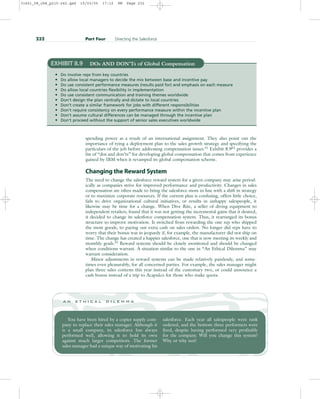
  • 273.
    A benchmarking studyshould provide several outputs. First, it should provide a meas- ure that compares performance for the benchmarked process relative to the organization studied. Second, it should identify the organization’s performance gap relative to bench- marked performance levels. Third, it should identify best practices and facilitators that produced the results observed during the study. Finally, the study should determine performance goals for the process studied and identify areas in which action can be taken to improve performance.15 Exhibit 9.2 provides some keys to successful benchmarking.16 To see how benchmarking can be used to improve sales organization performance, see ā€œSales Management in the 21st Century: Using Benchmarking to Succeed.ā€ 250 Part Five Determining Salesforce Effectiveness and Performance EXHIBIT 9.2 Keys to Successful Benchmarking • Clearly identify critical activities that will improve quality or service or reduce cost. • Properly prepare and benchmark only one activity at a time. • Make sure that you thoroughly understand your own process first. • Create a ā€œseek, desire, and listenā€ environment by choosing curious and knowledgeable people for your benchmark team. • Verify that your benchmark partner company is the best in its class, and clearly understand your partner’s process. • Provide adequate resources, not only financial, but also knowledgeable personnel. • Be diligent in selecting the correct partner—do not use a company that may not provide advantages to you. • Implement the benchmarking action plan. S a l e s m a n a g e m e n t i n t h e 2 1 s t c e n t u r y Using Benchmarking to Succeed Andre Wickham, corporate regional sales manager, Southeastern United States for Hormel Foods Corporation, comments on his company’s use of benchmarking: The marketplace today is fast-paced and con- stantly changing. As a result, sales organizations are continuously challenged to develop a structure that will allow them to effectively meet customer needs and fully penetrate all competitive market segments. At Hormel, we use benchmarking to help us achieve this goal. With benchmarking, we gauge our prac- tices against the ā€œbest practicesā€ of others in the marketplace. In recent years, this activity has become an important part of the strategic planning process. This evaluation helps us to assess our current and future course, which may range anywhere from no change to a major overhaul. Importantly, however, this practice allows us to clearly understand our strengths, weaknesses, opportunities, and threats. PLAN * Identify what to benchmark. * Identify comparative companies or salesforces. GATHER DATA * Determine data collection method and collect data. ANALYZE AND COMMUNICATE * Determine current performance gap. * Project future performance levels. * Communicate benchmark findings and gain acceptance. IMPLEMENT AND CONTROL TO IMPROVE PERFORMANCE * Establish functional goals. * Develop action plans. * Implement specific action plans and monitor progress. * Recalibrate benchmark. FIGURE 9.3 Benchmarking Process 31451_09_ch9_p243-270.qxd 15/03/05 20:38 PM Page 250
  • 274.
    SALES ORGANIZATION EFFECTIVENESSEVALUATIONS There is no one summary measure of sales organization effectiveness. Sales organiza- tions have multiple goals and objectives, and thus, multiple factors must be assessed. As illustrated in Figure 9.4, four types of analyses are typically necessary to develop a comprehensive evaluation of any sales organization. Conducting analyses in each of these areas is a complex task for two reasons. First, many types of analyses can be performed to evaluate sales, cost, profitability, and productivity results. For example, a sales analysis might focus on total sales, sales of specific products, sales to specific cus- tomers, or other types of sales and might include sales comparisons to sales quotas, to previous periods, to sales of competitors, or other types of analyses. Second, separate sales analyses need to be performed for the different levels in the sales organization. Thus, a typical evaluation would include separate sales analyses for sales zones, regions, districts, and territories. Many sales organizations focus on sales analysis.17 The results from one study on meth- ods used to measure salesforce effectiveness are presented in Exhibit 9.3.18 Customer satisfaction is also heavily relied upon to determine sales organization effectiveness. This involves surveying customers to determine their level of satisfaction with the company’s products, service, and salespeople, among other things. Determining the level of customer satisfaction has become easier due to the Internet. Companies such as Apogee Analytics, LLC (http:/ /www.apogeeanalytics.com) and NetReflector (http:/ /www.netreflector.com) will create and administer Web-based customer satisfaction surveys for firms.19 Now we discuss how sales, cost, profitability, and productivity analyses can be conducted to evalu- ate sales organization effectiveness. Sales Analysis Because the basic purpose of a sales organization is to generate sales, sales analysis is an obvious and important element of evaluating sales organization effectiveness. The difficulty, however, is in determining exactly what should be analyzed. One key consideration is in defining what is meant by a sale. Definitions include a placed order, a shipped order, and a paid order. Defining a sale by when an order is shipped is probably most common. Regardless of the definition used, the sales organization must be consistent and develop an information system to track sales based on what- ever sales definition is used. Module Nine Evaluating the Effectiveness of the Organization 251 Sales Analysis Sales Organization Effectiveness Cost Analysis Productivity Analysis Profitability Analysis Sales Organization Effectiveness Framework FIGURE 9.4 Evaluating sales organization effectiveness requires analyses of sales, cost, profitability, and productivity. Each type of analysis can be performed in several ways, should be performed at different sales organization levels, and will produce unique evaluative and diagnostic information for sales managers. 31451_09_ch9_p243-270.qxd 15/03/05 20:38 PM Page 251
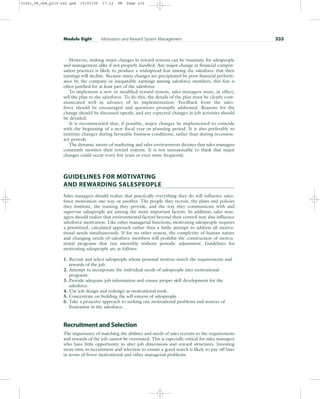
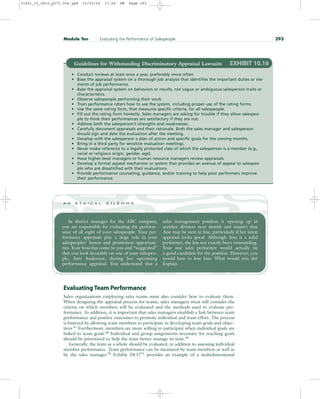
  • 275.
    Another consideration iswhether to focus on sales dollars or sales units. This can be extremely important during times when prices increase or when salespeople have substantial latitude in negotiating selling prices. The sales information in Exhibit 9.4 illustrates how different conclusions may result from analyses of sales dollars or sales units. If just sales dollars are analyzed, all regions in the exhibit would appear to be generating substantial sales growth. However, when sales units are introduced, the dollar sales growth for all regions in 2003 can be attributed almost entirely to price increases, because units sold increased only minimally during this period. The situation is somewhat different in 2004, because all regions increased the number of units sold. However, sales volume for region 2 is relatively flat, even though units sold increased. This could be caused either by selling more lower-priced products or by using larger price concessions than the other regions. In either case, analysis of sales dollars or sales units provides different evaluative information, so it is often useful to include both dollars and units in a sales analysis. Given a definition of sales and a decision concerning sales dollars versus units, many types of sales evaluations can be performed. Several alternative evaluations are presented in Figure 9.5. The critical decision areas are the organizational level of analysis, the type of sales, and the type of analysis. Organizational Level of Analysis Sales analyses should be performed for all levels in the sales organization for two basic reasons. First, sales managers at each level need sales analyses at their level and the next level below for evaluation and control purposes. For example, a regional sales manager should have sales analyses for all regions as well as for all districts within his or her region. This makes it possible to assess the sales effectiveness of the region and to deter- mine the sales contribution of each district. 252 Part Five Determining Salesforce Effectiveness and Performance EXHIBIT 9.3 Methods Used to Measure Salesforce Effectiveness Percent Using Sales results versus goal 79 Customer satisfaction 59 Profit versus goal 49 Sales manager feedback 45 Market share 39 Cost of sales 37 Sales employee feedback 28 Return on investment of sales resources 21 Other 9 EXHIBIT 9.4 Sales Dollars versus Sales Units 2002 2003 2004 Sales Sales Sales Sales Sales Sales Dollars Units Dollars Units Dollars Units Region 1 $50,000,000 500,000 $55,000,000 510,000 $62,000,000 575,000 Region 2 $55,000,000 550,000 $60,000,000 560,000 $62,000,000 600,000 Region 3 $45,000,000 450,000 $50,000,000 460,000 $56,000,000 520,000 Region 4 $60,000,000 600,000 $65,000,000 610,000 $73,000,000 720,000 31451_09_ch9_p243-270.qxd 15/03/05 20:38 PM Page 252
  • 276.
    Second, a usefulway to identify problem areas in achieving sales effectiveness is to perform a hierarchical sales analysis, which consists of evaluating sales results throughout the sales organization from a top-down perspective. Essentially, the analysis begins with total sales for the sales organization and proceeds through each successively lower level in the sales organization. The emphasis is on identifying potential problem areas at each level and then using analyses at lower levels to pin- point the specific problems. An example of a hierarchical sales analysis is presented in Figure 9.6. In this example, sales for region 3 appear to be much lower than those for the other regions, so the analysis proceeds to investigate the sales for all the districts in region 3. Low sales are identified for district 4; then district 4 sales are analyzed by territory. The results of this analysis suggest potential sales problems within territory 5. Additional analyses would be performed to determine why sales are so low for territory 5 and to take corrective action to increase sales from this territory. The hierarchical approach to sales analysis provides an efficient way to conduct a sales analysis and to identify major areas of sales problems. Type of Sales The analysis in Figure 9.6 addresses only total firm sales at each organizational level. It is usually desirable to evaluate several types of sales, such as by the following categories: • product type or specific products • account type or specific accounts • type of distribution method • order size The hierarchical analysis in Figure 9.6 could have included sales by product type, account type, or other type of sales at each level. Or once the potential sales prob- lem in territory 5 has been isolated, analysis of different types of sales could be performed to define the sales problem more fully. An example analysis is presented Module Nine Evaluating the Effectiveness of the Organization 253 Organizational Level of Analysis Type of Sales Type of Analysis Sales Organization Zones Regions Districts Territories Accounts Total Sales Type of Product Sales Type of Account Sales Type of Distribution Sales Order Size Sales Comparisons within Sales Organization Comparisons with Forecasts Comparisons with Sales Quotas Comparisons with Previous Period Comparisons with Industry/Competitors Sales Analysis Sales Analysis Framework FIGURE 9.5 A sales analysis can be performed at a number of organization levels and for many types of sales and can use several types of analysis. 31451_09_ch9_p243-270.qxd 15/03/05 20:38 PM Page 253
  • 277.
    in Figure 9.7.This example suggests especially low sales volume for product type A and account type B. Additional analyses within these product and account types would be needed to determine why sales are low in these areas and what needs to be done to improve sales effectiveness. The analysis of different types of sales at different organizational levels increases man- agement’s ability to detect and define problem areas in sales performance. However, incorporating different sales types into the analysis complicates the evaluation process and requires an information system capable of providing sales data concerning the desired breakdowns. Type of Analysis The discussion to this point has focused on the actual sales results for different organiza- tional levels and types of sales. However, the use of actual sales results limits the analysis to comparisons across organizational levels or sales types. These within-organization comparisons provide some useful information but are insufficient for a comprehensive evaluation of sales effectiveness. Several additional types of analysis are recommended and presented in Exhibit 9.5. Comparing actual sales results with sales forecasts and quotas is extremely revealing. A sales forecast represents an expected level of firm sales for defined products, markets, and 254 Part Five Determining Salesforce Effectiveness and Performance Territory 1 Territory 2 Territory 3 Territory 4 Territory 5 Territory 6 Sales $1,300,000 $1,250,000 $1,400,000 $750,000 $1,200,000 Additional Analysis District 1 District 2 District 3 District 4 District 5 Sales $12,000,000 $13,500,000 $7,000,000 $12,500,000 Region 1 Region 2 Region 3 Region 4 Sales $62,000,000 $62,000,000 $56,000,000 $73,000,000 Sales Organization $1,100,000 $11,000,000 FIGURE 9.6 Example of Hierarchical Sales Analysis This multistage analysis proceeds from one sales organization level to the next by identifying the major deviations and investigating them in more detail at the next lower level. In the present example, region 3 has the lowest sales, so all districts in region 3 are exam- ined. District 4 has poor sales results, so all the territories in district 4 are examined. Additional analysis is indicated for territory 5. 31451_09_ch9_p243-270.qxd 15/03/05 20:38 PM Page 254
  • 278.
    time periods andfor a specified strategy. Based on this definition, a sales forecast provides a basis for establishing specific sales quotas and reasonable sales objectives for a territory, district, region, or zone (methods for establishing sales quotas are discussed in Module 10). An effectiveness index can be computed by dividing actual sales results by the sales quota and multiplying by 100. As illustrated in Exhibit 9.5, sales results in excess of quota will have index values greater than 100, and results lower than quota will have index values less than 100. The sales effectiveness index makes it easy to compare directly the sales effectiveness of different organizational levels and different types of sales. Another type of useful analysis is the comparison of actual results to previous periods. As illustrated in Exhibit 9.5, this type of analysis can be used to determine sales growth rates for different organizational levels and for different sales types. Incorporating sales data for many periods makes it possible to assess long-term sales trends. A final type of analysis to be considered is a comparison of actual sales results to those achieved by competitors. This type of analysis can again be performed at different organizational levels and for different types of sales. If the comparison is extended to Module Nine Evaluating the Effectiveness of the Organization 255 Product Type B Product Type A Product Type C Account Type A Account Type B Account Type C $175,000 $275,000 $300,000 $290,000 $175,000 $285,000 Additional Analysis Product Type Sales Account Type Sales Additional Analysis Territory 5 Sales Example of Type-of-Sales Analysis FIGURE 9.7 This is a continuation of the hierarchical sales analysis presented in Figure 9.6. Sales in territory 5 are analyzed by prod- uct type and account type. The analysis suggests poor sales results for product type A and account type B. Types of Analysis Examples EXHIBIT 9.5 District 1 District 2 District 3 District 4 District 5 Sales $11,000,000 $12,000,000 $13,000,000 $7,000,000 $12,000,000 Sales quota $11,250,000 $11,500,000 $12,750,000 $10,000,000 $11,000,000 Effectiveness index 98 104 102 70 109 Sales last year $10,700,000 $11,000,000 $12,250,000 $6,800,000 $10,350,000 Sales growth 3% 9% 6% 3% 16% Industry sales $42,000,000 $42,000,000 $45,000,000 $40,000,000 $45,000,000 Market share 26% 29% 29% 18% 27% 31451_09_ch9_p243-270.qxd 15/03/05 20:38 PM Page 255
  • 279.
    overall industry sales,various types of market share can be calculated. Examples of these comparisons are presented in Exhibit 9.5. Sales analysis is the approach used most often for evaluating sales organization effective- ness. Sales data are typically more readily available than other data types, and sales results are extremely important to sales organizations. However, developing a sales analysis approach that will produce the desired evaluative information is a complex undertaking. Sales data must be available for different organizational levels and for different types of sales. Valid sales forecasts are needed to establish sales quotas for evaluating sales effectiveness in achieving sales objectives. In addition, industry and competitor sales information is also use- ful. Regardless of the comprehensiveness of the sales analysis, sales organizations need to perform additional analyses to evaluate sales organization effectiveness adequately. Cost Analysis A second major element in the evaluation of sales organization effectiveness is cost analysis. The emphasis here is on assessing the costs incurred by the sales organization to generate the achieved levels of sales. The general approach is to compare the costs incurred with planned costs as defined by selling budgets. Corporate resources earmarked for personal selling expenses for a designated period represent the total selling budget. The key sales management budgeting task is to determine the best way to allocate these sales resources throughout the sales organiza- tion and across the different selling activities. The budgeting process is intended to instill cost consciousness and profit awareness throughout the organization, and it is necessary for establishing benchmarks for evaluating selling costs. Selling budgets are developed at all levels of the sales organization and for all key expenditure categories. Our discussion focuses on the major selling expense categories and methods for establishing specific expenditure levels within the budget. Firms differ considerably in how they define their selling expense categories. Nevertheless, all sales organizations should plan expenditures carefully for the major sell- ing and sales management activities and for the different levels in the sales organization structure. The selling budget addresses controllable expenses, not uncontrollable ones. Typical selling budget expense categories are presented in Exhibit 9.6. 256 Part Five Determining Salesforce Effectiveness and Performance EXHIBIT 9.6 Selling Expense Categories in Budget Actual Original April July October Classification 2004 2005 Budget Revision Revision Revision Compensation expenses Salaries Commissions Bonuses Total Travel expenses Lodging Food Transportation Miscellaneous Total Administrative expenses Recruiting Training Meetings Sales offices Total 31451_09_ch9_p243-270.qxd 15/03/05 20:38 PM Page 256
  • 280.
    Both the totalexpenditures for each of these categories and sales management budget responsibility must be determined. Sales management budget responsibility depends on the degree of centralization or decentralization in the sales organization. In general, more centralized sales organizations will place budget responsibility at higher sales man- agement levels. For example, if salesforce recruitment and selection take place at the regional level, then the regional sales managers will have responsibility for this budget category. Typically, the sales management activity occurs at all management levels. For example, training activities might be performed at national, zone, regional, and district levels. In this case, the budgeting process must address how much to spend on overall training and how to allocate training expenditures to the organizational levels. The basic objective in budgeting for each category is to determine the lowest expen- diture level necessary to achieve the sales quotas. Notice that we did not say the lowest possible expenditure level. Sales managers might cut costs and improve profitability in the short run, but if expenditures for training, travel, and so forth are too low, long-run sales and profits will be sacrificed. However, if expenses can be reduced by more effec- tive or more efficient spending, these productivity improvements can produce increased profitability in the long run. Achieving productivity improvements has been one of the most demanding tasks facing sales managers in recent years because increases in field selling costs and extremely competitive markets have put tremendous pressure on firm profitability. Determining expenditure levels for each selling expense category is extremely diffi- cult. Although there is no perfect way to arrive at these expenditure levels, two approaches warrant attention: the percentage of sales method and the objective and task method.20 Probably the most often used, the percentage of sales method calculates an expen- diture level for each category by multiplying an expenditure percentage times forecasted sales. The effectiveness of the percentage of sales method depends on the accuracy of sales forecasts and the appropriateness of the expenditure percentages. If the sales forecasts are not accurate, the selling budgets will be incorrect, regardless of the expenditure per- centages used. If sales forecasts are accurate, the key is determining the expenditure percentages. This percentage may be derived from historical spending patterns or indus- try averages. Sales management should adjust the percentage up or down to reflect the unique aspects of their sales organization. The objective and task method takes an entirely different approach. In its most basic form, it is a type of zero-based budgeting. In essence, each sales manager prepares a sepa- rate budget request that stipulates the objectives to be achieved, the tasks required to achieve these objectives, and the costs associated with performing the necessary tasks. These requests are reviewed, and through an iterative process, selling budgets are approved. Many variations of the objective and task method are used by different sales organizations. In reality, the process of establishing a selling budget is an involved one that typically incorporates various types of analysis, many meetings, and much political maneuvering. However, the process has been streamlined in many firms through the use of computer modeling to rapidly evaluate alternative selling budgets. After a budget has been determined, cost analysis can be performed. Examples of two types of cost analysis are presented in Exhibit 9.7. The first analysis calculates the variance between actual costs and budgeted costs for the regions in a sales organization. Regions with the largest variation, especially when actual costs far exceed budgeted costs, should be highlighted for further analysis. Large variations are not necessarily bad, but the reasons for the variations should be determined. For example, the ultimate purpose of selling costs is to generate sales. Therefore, the objective is not necessarily to minimize selling costs but to ensure that a specified relationship between sales and selling costs is maintained. Evaluate one sales manager’s method for determining budgeted costs in ā€œAn Ethical Dilemma.ā€ One way to evaluate this relationship is to calculate the selling costs as a percentage of sales achieved. Translating actual selling costs into percentages of sales achieved provides a means for assessing whether the cost–sales relationship has been maintained, even though the actual costs may exceed the absolute level in the selling budget. This situation is illus- trated by region 4 in Exhibit 9.7. Module Nine Evaluating the Effectiveness of the Organization 257 31451_09_ch9_p243-270.qxd 15/03/05 20:38 PM Page 257
  • 281.
    Sales and costanalyses are the two most direct approaches for evaluating sales organ- ization effectiveness. Profitability and productivity analyses extend the evaluation by assessing relationships between sales and costs. These analyses can be quite complex but may provide very useful information. Profitability Analysis Sales and cost data can be combined in various ways to produce evaluations of sales organization profitability for different organizational levels of different types of sales. This section covers three types of profitability analysis: income statement analysis, activity-based costing, and return on assets managed analysis. Income Statement Analysis The different levels in a sales organization and different types of sales can be considered as separate businesses.21 Consequently, income statements can be developed for prof- itability analysis. One of the major difficulties in income statement analysis is that some costs are shared between organizational levels or sales types. Two approaches for dealing with the shared costs are illustrated in Exhibit 9.8. The full cost approach attempts to allocate the shared costs to individual units based on 258 Part Five Determining Salesforce Effectiveness and Performance EXHIBIT 9.7 Cost Analysis Examples Compensation Costs Training Costs Actual Budgeted Actual Budgeted Cost Cost Variance Cost Cost Variance Region 1 $3,660,000 $3,600,000 +$ 60,000 $ 985,000 $1,030,000 –$ 45,000 Region 2 $3,500,000 $3,700,000 –$200,000 $2,110,000 $2,040,000 +$ 70,000 Region 3 $3,150,000 $3,400,000 –$250,000 $ 830,000 $1,060,000 –$230,000 Region 4 $4,200,000 $3,900,000 +$300,000 $2,340,000 $2,160,000 +$180,000 Compensation Costs Training Costs Actual Budgeted Actual Budgeted % Sales % Sales % Sales % Sales Region 1 6.1 6 2.9 3 Region 2 5.8 6 3.1 3 Region 3 5.4 6 2.6 3 Region 4 6.0 6 3.1 3 At the Alpha company, a contest is held each year among sales regions. Salespeople in the region deemed to be the most effective, based in large part on a cost analysis, receive a weekend trip to an exotic island. As manager of the south- eastern region, Kathy has finished as runner-up in the contest the past three years. She thinks her salespeople are long overdue. This year Kathy is considering setting budgeted costs higher than she actually anticipates so that her year-end costs will look significantly lower than budgeted. What do you think Kathy should do? Why? a n e t h i c a l d i l e m m a 31451_09_ch9_p243-270.qxd 15/03/05 20:39 PM Page 258
  • 282.
    some type ofcost allocation procedure. This results in a net profit figure for each unit. The contribution approach is different in that only direct costs are included in the profitability analysis; the indirect or shared costs are not included. The net contribution calculated from this approach represents the profit contribution of the unit being ana- lyzed. This profit contribution must be sufficient to cover indirect costs and other over- head and to provide the net profit for the firm. An example that incorporates both approaches is presented in Exhibit 9.9. This example uses the direct approach for assessing sales region profitability and the contri- bution approach for evaluating the districts within this region. Notice that the prof- itability calculations for each district include only district sales, cost of goods sold, and district direct selling expenses. A profit contribution is generated for each district. The profitability calculations for the region include district selling expenses, region direct selling expenses that have not been allocated to the districts, and an allocated portion of shared zone costs. This produces a net profit figure for a profitability evaluation of the region. Although either approach might be used, there seems to be a trend toward the con- tribution approach, probably because of the difficulty in arriving at a satisfactory proce- dure for allocating the shared costs. Different cost allocation methods produce different results. Thus, many firms feel more comfortable with the contribution approach because it eliminates the need for cost allocation judgments and is viewed as more objective. For a look at how Hormel Foods focuses on selling costs to achieve profitable sales, see ā€œSales Management in the 21st Century: Focus on Profits at Hormel.ā€ Module Nine Evaluating the Effectiveness of the Organization 259 Full Cost versus Contribution Approaches EXHIBIT 9.8 Full Cost Approach Contribution Approach Sales Sales Minus: Cost of goods sold Minus: Cost of goods sold Gross margin Gross margin Minus: Direct selling expenses Minus: Direct selling expenses Minus: Allocated portion of shared expenses Profit contribution Net profit Profitability Analysis Example EXHIBIT 9.9 Full Cost Approach Contribution Approach Region District 1 District 2 District 3 Sales $300,000,000 $180,000,000 $70,000,000 $50,000,000 Cost of goods sold 255,000,000 168,500,000 58,500,000 28,000,000 Gross margin 45,000,000 11,500,000 11,500,000 22,000,000 District selling expenses 11,000,000 5,000,000 3,500,000 2,500,000 Region direct selling expenses 10,000,000 — — — Profit contribution 24,000,000 6,500,000 8,000,000 19,500,000 Allocated portion of shared zone costs 16,000,000 Net profit 8,000,000 31451_09_ch9_p243-270.qxd 15/03/05 20:39 PM Page 259
  • 283.
    Activity-Based Costing Perhaps amore accountable method for allocating costs is activity-based costing (ABC). ABC allocates costs to individual units on the basis of how the units actually expend or cause these costs. Costs are accumulated and then allocated to the units by the appropriate drivers, factors that drive costs up or down.22 Exhibit 9.10 illustrates how the profitability picture changed for a building supplies company that switched to ABC to assess distribution channel profitability.23 Notice that with ABC, selling expenses are no longer allocated to each channel based on a percent- age of that channel’s sales revenues. Instead, costs associated with each activity used to generate sales for a specific channel are allocated to that channel. With ABC, a clearer picture of operating profits per channel emerges. In particular, the original equipment manufacturer channel appears to be much more profitable than the firm’s prior account- ing system indicates. ABC places greater emphasis on more accurately defining unit profitability by tracing activities and their associated costs directly to a specific unit. For example, using ABC analysis, the Doig Corporation was able to lower costs by identifying which tasks added value and which ones did not. For instance, it identified which customers could be served just as well by phone, saving both reps and the company time and money.24 As such, ABC helps foster an understanding of resource expenditures, how customer value is created, and where money is being made or lost.25 Return on Assets Managed Analysis The income statement approach to profitability assessment produces net profit or prof- it contribution in dollars or expressed as a percentage of sales. Although necessary and valuable, the income statement approach is incomplete because it does not incorporate any evaluation of the investment in assets required to generate the net profit or profit contribution. The calculation of return on assets managed (ROAM) can extend the income statement analysis to include asset investment considerations. The formula for calculating ROAM is ROAM Profit contribution as percentage of sales Asset turnover rate (Profit contribution/Sales) (Sales/Assets managed) 260 Part Five Determining Salesforce Effectiveness and Performance S a l e s m a n a g e m e n t i n t h e 2 1 s t c e n t u r y Focus on Profits at Hormel Andre Wickham, corporate regional sales man- ager, Southeastern United States for Hormel Foods Corporation, comments on his company’s focus on profitable selling: In today’s sales environment, simply making the sale is not enough. We are fully invested in making profitable sales that mutually benefit our company and our customers. Our sales organization’s ability to achieve desired profit targets is often manifested in two ways: by controlling our selling costs and by improving our product mix. Our sales organiza- tion is accountable for managing controllable expenses such as travel, entertainment, and product samples. This may appear to be a small matter, but we find that our people make better sales (business) decisions when this type of accountability is placed at their level. Further, we believe that by selling our customers a balanced mix of products, our sales organization will benefit with stronger sales volume sold as well as higher profit contributions. When these tasks are effectively accomplished the objectives of the customer and our company are met in a very efficient manner. 31451_09_ch9_p243-270.qxd 15/03/05 20:39 PM Page 260
  • 284.
    Profit contribution canbe either a net profit figure from a direct approach or profit contribution from a contribution approach. Assets managed typically include inventory, accounts receivable, or other assets at each sales organizational level. An example of ROAM calculations is presented in Exhibit 9.11. The example illustrates ROAM calculations for sales districts within a region. Notice that district 1 and district 2 produce the same ROAM but achieve their results in different ways. District 1 generates a relatively high profit contribution percentage, whereas district 2 operates with a relatively high asset turnover. Both district 3 and district 4 are Module Nine Evaluating the Effectiveness of the Organization 261 Activity-Based Costing Example EXHIBIT 9.10 Profits by Commercial Distribution Channel (Old System) Industrial Total Contract Suppliers Government OEM Commercial Annual sales (in thousands of dollars) $79,434 $25,110 $422 $9,200 $114,166 Gross margin 34% 41% 23% 27% 35% Gross profit $27,375 $10,284 $136 $2,461 $ 40,256 SGA allowancea (in thousands of dollars) $19,746 $ 6,242 $105 $2,287 $ 31,814 Operating profit (in thousands of dollars) $ 7,629 $ 4,042 $ 31 $ 174 $ 11,876 Operating margin 10% 16% 7% 2% 10% Invested capital allowanceb (in thousands of dollars) $33,609 $10,624 $179 $3,893 $ 48,305 Return on investment 23% 38% 17% 4% 25% a SGA allowance for each channel is 25 percent of that channel’s revenues. b Invested capital allowance for each channel is 42 percent of that channel’s revenues. Profits by Commercial Distribution Channel (New System: ABC) Industrial Total Contract Suppliers Government OEM Commercial Gross profit (from previous table) $27,375 $10,284 $136 $2,461 $ 40,256 Selling expensesc (all in thousands of dollars) Commission $ 4,682 $ 1,344 $ 12 $ 372 $ 6,410 Advertising 132 38 0 2 172 Catalog 504 160 0 0 664 Co-op advertising 416 120 0 0 536 Sales promotion 394 114 0 2 510 Warranty 64 22 0 4 90 Sales administration 5,696 1,714 20 351 7,781 Cash discount 892 252 12 114 1,270 Total $12,780 $ 3,764 $ 44 $ 845 $ 17,433 GA (in thousands of dollars) $ 6,740 $ 2,131 $ 36 $ 781 $ 9,688 Operating profit (in thousands of dollars) $ 7,855 $ 4,389 $ 56 $ 835 $ 13,135 Operating margin 10% 17% 13% 9% 12% Invested capitalc $33,154 $10,974 $184 $2,748 $ 47,060 Return on investment 24% 40% 30% 30% 28% cSelling expenses and invested capital estimated under an activity-based system. 31451_09_ch9_p243-270.qxd 15/03/05 20:39 PM Page 261
  • 285.
    achieving poor levelsof ROAM but for different reasons. District 3 has an acceptable profit contribution percentage but very low asset turnover ratio. This low asset turnover ratio is the result of both inventory accumulations or problems in payments from accounts. District 4, however, has an acceptable asset turnover ratio but low profit contribution percentage. This low profit contribution percentage may be the result of selling low margin products, negotiating low selling prices, or accruing excessive selling expenses. As illustrated in the preceding example, ROAM calculations provide an assessment of profitability and useful diagnostic information. ROAM is determined by both profit contribution percentage and asset turnover. If ROAM is low in any area, the profit contribution percentage and asset turnover ratio can be examined to determine the reason. Corrective action (e.g., reduced selling expenses, stricter credit guidelines, lower inventory levels) can then be taken to improve future ROAM performance. Productivity Analysis Although ROAM incorporates elements of productivity by comparing profits and asset investments, additional productivity analysis is desirable for thorough evaluation of sales organization effectiveness. Productivity is typically measured in terms of ratios between outputs and inputs. For example, as discussed in Module 4, one often-used measure of salesforce productivity is sales per salesperson. A major advantage of pro- ductivity ratios is that they can be compared directly across the entire sales organization and with other sales organizations. This direct comparison is possible because all the ratios are expressed in terms of the same units. Because the basic job of sales managers is to manage salespeople, the most useful input unit for productivity analysis is the salesperson. Therefore, various types of pro- ductivity ratios are calculated on a per-salesperson basis. The specific ratios depend on the characteristics of a particular selling situation but often include important outputs such as sales, expenses, calls, demonstrations, and proposals. An example of a produc- tivity analysis is presented in Exhibit 9.12. Exhibit 9.12 illustrates how productivity analysis provides a different and useful per- spective for evaluating sales organization effectiveness. As the exhibit reveals, absolute values can be misleading. For example, the highest sales districts are not necessarily the most effective. Although profitability analyses would likely detect this also, productiv- ity analysis presents a vivid and precise evaluation by highlighting specific areas of both high and low productivity. Take the information concerning district 2. Although sales per salesperson is reasonable and expenses per salesperson is relatively low, both calls 262 Part Five Determining Salesforce Effectiveness and Performance EXHIBIT 9.11 Return on Assets Managed (ROAM) Example District 1 District 2 District 3 District 4 Sales $24,000,000 $24,000,000 $24,000,000 $24,000,000 Cost of goods sold 12,000,000 12,000,000 14,000,000 14,000,000 Gross margin 12,000,000 12,000,000 10,000,000 10,000,000 Direct selling expenses 7,200,000 9,600,000 5,200,000 8,800,000 Profit contribution 4,800,000 2,400,000 4,800,000 1,200,000 Accounts receivable 8,000,000 4,000,000 16,000,000 4,000,000 Inventory 8,000,000 4,000,000 16,000,000 4,000,000 Total assets managed 16,000,000 8,000,000 32,000,000 8,000,000 Profit contribution percentage 20% 10% 20% 5% Asset turnover 1.5 3.0 .75 3.0 ROAM 30% 30% 15% 15% 31451_09_ch9_p243-270.qxd 15/03/05 20:39 PM Page 262
  • 286.
    per salesperson andproposals per salesperson are much lower than those for the other districts. This may explain why selling expenses are low, but it also suggests that the salespeople in this district may not be covering the district adequately. The high sales may be due to a few large sales to large customers. In any case, the productivity analysis provides useful evaluative and diagnostic infor- mation that is not directly available from the other types of analyses discussed in this module. Sales productivity and profitability are highly interrelated. However, profitabil- ity analysis has a financial perspective, whereas productivity analysis is more manageri- ally oriented. Improvements in sales productivity should translate into increases in profitability. Productivity improvements are obtained in one of two basic ways: 1. increasing output with the same level of input 2. maintaining the same level of output but using less input Productivity analysis can help determine which of these basic approaches should be pursued. ETHICAL ISSUES The value of comparing actual expenses with budgeted expenses depends on the accuracy of the expense information provided by salespeople. Although most sales organizations have prepared forms with the expense categories and instructions for salespeople, salespeople often face ethical problems in reporting their expenses. Consider the following situations: • A salesperson has been on the road for a week and incurs laundry expenses. He knows that if he places the laundry expenses under the miscellaneous expense category in his expense report, he will have to provide receipts. He decides that he can include them under the meals category because receipts are not required for this category as long as he stays under his per-diem allowance. • A salesperson is trying to get a customer to purchase a new product. He decides to take three individuals from the customer’s firm to dinner and a basketball game, even though he knows that he has exceeded his entertainment budget for the month. He thinks about hiding these entertainment expenses in different categories in his expense report. The decisions that salespeople make in these and similar situations affect the ability of sales managers to evaluate actual and budgeted expenses in an accurate manner. Sales managers themselves, however, may have opportunities to act unethically when evaluat- ing salesforce effectiveness as illustrated in ā€œAn Ethical Dilemma.ā€ Module Nine Evaluating the Effectiveness of the Organization 263 Productivity Analysis Example EXHIBIT 9.12 District 1 District 2 District 3 District 4 Sales $20,000,000 $24,000,000 $20,000,000 $24,000,000 Selling expenses $ 2,000,000 $ 2,400,000 $ 3,000,000 $ 3,000,000 Sales calls 9,000 7,500 8,500 10,000 Proposals 220 180 260 270 Number of salespeople 20 30 20 30 Sales/salesperson $ 1,000,000 $ 800,000 $ 1,000,000 $ 800,000 Expenses/salesperson $ 100,000 $ 80,000 $ 150,000 $ 100,000 Calls/salesperson 450 250 425 333 Proposals/salesperson 11 6 13 9 31451_09_ch9_p243-270.qxd 15/03/05 20:39 PM Page 263
  • 287.
    SUMMARY 1. Differentiate betweensales organization effectiveness and salesperson perform- ance. Sales organization effectiveness is a summary evaluation of the overall success of a sales organization in meeting its goals and objectives in total and at different organizational levels. By contrast, salesperson performance is a function of individual salesperson performance in individual situations. 2. Define a sales organization audit and discuss how it should be conducted. The most comprehensive type of evaluation is a sales organization audit, which is a systematic assessment of all aspects of a sales organization. The major areas included in the audit are sales organization environment, sales management evalua- tion, sales organization planning system, and sales management functions. The audit should be conducted regularly by individuals outside the sales organization. It is intended to identify existing or potential problems early so that corrective action can be taken before the problems become serious. 3. Define benchmarking and discuss how it should be conducted. Benchmarking is an ongoing measurement and analysis process that compares an organization’s current operating practices with the ā€œbest practicesā€ used by world-class organi- zations. It involves identifying the sales organization processes to be benchmarked and whom to benchmark, collecting data on the benchmarked firm, analyzing performance gaps and communicating them to the salesforce, and establishing goals and implementing plans. Its purpose is to improve processes to improve performance. 264 Part Five Determining Salesforce Effectiveness and Performance CONCLUDING COMMENTS As is obvious from the discussion in this module, there is no easy way to evaluate the effectiveness of a sales organization. Our recommendation is to perform separate analy- ses of sales, costs, profitability, and productivity to assess different aspects of sales organ- ization effectiveness. In addition, salesperson performance, which is discussed in the next module, must also be evaluated and considered. Each type of analysis offers a piece of the puzzle. Sales managers must put these pieces together for comprehensive evaluations. The objective underlying each of the analyses is to be able to evaluate effectiveness, identify problem areas, and use this information to improve future sales organization effectiveness. As regional sales manager for International Enterprises, Janice has been passed over several times for a promotion. Although her region per- forms as well as others within the company, she believes she may be getting overlooked because she is female. She has been told that if her region ranks above the other regions in the company in terms of effectiveness (based on sales, costs, prof- itability, productivity) this year that she will finally get her promotion. To ensure that her salesforce fares well, Janice is considering doing a little ā€œcre- ative bookkeeping.ā€ She reasons that her salesforce might look a little more effective than it actually is, but no harm will be done, and she will finally get the promotion the company owes her. If you were Janice, what would you do and why? a n e t h i c a l d i l e m m a 31451_09_ch9_p243-270.qxd 15/03/05 20:39 PM Page 264
  • 288.
    4. Describe howto perform different types of sales analysis for different organi- zational levels and types of sales. Sales analysis is the most common evaluation approach, but it can be extremely complex. Specific definitions of a sale are required, and both sales dollars and units typically should be considered. A hierarchical approach is suggested as a top-down procedure to address sales results at each level of the sales organization with an emphasis on identifying problem areas. Sales analy- sis is more useful when sales results are compared with forecasts, quotas, previous time periods, and competitor results. 5. Describe how to perform a cost analysis for a sales organization. Cost analysis focuses on the costs incurred to generate sales results. Specific costs can be compared with the planned levels in the selling budget. Areas with large variances require specific attention. Costs can also be evaluated as percentages of sales and compared to comparable industry figures. 6. Describe how to perform an income statement analysis, activity-based costing, and return on assets managed to assess sales organization profitability. Profitability analysis combines sales and cost data in various ways. The income state- ment approach focuses on net profit or profit contributions from the different sales organization levels. Activity-based costing allocates costs to individual units on the basis of how the units actually expend or cause these costs. The return on assets man- aged approach assesses relationships between profit contributions and the assets used to generate these profit contributions. Residual income analysis combines the return on assets managed concept with sales growth objectives to produce a very useful evaluative tool. The different profitability analyses address different aspects of prof- itability that are of interest to sales managers. 7. Describe how to perform a productivity analysis for a sales organization. Productivity analysis focuses on relationships between outputs and inputs. The most useful input is the number of salespeople, whereas relevant outputs might be sales, expenses, proposals, and so on. The productivity ratios calculated in this manner are versatile because they can be used for comparisons within the sales organization and across other sales organizations. Productivity analysis not only provides useful evalu- ative information but also provides managerially useful diagnostic information that can suggest ways to improve productivity and increase profitability. UNDERSTANDING SALES MANAGEMENT TERMS sales organization audit objective and task method benchmarking profitability analysis sales analysis income statement analysis hierarchical sales analysis full cost approach effectiveness index contribution approach cost analysis activity-based costing (ABC) selling budget return on assets managed (ROAM) percentage of sales method productivity analysis DEVELOPING SALES MANAGEMENT KNOWLEDGE 1. Discuss why it is important to differentiate between sales organization effectiveness and salesperson performance. 2. Discuss what is involved in conducting a sales management audit. 3. What is the purpose of benchmarking? Discuss what is involved in benchmarking. 4. Refer to ā€œSales Management in the 21st Century: Using Benchmarking to Succeed.ā€ How can benchmarking be used to improve performance? Module Nine Evaluating the Effectiveness of the Organization 265 31451_09_ch9_p243-270.qxd 15/03/05 20:39 PM Page 265
  • 289.
    5. What ismeant by a hierarchical sales analysis? Can a hierarchical approach be used in analyzing costs, profitability, and/or productivity? 6. What is the difference between the full cost and contribution approaches to income statement analysis for a sales organization? Which would you recommend for a sales organization? Why? 7. Refer to ā€œSales Management in the 21st Century: Focus on Profits at Hormel.ā€ How can a company achieve more profitable sales? 8. What are the two basic components of return on assets managed? How is each com- ponent calculated, and what does each component tell a sales manager? 9. Identify five different sales organization productivity ratios that you would recom- mend. Describe how each would be calculated and what information each would provide. 10. Discuss how you think new computer and information technologies will affect the evaluations of sales organization effectiveness in the future. BUILDING SALES MANAGEMENT SKILLS 1. Using the following information, conduct a sales analysis to evaluate sales organiza- tion effectiveness. Explain your findings. Region 1 Region 2 Region 3 Region 4 ($000) ($000) ($000) ($000) Sales $ 4,050 $ 4,750 $ 4,250 $ 2,500 Sales quota $ 4,125 $ 4,250 $ 4,075 $ 3,900 Sales last year $ 3,925 $ 4,375 $ 4,000 $ 2,425 Industry sales $11,500 $12,500 $13,500 $10,500 2. Sales and cost data can be combined in various ways to produce evaluations of sales organization profitability for different organizational levels or different types of sales. Three types of profitability analysis are useful for evaluating effectiveness: activity- based costing, income statement analysis, and return on assets managed analysis. Examining Exhibit 9.10, point out differences in operating profits by commercial distribution channel between the company’s old and new (ABC) system, and explain why they differ. What would the ABC system lead you to believe regarding the effec- tiveness of each channel? Using the information in Exhibit 9.10 and the following information, conduct an income statement analysis and return on assets managed analysis. Explain the results of your analyses. Industrial Contract Suppliers Government OEM ($000) ($000) ($000) ($000) Accounts receivable $26,578 $16,840 $72 $1,633 Inventory $26,578 $16,840 $73 $1,634 3. Several sites are available on the World Wide Web that provide benchmarking services. One such site is Best Practices, LLC (http:/ /www.best-in-class.com), a research and consulting firm that provides business insight and analysis of how world-class compa- nies achieve exceptional economic and operational performance. Access this site and review its services. 3a. How can a company such as this be useful to a sales manager attempting to improve the sales organization? 3b. From the Best Practices home page, click on ā€œBest Practice Database.ā€ Next, go to ā€œsubject areas,ā€ click on ā€œsales and marketing,ā€ and finally click on ā€œsales management.ā€ You will find several reports (click on a report for an 266 Part Five Determining Salesforce Effectiveness and Performance 31451_09_ch9_p243-270.qxd 15/03/05 20:39 PM Page 266
  • 290.
    Module Nine Evaluatingthe Effectiveness of the Organization 267 overview). Identify two reports that might be helpful for improving a sales organization’s effectiveness and briefly explain how each report’s information might be used. 3c. Locate another benchmarking service on the World Wide Web. Identify its address and briefly describe its services. Compare and contrast its services to those of Best Practices, LLC. 4. Situation: Read the Ethical Dilemma on page 258. Characters: Kathy, southeastern region manager; Brenda, one of Kathy’s top sales- people Scene: Location—local restaurant for lunch. Action—Kathy tells Brenda abouther plan to set higher than usual budgeted selling costs. Brenda is skeptical. The two discuss the pros and cons of doing so and con- sider other alternatives Kathy might take. 5. Using the following information, conduct a productivity analysis. District 1 District 2 District 3 District 4 Sales $30,000,000 $36,000,000 $30,000,000 $36,000,000 Selling expenses $ 3,000,000 $ 3,600,000 $ 4,500,000 $ 4,500,000 Sales calls 13,500 11,250 12,750 15,000 Proposals 330 270 390 405 Number of salespeople 30 45 30 45 PROD. NO SCENE TAKE ROLL SOUND DATE PROD CO. DIRECTOR CAMERAMAN ROLE PLAY 31451_09_ch9_p243-270.qxd 15/03/05 20:39 PM Page 267
  • 291.
    Case 9.1: BeautyGlow Cosmetics Company Background Beauty Glow Cosmetics Company manufactures and markets a line of cosmetics products to retail- ers throughout the United States. The salesforce is organized into five regions, each comprised of five districts. A national sales manager oversees the five regional sales managers. Each regional manager is responsible for the effectiveness of his or her region and is compensated accordingly. Current Situation Kate Flower is the regional sales manager for the northern region. The fiscal year just ended, and Kate has compiled data to help her analyze her regions’s effectiveness. Although her region has had what she believes to be a very successful year, she wants to analyze each district closely. She hopes to use her analysis to identify and correct problems. Moreover, she needs to complete her analysis for her upcoming meeting with her national sales man- ager, Calvin Cline. Market shares for each district were fairly sizable (30 percent, 32 percent, 34 percent, 31 percent, and 28 percent for districts 1 through 5, respectively) at the beginning of the fiscal year. Kate had expected these to remain relatively stable over the past year. The company had anticipated a sales growth of 2 percent. In addition, selling costs were budgeted at 10 percent of sales. If Kate’s region did not increase sales by 2 percent and stay within the sales budget, her performance appraisal, and subse- quently her compensation, would suffer. Kate knew her boss would carefully scrutinize her analysis. She hoped to be able to identify any problem areas so that she could develop solutions and implement them in the upcoming year. She was scheduled to meet with Cline in 3 days. Kate compiled the following information. (Shown at the bottom of the page.) Questions 1. What analyses should Kate perform with this data? Perform these analyses. 2. What problems can you identify from your analyses? 3. What solutions do you recommend to solve these problems and improve results in the future? Situation: Read Case 9.1. Characters: Calvin Cline, national sales manager; Kate Flower, regional sales manager Scene: Location—meeting room at Beauty Glow Cosmetics headquarters. Action—Kate presents her findings from analyzing the effectiveness of her salesforce. She makes suggestions for solving the problems she has identified. Calvin responds to her analysis. He then asks Kate about the performance of her salespeople and who, if anyone, she thinks the com- pany should let go. 268 Part Five Determining Salesforce Effectiveness and Performance MAKING SALES MANAGEMENT DECISIONS PROD. NO SCENE TAKE ROLL SOUND DATE PROD CO. DIRECTOR CAMERAMAN ROLE PLAY District District District District District 1 2 3 4 5 ($000) ($000) ($000) ($000) ($000) Sales $8,200 $9,500 $10,450 $13,750 $8,400 Cost of goods sold 4,920 5,510 6,479 8,250 4,620 Compensation 615 810 735 1,140 630 Transportation 41 67 42 70 50 Lodging and meals 17 30 16 41 21 Telephone 8 10 12 14 9 Entertainment 10 8 15 12 12 Training 80 95 105 125 110 District accounts receivable 1,170 1,400 1,450 2,420 1,150 District inventory 2,000 3,500 3,200 5,250 2,500 Number of salespeople 8 9 11 12 10 Sales quota 8,100 9,750 10,250 14,125 3,300 Sales last year 7,500 9,250 10,250 13,925 8,200 Industry sales 26,452 29,689 30,736 45,834 30,000 31451_09_ch9_p243-270.qxd 15/03/05 20:39 PM Page 268
  • 292.
    Case 9.2: InduplicateCopiers,Inc. Background Induplicate Copiers, Inc., manufactures and mar- kets photocopiers. The company operates through- out the United States and is divided into four regions, each consisting of four districts with a dis- trict sales manager in charge of each. A regional sales manager is assigned ultimate responsibility for each region. The company manufactures its copiers in San Diego, California, and ships them directly to regional warehouses. For the most part, salespeople at Induplicate are well qualified and experienced. All its salespeople have a college degree, and several have prior sales experience. The average salesperson tenure at Induplicate is seven years. Current Situation Despite competing with major copier manufactur- ers such as Xerox and Minolta, Induplicate has done well. It continues to produce some of the most innovative and advanced machines on the market. However, Induplicate’s president, Alicia Doubleit, believes that the company can do much better. The following is a conversation she recently had with her national sales manager, Rich Getmore: Alicia: I believe that the key to our growth lies in having a successful salesforce. Rich: Absolutely. We have made great strides over the past three years, consistently increasing our sales volume. Alicia: Sales growth is a must. However, we need to measure up to the performance of our com- petition in other ways. Rich: What do you mean? Alicia: If we want to reach the top, we have to have a salesforce that performs like those at the top. How convenient and quick is our service? How long does it take from order to delivery and setup? Rich: I suppose we could always improve our serv- ice. However, our salespeople are well qualified and do a competent job. Alicia: What about our user training program? Can it be made more convenient for customers? Is it possible to accomplish it more quickly and less expensively without sacrificing the quality of the training? Rich: We seem to be doing okay in this area. There haven’t been a lot of complaints that I am aware of, so I assume everything is going well. Alicia: If we are going to be the best, we have to have the best salesforce. Rich, I’m counting on you to lead our salesforce to the top. I can’t stress how important it is for us to have a high performing salesforce. I’d like to meet with you in two weeks to discuss your plan for addressing these issues. Rich: Perhaps it’s time to take a closer look at our sales organization. I’ll do my best. Questions 1. How could Rich use benchmarking to address Alicia’s concerns? 2. Outline a benchmarking study that could be used to help make Induplicate’s salesforce more effective. 3. What else can be done to ensure that Induplicate’s salesforce is performing effectively? Situation: Read Case 9.2. Characters: Alicia Doubleit, president; Rich Getmore, national sales manager Scene 1: Location—Getmore’s office. Action— Role play the conversation between Alicia and Rich as outlined in the case. Scene 2: Location—Alicia’s office, two weeks later. Action—Rich is meeting with Alicia to discuss his plan for improv- ing the sales organization. He out- lines his plan and Alicia provides her thoughts regarding it. Module Nine Evaluating the Effectiveness of the Organization 269 PROD. NO SCENE TAKE ROLL SOUND DATE PROD CO. DIRECTOR CAMERAMAN ROLE PLAY 31451_09_ch9_p243-270.qxd 15/03/05 20:39 PM Page 269
  • 293.
  • 294.
    EVALUATING SALESPERSON PERFORMANCE ATCITY WHOLESALE Chip Prince, director of sales and marketing at City Wholesale, a provider of food service products based in Birmingham, Alabama, holds his salespeople accountable for their performance. He will not tolerate excuses for poor performance such as ā€œnot enough timeā€ or ā€œtough economy right now.ā€ However, he wants to help improve his salespeople’s performance. To do so, Prince conducts frequent per- formance evaluations. When Prince took over in 2000, sales reps were evaluated annually, and the company’s turnover was at 50 percent. ā€œWe spent five or six months figuring out what was important to our employees,ā€ Prince says. ā€œAlmost everyone said they wanted to get quicker feedback.ā€ As a result, Prince now evaluates his reps quarterly. In doing so, he focuses on determining what needs to be done to help improve each rep’s performance. A key question he asks his reps is ā€œWhat do you think we’re not doing?ā€ He then tries to determine what can be done to improve performance and stipulates what he expects from his reps. The more frequent evaluations at City Wholesale have improved communica- tions and provided better direction. ā€œPeople are telling us they now know where they’re supposed to go and are more in tune with what they’re supposed to be doing,ā€ says Prince. Consequently, his reps are performing better. Take for instance Catherine, one of Prince’s most improved performers. When Catherine began, she was an average performer who was falling well short of her potential. Her problem stemmed from her inability to focus her sales efforts. During one of their quarterly reviews, Prince asked her, ā€œWhat do you think we could do better?ā€ Catherine told Prince that she was uncertain about what he expected from her and that it would be helpful if he more clearly defined her objectives. Subsequently, Prince clearly outlined her goals and provided her with a specific quota. Catherine increased her sales by 30 to 40 percent after three quarters. According to Prince, ā€œPerformance is not going to just happen. Our job is to give guidance.ā€ The improved performance evaluation system at City Wholesale has reaped huge benefits. Turnover has dropped to less than 10 percent and profit margins are up by an average of 15 percent per quarter. Source: Jordana Mishory, ā€œFrequency Matters,ā€ Sales Marketing Management 156 (July 2004): 36–38. Whereas Module 9 focused on evaluating sales organization effectiveness, this module examines the task of evaluating salesperson performance and job satisfaction. Evaluations of sales organization effectiveness concentrate on the overall results achieved by the different units within the sales organization, with special attention given to determining the effectiveness of territories, districts, regions, and zones and identifying strategic changes to improve future effectiveness. These effectiveness assessments examine sales organization units and do not directly evaluate individuals; however, sales managers are responsible for the effectiveness of their assigned units. The City Wholesale example in the opening vignette illustrates how one firm conducts performance evaluations and how such evaluations might be used. City Wholesale evaluates its salespeople’s performance quarterly in an effort to determine After completing this module, you should be able to 1 Discuss the different purposes of salesperson performance evaluations. 2 Differentiate between an outcome-based and a behavior-based perspec- tive for evaluating and controlling salesperson performance. 3 Describe the different types of criteria necessary for comprehensive evalua- tions of salesperson performance. 4 Compare the advantages and disadvantages of different methods of salesperson performance evaluation. 5 Explain how salesperson performance information can be used to identify problems, determine their causes, and suggest sales management actions to solve them. 6 Discuss the measurement and importance of sales- person job satisfaction. Objectives 271 10 M o d u l e E V A L U A T I N G T H E P E R F O R M A N C E O F S A L E S P E O P L E 31451_10_ch10_p271-304.qxd 15/03/05 17:28 PM Page 271
  • 295.
    salespeople’s problems, improvecommunication, and provide direction. To evaluate sales- person performance, sales managers must understand why and how performance evalua- tions are conducted, as well as how to use information gained from these evaluations. The purpose of this module is to investigate the key issues involved in evaluating and controlling the performance and job satisfaction of salespeople. The purposes of sales- person performance evaluations are discussed initially. Then, the performance evaluation procedures currently used by sales organizations are examined. This is followed by a com- prehensive assessment of salesperson performance evaluation. The assessment addresses the criteria to be used in evaluating salespeople, the methods for evaluating salespeople against these criteria, and the outcomes of salesperson performance evaluations. The module concludes by discussing the importance and measurement of salesperson job satisfaction and relationships between salesperson performance and job satisfaction. PURPOSES OF SALESPERSON PERFORMANCE EVALUATIONS As the name suggests, the basic objective of salesperson performance evaluations is to determine how well individual salespeople have performed. However, the results of salesperson performance evaluations can be used for many sales management purposes:1 1. To ensure that compensation and other reward disbursements are consistent with actual salesperson performance. 2. To identify salespeople who might be promoted. 3. To identify salespeople whose employment should be terminated and to supply evidence to support the need for termination. 4. To determine the specific training and counseling needs of individual salespeople and the overall salesforce. 5. To provide information for effective human resource planning. 6. To identify criteria that can be used to recruit and select salespeople in the future. 7. To advise salespeople of work expectations. 8. To motivate salespeople. 9. To help salespeople set career goals. 10. To relate salesperson performance to sales organization goals. 11. To enhance communications between salesperson and sales manager. 12. To improve salesperson performance. These diverse purposes affect all aspects of the performance evaluation process. For example, performance evaluations for determining compensation and special rewards should emphasize activities and results related to the salesperson’s current job and situation. Performance evaluations for the purpose of identifying salespeople for promotion into sales management positions should focus on criteria related to potential effectiveness as a sales manager and not just current performance as a salesperson. The best salespeople do not always make the best sales managers. Thus, salesperson performance appraisals must be carefully developed and implemented to provide the types of information necessary to accomplish all the desired purposes. For an example of how Allied Office Products uses performance evaluations to determine how to improve salespeople’s performance see ā€œSales Management in the 21st Century: Using Performance Evaluations to Improve Performance at Allied Office Products.ā€ SALESPERSON PERFORMANCE EVALUATION APPROACHES Although it is impossible to determine with precision all the performance evaluation approaches used by sales organizations, several studies have produced sufficiently con- sistent information to warrant some general conclusions.2 272 Part Five Determining Salesforce Effectiveness and Performance 31451_10_ch10_p271-304.qxd 15/03/05 17:28 PM Page 272
  • 296.
    1. Most salesorganizations evaluate salesperson performance annually, although many firms conduct evaluations semiannually or quarterly. Relatively few firms evaluate salesperson performance more often than quarterly. 2. Most sales organizations use combinations of input and output criteria that are evaluated by quantitative and qualitative measures. However, emphasis seems to be placed on outputs, with evaluations of sales volume results the most popular. 3. Sales organizations that set performance standards or quotas tend to enlist the aid of salespeople in establishing these objectives. The degree of salesperson input and involvement does, however, appear to vary across firms. 4. Many sales organizations assign weights to different performance objectives and incorporate territory data when establishing these objectives. 5. Most firms use more than one source of information in evaluating salesperson perform- ance. and client and peer feedback are some of the common sources of information. 6. Most salesperson performance evaluations are conducted by the field sales manager who supervises the salesperson. However, some firms involve the manager above the field sales manager in the salesperson performance appraisal. 7. Most sales organizations provide salespeople with a written copy of their perform- ance review and have sales managers discuss the performance evaluation with each salesperson. These discussions typically take place in an office, although sometimes they are conducted in the field. These results offer a glimpse of current practices in evaluating salesperson performance. Although performance appraisal continues to be primarily a top-down process, changes are taking place in some companies leading to the implementation of a broader-based assessment process. An increasingly popular assessment technique, dubbed 360-degree feedback, involves performance assessment from multiple raters, including sales managers, Module Ten Evaluating the Performance of Salespeople 273 S a l e s m a n a g e m e n t i n t h e 2 1 s t c e n t u r y Using Performance Evaluations to Improve Performance at Allied Office Products Marty Zucker, vice president and general manager of the Long Island Division at Allied Office Products, discusses how the company evaluates its salesforce in order to improve rev- enues and margin performance: Allied Office Products is the largest independ- ent office products company in the United States, selling office supplies, furniture, promotion mar- keting, printing, and beverage services. At Allied Office Products, it is extremely important that we have a well-educated, highly talented, and moti- vated salesforce. My division, Allied Long Island, is in a very competitive market place. Thus, to compete we must be at the top of our game every day. To do so, we conduct performance evaluations monthly and annually to ensure that valuable assets are being used correctly. Each month, we hold one- on-one meetings with each sales representative to discuss their current clients, new prospects, future projects, and strategies for developing and closing accounts. We also discuss our ā€œjackpotā€ report, which lets us know how much money a client should be spending in each of our offerings. The evaluation takes approximately one hour and lets our management team determine if the sales representative is knowledgeable of our offerings, as well as his or her level of motivation. As for our annual review, we check to determine if the sales rep achieved both sales and margin plans. We examine what accounts were opened, what accounts were lost, and what accounts are good prospects. Furthermore, we scrutinize the outlook for the following year, as well as develop a new budget. By analyzing these reviews, we are able to coach our sales representatives to success- ful careers. Undoubtedly, conducting perform- ance evaluations will improve your company’s health in the 21st century. 31451_10_ch10_p271-304.qxd 15/03/05 17:28 PM Page 273
  • 297.
    internal and externalcustomers, team members, and even salespeople themselves. As part of its 360-degree review, sales managers at Knowledgepoint, a human resources software provider, solicit feedback from coworkers in areas such as rapport with clients, time management, and presentation skills when evaluating salespeople.3 Among its many benefits, 360-degree feedback helps managers better understand cus- tomer needs, detect barriers to success, assess developmental needs, create job involve- ment, reduce assessment bias, and improve performance.4 Because this evaluation method tends to make employees feel valued, they stay with the organization longer.5 However, when using the process, keep in mind that bias may still exist. Individuals may be less forthright in giving feedback and less accepting of feedback from others if they believe it will have damaging consequences.6 Furthermore, top salespeople tend to underestimate their performance, while bottom performers overestimate.7 Also, other ratings and self-ratings tend to differ significantly most of the time.8 Thus, it may be best to use feedback in conjunction with other appraisal techniques. Exhibit 10.1 provides 274 Part Five Determining Salesforce Effectiveness and Performance Salesperson E x t e r n a l Customers Internal C u s t o m e r s O n e s e l f Sales Manager T e a m M e m b e r s Evaluation Evaluation Evaluation E v a l u a t i o n Evaluation EXHIBIT 10.1 Keys to an Effective 360-Degree Feedback System 1. Ensure that participants willingly provide honest feedback by distributing the feedback instru- ment confidentially, aggregating responses by rating source, having rating forms sent directly to the person or group organizing the data, and including feedback from at least three respon- dents in each rater group (e.g., customers, coworkers, team members). Allow participants some input in selecting raters. 2. Explain to all participants how the data will be used. 3. Ensure that the data sources remain confidential so those being rated do not know specifically who did the rating. 4. Verify that the data are accurate. The assessment tools used to gather the data should be reli- able and valid. 5. Ensure that subjects can use the data to improve their performance. Present the feedback from the different groups (perspectives). It should be in a format that is easy to use and interpret. Compare feedback from others with one’s own perceptions. Feedback should be linked to development tools and processes. 6. Determine how the system will affect the organization overall and systematically evaluate its effectiveness. 7. Do not rely exclusively on 360-degree feedback. Timely feedback concerning day-to-day per- formance is important. 31451_10_ch10_p271-304.qxd 15/03/05 17:28 PM Page 274
  • 298.
    keys to implementingan effective 360-degree feedback system.9 To facilitate this process, some companies use Web sites to distribute and collect multiple evaluations.10 Companies such as Training Technologies, Inc. (http:/ /www.surveytracker.com) and Cognology (http:/ /www.cognology.biz) use the Internet to conduct 360-degree feedback surveys for companies.11 Another evaluation approach that moves away from the traditional top-down appraisal is referred to as performance management. This approach involves sales managers and salespeople working together on setting goals, giving feedback, reviewing, and rewarding.12 With this system, salespeople create their own development plans and assume responsibility for their careers. The sales manager acts as a partner in the process, providing feedback that is timely, specific, regular, solicited, and focused on what is within the salesperson’s control to change. Salespeople are compensated on the value of their contributions to the organi- zation’s success. To facilitate the review process, sales managers may want to use software applications, such as Performance Now Enterprise Edition, which provide a framework for implementing a comprehensive performance management system. Performance management ultimately focuses on improving organizational performance by finding new and better ways to satisfy customers.13 A study of 437 U.S. companies in 58 industries reported that companies following a performance management approach had greater financial and productivity performance relative to other companies in their industry.14 A performance management approach is consistent with the principles of total qual- ity management (TQM). TQM incorporates a strong customer orientation, a team- oriented corporate culture, and the use of statistical methods to analyze and improve all business processes including sales management.15 TQM programs focus on efforts to continuously monitor and improve performance rather than merely evaluating perform- ance over extended periods. This can be accomplished by mapping the processes that lead to desired results and then concentrating effort on improving these processes. As a result, reengineering may occur, resulting in a simpler process with corresponding savings in time and cost and improvements in quality.16 One approach for incorporating TQM into the performance evaluation process consists of four stages. In stage one, the sales manager and salesperson discuss the salesperson’s evaluation, which is based on feedback from several sources, such as the manager, customers, team members, and oneself. During stage two, the sales manager rates the salesperson relative to predetermined criteria to determine whether he or she is above or below expectations. In stage three, the salesperson’s performance is reviewed relative to his or her previous performance evaluation to ascertain accomplishments in performance and areas that need improvement. The final stage focuses on improving the system. During this stage, the sales manager specifies training and resources needed for improvement. The sales manager and salesperson also mutually agree on targets, degree, and type of improvement.17 Despite the approach taken, several key decisions concerning the appraisal process must be made. The remainder of this module addresses the key decision areas and alter- native methods for developing comprehensive evaluation and control procedures. KEY ISSUES IN EVALUATING AND CONTROLLING SALESPERSON PERFORMANCE A useful way to view different perspectives for evaluating and controlling salesperson performance is presented in Exhibit 10.2.18 An outcome-based perspective focuses on objective measures of results with little monitoring or directing of salesperson behavior by sales managers. By contrast, a behavior-based perspective incorporates complex and often subjective assessments of salesperson characteristics and behaviors with consider- able monitoring and directing of salesperson behavior by sales managers.19 The outcome-based and behavior-based perspectives illustrated in Exhibit 10.2 rep- resent the extreme positions that a sales organization might take concerning salesper- son performance evaluation. Although our earlier review of current practice indicates a tendency toward an outcome-based perspective, most sales organizations operate Module Ten Evaluating the Performance of Salespeople 275 31451_10_ch10_p271-304.qxd 15/03/05 17:28 PM Page 275
  • 299.
    somewhere between thetwo extreme positions. However, emphasis on either perspec- tive can have far-reaching impacts on the salesforce and important implications for sales managers. Several of these key implications are presented in Exhibit 10.3.20 See how placing too much focus on outcomes may lead to undesirable behavior as illustrated in ā€œAn Ethical Dilemma.ā€ On balance, these implications provide strong support for at least some behavior-based evaluations in most selling situations, including internationally. Some research finds a pos- itive relationship between behavior-based control and salesperson outcome performance, and sales organization effectiveness in Australia and Austria.21 In the absence of any behavior-based measures and limited monitoring and direction from sales management, salespeople are likely to focus on the short-term outcomes that are being evaluated. The process of obtaining the desired outcomes may be neglected, causing some activities that produce short-term results (e.g., selling pressure, unethical activities) to be emphasized and activities related to long-term customer relationships (e.g., customer orientation, post-sale service) to be minimized. A reasonable conclusion from this discussion is that sales organizations should use both outcome-based and behavior-based measures when evaluating salesperson performance. Research indicates that some firms use a hybrid approach to controlling the salesforce. The hybrid form was found to place considerable emphasis on the following: supervision; 276 Part Five Determining Salesforce Effectiveness and Performance EXHIBIT 10.2 Perspectives on Salesperson Performance Evaluation Outcome-Based Perspective Behavior-Based Perspective • Little monitoring of salespeople • Considerable monitoring of salespeople • Little managerial direction of salespeople • High levels of managerial direction of • Straightforward, objective measures of salespeople results • Subjective measures of salesperson characteristics, activities, and strategies The perspectives that a sales organization might take toward salesperson performance evaluation and control lie on a continuum. The two extremes are the outcome-based and behavior-based perspectives. EXHIBIT 10.3 Outcome-Based versus Behavior-Based Implications The more behavior-based (versus outcome-based) a salesperson performance evaluation is, • The more professionally competent, team-oriented, risk averse, planning-oriented, sales support-oriented, and customer-oriented salespeople will be. • The more intrinsically and recognition-motivated salespeople will be. • The more committed to the sales organization salespeople will be. • The more likely salespeople will be to accept authority, participate in decision making, and welcome management performance reviews. • The less the need for using pay as a control mechanism. • The more innovative and supportive the culture is likely to be. • The more inclined salespeople are to sell smarter rather than harder. • The better salespeople will perform on both selling (e.g., using technical knowledge, making sales presentations) and nonselling (e.g., providing information, controlling expenses ethically) behavioral performance dimensions. • The better salespeople will perform on outcome (e.g., achieving sales objectives) performance dimensions. • The better the sales organization will perform on sales organization effectiveness dimensions (e.g., sales volume and growth, profitability, and customer satisfaction). • The greater salespeople’s job satisfaction will be. 31451_10_ch10_p271-304.qxd 15/03/05 17:28 PM Page 276
  • 300.
    evaluation of attitude,effort, and quantitative results; and complete, accurate paperwork.22 However, the relative emphasis on outcome-based and behavior-based measures depends on environmental, firm, and salesperson considerations. Limited research finds that behav- ior-based control is used when the selling environment is uncertain, the salesforce is small, outputs and the cost of measuring them are inadequate, means for measuring behaviors are available, products are less complex, the percentage of routine activities is high, and sales- people are more educated.23 In addition, when formalization is high, outcome-based con- trol can reduce its negative impact on role ambiguity and organizational commitment.24 Establishing the desired emphasis should be the initial decision in developing a salesperson performance evaluation and control system. Once this emphasis has been established, the sales organization can then address the specific criteria to be evaluated, the methods of eval- uation, and how the performance information will be used. Regardless of the relative emphasis, however, some research suggests that greater control leads to higher levels of salesperson job satisfaction, organizational commitment and job performance, and lower levels of role stress.25 Criteria for Performance Evaluation The typical salesperson job is multidimensional. Salespeople normally sell multiple products to diverse customers and perform a variety of selling and nonselling activities. Therefore, any comprehensive assessment of salesperson performance must include multiple criteria. Although the specific criteria depend on the characteristics of a given selling situation and the performance evaluation perspective, the four performance dimensions illustrated in Figure 10.1 should be considered: behavioral and professional development (behavior- based perspective) and results and profitability (outcome-based perspective). Regardless of the specific evaluative criteria chosen, it is important that salespeople know and under- stand the criteria to achieve desired performance. Moreover, sales managers should explain the rationale underlying the use of specific criteria. They may even want to let salespeople help in determining the evaluation criteria. When salespeople believe that the criteria upon which they are being evaluated is appropriate, they are likely to be more satisfied with their job.26 Behavior The behavioral dimension consists of criteria related to activities performed by individ- ual salespeople. The emphasis is on evaluating exactly what each salesperson does. These behavioral criteria should not only address activities related to short-term sales gener- ation but should also include nonselling activities needed to ensure long-term customer satisfaction and to provide necessary information to the sales organization. Examples of typical behavioral criteria are presented in Exhibit 10.4.27 As might be expected, most sales organizations focus on the number of sales calls made as the key behavioral criterion. However, other activities are also important to at least some sales organizations. At Motorola, for instance, customer satisfaction is measured to determine goal achievement.28 Part of salespeople’s compensation at IBM is based on Module Ten Evaluating the Performance of Salespeople 277 It is performance appraisal time again. Dollar sales volume is an important criterion on which salespeople’s performance is evaluated. You just found out that your star sales performer is mak- ing statements to customers that exaggerate the seriousness of their problem to obtain a bigger order or other concessions. Your yearly bonus is based on how well your salesforce performs. What do you do? Why? a n e t h i c a l d i l e m m a 31451_10_ch10_p271-304.qxd 15/03/05 17:28 PM Page 277
  • 301.
    278 Part FiveDetermining Salesforce Effectiveness and Performance Behavioral Professional Development Profitability Results Salesperson Performance Behavior-Based Perspective Outcome-Based Perspective FIGURE 10.1 Dimensions of Salesperson Performance Evaluation A comprehensive evaluation of salesperson performance should incorporate criteria from these dimensions. Sales organ- izations using a behavior-based perspective would focus on behavioral and professional development criteria, whereas those using an outcome-based perspective would emphasize results and profitability criteria. EXHIBIT 10.4 Behavioral Criteria Base Percentage Reporting Using Calls Number of customer calls 48 Number of calls per day (or period) 42 Number of planned calls 24 Number of calls per account 23 Number of calls per number of customers— by product class (call frequency ratio) 18 Average time spent per call 8 Number of unplanned calls 7 Planned to unplanned call ratio 3 Ancillary Activities Number of required reports turned in 38 Number of days worked (per period) 33 Selling time versus nonselling time 27 Training meetings conducted 26 Number of customer complaints 25 Number of formal presentations 22 Number of quotes 21 Percentage of goods returned 17 Number of dealer meetings held 17 Number of service calls made 15 Number of formal proposals developed 15 Advertising displays set up 13 Number of demonstrations conducted 12 Dollar amount of overdue accounts collected 10 Number of letters/phone calls to prospects 9 31451_10_ch10_p271-304.qxd 15/03/05 17:28 PM Page 278
  • 302.
    customer satisfaction. Whensalespeople’s rewards are based on a customer satisfaction rat- ing, salespeople are likely to demonstrate a higher level of customer service activity.29 This helps to explain research that finds that when buyers rate salespeople highly, they tend to give the salesperson’s organization higher performance ratings.30 Salespeople have the most control over what they do, so evaluations of their perform- ance should include some assessment of their behaviors. Interestingly, foreign subsidiaries of U.S.–based multinationals appear to rely more heavily than U.S. firms on behavioral criteria for evaluating salesperson performance.31 This may be because behavior-based systems have been found to be better than compensation at promoting selling techniques among salespeople in other cultures, particularly Europe.32 As discussed in Exhibit 10.3, the use of behavior-based criteria will also facilitate the development of a professional, customer-oriented, committed, and motivated salesforce. Professional Development Another dimension of considerable importance in evaluating the performance of individ- ual salespeople relates to professional development. Professional development criteria assess improvements in certain characteristics of salespeople that are related to successful performance in the sales job. For example, if product knowledge is critical in a particular selling situation, then evaluations of the product knowledge of individual salespeople over various periods should be conducted. Examples of professional development criteria are presented in Exhibit 10.5.33 Module Ten Evaluating the Performance of Salespeople 279 Professional Development Criteria EXHIBIT 10.5 Base Percentage Reporting Using Communication skills 88 Product knowledge 85 Attitude 82 Selling skills 79 Initiative and aggressiveness 76 Appearance and manner 75 Knowledge of competition 71 Team player 67 Enthusiasm 66 Time management 63 Judgment 62 Cooperation 62 Motivation 61 Ethical/moral behavior 59 Planning ability 58 Pricing knowledge 55 Report preparation and submission 54 Creativity 54 Punctuality 49 Resourcefulness 49 Knowledge of company policies 48 Customer goodwill generation 41 Self-improvement efforts 40 Care of company property 39 Degree of respect from trade and competition 38 Use of promotional materials 37 New product ideas 35 Use of marketing/technical backup teams 33 Good citizenship 22 31451_10_ch10_p271-304.qxd 15/03/05 17:28 PM Page 279
  • 303.
    Many sales organizationsincorporate multiple professional development criteria into their salesperson performance evaluations. This is appropriate, because salespeople have control over the development of personal characteristics related to success in their sell- ing situation. The professional development criteria introduce a long-term perspective into the process of salesperson performance evaluation. Salespeople who are developing professionally are increasing their chances of successful performance over the long run. Although the professional development and behavioral criteria might be combined into one category, we prefer to keep them separate to reflect their different perspectives. Results The results achieved by salespeople are extremely important and should be evaluated. Examples of results criteria used in salesperson performance evaluations are listed in Exhibit 10.6.34 A potential problem with the use of results criteria in Exhibit 10.6 is that the overall results measures do not reflect the territory situations faced by individual salespeople. The salesperson with the highest level of sales may have the best territory and may not neces- sarily be the best performer in generating sales. In fact, some research shows that rewards for achieving results have a negative effect on performance and satisfaction because sales- people may view the rewards as arbitrary if the goals are beyond their control.35 Aside from the impossible task of developing territories that are exactly equal, the only way to address this potential problem is to compare actual results with standards that reflect the unique ter- ritory situation faced by each salesperson. These standards are generally called sales quotas. A sales quota represents a reasonable sales objective for a territory, district, region, or zone. Because a sales forecast represents an expected level of firm sales for a defined 280 Part Five Determining Salesforce Effectiveness and Performance EXHIBIT 10.6 Results Criteria Base Percentage Reporting Using Sales Sales volume in dollars 79 Sales volume to previous year’s sales 76 Sales volume by (versus) dollar quota 65 Percentage of increase in sales volume 55 Sales volume by product or product line 48 Sales volume by customer 44 Amount of new account sales 42 Sales volume in units 35 Sales volume to (versus) market potential 27 Sales volume by customer type 22 Sales volume to physical unit quota 9 Sales volume per order 7 Sales volume per call 6 Sales volume by outlet type 4 Percentage of sales made by telephone or mail 1 Market Share Market share achieved 59 Market share per quota 18 Accounts Number of new accounts 69 Number of accounts lost 33 Number of accounts buying the full line 22 Dollar amount of accounts receivable 17 Number of accounts (payment is) overdue 15 Lost account ratio 6 31451_10_ch10_p271-304.qxd 15/03/05 17:28 PM Page 280
  • 304.
    geographic area, timeperiod, and strategy, there should be a close relationship between the sales forecast and the sales quota. Bottom-up and/or top-down approaches might be used to develop sales forecasts that are translated into sales quotas. One recommended approach for developing a sales forecast is to use statistical methods such as regression.36 A market response framework to guide this type of approach is presented in Figure 10.2.37 Depending on the planning and control unit of interest (territory, district, region, or zone), different determinants of market response (e.g., sales, market share) might be important. However, these determinants can be classified as either environmental, organizational, or salesperson factors. Once the determinant and market response factors are identified, their values for each plan- ning and control unit in the previous period must be measured. Statistical packages can then be used to estimate the parameters of the regression equation. For example, if you are a district sales manager interested in forecasting terri- tory sales, you would identify and measure specific environmental, organizational, and salesperson factors as well as sales for each territory in the previous year. You could then develop a regression model of the following form: Territory sales a (b1)(environmental factor) (b2)(organizational factor) (b3)(salesperson factor) Module Ten Evaluating the Performance of Salespeople 281 Salesperson Factors Planning and Control Unit Market Response • Role Perceptions • Aptitude • Skill Level • Motivation Organizational Factors • Effort • Quality • Control Unit Attractiveness • Business Position Characteristics Environmental Factors • Marketing Effort • Sales Management Effort Behavior Market Response Framework FIGURE 10.2 These are the types of factors that affect market response for any planning and control unit, whether it be accounts, ter- ritories, districts, regions, or zones. Market response might be profits, market share, or some other response, but sales is usually the market response variable of interest to sales managers. 31451_10_ch10_p271-304.qxd 15/03/05 17:28 PM Page 281
  • 305.
    The a, b1,b2, and b3 values are the model parameters supplied by the regression pro- cedure to define the relationship between the determinant factors and territory sales. Although this type of model might be useful, it suffers from two basic weaknesses. First, it incorporates only the independent effects of the determinant variables, yet these variables are highly interrelated. Second, this type of equation is linear, yet the determi- nant variable relationships are probably nonlinear. These weaknesses can be addressed by performing the linear regression on the logarithms of the actual data, producing a multiplicative power function of the following form: Territory sales (a) (environmental factorb1 ) (organizational factorb2) (salesperson factorb3) This function is nonlinear and incorporates interactions through the multiplication of determinant variables. A specific example illustrating this type of function is presented in Exhibit 10.7.38 The environmental factors are potential and concentration, the salesperson factor is experience, and the organizational factor is span of control. The data are for three territories and are used in the model to generate sales forecasts for each territory individually. This regres- sion model indicates that the higher the territory potential, account concentration, and level of salesperson experience are, the higher the territory sales will be. The larger the span of control is, the lower the territory sales. The exponents in the model suggest that territory sales are most affected by territory potential and span of control. Thus, the regression model generates a specific sales forecast for each territory, and it also provides information concerning relationships between determinant factors and sales. The regression forecasting approach develops sales forecasts that explicitly consider the characteristics of a territory or other planning and control unit. Thus, these regression forecasts can be translated directly into sales quotas. For example, the sales forecasts for the three territories in Exhibit 10.7 ($586,000, $238,400, and $173,200) represent expected sales levels given the potential, concentration experience, and span of control evaluations for each territory. Sales management might use these regression sales forecasts as sales quo- tas for each territory. Alternatively, sales management might adjust the forecasts up or down based on information about the territories not incorporated in the regression model. 282 Part Five Determining Salesforce Effectiveness and Performance EXHIBIT 10.7 Regression Model Example Territory sales = (800.82) (potential.53 ) (concentration.03 ) (experience.08 ) (span of control–.55 ) Territory 1 Territory 2 Territory 3 Potential 114,000 125,000 87,000 (number of persons employed by firms in customer industry located in territory) Concentration 94,000 52,000 12,000 (number of persons employed by the large plants in customer industry located in territory) Experience 30 10 20 (months salesperson has been with company) Span of control 5 8 10 (number of salespeople supervised by sales manager) Territory sales forecast $586,000 $238,400 $173,200 31451_10_ch10_p271-304.qxd 15/03/05 17:28 PM Page 282
  • 306.
    Exhibit 10.8 showsresults of a survey indicating the relative importance placed on various factors by sales managers when assigning sales quotas.39 In any case, the territory sales fore- casts provide the basis for establishing the territory sales quotas. The regression approach can be used to develop sales forecasts and establish sales quotas at all sales organization levels.40 The determinant variables and measures are typically different depending on whether the control unit is a territory, district, region, or zone. Nevertheless, accurate sales forecasts are critical for establishing valid sales quotas at all sales organization levels. To increase the accuracy of sales forecasts and subsequently quotas, they should be developed quarterly, particularly in highly dynamic environments.41 Although forecasts provide the basis for developing quotas, they must be adjusted to determine each individual’s quota. Research suggests that salesperson performance can be enhanced by assigning more challenging quotas to experienced salespeople who have demonstrated exceptional competence or to novices who quickly exhibit high poten- tial.42 Likewise, performance may be enhanced by setting fair, consistent, and realistic quotas and by explaining to salespeople the rationale behind the quota assignment.43 Web-based applications such as Synygy Quotas, by Synygy, Inc. (http:/ /www. synygy.com), facilitate the quota-setting process. This application provides companies a means for setting corporate sales goals, allocating quotas, communicating them, mak- ing field adjustments, tracking changes, and tying quotas to incentive compensation pro- grams. Quota allocation methods are derived from over eight years of industry-leading best practices. Sales managers can use market potential, historical data, revenue, gross margin, profit, or any other measure or combination of measures to set quota.44 Module Ten Evaluating the Performance of Salespeople 283 Elements Important in Assigning Sales Quotas EXHIBIT 10.8 Statement Mean1,2 Rank Concentration of businesses within the sales representative’s territory is important in determining the amount of quota. 1.82 1 The geographical size of territory is important in determining the amount of quota. 1.95 2 Growth of businesses within the sales representative’s territory is important in determining the amount of quota. 2.11 3 Commitment by the sales manager to assisting the sales representative is important in determining the amount of quota. 2.23 4 Complexity of products sold is important in determining the amount of quota. 2.50 5 The sales representative’s past sales performance is important in determining the amount of quota. 2.54 6 Extent of product line is important in determining the amount of quota. 2.59 7 The financial support (e.g., compensation) a firm provides sales representatives is important in assigning quota. 2.76 8 The relationship of your product line is important in determining the amount of quota. 2.82 9 The amount of clerical support given to a sales representative is important in determining the amount of quota. 3.13 10 1The rating scale and weights used to rate the importance of each statement were as follows: 1 strongly agree; 2 agree; 3 neutral; 4 disagree; and 5 strongly disagree. 2 The responses numbered 186. 31451_10_ch10_p271-304.qxd 15/03/05 17:28 PM Page 283
  • 307.
    Although it variesfrom company to company, some research indicates that a majority of companies require salespeople to achieve 100 percent or more of quota to be consid- ered a strong performer. Over 26 percent of the respondents in this research claimed that achieving 111 percent or more of quota is necessary to be considered a strong performer. However, most companies (72 percent) consider salespeople who make 90 percent or less of quota to be average performers.45 As seen in Exhibit 10.9, this research also found that sales managers often work closely with salespeople to improve their performance when they fail to achieve quota.46 Profitability A potential problem with focusing on sales results is that the profitability of sales is not assessed. Salespeople can affect profitability in two basic ways. First, salespeople have an impact on gross profits through the specific products they sell and/or through the prices they negotiate for final sale. Thus, two salespeople could generate the same level of sales dollars and achieve the same sales/sales quota evaluation, but one salesperson could pro- duce more gross profits by selling higher margin products and/or maintaining higher prices in sales negotiations. Second, salespeople affect net profits by the expenses they incur in generating sales. The selling expenses most under the control of salespeople are travel and entertainment expenses. Therefore, two salespeople could generate the same levels of total sales, the same sales/sales quota performance, and even the same levels of gross profits, but one salesperson could contribute more to net profits through lower travel and entertainment costs. Examples of profitability criteria are listed in Exhibit 10.10.47 Sales organizations are increasingly incorporating profitability criteria into their salesper- son performance evaluations. The most frequently used profitability criterion is net profit dollars. Selling expenditures relative to budget is also heavily emphasized. The need to address profitability criteria is especially important during a slow-growth, competitive envi- ronment in which sales growth is so difficult and productivity and profitability so important. Comment on Criteria Conducting a comprehensive evaluation of salesperson performance typically requires consideration of behavioral professional development, results, and profitability criteria. Each set of criteria tells a different story as to how well salespeople have performed and provides different diagnostic information for control purposes. Steve Randazzo of KV Pharmaceutical (ETHEX Division) explains how KV uses various performance criteria to drive relationship development in ā€œSales Management in the 21st Century: Performance Criteria at KV Pharmaceutical Inc. (ETHEX Division).ā€ Other methods for evaluating salespeople against these criteria are discussed in the following sections. 284 Part Five Determining Salesforce Effectiveness and Performance EXHIBIT 10.9 Examples of Managerial Actions Resulting from Failure to Achieve Assigned Quota Percentage Agreement Strongly Strongly Action to Salesperson Disagree Disagree Neutral Agree Agree Nothing 12.7 38.2 18.5 25.4 5.2 Informal reprimand to do better 9.2 16.1 19.0 47.1 8.6 A stern verbal warning 10.7 30.5 23.4 29.7 5.7 Sales manager works closely with salesperson to improve 7.6 7.0 17.4 48.8 19.2 Formal probation 12.2 34.9 24.4 22.1 6.4 31451_10_ch10_p271-304.qxd 15/03/05 17:28 PM Page 284
  • 308.
    Module Ten Evaluatingthe Performance of Salespeople 285 Profitability Criteria EXHIBIT 10.10 Base Percentage Reporting Using Sales Net profit dollars 69 Gross margin per sales (a percentage of sales) 34 Return on investment 33 Net profit as a percent(age) of sales 32 Margin by product category 28 Gross margin (in dollars) 25 Margin by customer type 18 Net profit per sale 14 Return on sales cost 14 Net profit contribution — Order(s) Number of orders secured 47 Average size of order secured 22 Order per call ratio (aka batting average) 14 Number of orders canceled 11 Net orders per repeat order 10 Number of canceled orders per orders booked 4 Selling Expense Selling expense versus budget 55 Total expenses 53 Selling expense to sales 49 Average cost per call 12 Selling expense to quota 12 Expenses by product category 7 Expenses by customer type 3 S a l e s m a n a g e m e n t i n t h e 2 1 s t c e n t u r y Performance Criteria at KV Pharmaceutical, Inc.(ETHEX Division) Steve Randazzo, vice president of sales for KV Pharmaceutical, Inc. (ETHEX Division), dis- cusses how he uses performance criteria to drive relationship development: Our salespeople are evaluated on several crite- ria: industry/product knowledge; promotion of specified and new products; relationship develop- ment skills; territory management/work habits; and sales and profitability. While achieving sales and profitability goals are important, it is equally important for our salespeople to be able to develop customer relationships, be creative, and think ā€œoutside the box.ā€ Good sales numbers might be achieved because we launched a new product, or offered a very competitive price. However, we want to establish relationships with customers that will enable us to withstand turbulent times in the market. For instance, salespeople are evaluated on their ability to get customers to implement promo- tional programs developed by our marketing department that are designed to help customers move our products. Customers who use these pro- grams are more likely to see us as a partner. Therefore, we evaluate salespeople’s ability to build relationships just as seriously as we do their ability to achieve sales and profits. Territory man- agement and work habits are also extremely important to being a successful salesperson. My top producers are always the ones who understand how to work with the corporate office to meet customer needs and work equally hard for the customer plus close for the business. 31451_10_ch10_p271-304.qxd 15/03/05 17:28 PM Page 285
  • 309.
    Performance Evaluation Methods Salesmanagers can use a number of different methods for measuring the behaviors, pro- fessional development, results, and profitability of salespeople. Ideally, the method used should have the following characteristics.48 • Job relatedness: The performance evaluation method should be designed to meet the needs of each specific sales organization. • Reliability: The measures should be stable over time and exhibit internal consistency. • Validity: The measures should provide accurate assessments of the criteria they are intended to measure. • Standardization: The measurement instruments and evaluation process should be similar throughout the sales organization. • Practicality: Sales managers and salespeople should understand the entire performance appraisal process and should be able to implement it in a reasonable amount of time. • Comparability: The results of the performance evaluation process should make it pos- sible to compare the performance of individual salespeople directly. • Discriminability: The evaluative methods must be capable of detecting differences in the performance of individual salespeople. • Usefulness: The information provided by the performance evaluation must be valuable to sales managers in making various decisions. Designing methods of salesperson performance evaluation that possess all these char- acteristics is a difficult task. As indicated in Exhibit 10.11 each evaluative method has certain strengths and weaknesses.49 No one method provides a perfect evaluation. Therefore, it is important to understand the strengths and weaknesses of each method so that several can be combined to produce the best evaluative procedure for a given sales organization. Graphic Rating/Checklist Methods Graphic rating/checklist methods consist of approaches in which salespeople are eval- uated by using some type of performance evaluation form. The performance evaluation form contains the criteria to be used in the evaluation as well as some means to provide an assessment of how well each salesperson performed on each criterion. An example of part of such a form is presented in Exhibit 10.12. 286 Part Five Determining Salesforce Effectiveness and Performance EXHIBIT 10.11 Comparison of Performance Evaluation Methods Evaluation Criteria Performance Evaluation Method Graphic rating/checklist Very good Good Good Very good Very good Very good Poor Good Ranking Poor Poor Poor Very good Poor Good Excellent Poor Objective-setting/MBO Very Good Good Good Poor Good Poor Good Poor Behaviorally Anchored Rating Scale (BARS) Very Good Good Good Poor Good Poor Poor Good J o b R e l a t e d n e s s R e l i a b i l i t y V a l i d i t y S t a n d a r d i z a t i o n P r a c t i c a l i t y C o m p a r a b i l i t y D i s c r i m i n a b i l i t y U s e f u l n e s s 31451_10_ch10_p271-304.qxd 15/03/05 17:28 PM Page 286
  • 310.
    This method ispopular in many sales organizations. It is especially useful in evaluating salesperson behavioral and professional development criteria. As part of its assessment process, Eastman Chemical Company asks its customers to evaluate their satisfaction with the company by using a rating scale. As evident from Exhibit 10.13, Eastman’s salespeo- ple are responsible for several behavior-based performance factors.50 Rating methods have Module Ten Evaluating the Performance of Salespeople 287 Graphic Rating/Checklist Example EXHIBIT 10.12 1. Asks customers for their ideas for promoting business Almost Never 1 2 3 4 5 Almost Always NA 2. Offers customers help in solving their problems Almost Never 1 2 3 4 5 Almost Always NA 3. Is constantly smiling when interacting with customers Almost Never 1 2 3 4 5 Almost Always NA 4. Admits when he/she doesn’t know the answer, but promises to find out Almost Never 1 2 3 4 5 Almost Always NA 5. Generates new ways of tackling new or ongoing problems Almost Never 1 2 3 4 5 Almost Always NA 6. Returns customers’ calls the same day Almost Never 1 2 3 4 5 Almost Always NA 7. Retains his or her composure in front of customers Almost Never 1 2 3 4 5 Almost Always NA 8. Delivers what he or she promises on time Almost Never 1 2 3 4 5 Almost Always NA Eastman Chemical Company Customer Satisfaction Survey EXHIBIT 10.13 Importance: Rate the importance of each state- ment (your buying criteria) by asking, ā€œWould I place additional business with a supplier who improved per- formance in this category from ā€˜aver- age’ to ā€˜outstanding’?ā€ Performance: Rate Eastman performance and your best ā€œother supplierā€ on each criteria. Product 1. Product Performance: Supplier provides a product that consistently meets your requirements and performance expectations. 2. Product Mix: Supplier offers a range of products that meets your needs. 3. Packaging: Supplier has the package type, size, and label to meet your needs. 4. New Products: Supplier meets your needs through timely introduction of new products. 5. Product Availability: Supplier meets volume com- mitments and is also fair and consistent during times of restricted supply. 6. Product Stewardship: Supplier provides informa- tion about the transportation, storage, handling, use, recycling, disposal, and regulation of prod- ucts and product packaging. Importance Performance 5—Definitely Would 5—Outstanding 2—Fair 4—Probably Would 4—Good 1—Poor 3—Uncertain 3—Average 2—Probably Would Not NA—Not Applicable 1—Definitely Would Not NA—Not Applicable Eastman Best Other Supplier (continued) 31451_10_ch10_p271-304.qxd 15/03/05 17:28 PM Page 287
  • 311.
    288 Part FiveDetermining Salesforce Effectiveness and Performance EXHIBIT 10.13 Eastman Chemical Company Customer Satisfaction Survey (Continued) Service 7. Order Entry: Supplier has a user-friendly system to place orders that is flexible and responsive to rou- tine order changes as well as urgent or special requests. 8. Delivery: Supplier consistently delivers the right product on time and in satisfactory condition. 9. Technical Service: Supplier provides timely techni- cal support through training, information, prob- lem solving, and assistance in current and new end-use applications. 10. Sharing Information: Supplier is a resource for product, market, industry, and company informa- tion that helps you better understand business issues. 11. New Ideas: Supplier offers new ideas that add value to your business. Pricing/Business Practices 12. Pricing Practices: Supplier is consistent with the marketplace in establishing pricing practices. 13. Paperwork: Supplier provides clear and accurate paperwork and business documents that meet your needs. 14. Commitment to total quality management: Supplier exhibits strong commitment to total quality management in all aspects of their business. 15. Responsiveness: Supplier listens and responds to your business needs in a timely manner. Relationship 16. Integrity: Supplier is credible, honest, and trust- worthy. 17. Dependability: Supplier follows through on agree- ments. 18. Supplier Contact: Supplier is easy to contact and provides the right amount of interface with the appropriate personnel. 19. Problem Solving: Supplier provides empowered employees to solve your problems. Supplier Commitment 20. Industry Commitment: Supplier exhibits a strong commitment to your industry. 21. Regional Commitment: Supplier has the appropri- ate resources in place in your region to provide products and services needed. 22. Customer Commitment: Supplier is strongly com- mitted to helping your business be successful. Importance Performance Eastman Best Other Supplier 31451_10_ch10_p271-304.qxd 15/03/05 17:28 PM Page 288
  • 312.
    been developed toevaluate all the important salesperson performance dimensions.51 There are even employee-appraisal software programs, such as Performance Now!, avail- able to assist in the review process. The program asks users to rate employees by goals, development plans, and competencies.52 As evident from Exhibit 10.11, graphic rating/checklist methods possess many desirable characteristics, especially in terms of job relatedness, standardization, practi- cality, and comparability. The reliability and validity of these methods, however, must be continually assessed and the specific rating scales improved over time. The major disadvantage of graphic rating/checklist methods is in providing evalua- tions that discriminate sufficiently among the performances of individual salespeople or among the performances on different criteria for the same salesperson. For example, some sales managers may be very lenient in their evaluations; they may try to play it safe and give all salespeople ratings around the average. In addition, when evaluating an indi- vidual salesperson, some sales managers are subject to a halo effect, meaning that their evaluations on one criterion affect their ratings on other criteria. The advantages of graphic rating/checklist methods clearly outweigh the disadvan- tages. However, care must be taken to minimize potential sales management biases when the evaluation forms are completed, and continuous attention to reliability and validity issues is necessary. Ranking Methods Otherwise similar to graphic rating/checklist methods, ranking methods rank all salespeople according to relative performance on each performance criterion rather than evaluating them against a set of performance criteria. Companies such as Ford, General Electric, and Microsoft use ranking methods.53 Many approaches might be used to obtain the rankings. An example of a ranking approach in which salespeople are compared in pairs concerning relative communication skills is presented in Exhibit 10.14.54 Ranking methods provide a standardized approach to evaluation and thus force dis- crimination as to the performance of individual salespeople on each criterion. The process of ranking forces this discrimination in performance. Despite these advantages, ranking methods have many shortcomings, as indicated in Exhibit 10.11. Of major con- cern are the constraints on their practicality and usefulness. Ranking all salespeople against each performance criterion can be a complex and cognitively difficult task. The ranking task can be simplified by using paired-comparison approaches like the one pre- sented in Exhibit 10.14. However, the computations required to translate the paired comparisons into overall rankings can be extremely cumbersome. Even if the evaluative and computative procedures can be simplified, the rankings are of limited usefulness. Rank data reveal only relative ordering and omit any assessment of the differences between ranks. For example, the actual differences in the communication skills of salespeople ranked first, second, and third may be small or large, but there is no Module Ten Evaluating the Performance of Salespeople 289 Ranking Method Example EXHIBIT 10.14 Performance Criterion: Communication Skills Much Slightly Slightly Much Better Better Equal Better Better Jane Haynes X John Evans Ron Castaneda X Jane Haynes Bill Haroldson X Jane Haynes 31451_10_ch10_p271-304.qxd 15/03/05 17:28 PM Page 289
  • 313.
    way to tellthe degree of these differences from the ranked data. In addition, informa- tion obtained from graphic rating/checklist methods can always be transformed into rankings, but rankings cannot be translated into graphic rating/checklist form. Despite their limitations, one study of several large companies found forced rankings to be an effective way to identify and reward core competencies.55 However, given their limita- tions, it is suggested that ranking methods for salesperson performance evaluations be used as a supplement to other methods. Objective-Setting Methods The most common and comprehensive goal-setting method is management by objec- tives (MBO). Applied to a salesforce, the typical MBO approach is as follows:56 1. mutual setting of well-defined and measurable goals within a specified time period 2. managing activities within the specified time period toward the accomplishment of the stated objectives 3. appraisal of performance against objectives As with all the performance evaluation methods, MBO and other goal-setting meth- ods have certain strengths and weaknesses (see Exhibit 10.11). Although complete reliance on this or any other goal-setting method is inadvisable, the incorporation of some goal-setting procedures is normally desirable. This is especially true for performance criteria related to quantitative behavioral, professional development, results, and prof- itability criteria. Absolute measures of these dimensions are often not very meaningful because of extreme differences in the territory situations of individual salespeople. The setting of objectives or quotas provides a means for controlling for territory differences through the establishment of performance benchmarks that incorporate these territory differences. Quotas can be established for other important results criteria and for specific behav- ioral, professional development, and profitability criteria. Each type of quota represents a specific objective for a salesperson to achieve during a given period. Actual perform- ance can be compared with the quota objective and a performance index calculated for each criterion being evaluated. The individual performance indices can then be weight- ed to reflect their relative importance and combined to produce an overall performance index. An example of this procedure is shown in Exhibit 10.15.57 290 Part Five Determining Salesforce Effectiveness and Performance EXHIBIT 10.15 Quota Evaluation Example Actual Weighted Salesperson Quota Weight Performance Index Performance Laura Sales 600,000 3 552,000 92 276 Gross profits 150,000 6 180,000 120 720 Demonstrations 200 4 250 125 500 Overall performance 115 David Sales 700,000 3 710,000 101 303 Gross profits 170,000 6 174,000 102 612 Demonstrations 200 4 200 100 400 Overall performance 101 Kendra Sales 550,000 3 650,000 118 354 Gross profits 140,000 6 100,000 71 426 Demonstrations 180 4 150 82 332 Overall performance 86 31451_10_ch10_p271-304.qxd 15/03/05 17:28 PM Page 290
  • 314.
    This example illustratesan evaluation of Kendra, David, and Laura on sales, gross profit, and demonstration quotas. The unequal weights reflect that the firm is placing the most importance on gross profits, followed by demonstrations and then sales. Laura has performed the best overall, but she did not reach her sales quota for this period. David has performed reasonably well on all criteria. Kendra’s situation is interesting in that she performed the best on the sales quota but poorly overall due to low perform- ance indices for gross profits and demonstrations. Perhaps she is concentrating too much on short-term sales generation and not concerning herself with the profitability of sales or the number of product demonstrations. In any case, the use of quotas provides an extremely useful method for evaluating salesperson performance and highlighting specific areas in which performance is especially good or especially poor. Behaviorally Anchored Rating Scales The uniqueness of behaviorally anchored rating scales (BARS) is due to its focus on trying to link salesperson behaviors with specific results. These behavior–results linkages become the basis for salesperson performance evaluation in this method. The development of a BARS approach is an iterative process that actively incorporates members of the salesforce.58 Salespeople are used to identify important performance results and the critical behaviors necessary to achieve those results. The critical behav- iors are assigned numbers on a rating scale for each performance result. An example of one such BARS rating scale is presented in Figure 10.3.59 The performance result in this example is achieving cooperative relations with sales team members. Seven behaviors have been assigned numbers on a 10-point rating scale to reflect the linkages between engaging in the behavior and achieving the result. This scale can then be used to evaluate individual salespeople. For instance, the example rat- ing of 5 in the figure suggests that the salesperson occasionally supports the sales team on problems encountered in the field and thus achieves only a moderate amount of cooperation with sales team members. As indicated in Exhibit 10.11, the BARS approach rates high on job relatedness. This is because of the rigorous process used to determine important performance results and critical salesperson behaviors. The results and behaviors identified in this manner are specific to a given selling situation and directly related to the job of the salespeople being evaluated. Research indicates that positive feedback about sales behaviors has a greater impact on salesperson behavior than positive output feedback, perhaps because it gives salespeople direction for improving selling. However, although both have a positive effect on performance, the effect is greater for positive output feedback.60 The really unique aspect of BARS is the focus on linkages between behaviors and results. No other approach incorporates this perspective. In sum, the basic methods for evaluating salesperson performance include graphic rating/checklist methods, ranking methods, objective-setting methods, and BARS methods. Each approach has specific strengths and weaknesses that should be consid- ered. Combining different methods into the salesperson performance evaluation pro- cess is one way to capitalize on the strengths and minimize the weaknesses inherent in each approach. Performance Evaluation Bias Sales managers must be careful to avoid bias when assessing salespeople. For instance, sales managers tend to give more favorable performance ratings to those with whom they have closer personal relationships and less favorable performance ratings to those with whom they maintain formal role-defined relationships.61 Similarly, sales managers are more likely to discount internal responsibility while bolstering external explanations when appraising salespeople with whom they work well and are socially compatible. In addition, these salespeople are less likely to receive coercive feedback.62 Sales managers also tend to rate individuals in more difficult territories higher in ability and perform- ance than those in less difficult territories.63 Furthermore, supervisors are more likely to Module Ten Evaluating the Performance of Salespeople 291 31451_10_ch10_p271-304.qxd 15/03/05 17:28 PM Page 291
  • 315.
    292 Part FiveDetermining Salesforce Effectiveness and Performance Cooperative Relations with Other Sales Team Members Seven Behavioral Anchor Statements Could be expected to cooperate when help or aid is requested by other team members. Could be expected to go out of his or her way to help the team achieve its goals. Is usually willing to lend a helping hand and can be expected to try hard to help the team. Could be expected to occasionally support the team on problems encountered in the field. Could be expected to contribute halfheartedly to the team effort to accomplish goals. Could be expected not to care much about the team and its members. Could be expected to antagonize members of the team and pull against the team goals. Performance Categories and Definitions of the Dimension Very High This indicates a willingness to work as a member of the sales team. Moderate This indicates an average amount of cooperation and willingness to be part of the sales team. Very Low This indicates an antagonistic and non- team-oriented effort, which is not conducive to good performance. 0.0 10.0 9.0 8.0 7.0 6.0 5.0 4.0 3.0 2.0 1.0 Example of Rating FIGURE 10.3 BARS Scale This scale evaluates a salesperson’s cooperation with other sales team members. The example rating of 5 suggests a mod- erate level of cooperation in which the salesperson gives only occasional support to the sales team. rate those who are better at impression management (the ability to shape and manage a self-image that positively influences others), which tend to be males, more favorably when using subjective evaluations.64 Sales managers must likewise be careful to avoid outcome bias. Outcome bias occurs when the outcome of a decision rather than the appropriateness of the decision influences an evaluator’s ratings. When sales managers rate the quality of a salesperson’s decision, outcome information (e.g., salesperson did or did not make the sale) often influences their ratings across all criteria when the decision is perceived to have been inappropriate. Using the BARS scale to assess behavioral and professional development criteria helps reduce outcome bias.65 Performance evaluation bias not only is harmful to the individual being rated but could result in legal action. Personnel actions that discriminate unfairly are unlawful.66 A performance appraisal system is more likely to withstand a legal challenge if the guide- lines in Exhibit 10.16 are adhered to in developing and implementing the system. ā€œAn Ethical Dilemmaā€ illustrates potential difficulties a sales manager may face when evalu- ating salesperson performance. 31451_10_ch10_p271-304.qxd 15/03/05 17:28 PM Page 292
  • 316.
    Evaluating Team Performance Salesorganizations employing sales teams must also consider how to evaluate them. When designing the appraisal process for teams, sales managers must still consider the criteria on which members will be evaluated and the methods used to evaluate per- formance. In addition, it is important that sales managers establish a link between team performance and positive outcomes to promote individual and team effort. The process is fostered by allowing team members to participate in developing team goals and objec- tives.67 Furthermore, members are more willing to participate when individual goals are linked to team goals.68 Individual and group assignments necessary for reaching goals should be prioritized to help the team better manage its time.69 Generally, the team as a whole should be evaluated, in addition to assessing individual member performance. Team performance can be measured by team members as well as by the sales manager.70 Exhibit 10.1771 provides an example of a multidimensional Module Ten Evaluating the Performance of Salespeople 293 Guidelines for Withstanding Discriminatory Appraisal Lawsuits EXHIBIT 10.16 • Conduct reviews at least once a year, preferably more often. • Base the appraisal system on a thorough job analysis that identifies the important duties or ele- ments of job performance. • Base the appraisal system on behaviors or results, not vague or ambiguous salesperson traits or characteristics. • Observe salespeople performing their work. • Train performance raters how to use the system, including proper use of the rating forms. • Use the same rating form, that measures specific criteria, for all salespeople. • Fill out the rating form honestly. Sales managers are asking for trouble if they allow salespeo- ple to think their performances are satisfactory if they are not. • Address both the salesperson’s strengths and weaknesses. • Carefully document appraisals and their rationale. Both the sales manager and salesperson should sign and date the evaluation after the meeting. • Develop with the salesperson a plan of action and specific goals for the coming months. • Bring in a third party for sensitive evaluation meetings. • Never make reference to a legally protected class of which the salesperson is a member (e.g., racial or religious origin, gender, age). • Have higher-level managers or human resource managers review appraisals. • Develop a formal appeal mechanism or system that provides an avenue of appeal to salespeo- ple who are dissatisfied with their evaluations. • Provide performance counseling, guidance, and/or training to help poor performers improve their performance. As district manager for the ABC company, you are responsible for evaluating the perform- ance of all eight of your salespeople. Your per- formance appraisals play a large role in your salespeoples’ bonus and promotion opportuni- ties. Your boss has come to you and ā€œsuggestedā€ that you look favorably on one of your salespeo- ple, Ann Anderson, during her upcoming performance appraisal. You understand that a sales management position is opening up in another division next month and suspect that Ann may be next in line, particularly if her latest appraisal looks good. Although Ann is a solid performer, she has not exactly been outstanding. Your star sales performer would actually be a good candidate for the position. However, you would hate to lose him. What would you do? Explain. a n e t h i c a l d i l e m m a 31451_10_ch10_p271-304.qxd 15/03/05 17:29 PM Page 293
  • 317.
    294 Part FiveDetermining Salesforce Effectiveness and Performance EXHIBIT 10.17 Teamwork Effectiveness/Attitude Measurement (TEAM) MAJOR LEADERSHIP STRENGTH: POSITIVE SUGGESTION FOR IMPROVING LEADERSHIP ROLE: TEAM Productivity 1. Uses time effectively. 2. Produces quality work. 3. Provides creative ideas and proposals. 4. Is industrious, works at good pace. 5. Meets targets and deadlines. 6. Focuses on high-priority projects. 7. Has discipline and perserverance. 8. Plans and organizes effectively. 9. Produces accurate work. 10. Stays within budget (resources and/or parameters). Totals A L W A Y S U S U A L L Y O F T E N R A R E L Y N E V E R MAJOR PRODUCTIVITY STRENGTH: POSITIVE SUGGESTION FOR IMPROVING PRODUCTIVITY: TEAM Leadership 1. Is assertive, persuasive. 2. Has trust and respect of team members. 3. Sets good example, role model. 4. Is consistent in attitude, actions, behavior. 5. Provides recognition/encouragement to others. 6. Volunteers, takes initiative on assignments. 7. Is willing to assume extra responsibility. 8. Makes effective decisions/uses good judgment. 9. Has high, positive expectations of self and team members. 10. Is firm but fair. Totals A L W A Y S U S U A L L Y O F T E N R A R E L Y N E V E R TEAM Communication 1. Communicates clearly and specifically. 2. Allows sufficient time for communication. 3. Listens effectively. 4. Keeps others informed, provides feedback. 5. Is concise, to the point. 6. Organizes written and verbal communication. 7. Initiates discussion on important matters. 8. Is open-minded, receptive to others’ ideas. 9. Generates or confirms important communication in writing. 10. Responds promptly to requests for information. Totals MAJOR COMMUNICATION STRENGTH: POSITIVE SUGGESTION FOR IMPROVING COMMUNICATION SKILLS: A L W A Y S S O M E T I M E S U S U A L L Y O F T E N R A R E L Y N E V E R TEAM Relations 1. Is sensitive to needs of others. 2. Is supportive, concerned. 3. Keeps commitments. 4. Has positive attitude. 5. Is pleasant, courteous, tactful. 6. Maintains control, has high threshold of frustration. 7. Levels with others. 8. Cooperates with team members. 9. Is flexible in approach and relationships. 10. Has patience, accepts team members’ shortcomings. Totals MAJOR RELATIONS STRENGTH: POSITIVE SUGGESTION FOR IMPROVING RELATIONS WITH TEAM: A L W A Y S U S U A L L Y O F T E N R A R E L Y N E V E R TEAMwork 1. Is competitive/wants team to ā€œwin.ā€ 2. Takes reasonable risks. 3. Has confidence in team members’ abilities. 4. Places team success before individual recognition. 5. Contributes ā€œextra effortā€ to team success/efforts. 6. Implements or supports all team decisions. 7. Shares ā€œcreditā€ with team members. 8. Works well with team. 9. Has personal ā€œchemistryā€ with other team members. 10. Is resilient; bounces back and regains momentum after setback. Totals MAJOR TEAMWORK STRENGTH: POSITIVE SUGGESTION FOR IMPROVING TEAMWORK: A L W A Y S U S U A L L Y O F T E N R A R E L Y N E V E R S O M E T I M E S S O M E T I M E S S O M E T I M E S S O M E T I M E S approach team members can use to evaluate teammates’ critical skills and behaviors. The measurement allows sales managers to develop a composite performance appraisal, merg- ing each team member’s viewpoint. The process helps strengthen teams, enhance morale, and contribute to a healthy working climate.72 In addition, the team and its members must be evaluated against predetermined performance criteria. Exhibit 10.18 outlines a process for measuring team performance.73 Poor team performance is often not the fault of individual team members but of management. A study of 179 companies found top management commitment and support, appropriate use of teams, provision of training, start-up support, cross-team communica- tion, and accountability for team performance to most influence a team’s success.74 31451_10_ch10_p271-304.qxd 15/03/05 17:29 PM Page 294
  • 318.
    Using Performance Information Usingdifferent methods to evaluate the behavior, professional development, results, and profitability of salespeople provides extremely important performance information. The critical sales management task is to use this information to improve the performance of individual salespeople, sales teams, and the overall operations of the sales organization. Initially, it should be used to determine the absolute and relative performance of each salesperson. These determinations then provide the basis for reward disbursements, spe- cial recognition, promotions, and so forth. The second major use of this performance information is to identify potential problems or areas in which salespeople need to improve for better performance in the future. If sales- people are evaluated against multiple criteria, as suggested in this module, useful diagnostic information will be available. The difficulty exists in isolating the specific causes of low per- formance areas. A framework for performing this analysis is given in Figure 10.4. The first step in this analysis is to review the performance of each salesperson against each relevant criterion and summarize the results across all salespeople being supervised. The purpose of this step is to determine whether there are common areas of low performance. For example, the situation is different when most salespeople are not meeting their sales quotas than when only one or two salespeople are not meeting their sales quotas. Once the poor performance areas have been identified, the sales manager must work backward to try to identify the cause of the poor performance. Merely determining that most salespeople did not meet their sales quotas is not sufficient to improve future per- formance; the sales manager must try to uncover the reason for this poor performance. The basic approach is to try to answer the question, ā€œWhat factors affect the achievement of this performance dimension?ā€ For instance, in regard to achieving sales quotas, the key question is, ā€œWhat factors determine whether salespeople achieve their sales quotas?ā€ All the factors identified should be reviewed to isolate the cause of any poor performance. Several factors that might cause poor performance in different areas are presented in Exhibit 10.19.75 After identifying the potential causes of poor performance, the sales manager must determine the appropriate action to reduce or eliminate the cause of the problem so that performance will be improved in the future. Examples of potential management actions for specific problems are also presented in Exhibit 10.19. Consider again poor performance on sales quota achievement. Assume that intense review of this problem reveals that salespeople not meeting sales quotas also do not make many product demonstrations to prospects. This analysis suggests that if salespeo- ple were to make more product demonstrations, they would be able to generate more sales and thus achieve their sales quotas. The sales management task is to determine what management actions will lead to more product demonstrations by salespeople. Module Ten Evaluating the Performance of Salespeople 295 Steps for Measuring Team Performance EXHIBIT 10.18 1. Review the existing organizational measures. Make sure that the measures above and around the team are known to the team and linked to the team’s measures. 2. Define team measurement points. Select the best alternatives for identifying starting points for team measurement. Selecting the best alternatives and using them to identify the team’s accomplishments provides the basis for all further measurement. 3. Identify individual team member accomplishments that support the team. Identify the results each team member must produce to support the team’s results or work process. 4. Weight the accomplishments. The team should discuss and agree upon the relative importance of each accomplishment. 5. Develop team and individual performance measures. Identify the numeric and descriptive yard- sticks that will be used to gauge how well results have been achieved. 6. Develop team and individual performance standards. Define how well the team and individuals have to perform to meet expectations. 7. Decide how to track performance. Identify how the team will collect the data for each per- formance standard and feed this data back to the team. 31451_10_ch10_p271-304.qxd 15/03/05 17:29 PM Page 295
  • 319.
    296 Part FiveDetermining Salesforce Effectiveness and Performance Evaluate Salespeople against Relevant Performance Criteria Compare Salesperson Evaluations to Identify Problem Areas Investigate Problem Areas to Identify Causes of Performance Problems Determine Sales Management Actions to Eliminate Causes of Future Problems and to Solve Existing Problems FIGURE 10.4 Framework for Using Performance Information Sales managers need to be able to use the information provided by salesperson performance evaluations in a diagnos- tic manner. The basic diagnostic approach is to determine problem areas, identify the causes of these problems, and take appropriate action to eliminate the causes and to solve problems that are already present, thus improving future sales- person performance. EXHIBIT 10.19 Sample Problems, Causes, and Management Actions Not meeting sales or other results quotas Not meeting behavioral quotas Not meeting profitability quotas Not meeting professional development quotas Sales or other results quotas incorrect; poor account cov- erage; too few sales calls Behavioral quotas incorrect; too little effort; poor quality of effort Profitability quotas incorrect; low gross margins; high sell- ing expenses Professional development quotas incorrect; inadequate training Revise sales or other results quotas; revise effort allocation; redesign terri- tories; develop motivational programs; provide closer supervision; increase salesforce size Revise behavioral quotas; develop motivational programs; increase sales- force size; conduct training programs; provide closer supervision Revise profitability quotas; change compensation; devise incentive programs; provide closer supervision; conduct training programs Revise professional development quotas; conduct training programs; provide closer supervision; develop motivational programs; change hiring practices Performance Problems Potential Causes Sales Management Actions 31451_10_ch10_p271-304.qxd 15/03/05 17:29 PM Page 296
  • 320.
    Possible actions includemore training on product demonstrations, direct communica- tion with individual salespeople about the need for more product demonstrations, or some combination of these or other management actions. This discussion highlights the thought processes that sales managers need to use to identify performance problems, isolate the causes of these problems, and determine the appropriate management actions necessary to solve the problems and improve future salesperson performance. Using this approach successfully requires that sales managers have a detailed understanding of the personal selling and sales management processes and relationships. Such an understanding is essential for them to be able to determine the causes of performance problems and identify the appropriate management actions to solve these problems. Our discussion and examples have emphasized problems affecting many salespeople. The same basic approach can be used for performance problems that are unique to one individual salesperson. In fact, many sales organizations use performance reviews as a means for a sales manager to meet with each salesperson, analyze the salesperson’s per- formance on each criterion, and suggest ways to improve future performance. These performance reviews provide one means for communicating the performance feedback that is so important to salespeople. Performance feedback is also an important determi- nant of salesperson job satisfaction, which is discussed next. SALESPERSON JOB SATISFACTION In addition to evaluating salesperson performance, sales managers should be concerned with the job satisfaction of salespeople. Research results have consistently found rela- tionships between salesperson job satisfaction and turnover, absenteeism, motivation, and organizational commitment.76 Salespeople who are satisfied with their job tend to stay with the firm and work harder than those who are not satisfied. Other research has investigated relationships between salesperson performance and salesperson satisfaction. This research has produced conflicting findings concerning the direction of the relationship between performance and satisfaction.77 In other words, it has not been established whether achieving high performance causes salesperson satis- faction or whether salesperson satisfaction determines salesperson performance. However, there is some evidence that salespeople’s job satisfaction has a positive effect on customer satisfaction.78 Thus it is clear, however, that sales managers should be con- cerned with both the performance and satisfaction of their salespeople. Of importance to sales managers is how salesperson satisfaction might be measured and then how this satisfaction information might be used. Measuring Salesperson Job Satisfaction Because job satisfaction is based on individual perceptions, measures of salesperson sat- isfaction must be based on data provided by individual salespeople. In addition, there are many different aspects of a salesperson’s job, and these different areas should be incorporated into the satisfaction evaluation. Fortunately, a scale for evaluating the job satisfaction of salespeople, termed INDSALES, has been developed, validated, and revised. Portions of the revised scale are presented in Exhibit 10.20.79,80 On this scale, salespeople indicate their level of agreement with statements concerning their particular sales job. These statements are designed to measure their satisfaction in seven general areas: satisfaction with the job, fellow workers, supervision, company policy and support, pay, promotion and advancement, and customers. Answers to the specific questions for each area are summed to produce a separate satisfaction score for each job dimension. These individual job dimension scores can then be summed to form an overall salesperson satisfaction score. Sales managers can then view the dimensional or overall satisfaction scores for each salesperson or for specified groups of salespeople. Module Ten Evaluating the Performance of Salespeople 297 31451_10_ch10_p271-304.qxd 15/03/05 17:29 PM Page 297
  • 321.
    Using Job SatisfactionInformation INDSALES provides extremely useful evaluative and diagnostic information. Because sales managers can evaluate the degree of salesperson satisfaction with specific aspects of the sales job, areas in which satisfaction is low can be investigated further by looking at the individual questions for that dimension. For example, if salespeople tended to express dissatisfaction with the supervision they were receiving, management could investigate the answers to the specific questions designed to evaluate the supervision dimension (see Exhibit 10.20). The sales manager in this example might find that most salespeople responded negatively to the statement, ā€œMy sales manager really tries to get our ideas about things.ā€ The sales manager could then try to increase salesperson satis- faction by using a more participative management style and trying to incorporate sales- person input into the decision-making process. One useful approach is to perform separate analyses of salesperson satisfaction for high-performing and low-performing salespeople. Research results suggest that there may be important differences in job satisfaction between high performers and low per- formers. Not incorporating these differences could lead sales managers to make changes that would tend to reduce the turnover of low performers but not of high performers.81 Research has also found an important relationship between salesperson satisfaction and performance feedback. Interestingly, negative output feedback does not lower satisfaction with supervisors, whereas negative behavioral feedback appears to improve satisfaction mar- ginally.82 This suggests salespeople are open to feedback that helps improve their sales per- formance. Further support for this finding comes from studies showing that sales managers’ leadership and role modeling behaviors positively affect salespeople’s job satisfaction.83 One of the studies, involving 25,000 employees (2,000 of whom were sales professionals), found that 69 percent of employee job satisfaction stems from the leadership skills of managers. The study suggests a sales manager can become a great leader by doing many of the activ- ities involved in performance appraisal: providing feedback on what salespeople need to improve; offering recognition and rewards in a manner that acknowledges individuals and teams; and helping and supporting salespeople in developing their talents and careers.84 Carefully evaluating salesperson performance and satisfaction, identifying problem areas, and solving these problems is really what sales management is all about. 298 Part Five Determining Salesforce Effectiveness and Performance EXHIBIT 10.20 Sample Questions from Revised INDSALES Scale Total Number Component of Items Sample Items The job 4 My work gives me a sense of accomplishment. My job is exciting. Fellow workers 4 My fellow workers are selfish. My fellow workers are pleasant. Supervision 4 My sales manager really tries to get our ideas about things. My sales manager keeps his or her promises. Company policy 4 Top management really knows its job. and support Management is progressive. Pay 4 My pay is low in comparison with what others get for similar work in other companies. I’m paid fairly compared with other employees in this company. Promotion and 4 My opportunities for advancement are limited. advancement I have a good chance for promotion. Customers 4 My customers are loyal. My customers are trustworthy. 31451_10_ch10_p271-304.qxd 15/03/05 17:29 PM Page 298
  • 322.
    SUMMARY 1. Discuss thedifferent purposes of salesperson performance evaluations. Performance evaluations can serve many different purposes and should be designed with specific purposes in mind. They may serve to determine appropriate compen- sation and other reward disbursements, to identify salespeople who should be promoted or fired, to determine training and counseling needs, to provide infor- mation for human resource planning to identify criteria for future recruitment and selection of salespeople, to advise salespeople of work expectations, to motivate salespeople, to help salespeople set career goals, to tie indivdual performance to sales organization goals, to enhance communications, and to ultimately improve sales- person performance. 2. Differentiate between an outcome-based and a behavior-based perspective for evaluating and controlling salesperson performance. An outcome-based perspective focuses on objective measures of results, with little monitoring or direc- tion of salesperson efforts by sales managers. By contrast, a behavior-based per- spective focuses on close supervision of salesperson efforts and subjective measures of salesperson characteristics, activities, and strategies. The perspective taken by a sales organization will affect salespeople and has important implications for sales management. 3. Describe the different types of criteria necessary for comprehensive evalua- tions of salesperson performance. The multifaceted nature of sales jobs requires that performance evaluations incorporate multiple criteria. Although the specific criteria depend on the characteristics of a particular selling situation, compre- hensive evaluations of salesperson performance require that four dimensions be addressed: behavioral, professional development, results, and profitability criteria. Addressing each of these areas is necessary to get a complete picture of salesper- son performance and to produce the diagnostic information needed to improve future performance. 4. Compare the advantages and disadvantages of different methods of salesperson performance evaluation. Sales managers can use four basic methods to evaluate salesperson behaviors, professional development, results, and profitability: graphic rating/checklist methods, ranking methods, objective-setting methods, and behav- iorally anchored rating scales (BARS). Each method has certain strengths and weaknesses that must be understood and can be compensated for by using other methods in combination. Special attention should be directed toward developing performance benchmarks or quotas that reflect the unique characteristics of each territory. 5. Explain how salesperson performance information can be used to identify problems, determine their causes, and suggest sales management actions to solve them. The suggested approach is to first identify areas of poor performance, then work backward to try to identify the cause by asking, ā€œWhat factors affect the achievement of this performance dimension?ā€ Finally, the most effective sales management action to remove the cause of the problem and improve future performance must be determined. Examples of possible actions are given in Exhibit 10.19. 6. Discuss the measurement and importance of salesperson job satisfaction. Dissatisfied salespeople tend to be absent more, leave the firm more, and work less hard than satisfied salespeople. The INDSALES scale can be used to measure sales- person satisfaction in total and for specific job dimensions. Analysis of the satisfaction with individual job dimensions can be used to determine appropriate action to increase salesperson job satisfaction. Module Ten Evaluating the Performance of Salespeople 299 31451_10_ch10_p271-304.qxd 15/03/05 17:29 PM Page 299
  • 323.
    UNDERSTANDING SALES MANAGEMENTTERMS 360-degree feedback sales quota performance management profitability criteria total quality management (TQM) graphic rating/checklist methods outcome-based perspective ranking methods behavior-based perspective management by objectives (MBO) behavioral criteria behaviorally anchored rating scales (BARS) professional development criteria outcome bias results criteria job satisfaction DEVELOPING SALES MANAGEMENT KNOWLEDGE 1. Discuss the different purposes of an evaluation of salesperson performance and how each purpose affects the performance evaluation process. 2. Characterize the salesforce of a firm that uses an outcome-based perspective for evaluating salespeople. 3. Why should sales managers pay more attention to behavioral criteria when evaluat- ing salespeople? 4. Compare and contrast the graphic rating/checklist and ranking methods for evalu- ating salesperson performance. 5. Refer to ā€œSales Management in the 21st Century: Performance Criteria at KV Pharmaceutical Company (ETHEX Division).ā€ Discuss the types of performance criteria KV uses and how these drive relationship development. 6. Discuss the importance of using different types of quotas in evaluating and con- trolling salesperson performance. 7. What is unique about the BARS method for evaluating salesperson performance? 8. Refer to ā€œSales Management in the 21st Century: Using Performance Evaluations to Improve Performance at Allied Office Products.ā€ Identify the outcomes and behaviors assessed when evaluating performance at Allied Office Products. 9. Why should sales managers be concerned with the job satisfaction of salespeople? 10. How can evaluations of salesperson performance and satisfaction be used by sales managers? BUILDING SALES MANAGEMENT SKILLS 1. Develop a method that can be used to evaluate salespeople’s performance in the fol- lowing areas: communication skills, attitude, initiative and aggressiveness, appearance and manner, knowledge of competition, enthusiasm, cooperation, and time manage- ment. Explain any advantages and/or disadvantages associated with your measure- ment method. 2. Using the following scale (1 to 5, with 1 ā€œstrongly disagreeā€ and 5 ā€œstrongly agreeā€) and the statements in Exhibit 10.20, interview three salespeople and deter- mine the level of job satisfaction of each. Explain areas of dissatisfaction and offer suggestions for improving satisfaction. 3. Following is an evaluation of salesperson Sally from the XYZ Corporation that was filled out by her sales manager. The company requires all its sales managers to use this form when evaluating salespeople. 300 Part Five Determining Salesforce Effectiveness and Performance 31451_10_ch10_p271-304.qxd 15/03/05 17:29 PM Page 300
  • 324.
    The following scalewas used: Almost Never 1 2 3 4 5 Almost Always Sally’s Score Asks customers for their ideas for promoting business . . . . . . . . . . . . . . . . . 2 Offers customers help in solving their problems . . . . . . . . . . . . . . . . . . . . . 1 Is constantly smiling when interacting with customers . . . . . . . . . . . . . . . . 4 Admits when she does not know the answer, but promises to find out . . . . 4 Generates new ways of tackling new or ongoing problems . . . . . . . . . . . . . 1 Returns customers’ calls the same day . . . . . . . . . . . . . . . . . . . . . . . . . . . . . 2 Retains her composure in front of customers . . . . . . . . . . . . . . . . . . . . . . . 5 Delivers what she promises on time . . . . . . . . . . . . . . . . . . . . . . . . . . . . . . . 1 Remains positive about company in front of customers . . . . . . . . . . . . . . . . 5 Knows the design and specification of company products . . . . . . . . . . . . . . 4 Knows the applications and functions of company products . . . . . . . . . . . . 2 Submits reports on time . . . . . . . . . . . . . . . . . . . . . . . . . . . . . . . . . . . . . . . 2 Maintains company specified records that are accurate and complete . . . . . . 2 Uses expense accounts with integrity . . . . . . . . . . . . . . . . . . . . . . . . . . . . . . 3 Uses business gift and promotional allowances responsibly . . . . . . . . . . . . . 3 Controls costs in other areas of the company (order processing and preparation, delivery, etc.) when taking sales orders . . . . . . . . . . . . . 3 Identify any problems that you see with Sally and make suggestions for improving her performance. In your analysis, be sure to consider the reasons why Sally may be doing a poor job in some of these areas. How could information like this be used to improve the performance of the sales organization? 4. Situation: Look at the evaluation of Sally from question 3. Identify problems you see with Sally. Characters: Brandon, sales manager; Sally, salesperson Scene: Location—Brandon’s office. Action—Brandon is discussing Sally’s per- formance evaluation with her. He makes suggestions for improve- ments. Sally does not take the suggestions well. She becomes upset. She believes that Brandon is biased against her because she is a woman and lets him know this in no uncertain terms. In fact, she threatens to bring a lawsuit against him. 5. Situation: Read the Ethical Dilemma on page 293. Characters: Ralph, district sales manager; Lisa, district sales manager Ralph’s boss Scene: Location—Ralph’s office. Action—Lisa is paying a visit to Ralph to solicit his thoughts about Ann Anderson. She is very excited about Ann and makes suggestions about how she might be evaluated. Ralph dis- cusses his thoughts about Ann and suggests who he thinks would make a good candidate for the sales management position opening up next month. 6. Use the Internet to search for two performance evaluation software packages. You may want to type ā€œperformance evaluation softwareā€ or ā€œperformance appraisal soft- wareā€ into a search engine such as Google.com. Provide the name of the software package and the company that provides it. Then, list the pros and cons of using each software package to help sales managers evaluate salespeople. Finally, of the two soft- ware packages you evaluated, if you were a sales manager, which would you choose to use and why? Module Ten Evaluating the Performance of Salespeople 301 PROD. NO SCENE TAKE ROLL SOUND DATE PROD CO. DIRECTOR CAMERAMAN ROLE PLAY PROD. NO SCENE TAKE ROLL SOUND DATE PROD CO. DIRECTOR CAMERAMAN ROLE PLAY 31451_10_ch10_p271-304.qxd 15/03/05 17:29 PM Page 301
  • 325.
    Case 10.1: LabelsExpress Background Sally Stickum has just completed her first year as a district sales manager for Labels Express, a manufac- turer and marketer of a wide variety of labels. Before joining Labels Express, Sally was a salesperson for one of Labels’ competitors. She was hired partly because of her philosophy on personal selling. Sally’s philosophy on personal selling is simple and consists of three premises. First, to succeed in sales requires the proper attitude. A salesperson should have a positive, forward-looking, nonde- featist, cooperative attitude. Second, a salesper- son should be aggressive and show initiative. According to Sally, ā€œThings don’t happen until you make them happen.ā€ Third, although salespeople should be aggressive, at no time should their behav- ior be unethical. It is Sally’s opinion that honest and ethical behavior leads to long-term, trusting relationships. Current Situation Sally is now in the process of a year-end review. When the year began, she met with each salesperson to explain the criteria on which their performance would be judged. Several quotas were determined for each salesperson, including a sales dollar quota, new account quota, and sales call quota. The relative importance of each was determined by the following weight system: 4 for new accounts, 3 for sales, and 2 for sales calls, with 4 being weighted the highest. Salespeople were also told that their performance would be judged by the number of customer complaints received and by the extent to which they submitted required reports. Finally, salespeople would be judged on their ability to meet customer needs. This includes salespeople’s ability to suggest ideas for promoting business, helping customers solve problems, finding answers to customer questions not readily known, returning customers’ calls, and delivering what is promised. Sally had heard about a performance appraisal process dubbed 360-degree feedback that involved getting feedback from multiple sources. She thought that this would be a great way to evaluate her salespeople and decided to implement her plan for using it. She decided that she would have each salesperson give a questionnaire to a customer, a team member, and a member of customer service (with whom salespeople worked very closely) to have them evaluate that salesperson’s performance. Each questionnaire contained the following ques- tions: (1) How often did you have contact with this salesperson over the course of the year? (2) Were you able to work closely with this salesperson to satisfy your needs? (3) Overall, how would you evaluate this salesperson’s performance? (4) How satisfied are you with this salesperson? The ques- tionnaire was to be signed by the respondent and returned to the salesperson who would submit it to Sally for review. Sally decided that if she saw some- thing that she did not like in the feedback, she would discuss it with the salesperson. Sally thought that evaluating quota achievement would be a fairly straightforward process and that she could easily determine discrepancies and make salespeople aware of their shortcomings. Questions 1. Assess Sally’s use of 360-degree feedback for performance appraisal. Can you make any sug- gestions for improving this process? 2. What do you think about the type of feedback Sally is willing to provide her salespeople? How do you suggest performance feedback be handled? 3. What can Sally do to ensure that her salespeople make efforts to improve their performance in the areas she deems important? Situation: Read Case 10.1. Characters: Sally Stickum, district sales manager; Nick Pallardy, regional sales manager Scene: Location—Nick Pallardy’s office. Action—Nick is meeting with Sally to review how things have been going for her during her first year. Sally explains her performance review process to Nick. Nick makes some suggestions for improving her appraisal methods and performance feedback. Case 10.2: Oakmaster Furniture Inc. Background Oakmaster Furniture Inc. produces several lines of oak furniture, ranging from traditional to contem- porary. The firm has been in business for more than 20 years, serving primarily the western half of the United States. Headquartered in Portland, Oregon, the company employs 360 salespeople. Its salesforce consists of three regions, with four districts in each region. There are three regional sales managers and 12 district sales managers. 302 Part Five Determining Salesforce Effectiveness and Performance MAKING SALES MANAGEMENT DECISIONS PROD. NO SCENE TAKE ROLL SOUND DATE PROD CO. DIRECTOR CAMERAMAN ROLE PLAY 31451_10_ch10_p271-304.qxd 15/03/05 17:29 PM Page 302
  • 326.
    About one yearago, Roger Acorn was promoted to district sales manager at Oakmaster. He had been a salesperson with a competing firm for five years before joining the company two years ago. Roger was dissatisfied with the work environment at his previous employer, so when he arrived at Oakmaster, he was eager to take on new challenges with a com- pany he viewed as progressive. Current Situation As Roger reflected on his first year as district sales manager, he was concerned. His district had experi- enced higher-than-expected turnover among his salesforce during the year, and he was puzzled. In his opinion, Oakmaster offered excellent pay and bene- fits, a cooperative work environment, a challenging and rewarding job, strong company support, and opportunity for promotion. Although Roger was very satisfied at Oakmaster, he began to believe that his salespeople might not be as happy. As a salesperson, he had noticed that dissatisfied colleagues’ job performance often suf- fered. However, his salespeople’s performance on the whole was not significantly down. Like many salesforces, his salespeople’s performances ranged from less than average to outstanding. Nevertheless, he knew the importance of being satisfied. It was job dissatisfaction that led to his departure from his pre- vious job. In an attempt to measure the level of job satisfac- tion among his salespeople, Roger administered INDSALES to his salesforce. When the results were tabulated, he was surprised to find several areas in which salespeople expressed dissatisfaction. Salespeople seemed to be dissatisfied with their pay, thinking that it was low in comparison with what others were getting for similar work in other compa- nies. Much to his dismay, Roger’s salespeople seemed to be dissatisfied with him. They thought that he did not attempt to solicit their ideas about things and did not live up to his promises. Salespeople also expressed their dissatisfaction with the promotion policy, believing that it was unfair. They did not think that promotion was based on ability. Although Roger was satisfied with the company’s training program, his salespeople were not. Finally, salespeople did not believe they were receiving ade- quate support from the home office. Although Roger was surprised and disappointed at the level of dissatis- faction among his salespeople, he was glad he took steps to analyze their job satisfaction. He was eager to take steps to bring about greater satisfaction. Roger decided to draw up plans for improving satisfaction and present them to his boss at their meeting sched- uled for next week. Questions 1. What steps can Roger take to increase the level of satisfaction among his salespeople? 2. Rather than examining overall salesforce job sat- isfaction, what might be a more useful approach to examining salesforce job satisfaction with INDSALES? 3. What do you perceive the relationship to be between job satisfaction and turnover at Oakmaster? Situation: Read Case 10.2. Characters: Roger Acorn, district sales manager; Ben Bark, Roger’s boss; Glenda Leaf, member of Roger’s salesforce Scene 1: Location—Ben’s office. Action— Roger explains to Ben his plans for improving satisfaction amongst his salespeople. Ben provides his reac- tion, including his assessment of Roger’s method for determining salesforce job satisfaction. Scene 2: Location—in the car in route to a sales call. Action—Roger is accompanying one of his salespeople, Glenda Leaf, on a sales call. He asks Glenda why his salespeople think he does a poor job soliciting their ideas and following through on promises and how she thinks he could improve in these areas. Glenda provides her thoughts and ideas. Module Ten Evaluating the Performance of Salespeople 303 PROD. NO SCENE TAKE ROLL SOUND DATE PROD CO. DIRECTOR CAMERAMAN ROLE PLAY 31451_10_ch10_p271-304.qxd 15/03/05 17:29 PM Page 303
  • 327.
  • 328.
    c a se s Smith Nephew—Innovex Dairyland Seed Company Businessland Computers, Inc. Royal Corporation Morgantown Inc. Hospital Supply International Adams Brands Romano Pitesti Modern Plastics Denman Industrial Products (A) Denman Industrial Products (B) Dura-plast Inc. (A) Dura-plast Inc. (B) 305 31451_11_cases.qxd 15/03/05 21:03 PM Page 305
  • 329.
  • 330.
    SMITH NEPHEW—INNOVEX Atthe beginning of March 2000, James Brown, CEO of Smith Nephew, S.A. (SN), was in a meeting with Josep Serra, Director of the Medical Division. Almost six months earlier, on September 29, 1999, they had signed an agency contract with Innovex whereby Innovex employees would pro- mote SN’s moist wound healing (MWH) products AllevynĀ® , IntrasiteĀ® Gel, and OpsiteĀ®1 to primary care centres2 in Galicia and Asturias (see map in Exhibit 8). It was the first time SN had used the services of a contract or outsourced sales force in Spain. Among other things, the contract specified that the agreement would expire on March 29, 2000. Brown and Serra had to assess the results of their collaboration with Innovex and decide not only what to do in Galicia and Asturias but also, more generally, what their policy should be with respect to the sales personnel who promoted the company’s MWH products in the rest of Spain. Smith Nephew,S.A.(SN) Smith Nephew, S.A. (SN) was the Spanish sub- sidiary of the Smith Nephew group (for informa- tion on the group, see Exhibit 1). Founded in Spain in 1963, SN sold in Spain the healthcare products manufactured by the Smith Nephew group in various countries, mainly the United Kingdom and the United States, though it also imported products from France, Germany and South Africa, among others. With annual sales of more than 4,000 million pesetas, the Spanish subsidiary had two commercial divisions: a medical division, and a surgical division. Between them these two sold all of the group’s product ranges and families except consumer healthcare products, which were sold almost exclu- sively in the United Kingdom and some former Commonwealth countries. The company also had an administrative and finance division. At the beginning of the year 2000, James Brown had been with the Smith Nephew group for 18 years. He had been appointed CEO of the Spanish subsidiary in 1993. He reported to the Managing Director for Continental Europe, who was responsible for various countries in the north and south of continental Europe. The Managing Director for Continental Europe, in turn, reported to the Group Commercial Director, who was a member of the Group Executive Committee, along with the chief executive, the three presidents of the group’s Global Business Units, and other senior executives. The Spanish subsidiary had been the official supplier of certain healthcare products during the 1992 Barcelona Olympics. It had had ISO 9002 certification for several years and had almost fin- ished computerising its entire sales network. Since November 1998 SN had been using the services of a specialized shipping and logistics compa- ny, which, under contract, took care of the reception of imported goods, storage, stock control, order preparation, and transport and delivery to the cus- tomer’s address. Given its small workforce of fewer than 100 people, SN also outsourced certain other services, such as payroll administration and Social Security paperwork, legal and tax advice, design and execution of advertising materials, organization of sales conventions, etc. And yet the company had an uneven profit record, and its management faced certain challenges. For example, throughout 1998 and 1999 the pound ster- ling had steadily appreciated against the peseta, giving rise to a steady increase in the peseta cost of the prod- ucts sold in Spain, most of which were imported from the United States and the United Kingdom. Selling prices in the Spanish market for healthcare products were significantly lower than in other European countries. Also, in Spain it was more diffi- cult to raise prices because the Social Security Administration often did its purchasing by a system of open bidding, and because other competitors were less affected by the strength of the dollar and sterling. Commercialization of healthcare products in Spain According to EC directives, before a healthcare product could be commercialized, it first had to obtain the ā€œCE markingā€ from an authorized body in any EU member country. In addition to this, in Spain the company commercializing the product had to submit, generally to the Ministry of Health or the regional government, a ā€œmarket Cases Smith Nephew—Innovex 307 Case of the Research Department at IESE. Prepared by Professor Lluis G. Renart. May 2000. It is intended to be used as a basis for class discussion rather than to illustrate either effective or ineffective handling of an administrative situation. Copyright Ā© 2000, IESE. No part of this publication may be reproduced without the written permission of IESE. Last edited: 1/16/01 31451_11_cases.qxd 15/03/05 21:04 PM Page 307
  • 331.
    introduction report.ā€ Oncethese requirements had been met, the product could be marketed and sold. However, given the way Social Security operated in Spain, the second key requirement for a product to achieve widespread use was for the product to gain approval from the Social Security Administration as a reimbursable product. Reimbursable products were identified by what was known as the cupón precinto or ā€œSocial Security coupon.ā€3 As is explained in greater detail later on, obtaining reimbursable status as certi- fied by the Social Security coupon was critical for sales of a particular product through pharmacies, though not strictly necessary for its use in hospitals. The Social Security coupon was a rectangle printed on the packaging of each unit of product, with perforated edges to allow it to be detached. On it were printed the initials A.S.S.S. (ā€œSocial Security healthcareā€), the commercial name of the product, certain data about the product and manu- facturer, and the price. Healthcare products sold in pharmacies In the case of drugs and healthcare products sold in pharmacies, patients covered by Social Security had to obtain a prescription from their Social Security physician, who would usually have her office in a primary care centre. They could then take the pre- scription to any pharmacy to obtain the medicine. At the time of purchase, the patient would have to pay 40 percent of the retail price (except for pensioners and the chronically ill, for whom pre- scriptions were completely free). Before handing over the product, the pharmacist would cut out the Social Security coupon and staple it to the prescrip- tion, so as later to be able to obtain reimbursement of the remaining 60 percent (or 100 percent if sold to a pensioner or chronic patient) from the Social Security Administration. If a drug or healthcare product was authorized for sale but did not have the Social Security coupon, a patient could still apply to the Social Security Administration’s own medical inspection service for reimbursement as an exceptional case, but this was a very laborious procedure with no guarantee of success. The alternative was to pay the full 100 per- cent of the retail price. In either case use of the product was seriously inhibited, above all if there were alternative healthcare products on the market that had similar therapeutic qualities and were reimbursable. Given the pressure to contain health spending in the Spanish state budget, it was quite possible for a more modern and more efficient yet more expen- sive drug or healthcare product not to obtain Social Security approval because an alternative product was available which, while not so advanced from a therapeutic point of view and possibly less efficient, could cover the same need. Healthcare products used in hospitals and primary care centres In hospitals, whether a healthcare product was reim- bursable or not had no direct impact on sales (though it did affect them indirectly, as we shall see later). Private hospitals and clinics purchased healthcare products in the normal way, paying the price freely agreed with the manufacturer or distributor. Hospitals and primary care centres belonging to the Social Security Administration, in contrast, used a system of procurement by public bidding. Usually, an individual hospital or primary care centre, or all of the hospitals and primary care centres in a particular geographical area, would issue an invitation to tender once a year, specifying the quantity and characteris- tics of the products they wanted to purchase. All of this would be set out in a bidding document, which would also specify the information and other things required of prospective bidders, the bid closing date, the selection criteria, etc. Healthcare products for ulcer and wound care Traditionally, the main wound care products were elastic adhesive bandages, gauzes, and the classic dressings. These constituted what was known as the wet-to-dry method. In the year 2000, wet-to-dry dressings were still commonly used in the manage- ment of acute wounds, where it was possible to predict the duration of the healing process. They were products with a low unit value, and so whether they were reimbursable or not was practically irrele- vant, as hardly anybody went to the doctor to get a prescription for a roll of plaster. From the early 80s onward, however, a new method, known as moist wound healing, began to be adopted in the treatment of chronic ulcers.4 It was found that wounds healed more quickly if they were kept moist and protected from infection, allowing the passage of moisture vapour and main- taining the physiological temperature. Over the years a variety of products for moist wound healing (MWH) came onto the market, such as polyurethane dressings, hydrocolloids, alginates, hydrocellular dressings, and carbon moist wound dressings. In Spain, in 1999, the total market for MWH products was worth around 3,200 million pesetas at manufacturer’s prices. Of this total, around 1,870 million was sold through pharmacies and around 1,300 to hospitals and clinics. A large pro- portion of the total MWH market consisted of hydrocolloids. The main competitors in the MWH product category were C.S. (with a market share of around 308 Cases Smith Nephew—Innovex 31451_11_cases.qxd 15/03/05 21:04 PM Page 308
  • 332.
    35 percent), Danplast(22 percent), and Smith Nephew (9 percent).5 The medical division of Smith Nephew,S.A.(SN) Under the overall management of Josep Serra, the medical division’s sales and marketing activities were carried out by a sales team and a marketing team. In 1999 the division had total sales in the region of 3,000 million pesetas, shared between three product families: wound care (1,000 million); casting and bandaging; and orthosis, rehabilitation and aids for everyday living (2,000 million between these last two families). Of the 1,000 million pesetas in wound care, around 600 million were wet-to-dry and around 400 million, moist wound healing (MWH) products. At the beginning of the year 2000, SN com- peted in only three categories of MWH products (in various sizes and varieties): • IntrasiteĀ® Gel, a cleansing hydrogel that regenerat- ed the ulcer, debriding and absorptive, sold in packs of five 15g units (see Exhibit 5). It had the Social Security coupon. In 1999, SN had sold 130 million pesetas of the product and had a mar- ket share in this subcategory in the order of 40 per- cent of sales through pharmacies. • The AllevynĀ® range, a controlled absorption hydro- cellular dressing (see Exhibit 6). Three sizes of the range had the Social Security coupon. In 1999, SN had sold 170 million pesetas of the product and had a market share in this subcategory in the order of 50 percent of sales through pharmacies. • The OpsiteĀ® range, a transparent polyurethane dressing (see Exhibit 7). Six sizes of the range had the Social Security coupon. In 1999, SN had sold 100 million pesetas of the product and had a market share in this subcategory in the order of 90 percent of sales through pharmacies. These products had various technical advantages that made the healing of an ulcer or wound faster, safer, and less painful. However, the correct prescription, use and appli- cation of MWH products required certain knowledge that only doctors and nurses were likely to have. This meant that patients and their relatives very rarely influenced the type of product used. Nevertheless, a significant volume of MWH products was sold through pharmacies. It was true that it was always a doctor who prescribed the use of a particular product. But, often, a relative of a housebound chronically ill patient would go to the pharmacy, obtain the product free of charge, and then give it to the nurse who, in the course of a home visit, would apply the dressing. The management of SN’s medical division esti- mated that slightly over 50 percent of their MWH products were sold through pharmacies. Almost all the remainder, just under 50 percent, was used in hospitals and primary care centres belonging to the Social Security Administration. SN medical division’s sales and promotional activities The division’s sales efforts, strictly speaking (i.e., activ- ities undertaken to generate orders and invoices), were conducted in three channels: 1. Sales to Social Security hospitals and primary care centres were made by bidding in yearly auc- tions.6 Products that won a contract would be supplied and billed over the course of the year, and were used either in the hospital or primary care centre itself, or during home visits. 2. Sales to pharmacies were accomplished through pharmaceutical wholesalers or cooperatives, which replenished their stocks at regular inter- vals without SN having to make hardly any effort to sell to them. 3. Lastly, the medical division’s own sales repre- sentatives sold directly to private hospitals and large private clinics, or indirectly, through healthcare product wholesalers/distributors, to other private hospitals and clinics, geriatric homes, and the private practices of doctors and vets. The division’s promotional efforts were targeted at doctors and, above all, nurses. The aim was to bring the products to their attention, explain their advantages and how to use them, give the doctors and nurses an opportunity to try them out, and explain to them the differential therapeutic advan- tages of the company’s products compared with older or competing alternatives. When dealing with healthcare professionals work- ing in the public health system, the sales representa- tives’ mission was also to persuade doctors and nurses to issue favourable reports on SN’s products. Lastly, an important goal of the promotional effort was to ensure, once a contract had been won and the SN product was in use in a given health- care facility, that the product was always at hand for any doctor or nurse who needed it. As Josep Serra remarked: It’s a major training and ā€œmerchandis- ingā€ challenge seeing to it that the products we sell are available on every floor, in every consulting room, on every trolley, and that they are used correctly. Cases Smith Nephew—Innovex 309 31451_11_cases.qxd 15/03/05 21:04 PM Page 309
  • 333.
    Promotional tasks carriedout in the field by the medical division’s own sales representatives The national sales manager supervised two regional sales managers. Between them the two regional sales managers had 18 sales representatives and three com- mission agents, who did all the sales and promotional work for all the division’s products. This sales team’s coverage of the Spanish market as a whole was considered poor, particularly com- pared with the division’s main competitors. It was estimated that it covered almost 100 percent of the hospitals but only 20 percent of the primary care centres. In contrast, Danplast, S.A. was thought to have around 50 sales representatives, and another major competitor, C.S., S.A., more than 40. SN’s marketing manager estimated that to be able to provide a satisfactory level of promotional and sales service for the medical division’s products throughout Spain, they would need about 40 sales representatives. Without that number it would be impossible to visit all the primary care centres. One of the division’s sales representatives nomi- nally covered the area of Galicia. But given the size of the region,7 in practice he only ever had time to visit hospitals and clinics and healthcare product wholesalers. In 1999 the medical division’s full-time sales rep- resentatives had sold an average of 150 million pesetas each, at an average cost per representative of 8.5 million pesetas, including salary, incentives, Social Security, vacations, travelling expenses, etc. The division’s three remaining commission agents (previously it had had five or six of them) had between them sold 150 million pesetas. The agent for the region of Extremadura was a company that had been working with SN for about eight years. The other two agents were individuals. One covered the islands of Majorca and Ibiza, selling only SN products. The other covered t