Sales management
 Meaning and definition
 “Sales management is primarily the direction of salesmen, sales planning,
budgeting , policy making and merchandising and the integration in the
marketing program of all business activities that contributes to increase
sales and profits. “ – Hamton and Zalin
1.) It is the management of the sales force.This is a personnel –type function.
2.) sales management also organizes the selling effort.To do so, creates a
suitable organizational structure, with appropriate communication system.
3.) Sales management interfaces with other marketing functions while polices
of the functions are being formulated.
Sunilsinh Thakur - 9712991088 1
Nature of sales Management
 The nature of sales management is very wide. It is an administrative ,
operating, as well as staff function. As such , sales management is both an
administrative as well an executive function that makes the selling system
alert, relevant, and effective.
 1. ) sales management is a part of branch to total management of the
enterprise.
 2. ) sales management is responsible for a part of marketing activities.
 3.)The scope of sales management is increasing rapidly.
 4.) Sales management includes recruitment , selection, equipping , assigning
supervising, controlling, routing, paying and motivating sales force.
Sunilsinh Thakur - 9712991088 2
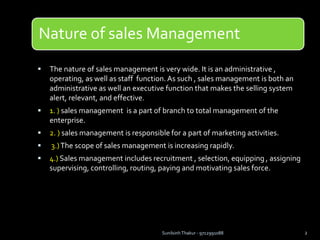
Scope of sales management
Achieve
Company
Goals
Manage
People Other Source
Finance $ Physical Informational
Sell
Assist others
Own
“Territory”
Sunilsinh Thakur - 9712991088 3
Objectives of sales Management
1.) Establish distribution set –up.
2.) Maximization of sales.
3.) Maximization of profit.
4.) Increase of Market share.
5.) Ensuring Equity of shareholders.
Sunilsinh Thakur - 9712991088 4
Types of sales Positions
1.) Delivery or Delivery sales Person ( response selling )
2.) Order –Taker (Response selling )
3.) Sales support people ( Missionary Selling ) /Technical sales Support / sales
Engineer, (Technical Selling)
4.) Demand Creators or Order – Getter ( Creative selling)
5.) Solution vendor (Business selling ) or Order Getter.
Sunilsinh Thakur - 9712991088 5
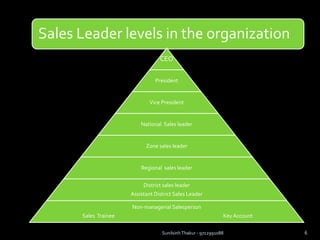
Sales Leader levels in the organization
CEO
President
Vice President
National Sales leader
Zone sales leader
Regional sales leader
District sales leader
Assistant District Sales Leader
Non-managerial Salesperson
Sales Trainee Key Account
Sunilsinh Thakur - 9712991088 6
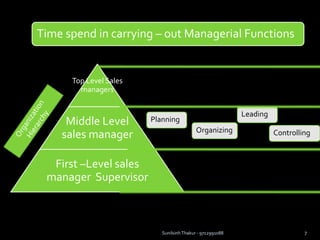
Time spend in carrying – out Managerial Functions
Top Level Sales
managers
Middle Level
sales manager
First –Level sales
manager Supervisor
Planning
Organizing
Leading
Controlling
Sunilsinh Thakur - 9712991088 7
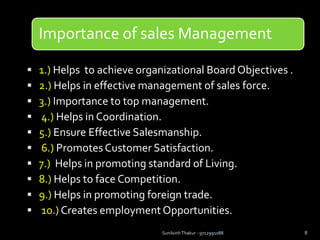
Importance of sales Management
 1.) Helps to achieve organizational Board Objectives .
 2.) Helps in effective management of sales force.
 3.) Importance to top management.
 4.) Helps in Coordination.
 5.) Ensure Effective Salesmanship.
 6.) PromotesCustomer Satisfaction.
 7.) Helps in promoting standard of Living.
 8.) Helps to face Competition.
 9.) Helps in promoting foreign trade.
 10.) Creates employment Opportunities.
Sunilsinh Thakur - 9712991088 8
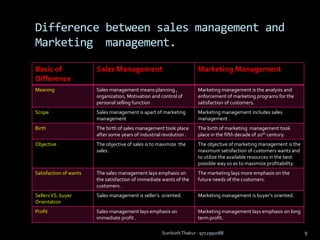
Difference between sales management and
Marketing management.
Basic of
Difference
Sales Management Marketing Management
Meaning Sales management means planning ,
organization, Motivation and control of
personal selling function
Marketing management is the analysis and
enforcement of marketing programs for the
satisfaction of customers.
Scope Sales management is apart of marketing
management
Marketing management includes sales
management .
Birth The birth of sales management took place
after some years of industrial revolution .
The birth of marketing management took
place in the fifth decade of 20th century.
Objective The objective of sales is to maximize the
sales.
The objective of marketing management is the
maximum satisfaction of customers wants and
to utilize the available resources in the best
possible way so as to maximize profitability.
Satisfaction of wants The sales management lays emphasis on
the satisfaction of immediate wants of the
customers .
The marketing lays more emphasis on the
future needs of the customers.
SellersVS. buyer
Orientation
Sales management is seller’s oriented. Marketing management is buyer’s oriented.
Profit Sales management lays emphasis on
immediate profit .
Marketing management lays emphasis on long
term profit.
Sunilsinh Thakur - 9712991088 9
Sales management process
Setting sales Force objectives
Creating a sales Force strategy
Recruiting the sales Force
Training the sales Force
Developing Motivation and compensation plans for the sales Force
Evaluating the sales Force
Sunilsinh Thakur - 9712991088 10
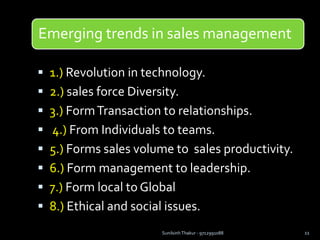
Emerging trends in sales management
 1.) Revolution in technology.
 2.) sales force Diversity.
 3.) FormTransaction to relationships.
 4.) From Individuals to teams.
 5.) Forms sales volume to sales productivity.
 6.) Form management to leadership.
 7.) Form local to Global
 8.) Ethical and social issues.
Sunilsinh Thakur - 9712991088 11
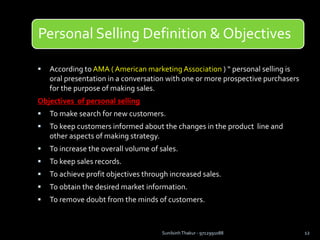
Personal Selling Definition & Objectives
 According to AMA ( American marketing Association ) “ personal selling is
oral presentation in a conversation with one or more prospective purchasers
for the purpose of making sales.
Objectives of personal selling
 To make search for new customers.
 To keep customers informed about the changes in the product line and
other aspects of making strategy.
 To increase the overall volume of sales.
 To keep sales records.
 To achieve profit objectives through increased sales.
 To obtain the desired market information.
 To remove doubt from the minds of customers.
Sunilsinh Thakur - 9712991088 12
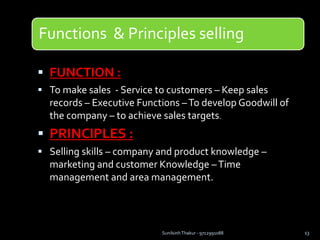
Functions & Principles selling
 FUNCTION :
 To make sales - Service to customers – Keep sales
records – Executive Functions –To develop Goodwill of
the company – to achieve sales targets.
 PRINCIPLES :
 Selling skills – company and product knowledge –
marketing and customer Knowledge –Time
management and area management.
Sunilsinh Thakur - 9712991088 13
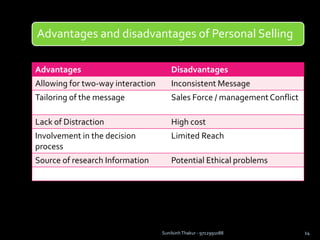
Advantages and disadvantages of Personal Selling
Advantages Disadvantages
Allowing for two-way interaction Inconsistent Message
Tailoring of the message Sales Force / management Conflict
Lack of Distraction High cost
Involvement in the decision
process
Limited Reach
Source of research Information Potential Ethical problems
Sunilsinh Thakur - 9712991088 14
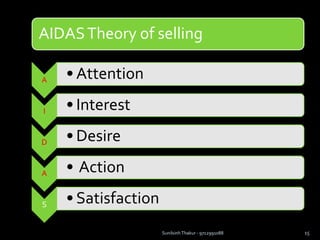
AIDASTheory of selling
A • Attention
I • Interest
D • Desire
A • Action
S • Satisfaction
Sunilsinh Thakur - 9712991088 15
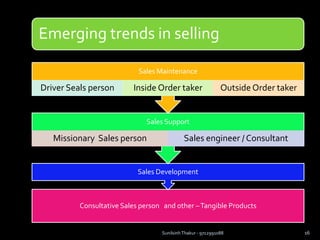
Emerging trends in selling
Consultative Sales person and other –Tangible Products
Sales Development
Sales Support
Missionary Sales person Sales engineer / Consultant
Sales Maintenance
Driver Seals person Inside Order taker Outside Order taker
Sunilsinh Thakur - 9712991088 16
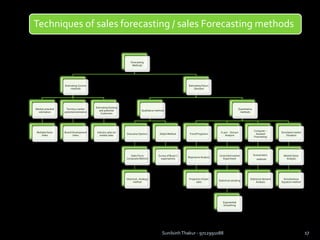
Techniques of sales forecasting / sales Forecasting methods
Forecasting
Methods
Estimating Current
methods
Market potential
estimation
Multiple factor
Index
Territory market
potential estimation
Brand Development
Index
Estimating Existing
and potential
Customers
Industry sales ad
market sales
Estimating Future
Demand
Qualitative methods
Executive Opinion
Sales Force
Composite Method
Historical , Analogy
method
Delphi Method
Survey of Buyer’s
expectations
Quantitative
methods
Trend Projection
Regressive Analysis
Projection of past
sales
In put - Out put
Analysis
Controlled market
Experiment
Statistical sampling
Exponential
Smoothing
Computer –
Assisted
Forecasting
Econometric
methods
Statistical demand
Analysis
Simulated market
Situation
Market factor
Analysis
Simultaneous
Equation method
Sunilsinh Thakur - 9712991088 17
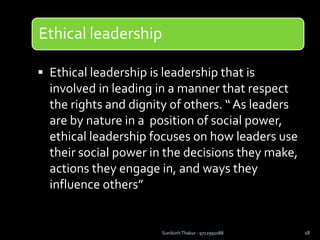
Ethical leadership
 Ethical leadership is leadership that is
involved in leading in a manner that respect
the rights and dignity of others. “ As leaders
are by nature in a position of social power,
ethical leadership focuses on how leaders use
their social power in the decisions they make,
actions they engage in, and ways they
influence others”
Sunilsinh Thakur - 9712991088 18
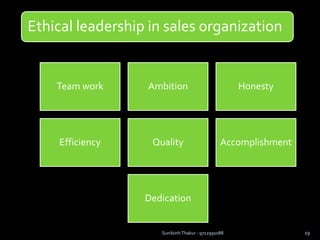
Ethical leadership in sales organization
Team work Ambition Honesty
Efficiency Quality Accomplishment
Dedication
Sunilsinh Thakur - 9712991088 19
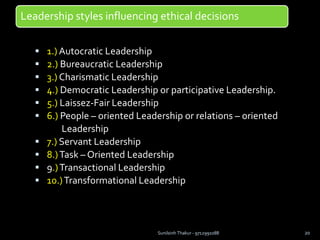
Leadership styles influencing ethical decisions
 1.) Autocratic Leadership
 2.) Bureaucratic Leadership
 3.) Charismatic Leadership
 4.) Democratic Leadership or participative Leadership.
 5.) Laissez-Fair Leadership
 6.) People – oriented Leadership or relations – oriented
Leadership
 7.) Servant Leadership
 8.)Task – Oriented Leadership
 9.)Transactional Leadership
 10.)Transformational Leadership
Sunilsinh Thakur - 9712991088 20

Sales & Distribution Management GTU MBA

  • 1.
    Sales management  Meaningand definition  “Sales management is primarily the direction of salesmen, sales planning, budgeting , policy making and merchandising and the integration in the marketing program of all business activities that contributes to increase sales and profits. “ – Hamton and Zalin 1.) It is the management of the sales force.This is a personnel –type function. 2.) sales management also organizes the selling effort.To do so, creates a suitable organizational structure, with appropriate communication system. 3.) Sales management interfaces with other marketing functions while polices of the functions are being formulated. Sunilsinh Thakur - 9712991088 1
  • 2.
    Nature of salesManagement  The nature of sales management is very wide. It is an administrative , operating, as well as staff function. As such , sales management is both an administrative as well an executive function that makes the selling system alert, relevant, and effective.  1. ) sales management is a part of branch to total management of the enterprise.  2. ) sales management is responsible for a part of marketing activities.  3.)The scope of sales management is increasing rapidly.  4.) Sales management includes recruitment , selection, equipping , assigning supervising, controlling, routing, paying and motivating sales force. Sunilsinh Thakur - 9712991088 2
  • 3.
    Scope of salesmanagement Achieve Company Goals Manage People Other Source Finance $ Physical Informational Sell Assist others Own “Territory” Sunilsinh Thakur - 9712991088 3
  • 4.
    Objectives of salesManagement 1.) Establish distribution set –up. 2.) Maximization of sales. 3.) Maximization of profit. 4.) Increase of Market share. 5.) Ensuring Equity of shareholders. Sunilsinh Thakur - 9712991088 4
  • 5.
    Types of salesPositions 1.) Delivery or Delivery sales Person ( response selling ) 2.) Order –Taker (Response selling ) 3.) Sales support people ( Missionary Selling ) /Technical sales Support / sales Engineer, (Technical Selling) 4.) Demand Creators or Order – Getter ( Creative selling) 5.) Solution vendor (Business selling ) or Order Getter. Sunilsinh Thakur - 9712991088 5
  • 6.
    Sales Leader levelsin the organization CEO President Vice President National Sales leader Zone sales leader Regional sales leader District sales leader Assistant District Sales Leader Non-managerial Salesperson Sales Trainee Key Account Sunilsinh Thakur - 9712991088 6
  • 7.
    Time spend incarrying – out Managerial Functions Top Level Sales managers Middle Level sales manager First –Level sales manager Supervisor Planning Organizing Leading Controlling Sunilsinh Thakur - 9712991088 7
  • 8.
    Importance of salesManagement  1.) Helps to achieve organizational Board Objectives .  2.) Helps in effective management of sales force.  3.) Importance to top management.  4.) Helps in Coordination.  5.) Ensure Effective Salesmanship.  6.) PromotesCustomer Satisfaction.  7.) Helps in promoting standard of Living.  8.) Helps to face Competition.  9.) Helps in promoting foreign trade.  10.) Creates employment Opportunities. Sunilsinh Thakur - 9712991088 8
  • 9.
    Difference between salesmanagement and Marketing management. Basic of Difference Sales Management Marketing Management Meaning Sales management means planning , organization, Motivation and control of personal selling function Marketing management is the analysis and enforcement of marketing programs for the satisfaction of customers. Scope Sales management is apart of marketing management Marketing management includes sales management . Birth The birth of sales management took place after some years of industrial revolution . The birth of marketing management took place in the fifth decade of 20th century. Objective The objective of sales is to maximize the sales. The objective of marketing management is the maximum satisfaction of customers wants and to utilize the available resources in the best possible way so as to maximize profitability. Satisfaction of wants The sales management lays emphasis on the satisfaction of immediate wants of the customers . The marketing lays more emphasis on the future needs of the customers. SellersVS. buyer Orientation Sales management is seller’s oriented. Marketing management is buyer’s oriented. Profit Sales management lays emphasis on immediate profit . Marketing management lays emphasis on long term profit. Sunilsinh Thakur - 9712991088 9
  • 10.
    Sales management process Settingsales Force objectives Creating a sales Force strategy Recruiting the sales Force Training the sales Force Developing Motivation and compensation plans for the sales Force Evaluating the sales Force Sunilsinh Thakur - 9712991088 10
  • 11.
    Emerging trends insales management  1.) Revolution in technology.  2.) sales force Diversity.  3.) FormTransaction to relationships.  4.) From Individuals to teams.  5.) Forms sales volume to sales productivity.  6.) Form management to leadership.  7.) Form local to Global  8.) Ethical and social issues. Sunilsinh Thakur - 9712991088 11
  • 12.
    Personal Selling Definition& Objectives  According to AMA ( American marketing Association ) “ personal selling is oral presentation in a conversation with one or more prospective purchasers for the purpose of making sales. Objectives of personal selling  To make search for new customers.  To keep customers informed about the changes in the product line and other aspects of making strategy.  To increase the overall volume of sales.  To keep sales records.  To achieve profit objectives through increased sales.  To obtain the desired market information.  To remove doubt from the minds of customers. Sunilsinh Thakur - 9712991088 12
  • 13.
    Functions & Principlesselling  FUNCTION :  To make sales - Service to customers – Keep sales records – Executive Functions –To develop Goodwill of the company – to achieve sales targets.  PRINCIPLES :  Selling skills – company and product knowledge – marketing and customer Knowledge –Time management and area management. Sunilsinh Thakur - 9712991088 13
  • 14.
    Advantages and disadvantagesof Personal Selling Advantages Disadvantages Allowing for two-way interaction Inconsistent Message Tailoring of the message Sales Force / management Conflict Lack of Distraction High cost Involvement in the decision process Limited Reach Source of research Information Potential Ethical problems Sunilsinh Thakur - 9712991088 14
  • 15.
    AIDASTheory of selling A• Attention I • Interest D • Desire A • Action S • Satisfaction Sunilsinh Thakur - 9712991088 15
  • 16.
    Emerging trends inselling Consultative Sales person and other –Tangible Products Sales Development Sales Support Missionary Sales person Sales engineer / Consultant Sales Maintenance Driver Seals person Inside Order taker Outside Order taker Sunilsinh Thakur - 9712991088 16
  • 17.
    Techniques of salesforecasting / sales Forecasting methods Forecasting Methods Estimating Current methods Market potential estimation Multiple factor Index Territory market potential estimation Brand Development Index Estimating Existing and potential Customers Industry sales ad market sales Estimating Future Demand Qualitative methods Executive Opinion Sales Force Composite Method Historical , Analogy method Delphi Method Survey of Buyer’s expectations Quantitative methods Trend Projection Regressive Analysis Projection of past sales In put - Out put Analysis Controlled market Experiment Statistical sampling Exponential Smoothing Computer – Assisted Forecasting Econometric methods Statistical demand Analysis Simulated market Situation Market factor Analysis Simultaneous Equation method Sunilsinh Thakur - 9712991088 17
  • 18.
    Ethical leadership  Ethicalleadership is leadership that is involved in leading in a manner that respect the rights and dignity of others. “ As leaders are by nature in a position of social power, ethical leadership focuses on how leaders use their social power in the decisions they make, actions they engage in, and ways they influence others” Sunilsinh Thakur - 9712991088 18
  • 19.
    Ethical leadership insales organization Team work Ambition Honesty Efficiency Quality Accomplishment Dedication Sunilsinh Thakur - 9712991088 19
  • 20.
    Leadership styles influencingethical decisions  1.) Autocratic Leadership  2.) Bureaucratic Leadership  3.) Charismatic Leadership  4.) Democratic Leadership or participative Leadership.  5.) Laissez-Fair Leadership  6.) People – oriented Leadership or relations – oriented Leadership  7.) Servant Leadership  8.)Task – Oriented Leadership  9.)Transactional Leadership  10.)Transformational Leadership Sunilsinh Thakur - 9712991088 20