UNIT- 3
International Marketing Program I
Cont….
What is a Product?
A product can be defined in terms of its tangible, physical attributes- such things
as weight, dimensions and materials.
Products: National, International
 Many countries find that, as result of expanding existing businesses or
acquiring a new business, they have products for sale in a single national
market.
For example, Kraft Foods at one time found itself in the chewing gum
business in France, the ice cream business in Brazil, and the pasta
business in Italy.
 Managers run the risk of committing two types of errors regarding product
decisions in international marketing. One error is to fall victim to the “not
invented here” (NH) syndrome, ignoring product decisions made by
subsidiary or affiliate managers.
 The other error has been to impose product decision policy on all affiliate
companies on the assumption that what is right for customers in the home
market must also be right for customers everywhere.
Local Products
A national product is one that, in the context of a particular company, is offered in
a single national market. Sometimes national products appear when a global
company caters to the needs and preferences of particular country markets.
For example, Coca-Cola developed a noncarbonated, ginseng-flavored
beverage for sale only in Japan and a yellow, carbonated flavored drink called
Pasturina to compete with Peru’s favorite soft drink, Inca Cola.
International Products and International Brands
 International products are offered in international markets. They are
international and multi regional. A true international product is offered in the
Triad, in every world region, and in countries at every stage of development.
 Note that a product is not a brand.
For example, a portable personal sound or personal stereos are a category of
international product;
Sony is a international brand.
Cont….
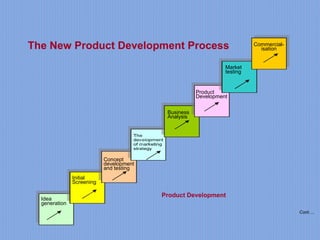
The New Product Development Process
Idea
generation
Initial
Screening
Concept
development
and testing
Business
Analysis
Product
Development
Market
testing
Commercial-
isation
Product Development
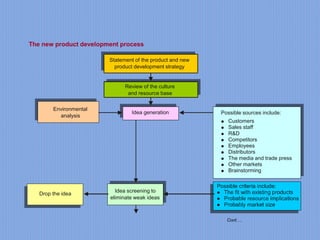
The new product development process
Drop the idea
Idea screening to
eliminate weak ideas
Review of the culture
and resource base
Statement of the product and new
product development strategy
Environmental
analysis
Possible sources include:
l Customers
Sales staff
R&D
Competitors
Employees
Distributors
The media and trade press
Other markets
Brainstorming
l
l
l
l
l
l
l
l
Idea generation
Cont….
Cont….
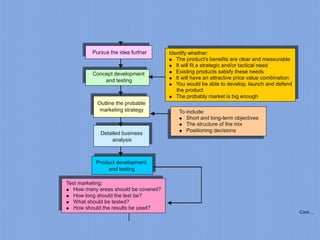
Concept development
and testing
Identify whether:
The product's benefits are clear and measurable
It will fit a strategic and/or tactical need
Existing products satisfy these needs
It will have an attractive price value combination
You would be able to develop, launch and defend
the product
The probably market is big enough
l
l
l
l
l
l
To include:
Short and long-term objectives
The structure of the mix
Positioning decisions
l
l
l
Outline the probable
marketing strategy
Detailed business
analysis
Test marketing:
How many areas should be covered?
How long should the test be?
What should be tested?
How should the results be used?
l
l
l
l
Product development
and testing
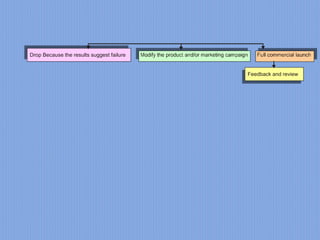
Drop Because the results suggest failure
Feedback and review
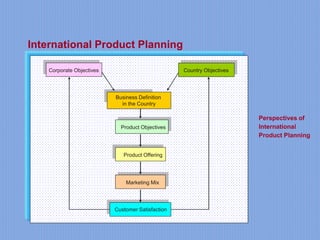
International Product Planning
Perspectives of
International
Product Planning
Marketing Mix
Product Offering
Product Objectives
Corporate Objectives Country Objectives
Business Definition
in the Country
Customer Satisfaction
Product Objectives
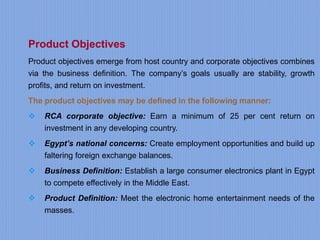
Product objectives emerge from host country and corporate objectives combines
via the business definition. The company’s goals usually are stability, growth
profits, and return on investment.
The product objectives may be defined in the following manner:
 RCA corporate objective: Earn a minimum of 25 per cent return on
investment in any developing country.
 Egypt’s national concerns: Create employment opportunities and build up
faltering foreign exchange balances.
 Business Definition: Establish a large consumer electronics plant in Egypt
to compete effectively in the Middle East.
 Product Definition: Meet the electronic home entertainment needs of the
masses.
Cont….
New Product in International Marketing
 In today’s dynamic, competitive market environment, many companies
realize that continuous development and introduction of new products are
keys to survival and growth.
 One common characteristic: They are international companies that pursue
opportunities in international markets in which competition is fierce, thus
ensuring that new products will be world class. Other characteristics noted
by Reiner are as follows:
1. They focus on one or only a few businesses.
2. Senior management is actively involved in defining and improving the
product development process.
3. They have the ability to recruit and retain the best and the brightest
people in their fields.
4. They understand that speed in bringing new products to market
reinforces product quality4.
Identifying New Product Ideas
The starting point for an effective worldwide new-product program is an information
system that seeks new-product ideas from all potentially useful sources and channels.
Those ideas relevant to the company undergo screening at decision centers within the
organization.
There are many sources of new product ideas, including customers, suppliers,
competitors, company salespeople, distributors and agents, subsidiary executives,
headquarters executives, documentary sources ( for example, information service
reports and publications), and finally, actual firsthand observation of the market
environment.
The International New Product Department
The function of such a department is fourfold:
(1) to ensure that all relevant information sources are continuously tapped for new
product ideas;
(2) to screen these ideas to identify candidates for investigation;
(3) to investigate and analyze selected new product ideas;
(4) to ensure that the organization commits resources to the most likely new product
candidates and is continuously involved in an orderly program of new product
introduction and development on a worldwide basis.
Product Segmentation
 Market segmentation is an acceptable concept to which marketers and
academics all over the world like to pay great deal of attention. Without
market segmentation the product cannot be marketed in a big way.
 This phenomena probably derives from an assumption that by going abroad
geographic segmentations have been implemented but geographic
segmentation is often over emphasized and is usually inappropriate.
 Marketers fail to appreciate that the purpose of segmentation is to satisfy
consumer needs more precisely — not to segment the market just for the
sake of segmentation.
 The most important reason behind the utilization of market segmentation is
market homogeneity/heterogeneity. Based on the national boundary
homogeneity can be vertical (homogeneous in one country) or horizontal
(homogenous across the countries).
Product Positioning
 Product positioning is a marketing strategy that attempts to occupy an
appealing space in consumers’ mind in relation to the spaces occupied by
other competitive products.
 The mind is like a computer, in that it has slots and each bit of information is
placed and retained in the proper slot. The mind screens and accepts
information according to prior experience.
 A marketer determines the perceived position of a product as well as the
ideal position in a number of ways. One way is to use focus groups to
explore possible alternatives. Another positioning method is to rely on
perceptual and preference mapping.
 A product must be positioned carefully. Mazda erred in its initial attempt to
sell its rotary engine automobile as an economy car when in fact it is a
performance car. A company may possibly use dual or even triple
positioning. Beecham has positioned aqua fresh as (i) tooth paste, (ii)
breath freshener and (iii) plaque remover.
Product Adoption and Standardization
Product Adoption
Before breaking into the foreign market, marketers must consider factors that
influence product adoption. As explained by Diffusion Theory at least six factors
have a bearing on the adoption process: relative advantage, compatibility,
trialability/divisibility, observability, complexity and price. These factors are all
perceptual and thus subjective in nature.
Standardization
 The strength of standardization in the production and distribution of products
and services is in its simplicity and cost. It is an easy process for executives
to understand and implement and it also is cost effective.
 With regard to high technology products both users and manufacturers may
find it desirable to reduce confusion and promote compatibility by
introducing industry’s specifications that make standardization possible.
Cont….
International or National Product Marketing of Services
 Product standardization and modification may give the impression that a
marketer must choose between the two processes and that one approach is
better than other.
 World product and standardized product may some time be confused with
each other. A world product is designed for the international market.
 A standardized product is product develop for one national market and then
exported with no change to international market.
Marketing of Services
Internationally, the invisible trade is responsible for one fifty of the value of
exports. The share of commercial services in the world trade has risen from 17%
in 1980 to about 22% in 1993.
Importance of Services
The services sector has become very important. In the service oriented society
on the earth it represents almost 60-70% of the GNP and employs about 70-75%
labour force. The United States is the worlds leading producer and exporter of
services.
Cont….
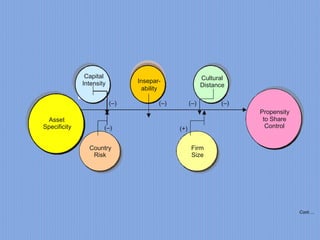
Asset
Specificity
Propensity
to Share
Control
Country
Risk
Firm
Size
(–)
(+)
Capital
Intensity Insepar-
ability
Cultural
Distance
(–) (–) (–)
(–)
Transfer Pricing
• Transfer pricing refers to the prices of goods and services that are
• Exchanged between companies under common control.
• For example, if a subsidiary company sells goods or renders services to
its holding company or a sister company, the price charged is
referred to as the transfer price
Benefits of Transfer Pricing
• Transfer pricing allows companies to reduce duty costs.
• It enables business entities to shipping goods to the high tariff
countries paying the minimum transfer prices.
• Hence the duty base related to the transactions becomes low.
18
Types of Transfer Pricing
• Different types of Transfer pricing are as follows
• Market-based transfer prices,
• Cost- based transfer prices, and
• Negotiated transfer prices.
19
Three Policy Alternatives of International Pricing.
• Viewed broadly, there are three alternative positions a company can
take toward worldwide pricing.
• 1. Extension/Ethnocentric
• The first can be called an extension/ethnocentric pricing policy. This
policy requires that the price of an item be the same around the
world and that the importer absorbs freight and import duties. This
approach has the advantage of extreme simplicity because no
information on competitive or market conditions is required for
implementation. The disadvantage of this approach is directly tied to
its simplicity. Extension pricing does not respond to the competitive
and market conditions of each national market and, therefore, does
not maximize the company’s profits in each national market.
20
Adaptation/Polycentric
• The second pricing policy can be termed adaptation/polycentric. This
policy permits subsidiary or affiliate managers to establish whatever
price they feel is most desirable in their circumstances. Under such an
approach, there is no control or fixed requirement that prices be
coordinated from one country to the next. The only constraint on this
approach is in setting transfer prices within the corporate system. Such
an approach is sensitive to local conditions, but it does present
problems of product arbitrage opportunities in cases where disparities
in local market prices exceed the transportation and duty cost
separating markets. When such a condition exists, there is an
opportunity for the enterprising business manager to take advantage
of these price disparities by buying in the lower-price market and
selling in the more expensive market.
21
Invention/Geocentric
• The third approach to international pricing can be termed
invention/geocentric, Using this approach, a company neither fixes a single
price worldwide nor remains aloof from subsidiary pricing decisions, but
instead strikes an intermediate position. A company pursuing this approach
works on the assumption that there are unique local market factors that
should be recognized in arriving at a pricing decision. These factors include
local costs, income levels, competition, and the local marketing strategy.
Local costs plus a return on invested capital and personnel fix the price floor
for the long term. However, for the short term, a company might decide to
pursue a market penetration objective and price at less than the cost-plus
return figure using export sourcing to establish a market. Another short-term
objective might be to estimate the size of a market at a price that would be
profitable given local sourcing and a certain scale of output. Instead of
building facilities, the target market might first be supplied from existing
higher-cost external supply sources. If the market accepts the price and
product, the company can then build a local manufacturing facility to further
develop the identified market opportunity in a profitable way. If the market
opportunity does not materialize, the company can experiment with the
product at other prices because it is not committed by existing local
manufacturing facilities to a fixed
22

UNIT 3.ppt

  • 1.
  • 2.
    Cont…. What is aProduct? A product can be defined in terms of its tangible, physical attributes- such things as weight, dimensions and materials. Products: National, International  Many countries find that, as result of expanding existing businesses or acquiring a new business, they have products for sale in a single national market. For example, Kraft Foods at one time found itself in the chewing gum business in France, the ice cream business in Brazil, and the pasta business in Italy.  Managers run the risk of committing two types of errors regarding product decisions in international marketing. One error is to fall victim to the “not invented here” (NH) syndrome, ignoring product decisions made by subsidiary or affiliate managers.  The other error has been to impose product decision policy on all affiliate companies on the assumption that what is right for customers in the home market must also be right for customers everywhere.
  • 3.
    Local Products A nationalproduct is one that, in the context of a particular company, is offered in a single national market. Sometimes national products appear when a global company caters to the needs and preferences of particular country markets. For example, Coca-Cola developed a noncarbonated, ginseng-flavored beverage for sale only in Japan and a yellow, carbonated flavored drink called Pasturina to compete with Peru’s favorite soft drink, Inca Cola. International Products and International Brands  International products are offered in international markets. They are international and multi regional. A true international product is offered in the Triad, in every world region, and in countries at every stage of development.  Note that a product is not a brand. For example, a portable personal sound or personal stereos are a category of international product; Sony is a international brand.
  • 4.
    Cont…. The New ProductDevelopment Process Idea generation Initial Screening Concept development and testing Business Analysis Product Development Market testing Commercial- isation Product Development
  • 5.
    The new productdevelopment process Drop the idea Idea screening to eliminate weak ideas Review of the culture and resource base Statement of the product and new product development strategy Environmental analysis Possible sources include: l Customers Sales staff R&D Competitors Employees Distributors The media and trade press Other markets Brainstorming l l l l l l l l Idea generation Cont….
  • 6.
    Cont…. Concept development and testing Identifywhether: The product's benefits are clear and measurable It will fit a strategic and/or tactical need Existing products satisfy these needs It will have an attractive price value combination You would be able to develop, launch and defend the product The probably market is big enough l l l l l l To include: Short and long-term objectives The structure of the mix Positioning decisions l l l Outline the probable marketing strategy Detailed business analysis Test marketing: How many areas should be covered? How long should the test be? What should be tested? How should the results be used? l l l l Product development and testing
  • 7.
    Drop Because theresults suggest failure Feedback and review
  • 8.
    International Product Planning Perspectivesof International Product Planning Marketing Mix Product Offering Product Objectives Corporate Objectives Country Objectives Business Definition in the Country Customer Satisfaction
  • 9.
    Product Objectives Product objectivesemerge from host country and corporate objectives combines via the business definition. The company’s goals usually are stability, growth profits, and return on investment. The product objectives may be defined in the following manner:  RCA corporate objective: Earn a minimum of 25 per cent return on investment in any developing country.  Egypt’s national concerns: Create employment opportunities and build up faltering foreign exchange balances.  Business Definition: Establish a large consumer electronics plant in Egypt to compete effectively in the Middle East.  Product Definition: Meet the electronic home entertainment needs of the masses.
  • 10.
    Cont…. New Product inInternational Marketing  In today’s dynamic, competitive market environment, many companies realize that continuous development and introduction of new products are keys to survival and growth.  One common characteristic: They are international companies that pursue opportunities in international markets in which competition is fierce, thus ensuring that new products will be world class. Other characteristics noted by Reiner are as follows: 1. They focus on one or only a few businesses. 2. Senior management is actively involved in defining and improving the product development process. 3. They have the ability to recruit and retain the best and the brightest people in their fields. 4. They understand that speed in bringing new products to market reinforces product quality4.
  • 11.
    Identifying New ProductIdeas The starting point for an effective worldwide new-product program is an information system that seeks new-product ideas from all potentially useful sources and channels. Those ideas relevant to the company undergo screening at decision centers within the organization. There are many sources of new product ideas, including customers, suppliers, competitors, company salespeople, distributors and agents, subsidiary executives, headquarters executives, documentary sources ( for example, information service reports and publications), and finally, actual firsthand observation of the market environment. The International New Product Department The function of such a department is fourfold: (1) to ensure that all relevant information sources are continuously tapped for new product ideas; (2) to screen these ideas to identify candidates for investigation; (3) to investigate and analyze selected new product ideas; (4) to ensure that the organization commits resources to the most likely new product candidates and is continuously involved in an orderly program of new product introduction and development on a worldwide basis.
  • 12.
    Product Segmentation  Marketsegmentation is an acceptable concept to which marketers and academics all over the world like to pay great deal of attention. Without market segmentation the product cannot be marketed in a big way.  This phenomena probably derives from an assumption that by going abroad geographic segmentations have been implemented but geographic segmentation is often over emphasized and is usually inappropriate.  Marketers fail to appreciate that the purpose of segmentation is to satisfy consumer needs more precisely — not to segment the market just for the sake of segmentation.  The most important reason behind the utilization of market segmentation is market homogeneity/heterogeneity. Based on the national boundary homogeneity can be vertical (homogeneous in one country) or horizontal (homogenous across the countries).
  • 13.
    Product Positioning  Productpositioning is a marketing strategy that attempts to occupy an appealing space in consumers’ mind in relation to the spaces occupied by other competitive products.  The mind is like a computer, in that it has slots and each bit of information is placed and retained in the proper slot. The mind screens and accepts information according to prior experience.  A marketer determines the perceived position of a product as well as the ideal position in a number of ways. One way is to use focus groups to explore possible alternatives. Another positioning method is to rely on perceptual and preference mapping.  A product must be positioned carefully. Mazda erred in its initial attempt to sell its rotary engine automobile as an economy car when in fact it is a performance car. A company may possibly use dual or even triple positioning. Beecham has positioned aqua fresh as (i) tooth paste, (ii) breath freshener and (iii) plaque remover.
  • 14.
    Product Adoption andStandardization Product Adoption Before breaking into the foreign market, marketers must consider factors that influence product adoption. As explained by Diffusion Theory at least six factors have a bearing on the adoption process: relative advantage, compatibility, trialability/divisibility, observability, complexity and price. These factors are all perceptual and thus subjective in nature. Standardization  The strength of standardization in the production and distribution of products and services is in its simplicity and cost. It is an easy process for executives to understand and implement and it also is cost effective.  With regard to high technology products both users and manufacturers may find it desirable to reduce confusion and promote compatibility by introducing industry’s specifications that make standardization possible.
  • 15.
    Cont…. International or NationalProduct Marketing of Services  Product standardization and modification may give the impression that a marketer must choose between the two processes and that one approach is better than other.  World product and standardized product may some time be confused with each other. A world product is designed for the international market.  A standardized product is product develop for one national market and then exported with no change to international market. Marketing of Services Internationally, the invisible trade is responsible for one fifty of the value of exports. The share of commercial services in the world trade has risen from 17% in 1980 to about 22% in 1993. Importance of Services The services sector has become very important. In the service oriented society on the earth it represents almost 60-70% of the GNP and employs about 70-75% labour force. The United States is the worlds leading producer and exporter of services.
  • 16.
  • 17.
    Transfer Pricing • Transferpricing refers to the prices of goods and services that are • Exchanged between companies under common control. • For example, if a subsidiary company sells goods or renders services to its holding company or a sister company, the price charged is referred to as the transfer price
  • 18.
    Benefits of TransferPricing • Transfer pricing allows companies to reduce duty costs. • It enables business entities to shipping goods to the high tariff countries paying the minimum transfer prices. • Hence the duty base related to the transactions becomes low. 18
  • 19.
    Types of TransferPricing • Different types of Transfer pricing are as follows • Market-based transfer prices, • Cost- based transfer prices, and • Negotiated transfer prices. 19
  • 20.
    Three Policy Alternativesof International Pricing. • Viewed broadly, there are three alternative positions a company can take toward worldwide pricing. • 1. Extension/Ethnocentric • The first can be called an extension/ethnocentric pricing policy. This policy requires that the price of an item be the same around the world and that the importer absorbs freight and import duties. This approach has the advantage of extreme simplicity because no information on competitive or market conditions is required for implementation. The disadvantage of this approach is directly tied to its simplicity. Extension pricing does not respond to the competitive and market conditions of each national market and, therefore, does not maximize the company’s profits in each national market. 20
  • 21.
    Adaptation/Polycentric • The secondpricing policy can be termed adaptation/polycentric. This policy permits subsidiary or affiliate managers to establish whatever price they feel is most desirable in their circumstances. Under such an approach, there is no control or fixed requirement that prices be coordinated from one country to the next. The only constraint on this approach is in setting transfer prices within the corporate system. Such an approach is sensitive to local conditions, but it does present problems of product arbitrage opportunities in cases where disparities in local market prices exceed the transportation and duty cost separating markets. When such a condition exists, there is an opportunity for the enterprising business manager to take advantage of these price disparities by buying in the lower-price market and selling in the more expensive market. 21
  • 22.
    Invention/Geocentric • The thirdapproach to international pricing can be termed invention/geocentric, Using this approach, a company neither fixes a single price worldwide nor remains aloof from subsidiary pricing decisions, but instead strikes an intermediate position. A company pursuing this approach works on the assumption that there are unique local market factors that should be recognized in arriving at a pricing decision. These factors include local costs, income levels, competition, and the local marketing strategy. Local costs plus a return on invested capital and personnel fix the price floor for the long term. However, for the short term, a company might decide to pursue a market penetration objective and price at less than the cost-plus return figure using export sourcing to establish a market. Another short-term objective might be to estimate the size of a market at a price that would be profitable given local sourcing and a certain scale of output. Instead of building facilities, the target market might first be supplied from existing higher-cost external supply sources. If the market accepts the price and product, the company can then build a local manufacturing facility to further develop the identified market opportunity in a profitable way. If the market opportunity does not materialize, the company can experiment with the product at other prices because it is not committed by existing local manufacturing facilities to a fixed 22