


UNIVERSITY of PETROLEUM and ENERGY
               STUDIES


           Student Bulletin

              (2011-12)


                  1
Reservation of Rights / Disclaimer

Every effort has been made to provide accurate and current information; however, the right is
reserved to change without notice any of the Rules and Regulations of the University at any time,
including those relating to fees, location, to withdraw curricula and specific courses, change or
discontinue programs, alter course content, change the calendar. All such changes are effective at
such times as the University Authorities determine, and may apply not only to prospective
students but also to those who are already enrolled in the University.

The information contained in the Bulletin is subject to change at any time, without notice. It is
intended to serve only as a general source of information about the University and is in no way
intended to state contractual terms.

This information may include technical inaccuracies or typographical errors.


                                                2
1. INTRODUCTION

The University of Petroleum & Energy Studies (UPES) is established through an Act No. 15 of 2003 of
the State Legislature of Uttarakhand. The University is recognized by University Grants Commission
(UGC) under Section 2 (f) of the UGC Act, 1956 vide notification no. F-9-20/2003 (CPP-1) dated 4th June
2004. This applies that UPES is fully compliant to the regulations established by UGC.

It is the first University in the country dedicated to petroleum and energy studies for creating world-class
petroleum professionals in the Petroleum, Oil & Gas, Power and Transportation sector to fulfill the
growing demand of specialized personnel in the industry. It offers Post Graduate and the Undergraduate
programmes in all areas pertaining to the Oil and Gas, Power and Transportation and allied sectors with
highly focused cutting edge courses.

 The UPES is an endeavor of Hydrocarbons Education and Research Society (the ‘Society’), a non- profit
organization, pioneer in imparting education and other activities in Energy Sector. The society comprises
of eminent individuals from the Oil and Gas industry including the top bureaucrats concerned with this
sector in Government of India, Professionals of repute, Chiefs of major oil companies and experts from
various national & international organizations.


2.        VISION

 To be the premier institute with state of art facilities to provide world class education, training, research,
 consultancy and outreach services in the areas of Oil & Gas, Energy & Transportation Sector.

3.        MISSION

      •    To create top quality human resources, to enhance the productivity in the Oil and Gas and Energy
           Industry.

      •    To design, develop and deliver continuously evolving education and training programmes for
           professionals in the industry.

      •    To take leader’s role in promoting the growth of Oil and Gas and Energy sector through specific
           education & outreach activities.

      •    To provide support to research, consultancy, development activities in all technical & managerial
           aspects of the petroleum industry


4.        PROGRAMMES

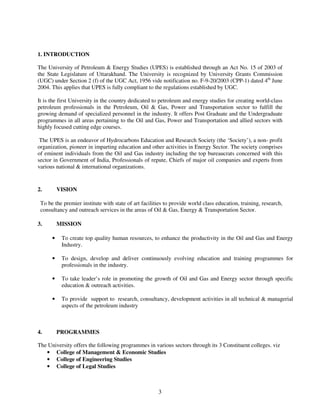
The University offers the following programmes in various sectors through its 3 Constituent colleges. viz
   • College of Management & Economic Studies
   • College of Engineering Studies
   • College of Legal Studies


                                                      3
College-wise Programs

College of Engineering Studies
Undergraduate                                                     Postgraduate


                                                           Oil & Gas

  B. Tech. (Applied Petroleum Engineering)                         M. Tech. (Health Safety & Environmental Engineering)
  with specialization in Upstream
                                                                   M. Tech. (Pipeline Engineering)
  B. Tech. (Applied Petroleum Engineering)
                                                                   M. Tech. (Process Design Engineering)
  with specialization in Gas
                                                                   M. Tech. (Petroleum Exploration)
  B. Tech. (Chemical Engineering)
  with specialization in Refining & Petrochemicals

  B. Tech. (Geo Informatics Engineering)

  B. Tech. (Geo Sciences Engineering)


                                                            Power

  B. Tech. (Power System Engineering)                              M. Tech. (Energy Systems)

  B.Tech.(Energy Technology) + LL. B.
  with emphasis on Intellectual Property Rights


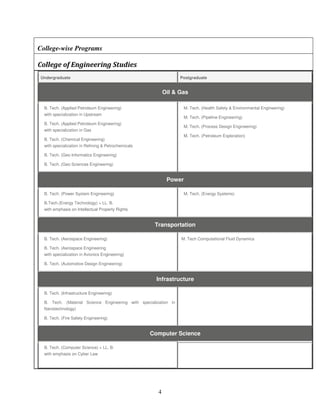
                                                      Transportation

  B. Tech. (Aerospace Engineering)                                M. Tech Computational Fluid Dynamics

  B. Tech. (Aerospace Engineering
  with specialization in Avionics Engineering)

  B. Tech. (Automotive Design Engineering)


                                                       Infrastructure

  B. Tech. (Infrastructure Engineering)

  B. Tech. (Material Science Engineering with specialization in
  Nanotechnology)

  B. Tech. (Fire Safety Engineering)


                                                     Computer Science

  B. Tech. (Computer Science) + LL. B.
  with emphasis on Cyber Law


                                                       4
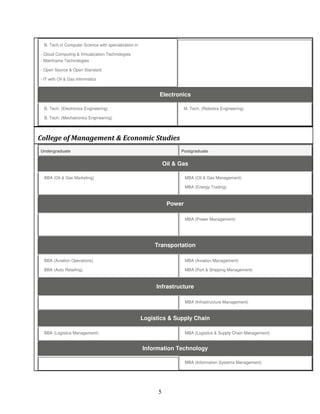
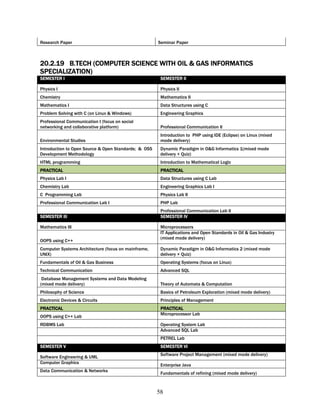
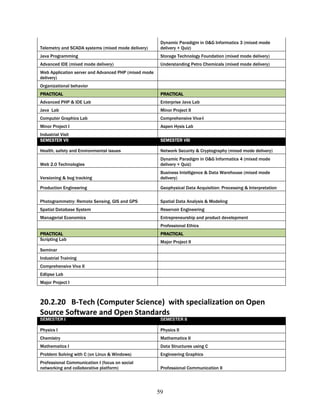
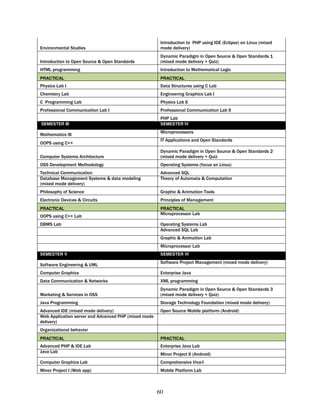
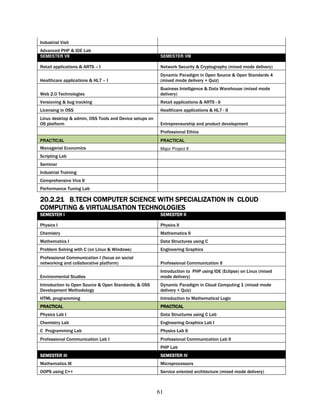
B. Tech in Computer Science with specialization in

- Cloud Computing & Virtualization Technologies
- Mainframe Technologies

- Open Source & Open Standard

- IT with Oil & Gas Informatics


                                                            Electronics

 B. Tech. (Electronics Engineering)                                    M. Tech. (Robotics Engineering)

 B. Tech. (Mechatronics Engineering)


College of Management & Economic Studies
Undergraduate                                                         Postgraduate


                                                                Oil & Gas

 BBA (Oil & Gas Marketing)                                               MBA (Oil & Gas Management)

                                                                         MBA (Energy Trading)


                                                                 Power

                                                                         MBA (Power Management)


                                                          Transportation

 BBA (Aviation Operations)                                               MBA (Aviation Management)

 BBA (Auto Retailing)                                                    MBA (Port & Shipping Management)


                                                           Infrastructure

                                                                         MBA (Infrastructure Management)


                                                      Logistics & Supply Chain

 BBA (Logistics Management)                                              MBA (Logistics & Supply Chain Management)


                                                      Information Technology

                                                                         MBA (Information Systems Management)


                                                            5
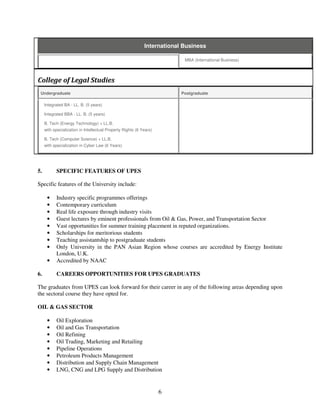
International Business

                                                                           MBA (International Business)


College of Legal Studies
 Undergraduate                                                            Postgraduate

     Integrated BA - LL. B. (5 years)

     Integrated BBA - LL. B. (5 years)

     B. Tech (Energy Technology) + LL.B.
     with specialization in Intellectual Property Rights (6 Years)

     B. Tech (Computer Science) + LL.B.
     with specialization in Cyber Law (6 Years)


5.         SPECIFIC FEATURES OF UPES

Specific features of the University include:

      •    Industry specific programmes offerings
      •    Contemporary curriculum
      •    Real life exposure through industry visits
      •    Guest lectures by eminent professionals from Oil & Gas, Power, and Transportation Sector
      •    Vast opportunities for summer training placement in reputed organizations.
      •    Scholarships for meritorious students
      •    Teaching assistantship to postgraduate students
      •    Only University in the PAN Asian Region whose courses are accredited by Energy Institute
           London, U.K.
      •    Accredited by NAAC

6.         CAREERS OPPORTUNITIES FOR UPES GRADUATES

The graduates from UPES can look forward for their career in any of the following areas depending upon
the sectoral course they have opted for.

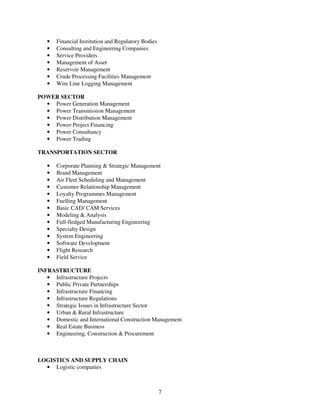
OIL & GAS SECTOR

      •    Oil Exploration
      •    Oil and Gas Transportation
      •    Oil Refining
      •    Oil Trading, Marketing and Retailing
      •    Pipeline Operations
      •    Petroleum Products Management
      •    Distribution and Supply Chain Management
      •    LNG, CNG and LPG Supply and Distribution


                                                                     6
•   Financial Institution and Regulatory Bodies
   •   Consulting and Engineering Companies
   •   Service Providers
   •   Management of Asset
   •   Reservoir Management
   •   Crude Processing Facilities Management
   •   Wire Line Logging Management

POWER SECTOR
  • Power Generation Management
  • Power Transmission Management
  • Power Distribution Management
  • Power Project Financing
  • Power Consultancy
  • Power Trading

TRANSPORTATION SECTOR

   •   Corporate Planning & Strategic Management
   •   Brand Management
   •   Air Fleet Scheduling and Management
   •   Customer Relationship Management
   •   Loyalty Programmes Management
   •   Fuelling Management
   •   Basic CAD/ CAM Services
   •   Modeling & Analysis
   •   Full-fledged Manufacturing Engineering
   •   Specialty Design
   •   System Engineering
   •   Software Development
   •   Flight Research
   •   Field Service

INFRASTRUCTURE
   • Infrastructure Projects
   • Public Private Partnerships
   • Infrastructure Financing
   • Infrastructure Regulations
   • Strategic Issues in Infrastructure Sector
   • Urban & Rural Infrastructure
   • Domestic and International Construction Management
   • Real Estate Business
   • Engineering, Construction & Procurement


LOGISTICS AND SUPPLY CHAIN
  • Logistic companies


                                                     7
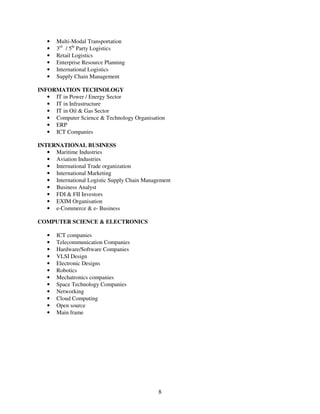
•   Multi-Modal Transportation
   •   3rd / 5th Party Logistics
   •   Retail Logistics
   •   Enterprise Resource Planning
   •   International Logistics
   •   Supply Chain Management

INFORMATION TECHNOLOGY
   • IT in Power / Energy Sector
   • IT in Infrastructure
   • IT in Oil & Gas Sector
   • Computer Science & Technology Organisation
   • ERP
   • ICT Companies

INTERNATIONAL BUSINESS
   • Maritime Industries
   • Aviation Industries
   • International Trade organization
   • International Marketing
   • International Logistic Supply Chain Management
   • Business Analyst
   • FDI & FII Investors
   • EXIM Organisation
   • e-Commerce & e- Business

COMPUTER SCIENCE & ELECTRONICS

   •   ICT companies
   •   Telecommunication Companies
   •   Hardware/Software Companies
   •   VLSI Design
   •   Electronic Designs
   •   Robotics
   •   Mechatronics companies
   •   Space Technology Companies
   •   Networking
   •   Cloud Computing
   •   Open source
   •   Main frame


                                              8
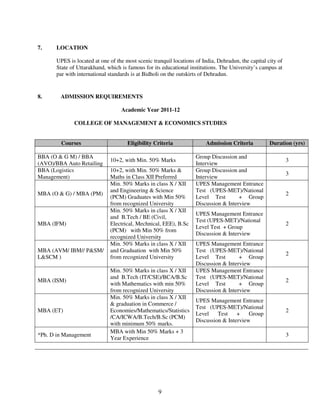
7.     LOCATION

       UPES is located at one of the most scenic tranquil locations of India, Dehradun, the capital city of
       State of Uttarakhand, which is famous for its educational institutions. The University’s campus at
       par with international standards is at Bidholi on the outskirts of Dehradun.


8.      ADMISSION REQUIREMENTS

                                   Academic Year 2011-12

              COLLEGE OF MANAGEMENT & ECONOMICS STUDIES


         Courses                      Eligibility Criteria               Admission Criteria          Duration (yrs)

BBA (O & G M) / BBA                                                 Group Discussion and
                              10+2, with Min. 50% Marks                                                       3
(AVO)/BBA Auto Retailing                                            Interview
BBA (Logistics                10+2, with Min. 50% Marks &           Group Discussion and
                                                                                                              3
Management)                   Maths in Class XII Preferred          Interview
                              Min. 50% Marks in class X / XII       UPES Management Entrance
                              and Engineering & Science             Test (UPES-MET)/National
MBA (O & G) / MBA (PM)                                                                                        2
                              (PCM) Graduates with Min 50%          Level Test        + Group
                              from recognized University            Discussion & Interview
                              Min. 50% Marks in class X / XII
                                                                    UPES Management Entrance
                              and B.Tech / BE (Civil,
                                                                    Test (UPES-MET)/National
MBA (IFM)                     Electrical, Mechnical, EEE), B.Sc                                               2
                                                                    Level Test + Group
                              (PCM) with Min 50% from
                                                                    Discussion & Interview
                              recognized University
                              Min. 50% Marks in class X / XII       UPES Management Entrance
MBA (AVM/ IBM// P&SM/         and Graduation with Min 50%           Test (UPES-MET)/National
                                                                                                              2
L&SCM )                       from recognized University            Level Test        + Group
                                                                    Discussion & Interview
                              Min. 50% Marks in class X / XII       UPES Management Entrance
                              and B.Tech (IT/CSE)/BCA/B.Sc          Test (UPES-MET)/National
MBA (ISM)                                                                                                     2
                              with Mathematics with min 50%         Level Test        + Group
                              from recognized University            Discussion & Interview
                              Min. 50% Marks in class X / XII
                                                                    UPES Management Entrance
                              & graduation in Commerce /
                                                                    Test (UPES-MET)/National
MBA (ET)                      Economies/Mathematics/Statistics                                                2
                                                                    Level    Test    +    Group
                              /CA/ICWA/B.Tech/B.Sc (PCM)
                                                                    Discussion & Interview
                              with minimum 50% marks.
                              MBA with Min 50% Marks + 3
*Ph. D in Management                                                                                          3
                              Year Experience


                                                    9
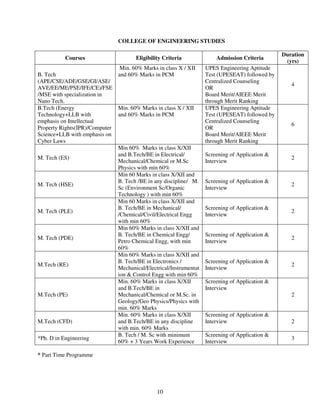
COLLEGE OF ENGINEERING STUDIES

                                                                                                Duration
          Courses                     Eligibility Criteria             Admission Criteria
                                                                                                 (yrs)
                               Min. 60% Marks in class X / XII     UPES Engineering Aptitude
B. Tech                       and 60% Marks in PCM                 Test (UPESEAT) followed by
(APE/CSE/ADE/GSE/GI/ASE/                                           Centralized Counseling
                                                                                                   4
AVE/EE/ME/PSE/IFE/CE)/FSE                                          OR
/MSE with specialization in                                        Board Merit/AIEEE Merit
Nano Tech.                                                         through Merit Ranking
B.Tech (Energy                Min. 60% Marks in class X / XII      UPES Engineering Aptitude
Technology+LLB with           and 60% Marks in PCM                 Test (UPESEAT) followed by
emphasis on Intellectual                                           Centralized Counseling
                                                                                                   6
Property Rights(IPR)/Computer                                      OR
Science+LLB with emphasis on                                       Board Merit/AIEEE Merit
Cyber Laws                                                         through Merit Ranking
                              Min 60% Marks in class X/XII
                              and B.Tech/BE in Electrical/         Screening of Application &
M. Tech (ES)                                                                                       2
                              Mechanical/Chemical or M.Sc          Interview
                              Physics with min 60%
                              Min 60 Marks in class X/XII and
                              B. Tech /BE in any discipline/ M.    Screening of Application &
M. Tech (HSE)                                                                                      2
                              Sc (Environment Sc/Organic           Interview
                              Technology ) with min 60%
                              Min 60 Marks in class X/XII and
                              B. Tech/BE in Mechanical/            Screening of Application &
M. Tech (PLE)                                                                                      2
                              /Chemical/Civil/Electrical Engg      Interview
                              with min 60%
                              Min 60% Marks in class X/XII and
                              B. Tech/BE in Chemical Engg/         Screening of Application &
M. Tech (PDE)                                                                                      2
                              Petro Chemical Engg, with min        Interview
                              60%
                              Min 60% Marks in class X/XII and
                              B. Tech/BE in Electronics /          Screening of Application &
M.Tech (RE)                                                                                        2
                              Mechanical/Electrical/Instrumentat   Interview
                              ion & Control Engg with min 60%
                              Min. 60% Marks in class X/XII        Screening of Application &
                              and B.Tech/BE in                     Interview
M.Tech (PE)                   Mechanical/Chemical or M.Sc. in                                      2
                              Geology/Geo Physics/Physics with
                              min. 60% Marks
                              Min. 60% Marks in class X/XII        Screening of Application &
M.Tech (CFD)                  and B.Tech/BE in any discipline      Interview                       2
                              with min. 60% Marks
                              B. Tech / M. Sc with minimum         Screening of Application &
*Ph. D in Engineering                                                                              3
                              60% + 3 Years Work Experience        Interview

* Part Time Programme


                                               10
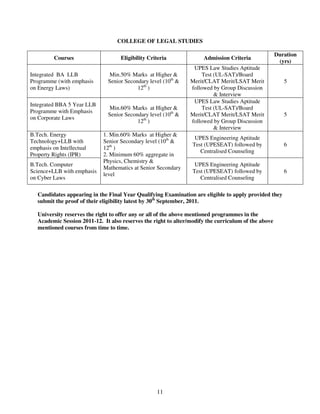
COLLEGE OF LEGAL STUDIES

                                                                                                      Duration
          Courses                   Eligibility Criteria              Admission Criteria
                                                                                                       (yrs)
                                                                  UPES Law Studies Aptitude
Integrated BA LLB              Min.50% Marks at Higher &              Test (UL-SAT)/Board
Programme (with emphasis       Senior Secondary level (10th &    Merit/CLAT Merit/LSAT Merit             5
on Energy Laws)                            12th )                followed by Group Discussion
                                                                           & Interview
                                                                  UPES Law Studies Aptitude
Integrated BBA 5 Year LLB
                               Min.60% Marks at Higher &              Test (UL-SAT)/Board
Programme with Emphasis
                               Senior Secondary level (10th &    Merit/CLAT Merit/LSAT Merit             5
on Corporate Laws
                                           12th )                followed by Group Discussion
                                                                           & Interview
B.Tech. Energy               1. Min.60% Marks at Higher &
                                                                   UPES Engineering Aptitude
Technology+LLB with          Senior Secondary level (10th &
                                                                  Test (UPESEAT) followed by             6
emphasis on Intellectual     12th )
                                                                     Centralised Counseling
Property Rights (IPR)        2. Minimum 60% aggregate in
                             Physics, Chemistry &
B.Tech. Computer                                                   UPES Engineering Aptitude
                             Mathematics at Senior Secondary
Science+LLB with emphasis                                         Test (UPESEAT) followed by             6
                             level
on Cyber Laws                                                        Centralised Counseling

   Candidates appearing in the Final Year Qualifying Examination are eligible to apply provided they
   submit the proof of their eligibility latest by 30th September, 2011.

   University reserves the right to offer any or all of the above mentioned programmes in the
   Academic Session 2011-12. It also reserves the right to alter/modify the curriculum of the above
   mentioned courses from time to time.


                                                   11
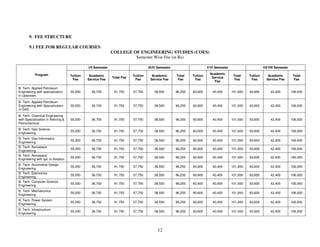
9. FEE STRUCTURE

       9.1 FEE FOR REGULAR COURSES
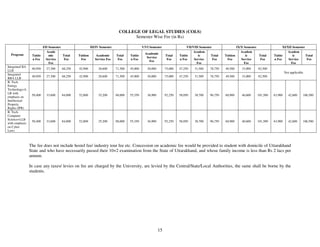
                                                              COLLEGE OF ENGINEERING STUDIES (COES)
                                                                       Semester Wise Fee (in Rs)

                                              I/II Semester                         III/IV Semester                      V/VI Semester                       VII/VIII Semester

           Program                                                                                                        Academic
                                    Tuition    Academic                   Tuition     Academic        Total    Tuition                    Total    Tuition      Academic          Total
                                                              Total Fee                                                    Service
                                     Fee      Service Fee                  Fee       Service Fee       Fee      Fee                        Fee      Fee        Service Fee         Fee
                                                                                                                            Fee

B. Tech. Applied Petroleum
Engineering with specialization     55,050      36,700         91,750     57,750        38,500        96,250   60,600       40,400       101,000   63,600         42,400         106,000
in Upstream
B. Tech. Applied Petroleum
Engineering with Specialization     55,050      36,700         91,750     57,750        38,500        96,250   60,600       40,400       101,000   63,600         42,400         106,000
in GAS
B. Tech. Chemical Engineering
with Specialization in Refining &   55,050      36,700         91,750     57,750        38,500        96,250   60,600       40,400       101,000   63,600         42,400         106,000
Petrochemical
B. Tech. Geo Science
                                    55,050      36,700         91,750     57,750        38,500        96,250   60,600       40,400       101,000   63,600         42,400         106,000
Engineering
B. Tech. Geo-Informatics
                                    55,050      36,700         91,750     57,750        38,500        96,250   60,600       40,400       101,000   63,600         42,400         106,000
Engineering
B. Tech. Aerospace
                                    55,050      36,700         91,750     57,750        38,500        96,250   60,600       40,400       101,000   63,600         42,400         106,000
Engineering
B. Tech. Aerospace
                                    55,050      36,700         91,750     57,750        38,500        96,250   60,600       40,400       101,000   63,600         42,400         106,000
Engineering with spl. In Aviation
B. Tech. Automotive Design
                                    55,050      36,700         91,750     57,750        38,500        96,250   60,600       40,400       101,000   63,600         42,400         106,000
Engineering
B. Tech. Electronics
                                    55,050      36,700         91,750     57,750        38,500        96,250   60,600       40,400       101,000   63,600         42,400         106,000
Engineering
B. Tech. Computer Science
                                    55,050      36,700         91,750     57,750        38,500        96,250   60,600       40,400       101,000   63,600         42,400         106,000
Engineering
B. Tech. Mechatronics
                                    55,050      36,700         91,750     57,750        38,500        96,250   60,600       40,400       101,000   63,600         42,400         106,000
Engineering
B. Tech. Power System
                                    55,050      36,700         91,750     57,750        38,500        96,250   60,600       40,400       101,000   63,600         42,400         106,000
Engineering
B. Tech. Infrastructure
                                    55,050      36,700         91,750     57,750        38,500        96,250   60,600       40,400       101,000   63,600         42,400         106,000
Engineering


                                                                                          12
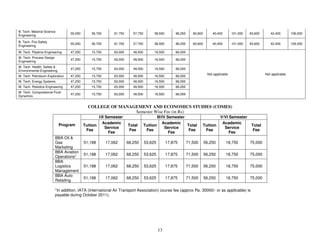
B. Tech. Material Science
                                  55,050       36,700       91,750      57,750         38,500        96,250      60,600       40,400        101,000   63,600      42,400        106,000
Engineering

B. Tech. Fire Safety
                                  55,050       36,700       91,750      57,750         38,500        96,250      60,600       40,400        101,000   63,600      42,400        106,000
Engineering
M. Tech. Pipeline Engineering     47,250       15,750       63,000      49,500         16,500        66,000
M. Tech. Process Design
                                  47,250       15,750       63,000      49,500         16,500        66,000
Engineering
M. Tech. Health, Safety &
                                  47,250       15,750       63,000      49,500         16,500        66,000
Environmental Engineering
                                                                                                                           Not applicable                      Not applicable
M. Tech. Petroleum Exploration    47,250       15,750       63,000      49,500         16,500        66,000
M. Tech. Energy Systems           47,250       15,750       63,000      49,500         16,500        66,000
M. Tech. Robotics Engineering     47,250       15,750       63,000      49,500         16,500        66,000
M. Tech. Computational Fluid
                                  47,250       15,750       63,000      49,500         16,500        66,000
Dynamics


                                             COLLEGE OF MANAGEMENT AND ECONOMICS STUDIES (COMES)
                                                             Semester Wise Fee (in Rs)
                                                   I/II Semester                         III/IV Semester                       V/VI Semester
                            Program                   Academic                               Academic                           Academic
                                           Tuition                   Total       Tuition                 Total         Tuition                         Total
                                                        Service                                Service                           Service
                                            Fee                       Fee         Fee                     Fee           Fee                             Fee
                                                         Fee                                     Fee                                Fee
                          BBA Oil &
                          Gas              51,188       17,062       68,250      53,625         17,875        71,500      56,250       18,750         75,000
                          Marketing
                          BBA Aviation
                                           51,188       17,062       68,250      53,625         17,875        71,500      56,250       18,750         75,000
                          Operations*
                          BBA
                          Logistics        51,188       17,062       68,250      53,625         17,875        71,500      56,250       18,750         75,000
                          Management
                          BBA Auto
                                           51,188       17,062       68,250      53,625         17,875        71,500      56,250       18,750         75,000
                          Retailing

                          *In addition, IATA (International Air Transport Association) course fee (approx Rs. 30000/- or as applicable) is
                          payable during October 2011).


                                                                                          13
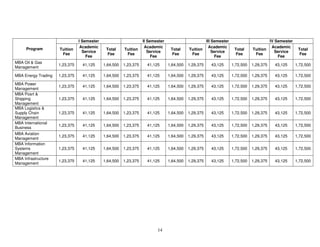
I Semester                         II Semester                      III Semester                      IV Semester
      Program                    Academic                           Academic                          Academic                         Academic
                     Tuition                  Total     Tuition                   Total     Tuition                 Total     Tuition                Total
                                  Service                             Service                           Service                          Service
                      Fee                      Fee       Fee                       Fee       Fee                     Fee       Fee                    Fee
                                    Fee                                 Fee                              Fee                              Fee
MBA Oil & Gas
                     1,23,375    41,125      1,64,500   1,23,375     41,125      1,64,500   1,29,375   43,125      1,72,500   1,29,375   43,125     1,72,500
Management

MBA Energy Trading   1,23,375    41,125      1,64,500   1,23,375     41,125      1,64,500   1,29,375   43,125      1,72,500   1,29,375   43,125     1,72,500

MBA Power
                     1,23,375    41,125      1,64,500   1,23,375     41,125      1,64,500   1,29,375   43,125      1,72,500   1,29,375   43,125     1,72,500
Management
MBA Posrt &
Shipping             1,23,375    41,125      1,64,500   1,23,375     41,125      1,64,500   1,29,375   43,125      1,72,500   1,29,375   43,125     1,72,500
Management
MBA Logistics &
Supply Chain         1,23,375    41,125      1,64,500   1,23,375     41,125      1,64,500   1,29,375   43,125      1,72,500   1,29,375   43,125     1,72,500
Management
MBA International
                     1,23,375    41,125      1,64,500   1,23,375     41,125      1,64,500   1,29,375   43,125      1,72,500   1,29,375   43,125     1,72,500
Business
MBA Aviation
                     1,23,375    41,125      1,64,500   1,23,375     41,125      1,64,500   1,29,375   43,125      1,72,500   1,29,375   43,125     1,72,500
Management
MBA Information
Systems              1,23,375    41,125      1,64,500   1,23,375     41,125      1,64,500   1,29,375   43,125      1,72,500   1,29,375   43,125     1,72,500
Management
MBA Infrastructure
                     1,23,375    41,125      1,64,500   1,23,375     41,125      1,64,500   1,29,375   43,125      1,72,500   1,29,375   43,125     1,72,500
Management


                                                                          14
COLLEGE OF LEGAL STUDIES (COLS)
                                                                                  Semester Wise Fee (in Rs)

                        I/II Semester                   III/IV Semester                     V/VI Semester                  VII/VIII Semester               IX/X Semester                XI/XII Semester
                           Acade                                                                                                Academ                        Academ                        Academ
  Program                                                                                     Academic
                 Tuitio      mic      Total   Tuition       Academic      Total    Tuitio                    Total    Tuitio       ic      Total   Tuition       ic      Total    Tuitio       ic       Total
                                                                                               Service
                 n Fee     Service     Fee     Fee         Service Fee     Fee     n Fee                      Fee     n Fee     Service      Fee    Fee       Service     Fee     n Fee     Service      Fee
                                                                                                 Fee
                             Fee                                                                                                  Fee                           Fee                           Fee
Integrated BA
                 40,950   27,300     68,250   42,900         28,600       71,500   45,000      30,000        75,000   47,250    31,500    78,750   49,500     33,000    82,500
LLB
                                                                                                                                                                                           Not applicable
Integrated
                 40,950   27,300     68,250   42,900         28,600       71,500   45,000      30,000        75,000   47,250    31,500    78,750   49,500     33,000    82,500
BBA LLB
B. Tech.
Energy
Technology+L
LB with
                 50,400   33,600     84,000   52,800         35,200       88,000   55,350      36,900        92,250   58,050    38,700    96,750   60,900     40,600    101,500   63,900      42,600    106,500
emphasis on
Intellectual
Property
Rights (IPR)
B. Tech.
Computer
Science+LLB
                 50,400   33,600     84,000   52,800         35,200       88,000   55,350      36,900        92,250   58,050    38,700    96,750   60,900     40,600    101,500   63,900      42,600    106,500
with emphasis
on Cyber
Laws


                The fee does not include hostel fee/ industry tour fee etc. Concession on academic fee would be provided to student with domicile of Uttarakhand
                State and who have necessarily passed their 10+2 examination from the State of Uttarakhand, and whose family income is less than Rs 2 lacs per
                annum.

                In case any taxes/ levies on fee are charged by the University, are levied by the Central/State/Local Authorities, the same shall be borne by the
                students.


                                                                                                        15
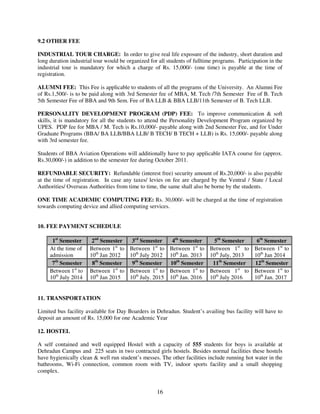
9.2 OTHER FEE

INDUSTRIAL TOUR CHARGE: In order to give real life exposure of the industry, short duration and
long duration industrial tour would be organized for all students of fulltime programs. Participation in the
industrial tour is mandatory for which a charge of Rs. 15,000/- (one time) is payable at the time of
registration.

ALUMNI FEE: This Fee is applicable to students of all the programs of the University. An Alumni Fee
of Rs.1,500/- is to be paid along with 3rd Semester fee of MBA, M. Tech /7th Semester Fee of B. Tech
5th Semester Fee of BBA and 9th Sem. Fee of BA LLB & BBA LLB/11th Semester of B. Tech LLB.

PERSONALITY DEVELOPMENT PROGRAM (PDP) FEE: To improve communication & soft
skills, it is mandatory for all the students to attend the Personality Development Program organized by
UPES. PDP fee for MBA / M. Tech is Rs.10,000/- payable along with 2nd Semester Fee, and for Under
Graduate Programs (BBA/ BA LLB/BBA LLB/ B TECH/ B TECH + LLB) is Rs. 15,000/- payable along
with 3rd semester fee.

Students of BBA Aviation Operations will additionally have to pay applicable IATA course fee (approx.
Rs.30,000/-) in addition to the semester fee during October 2011.

REFUNDABLE SECURITY: Refundable (interest free) security amount of Rs.20,000/- is also payable
at the time of registration. In case any taxes/ levies on fee are charged by the Ventral / State / Local
Authorities/ Overseas Authorities from time to time, the same shall also be borne by the students.

ONE TIME ACADEMIC COMPUTING FEE: Rs. 30,000/- will be charged at the time of registration
towards computing device and allied computing services.


10. FEE PAYMENT SCHEDULE

      1st Semester      2nd Semester     3rd Semester      4th Semester       5th Semester      6th Semester
     At the time of    Between 1st to   Between 1st to    Between 1st to    Between 1st to     Between 1st to
     admission         10th Jan 2012    10th July 2012    10th Jan. 2013    10th July, 2013    10th Jan 2014
      7th Semester      8th Semester     9th Semester     10th Semester      11th Semester     12th Semester
     Between 1st to    Between 1st to   Between 1st to    Between 1st to    Between 1st to     Between 1st to
     10th July 2014    10th Jan 2015    10th July. 2015   10th Jan. 2016    10th July 2016     10th Jan. 2017


11. TRANSPORTATION

Limited bus facility available for Day Boarders in Dehradun. Student’s availing bus facility will have to
deposit an amount of Rs. 15,000 for one Academic Year

12. HOSTEL

A self contained and well equipped Hostel with a capacity of 555 students for boys is available at
Dehradun Campus and 225 seats in two contracted girls hostels. Besides normal facilities these hostels
have hygienically clean & well run student’s messes. The other facilities include running hot water in the
bathrooms, Wi-Fi connection, common room with TV, indoor sports facility and a small shopping
complex.


                                                    16
The campus Hostel has a well equipped Infirmary with a Doctor during day and a male nurse available all
24 hours. The University has also set up a Multi Purpose Gymnasium at its Hostel.

The students availing Hostel facility will be required to deposit a sum of Rs. 70,000/- towards hostel fee
for one Academic Year 2011-12. In addition students will also pay an amount of Rs 10,000/- toward
refundable security. The Hostel fee includes Boarding, Lodging and Transportation to the campus &
back. Campus hostel provides transport facility to hostel boys from campus to Dehradun City and back
once a week. Option exercised for the Hostel seat shall not be allowed to be withdrawn and fee paid
therefore shall not be refunded in any case. Students availing Hostel Facility will have to abide by the
hostel rules and regulation. Hostel facility is available on first cum first serve basis.


13. WITHDRAWAL OF ADMISSION

      •   UPES will follow the guidelines of UGC regarding withdrawal of admission as prescribed from
          time to time


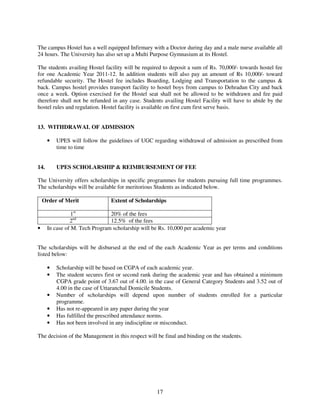
14.       UPES SCHOLARSHIP & REIMBURSEMENT OF FEE

The University offers scholarships in specific programmes for students pursuing full time programmes.
The scholarships will be available for meritorious Students as indicated below.

    Order of Merit              Extent of Scholarships

                 1st            20% of the fees
                2nd             12.5% of the fees
•     In case of M. Tech Program scholarship will be Rs. 10,000 per academic year


The scholarships will be disbursed at the end of the each Academic Year as per terms and conditions
listed below:

      •   Scholarship will be based on CGPA of each academic year.
      •   The student secures first or second rank during the academic year and has obtained a minimum
          CGPA grade point of 3.67 out of 4.00. in the case of General Category Students and 3.52 out of
          4.00 in the case of Uttaranchal Domicile Students.
      •   Number of scholarships will depend upon number of students enrolled for a particular
          programme.
      •   Has not re-appeared in any paper during the year
      •   Has fulfilled the prescribed attendance norms.
      •   Has not been involved in any indiscipline or misconduct.

The decision of the Management in this respect will be final and binding on the students.


                                                    17
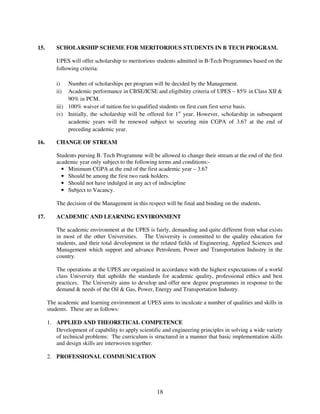
15.       SCHOLARSHIP SCHEME FOR MERITORIOUS STUDENTS IN B TECH PROGRAM.

          UPES will offer scholarship to meritorious students admitted in B-Tech Programmes based on the
          following criteria:

          i)   Number of scholarships per program will be decided by the Management.
          ii)  Academic performance in CBSE/ICSE and eligibility criteria of UPES – 85% in Class XII &
               90% in PCM.
          iii) 100% waiver of tuition fee to qualified students on first cum first serve basis.
          iv) Initially, the scholarship will be offered for 1st year. However, scholarship in subsequent
               academic years will be renewed subject to securing min CGPA of 3.67 at the end of
               preceding academic year.

16.       CHANGE OF STREAM

          Students pursing B. Tech Programme will be allowed to change their stream at the end of the first
          academic year only subject to the following terms and conditions:-
            • Minimum CGPA at the end of the first academic year – 3.67
            • Should be among the first two rank holders.
            • Should not have indulged in any act of indiscipline
            • Subject to Vacancy.

          The decision of the Management in this respect will be final and binding on the students.

17.       ACADEMIC AND LEARNING ENVIRONMENT

          The academic environment at the UPES is fairly, demanding and quite different from what exists
          in most of the other Universities. The University is committed to the quality education for
          students, and their total development in the related fields of Engineering, Applied Sciences and
          Management which support and advance Petroleum, Power and Transportation Industry in the
          country.

          The operations at the UPES are organized in accordance with the highest expectations of a world
          class University that upholds the standards for academic quality, professional ethics and best
          practices. The University aims to develop and offer new degree programmes in response to the
          demand & needs of the Oil & Gas, Power, Energy and Transportation Industry.

      The academic and learning environment at UPES aims to inculcate a number of qualities and skills in
      students. These are as follows:

      1. APPLIED AND THEORETICAL COMPETENCE
         Development of capability to apply scientific and engineering principles in solving a wide variety
         of technical problems: The curriculum is structured in a manner that basic implementation skills
         and design skills are interwoven together.

      2. PROFESSIONAL COMMUNICATION


                                                     18
Appreciation of verbal, written and graphical communication in engineering and management
          fields and developing skills to communicate with different persons at various levels employing
          IT skills wherever required.

      3. SELF LEARNING
         Development of curriculum which encourages self-learning and makes a bold attempt to move
         away from teacher-centered learning to student-specific learning: The students are encouraged to
         learn to develop flexibility in managing a career path that changes over time and supported by
         life-long learning, critical thinking, team work and leadership.

      4. GLOBAL PRACTICES
         Inculcating awareness for customary practices in different countries and the influence of diverse
         cultures: UPES provides its students sufficient exposure to various cultures for their success in
         international arena.

      5. INTEGRITY & MATURITY
         Observance of professional integrity and maturity are the core competencies of UPES. Students
         are trained to always make ethical decisions.

      6. QUALITY CONSCIOUSNESS
         Striving towards importance of continuous improvement imbibing the zero-defect concept and
         doing quality work.

      7. GROUP DYNAMICS
         UPES stresses inter-disciplinary teamwork to crack the complex technological problems.
         Students learn group dynamics and the art of working in teams. That distinguishes them as a class
         among the masses.

18.       CURRICULUM DEVELOPMENT
      1. The Academic Council of the University, which is a blend of senior academia and industrial
      personnel, is the overall custodian of the academic rigour that is followed by the students and faculty.
      The Academic Council has constituted Board of Studies (BOS) (one for each Constituent College) to
      review the curricula which was developed by benchmarking it against similar programmes offered
      nationally and internationally

      The BOS meet and review the curricula of its academic content and industry relevance so as to fulfill
      the international standards, academic standards and the latest industry requirements. The
      recommendations of the BOS are then sent to Academic Council for approval.

 2. Basic theory and fundamentals of every subject are imparted through experienced professors who
    have a wide exposure and have excelled in their respective teaching and research areas. The
    practical aspects are covered by inviting experienced / working professionals from the industry in
    specific areas to sharpen student’s grasp of the subject.

      3. The industrial aspects are further strengthened by way of learning through actual field visits
      specific to programmes of study under the guidance of faculty members. In Addition, students are
      encouraged in preparation of assignments and presentation on critical aspects / areas of the course.
      This approach helps the students in developing better understanding and grasp of critical areas of the


                                                      19
course and in-depth information on international operational and design standards. The students are
      also encouraged to understand practical aspects of theory through tutorials and assignments solving
      practical problems faced in the industry.

      4. With a view to upgrade the students on the latest developments, in specific areas highly placed
         professional speakers are invited from the industry to discuss developments taking place in their
         respective areas followed by visits to national research laboratories / institutions of national
         importance. This exposes the students to working scientists and provides them an opportunity to
         develop familiarity with the problems / areas which are being investigated for future
         technological needs.

      5. Another major step followed at UPES to make the learning process more practical for students is
         their summer internships for two months with the industry to work on well defined projects under
         the direct guidance of hard-core professionals. The projects for this purpose are chosen in
         advance as per the requirement of the industry / organizations and the students are asked to apply
         the knowledge gained while on campus to find solution or develop applications which help the
         industry to improve operations / efficiency.

19.       INSTRUCTION METHODOLOGY

      Based on the outlines provided in the syllabi, the faculty develops teaching plan for each course in the
      beginning of each semester. The broad outlines of the course plan shall include:

      •   Title
      •   Course Code
      •   Objectives
      •   Learning Outcomes
      •   Course Outline: Detailing session plan coverage for various topics including the case studies
          likely to be taken up during each of these sessions.
      •   Evaluation scheme including weightages assigned to each component of evaluation system.
      •   Text and Reference Books

      The faculty uses a blend of the following methodologies during the course of instruction to meet the
      teaching and learning objectives.

          *Lectures                         *Paper Presentation     *Industrial Tours
          *Group Discussions               *Seminars                *Field Visits
          *Case Analysis                    *Quizzes                *Video Lectures
          *Simulation Games                 *Surprise tests         *Experts’ Lectures
          *Role Plays                       *Projects               *Internships


                                                      20
20.     COURSE CURRICULUM

20.1    COLLEGE OF MANAGEMENT & ECONOMICS STUDIES

20.1.1 BBA (OIL & GAS MARKETING)
SEMESTER I                               SEMESTER II

Business Organization                    Organizational Behavior
Business Economics I                     Business Economics II
Business Mathematics                     Business Statistics
Business Accounting                      Financial Management
Business Computing                       Business Communication II
Business Communication I                 Marketing Management
                                         Understanding Oil & Gas Business
SEMESTER III                             SEMESTER IV

Human Resource Management                International Business
Operations and Materials Management      Advertising & Sales Promotion
Logistics and Supply Chain Management    Research Methodology & Report Writing
Consumer Behavior & Market Research      Understanding New Energy Resources
Oil / Gas Storage & Transportation       Internet & Petroleum E – Commerce
Petroleum Retail Development             Petroleum Business Regulation & Law
                                         Industry Visit
SEMESTER V                               SEMESTER VI


Customer Relationship Management         Project Management
Business Policy & Strategy               Entrepreneurship & Venture Management
Negotiating Skills                       Lubricant Marketing
HSE in Petroleum Industry                Gas Fundamentals & Marketing
Summer Internship                        Energy Retail Economics
Dissertation I                           Dissertation II


20.1.2 BBA (AVIATION OPERATION)
SEMESTER I                               SEMESTER II

Business Organization                    Organizational Behavior
Introduction to Aviation Industry        Business Economics I
Business Mathematics                     Business Statistics
Business Accounting                      IATA Travel & Tourism
Business Communication I
Business Computing


                                        21
SEMESTER III                                               SEMESTER IV

Marketing Management                                       Business Communication II
Research Methodology and Report Writing                    Business Law
Airport Functions of Airlines                              Marketing Communication
                                                           Consumer Behavior & Market Research
Financial Management
Business Economics II                                      Cargo Handling
                                                           Travelling Agency & Tour Operations
SEMESTER V                                                 SEMESTER VI

Essential of Strategic Management                          Airport Customer Services
Customer Relationship Management                           Aviation Marketing
International Business                                     Human Resource Management
Understanding of Aviation Business
                                                           Dissertation II
Tourism Enterprise Planning
Dissertation I
Summer Internship
Industrial Tour Report


20.1.3 BBA (AUTO RETAILING)
SEMESTER I                                                 SEMESTER II

Business Organization                                      Organizational Behavior
Business Economics I                                       Business Economics II
Business Mathematics                                       Business Statistics
Business Accounting                                        Financial Management
Business Computing                                         Business Communication II
Business Communication I                                   Marketing Management

SEMESTER III                                               SEMESTER IV

Human Resource Management                                  Marketing of Services
Operations and Materials Management                        Automotive Materials / Material Mgmt
Logistics and Supply Chain Management                      Research Methodology & Report Writing
Consumer Behavior & Market Research                        CRM & e- CRM
Introduction to Automotive Industry                        Integrated Marketing Communication
                                                           Industry Visit
SEMESTER V                                                 SEMESTER VI

Automotive Internet Marketing                              B2B Auto Retailing
Business Policy & Strategy                                 Entrepreneurship & Venture Management
Brand Management                                           Total Quality Management
Automotive Marketing Distribution/ Sales & Distribution
Mgmt                                                       Dissertation II
Summer Internship
Dissertation I


                                                          22
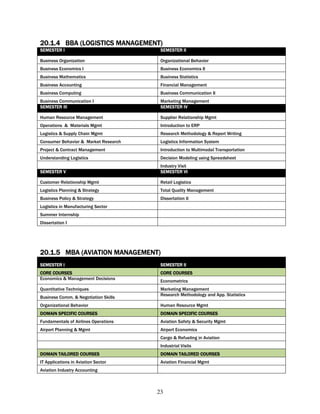
20.1.4 BBA (LOGISTICS MANAGEMENT)
SEMESTER I                             SEMESTER II

Business Organization                  Organizational Behavior
Business Economics I                   Business Economics II
Business Mathematics                   Business Statistics
Business Accounting                    Financial Management
Business Computing                     Business Communication II
Business Communication I               Marketing Management
SEMESTER III                           SEMESTER IV

Human Resource Management              Supplier Relationship Mgmt
Operations & Materials Mgmt            Introduction to ERP
Logistics & Supply Chain Mgmt          Research Methodology & Report Writing
Consumer Behavior & Market Research    Logistics Information System
Project & Contract Management          Introduction to Multimodal Transportation
Understanding Logistics                Decision Modeling using Spreadsheet
                                       Industry Visit
SEMESTER V                             SEMESTER VI

Customer Relationship Mgmt             Retail Logistics
Logistics Planning & Strategy          Total Quality Management
Business Policy & Strategy             Dissertation II
Logistics in Manufacturing Sector
Summer Internship
Dissertation I


20.1.5 MBA (AVIATION MANAGEMENT)
SEMESTER I                             SEMESTER II
CORE COURSES                           CORE COURSES
Economics & Management Decisions
                                       Econometrics
Quantitative Techniques                Marketing Management
                                       Research Methodology and App. Statistics
Business Comm. & Negotiation Skills
Organizational Behavior                Human Resource Mgmt
DOMAIN SPECIFIC COURSES                DOMAIN SPECIFIC COURSES
Fundamentals of Airlines Operations    Aviation Safety & Security Mgmt
Airport Planning & Mgmt                Airport Economics
                                       Cargo & Refueling in Aviation
                                       Industrial Visits
DOMAIN TAILORED COURSES                DOMAIN TAILORED COURSES
IT Applications in Aviation Sector     Aviation Financial Mgmt
Aviation Industry Accounting


                                      23
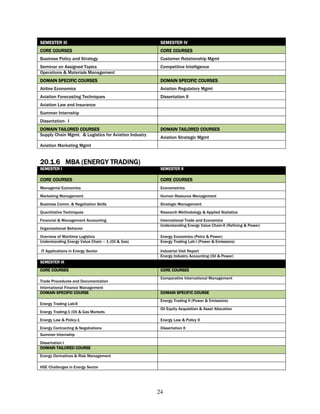
SEMESTER III                                            SEMESTER IV
CORE COURSES                                            CORE COURSES
Business Policy and Strategy                            Customer Relationship Mgmt
Seminar on Assigned Topics                              Competitive Intelligence
Operations & Materials Management
DOMAIN SPECIFIC COURSES                                 DOMAIN SPECIFIC COURSES
Airline Economics                                       Aviation Regulatory Mgmt
Aviation Forecasting Techniques                         Dissertation II
Aviation Law and Insurance
Summer Internship
Dissertation- I
DOMAIN TAILORED COURSES                                 DOMAIN TAILORED COURSES
Supply Chain Mgmt. & Logistics for Aviation Industry
                                                        Aviation Strategic Mgmt
Aviation Marketing Mgmt


20.1.6 MBA (ENERGY TRADING)
SEMESTER I                                              SEMESTER II

CORE COURSES                                            CORE COURSES
Managerial Economics                                    Econometrics
Marketing Management                                    Human Resource Management
Business Comm. & Negotiation Skills                     Strategic Management
Quantitative Techniques                                 Research Methodology & Applied Statistics
Financial & Management Accounting                       International Trade and Economics
                                                        Understanding Energy Value Chain-II (Refining & Power)
Organizational Behavior
Overview of Maritime Logistics                          Energy Economics (Petro & Power)
Understanding Energy Value Chain – 1 (Oil & Gas)        Energy Trading Lab I (Power & Emissions)

IT Applications in Energy Sector                        Industrial Visit Report
                                                        Energy Industry Accounting (Oil & Power)
SEMESTER III
CORE COURSES                                            CORE COURSES
                                                        Comparative International Management
Trade Procedures and Documentation
International Finance Management
DOMAIN SPECIFIC COURSE                                  DOMAIN SPECIFIC COURSE
                                                        Energy Trading II (Power & Emissions)
Energy Trading Lab-II
                                                        Oil Equity Acquisition & Asset Allocation
Energy Trading-1 (Oil & Gas Markets
Energy Law & Policy-1                                   Energy Law & Policy II
Energy Contracting & Negotiations                       Dissertation II
Summer Internship
Dissertation I
DOMAIN TAILORED COURSE
Energy Derivatives & Risk Management

HSE Challenges in Energy Sector


                                                       24
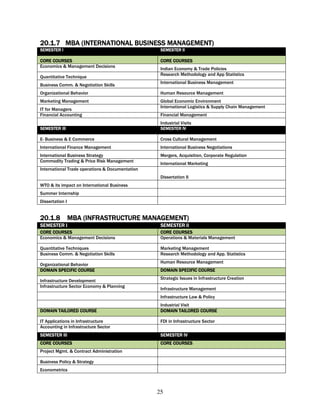
20.1.7 MBA (INTERNATIONAL BUSINESS MANAGEMENT)
SEMESTER I                                        SEMESTER II

CORE COURSES                                      CORE COURSES
Economics & Management Decisions
                                                  Indian Economy & Trade Policies
                                                  Research Methodology and App Statistics
Quantitative Technique
                                                  International Business Management
Business Comm. & Negotiation Skills
Organizational Behavior                           Human Resource Management
Marketing Management                              Global Economic Environment
                                                  International Logistics & Supply Chain Management
IT for Managers
Financial Accounting                              Financial Management
                                                  Industrial Visits
SEMESTER III                                      SEMESTER IV

E- Business & E Commerce                          Cross Cultural Management
International Finance Management                  International Business Negotiations
International Business Strategy                   Mergers, Acquisition, Corporate Regulation
Commodity Trading & Price Risk Management
                                                  International Marketing
International Trade operations & Documentation
                                                  Dissertation II
WTO & its impact on International Business
Summer Internship
Dissertation I
                                                                                 TOTAL

20.1.8 MBA (INFRASTRUCTURE MANAGEMENT)
SEMESTER I                                        SEMESTER II
CORE COURSES                                      CORE COURSES
Economics & Management Decisions                  Operations & Materials Management

Quantitative Techniques                           Marketing Management
Business Comm. & Negotiation Skills               Research Methodology and App. Statistics
                                                  Human Resource Management
Organizational Behavior
DOMAIN SPECIFIC COURSE                            DOMAIN SPECIFIC COURSE
                                                  Strategic Issues in Infrastructure Creation
Infrastructure Development
Infrastructure Sector Economy & Planning
                                                  Infrastructure Management
                                                  Infrastructure Law & Policy
                                                  Industrial Visit
DOMAIN TAILORED COURSE                            DOMAIN TAILORED COURSE

IT Applications in Infrastructure                 FDI in Infrastructure Sector
Accounting in Infrastructure Sector
SEMESTER III                                      SEMESTER IV
CORE COURSES                                      CORE COURSES
Project Mgmt. & Contract Administration

Business Policy & Strategy
Econometrics


                                                 25
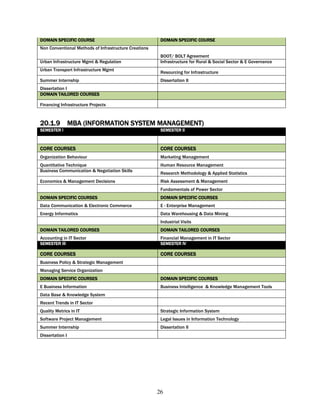
DOMAIN SPECIFIC COURSE                                  DOMAIN SPECIFIC COURSE
Non Conventional Methods of Infrastructure Creations
                                                        BOOT/ BOLT Agreement
Urban Infrastructure Mgmt & Regulation                  Infrastructure for Rural & Social Sector & E Governance
Urban Transport Infrastructure Mgmt
                                                        Resourcing for Infrastructure
Summer Internship                                       Dissertation II
Dissertation I
DOMAIN TAILORED COURSES

Financing Infrastructure Projects


20.1.9 MBA (INFORMATION SYSTEM MANAGEMENT)
SEMESTER I                                              SEMESTER II


CORE COURSES                                            CORE COURSES
Organization Behaviour                                  Marketing Management
Quantitative Technique                                  Human Resource Management
Business Communication & Negotiation Skills
                                                        Research Methodology & Applied Statistics
Economics & Management Decisions                        Risk Assessment & Management
                                                        Fundamentals of Power Sector
DOMAIN SPECIFIC COURSES                                 DOMAIN SPECIFIC COURSES
Data Communication & Electronic Commerce                E - Enterprise Management
Energy Informatics                                      Data Warehousing & Data Mining
                                                        Industrial Visits
DOMAIN TAILORED COURSES                                 DOMAIN TAILORED COURSES
Accounting in IT Sector                                 Financial Management in IT Sector
SEMESTER III                                            SEMESTER IV

CORE COURSES                                            CORE COURSES
Business Policy & Strategic Management
Managing Service Organization
DOMAIN SPECIFIC COURSES                                 DOMAIN SPECIFIC COURSES
E Business Information                                  Business Intelligence & Knowledge Management Tools
Data Base & Knowledge System
Recent Trends in IT Sector
Quality Metrics in IT                                   Strategic Information System
Software Project Management                             Legal Issues in Information Technology
Summer Internship                                       Dissertation II
Dissertation I


                                                       26
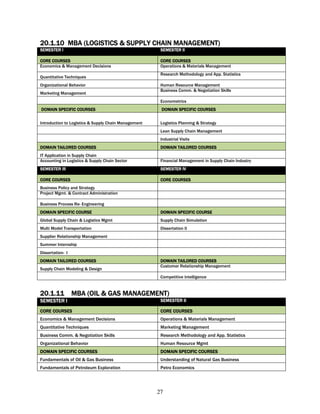
20.1.10 MBA (LOGISTICS & SUPPLY CHAIN MANAGEMENT)
SEMESTER I                                             SEMESTER II

CORE COURSES                                           CORE COURSES
Economics & Management Decisions                       Operations & Materials Management
                                                       Research Methodology and App. Statistics
Quantitative Techniques
Organizational Behavior                                Human Resource Management
                                                       Business Comm. & Negotiation Skills
Marketing Management
                                                       Econometrics
DOMAIN SPECIFIC COURSES                                DOMAIN SPECIFIC COURSES


Introduction to Logistics & Supply Chain Management    Logistics Planning & Strategy
                                                       Lean Supply Chain Management
                                                       Industrial Visits
DOMAIN TAILORED COURSES                                DOMAIN TAILORED COURSES
IT Application in Supply Chain
Accounting in Logistics & Supply Chain Sector          Financial Management in Supply Chain Industry
SEMESTER III                                           SEMESTER IV

CORE COURSES                                           CORE COURSES
Business Policy and Strategy
Project Mgmt. & Contract Administration

Business Process Re- Engineering
DOMAIN SPECIFIC COURSE                                 DOMAIN SPECIFIC COURSE
Global Supply Chain & Logistics Mgmt                   Supply Chain Simulation
Multi Model Transportation                             Dissertation II
Supplier Relationship Management
Summer Internship
Dissertation- I
DOMAIN TAILORED COURSES                                DOMAIN TAILORED COURSES
                                                       Customer Relationship Management
Supply Chain Modeling & Design
                                                       Competitive Intelligence


20.1.11 MBA (OIL & GAS MANAGEMENT)
SEMESTER I                                             SEMESTER II

CORE COURSES                                           CORE COURSES
Economics & Management Decisions                       Operations & Materials Management
Quantitative Techniques                                Marketing Management
Business Comm. & Negotiation Skills                    Research Methodology and App. Statistics
Organizational Behavior                                Human Resource Mgmt
DOMAIN SPECIFIC COURSES                                DOMAIN SPECIFIC COURSES
Fundamentals of Oil & Gas Business                     Understanding of Natural Gas Business
Fundamentals of Petroleum Exploration                  Petro Economics


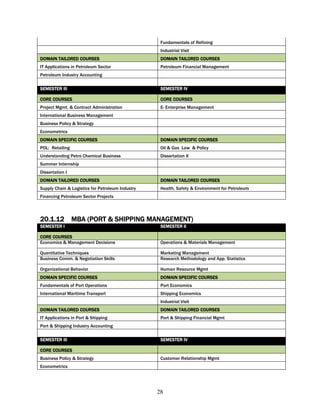
                                                      27
Fundamentals of Refining
                                                   Industrial Visit
DOMAIN TAILORED COURSES                            DOMAIN TAILORED COURSES
IT Applications in Petroleum Sector                Petroleum Financial Management
Petroleum Industry Accounting

SEMESTER III                                       SEMESTER IV

CORE COURSES                                       CORE COURSES
Project Mgmt. & Contract Administration            E- Enterprise Management
International Business Management
Business Policy & Strategy
Econometrics
DOMAIN SPECIFIC COURSES                            DOMAIN SPECIFIC COURSES
POL: Retailing                                     Oil & Gas Law & Policy
Understanding Petro Chemical Business              Dissertation II
Summer Internship
Dissertation I
DOMAIN TAILORED COURSES                            DOMAIN TAILORED COURSES
Supply Chain & Logistics for Petroleum Industry    Health, Safety & Environment for Petroleum
Financing Petroleum Sector Projects


20.1.12 MBA (PORT & SHIPPING MANAGEMENT)
SEMESTER I                                         SEMESTER II

CORE COURSES
Economics & Management Decisions                   Operations & Materials Management

Quantitative Techniques                            Marketing Management
Business Comm. & Negotiation Skills                Research Methodology and App. Statistics

Organizational Behavior                            Human Resource Mgmt
DOMAIN SPECIFIC COURSES                            DOMAIN SPECIFIC COURSES
Fundamentals of Port Operations                    Port Economics
International Maritime Transport                   Shipping Economics
                                                   Industrial Visit
DOMAIN TAILORED COURSES                            DOMAIN TAILORED COURSES
IT Applications in Port & Shipping                 Port & Shipping Financial Mgmt
Port & Shipping Industry Accounting

SEMESTER III                                       SEMESTER IV

CORE COURSES
Business Policy & Strategy                         Customer Relationship Mgmt
Econometrics


                                                  28
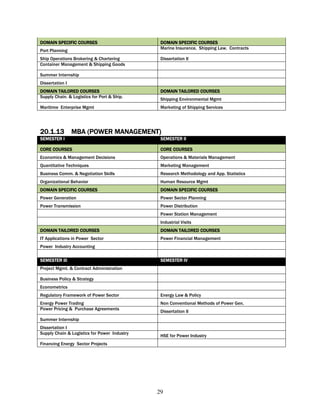
DOMAIN SPECIFIC COURSES                        DOMAIN SPECIFIC COURSES
                                               Marine Insurance, Shipping Law, Contracts
Port Planning
Ship Operations Brokering & Chartering         Dissertation II
Container Management & Shipping Goods

Summer Internship
Dissertation I
DOMAIN TAILORED COURSES                        DOMAIN TAILORED COURSES
Supply Chain. & Logistics for Port & Ship.
                                               Shipping Environmental Mgmt
Maritime Enterprise Mgmt                       Marketing of Shipping Services


20.1.13 MBA (POWER MANAGEMENT)
SEMESTER I                                     SEMESTER II

CORE COURSES                                   CORE COURSES
Economics & Management Decisions               Operations & Materials Management
Quantitative Techniques                        Marketing Management
Business Comm. & Negotiation Skills            Research Methodology and App. Statistics
Organizational Behavior                        Human Resource Mgmt
DOMAIN SPECIFIC COURSES                        DOMAIN SPECIFIC COURSES
Power Generation                               Power Sector Planning
Power Transmission                             Power Distribution
                                               Power Station Management
                                               Industrial Visits
DOMAIN TAILORED COURSES                        DOMAIN TAILORED COURSES
IT Applications in Power Sector                Power Financial Management
Power Industry Accounting

SEMESTER III                                   SEMESTER IV
Project Mgmt. & Contract Administration

Business Policy & Strategy
Econometrics
Regulatory Framework of Power Sector           Energy Law & Policy
Energy Power Trading                           Non Conventional Methods of Power Gen.
Power Pricing & Purchase Agreements
                                               Dissertation II
Summer Internship
Dissertation I
Supply Chain & Logistics for Power Industry
                                               HSE for Power Industry
Financing Energy Sector Projects


                                              29
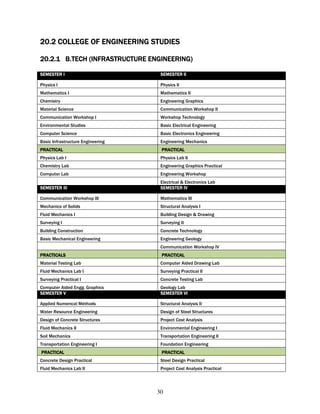
20.2 COLLEGE OF ENGINEERING STUDIES

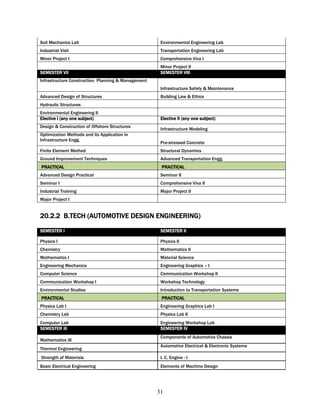
20.2.1 B.TECH (INFRASTRUCTURE ENGINEERING)

SEMESTER I                          SEMESTER II

Physics I                           Physics II
Mathematics I                       Mathematics II
Chemistry                           Engineering Graphics
Material Science                    Communication Workshop II
Communication Workshop I            Workshop Technology
Environmental Studies               Basic Electrical Engineering
Computer Science                    Basic Electronics Engineering
Basic Infrastructure Engineering    Engineering Mechanics
PRACTICAL                           PRACTICAL
Physics Lab I                       Physics Lab II
Chemistry Lab                       Engineering Graphics Practical
Computer Lab                        Engineering Workshop
                                    Electrical & Electronics Lab
SEMESTER III                        SEMESTER IV

Communication Workshop III          Mathematics III
Mechanics of Solids                 Structural Analysis I
Fluid Mechanics I                   Building Design & Drawing
Surveying I                         Surveying II
Building Construction               Concrete Technology
Basic Mechanical Engineering        Engineering Geology
                                    Communication Workshop IV
PRACTICALS                          PRACTICAL
Material Testing Lab                Computer Aided Drawing Lab
Fluid Mechanics Lab I               Surveying Practical II
Surveying Practical I               Concrete Testing Lab
Computer Aided Engg. Graphics       Geology Lab
SEMESTER V                          SEMESTER VI

Applied Numerical Methods           Structural Analysis II
Water Resource Engineering          Design of Steel Structures
Design of Concrete Structures       Project Cost Analysis
Fluid Mechanics II                  Environmental Engineering I
Soil Mechanics                      Transportation Engineering II
Transportation Engineering I        Foundation Engineering
PRACTICAL                           PRACTICAL
Concrete Design Practical           Steel Design Practical
Fluid Mechanics Lab II              Project Cost Analysis Practical


                                   30
Soil Mechanics Lab                                   Environmental Engineering Lab
Industrial Visit                                     Transportation Engineering Lab
Minor Project I                                      Comprehensive Viva I
                                                     Minor Project II
SEMESTER VII                                         SEMESTER VIII
Infrastructure Construction Planning & Management
                                                     Infrastructure Safety & Maintenance
Advanced Design of Structures                        Building Law & Ethics
Hydraulic Structures
Environmental Engineering II
Elective I (any one subject)                         Elective II (any one subject)
Design & Construction of Offshore Structures
                                                     Infrastructure Modeling
Optimization Methods and its Application in
Infrastructure Engg.
                                                     Pre-stressed Concrete
Finite Element Method                                Structural Dynamics
Ground Improvement Techniques                        Advanced Transportation Engg.
PRACTICAL                                            PRACTICAL
Advanced Design Practical                            Seminar II
Seminar I                                            Comprehensive Viva II
Industrial Training                                  Major Project II
Major Project I


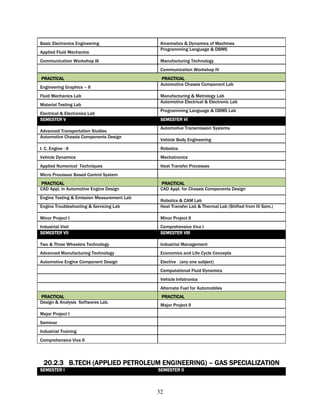
20.2.2 B.TECH (AUTOMOTIVE DESIGN ENGINEERING)

SEMESTER I                                           SEMESTER II

Physics I                                            Physics II
Chemistry                                            Mathematics II
Mathematics I                                        Material Science
Engineering Mechanics                                Engineering Graphics – I
Computer Science                                     Communication Workshop II
Communication Workshop I                             Workshop Technology
Environmental Studies                                Introduction to Transportation Systems
PRACTICAL                                            PRACTICAL
Physics Lab I                                        Engineering Graphics Lab I
Chemistry Lab                                        Physics Lab II
Computer Lab                                         Engineering Workshop Lab
SEMESTER III                                         SEMESTER IV
                                                     Components of Automotive Chassis
Mathematics III
                                                     Automotive Electrical & Electronic Systems
Thermal Engineering
Strength of Materials                                I. C. Engine - I
Basic Electrical Engineering                         Elements of Machine Design


                                                    31
Basic Electronics Engineering                Kinematics & Dynamics of Machines
                                             Programming Language & DBMS
Applied Fluid Mechanics
Communication Workshop III                   Manufacturing Technology
                                             Communication Workshop IV
PRACTICAL                                    PRACTICAL
                                             Automotive Chassis Component Lab
Engineering Graphics – II
Fluid Mechanics Lab                          Manufacturing & Metrology Lab
                                             Automotive Electrical & Electronic Lab
Material Testing Lab
                                             Programming Language & DBMS Lab
Electrical & Electronics Lab
SEMESTER V                                   SEMESTER VI
                                             Automotive Transmission Systems
Advanced Transportation Studies
Automotive Chassis Components Design
                                             Vehicle Body Engineering
I. C. Engine - II                            Robotics
Vehicle Dynamics                             Mechatronics
Applied Numerical Techniques                 Heat Transfer Processes
Micro Processor Based Control System
PRACTICAL                                    PRACTICAL
CAD Appl. in Automotive Engine Design        CAD Appl. for Chassis Components Design
Engine Testing & Emission Measurement Lab
                                             Robotics & CAM Lab
Engine Troubleshooting & Servicing Lab       Heat Transfer Lab & Thermal Lab (Shifted from IV Sem.)

Minor Project I                              Minor Project II
Industrial Visit                             Comprehensive Viva I
SEMESTER VII                                 SEMESTER VIII

Two & Three Wheelers Technology              Industrial Management
Advanced Manufacturing Technology            Economics and Life Cycle Concepts
Automotive Engine Component Design           Elective (any one subject)
                                             Computational Fluid Dynamics
                                             Vehicle Infotronics
                                             Alternate Fuel for Automobiles
PRACTICAL                                    PRACTICAL
Design & Analysis Softwares Lab.
                                             Major Project II
Major Project I
Seminar
Industrial Training
Comprehensive Viva II


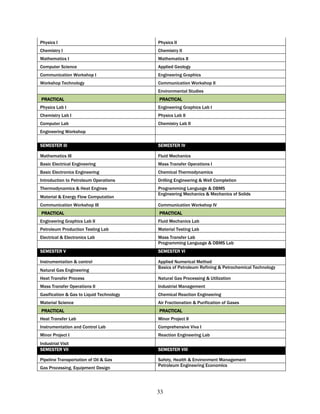
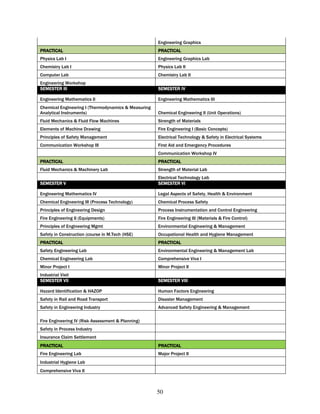
  20.2.3 B.TECH (APPLIED PETROLEUM ENGINEERING) – GAS SPECIALIZATION
SEMESTER I                                  SEMESTER II


                                            32
Physics I                                 Physics II
Chemistry I                               Chemistry II
Mathematics I                             Mathematics II
Computer Science                          Applied Geology
Communication Workshop I                  Engineering Graphics
Workshop Technology                       Communication Workshop II
                                          Environmental Studies
PRACTICAL                                 PRACTICAL
Physics Lab I                             Engineering Graphics Lab I
Chemistry Lab I                           Physics Lab II
Computer Lab                              Chemistry Lab II
Engineering Workshop

SEMESTER III                              SEMESTER IV

Mathematics III                           Fluid Mechanics
Basic Electrical Engineering              Mass Transfer Operations I
Basic Electronics Engineering             Chemical Thermodynamics
Introduction to Petroleum Operations      Drilling Engineering & Well Completion
Thermodynamics & Heat Engines             Programming Language & DBMS
                                          Engineering Mechanics & Mechanics of Solids
Material & Energy Flow Computation
Communication Workshop III                Communication Workshop IV
PRACTICAL                                 PRACTICAL
Engineering Graphics Lab II               Fluid Mechanics Lab
Petroleum Production Testing Lab          Material Testing Lab
Electrical & Electronics Lab              Mass Transfer Lab
                                          Programming Language & DBMS Lab
SEMESTER V                                SEMESTER VI

Instrumentation & control                 Applied Numerical Method
                                          Basics of Petroleum Refining & Petrochemical Technology
Natural Gas Engineering
Heat Transfer Process                     Natural Gas Processing & Utilization
Mass Transfer Operations II               Industrial Management
Gasification & Gas to Liquid Technology   Chemical Reaction Engineering
Material Science                          Air Fractionation & Purification of Gases
PRACTICAL                                 PRACTICAL
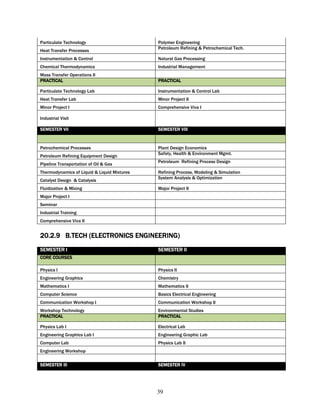
Heat Transfer Lab                         Minor Project II
Instrumentation and Control Lab           Comprehensive Viva I
Minor Project I                           Reaction Engineering Lab
Industrial Visit
SEMESTER VII                              SEMESTER VIII

Pipeline Transportation of Oil & Gas      Safety, Health & Environment Management
                                          Petroleum Engineering Economics
Gas Processing, Equipment Design


                                          33
Petrochemical Process Technology & Polymers   Elective II (Any one)
City Gas Distribution & Pipeline Network      Natural Gas Processes: Modeling & Simulation
Elective I (Any One)                          CNG based Green Fuels
Coal Bed Methane Technology
Developing LNG, Production & Handling
Major Project I
Seminar
Industrial Training
Comprehensive Viva II


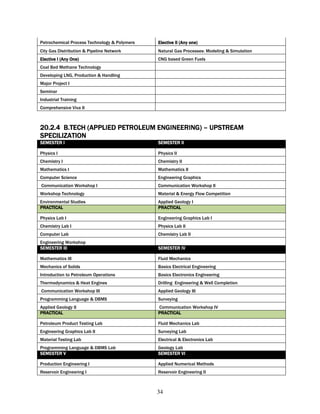
20.2.4 B.TECH (APPLIED PETROLEUM ENGINEERING) – UPSTREAM
SPECILIZATION
SEMESTER I                                    SEMESTER II

Physics I                                     Physics II
Chemistry I                                   Chemistry II
Mathematics I                                 Mathematics II
Computer Science                              Engineering Graphics
Communication Workshop I                      Communication Workshop II
Workshop Technology                           Material & Energy Flow Competition
Environmental Studies                         Applied Geology I
PRACTICAL                                     PRACTICAL

Physics Lab I                                 Engineering Graphics Lab I
Chemistry Lab I                               Physics Lab II
Computer Lab                                  Chemistry Lab II
Engineering Workshop
SEMESTER III                                  SEMESTER IV

Mathematics III                               Fluid Mechanics
Mechanics of Solids                           Basics Electrical Engineering
Introduction to Petroleum Operations          Basics Electronics Engineering
Thermodynamics & Heat Engines                 Drilling Engineering & Well Completion
Communication Workshop III                    Applied Geology III
Programming Language & DBMS                   Surveying
Applied Geology II                            Communication Workshop IV
PRACTICAL                                     PRACTICAL

Petroleum Product Testing Lab                 Fluid Mechanics Lab
Engineering Graphics Lab II                   Surveying Lab
Material Testing Lab                          Electrical & Electronics Lab
Programming Language & DBMS Lab               Geology Lab
SEMESTER V                                    SEMESTER VI

Production Engineering I                      Applied Numerical Methods
Reservoir Engineering I                       Reservoir Engineering II


                                              34
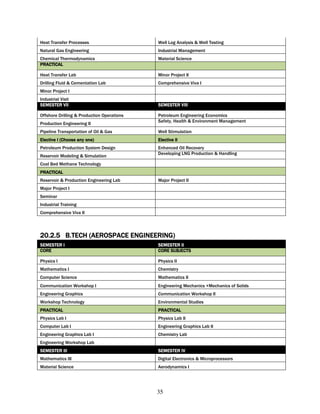
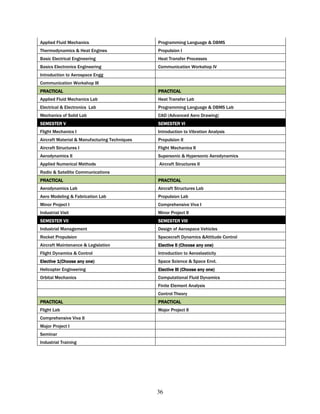
Heat Transfer Processes                     Well Log Analysis & Well Testing
Natural Gas Engineering                     Industrial Management
Chemical Thermodynamics                     Material Science
PRACTICAL

Heat Transfer Lab                           Minor Project II
Drilling Fluid & Cementation Lab            Comprehensive Viva I
Minor Project I
Industrial Visit
SEMESTER VII                                SEMESTER VIII

Offshore Drilling & Production Operations   Petroleum Engineering Economics
                                            Safety, Health & Environment Management
Production Engineering II
Pipeline Transportation of Oil & Gas        Well Stimulation
Elective I (Choose any one)                 Elective II
Petroleum Production System Design          Enhanced Oil Recovery
                                            Developing LNG Production & Handling
Reservoir Modeling & Simulation
Coal Bed Methane Technology
PRACTICAL
Reservoir & Production Engineering Lab      Major Project II
Major Project I
Seminar
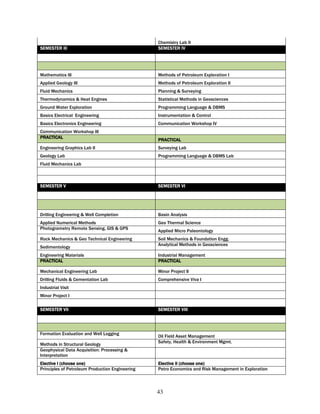
Industrial Training
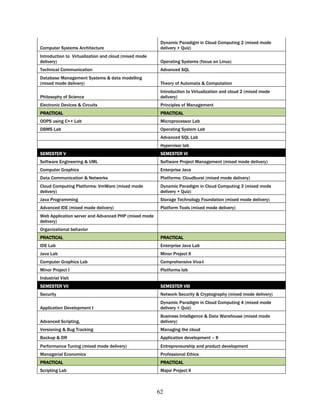
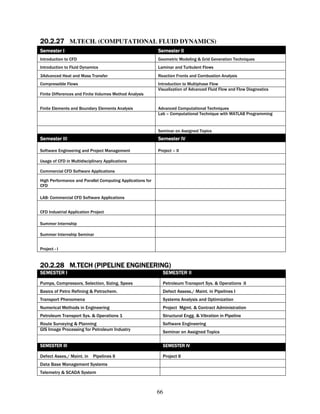
Comprehensive Viva II


20.2.5 B.TECH (AEROSPACE ENGINEERING)
SEMESTER I                                  SEMESTER II
CORE                                        CORE SUBJECTS

Physics I                                   Physics II
Mathematics I                               Chemistry
Computer Science                            Mathematics II
Communication Workshop I                    Engineering Mechanics +Mechanics of Solids
Engineering Graphics                        Communication Workshop II
Workshop Technology                         Environmental Studies
PRACTICAL                                   PRACTICAL
Physics Lab I                               Physics Lab II
Computer Lab I                              Engineering Graphics Lab II
Engineering Graphics Lab I                  Chemistry Lab
Engineering Workshop Lab
SEMESTER III                                SEMESTER IV
Mathematics III                             Digital Electronics & Microprocessors
Material Science                            Aerodynamics I


                                            35
Applied Fluid Mechanics                        Programming Language & DBMS
Thermodynamics & Heat Engines                  Propulsion I
Basic Electrical Engineering                   Heat Transfer Processes
Basics Electronics Engineering                 Communication Workshop IV
Introduction to Aerospace Engg
Communication Workshop III
PRACTICAL                                      PRACTICAL
Applied Fluid Mechanics Lab                    Heat Transfer Lab
Electrical & Electronics Lab                   Programming Language & DBMS Lab
Mechanics of Solid Lab                         CAD (Advanced Aero Drawing)
SEMESTER V                                     SEMESTER VI
Flight Mechanics I                             Introduction to Vibration Analysis
Aircraft Material & Manufacturing Techniques   Propulsion II
Aircraft Structures I                          Flight Mechanics II
Aerodynamics II                                Supersonic & Hypersonic Aerodynamics
Applied Numerical Methods                      Aircraft Structures II
Radio & Satellite Communications
PRACTICAL                                      PRACTICAL
Aerodynamics Lab                               Aircraft Structures Lab
Aero Modeling & Fabrication Lab                Propulsion Lab
Minor Project I                                Comprehensive Viva I
Industrial Visit                               Minor Project II
SEMESTER VII                                   SEMESTER VIII
Industrial Management                          Design of Aerospace Vehicles
Rocket Propulsion                              Spacecraft Dynamics &Attitude Control
Aircraft Maintenance & Legislation             Elective II (Choose any one)
Flight Dynamics & Control                      Introduction to Aeroelasticity
Elective 1(Choose any one)                     Space Science & Space Envt.
Helicopter Engineering                         Elective III (Choose any one)
Orbital Mechanics                              Computational Fluid Dynamics
                                               Finite Element Analysis
                                               Control Theory
PRACTICAL                                      PRACTICAL
Flight Lab                                     Major Project II
Comprehensive Viva II
Major Project I
Seminar
Industrial Training


                                               36
20.2.6 B.TECH (AEROSPACE ENGINEERING) with Avionics Specialization

SEMESTER I                                     SEMESTER II


Physics I                                      Physics II
Mathematics I                                  Chemistry
Computer Science                               Mathematics II
Communication Workshop I                       Engineering Mechanics +Mechanics of Solids
Engineering Graphics                           Communication Workshop II
Workshop Technology                            Environmental Studies
PRACTICAL                                      PRACTICAL
Physics Lab I                                  Physics Lab II
Computer Lab I                                 Engineering Graphics Lab II
Engineering Graphics Lab I                     Chemistry Lab
Engineering Workshop Lab
SEMESTER III                                   SEMESTER IV
Mathematics III                                Digital Electronics & Microprocessors
Material Science                               Aerodynamics I
Applied Fluid Mechanics                        Programming Language & DBMS
Thermodynamics & Heat Engines                  Propulsion I
Basic Electrical Engineering                   Heat Transfer Processes
Basics Electronics Engineering                 Communication Workshop IV
Introduction to Aerospace Engg
Communication Workshop III
PRACTICAL                                      PRACTICAL
Applied Fluid Mechanics Lab                    Heat Transfer Lab
Electrical & Electronics Lab                   Programming Language & DBMS Lab
Mechanics of Solid Lab                         CAD (Advanced Aero Drawing)
SEMESTER V                                     SEMESTER VI
Flight Mechanics I                             Digital Signal Processing
Aircraft Material & Manufacturing Techniques   Propulsion II
Aircraft Structures I                          Flight Mechanics II
Aerodynamics II                                Signals & Systems
Applied Numerical Methods                      Aircraft Structures II
Radio & Satellite Communications
PRACTICAL                                      PRACTICAL
Aerodynamics Lab                               Aircraft Structures Lab
Aero Modeling & Fabrication Lab                Propulsion Lab
Minor Project I                                Comprehensive Viva I
Industrial Visit                               Minor Project II
SEMESTER VII                                   SEMESTER VIII


                                               37
Industrial Management                  Avionics System Design
Avionics I                             Spacecraft Dynamics &Attitude Control
Avionics Maintenance & Legislation     Avionics II
Radar Technology
PRACTICAL                              PRACTICAL
Flight Lab                             Major Project II
Comprehensive Viva II
Major Project I
Seminar
Industrial Training


20.2.7 B.TECH (CHEMICAL ENGINEERING) WITH SPECIALIZATION IN REFINING
& PETROCHEMICALS
SEMESTER I                             SEMESTER II

Physics I                              Physics II
Chemistry I                            Chemistry II
Mathematics I                          Mathematics II
Environment Studies                    Material & Energy Flow Computation
Computer Science                       Engineering Graphics
Communication Workshop I               Communication Workshop II
Workshop Technology                    Programming Language & DBMS
PRACTICAL
                                       PRACTICAL
Physics Lab I                          Programming Language & DBMS Lab
Chemistry Lab I                        Engineering Graphics Lab I
Computer Lab                           Physics Lab II
Engineering Workshop                   Chemistry Lab II

SEMESTER III                           SEMESTER IV

Mathematics III                        Fluid Mechanics
Mechanics of Solids                    Chemical Reaction Engineering
Introduction to Petroleum Operations   Applied Numerical Methods
Thermodynamics & Heat Engines          Mass Transfer Operations I
Communication Workshop III             Material Science
Basic Electrical Engineering           Communication Workshop IV
Basic Electronics Engineering
PRACTICAL                              PRACTICAL
Engineering Graphics Lab II            Fluid Mechanics Lab
Material Testing Lab                   Mass Transfer Lab
Petroleum Production Testing Lab       Reaction Engineering Lab
Electrical & Electronics Lab
SEMESTER V                             SEMESTER VI


                                       38
Particulate Technology                       Polymer Engineering
                                             Petroleum Refining & Petrochemical Tech.
Heat Transfer Processes
Instrumentation & Control                    Natural Gas Processing
Chemical Thermodynamics                      Industrial Management
Mass Transfer Operations II
PRACTICAL                                    PRACTICAL

Particulate Technology Lab                   Instrumentation & Control Lab
Heat Transfer Lab                            Minor Project II
Minor Project I                              Comprehensive Viva I

Industrial Visit

SEMESTER VII                                 SEMESTER VIII


Petrochemical Processes                      Plant Design Economics
                                             Safety, Health & Environment Mgmt.
Petroleum Refining Equipment Design
                                             Petroleum Refining Process Design
Pipeline Transportation of Oil & Gas
Thermodynamics of Liquid & Liquid Mixtures   Refining Process, Modeling & Simulation
                                             System Analysis & Optimization
Catalyst Design & Catalysis
Fluidization & Mixing                        Major Project II
Major Project I
Seminar
Industrial Training
Comprehensive Viva II


20.2.9 B.TECH (ELECTRONICS ENGINEERING)
SEMESTER I                                   SEMESTER II
CORE COURSES

Physics I                                    Physics II
Engineering Graphics                         Chemistry
Mathematics I                                Mathematics II
Computer Science                             Basics Electrical Engineering
Communication Workshop I                     Communication Workshop II
Workshop Technology                          Environmental Studies
PRACTICAL                                    PRACTICAL

Physics Lab I                                Electrical Lab
Engineering Graphics Lab I                   Engineering Graphic Lab
Computer Lab                                 Physics Lab II
Engineering Workshop

SEMESTER III                                 SEMESTER IV


                                             39
CORE COURSES

Mathematics III                       Electromagnetic Field Theory
OOPs with C & C++                     Instrumentation & Measurement
Signals & Systems                     Digital Logic Design & Application,
Electronic Devices & Circuits (EDC)   Analog Electronic
Network Theory                        Information Theory & Coding
Communication Workshop III            Electronic Material & Processes
                                      Communication Workshop IV
PRACTICAL                             PRACTICAL
                                      Instrumentation & Measurement Lab
OOPs Lab
EDC Lab                               Analog Electronics Lab
Network Lab                           Digital Circuit Design Lab
Electronics Workshop


SEMESTER V                            SEMESTER VI


CORE COURSES
Linear Integrated Circuits            Antenna & Wave Propagation
Numerical Methods                     Control System Engineering
Microprocessor & Peripherals          Digital Signal Processing
Communication Systems                 Digital Communication
Power Electronics & Derives           Advanced Microprocessor & Embedded Systems
Artificial Intelligence
PRACTICAL                             PRACTICAL
Communication Lab                     Advanced Microprocessor & Embedded Systems Lab
Microprocessor Lab                    Communication Lab II
Linear Integrated Circuit Lab         DSP Lab
Industrial Visit                      Minor Project II
Minor Project I                       Comprehensive Viva I

SEMESTER VII                          SEMESTER VIII


CORE COURSES
VLSI Engineering                      Micro Electro Mechanical Systems
Nano Electronics Technology           Industrial Automation
Microwave Electronics                 Industrial Management
Elective-
Elective-I (Choose any 1)             Elective II (Choose any 1)
Optical Communications                VHTL
Remote Sensing                        Radar Systems
Wireless Communications               Multimedia Systems


                                      40
Solar Cell Technology                    Biomedical Instrumentation
                                         Broadband Wireless Communication
I C Technology
PRACTICAL                                PRACTICAL
VLSI Lab                                 Major Project II
Microwave & Antenna Lab
Major Project I
Seminar
Industrial Training


20.2.10 B.TECH (GEO INFORMATICS)
SEMESTER I                               SEMESTER II


Physics I                                Physics II
Chemistry I                              Chemistry II
Mathematics I                            Mathematics II
Applied Geology I                        Applied Geology II
Computer Science                         Engineering Graphics
Communication Workshop I                 Communication Workshop II
Environmental Studies
PRACTICAL                                PRACTICAL
Physics Lab I                            Engineering Graphics Lab I
Chemistry Lab I                          Physics Lab II
Computer Lab                             Chemistry Lab II
                                         Geology Lab 1
SEMESTER III                             SEMESTER IV
                                         Methods of Petroleum Exploration I
Mathematics III
Applied Geology III                      Planning & Surveying
                                         Statistical Methods in Geosciences
Fluid Mechanics
                                         Programming Language & DBMS
Thermodynamics & Heat Engines
Introduction to Geoinformatics           Instrumentation & Control
Basic Electrical Engineering             Communication Workshop IV
Basics Electronics Engineering
Communication Workshop III
PRACTICAL                                PRACTICAL
Engineering Graphics Lab II              Instrumentation & Control Lab
Geology Lab II                           Surveying Lab
Fluid Mechanics Lab                      Programming Language & DBMS Lab
Electrical & Electronics Lab
SEMESTER V                               SEMESTER VI


Drilling Engineering & Well Completion   Basin Analysis


                                         41
Methods of Petroleum Exploration II          Geo Thermal Science
Rock Mechanics & Geo Technical Engineering   Digital Image Processing
Sedimentology                                Spatial Database System
Engineering Materials                        Analytical Methods in Geosciences
Photogrametry: Remote Sensing FIS & GPS      Industrial Management
PRACTICAL                                    PRACTICAL

Mechanical Engineering Lab                   Minor Project II
Drilling Fluids & Cementation Lab            Comprehensive Viva I
Minor Project I
Industrial Visit
SEMESTER VII                                 SEMESTER VIII


Formation Evaluation and Well Logging
                                             Oil Field Asset Management
Geophysical Data Acquisition: Processing &
Interpretation
                                             Application of Geo Informatics II
Application of Geo Informatics I
Elective I (any one)                         Elective II (any one)
Principles of Reservoir Engineering
                                             Mobile Mapping
Spatial Data Analysis & Modeling
PRACTICAL                                    PRACTICAL
Major Project I                              Major Project II
Seminar
Industrial Training
Comprehensive Viva II


20.2.11 B.TECH (GEOSCIENCES ENGINEERING)
SEMESTER I                                   SEMESTER II


Physics I                                    Physics II
Chemistry I                                  Chemistry II
Mathematics I                                Mathematics II
Applied Geology I                            Applied Geology II
Computer Science                             Engineering Graphics
Communication Workshop I                     Communication Workshop II
Environmental Studies                        Workshop Technology
PRACTICAL                                    PRACTICAL

Physics Lab I                                Engineering Workshop
Chemistry Lab I                              Engineering Graphics Lab I
Computer Lab                                 Physics Lab II


                                             42
Chemistry Lab II
SEMESTER III                                     SEMESTER IV


Mathematics III                                  Methods of Petroleum Exploration I
Applied Geology III                              Methods of Petroleum Exploration II
Fluid Mechanics                                  Planning & Surveying
Thermodynamics & Heat Engines                    Statistical Methods in Geosciences
Ground Water Exploration                         Programming Language & DBMS
Basics Electrical Engineering                    Instrumentation & Control
Basics Electronics Engineering                   Communication Workshop IV
Communication Workshop III
PRACTICAL
                                                 PRACTICAL
Engineering Graphics Lab II                      Surveying Lab
Geology Lab                                      Programming Language & DBMS Lab
Fluid Mechanics Lab


SEMESTER V                                       SEMESTER VI


Drilling Engineering & Well Completion           Basin Analysis
Applied Numerical Methods                        Geo Thermal Science
Photogrametry Remote Sensing, GIS & GPS
                                                 Applied Micro Paleontology
Rock Mechanics & Geo Technical Engineering       Soil Mechanics & Foundation Engg.
                                                 Analytical Methods in Geosciences
Sedimentology
Engineering Materials                            Industrial Management
PRACTICAL                                        PRACTICAL

Mechanical Engineering Lab                       Minor Project II
Drilling Fluids & Cementation Lab                Comprehensive Viva I
Industrial Visit
Minor Project I

SEMESTER VII                                     SEMESTER VIII


Formation Evaluation and Well Logging
                                                 Oil Field Asset Management
                                                 Safety, Health & Environment Mgmt.
Methods in Structural Geology
Geophysical Data Acquisition: Processing &
Interpretation
Elective I (choose one)                          Elective II (choose one)
Principles of Petroleum Production Engineering   Petro Economics and Risk Management in Exploration


                                                 43
Principles of Reservoir Engineering   Petroleum Law & Contract Administration

PRACTICAL                             PRACTICAL
Major Project I                       Major Project II
Seminar I
Industrial Training
Comprehensive Viva II


                                      44
45
46
20.2.12 B.TECH MECHATRONICS ENGINEERING

SEMESTER I                               SEMESTER II
Physics I
                                         Physics II
Chemistry                                Mathematics II
Mathematics I                            Basic Electrical Engineering
Computer Science                         Basic Electronics Engineering
Communication Workshop I                 Engineering Graphics
Workshop Technology                      Communication Workshop II
                                         Environmental Studies
PRACTICAL                                PRACTICAL
Physics Lab I                            Electrical& Electronics Lab
Chemistry Lab                            Engineering Graphics Lab
Computer Lab                             Physics Lab II
Engineering Workshop
SEMESTER III                             SEMESTER IV


Materials Technology                     Fluid Mechanics
                                         Metrology & Computer Aided Inspection
OOPs with C & C++
Applied Thermodynamics                   Engineering Mechanics & Mechanics of Solids
Analog and Digital Electronics           Manufacturing Technology
Electrical Machines                      Control Engineering
Communication Workshop III               Instrumentation & Control
                                         Communication Workshop IV
PRACTICAL                                PRACTICAL
OOPs Lab                                 Fluid Mechanics Lab
Engineering Graphics Lab -II             Instrumentation & Control Lab
Electrical Drives & Electronics Lab      Manufacturing science and material testing Lab


SEMESTER V                               SEMESTER VI

Power Electronics & Electrical Derives   Design of Machine Elements
Numerical Methods &Applications          Robotics & Control
Microprocessor & Microcontroller         Hydraulics and Pneumatics
                                         Programmable Logic Controller (PLC)
Theory of Machines
Computer Aided Manufacturing             Sensor Systems and Artificial Intelligence
Signal Processing and Systems            Operations & Quality Mgmt
PRACTICAL
Power Electrical & Electronics Lab       Hydraulics & Pneumatics Lab
Microprocessor & Microcontroller Lab
                                         PLC and AI Lab
Sensor & Signal Processing Lab           Robotics Lab
CAM Lab                                  Minor Project II


                                         47
Minor Project I                     Comprehensive Viva I
Industrial Visit
SEMESTER VII                        SEMESTER VIII

Mechatronics System Design          Material Handling
Embedded Systems
Fluid Power System &
                                    Elective-
                                    Elective-II (Any Two)
Factory Automation

Elective-
Elective-I ( Any Two)               Robot Applications
Rapid Prototyping and Tooling       Micro Electromechanical Sys
Manufacturing System Analysis       Optimization Technique
Manufacturing Information Sys       Machine Vision
Process Control Description
Computer Integrated Manufacturing
PRACTICAL                           PRACTICAL
                                    Design and research project often linked directly to industry
Mechatronics Lab
Major Project I                     Major Project II
Seminar
Industrial Training                 CFD Lab
Comprehensive Viva II


20.2.13 B.TECH (POWER SYSTEM ENGINEERING)
SEMESTER I                          SEMESTER II

Physics I                           Physics II
Chemistry                           Mathematics II
Mathematics I                       Engineering Graphics
Engineering Mechanics               Communication Workshop II
Computer Science                    Workshop Technology
Communication Workshop I            Object Oriented Programming using C++
Environmental Studies
PRACTICAL

Physics Lab I                       Programming Lab
Chemistry Lab                       Engineering Graphics Lab I
Computer Lab                        Physics Lab II
Engineering Mechanics Lab           Engineering Workshop Lab
SEMESTER III                        SEMESTER IV

Mathematics III                     Applied Fluid Mechanics
Thermodynamics & Heat Engines       Electric Machine II
Mechanics of Solids                 Heat & Mass Transfer Process
Electric Circuit Theory             Control Engineering
Analog Electronics                  Energy Conversion
Communication Workshop III          Digital Electronics


                                    48
Electric Machine I                             Communication Workshop IV
PRACTICAL                                      PRACTICAL

Engineering Thermodynamics Lab                 Digital Electronics Lab
Material Testing Lab                           Control Engineering Lab
Electric Circuit Lab                           Electric Machine Lab II
Electronics Lab                                Thermal Lab
Electric Machines I Lab                        Fluid Machines Lab
SEMESTER V                                     SEMESTER VI

Power Plant Engineering                        Power System Protection & Switchgear
Steam Generator Turbine & Its Auxiliaries      Power Transmission
Power Plant Electrical Machines & Systems      Power Plant Control & Instrumentation
Applied Numerical Methods                      Power Electronics & Electrical Drives
Electrical & Electronic Measurement            Power Distribution & Utilization
Hydro Power Engineering                        Substation Designing
PRACTICAL                                      PRACTICAL

Microprocessor Lab                             Power System Protection & Switchgear Lab
Electrical & Electronic Measurement Lab        Power Electronics & Electrical Drives Lab
Power System Modeling & Simulation Lab         Minor Project II
Minor Project I                                Comprehensive Viva I
Industrial Visit
SEMESTER VII                                   SEMESTER VIII


Renewable Energy Technology & Co- Generation   Energy Conservation & Audit
Power Plant Operation & Maintenance            Load Dispatch & Regulatory Issues
Power System Analysis & Stability              HSE for Power Industry
Project Management & Contract Administration
Elective I (choose any one)                    Elective II (choose any one)
Nuclear Power Generation                       Design of Electrical Machines
IC Engines & Gas Dynamics                      Automation in Power Industry
PRACTICAL
Major Project I                                Major Project II
Seminar I                                      Comprehensive Viva II
Industrial Training


20.2.14 B.TECH (FIRE SAFETY ENGINEERING)
SEMESTER I                                     SEMESTER II

Physics I                                      Physics II
Chemistry I                                    Chemistry II
Computer Science                               Engineering Mathematics II
Communication Workshop I                       Manufacturing Process
Workshop Technology                            Communication Workshop II


                                               49
Engineering Graphics
PRACTICAL                                            PRACTICAL
Physics Lab I                                        Engineering Graphics Lab
Chemistry Lab I                                      Physics Lab II
Computer Lab                                         Chemistry Lab II
Engineering Workshop
SEMESTER III                                         SEMESTER IV

Engineering Mathematics II                           Engineering Mathematics III
Chemical Engineering I (Thermodynamics & Measuring
Analytical Instruments)                              Chemical Engineering II (Unit Operations)
Fluid Mechanics & Fluid Flow Machines                Strength of Materials
Elements of Machine Drawing                          Fire Engineering I (Basic Concepts)
Principles of Safety Management                      Electrical Technology & Safety in Electrical Systems
Communication Workshop III                           First Aid and Emergency Procedures
                                                     Communication Workshop IV
PRACTICAL                                            PRACTICAL
Fluid Mechanics & Machinery Lab                      Strength of Material Lab
                                                     Electrical Technology Lab
SEMESTER V                                           SEMESTER VI

Engineering Mathematics IV                           Legal Aspects of Safety, Health & Environment
Chemical Engineering III (Process Technology)        Chemical Process Safety
Principles of Engineering Design                     Process Instrumentation and Control Engineering
Fire Engineering II (Equipments)                     Fire Engineering III (Materials & Fire Control)
Principles of Engineering Mgmt                       Environmental Engineering & Management
Safety in Construction (course in M.Tech (HSE)       Occupational Health and Hygiene Management
PRACTICAL                                            PRACTICAL
Safety Engineering Lab                               Environmental Engineering & Management Lab
Chemical Engineering Lab                             Comprehensive Viva I
Minor Project I                                      Minor Project II
Industrial Visit
SEMESTER VII                                         SEMESTER VIII

Hazard Identification & HAZOP                        Human Factors Engineering
Safety in Rail and Road Transport                    Disaster Management
Safety in Engineering Industry                       Advanced Safety Engineering & Management

Fire Engineering IV (Risk Assessment & Planning)
Safety in Process Industry
Insurance Claim Settlement
PRACTICAL                                            PRACTICAL
Fire Engineering Lab                                 Major Project II
Industrial Hygiene Lab
Comprehensive Viva II


                                                     50
Major Project I
Industrial Training
Seminar


20.2.15 B.TECH (MATERIAL SCIENCE ENGINEERING) WITH SPECIALIZATION IN
NANOTECHNOLOGY
SEMESTER I                                         SEMESTER II

Physics I                                          Physics II
Chemistry                                          Mathematics II
Mathematics I                                      Engineering Mechanics
Workshop Technology                                Engineering Graphics
Computer Science                                   Communication Workshop II
Basic Thermodynamics                               Environmental Studies
Communication Workshop I                           Basic Electrical Engineering
                                                   Basic Electronics Engineering
PRACTICAL                                          PRACTICAL

Physics Lab I                                      Engineering Graphics Lab
Chemistry Lab                                      Physics Lab II
Computer Lab                                       Electrical &Electronics Engineering Lab
Engineering Workshop Lab
SEMESTER III                                       SEMESTER IV
                                                   Micro and Nano Materials Characterization
Mathematics III
Metallurgical Thermodynamics & Kinetics            Electrical, Magnetic & Electronic Materials
Strength of Materials                              Principles of Metal Extraction & Refining
Material Science/Physical Metallurgy               Fuel Furnaces & Refractories
Transport Phenomenon                               Particulate Processing
Communication Workshop III                         Applied Numerical Method
Introduction to Nano Technology                    Communication Workshop IV
PRACTICAL                                          PRACTICAL

Material Science Lab                               Metallurgical & Instrument Analysis Lab
SEMESTER V                                         SEMESTER VI

                                                   Corrosion Science & Technology/Materials Degradation & Its
Nano Material Processing                           Prevention

Mechanical Behaviour & Properties of Materials     Iron & Steel Making


Polymers & Ceramics                                Phase Equilibria & Phase Transformation in Materials
Energy Resources and Conversion                    Quality ,Reliability and Safety

Modeling & Simulation of Metallurgical Processes   Industrial Management
Manufacturing Processes
PRACTICAL                                          PRACTICAL


                                                   51
Manufacturing Lab                                    Corrosion Engineering Lab
Materials Testing Lab                                Minor Project II
Nano Materials Laboratory                            Comprehensive Viva I
Minor Project I
Industrial Visit
SEMESTER VII                                         SEMESTER VIII

Nano Composite                                       Advanced Applications of Nano Technology
Process Plant Design for Metallurgical Engineering
Operations                                           Nano Electronics & Robotics
                                                     Elective II (choose any one)
Non-Ferrous Materials Technology
Elective I (choose any one)                          Tribology
Finite Elements Methods                              CFD
Advanced Manufacturing System                        Advanced Materials Technology
PRACTICAL                                            PRACTICAL

Composite and Nano Composite Fabrication Lab         Major Project II
Seminar
Major Project I
Industrial Training
Comprehensive Viva II


20.2.16 INT B.TECH (ENERGY TECHNOLOGIES) + LLB WITH EMPHASIS
ON INTELLECTUAL PROPERTY RIGHTS (IPR)
SEMESTER I                                           SEMESTER II
Physics I                                            Physics II
Chemistry I                                          Chemistry II
Mathematics I                                        Mathematics II
Computer Science                                     Workshop Practice
Engineering Graphics                                 Basics Electrical Engineering
Communication Workshop I                             Communication Workshop II
Environmental Studies-I                              Introduction to Energy Technology
PRACTICAL                                            PRACTICAL
Physics Lab I                                        Physics Lab II
Chemistry Lab I                                      Chemistry Lab II
Computer Lab                                         Workshop Lab
Engineering Graphics Lab I                           Electrical Engg Lab
SEMESTER III                                         SEMESTER IV
Thermodynamics & Heat Engines                        Fluid Mechanics
Material & Energy Flow Computation                   Material Science (course in B.Tech (APE)
Data Analysis & Interpretation                       Power System
Introduction to Numerical Analysis                   Surveying


                                                     52
Basics Electronics Engineering       Heat & Mass Transfer Process
Legal History of Courts              Law of Contracts I
Legal Method + Legal Reasoning       Constitutional Law I
PRACTICAL                            PRACTICAL
Electronic Lab                       Fluid Machines Lab
DBMS Lab                             Heat Transfer Lab
                                     Mass Transfer Lab
SEMESTER V                           SEMESTER VI
Combustion Energy & Technology       Electro Chemistry
Solar Energy Technology              Hydrogen Technology
Magneto Hydro Dynamics               Performance Analysis of Electrical Equipments
Power Systems                        Fundamentals of Nano Technology
Fundamentals of Bio Energy           Family Law II


Law of Contracts II                  Law of Torts including Consumer Protection & MV Accidents
Constitutional Law II                Law of Crimes I
Family Law I                         PRACTICAL
PRACTICAL                            Minor Project II
Minor Project I                      Comprehensive Viva-I
Industrial Visit


SEMESTER VII                         SEMESTER VIII
Fuel Cells                           Energy Management
Wind Energy Technology               Energy Economics
Waste Heat Recovery & cogeneration   Hydro Power Engineering
Utilities                            Frontiers in Energy Technology
Company Law                          Civil Procedure Code & Law of Limitation
Law of Crime II                      Labour Law I
                                     Property law including Transfer of Property Act & Easement
Administrative Law                   Act
Jurisprudence                        Merger & Acquisition
PRACTICAL                            PRACTICAL
Seminar I                            Seminar II
Major Project – I                    Major Project II
Industrial Training
Comprehensive Viva II
SEMESTER IX                          SEMESTER X

                                     Arbitration and Conciliation & Alternative Dispute
Labour Law II                        Resolution Mechanism
Law of Evidence                      Taxation Law
Environmental Law                    Private International Law
Public International Law             Competition Law


                                     53
Law Justice & Information                                  Law of Copyrights Specifications & Claims Writing
Law of Patents
PRACTICAL                                                  PRACTICAL
Moot Court                                                 Moot Court
SEMESTER XI                                                SEMESTER XII
Pleading, Drafting & Conveyance                            Professional Ethics
Information Technology Law                                 International Trade Law
Law of Trademarks TRIPs                                    IPR Technology & Transfer
IP Litigation                                              IP Valuation & Management
PRACTICAL                                                  PRACTICAL
Research Paper                                             Seminar Paper


20.2.17 B.TECH COMPUTER SCIENCE WITH SPECIALIZATION IN
MAINFRAME TECHNOLOGY

SEMESTER I                                                   SEMESTER II
Physics I                                                    Physics II
Chemistry                                                    Mathematics II
Mathematics I                                                Data Structures using C
Problem Solving with C (on Linux & Windows)

                                                             Engineering Graphics
Professional Communication I (focus on social networking
and collaborative platform)

                                                             Professional Communication II

                                                             Introduction to PHP using IDE (Eclipse) on Linux (mixed
Environmental Studies                                        mode delivery)
Introduction to Open Source & Open Standards & OSS           Dynamic Paradigm in Mainframe Technology 1 (mixed
Development Methodology                                      mode delivery + Quiz)


                                                             Introduction to Mathematical Logic
HTML programming
PRACTICAL                                                    PRACTICAL
Physics Lab I                                                Data Structures using C Lab
Chemistry Lab                                                Engineering Graphics Lab I
C Programming Lab                                            Physics Lab II
Professional Communication Lab I
                                                             Professional Communication Lab II
                                                             PHP Lab
SEMESTER III                                                 SEMESTER IV
Mathematics III                                              Microprocessors
                                                             Linux Implementation for System z (mixed mode delivery)

OOPS using C++
                                                             Dynamic Paradigm in Mainframe Technology 2 (mixed
                                                             mode delivery + Quiz)
Computer Systems Architecture


                                                           54
Operating Systems (focus on Linux)
Fundamental System Skills on z/OS (mixed mode
delivery)
                                                        Advanced SQL
Technical Communication
Database Management Systems & data modelling (mixed     Theory of Automata & Computation
mode delivery)


                                                        Mainframe Operating Systems (z/OS, zVM) (mixed mode
                                                        delivery)
Philosophy of Science
                                                        Principles of Management
Electronic Devices & Circuits
OOPS using C++ Lab                                      Microprocessor Lab
DBMS Lab                                                Operating System Lab
                                                        Advanced SQL Lab

             SEMESTER V                                                        SEMESTER VI
Software Engineering & UML

                                                        Software Project Management (mixed mode delivery)
Computer Graphics                                       Enterprise Java
                                                        Components or products of z/vm (course number zv20)

Data Communication & Networks
                                                        Dynamic Paradigm in Mainframe Technology 3 (mixed
                                                        mode delivery + Quiz)
z/OS services
                                                        Storage Technology Foundation (mixed mode delivery)

Java Programming
Advanced IDE (mixed mode delivery)
                                                        Parallel Sysplex for z/OS
Web Application server and Advanced PHP (mixed mode
delivery)
                                                        Enterprise Java Lab
Organizational behavior                                 Minor Project II
Advanced PHP & IDE Lab                                  Comprehensive Viva-I
Java Lab

Computer Graphics Lab
Minor Project I
Industrial Visit


    SEMESTER VII                                                           SEMESTER VIII
Resource allocation on System z(mixed mode delivery)    Network Security & Cryptography (mixed mode delivery)


                                                        Dynamic Paradigm in Mainframe Technology 4 (mixed
                                                        mode delivery + Quiz)
Advanced Scripting (REXX)
Versioning & Bug Tracking                               Business Intelligence & Data Warehouse (mixed mode
                                                        delivery)

Transaction manager on z/os – CICS
                                                        Networking under z/vm - zv10
SMP/E - Maintenance of z/os                             Application development – II


                                                       55
Entrepreneurship and Product Development
Managerial Economics
Scripting Lab (REXX)                     Professional Ethics
Seminar                                  Major Project II
Industrial Training
Comprehensive Viva II
Major Project I


20.2.18 INT B.TECH (COMPUTER SCIENCE & ENGINEERING) + LLB WITH
EMPHASIS ON CYBER LAWS
SEMESTER I                             SEMESTER II

Physics I                              Physics II
Mathematics I                          Chemistry
Problem Solving with C                 Mathematics II
Electrical & Electronics Engg          Data Structures using C
Communication Workshop I               Engineering Graphics
Environmental Studies-I                Communication Workshop II
PRACTICAL                              PRACTICAL
Physics Lab I                          Data Structures using C Lab
Electrical and Electronics Lab         Engineering Graphics Lab I
C Programming Lab                      Physics Lab II
                                       Chemistry Lab
SEMESTER III                           SEMESTER IV

Mathematics III                        Computer Graphics – old course
OOAP using C++                         Operating Systems
Computer Systems Architecture          Database Management System
Data Communication & Networks          Numerical Methods in Engg
Communication Workshop III             Theory of Automata & Computation
Legal History & History of Courts      Law of Contracts I
Legal Method + Legal Reasoning         Constitutional Law I
PRACTICAL                              PRACTICAL
OOAP using C++ Lab                     Computer Graphics Lab
Networking Lab                         DBMS Lab
SEMESTER V                             SEMESTER VI
                                       Visual programming with .NET
Unix & Shell Programming –old course
Design & Analysis of Algorithms        Digital Signal Processing
Java Programming                       Enterprise Systems Mgmt – old course
Microprocessors & Microcontrollers     Software Engineering
OOAD & UML                             Artificial Intelligence
Law of Contracts II                    Family Law II
Constitutional Law II                  Law of Torts including Consumer Protection & MV Accidents


                                       56
Family Law I                                  Law of Crimes I
PRACTICAL                                     PRACTICAL
Design & Analysis of Algo Lab                 Digital Signal Processing Lab
Java Lab                                      Visual programming Lab
Unix & Shell Programming Lab                  Minor Project II
Microprocessors & Microcontrollers Lab        Comprehensive Viva-I
Minor Project I
Industrial Visit

SEMESTER VII                                  SEMESTER VIII
                                              Network Security & Cryptography
E- Commerce & Web Technologies – old course
Multimedia Applications old course            Data Warehousing & Data Mining
                                              Storage Technology Foundations
Software Project Management – old course
Mobile Computing                              VLSI Design
Company Law                                   Civil Procedure Code & Law of Limitation
Law of Crime II                               Labour Law I
Administrative Law                            Property Law
Jurisprudence                                 Merger & Acquisition
PRACTICAL                                     PRACTICAL
Multimedia Lab                                VLSI Engg Lab
Web Technology Lab                            Seminar II
Seminar I                                     Major Project II
Major Project – I                             Comprehensive Viva II
Industrial Training
SEMESTER IX                                   SEMESTER X

                                              Arbitration and Conciliation & Alternative Dispute Resolution
Labour Law II                                 Mechanism
Law of Evidence                               Taxation Law
Environmental Law                             Private International Law
Public International Law                      Intellectual Property Law
Law Justice & Information                     Regulatory Framework of Cyber
Jurisprudence of Cyber Space                  E-Commerce & Law
PRACTICAL                                     PRACTICAL
Moot Court                                    Moot Court
                                              Summer Internship
SEMESTER XI                                   SEMESTER XII
Pleading, Drafting & Conveyance               Professional Ethics
Competition Law                               International Trade Law
Cyber Crimes                                  Trademarks & Domain Names
Copyrights in Digital Era                     Cyber Forensic
IPR Transaction & Technology Transfer
PRACTICAL                                     PRACTICAL


                                              57
Research Paper                                        Seminar Paper


20.2.19 B.TECH (COMPUTER SCIENCE WITH OIL & GAS INFORMATICS
SPECIALIZATION)
SEMESTER I                                             SEMESTER II

Physics I                                              Physics II
Chemistry                                              Mathematics II
Mathematics I                                          Data Structures using C
Problem Solving with C (on Linux & Windows)            Engineering Graphics
Professional Communication I (focus on social
networking and collaborative platform)                 Professional Communication II
                                                       Introduction to PHP using IDE (Eclipse) on Linux (mixed
Environmental Studies                                  mode delivery)
Introduction to Open Source & Open Standards; & OSS    Dynamic Paradigm in O&G Informatics 1(mixed mode
Development Methodology                                delivery + Quiz)
HTML programming                                       Introduction to Mathematical Logic
PRACTICAL                                              PRACTICAL
Physics Lab I                                          Data Structures using C Lab
Chemistry Lab                                          Engineering Graphics Lab I
C Programming Lab                                      Physics Lab II
Professional Communication Lab I                       PHP Lab
                                                       Professional Communication Lab II
SEMESTER III                                           SEMESTER IV

Mathematics III                                        Microprocessors
                                                       IT Applications and Open Standards in Oil & Gas Industry
                                                       (mixed mode delivery)
OOPS using C++
Computer Systems Architecture (focus on mainframe,     Dynamic Paradigm in O&G Informatics 2 (mixed mode
UNIX)                                                  delivery + Quiz)
Fundamentals of Oil & Gas Business                     Operating Systems (focus on Linux)
Technical Communication                                Advanced SQL
 Database Management Systems and Data Modeling
(mixed mode delivery)                                  Theory of Automata & Computation
Philosophy of Science                                  Basics of Petroleum Exploration (mixed mode delivery)
Electronic Devices & Circuits                          Principles of Management
PRACTICAL                                              PRACTICAL
                                                       Microprocessor Lab
OOPS using C++ Lab
RDBMS Lab                                              Operating System Lab
                                                       Advanced SQL Lab
                                                       PETREL Lab
SEMESTER V                                             SEMESTER VI
                                                       Software Project Management (mixed mode delivery)
Software Engineering & UML
Computer Graphics
                                                       Enterprise Java
Data Communication & Networks
                                                       Fundamentals of refining (mixed mode delivery)


                                                      58
Dynamic Paradigm in O&G Informatics 3 (mixed mode
Telemetry and SCADA systems (mixed mode delivery)      delivery + Quiz)
Java Programming                                       Storage Technology Foundation (mixed mode delivery)
Advanced IDE (mixed mode delivery)                     Understanding Petro Chemicals (mixed mode delivery)
Web Application server and Advanced PHP (mixed mode
delivery)
Organizational behavior
PRACTICAL                                              PRACTICAL
Advanced PHP & IDE Lab                                 Enterprise Java Lab
Java Lab                                               Minor Project II
Computer Graphics Lab                                  Comprehensive Viva-I
Minor Project I                                        Aspen Hysis Lab
Industrial Visit
SEMESTER VII                                           SEMESTER VIII

Health, safety and Environmental issues                Network Security & Cryptography (mixed mode delivery)
                                                       Dynamic Paradigm in O&G Informatics 4 (mixed mode
Web 2.0 Technologies                                   delivery + Quiz)
                                                       Business Intelligence & Data Warehouse (mixed mode
Versioning & bug tracking                              delivery)

Production Engineering                                 Geophysical Data Acquisition: Processing & Interpretation

Photogrammetry: Remote Sensing, GIS and GPS            Spatial Data Analysis & Modeling
Spatial Database System                                Reservoir Engineering
Managerial Economics                                   Entrepreneurship and product development
                                                       Professional Ethics
PRACTICAL                                              PRACTICAL
Scripting Lab
                                                       Major Project II
Seminar
Industrial Training
Comprehensive Viva II
Edlipse Lab
Major Project I


20.2.20 B-Tech (Computer Science) with specialization on Open
Source Software and Open Standards
SEMESTER I                                             SEMESTER II

Physics I                                              Physics II
Chemistry                                              Mathematics II
Mathematics I                                          Data Structures using C
Problem Solving with C (on Linux & Windows)            Engineering Graphics
Professional Communication I (focus on social
networking and collaborative platform)                 Professional Communication II


                                                      59
Introduction to PHP using IDE (Eclipse) on Linux (mixed
Environmental Studies                                  mode delivery)
                                                       Dynamic Paradigm in Open Source & Open Standards 1
Introduction to Open Source & Open Standards           (mixed mode delivery + Quiz)
HTML programming                                       Introduction to Mathematical Logic
PRACTICAL                                              PRACTICAL
Physics Lab I                                          Data Structures using C Lab
Chemistry Lab                                          Engineering Graphics Lab I
C Programming Lab                                      Physics Lab II
Professional Communication Lab I                       Professional Communication Lab II
                                                       PHP Lab
SEMESTER III                                           SEMESTER IV
                                                       Microprocessors
Mathematics III
                                                       IT Applications and Open Standards
OOPS using C++
                                                       Dynamic Paradigm in Open Source & Open Standards 2
Computer Systems Architecture                          (mixed mode delivery + Quiz
OSS Development Methodology                            Operating Systems (focus on Linux)
Technical Communication                                Advanced SQL
Database Management Systems & data modeling            Theory of Automata & Computation
(mixed mode delivery)
Philosophy of Science                                  Graphic & Animation Tools
Electronic Devices & Circuits                          Principles of Management
PRACTICAL                                              PRACTICAL
                                                       Microprocessor Lab
OOPS using C++ Lab
DBMS Lab                                               Operating Systems Lab
                                                       Advanced SQL Lab
                                                       Graphic & Animation Lab
                                                       Microprocessor Lab
SEMESTER V                                             SEMESTER VI
                                                       Software Project Management (mixed mode delivery)
Software Engineering & UML
Computer Graphics                                      Enterprise Java
Data Communication & Networks                          XML programming
                                                       Dynamic Paradigm in Open Source & Open Standards 3
Marketing & Services in OSS                            (mixed mode delivery + Quiz)
Java Programming                                       Storage Technology Foundation (mixed mode delivery)
Advanced IDE (mixed mode delivery)                     Open Source Mobile platform (Android)
Web Application server and Advanced PHP (mixed mode
delivery)
Organizational behavior
PRACTICAL                                              PRACTICAL
Advanced PHP & IDE Lab                                 Enterprise Java Lab
Java Lab
                                                       Minor Project II (Android)
Computer Graphics Lab                                  Comprehensive Viva-I
Minor Project I (Web app)                              Mobile Platform Lab


                                                      60
Industrial Visit
Advanced PHP & IDE Lab
SEMESTER VII                                             SEMESTER VIII

Retail applications & ARTS – I                           Network Security & Cryptography (mixed mode delivery)
                                                         Dynamic Paradigm in Open Source & Open Standards 4
Healthcare applications & HL7 – I                        (mixed mode delivery + Quiz)
                                                         Business Intelligence & Data Warehouse (mixed mode
Web 2.0 Technologies                                     delivery)
Versioning & bug tracking                                Retail applications & ARTS - II
Licensing in OSS                                         Healthcare applications & HL7 - II
Linux desktop & admin, OSS Tools and Device setups on
OS platform                                              Entrepreneurship and product development
                                                         Professional Ethics
PRACTICAL                                                PRACTICAL
Managerial Economics                                     Major Project II
Scripting Lab
Seminar
Industrial Training
Comprehensive Viva II
Performance Tuning Lab

20.2.21 B.TECH COMPUTER SCIENCE WITH SPECIALIZATION IN CLOUD
COMPUTING & VIRTUALISATION TECHNOLOGIES
SEMESTER I                                               SEMESTER II

Physics I                                                Physics II
Chemistry                                                Mathematics II
Mathematics I                                            Data Structures using C
Problem Solving with C (on Linux & Windows)              Engineering Graphics
Professional Communication I (focus on social
networking and collaborative platform)                   Professional Communication II
                                                         Introduction to PHP using IDE (Eclipse) on Linux (mixed
Environmental Studies                                    mode delivery)
Introduction to Open Source & Open Standards; & OSS      Dynamic Paradigm in Cloud Computing 1 (mixed mode
Development Methodology                                  delivery + Quiz)
HTML programming                                         Introduction to Mathematical Logic
PRACTICAL                                                PRACTICAL
Physics Lab I                                            Data Structures using C Lab
Chemistry Lab                                            Engineering Graphics Lab I
C Programming Lab                                        Physics Lab II
Professional Communication Lab I                         Professional Communication Lab II
                                                         PHP Lab
SEMESTER III                                             SEMESTER IV
Mathematics III                                          Microprocessors
OOPS using C++                                           Service oriented architecture (mixed mode delivery)


                                                        61
Dynamic Paradigm in Cloud Computing 2 (mixed mode
Computer Systems Architecture                           delivery + Quiz)
Introduction to Virtualization and cloud (mixed mode
delivery)                                               Operating Systems (focus on Linux)
Technical Communication                                 Advanced SQL
Database Management Systems & data modelling
(mixed mode delivery)                                   Theory of Automata & Computation
                                                        Introduction to Virtualization and cloud 2 (mixed mode
Philosophy of Science                                   delivery)
Electronic Devices & Circuits                           Principles of Management
PRACTICAL                                               PRACTICAL
OOPS using C++ Lab                                      Microprocessor Lab
DBMS Lab                                                Operating System Lab
                                                        Advanced SQL Lab
                                                        Hypervisor lab
SEMESTER V                                              SEMESTER VI
Software Engineering & UML                              Software Project Management (mixed mode delivery)
Computer Graphics                                       Enterprise Java
Data Communication & Networks                           Platforms: Cloudburst (mixed mode delivery)
Cloud Computing Platforms: VmWare (mixed mode           Dynamic Paradigm in Cloud Computing 3 (mixed mode
delivery)                                               delivery + Quiz)
Java Programming                                        Storage Technology Foundation (mixed mode delivery)
Advanced IDE (mixed mode delivery)                      Platform Tools (mixed mode delivery)
Web Application server and Advanced PHP (mixed mode
delivery)
Organizational behavior
PRACTICAL                                               PRACTICAL
IDE Lab                                                 Enterprise Java Lab
Java Lab                                                Minor Project II
Computer Graphics Lab                                   Comprehensive Viva-I
Minor Project I                                         Platforms lab
Industrial Visit
SEMESTER VII                                            SEMESTER VIII
Security                                                Network Security & Cryptography (mixed mode delivery)
                                                        Dynamic Paradigm in Cloud Computing 4 (mixed mode
Application Development I                               delivery + Quiz)
                                                        Business Intelligence & Data Warehouse (mixed mode
Advanced Scripting,                                     delivery)
Versioning & Bug Tracking                               Managing the cloud
Backup & DR                                             Application development – II
Performance Tuning (mixed mode delivery)                Entrepreneurship and product development
Managerial Economics                                    Professional Ethics
PRACTICAL                                               PRACTICAL
Scripting Lab                                           Major Project II


                                                       62
Seminar
Industrial Training
Comprehensive Viva II
Performance Tuning Lab
Major Project I


                                             ENGINEERING)
20.2.22 M.TECH (HEALTH, SAFETY & ENVIRONMENT ENGINEERING)
SEMESTER I                                          SEMESTER II
Petroleum Exploration and Prospecting
                                                    Principles of Process Safety
Basics of Petro Refining & Petrochem.
                                                    Hazards & Safety Measures in HC Ind.
Total Quality Management                            Safety in Construction
Elements of Safety Mgmt and Systems
                                                    Total Predictive Maintenance
Environmental Engineering                           Safety in Industrial Operations & Design
Occupational Health & Safety Management
                                                    Project Mgmt. & Contract Administration
Health, Safety &Environment Lab                     Electrical Safety
                                                    Seminar on Assigned Topics
SEMESTER III                                        SEMESTER IV

Green Fuels & Their Env. Impact                     Project
Risk Analysis & Management
Statutory Rules & Regulation
Fire Risk and Control
Clean Development Mechanism
Safety in Drilling & Production
Summer Internship
Summer Internship Seminar
Project I


20.2.23 M.TECH (PETROLEUM EXPLORATION)
SEMESTER I                                          SEMESTER II

Petroleum Geology                                   Methods in Petroleum Exploration II
Methods in Petroleum Exploration I                  Geophysical Data Acquisition & Processing
Basin Analysis                                      Drilling Technology & Well Completion
Methods in Structural Analysis                      Introduction to Production Engineering
Remote Sensing, GIS & GPS                           Introduction to Petroleum Reservoir Engineering
Computer Programming & Applied Numerical Methods
in Science & Engineering                            Formation Evaluation & Well Logging
SEMESTER III                                        SEMESTER IV

Geophysical Data Interpretation                     Project Work
Economics & Risk Mgmt in Exploration


                                                   63
HSE Challenges in Petroleum Operations
Petroleum Law & Contract Administration
*****
Well Seismic Methods
Statistical Methods in Geosciences
Applied Micropaleontology
Sedimentology
Subsurface Geological Methods
Electronics & Geo-Physical Instrumentation
Modern Analytical Methods in Geo Sciences
Oil / Gas Field Development
Spatial Data Analysis & Modeling
Summer Internship
Summer Internship Seminar
Project I


20.2.24 M.TECH (PROCESS DESIGN ENGINEERING)
SEMESTER I                                             SEMESTER II
                                                       Plant Utility Equipment & Systems
Separation Processes
                                                       Heat Transfer: Principles & Equipments
Advanced Thermodynamics
                                                       Systems Analysis and Optimization
Transport Phenomena
Basics of Petroleum Refining & Petrochemicals          Software Engineering
                                                       Project Mgmt. & Contract Administration
Numerical Methods in Engineering
Chemical Reaction Engineering & Reactor Design         Process Plant Instrumentation & Automation


                                                       Seminar on Assigned Topics
SEMESTER III                                           SEMESTER IV

Process Modeling,& Simulation                          Project II
Gas Processing Technology
Process Design & Flow Sheeting

Pressure Vessel Design & Design of Column internals
ESM & its Applications to Petroleum Sector
Pumps & Compressors, Designed Selection
Summer Internship
Summer Internship Seminar
Project I


                                                      64
20.2.25 M.TECH (ROBOTICS ENGINEERING)
SEMESTER I                                         SEMESTER II

Applied Numerical Method                           Manufacturing System
Control Systems                                    Electrical Actuators & Drives
Introduction to Robotics                           Image Processing & Machine Vision
Instrumentation & Sensors                          Robotics - based Industrial Automation
Analog & Digital Electronics                       Micro Processor & Micro Controller Programming
Advanced Solid Mechanics
Instrumentation & Sensor Lab                       Robotic Lab I
                                                   Micro Processor Lab
SEMESTER III                                       SEMESTER IV

Artificial Intelligence & Neutral Network          Project II
Embedded System
PLC & Data Acquisition system
CAD/CAM
Robotics Lab II
Summer Internship
Summer Internship Seminar
Project I


20.2.26 M. TECH (ENERGY SYSTEMS)
SEMESTER I                                         SEMESTER II
Energy Scenario & Energy Forms                     Thermal Power Generation
Fuels & Combustion                                 Hydro Power Generation
Thermal Utilities I                                Waste Heat Recovery & Cogeneration
Electrical Utilities                               Thermal Utilities II
Thermodynamics & Heat Transfer Systems             Renewable Energy Techniques II
Renewable Energy Technologies I                    Performance Analysis of Electrical Utilities
                                                   Seminar on Assigned topic
SEMESTER III                                       SEMESTER IV
Nuclear Power Generation                           Project II
Performance Analysis of Thermal Equipments
Energy Management & Audit
Clean Development Mechanism


Project & Financial Management In Energy Sector
Summer Internship
Summer Internship Seminar
Project I


                                                  65
20.2.27
20.2.27 M.TECH. (COMPUTATIONAL FLUID DYNAMICS)
Semester I                                                 Semester II
Introduction to CFD                                        Geometric Modeling & Grid Generation Techniques
Introduction to Fluid Dynamics                             Laminar and Turbulent Flows
3Advanced Heat and Mass Transfer                           Reaction Fronts and Combustion Analysis
Compressible Flows                                         Introduction to Multiphase Flow
                                                           Visualization of Advanced Fluid Flow and Flow Diagnostics
Finite Differences and Finite Volumes Method Analysis


Finite Elements and Boundary Elements Analysis             Advanced Computational Techniques
                                                           Lab – Computational Technique with MATLAB Programming


                                                           Seminar on Assigned Topics
Semester III                                               Semester IV

Software Engineering and Project Management                Project – II

Usage of CFD in Multidisciplinary Applications

Commercial CFD Software Applications

High Performance and Parallel Computing Applications for
CFD

LAB- Commercial CFD Software Applications


CFD Industrial Application Project

Summer Internship

Summer Internship Seminar


Project - I


20.2.28
20.2.28 M.TECH (PIPELINE ENGINEERING)
SEMESTER I                                                   SEMESTER II

Pumps, Compressors, Selection, Sizing, Spees                 Petroleum Transport Sys. & Operations II
Basics of Petro Refining & Petrochem.                        Defect Assess./ Maint. in Pipelines I
Transport Phenomena                                          Systems Analysis and Optimization
Numerical Methods in Engineering                             Project Mgmt. & Contract Administration
Petroleum Transport Sys. & Operations 1                      Structural Engg. & Vibration in Pipeline
Route Surveying & Planning                                   Software Engineering
GIS Image Processing for Petroleum Industry
                                                             Seminar on Assigned Topics

SEMESTER III                                                 SEMESTER IV

Defect Asses./ Maint. in    Pipelines II                     Project II
Data Base Management Systems
Telemetry & SCADA System


                                                           66
Pipeline Network Analysis
ESM & its Application in Petro Sector
Equipment & Machinery Maintenance
Summer Internship
Summer Internship Seminar
Project I


20.3 COLLEGE OF LEGAL STUDIES

20.3.1 INTEGRATED B.A.LL.B WITH EMPHASIS ON ENERGY LAW

SEMESTER I                                          SEMESTER II

General English                                     Legal Language & Legal Writing
Political Science I                                 Political Science II
Computer Fundamentals & its Applications
                                                    Sociology
                                                    History II (History of Court, Legislation & Legal Profession in
                                                    India)
History-I
Law of Contracts I                                  Law of Contracts II
Legal Method (+ Legal Reasoning)                    Constitutional Law I
Fundamentals of Moot Court
SEMESTER III                                        SEMESTER IV

Family Law I                                        Family Law II
Torts & Consumer Protection Law                     Philosophy
Constitutional Law II                               Civil Procedure Code & Law of Limitation
Understanding Oil & Gas Business                    Power & Energy Sector Business & Related Regulations
Political Science III                               Economics
Psychology                                          Jurisprudence
SEMESTER V                                          SEMESTER VI

Company Law I                                       Company Law II
Law of Evidence                                     Administrative Law
                                                    Human Rights & International Law
Understanding Transport Sector
Property law including Transfer of Property Act &
Easement Act                                        Criminal Procedure Code
Law of Crimes (IPC)                                 Law relating to Mining
Sectoral Report I                                   Sectoral Report II
SEMESTER VII                                        SEMESTER VIII

Interpretation of Statutes                          Labour Law II
Private International Law                           Banking & Insurance Law
Labour Law I                                        Intellectual Property Law
Air & Space Law                                     Taxation Law
Aviation Law                                        Oil & Gas Law & Policy (Downstream)


                                                    67
Environmental Law                                    Maritime Law
Oil & Gas Law & Policy (Upstream)                    Summer Internship
Sectoral Report III
SEMESTER IX                                          SEMESTER X

Professional Ethics, Accountancy for Lawyers & Bar   Arbitration and Conciliation & Alternative Dispute Resolution
Bench Relation                                       Mechanism
International Economic Law                           Information Technology Law
Competition Law                                      Energy Economics

Pleading, Drafting & Conveyance                      Health, Safety and Environmental Challenges in Energy Sector
Regulatory Framework of Power Energy Sector          Dissertation II
Right to Information
Dissertation I


20.3.2 INTEGRATED BBA LL.B. WITH EMPHASIS ON CORPORATE LAW
SEMESTER I                                             SEMESTER II

General English including Legal Language               Legal Language & Legal Writing
                                                       History II (History of Courts, Legislature & Legal Profession
                                                       of India)
Law of Contracts I
Legal Method (+ Legal Reasoning)                       Law of Contracts II
Computer Applications & its Fundamentals               Business Economics I (Micro)
Business Mathematics                                   Constitutional Law I
Business Organization                                  Quantitative Techniques for Decision Making
Fundamentals of Moot Court
SEMESTER III                                           SEMESTER IV

Family Law I                                           Jurisprudence
Torts & Consumer protection Act                        Family Law II
Constitutional Law II                                  Civil Procedure Code & Law of Limitation
Business Economics II (Micro)                          Human Resource Management
Business Accounting                                    Marketing Management
Organizational Behavior                                Financial Management
SEMESTER V                                             SEMESTER VI

Law of Crimes (IPC)                                    Law of Evidence
Company Law I                                          Company Law II
Administrative Law                                     Human Rights & International Law
Property Law including Transfer of Property Act &      Criminal Procedure Court, JJ Act & Prohibition of Offenders
Easement Act                                           Act
Consumer Behavior & Market Research                    Operations & Materials Management
Commercial Transaction                                 Sectoral Report I
SEMESTER VII                                           SEMESTER VIII

Interpretation of Statutes                             Intellectual Property Right


                                                     68
Labour Law I                                                Labour Law II
 Environmental Law                                           Business Policy & Strategy
 Corporate Governance
                                                             Corporate Finance & Investment Regulations
 International Finance & Risk Management                     Optional Law II
 Optional Law I                                              Banking & Insurance Law
 Private International Law                                   Power Sector Law & Policy
 Oil & Gas Law Policy                                        Sectoral Report III
 Sectoral Report II
                                                             Summer Internship
 SEMESTER IX                                                 SEMESTER X

 Professional Ethics, Accountancy for lawyers & Bar Bench
 Relation                                                    Arbitration, Conciliation & ADR Mechanisms
 Law Justice & Information                                   Information Technology Law
 Competition Law                                             Project Finance
 Pleading, Drafting and Conveyance                           Elective I (Any one)
 Markets Frauds & Auditing                                   Law of Infrastructure Development
 Optional Law III                                            International Arbitration
                                                             TRIPs (Trade Related Aspects of Intellectual Property
 International Trade Law                                     Rights)
 Energy Economics                                            Dissertation II
 Dissertation I


21.      REGULATIONS GOVERNING EXAMINATION AND
         EVALUATION

21.1     General

21.1.1 Every Undergraduate/Postgraduate Programme of UPES shall be run in accordance with the
       Curricula and Syllabi of the respective programme framed by the Academic Council.

21.1.2 The B.Tech. programme will be of four years duration comprising eight semesters, the
       Postgraduate Programmes like M.Tech., MBA, etc., will be of two years duration comprising four
       semesters. The LLB will be of five years duration comprising ten semesters and Bachelors
       programmes like BBA. will be of three years duration comprising six semesters. Integrated
       B.Tech, LLB Programmes will be of 6 years duration comprising of 12 Semesters.

21.1.3 The academic schedule for each semester (including the duration of each semester) shall be
       approved by Vice Chancellor in the form of an Academic Calendar before the start of the
       Academic Year. Unless otherwise provided in the academic calendar, an academic year of the
       UPES will normally begin in JULY of current calendar year and end in May of the next calendar
       year. Every academic year shall be divided into two semesters. While the odd semester will
       normally begin in JULY and end in December, the even semester will normally begin in January
       and end in May.

21.1.4 The schedule of academic activities as notified in the academic calendar will normally be adhered
       to provided that, notwithstanding anything contained in these Rules, the Vice Chancellor may, if


                                                            69
he feels it necessary or expedient, modify the academic calendar, in consultation with the
       Deans/Directors of Constituent Colleges/Centres.

       Provided further that, notwithstanding anything contained in these Regulations, the Vice
       Chancellor may, in consultation with the Deans/Director concerned, allow the academic schedule
       of any particular programme to be at variance with the academic calendar of the UPES, if he finds
       that it is expedient or necessary to allow such variation(s).

21.1.5 UPES shall follow an instructor-led continuous evaluation system. The components of the
       evaluation system will be as follows:


            ASSESSMENT                                         WEIGHTAGE
                                                            UG & PG Programmes
            Internal Assessment                                    30%
            Mid Semester Examination                               20%
            Semester End Examination                               50%


21.1.6 Internal Assessment

       Internal assessment will be based on the student’s performance in regular course work,
       assignments, quizzes, project, term paper, case analysis, paper presentations, class participation,
       role plays, etc. At the beginning of each semester, the scheme of weightage of each component
       of internal assessment shall be notified by the faculty concerned, through the teaching plan of the
       subject to be taught.

21.1.7 Mid-Semester Examination

       The duration of Mid-Semester Examination will be of 2 hours. The question paper will include
       short & long answer objective and subjective type questions. For Postgraduate programmes, most
       of the questions will be application focused with analysis and numeric orientation.

       The main purpose of the Internal Assessment and Mid Semester Examination will be to test
       students’ comprehension and application of subject matter and to help students perform better in
       the course by providing them feedback on their performance.

21.1.8 End-Semester Examination

       End-Semester Examination will be held at the end of each Semester. Duration of End-Semester
       Examinations will be 3 hours.

       The Question Paper for the End-Semester Examination Course(s) shall have the following
       components:

       •   Short answer type questions;
       •   Analytical and conceptual comprehension through essay/descriptive type questions; and
       •   Cases or problem solving exercises.


                                                   70
In both, Post Graduate and Undergraduate Programmes the End Semester Examination will cover
        entire contents of the course.

21.19 Practical Examination

        There will be only one practical examination at the end of the semester. Course work for a
        Practical subject will include Practical Class Work, Practical Report Writing, Practical
        Examination, Viva-voce etc. The performance of a student in a Practical subject will be
        evaluated by assigning 50% weightage to regular laboratory work evidenced through well
        maintained laboratory/workshop note books and quality of experimental results and 50%
        weightage to the Practical Examination and comprehensive Viva-voce covering all aspects of
        practical course.

21.2    REGISTRATION

21.2.1 All students will be required to register on the date of Registration as notified by the University.
       Students not reporting for registration on the due date shall in addition to losing attendance and
       internal assessment weightage have to face the following penalties:

            (i) Late registration fine @ Rs. 500 per day up to a maximum of 3 days.
            (ii) Late registration fine @ Rs. 1000 per day for the next 2 days.
            (iii) Name struck off from the rolls of the University after this date.

        However, in exceptional circumstances, Vice Chancellor, on recommendation of the PVC/
        Dean/Director of the Constituent College may allow late registration upto maximum of two
        weeks with higher late fee. There shall be no relaxation on attendance requirement for late
        registrants.


   PROGRAMME COMPLETION Duration

        The maximum duration of Programme of Study having minimum duration of one, two, three, four
        or five years will be as follows:

        Minimum Duration                         Maximum Duration

        2 Years                                  3 Years
        3 Years                                  5 Years
        4 Years                                  6 Years
        5 Years                                  7 Years
        6 Years                                  8 Years

        A student shall be allowed to register for the next academic year based on the following
        Progression Policy.

        Progression Policy

        •   For Post Graduate Student

            Progression from Semester I to Semester II to Semester III to Semester IV will be automatic
            irrespective of the SGPA obtained.


                                                    71
•   For Under Graduate Student

               •   At the end of the first academic year, the supplementary examination will be held for
                   Ist & IInd Semesters and only those students will be allowed to progress to the next
                   academic year who have a backlog of not exceeding three papers for both semesters
                   put together. Students having backlog of more than three papers will be asked to
                   withdraw from the rolls of University*. However, the students will have to clear all
                   papers of first year before they are allowed to progress to third academic year.

                   Similarly the students will be allowed to carry a backlog of 3 papers of the previous
                   year for the subsequent academic years. Students should have cleared all the modules
                   of second year to be allowed to progress to the fourth academic year.

               •   For Progression to the Fifth Year the student should have cleared all papers upto
                   Third Year. For progression to the Sixth Year, the student should have cleared
                   all papers upto Fourth Year.

               •   Summer Courses may be organized for the benefit of students, wherever possible; for
                   which additional registration fee will be payable.

               •   For progression to the Third Year of the programme a student having backlog of
                   courses of I and II year will be allowed a period of one more year to clear the backlog
                   and during that period the student will be registered as a non-regular student.

               •   A student having a backlog of subjects from Third to Fifth Year and Fourth to Sixth
                   Year will be allowed one extra year to complete the programme and during that
                   period the student will be registered as non-regular student.

               •   Students who are allowed extra time to clear backlog of courses will be designated as
                   non- regular students. Such students will have the option either to attend the classes
                   along with regular students and appear for the examination or only appear for the
                   examination. They will be required to pay the specified registration fee for each
                   course of attendance or pay only the examination fee as the case may be.

21.2.2 Only those students will be permitted to register who have
       (a)     paid all required tuition fee and other charges including hostel charges for the current
               semester;
       (b)     cleared all the University and Hostel dues of previous semesters/years; and
       (c)     not been debarred from registering by the University on account of disciplinary or any
       other ground.

21.3   SEMESTER EXAMINATION

21.3.1 No student will be allowed to appear at the End-Semester Examination or Supplementary
       Examination unless the student has attended 75% of the classes in the subject, provided that a
       student on medical or valid ground like immediate family exigencies, etc. fails to secure 75%
       attendance in one or more subjects but secures not less than 67% attendance, may on
       recommendation of the Course Coordinators and Head of Department be permitted to appear at


                                                  72
the Examination solely at the discretion of the Dean/Director of the concerned College. The
        student who has attendance less than 50% is liable to be given year back.

        Application for condonation of attendance on medical ground shall be made to Course.
        Coordinator/HOD immediately on joining back the programme after absence and in any case
        within 7 days of availing leave along with medical certificates in original from a registered
        medical practitioner. Outstation medical certificate will be entertained for this purpose only from
        students who have proceeded to their hometown/place of residence of their parents/guardians for
        the purpose of obtaining medical treatment duly authenticated by the travel records and
        hospitalization records. However, University reserves the right to have such applicants examined
        by medical practitioner empanelled by the University to ascertain the authenticity of the
        applicant’s medical problem.

21.3.2 A list of students not eligible to appear in the End-Semester Examination because of shortfall in
       attendance shall be sent by Course-Coordinator/HOD/Dean through SRE at least four days before
       the commencement of the examination. The list shall be displayed on the Notice Board by the
       Examination Department at least 24 hours before the commencement of the exam. Subject to the
       provision of sub-clause 21.3.1, no student, whose name appears in the list, shall be allowed to sit
       in the End-Semester Examination. Every registered student, whose name does not appear in the
       list, and who is not otherwise debarred from appearing in the End-Semester Examination shall be
       eligible for appearing at the End-Semester Examination.

21.3.3 No separate admit card shall be issued for appearing in the End-Semester or Special Examination.
       However, while appearing in any Examination, a student must be in possession of the Identity
       Card issued to him/her by the University. A student who fails to produce the Identity Card, on
       demand, may be debarred from appearing in an examination.

21.3.4 A student will be allowed to sit in the End-Semester Examination only after he/she produces a no-
       dues certificate from the Finance and Accounts section of the University to the Examination
       Department three days before the commencement of the examination.

       Also before graduating, the student will have to produce a no-dues certificate from Finance, IT,
       Library, Laboratory In charge, Course Coordinator / Dean/ Director

21.3.5 Absence from Examination

        A student, who does not appear in the End-Semester Examination, in one or more subjects
        without obtaining prior permission of the Course Coordinator, shall normally be denied
        permission to appear in the Supplementary Examination.

        However, the Course Coordinator, on his being satisfied that a student could not appear in an
        End-Semester Examination due to some valid medical or other specific reasons and on receiving
        specific approval from the concerned Dean/Director of the College may permit the student to
        appear in the Supplementary Examination.

21.4    EXEMPTIONS

        A student may be granted exemption from one or more papers for a programme if

        (a)   he/she is a registered student of the University and has cleared an equivalent course with a
              minimum Grade of C+ in a Postgraduate and D+ in an Undergraduate Course; or


                                                    73
(b)   he is transferred from another University / Institution where he has studied and qualified
                  for an equivalent course (the exemption to be decided by a Course Transfer Committee
                  constituted by the Vice Chancellor).

            In any of the above cases, he will be given an exemption in the subject(s). In such cases, the
            subject exempted will not be counted for calculation of his/her Grade/ SGPA. The total number of
            credits, however, will be reduced proportionally for calculation purposes and the Grade Card
            would reflect a Grade E for the exempted papers.

21.5        SUPPLEMENTARY EXAMINATIONS

21.5.1 Supplementary Examination will be conducted for the following category of students to help
       them to clear the subject/ improve upon their grade and thereby meet the SGPA qualifying
       criteria as well as individual subject qualifying criteria:

       i)         Students desirous of clearing the subjects in which they have missed the End Semester
                  Examination, OR fail to meet the qualifying SGPA criteria as defined in Examination and
                  Allied Provision Regulations but qualify in all subjects individually, OR students who fail
                  to qualify in one or more individual subjects including dissertation/seminar/summer
                  internship/project work. Supplementary Examination will be permitted only in such courses
                  in which a student has secured “C”; “D” or “F” grade in case of Under-Graduate and Post-
                  Graduate programmes; “C” grade will include “C+” and “D” will include “D+”

       ii)        Students debarred from appearing in the End Semester Examination on the grounds of
                  shortfall in class attendance requirement.

       iii)       Any other disciplinary action which does not prohibit a student from appearing for any
                  examination of the University.

21.5.2 Conduct of Supplementary Examination

        For Post Graduate Course

            1. The first Supplementary Examination will be held at the end of the First Academic Year for
               Semester I & II*
            2. In case the student does not qualify in the Supplementary Examination held at the end of the
               First Academic Year he/she will be allowed another attempt after the Third Semester
            3. Student who has to appear in the First Semester course will appear with the regular students
               of the next batch. However, those who fail to clear the papers of the Second Semester in the
               first Supplementary Examination a second attempt will be given to them after the Third
               Semester
            4. Student of Third Semester needing to appear for the Supplementary Examination shall be
               allowed to do before the Fourth Semester Exam
            5. Supplementary Exam for the Fourth Semester and the second chance to appear in the
               Supplementary Exam of Third Semester will be held at a suitable date after the declaration of
               result.

In case of Undergraduate Programmes the conduct of Supplementary Exam will be as under:-

            1. The Supplementary Examinations will be held at the end of the academic year. *


                                                       74
2. The student who fails to clear his Supplementary Exam will be allowed to take the second
           chance along with the regular students of the next batch.
       3. In case of course of 3 years duration the Supplementary Examination for 5th Semester will be
           held along with the 6th Semester Examination. Supplementary Examination for the 6th
           Semester will be held after the declaration of results.
       4. For the course of 4 years duration the Supplementary Exam for VIIth Semester Exam will be
           held along with VIIIth Semester Exam and for VIIIth Semester Exam only after the
           declaration of results
       5. For the course of 5 years duration the Supplementary Exam of the Eight Semester will be held
           along with the Semester Exam of the Tenth Semester and for the Tenth Semester the
           Supplementary Exam will be held after the declaration of results.
       6. For the course of 6 years duration, the supplementary examination of the Xth Semester will be
           held along with the 12th Semester and that of 12th Semester will be held at an appropriate time
           after the declaration of results.

           * The Supplementary Examinations will be scheduled by the SRE Team in such a manner that
           the exams are held before the commencement of the next academic session. Students who are
           on internship will be required to forego their internship for that period. Students who fail to
           appear in these scheduled examinations would be deemed to have chance availed

21.5.3 A student who appears in the Supplementary Examination shall be charged prescribed fee per
       subject. The quantum of fee per subject shall be notified by the University.

21.5.4 The course content in Supplementary Examination shall be the full course in vogue at the time of
       the Supplementary Examination.

21.5.5 No Repeat/Supplementary Examination will be held for Mid- Semester/ Internal Assessment
       under any circumstances.

21.5.6 Whenever the students appear in the Supplementary Examination for whatever reason the
       weigtage of the Supplementary Examination will be 100% which implies that the previous grade
       shall be superseded and all the components of evaluation consisting of Internal Assessment, Mid
       Semester and End Semester Examination shall be replaced by the grade awarded on the basis of
       marks in the Supplementary Examination.

21.5.7 The maximum grade that will be awarded to the student who appears in the Supplementary
       examination will be “B+” in case of post graduate programme and “B” in case of undergraduate
       programme which means that irrespective of whatever grade is obtained by the student, his/her
       grade will be capped at “B+” and “B” in case of postgraduate and undergraduate programme
       respectively.

21.5.8 In case a student is appearing for supplementary examination for improving the grades, the SGPA
       will be capped at 2.67 in the case of post graduate programme and 2.0 in the case of
       undergraduate programme. However, in case a student is appearing in the Supplementary
       examination because the student could not appear in the end-semester examination for medical
       reasons, or any other exigencies beyond the control of the student his individual subject grade
       will be capped at “B+” in case of postgraduate programme and “B” in the case of undergraduate
       programme, but there will be no capping on the SGPA. In case a student fails to appear in the
       Supplementary Exam it would be deemed to have chance availed.


                                                   75
21.5.9 Graduating students who clear their academic requirements after the Convocation, will be issued a
        provisional certificate and will be awarded the degree in the convocation of the subsequent year.

21.5.10Summer Schools will be arranged by UPES, wherever possible, for students who have been
       debarred from taking examination on account of shortfall in attendance requirement and also for
       weak students on payment of prescribed fee.

        The Deans of the Constituent Colleges will arrange the Summer School for weak students and
        students falling short of attendance (Minimum 50% attendance in each subject in the semester is
        mandatory for attending summer school). These Summer Schools will be organized during
        vacation. It will be mandatory for the students to attend the Summer School on prescribed fee,
        failing which they will not be allowed to appear in the supplementary examinations. Summer
        School will be arranged for all undergraduate students except for the ones going for summer
        internship and students in the graduating year. Summer Schools will be arranged in the form of a
        compressed semester and will have all components of evaluation viz internal assessment, mid
        semester and end semester. Student will also have to maintain a minimum attendance of 75% in
        summer school failing which they will not be allowed to appear in the supplementary
        examination. Registration to summer school is mandatory for all UG Students except the ones as
        mentioned above who have an NC in either of the semester. It will also be mandatory for all the
        students who are not allowed to appear in the end semester examinations on account of shortage
        of attendance to attend the summer school failing which they will not be allowed to appear in
        Supplementary Examination. Student will have to pay the prescribed fee for summer school and
        additionally for supplementary examination


21.5.11Directed Reading – Post Graduate students who do not meet the attendance requirement of 75%
       will have to go through the process of Directed Reading. However, if a student has less than 50%
       attendance even if it is one course in the semester will be given a year back.

        Students required to do directed reading will be given assignments as deemed fit including tests
        and quizzing by the faculty. The faculty and student will have to maintain a record of all the
        assignments given by the faculty. On successful completion of directed reading, the faculty will
        issue a certificate to the SRE. Only on receipt of the certificate by the faculty and approved by
        HOD, the student will be allowed to appear in supplementary examination. Students undergoing
        Directed Reading will have to pay a prescribed fee as notified by the University from time to
        time.

21.5.12 Normally students will be allowed two chances to appear in the Supplementary Examination.
        However, in exceptional circumstances, a student may make an appeal to the Appellate Authority
        for permitting him/her in the Supplementary Examination through the Deans / Director
        concerned. The Appellate Authority will consist of the following members:-

            •   Chancellor
            •   Vice Chancellor
            •   Vice President (Academic Affairs)

        The Appellate Authority will take a decision which to the best of their knowledge is fair and may
        fix up a bar either in terms of SGPA/CGPA above which only the mercy be allowed. The decision
        taken by the Appellate Authority will be final and binding on the students


                                                    76
No further appeal after the decision of the Appellate Authority in this regard shall be entertained
         by the University.

         A student who fails in paper(s) in the last permitted Special Examination, shall be declared failed
         in that Academic Year and shall repeat the paper(s) as a non- regular Student. A student shall pay
         the requisite fee for paper(s) which he/ she shall repeat.


21.6     CONDUCT OF EXAMINATION

21.6.1       Question Paper (Setting and Moderation)

21.6.1.1 The Question Paper shall be set only in English language and normally by the faculty teaching
          the course except where otherwise decided by the University.

21.6.1.2 The paper-setter shall be guided as to the scope of the subject of Examination by the syllabus
         prescribed. The paper shall be so set that a student, fairly well prepared in the subject, can
         reasonably be expected to answer it within the time allotted. Questions in each subject shall be
         fairly distributed over the syllabus.

21.6.1.3 In case of a multi faculty taught paper the following guidelines will be followed:

         •     Where there are 2 faculty members involved each of the faculty will be responsible for 50%
               weightage of the evaluation in each of the components viz. Mid-Semester / Internal
               Assessment and End Semester and the question paper will be set in two sections viz. A and B

         •     In case where one of the faculty members is internal and the other is external the setting of
               the question paper and the evaluation will be coordinated by the internal faculty incharge and
               the weightage of their sections would be guided by the inputs given by each faculty member.

         •     In case of a multi faculty taught course where more than 2 faculty members are involved to
               teach the course then either the HOD of the concerned programe or faculty member
               nominated by HOD would act as the anchor of the course who would be responsible for all
               components of evaluation before handing it over to SRE.

21.6.1.4 The Paper-Setter shall, as far as practicable, avoid any marked change in standard of question
         paper from Examination to SRE.

21.6.1.5 While the paper setter should have freedom and flexibility in setting the question paper, to
         ensure maintenance of the standard, quality and secrecy of the question paper all paper setters
         should get their question papers moderated by the HOD / Dean of the concerned College before
         sending the question paper to the Exam branch. Model answers should be deposited with HOD
         /Dean or should remain with the faculty.

21.6.2 Evaluation

21.6.2.1 The answer-scripts of a subject shall normally be evaluated by the Instructor – incharge or by
         an Evaluator to be appointed by the Dean who could be a person other than the paper setter.


                                                      77
21.6.2.2 The evaluator so appointed shall evaluate the answer scripts and award marks for every
         question attempted in the answer script. After evaluation, the evaluator shall total all the marks
         in an answer script. If the total so arrived is not a whole number it shall be rounded off to the
         next higher whole number. The evaluator concerned would arrive at a scale for awarding
         various letter grades in that course. The grades awarded by the faculty would be discussed and
         finalized in consultation with the Examination Committee. The Examination Committee will
         have the authority to moderate the results submitted by the faculty members and also call for an
         explanation from the faculty, if desired.

21.6.2.3 The evaluator shall prepare the grade sheet providing following information:

            •   The title and code of the paper and credits assigned;

            •   The programme(s) whose students are being evaluated and the semester number;

            •   Against each students’ enrollment number/name

                    (i) Internal Assessment (IA) marks obtained out of 100 and reduced to 30%


                    (ii) Mid-semester (MS) marks obtained out of 100 and reduced to 20%
                    (iii) End-semester (ES) marks obtained out of 100 and reduced to 50%
                    (iv) Composite score obtained out of 100 (30% IA + 20% MS + 50% ES)
                    (v) Based on (iv) tentative grade are assigned to students
                    (vi) While awarding the grades, the evaluator will necessarily award grade “F” in
                         case of a post graduate programme if the raw score obtained by the student is less
                         than 40% of the highest raw score obtained in the End-semester examination or
                         in the composite score of IA + MS + ES. In the case of the undergraduate
                         programme, grade “F” will be awarded if the raw score obtained by the student is
                         less than 30% of the highest raw score obtained in the End-semester examination
                         or in the composite score of IA + MS + ES.
            •   The evaluator should also provide the range of marks for each category of grade (a
                histogram is desirable)

21.6.2.4 In case of medical exigencies, if a student is unable to write an exam, the student will be allowed
        to use a writer. The credentials of the writer will be approved by the Head of SRE. Usually the
        writer will be a person who is two grades lower and does not belong to the same discipline as that
        of the student.


21.7    APPROVAL OF GRADES BY EXAMINATION COMMITTEE

21.7.1 The tabulation sheet prepared as per provisions of Clause 21.6.2 shall be placed for consideration
       before Examination Committee.


                                                    78
The Examination Committee of the Colleges will be constituted as per provisions of Statutes of the
       University to consider the matters referred by the Examination Board. The Examination
       Committee will have the concerned Dean/ Director as its Chairman.

        The Examination Committee will have the authority to moderate the results submitted by the
        faculty members and also seeking an explanation from the faculty, if considered necessary.

21.7.2 The Examination Committee may moderate the result of a particular subject/student and advice
       on any action to be taken in this regard, in writing for incorporation in tabulation of the results
       and preparation of Grade Cards; to the Controller of Examination/Head SRE

21.7.3 Every Examination shall be conducted in accordance with the administrative orders framed by the
       Academic Council and in force from time to time. The responsibility of executing the
       administrative order of the Academic Council rests with Deans/Director of respective College.


                                                   79
21.8 AWARD OF GRADES

21.8.1 The following will be the process grading

                                   Faculty Evaluation
                                      (Raw Score)


                                    Faculty Grading
                                   (Award of Grades)


                          Approval by Examination Committee


                             Submission of grades to the SRE


                              Declaration of Grades by ACG


21.8.2 The following grade conversion scale shall be applicable for the purpose of calculation of
       SGPA/CGPA.

                                     GRADE          POINT
                                     A              4.0
                                     A-             3.67
                                     B+             3.33
                                     B              3.0
                                     B-             2.67
                                     C+             2.33
                                     C              2.0
                                     C-             1.67
                                     D+             1.33
                                     D              1.0
                                     D-             0.67
                                     F              0
                                     E*             Exemption

       * For all E Grades, the credits for the subjects will not be considered for calculations of Grade
       Point Averages.

21.8.3 The credits for each subject will be assigned as approved by the Academic Council while
       approving the curricula and syllabi.

21.8.4 Grade shall be awarded on the basis of performance in Internal Assessment, Mid-Semester and
       End-Semester Examinations. In the case of Supplementary Examination 100% weightage is
       given to Supplementary Examination barring cases of students who are allowed to take


                                                   80
Supplementary Examination for reasons of shortfall in attendance requirement where Internal
       Assessment and Mid- Semester score will be carried forward.
21.8.5 The performance of a student will be evaluated in terms of two indices, viz., the Semester Grade
       Point Average (SGPA) which is the Grade Point Average for a semester and Cumulative Grade
       Point Average (CGPA) which is the Grade Point Average for all the completed semesters at any
       point in time. The SGPA is calculated on the basis of grades obtained in all courses, registered in
       a semester:
                        s           s
       SGPA =          ∑(Gi * Ci) / ∑Ci
                         i =1        i =1

        where           Ci =    Credits in the Course i
                        Gi =    Grade Points awarded to the student in Course i as per conversion table
                                given in clause 19.8.2
                        S   =   No. of Courses for which a student is registered in that Semester

        The overall Grade Point of a student in the programme of study up to the end of a particular
        Semester shall be called Cumulative Grade Point Average (CGPA). CGPA shall be calculated on
        the basis of all grades, obtained in all completed semesters as follows:

                        N               N
        CGPA =          ∑(Gi * Ci) / ∑Ci
                         i =1         i =1

        Where           Ci = Credits in the Course i taken by the student
                        Gi = Grade Point awarded to the student in the Course i
                        N = No. of Courses taken by the student up to the end of that Semester

21.8.6 For students who do not meet the individual subject passing criteria or SGPA qualification
       criteria though their SGPA nor CGPA will be calculated but in their grade card it shall be
       mentioned that the SGPA/CGPA qualifying criteria has not been met.


21.9    TABULATION OF GRADES AND PREPARATION OF RESULT SHEET

21.9.1 The marks sheet in each subject shall be prepared in duplicate by the evaluator concerned as
       explained in Clause 21.8.

21.9.2 Tabulation of Grades and Preparation of Result Sheet shall be done by the Head of the Academic
       Computing. The Head of the Academic Computing shall carry out the work in accordance with
       the provisions laid down in Clause 21.8.

        All the results will be published by the Academic Computing Group on the website.

21.9.3 Appropriate Grade Cards shall be prepared by the Academic Computing Group at the time of
       graduation.


21.10   REQUIREMENTS FOR PASSING


                                                   81
21.10.1     Students in all the postgraduate programmes are required to maintain a minimum SGPA of 2.67
            to qualify in each semester. For individual subjects, minimum passing grade shall be C-
            Students in Undergraduate programmes will be required to maintain a minimum SGPA of 2.0
            to qualify in each semester. For individual subjects minimum passing grade shall be D. For
            qualifying for a degree the student must secure a minimum CGPA of 2.67 for the Postgraduate
            and 2.0 for Undergraduate.


21.11     MODERATION OF RESULTS

21.11.1 A Moderation Board constituted as per University Rules will have the power to moderate the
        results of the graduating students.

21.12     DECLARATION AND RECTIFICATION OF RESULTS

21.12.1      The results tabulated and moderated, as above, shall be put up to the Chancellor/ Vice
            Chancellor/Director (Institutional Affairs), for approval after which the results shall be
            published.


21.12.2 The Examination Board shall have the power to quash or rectify the result of a student (even
        after it has been published) if

            (a) it is found that he/she was ineligible to appear at the Examination; or
            (b) he/she used unfair means in the Examination or was found guilty of misconduct; or
            (c) a mistake is found in his/her result.

21.12.3     A student shall be entitled to have his/her answer books re-checked on payment of prescribed
            fee for each paper subject to the following condition:

          (a)     The application for rechecking is received by the Controller of Examinations or his/her
                  nominee within 30 (thirty) days of the date of publication of result.

          (b)     The Controller of Examinations shall get rechecking done to ascertain whether the marks
                  awarded to various answers have been correctly added and whether the Examiner has
                  evaluated answers to all the questions written by the Examinee.

          If any mistake is discovered as a result of re-checking as above, the Head of Academic
          Computing shall rectify the result.


21.13     SUMMER TRAINING/INTERNSHIP

21.13.1     Students of all programmes will be required to undergo summer training/internship of about 8
            weeks as part of their academic programme.

21.13.2 Students will have to keep a Record/Work Book detailing out the activities that are carried out
        during their summer training/internship.

21.13.3     Students will be required to submit a Detailed Report at the start of the next semester after
            completion of their summer training/internship.


                                                    82
21.13.4    The Course Coordinator will notify the date of presentation of the project/activities undertaken
           during summer training/internship.

21.13.5    The Report and the presentation will be evaluated by a duly constituted committee. The
           committee will ordinary consist of:

           (a) HOD of the Concerned Department or his nominee;
           (b) Professor of the Constituent College;
           (c) Course Coordinator.

           The Deans of the respective colleges would have authority to alter the Constitution of the
           Committee if deemed necessary.

21.13.6    The Committee will submit its evaluation grade in a sealed envelope to the Controller of
           Examination/Head SRE.

21.13.7    It is mandatory for all students of all programme to undergo Summer Internship. However, if
           on account of some exigencies, if a student is unable to pursue internship, the HOD on approval
           of the Dean can assign him a project whose grade will then be assigned towards Summer
           Internship.


21.14     DISSERTATION/PROJECT WORK

21.14.1    Every student shall, carryout dissertation/project work under the overall supervision of the
           supervisor(s). Normally, only a faculty of the Constituent College concerned shall be allowed
           to supervise a dissertation/project work. When the topic of a dissertation/project work so
           warrants at the most two faculty members of the Constituent College concerned may be
           allowed to supervise a dissertation/project work. Considering the interdisciplinary nature of the
           work involved a faculty from the sister Constituent College and/or from industry/corporate
           organization active in the area in which the work is being carried may be allowed to be
           associated as a co-supervisor.

21.14.2    Under exceptional circumstances, an expert in the area from other academic institutions may
           also be appointed as a co-supervisor in addition to a faculty from the Constituent College of
           UPES.

21.14.3    The Coordinators shall, in consultation with the Dean concerned, finalize the topic for
           dissertation/project work along with the name(s) of the supervisor(s).

           For this purpose, the Coordinator shall take into account the relevance of the topic on which the
           candidate proposes to work. However, the Coordinator may, if he considers it necessary or
           expedient, ask a student to carry out dissertation / project work on a topic other than the topic
           proposed by the student and/or under a supervisor other than the one under whom the student
           proposed to carryout his/her dissertation/project work. Mid course alteration/ modification in
           the scope of dissertation would need explicit approval from the Dean of the respective college.

           The Coordinator shall prepare a list comprising the names of the students, topic allotted to each
           of them along with the name of the supervisor(s). The list duly approved by the Dean of the
           concerned College shall be sent to the Examination Section.


                                                     83
21.14.4     The dissertation/project work shall

          (a)     be focused on the problem as per clause 21.14.3;
          (b)     include current status of knowledge in the subject (literature review);
          (c)     embody the result of studies carried out by him/her;
          (d)     show evidence of the student’s capacity for critical examination and judgment; and
          (e)     be satisfactory in presentation so far as language, style and form are concerned.

21.14.5     The student shall indicate clearly and extensively in his/her dissertation/project, the following:

          (a)     the source from which referred information is taken;
          (b)     the extent to which he/she has availed himself/herself of the work of others and the
                  portion of the dissertation/project work he/she claims to be his/her original work; and
          (c)     whether his/her dissertation/project work has been conducted independently or in
                  collaboration with others.

21.14.6 A certificate to the effect that the dissertation/project work carried out by the student
        independently or in collaboration with other student(s) issued by the Supervisor(s) concerned
        and endorsed by the Coordinator concerned, shall form the part of the submission for evaluation.

21.14.7 Every student who spends a specified period of time in an industry/organization/institute for
        reasons of work related to his/her dissertation/project work, with prior permission from the
        Coordinator concerned will explicitly acknowledge working in the relevant
        industry/organization/institute.


21.15     SUBMISSION OF DISSERTATION/PROJECT WORK

21.15.1 Every student shall, on completion of his/her dissertation/project work, submit to the
        Examination Section (through the Coordinator concerned) two typed (or printed) hard bound
        copies of his/her dissertation/project work embodying the results of his/her dissertation/project
        work.

          The dissertation/project work shall be submitted not later than the date specified for the purpose
          in the academic calendar or as notified by the Coordinator with the approval of the Dean.

          Provided that, in exceptional cases, the Dean may permit a student (on the recommendation of
          supervisor concerned) to submit his/her dissertation/project work in the following semester for
          which tuition fee/hostel and other fees (as may be applicable) shall be charged.

21.15.2     No such dissertation/project work shall be processed for examination unless it is accompanied
            by a certificate from the supervisor to the effect that the dissertation/project is a record of work
            carried out by the student himself/herself or in collaboration with other student(s).


21.16     EVALUATION OF DISSERTATION/PROJECT WORK

21.16.1 Seminar and Viva-voce of Dissertation/Project Work


                                                       84
Every registered and eligible student shall be required to deliver a seminar related to his/her
           dissertation work/project work before submitting the dissertation work/ project work before a
           committee constituted for the purpose by the Deans. The Coordinator shall, in consultation with
           the Dean concerned, notify the date of the seminar. The committee will ascertain the status of
           preparedness of the candidate for submission of dissertation project


21.16.2 Examination of the Dissertation/Project Work

           Two Examiners, one internal and one external, who could be a faculty member of the college,
           shall examine the dissertation/project work. The Examiners shall be appointed by the Board on
           the recommendation of the Coordinator and the Dean concerned. The internal examiner shall
           ordinarily be the teacher under whose supervision the student carried out his/her project work.

21.16.3 The student shall be required to defend his/her dissertation/project work by making a presentation
         followed by Viva-voce.

21.16.4     The viva–voce (oral defence) on the dissertation will be conducted by a committee constituted
            for the purpose. The names of the Committee Members will be suggested by the Coordinator
            and approved by the Dean. The committee will opine about acceptability or otherwise of the
            dissertation and decide on the final grade, which will be submitted to the SRE by the Course
            Coordinator.

21.16.5     All Summer Internship Report and Dissertation Thesis submitted by the students will go
            through the process of plagiarism check through the anti-plagiarism software. The report
            produced by the software will necessarily be submitted to the SRE Department along with the
            evaluation of the Summer Internship Report/Dissertation Report. The Deans of the Constituent
            Colleges will frame the rules of anti-plagiarism and display them on students Notice Board.


21.17     RE-EXAMINATION OF DISSERTATION/PROJECT WORK

          If a student does not appear or fails in the ‘Seminar and Viva-voce of Dissertation/Project or in
          the examination of the Dissertation/Project work he/she may be allowed to resubmit the
          Dissertation/Project work and appear at the Seminar and Viva voce within a period of six months
          from the date of declaration of the result which can be further extended on special grounds by the
          Vice Chancellor. Evaluation shall be done in the same manner as specified in Clause 21.15 and
          21.16. If he/she again fails to clear the seminar, his/her name shall be struck off the UPES rolls.

21.18 UPES MEDALS AWARDED DURING CONVOCATION

              •   Gold Medal for the student standing first in the order of combined merit list prepared for
                  all Post Graduate Programmes offered by the College of Management & Economic
                  Studies
              •   Gold Medal for the student standing first in the order of combined merit list prepared for
                  all Under Graduate Programmes offered by the Under Graduate Student of College of
                  Management & Economic Studies
              •   Gold Medal for the student standing first in the order of combined merit list prepared for
                  all Post Graduate Programmes offered by the College of Engineering Studies


                                                      85
•   Gold Medal for the student standing first in the order of combined merit list prepared for
                    all Under Graduate Programmes offered by the Best Under Graduate Student of College
                    of Engineering studies
                •   Silver Medal for the student standing first in the order of merit in each of the Programme
                    offered at Undergraduate and Postgraduate level by the COMES and COES.

21.19   PUNISHMENT FOR ADOPTION OF UNFAIR MEANS IN EXAMINATION

        Whenever a case of adoption of unfair means in an Examination is brought to the notice of the
        Controller of Examinations by an invigilator (through the Centre Superintendent) or by a Centre
        Superintendent, the Controller of Examinations shall take cognizance of the matter. The
        Controller of Examinations shall on every such occasion enquire into the matter and bring all
        incidents of unfair means in writing with relevant documents, wherever possible, to the
        Examination Disciplinary Committee constituted by the Vice Chancellor.

        The constitution of the Examination Disciplinary Committee shall be as follows:

        (i)         Dean/Professor of a Constituent College/ or their nominee        Chairman
        (ii)        Course Coordinator; and                                          Member
        (iii)       Controller of Examinations or his nominee                        Member Secretary

        The Examination Disciplinary Committee may take further action under the following broad
        guidelines:

        Nature of unfair means adopted                     Punishment to be awarded
A. (a) When incriminating material has been A. Examination in that subject shall be
        found in the possession of the examinee      cancelled. In the event of the unfair-means
        which was unrelated or related to the        being adopted in an End-Semester
        question paper but not copied and the        Examination the student(s) may be allowed
        student hands over the material when         to clear the subject by appearing in the
        challenged and accepts the fault in          Supplementary Examination.
        writing, if directed to do so.
                                                     In the event of the unfair-means being
    (b) When a student tries to copy from other      adopted in a Supplementary Examination the
        Student’s answer book, talks to other        student shall be declared failed in the
        students, tries to exchange answer           Examination. This will attract provisions of
        books/question papers/ calculators, tries    Clause 21.5.
        to pass on information in any form and
        does accepts the fault in writing, when
        challenged.
B. (a) When incriminating material related to the B. Examination in the subject as also in all other
        question paper has been found in the         subjects of the semester shall be
        possession of an examinee he/she copied      cancelled and the student shall be declared
        it in part or full or when the examinee      failed in all the subjects of the Semester.
        refused to be searched, if so desired by
        the Center Superintendent/Invigilator.       In the event of the unfair-means being
                                                     adopted in an End-Semester Examination the
                                                     student may be allowed to clear the semester
    (b) When a student tries to copy from other      by appearing at special Examination in all
        students’ answer books, talks to other       the subjects.


                                                       86
Nature of unfair means adopted                        Punishment to be awarded
          students, tries to exchange answer
          books/question papers/ calculators, or           However, in the event of the unfair-means
          tries to pass on information in any form         being     adopted    in      supplementary
          and does        not accept the fault when        Examination this will attract provision of
          challenged and/or enter into arguments           Clause 21.20 (b).
          with the invigilator(s).

C. (a) When incriminating material has been C. Examination in all papers of the Semester shall
       found in the possession of an examinee   be cancelled and the student shall be
       who was found guilty of using unfair     declared failed in the Examination. In
       means on an earlier occasion; or         addition the student shall be rusticated for a
                                                period of One year. In the event of the
   (b) When incriminating material has been     unfair-means being adopted in an End-
       found in the possession of an examinee   Semester Examination the student shall not
       the examinee having been caught for use  be allowed to appear in the Special
       of unfair means on earlier occasion of   Examination. This will attract provisions of
       the     same       End-Semester/Special  Clause 21.20 (c).
       Examination; or,

    (c) When the incriminating material
      comprises answer book/additional answer
      sheet stolen earlier and/or when the
      examinee tries to destroy the material,
      and/or when the examinee tries to tear the
      answer book, and/or instigate/disturb
      others in the Examination hall to support
      his cause.
D. When use of unfair-means has been attempted D. Examination in all papers of the semester
    or where incriminating material has been     shall be cancelled and the student shall be
    found in the possession of the examinee,     expelled from the University.
    and the examinee has           misbehaved
    with     the    faculty   or    staff     on
    Examination supervision duty.

21.19.1     The Examination Disciplinary Committee will examine each case referred to it by the
            Controller of Examination and make recommendations for appropriate punishment to the
            Dean/Vice Chancellor as the case may be.

21.19.2     Notwithstanding anything contained in the broad guidelines as above, the Board may, at its own
            discretion, award more severe punishment with or without imposition of a fine. When a fine is
            contemplated to be imposed, the Board shall decide the amount of the fine on a case to case
            basis. Board may also recommend rustication of the student from the rolls of the University, in
            case of repeated violation, or if student has a past history of other disciplinary violations or
            misconducts.

21.19.3     In case a student:

21.19.3.1 is found lifting some other(s) work and inserting it in his/her project, seminar, dissertation etc
          without proper acknowledgement, credit and reference or plagiarizing the dissertation/project


                                                      87
report etc such penal action will be taken by the University as may be necessary to uphold the
          sanctity and integrity of the examination system and the credibility of the University.

21.19.3.2 All such cases will be taken suo-moto cognizance by the Examination Disciplinary Committee
        of the Constituent College appointed by the University. After giving an opportunity to the
        concerned student to explain the conduct/defend the charge, the Examination Disciplinary
        Committee shall take appropriate action including imposition of appropriate penalty including
        award of ‘F’ grade.


21.20   DELETION FROM THE ROLLS OF THE UNIVERSITY

        The name of a student shall be deleted form the rolls of University if

        (a) he/she does not clear 6 years programme in 8 years, 5 years Programme in 7 years, 4 years
            Programme in 6 years, a 3 year Programme in 5 years and a 2 year programme in 3 years;

        (b) he/she is expelled form the University on account of punishment for adoption of unfair means
            as define in Clause 21.19; or

        (c) he/she is expelled from the University on account of indiscipline as defined in Clause 21.19.

21.21   In case of ambiguity in any of the clauses above, the decision of the Vice Chancellor shall be
        final and binding on the student.

21.22   For any exigency on Medical Grounds and/or natural calamity, a student can make an appeal to
        the Vice Chancellor whose decision shall be final and binding on the student.


21.23   Prescribed Fees

    Supplementary Examination                                Rs. 1,000 per paper
    Summer Course                                            Rs. 2,000 per paper
    Re-evaluation of Examination Paper                       Rs. 250 per paper
    Duplicate Grade Card                                     Rs. 1,000
    Duplicate Degree                                         Rs. 5,000
    Directed Reading                                         Rs. 1,500 per paper
    Summer School                                            Rs. 2,000 per paper

21.24   In case of Year Back students, who want to register for the entire semester to improve their grade
        will be required to register and pay the tuition fees of that semester. In case the Year Back
        student does not want to register for a particular course/module, he/she will be required to pay an
        amount of Rs. 6,000 per course. It is not mandatory for the students to register for the semester or
        the course. The student can be a non-regular student and appear directly for the Supplementary
        Exam by paying the prescribed fees.


                                                    88
22.      LIBRARY RULES AND REGULATIONS


22.1     MEMBERSHIP


22.1.1    The membership is open to all regular students, visiting faculty, UPES staff and participants of
          different courses conducted by the University and any person associated with the University or
          permitted by the College authority may be admitted in the Library.

22.1.2    Library Security deposit is refundable after adjusting dues, if any, on withdrawal of Library
          Membership.


22.2     ADMISSION TO THE LIBRARY

22.2.1 The Library timings (Subject to change) are as under:


                Monday to Friday                  8.00 a.m. – 8:00 p.m.
                Saturday                         10.00 a.m. – 5:00 p.m.

22.2.2    Identity card is mandatory for entering the Library and issuing of books.

22.2.3    The Janitor / Library Assistant at the entrance is authorized to examine everything that
          passes into or goes out of the Library.

22.2.4    Personal belongings shall not be allowed to be taken inside the Library. Library does not
          accept any responsibility for loss or damage to personal property left at the counter.

22.2.5    Disfiguring of Library furniture e.g. writing on tables, newspapers etc would result in the
          cancellation of library membership and also amounts to forfeit the refunded security deposit

22.2.6 Students shall not be allowed to use Library during the class hours.

22.3     BORROWING PRIVILEGES

22.3.1 The books will be issued from 9:30 a.m. to 5:00 p.m. to the students and faculty members on all
        days when the library is open.

22.3.2 Each student will be entitled to borrow 4 books.

22.3.3 The books will be issued to the students and staff members for 7 (Seven) days only. Faculty will
        be allowed to keep books for at least 14 days.

22.3.4 The books may be reissued if the same is not in demand. The reissue will be done generally on
       the physical presentation of the books.


                                                    89
22.3.5 Reference books, projects, text books from text book section, bound Periodicals/ Journals and
       loose issues of Periodicals/Journals shall not be issued.


22.5     CONDITIONS OF LOAN

22.5.1 The books and videocassettes / CDs shall be issued to the students for 2 (two) days at a time.

22.5.2 Students who do not produce “No Due Certificate” from the Library will not be allowed to appear
        for the End Semester.

22.5.3 SRE UPES shall ensure that the students to various courses have taken “No Due Certificate” from
        the Librarian before a decision is taken to award Degree.

22.5.3 Books may be re-issued provided:

22.5.4 No other member has reserved the same book; and

22.5.5 Not more than two renewals have already been made by the members consecutively.

22.5.6 An overdue charge of Rs. 5.00 (Rupees five only) per book, per day, will be charged if the books
       are not returned to the Library when due.

22.5.7 Books on loan are subject to recall by the Librarian at any time.

22.5.8 The Librarian may at his/her discretion stop issue of any book.

22.5.9 It is the responsibility of the student to return the books on time. No reminders will be sent by the
       Librarian.


22.6     LOSS OF BOOKS

22.6.1    If a member loses or damages any book, he/she shall have to pay the original printed cost or the
          replacement cost of the book whichever is higher.

22.6.2    If the book lost or damaged is one of the volumes of a set, the member shall have to pay the
          cost of the whole set.

22.7     GENERAL

22.7.1    Members should keep the Librarian informed of any change in address during the period of
          membership.

22.7.2    Library Committee may grant special permission to any person to borrow books on such
          conditions as specified in each case.

22.7.3    The members shall satisfy themselves about the physical condition of books before borrowing.
          No plea that the book was already damaged will be entertained at the time of return of the book.


                                                    90
22.7.4     Eating, drinking, smoking and usage of cell phone are strictly prohibited inside the Library.

22.7.5     No one shall enter the counter or use the Library Telephone without prior permission.

22.7.6     Members are requested not to write in, mark or otherwise disfigure and damage books and
           journals. Anyone found involved in such activity shall be penalized.

22.7.7     All personal belongings except purses and notebooks shall be deposited at the Library
           /Property Counter.

22.7.8     Silence will be maintained in the Library.


22.8      TEXT BOOK LOAN SCHEME (TBLS)

The TBLS is open to all regular Students. Students can obtain a set of recommended books through Text
Book Loan Scheme for a semester. This set will be returned to the Library before the end of the Semester
Exam as notified by the University. If any student fails to return the books in time, he/she will not be
allowed to register for the next semester.

TBLS Policy Terms and Conditions:

      •   Students will collect his or her book sets in the beginning of the semester within three days of
          stipulated issue dates as notified. Information to individuals shall not be given for the same.
      •   Students will bring their fee deposit receipt at the time of book collection.
      •   Books will be issued for a semester only.
      •   Set of recommended books will be returned to the library after the end of semester exam as
          notified by the university.
      •   Delays in book return shall be treated as default. Fine recovery or termination of library
          membership may be done accordingly.
      •   Books lost or defaced shall have to be replaced or double cost will be recovered.


23.       COMPUTING FACILITIES

23.1      GENERAL INFORMATION
The Computer centre is equipped with 64-bit muti-core Xeon and Opteron processor based
servers running in a virtualized cloud environment designed to provide maximum uptime as well
as compute on demand facilities to the University community. These run central network
functions such as Authentication, mail services, database services, application servers etc. These
servers cater to a total of about 5000 nodes - of which 300 are in the main IT Block labs. All
machines have internet access over high speed fibre optic links. The primary operating
environment is a mix of Windows Server 2008, Solaris 10 and Linux.

Computer labs have Sun Rays available to students on which they can use Windows as well as
Solaris and Linux applications. The network backbone is Gigabit switched running on a dual ring
fibre optic network across the entire campus. Additional redundancy is provided by means of a


                                                        91
failover wireless mesh across campus. End client access is provided through a mix of wired and
wireless technologies. The entire campus acts as a wireless 'hot spot' by providing a Wi-Fi
network based on the 802.11n standard. Any student having their own laptop/tablet/smartphone
can be made part of the campus wireless network and have internet access. However, the device
must be equipped with adequate and current antivirus protection and usage must conform to the
University Acceptable IT Use policy available at http://stu.upes.ac.in

The student Engineering Graphics labs contain 60 engineering workstations. All these machines
are on a switched, gigabit backbone network and so can also be used to access central services
including the Web.

Ancillary services and access to peripherals like CD/DVD burners, Scanners, photo quality
printers and high speed laser printers is available to students through the computing labs.
Centralized online backups are also maintained for the campus. Anti-virus protection is provided
at the gateway, server & client levels. All classrooms are equipped with ceiling mounted
LCD/DLP projectors, computers and PA system with wireless microphones.

The University has several Academic Alliances with leading IT majors such as Microsoft,
ORACLE, Schlumberger, SAP, Aspentech etc. through which a large portfolio of applications
and platforms are available for use by students and faculty. Applications range from basic
operating systems to high end clustering and grid computing solutions. Additionally, specialized
software is available to students like Solidworks for Engineering Graphics, CATIA, AutoCAD
Engineering Suite, SPSS & Systat for Statistical analysis, Mathematica, Matlab etc. A complete
list of software can be made available by placing a request to the IT Helpdesk.

Most faculty communicate with their students by email. It is therefore important that students
read mail sent to their official student e-mail account regularly as this is the address they will
use. Each student has been provided with a unique email address of the format
firstname.lastname@stu.upes.ac.in This mail account can be accessed by going to
http://mail.stu.upes.ac.in and providing your username and password.

23.2 TEACHING ASSISTANTSHIP AND ADVISORY SERVICES

All the campuses have systems administrators on duty during the hours that the lab is open. Advisory
services include helping to resolve problems in using computer hardware and software, and extend to
tutoring in the academic subject at hand or conducting practical sessions. The administrators are provided
with reference manuals for the software in use and work with the user to identify the problem and
discover its solution.

In addition to regular administrators, student assistants may also be hired to assist with the lab. These
student assistants are typically hired in their first or second year at the University and continue until they
graduate, so average experience levels are quite good.

Non-credit seminars and other forms of instruction are offered to users free of charge regularly. Topics
vary according to need, and include introductions to using the Internet, Microsoft Office, Internet Access
and E-Mail system use, Web Page authoring, effective utilization of available infrastructure and any other
requested topics.


                                                     92
23.3    RULES AND REGULATIONS:

Every student is given an individual user-id and password. The individual is responsible to maintain the
secrecy of his/her own password and store important data in their home folder on the network and not on
the local hard disk.

Discipline in the Computer Centre:

        The mind works better in peace and calm. Silence should be maintained.
        Bags/folders/bottles etc. are to be kept outside the Computer Centre.
        No eatables are allowed in the Computer Centre.
        No hardware components can be replaced / swapped without permission. Doing so without
        permission will result in a penalty. If necessary, guidance of the Systems Administrator is always
        available.
        Internet usage should be in accordance with the Acceptable IT usage policy and Acceptable
        Downloads and Executable policy of the University. Both these documents are circulated to
        students on joining.
        Entry of outsiders is strictly prohibited.
        Tampering with files of others in the desktop/network will be seriously viewed.
        Systems should be shutdown properly and switched off before leaving the Computer Centre.
        In case a student loses a smart card, a fine of Rs. 500.00 will be charged for replacing the same.
All students of College of Management and Economics Studies (registered in August 2009) will be
required to sign an agreement with the University for usage of Laptops.

23.4    GETTING HELP
For any help or assistance in either hardware, software or network issue, please contact the IT
Helpdesk located in the IT Block; or log an online request through the helpdesk link at
http://stu.upes.ac.in


24      STUDENT DEVELOPMENT ACTIVITIES

The Directorate of Student Affairs (DSA) set about its task of grooming the students to develop an all
round personality to enable them to take their rightful place as future corporate leaders in Energy
Environment. Numerous activities are held to inculcate character qualities, bring in desired attitudinal
changes and hone behavior skills.

24.1    SPORTS

•    Basket Ball
•    Volley Ball
•    Badminton
•    Football
•    Cricket
•    Table-Tennis
•    Athletics


                                                   93
•    Hand ball
•    Shooting


24.2 ADVENTURE ACTIVITIES

Trekking: - Trekking expeditions are organized on regular basis under UPES trekkers

IMA obstacles:- Under the able guidance of training instructors of Indian military academy our students
can undergo the Russian obstacle training at the academy .

Shooting: - The University has taken corporate membership of Jaspal Rana shooting range. Students
carry out shooting practices under the guidance of world class shooter Jaspal Rana supported by national
levels coaches.

24.3 ACTIVITIES

Badge of Honour: - In order to encourage the students to take more and more active part in sports and
other extra curricular activities the Badge of Honour has been started.

Personal Grooming: - A number of lectures concerning well rounded personality and dress etiquettes are
conducted for students

24.4 Personality Development Programme are organized for Post Graduate Students on Resume
writing, Presentation Skills, Interviews Skills, Group Discussion Skills, Business Etiquettes etc.


25         DRESS CODE- BOYS & GIRLS

UPES prescribes a dress code for all students. All students must abide by the dress code as given below:-

Trousers    : Dark Navy Blue (Siyaram Body Care or Equivalent Raymond Sterling Quality No 561066)
Shirt       : Oxford Blue (Raymond Quality No : 40055021)
Jacket      : Dark Navy Blue (Siyaram Body Care or Equivalent Raymond Sterling Quality No 561066)
Shoes       : Black, Leather, Executive


26 Regulations Governing Maintenance of Discipline Among Students, 2009

    1. Regulations Governing Maintenance of Discipline Among Students, 2009(as amended in 2010)

       In exercise of the powers conferred by and in discharge of the duties assigned under sections 30 (h)
       & 33(2) of the UPES Act; articles 2.2.3(ii) & 6.1 of the First Statutes; clause 10(1) of the First
       Rules of the University.

    2. TITLE & COMMENCEMENT

       These Regulations shall be called “The University of Petroleum and Energy Studies Regulations
       Governing Maintenance of Discipline among Students, 2009”(as amended in 2010)


                                                    94
APPLICABILITY:

  These Regulations shall apply to all students of the University, whether admitted before the date of
  notification of these rules or afterwards.

3. DEFINITIONS

     i.          “Chancellor” shall mean the Chancellor of the University
    ii.          “Vice Chancellor” shall mean the Vice Chancellor of the University
   iii.          “Pro-Vice Chancellor” shall mean the Pro-Vice Chancellor of the University
   iv.           Director (Student Affairs) shall mean the Director Student Affairs of the University
    v.           “Dean”/Director shall mean Dean/Director of the College at the University
   vi.           “Assistant Proctor” shall mean Assistant Proctor of the University
   vii.          “College Proctor” shall mean the Proctor of the Constituent College.
  viii.          “Teaching Faculty” shall mean the faculty of the University
   ix.           “Student” shall mean a Student registered in the University.
    x.           “University” shall mean University of Petroleum and Energy Studies, Dehradun
   xi.           “Officers” shall mean Officers of the University


4. CODE OF CONDUCT

  Code of Conduct

    The code of conduct for students shall include:
            Observance of good conduct and orderly behavior within or outside the Campus.
            Emulating healthy traditions of the University and to be responsible students of the
            University.
            Giving undivided attention to their academic work and maintaining healthy and congenial
            academic environment at the University.

5. ACTS OF INDISCIPLINE AND MISCONDUCT

  Any act of misconduct committed by a student inside or outside the campus which is formally
  reported shall be construed as violation of discipline of the University. Without prejudice to the
  generality of the foregoing provision, violations of the discipline shall include:

    a) Misconduct in Classroom
            i.        Creating disturbance and not maintaining classroom decorum
           ii.        Disobeying instructions of the faculty or officer of the University.
          iii.        Rude behavior with faculty or officer of the University.
          iv.         In attentiveness in the class.


                                                       95
v.      Use of mobile phone inside the class
   vi. Damaging or Tampering University property e.g. LCD, Presentation Systems, Screens,
         Microphones, etc.
  vii.    Attempting “Proxy” in attendance

b) Minor acts of indiscipline
  viii. Violating the prescribed dress code (partially or completely) and or not carrying student
        identity cards issued by the University;
   ix. Refusing to produce or surrender the identity card as and when directed by Assistant
       Proctor, College Proctors or other officers of the University;
    x. Use of mobile phones inside the classrooms;
   xi. Negligence or indifference towards the work assigned;
  xii. Disobeying the instructions of teachers or other authorities;
  xiii. Smoking in the Campus – UPES having been declared a “No-Smoking Campus”;
  xiv. Violation of Vehicle usage and Traffic rules of the University including misuse of UPES
       vehicle and buses;

c) Major acts of indiscipline
  xv. Non-compliance of any of the Library/Lab rules and/or willfully damaging books/printed
      material/lab equipments, etc;
  xvi. Non-compliance of any of the hostel rules as prescribed in the Hostel Rules ;
 xvii. Improper rendering of accounts for money drawn from or through any office of the
       University;
xviii. Disruption of teaching, examinations, extra classes, curricular or extra-curricular
       activities, administrative work, including any attempt to prevent any member of the
       University, its staff or its outsourced agencies from carrying out their work; and any act
       likely to cause disruption also including disruption of residential life in the hostels where
       the University students are residing;
  xix. Disobedience or non-compliance of instructions while on Off-Campus activities like
       Industrial tours, Excursions, Internships, Seminars, Public functions, etc;
  xx. Damaging or defacing University property or the property of employees/ officers or of
      other students of the University or any other property inside or outside the University
      Campus;
  xxi. Pasting of posters or distributing pamphlets, handbills, etc of an objectionable nature or
       writing on walls or disfiguring property/equipment of the University;
 xxii. Engaging in any attempt at wrongful confinement                       of   the    University
       faculty/staff/employee or students inside or outside the Campus;
xxiii. Use of abusive and derogatory slogans or intimidatory           language or incitement of
       violence or any act calculated to further the same;
 xxiv. Any act of sexual harassment to the students/faculty/staff considered indecent and
       unacceptable;


                                           96
xxv. “Ragging in any form inside or outside the University Campus and hostel premises is
      strictly prohibited. Ragging is a cognizable offence and means doing an act which causes
      or is likely to cause insult or annoyance or fear or apprehension or threat or intimidation
      or outrage of modesty or injury to a student;
        Acts amounting to ragging could be
            Teasing, Embarrassing and Humiliating;
            Assaulting or using Criminal Force or Criminal intimidation;
            Wrongfully restraining or confining or causing hurt;
            Causing grievous hurt, kidnapping or rape or committing unnatural offence; and
            Causing death or abetting suicide
        All students will abide by the Regulations on Curbing the Menace of Ragging in the
        University of Petroleum & Energy Studies, as given in Student Bulletin and
        displayed on the notice boards and other communications sent by UPES.
 xxvi. Indulging in acts of violence, threat, intimidation or assault or harassment or extortion or
       theft towards fellow students, teaching faculty and employees of the University within or
       outside the Campus;
xxvii. Causing or colluding in the unauthorized entry of any person into the campus or in the
       residential premises where the students are residing or colluding with and involving
       outside elements to engage in any sort of verbal or physical violence inside or outside the
       Campus;
xxviii. Committing forgery, tampering with or misuse of the University documents or records,
        identification cards, etc;
 xxix. Furnishing false certificate or information to any office under control and jurisdiction of
       the University;


 xxx. Consuming or possessing alcoholic drinks, drugs and intoxicants in the Campus and the
      residential premises where the University students reside in/or outside the Campus;
 xxxi. Indulging in acts of gambling in the Campus and the residential premises where the
       University students are residing;
xxxii. Possessing or using any weapon such as knives, lathis, iron rods, chains, sticks or any
       other weapon ,explosives and fire arms (licensed or unlicensed) in the Campus and the
       residential premises where the University students are residing;
xxxiii. Arousing disturbance through communal, caste or religious feelings or creating
        disharmony among students within or outside the campus;
xxxiv. Misconduct or misbehaving of any nature during examinations, as specified in the
       Examination Regulations of the University;
xxxv. Violation of the status, dignity and honor of the fellow students including those
      belonging to a Scheduled Caste or a Scheduled Tribe, Other Backward Classes or
      Handicapped / Challenged ;
xxxvi. Holding meetings, organizing functions within the University campus without taking
       prior permission in writing from the appropriate authority of the University;


                                           97
xxxvii. Any attempt or involvement in the hacking of University websites/mails or any violation
           acts attracting the cyber laws;
   xxxviii. Any attempt or involvement in tampering or hacking with ATMs installed at Campus or
            Off-Campus ;
    xxxix. Any other act which may be considered as violation of discipline by the competent
           authorities, including involvement of any nature in any criminal offence inside or
           outside the Campus.
       xl. Involvement in Dharna, Protests, Agitations, Protest March on or off Campus including
           colluding with Non-UPES personals in Internal matters of the University.
       xli. Defaming / Maligning the name of Office Bearers / University Authorities
      xlii. Instigating / Involvement in Mass Bunks / Boycott of Examination / Assignments
     xliii. Verbal threats / Attempt to hurt oneself on or off campus
     xliv. Infringing on the property / documents / computers of University officials without prior
           permission
      xlv. Involvement in making audio / video clippings of fellow colleagues / University Officials
           without their consent.

6. OFFICERS AUTHORIZED TO TAKE DISCIPLINARY ACTIONS

     a. Without prejudice to the powers of the Vice Chancellor/Chancellor under Section 14.6 of the
        Act, and Article 6.1 of the First Statutes; the following officers are authorized to
        initiate/take disciplinary action against students indulging in any acts of misbehavior or
        indiscipline in their respective Campuses:
            The Pro-Vice Chancellor
            Campus Director
            The Dean / College Director
            Director Student Affairs
            Assistant Proctor
            College Proctors.
            Teaching faculty (for classroom misconduct, and in conjunction with any of the above
            officers for other acts of indiscipline)
            Any other Officer authorized by the Vice Chancellor
     b. Provided that no major penalties shall be awarded without referring the matter to the
        Disciplinary Committee of the University and taking concurrence of the Vice Chancellor in
        each case.
     c. Information about all actions taken by any of the above mentioned Officers shall be
        intimated to the Assistant Proctor & College Proctors for records.

7. DUTIES AND FUNCTIONS OF THE PROCTORIAL BOARD

     a. The Proctorial Board shall comprise of The Pro-Vice Chancellor/Campus Director,
        Director(Student Affairs), College Dean/College Director, the Assistant Proctor and the


                                               98
respective College Proctors. The Assistant Proctor / College Proctors shall be appointed by
          the Pro Vice Chancellor/Director (Student Affairs) from amongst the Teachers /Senior
          Officers of the University (not below the level of Asst. Professor or equivalent level) and
          shall exercise such powers and perform such duties in respect of the maintenance of
          discipline among students, as delegated/assigned hereunder.
                 (i) Handle non-academic grievances of the students;
                 (ii) Monitor the disciplinary climate prevailing in the student community;
                 (iii) Take preventive steps such as issue of notices, warnings, instructions regulating
                       certain acts, and other arrangements for the purpose of forestalling acts of
                       individual or collective indiscipline;
                 (iv) Make preliminary enquiries, collect relevant facts about the incidents of
                      indiscipline, evaluate the evidence collected, if any. The Assistant Proctor shall
                      place the relevant facts and information before the Discipline Committee for
                      consideration;
                 (v) Recommend disciplinary proceedings against students, whenever required; and
                 (vi) To suitably deal with media in event of law and order problems.


     b. The Assistant Proctor shall hold office for a period of three years and shall be eligible for
        re-appointment. The College Proctors shall hold Office for a period of One year and shall
        also be eligible for re-appointment.
     c. The Assistant Proctor shall be the Member Secretary of the Proctorial Board and also the
        Disciplinary committee of the University, the College Proctors shall be the Member
        Secretary of their respective Discipline Committees, and shall convene the meetings of the
        Committee and issue notices/orders on behalf of their Discipline Committees/Authorities.
     d. The College Proctors /Assistant Proctor shall have the power to take cognizance of any
        breach of discipline, and if the circumstances so require, to initiate/take immediate
        disciplinary action as the situation may warrant.
     e. In event of a perceived threat of grave nature, the Assistant Proctor can seek the help of
        local police for maintaining law and order. But the police will only be called with the
        consent of the Pro-Vice Chancellor/ Director (Students Welfare).
     f.   The Director (Students Affairs) shall maintain liaison with respective State Administration
          in matters regarding law and order situation in respective University Campuses.
     g. The Assistant Proctor, in discharge of their duties, shall report to the Director (Students
        Affairs) / Pro-Vice Chancellor respectively, and through them to the Vice Chancellor/
        Chancellor. The College Proctors shall report to their respective Dean/Director and through
        them to the Pro-Vice -Chancellor
     h. The Assistant Proctor shall perform such other functions as the Pro Vice Chancellor / Vice
        Chancellor/Chancellor may direct from time to time.

8. DISCIPLINE COMMITTEES

  The following Discipline Committees shall be constituted to consider acts of indiscipline referred to
  it by any of the Officers mentioned in Section 6.0.


                                                99
Of the University
          Pro Vice Chancellor/Campus Director                   -        Chairman
          All Dean / College Heads
          All Colleges Proctors
          Assistant Proctor                                -        Member Secretary


     Of the College
     •    The Dean / Director                                   - Chairman
     •    Two Senior Faculty Members of the College
     •    The College Proctor                                        - Member Secretary
     •    The Assistant Proctor

     The Chairman of the above Committees may co-opt such other members as the proceedings
     may warrant.

  The discipline Committee shall hold a tenure of one academic year i.e. from 1st July to 30th June of
  following year.


9. POWERS & FUNCTIONS AND RULES OF BUSINESS OF DISCIPLINE COMMITTEES

    a) Powers and Functions
          i. The Discipline Committees shall take cognizance of all matters relating to breach of
             conduct/discipline and acts of misbehavior by the students of the University (as detailed
             in section 6.0), and shall have the powers to initiate disciplinary proceedings and
             recommend appropriate punishment as it may deem appropriate.
         ii. The recommendations of the Disciplinary Committee(s) shall be approved by the PVC in
             cases of minor offences(through the Chairman), and by the Vice Chancellor/Chancellor
             for major offences(through the Pro Vice Chancellor)
         iii. Powers to review any of the disciplinary action taken shall lie with the Vice
              Chancellor/Chancellor.


    b) Rules of Business:
          i. Faculty Members nominated to the Disciplinary Committee or as College Proctors shall
             hold office for a period of One year. Any vacancy occurring shall be filled for the
             residual period of the term.
         ii. Three members of the Committee shall constitute a quorum for the meeting.
         iii. The Committees shall meet as often as required.


                                               100
10. PENALTIES

     a. Punishment for classroom misconduct shall be imposed by the respective teacher. Such
        punishment may include
                Verbal admonishment
                Written warning
                Assigning him/her additional assignments / tasks
                Change of seat of a student
                Sending a student out of the classroom
                Debarring a student from attending classes up to 5 working days
     b. The penalties for other minor and major acts of indiscipline or misconduct or for sufficient
        reasons, shall be imposed on a student as under


                   Minor Penalties *                                     Major Penalties

     Fine up to Rs. 5,000                                Fine above Rs. 5,000

     Recovery of pecuniary        loss   caused   to     Recovery of pecuniary loss caused to University
     University property                                 property

     Written warning and information to the              Debarment from classes/hostels
     parent/guardian

     Submission of written Undertaking                   Debarring from an examination
                                                         Withholding scholarship (if entitled to)

     Imposing a period of Probation/Counseling           Non issue of Migration Certificate

     Debarring from participation in any non-            Disqualifying from further studies, or
     academic activity                                   prohibition of further admission or re-admission

     Disqualifying from holding any representative       Rustication from the University.
     position

     Suspension up to five working days from any         Expulsion from the University.
     academic or non-academic activities

     Debarring from rendering assistance in
     summer internship, campus placements with
     the prior approval from Dean/PVC


   * Committing three minor offences will constitute a major act of indiscipline and will attract
     major penalty.


                                              101
a. All acts of indiscipline/misconduct during examinations will be dealt with in accordance
            with the provisions of “UPES Examinations & allied provisions, Regulations, 2003” as
            amended from time to time.
         b. Any student who is involved in a serious criminal offence and against whom an
            investigation or trial is pending in a court of law, may be summarily expelled from the
            University by the Vice Chancellor on the recommendation of the Pro Vice Chancellor
            without the holding of Discipline Committee proceedings.
                o   Provided that the offence in which the student is involved is of a serious nature
                    and the Vice chancellor is of the opinion that his expulsion is necessitated in the
                    interest of maintaining discipline in the University
         c. No major penalties shall be imposed without giving the student a reasonable opportunity of
            being heard in person and represent his case. For defence of his/her case, the student will
            not be allowed to engage/hire any outside person or a lawyer.
         d. Minor penalties as enumerated in Section 10 may be imposed by the Pro-Vice Chancellor on
            the recommendation of the College Disciplinary Committee.
        e. Any major penalty enumerated in Section 10 may be imposed only after the
            recommendations of the Discipline Committee(s) are approved by the Pro Vice Chancellor
            /Vice Chancellor /Chancellor(as the case maybe).


11. PROCEDURES FOR ENQUIRY AND PUNISHMENT

    i.       All cases of indiscipline and misbehavior shall be referred immediately to the
             College Proctor / Assistant Proctor directly or through the PVC/Dean/College Director,
             who after a preliminary enquiry and assessing the nature and seriousness of the act, shall:
             - either recommend summary dismissal of the case with minor penalty, or
             - Convene a meeting of the Discipline Committee and place the facts and evidence
               gathered before it.
   ii.       A notice for the meeting indicating date, time and the venue shall be issued (within 3 days
             of the offence) by the College Proctors / Assistant Proctor in consultation with the
             Chairman of their Disciplinary Committee and the guilty students shall be given an
             opportunity to appear before the Committee for cross examination and interrogation.
  iii.       The Disciplinary Committee shall hold its meeting latest within 5 days of the offence and
             submit recommendations within next 2 days.
  iv.        During the period of inquiry, the Disciplinary Committee will be empowered to suspend the
             student if its judgement is in the larger interest of the student community.
   v.        If further interrogation is required, the Disciplinary Committee may inform the student in
             writing about the next appearance date and time.
  vi.        The Disciplinary Committee is to keep a record of the proceedings and compile a Report
             containing all facts and evidence that has been placed before it. Such report along with the
             recommendations and punishment to be imposed is to be given to the Pro vice chancellor
             who would forward the same to the Vice Chancellor for further action (as the case maybe).
             If the guilty student fails to appear, the Disciplinary committee will have the right to draw
             its conclusion ex parte and submit the aforesaid documents to the Pro Vice Chancellor.


                                                  102
vii.     The final decision shall be communicated to the convicted student(s) and to their parents by
           the College Proctors(minor penalties) / Assistant Proctor(major penalties).

12. APPEAL

     i.   A student having been awarded a penalty for any act(s) of indiscipline or misconduct, shall
          have the right to file an appeal (in writing) for review of the decision to the Vice
          Chancellor/Chancellor within 10 days of the service of the order.
    ii.   The powers to review the major penalties imposed shall lie with the Vice
          Chancellor/Chancellor. Powers to review the minor penalties shall be with the Pro-Vice
          Chancellor as the case may be.
   iii.   The Pro Vice Chancellor/ Vice Chancellor/Chancellor may either maintain the earlier
          decision or refer it back to the Disciplinary Committee for review in light of any new
          submissions made by the student in his appeal.
   iv.    The decision of the Pro Vice Chancellor/ Vice Chancellor / Chancellor following the appeal
          will be final (as the case may be)and no more appeal(s) shall be entertained thereafter.


     Note:-
     Student should also note that the University has Grievance Handling Procedures to redress
     issues of all kinds. Students are requested to visit the website for details.


                                               103
27.   UGC REGULATIONS ON CURBING THE MENACE OF RAGGING IN
      HIGHER EDUCATIONAL INSTITUTIONS, 2009, AS ADOPTED BY
      UNIVERSITY OF PETROLEUM & ENGINEERING STUDIES
                   (under Section 26 (1)(g) of the University Grants Commission Act, 1956)

PREAMBLE:-

In view of the directions of the Hon’ble Supreme Court in the matter of “University of Kerala v/s.
Council, Principals, Colleges and others” in SLP no. 24295 of 2006 dated 16.05.2007 and that dated
8.05.2009 in Civil Appeal number 887 of 2009, and in consideration of the determination of the Central
Government and the University Grants Commission to prohibit, prevent and eliminate the scourge of
ragging including any conduct by any student or students whether by words spoken or written or by an act
which has the effect of teasing, treating or handling with rudeness a fresher or any other student, or
indulging in rowdy or indisciplined activities by any student or students which causes or is likely to cause
annoyance, hardship or psychological harm or to raise fear or apprehension thereof in any fresher or any
other student or asking any student to do any act which such student will not in the ordinary course do
and which has the effect of causing or generating a sense of shame, or torment or embarrassment so as to
adversely affect the physique or psyche of such fresher or any other student, with or without an intent to
derive a sadistic pleasure or showing off power, authority or superiority by a student over any fresher or
any other student, in all higher education institutions in the country, and thereby, to provide for the
healthy development, physically and psychologically, of all students, the University Grants Commission,
in consultation with the Councils, brings forth this Regulation.
In exercise of the powers conferred by Clause (g) of sub-section (1) of Section 26 of the University
Grants Commission Act, 1956, the University Grants Commission hereby makes the following
Regulations, namely;
1.     Title, commencement and applicability:-

1.1     These regulations shall be called the “UGC Regulations on Curbing the Menace of Ragging in
        Higher Educational Institutions, 2009”.

1.2     They shall come into force from the date of their publication in the Official Gazette.

1.3     They shall apply to all the institutions coming within the definition of an University under sub-
        section (f) of section (2) of the University Grants Commission Act, 1956, and to all institutions
        deemed to be a university under Section 3 of the University Grants Commission Act, 1956, to all
        other higher educational institutions, or elements of such universities or institutions, including its
        departments, constituent units and all the premises, whether being academic, residential,
        playgrounds, canteen, or other such premises of such universities, deemed universities and higher
        educational institutions, whether located within the campus or outside, and to all means of
        transportation of students, whether public or private, accessed by students for the pursuit of
        studies in such universities, deemed universities and higher educational institutions.

2.      Objectives:-

To prohibit any conduct by any student or students whether by words spoken or written or by an act
which has the effect of teasing, treating or handling with rudeness a fresher or any other student, or
indulging in rowdy or indisciplined activities by any student or students which causes or is likely to cause


                                                    104
annoyance, hardship or psychological harm or to raise fear or apprehension thereof in any fresher or any
other student or asking any student to do any act which such student will not in the ordinary course do
and which has the effect of causing or generating a sense of shame, or torment or embarrassment so as to
adversely affect the physique or psyche of such fresher or any other student, with or without an intent to
derive a sadistic pleasure or showing off power, authority or superiority by a student over any fresher or
any other student; and thereby, to eliminate ragging in all its forms from universities, deemed universities
and other higher educational institutions in the country by prohibiting it under these Regulations,
preventing its occurrence and punishing those who indulge in ragging as provided for in these
Regulations and the appropriate law in force.
3.      What constitutes Ragging:- Ragging constitutes one or more of any of the following acts:
        a)      any conduct by any student or students whether by words spoken or written or by an
                act which has the effect of teasing, treating or handling with rudeness a fresher or any
                other student;
        b)      indulging in rowdy or indisciplined activities by any student or students which causes
                or is likely to cause annoyance, hardship, physical or psychological harm or to raise
                fear or apprehension thereof in any fresher or any other student;
        c)      asking any student to do any act which such student will not in the ordinary course do
                and which has the effect of causing or generating a sense of shame, or torment or
                embarrassment so as to adversely affect the physique or psyche of such fresher or any
                other student;
        d)      any act by a senior student that prevents, disrupts or disturbs the regular academic
                activity of any other student or a fresher;
        e)      exploiting the services of a fresher or any other student for completing the academic
                tasks assigned to an individual or a group of students.
        f)      any act of financial extortion or forceful expenditure burden put on a fresher or any
                other student by students;
        g)      any act of physical abuse including all variants of it: sexual abuse, homosexual
                assaults, stripping, forcing obscene and lewd acts, gestures, causing bodily harm or
                any other danger to health or person;
        h)      any act or abuse by spoken words, emails, post, public insults which would also
                include deriving perverted pleasure, vicarious or sadistic thrill from actively or
                passively participating in the discomfiture to fresher or any other student ;
        i)      any act that affects the mental health and self-confidence of a fresher or any other
                student; with or without an intent to derive a sadistic pleasure or showing off power,
                authority or superiority by a student over any fresher or any other student.


                                                   105
4.   Definitions: -

1)   In these regulations unless the context otherwise requires:-

     a) “Act” means, the University Grants Commission Act, 1956 (3 of 1956);


     b) “Academic year” means the period from the commencement of admission of students in
     any course of study in the institution up to the completion of academic requirements for that
     particular year.

     c) “Anti-Ragging Helpline” means the Helpline established under clause (a) of Regulation
     8.1 of these Regulations.

     d) “Commission” means the University Grants Commission;

     e) “Council” means a body so constituted by an Act of Parliament or an Act of any State
     Legislature for setting, or co-ordinating or maintaining standards in the relevant areas of
     higher education, such as the All India Council for Technical Education (AICTE), the Bar
     Council of India (BCI), the Dental Council of India (DCI), the Distance Education Council
     (DEC), the Indian Council of Agricultural Research (ICAR), the Indian Nursing Council
     (INC), the Medical Council of India (MCI), the National Council for Teacher Education
     (NCTE), the Pharmacy Council of India (PCI), etc. and the State Higher Education Councils.

     f) “District Level Anti-Ragging Committee” means the Committee, headed by the District
     Magistrate, constituted by the State Government, for the control and elimination of ragging in
     institutions within the jurisdiction of the district.

     g) “Head of the institution” means the Vice-Chancellor in case of a university or a deemed to
     be university, the Principal or the Director or such other designation as the executive head of
     the institution or the college is referred.

     h) “Fresher” means a student who has been admitted to an institution and who is undergoing
     his/her first year of study in such institution.

     i) “Institution” means a higher educational institution including, but not limited to an
     university, a deemed to be university, a college, an institute, an institution of national
     importance set up by an Act of Parliament or a constituent unit of such institution, imparting
     higher education beyond 12 years of schooling leading to, but not necessarily culminating in,
     a degree (graduate, postgraduate and/or higher level) and/or to a university diploma.

     j) “NAAC” means the National Academic and Accreditation Council established by the
     Commission under section 12(ccc) of the Act;
     k) “State Level Monitoring Cell” means the body constituted by the State Government for the
     control and elimination of ragging in institutions within the jurisdiction of the State, established
     under a State Law or on the advice of the Central Government, as the case may be. (2) Words
     and expressions used and not defined herein but defined in the Act or in the General Clauses Act,
     1897, shall have the meanings respectively assigned to them in the Act or in the General Clauses
     Act, 1897, as the case may be.


                                                 106
(2)        Words and expressions used and not defined herein but defined in the Act or in the General Act,
           1897, shall have the meanings respectively assigned to them in the Act or in the General Clause
           Act, 1897, as the case may be.

5.         Measures for prohibition of ragging at the institution level:-

      a)
       No institution or any part of it thereof, including its elements, including, but not limited to, the
        departments, constituent units, colleges, centres of studies and all its premises, whether academic,
        residential, playgrounds, or canteen, whether located within the campus or outside, and in all
        means of transportation of students, whether public or private, accessed by students for the
        pursuit of studies in such institutions, shall permit or condone any reported incident of ragging in
        any form; and all institutions shall take all necessary and required measures, including but not
        limited to the provisions of these Regulations, to achieve the objective of eliminating ragging,
        within the institution or outside,
   b) All institutions shall take action in accordance with these Regulations against those found guilty of
        ragging and/or abetting ragging, actively or passively, or being part of a conspiracy to promote
        ragging.
6.       Measures for prevention of ragging at the institution level.-
6.1     An institution shall take the following steps in regard to admission or registration of students;
        namely,
    a) Every public declaration of intent by any institution, in any electronic, audio- visual or print or any
        other media, for admission of students to any course of study shall expressly provide that ragging
        is totally prohibited in the institution, and anyone found guilty of ragging and/or abetting ragging,
        whether actively or passively, or being a part of a conspiracy to promote ragging, is liable to be
        punished in accordance with these Regulations as well as under the provisions of any penal law
        for the time being in force.
    b) The brochure of admission/instruction booklet or the prospectus, whether in print or electronic
        format, shall prominently print these Regulations in full.

                  Provided that the institution shall also draw attention to any law concerning ragging and
           its consequences, as may be applicable to the institution publishing such brochure of
           admission/instruction booklet or the prospectus.

                   Provided further that the telephone numbers of the Anti-Ragging Helpline and all the
           important functionaries in the institution, including but not limited to the Head of the institution,
           faculty members, members of the Anti-Ragging Committees and Anti-Ragging Squads, District
           and Sub-Divisional authorities, Wardens of hostels, and other functionaries or authorities where
           relevant, shall be published in the brochure of admission/instruction booklet or the prospectus.
       c) Where an institution is affiliated to a University and publishes a brochure of admission/instruction
           booklet or a prospectus, the affiliating university shall ensure that the affiliated institution shall
           comply with the provisions of clause (a) and clause (b) of Regulation 6.1 of these Regulations.
       d) The application form for admission, enrolment or registration shall contain an affidavit,
           mandatorily in English and in Hindi and/or in one of the regional languages known to the
           applicant, as provided in the English language in Annexure I to these Regulations, to be filled up


                                                       107
and signed by the applicant to the effect that he/she has read and understood the provisions of
      these Regulations as well as the provisions of any other law for the time being in force, and is
      aware of the prohibition of ragging and the punishments prescribed, both under penal laws as well
      as under these Regulations and also affirm to the effect that he/she has not been expelled and/or
      debarred by any institution and further aver that he/she would not indulge, actively or passively,
      in the act or abet the act of ragging and if found guilty of ragging and/or abetting ragging, is liable
      to be proceeded against under these Regulations or under any penal law or any other law for the
      time being in force and such action would include but is not limited to debarment or expulsion of
      such student.
e)   The application form for admission, enrolment or registration shall contain an affidavit,
      mandatorily in English and in Hindi and/or in one of the regional languages known to the
      parents/guardians of the applicant, as provided in the English language in Annexure I to these
      Regulations, to be filled up and signed by the parents/guardians of the applicant to the effect that
      he/she has read and understood the provisions of these Regulations as well as the provisions of
      any other law for the time being in force, and is aware of the prohibition of ragging and the
      punishments prescribed, both under penal laws as well as under these Regulations and also affirm
      to the effect that his/her ward has not been expelled and/or debarred by any institution and further
      aver that his/her ward would not indulge, actively or passively, in the act or abet the act of
      ragging and if found guilty of ragging and/or abetting ragging, his/her ward is liable to be
      proceeded against under these Regulations or under any penal law or any other law for the time
      being in force and such action would include but is not limited to debarment or expulsion of
      his/her ward.
f)   The application for admission shall be accompanied by a document in the form of, or annexed to,
      the School Leaving Certificate/Transfer Certificate/Migration Certificate/Character Certificate
      reporting on the inter-personal/social behavioural pattern of the applicant, to be issued by the
      school or institution last attended by the applicant, so that the institution can thereafter keep
      watch on the applicant, if admitted, whose behaviour has been commented in such document.
g)   A student seeking admission to a hostel forming part of the institution, or seeking to reside in any
      temporary premises not forming part of the institution, including a private commercially managed
      lodge or hostel, shall have to submit additional affidavits countersigned by his/her
      parents/guardians in the form prescribed in Annexure I and Annexure II to these Regulations
      respectively along with his/her application.
h)   Before the commencement of the academic session in any institution, the Head of the Institution
      shall convene and address a meeting of various functionaries/agencies, such as Hostel Wardens,
      representatives of students, parents/ guardians, faculty, district administration including the
      police, to discuss the measures to be taken to prevent ragging in the institution and steps to be
      taken to identify those indulging in or abetting ragging and punish them.
i)   The institution shall, to make the community at large and the students in particular aware of the
      dehumanizing effect of ragging, and the approach of the institution towards those indulging in
      ragging, prominently display posters depicting the provisions of penal law applicable to incidents
      of ragging, and the provisions of these Regulations and also any other law for the time being in
      force, and the punishments thereof, shall be prominently displayed on Notice Boards of all
      departments, hostels and other buildings as well as at places, where students normally gather and
      at places, known to be vulnerable to occurrences of ragging incidents.


                                                   108
j) The institution shall request the media to give adequate publicity to the law prohibiting ragging and
        the negative aspects of ragging and the institution’s resolve to ban ragging and punish those
        found guilty without fear or favour.
    k) The institution shall identify, properly illuminate and keep a close watch on all locations known to
        be vulnerable to occurrences of ragging incidents.
    l) The institution shall tighten security in its premises, especially at vulnerable places and intense
        policing by Anti-Ragging Squad, referred to in these Regulations and volunteers, if any, shall be
        resorted to at such points at odd hours during the first few months of the academic session.
    m) The institution shall utilize the vacation period before the start of the new academic year to launch
        a publicity campaign against ragging through posters, leaflets and such other means, as may be
        desirable or required, to promote the objectives of these Regulations.
    n) The faculties/departments/units of the institution shall have induction arrangements, including
        those which anticipate, identify and plan to meet any special needs of any specific section of
        students, in place well in advance of the beginning of the academic year with an aim to promote
        the objectives of this Regulation.
    o) Every institution shall engage or seek the assistance of professional          counsellors before the
        commencement of the academic session, to be available when required by the institution, for the
        purposes of offering counselling to freshers and to other students after the commencement of the
        academic year.
    p) The head of the institution shall provide information to the local police and local authorities, the
        details of every privately commercially managed hostels or lodges used for residential purposes
        by students enrolled in the institution and the head of the institution shall also ensure that the
        Anti-Ragging Squad shall ensure vigil in such locations to prevent the occurrence of ragging
        therein.
6.2     An institution shall, on admission or enrolment or registration of students, take the following
        steps, namely;
    a) Every fresh student admitted to the institution shall be given a printed leaflet detailing to whom
        he/she has to turn to for help and guidance for various purposes including addresses and
        telephone numbers, so as to enable the student to contact the concerned person at any time, if and
        when required, of the Anti-Ragging Helpline referred to in these Regulations, Wardens, Head of
        the institution, all members of the anti-ragging squads and committees, relevant district and
        police authorities.

    b) The institution, through the leaflet specified in clause (a) of Regulation 6.2 of these Regulations
        shall explain to the freshers, the arrangements made for their induction and orientation which
        promote efficient and effective means of integrating them fully as students with those already
        admitted o the institution in earlier years.
    c) The leaflet specified in clause (a) of Regulation 6.2 of these Regulations shall inform the fresher’s
        about their rights as bona fide students of the institution and clearly instructing them that they
        should desist from doing anything, with or against their will, even if ordered to by the seniors
        students, and that any attempt of ragging shall be promptly reported to the Anti-ragging Squad or
        to the Warden or to the Head of the institution, as the case may be.
    d) The leaflet specified in clause (a) of Regulation 6.2 of these Regulations shall contain a calendar of
        events and activities laid down by the institution to facilitate and complement familiarization of


                                                    109
freshers with the academic environment of the institution.
e) The institution shall, on the arrival of senior students after the first week or after the second
    week, as the case may be, schedule orientation programmes as follows, namely; (i) joint
    sensitization programme and counselling of both freshers and senior students by a professional
    counsellor, referred to in clause (o) of Regulation 6.1 of these Regulations; (ii) joint
    orientation programme of freshers and seniors to be addressed by the Head of the
    institution and the anti -ragging committee;(iii) organization on a large scale of cultural, sports
    and other activities to provide a platform for the freshers and seniors to interact in the
    presence of faculty members ; (iv) in the hostel, the warden should address all students; and
    may request two junior colleagues from the college faculty to assist the warden by becoming
    resident tutors for a temporary duration.(v) as far as possible faculty members should dine
    with the hostel residents in their respective hostels to instil a feeling of confidence among the
    freshers.
f) The institution shall set up appropriate committees, including the course-in- charge, student
    advisor, Wardens and some senior students as its members, to actively monitor, promote and
    regulate healthy interaction between the freshers, junior students and senior students.
g) Freshers or any other student(s), whether being victims, or witnesses, in any incident of ragging,
    shall be encouraged to report such occurrence, and the identity of such informants shall be
    protected and shall not be subject to any adverse consequence only for the reason for having
    reported such incidents.
h) Each batch of freshers, on arrival at the institution, shall be divided into small groups and each
    such group shall be assigned to a member of the faculty, who shall interact individually with each
    member of the group every day for ascertaining the problems or difficulties, if any, faced by the
    fresher in the institution and shall extend necessary help to the fresher in overcoming the same.
i) It shall be the responsibility of the member of the faculty assigned to the group of freshers, to
    coordinate with the Wardens of the hostels and to make surprise visits to the rooms in such
    hostels, where a member or members of the group are lodged; and such member of faculty shall
    maintain a diary of his/her interaction with the freshers under his/her charge.
j) Freshers shall be lodged, as far as may be, in a separate hostel block, and where such facilities are
    not available, the institution shall ensure that access of seniors to accommodation allotted to
    freshers is strictly monitored by wardens, security guards and other staff of the institution.
k) A round the clock vigil against ragging in the hostel premises, in order to prevent ragging in the
    hostels after the classes are over, shall be ensured by the institution.
l) It shall be the responsibility of the parents/guardians of freshers to promptly bring any instance of
    ragging to the notice of the Head of the Institution.
m) Every student studying in the institution and his/her parents/guardians shall provide the specific
    affidavits required under clauses (d), (e) and (g) of Regulation 6.1 of these Regulations at the time
    of admission or registration, as the case may be, during each academic year.
n) Every institution shall obtain the affidavit from every student as referred to above in clause (m) of
    Regulation 6.2 and maintain a proper record of the same and to ensure its safe upkeep thereof,
    including maintaining the copies of the affidavit in an electronic form, to be accessed easily when
    required either by the Commission or any of the Councils or by the institution or by the affiliating
    University or by any other person or organisation authorised to do so.
o) Every student at the time of his/her registration shall inform the institution about his/her place of


                                                110
residence while pursuing the course of study, and in case the student has not decided his/her place
       of residence or intends to change the same, the details of his place of residence shall be provided
       immediately on deciding the same; and specifically in regard to a private commercially managed
       lodge or hostel where he/she has taken up residence.
    p) The Head of the institution shall, on the basis of the information provided by the student under
       clause (o) of Regulation 6.2, apportion sectors to be assigned to members of the faculty, so that
       such member of faculty can maintain vigil and report any incident of ragging outside the campus
       or en route while commuting to the institution using any means of transportation of students,
       whether public or private.
    q) The Head of the institution shall, at the end of each academic year, send a letter to the
       parents/guardians of the students who are completing their first year in the institution, informing
       them about these Regulations and any law for the time being in force prohibiting ragging and the
       punishments thereof as well as punishments prescribed under the penal laws, and appealing to
       them to impress upon their wards to desist from indulging in ragging on their return to the
       institution at the beginning of the academic session next.
6.3    Every institution shall constitute the following bodies; namely,

    a) Every institution shall constitute a Committee to be known as the Anti-Ragging
         Committee to be nominated and headed by the Head of the institution, and consisting of
         representatives of civil and police administration, local media, Non Government Organizations
         involved in youth activities, representatives of faculty members, representatives of parents,
         representatives of students belonging to the freshers' category as well as senior students, non-
         teaching staff; and shall have a diverse mix of membership in terms of levels as well as gender.
    b) It shall be the duty of the Anti-Ragging Committee to ensure compliance with the provisions of
         these Regulations as well as the provisions of any law for the time being in force concerning
         ragging; and also to monitor and oversee the performance of the Anti-Ragging Squad in
         prevention of ragging in the institution.
    c) Every institution shall also constitute a smaller body to be known as the Anti- Ragging Squad to
         be nominated by the Head of the Institution with such representation as may be considered
         necessary for maintaining vigil, oversight and patrolling functions and shall remain mobile, alert
         and active at all times.
                 Provided that the Anti-Ragging Squad shall have representation of various members of
         the campus community and shall have no outside representation.
    d) It shall be the duty of the Anti-Ragging Squad to be called upon to make surprise raids on hostels,
         and other places vulnerable to incidents of, and having the potential of, ragging and shall be
         empowered to inspect such places.
    e) It shall also be the duty of the Anti-Ragging Squad to conduct an on-the-spot enquiry into any
         incident of ragging referred to it by the Head of the institution or any member of the faculty or
         any member of the staff or any student or any parent or guardian or any employee of a service
         provider or by any other person, as the case may be; and the enquiry report along with
         recommendations shall be submitted to the Anti-Ragging Committee for action under clause (a)
         of Regulation 9.1.
                 Provided that the Anti-Ragging Squad shall conduct such enquiry observing a fair and
         transparent procedure and the principles of natural justice and after giving adequate opportunity


                                                   111
to the student or students accused of ragging and other witnesses to place before it the facts,
            documents and views concerning the incident of ragging, and considering such other relevant
            information as may be required.
      f)    Every institution shall, at the end of each academic year, in order to promote the objectives of
            these Regulations, constitute a Mentoring Cell consisting of students volunteering to be Mentors
            for freshers, in the succeeding academic year; and there shall be as many levels or tiers of
            Mentors as the number of batches in the institution, at the rate of one Mentor for six freshers and
            one Mentor of a higher level for six Mentors of the lower level.
      g)   Every University shall constitute a body to be known as Monitoring Cell on Ragging, which shall
            coordinate with the affiliated colleges and institutions under the domain of the University to
            achieve the objectives of these Regulations; and the Monitoring Cell shall call for reports from
            the Heads of institutions in regard to the activities of the Anti-Ragging Committees, Anti -
            Ragging Squads, and the Mentoring Cells at the institutions, and it shall also keep itself abreast of
            the decisions of the District level Anti-Ragging Committee headed by the District Magistrate.
      h)    The Monitoring Cell shall also review the efforts made by institutions to publicize anti-ragging
            measures, soliciting of affidavits from parents/guardians and from students, each academic year,
            to abstain from ragging activities or willingness to be penalized for violations; and shall function
            as the prime mover for initiating action on the part of the appropriate authorities of the university
            for amending the Statutes or Ordinances or Bye-laws to facilitate the implementation of anti-
            ragging measures at the level of the institution.
6.4         Every institution shall take the following other measures, namely;
      a)   Each hostel or a place where groups of students reside, forming part of the institution, shall have a
            full-time Warden, to be appointed by the institution as per the eligibility criteria laid down for the
            post reflecting both the command and control aspects of maintaining discipline and preventing
            incidents of ragging within the hostel, as well as the softer skills of counselling and
            communicating with the youth outside the class-room situation; and who shall reside within the
            hostel, or at the very least, in the close vicinity thereof.
      b)   The Warden shall be accessible at all hours and be available on telephone and other modes of
            communication, and for the purpose the Warden shall be provided with a mobile phone by the
            institution, the number of which shall be publicised among all students residing in the hostel.
      c)   The institution shall review and suitably enhance the powers of Wardens; and the security
            personnel posted in hostels shall be under the direct control of the Warden and their performance
            shall be assessed by them.
      d)   The professional counsellors referred to under clause (o) of Regulation 6.1 of these Regulations
            shall, at the time of admission, counsel freshers and/or any other student(s) desiring counselling,
            in order to prepare them for the life ahead, particularly in regard to the life in hostels and to the
            extent possible, also involve parents and teachers in the counselling sessions.
      e)    The institution shall undertake measures for extensive publicity against ragging by means of
            audio-visual aids, counselling sessions, workshops, painting and design competitions among
            students and such other measures, as it may deem fit.
      f)   In order to enable a student or any person to communicate with the Anti- Ragging Helpline, every
            institution shall permit unrestricted access to mobile phones and public phones in hostels and
            campuses, other than in class-rooms, seminar halls, library, and in such other places that the
            institution may deem it necessary to restrict the use of phones.


                                                        112
g) The faculty of the institution and its non-teaching staff, which includes but is not limited to the
    administrative staff, contract employees, security guards and employees of service providers
    providing services within the institution, shall be sensitized towards the ills of ragging, its
    prevention and the consequences thereof.
h) The institution shall obtain an undertaking from every employee of the institution including all
    teaching and non-teaching members of staff, contract labour employed in the premises either for
    running canteen or as watch and ward staff or for cleaning or maintenance of the buildings/lawns
    and employees of service providers providing services within the institution, that he/she would
    report promptly any case of ragging which comes to his/her notice.
i) The institution shall make a provision in the service rules of its employees for issuing certificates
    of appreciation to such members of the staff who report incidents of ragging, which will form part
    of their service record.
j) The institution shall give necessary instructions to the employees of the canteens and messing,
    whether that of the institution or that of a service provider providing this service, or their
    employers, as the case may be, to keep a strict vigil in the area of their work and to report the
    incidents of ragging to the Head of the institution or members of the Anti-Ragging Squad or
    members of the Anti-Ragging Committee or the Wardens, as may be required.
k) All Universities awarding a degree in education at any level, shall be required to ensure that
    institutions imparting instruction in such courses or conducting training programme for teachers
    include inputs relating to anti- ragging and the appreciation of the relevant human rights, as well
    as inputs on topics regarding sensitization against corporal punishments and checking of bullying
    amongst students, so that every teacher is equipped to handle at least the rudiments of the
    counselling approach.
l) Discreet random surveys shall be conducted amongst the freshers every fortnight during the first
    three months of the academic year to verify and cross- check whether the institution is indeed free
    of ragging or not and for the purpose the institution may design its own methodology of
    conducting such surveys.
m) The institution shall cause to have an entry, apart from those relating to general conduct and
    behaviour, made in the Migration/Transfer Certificate issued to the student while leaving the
    institution, as to whether the student has been punished for committing or abetting an act of
    ragging, as also whether the student has displayed persistent violent or aggressive behaviour or
    any inclination to harm others, during his course of study in the institution.
n) Notwithstanding anything contained in these Regulations with regard to obligations and
    responsibilities pertaining to the authorities or members of bodies prescribed above, it shall be the
    general collective responsibility of all levels and sections of authorities or functionaries including
    members of the faculty and employees of the institution, whether regular or temporary, and
    employees of service providers providing service within the institution, to prevent or to act
    promptly against the occurrence of ragging or any incident of ragging which comes to their
    notice.
o) The Heads of institutions affiliated to a University or a constituent of the University, as the case
    may be, shall, during the first three months of an academic year, submit a weekly report on the
    status of compliance with Anti- Ragging measures under these Regulations, and a monthly report
    on such status thereafter, to the Vice-Chancellor of the University to which the institution is
    affiliated to or recognized by.


                                                113
p) The Vice Chancellor of each University, shall submit fortnightly reports of the University,
         including those of the Monitoring Cell on Ragging in case of an affiliating university, to the State
         Level Monitoring Cell.
7.        Action to be taken by the Head of the institution:- On receipt of the recommendation of the Anti
Ragging Squad or on receipt of any information concerning any reported incident of ragging, the Head of
institution shall immediately determine if a case under the penal laws is made out and if so, either on his
own or through a member of the Anti-Ragging Committee authorised by him in this behalf, proceed to
file a First Information Report (FIR), within twenty four hours of receipt of such information or
recommendation, with the police and local authorities, under the appropriate penal provisions relating to
one or more of the following, namely;
                         i. Abetment to ragging;
                        ii. Criminal conspiracy to rag;
                       iii. Unlawful assembly and rioting while ragging;
                       iv. Public nuisance created during ragging;
                        v. Violation of decency and morals through ragging;
                       vi. Injury to body, causing hurt or grievous hurt;
                      vii. Wrongful restraint;
                     viii. Wrongful confinement;
                       ix. Use of criminal force;
                        x. Assault as well as sexual offences or unnatural offences;
                       xi. Extortion;
                      xii. Criminal trespass;
                     xiii. Offences against property;
                      xiv. Criminal intimidation;
                       xv. Attempts to commit any or all of the above mentioned offences against the
                            victim(s);
                      xvi. Threat to commit any or all of the above mentioned offences against the
                            victim(s);
                     xvii. Physical or psychological humiliation;
                    xviii. All other offences following from the definition of “Ragging”.
         Provided that the Head of the institution shall forthwith report the occurrence of the incident of
ragging to the District Level Anti-Ragging Committee and the Nodal officer of the affiliating University,
if the institution is an affiliated institution.

Provided further that the institution shall also continue with its own enquiry initiated under clause 9 of
these Regulations and other measures without waiting for action on the part of the police/local authorities
and such remedial action shall be initiated and completed immediately and in no case later than a period
of seven days of the reported occurrence of the incident of ragging.
8. Duties and Responsibilities of the Commission and the Councils:-

8.1 The Commission shall, with regard to providing facilitating communication of information regarding
incidents of ragging in any institution, take the following steps, namely;
    a) The Commission shall establish, fund and operate, a toll-free Anti-Ragging Helpline, operational
        round the clock, which could be accessed by students in distress owing to ragging related


                                                    114
incidents.
    b) Any distress message received at the Anti-Ragging Helpline shall be simultaneously relayed to the
        Head of the Institution, the Warden of the Hostels, the Nodal Officer of the affiliating University,
        if the incident reported has taken place in an institution affiliated to a University, the concerned
        District authorities and if so required, the District Magistrate, and the Superintendent of Police,
        and shall also be web enabled so as to be in the public domain simultaneously for the media and
        citizens to access it.
    c) The Head of the institution shall be obliged to act immediately in response to the information
        received from the Anti-Ragging Helpline as at sub-clause (b) of this clause.
    d) The telephone numbers of the Anti-Ragging Helpline and all the important functionaries in every
        institution, Heads of institutions, faculty members, members of the anti-ragging committees and
        anti ragging squads, district and sub-divisional authorities and state authorities, Wardens of
        hostels, and other functionaries or authorities where relevant, shall be widely disseminated for
        access or to seek help in emergencies.
    e) The Commission shall maintain an appropriate data base to be created out of affidavits, affirmed
        by each student and his/her parents/guardians and stored electronically by the institution, either
        on its or through an agency to be designated by it; and such database shall also function as a
        record of ragging complaints received, and the status of the action taken thereon.
    f) The Commission shall make available the database to a non-governmental agency to be nominated
        by the Central Government, to build confidence in the public and also to provide information of
        non compliance with these Regulations to the Councils and to such bodies as may be authorised
        by the Commission or by the Central Government.
8.2     The Commission shall take the following regulatory steps, namely;
    a) The Commission shall make it mandatory for the institutions to incorporate in their prospectus, the
        directions of the Central Government or the State Level Monitoring Committee with regard to
        prohibition and consequences of ragging, and that non-compliance with these Regulations and
        directions so provided, shall be considered as lowering of academic standards by the institution,
        therefore making it liable for appropriate action.
    b) The Commission shall verify that the institutions strictly comply with the requirement of getting
        the affidavits from the students and their parents/guardians as envisaged under these Regulations.
    c) The Commission shall include a specific condition in the Utilization Certificate, in respect of any
        financial assistance or grants-in-aid to any institution under any of the general or special schemes
        of the Commission, that the institution has complied with the anti-ragging measures.
    d) Any incident of ragging in an institution shall adversely affect its accreditation, ranking or grading
        by NAAC or by any other authorised accreditation agencies while assessing the institution for
        accreditation, ranking or grading purposes.
    e) The Commission may accord priority in financial grants-in-aid to those institutions, otherwise
        eligible to receive grants under section 12B of the Act, which report a blemishless record in terms
        of there being no reported incident of ragging.
    f) The Commission shall constitute an Inter-Council Committee, consisting of representatives of the
        various Councils, the Non-Governmental agency responsible for monitoring the database
        maintained by the Commission under clause (g) of Regulation 8.1 and such other bodies in
        higher education, to coordinate and monitor the anti-ragging measures in institutions across the
        country and to make recommendations from time to time; and shall meet at least once in six


                                                    115
months each year.
      g) The Commission shall institute an Anti-Ragging Cell within the Commission as an institutional
          mechanism to provide secretarial support for collection of information and monitoring, and to
          coordinate with the State Level Monitoring Cell and University level Committees for effective
          implementation of anti-ragging measures, and the Cell shall also coordinate with the Non-
          Governmental agency responsible for monitoring the database maintained by the Commission
          appointed under clause (g) of Regulation 8.1.

9. Administrative action in the event of ragging:-

9.1    The institution shall punish a student found guilty of ragging after following the procedure and in
       the manner prescribed here in under:
   a) The Anti-Ragging Committee of the institution shall take an appropriate decision, in regard to
       punishment or otherwise, depending on the facts of each incident of ragging and nature and
       gravity of the incident of ragging established in the recommendations of the Anti-Ragging Squad.
   b) The Anti-Ragging Committee may, depending on the nature and gravity of the guilt established by
       the Anti-Ragging Squad, award, to those found guilty, one or more of the following punishments,
       namely;
       i.       Suspension from attending classes and academic privileges.
       ii.      Withholding/ withdrawing scholarship/ fellowship and other benefits.
       iii.     Debarring from appearing in any test/ examination or other evaluation process.
       iv.      Withholding results.
        v.      Debarring from representing the institution in any regional, national or international
                meet, tournament, youth festival, etc. vi. Suspension/ expulsion from the hostel.
       vii.     Cancellation of admission. viii. Rustication from the institution for period ranging from
                one to four semesters.
       ix.       Expulsion from the institution and consequent debarring from admission to any other
                 institution for a specified period.
                   Provided that where the persons committing or abetting the act of ragging are not
                   identified, the institution shall resort to collective punishment.
        c)         An appeal against the order of punishment by the Anti-Ragging Committee shall lie,
                     i.       in case of an order of an institution, affiliated to or constituent part, of a
                              University, to the Vice-Chancellor of the University;
                     ii.      in case of an order of a University, to its Chancellor.
                     iii.     in case of an institution of national importance created by an Act of
                              Parliament, to the Chairman or Chancellor of the institution, as the case may
                              be.
 9.2      Where an institution, being constituent of, affiliated to or recognized by a University, fails to
          comply with any of the provisions of these Regulations or fails to curb ragging effectively, such
          University may take any one or more of the following actions, namely;
            i.     Withdrawal of affiliation/recognition or other privileges conferred.
            ii.    Prohibiting such institution from presenting any student or students then undergoing
                   any programme of study therein for the award of any degree/diploma of the
                   University.


                                                   116
Provided that where an institution is prohibited from presenting its student or
                students, the Commission shall make suitable arrangements for the other students so
                as to ensure that such students are able to pursue their academic studies.
       iii.     Withholding grants allocated to it by the university, if any
       iv.      Withholding any grants chanellised through the university to the institution.
       v.       Any other appropriate penalty within the powers of the university.
9.3   Where in the opinion of the appointing authority, a lapse is attributable to any member of the
      faulty or staff of the institution, in the matter of reporting or taking prompt action to prevent an
      incident of ragging or who display an apathetic or insensitive attitude towards complaints of
      ragging, or who fail to take timely steps, whether required under these Regulations or otherwise,
      to prevent an incident or incidents of ragging, then such authority shall initiate departmental
      disciplinary action, in accordance with the prescribed procedure of the institution, against such
      member of the faulty or staff.
                Provided that where such lapse is attributable to the Head of the institution, the
      authority designated to appoint such Head shall take such departmental disciplinary action; and
      such action shall be without prejudice to any action that may be taken under the penal laws for
      abetment of ragging for failure to take timely steps in the prevention of ragging or punishing
      any student found guilty of ragging.
9.4   The Commission shall, in respect of any institution that fails to take adequate steps to prevent
      ragging or fails to act in accordance with these Regulations or fails to punish perpetrators or
      incidents of ragging suitably, take one of more of the following measures, namely;
         i.     Withdrawal of declaration of fitness to receive grants under section 12B of the Act.
         ii.    Withholding any grant allocated.
         iii.   Declaring the institution ineligible for consideration for any assistance under any of
                the general or special assistance programmes of the Commission.
         iv.    Informing the general public, including potential candidates for admission, through a
                notice displayed prominently in the newspapers or other suitable media and posted on
                the website of the Commission, declaring that the institution does not possess the
                minimum academic standards.
        v.      Taking such other action within its powers as it may deem fit and impose such other
                penalties as may be provided in the Act for such duration of time as the institution
                complies with the provisions of these Regulations.
      Provided that the action taken under this clause by the Commission against any institution shall
      be shared with all Councils.

                                                                                   (Dr. R.K. Chauhan)
                                                                                             Secretary


                                                117
ANNEXURE I
                                    AFFIDAVIT BY THE STUDENT

I, _________________________(full name of student with admission/registration/enrolment number) S/o
d/o Mr./Mrs./Ms. _____________________________________________ , having
been admitted to (name of the institution) , have received a copy of the UGC Regulations on Curbing the
Menace of Ragging in Higher Educational Institutions, 2009, (hereinafter called the “Regulations”)
carefully read and fully understood the provisions contained in the said Regulations.
2)      I have, in particular, perused clause 3 of the Regulations and am aware as to what constitutes
        ragging.
3)      I have also, in particular, perused clause 7 and clause 9.1 of the Regulations and am fully aware
        of the penal and administrative action that is liable to be taken against me in case I am found
        guilty of or abetting ragging, actively or passively, or being part of a conspiracy to promote
        ragging.
4)      I hereby solemnly aver and undertake that
               a) I will not indulge in any behaviour or act that may be constituted as ragging under
                    clause 3 of the Regulations.
               b) I will not participate in or abet or propagate through any act of commission or
                    omission that may be constituted as ragging under clause 3 of the Regulations.
5)      I hereby affirm that, if found guilty of ragging, I am liable for punishment according to clause 9.1
        of the Regulations, without prejudice to any other criminal action that may be taken against me
        under any penal law or any law for the time being in force.
6)      I hereby declare that I have not been expelled or debarred from admission in any institution in the
        country on account of being found guilty of, abetting or being part of a conspiracy to promote,
        ragging; and further affirm that, in case the declaration is found to be untrue, I am aware that my
        admission is liable to be cancelled.

        Declared this ___day of __________ month of ______year.

                                                                                         ________________
                                                                                       Signature of deponent
                                                                             Name:


                                             VERIFICATION

Verified that the contents of this affidavit are true to the best of my knowledge and no part of the affidavit
is false and nothing has been concealed or misstated therein.

Verified at ________________(place) on this ___the (day) of_________(month), _____ (year).

                                                                                 ________________
                                                                               Signature of deponent
Solemnly affirmed and signed in my presence on this____ the (day) of________ (month), _____ (year )
after reading the contents of this affidavit.

                                                                                  OATH COMMISSIONER


                                                    118
ANNEXURE II
                                AFFIDAVIT BY PARENT/GUARDIAN

I, Mr./Mrs./Ms. ______________________________________ (full name of parent/guardian)
father/mother/guardian of, (full name of student with admission/registration/enrolment number) , having
been admitted to _______________________(name of the institution), have received a copy of the UGC
Regulations on Curbing the Menace of Ragging in Higher Educational Institutions, 2009,(hereinafter
called the “Regulations”), carefully read and fully understood the provisions contained in the said
Regulations.
2)      I have, in particular, perused clause 3 of the Regulations and am aware as to
        what constitutes ragging.
3)      I have also, in particular, perused clause 7 and clause 9.1 of the Regulations and am fully aware
        of the penal and administrative action that is liable to be taken against my ward in case he/she is
        found guilty of or abetting ragging, actively or passively, or being part of a conspiracy to promote
        ragging.
4)      I hereby solemnly aver and undertake that
        a)       My ward will not indulge in any behaviour or act that may be constituted as ragging
                 under clause 3 of the Regulations.
        b)       My ward will not participate in or abet or propagate through any act of commission or
                 omission that may be constituted as ragging under clause 3 of the Regulations.
5)      I hereby affirm that, if found guilty of ragging, my ward is liable for punishment according to
        clause 9.1 of the Regulations, without prejudice to any other criminal action
        that may be taken against my ward under any penal law or any law for the time being in
        force.
6)      I hereby declare that my ward has not been expelled or debarred from admission in any institution
        in the country on account of being found guilty of, abetting or being part of a conspiracy to
        promote, ragging; and further affirm that, in case the declaration is found to be untrue, the
        admission of my ward is liable to be cancelled.

Declared this ___day of __________ month of ______year.
                                                                                  _____________________
                                                                                     Signature of deponent
                                                                        Name:
                                                                       Address:
                                                                       Telephone/ Mobile No.:
                                               VERIFICATION
Verified that the contents of this affidavit are true to the best of my knowledge and no part of the affidavit
is false and nothing has been concealed or misstated therein.

Verified at__________________ (place) on this the ____ (day) of _______(month),_____ (year).
                                                                                 ________________
                                                                               Signature of deponent
Solemnly affirmed and signed in my presence on this the ___(day) of _________(month), ____
(year ) after reading the contents of this affidavit.
                                                                            OATH COMMISSIONER


                                                    119
LIST OF OFFICE BEARERS YOU SHOULD KNOW

Mr. SANJAY KAUL                    DR. S. J. CHOPRA                    DR. PARAG DIWAN
President                          Chancellor                          Vice Chancellor
Prof. G. C. TEWARI                 Prof. UTPAL GHOSH                   Mr. K. B. LAL
Pro-Vice Chancellor                Campus Director                     Director Finance
                                   DR. ASHISH MANOHAR URKUDE,          DR. SHRIHARI
Ms. DEEPA VERMA
                                   Vice President (Academic Affairs)   Dean (COES)
Director (Institutional Affairs)
Dr. Anirban Sengupta                                                   BRIG. S.S. DHILLON
                                   BRIG (DR) ANIL KUMAR SHARMA
Director (COMES)                                                       Director -
                                   Director (Student Affairs)
                                                                       Administration
Mr. ARUN DHAND
Director- Govt. Relations &
Media Affairs


                                               120
LIST OF FACULTY MEMBERS
                    COLLEGE OF MANAGEMENT & ECONOMICS STUDIES
                           DEPARTMENT OF STRATEGIC MANAGEMENT

Name                Designation       Qualification                                 Area of Specialization
                                      B.E (Chemical Engineering), PGDM
DR. SUBIR RANJAN                                                                    Competitive Intelligence, Strategic
                    Professor         (Marketing), PhD (Competitive Technical
DAS                                                                                 Mgmt
                                      Intelligence)
                                      B. Tech(Electronics Engg), PGDM-Xavier
                    Associate                                                       Strategic Management, Operations
S. MOHAN                              Institute of Management, Bhubaneswar, PhD
                    Professor                                                       Management
                                      (Pursuing)
                    Assistant         B. Sc, MBA (Marketing Management), NET,
DR.TARUN                                                                            Strategic Management, Research
                    Professor         ICCSR Doctoral Fellow, PhD(Strategic
DHINGRA                                                                             Methodology
                    Selection Grade   Management)
                                                                                    Business Policy and Strategic
                                                                                    Management , Business Ethics &
                    Assistant
JAYANTA KUMAR                         BBA, MBA (Strategic Management & Financial    Corporate Governance, Securities
                    Professor
MOHAPATRA                             Management), PhD (Pursuing)                   Analysis & Portfolio Management,
                    Selection Grade
                                                                                    Mergers Acquisitions & Corporate
                                                                                    Restructuring.

                   DEPARTMENT OF ECONOMICS & INTERNATIONAL BUSINESS

                                      B.Com(Hons.) and M.A (Economics), M.Phil
DR. ANSHUMAN        Associate
                                      (International Trade & Finance), PhD in        Economics, International Business
GUPTA               Professor
                                      International Trade & Finance

AJIT KUMAR          Associate         BA (Hons) English ,LLB (Academic) DU, MBA
                                                                                     Marketing
NIGAM               Professor         (Marketing, IMT Ghaziabad), PhD (Pursuing)

TARANDEEP                             B.Tech (Mechanical Engg), PGD International
                    Industry Fellow                                                  International Business
SINGH MARHWAH                         Trade
                    Assistant
DR. PRASOOM                           B.Com., M.Com(Applied Economics), PhD
                    Professor                                                        Applied Economics
DWIVEDI                               (Economics)
                    Selection Grade

                    Assistant                                                        Economics, International Business,
DR. R. JAYARAJ      Professor         B.A, M.A(Economics), PhD (Economics)           International Finance, Research
                    Selection Grade                                                  Methodology, Econometrics

                    Assistant
VIMAL PRASAD
                    Professor-        B.Com, MBA, PhD (Pursuing)                     International Business
MATHUR
                    Selection Grade
                                                                                     Indian Economy & Trade policies,
                    Assistant
DR. HIRANMOY                          BA, MA (Economics), UGC NET, PhD               WTO & International Policies,
                    Professor
ROY                                   (Economics)                                    Business Economics, Research
                    Senior Scale
                                                                                     Methodology
                    Assistant         MA (Economics), M. Phil (Economics),           Research Methodology and
ASH NARAYAN SAH
                    Professor         PhD(Pursuing)                                  Econometrics


                                                       121
Economics (Micro & Macro),
                 Assistant                                                              Econometrics, Quantitative Methods,
                                   B.A, M.A (Economics), M.Phil (Economics),
SUNIL KUMAR      Professor                                                              Managerial Economics, Business
                                   PGDM, PhD (Pursuing)
                 Senior Scale                                                           Environment & Management
                                                                                        Information System

                                                                                        Micro & Macro Economics,
                                                                                        Managerial Economics, Indian
                 Assistant         B.Com, LLB, CA(Inter-final GP I), B.Ed, MA (Eco),
SURBHI ARORA                                                                            Economy & Trade Policies, Monetary
                 Professor         NET, LLM (pursuing), PhD (Pursuing)
                                                                                        Economics and Interactional
                                                                                        Dimensions of Law & Economics.

                                                                                        International Economics, Foreign
                                   B.Sc (Economics), M.Sc (Economics), M. Phil
K. DEEPPA        Lecturer                                                               Direct Investment, Outward Foreign
                                   (Economics)
                                                                                        Direct Investment and Econometrics


                       DEPARTMENT OF POWER & INFRASTRUCTURE

                                   B.Sc (Electrical Engineering), M. Tech (Energy &     Power Engineering & Management,
                                   Environment-IIT, Delhi), MBA (Operations             Strategic Management, Engineering
ANIL KUMAR       Industry Fellow   Management), PGD in Personnel Management,            Economics, Hydropower
                                   M.B.A. ( Finance), Certified National Energy         Management, Rural Energy and
                                   Auditor & Manager, PhD (Pursuing)                    Distribution Management.
                                   B.Tech (Electrical Engineering-IIT, Delhi), MSEE     Software Engineering/ Computer
                                   (Computer Applications in Power Systems-             Application, Strategic Planning &
DINESH KUMAR
                 Industry Fellow   Virginia Polytechnic Institute & State University,   Financial Analysis, Electrical Power
AGARWAL
                                   Blacksburg, VA), MBA (Finance-University of          Project Structuring, Project Financing
                                   Pittsburgh, Pennsylvania)                            & Contract Negotiations

S.R.SETHI        Industry Fellow                                                        Power Regulatory & Tarriff Fixation

                 Adjunct           B.Sc; M.E (Electrical Engineering - IISc,            Power Management, Electrical
C P SHARMA
                 Professor         Bangalore)                                           Engineering
                 Assistant
DR. MEENU                          BA, MA(Economics), MBA(HRD), PhD (Energy
                 Professor                                                              Energy Economics & Implementation
MISHRA                             Economics)
                 Selection Grade
                 Assistant
MOHAMMAD                           B E (Mechanical), M.Tech ( Energy Studies), PhD      Renewable, Energy Policy and
                 Professor
YAQOOT                             (Pursuing)                                           Planning, Power Generation
                 Senior Scale
VIJAYPAL SINGH   Assistant         B.Sc , MBA (Infrastructure Management, TERI          Urban Infrastructure & Transport,
SHEKHAWAT        Professor         University)                                          Infrastructure Project Financing
                 Doctoral                                                               Urban Infrastructure, Infrastructure
                                   BBA, MBA (Infrastructure Management, TERI
KARAN KAPOOR     Research                                                               Laws, Financing of Infrastructure
                                   University)
                 Fellow                                                                 Projects


                                                      122
DEPARTMENT OF OIL & GAS

SHAILENDRA                          B.Sc. (H) Chemistry , Delhi University
                  Associate                                                          Oil & Gas Business , Refinery
KUMAR                               M.Sc.(Oil & Gas Technology,Bourgas, Bulgaria)
                  Professor                                                          Business ,Natural Gas Business
POKHRIYAL                           Ph.D. ( Pursuing)

                                    B.Sc (Chemistry), M.Sc (Chemistry-IIT Kanpur),
DR. PANKAJ        Associate         PhD (Analytical Chemistry - IIT Delhi), MBA      Natural Resources Energy &
TEWARI            Professor         (Natural Resources Energy & Environment-         Environment
                                    University of Alberta, Canada)
KRITI MEHROTRA    Assistant
                                    B.Com ,Masters in Oil Trading, PhD (Pursuing)    Energy Trading
SRIVASTAVA        Professor
PARIMAL           Assistant
                                    B.Com, Masters in Oil Trading, PhD (Pursuing)    Energy Trading
SRIVASTAVA        Professor
                  Doctoral
GEO JOS                             B.Sc (Petrochemicals), MBA (Upstream Asset
                  Research                                                           Upstream
FERNANDEZ                           Management)
                  Fellow
                  Doctoral
                                    B.Sc (Botany & Chemistry), MBA (Oil & Gas),
NAMITA PRAGYA     Research                                                           Oil & Gas
                                    PhD (Pursuing)
                  Fellow


                                    DEPARTMENT OF FINANCE

DR. MANVINDER     Associate         LL.B. PGDHR, PGDIB, M.Com, Ph. D (Banking)
SINGH PAHWA       Professor         LL.M.M.B.A. (Pursuing)                           Banking & Finance
                                    B.Com, M.F.C (Master of Finance & Control),
                                    MIFC                                             Portfolio Management, Strategic
                  Assistant
DR. SUMEET                          (Masters in Financial Consultants),MIFP(         Management, Project Financing,
                  Professor-
GUPTA                               Masters in Financial Planning),CBA ( Chartered   Security Analysis, Foreign Exchange
                  Selection Grade
                                    Business Administrator),NCFM Certified,          Management and Cost Accounting
                                    PhD(Finance)                                     and Advance Financial Management.
                  Assistant                                                          Finance, Accounting, Oil and Gas
DR. T. JOJI RAO   Professor-        B. Com, MBA (Finance), PhD(Management)           Accounting, Risk Management,
                  Selection Grade                                                    Insurance
                  Assistant
N BHANU           Professor
PRAKASH           Senior Scale      B.Com, MBA (Finance), M.Com, PhD (Pursuing)      Finance and Economics
                  Assistant
DR. VIPUL         Professor         B. Com, M.B.A. (Finance & Marketing),
SHARMA            Senior Scale      PhD(Finance)                                     Finance
DR ANKUR          Assistant         M.Com, MBA(Finance), PhD (Financial
MITTAL            Professor         Management)                                      Financial Mgmt & Accounting


                                                     123
DEPARTMENT OF TRANSPORTATION

DR. VEERA K.
                  Professor &       MA (Economics),M .Sc (Statistics), Ph.
MOHANA RAO                                                                          Port & Shipping Management
                  Associate Dean    D(Corridor Transport Network-Shipping)
KOYYALAMUDI
                  Adjunct
DR. K.C. GANDHI                     B.A, Post Graduate Diploma in Management        Aviation Management
                  Professor
YOGENDRA
                  Industry Fellow   B.Sc (Nautical Sc), MBA (Port & Shipping)       Port & Shipping
BHATTACHARYA
                  Assistant         PGD in Human Resource Management, Master        International Aviation, Strategic
SQN LDR GIRIJA
                  Professor         of Aviation Management (Griffith University,    Aviation Management, Airline
SABITHA BANU
                  Senior Scale      Australia)                                      Management, Project Management
                                                                                    Port & Shipping Management,
                  Assistant
ARUN GAUTAM                         MBA: Port & Shipping Management, B.A            Logistics & Supply Chain
                  Professor
                                                                                    Management
                  Assistant         Pursuing Ph.D (Aviation Management), MBA
MANISH YADAV                                                                        Aviation Management
                  Professor         (Aviation Management), B.Sc


                                 DEPARTMENT OF HUMAN RESOURCE

                                    M.Sc (Defence Studies), M.Phil (International   HRM, Organizational Behaviour,
MAJ. GEN (DR.)
                  Professor         System & Conflict Resolution), PhD (Social      Business Communication &
S.P.S NARANG
                                    Sciences)                                       Negotiations

TANUSHREE         Assistant         B.Sc, PGDBM (Personnel Management), LL.B        Human Resource Management,
SHARMA            Professor         (Labour Laws), M.A(Organizational               Organizational Behaviour
                  Selection Grade   Psychology),PhD (Pursuing)
                  Assistant
P. C. BAHUGUNA    Professor         B. Sc , MA (Economics), PGDM(HRM), PhD
                  Senior Scale      (Pursuing)                                      HRM & Managerial Economics
                  Assistant
DR. SHEETAL
                  Professor
KHANKA
                  Senior Scale      BA, MBA(HRM), PhD (Knowledge Management)        Human Resource Management
                  Assistant
NEERAJ KATARIA    Professor
                  Senior Scale      B. Sc and M.M.S (HRM), PhD(Pursuing)            HRM & Organizational Behavior
                  Assistant
A. LAKSHMAN RAO
                  Professor         B.L, LLM, M.C.S, M.Com, MBA, PhD (Pursuing)     HR & OB
DR. ALKA          Assistant
DWIVEDI           Professor         MHRM & IR, PhD (Business Administration)        HRM & Organizational Behavior
RASHMI TRIPATHI   Lecturer          B.Com, MBA (Human Resource Management),
                                    Ph.D ( pursuing)                                Business Communication, HRM


                                                      124
DEPARTMENT OF LOGISTICS & SUPPLY CHAIN MANAGEMENT &
                               QUANTITATIVE TECHNIQUE

DR. NEERAJ          Associate                                                         Quantitative Techniques & Research/
                                      BE (Civil), MBA (Marketing), PhD(Management)
ANAND               Professor                                                         Production & Operations Mgt.

                    Assistant
DR. KRISHAN                           B. Sc., M.Sc. (Statistics), M.B.A. (HR), PhD
                    Professor                                                         Statistics
KUMAR PANDEY                          (Statistics)
                    Selection Grade

DR. RATNA           Assistant
                                      B.sc., M.Sc. (Mathematics), PhD (Mathematics)   Mathematics
BANERJEE            Professor

                    Assistant
                    Professor
                                      M.Phil (Business Management), MBA               Logistics & Supply Chain
REYAZ AHMED
                                      (Marketing), B.Sc (Chemistry)                   Management

                    Assistant
                    Professor
                                      B. Sc. (Mathematics, Statistics & Computer
T. ANUPAMA                                                                            Econometrics, Operational Research
                                      Science), M. Sc. (Statistics), PhD (Pursuing)


                                      B.Tech. (Electronics & Communication), MMS,
SAURABH TIWARI      Lecturer                                                          Logistics & Supply Chain
                                      PhD (Pursuing)
                    Doctoral
                                      B.Sc, MBA (Logistics & Supply Chain             Logistics & Supply Chain
NEHA GROVER         Research
                                      Management)                                     Management
                    Fellow


                   DEPARTMENT OF MARKETING & PROJECT MANAGEMENT

DR. ASHISH                            B.E (Hons.) (Automobile Engineering), MBA       International Business, Strategic
MANOHAR             Professor         (Marketing & Finance), PhD (Business            Management & Project Management,
URKUDE                                Management)                                     Marketing
                    Associate         B.E. (Mech. Engg.), BIT, Ranchi, MBA
DR. ATUL RAZDAN                                                                       Marketing and Operation Mgmt
                    Professor         (Marketing),PhD
                                      B.Sc (Applied Geophysics), M.Sc (Applied
WG. CDR. P. K.      Adjunct                                                           Marketing, Aviation Management &
                                      Geophysics), MBA (Finance & Marketing), PhD
GUPTA               Professor                                                         Academic Management
                                      (Pursuing)
                                                                                      Services Marketing, International
                    Assistant         B.Sc, PGDBM (Marketing & HRM), PhD (Applied
DR. ARVIND                                                                            Business & Marketing, Retail
                    Professor         Business Economics), CIC and Brain Bench
KUMAR JAIN                                                                            Management, Consumer Behaviour,
                    Selection Grade   Certified Professional
                                                                                      Marketing Mgt
                    Assistant                                                         CRM, Marketing Management, CBRM,
DR. SURESH                            B.Com, MBA (Marketing & Finance), PhD
                    Professor                                                         Marketing of Shipping Services,
MALODIA                               (Management)
                    Senior Scale                                                      Brand Management
                    Assistant
                                      B. Tech (Chemical), MBA(Finance),
VIKAS KUMAR         Professor                                                         Finance & Marketing
                                      PhD(Pursuing)
                    Senior Scale


                                                         125
I KRISHNA           Assistant         B. Sc( Math, Statistics), M. Sc (Econometrics),
                                                                                        Econometrics, Operational Research
MURTHY              Professor         PhD(Pursuing)
                    Assistant
SUNIL BARTHWAL                        B. Sc, M.A, MBA (Marketing), PhD(Pursuing)        Marketing
                    Professor

                    DEPARTMENT OF INFORMATION SYSTEMS MANAGEMENT

                                                                                        Information System Design &
                                      B.E (Electronics & Telecommunications), PGD in    Analysis, IT Management, Project
DR. DEVENDRA
                    Professor         French, Fellowship (Information Management-       Management, E-Business & E-
KUMAR PUNIA
                                      MDI, Gurgaon)                                     Commerce, Management Information
                                                                                        System
DR. ASHISH          Associate         BA (Hons. Economics), PGDITM (Systems), PhD
                                                                                        Cloud Computing
BHARADWAJ           Professor         (Petro Informatics)
                    Assistant
VIBHAV PRASAD
                    Professor         B. Sc, MCA, LLB, PhD (Pursuing)                   Information Technology
MATHUR
                    Selection Grade
                    Assistant
DR. P.S.V BALAJI                                                                        Business Statistics, Training and
                    Professor         MSBM, MBA, PhD
RAO                                                                                     Development, IT& e-Governance
                    Senior Scale


                                 COLLEGE OF ENGINEERING STUDIES

                                        Department of Physics

Name                 Designation      Qualification                                     Area of Specialization
DR. PIYUSH           Associate
                                      B. Sc, M. Sc, PhD (Physics)                       Physics Standardization
KUCHHAL              Professor
                     Assistant                                                          Engineering Physics
                     Professor        B.Sc (Electronics),M.Sc (Opto Electronics),       Applied Physics
DR. AJAY VASISHTH
                     Selection        PGDCA,Ph.D (Physics)                              Optical communication.
                     Grade                                                              Environmental Science
                     Assistant
DR PRASANT
                     Professor                                                          Experimental Atomic, Molecular &
SHAMBHUDAYAL                          B.Sc (Physics), M.Sc (Physics), PhD (Science)
                     Selection                                                          Optical Physics
RAWAT
                     Grade
                     Assistant
DR RAJEEV KUMAR      Professor
                                      B.Sc, M. Sc (Physics), PhD (Physics)              Physics
GUPTA                Selection
                     Grade
                     Assistant
                                      PhD - (Study of Optical Properties of
DR. AMIT KUMAR       Professor
                                      Nanocrystalline metal and metal oxides thin       Nanophysics
CHAWLA               Selection
                                      films), M.Sc- (Electronics),B.Sc.
                     Grade
                     Assistant
                     Professor        B.Sc, M.Sc (Electronics), PhD (Strongly
DR PIYUSH DUA                                                                           Physics
                     Selection        Correlated Electronic Systems)
                     Grade


                                                         126
Engineering Physics,
                                                                                      Thermodynamics, Engineering
                    Assistant                                                         Materials, Optical Instrumentation,
DR SANTOSH          Professor      Ph.D (Physics- Solid State Physics), M.Sc          Optoelectronics, Structure &
KUMAR JOSHI         Selection      (Physics- Electronics), B.Sc (PCM)                 Properties of Materials,
                    Grade                                                             Measurement Techniques,
                                                                                      Introduction to Nanoscience &
                                                                                      Technology
                    Assistant
                                   M.Sc (Physics with Electronics), M-TQM
RISHI DEWAN         Professor                                                         Physics
                                   (Masters in Total Quality Mgt.), PhD (Pursuing)
                    Senior Scale
                    Assistant                                                         Engineering Physics, Quantum
DR. B.S. TEWARI     Professor      B.Sc, M.Sc (Physics), PhD (Physics)                Mechanics and Computational
                    Senior Scale                                                      Physics
                    Assistant
DR. NIGAMANANDA                                                                       Quantum Mechanics,
                    Professor      B.Sc, M.Sc (Physics), PhD (Physics, IIT Roorkee)
OJHA                                                                                  Electrodynamics
                    Senior Scale
NIPPANI SATYA                      B. Sc. (Electrical Engineering) M.Sc.(Electrical
                    Lecturer                                                          Electronics & Physics
KRISHNA                            Engineering), PhD (Pursuing)
                                                                                      Nuclear Physics, Nanotechnology,
                                   B.Sc( Physics), M.Sc( Physics, IIT- Delhi), PhD
SEETESH PANDE       Lecturer                                                          Renewable Energy and Space
                                   (Pursuing)
                                                                                      Technology

                                   Department of Chemistry

                    Associate
DR. K. MASTAN RAO                  B. Sc., M.Sc (Chemistry), PhD (Chemistry)          Physical Chemistry, Electrochemistry
                    Professor
                                   B.Sc (Chemistry), M.Sc (Environmental Science
                                                                                      Analytica, Physical, Industrial &
                    Assistant      ,University of Strathclyde, Glasgow, UK), M. Sc
                                                                                      Environmental Chemistry
                    Professor      (Analytical Chemistry)
DR. K.S.R. MURTHY                                                                     Advanced Instrumentation, Waste
                    Selection      PhD: Chemistry
                                                                                      Water Treatment, Removal of heavy
                    Grade
                                                                                      metals, Soil analysis, Food analysis

                    Assistant
DR. BHAWNA                         B,Sc, M.Sc. (Organic Chemistry), M.E. (Polymer     Organic Chemistry, Polymer
                    Professor
YADAV LAMBA                        Technology), PhD (Chemistry)                       Technology and Biodiesel
                    Senior Scale
                    Assistant      B.Sc (Chemistry Hons), M.Sc (Applied Chemistry)
DR. SANJEEV
                    Professor      CSIR-NET (Chemical Sciences), PhD (Applied         Organic Chemistry and Nanoscience
KUMAR
                    Senior Scale   Chemistry)
                    Assistant
DR. SHAILEY                        B.Sc, M.Sc. (Chemistry), CSIR- NET (Chemical       Organic Chemistry and
                    Professor
SINGHAL                            Sciences), Ph.D. (Chemistry)                       Organometallics
                    Senior Scale
                    Assistant      B.Sc (Chemistry), M.Sc (Organic Chemistry), PhD
GIRIDHAR JOSHI                                                                        Organic Chemistry
                    Professor      (Pursuing)
                                   B. Sc (Chemistry), M. Sc (Chemistry), CSIR-NET
                    Assistant
SHILPI AGARWAL                     (Chemical Engineering), U.P.SLET (Chemical         Organic Chemistry
                    Professor
                                   Engineering), PhD (Pursuing)
G. SELVI SANJAY                    B.Sc (Chemistry), M. Sc (Chemistry), PhD
                    Lecturer                                                          Organic Chemistry
KUMAR                              (Pursuing)
                    Doctoral
SURBHI SEMWAL       Research       B.Sc, M.Sc (Organic Chemistry), PhD (Pursuing)     Organic Chemistry
                    Fellow


                                                      127
Department of Mathematics

DR. S.K.BANERJEE   Professor       B. Sc (Mathematics), M.Sc.(Mathematics), Ph. D   Mathematics
                   Adjunct         B. Sc (PCM), M. Sc(Mathematics), Ph.D. (Fluid    Fluid Mechanics &Mathematical
DR. D.K.BANERJEE
                   Professor       Mechanics, MHD Turbulance)                       Analysis
                   Assistant
                                   B.Sc, M.Sc (Mathematics, IIT- Roorkee),
DR. MUKESH         Professor
                                   Ph D (Mathematical Modeling & Simulation-        Industrial Mathematics
KUMAR SINGHAL      Selection
                                   IIT Roorkee)
                   Grade
                                                                                    Reliability Analysis, Fuzzy Sets and
                   Assistant
                                   B. Sc, M.Sc (Applied Mathematics -IIT Roorkee,   Fuzzy Logic, Optimization
DR. KOMAL          Professor
                                   PhD (Mathematics - IIT, Roorkee), CSIR - NET     Techniques, Soft Comput-
                   Senior Scale
                                                                                    ing
PANKAJ KUMAR       Assistant
                                   B. Tech, M. Tech (IIT Roorkee), PhD (Pursuing)   Engineering Mathematics
MISHRA             Professor

                                   M.Tech.(CSE)
                                                                                    Numerical Analysis, Engineering
                                   Ph.D. (pursuing)
                                                                                    Mathematics, Graph Theory,
                   Assistant       M.Phil. (Mathematics)
SHALLEY GUPTA                                                                       Operations research, Optimization
                   Professor       M.Sc.(Mathematical Sciences)
                                                                                    Techniques, Statistics & Probability
                                   B.Sc. (PCM)
                                                                                    Theory

SHWETA             Assistant
                                   M.Sc.(Maths), M. Phil, PhD (Pursuing)            Mathematics
SACHDEVA           Professor
                                   B.Sc (PCM), M.Sc (Maths, Applied Sciences), M.
GEETIKA SHARMA     Lecturer                                                         Mathematics
                                   Phil (Mathematics), PhD (Pursuing)
                                                                                    Basic Hypergeometric Function,
DR. MAHESHWAR                                                                       Complex Analysis, Differential
                   Lecturer        B.Sc; M.Sc (Mathematics), PhD (Mathematics)
PATHAK                                                                              Equation, Vector Calculus and
                                                                                    Numerical Analysis.
                                                                                    Mathematical Modeling, Differential
RAVI KIRAN                         B. Sc.(Mathematics), M. Sc (Applied              Equations, Theory of Games, Ant
                   Lecturer
MADDALI                            Mathematics), PhD (Pursuing)                     Colony Optimization, Soft Computing,
                                                                                    Programming in MATLAB.
RK PAVAN KUMAR                     B.Sc. (Mathematics), M. Sc.(Mathematics), PhD
                   Lecturer                                                         Mathematics
PANNALA                            (Pursuing)


                          Centre for Professional Communication

                   Assistant
DR MEENAKSHI       Professor       M.A (English Literature), PhD
                                                                                    Professional Communication
SINGHAL            Selection       (Literature)
                   Grade
                   Assistant       B.A (Economics), PGDBA, PGD in PR,
VICKRAM SAHAI      Professor       Masters(Mass Comm.), M. Phil (Journalism &       Business Communication
                   Senior Scale    Mass Comm), PhD (Pursuing)
ANAND PRAKASH      Assistant
                                   B.A, M.A, M.Phil                                 English ( Language)
PATHAK             Professor
                   Assistant       B.Tech (Mechanical), MBA (Finance), M.Phil
NEHA CHHABRA                                                                        Technical Communication
                   Professor       (Business Management & Commerce)


                                                      128
DR. RADHIKA          Assistant      B.A, M.A (English Literature), B.Ed, Advance       Soft Skill, Corporate Communication,
BANSAL PASRICHA      Professor      Diploma in French Language, PhD(English)           English Language
                     Assistant      BA, MA(English Literature), PhD (English           Professional Communication, English
DR. RATI OBEROI
                     Professor      Literature)                                        Literature
                     Assistant
DR.SHALINI VOHRA                    M.A (English), Ph. D (English)                     Communication
                     Professor
JYOTI LUXMI                         B.A, M.A (English), M.Phil (English),              Communication Skills & English
                     Lecturer
KASHYUP                             PhD(Pursuing)                                      Literature
M. SASI SEKHAR       Lecturer       , B. A., M. A. (English), PhD (Pursuing)           Business Communication
                                    B.Com, M. A. (English Literature), M. Phil         Professional Communication & Soft
P. L. L. ANNAPURNA   Lecturer
                                    (English), PhD (Pursuing)                          Skill


                           Centre for Information Technology(CSE)

                                    B.Tech, M.Tech (Computer Engineering-from
                                    Kursk State Technical University, Russia), PhD
DR. MANISH                                                                             Computer Science Engineering,
                     Professor      (Robotics, Dept. of Physics), Research in
PRATEEK                                                                                Robotics
                                    Manufacturing & Robotics -Memorial University
                                    of Newfoundland, Canada
                     Assistant
ANANT BHASKAR        Professor                                                         Computer Science &
                                    B.E(Computer Science),M.S, PhD (Pursuing)
GARG                 Selection                                                         Engineering/Information Technology
                     Grade
                     Assistant
                                    B.Tech & M.Tech (Computer Science - Kursk
AJAY SHANKAR         Professor
                                    State Technical University, Russia)PhD             Computer Science
SINGH                Selection
                                    (Pursuing)
                     Grade
                     Assistant
DR NEELU JYOTI       Professor
                                                                                       Computer Sciences
AHUJA                Selection      B. Sc, Microsoft Certified Professional, M .Tech
                     Grade          (IT), MBA, PhD (Geo Informatics)

                                                                                       Data Structures
                     Assistant                                                         Computer Graphics
                                    B.Tech (CSE) , M.Tech (IT), M.Tech (CSE) Ph.D
M. VENKATADARI       Professor                                                         Software Engineering
                                    (Pursuing)
                     Senior Scale                                                      Artificial Intelligence
                                                                                       Data Warehousing & Data Mining

                     Assistant
                                                                                       Computer Science &
NEERAJ CHUGH         Professor      M.Sc.,M.Tech(Computer Science Engineering)
                                                                                       Engineering/Information Technology
                     Senior Scale
                                                                                       Data Structures, Algorithms, Logic
                     Assistant
                                                                                       Design, Microprocessor, Computer
PRAKASH G L          Professor      B.E, M.E (Computer Science Engineering)
                                                                                       Networks, DMS, Performance
                     Senior Scale
                                                                                       Modeling
                     Assistant
                                    B .Sc, M.Sc (IT), MCA, M.Phil (Computer Science)
VINAY AVASTHI        Professor                                                         Computer Science
                                    PhD (Pursuing)
                     Senior Scale
                                                                                       Computer Science Engineering,
                     Assistant
                                    B.Sc, PGDCA, M.Sc (Computer Science) and M.        Cryptography, Mobile Computing, E-
VISHAL KAUSHIK       Professor
                                    Tech (IT).                                         Commerce & Web Technologies and
                     Senior Scale
                                                                                       Project Software Management.


                                                       129
Assistant
P S V S SRIDHAR                      B Sc, MCA, PhD (Pursuing)                          Information Technology
                    Professor
RAJ KUMAR           Assistant
                                     B.E. (CSE), M.E. (CNE)                             CSE (Computer Science Engg.)
JAISWAL             Professor
                                                                                        Data Communications and
                                     B.Com, M. Sc (IT), M.Tech (IT), PhD (Pursuing),    Networking, E-Business & E-
INDER SINGH         Lecturer         Microsoft Certified Professional, IBM DB2, E-      Commerce, Network security,
                                     Commerce                                           Management Information System,
                                                                                        KM
                                     BCA, M.Sc. (Computer Science),M.Phil
                                     (Computer Science)HDSE (Honours Diploma in
GAGAN DEEP SINGH    Lecturer                                                            Computer Science
                                     Software Engineering, Aptech Certified), ACEP
                                     (Aptech Certified E-commerce Professional)
                    Doctoral
                                     B.Sc, MCA, M.Tech (Petro Informatics), PhD
R.SUGANYA           Research                                                            Petroleum Exploration
                                     Pursuing
                    Fellow
                    Doctoral
N C CHITHRA                          B.Tech , M.Tech (Petro Informatics),PhD
                    Research                                                            Petro Informatics
CHAKRA                               Pursuing
                    Fellow
                    Doctoral
KINGSHUK                             B.Sc, M.Sc (Electronics), M.Tech
                    Research                                                            Electronics & IT
SRIVASTAVA                           (Petro Informatics), PhD Pursuing
                    Fellow

                  Department of Petroleum Engineering & Earth Sciences

                    Adjunct          M.Sc.(Organic Chemistry),B.E (Science & Maths),
DR.. S.K.NANDA                                                                          Upstream
                    Professor        Ph.D (Polymers)
                                     BSc, MSc (Geology),PhD (Exploration Geology &
                                                                                        Exploration Geology, Petroleum
DR. K.S MISRA       Professor        Remote Sensing, University of Manitoba,
                                                                                        Geology, Remote Sensing
                                     Canada)
                                                                                        Formation Evaluation, Well log
                                     B.Sc Hons (Applied Geophysics - Indian School of   Analysis, Petrophysics, Geophysical
ASIT KUMAR          Industry
                                     Mines, Dhanbad), Masters (Applied Geophysics -     method of Prospecting/Reservoir
SAMADDER            Fellow
                                     Indian School of Mines, Dhanbad)                   Studies, Well Simulation Techniques,
                                                                                        Alternate Energy Resources
                    Associate        Ph.D (Chemistry), M.S (Petroleum Engg), M.Sc       Drilling-Completions,
DR SUBODH SINGH
                    Professor        (Chemistry), B.Sc (PCM)                            Production Engineering
DHARMENDRA          Associate        BE(Mechanical Engineering), ME(Analysis &
                                                                                        Drilling Engineering
KUMAR GUPTA         Professor        Design of Process Equipments),PhD(Pursuing)

                                     PhD (University of Delhi)
DR. ARKA PRAVA      Assistant                                                           Remote Sensing, Digital Image
                                     M.Tech (Applied Geology), IIR Roorkee
MUKHERJEE           Professor - SG                                                      Processing and GIS
                                     B.Sc hons (University of Delhi)

                    Assistant
                                     B.Sc (Geology), M.Sc (Applied Geology), M.Tech
                    Professor
DR. N.G. ROY                         (Petroleum Exploration- ISM, Dhanbad), PhD         Geology, Geophysics
                    Selection
                                     (Engineering Geoscience - IIT, Kanpur)
                    Grade
                    Assistant        B.Sc, M.Sc (Geology), M.Tech (Applied Geology,
DR. PANKAJ KUMAR    Professor        IIT Kharagpur) Researcher (Remote Sensing,         Remote Sensing, GIS, Geology,
SRIVASTAVA          Selection        University of Tokyo), PhD (Geology &               Geophysics
                    Grade            Geophysics, IIT Kharagpur)


                                                       130
Assistant
                                       B.Sc., M.Sc. (Geophysics), UGC NET (Geophysics),
DR. U.              Professor
                                       M. Tech (Computer Science & Engineering), Ph.        Geophysics
KEDARESWARUDU       Selection
                                       D (Geophysics),
                    Grade
                    Assistant
DR. J. DEVARAJU     Professor-         B. Sc, M. Sc, PMDH (Hydrology) Ph. D (Geology)       Geology
                    Senior Scale
                    Assistant
DR. SABYASACHI                         B.Sc (Geology), M.Tech (Applied Geology, IIT
                    Professor-                                                              Remote Sensing, GIS, Sedimentology
MAITI                                  Roorkee), PhD (Remote Sensing, IIT Kharagpur)
                    Senior Scale
ARUN SINGH          Assistant          B.Tech (Chemical Engineering), M.Sc (Oil & Gas       Drilling Engineering and Well
CHANDEL             Professor          Engineering), PhD (Pursuing)                         Completions
                    Assistant
Dr. PRADEEP JOSHI                      B. Sc (Geology), M. Sc (Geology) D. Phil(Geology)    Geology
                    Professor
                    Doctoral
                                       B.Sc, M.Sc (Applied Geology), M.Tech
DEEPAK SINGH        Research                                                                Petroleum Exploration
                                       (Petroleum Exploration), PhD (Pursuing)
                    Fellow
                    Doctoral
PAWAN GUPTA         Research           B.E, M.Tech ( Petroleum Engg), PhD (Pursuing)        Petroleum Engg
                    Fellow
                    Doctoral
                                       B.Sc, M.Sc (Applied Geology), M. Tech
UDAY BHAN           Research                                                                Petroleum Exploration
                                       (Petroleum Exploration), PhD (Pursuing)
                    Fellow
                             Department of Chemical Engineering

                                                 B.Tech (Chemical Engineering, BITS-
                                                 Pilani, M.Tech (Chemical                   Chemical Engineering, Process
DR. SHRIHARI        Dean & Professor
                                                 Engineering), PhD (Chemical                Simulation
                                                 Engineering- IISc.Bangalore)
                                                                                            Refining Technologies &
DR. R. P. BADONI    Distinguished Professor      M. Sc. Ph. D. (Chemistry)
                                                                                            Combinatorial Chemistry
DR. NITYANAND                                    B.Sc. (Chemical Engineering), M.Sc. &
                    Adjunct Professor                                                       Chemical Engineering
CHOUDHARY                                        Ph.D. (Chemical Engineering)
                                                 B.Tech (Chemical Engineering -
                                                                                            Kinetic Modeling, Modeling of
                                                 Institute of Technology, BHU), M.Tech
                                                                                            Separation Processes, Modeling &
DR. ALOK KUMAR                                   (Process Instrumentation & Control -
                    Professor                                                               Simulation of Refinery Processes,
SAXENA                                           IIT, Delhi ), PhD (IIT, Delhi), Post Doc
                                                                                            Scale up and Process Design and
                                                 Research(University of Oldenburg,
                                                                                            Process Licensing
                                                 Germany)
                                                 B. Tech, M.Tech (Chemical
DR ASHTOSH                                       Engineering - IIT, Kanpur), PhD
                    Associate Professor                                                     Chemical Engineering
PANDEY                                           (Chemical Engineering - University of
                                                 Massachusetts, USA)
                                                                                            Waste Water Treatment
                                                 B.E (Chemical) , M.Tech(Chemical)          Mixing Theory and Agiation Practice
                    Assistant Professor          Ph.D (pursuing)                            Process Design
B. MANIKANDAN
                    Selection Grade                                                         Industrial Waste Water Utilization
                                                                                            and Mgmt
                                                                                            Fertilizer Technology
                    Assistant Professor          B.E. (Chemical), M. Tech (Petroleum
G. SANJAY KUMAR                                                                             Petro Refining & Petro Chemical
                    Selection Grade              Refining), PhD (Pursuing)


                                                         131
Gas Processing Technology, Heat
NITEEN                                                                         Transfer Process, Environment
                  Assistant Professor   B.Tech(Petrocemicals), M.E (Chemical
RAMCHANDRA                                                                     Management of Hydrocarbons,
                  Selection Grade       Engineering)
YEOLE                                                                          Seperation Process, Basics of
                                                                               Petroleum Refining & Petrochemicals
                  Assistant Professor   B. Tech, ME(Chemical Engineering),
CH VARA PRASAD                                                                 Chemical Engineering
                  Senior Scale          PhD (Pursuing)
                                        B. Tech (Chemical Engineering.), M.E
RAJESHWAR         Assistant Professor
                                        (Chemical Engineering), PhD            Chemical Engg
MAHAJAN           Senior Scale
                                        (Pursuing)
                                        M. Tech(Chemical Engineering) , BE
SANJAY DASRATH    Assistant Professor
                                        (Chemical Engineering), Phd            Chemical Engg
DALVI             Senior Scale
                                        (Pursuing)
                  Assistant Professor   B.Tech, M.Tech (Chemical
SHIPRA BATRA                                                                   Chemical Engineering
                  Senior Scale          Engineering - IIT Mumbai)
                                        B.Tech (Chemical Engineering),
A . ARAVIND
                  Assistant Professor   M.Tech (Chemical Engineering), PhD     Chemical Engineering
KUMAR
                                        (Pursuing)
                                        B.Tech (Chemical Engineering),
ADARSH KR. ARYA   Assistant Professor   M.Tech (Chemical Engineering), PhD     Chemical Engineering
                                        (Pursuing)
                                        B.E (Chemical Engineering), M.Tech
GIRISH N DESAI    Assistant Professor                                          Chemical Engineering
                                        (Chemical Engineering - IIT, Mumbai)
                                        B. Tech (Chemical Engineering), M.     Pollution Abatement, Industrial
JITENDRA KUMAR    Assistant Professor   Tech (Chemical Engineering - IIT,      Safety and Hazard Management, Heat
                                        Roorkee)                               Transfer, Fluid Mechanics.
KUMARGAURAV
                                        B.Tech , M.Tech (Chemical              Computer Aided Process Plant
DNYANESHWAR       Assistant Professor
                                        Engineering- IIT, Roorkee)             Design
PUNASE
                                        B. Tech( Chemical Engineering), M.E(
ROSE HAVILAH
                  Assistant Professor   Petrochemical Engineering),PhD         Chemical Engineering
PULLA
                                        (Pursuing)
                                        B.Tech (Chemical Engg)
C.V.R. BABU       Lecturer                                                     Process Design Engineering
                                        M.Tech (Process Design Engg)
                                        B.Tech (Chemical Engineering),
                  Doctoral Research
G. SARADHA DEVI                         M.Tech (Refining & Petrochemicals),    Refining & Petrochemical
                  Fellow
                                        PhD (Pursuing)
                  Doctoral Research     M.Tech (Gas Engg)
T. SRINIVAS                                                                    Chemical Engineering
                  Fellow                B.Tech (Chemical Engg)
SACHIN M          Doctoral Research     B.Tech, M.Tech (Chemical
                                                                               Chemical Engineering
GODBOLE           Fellow                Engineering)
                  Doctoral Research     B.Tech, M.Tech (Chemical
ANAND PRABHAKA                                                                 Chemical Engineering
                  Fellow                Engineering)
                                                                               Applied Petroleum- Material Science,
RAVI KUMAR        Assistant Professor   Ph.D (Chemical Engg.), B.Tech          Heat Transfer Processes, Fluid
TIWARI            Senior Scale          (Chemical Engg.)                       Mechanics, Natural Gas Engineering
                                                                               & Processing,


                                               132
Department of Mechanical Engineering

                                        B.Sc (Mechanical Engineering/
DR MUKESH                               Automobile), M.Tech (Thermal Engg),
                  Professor                                                      Automotive Engineering
SAXENA                                  PhD (Mechanical Engineering - IIT
                                        Delhi)
                                        B.E.(Mechanical Engineering), M.E
                                        (Metallurgical Engineering), PhD
DR RAJNISH GARG   Professor             (Materials Engineering, IIT- Roorkee),   Materials Engineering
                                        Post Doctorate (Materials Technology
                                        - TU Delft, The Netherlands)
                                                                                 Automotive Designs, Emerging
                                        B.E (Mechanical Engineering - NIT
                                                                                 Automotive Technologies, CAD of
                                        Warrangal), M.Tech (Automobile &
UMESH WAZIR       Adjunct Professor                                              Vehicles, Automotive Transmission,
                                        Mechanical Engineering - University
                                                                                 Mechanical Engineering Design,
                                        of Stuttgart)
                                                                                 Material Sciences
                                        DME (Mechanical Engineering), B.E        Mechanical Machine Concept,
VASUDEVAN KESHAVAN
                                        (Mechanical Engineering)                 Workshop Technology
                  Assistant Professor   B.E (Mechanical), M.E. (Mechanical),
AJAY KUMAR                                                                       Mechanical Engineering
                  Selection Grade       Ph.D (Pursuing)
                  Assistant Professor
DEEPAK KUMAR                            M. Tech (CAD/CAM), PhD (pursuing)        CAD, CAM
                  Selection Grade
                                        B.E. (Mechanical Engineering), M.Tech
G. GOURIPATI      Assistant Professor
                                        (Computer Integrated Manufacturing       Mechanical Engineering
SASTRY            Selection Grade
                                        [CIM] )NITW, PhD (Pursuing)
                                        B.Tech (Agricultural .Engineering),
DR PRADEEPTA      Assistant Professor
                                        M.Tech(Agricultural Engineering),        Mechanical Engineering & Bio Fuels
KUMAR SAHOO       Selection Grade
                                        PhD (Energy Studies, IIT –Delhi)
                  Assistant Professor   B.E. (Mechanical Engineering), M.Tech
NARAYAN KHATRI                                                                   Mechanical Engineering
                  Selection Grade       (Non Ferrous Met.), PhD (Pursuing)
                                                                                 Kinematics Of Machinery
                                                                                 Dynamics Of Machines
                                                                                 Applied Thermo Dynamics
                                                                                 Engineering Graphics
                                                                                 Production Technology I & II
                                        B.E (Mechanical Engg.), MBA
                                                                                 Manufacturing Technology– I&II
                                        (Personnel), M.Tech (Industrial Engg)
                  Assistant Professor                                            ,Engg Mechanics
P. PAL PANDIAN                          Ph.D (Pursuing)
                  Selection Grade                                                Automobile Engg, Finite Element
                                                                                 Analysis , Optimization Techniques,
                                                                                 Power Plant Engg , Industrial
                                                                                 Robotics , Design of Machine
                                                                                 Elements, Principles of Mgmt,
                                                                                 Mechanics of Machines,Prof. Ethics &
                                                                                 Human Values
PANKAJ KUMAR      Assistant Professor   B. Tech, M. Tech (IIT Roorkee), PhD
                                                                                 Mechanical Engineering
SHARMA            Selection Grade       (Pursuing)


                                                133
B.E (Mechanical Engineering),
                                        M.Tech (Industrial Tribology and        Automotive engineering
DR. PRAKASH       Assistant Professor
                                        Maintenance engineering - IIT Delhi),   Tribology
CHANDRA MISHRA    Selection Grade
                                        PhD (Loughborough University, UK)       Machine dynamics


                  Assistant Professor   BE, M.Tech Mechanical Engineering,
SHYAM PANDEY                                                                    Mechanical Engineering
                  Selection Grade       IIT Roorkee), PhD (Pursuing)
                                        B.Tech (Mechanical Engineering),        Industrial System Engineering,
                  Assistant Professor
VIKAS MISRA                             M.Tech(Mechanical Engineering), PhD     Decision Models in Supply Chain
                  Selection Grade
                                        (Pursuing)                              Management
                                        PhD (Pursuing ): Mechanical &           Operation Research, Management of
                                        Industrial Engineering, IIT Roorkee.    Manufacturing System,       Industrial
                                        M.E - Production & Industrial Engg      Engineering, Quality Assurance and
                  Assistant Professor   Delhi Technological University)         Quality Control, Total Quality
ATUL SIDOLA
                  Senior Scale          B.Tech-Production Engineering           Management, Robotics &
                                        College of Technology, GB Pant          Automation, and Computer Aided
                                        University of Agric. & Technology,      Manufacturing, Elements of
                                        Pantnagar                               Mechanical Engineering.
                                        DAE (Automobile), B.E (Automobile),
                  Assistant Professor
P. S.RANJIT                             M.E. (Mechanical Engineering), PhD      Automobile Engineering
                  Senior Scale
                                        (Pursuing)
                                        B. Tech (Mechanical Engineering),
                  Assistant Professor                                           Mechanical Engineering & Thermal
P. SURESH KUMAR                         M.Tech (Thermal Engineering), PhD
                  Senior Scale                                                  Engineering
                                        (Pursuing)
                                                                                Advanced Vibrations, Vehicle
                  Assistant Professor   B.E (Mechanical Engineering), M.Tech    Dynamics, Noise Measurements
RAMESH M.
                  Senior Scale          (Maintenance Engineering)               Control & Analysis, Tribology &
                                                                                Bearing Design
                                                                                Engineering Graphics, Basic
                                        B.E (Mechanical Engineering), M.Tech    Mechanical Engineering, Kinematics
SANTOSH KUMAR     Assistant Professor
                                        (Tribology & Maintenance                of Machine, Dynamics of Machine,
KURRE             Senior Scale
                                        Engineering)                            Vibration and Product Design &
                                                                                Development Strategies.
DEEPAK                                  M.Tech (Robotics & Automation), B.E
                  Assistant Professor                                           Robotics Engg
BHARDWAJ                                (Mechanical Engg.), GATE Qualified
                                                                                Design & Engineering for
                                        B.Tech in Electronics &
DEEPSHIKHA                                                                      Instrumentation & Control Systems
                  Assistant Professor   Communication and M.Tech in Gas
PANDEY                                                                          for Pipelines, Onshore Oil & Gas
                                        Engineering.
                                                                                Processing Plants and Refineries.
                                                                                Applied Hydraulics & Pneumatics,
                                        B.E (Mechanical Engineering), PGD in    Internal Combustion & Emission in
JAYAPRASAD M.     Assistant Professor   Thermal Power Plant Engineering,        I.C Engines, Kinematics of Machinery,
                                        M.E (Internal Combustion Engines)       Dynamics of Machinery, Power Plant
                                                                                Engineering, Heat & Mass Transfer
KAMALA KANTA                            B.Tech, M.Tech (Industrial              Project Management and Industrial
                  Assistant Professor
SAHOO                                   Engineering-IIT,Delhi)                  Engineering

                                        B.Tech (Mechanical Engineering)
                                                                                Mechanical Engg
MOTILAL LAKAVAT   Assistant Professor   M.Tech (Industrial Engineering and
                                                                                Industrial Engg
                                        Management)


                                                134
Strength of Material, Machine Design,
                                         B.E (Mechanical Engineering), M.Tech
                                                                                   Theory of Machine, Dynamics of
SANDEEP BHASKAR    Assistant Professor   (Mechanical System Design - IIT,
                                                                                   Machine, Automobile Engineering,
                                         Kharagpur)
                                                                                   Composite Material
                                         M.Tech (Industrial Pollution              Mechanical Engg.- Basic Mechanical
SUMIT TRIPATHI     Assistant Professor   Abatement), B.Tech (Mechanical            Engineering, Heat & Mass Transfer,
                                         Engg.)                                    Maintenance & Safety Engineering
                                         B.E (Mechanical Engineering), M.E         Finite Element Analysis, Automotive
V. DEEPAN          Assistant Professor   (Automobile Engineering - MIT,            Electrical & Electronics, Vehicle
                                         Chennai)                                  Design & Data Characterstics
                                         B.E (Mechanical Engineering), M.E
                                                                                   Thermal Engineering, Kinematics of
V SENTHIL KUMAR    Assistant Professor   (Automobile Engineering - MIT,
                                                                                   Machinery
                                         Chennai)


       Department of Electrical, Electronics & Instrumentation Engineering

                   Associate Vice        B.Sc (Hons), M.Sc(Physics), MBA
Dr Sanket Goel                                                                     Electrical Engg
                   President- Research   (Executive), Ph.D (Electrical Engg)
                                         B. Tech.(Electrical. Engineering),        Electrical Engineering, Project
DR. KAMAL BANSAL   Professor             M.Tech(Power Systems),                    Management, Maintenance &
                                         PhD (Renewable Energy Engineering)        Operations
                                         A.M.I.E (Mechanical Engineering),         Power Plant Engineering, Power
BUDDHADEV
                   Associate Professor   M.Tech (Mechanical Engineering),          Generation,Operation & Maintenance
BAGCHI
                                         Diploma in Mechanical Engineering         of Thermal Power Plant
                                                                                   Electrical Power System, Renewal
                                         B.E, M.E (Power System Engineering),
NARENDRA B SONI    Associate Professor                                             Energy, Energy Management &
                                         PhD(Pursuing)
                                                                                   Conservation, Electromagnetic Fields
                                                                                   Field Theory
                                                                                   Electromagnetics
                                                                                   Antennas and Wave Propagation
                                                                                   Microwave Engineering
                                                                                   Solid State Devices and Technology
DR. S.C.                                 B.Sc. ,M.Sc.(Applied Electronics), Ph.D
                   Associate Professor                                             Basic Electronics and Electronic
RAGHUVENDRA                              (Applied Electronics)
                                                                                   Circuits
                                                                                   General Electronics
                                                                                   Circuit Theory
                                                                                   Network Analysis
                                                                                   8085 and 8086 Microprocessor
                                         B.E (Electrical & Electronics
                                                                                   Electrical Circuits, Electrical
JAYDEEP            Assistant Professor   Engineering), M.E (Software
                                                                                   Machines, Digital Electronics, Digital
CHAKRAVORTY        Selection Grade       Engineering -Birla Institute of
                                                                                   Computer Architecture
                                         Technology)
                                                                                   Communication System, Analog &
                                                                                   Digital Communication, Satellite
                   Assistant Professor
RANJAN MISHRA                            M.Tech (Microwaves), PhD (Pursuing)       Communication, Wireless & Mobile
                   Selection Grade
                                                                                   Communication, microwaves, Digital
                                                                                   Electronics
                                         Diploma 3 Yrs ( Electrical Engg), B.E.
                   Assistant Professor   (Electrical Engg) , Certificate in
MADHU SHARMA                                                                       Electrical Engineering
                   Senior Scale          Computing (Computers) M.
                                         Tech.(Power System), PhD (Pursuing)


                                                 135
B.Tech (Electronics &
PAVAN KUMAR         Assistant Professor   Communication), M.S (DSP &                 Microwave Engg, Antennas, Cellular
NANDURI             Senior Scale          VHDLCommunications Engg - Oxford           & Mobile Comm, Optical Comm
                                          Brookers University, UK)
                                          B. Tech(ECE) , M. Tech(Digital
PRASHANTHI          Assistant Professor
                                          Systems and Computer Engineering),         Electronics & Telecommunications
KUMARI              Senior Scale
                                          PhD (Pursuing)
                                          BE (Electrical) M. Tech (Electrical-
VINEET              Assistant Professor
                                          Control & Instrumentation), PhD            Electrical Engineering
MEDIRATTA           Senior Scale
                                          (Pursuing)
                                          B. Tech (Electronics & Communication
                                                                                     Microelectronics, VLSI Engineering,
ADESH KUMAR         Assistant Professor   Engineering), M. Tech (Embedded
                                                                                     Microprocessor
                                          Systems Technology), PhD (Pursuing)
AGAM KUMAR                                B.E. M. Tech(Electrical Engg), Phd
                    Assistant Professor                                              Power Electronics & Measurements
TYAGI                                     (Pursuing)
                                          B.E., , M.E (Electronics
ARPIT JAIN          Assistant Professor                                              Electronics & Instrumentation
                                          Instrumentation & Control),
                                          B. Tech (Electronics &
MUKUL KUMAR
                    Assistant Professor   Instrumentation), M. Tech (Control         Control System
GUPTA
                                          System), PhD (Pursuing)

                                          M.Tech - Solid State Electronic
                                          Materials IIT, Roorkee
NITIN SINGHAL       Assistant Professor                                              Electronics & Communication
                                          B.Tech- Electronics and
                                          Communication Engineering

                                          M.Tech (Digital Communication), B.E
RAJESH SINGH        Assistant Professor   (Electronics & Communication               Electronics & Communication
                                          Engineering)
                                          B.E. (Electronics), M.Tech. (Electronics
                                          with specialization in Semiconductor
                                                                                     VLSI Technology, Semiconductor
SONAL SINGHAL       Assistant Professor   Devices and VLSI Technology- IIT
                                                                                     Devices
                                          Roorkee), PhD (pursuing)

                                                                                     Digital Communication, Digital Signal
                                          B.Tech (Electronics &                      Processing, Optoelectronics, Analog
VIVEK KAUNDAL       Lecturer              Communication),                            Integrated Electronics, Wireless
                                          M. Tech (Digital Communication)            Communication, Embedded
                                                                                     Technologies.

                Department of Civil Engineering & Environmental Science

                                          B.Sc, M.Sc (Organic Chemistry), Ph.D       Occupational Health Safety &
DR. D V L REWAL     Adjunct Professor
                                          (Synthetic Studies in Hetero-steroids)     Environment
SUBHASH                                   BE (Civil), M. Tech (Stress & Vibration
                    Associate Professor                                              Structural Engineering
CHANDRA GUPTA                             Analysis), Phd (Pursuing)
                                          B.E (Civil Engineering), M.Tech (IIT,      Water Resource Engineering, Fluid
DR. GOPAL DAS       Assistant Professor
                                          Roorkee), PhD (Hydraulic Engineering       Mechanics, Hydraulic Structures,
SINGHAL             Selection Grade
                                          - IIT, Roorkee)                            Advanced Fluid Mechanics
DR NIHAL ANWAR      Assistant Professor   M.S., Environnemental Science, PhD
                                                                                     Health, Safety & Environment
SIDDIQUI            Selection Grade       (Environnent)


                                                  136
SANJAY KUMAR      Assistant Professor   B.E (Civil), M.Tech (Civil), Ph.D
                                                                                Geotechnical Engineering
MISHRA            Selection Grade       (Pursuing)
                                        M.Sc (Chemistry), PhD (Organic
                  Assistant Professor
DR SWATI TEWARI                         Chemistry), MBA (University of          Organic Chemistry
                  Selection Grade
                                        Alberta, Canada)
                                                                                Structural Engineering Design,
                  Assistant Professor   B.E (Civil Engineering, M.Tech          Building Construction & Material,
PRADNYA DHOKE
                  Senior Scale          (Structural Engineering)                Building Design & Drawing,
                                                                                Surveying
                                                                                Structural Analysis
                                        B.E (Civil Engineering), M.Tech         Basic Structural Design
RAJA SEKHAR       Assistant Professor   (Structural Engg - National Institute   Engg Economics & Cost Analysis
MAMILLAPALLI      Senior Scale          of Technology- Rourkela)                Structural Dyanamics
                                        MBA (HRM)                               Maintenance and Rehabilitation of
                                                                                Structure
                                        B.Sc (Hons.), M.Sc (Environmental       Hazardous Waste Management,
GEETANJALI
                  Assistant Professor   Studies - TERI School of Advance        Energy & Environment, Ecology, Non
KAUSHIK
                                        Studies, New Delhi), PhD (Pursuing)     Conventional Sources of Energy
                                        B. Sc(BZC) , MA(Anthropology),M. Ed,
DR. VADREVU
                  Assistant Professor   PGDFE,PhD (Environmental                Environmental Engineering
SUJATHA
                                        Engineering Education)
                                        B.Sc, M.Sc, B.E, PhD (Polymer
DR NIDHI SINGH    Assistant Professor                                           Chemistry, Environmental Science
                                        Chemistry), M.Ed(SD, USA)
                                                                                Environmental Engineering, Heat
                                        B.Tech (Chemical
PAVAN KUMAR                                                                     Transfer Process, Energy
                  Assistant Professor   Engineering),M.Tech (Chemical
MANDAPAKA                                                                       Conservation, Environmental
                                        Engineering, IIT Roorkee)
                                                                                Management
KANCHAN                                 B. Sc, M. Sc(Environmental Science),
                  Lecturer                                                      Environmental Science
BAHUKHANDI                              PhD (Pursuing)
                                                                                FEM, Matrix analysis of framed
                                                                                structures, Optimization Techniques,
                                        M. Tech (CADS)                          Composite Structures,
A.N SHANKAR       Lecturer
                                        B.E (Civil)                             STAAD, E-TABS,
                                                                                Stability of Structures, Reliability
                                                                                Analysis of Structures
                                                                                Environmental Science, Water
                                                                                Quality Management, Environmental
                                        Ph.D (Pursuing) -Water Quality          Pollution (groundwater pollution),
                                        Modelling                               occupational health and safety ,
MADHUBEN                                Teri University, New Delhi.             Energy Management, Solid Waste
                  Lecturer
SHARMA                                  M.Sc.- Environmental Science            Management, Eco-biotechnology &
                                        Gurukul Kangri University Haridwar.     Remote Sensing, Environmental
                                        Qualified U.G.C. NET                    Monitoring & Toxicology, Natural
                                                                                Resources Conservation &
                                                                                Management
                                        M.Tech (Civil Engg), IIT Mumbai
GANESH KUMAR G    Assistant Professor                                           Civil Engineering
                                        B.E, Anna University


                                                137
Department of Aerospace Engineering

                                               B.Tech (Honours), Ph.D (Aeronautics
Prof Kunal Ghosh     Distinguished Professor                                           Aerospace Engineering
                                               & Astronautics)
                                               BE (Hons) Mechanical Engg, M E
Dr R L Sullerey      Distinguished Professor   (Mechanical Engg), Ph.D (Aerospace      Aerospace Engineering
                                               Engg)
                                               Undergraduate Studies (Physics-         Space Dynamics, Advanced
                                               Florida Atlantic University), B.Sc      Propulsion Techniques, Nuclear
                                               (Aerospace Engineering- Istanbul        Reactor Theory, Advanced Quantum
DR. UGUR GUVEN       Professor                 Technical University) M.Sc (Nuclear     Mechanics, Advanced Plasma
                                               Science & Technology- Istanbul          Physics, Advanced Quantum
                                               Technical University), PhD (Aerospace   Thermodynamics, Advanced Heat
                                               Engineering-Capitol University, USA)    Transfer Theory
                                                                                       Flight Mechanics (Aircrafts,
                                               B. E. (Aeronautical Engineering),       Rockets/Missiles, and
                     Assistant Professor       M.Tech (Aerospace Engineering, IIT-     Parafoil/Parachute System),
DR. OM PRAKASH
                     Selection Grade           Kanpur), PhD (Aerospace                 Nonlinear Dynamics & Control,
                                               Engineering, IIT- Bombay)               Bifurcation Methods, Flight
                                                                                       Parameter Estimation.
                                               AMIE(Mechanical Engg.) ,MTech
DR RAJ KISHORE       Assistant Professor
                                               (Machine Design Machines), PhD          Mechanical Engineering
TRIPATHI             Senior Scale
                                               (Mechanical Engineering)
                                               B.E(Aeronautical Engineering), M.E
                     Assistant Professor                                               Aerospace Engineering,
SUDHIR JOSHI                                   (Aerospace, BITS, Mesra), PhD
                     Senior Scale                                                      Aerodynamics
                                               (Pursuing)
VIJAY KUMAR
                     Assistant Professor       M. Tech. AMEAS, PhD (Pursuing)          Aerospace Engineering
PATIDAR
VELIDI VSS           Doctoral Research         B.E (Mechanical), M.Tech ( Energy
GURUNADH             Fellow                    Systems)                                Energy Systems


                                   COLLEGE OF LEGAL STUDIES

Name                 Designation               Qualification                           Area of Specilization
                                               M.Com, M.B.L, LL.M (International
                                                                                       IPR, International Law, Banking
DR. V L MONY         Associate Professor       Law), PhD (Human Rights),
                                                                                       Insurance & Contract, Business Law
                                               (LL.D, pursuing)

DR. TARAKNATH        Assistant Professor
                                               LLB, LLM (Family Law), PhD              Family Law
PRASAD               Selection Grade
                                                                                       Public International Law,
                                               B,Sc, LL.B, LL.M (Cyber Law)&
                     Assistant Professor                                               Constitutional Governance,
ANURADHA NAYAK                                 Graduate Diploma in International
                     Senior Scale                                                      Comparative Constitutional
                                               Law(University of Sydney, Australia)
                                                                                       Litigation, IT & Cyber Laws
DR. KANADAI          Assistant Professor                                               Intellectual Property Right,
                                               B.L, M.L, PhD
SYAMALA              Senior Scale                                                      Constitutional Law
                                                                                       Intellectual Property Right,
DR. M R SREENIVASA   Assistant Professor
                                               B.Com, M.L, PhD                         Administrative Law, Law of Torts &
MURTHY               Senior Scale
                                                                                       Contracts


                                                       138
ASHISH VERMA       Assistant Professor   LLB, LLM, NET, PhD (Pursuing)              International Law
                                                                                    Law of Contract, Law of Torts,
RADHESHYAM                               B.A (Hons.), M.A (Political Science),
                   Assistant Professor                                              Arbitration, Conciliation, ADR
PRASAD                                   LL.B, LL.M NET, PhD (Pursuing)
                                                                                    Systems
                                                                                    Climate Change, Comparative
                                         B.A (World Politics & World History),
                                                                                    Environmental Laws, Energy laws &
RITUMBRA                                 LLB, LLM (Human Rights - NLSIU,
                   Assistant Professor                                              Policies, Renewal Energy
MANUVIE                                  Bangalore), United Nations University
                                                                                    Technologies, International Laws,
                                         International Courses (Tokyo, Japan)
                                                                                    Human Rights, Migration Laws
SHIKHA DIMRI       Assistant Professor   B.Com, LLB, LLM, PhD (Pursuing)            Mercantile Law, Law of Tort
                                         B. Com (Taxation), LL.B, LL.M              Business Laws, Contract Law,
SUJITH P
                   Assistant Professor   (National Law School of India              Constitutional Law, Law on
SURENDR.AN
                                         University (NLSIU), Bangalore)             Corporate Finance

DR. VINITA SINGH   Assistant Professor   MA (History), M.Phil (History), PhD        History

                                         LLB, LLM, Certificate Course in Oil &      International Commercial Law, and
RAJKUMAR           Lecturer
                                         Gas Law, PhD (Pursuing)                    Oil & Gas Law
                                                                                    Indian Politics and Government,
                                                                                    International Relations and
                                         B.A. (Political Science), LL.B. and M.A.   International Law, Comparative
SAM BABU K.C.      Lecturer
                                         (Political Science), UGC-NET               Politics & Government, Foreign
                                                                                    Policy, Political Theory , Human
                                                                                    Rights.
SABINA MARY                              B.A LL.B , LL.M in Oil & Gas Law           Environmental law ,International law
                   Lecturer
PETERS                                   (University Of Aberdeen ,Scotland)         and the Law of the sea
                                         B.A. (Pol. Sc. Hons. with Economics &      Law of Contract, Criminal Laws,
SHRADHA
                   Lecturer              History), LL.B., LL.M.(National Law        Property Laws Jurisprudence &
BARANWAL
                                         School of India University)                Microfinance


                                                  139
UNIVERSITY OF PETROLEUM & ENERGY STUDIES


 STUDENT RECORD & EVALUATION CELL

 DR. AMITABH BHATTACHARYA
 Head SRE

 SHUDANSHU SHARMA
 Assistant Registrar (Academic Computing)

 CAREER SERVICES DEPARTMENT
 SHANTANIL DAS GUPTA
 Sr Associate Director

 ALKA MADAN
 Assistant Director

 VINIL PANT
 Asst. Director Industry Relations – Summer Internship Head

 COLLEGE PROCTORS

  COMES          Mr. Neeraj Kataria
                 Dr. Prashant Rawat & Mr.Shyam
  COES
                 Pandey
  COLS           Mr. Pankaj Barthwal
 Asst Proctor - Ms. ANSHU PALIWAL
 SPORTS & CULTURAL ACTIVITIES

 MANISH MADAN
Manager – Student Affairs

 TECHNICAL STAFF

 SANJEEV SAIN
 Dy. Librarian

 RAVINDER YATAGIRI
 Assistant Director – IT


                                                 140
ADMINISTRATION DEPARTMENT

BRIG. S. S. DILLON
Director – Admin


GOVIND SINGH RAWAT
Hostel Warden

ARVIND KUMAR SHARMA
Hostel Warden


FINANCE AND ACCOUNTS

SANJEEV GOYAL
Associate Director (Corp. Office)

NEERAJ KAPOOR
Associate Director (Dehradun)


                                    141
List of Abbreviations

•   UPES - University of Petroleum & Energy Studies
•   COMES – College of Management and Economic Studies
•   COES – College of Engineering Studies
•   COLS – College of Legal Studies
•   DDN - Dehradun
•   SRE - Student Record & Evaluation Cell
•   ACG- Academic Computing Group
•   MBA (O & G) – MBA (Oil & Gas Management)
•   MBA (AVM) – MBA (Aviation Management)
•   MBA (ISM) – MBA (Information System Management)
•   MBA (PM) – MBA (Power Management)
•   MBA (L & SCM) – MBA (Logistics & Supply Chain Management)
•   MBA (P & SM) – MBA (Port & Shipping Management)
•   MBA (IFM) – MBA (Infrastructure Management)
•   MBA (ET) – MBA (Energy Trading)
•   MBA (IBM) – MBA (International Business Management)
•   M. Tech (ES) – M. Tech (Energy Systems)
•   M. Tech (GE) – M. Tech (Gas Engineering)
•   M. Tech (HSE) – M. Tech (Health, Safety & Environment)
•   M. Tech (PLE) – M. Tech (Pipeline Engineering)
•   M. Tech (PD) – M. Tech (Process Design Engineering)
•   M.Tech (PE) – M.Tech (Petroleum Exploration)
•   M.Tech (RE) – M.Tech (Robotics Engineering)
•   BBA (O&G) – BBA (Oil & Gas Marketing)
•   BBA (AVO) – BBA (Aviation Operations)
•   B. Tech (APE) – B. Tech (Applied Petroleum Engineering)
•   B.Tech (ADE) – B.Tech (Automotive Design Engineering)
•   B.Tech (ASE) - B.Tech (Aerospace Engineering)
•   B.Tech (GSE) – B.Tech (Geo Science Engineering)
•   B.Tech (GIS) – B.Tech (Geo Informatics Engineering)
•   B.Tech (AE) – B.Tech (Avionics Engineering)
•   B.Tech (PSE) – B.Tech (Power System Engineering)
•   B.Tech (IFE) – B.Tech (Infrastructure Engineering)
•   B.Tech (EE) – B.Tech (Electronics Engineering)
•   B.Tech (ME) – B.Tech (Mechatronics Engineering)
•   FT – Full Time
•   PT- Part Time


                                        142
S.No     Month             Activity                  Dates             DAY            Category
                                                                 Saturday , Sunday
                                                                                       Boys /
 1                  Handball Tournament            13th – 15th      & Monday           Girls
                                                                 Friday , Saturday
 2      AUGUST        Fresher’s Parties            26th – 28th       & Sunday         -
 3     SEPTEMBER    Foot Ball Tournament           17th – 26th   Saturday - Monday        Boys
                                                                  Friday , Saturday
                   Uurja ………..The Annual
 4                         Fest                    11th -13th        & Sunday            -
                                                                                       Boys
 5     NOVEMBER    Volley Ball Tournament          26th -27th    Saturday & Sunday     Girls
                                                                                       Boys /
 6                 Badminton Tournament *          14th -15th    Saturday & Sunday     Girls
                                                    st    nd      Saturday, Sunday
                                               21 –22 &                                Boys /
 7     JANUARY          Athletics Meet            26th              & Thursday          Girls
                                                                                        Boys
 8                 Shooting Championship *         11th -12th    Saturday & Sunday     /Girls
                                                                  Friday , Saturday
                                                                                       Boys /
 9     FEBRUARY     Table Tennis & Chess           17th -19th        & Sunday          Girls
 10                  Cricket Tournament            17th -30th    Saturday – Friday        Boys
                                                                     Tuesday ,
                   Annual Voluntary Blood                         Wednesday , &
 11     MARCH         Donation Camp                20th -22nd        Thursday         -


                                             143

Students bulletin 2011-12

  • 1.
    UNIVERSITY of PETROLEUMand ENERGY STUDIES Student Bulletin (2011-12) 1
  • 2.
    Reservation of Rights/ Disclaimer Every effort has been made to provide accurate and current information; however, the right is reserved to change without notice any of the Rules and Regulations of the University at any time, including those relating to fees, location, to withdraw curricula and specific courses, change or discontinue programs, alter course content, change the calendar. All such changes are effective at such times as the University Authorities determine, and may apply not only to prospective students but also to those who are already enrolled in the University. The information contained in the Bulletin is subject to change at any time, without notice. It is intended to serve only as a general source of information about the University and is in no way intended to state contractual terms. This information may include technical inaccuracies or typographical errors. 2
  • 3.
    1. INTRODUCTION The Universityof Petroleum & Energy Studies (UPES) is established through an Act No. 15 of 2003 of the State Legislature of Uttarakhand. The University is recognized by University Grants Commission (UGC) under Section 2 (f) of the UGC Act, 1956 vide notification no. F-9-20/2003 (CPP-1) dated 4th June 2004. This applies that UPES is fully compliant to the regulations established by UGC. It is the first University in the country dedicated to petroleum and energy studies for creating world-class petroleum professionals in the Petroleum, Oil & Gas, Power and Transportation sector to fulfill the growing demand of specialized personnel in the industry. It offers Post Graduate and the Undergraduate programmes in all areas pertaining to the Oil and Gas, Power and Transportation and allied sectors with highly focused cutting edge courses. The UPES is an endeavor of Hydrocarbons Education and Research Society (the ‘Society’), a non- profit organization, pioneer in imparting education and other activities in Energy Sector. The society comprises of eminent individuals from the Oil and Gas industry including the top bureaucrats concerned with this sector in Government of India, Professionals of repute, Chiefs of major oil companies and experts from various national & international organizations. 2. VISION To be the premier institute with state of art facilities to provide world class education, training, research, consultancy and outreach services in the areas of Oil & Gas, Energy & Transportation Sector. 3. MISSION • To create top quality human resources, to enhance the productivity in the Oil and Gas and Energy Industry. • To design, develop and deliver continuously evolving education and training programmes for professionals in the industry. • To take leader’s role in promoting the growth of Oil and Gas and Energy sector through specific education & outreach activities. • To provide support to research, consultancy, development activities in all technical & managerial aspects of the petroleum industry 4. PROGRAMMES The University offers the following programmes in various sectors through its 3 Constituent colleges. viz • College of Management & Economic Studies • College of Engineering Studies • College of Legal Studies 3
  • 4.
    College-wise Programs College ofEngineering Studies Undergraduate Postgraduate Oil & Gas B. Tech. (Applied Petroleum Engineering) M. Tech. (Health Safety & Environmental Engineering) with specialization in Upstream M. Tech. (Pipeline Engineering) B. Tech. (Applied Petroleum Engineering) M. Tech. (Process Design Engineering) with specialization in Gas M. Tech. (Petroleum Exploration) B. Tech. (Chemical Engineering) with specialization in Refining & Petrochemicals B. Tech. (Geo Informatics Engineering) B. Tech. (Geo Sciences Engineering) Power B. Tech. (Power System Engineering) M. Tech. (Energy Systems) B.Tech.(Energy Technology) + LL. B. with emphasis on Intellectual Property Rights Transportation B. Tech. (Aerospace Engineering) M. Tech Computational Fluid Dynamics B. Tech. (Aerospace Engineering with specialization in Avionics Engineering) B. Tech. (Automotive Design Engineering) Infrastructure B. Tech. (Infrastructure Engineering) B. Tech. (Material Science Engineering with specialization in Nanotechnology) B. Tech. (Fire Safety Engineering) Computer Science B. Tech. (Computer Science) + LL. B. with emphasis on Cyber Law 4
  • 5.
    B. Tech inComputer Science with specialization in - Cloud Computing & Virtualization Technologies - Mainframe Technologies - Open Source & Open Standard - IT with Oil & Gas Informatics Electronics B. Tech. (Electronics Engineering) M. Tech. (Robotics Engineering) B. Tech. (Mechatronics Engineering) College of Management & Economic Studies Undergraduate Postgraduate Oil & Gas BBA (Oil & Gas Marketing) MBA (Oil & Gas Management) MBA (Energy Trading) Power MBA (Power Management) Transportation BBA (Aviation Operations) MBA (Aviation Management) BBA (Auto Retailing) MBA (Port & Shipping Management) Infrastructure MBA (Infrastructure Management) Logistics & Supply Chain BBA (Logistics Management) MBA (Logistics & Supply Chain Management) Information Technology MBA (Information Systems Management) 5
  • 6.
    International Business MBA (International Business) College of Legal Studies Undergraduate Postgraduate Integrated BA - LL. B. (5 years) Integrated BBA - LL. B. (5 years) B. Tech (Energy Technology) + LL.B. with specialization in Intellectual Property Rights (6 Years) B. Tech (Computer Science) + LL.B. with specialization in Cyber Law (6 Years) 5. SPECIFIC FEATURES OF UPES Specific features of the University include: • Industry specific programmes offerings • Contemporary curriculum • Real life exposure through industry visits • Guest lectures by eminent professionals from Oil & Gas, Power, and Transportation Sector • Vast opportunities for summer training placement in reputed organizations. • Scholarships for meritorious students • Teaching assistantship to postgraduate students • Only University in the PAN Asian Region whose courses are accredited by Energy Institute London, U.K. • Accredited by NAAC 6. CAREERS OPPORTUNITIES FOR UPES GRADUATES The graduates from UPES can look forward for their career in any of the following areas depending upon the sectoral course they have opted for. OIL & GAS SECTOR • Oil Exploration • Oil and Gas Transportation • Oil Refining • Oil Trading, Marketing and Retailing • Pipeline Operations • Petroleum Products Management • Distribution and Supply Chain Management • LNG, CNG and LPG Supply and Distribution 6
  • 7.
    Financial Institution and Regulatory Bodies • Consulting and Engineering Companies • Service Providers • Management of Asset • Reservoir Management • Crude Processing Facilities Management • Wire Line Logging Management POWER SECTOR • Power Generation Management • Power Transmission Management • Power Distribution Management • Power Project Financing • Power Consultancy • Power Trading TRANSPORTATION SECTOR • Corporate Planning & Strategic Management • Brand Management • Air Fleet Scheduling and Management • Customer Relationship Management • Loyalty Programmes Management • Fuelling Management • Basic CAD/ CAM Services • Modeling & Analysis • Full-fledged Manufacturing Engineering • Specialty Design • System Engineering • Software Development • Flight Research • Field Service INFRASTRUCTURE • Infrastructure Projects • Public Private Partnerships • Infrastructure Financing • Infrastructure Regulations • Strategic Issues in Infrastructure Sector • Urban & Rural Infrastructure • Domestic and International Construction Management • Real Estate Business • Engineering, Construction & Procurement LOGISTICS AND SUPPLY CHAIN • Logistic companies 7
  • 8.
    Multi-Modal Transportation • 3rd / 5th Party Logistics • Retail Logistics • Enterprise Resource Planning • International Logistics • Supply Chain Management INFORMATION TECHNOLOGY • IT in Power / Energy Sector • IT in Infrastructure • IT in Oil & Gas Sector • Computer Science & Technology Organisation • ERP • ICT Companies INTERNATIONAL BUSINESS • Maritime Industries • Aviation Industries • International Trade organization • International Marketing • International Logistic Supply Chain Management • Business Analyst • FDI & FII Investors • EXIM Organisation • e-Commerce & e- Business COMPUTER SCIENCE & ELECTRONICS • ICT companies • Telecommunication Companies • Hardware/Software Companies • VLSI Design • Electronic Designs • Robotics • Mechatronics companies • Space Technology Companies • Networking • Cloud Computing • Open source • Main frame 8
  • 9.
    7. LOCATION UPES is located at one of the most scenic tranquil locations of India, Dehradun, the capital city of State of Uttarakhand, which is famous for its educational institutions. The University’s campus at par with international standards is at Bidholi on the outskirts of Dehradun. 8. ADMISSION REQUIREMENTS Academic Year 2011-12 COLLEGE OF MANAGEMENT & ECONOMICS STUDIES Courses Eligibility Criteria Admission Criteria Duration (yrs) BBA (O & G M) / BBA Group Discussion and 10+2, with Min. 50% Marks 3 (AVO)/BBA Auto Retailing Interview BBA (Logistics 10+2, with Min. 50% Marks & Group Discussion and 3 Management) Maths in Class XII Preferred Interview Min. 50% Marks in class X / XII UPES Management Entrance and Engineering & Science Test (UPES-MET)/National MBA (O & G) / MBA (PM) 2 (PCM) Graduates with Min 50% Level Test + Group from recognized University Discussion & Interview Min. 50% Marks in class X / XII UPES Management Entrance and B.Tech / BE (Civil, Test (UPES-MET)/National MBA (IFM) Electrical, Mechnical, EEE), B.Sc 2 Level Test + Group (PCM) with Min 50% from Discussion & Interview recognized University Min. 50% Marks in class X / XII UPES Management Entrance MBA (AVM/ IBM// P&SM/ and Graduation with Min 50% Test (UPES-MET)/National 2 L&SCM ) from recognized University Level Test + Group Discussion & Interview Min. 50% Marks in class X / XII UPES Management Entrance and B.Tech (IT/CSE)/BCA/B.Sc Test (UPES-MET)/National MBA (ISM) 2 with Mathematics with min 50% Level Test + Group from recognized University Discussion & Interview Min. 50% Marks in class X / XII UPES Management Entrance & graduation in Commerce / Test (UPES-MET)/National MBA (ET) Economies/Mathematics/Statistics 2 Level Test + Group /CA/ICWA/B.Tech/B.Sc (PCM) Discussion & Interview with minimum 50% marks. MBA with Min 50% Marks + 3 *Ph. D in Management 3 Year Experience 9
  • 10.
    COLLEGE OF ENGINEERINGSTUDIES Duration Courses Eligibility Criteria Admission Criteria (yrs) Min. 60% Marks in class X / XII UPES Engineering Aptitude B. Tech and 60% Marks in PCM Test (UPESEAT) followed by (APE/CSE/ADE/GSE/GI/ASE/ Centralized Counseling 4 AVE/EE/ME/PSE/IFE/CE)/FSE OR /MSE with specialization in Board Merit/AIEEE Merit Nano Tech. through Merit Ranking B.Tech (Energy Min. 60% Marks in class X / XII UPES Engineering Aptitude Technology+LLB with and 60% Marks in PCM Test (UPESEAT) followed by emphasis on Intellectual Centralized Counseling 6 Property Rights(IPR)/Computer OR Science+LLB with emphasis on Board Merit/AIEEE Merit Cyber Laws through Merit Ranking Min 60% Marks in class X/XII and B.Tech/BE in Electrical/ Screening of Application & M. Tech (ES) 2 Mechanical/Chemical or M.Sc Interview Physics with min 60% Min 60 Marks in class X/XII and B. Tech /BE in any discipline/ M. Screening of Application & M. Tech (HSE) 2 Sc (Environment Sc/Organic Interview Technology ) with min 60% Min 60 Marks in class X/XII and B. Tech/BE in Mechanical/ Screening of Application & M. Tech (PLE) 2 /Chemical/Civil/Electrical Engg Interview with min 60% Min 60% Marks in class X/XII and B. Tech/BE in Chemical Engg/ Screening of Application & M. Tech (PDE) 2 Petro Chemical Engg, with min Interview 60% Min 60% Marks in class X/XII and B. Tech/BE in Electronics / Screening of Application & M.Tech (RE) 2 Mechanical/Electrical/Instrumentat Interview ion & Control Engg with min 60% Min. 60% Marks in class X/XII Screening of Application & and B.Tech/BE in Interview M.Tech (PE) Mechanical/Chemical or M.Sc. in 2 Geology/Geo Physics/Physics with min. 60% Marks Min. 60% Marks in class X/XII Screening of Application & M.Tech (CFD) and B.Tech/BE in any discipline Interview 2 with min. 60% Marks B. Tech / M. Sc with minimum Screening of Application & *Ph. D in Engineering 3 60% + 3 Years Work Experience Interview * Part Time Programme 10
  • 11.
    COLLEGE OF LEGALSTUDIES Duration Courses Eligibility Criteria Admission Criteria (yrs) UPES Law Studies Aptitude Integrated BA LLB Min.50% Marks at Higher & Test (UL-SAT)/Board Programme (with emphasis Senior Secondary level (10th & Merit/CLAT Merit/LSAT Merit 5 on Energy Laws) 12th ) followed by Group Discussion & Interview UPES Law Studies Aptitude Integrated BBA 5 Year LLB Min.60% Marks at Higher & Test (UL-SAT)/Board Programme with Emphasis Senior Secondary level (10th & Merit/CLAT Merit/LSAT Merit 5 on Corporate Laws 12th ) followed by Group Discussion & Interview B.Tech. Energy 1. Min.60% Marks at Higher & UPES Engineering Aptitude Technology+LLB with Senior Secondary level (10th & Test (UPESEAT) followed by 6 emphasis on Intellectual 12th ) Centralised Counseling Property Rights (IPR) 2. Minimum 60% aggregate in Physics, Chemistry & B.Tech. Computer UPES Engineering Aptitude Mathematics at Senior Secondary Science+LLB with emphasis Test (UPESEAT) followed by 6 level on Cyber Laws Centralised Counseling Candidates appearing in the Final Year Qualifying Examination are eligible to apply provided they submit the proof of their eligibility latest by 30th September, 2011. University reserves the right to offer any or all of the above mentioned programmes in the Academic Session 2011-12. It also reserves the right to alter/modify the curriculum of the above mentioned courses from time to time. 11
  • 12.
    9. FEE STRUCTURE 9.1 FEE FOR REGULAR COURSES COLLEGE OF ENGINEERING STUDIES (COES) Semester Wise Fee (in Rs) I/II Semester III/IV Semester V/VI Semester VII/VIII Semester Program Academic Tuition Academic Tuition Academic Total Tuition Total Tuition Academic Total Total Fee Service Fee Service Fee Fee Service Fee Fee Fee Fee Fee Service Fee Fee Fee B. Tech. Applied Petroleum Engineering with specialization 55,050 36,700 91,750 57,750 38,500 96,250 60,600 40,400 101,000 63,600 42,400 106,000 in Upstream B. Tech. Applied Petroleum Engineering with Specialization 55,050 36,700 91,750 57,750 38,500 96,250 60,600 40,400 101,000 63,600 42,400 106,000 in GAS B. Tech. Chemical Engineering with Specialization in Refining & 55,050 36,700 91,750 57,750 38,500 96,250 60,600 40,400 101,000 63,600 42,400 106,000 Petrochemical B. Tech. Geo Science 55,050 36,700 91,750 57,750 38,500 96,250 60,600 40,400 101,000 63,600 42,400 106,000 Engineering B. Tech. Geo-Informatics 55,050 36,700 91,750 57,750 38,500 96,250 60,600 40,400 101,000 63,600 42,400 106,000 Engineering B. Tech. Aerospace 55,050 36,700 91,750 57,750 38,500 96,250 60,600 40,400 101,000 63,600 42,400 106,000 Engineering B. Tech. Aerospace 55,050 36,700 91,750 57,750 38,500 96,250 60,600 40,400 101,000 63,600 42,400 106,000 Engineering with spl. In Aviation B. Tech. Automotive Design 55,050 36,700 91,750 57,750 38,500 96,250 60,600 40,400 101,000 63,600 42,400 106,000 Engineering B. Tech. Electronics 55,050 36,700 91,750 57,750 38,500 96,250 60,600 40,400 101,000 63,600 42,400 106,000 Engineering B. Tech. Computer Science 55,050 36,700 91,750 57,750 38,500 96,250 60,600 40,400 101,000 63,600 42,400 106,000 Engineering B. Tech. Mechatronics 55,050 36,700 91,750 57,750 38,500 96,250 60,600 40,400 101,000 63,600 42,400 106,000 Engineering B. Tech. Power System 55,050 36,700 91,750 57,750 38,500 96,250 60,600 40,400 101,000 63,600 42,400 106,000 Engineering B. Tech. Infrastructure 55,050 36,700 91,750 57,750 38,500 96,250 60,600 40,400 101,000 63,600 42,400 106,000 Engineering 12
  • 13.
    B. Tech. MaterialScience 55,050 36,700 91,750 57,750 38,500 96,250 60,600 40,400 101,000 63,600 42,400 106,000 Engineering B. Tech. Fire Safety 55,050 36,700 91,750 57,750 38,500 96,250 60,600 40,400 101,000 63,600 42,400 106,000 Engineering M. Tech. Pipeline Engineering 47,250 15,750 63,000 49,500 16,500 66,000 M. Tech. Process Design 47,250 15,750 63,000 49,500 16,500 66,000 Engineering M. Tech. Health, Safety & 47,250 15,750 63,000 49,500 16,500 66,000 Environmental Engineering Not applicable Not applicable M. Tech. Petroleum Exploration 47,250 15,750 63,000 49,500 16,500 66,000 M. Tech. Energy Systems 47,250 15,750 63,000 49,500 16,500 66,000 M. Tech. Robotics Engineering 47,250 15,750 63,000 49,500 16,500 66,000 M. Tech. Computational Fluid 47,250 15,750 63,000 49,500 16,500 66,000 Dynamics COLLEGE OF MANAGEMENT AND ECONOMICS STUDIES (COMES) Semester Wise Fee (in Rs) I/II Semester III/IV Semester V/VI Semester Program Academic Academic Academic Tuition Total Tuition Total Tuition Total Service Service Service Fee Fee Fee Fee Fee Fee Fee Fee Fee BBA Oil & Gas 51,188 17,062 68,250 53,625 17,875 71,500 56,250 18,750 75,000 Marketing BBA Aviation 51,188 17,062 68,250 53,625 17,875 71,500 56,250 18,750 75,000 Operations* BBA Logistics 51,188 17,062 68,250 53,625 17,875 71,500 56,250 18,750 75,000 Management BBA Auto 51,188 17,062 68,250 53,625 17,875 71,500 56,250 18,750 75,000 Retailing *In addition, IATA (International Air Transport Association) course fee (approx Rs. 30000/- or as applicable) is payable during October 2011). 13
  • 14.
    I Semester II Semester III Semester IV Semester Program Academic Academic Academic Academic Tuition Total Tuition Total Tuition Total Tuition Total Service Service Service Service Fee Fee Fee Fee Fee Fee Fee Fee Fee Fee Fee Fee MBA Oil & Gas 1,23,375 41,125 1,64,500 1,23,375 41,125 1,64,500 1,29,375 43,125 1,72,500 1,29,375 43,125 1,72,500 Management MBA Energy Trading 1,23,375 41,125 1,64,500 1,23,375 41,125 1,64,500 1,29,375 43,125 1,72,500 1,29,375 43,125 1,72,500 MBA Power 1,23,375 41,125 1,64,500 1,23,375 41,125 1,64,500 1,29,375 43,125 1,72,500 1,29,375 43,125 1,72,500 Management MBA Posrt & Shipping 1,23,375 41,125 1,64,500 1,23,375 41,125 1,64,500 1,29,375 43,125 1,72,500 1,29,375 43,125 1,72,500 Management MBA Logistics & Supply Chain 1,23,375 41,125 1,64,500 1,23,375 41,125 1,64,500 1,29,375 43,125 1,72,500 1,29,375 43,125 1,72,500 Management MBA International 1,23,375 41,125 1,64,500 1,23,375 41,125 1,64,500 1,29,375 43,125 1,72,500 1,29,375 43,125 1,72,500 Business MBA Aviation 1,23,375 41,125 1,64,500 1,23,375 41,125 1,64,500 1,29,375 43,125 1,72,500 1,29,375 43,125 1,72,500 Management MBA Information Systems 1,23,375 41,125 1,64,500 1,23,375 41,125 1,64,500 1,29,375 43,125 1,72,500 1,29,375 43,125 1,72,500 Management MBA Infrastructure 1,23,375 41,125 1,64,500 1,23,375 41,125 1,64,500 1,29,375 43,125 1,72,500 1,29,375 43,125 1,72,500 Management 14
  • 15.
    COLLEGE OF LEGALSTUDIES (COLS) Semester Wise Fee (in Rs) I/II Semester III/IV Semester V/VI Semester VII/VIII Semester IX/X Semester XI/XII Semester Acade Academ Academ Academ Program Academic Tuitio mic Total Tuition Academic Total Tuitio Total Tuitio ic Total Tuition ic Total Tuitio ic Total Service n Fee Service Fee Fee Service Fee Fee n Fee Fee n Fee Service Fee Fee Service Fee n Fee Service Fee Fee Fee Fee Fee Fee Integrated BA 40,950 27,300 68,250 42,900 28,600 71,500 45,000 30,000 75,000 47,250 31,500 78,750 49,500 33,000 82,500 LLB Not applicable Integrated 40,950 27,300 68,250 42,900 28,600 71,500 45,000 30,000 75,000 47,250 31,500 78,750 49,500 33,000 82,500 BBA LLB B. Tech. Energy Technology+L LB with 50,400 33,600 84,000 52,800 35,200 88,000 55,350 36,900 92,250 58,050 38,700 96,750 60,900 40,600 101,500 63,900 42,600 106,500 emphasis on Intellectual Property Rights (IPR) B. Tech. Computer Science+LLB 50,400 33,600 84,000 52,800 35,200 88,000 55,350 36,900 92,250 58,050 38,700 96,750 60,900 40,600 101,500 63,900 42,600 106,500 with emphasis on Cyber Laws The fee does not include hostel fee/ industry tour fee etc. Concession on academic fee would be provided to student with domicile of Uttarakhand State and who have necessarily passed their 10+2 examination from the State of Uttarakhand, and whose family income is less than Rs 2 lacs per annum. In case any taxes/ levies on fee are charged by the University, are levied by the Central/State/Local Authorities, the same shall be borne by the students. 15
  • 16.
    9.2 OTHER FEE INDUSTRIALTOUR CHARGE: In order to give real life exposure of the industry, short duration and long duration industrial tour would be organized for all students of fulltime programs. Participation in the industrial tour is mandatory for which a charge of Rs. 15,000/- (one time) is payable at the time of registration. ALUMNI FEE: This Fee is applicable to students of all the programs of the University. An Alumni Fee of Rs.1,500/- is to be paid along with 3rd Semester fee of MBA, M. Tech /7th Semester Fee of B. Tech 5th Semester Fee of BBA and 9th Sem. Fee of BA LLB & BBA LLB/11th Semester of B. Tech LLB. PERSONALITY DEVELOPMENT PROGRAM (PDP) FEE: To improve communication & soft skills, it is mandatory for all the students to attend the Personality Development Program organized by UPES. PDP fee for MBA / M. Tech is Rs.10,000/- payable along with 2nd Semester Fee, and for Under Graduate Programs (BBA/ BA LLB/BBA LLB/ B TECH/ B TECH + LLB) is Rs. 15,000/- payable along with 3rd semester fee. Students of BBA Aviation Operations will additionally have to pay applicable IATA course fee (approx. Rs.30,000/-) in addition to the semester fee during October 2011. REFUNDABLE SECURITY: Refundable (interest free) security amount of Rs.20,000/- is also payable at the time of registration. In case any taxes/ levies on fee are charged by the Ventral / State / Local Authorities/ Overseas Authorities from time to time, the same shall also be borne by the students. ONE TIME ACADEMIC COMPUTING FEE: Rs. 30,000/- will be charged at the time of registration towards computing device and allied computing services. 10. FEE PAYMENT SCHEDULE 1st Semester 2nd Semester 3rd Semester 4th Semester 5th Semester 6th Semester At the time of Between 1st to Between 1st to Between 1st to Between 1st to Between 1st to admission 10th Jan 2012 10th July 2012 10th Jan. 2013 10th July, 2013 10th Jan 2014 7th Semester 8th Semester 9th Semester 10th Semester 11th Semester 12th Semester Between 1st to Between 1st to Between 1st to Between 1st to Between 1st to Between 1st to 10th July 2014 10th Jan 2015 10th July. 2015 10th Jan. 2016 10th July 2016 10th Jan. 2017 11. TRANSPORTATION Limited bus facility available for Day Boarders in Dehradun. Student’s availing bus facility will have to deposit an amount of Rs. 15,000 for one Academic Year 12. HOSTEL A self contained and well equipped Hostel with a capacity of 555 students for boys is available at Dehradun Campus and 225 seats in two contracted girls hostels. Besides normal facilities these hostels have hygienically clean & well run student’s messes. The other facilities include running hot water in the bathrooms, Wi-Fi connection, common room with TV, indoor sports facility and a small shopping complex. 16
  • 17.
    The campus Hostelhas a well equipped Infirmary with a Doctor during day and a male nurse available all 24 hours. The University has also set up a Multi Purpose Gymnasium at its Hostel. The students availing Hostel facility will be required to deposit a sum of Rs. 70,000/- towards hostel fee for one Academic Year 2011-12. In addition students will also pay an amount of Rs 10,000/- toward refundable security. The Hostel fee includes Boarding, Lodging and Transportation to the campus & back. Campus hostel provides transport facility to hostel boys from campus to Dehradun City and back once a week. Option exercised for the Hostel seat shall not be allowed to be withdrawn and fee paid therefore shall not be refunded in any case. Students availing Hostel Facility will have to abide by the hostel rules and regulation. Hostel facility is available on first cum first serve basis. 13. WITHDRAWAL OF ADMISSION • UPES will follow the guidelines of UGC regarding withdrawal of admission as prescribed from time to time 14. UPES SCHOLARSHIP & REIMBURSEMENT OF FEE The University offers scholarships in specific programmes for students pursuing full time programmes. The scholarships will be available for meritorious Students as indicated below. Order of Merit Extent of Scholarships 1st 20% of the fees 2nd 12.5% of the fees • In case of M. Tech Program scholarship will be Rs. 10,000 per academic year The scholarships will be disbursed at the end of the each Academic Year as per terms and conditions listed below: • Scholarship will be based on CGPA of each academic year. • The student secures first or second rank during the academic year and has obtained a minimum CGPA grade point of 3.67 out of 4.00. in the case of General Category Students and 3.52 out of 4.00 in the case of Uttaranchal Domicile Students. • Number of scholarships will depend upon number of students enrolled for a particular programme. • Has not re-appeared in any paper during the year • Has fulfilled the prescribed attendance norms. • Has not been involved in any indiscipline or misconduct. The decision of the Management in this respect will be final and binding on the students. 17
  • 18.
    15. SCHOLARSHIP SCHEME FOR MERITORIOUS STUDENTS IN B TECH PROGRAM. UPES will offer scholarship to meritorious students admitted in B-Tech Programmes based on the following criteria: i) Number of scholarships per program will be decided by the Management. ii) Academic performance in CBSE/ICSE and eligibility criteria of UPES – 85% in Class XII & 90% in PCM. iii) 100% waiver of tuition fee to qualified students on first cum first serve basis. iv) Initially, the scholarship will be offered for 1st year. However, scholarship in subsequent academic years will be renewed subject to securing min CGPA of 3.67 at the end of preceding academic year. 16. CHANGE OF STREAM Students pursing B. Tech Programme will be allowed to change their stream at the end of the first academic year only subject to the following terms and conditions:- • Minimum CGPA at the end of the first academic year – 3.67 • Should be among the first two rank holders. • Should not have indulged in any act of indiscipline • Subject to Vacancy. The decision of the Management in this respect will be final and binding on the students. 17. ACADEMIC AND LEARNING ENVIRONMENT The academic environment at the UPES is fairly, demanding and quite different from what exists in most of the other Universities. The University is committed to the quality education for students, and their total development in the related fields of Engineering, Applied Sciences and Management which support and advance Petroleum, Power and Transportation Industry in the country. The operations at the UPES are organized in accordance with the highest expectations of a world class University that upholds the standards for academic quality, professional ethics and best practices. The University aims to develop and offer new degree programmes in response to the demand & needs of the Oil & Gas, Power, Energy and Transportation Industry. The academic and learning environment at UPES aims to inculcate a number of qualities and skills in students. These are as follows: 1. APPLIED AND THEORETICAL COMPETENCE Development of capability to apply scientific and engineering principles in solving a wide variety of technical problems: The curriculum is structured in a manner that basic implementation skills and design skills are interwoven together. 2. PROFESSIONAL COMMUNICATION 18
  • 19.
    Appreciation of verbal,written and graphical communication in engineering and management fields and developing skills to communicate with different persons at various levels employing IT skills wherever required. 3. SELF LEARNING Development of curriculum which encourages self-learning and makes a bold attempt to move away from teacher-centered learning to student-specific learning: The students are encouraged to learn to develop flexibility in managing a career path that changes over time and supported by life-long learning, critical thinking, team work and leadership. 4. GLOBAL PRACTICES Inculcating awareness for customary practices in different countries and the influence of diverse cultures: UPES provides its students sufficient exposure to various cultures for their success in international arena. 5. INTEGRITY & MATURITY Observance of professional integrity and maturity are the core competencies of UPES. Students are trained to always make ethical decisions. 6. QUALITY CONSCIOUSNESS Striving towards importance of continuous improvement imbibing the zero-defect concept and doing quality work. 7. GROUP DYNAMICS UPES stresses inter-disciplinary teamwork to crack the complex technological problems. Students learn group dynamics and the art of working in teams. That distinguishes them as a class among the masses. 18. CURRICULUM DEVELOPMENT 1. The Academic Council of the University, which is a blend of senior academia and industrial personnel, is the overall custodian of the academic rigour that is followed by the students and faculty. The Academic Council has constituted Board of Studies (BOS) (one for each Constituent College) to review the curricula which was developed by benchmarking it against similar programmes offered nationally and internationally The BOS meet and review the curricula of its academic content and industry relevance so as to fulfill the international standards, academic standards and the latest industry requirements. The recommendations of the BOS are then sent to Academic Council for approval. 2. Basic theory and fundamentals of every subject are imparted through experienced professors who have a wide exposure and have excelled in their respective teaching and research areas. The practical aspects are covered by inviting experienced / working professionals from the industry in specific areas to sharpen student’s grasp of the subject. 3. The industrial aspects are further strengthened by way of learning through actual field visits specific to programmes of study under the guidance of faculty members. In Addition, students are encouraged in preparation of assignments and presentation on critical aspects / areas of the course. This approach helps the students in developing better understanding and grasp of critical areas of the 19
  • 20.
    course and in-depthinformation on international operational and design standards. The students are also encouraged to understand practical aspects of theory through tutorials and assignments solving practical problems faced in the industry. 4. With a view to upgrade the students on the latest developments, in specific areas highly placed professional speakers are invited from the industry to discuss developments taking place in their respective areas followed by visits to national research laboratories / institutions of national importance. This exposes the students to working scientists and provides them an opportunity to develop familiarity with the problems / areas which are being investigated for future technological needs. 5. Another major step followed at UPES to make the learning process more practical for students is their summer internships for two months with the industry to work on well defined projects under the direct guidance of hard-core professionals. The projects for this purpose are chosen in advance as per the requirement of the industry / organizations and the students are asked to apply the knowledge gained while on campus to find solution or develop applications which help the industry to improve operations / efficiency. 19. INSTRUCTION METHODOLOGY Based on the outlines provided in the syllabi, the faculty develops teaching plan for each course in the beginning of each semester. The broad outlines of the course plan shall include: • Title • Course Code • Objectives • Learning Outcomes • Course Outline: Detailing session plan coverage for various topics including the case studies likely to be taken up during each of these sessions. • Evaluation scheme including weightages assigned to each component of evaluation system. • Text and Reference Books The faculty uses a blend of the following methodologies during the course of instruction to meet the teaching and learning objectives. *Lectures *Paper Presentation *Industrial Tours *Group Discussions *Seminars *Field Visits *Case Analysis *Quizzes *Video Lectures *Simulation Games *Surprise tests *Experts’ Lectures *Role Plays *Projects *Internships 20
  • 21.
    20. COURSE CURRICULUM 20.1 COLLEGE OF MANAGEMENT & ECONOMICS STUDIES 20.1.1 BBA (OIL & GAS MARKETING) SEMESTER I SEMESTER II Business Organization Organizational Behavior Business Economics I Business Economics II Business Mathematics Business Statistics Business Accounting Financial Management Business Computing Business Communication II Business Communication I Marketing Management Understanding Oil & Gas Business SEMESTER III SEMESTER IV Human Resource Management International Business Operations and Materials Management Advertising & Sales Promotion Logistics and Supply Chain Management Research Methodology & Report Writing Consumer Behavior & Market Research Understanding New Energy Resources Oil / Gas Storage & Transportation Internet & Petroleum E – Commerce Petroleum Retail Development Petroleum Business Regulation & Law Industry Visit SEMESTER V SEMESTER VI Customer Relationship Management Project Management Business Policy & Strategy Entrepreneurship & Venture Management Negotiating Skills Lubricant Marketing HSE in Petroleum Industry Gas Fundamentals & Marketing Summer Internship Energy Retail Economics Dissertation I Dissertation II 20.1.2 BBA (AVIATION OPERATION) SEMESTER I SEMESTER II Business Organization Organizational Behavior Introduction to Aviation Industry Business Economics I Business Mathematics Business Statistics Business Accounting IATA Travel & Tourism Business Communication I Business Computing 21
  • 22.
    SEMESTER III SEMESTER IV Marketing Management Business Communication II Research Methodology and Report Writing Business Law Airport Functions of Airlines Marketing Communication Consumer Behavior & Market Research Financial Management Business Economics II Cargo Handling Travelling Agency & Tour Operations SEMESTER V SEMESTER VI Essential of Strategic Management Airport Customer Services Customer Relationship Management Aviation Marketing International Business Human Resource Management Understanding of Aviation Business Dissertation II Tourism Enterprise Planning Dissertation I Summer Internship Industrial Tour Report 20.1.3 BBA (AUTO RETAILING) SEMESTER I SEMESTER II Business Organization Organizational Behavior Business Economics I Business Economics II Business Mathematics Business Statistics Business Accounting Financial Management Business Computing Business Communication II Business Communication I Marketing Management SEMESTER III SEMESTER IV Human Resource Management Marketing of Services Operations and Materials Management Automotive Materials / Material Mgmt Logistics and Supply Chain Management Research Methodology & Report Writing Consumer Behavior & Market Research CRM & e- CRM Introduction to Automotive Industry Integrated Marketing Communication Industry Visit SEMESTER V SEMESTER VI Automotive Internet Marketing B2B Auto Retailing Business Policy & Strategy Entrepreneurship & Venture Management Brand Management Total Quality Management Automotive Marketing Distribution/ Sales & Distribution Mgmt Dissertation II Summer Internship Dissertation I 22
  • 23.
    20.1.4 BBA (LOGISTICSMANAGEMENT) SEMESTER I SEMESTER II Business Organization Organizational Behavior Business Economics I Business Economics II Business Mathematics Business Statistics Business Accounting Financial Management Business Computing Business Communication II Business Communication I Marketing Management SEMESTER III SEMESTER IV Human Resource Management Supplier Relationship Mgmt Operations & Materials Mgmt Introduction to ERP Logistics & Supply Chain Mgmt Research Methodology & Report Writing Consumer Behavior & Market Research Logistics Information System Project & Contract Management Introduction to Multimodal Transportation Understanding Logistics Decision Modeling using Spreadsheet Industry Visit SEMESTER V SEMESTER VI Customer Relationship Mgmt Retail Logistics Logistics Planning & Strategy Total Quality Management Business Policy & Strategy Dissertation II Logistics in Manufacturing Sector Summer Internship Dissertation I 20.1.5 MBA (AVIATION MANAGEMENT) SEMESTER I SEMESTER II CORE COURSES CORE COURSES Economics & Management Decisions Econometrics Quantitative Techniques Marketing Management Research Methodology and App. Statistics Business Comm. & Negotiation Skills Organizational Behavior Human Resource Mgmt DOMAIN SPECIFIC COURSES DOMAIN SPECIFIC COURSES Fundamentals of Airlines Operations Aviation Safety & Security Mgmt Airport Planning & Mgmt Airport Economics Cargo & Refueling in Aviation Industrial Visits DOMAIN TAILORED COURSES DOMAIN TAILORED COURSES IT Applications in Aviation Sector Aviation Financial Mgmt Aviation Industry Accounting 23
  • 24.
    SEMESTER III SEMESTER IV CORE COURSES CORE COURSES Business Policy and Strategy Customer Relationship Mgmt Seminar on Assigned Topics Competitive Intelligence Operations & Materials Management DOMAIN SPECIFIC COURSES DOMAIN SPECIFIC COURSES Airline Economics Aviation Regulatory Mgmt Aviation Forecasting Techniques Dissertation II Aviation Law and Insurance Summer Internship Dissertation- I DOMAIN TAILORED COURSES DOMAIN TAILORED COURSES Supply Chain Mgmt. & Logistics for Aviation Industry Aviation Strategic Mgmt Aviation Marketing Mgmt 20.1.6 MBA (ENERGY TRADING) SEMESTER I SEMESTER II CORE COURSES CORE COURSES Managerial Economics Econometrics Marketing Management Human Resource Management Business Comm. & Negotiation Skills Strategic Management Quantitative Techniques Research Methodology & Applied Statistics Financial & Management Accounting International Trade and Economics Understanding Energy Value Chain-II (Refining & Power) Organizational Behavior Overview of Maritime Logistics Energy Economics (Petro & Power) Understanding Energy Value Chain – 1 (Oil & Gas) Energy Trading Lab I (Power & Emissions) IT Applications in Energy Sector Industrial Visit Report Energy Industry Accounting (Oil & Power) SEMESTER III CORE COURSES CORE COURSES Comparative International Management Trade Procedures and Documentation International Finance Management DOMAIN SPECIFIC COURSE DOMAIN SPECIFIC COURSE Energy Trading II (Power & Emissions) Energy Trading Lab-II Oil Equity Acquisition & Asset Allocation Energy Trading-1 (Oil & Gas Markets Energy Law & Policy-1 Energy Law & Policy II Energy Contracting & Negotiations Dissertation II Summer Internship Dissertation I DOMAIN TAILORED COURSE Energy Derivatives & Risk Management HSE Challenges in Energy Sector 24
  • 25.
    20.1.7 MBA (INTERNATIONALBUSINESS MANAGEMENT) SEMESTER I SEMESTER II CORE COURSES CORE COURSES Economics & Management Decisions Indian Economy & Trade Policies Research Methodology and App Statistics Quantitative Technique International Business Management Business Comm. & Negotiation Skills Organizational Behavior Human Resource Management Marketing Management Global Economic Environment International Logistics & Supply Chain Management IT for Managers Financial Accounting Financial Management Industrial Visits SEMESTER III SEMESTER IV E- Business & E Commerce Cross Cultural Management International Finance Management International Business Negotiations International Business Strategy Mergers, Acquisition, Corporate Regulation Commodity Trading & Price Risk Management International Marketing International Trade operations & Documentation Dissertation II WTO & its impact on International Business Summer Internship Dissertation I TOTAL 20.1.8 MBA (INFRASTRUCTURE MANAGEMENT) SEMESTER I SEMESTER II CORE COURSES CORE COURSES Economics & Management Decisions Operations & Materials Management Quantitative Techniques Marketing Management Business Comm. & Negotiation Skills Research Methodology and App. Statistics Human Resource Management Organizational Behavior DOMAIN SPECIFIC COURSE DOMAIN SPECIFIC COURSE Strategic Issues in Infrastructure Creation Infrastructure Development Infrastructure Sector Economy & Planning Infrastructure Management Infrastructure Law & Policy Industrial Visit DOMAIN TAILORED COURSE DOMAIN TAILORED COURSE IT Applications in Infrastructure FDI in Infrastructure Sector Accounting in Infrastructure Sector SEMESTER III SEMESTER IV CORE COURSES CORE COURSES Project Mgmt. & Contract Administration Business Policy & Strategy Econometrics 25
  • 26.
    DOMAIN SPECIFIC COURSE DOMAIN SPECIFIC COURSE Non Conventional Methods of Infrastructure Creations BOOT/ BOLT Agreement Urban Infrastructure Mgmt & Regulation Infrastructure for Rural & Social Sector & E Governance Urban Transport Infrastructure Mgmt Resourcing for Infrastructure Summer Internship Dissertation II Dissertation I DOMAIN TAILORED COURSES Financing Infrastructure Projects 20.1.9 MBA (INFORMATION SYSTEM MANAGEMENT) SEMESTER I SEMESTER II CORE COURSES CORE COURSES Organization Behaviour Marketing Management Quantitative Technique Human Resource Management Business Communication & Negotiation Skills Research Methodology & Applied Statistics Economics & Management Decisions Risk Assessment & Management Fundamentals of Power Sector DOMAIN SPECIFIC COURSES DOMAIN SPECIFIC COURSES Data Communication & Electronic Commerce E - Enterprise Management Energy Informatics Data Warehousing & Data Mining Industrial Visits DOMAIN TAILORED COURSES DOMAIN TAILORED COURSES Accounting in IT Sector Financial Management in IT Sector SEMESTER III SEMESTER IV CORE COURSES CORE COURSES Business Policy & Strategic Management Managing Service Organization DOMAIN SPECIFIC COURSES DOMAIN SPECIFIC COURSES E Business Information Business Intelligence & Knowledge Management Tools Data Base & Knowledge System Recent Trends in IT Sector Quality Metrics in IT Strategic Information System Software Project Management Legal Issues in Information Technology Summer Internship Dissertation II Dissertation I 26
  • 27.
    20.1.10 MBA (LOGISTICS& SUPPLY CHAIN MANAGEMENT) SEMESTER I SEMESTER II CORE COURSES CORE COURSES Economics & Management Decisions Operations & Materials Management Research Methodology and App. Statistics Quantitative Techniques Organizational Behavior Human Resource Management Business Comm. & Negotiation Skills Marketing Management Econometrics DOMAIN SPECIFIC COURSES DOMAIN SPECIFIC COURSES Introduction to Logistics & Supply Chain Management Logistics Planning & Strategy Lean Supply Chain Management Industrial Visits DOMAIN TAILORED COURSES DOMAIN TAILORED COURSES IT Application in Supply Chain Accounting in Logistics & Supply Chain Sector Financial Management in Supply Chain Industry SEMESTER III SEMESTER IV CORE COURSES CORE COURSES Business Policy and Strategy Project Mgmt. & Contract Administration Business Process Re- Engineering DOMAIN SPECIFIC COURSE DOMAIN SPECIFIC COURSE Global Supply Chain & Logistics Mgmt Supply Chain Simulation Multi Model Transportation Dissertation II Supplier Relationship Management Summer Internship Dissertation- I DOMAIN TAILORED COURSES DOMAIN TAILORED COURSES Customer Relationship Management Supply Chain Modeling & Design Competitive Intelligence 20.1.11 MBA (OIL & GAS MANAGEMENT) SEMESTER I SEMESTER II CORE COURSES CORE COURSES Economics & Management Decisions Operations & Materials Management Quantitative Techniques Marketing Management Business Comm. & Negotiation Skills Research Methodology and App. Statistics Organizational Behavior Human Resource Mgmt DOMAIN SPECIFIC COURSES DOMAIN SPECIFIC COURSES Fundamentals of Oil & Gas Business Understanding of Natural Gas Business Fundamentals of Petroleum Exploration Petro Economics 27
  • 28.
    Fundamentals of Refining Industrial Visit DOMAIN TAILORED COURSES DOMAIN TAILORED COURSES IT Applications in Petroleum Sector Petroleum Financial Management Petroleum Industry Accounting SEMESTER III SEMESTER IV CORE COURSES CORE COURSES Project Mgmt. & Contract Administration E- Enterprise Management International Business Management Business Policy & Strategy Econometrics DOMAIN SPECIFIC COURSES DOMAIN SPECIFIC COURSES POL: Retailing Oil & Gas Law & Policy Understanding Petro Chemical Business Dissertation II Summer Internship Dissertation I DOMAIN TAILORED COURSES DOMAIN TAILORED COURSES Supply Chain & Logistics for Petroleum Industry Health, Safety & Environment for Petroleum Financing Petroleum Sector Projects 20.1.12 MBA (PORT & SHIPPING MANAGEMENT) SEMESTER I SEMESTER II CORE COURSES Economics & Management Decisions Operations & Materials Management Quantitative Techniques Marketing Management Business Comm. & Negotiation Skills Research Methodology and App. Statistics Organizational Behavior Human Resource Mgmt DOMAIN SPECIFIC COURSES DOMAIN SPECIFIC COURSES Fundamentals of Port Operations Port Economics International Maritime Transport Shipping Economics Industrial Visit DOMAIN TAILORED COURSES DOMAIN TAILORED COURSES IT Applications in Port & Shipping Port & Shipping Financial Mgmt Port & Shipping Industry Accounting SEMESTER III SEMESTER IV CORE COURSES Business Policy & Strategy Customer Relationship Mgmt Econometrics 28
  • 29.
    DOMAIN SPECIFIC COURSES DOMAIN SPECIFIC COURSES Marine Insurance, Shipping Law, Contracts Port Planning Ship Operations Brokering & Chartering Dissertation II Container Management & Shipping Goods Summer Internship Dissertation I DOMAIN TAILORED COURSES DOMAIN TAILORED COURSES Supply Chain. & Logistics for Port & Ship. Shipping Environmental Mgmt Maritime Enterprise Mgmt Marketing of Shipping Services 20.1.13 MBA (POWER MANAGEMENT) SEMESTER I SEMESTER II CORE COURSES CORE COURSES Economics & Management Decisions Operations & Materials Management Quantitative Techniques Marketing Management Business Comm. & Negotiation Skills Research Methodology and App. Statistics Organizational Behavior Human Resource Mgmt DOMAIN SPECIFIC COURSES DOMAIN SPECIFIC COURSES Power Generation Power Sector Planning Power Transmission Power Distribution Power Station Management Industrial Visits DOMAIN TAILORED COURSES DOMAIN TAILORED COURSES IT Applications in Power Sector Power Financial Management Power Industry Accounting SEMESTER III SEMESTER IV Project Mgmt. & Contract Administration Business Policy & Strategy Econometrics Regulatory Framework of Power Sector Energy Law & Policy Energy Power Trading Non Conventional Methods of Power Gen. Power Pricing & Purchase Agreements Dissertation II Summer Internship Dissertation I Supply Chain & Logistics for Power Industry HSE for Power Industry Financing Energy Sector Projects 29
  • 30.
    20.2 COLLEGE OFENGINEERING STUDIES 20.2.1 B.TECH (INFRASTRUCTURE ENGINEERING) SEMESTER I SEMESTER II Physics I Physics II Mathematics I Mathematics II Chemistry Engineering Graphics Material Science Communication Workshop II Communication Workshop I Workshop Technology Environmental Studies Basic Electrical Engineering Computer Science Basic Electronics Engineering Basic Infrastructure Engineering Engineering Mechanics PRACTICAL PRACTICAL Physics Lab I Physics Lab II Chemistry Lab Engineering Graphics Practical Computer Lab Engineering Workshop Electrical & Electronics Lab SEMESTER III SEMESTER IV Communication Workshop III Mathematics III Mechanics of Solids Structural Analysis I Fluid Mechanics I Building Design & Drawing Surveying I Surveying II Building Construction Concrete Technology Basic Mechanical Engineering Engineering Geology Communication Workshop IV PRACTICALS PRACTICAL Material Testing Lab Computer Aided Drawing Lab Fluid Mechanics Lab I Surveying Practical II Surveying Practical I Concrete Testing Lab Computer Aided Engg. Graphics Geology Lab SEMESTER V SEMESTER VI Applied Numerical Methods Structural Analysis II Water Resource Engineering Design of Steel Structures Design of Concrete Structures Project Cost Analysis Fluid Mechanics II Environmental Engineering I Soil Mechanics Transportation Engineering II Transportation Engineering I Foundation Engineering PRACTICAL PRACTICAL Concrete Design Practical Steel Design Practical Fluid Mechanics Lab II Project Cost Analysis Practical 30
  • 31.
    Soil Mechanics Lab Environmental Engineering Lab Industrial Visit Transportation Engineering Lab Minor Project I Comprehensive Viva I Minor Project II SEMESTER VII SEMESTER VIII Infrastructure Construction Planning & Management Infrastructure Safety & Maintenance Advanced Design of Structures Building Law & Ethics Hydraulic Structures Environmental Engineering II Elective I (any one subject) Elective II (any one subject) Design & Construction of Offshore Structures Infrastructure Modeling Optimization Methods and its Application in Infrastructure Engg. Pre-stressed Concrete Finite Element Method Structural Dynamics Ground Improvement Techniques Advanced Transportation Engg. PRACTICAL PRACTICAL Advanced Design Practical Seminar II Seminar I Comprehensive Viva II Industrial Training Major Project II Major Project I 20.2.2 B.TECH (AUTOMOTIVE DESIGN ENGINEERING) SEMESTER I SEMESTER II Physics I Physics II Chemistry Mathematics II Mathematics I Material Science Engineering Mechanics Engineering Graphics – I Computer Science Communication Workshop II Communication Workshop I Workshop Technology Environmental Studies Introduction to Transportation Systems PRACTICAL PRACTICAL Physics Lab I Engineering Graphics Lab I Chemistry Lab Physics Lab II Computer Lab Engineering Workshop Lab SEMESTER III SEMESTER IV Components of Automotive Chassis Mathematics III Automotive Electrical & Electronic Systems Thermal Engineering Strength of Materials I. C. Engine - I Basic Electrical Engineering Elements of Machine Design 31
  • 32.
    Basic Electronics Engineering Kinematics & Dynamics of Machines Programming Language & DBMS Applied Fluid Mechanics Communication Workshop III Manufacturing Technology Communication Workshop IV PRACTICAL PRACTICAL Automotive Chassis Component Lab Engineering Graphics – II Fluid Mechanics Lab Manufacturing & Metrology Lab Automotive Electrical & Electronic Lab Material Testing Lab Programming Language & DBMS Lab Electrical & Electronics Lab SEMESTER V SEMESTER VI Automotive Transmission Systems Advanced Transportation Studies Automotive Chassis Components Design Vehicle Body Engineering I. C. Engine - II Robotics Vehicle Dynamics Mechatronics Applied Numerical Techniques Heat Transfer Processes Micro Processor Based Control System PRACTICAL PRACTICAL CAD Appl. in Automotive Engine Design CAD Appl. for Chassis Components Design Engine Testing & Emission Measurement Lab Robotics & CAM Lab Engine Troubleshooting & Servicing Lab Heat Transfer Lab & Thermal Lab (Shifted from IV Sem.) Minor Project I Minor Project II Industrial Visit Comprehensive Viva I SEMESTER VII SEMESTER VIII Two & Three Wheelers Technology Industrial Management Advanced Manufacturing Technology Economics and Life Cycle Concepts Automotive Engine Component Design Elective (any one subject) Computational Fluid Dynamics Vehicle Infotronics Alternate Fuel for Automobiles PRACTICAL PRACTICAL Design & Analysis Softwares Lab. Major Project II Major Project I Seminar Industrial Training Comprehensive Viva II 20.2.3 B.TECH (APPLIED PETROLEUM ENGINEERING) – GAS SPECIALIZATION SEMESTER I SEMESTER II 32
  • 33.
    Physics I Physics II Chemistry I Chemistry II Mathematics I Mathematics II Computer Science Applied Geology Communication Workshop I Engineering Graphics Workshop Technology Communication Workshop II Environmental Studies PRACTICAL PRACTICAL Physics Lab I Engineering Graphics Lab I Chemistry Lab I Physics Lab II Computer Lab Chemistry Lab II Engineering Workshop SEMESTER III SEMESTER IV Mathematics III Fluid Mechanics Basic Electrical Engineering Mass Transfer Operations I Basic Electronics Engineering Chemical Thermodynamics Introduction to Petroleum Operations Drilling Engineering & Well Completion Thermodynamics & Heat Engines Programming Language & DBMS Engineering Mechanics & Mechanics of Solids Material & Energy Flow Computation Communication Workshop III Communication Workshop IV PRACTICAL PRACTICAL Engineering Graphics Lab II Fluid Mechanics Lab Petroleum Production Testing Lab Material Testing Lab Electrical & Electronics Lab Mass Transfer Lab Programming Language & DBMS Lab SEMESTER V SEMESTER VI Instrumentation & control Applied Numerical Method Basics of Petroleum Refining & Petrochemical Technology Natural Gas Engineering Heat Transfer Process Natural Gas Processing & Utilization Mass Transfer Operations II Industrial Management Gasification & Gas to Liquid Technology Chemical Reaction Engineering Material Science Air Fractionation & Purification of Gases PRACTICAL PRACTICAL Heat Transfer Lab Minor Project II Instrumentation and Control Lab Comprehensive Viva I Minor Project I Reaction Engineering Lab Industrial Visit SEMESTER VII SEMESTER VIII Pipeline Transportation of Oil & Gas Safety, Health & Environment Management Petroleum Engineering Economics Gas Processing, Equipment Design 33
  • 34.
    Petrochemical Process Technology& Polymers Elective II (Any one) City Gas Distribution & Pipeline Network Natural Gas Processes: Modeling & Simulation Elective I (Any One) CNG based Green Fuels Coal Bed Methane Technology Developing LNG, Production & Handling Major Project I Seminar Industrial Training Comprehensive Viva II 20.2.4 B.TECH (APPLIED PETROLEUM ENGINEERING) – UPSTREAM SPECILIZATION SEMESTER I SEMESTER II Physics I Physics II Chemistry I Chemistry II Mathematics I Mathematics II Computer Science Engineering Graphics Communication Workshop I Communication Workshop II Workshop Technology Material & Energy Flow Competition Environmental Studies Applied Geology I PRACTICAL PRACTICAL Physics Lab I Engineering Graphics Lab I Chemistry Lab I Physics Lab II Computer Lab Chemistry Lab II Engineering Workshop SEMESTER III SEMESTER IV Mathematics III Fluid Mechanics Mechanics of Solids Basics Electrical Engineering Introduction to Petroleum Operations Basics Electronics Engineering Thermodynamics & Heat Engines Drilling Engineering & Well Completion Communication Workshop III Applied Geology III Programming Language & DBMS Surveying Applied Geology II Communication Workshop IV PRACTICAL PRACTICAL Petroleum Product Testing Lab Fluid Mechanics Lab Engineering Graphics Lab II Surveying Lab Material Testing Lab Electrical & Electronics Lab Programming Language & DBMS Lab Geology Lab SEMESTER V SEMESTER VI Production Engineering I Applied Numerical Methods Reservoir Engineering I Reservoir Engineering II 34
  • 35.
    Heat Transfer Processes Well Log Analysis & Well Testing Natural Gas Engineering Industrial Management Chemical Thermodynamics Material Science PRACTICAL Heat Transfer Lab Minor Project II Drilling Fluid & Cementation Lab Comprehensive Viva I Minor Project I Industrial Visit SEMESTER VII SEMESTER VIII Offshore Drilling & Production Operations Petroleum Engineering Economics Safety, Health & Environment Management Production Engineering II Pipeline Transportation of Oil & Gas Well Stimulation Elective I (Choose any one) Elective II Petroleum Production System Design Enhanced Oil Recovery Developing LNG Production & Handling Reservoir Modeling & Simulation Coal Bed Methane Technology PRACTICAL Reservoir & Production Engineering Lab Major Project II Major Project I Seminar Industrial Training Comprehensive Viva II 20.2.5 B.TECH (AEROSPACE ENGINEERING) SEMESTER I SEMESTER II CORE CORE SUBJECTS Physics I Physics II Mathematics I Chemistry Computer Science Mathematics II Communication Workshop I Engineering Mechanics +Mechanics of Solids Engineering Graphics Communication Workshop II Workshop Technology Environmental Studies PRACTICAL PRACTICAL Physics Lab I Physics Lab II Computer Lab I Engineering Graphics Lab II Engineering Graphics Lab I Chemistry Lab Engineering Workshop Lab SEMESTER III SEMESTER IV Mathematics III Digital Electronics & Microprocessors Material Science Aerodynamics I 35
  • 36.
    Applied Fluid Mechanics Programming Language & DBMS Thermodynamics & Heat Engines Propulsion I Basic Electrical Engineering Heat Transfer Processes Basics Electronics Engineering Communication Workshop IV Introduction to Aerospace Engg Communication Workshop III PRACTICAL PRACTICAL Applied Fluid Mechanics Lab Heat Transfer Lab Electrical & Electronics Lab Programming Language & DBMS Lab Mechanics of Solid Lab CAD (Advanced Aero Drawing) SEMESTER V SEMESTER VI Flight Mechanics I Introduction to Vibration Analysis Aircraft Material & Manufacturing Techniques Propulsion II Aircraft Structures I Flight Mechanics II Aerodynamics II Supersonic & Hypersonic Aerodynamics Applied Numerical Methods Aircraft Structures II Radio & Satellite Communications PRACTICAL PRACTICAL Aerodynamics Lab Aircraft Structures Lab Aero Modeling & Fabrication Lab Propulsion Lab Minor Project I Comprehensive Viva I Industrial Visit Minor Project II SEMESTER VII SEMESTER VIII Industrial Management Design of Aerospace Vehicles Rocket Propulsion Spacecraft Dynamics &Attitude Control Aircraft Maintenance & Legislation Elective II (Choose any one) Flight Dynamics & Control Introduction to Aeroelasticity Elective 1(Choose any one) Space Science & Space Envt. Helicopter Engineering Elective III (Choose any one) Orbital Mechanics Computational Fluid Dynamics Finite Element Analysis Control Theory PRACTICAL PRACTICAL Flight Lab Major Project II Comprehensive Viva II Major Project I Seminar Industrial Training 36
  • 37.
    20.2.6 B.TECH (AEROSPACEENGINEERING) with Avionics Specialization SEMESTER I SEMESTER II Physics I Physics II Mathematics I Chemistry Computer Science Mathematics II Communication Workshop I Engineering Mechanics +Mechanics of Solids Engineering Graphics Communication Workshop II Workshop Technology Environmental Studies PRACTICAL PRACTICAL Physics Lab I Physics Lab II Computer Lab I Engineering Graphics Lab II Engineering Graphics Lab I Chemistry Lab Engineering Workshop Lab SEMESTER III SEMESTER IV Mathematics III Digital Electronics & Microprocessors Material Science Aerodynamics I Applied Fluid Mechanics Programming Language & DBMS Thermodynamics & Heat Engines Propulsion I Basic Electrical Engineering Heat Transfer Processes Basics Electronics Engineering Communication Workshop IV Introduction to Aerospace Engg Communication Workshop III PRACTICAL PRACTICAL Applied Fluid Mechanics Lab Heat Transfer Lab Electrical & Electronics Lab Programming Language & DBMS Lab Mechanics of Solid Lab CAD (Advanced Aero Drawing) SEMESTER V SEMESTER VI Flight Mechanics I Digital Signal Processing Aircraft Material & Manufacturing Techniques Propulsion II Aircraft Structures I Flight Mechanics II Aerodynamics II Signals & Systems Applied Numerical Methods Aircraft Structures II Radio & Satellite Communications PRACTICAL PRACTICAL Aerodynamics Lab Aircraft Structures Lab Aero Modeling & Fabrication Lab Propulsion Lab Minor Project I Comprehensive Viva I Industrial Visit Minor Project II SEMESTER VII SEMESTER VIII 37
  • 38.
    Industrial Management Avionics System Design Avionics I Spacecraft Dynamics &Attitude Control Avionics Maintenance & Legislation Avionics II Radar Technology PRACTICAL PRACTICAL Flight Lab Major Project II Comprehensive Viva II Major Project I Seminar Industrial Training 20.2.7 B.TECH (CHEMICAL ENGINEERING) WITH SPECIALIZATION IN REFINING & PETROCHEMICALS SEMESTER I SEMESTER II Physics I Physics II Chemistry I Chemistry II Mathematics I Mathematics II Environment Studies Material & Energy Flow Computation Computer Science Engineering Graphics Communication Workshop I Communication Workshop II Workshop Technology Programming Language & DBMS PRACTICAL PRACTICAL Physics Lab I Programming Language & DBMS Lab Chemistry Lab I Engineering Graphics Lab I Computer Lab Physics Lab II Engineering Workshop Chemistry Lab II SEMESTER III SEMESTER IV Mathematics III Fluid Mechanics Mechanics of Solids Chemical Reaction Engineering Introduction to Petroleum Operations Applied Numerical Methods Thermodynamics & Heat Engines Mass Transfer Operations I Communication Workshop III Material Science Basic Electrical Engineering Communication Workshop IV Basic Electronics Engineering PRACTICAL PRACTICAL Engineering Graphics Lab II Fluid Mechanics Lab Material Testing Lab Mass Transfer Lab Petroleum Production Testing Lab Reaction Engineering Lab Electrical & Electronics Lab SEMESTER V SEMESTER VI 38
  • 39.
    Particulate Technology Polymer Engineering Petroleum Refining & Petrochemical Tech. Heat Transfer Processes Instrumentation & Control Natural Gas Processing Chemical Thermodynamics Industrial Management Mass Transfer Operations II PRACTICAL PRACTICAL Particulate Technology Lab Instrumentation & Control Lab Heat Transfer Lab Minor Project II Minor Project I Comprehensive Viva I Industrial Visit SEMESTER VII SEMESTER VIII Petrochemical Processes Plant Design Economics Safety, Health & Environment Mgmt. Petroleum Refining Equipment Design Petroleum Refining Process Design Pipeline Transportation of Oil & Gas Thermodynamics of Liquid & Liquid Mixtures Refining Process, Modeling & Simulation System Analysis & Optimization Catalyst Design & Catalysis Fluidization & Mixing Major Project II Major Project I Seminar Industrial Training Comprehensive Viva II 20.2.9 B.TECH (ELECTRONICS ENGINEERING) SEMESTER I SEMESTER II CORE COURSES Physics I Physics II Engineering Graphics Chemistry Mathematics I Mathematics II Computer Science Basics Electrical Engineering Communication Workshop I Communication Workshop II Workshop Technology Environmental Studies PRACTICAL PRACTICAL Physics Lab I Electrical Lab Engineering Graphics Lab I Engineering Graphic Lab Computer Lab Physics Lab II Engineering Workshop SEMESTER III SEMESTER IV 39
  • 40.
    CORE COURSES Mathematics III Electromagnetic Field Theory OOPs with C & C++ Instrumentation & Measurement Signals & Systems Digital Logic Design & Application, Electronic Devices & Circuits (EDC) Analog Electronic Network Theory Information Theory & Coding Communication Workshop III Electronic Material & Processes Communication Workshop IV PRACTICAL PRACTICAL Instrumentation & Measurement Lab OOPs Lab EDC Lab Analog Electronics Lab Network Lab Digital Circuit Design Lab Electronics Workshop SEMESTER V SEMESTER VI CORE COURSES Linear Integrated Circuits Antenna & Wave Propagation Numerical Methods Control System Engineering Microprocessor & Peripherals Digital Signal Processing Communication Systems Digital Communication Power Electronics & Derives Advanced Microprocessor & Embedded Systems Artificial Intelligence PRACTICAL PRACTICAL Communication Lab Advanced Microprocessor & Embedded Systems Lab Microprocessor Lab Communication Lab II Linear Integrated Circuit Lab DSP Lab Industrial Visit Minor Project II Minor Project I Comprehensive Viva I SEMESTER VII SEMESTER VIII CORE COURSES VLSI Engineering Micro Electro Mechanical Systems Nano Electronics Technology Industrial Automation Microwave Electronics Industrial Management Elective- Elective-I (Choose any 1) Elective II (Choose any 1) Optical Communications VHTL Remote Sensing Radar Systems Wireless Communications Multimedia Systems 40
  • 41.
    Solar Cell Technology Biomedical Instrumentation Broadband Wireless Communication I C Technology PRACTICAL PRACTICAL VLSI Lab Major Project II Microwave & Antenna Lab Major Project I Seminar Industrial Training 20.2.10 B.TECH (GEO INFORMATICS) SEMESTER I SEMESTER II Physics I Physics II Chemistry I Chemistry II Mathematics I Mathematics II Applied Geology I Applied Geology II Computer Science Engineering Graphics Communication Workshop I Communication Workshop II Environmental Studies PRACTICAL PRACTICAL Physics Lab I Engineering Graphics Lab I Chemistry Lab I Physics Lab II Computer Lab Chemistry Lab II Geology Lab 1 SEMESTER III SEMESTER IV Methods of Petroleum Exploration I Mathematics III Applied Geology III Planning & Surveying Statistical Methods in Geosciences Fluid Mechanics Programming Language & DBMS Thermodynamics & Heat Engines Introduction to Geoinformatics Instrumentation & Control Basic Electrical Engineering Communication Workshop IV Basics Electronics Engineering Communication Workshop III PRACTICAL PRACTICAL Engineering Graphics Lab II Instrumentation & Control Lab Geology Lab II Surveying Lab Fluid Mechanics Lab Programming Language & DBMS Lab Electrical & Electronics Lab SEMESTER V SEMESTER VI Drilling Engineering & Well Completion Basin Analysis 41
  • 42.
    Methods of PetroleumExploration II Geo Thermal Science Rock Mechanics & Geo Technical Engineering Digital Image Processing Sedimentology Spatial Database System Engineering Materials Analytical Methods in Geosciences Photogrametry: Remote Sensing FIS & GPS Industrial Management PRACTICAL PRACTICAL Mechanical Engineering Lab Minor Project II Drilling Fluids & Cementation Lab Comprehensive Viva I Minor Project I Industrial Visit SEMESTER VII SEMESTER VIII Formation Evaluation and Well Logging Oil Field Asset Management Geophysical Data Acquisition: Processing & Interpretation Application of Geo Informatics II Application of Geo Informatics I Elective I (any one) Elective II (any one) Principles of Reservoir Engineering Mobile Mapping Spatial Data Analysis & Modeling PRACTICAL PRACTICAL Major Project I Major Project II Seminar Industrial Training Comprehensive Viva II 20.2.11 B.TECH (GEOSCIENCES ENGINEERING) SEMESTER I SEMESTER II Physics I Physics II Chemistry I Chemistry II Mathematics I Mathematics II Applied Geology I Applied Geology II Computer Science Engineering Graphics Communication Workshop I Communication Workshop II Environmental Studies Workshop Technology PRACTICAL PRACTICAL Physics Lab I Engineering Workshop Chemistry Lab I Engineering Graphics Lab I Computer Lab Physics Lab II 42
  • 43.
    Chemistry Lab II SEMESTERIII SEMESTER IV Mathematics III Methods of Petroleum Exploration I Applied Geology III Methods of Petroleum Exploration II Fluid Mechanics Planning & Surveying Thermodynamics & Heat Engines Statistical Methods in Geosciences Ground Water Exploration Programming Language & DBMS Basics Electrical Engineering Instrumentation & Control Basics Electronics Engineering Communication Workshop IV Communication Workshop III PRACTICAL PRACTICAL Engineering Graphics Lab II Surveying Lab Geology Lab Programming Language & DBMS Lab Fluid Mechanics Lab SEMESTER V SEMESTER VI Drilling Engineering & Well Completion Basin Analysis Applied Numerical Methods Geo Thermal Science Photogrametry Remote Sensing, GIS & GPS Applied Micro Paleontology Rock Mechanics & Geo Technical Engineering Soil Mechanics & Foundation Engg. Analytical Methods in Geosciences Sedimentology Engineering Materials Industrial Management PRACTICAL PRACTICAL Mechanical Engineering Lab Minor Project II Drilling Fluids & Cementation Lab Comprehensive Viva I Industrial Visit Minor Project I SEMESTER VII SEMESTER VIII Formation Evaluation and Well Logging Oil Field Asset Management Safety, Health & Environment Mgmt. Methods in Structural Geology Geophysical Data Acquisition: Processing & Interpretation Elective I (choose one) Elective II (choose one) Principles of Petroleum Production Engineering Petro Economics and Risk Management in Exploration 43
  • 44.
    Principles of ReservoirEngineering Petroleum Law & Contract Administration PRACTICAL PRACTICAL Major Project I Major Project II Seminar I Industrial Training Comprehensive Viva II 44
  • 45.
  • 46.
  • 47.
    20.2.12 B.TECH MECHATRONICSENGINEERING SEMESTER I SEMESTER II Physics I Physics II Chemistry Mathematics II Mathematics I Basic Electrical Engineering Computer Science Basic Electronics Engineering Communication Workshop I Engineering Graphics Workshop Technology Communication Workshop II Environmental Studies PRACTICAL PRACTICAL Physics Lab I Electrical& Electronics Lab Chemistry Lab Engineering Graphics Lab Computer Lab Physics Lab II Engineering Workshop SEMESTER III SEMESTER IV Materials Technology Fluid Mechanics Metrology & Computer Aided Inspection OOPs with C & C++ Applied Thermodynamics Engineering Mechanics & Mechanics of Solids Analog and Digital Electronics Manufacturing Technology Electrical Machines Control Engineering Communication Workshop III Instrumentation & Control Communication Workshop IV PRACTICAL PRACTICAL OOPs Lab Fluid Mechanics Lab Engineering Graphics Lab -II Instrumentation & Control Lab Electrical Drives & Electronics Lab Manufacturing science and material testing Lab SEMESTER V SEMESTER VI Power Electronics & Electrical Derives Design of Machine Elements Numerical Methods &Applications Robotics & Control Microprocessor & Microcontroller Hydraulics and Pneumatics Programmable Logic Controller (PLC) Theory of Machines Computer Aided Manufacturing Sensor Systems and Artificial Intelligence Signal Processing and Systems Operations & Quality Mgmt PRACTICAL Power Electrical & Electronics Lab Hydraulics & Pneumatics Lab Microprocessor & Microcontroller Lab PLC and AI Lab Sensor & Signal Processing Lab Robotics Lab CAM Lab Minor Project II 47
  • 48.
    Minor Project I Comprehensive Viva I Industrial Visit SEMESTER VII SEMESTER VIII Mechatronics System Design Material Handling Embedded Systems Fluid Power System & Elective- Elective-II (Any Two) Factory Automation Elective- Elective-I ( Any Two) Robot Applications Rapid Prototyping and Tooling Micro Electromechanical Sys Manufacturing System Analysis Optimization Technique Manufacturing Information Sys Machine Vision Process Control Description Computer Integrated Manufacturing PRACTICAL PRACTICAL Design and research project often linked directly to industry Mechatronics Lab Major Project I Major Project II Seminar Industrial Training CFD Lab Comprehensive Viva II 20.2.13 B.TECH (POWER SYSTEM ENGINEERING) SEMESTER I SEMESTER II Physics I Physics II Chemistry Mathematics II Mathematics I Engineering Graphics Engineering Mechanics Communication Workshop II Computer Science Workshop Technology Communication Workshop I Object Oriented Programming using C++ Environmental Studies PRACTICAL Physics Lab I Programming Lab Chemistry Lab Engineering Graphics Lab I Computer Lab Physics Lab II Engineering Mechanics Lab Engineering Workshop Lab SEMESTER III SEMESTER IV Mathematics III Applied Fluid Mechanics Thermodynamics & Heat Engines Electric Machine II Mechanics of Solids Heat & Mass Transfer Process Electric Circuit Theory Control Engineering Analog Electronics Energy Conversion Communication Workshop III Digital Electronics 48
  • 49.
    Electric Machine I Communication Workshop IV PRACTICAL PRACTICAL Engineering Thermodynamics Lab Digital Electronics Lab Material Testing Lab Control Engineering Lab Electric Circuit Lab Electric Machine Lab II Electronics Lab Thermal Lab Electric Machines I Lab Fluid Machines Lab SEMESTER V SEMESTER VI Power Plant Engineering Power System Protection & Switchgear Steam Generator Turbine & Its Auxiliaries Power Transmission Power Plant Electrical Machines & Systems Power Plant Control & Instrumentation Applied Numerical Methods Power Electronics & Electrical Drives Electrical & Electronic Measurement Power Distribution & Utilization Hydro Power Engineering Substation Designing PRACTICAL PRACTICAL Microprocessor Lab Power System Protection & Switchgear Lab Electrical & Electronic Measurement Lab Power Electronics & Electrical Drives Lab Power System Modeling & Simulation Lab Minor Project II Minor Project I Comprehensive Viva I Industrial Visit SEMESTER VII SEMESTER VIII Renewable Energy Technology & Co- Generation Energy Conservation & Audit Power Plant Operation & Maintenance Load Dispatch & Regulatory Issues Power System Analysis & Stability HSE for Power Industry Project Management & Contract Administration Elective I (choose any one) Elective II (choose any one) Nuclear Power Generation Design of Electrical Machines IC Engines & Gas Dynamics Automation in Power Industry PRACTICAL Major Project I Major Project II Seminar I Comprehensive Viva II Industrial Training 20.2.14 B.TECH (FIRE SAFETY ENGINEERING) SEMESTER I SEMESTER II Physics I Physics II Chemistry I Chemistry II Computer Science Engineering Mathematics II Communication Workshop I Manufacturing Process Workshop Technology Communication Workshop II 49
  • 50.
    Engineering Graphics PRACTICAL PRACTICAL Physics Lab I Engineering Graphics Lab Chemistry Lab I Physics Lab II Computer Lab Chemistry Lab II Engineering Workshop SEMESTER III SEMESTER IV Engineering Mathematics II Engineering Mathematics III Chemical Engineering I (Thermodynamics & Measuring Analytical Instruments) Chemical Engineering II (Unit Operations) Fluid Mechanics & Fluid Flow Machines Strength of Materials Elements of Machine Drawing Fire Engineering I (Basic Concepts) Principles of Safety Management Electrical Technology & Safety in Electrical Systems Communication Workshop III First Aid and Emergency Procedures Communication Workshop IV PRACTICAL PRACTICAL Fluid Mechanics & Machinery Lab Strength of Material Lab Electrical Technology Lab SEMESTER V SEMESTER VI Engineering Mathematics IV Legal Aspects of Safety, Health & Environment Chemical Engineering III (Process Technology) Chemical Process Safety Principles of Engineering Design Process Instrumentation and Control Engineering Fire Engineering II (Equipments) Fire Engineering III (Materials & Fire Control) Principles of Engineering Mgmt Environmental Engineering & Management Safety in Construction (course in M.Tech (HSE) Occupational Health and Hygiene Management PRACTICAL PRACTICAL Safety Engineering Lab Environmental Engineering & Management Lab Chemical Engineering Lab Comprehensive Viva I Minor Project I Minor Project II Industrial Visit SEMESTER VII SEMESTER VIII Hazard Identification & HAZOP Human Factors Engineering Safety in Rail and Road Transport Disaster Management Safety in Engineering Industry Advanced Safety Engineering & Management Fire Engineering IV (Risk Assessment & Planning) Safety in Process Industry Insurance Claim Settlement PRACTICAL PRACTICAL Fire Engineering Lab Major Project II Industrial Hygiene Lab Comprehensive Viva II 50
  • 51.
    Major Project I IndustrialTraining Seminar 20.2.15 B.TECH (MATERIAL SCIENCE ENGINEERING) WITH SPECIALIZATION IN NANOTECHNOLOGY SEMESTER I SEMESTER II Physics I Physics II Chemistry Mathematics II Mathematics I Engineering Mechanics Workshop Technology Engineering Graphics Computer Science Communication Workshop II Basic Thermodynamics Environmental Studies Communication Workshop I Basic Electrical Engineering Basic Electronics Engineering PRACTICAL PRACTICAL Physics Lab I Engineering Graphics Lab Chemistry Lab Physics Lab II Computer Lab Electrical &Electronics Engineering Lab Engineering Workshop Lab SEMESTER III SEMESTER IV Micro and Nano Materials Characterization Mathematics III Metallurgical Thermodynamics & Kinetics Electrical, Magnetic & Electronic Materials Strength of Materials Principles of Metal Extraction & Refining Material Science/Physical Metallurgy Fuel Furnaces & Refractories Transport Phenomenon Particulate Processing Communication Workshop III Applied Numerical Method Introduction to Nano Technology Communication Workshop IV PRACTICAL PRACTICAL Material Science Lab Metallurgical & Instrument Analysis Lab SEMESTER V SEMESTER VI Corrosion Science & Technology/Materials Degradation & Its Nano Material Processing Prevention Mechanical Behaviour & Properties of Materials Iron & Steel Making Polymers & Ceramics Phase Equilibria & Phase Transformation in Materials Energy Resources and Conversion Quality ,Reliability and Safety Modeling & Simulation of Metallurgical Processes Industrial Management Manufacturing Processes PRACTICAL PRACTICAL 51
  • 52.
    Manufacturing Lab Corrosion Engineering Lab Materials Testing Lab Minor Project II Nano Materials Laboratory Comprehensive Viva I Minor Project I Industrial Visit SEMESTER VII SEMESTER VIII Nano Composite Advanced Applications of Nano Technology Process Plant Design for Metallurgical Engineering Operations Nano Electronics & Robotics Elective II (choose any one) Non-Ferrous Materials Technology Elective I (choose any one) Tribology Finite Elements Methods CFD Advanced Manufacturing System Advanced Materials Technology PRACTICAL PRACTICAL Composite and Nano Composite Fabrication Lab Major Project II Seminar Major Project I Industrial Training Comprehensive Viva II 20.2.16 INT B.TECH (ENERGY TECHNOLOGIES) + LLB WITH EMPHASIS ON INTELLECTUAL PROPERTY RIGHTS (IPR) SEMESTER I SEMESTER II Physics I Physics II Chemistry I Chemistry II Mathematics I Mathematics II Computer Science Workshop Practice Engineering Graphics Basics Electrical Engineering Communication Workshop I Communication Workshop II Environmental Studies-I Introduction to Energy Technology PRACTICAL PRACTICAL Physics Lab I Physics Lab II Chemistry Lab I Chemistry Lab II Computer Lab Workshop Lab Engineering Graphics Lab I Electrical Engg Lab SEMESTER III SEMESTER IV Thermodynamics & Heat Engines Fluid Mechanics Material & Energy Flow Computation Material Science (course in B.Tech (APE) Data Analysis & Interpretation Power System Introduction to Numerical Analysis Surveying 52
  • 53.
    Basics Electronics Engineering Heat & Mass Transfer Process Legal History of Courts Law of Contracts I Legal Method + Legal Reasoning Constitutional Law I PRACTICAL PRACTICAL Electronic Lab Fluid Machines Lab DBMS Lab Heat Transfer Lab Mass Transfer Lab SEMESTER V SEMESTER VI Combustion Energy & Technology Electro Chemistry Solar Energy Technology Hydrogen Technology Magneto Hydro Dynamics Performance Analysis of Electrical Equipments Power Systems Fundamentals of Nano Technology Fundamentals of Bio Energy Family Law II Law of Contracts II Law of Torts including Consumer Protection & MV Accidents Constitutional Law II Law of Crimes I Family Law I PRACTICAL PRACTICAL Minor Project II Minor Project I Comprehensive Viva-I Industrial Visit SEMESTER VII SEMESTER VIII Fuel Cells Energy Management Wind Energy Technology Energy Economics Waste Heat Recovery & cogeneration Hydro Power Engineering Utilities Frontiers in Energy Technology Company Law Civil Procedure Code & Law of Limitation Law of Crime II Labour Law I Property law including Transfer of Property Act & Easement Administrative Law Act Jurisprudence Merger & Acquisition PRACTICAL PRACTICAL Seminar I Seminar II Major Project – I Major Project II Industrial Training Comprehensive Viva II SEMESTER IX SEMESTER X Arbitration and Conciliation & Alternative Dispute Labour Law II Resolution Mechanism Law of Evidence Taxation Law Environmental Law Private International Law Public International Law Competition Law 53
  • 54.
    Law Justice &Information Law of Copyrights Specifications & Claims Writing Law of Patents PRACTICAL PRACTICAL Moot Court Moot Court SEMESTER XI SEMESTER XII Pleading, Drafting & Conveyance Professional Ethics Information Technology Law International Trade Law Law of Trademarks TRIPs IPR Technology & Transfer IP Litigation IP Valuation & Management PRACTICAL PRACTICAL Research Paper Seminar Paper 20.2.17 B.TECH COMPUTER SCIENCE WITH SPECIALIZATION IN MAINFRAME TECHNOLOGY SEMESTER I SEMESTER II Physics I Physics II Chemistry Mathematics II Mathematics I Data Structures using C Problem Solving with C (on Linux & Windows) Engineering Graphics Professional Communication I (focus on social networking and collaborative platform) Professional Communication II Introduction to PHP using IDE (Eclipse) on Linux (mixed Environmental Studies mode delivery) Introduction to Open Source & Open Standards & OSS Dynamic Paradigm in Mainframe Technology 1 (mixed Development Methodology mode delivery + Quiz) Introduction to Mathematical Logic HTML programming PRACTICAL PRACTICAL Physics Lab I Data Structures using C Lab Chemistry Lab Engineering Graphics Lab I C Programming Lab Physics Lab II Professional Communication Lab I Professional Communication Lab II PHP Lab SEMESTER III SEMESTER IV Mathematics III Microprocessors Linux Implementation for System z (mixed mode delivery) OOPS using C++ Dynamic Paradigm in Mainframe Technology 2 (mixed mode delivery + Quiz) Computer Systems Architecture 54
  • 55.
    Operating Systems (focuson Linux) Fundamental System Skills on z/OS (mixed mode delivery) Advanced SQL Technical Communication Database Management Systems & data modelling (mixed Theory of Automata & Computation mode delivery) Mainframe Operating Systems (z/OS, zVM) (mixed mode delivery) Philosophy of Science Principles of Management Electronic Devices & Circuits OOPS using C++ Lab Microprocessor Lab DBMS Lab Operating System Lab Advanced SQL Lab SEMESTER V SEMESTER VI Software Engineering & UML Software Project Management (mixed mode delivery) Computer Graphics Enterprise Java Components or products of z/vm (course number zv20) Data Communication & Networks Dynamic Paradigm in Mainframe Technology 3 (mixed mode delivery + Quiz) z/OS services Storage Technology Foundation (mixed mode delivery) Java Programming Advanced IDE (mixed mode delivery) Parallel Sysplex for z/OS Web Application server and Advanced PHP (mixed mode delivery) Enterprise Java Lab Organizational behavior Minor Project II Advanced PHP & IDE Lab Comprehensive Viva-I Java Lab Computer Graphics Lab Minor Project I Industrial Visit SEMESTER VII SEMESTER VIII Resource allocation on System z(mixed mode delivery) Network Security & Cryptography (mixed mode delivery) Dynamic Paradigm in Mainframe Technology 4 (mixed mode delivery + Quiz) Advanced Scripting (REXX) Versioning & Bug Tracking Business Intelligence & Data Warehouse (mixed mode delivery) Transaction manager on z/os – CICS Networking under z/vm - zv10 SMP/E - Maintenance of z/os Application development – II 55
  • 56.
    Entrepreneurship and ProductDevelopment Managerial Economics Scripting Lab (REXX) Professional Ethics Seminar Major Project II Industrial Training Comprehensive Viva II Major Project I 20.2.18 INT B.TECH (COMPUTER SCIENCE & ENGINEERING) + LLB WITH EMPHASIS ON CYBER LAWS SEMESTER I SEMESTER II Physics I Physics II Mathematics I Chemistry Problem Solving with C Mathematics II Electrical & Electronics Engg Data Structures using C Communication Workshop I Engineering Graphics Environmental Studies-I Communication Workshop II PRACTICAL PRACTICAL Physics Lab I Data Structures using C Lab Electrical and Electronics Lab Engineering Graphics Lab I C Programming Lab Physics Lab II Chemistry Lab SEMESTER III SEMESTER IV Mathematics III Computer Graphics – old course OOAP using C++ Operating Systems Computer Systems Architecture Database Management System Data Communication & Networks Numerical Methods in Engg Communication Workshop III Theory of Automata & Computation Legal History & History of Courts Law of Contracts I Legal Method + Legal Reasoning Constitutional Law I PRACTICAL PRACTICAL OOAP using C++ Lab Computer Graphics Lab Networking Lab DBMS Lab SEMESTER V SEMESTER VI Visual programming with .NET Unix & Shell Programming –old course Design & Analysis of Algorithms Digital Signal Processing Java Programming Enterprise Systems Mgmt – old course Microprocessors & Microcontrollers Software Engineering OOAD & UML Artificial Intelligence Law of Contracts II Family Law II Constitutional Law II Law of Torts including Consumer Protection & MV Accidents 56
  • 57.
    Family Law I Law of Crimes I PRACTICAL PRACTICAL Design & Analysis of Algo Lab Digital Signal Processing Lab Java Lab Visual programming Lab Unix & Shell Programming Lab Minor Project II Microprocessors & Microcontrollers Lab Comprehensive Viva-I Minor Project I Industrial Visit SEMESTER VII SEMESTER VIII Network Security & Cryptography E- Commerce & Web Technologies – old course Multimedia Applications old course Data Warehousing & Data Mining Storage Technology Foundations Software Project Management – old course Mobile Computing VLSI Design Company Law Civil Procedure Code & Law of Limitation Law of Crime II Labour Law I Administrative Law Property Law Jurisprudence Merger & Acquisition PRACTICAL PRACTICAL Multimedia Lab VLSI Engg Lab Web Technology Lab Seminar II Seminar I Major Project II Major Project – I Comprehensive Viva II Industrial Training SEMESTER IX SEMESTER X Arbitration and Conciliation & Alternative Dispute Resolution Labour Law II Mechanism Law of Evidence Taxation Law Environmental Law Private International Law Public International Law Intellectual Property Law Law Justice & Information Regulatory Framework of Cyber Jurisprudence of Cyber Space E-Commerce & Law PRACTICAL PRACTICAL Moot Court Moot Court Summer Internship SEMESTER XI SEMESTER XII Pleading, Drafting & Conveyance Professional Ethics Competition Law International Trade Law Cyber Crimes Trademarks & Domain Names Copyrights in Digital Era Cyber Forensic IPR Transaction & Technology Transfer PRACTICAL PRACTICAL 57
  • 58.
    Research Paper Seminar Paper 20.2.19 B.TECH (COMPUTER SCIENCE WITH OIL & GAS INFORMATICS SPECIALIZATION) SEMESTER I SEMESTER II Physics I Physics II Chemistry Mathematics II Mathematics I Data Structures using C Problem Solving with C (on Linux & Windows) Engineering Graphics Professional Communication I (focus on social networking and collaborative platform) Professional Communication II Introduction to PHP using IDE (Eclipse) on Linux (mixed Environmental Studies mode delivery) Introduction to Open Source & Open Standards; & OSS Dynamic Paradigm in O&G Informatics 1(mixed mode Development Methodology delivery + Quiz) HTML programming Introduction to Mathematical Logic PRACTICAL PRACTICAL Physics Lab I Data Structures using C Lab Chemistry Lab Engineering Graphics Lab I C Programming Lab Physics Lab II Professional Communication Lab I PHP Lab Professional Communication Lab II SEMESTER III SEMESTER IV Mathematics III Microprocessors IT Applications and Open Standards in Oil & Gas Industry (mixed mode delivery) OOPS using C++ Computer Systems Architecture (focus on mainframe, Dynamic Paradigm in O&G Informatics 2 (mixed mode UNIX) delivery + Quiz) Fundamentals of Oil & Gas Business Operating Systems (focus on Linux) Technical Communication Advanced SQL Database Management Systems and Data Modeling (mixed mode delivery) Theory of Automata & Computation Philosophy of Science Basics of Petroleum Exploration (mixed mode delivery) Electronic Devices & Circuits Principles of Management PRACTICAL PRACTICAL Microprocessor Lab OOPS using C++ Lab RDBMS Lab Operating System Lab Advanced SQL Lab PETREL Lab SEMESTER V SEMESTER VI Software Project Management (mixed mode delivery) Software Engineering & UML Computer Graphics Enterprise Java Data Communication & Networks Fundamentals of refining (mixed mode delivery) 58
  • 59.
    Dynamic Paradigm inO&G Informatics 3 (mixed mode Telemetry and SCADA systems (mixed mode delivery) delivery + Quiz) Java Programming Storage Technology Foundation (mixed mode delivery) Advanced IDE (mixed mode delivery) Understanding Petro Chemicals (mixed mode delivery) Web Application server and Advanced PHP (mixed mode delivery) Organizational behavior PRACTICAL PRACTICAL Advanced PHP & IDE Lab Enterprise Java Lab Java Lab Minor Project II Computer Graphics Lab Comprehensive Viva-I Minor Project I Aspen Hysis Lab Industrial Visit SEMESTER VII SEMESTER VIII Health, safety and Environmental issues Network Security & Cryptography (mixed mode delivery) Dynamic Paradigm in O&G Informatics 4 (mixed mode Web 2.0 Technologies delivery + Quiz) Business Intelligence & Data Warehouse (mixed mode Versioning & bug tracking delivery) Production Engineering Geophysical Data Acquisition: Processing & Interpretation Photogrammetry: Remote Sensing, GIS and GPS Spatial Data Analysis & Modeling Spatial Database System Reservoir Engineering Managerial Economics Entrepreneurship and product development Professional Ethics PRACTICAL PRACTICAL Scripting Lab Major Project II Seminar Industrial Training Comprehensive Viva II Edlipse Lab Major Project I 20.2.20 B-Tech (Computer Science) with specialization on Open Source Software and Open Standards SEMESTER I SEMESTER II Physics I Physics II Chemistry Mathematics II Mathematics I Data Structures using C Problem Solving with C (on Linux & Windows) Engineering Graphics Professional Communication I (focus on social networking and collaborative platform) Professional Communication II 59
  • 60.
    Introduction to PHPusing IDE (Eclipse) on Linux (mixed Environmental Studies mode delivery) Dynamic Paradigm in Open Source & Open Standards 1 Introduction to Open Source & Open Standards (mixed mode delivery + Quiz) HTML programming Introduction to Mathematical Logic PRACTICAL PRACTICAL Physics Lab I Data Structures using C Lab Chemistry Lab Engineering Graphics Lab I C Programming Lab Physics Lab II Professional Communication Lab I Professional Communication Lab II PHP Lab SEMESTER III SEMESTER IV Microprocessors Mathematics III IT Applications and Open Standards OOPS using C++ Dynamic Paradigm in Open Source & Open Standards 2 Computer Systems Architecture (mixed mode delivery + Quiz OSS Development Methodology Operating Systems (focus on Linux) Technical Communication Advanced SQL Database Management Systems & data modeling Theory of Automata & Computation (mixed mode delivery) Philosophy of Science Graphic & Animation Tools Electronic Devices & Circuits Principles of Management PRACTICAL PRACTICAL Microprocessor Lab OOPS using C++ Lab DBMS Lab Operating Systems Lab Advanced SQL Lab Graphic & Animation Lab Microprocessor Lab SEMESTER V SEMESTER VI Software Project Management (mixed mode delivery) Software Engineering & UML Computer Graphics Enterprise Java Data Communication & Networks XML programming Dynamic Paradigm in Open Source & Open Standards 3 Marketing & Services in OSS (mixed mode delivery + Quiz) Java Programming Storage Technology Foundation (mixed mode delivery) Advanced IDE (mixed mode delivery) Open Source Mobile platform (Android) Web Application server and Advanced PHP (mixed mode delivery) Organizational behavior PRACTICAL PRACTICAL Advanced PHP & IDE Lab Enterprise Java Lab Java Lab Minor Project II (Android) Computer Graphics Lab Comprehensive Viva-I Minor Project I (Web app) Mobile Platform Lab 60
  • 61.
    Industrial Visit Advanced PHP& IDE Lab SEMESTER VII SEMESTER VIII Retail applications & ARTS – I Network Security & Cryptography (mixed mode delivery) Dynamic Paradigm in Open Source & Open Standards 4 Healthcare applications & HL7 – I (mixed mode delivery + Quiz) Business Intelligence & Data Warehouse (mixed mode Web 2.0 Technologies delivery) Versioning & bug tracking Retail applications & ARTS - II Licensing in OSS Healthcare applications & HL7 - II Linux desktop & admin, OSS Tools and Device setups on OS platform Entrepreneurship and product development Professional Ethics PRACTICAL PRACTICAL Managerial Economics Major Project II Scripting Lab Seminar Industrial Training Comprehensive Viva II Performance Tuning Lab 20.2.21 B.TECH COMPUTER SCIENCE WITH SPECIALIZATION IN CLOUD COMPUTING & VIRTUALISATION TECHNOLOGIES SEMESTER I SEMESTER II Physics I Physics II Chemistry Mathematics II Mathematics I Data Structures using C Problem Solving with C (on Linux & Windows) Engineering Graphics Professional Communication I (focus on social networking and collaborative platform) Professional Communication II Introduction to PHP using IDE (Eclipse) on Linux (mixed Environmental Studies mode delivery) Introduction to Open Source & Open Standards; & OSS Dynamic Paradigm in Cloud Computing 1 (mixed mode Development Methodology delivery + Quiz) HTML programming Introduction to Mathematical Logic PRACTICAL PRACTICAL Physics Lab I Data Structures using C Lab Chemistry Lab Engineering Graphics Lab I C Programming Lab Physics Lab II Professional Communication Lab I Professional Communication Lab II PHP Lab SEMESTER III SEMESTER IV Mathematics III Microprocessors OOPS using C++ Service oriented architecture (mixed mode delivery) 61
  • 62.
    Dynamic Paradigm inCloud Computing 2 (mixed mode Computer Systems Architecture delivery + Quiz) Introduction to Virtualization and cloud (mixed mode delivery) Operating Systems (focus on Linux) Technical Communication Advanced SQL Database Management Systems & data modelling (mixed mode delivery) Theory of Automata & Computation Introduction to Virtualization and cloud 2 (mixed mode Philosophy of Science delivery) Electronic Devices & Circuits Principles of Management PRACTICAL PRACTICAL OOPS using C++ Lab Microprocessor Lab DBMS Lab Operating System Lab Advanced SQL Lab Hypervisor lab SEMESTER V SEMESTER VI Software Engineering & UML Software Project Management (mixed mode delivery) Computer Graphics Enterprise Java Data Communication & Networks Platforms: Cloudburst (mixed mode delivery) Cloud Computing Platforms: VmWare (mixed mode Dynamic Paradigm in Cloud Computing 3 (mixed mode delivery) delivery + Quiz) Java Programming Storage Technology Foundation (mixed mode delivery) Advanced IDE (mixed mode delivery) Platform Tools (mixed mode delivery) Web Application server and Advanced PHP (mixed mode delivery) Organizational behavior PRACTICAL PRACTICAL IDE Lab Enterprise Java Lab Java Lab Minor Project II Computer Graphics Lab Comprehensive Viva-I Minor Project I Platforms lab Industrial Visit SEMESTER VII SEMESTER VIII Security Network Security & Cryptography (mixed mode delivery) Dynamic Paradigm in Cloud Computing 4 (mixed mode Application Development I delivery + Quiz) Business Intelligence & Data Warehouse (mixed mode Advanced Scripting, delivery) Versioning & Bug Tracking Managing the cloud Backup & DR Application development – II Performance Tuning (mixed mode delivery) Entrepreneurship and product development Managerial Economics Professional Ethics PRACTICAL PRACTICAL Scripting Lab Major Project II 62
  • 63.
    Seminar Industrial Training Comprehensive VivaII Performance Tuning Lab Major Project I ENGINEERING) 20.2.22 M.TECH (HEALTH, SAFETY & ENVIRONMENT ENGINEERING) SEMESTER I SEMESTER II Petroleum Exploration and Prospecting Principles of Process Safety Basics of Petro Refining & Petrochem. Hazards & Safety Measures in HC Ind. Total Quality Management Safety in Construction Elements of Safety Mgmt and Systems Total Predictive Maintenance Environmental Engineering Safety in Industrial Operations & Design Occupational Health & Safety Management Project Mgmt. & Contract Administration Health, Safety &Environment Lab Electrical Safety Seminar on Assigned Topics SEMESTER III SEMESTER IV Green Fuels & Their Env. Impact Project Risk Analysis & Management Statutory Rules & Regulation Fire Risk and Control Clean Development Mechanism Safety in Drilling & Production Summer Internship Summer Internship Seminar Project I 20.2.23 M.TECH (PETROLEUM EXPLORATION) SEMESTER I SEMESTER II Petroleum Geology Methods in Petroleum Exploration II Methods in Petroleum Exploration I Geophysical Data Acquisition & Processing Basin Analysis Drilling Technology & Well Completion Methods in Structural Analysis Introduction to Production Engineering Remote Sensing, GIS & GPS Introduction to Petroleum Reservoir Engineering Computer Programming & Applied Numerical Methods in Science & Engineering Formation Evaluation & Well Logging SEMESTER III SEMESTER IV Geophysical Data Interpretation Project Work Economics & Risk Mgmt in Exploration 63
  • 64.
    HSE Challenges inPetroleum Operations Petroleum Law & Contract Administration ***** Well Seismic Methods Statistical Methods in Geosciences Applied Micropaleontology Sedimentology Subsurface Geological Methods Electronics & Geo-Physical Instrumentation Modern Analytical Methods in Geo Sciences Oil / Gas Field Development Spatial Data Analysis & Modeling Summer Internship Summer Internship Seminar Project I 20.2.24 M.TECH (PROCESS DESIGN ENGINEERING) SEMESTER I SEMESTER II Plant Utility Equipment & Systems Separation Processes Heat Transfer: Principles & Equipments Advanced Thermodynamics Systems Analysis and Optimization Transport Phenomena Basics of Petroleum Refining & Petrochemicals Software Engineering Project Mgmt. & Contract Administration Numerical Methods in Engineering Chemical Reaction Engineering & Reactor Design Process Plant Instrumentation & Automation Seminar on Assigned Topics SEMESTER III SEMESTER IV Process Modeling,& Simulation Project II Gas Processing Technology Process Design & Flow Sheeting Pressure Vessel Design & Design of Column internals ESM & its Applications to Petroleum Sector Pumps & Compressors, Designed Selection Summer Internship Summer Internship Seminar Project I 64
  • 65.
    20.2.25 M.TECH (ROBOTICSENGINEERING) SEMESTER I SEMESTER II Applied Numerical Method Manufacturing System Control Systems Electrical Actuators & Drives Introduction to Robotics Image Processing & Machine Vision Instrumentation & Sensors Robotics - based Industrial Automation Analog & Digital Electronics Micro Processor & Micro Controller Programming Advanced Solid Mechanics Instrumentation & Sensor Lab Robotic Lab I Micro Processor Lab SEMESTER III SEMESTER IV Artificial Intelligence & Neutral Network Project II Embedded System PLC & Data Acquisition system CAD/CAM Robotics Lab II Summer Internship Summer Internship Seminar Project I 20.2.26 M. TECH (ENERGY SYSTEMS) SEMESTER I SEMESTER II Energy Scenario & Energy Forms Thermal Power Generation Fuels & Combustion Hydro Power Generation Thermal Utilities I Waste Heat Recovery & Cogeneration Electrical Utilities Thermal Utilities II Thermodynamics & Heat Transfer Systems Renewable Energy Techniques II Renewable Energy Technologies I Performance Analysis of Electrical Utilities Seminar on Assigned topic SEMESTER III SEMESTER IV Nuclear Power Generation Project II Performance Analysis of Thermal Equipments Energy Management & Audit Clean Development Mechanism Project & Financial Management In Energy Sector Summer Internship Summer Internship Seminar Project I 65
  • 66.
    20.2.27 20.2.27 M.TECH. (COMPUTATIONALFLUID DYNAMICS) Semester I Semester II Introduction to CFD Geometric Modeling & Grid Generation Techniques Introduction to Fluid Dynamics Laminar and Turbulent Flows 3Advanced Heat and Mass Transfer Reaction Fronts and Combustion Analysis Compressible Flows Introduction to Multiphase Flow Visualization of Advanced Fluid Flow and Flow Diagnostics Finite Differences and Finite Volumes Method Analysis Finite Elements and Boundary Elements Analysis Advanced Computational Techniques Lab – Computational Technique with MATLAB Programming Seminar on Assigned Topics Semester III Semester IV Software Engineering and Project Management Project – II Usage of CFD in Multidisciplinary Applications Commercial CFD Software Applications High Performance and Parallel Computing Applications for CFD LAB- Commercial CFD Software Applications CFD Industrial Application Project Summer Internship Summer Internship Seminar Project - I 20.2.28 20.2.28 M.TECH (PIPELINE ENGINEERING) SEMESTER I SEMESTER II Pumps, Compressors, Selection, Sizing, Spees Petroleum Transport Sys. & Operations II Basics of Petro Refining & Petrochem. Defect Assess./ Maint. in Pipelines I Transport Phenomena Systems Analysis and Optimization Numerical Methods in Engineering Project Mgmt. & Contract Administration Petroleum Transport Sys. & Operations 1 Structural Engg. & Vibration in Pipeline Route Surveying & Planning Software Engineering GIS Image Processing for Petroleum Industry Seminar on Assigned Topics SEMESTER III SEMESTER IV Defect Asses./ Maint. in Pipelines II Project II Data Base Management Systems Telemetry & SCADA System 66
  • 67.
    Pipeline Network Analysis ESM& its Application in Petro Sector Equipment & Machinery Maintenance Summer Internship Summer Internship Seminar Project I 20.3 COLLEGE OF LEGAL STUDIES 20.3.1 INTEGRATED B.A.LL.B WITH EMPHASIS ON ENERGY LAW SEMESTER I SEMESTER II General English Legal Language & Legal Writing Political Science I Political Science II Computer Fundamentals & its Applications Sociology History II (History of Court, Legislation & Legal Profession in India) History-I Law of Contracts I Law of Contracts II Legal Method (+ Legal Reasoning) Constitutional Law I Fundamentals of Moot Court SEMESTER III SEMESTER IV Family Law I Family Law II Torts & Consumer Protection Law Philosophy Constitutional Law II Civil Procedure Code & Law of Limitation Understanding Oil & Gas Business Power & Energy Sector Business & Related Regulations Political Science III Economics Psychology Jurisprudence SEMESTER V SEMESTER VI Company Law I Company Law II Law of Evidence Administrative Law Human Rights & International Law Understanding Transport Sector Property law including Transfer of Property Act & Easement Act Criminal Procedure Code Law of Crimes (IPC) Law relating to Mining Sectoral Report I Sectoral Report II SEMESTER VII SEMESTER VIII Interpretation of Statutes Labour Law II Private International Law Banking & Insurance Law Labour Law I Intellectual Property Law Air & Space Law Taxation Law Aviation Law Oil & Gas Law & Policy (Downstream) 67
  • 68.
    Environmental Law Maritime Law Oil & Gas Law & Policy (Upstream) Summer Internship Sectoral Report III SEMESTER IX SEMESTER X Professional Ethics, Accountancy for Lawyers & Bar Arbitration and Conciliation & Alternative Dispute Resolution Bench Relation Mechanism International Economic Law Information Technology Law Competition Law Energy Economics Pleading, Drafting & Conveyance Health, Safety and Environmental Challenges in Energy Sector Regulatory Framework of Power Energy Sector Dissertation II Right to Information Dissertation I 20.3.2 INTEGRATED BBA LL.B. WITH EMPHASIS ON CORPORATE LAW SEMESTER I SEMESTER II General English including Legal Language Legal Language & Legal Writing History II (History of Courts, Legislature & Legal Profession of India) Law of Contracts I Legal Method (+ Legal Reasoning) Law of Contracts II Computer Applications & its Fundamentals Business Economics I (Micro) Business Mathematics Constitutional Law I Business Organization Quantitative Techniques for Decision Making Fundamentals of Moot Court SEMESTER III SEMESTER IV Family Law I Jurisprudence Torts & Consumer protection Act Family Law II Constitutional Law II Civil Procedure Code & Law of Limitation Business Economics II (Micro) Human Resource Management Business Accounting Marketing Management Organizational Behavior Financial Management SEMESTER V SEMESTER VI Law of Crimes (IPC) Law of Evidence Company Law I Company Law II Administrative Law Human Rights & International Law Property Law including Transfer of Property Act & Criminal Procedure Court, JJ Act & Prohibition of Offenders Easement Act Act Consumer Behavior & Market Research Operations & Materials Management Commercial Transaction Sectoral Report I SEMESTER VII SEMESTER VIII Interpretation of Statutes Intellectual Property Right 68
  • 69.
    Labour Law I Labour Law II Environmental Law Business Policy & Strategy Corporate Governance Corporate Finance & Investment Regulations International Finance & Risk Management Optional Law II Optional Law I Banking & Insurance Law Private International Law Power Sector Law & Policy Oil & Gas Law Policy Sectoral Report III Sectoral Report II Summer Internship SEMESTER IX SEMESTER X Professional Ethics, Accountancy for lawyers & Bar Bench Relation Arbitration, Conciliation & ADR Mechanisms Law Justice & Information Information Technology Law Competition Law Project Finance Pleading, Drafting and Conveyance Elective I (Any one) Markets Frauds & Auditing Law of Infrastructure Development Optional Law III International Arbitration TRIPs (Trade Related Aspects of Intellectual Property International Trade Law Rights) Energy Economics Dissertation II Dissertation I 21. REGULATIONS GOVERNING EXAMINATION AND EVALUATION 21.1 General 21.1.1 Every Undergraduate/Postgraduate Programme of UPES shall be run in accordance with the Curricula and Syllabi of the respective programme framed by the Academic Council. 21.1.2 The B.Tech. programme will be of four years duration comprising eight semesters, the Postgraduate Programmes like M.Tech., MBA, etc., will be of two years duration comprising four semesters. The LLB will be of five years duration comprising ten semesters and Bachelors programmes like BBA. will be of three years duration comprising six semesters. Integrated B.Tech, LLB Programmes will be of 6 years duration comprising of 12 Semesters. 21.1.3 The academic schedule for each semester (including the duration of each semester) shall be approved by Vice Chancellor in the form of an Academic Calendar before the start of the Academic Year. Unless otherwise provided in the academic calendar, an academic year of the UPES will normally begin in JULY of current calendar year and end in May of the next calendar year. Every academic year shall be divided into two semesters. While the odd semester will normally begin in JULY and end in December, the even semester will normally begin in January and end in May. 21.1.4 The schedule of academic activities as notified in the academic calendar will normally be adhered to provided that, notwithstanding anything contained in these Rules, the Vice Chancellor may, if 69
  • 70.
    he feels itnecessary or expedient, modify the academic calendar, in consultation with the Deans/Directors of Constituent Colleges/Centres. Provided further that, notwithstanding anything contained in these Regulations, the Vice Chancellor may, in consultation with the Deans/Director concerned, allow the academic schedule of any particular programme to be at variance with the academic calendar of the UPES, if he finds that it is expedient or necessary to allow such variation(s). 21.1.5 UPES shall follow an instructor-led continuous evaluation system. The components of the evaluation system will be as follows: ASSESSMENT WEIGHTAGE UG & PG Programmes Internal Assessment 30% Mid Semester Examination 20% Semester End Examination 50% 21.1.6 Internal Assessment Internal assessment will be based on the student’s performance in regular course work, assignments, quizzes, project, term paper, case analysis, paper presentations, class participation, role plays, etc. At the beginning of each semester, the scheme of weightage of each component of internal assessment shall be notified by the faculty concerned, through the teaching plan of the subject to be taught. 21.1.7 Mid-Semester Examination The duration of Mid-Semester Examination will be of 2 hours. The question paper will include short & long answer objective and subjective type questions. For Postgraduate programmes, most of the questions will be application focused with analysis and numeric orientation. The main purpose of the Internal Assessment and Mid Semester Examination will be to test students’ comprehension and application of subject matter and to help students perform better in the course by providing them feedback on their performance. 21.1.8 End-Semester Examination End-Semester Examination will be held at the end of each Semester. Duration of End-Semester Examinations will be 3 hours. The Question Paper for the End-Semester Examination Course(s) shall have the following components: • Short answer type questions; • Analytical and conceptual comprehension through essay/descriptive type questions; and • Cases or problem solving exercises. 70
  • 71.
    In both, PostGraduate and Undergraduate Programmes the End Semester Examination will cover entire contents of the course. 21.19 Practical Examination There will be only one practical examination at the end of the semester. Course work for a Practical subject will include Practical Class Work, Practical Report Writing, Practical Examination, Viva-voce etc. The performance of a student in a Practical subject will be evaluated by assigning 50% weightage to regular laboratory work evidenced through well maintained laboratory/workshop note books and quality of experimental results and 50% weightage to the Practical Examination and comprehensive Viva-voce covering all aspects of practical course. 21.2 REGISTRATION 21.2.1 All students will be required to register on the date of Registration as notified by the University. Students not reporting for registration on the due date shall in addition to losing attendance and internal assessment weightage have to face the following penalties: (i) Late registration fine @ Rs. 500 per day up to a maximum of 3 days. (ii) Late registration fine @ Rs. 1000 per day for the next 2 days. (iii) Name struck off from the rolls of the University after this date. However, in exceptional circumstances, Vice Chancellor, on recommendation of the PVC/ Dean/Director of the Constituent College may allow late registration upto maximum of two weeks with higher late fee. There shall be no relaxation on attendance requirement for late registrants. PROGRAMME COMPLETION Duration The maximum duration of Programme of Study having minimum duration of one, two, three, four or five years will be as follows: Minimum Duration Maximum Duration 2 Years 3 Years 3 Years 5 Years 4 Years 6 Years 5 Years 7 Years 6 Years 8 Years A student shall be allowed to register for the next academic year based on the following Progression Policy. Progression Policy • For Post Graduate Student Progression from Semester I to Semester II to Semester III to Semester IV will be automatic irrespective of the SGPA obtained. 71
  • 72.
    For Under Graduate Student • At the end of the first academic year, the supplementary examination will be held for Ist & IInd Semesters and only those students will be allowed to progress to the next academic year who have a backlog of not exceeding three papers for both semesters put together. Students having backlog of more than three papers will be asked to withdraw from the rolls of University*. However, the students will have to clear all papers of first year before they are allowed to progress to third academic year. Similarly the students will be allowed to carry a backlog of 3 papers of the previous year for the subsequent academic years. Students should have cleared all the modules of second year to be allowed to progress to the fourth academic year. • For Progression to the Fifth Year the student should have cleared all papers upto Third Year. For progression to the Sixth Year, the student should have cleared all papers upto Fourth Year. • Summer Courses may be organized for the benefit of students, wherever possible; for which additional registration fee will be payable. • For progression to the Third Year of the programme a student having backlog of courses of I and II year will be allowed a period of one more year to clear the backlog and during that period the student will be registered as a non-regular student. • A student having a backlog of subjects from Third to Fifth Year and Fourth to Sixth Year will be allowed one extra year to complete the programme and during that period the student will be registered as non-regular student. • Students who are allowed extra time to clear backlog of courses will be designated as non- regular students. Such students will have the option either to attend the classes along with regular students and appear for the examination or only appear for the examination. They will be required to pay the specified registration fee for each course of attendance or pay only the examination fee as the case may be. 21.2.2 Only those students will be permitted to register who have (a) paid all required tuition fee and other charges including hostel charges for the current semester; (b) cleared all the University and Hostel dues of previous semesters/years; and (c) not been debarred from registering by the University on account of disciplinary or any other ground. 21.3 SEMESTER EXAMINATION 21.3.1 No student will be allowed to appear at the End-Semester Examination or Supplementary Examination unless the student has attended 75% of the classes in the subject, provided that a student on medical or valid ground like immediate family exigencies, etc. fails to secure 75% attendance in one or more subjects but secures not less than 67% attendance, may on recommendation of the Course Coordinators and Head of Department be permitted to appear at 72
  • 73.
    the Examination solelyat the discretion of the Dean/Director of the concerned College. The student who has attendance less than 50% is liable to be given year back. Application for condonation of attendance on medical ground shall be made to Course. Coordinator/HOD immediately on joining back the programme after absence and in any case within 7 days of availing leave along with medical certificates in original from a registered medical practitioner. Outstation medical certificate will be entertained for this purpose only from students who have proceeded to their hometown/place of residence of their parents/guardians for the purpose of obtaining medical treatment duly authenticated by the travel records and hospitalization records. However, University reserves the right to have such applicants examined by medical practitioner empanelled by the University to ascertain the authenticity of the applicant’s medical problem. 21.3.2 A list of students not eligible to appear in the End-Semester Examination because of shortfall in attendance shall be sent by Course-Coordinator/HOD/Dean through SRE at least four days before the commencement of the examination. The list shall be displayed on the Notice Board by the Examination Department at least 24 hours before the commencement of the exam. Subject to the provision of sub-clause 21.3.1, no student, whose name appears in the list, shall be allowed to sit in the End-Semester Examination. Every registered student, whose name does not appear in the list, and who is not otherwise debarred from appearing in the End-Semester Examination shall be eligible for appearing at the End-Semester Examination. 21.3.3 No separate admit card shall be issued for appearing in the End-Semester or Special Examination. However, while appearing in any Examination, a student must be in possession of the Identity Card issued to him/her by the University. A student who fails to produce the Identity Card, on demand, may be debarred from appearing in an examination. 21.3.4 A student will be allowed to sit in the End-Semester Examination only after he/she produces a no- dues certificate from the Finance and Accounts section of the University to the Examination Department three days before the commencement of the examination. Also before graduating, the student will have to produce a no-dues certificate from Finance, IT, Library, Laboratory In charge, Course Coordinator / Dean/ Director 21.3.5 Absence from Examination A student, who does not appear in the End-Semester Examination, in one or more subjects without obtaining prior permission of the Course Coordinator, shall normally be denied permission to appear in the Supplementary Examination. However, the Course Coordinator, on his being satisfied that a student could not appear in an End-Semester Examination due to some valid medical or other specific reasons and on receiving specific approval from the concerned Dean/Director of the College may permit the student to appear in the Supplementary Examination. 21.4 EXEMPTIONS A student may be granted exemption from one or more papers for a programme if (a) he/she is a registered student of the University and has cleared an equivalent course with a minimum Grade of C+ in a Postgraduate and D+ in an Undergraduate Course; or 73
  • 74.
    (b) he is transferred from another University / Institution where he has studied and qualified for an equivalent course (the exemption to be decided by a Course Transfer Committee constituted by the Vice Chancellor). In any of the above cases, he will be given an exemption in the subject(s). In such cases, the subject exempted will not be counted for calculation of his/her Grade/ SGPA. The total number of credits, however, will be reduced proportionally for calculation purposes and the Grade Card would reflect a Grade E for the exempted papers. 21.5 SUPPLEMENTARY EXAMINATIONS 21.5.1 Supplementary Examination will be conducted for the following category of students to help them to clear the subject/ improve upon their grade and thereby meet the SGPA qualifying criteria as well as individual subject qualifying criteria: i) Students desirous of clearing the subjects in which they have missed the End Semester Examination, OR fail to meet the qualifying SGPA criteria as defined in Examination and Allied Provision Regulations but qualify in all subjects individually, OR students who fail to qualify in one or more individual subjects including dissertation/seminar/summer internship/project work. Supplementary Examination will be permitted only in such courses in which a student has secured “C”; “D” or “F” grade in case of Under-Graduate and Post- Graduate programmes; “C” grade will include “C+” and “D” will include “D+” ii) Students debarred from appearing in the End Semester Examination on the grounds of shortfall in class attendance requirement. iii) Any other disciplinary action which does not prohibit a student from appearing for any examination of the University. 21.5.2 Conduct of Supplementary Examination For Post Graduate Course 1. The first Supplementary Examination will be held at the end of the First Academic Year for Semester I & II* 2. In case the student does not qualify in the Supplementary Examination held at the end of the First Academic Year he/she will be allowed another attempt after the Third Semester 3. Student who has to appear in the First Semester course will appear with the regular students of the next batch. However, those who fail to clear the papers of the Second Semester in the first Supplementary Examination a second attempt will be given to them after the Third Semester 4. Student of Third Semester needing to appear for the Supplementary Examination shall be allowed to do before the Fourth Semester Exam 5. Supplementary Exam for the Fourth Semester and the second chance to appear in the Supplementary Exam of Third Semester will be held at a suitable date after the declaration of result. In case of Undergraduate Programmes the conduct of Supplementary Exam will be as under:- 1. The Supplementary Examinations will be held at the end of the academic year. * 74
  • 75.
    2. The studentwho fails to clear his Supplementary Exam will be allowed to take the second chance along with the regular students of the next batch. 3. In case of course of 3 years duration the Supplementary Examination for 5th Semester will be held along with the 6th Semester Examination. Supplementary Examination for the 6th Semester will be held after the declaration of results. 4. For the course of 4 years duration the Supplementary Exam for VIIth Semester Exam will be held along with VIIIth Semester Exam and for VIIIth Semester Exam only after the declaration of results 5. For the course of 5 years duration the Supplementary Exam of the Eight Semester will be held along with the Semester Exam of the Tenth Semester and for the Tenth Semester the Supplementary Exam will be held after the declaration of results. 6. For the course of 6 years duration, the supplementary examination of the Xth Semester will be held along with the 12th Semester and that of 12th Semester will be held at an appropriate time after the declaration of results. * The Supplementary Examinations will be scheduled by the SRE Team in such a manner that the exams are held before the commencement of the next academic session. Students who are on internship will be required to forego their internship for that period. Students who fail to appear in these scheduled examinations would be deemed to have chance availed 21.5.3 A student who appears in the Supplementary Examination shall be charged prescribed fee per subject. The quantum of fee per subject shall be notified by the University. 21.5.4 The course content in Supplementary Examination shall be the full course in vogue at the time of the Supplementary Examination. 21.5.5 No Repeat/Supplementary Examination will be held for Mid- Semester/ Internal Assessment under any circumstances. 21.5.6 Whenever the students appear in the Supplementary Examination for whatever reason the weigtage of the Supplementary Examination will be 100% which implies that the previous grade shall be superseded and all the components of evaluation consisting of Internal Assessment, Mid Semester and End Semester Examination shall be replaced by the grade awarded on the basis of marks in the Supplementary Examination. 21.5.7 The maximum grade that will be awarded to the student who appears in the Supplementary examination will be “B+” in case of post graduate programme and “B” in case of undergraduate programme which means that irrespective of whatever grade is obtained by the student, his/her grade will be capped at “B+” and “B” in case of postgraduate and undergraduate programme respectively. 21.5.8 In case a student is appearing for supplementary examination for improving the grades, the SGPA will be capped at 2.67 in the case of post graduate programme and 2.0 in the case of undergraduate programme. However, in case a student is appearing in the Supplementary examination because the student could not appear in the end-semester examination for medical reasons, or any other exigencies beyond the control of the student his individual subject grade will be capped at “B+” in case of postgraduate programme and “B” in the case of undergraduate programme, but there will be no capping on the SGPA. In case a student fails to appear in the Supplementary Exam it would be deemed to have chance availed. 75
  • 76.
    21.5.9 Graduating studentswho clear their academic requirements after the Convocation, will be issued a provisional certificate and will be awarded the degree in the convocation of the subsequent year. 21.5.10Summer Schools will be arranged by UPES, wherever possible, for students who have been debarred from taking examination on account of shortfall in attendance requirement and also for weak students on payment of prescribed fee. The Deans of the Constituent Colleges will arrange the Summer School for weak students and students falling short of attendance (Minimum 50% attendance in each subject in the semester is mandatory for attending summer school). These Summer Schools will be organized during vacation. It will be mandatory for the students to attend the Summer School on prescribed fee, failing which they will not be allowed to appear in the supplementary examinations. Summer School will be arranged for all undergraduate students except for the ones going for summer internship and students in the graduating year. Summer Schools will be arranged in the form of a compressed semester and will have all components of evaluation viz internal assessment, mid semester and end semester. Student will also have to maintain a minimum attendance of 75% in summer school failing which they will not be allowed to appear in the supplementary examination. Registration to summer school is mandatory for all UG Students except the ones as mentioned above who have an NC in either of the semester. It will also be mandatory for all the students who are not allowed to appear in the end semester examinations on account of shortage of attendance to attend the summer school failing which they will not be allowed to appear in Supplementary Examination. Student will have to pay the prescribed fee for summer school and additionally for supplementary examination 21.5.11Directed Reading – Post Graduate students who do not meet the attendance requirement of 75% will have to go through the process of Directed Reading. However, if a student has less than 50% attendance even if it is one course in the semester will be given a year back. Students required to do directed reading will be given assignments as deemed fit including tests and quizzing by the faculty. The faculty and student will have to maintain a record of all the assignments given by the faculty. On successful completion of directed reading, the faculty will issue a certificate to the SRE. Only on receipt of the certificate by the faculty and approved by HOD, the student will be allowed to appear in supplementary examination. Students undergoing Directed Reading will have to pay a prescribed fee as notified by the University from time to time. 21.5.12 Normally students will be allowed two chances to appear in the Supplementary Examination. However, in exceptional circumstances, a student may make an appeal to the Appellate Authority for permitting him/her in the Supplementary Examination through the Deans / Director concerned. The Appellate Authority will consist of the following members:- • Chancellor • Vice Chancellor • Vice President (Academic Affairs) The Appellate Authority will take a decision which to the best of their knowledge is fair and may fix up a bar either in terms of SGPA/CGPA above which only the mercy be allowed. The decision taken by the Appellate Authority will be final and binding on the students 76
  • 77.
    No further appealafter the decision of the Appellate Authority in this regard shall be entertained by the University. A student who fails in paper(s) in the last permitted Special Examination, shall be declared failed in that Academic Year and shall repeat the paper(s) as a non- regular Student. A student shall pay the requisite fee for paper(s) which he/ she shall repeat. 21.6 CONDUCT OF EXAMINATION 21.6.1 Question Paper (Setting and Moderation) 21.6.1.1 The Question Paper shall be set only in English language and normally by the faculty teaching the course except where otherwise decided by the University. 21.6.1.2 The paper-setter shall be guided as to the scope of the subject of Examination by the syllabus prescribed. The paper shall be so set that a student, fairly well prepared in the subject, can reasonably be expected to answer it within the time allotted. Questions in each subject shall be fairly distributed over the syllabus. 21.6.1.3 In case of a multi faculty taught paper the following guidelines will be followed: • Where there are 2 faculty members involved each of the faculty will be responsible for 50% weightage of the evaluation in each of the components viz. Mid-Semester / Internal Assessment and End Semester and the question paper will be set in two sections viz. A and B • In case where one of the faculty members is internal and the other is external the setting of the question paper and the evaluation will be coordinated by the internal faculty incharge and the weightage of their sections would be guided by the inputs given by each faculty member. • In case of a multi faculty taught course where more than 2 faculty members are involved to teach the course then either the HOD of the concerned programe or faculty member nominated by HOD would act as the anchor of the course who would be responsible for all components of evaluation before handing it over to SRE. 21.6.1.4 The Paper-Setter shall, as far as practicable, avoid any marked change in standard of question paper from Examination to SRE. 21.6.1.5 While the paper setter should have freedom and flexibility in setting the question paper, to ensure maintenance of the standard, quality and secrecy of the question paper all paper setters should get their question papers moderated by the HOD / Dean of the concerned College before sending the question paper to the Exam branch. Model answers should be deposited with HOD /Dean or should remain with the faculty. 21.6.2 Evaluation 21.6.2.1 The answer-scripts of a subject shall normally be evaluated by the Instructor – incharge or by an Evaluator to be appointed by the Dean who could be a person other than the paper setter. 77
  • 78.
    21.6.2.2 The evaluatorso appointed shall evaluate the answer scripts and award marks for every question attempted in the answer script. After evaluation, the evaluator shall total all the marks in an answer script. If the total so arrived is not a whole number it shall be rounded off to the next higher whole number. The evaluator concerned would arrive at a scale for awarding various letter grades in that course. The grades awarded by the faculty would be discussed and finalized in consultation with the Examination Committee. The Examination Committee will have the authority to moderate the results submitted by the faculty members and also call for an explanation from the faculty, if desired. 21.6.2.3 The evaluator shall prepare the grade sheet providing following information: • The title and code of the paper and credits assigned; • The programme(s) whose students are being evaluated and the semester number; • Against each students’ enrollment number/name (i) Internal Assessment (IA) marks obtained out of 100 and reduced to 30% (ii) Mid-semester (MS) marks obtained out of 100 and reduced to 20% (iii) End-semester (ES) marks obtained out of 100 and reduced to 50% (iv) Composite score obtained out of 100 (30% IA + 20% MS + 50% ES) (v) Based on (iv) tentative grade are assigned to students (vi) While awarding the grades, the evaluator will necessarily award grade “F” in case of a post graduate programme if the raw score obtained by the student is less than 40% of the highest raw score obtained in the End-semester examination or in the composite score of IA + MS + ES. In the case of the undergraduate programme, grade “F” will be awarded if the raw score obtained by the student is less than 30% of the highest raw score obtained in the End-semester examination or in the composite score of IA + MS + ES. • The evaluator should also provide the range of marks for each category of grade (a histogram is desirable) 21.6.2.4 In case of medical exigencies, if a student is unable to write an exam, the student will be allowed to use a writer. The credentials of the writer will be approved by the Head of SRE. Usually the writer will be a person who is two grades lower and does not belong to the same discipline as that of the student. 21.7 APPROVAL OF GRADES BY EXAMINATION COMMITTEE 21.7.1 The tabulation sheet prepared as per provisions of Clause 21.6.2 shall be placed for consideration before Examination Committee. 78
  • 79.
    The Examination Committeeof the Colleges will be constituted as per provisions of Statutes of the University to consider the matters referred by the Examination Board. The Examination Committee will have the concerned Dean/ Director as its Chairman. The Examination Committee will have the authority to moderate the results submitted by the faculty members and also seeking an explanation from the faculty, if considered necessary. 21.7.2 The Examination Committee may moderate the result of a particular subject/student and advice on any action to be taken in this regard, in writing for incorporation in tabulation of the results and preparation of Grade Cards; to the Controller of Examination/Head SRE 21.7.3 Every Examination shall be conducted in accordance with the administrative orders framed by the Academic Council and in force from time to time. The responsibility of executing the administrative order of the Academic Council rests with Deans/Director of respective College. 79
  • 80.
    21.8 AWARD OFGRADES 21.8.1 The following will be the process grading Faculty Evaluation (Raw Score) Faculty Grading (Award of Grades) Approval by Examination Committee Submission of grades to the SRE Declaration of Grades by ACG 21.8.2 The following grade conversion scale shall be applicable for the purpose of calculation of SGPA/CGPA. GRADE POINT A 4.0 A- 3.67 B+ 3.33 B 3.0 B- 2.67 C+ 2.33 C 2.0 C- 1.67 D+ 1.33 D 1.0 D- 0.67 F 0 E* Exemption * For all E Grades, the credits for the subjects will not be considered for calculations of Grade Point Averages. 21.8.3 The credits for each subject will be assigned as approved by the Academic Council while approving the curricula and syllabi. 21.8.4 Grade shall be awarded on the basis of performance in Internal Assessment, Mid-Semester and End-Semester Examinations. In the case of Supplementary Examination 100% weightage is given to Supplementary Examination barring cases of students who are allowed to take 80
  • 81.
    Supplementary Examination forreasons of shortfall in attendance requirement where Internal Assessment and Mid- Semester score will be carried forward. 21.8.5 The performance of a student will be evaluated in terms of two indices, viz., the Semester Grade Point Average (SGPA) which is the Grade Point Average for a semester and Cumulative Grade Point Average (CGPA) which is the Grade Point Average for all the completed semesters at any point in time. The SGPA is calculated on the basis of grades obtained in all courses, registered in a semester: s s SGPA = ∑(Gi * Ci) / ∑Ci i =1 i =1 where Ci = Credits in the Course i Gi = Grade Points awarded to the student in Course i as per conversion table given in clause 19.8.2 S = No. of Courses for which a student is registered in that Semester The overall Grade Point of a student in the programme of study up to the end of a particular Semester shall be called Cumulative Grade Point Average (CGPA). CGPA shall be calculated on the basis of all grades, obtained in all completed semesters as follows: N N CGPA = ∑(Gi * Ci) / ∑Ci i =1 i =1 Where Ci = Credits in the Course i taken by the student Gi = Grade Point awarded to the student in the Course i N = No. of Courses taken by the student up to the end of that Semester 21.8.6 For students who do not meet the individual subject passing criteria or SGPA qualification criteria though their SGPA nor CGPA will be calculated but in their grade card it shall be mentioned that the SGPA/CGPA qualifying criteria has not been met. 21.9 TABULATION OF GRADES AND PREPARATION OF RESULT SHEET 21.9.1 The marks sheet in each subject shall be prepared in duplicate by the evaluator concerned as explained in Clause 21.8. 21.9.2 Tabulation of Grades and Preparation of Result Sheet shall be done by the Head of the Academic Computing. The Head of the Academic Computing shall carry out the work in accordance with the provisions laid down in Clause 21.8. All the results will be published by the Academic Computing Group on the website. 21.9.3 Appropriate Grade Cards shall be prepared by the Academic Computing Group at the time of graduation. 21.10 REQUIREMENTS FOR PASSING 81
  • 82.
    21.10.1 Students in all the postgraduate programmes are required to maintain a minimum SGPA of 2.67 to qualify in each semester. For individual subjects, minimum passing grade shall be C- Students in Undergraduate programmes will be required to maintain a minimum SGPA of 2.0 to qualify in each semester. For individual subjects minimum passing grade shall be D. For qualifying for a degree the student must secure a minimum CGPA of 2.67 for the Postgraduate and 2.0 for Undergraduate. 21.11 MODERATION OF RESULTS 21.11.1 A Moderation Board constituted as per University Rules will have the power to moderate the results of the graduating students. 21.12 DECLARATION AND RECTIFICATION OF RESULTS 21.12.1 The results tabulated and moderated, as above, shall be put up to the Chancellor/ Vice Chancellor/Director (Institutional Affairs), for approval after which the results shall be published. 21.12.2 The Examination Board shall have the power to quash or rectify the result of a student (even after it has been published) if (a) it is found that he/she was ineligible to appear at the Examination; or (b) he/she used unfair means in the Examination or was found guilty of misconduct; or (c) a mistake is found in his/her result. 21.12.3 A student shall be entitled to have his/her answer books re-checked on payment of prescribed fee for each paper subject to the following condition: (a) The application for rechecking is received by the Controller of Examinations or his/her nominee within 30 (thirty) days of the date of publication of result. (b) The Controller of Examinations shall get rechecking done to ascertain whether the marks awarded to various answers have been correctly added and whether the Examiner has evaluated answers to all the questions written by the Examinee. If any mistake is discovered as a result of re-checking as above, the Head of Academic Computing shall rectify the result. 21.13 SUMMER TRAINING/INTERNSHIP 21.13.1 Students of all programmes will be required to undergo summer training/internship of about 8 weeks as part of their academic programme. 21.13.2 Students will have to keep a Record/Work Book detailing out the activities that are carried out during their summer training/internship. 21.13.3 Students will be required to submit a Detailed Report at the start of the next semester after completion of their summer training/internship. 82
  • 83.
    21.13.4 The Course Coordinator will notify the date of presentation of the project/activities undertaken during summer training/internship. 21.13.5 The Report and the presentation will be evaluated by a duly constituted committee. The committee will ordinary consist of: (a) HOD of the Concerned Department or his nominee; (b) Professor of the Constituent College; (c) Course Coordinator. The Deans of the respective colleges would have authority to alter the Constitution of the Committee if deemed necessary. 21.13.6 The Committee will submit its evaluation grade in a sealed envelope to the Controller of Examination/Head SRE. 21.13.7 It is mandatory for all students of all programme to undergo Summer Internship. However, if on account of some exigencies, if a student is unable to pursue internship, the HOD on approval of the Dean can assign him a project whose grade will then be assigned towards Summer Internship. 21.14 DISSERTATION/PROJECT WORK 21.14.1 Every student shall, carryout dissertation/project work under the overall supervision of the supervisor(s). Normally, only a faculty of the Constituent College concerned shall be allowed to supervise a dissertation/project work. When the topic of a dissertation/project work so warrants at the most two faculty members of the Constituent College concerned may be allowed to supervise a dissertation/project work. Considering the interdisciplinary nature of the work involved a faculty from the sister Constituent College and/or from industry/corporate organization active in the area in which the work is being carried may be allowed to be associated as a co-supervisor. 21.14.2 Under exceptional circumstances, an expert in the area from other academic institutions may also be appointed as a co-supervisor in addition to a faculty from the Constituent College of UPES. 21.14.3 The Coordinators shall, in consultation with the Dean concerned, finalize the topic for dissertation/project work along with the name(s) of the supervisor(s). For this purpose, the Coordinator shall take into account the relevance of the topic on which the candidate proposes to work. However, the Coordinator may, if he considers it necessary or expedient, ask a student to carry out dissertation / project work on a topic other than the topic proposed by the student and/or under a supervisor other than the one under whom the student proposed to carryout his/her dissertation/project work. Mid course alteration/ modification in the scope of dissertation would need explicit approval from the Dean of the respective college. The Coordinator shall prepare a list comprising the names of the students, topic allotted to each of them along with the name of the supervisor(s). The list duly approved by the Dean of the concerned College shall be sent to the Examination Section. 83
  • 84.
    21.14.4 The dissertation/project work shall (a) be focused on the problem as per clause 21.14.3; (b) include current status of knowledge in the subject (literature review); (c) embody the result of studies carried out by him/her; (d) show evidence of the student’s capacity for critical examination and judgment; and (e) be satisfactory in presentation so far as language, style and form are concerned. 21.14.5 The student shall indicate clearly and extensively in his/her dissertation/project, the following: (a) the source from which referred information is taken; (b) the extent to which he/she has availed himself/herself of the work of others and the portion of the dissertation/project work he/she claims to be his/her original work; and (c) whether his/her dissertation/project work has been conducted independently or in collaboration with others. 21.14.6 A certificate to the effect that the dissertation/project work carried out by the student independently or in collaboration with other student(s) issued by the Supervisor(s) concerned and endorsed by the Coordinator concerned, shall form the part of the submission for evaluation. 21.14.7 Every student who spends a specified period of time in an industry/organization/institute for reasons of work related to his/her dissertation/project work, with prior permission from the Coordinator concerned will explicitly acknowledge working in the relevant industry/organization/institute. 21.15 SUBMISSION OF DISSERTATION/PROJECT WORK 21.15.1 Every student shall, on completion of his/her dissertation/project work, submit to the Examination Section (through the Coordinator concerned) two typed (or printed) hard bound copies of his/her dissertation/project work embodying the results of his/her dissertation/project work. The dissertation/project work shall be submitted not later than the date specified for the purpose in the academic calendar or as notified by the Coordinator with the approval of the Dean. Provided that, in exceptional cases, the Dean may permit a student (on the recommendation of supervisor concerned) to submit his/her dissertation/project work in the following semester for which tuition fee/hostel and other fees (as may be applicable) shall be charged. 21.15.2 No such dissertation/project work shall be processed for examination unless it is accompanied by a certificate from the supervisor to the effect that the dissertation/project is a record of work carried out by the student himself/herself or in collaboration with other student(s). 21.16 EVALUATION OF DISSERTATION/PROJECT WORK 21.16.1 Seminar and Viva-voce of Dissertation/Project Work 84
  • 85.
    Every registered andeligible student shall be required to deliver a seminar related to his/her dissertation work/project work before submitting the dissertation work/ project work before a committee constituted for the purpose by the Deans. The Coordinator shall, in consultation with the Dean concerned, notify the date of the seminar. The committee will ascertain the status of preparedness of the candidate for submission of dissertation project 21.16.2 Examination of the Dissertation/Project Work Two Examiners, one internal and one external, who could be a faculty member of the college, shall examine the dissertation/project work. The Examiners shall be appointed by the Board on the recommendation of the Coordinator and the Dean concerned. The internal examiner shall ordinarily be the teacher under whose supervision the student carried out his/her project work. 21.16.3 The student shall be required to defend his/her dissertation/project work by making a presentation followed by Viva-voce. 21.16.4 The viva–voce (oral defence) on the dissertation will be conducted by a committee constituted for the purpose. The names of the Committee Members will be suggested by the Coordinator and approved by the Dean. The committee will opine about acceptability or otherwise of the dissertation and decide on the final grade, which will be submitted to the SRE by the Course Coordinator. 21.16.5 All Summer Internship Report and Dissertation Thesis submitted by the students will go through the process of plagiarism check through the anti-plagiarism software. The report produced by the software will necessarily be submitted to the SRE Department along with the evaluation of the Summer Internship Report/Dissertation Report. The Deans of the Constituent Colleges will frame the rules of anti-plagiarism and display them on students Notice Board. 21.17 RE-EXAMINATION OF DISSERTATION/PROJECT WORK If a student does not appear or fails in the ‘Seminar and Viva-voce of Dissertation/Project or in the examination of the Dissertation/Project work he/she may be allowed to resubmit the Dissertation/Project work and appear at the Seminar and Viva voce within a period of six months from the date of declaration of the result which can be further extended on special grounds by the Vice Chancellor. Evaluation shall be done in the same manner as specified in Clause 21.15 and 21.16. If he/she again fails to clear the seminar, his/her name shall be struck off the UPES rolls. 21.18 UPES MEDALS AWARDED DURING CONVOCATION • Gold Medal for the student standing first in the order of combined merit list prepared for all Post Graduate Programmes offered by the College of Management & Economic Studies • Gold Medal for the student standing first in the order of combined merit list prepared for all Under Graduate Programmes offered by the Under Graduate Student of College of Management & Economic Studies • Gold Medal for the student standing first in the order of combined merit list prepared for all Post Graduate Programmes offered by the College of Engineering Studies 85
  • 86.
    Gold Medal for the student standing first in the order of combined merit list prepared for all Under Graduate Programmes offered by the Best Under Graduate Student of College of Engineering studies • Silver Medal for the student standing first in the order of merit in each of the Programme offered at Undergraduate and Postgraduate level by the COMES and COES. 21.19 PUNISHMENT FOR ADOPTION OF UNFAIR MEANS IN EXAMINATION Whenever a case of adoption of unfair means in an Examination is brought to the notice of the Controller of Examinations by an invigilator (through the Centre Superintendent) or by a Centre Superintendent, the Controller of Examinations shall take cognizance of the matter. The Controller of Examinations shall on every such occasion enquire into the matter and bring all incidents of unfair means in writing with relevant documents, wherever possible, to the Examination Disciplinary Committee constituted by the Vice Chancellor. The constitution of the Examination Disciplinary Committee shall be as follows: (i) Dean/Professor of a Constituent College/ or their nominee Chairman (ii) Course Coordinator; and Member (iii) Controller of Examinations or his nominee Member Secretary The Examination Disciplinary Committee may take further action under the following broad guidelines: Nature of unfair means adopted Punishment to be awarded A. (a) When incriminating material has been A. Examination in that subject shall be found in the possession of the examinee cancelled. In the event of the unfair-means which was unrelated or related to the being adopted in an End-Semester question paper but not copied and the Examination the student(s) may be allowed student hands over the material when to clear the subject by appearing in the challenged and accepts the fault in Supplementary Examination. writing, if directed to do so. In the event of the unfair-means being (b) When a student tries to copy from other adopted in a Supplementary Examination the Student’s answer book, talks to other student shall be declared failed in the students, tries to exchange answer Examination. This will attract provisions of books/question papers/ calculators, tries Clause 21.5. to pass on information in any form and does accepts the fault in writing, when challenged. B. (a) When incriminating material related to the B. Examination in the subject as also in all other question paper has been found in the subjects of the semester shall be possession of an examinee he/she copied cancelled and the student shall be declared it in part or full or when the examinee failed in all the subjects of the Semester. refused to be searched, if so desired by the Center Superintendent/Invigilator. In the event of the unfair-means being adopted in an End-Semester Examination the student may be allowed to clear the semester (b) When a student tries to copy from other by appearing at special Examination in all students’ answer books, talks to other the subjects. 86
  • 87.
    Nature of unfairmeans adopted Punishment to be awarded students, tries to exchange answer books/question papers/ calculators, or However, in the event of the unfair-means tries to pass on information in any form being adopted in supplementary and does not accept the fault when Examination this will attract provision of challenged and/or enter into arguments Clause 21.20 (b). with the invigilator(s). C. (a) When incriminating material has been C. Examination in all papers of the Semester shall found in the possession of an examinee be cancelled and the student shall be who was found guilty of using unfair declared failed in the Examination. In means on an earlier occasion; or addition the student shall be rusticated for a period of One year. In the event of the (b) When incriminating material has been unfair-means being adopted in an End- found in the possession of an examinee Semester Examination the student shall not the examinee having been caught for use be allowed to appear in the Special of unfair means on earlier occasion of Examination. This will attract provisions of the same End-Semester/Special Clause 21.20 (c). Examination; or, (c) When the incriminating material comprises answer book/additional answer sheet stolen earlier and/or when the examinee tries to destroy the material, and/or when the examinee tries to tear the answer book, and/or instigate/disturb others in the Examination hall to support his cause. D. When use of unfair-means has been attempted D. Examination in all papers of the semester or where incriminating material has been shall be cancelled and the student shall be found in the possession of the examinee, expelled from the University. and the examinee has misbehaved with the faculty or staff on Examination supervision duty. 21.19.1 The Examination Disciplinary Committee will examine each case referred to it by the Controller of Examination and make recommendations for appropriate punishment to the Dean/Vice Chancellor as the case may be. 21.19.2 Notwithstanding anything contained in the broad guidelines as above, the Board may, at its own discretion, award more severe punishment with or without imposition of a fine. When a fine is contemplated to be imposed, the Board shall decide the amount of the fine on a case to case basis. Board may also recommend rustication of the student from the rolls of the University, in case of repeated violation, or if student has a past history of other disciplinary violations or misconducts. 21.19.3 In case a student: 21.19.3.1 is found lifting some other(s) work and inserting it in his/her project, seminar, dissertation etc without proper acknowledgement, credit and reference or plagiarizing the dissertation/project 87
  • 88.
    report etc suchpenal action will be taken by the University as may be necessary to uphold the sanctity and integrity of the examination system and the credibility of the University. 21.19.3.2 All such cases will be taken suo-moto cognizance by the Examination Disciplinary Committee of the Constituent College appointed by the University. After giving an opportunity to the concerned student to explain the conduct/defend the charge, the Examination Disciplinary Committee shall take appropriate action including imposition of appropriate penalty including award of ‘F’ grade. 21.20 DELETION FROM THE ROLLS OF THE UNIVERSITY The name of a student shall be deleted form the rolls of University if (a) he/she does not clear 6 years programme in 8 years, 5 years Programme in 7 years, 4 years Programme in 6 years, a 3 year Programme in 5 years and a 2 year programme in 3 years; (b) he/she is expelled form the University on account of punishment for adoption of unfair means as define in Clause 21.19; or (c) he/she is expelled from the University on account of indiscipline as defined in Clause 21.19. 21.21 In case of ambiguity in any of the clauses above, the decision of the Vice Chancellor shall be final and binding on the student. 21.22 For any exigency on Medical Grounds and/or natural calamity, a student can make an appeal to the Vice Chancellor whose decision shall be final and binding on the student. 21.23 Prescribed Fees Supplementary Examination Rs. 1,000 per paper Summer Course Rs. 2,000 per paper Re-evaluation of Examination Paper Rs. 250 per paper Duplicate Grade Card Rs. 1,000 Duplicate Degree Rs. 5,000 Directed Reading Rs. 1,500 per paper Summer School Rs. 2,000 per paper 21.24 In case of Year Back students, who want to register for the entire semester to improve their grade will be required to register and pay the tuition fees of that semester. In case the Year Back student does not want to register for a particular course/module, he/she will be required to pay an amount of Rs. 6,000 per course. It is not mandatory for the students to register for the semester or the course. The student can be a non-regular student and appear directly for the Supplementary Exam by paying the prescribed fees. 88
  • 89.
    22. LIBRARY RULES AND REGULATIONS 22.1 MEMBERSHIP 22.1.1 The membership is open to all regular students, visiting faculty, UPES staff and participants of different courses conducted by the University and any person associated with the University or permitted by the College authority may be admitted in the Library. 22.1.2 Library Security deposit is refundable after adjusting dues, if any, on withdrawal of Library Membership. 22.2 ADMISSION TO THE LIBRARY 22.2.1 The Library timings (Subject to change) are as under: Monday to Friday 8.00 a.m. – 8:00 p.m. Saturday 10.00 a.m. – 5:00 p.m. 22.2.2 Identity card is mandatory for entering the Library and issuing of books. 22.2.3 The Janitor / Library Assistant at the entrance is authorized to examine everything that passes into or goes out of the Library. 22.2.4 Personal belongings shall not be allowed to be taken inside the Library. Library does not accept any responsibility for loss or damage to personal property left at the counter. 22.2.5 Disfiguring of Library furniture e.g. writing on tables, newspapers etc would result in the cancellation of library membership and also amounts to forfeit the refunded security deposit 22.2.6 Students shall not be allowed to use Library during the class hours. 22.3 BORROWING PRIVILEGES 22.3.1 The books will be issued from 9:30 a.m. to 5:00 p.m. to the students and faculty members on all days when the library is open. 22.3.2 Each student will be entitled to borrow 4 books. 22.3.3 The books will be issued to the students and staff members for 7 (Seven) days only. Faculty will be allowed to keep books for at least 14 days. 22.3.4 The books may be reissued if the same is not in demand. The reissue will be done generally on the physical presentation of the books. 89
  • 90.
    22.3.5 Reference books,projects, text books from text book section, bound Periodicals/ Journals and loose issues of Periodicals/Journals shall not be issued. 22.5 CONDITIONS OF LOAN 22.5.1 The books and videocassettes / CDs shall be issued to the students for 2 (two) days at a time. 22.5.2 Students who do not produce “No Due Certificate” from the Library will not be allowed to appear for the End Semester. 22.5.3 SRE UPES shall ensure that the students to various courses have taken “No Due Certificate” from the Librarian before a decision is taken to award Degree. 22.5.3 Books may be re-issued provided: 22.5.4 No other member has reserved the same book; and 22.5.5 Not more than two renewals have already been made by the members consecutively. 22.5.6 An overdue charge of Rs. 5.00 (Rupees five only) per book, per day, will be charged if the books are not returned to the Library when due. 22.5.7 Books on loan are subject to recall by the Librarian at any time. 22.5.8 The Librarian may at his/her discretion stop issue of any book. 22.5.9 It is the responsibility of the student to return the books on time. No reminders will be sent by the Librarian. 22.6 LOSS OF BOOKS 22.6.1 If a member loses or damages any book, he/she shall have to pay the original printed cost or the replacement cost of the book whichever is higher. 22.6.2 If the book lost or damaged is one of the volumes of a set, the member shall have to pay the cost of the whole set. 22.7 GENERAL 22.7.1 Members should keep the Librarian informed of any change in address during the period of membership. 22.7.2 Library Committee may grant special permission to any person to borrow books on such conditions as specified in each case. 22.7.3 The members shall satisfy themselves about the physical condition of books before borrowing. No plea that the book was already damaged will be entertained at the time of return of the book. 90
  • 91.
    22.7.4 Eating, drinking, smoking and usage of cell phone are strictly prohibited inside the Library. 22.7.5 No one shall enter the counter or use the Library Telephone without prior permission. 22.7.6 Members are requested not to write in, mark or otherwise disfigure and damage books and journals. Anyone found involved in such activity shall be penalized. 22.7.7 All personal belongings except purses and notebooks shall be deposited at the Library /Property Counter. 22.7.8 Silence will be maintained in the Library. 22.8 TEXT BOOK LOAN SCHEME (TBLS) The TBLS is open to all regular Students. Students can obtain a set of recommended books through Text Book Loan Scheme for a semester. This set will be returned to the Library before the end of the Semester Exam as notified by the University. If any student fails to return the books in time, he/she will not be allowed to register for the next semester. TBLS Policy Terms and Conditions: • Students will collect his or her book sets in the beginning of the semester within three days of stipulated issue dates as notified. Information to individuals shall not be given for the same. • Students will bring their fee deposit receipt at the time of book collection. • Books will be issued for a semester only. • Set of recommended books will be returned to the library after the end of semester exam as notified by the university. • Delays in book return shall be treated as default. Fine recovery or termination of library membership may be done accordingly. • Books lost or defaced shall have to be replaced or double cost will be recovered. 23. COMPUTING FACILITIES 23.1 GENERAL INFORMATION The Computer centre is equipped with 64-bit muti-core Xeon and Opteron processor based servers running in a virtualized cloud environment designed to provide maximum uptime as well as compute on demand facilities to the University community. These run central network functions such as Authentication, mail services, database services, application servers etc. These servers cater to a total of about 5000 nodes - of which 300 are in the main IT Block labs. All machines have internet access over high speed fibre optic links. The primary operating environment is a mix of Windows Server 2008, Solaris 10 and Linux. Computer labs have Sun Rays available to students on which they can use Windows as well as Solaris and Linux applications. The network backbone is Gigabit switched running on a dual ring fibre optic network across the entire campus. Additional redundancy is provided by means of a 91
  • 92.
    failover wireless meshacross campus. End client access is provided through a mix of wired and wireless technologies. The entire campus acts as a wireless 'hot spot' by providing a Wi-Fi network based on the 802.11n standard. Any student having their own laptop/tablet/smartphone can be made part of the campus wireless network and have internet access. However, the device must be equipped with adequate and current antivirus protection and usage must conform to the University Acceptable IT Use policy available at http://stu.upes.ac.in The student Engineering Graphics labs contain 60 engineering workstations. All these machines are on a switched, gigabit backbone network and so can also be used to access central services including the Web. Ancillary services and access to peripherals like CD/DVD burners, Scanners, photo quality printers and high speed laser printers is available to students through the computing labs. Centralized online backups are also maintained for the campus. Anti-virus protection is provided at the gateway, server & client levels. All classrooms are equipped with ceiling mounted LCD/DLP projectors, computers and PA system with wireless microphones. The University has several Academic Alliances with leading IT majors such as Microsoft, ORACLE, Schlumberger, SAP, Aspentech etc. through which a large portfolio of applications and platforms are available for use by students and faculty. Applications range from basic operating systems to high end clustering and grid computing solutions. Additionally, specialized software is available to students like Solidworks for Engineering Graphics, CATIA, AutoCAD Engineering Suite, SPSS & Systat for Statistical analysis, Mathematica, Matlab etc. A complete list of software can be made available by placing a request to the IT Helpdesk. Most faculty communicate with their students by email. It is therefore important that students read mail sent to their official student e-mail account regularly as this is the address they will use. Each student has been provided with a unique email address of the format firstname.lastname@stu.upes.ac.in This mail account can be accessed by going to http://mail.stu.upes.ac.in and providing your username and password. 23.2 TEACHING ASSISTANTSHIP AND ADVISORY SERVICES All the campuses have systems administrators on duty during the hours that the lab is open. Advisory services include helping to resolve problems in using computer hardware and software, and extend to tutoring in the academic subject at hand or conducting practical sessions. The administrators are provided with reference manuals for the software in use and work with the user to identify the problem and discover its solution. In addition to regular administrators, student assistants may also be hired to assist with the lab. These student assistants are typically hired in their first or second year at the University and continue until they graduate, so average experience levels are quite good. Non-credit seminars and other forms of instruction are offered to users free of charge regularly. Topics vary according to need, and include introductions to using the Internet, Microsoft Office, Internet Access and E-Mail system use, Web Page authoring, effective utilization of available infrastructure and any other requested topics. 92
  • 93.
    23.3 RULES AND REGULATIONS: Every student is given an individual user-id and password. The individual is responsible to maintain the secrecy of his/her own password and store important data in their home folder on the network and not on the local hard disk. Discipline in the Computer Centre: The mind works better in peace and calm. Silence should be maintained. Bags/folders/bottles etc. are to be kept outside the Computer Centre. No eatables are allowed in the Computer Centre. No hardware components can be replaced / swapped without permission. Doing so without permission will result in a penalty. If necessary, guidance of the Systems Administrator is always available. Internet usage should be in accordance with the Acceptable IT usage policy and Acceptable Downloads and Executable policy of the University. Both these documents are circulated to students on joining. Entry of outsiders is strictly prohibited. Tampering with files of others in the desktop/network will be seriously viewed. Systems should be shutdown properly and switched off before leaving the Computer Centre. In case a student loses a smart card, a fine of Rs. 500.00 will be charged for replacing the same. All students of College of Management and Economics Studies (registered in August 2009) will be required to sign an agreement with the University for usage of Laptops. 23.4 GETTING HELP For any help or assistance in either hardware, software or network issue, please contact the IT Helpdesk located in the IT Block; or log an online request through the helpdesk link at http://stu.upes.ac.in 24 STUDENT DEVELOPMENT ACTIVITIES The Directorate of Student Affairs (DSA) set about its task of grooming the students to develop an all round personality to enable them to take their rightful place as future corporate leaders in Energy Environment. Numerous activities are held to inculcate character qualities, bring in desired attitudinal changes and hone behavior skills. 24.1 SPORTS • Basket Ball • Volley Ball • Badminton • Football • Cricket • Table-Tennis • Athletics 93
  • 94.
    Hand ball • Shooting 24.2 ADVENTURE ACTIVITIES Trekking: - Trekking expeditions are organized on regular basis under UPES trekkers IMA obstacles:- Under the able guidance of training instructors of Indian military academy our students can undergo the Russian obstacle training at the academy . Shooting: - The University has taken corporate membership of Jaspal Rana shooting range. Students carry out shooting practices under the guidance of world class shooter Jaspal Rana supported by national levels coaches. 24.3 ACTIVITIES Badge of Honour: - In order to encourage the students to take more and more active part in sports and other extra curricular activities the Badge of Honour has been started. Personal Grooming: - A number of lectures concerning well rounded personality and dress etiquettes are conducted for students 24.4 Personality Development Programme are organized for Post Graduate Students on Resume writing, Presentation Skills, Interviews Skills, Group Discussion Skills, Business Etiquettes etc. 25 DRESS CODE- BOYS & GIRLS UPES prescribes a dress code for all students. All students must abide by the dress code as given below:- Trousers : Dark Navy Blue (Siyaram Body Care or Equivalent Raymond Sterling Quality No 561066) Shirt : Oxford Blue (Raymond Quality No : 40055021) Jacket : Dark Navy Blue (Siyaram Body Care or Equivalent Raymond Sterling Quality No 561066) Shoes : Black, Leather, Executive 26 Regulations Governing Maintenance of Discipline Among Students, 2009 1. Regulations Governing Maintenance of Discipline Among Students, 2009(as amended in 2010) In exercise of the powers conferred by and in discharge of the duties assigned under sections 30 (h) & 33(2) of the UPES Act; articles 2.2.3(ii) & 6.1 of the First Statutes; clause 10(1) of the First Rules of the University. 2. TITLE & COMMENCEMENT These Regulations shall be called “The University of Petroleum and Energy Studies Regulations Governing Maintenance of Discipline among Students, 2009”(as amended in 2010) 94
  • 95.
    APPLICABILITY: TheseRegulations shall apply to all students of the University, whether admitted before the date of notification of these rules or afterwards. 3. DEFINITIONS i. “Chancellor” shall mean the Chancellor of the University ii. “Vice Chancellor” shall mean the Vice Chancellor of the University iii. “Pro-Vice Chancellor” shall mean the Pro-Vice Chancellor of the University iv. Director (Student Affairs) shall mean the Director Student Affairs of the University v. “Dean”/Director shall mean Dean/Director of the College at the University vi. “Assistant Proctor” shall mean Assistant Proctor of the University vii. “College Proctor” shall mean the Proctor of the Constituent College. viii. “Teaching Faculty” shall mean the faculty of the University ix. “Student” shall mean a Student registered in the University. x. “University” shall mean University of Petroleum and Energy Studies, Dehradun xi. “Officers” shall mean Officers of the University 4. CODE OF CONDUCT Code of Conduct The code of conduct for students shall include: Observance of good conduct and orderly behavior within or outside the Campus. Emulating healthy traditions of the University and to be responsible students of the University. Giving undivided attention to their academic work and maintaining healthy and congenial academic environment at the University. 5. ACTS OF INDISCIPLINE AND MISCONDUCT Any act of misconduct committed by a student inside or outside the campus which is formally reported shall be construed as violation of discipline of the University. Without prejudice to the generality of the foregoing provision, violations of the discipline shall include: a) Misconduct in Classroom i. Creating disturbance and not maintaining classroom decorum ii. Disobeying instructions of the faculty or officer of the University. iii. Rude behavior with faculty or officer of the University. iv. In attentiveness in the class. 95
  • 96.
    v. Use of mobile phone inside the class vi. Damaging or Tampering University property e.g. LCD, Presentation Systems, Screens, Microphones, etc. vii. Attempting “Proxy” in attendance b) Minor acts of indiscipline viii. Violating the prescribed dress code (partially or completely) and or not carrying student identity cards issued by the University; ix. Refusing to produce or surrender the identity card as and when directed by Assistant Proctor, College Proctors or other officers of the University; x. Use of mobile phones inside the classrooms; xi. Negligence or indifference towards the work assigned; xii. Disobeying the instructions of teachers or other authorities; xiii. Smoking in the Campus – UPES having been declared a “No-Smoking Campus”; xiv. Violation of Vehicle usage and Traffic rules of the University including misuse of UPES vehicle and buses; c) Major acts of indiscipline xv. Non-compliance of any of the Library/Lab rules and/or willfully damaging books/printed material/lab equipments, etc; xvi. Non-compliance of any of the hostel rules as prescribed in the Hostel Rules ; xvii. Improper rendering of accounts for money drawn from or through any office of the University; xviii. Disruption of teaching, examinations, extra classes, curricular or extra-curricular activities, administrative work, including any attempt to prevent any member of the University, its staff or its outsourced agencies from carrying out their work; and any act likely to cause disruption also including disruption of residential life in the hostels where the University students are residing; xix. Disobedience or non-compliance of instructions while on Off-Campus activities like Industrial tours, Excursions, Internships, Seminars, Public functions, etc; xx. Damaging or defacing University property or the property of employees/ officers or of other students of the University or any other property inside or outside the University Campus; xxi. Pasting of posters or distributing pamphlets, handbills, etc of an objectionable nature or writing on walls or disfiguring property/equipment of the University; xxii. Engaging in any attempt at wrongful confinement of the University faculty/staff/employee or students inside or outside the Campus; xxiii. Use of abusive and derogatory slogans or intimidatory language or incitement of violence or any act calculated to further the same; xxiv. Any act of sexual harassment to the students/faculty/staff considered indecent and unacceptable; 96
  • 97.
    xxv. “Ragging inany form inside or outside the University Campus and hostel premises is strictly prohibited. Ragging is a cognizable offence and means doing an act which causes or is likely to cause insult or annoyance or fear or apprehension or threat or intimidation or outrage of modesty or injury to a student; Acts amounting to ragging could be Teasing, Embarrassing and Humiliating; Assaulting or using Criminal Force or Criminal intimidation; Wrongfully restraining or confining or causing hurt; Causing grievous hurt, kidnapping or rape or committing unnatural offence; and Causing death or abetting suicide All students will abide by the Regulations on Curbing the Menace of Ragging in the University of Petroleum & Energy Studies, as given in Student Bulletin and displayed on the notice boards and other communications sent by UPES. xxvi. Indulging in acts of violence, threat, intimidation or assault or harassment or extortion or theft towards fellow students, teaching faculty and employees of the University within or outside the Campus; xxvii. Causing or colluding in the unauthorized entry of any person into the campus or in the residential premises where the students are residing or colluding with and involving outside elements to engage in any sort of verbal or physical violence inside or outside the Campus; xxviii. Committing forgery, tampering with or misuse of the University documents or records, identification cards, etc; xxix. Furnishing false certificate or information to any office under control and jurisdiction of the University; xxx. Consuming or possessing alcoholic drinks, drugs and intoxicants in the Campus and the residential premises where the University students reside in/or outside the Campus; xxxi. Indulging in acts of gambling in the Campus and the residential premises where the University students are residing; xxxii. Possessing or using any weapon such as knives, lathis, iron rods, chains, sticks or any other weapon ,explosives and fire arms (licensed or unlicensed) in the Campus and the residential premises where the University students are residing; xxxiii. Arousing disturbance through communal, caste or religious feelings or creating disharmony among students within or outside the campus; xxxiv. Misconduct or misbehaving of any nature during examinations, as specified in the Examination Regulations of the University; xxxv. Violation of the status, dignity and honor of the fellow students including those belonging to a Scheduled Caste or a Scheduled Tribe, Other Backward Classes or Handicapped / Challenged ; xxxvi. Holding meetings, organizing functions within the University campus without taking prior permission in writing from the appropriate authority of the University; 97
  • 98.
    xxxvii. Any attemptor involvement in the hacking of University websites/mails or any violation acts attracting the cyber laws; xxxviii. Any attempt or involvement in tampering or hacking with ATMs installed at Campus or Off-Campus ; xxxix. Any other act which may be considered as violation of discipline by the competent authorities, including involvement of any nature in any criminal offence inside or outside the Campus. xl. Involvement in Dharna, Protests, Agitations, Protest March on or off Campus including colluding with Non-UPES personals in Internal matters of the University. xli. Defaming / Maligning the name of Office Bearers / University Authorities xlii. Instigating / Involvement in Mass Bunks / Boycott of Examination / Assignments xliii. Verbal threats / Attempt to hurt oneself on or off campus xliv. Infringing on the property / documents / computers of University officials without prior permission xlv. Involvement in making audio / video clippings of fellow colleagues / University Officials without their consent. 6. OFFICERS AUTHORIZED TO TAKE DISCIPLINARY ACTIONS a. Without prejudice to the powers of the Vice Chancellor/Chancellor under Section 14.6 of the Act, and Article 6.1 of the First Statutes; the following officers are authorized to initiate/take disciplinary action against students indulging in any acts of misbehavior or indiscipline in their respective Campuses: The Pro-Vice Chancellor Campus Director The Dean / College Director Director Student Affairs Assistant Proctor College Proctors. Teaching faculty (for classroom misconduct, and in conjunction with any of the above officers for other acts of indiscipline) Any other Officer authorized by the Vice Chancellor b. Provided that no major penalties shall be awarded without referring the matter to the Disciplinary Committee of the University and taking concurrence of the Vice Chancellor in each case. c. Information about all actions taken by any of the above mentioned Officers shall be intimated to the Assistant Proctor & College Proctors for records. 7. DUTIES AND FUNCTIONS OF THE PROCTORIAL BOARD a. The Proctorial Board shall comprise of The Pro-Vice Chancellor/Campus Director, Director(Student Affairs), College Dean/College Director, the Assistant Proctor and the 98
  • 99.
    respective College Proctors.The Assistant Proctor / College Proctors shall be appointed by the Pro Vice Chancellor/Director (Student Affairs) from amongst the Teachers /Senior Officers of the University (not below the level of Asst. Professor or equivalent level) and shall exercise such powers and perform such duties in respect of the maintenance of discipline among students, as delegated/assigned hereunder. (i) Handle non-academic grievances of the students; (ii) Monitor the disciplinary climate prevailing in the student community; (iii) Take preventive steps such as issue of notices, warnings, instructions regulating certain acts, and other arrangements for the purpose of forestalling acts of individual or collective indiscipline; (iv) Make preliminary enquiries, collect relevant facts about the incidents of indiscipline, evaluate the evidence collected, if any. The Assistant Proctor shall place the relevant facts and information before the Discipline Committee for consideration; (v) Recommend disciplinary proceedings against students, whenever required; and (vi) To suitably deal with media in event of law and order problems. b. The Assistant Proctor shall hold office for a period of three years and shall be eligible for re-appointment. The College Proctors shall hold Office for a period of One year and shall also be eligible for re-appointment. c. The Assistant Proctor shall be the Member Secretary of the Proctorial Board and also the Disciplinary committee of the University, the College Proctors shall be the Member Secretary of their respective Discipline Committees, and shall convene the meetings of the Committee and issue notices/orders on behalf of their Discipline Committees/Authorities. d. The College Proctors /Assistant Proctor shall have the power to take cognizance of any breach of discipline, and if the circumstances so require, to initiate/take immediate disciplinary action as the situation may warrant. e. In event of a perceived threat of grave nature, the Assistant Proctor can seek the help of local police for maintaining law and order. But the police will only be called with the consent of the Pro-Vice Chancellor/ Director (Students Welfare). f. The Director (Students Affairs) shall maintain liaison with respective State Administration in matters regarding law and order situation in respective University Campuses. g. The Assistant Proctor, in discharge of their duties, shall report to the Director (Students Affairs) / Pro-Vice Chancellor respectively, and through them to the Vice Chancellor/ Chancellor. The College Proctors shall report to their respective Dean/Director and through them to the Pro-Vice -Chancellor h. The Assistant Proctor shall perform such other functions as the Pro Vice Chancellor / Vice Chancellor/Chancellor may direct from time to time. 8. DISCIPLINE COMMITTEES The following Discipline Committees shall be constituted to consider acts of indiscipline referred to it by any of the Officers mentioned in Section 6.0. 99
  • 100.
    Of the University Pro Vice Chancellor/Campus Director - Chairman All Dean / College Heads All Colleges Proctors Assistant Proctor - Member Secretary Of the College • The Dean / Director - Chairman • Two Senior Faculty Members of the College • The College Proctor - Member Secretary • The Assistant Proctor The Chairman of the above Committees may co-opt such other members as the proceedings may warrant. The discipline Committee shall hold a tenure of one academic year i.e. from 1st July to 30th June of following year. 9. POWERS & FUNCTIONS AND RULES OF BUSINESS OF DISCIPLINE COMMITTEES a) Powers and Functions i. The Discipline Committees shall take cognizance of all matters relating to breach of conduct/discipline and acts of misbehavior by the students of the University (as detailed in section 6.0), and shall have the powers to initiate disciplinary proceedings and recommend appropriate punishment as it may deem appropriate. ii. The recommendations of the Disciplinary Committee(s) shall be approved by the PVC in cases of minor offences(through the Chairman), and by the Vice Chancellor/Chancellor for major offences(through the Pro Vice Chancellor) iii. Powers to review any of the disciplinary action taken shall lie with the Vice Chancellor/Chancellor. b) Rules of Business: i. Faculty Members nominated to the Disciplinary Committee or as College Proctors shall hold office for a period of One year. Any vacancy occurring shall be filled for the residual period of the term. ii. Three members of the Committee shall constitute a quorum for the meeting. iii. The Committees shall meet as often as required. 100
  • 101.
    10. PENALTIES a. Punishment for classroom misconduct shall be imposed by the respective teacher. Such punishment may include Verbal admonishment Written warning Assigning him/her additional assignments / tasks Change of seat of a student Sending a student out of the classroom Debarring a student from attending classes up to 5 working days b. The penalties for other minor and major acts of indiscipline or misconduct or for sufficient reasons, shall be imposed on a student as under Minor Penalties * Major Penalties Fine up to Rs. 5,000 Fine above Rs. 5,000 Recovery of pecuniary loss caused to Recovery of pecuniary loss caused to University University property property Written warning and information to the Debarment from classes/hostels parent/guardian Submission of written Undertaking Debarring from an examination Withholding scholarship (if entitled to) Imposing a period of Probation/Counseling Non issue of Migration Certificate Debarring from participation in any non- Disqualifying from further studies, or academic activity prohibition of further admission or re-admission Disqualifying from holding any representative Rustication from the University. position Suspension up to five working days from any Expulsion from the University. academic or non-academic activities Debarring from rendering assistance in summer internship, campus placements with the prior approval from Dean/PVC * Committing three minor offences will constitute a major act of indiscipline and will attract major penalty. 101
  • 102.
    a. All actsof indiscipline/misconduct during examinations will be dealt with in accordance with the provisions of “UPES Examinations & allied provisions, Regulations, 2003” as amended from time to time. b. Any student who is involved in a serious criminal offence and against whom an investigation or trial is pending in a court of law, may be summarily expelled from the University by the Vice Chancellor on the recommendation of the Pro Vice Chancellor without the holding of Discipline Committee proceedings. o Provided that the offence in which the student is involved is of a serious nature and the Vice chancellor is of the opinion that his expulsion is necessitated in the interest of maintaining discipline in the University c. No major penalties shall be imposed without giving the student a reasonable opportunity of being heard in person and represent his case. For defence of his/her case, the student will not be allowed to engage/hire any outside person or a lawyer. d. Minor penalties as enumerated in Section 10 may be imposed by the Pro-Vice Chancellor on the recommendation of the College Disciplinary Committee. e. Any major penalty enumerated in Section 10 may be imposed only after the recommendations of the Discipline Committee(s) are approved by the Pro Vice Chancellor /Vice Chancellor /Chancellor(as the case maybe). 11. PROCEDURES FOR ENQUIRY AND PUNISHMENT i. All cases of indiscipline and misbehavior shall be referred immediately to the College Proctor / Assistant Proctor directly or through the PVC/Dean/College Director, who after a preliminary enquiry and assessing the nature and seriousness of the act, shall: - either recommend summary dismissal of the case with minor penalty, or - Convene a meeting of the Discipline Committee and place the facts and evidence gathered before it. ii. A notice for the meeting indicating date, time and the venue shall be issued (within 3 days of the offence) by the College Proctors / Assistant Proctor in consultation with the Chairman of their Disciplinary Committee and the guilty students shall be given an opportunity to appear before the Committee for cross examination and interrogation. iii. The Disciplinary Committee shall hold its meeting latest within 5 days of the offence and submit recommendations within next 2 days. iv. During the period of inquiry, the Disciplinary Committee will be empowered to suspend the student if its judgement is in the larger interest of the student community. v. If further interrogation is required, the Disciplinary Committee may inform the student in writing about the next appearance date and time. vi. The Disciplinary Committee is to keep a record of the proceedings and compile a Report containing all facts and evidence that has been placed before it. Such report along with the recommendations and punishment to be imposed is to be given to the Pro vice chancellor who would forward the same to the Vice Chancellor for further action (as the case maybe). If the guilty student fails to appear, the Disciplinary committee will have the right to draw its conclusion ex parte and submit the aforesaid documents to the Pro Vice Chancellor. 102
  • 103.
    vii. The final decision shall be communicated to the convicted student(s) and to their parents by the College Proctors(minor penalties) / Assistant Proctor(major penalties). 12. APPEAL i. A student having been awarded a penalty for any act(s) of indiscipline or misconduct, shall have the right to file an appeal (in writing) for review of the decision to the Vice Chancellor/Chancellor within 10 days of the service of the order. ii. The powers to review the major penalties imposed shall lie with the Vice Chancellor/Chancellor. Powers to review the minor penalties shall be with the Pro-Vice Chancellor as the case may be. iii. The Pro Vice Chancellor/ Vice Chancellor/Chancellor may either maintain the earlier decision or refer it back to the Disciplinary Committee for review in light of any new submissions made by the student in his appeal. iv. The decision of the Pro Vice Chancellor/ Vice Chancellor / Chancellor following the appeal will be final (as the case may be)and no more appeal(s) shall be entertained thereafter. Note:- Student should also note that the University has Grievance Handling Procedures to redress issues of all kinds. Students are requested to visit the website for details. 103
  • 104.
    27. UGC REGULATIONS ON CURBING THE MENACE OF RAGGING IN HIGHER EDUCATIONAL INSTITUTIONS, 2009, AS ADOPTED BY UNIVERSITY OF PETROLEUM & ENGINEERING STUDIES (under Section 26 (1)(g) of the University Grants Commission Act, 1956) PREAMBLE:- In view of the directions of the Hon’ble Supreme Court in the matter of “University of Kerala v/s. Council, Principals, Colleges and others” in SLP no. 24295 of 2006 dated 16.05.2007 and that dated 8.05.2009 in Civil Appeal number 887 of 2009, and in consideration of the determination of the Central Government and the University Grants Commission to prohibit, prevent and eliminate the scourge of ragging including any conduct by any student or students whether by words spoken or written or by an act which has the effect of teasing, treating or handling with rudeness a fresher or any other student, or indulging in rowdy or indisciplined activities by any student or students which causes or is likely to cause annoyance, hardship or psychological harm or to raise fear or apprehension thereof in any fresher or any other student or asking any student to do any act which such student will not in the ordinary course do and which has the effect of causing or generating a sense of shame, or torment or embarrassment so as to adversely affect the physique or psyche of such fresher or any other student, with or without an intent to derive a sadistic pleasure or showing off power, authority or superiority by a student over any fresher or any other student, in all higher education institutions in the country, and thereby, to provide for the healthy development, physically and psychologically, of all students, the University Grants Commission, in consultation with the Councils, brings forth this Regulation. In exercise of the powers conferred by Clause (g) of sub-section (1) of Section 26 of the University Grants Commission Act, 1956, the University Grants Commission hereby makes the following Regulations, namely; 1. Title, commencement and applicability:- 1.1 These regulations shall be called the “UGC Regulations on Curbing the Menace of Ragging in Higher Educational Institutions, 2009”. 1.2 They shall come into force from the date of their publication in the Official Gazette. 1.3 They shall apply to all the institutions coming within the definition of an University under sub- section (f) of section (2) of the University Grants Commission Act, 1956, and to all institutions deemed to be a university under Section 3 of the University Grants Commission Act, 1956, to all other higher educational institutions, or elements of such universities or institutions, including its departments, constituent units and all the premises, whether being academic, residential, playgrounds, canteen, or other such premises of such universities, deemed universities and higher educational institutions, whether located within the campus or outside, and to all means of transportation of students, whether public or private, accessed by students for the pursuit of studies in such universities, deemed universities and higher educational institutions. 2. Objectives:- To prohibit any conduct by any student or students whether by words spoken or written or by an act which has the effect of teasing, treating or handling with rudeness a fresher or any other student, or indulging in rowdy or indisciplined activities by any student or students which causes or is likely to cause 104
  • 105.
    annoyance, hardship orpsychological harm or to raise fear or apprehension thereof in any fresher or any other student or asking any student to do any act which such student will not in the ordinary course do and which has the effect of causing or generating a sense of shame, or torment or embarrassment so as to adversely affect the physique or psyche of such fresher or any other student, with or without an intent to derive a sadistic pleasure or showing off power, authority or superiority by a student over any fresher or any other student; and thereby, to eliminate ragging in all its forms from universities, deemed universities and other higher educational institutions in the country by prohibiting it under these Regulations, preventing its occurrence and punishing those who indulge in ragging as provided for in these Regulations and the appropriate law in force. 3. What constitutes Ragging:- Ragging constitutes one or more of any of the following acts: a) any conduct by any student or students whether by words spoken or written or by an act which has the effect of teasing, treating or handling with rudeness a fresher or any other student; b) indulging in rowdy or indisciplined activities by any student or students which causes or is likely to cause annoyance, hardship, physical or psychological harm or to raise fear or apprehension thereof in any fresher or any other student; c) asking any student to do any act which such student will not in the ordinary course do and which has the effect of causing or generating a sense of shame, or torment or embarrassment so as to adversely affect the physique or psyche of such fresher or any other student; d) any act by a senior student that prevents, disrupts or disturbs the regular academic activity of any other student or a fresher; e) exploiting the services of a fresher or any other student for completing the academic tasks assigned to an individual or a group of students. f) any act of financial extortion or forceful expenditure burden put on a fresher or any other student by students; g) any act of physical abuse including all variants of it: sexual abuse, homosexual assaults, stripping, forcing obscene and lewd acts, gestures, causing bodily harm or any other danger to health or person; h) any act or abuse by spoken words, emails, post, public insults which would also include deriving perverted pleasure, vicarious or sadistic thrill from actively or passively participating in the discomfiture to fresher or any other student ; i) any act that affects the mental health and self-confidence of a fresher or any other student; with or without an intent to derive a sadistic pleasure or showing off power, authority or superiority by a student over any fresher or any other student. 105
  • 106.
    4. Definitions: - 1) In these regulations unless the context otherwise requires:- a) “Act” means, the University Grants Commission Act, 1956 (3 of 1956); b) “Academic year” means the period from the commencement of admission of students in any course of study in the institution up to the completion of academic requirements for that particular year. c) “Anti-Ragging Helpline” means the Helpline established under clause (a) of Regulation 8.1 of these Regulations. d) “Commission” means the University Grants Commission; e) “Council” means a body so constituted by an Act of Parliament or an Act of any State Legislature for setting, or co-ordinating or maintaining standards in the relevant areas of higher education, such as the All India Council for Technical Education (AICTE), the Bar Council of India (BCI), the Dental Council of India (DCI), the Distance Education Council (DEC), the Indian Council of Agricultural Research (ICAR), the Indian Nursing Council (INC), the Medical Council of India (MCI), the National Council for Teacher Education (NCTE), the Pharmacy Council of India (PCI), etc. and the State Higher Education Councils. f) “District Level Anti-Ragging Committee” means the Committee, headed by the District Magistrate, constituted by the State Government, for the control and elimination of ragging in institutions within the jurisdiction of the district. g) “Head of the institution” means the Vice-Chancellor in case of a university or a deemed to be university, the Principal or the Director or such other designation as the executive head of the institution or the college is referred. h) “Fresher” means a student who has been admitted to an institution and who is undergoing his/her first year of study in such institution. i) “Institution” means a higher educational institution including, but not limited to an university, a deemed to be university, a college, an institute, an institution of national importance set up by an Act of Parliament or a constituent unit of such institution, imparting higher education beyond 12 years of schooling leading to, but not necessarily culminating in, a degree (graduate, postgraduate and/or higher level) and/or to a university diploma. j) “NAAC” means the National Academic and Accreditation Council established by the Commission under section 12(ccc) of the Act; k) “State Level Monitoring Cell” means the body constituted by the State Government for the control and elimination of ragging in institutions within the jurisdiction of the State, established under a State Law or on the advice of the Central Government, as the case may be. (2) Words and expressions used and not defined herein but defined in the Act or in the General Clauses Act, 1897, shall have the meanings respectively assigned to them in the Act or in the General Clauses Act, 1897, as the case may be. 106
  • 107.
    (2) Words and expressions used and not defined herein but defined in the Act or in the General Act, 1897, shall have the meanings respectively assigned to them in the Act or in the General Clause Act, 1897, as the case may be. 5. Measures for prohibition of ragging at the institution level:- a) No institution or any part of it thereof, including its elements, including, but not limited to, the departments, constituent units, colleges, centres of studies and all its premises, whether academic, residential, playgrounds, or canteen, whether located within the campus or outside, and in all means of transportation of students, whether public or private, accessed by students for the pursuit of studies in such institutions, shall permit or condone any reported incident of ragging in any form; and all institutions shall take all necessary and required measures, including but not limited to the provisions of these Regulations, to achieve the objective of eliminating ragging, within the institution or outside, b) All institutions shall take action in accordance with these Regulations against those found guilty of ragging and/or abetting ragging, actively or passively, or being part of a conspiracy to promote ragging. 6. Measures for prevention of ragging at the institution level.- 6.1 An institution shall take the following steps in regard to admission or registration of students; namely, a) Every public declaration of intent by any institution, in any electronic, audio- visual or print or any other media, for admission of students to any course of study shall expressly provide that ragging is totally prohibited in the institution, and anyone found guilty of ragging and/or abetting ragging, whether actively or passively, or being a part of a conspiracy to promote ragging, is liable to be punished in accordance with these Regulations as well as under the provisions of any penal law for the time being in force. b) The brochure of admission/instruction booklet or the prospectus, whether in print or electronic format, shall prominently print these Regulations in full. Provided that the institution shall also draw attention to any law concerning ragging and its consequences, as may be applicable to the institution publishing such brochure of admission/instruction booklet or the prospectus. Provided further that the telephone numbers of the Anti-Ragging Helpline and all the important functionaries in the institution, including but not limited to the Head of the institution, faculty members, members of the Anti-Ragging Committees and Anti-Ragging Squads, District and Sub-Divisional authorities, Wardens of hostels, and other functionaries or authorities where relevant, shall be published in the brochure of admission/instruction booklet or the prospectus. c) Where an institution is affiliated to a University and publishes a brochure of admission/instruction booklet or a prospectus, the affiliating university shall ensure that the affiliated institution shall comply with the provisions of clause (a) and clause (b) of Regulation 6.1 of these Regulations. d) The application form for admission, enrolment or registration shall contain an affidavit, mandatorily in English and in Hindi and/or in one of the regional languages known to the applicant, as provided in the English language in Annexure I to these Regulations, to be filled up 107
  • 108.
    and signed bythe applicant to the effect that he/she has read and understood the provisions of these Regulations as well as the provisions of any other law for the time being in force, and is aware of the prohibition of ragging and the punishments prescribed, both under penal laws as well as under these Regulations and also affirm to the effect that he/she has not been expelled and/or debarred by any institution and further aver that he/she would not indulge, actively or passively, in the act or abet the act of ragging and if found guilty of ragging and/or abetting ragging, is liable to be proceeded against under these Regulations or under any penal law or any other law for the time being in force and such action would include but is not limited to debarment or expulsion of such student. e) The application form for admission, enrolment or registration shall contain an affidavit, mandatorily in English and in Hindi and/or in one of the regional languages known to the parents/guardians of the applicant, as provided in the English language in Annexure I to these Regulations, to be filled up and signed by the parents/guardians of the applicant to the effect that he/she has read and understood the provisions of these Regulations as well as the provisions of any other law for the time being in force, and is aware of the prohibition of ragging and the punishments prescribed, both under penal laws as well as under these Regulations and also affirm to the effect that his/her ward has not been expelled and/or debarred by any institution and further aver that his/her ward would not indulge, actively or passively, in the act or abet the act of ragging and if found guilty of ragging and/or abetting ragging, his/her ward is liable to be proceeded against under these Regulations or under any penal law or any other law for the time being in force and such action would include but is not limited to debarment or expulsion of his/her ward. f) The application for admission shall be accompanied by a document in the form of, or annexed to, the School Leaving Certificate/Transfer Certificate/Migration Certificate/Character Certificate reporting on the inter-personal/social behavioural pattern of the applicant, to be issued by the school or institution last attended by the applicant, so that the institution can thereafter keep watch on the applicant, if admitted, whose behaviour has been commented in such document. g) A student seeking admission to a hostel forming part of the institution, or seeking to reside in any temporary premises not forming part of the institution, including a private commercially managed lodge or hostel, shall have to submit additional affidavits countersigned by his/her parents/guardians in the form prescribed in Annexure I and Annexure II to these Regulations respectively along with his/her application. h) Before the commencement of the academic session in any institution, the Head of the Institution shall convene and address a meeting of various functionaries/agencies, such as Hostel Wardens, representatives of students, parents/ guardians, faculty, district administration including the police, to discuss the measures to be taken to prevent ragging in the institution and steps to be taken to identify those indulging in or abetting ragging and punish them. i) The institution shall, to make the community at large and the students in particular aware of the dehumanizing effect of ragging, and the approach of the institution towards those indulging in ragging, prominently display posters depicting the provisions of penal law applicable to incidents of ragging, and the provisions of these Regulations and also any other law for the time being in force, and the punishments thereof, shall be prominently displayed on Notice Boards of all departments, hostels and other buildings as well as at places, where students normally gather and at places, known to be vulnerable to occurrences of ragging incidents. 108
  • 109.
    j) The institutionshall request the media to give adequate publicity to the law prohibiting ragging and the negative aspects of ragging and the institution’s resolve to ban ragging and punish those found guilty without fear or favour. k) The institution shall identify, properly illuminate and keep a close watch on all locations known to be vulnerable to occurrences of ragging incidents. l) The institution shall tighten security in its premises, especially at vulnerable places and intense policing by Anti-Ragging Squad, referred to in these Regulations and volunteers, if any, shall be resorted to at such points at odd hours during the first few months of the academic session. m) The institution shall utilize the vacation period before the start of the new academic year to launch a publicity campaign against ragging through posters, leaflets and such other means, as may be desirable or required, to promote the objectives of these Regulations. n) The faculties/departments/units of the institution shall have induction arrangements, including those which anticipate, identify and plan to meet any special needs of any specific section of students, in place well in advance of the beginning of the academic year with an aim to promote the objectives of this Regulation. o) Every institution shall engage or seek the assistance of professional counsellors before the commencement of the academic session, to be available when required by the institution, for the purposes of offering counselling to freshers and to other students after the commencement of the academic year. p) The head of the institution shall provide information to the local police and local authorities, the details of every privately commercially managed hostels or lodges used for residential purposes by students enrolled in the institution and the head of the institution shall also ensure that the Anti-Ragging Squad shall ensure vigil in such locations to prevent the occurrence of ragging therein. 6.2 An institution shall, on admission or enrolment or registration of students, take the following steps, namely; a) Every fresh student admitted to the institution shall be given a printed leaflet detailing to whom he/she has to turn to for help and guidance for various purposes including addresses and telephone numbers, so as to enable the student to contact the concerned person at any time, if and when required, of the Anti-Ragging Helpline referred to in these Regulations, Wardens, Head of the institution, all members of the anti-ragging squads and committees, relevant district and police authorities. b) The institution, through the leaflet specified in clause (a) of Regulation 6.2 of these Regulations shall explain to the freshers, the arrangements made for their induction and orientation which promote efficient and effective means of integrating them fully as students with those already admitted o the institution in earlier years. c) The leaflet specified in clause (a) of Regulation 6.2 of these Regulations shall inform the fresher’s about their rights as bona fide students of the institution and clearly instructing them that they should desist from doing anything, with or against their will, even if ordered to by the seniors students, and that any attempt of ragging shall be promptly reported to the Anti-ragging Squad or to the Warden or to the Head of the institution, as the case may be. d) The leaflet specified in clause (a) of Regulation 6.2 of these Regulations shall contain a calendar of events and activities laid down by the institution to facilitate and complement familiarization of 109
  • 110.
    freshers with theacademic environment of the institution. e) The institution shall, on the arrival of senior students after the first week or after the second week, as the case may be, schedule orientation programmes as follows, namely; (i) joint sensitization programme and counselling of both freshers and senior students by a professional counsellor, referred to in clause (o) of Regulation 6.1 of these Regulations; (ii) joint orientation programme of freshers and seniors to be addressed by the Head of the institution and the anti -ragging committee;(iii) organization on a large scale of cultural, sports and other activities to provide a platform for the freshers and seniors to interact in the presence of faculty members ; (iv) in the hostel, the warden should address all students; and may request two junior colleagues from the college faculty to assist the warden by becoming resident tutors for a temporary duration.(v) as far as possible faculty members should dine with the hostel residents in their respective hostels to instil a feeling of confidence among the freshers. f) The institution shall set up appropriate committees, including the course-in- charge, student advisor, Wardens and some senior students as its members, to actively monitor, promote and regulate healthy interaction between the freshers, junior students and senior students. g) Freshers or any other student(s), whether being victims, or witnesses, in any incident of ragging, shall be encouraged to report such occurrence, and the identity of such informants shall be protected and shall not be subject to any adverse consequence only for the reason for having reported such incidents. h) Each batch of freshers, on arrival at the institution, shall be divided into small groups and each such group shall be assigned to a member of the faculty, who shall interact individually with each member of the group every day for ascertaining the problems or difficulties, if any, faced by the fresher in the institution and shall extend necessary help to the fresher in overcoming the same. i) It shall be the responsibility of the member of the faculty assigned to the group of freshers, to coordinate with the Wardens of the hostels and to make surprise visits to the rooms in such hostels, where a member or members of the group are lodged; and such member of faculty shall maintain a diary of his/her interaction with the freshers under his/her charge. j) Freshers shall be lodged, as far as may be, in a separate hostel block, and where such facilities are not available, the institution shall ensure that access of seniors to accommodation allotted to freshers is strictly monitored by wardens, security guards and other staff of the institution. k) A round the clock vigil against ragging in the hostel premises, in order to prevent ragging in the hostels after the classes are over, shall be ensured by the institution. l) It shall be the responsibility of the parents/guardians of freshers to promptly bring any instance of ragging to the notice of the Head of the Institution. m) Every student studying in the institution and his/her parents/guardians shall provide the specific affidavits required under clauses (d), (e) and (g) of Regulation 6.1 of these Regulations at the time of admission or registration, as the case may be, during each academic year. n) Every institution shall obtain the affidavit from every student as referred to above in clause (m) of Regulation 6.2 and maintain a proper record of the same and to ensure its safe upkeep thereof, including maintaining the copies of the affidavit in an electronic form, to be accessed easily when required either by the Commission or any of the Councils or by the institution or by the affiliating University or by any other person or organisation authorised to do so. o) Every student at the time of his/her registration shall inform the institution about his/her place of 110
  • 111.
    residence while pursuingthe course of study, and in case the student has not decided his/her place of residence or intends to change the same, the details of his place of residence shall be provided immediately on deciding the same; and specifically in regard to a private commercially managed lodge or hostel where he/she has taken up residence. p) The Head of the institution shall, on the basis of the information provided by the student under clause (o) of Regulation 6.2, apportion sectors to be assigned to members of the faculty, so that such member of faculty can maintain vigil and report any incident of ragging outside the campus or en route while commuting to the institution using any means of transportation of students, whether public or private. q) The Head of the institution shall, at the end of each academic year, send a letter to the parents/guardians of the students who are completing their first year in the institution, informing them about these Regulations and any law for the time being in force prohibiting ragging and the punishments thereof as well as punishments prescribed under the penal laws, and appealing to them to impress upon their wards to desist from indulging in ragging on their return to the institution at the beginning of the academic session next. 6.3 Every institution shall constitute the following bodies; namely, a) Every institution shall constitute a Committee to be known as the Anti-Ragging Committee to be nominated and headed by the Head of the institution, and consisting of representatives of civil and police administration, local media, Non Government Organizations involved in youth activities, representatives of faculty members, representatives of parents, representatives of students belonging to the freshers' category as well as senior students, non- teaching staff; and shall have a diverse mix of membership in terms of levels as well as gender. b) It shall be the duty of the Anti-Ragging Committee to ensure compliance with the provisions of these Regulations as well as the provisions of any law for the time being in force concerning ragging; and also to monitor and oversee the performance of the Anti-Ragging Squad in prevention of ragging in the institution. c) Every institution shall also constitute a smaller body to be known as the Anti- Ragging Squad to be nominated by the Head of the Institution with such representation as may be considered necessary for maintaining vigil, oversight and patrolling functions and shall remain mobile, alert and active at all times. Provided that the Anti-Ragging Squad shall have representation of various members of the campus community and shall have no outside representation. d) It shall be the duty of the Anti-Ragging Squad to be called upon to make surprise raids on hostels, and other places vulnerable to incidents of, and having the potential of, ragging and shall be empowered to inspect such places. e) It shall also be the duty of the Anti-Ragging Squad to conduct an on-the-spot enquiry into any incident of ragging referred to it by the Head of the institution or any member of the faculty or any member of the staff or any student or any parent or guardian or any employee of a service provider or by any other person, as the case may be; and the enquiry report along with recommendations shall be submitted to the Anti-Ragging Committee for action under clause (a) of Regulation 9.1. Provided that the Anti-Ragging Squad shall conduct such enquiry observing a fair and transparent procedure and the principles of natural justice and after giving adequate opportunity 111
  • 112.
    to the studentor students accused of ragging and other witnesses to place before it the facts, documents and views concerning the incident of ragging, and considering such other relevant information as may be required. f) Every institution shall, at the end of each academic year, in order to promote the objectives of these Regulations, constitute a Mentoring Cell consisting of students volunteering to be Mentors for freshers, in the succeeding academic year; and there shall be as many levels or tiers of Mentors as the number of batches in the institution, at the rate of one Mentor for six freshers and one Mentor of a higher level for six Mentors of the lower level. g) Every University shall constitute a body to be known as Monitoring Cell on Ragging, which shall coordinate with the affiliated colleges and institutions under the domain of the University to achieve the objectives of these Regulations; and the Monitoring Cell shall call for reports from the Heads of institutions in regard to the activities of the Anti-Ragging Committees, Anti - Ragging Squads, and the Mentoring Cells at the institutions, and it shall also keep itself abreast of the decisions of the District level Anti-Ragging Committee headed by the District Magistrate. h) The Monitoring Cell shall also review the efforts made by institutions to publicize anti-ragging measures, soliciting of affidavits from parents/guardians and from students, each academic year, to abstain from ragging activities or willingness to be penalized for violations; and shall function as the prime mover for initiating action on the part of the appropriate authorities of the university for amending the Statutes or Ordinances or Bye-laws to facilitate the implementation of anti- ragging measures at the level of the institution. 6.4 Every institution shall take the following other measures, namely; a) Each hostel or a place where groups of students reside, forming part of the institution, shall have a full-time Warden, to be appointed by the institution as per the eligibility criteria laid down for the post reflecting both the command and control aspects of maintaining discipline and preventing incidents of ragging within the hostel, as well as the softer skills of counselling and communicating with the youth outside the class-room situation; and who shall reside within the hostel, or at the very least, in the close vicinity thereof. b) The Warden shall be accessible at all hours and be available on telephone and other modes of communication, and for the purpose the Warden shall be provided with a mobile phone by the institution, the number of which shall be publicised among all students residing in the hostel. c) The institution shall review and suitably enhance the powers of Wardens; and the security personnel posted in hostels shall be under the direct control of the Warden and their performance shall be assessed by them. d) The professional counsellors referred to under clause (o) of Regulation 6.1 of these Regulations shall, at the time of admission, counsel freshers and/or any other student(s) desiring counselling, in order to prepare them for the life ahead, particularly in regard to the life in hostels and to the extent possible, also involve parents and teachers in the counselling sessions. e) The institution shall undertake measures for extensive publicity against ragging by means of audio-visual aids, counselling sessions, workshops, painting and design competitions among students and such other measures, as it may deem fit. f) In order to enable a student or any person to communicate with the Anti- Ragging Helpline, every institution shall permit unrestricted access to mobile phones and public phones in hostels and campuses, other than in class-rooms, seminar halls, library, and in such other places that the institution may deem it necessary to restrict the use of phones. 112
  • 113.
    g) The facultyof the institution and its non-teaching staff, which includes but is not limited to the administrative staff, contract employees, security guards and employees of service providers providing services within the institution, shall be sensitized towards the ills of ragging, its prevention and the consequences thereof. h) The institution shall obtain an undertaking from every employee of the institution including all teaching and non-teaching members of staff, contract labour employed in the premises either for running canteen or as watch and ward staff or for cleaning or maintenance of the buildings/lawns and employees of service providers providing services within the institution, that he/she would report promptly any case of ragging which comes to his/her notice. i) The institution shall make a provision in the service rules of its employees for issuing certificates of appreciation to such members of the staff who report incidents of ragging, which will form part of their service record. j) The institution shall give necessary instructions to the employees of the canteens and messing, whether that of the institution or that of a service provider providing this service, or their employers, as the case may be, to keep a strict vigil in the area of their work and to report the incidents of ragging to the Head of the institution or members of the Anti-Ragging Squad or members of the Anti-Ragging Committee or the Wardens, as may be required. k) All Universities awarding a degree in education at any level, shall be required to ensure that institutions imparting instruction in such courses or conducting training programme for teachers include inputs relating to anti- ragging and the appreciation of the relevant human rights, as well as inputs on topics regarding sensitization against corporal punishments and checking of bullying amongst students, so that every teacher is equipped to handle at least the rudiments of the counselling approach. l) Discreet random surveys shall be conducted amongst the freshers every fortnight during the first three months of the academic year to verify and cross- check whether the institution is indeed free of ragging or not and for the purpose the institution may design its own methodology of conducting such surveys. m) The institution shall cause to have an entry, apart from those relating to general conduct and behaviour, made in the Migration/Transfer Certificate issued to the student while leaving the institution, as to whether the student has been punished for committing or abetting an act of ragging, as also whether the student has displayed persistent violent or aggressive behaviour or any inclination to harm others, during his course of study in the institution. n) Notwithstanding anything contained in these Regulations with regard to obligations and responsibilities pertaining to the authorities or members of bodies prescribed above, it shall be the general collective responsibility of all levels and sections of authorities or functionaries including members of the faculty and employees of the institution, whether regular or temporary, and employees of service providers providing service within the institution, to prevent or to act promptly against the occurrence of ragging or any incident of ragging which comes to their notice. o) The Heads of institutions affiliated to a University or a constituent of the University, as the case may be, shall, during the first three months of an academic year, submit a weekly report on the status of compliance with Anti- Ragging measures under these Regulations, and a monthly report on such status thereafter, to the Vice-Chancellor of the University to which the institution is affiliated to or recognized by. 113
  • 114.
    p) The ViceChancellor of each University, shall submit fortnightly reports of the University, including those of the Monitoring Cell on Ragging in case of an affiliating university, to the State Level Monitoring Cell. 7. Action to be taken by the Head of the institution:- On receipt of the recommendation of the Anti Ragging Squad or on receipt of any information concerning any reported incident of ragging, the Head of institution shall immediately determine if a case under the penal laws is made out and if so, either on his own or through a member of the Anti-Ragging Committee authorised by him in this behalf, proceed to file a First Information Report (FIR), within twenty four hours of receipt of such information or recommendation, with the police and local authorities, under the appropriate penal provisions relating to one or more of the following, namely; i. Abetment to ragging; ii. Criminal conspiracy to rag; iii. Unlawful assembly and rioting while ragging; iv. Public nuisance created during ragging; v. Violation of decency and morals through ragging; vi. Injury to body, causing hurt or grievous hurt; vii. Wrongful restraint; viii. Wrongful confinement; ix. Use of criminal force; x. Assault as well as sexual offences or unnatural offences; xi. Extortion; xii. Criminal trespass; xiii. Offences against property; xiv. Criminal intimidation; xv. Attempts to commit any or all of the above mentioned offences against the victim(s); xvi. Threat to commit any or all of the above mentioned offences against the victim(s); xvii. Physical or psychological humiliation; xviii. All other offences following from the definition of “Ragging”. Provided that the Head of the institution shall forthwith report the occurrence of the incident of ragging to the District Level Anti-Ragging Committee and the Nodal officer of the affiliating University, if the institution is an affiliated institution. Provided further that the institution shall also continue with its own enquiry initiated under clause 9 of these Regulations and other measures without waiting for action on the part of the police/local authorities and such remedial action shall be initiated and completed immediately and in no case later than a period of seven days of the reported occurrence of the incident of ragging. 8. Duties and Responsibilities of the Commission and the Councils:- 8.1 The Commission shall, with regard to providing facilitating communication of information regarding incidents of ragging in any institution, take the following steps, namely; a) The Commission shall establish, fund and operate, a toll-free Anti-Ragging Helpline, operational round the clock, which could be accessed by students in distress owing to ragging related 114
  • 115.
    incidents. b) Any distress message received at the Anti-Ragging Helpline shall be simultaneously relayed to the Head of the Institution, the Warden of the Hostels, the Nodal Officer of the affiliating University, if the incident reported has taken place in an institution affiliated to a University, the concerned District authorities and if so required, the District Magistrate, and the Superintendent of Police, and shall also be web enabled so as to be in the public domain simultaneously for the media and citizens to access it. c) The Head of the institution shall be obliged to act immediately in response to the information received from the Anti-Ragging Helpline as at sub-clause (b) of this clause. d) The telephone numbers of the Anti-Ragging Helpline and all the important functionaries in every institution, Heads of institutions, faculty members, members of the anti-ragging committees and anti ragging squads, district and sub-divisional authorities and state authorities, Wardens of hostels, and other functionaries or authorities where relevant, shall be widely disseminated for access or to seek help in emergencies. e) The Commission shall maintain an appropriate data base to be created out of affidavits, affirmed by each student and his/her parents/guardians and stored electronically by the institution, either on its or through an agency to be designated by it; and such database shall also function as a record of ragging complaints received, and the status of the action taken thereon. f) The Commission shall make available the database to a non-governmental agency to be nominated by the Central Government, to build confidence in the public and also to provide information of non compliance with these Regulations to the Councils and to such bodies as may be authorised by the Commission or by the Central Government. 8.2 The Commission shall take the following regulatory steps, namely; a) The Commission shall make it mandatory for the institutions to incorporate in their prospectus, the directions of the Central Government or the State Level Monitoring Committee with regard to prohibition and consequences of ragging, and that non-compliance with these Regulations and directions so provided, shall be considered as lowering of academic standards by the institution, therefore making it liable for appropriate action. b) The Commission shall verify that the institutions strictly comply with the requirement of getting the affidavits from the students and their parents/guardians as envisaged under these Regulations. c) The Commission shall include a specific condition in the Utilization Certificate, in respect of any financial assistance or grants-in-aid to any institution under any of the general or special schemes of the Commission, that the institution has complied with the anti-ragging measures. d) Any incident of ragging in an institution shall adversely affect its accreditation, ranking or grading by NAAC or by any other authorised accreditation agencies while assessing the institution for accreditation, ranking or grading purposes. e) The Commission may accord priority in financial grants-in-aid to those institutions, otherwise eligible to receive grants under section 12B of the Act, which report a blemishless record in terms of there being no reported incident of ragging. f) The Commission shall constitute an Inter-Council Committee, consisting of representatives of the various Councils, the Non-Governmental agency responsible for monitoring the database maintained by the Commission under clause (g) of Regulation 8.1 and such other bodies in higher education, to coordinate and monitor the anti-ragging measures in institutions across the country and to make recommendations from time to time; and shall meet at least once in six 115
  • 116.
    months each year. g) The Commission shall institute an Anti-Ragging Cell within the Commission as an institutional mechanism to provide secretarial support for collection of information and monitoring, and to coordinate with the State Level Monitoring Cell and University level Committees for effective implementation of anti-ragging measures, and the Cell shall also coordinate with the Non- Governmental agency responsible for monitoring the database maintained by the Commission appointed under clause (g) of Regulation 8.1. 9. Administrative action in the event of ragging:- 9.1 The institution shall punish a student found guilty of ragging after following the procedure and in the manner prescribed here in under: a) The Anti-Ragging Committee of the institution shall take an appropriate decision, in regard to punishment or otherwise, depending on the facts of each incident of ragging and nature and gravity of the incident of ragging established in the recommendations of the Anti-Ragging Squad. b) The Anti-Ragging Committee may, depending on the nature and gravity of the guilt established by the Anti-Ragging Squad, award, to those found guilty, one or more of the following punishments, namely; i. Suspension from attending classes and academic privileges. ii. Withholding/ withdrawing scholarship/ fellowship and other benefits. iii. Debarring from appearing in any test/ examination or other evaluation process. iv. Withholding results. v. Debarring from representing the institution in any regional, national or international meet, tournament, youth festival, etc. vi. Suspension/ expulsion from the hostel. vii. Cancellation of admission. viii. Rustication from the institution for period ranging from one to four semesters. ix. Expulsion from the institution and consequent debarring from admission to any other institution for a specified period. Provided that where the persons committing or abetting the act of ragging are not identified, the institution shall resort to collective punishment. c) An appeal against the order of punishment by the Anti-Ragging Committee shall lie, i. in case of an order of an institution, affiliated to or constituent part, of a University, to the Vice-Chancellor of the University; ii. in case of an order of a University, to its Chancellor. iii. in case of an institution of national importance created by an Act of Parliament, to the Chairman or Chancellor of the institution, as the case may be. 9.2 Where an institution, being constituent of, affiliated to or recognized by a University, fails to comply with any of the provisions of these Regulations or fails to curb ragging effectively, such University may take any one or more of the following actions, namely; i. Withdrawal of affiliation/recognition or other privileges conferred. ii. Prohibiting such institution from presenting any student or students then undergoing any programme of study therein for the award of any degree/diploma of the University. 116
  • 117.
    Provided that wherean institution is prohibited from presenting its student or students, the Commission shall make suitable arrangements for the other students so as to ensure that such students are able to pursue their academic studies. iii. Withholding grants allocated to it by the university, if any iv. Withholding any grants chanellised through the university to the institution. v. Any other appropriate penalty within the powers of the university. 9.3 Where in the opinion of the appointing authority, a lapse is attributable to any member of the faulty or staff of the institution, in the matter of reporting or taking prompt action to prevent an incident of ragging or who display an apathetic or insensitive attitude towards complaints of ragging, or who fail to take timely steps, whether required under these Regulations or otherwise, to prevent an incident or incidents of ragging, then such authority shall initiate departmental disciplinary action, in accordance with the prescribed procedure of the institution, against such member of the faulty or staff. Provided that where such lapse is attributable to the Head of the institution, the authority designated to appoint such Head shall take such departmental disciplinary action; and such action shall be without prejudice to any action that may be taken under the penal laws for abetment of ragging for failure to take timely steps in the prevention of ragging or punishing any student found guilty of ragging. 9.4 The Commission shall, in respect of any institution that fails to take adequate steps to prevent ragging or fails to act in accordance with these Regulations or fails to punish perpetrators or incidents of ragging suitably, take one of more of the following measures, namely; i. Withdrawal of declaration of fitness to receive grants under section 12B of the Act. ii. Withholding any grant allocated. iii. Declaring the institution ineligible for consideration for any assistance under any of the general or special assistance programmes of the Commission. iv. Informing the general public, including potential candidates for admission, through a notice displayed prominently in the newspapers or other suitable media and posted on the website of the Commission, declaring that the institution does not possess the minimum academic standards. v. Taking such other action within its powers as it may deem fit and impose such other penalties as may be provided in the Act for such duration of time as the institution complies with the provisions of these Regulations. Provided that the action taken under this clause by the Commission against any institution shall be shared with all Councils. (Dr. R.K. Chauhan) Secretary 117
  • 118.
    ANNEXURE I AFFIDAVIT BY THE STUDENT I, _________________________(full name of student with admission/registration/enrolment number) S/o d/o Mr./Mrs./Ms. _____________________________________________ , having been admitted to (name of the institution) , have received a copy of the UGC Regulations on Curbing the Menace of Ragging in Higher Educational Institutions, 2009, (hereinafter called the “Regulations”) carefully read and fully understood the provisions contained in the said Regulations. 2) I have, in particular, perused clause 3 of the Regulations and am aware as to what constitutes ragging. 3) I have also, in particular, perused clause 7 and clause 9.1 of the Regulations and am fully aware of the penal and administrative action that is liable to be taken against me in case I am found guilty of or abetting ragging, actively or passively, or being part of a conspiracy to promote ragging. 4) I hereby solemnly aver and undertake that a) I will not indulge in any behaviour or act that may be constituted as ragging under clause 3 of the Regulations. b) I will not participate in or abet or propagate through any act of commission or omission that may be constituted as ragging under clause 3 of the Regulations. 5) I hereby affirm that, if found guilty of ragging, I am liable for punishment according to clause 9.1 of the Regulations, without prejudice to any other criminal action that may be taken against me under any penal law or any law for the time being in force. 6) I hereby declare that I have not been expelled or debarred from admission in any institution in the country on account of being found guilty of, abetting or being part of a conspiracy to promote, ragging; and further affirm that, in case the declaration is found to be untrue, I am aware that my admission is liable to be cancelled. Declared this ___day of __________ month of ______year. ________________ Signature of deponent Name: VERIFICATION Verified that the contents of this affidavit are true to the best of my knowledge and no part of the affidavit is false and nothing has been concealed or misstated therein. Verified at ________________(place) on this ___the (day) of_________(month), _____ (year). ________________ Signature of deponent Solemnly affirmed and signed in my presence on this____ the (day) of________ (month), _____ (year ) after reading the contents of this affidavit. OATH COMMISSIONER 118
  • 119.
    ANNEXURE II AFFIDAVIT BY PARENT/GUARDIAN I, Mr./Mrs./Ms. ______________________________________ (full name of parent/guardian) father/mother/guardian of, (full name of student with admission/registration/enrolment number) , having been admitted to _______________________(name of the institution), have received a copy of the UGC Regulations on Curbing the Menace of Ragging in Higher Educational Institutions, 2009,(hereinafter called the “Regulations”), carefully read and fully understood the provisions contained in the said Regulations. 2) I have, in particular, perused clause 3 of the Regulations and am aware as to what constitutes ragging. 3) I have also, in particular, perused clause 7 and clause 9.1 of the Regulations and am fully aware of the penal and administrative action that is liable to be taken against my ward in case he/she is found guilty of or abetting ragging, actively or passively, or being part of a conspiracy to promote ragging. 4) I hereby solemnly aver and undertake that a) My ward will not indulge in any behaviour or act that may be constituted as ragging under clause 3 of the Regulations. b) My ward will not participate in or abet or propagate through any act of commission or omission that may be constituted as ragging under clause 3 of the Regulations. 5) I hereby affirm that, if found guilty of ragging, my ward is liable for punishment according to clause 9.1 of the Regulations, without prejudice to any other criminal action that may be taken against my ward under any penal law or any law for the time being in force. 6) I hereby declare that my ward has not been expelled or debarred from admission in any institution in the country on account of being found guilty of, abetting or being part of a conspiracy to promote, ragging; and further affirm that, in case the declaration is found to be untrue, the admission of my ward is liable to be cancelled. Declared this ___day of __________ month of ______year. _____________________ Signature of deponent Name: Address: Telephone/ Mobile No.: VERIFICATION Verified that the contents of this affidavit are true to the best of my knowledge and no part of the affidavit is false and nothing has been concealed or misstated therein. Verified at__________________ (place) on this the ____ (day) of _______(month),_____ (year). ________________ Signature of deponent Solemnly affirmed and signed in my presence on this the ___(day) of _________(month), ____ (year ) after reading the contents of this affidavit. OATH COMMISSIONER 119
  • 120.
    LIST OF OFFICEBEARERS YOU SHOULD KNOW Mr. SANJAY KAUL DR. S. J. CHOPRA DR. PARAG DIWAN President Chancellor Vice Chancellor Prof. G. C. TEWARI Prof. UTPAL GHOSH Mr. K. B. LAL Pro-Vice Chancellor Campus Director Director Finance DR. ASHISH MANOHAR URKUDE, DR. SHRIHARI Ms. DEEPA VERMA Vice President (Academic Affairs) Dean (COES) Director (Institutional Affairs) Dr. Anirban Sengupta BRIG. S.S. DHILLON BRIG (DR) ANIL KUMAR SHARMA Director (COMES) Director - Director (Student Affairs) Administration Mr. ARUN DHAND Director- Govt. Relations & Media Affairs 120
  • 121.
    LIST OF FACULTYMEMBERS COLLEGE OF MANAGEMENT & ECONOMICS STUDIES DEPARTMENT OF STRATEGIC MANAGEMENT Name Designation Qualification Area of Specialization B.E (Chemical Engineering), PGDM DR. SUBIR RANJAN Competitive Intelligence, Strategic Professor (Marketing), PhD (Competitive Technical DAS Mgmt Intelligence) B. Tech(Electronics Engg), PGDM-Xavier Associate Strategic Management, Operations S. MOHAN Institute of Management, Bhubaneswar, PhD Professor Management (Pursuing) Assistant B. Sc, MBA (Marketing Management), NET, DR.TARUN Strategic Management, Research Professor ICCSR Doctoral Fellow, PhD(Strategic DHINGRA Methodology Selection Grade Management) Business Policy and Strategic Management , Business Ethics & Assistant JAYANTA KUMAR BBA, MBA (Strategic Management & Financial Corporate Governance, Securities Professor MOHAPATRA Management), PhD (Pursuing) Analysis & Portfolio Management, Selection Grade Mergers Acquisitions & Corporate Restructuring. DEPARTMENT OF ECONOMICS & INTERNATIONAL BUSINESS B.Com(Hons.) and M.A (Economics), M.Phil DR. ANSHUMAN Associate (International Trade & Finance), PhD in Economics, International Business GUPTA Professor International Trade & Finance AJIT KUMAR Associate BA (Hons) English ,LLB (Academic) DU, MBA Marketing NIGAM Professor (Marketing, IMT Ghaziabad), PhD (Pursuing) TARANDEEP B.Tech (Mechanical Engg), PGD International Industry Fellow International Business SINGH MARHWAH Trade Assistant DR. PRASOOM B.Com., M.Com(Applied Economics), PhD Professor Applied Economics DWIVEDI (Economics) Selection Grade Assistant Economics, International Business, DR. R. JAYARAJ Professor B.A, M.A(Economics), PhD (Economics) International Finance, Research Selection Grade Methodology, Econometrics Assistant VIMAL PRASAD Professor- B.Com, MBA, PhD (Pursuing) International Business MATHUR Selection Grade Indian Economy & Trade policies, Assistant DR. HIRANMOY BA, MA (Economics), UGC NET, PhD WTO & International Policies, Professor ROY (Economics) Business Economics, Research Senior Scale Methodology Assistant MA (Economics), M. Phil (Economics), Research Methodology and ASH NARAYAN SAH Professor PhD(Pursuing) Econometrics 121
  • 122.
    Economics (Micro &Macro), Assistant Econometrics, Quantitative Methods, B.A, M.A (Economics), M.Phil (Economics), SUNIL KUMAR Professor Managerial Economics, Business PGDM, PhD (Pursuing) Senior Scale Environment & Management Information System Micro & Macro Economics, Managerial Economics, Indian Assistant B.Com, LLB, CA(Inter-final GP I), B.Ed, MA (Eco), SURBHI ARORA Economy & Trade Policies, Monetary Professor NET, LLM (pursuing), PhD (Pursuing) Economics and Interactional Dimensions of Law & Economics. International Economics, Foreign B.Sc (Economics), M.Sc (Economics), M. Phil K. DEEPPA Lecturer Direct Investment, Outward Foreign (Economics) Direct Investment and Econometrics DEPARTMENT OF POWER & INFRASTRUCTURE B.Sc (Electrical Engineering), M. Tech (Energy & Power Engineering & Management, Environment-IIT, Delhi), MBA (Operations Strategic Management, Engineering ANIL KUMAR Industry Fellow Management), PGD in Personnel Management, Economics, Hydropower M.B.A. ( Finance), Certified National Energy Management, Rural Energy and Auditor & Manager, PhD (Pursuing) Distribution Management. B.Tech (Electrical Engineering-IIT, Delhi), MSEE Software Engineering/ Computer (Computer Applications in Power Systems- Application, Strategic Planning & DINESH KUMAR Industry Fellow Virginia Polytechnic Institute & State University, Financial Analysis, Electrical Power AGARWAL Blacksburg, VA), MBA (Finance-University of Project Structuring, Project Financing Pittsburgh, Pennsylvania) & Contract Negotiations S.R.SETHI Industry Fellow Power Regulatory & Tarriff Fixation Adjunct B.Sc; M.E (Electrical Engineering - IISc, Power Management, Electrical C P SHARMA Professor Bangalore) Engineering Assistant DR. MEENU BA, MA(Economics), MBA(HRD), PhD (Energy Professor Energy Economics & Implementation MISHRA Economics) Selection Grade Assistant MOHAMMAD B E (Mechanical), M.Tech ( Energy Studies), PhD Renewable, Energy Policy and Professor YAQOOT (Pursuing) Planning, Power Generation Senior Scale VIJAYPAL SINGH Assistant B.Sc , MBA (Infrastructure Management, TERI Urban Infrastructure & Transport, SHEKHAWAT Professor University) Infrastructure Project Financing Doctoral Urban Infrastructure, Infrastructure BBA, MBA (Infrastructure Management, TERI KARAN KAPOOR Research Laws, Financing of Infrastructure University) Fellow Projects 122
  • 123.
    DEPARTMENT OF OIL& GAS SHAILENDRA B.Sc. (H) Chemistry , Delhi University Associate Oil & Gas Business , Refinery KUMAR M.Sc.(Oil & Gas Technology,Bourgas, Bulgaria) Professor Business ,Natural Gas Business POKHRIYAL Ph.D. ( Pursuing) B.Sc (Chemistry), M.Sc (Chemistry-IIT Kanpur), DR. PANKAJ Associate PhD (Analytical Chemistry - IIT Delhi), MBA Natural Resources Energy & TEWARI Professor (Natural Resources Energy & Environment- Environment University of Alberta, Canada) KRITI MEHROTRA Assistant B.Com ,Masters in Oil Trading, PhD (Pursuing) Energy Trading SRIVASTAVA Professor PARIMAL Assistant B.Com, Masters in Oil Trading, PhD (Pursuing) Energy Trading SRIVASTAVA Professor Doctoral GEO JOS B.Sc (Petrochemicals), MBA (Upstream Asset Research Upstream FERNANDEZ Management) Fellow Doctoral B.Sc (Botany & Chemistry), MBA (Oil & Gas), NAMITA PRAGYA Research Oil & Gas PhD (Pursuing) Fellow DEPARTMENT OF FINANCE DR. MANVINDER Associate LL.B. PGDHR, PGDIB, M.Com, Ph. D (Banking) SINGH PAHWA Professor LL.M.M.B.A. (Pursuing) Banking & Finance B.Com, M.F.C (Master of Finance & Control), MIFC Portfolio Management, Strategic Assistant DR. SUMEET (Masters in Financial Consultants),MIFP( Management, Project Financing, Professor- GUPTA Masters in Financial Planning),CBA ( Chartered Security Analysis, Foreign Exchange Selection Grade Business Administrator),NCFM Certified, Management and Cost Accounting PhD(Finance) and Advance Financial Management. Assistant Finance, Accounting, Oil and Gas DR. T. JOJI RAO Professor- B. Com, MBA (Finance), PhD(Management) Accounting, Risk Management, Selection Grade Insurance Assistant N BHANU Professor PRAKASH Senior Scale B.Com, MBA (Finance), M.Com, PhD (Pursuing) Finance and Economics Assistant DR. VIPUL Professor B. Com, M.B.A. (Finance & Marketing), SHARMA Senior Scale PhD(Finance) Finance DR ANKUR Assistant M.Com, MBA(Finance), PhD (Financial MITTAL Professor Management) Financial Mgmt & Accounting 123
  • 124.
    DEPARTMENT OF TRANSPORTATION DR.VEERA K. Professor & MA (Economics),M .Sc (Statistics), Ph. MOHANA RAO Port & Shipping Management Associate Dean D(Corridor Transport Network-Shipping) KOYYALAMUDI Adjunct DR. K.C. GANDHI B.A, Post Graduate Diploma in Management Aviation Management Professor YOGENDRA Industry Fellow B.Sc (Nautical Sc), MBA (Port & Shipping) Port & Shipping BHATTACHARYA Assistant PGD in Human Resource Management, Master International Aviation, Strategic SQN LDR GIRIJA Professor of Aviation Management (Griffith University, Aviation Management, Airline SABITHA BANU Senior Scale Australia) Management, Project Management Port & Shipping Management, Assistant ARUN GAUTAM MBA: Port & Shipping Management, B.A Logistics & Supply Chain Professor Management Assistant Pursuing Ph.D (Aviation Management), MBA MANISH YADAV Aviation Management Professor (Aviation Management), B.Sc DEPARTMENT OF HUMAN RESOURCE M.Sc (Defence Studies), M.Phil (International HRM, Organizational Behaviour, MAJ. GEN (DR.) Professor System & Conflict Resolution), PhD (Social Business Communication & S.P.S NARANG Sciences) Negotiations TANUSHREE Assistant B.Sc, PGDBM (Personnel Management), LL.B Human Resource Management, SHARMA Professor (Labour Laws), M.A(Organizational Organizational Behaviour Selection Grade Psychology),PhD (Pursuing) Assistant P. C. BAHUGUNA Professor B. Sc , MA (Economics), PGDM(HRM), PhD Senior Scale (Pursuing) HRM & Managerial Economics Assistant DR. SHEETAL Professor KHANKA Senior Scale BA, MBA(HRM), PhD (Knowledge Management) Human Resource Management Assistant NEERAJ KATARIA Professor Senior Scale B. Sc and M.M.S (HRM), PhD(Pursuing) HRM & Organizational Behavior Assistant A. LAKSHMAN RAO Professor B.L, LLM, M.C.S, M.Com, MBA, PhD (Pursuing) HR & OB DR. ALKA Assistant DWIVEDI Professor MHRM & IR, PhD (Business Administration) HRM & Organizational Behavior RASHMI TRIPATHI Lecturer B.Com, MBA (Human Resource Management), Ph.D ( pursuing) Business Communication, HRM 124
  • 125.
    DEPARTMENT OF LOGISTICS& SUPPLY CHAIN MANAGEMENT & QUANTITATIVE TECHNIQUE DR. NEERAJ Associate Quantitative Techniques & Research/ BE (Civil), MBA (Marketing), PhD(Management) ANAND Professor Production & Operations Mgt. Assistant DR. KRISHAN B. Sc., M.Sc. (Statistics), M.B.A. (HR), PhD Professor Statistics KUMAR PANDEY (Statistics) Selection Grade DR. RATNA Assistant B.sc., M.Sc. (Mathematics), PhD (Mathematics) Mathematics BANERJEE Professor Assistant Professor M.Phil (Business Management), MBA Logistics & Supply Chain REYAZ AHMED (Marketing), B.Sc (Chemistry) Management Assistant Professor B. Sc. (Mathematics, Statistics & Computer T. ANUPAMA Econometrics, Operational Research Science), M. Sc. (Statistics), PhD (Pursuing) B.Tech. (Electronics & Communication), MMS, SAURABH TIWARI Lecturer Logistics & Supply Chain PhD (Pursuing) Doctoral B.Sc, MBA (Logistics & Supply Chain Logistics & Supply Chain NEHA GROVER Research Management) Management Fellow DEPARTMENT OF MARKETING & PROJECT MANAGEMENT DR. ASHISH B.E (Hons.) (Automobile Engineering), MBA International Business, Strategic MANOHAR Professor (Marketing & Finance), PhD (Business Management & Project Management, URKUDE Management) Marketing Associate B.E. (Mech. Engg.), BIT, Ranchi, MBA DR. ATUL RAZDAN Marketing and Operation Mgmt Professor (Marketing),PhD B.Sc (Applied Geophysics), M.Sc (Applied WG. CDR. P. K. Adjunct Marketing, Aviation Management & Geophysics), MBA (Finance & Marketing), PhD GUPTA Professor Academic Management (Pursuing) Services Marketing, International Assistant B.Sc, PGDBM (Marketing & HRM), PhD (Applied DR. ARVIND Business & Marketing, Retail Professor Business Economics), CIC and Brain Bench KUMAR JAIN Management, Consumer Behaviour, Selection Grade Certified Professional Marketing Mgt Assistant CRM, Marketing Management, CBRM, DR. SURESH B.Com, MBA (Marketing & Finance), PhD Professor Marketing of Shipping Services, MALODIA (Management) Senior Scale Brand Management Assistant B. Tech (Chemical), MBA(Finance), VIKAS KUMAR Professor Finance & Marketing PhD(Pursuing) Senior Scale 125
  • 126.
    I KRISHNA Assistant B. Sc( Math, Statistics), M. Sc (Econometrics), Econometrics, Operational Research MURTHY Professor PhD(Pursuing) Assistant SUNIL BARTHWAL B. Sc, M.A, MBA (Marketing), PhD(Pursuing) Marketing Professor DEPARTMENT OF INFORMATION SYSTEMS MANAGEMENT Information System Design & B.E (Electronics & Telecommunications), PGD in Analysis, IT Management, Project DR. DEVENDRA Professor French, Fellowship (Information Management- Management, E-Business & E- KUMAR PUNIA MDI, Gurgaon) Commerce, Management Information System DR. ASHISH Associate BA (Hons. Economics), PGDITM (Systems), PhD Cloud Computing BHARADWAJ Professor (Petro Informatics) Assistant VIBHAV PRASAD Professor B. Sc, MCA, LLB, PhD (Pursuing) Information Technology MATHUR Selection Grade Assistant DR. P.S.V BALAJI Business Statistics, Training and Professor MSBM, MBA, PhD RAO Development, IT& e-Governance Senior Scale COLLEGE OF ENGINEERING STUDIES Department of Physics Name Designation Qualification Area of Specialization DR. PIYUSH Associate B. Sc, M. Sc, PhD (Physics) Physics Standardization KUCHHAL Professor Assistant Engineering Physics Professor B.Sc (Electronics),M.Sc (Opto Electronics), Applied Physics DR. AJAY VASISHTH Selection PGDCA,Ph.D (Physics) Optical communication. Grade Environmental Science Assistant DR PRASANT Professor Experimental Atomic, Molecular & SHAMBHUDAYAL B.Sc (Physics), M.Sc (Physics), PhD (Science) Selection Optical Physics RAWAT Grade Assistant DR RAJEEV KUMAR Professor B.Sc, M. Sc (Physics), PhD (Physics) Physics GUPTA Selection Grade Assistant PhD - (Study of Optical Properties of DR. AMIT KUMAR Professor Nanocrystalline metal and metal oxides thin Nanophysics CHAWLA Selection films), M.Sc- (Electronics),B.Sc. Grade Assistant Professor B.Sc, M.Sc (Electronics), PhD (Strongly DR PIYUSH DUA Physics Selection Correlated Electronic Systems) Grade 126
  • 127.
    Engineering Physics, Thermodynamics, Engineering Assistant Materials, Optical Instrumentation, DR SANTOSH Professor Ph.D (Physics- Solid State Physics), M.Sc Optoelectronics, Structure & KUMAR JOSHI Selection (Physics- Electronics), B.Sc (PCM) Properties of Materials, Grade Measurement Techniques, Introduction to Nanoscience & Technology Assistant M.Sc (Physics with Electronics), M-TQM RISHI DEWAN Professor Physics (Masters in Total Quality Mgt.), PhD (Pursuing) Senior Scale Assistant Engineering Physics, Quantum DR. B.S. TEWARI Professor B.Sc, M.Sc (Physics), PhD (Physics) Mechanics and Computational Senior Scale Physics Assistant DR. NIGAMANANDA Quantum Mechanics, Professor B.Sc, M.Sc (Physics), PhD (Physics, IIT Roorkee) OJHA Electrodynamics Senior Scale NIPPANI SATYA B. Sc. (Electrical Engineering) M.Sc.(Electrical Lecturer Electronics & Physics KRISHNA Engineering), PhD (Pursuing) Nuclear Physics, Nanotechnology, B.Sc( Physics), M.Sc( Physics, IIT- Delhi), PhD SEETESH PANDE Lecturer Renewable Energy and Space (Pursuing) Technology Department of Chemistry Associate DR. K. MASTAN RAO B. Sc., M.Sc (Chemistry), PhD (Chemistry) Physical Chemistry, Electrochemistry Professor B.Sc (Chemistry), M.Sc (Environmental Science Analytica, Physical, Industrial & Assistant ,University of Strathclyde, Glasgow, UK), M. Sc Environmental Chemistry Professor (Analytical Chemistry) DR. K.S.R. MURTHY Advanced Instrumentation, Waste Selection PhD: Chemistry Water Treatment, Removal of heavy Grade metals, Soil analysis, Food analysis Assistant DR. BHAWNA B,Sc, M.Sc. (Organic Chemistry), M.E. (Polymer Organic Chemistry, Polymer Professor YADAV LAMBA Technology), PhD (Chemistry) Technology and Biodiesel Senior Scale Assistant B.Sc (Chemistry Hons), M.Sc (Applied Chemistry) DR. SANJEEV Professor CSIR-NET (Chemical Sciences), PhD (Applied Organic Chemistry and Nanoscience KUMAR Senior Scale Chemistry) Assistant DR. SHAILEY B.Sc, M.Sc. (Chemistry), CSIR- NET (Chemical Organic Chemistry and Professor SINGHAL Sciences), Ph.D. (Chemistry) Organometallics Senior Scale Assistant B.Sc (Chemistry), M.Sc (Organic Chemistry), PhD GIRIDHAR JOSHI Organic Chemistry Professor (Pursuing) B. Sc (Chemistry), M. Sc (Chemistry), CSIR-NET Assistant SHILPI AGARWAL (Chemical Engineering), U.P.SLET (Chemical Organic Chemistry Professor Engineering), PhD (Pursuing) G. SELVI SANJAY B.Sc (Chemistry), M. Sc (Chemistry), PhD Lecturer Organic Chemistry KUMAR (Pursuing) Doctoral SURBHI SEMWAL Research B.Sc, M.Sc (Organic Chemistry), PhD (Pursuing) Organic Chemistry Fellow 127
  • 128.
    Department of Mathematics DR.S.K.BANERJEE Professor B. Sc (Mathematics), M.Sc.(Mathematics), Ph. D Mathematics Adjunct B. Sc (PCM), M. Sc(Mathematics), Ph.D. (Fluid Fluid Mechanics &Mathematical DR. D.K.BANERJEE Professor Mechanics, MHD Turbulance) Analysis Assistant B.Sc, M.Sc (Mathematics, IIT- Roorkee), DR. MUKESH Professor Ph D (Mathematical Modeling & Simulation- Industrial Mathematics KUMAR SINGHAL Selection IIT Roorkee) Grade Reliability Analysis, Fuzzy Sets and Assistant B. Sc, M.Sc (Applied Mathematics -IIT Roorkee, Fuzzy Logic, Optimization DR. KOMAL Professor PhD (Mathematics - IIT, Roorkee), CSIR - NET Techniques, Soft Comput- Senior Scale ing PANKAJ KUMAR Assistant B. Tech, M. Tech (IIT Roorkee), PhD (Pursuing) Engineering Mathematics MISHRA Professor M.Tech.(CSE) Numerical Analysis, Engineering Ph.D. (pursuing) Mathematics, Graph Theory, Assistant M.Phil. (Mathematics) SHALLEY GUPTA Operations research, Optimization Professor M.Sc.(Mathematical Sciences) Techniques, Statistics & Probability B.Sc. (PCM) Theory SHWETA Assistant M.Sc.(Maths), M. Phil, PhD (Pursuing) Mathematics SACHDEVA Professor B.Sc (PCM), M.Sc (Maths, Applied Sciences), M. GEETIKA SHARMA Lecturer Mathematics Phil (Mathematics), PhD (Pursuing) Basic Hypergeometric Function, DR. MAHESHWAR Complex Analysis, Differential Lecturer B.Sc; M.Sc (Mathematics), PhD (Mathematics) PATHAK Equation, Vector Calculus and Numerical Analysis. Mathematical Modeling, Differential RAVI KIRAN B. Sc.(Mathematics), M. Sc (Applied Equations, Theory of Games, Ant Lecturer MADDALI Mathematics), PhD (Pursuing) Colony Optimization, Soft Computing, Programming in MATLAB. RK PAVAN KUMAR B.Sc. (Mathematics), M. Sc.(Mathematics), PhD Lecturer Mathematics PANNALA (Pursuing) Centre for Professional Communication Assistant DR MEENAKSHI Professor M.A (English Literature), PhD Professional Communication SINGHAL Selection (Literature) Grade Assistant B.A (Economics), PGDBA, PGD in PR, VICKRAM SAHAI Professor Masters(Mass Comm.), M. Phil (Journalism & Business Communication Senior Scale Mass Comm), PhD (Pursuing) ANAND PRAKASH Assistant B.A, M.A, M.Phil English ( Language) PATHAK Professor Assistant B.Tech (Mechanical), MBA (Finance), M.Phil NEHA CHHABRA Technical Communication Professor (Business Management & Commerce) 128
  • 129.
    DR. RADHIKA Assistant B.A, M.A (English Literature), B.Ed, Advance Soft Skill, Corporate Communication, BANSAL PASRICHA Professor Diploma in French Language, PhD(English) English Language Assistant BA, MA(English Literature), PhD (English Professional Communication, English DR. RATI OBEROI Professor Literature) Literature Assistant DR.SHALINI VOHRA M.A (English), Ph. D (English) Communication Professor JYOTI LUXMI B.A, M.A (English), M.Phil (English), Communication Skills & English Lecturer KASHYUP PhD(Pursuing) Literature M. SASI SEKHAR Lecturer , B. A., M. A. (English), PhD (Pursuing) Business Communication B.Com, M. A. (English Literature), M. Phil Professional Communication & Soft P. L. L. ANNAPURNA Lecturer (English), PhD (Pursuing) Skill Centre for Information Technology(CSE) B.Tech, M.Tech (Computer Engineering-from Kursk State Technical University, Russia), PhD DR. MANISH Computer Science Engineering, Professor (Robotics, Dept. of Physics), Research in PRATEEK Robotics Manufacturing & Robotics -Memorial University of Newfoundland, Canada Assistant ANANT BHASKAR Professor Computer Science & B.E(Computer Science),M.S, PhD (Pursuing) GARG Selection Engineering/Information Technology Grade Assistant B.Tech & M.Tech (Computer Science - Kursk AJAY SHANKAR Professor State Technical University, Russia)PhD Computer Science SINGH Selection (Pursuing) Grade Assistant DR NEELU JYOTI Professor Computer Sciences AHUJA Selection B. Sc, Microsoft Certified Professional, M .Tech Grade (IT), MBA, PhD (Geo Informatics) Data Structures Assistant Computer Graphics B.Tech (CSE) , M.Tech (IT), M.Tech (CSE) Ph.D M. VENKATADARI Professor Software Engineering (Pursuing) Senior Scale Artificial Intelligence Data Warehousing & Data Mining Assistant Computer Science & NEERAJ CHUGH Professor M.Sc.,M.Tech(Computer Science Engineering) Engineering/Information Technology Senior Scale Data Structures, Algorithms, Logic Assistant Design, Microprocessor, Computer PRAKASH G L Professor B.E, M.E (Computer Science Engineering) Networks, DMS, Performance Senior Scale Modeling Assistant B .Sc, M.Sc (IT), MCA, M.Phil (Computer Science) VINAY AVASTHI Professor Computer Science PhD (Pursuing) Senior Scale Computer Science Engineering, Assistant B.Sc, PGDCA, M.Sc (Computer Science) and M. Cryptography, Mobile Computing, E- VISHAL KAUSHIK Professor Tech (IT). Commerce & Web Technologies and Senior Scale Project Software Management. 129
  • 130.
    Assistant P S VS SRIDHAR B Sc, MCA, PhD (Pursuing) Information Technology Professor RAJ KUMAR Assistant B.E. (CSE), M.E. (CNE) CSE (Computer Science Engg.) JAISWAL Professor Data Communications and B.Com, M. Sc (IT), M.Tech (IT), PhD (Pursuing), Networking, E-Business & E- INDER SINGH Lecturer Microsoft Certified Professional, IBM DB2, E- Commerce, Network security, Commerce Management Information System, KM BCA, M.Sc. (Computer Science),M.Phil (Computer Science)HDSE (Honours Diploma in GAGAN DEEP SINGH Lecturer Computer Science Software Engineering, Aptech Certified), ACEP (Aptech Certified E-commerce Professional) Doctoral B.Sc, MCA, M.Tech (Petro Informatics), PhD R.SUGANYA Research Petroleum Exploration Pursuing Fellow Doctoral N C CHITHRA B.Tech , M.Tech (Petro Informatics),PhD Research Petro Informatics CHAKRA Pursuing Fellow Doctoral KINGSHUK B.Sc, M.Sc (Electronics), M.Tech Research Electronics & IT SRIVASTAVA (Petro Informatics), PhD Pursuing Fellow Department of Petroleum Engineering & Earth Sciences Adjunct M.Sc.(Organic Chemistry),B.E (Science & Maths), DR.. S.K.NANDA Upstream Professor Ph.D (Polymers) BSc, MSc (Geology),PhD (Exploration Geology & Exploration Geology, Petroleum DR. K.S MISRA Professor Remote Sensing, University of Manitoba, Geology, Remote Sensing Canada) Formation Evaluation, Well log B.Sc Hons (Applied Geophysics - Indian School of Analysis, Petrophysics, Geophysical ASIT KUMAR Industry Mines, Dhanbad), Masters (Applied Geophysics - method of Prospecting/Reservoir SAMADDER Fellow Indian School of Mines, Dhanbad) Studies, Well Simulation Techniques, Alternate Energy Resources Associate Ph.D (Chemistry), M.S (Petroleum Engg), M.Sc Drilling-Completions, DR SUBODH SINGH Professor (Chemistry), B.Sc (PCM) Production Engineering DHARMENDRA Associate BE(Mechanical Engineering), ME(Analysis & Drilling Engineering KUMAR GUPTA Professor Design of Process Equipments),PhD(Pursuing) PhD (University of Delhi) DR. ARKA PRAVA Assistant Remote Sensing, Digital Image M.Tech (Applied Geology), IIR Roorkee MUKHERJEE Professor - SG Processing and GIS B.Sc hons (University of Delhi) Assistant B.Sc (Geology), M.Sc (Applied Geology), M.Tech Professor DR. N.G. ROY (Petroleum Exploration- ISM, Dhanbad), PhD Geology, Geophysics Selection (Engineering Geoscience - IIT, Kanpur) Grade Assistant B.Sc, M.Sc (Geology), M.Tech (Applied Geology, DR. PANKAJ KUMAR Professor IIT Kharagpur) Researcher (Remote Sensing, Remote Sensing, GIS, Geology, SRIVASTAVA Selection University of Tokyo), PhD (Geology & Geophysics Grade Geophysics, IIT Kharagpur) 130
  • 131.
    Assistant B.Sc., M.Sc. (Geophysics), UGC NET (Geophysics), DR. U. Professor M. Tech (Computer Science & Engineering), Ph. Geophysics KEDARESWARUDU Selection D (Geophysics), Grade Assistant DR. J. DEVARAJU Professor- B. Sc, M. Sc, PMDH (Hydrology) Ph. D (Geology) Geology Senior Scale Assistant DR. SABYASACHI B.Sc (Geology), M.Tech (Applied Geology, IIT Professor- Remote Sensing, GIS, Sedimentology MAITI Roorkee), PhD (Remote Sensing, IIT Kharagpur) Senior Scale ARUN SINGH Assistant B.Tech (Chemical Engineering), M.Sc (Oil & Gas Drilling Engineering and Well CHANDEL Professor Engineering), PhD (Pursuing) Completions Assistant Dr. PRADEEP JOSHI B. Sc (Geology), M. Sc (Geology) D. Phil(Geology) Geology Professor Doctoral B.Sc, M.Sc (Applied Geology), M.Tech DEEPAK SINGH Research Petroleum Exploration (Petroleum Exploration), PhD (Pursuing) Fellow Doctoral PAWAN GUPTA Research B.E, M.Tech ( Petroleum Engg), PhD (Pursuing) Petroleum Engg Fellow Doctoral B.Sc, M.Sc (Applied Geology), M. Tech UDAY BHAN Research Petroleum Exploration (Petroleum Exploration), PhD (Pursuing) Fellow Department of Chemical Engineering B.Tech (Chemical Engineering, BITS- Pilani, M.Tech (Chemical Chemical Engineering, Process DR. SHRIHARI Dean & Professor Engineering), PhD (Chemical Simulation Engineering- IISc.Bangalore) Refining Technologies & DR. R. P. BADONI Distinguished Professor M. Sc. Ph. D. (Chemistry) Combinatorial Chemistry DR. NITYANAND B.Sc. (Chemical Engineering), M.Sc. & Adjunct Professor Chemical Engineering CHOUDHARY Ph.D. (Chemical Engineering) B.Tech (Chemical Engineering - Kinetic Modeling, Modeling of Institute of Technology, BHU), M.Tech Separation Processes, Modeling & DR. ALOK KUMAR (Process Instrumentation & Control - Professor Simulation of Refinery Processes, SAXENA IIT, Delhi ), PhD (IIT, Delhi), Post Doc Scale up and Process Design and Research(University of Oldenburg, Process Licensing Germany) B. Tech, M.Tech (Chemical DR ASHTOSH Engineering - IIT, Kanpur), PhD Associate Professor Chemical Engineering PANDEY (Chemical Engineering - University of Massachusetts, USA) Waste Water Treatment B.E (Chemical) , M.Tech(Chemical) Mixing Theory and Agiation Practice Assistant Professor Ph.D (pursuing) Process Design B. MANIKANDAN Selection Grade Industrial Waste Water Utilization and Mgmt Fertilizer Technology Assistant Professor B.E. (Chemical), M. Tech (Petroleum G. SANJAY KUMAR Petro Refining & Petro Chemical Selection Grade Refining), PhD (Pursuing) 131
  • 132.
    Gas Processing Technology,Heat NITEEN Transfer Process, Environment Assistant Professor B.Tech(Petrocemicals), M.E (Chemical RAMCHANDRA Management of Hydrocarbons, Selection Grade Engineering) YEOLE Seperation Process, Basics of Petroleum Refining & Petrochemicals Assistant Professor B. Tech, ME(Chemical Engineering), CH VARA PRASAD Chemical Engineering Senior Scale PhD (Pursuing) B. Tech (Chemical Engineering.), M.E RAJESHWAR Assistant Professor (Chemical Engineering), PhD Chemical Engg MAHAJAN Senior Scale (Pursuing) M. Tech(Chemical Engineering) , BE SANJAY DASRATH Assistant Professor (Chemical Engineering), Phd Chemical Engg DALVI Senior Scale (Pursuing) Assistant Professor B.Tech, M.Tech (Chemical SHIPRA BATRA Chemical Engineering Senior Scale Engineering - IIT Mumbai) B.Tech (Chemical Engineering), A . ARAVIND Assistant Professor M.Tech (Chemical Engineering), PhD Chemical Engineering KUMAR (Pursuing) B.Tech (Chemical Engineering), ADARSH KR. ARYA Assistant Professor M.Tech (Chemical Engineering), PhD Chemical Engineering (Pursuing) B.E (Chemical Engineering), M.Tech GIRISH N DESAI Assistant Professor Chemical Engineering (Chemical Engineering - IIT, Mumbai) B. Tech (Chemical Engineering), M. Pollution Abatement, Industrial JITENDRA KUMAR Assistant Professor Tech (Chemical Engineering - IIT, Safety and Hazard Management, Heat Roorkee) Transfer, Fluid Mechanics. KUMARGAURAV B.Tech , M.Tech (Chemical Computer Aided Process Plant DNYANESHWAR Assistant Professor Engineering- IIT, Roorkee) Design PUNASE B. Tech( Chemical Engineering), M.E( ROSE HAVILAH Assistant Professor Petrochemical Engineering),PhD Chemical Engineering PULLA (Pursuing) B.Tech (Chemical Engg) C.V.R. BABU Lecturer Process Design Engineering M.Tech (Process Design Engg) B.Tech (Chemical Engineering), Doctoral Research G. SARADHA DEVI M.Tech (Refining & Petrochemicals), Refining & Petrochemical Fellow PhD (Pursuing) Doctoral Research M.Tech (Gas Engg) T. SRINIVAS Chemical Engineering Fellow B.Tech (Chemical Engg) SACHIN M Doctoral Research B.Tech, M.Tech (Chemical Chemical Engineering GODBOLE Fellow Engineering) Doctoral Research B.Tech, M.Tech (Chemical ANAND PRABHAKA Chemical Engineering Fellow Engineering) Applied Petroleum- Material Science, RAVI KUMAR Assistant Professor Ph.D (Chemical Engg.), B.Tech Heat Transfer Processes, Fluid TIWARI Senior Scale (Chemical Engg.) Mechanics, Natural Gas Engineering & Processing, 132
  • 133.
    Department of MechanicalEngineering B.Sc (Mechanical Engineering/ DR MUKESH Automobile), M.Tech (Thermal Engg), Professor Automotive Engineering SAXENA PhD (Mechanical Engineering - IIT Delhi) B.E.(Mechanical Engineering), M.E (Metallurgical Engineering), PhD DR RAJNISH GARG Professor (Materials Engineering, IIT- Roorkee), Materials Engineering Post Doctorate (Materials Technology - TU Delft, The Netherlands) Automotive Designs, Emerging B.E (Mechanical Engineering - NIT Automotive Technologies, CAD of Warrangal), M.Tech (Automobile & UMESH WAZIR Adjunct Professor Vehicles, Automotive Transmission, Mechanical Engineering - University Mechanical Engineering Design, of Stuttgart) Material Sciences DME (Mechanical Engineering), B.E Mechanical Machine Concept, VASUDEVAN KESHAVAN (Mechanical Engineering) Workshop Technology Assistant Professor B.E (Mechanical), M.E. (Mechanical), AJAY KUMAR Mechanical Engineering Selection Grade Ph.D (Pursuing) Assistant Professor DEEPAK KUMAR M. Tech (CAD/CAM), PhD (pursuing) CAD, CAM Selection Grade B.E. (Mechanical Engineering), M.Tech G. GOURIPATI Assistant Professor (Computer Integrated Manufacturing Mechanical Engineering SASTRY Selection Grade [CIM] )NITW, PhD (Pursuing) B.Tech (Agricultural .Engineering), DR PRADEEPTA Assistant Professor M.Tech(Agricultural Engineering), Mechanical Engineering & Bio Fuels KUMAR SAHOO Selection Grade PhD (Energy Studies, IIT –Delhi) Assistant Professor B.E. (Mechanical Engineering), M.Tech NARAYAN KHATRI Mechanical Engineering Selection Grade (Non Ferrous Met.), PhD (Pursuing) Kinematics Of Machinery Dynamics Of Machines Applied Thermo Dynamics Engineering Graphics Production Technology I & II B.E (Mechanical Engg.), MBA Manufacturing Technology– I&II (Personnel), M.Tech (Industrial Engg) Assistant Professor ,Engg Mechanics P. PAL PANDIAN Ph.D (Pursuing) Selection Grade Automobile Engg, Finite Element Analysis , Optimization Techniques, Power Plant Engg , Industrial Robotics , Design of Machine Elements, Principles of Mgmt, Mechanics of Machines,Prof. Ethics & Human Values PANKAJ KUMAR Assistant Professor B. Tech, M. Tech (IIT Roorkee), PhD Mechanical Engineering SHARMA Selection Grade (Pursuing) 133
  • 134.
    B.E (Mechanical Engineering), M.Tech (Industrial Tribology and Automotive engineering DR. PRAKASH Assistant Professor Maintenance engineering - IIT Delhi), Tribology CHANDRA MISHRA Selection Grade PhD (Loughborough University, UK) Machine dynamics Assistant Professor BE, M.Tech Mechanical Engineering, SHYAM PANDEY Mechanical Engineering Selection Grade IIT Roorkee), PhD (Pursuing) B.Tech (Mechanical Engineering), Industrial System Engineering, Assistant Professor VIKAS MISRA M.Tech(Mechanical Engineering), PhD Decision Models in Supply Chain Selection Grade (Pursuing) Management PhD (Pursuing ): Mechanical & Operation Research, Management of Industrial Engineering, IIT Roorkee. Manufacturing System, Industrial M.E - Production & Industrial Engg Engineering, Quality Assurance and Assistant Professor Delhi Technological University) Quality Control, Total Quality ATUL SIDOLA Senior Scale B.Tech-Production Engineering Management, Robotics & College of Technology, GB Pant Automation, and Computer Aided University of Agric. & Technology, Manufacturing, Elements of Pantnagar Mechanical Engineering. DAE (Automobile), B.E (Automobile), Assistant Professor P. S.RANJIT M.E. (Mechanical Engineering), PhD Automobile Engineering Senior Scale (Pursuing) B. Tech (Mechanical Engineering), Assistant Professor Mechanical Engineering & Thermal P. SURESH KUMAR M.Tech (Thermal Engineering), PhD Senior Scale Engineering (Pursuing) Advanced Vibrations, Vehicle Assistant Professor B.E (Mechanical Engineering), M.Tech Dynamics, Noise Measurements RAMESH M. Senior Scale (Maintenance Engineering) Control & Analysis, Tribology & Bearing Design Engineering Graphics, Basic B.E (Mechanical Engineering), M.Tech Mechanical Engineering, Kinematics SANTOSH KUMAR Assistant Professor (Tribology & Maintenance of Machine, Dynamics of Machine, KURRE Senior Scale Engineering) Vibration and Product Design & Development Strategies. DEEPAK M.Tech (Robotics & Automation), B.E Assistant Professor Robotics Engg BHARDWAJ (Mechanical Engg.), GATE Qualified Design & Engineering for B.Tech in Electronics & DEEPSHIKHA Instrumentation & Control Systems Assistant Professor Communication and M.Tech in Gas PANDEY for Pipelines, Onshore Oil & Gas Engineering. Processing Plants and Refineries. Applied Hydraulics & Pneumatics, B.E (Mechanical Engineering), PGD in Internal Combustion & Emission in JAYAPRASAD M. Assistant Professor Thermal Power Plant Engineering, I.C Engines, Kinematics of Machinery, M.E (Internal Combustion Engines) Dynamics of Machinery, Power Plant Engineering, Heat & Mass Transfer KAMALA KANTA B.Tech, M.Tech (Industrial Project Management and Industrial Assistant Professor SAHOO Engineering-IIT,Delhi) Engineering B.Tech (Mechanical Engineering) Mechanical Engg MOTILAL LAKAVAT Assistant Professor M.Tech (Industrial Engineering and Industrial Engg Management) 134
  • 135.
    Strength of Material,Machine Design, B.E (Mechanical Engineering), M.Tech Theory of Machine, Dynamics of SANDEEP BHASKAR Assistant Professor (Mechanical System Design - IIT, Machine, Automobile Engineering, Kharagpur) Composite Material M.Tech (Industrial Pollution Mechanical Engg.- Basic Mechanical SUMIT TRIPATHI Assistant Professor Abatement), B.Tech (Mechanical Engineering, Heat & Mass Transfer, Engg.) Maintenance & Safety Engineering B.E (Mechanical Engineering), M.E Finite Element Analysis, Automotive V. DEEPAN Assistant Professor (Automobile Engineering - MIT, Electrical & Electronics, Vehicle Chennai) Design & Data Characterstics B.E (Mechanical Engineering), M.E Thermal Engineering, Kinematics of V SENTHIL KUMAR Assistant Professor (Automobile Engineering - MIT, Machinery Chennai) Department of Electrical, Electronics & Instrumentation Engineering Associate Vice B.Sc (Hons), M.Sc(Physics), MBA Dr Sanket Goel Electrical Engg President- Research (Executive), Ph.D (Electrical Engg) B. Tech.(Electrical. Engineering), Electrical Engineering, Project DR. KAMAL BANSAL Professor M.Tech(Power Systems), Management, Maintenance & PhD (Renewable Energy Engineering) Operations A.M.I.E (Mechanical Engineering), Power Plant Engineering, Power BUDDHADEV Associate Professor M.Tech (Mechanical Engineering), Generation,Operation & Maintenance BAGCHI Diploma in Mechanical Engineering of Thermal Power Plant Electrical Power System, Renewal B.E, M.E (Power System Engineering), NARENDRA B SONI Associate Professor Energy, Energy Management & PhD(Pursuing) Conservation, Electromagnetic Fields Field Theory Electromagnetics Antennas and Wave Propagation Microwave Engineering Solid State Devices and Technology DR. S.C. B.Sc. ,M.Sc.(Applied Electronics), Ph.D Associate Professor Basic Electronics and Electronic RAGHUVENDRA (Applied Electronics) Circuits General Electronics Circuit Theory Network Analysis 8085 and 8086 Microprocessor B.E (Electrical & Electronics Electrical Circuits, Electrical JAYDEEP Assistant Professor Engineering), M.E (Software Machines, Digital Electronics, Digital CHAKRAVORTY Selection Grade Engineering -Birla Institute of Computer Architecture Technology) Communication System, Analog & Digital Communication, Satellite Assistant Professor RANJAN MISHRA M.Tech (Microwaves), PhD (Pursuing) Communication, Wireless & Mobile Selection Grade Communication, microwaves, Digital Electronics Diploma 3 Yrs ( Electrical Engg), B.E. Assistant Professor (Electrical Engg) , Certificate in MADHU SHARMA Electrical Engineering Senior Scale Computing (Computers) M. Tech.(Power System), PhD (Pursuing) 135
  • 136.
    B.Tech (Electronics & PAVANKUMAR Assistant Professor Communication), M.S (DSP & Microwave Engg, Antennas, Cellular NANDURI Senior Scale VHDLCommunications Engg - Oxford & Mobile Comm, Optical Comm Brookers University, UK) B. Tech(ECE) , M. Tech(Digital PRASHANTHI Assistant Professor Systems and Computer Engineering), Electronics & Telecommunications KUMARI Senior Scale PhD (Pursuing) BE (Electrical) M. Tech (Electrical- VINEET Assistant Professor Control & Instrumentation), PhD Electrical Engineering MEDIRATTA Senior Scale (Pursuing) B. Tech (Electronics & Communication Microelectronics, VLSI Engineering, ADESH KUMAR Assistant Professor Engineering), M. Tech (Embedded Microprocessor Systems Technology), PhD (Pursuing) AGAM KUMAR B.E. M. Tech(Electrical Engg), Phd Assistant Professor Power Electronics & Measurements TYAGI (Pursuing) B.E., , M.E (Electronics ARPIT JAIN Assistant Professor Electronics & Instrumentation Instrumentation & Control), B. Tech (Electronics & MUKUL KUMAR Assistant Professor Instrumentation), M. Tech (Control Control System GUPTA System), PhD (Pursuing) M.Tech - Solid State Electronic Materials IIT, Roorkee NITIN SINGHAL Assistant Professor Electronics & Communication B.Tech- Electronics and Communication Engineering M.Tech (Digital Communication), B.E RAJESH SINGH Assistant Professor (Electronics & Communication Electronics & Communication Engineering) B.E. (Electronics), M.Tech. (Electronics with specialization in Semiconductor VLSI Technology, Semiconductor SONAL SINGHAL Assistant Professor Devices and VLSI Technology- IIT Devices Roorkee), PhD (pursuing) Digital Communication, Digital Signal B.Tech (Electronics & Processing, Optoelectronics, Analog VIVEK KAUNDAL Lecturer Communication), Integrated Electronics, Wireless M. Tech (Digital Communication) Communication, Embedded Technologies. Department of Civil Engineering & Environmental Science B.Sc, M.Sc (Organic Chemistry), Ph.D Occupational Health Safety & DR. D V L REWAL Adjunct Professor (Synthetic Studies in Hetero-steroids) Environment SUBHASH BE (Civil), M. Tech (Stress & Vibration Associate Professor Structural Engineering CHANDRA GUPTA Analysis), Phd (Pursuing) B.E (Civil Engineering), M.Tech (IIT, Water Resource Engineering, Fluid DR. GOPAL DAS Assistant Professor Roorkee), PhD (Hydraulic Engineering Mechanics, Hydraulic Structures, SINGHAL Selection Grade - IIT, Roorkee) Advanced Fluid Mechanics DR NIHAL ANWAR Assistant Professor M.S., Environnemental Science, PhD Health, Safety & Environment SIDDIQUI Selection Grade (Environnent) 136
  • 137.
    SANJAY KUMAR Assistant Professor B.E (Civil), M.Tech (Civil), Ph.D Geotechnical Engineering MISHRA Selection Grade (Pursuing) M.Sc (Chemistry), PhD (Organic Assistant Professor DR SWATI TEWARI Chemistry), MBA (University of Organic Chemistry Selection Grade Alberta, Canada) Structural Engineering Design, Assistant Professor B.E (Civil Engineering, M.Tech Building Construction & Material, PRADNYA DHOKE Senior Scale (Structural Engineering) Building Design & Drawing, Surveying Structural Analysis B.E (Civil Engineering), M.Tech Basic Structural Design RAJA SEKHAR Assistant Professor (Structural Engg - National Institute Engg Economics & Cost Analysis MAMILLAPALLI Senior Scale of Technology- Rourkela) Structural Dyanamics MBA (HRM) Maintenance and Rehabilitation of Structure B.Sc (Hons.), M.Sc (Environmental Hazardous Waste Management, GEETANJALI Assistant Professor Studies - TERI School of Advance Energy & Environment, Ecology, Non KAUSHIK Studies, New Delhi), PhD (Pursuing) Conventional Sources of Energy B. Sc(BZC) , MA(Anthropology),M. Ed, DR. VADREVU Assistant Professor PGDFE,PhD (Environmental Environmental Engineering SUJATHA Engineering Education) B.Sc, M.Sc, B.E, PhD (Polymer DR NIDHI SINGH Assistant Professor Chemistry, Environmental Science Chemistry), M.Ed(SD, USA) Environmental Engineering, Heat B.Tech (Chemical PAVAN KUMAR Transfer Process, Energy Assistant Professor Engineering),M.Tech (Chemical MANDAPAKA Conservation, Environmental Engineering, IIT Roorkee) Management KANCHAN B. Sc, M. Sc(Environmental Science), Lecturer Environmental Science BAHUKHANDI PhD (Pursuing) FEM, Matrix analysis of framed structures, Optimization Techniques, M. Tech (CADS) Composite Structures, A.N SHANKAR Lecturer B.E (Civil) STAAD, E-TABS, Stability of Structures, Reliability Analysis of Structures Environmental Science, Water Quality Management, Environmental Ph.D (Pursuing) -Water Quality Pollution (groundwater pollution), Modelling occupational health and safety , MADHUBEN Teri University, New Delhi. Energy Management, Solid Waste Lecturer SHARMA M.Sc.- Environmental Science Management, Eco-biotechnology & Gurukul Kangri University Haridwar. Remote Sensing, Environmental Qualified U.G.C. NET Monitoring & Toxicology, Natural Resources Conservation & Management M.Tech (Civil Engg), IIT Mumbai GANESH KUMAR G Assistant Professor Civil Engineering B.E, Anna University 137
  • 138.
    Department of AerospaceEngineering B.Tech (Honours), Ph.D (Aeronautics Prof Kunal Ghosh Distinguished Professor Aerospace Engineering & Astronautics) BE (Hons) Mechanical Engg, M E Dr R L Sullerey Distinguished Professor (Mechanical Engg), Ph.D (Aerospace Aerospace Engineering Engg) Undergraduate Studies (Physics- Space Dynamics, Advanced Florida Atlantic University), B.Sc Propulsion Techniques, Nuclear (Aerospace Engineering- Istanbul Reactor Theory, Advanced Quantum DR. UGUR GUVEN Professor Technical University) M.Sc (Nuclear Mechanics, Advanced Plasma Science & Technology- Istanbul Physics, Advanced Quantum Technical University), PhD (Aerospace Thermodynamics, Advanced Heat Engineering-Capitol University, USA) Transfer Theory Flight Mechanics (Aircrafts, B. E. (Aeronautical Engineering), Rockets/Missiles, and Assistant Professor M.Tech (Aerospace Engineering, IIT- Parafoil/Parachute System), DR. OM PRAKASH Selection Grade Kanpur), PhD (Aerospace Nonlinear Dynamics & Control, Engineering, IIT- Bombay) Bifurcation Methods, Flight Parameter Estimation. AMIE(Mechanical Engg.) ,MTech DR RAJ KISHORE Assistant Professor (Machine Design Machines), PhD Mechanical Engineering TRIPATHI Senior Scale (Mechanical Engineering) B.E(Aeronautical Engineering), M.E Assistant Professor Aerospace Engineering, SUDHIR JOSHI (Aerospace, BITS, Mesra), PhD Senior Scale Aerodynamics (Pursuing) VIJAY KUMAR Assistant Professor M. Tech. AMEAS, PhD (Pursuing) Aerospace Engineering PATIDAR VELIDI VSS Doctoral Research B.E (Mechanical), M.Tech ( Energy GURUNADH Fellow Systems) Energy Systems COLLEGE OF LEGAL STUDIES Name Designation Qualification Area of Specilization M.Com, M.B.L, LL.M (International IPR, International Law, Banking DR. V L MONY Associate Professor Law), PhD (Human Rights), Insurance & Contract, Business Law (LL.D, pursuing) DR. TARAKNATH Assistant Professor LLB, LLM (Family Law), PhD Family Law PRASAD Selection Grade Public International Law, B,Sc, LL.B, LL.M (Cyber Law)& Assistant Professor Constitutional Governance, ANURADHA NAYAK Graduate Diploma in International Senior Scale Comparative Constitutional Law(University of Sydney, Australia) Litigation, IT & Cyber Laws DR. KANADAI Assistant Professor Intellectual Property Right, B.L, M.L, PhD SYAMALA Senior Scale Constitutional Law Intellectual Property Right, DR. M R SREENIVASA Assistant Professor B.Com, M.L, PhD Administrative Law, Law of Torts & MURTHY Senior Scale Contracts 138
  • 139.
    ASHISH VERMA Assistant Professor LLB, LLM, NET, PhD (Pursuing) International Law Law of Contract, Law of Torts, RADHESHYAM B.A (Hons.), M.A (Political Science), Assistant Professor Arbitration, Conciliation, ADR PRASAD LL.B, LL.M NET, PhD (Pursuing) Systems Climate Change, Comparative B.A (World Politics & World History), Environmental Laws, Energy laws & RITUMBRA LLB, LLM (Human Rights - NLSIU, Assistant Professor Policies, Renewal Energy MANUVIE Bangalore), United Nations University Technologies, International Laws, International Courses (Tokyo, Japan) Human Rights, Migration Laws SHIKHA DIMRI Assistant Professor B.Com, LLB, LLM, PhD (Pursuing) Mercantile Law, Law of Tort B. Com (Taxation), LL.B, LL.M Business Laws, Contract Law, SUJITH P Assistant Professor (National Law School of India Constitutional Law, Law on SURENDR.AN University (NLSIU), Bangalore) Corporate Finance DR. VINITA SINGH Assistant Professor MA (History), M.Phil (History), PhD History LLB, LLM, Certificate Course in Oil & International Commercial Law, and RAJKUMAR Lecturer Gas Law, PhD (Pursuing) Oil & Gas Law Indian Politics and Government, International Relations and B.A. (Political Science), LL.B. and M.A. International Law, Comparative SAM BABU K.C. Lecturer (Political Science), UGC-NET Politics & Government, Foreign Policy, Political Theory , Human Rights. SABINA MARY B.A LL.B , LL.M in Oil & Gas Law Environmental law ,International law Lecturer PETERS (University Of Aberdeen ,Scotland) and the Law of the sea B.A. (Pol. Sc. Hons. with Economics & Law of Contract, Criminal Laws, SHRADHA Lecturer History), LL.B., LL.M.(National Law Property Laws Jurisprudence & BARANWAL School of India University) Microfinance 139
  • 140.
    UNIVERSITY OF PETROLEUM& ENERGY STUDIES STUDENT RECORD & EVALUATION CELL DR. AMITABH BHATTACHARYA Head SRE SHUDANSHU SHARMA Assistant Registrar (Academic Computing) CAREER SERVICES DEPARTMENT SHANTANIL DAS GUPTA Sr Associate Director ALKA MADAN Assistant Director VINIL PANT Asst. Director Industry Relations – Summer Internship Head COLLEGE PROCTORS COMES Mr. Neeraj Kataria Dr. Prashant Rawat & Mr.Shyam COES Pandey COLS Mr. Pankaj Barthwal Asst Proctor - Ms. ANSHU PALIWAL SPORTS & CULTURAL ACTIVITIES MANISH MADAN Manager – Student Affairs TECHNICAL STAFF SANJEEV SAIN Dy. Librarian RAVINDER YATAGIRI Assistant Director – IT 140
  • 141.
    ADMINISTRATION DEPARTMENT BRIG. S.S. DILLON Director – Admin GOVIND SINGH RAWAT Hostel Warden ARVIND KUMAR SHARMA Hostel Warden FINANCE AND ACCOUNTS SANJEEV GOYAL Associate Director (Corp. Office) NEERAJ KAPOOR Associate Director (Dehradun) 141
  • 142.
    List of Abbreviations • UPES - University of Petroleum & Energy Studies • COMES – College of Management and Economic Studies • COES – College of Engineering Studies • COLS – College of Legal Studies • DDN - Dehradun • SRE - Student Record & Evaluation Cell • ACG- Academic Computing Group • MBA (O & G) – MBA (Oil & Gas Management) • MBA (AVM) – MBA (Aviation Management) • MBA (ISM) – MBA (Information System Management) • MBA (PM) – MBA (Power Management) • MBA (L & SCM) – MBA (Logistics & Supply Chain Management) • MBA (P & SM) – MBA (Port & Shipping Management) • MBA (IFM) – MBA (Infrastructure Management) • MBA (ET) – MBA (Energy Trading) • MBA (IBM) – MBA (International Business Management) • M. Tech (ES) – M. Tech (Energy Systems) • M. Tech (GE) – M. Tech (Gas Engineering) • M. Tech (HSE) – M. Tech (Health, Safety & Environment) • M. Tech (PLE) – M. Tech (Pipeline Engineering) • M. Tech (PD) – M. Tech (Process Design Engineering) • M.Tech (PE) – M.Tech (Petroleum Exploration) • M.Tech (RE) – M.Tech (Robotics Engineering) • BBA (O&G) – BBA (Oil & Gas Marketing) • BBA (AVO) – BBA (Aviation Operations) • B. Tech (APE) – B. Tech (Applied Petroleum Engineering) • B.Tech (ADE) – B.Tech (Automotive Design Engineering) • B.Tech (ASE) - B.Tech (Aerospace Engineering) • B.Tech (GSE) – B.Tech (Geo Science Engineering) • B.Tech (GIS) – B.Tech (Geo Informatics Engineering) • B.Tech (AE) – B.Tech (Avionics Engineering) • B.Tech (PSE) – B.Tech (Power System Engineering) • B.Tech (IFE) – B.Tech (Infrastructure Engineering) • B.Tech (EE) – B.Tech (Electronics Engineering) • B.Tech (ME) – B.Tech (Mechatronics Engineering) • FT – Full Time • PT- Part Time 142
  • 143.
    S.No Month Activity Dates DAY Category Saturday , Sunday Boys / 1 Handball Tournament 13th – 15th & Monday Girls Friday , Saturday 2 AUGUST Fresher’s Parties 26th – 28th & Sunday - 3 SEPTEMBER Foot Ball Tournament 17th – 26th Saturday - Monday Boys Friday , Saturday Uurja ………..The Annual 4 Fest 11th -13th & Sunday - Boys 5 NOVEMBER Volley Ball Tournament 26th -27th Saturday & Sunday Girls Boys / 6 Badminton Tournament * 14th -15th Saturday & Sunday Girls st nd Saturday, Sunday 21 –22 & Boys / 7 JANUARY Athletics Meet 26th & Thursday Girls Boys 8 Shooting Championship * 11th -12th Saturday & Sunday /Girls Friday , Saturday Boys / 9 FEBRUARY Table Tennis & Chess 17th -19th & Sunday Girls 10 Cricket Tournament 17th -30th Saturday – Friday Boys Tuesday , Annual Voluntary Blood Wednesday , & 11 MARCH Donation Camp 20th -22nd Thursday - 143