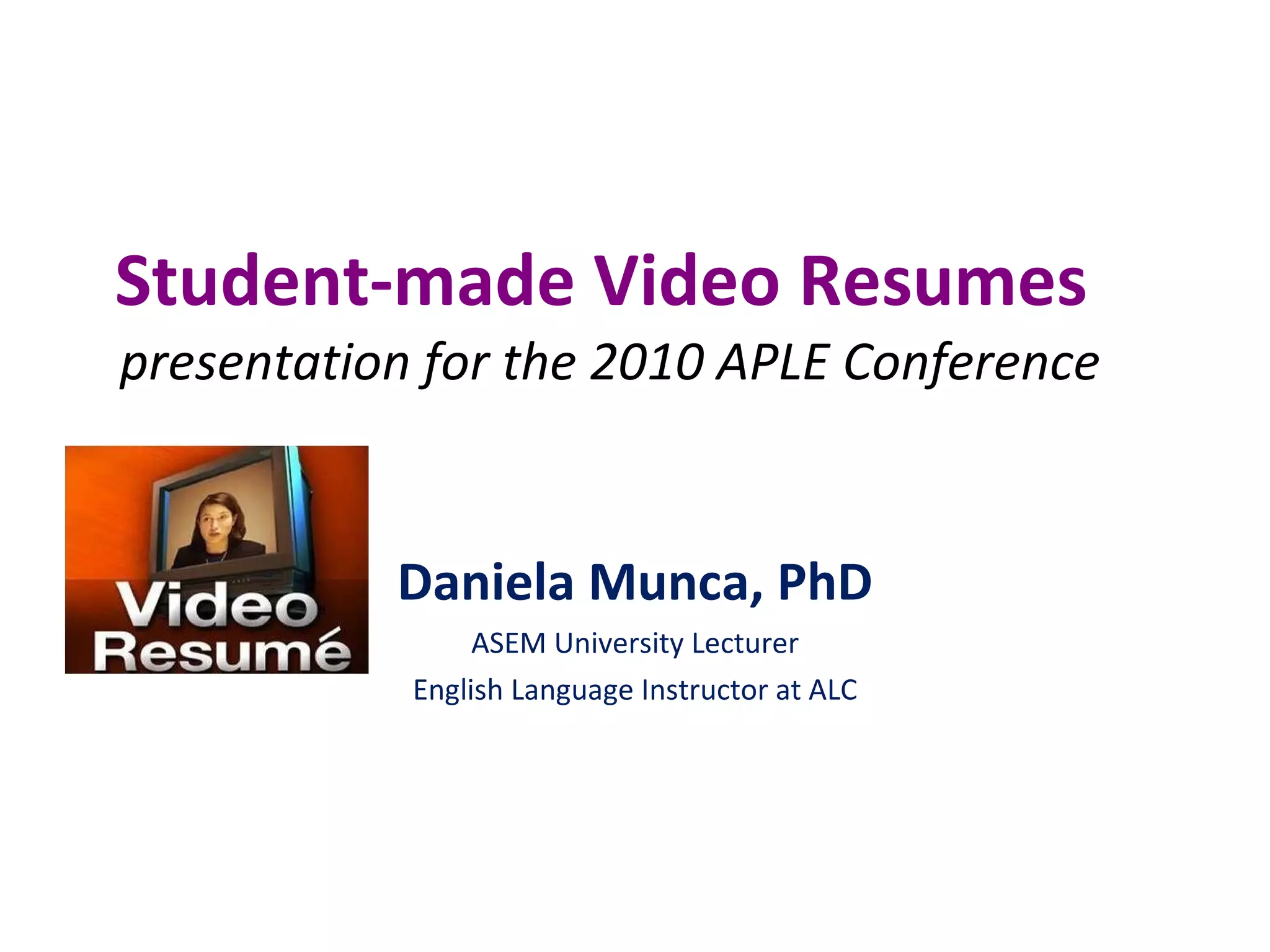


Student-made Video Resumes   presentation for the 2010 APLE Conference Daniela Munca, PhD ASEM University Lecturer English Language Instructor at ALC
Getting a good job in Moldova is … ?
?  Getting a good job in a competitive organization in Moldova requires job hunters …
How to stand out from the crowd?  Video Resumes: Video 1 a short video created by a candidate for employment and uploaded to the Internet for prospective employers to review.  describes the individual's skills and experience and is typically used to supplement a paper resume.  can be created by a professional or you can create your own.  Some job search and networking sites (like Jobster and MyWorkster) provide a means for users to incorporate video resumes into their profiles.
Video resumes (or Video CV)…  were first introduced in the 1980s for use and distribution via  VHS  tape, but the idea never took off beyond the video taping of  interviews .  with the modern capabilities of transmitting streaming video via the internet, video resumes have taken on new popularity. Video resumes are now being widely accepted by companies throughout the world for varying professions
A good teacher makes you think even when you don’t want to. (Fisher, 1998,  Teaching Thinking )
Why Video Resumes for Students? Creative project Combine essay writing skills and visuals Challenge students to “think outside the box” Give them an introduction to real world surviving skills Offers teachers an opportunity to asses vocabulary, pronunciation, grammar, sentence structure, oratorical skills, etc
Pedagogical Implications  He who learns but does not think is lost (Chinese Proverb)
Reference to Bloom’s Revised Taxonomy  a classification of learning objectives within education one of the best ways to differentiate the curriculum to meet student needs    six levels of thinking can provide a framework for planning units that incorporate low to high-level thinking activities a planning framework encouraging student thinking at all levels
first presented in 1956 through the publication  The Taxonomy of Educational Objectives, The Classification of Educational Goals, Handbook I: Cognitive Domain , by Benjamin Bloom (editor), M. D. Englehart, E. J. Furst, W. H. Hill, and David Krathwohl.  It is considered to be a foundational and essential element within the education community as evidenced in the 1981 survey  Significant writings that have influenced the curriculum: 1906-1981 , by H. G. Shane and the 1994 yearbook of the National Society for the Study of Education.
Teaching EFL involves : Drilling Memorization Reproduction Dictations Recite the poem Lower-thinking Skills
What is Higher-order thinking? A guide to Productive Pedagogies: Classroom reflection manual   states that: Higher-order thinking by students involves the transformation of information and ideas.  It occurs when students combine facts and ideas and synthesise, generalise, explain, hypothesise or arrive at some conclusion or interpretation.  Manipulating information and ideas through these processes allows students to solve problems, gain understanding and discover new meaning.  In helping students become producers of knowledge, the teacher’s main instructional task is  to create activities or environments that allow them opportunities to engage in higher-order thinking.
Taxonomy of Cognitive Objectives 1950s- developed by Benjamin Bloom Means of expressing qualitatively different kinds of thinking Adapted for classroom use as a planning tool Continues to be one of the most universally applied models  Provides a way to organise thinking skills into six levels, from the most basic to the higher order levels of thinking 1990s- Lorin Anderson (former student of Bloom) revisited the taxonomy ( Pohl, 2000,  Learning to Think, Thinking to Learn, pp. 7-8 )
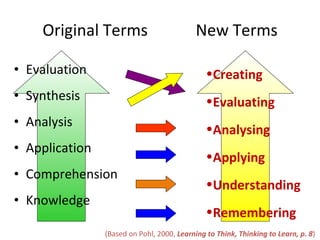
Original Terms  New Terms Evaluation Synthesis Analysis Application Comprehension Knowledge Creating Evaluating Analysing Applying Understanding Remembering (Based on Pohl, 2000,  Learning to Think, Thinking to Learn, p. 8 )
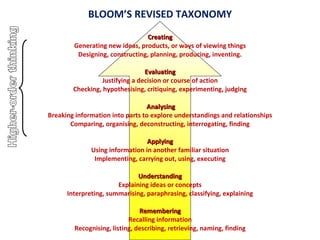
BLOOM’S REVISED TAXONOMY Creating Generating new ideas, products, or ways of viewing things Designing, constructing, planning, producing, inventing.   Evaluating Justifying a decision or course of action Checking, hypothesising, critiquing, experimenting, judging     Analysing Breaking information into parts to explore understandings and relationships Comparing, organising, deconstructing, interrogating, finding   Applying Using information in another familiar situation Implementing, carrying out, using, executing   Understanding Explaining ideas or concepts Interpreting, summarising, paraphrasing, classifying, explaining   Remembering Recalling information Recognising, listing, describing, retrieving, naming, finding   Higher-order thinking
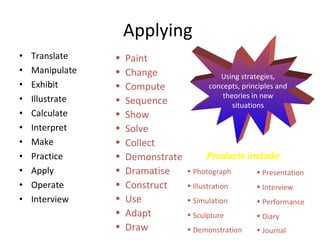
Applying  Translate Manipulate Exhibit Illustrate Calculate Interpret Make Practice Apply Operate Interview  Paint Change Compute Sequence Show Solve Collect Demonstrate Dramatise Construct Use Adapt Draw  Using strategies, concepts, principles and theories in new situations Products include : Photograph  Illustration Simulation Sculpture Demonstration  Presentation Interview Performance Diary Journal
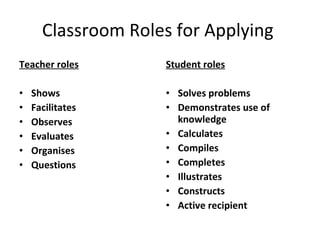
Classroom Roles for Applying  Teacher roles Shows Facilitates Observes Evaluates Organises Questions  Student roles Solves problems Demonstrates use of knowledge Calculates Compiles Completes Illustrates  Constructs  Active recipient
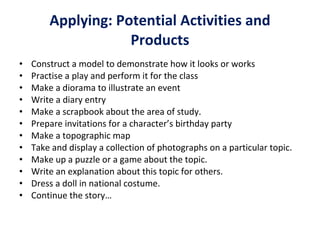
Applying:  Potential Activities and Products Construct a model to demonstrate how it looks or works Practise a play and perform it for the class Make a diorama to illustrate an event Write a diary entry Make a scrapbook about the area of study. Prepare invitations for a character’s birthday party Make a topographic map Take and display a collection of photographs on a particular topic. Make up a puzzle or a game about the topic. Write an explanation about this topic for others. Dress a doll in national costume. Continue the story…
Analysing The learner breaks learned information into its parts to best understand that information. Comparing Organising Deconstructing Attributing Outlining Finding Structuring Integrating   Can you break information into parts to explore understandings and relationships?
Analysing:  Potential Activities and Products Use a Venn Diagram to show how two topics are the same and different Design a questionnaire to gather information. Survey classmates to find out what they think about a particular topic. Analyse the results. Make a flow chart to show the critical stages. Classify the actions of the characters in the book Construct a graph to illustrate selected information. Make a family tree showing relationships. Write a biography of a person studied. Prepare a report about the area of study. Conduct an investigation to produce information to support a view. Review a work of art in terms of form, colour and texture. Draw a graph Complete a Decision Making Matrix to help you decide which breakfast cereal to purchase
Evaluating The learner makes decisions based on in-depth reflection, criticism and assessment. Checking Hypothesising Critiquing Experimenting Judging Testing Detecting Monitoring    Can you justify a decision or course of action?
Evaluating cont’ Judge Rate Validate Predict Assess Score Revise Infer Determine Prioritise Tell why Compare Evaluate Defend Select Measure Choose Conclude Deduce Debate Justify Recommend Discriminate Appraise Value Probe Argue Decide Criticise Rank Reject Judging the value of ideas, materials and methods by developing and applying standards and criteria. Products include : Debate Panel Report Evaluation Investigation Verdict Conclusion Persuasive speech
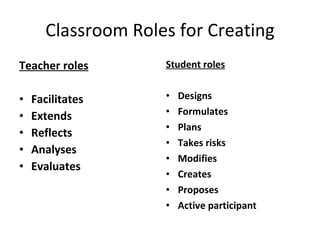
Classroom Roles for Creating Teacher roles Facilitates Extends  Reflects Analyses Evaluates  Student roles Designs Formulates Plans Takes risks Modifies Creates Proposes Active participant
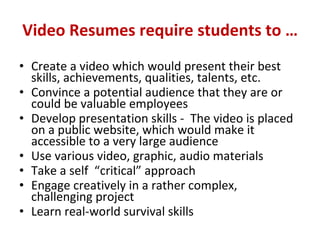
Video Resumes require students to … Create a video which would present their best skills, achievements, qualities, talents, etc.  Convince a potential audience that they are or could be valuable employees Develop presentation skills -  The video is placed on a public website, which would make it accessible to a very large audience  Use various video, graphic, audio materials Take a self  “critical” approach  Engage creatively in a rather complex, challenging project  Learn real-world survival skills
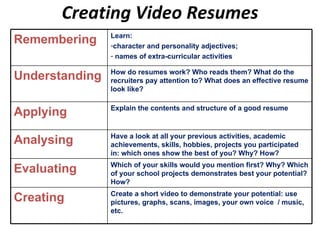
Creating Video Resumes Remembering Learn: character and personality adjectives;  names of extra-curricular activities  Understanding How do resumes work? Who reads them? What do the recruiters pay attention to? What does an effective resume look like?  Applying Explain the contents and structure of a good resume Analysing Have a look at all your previous activities, academic achievements, skills, hobbies, projects you participated in: which ones show the best of you? Why? How?  Evaluating Which of your skills would you mention first? Why? Which of your school projects demonstrates best your potential? How?  Creating Create a short video to demonstrate your potential: use pictures, graphs, scans, images, your own voice  / music, etc.
Final thought … Doing a good job as a teacher in Moldova is … ?
Daniela Munca [email_address]

Student Video Resume APLE

  • 1.
    Student-made Video Resumes presentation for the 2010 APLE Conference Daniela Munca, PhD ASEM University Lecturer English Language Instructor at ALC
  • 2.
    Getting a goodjob in Moldova is … ?
  • 3.
    ? Gettinga good job in a competitive organization in Moldova requires job hunters …
  • 4.
    How to standout from the crowd? Video Resumes: Video 1 a short video created by a candidate for employment and uploaded to the Internet for prospective employers to review. describes the individual's skills and experience and is typically used to supplement a paper resume. can be created by a professional or you can create your own. Some job search and networking sites (like Jobster and MyWorkster) provide a means for users to incorporate video resumes into their profiles.
  • 5.
    Video resumes (orVideo CV)… were first introduced in the 1980s for use and distribution via VHS tape, but the idea never took off beyond the video taping of interviews . with the modern capabilities of transmitting streaming video via the internet, video resumes have taken on new popularity. Video resumes are now being widely accepted by companies throughout the world for varying professions
  • 6.
    A good teachermakes you think even when you don’t want to. (Fisher, 1998, Teaching Thinking )
  • 7.
    Why Video Resumesfor Students? Creative project Combine essay writing skills and visuals Challenge students to “think outside the box” Give them an introduction to real world surviving skills Offers teachers an opportunity to asses vocabulary, pronunciation, grammar, sentence structure, oratorical skills, etc
  • 8.
    Pedagogical Implications He who learns but does not think is lost (Chinese Proverb)
  • 9.
    Reference to Bloom’sRevised Taxonomy a classification of learning objectives within education one of the best ways to differentiate the curriculum to meet student needs   six levels of thinking can provide a framework for planning units that incorporate low to high-level thinking activities a planning framework encouraging student thinking at all levels
  • 10.
    first presented in1956 through the publication The Taxonomy of Educational Objectives, The Classification of Educational Goals, Handbook I: Cognitive Domain , by Benjamin Bloom (editor), M. D. Englehart, E. J. Furst, W. H. Hill, and David Krathwohl. It is considered to be a foundational and essential element within the education community as evidenced in the 1981 survey Significant writings that have influenced the curriculum: 1906-1981 , by H. G. Shane and the 1994 yearbook of the National Society for the Study of Education.
  • 11.
    Teaching EFL involves: Drilling Memorization Reproduction Dictations Recite the poem Lower-thinking Skills
  • 12.
    What is Higher-orderthinking? A guide to Productive Pedagogies: Classroom reflection manual states that: Higher-order thinking by students involves the transformation of information and ideas. It occurs when students combine facts and ideas and synthesise, generalise, explain, hypothesise or arrive at some conclusion or interpretation. Manipulating information and ideas through these processes allows students to solve problems, gain understanding and discover new meaning. In helping students become producers of knowledge, the teacher’s main instructional task is to create activities or environments that allow them opportunities to engage in higher-order thinking.
  • 13.
    Taxonomy of CognitiveObjectives 1950s- developed by Benjamin Bloom Means of expressing qualitatively different kinds of thinking Adapted for classroom use as a planning tool Continues to be one of the most universally applied models Provides a way to organise thinking skills into six levels, from the most basic to the higher order levels of thinking 1990s- Lorin Anderson (former student of Bloom) revisited the taxonomy ( Pohl, 2000, Learning to Think, Thinking to Learn, pp. 7-8 )
  • 14.
    Original Terms New Terms Evaluation Synthesis Analysis Application Comprehension Knowledge Creating Evaluating Analysing Applying Understanding Remembering (Based on Pohl, 2000, Learning to Think, Thinking to Learn, p. 8 )
  • 15.
    BLOOM’S REVISED TAXONOMYCreating Generating new ideas, products, or ways of viewing things Designing, constructing, planning, producing, inventing.   Evaluating Justifying a decision or course of action Checking, hypothesising, critiquing, experimenting, judging     Analysing Breaking information into parts to explore understandings and relationships Comparing, organising, deconstructing, interrogating, finding   Applying Using information in another familiar situation Implementing, carrying out, using, executing   Understanding Explaining ideas or concepts Interpreting, summarising, paraphrasing, classifying, explaining   Remembering Recalling information Recognising, listing, describing, retrieving, naming, finding   Higher-order thinking
  • 16.
    Applying TranslateManipulate Exhibit Illustrate Calculate Interpret Make Practice Apply Operate Interview Paint Change Compute Sequence Show Solve Collect Demonstrate Dramatise Construct Use Adapt Draw Using strategies, concepts, principles and theories in new situations Products include : Photograph Illustration Simulation Sculpture Demonstration Presentation Interview Performance Diary Journal
  • 17.
    Classroom Roles forApplying Teacher roles Shows Facilitates Observes Evaluates Organises Questions Student roles Solves problems Demonstrates use of knowledge Calculates Compiles Completes Illustrates Constructs Active recipient
  • 18.
    Applying: PotentialActivities and Products Construct a model to demonstrate how it looks or works Practise a play and perform it for the class Make a diorama to illustrate an event Write a diary entry Make a scrapbook about the area of study. Prepare invitations for a character’s birthday party Make a topographic map Take and display a collection of photographs on a particular topic. Make up a puzzle or a game about the topic. Write an explanation about this topic for others. Dress a doll in national costume. Continue the story…
  • 19.
    Analysing The learnerbreaks learned information into its parts to best understand that information. Comparing Organising Deconstructing Attributing Outlining Finding Structuring Integrating   Can you break information into parts to explore understandings and relationships?
  • 20.
    Analysing: PotentialActivities and Products Use a Venn Diagram to show how two topics are the same and different Design a questionnaire to gather information. Survey classmates to find out what they think about a particular topic. Analyse the results. Make a flow chart to show the critical stages. Classify the actions of the characters in the book Construct a graph to illustrate selected information. Make a family tree showing relationships. Write a biography of a person studied. Prepare a report about the area of study. Conduct an investigation to produce information to support a view. Review a work of art in terms of form, colour and texture. Draw a graph Complete a Decision Making Matrix to help you decide which breakfast cereal to purchase
  • 21.
    Evaluating The learnermakes decisions based on in-depth reflection, criticism and assessment. Checking Hypothesising Critiquing Experimenting Judging Testing Detecting Monitoring    Can you justify a decision or course of action?
  • 22.
    Evaluating cont’ JudgeRate Validate Predict Assess Score Revise Infer Determine Prioritise Tell why Compare Evaluate Defend Select Measure Choose Conclude Deduce Debate Justify Recommend Discriminate Appraise Value Probe Argue Decide Criticise Rank Reject Judging the value of ideas, materials and methods by developing and applying standards and criteria. Products include : Debate Panel Report Evaluation Investigation Verdict Conclusion Persuasive speech
  • 23.
    Classroom Roles forCreating Teacher roles Facilitates Extends Reflects Analyses Evaluates Student roles Designs Formulates Plans Takes risks Modifies Creates Proposes Active participant
  • 24.
    Video Resumes requirestudents to … Create a video which would present their best skills, achievements, qualities, talents, etc. Convince a potential audience that they are or could be valuable employees Develop presentation skills - The video is placed on a public website, which would make it accessible to a very large audience Use various video, graphic, audio materials Take a self “critical” approach Engage creatively in a rather complex, challenging project Learn real-world survival skills
  • 25.
    Creating Video ResumesRemembering Learn: character and personality adjectives; names of extra-curricular activities Understanding How do resumes work? Who reads them? What do the recruiters pay attention to? What does an effective resume look like? Applying Explain the contents and structure of a good resume Analysing Have a look at all your previous activities, academic achievements, skills, hobbies, projects you participated in: which ones show the best of you? Why? How? Evaluating Which of your skills would you mention first? Why? Which of your school projects demonstrates best your potential? How? Creating Create a short video to demonstrate your potential: use pictures, graphs, scans, images, your own voice / music, etc.
  • 26.
    Final thought …Doing a good job as a teacher in Moldova is … ?
  • 27.