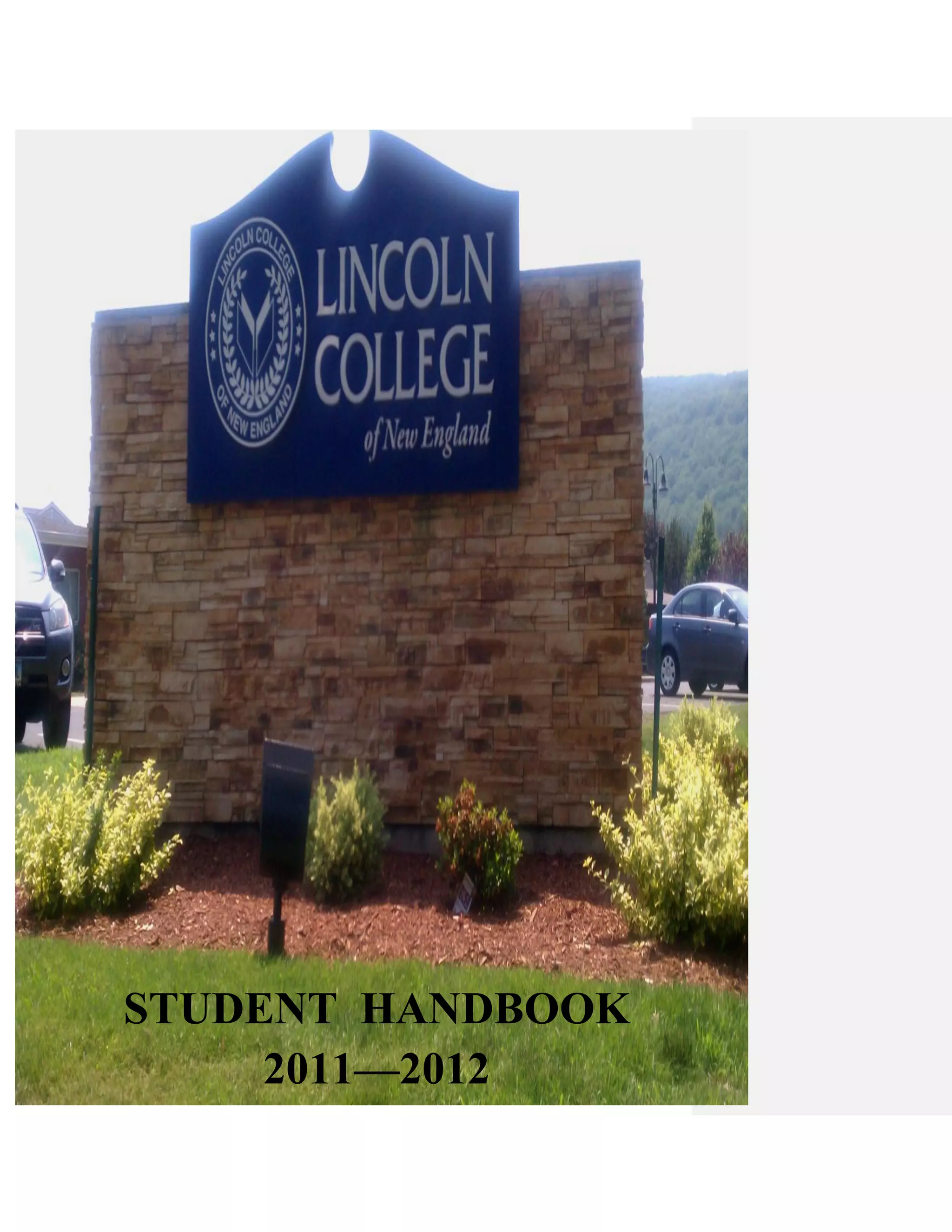
STUDENT HANDBOOK
     2011—2012
LCNE Student Handbook 2011 - 2012

LETTER FROM THE PRESIDENT
DEAR FUTURE AND CURRENT STUDENTS:

Lincoln College of New England is dedicated to delivering academic
excellence in an environment that supports student success. Whether you're
a recent high school graduate or you want to advance or change your career,
Lincoln College of New England offers degree programs for the most in-
demand careers, as well as internships where you gain first-hand knowledge
and experience in your career field.

Lincoln College of New England graduates have an excellent reputation
among employers. For 2009, 79% of our graduates were working in their
field of study after graduation. Yet, despite our size and wealth of offerings, we never lose sight
of the individual student. Our campuses and our online programs provide students the
opportunity to further their education in any format that suits their lifestyle.

Teaching and learning are at the heart of what we do at Lincoln College of New England. You
will never sit in a lecture hall with 99, or 199, other students. With a 9:1 student-faculty ratio,
you will really get to know accomplished faculty members who cause LEARNING, first and
foremost. You certainly will begin the process of shaping your own direction and destiny.

Under our unique offerings, students can enroll in our traditional semester plan, or opt to take
their courses online. In the near future, students will be able to enroll in either one course at a
time for three and half weeks, or opt to take two courses during our eight week sessions. In any
schedule, you will be immersed in relevant programs that prepare you for an exciting and
worthwhile career.

You see, at Lincoln College of New England, the needs of our student body are as diverse as the
wealth of opportunities available to them. Some students come to earn an associate degree or
baccalaureate degree, while others come for our high-quality career and technical training.

Our commitment to excellence stems from the core of our mission- we care for our students and
create an educational environment which facilitates strong educational outcomes. With the
support of a first-rate faculty and staff LCNE is becoming a national model of education, both
on-campus and online.

Indeed, we claim your dreams, goals, and challenges as our own. Thank you again for you
interest in Lincoln College of New England.

Visit us, and you will see why this place is like no other. Until then, explore our web site for a
glimpse of the campus – and make plans to come see firsthand what I am talking about. I hope to
see you at Lincoln College of New England – and please stop by the Office of the President to
say hello.

Cordially,
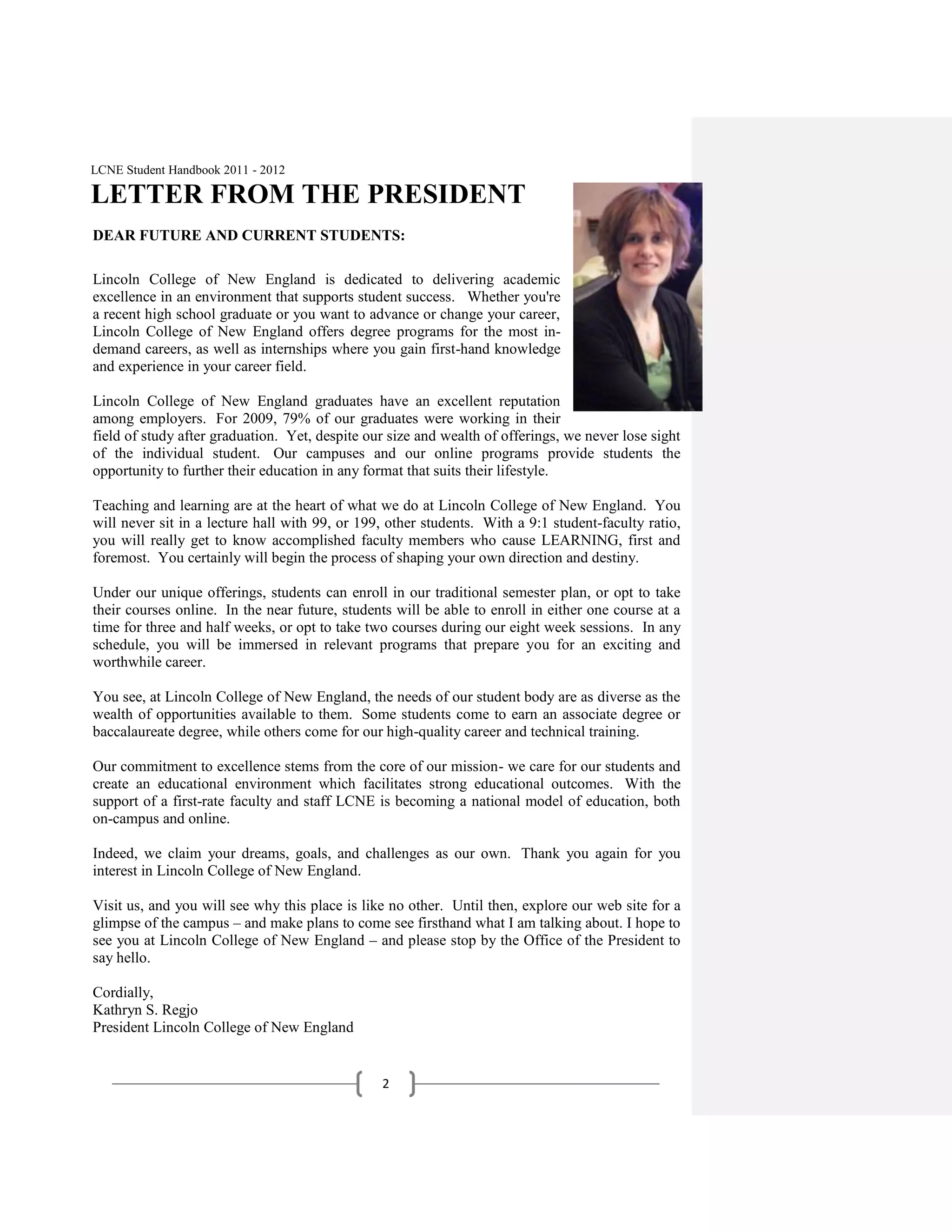
Kathryn S. Regjo
President Lincoln College of New England


                                                2
LCNE Student Handbook 2011 - 2012
Contents

History of the Lincoln College of New England       Page 4

Academic Information                                Page 5

General Policies                                    Page 12

Campus Safety and Security                          Page 17

Student Activities                                  Page 22

Student Conduct                                     Page 31

Student Housing                                     Page 36

Student Services                                    Page 48

Appendixes                                          Page 53


                                                3
LCNE Student Handbook 2011 - 2012


THE HISTORY OF LINCOLN COLLEGECOLLEGE OF NEW ENGLAND

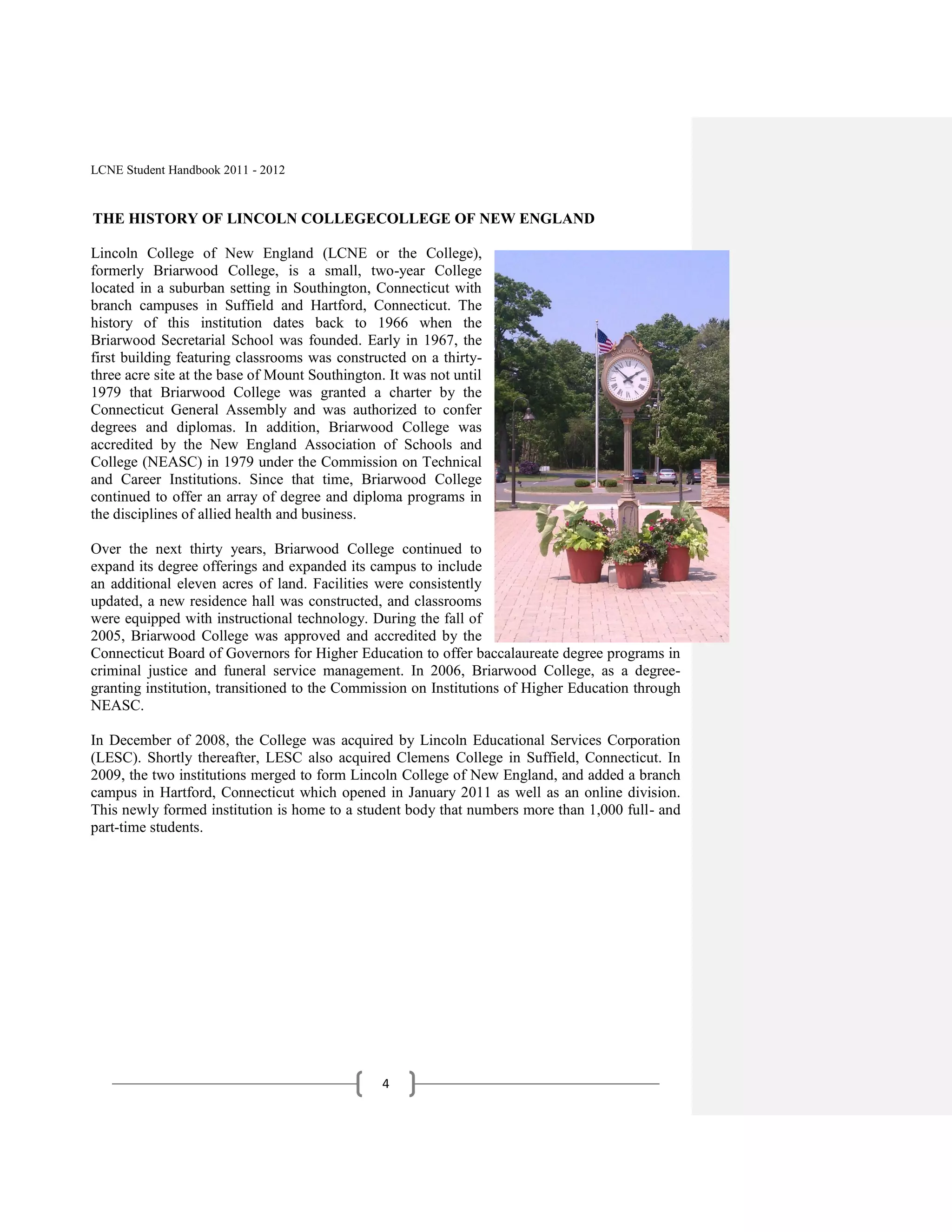
Lincoln College of New England (LCNE or the College),
formerly Briarwood College, is a small, two-year College
located in a suburban setting in Southington, Connecticut with
branch campuses in Suffield and Hartford, Connecticut. The
history of this institution dates back to 1966 when the
Briarwood Secretarial School was founded. Early in 1967, the
first building featuring classrooms was constructed on a thirty-
three acre site at the base of Mount Southington. It was not until
1979 that Briarwood College was granted a charter by the
Connecticut General Assembly and was authorized to confer
degrees and diplomas. In addition, Briarwood College was
accredited by the New England Association of Schools and
College (NEASC) in 1979 under the Commission on Technical
and Career Institutions. Since that time, Briarwood College
continued to offer an array of degree and diploma programs in
the disciplines of allied health and business.

Over the next thirty years, Briarwood College continued to
expand its degree offerings and expanded its campus to include
an additional eleven acres of land. Facilities were consistently
updated, a new residence hall was constructed, and classrooms
were equipped with instructional technology. During the fall of
2005, Briarwood College was approved and accredited by the
Connecticut Board of Governors for Higher Education to offer baccalaureate degree programs in
criminal justice and funeral service management. In 2006, Briarwood College, as a degree-
granting institution, transitioned to the Commission on Institutions of Higher Education through
NEASC.

In December of 2008, the College was acquired by Lincoln Educational Services Corporation
(LESC). Shortly thereafter, LESC also acquired Clemens College in Suffield, Connecticut. In
2009, the two institutions merged to form Lincoln College of New England, and added a branch
campus in Hartford, Connecticut which opened in January 2011 as well as an online division.
This newly formed institution is home to a student body that numbers more than 1,000 full- and
part-time students.


                                                 4
LCNE Student Handbook 2011 - 2012


ACADEMIC INFORMATION
The course catalog contains more information on academics. In certain cases, the course catalog
may mention program specific requirements and policies that differ from the ones described
here. In all cases, the course catalog is the predominant document in regards to academics.

The College reserves the right to reschedule classes, classrooms, or students at any time to
accommodate College needs.

Absence from Class

Please refer to the Attendance Policy found in the College Catalog.

Academic Advising

Academic advising is available to students from faculty members, department chairs, academic
deans, and the Vice President of Academic Affairs. Academic administrators are available at
most times of the day to deal with any immediate issues that may arise. When a student is
admitted to the College, they are assigned an advisor. A new advisor is assigned if a student
changes majors.

The Faculty Advisor will assist the student with:
      Ensuring the completion of courses required for the major
      Review and approve all schedule-related business
      Questions about the major
      Review academic progress and offer suggestions for improving performance and/or
      enhancing the academic experience
      Clarification of academic policies

Ultimately, it is the responsibility of each student to maintain knowledge of their program and to
track their academic progress carefully utilizing the degree audit, the College catalog and


                                                5
LCNE Student Handbook 2011 - 2012
assistance from their department chair. Students may request a copy of their degree audit from
their department chair or the Registrar’s Office at anytime.

The College is not responsible in the case that a student has not accumulated sufficient credits or
met programmatic or general education needs for graduation.


Academic Honesty

Academic Honesty is an integral part of being a student within higher education. As such,
students of Lincoln College of New England are expected to submit original work/materials in
all courses and academic requirements. Failure to do so results in Academic Dishonesty which
not only contradicts the expectations of the faculty and student body, but also undermines
students’ pursuit of knowledge and violates the College rules and regulations. In addition, the
student may face copyright infringement.

Definitions:

   1. Cheating: The actual giving or receiving of any unauthorized aid or assistance, or the
      actual giving or receiving of any unfair advantage on any form of academic work. This is
      a violation of the academic policy.
   2. Citation: The act of giving credit to the original author/owner of materials that are
      utilized in your work. There are various forms that citations can take, including MLA or
      APA. If there is a question on specific requirements, see your instructor. Handouts are
      available in the Southington campus library specific to MLA and APA.
   3. Falsification: Any untrue statement, verbal or written, relating to one’s academic or
      professional work. Such acts include, but are not limited to, the forgery of official
      signatures, tampering with official documents, and/or fraudulently adding or deleting
      information on academic and administrative documents.
   4. Plagiarism - the copying of the language, structure, ideas and/or thoughts of another and
      presenting it as one’s own original work, or any attempts thereof. This includes the
      cutting and pasting of internet resources in particular. The College reserves the right to
      use plagiarism-detection software on any paper turned in for credit. Committing
      plagiarism is a violation of the academic policy.
   5. Public Domain: Materials which are publicly available, typically on the internet. This
      can include works and materials that no longer carry a formal copyright. Plagiarizing this
      material still constitutes a violation of the LCNE academic policy. Whether there is a
      formal copyright or not, if it is not your original work, it must be cited.
   6. Self-Plagiarism: All materials submitted for coursework must be original. In addition,
      you may not submit the same or similar works in different courses for credit. To do so
      without permission from the instructor is committing self-plagiarism, which is a violation
      of the academic policy. Whether or not assignments are similar, original work must be
      submitted in each course.

Violations of the academic policy may result in a failing grade on the assignment, examination,
quiz, paper, etc, and possibly a failing grade for the course. Students who violate the academic
policy are also subject to possible suspension, dismissal from the program, or dismissal from the
College.


                                                6
LCNE Student Handbook 2011 - 2012
Procedure for Handling Violations of Academic Honesty

   1. Reporting: Anyone may report alleged violations of Academic Honesty. Allegations
      should be made in writing to the faculty member or College official responsible for the
      course or activity in question. If the report is made to another faculty member or College
      official, that individual will bring it to the individual responsible for the course or
      activity.
          a. Initial Resolution: The faculty member will determine if he/she can resolve the
              issue informally with the student. Possible sanctions include but are not limited to
              re-submission of the assignment in question, a zero grade for the assignment, or
              failure for the course. The faculty member will notify the student of the decision
              in writing.
          b. If the student rejects the faculty member’s decision, if a second instance of a
              suspected violation occurs, or if the initial instance is blatant enough to warrant a
              more severe sanction, the violation may be escalated to the Academic Review
              Board.
          c. Either the student, faculty member, or both may request the incident to be
              reviewed by the Academic Review Board.
          d. Requests to convene the Academic Review Board must be made no later than 10
              days after the violation (or when the violation became known) or no later than 10
              days after the student rejects the faculty member’s sanctions.
   2. Academic Review Board: Comprised of a panel of three College officials with at least
      one being an instructional faculty member, the Academic Review Board will hear all
      formal cases in regard to Academic Misconduct. Other violations of the Student Code of
      Conduct will be handled by the Office of Student Life. The following procedures will be
      followed by the board:
          a. Notice: A formal notice of hearing will be given to the student within 5 business
              days of being notified of charges being filed or within 5 business days of an
              unresolved initial faculty resolution. Notices will either be mailed to the student’s
              permanent address that is on file with the College (commuters or resident students
              during breaks) or delivered to the student’s on campus residence. Failure to
              appear may not necessarily stop or delay proceedings. Refusal to accept the
              notification will not stop or delay proceedings. Hearings with LCNE Online
              students will be done via teleconference.
          b. Record of Hearing: The College reserves the right to create an audio recording of
              Academic Review Board hearings. This recording is property of the College and
              no other recordings are to be made of the proceedings.
          c. Opportunity to Present a Defense: The accused student will be afforded the right
              to present a defense including the submission of evidence and the right to
              question an accuser. The accused may bring in witnesses but the College reserves
              the right to restrict the witnesses based on relevance and whether or not they can
              provide concrete testimony.
          d. Accused Student Files: After the hearing, students may access any personal data
              in accordance with federal and state laws.
          e. Non-Appearance of Accused Student: Failure to appear for a scheduled Academic
              Review Board hearing may not necessarily stop or delay the proceedings. The
              College reserves the right to carry on the proceeding without the student unless
              extenuating circumstances exist for the student’s failure to appear. The Vice
              President for Academic Affairs will have final say as to whether or not a student’s
              circumstances are adequate for excusing a no-show at a formal hearing.

                                                7
LCNE Student Handbook 2011 - 2012
           f. Admission of Persons to Academic Review Board Hearing: All hearings will be
              considered ―closed‖ hearings. Only relevant persons including the accuser,
              accused, Academic Review Board panel, security personnel (as needed), advisors,
              and others as deemed necessary by the hearing panel will be permitted. Hearing
              board officials in training will be permitted to be present as needed.
           g. Right to an Advisor: The accused student has the right to consult with a support
              person of his or her choice in the preparation of his or her defense. The accused
              student also has the right to have a support person sit with him or her at the
              hearing and to consult privately with that person, but the support person will not
              be permitted to speak or advocate during the hearing unless the accused student is
              disabled to the point of being unable to present his or her defense or unless the
              case against the student is presented by an attorney. The support person may be
              legal counsel.
           h. Prior Disciplinary Sanctions: Any prior disciplinary record will not be used to
              determine whether or not a student is responsible for the incident in question. The
              prior record will be used to determine sanctioning.
           i. Written Notice of Decision: The student will be given a written notice of decision
              at the hearing, including sanctions (if any) and a formal letter will be sent. The
              student will be asked to sign an acknowledgment. If the student refuses to sign or
              the student failed to show up, the members of the hearing panel may sign instead.
              Under no circumstances will a student’s refusal to sign postpone sanctioning.
           1. Appeal Process: If the student wishes to appeal the decision of the board, then a
              request for appeal form must be filed with the Vice President for Academic
              Affairs within 48 hours after the completion of the hearing. Appeals may be
              requested for the following criteria only:
                  a. A Question of Evidence: The existence of new evidence that was not
                      available at the time of the hearing.
                  b. A Question of Sanctions: The sanction imposed was not in keeping with
                      the gravity of the offense.
                  c. A Question of Process: The occurrence of a substantive violation, mistake,
                      or error during the conduct meeting that could have significantly altered
                      the outcome of the decision.
           j. Grades: Under no circumstances can an Academic Review Panel or the Vice
              President for Academic Affairs change a grade. By law, only the instructor can
              assign or change a grade.

Academic Programs

Please see the course catalog for a full description of the various academic programs offered and
any individual requirements.

Academic Year

Each Academic Year is comprised of two semesters (Fall and Spring) and a summer term. The
year begins at the start of the fall semester and ends at the completion of the summer term. It is
denoted by two years (i.e. the 2012 – 2013 Academic Year). The first year is when the Fall
semester begins and the next year is simply the following year. Located in the Appendix B is the
Academic Calendar (please note that this calendar is subject to change).


                                                8
LCNE Student Handbook 2011 - 2012


Computer Labs

Computer labs will be provided by the College to facilitate academic activities. Use of these labs
is subject to the policies governing Information Technology use on campus.

Grade Reports

A report of final grades in each course is sent to student’s permanent address after the close of
each semester (and summer if the student attended summer courses). Grades will be withheld for
any students who have not met financial or other responsibilities.

In an effort to keep the students informed of their progress, midterm grades are made available
via the student portal online. Low midterm grades are reported to the Registrar, appropriate
College personnel, and academic advisors, for the purposes of offering additional assistance to
the student to insure success.

Graduation Requirements

To earn a degree or certificate from Lincoln College of New England, students must:
       Successfully complete the total number of credits required for the degree or certificate
       program in which the student is enrolled;
       Student must also successfully complete the First Year Experience course
       Successfully complete all courses required in the degree or certificate program;
       Attain the required minimum grade in each course (see course catalog);
       Maintain the minimum Cumulative GPA according to the requirements of the College
       and your individual program (as outlined in the course catalog).
       51% of degree credits must be earned at the College (credits awarded through transfer,
       challenge exam, CLEP, or experience are NOT considered to have been completed at the
       College).
       The final 15 credits of a 2-year program and the final 30 credits of a 4-year program must
       be completed at the College.

Students intending to graduate must file an Application to Graduate in the Office of the
Registrar. Students anticipating completing degree or certificate requirements in May or June
must file by mid-April. Students anticipating completion of their requirements in December must
file by mid-November.

A student must have fulfilled ALL obligations to the College in order to officially graduate.
Participation in Commencement exercises does not imply completion of degree or certificate
requirements. Official completion occurs only when all graduation requirements have been
fulfilled and the College certifies that the student has graduated. Degrees are normally conferred
once each year, in May.


                                                9
LCNE Student Handbook 2011 - 2012
Guided Study

Guided Study is a requirement for anyone taking two developmental courses and may be
required of students who are on academic probation. Students who are assigned to guided study
must spend an hour and a half in the Learning Center working on course work or study skills.
This scheduled time is supervised by a faculty member and is monitored by the Director of the
Learning Center. Attendance will be recorded. The purpose is to give students the additional
help they need to be successful with academics.

Inclement Weather

Announcement of inclement weather delays, closings, and/or cancellations will be reported to
local television stations and posted on the internet and sent through LincAlert. Students MUST
register for LincAlert to receive the notifications via text messaging. PLEASE DO NOT CALL
THE COLLEGECOLLEGE TELEPHONE NUMBER FOR SUCH INFORMATION.

Incomplete

The purpose of a grade of I (Incomplete) is to allow a student who was unable to complete all
course requirements to make up the work. The granting of an Incomplete is only done for one of
the following reasons:
    1. Student is unable to complete the required number of hours for an internship, clinical, or
        practicum experience before the end of the term and will complete them after the term;
    2. The student has documented extenuating circumstances that prevent completion of the
        required coursework by the end of the term, e.g., illness, death in the family.
To be eligible for an Incomplete, students must
    1. Obtain the required permission form from the registrar;
    2. Provide the instructor with the necessary evidence if circumstances exist as noted in #2
        above;
    3. Have the instructor sign the form;
    4. Return the completed form to the registrar no later than one week prior to the end of the
        term.

Except for internship, clinical, or practicum experiences, Incompletes will be converted to a
grade of F if a student fails to make-up the required work within three weeks after the last day of
the semester or summer (ten days after the last day of a half-semester course). The instructor
who authorized the Incomplete must notify the registrar of the grade assigned following
submission of the required work, or of the grade of F for failure to submit the required work. If
no grade is forthcoming by the end of the prescribed time period, an F will automatically be
entered into the student’s record.

Registration

Please register early! Registration occurs on a first-come, first-served basis. The College reserves
the right to change the academic schedule at any time without prior notice. Registration forms
must be filled out and signed by the student’s department chair or appropriate academic official.
Students may adjust their scheduled classes during the add/drop period. Please see the section on
add/drop for more information. Registration packets must be picked up in order to register for the
upcoming semester. Packets are available in the Office of the Registrar.


                                                10
LCNE Student Handbook 2011 - 2012

Satisfactory Academic Progress
Please refer to the College catalog for the SAP policy located on page 34 of the catalog.

Status Change

Both full-time and part-time students must fill out a Status Change Form with their academic
advisor or the registrar when any of the following occurs:
•      Change of program
•      Name, address, email or phone number changes
•      Residency changes
•      Withdrawal from the College.


Withdrawal Policy

Withdrawal from a Course
Following the add/drop period, students may choose to withdraw from a course. In order to do
so, the student must complete the following steps:
    1. Meet with the academic advisor.
    2. Complete all necessary paperwork and present to the registrar with the appropriate
        signatures no later than the close of business on Friday of the ninth week of semester
        classes (Wednesday of the fourth week of half-semester courses).
    3. Upon approval from the registrar, students will receive a ―W‖ on their transcript and no
        penalty will be factored into their Cumulative Grade Point Average (CGPA).

Withdrawal from a course after the end of the ninth week of semester classes (Wednesday of the
fourth week of half-semester courses) will not be permitted. A student who discontinues
attending class but does not officially withdraw from a course will be issued a final grade based
on the course requirements, including all complete and incomplete tests and assignments. The
resulting grade is submitted to the registrar at the end of the semester and will be used when
calculating the Cumulative Grade Point Average (CGPA).

NOTE: No tuition refunds or partial refunds are given for course withdrawals.

Withdrawal from the College
A student who will not be returning the following semester should complete a withdrawal form,
which is routed to the academic advisor and Registrar. Withdrawal by the student becomes
effective only upon receipt of a Student Change Form or other written notice to the Registrar.
No refund request will be processed until written notification is received. Processing will take
place within 30 days of receipt of notice.


                                                11
LCNE Student Handbook 2011 - 2012


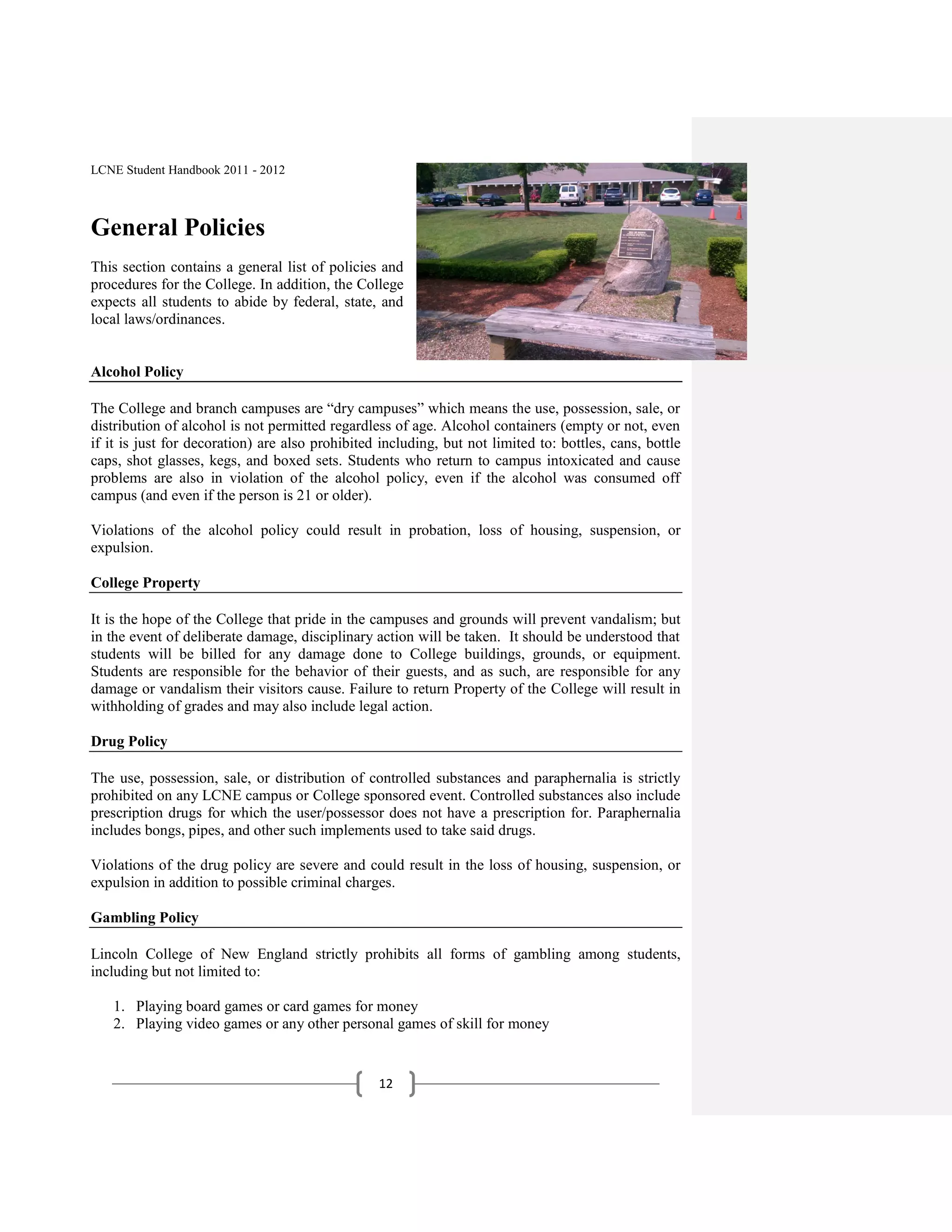
General Policies
This section contains a general list of policies and
procedures for the College. In addition, the College
expects all students to abide by federal, state, and
local laws/ordinances.


Alcohol Policy

The College and branch campuses are ―dry campuses‖ which means the use, possession, sale, or
distribution of alcohol is not permitted regardless of age. Alcohol containers (empty or not, even
if it is just for decoration) are also prohibited including, but not limited to: bottles, cans, bottle
caps, shot glasses, kegs, and boxed sets. Students who return to campus intoxicated and cause
problems are also in violation of the alcohol policy, even if the alcohol was consumed off
campus (and even if the person is 21 or older).

Violations of the alcohol policy could result in probation, loss of housing, suspension, or
expulsion.

College Property

It is the hope of the College that pride in the campuses and grounds will prevent vandalism; but
in the event of deliberate damage, disciplinary action will be taken. It should be understood that
students will be billed for any damage done to College buildings, grounds, or equipment.
Students are responsible for the behavior of their guests, and as such, are responsible for any
damage or vandalism their visitors cause. Failure to return Property of the College will result in
withholding of grades and may also include legal action.

Drug Policy

The use, possession, sale, or distribution of controlled substances and paraphernalia is strictly
prohibited on any LCNE campus or College sponsored event. Controlled substances also include
prescription drugs for which the user/possessor does not have a prescription for. Paraphernalia
includes bongs, pipes, and other such implements used to take said drugs.

Violations of the drug policy are severe and could result in the loss of housing, suspension, or
expulsion in addition to possible criminal charges.

Gambling Policy

Lincoln College of New England strictly prohibits all forms of gambling among students,
including but not limited to:

   1. Playing board games or card games for money
   2. Playing video games or any other personal games of skill for money


                                                 12
LCNE Student Handbook 2011 - 2012
   3. Betting on campus sports and other athletic events (including NBA, NFL, NCAA,
      NCJAA etc)
   4. Substituting monetary rewards with alcohol or any other tangible or intangible reward is
      also strictly prohibited

LCNE is aware that gambling is a growing problem among College students and as such will
provide resources to help students who may have a problem.

Hazing Policy

For purpose of this policy, Hazing is hereby defined as:

“Any activity expected of someone joining a group (or to maintain full status in a group) that
humiliates, degrades or risks emotional and/or physical harm, regardless of the person's
willingness to participate.” – StopHazing.org

No individual can consent to being hazed. Any activity falling within the definition of hazing
activities is considered to be a forced activity, subjecting the organization and its members to
severe penalties.

Organizations violating this policy will be held accountable by the Office of Student Life. If
found responsible, such organization will be disbanded. Individual members of organizations, if
found responsibility, will be subject to suspension or expulsion from the College.

Posting Policy

All posters, notices, petitions, and other publicity must be approved by the Office of the Vice
President of Operations and Student Affairs prior to posting. Posters may not be placed on
windows, painted surfaces, or stairwells. Students are also responsible for removing outdated
notices. Bulletin Boards are provided for students to post notices.

Any posters, notices, petitions and other publicity that are to be placed in the Residence Halls
must be approved by the Office of Student Life prior to posting. Those not approved by Student
Life will be taken down. Clubs/organizations or students requesting approval are also
responsible for removing outdated items.

Selling/Solicitation

Sales by student groups, teams or academic departments should be cleared for scheduling
through the Office of the Vice President of Operations and Student Affairs. All vendors must be
sponsored by a recognized student organization or a College department and cite the name of the
sponsoring group in its display. Vendors who violate the solicitation policy risk the loss of ability
to return to campus.

Solicitation as it applies to commercial, charitable, religious and political endeavors are
prohibited on the College premises without prior clearance through the Office of the Vice
President of Operations and Student Affairs. The College reserves the right to refuse permission
for recruiting, sales, information dissemination, etc, should it be deemed offensive or not in the
best interest of the Lincoln College of New England Community as a whole.


                                                 13
LCNE Student Handbook 2011 - 2012

Smoking

Smoking is prohibited in all campus buildings including residential rooms, lounges, and public
areas. Each campus has designated smoking areas. In all cases, the rights of the non-smokers
shall take precedence over those of smokers.

The use of chewing tobacco and smokeless tobacco products is strictly prohibited from all
community areas and corridors of campus buildings.

Student Grievance Procedure

The purpose of the student grievance procedure is to resolve conflicts that arise between
faculty/staff and a student. It is imperative to everyone in the College community to maintain
open lines of communication and facilitate mutual respect.

Faculty

Conflicts, including grading, attendance, and other such issues that occur with a faculty member
must be handled through the academic channels according to the following procedure.

   1. The student must first discuss the subject of the grievance with the instructor. At all
      times, the student should remain respectful and offer feedback on how to resolve the
      issue. If, at the conclusion of this meeting there is no agreement, proceed to step 2. In the
      case that the instructor is also the department chair, skip this step and go to step 2.
   2. The student must discuss the grievance with the chair of the department to whom the
      faculty member answers. He/she should provide any documentation they possess. The
      department chair will subsequently determine if they need to meet with the faculty
      member, have a joint meeting with the faculty member and student, resolve the conflict in
      this meeting, or refer the grievance to an Academic Dean. If the proposed solution does
      not satisfy the student, he/she has the option to go to step 3.
   3. The student must discuss the grievance with an Academic Dean. At this point, the student
      should address the reasons they were not satisfied with the outcomes of the previous
      steps. Every effort should be made to come to a resolution. The final decision rests on the
      Academic Dean.

If a student has an issue with a grade, they may follow the above procedure but, by law, only the
instructor who issued a grade may change it. In cases of alleged harassment, accusations should
always be brought to the person’s direct supervisor. The above process may not be used to
circumvent the Academic Misconduct or Student Conduct Hearing procedures.

Professional Staff
Conflicts with staff, which includes employees of the College who are not faculty members,
should be handled according to the following procedure. Keep in mind that certain aspects of a
staff member’s job may not have an appeal (i.e. a security guard ordering a student to clear an
area in an emergency). Students are to comply with the directives of a staff member and address
grievances in private.

   1. The student should discuss the situation with the staff member to determine an acceptable
      solution. If none can be agreed upon, the student may proceed to step 2.

                                                14
LCNE Student Handbook 2011 - 2012
   2. The student should address the issue with the staff member’s direct supervisor. The
      supervisor may need to have a meeting with the staff member, have a meeting with the
      staff member and student, make a determination on the spot, or refer the case to the next
      level of supervisory hierarchy.
   3. If the student has not found a satisfactory answer, he/she may continue to refer up the
      hierarchy through the Vice President of the area (other than Academics). The Vice
      President’s decision is final.

In cases of alleged harassment, accusations should always be brought to the person’s direct
supervisor. The above process may not be used to circumvent the Academic Misconduct or
Student Conduct Hearing procedures.

Student Records Policy

(Abstract from the Family Educational Rights and Privacy Act of 1974, as amended)
     Students at Lincoln College of New England shall have access to information filed in a
     student’s record without written consent.
     Anyone outside of Lincoln College of New England shall not have access to information
     filed in a student’s record without the written consent of the student except those officials
     permitted by law as follows: Teachers, professors, or faculty members or other College
     officials who have a legitimate educational interest.
            a. Officials of another College or post secondary institution where the student seeks
               to enroll.
            b. Authorized representatives of the Comptroller General of the United States, the
               Secretary of the Department of Education, or state and local educational
               authorities.
            c. Officials in connection with the application for or receipt of financial aid.
            d. State and local juvenile justice systems or their officials or a court if the student or
               parents have sued the College.
            e. Organizations conducting educational studies
            f. Accrediting organizations
            g. Parents of an ineligible student (those students not protected by FERPA
               regulations) who is considered dependent under the IRS code.
            h. To be in compliance with a judicial order or other lawfully issued subpoena
            i. In connection with a health or safety emergency
            j. If designated as directory information
            k. The parents (of a non-eligible student) or to an eligible student
            l. An alleged victim of a crime of violence, disciplinary records maintained by post
               secondary institutions concerning the alleged crime
            m. Courts, if the student or parent have sued the College
            n. An ex parte court order in a terrorism investigation
     In the final analysis, person(s) seeking information from a student’s file may be denied the
     information if the Registrar deems that the information requested is beyond their need to
     know or deemed not to be in the best interest of the student
     Information stored in computer files and/or printed from said files should be handled with
     the same responsibility and integrity as listed below.
     Lincoln College of New England ensures each student that he/she has the right to review
     and/or amend his/her file for accuracy of content. This right, however, does not extend to
     changing an assigned grade by a faculty member.


                                                  15
LCNE Student Handbook 2011 - 2012
     Unless notified in writing by a student, the College reserves the right to make available
     information on Lincoln’s application form, dates of attendance, class degrees, honors and
     awards received, previous educational institutions attended, and participation in activities
     and athletics.

Transportation

The following are various transportation services available to students. This is informational only
and the College does not endorse or sponsor their use. It is strongly encouraged that students
protect themselves by hiring only those livery companies that are licensed by the State of
Connecticut.

Students who have rented a vehicle must still register the vehicle with the Campus Safety and
Security Office for temporary parking privileges.

Amtrak Trains (Telephone Toll-free 1-800-872-7245). Train service to all major cities
nationwide. Their ticket terminal is located at Union Station in Hartford, Connecticut, 5-minutes
from the Hartford campus and about a 25-minute drive from Southington and Suffield.

Carriage Limousine Service, Inc. (Telephone toll-free 1-800-782-0570). A state-licensed
professional limousine service, Carriage Limousine provides transportation to all airports and
other destinations.

Connecticut Limo (Telephone toll-free 1-800-472-5466 or www.ctlimo.com). This company
schedules regular trips to the three New York City area airports - JFK, LaGuardia, and Newark.
Their ticket terminal is located at Union Station in Hartford.

Bonanza Bus Lines, Inc. (Telephone toll-free 1-888-751-8800). Bus services operate from
Union Station in Hartford, and connects with Providence, Boston, Danbury, and New York City.

Van Policy

The van service is provided for students, faculty, and staff for shuttling between the Southington
and Hartford campuses, as well as other services. Students who are interested in utilizing the van
must do the following:

   1. Present their LCNE ID card. Due to liability and insurance restrictions, visitors can not,
      at any time, ride the Lincoln Transportation System.
   2. Sign in with the driver.
   3. Wear a seat belt at all times.
   4. Refrain from drinking, smoking, or eating.
   5. Refrain from loud, lewd, obscene, or disruptive behavior.

Schedules are posted at various areas around both the campuses (including the security desk in
Hartford). These schedules are subject to change according to the needs of students. When the
schedule changes, a new one will be updated and posted through the College. The College
reserves the right to restrict or terminate usage of the transportation system.


                                                16
LCNE Student Handbook 2011 - 2012


Campus Safety and Security
Campus Safety and Security Officers
provide 24 hour coverage 7 days a week.
These officers report directly to the
Director of Campus Safety and Security
and are responsible for the safety and
protection of all faculty, staff, and students.
Safety Officers are trained in crisis
intervention, CPR, First Aid, and AED.
They are also responsible for patrols of the
campus; that is electronically recorded, check the identification of all persons coming on
campus, and enforce College Policy. All students and visitors to campus must comply with the
rules and regulations of the College as enforced by the Office of Campus Safety and Security.

Crisis Response Team

In the event of a medical emergency, natural disaster, act of violence, or criminal offence, the
Director of Campus Safety has a prescribed protocol and a team of responders. The core team
consists of President, Vice President of Operations and Student Affairs, Dean of Student Life,
Assistant Deans of Student Life, and Superintendent of Buildings and Grounds. Students and
staff are asked to contact one of these offices immediately. As always, if a medical emergency
arises always seek assistance or call 911

Emergency Evacuation

In the event of an emergency necessitating evacuation, students should go immediately to the
nearest safe exit. DO NOT gather any belongings. If it is determined that resident students
cannot return to the residence hall, College officials and/or the local fire department will provide
students with the necessary living facilities.

Fire Drills

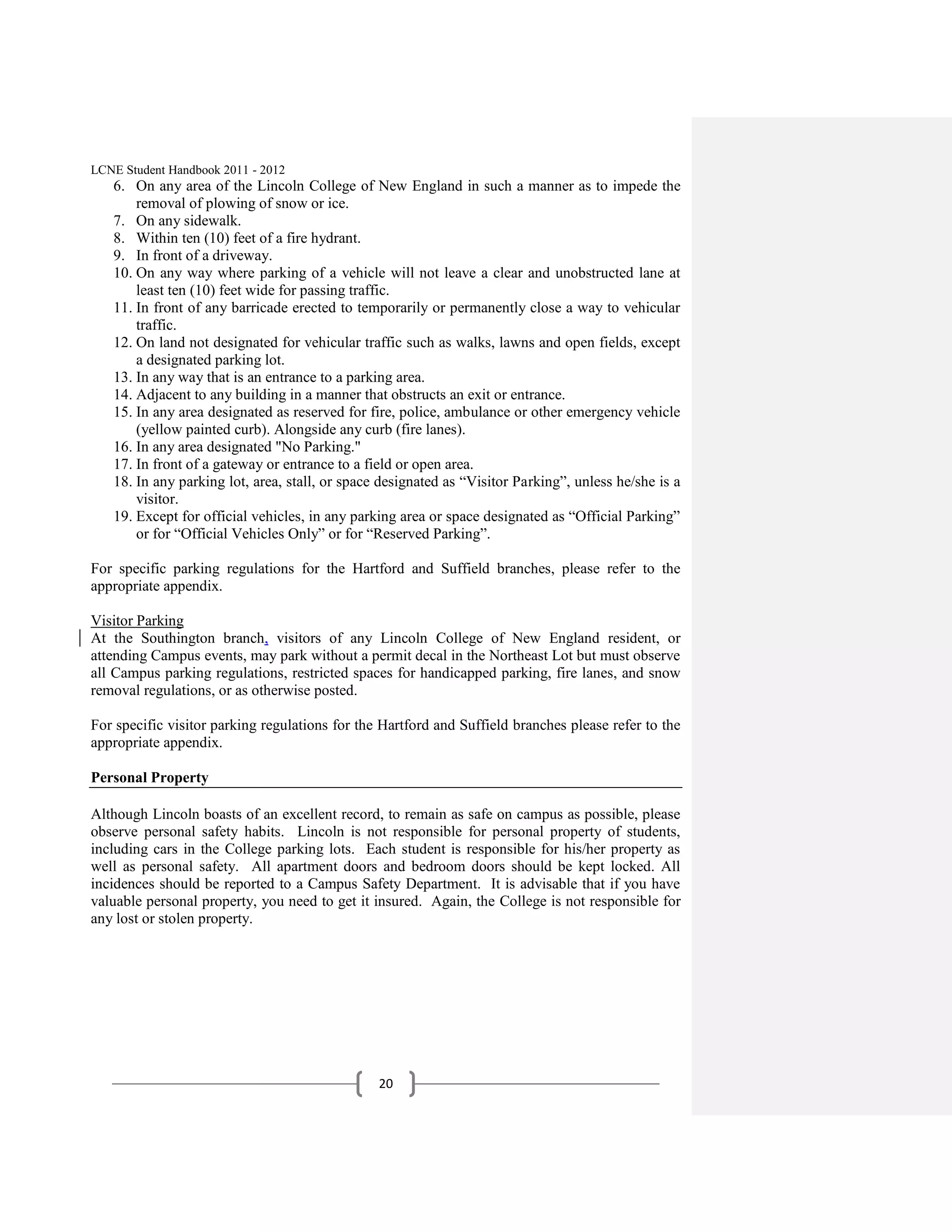
There are two (2) Fire Drills held each year to be in compliance with Government Regulations.
All occupants must evacuate buildings immediately when a fire alarm sounds and remain outside
until the fire department gives an ―all clear.‖ Tampering with extinguishers or other equipment,
failing to vacate a building during a sounding alarm, or setting off false alarms will be dealt with
severely, including arrest for these offences.

Fire Safety

The following items are not to be tampered with under any circumstances: heat sensors, smoke
detectors, fire alarm pull stations, fire horns, emergency lighting, and exit signs. Should you
suspect a problem with any of the above items, notify your RA or a Safety and Security Officer.
Except as required by law, Lincoln College of New England does not assume responsibility for
loss of, or damage to personal articles by fire, theft, or other causes. Residents are encouraged to
acquire property insurance coverage.


                                                17
LCNE Student Handbook 2011 - 2012

Lost and Found

Lost and found property can be retrieved from the Director of Campus Safety or the Central
Office. Lost and found items will be stored for a period of 30 days. After 30 days the lost/found
item will become the property of Lincoln College of New England, and disposed of at the
discretion of the Administration.

Operation of Vehicles

Loading and Unloading of Passengers
Passengers must enter or exit vehicles at curb side or parking spaces. At no time shall any
vehicle allow passengers to sit, stand, or lie on any exterior portion of the vehicle.

Speed Limit
   1. All vehicles shall be operated at all times at a speed that is reasonable and proper.
   2. At no time shall a speed on any campus roadway in excess of fifteen (15) miles per hour
       be considered reasonable and proper, except as otherwise posted, and for vehicles
       engaged in emergency work.
   3. At no time shall a vehicle exceed ten (10) miles per hour in any campus parking lot area.
   4. At no time shall any vehicle be operated in any area not specifically designed, intended,
       or designated for vehicular traffic. No vehicles are allowed to travel off of the paved
       roadways of the campus.

Traffic and Parking Control Signs
Operators are subject to penalties in effect prior to the illegal defacement or removal of such
posted signs. Any person who willfully, intentionally and without right, defaces or otherwise
injures, removes, interferes with or destroys any traffic or parking device or sign lawfully erected
or placed on the Lincoln College of New England shall be subject to disciplinary action.

Parking Policy

ALL VEHICLES ON CAMPUS ARE PARKED AT THE OWNER’S RISK in all College-
owned or leased parking areas. All students, full-time and part-time, should secure a parking
permit decal from the Office of Safety and Security on each branch. This permit decal must be
displayed on either the passenger side or driver side of the windshield. You may obtain a parking
by registering with Campus Security. The cost for parking per semester on each of the branch
campus can be found within the College Catalog.

Use of a motor vehicle on Campus property is a privilege, not a right, and is made available only
under the policies established by the Campus Safety Department. Failure of Campus Safety to
strictly enforce any parking regulations shall not be construed as a waiver for the future
enforcement of the regulation. The purpose of these regulations is to expedite the safe and
orderly conduct of Lincoln College of New England business and to provide parking facilities in
support of this function within the limits of available space. Any unused or abandoned vehicle
will be towed off of the property at the owner’s expense. All vehicles must have a valid
registration plate to be parked on College property.


                                                18
LCNE Student Handbook 2011 - 2012
Lack of space, mechanical problems, inclement weather, or other factors are not considered valid
excuses for failure to comply with the traffic and parking regulations. A parking permit decal
does not guarantee the holder a parking space, but only the opportunity to park within a specified
area.

In Southington, the North, Northeast and Palmisano Lots are designated as student parking areas.
The Ligouri Lot (adjacent to Brook’s Hall) is not for students. Students may park in the
Palmisano Lot on a first come, first served basis. The Northwest Lot (adjacent to Mount Vernon
Rd.) is strictly for Faculty and Staff. Students may not park in any area labeled STAFF and
FACULTY.

* Please refer to the Hartford/Suffield Appendix for specific parking regulations for those branch
campuses.

Permit Requirements
All students that qualify for parking privileges are authorized to have one (1) permit decal issued
to them. All students must have a parking permit decal on their vehicle. When applying for a
permit decal at the Campus Safety Office, you must have your registration to that vehicle, your
license, and your insurance card.
    1. Students who need a temporary parking pass must obtain that solely through the Director
        of Campus Safety and Security.
    2. Parking permit decals are nontransferable. You may not remove it and place it on another
        vehicle. Vehicles parked without the proper identification will be towed at owner’s
        expense.
    3. We will re-issue new permit decals every semester and there will be a different design for
        commuters and residents.
    4. The cost of parking permits differs between the branch campuses. Parking permits for the
        Southington Branch are $50 per semester for all students.
    5. Parking permits for the Hartford branch
            a. Resident students: $150 per semester
            b. Commuters: $100 per semester
    6. Suffield branch charges a onetime fee for residential students of $150 and $100 for
        commuter students.

Regulations
The following list describes some of the forms of illegal parking.
   1. No motor vehicles, including motorcycles or motor scooters, shall be parked so as to
       obstruct an entrance or egress to or from any Campus building.
   2. No vehicle shall be parked within the walks of the residence hall or on land not so
       appropriately designated or designed for motor vehicle use immediately adjacent to a
       residence hall or other Campus building unless specifically authorized by the Director of
       Campus Safety. No vehicle shall, at any time, be parked or stored in any residential or
       Campus building.
   3. Motor vehicles, including motorcycles and motor scooters, which are creating a noise or
       disturbance while parked in the proximity of a Campus building, must be moved or
       turned off.
   4. There is no loitering in any of the campus parking lots.
   5. The playing of vehicle stereo’s while a vehicle is parked in any of the Campus Parking
       lots creates a disturbance to both residents and students attending classes and is hereby
       prohibited.

                                                19
LCNE Student Handbook 2011 - 2012
   6. On any area of the Lincoln College of New England in such a manner as to impede the
       removal of plowing of snow or ice.
   7. On any sidewalk.
   8. Within ten (10) feet of a fire hydrant.
   9. In front of a driveway.
   10. On any way where parking of a vehicle will not leave a clear and unobstructed lane at
       least ten (10) feet wide for passing traffic.
   11. In front of any barricade erected to temporarily or permanently close a way to vehicular
       traffic.
   12. On land not designated for vehicular traffic such as walks, lawns and open fields, except
       a designated parking lot.
   13. In any way that is an entrance to a parking area.
   14. Adjacent to any building in a manner that obstructs an exit or entrance.
   15. In any area designated as reserved for fire, police, ambulance or other emergency vehicle
       (yellow painted curb). Alongside any curb (fire lanes).
   16. In any area designated "No Parking."
   17. In front of a gateway or entrance to a field or open area.
   18. In any parking lot, area, stall, or space designated as ―Visitor Parking‖, unless he/she is a
       visitor.
   19. Except for official vehicles, in any parking area or space designated as ―Official Parking‖
       or for ―Official Vehicles Only‖ or for ―Reserved Parking‖.

For specific parking regulations for the Hartford and Suffield branches, please refer to the
appropriate appendix.

Visitor Parking
At the Southington branch, visitors of any Lincoln College of New England resident, or
attending Campus events, may park without a permit decal in the Northeast Lot but must observe
all Campus parking regulations, restricted spaces for handicapped parking, fire lanes, and snow
removal regulations, or as otherwise posted.

For specific visitor parking regulations for the Hartford and Suffield branches please refer to the
appropriate appendix.

Personal Property

Although Lincoln boasts of an excellent record, to remain as safe on campus as possible, please
observe personal safety habits. Lincoln is not responsible for personal property of students,
including cars in the College parking lots. Each student is responsible for his/her property as
well as personal safety. All apartment doors and bedroom doors should be kept locked. All
incidences should be reported to a Campus Safety Department. It is advisable that if you have
valuable personal property, you need to get it insured. Again, the College is not responsible for
any lost or stolen property.


                                                20
LCNE Student Handbook 2011 - 2012
Personal Safety

At night, you should not walk alone and should walk only in well-lit areas. Students are asked to
walk on the sidewalks for your own safety from both motor vehicle traffic and dangerous
footing. After evening and weekend classes on the Southington campus, everyone should pass by
the Campus Safety and Security Office. Do not take the path over the bridge.

Should a Safety and Security Officer or other member of the staff not recognize you, you will be
asked to produce your student ID. Students should carry their ID at all times. The staff takes
pride in knowing nearly every student; but even on a small campus, it is not always realistic to
know or recognize everyone all of the time. Please cooperate and introduce yourself if asked.

Search/Seizure

Lincoln College of New England reserves the right to search vehicles, book bags, back packs,
bags, residence hall rooms, apartments and any suspicious looking containers as part of its
mission to provide a safe environment in which students may live and learn. The Campus Safety
and Security Office maintain the right to designate items as unsafe or not permitted in the
residence halls and all other campus locations as warranted.

Security Escort

Although Lincoln College of New England prides itself in campus safety, for those who are not
comfortable walking alone at night, the Office of Campus Safety and Security provides door-to-
door walking escorts from dusk until 7:00 a.m. for students and faculty. Please contact the Safety
and Security Office and ask for assistance.

Snow Policy

   1. When there is a forecast for snowfall to impair the safe and free flow of pedestrians,
      vehicular traffic, and snow removal equipment, or when conditions arise that may imperil
      the public safety, the College President may either delay or close school operations.
   2. Residential and Commuter parking lots shall be cleared on an as-needed basis. In the
      event of a large snowfall, students may be asked to move their vehicles to a cleared lot to
      facilitate snow clearing efforts. Ample notification will be given with instructions on
      where to move vehicles. We ask that you please cooperate fully with all directives to
      move automobiles.
   3. Snow removal rules and regulations take precedence over all regularly followed rules and
      regulations, when snow closings exist.


                                               21
LCNE Student Handbook 2011 - 2012


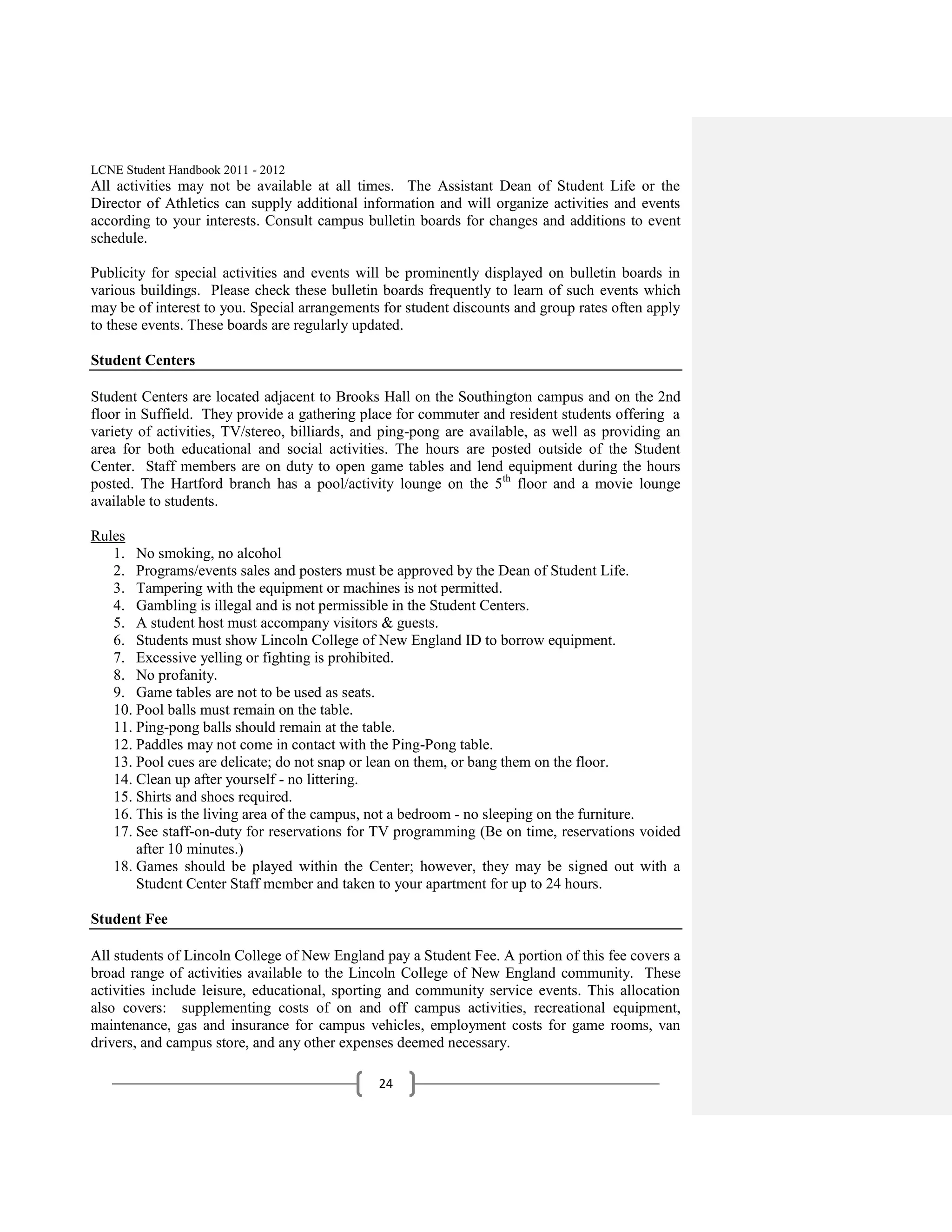
Student Activities
Right about now you’re probably wondering what life is like on a Lincoln College of New
England campus...life beyond the classroom, that is! We’re happy to tell you that, just like our
students, we realize life does not begin and end with homework, internships and resumes. We
understand that a fulfilling life is all about the connections we have with others, so we go out of
our way to make sure you’ll have a chance to enjoy all the wonderful people—especially our
interesting, diverse and talented students—you’ll meet here each day.

To help you connect, each of our campuses feature meeting places where you and your
classmates can gather to socialize and keep up with the many activities, clubs and organizations
you’ll be invited to join. In addition, we encourage you to visit the exciting nearby attractions
you’ll find in the communities surrounding our campuses, all of which can offer you a refreshing
change of pace so you can resume your studies with renewed interest and energy.

Activities

Cancellations
The Office of Student Life reserves the right to cancel any activity that has been posted. All
cancellations are posted no later than 4 hours prior to the activity.

Coordination
The leadership of clubs and organizations are encouraged to communicate and coordinate
activities (dates, times and locations) with the Deans of Student Life.

Students and faculty interested in chartering new organizations to meet the needs of Lincoln
students are encouraged to bring such suggestions (including recommendations for faculty
advisor) to the Deans of Student Life.

Costs
Some on and off campus activities may have a cost associated with their participation. If a cost
is associated with an activity it will be clearly written on any material that describes the activity.
This will also indicate a date and time the money is due to participate.

Athletics and Recreation

Lincoln College of New England athletic programs support the educational mission statement of
the College by providing additional opportunities for the student-athlete. The athletic programs
at Lincoln College of New England consist of both intercollegiate and intramural opportunities.


                                                 22
LCNE Student Handbook 2011 - 2012
Athletic Facilities
The athletic fields on the Southington campus are located adjacent to Brooks Hall. Facilities
include a volleyball sandpit, soccer/softball field, and a basketball hoop. Locally, the College
enjoys the use of Gold’s Gym in Bristol, and indoor and outdoor activities in the area. In Suffield
and Hartford, students have access to a gym and weight room.

Intercollegiate Athletics
The intercollegiate athletic program is under the direction of the Director of Athletics. The
College intercollegiate teams take great pride in competing at the Division III level of the
National Junior College Athletic Association (NJCAA). LCNE’s membership allows the
College to participate in the New England Region (REGION XXI) against other Junior and
Community College member institutions throughout Connecticut, Rhode Island, New York and
Massachusetts. This affiliation allows Lincoln College of New England the opportunity to
qualify for regional and national post season tournaments and the student-athlete to be
recognized for various individual awards. The College currently sponsors men’s basketball.

To be eligible, students must be enrolled in a minimum of 12 credits, maintain a 2.0 grade point
average, and comply with the eligibility criteria set forth by the NJCAA and Lincoln College of
New England.

All teams will have open tryouts. If interested, please contact the Director of Athletics for more
information.

Intramural Athletics
Intramural sports are recognized as an important part of the student’s education. Through
participation, the student has the opportunity to exercise, relieve stress, socialize with friends,
meet new people, and experience the thrill of competition in a fun, relaxed setting.

The intramural program is made up of organized leagues leading to individual or team
championships. It’s here for your enjoyment and recreational needs. Intramural competition is
offered in various sports for men, women, and co-ed teams. Competition is provided in the form
of leagues, tournaments, and special events. The programs offered are selected based on student
interest and the availability of resources and facilities. Some programs offered include: flag-
football, bowling, basketball, volleyball, softball, soccer, and waffle ball.

Recreational Activities
Free recreational time is an excellent way to meet new friends. You are encouraged to engage in
informal recreational activities. These may include:

       Basketball
       Bowling
       Ping-Pong/Billiards
       Softball
       Dances
       Gold's Gym
       Soccer
       Volleyball


                                                23
LCNE Student Handbook 2011 - 2012
All activities may not be available at all times. The Assistant Dean of Student Life or the
Director of Athletics can supply additional information and will organize activities and events
according to your interests. Consult campus bulletin boards for changes and additions to event
schedule.

Publicity for special activities and events will be prominently displayed on bulletin boards in
various buildings. Please check these bulletin boards frequently to learn of such events which
may be of interest to you. Special arrangements for student discounts and group rates often apply
to these events. These boards are regularly updated.

Student Centers

Student Centers are located adjacent to Brooks Hall on the Southington campus and on the 2nd
floor in Suffield. They provide a gathering place for commuter and resident students offering a
variety of activities, TV/stereo, billiards, and ping-pong are available, as well as providing an
area for both educational and social activities. The hours are posted outside of the Student
Center. Staff members are on duty to open game tables and lend equipment during the hours
posted. The Hartford branch has a pool/activity lounge on the 5th floor and a movie lounge
available to students.

Rules
   1. No smoking, no alcohol
   2. Programs/events sales and posters must be approved by the Dean of Student Life.
   3. Tampering with the equipment or machines is not permitted.
   4. Gambling is illegal and is not permissible in the Student Centers.
   5. A student host must accompany visitors & guests.
   6. Students must show Lincoln College of New England ID to borrow equipment.
   7. Excessive yelling or fighting is prohibited.
   8. No profanity.
   9. Game tables are not to be used as seats.
   10. Pool balls must remain on the table.
   11. Ping-pong balls should remain at the table.
   12. Paddles may not come in contact with the Ping-Pong table.
   13. Pool cues are delicate; do not snap or lean on them, or bang them on the floor.
   14. Clean up after yourself - no littering.
   15. Shirts and shoes required.
   16. This is the living area of the campus, not a bedroom - no sleeping on the furniture.
   17. See staff-on-duty for reservations for TV programming (Be on time, reservations voided
       after 10 minutes.)
   18. Games should be played within the Center; however, they may be signed out with a
       Student Center Staff member and taken to your apartment for up to 24 hours.

Student Fee

All students of Lincoln College of New England pay a Student Fee. A portion of this fee covers a
broad range of activities available to the Lincoln College of New England community. These
activities include leisure, educational, sporting and community service events. This allocation
also covers: supplementing costs of on and off campus activities, recreational equipment,
maintenance, gas and insurance for campus vehicles, employment costs for game rooms, van
drivers, and campus store, and any other expenses deemed necessary.

                                               24
LCNE Student Handbook 2011 - 2012

Student Groups/Organizations

LCNE offers a full range of student clubs and organizations with more being offered each
semester. Currently, the College offers the following groups.

Academic and Professional Groups
      Criminal Justice: The Criminal Justice Club is an informal organization open to all
      students at Lincoln College of New England. Meetings are once a week or every other
      week. Events and speakers are planned which help build the students awareness of
      current issues and careers in Criminal Justice. The club also sponsors social events such
      as movie nights, participates in community service events and fund-raising for local
      charities.
      Dental Club: For students in the Dental Hygienic program, this is a great way to meet and
      support each other. Opportunities for events as well as networking are provided. Like
      other organizations, students will get out of this what they put into it.
      Heath and Nutrition Club: This club is open to students in the Dietetic Technician
      program and Medical Assisting programs and anyone else interested. The goals of the
      club are to unite students into a friendly, cohesive group; to foster a feeling of service to
      one another and to the College community; and to promote professionalism and
      enthusiasm. Social activities may include assisting with a health fair and/or National
      Nutrition month activities, participation in a pinning ceremony for those graduating from
      an allied health program and fund raising for community charities. Meetings are held to
      plan activities.
      Medical Club: The goals of the club are to unite Allied Health students into a friendly,
      cohesive group; to foster a feeling of service to one another and to the College
      community, and to promote professionalism by attendance at scheduled lectures and by
      participating in community projects. There are no dues, except for time and enthusiasm.
      Social activities may include assisting with a health fair, participation in a pinning
      ceremony for those graduating from the medical programs, and fund raising for
      community charities. Meetings are held once per semester to plan activities for the
      semester.
      Mortuary Science Club: The Mortuary Club is a great way to meet other students in the
      Mortuary Science Program. With a large collaboration of students, it offers many ways
      for the students to connect with employment opportunities, study partners, even friendly
      scholastic advice. The club also runs various fundraisers to help support local
      associations, i.e. Toys for Tots. The club takes trips to places associated with the funeral
      profession, i.e. Dodge Company and Evergreen Cemetery. It’s a great way for students
      to get involved.
      Psychology Club: This organization serves to join students from the Psychology program
      for networking and social purposes. As with other program-specific groups, there are
      many opportunities for mutual support here.
      Student Occupational Therapy Association: This is one of several local branches of the
      national American Student Committee of Occupational Therapy Association.
      Membership is open to students in the OTA Program whose aim is to foster growth of the
      organization, educate the community and network with occupational therapists in the
      community through activities, fundraising events and support of the national association.


                                                25
LCNE Student Handbook 2011 - 2012

Councils and Governing Organizations
      Resident Council: LCNE invites all residents interested in leadership opportunities to
      participate in the Resident Council. The Resident Council is a group of residents and is
      facilitated by the Residence Life Coordinator or the Assistant Dean of Student Life. All
      residents are encouraged to attend. All meeting dates and times will be clearly written on
      any calendar of events and other posting areas. Campus leadership is strongly encouraged
      by the Office of Student Life.
      Safety Committee: Students serve on this College committee as spokespersons for the
      student body. This committee is responsible for identifying and reporting unsafe
      situations in facilities, grounds, and procedures as they relate to all members of the
      Lincoln community. Reports are given to the President, and members. Anyone may see
      the reports, located in the Campus Safety and Security Office upon request.
      Student Government Association (SGA): SGA is the primary organization of student
      governance on LCNE’s campus. Voting membership is comprised of 20 students who are
      elected annually by the student body. Student Government serves as the voice of the
      student body. SGA also lobbies and advocates on behalf of the students, ensuring that
      their experience is preserved and protected. Members of Student Government play vital
      roles on numerous campus committees and have representation on search committees for
      executive level administrative positions within the College. In addition, SGA helps plan
      large community and social events. For more information on how to get involved or to
      speak to someone about your interests or concerns, or for a copy of the Student
      Government Association Constitution, please contact the Office of Student Life in
      Brooks Hall E-7 or email at lcne.sga@gmail.com.

Honorary Organizations
      Phi Theta Kappa International Honor Society Of The Two-Year College: The purpose of
      Phi Theta Kappa is to recognize and encourage scholarship among two-year College
      students. All students may be Provisional Members while waiting to meet full eligibility
      requirements. Students are eligible for full membership after completing 12 credits and
      the required cumulative grade point average of 3.5. Full members will be recognized
      with a membership certificate and notation of membership on their diploma and
      transcript. An induction ceremony is held in the spring. In addition, members have
      access to listings of scholarships designated exclusively for members. In order to remain
      a member, students must maintain a 3.2 cumulative GPA. Phi Theta Kappa sponsors
      various activities on campus, including participation in community efforts such as Race
      for the Cure and Making Strides and fun activities such as pasta dinners and participation
      in Regional and International meetings.

Media Groups
      THE PULSE – This club is open to students who want to learn the skills of a DJ, news
      writer, sports reporter/writer, technician, interviewer, producer, audio editor or music
      library manager. Hands-on experience, speakers and field trips make this an interesting
      and exciting experience.

Recreation and Social Organizations
       Expression Dance: Throughout human history, dance has been used as a form of
       expression. That tradition continues in this group, allowing students the opportunity of
       expression.


                                              26
LCNE Student Handbook 2011 - 2012
       Lincoln Hookers: The Lincoln Hookers is knitting and crocheting club which is open to
       students, faculty, staff and community members. The members of the club are taught
       how to knit and crochet, if they don’t know how, and supplies are usually given for
       smaller projects. Each semester a different charity or organization is selected and the
       items made are donated to the selected organization. The club has donated items such as
       blankets to an American Indian Reservation out west, and baby blankets to ―Project
       Linus‖. Knitting and crocheting is a fun activity that can be enjoyed throughout life and
       brings together people of all ages.
       Multicultural Club: LCNE celebrates diversity amongst its students and the multicultural
       club exists to help further that celebration. Students of ALL backgrounds are encouraged
       to take part and celebrate all that makes us unique.
       Sigma Delta Sorority: This is a Latino-based Sorority that promotes honesty, compassion,
       self-pride, professionalism and hard work among Women of Science. Female students
       who are taking or have taken a science class are eligible.
       Step Team: In some years this is a ―dance team‖ depending on the desire and background
       of the interested students. Whatever the title, it’s an energetic group that gets together to
       MOVE. The team performs at various events on campus.

If you are interested in any of the listed groups or if you are interested in starting one of your
own; please contact the Office of Student Life, Brooks Hall, E7 for more information.

Recognition of Student Organizations
Students bring to the College a variety of interests previously acquired and develop many new
interests as members of the academic community. Student organizations must be established for
purposes that are legal and consistent with the broad educational mission of the College.

Organizations wishing to be recognized by the College must form and operate in compliance
with College policies and procedures. Once recognized, groups are required to abide by all
applicable local, state and federal laws, including Title IX and College policies, rules and
regulations. The recognition of a student organization by the College does not constitute an
endorsement of the objectives, policies or practices of that organization, nor does the College
assume sponsorship of or responsibility for any of the programs or activities of that organization.

As adults, all students of the College are expected to take personal responsibility for their own
conduct, including participation in extracurricular activities. The recognition procedures that
follow were established by the College to ensure that all student organizations can, on an
equitable basis, obtain those rights and privileges that are normally associated with formal
recognition. Students interested in forming a new student organization should contact the Office
of Student Life in Brooks Hall to discuss the type of organization desired and the procedures that
must be followed.

Recognition Procedures
   1. A student organization seeking College recognition must be comprised of LCNE students
      only currently registered at the College. Membership may also be extended to teaching
      faculty, administrators and staff members.

   2. A student group interested in organizing and applying for recognition may be granted a
      30-day permit to use campus facilities for the purpose of completing required procedures
      and for recruiting interested members. It will not be allowed to sponsor speakers,


                                                27
LCNE Student Handbook 2011 - 2012
      programs or events; sponsor fund-raising activities; or use the name of the College until it
      has been formally recognized.
          a. Proposals may be submitted to the Office of Student Life in Brooks Hall.
              Proposals must contain the following information:
          b. Name of the proposed organization.
          c. A statement of purpose.
          d. A statement explaining the potential benefits of the proposed organization to the
              College and members of the student body.
          e. A statement of the membership policy.
          f. Names of those interested in forming the organization.
          g. Evidence of faculty/staff sponsorship. All student organizations are required to
              have faculty advisers who are members of the teaching faculty, administration or
              staff.
          h. Faculty members may be recommended by the organization, but are appointed by
              and serve at the discretion of the College.
          i. A copy of the proposed constitution.
          j. An organization desiring College recognition of its affiliation with a state and/or
              national organization must submit a copy of the state and/or national constitution
              and bylaws. These shall be reviewed as part of the recognition process.
   3. Upon an initial review by the New Student Organization (NSO) committee, the
      chairperson will submit copies of the completed proposal to the Assistant Office of
      Student Life in Brooks Hall for review and approval.
   4. A recognized organization that wishes to revise or amend its approved constitution can
      obtain the appropriate forms and procedures from the Office of Student Life in Brooks
      Hall. Upon an initial review by the New Student Organization (NSO) committee, the
      chairperson will submit copies of the completed proposal to the Assistant Office of
      Student Life in Brooks Hall for review and approval.
   5. Student groups wishing to benefit from the advantages of recognition for a limited period
      of time without the intent of becoming a permanent student organization should meet
      with the Assistant Dean of Student Life to discuss specific group plans and objectives.

Responsibilities of Advisors
The faculty advisor has the following responsibilities to an organization:
   1. To be knowledgeable about the purpose and program of the organization;
   2. To ensure that the officers and members of the organization are informed of College
       policies, procedures, rules and regulations;
   3. To ensure that College policies, procedures, rules and regulations governing student
       activities and student organizations are followed;
   4. To ensure that officers of the organization are selected according to the procedures stated
       in the organization’s constitution;
   5. To ensure that all monies raised through fundraising, are maintained and expended
       according to the established rules and procedures;
   6. To attend and supervise all activities, programs and events sponsored by the organization
       as required by the Office of Student Life;
   7. To ensure that requests for College services or appeals of administrative decisions are
       processed through the faculty advisor;
   8. To inform the Office of Student Life immediately when the organization is disbanded or
       becomes inactive.


                                               28
LCNE Student Handbook 2011 - 2012
Responsibilities of Organizations to Advisors
The organization has the following responsibilities to its advisor:
   1. To meet with the advisor on a regular basis and to keep the advisor informed of the
       overall program and activities of the organization;
   2. To inform the advisor well in advance of the schedule (date, time and location) of all
       meetings, activities, programs and events sponsored by the organization;
   3. To process requests for College services or appeals of administrative decisions through
       the faculty advisor;
   4. To give the advisor an opportunity to express an opinion on issues that affect the welfare
       of the organization and the interest of the College.

Responsibilities of Student Organizations
In addition to the rights and privileges that formal recognition carries, responsibility is placed on
each organization, including its officers and individual members, to conduct its affairs within the
framework of College policies, rules and regulations and the provisions stated in the constitution
of the organization.

   1. Organizations have the responsibility to take reasonable steps to ensure that all programs
       and activities sponsored by the organization comply with all applicable local, state and
       federal laws and with College policies, procedures, rules and regulations.
   2. Officers of an organization shall be held accountable and responsible for the programs
       and activities sponsored by the organization in the event that the organization and/or its
       members violate established College policies, procedures, rules or regulations.
   3. An organization shall be responsible for its members’ behavior when they are acting as
       members of the organization (with or without official approval) rather than as individual
       students; when an event is held (officially or unofficially) in the name of the
       organization; and when the actions or activities of individual students draw attention to
       the organization rather than to themselves as individuals.
   4. An organization shall have an up-to-date copy of its constitution, a Directory Information
       form on file with the Office of Student Life, Brooks Hall, E7.
   5. Organizations have the responsibility to ensure that all students within the College
       community, including those with disabilities, are able to participate in and benefit from
       all programs and activities sponsored by the organization. All publicity for approved trips
       must include information on accessibility needs.
   6. Organizations have the responsibility to supervise their events and ensure the safe
       operation of their programs and activities.
   7. Organizations accept responsibility for any destruction of or damage to College property,
       equipment or facilities and any costs related to the use of College property, equipment or
       facilities.
   8. Organizations accept responsibility for assuring that facilities are used for the purpose for
       which they were scheduled.
   9. An organization accepts responsibility for any of its programs and activities that interfere
       with the rights of any member of the College community, with another student
       organization and/or its guests or with the normal operation of the College.
   10. Organizations must register with the Office of Student Life each semester by the
       advertised deadline, in order to maintain their recognition status.
   11. Organizations take responsibility for maintaining contact with their approved faculty
       advisor and meeting their responsibilities to their faculty advisor as outlined.


                                                 29
LCNE Student Handbook 2011 - 2012
Rights and Privileges of Recognized Organizations
   1. Use of certain College facilities, equipment and services.
   2. Right to schedule meetings and programs in campus facilities.
   3. Right to publicize group meetings and other events on campus.
   4. Right to disseminate information and literature on campus.
   5. Right to raise funds or make other permissible solicitations on College property in
       accordance with written College policies.
   6. Right to invite membership.
   7. Opportunities to participate as a group in College events and other activities.
   8. Right to invite speakers to campus.
   9. Right to receive assistance from a faculty advisor.
   10. May be granted permission to use the name of the College in connection with its
       approved programs and activities. No organization, however, shall advertise or promote
       its programs or activities in a manner that suggests that the College sponsors the function.

Withdrawal of Recognition

   1. All recognized organizations must register with the Office of Student Life each semester.
   2. Should any organization fail to register within the prescribed period, it shall
      automatically lose its recognition and all the rights and privileges associated with formal
      recognition. It is the organization’s responsibility to keep this information accurate and
      up-to-date.
   3. Any organization that fails to comply with its own constitution; fails to abide by all
      applicable local, state and federal laws and College policies, rules and regulations;
      engages in unlawful activities; or violates the rules and procedures governing the use of
      Student Activity Funds is subject to disciplinary action including, but not limited to,
      probation, suspension or withdrawal of College recognition by the Office of Student Life.
   4. Disciplinary action may be initiated by the Student Government Association or the Office
      of Student Life. A recognized organization subject to disciplinary action that may result
      in the termination or suspension of recognition shall be guaranteed the right to a hearing
      and all the protections of due process.
   5. An organization whose recognition was terminated or suspended may petition the Vice
      President of Operations and Student Affairs or their designee for reinstatement. The Vice
      President of Operations and Student Affairs may set terms, conditions and/or restrictions
      that the organization must adhere to before and after its recognition is reinstated by the
      College.
   6. Disciplinary action involving suspension or withdrawal of College recognition may be
      appealed to the President of the College. The decision of the President will be final and
      binding.


                                                30
LCNE Student Handbook 2011 - 2012


STUDENT CONDUCT
Lincoln College of New England holds the education and success of students in the highest
regard. In line with this belief, the College places great importance on dignity, rights, and
individuality. It is critical that all members of the College community behave in a manner that
promotes tolerance and respect.

The purpose of Student Conduct policies and procedures is to safeguard the values of the College
as well as the academic, professional, and personal growth of the students. The Code of Conduct
appears in a later section and will be referred to in this section as the ―Code‖. The Vice President
of Operations and Student Affairs or designee will be referred to as the ―VP‖.

Academic Misconduct

Academic misconduct, including but not limited to plagiarism or cheating, will be handled under
a separate procedure outlined under the Academic policy.

Filing a Complaint

Any member of the College community, whether that member is faculty, staff, or student, is
entitled to file a complaint for an alleged violation of the Code (accusations of Academic
Misconduct are treated separately by the process outlined in the Academic Policy). The
complaint must be made in writing and submitted to the VP within 30 calendar days of the
incident in question, except in cases of alleged misuse of College documents or making false
statements as defined in the Code, and under other appropriate circumstances, a complaint may
be made at any time. Any exception to the submission deadline must be authorized by the VP.

Once a complaint has been filed, the VP will determine if there is enough probable cause to
believe that a violation occurred. If probable cause is determined to exist, the VP will determine
if the complaint can be resolved by an administrative meeting. If the VP determines that a formal
hearing with the board is necessary, one will be scheduled.

                                                31
LCNE Student Handbook 2011 - 2012


Formal Hearing

Formal Hearings are conducted when:

   1. An administrative meeting is not adequate to resolve the case.
   2. A grievous violation of the Code occurs.
   3. The accused faces possible loss of housing, suspension, or expulsion.

Please note that academic misconduct violations are handled under a separate procedure as
outlined in the Academic Policy section.

Formal Hearing (Conduct Board) Procedure

   2. Notice of Hearing: A formal notice of hearing will be given to the student within 5
      business days of being notified of charges being filed or within 5 business days of an
      unresolved administrative meeting. Notices will either be mailed to the student’s
      permanent address that is on file with the College (commuters and students under interim
      suspension) or delivered to the student’s on campus residence. Failure to appear may not
      necessarily stop or delay proceedings. Refusal to accept the notification will not stop or
      delay proceedings. Hearings with LCNE Online students will be done via teleconference.
   3. Hearing: The student has the right to be heard by a hearing panel of not less than three
      people. The hearing panel may be comprised of faculty, staff, students or any
      combination. In the case of violations on the Hartford or Suffield campuses, the hearing
      panel may include faculty and/or staff of the Lincoln Culinary Institute and/or Lincoln
      Technical Institute.
   4. Record of Hearing: The College reserves the right to create an audio recording of formal
      hearings. This recording is property of the College and no other recordings are to be
      made of the proceedings.
   5. Opportunity to Present a Defense: The accused student will be afforded the right to
      present a defense including the submission of evidence and the right to question an
      accuser. The accused may bring in witnesses but the College reserves the right to restrict
      the witnesses based on relevance and whether or not they can provide concrete testimony.
   6. Accused Student Files: After the hearing, students may access any personal data in
      accordance with federal and state laws.
   7. Non-Appearance of Accused Student: Failure to appear for a scheduled formal hearing
      may not necessarily stop or delay the proceedings. The College reserves the right to carry
      on the proceeding without the student unless extenuating circumstances exist for the
      student’s failure to appear. The VP will have final say as to whether or not a student’s
      circumstances are adequate for excusing a no-show at a formal hearing.
   8. Admission of Persons to Hearing: All hearings will be considered ―closed‖ hearings.
      Only relevant persons including the accuser, accused, conduct panel, security personnel
      (as needed), advisors, and others as deemed necessary by the hearing panel will be
      permitted. Hearing board officials in training will be permitted to be present as needed.
   9. Right to an Advisor: The accused student has the right to consult with a support person of
      his or her choice in the preparation of his or her defense. The accused student also has the
      right to have a support person sit with him or her at the hearing and to consult privately
      with that person, but the support person will not be permitted to speak or advocate during
      the hearing unless the accused student is disabled to the point of being unable to present

                                               32
LCNE Student Handbook 2011 - 2012
       his or her defense or unless the case against the student is presented by an attorney. The
       support person may be legal counsel. With respect to hearings in which the offense
       alleged involves harassment, threatening, physical assault, sexual misconduct or sexual
       assault, both the accused and the accuser are entitled to have a support person present
       during a formal hearing.
   10. Prior Disciplinary Sanctions: Any prior disciplinary record will not be used to determine
       whether or not a student is responsible for the incident in question. The prior record will
       be used to determine sanctioning.
   11. Written Notice of Decision: The student will be given a written notice of decision at the
       hearing, including sanctions (if any) and a formal follow up letter will be sent. The
       student will be asked to sign an acknowledgment. If the student refuses to sign or the
       student failed to show up, the members of the hearing panel may sign instead. Under no
       circumstances will a student’s refusal to sign postpone sanctioning.
   12. Appeal Process: If the student wishes to appeal the decision of the board, then a request
       for appeal form must be filed with the VP within 48 hours after the completion of the
       hearing. Appeals may be requested for the following criteria only:
           a. A Question of Evidence: The existence of new evidence that was not available at
               the time of the hearing.
           b. A Question of Sanctions: The sanction imposed was not in keeping with the
               gravity of the offense.
           c. A Question of Process: The occurrence of a substantive violation, mistake, or
               error during the conduct meeting that could have significantly altered the outcome
               of the decision.

Interim Separation/Suspension

In cases where an accused student is deemed to pose a threat to his or herself, others, or property,
the College reserves the right to issue an interim separation or suspension pending a formal
hearing. The following interim separations/suspensions may be issued:

   1. Housing Separation: The student is banned from the residential facilities at the
      Southington, Hartford, and Suffield campuses but may still attend classes and utilize
      services that are in non-residential areas. In the case of a building that serves as both a
      residence hall and classroom/office space, the student may only enter the classroom or
      office portion and needs to communicate with security in regards to their need to be
      within said building.
   2. College Suspension: The student is banned from all areas of the Southington campus as
      well as the Hartford and Suffield campuses. This includes the grounds, buildings, shuttle
      services, and College sponsored events.
   3. Other Separation/Suspension: A student may be restricted from specific areas and not
      from others, outside of the normal residential and non-residential designation. Details of
      such a suspension will be given to the student in writing.

Violation of the provisions of a suspension will result in further sanctions and possible arrest for
criminal trespassing. A formal hearing to make a final determination will be scheduled for no
more than 7 calendar days following an interim separation/suspension. If the College and student
agree, the process can be expedited.


                                                33
LCNE Student Handbook 2011 - 2012
Legal System

College disciplinary proceedings may be instituted against an accused student who has been
charged with the violation of local, state, and federal laws and/or ordinances in connection with
conduct that also violates the provisions of the Code. Disciplinary proceedings under the Code
may be carried out prior to, simultaneously with, or following the institution of civil or criminal
court proceedings against the accused student. The College reserves the right to hold a hearing in
the student’s absence if he or she is incarcerated.

Records

A student's conduct record will be maintained separately from the student’s academic record,
with the exception of violations of Academic Honesty and cases of expulsion. Generally,
information contained in the conduct record will not be released without the prior written consent
of the student. However, certain information may be released to individuals within or outside of
the College who have a legitimate legal or educational interest in obtaining it (Please refer to the
Family Educational Rights and Privacy Act of 1974 ("FERPA"), as amended).

Sanctions

Sanctions are assigned after a hearing body determines a student’s responsibility in regards to
violation(s) of the Code. All sanctions are documented in the student’s conduct record. Possible
sanctions are as follows:

   1. Formal Warning: The student receives a formal warning that a behavior or behaviors will
      not be tolerated.
   2. Educational Program: Whenever possible, the College encourages the student conduct
      process to be a learning experience to allow the student to grow as a responsible member
      of the community. Educational sanctions can take on a variety of forms and are typically
      related to the violation.
   3. Fine: A monetary fine of varying amounts, depending on the violation.
   4. Community Service: The student is assigned a certain number of hours, at the judgment
      of the hearing officer or hearing board, to be completed in a given time frame. Certain
      restrictions may be implemented by College officials.
   5. Parental Notification: Under FERPA, the College will notify parents of a violation of the
      alcohol and/or drug policy if the student is less than21 years of age.
   6. Follow-Up Meeting: If the hearing body cannot make a determination of responsibility
      and/or sanctions, a follow up meeting may be scheduled.
   7. Restitution: In cases of theft, vandalism, and/or damage have occurred; the hearing body
      may mandate financial restitution to the affected party or parties.
   8. Housing/College Probation: Probation is assigned for a given amount of time, based on
      the discretion of the hearing officer or board in relation to the violation. The purpose is to
      put the student on notice that further violations may lead to tougher sanctioning and
      possible separation/suspension.
   9. Housing Separation: Removal from residential facilities. The separation may be
      temporary in nature or permanent. For the duration of the separation, if the student enters
      a residential area, he/she is subject to arrest for criminal trespassing as well as further
      sanctions. No refund will be given for fees if a student is separated from housing. If a


                                                34
LCNE Student Handbook 2011 - 2012
       student is separated from housing at a satellite campus, they will not be permitted in
       housing in Southington and vice versa.
   10. College Suspension: Suspension is the temporary loss of status. During the period of
       suspension, the student is not permitted on College property or any satellite campus
       property. The student is also not permitted at College sponsored events or on College
       operated vans or shuttle buses. Violation of a suspension may result in arrest for criminal
       trespassing, as well as permanent expulsion from the College. If there is a need to enter
       campus grounds, the student must request permission in writing from the Dean of Student
       Life. No refund will be given for tuition and/or fees.
   11. Expulsion: The permanent separation of a student from the College. When expelled, the
       student is not permitted on College property or any satellite campus property. The student
       is also not permitted at College sponsored events or on College operated vans or shuttle
       buses. Violation of expulsion may result in arrest for criminal trespassing

Failure to complete sanctions as directed may result in further sanctions, including but not
limited to suspension or expulsion. Removal from any of the three branches of the College
indicates removal from all of them.

The list of sanctions is not meant to be all-inclusive and other sanctions may be imposed at the
discretion of the hearing body.

Warning System (Southington Only)

For minor violations of the Code, the College may decide to issue a written warning in lieu of a
formal hearing or administrative meeting. The written warning serves as a formal notification
that a certain behavior will not be tolerated. Only two warnings per student are allowed in a
given academic year. Upon the third warning violation, the student will be referred to either an
administrative meeting or formal hearing to discuss the continued violations of the Code and
appropriate sanctions will be assigned.

The written warning system is only for the Southington Campus. All violations will be resolved
through administrative meeting or formal hearing for the Hartford and Suffield campuses.


                                               35
LCNE Student Handbook 2011 - 2012


                                                                    Student Housing
                                                                On campus housing is
                                                                available for all full-time,
                                                                matriculated students with
                                                                satisfactory           academic
                                                                progress. In Southington,
                                                                students are housed in the two
                                                                apartment       buildings     on
                                                                campus, Brooks Hall and
                                                                Palmisano Hall. In Hartford
                                                                and Suffield, housing is
                                                                available on the upper floors
                                                                of the facilities. Hartford also
has newly acquired apartments. Each campus has similarities and differences. The policies in this
section apply to ALL LCNE students unless otherwise noted for specific campuses. See the
Appendix A & B for excerpts from the Hartford and Suffield handbooks as it relates to housing.

Alcohol/Drug Policy

The student conduct section covers the subject of alcohol and drugs extensively but it warrants
mentioning here. Alcohol, regardless of age, is not permitted on any LCNE campus or
residential facility. This includes the new apartments in Hartford. LCNE also has a zero tolerance
for drugs. Violation of these policies may result in loss of housing, suspension, or expulsion.

Cleaning of Rooms

The College strives to maintain a clean and healthy living environment. The expectation is that
students will do their part. Littering or dumping of garbage in areas other than designated
receptacles is not permitted. Students are also expected to keep their rooms clean and free of dirt,
litter, garbage, etc. Students are also responsible for cleaning their own rooms, the College
provides housekeeping services to public, academic, and administrative areas only. Remember,
there are a lot of people under one roof. No one wants bugs or any type of health hazard.

To insure a clean and healthy living environment, monthly health and safety inspections will be
conducted on all campuses.

Community Living

Lincoln College of New England strives to help you make your residential experience more than
just a bed to sleep on. You should realize that you play an important part in the community of the
residence halls. Getting along with your roommates is important but so is learning how to live
with the others on the floor and in the building. You are not only sharing a bedroom, but also a
bathroom, living areas, and the common areas of the halls. The members of a community will
determine its nature, and their willingness to be responsible community members will shape its
success.


                                                36
LCNE Student Handbook 2011 - 2012
Hartford Campus

The Hartford Campus, which is located in the Lincoln Education Center, was formerly the
Hastings Hotel. Operated by the Lincoln Culinary Institute (LCI), students from LCNE, LCI, and
LTI (Lincoln Technical Institute) are all housed in the upper floors. Student rooms are either
double or quad rooms, each with a private bathroom. Students are provided a bed, desk space,
and a dresser. There is also a fitness center, a movie room, and a lounge with pool tables.

The Hartford Campus has recently obtained and renovated apartment buildings on Imlay Street
(behind the Lincoln Education Center). These apartments will be available for student housing
beginning in July 2011. These are fully equipped apartments with one or two bathrooms,
bedrooms, a living room, breakfast bar, and full equipped kitchen (range, oven, microwave, and
full size refrigerator). Only beds are provided however, the remaining furniture must be provided
by the students.

LCNE maintains shuttle services during the school week to and from the Southington campus (a
schedule will be posted at the security desk). This allows students to take classes at both
locations if necessary. It is recommended that you do your best to schedule classes at the campus
of your location. Southington students may be permitted to reside in Hartford on a space
available basis but LCNE Hartford students have priority.

Special Notes on the Hartford Campus:
   1. Parking Garage: There is a parking garage available to students. It is located in the
       sublevels of the building. Any student parking anywhere on the Hartford Campus needs
       to obtain a permit from Hartford Campus Security. Please see the parking policy for more
       information.
   2. Bicycle Storage: There is a bike rack available for bike storage in the parking garage.
       Bikes are not permitted within the building or anywhere else outside and will be removed
       if found.
   3. Unlike traditional residence halls, the Lincoln Education Center is a combination
       residential/teaching/administrative area. Students are expected to be in appropriate attire
       when they are on the first or second floor of the building. This means no pajamas, cut-off
       or sleeveless shirts (unless you are going to or coming from the Fitness Center), etc.
       Shoes must be worn at all times on the first and second floors.
   4. The visitation policy in Hartford is different from the one in Southington and is outlined
       in the visitation section below. A specific difference of note is that overnight guests are
       not permitted.
   5. LCNE has branch offices on the Hartford Campus including faculty offices, admissions,
       financial aid, career services, and student life.
   6. Even though the Residence Life office is run by LCI, they are available for and interested
       in assisting LCNE students with their residential experience. It should be noted that room
       changes and other such operational requests must be made through the LCI Residence
       Life office.
   7. An Assistant Dean for Student Life is available to support LCNE students specifically at
       both the Hartford and Suffield campuses.


                                               37
LCNE Student Handbook 2011 - 2012
Housing Selection Process (Southington Only)

Among our three distinctive campus locations are a variety of housing options that can
accommodate your specific preferences, whether that means traditional residential dorm living or
a more independent lifestyle in an apartment.

As a result of the high demand for housing at our Southington location, a process was developed
to assign rooms as fairly as possible. The process uses a priority points system, PPS.

Priority Points System
The PPS was designed to reward students for their academic excellence and commitment to their
education. All current residential students who wish to return to campus housing for the
upcoming academic year (Fall to Spring) must take part in the room selection process.

Room Selection Process
   1. Students who wish to remain in their current room are allowed to do so.
   2. Students will earn priority points based on their:
      a) Cumulative GPA
       b) Credits Earned (not attempted).

       Students who entered the College after January and have not yet established a GPA will
       be randomly issued a lottery number after all other students have been issued a lottery
       number.
   3. Using a unique formula that gives more weight to the student’s GPA, a priority point is
      computed. The higher your priority point, the better your lottery number will be.
      Students will receive a copy of their priority point number and their lottery number prior
      to the room selection date.
       Any ties in lottery numbers will be broken using the highest GPA, then credits if a tie is
       still apparent.

LCNE Embraces Academic Excellence And As Such, Students With A Healthy GPA Are
More Likely To Receive A More Favorable Lottery Number.

Key/ID Policy

Resident students are assigned keys to their individual rooms/apartments and ID cards (in
Hartford, the ID card also functions as the room key for the rooms within the Lincoln Education
Center). Students are expected to carry both at all times. Keep in mind the following:

   1. Keys and IDs are not to be given or leant. Guests must be escorted at all times by their
      host.
   2. Loss of keys and/or IDs may result in a replacement fee. In the case of metal keys, a fee
      may also be assessed to change the lock and assign new keys to everyone in that room.
      The loss must be reported to the security office of your given campus immediately.
   3. Upon vacating the room, students must turn in their keys. Keys may be returned via
      express checkout to the Residence Life/Student Life office on your campus or turned in at
      the Security Office. In Hartford and Suffield, the ID card must also be turned in upon
      checkout.


                                               38
LCNE Student Handbook 2011 - 2012
   4. In the case of a lockout, there may be a fee to be let in to your room.
   5. Only the students assigned to the room will be let in to that room.

College officials from the Office of Student Life, Office of Residence Life (in the case of
Hartford or Suffield), Campus Safety and Security, and/or Maintenance may enter student
apartments/rooms for the following reasons:

   1. There is apparent danger to the occupant(s) of the apartment/room or other residents.
   2. There is reasonable and probable cause to believe that students are violating federal, state
      or local laws or College regulations.
   3. To make apartment/room inspections (to ensure compliance with College regulations, fire
      safety guidelines and to note damage).
   4. To perform maintenance tasks.

Laundry Services

Laundry services are provided at all the branch locations.

At the Southington branch, residents of Brooks Hall will locate the laundry on the ground level.
There are two washers and two dryers available for student use. Each apartment in Palmasino has
a washer and dryer available for student use.

The laundry machines all work on a card system. Students will need to purchase a laundry card
from the office of student life for $5. They will need to add money to the card using the card
machine located in Brooks Hall lobby prior to doing their laundry.

The Hartford and Suffield branches also offer laundry services for students. These branches also
utilize a card system. Students should refer to appendix A for specific instructions and costs.

Lockout Policy

If a student is locked out of their room (forgot keys, etc), they should contact campus safety to be
let back in. There may be a charge for this. Extensive lockouts may be dealt with by higher
charges or through the student conduct system.

Mail

Resident students are permitted to receive mail at the campus where they reside. The mailing
addresses for each campus are as follows:

Southington:
Student Name
Hall Apt#
2279 Mount Vernon Road
Southington, CT 06489

Mail and packages are locked in the RA booth in Brooks Hall. Students may pick up their mail
after 7:00 pm during the RA duty shift.


                                                39
LCNE Student Handbook 2011 - 2012


Suffield:
Resident Name, Room # & Mailbox #
Lincoln Education Center
1760 Mapleton Avenue
Suffield, CT 06078

Mail can be picked up from student mailboxes. Packages are held at the security desk and can be
picked up there.

Hartford (Lincoln Education Center residents only):
Resident Name, Room # & Mailbox #
Lincoln Education Center
85 Sigourney Street
Hartford, CT 06105

Mail can be picked up from student mailboxes in the lobby. Packages are held at the security
desk and can be picked up there.

Residents of the apartments in Hartford will receive mail directly at their apartment address, not
the Lincoln Education Center.

Please Note: Mailbox keys (if applicable to your campus) are not to be given out or leant. They
are to be turned in upon checkout. Loss of a key or failure to return it upon checkout will yield a
replacement fee.

Meal Plan

Dining facilities are provided on all 3 campuses. All resident students, regardless of campus,
must sign up for a meal plan. Meal plans operate on a weekly basis so the number of meals you
purchase is per week. In Hartford and Suffield, students may elect 4, 10, 14, or 19 meal a week
plans. In Southington, students may elect 5, 10, or 15 meal a week plans. If you find you need
more meals than what you are assigned, you may speak with Financial Aid on your campus to
work through the process of changing. Also, meal plan pricing information is available through
the Financial Aid office.

Dining is located in Founders Hall in Southington, the second floor of the Lincoln Education
Center in Hartford, and the main floor of the Lincoln Education Center in Suffield. All students
must adhere to the following policies when utilizing the dining facilities:

       Students are required to bring their IDs to the dining area. You will not be permitted to
       enter unless you have your ID and a valid meal plan.
       Since Hartford and Suffield are buffet style, all food and beverages are to be consumed in
       the dining room only at those two locations. You may not take food, beverage, plates,
       utensils, cups, napkins, etc from the dining area. In Southington, since it is not buffet
       style, students may take food with them. Should you need a boxed meal due to class or
       other obligation, you will need to make arrangements ahead of time.
       Please refrain from loud or disruptive behavior as well as profanity or other inappropriate
       language.

                                                40
LCNE Student Handbook 2011 - 2012
       Appropriate attire must be worn in the dining area. This means no pajamas, cut-offs,
       clothing with obscene, lewd, or profane expressions or images.
       Please be considerate of others by busing your dishes properly, wiping up any spills you
       create, and picking up items you drop to the floor. Leave your area the way you would
       like to find it.
       Radios, CD players or any athletic equipment are not allowed in the Dining Area.
       Containers (food containers or cups) may not be brought into the Dining Area. Only cups
       that are provided by Dining Services are permitted
       Hartford and Suffield Only: Meal plan participants delivering food to non-participants is
       not allowed. If you are found to be doing so, you will face the possibility of disciplinary
       action and removal from meal plan participation.

To ensure everyone has the option of enjoying their meals in the Dining Area we ask for your
cooperation in observing the above guidelines. Dining Services reserves the right to refuse
admission or remove a student in the event these guidelines are not followed.

Holidays that may constitute the dining room to close for the weekend:
       President’s Day weekend – closed Saturday, Sunday and Monday
       Memorial Day weekend – closed Saturday, Sunday and Monday
       Easter weekend – closed Good Friday, Saturday and Easter Sunday
       Independence Day – the dining room will be closed on the 4th of July; the dining room
       will close for the holiday weekend if the 4th of July falls on a Friday, Saturday, Sunday
       or Monday
       Labor Day weekend – closed Saturday, Sunday and Monday
       Thanksgiving break – closed Thanksgiving Day, Friday, Saturday and Sunday
       Winter Break – Dining services are closed during this time. The specific dates will be
       posted well in advance of the holiday.

Modification

Students are encouraged to feel at home in the residential areas of the three campuses. That being
said, students need to keep in mind that these facilities belong to the College or LCI/LTI and will
be used for future students. Modification to the furniture, rooms, or facilities is prohibited. This
includes but is not limited to: painting, removal/replacement of fixtures, disassembling of
furniture, lofting, defacement, etc.

Cinderblocks, improper balancing of bed frames on top of one another, etc can cause the bed to
slip or the frame to crack (bed risers are not permitted in Hartford and Suffield but are permitted
in Southington on non-bunked beds). Therefore, raising the beds is prohibited as is self-bunking
of beds. If you live in a location where bunking is available, it will be done for you by College
officials.

College owned furniture and appliances may not be removed from the room/apartment.


                                                41
LCNE Student Handbook 2011 - 2012
Noise

Students both inside and outside of the residence halls have a right to study and participate in
their academic studies free of distractions as well as sleep. The College maintains ―Quiet Hours‖
to grant students time to participate in these activities. In addition, students are expected to
follow 24 hour ―Courtesy Hours‖.

        Quiet Hours: Daily, 10:00 pm – 10:00 am. During examination periods, Quiet Hours are
        extended to 24 hours (in Hartford and Suffield, additional examination periods exist for
        the Culinary Institute and Technical Institute, LCNE students must still abide by these).
        During Quiet Hours, there should be no noise that would disrupt sleep or rest.
        Courtesy Hours: At all times, the College environment should be conducive to academic
        studies. Excessive noise (pointing speakers out the window, playing sports in the
        hallways, etc) is prohibited at all times. Any type of inconsiderate, loud, or obscene
        behavior is also prohibited.

Courtesy hours also apply to the public grounds, administrative, and academic areas on all
campuses. Students should be mindful at all times not to disrupt the operations of the College.

Pets

Pets of any kind are prohibited on all campuses. Students requiring the assistance of a service
animal should contact the Associate Dean of Student Services and provide appropriate
documentation. While on campus (especially if the student is residential), the student is
responsible for the animal and provide appropriate care for said animal at all times.

Personal Belongings

The College is not responsible for student personal belongings. It is recommended students look
into renters insurance to cover the cost of any lost, damaged, or stolen personal property. Upon
checkout, students are expected to remove all of their belongings. Personal property remaining
after final walk-throughs will be removed and disposed of. Student property will not be stored.

Prohibited/Restricted Items

Due to safety and security reasons, certain items are not permitted in the residential areas.
Students in Hartford and Suffield should check the Appendixes for their campus for possible
differences.

Fire Hazards:
       Open flames including candles (also prohibited are unlit, gel, and non-wicked candles),
       incense, open flame cooking devices (with the exception of the gas stoves in the Hartford
       Campus apartments)
       Non-wick candles
       Tart warmers, potpourri pots, candle warmers
       Extension cords
       Non-UL approved lamps
       Power strips must be UL approved and have a circuit breaker to be permitted. Power strip
       ―chains‖ are not permitted (plugging a power strip into another power strip).

                                               42
LCNE Student Handbook 2011 - 2012
       Multi-plugs
       Halogen lights
       Gasoline, kerosene, propane, or other flammable fuels
       Fireworks and/or explosives
       Items with combustion motors
       Heat lamps, lava lamps

Appliances:

       Space heaters
       Cooking devices (sandwich makers, toasters, toaster ovens, microwaves, griddles, etc)
       are only permitted in the kitchens of apartments in Southington. They are not permitted in
       the rooms in the Lincoln Education Centers in both Hartford and Suffield or in the
       bedrooms of apartments. The Hartford apartments provide a microwave for your use and
       no additional ones are permitted.
       Hot plates and hot pots
       Coffee makers must have an automatic shut-off
       Amplifiers/Sound boards/Speakers larger than 12‖
       Custom stereo systems
       Hot oil popcorn poppers
       Refrigerators must be UL approved and must operate on no more than 2.5 amps and be
       no larger than 4 cubic feet. In Hartford and Suffield, only one refrigerator is allowed per
       room. Refrigerators must also be plugged directly into a wall outlet, not into a power
       strip.
       Air conditioners

Other Prohibited Items:

       Weights (students can lift weights in the fitness centers)
       Dart Boards
       Weapons of any kind (i.e. martial arts weapons, melee weapons, crossbows, bows, guns,
       paintball markers, BB guns, pellet guns, non-cooking knives, etc)
       Toy weapons that fire projectiles such as plastic BB guns, water guns, nerf guns, etc.
       Additional furniture other than what is provided (unless authorized); the Hartford
       Apartments residents must provide all furniture except for beds.
       Duct tape (use on walls, floors, ceilings, College owned furniture, etc)
       Tapestries and/or similar wall hangings
       Extensive paper wall hangings (by extensive, covering more than 25% of a given wall)
       Alcohol and/or alcohol containers, corks, bottle caps, etc (even if the student is 21 or
       older)

Residence Hall Staff

The residence hall staff members live on campus within the residential areas they serve. They are
part of the student life staff and consist of:

       Residence Life Coordinator: A full time, live-in, professional staff member, the
       Residence Life Coordinator is responsible for the day to day operations of Palmisano and


                                               43
LCNE Student Handbook 2011 - 2012
       Brooks Halls and the direct supervision of the Resident Assistants and Senior Resident
       Assistants. The mission of the RLC is to give students the personal assistance, guidance
       and advice needed for success. Their responsibilities include monitoring the physical
       maintenance of the facility, residential programming, disciplinary action, and the
       advising of individuals as well as groups of students. The RLC is trained in management,
       programming, facilitating conversations, and help skills. The RLC reserves the right to
       meet with you at any time deemed necessary during your stay at LCNE.
       Resident Assistants/Senior Resident Assistants: The residence halls are staffed with live-
       in paraprofessional students called Resident Assistants. Each RA strives to empower
       students to succeed. They make themselves available to students to provide assistance for
       student involvement in the residential community and to assist individual students in
       realizing and implementing a mature approach to personal conduct. RAs have a vested
       interest in helping to maintain a community that is inclusive to everyone who wishes to
       live on campus and to succeed both inside and outside of the classroom. RAs also
       facilitate floor meetings and health and safety inspections on a monthly basis or as
       required. We encourage you to call upon your RA as a resource person in gathering
       information and answering questions about the College.
       Director of Residence Life (Hartford/Suffield): The Director of Residence Life supervises
       the Residence Life Coordinators of Hartford and Suffield and overseas the general
       operation of student housing in those two locations. Though an employee of the Lincoln
       Culinary Institute, the director is available to students of the College assigned to the
       branch campuses so feel free to stop by.

Roommates

A roommate is someone with whom you live that may also be a potential friend. Roommates will
have different personalities, interests, and experiences. Some roommates will find a lot in
common quickly; others will develop a strong friendship based on sharing their differences.
Keep in mind that living with someone else often teaches you more about yourself. Remember
that patience and understanding are key tools to a successful roommate partnership.

Roommate Bill of Rights
   1. The right to read and study free from undue interference
   2. The right to uninterrupted sleep
   3. The right to an equal share of space in the room/apartment
   4. The right to a safe, healthy and clean environment in which to live
   5. The right to privacy
   6. The right to expect that each person will respect the others’ belongings

Good roommate relationships depend on allowing roommates
   1. To be treated with respect
   2. To be listened to and taken seriously
   3. To make mistakes and be responsible for them
   4. To express personal feelings in a manner that does not violate the dignity of others
   5. To say no without feeling guilty
   6. To share preferences without risking ridicule

Sometimes even the closest of friends have disagreements or conflicts and the possibility for one
between roommates also exists. If you find yourself in a disagreement with a roommate, you
should follow these guidelines:

                                               44
LCNE Student Handbook 2011 - 2012

       Keep the problem between you and your roommate
       Talk with your roommate about the situation
       Discuss solutions that you can both live with and write them down
       Watch for nonverbal cues
       Discuss the situation with your RA and/or the Residence Life Coordinator if the situation
       cannot be resolved

Southington Campus

The main campus for LCNE was formerly known as Briarwood College. There are two
residential facilities: Brooks Hall and Palmisano Hall. Both are apartment buildings.

       Palmisano Hall: Palmisano is entirely resident students and lounges,. Each apartment has
       bedrooms with furniture including beds, desks, and dressers. There is also a furnished
       living/dining area and a full kitchen with a stove, oven, and refrigerator. There is a TV
       lounge on the 2nd floor and washers and dryers located in each apartment for student use.
       Brooks Hall (formerly known as Brooks Hall): Brooks not only has resident students but
       also has administrative and faculty offices, as well as classrooms. This includes the
       Office of Student Life. Brooks has a computer lounge on the main floor near Student Life
       and laundry facilities on the ground floor near the administrative offices. Because Brooks
       is a combination residence hall and administrative/academic facility, students are to dress
       appropriately (no pajamas, cut-offs, etc and shoes must be worn at all times) when
       venturing to these areas.

Suffield Campus

The Suffield Campus is located in the Lincoln Education Center in Suffield, Connecticut.
Operated by the Lincoln Culinary Institute (LCI), students from LCNE (Culinary and Hospitality
Management programs only), LCI, and LTI (Lincoln Technical Institute) are all housed in the
upper floors. Students are housed in double, triple or quad rooms. There are some rooms with a
private bathroom. Students are provided a bed, desk space, and a dresser. There is also a fitness
center and a lounge with pool tables and flat panel televisions.

There currently is no shuttle service to the Southington or Hartford campuses. Only LCNE
students in the Culinary or Hospitality Management associates degree programs are permitted to
reside in Suffield.

Special Notes on the Suffield Campus:
   1. Bicycle Storage: There is a designated bike rack available for bike storage outside of the
       building. Bikes are not permitted within the building or anywhere else outside and will be
       removed if found.
   2. The Lincoln Education Center is a combination residential/teaching/administrative area.
       Students are expected to be in appropriate attire when they are on the first or second floor
       of the building. This means no pajamas, cut-off or sleeveless shirts (unless you are going
       to or coming from the Fitness Center), etc. Shoes must be worn at all times on the first
       and second floors.


                                                45
LCNE Student Handbook 2011 - 2012
   3. The visitation policy in Suffield is different from the one in Southington and is noted in
      the visitation section below. A specific difference of note is that overnight guests are not
      permitted.
   4. LCNE has branch offices on the Suffield Campus including faculty offices, admissions,
      financial aid, career services, and student life.
   5. The Residence Life staff in Suffield provides services to students of LCNE, LCI and LTI;
      and is available to assist all LCNE students with their residential experience. It should be
      noted that room changes and other such operational requests must be made through the
      Residence Life office at the Suffield Campus.
   6. An Assistant Dean for Student Life is available to support LCNE students specifically at
      both the Hartford and Suffield campuses.

Visitation

Students are permitted to have visitors at designated times depending on which campus they
reside. No matter which campus, the following applies:

   1. Guests under the age of 18 years are not permitted.
   2. All guests must sign in with security and present a valid government issued photo ID or
      Lincoln ID (ID cards from other Universities or schools are not acceptable). The ID is left
      with security until the person signs out.
   3. Upon leaving, visitors must sign out.
   4. All visitors must be escorted at all times (including from the security desk/booth).
      Visitors, resident or non-resident guest, are not allowed to remain in a resident’s room
      without the resident assigned to that particular room being present in the room with them.
      In the case of a room that is assigned two residents, the resident that has a visitor or guest
      in the room must be present in the room.
   5. Students who have been missing for 24 hours should be reported to Security, the Dean of
      Student Life, or the Director of Residence Life (Hartford and Suffield only).
   6. Residents will be held accountable for the behavior of their guests. It is the responsibility
      of the host to inform their visitor of the policies and procedures of the College as well as
      the individual campus. Violations on the part of the guest may yield student conduct,
      civil, and/or criminal action for the resident.
   7. The College reserves the right to restrict guest privileges, deny a guest access, or to ban a
      guest completely.
   8. In ALL cases, the rights of the students take precedence over the rights of guests.
   9. Family housing is not provided.


                                                46
LCNE Student Handbook 2011 - 2012
Southington

Visiting Hours for resident students with non-resident guests are as follows:
   - Sunday – Thursday - 10:00 a.m. to 1:00 a.m.
   - Friday, Saturday and Nights Preceding Holidays - 10:00 a.m. to 2:00 a.m.

Overnight guests are permitted only Friday and Saturday nights. Overnight guests are also
subject to the approval of roommates. Overnight guests must follow the pre-described guidelines
for visitors outlined above. Specifically, Overnight guests must sign in with security and provide
them the details of their stay. Overnight stay on any other night is strictly prohibited without the
prior approval of the Residence Life Coordinator or the Deans of Student Life. Each student is
only allowed 1 overnight guest and must adhere to number of guests allowed in each apartment.

A Resident Assistant will poll all student apartments on Thursday night and give a list of anyone
planning to stay for the weekend to Campus Security. This is for informational purposes only.
Students are permitted to come and go as they please (there is no curfew for students to return to
their rooms).

The total number of visitors allowed in any apartment at any given time cannot exceed 8, for
safety reasons. This does not mean that each person can only have one guest at a time. However,
it is important that you communicate with your apartment mates when you are planning on
having more than 1 guest visiting.

During examination periods, no guests are permitted in the residence halls at any time other than
to assist a student in moving out.

Hartford & Suffield

Visiting Hours for resident students with non-resident guests are as follows:
   - Sunday – Thursday - 10:00 a.m. to 12 midnight
   - Friday, Saturday and Nights Preceding Holidays - 10:00 a.m. to 2:00 a.m.

The Director of Residence Life may extend visitation hours during certain times of the year,
special events, or extenuating circumstances. Please note that overnight guests are never
allowed. No exceptions will be made for this guideline.

Room occupancy limitations: To ensure that other residents of Lincoln Education Center are not
disturbed occupancy limits concerning individual rooms are as follows:
    - Any resident may have a total of 2 visitors at any given time.
    - If a double occupancy room has two residents assigned to it, then the maximum
       occupancy of the room is six only if both residents of that room are present in the room.
    - A double occupancy room that only has one resident assigned to it has a maximum
       occupancy of three and not six.

These policies also apply to the Hartford Apartments.


More information on the Hartford and Suffield campuses is available in Appendix A.


                                                47
LCNE Student Handbook 2011 - 2012


Student Services
Lincoln College of New England has numerous services available to students. Some of these
services have their own sections due to their extensiveness.

Bookstore

The Bookstore’s main location is on the Southington campus in Founders Hall. Hours for the
Bookstore are mailed to students a few weeks before the start of each semester and remain open
for approximately four weeks. A bookstore is also available to students at the Hartford and
Suffield branches. Hours and location will be posted at the beginning of each semester.

Career Services

The Office of Career Services at each Lincoln College of New England campus is an essential
part of the student experience whether new, returning, or alumni. Based on the field of interest,
career advisors can help students choose the programs and courses that offer the best skills,
knowledge, and experience for success in the real world post graduation. The office will even
conduct vocational interest ―inventories‖ to help clarify your goals, discover options, and assess
interests, values, and abilities. For 2009, 79% of graduates from the College were working in
their field of study after they left.

Planning Success After Graduation


                                               48
LCNE Student Handbook 2011 - 2012

As students continue with studies and close in on graduation, the career services offered will
become even more important and meaningful. As a team, the faculty advisor, department chair,
and career advisors work closely with the student to secure an appropriate internship, help
prepare a resume, provide job-search assistance, networking, and interview techniques. In
addition, the staff will present regular workshops, schedule job fairs and assist in the
identification of possible employers and plan the best job-seeking strategies.

Post graduation, students continue to receive career support through resume reviews, online
advising, and one-on-one counseling.

Financial Aid

The Department of Financial Aid at LCNE services all of the financial needs of prospective and
current students of the College. These services include: consultation for financial aid eligibility,
entrance and exit loan counseling, and financial literacy education. The Department is committed
to providing outstanding service to the students and their families and prides themselves on
meeting the student needs on a consistent basis. The Regional Director of Financial Aid is
responsible for coordinating these services across the campuses. She is supported by several
Assistant Directors of Financial Aid as well as a Director of Financial Aid who is focused
exclusively on the online students. In addition, several financial aid counselors are available at
each campus to meet one-on-one with students to discuss the financing of their education. The
Connecticut State Department of Education recommends a counselor-to-student of 1:125; at this
time, the LCNE ratio is approximately 1:115 for the ground campuses and 1:85 for online. This
ratio allows for individualized attention during a potentially stressful time as students and
families discuss their finances and options for financing the student’s education. From the Free
Application for Financial Aid to exit loan counseling, Financial Aid Counselors are available to
assist students from acceptance to graduation.

At this time, 90% of students at LCNE receive some form of financial aid. Students who are
eligible may receive College-sponsored scholarships, state grants, federal grants, federal loans,
and/or private loans and scholarships. The College currently offers eight different scholarships to
student with amounts ranging from $500 to $4000. With the current rate of tuition, most full-
time students require financial assistance and payment options for remaining balances to attend;
so, the functions of the Financial Aid Department are crucial.

Recently, with loan default rates in mind, the College has reinvested in LCNE’s loan default and
financial literacy program. As a result, a member of the Financial Aid team is devoted to loan
and financial literacy education for all students of LCNE. This Student Financial Advisor plays a
significant role in New Student Orientation, meeting with all students to discuss financial aid and
the process for determining financial eligibility. Also, the Student Financial Advisor visits every
First-Year Seminar course to lead a lesson on personal finances and the importance of
understanding loans and repayment. Finally, the Student Financial Advisor hosts several
financial literacy events throughout the year including game nights and Grad Fest to increase
students’ levels of financial literacy.
Financial Aid has several scholarships available to students each year. Below are the
scholarships descriptions and requirements.

* Please refer to the College catalogue for LCNE scholarship listings as well as rules and
requirements.

                                                49
LCNE Student Handbook 2011 - 2012

Fitness

Fitness is important for the overall health and wellness of the students. As such, facilities are
provided for student use as follows:

Hartford and Suffield: Both branch campuses have fitness centers and basketball courts available
for student use.

Southington: Though there is no fitness center on the Southington Campus, the College has made
arrangements with the local Gold’s Gym, which students are able to use when they bring their
student ID. Gold’s gym is located at 851 Middle Street in Bristol, approximately 2 miles from
the campus. Students only pay $1 to enter.

The Southington Campus also has a softball field and open green space for outdoor recreation.

Identification Card

The College ID card, issued by the Campus Security (Suffield & Hartford Branches) or Library
representative (Southington Branch), identifies the holder as a student of Lincoln College of New
England. Each student is required to carry his/her College ID card at all times and to present it,
upon request, to officers of the College. The identification card also acts as a meal plan card and
a library card – Southington students should see Library Services for the purpose of having their
ID card endorsed with a library barcode.

In Hartford and Suffield, the ID card also functions as the key to enter the Lincoln Education
Center buildings.

Learning Center

The Learning Center, located in Liguori 10 on the Southington campus and in the library on the
Suffield campus, is available to any students who need tutorial support. All students are welcome
to use the facilities and the College actively encourages staying on top of studies and seeking
assistance early in the semester. The hours for the Center are posted at the beginning of each
semester.

Hartford students are able to take the shuttle to Southington to access the Learning Center there
and also have access to a shared Learning Resource Center located at the Hartford campus. See
Appendix A & B for more information on the LRC.

Libraries

The libraries at Lincoln College of New England provide academic support material for research
and study in the areas of study at the College. Books, videos and periodicals are available for
both students and faculty, and all are encouraged to use the materials available. The libraries also
offer a robust selection of article and electronic book databases. All resources are available from
off-campus and can be accessed at http://lcnelibrary.follettdestiny.com.


                                                50
LCNE Student Handbook 2011 - 2012
There are spaces available in the libraries for both quiet study and group work. The libraries are
open late most evenings, and are open weekends. Research assistance is available all hours that
the libraries are open. Please check the library on your campus for hours and contact
information. We hope to see you throughout your College career!

The LCNE libraries are on both the Southington and Suffield campuses. A new library is being
added to the Hartford campus.

Meal Plan

The Meal plan is explained in the ―Student Housing‖ section of this handbook but is also
available to commuter students who are interested. ―Pay as you go‖ meals are also available.

Student Portal

The student portal is a free service to all LCNE students. Through the portal, all students can
access and view their class schedule, attendance records, grades, unofficial transcripts. They can
also perform a degree audit and pay bills.

Students must create a username and password before accessing the portal. Instructions are
available through the office of the Registrar. Once you have this you can access the portal at the
following URL:

http://campus.lincolnedu.com

Students with Disabilities

   I.       Lincoln College of New England (LCNE) does not discriminate or deny access to an
            ―otherwise qualified‖ student with a disability. An ―otherwise qualified‖ student with
            a disability is one who meets the essential institutional, academic and technical
            standards requisite to admission, participation, and completion of the College
            programs.

   II.      Students who are seeking disability support services from LCNE are required to
            submit documentation to verify eligibility under Section 504 of the Rehabilitation Act
            of 1973 and the Americans with Disabilities Amendment Act of 2008 (ADAAA)
            which guarantees certain protections and rights to equal access to programs and
            services. A student with a disability is defined as having a physical or mental
            impairment, has a history of such impairment, and/or is regarded as having such
            impairment that substantially limits one or more of the following major life activities:
            caring for one’s self, speaking, walking, seeing, hearing, breathing and/or learning.

   III.     The documentation should be a current assessment (completed in the last 3 years),
            from an appropriate professional source that verifies the nature of the disability, the
            functional limitations of the disability, an assessment of the impact of the disability
            on learning, and must clearly substantiate the need for all specific accommodation
            requests. Required accommodations should be clearly distinguished from suggested
            ones. The documentation must include a copy of the most recent testing results and a
            summary of performance (SOP). Eligibility for accommodations is determined on a


                                                 51
LCNE Student Handbook 2011 - 2012
           case by case basis based on the documentation. The student with a disability must
           self-disclose his or her disability to the Associate Dean of Student Services in order to
           be eligible for accommodations, and it is recommended that this be done before the
           student starts classes. Once the documentation is on file and the student requests
           accommodations, the Associate Dean for Student Services will determine the
           appropriateness of the accommodations requested.

   IV.     LCNE is not responsible for making accommodations for students who have not self-
           disclosed, requested and documented accommodations for their disability.

   V.      Students who feel as though their required accommodations have not been properly
           made must notify the Dean of Academic Affairs. To appeal a decision, the student
           should follow the Grievance Procedure outlined on page 14 of this handbook.

Students with special parking needs should also go through the above process. Please do not
present the needs to Security. All special needs are to be documented through the Associate Dean
for Student Services.


                                                52
LCNE Student Handbook 2011 - 2012

                                      Appendix A
                Information for students at the Hartford & Suffield branches

Residence Hall Policy
   A. RESIDENCE LIFE ACTIVITIES
      The Lincoln Education Center provides many services to the residential community. The
      Office of Residence Life is designed specifically to help accommodate the needs of the
      residents on an individual scale and within the community.

       Activity Fee

       All residents that live at the Lincoln Education Center have paid a resident activity fee.
       This fee covers a broad range of services to the Lincoln Education Center community.
       The more a resident participates, the more a resident benefits. The resident activity fee
       covers: supplementing costs of on and off campus activities, supplementing costs for
       educational activities, recreational equipment, maintenance, gas, and insurance for
       campus vehicles, employment costs for game rooms, van drivers, and any other expenses
       deemed necessary by the Office of Residence Life.

       Communication of Services and Activities

       Residents will receive notice of all services and activities offered on campus. Activity
       calendars will be delivered to each resident’s personal mailbox. It’s the resident’s
       responsibility to review the information provided. There are several posting areas on
       campus to refresh residents on upcoming activities.

       Program Sign-Up Policy and Minimum Participation

       Some services and activities may require residents to sign-up to acknowledge their intent
       to participate. If a sign-up is required it will be clearly written on any material that
       describes the activity. A date will be determined as to when sign-ups close. The Office
       of Residence Life reserves the right to include or exclude any member, after sign-ups
       have ended. It is in the resident’s best interest to sign-up for any activities he or she is
       interested in immediately.

       In conjunction with sign-ups, some activities may post a minimum participation number.
       If the minimum number of participates is not met, the Office of Residence Life reserves
       the right to cancel any activity without notice. The Office of Residence Life may also
       decide the activity may move forward without the minimum number of participates.

       Activity Cancellations

       The Office of Residence Life reserves the right to cancel any activity that has been
       posted. All cancellations are posted no later than 4 hours prior to the activity.

       Activity Costs


                                                53
LCNE Student Handbook 2011 - 2012
       Some on and off campus activities may have a cost associated with their participation. If
       a cost is associated with an activity it will be clearly written on any material that
       describes the activity. This will also indicate a date and time the money is due to
       participate.

       Residents may pay for activities with cash, check or money order. Advance purchase of
       activities is available for those interested. A 3 rd party may contact the Office of
       Residence Life to make payment arrangements on behalf of the resident.

       Resident Activities

       Residents of the Lincoln Education Center will have several opportunities to participate
       in many different styles of extracurricular activities.

           Leisure Activities: These activities are designed to engage residents and encourage
           participation within the Lincoln Education Center community. Examples of leisure
           activities: Bingo, Bowling, Billiards, Food Socials, Holiday Mixer, and much more.
           Leisure activities take place on and off campus.
           Educational Activities: These activities are designed to engage residents in an
           educational fashion. These activities do not affect a residents educational standing
           nor are they required by their educational institution. Some educational activities
           may require participation. If an activity requires participation residents will receive a
           minimum of two weeks notice via mailbox and posting boards. Examples of
           educational activities: Guest speakers on substance abuse, activities related to
           different industries that may relate to residents field of study, films, visits to
           museums, and much more. Educational activities take place on and off campus.
           Sporting Activities: These activities are designed to engage residents in physical
           fitness and create team building skills. Sporting activities are not intercollegiate.
           Examples of sporting activities: basketball, soccer, flag football, horseshoes, dodge
           ball, hiking, off campus trips to a sporting event like baseball or hockey. Sporting
           activities take place on and off campus.
           Community Service Activities: These activities are designed to engage residents in
           the importance of community service. These activities will help instill core values
           such as team work and empathy. Community services activities are voluntary and do
           not relate to community service required for judicial reasons. Examples of
           community services activities: Blood drives, working with food pantries, fundraising
           for non-profit organizations, Habitat for Humanities, and much more. Community
           service activities take place on and off campus.


       1. Apartments Only – Each apartment is equipped with a microwave, dishwasher,
          stove and refrigerator. The ―User Guides‖ for these appliances are conveniently
          located in a binder in the kitchen utensil drawer.


   B. CABLE/INTERNET
        Basic cable is provided in the residence hall and the apartments.


                                                54
LCNE Student Handbook 2011 - 2012
           In the apartments, you may upgrade to a digital box, at your own expense, by
           contacting the local cable company. Local company: Comcast 1-800-COMCAST.
           No satellite tvTV allowed.

   C. DAMAGE
      1. Residents of a building are responsible for damage and vandalism which occurs
         during the year. Damages are classified as:
         a. Personal- the resident’s room in the main building or in the apartment.
         b. Common Area- Public areas such as hallways, floor lounges, bathrooms,
             stairwells, hallways, main lounges, courtyards, game rooms, TV rooms, exercise
             room, and grounds.


       2. At check-in each resident receives a detailed room inspection form (RIF).Carefully
          complete the RIF to avoid billing concerns at checkout. The RIF will be reviewed at
          checkout by The Facilities Coordinator. Costs for room damages, missing items and
          extraordinary cleaning will be billed to residents. Complete and return your RIF
          within 24 hours of check in to avoid a $50.00 improper check-in charge and possible
          room damage charges.


       3. Common area damages which cannot be attributed to specific persons will be
          apportioned among either the floor or all hall residents depending on the
          circumstances or the damages at the time those charges occurred. Common
          area charges will be billed to residents during the year and/or at the end of the
          academic year as necessary.


       4. The Lincoln Education Center Residence Life staff conducts room damage
          assessments upon checkout, at the end of each academic year and as needed. At
          checkout, the detailed Room Inspection Form that was completed at check-in is
          pulled from the resident’s file and is again used during checkout. All entries that
          were made during check-in are compared to the current condition of the room at
          checkout.


       5. The Lincoln Education Center staff is responsible for the daily cleaning of public
          areas, trash removal from designated areas, and routine minor repairs. Lincoln
          Education Center staff is not assigned to clean extraordinary messes or resident
          rooms. Where extraordinary cleaning is needed, the individual or building will be
          assessed a service charge based on the nature of the occurrence and the actual clean-
          up cost. Residents living in the Residence Hall are required to remove their
          personal trash from their rooms and place it in a trash receptacle positioned in
          the utility room located on each floor. Apartment residents should remove their
          trash and place it in the dumpster located near their building. If you are leaving
          the Residence Hall for more than 2 days please remove your trash.


                                              55
LCNE Student Handbook 2011 - 2012
       6. Repairs may be made immediately or on a cyclical basis, depending on the nature and
          severity. Damage repair fees are applied to those repairs regardless of when this
          work is completed.


       7. Appeals of personal damage charges may be submitted to:
            Director of Residence Life
            Lincoln Education Center
            85 Sigourney Street
            Hartford, Connecticut 06105

           Please state the charge in question and list the reason(s) for the appeal. Only appeals
           submitted in writing by the resident being charged within 14 days of the billing date
           will be considered. Common area damages may not be appealed but residents may
           view a copy of the monthly common area charges upon written request.

       8. Residents responsible for repeated or significant damages or extraordinary cleaning
          charges face sanctions up to and including loss of housing in addition to restitution.


       9. Additional after-hours labor charges may be submitted for any trades personnel,
          (plumber, carpenter, heating/ventilation, locksmith), to respond to repairs after
          normal working hours.


   D. ENTRY INTO RESIDENCE HALL ROOMS/ BEDROOMS APARTMENTS AND
      APARTMENT


           1. The Office of Residence Life staff and/or the Campus Safety staff conducts health
              and safety inspections of all residential areas including resident rooms and
              apartments as needed to insure that residents are living in a safe, sanitary manner
              and in compliance with the provisions set forth in the Residential Handbook.
              Advance notice of these routine inspections may or may not be given.


           2. Maintenance, Facilities and Operations personnel may enter resident rooms and
              apartments at any time to perform maintenance duties.


           3. Lincoln Education Center staff may enter a room or apartment in emergency or
              ongoing situations which are believed to present immediate danger to the
              residents and/or property.


           4. The Lincoln Education Center administration may authorize an administrative
              room or apartment entry or search based on reasonable grounds for believing that
              the search will yield evidence that the resident is in violation of any Lincoln
              Education Center policy. The search shall include any locked box, drawer,
              container, and footlocker. If the resident is present in the room he/she will be


                                               56
LCNE Student Handbook 2011 - 2012
               instructed to open the box. If the resident is not present the locked container, if
               feasible, will be confiscated and secured in the Campus Safety office until the
               resident can be contacted and informed to come and open the container. In some
               instances, as determined by the Director of Residence Life, the Lincoln Education
               Center Staff may remove a lock.


           5. Residents should also be aware that search warrants, based on probable cause that
              a crime has been/is being committed, are obtained by local/state and federal
              police agencies as needed.


           6. Fire alarms will necessitate a health and safety check of each room and apartment
              to ensure building evacuation. Staff members are obligated to report any
              violations noted during room and apartment checks.

   E. FACILITIES

           1. Parking lots – Residents who have a vehicle must register it with the Campus
              Safety department. Vehicles parked at the facility must be functional. Vehicle
              maintenance is not allowed on the premises. Performing maintenance on a
              vehicle on the premises could result in a fine and/or loss of parking
              privileges. Any vehicle operator found responsible for operating their
              vehicle off of the paved roadways/parking lots of the Lincoln Education
              Center shall be subject to fines, loss of parking privileges, and or loss of
              housing. Please refrain from depositing trash from your vehicle into the parking
              lots there are several dumpsters provided in the parking lots. There are trashcans
              at the entrances of the building where garbage can be deposited. Excessive trash
              deposited in the parking lots may result in floor charges.


           2. Walls
                 You may only use 3M drafting tape to hang posters, unframed pictures,
                    etc…
                 No Molly Bolts or anchor screws are to be used on the walls.
                 Framed items or other decorations may be hung on dry wall with finishing
                    nails or small cinder block walls with 3-pringed hard surface hangers.
                    These items may not weigh more than 3 pounds.
                 Nothing is to be hung on any doors (mirrors, photos, posters, dart boards,
                    etc…)
                 Nothing is to be hung from overhead pipes or sprinkler heads.
                 No painting, wallpapering, stenciling, contact paper, stamping or writing
                    on walls with any medium.
                 No glow-in-the-dark star stickers or similar decorations.
                 Nothing is to be posted anywhere on apartment doors including dry erase
                    message boards.


           3. Windows – You may not throw anything from the windows. You and your entire
              room or apartment will be separated from housing if you are found to have


                                               57
LCNE Student Handbook 2011 - 2012
               violated this policy. Windows may not be used instead of doors to enter and/or
               exit the building, excluding during a fire emergency. Nothing may be passed thru
               windows.


               Curtains may be hung using tension rods only.

               You may never remove your screens for any reason. Illegal removal will result in
               disciplinary action and a fine for re-installation.

           4. Cleanliness- Residents are responsible for cleaning their rooms and share
              responsibility for maintaining common areas such as kitchens, hallways,
              bathrooms, and lounges. Trash should be deposited in the trash receptacles
              provided in the utility room located on each residential floor or for the
              apartment in the dumpsters located besides the building. Any resident found
              responsible for tipping over garbage cans causing a mess for other students and
              lengthy clean-up for staff members will be dealt with by the Resident Conduct
              and Discipline Board. Trash that is not deposited in the proper receptacles and
              has to be removed by Lincoln Education Center staff shall result in floor charges
              unless a responsible party is identified. When necessary, extraordinary cleaning
              charges are assessed to individuals or the entire hall. During normal maintenance
              hours these charges vary, depending on the situation. During evenings or
              weekends, the minimum charge is $150.00 per incident. If members from the
              Facilities Management team determine a health or safety concern to exist in a
              resident’s room or apartment the resident(s) will be informed that the room or
              apartment needs to be cleaned.


               If the room or apartment is not cleaned within the 24 hours, the Director of
               Residence Life may either have the area cleaned by facility staff at a charge of not
               less than $150.00 and/or fine the resident(s), not less than $50.00 each, and may
               have them removed from housing.

               If the room or apartment is deemed to be in need of immediate cleaning, the
               Director of Residence Life, may allow for staff to clean the area and a charge will
               be issued to the resident(s) as indicated previously.

           5. Fire Alarms
              a) 1. Residence Hall Occupants
                  All residence hall occupants must evacuate the building immediately when a
                  fire alarm sounds. Students must immediately proceed down the stairway and
                  exit the building. Students are to proceed across Sigourney Street and remain
                  in the staging area in front of the AETNA building until further directed.

                   2. Apartment Occupants

                   All apartment occupants must evacuate the building immediately when a fire
                   alarm sounds. Students must immediately proceed to the Lincoln Education


                                                58
LCNE Student Handbook 2011 - 2012
                   Center Main Building, enter the building and continue to the gymnasium for
                   further instruction.


               b) Any resident who fails to evacuate during a fire alarm shall be subject to
                  mandatory attendance at a fire prevention program, a $100.00 service charge
                  for a first offense, and suspension from housing for any subsequent offense.


               c) Any resident or commuter student found responsible for maliciously
                  causing a false fire alarm or tampering with fire safety equipment may be
                  immediately suspended from the campus and subject to expulsion.
                  Furthermore, the responsible parties will be reported to the Fire
                  Marshall’s Office for possible legal action. The Campus administration
                  will work with the Marshall’s Office and helps to prosecute the individual
                  to the fullest extent of the law.


               d) A $600.00 charge is assessed to any building where an alarm is activated
                  falsely and/or maliciously. A $200.00 reward is offered for information
                  leading to the successful apprehension and prosecution of any person(s)
                  responsible for causing a malicious fire or fire alarm.


               e) Students, who cause an actual fire or cause an alarm, either intentionally or
                  through negligence, face sanctions, including fines and the possible loss of
                  housing.


           5. Fire Safety

               a) Lighting, heating, decorative or cooking devices with an open flame or burner
                  are prohibited with the exception of the microwave and stove/oven provided
                  in the apartments. This includes all candles (even those without wicks),
                  incense, incense burners, and potpourri pots. Candles, incense, incense
                  burners, and non-approved appliances will be disposed of immediately upon
                  discovery. Repeat violations will lead to sanctions up to and including loss of
                  housing.


               b) Storage of gasoline, kerosene, liquid propane or any flammable liquid, or
                  machines using flammable liquids is prohibited. Storage of motor vehicle
                  parts is not allowed in rooms. Explosives, fireworks, and/or other
                  hazardous materials may not be stored or used on the Lincoln Education
                  Center Property. Residents found responsible for use or possession of
                  fireworks shall be subject to fines and or loss of housing.


               c) Doorways, stairwells, and hallways must remain unobstructed.         No
                  sheets/blankets may be hung in doorways. Door decorations are allowed in

                                               59
LCNE Student Handbook 2011 - 2012
                   the Residence Hall but must not be affixed within one foot of the top or
                   bottom of any door. Fire doors must remain closed at all times.


               d) Holiday decorations: Live trees, wreaths and lighted decorations are
                  prohibited. Decorations must be fireproof and cannot cover hallways, exits or
                  doors, appliances, or electrical fixtures and they must be removed in a timely
                  manner. Extensive hanging of posters, magazine cutouts, pictures, and
                  other paper decorations, may be deemed a fire hazard. Material that is in
                  plain view and is deemed to be offensive or inappropriate shall be removed by
                  the resident upon request of the Director of Residence Life or
                  Director/Assistant Director of Campus Safety. Violations detected during fire
                  inspections conducted by the Fire Marshall will require immediate corrective
                  action by Lincoln Education Center Staff to include the removal of posters,
                  candles, etc.


               e) The campus reserves the right to remove hazardous materials or devices.
                  Confiscated items will be returned for transport off campus or disposed
                  of if not reclaimed within 10 days of confiscation date.


               f) Fire escape doors and stairwells are for emergency purposes only; any other
                  use will result in a fine or student conduct hearing.


               g) Grills and BBQ’s are not allowed.


           6. Common Areas

               a) Please realize that proper attire is required for entry into public areas of the
                    main building. Please do not wear pajamas, slippers, or robes on these floors.
                  i. No one should be bare-footed. Wearing socks without shoes is also
                       unacceptable.
                 ii. There should be no cut off or sleeveless shirts worn in these areas either,
                       unless you are traveling from the south elevators to the gym/fitness center.
                iii. Questionable clothing should not be worn.


               b) To preserve a good living environment for all residents, please respect and
                  care for the shared areas especially common area furniture and equipment
                  provided for residence use. Please DO NOT remove these items from
                  common areas. Residents found with such items in their rooms face resident
                  conduct action and possible criminal charges for theft of property and will be
                  charged a $100.00 service charge.

           7. Repairs


                                                60
LCNE Student Handbook 2011 - 2012
               The Facilities Coordinator uses a Work Order Form to track work requested and
               work completed. This triplicate form makes the work order process effective. If
               after you fill this form out and have additional questions, please call The Facilities
               Coordinator at ext. 46813.

               Issues that warrant a work order include, but are not limited to, non-emergency
               plumbing, electrical work, general maintenance and housekeeping issues. Work
               orders that are processed through The Facilities Coordinator will be addressed
               within 72 hours. Exceptions would include jobs where parts or materials may be
               necessary before job can be completed.

               Blank work order forms can be picked up in four locations for your convenience:
               The Facilities Coordinator Monday through Friday between the hours of 8:30 a.m.
               and 5:00 p.m., the Office of Residence Life, the Campus Safety front desk and the
               RA located on your floor. These forms should be filled out completely and
               accurately. When the work order form is complete, please bring the triplicate
               form directly to The Facilities Coordinator, located on the first floor in the
               Business Office or drop it off in the Facilities Mailbox located at the Campus
               Safety front desk.

               When the appropriate staff has completed your work request, a copy of the
               completed work order will be returned to you for your records.

               All emergency work orders need to be reported immediately to the Campus Safety
               front desk in the main lobby or called in to 860-895-6111. Please be specific
               when reporting the issue to Campus Safety personnel. The appropriate personnel
               will be notified immediately and resolution of the issue will occur quickly. Issues
               that warrant an emergency call include, but are not limited to, water coming in
               from ceiling, no heat, broken pipes, sparking electrical wires and inoperable
               elevators.

           8. Roofs

               Roofs, roof access, balconies, fire escapes and exterior landings are not designed
               for resident use; residents found in these areas face loss of housing.

           9. Room furniture

               a) Do not put beds on radiators, cinderblocks, or other furniture. Do not place
                  mattresses on the floor. Waterbeds are not allowed.

               b) Room furniture can only be removed with the approval from The Facilities
                  Coordinator and may be stored in a designated area if space permits. If you
                  wish to remove furniture from your room, please fill out a work order at the
                  assigned locations.

               c) Do not stack room furniture.


                                                 61
LCNE Student Handbook 2011 - 2012

               d) Residents are not allowed to bring large, upholstered furniture made for home
                  use into residence halls, as they do not meet strict state mandated fire retardant
                  standards for resident hall use. NO FUTONS and NO VEHICLE SEATS.


               e) APARTMENTS ONLY - The Lincoln Education Center does not supply
                  living room or kitchen furniture for the apartments. Bunk beds are supplied
                  for the bedrooms. We allow personal furniture, but, we reserve the right to
                  limit the amount of, or refuse to allow unsuitable furniture in the apartments.
                  Each apartment is limited to the following furniture:

                       One (1) sofa, loveseat, or futon
                       Three (3) upholstered chairs
                       One (1) medium to large entertainment center
                       One (1) end table/night stand/TV stands per person

                   No gaming tables, such as foosball, billiards, ping pong, pinball, or bank shot
                   basketball machine are allowed.

                   No washers or dryers of any kind.
                   No Lofts.
                   No halogen or ―touchier‖ lights
                   No furniture can block the AC unit (12 -18 inch clearance is recommended)


   F. ID CARDS/ACCESS CARDS

       The Lincoln Education Center ID Card issued to you at check-in identifies you as a
       resident/commuter of the Lincoln Education Center. The card should be carried on you
       at all times and upon request it should be surrendered to any staff member of the campus.

       Residents should know that your Campus ID Card is used to borrow items for use, such
       as DVD players, pool equipment, and basketballs. There are many more items available
       for rental from the front desk.

           1. ID/Access Cards belong to the Lincoln Education Center and are assigned to the
              residents for personal use only. You are responsible for carrying your assigned
              ID/access cards at all times.


           2. Lost ID/access cards—report lost ID/access cards to the Campus Safety Office
              immediately so that the card can be deactivated and a new card can be issued.
              There is a charge for replacement access cards.


           3. Lockouts—contact a Campus Safety staff member for reentry into your room or
              apartment; this will result in a service charge.


                                                62
LCNE Student Handbook 2011 - 2012
           4. Unauthorized possession of a campus access card, use of a campus key not
              officially issued to you, duplication of any campus access card, or loaning of a
              campus access card to you or any other person is a major offense and will result in
              sanctions up to and including loss of housing.


           5. The ID/access card must be surrendered at housing checkout.


           6. APARTMENTS ONLY – FOB – Apartment key FOB’s belong to the Lincoln
              Education Center and are assigned to the apartment building residents for
              personal use only. You are responsible for carrying your assigned FOB.


           7. APARTMENTS ONLY – Lost FOBs – report lost FOB’s to the Campus Safety
              Office immediately. There is a replacement charge.


   G. OCCUPANCY ISSUES

           1. This Residential Handbook sets forth the terms and conditions for living in the
              residence hall. A signed receipt indicating issuance of this manual is required at
              check-in. Once a resident is issued a Residential Handbook they are responsible
              for abiding by its contents.


           2. Check-in/Out Procedures


               a) When checking into your room or apartment, you will need to document any
                  pre-existing damage so that you are not fined at your departure. In order to
                  best keep track of any pre-existing damage you will need to complete and sign
                  a Room Inspection Form (RIF) and return it to the Office of Residence Life
                  within 24 hours. When you leave housing, change rooms or apartments,
                  check with the Office of Residence Life and make sure you sign your RIF in
                  order to make sure you are not charged.

                   Failure to return your RIF will result in a $50.00 improper check-in charge
                   and will result in the assumption that the room or apartment was in completely
                   satisfactory condition upon arrival.

               b) Failure to checkout of a room or apartment may lead to a $150.00 charge.

                   When moving out be sure to empty all drawers, closets, remove personal
                   carpets, and personal belongings before leaving. You must also clean your
                   room or apartment and set it back to its original position. Room cleaning fees
                   start at $150.00. A per item removal charge will be assessed for large items
                   such as carpets.

                   There are two easy ways to check-out of a room.


                                               63
LCNE Student Handbook 2011 - 2012
                   You may make an appointment with a member of Residence Life. They will
                   then go up to your room with your RIF and compare the condition of your
                   room from check-out to check-in.

                   You may also pick up an Express Checkout envelope. The Express Checkout
                   allows you the flexibility to checkout at a more convenient time. The Office of
                   Residence Life will then go up to your room at a later date to view the
                   condition of your room.

               c) If any damage is present at checkout that was not included in your initial
                  check-in RIF you will be fined for that damage. The fines for damage to a
                  room are as follows:

                   Armoire                                                 $400
                   Armoire Drawers                                         $50
                   Artwork                                                 $60
                   Bed Frame                                               $85
                   Bed Slats                                               $25
                   Blinds                                                  $45
                   Cabinet replacement                                     $225
                   Cabinet knobs                                           $10
                   Carpet (total replace per room)                         $550
                   Desk                                                    $250
                   Desk Chair                                              $35
                   Dishwasher                                              $525
                   Door Lock Set (complete) Lincoln Education Center       $300
                   Door Lock Set (complete) Apartments                     $100
                   Drapes                                                  $150
                   Dresser                                                 $75
                   Dresser Drawer (per drawer)                             $15
                   Hardware                                                $10
                   Heating/Cooling Unit Door Replacement                   $25
                   Housekeeping Fee (per hour)                             $65
                   Mattress                                                $150
                   Microwave                                               $375
                   Nightstand                                              $50
                   Paint (total)                                           $375
                   Refrigerator                                            $650
                   Screen Replacement                                      $75
                   Sink                                                    $195
                   Shower Door                                             $175
                   Soft Chair                                              $100
                   Stove                                                   $645
                   Switch plates                                           $5
                   Thermostat                                              $70

                                               64
LCNE Student Handbook 2011 - 2012
                   Toilet Paper holder                                     $15
                   Toilet seat                                             $20
                   Towel Rack                                              $20
                   Window                                                  $375
                   Window Latch                                            $10
                   Wall damage will be billed per event at $25 per hour (two hour minimum)


       This is an example of the room inspection form:


                                              65
LCNE Student Handbook 2011 - 2012


           3. Room Changes

               a) Successful roommate relationships are an important learning component of
                  the residential experience and a responsibility shared by roommates.


               b) Room changes requested in response to roommate conflicts are generally
                  considered only after other options and educational processes have been
                  explored.


               c) Residents requesting to be reassigned may be asked to take an active role in
                  determining which available space is likely to be most successful for them.


               d) While individual needs weigh heavily in all decisions regarding room request,
                  the needs of the campus residential community-at-large and the integrity of
                  the room allocation process are also key considerations.


               e) All room changes must be approved and scheduled with the Office of
                  Residence Life by submitting a written Roommate Change Request form
                  signed by all parties involved in the move. There is a $50.00 room change
                  processing fee assessed to the moving parties which must be pre-paid to
                  the Business Office.


               f) When a resident moves out of a room or apartment, it is the responsibility
                  of the remaining resident(s) to rearrange furniture and storage space to
                  accommodate a newly assigned roommate in anticipation of his/her
                  arrival. Failure to do so may result in a fine of not less than $50.00.


               g) No room changes may occur during the first or last two weeks of each
                  block of school.


               h) All room changes occur at the discretion of the Director of Residence Life or
                  the Residence Life Coordinator and are subject to change.


               i) Residents must not reside in campus spaces other than the ones to which they
                  are assigned and for which they are issued access cards.


               j) All room assignments are subject to change by the Director of Residence Life
                  and/or the Residence Life Coordinator at any time.


                                              66
LCNE Student Handbook 2011 - 2012


           4. Vacation Periods/End of Mod Breaks/Departing on Externships-Residents may be
              allowed to stay in housing during Mod breaks/vacation periods lasting no longer
              than one week provided they inform the Director of Residence Life of their plans
              to remain on campus during the break.

                Please note that the Residence Halls are closed for the week between
                Christmas and New Year’s Day. The move out and move in date is variable,
                depending upon the last day of classes, where Christmas Day falls, and where
                New Year’s Day falls. The specific dates will be posted well in advance of the
                holiday.

                Residents graduating or departing on Externships are to vacate the residence hall
                within 24 hours of their last class or by the end of the day on the last day of
                classes. Residents that have been terminated from school for any reason or who
                have lost housing due to housing disciplinary issues are to vacate the residence
                hall within 24 hours of being notified of their termination from school or loss of
                housing. The Director of Residence Life may authorize the immediate removal
                from housing for any reason he/she feels is in the best interest of the Hartford
                community.

           5. Students move in and out of the Lincoln Education Center on a continuous basis.
              From time to time, resident students might need to consolidate.

           6. If suspended from housing, there is no guarantee that a resident may be able to
              move back once the suspension is complete.

           7. If a resident misses 5 consecutive classes which are deemed unexcused by the
              school’s administration, the student must move out of housing.

           8. In order to stay in housing, a student must keep a full-time course load. If a
              student falls below full-time status, the Director of Residence Life can make the
              exception for housing.


   H. PERSONAL BELONGINGS
      You are responsible for your personal belongings. Except as required by law, the Lincoln
      Education Center does not assume responsibility for loss of, or damage to personal
      articles by fire, theft, or other causes. Residents are encouraged to acquire property
      insurance coverage. See the Office of Residence Life for more information regarding
      insurance.

           1.    Lost and Found - In an effort to properly safeguard lost, found, and abandoned
                property of students and staff, itemized procedures are in place.

           2. Lost and found property of substantial value such as; cell phones, iPods, wallets or
              purses can be retrieved from Campus Safety’s Main Desk. Items of great size or

                                                67
LCNE Student Handbook 2011 - 2012
               value can be retrieved from the Director/Assistant Director of Campus Safety.
               Lost and found items will be stored for a period of 90 days. After 90 days the
               lost/found item will become the property of Lincoln Education Center and will be
               disposed of at the discretion of the Director of Residence Life.

           3. Abandoned Property – Any property left by students after they move out of the
              Residence Hall or Apartment will be considered abandoned. The abandoned
              property will be disposed of, donated or used at the discretion of the Director of
              Residence Life.

   I. POSTING POLICY IN PUBLIC SPACE

           Prior to posting, The Facilities Coordinator must approve all posters, notices,
           petitions, and other publicity. Posters, flags, magazine cutouts, etc., may not be
           placed on windows, painted surfaces, or stairwells. Residents are also responsible
           for removing outdated notices. Bulletin Boards are provided in several locations for
           residents to post notices. Blue Fun Tack™ stains walls and cannot be used in the
           residence hall. Residents Groups/ Organizations must be clearly identified on any
           posting and are responsible for their timely removal.

   J. SAFETY AND SECURITY
        1. All doors into the Lincoln Education Center should be locked at all times.
           Residents and commuters may enter through the south or west side of the building
           with their Student IDs. All exterior doors should be kept closed at all times;
           violators shall be subject to sanctions.

           2. Sports - Due to the potential danger to people and property, athletic activities
              deemed hazardous by administration, including skateboarding, are prohibited on
              the entire property and in the residence halls.

           3. Weapons- Possession, storage, or use of any weapon or other dangerous or illegal
              device is prohibited on the campus. Weapons possession in the residence hall,
              regardless of whether or not the weapon is considered by the owner to be a
              decorative or collectible item, is a major offense and subject to loss of housing.

           4. Windows- For safety reasons, opening windows, dropping/throwing objects from
              windows, leaning out of windows, entering or exiting the hall through a window,
              and placing yourself or property on a window sill or building ledge are prohibited.

           5. Residents, who create a significant health and safety hazard within a residence
              hall, either intentionally or through negligence, demonstrate a lack of appropriate
              concern for the well being of other residents and face sanctions up to an including
              the loss of housing. Residents must keep their rooms clean.


           6. Resident and commuter students must update their contact information with
              the school’s Registrar during the year if any contact information changes in
              order to be alerted to campus emergency announcements. LincAlert is an


                                               68
LCNE Student Handbook 2011 - 2012
               emergency event notification system and will alert residents and commuter
               students to critical information thru e-mail, phone and text.

   K. SMOKING

       Smoking is prohibited in all buildings located on campus including residential rooms,
       apartments, lounges, and public areas. Smoking must be done outside in designated
       smoking areas. In all cases, the rights of the non-smokers not to breath smoke shall take
       precedence over those of smokers to smoke. No Smoking Law-The State of Connecticut
       General Statues, Section 1/Subsection (b) of section 19a-342 governs smoking in
       dormitories is prohibited and any evidence indicating that smoking has been taking place
       in a room will subject the facility to a $100.00 fine. The facility therefore will be
       enforcing this law and will be assessing a $100.00 fine to any resident found to be in
       violation of this law.

   L. SOLICITATION

       1. Since the Lincoln Education Center is strictly for the use of its residents and their
          guests, soliciting of any type is not permitted. The Facilities Coordinator may grant
          exceptions to this rule for bonafied on-campus groups. Please contact the Office of
          Residence Life for further information.
       2. Individuals and groups wishing to advertise events or services that may be of interest
          to on-campus residents should contact the Office Facilities Management of
          Operations for permission. The Director of Residence Life reserves the right to
          refuse permission to advertise for those events or services that promote the use of
          alcohol or are insensitive to members of the campus community. If permission is
          granted, the advertisements will be posted/or distributed by the staff. Under no
          circumstances should individuals/groups enter a residence hall to post advertisements
          on their own.

   M. LAUNDRY FACILITY

       HARTFORD LAUNDRY SERVICES
       Resident Laundry Facilities are located on the basement level near the north elevators.
       The Laundry area is open 24 hours a day/7 days a week. The machines run on a card
       system and do not accept coins. There is a card issuance machine in the laundry room.
       To purchase a card you must initially pay $5.00 for the card. Your choices of dollar
       amounts are $20.00, $30.00, or $50.00. The machine will then issue you a laundry card
       with the appropriate dollar amount purchased. All transactions are payable via Visa,
       MasterCard or a debit card. If a resident does not have a credit or debit card, they can
       mail their card to Automatic Laundry, along with payment by check or money order and
       the card will be returned as soon as possible with the correct balance. The card is yours
       to keep and can have credit added onto it simply by placing the card into the card
       issuance machine along with a credit or debit card. Your card will then be credited with
       that amount and can be ready to use immediately. A replacement card is $5. The mailing
       address for Automatic Laundry Service is as follows:


                                              69
LCNE Student Handbook 2011 - 2012
       Automatic Laundry Service

       45 Border Street

       West Newton, MA 02465

       Any questions or concerns, call 1-800-422-5833 or www.automaticlaundry.com.


       SUFFIELD LAUNDRY SERVICES
       The Resident Laundry Facilities are located on the third and fourth floors near the
       elevators. The Laundry areas are open 24 hours a day/7 days a week. The machines run
       off of a card system and do not accept coins. There is a card issuance machine located in
       the third floor laundry room. You initially place $5.00 in the machine and the machine
       will then issue you a card with $3.00 credit (there is an initial $2.00 charge for the card).
       The card is yours to keep and can have credit added onto it simply by placing the card
       into the card issuance machine along with the amount of money you want credited to the
       card. Your card will then be credited with that amount and the card can then be used at
       either of the laundry facilities.


       Keep in mind that the Lincoln Education Center does not assume any responsibility for
       lost or stolen items and it is the responsibility of the individual resident to ensure the
       security of their laundry items. Also, any resident that is using the laundry facilities is
       asked to remove their items from the machines promptly in order that others may also
       have the opportunity to use the machines. Please observe the rules that are posted in the
       Laundry Areas.

   N. TELEPHONES

       There is no land-line phone service provided in the individual rooms. Residents are
       encouraged to purchase cell phones, however, we ask that cell phones are not used in the
       residential hallways or stairwells cell phone usage in these areas for such use disturbs the
       other residents of the community. The Lincoln Education Center does provide a house
       phone for resident use. This phone is adjacent to the main entrance to the Mountain
       Laurel room. We recommend the purchase of prepaid phone cards when using this
       phone. Please be considerate concerning the length of time you are on this phone and be
       conscious of the fact that another resident may be waiting to use the phone.

       For your safety and well-being Red Emergency Phones have been installed on all
       residential floors in the main building and in the garage area. Once picked up, these
       phones dial directly to Campus Safety and you will be put in contact with a Campus
       Safety staff member. These phones are in place for any and all emergency situations.
       Please note that you will not be able to dial-out and cannot use these phones for anything
       other than emergency situations.


                                                70
LCNE Student Handbook 2011 - 2012
   O. VENDING MACHINES

       Vending machines are located in several locations throughout the Lincoln Education
       Center.

       Please be respectful of the property at all time. Do not hit rock or jostle the vending
       machines at any time. Please inform Campus Safety Staff about ―eaten money‖ as soon
       as possible.


                                             71
LCNE Student Handbook 2011 - 2012
                                       Appendix B
                                    Academic Calendar

Fall 2011

Month          Date       Day                       Description
August         27 – 28    Saturday – Sunday         Orientation
August         29         Monday                    First Day of Classes
September      2          Friday                    Last day to add or drop 7.5 week courses
September      5          Monday                    Labor Day – No Classes
September      9          Friday                    Last day to add or drop 15 week courses
September      9          Friday                    Last day to take Challenge Exams
October        18         Tuesday                   First 7.5 week term ends
October        18         Tuesday                   Mid-Semester evaluations due
October        19         Wednesday                 Second 7.5 week term begins
November       23 – 27    Wednesday – Sunday        Thanksgiving Break
December       12 – 17    Monday – Saturday         Final Exams

Spring 2012

Month          Date       Day                       Description
January        12         Thursday                  Orientation
January        16         Monday                    First day of classes
January        20         Friday                    Last day to add or drop 7.5 week courses
January        27         Friday                    Last day to add or drop 15 week courses
January        27         Friday                    Last day to take Challenge Exams
February       20         Monday                    President’s Day – No Classes
March          6          Tuesday                   First 7.5 week term ends
March          6          Tuesday                   Mid-Semester evaluations due
March          7 – 13     Wednesday – Tuesday       Spring Break
March          14         Wednesday                 Second 7.5 week term begins
April          20         Friday                    Convocation
April-May      30 – 5     Monday – Saturday         Final Exams
May            11         Friday                    Pinning
May            18         Friday                    Commencement

Summer 2012 – Session 1

Month          Date       Day                       Description
May            14         Monday                    First day of classes
May            28         Monday                    Memorial Day – No Classes
June           29         Friday                    Final Exams


                                               72
LCNE Student Handbook 2011 - 2012
Summer 2012 – Session 2

Month          Date       Day              Description
July           2          Monday           First day of classes
July           4          Wednesday        Independence Day – No Classes
August         17         Friday           Final Exams


                                      73
LCNE Student Handbook 2011 - 2012
                                         Appendix C
                            Student Information Technology Policy
                                                                                                        Comment [WU1]: I don’t think you need to say
                                                                                                        this. We adopted these policies as our own, so no
Title: STUDENT INTERNET USAGE POLICY                                                                    need to introduce the concept of “ Corporate” to
General                                                                                                 the students.
Policy: Lincoln Educational Services Corporation (hereby referred to as LESC) is committed to
provide secure and productive access to the Internet for its students within the Lincoln Group of
schools, which includes Lincoln College of New England within the Lincoln Group of schools,
which includes L of New England. This access must be used for academic related activities,
academic research, job searches or occasional incidental use during breaks.

Purpose: To define the use of the Internet as a research tool for information and data gathering
and to define the responsibilities of students while accessing the Internet while using LESC
equipment. Also, to clearly define expectations and acceptable usage that LESC holds for its
Internet Usage.
Scope: All active and past students of an LESC operated campus. Any and all equipment
owned, used, and connected to LESC networks.

Date: Effective 1/1/2006
Policy:
        Access to the Internet by students is specifically limited to activities in direct support of
        academic projects and research and may be used for activities related to job placement
        and communication with instructors and/or prospective employers.
        Students must comply with all applicable laws and regulations and must respect the legal
        protection provided by copyright and licenses with respect to both programs and data.
        Users are prohibited from printing, posting, downloading, and copying media or hyper
        linking protected material without the prior permission of the copyright owner.
        Internet usage must be able to survive public scrutiny and/or disclosure. Students are
        prohibited from accessing sites that are inappropriate or carry offensive material,
        including websites that are pornographic, discriminatory, and defamatory or promote
        violence or terror in any form. Students are also prohibited from using the Internet for
        unlawful or illegal purposes. Students are responsible for ensuring that their use of
        Internet access is appropriately ethical and professional.
        The Internet does not guarantee the privacy and confidentiality of information. Sensitive
        material transferred over the Internet may be at risk of detection by a third party. Students
        should exercise caution when transferring sensitive material or personal information.
        Internet usage from LESC properties and equipment can only be accessed via the
        authorized network connection provided by Corporate IT. Students are not permitted to
        bypass security measures by obtaining Internet connectivity through any other method,
        including but not limited to modems, proxy servers, wireless devices, remote control of
        outside computers etc.
        Internet usage is monitored and filtered by an application designed for this purpose. Any
        attempt to bypass or tamper with the instituted Internet filtering and monitoring
        application is strictly prohibited. LESC will periodically monitor and audit Internet usage
        and reserves the right to report and disclose any misuse of its property when appropriate.
        Lincoln Educational Services also reserves the right to audit, control, delete, restore and
        review any downloaded or transferred material.


                                                 74
LCNE Student Handbook 2011 - 2012
       Students are permitted to use the Internet for personal improvement, outside of scheduled
       class hours, provided that such use is consistent with professional conduct and is not used
       for personal financial gain or for commercial and political purposes.
       Students are prohibited from downloading and installing any programs on company
       equipment without the express approval of the IT Department, and then only if there is a
       specific academic course-related reason for doing so. This includes Shareware,
       Freeware, Demo, Trial and Beta applications. Unless otherwise noted, all software on the
       Internet should be considered copyrighted work. Students are prohibited from
       downloading and/or modifying such files without permission from the copyright holder.
       Internet forums such as newsgroups may only be used to conduct academic related
       business or exchange non-proprietary technical or analytical information.
       Publishing anything online in the name of LESC is prohibited. In particular, registering
       domain names in the name of LESC or creating any sort of outside website that
       references LESC in any way, whether positive or negative.
       If any student has a question about what constitutes acceptable use, they should check
       with their Instructor or Education supervisor for additional guidance. Management or
       supervisory personnel should consult with the IT Department for clarification of these
       guidelines.


LESC reserves the right to inspect an LESC owned or operated systems and to monitor, suspend,
and/or limit a user’s access to ensure compliance with LESC policies and federal, state and local
law.
Any student violating these policies or applicable local, state, or federal laws while using the
Company network shall be subject to loss of network privileges and any other disciplinary
actions deemed appropriate, possibly including expulsion and criminal and/or civil prosecution.


                                               75
LCNE Student Handbook 2011 - 2012
Title: STUDENT NETWORK AND COMPUTER USAGE POLICY
General
Policy: Classroom computers and computer labs are provided as an important resource for
students to complete class assignments and projects and to do research related to their education.
Students using Lincoln Educational Services computer equipment must understand and comply
with the policies for computer and network usage. Student computer usage is permitted ONLY
on the Education network – students are not permitted to use administrative staff assigned
computers for any reason.

Purpose: This document will clearly define student responsibility and guidelines for using
Lincoln Educational Services computer equipment. Also, to define expectations and acceptable
usage that LESC holds for its computer labs and classrooms.

Scope: All active and past students of an LESC operated campus. Any and all equipment
owned, used, and connected to LESC networks.

Date: Effective 1/1/2006

Policy: Facilities/General

       Students are only permitted in a computer classroom or lab if there is an Instructor or Lab
       Attendant present unless the lab is otherwise monitored by the campus. Note: Each
       campus will define its own rules for unattended lab or classroom access. Monitoring of
       all computer classrooms and labs is required by LESC but each campus can determine the
       monitoring method appropriate for their situation
       Food and drink are not permitted in computer labs or classrooms where students have
       individual computers
       Cell phone use is not permitted in the lab or classroom environment and cell phones
       should be kept on vibrate mode
       Students using lab or classroom equipment must be registered, active students with a
       valid Student ID.
       Computers or software not working properly must be reported to an Instructor, Education
       Supervisor or Lab Attendant immediately.
       Students are responsible for their own personal belongings and equipment. Nothing
       should be left unattended and Lincoln Educational Services is not responsible for any lost
       or stolen items. Lost and found items should be reported to an Instructor, Education
       Supervisor or Lab Attendant immediately.
       Students must not disturb or distract others by conducting themselves in an unacceptable
       manner, including excessive computer volume, loud conversation and disruptive
       behavior. Anyone causing a continual disturbance can be asked to leave the lab.

Printing
       Printing is permitted only for academic purposes related to school work, projects, and
       research and job searches. Printing for personal reasons is not allowed.
       Printing multiple copies is prohibited. If multiple copies are required, students should
       use a copier as instructed by the Education office.
       Only paper provided by the Education department can be used in the lab or classroom
       printers. Students are not permitted to use their own paper or transparencies, labels,


                                               76
LCNE Student Handbook 2011 - 2012
       business cards etc. Specialized resume paper is permitted if approved by the local IT
       administrator for use in the printer.

Network and Computer Usage
      Computers are provided for students to use for academic purposes related to school work,
      projects, research and classroom instruction. Use of computers for personal reasons,
      games or recreation is not permitted. Further, computing resources cannot be used to
      create an environment of harassment based upon gender, race, religion, ethnic origin,
      creed or sexual orientation. This includes using e-mail for harassment or inappropriate
      graphical displays.
      Cyber bullying is not tolerated in the LESC learning environment. If electronic
      communications between students is negatively impacting learning conditions online or
      on the ground campus, the activity is considered a violation of this policy and will be
      addressed as such by campus personnel.
      Removable media cannot be used on lab or classroom computers unless specifically
      permitted by the Education department for the purpose of a student saving their own class
      work or resume etc. Any permitted removable media is to be used ONLY for the purpose
      of saving student academic work and cannot be used for any other purpose, such as
      transferring software, pictures, music files etc. It is the student’s responsibility to ensure
      that any data on removable media brought in from the outside is virus free.
      The use of unlicensed or unauthorized media or streaming video is prohibited on school
      computers. Additionally, users shall not place copyrighted material such as software,
      images, music, movies etc. on an LESC computer unless there is an academic directive
      for doing so and express approval from the copyright holder.
      Students should not save work to the local drive since the local drives are regularly
      purged (in the case of labs, computers are accessed by many students daily so work saved
      locally also makes files vulnerable to tampering). Lincoln Educational Services is not
      responsible for the loss of files due to power failures, computer hardware/software
      failures, network difficulties and/or students not saving their work and are not responsible
      if lost files can or damages disks cannot be recovered.
      It is not permitted for students to bring personal computer equipment or IT components
      onto LESC property – this includes but is not limited to Personal Computers, Laptops,
      Digital Cameras, wireless devices etc. Students MAY bring cell phones, MP3 or
      Multimedia players, Palm PDA’s etc. for personal use only – to be used OUTSIDE the
      classroom during personal or break time.
      It is ABSOLUTELY FORBIDDEN to install or connect foreign equipment (non-LESC
      owned) to a lab or classroom computer or to connect unauthorized devices to the
      network. This includes laptops, printers, scanners, USB drives, projection equipment,
      external parallel drives, cell phones, MP3 Players etc.
      Only LESC IT Department Personnel are allowed to make modifications to computer
      equipment. This includes moving equipment, making hardware changes, software
      installation, software configuration, printer installation etc.
      Deliberate attempts to degrade the performance of a computer or the network, tamper
      with network security in any way, or obtain unauthorized access by password sabotage is
      strictly forbidden and will result in disciplinary action, up to and including dismissal from
      school and/or legal action.
      The intentional introduction of viruses or malicious software is expressly prohibited and
      will result in disciplinary action, up to and including dismissal from school and/or legal
      action.


                                                77
LCNE Student Handbook 2011 - 2012
                                       Appendix D
               Student Rights and Responsibilities & Student Code of Conduct

Lincoln College of New England, (henceforth referred to as LCNE) requires that all its students
accept an unqualified commitment to conduct themselves at all times, both on and off campus, in
a responsible manner that conforms with generally accepted standards of adult behavior. The
College expects that all students will show courtesy and respect for all administrative officers,
faculty, students and other employees of LCNE. The College requires that all LCNE students
understand and accept the necessity for various College regulations and comply with the
directives of those authorized to enforce the regulations. Students who conduct themselves in a
manner contrary to the best interests of the College or who are a danger to themselves or others
will be subject to such penalties as the circumstances justify, including suspension or expulsion
from the College.

Student Rights
      Each student has the right to participate in a free exchange of ideas, and no College rule
      or regulation or administrative policy should abridge the rights of freedom of speech,
      expression, petition and peaceful assembly as set forth in the United States Constitution,
      except as permitted by law.
      Each student shall be treated on an equal basis, free from discrimination, including
      harassment, in all areas and activities of the College regardless of race, color, religion,
      sex, age, national origin, veteran status, sexual orientation or disabilities.
      A student has the right to personal privacy except as otherwise provided by law and
      College policy.
      Each student shall be free from disciplinary actions by College officials for violations of
      civil and criminal law off campus, except when such a violation is determined to also be
      a violation of the provision regarding conduct in the Code of Student Conduct or College
      regulations.
      Each student subject to disciplinary action arising from violations of College student
      rules shall be assured due process.

Student Responsibilities
      A student accepts the responsibility to respect the rights and property of others, including
      other students, guests, faculty and administrators.
      A student has the responsibility to be fully acquainted with the published student
      guidelines, rules and current Code of Student Conduct and to comply with the regulations
      and the laws of the College.
      A students’ actions reflect upon the individual involved and upon the entire College
      community.
      Students are responsible for becoming familiar with and following all safety procedures.
      .
STUDENT CODE OF CONDUCT

A student, who is found responsible for engaging in conduct that violates this Code on any
Lincoln College of New England campus, or on property controlled by the Lincoln Educational
Services or by any College affiliate, shall be subject to the sanctions described in this Code.
Students who attempt to engage in conduct that violates this Code, who knowingly encourage,
aid or assist another person in engaging in such conduct, or who agree with another person,
explicitly or otherwise, to engage in such conduct, may also be subject to disciplinary action.


                                               78
LCNE Student Handbook 2011 - 2012
Off-campus misconduct may be subject to the jurisdiction of the College and addressed through
its disciplinary procedures if one of the following conditions is met: (i) a student engages in
prohibited conduct at an official College event, at a College-sanctioned event, or at an event
sponsored by a recognized student organization; or (ii) a student engages in prohibited conduct
under such circumstances that reasonable grounds exist for believing that the accused student
poses a threat to the life, health or safety of any member of the College community or to the
property of the College. The decision to extend the College jurisdiction to off-campus
misconduct shall be made by the Vice President of Student Affairs on a case-by-case basis.

The following list of behaviors is intended to represent the types of acts that constitute violations
of LCNE student code of conduct.

Alcohol Charges
AP1 Consumption or possession of alcoholic beverages by students or guests is prohibited on all
     LCNE campuses.
AP2 Consumption or possession of alcoholic beverages at any LCNE sponsored activity is
     expressly prohibited.
AP3 Any intoxicated individual who engages in disruptive behavior is subject to disciplinary
     action.

Drug Charges
DP1 The unprescribed use, possession, sale, purchase or distribution of any controlled substance to
     include, but not limited to, marijuana, cocaine, amphetamines, heroin, hallucinogens,
     barbiturates and paraphernalia, is a violation of the laws of the State of Connecticut and is
     therefore subject to disciplinary action and possible criminal prosecution
DP2 Student Athletes must abide by the rules and regulations set forth by the NJCAA, LCNE and
     Lincoln Educational Services. These rules prohibit the use of anabolic steroids, energy
     enhancers, amphetamines and other drugs as ergogenic aids.
DP3 Smoking is restricted to designated areas only.
DP4 The presence, possession and/or usage of the following items is prohibited: narcotics and/or
     illegal drugs, drug paraphernalia.

Personal Conduct
PC1 All students are responsible for the behavior of their guests. All guests are subject to all
      LCNE policies and regulations.
PC2 All students who are present during any violation of the policies herein are subject to
      disciplinary action as a result.
PC3 Insubordination or non-compliance with a LCNE staff /faculty person who is performing
      his/her assigned duties is subject to disciplinary action.
PC4 Falsification, distortion, or intentional misrepresentation of information to a LCNE official is
      prohibited.
PC5 Use of video or voice recording devices on others without his/her knowledge is prohibited.
PC6 Inconsiderate, loud, or obscene behavior including excessive noise is prohibited.
PC7 Conduct which endangers the property or the health and safety of oneself or others is
      prohibited.
PC8 Any threat to the health and safety of Lincoln Educational Services community members or
      guests is strictly prohibited.
PC9 Any damage to College or personal property is prohibited.
PC10 Gambling is not permitted in the residence halls or any LCNE property or sponsored event
      unless sanctioned by College administration.
PC11 Students are required to carry their LCNE Identification Cards and room keys at all times.


                                                 79
LCNE Student Handbook 2011 - 2012
PC12 Bathroom facilities are designated by gender. Any violation of the designated facilities will
     result in immediate disciplinary action.
PC13 All students are required to follow all LCNE policies regarding computer and network usage
     and downloading of unauthorized or inappropriate material as found in the Student
     Handbook.
PC14 Academic misconduct, including all forms of cheating and plagiarism is prohibited. (See
     Academic Misconduct Policy)
PC15 Misuse of LCNE documents, including, but not limited to, forging, transferring, altering or
     otherwise misusing a student payroll sheet, identification card or other College identification
     document, course registration document, schedule, transcript, or any other College-issued
     document or record is prohibited.
PC16 Knowingly furnishing false information to any LCNE official is prohibited.
PC17 Disruption or obstruction of teaching, research or other academic or administrative activities
     is prohibited.
PC18 Actual or threatened physical assault or abuse, threatening, intimidation, coercion, and any
     other conduct which threatens or endangers the health or safety of any person are prohibited.
PC19 Sexual assault, sexual misconduct as defined by the sexual misconduct policy is prohibited.
PC20 Hazing is prohibited. Hazing is defined as an act which endangers the mental or physical
     health or safety of a student, or which destroys or removes public or private property, for the
     purpose of initiation or admission into, affiliation with, or as a condition for continued
     membership in, a group or organization is prohibited.
PC21 Stalking is prohibited. Stalking is defined as repeatedly contacting another person when: The
     contact causes the other person reasonable apprehension of imminent physical harm or the
     contacting person knows or should know that the contact causes substantial impairment of
     the other person’s ability to perform the activities of daily life. As used in this definition, the
     term ―contacting‖ includes, but is not limited to, communicating with or remaining in the
     physical presence of the other person is prohibited.
PC22 Harassment is prohibited. Harassment is defined as conduct which is abusive or which
     interferes with a person’s pursuit of his or her customary or usual affairs, including, but not
     limited to, such conduct when directed toward an individual or group because of race,
     ethnicity, ancestry, national origin, religion, gender, sexual orientation, age, physical
     attribute, or physical or mental disability or disorder, including learning disabilities and
     mental retardation is prohibited.
PC23 Intentional interference with entry into or exit from any Lincoln Educational Services
     premises or with the free movement of any person is prohibited.
PC24 Unauthorized or improper possession, use, removal, tampering or disabling of fire and/or
     safety equipment and warning devices, failure to follow standard fire and/or emergency
     safety procedures, or interference with firefighting or emergency response equipment or
     personnel is prohibited.
PC25 Conduct prohibited by any federal, state, and/or local law, regulation or ordinance is
     prohibited.
PC26 Abuse of the College student conduct system, including but not limited to policies outlined in
     the LCNE student conduct process is prohibited.
PC27 Failure to comply with the sanction(s) imposed under the student code.
PC28 Any violation of the guest policies (Southington, Hartford & Suffield campuses) is strictly
     prohibited.
PC29 Failure to adhere to the van policy is prohibited.

Housing Regulations
HR1     Professional housing staff may deem it necessary to call a mandatory meeting to discuss
        issues and concerns as needed. It is a requirement of all students to attend these meetings.
HR2     Excessive litter or dirt caused by residents must be cleaned by the residents responsible.


                                                  80
LCNE Student Handbook 2011 - 2012
       Residents are responsible for the care and cleaning of their rooms.
HR3    A resident may not install equipment, make alterations (including but not limited: painting,
       removal of furniture/screens, changing fixtures, unbunking beds etc) or make repairs.
HR4.1 (Southington Campus ONLY) Microwave and toaster ovens and other cooking appliances
       are permitted in kitchens only.
HR4.2 (Hartford & Suffield Campuses) Microwave and toaster ovens and other cooking
       appliances are not permitted.
HR5    Residents are prohibited from leaving any possessions in their room after it is vacated.
HR6    The lending of any key or allowing a non-resident unknown and/or unescorted by you into
       a residence hall is prohibited.
HR7    All residents must evacuate the residence hall whenever a fire alarm sounds.
HR8    False alarms and tampering with fire equipment, particularly smoke detectors, is prohibited
       by state law and violators will be subject to disciplinary action by LCNE, as well as
       possible criminal prosecution.
HR9    The presence, possession and/or usage of prohibited items (detailed list can be found in the
       Student Handbook) is considered a violation.
HR10   The presence, possession and/or usage of the following items is prohibited: air guns,
       paintball markers, firearms, fireworks, explosives, dangerous weapons or any other
       incendiary devices.
HR11   The presence, possession and/or usage of official or public signs are prohibited.
HR12   Any acts of reckless endangerment such as fighting, hitting, throwing, or kicking of objects
       inside a residence hall, or throwing of items out of, off of, on to, or up to the hall are
       prohibited.
HR13   No pets are allowed at any LCNE campuses.
HR14   Bicycles, motorcycles and mopeds are not allowed in residence halls.
HR15   Students are not permitted to use their rooms or facilities in the residence hall for any
       commercial or illegal purposes.
HR16.1 (Southington campus Only) Violation of the Southington guest policy is prohibited.
HR16.2 (Hartford & Suffield Campus Only) Violation of the Hartford/Suffield guest policy is
       prohibited.
HR17   Tapping into any utility service in the residence hall (cable TV, electricity, water, , etc.) is
       strictly forbidden, as is using any electrical equipment that requires more than normal
       amounts of current. LCNE is not responsible for any cable disputes between the student
       and the local cable supplier, or between residents.
HR18   Violation of quiet/courtesy hours is prohibited.
HR19   Smoking is prohibited in all residential halls. All residence halls are smoke free by
       Connecticut State Law. HR20 The use of chewing tobacco and smokeless tobacco
       products is strictly prohibited from all community areas and corridors of all residence halls.


                                                  81

Student handbook

  • 1.
    STUDENT HANDBOOK 2011—2012
  • 2.
    LCNE Student Handbook2011 - 2012 LETTER FROM THE PRESIDENT DEAR FUTURE AND CURRENT STUDENTS: Lincoln College of New England is dedicated to delivering academic excellence in an environment that supports student success. Whether you're a recent high school graduate or you want to advance or change your career, Lincoln College of New England offers degree programs for the most in- demand careers, as well as internships where you gain first-hand knowledge and experience in your career field. Lincoln College of New England graduates have an excellent reputation among employers. For 2009, 79% of our graduates were working in their field of study after graduation. Yet, despite our size and wealth of offerings, we never lose sight of the individual student. Our campuses and our online programs provide students the opportunity to further their education in any format that suits their lifestyle. Teaching and learning are at the heart of what we do at Lincoln College of New England. You will never sit in a lecture hall with 99, or 199, other students. With a 9:1 student-faculty ratio, you will really get to know accomplished faculty members who cause LEARNING, first and foremost. You certainly will begin the process of shaping your own direction and destiny. Under our unique offerings, students can enroll in our traditional semester plan, or opt to take their courses online. In the near future, students will be able to enroll in either one course at a time for three and half weeks, or opt to take two courses during our eight week sessions. In any schedule, you will be immersed in relevant programs that prepare you for an exciting and worthwhile career. You see, at Lincoln College of New England, the needs of our student body are as diverse as the wealth of opportunities available to them. Some students come to earn an associate degree or baccalaureate degree, while others come for our high-quality career and technical training. Our commitment to excellence stems from the core of our mission- we care for our students and create an educational environment which facilitates strong educational outcomes. With the support of a first-rate faculty and staff LCNE is becoming a national model of education, both on-campus and online. Indeed, we claim your dreams, goals, and challenges as our own. Thank you again for you interest in Lincoln College of New England. Visit us, and you will see why this place is like no other. Until then, explore our web site for a glimpse of the campus – and make plans to come see firsthand what I am talking about. I hope to see you at Lincoln College of New England – and please stop by the Office of the President to say hello. Cordially, Kathryn S. Regjo President Lincoln College of New England 2
  • 3.
    LCNE Student Handbook2011 - 2012 Contents History of the Lincoln College of New England Page 4 Academic Information Page 5 General Policies Page 12 Campus Safety and Security Page 17 Student Activities Page 22 Student Conduct Page 31 Student Housing Page 36 Student Services Page 48 Appendixes Page 53 3
  • 4.
    LCNE Student Handbook2011 - 2012 THE HISTORY OF LINCOLN COLLEGECOLLEGE OF NEW ENGLAND Lincoln College of New England (LCNE or the College), formerly Briarwood College, is a small, two-year College located in a suburban setting in Southington, Connecticut with branch campuses in Suffield and Hartford, Connecticut. The history of this institution dates back to 1966 when the Briarwood Secretarial School was founded. Early in 1967, the first building featuring classrooms was constructed on a thirty- three acre site at the base of Mount Southington. It was not until 1979 that Briarwood College was granted a charter by the Connecticut General Assembly and was authorized to confer degrees and diplomas. In addition, Briarwood College was accredited by the New England Association of Schools and College (NEASC) in 1979 under the Commission on Technical and Career Institutions. Since that time, Briarwood College continued to offer an array of degree and diploma programs in the disciplines of allied health and business. Over the next thirty years, Briarwood College continued to expand its degree offerings and expanded its campus to include an additional eleven acres of land. Facilities were consistently updated, a new residence hall was constructed, and classrooms were equipped with instructional technology. During the fall of 2005, Briarwood College was approved and accredited by the Connecticut Board of Governors for Higher Education to offer baccalaureate degree programs in criminal justice and funeral service management. In 2006, Briarwood College, as a degree- granting institution, transitioned to the Commission on Institutions of Higher Education through NEASC. In December of 2008, the College was acquired by Lincoln Educational Services Corporation (LESC). Shortly thereafter, LESC also acquired Clemens College in Suffield, Connecticut. In 2009, the two institutions merged to form Lincoln College of New England, and added a branch campus in Hartford, Connecticut which opened in January 2011 as well as an online division. This newly formed institution is home to a student body that numbers more than 1,000 full- and part-time students. 4
  • 5.
    LCNE Student Handbook2011 - 2012 ACADEMIC INFORMATION The course catalog contains more information on academics. In certain cases, the course catalog may mention program specific requirements and policies that differ from the ones described here. In all cases, the course catalog is the predominant document in regards to academics. The College reserves the right to reschedule classes, classrooms, or students at any time to accommodate College needs. Absence from Class Please refer to the Attendance Policy found in the College Catalog. Academic Advising Academic advising is available to students from faculty members, department chairs, academic deans, and the Vice President of Academic Affairs. Academic administrators are available at most times of the day to deal with any immediate issues that may arise. When a student is admitted to the College, they are assigned an advisor. A new advisor is assigned if a student changes majors. The Faculty Advisor will assist the student with: Ensuring the completion of courses required for the major Review and approve all schedule-related business Questions about the major Review academic progress and offer suggestions for improving performance and/or enhancing the academic experience Clarification of academic policies Ultimately, it is the responsibility of each student to maintain knowledge of their program and to track their academic progress carefully utilizing the degree audit, the College catalog and 5
  • 6.
    LCNE Student Handbook2011 - 2012 assistance from their department chair. Students may request a copy of their degree audit from their department chair or the Registrar’s Office at anytime. The College is not responsible in the case that a student has not accumulated sufficient credits or met programmatic or general education needs for graduation. Academic Honesty Academic Honesty is an integral part of being a student within higher education. As such, students of Lincoln College of New England are expected to submit original work/materials in all courses and academic requirements. Failure to do so results in Academic Dishonesty which not only contradicts the expectations of the faculty and student body, but also undermines students’ pursuit of knowledge and violates the College rules and regulations. In addition, the student may face copyright infringement. Definitions: 1. Cheating: The actual giving or receiving of any unauthorized aid or assistance, or the actual giving or receiving of any unfair advantage on any form of academic work. This is a violation of the academic policy. 2. Citation: The act of giving credit to the original author/owner of materials that are utilized in your work. There are various forms that citations can take, including MLA or APA. If there is a question on specific requirements, see your instructor. Handouts are available in the Southington campus library specific to MLA and APA. 3. Falsification: Any untrue statement, verbal or written, relating to one’s academic or professional work. Such acts include, but are not limited to, the forgery of official signatures, tampering with official documents, and/or fraudulently adding or deleting information on academic and administrative documents. 4. Plagiarism - the copying of the language, structure, ideas and/or thoughts of another and presenting it as one’s own original work, or any attempts thereof. This includes the cutting and pasting of internet resources in particular. The College reserves the right to use plagiarism-detection software on any paper turned in for credit. Committing plagiarism is a violation of the academic policy. 5. Public Domain: Materials which are publicly available, typically on the internet. This can include works and materials that no longer carry a formal copyright. Plagiarizing this material still constitutes a violation of the LCNE academic policy. Whether there is a formal copyright or not, if it is not your original work, it must be cited. 6. Self-Plagiarism: All materials submitted for coursework must be original. In addition, you may not submit the same or similar works in different courses for credit. To do so without permission from the instructor is committing self-plagiarism, which is a violation of the academic policy. Whether or not assignments are similar, original work must be submitted in each course. Violations of the academic policy may result in a failing grade on the assignment, examination, quiz, paper, etc, and possibly a failing grade for the course. Students who violate the academic policy are also subject to possible suspension, dismissal from the program, or dismissal from the College. 6
  • 7.
    LCNE Student Handbook2011 - 2012 Procedure for Handling Violations of Academic Honesty 1. Reporting: Anyone may report alleged violations of Academic Honesty. Allegations should be made in writing to the faculty member or College official responsible for the course or activity in question. If the report is made to another faculty member or College official, that individual will bring it to the individual responsible for the course or activity. a. Initial Resolution: The faculty member will determine if he/she can resolve the issue informally with the student. Possible sanctions include but are not limited to re-submission of the assignment in question, a zero grade for the assignment, or failure for the course. The faculty member will notify the student of the decision in writing. b. If the student rejects the faculty member’s decision, if a second instance of a suspected violation occurs, or if the initial instance is blatant enough to warrant a more severe sanction, the violation may be escalated to the Academic Review Board. c. Either the student, faculty member, or both may request the incident to be reviewed by the Academic Review Board. d. Requests to convene the Academic Review Board must be made no later than 10 days after the violation (or when the violation became known) or no later than 10 days after the student rejects the faculty member’s sanctions. 2. Academic Review Board: Comprised of a panel of three College officials with at least one being an instructional faculty member, the Academic Review Board will hear all formal cases in regard to Academic Misconduct. Other violations of the Student Code of Conduct will be handled by the Office of Student Life. The following procedures will be followed by the board: a. Notice: A formal notice of hearing will be given to the student within 5 business days of being notified of charges being filed or within 5 business days of an unresolved initial faculty resolution. Notices will either be mailed to the student’s permanent address that is on file with the College (commuters or resident students during breaks) or delivered to the student’s on campus residence. Failure to appear may not necessarily stop or delay proceedings. Refusal to accept the notification will not stop or delay proceedings. Hearings with LCNE Online students will be done via teleconference. b. Record of Hearing: The College reserves the right to create an audio recording of Academic Review Board hearings. This recording is property of the College and no other recordings are to be made of the proceedings. c. Opportunity to Present a Defense: The accused student will be afforded the right to present a defense including the submission of evidence and the right to question an accuser. The accused may bring in witnesses but the College reserves the right to restrict the witnesses based on relevance and whether or not they can provide concrete testimony. d. Accused Student Files: After the hearing, students may access any personal data in accordance with federal and state laws. e. Non-Appearance of Accused Student: Failure to appear for a scheduled Academic Review Board hearing may not necessarily stop or delay the proceedings. The College reserves the right to carry on the proceeding without the student unless extenuating circumstances exist for the student’s failure to appear. The Vice President for Academic Affairs will have final say as to whether or not a student’s circumstances are adequate for excusing a no-show at a formal hearing. 7
  • 8.
    LCNE Student Handbook2011 - 2012 f. Admission of Persons to Academic Review Board Hearing: All hearings will be considered ―closed‖ hearings. Only relevant persons including the accuser, accused, Academic Review Board panel, security personnel (as needed), advisors, and others as deemed necessary by the hearing panel will be permitted. Hearing board officials in training will be permitted to be present as needed. g. Right to an Advisor: The accused student has the right to consult with a support person of his or her choice in the preparation of his or her defense. The accused student also has the right to have a support person sit with him or her at the hearing and to consult privately with that person, but the support person will not be permitted to speak or advocate during the hearing unless the accused student is disabled to the point of being unable to present his or her defense or unless the case against the student is presented by an attorney. The support person may be legal counsel. h. Prior Disciplinary Sanctions: Any prior disciplinary record will not be used to determine whether or not a student is responsible for the incident in question. The prior record will be used to determine sanctioning. i. Written Notice of Decision: The student will be given a written notice of decision at the hearing, including sanctions (if any) and a formal letter will be sent. The student will be asked to sign an acknowledgment. If the student refuses to sign or the student failed to show up, the members of the hearing panel may sign instead. Under no circumstances will a student’s refusal to sign postpone sanctioning. 1. Appeal Process: If the student wishes to appeal the decision of the board, then a request for appeal form must be filed with the Vice President for Academic Affairs within 48 hours after the completion of the hearing. Appeals may be requested for the following criteria only: a. A Question of Evidence: The existence of new evidence that was not available at the time of the hearing. b. A Question of Sanctions: The sanction imposed was not in keeping with the gravity of the offense. c. A Question of Process: The occurrence of a substantive violation, mistake, or error during the conduct meeting that could have significantly altered the outcome of the decision. j. Grades: Under no circumstances can an Academic Review Panel or the Vice President for Academic Affairs change a grade. By law, only the instructor can assign or change a grade. Academic Programs Please see the course catalog for a full description of the various academic programs offered and any individual requirements. Academic Year Each Academic Year is comprised of two semesters (Fall and Spring) and a summer term. The year begins at the start of the fall semester and ends at the completion of the summer term. It is denoted by two years (i.e. the 2012 – 2013 Academic Year). The first year is when the Fall semester begins and the next year is simply the following year. Located in the Appendix B is the Academic Calendar (please note that this calendar is subject to change). 8
  • 9.
    LCNE Student Handbook2011 - 2012 Computer Labs Computer labs will be provided by the College to facilitate academic activities. Use of these labs is subject to the policies governing Information Technology use on campus. Grade Reports A report of final grades in each course is sent to student’s permanent address after the close of each semester (and summer if the student attended summer courses). Grades will be withheld for any students who have not met financial or other responsibilities. In an effort to keep the students informed of their progress, midterm grades are made available via the student portal online. Low midterm grades are reported to the Registrar, appropriate College personnel, and academic advisors, for the purposes of offering additional assistance to the student to insure success. Graduation Requirements To earn a degree or certificate from Lincoln College of New England, students must: Successfully complete the total number of credits required for the degree or certificate program in which the student is enrolled; Student must also successfully complete the First Year Experience course Successfully complete all courses required in the degree or certificate program; Attain the required minimum grade in each course (see course catalog); Maintain the minimum Cumulative GPA according to the requirements of the College and your individual program (as outlined in the course catalog). 51% of degree credits must be earned at the College (credits awarded through transfer, challenge exam, CLEP, or experience are NOT considered to have been completed at the College). The final 15 credits of a 2-year program and the final 30 credits of a 4-year program must be completed at the College. Students intending to graduate must file an Application to Graduate in the Office of the Registrar. Students anticipating completing degree or certificate requirements in May or June must file by mid-April. Students anticipating completion of their requirements in December must file by mid-November. A student must have fulfilled ALL obligations to the College in order to officially graduate. Participation in Commencement exercises does not imply completion of degree or certificate requirements. Official completion occurs only when all graduation requirements have been fulfilled and the College certifies that the student has graduated. Degrees are normally conferred once each year, in May. 9
  • 10.
    LCNE Student Handbook2011 - 2012 Guided Study Guided Study is a requirement for anyone taking two developmental courses and may be required of students who are on academic probation. Students who are assigned to guided study must spend an hour and a half in the Learning Center working on course work or study skills. This scheduled time is supervised by a faculty member and is monitored by the Director of the Learning Center. Attendance will be recorded. The purpose is to give students the additional help they need to be successful with academics. Inclement Weather Announcement of inclement weather delays, closings, and/or cancellations will be reported to local television stations and posted on the internet and sent through LincAlert. Students MUST register for LincAlert to receive the notifications via text messaging. PLEASE DO NOT CALL THE COLLEGECOLLEGE TELEPHONE NUMBER FOR SUCH INFORMATION. Incomplete The purpose of a grade of I (Incomplete) is to allow a student who was unable to complete all course requirements to make up the work. The granting of an Incomplete is only done for one of the following reasons: 1. Student is unable to complete the required number of hours for an internship, clinical, or practicum experience before the end of the term and will complete them after the term; 2. The student has documented extenuating circumstances that prevent completion of the required coursework by the end of the term, e.g., illness, death in the family. To be eligible for an Incomplete, students must 1. Obtain the required permission form from the registrar; 2. Provide the instructor with the necessary evidence if circumstances exist as noted in #2 above; 3. Have the instructor sign the form; 4. Return the completed form to the registrar no later than one week prior to the end of the term. Except for internship, clinical, or practicum experiences, Incompletes will be converted to a grade of F if a student fails to make-up the required work within three weeks after the last day of the semester or summer (ten days after the last day of a half-semester course). The instructor who authorized the Incomplete must notify the registrar of the grade assigned following submission of the required work, or of the grade of F for failure to submit the required work. If no grade is forthcoming by the end of the prescribed time period, an F will automatically be entered into the student’s record. Registration Please register early! Registration occurs on a first-come, first-served basis. The College reserves the right to change the academic schedule at any time without prior notice. Registration forms must be filled out and signed by the student’s department chair or appropriate academic official. Students may adjust their scheduled classes during the add/drop period. Please see the section on add/drop for more information. Registration packets must be picked up in order to register for the upcoming semester. Packets are available in the Office of the Registrar. 10
  • 11.
    LCNE Student Handbook2011 - 2012 Satisfactory Academic Progress Please refer to the College catalog for the SAP policy located on page 34 of the catalog. Status Change Both full-time and part-time students must fill out a Status Change Form with their academic advisor or the registrar when any of the following occurs: • Change of program • Name, address, email or phone number changes • Residency changes • Withdrawal from the College. Withdrawal Policy Withdrawal from a Course Following the add/drop period, students may choose to withdraw from a course. In order to do so, the student must complete the following steps: 1. Meet with the academic advisor. 2. Complete all necessary paperwork and present to the registrar with the appropriate signatures no later than the close of business on Friday of the ninth week of semester classes (Wednesday of the fourth week of half-semester courses). 3. Upon approval from the registrar, students will receive a ―W‖ on their transcript and no penalty will be factored into their Cumulative Grade Point Average (CGPA). Withdrawal from a course after the end of the ninth week of semester classes (Wednesday of the fourth week of half-semester courses) will not be permitted. A student who discontinues attending class but does not officially withdraw from a course will be issued a final grade based on the course requirements, including all complete and incomplete tests and assignments. The resulting grade is submitted to the registrar at the end of the semester and will be used when calculating the Cumulative Grade Point Average (CGPA). NOTE: No tuition refunds or partial refunds are given for course withdrawals. Withdrawal from the College A student who will not be returning the following semester should complete a withdrawal form, which is routed to the academic advisor and Registrar. Withdrawal by the student becomes effective only upon receipt of a Student Change Form or other written notice to the Registrar. No refund request will be processed until written notification is received. Processing will take place within 30 days of receipt of notice. 11
  • 12.
    LCNE Student Handbook2011 - 2012 General Policies This section contains a general list of policies and procedures for the College. In addition, the College expects all students to abide by federal, state, and local laws/ordinances. Alcohol Policy The College and branch campuses are ―dry campuses‖ which means the use, possession, sale, or distribution of alcohol is not permitted regardless of age. Alcohol containers (empty or not, even if it is just for decoration) are also prohibited including, but not limited to: bottles, cans, bottle caps, shot glasses, kegs, and boxed sets. Students who return to campus intoxicated and cause problems are also in violation of the alcohol policy, even if the alcohol was consumed off campus (and even if the person is 21 or older). Violations of the alcohol policy could result in probation, loss of housing, suspension, or expulsion. College Property It is the hope of the College that pride in the campuses and grounds will prevent vandalism; but in the event of deliberate damage, disciplinary action will be taken. It should be understood that students will be billed for any damage done to College buildings, grounds, or equipment. Students are responsible for the behavior of their guests, and as such, are responsible for any damage or vandalism their visitors cause. Failure to return Property of the College will result in withholding of grades and may also include legal action. Drug Policy The use, possession, sale, or distribution of controlled substances and paraphernalia is strictly prohibited on any LCNE campus or College sponsored event. Controlled substances also include prescription drugs for which the user/possessor does not have a prescription for. Paraphernalia includes bongs, pipes, and other such implements used to take said drugs. Violations of the drug policy are severe and could result in the loss of housing, suspension, or expulsion in addition to possible criminal charges. Gambling Policy Lincoln College of New England strictly prohibits all forms of gambling among students, including but not limited to: 1. Playing board games or card games for money 2. Playing video games or any other personal games of skill for money 12
  • 13.
    LCNE Student Handbook2011 - 2012 3. Betting on campus sports and other athletic events (including NBA, NFL, NCAA, NCJAA etc) 4. Substituting monetary rewards with alcohol or any other tangible or intangible reward is also strictly prohibited LCNE is aware that gambling is a growing problem among College students and as such will provide resources to help students who may have a problem. Hazing Policy For purpose of this policy, Hazing is hereby defined as: “Any activity expected of someone joining a group (or to maintain full status in a group) that humiliates, degrades or risks emotional and/or physical harm, regardless of the person's willingness to participate.” – StopHazing.org No individual can consent to being hazed. Any activity falling within the definition of hazing activities is considered to be a forced activity, subjecting the organization and its members to severe penalties. Organizations violating this policy will be held accountable by the Office of Student Life. If found responsible, such organization will be disbanded. Individual members of organizations, if found responsibility, will be subject to suspension or expulsion from the College. Posting Policy All posters, notices, petitions, and other publicity must be approved by the Office of the Vice President of Operations and Student Affairs prior to posting. Posters may not be placed on windows, painted surfaces, or stairwells. Students are also responsible for removing outdated notices. Bulletin Boards are provided for students to post notices. Any posters, notices, petitions and other publicity that are to be placed in the Residence Halls must be approved by the Office of Student Life prior to posting. Those not approved by Student Life will be taken down. Clubs/organizations or students requesting approval are also responsible for removing outdated items. Selling/Solicitation Sales by student groups, teams or academic departments should be cleared for scheduling through the Office of the Vice President of Operations and Student Affairs. All vendors must be sponsored by a recognized student organization or a College department and cite the name of the sponsoring group in its display. Vendors who violate the solicitation policy risk the loss of ability to return to campus. Solicitation as it applies to commercial, charitable, religious and political endeavors are prohibited on the College premises without prior clearance through the Office of the Vice President of Operations and Student Affairs. The College reserves the right to refuse permission for recruiting, sales, information dissemination, etc, should it be deemed offensive or not in the best interest of the Lincoln College of New England Community as a whole. 13
  • 14.
    LCNE Student Handbook2011 - 2012 Smoking Smoking is prohibited in all campus buildings including residential rooms, lounges, and public areas. Each campus has designated smoking areas. In all cases, the rights of the non-smokers shall take precedence over those of smokers. The use of chewing tobacco and smokeless tobacco products is strictly prohibited from all community areas and corridors of campus buildings. Student Grievance Procedure The purpose of the student grievance procedure is to resolve conflicts that arise between faculty/staff and a student. It is imperative to everyone in the College community to maintain open lines of communication and facilitate mutual respect. Faculty Conflicts, including grading, attendance, and other such issues that occur with a faculty member must be handled through the academic channels according to the following procedure. 1. The student must first discuss the subject of the grievance with the instructor. At all times, the student should remain respectful and offer feedback on how to resolve the issue. If, at the conclusion of this meeting there is no agreement, proceed to step 2. In the case that the instructor is also the department chair, skip this step and go to step 2. 2. The student must discuss the grievance with the chair of the department to whom the faculty member answers. He/she should provide any documentation they possess. The department chair will subsequently determine if they need to meet with the faculty member, have a joint meeting with the faculty member and student, resolve the conflict in this meeting, or refer the grievance to an Academic Dean. If the proposed solution does not satisfy the student, he/she has the option to go to step 3. 3. The student must discuss the grievance with an Academic Dean. At this point, the student should address the reasons they were not satisfied with the outcomes of the previous steps. Every effort should be made to come to a resolution. The final decision rests on the Academic Dean. If a student has an issue with a grade, they may follow the above procedure but, by law, only the instructor who issued a grade may change it. In cases of alleged harassment, accusations should always be brought to the person’s direct supervisor. The above process may not be used to circumvent the Academic Misconduct or Student Conduct Hearing procedures. Professional Staff Conflicts with staff, which includes employees of the College who are not faculty members, should be handled according to the following procedure. Keep in mind that certain aspects of a staff member’s job may not have an appeal (i.e. a security guard ordering a student to clear an area in an emergency). Students are to comply with the directives of a staff member and address grievances in private. 1. The student should discuss the situation with the staff member to determine an acceptable solution. If none can be agreed upon, the student may proceed to step 2. 14
  • 15.
    LCNE Student Handbook2011 - 2012 2. The student should address the issue with the staff member’s direct supervisor. The supervisor may need to have a meeting with the staff member, have a meeting with the staff member and student, make a determination on the spot, or refer the case to the next level of supervisory hierarchy. 3. If the student has not found a satisfactory answer, he/she may continue to refer up the hierarchy through the Vice President of the area (other than Academics). The Vice President’s decision is final. In cases of alleged harassment, accusations should always be brought to the person’s direct supervisor. The above process may not be used to circumvent the Academic Misconduct or Student Conduct Hearing procedures. Student Records Policy (Abstract from the Family Educational Rights and Privacy Act of 1974, as amended) Students at Lincoln College of New England shall have access to information filed in a student’s record without written consent. Anyone outside of Lincoln College of New England shall not have access to information filed in a student’s record without the written consent of the student except those officials permitted by law as follows: Teachers, professors, or faculty members or other College officials who have a legitimate educational interest. a. Officials of another College or post secondary institution where the student seeks to enroll. b. Authorized representatives of the Comptroller General of the United States, the Secretary of the Department of Education, or state and local educational authorities. c. Officials in connection with the application for or receipt of financial aid. d. State and local juvenile justice systems or their officials or a court if the student or parents have sued the College. e. Organizations conducting educational studies f. Accrediting organizations g. Parents of an ineligible student (those students not protected by FERPA regulations) who is considered dependent under the IRS code. h. To be in compliance with a judicial order or other lawfully issued subpoena i. In connection with a health or safety emergency j. If designated as directory information k. The parents (of a non-eligible student) or to an eligible student l. An alleged victim of a crime of violence, disciplinary records maintained by post secondary institutions concerning the alleged crime m. Courts, if the student or parent have sued the College n. An ex parte court order in a terrorism investigation In the final analysis, person(s) seeking information from a student’s file may be denied the information if the Registrar deems that the information requested is beyond their need to know or deemed not to be in the best interest of the student Information stored in computer files and/or printed from said files should be handled with the same responsibility and integrity as listed below. Lincoln College of New England ensures each student that he/she has the right to review and/or amend his/her file for accuracy of content. This right, however, does not extend to changing an assigned grade by a faculty member. 15
  • 16.
    LCNE Student Handbook2011 - 2012 Unless notified in writing by a student, the College reserves the right to make available information on Lincoln’s application form, dates of attendance, class degrees, honors and awards received, previous educational institutions attended, and participation in activities and athletics. Transportation The following are various transportation services available to students. This is informational only and the College does not endorse or sponsor their use. It is strongly encouraged that students protect themselves by hiring only those livery companies that are licensed by the State of Connecticut. Students who have rented a vehicle must still register the vehicle with the Campus Safety and Security Office for temporary parking privileges. Amtrak Trains (Telephone Toll-free 1-800-872-7245). Train service to all major cities nationwide. Their ticket terminal is located at Union Station in Hartford, Connecticut, 5-minutes from the Hartford campus and about a 25-minute drive from Southington and Suffield. Carriage Limousine Service, Inc. (Telephone toll-free 1-800-782-0570). A state-licensed professional limousine service, Carriage Limousine provides transportation to all airports and other destinations. Connecticut Limo (Telephone toll-free 1-800-472-5466 or www.ctlimo.com). This company schedules regular trips to the three New York City area airports - JFK, LaGuardia, and Newark. Their ticket terminal is located at Union Station in Hartford. Bonanza Bus Lines, Inc. (Telephone toll-free 1-888-751-8800). Bus services operate from Union Station in Hartford, and connects with Providence, Boston, Danbury, and New York City. Van Policy The van service is provided for students, faculty, and staff for shuttling between the Southington and Hartford campuses, as well as other services. Students who are interested in utilizing the van must do the following: 1. Present their LCNE ID card. Due to liability and insurance restrictions, visitors can not, at any time, ride the Lincoln Transportation System. 2. Sign in with the driver. 3. Wear a seat belt at all times. 4. Refrain from drinking, smoking, or eating. 5. Refrain from loud, lewd, obscene, or disruptive behavior. Schedules are posted at various areas around both the campuses (including the security desk in Hartford). These schedules are subject to change according to the needs of students. When the schedule changes, a new one will be updated and posted through the College. The College reserves the right to restrict or terminate usage of the transportation system. 16
  • 17.
    LCNE Student Handbook2011 - 2012 Campus Safety and Security Campus Safety and Security Officers provide 24 hour coverage 7 days a week. These officers report directly to the Director of Campus Safety and Security and are responsible for the safety and protection of all faculty, staff, and students. Safety Officers are trained in crisis intervention, CPR, First Aid, and AED. They are also responsible for patrols of the campus; that is electronically recorded, check the identification of all persons coming on campus, and enforce College Policy. All students and visitors to campus must comply with the rules and regulations of the College as enforced by the Office of Campus Safety and Security. Crisis Response Team In the event of a medical emergency, natural disaster, act of violence, or criminal offence, the Director of Campus Safety has a prescribed protocol and a team of responders. The core team consists of President, Vice President of Operations and Student Affairs, Dean of Student Life, Assistant Deans of Student Life, and Superintendent of Buildings and Grounds. Students and staff are asked to contact one of these offices immediately. As always, if a medical emergency arises always seek assistance or call 911 Emergency Evacuation In the event of an emergency necessitating evacuation, students should go immediately to the nearest safe exit. DO NOT gather any belongings. If it is determined that resident students cannot return to the residence hall, College officials and/or the local fire department will provide students with the necessary living facilities. Fire Drills There are two (2) Fire Drills held each year to be in compliance with Government Regulations. All occupants must evacuate buildings immediately when a fire alarm sounds and remain outside until the fire department gives an ―all clear.‖ Tampering with extinguishers or other equipment, failing to vacate a building during a sounding alarm, or setting off false alarms will be dealt with severely, including arrest for these offences. Fire Safety The following items are not to be tampered with under any circumstances: heat sensors, smoke detectors, fire alarm pull stations, fire horns, emergency lighting, and exit signs. Should you suspect a problem with any of the above items, notify your RA or a Safety and Security Officer. Except as required by law, Lincoln College of New England does not assume responsibility for loss of, or damage to personal articles by fire, theft, or other causes. Residents are encouraged to acquire property insurance coverage. 17
  • 18.
    LCNE Student Handbook2011 - 2012 Lost and Found Lost and found property can be retrieved from the Director of Campus Safety or the Central Office. Lost and found items will be stored for a period of 30 days. After 30 days the lost/found item will become the property of Lincoln College of New England, and disposed of at the discretion of the Administration. Operation of Vehicles Loading and Unloading of Passengers Passengers must enter or exit vehicles at curb side or parking spaces. At no time shall any vehicle allow passengers to sit, stand, or lie on any exterior portion of the vehicle. Speed Limit 1. All vehicles shall be operated at all times at a speed that is reasonable and proper. 2. At no time shall a speed on any campus roadway in excess of fifteen (15) miles per hour be considered reasonable and proper, except as otherwise posted, and for vehicles engaged in emergency work. 3. At no time shall a vehicle exceed ten (10) miles per hour in any campus parking lot area. 4. At no time shall any vehicle be operated in any area not specifically designed, intended, or designated for vehicular traffic. No vehicles are allowed to travel off of the paved roadways of the campus. Traffic and Parking Control Signs Operators are subject to penalties in effect prior to the illegal defacement or removal of such posted signs. Any person who willfully, intentionally and without right, defaces or otherwise injures, removes, interferes with or destroys any traffic or parking device or sign lawfully erected or placed on the Lincoln College of New England shall be subject to disciplinary action. Parking Policy ALL VEHICLES ON CAMPUS ARE PARKED AT THE OWNER’S RISK in all College- owned or leased parking areas. All students, full-time and part-time, should secure a parking permit decal from the Office of Safety and Security on each branch. This permit decal must be displayed on either the passenger side or driver side of the windshield. You may obtain a parking by registering with Campus Security. The cost for parking per semester on each of the branch campus can be found within the College Catalog. Use of a motor vehicle on Campus property is a privilege, not a right, and is made available only under the policies established by the Campus Safety Department. Failure of Campus Safety to strictly enforce any parking regulations shall not be construed as a waiver for the future enforcement of the regulation. The purpose of these regulations is to expedite the safe and orderly conduct of Lincoln College of New England business and to provide parking facilities in support of this function within the limits of available space. Any unused or abandoned vehicle will be towed off of the property at the owner’s expense. All vehicles must have a valid registration plate to be parked on College property. 18
  • 19.
    LCNE Student Handbook2011 - 2012 Lack of space, mechanical problems, inclement weather, or other factors are not considered valid excuses for failure to comply with the traffic and parking regulations. A parking permit decal does not guarantee the holder a parking space, but only the opportunity to park within a specified area. In Southington, the North, Northeast and Palmisano Lots are designated as student parking areas. The Ligouri Lot (adjacent to Brook’s Hall) is not for students. Students may park in the Palmisano Lot on a first come, first served basis. The Northwest Lot (adjacent to Mount Vernon Rd.) is strictly for Faculty and Staff. Students may not park in any area labeled STAFF and FACULTY. * Please refer to the Hartford/Suffield Appendix for specific parking regulations for those branch campuses. Permit Requirements All students that qualify for parking privileges are authorized to have one (1) permit decal issued to them. All students must have a parking permit decal on their vehicle. When applying for a permit decal at the Campus Safety Office, you must have your registration to that vehicle, your license, and your insurance card. 1. Students who need a temporary parking pass must obtain that solely through the Director of Campus Safety and Security. 2. Parking permit decals are nontransferable. You may not remove it and place it on another vehicle. Vehicles parked without the proper identification will be towed at owner’s expense. 3. We will re-issue new permit decals every semester and there will be a different design for commuters and residents. 4. The cost of parking permits differs between the branch campuses. Parking permits for the Southington Branch are $50 per semester for all students. 5. Parking permits for the Hartford branch a. Resident students: $150 per semester b. Commuters: $100 per semester 6. Suffield branch charges a onetime fee for residential students of $150 and $100 for commuter students. Regulations The following list describes some of the forms of illegal parking. 1. No motor vehicles, including motorcycles or motor scooters, shall be parked so as to obstruct an entrance or egress to or from any Campus building. 2. No vehicle shall be parked within the walks of the residence hall or on land not so appropriately designated or designed for motor vehicle use immediately adjacent to a residence hall or other Campus building unless specifically authorized by the Director of Campus Safety. No vehicle shall, at any time, be parked or stored in any residential or Campus building. 3. Motor vehicles, including motorcycles and motor scooters, which are creating a noise or disturbance while parked in the proximity of a Campus building, must be moved or turned off. 4. There is no loitering in any of the campus parking lots. 5. The playing of vehicle stereo’s while a vehicle is parked in any of the Campus Parking lots creates a disturbance to both residents and students attending classes and is hereby prohibited. 19
  • 20.
    LCNE Student Handbook2011 - 2012 6. On any area of the Lincoln College of New England in such a manner as to impede the removal of plowing of snow or ice. 7. On any sidewalk. 8. Within ten (10) feet of a fire hydrant. 9. In front of a driveway. 10. On any way where parking of a vehicle will not leave a clear and unobstructed lane at least ten (10) feet wide for passing traffic. 11. In front of any barricade erected to temporarily or permanently close a way to vehicular traffic. 12. On land not designated for vehicular traffic such as walks, lawns and open fields, except a designated parking lot. 13. In any way that is an entrance to a parking area. 14. Adjacent to any building in a manner that obstructs an exit or entrance. 15. In any area designated as reserved for fire, police, ambulance or other emergency vehicle (yellow painted curb). Alongside any curb (fire lanes). 16. In any area designated "No Parking." 17. In front of a gateway or entrance to a field or open area. 18. In any parking lot, area, stall, or space designated as ―Visitor Parking‖, unless he/she is a visitor. 19. Except for official vehicles, in any parking area or space designated as ―Official Parking‖ or for ―Official Vehicles Only‖ or for ―Reserved Parking‖. For specific parking regulations for the Hartford and Suffield branches, please refer to the appropriate appendix. Visitor Parking At the Southington branch, visitors of any Lincoln College of New England resident, or attending Campus events, may park without a permit decal in the Northeast Lot but must observe all Campus parking regulations, restricted spaces for handicapped parking, fire lanes, and snow removal regulations, or as otherwise posted. For specific visitor parking regulations for the Hartford and Suffield branches please refer to the appropriate appendix. Personal Property Although Lincoln boasts of an excellent record, to remain as safe on campus as possible, please observe personal safety habits. Lincoln is not responsible for personal property of students, including cars in the College parking lots. Each student is responsible for his/her property as well as personal safety. All apartment doors and bedroom doors should be kept locked. All incidences should be reported to a Campus Safety Department. It is advisable that if you have valuable personal property, you need to get it insured. Again, the College is not responsible for any lost or stolen property. 20
  • 21.
    LCNE Student Handbook2011 - 2012 Personal Safety At night, you should not walk alone and should walk only in well-lit areas. Students are asked to walk on the sidewalks for your own safety from both motor vehicle traffic and dangerous footing. After evening and weekend classes on the Southington campus, everyone should pass by the Campus Safety and Security Office. Do not take the path over the bridge. Should a Safety and Security Officer or other member of the staff not recognize you, you will be asked to produce your student ID. Students should carry their ID at all times. The staff takes pride in knowing nearly every student; but even on a small campus, it is not always realistic to know or recognize everyone all of the time. Please cooperate and introduce yourself if asked. Search/Seizure Lincoln College of New England reserves the right to search vehicles, book bags, back packs, bags, residence hall rooms, apartments and any suspicious looking containers as part of its mission to provide a safe environment in which students may live and learn. The Campus Safety and Security Office maintain the right to designate items as unsafe or not permitted in the residence halls and all other campus locations as warranted. Security Escort Although Lincoln College of New England prides itself in campus safety, for those who are not comfortable walking alone at night, the Office of Campus Safety and Security provides door-to- door walking escorts from dusk until 7:00 a.m. for students and faculty. Please contact the Safety and Security Office and ask for assistance. Snow Policy 1. When there is a forecast for snowfall to impair the safe and free flow of pedestrians, vehicular traffic, and snow removal equipment, or when conditions arise that may imperil the public safety, the College President may either delay or close school operations. 2. Residential and Commuter parking lots shall be cleared on an as-needed basis. In the event of a large snowfall, students may be asked to move their vehicles to a cleared lot to facilitate snow clearing efforts. Ample notification will be given with instructions on where to move vehicles. We ask that you please cooperate fully with all directives to move automobiles. 3. Snow removal rules and regulations take precedence over all regularly followed rules and regulations, when snow closings exist. 21
  • 22.
    LCNE Student Handbook2011 - 2012 Student Activities Right about now you’re probably wondering what life is like on a Lincoln College of New England campus...life beyond the classroom, that is! We’re happy to tell you that, just like our students, we realize life does not begin and end with homework, internships and resumes. We understand that a fulfilling life is all about the connections we have with others, so we go out of our way to make sure you’ll have a chance to enjoy all the wonderful people—especially our interesting, diverse and talented students—you’ll meet here each day. To help you connect, each of our campuses feature meeting places where you and your classmates can gather to socialize and keep up with the many activities, clubs and organizations you’ll be invited to join. In addition, we encourage you to visit the exciting nearby attractions you’ll find in the communities surrounding our campuses, all of which can offer you a refreshing change of pace so you can resume your studies with renewed interest and energy. Activities Cancellations The Office of Student Life reserves the right to cancel any activity that has been posted. All cancellations are posted no later than 4 hours prior to the activity. Coordination The leadership of clubs and organizations are encouraged to communicate and coordinate activities (dates, times and locations) with the Deans of Student Life. Students and faculty interested in chartering new organizations to meet the needs of Lincoln students are encouraged to bring such suggestions (including recommendations for faculty advisor) to the Deans of Student Life. Costs Some on and off campus activities may have a cost associated with their participation. If a cost is associated with an activity it will be clearly written on any material that describes the activity. This will also indicate a date and time the money is due to participate. Athletics and Recreation Lincoln College of New England athletic programs support the educational mission statement of the College by providing additional opportunities for the student-athlete. The athletic programs at Lincoln College of New England consist of both intercollegiate and intramural opportunities. 22
  • 23.
    LCNE Student Handbook2011 - 2012 Athletic Facilities The athletic fields on the Southington campus are located adjacent to Brooks Hall. Facilities include a volleyball sandpit, soccer/softball field, and a basketball hoop. Locally, the College enjoys the use of Gold’s Gym in Bristol, and indoor and outdoor activities in the area. In Suffield and Hartford, students have access to a gym and weight room. Intercollegiate Athletics The intercollegiate athletic program is under the direction of the Director of Athletics. The College intercollegiate teams take great pride in competing at the Division III level of the National Junior College Athletic Association (NJCAA). LCNE’s membership allows the College to participate in the New England Region (REGION XXI) against other Junior and Community College member institutions throughout Connecticut, Rhode Island, New York and Massachusetts. This affiliation allows Lincoln College of New England the opportunity to qualify for regional and national post season tournaments and the student-athlete to be recognized for various individual awards. The College currently sponsors men’s basketball. To be eligible, students must be enrolled in a minimum of 12 credits, maintain a 2.0 grade point average, and comply with the eligibility criteria set forth by the NJCAA and Lincoln College of New England. All teams will have open tryouts. If interested, please contact the Director of Athletics for more information. Intramural Athletics Intramural sports are recognized as an important part of the student’s education. Through participation, the student has the opportunity to exercise, relieve stress, socialize with friends, meet new people, and experience the thrill of competition in a fun, relaxed setting. The intramural program is made up of organized leagues leading to individual or team championships. It’s here for your enjoyment and recreational needs. Intramural competition is offered in various sports for men, women, and co-ed teams. Competition is provided in the form of leagues, tournaments, and special events. The programs offered are selected based on student interest and the availability of resources and facilities. Some programs offered include: flag- football, bowling, basketball, volleyball, softball, soccer, and waffle ball. Recreational Activities Free recreational time is an excellent way to meet new friends. You are encouraged to engage in informal recreational activities. These may include: Basketball Bowling Ping-Pong/Billiards Softball Dances Gold's Gym Soccer Volleyball 23
  • 24.
    LCNE Student Handbook2011 - 2012 All activities may not be available at all times. The Assistant Dean of Student Life or the Director of Athletics can supply additional information and will organize activities and events according to your interests. Consult campus bulletin boards for changes and additions to event schedule. Publicity for special activities and events will be prominently displayed on bulletin boards in various buildings. Please check these bulletin boards frequently to learn of such events which may be of interest to you. Special arrangements for student discounts and group rates often apply to these events. These boards are regularly updated. Student Centers Student Centers are located adjacent to Brooks Hall on the Southington campus and on the 2nd floor in Suffield. They provide a gathering place for commuter and resident students offering a variety of activities, TV/stereo, billiards, and ping-pong are available, as well as providing an area for both educational and social activities. The hours are posted outside of the Student Center. Staff members are on duty to open game tables and lend equipment during the hours posted. The Hartford branch has a pool/activity lounge on the 5th floor and a movie lounge available to students. Rules 1. No smoking, no alcohol 2. Programs/events sales and posters must be approved by the Dean of Student Life. 3. Tampering with the equipment or machines is not permitted. 4. Gambling is illegal and is not permissible in the Student Centers. 5. A student host must accompany visitors & guests. 6. Students must show Lincoln College of New England ID to borrow equipment. 7. Excessive yelling or fighting is prohibited. 8. No profanity. 9. Game tables are not to be used as seats. 10. Pool balls must remain on the table. 11. Ping-pong balls should remain at the table. 12. Paddles may not come in contact with the Ping-Pong table. 13. Pool cues are delicate; do not snap or lean on them, or bang them on the floor. 14. Clean up after yourself - no littering. 15. Shirts and shoes required. 16. This is the living area of the campus, not a bedroom - no sleeping on the furniture. 17. See staff-on-duty for reservations for TV programming (Be on time, reservations voided after 10 minutes.) 18. Games should be played within the Center; however, they may be signed out with a Student Center Staff member and taken to your apartment for up to 24 hours. Student Fee All students of Lincoln College of New England pay a Student Fee. A portion of this fee covers a broad range of activities available to the Lincoln College of New England community. These activities include leisure, educational, sporting and community service events. This allocation also covers: supplementing costs of on and off campus activities, recreational equipment, maintenance, gas and insurance for campus vehicles, employment costs for game rooms, van drivers, and campus store, and any other expenses deemed necessary. 24
  • 25.
    LCNE Student Handbook2011 - 2012 Student Groups/Organizations LCNE offers a full range of student clubs and organizations with more being offered each semester. Currently, the College offers the following groups. Academic and Professional Groups Criminal Justice: The Criminal Justice Club is an informal organization open to all students at Lincoln College of New England. Meetings are once a week or every other week. Events and speakers are planned which help build the students awareness of current issues and careers in Criminal Justice. The club also sponsors social events such as movie nights, participates in community service events and fund-raising for local charities. Dental Club: For students in the Dental Hygienic program, this is a great way to meet and support each other. Opportunities for events as well as networking are provided. Like other organizations, students will get out of this what they put into it. Heath and Nutrition Club: This club is open to students in the Dietetic Technician program and Medical Assisting programs and anyone else interested. The goals of the club are to unite students into a friendly, cohesive group; to foster a feeling of service to one another and to the College community; and to promote professionalism and enthusiasm. Social activities may include assisting with a health fair and/or National Nutrition month activities, participation in a pinning ceremony for those graduating from an allied health program and fund raising for community charities. Meetings are held to plan activities. Medical Club: The goals of the club are to unite Allied Health students into a friendly, cohesive group; to foster a feeling of service to one another and to the College community, and to promote professionalism by attendance at scheduled lectures and by participating in community projects. There are no dues, except for time and enthusiasm. Social activities may include assisting with a health fair, participation in a pinning ceremony for those graduating from the medical programs, and fund raising for community charities. Meetings are held once per semester to plan activities for the semester. Mortuary Science Club: The Mortuary Club is a great way to meet other students in the Mortuary Science Program. With a large collaboration of students, it offers many ways for the students to connect with employment opportunities, study partners, even friendly scholastic advice. The club also runs various fundraisers to help support local associations, i.e. Toys for Tots. The club takes trips to places associated with the funeral profession, i.e. Dodge Company and Evergreen Cemetery. It’s a great way for students to get involved. Psychology Club: This organization serves to join students from the Psychology program for networking and social purposes. As with other program-specific groups, there are many opportunities for mutual support here. Student Occupational Therapy Association: This is one of several local branches of the national American Student Committee of Occupational Therapy Association. Membership is open to students in the OTA Program whose aim is to foster growth of the organization, educate the community and network with occupational therapists in the community through activities, fundraising events and support of the national association. 25
  • 26.
    LCNE Student Handbook2011 - 2012 Councils and Governing Organizations Resident Council: LCNE invites all residents interested in leadership opportunities to participate in the Resident Council. The Resident Council is a group of residents and is facilitated by the Residence Life Coordinator or the Assistant Dean of Student Life. All residents are encouraged to attend. All meeting dates and times will be clearly written on any calendar of events and other posting areas. Campus leadership is strongly encouraged by the Office of Student Life. Safety Committee: Students serve on this College committee as spokespersons for the student body. This committee is responsible for identifying and reporting unsafe situations in facilities, grounds, and procedures as they relate to all members of the Lincoln community. Reports are given to the President, and members. Anyone may see the reports, located in the Campus Safety and Security Office upon request. Student Government Association (SGA): SGA is the primary organization of student governance on LCNE’s campus. Voting membership is comprised of 20 students who are elected annually by the student body. Student Government serves as the voice of the student body. SGA also lobbies and advocates on behalf of the students, ensuring that their experience is preserved and protected. Members of Student Government play vital roles on numerous campus committees and have representation on search committees for executive level administrative positions within the College. In addition, SGA helps plan large community and social events. For more information on how to get involved or to speak to someone about your interests or concerns, or for a copy of the Student Government Association Constitution, please contact the Office of Student Life in Brooks Hall E-7 or email at lcne.sga@gmail.com. Honorary Organizations Phi Theta Kappa International Honor Society Of The Two-Year College: The purpose of Phi Theta Kappa is to recognize and encourage scholarship among two-year College students. All students may be Provisional Members while waiting to meet full eligibility requirements. Students are eligible for full membership after completing 12 credits and the required cumulative grade point average of 3.5. Full members will be recognized with a membership certificate and notation of membership on their diploma and transcript. An induction ceremony is held in the spring. In addition, members have access to listings of scholarships designated exclusively for members. In order to remain a member, students must maintain a 3.2 cumulative GPA. Phi Theta Kappa sponsors various activities on campus, including participation in community efforts such as Race for the Cure and Making Strides and fun activities such as pasta dinners and participation in Regional and International meetings. Media Groups THE PULSE – This club is open to students who want to learn the skills of a DJ, news writer, sports reporter/writer, technician, interviewer, producer, audio editor or music library manager. Hands-on experience, speakers and field trips make this an interesting and exciting experience. Recreation and Social Organizations Expression Dance: Throughout human history, dance has been used as a form of expression. That tradition continues in this group, allowing students the opportunity of expression. 26
  • 27.
    LCNE Student Handbook2011 - 2012 Lincoln Hookers: The Lincoln Hookers is knitting and crocheting club which is open to students, faculty, staff and community members. The members of the club are taught how to knit and crochet, if they don’t know how, and supplies are usually given for smaller projects. Each semester a different charity or organization is selected and the items made are donated to the selected organization. The club has donated items such as blankets to an American Indian Reservation out west, and baby blankets to ―Project Linus‖. Knitting and crocheting is a fun activity that can be enjoyed throughout life and brings together people of all ages. Multicultural Club: LCNE celebrates diversity amongst its students and the multicultural club exists to help further that celebration. Students of ALL backgrounds are encouraged to take part and celebrate all that makes us unique. Sigma Delta Sorority: This is a Latino-based Sorority that promotes honesty, compassion, self-pride, professionalism and hard work among Women of Science. Female students who are taking or have taken a science class are eligible. Step Team: In some years this is a ―dance team‖ depending on the desire and background of the interested students. Whatever the title, it’s an energetic group that gets together to MOVE. The team performs at various events on campus. If you are interested in any of the listed groups or if you are interested in starting one of your own; please contact the Office of Student Life, Brooks Hall, E7 for more information. Recognition of Student Organizations Students bring to the College a variety of interests previously acquired and develop many new interests as members of the academic community. Student organizations must be established for purposes that are legal and consistent with the broad educational mission of the College. Organizations wishing to be recognized by the College must form and operate in compliance with College policies and procedures. Once recognized, groups are required to abide by all applicable local, state and federal laws, including Title IX and College policies, rules and regulations. The recognition of a student organization by the College does not constitute an endorsement of the objectives, policies or practices of that organization, nor does the College assume sponsorship of or responsibility for any of the programs or activities of that organization. As adults, all students of the College are expected to take personal responsibility for their own conduct, including participation in extracurricular activities. The recognition procedures that follow were established by the College to ensure that all student organizations can, on an equitable basis, obtain those rights and privileges that are normally associated with formal recognition. Students interested in forming a new student organization should contact the Office of Student Life in Brooks Hall to discuss the type of organization desired and the procedures that must be followed. Recognition Procedures 1. A student organization seeking College recognition must be comprised of LCNE students only currently registered at the College. Membership may also be extended to teaching faculty, administrators and staff members. 2. A student group interested in organizing and applying for recognition may be granted a 30-day permit to use campus facilities for the purpose of completing required procedures and for recruiting interested members. It will not be allowed to sponsor speakers, 27
  • 28.
    LCNE Student Handbook2011 - 2012 programs or events; sponsor fund-raising activities; or use the name of the College until it has been formally recognized. a. Proposals may be submitted to the Office of Student Life in Brooks Hall. Proposals must contain the following information: b. Name of the proposed organization. c. A statement of purpose. d. A statement explaining the potential benefits of the proposed organization to the College and members of the student body. e. A statement of the membership policy. f. Names of those interested in forming the organization. g. Evidence of faculty/staff sponsorship. All student organizations are required to have faculty advisers who are members of the teaching faculty, administration or staff. h. Faculty members may be recommended by the organization, but are appointed by and serve at the discretion of the College. i. A copy of the proposed constitution. j. An organization desiring College recognition of its affiliation with a state and/or national organization must submit a copy of the state and/or national constitution and bylaws. These shall be reviewed as part of the recognition process. 3. Upon an initial review by the New Student Organization (NSO) committee, the chairperson will submit copies of the completed proposal to the Assistant Office of Student Life in Brooks Hall for review and approval. 4. A recognized organization that wishes to revise or amend its approved constitution can obtain the appropriate forms and procedures from the Office of Student Life in Brooks Hall. Upon an initial review by the New Student Organization (NSO) committee, the chairperson will submit copies of the completed proposal to the Assistant Office of Student Life in Brooks Hall for review and approval. 5. Student groups wishing to benefit from the advantages of recognition for a limited period of time without the intent of becoming a permanent student organization should meet with the Assistant Dean of Student Life to discuss specific group plans and objectives. Responsibilities of Advisors The faculty advisor has the following responsibilities to an organization: 1. To be knowledgeable about the purpose and program of the organization; 2. To ensure that the officers and members of the organization are informed of College policies, procedures, rules and regulations; 3. To ensure that College policies, procedures, rules and regulations governing student activities and student organizations are followed; 4. To ensure that officers of the organization are selected according to the procedures stated in the organization’s constitution; 5. To ensure that all monies raised through fundraising, are maintained and expended according to the established rules and procedures; 6. To attend and supervise all activities, programs and events sponsored by the organization as required by the Office of Student Life; 7. To ensure that requests for College services or appeals of administrative decisions are processed through the faculty advisor; 8. To inform the Office of Student Life immediately when the organization is disbanded or becomes inactive. 28
  • 29.
    LCNE Student Handbook2011 - 2012 Responsibilities of Organizations to Advisors The organization has the following responsibilities to its advisor: 1. To meet with the advisor on a regular basis and to keep the advisor informed of the overall program and activities of the organization; 2. To inform the advisor well in advance of the schedule (date, time and location) of all meetings, activities, programs and events sponsored by the organization; 3. To process requests for College services or appeals of administrative decisions through the faculty advisor; 4. To give the advisor an opportunity to express an opinion on issues that affect the welfare of the organization and the interest of the College. Responsibilities of Student Organizations In addition to the rights and privileges that formal recognition carries, responsibility is placed on each organization, including its officers and individual members, to conduct its affairs within the framework of College policies, rules and regulations and the provisions stated in the constitution of the organization. 1. Organizations have the responsibility to take reasonable steps to ensure that all programs and activities sponsored by the organization comply with all applicable local, state and federal laws and with College policies, procedures, rules and regulations. 2. Officers of an organization shall be held accountable and responsible for the programs and activities sponsored by the organization in the event that the organization and/or its members violate established College policies, procedures, rules or regulations. 3. An organization shall be responsible for its members’ behavior when they are acting as members of the organization (with or without official approval) rather than as individual students; when an event is held (officially or unofficially) in the name of the organization; and when the actions or activities of individual students draw attention to the organization rather than to themselves as individuals. 4. An organization shall have an up-to-date copy of its constitution, a Directory Information form on file with the Office of Student Life, Brooks Hall, E7. 5. Organizations have the responsibility to ensure that all students within the College community, including those with disabilities, are able to participate in and benefit from all programs and activities sponsored by the organization. All publicity for approved trips must include information on accessibility needs. 6. Organizations have the responsibility to supervise their events and ensure the safe operation of their programs and activities. 7. Organizations accept responsibility for any destruction of or damage to College property, equipment or facilities and any costs related to the use of College property, equipment or facilities. 8. Organizations accept responsibility for assuring that facilities are used for the purpose for which they were scheduled. 9. An organization accepts responsibility for any of its programs and activities that interfere with the rights of any member of the College community, with another student organization and/or its guests or with the normal operation of the College. 10. Organizations must register with the Office of Student Life each semester by the advertised deadline, in order to maintain their recognition status. 11. Organizations take responsibility for maintaining contact with their approved faculty advisor and meeting their responsibilities to their faculty advisor as outlined. 29
  • 30.
    LCNE Student Handbook2011 - 2012 Rights and Privileges of Recognized Organizations 1. Use of certain College facilities, equipment and services. 2. Right to schedule meetings and programs in campus facilities. 3. Right to publicize group meetings and other events on campus. 4. Right to disseminate information and literature on campus. 5. Right to raise funds or make other permissible solicitations on College property in accordance with written College policies. 6. Right to invite membership. 7. Opportunities to participate as a group in College events and other activities. 8. Right to invite speakers to campus. 9. Right to receive assistance from a faculty advisor. 10. May be granted permission to use the name of the College in connection with its approved programs and activities. No organization, however, shall advertise or promote its programs or activities in a manner that suggests that the College sponsors the function. Withdrawal of Recognition 1. All recognized organizations must register with the Office of Student Life each semester. 2. Should any organization fail to register within the prescribed period, it shall automatically lose its recognition and all the rights and privileges associated with formal recognition. It is the organization’s responsibility to keep this information accurate and up-to-date. 3. Any organization that fails to comply with its own constitution; fails to abide by all applicable local, state and federal laws and College policies, rules and regulations; engages in unlawful activities; or violates the rules and procedures governing the use of Student Activity Funds is subject to disciplinary action including, but not limited to, probation, suspension or withdrawal of College recognition by the Office of Student Life. 4. Disciplinary action may be initiated by the Student Government Association or the Office of Student Life. A recognized organization subject to disciplinary action that may result in the termination or suspension of recognition shall be guaranteed the right to a hearing and all the protections of due process. 5. An organization whose recognition was terminated or suspended may petition the Vice President of Operations and Student Affairs or their designee for reinstatement. The Vice President of Operations and Student Affairs may set terms, conditions and/or restrictions that the organization must adhere to before and after its recognition is reinstated by the College. 6. Disciplinary action involving suspension or withdrawal of College recognition may be appealed to the President of the College. The decision of the President will be final and binding. 30
  • 31.
    LCNE Student Handbook2011 - 2012 STUDENT CONDUCT Lincoln College of New England holds the education and success of students in the highest regard. In line with this belief, the College places great importance on dignity, rights, and individuality. It is critical that all members of the College community behave in a manner that promotes tolerance and respect. The purpose of Student Conduct policies and procedures is to safeguard the values of the College as well as the academic, professional, and personal growth of the students. The Code of Conduct appears in a later section and will be referred to in this section as the ―Code‖. The Vice President of Operations and Student Affairs or designee will be referred to as the ―VP‖. Academic Misconduct Academic misconduct, including but not limited to plagiarism or cheating, will be handled under a separate procedure outlined under the Academic policy. Filing a Complaint Any member of the College community, whether that member is faculty, staff, or student, is entitled to file a complaint for an alleged violation of the Code (accusations of Academic Misconduct are treated separately by the process outlined in the Academic Policy). The complaint must be made in writing and submitted to the VP within 30 calendar days of the incident in question, except in cases of alleged misuse of College documents or making false statements as defined in the Code, and under other appropriate circumstances, a complaint may be made at any time. Any exception to the submission deadline must be authorized by the VP. Once a complaint has been filed, the VP will determine if there is enough probable cause to believe that a violation occurred. If probable cause is determined to exist, the VP will determine if the complaint can be resolved by an administrative meeting. If the VP determines that a formal hearing with the board is necessary, one will be scheduled. 31
  • 32.
    LCNE Student Handbook2011 - 2012 Formal Hearing Formal Hearings are conducted when: 1. An administrative meeting is not adequate to resolve the case. 2. A grievous violation of the Code occurs. 3. The accused faces possible loss of housing, suspension, or expulsion. Please note that academic misconduct violations are handled under a separate procedure as outlined in the Academic Policy section. Formal Hearing (Conduct Board) Procedure 2. Notice of Hearing: A formal notice of hearing will be given to the student within 5 business days of being notified of charges being filed or within 5 business days of an unresolved administrative meeting. Notices will either be mailed to the student’s permanent address that is on file with the College (commuters and students under interim suspension) or delivered to the student’s on campus residence. Failure to appear may not necessarily stop or delay proceedings. Refusal to accept the notification will not stop or delay proceedings. Hearings with LCNE Online students will be done via teleconference. 3. Hearing: The student has the right to be heard by a hearing panel of not less than three people. The hearing panel may be comprised of faculty, staff, students or any combination. In the case of violations on the Hartford or Suffield campuses, the hearing panel may include faculty and/or staff of the Lincoln Culinary Institute and/or Lincoln Technical Institute. 4. Record of Hearing: The College reserves the right to create an audio recording of formal hearings. This recording is property of the College and no other recordings are to be made of the proceedings. 5. Opportunity to Present a Defense: The accused student will be afforded the right to present a defense including the submission of evidence and the right to question an accuser. The accused may bring in witnesses but the College reserves the right to restrict the witnesses based on relevance and whether or not they can provide concrete testimony. 6. Accused Student Files: After the hearing, students may access any personal data in accordance with federal and state laws. 7. Non-Appearance of Accused Student: Failure to appear for a scheduled formal hearing may not necessarily stop or delay the proceedings. The College reserves the right to carry on the proceeding without the student unless extenuating circumstances exist for the student’s failure to appear. The VP will have final say as to whether or not a student’s circumstances are adequate for excusing a no-show at a formal hearing. 8. Admission of Persons to Hearing: All hearings will be considered ―closed‖ hearings. Only relevant persons including the accuser, accused, conduct panel, security personnel (as needed), advisors, and others as deemed necessary by the hearing panel will be permitted. Hearing board officials in training will be permitted to be present as needed. 9. Right to an Advisor: The accused student has the right to consult with a support person of his or her choice in the preparation of his or her defense. The accused student also has the right to have a support person sit with him or her at the hearing and to consult privately with that person, but the support person will not be permitted to speak or advocate during the hearing unless the accused student is disabled to the point of being unable to present 32
  • 33.
    LCNE Student Handbook2011 - 2012 his or her defense or unless the case against the student is presented by an attorney. The support person may be legal counsel. With respect to hearings in which the offense alleged involves harassment, threatening, physical assault, sexual misconduct or sexual assault, both the accused and the accuser are entitled to have a support person present during a formal hearing. 10. Prior Disciplinary Sanctions: Any prior disciplinary record will not be used to determine whether or not a student is responsible for the incident in question. The prior record will be used to determine sanctioning. 11. Written Notice of Decision: The student will be given a written notice of decision at the hearing, including sanctions (if any) and a formal follow up letter will be sent. The student will be asked to sign an acknowledgment. If the student refuses to sign or the student failed to show up, the members of the hearing panel may sign instead. Under no circumstances will a student’s refusal to sign postpone sanctioning. 12. Appeal Process: If the student wishes to appeal the decision of the board, then a request for appeal form must be filed with the VP within 48 hours after the completion of the hearing. Appeals may be requested for the following criteria only: a. A Question of Evidence: The existence of new evidence that was not available at the time of the hearing. b. A Question of Sanctions: The sanction imposed was not in keeping with the gravity of the offense. c. A Question of Process: The occurrence of a substantive violation, mistake, or error during the conduct meeting that could have significantly altered the outcome of the decision. Interim Separation/Suspension In cases where an accused student is deemed to pose a threat to his or herself, others, or property, the College reserves the right to issue an interim separation or suspension pending a formal hearing. The following interim separations/suspensions may be issued: 1. Housing Separation: The student is banned from the residential facilities at the Southington, Hartford, and Suffield campuses but may still attend classes and utilize services that are in non-residential areas. In the case of a building that serves as both a residence hall and classroom/office space, the student may only enter the classroom or office portion and needs to communicate with security in regards to their need to be within said building. 2. College Suspension: The student is banned from all areas of the Southington campus as well as the Hartford and Suffield campuses. This includes the grounds, buildings, shuttle services, and College sponsored events. 3. Other Separation/Suspension: A student may be restricted from specific areas and not from others, outside of the normal residential and non-residential designation. Details of such a suspension will be given to the student in writing. Violation of the provisions of a suspension will result in further sanctions and possible arrest for criminal trespassing. A formal hearing to make a final determination will be scheduled for no more than 7 calendar days following an interim separation/suspension. If the College and student agree, the process can be expedited. 33
  • 34.
    LCNE Student Handbook2011 - 2012 Legal System College disciplinary proceedings may be instituted against an accused student who has been charged with the violation of local, state, and federal laws and/or ordinances in connection with conduct that also violates the provisions of the Code. Disciplinary proceedings under the Code may be carried out prior to, simultaneously with, or following the institution of civil or criminal court proceedings against the accused student. The College reserves the right to hold a hearing in the student’s absence if he or she is incarcerated. Records A student's conduct record will be maintained separately from the student’s academic record, with the exception of violations of Academic Honesty and cases of expulsion. Generally, information contained in the conduct record will not be released without the prior written consent of the student. However, certain information may be released to individuals within or outside of the College who have a legitimate legal or educational interest in obtaining it (Please refer to the Family Educational Rights and Privacy Act of 1974 ("FERPA"), as amended). Sanctions Sanctions are assigned after a hearing body determines a student’s responsibility in regards to violation(s) of the Code. All sanctions are documented in the student’s conduct record. Possible sanctions are as follows: 1. Formal Warning: The student receives a formal warning that a behavior or behaviors will not be tolerated. 2. Educational Program: Whenever possible, the College encourages the student conduct process to be a learning experience to allow the student to grow as a responsible member of the community. Educational sanctions can take on a variety of forms and are typically related to the violation. 3. Fine: A monetary fine of varying amounts, depending on the violation. 4. Community Service: The student is assigned a certain number of hours, at the judgment of the hearing officer or hearing board, to be completed in a given time frame. Certain restrictions may be implemented by College officials. 5. Parental Notification: Under FERPA, the College will notify parents of a violation of the alcohol and/or drug policy if the student is less than21 years of age. 6. Follow-Up Meeting: If the hearing body cannot make a determination of responsibility and/or sanctions, a follow up meeting may be scheduled. 7. Restitution: In cases of theft, vandalism, and/or damage have occurred; the hearing body may mandate financial restitution to the affected party or parties. 8. Housing/College Probation: Probation is assigned for a given amount of time, based on the discretion of the hearing officer or board in relation to the violation. The purpose is to put the student on notice that further violations may lead to tougher sanctioning and possible separation/suspension. 9. Housing Separation: Removal from residential facilities. The separation may be temporary in nature or permanent. For the duration of the separation, if the student enters a residential area, he/she is subject to arrest for criminal trespassing as well as further sanctions. No refund will be given for fees if a student is separated from housing. If a 34
  • 35.
    LCNE Student Handbook2011 - 2012 student is separated from housing at a satellite campus, they will not be permitted in housing in Southington and vice versa. 10. College Suspension: Suspension is the temporary loss of status. During the period of suspension, the student is not permitted on College property or any satellite campus property. The student is also not permitted at College sponsored events or on College operated vans or shuttle buses. Violation of a suspension may result in arrest for criminal trespassing, as well as permanent expulsion from the College. If there is a need to enter campus grounds, the student must request permission in writing from the Dean of Student Life. No refund will be given for tuition and/or fees. 11. Expulsion: The permanent separation of a student from the College. When expelled, the student is not permitted on College property or any satellite campus property. The student is also not permitted at College sponsored events or on College operated vans or shuttle buses. Violation of expulsion may result in arrest for criminal trespassing Failure to complete sanctions as directed may result in further sanctions, including but not limited to suspension or expulsion. Removal from any of the three branches of the College indicates removal from all of them. The list of sanctions is not meant to be all-inclusive and other sanctions may be imposed at the discretion of the hearing body. Warning System (Southington Only) For minor violations of the Code, the College may decide to issue a written warning in lieu of a formal hearing or administrative meeting. The written warning serves as a formal notification that a certain behavior will not be tolerated. Only two warnings per student are allowed in a given academic year. Upon the third warning violation, the student will be referred to either an administrative meeting or formal hearing to discuss the continued violations of the Code and appropriate sanctions will be assigned. The written warning system is only for the Southington Campus. All violations will be resolved through administrative meeting or formal hearing for the Hartford and Suffield campuses. 35
  • 36.
    LCNE Student Handbook2011 - 2012 Student Housing On campus housing is available for all full-time, matriculated students with satisfactory academic progress. In Southington, students are housed in the two apartment buildings on campus, Brooks Hall and Palmisano Hall. In Hartford and Suffield, housing is available on the upper floors of the facilities. Hartford also has newly acquired apartments. Each campus has similarities and differences. The policies in this section apply to ALL LCNE students unless otherwise noted for specific campuses. See the Appendix A & B for excerpts from the Hartford and Suffield handbooks as it relates to housing. Alcohol/Drug Policy The student conduct section covers the subject of alcohol and drugs extensively but it warrants mentioning here. Alcohol, regardless of age, is not permitted on any LCNE campus or residential facility. This includes the new apartments in Hartford. LCNE also has a zero tolerance for drugs. Violation of these policies may result in loss of housing, suspension, or expulsion. Cleaning of Rooms The College strives to maintain a clean and healthy living environment. The expectation is that students will do their part. Littering or dumping of garbage in areas other than designated receptacles is not permitted. Students are also expected to keep their rooms clean and free of dirt, litter, garbage, etc. Students are also responsible for cleaning their own rooms, the College provides housekeeping services to public, academic, and administrative areas only. Remember, there are a lot of people under one roof. No one wants bugs or any type of health hazard. To insure a clean and healthy living environment, monthly health and safety inspections will be conducted on all campuses. Community Living Lincoln College of New England strives to help you make your residential experience more than just a bed to sleep on. You should realize that you play an important part in the community of the residence halls. Getting along with your roommates is important but so is learning how to live with the others on the floor and in the building. You are not only sharing a bedroom, but also a bathroom, living areas, and the common areas of the halls. The members of a community will determine its nature, and their willingness to be responsible community members will shape its success. 36
  • 37.
    LCNE Student Handbook2011 - 2012 Hartford Campus The Hartford Campus, which is located in the Lincoln Education Center, was formerly the Hastings Hotel. Operated by the Lincoln Culinary Institute (LCI), students from LCNE, LCI, and LTI (Lincoln Technical Institute) are all housed in the upper floors. Student rooms are either double or quad rooms, each with a private bathroom. Students are provided a bed, desk space, and a dresser. There is also a fitness center, a movie room, and a lounge with pool tables. The Hartford Campus has recently obtained and renovated apartment buildings on Imlay Street (behind the Lincoln Education Center). These apartments will be available for student housing beginning in July 2011. These are fully equipped apartments with one or two bathrooms, bedrooms, a living room, breakfast bar, and full equipped kitchen (range, oven, microwave, and full size refrigerator). Only beds are provided however, the remaining furniture must be provided by the students. LCNE maintains shuttle services during the school week to and from the Southington campus (a schedule will be posted at the security desk). This allows students to take classes at both locations if necessary. It is recommended that you do your best to schedule classes at the campus of your location. Southington students may be permitted to reside in Hartford on a space available basis but LCNE Hartford students have priority. Special Notes on the Hartford Campus: 1. Parking Garage: There is a parking garage available to students. It is located in the sublevels of the building. Any student parking anywhere on the Hartford Campus needs to obtain a permit from Hartford Campus Security. Please see the parking policy for more information. 2. Bicycle Storage: There is a bike rack available for bike storage in the parking garage. Bikes are not permitted within the building or anywhere else outside and will be removed if found. 3. Unlike traditional residence halls, the Lincoln Education Center is a combination residential/teaching/administrative area. Students are expected to be in appropriate attire when they are on the first or second floor of the building. This means no pajamas, cut-off or sleeveless shirts (unless you are going to or coming from the Fitness Center), etc. Shoes must be worn at all times on the first and second floors. 4. The visitation policy in Hartford is different from the one in Southington and is outlined in the visitation section below. A specific difference of note is that overnight guests are not permitted. 5. LCNE has branch offices on the Hartford Campus including faculty offices, admissions, financial aid, career services, and student life. 6. Even though the Residence Life office is run by LCI, they are available for and interested in assisting LCNE students with their residential experience. It should be noted that room changes and other such operational requests must be made through the LCI Residence Life office. 7. An Assistant Dean for Student Life is available to support LCNE students specifically at both the Hartford and Suffield campuses. 37
  • 38.
    LCNE Student Handbook2011 - 2012 Housing Selection Process (Southington Only) Among our three distinctive campus locations are a variety of housing options that can accommodate your specific preferences, whether that means traditional residential dorm living or a more independent lifestyle in an apartment. As a result of the high demand for housing at our Southington location, a process was developed to assign rooms as fairly as possible. The process uses a priority points system, PPS. Priority Points System The PPS was designed to reward students for their academic excellence and commitment to their education. All current residential students who wish to return to campus housing for the upcoming academic year (Fall to Spring) must take part in the room selection process. Room Selection Process 1. Students who wish to remain in their current room are allowed to do so. 2. Students will earn priority points based on their: a) Cumulative GPA b) Credits Earned (not attempted). Students who entered the College after January and have not yet established a GPA will be randomly issued a lottery number after all other students have been issued a lottery number. 3. Using a unique formula that gives more weight to the student’s GPA, a priority point is computed. The higher your priority point, the better your lottery number will be. Students will receive a copy of their priority point number and their lottery number prior to the room selection date. Any ties in lottery numbers will be broken using the highest GPA, then credits if a tie is still apparent. LCNE Embraces Academic Excellence And As Such, Students With A Healthy GPA Are More Likely To Receive A More Favorable Lottery Number. Key/ID Policy Resident students are assigned keys to their individual rooms/apartments and ID cards (in Hartford, the ID card also functions as the room key for the rooms within the Lincoln Education Center). Students are expected to carry both at all times. Keep in mind the following: 1. Keys and IDs are not to be given or leant. Guests must be escorted at all times by their host. 2. Loss of keys and/or IDs may result in a replacement fee. In the case of metal keys, a fee may also be assessed to change the lock and assign new keys to everyone in that room. The loss must be reported to the security office of your given campus immediately. 3. Upon vacating the room, students must turn in their keys. Keys may be returned via express checkout to the Residence Life/Student Life office on your campus or turned in at the Security Office. In Hartford and Suffield, the ID card must also be turned in upon checkout. 38
  • 39.
    LCNE Student Handbook2011 - 2012 4. In the case of a lockout, there may be a fee to be let in to your room. 5. Only the students assigned to the room will be let in to that room. College officials from the Office of Student Life, Office of Residence Life (in the case of Hartford or Suffield), Campus Safety and Security, and/or Maintenance may enter student apartments/rooms for the following reasons: 1. There is apparent danger to the occupant(s) of the apartment/room or other residents. 2. There is reasonable and probable cause to believe that students are violating federal, state or local laws or College regulations. 3. To make apartment/room inspections (to ensure compliance with College regulations, fire safety guidelines and to note damage). 4. To perform maintenance tasks. Laundry Services Laundry services are provided at all the branch locations. At the Southington branch, residents of Brooks Hall will locate the laundry on the ground level. There are two washers and two dryers available for student use. Each apartment in Palmasino has a washer and dryer available for student use. The laundry machines all work on a card system. Students will need to purchase a laundry card from the office of student life for $5. They will need to add money to the card using the card machine located in Brooks Hall lobby prior to doing their laundry. The Hartford and Suffield branches also offer laundry services for students. These branches also utilize a card system. Students should refer to appendix A for specific instructions and costs. Lockout Policy If a student is locked out of their room (forgot keys, etc), they should contact campus safety to be let back in. There may be a charge for this. Extensive lockouts may be dealt with by higher charges or through the student conduct system. Mail Resident students are permitted to receive mail at the campus where they reside. The mailing addresses for each campus are as follows: Southington: Student Name Hall Apt# 2279 Mount Vernon Road Southington, CT 06489 Mail and packages are locked in the RA booth in Brooks Hall. Students may pick up their mail after 7:00 pm during the RA duty shift. 39
  • 40.
    LCNE Student Handbook2011 - 2012 Suffield: Resident Name, Room # & Mailbox # Lincoln Education Center 1760 Mapleton Avenue Suffield, CT 06078 Mail can be picked up from student mailboxes. Packages are held at the security desk and can be picked up there. Hartford (Lincoln Education Center residents only): Resident Name, Room # & Mailbox # Lincoln Education Center 85 Sigourney Street Hartford, CT 06105 Mail can be picked up from student mailboxes in the lobby. Packages are held at the security desk and can be picked up there. Residents of the apartments in Hartford will receive mail directly at their apartment address, not the Lincoln Education Center. Please Note: Mailbox keys (if applicable to your campus) are not to be given out or leant. They are to be turned in upon checkout. Loss of a key or failure to return it upon checkout will yield a replacement fee. Meal Plan Dining facilities are provided on all 3 campuses. All resident students, regardless of campus, must sign up for a meal plan. Meal plans operate on a weekly basis so the number of meals you purchase is per week. In Hartford and Suffield, students may elect 4, 10, 14, or 19 meal a week plans. In Southington, students may elect 5, 10, or 15 meal a week plans. If you find you need more meals than what you are assigned, you may speak with Financial Aid on your campus to work through the process of changing. Also, meal plan pricing information is available through the Financial Aid office. Dining is located in Founders Hall in Southington, the second floor of the Lincoln Education Center in Hartford, and the main floor of the Lincoln Education Center in Suffield. All students must adhere to the following policies when utilizing the dining facilities: Students are required to bring their IDs to the dining area. You will not be permitted to enter unless you have your ID and a valid meal plan. Since Hartford and Suffield are buffet style, all food and beverages are to be consumed in the dining room only at those two locations. You may not take food, beverage, plates, utensils, cups, napkins, etc from the dining area. In Southington, since it is not buffet style, students may take food with them. Should you need a boxed meal due to class or other obligation, you will need to make arrangements ahead of time. Please refrain from loud or disruptive behavior as well as profanity or other inappropriate language. 40
  • 41.
    LCNE Student Handbook2011 - 2012 Appropriate attire must be worn in the dining area. This means no pajamas, cut-offs, clothing with obscene, lewd, or profane expressions or images. Please be considerate of others by busing your dishes properly, wiping up any spills you create, and picking up items you drop to the floor. Leave your area the way you would like to find it. Radios, CD players or any athletic equipment are not allowed in the Dining Area. Containers (food containers or cups) may not be brought into the Dining Area. Only cups that are provided by Dining Services are permitted Hartford and Suffield Only: Meal plan participants delivering food to non-participants is not allowed. If you are found to be doing so, you will face the possibility of disciplinary action and removal from meal plan participation. To ensure everyone has the option of enjoying their meals in the Dining Area we ask for your cooperation in observing the above guidelines. Dining Services reserves the right to refuse admission or remove a student in the event these guidelines are not followed. Holidays that may constitute the dining room to close for the weekend: President’s Day weekend – closed Saturday, Sunday and Monday Memorial Day weekend – closed Saturday, Sunday and Monday Easter weekend – closed Good Friday, Saturday and Easter Sunday Independence Day – the dining room will be closed on the 4th of July; the dining room will close for the holiday weekend if the 4th of July falls on a Friday, Saturday, Sunday or Monday Labor Day weekend – closed Saturday, Sunday and Monday Thanksgiving break – closed Thanksgiving Day, Friday, Saturday and Sunday Winter Break – Dining services are closed during this time. The specific dates will be posted well in advance of the holiday. Modification Students are encouraged to feel at home in the residential areas of the three campuses. That being said, students need to keep in mind that these facilities belong to the College or LCI/LTI and will be used for future students. Modification to the furniture, rooms, or facilities is prohibited. This includes but is not limited to: painting, removal/replacement of fixtures, disassembling of furniture, lofting, defacement, etc. Cinderblocks, improper balancing of bed frames on top of one another, etc can cause the bed to slip or the frame to crack (bed risers are not permitted in Hartford and Suffield but are permitted in Southington on non-bunked beds). Therefore, raising the beds is prohibited as is self-bunking of beds. If you live in a location where bunking is available, it will be done for you by College officials. College owned furniture and appliances may not be removed from the room/apartment. 41
  • 42.
    LCNE Student Handbook2011 - 2012 Noise Students both inside and outside of the residence halls have a right to study and participate in their academic studies free of distractions as well as sleep. The College maintains ―Quiet Hours‖ to grant students time to participate in these activities. In addition, students are expected to follow 24 hour ―Courtesy Hours‖. Quiet Hours: Daily, 10:00 pm – 10:00 am. During examination periods, Quiet Hours are extended to 24 hours (in Hartford and Suffield, additional examination periods exist for the Culinary Institute and Technical Institute, LCNE students must still abide by these). During Quiet Hours, there should be no noise that would disrupt sleep or rest. Courtesy Hours: At all times, the College environment should be conducive to academic studies. Excessive noise (pointing speakers out the window, playing sports in the hallways, etc) is prohibited at all times. Any type of inconsiderate, loud, or obscene behavior is also prohibited. Courtesy hours also apply to the public grounds, administrative, and academic areas on all campuses. Students should be mindful at all times not to disrupt the operations of the College. Pets Pets of any kind are prohibited on all campuses. Students requiring the assistance of a service animal should contact the Associate Dean of Student Services and provide appropriate documentation. While on campus (especially if the student is residential), the student is responsible for the animal and provide appropriate care for said animal at all times. Personal Belongings The College is not responsible for student personal belongings. It is recommended students look into renters insurance to cover the cost of any lost, damaged, or stolen personal property. Upon checkout, students are expected to remove all of their belongings. Personal property remaining after final walk-throughs will be removed and disposed of. Student property will not be stored. Prohibited/Restricted Items Due to safety and security reasons, certain items are not permitted in the residential areas. Students in Hartford and Suffield should check the Appendixes for their campus for possible differences. Fire Hazards: Open flames including candles (also prohibited are unlit, gel, and non-wicked candles), incense, open flame cooking devices (with the exception of the gas stoves in the Hartford Campus apartments) Non-wick candles Tart warmers, potpourri pots, candle warmers Extension cords Non-UL approved lamps Power strips must be UL approved and have a circuit breaker to be permitted. Power strip ―chains‖ are not permitted (plugging a power strip into another power strip). 42
  • 43.
    LCNE Student Handbook2011 - 2012 Multi-plugs Halogen lights Gasoline, kerosene, propane, or other flammable fuels Fireworks and/or explosives Items with combustion motors Heat lamps, lava lamps Appliances: Space heaters Cooking devices (sandwich makers, toasters, toaster ovens, microwaves, griddles, etc) are only permitted in the kitchens of apartments in Southington. They are not permitted in the rooms in the Lincoln Education Centers in both Hartford and Suffield or in the bedrooms of apartments. The Hartford apartments provide a microwave for your use and no additional ones are permitted. Hot plates and hot pots Coffee makers must have an automatic shut-off Amplifiers/Sound boards/Speakers larger than 12‖ Custom stereo systems Hot oil popcorn poppers Refrigerators must be UL approved and must operate on no more than 2.5 amps and be no larger than 4 cubic feet. In Hartford and Suffield, only one refrigerator is allowed per room. Refrigerators must also be plugged directly into a wall outlet, not into a power strip. Air conditioners Other Prohibited Items: Weights (students can lift weights in the fitness centers) Dart Boards Weapons of any kind (i.e. martial arts weapons, melee weapons, crossbows, bows, guns, paintball markers, BB guns, pellet guns, non-cooking knives, etc) Toy weapons that fire projectiles such as plastic BB guns, water guns, nerf guns, etc. Additional furniture other than what is provided (unless authorized); the Hartford Apartments residents must provide all furniture except for beds. Duct tape (use on walls, floors, ceilings, College owned furniture, etc) Tapestries and/or similar wall hangings Extensive paper wall hangings (by extensive, covering more than 25% of a given wall) Alcohol and/or alcohol containers, corks, bottle caps, etc (even if the student is 21 or older) Residence Hall Staff The residence hall staff members live on campus within the residential areas they serve. They are part of the student life staff and consist of: Residence Life Coordinator: A full time, live-in, professional staff member, the Residence Life Coordinator is responsible for the day to day operations of Palmisano and 43
  • 44.
    LCNE Student Handbook2011 - 2012 Brooks Halls and the direct supervision of the Resident Assistants and Senior Resident Assistants. The mission of the RLC is to give students the personal assistance, guidance and advice needed for success. Their responsibilities include monitoring the physical maintenance of the facility, residential programming, disciplinary action, and the advising of individuals as well as groups of students. The RLC is trained in management, programming, facilitating conversations, and help skills. The RLC reserves the right to meet with you at any time deemed necessary during your stay at LCNE. Resident Assistants/Senior Resident Assistants: The residence halls are staffed with live- in paraprofessional students called Resident Assistants. Each RA strives to empower students to succeed. They make themselves available to students to provide assistance for student involvement in the residential community and to assist individual students in realizing and implementing a mature approach to personal conduct. RAs have a vested interest in helping to maintain a community that is inclusive to everyone who wishes to live on campus and to succeed both inside and outside of the classroom. RAs also facilitate floor meetings and health and safety inspections on a monthly basis or as required. We encourage you to call upon your RA as a resource person in gathering information and answering questions about the College. Director of Residence Life (Hartford/Suffield): The Director of Residence Life supervises the Residence Life Coordinators of Hartford and Suffield and overseas the general operation of student housing in those two locations. Though an employee of the Lincoln Culinary Institute, the director is available to students of the College assigned to the branch campuses so feel free to stop by. Roommates A roommate is someone with whom you live that may also be a potential friend. Roommates will have different personalities, interests, and experiences. Some roommates will find a lot in common quickly; others will develop a strong friendship based on sharing their differences. Keep in mind that living with someone else often teaches you more about yourself. Remember that patience and understanding are key tools to a successful roommate partnership. Roommate Bill of Rights 1. The right to read and study free from undue interference 2. The right to uninterrupted sleep 3. The right to an equal share of space in the room/apartment 4. The right to a safe, healthy and clean environment in which to live 5. The right to privacy 6. The right to expect that each person will respect the others’ belongings Good roommate relationships depend on allowing roommates 1. To be treated with respect 2. To be listened to and taken seriously 3. To make mistakes and be responsible for them 4. To express personal feelings in a manner that does not violate the dignity of others 5. To say no without feeling guilty 6. To share preferences without risking ridicule Sometimes even the closest of friends have disagreements or conflicts and the possibility for one between roommates also exists. If you find yourself in a disagreement with a roommate, you should follow these guidelines: 44
  • 45.
    LCNE Student Handbook2011 - 2012 Keep the problem between you and your roommate Talk with your roommate about the situation Discuss solutions that you can both live with and write them down Watch for nonverbal cues Discuss the situation with your RA and/or the Residence Life Coordinator if the situation cannot be resolved Southington Campus The main campus for LCNE was formerly known as Briarwood College. There are two residential facilities: Brooks Hall and Palmisano Hall. Both are apartment buildings. Palmisano Hall: Palmisano is entirely resident students and lounges,. Each apartment has bedrooms with furniture including beds, desks, and dressers. There is also a furnished living/dining area and a full kitchen with a stove, oven, and refrigerator. There is a TV lounge on the 2nd floor and washers and dryers located in each apartment for student use. Brooks Hall (formerly known as Brooks Hall): Brooks not only has resident students but also has administrative and faculty offices, as well as classrooms. This includes the Office of Student Life. Brooks has a computer lounge on the main floor near Student Life and laundry facilities on the ground floor near the administrative offices. Because Brooks is a combination residence hall and administrative/academic facility, students are to dress appropriately (no pajamas, cut-offs, etc and shoes must be worn at all times) when venturing to these areas. Suffield Campus The Suffield Campus is located in the Lincoln Education Center in Suffield, Connecticut. Operated by the Lincoln Culinary Institute (LCI), students from LCNE (Culinary and Hospitality Management programs only), LCI, and LTI (Lincoln Technical Institute) are all housed in the upper floors. Students are housed in double, triple or quad rooms. There are some rooms with a private bathroom. Students are provided a bed, desk space, and a dresser. There is also a fitness center and a lounge with pool tables and flat panel televisions. There currently is no shuttle service to the Southington or Hartford campuses. Only LCNE students in the Culinary or Hospitality Management associates degree programs are permitted to reside in Suffield. Special Notes on the Suffield Campus: 1. Bicycle Storage: There is a designated bike rack available for bike storage outside of the building. Bikes are not permitted within the building or anywhere else outside and will be removed if found. 2. The Lincoln Education Center is a combination residential/teaching/administrative area. Students are expected to be in appropriate attire when they are on the first or second floor of the building. This means no pajamas, cut-off or sleeveless shirts (unless you are going to or coming from the Fitness Center), etc. Shoes must be worn at all times on the first and second floors. 45
  • 46.
    LCNE Student Handbook2011 - 2012 3. The visitation policy in Suffield is different from the one in Southington and is noted in the visitation section below. A specific difference of note is that overnight guests are not permitted. 4. LCNE has branch offices on the Suffield Campus including faculty offices, admissions, financial aid, career services, and student life. 5. The Residence Life staff in Suffield provides services to students of LCNE, LCI and LTI; and is available to assist all LCNE students with their residential experience. It should be noted that room changes and other such operational requests must be made through the Residence Life office at the Suffield Campus. 6. An Assistant Dean for Student Life is available to support LCNE students specifically at both the Hartford and Suffield campuses. Visitation Students are permitted to have visitors at designated times depending on which campus they reside. No matter which campus, the following applies: 1. Guests under the age of 18 years are not permitted. 2. All guests must sign in with security and present a valid government issued photo ID or Lincoln ID (ID cards from other Universities or schools are not acceptable). The ID is left with security until the person signs out. 3. Upon leaving, visitors must sign out. 4. All visitors must be escorted at all times (including from the security desk/booth). Visitors, resident or non-resident guest, are not allowed to remain in a resident’s room without the resident assigned to that particular room being present in the room with them. In the case of a room that is assigned two residents, the resident that has a visitor or guest in the room must be present in the room. 5. Students who have been missing for 24 hours should be reported to Security, the Dean of Student Life, or the Director of Residence Life (Hartford and Suffield only). 6. Residents will be held accountable for the behavior of their guests. It is the responsibility of the host to inform their visitor of the policies and procedures of the College as well as the individual campus. Violations on the part of the guest may yield student conduct, civil, and/or criminal action for the resident. 7. The College reserves the right to restrict guest privileges, deny a guest access, or to ban a guest completely. 8. In ALL cases, the rights of the students take precedence over the rights of guests. 9. Family housing is not provided. 46
  • 47.
    LCNE Student Handbook2011 - 2012 Southington Visiting Hours for resident students with non-resident guests are as follows: - Sunday – Thursday - 10:00 a.m. to 1:00 a.m. - Friday, Saturday and Nights Preceding Holidays - 10:00 a.m. to 2:00 a.m. Overnight guests are permitted only Friday and Saturday nights. Overnight guests are also subject to the approval of roommates. Overnight guests must follow the pre-described guidelines for visitors outlined above. Specifically, Overnight guests must sign in with security and provide them the details of their stay. Overnight stay on any other night is strictly prohibited without the prior approval of the Residence Life Coordinator or the Deans of Student Life. Each student is only allowed 1 overnight guest and must adhere to number of guests allowed in each apartment. A Resident Assistant will poll all student apartments on Thursday night and give a list of anyone planning to stay for the weekend to Campus Security. This is for informational purposes only. Students are permitted to come and go as they please (there is no curfew for students to return to their rooms). The total number of visitors allowed in any apartment at any given time cannot exceed 8, for safety reasons. This does not mean that each person can only have one guest at a time. However, it is important that you communicate with your apartment mates when you are planning on having more than 1 guest visiting. During examination periods, no guests are permitted in the residence halls at any time other than to assist a student in moving out. Hartford & Suffield Visiting Hours for resident students with non-resident guests are as follows: - Sunday – Thursday - 10:00 a.m. to 12 midnight - Friday, Saturday and Nights Preceding Holidays - 10:00 a.m. to 2:00 a.m. The Director of Residence Life may extend visitation hours during certain times of the year, special events, or extenuating circumstances. Please note that overnight guests are never allowed. No exceptions will be made for this guideline. Room occupancy limitations: To ensure that other residents of Lincoln Education Center are not disturbed occupancy limits concerning individual rooms are as follows: - Any resident may have a total of 2 visitors at any given time. - If a double occupancy room has two residents assigned to it, then the maximum occupancy of the room is six only if both residents of that room are present in the room. - A double occupancy room that only has one resident assigned to it has a maximum occupancy of three and not six. These policies also apply to the Hartford Apartments. More information on the Hartford and Suffield campuses is available in Appendix A. 47
  • 48.
    LCNE Student Handbook2011 - 2012 Student Services Lincoln College of New England has numerous services available to students. Some of these services have their own sections due to their extensiveness. Bookstore The Bookstore’s main location is on the Southington campus in Founders Hall. Hours for the Bookstore are mailed to students a few weeks before the start of each semester and remain open for approximately four weeks. A bookstore is also available to students at the Hartford and Suffield branches. Hours and location will be posted at the beginning of each semester. Career Services The Office of Career Services at each Lincoln College of New England campus is an essential part of the student experience whether new, returning, or alumni. Based on the field of interest, career advisors can help students choose the programs and courses that offer the best skills, knowledge, and experience for success in the real world post graduation. The office will even conduct vocational interest ―inventories‖ to help clarify your goals, discover options, and assess interests, values, and abilities. For 2009, 79% of graduates from the College were working in their field of study after they left. Planning Success After Graduation 48
  • 49.
    LCNE Student Handbook2011 - 2012 As students continue with studies and close in on graduation, the career services offered will become even more important and meaningful. As a team, the faculty advisor, department chair, and career advisors work closely with the student to secure an appropriate internship, help prepare a resume, provide job-search assistance, networking, and interview techniques. In addition, the staff will present regular workshops, schedule job fairs and assist in the identification of possible employers and plan the best job-seeking strategies. Post graduation, students continue to receive career support through resume reviews, online advising, and one-on-one counseling. Financial Aid The Department of Financial Aid at LCNE services all of the financial needs of prospective and current students of the College. These services include: consultation for financial aid eligibility, entrance and exit loan counseling, and financial literacy education. The Department is committed to providing outstanding service to the students and their families and prides themselves on meeting the student needs on a consistent basis. The Regional Director of Financial Aid is responsible for coordinating these services across the campuses. She is supported by several Assistant Directors of Financial Aid as well as a Director of Financial Aid who is focused exclusively on the online students. In addition, several financial aid counselors are available at each campus to meet one-on-one with students to discuss the financing of their education. The Connecticut State Department of Education recommends a counselor-to-student of 1:125; at this time, the LCNE ratio is approximately 1:115 for the ground campuses and 1:85 for online. This ratio allows for individualized attention during a potentially stressful time as students and families discuss their finances and options for financing the student’s education. From the Free Application for Financial Aid to exit loan counseling, Financial Aid Counselors are available to assist students from acceptance to graduation. At this time, 90% of students at LCNE receive some form of financial aid. Students who are eligible may receive College-sponsored scholarships, state grants, federal grants, federal loans, and/or private loans and scholarships. The College currently offers eight different scholarships to student with amounts ranging from $500 to $4000. With the current rate of tuition, most full- time students require financial assistance and payment options for remaining balances to attend; so, the functions of the Financial Aid Department are crucial. Recently, with loan default rates in mind, the College has reinvested in LCNE’s loan default and financial literacy program. As a result, a member of the Financial Aid team is devoted to loan and financial literacy education for all students of LCNE. This Student Financial Advisor plays a significant role in New Student Orientation, meeting with all students to discuss financial aid and the process for determining financial eligibility. Also, the Student Financial Advisor visits every First-Year Seminar course to lead a lesson on personal finances and the importance of understanding loans and repayment. Finally, the Student Financial Advisor hosts several financial literacy events throughout the year including game nights and Grad Fest to increase students’ levels of financial literacy. Financial Aid has several scholarships available to students each year. Below are the scholarships descriptions and requirements. * Please refer to the College catalogue for LCNE scholarship listings as well as rules and requirements. 49
  • 50.
    LCNE Student Handbook2011 - 2012 Fitness Fitness is important for the overall health and wellness of the students. As such, facilities are provided for student use as follows: Hartford and Suffield: Both branch campuses have fitness centers and basketball courts available for student use. Southington: Though there is no fitness center on the Southington Campus, the College has made arrangements with the local Gold’s Gym, which students are able to use when they bring their student ID. Gold’s gym is located at 851 Middle Street in Bristol, approximately 2 miles from the campus. Students only pay $1 to enter. The Southington Campus also has a softball field and open green space for outdoor recreation. Identification Card The College ID card, issued by the Campus Security (Suffield & Hartford Branches) or Library representative (Southington Branch), identifies the holder as a student of Lincoln College of New England. Each student is required to carry his/her College ID card at all times and to present it, upon request, to officers of the College. The identification card also acts as a meal plan card and a library card – Southington students should see Library Services for the purpose of having their ID card endorsed with a library barcode. In Hartford and Suffield, the ID card also functions as the key to enter the Lincoln Education Center buildings. Learning Center The Learning Center, located in Liguori 10 on the Southington campus and in the library on the Suffield campus, is available to any students who need tutorial support. All students are welcome to use the facilities and the College actively encourages staying on top of studies and seeking assistance early in the semester. The hours for the Center are posted at the beginning of each semester. Hartford students are able to take the shuttle to Southington to access the Learning Center there and also have access to a shared Learning Resource Center located at the Hartford campus. See Appendix A & B for more information on the LRC. Libraries The libraries at Lincoln College of New England provide academic support material for research and study in the areas of study at the College. Books, videos and periodicals are available for both students and faculty, and all are encouraged to use the materials available. The libraries also offer a robust selection of article and electronic book databases. All resources are available from off-campus and can be accessed at http://lcnelibrary.follettdestiny.com. 50
  • 51.
    LCNE Student Handbook2011 - 2012 There are spaces available in the libraries for both quiet study and group work. The libraries are open late most evenings, and are open weekends. Research assistance is available all hours that the libraries are open. Please check the library on your campus for hours and contact information. We hope to see you throughout your College career! The LCNE libraries are on both the Southington and Suffield campuses. A new library is being added to the Hartford campus. Meal Plan The Meal plan is explained in the ―Student Housing‖ section of this handbook but is also available to commuter students who are interested. ―Pay as you go‖ meals are also available. Student Portal The student portal is a free service to all LCNE students. Through the portal, all students can access and view their class schedule, attendance records, grades, unofficial transcripts. They can also perform a degree audit and pay bills. Students must create a username and password before accessing the portal. Instructions are available through the office of the Registrar. Once you have this you can access the portal at the following URL: http://campus.lincolnedu.com Students with Disabilities I. Lincoln College of New England (LCNE) does not discriminate or deny access to an ―otherwise qualified‖ student with a disability. An ―otherwise qualified‖ student with a disability is one who meets the essential institutional, academic and technical standards requisite to admission, participation, and completion of the College programs. II. Students who are seeking disability support services from LCNE are required to submit documentation to verify eligibility under Section 504 of the Rehabilitation Act of 1973 and the Americans with Disabilities Amendment Act of 2008 (ADAAA) which guarantees certain protections and rights to equal access to programs and services. A student with a disability is defined as having a physical or mental impairment, has a history of such impairment, and/or is regarded as having such impairment that substantially limits one or more of the following major life activities: caring for one’s self, speaking, walking, seeing, hearing, breathing and/or learning. III. The documentation should be a current assessment (completed in the last 3 years), from an appropriate professional source that verifies the nature of the disability, the functional limitations of the disability, an assessment of the impact of the disability on learning, and must clearly substantiate the need for all specific accommodation requests. Required accommodations should be clearly distinguished from suggested ones. The documentation must include a copy of the most recent testing results and a summary of performance (SOP). Eligibility for accommodations is determined on a 51
  • 52.
    LCNE Student Handbook2011 - 2012 case by case basis based on the documentation. The student with a disability must self-disclose his or her disability to the Associate Dean of Student Services in order to be eligible for accommodations, and it is recommended that this be done before the student starts classes. Once the documentation is on file and the student requests accommodations, the Associate Dean for Student Services will determine the appropriateness of the accommodations requested. IV. LCNE is not responsible for making accommodations for students who have not self- disclosed, requested and documented accommodations for their disability. V. Students who feel as though their required accommodations have not been properly made must notify the Dean of Academic Affairs. To appeal a decision, the student should follow the Grievance Procedure outlined on page 14 of this handbook. Students with special parking needs should also go through the above process. Please do not present the needs to Security. All special needs are to be documented through the Associate Dean for Student Services. 52
  • 53.
    LCNE Student Handbook2011 - 2012 Appendix A Information for students at the Hartford & Suffield branches Residence Hall Policy A. RESIDENCE LIFE ACTIVITIES The Lincoln Education Center provides many services to the residential community. The Office of Residence Life is designed specifically to help accommodate the needs of the residents on an individual scale and within the community. Activity Fee All residents that live at the Lincoln Education Center have paid a resident activity fee. This fee covers a broad range of services to the Lincoln Education Center community. The more a resident participates, the more a resident benefits. The resident activity fee covers: supplementing costs of on and off campus activities, supplementing costs for educational activities, recreational equipment, maintenance, gas, and insurance for campus vehicles, employment costs for game rooms, van drivers, and any other expenses deemed necessary by the Office of Residence Life. Communication of Services and Activities Residents will receive notice of all services and activities offered on campus. Activity calendars will be delivered to each resident’s personal mailbox. It’s the resident’s responsibility to review the information provided. There are several posting areas on campus to refresh residents on upcoming activities. Program Sign-Up Policy and Minimum Participation Some services and activities may require residents to sign-up to acknowledge their intent to participate. If a sign-up is required it will be clearly written on any material that describes the activity. A date will be determined as to when sign-ups close. The Office of Residence Life reserves the right to include or exclude any member, after sign-ups have ended. It is in the resident’s best interest to sign-up for any activities he or she is interested in immediately. In conjunction with sign-ups, some activities may post a minimum participation number. If the minimum number of participates is not met, the Office of Residence Life reserves the right to cancel any activity without notice. The Office of Residence Life may also decide the activity may move forward without the minimum number of participates. Activity Cancellations The Office of Residence Life reserves the right to cancel any activity that has been posted. All cancellations are posted no later than 4 hours prior to the activity. Activity Costs 53
  • 54.
    LCNE Student Handbook2011 - 2012 Some on and off campus activities may have a cost associated with their participation. If a cost is associated with an activity it will be clearly written on any material that describes the activity. This will also indicate a date and time the money is due to participate. Residents may pay for activities with cash, check or money order. Advance purchase of activities is available for those interested. A 3 rd party may contact the Office of Residence Life to make payment arrangements on behalf of the resident. Resident Activities Residents of the Lincoln Education Center will have several opportunities to participate in many different styles of extracurricular activities. Leisure Activities: These activities are designed to engage residents and encourage participation within the Lincoln Education Center community. Examples of leisure activities: Bingo, Bowling, Billiards, Food Socials, Holiday Mixer, and much more. Leisure activities take place on and off campus. Educational Activities: These activities are designed to engage residents in an educational fashion. These activities do not affect a residents educational standing nor are they required by their educational institution. Some educational activities may require participation. If an activity requires participation residents will receive a minimum of two weeks notice via mailbox and posting boards. Examples of educational activities: Guest speakers on substance abuse, activities related to different industries that may relate to residents field of study, films, visits to museums, and much more. Educational activities take place on and off campus. Sporting Activities: These activities are designed to engage residents in physical fitness and create team building skills. Sporting activities are not intercollegiate. Examples of sporting activities: basketball, soccer, flag football, horseshoes, dodge ball, hiking, off campus trips to a sporting event like baseball or hockey. Sporting activities take place on and off campus. Community Service Activities: These activities are designed to engage residents in the importance of community service. These activities will help instill core values such as team work and empathy. Community services activities are voluntary and do not relate to community service required for judicial reasons. Examples of community services activities: Blood drives, working with food pantries, fundraising for non-profit organizations, Habitat for Humanities, and much more. Community service activities take place on and off campus. 1. Apartments Only – Each apartment is equipped with a microwave, dishwasher, stove and refrigerator. The ―User Guides‖ for these appliances are conveniently located in a binder in the kitchen utensil drawer. B. CABLE/INTERNET Basic cable is provided in the residence hall and the apartments. 54
  • 55.
    LCNE Student Handbook2011 - 2012 In the apartments, you may upgrade to a digital box, at your own expense, by contacting the local cable company. Local company: Comcast 1-800-COMCAST. No satellite tvTV allowed. C. DAMAGE 1. Residents of a building are responsible for damage and vandalism which occurs during the year. Damages are classified as: a. Personal- the resident’s room in the main building or in the apartment. b. Common Area- Public areas such as hallways, floor lounges, bathrooms, stairwells, hallways, main lounges, courtyards, game rooms, TV rooms, exercise room, and grounds. 2. At check-in each resident receives a detailed room inspection form (RIF).Carefully complete the RIF to avoid billing concerns at checkout. The RIF will be reviewed at checkout by The Facilities Coordinator. Costs for room damages, missing items and extraordinary cleaning will be billed to residents. Complete and return your RIF within 24 hours of check in to avoid a $50.00 improper check-in charge and possible room damage charges. 3. Common area damages which cannot be attributed to specific persons will be apportioned among either the floor or all hall residents depending on the circumstances or the damages at the time those charges occurred. Common area charges will be billed to residents during the year and/or at the end of the academic year as necessary. 4. The Lincoln Education Center Residence Life staff conducts room damage assessments upon checkout, at the end of each academic year and as needed. At checkout, the detailed Room Inspection Form that was completed at check-in is pulled from the resident’s file and is again used during checkout. All entries that were made during check-in are compared to the current condition of the room at checkout. 5. The Lincoln Education Center staff is responsible for the daily cleaning of public areas, trash removal from designated areas, and routine minor repairs. Lincoln Education Center staff is not assigned to clean extraordinary messes or resident rooms. Where extraordinary cleaning is needed, the individual or building will be assessed a service charge based on the nature of the occurrence and the actual clean- up cost. Residents living in the Residence Hall are required to remove their personal trash from their rooms and place it in a trash receptacle positioned in the utility room located on each floor. Apartment residents should remove their trash and place it in the dumpster located near their building. If you are leaving the Residence Hall for more than 2 days please remove your trash. 55
  • 56.
    LCNE Student Handbook2011 - 2012 6. Repairs may be made immediately or on a cyclical basis, depending on the nature and severity. Damage repair fees are applied to those repairs regardless of when this work is completed. 7. Appeals of personal damage charges may be submitted to: Director of Residence Life Lincoln Education Center 85 Sigourney Street Hartford, Connecticut 06105 Please state the charge in question and list the reason(s) for the appeal. Only appeals submitted in writing by the resident being charged within 14 days of the billing date will be considered. Common area damages may not be appealed but residents may view a copy of the monthly common area charges upon written request. 8. Residents responsible for repeated or significant damages or extraordinary cleaning charges face sanctions up to and including loss of housing in addition to restitution. 9. Additional after-hours labor charges may be submitted for any trades personnel, (plumber, carpenter, heating/ventilation, locksmith), to respond to repairs after normal working hours. D. ENTRY INTO RESIDENCE HALL ROOMS/ BEDROOMS APARTMENTS AND APARTMENT 1. The Office of Residence Life staff and/or the Campus Safety staff conducts health and safety inspections of all residential areas including resident rooms and apartments as needed to insure that residents are living in a safe, sanitary manner and in compliance with the provisions set forth in the Residential Handbook. Advance notice of these routine inspections may or may not be given. 2. Maintenance, Facilities and Operations personnel may enter resident rooms and apartments at any time to perform maintenance duties. 3. Lincoln Education Center staff may enter a room or apartment in emergency or ongoing situations which are believed to present immediate danger to the residents and/or property. 4. The Lincoln Education Center administration may authorize an administrative room or apartment entry or search based on reasonable grounds for believing that the search will yield evidence that the resident is in violation of any Lincoln Education Center policy. The search shall include any locked box, drawer, container, and footlocker. If the resident is present in the room he/she will be 56
  • 57.
    LCNE Student Handbook2011 - 2012 instructed to open the box. If the resident is not present the locked container, if feasible, will be confiscated and secured in the Campus Safety office until the resident can be contacted and informed to come and open the container. In some instances, as determined by the Director of Residence Life, the Lincoln Education Center Staff may remove a lock. 5. Residents should also be aware that search warrants, based on probable cause that a crime has been/is being committed, are obtained by local/state and federal police agencies as needed. 6. Fire alarms will necessitate a health and safety check of each room and apartment to ensure building evacuation. Staff members are obligated to report any violations noted during room and apartment checks. E. FACILITIES 1. Parking lots – Residents who have a vehicle must register it with the Campus Safety department. Vehicles parked at the facility must be functional. Vehicle maintenance is not allowed on the premises. Performing maintenance on a vehicle on the premises could result in a fine and/or loss of parking privileges. Any vehicle operator found responsible for operating their vehicle off of the paved roadways/parking lots of the Lincoln Education Center shall be subject to fines, loss of parking privileges, and or loss of housing. Please refrain from depositing trash from your vehicle into the parking lots there are several dumpsters provided in the parking lots. There are trashcans at the entrances of the building where garbage can be deposited. Excessive trash deposited in the parking lots may result in floor charges. 2. Walls  You may only use 3M drafting tape to hang posters, unframed pictures, etc…  No Molly Bolts or anchor screws are to be used on the walls.  Framed items or other decorations may be hung on dry wall with finishing nails or small cinder block walls with 3-pringed hard surface hangers. These items may not weigh more than 3 pounds.  Nothing is to be hung on any doors (mirrors, photos, posters, dart boards, etc…)  Nothing is to be hung from overhead pipes or sprinkler heads.  No painting, wallpapering, stenciling, contact paper, stamping or writing on walls with any medium.  No glow-in-the-dark star stickers or similar decorations.  Nothing is to be posted anywhere on apartment doors including dry erase message boards. 3. Windows – You may not throw anything from the windows. You and your entire room or apartment will be separated from housing if you are found to have 57
  • 58.
    LCNE Student Handbook2011 - 2012 violated this policy. Windows may not be used instead of doors to enter and/or exit the building, excluding during a fire emergency. Nothing may be passed thru windows. Curtains may be hung using tension rods only. You may never remove your screens for any reason. Illegal removal will result in disciplinary action and a fine for re-installation. 4. Cleanliness- Residents are responsible for cleaning their rooms and share responsibility for maintaining common areas such as kitchens, hallways, bathrooms, and lounges. Trash should be deposited in the trash receptacles provided in the utility room located on each residential floor or for the apartment in the dumpsters located besides the building. Any resident found responsible for tipping over garbage cans causing a mess for other students and lengthy clean-up for staff members will be dealt with by the Resident Conduct and Discipline Board. Trash that is not deposited in the proper receptacles and has to be removed by Lincoln Education Center staff shall result in floor charges unless a responsible party is identified. When necessary, extraordinary cleaning charges are assessed to individuals or the entire hall. During normal maintenance hours these charges vary, depending on the situation. During evenings or weekends, the minimum charge is $150.00 per incident. If members from the Facilities Management team determine a health or safety concern to exist in a resident’s room or apartment the resident(s) will be informed that the room or apartment needs to be cleaned. If the room or apartment is not cleaned within the 24 hours, the Director of Residence Life may either have the area cleaned by facility staff at a charge of not less than $150.00 and/or fine the resident(s), not less than $50.00 each, and may have them removed from housing. If the room or apartment is deemed to be in need of immediate cleaning, the Director of Residence Life, may allow for staff to clean the area and a charge will be issued to the resident(s) as indicated previously. 5. Fire Alarms a) 1. Residence Hall Occupants All residence hall occupants must evacuate the building immediately when a fire alarm sounds. Students must immediately proceed down the stairway and exit the building. Students are to proceed across Sigourney Street and remain in the staging area in front of the AETNA building until further directed. 2. Apartment Occupants All apartment occupants must evacuate the building immediately when a fire alarm sounds. Students must immediately proceed to the Lincoln Education 58
  • 59.
    LCNE Student Handbook2011 - 2012 Center Main Building, enter the building and continue to the gymnasium for further instruction. b) Any resident who fails to evacuate during a fire alarm shall be subject to mandatory attendance at a fire prevention program, a $100.00 service charge for a first offense, and suspension from housing for any subsequent offense. c) Any resident or commuter student found responsible for maliciously causing a false fire alarm or tampering with fire safety equipment may be immediately suspended from the campus and subject to expulsion. Furthermore, the responsible parties will be reported to the Fire Marshall’s Office for possible legal action. The Campus administration will work with the Marshall’s Office and helps to prosecute the individual to the fullest extent of the law. d) A $600.00 charge is assessed to any building where an alarm is activated falsely and/or maliciously. A $200.00 reward is offered for information leading to the successful apprehension and prosecution of any person(s) responsible for causing a malicious fire or fire alarm. e) Students, who cause an actual fire or cause an alarm, either intentionally or through negligence, face sanctions, including fines and the possible loss of housing. 5. Fire Safety a) Lighting, heating, decorative or cooking devices with an open flame or burner are prohibited with the exception of the microwave and stove/oven provided in the apartments. This includes all candles (even those without wicks), incense, incense burners, and potpourri pots. Candles, incense, incense burners, and non-approved appliances will be disposed of immediately upon discovery. Repeat violations will lead to sanctions up to and including loss of housing. b) Storage of gasoline, kerosene, liquid propane or any flammable liquid, or machines using flammable liquids is prohibited. Storage of motor vehicle parts is not allowed in rooms. Explosives, fireworks, and/or other hazardous materials may not be stored or used on the Lincoln Education Center Property. Residents found responsible for use or possession of fireworks shall be subject to fines and or loss of housing. c) Doorways, stairwells, and hallways must remain unobstructed. No sheets/blankets may be hung in doorways. Door decorations are allowed in 59
  • 60.
    LCNE Student Handbook2011 - 2012 the Residence Hall but must not be affixed within one foot of the top or bottom of any door. Fire doors must remain closed at all times. d) Holiday decorations: Live trees, wreaths and lighted decorations are prohibited. Decorations must be fireproof and cannot cover hallways, exits or doors, appliances, or electrical fixtures and they must be removed in a timely manner. Extensive hanging of posters, magazine cutouts, pictures, and other paper decorations, may be deemed a fire hazard. Material that is in plain view and is deemed to be offensive or inappropriate shall be removed by the resident upon request of the Director of Residence Life or Director/Assistant Director of Campus Safety. Violations detected during fire inspections conducted by the Fire Marshall will require immediate corrective action by Lincoln Education Center Staff to include the removal of posters, candles, etc. e) The campus reserves the right to remove hazardous materials or devices. Confiscated items will be returned for transport off campus or disposed of if not reclaimed within 10 days of confiscation date. f) Fire escape doors and stairwells are for emergency purposes only; any other use will result in a fine or student conduct hearing. g) Grills and BBQ’s are not allowed. 6. Common Areas a) Please realize that proper attire is required for entry into public areas of the main building. Please do not wear pajamas, slippers, or robes on these floors. i. No one should be bare-footed. Wearing socks without shoes is also unacceptable. ii. There should be no cut off or sleeveless shirts worn in these areas either, unless you are traveling from the south elevators to the gym/fitness center. iii. Questionable clothing should not be worn. b) To preserve a good living environment for all residents, please respect and care for the shared areas especially common area furniture and equipment provided for residence use. Please DO NOT remove these items from common areas. Residents found with such items in their rooms face resident conduct action and possible criminal charges for theft of property and will be charged a $100.00 service charge. 7. Repairs 60
  • 61.
    LCNE Student Handbook2011 - 2012 The Facilities Coordinator uses a Work Order Form to track work requested and work completed. This triplicate form makes the work order process effective. If after you fill this form out and have additional questions, please call The Facilities Coordinator at ext. 46813. Issues that warrant a work order include, but are not limited to, non-emergency plumbing, electrical work, general maintenance and housekeeping issues. Work orders that are processed through The Facilities Coordinator will be addressed within 72 hours. Exceptions would include jobs where parts or materials may be necessary before job can be completed. Blank work order forms can be picked up in four locations for your convenience: The Facilities Coordinator Monday through Friday between the hours of 8:30 a.m. and 5:00 p.m., the Office of Residence Life, the Campus Safety front desk and the RA located on your floor. These forms should be filled out completely and accurately. When the work order form is complete, please bring the triplicate form directly to The Facilities Coordinator, located on the first floor in the Business Office or drop it off in the Facilities Mailbox located at the Campus Safety front desk. When the appropriate staff has completed your work request, a copy of the completed work order will be returned to you for your records. All emergency work orders need to be reported immediately to the Campus Safety front desk in the main lobby or called in to 860-895-6111. Please be specific when reporting the issue to Campus Safety personnel. The appropriate personnel will be notified immediately and resolution of the issue will occur quickly. Issues that warrant an emergency call include, but are not limited to, water coming in from ceiling, no heat, broken pipes, sparking electrical wires and inoperable elevators. 8. Roofs Roofs, roof access, balconies, fire escapes and exterior landings are not designed for resident use; residents found in these areas face loss of housing. 9. Room furniture a) Do not put beds on radiators, cinderblocks, or other furniture. Do not place mattresses on the floor. Waterbeds are not allowed. b) Room furniture can only be removed with the approval from The Facilities Coordinator and may be stored in a designated area if space permits. If you wish to remove furniture from your room, please fill out a work order at the assigned locations. c) Do not stack room furniture. 61
  • 62.
    LCNE Student Handbook2011 - 2012 d) Residents are not allowed to bring large, upholstered furniture made for home use into residence halls, as they do not meet strict state mandated fire retardant standards for resident hall use. NO FUTONS and NO VEHICLE SEATS. e) APARTMENTS ONLY - The Lincoln Education Center does not supply living room or kitchen furniture for the apartments. Bunk beds are supplied for the bedrooms. We allow personal furniture, but, we reserve the right to limit the amount of, or refuse to allow unsuitable furniture in the apartments. Each apartment is limited to the following furniture: One (1) sofa, loveseat, or futon Three (3) upholstered chairs One (1) medium to large entertainment center One (1) end table/night stand/TV stands per person No gaming tables, such as foosball, billiards, ping pong, pinball, or bank shot basketball machine are allowed. No washers or dryers of any kind. No Lofts. No halogen or ―touchier‖ lights No furniture can block the AC unit (12 -18 inch clearance is recommended) F. ID CARDS/ACCESS CARDS The Lincoln Education Center ID Card issued to you at check-in identifies you as a resident/commuter of the Lincoln Education Center. The card should be carried on you at all times and upon request it should be surrendered to any staff member of the campus. Residents should know that your Campus ID Card is used to borrow items for use, such as DVD players, pool equipment, and basketballs. There are many more items available for rental from the front desk. 1. ID/Access Cards belong to the Lincoln Education Center and are assigned to the residents for personal use only. You are responsible for carrying your assigned ID/access cards at all times. 2. Lost ID/access cards—report lost ID/access cards to the Campus Safety Office immediately so that the card can be deactivated and a new card can be issued. There is a charge for replacement access cards. 3. Lockouts—contact a Campus Safety staff member for reentry into your room or apartment; this will result in a service charge. 62
  • 63.
    LCNE Student Handbook2011 - 2012 4. Unauthorized possession of a campus access card, use of a campus key not officially issued to you, duplication of any campus access card, or loaning of a campus access card to you or any other person is a major offense and will result in sanctions up to and including loss of housing. 5. The ID/access card must be surrendered at housing checkout. 6. APARTMENTS ONLY – FOB – Apartment key FOB’s belong to the Lincoln Education Center and are assigned to the apartment building residents for personal use only. You are responsible for carrying your assigned FOB. 7. APARTMENTS ONLY – Lost FOBs – report lost FOB’s to the Campus Safety Office immediately. There is a replacement charge. G. OCCUPANCY ISSUES 1. This Residential Handbook sets forth the terms and conditions for living in the residence hall. A signed receipt indicating issuance of this manual is required at check-in. Once a resident is issued a Residential Handbook they are responsible for abiding by its contents. 2. Check-in/Out Procedures a) When checking into your room or apartment, you will need to document any pre-existing damage so that you are not fined at your departure. In order to best keep track of any pre-existing damage you will need to complete and sign a Room Inspection Form (RIF) and return it to the Office of Residence Life within 24 hours. When you leave housing, change rooms or apartments, check with the Office of Residence Life and make sure you sign your RIF in order to make sure you are not charged. Failure to return your RIF will result in a $50.00 improper check-in charge and will result in the assumption that the room or apartment was in completely satisfactory condition upon arrival. b) Failure to checkout of a room or apartment may lead to a $150.00 charge. When moving out be sure to empty all drawers, closets, remove personal carpets, and personal belongings before leaving. You must also clean your room or apartment and set it back to its original position. Room cleaning fees start at $150.00. A per item removal charge will be assessed for large items such as carpets. There are two easy ways to check-out of a room. 63
  • 64.
    LCNE Student Handbook2011 - 2012 You may make an appointment with a member of Residence Life. They will then go up to your room with your RIF and compare the condition of your room from check-out to check-in. You may also pick up an Express Checkout envelope. The Express Checkout allows you the flexibility to checkout at a more convenient time. The Office of Residence Life will then go up to your room at a later date to view the condition of your room. c) If any damage is present at checkout that was not included in your initial check-in RIF you will be fined for that damage. The fines for damage to a room are as follows: Armoire $400 Armoire Drawers $50 Artwork $60 Bed Frame $85 Bed Slats $25 Blinds $45 Cabinet replacement $225 Cabinet knobs $10 Carpet (total replace per room) $550 Desk $250 Desk Chair $35 Dishwasher $525 Door Lock Set (complete) Lincoln Education Center $300 Door Lock Set (complete) Apartments $100 Drapes $150 Dresser $75 Dresser Drawer (per drawer) $15 Hardware $10 Heating/Cooling Unit Door Replacement $25 Housekeeping Fee (per hour) $65 Mattress $150 Microwave $375 Nightstand $50 Paint (total) $375 Refrigerator $650 Screen Replacement $75 Sink $195 Shower Door $175 Soft Chair $100 Stove $645 Switch plates $5 Thermostat $70 64
  • 65.
    LCNE Student Handbook2011 - 2012 Toilet Paper holder $15 Toilet seat $20 Towel Rack $20 Window $375 Window Latch $10 Wall damage will be billed per event at $25 per hour (two hour minimum) This is an example of the room inspection form: 65
  • 66.
    LCNE Student Handbook2011 - 2012 3. Room Changes a) Successful roommate relationships are an important learning component of the residential experience and a responsibility shared by roommates. b) Room changes requested in response to roommate conflicts are generally considered only after other options and educational processes have been explored. c) Residents requesting to be reassigned may be asked to take an active role in determining which available space is likely to be most successful for them. d) While individual needs weigh heavily in all decisions regarding room request, the needs of the campus residential community-at-large and the integrity of the room allocation process are also key considerations. e) All room changes must be approved and scheduled with the Office of Residence Life by submitting a written Roommate Change Request form signed by all parties involved in the move. There is a $50.00 room change processing fee assessed to the moving parties which must be pre-paid to the Business Office. f) When a resident moves out of a room or apartment, it is the responsibility of the remaining resident(s) to rearrange furniture and storage space to accommodate a newly assigned roommate in anticipation of his/her arrival. Failure to do so may result in a fine of not less than $50.00. g) No room changes may occur during the first or last two weeks of each block of school. h) All room changes occur at the discretion of the Director of Residence Life or the Residence Life Coordinator and are subject to change. i) Residents must not reside in campus spaces other than the ones to which they are assigned and for which they are issued access cards. j) All room assignments are subject to change by the Director of Residence Life and/or the Residence Life Coordinator at any time. 66
  • 67.
    LCNE Student Handbook2011 - 2012 4. Vacation Periods/End of Mod Breaks/Departing on Externships-Residents may be allowed to stay in housing during Mod breaks/vacation periods lasting no longer than one week provided they inform the Director of Residence Life of their plans to remain on campus during the break. Please note that the Residence Halls are closed for the week between Christmas and New Year’s Day. The move out and move in date is variable, depending upon the last day of classes, where Christmas Day falls, and where New Year’s Day falls. The specific dates will be posted well in advance of the holiday. Residents graduating or departing on Externships are to vacate the residence hall within 24 hours of their last class or by the end of the day on the last day of classes. Residents that have been terminated from school for any reason or who have lost housing due to housing disciplinary issues are to vacate the residence hall within 24 hours of being notified of their termination from school or loss of housing. The Director of Residence Life may authorize the immediate removal from housing for any reason he/she feels is in the best interest of the Hartford community. 5. Students move in and out of the Lincoln Education Center on a continuous basis. From time to time, resident students might need to consolidate. 6. If suspended from housing, there is no guarantee that a resident may be able to move back once the suspension is complete. 7. If a resident misses 5 consecutive classes which are deemed unexcused by the school’s administration, the student must move out of housing. 8. In order to stay in housing, a student must keep a full-time course load. If a student falls below full-time status, the Director of Residence Life can make the exception for housing. H. PERSONAL BELONGINGS You are responsible for your personal belongings. Except as required by law, the Lincoln Education Center does not assume responsibility for loss of, or damage to personal articles by fire, theft, or other causes. Residents are encouraged to acquire property insurance coverage. See the Office of Residence Life for more information regarding insurance. 1. Lost and Found - In an effort to properly safeguard lost, found, and abandoned property of students and staff, itemized procedures are in place. 2. Lost and found property of substantial value such as; cell phones, iPods, wallets or purses can be retrieved from Campus Safety’s Main Desk. Items of great size or 67
  • 68.
    LCNE Student Handbook2011 - 2012 value can be retrieved from the Director/Assistant Director of Campus Safety. Lost and found items will be stored for a period of 90 days. After 90 days the lost/found item will become the property of Lincoln Education Center and will be disposed of at the discretion of the Director of Residence Life. 3. Abandoned Property – Any property left by students after they move out of the Residence Hall or Apartment will be considered abandoned. The abandoned property will be disposed of, donated or used at the discretion of the Director of Residence Life. I. POSTING POLICY IN PUBLIC SPACE Prior to posting, The Facilities Coordinator must approve all posters, notices, petitions, and other publicity. Posters, flags, magazine cutouts, etc., may not be placed on windows, painted surfaces, or stairwells. Residents are also responsible for removing outdated notices. Bulletin Boards are provided in several locations for residents to post notices. Blue Fun Tack™ stains walls and cannot be used in the residence hall. Residents Groups/ Organizations must be clearly identified on any posting and are responsible for their timely removal. J. SAFETY AND SECURITY 1. All doors into the Lincoln Education Center should be locked at all times. Residents and commuters may enter through the south or west side of the building with their Student IDs. All exterior doors should be kept closed at all times; violators shall be subject to sanctions. 2. Sports - Due to the potential danger to people and property, athletic activities deemed hazardous by administration, including skateboarding, are prohibited on the entire property and in the residence halls. 3. Weapons- Possession, storage, or use of any weapon or other dangerous or illegal device is prohibited on the campus. Weapons possession in the residence hall, regardless of whether or not the weapon is considered by the owner to be a decorative or collectible item, is a major offense and subject to loss of housing. 4. Windows- For safety reasons, opening windows, dropping/throwing objects from windows, leaning out of windows, entering or exiting the hall through a window, and placing yourself or property on a window sill or building ledge are prohibited. 5. Residents, who create a significant health and safety hazard within a residence hall, either intentionally or through negligence, demonstrate a lack of appropriate concern for the well being of other residents and face sanctions up to an including the loss of housing. Residents must keep their rooms clean. 6. Resident and commuter students must update their contact information with the school’s Registrar during the year if any contact information changes in order to be alerted to campus emergency announcements. LincAlert is an 68
  • 69.
    LCNE Student Handbook2011 - 2012 emergency event notification system and will alert residents and commuter students to critical information thru e-mail, phone and text. K. SMOKING Smoking is prohibited in all buildings located on campus including residential rooms, apartments, lounges, and public areas. Smoking must be done outside in designated smoking areas. In all cases, the rights of the non-smokers not to breath smoke shall take precedence over those of smokers to smoke. No Smoking Law-The State of Connecticut General Statues, Section 1/Subsection (b) of section 19a-342 governs smoking in dormitories is prohibited and any evidence indicating that smoking has been taking place in a room will subject the facility to a $100.00 fine. The facility therefore will be enforcing this law and will be assessing a $100.00 fine to any resident found to be in violation of this law. L. SOLICITATION 1. Since the Lincoln Education Center is strictly for the use of its residents and their guests, soliciting of any type is not permitted. The Facilities Coordinator may grant exceptions to this rule for bonafied on-campus groups. Please contact the Office of Residence Life for further information. 2. Individuals and groups wishing to advertise events or services that may be of interest to on-campus residents should contact the Office Facilities Management of Operations for permission. The Director of Residence Life reserves the right to refuse permission to advertise for those events or services that promote the use of alcohol or are insensitive to members of the campus community. If permission is granted, the advertisements will be posted/or distributed by the staff. Under no circumstances should individuals/groups enter a residence hall to post advertisements on their own. M. LAUNDRY FACILITY HARTFORD LAUNDRY SERVICES Resident Laundry Facilities are located on the basement level near the north elevators. The Laundry area is open 24 hours a day/7 days a week. The machines run on a card system and do not accept coins. There is a card issuance machine in the laundry room. To purchase a card you must initially pay $5.00 for the card. Your choices of dollar amounts are $20.00, $30.00, or $50.00. The machine will then issue you a laundry card with the appropriate dollar amount purchased. All transactions are payable via Visa, MasterCard or a debit card. If a resident does not have a credit or debit card, they can mail their card to Automatic Laundry, along with payment by check or money order and the card will be returned as soon as possible with the correct balance. The card is yours to keep and can have credit added onto it simply by placing the card into the card issuance machine along with a credit or debit card. Your card will then be credited with that amount and can be ready to use immediately. A replacement card is $5. The mailing address for Automatic Laundry Service is as follows: 69
  • 70.
    LCNE Student Handbook2011 - 2012 Automatic Laundry Service 45 Border Street West Newton, MA 02465 Any questions or concerns, call 1-800-422-5833 or www.automaticlaundry.com. SUFFIELD LAUNDRY SERVICES The Resident Laundry Facilities are located on the third and fourth floors near the elevators. The Laundry areas are open 24 hours a day/7 days a week. The machines run off of a card system and do not accept coins. There is a card issuance machine located in the third floor laundry room. You initially place $5.00 in the machine and the machine will then issue you a card with $3.00 credit (there is an initial $2.00 charge for the card). The card is yours to keep and can have credit added onto it simply by placing the card into the card issuance machine along with the amount of money you want credited to the card. Your card will then be credited with that amount and the card can then be used at either of the laundry facilities. Keep in mind that the Lincoln Education Center does not assume any responsibility for lost or stolen items and it is the responsibility of the individual resident to ensure the security of their laundry items. Also, any resident that is using the laundry facilities is asked to remove their items from the machines promptly in order that others may also have the opportunity to use the machines. Please observe the rules that are posted in the Laundry Areas. N. TELEPHONES There is no land-line phone service provided in the individual rooms. Residents are encouraged to purchase cell phones, however, we ask that cell phones are not used in the residential hallways or stairwells cell phone usage in these areas for such use disturbs the other residents of the community. The Lincoln Education Center does provide a house phone for resident use. This phone is adjacent to the main entrance to the Mountain Laurel room. We recommend the purchase of prepaid phone cards when using this phone. Please be considerate concerning the length of time you are on this phone and be conscious of the fact that another resident may be waiting to use the phone. For your safety and well-being Red Emergency Phones have been installed on all residential floors in the main building and in the garage area. Once picked up, these phones dial directly to Campus Safety and you will be put in contact with a Campus Safety staff member. These phones are in place for any and all emergency situations. Please note that you will not be able to dial-out and cannot use these phones for anything other than emergency situations. 70
  • 71.
    LCNE Student Handbook2011 - 2012 O. VENDING MACHINES Vending machines are located in several locations throughout the Lincoln Education Center. Please be respectful of the property at all time. Do not hit rock or jostle the vending machines at any time. Please inform Campus Safety Staff about ―eaten money‖ as soon as possible. 71
  • 72.
    LCNE Student Handbook2011 - 2012 Appendix B Academic Calendar Fall 2011 Month Date Day Description August 27 – 28 Saturday – Sunday Orientation August 29 Monday First Day of Classes September 2 Friday Last day to add or drop 7.5 week courses September 5 Monday Labor Day – No Classes September 9 Friday Last day to add or drop 15 week courses September 9 Friday Last day to take Challenge Exams October 18 Tuesday First 7.5 week term ends October 18 Tuesday Mid-Semester evaluations due October 19 Wednesday Second 7.5 week term begins November 23 – 27 Wednesday – Sunday Thanksgiving Break December 12 – 17 Monday – Saturday Final Exams Spring 2012 Month Date Day Description January 12 Thursday Orientation January 16 Monday First day of classes January 20 Friday Last day to add or drop 7.5 week courses January 27 Friday Last day to add or drop 15 week courses January 27 Friday Last day to take Challenge Exams February 20 Monday President’s Day – No Classes March 6 Tuesday First 7.5 week term ends March 6 Tuesday Mid-Semester evaluations due March 7 – 13 Wednesday – Tuesday Spring Break March 14 Wednesday Second 7.5 week term begins April 20 Friday Convocation April-May 30 – 5 Monday – Saturday Final Exams May 11 Friday Pinning May 18 Friday Commencement Summer 2012 – Session 1 Month Date Day Description May 14 Monday First day of classes May 28 Monday Memorial Day – No Classes June 29 Friday Final Exams 72
  • 73.
    LCNE Student Handbook2011 - 2012 Summer 2012 – Session 2 Month Date Day Description July 2 Monday First day of classes July 4 Wednesday Independence Day – No Classes August 17 Friday Final Exams 73
  • 74.
    LCNE Student Handbook2011 - 2012 Appendix C Student Information Technology Policy Comment [WU1]: I don’t think you need to say this. We adopted these policies as our own, so no Title: STUDENT INTERNET USAGE POLICY need to introduce the concept of “ Corporate” to General the students. Policy: Lincoln Educational Services Corporation (hereby referred to as LESC) is committed to provide secure and productive access to the Internet for its students within the Lincoln Group of schools, which includes Lincoln College of New England within the Lincoln Group of schools, which includes L of New England. This access must be used for academic related activities, academic research, job searches or occasional incidental use during breaks. Purpose: To define the use of the Internet as a research tool for information and data gathering and to define the responsibilities of students while accessing the Internet while using LESC equipment. Also, to clearly define expectations and acceptable usage that LESC holds for its Internet Usage. Scope: All active and past students of an LESC operated campus. Any and all equipment owned, used, and connected to LESC networks. Date: Effective 1/1/2006 Policy: Access to the Internet by students is specifically limited to activities in direct support of academic projects and research and may be used for activities related to job placement and communication with instructors and/or prospective employers. Students must comply with all applicable laws and regulations and must respect the legal protection provided by copyright and licenses with respect to both programs and data. Users are prohibited from printing, posting, downloading, and copying media or hyper linking protected material without the prior permission of the copyright owner. Internet usage must be able to survive public scrutiny and/or disclosure. Students are prohibited from accessing sites that are inappropriate or carry offensive material, including websites that are pornographic, discriminatory, and defamatory or promote violence or terror in any form. Students are also prohibited from using the Internet for unlawful or illegal purposes. Students are responsible for ensuring that their use of Internet access is appropriately ethical and professional. The Internet does not guarantee the privacy and confidentiality of information. Sensitive material transferred over the Internet may be at risk of detection by a third party. Students should exercise caution when transferring sensitive material or personal information. Internet usage from LESC properties and equipment can only be accessed via the authorized network connection provided by Corporate IT. Students are not permitted to bypass security measures by obtaining Internet connectivity through any other method, including but not limited to modems, proxy servers, wireless devices, remote control of outside computers etc. Internet usage is monitored and filtered by an application designed for this purpose. Any attempt to bypass or tamper with the instituted Internet filtering and monitoring application is strictly prohibited. LESC will periodically monitor and audit Internet usage and reserves the right to report and disclose any misuse of its property when appropriate. Lincoln Educational Services also reserves the right to audit, control, delete, restore and review any downloaded or transferred material. 74
  • 75.
    LCNE Student Handbook2011 - 2012 Students are permitted to use the Internet for personal improvement, outside of scheduled class hours, provided that such use is consistent with professional conduct and is not used for personal financial gain or for commercial and political purposes. Students are prohibited from downloading and installing any programs on company equipment without the express approval of the IT Department, and then only if there is a specific academic course-related reason for doing so. This includes Shareware, Freeware, Demo, Trial and Beta applications. Unless otherwise noted, all software on the Internet should be considered copyrighted work. Students are prohibited from downloading and/or modifying such files without permission from the copyright holder. Internet forums such as newsgroups may only be used to conduct academic related business or exchange non-proprietary technical or analytical information. Publishing anything online in the name of LESC is prohibited. In particular, registering domain names in the name of LESC or creating any sort of outside website that references LESC in any way, whether positive or negative. If any student has a question about what constitutes acceptable use, they should check with their Instructor or Education supervisor for additional guidance. Management or supervisory personnel should consult with the IT Department for clarification of these guidelines. LESC reserves the right to inspect an LESC owned or operated systems and to monitor, suspend, and/or limit a user’s access to ensure compliance with LESC policies and federal, state and local law. Any student violating these policies or applicable local, state, or federal laws while using the Company network shall be subject to loss of network privileges and any other disciplinary actions deemed appropriate, possibly including expulsion and criminal and/or civil prosecution. 75
  • 76.
    LCNE Student Handbook2011 - 2012 Title: STUDENT NETWORK AND COMPUTER USAGE POLICY General Policy: Classroom computers and computer labs are provided as an important resource for students to complete class assignments and projects and to do research related to their education. Students using Lincoln Educational Services computer equipment must understand and comply with the policies for computer and network usage. Student computer usage is permitted ONLY on the Education network – students are not permitted to use administrative staff assigned computers for any reason. Purpose: This document will clearly define student responsibility and guidelines for using Lincoln Educational Services computer equipment. Also, to define expectations and acceptable usage that LESC holds for its computer labs and classrooms. Scope: All active and past students of an LESC operated campus. Any and all equipment owned, used, and connected to LESC networks. Date: Effective 1/1/2006 Policy: Facilities/General Students are only permitted in a computer classroom or lab if there is an Instructor or Lab Attendant present unless the lab is otherwise monitored by the campus. Note: Each campus will define its own rules for unattended lab or classroom access. Monitoring of all computer classrooms and labs is required by LESC but each campus can determine the monitoring method appropriate for their situation Food and drink are not permitted in computer labs or classrooms where students have individual computers Cell phone use is not permitted in the lab or classroom environment and cell phones should be kept on vibrate mode Students using lab or classroom equipment must be registered, active students with a valid Student ID. Computers or software not working properly must be reported to an Instructor, Education Supervisor or Lab Attendant immediately. Students are responsible for their own personal belongings and equipment. Nothing should be left unattended and Lincoln Educational Services is not responsible for any lost or stolen items. Lost and found items should be reported to an Instructor, Education Supervisor or Lab Attendant immediately. Students must not disturb or distract others by conducting themselves in an unacceptable manner, including excessive computer volume, loud conversation and disruptive behavior. Anyone causing a continual disturbance can be asked to leave the lab. Printing Printing is permitted only for academic purposes related to school work, projects, and research and job searches. Printing for personal reasons is not allowed. Printing multiple copies is prohibited. If multiple copies are required, students should use a copier as instructed by the Education office. Only paper provided by the Education department can be used in the lab or classroom printers. Students are not permitted to use their own paper or transparencies, labels, 76
  • 77.
    LCNE Student Handbook2011 - 2012 business cards etc. Specialized resume paper is permitted if approved by the local IT administrator for use in the printer. Network and Computer Usage Computers are provided for students to use for academic purposes related to school work, projects, research and classroom instruction. Use of computers for personal reasons, games or recreation is not permitted. Further, computing resources cannot be used to create an environment of harassment based upon gender, race, religion, ethnic origin, creed or sexual orientation. This includes using e-mail for harassment or inappropriate graphical displays. Cyber bullying is not tolerated in the LESC learning environment. If electronic communications between students is negatively impacting learning conditions online or on the ground campus, the activity is considered a violation of this policy and will be addressed as such by campus personnel. Removable media cannot be used on lab or classroom computers unless specifically permitted by the Education department for the purpose of a student saving their own class work or resume etc. Any permitted removable media is to be used ONLY for the purpose of saving student academic work and cannot be used for any other purpose, such as transferring software, pictures, music files etc. It is the student’s responsibility to ensure that any data on removable media brought in from the outside is virus free. The use of unlicensed or unauthorized media or streaming video is prohibited on school computers. Additionally, users shall not place copyrighted material such as software, images, music, movies etc. on an LESC computer unless there is an academic directive for doing so and express approval from the copyright holder. Students should not save work to the local drive since the local drives are regularly purged (in the case of labs, computers are accessed by many students daily so work saved locally also makes files vulnerable to tampering). Lincoln Educational Services is not responsible for the loss of files due to power failures, computer hardware/software failures, network difficulties and/or students not saving their work and are not responsible if lost files can or damages disks cannot be recovered. It is not permitted for students to bring personal computer equipment or IT components onto LESC property – this includes but is not limited to Personal Computers, Laptops, Digital Cameras, wireless devices etc. Students MAY bring cell phones, MP3 or Multimedia players, Palm PDA’s etc. for personal use only – to be used OUTSIDE the classroom during personal or break time. It is ABSOLUTELY FORBIDDEN to install or connect foreign equipment (non-LESC owned) to a lab or classroom computer or to connect unauthorized devices to the network. This includes laptops, printers, scanners, USB drives, projection equipment, external parallel drives, cell phones, MP3 Players etc. Only LESC IT Department Personnel are allowed to make modifications to computer equipment. This includes moving equipment, making hardware changes, software installation, software configuration, printer installation etc. Deliberate attempts to degrade the performance of a computer or the network, tamper with network security in any way, or obtain unauthorized access by password sabotage is strictly forbidden and will result in disciplinary action, up to and including dismissal from school and/or legal action. The intentional introduction of viruses or malicious software is expressly prohibited and will result in disciplinary action, up to and including dismissal from school and/or legal action. 77
  • 78.
    LCNE Student Handbook2011 - 2012 Appendix D Student Rights and Responsibilities & Student Code of Conduct Lincoln College of New England, (henceforth referred to as LCNE) requires that all its students accept an unqualified commitment to conduct themselves at all times, both on and off campus, in a responsible manner that conforms with generally accepted standards of adult behavior. The College expects that all students will show courtesy and respect for all administrative officers, faculty, students and other employees of LCNE. The College requires that all LCNE students understand and accept the necessity for various College regulations and comply with the directives of those authorized to enforce the regulations. Students who conduct themselves in a manner contrary to the best interests of the College or who are a danger to themselves or others will be subject to such penalties as the circumstances justify, including suspension or expulsion from the College. Student Rights Each student has the right to participate in a free exchange of ideas, and no College rule or regulation or administrative policy should abridge the rights of freedom of speech, expression, petition and peaceful assembly as set forth in the United States Constitution, except as permitted by law. Each student shall be treated on an equal basis, free from discrimination, including harassment, in all areas and activities of the College regardless of race, color, religion, sex, age, national origin, veteran status, sexual orientation or disabilities. A student has the right to personal privacy except as otherwise provided by law and College policy. Each student shall be free from disciplinary actions by College officials for violations of civil and criminal law off campus, except when such a violation is determined to also be a violation of the provision regarding conduct in the Code of Student Conduct or College regulations. Each student subject to disciplinary action arising from violations of College student rules shall be assured due process. Student Responsibilities A student accepts the responsibility to respect the rights and property of others, including other students, guests, faculty and administrators. A student has the responsibility to be fully acquainted with the published student guidelines, rules and current Code of Student Conduct and to comply with the regulations and the laws of the College. A students’ actions reflect upon the individual involved and upon the entire College community. Students are responsible for becoming familiar with and following all safety procedures. . STUDENT CODE OF CONDUCT A student, who is found responsible for engaging in conduct that violates this Code on any Lincoln College of New England campus, or on property controlled by the Lincoln Educational Services or by any College affiliate, shall be subject to the sanctions described in this Code. Students who attempt to engage in conduct that violates this Code, who knowingly encourage, aid or assist another person in engaging in such conduct, or who agree with another person, explicitly or otherwise, to engage in such conduct, may also be subject to disciplinary action. 78
  • 79.
    LCNE Student Handbook2011 - 2012 Off-campus misconduct may be subject to the jurisdiction of the College and addressed through its disciplinary procedures if one of the following conditions is met: (i) a student engages in prohibited conduct at an official College event, at a College-sanctioned event, or at an event sponsored by a recognized student organization; or (ii) a student engages in prohibited conduct under such circumstances that reasonable grounds exist for believing that the accused student poses a threat to the life, health or safety of any member of the College community or to the property of the College. The decision to extend the College jurisdiction to off-campus misconduct shall be made by the Vice President of Student Affairs on a case-by-case basis. The following list of behaviors is intended to represent the types of acts that constitute violations of LCNE student code of conduct. Alcohol Charges AP1 Consumption or possession of alcoholic beverages by students or guests is prohibited on all LCNE campuses. AP2 Consumption or possession of alcoholic beverages at any LCNE sponsored activity is expressly prohibited. AP3 Any intoxicated individual who engages in disruptive behavior is subject to disciplinary action. Drug Charges DP1 The unprescribed use, possession, sale, purchase or distribution of any controlled substance to include, but not limited to, marijuana, cocaine, amphetamines, heroin, hallucinogens, barbiturates and paraphernalia, is a violation of the laws of the State of Connecticut and is therefore subject to disciplinary action and possible criminal prosecution DP2 Student Athletes must abide by the rules and regulations set forth by the NJCAA, LCNE and Lincoln Educational Services. These rules prohibit the use of anabolic steroids, energy enhancers, amphetamines and other drugs as ergogenic aids. DP3 Smoking is restricted to designated areas only. DP4 The presence, possession and/or usage of the following items is prohibited: narcotics and/or illegal drugs, drug paraphernalia. Personal Conduct PC1 All students are responsible for the behavior of their guests. All guests are subject to all LCNE policies and regulations. PC2 All students who are present during any violation of the policies herein are subject to disciplinary action as a result. PC3 Insubordination or non-compliance with a LCNE staff /faculty person who is performing his/her assigned duties is subject to disciplinary action. PC4 Falsification, distortion, or intentional misrepresentation of information to a LCNE official is prohibited. PC5 Use of video or voice recording devices on others without his/her knowledge is prohibited. PC6 Inconsiderate, loud, or obscene behavior including excessive noise is prohibited. PC7 Conduct which endangers the property or the health and safety of oneself or others is prohibited. PC8 Any threat to the health and safety of Lincoln Educational Services community members or guests is strictly prohibited. PC9 Any damage to College or personal property is prohibited. PC10 Gambling is not permitted in the residence halls or any LCNE property or sponsored event unless sanctioned by College administration. PC11 Students are required to carry their LCNE Identification Cards and room keys at all times. 79
  • 80.
    LCNE Student Handbook2011 - 2012 PC12 Bathroom facilities are designated by gender. Any violation of the designated facilities will result in immediate disciplinary action. PC13 All students are required to follow all LCNE policies regarding computer and network usage and downloading of unauthorized or inappropriate material as found in the Student Handbook. PC14 Academic misconduct, including all forms of cheating and plagiarism is prohibited. (See Academic Misconduct Policy) PC15 Misuse of LCNE documents, including, but not limited to, forging, transferring, altering or otherwise misusing a student payroll sheet, identification card or other College identification document, course registration document, schedule, transcript, or any other College-issued document or record is prohibited. PC16 Knowingly furnishing false information to any LCNE official is prohibited. PC17 Disruption or obstruction of teaching, research or other academic or administrative activities is prohibited. PC18 Actual or threatened physical assault or abuse, threatening, intimidation, coercion, and any other conduct which threatens or endangers the health or safety of any person are prohibited. PC19 Sexual assault, sexual misconduct as defined by the sexual misconduct policy is prohibited. PC20 Hazing is prohibited. Hazing is defined as an act which endangers the mental or physical health or safety of a student, or which destroys or removes public or private property, for the purpose of initiation or admission into, affiliation with, or as a condition for continued membership in, a group or organization is prohibited. PC21 Stalking is prohibited. Stalking is defined as repeatedly contacting another person when: The contact causes the other person reasonable apprehension of imminent physical harm or the contacting person knows or should know that the contact causes substantial impairment of the other person’s ability to perform the activities of daily life. As used in this definition, the term ―contacting‖ includes, but is not limited to, communicating with or remaining in the physical presence of the other person is prohibited. PC22 Harassment is prohibited. Harassment is defined as conduct which is abusive or which interferes with a person’s pursuit of his or her customary or usual affairs, including, but not limited to, such conduct when directed toward an individual or group because of race, ethnicity, ancestry, national origin, religion, gender, sexual orientation, age, physical attribute, or physical or mental disability or disorder, including learning disabilities and mental retardation is prohibited. PC23 Intentional interference with entry into or exit from any Lincoln Educational Services premises or with the free movement of any person is prohibited. PC24 Unauthorized or improper possession, use, removal, tampering or disabling of fire and/or safety equipment and warning devices, failure to follow standard fire and/or emergency safety procedures, or interference with firefighting or emergency response equipment or personnel is prohibited. PC25 Conduct prohibited by any federal, state, and/or local law, regulation or ordinance is prohibited. PC26 Abuse of the College student conduct system, including but not limited to policies outlined in the LCNE student conduct process is prohibited. PC27 Failure to comply with the sanction(s) imposed under the student code. PC28 Any violation of the guest policies (Southington, Hartford & Suffield campuses) is strictly prohibited. PC29 Failure to adhere to the van policy is prohibited. Housing Regulations HR1 Professional housing staff may deem it necessary to call a mandatory meeting to discuss issues and concerns as needed. It is a requirement of all students to attend these meetings. HR2 Excessive litter or dirt caused by residents must be cleaned by the residents responsible. 80
  • 81.
    LCNE Student Handbook2011 - 2012 Residents are responsible for the care and cleaning of their rooms. HR3 A resident may not install equipment, make alterations (including but not limited: painting, removal of furniture/screens, changing fixtures, unbunking beds etc) or make repairs. HR4.1 (Southington Campus ONLY) Microwave and toaster ovens and other cooking appliances are permitted in kitchens only. HR4.2 (Hartford & Suffield Campuses) Microwave and toaster ovens and other cooking appliances are not permitted. HR5 Residents are prohibited from leaving any possessions in their room after it is vacated. HR6 The lending of any key or allowing a non-resident unknown and/or unescorted by you into a residence hall is prohibited. HR7 All residents must evacuate the residence hall whenever a fire alarm sounds. HR8 False alarms and tampering with fire equipment, particularly smoke detectors, is prohibited by state law and violators will be subject to disciplinary action by LCNE, as well as possible criminal prosecution. HR9 The presence, possession and/or usage of prohibited items (detailed list can be found in the Student Handbook) is considered a violation. HR10 The presence, possession and/or usage of the following items is prohibited: air guns, paintball markers, firearms, fireworks, explosives, dangerous weapons or any other incendiary devices. HR11 The presence, possession and/or usage of official or public signs are prohibited. HR12 Any acts of reckless endangerment such as fighting, hitting, throwing, or kicking of objects inside a residence hall, or throwing of items out of, off of, on to, or up to the hall are prohibited. HR13 No pets are allowed at any LCNE campuses. HR14 Bicycles, motorcycles and mopeds are not allowed in residence halls. HR15 Students are not permitted to use their rooms or facilities in the residence hall for any commercial or illegal purposes. HR16.1 (Southington campus Only) Violation of the Southington guest policy is prohibited. HR16.2 (Hartford & Suffield Campus Only) Violation of the Hartford/Suffield guest policy is prohibited. HR17 Tapping into any utility service in the residence hall (cable TV, electricity, water, , etc.) is strictly forbidden, as is using any electrical equipment that requires more than normal amounts of current. LCNE is not responsible for any cable disputes between the student and the local cable supplier, or between residents. HR18 Violation of quiet/courtesy hours is prohibited. HR19 Smoking is prohibited in all residential halls. All residence halls are smoke free by Connecticut State Law. HR20 The use of chewing tobacco and smokeless tobacco products is strictly prohibited from all community areas and corridors of all residence halls. 81