Student Conduct and Disciplinary Procedure 2015 page 1
STUDENT CONDUCT AND
DISCIPLINARY
PROCEDURE
Effective for employees, students, governors and volunteers on or
after 1 April 2015
Approved by SMT: March 2015
Author: Mark Nettle
Next Review Date: March 2018
Student Conduct and Disciplinary Procedure 2015 page 2
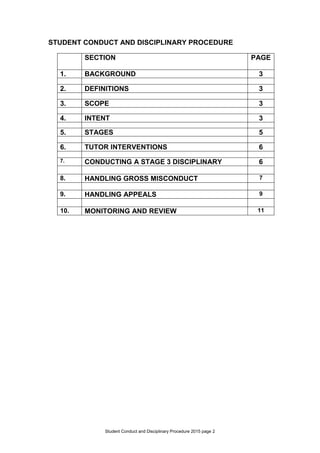
STUDENT CONDUCT AND DISCIPLINARY PROCEDURE
SECTION PAGE
1. BACKGROUND 3
2. DEFINITIONS 3
3. SCOPE 3
4. INTENT 3
5. STAGES 5
6. TUTOR INTERVENTIONS 6
7. CONDUCTING A STAGE 3 DISCIPLINARY 6
8. HANDLING GROSS MISCONDUCT 7
9. HANDLING APPEALS 9
10. MONITORING AND REVIEW 11
Student Conduct and Disciplinary Procedure 2015 page 3
STUDENT CONDUCT AND DISCIPLINARY PROCEDURE
1. BACKGROUND
There are occasions when the behaviour of some students is not appropriate or
acceptable for the College environment, disrupts others and interferes with learning,
and falls outside what is expected of students in the Student Charter. The Disciplinary
procedure aims to be a supportive and restorative process that enables such students
to improve their behaviour and get back on track to complete their courses and
succeed. The Procedure covers both academic misconduct and general misconduct.
Very few students, relative to the size of the College, are excluded from study – just
10 in 2013-14, against a full time cohort of over 3800 students. The Procedure has a
number of stages of increasing formality according to the severity of the behaviour.
2. DEFINITIONS
Academic misconduct that could invoke disciplinary action might involve failure to
attend lessons, falling behind with work or assignment submission, or failing to meet
agreed targets.
General misconduct includes swearing and disobedience, disrupting a lesson or
poor behaviour affecting others around College.
Gross misconduct includes intentional plagiarism or cheating in exams, fighting,
online bullying and harassment, substance misuse or bringing the College’s name into
disrepute.
Suspension means asking a student not to attend College for a fixed period of time in
order to allow investigation without prejudice.
3. SCOPE
3.1 The Student Conduct and Disciplinary Procedure is a guide to procedures for
all College staff, job applicants, students and prospective students, volunteers
and governors whether they work or study in the main College campuses,
outreach centres, or other designated areas. Note:
 for HE learners, these procedures will apply unless they are overridden by an
HE Partner Institution’s disciplinary procedures, especially in the case of
academic misconduct.
 For learners for whom sub-contractors provide the teaching and learning,
these procedures will apply unless the sub-contractor has an agreed
disciplinary policy and both parties (the College and sub-contractor) agree to
its use
3.2 The Procedure applies to students on work experience placements and work-
based and workplace learning programmes, and those engaged on any
College-organised off site activity including College parties and RAG Day, off-
site trips, and using transport to and from College.
Student Conduct and Disciplinary Procedure 2015 page 4
4. INTENT
The intent of the Student Conduct and Disciplinary Procedure is to ensure that:
4.1 A restorative approach is adopted towards students whose behaviour falls
outside the standards of the Student Code of Conduct and is disrupting the
learning of the student and that of other students.
4.2 The Procedure contributes to the improved attendance, retention and
achievement of College students.
4.2 Poor behaviour is dealt with supportively and consistently across College.
4.3 Where possible students are supported in their attempts to reform their
behaviour before sanctions are imposed. In the case of gross misconduct
however a student is likely to proceed directly to Stage 3 of the Procedure.
4.4 The College takes seriously, and deals effectively with, substance misuse and
any form of bullying, harassment or discrimination.
Student Conduct and Disciplinary Procedure 2015 page 5
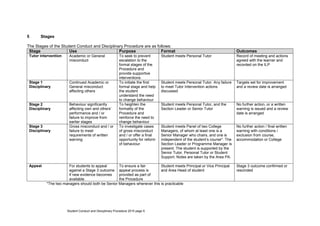
5 Stages
The Stages of the Student Conduct and Disciplinary Procedure are as follows:
Stage Use Purpose Format Outcomes
Tutor intervention Academic or General
misconduct
To seek to prevent
escalation to the
formal stages of the
Procedure and
provide supportive
interventions
Student meets Personal Tutor Record of meeting and actions
agreed with the learner and
recorded on the ILP
Stage 1
Disciplinary
Continued Academic or
General misconduct
affecting others
To initiate the first
formal stage and help
the student
understand the need
to change behaviour
Student meets Personal Tutor. Any failure
to meet Tutor Intervention actions
discussed
Targets set for improvement
and a review date is arranged
Stage 2
Disciplinary
Behaviour significantly
affecting own and others’
performance and / or
failure to improve from
earlier stages
To heighten the
formality of the
Procedure and
reinforce the need to
change behaviour
Student meets Personal Tutor, and the
Section Leader or Senior Tutor
No further action, or a written
warning is issued and a review
date is arranged
Stage 3
Disciplinary
Gross misconduct and / or
failure to meet
requirements of written
warning
To investigate cases
of gross misconduct
and / or offer a final
opportunity for reform
of behaviour
Student meets Panel of two College
Managers, of whom at least one is a
Senior Manager who chairs, and one is
independent of the student’s course*. The
Section Leader or Programme Manager is
present. The student is supported by the
Senior Tutor, Personal Tutor or Student
Support. Notes are taken by the Area PA.
No further action / final written
warning with conditions /
exclusion from course,
accommodation or College
Appeal For students to appeal
against a Stage 3 outcome
if new evidence becomes
available.
To ensure a fair
appeal process is
provided as part of
the Procedure
Student meets Principal or Vice Principal
and Area Head of student
Stage 3 outcome confirmed or
rescinded
*The two managers should both be Senior Managers whenever this is practicable
Student Conduct and Disciplinary Procedure 2015 page 6
6 Tutor interventions
Personal tutors should consider the following support strategies to help students
whose behaviour or attitude is starting to cause concern. The list is not exhaustive.
 Discuss the student with the Programme Team (and College Residential staff
in the case of a student in College accommodation), and ask the Senior Tutor
to check the At Risk database for relevant information
 Contact parents / carers and / or key worker / Leaving Care social worker, as
relevant
 Draw up a contract for attendance, submission of work etc
 Arrange learning support assessment if required, or liaise with LSA if an
existing arrangement is already in place.
 Refer to Counselling support where there are complex mental health issues
 Check whether Student Support can help with Finances, transport etc.
 Provide a Buddy or Mentor from staff or other students
 Consider Health Promotions, Multifaith and Enrichment support, (e.g. Sports
Maker and Bridgwater Student Liaison Officer) as appropriate
 Seek Careers advice from the Careers Shop service
 Identify whether a transfer to another programme would help the student to
refocus
 Consider whether LRC staff can help with study skills
7 Conducting a Stage 3 Disciplinary
7.1 Invitations
The Stage 3 Disciplinary should take place within 10 days of being called.
For students under 18 at the start of their course:
The Area Office writes to the student inviting them to the Stage 3 and requesting the
presence of a parent or carer. The student may request support from an advocate,
which the College can arrange on request. If a student and parents or carers wish to
bring legal representation, the Principal of the College requests 48 hours’ notice of
this.
If an under-18 student arrives without a parent or carer, the Disciplinary can take
place, but any Panel decision to exclude a student should be discussed with the
parent or carer, by phone if necessary, before it is ratified by the Panel.
For students over 18 at the start of their course:
The Area Office writes only to the student and does not invite a parent or carer.
If a student fails to attend a Stage 3 Disciplinary the Panel may reach a conclusion in
the student’s absence, unless it is felt that the failure to attend makes this impossible
– in this case the Stage 3 Disciplinary will be rescheduled.
7.2 Information preparation
The Area office should prepare information related to the Disciplinary. This may include
evidence, such as witness statements of what is alleged to have happened, and should
include information that allows the Panel to assess what impact the student’s behaviour
Student Conduct and Disciplinary Procedure 2015 page 7
is having on their attendance and submission of work and therefore their capacity to
achieve. ILP records should be made available.
7.3 Procedure
A Stage 3 Disciplinary should follow the format below:
1 The Chair introduces those present, and explains the Disciplinary
Procedure and the possible outcomes at Stage 3, and how the meeting will
be conducted.
2 The Section Leader or Programme Manager presents the reasons for the
Disciplinary Procedure and is able to question the student.
3 The student gives their own account of what happened, and is able to call
on any witnesses or advocates, including parents / carers.
4 The Panel questions the Section Leader and student and any witnesses or
advocates. The Senior Tutor should seek to ensure the student has been
able to speak and treated fairly.
5 The Chair asks all parties whether they have been able to say everything
they wanted.
6 The Panel recalls all to the room and announces the outcome, and provides
this in writing within five working days.
8 Handling gross misconduct
8.1 Conducting an Investigation
Especially in the case of gross misconduct, an immediate investigation may be required.
 The first staff member on the scene should ensure the safety of those involved,
calling emergency services if required.
 Where an injury has occurred, this takes priority and must be dealt with first, with
support from the Duty Manager and College First Aid team.
 The Senior Tutor (or Section Leader in their absence) should carry out an initial
interview and take notes.
 At this stage suspension may be necessary for the safety of those involved or
others – see ‘Suspension’ below.
As soon as possible:
 Students and staff involved, including any witnesses identified, should be asked
to write their versions of the event, signed and dated. A Student Statement form
is available for this. Students should be separated from each other while this
takes place. A member of staff should NOT write a statement on behalf of a
student, unless a student is unable to write it themselves. In this case the
statement should be read back to the student who should then sign it to confirm
its accuracy.
Student Conduct and Disciplinary Procedure 2015 page 8
 Any item considered useful evidence, e.g. CCTV footage, a sketch of an area at
the time of an incident, should be retained.
Following the investigation, if there is sufficient evidence then the Area Head (or in
exceptional circumstances other members of SMT except Principalship) will invoke the
disciplinary procedure, which is likely to be at Stage 3 for an incident requiring
investigation. (see Section 6 above).
Note that a member of staff conducting an investigation is not in a position to comment
on the potential outcome.
Ensure that where a group or number of students is involved in a case of gross
misconduct, for example if there is a fight, that those involved are investigated and
treated equally.
Cases of bullying, harassment or discrimination, and substance misuse will be treated
extremely seriously and will normally be escalated straight to Stage 3. However it is not
possible to exclude a student without carrying out a Stage 3 Disciplinary Procedure.
8.2 Criminal Incidents
The police are likely to be involved where a gross misconduct incident occurs, for
example, theft, the use or carrying of an offensive weapon, physical or sexual
harassment or assault, vandalism, arson, or substance misuse. The College
Disciplinary Procedure will be followed, but timing and procedure may be affected by
the police investigation and actions.
Other incidents which may compromise the safety of students such as threats outside
college, disputes on buses or safeguarding issues may also be reported to the police,
following a decision by the Head of Student Services or Principalship.
8.3 Suspension
Suspension is normally only used for gross misconduct, or for incidents where it is
necessary to remove the student from College for reasons of safety, i.e. there is
significant risk to the student or to others. If a suspended student does attend College,
the Senior Tutor or Area Head should be contacted immediately.
Suspension Procedure
 A student may only be suspended with the authorisation of SMT but the
suspension can be carried out by a member of CMT or SMT.
 The suspending manager will explain to the student why s/he is being
suspended and the conditions of the suspension
 If the student is under 18, parents/carers must be contacted by the Senior Tutor
to explain the suspension and to agree arrangements for sending the student
home.
 If the student is employed, the Section Leader must arrange for the Training
Officer and Employer to be informed of the suspension
 If the student is able to return home safely s/he may be sent home once the
suspension has been explained. If the student is unable to leave immediately,
suitable supervision arrangements must be made by the student’s Section
Leader until the student is able to leave
Student Conduct and Disciplinary Procedure 2015 page 9
 The Area Office will contact College and Student Support teams to inform staff
that the named student has been suspended
 The Area Head will send a letter confirming the suspension to the student and,
as appropriate, to parents/carers and employers, within two days of the
suspension.
 If the student is in College residential accommodation, suitable arrangements
must be made by the Section Leader and the Student Liaison Team.
Time Periods for Suspension
Suspension are normally for a fixed period of up to 5 working days, with reasons given
for any extension - and must be followed up by appropriate disciplinary action, Stage 3
in most cases.
8.4 Exclusion
Exclusion is a potential outcome of the Stage 3 Panel and can be applied in three
specific modes:
1. Permanent Exclusion from the College – Any future reference provided by
the College will indicate that this was the outcome of a Stage 3 Panel Meeting.
Any future application by that student to the College will not be considered
unless there is authorisation from the Head of Student Services. Any attempt by
the student to by-pass this authorisation will nullify any offer.
2. Exclusion from the Programme – Any future reference request made will
indicate that this was the outcome of a Stage 3 Panel Meeting. Any future
application by that student to the College may be considered provided there is
sufficient evidence that the student has matured significantly to benefit from
College.
3. Exclusion from Accommodation - Students excluded from College
accommodation may continue to attend their programme as day students.
Note that immediate suspension of a student is permissible in the case of gross
misconduct, but immediate exclusion is not. Any exclusion should be preceded by a
Stage 3 Panel meeting, or a reconvened Stage 3 Panel if a student has not met the
terms of an earlier panel.
9 Handling Appeals
9.1 Overview
If a student wishes to appeal against the decision of a Stage 3 Panel, this must be done
within 5 working days of the date of the decision letter.
A student can only appeal against the decision, stating their reasons, on the following
grounds:
 The Panel did not consider all the relevant evidence
 Information is now available which was not available to the student or the Panel at
the time
 The correct disciplinary procedure was not followed by the Panel
Student Conduct and Disciplinary Procedure 2015 page 10
Following a request for an appeal, an Appeal Panel chaired by the Principal or Vice
Principal will be set up by a Principalship PA within 10 working days of receipt of the
request. This will enable the student to prepare his/her appeal case. A letter will be
sent to the student giving details of the Appeal Panel, the right to representation and
support available from Student Support Officers or Senior Tutors. The Appeal Panel
will consider a report from the Chair of the Stage 3 Panel and evidence from the student
concerned.
The student must have access to all briefing notes and other relevant papers considered
by the Panel, with names blanked out for witnesses who do not wish to be identified.
The student must be aware of any meetings, correspondence or consideration of facts
or evidence available to the Panel. This is the last chance that a student has to make a
case to the College. It is therefore crucial that the student feels that the meeting is
unbiased and gives him/her a fair hearing. If the student indicates that he/she will be
represented by a lawyer, advice should be sought from the Principalship.
The Area or Principalship PA will coordinate the Appeal proceedings and will be the
contact person for the appellant and take detailed notes during the hearing.
Effort must be made to make the Appeal procedure as comfortable as possible for the
appellant. The student should be given information about how the meeting will be
conducted, who will be there, how long it is likely to last etc.
The Panel may, but is not obliged to, reach a decision at the meeting. The Panel must
not consider further evidence after the meeting without giving the student the
opportunity to comment on it.
The student will be informed of the decision within 5 working days of the Appeal Hearing.
The decision of the Appeal Panel is final.
Students who wish to challenge this decision should be directed to the College’s
Complaints Policy, which provides details of how to complain to the Governing Body
and to external funding and inspecting bodies.
Ensure that the appellant is informed of the outcome, in writing. This letter should be
signed by the Chair of the Appeal Panel (Principal or Vice Principal).
9.2 Outcomes of an Appeal Hearing
There are three possible outcomes from an Appeal Panel hearing:
 Confirm the earlier decision, i.e. uphold the Stage 3 Panel’s decision to
recommend the exclusion of the student
 Reverse the earlier decision, i.e. reinstate the student on the same programme
with clear targets
 Vary the earlier decision, i.e. reinstate the student on to a different programme
or mode of study
9.3 Procedure
Before the hearing all members of the Appeal Panel will familiarise themselves with the
documentation presented to them.
Student Conduct and Disciplinary Procedure 2015 page 11
At the start of the meeting, the Chair will:
 Introduce the Panel and confirm that they have had no involvement in the
process so far
 Confirm that the appellant is aware of his/her right to be accompanied by a
parent/carer or friend
 Confirm that the appellant is aware that the Appeal Panel’s decision will be final
 Outline the conduct of the meeting
The Chair will then ask the appellant to submit his/her case to the Appeal Panel
The Chair of the Stage 3 Panel will then be given the opportunity to ask the appellant
questions, and members of the Appeal Panel may ask the appellant questions.
The Chair of the Stage 3 Panel will then present the case for the College’s response so
far, and the appellant and/or advocate will be given the opportunity to ask questions
The Appeal Panel members may ask the Chair of the Stage 3 Panel questions.
The Chair will then ask the appellant and the Chair of the Stage 3 Panel to sum up.
The appellant and the Chair of the Stage 3 Panel will then be asked to withdraw and
wait and thanked for their attendance. If it becomes necessary to recall to clarify a point,
then both parties will return. If no recall is required, the notetaker will inform both parties
and release them.
The Appeal Panel will then deliberate and come to a decision which will be
communicated in writing to the appellant. This decision remains confidential until the
appellant has been informed.
10 MONITORING AND REVIEW
10.1 This policy will be reviewed every three years by the Senior Management
Team
10.2 The senior manager with responsibility for the Student Conduct and
Disciplinary Procedure is the Head of Student Services, who will report each
term to SMT and the Academic Standards Committee on the numbers and
types of Disciplinary Procedure.
10.3 This policy should not be read in isolation and should be cross-referenced to
other relevant College policies and procedures, including:
 The Student Charter
 The Student Substance Misuse Policy
 The Equality and Diversity Policy
 The Safeguarding and Child Protection Policy
 The e-Safety Policy
 The Tutorial Policy
 The Teaching, Learning and Assessment Strategy

Student Conduct and Disciplinary Procedure

  • 1.
    Student Conduct andDisciplinary Procedure 2015 page 1 STUDENT CONDUCT AND DISCIPLINARY PROCEDURE Effective for employees, students, governors and volunteers on or after 1 April 2015 Approved by SMT: March 2015 Author: Mark Nettle Next Review Date: March 2018
  • 2.
    Student Conduct andDisciplinary Procedure 2015 page 2 STUDENT CONDUCT AND DISCIPLINARY PROCEDURE SECTION PAGE 1. BACKGROUND 3 2. DEFINITIONS 3 3. SCOPE 3 4. INTENT 3 5. STAGES 5 6. TUTOR INTERVENTIONS 6 7. CONDUCTING A STAGE 3 DISCIPLINARY 6 8. HANDLING GROSS MISCONDUCT 7 9. HANDLING APPEALS 9 10. MONITORING AND REVIEW 11
  • 3.
    Student Conduct andDisciplinary Procedure 2015 page 3 STUDENT CONDUCT AND DISCIPLINARY PROCEDURE 1. BACKGROUND There are occasions when the behaviour of some students is not appropriate or acceptable for the College environment, disrupts others and interferes with learning, and falls outside what is expected of students in the Student Charter. The Disciplinary procedure aims to be a supportive and restorative process that enables such students to improve their behaviour and get back on track to complete their courses and succeed. The Procedure covers both academic misconduct and general misconduct. Very few students, relative to the size of the College, are excluded from study – just 10 in 2013-14, against a full time cohort of over 3800 students. The Procedure has a number of stages of increasing formality according to the severity of the behaviour. 2. DEFINITIONS Academic misconduct that could invoke disciplinary action might involve failure to attend lessons, falling behind with work or assignment submission, or failing to meet agreed targets. General misconduct includes swearing and disobedience, disrupting a lesson or poor behaviour affecting others around College. Gross misconduct includes intentional plagiarism or cheating in exams, fighting, online bullying and harassment, substance misuse or bringing the College’s name into disrepute. Suspension means asking a student not to attend College for a fixed period of time in order to allow investigation without prejudice. 3. SCOPE 3.1 The Student Conduct and Disciplinary Procedure is a guide to procedures for all College staff, job applicants, students and prospective students, volunteers and governors whether they work or study in the main College campuses, outreach centres, or other designated areas. Note:  for HE learners, these procedures will apply unless they are overridden by an HE Partner Institution’s disciplinary procedures, especially in the case of academic misconduct.  For learners for whom sub-contractors provide the teaching and learning, these procedures will apply unless the sub-contractor has an agreed disciplinary policy and both parties (the College and sub-contractor) agree to its use 3.2 The Procedure applies to students on work experience placements and work- based and workplace learning programmes, and those engaged on any College-organised off site activity including College parties and RAG Day, off- site trips, and using transport to and from College.
  • 4.
    Student Conduct andDisciplinary Procedure 2015 page 4 4. INTENT The intent of the Student Conduct and Disciplinary Procedure is to ensure that: 4.1 A restorative approach is adopted towards students whose behaviour falls outside the standards of the Student Code of Conduct and is disrupting the learning of the student and that of other students. 4.2 The Procedure contributes to the improved attendance, retention and achievement of College students. 4.2 Poor behaviour is dealt with supportively and consistently across College. 4.3 Where possible students are supported in their attempts to reform their behaviour before sanctions are imposed. In the case of gross misconduct however a student is likely to proceed directly to Stage 3 of the Procedure. 4.4 The College takes seriously, and deals effectively with, substance misuse and any form of bullying, harassment or discrimination.
  • 5.
    Student Conduct andDisciplinary Procedure 2015 page 5 5 Stages The Stages of the Student Conduct and Disciplinary Procedure are as follows: Stage Use Purpose Format Outcomes Tutor intervention Academic or General misconduct To seek to prevent escalation to the formal stages of the Procedure and provide supportive interventions Student meets Personal Tutor Record of meeting and actions agreed with the learner and recorded on the ILP Stage 1 Disciplinary Continued Academic or General misconduct affecting others To initiate the first formal stage and help the student understand the need to change behaviour Student meets Personal Tutor. Any failure to meet Tutor Intervention actions discussed Targets set for improvement and a review date is arranged Stage 2 Disciplinary Behaviour significantly affecting own and others’ performance and / or failure to improve from earlier stages To heighten the formality of the Procedure and reinforce the need to change behaviour Student meets Personal Tutor, and the Section Leader or Senior Tutor No further action, or a written warning is issued and a review date is arranged Stage 3 Disciplinary Gross misconduct and / or failure to meet requirements of written warning To investigate cases of gross misconduct and / or offer a final opportunity for reform of behaviour Student meets Panel of two College Managers, of whom at least one is a Senior Manager who chairs, and one is independent of the student’s course*. The Section Leader or Programme Manager is present. The student is supported by the Senior Tutor, Personal Tutor or Student Support. Notes are taken by the Area PA. No further action / final written warning with conditions / exclusion from course, accommodation or College Appeal For students to appeal against a Stage 3 outcome if new evidence becomes available. To ensure a fair appeal process is provided as part of the Procedure Student meets Principal or Vice Principal and Area Head of student Stage 3 outcome confirmed or rescinded *The two managers should both be Senior Managers whenever this is practicable
  • 6.
    Student Conduct andDisciplinary Procedure 2015 page 6 6 Tutor interventions Personal tutors should consider the following support strategies to help students whose behaviour or attitude is starting to cause concern. The list is not exhaustive.  Discuss the student with the Programme Team (and College Residential staff in the case of a student in College accommodation), and ask the Senior Tutor to check the At Risk database for relevant information  Contact parents / carers and / or key worker / Leaving Care social worker, as relevant  Draw up a contract for attendance, submission of work etc  Arrange learning support assessment if required, or liaise with LSA if an existing arrangement is already in place.  Refer to Counselling support where there are complex mental health issues  Check whether Student Support can help with Finances, transport etc.  Provide a Buddy or Mentor from staff or other students  Consider Health Promotions, Multifaith and Enrichment support, (e.g. Sports Maker and Bridgwater Student Liaison Officer) as appropriate  Seek Careers advice from the Careers Shop service  Identify whether a transfer to another programme would help the student to refocus  Consider whether LRC staff can help with study skills 7 Conducting a Stage 3 Disciplinary 7.1 Invitations The Stage 3 Disciplinary should take place within 10 days of being called. For students under 18 at the start of their course: The Area Office writes to the student inviting them to the Stage 3 and requesting the presence of a parent or carer. The student may request support from an advocate, which the College can arrange on request. If a student and parents or carers wish to bring legal representation, the Principal of the College requests 48 hours’ notice of this. If an under-18 student arrives without a parent or carer, the Disciplinary can take place, but any Panel decision to exclude a student should be discussed with the parent or carer, by phone if necessary, before it is ratified by the Panel. For students over 18 at the start of their course: The Area Office writes only to the student and does not invite a parent or carer. If a student fails to attend a Stage 3 Disciplinary the Panel may reach a conclusion in the student’s absence, unless it is felt that the failure to attend makes this impossible – in this case the Stage 3 Disciplinary will be rescheduled. 7.2 Information preparation The Area office should prepare information related to the Disciplinary. This may include evidence, such as witness statements of what is alleged to have happened, and should include information that allows the Panel to assess what impact the student’s behaviour
  • 7.
    Student Conduct andDisciplinary Procedure 2015 page 7 is having on their attendance and submission of work and therefore their capacity to achieve. ILP records should be made available. 7.3 Procedure A Stage 3 Disciplinary should follow the format below: 1 The Chair introduces those present, and explains the Disciplinary Procedure and the possible outcomes at Stage 3, and how the meeting will be conducted. 2 The Section Leader or Programme Manager presents the reasons for the Disciplinary Procedure and is able to question the student. 3 The student gives their own account of what happened, and is able to call on any witnesses or advocates, including parents / carers. 4 The Panel questions the Section Leader and student and any witnesses or advocates. The Senior Tutor should seek to ensure the student has been able to speak and treated fairly. 5 The Chair asks all parties whether they have been able to say everything they wanted. 6 The Panel recalls all to the room and announces the outcome, and provides this in writing within five working days. 8 Handling gross misconduct 8.1 Conducting an Investigation Especially in the case of gross misconduct, an immediate investigation may be required.  The first staff member on the scene should ensure the safety of those involved, calling emergency services if required.  Where an injury has occurred, this takes priority and must be dealt with first, with support from the Duty Manager and College First Aid team.  The Senior Tutor (or Section Leader in their absence) should carry out an initial interview and take notes.  At this stage suspension may be necessary for the safety of those involved or others – see ‘Suspension’ below. As soon as possible:  Students and staff involved, including any witnesses identified, should be asked to write their versions of the event, signed and dated. A Student Statement form is available for this. Students should be separated from each other while this takes place. A member of staff should NOT write a statement on behalf of a student, unless a student is unable to write it themselves. In this case the statement should be read back to the student who should then sign it to confirm its accuracy.
  • 8.
    Student Conduct andDisciplinary Procedure 2015 page 8  Any item considered useful evidence, e.g. CCTV footage, a sketch of an area at the time of an incident, should be retained. Following the investigation, if there is sufficient evidence then the Area Head (or in exceptional circumstances other members of SMT except Principalship) will invoke the disciplinary procedure, which is likely to be at Stage 3 for an incident requiring investigation. (see Section 6 above). Note that a member of staff conducting an investigation is not in a position to comment on the potential outcome. Ensure that where a group or number of students is involved in a case of gross misconduct, for example if there is a fight, that those involved are investigated and treated equally. Cases of bullying, harassment or discrimination, and substance misuse will be treated extremely seriously and will normally be escalated straight to Stage 3. However it is not possible to exclude a student without carrying out a Stage 3 Disciplinary Procedure. 8.2 Criminal Incidents The police are likely to be involved where a gross misconduct incident occurs, for example, theft, the use or carrying of an offensive weapon, physical or sexual harassment or assault, vandalism, arson, or substance misuse. The College Disciplinary Procedure will be followed, but timing and procedure may be affected by the police investigation and actions. Other incidents which may compromise the safety of students such as threats outside college, disputes on buses or safeguarding issues may also be reported to the police, following a decision by the Head of Student Services or Principalship. 8.3 Suspension Suspension is normally only used for gross misconduct, or for incidents where it is necessary to remove the student from College for reasons of safety, i.e. there is significant risk to the student or to others. If a suspended student does attend College, the Senior Tutor or Area Head should be contacted immediately. Suspension Procedure  A student may only be suspended with the authorisation of SMT but the suspension can be carried out by a member of CMT or SMT.  The suspending manager will explain to the student why s/he is being suspended and the conditions of the suspension  If the student is under 18, parents/carers must be contacted by the Senior Tutor to explain the suspension and to agree arrangements for sending the student home.  If the student is employed, the Section Leader must arrange for the Training Officer and Employer to be informed of the suspension  If the student is able to return home safely s/he may be sent home once the suspension has been explained. If the student is unable to leave immediately, suitable supervision arrangements must be made by the student’s Section Leader until the student is able to leave
  • 9.
    Student Conduct andDisciplinary Procedure 2015 page 9  The Area Office will contact College and Student Support teams to inform staff that the named student has been suspended  The Area Head will send a letter confirming the suspension to the student and, as appropriate, to parents/carers and employers, within two days of the suspension.  If the student is in College residential accommodation, suitable arrangements must be made by the Section Leader and the Student Liaison Team. Time Periods for Suspension Suspension are normally for a fixed period of up to 5 working days, with reasons given for any extension - and must be followed up by appropriate disciplinary action, Stage 3 in most cases. 8.4 Exclusion Exclusion is a potential outcome of the Stage 3 Panel and can be applied in three specific modes: 1. Permanent Exclusion from the College – Any future reference provided by the College will indicate that this was the outcome of a Stage 3 Panel Meeting. Any future application by that student to the College will not be considered unless there is authorisation from the Head of Student Services. Any attempt by the student to by-pass this authorisation will nullify any offer. 2. Exclusion from the Programme – Any future reference request made will indicate that this was the outcome of a Stage 3 Panel Meeting. Any future application by that student to the College may be considered provided there is sufficient evidence that the student has matured significantly to benefit from College. 3. Exclusion from Accommodation - Students excluded from College accommodation may continue to attend their programme as day students. Note that immediate suspension of a student is permissible in the case of gross misconduct, but immediate exclusion is not. Any exclusion should be preceded by a Stage 3 Panel meeting, or a reconvened Stage 3 Panel if a student has not met the terms of an earlier panel. 9 Handling Appeals 9.1 Overview If a student wishes to appeal against the decision of a Stage 3 Panel, this must be done within 5 working days of the date of the decision letter. A student can only appeal against the decision, stating their reasons, on the following grounds:  The Panel did not consider all the relevant evidence  Information is now available which was not available to the student or the Panel at the time  The correct disciplinary procedure was not followed by the Panel
  • 10.
    Student Conduct andDisciplinary Procedure 2015 page 10 Following a request for an appeal, an Appeal Panel chaired by the Principal or Vice Principal will be set up by a Principalship PA within 10 working days of receipt of the request. This will enable the student to prepare his/her appeal case. A letter will be sent to the student giving details of the Appeal Panel, the right to representation and support available from Student Support Officers or Senior Tutors. The Appeal Panel will consider a report from the Chair of the Stage 3 Panel and evidence from the student concerned. The student must have access to all briefing notes and other relevant papers considered by the Panel, with names blanked out for witnesses who do not wish to be identified. The student must be aware of any meetings, correspondence or consideration of facts or evidence available to the Panel. This is the last chance that a student has to make a case to the College. It is therefore crucial that the student feels that the meeting is unbiased and gives him/her a fair hearing. If the student indicates that he/she will be represented by a lawyer, advice should be sought from the Principalship. The Area or Principalship PA will coordinate the Appeal proceedings and will be the contact person for the appellant and take detailed notes during the hearing. Effort must be made to make the Appeal procedure as comfortable as possible for the appellant. The student should be given information about how the meeting will be conducted, who will be there, how long it is likely to last etc. The Panel may, but is not obliged to, reach a decision at the meeting. The Panel must not consider further evidence after the meeting without giving the student the opportunity to comment on it. The student will be informed of the decision within 5 working days of the Appeal Hearing. The decision of the Appeal Panel is final. Students who wish to challenge this decision should be directed to the College’s Complaints Policy, which provides details of how to complain to the Governing Body and to external funding and inspecting bodies. Ensure that the appellant is informed of the outcome, in writing. This letter should be signed by the Chair of the Appeal Panel (Principal or Vice Principal). 9.2 Outcomes of an Appeal Hearing There are three possible outcomes from an Appeal Panel hearing:  Confirm the earlier decision, i.e. uphold the Stage 3 Panel’s decision to recommend the exclusion of the student  Reverse the earlier decision, i.e. reinstate the student on the same programme with clear targets  Vary the earlier decision, i.e. reinstate the student on to a different programme or mode of study 9.3 Procedure Before the hearing all members of the Appeal Panel will familiarise themselves with the documentation presented to them.
  • 11.
    Student Conduct andDisciplinary Procedure 2015 page 11 At the start of the meeting, the Chair will:  Introduce the Panel and confirm that they have had no involvement in the process so far  Confirm that the appellant is aware of his/her right to be accompanied by a parent/carer or friend  Confirm that the appellant is aware that the Appeal Panel’s decision will be final  Outline the conduct of the meeting The Chair will then ask the appellant to submit his/her case to the Appeal Panel The Chair of the Stage 3 Panel will then be given the opportunity to ask the appellant questions, and members of the Appeal Panel may ask the appellant questions. The Chair of the Stage 3 Panel will then present the case for the College’s response so far, and the appellant and/or advocate will be given the opportunity to ask questions The Appeal Panel members may ask the Chair of the Stage 3 Panel questions. The Chair will then ask the appellant and the Chair of the Stage 3 Panel to sum up. The appellant and the Chair of the Stage 3 Panel will then be asked to withdraw and wait and thanked for their attendance. If it becomes necessary to recall to clarify a point, then both parties will return. If no recall is required, the notetaker will inform both parties and release them. The Appeal Panel will then deliberate and come to a decision which will be communicated in writing to the appellant. This decision remains confidential until the appellant has been informed. 10 MONITORING AND REVIEW 10.1 This policy will be reviewed every three years by the Senior Management Team 10.2 The senior manager with responsibility for the Student Conduct and Disciplinary Procedure is the Head of Student Services, who will report each term to SMT and the Academic Standards Committee on the numbers and types of Disciplinary Procedure. 10.3 This policy should not be read in isolation and should be cross-referenced to other relevant College policies and procedures, including:  The Student Charter  The Student Substance Misuse Policy  The Equality and Diversity Policy  The Safeguarding and Child Protection Policy  The e-Safety Policy  The Tutorial Policy  The Teaching, Learning and Assessment Strategy