By the endof the session, you will have….
___ more about student-centered
approaches;
practiced utilizing them in different
_____;
and been able to practice ways of
introducing and using these methods
that are advantageous to students,
schools, and _____.
3.
By the endof the session, you will have….
learned more about student-centered
approaches; practiced utilizing them
in different contexts; and been able to
practice ways of introducing and using
these methods that are advantageous
to students, schools, and
counterparts.
4.
Guiding Questions
1. Whatis student-centered approach to teaching?
2. Why is it better to use student-centered approach
to teaching?
3. Why do some teachers find student-centred
approach to teaching challenging?
4. What are some examples of student-centred
methods/activities?
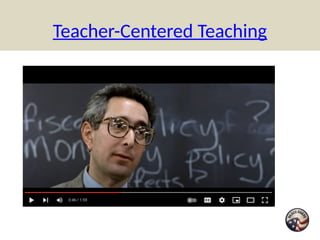
Teacher-Centered Teaching
▪ FerrisBueller scene
– What makes this classroom “teacher-centered”?
– How are the students reacting?
▪ Armenian context
– “teacher-centered” lessons
• common to have lectures and activities directly from
textbook
– More common with older teachers with
experience in Soviet-style schools
7.
Student-Centered Teaching
Learners:
▪ Areactive participants in their own learning.
▪ Work in collaboration with other learners.
▪ Produce work that demonstrates authentic
learning.
Instructors:
▪ Help learners work through difficulties by asking
open-ended questions to help them arrive at
conclusions or solutions that are satisfactory to
them.
▪ Encourage and facilitate learners’ shared decision-
making. Corley, M. Student-Centered Learning. Fact Sheet . Sacramento :
Teaching Excellence in Adult Literacy , 2010.
8.
Why should ourinstruction be
student-centered?
▪ Students learn to learn
▪ Students feel more engaged
▪ Students learn how to build collaboration skills and
gain confidence in knowledge of the lesson.
▪ Students learn how to solve problems and about
the relationship between rights and
responsibilities.
▪ Student-centred instruction leads to long-term
retention.
RAO, N KUTUMBA. “ADVANTAGES AND DISADVANTAGES OF STUDENT
CENTERED LEARNING.” Research Journal of English Language and
Literature (2020): 132-134.
9.
Potential Challenges
▪ Workingwith counterparts (chaos, noise)
▪ Some students prefer working alone rather than in
groups.
– Armenian context: Students may be entirely unfamiliar
with concepts like pair work or “turn and talk”
▪ Delivering important facts to the whole class.
▪ Running out of classroom ideas
▪ Challenging to explain complicated activities
▪ Still teaching to the textbook
▪ Other?
10.
Necessary Modifications
▪ Theformat of interactions
– How do you present information to
students?
▪ The content
– Adapting curriculum
▪ The role of teacher
– Maintaining leading role while allowing
students more active roles
11.
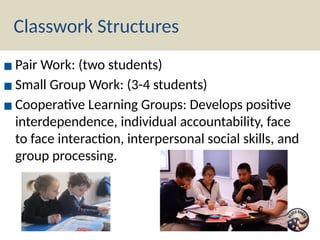
▪ Pair Work:(two students)
▪ Small Group Work: (3-4 students)
▪ Cooperative Learning Groups: Develops positive
interdependence, individual accountability, face
to face interaction, interpersonal social skills, and
group processing.
Classwork Structures
12.
Role Play
▪ Realisticsituation practice
▪ Speaking skills and producing language
▪ Can be used for different situations!
▪ What role-play activities have you engaged in?
– during PST language training or
– previous language learning experiences
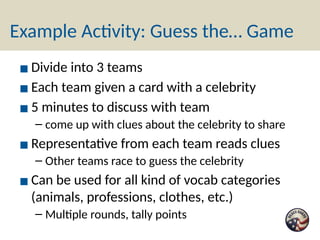
Example Activity: Guessthe… Game
▪ Divide into 3 teams
▪ Each team given a card with a celebrity
▪ 5 minutes to discuss with team
– come up with clues about the celebrity to share
▪ Representative from each team reads clues
– Other teams race to guess the celebrity
▪ Can be used for all kind of vocab categories
(animals, professions, clothes, etc.)
– Multiple rounds, tally points
15.
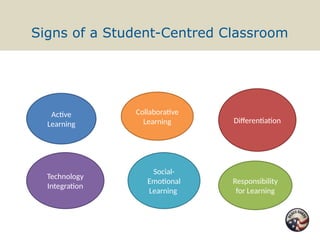
Signs of aStudent-Centred Classroom
Active
Learning
Collaborative
Learning
Technology
Integration
Social-
Emotional
Learning
Differentiation
Responsibility
for Learning
16.
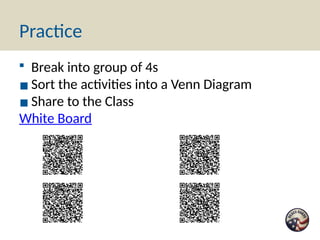
Practice
▪ Break intogroup of 4s
▪ Sort the activities into a Venn Diagram
▪ Share to the Class
White Board
17.
Application
▪ W/ yourpartner find another pair to work in groups of 4
▪ Use an activity from the book that is usually teacher
centered and make it student centered (think what
student-centered practices work best for your activity).
▪ Each pair will have 30 minutes to prepare the activity.
Feel free to use whatever materials are available!
▪ Each pair will present their activity. Think about how you
would address these questions:
– How will you suggest this activity to your counterpart?
– What is the goal/objective of this activity? Does it
meet this goal?
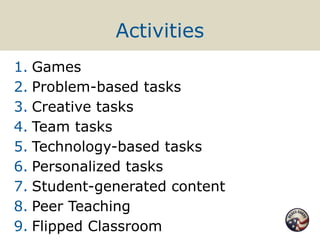
#13 Flipped Classroom - Instead of getting information at school then practicing at home through homework, they do the opposite. They gather information at home and work with it at school.