1st Year Masters:
The Wadeye Cultural Precinct has been
designed with high regards and a great
deal of consideration towards the
community of Wadeye. After ten days on
site consulting with the community in
Wadeye the design produced best reflects
the community’s current and future needs
and wants. The proposed design also
has the flexibility to allow for potential
future expansion; ensuring it does not
prevent any future potential additions to
the cultural precinct and allows for more
buildings to be added as required.
Story:
Whilst in Wadeye we were told by Mark
Crocombe story of the community; it is
said that in the Dreamtime the people
of Wadeye all lived together under one
they all knew as Rainbow; however,
after rainbow was killed the people left
and dispersed throughout the lands as
different clans. It wasn’t until 1939 under
Father Docherty that the dispersed clans
all came back to form the Wadeye we
know today.
Design:
This story has become a major factor in
determining the concept of the Wadeye
Cultural Precinct. As the community of
Wadeye has become a place where many
different clans from the North, south, east
and west have come, the concept chosen
for the design is “Meeting Place” an area
which draws people from all corners of
the land to a central place which can
be shared and utilised for everyday use
as well as for more formal settings. The
precinct aims to bring together people
from different clans as well as bringing
together a variety of different functions
such as museum, recording studio,
creative spaces, etc in one precinct. A
second driving factor for the design is the
growing issue of the disconnection of the
youth from their heritage and culture. The
design for the cultural precinct will aim at
recreating the connection for the youth of
the community.
Wadeye Cultural Precinct
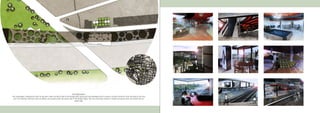
.....the youth of Wadeye are becoming more disconnected from their culture and heritage, by creating a visual connection
between the cultural precinct and the recreation/youth centre we can begin to bridge that gap...
Creative Space Pavilion 01 is
located along the eastern face
of the precinct. It consists of two
separate covered spaces, which
can be made more public or private
by the user by simply rotating
the manual louvers. The use of
the space is not dictated and is
therefore multi-functional and
versatile for its users.
Creative Space Pavilion 01
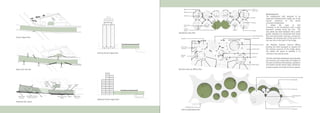
This section illustrates the North-
South correlation of the Precinct.
It shows the axes which passes
through the site connecting the
youth centre/recreation centre
back to the cultural centre; the
importance of this connection
is to regenerate the tie between
the youth and their culture and
heritage. The renders illustrate
different locations on site and
potential functions they serve.
Section A-A
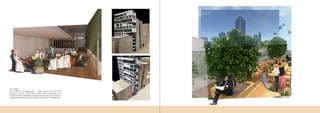
This illustration depicts the
Creative Space Pavilion 01 being
utilised in a relaxed and casual
manner. As can be seen the louvres
are in an open position making the
space less ‘private’ and maximising
ventilation through the space.
Creative Space Pavilion 01 Exterior
This illustration shows the end of
the main ‘Connection Axes’ This
axes commences near the youth
centre/recreation centre and
leads to the heart of the Cultural
Precinct. It acts as a ‘guide’ for the
youth reconnecting them to their
culture. While walking along the
axes you pass history panels (see
cover page) as well as the entry
to the museum, gallery and new
recording studio.
The ‘Connection Axes’
k20 Architecture:
K20 Architecture was awarded an early
years hub by Knox City Council. The
following drawings are extracts from k20
Architecturesdesignfiles.Ihavepersonally
been working on this project from
inception through to Design Development.
The provided plans and internal elevations
are in Design Development phase.
Design:
The design for the Bayswater Early
Years Hub located at 41 Phyllis Street
in Bayswater explores the relationship
between the elements of sunshine, natural
light, materiality and the surrounding
environment.
The Early Years Hub is designed to set
a new benchmark for a Council building
as an environmentally, socially and
economically sustainable project aimed
at a 100+ year
lifecycle, with the intention to operate
under its own power and water supply
with reduced maintenance and operation
costs. As such the project has been crafted
to incorporate an open and flexible design
that can successfully accommodate
multi–uses and will enable Council to
accommodate diverse functions and
changing community needs over time.
Inclusions:
•	 105 long day care places per day:
•	 For 0 to 2 year olds - 3 rooms with 12
places each
•	 For 2 to 3 year olds - 3 rooms with 16
places each
•	 For 3 to 5 year olds - 1 room with 33
places
•	 33 places per day for 4 year old
sessional preschool
•	 A shared outdoor play space for the
long day care and sessional preschool
programs
•	 1 playgroup room with an outdoor play
space
•	 2 Maternal Child Health offices
•	 1 Allied Health consulting suite
•	 Kitchen and dining area for children
Bayswater Early Years Hub
Note: This following images are property of and copyright by k20 Architecture. They are extracts from a project
I worked on while employed at k20 Architecture. The use of these image is strictly for representation of work
experiences and should not be used or copied in any way. They remain solely the property of k20 Architecture
Note: This following images are property of and copyright by k20 Architecture. They are extracts from a project
I worked on while employed at k20 Architecture. The use of these image is strictly for representation of work
experiences and should not be used or copied in any way. They remain solely the property of k20 Architecture
k20 Architecture:
K20 Architecture was awarded several
smaller kindergarten refurbishment
projects in Mornington by the
Mornington Peninsula Shire Council. The
following drawings are extracts from k20
Architectures design files. I was fortunate
enough to have run most of these projects
from inception through to construction.
Several of the projects have recently been
constructed.
Building Inclusions:
The following refurbishments were made
to the original building:
•	 Two new kitchens replacing the
existing
•	 Two new staff and accessible
bathrooms to replace the existing
staff amenities
•	 Two new children’s WC to replace the
existing children’s WC
•	 New art sinks
•	 Removal of asbestos
•	 Upgrading buildings accessibility
standards to meet current Australian
Standards
Detail Drawings:
Not only was I required to produce site
plans, floor plans, detail plans, sections
and internal and external elevations,
but I was required to draw details for
joinery and more intricate sections of the
buildings.
The images to the left are a few details
drawn for this particular project, they
illustrate that when I create a drawing
I am able to understand how it is put
together and how it could be constructed
in reality.
Waterfall Gully Preschool
Note: This following images are property of and copyright by k20 Architecture. They are extracts from a project
I worked on while employed at k20 Architecture. The use of these image is strictly for representation of work
experiences and should not be used or copied in any way. They remain solely the property of k20 Architecture
Note: This following images are property of and copyright by k20 Architecture. They are extracts from a project
I worked on while employed at k20 Architecture. The use of these image is strictly for representation of work
experiences and should not be used or copied in any way. They remain solely the property of k20 Architecture
3rd year studio:	
Type: Architectural Masterplan, Mixed use
zones, making good to unused urban/
industrial spaces.
Location: Thevolumeofsilosandadjoining
space under the bridge located at the
Punt Road and Yarra River intersection,
Cremorne, Melbourne.
Concept
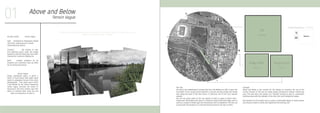
Above and Below is the concept for this
design, to maintain the use of the current
function of the site by simply adding
architecture without subtracting area.
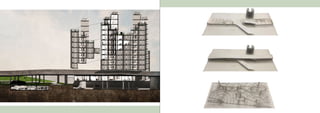
This idea led to the design of a ‘floating’
building as well as ‘submersed’ building
along with the redesign of the silos into
multi-residential towers.
My intention for this project was to create
a sustainable design to reduce waste and
recycle as well as renew and regenerate
the existing site.
Redevelopment
The underground café, designed to be
made with rammed earth, makes use
of the natural conditions of the earths
consistent temperature.
It allows the users to feel immersed in
the environment with a large panoramic
window facing the river. The area above
has been designed into a public garden,
allowing it to rejuvenate with native flora
and fauna while creating a connection
between the existing park to the north
and the river trail to the south of the
bridge.
The ‘floating’ business start-up office’s
building has been designed to suspend
off the existing structure of the bridge
above, this allows the space to beneath it
to continue to be used by locals.
The silos have been designed to use
only what was existing, and simply alter
the heights of the silos to enhance the
building’s aesthetics and further provide
natural light, ventilation, as well as green
roof areas for the occupants
Above and Below - Terrain Vague
2nd year studio
	
Type: Sustainable Design, integration of
architecture into the natural environment
Location: Djilimbardi, near the Fitzroy
Crossing, Western Australia
Brief: Private accommodation and design
studio for five architects as well as
separate accommodation for 16 Eco-
tourists. The total enclosed area should
be no greater than 400m3 with a footprint
of 300m2 or less. The design must
consider the local climate and include
passive and low embodied energy design
strategies. Considerations must also be
made towards universal accessibility and
access for all ages.
Concept
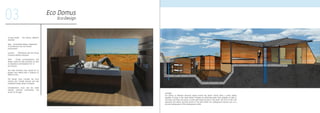
Eco Domus in Western Australia based
around the desert Thorny Devil, a small
reptile capable of living in the harsh
desert climates by obtaining water from
droplets of dew in the early mornings and
living in small self-made burrows in the
earth. The form of the roof replicates the
water catching thorns of the devil while
the underground section acts as a burrow
making good of the underground coolth.
The Design
Taking into consideration the vast flat
surrounds, Eco Domus breaks the surface
of the earth to divide the land and add
point of interest to a flat landscape. The
form of the roof represents the thorns
along the back and tail of the Thorny
Devil semi-submerged in a burrow in the
desert sands. The structure takes into
consideration the needs of its surrounding
ecosystem and recognises equity for all
users.
The building allows the users to feel in
touch with the natural surrounds through
the use of a private semi submerged
outdoor meeting courtyard, this courtyard
also provides a separation between the
architects and tourists.
Eco Domus - Eco-Design
Easterly sun direction Separation of noise, privacy
and pedestrian movement
Potential core elevator
shaft
Proposed design
Views and light for residents
Public
Private
Homes
Offices
North Facing Facade
1st year studio
Type: Mixed use high-rise, including SoHo
(Small office Home office)
Brief: To design an urban high-rise
hybridscape to cater for several SoHo
(Small office Home office as well as a
retail space. Height of building must not
exceed surrounding buildings in the area
Concept
The building blocks of this design
stemmed from a game of Jenga; the
idea to build a tall narrow building with
‘hollowed’ sections to provide for natural
ventilation and air high air quality for a
dense living environment. The building
incorporates vertical gardens to make CBD
living easier, and bring some greenery
back into a relatively dull coloured street.
The fundamental intentions behind the
design was to create more than just a
house and an office, it was to create a
sustainable Habitat for the end users.
Site
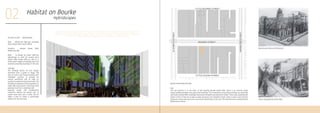
The site location is in the heart of the
bustling Bourke Street Mall. There is an
existing single
storey building between two large retail
buildings. The immediate surrounding
buildings are generally retail with several
office buildings found past Elizabeth and
Swanston Street. Trams pass along Bourke
Street in front of the site as well as down
Swanston and Elizabeth Street. There is
never a dull moment along this street with
musicians and artists performing in the
area. The Architecture is predominantly
Renaissance revival.
The Design
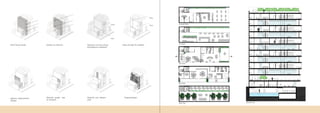
The building is designed with a ground
level café, first level restaurant, SoHo’s –
Small office / Home office (a combination
of residences with independent offices)
from level two and above, an underground
private pool and a private roof deck for
the inhabitants.
Habitat on Bourke - Hybridscapes
Dates vary
Type:	 Animal portraiture, wildlife
art, also capable of drawing people.
Media: Soft pastels and soft pastel
pencil, charcoal
Artworks
This section is a compilation of
several of my drawings; they are
depicted using soft pastels and
soft pastel pencils.
In addition to soft pastels I possess
the ability to draw using other
media
including: graphite, charcoal and
paints to name a few.
Personal Art

Architectural Design Portfolio

  • 2.
    1st Year Masters: TheWadeye Cultural Precinct has been designed with high regards and a great deal of consideration towards the community of Wadeye. After ten days on site consulting with the community in Wadeye the design produced best reflects the community’s current and future needs and wants. The proposed design also has the flexibility to allow for potential future expansion; ensuring it does not prevent any future potential additions to the cultural precinct and allows for more buildings to be added as required. Story: Whilst in Wadeye we were told by Mark Crocombe story of the community; it is said that in the Dreamtime the people of Wadeye all lived together under one they all knew as Rainbow; however, after rainbow was killed the people left and dispersed throughout the lands as different clans. It wasn’t until 1939 under Father Docherty that the dispersed clans all came back to form the Wadeye we know today. Design: This story has become a major factor in determining the concept of the Wadeye Cultural Precinct. As the community of Wadeye has become a place where many different clans from the North, south, east and west have come, the concept chosen for the design is “Meeting Place” an area which draws people from all corners of the land to a central place which can be shared and utilised for everyday use as well as for more formal settings. The precinct aims to bring together people from different clans as well as bringing together a variety of different functions such as museum, recording studio, creative spaces, etc in one precinct. A second driving factor for the design is the growing issue of the disconnection of the youth from their heritage and culture. The design for the cultural precinct will aim at recreating the connection for the youth of the community. Wadeye Cultural Precinct .....the youth of Wadeye are becoming more disconnected from their culture and heritage, by creating a visual connection between the cultural precinct and the recreation/youth centre we can begin to bridge that gap... Creative Space Pavilion 01 is located along the eastern face of the precinct. It consists of two separate covered spaces, which can be made more public or private by the user by simply rotating the manual louvers. The use of the space is not dictated and is therefore multi-functional and versatile for its users. Creative Space Pavilion 01
  • 3.
    This section illustratesthe North- South correlation of the Precinct. It shows the axes which passes through the site connecting the youth centre/recreation centre back to the cultural centre; the importance of this connection is to regenerate the tie between the youth and their culture and heritage. The renders illustrate different locations on site and potential functions they serve. Section A-A
  • 4.
    This illustration depictsthe Creative Space Pavilion 01 being utilised in a relaxed and casual manner. As can be seen the louvres are in an open position making the space less ‘private’ and maximising ventilation through the space. Creative Space Pavilion 01 Exterior This illustration shows the end of the main ‘Connection Axes’ This axes commences near the youth centre/recreation centre and leads to the heart of the Cultural Precinct. It acts as a ‘guide’ for the youth reconnecting them to their culture. While walking along the axes you pass history panels (see cover page) as well as the entry to the museum, gallery and new recording studio. The ‘Connection Axes’
  • 5.
    k20 Architecture: K20 Architecturewas awarded an early years hub by Knox City Council. The following drawings are extracts from k20 Architecturesdesignfiles.Ihavepersonally been working on this project from inception through to Design Development. The provided plans and internal elevations are in Design Development phase. Design: The design for the Bayswater Early Years Hub located at 41 Phyllis Street in Bayswater explores the relationship between the elements of sunshine, natural light, materiality and the surrounding environment. The Early Years Hub is designed to set a new benchmark for a Council building as an environmentally, socially and economically sustainable project aimed at a 100+ year lifecycle, with the intention to operate under its own power and water supply with reduced maintenance and operation costs. As such the project has been crafted to incorporate an open and flexible design that can successfully accommodate multi–uses and will enable Council to accommodate diverse functions and changing community needs over time. Inclusions: • 105 long day care places per day: • For 0 to 2 year olds - 3 rooms with 12 places each • For 2 to 3 year olds - 3 rooms with 16 places each • For 3 to 5 year olds - 1 room with 33 places • 33 places per day for 4 year old sessional preschool • A shared outdoor play space for the long day care and sessional preschool programs • 1 playgroup room with an outdoor play space • 2 Maternal Child Health offices • 1 Allied Health consulting suite • Kitchen and dining area for children Bayswater Early Years Hub Note: This following images are property of and copyright by k20 Architecture. They are extracts from a project I worked on while employed at k20 Architecture. The use of these image is strictly for representation of work experiences and should not be used or copied in any way. They remain solely the property of k20 Architecture Note: This following images are property of and copyright by k20 Architecture. They are extracts from a project I worked on while employed at k20 Architecture. The use of these image is strictly for representation of work experiences and should not be used or copied in any way. They remain solely the property of k20 Architecture
  • 6.
    k20 Architecture: K20 Architecturewas awarded several smaller kindergarten refurbishment projects in Mornington by the Mornington Peninsula Shire Council. The following drawings are extracts from k20 Architectures design files. I was fortunate enough to have run most of these projects from inception through to construction. Several of the projects have recently been constructed. Building Inclusions: The following refurbishments were made to the original building: • Two new kitchens replacing the existing • Two new staff and accessible bathrooms to replace the existing staff amenities • Two new children’s WC to replace the existing children’s WC • New art sinks • Removal of asbestos • Upgrading buildings accessibility standards to meet current Australian Standards Detail Drawings: Not only was I required to produce site plans, floor plans, detail plans, sections and internal and external elevations, but I was required to draw details for joinery and more intricate sections of the buildings. The images to the left are a few details drawn for this particular project, they illustrate that when I create a drawing I am able to understand how it is put together and how it could be constructed in reality. Waterfall Gully Preschool Note: This following images are property of and copyright by k20 Architecture. They are extracts from a project I worked on while employed at k20 Architecture. The use of these image is strictly for representation of work experiences and should not be used or copied in any way. They remain solely the property of k20 Architecture Note: This following images are property of and copyright by k20 Architecture. They are extracts from a project I worked on while employed at k20 Architecture. The use of these image is strictly for representation of work experiences and should not be used or copied in any way. They remain solely the property of k20 Architecture
  • 7.
    3rd year studio: Type:Architectural Masterplan, Mixed use zones, making good to unused urban/ industrial spaces. Location: Thevolumeofsilosandadjoining space under the bridge located at the Punt Road and Yarra River intersection, Cremorne, Melbourne. Concept Above and Below is the concept for this design, to maintain the use of the current function of the site by simply adding architecture without subtracting area. This idea led to the design of a ‘floating’ building as well as ‘submersed’ building along with the redesign of the silos into multi-residential towers. My intention for this project was to create a sustainable design to reduce waste and recycle as well as renew and regenerate the existing site. Redevelopment The underground café, designed to be made with rammed earth, makes use of the natural conditions of the earths consistent temperature. It allows the users to feel immersed in the environment with a large panoramic window facing the river. The area above has been designed into a public garden, allowing it to rejuvenate with native flora and fauna while creating a connection between the existing park to the north and the river trail to the south of the bridge. The ‘floating’ business start-up office’s building has been designed to suspend off the existing structure of the bridge above, this allows the space to beneath it to continue to be used by locals. The silos have been designed to use only what was existing, and simply alter the heights of the silos to enhance the building’s aesthetics and further provide natural light, ventilation, as well as green roof areas for the occupants Above and Below - Terrain Vague
  • 8.
    2nd year studio Type:Sustainable Design, integration of architecture into the natural environment Location: Djilimbardi, near the Fitzroy Crossing, Western Australia Brief: Private accommodation and design studio for five architects as well as separate accommodation for 16 Eco- tourists. The total enclosed area should be no greater than 400m3 with a footprint of 300m2 or less. The design must consider the local climate and include passive and low embodied energy design strategies. Considerations must also be made towards universal accessibility and access for all ages. Concept Eco Domus in Western Australia based around the desert Thorny Devil, a small reptile capable of living in the harsh desert climates by obtaining water from droplets of dew in the early mornings and living in small self-made burrows in the earth. The form of the roof replicates the water catching thorns of the devil while the underground section acts as a burrow making good of the underground coolth. The Design Taking into consideration the vast flat surrounds, Eco Domus breaks the surface of the earth to divide the land and add point of interest to a flat landscape. The form of the roof represents the thorns along the back and tail of the Thorny Devil semi-submerged in a burrow in the desert sands. The structure takes into consideration the needs of its surrounding ecosystem and recognises equity for all users. The building allows the users to feel in touch with the natural surrounds through the use of a private semi submerged outdoor meeting courtyard, this courtyard also provides a separation between the architects and tourists. Eco Domus - Eco-Design
  • 9.
    Easterly sun directionSeparation of noise, privacy and pedestrian movement Potential core elevator shaft Proposed design Views and light for residents Public Private Homes Offices North Facing Facade 1st year studio Type: Mixed use high-rise, including SoHo (Small office Home office) Brief: To design an urban high-rise hybridscape to cater for several SoHo (Small office Home office as well as a retail space. Height of building must not exceed surrounding buildings in the area Concept The building blocks of this design stemmed from a game of Jenga; the idea to build a tall narrow building with ‘hollowed’ sections to provide for natural ventilation and air high air quality for a dense living environment. The building incorporates vertical gardens to make CBD living easier, and bring some greenery back into a relatively dull coloured street. The fundamental intentions behind the design was to create more than just a house and an office, it was to create a sustainable Habitat for the end users. Site The site location is in the heart of the bustling Bourke Street Mall. There is an existing single storey building between two large retail buildings. The immediate surrounding buildings are generally retail with several office buildings found past Elizabeth and Swanston Street. Trams pass along Bourke Street in front of the site as well as down Swanston and Elizabeth Street. There is never a dull moment along this street with musicians and artists performing in the area. The Architecture is predominantly Renaissance revival. The Design The building is designed with a ground level café, first level restaurant, SoHo’s – Small office / Home office (a combination of residences with independent offices) from level two and above, an underground private pool and a private roof deck for the inhabitants. Habitat on Bourke - Hybridscapes
  • 10.
    Dates vary Type: Animalportraiture, wildlife art, also capable of drawing people. Media: Soft pastels and soft pastel pencil, charcoal Artworks This section is a compilation of several of my drawings; they are depicted using soft pastels and soft pastel pencils. In addition to soft pastels I possess the ability to draw using other media including: graphite, charcoal and paints to name a few. Personal Art