STS Plus Lean
An Integrative Learning Exercise
WHAT CAN STS DESIGN LEARN FROM LEAN
&
WHAT CAN LEAN LEARN FROM STS
09/09/2013 LAWRENCEM. MILLER 1
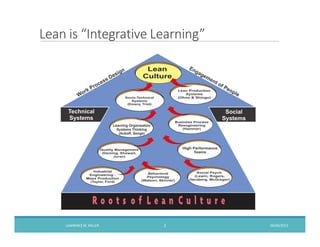
Lean is Integrative Learning
09/09/2013LAWRENCEM. MILLER 2
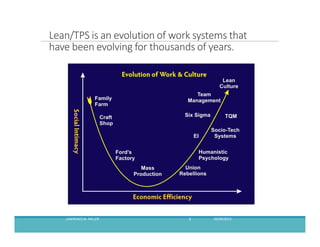
Lean/TPS is an evolution of work systems that
have been evolving for thousands of years.
09/09/2013LAWRENCEM. MILLER 3
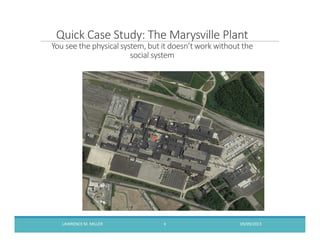
Quick Case Study: The Marysville Plant
You see the physical system, but it doesn t work without the
social system
09/09/2013LAWRENCE M. MILLER 4
Lean/TPS Principles
1. Lean is a culture of continuous improvement practiced at every level of
the organization and by every team.
2. Lean is the application of the scientific method of experimentation and
study of work processes and systems to find improvements.
3. Lean is respect for people. It is respect for the voice of the customer
and it is respect for those who do the work, who are on-the-spot and
are, therefore, the world s greatest experts in their work.
4. Lean is the elimination of waste in all its forms. Lean is the ability to
distinguish between work that actually adds value to your customers
and work that does not. By eliminating waste, you free resources to
devote to value-adding activity that serves your customers.
09/09/2013 LAWRENCEM. MILLER 5
Lean/TPS Principles
5. Lean is a work environment that assures the quality and safety of all
work for both customers and staff.
6. Lean is a focus on improving the work process and not on blaming
people or creating fear.
7. Lean is a culture of teamwork, shared responsibility and ownership
that cuts through organization walls or silos.
8. Lean is a culture that returns the joy to work. Honda speaks of the
three joys of buying, selling and making the product. We do our best
work when we have joy in our work.
9. Lean is flow. Lean is an interruption free process that flows from
beginning to end without interruption.
09/09/2013 LAWRENCEM. MILLER 6
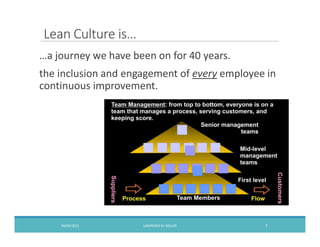
Lean Culture is
a journey we have been on for 40 years.
the inclusion and engagement of every employee in
continuous improvement.
LAWRENCEM. MILLER 709/09/2013
Lean Culture is
LAWRENCEM. MILLER 8
the knowledge of customers, suppliers, and processes
by every employee.
every team having a charter that defines their
responsibilities.
every team owning a process and being empowered
to improve that process.
09/09/2013
Lean Culture is
LAWRENCEM. MILLER
9
data driven!
keeping score on performance by
every team.
the visual display of performance by
every team.
09/09/2013
Lean Culture is
LAWRENCEM. MILLER 10
Flow in the value-stream
mapping of every key work
process by every team at
every level.
the elimination of waste
from every process.
09/09/2013
Lean Culture is
LAWRENCEM. MILLER 11
the analysis and reduction of variances in
quality, cost, and from principles or cycle
time.
09/09/2013
Lean Culture is
LAWRENCEM. MILLER 12
..a change in culture from traditional management styles to
high participation high ownership.
09/09/2013
Lean Culture is
continuous improvement at ALL levels, in ALL functions using the PDCA
cycle.
LAWRENCEM. MILLER 1309/09/2013
Lean Culture
Experimentation leads to Standard Work and Leader Standard
Work
An essential component of lean organizations is defining
standard ways of doing things. This reduces mistakes and
facilitates learning through planned experimentation, rather
than constant re-learning.
LAWRENCEM. MILLER 1409/09/2013
How Much Time is Devoted to Standard Work?
LAWRENCEM. MILLER 15
This is a possible, or typical, percent of time devoted to LSW.
However, this is not meant to be a rule. Each organization and each
position is different and will have some unique requirements.
09/09/2013
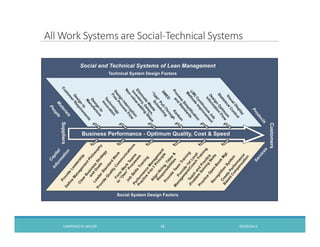
All Work Systems are Social-Technical Systems
09/09/2013LAWRENCEM. MILLER 16
Even Toyota Redesigned their whole-system.
Facing up to the labour shortage and to the exhaustion of the whole work force,
the management and the union at Toyota began to question the production system
and the method of managing work. They concluded that a radical resolution of the
crisis of work could only be found in a reorganization of the production system to
make work more attractive, for they were in agreement that the cause of the labour
shortage was the nature of assembly line work and the Toyotaist method of
managing work.
By investing massively to improve working conditions, by developing a new
conception of the production line, by allowing segments of the line to keep buffer
stocks, by making social relations of work more equitable and rational, Toyota has
changed the rules of the game. For Toyota, lean production appears to be the
model of the past, because it placed too much pressure on people. The new
strategy at Toyota is to give a more humane dimension to its production system but
without hindering productivity; even if progress remains slow, and is held back by
the old Toyotaism.
In terms of team work, four production workers form a work team which is
responsible for a segment composed of a series of connected tasks (three or four
tasks). The work team takes responsibility for the quality of its tasks, whereas on
traditional lines, each person is responsible individually.
Humanization of the production system and work at Toyota Motor Co and Toyota Motor Kyushu. By
Koichi Shimizu, In Enriching Production: Perspectives on Volvo s Uddevalla Plant as an Alternative to
lean production. Sandberg, Ake, Editor, Digital Edition, Stockholm. 2007. P. 398.
09/09/2013LAWRENCEM. MILLER 17
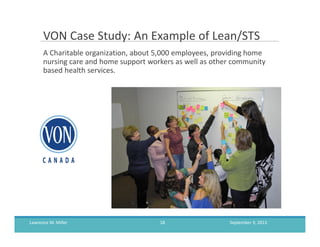
VON Case Study: An Example of Lean/STS
A Charitable organization, about 5,000 employees, providing home
nursing care and home support workers as well as other community
based health services.
September 9, 2013Lawrence M. Miller 18
VON Learned that
09/09/2013 LAWRENCEM. MILLER 19
Their organization is a whole-system
Social, technical and economic systems
must be aligned to customer/client
needs
The process of change must reflect the
desired culture the Habitat for
Humanity principle.
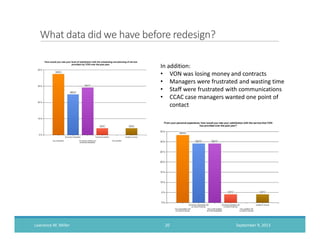
What data did we have before redesign?
September 9, 2013Lawrence M. Miller 20
In addition:
VON was losing money and contracts
Managers were frustrated and wasting time
Staff were frustrated with communications
CCAC case managers wanted one point of
contact
VON Design Charter
PURPOSE:
The purpose of the HomeCare Service Delivery Redesign Team is to ensure that our service
delivery to clients and customers (funders) meet or exceed their expectations in a manner that
will maximize the probability of customer, client and service provider loyalty and acquisition of
additional contracts. The design should improve financial performance as well as customer and
client performance.
OBJECTIVES:
Timelines
1. One (Nursing) will focus initially on designing the nursing service process, while another
(Home Support) will focus on designing the home support delivery process.
2. By November 1st, 2011 present initial recommendations for a redesign of the work flow.
3. By November 15th present initial recommendations for changes to systems, structure,
decision-making, responsibility or other factors that may enhance performance to customer
expectations.
4. By January 1st begin implementation of those recommendations.
September 9, 2013Lawrence M. Miller 21
Deliverables
1. Reduce the number of process steps by at least 50% in order to reduce potential for errors, delay and rework.
2. It currently requires an average of five hours from acceptance of referral to the scheduling of a visit. The goal of the
design team should be to reduce this to one hour.
3. A customer or client or service provider must be able to reach someone who can respond to their concerns 24/7.
4. The redesign should result in a missed visits rate below CCAC targets.
5. The redesign should result in a referral rate to exceed CCAC targets.
6. The redesign should result in continuity within CCAC targets.
7. The redesign should result in a reduction in ORTS (complaints) by 75%.
8. The redesign will ensure there is a focus on the quality of care delivered to the client. It will ensure that managers are
able to facilitate necessary clinician education, supervisory visits and practice learning teams. This will be measured by
up-to-date performance review practices for new and existing employees (as per policy) and by nurse satisfaction that
learning needs are met.
9. Reduce billing rejections to a rate of less than .05 percent.
10. Quality feedback loops will be built into each process so they can monitor in real time effectiveness.
11. The design team will calculate the cost of planning and scheduling of visits to be less than five dollars per visit.
12. The design team will define productivity measures at the primary care provider team level and at the district level.
These measures will align financial improvement measures at all levels.
September 9, 2013Lawrence M. Miller 22
VON Design Charter
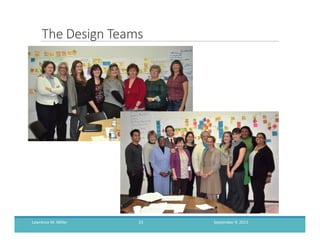
The Design Teams
September 9, 2013Lawrence M. Miller 23
2 Design teams met for 12 weeks, 3 days a week
September 9, 2013Lawrence M. Miller 24
Each process step was analyzed for speed,
value-adding, causes of variances
09/09/2013LAWRENCEM. MILLER 25
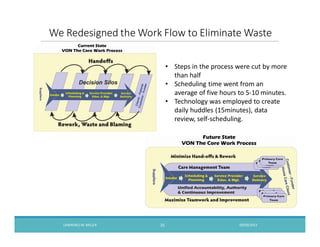
We Redesigned the Work Flow to Eliminate Waste
Steps in the process were cut by more
than half
Scheduling time went from an
average of five hours to 5-10 minutes.
Technology was employed to create
daily huddles (15minutes), data
review, self-scheduling.
The Structure was redesigned
09/09/2013LAWRENCEM. MILLER 26
Oblatonyangpi
Square People and Round People
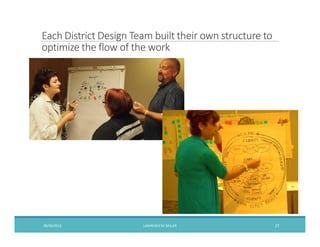
Each District Design Team built their own structure to
optimize the flow of the work
09/09/2013 LAWRENCEM. MILLER 27
09/09/2013LAWRENCEM. MILLER 28
The redesigned VON
Each District designed
their own structure to
their realities.
They have redesigned
as they have
experimented
Alignment of National Functions
09/09/2013LAWRENCEM. MILLER 29
Creating a Culture for Future
Capabilities
Implementation included training of all teams
09/09/2013 LAWRENCEM. MILLER 30
Decision processes were define in terms of
command, consultative and consensus decisions
Key data variables and data feedback was
designed for each team.
A competency model was developed for each
position.
Final Presentation to SMT
September 9, 2013Lawrence M. Miller 31
VON Results:
Schedulingfromfivehours to five minutes
Productivityimprovedby25%
09/09/2013 LAWRENCEM. MILLER 32
09/09/2013LAWRENCEM. MILLER 33
PreRedesignSurveyPostRedesignSurvey
CCAC Customer Satisfaction
Productivity (visits/FTE) is up 25% across all districts
Exercise
1. How were the Lean and STS approaches
combined? Was this effective or not?
2. What are the lessons you take from this case for
your practice or for your company?
3. What questions do you have for the consultants
in these cases?
09/09/2013 LAWRENCEM. MILLER 34

Sts plus lean pt2 final

  • 1.
    STS Plus Lean AnIntegrative Learning Exercise WHAT CAN STS DESIGN LEARN FROM LEAN & WHAT CAN LEAN LEARN FROM STS 09/09/2013 LAWRENCEM. MILLER 1
  • 2.
    Lean is IntegrativeLearning 09/09/2013LAWRENCEM. MILLER 2
  • 3.
    Lean/TPS is anevolution of work systems that have been evolving for thousands of years. 09/09/2013LAWRENCEM. MILLER 3
  • 4.
    Quick Case Study:The Marysville Plant You see the physical system, but it doesn t work without the social system 09/09/2013LAWRENCE M. MILLER 4
  • 5.
    Lean/TPS Principles 1. Leanis a culture of continuous improvement practiced at every level of the organization and by every team. 2. Lean is the application of the scientific method of experimentation and study of work processes and systems to find improvements. 3. Lean is respect for people. It is respect for the voice of the customer and it is respect for those who do the work, who are on-the-spot and are, therefore, the world s greatest experts in their work. 4. Lean is the elimination of waste in all its forms. Lean is the ability to distinguish between work that actually adds value to your customers and work that does not. By eliminating waste, you free resources to devote to value-adding activity that serves your customers. 09/09/2013 LAWRENCEM. MILLER 5
  • 6.
    Lean/TPS Principles 5. Leanis a work environment that assures the quality and safety of all work for both customers and staff. 6. Lean is a focus on improving the work process and not on blaming people or creating fear. 7. Lean is a culture of teamwork, shared responsibility and ownership that cuts through organization walls or silos. 8. Lean is a culture that returns the joy to work. Honda speaks of the three joys of buying, selling and making the product. We do our best work when we have joy in our work. 9. Lean is flow. Lean is an interruption free process that flows from beginning to end without interruption. 09/09/2013 LAWRENCEM. MILLER 6
  • 7.
    Lean Culture is ajourney we have been on for 40 years. the inclusion and engagement of every employee in continuous improvement. LAWRENCEM. MILLER 709/09/2013
  • 8.
    Lean Culture is LAWRENCEM.MILLER 8 the knowledge of customers, suppliers, and processes by every employee. every team having a charter that defines their responsibilities. every team owning a process and being empowered to improve that process. 09/09/2013
  • 9.
    Lean Culture is LAWRENCEM.MILLER 9 data driven! keeping score on performance by every team. the visual display of performance by every team. 09/09/2013
  • 10.
    Lean Culture is LAWRENCEM.MILLER 10 Flow in the value-stream mapping of every key work process by every team at every level. the elimination of waste from every process. 09/09/2013
  • 11.
    Lean Culture is LAWRENCEM.MILLER 11 the analysis and reduction of variances in quality, cost, and from principles or cycle time. 09/09/2013
  • 12.
    Lean Culture is LAWRENCEM.MILLER 12 ..a change in culture from traditional management styles to high participation high ownership. 09/09/2013
  • 13.
    Lean Culture is continuousimprovement at ALL levels, in ALL functions using the PDCA cycle. LAWRENCEM. MILLER 1309/09/2013
  • 14.
    Lean Culture Experimentation leadsto Standard Work and Leader Standard Work An essential component of lean organizations is defining standard ways of doing things. This reduces mistakes and facilitates learning through planned experimentation, rather than constant re-learning. LAWRENCEM. MILLER 1409/09/2013
  • 15.
    How Much Timeis Devoted to Standard Work? LAWRENCEM. MILLER 15 This is a possible, or typical, percent of time devoted to LSW. However, this is not meant to be a rule. Each organization and each position is different and will have some unique requirements. 09/09/2013
  • 16.
    All Work Systemsare Social-Technical Systems 09/09/2013LAWRENCEM. MILLER 16
  • 17.
    Even Toyota Redesignedtheir whole-system. Facing up to the labour shortage and to the exhaustion of the whole work force, the management and the union at Toyota began to question the production system and the method of managing work. They concluded that a radical resolution of the crisis of work could only be found in a reorganization of the production system to make work more attractive, for they were in agreement that the cause of the labour shortage was the nature of assembly line work and the Toyotaist method of managing work. By investing massively to improve working conditions, by developing a new conception of the production line, by allowing segments of the line to keep buffer stocks, by making social relations of work more equitable and rational, Toyota has changed the rules of the game. For Toyota, lean production appears to be the model of the past, because it placed too much pressure on people. The new strategy at Toyota is to give a more humane dimension to its production system but without hindering productivity; even if progress remains slow, and is held back by the old Toyotaism. In terms of team work, four production workers form a work team which is responsible for a segment composed of a series of connected tasks (three or four tasks). The work team takes responsibility for the quality of its tasks, whereas on traditional lines, each person is responsible individually. Humanization of the production system and work at Toyota Motor Co and Toyota Motor Kyushu. By Koichi Shimizu, In Enriching Production: Perspectives on Volvo s Uddevalla Plant as an Alternative to lean production. Sandberg, Ake, Editor, Digital Edition, Stockholm. 2007. P. 398. 09/09/2013LAWRENCEM. MILLER 17
  • 18.
    VON Case Study:An Example of Lean/STS A Charitable organization, about 5,000 employees, providing home nursing care and home support workers as well as other community based health services. September 9, 2013Lawrence M. Miller 18
  • 19.
    VON Learned that 09/09/2013LAWRENCEM. MILLER 19 Their organization is a whole-system Social, technical and economic systems must be aligned to customer/client needs The process of change must reflect the desired culture the Habitat for Humanity principle.
  • 20.
    What data didwe have before redesign? September 9, 2013Lawrence M. Miller 20 In addition: VON was losing money and contracts Managers were frustrated and wasting time Staff were frustrated with communications CCAC case managers wanted one point of contact
  • 21.
    VON Design Charter PURPOSE: Thepurpose of the HomeCare Service Delivery Redesign Team is to ensure that our service delivery to clients and customers (funders) meet or exceed their expectations in a manner that will maximize the probability of customer, client and service provider loyalty and acquisition of additional contracts. The design should improve financial performance as well as customer and client performance. OBJECTIVES: Timelines 1. One (Nursing) will focus initially on designing the nursing service process, while another (Home Support) will focus on designing the home support delivery process. 2. By November 1st, 2011 present initial recommendations for a redesign of the work flow. 3. By November 15th present initial recommendations for changes to systems, structure, decision-making, responsibility or other factors that may enhance performance to customer expectations. 4. By January 1st begin implementation of those recommendations. September 9, 2013Lawrence M. Miller 21
  • 22.
    Deliverables 1. Reduce thenumber of process steps by at least 50% in order to reduce potential for errors, delay and rework. 2. It currently requires an average of five hours from acceptance of referral to the scheduling of a visit. The goal of the design team should be to reduce this to one hour. 3. A customer or client or service provider must be able to reach someone who can respond to their concerns 24/7. 4. The redesign should result in a missed visits rate below CCAC targets. 5. The redesign should result in a referral rate to exceed CCAC targets. 6. The redesign should result in continuity within CCAC targets. 7. The redesign should result in a reduction in ORTS (complaints) by 75%. 8. The redesign will ensure there is a focus on the quality of care delivered to the client. It will ensure that managers are able to facilitate necessary clinician education, supervisory visits and practice learning teams. This will be measured by up-to-date performance review practices for new and existing employees (as per policy) and by nurse satisfaction that learning needs are met. 9. Reduce billing rejections to a rate of less than .05 percent. 10. Quality feedback loops will be built into each process so they can monitor in real time effectiveness. 11. The design team will calculate the cost of planning and scheduling of visits to be less than five dollars per visit. 12. The design team will define productivity measures at the primary care provider team level and at the district level. These measures will align financial improvement measures at all levels. September 9, 2013Lawrence M. Miller 22 VON Design Charter
  • 23.
    The Design Teams September9, 2013Lawrence M. Miller 23
  • 24.
    2 Design teamsmet for 12 weeks, 3 days a week September 9, 2013Lawrence M. Miller 24 Each process step was analyzed for speed, value-adding, causes of variances
  • 25.
    09/09/2013LAWRENCEM. MILLER 25 WeRedesigned the Work Flow to Eliminate Waste Steps in the process were cut by more than half Scheduling time went from an average of five hours to 5-10 minutes. Technology was employed to create daily huddles (15minutes), data review, self-scheduling.
  • 26.
    The Structure wasredesigned 09/09/2013LAWRENCEM. MILLER 26 Oblatonyangpi Square People and Round People
  • 27.
    Each District DesignTeam built their own structure to optimize the flow of the work 09/09/2013 LAWRENCEM. MILLER 27
  • 28.
    09/09/2013LAWRENCEM. MILLER 28 Theredesigned VON Each District designed their own structure to their realities. They have redesigned as they have experimented
  • 29.
    Alignment of NationalFunctions 09/09/2013LAWRENCEM. MILLER 29 Creating a Culture for Future Capabilities
  • 30.
    Implementation included trainingof all teams 09/09/2013 LAWRENCEM. MILLER 30 Decision processes were define in terms of command, consultative and consensus decisions Key data variables and data feedback was designed for each team. A competency model was developed for each position.
  • 31.
    Final Presentation toSMT September 9, 2013Lawrence M. Miller 31
  • 32.
    VON Results: Schedulingfromfivehours tofive minutes Productivityimprovedby25% 09/09/2013 LAWRENCEM. MILLER 32
  • 33.
    09/09/2013LAWRENCEM. MILLER 33 PreRedesignSurveyPostRedesignSurvey CCACCustomer Satisfaction Productivity (visits/FTE) is up 25% across all districts
  • 34.
    Exercise 1. How werethe Lean and STS approaches combined? Was this effective or not? 2. What are the lessons you take from this case for your practice or for your company? 3. What questions do you have for the consultants in these cases? 09/09/2013 LAWRENCEM. MILLER 34