Struggle for
India’s
Independence
BY:- GOVINDRAJ, ROLL NO:-6 - 10
AYUSH,
ATHARV,
GAURAV, and
GAURAVI
Atharv
Roll no:- 06
91
Rise of Nationalism
Nationalism is a constructed identity. It develops out of shared
experiences.
A sequence of events caused the people of India to carefully analyse
how their authority over their daily lives, administration, and
resources was slipping away from their hands. The shared experience
was that of exploitation by a foreign power. Indians recognised the
need to defend their independence and break free from foreign
influence.
Atharv
Atharv
The British dominance over India was initially
viewed as a window to modernisation by the
educated Indians. They also anticipated that the
British would steer India towards economic
prosperity and that India would eventually become
an economic clone of Great Britain. However, when
the fundamental motives of colonialism were
gradually exposed, and their consciousness
matured over time, they undertook a critical
assessment of the economic reality of India.
Atharv
The Rowlatt Act and Satyagraha
The Rowlatt Act of 1919 spurred Gandhiji to
organise a nationwide resistance. The Act
restricted fundamental liberties such as free
speech and expression. The Act also
empowered the government to arrest and
detain anybody it deemed suspect without a
trial.
QUESTIONS
1. What caused Indians to analyze their situation?
Answer: Exploitation
2. What did Indians initially expect from British
rule? Answer: Modernisation
3. What did educated Indians hope for from British
rule?
Answer: Prosperity
Govindraj
Roll no:- 10
Govindraj
Quit India Movement
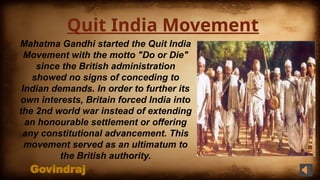
Mahatma Gandhi started the Quit India
Movement with the motto "Do or Die"
since the British administration
showed no signs of conceding to
Indian demands. In order to further its
own interests, Britain forced India into
the 2nd world war instead of extending
an honourable settlement or offering
any constitutional advancement. This
movement served as an ultimatum to
the British authority.
Govindraj
Swadeshi Movement
The Swadeshi movement was sparked by the
partition of Bengal. The Indian leaders urged
people to demonstrate their disapproval by
boycotting foreign goods like textiles, salt, etc.
Many regions witnessed the public burning of
foreign cloth. The need for self-reliance was
underlined, and indigenous businesses were
encouraged.
Govindraj
Withdrawal of the Non-Cooperation Movement
Civil Disobedience Movement
After a long pause, the time was now ripe for a new
movement. Gandhiji wisely identified a topic that would unite
the entire country in its opposition to British tyranny.
Gandhiji made 'the salt tax the focus of his agitation. Salt
was an ingredient that was vital to everyone's diet.
Gandhiji argued that by taxing salt, the poor Indians were
being starved. He decided to break the Salt Law which had
allowed only the British to manufacture salt.
Govindraj
Gandhiji and his followers walked from Sabarmati to the coastal village of
Dandi. Huge crowds, including women, gathered to support Gandhiji. The
mood was so intense that even the international media had been
following Gandhiji's every move.
When Gandhiji arrived in Dandi, he symbolically breached the Salt Law
by holding salt in his hands. This march famously came to be knowm as
the 'Dandi March'. Indians across the country took part in the movement.
Workers went on strikes, students left government schools and colleges,
people refused to pay taxes. Gandhiji urged the people to be non-violent.
Thousands of people including Gandhiji and Nehru were arrested and
sent to jail. The Civil Disobedience Movement was the first mass freedom
movement in India in the true sense.
QUESTIONS
1. Who started the Quit India Movement?
Answer: Mohandas karamchand Gandhi
2. What was the motto of the Quit India Movement?
Answer: Do or Die
3.What event forced India into war, according to
the paragraph?
Answer: World War II
Ayush
Roll no:- 07
Ayush
Early Nationalists - The Moderate Phase
The Early Nationalists are referred
to as moderates owing to their
style of resistance. They did not
take any radical steps to challenge
the British authority. They
advocated changes that would
allow for greater participation of
Indians in administration, resulting
in limited self-government, while
remaining under the colonial
superstructure.
Ayush
Indian National Army (I.N.A.)
Subhas Chandra Bose presided over the
Indian National Congress twice, but in the
later years, he became dissatisfied with its
policies. He fled India and arrived in
Singapore, where he established the
Provisional Government of Free India on
October 21, 1943. His government declared
war on Britain, which was acknowledged by
the Axis powers. To meet the needs of the
war, he reorganised the I.N.A.
QUESTIONS
1. Who presided over the Indian National Congress twice?
Answer:Subhas Chandra Bose
2. Where did Subhas Chandra Bose establish the Provisional
Government of Free India?
Answer: Singapore
3. What did Subhas Chandra Bose declare against Britain?
Answer: War
Gaurav
Roll no:- 08
Gaurav
The First Phase of the Indian National
Movement
The rise in national consciousness inevitably led to the
formation of many associations throughout the country.
The Indian Association, the Bombay Presidency
Association, the Madras Mahajan Sabha and the Poona
Sarvajanik Sabha were some of the important political
associations formed in the latter half of the 19th century.
Gaurav
The Second Phase of the Indian National Movement
The Gandhian Era
Gandhiji returned to India in 1915 from South Africa, where he
worked as a barrister and successfully applied the method of
non-violent resistance, which he termed 'Satyagraha, against
the racial discrimination faced by the Indians living in South
Africa. However, he did not immediately pursue politics after
arrival; instead, he spent the first year travelling the nation to
gain insight into the country's political and social
circumstances.
QUESTIONS
1. From which country did Gandhiji return in 1915?
Answer: South Africa
2. What method did Gandhiji apply in South
Africa?
Answer: Satyagraha
3. What did Gandhiji do during his first year in India?
Answer: Travel
Gauravi
Roll no:- 09
Gauravi
The Partition of Bengal
Partition of Bengal was aimed at weakening the
epicentre of the Indian National Movement. The
main goals were to obstruct the rise of
nationalism by dividing Bengalis on a religious
basis and placing them under separate
administrations. The decision infuriated Indians
across the country Protest meetings were held
throughout the country.
Gauravi
Independence and Partition
As the demand for a separate state for Muslims became stronger, the
division of the country was considered inevitable. Lord Mountbatten,
the last Viceroy of India, proposed a plan for the transfer of power.
The decision was made to divide British India along religious lines
into the two dominions of India and Pakistan. The Boundary
Commission, led by Sir Cyril Radcliffe, was formed to determine the
international borders between the two nations. The panel was tasked
with dividing Bengal and Punjab into two separate nations. The
princely nations were offered the option of remaining independent or
acceding to either India or Pakistan.
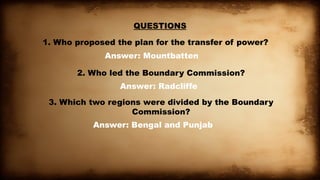
QUESTIONS
1. Who proposed the plan for the transfer of power?
Answer: Mountbatten
2. Who led the Boundary Commission?
Answer: Radcliffe
3. Which two regions were divided by the Boundary
Commission?
Answer: Bengal and Punjab
Struggle for indian independence 123.pptx

Struggle for indian independence 123.pptx

  • 1.
    Struggle for India’s Independence BY:- GOVINDRAJ,ROLL NO:-6 - 10 AYUSH, ATHARV, GAURAV, and GAURAVI
  • 2.
  • 3.
    91 Rise of Nationalism Nationalismis a constructed identity. It develops out of shared experiences. A sequence of events caused the people of India to carefully analyse how their authority over their daily lives, administration, and resources was slipping away from their hands. The shared experience was that of exploitation by a foreign power. Indians recognised the need to defend their independence and break free from foreign influence. Atharv
  • 4.
    Atharv The British dominanceover India was initially viewed as a window to modernisation by the educated Indians. They also anticipated that the British would steer India towards economic prosperity and that India would eventually become an economic clone of Great Britain. However, when the fundamental motives of colonialism were gradually exposed, and their consciousness matured over time, they undertook a critical assessment of the economic reality of India.
  • 5.
    Atharv The Rowlatt Actand Satyagraha The Rowlatt Act of 1919 spurred Gandhiji to organise a nationwide resistance. The Act restricted fundamental liberties such as free speech and expression. The Act also empowered the government to arrest and detain anybody it deemed suspect without a trial.
  • 6.
    QUESTIONS 1. What causedIndians to analyze their situation? Answer: Exploitation 2. What did Indians initially expect from British rule? Answer: Modernisation 3. What did educated Indians hope for from British rule? Answer: Prosperity
  • 7.
  • 8.
    Govindraj Quit India Movement MahatmaGandhi started the Quit India Movement with the motto "Do or Die" since the British administration showed no signs of conceding to Indian demands. In order to further its own interests, Britain forced India into the 2nd world war instead of extending an honourable settlement or offering any constitutional advancement. This movement served as an ultimatum to the British authority.
  • 9.
    Govindraj Swadeshi Movement The Swadeshimovement was sparked by the partition of Bengal. The Indian leaders urged people to demonstrate their disapproval by boycotting foreign goods like textiles, salt, etc. Many regions witnessed the public burning of foreign cloth. The need for self-reliance was underlined, and indigenous businesses were encouraged.
  • 10.
    Govindraj Withdrawal of theNon-Cooperation Movement Civil Disobedience Movement After a long pause, the time was now ripe for a new movement. Gandhiji wisely identified a topic that would unite the entire country in its opposition to British tyranny. Gandhiji made 'the salt tax the focus of his agitation. Salt was an ingredient that was vital to everyone's diet. Gandhiji argued that by taxing salt, the poor Indians were being starved. He decided to break the Salt Law which had allowed only the British to manufacture salt.
  • 11.
    Govindraj Gandhiji and hisfollowers walked from Sabarmati to the coastal village of Dandi. Huge crowds, including women, gathered to support Gandhiji. The mood was so intense that even the international media had been following Gandhiji's every move. When Gandhiji arrived in Dandi, he symbolically breached the Salt Law by holding salt in his hands. This march famously came to be knowm as the 'Dandi March'. Indians across the country took part in the movement. Workers went on strikes, students left government schools and colleges, people refused to pay taxes. Gandhiji urged the people to be non-violent. Thousands of people including Gandhiji and Nehru were arrested and sent to jail. The Civil Disobedience Movement was the first mass freedom movement in India in the true sense.
  • 12.
    QUESTIONS 1. Who startedthe Quit India Movement? Answer: Mohandas karamchand Gandhi 2. What was the motto of the Quit India Movement? Answer: Do or Die 3.What event forced India into war, according to the paragraph? Answer: World War II
  • 13.
  • 14.
    Ayush Early Nationalists -The Moderate Phase The Early Nationalists are referred to as moderates owing to their style of resistance. They did not take any radical steps to challenge the British authority. They advocated changes that would allow for greater participation of Indians in administration, resulting in limited self-government, while remaining under the colonial superstructure.
  • 15.
    Ayush Indian National Army(I.N.A.) Subhas Chandra Bose presided over the Indian National Congress twice, but in the later years, he became dissatisfied with its policies. He fled India and arrived in Singapore, where he established the Provisional Government of Free India on October 21, 1943. His government declared war on Britain, which was acknowledged by the Axis powers. To meet the needs of the war, he reorganised the I.N.A.
  • 16.
    QUESTIONS 1. Who presidedover the Indian National Congress twice? Answer:Subhas Chandra Bose 2. Where did Subhas Chandra Bose establish the Provisional Government of Free India? Answer: Singapore 3. What did Subhas Chandra Bose declare against Britain? Answer: War
  • 17.
  • 18.
    Gaurav The First Phaseof the Indian National Movement The rise in national consciousness inevitably led to the formation of many associations throughout the country. The Indian Association, the Bombay Presidency Association, the Madras Mahajan Sabha and the Poona Sarvajanik Sabha were some of the important political associations formed in the latter half of the 19th century.
  • 19.
    Gaurav The Second Phaseof the Indian National Movement The Gandhian Era Gandhiji returned to India in 1915 from South Africa, where he worked as a barrister and successfully applied the method of non-violent resistance, which he termed 'Satyagraha, against the racial discrimination faced by the Indians living in South Africa. However, he did not immediately pursue politics after arrival; instead, he spent the first year travelling the nation to gain insight into the country's political and social circumstances.
  • 20.
    QUESTIONS 1. From whichcountry did Gandhiji return in 1915? Answer: South Africa 2. What method did Gandhiji apply in South Africa? Answer: Satyagraha 3. What did Gandhiji do during his first year in India? Answer: Travel
  • 21.
  • 22.
    Gauravi The Partition ofBengal Partition of Bengal was aimed at weakening the epicentre of the Indian National Movement. The main goals were to obstruct the rise of nationalism by dividing Bengalis on a religious basis and placing them under separate administrations. The decision infuriated Indians across the country Protest meetings were held throughout the country.
  • 23.
    Gauravi Independence and Partition Asthe demand for a separate state for Muslims became stronger, the division of the country was considered inevitable. Lord Mountbatten, the last Viceroy of India, proposed a plan for the transfer of power. The decision was made to divide British India along religious lines into the two dominions of India and Pakistan. The Boundary Commission, led by Sir Cyril Radcliffe, was formed to determine the international borders between the two nations. The panel was tasked with dividing Bengal and Punjab into two separate nations. The princely nations were offered the option of remaining independent or acceding to either India or Pakistan.
  • 24.
    QUESTIONS 1. Who proposedthe plan for the transfer of power? Answer: Mountbatten 2. Who led the Boundary Commission? Answer: Radcliffe 3. Which two regions were divided by the Boundary Commission? Answer: Bengal and Punjab