
Structured Writing Using MS-Word

  luc.bouquet@teka-infopilots.com
Parts of this Workshop

 Communication vs. documentation
 Structured writing
 Exercise
 Evaluation and wrap up
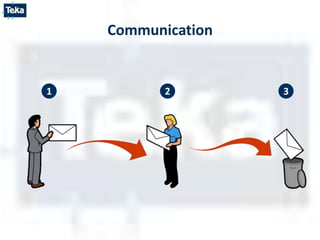
Communication


1          2        3
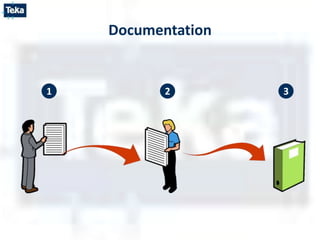
Documentation


1          2        3
Combined Action of
Communication and Documentation

1               2                 3
Example: Different use of e-mail and
            Attachment

 1                2                    3
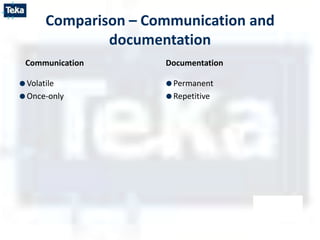
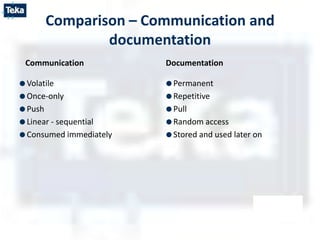
Comparison – Communication and
               documentation
 Communication        Documentation

 Volatile             Permanent
Comparison – Communication and
               documentation
 Communication        Documentation

 Volatile             Permanent
 Once-only            Repetitive
Comparison – Communication and
                 documentation
 Communication          Documentation

 Volatile               Permanent
 Once-only              Repetitive
 Push                   Pull
Comparison – Communication and
                 documentation
 Communication          Documentation

 Volatile               Permanent
 Once-only              Repetitive
 Push                   Pull
 Linear - sequential    Random access
Comparison – Communication and
                 documentation
 Communication           Documentation

 Volatile                Permanent
 Once-only               Repetitive
 Push                    Pull
 Linear - sequential     Random access
 Consumed immediately    Stored and used later on
Comparison – Communication and
                 documentation
 Communication           Documentation

 Volatile                Permanent
 Once-only               Repetitive
 Push                    Pull
 Linear - sequential     Random access
 Consumed immediately    Stored and used later on
 Consumed as a whole     Consumed only partly
Comparison – Communication and
                 documentation
 Communication              Documentation

 Volatile                   Permanent
 Once-only                  Repetitive
 Push                       Pull
 Linear - sequential        Random access
 Consumed immediately       Stored and used later on
 Consumed as a whole        Consumed only partly
 Comes about intuitively    Comes about through a process
Media for Communication and
              Documentation
Communication     Documentation
 Face-to-face     Document (Word, PDF, print…)
 Telephone        Intranet
 SMS              SharePoint
 E-mail           Blog
 Twitter          Wiki
 Facebook         YouTube
 Yammer           LinkedIn profile
 Chat             CMS or LCMS
STRUCTURED WRITING
What is it?

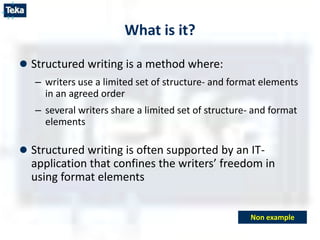
 Structured writing is a method where:
   – writers use a limited set of structure- and format elements
     in an agreed order
   – several writers share a limited set of structure- and format
     elements

 Structured writing is often supported by an IT-
  application that confines the writers’ freedom in
  using format elements


                                                     Non example
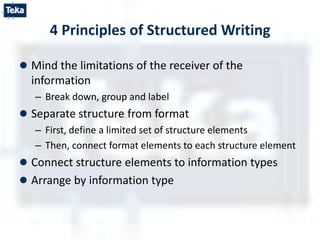
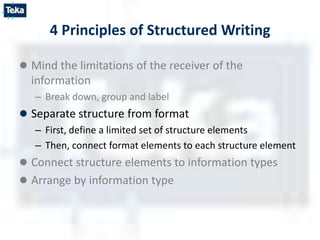
4 Principles of Structured Writing

 Mind the limitations of the receiver of the
  information
   – Break down, group and label
 Separate structure from format
   – First, define a limited set of structure elements
   – Then, connect format elements to each structure element
 Connect structure elements to information types
 Arrange by information type
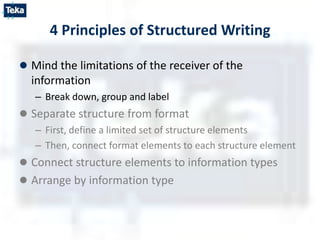
4 Principles of Structured Writing

 Mind the limitations of the receiver of the
  information
   – Break down, group and label
 Separate structure from format
   – First, define a limited set of structure elements
   – Then, connect format elements to each structure element
 Connect structure elements to information types
 Arrange by information type
Break down, group and label

 Feed information in ‘digestible’ units
 Mind the limits of short term memory 7 ± 2
 Put together what belongs together
 Give the topics an appropriate title


                                               Voorbeeld
saw milk train hammer
water cab screwdriver tea
car pliers coffee bike
spanner beer airplane
cissors wine tram chissel
lemonade bus
water         tea       airplane
saw           car       cissors
milk          pliers    wine
train         coffee    tram
hammer        bike      chisel
cab           spanner   lemonade
screwdriver   beer      bus
water      saw           airplane
tea        cissors       car
milk       pliers        train
wine       hammer        tram
coffee     bike          chisel
beer       spanner       bus
lemonade   screwdriver   cab
Drinks     Tools         Transportation
water      saw           airplane
tea        cissors       car
milk       pliers        train
wine       hammer        tram
coffee     bike          chisel
beer       spanner       bus
lemonade   screwdriver   cab
Animals   Furniture   Professions
tiger     chair       nurse
horse     cupboard    painter
rabbit    table       carpenter
cat       sofa        artist
sheep     bed         hair dresser
cow       arm chair   cook
dog       wardrobe    writer
4 Principles of Structured Writing

 Mind the limitations of the receiver of the
  information
   – Break down, group and label
 Separate structure from format
   – First, define a limited set of structure elements
   – Then, connect format elements to each structure element
 Connect structure elements to information types
 Arrange by information type
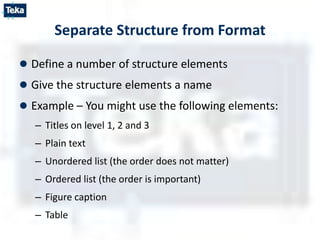
Separate Structure from Format

 Define a number of structure elements
 Give the structure elements a name
 Example – You might use the following elements:
   – Titles on level 1, 2 and 3
   – Plain text
   – Unordered list (the order does not matter)
   – Ordered list (the order is important)
   – Figure caption
   – Table
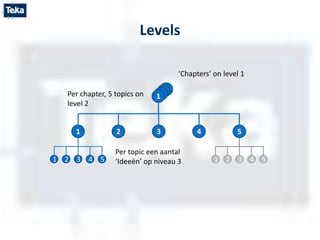
Levels

                                    ‘Chapters’ on level 1
                                1
  Per chapter, 5 topics on   111
  level 2


    1            2           3           4            5

                 Per topic een aantal
1 2 3 4 5        ‘Ideeën’ op niveau 3          1 2 3 4 5
Format Elements

 Use ‘Styles’ in your word processor (or use an
  existing template)
 Connect the following format elements to each
  structure element:
   – Typeface, color, size and style
   – Indentation and shape of the bullet or the number
   – Space above and below
   – Possible lines above and below
                                                         Voorbeeld
4 Principles of Structured Writing

 Mind the limitations of the receiver of the
  information
   – Break down, group and label
 Separate structure from format
   – First, define a limited set of structure elements
   – Then, connect format elements to each structure element
 Connect structure elements to information types
 Arrange by information type
Information Types

 Concepts and principles
 Composition
 Process
 Instruction
 Data
Connecting Format to Information Type
Information Type                            Format

Principles and concepts                      Plain text
Statements, intentions, definitions          Unordered list
Composition                                  Figure
How it looks like, how it is put together    Unordered list or table
Process                                      Ordered list
How does it work?                            Figure (Process diagram)
What happens?
Instruction                                  Ordered list
How you do something                         Figure (Flowchart)
Data                                         Unordered list or table
Figures, concrete information                Graph
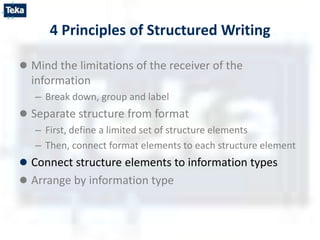
4 Principles of Structured Writing

 Mind the limitations of the receiver of the
  information
   – Break down, group and label
 Separate structure from format
   – First, define a limited set of structure elements
   – Then, connect format elements to each structure element
 Connect structure elements to information types
 Arrange by information type
Arrange by Information Type

1.   Principles and concepts
      Why is this information important?
      Who should read it?
      Possible new terms
2.   Compositions
      What are the parts, how does it look like?
3.   Processes
      How does it work? What happens?
4.   Instructions
      How do you have to proceed?
5.   Data                                          Example

Structured writing using ms word

  • 1.
    Structured Writing UsingMS-Word luc.bouquet@teka-infopilots.com
  • 2.
    Parts of thisWorkshop  Communication vs. documentation  Structured writing  Exercise  Evaluation and wrap up
  • 3.
  • 4.
  • 5.
    Combined Action of Communicationand Documentation 1 2 3
  • 6.
    Example: Different useof e-mail and Attachment 1 2 3
  • 7.
    Comparison – Communicationand documentation Communication Documentation  Volatile  Permanent
  • 8.
    Comparison – Communicationand documentation Communication Documentation  Volatile  Permanent  Once-only  Repetitive
  • 9.
    Comparison – Communicationand documentation Communication Documentation  Volatile  Permanent  Once-only  Repetitive  Push  Pull
  • 10.
    Comparison – Communicationand documentation Communication Documentation  Volatile  Permanent  Once-only  Repetitive  Push  Pull  Linear - sequential  Random access
  • 11.
    Comparison – Communicationand documentation Communication Documentation  Volatile  Permanent  Once-only  Repetitive  Push  Pull  Linear - sequential  Random access  Consumed immediately  Stored and used later on
  • 12.
    Comparison – Communicationand documentation Communication Documentation  Volatile  Permanent  Once-only  Repetitive  Push  Pull  Linear - sequential  Random access  Consumed immediately  Stored and used later on  Consumed as a whole  Consumed only partly
  • 13.
    Comparison – Communicationand documentation Communication Documentation  Volatile  Permanent  Once-only  Repetitive  Push  Pull  Linear - sequential  Random access  Consumed immediately  Stored and used later on  Consumed as a whole  Consumed only partly  Comes about intuitively  Comes about through a process
  • 14.
    Media for Communicationand Documentation Communication Documentation  Face-to-face  Document (Word, PDF, print…)  Telephone  Intranet  SMS  SharePoint  E-mail  Blog  Twitter  Wiki  Facebook  YouTube  Yammer  LinkedIn profile  Chat  CMS or LCMS
  • 15.
  • 16.
    What is it? Structured writing is a method where: – writers use a limited set of structure- and format elements in an agreed order – several writers share a limited set of structure- and format elements  Structured writing is often supported by an IT- application that confines the writers’ freedom in using format elements Non example
  • 17.
    4 Principles ofStructured Writing  Mind the limitations of the receiver of the information – Break down, group and label  Separate structure from format – First, define a limited set of structure elements – Then, connect format elements to each structure element  Connect structure elements to information types  Arrange by information type
  • 18.
    4 Principles ofStructured Writing  Mind the limitations of the receiver of the information – Break down, group and label  Separate structure from format – First, define a limited set of structure elements – Then, connect format elements to each structure element  Connect structure elements to information types  Arrange by information type
  • 19.
    Break down, groupand label  Feed information in ‘digestible’ units  Mind the limits of short term memory 7 ± 2  Put together what belongs together  Give the topics an appropriate title Voorbeeld
  • 20.
    saw milk trainhammer water cab screwdriver tea car pliers coffee bike spanner beer airplane cissors wine tram chissel lemonade bus
  • 21.
    water tea airplane saw car cissors milk pliers wine train coffee tram hammer bike chisel cab spanner lemonade screwdriver beer bus
  • 22.
    water saw airplane tea cissors car milk pliers train wine hammer tram coffee bike chisel beer spanner bus lemonade screwdriver cab
  • 23.
    Drinks Tools Transportation water saw airplane tea cissors car milk pliers train wine hammer tram coffee bike chisel beer spanner bus lemonade screwdriver cab
  • 24.
    Animals Furniture Professions tiger chair nurse horse cupboard painter rabbit table carpenter cat sofa artist sheep bed hair dresser cow arm chair cook dog wardrobe writer
  • 25.
    4 Principles ofStructured Writing  Mind the limitations of the receiver of the information – Break down, group and label  Separate structure from format – First, define a limited set of structure elements – Then, connect format elements to each structure element  Connect structure elements to information types  Arrange by information type
  • 26.
    Separate Structure fromFormat  Define a number of structure elements  Give the structure elements a name  Example – You might use the following elements: – Titles on level 1, 2 and 3 – Plain text – Unordered list (the order does not matter) – Ordered list (the order is important) – Figure caption – Table
  • 27.
    Levels ‘Chapters’ on level 1 1 Per chapter, 5 topics on 111 level 2 1 2 3 4 5 Per topic een aantal 1 2 3 4 5 ‘Ideeën’ op niveau 3 1 2 3 4 5
  • 28.
    Format Elements  Use‘Styles’ in your word processor (or use an existing template)  Connect the following format elements to each structure element: – Typeface, color, size and style – Indentation and shape of the bullet or the number – Space above and below – Possible lines above and below Voorbeeld
  • 29.
    4 Principles ofStructured Writing  Mind the limitations of the receiver of the information – Break down, group and label  Separate structure from format – First, define a limited set of structure elements – Then, connect format elements to each structure element  Connect structure elements to information types  Arrange by information type
  • 30.
    Information Types  Conceptsand principles  Composition  Process  Instruction  Data
  • 31.
    Connecting Format toInformation Type Information Type Format Principles and concepts  Plain text Statements, intentions, definitions  Unordered list Composition  Figure How it looks like, how it is put together  Unordered list or table Process  Ordered list How does it work?  Figure (Process diagram) What happens? Instruction  Ordered list How you do something  Figure (Flowchart) Data  Unordered list or table Figures, concrete information  Graph
  • 32.
    4 Principles ofStructured Writing  Mind the limitations of the receiver of the information – Break down, group and label  Separate structure from format – First, define a limited set of structure elements – Then, connect format elements to each structure element  Connect structure elements to information types  Arrange by information type
  • 33.
    Arrange by InformationType 1. Principles and concepts Why is this information important? Who should read it? Possible new terms 2. Compositions What are the parts, how does it look like? 3. Processes How does it work? What happens? 4. Instructions How do you have to proceed? 5. Data Example

Editor's Notes

  • #29 Voordelen:Structuur via OutlineStijl in zijn geheel aanpassenWerken met het slotje