STRCTURED SYSTEM
ANALYSIS AND DESIGN
CHP 7. LOGIC REPRESENTATION TECHNIQUES
MR. JAYANT. DALVI
NEED
• Whenever a system analyst or programmer is required to take a
logical decision for the case where there are repetitive situations,
then they take the help of the tools like decision table and/or decision
tree that leads or concludes to the appropriate solution for the
particular situation.
DECISION TABLE
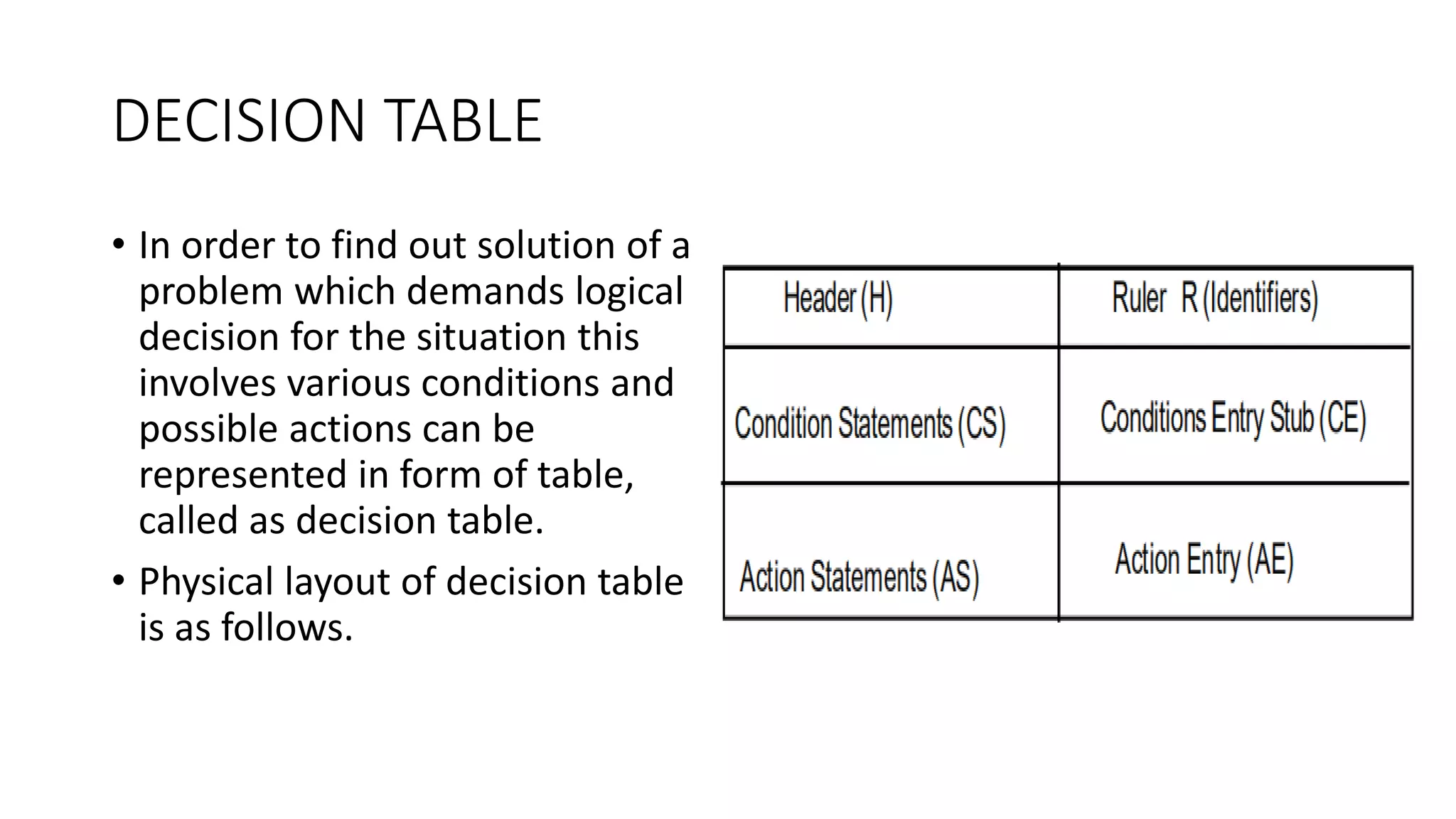
• In order to find out solution of a
problem which demands logical
decision for the situation this
involves various conditions and
possible actions can be
represented in form of table,
called as decision table.
• Physical layout of decision table
is as follows.
CASE 1:
Consider a case of a bank which grants loan to the customer
under the
following conditions
1] If a customer has an account with the bank and has no
previous loan outstanding, the loan will be granted.
2] If a customer has an account with the bank but some amount
is outstanding from previous loans then new proposal’s loan will
be granted if special management approval is there.
3] In all other situations loan applications are rejected.
Draw decision table and decision tree for the same.
Decision table:
1} List of conditions:
· Customer has an account.
· Customer had no dues.
· Customer has management approval.
2} Action list:
Grant loans.
Reject loans.
DECISION TABLE TYPE 1- Limited Entry Decision
Table
• This type of decision table expects ‘YES ’ or ‘NO’ answer for the
condition
• statements as well as action statements are marked by symbols
representing RIGHT or wrong.
Case 2
The discount policy of a manufacturer producing two products
1. Mechanical typewriter and
2. Electronic typewriter and who has three types of
customers(R) Retailers,(D) Dealers,(I) institutes is given below.
Rules: Incase of mechanical typewriter
1] If the order is from retailer for amount up to Rs.5000/, allow
6% discount.
2] If the order is from Dealer for amount up to Rs. 5000/ 7.5
discount is given.
3] On retail order exceeding Rs. 5000/- 7.5 % discount is given.
4] If the order is from Dealer for an amount exceeding
Rs.5000/-,11% discount is allowed.
5] In all the above cases flat discount of 7.5% is given to
institutes.
6] In case of electronic typewriter a flat discount of 6% is given
regardless of amount or customer.
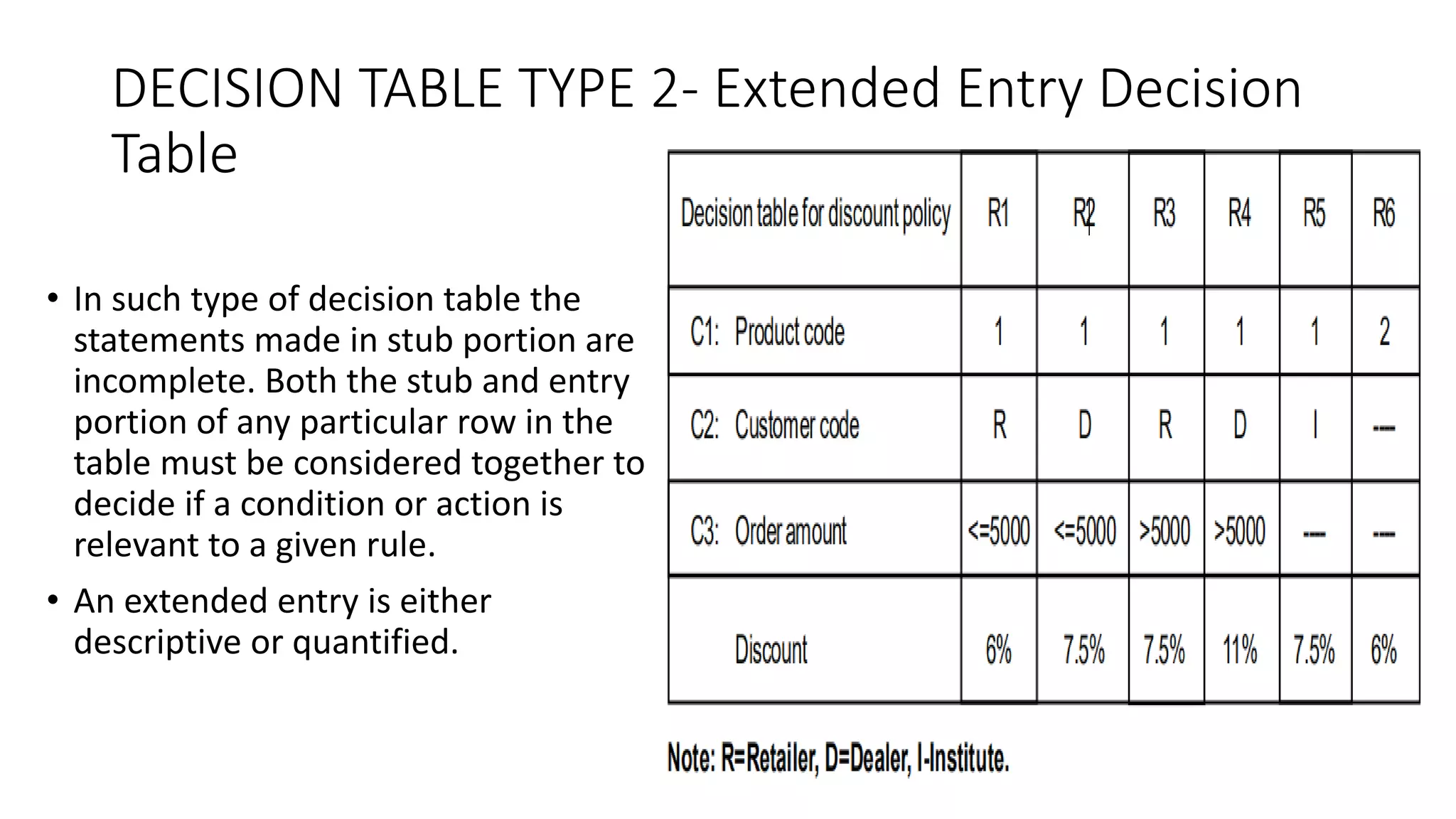
DECISION TABLE TYPE 2- Extended Entry Decision
Table
• In such type of decision table the
statements made in stub portion are
incomplete. Both the stub and entry
portion of any particular row in the
table must be considered together to
decide if a condition or action is
relevant to a given rule.
• An extended entry is either
descriptive or quantified.
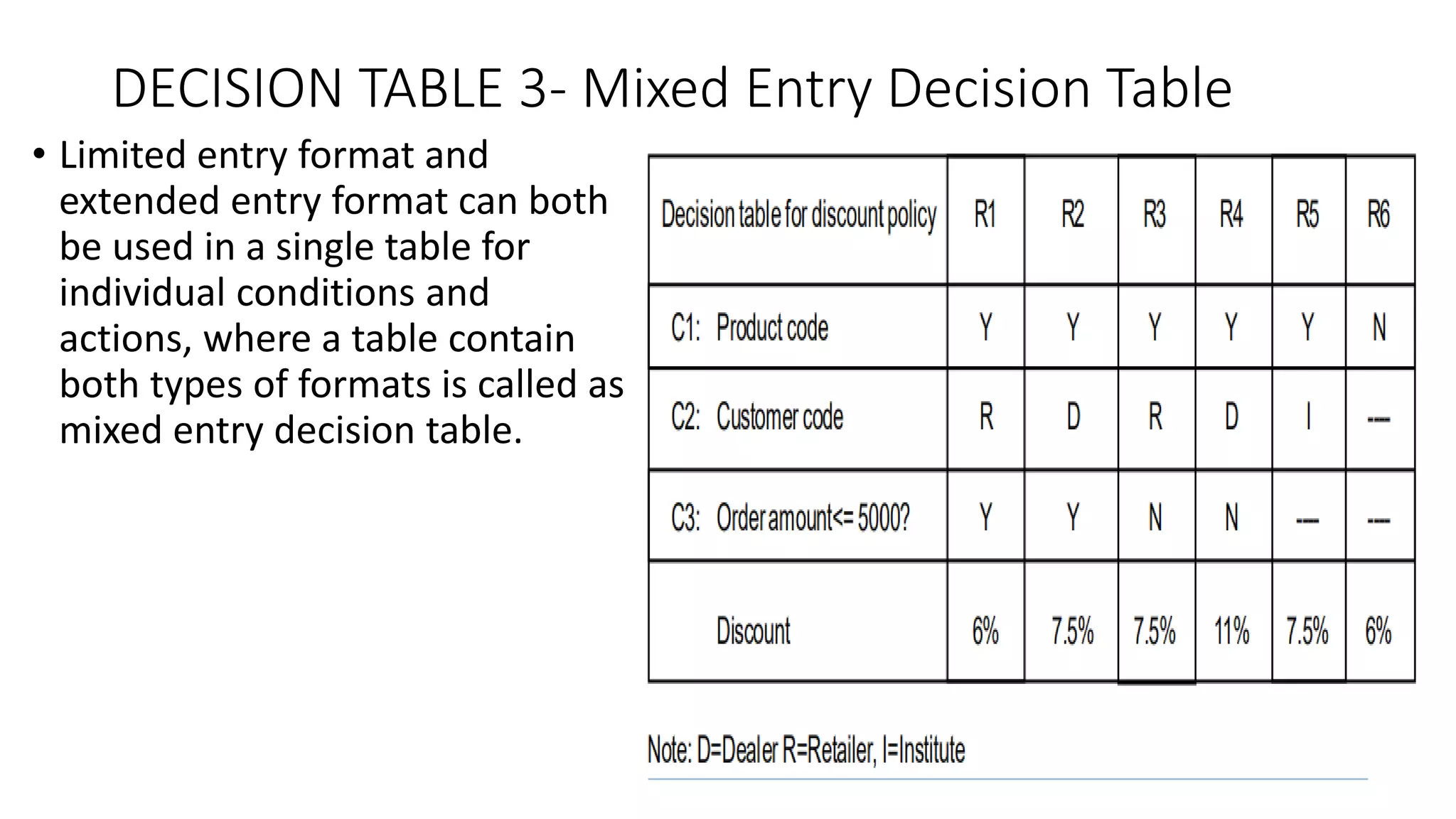
DECISION TABLE 3- Mixed Entry Decision Table
• Limited entry format and
extended entry format can both
be used in a single table for
individual conditions and
actions, where a table contain
both types of formats is called as
mixed entry decision table.
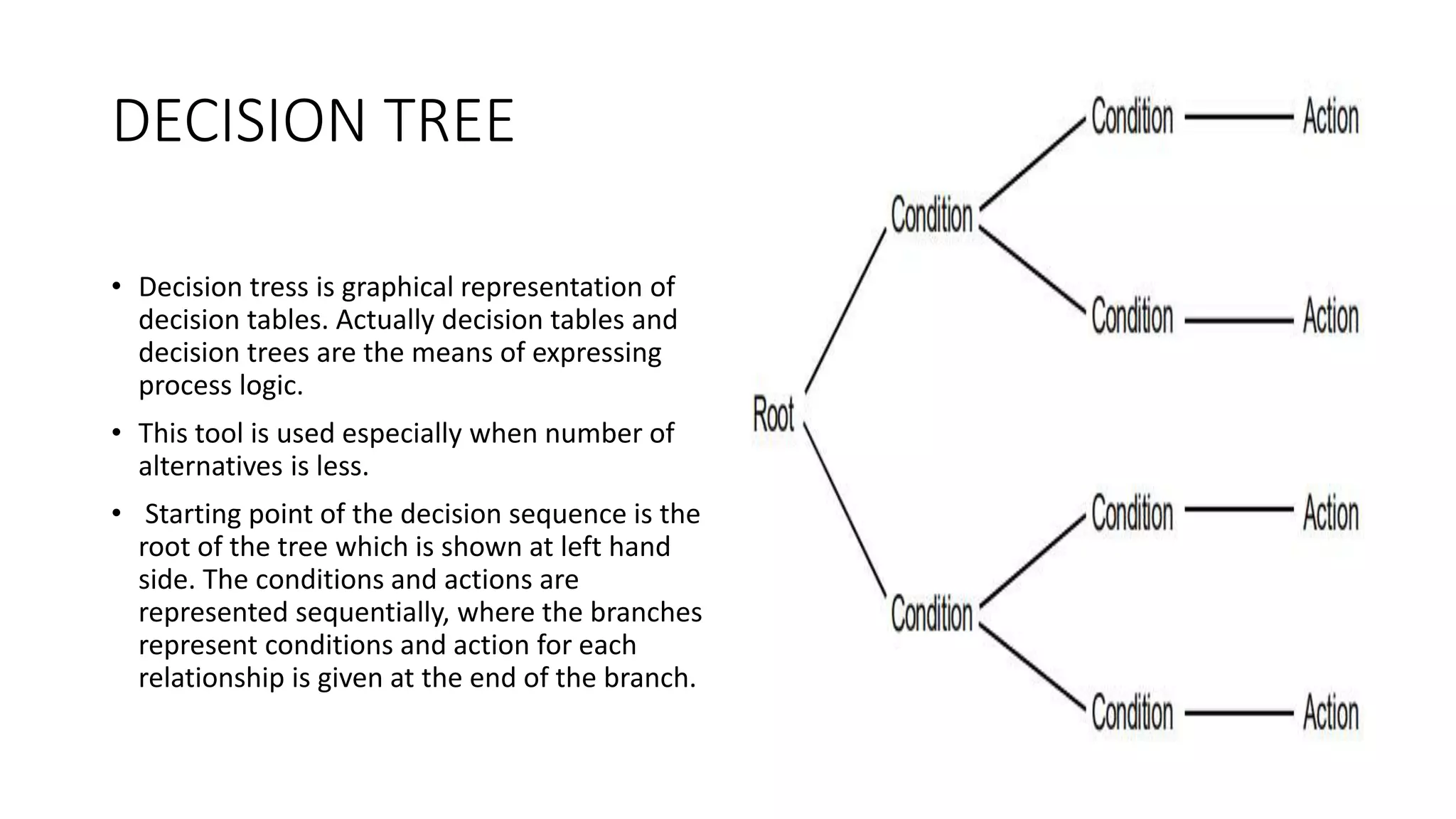
DECISION TREE
• Decision tress is graphical representation of
decision tables. Actually decision tables and
decision trees are the means of expressing
process logic.
• This tool is used especially when number of
alternatives is less.
• Starting point of the decision sequence is the
root of the tree which is shown at left hand
side. The conditions and actions are
represented sequentially, where the branches
represent conditions and action for each
relationship is given at the end of the branch.
STRUCTURED ENGLISH
• It is a specification tool that provides simple English
statements embedded in the construct of structured
programming. It consists of
1. English verbs 2. Terms from DD 3. Reserved words to
denote logic
Statements are written in structured way.
I. Sequence structure-Closed ended sequences.
II. Iteration structure-which has closed ended
repetitions.
III. Decision structure-contains closed ended decisions.
• While using structured English no particular format or
symbol is followed or used. Only the analyst has to
focus on conditions and actions.
• Advantages: -
i. It is used to describe conditions and actions clearly.
ii. Programming becomes easier if the processing logic is
already explained using structured English.
iii. Since it helps to define any process in DFD and useful
for reference to DD, it can complement DFD and DD.
iv. It also helps to communicate business requirements
effectively to computer programs
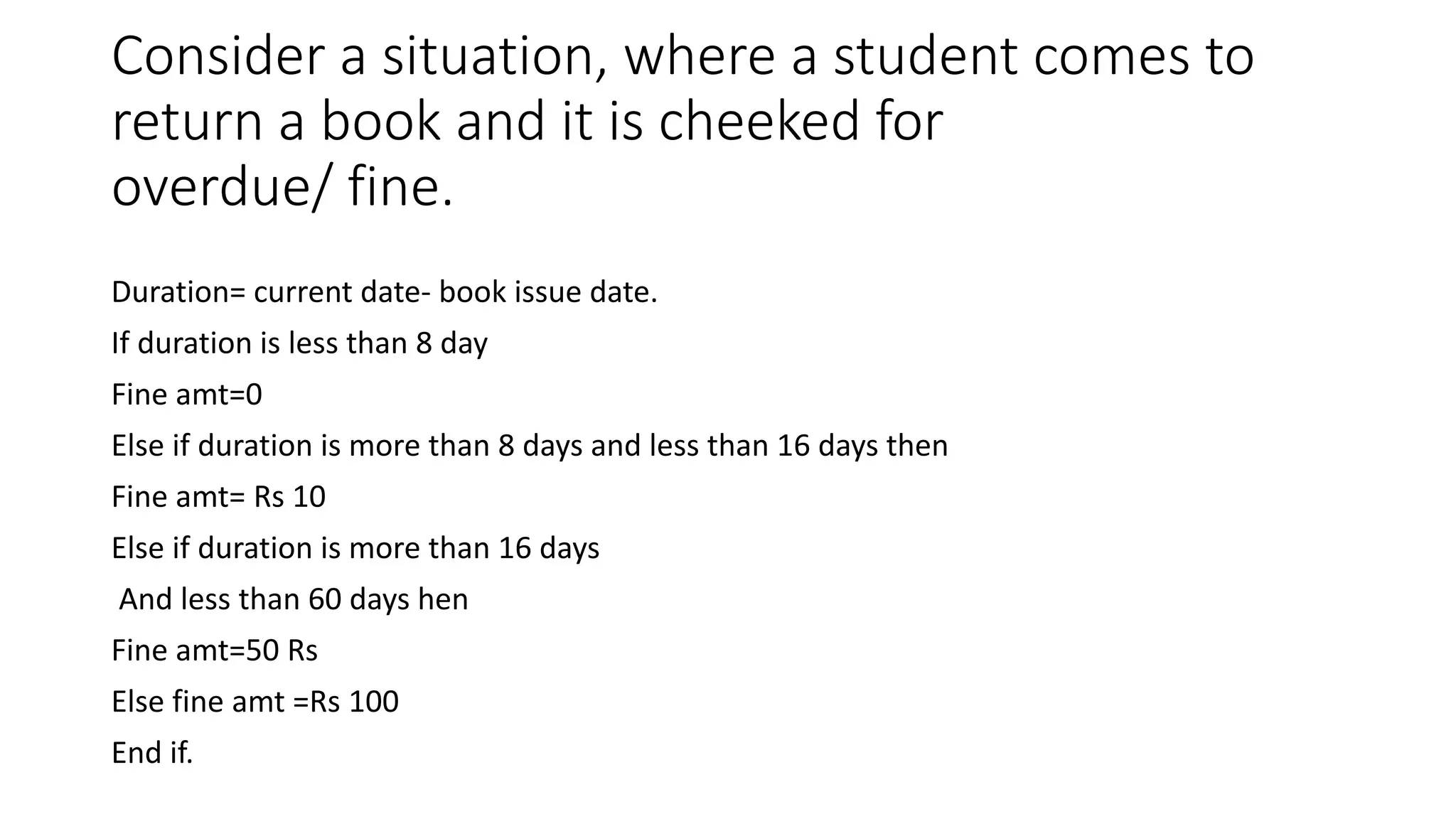
Consider a situation, where a student comes to
return a book and it is cheeked for
overdue/ fine.
Duration= current date- book issue date.
If duration is less than 8 day
Fine amt=0
Else if duration is more than 8 days and less than 16 days then
Fine amt= Rs 10
Else if duration is more than 16 days
And less than 60 days hen
Fine amt=50 Rs
Else fine amt =Rs 100
End if.
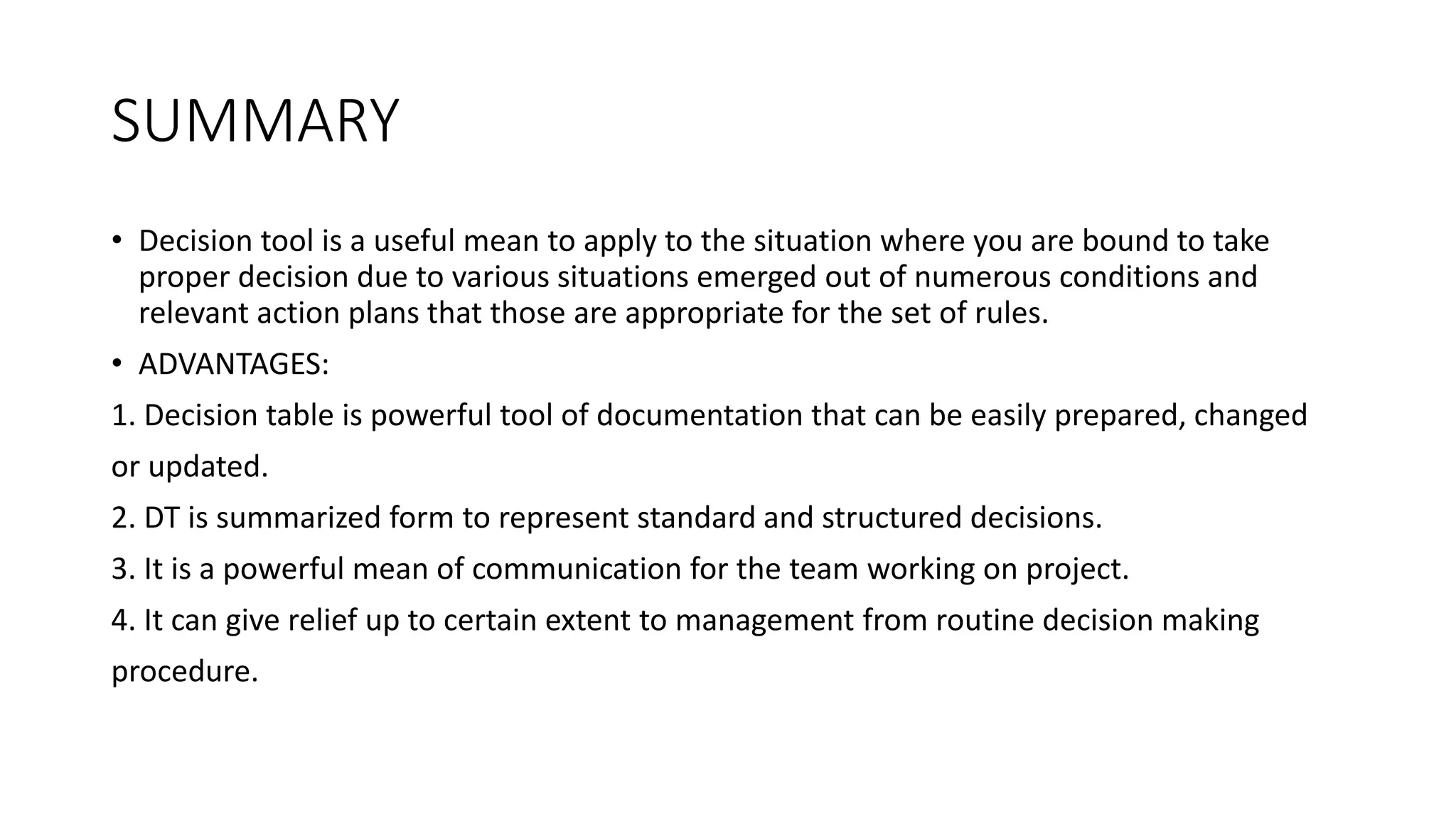
SUMMARY
• Decision tool is a useful mean to apply to the situation where you are bound to take
proper decision due to various situations emerged out of numerous conditions and
relevant action plans that those are appropriate for the set of rules.
• ADVANTAGES:
1. Decision table is powerful tool of documentation that can be easily prepared, changed
or updated.
2. DT is summarized form to represent standard and structured decisions.
3. It is a powerful mean of communication for the team working on project.
4. It can give relief up to certain extent to management from routine decision making
procedure.

Structured system analysis and design

  • 1.
    STRCTURED SYSTEM ANALYSIS ANDDESIGN CHP 7. LOGIC REPRESENTATION TECHNIQUES MR. JAYANT. DALVI
  • 2.
    NEED • Whenever asystem analyst or programmer is required to take a logical decision for the case where there are repetitive situations, then they take the help of the tools like decision table and/or decision tree that leads or concludes to the appropriate solution for the particular situation.
  • 3.
    DECISION TABLE • Inorder to find out solution of a problem which demands logical decision for the situation this involves various conditions and possible actions can be represented in form of table, called as decision table. • Physical layout of decision table is as follows.
  • 4.
    CASE 1: Consider acase of a bank which grants loan to the customer under the following conditions 1] If a customer has an account with the bank and has no previous loan outstanding, the loan will be granted. 2] If a customer has an account with the bank but some amount is outstanding from previous loans then new proposal’s loan will be granted if special management approval is there. 3] In all other situations loan applications are rejected. Draw decision table and decision tree for the same. Decision table: 1} List of conditions: · Customer has an account. · Customer had no dues. · Customer has management approval. 2} Action list: Grant loans. Reject loans.
  • 5.
    DECISION TABLE TYPE1- Limited Entry Decision Table • This type of decision table expects ‘YES ’ or ‘NO’ answer for the condition • statements as well as action statements are marked by symbols representing RIGHT or wrong.
  • 6.
    Case 2 The discountpolicy of a manufacturer producing two products 1. Mechanical typewriter and 2. Electronic typewriter and who has three types of customers(R) Retailers,(D) Dealers,(I) institutes is given below. Rules: Incase of mechanical typewriter 1] If the order is from retailer for amount up to Rs.5000/, allow 6% discount. 2] If the order is from Dealer for amount up to Rs. 5000/ 7.5 discount is given. 3] On retail order exceeding Rs. 5000/- 7.5 % discount is given. 4] If the order is from Dealer for an amount exceeding Rs.5000/-,11% discount is allowed. 5] In all the above cases flat discount of 7.5% is given to institutes. 6] In case of electronic typewriter a flat discount of 6% is given regardless of amount or customer.
  • 7.
    DECISION TABLE TYPE2- Extended Entry Decision Table • In such type of decision table the statements made in stub portion are incomplete. Both the stub and entry portion of any particular row in the table must be considered together to decide if a condition or action is relevant to a given rule. • An extended entry is either descriptive or quantified.
  • 8.
    DECISION TABLE 3-Mixed Entry Decision Table • Limited entry format and extended entry format can both be used in a single table for individual conditions and actions, where a table contain both types of formats is called as mixed entry decision table.
  • 9.
    DECISION TREE • Decisiontress is graphical representation of decision tables. Actually decision tables and decision trees are the means of expressing process logic. • This tool is used especially when number of alternatives is less. • Starting point of the decision sequence is the root of the tree which is shown at left hand side. The conditions and actions are represented sequentially, where the branches represent conditions and action for each relationship is given at the end of the branch.
  • 10.
    STRUCTURED ENGLISH • Itis a specification tool that provides simple English statements embedded in the construct of structured programming. It consists of 1. English verbs 2. Terms from DD 3. Reserved words to denote logic Statements are written in structured way. I. Sequence structure-Closed ended sequences. II. Iteration structure-which has closed ended repetitions. III. Decision structure-contains closed ended decisions. • While using structured English no particular format or symbol is followed or used. Only the analyst has to focus on conditions and actions. • Advantages: - i. It is used to describe conditions and actions clearly. ii. Programming becomes easier if the processing logic is already explained using structured English. iii. Since it helps to define any process in DFD and useful for reference to DD, it can complement DFD and DD. iv. It also helps to communicate business requirements effectively to computer programs
  • 11.
    Consider a situation,where a student comes to return a book and it is cheeked for overdue/ fine. Duration= current date- book issue date. If duration is less than 8 day Fine amt=0 Else if duration is more than 8 days and less than 16 days then Fine amt= Rs 10 Else if duration is more than 16 days And less than 60 days hen Fine amt=50 Rs Else fine amt =Rs 100 End if.
  • 12.
    SUMMARY • Decision toolis a useful mean to apply to the situation where you are bound to take proper decision due to various situations emerged out of numerous conditions and relevant action plans that those are appropriate for the set of rules. • ADVANTAGES: 1. Decision table is powerful tool of documentation that can be easily prepared, changed or updated. 2. DT is summarized form to represent standard and structured decisions. 3. It is a powerful mean of communication for the team working on project. 4. It can give relief up to certain extent to management from routine decision making procedure.