Structure 1.3
Electron configurations
Guiding question:
How can we model the energy
states of electrons in atoms?
Time:
SL and HL - 3 h
AHL - 3 h
1
Prior knowledge
1. Which types of electromagnetic radiation are relevant in these contexts?
2. What is different about different types of electromagnetic radiation?
2
SL and HL content
3
Part A
The electromagnetic
spectrum
4
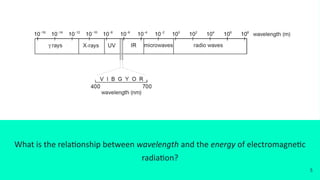
What is the relationship between wavelength and the energy of electromagnetic
radiation?
5
What is electromagnetic radiation?
Radiation that has both electric and magnetic fields can be modelled as both:
6
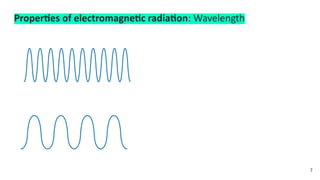
Properties of electromagnetic radiation: Wavelength
7
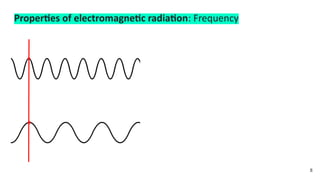
Properties of electromagnetic radiation: Frequency
8
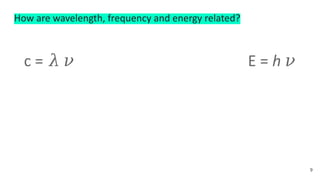
How are wavelength, frequency and energy related?
c = 𝜆 𝜈 E = h 𝜈
9
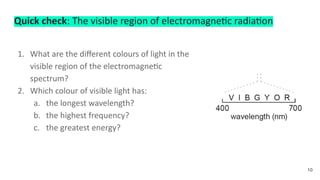
Quick check: The visible region of electromagnetic radiation
1. What are the different colours of light in the
visible region of the electromagnetic
spectrum?
2. Which colour of visible light has:
a. the longest wavelength?
b. the highest frequency?
c. the greatest energy?
10
Practice questions
Identify the region of
the electromagnetic
spectrum that has:
1. Shortest
wavelength
2. Lowest
frequency
3. Lowest energy
11
Part B
Emission spectra and the
Bohr model of the atom
12
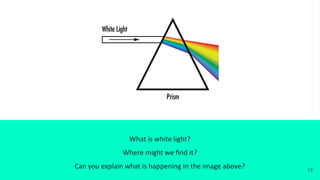
What is white light?
Where might we find it?
Can you explain what is happening in the image above? 13
Practical: Continuous and line emission spectra
A diffraction grating separates the different components of electromagnetic
radiation. With our eyes, we will be see any colours present in the visible region.
Record your observations when:
1. Looking at white light
2. Looking at a hydrogen gas lamp
What differences do you notice?
14
Continuous and line emission spectra
15
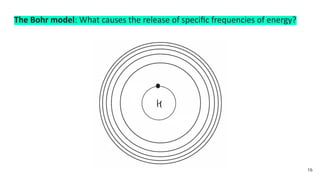
The Bohr model: What causes the release of specific frequencies of energy?
16
The Bohr model and the hydrogen emission spectrum
17
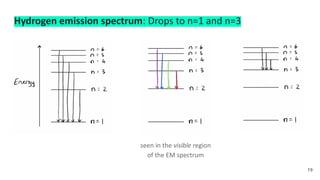
An energy level diagram for the hydrogen emission spectrum
18
Hydrogen emission spectrum: Drops to n=1 and n=3
seen in the visible region
of the EM spectrum
19
Quick check
1. (MCQ) What do the lines on the hydrogen emission spectrum represent?
a. The energy levels in a hydrogen atom
b. The energy gap between energy levels in a hydrogen atom
c. Excited electrons in hydrogen atoms
d. Relaxed electrons in hydrogen atoms
2. The hydrogen emission spectrum is caused by electrons dropping to which
energy level?
3. Why do the lines on an emission spectrum converge at higher energies?
20
Practical: Flame tests
1. Hold wooden splints soaked in different metal ion solutions in a Bunsen
burner flame.
2. Record your observations.
3. Identify the likely metal ion present in the two unknown solutions.
21
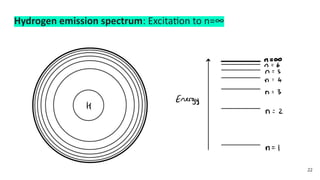
Hydrogen emission spectrum: Excitation to n=∞
22
Practice questions
1. Sketch an energy level diagram with 6 energy levels. Add and label arrows
showing an electron transition…
a. Caused by the absorption of energy.
b. Representing a line in the hydrogen emission spectrum.
c. That would represent the largest possible energy emission.
2. Explain why we do not see lines on a hydrogen emission spectrum caused by
drops to n=1.
23
Part C
Energy levels, sublevels
and orbitals
24
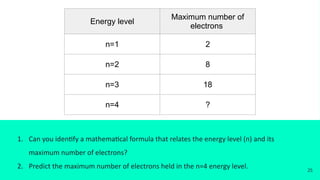
1. Can you identify a mathematical formula that relates the energy level (n) and its
maximum number of electrons?
2. Predict the maximum number of electrons held in the n=4 energy level.
Energy level
Maximum number of
electrons
n=1 2
n=2 8
n=3 18
n=4 ?
25
Main energy levels
Energy level
Maximum number
of electrons
n=1
n=2
n=3
n=4
26
2
8
18
32
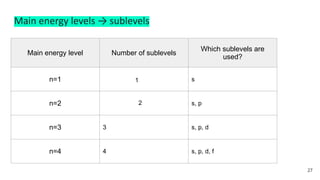
Main energy levels → sublevels
Main energy level Number of sublevels
Which sublevels are
used?
n=1 s
n=2 s, p
n=3 3 s, p, d
n=4 4 s, p, d, f
27
1
2
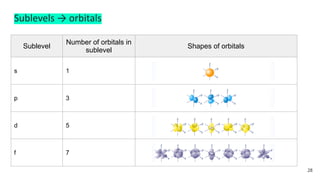
Sublevel
Number of orbitals in
sublevel
Shapes of orbitals
s 1
p 3 px, pppppp
d 5
f 7
Sublevels → orbitals
28
Summary
Main energy level Sublevels
Total number of
orbitals
Maximum no.
electrons
n=1 s 1 2
n=2 p 3 6
n=3 d 5 10
n=4 f 7 14
29
Practice questions
1. State the sublevels found in the n=1, n=2, n=3 and n=4 main energy levels.
2. Define ‘orbital’. The area where you have high probability of finding electron
3. State the number of electrons found in a single orbital. 2
4. Sketch the shape of an s orbital.
5. Sketch a pz orbital on these axes →
6. State the number of orbitals are found in the s, p, d and f sublevels. 1, 3, 5, 7
7. Explain, in terms of sublevels and orbitals, why the n=4 energy level can contain a
maximum of 32 electrons. It has 4s, 4p, 4d, and 4f sublevels, the s orbital has 1
orbital, p 3, d 5, f 7. and one orbital contains 2 electron. We have 16 orbital in
total, so there are 32 electrons
30
Part D
Electron configurations
31
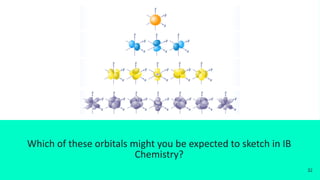
Which of these orbitals might you be expected to sketch in IB
Chemistry?
32
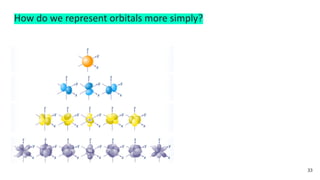
How do we represent orbitals more simply?
33
Orbital box diagram for n=1, n=2 and n=3 energy levels
34
Reminder:
Main
energy
level
Sublevels
Total
number of
orbitals
n=1 s 1
n=2 s, p 1 + 3
n=3 s, p, d 1 + 3 + 5
Orbital box diagrams
How might we draw the first 8
electrons in an atom?
35
Relative
energy levels
of electrons
in gaseous
atoms of the
first twenty
elements
Increasing
energy
s p d f
1s
2s
2p
3s
3d
3p
4s
4p
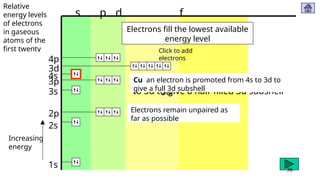
Electrons fill the lowest available
energy level
4s fills before
3d
Electrons remain unpaired as
far as possible
Cr an electron is promoted from 4s
to 3d to give a half-filled 3d subshell
Cu an electron is promoted from 4s to 3d to
give a full 3d subshell
Click to add
electrons
36
Relative
energy levels
of electrons
in gaseous
atoms of the
first twenty
elements
Increasing
energy
s p d f
1s
2s
2p
3s
3d
3p
4s
4p
Electronic configuration in
shorthand nomenclature
Click to add
electrons
H 1s1
He 1s2
Li 1s2
2s1
Be 1s2
2s2
B 1s2
2s2
2p1
C 1s2
2s2
2p2
N 1s2
2s2
2p3
O 1s2
2s2
2p4
F 1s2
2s2
2p5
Ne 1s2
2s2
2p6
Na 1s2
2s2
2p6
3s1
Mg 1s2
2s2
2p6
3s2
Al 1s2
2s2
2p6
3s2
3p1
Si 1s2
2s2
2p6
3s2
3p2
P 1s2
2s2
2p6
3s2
3p3
S 1s2
2s2
2p6
3s2
3p4
Cl 1s2
2s2
2p6
3s2
3p5
Ar 1s2
2s2
2p6
3s2
3p6
K 1s2
2s2
2p6
3s2
3p6
4s1
Ca 1s2
2s2
2p6
3s2
3p6
4s2
Sc 1s2
2s2
2p6
3s2
3p6
4s2
3d1
Ti 1s2
2s2
2p6
3s2
3p6
4s2
3d2
V 1s2
2s2
2p6
3s2
3p6
4s2
3d3
Cr 1s2
2s2
2p6
3s2
3p6
4s1
3d5
Mn 1s2
2s2
2p6
3s2
3p6
4s2
3d5
Fe 1s2
2s2
2p6
3s2
3p6
4s2
3d6
Co 1s2
2s2
2p6
3s2
3p6
4s2
3d7
Ni 1s2
2s2
2p6
3s2
3p6
4s2
3d8
Cu 1s2
2s2
2p6
3s2
3p6
4s1
3d10
Zn 1s2
2s2
2p6
3s2
3p6
4s2
3d10
Ga 1s2
2s2
2p6
3s2
3p6
4s2
3d10
4p1
Ge 1s2
2s2
2p6
3s2
3p6
4s2
3d10
4p2
As 1s2
2s2
2p6
3s2
3p6
4s2
3d10
4p3
Se 1s2
2s2
2p6
3s2
3p6
4s2
3d10
4p4
Br 1s2
2s2
2p6
3s2
3p6
4s2
3d10
4p5
Kr 1s2
2s2
2p6
3s2
3p6
4s2
3d10
4p6
37
Quick check
Symbol Full e-
configuration Condensed e-
configuration
Li
C
Cu
Fe
Cr
38
How do we write e-
configurations for ions?
Atom Full e-
configuration of atom Ion Full e-
configuration of ion
Li Li+
O O2-
Mg Mg2+
Fe Fe3+
Cu Cu2+
39
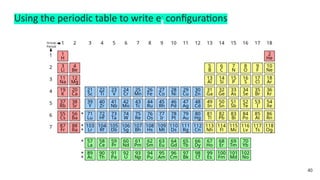
Using the periodic table to write e-
configurations
40
Practice
Symbol Full e-
configuration
Condensed e-
configuration
Be
N
Si
Cu
Ti4+
Mn2+
Cu+
Se2-
41
AHL content
42
Part E
First ionization energy
43
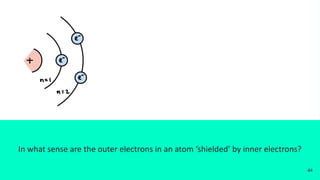
In what sense are the outer electrons in an atom ‘shielded’ by inner electrons?
44
What is ‘first ionization energy’?
Definition:
General formula:
45
Data for 1st ionization energy across a period
46
Quick check
47
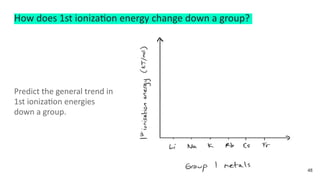
How does 1st ionization energy change down a group?
Predict the general trend in
1st ionization energies
down a group.
48
Practice questions
1. Predict and explain the general
trend in 1st ionization energy
down group 2.
2. Explain the general trend in 1st
ionization energy across a
period.
3. Explain the discontinuities
(exceptions) to the general trend
in the 1st ionization energies of
period 3 elements →
49
Part F
Successive ionization
energies
50
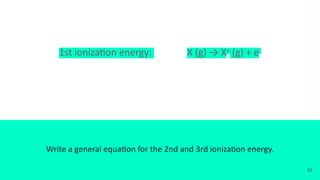
1st ionization energy: X (g) → X+
(g) + e-
Write a general equation for the 2nd and 3rd ionization energy.
51
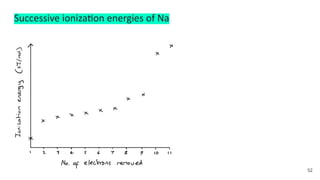
Successive ionization energies of Na
52
Quick check
Sketch the successive ionization
energies for a nitrogen atom.
53
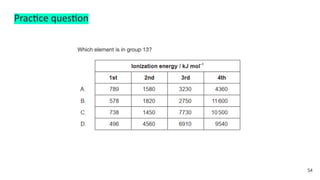
Practice question
54
Part G
The limit of convergence
and ionization
55
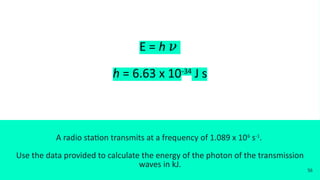
E = h 𝜈
h = 6.63 x 10⁻³⁴
J s
A radio station transmits at a frequency of 1.089 x 10⁶
s-1
.
Use the data provided to calculate the energy of the photon of the transmission
waves in kJ.
56
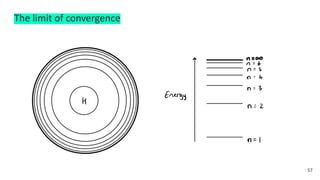
The limit of convergence
57
How do we calculate ionization energy from spectral data?
The convergence limit for a hydrogen atom
occurs at a frequency of 3.28 x 10¹⁵
Hz.
Calculate the:
1. First ionization energy for a hydrogen
atom in J.
2. First ionization energy for a hydrogen
atom in kJ.
3. First ionization energy for hydrogen in
kJ mol-1
.
Data booklet:
E = h 𝜈
h = 6.63 x 10⁻³⁴
J s
1 mol = 6.02 x 10²³
particles
c = 𝜈 𝜆
c = 3.00 x 10⁸
m s-1
58
Practice question
1. A beam of electromagnetic radiation has an energy of 3.65 x 10⁻²⁰
J per photon.
a. Calculate the frequency of the radiation.
b. Calculate the wavelength of the radiation.
c. Identify the type of electromagnetic radiation using the electromagnetic
spectrum below.
59
Practice question
2. The electron in a hydrogen atom reaches the convergence limit when it
absorbs radiation with a wavelength of 9.15 x 10⁻⁸
m. Calculate the ionisation
energy in kJ mol-1
.
60
Guiding question and
review
61
How can we model the energy states of electrons in atoms?
62
Where do we find electrons?
How do we represent the position of electrons?
How do electrons change energy states?
AHL - How can we ionize an atom?
Key terminology
1. Wavelength
2. Frequency
3. Continuous spectrum
4. Line spectrum
5. Photon
6. Hydrogen emission spectrum
7. Orbital
8. AHL: Ionization energy
63
Past-paper questions
64
Retrieval practice
65
Gamma rays
Infrared
Microwaves
Visible light
X-rays
Radio waves
Ultraviolet
Retrieval practice: Place the following regions of the electromagnetic spectrum
in order of increasing frequency.
66
Nature of science:
1. Which elements might be found in the unknown star?
2. How do emission spectra provide evidence for the existence of different
elements?
Unknown star
67
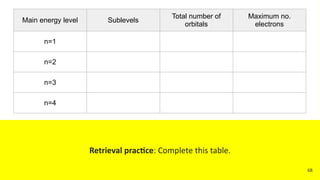
Retrieval practice: Complete this table.
Main energy level Sublevels
Total number of
orbitals
Maximum no.
electrons
n=1
n=2
n=3
n=4
68
1. Has the e-
configuration 1s2
2s2
2p6
3s2
.
2. Has 2 electrons in the second energy level.
3. Has the e-
configuration 1s2
.
4. Contains [Ar] in its condensed e-
configuration.
5. Finishes with p2
in its e configuration.
6. Contains an unpaired electron in an s-orbital.
7. Contains a half filled set of d-orbitals.
8. Contains a complete p sub-level.
9. Has 28e-
in its 2+ ion.
Retrieval practice: State the name of an element that...
69
1. Inner electrons shield valence electrons from the positive charge in the
nucleus.
2. Elements in the same group have the same number of shielding electrons.
3. Elements in the same period have the same number of shielding electrons.
4. Down a group, 1st ionization energy increases as valence electrons are
found further from the nucleus.
5. Across a period, the general trend in 1st ionization energy in increasing.
Retrieval practice: True or false?
70
The first four successive ionization energies are:
420, 3600, 4400 and 5900 kJ mol-1
Which group of the periodic would this element be found?
71
NOS and TOK
72
NOS/TOK: Evidence, models and theories
1. Use examples from Structure 1.3 to explain the relationship between these:
2. Can you do the same using examples from another IB subject?
Evidence Models Theories
73
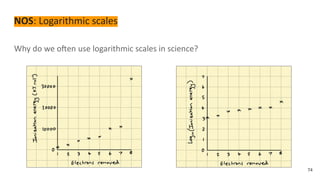
NOS: Logarithmic scales
Why do we often use logarithmic scales in science?
74
Extension
75
Extension: Doppler shift
How can emission and absorption spectra tell us about movement?
76
Extension: Atomic absorption spectra
What are the difference
between an emission line
spectrum and an
absorption line spectrum?
What causes these
differences?
77
Extension: Electron configurations and quantum numbers
78

Structure 1.3 - Electron configurations.pptx

  • 1.
    Structure 1.3 Electron configurations Guidingquestion: How can we model the energy states of electrons in atoms? Time: SL and HL - 3 h AHL - 3 h 1
  • 2.
    Prior knowledge 1. Whichtypes of electromagnetic radiation are relevant in these contexts? 2. What is different about different types of electromagnetic radiation? 2
  • 3.
    SL and HLcontent 3
  • 4.
  • 5.
    What is therelationship between wavelength and the energy of electromagnetic radiation? 5
  • 6.
    What is electromagneticradiation? Radiation that has both electric and magnetic fields can be modelled as both: 6
  • 7.
    Properties of electromagneticradiation: Wavelength 7
  • 8.
    Properties of electromagneticradiation: Frequency 8
  • 9.
    How are wavelength,frequency and energy related? c = 𝜆 𝜈 E = h 𝜈 9
  • 10.
    Quick check: Thevisible region of electromagnetic radiation 1. What are the different colours of light in the visible region of the electromagnetic spectrum? 2. Which colour of visible light has: a. the longest wavelength? b. the highest frequency? c. the greatest energy? 10
  • 11.
    Practice questions Identify theregion of the electromagnetic spectrum that has: 1. Shortest wavelength 2. Lowest frequency 3. Lowest energy 11
  • 12.
    Part B Emission spectraand the Bohr model of the atom 12
  • 13.
    What is whitelight? Where might we find it? Can you explain what is happening in the image above? 13
  • 14.
    Practical: Continuous andline emission spectra A diffraction grating separates the different components of electromagnetic radiation. With our eyes, we will be see any colours present in the visible region. Record your observations when: 1. Looking at white light 2. Looking at a hydrogen gas lamp What differences do you notice? 14
  • 15.
    Continuous and lineemission spectra 15
  • 16.
    The Bohr model:What causes the release of specific frequencies of energy? 16
  • 17.
    The Bohr modeland the hydrogen emission spectrum 17
  • 18.
    An energy leveldiagram for the hydrogen emission spectrum 18
  • 19.
    Hydrogen emission spectrum:Drops to n=1 and n=3 seen in the visible region of the EM spectrum 19
  • 20.
    Quick check 1. (MCQ)What do the lines on the hydrogen emission spectrum represent? a. The energy levels in a hydrogen atom b. The energy gap between energy levels in a hydrogen atom c. Excited electrons in hydrogen atoms d. Relaxed electrons in hydrogen atoms 2. The hydrogen emission spectrum is caused by electrons dropping to which energy level? 3. Why do the lines on an emission spectrum converge at higher energies? 20
  • 21.
    Practical: Flame tests 1.Hold wooden splints soaked in different metal ion solutions in a Bunsen burner flame. 2. Record your observations. 3. Identify the likely metal ion present in the two unknown solutions. 21
  • 22.
    Hydrogen emission spectrum:Excitation to n=∞ 22
  • 23.
    Practice questions 1. Sketchan energy level diagram with 6 energy levels. Add and label arrows showing an electron transition… a. Caused by the absorption of energy. b. Representing a line in the hydrogen emission spectrum. c. That would represent the largest possible energy emission. 2. Explain why we do not see lines on a hydrogen emission spectrum caused by drops to n=1. 23
  • 24.
    Part C Energy levels,sublevels and orbitals 24
  • 25.
    1. Can youidentify a mathematical formula that relates the energy level (n) and its maximum number of electrons? 2. Predict the maximum number of electrons held in the n=4 energy level. Energy level Maximum number of electrons n=1 2 n=2 8 n=3 18 n=4 ? 25
  • 26.
    Main energy levels Energylevel Maximum number of electrons n=1 n=2 n=3 n=4 26 2 8 18 32
  • 27.
    Main energy levels→ sublevels Main energy level Number of sublevels Which sublevels are used? n=1 s n=2 s, p n=3 3 s, p, d n=4 4 s, p, d, f 27 1 2
  • 28.
    Sublevel Number of orbitalsin sublevel Shapes of orbitals s 1 p 3 px, pppppp d 5 f 7 Sublevels → orbitals 28
  • 29.
    Summary Main energy levelSublevels Total number of orbitals Maximum no. electrons n=1 s 1 2 n=2 p 3 6 n=3 d 5 10 n=4 f 7 14 29
  • 30.
    Practice questions 1. Statethe sublevels found in the n=1, n=2, n=3 and n=4 main energy levels. 2. Define ‘orbital’. The area where you have high probability of finding electron 3. State the number of electrons found in a single orbital. 2 4. Sketch the shape of an s orbital. 5. Sketch a pz orbital on these axes → 6. State the number of orbitals are found in the s, p, d and f sublevels. 1, 3, 5, 7 7. Explain, in terms of sublevels and orbitals, why the n=4 energy level can contain a maximum of 32 electrons. It has 4s, 4p, 4d, and 4f sublevels, the s orbital has 1 orbital, p 3, d 5, f 7. and one orbital contains 2 electron. We have 16 orbital in total, so there are 32 electrons 30
  • 31.
  • 32.
    Which of theseorbitals might you be expected to sketch in IB Chemistry? 32
  • 33.
    How do werepresent orbitals more simply? 33
  • 34.
    Orbital box diagramfor n=1, n=2 and n=3 energy levels 34 Reminder: Main energy level Sublevels Total number of orbitals n=1 s 1 n=2 s, p 1 + 3 n=3 s, p, d 1 + 3 + 5
  • 35.
    Orbital box diagrams Howmight we draw the first 8 electrons in an atom? 35
  • 36.
    Relative energy levels of electrons ingaseous atoms of the first twenty elements Increasing energy s p d f 1s 2s 2p 3s 3d 3p 4s 4p Electrons fill the lowest available energy level 4s fills before 3d Electrons remain unpaired as far as possible Cr an electron is promoted from 4s to 3d to give a half-filled 3d subshell Cu an electron is promoted from 4s to 3d to give a full 3d subshell Click to add electrons 36
  • 37.
    Relative energy levels of electrons ingaseous atoms of the first twenty elements Increasing energy s p d f 1s 2s 2p 3s 3d 3p 4s 4p Electronic configuration in shorthand nomenclature Click to add electrons H 1s1 He 1s2 Li 1s2 2s1 Be 1s2 2s2 B 1s2 2s2 2p1 C 1s2 2s2 2p2 N 1s2 2s2 2p3 O 1s2 2s2 2p4 F 1s2 2s2 2p5 Ne 1s2 2s2 2p6 Na 1s2 2s2 2p6 3s1 Mg 1s2 2s2 2p6 3s2 Al 1s2 2s2 2p6 3s2 3p1 Si 1s2 2s2 2p6 3s2 3p2 P 1s2 2s2 2p6 3s2 3p3 S 1s2 2s2 2p6 3s2 3p4 Cl 1s2 2s2 2p6 3s2 3p5 Ar 1s2 2s2 2p6 3s2 3p6 K 1s2 2s2 2p6 3s2 3p6 4s1 Ca 1s2 2s2 2p6 3s2 3p6 4s2 Sc 1s2 2s2 2p6 3s2 3p6 4s2 3d1 Ti 1s2 2s2 2p6 3s2 3p6 4s2 3d2 V 1s2 2s2 2p6 3s2 3p6 4s2 3d3 Cr 1s2 2s2 2p6 3s2 3p6 4s1 3d5 Mn 1s2 2s2 2p6 3s2 3p6 4s2 3d5 Fe 1s2 2s2 2p6 3s2 3p6 4s2 3d6 Co 1s2 2s2 2p6 3s2 3p6 4s2 3d7 Ni 1s2 2s2 2p6 3s2 3p6 4s2 3d8 Cu 1s2 2s2 2p6 3s2 3p6 4s1 3d10 Zn 1s2 2s2 2p6 3s2 3p6 4s2 3d10 Ga 1s2 2s2 2p6 3s2 3p6 4s2 3d10 4p1 Ge 1s2 2s2 2p6 3s2 3p6 4s2 3d10 4p2 As 1s2 2s2 2p6 3s2 3p6 4s2 3d10 4p3 Se 1s2 2s2 2p6 3s2 3p6 4s2 3d10 4p4 Br 1s2 2s2 2p6 3s2 3p6 4s2 3d10 4p5 Kr 1s2 2s2 2p6 3s2 3p6 4s2 3d10 4p6 37
  • 38.
    Quick check Symbol Fulle- configuration Condensed e- configuration Li C Cu Fe Cr 38
  • 39.
    How do wewrite e- configurations for ions? Atom Full e- configuration of atom Ion Full e- configuration of ion Li Li+ O O2- Mg Mg2+ Fe Fe3+ Cu Cu2+ 39
  • 40.
    Using the periodictable to write e- configurations 40
  • 41.
    Practice Symbol Full e- configuration Condensede- configuration Be N Si Cu Ti4+ Mn2+ Cu+ Se2- 41
  • 42.
  • 43.
  • 44.
    In what senseare the outer electrons in an atom ‘shielded’ by inner electrons? 44
  • 45.
    What is ‘firstionization energy’? Definition: General formula: 45
  • 46.
    Data for 1stionization energy across a period 46
  • 47.
  • 48.
    How does 1stionization energy change down a group? Predict the general trend in 1st ionization energies down a group. 48
  • 49.
    Practice questions 1. Predictand explain the general trend in 1st ionization energy down group 2. 2. Explain the general trend in 1st ionization energy across a period. 3. Explain the discontinuities (exceptions) to the general trend in the 1st ionization energies of period 3 elements → 49
  • 50.
  • 51.
    1st ionization energy:X (g) → X+ (g) + e- Write a general equation for the 2nd and 3rd ionization energy. 51
  • 52.
  • 53.
    Quick check Sketch thesuccessive ionization energies for a nitrogen atom. 53
  • 54.
  • 55.
    Part G The limitof convergence and ionization 55
  • 56.
    E = h𝜈 h = 6.63 x 10⁻³⁴ J s A radio station transmits at a frequency of 1.089 x 10⁶ s-1 . Use the data provided to calculate the energy of the photon of the transmission waves in kJ. 56
  • 57.
    The limit ofconvergence 57
  • 58.
    How do wecalculate ionization energy from spectral data? The convergence limit for a hydrogen atom occurs at a frequency of 3.28 x 10¹⁵ Hz. Calculate the: 1. First ionization energy for a hydrogen atom in J. 2. First ionization energy for a hydrogen atom in kJ. 3. First ionization energy for hydrogen in kJ mol-1 . Data booklet: E = h 𝜈 h = 6.63 x 10⁻³⁴ J s 1 mol = 6.02 x 10²³ particles c = 𝜈 𝜆 c = 3.00 x 10⁸ m s-1 58
  • 59.
    Practice question 1. Abeam of electromagnetic radiation has an energy of 3.65 x 10⁻²⁰ J per photon. a. Calculate the frequency of the radiation. b. Calculate the wavelength of the radiation. c. Identify the type of electromagnetic radiation using the electromagnetic spectrum below. 59
  • 60.
    Practice question 2. Theelectron in a hydrogen atom reaches the convergence limit when it absorbs radiation with a wavelength of 9.15 x 10⁻⁸ m. Calculate the ionisation energy in kJ mol-1 . 60
  • 61.
  • 62.
    How can wemodel the energy states of electrons in atoms? 62 Where do we find electrons? How do we represent the position of electrons? How do electrons change energy states? AHL - How can we ionize an atom?
  • 63.
    Key terminology 1. Wavelength 2.Frequency 3. Continuous spectrum 4. Line spectrum 5. Photon 6. Hydrogen emission spectrum 7. Orbital 8. AHL: Ionization energy 63
  • 64.
  • 65.
  • 66.
    Gamma rays Infrared Microwaves Visible light X-rays Radiowaves Ultraviolet Retrieval practice: Place the following regions of the electromagnetic spectrum in order of increasing frequency. 66
  • 67.
    Nature of science: 1.Which elements might be found in the unknown star? 2. How do emission spectra provide evidence for the existence of different elements? Unknown star 67
  • 68.
    Retrieval practice: Completethis table. Main energy level Sublevels Total number of orbitals Maximum no. electrons n=1 n=2 n=3 n=4 68
  • 69.
    1. Has thee- configuration 1s2 2s2 2p6 3s2 . 2. Has 2 electrons in the second energy level. 3. Has the e- configuration 1s2 . 4. Contains [Ar] in its condensed e- configuration. 5. Finishes with p2 in its e configuration. 6. Contains an unpaired electron in an s-orbital. 7. Contains a half filled set of d-orbitals. 8. Contains a complete p sub-level. 9. Has 28e- in its 2+ ion. Retrieval practice: State the name of an element that... 69
  • 70.
    1. Inner electronsshield valence electrons from the positive charge in the nucleus. 2. Elements in the same group have the same number of shielding electrons. 3. Elements in the same period have the same number of shielding electrons. 4. Down a group, 1st ionization energy increases as valence electrons are found further from the nucleus. 5. Across a period, the general trend in 1st ionization energy in increasing. Retrieval practice: True or false? 70
  • 71.
    The first foursuccessive ionization energies are: 420, 3600, 4400 and 5900 kJ mol-1 Which group of the periodic would this element be found? 71
  • 72.
  • 73.
    NOS/TOK: Evidence, modelsand theories 1. Use examples from Structure 1.3 to explain the relationship between these: 2. Can you do the same using examples from another IB subject? Evidence Models Theories 73
  • 74.
    NOS: Logarithmic scales Whydo we often use logarithmic scales in science? 74
  • 75.
  • 76.
    Extension: Doppler shift Howcan emission and absorption spectra tell us about movement? 76
  • 77.
    Extension: Atomic absorptionspectra What are the difference between an emission line spectrum and an absorption line spectrum? What causes these differences? 77
  • 78.
    Extension: Electron configurationsand quantum numbers 78

Editor's Notes

  • #5 Data booklet section 3.
  • #6 A wave and a particle (photon)
  • #7 Wavelength, 𝜆 (lamda), is the distance between two peaks (m). Images: https://www.britannica.com/science/wavelength
  • #8 Frequency, 𝜈 (nu), is the number of waves that pass a point per second (s-1 or Hz). Images: https://www.britannica.com/science/wavelength
  • #9 Key points: Shorter wavelength, higher frequency. Energy is proportional to wavelength. The formulas are not required for SL.
  • #14 Helpful simulation: https://phet.colorado.edu/sims/cheerpj/discharge-lamps/latest/discharge-lamps.html?simulation=discharge-lamps
  • #15 Continuous shows all frequencies of visible light. Line shows only specific frequencies.
  • #16 The one electron in a H atom can absorb energy and move from the ground state up to a higher E level (excited state). The electron can then emit/release energy and drop back down to a lower energy level (relaxation).
  • #17 Lines on the spectrum converge because the energy levels converge at higher energy.
  • #19 Transitions down to n=1 are larger in energy and would be seen in the UV region. Transitions down to n=3 are smaller in energy and would be seen in the IR region.
  • #20 B A
  • #22 As energy levels converge at higher energies, we will soon reach the ‘edge’ of the atom known as n=∞. If an electron absorb enough energy to reach n=∞, it will leave the atom (forming a positive ion).
  • #25 Maximum number of electrons = 2n2
  • #26 It can be helpful to mention ‘electron arrangements’ here. Although not required in the IB, many students have come across them in previous chemistry courses.
  • #27 Note that each additional main energy level has 1 additional sublevel. In order of increasing energy: s < p < d < f Evidence for sublevels can be seen in ionization energy data. Explained by quantum mechanics. (not required) Names of sublevels: sharp, principal, diffuse, fundamental
  • #28 An orbital is a region of space where there is a high probability of finding an electron. Each orbital can contain 2 electrons of opposite spin. Orbitals in the same sublevel have identical energy. Note that each set of axes shows one orbital (the light and dark colours technically shows the phases of the lobes which helps explain bonding and antibonding molecular orbitals). https://www.mathsisfun.com/physics/atom-orbitals.html
  • #29 n=1 s 1 1 x 2e- = 2 n=2 s, p 1 + 3 = 4 4 x 2e- = 8 n=3 s, p, d 1 + 3 + 5 = 9 9 x 2e- = 18 n=4 s, p, d, f 1 + 3 + 5 + 7 = 16 16 x 2e- = 32
  • #33 A box can be used to represent individual orbitals.
  • #35 (specific names not required) Aufbau principle: Electrons fill orbitals from lowest energy to highest. Pauli exclusion principle: Quantum mechanics states that electrons possess a property called spin. Two e- in the same orbital must possess opposite spin. Hund’s rule: Electrons in the same sub-level will occupy orbitals individually before sharing.
  • #36 Click in presentation mode to work through this slide. As the main energy levels converge at higher energy, we begin to see the sublevels overlap. 3p < 4s< 3d. This occurs more and more when including the n=5 and n=6 energy levels.
  • #37 Click in presentation mode to work through this slide.
  • #40 https://commons.wikimedia.org/wiki/File:Simple_Periodic_Table_Chart-blocks.svg
  • #44 Repulsion between inner and outer electrons reduces the pull on outer electrons towards the nucleus.
  • #45 IB definition:
  • #46 Valence e- are all in the 2nd energy level so experience same shielding from 1st energy level electrons. Increasing number of protons in nucleus → increasing electrostatic attraction between nucleus and electrons → increasingly more energy required to remove a valence electron. General trend: Increasing across a period as valence e- are in same E level (so experience the same shielding) but experience greater attraction to the nucleus as the number of protons increases. General trend predicted by Bohr model is accurate → increasing 1st IE across a period. Exceptions at B and O: Valence e- in B is in 2p sublevel → slightly further from nucleus → less electrostatic attraction → less energy required to remove. Easiest valence electron to remove in O is found paired with another electron in a 2p orbital → electrostatic repulsion between paired electrons requires less energy to remove.
  • #47 Answer: C. The last 2 values are significantly lower than the first 3 so are likely elements in the next period.
  • #48 Valence electrons are further and further from the nucleus so experience less and less electrostatic attraction → less energy required to remove electrons. You might note that the number of protons also increases significantly, however the number of shielding electrons (SE) increases in proportion to this so distance from the nucleus becomes the primary factor to consider: Li has 3 p+ and 2 SE Na has 11 p+ and 10 SE K has 19 p+ and 18 SE Rb has 37 p+ and 36 SE Cs has 55 p+ and 54 SE Fr has 87 p+ and 86 SE
  • #49 https://chemistry.stackexchange.com/questions/145745/why-does-the-ionization-enthalpy-of-elements-across-a-period-not-follow-a-regula
  • #52 General trend is increasing: each time an electron is removed, repulsion between all electrons decreases and they move closer to nucleus → greater electrostatic attraction → more energy required to remove next electron. Explaining the jumps 1st electron removed is from 3rd energy level → farthest from nucleus → easiest to remove 2nd-9th electron removed are from 2nd energy level → closer to nucleus → more difficult to remove. Small jump between 7th and 8th electron: 2nd-7th electron removed are from 2p sublevel 8th and 9th electron removed are from 2s sublevel 10th and 11th electron removed are from 1st energy level → closest to nucleus so very difficult to remove.
  • #53 General increase as more electrons are removed. Small jump between 3 and 4 as electrons removed move from 2p to 2s. Large jump between 5 and 6 as electrons removed from n=2 to n=1 energy level.
  • #54 Answer: B. An element in group 13 will have a significant jump in IE for the 4th electron removed as it is an energy level closer to the nucleus.
  • #56 Note: The units of Hz is the same as s-1.
  • #57 As energy levels converge at higher energies, we soon reach the edge of the atom at the convergence limit.
  • #58 E = hv = 2.17x10⁻¹⁸ J 2.17x10-18 J x 1/1000 = 2.17x10⁻²¹ kJ 2.17x10-21 kJ x 6.02x1023 mol-1 = 1310 kJ mol-1
  • #59  v=E/h = 5.51 x 10¹³ s-1 (or units in Hz) λ=c/v = 5.45 x 10⁻⁶ m Radio waves
  • #66 Radio waves < microwaves < infrared < visible light < ultraviolet < x-rays < gamma rays
  • #71 Answer: Group 1. Largest increase between 1st and 2nd IE.
  • #73 Possible relationships: Evidence is used to propose and support models and theories. Models contain the characteristics used in explanatory theories. Theories use models to explain the behaviour of matter. Models and theories must be supported by evidence.
  • #74 A logarithmic scale condenses a large range of values into a smaller range with simpler numbers. This can help with the graphical presentation of data.
  • #76 https://webbtelescope.org/contents/articles/spectroscopy-101--beyond-temperature-and-composition