Presentation on
STRUCTURAL DEFENCE MECHANISMS
Submitted to, Submitted by,
Dr.N.Lakpale Vivekanand uraiha
Dept.of Pl.Pathology M.Sc.(Ag) pre.year
STRUCTURAL DEFENCE
MECHANISMS
HOW PLANTS DEFEND THEMSELVES
AGAINST PATHOGENS
Structural characteristics :
The first line of defence againts pathogen is the surface barrier ,
which a pathogen must penetrante before It can cause infection
.
Such morphological defence structures may be present before
penetration or infection or may be produced afterwards as a
result of the host and the pathogen
The entry of pathogen may either be through the epidermal cell
walls directly or through the natural opnings in the epidermas,
such as stomata, lenticels, and hydathodes,or through injured
areas caused by living or non- living agencies.
.
STRUCTURAL DEFENSE MECHANISMS
Two Types
A. Defence structures Existing Before
Infection
B. Defence structures formed after
Infection
A. Defence structures Existing Before
Infection
The first line of defense of a plant against pathogens is its
surface, which the pathogen must adhere to and penetrate if it
is to cause infection.
WAXES AND CUTICLES: The cuticle,which consists of cutin
and waxes, They are play a defensive role by forming a
hydrophobic surface which acts as a water repellent and
thereby prevents the retention of water on sloping plant
surface on which pathogens might be deposited and
subsequently invade the host
Eg: The cuticle acts as a physical and chemical barier to
infection.In Berberis spp. Infected with puccinia graminis.
The present waxe on leaves of brussels sprout to prevent the white
blister,albugo condida
STUCTURAL OF NATURAL OPNING : The
stem rust of wheat, can enter only when
stomata are open. Thus, some wheat varieties,
in which the stomata open late in the day, are
resistant because the germ tubes of spores
germinating in the night dew desiccate due to
evaporation of the dew before the stomata
begin to open (functional resistance).
Eg. The structure of the stomata, e.g., a very narrow entrance and
broad, elevated guard cells, may also confer resistance to some
varieties of mendarin against X. a. pv. citri.
Cell wall defense structures
The outer layer of the cell wall of parenchyma cells coming in
contact with incompatible bacteria swells and produces an
amorphous, fibrillar material that surrounds and traps the
bacteria and prevents them from multiplying.
The presence of silicic acid in the epidermis of
some plant acts as an important structural defence
mechanism . In the rice blast fungus pyricularia oryzae the
outer wall of most of the epidermal cell of the leaves of
lignifed and the entry of the pathogen is generally through
the thin walled moter cells having pectin rather then lignin
B. Defence structures formed after
Infection
Defence structure are produced inside the
host plant to block or prevent the spread of
the pathogen.these include the formation of
cork layers, tyloses and abscission
layers;deposition of gum, resins and tannin-
like substance;swelling of the cell wall;
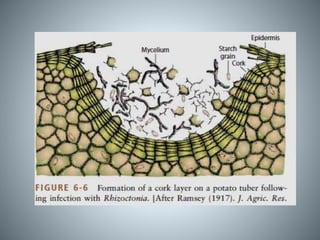
Formation of Cork Layers
Infection by fungi or bacteria, and even by some viruses and
nematodes, frequently induces plants to form several layers of cork
cells beyond the point of infection apparently as a result of
stimulation of the host cells by substances secreted by the
pathogen.
 The cork layers inhibit further invasion by the pathogen beyond the
initial lesion and also block the spread of any toxic substances that
the pathogen may secrete.
 Furthermore, cork layers stop the flow of nutrients and water from
the healthy to the infected area and deprive the pathogen of
nourishment. The dead tissues, including the pathogen, are thus
delimited by the cork
layers and may remain in place, forming necrotic lesions (spots) that
are remarkably uniform in size and shape for a particular host–
pathogen combination.
In some host–pathogen combinations the necrotic tissues are pushed
outward by the underlying healthy tissues and form scabs that may be
sloughed off, thus removing the pathogen from the host completely.
Eg. Cypress trees canker caused by the fungus Seiridium cardinale
Formation of Abscission Layers
Abscission layers are formed on young, active leaves of stone fruit
trees after infection by any of several fungi, bacteria, or viruses.
 An abscission layer consists of a gap formed between two circular
layers of leaf cells surrounding the locus of infection.
 Upon infection, the middle lamella between these two layers of cells
is dissolved throughout the thickness of the leaf, completely cutting
off the central area of the infection from the rest of the leaf
Gradually, this area shrivels, dies, and sloughs off, carrying with it
the pathogen. Thus, the plant, by discarding the infected area along
with a few yet uninfected cells, protects the rest of the leaf tissue
from being invaded by the pathogen and from becoming affected by
the toxic secretions of the pathogen.
Eg. Leaf spots and shot holes caused by Xanthomonas arboricola
Formation of tyloses
Tyloses are overgrowths of the protoplast of adjacent living
parenchymatous cells, which protrude into xylem vessels through
pits (Fig. 6-8). Tyloses have cellulosic walls and may, by their size
and numbers, clog the vessel completely. In some varieties of
plants, tyloses form abundantly and quickly ahead of the pathogen,
while the pathogen is still in the young roots, and block further
advance of the pathogen.The plants of these varieties remain free of
and therefore resistant to this pathogen.
Eg. Produced in response to toxin of wilt pathogen in xylem vessels.
Deposition of Gums
Various types of gums are produced by many plants around
lesions after infection by pathogens or injury.
Gum secretion is most common in stone fruit trees but occurs in
most plants.
The defensive role of gums stems from the fact that they are
deposited quickly in the intercellular spaces and within the cells
surrounding the locus of infection
Thus forming an impenetrable barrier that completely encloses the
pathogen.
The pathogen then becomes isolated, starves, and sooner or later
dies.
Sheating Of Hyphaae
It Has been seen that the hyphae
penetracing the cell wall are in sheath formed by the extention of the
hyphae penetrating the cell wall are often enveloped in sheath formed
by the extention of cell walls and prevent the pathogen from spreding . It
is consist of cellulose, callose substance or other material , and in some
cases , a sheath may be the deposition product of the cytoplasm rather
than the cell wall .lignitubers may develop as protuberance on the inner
side , opposite the site penetration .sometimes the cell wall being
penetrated by the infection peg swells and becomes suberized or
lignified
Structural defence machenism

Structural defence machenism

  • 1.
    Presentation on STRUCTURAL DEFENCEMECHANISMS Submitted to, Submitted by, Dr.N.Lakpale Vivekanand uraiha Dept.of Pl.Pathology M.Sc.(Ag) pre.year
  • 2.
    STRUCTURAL DEFENCE MECHANISMS HOW PLANTSDEFEND THEMSELVES AGAINST PATHOGENS
  • 3.
    Structural characteristics : Thefirst line of defence againts pathogen is the surface barrier , which a pathogen must penetrante before It can cause infection . Such morphological defence structures may be present before penetration or infection or may be produced afterwards as a result of the host and the pathogen The entry of pathogen may either be through the epidermal cell walls directly or through the natural opnings in the epidermas, such as stomata, lenticels, and hydathodes,or through injured areas caused by living or non- living agencies. .
  • 4.
    STRUCTURAL DEFENSE MECHANISMS TwoTypes A. Defence structures Existing Before Infection B. Defence structures formed after Infection
  • 6.
    A. Defence structuresExisting Before Infection The first line of defense of a plant against pathogens is its surface, which the pathogen must adhere to and penetrate if it is to cause infection. WAXES AND CUTICLES: The cuticle,which consists of cutin and waxes, They are play a defensive role by forming a hydrophobic surface which acts as a water repellent and thereby prevents the retention of water on sloping plant surface on which pathogens might be deposited and subsequently invade the host Eg: The cuticle acts as a physical and chemical barier to infection.In Berberis spp. Infected with puccinia graminis. The present waxe on leaves of brussels sprout to prevent the white blister,albugo condida
  • 7.
    STUCTURAL OF NATURALOPNING : The stem rust of wheat, can enter only when stomata are open. Thus, some wheat varieties, in which the stomata open late in the day, are resistant because the germ tubes of spores germinating in the night dew desiccate due to evaporation of the dew before the stomata begin to open (functional resistance). Eg. The structure of the stomata, e.g., a very narrow entrance and broad, elevated guard cells, may also confer resistance to some varieties of mendarin against X. a. pv. citri.
  • 8.
    Cell wall defensestructures The outer layer of the cell wall of parenchyma cells coming in contact with incompatible bacteria swells and produces an amorphous, fibrillar material that surrounds and traps the bacteria and prevents them from multiplying. The presence of silicic acid in the epidermis of some plant acts as an important structural defence mechanism . In the rice blast fungus pyricularia oryzae the outer wall of most of the epidermal cell of the leaves of lignifed and the entry of the pathogen is generally through the thin walled moter cells having pectin rather then lignin
  • 9.
    B. Defence structuresformed after Infection Defence structure are produced inside the host plant to block or prevent the spread of the pathogen.these include the formation of cork layers, tyloses and abscission layers;deposition of gum, resins and tannin- like substance;swelling of the cell wall;
  • 10.
    Formation of CorkLayers Infection by fungi or bacteria, and even by some viruses and nematodes, frequently induces plants to form several layers of cork cells beyond the point of infection apparently as a result of stimulation of the host cells by substances secreted by the pathogen.  The cork layers inhibit further invasion by the pathogen beyond the initial lesion and also block the spread of any toxic substances that the pathogen may secrete.  Furthermore, cork layers stop the flow of nutrients and water from the healthy to the infected area and deprive the pathogen of nourishment. The dead tissues, including the pathogen, are thus delimited by the cork layers and may remain in place, forming necrotic lesions (spots) that are remarkably uniform in size and shape for a particular host– pathogen combination.
  • 11.
    In some host–pathogencombinations the necrotic tissues are pushed outward by the underlying healthy tissues and form scabs that may be sloughed off, thus removing the pathogen from the host completely. Eg. Cypress trees canker caused by the fungus Seiridium cardinale
  • 13.
    Formation of AbscissionLayers Abscission layers are formed on young, active leaves of stone fruit trees after infection by any of several fungi, bacteria, or viruses.  An abscission layer consists of a gap formed between two circular layers of leaf cells surrounding the locus of infection.  Upon infection, the middle lamella between these two layers of cells is dissolved throughout the thickness of the leaf, completely cutting off the central area of the infection from the rest of the leaf Gradually, this area shrivels, dies, and sloughs off, carrying with it the pathogen. Thus, the plant, by discarding the infected area along with a few yet uninfected cells, protects the rest of the leaf tissue from being invaded by the pathogen and from becoming affected by the toxic secretions of the pathogen. Eg. Leaf spots and shot holes caused by Xanthomonas arboricola
  • 15.
    Formation of tyloses Tylosesare overgrowths of the protoplast of adjacent living parenchymatous cells, which protrude into xylem vessels through pits (Fig. 6-8). Tyloses have cellulosic walls and may, by their size and numbers, clog the vessel completely. In some varieties of plants, tyloses form abundantly and quickly ahead of the pathogen, while the pathogen is still in the young roots, and block further advance of the pathogen.The plants of these varieties remain free of and therefore resistant to this pathogen. Eg. Produced in response to toxin of wilt pathogen in xylem vessels.
  • 17.
    Deposition of Gums Varioustypes of gums are produced by many plants around lesions after infection by pathogens or injury. Gum secretion is most common in stone fruit trees but occurs in most plants. The defensive role of gums stems from the fact that they are deposited quickly in the intercellular spaces and within the cells surrounding the locus of infection Thus forming an impenetrable barrier that completely encloses the pathogen. The pathogen then becomes isolated, starves, and sooner or later dies.
  • 19.
    Sheating Of Hyphaae ItHas been seen that the hyphae penetracing the cell wall are in sheath formed by the extention of the hyphae penetrating the cell wall are often enveloped in sheath formed by the extention of cell walls and prevent the pathogen from spreding . It is consist of cellulose, callose substance or other material , and in some cases , a sheath may be the deposition product of the cytoplasm rather than the cell wall .lignitubers may develop as protuberance on the inner side , opposite the site penetration .sometimes the cell wall being penetrated by the infection peg swells and becomes suberized or lignified