1
McGraw-Hill/Irwin © 2003 The McGraw-Hill Companies, Inc., All Rights Reserved.
STRATEGIES FOR
COMPETING IN
GLOBALIZING MARKETS
CHAPTER 6
Screen graphics created by:
Jana F. Kuzmicki, PhD, Mississippi University for Women
“You do not choose to become
global. The market chooses for
you; it forces your hand.”
Alain Gomez
“Quote”
“. . . there’s no purely domestic
industry anymore.”
Robert Pelosky and Morgan Stanley
McGraw-Hill/Irwin © 2003 The McGraw-Hill Companies, Inc., All Rights Reserved. 2
3
McGraw-Hill/Irwin © 2003 The McGraw-Hill Companies, Inc., All Rights Reserved.
Chapter Outline
 Why Companies Expand into Foreign Markets
 Cross-Country Differences
 The Competitive Environment: Multi-country or Global
Competition?
 Strategy Options for Entering and Competing in Foreign
Markets
 Pursuing Competitive Advantage by
Competing Multinationally
 Profit Sanctuaries, Cross-Market
Subsidization, and Global Offensives
 Strategic Alliances and Joint Ventures
with Foreign Partners
 Competing in Emerging Foreign Markets
 Strategies for Local Companies in Emerging
Markets
4
McGraw-Hill/Irwin © 2003 The McGraw-Hill Companies, Inc., All Rights Reserved.
Why is the World Economy Globalizing?
 Previously closed national
economies are opening up
their markets to foreign
companies
 Importance of geographic
distance is shrinking due to
the Internet
 Growth-minded companies
are racing to stake out
positions in the markets of
more and more countries
5
McGraw-Hill/Irwin © 2003 The McGraw-Hill Companies, Inc., All Rights Reserved.
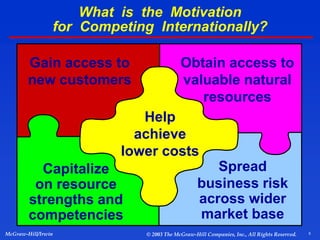
What is the Motivation
for Competing Internationally?
Gain access to
new customers
Capitalize
on resource
strengths and
competencies
Help
achieve
lower costs
Spread
business risk
across wider
market base
Obtain access to
valuable natural
resources
6
McGraw-Hill/Irwin © 2003 The McGraw-Hill Companies, Inc., All Rights Reserved.
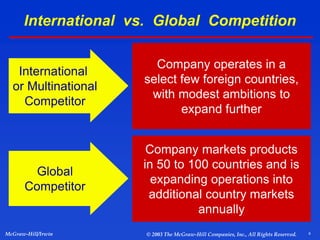
International vs. Global Competition
International
or Multinational
Competitor
Company operates in a
select few foreign countries,
with modest ambitions to
expand further
Global
Competitor
Company markets products
in 50 to 100 countries and is
expanding operations into
additional country markets
annually
7
McGraw-Hill/Irwin © 2003 The McGraw-Hill Companies, Inc., All Rights Reserved.
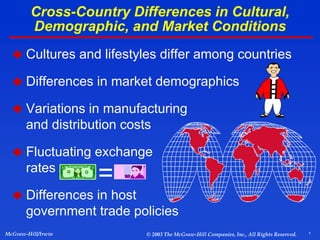
Cross-Country Differences in Cultural,
Demographic, and Market Conditions
 Cultures and lifestyles differ among countries
 Differences in market demographics
 Variations in manufacturing
and distribution costs
 Fluctuating exchange
rates
 Differences in host
government trade policies
=
8
McGraw-Hill/Irwin © 2003 The McGraw-Hill Companies, Inc., All Rights Reserved.
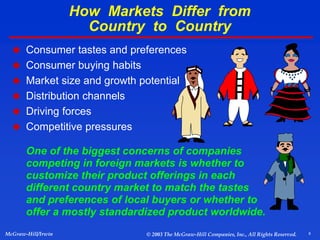
How Markets Differ from
Country to Country
 Consumer tastes and preferences
 Consumer buying habits
 Market size and growth potential
 Distribution channels
 Driving forces
 Competitive pressures
One of the biggest concerns of companies
competing in foreign markets is whether to
customize their product offerings in each
different country market to match the tastes
and preferences of local buyers or whether to
offer a mostly standardized product worldwide.
9
McGraw-Hill/Irwin © 2003 The McGraw-Hill Companies, Inc., All Rights Reserved.
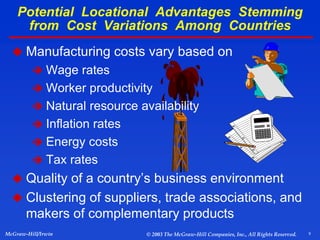
Potential Locational Advantages Stemming
from Cost Variations Among Countries
 Manufacturing costs vary based on
 Wage rates
 Worker productivity
 Natural resource availability
 Inflation rates
 Energy costs
 Tax rates
 Quality of a country’s business environment
 Clustering of suppliers, trade associations, and
makers of complementary products
10
McGraw-Hill/Irwin © 2003 The McGraw-Hill Companies, Inc., All Rights Reserved.
Differences in Host
Government Trade Policies
 Local content requirements
 Import tariffs or quotas
 Restrictions on exports
 Regulations regarding prices of imports
 Other regulations
 Technical standards
 Product certification
 Prior approval of capital spending projects
 Withdrawal of funds from country
 Minority ownership by local citizens
11
McGraw-Hill/Irwin © 2003 The McGraw-Hill Companies, Inc., All Rights Reserved.
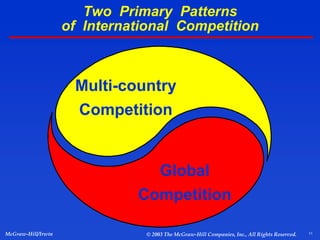
Multi-country
Competition
Global
Competition
Two Primary Patterns
of International Competition
12
McGraw-Hill/Irwin © 2003 The McGraw-Hill Companies, Inc., All Rights Reserved.
 Each country market is self-contained
 Competition in one country market is
independent of competition in other country
markets
 Rivals competing in one country market differ
from set of rivals competing in another country
market
 Rivals vie for national market leadership
 No “international” market, just a collection of
country markets
Characteristics of
Multi-Country Competition
13
McGraw-Hill/Irwin © 2003 The McGraw-Hill Companies, Inc., All Rights Reserved.
Characteristics of Global Competition
 Competitive conditions across country markets
are strongly linked together
 Many of same rivals compete in many of the
same country markets
 Rivals vie for worldwide leadership
 A true international market exists
 A firm’s competitive position in one country is
affected by its position in other countries
 Competitive advantage (or disadvantage) is
based on a firm’s world-wide operations and
overall global standing
14
McGraw-Hill/Irwin © 2003 The McGraw-Hill Companies, Inc., All Rights Reserved.
Strategy Options for International Markets
 Exporting
 Licensing
 Franchising strategy
 Multi-country strategy
 Global strategy based on
 Low cost
 Differentiation
 Best-cost
 Focusing
 Strategic alliances or joint ventures
15
McGraw-Hill/Irwin © 2003 The McGraw-Hill Companies, Inc., All Rights Reserved.
Characteristics of Export Strategies
Involves using domestic plants as a production base
for exporting to foreign markets
 Excellent initial strategy to pursue international sales
 Advantages
 Minimizes both risk and capital requirements
 Conservative way to test international waters
 Minimizes direct investments in foreign countries
An export strategy is vulnerable when
 Manufacturing costs in home country are higher
than in foreign countries where rivals have plants
 High shipping costs are involved
16
McGraw-Hill/Irwin © 2003 The McGraw-Hill Companies, Inc., All Rights Reserved.
 Licensing makes sense when a firm
 Has valuable technical know-how or a patented
product but does not have international
capabilities or resources to enter foreign
markets
 Desires to avoid risks of committing resources
to markets which
 Are unfamiliar
 Present economic uncertainty
 Are politically volatile
 Disadvantage
 Risk of providing valuable technical know-how
to foreign firms and losing some control over its
Characteristics of Licensing Strategies
17
McGraw-Hill/Irwin © 2003 The McGraw-Hill Companies, Inc., All Rights Reserved.
 Often is better suited to global expansion efforts
of service and retailing enterprises
 Advantages
 Franchisee bears most of costs and risks of
establishing foreign locations
 Franchisor has to expend only the resources to
recruit, train, and support franchisees
 Disadvantage
 Maintaining cross-country quality
control
Characteristics of Franchising Strategies
18
McGraw-Hill/Irwin © 2003 The McGraw-Hill Companies, Inc., All Rights Reserved.
Multi-Country Strategy
 Strategy is matched to local market needs
 Different country strategies are called for when
 Significant country-to-country differences in
customers’ needs exist
 Buyers in one country want a product different
from buyers in another country
 Host government regulations preclude
uniform global approach
 Two drawbacks
1. Poses problems of transferring
competencies across borders
2. Works against building a unified
competitive advantage
19
McGraw-Hill/Irwin © 2003 The McGraw-Hill Companies, Inc., All Rights Reserved.
Global Strategy
 Strategy for competing is similar
in all country markets
 Involves
 Coordinating strategic moves globally
 Selling in many, if not all, nations where a
significant market exists
 Works best when products and buyer
requirements are similar from country to country
20
McGraw-Hill/Irwin © 2003 The McGraw-Hill Companies, Inc., All Rights Reserved.
Competitive Strategy Principle
A global strategy works best in
markets that are globally
competitive or beginning to
globalize!
A multi-country strategy is
appropriate for industries
where multi-country
competition dominates!
Table 6.1: Differences
Between Multi-country and
Global Strategies
McGraw-Hill/Irwin © 2003 The McGraw-Hill Companies, Inc., All Rights Reserved. 21
22
McGraw-Hill/Irwin © 2003 The McGraw-Hill Companies, Inc., All Rights Reserved.
Pursuing Competitive Advantage
by Competing Multinationally
 Three ways to gain competitive advantage
1. Locating activities among nations to lower
costs or achieve greater product
differentiation
2. Efficient/effective transfer of competitively
valuable competencies and capabilities
from domestic to foreign markets
3. Coordinating dispersed activities in ways a
domestic-only competitor cannot
23
McGraw-Hill/Irwin © 2003 The McGraw-Hill Companies, Inc., All Rights Reserved.
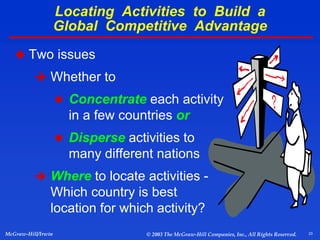
 Two issues
 Whether to
 Concentrate each activity
in a few countries or
 Disperse activities to
many different nations
 Where to locate activities -
Which country is best
location for which activity?
Locating Activities to Build a
Global Competitive Advantage
24
McGraw-Hill/Irwin © 2003 The McGraw-Hill Companies, Inc., All Rights Reserved.
 Activities should be concentrated when
 Costs of manufacturing or other value chain
activities are meaningful lower in certain
locations than in others
 There are sizable scale economies in
performing the activity
 There is a steep learning curve associated with
performing an activity in a single location
 Certain locations have superior resources,
allow better coordination of related activities, or
offer other valuable advantages
Concentrating Activities to Build a
Global Competitive Advantage
25
McGraw-Hill/Irwin © 2003 The McGraw-Hill Companies, Inc., All Rights Reserved.
 Activities should be dispersed when
 They need to be performed close to buyers
 Transportation costs, scale diseconomies,
or trade barriers make centralization
expensive
 Buffers for fluctuating exchange rates,
supply interruptions, and adverse politics
are needed
Dispersing Activities to Build a
Global Competitive Advantage
26
McGraw-Hill/Irwin © 2003 The McGraw-Hill Companies, Inc., All Rights Reserved.
 Transferring competencies, capabilities, and
resource strengths across borders contributes to
 Development of broader competencies and
capabilities
 Achievement of dominating depth in some
competitively valuable area
 Dominating depth in a competitively valuable
capability is a strong basis for sustainable
competitive advantage over
 Other multinational or global competitors and
 Small domestic competitors in host countries
Transferring Valuable Competencies to
Build a Global Competitive Advantage
27
McGraw-Hill/Irwin © 2003 The McGraw-Hill Companies, Inc., All Rights Reserved.
Aligning activities located in different countries
contributes to competitive advantage in several
ways
Choose where and how to challenge rivals
Shift production from one location to another to
take advantage of most favorable cost or trade
conditions or exchange rates
Enhance brand reputation by incorporating
same differentiating attributes in its products in
all markets where it competes
Coordinating Cross-Border Activities to
Build a Global Competitive Advantage
28
McGraw-Hill/Irwin © 2003 The McGraw-Hill Companies, Inc., All Rights Reserved.
What Are Profit Sanctuaries?
 Profit sanctuaries are country markets where
a firm
 Has a strong or protected market
position and
 Derives substantial profits
 Generally, a firm’s most strategically crucial
profit sanctuary is its home market
Profit sanctuaries are a valuable
competitive asset in global industries!
29
McGraw-Hill/Irwin © 2003 The McGraw-Hill Companies, Inc., All Rights Reserved.
What is Cross-Market Subsidization?
 Involves supporting competitive offensives in one market
with resources/profits diverted from operations in other
markets
 Competitive power of cross-market subsidization results
from a multinational firm’s ability to
 Draw upon its organizational resources and profits in
other country markets to help mount an attack on
single-market or one-country rivals and try to lure away
their customers with lower prices, discount
promotions, heavy advertising, or other offensive
tactics
30
McGraw-Hill/Irwin © 2003 The McGraw-Hill Companies, Inc., All Rights Reserved.
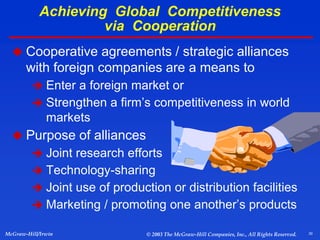
 Cooperative agreements / strategic alliances
with foreign companies are a means to
 Enter a foreign market or
 Strengthen a firm’s competitiveness in world
markets
 Purpose of alliances
 Joint research efforts
 Technology-sharing
 Joint use of production or distribution facilities
 Marketing / promoting one another’s products
Achieving Global Competitiveness
via Cooperation
31
McGraw-Hill/Irwin © 2003 The McGraw-Hill Companies, Inc., All Rights Reserved.
Benefits of Strategic Alliances
 Gain scale economies in production and/or
marketing
 Fill gaps in technical expertise or knowledge of
local markets
 Share distribution facilities
and dealer networks
 Direct combined competitive
energies toward defeating mutual rivals
 Useful way to gain agreement on important
technical standards
32
McGraw-Hill/Irwin © 2003 The McGraw-Hill Companies, Inc., All Rights Reserved.
Pitfalls of Strategic Alliances
 Becoming too dependent on another firm for
essential expertise over the long-term
 Different motives and conflicting objectives
 Time consuming; slows
decision-making
 Language and cultural barriers
 Mistrust when collaborating in
competitively sensitive areas
 Clash of egos and company cultures
33
McGraw-Hill/Irwin © 2003 The McGraw-Hill Companies, Inc., All Rights Reserved.
 Pick a good partner, one that shares
a common vision
 Be sensitive to cultural differences
 Recognize the alliance must benefit both sides
 Both parties have to deliver on their commitments
in the agreement
 Structure decision-making process so actions can
be taken swiftly when needed
 Parties must do a good job of managing the
learning process, adjusting the alliance
agreement over time to fit new circumstances
Guidelines in Forming Strategic Alliances
34
McGraw-Hill/Irwin © 2003 The McGraw-Hill Companies, Inc., All Rights Reserved.
Characteristics of Competing in
Emerging Foreign Markets
 Tailoring products for the big, emerging markets
often involves
 Making more than minor product changes and
 Becoming more familiar with the local cultures
 Companies have to attract buyers with bargain
prices as well as better products
 Specially designed and/or specially packaged
products may be needed to accommodate local
market circumstances
 Management team must usually consist of a mix of
expatriate and local managers
35
McGraw-Hill/Irwin © 2003 The McGraw-Hill Companies, Inc., All Rights Reserved.
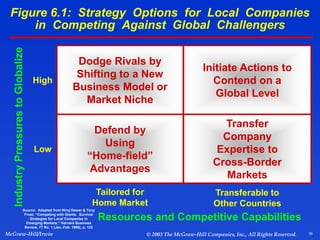
Strategies for Local Companies
in Emerging Markets
 Optimal strategic approach hinges
on
 Whether a firm’s competitive
assets are suitable only for the
home market or can be
transferred abroad
 Whether industry pressures to
move toward global competition
are strong or weak
36
McGraw-Hill/Irwin © 2003 The McGraw-Hill Companies, Inc., All Rights Reserved.
Industry
Pressures
to
Globalize
Resources and Competitive Capabilities
Dodge Rivals by
Shifting to a New
Business Model or
Market Niche
Initiate Actions to
Contend on a
Global Level
Defend by
Using
“Home-field”
Advantages
Transfer
Company
Expertise to
Cross-Border
Markets
Tailored for
Home Market
Transferable to
Other Countries
Low
High
Source: Adapted from Niroj Dawar & Tony
Frost, “Competing with Giants: Survival
Strategies for Local Companies in
Emerging Markets,” Harvard Business
Review, 77 No. 1 (Jan.-Feb. 1999), p. 122
Figure 6.1: Strategy Options for Local Companies
in Competing Against Global Challengers

strm06.pptx

  • 1.
    1 McGraw-Hill/Irwin © 2003The McGraw-Hill Companies, Inc., All Rights Reserved. STRATEGIES FOR COMPETING IN GLOBALIZING MARKETS CHAPTER 6 Screen graphics created by: Jana F. Kuzmicki, PhD, Mississippi University for Women
  • 2.
    “You do notchoose to become global. The market chooses for you; it forces your hand.” Alain Gomez “Quote” “. . . there’s no purely domestic industry anymore.” Robert Pelosky and Morgan Stanley McGraw-Hill/Irwin © 2003 The McGraw-Hill Companies, Inc., All Rights Reserved. 2
  • 3.
    3 McGraw-Hill/Irwin © 2003The McGraw-Hill Companies, Inc., All Rights Reserved. Chapter Outline  Why Companies Expand into Foreign Markets  Cross-Country Differences  The Competitive Environment: Multi-country or Global Competition?  Strategy Options for Entering and Competing in Foreign Markets  Pursuing Competitive Advantage by Competing Multinationally  Profit Sanctuaries, Cross-Market Subsidization, and Global Offensives  Strategic Alliances and Joint Ventures with Foreign Partners  Competing in Emerging Foreign Markets  Strategies for Local Companies in Emerging Markets
  • 4.
    4 McGraw-Hill/Irwin © 2003The McGraw-Hill Companies, Inc., All Rights Reserved. Why is the World Economy Globalizing?  Previously closed national economies are opening up their markets to foreign companies  Importance of geographic distance is shrinking due to the Internet  Growth-minded companies are racing to stake out positions in the markets of more and more countries
  • 5.
    5 McGraw-Hill/Irwin © 2003The McGraw-Hill Companies, Inc., All Rights Reserved. What is the Motivation for Competing Internationally? Gain access to new customers Capitalize on resource strengths and competencies Help achieve lower costs Spread business risk across wider market base Obtain access to valuable natural resources
  • 6.
    6 McGraw-Hill/Irwin © 2003The McGraw-Hill Companies, Inc., All Rights Reserved. International vs. Global Competition International or Multinational Competitor Company operates in a select few foreign countries, with modest ambitions to expand further Global Competitor Company markets products in 50 to 100 countries and is expanding operations into additional country markets annually
  • 7.
    7 McGraw-Hill/Irwin © 2003The McGraw-Hill Companies, Inc., All Rights Reserved. Cross-Country Differences in Cultural, Demographic, and Market Conditions  Cultures and lifestyles differ among countries  Differences in market demographics  Variations in manufacturing and distribution costs  Fluctuating exchange rates  Differences in host government trade policies =
  • 8.
    8 McGraw-Hill/Irwin © 2003The McGraw-Hill Companies, Inc., All Rights Reserved. How Markets Differ from Country to Country  Consumer tastes and preferences  Consumer buying habits  Market size and growth potential  Distribution channels  Driving forces  Competitive pressures One of the biggest concerns of companies competing in foreign markets is whether to customize their product offerings in each different country market to match the tastes and preferences of local buyers or whether to offer a mostly standardized product worldwide.
  • 9.
    9 McGraw-Hill/Irwin © 2003The McGraw-Hill Companies, Inc., All Rights Reserved. Potential Locational Advantages Stemming from Cost Variations Among Countries  Manufacturing costs vary based on  Wage rates  Worker productivity  Natural resource availability  Inflation rates  Energy costs  Tax rates  Quality of a country’s business environment  Clustering of suppliers, trade associations, and makers of complementary products
  • 10.
    10 McGraw-Hill/Irwin © 2003The McGraw-Hill Companies, Inc., All Rights Reserved. Differences in Host Government Trade Policies  Local content requirements  Import tariffs or quotas  Restrictions on exports  Regulations regarding prices of imports  Other regulations  Technical standards  Product certification  Prior approval of capital spending projects  Withdrawal of funds from country  Minority ownership by local citizens
  • 11.
    11 McGraw-Hill/Irwin © 2003The McGraw-Hill Companies, Inc., All Rights Reserved. Multi-country Competition Global Competition Two Primary Patterns of International Competition
  • 12.
    12 McGraw-Hill/Irwin © 2003The McGraw-Hill Companies, Inc., All Rights Reserved.  Each country market is self-contained  Competition in one country market is independent of competition in other country markets  Rivals competing in one country market differ from set of rivals competing in another country market  Rivals vie for national market leadership  No “international” market, just a collection of country markets Characteristics of Multi-Country Competition
  • 13.
    13 McGraw-Hill/Irwin © 2003The McGraw-Hill Companies, Inc., All Rights Reserved. Characteristics of Global Competition  Competitive conditions across country markets are strongly linked together  Many of same rivals compete in many of the same country markets  Rivals vie for worldwide leadership  A true international market exists  A firm’s competitive position in one country is affected by its position in other countries  Competitive advantage (or disadvantage) is based on a firm’s world-wide operations and overall global standing
  • 14.
    14 McGraw-Hill/Irwin © 2003The McGraw-Hill Companies, Inc., All Rights Reserved. Strategy Options for International Markets  Exporting  Licensing  Franchising strategy  Multi-country strategy  Global strategy based on  Low cost  Differentiation  Best-cost  Focusing  Strategic alliances or joint ventures
  • 15.
    15 McGraw-Hill/Irwin © 2003The McGraw-Hill Companies, Inc., All Rights Reserved. Characteristics of Export Strategies Involves using domestic plants as a production base for exporting to foreign markets  Excellent initial strategy to pursue international sales  Advantages  Minimizes both risk and capital requirements  Conservative way to test international waters  Minimizes direct investments in foreign countries An export strategy is vulnerable when  Manufacturing costs in home country are higher than in foreign countries where rivals have plants  High shipping costs are involved
  • 16.
    16 McGraw-Hill/Irwin © 2003The McGraw-Hill Companies, Inc., All Rights Reserved.  Licensing makes sense when a firm  Has valuable technical know-how or a patented product but does not have international capabilities or resources to enter foreign markets  Desires to avoid risks of committing resources to markets which  Are unfamiliar  Present economic uncertainty  Are politically volatile  Disadvantage  Risk of providing valuable technical know-how to foreign firms and losing some control over its Characteristics of Licensing Strategies
  • 17.
    17 McGraw-Hill/Irwin © 2003The McGraw-Hill Companies, Inc., All Rights Reserved.  Often is better suited to global expansion efforts of service and retailing enterprises  Advantages  Franchisee bears most of costs and risks of establishing foreign locations  Franchisor has to expend only the resources to recruit, train, and support franchisees  Disadvantage  Maintaining cross-country quality control Characteristics of Franchising Strategies
  • 18.
    18 McGraw-Hill/Irwin © 2003The McGraw-Hill Companies, Inc., All Rights Reserved. Multi-Country Strategy  Strategy is matched to local market needs  Different country strategies are called for when  Significant country-to-country differences in customers’ needs exist  Buyers in one country want a product different from buyers in another country  Host government regulations preclude uniform global approach  Two drawbacks 1. Poses problems of transferring competencies across borders 2. Works against building a unified competitive advantage
  • 19.
    19 McGraw-Hill/Irwin © 2003The McGraw-Hill Companies, Inc., All Rights Reserved. Global Strategy  Strategy for competing is similar in all country markets  Involves  Coordinating strategic moves globally  Selling in many, if not all, nations where a significant market exists  Works best when products and buyer requirements are similar from country to country
  • 20.
    20 McGraw-Hill/Irwin © 2003The McGraw-Hill Companies, Inc., All Rights Reserved. Competitive Strategy Principle A global strategy works best in markets that are globally competitive or beginning to globalize! A multi-country strategy is appropriate for industries where multi-country competition dominates!
  • 21.
    Table 6.1: Differences BetweenMulti-country and Global Strategies McGraw-Hill/Irwin © 2003 The McGraw-Hill Companies, Inc., All Rights Reserved. 21
  • 22.
    22 McGraw-Hill/Irwin © 2003The McGraw-Hill Companies, Inc., All Rights Reserved. Pursuing Competitive Advantage by Competing Multinationally  Three ways to gain competitive advantage 1. Locating activities among nations to lower costs or achieve greater product differentiation 2. Efficient/effective transfer of competitively valuable competencies and capabilities from domestic to foreign markets 3. Coordinating dispersed activities in ways a domestic-only competitor cannot
  • 23.
    23 McGraw-Hill/Irwin © 2003The McGraw-Hill Companies, Inc., All Rights Reserved.  Two issues  Whether to  Concentrate each activity in a few countries or  Disperse activities to many different nations  Where to locate activities - Which country is best location for which activity? Locating Activities to Build a Global Competitive Advantage
  • 24.
    24 McGraw-Hill/Irwin © 2003The McGraw-Hill Companies, Inc., All Rights Reserved.  Activities should be concentrated when  Costs of manufacturing or other value chain activities are meaningful lower in certain locations than in others  There are sizable scale economies in performing the activity  There is a steep learning curve associated with performing an activity in a single location  Certain locations have superior resources, allow better coordination of related activities, or offer other valuable advantages Concentrating Activities to Build a Global Competitive Advantage
  • 25.
    25 McGraw-Hill/Irwin © 2003The McGraw-Hill Companies, Inc., All Rights Reserved.  Activities should be dispersed when  They need to be performed close to buyers  Transportation costs, scale diseconomies, or trade barriers make centralization expensive  Buffers for fluctuating exchange rates, supply interruptions, and adverse politics are needed Dispersing Activities to Build a Global Competitive Advantage
  • 26.
    26 McGraw-Hill/Irwin © 2003The McGraw-Hill Companies, Inc., All Rights Reserved.  Transferring competencies, capabilities, and resource strengths across borders contributes to  Development of broader competencies and capabilities  Achievement of dominating depth in some competitively valuable area  Dominating depth in a competitively valuable capability is a strong basis for sustainable competitive advantage over  Other multinational or global competitors and  Small domestic competitors in host countries Transferring Valuable Competencies to Build a Global Competitive Advantage
  • 27.
    27 McGraw-Hill/Irwin © 2003The McGraw-Hill Companies, Inc., All Rights Reserved. Aligning activities located in different countries contributes to competitive advantage in several ways Choose where and how to challenge rivals Shift production from one location to another to take advantage of most favorable cost or trade conditions or exchange rates Enhance brand reputation by incorporating same differentiating attributes in its products in all markets where it competes Coordinating Cross-Border Activities to Build a Global Competitive Advantage
  • 28.
    28 McGraw-Hill/Irwin © 2003The McGraw-Hill Companies, Inc., All Rights Reserved. What Are Profit Sanctuaries?  Profit sanctuaries are country markets where a firm  Has a strong or protected market position and  Derives substantial profits  Generally, a firm’s most strategically crucial profit sanctuary is its home market Profit sanctuaries are a valuable competitive asset in global industries!
  • 29.
    29 McGraw-Hill/Irwin © 2003The McGraw-Hill Companies, Inc., All Rights Reserved. What is Cross-Market Subsidization?  Involves supporting competitive offensives in one market with resources/profits diverted from operations in other markets  Competitive power of cross-market subsidization results from a multinational firm’s ability to  Draw upon its organizational resources and profits in other country markets to help mount an attack on single-market or one-country rivals and try to lure away their customers with lower prices, discount promotions, heavy advertising, or other offensive tactics
  • 30.
    30 McGraw-Hill/Irwin © 2003The McGraw-Hill Companies, Inc., All Rights Reserved.  Cooperative agreements / strategic alliances with foreign companies are a means to  Enter a foreign market or  Strengthen a firm’s competitiveness in world markets  Purpose of alliances  Joint research efforts  Technology-sharing  Joint use of production or distribution facilities  Marketing / promoting one another’s products Achieving Global Competitiveness via Cooperation
  • 31.
    31 McGraw-Hill/Irwin © 2003The McGraw-Hill Companies, Inc., All Rights Reserved. Benefits of Strategic Alliances  Gain scale economies in production and/or marketing  Fill gaps in technical expertise or knowledge of local markets  Share distribution facilities and dealer networks  Direct combined competitive energies toward defeating mutual rivals  Useful way to gain agreement on important technical standards
  • 32.
    32 McGraw-Hill/Irwin © 2003The McGraw-Hill Companies, Inc., All Rights Reserved. Pitfalls of Strategic Alliances  Becoming too dependent on another firm for essential expertise over the long-term  Different motives and conflicting objectives  Time consuming; slows decision-making  Language and cultural barriers  Mistrust when collaborating in competitively sensitive areas  Clash of egos and company cultures
  • 33.
    33 McGraw-Hill/Irwin © 2003The McGraw-Hill Companies, Inc., All Rights Reserved.  Pick a good partner, one that shares a common vision  Be sensitive to cultural differences  Recognize the alliance must benefit both sides  Both parties have to deliver on their commitments in the agreement  Structure decision-making process so actions can be taken swiftly when needed  Parties must do a good job of managing the learning process, adjusting the alliance agreement over time to fit new circumstances Guidelines in Forming Strategic Alliances
  • 34.
    34 McGraw-Hill/Irwin © 2003The McGraw-Hill Companies, Inc., All Rights Reserved. Characteristics of Competing in Emerging Foreign Markets  Tailoring products for the big, emerging markets often involves  Making more than minor product changes and  Becoming more familiar with the local cultures  Companies have to attract buyers with bargain prices as well as better products  Specially designed and/or specially packaged products may be needed to accommodate local market circumstances  Management team must usually consist of a mix of expatriate and local managers
  • 35.
    35 McGraw-Hill/Irwin © 2003The McGraw-Hill Companies, Inc., All Rights Reserved. Strategies for Local Companies in Emerging Markets  Optimal strategic approach hinges on  Whether a firm’s competitive assets are suitable only for the home market or can be transferred abroad  Whether industry pressures to move toward global competition are strong or weak
  • 36.
    36 McGraw-Hill/Irwin © 2003The McGraw-Hill Companies, Inc., All Rights Reserved. Industry Pressures to Globalize Resources and Competitive Capabilities Dodge Rivals by Shifting to a New Business Model or Market Niche Initiate Actions to Contend on a Global Level Defend by Using “Home-field” Advantages Transfer Company Expertise to Cross-Border Markets Tailored for Home Market Transferable to Other Countries Low High Source: Adapted from Niroj Dawar & Tony Frost, “Competing with Giants: Survival Strategies for Local Companies in Emerging Markets,” Harvard Business Review, 77 No. 1 (Jan.-Feb. 1999), p. 122 Figure 6.1: Strategy Options for Local Companies in Competing Against Global Challengers