KMP Pattern Search
QUICK OVERVIEW
Created by,
Arjun SK
arjunsk.com
What is Patter Searching ?
o Suppose you are reading a text document.
o You want to search for a word.
o You click CTRL + F and search for that word.
o The word processor scans the document and shows the position of
occurrence.
What exactly happens is that, word i.e. pattern is searched inside the
text document.
Implementation
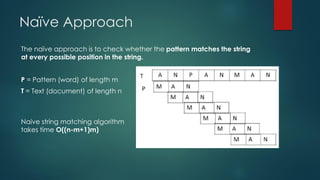
Naïve Approach
The naïve approach is to check whether the pattern matches the string
at every possible position in the string.
P = Pattern (word) of length m
T = Text (document) of length n
Naive string matching algorithm
takes time O((n-m+1)m)
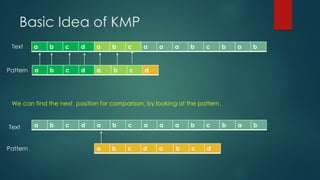
Basic Idea of KMP
a b c d a b c a a a b c b a b
a b c d a b c d
Text
Pattern
Text
Pattern
We can find the next position for comparison, by looking at the pattern.
a b c d a b c a a a b c b a b
a b c d a b c d
KMP (Knuth-Morris-Prattern String Matching Algorithm)
Why KMP?
Best known for linear time for exact pattern matching.
How is it implemented?
o We find patterns within the search pattern.
o When a pattern comparison partially fails, we can skip to next
occurrence of prefix pattern.
o In this way, we can skip trivial comparisons.
Pre-processing
Let’s say we’re matching the pattern “abababca” against the text
“bacbababaabcbab”.
Here’s our prefix match table : i.e. prefix-table[i]
index 0 1 2 3 4 5 6 7
char a b a b a b c a
value 0 0 1 2 3 4 0 1
Matching prefix i.e. a
Matching prefix i.e. ab
Matching prefix i.e. aba
Matching prefix i.e. abab
No matching prefix
Pre-processing - cont.
• partial_match_length = length of the matched pattern in a step.
• prefix-table = pre-processed prefix table
• If prefix-table[ partial_match_length ] > 1
we may skip ahead
partial_match_length - prefix-table[ partial_match_length – 1 ] characters.
// Used to skip, already compared prefix match in the pattern.
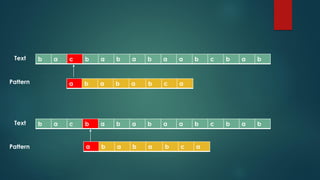
Searching
b a c b a b a b a a b c b a b
a b a b a b c a
Text
Pattern
b a c b a b a b a a b c b a b
a b a b a b c a
Text
Pattern
This is a partial match length of 1
The value at prefix-table[partial_match_length - 1] (or prefix-table[0]) is 0.
so we don’t get to skip ahead any.
b a c b a b a b a a b c b a b
a b a b a b c a
Text
Pattern
b a c b a b a b a a b c b a b
a b a b a b c a
Text
Pattern
b a c b a b a b a a b c b a b
a b a b a b c a
Text
Pattern
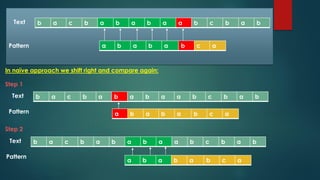
In naïve approach we shift right and compare again:
Step 2
b a c b a b a b a a b c b a b
a b a b a b c a
Text
Pattern
Step 1
b a c b a b a b a a b c b a b
a b a b a b c a
Text
Pattern
But in KMP approach, we can directly skip Step 1
b a c b a b a b a a b c b a b
a b a b a b c a
Text
Pattern
X X
b a c b a b a b a a b c b a b
a b a b a b c a
Text
Pattern
This is a partial match length of 5
The value at prefix-table[partial_match_length - 1] (or prefix-table[4]) is 3.
That means we get to skip ahead
partial_match_length – prefix-table[partial_match_length - 1] (or 5 - table[4] = 5 - 3 = 2) characters:
We skip comparing “b”. The next comparison starts at next “ab” i.e. the prefix match.
In KMP we can directly skip comparing “ab”
This is a partial match length of 3
The value at prefix-table[partial_match_length - 1] (or prefix-table[2]) is 1.
That means we get to skip ahead
partial_match_length – prefix-table[partial_match_length - 1] (or 3 - table[2] = 3 - 1 = 2) characters:
b a c b a b a b a a b c b a b
a b a b a b c a
Text
Pattern
b a c b a b a b a a b c b a b
a b a b a b c a
Text
Pattern X X
We skip comparing “b”. The next comparison starts at next “a” i.e. the prefix match.
Complexity
 O(m) - It is to compute the prefix function values.
 O(n) - It is to compare the pattern to the text.
 Total of O(n + m) run time.

KMP Pattern Search

  • 1.
    KMP Pattern Search QUICKOVERVIEW Created by, Arjun SK arjunsk.com
  • 2.
    What is PatterSearching ? o Suppose you are reading a text document. o You want to search for a word. o You click CTRL + F and search for that word. o The word processor scans the document and shows the position of occurrence. What exactly happens is that, word i.e. pattern is searched inside the text document.
  • 3.
  • 4.
    Naïve Approach The naïveapproach is to check whether the pattern matches the string at every possible position in the string. P = Pattern (word) of length m T = Text (document) of length n Naive string matching algorithm takes time O((n-m+1)m)
  • 5.
    Basic Idea ofKMP a b c d a b c a a a b c b a b a b c d a b c d Text Pattern Text Pattern We can find the next position for comparison, by looking at the pattern. a b c d a b c a a a b c b a b a b c d a b c d
  • 6.
    KMP (Knuth-Morris-Prattern StringMatching Algorithm) Why KMP? Best known for linear time for exact pattern matching. How is it implemented? o We find patterns within the search pattern. o When a pattern comparison partially fails, we can skip to next occurrence of prefix pattern. o In this way, we can skip trivial comparisons.
  • 7.
    Pre-processing Let’s say we’rematching the pattern “abababca” against the text “bacbababaabcbab”. Here’s our prefix match table : i.e. prefix-table[i] index 0 1 2 3 4 5 6 7 char a b a b a b c a value 0 0 1 2 3 4 0 1 Matching prefix i.e. a Matching prefix i.e. ab Matching prefix i.e. aba Matching prefix i.e. abab No matching prefix
  • 8.
    Pre-processing - cont. •partial_match_length = length of the matched pattern in a step. • prefix-table = pre-processed prefix table • If prefix-table[ partial_match_length ] > 1 we may skip ahead partial_match_length - prefix-table[ partial_match_length – 1 ] characters. // Used to skip, already compared prefix match in the pattern.
  • 9.
    Searching b a cb a b a b a a b c b a b a b a b a b c a Text Pattern b a c b a b a b a a b c b a b a b a b a b c a Text Pattern This is a partial match length of 1 The value at prefix-table[partial_match_length - 1] (or prefix-table[0]) is 0. so we don’t get to skip ahead any.
  • 10.
    b a cb a b a b a a b c b a b a b a b a b c a Text Pattern b a c b a b a b a a b c b a b a b a b a b c a Text Pattern
  • 11.
    b a cb a b a b a a b c b a b a b a b a b c a Text Pattern In naïve approach we shift right and compare again: Step 2 b a c b a b a b a a b c b a b a b a b a b c a Text Pattern Step 1 b a c b a b a b a a b c b a b a b a b a b c a Text Pattern
  • 12.
    But in KMPapproach, we can directly skip Step 1 b a c b a b a b a a b c b a b a b a b a b c a Text Pattern X X b a c b a b a b a a b c b a b a b a b a b c a Text Pattern This is a partial match length of 5 The value at prefix-table[partial_match_length - 1] (or prefix-table[4]) is 3. That means we get to skip ahead partial_match_length – prefix-table[partial_match_length - 1] (or 5 - table[4] = 5 - 3 = 2) characters: We skip comparing “b”. The next comparison starts at next “ab” i.e. the prefix match.
  • 13.
    In KMP wecan directly skip comparing “ab” This is a partial match length of 3 The value at prefix-table[partial_match_length - 1] (or prefix-table[2]) is 1. That means we get to skip ahead partial_match_length – prefix-table[partial_match_length - 1] (or 3 - table[2] = 3 - 1 = 2) characters: b a c b a b a b a a b c b a b a b a b a b c a Text Pattern b a c b a b a b a a b c b a b a b a b a b c a Text Pattern X X We skip comparing “b”. The next comparison starts at next “a” i.e. the prefix match.
  • 14.
    Complexity  O(m) -It is to compute the prefix function values.  O(n) - It is to compare the pattern to the text.  Total of O(n + m) run time.