2
String Searching
• Theprevious slide is not a great example of what is meant
by “String Searching.” Nor is it meant to ridicule people
without eyes....
• The object of string searching is to find the location of a
specific text pattern within a larger body of text (e.g., a
sentence, a paragraph, a book, etc.).
• As with most algorithms, the main considerations for string
searching are speed and efficiency.
• There are a number of string searching algorithms in
existence today, but the three we shall review are Brute
Force,Rabin-Karp, and Knuth-Morris-Pratt.
3.
3
Brute Force
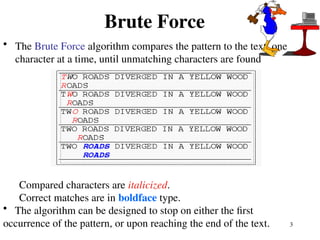
• TheBrute Force algorithm compares the pattern to the text, one
character at a time, until unmatching characters are found
Compared characters are italicized.
Correct matches are in boldface type.
• The algorithm can be designed to stop on either the first
occurrence of the pattern, or upon reaching the end of the text.
4.
4
Brute Force Pseudo-Code
•Here’s the pseudo-code
do if (text letter == pattern letter)
compare next letter of pattern to next
letter of text
else move pattern down text by one letter
while (entire pattern found or end of text)
5.
5
Brute Force-Complexity
• Givena pattern M characters in length, and a text N characters in
length...
• Worst case: compares pattern to each substring of text of length M.
For example, M=5.
• This kind of case can occur for image data.
Total number of comparisons: M (N-M+1)
Worst case time complexity: O(MN)
6.
6
Brute Force-Complexity(cont.)
• Givena pattern M characters in length, and a text N characters in
length...
• Best case if pattern found: Finds pattern in first M positions of text.
For example, M=5.
Total number of comparisons: M
Best case time complexity: O(M)
7.
7
Brute Force-Complexity(cont.)
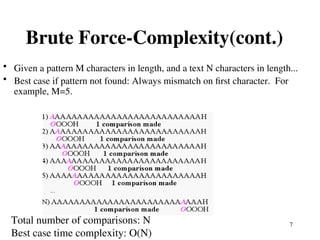
• Givena pattern M characters in length, and a text N characters in length...
• Best case if pattern not found: Always mismatch on first character. For
example, M=5.
Total number of comparisons: N
Best case time complexity: O(N)
8.
8
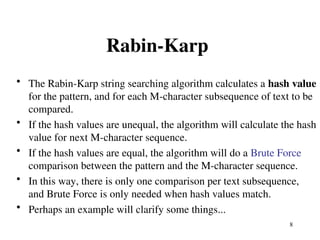
Rabin-Karp
• The Rabin-Karpstring searching algorithm calculates a hash value
for the pattern, and for each M-character subsequence of text to be
compared.
• If the hash values are unequal, the algorithm will calculate the hash
value for next M-character sequence.
• If the hash values are equal, the algorithm will do a Brute Force
comparison between the pattern and the M-character sequence.
• In this way, there is only one comparison per text subsequence,
and Brute Force is only needed when hash values match.
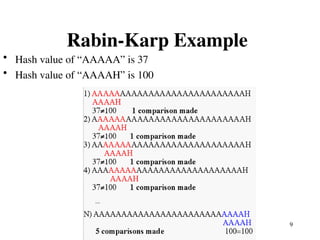
• Perhaps an example will clarify some things...
10
Rabin-Karp Algorithm
pattern isM characters long
hash_p=hash value of pattern
hash_t=hash value of first M letters in body of text
do
if (hash_p == hash_t)
brute force comparison of pattern
and selected section of text
hash_t= hash value of next section of text, one character over
while (end of text or
brute force comparison == true)
11.
11
Rabin-Karp
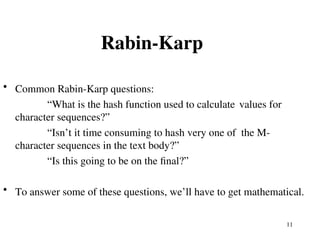
• Common Rabin-Karpquestions:
“What is the hash function used to calculate values for
character sequences?”
“Isn’t it time consuming to hash very one of the M-
character sequences in the text body?”
“Is this going to be on the final?”
• To answer some of these questions, we’ll have to get mathematical.
12.
12
Rabin-Karp Math
• Consideran M-character sequence as an M-digit number in base b, where b is the number
of letters in the alphabet. The text subsequence t[i .. i+M-1] is mapped to the number
• Furthermore, given x(i) we can compute x(i+1) for the next
subsequence t[i+1 .. i+M] in constant time, as follows:
• In this way, we never explicitly compute a new value. We
simply adjust the existing value as we move over one
character.
13.
13
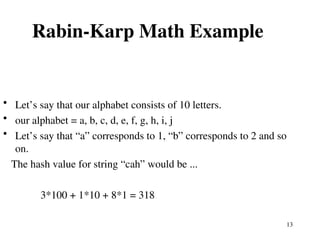
Rabin-Karp Math Example
•Let’s say that our alphabet consists of 10 letters.
• our alphabet = a, b, c, d, e, f, g, h, i, j
• Let’s say that “a” corresponds to 1, “b” corresponds to 2 and so
on.
The hash value for string “cah” would be ...
3*100 + 1*10 + 8*1 = 318
14.
14
Rabin-Karp Mods
• IfM is large, then the resulting value (~bM) will be enormous. For this reason, we
hash the value by taking it mod a prime number q.
• The mod function (% in Java) is particularly useful in this case due to several of its
inherent properties:
[(x mod q) + (y mod q)] mod q = (x+y) mod q
(x mod q) mod q = x mod q
• For these reasons:
h(i)=((t[i] bM-1 mod q) +(t[i+1] bM-2 mod q) + ...
+(t[i+M-1] mod q))mod q
h(i+1) =( h(i) b mod q
Shift left one digit
-t[i] bM
mod q
Subtract leftmost digit
+t[i+M] mod q )
Add new rightmost digit
mod q
15.
15
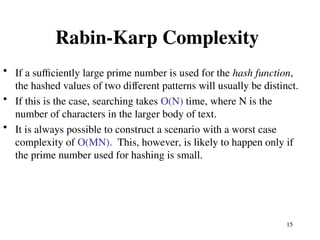
Rabin-Karp Complexity
• Ifa sufficiently large prime number is used for the hash function,
the hashed values of two different patterns will usually be distinct.
• If this is the case, searching takes O(N) time, where N is the
number of characters in the larger body of text.
• It is always possible to construct a scenario with a worst case
complexity of O(MN). This, however, is likely to happen only if
the prime number used for hashing is small.
16.
16
The Knuth-Morris-Pratt Algorithm
•The Knuth-Morris-Pratt (KMP) string searching algorithm differs from the brute-force algorithm by
keeping track of information gained from previous comparisons.
• A failure function (f) is computed that indicates how much of the last comparison can be reused if it
fails.
• Specifically, f is defined to be the longest prefix of the pattern P[0,..,j] that is also a suffix of P[1,..,j]
-Note: not a suffix of P[0,..,j]
• Example:-value of the
• KMP failure function:
• This shows how much of the beginning of the string matches up to the
portion immediately preceding a failed comparison.
-if the comparison fails at (4), we know the a,b in positions 2,3 is identical
to positions 0,1
17.
17
The KMP Algorithm(contd.)
• the KMP string matching algorithm: Pseudo-Code
Algorithm KMPMatch(T,P)
Input: Strings T (text) with n characters and P
(pattern) with m characters.
Output: Starting index of the first substring of T
matching P, or an indication that P is not a
substring of T.
18.
18
Algorithm
f KMPFailureFunction(P){build failure function}
i 0
j 0
while i < n do
if P[j] = T[i] then
if j = m - 1 then
return i - m - 1 {a match}
i i + 1
j j + 1
else if j > 0 then {no match, but we have advanced}
j f(j-1) {j indexes just after matching prefix in P}
else
i i + 1
return “There is no substring of T matching P”
19.
19
The KMP Algorithm(contd.)
• The KMP failure function: Pseudo-Code
Algorithm KMPMatch(T,P)
Input: String P (pattern) with m characters
Output: The failure function f for P, which maps j to
the length of the longest prefix of P that is a suffix
of P[1,..,j]
20.
20
Algorithm
f KMPFailureFunction(P){build failure function}
i 0
j 0
while i m-1 do
if P[j] = T[i] then
if j = m - 1 then
{ we have matched j+1 characters}
f(i) j + 1
i i + 1
j j + 1
else if j > 0 then
j f(j-1) {j indexes just after matching prefix in P}
else {there is no match}
f(i) 0
i i + 1
21.
21
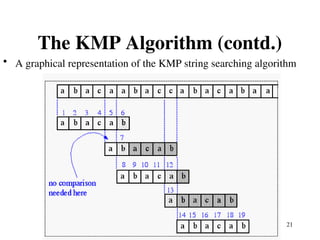
The KMP Algorithm(contd.)
• A graphical representation of the KMP string searching algorithm
22.
22
The KMP Algorithm(contd.)
• Time Complexity Analysis
• define k = i - j
• In every iteration through the while loop, one of three things happens.
1) if T[i] = P[j], then i increases by 1, as does j k remains the same.
2) if T[i] != P[j] and j > 0, then i does not change and k increases by at least 1,
since k changes from i - j to i - f(j-1)
3) if T[i] != P[j] and j = 0, then i increases by 1 and k increases by 1 since j
remains the same.
• Thus, each time through the loop, either i or k increases by at least 1, so the
greatest possible number of loops is 2n
• This of course assumes that f has already been computed.
• However, f is computed in much the same manner as KMPMatch so the time
complexity argument is analogous. KMPFailureFunction is O(m)
• Total Time Complexity: O(n + m)
23.
23
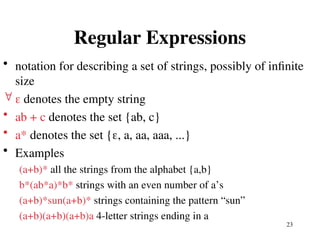
Regular Expressions
• notationfor describing a set of strings, possibly of infinite
size
denotes the empty string
• ab + c denotes the set {ab, c}
• a* denotes the set {, a, aa, aaa, ...}
• Examples
(a+b)* all the strings from the alphabet {a,b}
b*(ab*a)*b* strings with an even number of a’s
(a+b)*sun(a+b)* strings containing the pattern “sun”
(a+b)(a+b)(a+b)a 4-letter strings ending in a




![12
Rabin-Karp Math
• Consider an M-character sequence as an M-digit number in base b, where b is the number
of letters in the alphabet. The text subsequence t[i .. i+M-1] is mapped to the number
• Furthermore, given x(i) we can compute x(i+1) for the next
subsequence t[i+1 .. i+M] in constant time, as follows:
• In this way, we never explicitly compute a new value. We
simply adjust the existing value as we move over one
character.](https://image.slidesharecdn.com/cse408-250817160138-72ab371e/85/Cse408-complete-slide-for-the-4th-semester-12-320.jpg)
![14
Rabin-Karp Mods
• If M is large, then the resulting value (~bM) will be enormous. For this reason, we
hash the value by taking it mod a prime number q.
• The mod function (% in Java) is particularly useful in this case due to several of its
inherent properties:
[(x mod q) + (y mod q)] mod q = (x+y) mod q
(x mod q) mod q = x mod q
• For these reasons:
h(i)=((t[i] bM-1 mod q) +(t[i+1] bM-2 mod q) + ...
+(t[i+M-1] mod q))mod q
h(i+1) =( h(i) b mod q
Shift left one digit
-t[i] bM
mod q
Subtract leftmost digit
+t[i+M] mod q )
Add new rightmost digit
mod q](https://image.slidesharecdn.com/cse408-250817160138-72ab371e/85/Cse408-complete-slide-for-the-4th-semester-14-320.jpg)
![16
The Knuth-Morris-Pratt Algorithm
• The Knuth-Morris-Pratt (KMP) string searching algorithm differs from the brute-force algorithm by
keeping track of information gained from previous comparisons.
• A failure function (f) is computed that indicates how much of the last comparison can be reused if it
fails.
• Specifically, f is defined to be the longest prefix of the pattern P[0,..,j] that is also a suffix of P[1,..,j]
-Note: not a suffix of P[0,..,j]
• Example:-value of the
• KMP failure function:
• This shows how much of the beginning of the string matches up to the
portion immediately preceding a failed comparison.
-if the comparison fails at (4), we know the a,b in positions 2,3 is identical
to positions 0,1](https://image.slidesharecdn.com/cse408-250817160138-72ab371e/85/Cse408-complete-slide-for-the-4th-semester-16-320.jpg)

![18
Algorithm
f KMPFailureFunction(P) {build failure function}
i 0
j 0
while i < n do
if P[j] = T[i] then
if j = m - 1 then
return i - m - 1 {a match}
i i + 1
j j + 1
else if j > 0 then {no match, but we have advanced}
j f(j-1) {j indexes just after matching prefix in P}
else
i i + 1
return “There is no substring of T matching P”](https://image.slidesharecdn.com/cse408-250817160138-72ab371e/85/Cse408-complete-slide-for-the-4th-semester-18-320.jpg)
![19
The KMP Algorithm (contd.)
• The KMP failure function: Pseudo-Code
Algorithm KMPMatch(T,P)
Input: String P (pattern) with m characters
Output: The failure function f for P, which maps j to
the length of the longest prefix of P that is a suffix
of P[1,..,j]](https://image.slidesharecdn.com/cse408-250817160138-72ab371e/85/Cse408-complete-slide-for-the-4th-semester-19-320.jpg)
![20
Algorithm
f KMPFailureFunction(P) {build failure function}
i 0
j 0
while i m-1 do
if P[j] = T[i] then
if j = m - 1 then
{ we have matched j+1 characters}
f(i) j + 1
i i + 1
j j + 1
else if j > 0 then
j f(j-1) {j indexes just after matching prefix in P}
else {there is no match}
f(i) 0
i i + 1](https://image.slidesharecdn.com/cse408-250817160138-72ab371e/85/Cse408-complete-slide-for-the-4th-semester-20-320.jpg)
![22
The KMP Algorithm (contd.)
• Time Complexity Analysis
• define k = i - j
• In every iteration through the while loop, one of three things happens.
1) if T[i] = P[j], then i increases by 1, as does j k remains the same.
2) if T[i] != P[j] and j > 0, then i does not change and k increases by at least 1,
since k changes from i - j to i - f(j-1)
3) if T[i] != P[j] and j = 0, then i increases by 1 and k increases by 1 since j
remains the same.
• Thus, each time through the loop, either i or k increases by at least 1, so the
greatest possible number of loops is 2n
• This of course assumes that f has already been computed.
• However, f is computed in much the same manner as KMPMatch so the time
complexity argument is analogous. KMPFailureFunction is O(m)
• Total Time Complexity: O(n + m)](https://image.slidesharecdn.com/cse408-250817160138-72ab371e/85/Cse408-complete-slide-for-the-4th-semester-22-320.jpg)


![Gp 27[string matching].pptx](https://cdn.slidesharecdn.com/ss_thumbnails/gp27stringmatching-230422183348-6f0879e9-thumbnail.jpg?width=640&height=640&fit=bounds)


