Stress Management
MUS WELLNESS WEBINAR
MARCH 27TH, 2014
1
Manage Your Life Series
 Big Three:
 Stress
 Work
 Home/Personal
 Work/Life Balance
 Pain
 Orthopedic (Knee, Hip, Shoulder, Lower Back)
 Headaches
 Arthritis
 Time
2
Manage Your Life Series
 Stress Management
 Stress defined
 How stress affects our bodies and minds
 Strategies with how to deal with stress
3
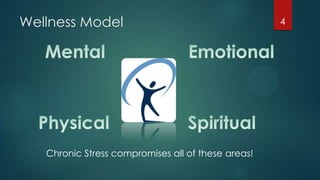
Wellness Model
Chronic Stress compromises all of these areas!
4
A Stressful Question:
 During the past work week, due to busyness or stress, I have:
 Lost at least an hour of sleep
 Skipped a workout
 Skipped a meal
 Made a poor nutritional choice
 Missed a social outing
 Neglected a loved one
5
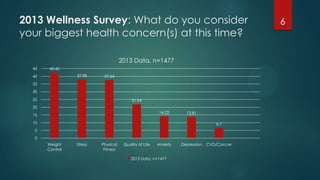
2013 Wellness Survey: What do you consider
your biggest health concern(s) at this time?
42.45
37.98 37.64
21.94
14.22 13.81
6.7
0
5
10
15
20
25
30
35
40
45
Weight
Control
Stress Physical
Fitness
Quality of Life Anxiety Depression CVD/Cancer
2013 Data, n=1477
2013 Data, n=1477
6
Understanding Stress
 What is Stress?
 Traditionally a noun, today also a verb.
 Psychological state of stress
 Physiological response to stress
 Stress, by definition, is something that threatens the body’s state of
equilibrium or homeostasis
 Eustress and Distress
 Eustress is ―positive stress‖, stress that the body and mind need to
perform
 Distress is negative stress
7
The Stress Response
 Fight or Flight!
 Acute effects from stressful stimulus
 Release of adrenaline and other hormones
 Heart Rate (HR), Blood Pressure (BP), Blood sugar, Ventilation, and resting
muscle tension increase
 Blood directed away from extremities and GI tract
 Pupils dilate
 Hearing is more acute
 Sweat
 READY FOR ACTION!!!
8
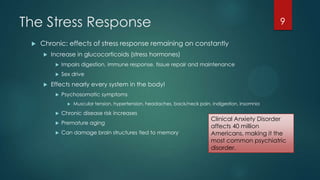
The Stress Response
 Chronic: effects of stress response remaining on constantly
 Increase in glucocorticoids (stress hormones)
 Impairs digestion, immune response, tissue repair and maintenance
 Sex drive
 Effects nearly every system in the body!
 Psychosomatic symptoms
 Muscular tension, hypertension, headaches, back/neck pain, indigestion, insomnia
 Chronic disease risk increases
 Premature aging
 Can damage brain structures tied to memory
9
Clinical Anxiety Disorder
affects 40 million
Americans, making it the
most common psychiatric
disorder.
The Stress Response
 Conditions linked to Chronic Stress
 Hypertension
 Elevated Blood Sugar
 High Cholesterol
 Increased frequency of heart
attack and stroke
 Heart Arrhythmias
 Decreased Mental Acuity
 Headaches
 Pain
 Irritable Bowel Syndrome
 Depression
 Fatigue
 Sleep Disruption
 Heartburn
 Weight fluctuation
 Poor Performance
 Aging
10
The Stress Response
 Chronic Stress and the Human Being
 Brain gets locked into same pattern
 ―Marked by pessimism, fear, and retreat‖ –Ratay, Spark
 ―The mind is so powerful that we can set off the [stress] response
just by imagining ourselves in a threatening situation.‖
 The End of Stress as we Know it, Bruce McEwen, Rockefeller University
Neuroscientist
 Humans are unique in this way—we are the only animal that
can think ourselves into a frenzy, without an actual stress
stimulus.
 “…you lose the capacity to compare the situation to other
memories or to recall that you can grab a jump rope and
immediately relieve the stress or that you have friends to talk to
or that it’s not the end of the world. Positive and realistic
thoughts become less accessible, and eventually brain
chemistry can shift toward anxiety or depression.‖
 Ratay, Spark
11
Key Stressors
 Drastic Changes
 Loss of Control
 Loss
 Positive Life events cause stress too!
 Marriage, birth of child, etc.
 Work
 Minor Stressors
 Accumulation
Holmes and Rahe Stress Scale
1. Death of a spouse
2. Divorce
3. Marital Separation
4. Imprisonment
5. Death of close family
member
6. Personal injury or illness
7. Marriage
8. Dismissal from Work
9. Marital reconciliation
10.Change in health of family
member
11.Pregnancy
42. Christmas
12
Don’t Sweat the Small Stuff!
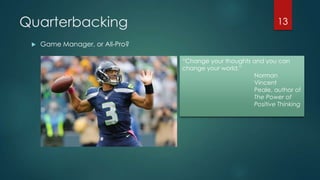
Quarterbacking
 Game Manager, or All-Pro?
13
―Change your thoughts and you can
change your world.‖
Norman
Vincent
Peale, author of
The Power of
Positive Thinking
Stress Hardiness
 Understanding/Envisioning stressors as opportunities, rather than
threats
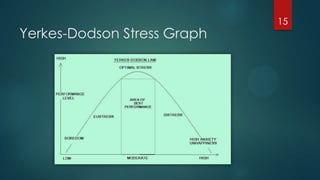
 The ―right‖ amount of tension is required for optimum performance.
 Too much tension—everything has a breaking point.
 For our bodies and mind, a degree of stress is necessary for growth.
 Muscular system
 Cardiovascular system
 Skeletal system
 Central Nervous system as well!
14
Yerkes-Dodson Stress Graph
15
Stress Hardiness
 Achieved by:
 Feeling in control of life circumstances
 Focus on your locus of control—your psychological response to stress
 Sense of commitment to homes, families, and work
 Good social network
 Good self-care
 Balance
16
Stress Management Techniques
 Behavioral Modification
 Cognitive Restructuring
 Changing negative thoughts into
positive or neutral thoughts
 Assertiveness Training
 Learning to say ―no‖
 using ―I‖ statements, strong posture, eye
contact
 Mindful Breathing
 Progressive Relaxation
 Meditation
17
―Today there is an ever-widening gap
between the evolution of our biology and
our society. We don’t have to run from
lions, but we’re stuck with the instinct…The
trick is how you respond. The way you
cope with stress can change not only how
you feel, but also how it transforms [your]
brain.‖
 John J. Ratay, Spark
Stress Management Techniques
 Sleep
 7-8 hours of quality sleep recommended for adults
 1/3 of adults do not get recommended amount
 Sleep deprivation affects ability to:
 Handle Stress
 Control Mood
 Judge Mood of others
 Tolerate Pain
18
Stress Management Techniques
 Exercise
 ―When we exercise in response to stress, we’re doing what human
beings have evolved to do over the past several million years.‖
 John J. Ratay, Spark
 Fight or Flight gets us ready to be physical.
 A 2002 article in the Journal of Applied Physiology studied physical
activity patterns of early man (Paleolithic rhythm)
 Found that modern man’s average energy expenditure per unit of body
mass is less than 38% of our early ancestors.
 Paleolithic man had to walk 5 to 10 miles on average per day, in order to find
food to survive.
 10,000 Steps!!!
19
Stress Management Techniques
 Stress and Exercise Research in the Literature
 2004 Study at Leeds Metropolitan University in England
 Workers who used company gym were more productive and felt better able
to handle their workloads.
 Based on questionnaire, 65% fared better in colleague interaction, time
management, and meeting deadlines on days in which they exercised.
 Northern Gas Company employees who participate in corporate
exercise program took 80% fewer sick days.
20
Stress Management Techniques
 Nutrition
 People tend to respond to stress in two ways nutritionally: eat too much
or lose appetite
 Best strategy: Eat nutritionally dense, balanced foods on a regular basis
for stable energy
 Reduce added sugars
 Sugars trigger release of endorphins, but can be followed by crash in blood
glucose
 Limit caffeine, alcohol
 Stay Hydrated!
21
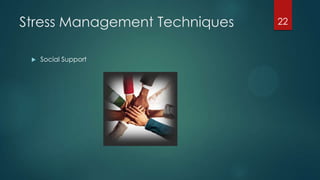
Stress Management Techniques
 Social Support
22
Stress Management Techniques
 Other Avenues:
 Yoga
 Tai Chi
 Massage Therapy
 Aromatherapy
 Pet Therapy
 Mental Imagery/Guided Imagery
 Time Management (Fall Webinar!)
 Planning and Prioritizing
 Music
 Hobbies
 Biofeedback
 Autogenic Training
23
Counseling Benefit
 MUS insured plan members eligible for 4 free counseling sessions per
year with an in-network provider
24
Life is Difficult
 ―Life is difficult. This is a great truth, one of the greatest truths. It is a
great truth because once we truly see this truth, we transcend it.
Once we truly know that life is difficult—once we truly understand
and accept it—then life is no longer difficult. Because once it is
accepted, the fact that life is difficult no longer matters…
 Life is a series of problems. Do we want to moan about them or
solve them? Do we want to teach our children to solve them?‖
 Excerpt from opening page of The Road Less Traveled, M. Scott Peck.
25
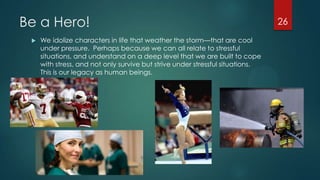
Be a Hero!
 We idolize characters in life that weather the storm—that are cool
under pressure. Perhaps because we can all relate to stressful
situations, and understand on a deep level that we are built to cope
with stress, and not only survive but strive under stressful situations.
This is our legacy as human beings.
26
Sources
 The Relaxation & Stress Reduction Workbook, 6th ed.
Davis, Eshelman, & McKay.
 Stressaholic, Heidi Hanna.
 Spark, The Revolutionary New Science of Exercise and the
Brain, John J. Ratey.
 Managing Stress, Brian Luke Seaward.
 The Healthiest You, Kelly Traver.
27
Upcoming Events
 4/1 Meal Planning Made Easy, MSU Northern, Havre
 4/2 Strong Back, Healthy Back, MSU Northern, Havre
 4/3 Exercise Room Workshops, Great Falls College
 4/9 TBA, Montana Tech, Butte
 4/15 Whole Grain Goodness, MSU Billings
 4/16 Strong Back, Healthy Back, City College, Billings
 4/17 Whole Grain Goodness, Dawson CC, Glendive
 4/17 Beyond Crunches, Dawson CC, Glendive
 4/29 Strong Back, Healthy Back, MSU Bozeman
 4/30 Whole Grain Goodness, MSU Bozeman
 5/1 Sitting is the New Smoking 2 (Webinar)
 5/6 Move Your Body, UM Missoula
 5/7 Tiny Steps, Big Changes, Missoula College
 5/8 Healthy Weight Basics, UM Missoula
28
Online Resources
 wellness.mus.edu
 montanamovesandmeals.com
 wellness@montana.edu
29
30

Stress management (MUS Wellness Webinar)

  • 1.
    Stress Management MUS WELLNESSWEBINAR MARCH 27TH, 2014 1
  • 2.
    Manage Your LifeSeries  Big Three:  Stress  Work  Home/Personal  Work/Life Balance  Pain  Orthopedic (Knee, Hip, Shoulder, Lower Back)  Headaches  Arthritis  Time 2
  • 3.
    Manage Your LifeSeries  Stress Management  Stress defined  How stress affects our bodies and minds  Strategies with how to deal with stress 3
  • 4.
    Wellness Model Chronic Stresscompromises all of these areas! 4
  • 5.
    A Stressful Question: During the past work week, due to busyness or stress, I have:  Lost at least an hour of sleep  Skipped a workout  Skipped a meal  Made a poor nutritional choice  Missed a social outing  Neglected a loved one 5
  • 6.
    2013 Wellness Survey:What do you consider your biggest health concern(s) at this time? 42.45 37.98 37.64 21.94 14.22 13.81 6.7 0 5 10 15 20 25 30 35 40 45 Weight Control Stress Physical Fitness Quality of Life Anxiety Depression CVD/Cancer 2013 Data, n=1477 2013 Data, n=1477 6
  • 7.
    Understanding Stress  Whatis Stress?  Traditionally a noun, today also a verb.  Psychological state of stress  Physiological response to stress  Stress, by definition, is something that threatens the body’s state of equilibrium or homeostasis  Eustress and Distress  Eustress is ―positive stress‖, stress that the body and mind need to perform  Distress is negative stress 7
  • 8.
    The Stress Response Fight or Flight!  Acute effects from stressful stimulus  Release of adrenaline and other hormones  Heart Rate (HR), Blood Pressure (BP), Blood sugar, Ventilation, and resting muscle tension increase  Blood directed away from extremities and GI tract  Pupils dilate  Hearing is more acute  Sweat  READY FOR ACTION!!! 8
  • 9.
    The Stress Response Chronic: effects of stress response remaining on constantly  Increase in glucocorticoids (stress hormones)  Impairs digestion, immune response, tissue repair and maintenance  Sex drive  Effects nearly every system in the body!  Psychosomatic symptoms  Muscular tension, hypertension, headaches, back/neck pain, indigestion, insomnia  Chronic disease risk increases  Premature aging  Can damage brain structures tied to memory 9 Clinical Anxiety Disorder affects 40 million Americans, making it the most common psychiatric disorder.
  • 10.
    The Stress Response Conditions linked to Chronic Stress  Hypertension  Elevated Blood Sugar  High Cholesterol  Increased frequency of heart attack and stroke  Heart Arrhythmias  Decreased Mental Acuity  Headaches  Pain  Irritable Bowel Syndrome  Depression  Fatigue  Sleep Disruption  Heartburn  Weight fluctuation  Poor Performance  Aging 10
  • 11.
    The Stress Response Chronic Stress and the Human Being  Brain gets locked into same pattern  ―Marked by pessimism, fear, and retreat‖ –Ratay, Spark  ―The mind is so powerful that we can set off the [stress] response just by imagining ourselves in a threatening situation.‖  The End of Stress as we Know it, Bruce McEwen, Rockefeller University Neuroscientist  Humans are unique in this way—we are the only animal that can think ourselves into a frenzy, without an actual stress stimulus.  “…you lose the capacity to compare the situation to other memories or to recall that you can grab a jump rope and immediately relieve the stress or that you have friends to talk to or that it’s not the end of the world. Positive and realistic thoughts become less accessible, and eventually brain chemistry can shift toward anxiety or depression.‖  Ratay, Spark 11
  • 12.
    Key Stressors  DrasticChanges  Loss of Control  Loss  Positive Life events cause stress too!  Marriage, birth of child, etc.  Work  Minor Stressors  Accumulation Holmes and Rahe Stress Scale 1. Death of a spouse 2. Divorce 3. Marital Separation 4. Imprisonment 5. Death of close family member 6. Personal injury or illness 7. Marriage 8. Dismissal from Work 9. Marital reconciliation 10.Change in health of family member 11.Pregnancy 42. Christmas 12 Don’t Sweat the Small Stuff!
  • 13.
    Quarterbacking  Game Manager,or All-Pro? 13 ―Change your thoughts and you can change your world.‖ Norman Vincent Peale, author of The Power of Positive Thinking
  • 14.
    Stress Hardiness  Understanding/Envisioningstressors as opportunities, rather than threats  The ―right‖ amount of tension is required for optimum performance.  Too much tension—everything has a breaking point.  For our bodies and mind, a degree of stress is necessary for growth.  Muscular system  Cardiovascular system  Skeletal system  Central Nervous system as well! 14
  • 15.
  • 16.
    Stress Hardiness  Achievedby:  Feeling in control of life circumstances  Focus on your locus of control—your psychological response to stress  Sense of commitment to homes, families, and work  Good social network  Good self-care  Balance 16
  • 17.
    Stress Management Techniques Behavioral Modification  Cognitive Restructuring  Changing negative thoughts into positive or neutral thoughts  Assertiveness Training  Learning to say ―no‖  using ―I‖ statements, strong posture, eye contact  Mindful Breathing  Progressive Relaxation  Meditation 17 ―Today there is an ever-widening gap between the evolution of our biology and our society. We don’t have to run from lions, but we’re stuck with the instinct…The trick is how you respond. The way you cope with stress can change not only how you feel, but also how it transforms [your] brain.‖  John J. Ratay, Spark
  • 18.
    Stress Management Techniques Sleep  7-8 hours of quality sleep recommended for adults  1/3 of adults do not get recommended amount  Sleep deprivation affects ability to:  Handle Stress  Control Mood  Judge Mood of others  Tolerate Pain 18
  • 19.
    Stress Management Techniques Exercise  ―When we exercise in response to stress, we’re doing what human beings have evolved to do over the past several million years.‖  John J. Ratay, Spark  Fight or Flight gets us ready to be physical.  A 2002 article in the Journal of Applied Physiology studied physical activity patterns of early man (Paleolithic rhythm)  Found that modern man’s average energy expenditure per unit of body mass is less than 38% of our early ancestors.  Paleolithic man had to walk 5 to 10 miles on average per day, in order to find food to survive.  10,000 Steps!!! 19
  • 20.
    Stress Management Techniques Stress and Exercise Research in the Literature  2004 Study at Leeds Metropolitan University in England  Workers who used company gym were more productive and felt better able to handle their workloads.  Based on questionnaire, 65% fared better in colleague interaction, time management, and meeting deadlines on days in which they exercised.  Northern Gas Company employees who participate in corporate exercise program took 80% fewer sick days. 20
  • 21.
    Stress Management Techniques Nutrition  People tend to respond to stress in two ways nutritionally: eat too much or lose appetite  Best strategy: Eat nutritionally dense, balanced foods on a regular basis for stable energy  Reduce added sugars  Sugars trigger release of endorphins, but can be followed by crash in blood glucose  Limit caffeine, alcohol  Stay Hydrated! 21
  • 22.
  • 23.
    Stress Management Techniques Other Avenues:  Yoga  Tai Chi  Massage Therapy  Aromatherapy  Pet Therapy  Mental Imagery/Guided Imagery  Time Management (Fall Webinar!)  Planning and Prioritizing  Music  Hobbies  Biofeedback  Autogenic Training 23
  • 24.
    Counseling Benefit  MUSinsured plan members eligible for 4 free counseling sessions per year with an in-network provider 24
  • 25.
    Life is Difficult ―Life is difficult. This is a great truth, one of the greatest truths. It is a great truth because once we truly see this truth, we transcend it. Once we truly know that life is difficult—once we truly understand and accept it—then life is no longer difficult. Because once it is accepted, the fact that life is difficult no longer matters…  Life is a series of problems. Do we want to moan about them or solve them? Do we want to teach our children to solve them?‖  Excerpt from opening page of The Road Less Traveled, M. Scott Peck. 25
  • 26.
    Be a Hero! We idolize characters in life that weather the storm—that are cool under pressure. Perhaps because we can all relate to stressful situations, and understand on a deep level that we are built to cope with stress, and not only survive but strive under stressful situations. This is our legacy as human beings. 26
  • 27.
    Sources  The Relaxation& Stress Reduction Workbook, 6th ed. Davis, Eshelman, & McKay.  Stressaholic, Heidi Hanna.  Spark, The Revolutionary New Science of Exercise and the Brain, John J. Ratey.  Managing Stress, Brian Luke Seaward.  The Healthiest You, Kelly Traver. 27
  • 28.
    Upcoming Events  4/1Meal Planning Made Easy, MSU Northern, Havre  4/2 Strong Back, Healthy Back, MSU Northern, Havre  4/3 Exercise Room Workshops, Great Falls College  4/9 TBA, Montana Tech, Butte  4/15 Whole Grain Goodness, MSU Billings  4/16 Strong Back, Healthy Back, City College, Billings  4/17 Whole Grain Goodness, Dawson CC, Glendive  4/17 Beyond Crunches, Dawson CC, Glendive  4/29 Strong Back, Healthy Back, MSU Bozeman  4/30 Whole Grain Goodness, MSU Bozeman  5/1 Sitting is the New Smoking 2 (Webinar)  5/6 Move Your Body, UM Missoula  5/7 Tiny Steps, Big Changes, Missoula College  5/8 Healthy Weight Basics, UM Missoula 28
  • 29.
    Online Resources  wellness.mus.edu montanamovesandmeals.com  wellness@montana.edu 29
  • 30.