Strategy for Product
Development
Presentation by Ramkumar Ramachandran
Vision Statement
 To create a product line that is matured
enough to address all the industry needs
and could be deployed with minimal
customization
Business Objective
 Understand the industry’s needs
thoroughly
 Incorporate the features in the product in
a controlled fashion
 Do a strong gap analysis
 Have minimal customization
 Maintain an effective help desk
Technical Objective
 Have a strong SCCB
 Create good amount of RUSAs
 Create a ‘highly configurable’ product
 Create an effective ‘patch management’
system
 Maintain ‘clean code’
Today’s Situation
 Where is the product?
 Where is the base source?
 Where is the base requirements?
 What is the product maturity?
 Which is the ‘right source’?
How Did We Get Here?
 Products are projects
 Base product defects + Customization defects
 Cloned source Vs. Referred source
 Understanding of product features by Pre-Sales
 Aggressive timelines due to over commitments
 Person committing and person delivering are
different
Process for productizing
 Product Readiness Stage
 Product Identification
 Product enrichment before launch
 SCCB formation
 Base product certification
 Internal product training for Pre-Sales
 Intra product team training
Process for productizing (contd.)
 Pre-Sales activities
 Identifying customers
 On-field gap study – only after being ‘trained’
 Contract finalization based on OGS
Process for productizing (contd.)
 Specific Implementation
 Detailed Gap Analysis in SpecImp
 DGA within the framework of OGS
 Conflict resolution OGS Vs. DGA
 Branch identification
 Requirements & Relation Management
Base module
SpecImp need
Process for productizing (contd.)
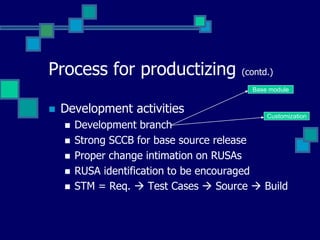
 Development activities
 Development branch
 Strong SCCB for base source release
 Proper change intimation on RUSAs
 RUSA identification to be encouraged
 STM = Req.  Test Cases  Source  Build
Base module
Customization
Process for productizing (contd.)
 Certification
 Defects routing
 Defects tracking
 Defects deferring
 Defects bouncing
 Known defects publishing for every release
 On-the-fly bug-fixing for base source - Ideal
Base module
Customization
Process for productizing (contd.)
 Product Implementation Plan
 Environment study
 Infrastructure upgrade – if needed
 End user training
 Dry / Parallel run
 User Acceptance
 On field defect handling / tracking
Process for productizing (contd.)
 Implementation signoff
 Customer signoff
 Customer satisfaction measurement
 Defined warranty period
Process for productizing (contd.)
 Product Help Desk
 Help Desk  Domain / Product specialists
 Paid support / Warranty Support
 Defects simulation & classification
 Defects reporting to Certification team
 Defects tracking by Certification team
Process for productizing (contd.)
 Patch Release Management
 Generic Patch release for all implementations
 Specific Patch for SpecImp customization
 Patches to be product-version-aware
Process for productizing (contd.)
 Numbers to be controlled
 Variance between OGS and DGA
 Customization Effort Vs. Base product effort
 RUSA size Vs. Customization size
 TimeToGoLive
 Patches released for a period
 Product Maturity Index
Recommendation
 Task force formation
 Process Creation
 Process training
 Process implementation
 Results monitoring
 Fine tune process
Thank You…!

Strategy for Product Development

  • 1.
  • 2.
    Vision Statement  Tocreate a product line that is matured enough to address all the industry needs and could be deployed with minimal customization
  • 3.
    Business Objective  Understandthe industry’s needs thoroughly  Incorporate the features in the product in a controlled fashion  Do a strong gap analysis  Have minimal customization  Maintain an effective help desk
  • 4.
    Technical Objective  Havea strong SCCB  Create good amount of RUSAs  Create a ‘highly configurable’ product  Create an effective ‘patch management’ system  Maintain ‘clean code’
  • 5.
    Today’s Situation  Whereis the product?  Where is the base source?  Where is the base requirements?  What is the product maturity?  Which is the ‘right source’?
  • 6.
    How Did WeGet Here?  Products are projects  Base product defects + Customization defects  Cloned source Vs. Referred source  Understanding of product features by Pre-Sales  Aggressive timelines due to over commitments  Person committing and person delivering are different
  • 7.
    Process for productizing Product Readiness Stage  Product Identification  Product enrichment before launch  SCCB formation  Base product certification  Internal product training for Pre-Sales  Intra product team training
  • 8.
    Process for productizing(contd.)  Pre-Sales activities  Identifying customers  On-field gap study – only after being ‘trained’  Contract finalization based on OGS
  • 9.
    Process for productizing(contd.)  Specific Implementation  Detailed Gap Analysis in SpecImp  DGA within the framework of OGS  Conflict resolution OGS Vs. DGA  Branch identification  Requirements & Relation Management Base module SpecImp need
  • 10.
    Process for productizing(contd.)  Development activities  Development branch  Strong SCCB for base source release  Proper change intimation on RUSAs  RUSA identification to be encouraged  STM = Req.  Test Cases  Source  Build Base module Customization
  • 11.
    Process for productizing(contd.)  Certification  Defects routing  Defects tracking  Defects deferring  Defects bouncing  Known defects publishing for every release  On-the-fly bug-fixing for base source - Ideal Base module Customization
  • 12.
    Process for productizing(contd.)  Product Implementation Plan  Environment study  Infrastructure upgrade – if needed  End user training  Dry / Parallel run  User Acceptance  On field defect handling / tracking
  • 13.
    Process for productizing(contd.)  Implementation signoff  Customer signoff  Customer satisfaction measurement  Defined warranty period
  • 14.
    Process for productizing(contd.)  Product Help Desk  Help Desk  Domain / Product specialists  Paid support / Warranty Support  Defects simulation & classification  Defects reporting to Certification team  Defects tracking by Certification team
  • 15.
    Process for productizing(contd.)  Patch Release Management  Generic Patch release for all implementations  Specific Patch for SpecImp customization  Patches to be product-version-aware
  • 16.
    Process for productizing(contd.)  Numbers to be controlled  Variance between OGS and DGA  Customization Effort Vs. Base product effort  RUSA size Vs. Customization size  TimeToGoLive  Patches released for a period  Product Maturity Index
  • 17.
    Recommendation  Task forceformation  Process Creation  Process training  Process implementation  Results monitoring  Fine tune process
  • 18.